EP3152595B1 - Dispositif de detection de radiations et systeme de detection associe - Google Patents
Dispositif de detection de radiations et systeme de detection associe Download PDFInfo
- Publication number
- EP3152595B1 EP3152595B1 EP15725365.9A EP15725365A EP3152595B1 EP 3152595 B1 EP3152595 B1 EP 3152595B1 EP 15725365 A EP15725365 A EP 15725365A EP 3152595 B1 EP3152595 B1 EP 3152595B1
- Authority
- EP
- European Patent Office
- Prior art keywords
- cable
- flexible cable
- radiation
- osl
- optical
- Prior art date
- Legal status (The legal status is an assumption and is not a legal conclusion. Google has not performed a legal analysis and makes no representation as to the accuracy of the status listed.)
- Active
Links
Images


Classifications
-
- G—PHYSICS
- G01—MEASURING; TESTING
- G01T—MEASUREMENT OF NUCLEAR OR X-RADIATION
- G01T1/00—Measuring X-radiation, gamma radiation, corpuscular radiation, or cosmic radiation
- G01T1/02—Dosimeters
- G01T1/10—Luminescent dosimeters
-
- G—PHYSICS
- G01—MEASURING; TESTING
- G01T—MEASUREMENT OF NUCLEAR OR X-RADIATION
- G01T1/00—Measuring X-radiation, gamma radiation, corpuscular radiation, or cosmic radiation
- G01T1/16—Measuring radiation intensity
- G01T1/20—Measuring radiation intensity with scintillation detectors
- G01T1/2012—Measuring radiation intensity with scintillation detectors using stimulable phosphors, e.g. stimulable phosphor sheets
-
- G—PHYSICS
- G01—MEASURING; TESTING
- G01T—MEASUREMENT OF NUCLEAR OR X-RADIATION
- G01T1/00—Measuring X-radiation, gamma radiation, corpuscular radiation, or cosmic radiation
- G01T1/16—Measuring radiation intensity
- G01T1/20—Measuring radiation intensity with scintillation detectors
- G01T1/2002—Optical details, e.g. reflecting or diffusing layers
-
- G—PHYSICS
- G01—MEASURING; TESTING
- G01T—MEASUREMENT OF NUCLEAR OR X-RADIATION
- G01T1/00—Measuring X-radiation, gamma radiation, corpuscular radiation, or cosmic radiation
- G01T1/16—Measuring radiation intensity
- G01T1/20—Measuring radiation intensity with scintillation detectors
- G01T1/201—Measuring radiation intensity with scintillation detectors using scintillating fibres
-
- G—PHYSICS
- G01—MEASURING; TESTING
- G01T—MEASUREMENT OF NUCLEAR OR X-RADIATION
- G01T1/00—Measuring X-radiation, gamma radiation, corpuscular radiation, or cosmic radiation
- G01T1/16—Measuring radiation intensity
- G01T1/20—Measuring radiation intensity with scintillation detectors
- G01T1/203—Measuring radiation intensity with scintillation detectors the detector being made of plastics
-
- G—PHYSICS
- G01—MEASURING; TESTING
- G01T—MEASUREMENT OF NUCLEAR OR X-RADIATION
- G01T7/00—Details of radiation-measuring instruments
Definitions
- the invention relates to a radiation detection device and a detection system capable of determining radiation present in an installation.
- the radiations concerned are, for example, energy photons between 50KeV and 6MeV, or even more, electrons with energy higher than MeV, etc.
- An individual dosimetry is thus deployed at all stages of a fuel cycle, from its preparation to the monitoring of the operation of a plant, to the monitoring of its clean-up for dismantling and the storage of waste following its completion. of construction.
- Decommissioning techniques ie robotics, tele-operation, dosimetry
- Dosimetry makes it possible to optimize the storage and management of waste, anticipate the impact of remediation on the response staff and develop an optimized dismantling scenario in terms of logistics, cost and risk management. .
- Upstream of the cycle dosimetry concerns the monitoring of infrastructure activities in operation (power plants, production plants, etc.).
- a first device disclosed in the patent US 5,665,972 is represented in figure 1 . It comprises a detection element 1 formed of a plurality of thermoluminescent dosimeters, for example four dosimeters, inserted into a support.
- the detection element 1 is fixed on its side walls to flexible metal cables 2.
- Two discs 3a, 3b pierced at their center are arranged on either side of the detector element 1, the flexible metal cables 2 passing through the discs via their piercing.
- the disks 3a, 3b bear against the inner wall of the pipe 4, the contamination of which is to be measured.
- the purpose of the discs 3a, 3b is to maintain the detection element 1 substantially along the axis of the pipe by means of pre-tensioning of the cables.
- Two intermediate half-tubes T 1 , T 2 are placed vis-a-vis on the inner wall of the pipe 4 in order to maintain a minimum distance between the two disks.
- the detection of the contamination inside the pipe is made by pulling, moving the detector element 1 inside
- the device represented in figure 1 has disadvantages.
- the presence of the intermediate half-tubes T 1 , T 2 excludes the crossing of curvatures.
- This device can only be used in straight lines.
- thermo-luminescent dosimeters do not allow operational use since they require dismantling the assembly after each exposure, and then transmit the dosimeters to a specialized laboratory to record the measurements.
- a second device disclosed in the patent US 5,665,972 is represented in figure 2 .
- Each detector 5 consists of a miniature Geiger-Muller detector inserted into a protective shell.
- the shells are connected to each other by a carrying cable 6 consisting of two elementary flexible metal cables, each elementary flexible metal cable having a diameter of 1.6 mm.
- the carrier cable 6 has the function of pulling all the detectors in line 4 whose contamination is to be measured.
- An electric cable 7 connects the different detectors 5 to each other. The electric cable 7 serves to power the Geiger-Muller detectors in high voltage and to convey the measurement signals.
- the device of the figure 2 also has disadvantages. Indeed, Geiger-Muller detectors, even miniature, remain relatively large. It is thus not possible to perform dose rate measurements in very small diameter pipes such as, for example, 8mm diameter pipes. Another disadvantage of the Geiger-Muller detectors is that they require the provision of a high voltage and that they are "dazzled" by large dose rates. Furthermore, the transmission of a measurement signal is disturbed as long as the length of the cable is too long (for example, beyond 20m) and the resolution of a miniature Geiger-Muller detector deported by a long length of cable is of the order of mGy / h, which is not sufficient at the ultimate stages of decontamination where the dose rate reaches values of a few ⁇ Gy / h.
- a common disadvantage of the two devices of the prior art described above is that they must be installed by traction, then requiring the presence of access to each of the two ends of the pipe to be analyzed.
- Another common disadvantage of the two devices is that the pipes concerned have a relatively high diameter, typically between 25mm and 50mm.
- the invention does not have the disadvantages mentioned above.
- the invention relates to a radiation detection device comprising at least two radiation detectors distributed in series along a support cable, each detector comprising an optically stimulated luminescence detection element ("Optically Stimulated Luminescence" or OSL). ) optically coupled to at least one optical fiber, each OSL detection element being held opposite a first end of the optical fiber by a mechanical part fixed on the support cable, the mechanical part being held in a cable flexible by means of maintaining, the second ends of each optical fiber opening at the same end of the flexible cable.
- OSL optically stimulated luminescence detection element
- the mechanical part which encloses the support cable comprises a first threaded bore and a second bore aligned with the first bore, the OSL detection element being fixed in a screw itself screwed into the first bore and the optical fiber being fixed in the second bore.
- the holding means comprise a carrier cylinder made of a deformable solid material on which the optical fibers are wound, preferably in a helix.
- a plurality of optical fibers are coupled to the same OSL detection element, the plurality of optical fibers being grouped together in a capillary tube in the form of a bundle of optical fibers.
- an optical fiber containing a plurality of Bragg gratings (“Fiber Bragg Gratings" in English) is inserted into a capillary tube (eg polyimide), and then wound in the same way as the other optical fibers to lead to the first end of the flexible cable.
- a capillary tube eg polyimide
- the second end of the flexible cable, opposite the first end, is closed by a tip.
- the tip comprises a microphone.
- the support cable is a multi-strand wire.
- the flexible cable is a stapled metal tube.
- the invention also relates to a system for detecting radiation in an installation, the system comprising a radiation detection device according to the invention and means for introducing by propulsion the radiation detection device into the installation.
- the object of the invention is a flexible cable of very small diameter (typically a few millimeters) which contains millimetric or even sub-millimetric miniature sensors delivering a linear mapping (1-D) resistant to radiation levels. high (typically several tens of kGy or more) and can be deported over a long distance (typically several tens of meters or more).
- the procedure that results from the use of the detection device of the invention has a beneficial impact on the organization of work. As shipyards are rarely operational at night, the possibility offered by the device of the invention of a nocturnal exposure makes it possible to reduce organizational constraints. Moreover, the entire sensitive cable can be exposed simultaneously. By way of nonlimiting example, sixteen simultaneous readings per day corresponding to sixteen detectors distributed in the flexible cable can be performed. It is then possible to save time on the inspection of the entire infrastructure (pipe, tanks, building, etc.) by the use of a plurality of cables in accordance with the cable of the invention.
- the detection device consists of optically stimulated luminescence detectors or OSL detectors (Optically Stimulated Luminescence OSL) optically coupled, each at the end of optical fibers serving, on the one hand, to transmit an optical stimulation light to the OSL detector and, on the other hand, to collect the luminescence emitted by the OSL detector, which results from the exposure thereof to the radiation.
- OSL detectors Optically Stimulated Luminescence OSL
- the optical stimulation of the OSL detector simultaneously causes OSL light emission by the detector and the resetting of the detector.
- the detection device of the invention makes it possible to perform an operational measurement during which the cable can be left in place during the entire reading and resetting operation, which is done online. and at a distance.
- the flexible cable equipped with a plurality of optical fiber detectors is deposited at the location where it is desired to record the activity measurements (infrastructure, pipe, tank, etc.) and left in place for a period of time determined by the user depending on the activity sought, the exposure time is even higher than the desired flow is low.
- the doses are deduced from the luminescences recorded following the optical stimulation.
- An average dose rate distribution can then be determined over the entire sensitive range of the cable by establishing the quotient between the measured doses and the chosen exposure time.
- Another advantage of the invention is the absence of electronics in the cable, the latter being deported outside the cable, in a dedicated box. Moreover, advantageously also, the OSL detectors are not thermalized, which leads to the economy of a thermalization electronics.
- the device of the invention makes it possible to save voluminous triaxial cables.
- the presence of miniature OSL detectors and optical fiber bundles of small diameters leads to optimizing the volume of the detection device, thus making it possible to increase the measurement capacity for the same external cable diameter.
- the measurement dynamic in terms of dose rate typically ranges from a few ⁇ Gy / h to about 10 Gy / h, ie between 5 to 7 orders of magnitude (ie equivalent of 17 bits to 24 bits respectively). This range of dose rate is much higher than that of conventional detectors.
- the temperature profile along the flexible cable is determined in parallel with the dose rate profile.
- a measurement of the temperature profile can be performed by a line of Bragg gratings deployed along the cable according to the known methods (cf. S. Melle et al., "Practical fiber-optic Bragg grating strain gauge system", Appl. Opt., 32 (19), 1993, pp. 3601-3609 ). It is then possible to correct the influence of the temperature on the dose measurement. By way of nonlimiting example, the correction may be about 0.3% .K -1 for reduced alumina crystals.
- the OSL sensors have a high radioresistance so that the cable is not disassembled. This property guarantees a saving of time in operation but also a saving of consumable for the operator since the lifespan of the cable can be very important (typically several years). Moreover, since the response of the OSL detectors remains stable as a function of time, the time which separates two consecutive calibrations can be long. By way of nonlimiting example, an annual calibration is sufficient for continuous exposure under 1 Gy / h (calibration every 10 kGy).
- the OSL emission occurs at around 400nm for a stimulation in the range 480nm-550nm.
- the transmission of an optical fiber core of pure silica sheathed fluorine is typically 50 dB / km (0.05 dB / m) at 400 nm.
- the OSL signal is attenuated by a factor 1/2 over a range of 60m. In practice, this requires doubling the integration time required for the detector at the end of the chain compared to that of an equivalent detector, connected close to the instrumentation.
- the flexible cable can thus advantageously have a length of 50 to 60 meters or more, to cover a wide variety of sanitation applications.
- OSL detectors emitting in red or near infrared (MgS: Ce, Sm or Li 2 B 4 O 7 -Mn for example).
- MgS red or near infrared
- the attenuation is then of the order of 8 dB / km so that the OSL signal is attenuated by a factor 1/2 over a range of 400m at the wavelength of 650nm.
- Such a flexible OSL can then cover large areas compatible with very large infrastructures (factories, storage sites, etc.).
- FIG 3 represents a schematic diagram of the essential elements that constitute a radiation detection device according to the invention and the Figures 4A-4D represent detailed views of the detection device of the invention.
- the detectors D i are connected to each other by means of a support cable MB.
- Each detector D i is equipped with a fiber bundle F i .
- the figure 4C represents a longitudinal sectional view of a detector D i .
- the figure 4D represents a cross sectional view of the same detector.
- the flexible cable FL is preferably a flexible metal tube stapled (" interlocked hose" in English).
- the stapled metal flexible tube can be single stapling or double stapling.
- the single staple tube has greater flexibility and a larger inside / outside diameter ratio than the double staple tube, but has less mechanical strength.
- a double stapling flexible tube such as that represented, for example, in Figure 4A is preferred.
- the double stapling flexible tube is made of stainless steel and can be declined over a wide range of nominal diameters, typically between 4 mm and 100 mm.
- the tube has, for example, an internal diameter of 4.8 mm and an external diameter of 8.5 mm.
- the minimum bending radius of the flexible tube is 35mm. Its weight per unit length is, for example, equal to 112 g / m.
- Other cables can also be used such as, for example, flexible metal sleeves based braid coated with a layer of polyvinyl chloride (PVC).
- PVC polyvinyl chloride
- Such flexible metal cables are made from a preformed stainless steel metal strip. Since such cables are capable of being immersed, a polymer coating R is applied externally, for example by coating.
- the coating R also has the advantage of facilitating the propulsion operations (reduction of friction by its smooth character) and decontamination (dismantling context).
- polyethylene PE
- PET polyethylene
- a support cable MB connects the detectors D i to each other.
- the MB support cable is not used to deploy or insert detectors inside a pipe.
- the effort required to deploy or insert the detectors into the pipes is applied to the only flexible cable FL.
- the latter can advantageously withstand a propulsion effort without flaming because, because of its diameter, its bending stiffness moment is much higher than that of the support cable.
- the support cable MB is used only to connect the detectors and maintain a constant spacing between them.
- the size of the detection device of the invention is mainly a function of the diameter of the fiber bundles (generally of the order of 200 ⁇ m to 600 ⁇ m), which diameter has an impact on the detection performance.
- a larger measurement capacity can be achieved by increasing the diameter of the cable or by reducing the diameter of the collection fiber bundles (typically 100 ⁇ m).
- the volume occupied by an elementary detector D i and the optical signal collected are two parameters evolving according to the square of the diameter of the flexible cable FL.
- a capacity increase of a factor of 4 (64 fibers) can be achieved by reducing the beam diameter by a factor of 2.
- the optical fibers used to produce a fiber bundle have a small diameter (typically 100 ⁇ m to 200 ⁇ m). It is thus advantageously possible to wind them easily and to reduce the bending stresses.
- a bundle of fibers consisting of 7 fibers arranged in a hexagonal arrangement is given in Figure 4B .
- the fibers fb are assembled by gluing or inserted into a flexible capillary tube K formed from a radio-resistant polymer, for example silicone, polyurethane, polyethylene or polypropylene. It is also possible to assemble a larger number of fibers of smaller diameter, for example by bundle of 19 fibers.
- the fibers fb have a low sheath / core diameter ratio ("low core / clad ratio" in English) in order to optimize the collection of light.
- the optical fibers are preferably multimode, with a core diameter of between 100 ⁇ m and 200 ⁇ m and have, for example, a numerical aperture NA between 0.22 and 0.48.
- multimode index jump fibers or graded index multimode fibers coated with a hard polymer such as polyimide.
- This polymer is applied in thin films (a few tens of micrometers) and shows good resistance to radiation and temperature.
- a hexagonal fiber bundle has a smaller coverage than a single fiber having the outer diameter of the bundle.
- the surface of a single fiber having the outer diameter of the beam would correspond to 0.283 mm 2 .
- the surface loss is about 30%.
- the rigidity of a fiber increases according to the cube of its diameter.
- the 7-fiber hex beam then has 27 times less flexibility than a single fiber of equivalent diameter and is therefore much easier to wind inside the flexible cable.
- Curvature deformation is the diameter of the fiber divided by twice its radius of curvature. For a fiber diameter of 200 ⁇ m and a minimum radius of curvature of 30mm, the maximum deformation generated by the curvature is about 0.33%, which is acceptable.
- the figure 4C represents a longitudinal sectional view of a detector D i and the figure 4D represents a cross-sectional view of the flexible cable at a detector D i .
- An OSL detector crystal 9 is placed opposite the end of an optical fiber bundle F i .
- the detector crystal 9 and the fiber bundle F i are placed, opposite each other, in two concentric bores of a clamp d.
- a first bore accommodates the optical fiber bundle F i and has, accordingly, a diameter required to accommodate the bundle of fibers, for example 0.6mm.
- the second bore is threaded and accommodates a set screw V, for example stainless steel, which contains the detector crystal 9.
- the detector crystal 9 is fixed downhole, for example by an epoxy type adhesive having a satisfactory mechanical strength to radiation.
- the fiber bundle F i is also fixed in its frame, for example using an epoxy-type adhesive.
- This coupling process between the detector crystal 9 and the fiber bundle F i makes it possible to leave a very small air gap between the crystal and the bundle of fibers. It is also possible that the detector crystal 9 and the end of the fiber bundle F i are in contact with each other. In practice, there is a small air thickness of a few tens of micrometers between the detector crystal 9 and the end of the fiber bundle F i because of their surface state.
- Each clamp is, for example, machined in a parallelepiped of stainless steel of dimensions 3 x 3 x 10 mm 3 approximately.
- the steel parallelepiped is, for example, machined by turning on a first portion and pierced by a hole of a diameter equivalent to that of the support cable, for example a diameter of 1 mm, on a second part. On this second part, the steel parallelepiped is also grooved over a half-length to form a clamp.
- the support cable MB is then engaged in the hole and the clamp clamped on the support cable by two screws VR, for example, stainless steel.
- VR for example, stainless steel.
- the different clamps may succeed one another with variable angular orientations, for example spiral, along the support cable MB.
- the length of the clamps can advantageously be designed according to the minimum curvature that it is necessary to provide the flexible cable FL.
- the length of a linear segment must not exceed 20 mm. Clips of 10 mm in length can then be chosen not to generate the curvature of the flexible cable in operation.
- the figure 4D represents a cross-sectional view of the flexible cable at a detector D i .
- the fiber bundles F j , F k , F l , and so on. which come from the respective detectors D j , D k , D l , etc. (not shown in the figure) are wound, preferably spirally, on a carrier cylinder S made of a deformable solid material, for example a foam cylinder, which surrounds the clamp d (the cylinder S is not shown on the figure 3 for convenience).
- the fiber bundles F j , F k , F l , and so on. are distributed on the carrier cylinder S which is positioned between the inner wall of the flexible cable FL and the clamp d.
- the inner wall of the cable FL is, preferably, covered with a film of grease G able to allow the movement of the fiber bundles.
- the bundles of fibers are wound on the carrier cylinder S before mounting the detectors in the flexible cable FL. In operation, the carrier cylinder S does not advantageously oppose resistance to the movements of the fibers.
- Bragg B gratings are photo-inscribed in a conventional monomode fiber, which fiber is inserted into a wound capillary, in the manner of the optical fiber bundles, around the carrier cylinder S.
- Each Bragg grating B is placed as close as possible to a detector crystal 9.
- the Bragg gratings serve to measure the detector crystal temperature 9.
- Each Bragg grating is photo-inscribed at a different Bragg wavelength which allows its position in the hose to be identified.
- the bending behavior of the sensor cable of the invention is described below, in the case where the internal diameter of the flexible cable is, for example, equal to 4 mm.
- the difference in radius of curvature between two bundles of fibers located at the two ends of an inner diameter of the flexible cable aligned with the radius of curvature of the flexible cable is substantially equal to 4 mm.
- the fiber bundle farthest from the center of the radius of curvature then travels a greater distance than the other bundle of fibers, at a rate of substantially 25 mm per revolution of the cable FL.
- the worst case corresponds to the storage situation for which the flexible cable is always wound in the same direction (cf. Figure 7 ).
- 21 turns are required to wind the complete cable on the drum.
- the length offset between the two bundles of fibers located at both ends of the internal diameter of the cable is then substantially equal to 525 mm (ie 21x25mm).
- the bundles of fibers are wound helically around the axis of the flexible cable.
- each bundle of fiber consequently has a length greater than the length of the rectilinear fraction of the cable.
- the difference between the length of the fiber bundle and the length of the rectilinear fraction of the cable that corresponds to it is called "over-length".
- the propellers have, for example, a pitch of the order of 50 to 60 mm.
- the over-length obtained by helical winding is about 1.55 mm in steps of 50 mm, an over-length of 31 mm / m which is then sufficient to wind the cable on a drum of 150 mm. radius without risk of deterioration.
- the embodiment of the detection device of the invention will now be described.
- the set of detectors D i and fiber bundles F i are firstly wound on the carrier cylinder and covered with grease to, firstly, facilitate their insertion into the flexible cable and, secondly, facilitate movement of the fibers inside the cable during subsequent decontamination operations.
- a wire puller in the form of a rigid rod, of length substantially equal to that of the flexible cable FL, is then connected to the support cable and introduced into the flexible cable, at a first end of the flexible cable.
- the flexible cable is held straight when the wire puller is inserted.
- the wire puller is then released from the flexible cable at the end of the flexible cable opposite the first end, thus causing all detectors D i inside the cable.
- the pull-wire is removed and a protective and sealing tip is positioned at the end of the flexible cable located opposite the end through which the bundles of fibers leave.
- This tip is detailed below with reference to Figures 5A and 5B .
- the support cable MB is cut off and the end thereof is preferably left free.
- the fiber bundles F i , F i , F k , F I , etc., the capillary KP and the support cable MB are connected to a flange. as is detailed with reference to Figures 6 and 7 below.
- the Figures 5A and 5B represent closure elements of the flexible cable.
- the Figure 5A represents a flexible cable closure element according to a first embodiment of the invention.
- the closure element is an EB steel plug which is welded to the end of the flexible cable FL.
- the steel stopper allows the shocks of the cable to be dealt with during the progression of the cable in a pipe.
- the Figure 5B represents a flexible cable closure element according to a second embodiment of the invention.
- the closure element according to the second embodiment of the invention comprises a microphone MC.
- a first part P 1 of the closure element is a frame, preferably made of stainless steel, which is secured to the flexible cable by welding and a second part P 2 is a plug, preferably duralumin, consisting of a screw head hemispherical screwed on the mount.
- the microphone MC is inserted in a cylinder CY, preferably in silicone, to protect it from shocks and embedded in a grease GR which ensures the acoustic coupling with the cap.
- the MC microphone is connected to AL wires.
- the electric wires AL make it possible to electrically power the microphone and to recover the electric signal delivered by the microphone.
- three electrical wires come out of the microphone and are connected, by welding, to three electrical wires present in the flexible cable FL. If necessary, excess thread is wound.
- One of the power leads can be electrically connected to a multi-strand wire to reduce the number of wires in the flex cable.
- the use of a closure element equipped with a microphone occurs, for example, during the deployment in pool of a flexible cable.
- an acoustic localization by ultrasound can be implemented.
- the microphone is, for example a miniature microphone better known as MEMS microphone (MEMS for " Micro-Electrical-Mechanical Systems ").
- MEMS microphone Micro-Electrical-Mechanical Systems
- several microphones may also be arranged in different locations within the flexible cable whose diameter is then adapted to the presence of microphones. It is then possible to account for the deployment of the cable under water. The location is obtained, in a manner known per se, by immersing at least three sound sources in the pool to be inspected.
- One possible mode of operation is to emit sequentially, by each source, a pulsed and periodic sound signal at an arbitrary frequency, for example close to 20 kHz, to reduce the sound overlaps due to echoes on the walls.
- the three signals received sequentially by the MEMS microphones (or microphones) housed in the flexible cable are then synchronized with respect to the respective transmission signals in order to determine the time delays.
- the distance between a microphone housed in the flexible cable and the local mark that carries the three sound sources is then determined from the three measured time delays and the known speed of sound in the water.
- the figure 6 represents a block diagram of a dose rate measurement instrumentation associated with the radiation detection device of the invention.
- the optical fiber bundles protruding from the end of the flexible cable FL located opposite the closure plug constitute a bundle of bundles of fibers E.
- the fiber bundles of the bundle E are connected to an optical switch Q.
- the number of fiber bundles is equal to the number of detectors D i , for example 16.
- the optical switch Q is connected to an optoelectronic detection block 10.
- the optoelectronic detection block 10 contains a laser, a photomultiplier, an electromechanical shutter and filters for filtering the laser light before stimulation of the OSL detectors and the luminescence resulting from the detection, after collection by the bundles of fibers (cf. Magne et al. And radiotherapy. Prot. Dosim. 131 (1), 2008, pp 93-99 ).
- the optoelectronic detection block 10 delivers, from the OSL luminescence reading data, dose rate DB data for each of the OSL detectors.
- the OSL pulse reaches an asymptotic minimum after a T OSL reading time, since most of the traps present in the detector crystal have been emptied (typically 99.9%).
- a measurement of the mean value of the asymptotic minimum is then carried out on the last recording points.
- This average value is then subtracted from the OSL pulse signal over the entire period T OSL .
- the corrected signal resulting from this subtraction is independent of external disturbances and, in particular, the Cerenkov effect.
- the corrected signal is then integrated over the entire time band and then weighted by a calibration coefficient to deduce the integrated dose D over the entire duration of exposure.
- the user can perform a periodic acquisition sequence or a single measurement.
- the protocol advantageously reduces to two phases (exposure and optical stimulation) since the optical stimulation realizes the reset for the next measurement.
- the user can perform several readings on multiple cables in parallel in order to save time on the overall dosimetry of an installation.
- This option is particularly advantageous in a low-dose environment, with high exposure times (of the order of the day, or even the week or the month).
- the reset operations are time-stamped for all lines analyzed in parallel.
- Disconnecting the flexible cable allows the operator to exit the zone during the exposure phase. This phase has little impact on the exposure of personnel and its duration can be chosen as long as it is necessary, the mode of parallel operation to save time on reading.
- an OSL crystalline fiber of 0.5 mm in diameter and 5 mm in length constitutes an interesting compromise.
- the dose resolution is estimated to be about 0.7 mGy with Al 2 O 3 : C crystals.
- the resolution in average dose rate is 0.7 mGy / 18h or 40 ⁇ Gy / h.
- Such a duration can then be obtained easily by triggering integration at the end of the day around 16:00 and by performing the dose readings the next morning around 10:00.
- the resolution in dose rate is then of the order of 0.7 mGy / 168 h, 4 ⁇ Gy / h.
- the detection device of the invention advantageously makes it possible to achieve a high dynamic in terms of dose rate (5 to 7 decades) thanks to the combination of the dose range (3 to 4 decades) and the duration range. exposure (2 to 3 decades).
- the advantage of a 1-D sensitive cable is to take a measurement of several measurements at different points (linear mapping of the activity) simultaneously in order to save time in the dosimetry. Indeed, the readings can then be performed simultaneously in different places and not sequentially as is the case by moving a point sensor on the entire scene to be analyzed.
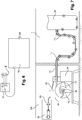
- the figure 7 represents a radiation detection system in an installation that uses a detection device according to the device of the invention.
- the installation may be a contaminated facility or an installation that, without being contaminated, is exposed to radiation.
- installation I is a contaminated installation which must, therefore, be decontaminated.
- the installation to be decontaminated I comprises, for example, a pipe 11 and a tank 12 into which the pipe 11 opens.
- the flexible cable FL equipped with detectors is introduced into line 11 from an uncontaminated zone ZA which is accessible. users.
- the flexible cable FL is introduced into the installation I by means of a propulsion device which comprises an injection tube 13, a motor 14 equipped with a control lever 15, a drum 16 on which the flexible cable is wound and mechanical drive means 17 which connect the motor to the drum.
- the drum 16 is equipped with a multi-fiber connector 18 which connects the second ends of the open-ended optical fibers which open out of the flexible cable to a measuring instrumentation.
- the measurement instrumentation comprises, for example, a multi-fiber optical cable 19, a multi-channel connector 20 and a measurement unit 21.
- the objective is to carry out dose rate readings inside the pipe and the tank and thus to follow the evolution of the sanitation process. Installation I remains inaccessible as long as remediation is not completed.
- the operator has previously disconnected the multifibre optical cable 19 of the drum. In case of forgetfulness, the presence of the connector in its housing prevents the starting of the engine.
- the end of the flexible cable FL initially wound around the drum 16 is engaged in the injection tube 13.
- the injection tube 13 is connected to the inlet of the pipe 11.
- the rotation of the motor 14 is activated at a controlled speed and the mechanical drive means 17 put the reel in rotation.
- the flexible cable FL is then propelled into the pipe 11.
- Drive rollers are used for the propulsion of the flexible cable.
- the driving pressure of the rollers is adjustable up to a maximum value function of the resistance of the cable. For example, for a cable resistant to 200 kg, the maximum effort can be limited to 50 kg to take into account a factor of safety.
- blockage due, for example, to an unexpected decrease in the section of the pipe, there is natural stop of the propulsion and safeguard of the cable as soon as the reaction force is greater than the friction force. The operator must then stop the propulsion operation to analyze the cause of the blockage.
- the core serving as a stopper impacts the injection tube 13 and blocks the cable to avoid destroying the optical link fitted to the drum's hub.
- the drive rollers begin to skate and the operator must then turn off the engine and go into neutral.
- the measurement instrumentation comprises means capable of optically stimulating the OSL detectors.
- the optical stimulation of the OSL detectors can therefore be performed.
- the connection of the measurement instrumentation to the connector 18 deactivates the supply of the motor and prevents the rotation thereof.
- the operator can either leave the measurement instrumentation connected and wait for the end of the exposure, or disconnect the measurement instrumentation to perform the optical stimulation of other flexible cables.
- the measurement instrumentation In all cases, at the end of the exposure time, the measurement instrumentation must be connected to the connector 18 so that the luminescence resulting from the detection of nuclear radiation is read. In the case - not desired - where the operator forgets to connect the measurement instrumentation and still triggers the data acquisition, nothing happens because the flexible cable FL is not connected. The user then sees no signal and an error message appears on the screen informing him of the anomaly. The operator is then asked to connect the measurement instrumentation and to make a reading. On the basis of the luminescence data read, the calculation unit 20 calculates the dose rates.
- the operator again disconnects the multifibre cable 19 of the drum which allows again to run the engine.
- the operator can then engage rewinding of the cable on the reel by operating the lever 15 in the "rewind" position. This operation is performed by rotating a second hub driving a belt which transmits the rotational force to the drum.
- the drum is then rotated in the opposite direction of the direction of phase 1 and the flexible cable FL is rewound, preferably in "zig-zag" (combination of a rotational movement and an alternating translational movement) for distribute the cable evenly over the entire surface of the drum.
- Other rewinding protocols may also be considered.
- temperature measurements can be made in parallel, if necessary, by means of a single-mode fiber present in the multi-fiber optical cable 19 and connected, via the connector 18, to the monomode fiber which contains the Bragg gratings present in the flexible cable.
- an electrical connector retrieves the signal from the microphone (s) incorporated (s) in the flexible cable FL .
- the multi-fiber optical cable 19 is connected to the connector 18 integral with the drum.
- the optical cable 19 is disconnected during the propulsion and rewinding as the reel is rotated during these two phases.
- the optical cable 19 comprises a core (two half-shells) screwed at the end portion (a few tens of centimeters from the end) which serves as a mechanical stop. The course of the cable, guided by a guide tube at the outlet of the drum, is then naturally blocked when the core impacts the guide tube.
- a presence sensor of the plugged in connector triggers a safety preventing the start of the engine in case of oblivion. The presence of the connector disables the power supply of the motor and thus prevents it from turning (and thus destroying the optical cable).
- the use of the 1-D cable of the invention makes it possible to save time on the overall dosimetry of the installation studied and consequently contributes, indirectly, to optimizing the cost of a remediation operation.
- This procedure is particularly interesting from a logistic point of view in low dosing environments characterized by high exposure times (of the order of the day to the week).
- the user can also carry out 2-D readings by deploying N 1-D flexible cables in parallel, for example 8 cables.
- the N 1-D cables are deployed and disconnected simultaneously and the reset and read operations are time-stamped for all curves analyzed in parallel.
- OSL dosimetry times with the duration of a conventional point dosimetry (0-D) performed using a miniature CZT detector (a few mm 3 ) that can be inserted and moved in a pipe.
- the acquisition time is of the order of 15 minutes for a typical dose rate of 6mGy / h (cf. A. Rocher, N. Blanc de Lanaute "Characterizations by gamma spectrometry Cd-Zn-Te of the contamination of the circuits of the nuclear power plants", Congress SFRP 2013, by is).
- OSL dosimetry 1-D / 2-D performed with the device of the invention is faster than 0-D dosimetry performed with a CZT detector.
- the conventional 0-D measurement requires a permanent on-line operator since the readings are performed sequentially.
- the OSL methodology relies on an almost simultaneous reading mode of all the detectors at the same time in an automated way. Thus, the presence of an operator is only required for triggering the OSL read protocol.
- This parallel OSL methodology thus saves time in the actual dosimetry operation as well as in operator time.
- a linear mapping of the activity makes it possible to reduce the measurement uncertainty of statistical origin, for a measurement time identical to that of a single detector moved. Indeed, consider a single point detector (0-D) delivering a measurement of dose rate with a given uncertainty after a time of exposure T. It takes a total time N x T to analyze the N points of measure of the scene.
- the 1-D measurement thus makes it possible to improve the results of measurements of dose rates.
- the measurement uncertainty is, for example, improved by a factor of 4.
- the measurement uncertainty is, for example, improved by a factor of 11 with respect to a unique detector.
Landscapes
- Physics & Mathematics (AREA)
- Health & Medical Sciences (AREA)
- Life Sciences & Earth Sciences (AREA)
- General Physics & Mathematics (AREA)
- High Energy & Nuclear Physics (AREA)
- Molecular Biology (AREA)
- Spectroscopy & Molecular Physics (AREA)
- Measurement Of Radiation (AREA)
Applications Claiming Priority (2)
| Application Number | Priority Date | Filing Date | Title |
|---|---|---|---|
| FR1455032A FR3021755B1 (fr) | 2014-06-03 | 2014-06-03 | Dispositif de detection de radiations et systeme de detection associe |
| PCT/EP2015/062067 WO2015185472A1 (fr) | 2014-06-03 | 2015-06-01 | Dispositif de detection de radiations et systeme de detection associe |
Publications (2)
| Publication Number | Publication Date |
|---|---|
| EP3152595A1 EP3152595A1 (fr) | 2017-04-12 |
| EP3152595B1 true EP3152595B1 (fr) | 2018-07-18 |
Family
ID=51261103
Family Applications (1)
| Application Number | Title | Priority Date | Filing Date |
|---|---|---|---|
| EP15725365.9A Active EP3152595B1 (fr) | 2014-06-03 | 2015-06-01 | Dispositif de detection de radiations et systeme de detection associe |
Country Status (5)
| Country | Link |
|---|---|
| US (1) | US10048388B2 (https=) |
| EP (1) | EP3152595B1 (https=) |
| JP (1) | JP6600648B2 (https=) |
| FR (1) | FR3021755B1 (https=) |
| WO (1) | WO2015185472A1 (https=) |
Families Citing this family (8)
| Publication number | Priority date | Publication date | Assignee | Title |
|---|---|---|---|---|
| JP6932619B2 (ja) * | 2017-11-10 | 2021-09-08 | 株式会社日立製作所 | 放射線モニタ、及び放射線の測定方法 |
| US10613289B2 (en) * | 2018-02-09 | 2020-04-07 | Facebook, Inc. | Apparatuses, systems, and methods for installing fiber optic cable using preexisting electrical power infrastructure |
| US11169351B2 (en) | 2019-01-17 | 2021-11-09 | Facebook, Inc. | Systems and methods for installing fiber optic cable about a powerline conductor |
| US11261130B2 (en) | 2019-05-10 | 2022-03-01 | Facebook, Inc. | Spool-free fiber optic cable configuration for cable installation onto a powerline conductor |
| US11652337B2 (en) | 2019-05-10 | 2023-05-16 | Meta Platforms, Inc. | Systems and methods for installing fiber optic cable onto a powerline conductor |
| CN110361769B (zh) * | 2019-06-26 | 2023-03-24 | 中国船舶重工集团公司第七一九研究所 | 一种基于脉冲光释光技术的准实时γ剂量率测量装置 |
| US11353672B1 (en) | 2019-11-27 | 2022-06-07 | Meta Platforms, Inc. | Components for fiber optic cable installation on a powerline conductor |
| US11262521B1 (en) | 2019-11-27 | 2022-03-01 | Facebook, Inc. | Fiber optic cable assembly for installation on a powerline conductor |
Family Cites Families (8)
| Publication number | Priority date | Publication date | Assignee | Title |
|---|---|---|---|---|
| US5665972A (en) * | 1995-12-29 | 1997-09-09 | Westinghouse Electric Corporation | Method and apparatus for monitoring contamination |
| JP3591275B2 (ja) * | 1998-02-20 | 2004-11-17 | 株式会社日立製作所 | 放射線強度計測装置 |
| JP3894351B2 (ja) * | 1999-03-03 | 2007-03-22 | 独立行政法人 日本原子力研究開発機構 | 輝尽性蛍光体を用いた放射線計測装置及びその計測方法 |
| FR2826733B1 (fr) * | 2001-07-02 | 2003-09-05 | Commissariat Energie Atomique | Capteur de rayonnement, a compensation d'energie et grande ouverture angulaire, pour la dosimetrie a distance, et dispositif de dosimetrie utilisant ce capteur |
| US20060138330A1 (en) * | 2003-03-28 | 2006-06-29 | Ronan Engineering Company | Flexible liquid-filled ionizing radiation scintillator used as a product level detector |
| US7351982B2 (en) * | 2005-05-24 | 2008-04-01 | Washington Savannah River Company Llp | Portable nuclear material detector and process |
| FR2906887B1 (fr) | 2006-10-10 | 2008-12-12 | Genesis France | Dispositif de transport d'une substance muni d'un detecteur optique de fuite |
| US20090321650A1 (en) * | 2008-04-22 | 2009-12-31 | Kadner Steven P | Radiation Security Blanket |
-
2014
- 2014-06-03 FR FR1455032A patent/FR3021755B1/fr not_active Expired - Fee Related
-
2015
- 2015-06-01 JP JP2016570971A patent/JP6600648B2/ja active Active
- 2015-06-01 US US15/315,628 patent/US10048388B2/en active Active
- 2015-06-01 WO PCT/EP2015/062067 patent/WO2015185472A1/fr not_active Ceased
- 2015-06-01 EP EP15725365.9A patent/EP3152595B1/fr active Active
Non-Patent Citations (1)
| Title |
|---|
| None * |
Also Published As
| Publication number | Publication date |
|---|---|
| JP2017523398A (ja) | 2017-08-17 |
| US10048388B2 (en) | 2018-08-14 |
| JP6600648B2 (ja) | 2019-10-30 |
| US20180074214A1 (en) | 2018-03-15 |
| FR3021755B1 (fr) | 2017-06-23 |
| EP3152595A1 (fr) | 2017-04-12 |
| FR3021755A1 (fr) | 2015-12-04 |
| WO2015185472A1 (fr) | 2015-12-10 |
Similar Documents
| Publication | Publication Date | Title |
|---|---|---|
| EP3152595B1 (fr) | Dispositif de detection de radiations et systeme de detection associe | |
| EP2080004B1 (fr) | Dispositif de transport d'une substance muni d'un detecteur optique de fuite | |
| FR3070101A1 (fr) | Ensemble d'amplificateur en ligne pour système de détection distribué | |
| FR2717908A1 (fr) | Appareil de mesure de rayonnement. | |
| WO1994002868A1 (fr) | Appareil de detection et de localisation de marqueurs biologiques radioactifs | |
| EP3757349B1 (fr) | Dispositif de maintenance et procédé pour déterminer la position d'un point de blocage d'un élément tubulaire | |
| EP2269022A2 (fr) | Systeme pour obtenir des informations relativement a une canalisation et procede associe | |
| FR3029344A1 (fr) | Ensemble instrument multithermocouple en coeur et systeme et procede pour surveiller l'etat interne d'un reacteur nucleaire apres un grave accident l'utilisant | |
| JP7177991B2 (ja) | 監視用湿度計測システムおよび監視用湿度計測方法 | |
| CA2860251C (fr) | Dispositif de detection et/ou de dosage d'hydrogene et procede de detection et/ou de dosage d'hydrogene | |
| JP2013501929A (ja) | 新しい放射線検出器 | |
| EP1730467B1 (fr) | Procede pour localiser et mesurer les deformations d'un ouvrage de genie civil | |
| FR3005865A1 (fr) | Dispositif de projection de source pour un traitement de curietherapie | |
| JP2017523398A5 (https=) | ||
| FR2718852A1 (fr) | Dispositif de détection à distance de rayonnement. | |
| EP1273931B1 (fr) | Capteur de rayonnement, à compensation d'énergie et grande ouverture angulaire, pour la dosimètrie à distance | |
| Zaghloul et al. | High spatial resolution radiation detection using distributed fiber sensing technique | |
| EP0247581A1 (fr) | Dispositif de mesure multipoint à fibre optique avec multiplexage temporel | |
| FR2844874A1 (fr) | Procede pour localiser et mesurer les deformations d'un ouvrage de genie civil | |
| WO2017021447A1 (fr) | Dispositif de mesure de niveau de liquide par réflectrométrie optique, structure comprenant un tel dispositif et procédé de mesure correspondant | |
| EP4515199B1 (fr) | Dispositif de detection d'un defaut dans un element structurel en materiau composite | |
| WO2023198801A1 (fr) | Capteur fibré pour l'analyse de l'activité d'un fluide radioactif | |
| FR3095863A1 (fr) | Dispositif d’analyse de rayonnement β et procédé d’analyse associé | |
| WO2026078332A1 (fr) | Systeme de mesure de vibrations comprenant une fibre optique a reseau(x) de bragg | |
| FR3157541A1 (fr) | Procédé de quantification par spectrométrie Raman |
Legal Events
| Date | Code | Title | Description |
|---|---|---|---|
| STAA | Information on the status of an ep patent application or granted ep patent |
Free format text: STATUS: THE INTERNATIONAL PUBLICATION HAS BEEN MADE |
|
| PUAI | Public reference made under article 153(3) epc to a published international application that has entered the european phase |
Free format text: ORIGINAL CODE: 0009012 |
|
| STAA | Information on the status of an ep patent application or granted ep patent |
Free format text: STATUS: REQUEST FOR EXAMINATION WAS MADE |
|
| 17P | Request for examination filed |
Effective date: 20161208 |
|
| AK | Designated contracting states |
Kind code of ref document: A1 Designated state(s): AL AT BE BG CH CY CZ DE DK EE ES FI FR GB GR HR HU IE IS IT LI LT LU LV MC MK MT NL NO PL PT RO RS SE SI SK SM TR |
|
| AX | Request for extension of the european patent |
Extension state: BA ME |
|
| DAV | Request for validation of the european patent (deleted) | ||
| DAX | Request for extension of the european patent (deleted) | ||
| GRAP | Despatch of communication of intention to grant a patent |
Free format text: ORIGINAL CODE: EPIDOSNIGR1 |
|
| STAA | Information on the status of an ep patent application or granted ep patent |
Free format text: STATUS: GRANT OF PATENT IS INTENDED |
|
| INTG | Intention to grant announced |
Effective date: 20180212 |
|
| GRAS | Grant fee paid |
Free format text: ORIGINAL CODE: EPIDOSNIGR3 |
|
| GRAA | (expected) grant |
Free format text: ORIGINAL CODE: 0009210 |
|
| STAA | Information on the status of an ep patent application or granted ep patent |
Free format text: STATUS: THE PATENT HAS BEEN GRANTED |
|
| AK | Designated contracting states |
Kind code of ref document: B1 Designated state(s): AL AT BE BG CH CY CZ DE DK EE ES FI FR GB GR HR HU IE IS IT LI LT LU LV MC MK MT NL NO PL PT RO RS SE SI SK SM TR |
|
| REG | Reference to a national code |
Ref country code: GB Ref legal event code: FG4D Free format text: NOT ENGLISH |
|
| REG | Reference to a national code |
Ref country code: CH Ref legal event code: EP |
|
| REG | Reference to a national code |
Ref country code: IE Ref legal event code: FG4D Free format text: LANGUAGE OF EP DOCUMENT: FRENCH |
|
| REG | Reference to a national code |
Ref country code: DE Ref legal event code: R096 Ref document number: 602015013725 Country of ref document: DE |
|
| REG | Reference to a national code |
Ref country code: AT Ref legal event code: REF Ref document number: 1019960 Country of ref document: AT Kind code of ref document: T Effective date: 20180815 |
|
| REG | Reference to a national code |
Ref country code: NL Ref legal event code: MP Effective date: 20180718 |
|
| REG | Reference to a national code |
Ref country code: LT Ref legal event code: MG4D |
|
| REG | Reference to a national code |
Ref country code: AT Ref legal event code: MK05 Ref document number: 1019960 Country of ref document: AT Kind code of ref document: T Effective date: 20180718 |
|
| PG25 | Lapsed in a contracting state [announced via postgrant information from national office to epo] |
Ref country code: NL Free format text: LAPSE BECAUSE OF FAILURE TO SUBMIT A TRANSLATION OF THE DESCRIPTION OR TO PAY THE FEE WITHIN THE PRESCRIBED TIME-LIMIT Effective date: 20180718 |
|
| PG25 | Lapsed in a contracting state [announced via postgrant information from national office to epo] |
Ref country code: LT Free format text: LAPSE BECAUSE OF FAILURE TO SUBMIT A TRANSLATION OF THE DESCRIPTION OR TO PAY THE FEE WITHIN THE PRESCRIBED TIME-LIMIT Effective date: 20180718 Ref country code: RS Free format text: LAPSE BECAUSE OF FAILURE TO SUBMIT A TRANSLATION OF THE DESCRIPTION OR TO PAY THE FEE WITHIN THE PRESCRIBED TIME-LIMIT Effective date: 20180718 Ref country code: AT Free format text: LAPSE BECAUSE OF FAILURE TO SUBMIT A TRANSLATION OF THE DESCRIPTION OR TO PAY THE FEE WITHIN THE PRESCRIBED TIME-LIMIT Effective date: 20180718 Ref country code: PL Free format text: LAPSE BECAUSE OF FAILURE TO SUBMIT A TRANSLATION OF THE DESCRIPTION OR TO PAY THE FEE WITHIN THE PRESCRIBED TIME-LIMIT Effective date: 20180718 Ref country code: IS Free format text: LAPSE BECAUSE OF FAILURE TO SUBMIT A TRANSLATION OF THE DESCRIPTION OR TO PAY THE FEE WITHIN THE PRESCRIBED TIME-LIMIT Effective date: 20181118 Ref country code: BG Free format text: LAPSE BECAUSE OF FAILURE TO SUBMIT A TRANSLATION OF THE DESCRIPTION OR TO PAY THE FEE WITHIN THE PRESCRIBED TIME-LIMIT Effective date: 20181018 Ref country code: NO Free format text: LAPSE BECAUSE OF FAILURE TO SUBMIT A TRANSLATION OF THE DESCRIPTION OR TO PAY THE FEE WITHIN THE PRESCRIBED TIME-LIMIT Effective date: 20181018 Ref country code: SE Free format text: LAPSE BECAUSE OF FAILURE TO SUBMIT A TRANSLATION OF THE DESCRIPTION OR TO PAY THE FEE WITHIN THE PRESCRIBED TIME-LIMIT Effective date: 20180718 Ref country code: GR Free format text: LAPSE BECAUSE OF FAILURE TO SUBMIT A TRANSLATION OF THE DESCRIPTION OR TO PAY THE FEE WITHIN THE PRESCRIBED TIME-LIMIT Effective date: 20181019 Ref country code: FI Free format text: LAPSE BECAUSE OF FAILURE TO SUBMIT A TRANSLATION OF THE DESCRIPTION OR TO PAY THE FEE WITHIN THE PRESCRIBED TIME-LIMIT Effective date: 20180718 |
|
| PG25 | Lapsed in a contracting state [announced via postgrant information from national office to epo] |
Ref country code: HR Free format text: LAPSE BECAUSE OF FAILURE TO SUBMIT A TRANSLATION OF THE DESCRIPTION OR TO PAY THE FEE WITHIN THE PRESCRIBED TIME-LIMIT Effective date: 20180718 Ref country code: AL Free format text: LAPSE BECAUSE OF FAILURE TO SUBMIT A TRANSLATION OF THE DESCRIPTION OR TO PAY THE FEE WITHIN THE PRESCRIBED TIME-LIMIT Effective date: 20180718 Ref country code: LV Free format text: LAPSE BECAUSE OF FAILURE TO SUBMIT A TRANSLATION OF THE DESCRIPTION OR TO PAY THE FEE WITHIN THE PRESCRIBED TIME-LIMIT Effective date: 20180718 |
|
| REG | Reference to a national code |
Ref country code: DE Ref legal event code: R097 Ref document number: 602015013725 Country of ref document: DE |
|
| PG25 | Lapsed in a contracting state [announced via postgrant information from national office to epo] |
Ref country code: CZ Free format text: LAPSE BECAUSE OF FAILURE TO SUBMIT A TRANSLATION OF THE DESCRIPTION OR TO PAY THE FEE WITHIN THE PRESCRIBED TIME-LIMIT Effective date: 20180718 Ref country code: RO Free format text: LAPSE BECAUSE OF FAILURE TO SUBMIT A TRANSLATION OF THE DESCRIPTION OR TO PAY THE FEE WITHIN THE PRESCRIBED TIME-LIMIT Effective date: 20180718 Ref country code: IT Free format text: LAPSE BECAUSE OF FAILURE TO SUBMIT A TRANSLATION OF THE DESCRIPTION OR TO PAY THE FEE WITHIN THE PRESCRIBED TIME-LIMIT Effective date: 20180718 Ref country code: EE Free format text: LAPSE BECAUSE OF FAILURE TO SUBMIT A TRANSLATION OF THE DESCRIPTION OR TO PAY THE FEE WITHIN THE PRESCRIBED TIME-LIMIT Effective date: 20180718 Ref country code: ES Free format text: LAPSE BECAUSE OF FAILURE TO SUBMIT A TRANSLATION OF THE DESCRIPTION OR TO PAY THE FEE WITHIN THE PRESCRIBED TIME-LIMIT Effective date: 20180718 |
|
| PLBE | No opposition filed within time limit |
Free format text: ORIGINAL CODE: 0009261 |
|
| STAA | Information on the status of an ep patent application or granted ep patent |
Free format text: STATUS: NO OPPOSITION FILED WITHIN TIME LIMIT |
|
| PG25 | Lapsed in a contracting state [announced via postgrant information from national office to epo] |
Ref country code: SM Free format text: LAPSE BECAUSE OF FAILURE TO SUBMIT A TRANSLATION OF THE DESCRIPTION OR TO PAY THE FEE WITHIN THE PRESCRIBED TIME-LIMIT Effective date: 20180718 Ref country code: DK Free format text: LAPSE BECAUSE OF FAILURE TO SUBMIT A TRANSLATION OF THE DESCRIPTION OR TO PAY THE FEE WITHIN THE PRESCRIBED TIME-LIMIT Effective date: 20180718 Ref country code: SK Free format text: LAPSE BECAUSE OF FAILURE TO SUBMIT A TRANSLATION OF THE DESCRIPTION OR TO PAY THE FEE WITHIN THE PRESCRIBED TIME-LIMIT Effective date: 20180718 |
|
| 26N | No opposition filed |
Effective date: 20190423 |
|
| PG25 | Lapsed in a contracting state [announced via postgrant information from national office to epo] |
Ref country code: SI Free format text: LAPSE BECAUSE OF FAILURE TO SUBMIT A TRANSLATION OF THE DESCRIPTION OR TO PAY THE FEE WITHIN THE PRESCRIBED TIME-LIMIT Effective date: 20180718 |
|
| PG25 | Lapsed in a contracting state [announced via postgrant information from national office to epo] |
Ref country code: MC Free format text: LAPSE BECAUSE OF FAILURE TO SUBMIT A TRANSLATION OF THE DESCRIPTION OR TO PAY THE FEE WITHIN THE PRESCRIBED TIME-LIMIT Effective date: 20180718 |
|
| REG | Reference to a national code |
Ref country code: CH Ref legal event code: PL |
|
| PG25 | Lapsed in a contracting state [announced via postgrant information from national office to epo] |
Ref country code: TR Free format text: LAPSE BECAUSE OF FAILURE TO SUBMIT A TRANSLATION OF THE DESCRIPTION OR TO PAY THE FEE WITHIN THE PRESCRIBED TIME-LIMIT Effective date: 20180718 |
|
| PG25 | Lapsed in a contracting state [announced via postgrant information from national office to epo] |
Ref country code: IE Free format text: LAPSE BECAUSE OF NON-PAYMENT OF DUE FEES Effective date: 20190601 |
|
| PG25 | Lapsed in a contracting state [announced via postgrant information from national office to epo] |
Ref country code: LI Free format text: LAPSE BECAUSE OF NON-PAYMENT OF DUE FEES Effective date: 20190630 Ref country code: CH Free format text: LAPSE BECAUSE OF NON-PAYMENT OF DUE FEES Effective date: 20190630 Ref country code: LU Free format text: LAPSE BECAUSE OF NON-PAYMENT OF DUE FEES Effective date: 20190601 |
|
| PG25 | Lapsed in a contracting state [announced via postgrant information from national office to epo] |
Ref country code: PT Free format text: LAPSE BECAUSE OF FAILURE TO SUBMIT A TRANSLATION OF THE DESCRIPTION OR TO PAY THE FEE WITHIN THE PRESCRIBED TIME-LIMIT Effective date: 20181118 |
|
| PG25 | Lapsed in a contracting state [announced via postgrant information from national office to epo] |
Ref country code: CY Free format text: LAPSE BECAUSE OF FAILURE TO SUBMIT A TRANSLATION OF THE DESCRIPTION OR TO PAY THE FEE WITHIN THE PRESCRIBED TIME-LIMIT Effective date: 20180718 |
|
| PG25 | Lapsed in a contracting state [announced via postgrant information from national office to epo] |
Ref country code: MT Free format text: LAPSE BECAUSE OF FAILURE TO SUBMIT A TRANSLATION OF THE DESCRIPTION OR TO PAY THE FEE WITHIN THE PRESCRIBED TIME-LIMIT Effective date: 20180718 Ref country code: HU Free format text: LAPSE BECAUSE OF FAILURE TO SUBMIT A TRANSLATION OF THE DESCRIPTION OR TO PAY THE FEE WITHIN THE PRESCRIBED TIME-LIMIT; INVALID AB INITIO Effective date: 20150601 |
|
| PG25 | Lapsed in a contracting state [announced via postgrant information from national office to epo] |
Ref country code: MK Free format text: LAPSE BECAUSE OF FAILURE TO SUBMIT A TRANSLATION OF THE DESCRIPTION OR TO PAY THE FEE WITHIN THE PRESCRIBED TIME-LIMIT Effective date: 20180718 |
|
| PGFP | Annual fee paid to national office [announced via postgrant information from national office to epo] |
Ref country code: DE Payment date: 20250618 Year of fee payment: 11 |
|
| PGFP | Annual fee paid to national office [announced via postgrant information from national office to epo] |
Ref country code: GB Payment date: 20250625 Year of fee payment: 11 |
|
| PGFP | Annual fee paid to national office [announced via postgrant information from national office to epo] |
Ref country code: BE Payment date: 20250624 Year of fee payment: 11 |
|
| PGFP | Annual fee paid to national office [announced via postgrant information from national office to epo] |
Ref country code: FR Payment date: 20250623 Year of fee payment: 11 |