EP3144311A1 - Tricyclic heterocyclic derivative having hiv replication-inhibiting effect - Google Patents
Tricyclic heterocyclic derivative having hiv replication-inhibiting effect Download PDFInfo
- Publication number
- EP3144311A1 EP3144311A1 EP15793640.2A EP15793640A EP3144311A1 EP 3144311 A1 EP3144311 A1 EP 3144311A1 EP 15793640 A EP15793640 A EP 15793640A EP 3144311 A1 EP3144311 A1 EP 3144311A1
- Authority
- EP
- European Patent Office
- Prior art keywords
- substituted
- unsubstituted
- aromatic
- compound
- heterocycle
- Prior art date
- Legal status (The legal status is an assumption and is not a legal conclusion. Google has not performed a legal analysis and makes no representation as to the accuracy of the status listed.)
- Withdrawn
Links
- 125000000623 heterocyclic group Chemical group 0.000 title claims description 121
- 230000010076 replication Effects 0.000 title description 10
- 230000002401 inhibitory effect Effects 0.000 title description 8
- 150000001875 compounds Chemical class 0.000 claims abstract description 451
- 125000003118 aryl group Chemical group 0.000 claims abstract description 304
- 125000000217 alkyl group Chemical group 0.000 claims abstract description 176
- 229910052739 hydrogen Inorganic materials 0.000 claims abstract description 102
- 239000001257 hydrogen Substances 0.000 claims abstract description 99
- 125000002911 monocyclic heterocycle group Chemical group 0.000 claims abstract description 53
- 229910052736 halogen Inorganic materials 0.000 claims abstract description 48
- 150000002367 halogens Chemical class 0.000 claims abstract description 47
- 229910052717 sulfur Inorganic materials 0.000 claims abstract description 32
- 229910052799 carbon Inorganic materials 0.000 claims abstract description 31
- 125000001620 monocyclic carbocycle group Chemical group 0.000 claims abstract description 29
- 229910052760 oxygen Inorganic materials 0.000 claims abstract description 28
- UFHFLCQGNIYNRP-UHFFFAOYSA-N Hydrogen Chemical compound [H][H] UFHFLCQGNIYNRP-UHFFFAOYSA-N 0.000 claims abstract description 22
- 230000000694 effects Effects 0.000 claims abstract description 15
- 125000003178 carboxy group Chemical group [H]OC(*)=O 0.000 claims abstract description 13
- 230000036436 anti-hiv Effects 0.000 claims abstract description 10
- 125000004093 cyano group Chemical group *C#N 0.000 claims abstract description 10
- 125000000449 nitro group Chemical group [O-][N+](*)=O 0.000 claims abstract description 9
- 150000002431 hydrogen Chemical class 0.000 claims abstract 14
- 125000004435 hydrogen atom Chemical group [H]* 0.000 claims description 118
- 125000003545 alkoxy group Chemical group 0.000 claims description 96
- 150000003839 salts Chemical class 0.000 claims description 84
- 125000003342 alkenyl group Chemical group 0.000 claims description 75
- 229910052757 nitrogen Inorganic materials 0.000 claims description 73
- 125000004429 atom Chemical group 0.000 claims description 60
- 125000000304 alkynyl group Chemical group 0.000 claims description 58
- 125000004433 nitrogen atom Chemical group N* 0.000 claims description 50
- 125000002924 primary amino group Chemical group [H]N([H])* 0.000 claims description 36
- 125000003003 spiro group Chemical group 0.000 claims description 33
- 238000000034 method Methods 0.000 claims description 30
- 125000003302 alkenyloxy group Chemical group 0.000 claims description 27
- 125000003917 carbamoyl group Chemical group [H]N([H])C(*)=O 0.000 claims description 26
- 125000005133 alkynyloxy group Chemical group 0.000 claims description 24
- 239000008194 pharmaceutical composition Substances 0.000 claims description 23
- 125000004452 carbocyclyl group Chemical group 0.000 claims description 22
- 125000004448 alkyl carbonyl group Chemical group 0.000 claims description 20
- 125000005090 alkenylcarbonyl group Chemical group 0.000 claims description 14
- 125000005087 alkynylcarbonyl group Chemical group 0.000 claims description 13
- 125000004450 alkenylene group Chemical group 0.000 claims description 11
- 125000002947 alkylene group Chemical group 0.000 claims description 11
- 125000004419 alkynylene group Chemical group 0.000 claims description 10
- 150000001721 carbon Chemical group 0.000 claims description 8
- OKTJSMMVPCPJKN-UHFFFAOYSA-N Carbon Chemical compound [C] OKTJSMMVPCPJKN-UHFFFAOYSA-N 0.000 claims description 6
- 208000037357 HIV infectious disease Diseases 0.000 claims description 6
- 125000000000 cycloalkoxy group Chemical group 0.000 claims description 6
- 125000000446 sulfanediyl group Chemical group *S* 0.000 claims description 6
- 125000004465 cycloalkenyloxy group Chemical group 0.000 claims description 5
- 125000004432 carbon atom Chemical group C* 0.000 claims description 4
- 125000005843 halogen group Chemical group 0.000 claims description 3
- 230000002155 anti-virotic effect Effects 0.000 claims description 2
- 125000004356 hydroxy functional group Chemical group O* 0.000 claims 1
- -1 elixir Substances 0.000 description 388
- 239000000243 solution Substances 0.000 description 206
- XEKOWRVHYACXOJ-UHFFFAOYSA-N Ethyl acetate Chemical compound CCOC(C)=O XEKOWRVHYACXOJ-UHFFFAOYSA-N 0.000 description 150
- 239000000203 mixture Substances 0.000 description 126
- 238000006243 chemical reaction Methods 0.000 description 109
- ZMXDDKWLCZADIW-UHFFFAOYSA-N N,N-Dimethylformamide Chemical compound CN(C)C=O ZMXDDKWLCZADIW-UHFFFAOYSA-N 0.000 description 87
- YMWUJEATGCHHMB-UHFFFAOYSA-N Dichloromethane Chemical compound ClCCl YMWUJEATGCHHMB-UHFFFAOYSA-N 0.000 description 86
- 125000001424 substituent group Chemical group 0.000 description 82
- 238000004895 liquid chromatography mass spectrometry Methods 0.000 description 78
- XLYOFNOQVPJJNP-UHFFFAOYSA-N water Substances O XLYOFNOQVPJJNP-UHFFFAOYSA-N 0.000 description 75
- OKKJLVBELUTLKV-UHFFFAOYSA-N Methanol Chemical compound OC OKKJLVBELUTLKV-UHFFFAOYSA-N 0.000 description 72
- WYURNTSHIVDZCO-UHFFFAOYSA-N Tetrahydrofuran Chemical compound C1CCOC1 WYURNTSHIVDZCO-UHFFFAOYSA-N 0.000 description 68
- 230000002829 reductive effect Effects 0.000 description 62
- NLXLAEXVIDQMFP-UHFFFAOYSA-N Ammonia chloride Chemical compound [NH4+].[Cl-] NLXLAEXVIDQMFP-UHFFFAOYSA-N 0.000 description 55
- HEDRZPFGACZZDS-MICDWDOJSA-N Trichloro(2H)methane Chemical compound [2H]C(Cl)(Cl)Cl HEDRZPFGACZZDS-MICDWDOJSA-N 0.000 description 54
- 239000002904 solvent Substances 0.000 description 52
- WEVYAHXRMPXWCK-UHFFFAOYSA-N Acetonitrile Chemical compound CC#N WEVYAHXRMPXWCK-UHFFFAOYSA-N 0.000 description 51
- PMZURENOXWZQFD-UHFFFAOYSA-L Sodium Sulfate Chemical compound [Na+].[Na+].[O-]S([O-])(=O)=O PMZURENOXWZQFD-UHFFFAOYSA-L 0.000 description 47
- 238000010898 silica gel chromatography Methods 0.000 description 47
- HEDRZPFGACZZDS-UHFFFAOYSA-N Chloroform Chemical compound ClC(Cl)Cl HEDRZPFGACZZDS-UHFFFAOYSA-N 0.000 description 46
- 239000012044 organic layer Substances 0.000 description 46
- 238000012360 testing method Methods 0.000 description 45
- IAZDPXIOMUYVGZ-UHFFFAOYSA-N Dimethylsulphoxide Chemical compound CS(C)=O IAZDPXIOMUYVGZ-UHFFFAOYSA-N 0.000 description 41
- LFQSCWFLJHTTHZ-UHFFFAOYSA-N Ethanol Chemical compound CCO LFQSCWFLJHTTHZ-UHFFFAOYSA-N 0.000 description 41
- 230000015572 biosynthetic process Effects 0.000 description 39
- OAYLNYINCPYISS-UHFFFAOYSA-N ethyl acetate;hexane Chemical compound CCCCCC.CCOC(C)=O OAYLNYINCPYISS-UHFFFAOYSA-N 0.000 description 37
- 238000003786 synthesis reaction Methods 0.000 description 37
- 125000002887 hydroxy group Chemical group [H]O* 0.000 description 36
- 125000003367 polycyclic group Chemical group 0.000 description 33
- 238000001816 cooling Methods 0.000 description 30
- 125000001997 phenyl group Chemical class [H]C1=C([H])C([H])=C(*)C([H])=C1[H] 0.000 description 30
- 125000004122 cyclic group Chemical group 0.000 description 29
- 238000005160 1H NMR spectroscopy Methods 0.000 description 27
- 235000019270 ammonium chloride Nutrition 0.000 description 27
- 239000003814 drug Substances 0.000 description 27
- JUJWROOIHBZHMG-UHFFFAOYSA-N Pyridine Chemical compound C1=CC=NC=C1 JUJWROOIHBZHMG-UHFFFAOYSA-N 0.000 description 26
- 239000002585 base Substances 0.000 description 26
- 125000002950 monocyclic group Chemical group 0.000 description 26
- BWHMMNNQKKPAPP-UHFFFAOYSA-L potassium carbonate Chemical compound [K+].[K+].[O-]C([O-])=O BWHMMNNQKKPAPP-UHFFFAOYSA-L 0.000 description 26
- 0 C*(C)(C*)N(C)C Chemical compound C*(C)(C*)N(C)C 0.000 description 24
- KRKNYBCHXYNGOX-UHFFFAOYSA-N citric acid Chemical compound OC(=O)CC(O)(C(O)=O)CC(O)=O KRKNYBCHXYNGOX-UHFFFAOYSA-N 0.000 description 24
- VEXZGXHMUGYJMC-UHFFFAOYSA-N Hydrochloric acid Chemical compound Cl VEXZGXHMUGYJMC-UHFFFAOYSA-N 0.000 description 23
- 229940079593 drug Drugs 0.000 description 23
- UIIMBOGNXHQVGW-UHFFFAOYSA-M Sodium bicarbonate Chemical compound [Na+].OC([O-])=O UIIMBOGNXHQVGW-UHFFFAOYSA-M 0.000 description 21
- ZMANZCXQSJIPKH-UHFFFAOYSA-N Triethylamine Chemical compound CCN(CC)CC ZMANZCXQSJIPKH-UHFFFAOYSA-N 0.000 description 21
- 125000003277 amino group Chemical group 0.000 description 21
- IJGRMHOSHXDMSA-UHFFFAOYSA-N Atomic nitrogen Chemical compound N#N IJGRMHOSHXDMSA-UHFFFAOYSA-N 0.000 description 20
- 239000003153 chemical reaction reagent Substances 0.000 description 20
- 125000004043 oxo group Chemical group O=* 0.000 description 20
- 239000012267 brine Substances 0.000 description 19
- HPALAKNZSZLMCH-UHFFFAOYSA-M sodium;chloride;hydrate Chemical compound O.[Na+].[Cl-] HPALAKNZSZLMCH-UHFFFAOYSA-M 0.000 description 19
- CDBYLPFSWZWCQE-UHFFFAOYSA-L Sodium Carbonate Chemical compound [Na+].[Na+].[O-]C([O-])=O CDBYLPFSWZWCQE-UHFFFAOYSA-L 0.000 description 18
- YXFVVABEGXRONW-UHFFFAOYSA-N Toluene Chemical compound CC1=CC=CC=C1 YXFVVABEGXRONW-UHFFFAOYSA-N 0.000 description 18
- 125000003282 alkyl amino group Chemical group 0.000 description 18
- 239000000706 filtrate Substances 0.000 description 18
- BDAGIHXWWSANSR-UHFFFAOYSA-N methanoic acid Natural products OC=O BDAGIHXWWSANSR-UHFFFAOYSA-N 0.000 description 18
- 125000000472 sulfonyl group Chemical group *S(*)(=O)=O 0.000 description 18
- QTBSBXVTEAMEQO-UHFFFAOYSA-N Acetic acid Chemical compound CC(O)=O QTBSBXVTEAMEQO-UHFFFAOYSA-N 0.000 description 17
- HEMHJVSKTPXQMS-UHFFFAOYSA-M Sodium hydroxide Chemical compound [OH-].[Na+] HEMHJVSKTPXQMS-UHFFFAOYSA-M 0.000 description 17
- 125000003396 thiol group Chemical group [H]S* 0.000 description 17
- RYHBNJHYFVUHQT-UHFFFAOYSA-N 1,4-Dioxane Chemical compound C1COCCO1 RYHBNJHYFVUHQT-UHFFFAOYSA-N 0.000 description 16
- 125000001797 benzyl group Chemical group [H]C1=C([H])C([H])=C(C([H])=C1[H])C([H])([H])* 0.000 description 16
- 239000000725 suspension Substances 0.000 description 16
- 239000007864 aqueous solution Substances 0.000 description 15
- 125000002915 carbonyl group Chemical group [*:2]C([*:1])=O 0.000 description 15
- VLKZOEOYAKHREP-UHFFFAOYSA-N n-Hexane Chemical compound CCCCCC VLKZOEOYAKHREP-UHFFFAOYSA-N 0.000 description 15
- 125000004430 oxygen atom Chemical group O* 0.000 description 15
- 108010081668 Cytochrome P-450 CYP3A Proteins 0.000 description 14
- 125000001841 imino group Chemical group [H]N=* 0.000 description 14
- 102100039205 Cytochrome P450 3A4 Human genes 0.000 description 13
- 125000004183 alkoxy alkyl group Chemical group 0.000 description 13
- PIBWKRNGBLPSSY-UHFFFAOYSA-L palladium(II) chloride Chemical compound Cl[Pd]Cl PIBWKRNGBLPSSY-UHFFFAOYSA-L 0.000 description 13
- 229910000027 potassium carbonate Inorganic materials 0.000 description 13
- UMJSCPRVCHMLSP-UHFFFAOYSA-N pyridine Natural products COC1=CC=CN=C1 UMJSCPRVCHMLSP-UHFFFAOYSA-N 0.000 description 13
- 238000010992 reflux Methods 0.000 description 13
- 229910002666 PdCl2 Inorganic materials 0.000 description 12
- FAPWRFPIFSIZLT-UHFFFAOYSA-M Sodium chloride Chemical compound [Na+].[Cl-] FAPWRFPIFSIZLT-UHFFFAOYSA-M 0.000 description 12
- 241000700605 Viruses Species 0.000 description 12
- FJDQFPXHSGXQBY-UHFFFAOYSA-L caesium carbonate Chemical compound [Cs+].[Cs+].[O-]C([O-])=O FJDQFPXHSGXQBY-UHFFFAOYSA-L 0.000 description 12
- 229910000024 caesium carbonate Inorganic materials 0.000 description 12
- 125000002768 hydroxyalkyl group Chemical group 0.000 description 12
- 230000005764 inhibitory process Effects 0.000 description 12
- JGFZNNIVVJXRND-UHFFFAOYSA-N N,N-Diisopropylethylamine (DIPEA) Chemical compound CCN(C(C)C)C(C)C JGFZNNIVVJXRND-UHFFFAOYSA-N 0.000 description 11
- KDLHZDBZIXYQEI-UHFFFAOYSA-N Palladium Chemical compound [Pd] KDLHZDBZIXYQEI-UHFFFAOYSA-N 0.000 description 11
- 125000004390 alkyl sulfonyl group Chemical group 0.000 description 11
- 239000002259 anti human immunodeficiency virus agent Substances 0.000 description 11
- 125000005842 heteroatom Chemical group 0.000 description 11
- 125000002496 methyl group Chemical group [H]C([H])([H])* 0.000 description 11
- 238000011533 pre-incubation Methods 0.000 description 11
- 239000011541 reaction mixture Substances 0.000 description 11
- FXHOOIRPVKKKFG-UHFFFAOYSA-N N,N-Dimethylacetamide Chemical compound CN(C)C(C)=O FXHOOIRPVKKKFG-UHFFFAOYSA-N 0.000 description 10
- VYPSYNLAJGMNEJ-UHFFFAOYSA-N Silicium dioxide Chemical compound O=[Si]=O VYPSYNLAJGMNEJ-UHFFFAOYSA-N 0.000 description 10
- 125000004453 alkoxycarbonyl group Chemical group 0.000 description 10
- 239000000872 buffer Substances 0.000 description 10
- 210000004027 cell Anatomy 0.000 description 10
- 125000001188 haloalkyl group Chemical group 0.000 description 10
- 150000002430 hydrocarbons Chemical group 0.000 description 10
- 230000004060 metabolic process Effects 0.000 description 10
- 125000005740 oxycarbonyl group Chemical group [*:1]OC([*:2])=O 0.000 description 10
- 235000017557 sodium bicarbonate Nutrition 0.000 description 10
- 229910000030 sodium bicarbonate Inorganic materials 0.000 description 10
- 239000000758 substrate Substances 0.000 description 10
- OSWFIVFLDKOXQC-UHFFFAOYSA-N 4-(3-methoxyphenyl)aniline Chemical compound COC1=CC=CC(C=2C=CC(N)=CC=2)=C1 OSWFIVFLDKOXQC-UHFFFAOYSA-N 0.000 description 9
- XEEYBQQBJWHFJM-UHFFFAOYSA-N Iron Chemical compound [Fe] XEEYBQQBJWHFJM-UHFFFAOYSA-N 0.000 description 9
- KWYUFKZDYYNOTN-UHFFFAOYSA-M Potassium hydroxide Chemical compound [OH-].[K+] KWYUFKZDYYNOTN-UHFFFAOYSA-M 0.000 description 9
- 125000004414 alkyl thio group Chemical group 0.000 description 9
- 125000004397 aminosulfonyl group Chemical group NS(=O)(=O)* 0.000 description 9
- 239000003054 catalyst Substances 0.000 description 9
- 125000001495 ethyl group Chemical group [H]C([H])([H])C([H])([H])* 0.000 description 9
- 235000019253 formic acid Nutrition 0.000 description 9
- 239000012299 nitrogen atmosphere Substances 0.000 description 9
- 229910000029 sodium carbonate Inorganic materials 0.000 description 9
- 125000004434 sulfur atom Chemical group 0.000 description 9
- KEAYESYHFKHZAL-UHFFFAOYSA-N Sodium Chemical compound [Na] KEAYESYHFKHZAL-UHFFFAOYSA-N 0.000 description 8
- QAOWNCQODCNURD-UHFFFAOYSA-N Sulfuric acid Chemical compound OS(O)(=O)=O QAOWNCQODCNURD-UHFFFAOYSA-N 0.000 description 8
- XJLXINKUBYWONI-DQQFMEOOSA-N [[(2r,3r,4r,5r)-5-(6-aminopurin-9-yl)-3-hydroxy-4-phosphonooxyoxolan-2-yl]methoxy-hydroxyphosphoryl] [(2s,3r,4s,5s)-5-(3-carbamoylpyridin-1-ium-1-yl)-3,4-dihydroxyoxolan-2-yl]methyl phosphate Chemical compound NC(=O)C1=CC=C[N+]([C@@H]2[C@H]([C@@H](O)[C@H](COP([O-])(=O)OP(O)(=O)OC[C@@H]3[C@H]([C@@H](OP(O)(O)=O)[C@@H](O3)N3C4=NC=NC(N)=C4N=C3)O)O2)O)=C1 XJLXINKUBYWONI-DQQFMEOOSA-N 0.000 description 8
- 235000015165 citric acid Nutrition 0.000 description 8
- 125000000753 cycloalkyl group Chemical group 0.000 description 8
- 239000012530 fluid Substances 0.000 description 8
- 125000004438 haloalkoxy group Chemical group 0.000 description 8
- 239000002207 metabolite Substances 0.000 description 8
- 229930027945 nicotinamide-adenine dinucleotide Natural products 0.000 description 8
- 230000035484 reaction time Effects 0.000 description 8
- 239000011734 sodium Substances 0.000 description 8
- 239000012312 sodium hydride Substances 0.000 description 8
- 229910000104 sodium hydride Inorganic materials 0.000 description 8
- 235000011121 sodium hydroxide Nutrition 0.000 description 8
- 239000006228 supernatant Substances 0.000 description 8
- 239000003826 tablet Substances 0.000 description 8
- 125000000999 tert-butyl group Chemical group [H]C([H])([H])C(*)(C([H])([H])[H])C([H])([H])[H] 0.000 description 8
- RIOQSEWOXXDEQQ-UHFFFAOYSA-N triphenylphosphine Chemical compound C1=CC=CC=C1P(C=1C=CC=CC=1)C1=CC=CC=C1 RIOQSEWOXXDEQQ-UHFFFAOYSA-N 0.000 description 8
- VHYFNPMBLIVWCW-UHFFFAOYSA-N 4-Dimethylaminopyridine Chemical compound CN(C)C1=CC=NC=C1 VHYFNPMBLIVWCW-UHFFFAOYSA-N 0.000 description 7
- 208000030507 AIDS Diseases 0.000 description 7
- DTQVDTLACAAQTR-UHFFFAOYSA-N Trifluoroacetic acid Chemical compound OC(=O)C(F)(F)F DTQVDTLACAAQTR-UHFFFAOYSA-N 0.000 description 7
- 125000005115 alkyl carbamoyl group Chemical group 0.000 description 7
- 229940124524 integrase inhibitor Drugs 0.000 description 7
- 239000002850 integrase inhibitor Substances 0.000 description 7
- 239000000543 intermediate Substances 0.000 description 7
- 229910052740 iodine Inorganic materials 0.000 description 7
- 125000006239 protecting group Chemical group 0.000 description 7
- 239000007787 solid Substances 0.000 description 7
- 239000000126 substance Substances 0.000 description 7
- 229910052723 transition metal Inorganic materials 0.000 description 7
- 150000003624 transition metals Chemical class 0.000 description 7
- CYPYTURSJDMMMP-WVCUSYJESA-N (1e,4e)-1,5-diphenylpenta-1,4-dien-3-one;palladium Chemical compound [Pd].[Pd].C=1C=CC=CC=1\C=C\C(=O)\C=C\C1=CC=CC=C1.C=1C=CC=CC=1\C=C\C(=O)\C=C\C1=CC=CC=C1.C=1C=CC=CC=1\C=C\C(=O)\C=C\C1=CC=CC=C1 CYPYTURSJDMMMP-WVCUSYJESA-N 0.000 description 6
- ZCYVEMRRCGMTRW-UHFFFAOYSA-N 7553-56-2 Chemical group [I] ZCYVEMRRCGMTRW-UHFFFAOYSA-N 0.000 description 6
- UHOVQNZJYSORNB-UHFFFAOYSA-N Benzene Chemical compound C1=CC=CC=C1 UHOVQNZJYSORNB-UHFFFAOYSA-N 0.000 description 6
- RGSFGYAAUTVSQA-UHFFFAOYSA-N Cyclopentane Chemical compound C1CCCC1 RGSFGYAAUTVSQA-UHFFFAOYSA-N 0.000 description 6
- 108090000790 Enzymes Proteins 0.000 description 6
- SIKJAQJRHWYJAI-UHFFFAOYSA-N Indole Chemical compound C1=CC=C2NC=CC2=C1 SIKJAQJRHWYJAI-UHFFFAOYSA-N 0.000 description 6
- 235000011054 acetic acid Nutrition 0.000 description 6
- 239000003795 chemical substances by application Substances 0.000 description 6
- 239000000470 constituent Substances 0.000 description 6
- GBRBMTNGQBKBQE-UHFFFAOYSA-L copper;diiodide Chemical compound I[Cu]I GBRBMTNGQBKBQE-UHFFFAOYSA-L 0.000 description 6
- 238000005859 coupling reaction Methods 0.000 description 6
- MXFYYFVVIIWKFE-UHFFFAOYSA-N dicyclohexyl-[2-[2,6-di(propan-2-yloxy)phenyl]phenyl]phosphane Chemical compound CC(C)OC1=CC=CC(OC(C)C)=C1C1=CC=CC=C1P(C1CCCCC1)C1CCCCC1 MXFYYFVVIIWKFE-UHFFFAOYSA-N 0.000 description 6
- 238000001914 filtration Methods 0.000 description 6
- 230000002140 halogenating effect Effects 0.000 description 6
- DMEGYFMYUHOHGS-UHFFFAOYSA-N heptamethylene Natural products C1CCCCCC1 DMEGYFMYUHOHGS-UHFFFAOYSA-N 0.000 description 6
- 238000001990 intravenous administration Methods 0.000 description 6
- 239000002609 medium Substances 0.000 description 6
- 239000000137 peptide hydrolase inhibitor Substances 0.000 description 6
- 239000000843 powder Substances 0.000 description 6
- 239000003419 rna directed dna polymerase inhibitor Substances 0.000 description 6
- 239000011780 sodium chloride Substances 0.000 description 6
- LWIHDJKSTIGBAC-UHFFFAOYSA-K tripotassium phosphate Chemical compound [K+].[K+].[K+].[O-]P([O-])([O-])=O LWIHDJKSTIGBAC-UHFFFAOYSA-K 0.000 description 6
- BHHYHSUAOQUXJK-UHFFFAOYSA-L zinc fluoride Chemical compound F[Zn]F BHHYHSUAOQUXJK-UHFFFAOYSA-L 0.000 description 6
- KZPYGQFFRCFCPP-UHFFFAOYSA-N 1,1'-bis(diphenylphosphino)ferrocene Chemical compound [Fe+2].C1=CC=C[C-]1P(C=1C=CC=CC=1)C1=CC=CC=C1.C1=CC=C[C-]1P(C=1C=CC=CC=1)C1=CC=CC=C1 KZPYGQFFRCFCPP-UHFFFAOYSA-N 0.000 description 5
- WFDIJRYMOXRFFG-UHFFFAOYSA-N Acetic anhydride Chemical compound CC(=O)OC(C)=O WFDIJRYMOXRFFG-UHFFFAOYSA-N 0.000 description 5
- 229940126639 Compound 33 Drugs 0.000 description 5
- 108010074922 Cytochrome P-450 CYP1A2 Proteins 0.000 description 5
- 102100026533 Cytochrome P450 1A2 Human genes 0.000 description 5
- 102000004190 Enzymes Human genes 0.000 description 5
- YLQBMQCUIZJEEH-UHFFFAOYSA-N Furan Chemical compound C=1C=COC=1 YLQBMQCUIZJEEH-UHFFFAOYSA-N 0.000 description 5
- PNUZDKCDAWUEGK-CYZMBNFOSA-N Sitafloxacin Chemical compound C([C@H]1N)N(C=2C(=C3C(C(C(C(O)=O)=CN3[C@H]3[C@H](C3)F)=O)=CC=2F)Cl)CC11CC1 PNUZDKCDAWUEGK-CYZMBNFOSA-N 0.000 description 5
- YZCKVEUIGOORGS-NJFSPNSNSA-N Tritium Chemical compound [3H] YZCKVEUIGOORGS-NJFSPNSNSA-N 0.000 description 5
- 125000005137 alkenylsulfonyl group Chemical group 0.000 description 5
- 125000005196 alkyl carbonyloxy group Chemical group 0.000 description 5
- 125000005278 alkyl sulfonyloxy group Chemical group 0.000 description 5
- 125000005139 alkynylsulfonyl group Chemical group 0.000 description 5
- 230000001580 bacterial effect Effects 0.000 description 5
- 239000002775 capsule Substances 0.000 description 5
- 239000012043 crude product Substances 0.000 description 5
- 238000010511 deprotection reaction Methods 0.000 description 5
- 238000010790 dilution Methods 0.000 description 5
- 239000012895 dilution Substances 0.000 description 5
- 238000000605 extraction Methods 0.000 description 5
- 229910052731 fluorine Inorganic materials 0.000 description 5
- 239000002198 insoluble material Substances 0.000 description 5
- 239000011630 iodine Substances 0.000 description 5
- 238000001294 liquid chromatography-tandem mass spectrometry Methods 0.000 description 5
- DDLIGBOFAVUZHB-UHFFFAOYSA-N midazolam Chemical compound C12=CC(Cl)=CC=C2N2C(C)=NC=C2CN=C1C1=CC=CC=C1F DDLIGBOFAVUZHB-UHFFFAOYSA-N 0.000 description 5
- 229960003793 midazolam Drugs 0.000 description 5
- 229920006395 saturated elastomer Polymers 0.000 description 5
- AKHNMLFCWUSKQB-UHFFFAOYSA-L sodium thiosulfate Chemical compound [Na+].[Na+].[O-]S([O-])(=O)=S AKHNMLFCWUSKQB-UHFFFAOYSA-L 0.000 description 5
- 235000019345 sodium thiosulphate Nutrition 0.000 description 5
- 238000010189 synthetic method Methods 0.000 description 5
- 238000011282 treatment Methods 0.000 description 5
- 229910052722 tritium Inorganic materials 0.000 description 5
- 230000009385 viral infection Effects 0.000 description 5
- YBJHBAHKTGYVGT-ZKWXMUAHSA-N (+)-Biotin Chemical compound N1C(=O)N[C@@H]2[C@H](CCCCC(=O)O)SC[C@@H]21 YBJHBAHKTGYVGT-ZKWXMUAHSA-N 0.000 description 4
- JKMHFZQWWAIEOD-UHFFFAOYSA-N 2-[4-(2-hydroxyethyl)piperazin-1-yl]ethanesulfonic acid Chemical compound OCC[NH+]1CCN(CCS([O-])(=O)=O)CC1 JKMHFZQWWAIEOD-UHFFFAOYSA-N 0.000 description 4
- QGZKDVFQNNGYKY-UHFFFAOYSA-N Ammonia Chemical compound N QGZKDVFQNNGYKY-UHFFFAOYSA-N 0.000 description 4
- 241000894006 Bacteria Species 0.000 description 4
- 108010026925 Cytochrome P-450 CYP2C19 Proteins 0.000 description 4
- 108010000543 Cytochrome P-450 CYP2C9 Proteins 0.000 description 4
- 108010001237 Cytochrome P-450 CYP2D6 Proteins 0.000 description 4
- 102100029363 Cytochrome P450 2C19 Human genes 0.000 description 4
- 102100029358 Cytochrome P450 2C9 Human genes 0.000 description 4
- 102100021704 Cytochrome P450 2D6 Human genes 0.000 description 4
- XTHFKEDIFFGKHM-UHFFFAOYSA-N Dimethoxyethane Chemical compound COCCOC XTHFKEDIFFGKHM-UHFFFAOYSA-N 0.000 description 4
- TWRXJAOTZQYOKJ-UHFFFAOYSA-L Magnesium chloride Chemical compound [Mg+2].[Cl-].[Cl-] TWRXJAOTZQYOKJ-UHFFFAOYSA-L 0.000 description 4
- AFVFQIVMOAPDHO-UHFFFAOYSA-N Methanesulfonic acid Chemical compound CS(O)(=O)=O AFVFQIVMOAPDHO-UHFFFAOYSA-N 0.000 description 4
- NFHFRUOZVGFOOS-UHFFFAOYSA-N Pd(PPh3)4 Substances [Pd].C1=CC=CC=C1P(C=1C=CC=CC=1)C1=CC=CC=C1.C1=CC=CC=C1P(C=1C=CC=CC=1)C1=CC=CC=C1.C1=CC=CC=C1P(C=1C=CC=CC=1)C1=CC=CC=C1.C1=CC=CC=C1P(C=1C=CC=CC=1)C1=CC=CC=C1 NFHFRUOZVGFOOS-UHFFFAOYSA-N 0.000 description 4
- XYFCBTPGUUZFHI-UHFFFAOYSA-N Phosphine Chemical compound P XYFCBTPGUUZFHI-UHFFFAOYSA-N 0.000 description 4
- NBIIXXVUZAFLBC-UHFFFAOYSA-N Phosphoric acid Chemical compound OP(O)(O)=O NBIIXXVUZAFLBC-UHFFFAOYSA-N 0.000 description 4
- 229940124158 Protease/peptidase inhibitor Drugs 0.000 description 4
- 208000036142 Viral infection Diseases 0.000 description 4
- 125000005193 alkenylcarbonyloxy group Chemical group 0.000 description 4
- 125000005092 alkenyloxycarbonyl group Chemical group 0.000 description 4
- 125000005136 alkenylsulfinyl group Chemical group 0.000 description 4
- 125000004644 alkyl sulfinyl group Chemical group 0.000 description 4
- 125000005198 alkynylcarbonyloxy group Chemical group 0.000 description 4
- 125000005225 alkynyloxycarbonyl group Chemical group 0.000 description 4
- 125000005134 alkynylsulfinyl group Chemical group 0.000 description 4
- 125000004103 aminoalkyl group Chemical group 0.000 description 4
- IOJUPLGTWVMSFF-UHFFFAOYSA-N benzothiazole Chemical compound C1=CC=C2SC=NC2=C1 IOJUPLGTWVMSFF-UHFFFAOYSA-N 0.000 description 4
- MUALRAIOVNYAIW-UHFFFAOYSA-N binap Chemical compound C1=CC=CC=C1P(C=1C(=C2C=CC=CC2=CC=1)C=1C2=CC=CC=C2C=CC=1P(C=1C=CC=CC=1)C=1C=CC=CC=1)C1=CC=CC=C1 MUALRAIOVNYAIW-UHFFFAOYSA-N 0.000 description 4
- 150000001732 carboxylic acid derivatives Chemical class 0.000 description 4
- SKCNIGRBPJIUBQ-UHFFFAOYSA-N chloroform;ethyl acetate Chemical compound ClC(Cl)Cl.CCOC(C)=O SKCNIGRBPJIUBQ-UHFFFAOYSA-N 0.000 description 4
- MGNZXYYWBUKAII-UHFFFAOYSA-N cyclohexa-1,3-diene Chemical compound C1CC=CC=C1 MGNZXYYWBUKAII-UHFFFAOYSA-N 0.000 description 4
- HGCIXCUEYOPUTN-UHFFFAOYSA-N cyclohexene Chemical compound C1CCC=CC1 HGCIXCUEYOPUTN-UHFFFAOYSA-N 0.000 description 4
- LPIQUOYDBNQMRZ-UHFFFAOYSA-N cyclopentene Chemical compound C1CC=CC1 LPIQUOYDBNQMRZ-UHFFFAOYSA-N 0.000 description 4
- 125000004663 dialkyl amino group Chemical group 0.000 description 4
- 201000010099 disease Diseases 0.000 description 4
- 208000037265 diseases, disorders, signs and symptoms Diseases 0.000 description 4
- 238000005755 formation reaction Methods 0.000 description 4
- 125000000262 haloalkenyl group Chemical group 0.000 description 4
- 125000000232 haloalkynyl group Chemical group 0.000 description 4
- 230000002440 hepatic effect Effects 0.000 description 4
- 125000004051 hexyl group Chemical group [H]C([H])([H])C([H])([H])C([H])([H])C([H])([H])C([H])([H])C([H])([H])* 0.000 description 4
- 238000005805 hydroxylation reaction Methods 0.000 description 4
- 239000005457 ice water Substances 0.000 description 4
- 239000003112 inhibitor Substances 0.000 description 4
- INQOMBQAUSQDDS-UHFFFAOYSA-N iodomethane Chemical compound IC INQOMBQAUSQDDS-UHFFFAOYSA-N 0.000 description 4
- 210000001853 liver microsome Anatomy 0.000 description 4
- 239000000463 material Substances 0.000 description 4
- 210000001589 microsome Anatomy 0.000 description 4
- 125000004108 n-butyl group Chemical group [H]C([H])([H])C([H])([H])C([H])([H])C([H])([H])* 0.000 description 4
- YJVFFLUZDVXJQI-UHFFFAOYSA-L palladium(ii) acetate Chemical compound [Pd+2].CC([O-])=O.CC([O-])=O YJVFFLUZDVXJQI-UHFFFAOYSA-L 0.000 description 4
- 238000007911 parenteral administration Methods 0.000 description 4
- 239000012071 phase Substances 0.000 description 4
- 239000002244 precipitate Substances 0.000 description 4
- 238000002360 preparation method Methods 0.000 description 4
- 238000006722 reduction reaction Methods 0.000 description 4
- 238000007363 ring formation reaction Methods 0.000 description 4
- 238000001308 synthesis method Methods 0.000 description 4
- 239000006188 syrup Substances 0.000 description 4
- 235000020357 syrup Nutrition 0.000 description 4
- FPGGTKZVZWFYPV-UHFFFAOYSA-M tetrabutylammonium fluoride Chemical compound [F-].CCCC[N+](CCCC)(CCCC)CCCC FPGGTKZVZWFYPV-UHFFFAOYSA-M 0.000 description 4
- 238000000825 ultraviolet detection Methods 0.000 description 4
- 239000011701 zinc Substances 0.000 description 4
- GHYOCDFICYLMRF-UTIIJYGPSA-N (2S,3R)-N-[(2S)-3-(cyclopenten-1-yl)-1-[(2R)-2-methyloxiran-2-yl]-1-oxopropan-2-yl]-3-hydroxy-3-(4-methoxyphenyl)-2-[[(2S)-2-[(2-morpholin-4-ylacetyl)amino]propanoyl]amino]propanamide Chemical compound C1(=CCCC1)C[C@@H](C(=O)[C@@]1(OC1)C)NC([C@H]([C@@H](C1=CC=C(C=C1)OC)O)NC([C@H](C)NC(CN1CCOCC1)=O)=O)=O GHYOCDFICYLMRF-UTIIJYGPSA-N 0.000 description 3
- BIWQNIMLAISTBV-UHFFFAOYSA-N (4-methylphenyl)boronic acid Chemical compound CC1=CC=C(B(O)O)C=C1 BIWQNIMLAISTBV-UHFFFAOYSA-N 0.000 description 3
- SCYULBFZEHDVBN-UHFFFAOYSA-N 1,1-Dichloroethane Chemical compound CC(Cl)Cl SCYULBFZEHDVBN-UHFFFAOYSA-N 0.000 description 3
- KOFLVDBWRHFSAB-UHFFFAOYSA-N 1,2,4,5-tetrahydro-1-(phenylmethyl)-5,9b(1',2')-benzeno-9bh-benz(g)indol-3(3ah)-one Chemical compound C1C(C=2C3=CC=CC=2)C2=CC=CC=C2C23C1C(=O)CN2CC1=CC=CC=C1 KOFLVDBWRHFSAB-UHFFFAOYSA-N 0.000 description 3
- LVEYOSJUKRVCCF-UHFFFAOYSA-N 1,3-Bis(diphenylphosphino)propane Substances C=1C=CC=CC=1P(C=1C=CC=CC=1)CCCP(C=1C=CC=CC=1)C1=CC=CC=C1 LVEYOSJUKRVCCF-UHFFFAOYSA-N 0.000 description 3
- YBYIRNPNPLQARY-UHFFFAOYSA-N 1H-indene Chemical compound C1=CC=C2CC=CC2=C1 YBYIRNPNPLQARY-UHFFFAOYSA-N 0.000 description 3
- 229960000549 4-dimethylaminophenol Drugs 0.000 description 3
- CSCPPACGZOOCGX-UHFFFAOYSA-N Acetone Chemical compound CC(C)=O CSCPPACGZOOCGX-UHFFFAOYSA-N 0.000 description 3
- RTZKZFJDLAIYFH-UHFFFAOYSA-N Diethyl ether Chemical compound CCOCC RTZKZFJDLAIYFH-UHFFFAOYSA-N 0.000 description 3
- QMMFVYPAHWMCMS-UHFFFAOYSA-N Dimethyl sulfide Chemical compound CSC QMMFVYPAHWMCMS-UHFFFAOYSA-N 0.000 description 3
- WQZGKKKJIJFFOK-GASJEMHNSA-N Glucose Natural products OC[C@H]1OC(O)[C@H](O)[C@@H](O)[C@@H]1O WQZGKKKJIJFFOK-GASJEMHNSA-N 0.000 description 3
- 101001047090 Homo sapiens Potassium voltage-gated channel subfamily H member 2 Proteins 0.000 description 3
- 241000725303 Human immunodeficiency virus Species 0.000 description 3
- SJRJJKPEHAURKC-UHFFFAOYSA-N N-Methylmorpholine Chemical compound CN1CCOCC1 SJRJJKPEHAURKC-UHFFFAOYSA-N 0.000 description 3
- MUBZPKHOEPUJKR-UHFFFAOYSA-N Oxalic acid Chemical compound OC(=O)C(O)=O MUBZPKHOEPUJKR-UHFFFAOYSA-N 0.000 description 3
- 102100022807 Potassium voltage-gated channel subfamily H member 2 Human genes 0.000 description 3
- RWRDLPDLKQPQOW-UHFFFAOYSA-N Pyrrolidine Chemical compound C1CCNC1 RWRDLPDLKQPQOW-UHFFFAOYSA-N 0.000 description 3
- 241000700159 Rattus Species 0.000 description 3
- 238000003477 Sonogashira cross-coupling reaction Methods 0.000 description 3
- JLRGJRBPOGGCBT-UHFFFAOYSA-N Tolbutamide Chemical compound CCCCNC(=O)NS(=O)(=O)C1=CC=C(C)C=C1 JLRGJRBPOGGCBT-UHFFFAOYSA-N 0.000 description 3
- HCHKCACWOHOZIP-UHFFFAOYSA-N Zinc Chemical compound [Zn] HCHKCACWOHOZIP-UHFFFAOYSA-N 0.000 description 3
- SORGEQQSQGNZFI-UHFFFAOYSA-N [azido(phenoxy)phosphoryl]oxybenzene Chemical compound C=1C=CC=CC=1OP(=O)(N=[N+]=[N-])OC1=CC=CC=C1 SORGEQQSQGNZFI-UHFFFAOYSA-N 0.000 description 3
- HSFWRNGVRCDJHI-UHFFFAOYSA-N alpha-acetylene Natural products C#C HSFWRNGVRCDJHI-UHFFFAOYSA-N 0.000 description 3
- 150000004945 aromatic hydrocarbons Chemical group 0.000 description 3
- 238000003556 assay Methods 0.000 description 3
- XSCHRSMBECNVNS-UHFFFAOYSA-N benzopyrazine Natural products N1=CC=NC2=CC=CC=C21 XSCHRSMBECNVNS-UHFFFAOYSA-N 0.000 description 3
- 229910052794 bromium Inorganic materials 0.000 description 3
- WORJEOGGNQDSOE-UHFFFAOYSA-N chloroform;methanol Chemical compound OC.ClC(Cl)Cl WORJEOGGNQDSOE-UHFFFAOYSA-N 0.000 description 3
- 229940125797 compound 12 Drugs 0.000 description 3
- 150000001924 cycloalkanes Chemical class 0.000 description 3
- 150000001925 cycloalkenes Chemical class 0.000 description 3
- 239000000839 emulsion Substances 0.000 description 3
- 125000004185 ester group Chemical group 0.000 description 3
- 125000005677 ethinylene group Chemical group [*:2]C#C[*:1] 0.000 description 3
- 238000009472 formulation Methods 0.000 description 3
- 239000008103 glucose Substances 0.000 description 3
- HNDVDQJCIGZPNO-UHFFFAOYSA-N histidine Natural products OC(=O)C(N)CC1=CN=CN1 HNDVDQJCIGZPNO-UHFFFAOYSA-N 0.000 description 3
- 238000006460 hydrolysis reaction Methods 0.000 description 3
- RAXXELZNTBOGNW-UHFFFAOYSA-N imidazole Natural products C1=CNC=N1 RAXXELZNTBOGNW-UHFFFAOYSA-N 0.000 description 3
- 238000002347 injection Methods 0.000 description 3
- 239000007924 injection Substances 0.000 description 3
- 229910052742 iron Inorganic materials 0.000 description 3
- 125000001449 isopropyl group Chemical group [H]C([H])([H])C([H])(*)C([H])([H])[H] 0.000 description 3
- 239000003446 ligand Substances 0.000 description 3
- GLXDVVHUTZTUQK-UHFFFAOYSA-M lithium;hydroxide;hydrate Chemical compound [Li+].O.[OH-] GLXDVVHUTZTUQK-UHFFFAOYSA-M 0.000 description 3
- 230000010534 mechanism of action Effects 0.000 description 3
- 125000004170 methylsulfonyl group Chemical group [H]C([H])([H])S(*)(=O)=O 0.000 description 3
- 230000007886 mutagenicity Effects 0.000 description 3
- 231100000299 mutagenicity Toxicity 0.000 description 3
- VMGAPWLDMVPYIA-HIDZBRGKSA-N n'-amino-n-iminomethanimidamide Chemical compound N\N=C\N=N VMGAPWLDMVPYIA-HIDZBRGKSA-N 0.000 description 3
- 125000004123 n-propyl group Chemical group [H]C([H])([H])C([H])([H])C([H])([H])* 0.000 description 3
- 125000001624 naphthyl group Chemical group 0.000 description 3
- 230000003287 optical effect Effects 0.000 description 3
- 239000000546 pharmaceutical excipient Substances 0.000 description 3
- TYJJADVDDVDEDZ-UHFFFAOYSA-M potassium hydrogencarbonate Chemical compound [K+].OC([O-])=O TYJJADVDDVDEDZ-UHFFFAOYSA-M 0.000 description 3
- 235000011118 potassium hydroxide Nutrition 0.000 description 3
- LPNYRYFBWFDTMA-UHFFFAOYSA-N potassium tert-butoxide Chemical compound [K+].CC(C)(C)[O-] LPNYRYFBWFDTMA-UHFFFAOYSA-N 0.000 description 3
- 230000002265 prevention Effects 0.000 description 3
- 230000008569 process Effects 0.000 description 3
- 230000000069 prophylactic effect Effects 0.000 description 3
- 230000009467 reduction Effects 0.000 description 3
- BOLDJAUMGUJJKM-LSDHHAIUSA-N renifolin D Natural products CC(=C)[C@@H]1Cc2c(O)c(O)ccc2[C@H]1CC(=O)c3ccc(O)cc3O BOLDJAUMGUJJKM-LSDHHAIUSA-N 0.000 description 3
- 239000000741 silica gel Substances 0.000 description 3
- 229910002027 silica gel Inorganic materials 0.000 description 3
- FVAUCKIRQBBSSJ-UHFFFAOYSA-M sodium iodide Chemical compound [Na+].[I-] FVAUCKIRQBBSSJ-UHFFFAOYSA-M 0.000 description 3
- 125000000475 sulfinyl group Chemical group [*:2]S([*:1])=O 0.000 description 3
- 229940124597 therapeutic agent Drugs 0.000 description 3
- RMVRSNDYEFQCLF-UHFFFAOYSA-N thiophenol Chemical compound SC1=CC=CC=C1 RMVRSNDYEFQCLF-UHFFFAOYSA-N 0.000 description 3
- 229960005371 tolbutamide Drugs 0.000 description 3
- 125000004665 trialkylsilyl group Chemical group 0.000 description 3
- WJKHJLXJJJATHN-UHFFFAOYSA-N triflic anhydride Chemical compound FC(F)(F)S(=O)(=O)OS(=O)(=O)C(F)(F)F WJKHJLXJJJATHN-UHFFFAOYSA-N 0.000 description 3
- 125000000026 trimethylsilyl group Chemical group [H]C([H])([H])[Si]([*])(C([H])([H])[H])C([H])([H])[H] 0.000 description 3
- BWHDROKFUHTORW-UHFFFAOYSA-N tritert-butylphosphane Chemical compound CC(C)(C)P(C(C)(C)C)C(C)(C)C BWHDROKFUHTORW-UHFFFAOYSA-N 0.000 description 3
- 229910052721 tungsten Inorganic materials 0.000 description 3
- 239000013598 vector Substances 0.000 description 3
- 238000005406 washing Methods 0.000 description 3
- 229910052725 zinc Inorganic materials 0.000 description 3
- ASGMFNBUXDJWJJ-JLCFBVMHSA-N (1R,3R)-3-[[3-bromo-1-[4-(5-methyl-1,3,4-thiadiazol-2-yl)phenyl]pyrazolo[3,4-d]pyrimidin-6-yl]amino]-N,1-dimethylcyclopentane-1-carboxamide Chemical compound BrC1=NN(C2=NC(=NC=C21)N[C@H]1C[C@@](CC1)(C(=O)NC)C)C1=CC=C(C=C1)C=1SC(=NN=1)C ASGMFNBUXDJWJJ-JLCFBVMHSA-N 0.000 description 2
- UAOUIVVJBYDFKD-XKCDOFEDSA-N (1R,9R,10S,11R,12R,15S,18S,21R)-10,11,21-trihydroxy-8,8-dimethyl-14-methylidene-4-(prop-2-enylamino)-20-oxa-5-thia-3-azahexacyclo[9.7.2.112,15.01,9.02,6.012,18]henicosa-2(6),3-dien-13-one Chemical compound C([C@@H]1[C@@H](O)[C@@]23C(C1=C)=O)C[C@H]2[C@]12C(N=C(NCC=C)S4)=C4CC(C)(C)[C@H]1[C@H](O)[C@]3(O)OC2 UAOUIVVJBYDFKD-XKCDOFEDSA-N 0.000 description 2
- AOSZTAHDEDLTLQ-AZKQZHLXSA-N (1S,2S,4R,8S,9S,11S,12R,13S,19S)-6-[(3-chlorophenyl)methyl]-12,19-difluoro-11-hydroxy-8-(2-hydroxyacetyl)-9,13-dimethyl-6-azapentacyclo[10.8.0.02,9.04,8.013,18]icosa-14,17-dien-16-one Chemical compound C([C@@H]1C[C@H]2[C@H]3[C@]([C@]4(C=CC(=O)C=C4[C@@H](F)C3)C)(F)[C@@H](O)C[C@@]2([C@@]1(C1)C(=O)CO)C)N1CC1=CC=CC(Cl)=C1 AOSZTAHDEDLTLQ-AZKQZHLXSA-N 0.000 description 2
- ABJSOROVZZKJGI-OCYUSGCXSA-N (1r,2r,4r)-2-(4-bromophenyl)-n-[(4-chlorophenyl)-(2-fluoropyridin-4-yl)methyl]-4-morpholin-4-ylcyclohexane-1-carboxamide Chemical compound C1=NC(F)=CC(C(NC(=O)[C@H]2[C@@H](C[C@@H](CC2)N2CCOCC2)C=2C=CC(Br)=CC=2)C=2C=CC(Cl)=CC=2)=C1 ABJSOROVZZKJGI-OCYUSGCXSA-N 0.000 description 2
- SZUVGFMDDVSKSI-WIFOCOSTSA-N (1s,2s,3s,5r)-1-(carboxymethyl)-3,5-bis[(4-phenoxyphenyl)methyl-propylcarbamoyl]cyclopentane-1,2-dicarboxylic acid Chemical compound O=C([C@@H]1[C@@H]([C@](CC(O)=O)([C@H](C(=O)N(CCC)CC=2C=CC(OC=3C=CC=CC=3)=CC=2)C1)C(O)=O)C(O)=O)N(CCC)CC(C=C1)=CC=C1OC1=CC=CC=C1 SZUVGFMDDVSKSI-WIFOCOSTSA-N 0.000 description 2
- GCTFTMWXZFLTRR-GFCCVEGCSA-N (2r)-2-amino-n-[3-(difluoromethoxy)-4-(1,3-oxazol-5-yl)phenyl]-4-methylpentanamide Chemical compound FC(F)OC1=CC(NC(=O)[C@H](N)CC(C)C)=CC=C1C1=CN=CO1 GCTFTMWXZFLTRR-GFCCVEGCSA-N 0.000 description 2
- IUSARDYWEPUTPN-OZBXUNDUSA-N (2r)-n-[(2s,3r)-4-[[(4s)-6-(2,2-dimethylpropyl)spiro[3,4-dihydropyrano[2,3-b]pyridine-2,1'-cyclobutane]-4-yl]amino]-3-hydroxy-1-[3-(1,3-thiazol-2-yl)phenyl]butan-2-yl]-2-methoxypropanamide Chemical compound C([C@H](NC(=O)[C@@H](C)OC)[C@H](O)CN[C@@H]1C2=CC(CC(C)(C)C)=CN=C2OC2(CCC2)C1)C(C=1)=CC=CC=1C1=NC=CS1 IUSARDYWEPUTPN-OZBXUNDUSA-N 0.000 description 2
- YJLIKUSWRSEPSM-WGQQHEPDSA-N (2r,3r,4s,5r)-2-[6-amino-8-[(4-phenylphenyl)methylamino]purin-9-yl]-5-(hydroxymethyl)oxolane-3,4-diol Chemical compound C=1C=C(C=2C=CC=CC=2)C=CC=1CNC1=NC=2C(N)=NC=NC=2N1[C@@H]1O[C@H](CO)[C@@H](O)[C@H]1O YJLIKUSWRSEPSM-WGQQHEPDSA-N 0.000 description 2
- VIJSPAIQWVPKQZ-BLECARSGSA-N (2s)-2-[[(2s)-2-[[(2s)-2-[[(2s)-2-[[(2s)-2-[[(2s)-2-acetamido-5-(diaminomethylideneamino)pentanoyl]amino]-4-methylpentanoyl]amino]-4,4-dimethylpentanoyl]amino]-4-methylpentanoyl]amino]propanoyl]amino]-5-(diaminomethylideneamino)pentanoic acid Chemical compound NC(=N)NCCC[C@@H](C(O)=O)NC(=O)[C@H](C)NC(=O)[C@H](CC(C)C)NC(=O)[C@H](CC(C)(C)C)NC(=O)[C@H](CC(C)C)NC(=O)[C@H](CCCNC(N)=N)NC(C)=O VIJSPAIQWVPKQZ-BLECARSGSA-N 0.000 description 2
- ITOFPJRDSCGOSA-KZLRUDJFSA-N (2s)-2-[[(4r)-4-[(3r,5r,8r,9s,10s,13r,14s,17r)-3-hydroxy-10,13-dimethyl-2,3,4,5,6,7,8,9,11,12,14,15,16,17-tetradecahydro-1h-cyclopenta[a]phenanthren-17-yl]pentanoyl]amino]-3-(1h-indol-3-yl)propanoic acid Chemical compound C([C@H]1CC2)[C@H](O)CC[C@]1(C)[C@@H](CC[C@]13C)[C@@H]2[C@@H]3CC[C@@H]1[C@H](C)CCC(=O)N[C@H](C(O)=O)CC1=CNC2=CC=CC=C12 ITOFPJRDSCGOSA-KZLRUDJFSA-N 0.000 description 2
- WWTBZEKOSBFBEM-SPWPXUSOSA-N (2s)-2-[[2-benzyl-3-[hydroxy-[(1r)-2-phenyl-1-(phenylmethoxycarbonylamino)ethyl]phosphoryl]propanoyl]amino]-3-(1h-indol-3-yl)propanoic acid Chemical compound N([C@@H](CC=1C2=CC=CC=C2NC=1)C(=O)O)C(=O)C(CP(O)(=O)[C@H](CC=1C=CC=CC=1)NC(=O)OCC=1C=CC=CC=1)CC1=CC=CC=C1 WWTBZEKOSBFBEM-SPWPXUSOSA-N 0.000 description 2
- STBLNCCBQMHSRC-BATDWUPUSA-N (2s)-n-[(3s,4s)-5-acetyl-7-cyano-4-methyl-1-[(2-methylnaphthalen-1-yl)methyl]-2-oxo-3,4-dihydro-1,5-benzodiazepin-3-yl]-2-(methylamino)propanamide Chemical compound O=C1[C@@H](NC(=O)[C@H](C)NC)[C@H](C)N(C(C)=O)C2=CC(C#N)=CC=C2N1CC1=C(C)C=CC2=CC=CC=C12 STBLNCCBQMHSRC-BATDWUPUSA-N 0.000 description 2
- QFLWZFQWSBQYPS-AWRAUJHKSA-N (3S)-3-[[(2S)-2-[[(2S)-2-[5-[(3aS,6aR)-2-oxo-1,3,3a,4,6,6a-hexahydrothieno[3,4-d]imidazol-4-yl]pentanoylamino]-3-methylbutanoyl]amino]-3-(4-hydroxyphenyl)propanoyl]amino]-4-[1-bis(4-chlorophenoxy)phosphorylbutylamino]-4-oxobutanoic acid Chemical compound CCCC(NC(=O)[C@H](CC(O)=O)NC(=O)[C@H](Cc1ccc(O)cc1)NC(=O)[C@@H](NC(=O)CCCCC1SC[C@@H]2NC(=O)N[C@H]12)C(C)C)P(=O)(Oc1ccc(Cl)cc1)Oc1ccc(Cl)cc1 QFLWZFQWSBQYPS-AWRAUJHKSA-N 0.000 description 2
- IWZSHWBGHQBIML-ZGGLMWTQSA-N (3S,8S,10R,13S,14S,17S)-17-isoquinolin-7-yl-N,N,10,13-tetramethyl-2,3,4,7,8,9,11,12,14,15,16,17-dodecahydro-1H-cyclopenta[a]phenanthren-3-amine Chemical compound CN(C)[C@H]1CC[C@]2(C)C3CC[C@@]4(C)[C@@H](CC[C@@H]4c4ccc5ccncc5c4)[C@@H]3CC=C2C1 IWZSHWBGHQBIML-ZGGLMWTQSA-N 0.000 description 2
- UDQTXCHQKHIQMH-KYGLGHNPSA-N (3ar,5s,6s,7r,7ar)-5-(difluoromethyl)-2-(ethylamino)-5,6,7,7a-tetrahydro-3ah-pyrano[3,2-d][1,3]thiazole-6,7-diol Chemical compound S1C(NCC)=N[C@H]2[C@@H]1O[C@H](C(F)F)[C@@H](O)[C@@H]2O UDQTXCHQKHIQMH-KYGLGHNPSA-N 0.000 description 2
- HUWSZNZAROKDRZ-RRLWZMAJSA-N (3r,4r)-3-azaniumyl-5-[[(2s,3r)-1-[(2s)-2,3-dicarboxypyrrolidin-1-yl]-3-methyl-1-oxopentan-2-yl]amino]-5-oxo-4-sulfanylpentane-1-sulfonate Chemical compound OS(=O)(=O)CC[C@@H](N)[C@@H](S)C(=O)N[C@@H]([C@H](C)CC)C(=O)N1CCC(C(O)=O)[C@H]1C(O)=O HUWSZNZAROKDRZ-RRLWZMAJSA-N 0.000 description 2
- MPDDTAJMJCESGV-CTUHWIOQSA-M (3r,5r)-7-[2-(4-fluorophenyl)-5-[methyl-[(1r)-1-phenylethyl]carbamoyl]-4-propan-2-ylpyrazol-3-yl]-3,5-dihydroxyheptanoate Chemical compound C1([C@@H](C)N(C)C(=O)C2=NN(C(CC[C@@H](O)C[C@@H](O)CC([O-])=O)=C2C(C)C)C=2C=CC(F)=CC=2)=CC=CC=C1 MPDDTAJMJCESGV-CTUHWIOQSA-M 0.000 description 2
- YQOLEILXOBUDMU-KRWDZBQOSA-N (4R)-5-[(6-bromo-3-methyl-2-pyrrolidin-1-ylquinoline-4-carbonyl)amino]-4-(2-chlorophenyl)pentanoic acid Chemical compound CC1=C(C2=C(C=CC(=C2)Br)N=C1N3CCCC3)C(=O)NC[C@H](CCC(=O)O)C4=CC=CC=C4Cl YQOLEILXOBUDMU-KRWDZBQOSA-N 0.000 description 2
- VEFLKXRACNJHOV-UHFFFAOYSA-N 1,3-dibromopropane Chemical compound BrCCCBr VEFLKXRACNJHOV-UHFFFAOYSA-N 0.000 description 2
- KKHFRAFPESRGGD-UHFFFAOYSA-N 1,3-dimethyl-7-[3-(n-methylanilino)propyl]purine-2,6-dione Chemical compound C1=NC=2N(C)C(=O)N(C)C(=O)C=2N1CCCN(C)C1=CC=CC=C1 KKHFRAFPESRGGD-UHFFFAOYSA-N 0.000 description 2
- WTAPZWXVSZMMDG-UHFFFAOYSA-N 1,5-diphenylpenta-1,4-dien-3-one;palladium Chemical compound [Pd].C=1C=CC=CC=1C=CC(=O)C=CC1=CC=CC=C1 WTAPZWXVSZMMDG-UHFFFAOYSA-N 0.000 description 2
- MHSLDASSAFCCDO-UHFFFAOYSA-N 1-(5-tert-butyl-2-methylpyrazol-3-yl)-3-(4-pyridin-4-yloxyphenyl)urea Chemical compound CN1N=C(C(C)(C)C)C=C1NC(=O)NC(C=C1)=CC=C1OC1=CC=NC=C1 MHSLDASSAFCCDO-UHFFFAOYSA-N 0.000 description 2
- KQZLRWGGWXJPOS-NLFPWZOASA-N 1-[(1R)-1-(2,4-dichlorophenyl)ethyl]-6-[(4S,5R)-4-[(2S)-2-(hydroxymethyl)pyrrolidin-1-yl]-5-methylcyclohexen-1-yl]pyrazolo[3,4-b]pyrazine-3-carbonitrile Chemical compound ClC1=C(C=CC(=C1)Cl)[C@@H](C)N1N=C(C=2C1=NC(=CN=2)C1=CC[C@@H]([C@@H](C1)C)N1[C@@H](CCC1)CO)C#N KQZLRWGGWXJPOS-NLFPWZOASA-N 0.000 description 2
- WZZBNLYBHUDSHF-DHLKQENFSA-N 1-[(3s,4s)-4-[8-(2-chloro-4-pyrimidin-2-yloxyphenyl)-7-fluoro-2-methylimidazo[4,5-c]quinolin-1-yl]-3-fluoropiperidin-1-yl]-2-hydroxyethanone Chemical compound CC1=NC2=CN=C3C=C(F)C(C=4C(=CC(OC=5N=CC=CN=5)=CC=4)Cl)=CC3=C2N1[C@H]1CCN(C(=O)CO)C[C@@H]1F WZZBNLYBHUDSHF-DHLKQENFSA-N 0.000 description 2
- ONBQEOIKXPHGMB-VBSBHUPXSA-N 1-[2-[(2s,3r,4s,5r)-3,4-dihydroxy-5-(hydroxymethyl)oxolan-2-yl]oxy-4,6-dihydroxyphenyl]-3-(4-hydroxyphenyl)propan-1-one Chemical compound O[C@@H]1[C@H](O)[C@@H](CO)O[C@H]1OC1=CC(O)=CC(O)=C1C(=O)CCC1=CC=C(O)C=C1 ONBQEOIKXPHGMB-VBSBHUPXSA-N 0.000 description 2
- UNILWMWFPHPYOR-KXEYIPSPSA-M 1-[6-[2-[3-[3-[3-[2-[2-[3-[[2-[2-[[(2r)-1-[[2-[[(2r)-1-[3-[2-[2-[3-[[2-(2-amino-2-oxoethoxy)acetyl]amino]propoxy]ethoxy]ethoxy]propylamino]-3-hydroxy-1-oxopropan-2-yl]amino]-2-oxoethyl]amino]-3-[(2r)-2,3-di(hexadecanoyloxy)propyl]sulfanyl-1-oxopropan-2-yl Chemical compound O=C1C(SCCC(=O)NCCCOCCOCCOCCCNC(=O)COCC(=O)N[C@@H](CSC[C@@H](COC(=O)CCCCCCCCCCCCCCC)OC(=O)CCCCCCCCCCCCCCC)C(=O)NCC(=O)N[C@H](CO)C(=O)NCCCOCCOCCOCCCNC(=O)COCC(N)=O)CC(=O)N1CCNC(=O)CCCCCN\1C2=CC=C(S([O-])(=O)=O)C=C2CC/1=C/C=C/C=C/C1=[N+](CC)C2=CC=C(S([O-])(=O)=O)C=C2C1 UNILWMWFPHPYOR-KXEYIPSPSA-M 0.000 description 2
- OISVCGZHLKNMSJ-UHFFFAOYSA-N 2,6-dimethylpyridine Chemical compound CC1=CC=CC(C)=N1 OISVCGZHLKNMSJ-UHFFFAOYSA-N 0.000 description 2
- FQMZXMVHHKXGTM-UHFFFAOYSA-N 2-(1-adamantyl)-n-[2-[2-(2-hydroxyethylamino)ethylamino]quinolin-5-yl]acetamide Chemical compound C1C(C2)CC(C3)CC2CC13CC(=O)NC1=CC=CC2=NC(NCCNCCO)=CC=C21 FQMZXMVHHKXGTM-UHFFFAOYSA-N 0.000 description 2
- HZAXFHJVJLSVMW-UHFFFAOYSA-N 2-Aminoethan-1-ol Chemical compound NCCO HZAXFHJVJLSVMW-UHFFFAOYSA-N 0.000 description 2
- NGNBDVOYPDDBFK-UHFFFAOYSA-N 2-[2,4-di(pentan-2-yl)phenoxy]acetyl chloride Chemical compound CCCC(C)C1=CC=C(OCC(Cl)=O)C(C(C)CCC)=C1 NGNBDVOYPDDBFK-UHFFFAOYSA-N 0.000 description 2
- PYRKKGOKRMZEIT-UHFFFAOYSA-N 2-[6-(2-cyclopropylethoxy)-9-(2-hydroxy-2-methylpropyl)-1h-phenanthro[9,10-d]imidazol-2-yl]-5-fluorobenzene-1,3-dicarbonitrile Chemical compound C1=C2C3=CC(CC(C)(O)C)=CC=C3C=3NC(C=4C(=CC(F)=CC=4C#N)C#N)=NC=3C2=CC=C1OCCC1CC1 PYRKKGOKRMZEIT-UHFFFAOYSA-N 0.000 description 2
- FMKGJQHNYMWDFJ-CVEARBPZSA-N 2-[[4-(2,2-difluoropropoxy)pyrimidin-5-yl]methylamino]-4-[[(1R,4S)-4-hydroxy-3,3-dimethylcyclohexyl]amino]pyrimidine-5-carbonitrile Chemical compound FC(COC1=NC=NC=C1CNC1=NC=C(C(=N1)N[C@H]1CC([C@H](CC1)O)(C)C)C#N)(C)F FMKGJQHNYMWDFJ-CVEARBPZSA-N 0.000 description 2
- YSUIQYOGTINQIN-UZFYAQMZSA-N 2-amino-9-[(1S,6R,8R,9S,10R,15R,17R,18R)-8-(6-aminopurin-9-yl)-9,18-difluoro-3,12-dihydroxy-3,12-bis(sulfanylidene)-2,4,7,11,13,16-hexaoxa-3lambda5,12lambda5-diphosphatricyclo[13.2.1.06,10]octadecan-17-yl]-1H-purin-6-one Chemical compound NC1=NC2=C(N=CN2[C@@H]2O[C@@H]3COP(S)(=O)O[C@@H]4[C@@H](COP(S)(=O)O[C@@H]2[C@@H]3F)O[C@H]([C@H]4F)N2C=NC3=C2N=CN=C3N)C(=O)N1 YSUIQYOGTINQIN-UZFYAQMZSA-N 0.000 description 2
- TVTJUIAKQFIXCE-HUKYDQBMSA-N 2-amino-9-[(2R,3S,4S,5R)-4-fluoro-3-hydroxy-5-(hydroxymethyl)oxolan-2-yl]-7-prop-2-ynyl-1H-purine-6,8-dione Chemical compound NC=1NC(C=2N(C(N(C=2N=1)[C@@H]1O[C@@H]([C@H]([C@H]1O)F)CO)=O)CC#C)=O TVTJUIAKQFIXCE-HUKYDQBMSA-N 0.000 description 2
- 125000000954 2-hydroxyethyl group Chemical group [H]C([*])([H])C([H])([H])O[H] 0.000 description 2
- LFOIDLOIBZFWDO-UHFFFAOYSA-N 2-methoxy-6-[6-methoxy-4-[(3-phenylmethoxyphenyl)methoxy]-1-benzofuran-2-yl]imidazo[2,1-b][1,3,4]thiadiazole Chemical compound N1=C2SC(OC)=NN2C=C1C(OC1=CC(OC)=C2)=CC1=C2OCC(C=1)=CC=CC=1OCC1=CC=CC=C1 LFOIDLOIBZFWDO-UHFFFAOYSA-N 0.000 description 2
- BKOOMYPCSUNDGP-UHFFFAOYSA-N 2-methylbut-2-ene Chemical compound CC=C(C)C BKOOMYPCSUNDGP-UHFFFAOYSA-N 0.000 description 2
- 125000000094 2-phenylethyl group Chemical group [H]C1=C([H])C([H])=C(C([H])=C1[H])C([H])([H])C([H])([H])* 0.000 description 2
- 125000003903 2-propenyl group Chemical group [H]C([*])([H])C([H])=C([H])[H] 0.000 description 2
- QBWKPGNFQQJGFY-QLFBSQMISA-N 3-[(1r)-1-[(2r,6s)-2,6-dimethylmorpholin-4-yl]ethyl]-n-[6-methyl-3-(1h-pyrazol-4-yl)imidazo[1,2-a]pyrazin-8-yl]-1,2-thiazol-5-amine Chemical compound N1([C@H](C)C2=NSC(NC=3C4=NC=C(N4C=C(C)N=3)C3=CNN=C3)=C2)C[C@H](C)O[C@H](C)C1 QBWKPGNFQQJGFY-QLFBSQMISA-N 0.000 description 2
- WYFCZWSWFGJODV-MIANJLSGSA-N 4-[[(1s)-2-[(e)-3-[3-chloro-2-fluoro-6-(tetrazol-1-yl)phenyl]prop-2-enoyl]-5-(4-methyl-2-oxopiperazin-1-yl)-3,4-dihydro-1h-isoquinoline-1-carbonyl]amino]benzoic acid Chemical compound O=C1CN(C)CCN1C1=CC=CC2=C1CCN(C(=O)\C=C\C=1C(=CC=C(Cl)C=1F)N1N=NN=C1)[C@@H]2C(=O)NC1=CC=C(C(O)=O)C=C1 WYFCZWSWFGJODV-MIANJLSGSA-N 0.000 description 2
- XFJBGINZIMNZBW-CRAIPNDOSA-N 5-chloro-2-[4-[(1r,2s)-2-[2-(5-methylsulfonylpyridin-2-yl)oxyethyl]cyclopropyl]piperidin-1-yl]pyrimidine Chemical compound N1=CC(S(=O)(=O)C)=CC=C1OCC[C@H]1[C@@H](C2CCN(CC2)C=2N=CC(Cl)=CN=2)C1 XFJBGINZIMNZBW-CRAIPNDOSA-N 0.000 description 2
- HCCNBKFJYUWLEX-UHFFFAOYSA-N 7-(6-methoxypyridin-3-yl)-1-(2-propoxyethyl)-3-(pyrazin-2-ylmethylamino)pyrido[3,4-b]pyrazin-2-one Chemical compound O=C1N(CCOCCC)C2=CC(C=3C=NC(OC)=CC=3)=NC=C2N=C1NCC1=CN=CC=N1 HCCNBKFJYUWLEX-UHFFFAOYSA-N 0.000 description 2
- CRCWUBLTFGOMDD-UHFFFAOYSA-N 7-ethoxyresorufin Chemical compound C1=CC(=O)C=C2OC3=CC(OCC)=CC=C3N=C21 CRCWUBLTFGOMDD-UHFFFAOYSA-N 0.000 description 2
- KDCGOANMDULRCW-UHFFFAOYSA-N 7H-purine Chemical compound N1=CNC2=NC=NC2=C1 KDCGOANMDULRCW-UHFFFAOYSA-N 0.000 description 2
- UJOBWOGCFQCDNV-UHFFFAOYSA-N 9H-carbazole Chemical compound C1=CC=C2C3=CC=CC=C3NC2=C1 UJOBWOGCFQCDNV-UHFFFAOYSA-N 0.000 description 2
- DLFVBJFMPXGRIB-UHFFFAOYSA-N Acetamide Chemical compound CC(N)=O DLFVBJFMPXGRIB-UHFFFAOYSA-N 0.000 description 2
- CIWBSHSKHKDKBQ-JLAZNSOCSA-N Ascorbic acid Chemical compound OC[C@H](O)[C@H]1OC(=O)C(O)=C1O CIWBSHSKHKDKBQ-JLAZNSOCSA-N 0.000 description 2
- CPELXLSAUQHCOX-UHFFFAOYSA-M Bromide Chemical compound [Br-] CPELXLSAUQHCOX-UHFFFAOYSA-M 0.000 description 2
- WKBOTKDWSSQWDR-UHFFFAOYSA-N Bromine atom Chemical group [Br] WKBOTKDWSSQWDR-UHFFFAOYSA-N 0.000 description 2
- KCBAMQOKOLXLOX-BSZYMOERSA-N CC1=C(SC=N1)C2=CC=C(C=C2)[C@H](C)NC(=O)[C@@H]3C[C@H](CN3C(=O)[C@H](C(C)(C)C)NC(=O)CCCCCCCCCCNCCCONC(=O)C4=C(C(=C(C=C4)F)F)NC5=C(C=C(C=C5)I)F)O Chemical compound CC1=C(SC=N1)C2=CC=C(C=C2)[C@H](C)NC(=O)[C@@H]3C[C@H](CN3C(=O)[C@H](C(C)(C)C)NC(=O)CCCCCCCCCCNCCCONC(=O)C4=C(C(=C(C=C4)F)F)NC5=C(C=C(C=C5)I)F)O KCBAMQOKOLXLOX-BSZYMOERSA-N 0.000 description 2
- BQXUPNKLZNSUMC-YUQWMIPFSA-N CCN(CCCCCOCC(=O)N[C@H](C(=O)N1C[C@H](O)C[C@H]1C(=O)N[C@@H](C)c1ccc(cc1)-c1scnc1C)C(C)(C)C)CCOc1ccc(cc1)C(=O)c1c(sc2cc(O)ccc12)-c1ccc(O)cc1 Chemical compound CCN(CCCCCOCC(=O)N[C@H](C(=O)N1C[C@H](O)C[C@H]1C(=O)N[C@@H](C)c1ccc(cc1)-c1scnc1C)C(C)(C)C)CCOc1ccc(cc1)C(=O)c1c(sc2cc(O)ccc12)-c1ccc(O)cc1 BQXUPNKLZNSUMC-YUQWMIPFSA-N 0.000 description 2
- VEXZGXHMUGYJMC-UHFFFAOYSA-M Chloride anion Chemical compound [Cl-] VEXZGXHMUGYJMC-UHFFFAOYSA-M 0.000 description 2
- VGCXGMAHQTYDJK-UHFFFAOYSA-N Chloroacetyl chloride Chemical compound ClCC(Cl)=O VGCXGMAHQTYDJK-UHFFFAOYSA-N 0.000 description 2
- 229940126657 Compound 17 Drugs 0.000 description 2
- 229940127007 Compound 39 Drugs 0.000 description 2
- 238000006969 Curtius rearrangement reaction Methods 0.000 description 2
- PMPVIKIVABFJJI-UHFFFAOYSA-N Cyclobutane Chemical compound C1CCC1 PMPVIKIVABFJJI-UHFFFAOYSA-N 0.000 description 2
- XDTMQSROBMDMFD-UHFFFAOYSA-N Cyclohexane Chemical compound C1CCCCC1 XDTMQSROBMDMFD-UHFFFAOYSA-N 0.000 description 2
- LVZWSLJZHVFIQJ-UHFFFAOYSA-N Cyclopropane Chemical compound C1CC1 LVZWSLJZHVFIQJ-UHFFFAOYSA-N 0.000 description 2
- FEWJPZIEWOKRBE-JCYAYHJZSA-N Dextrotartaric acid Chemical compound OC(=O)[C@H](O)[C@@H](O)C(O)=O FEWJPZIEWOKRBE-JCYAYHJZSA-N 0.000 description 2
- 241000792859 Enema Species 0.000 description 2
- UEXCJVNBTNXOEH-UHFFFAOYSA-N Ethynylbenzene Chemical compound C#CC1=CC=CC=C1 UEXCJVNBTNXOEH-UHFFFAOYSA-N 0.000 description 2
- PXGOKWXKJXAPGV-UHFFFAOYSA-N Fluorine Chemical compound FF PXGOKWXKJXAPGV-UHFFFAOYSA-N 0.000 description 2
- VZCYOOQTPOCHFL-OWOJBTEDSA-N Fumaric acid Chemical compound OC(=O)\C=C\C(O)=O VZCYOOQTPOCHFL-OWOJBTEDSA-N 0.000 description 2
- 241000714260 Human T-lymphotropic virus 1 Species 0.000 description 2
- MHAJPDPJQMAIIY-UHFFFAOYSA-N Hydrogen peroxide Chemical compound OO MHAJPDPJQMAIIY-UHFFFAOYSA-N 0.000 description 2
- 238000006898 Intramolecular Friedel-Crafts reaction Methods 0.000 description 2
- KFZMGEQAYNKOFK-UHFFFAOYSA-N Isopropanol Chemical compound CC(C)O KFZMGEQAYNKOFK-UHFFFAOYSA-N 0.000 description 2
- MKXZASYAUGDDCJ-SZMVWBNQSA-N LSM-2525 Chemical compound C1CCC[C@H]2[C@@]3([H])N(C)CC[C@]21C1=CC(OC)=CC=C1C3 MKXZASYAUGDDCJ-SZMVWBNQSA-N 0.000 description 2
- 239000002841 Lewis acid Substances 0.000 description 2
- YNAVUWVOSKDBBP-UHFFFAOYSA-N Morpholine Chemical compound C1COCCN1 YNAVUWVOSKDBBP-UHFFFAOYSA-N 0.000 description 2
- LVDRREOUMKACNJ-BKMJKUGQSA-N N-[(2R,3S)-2-(4-chlorophenyl)-1-(1,4-dimethyl-2-oxoquinolin-7-yl)-6-oxopiperidin-3-yl]-2-methylpropane-1-sulfonamide Chemical compound CC(C)CS(=O)(=O)N[C@H]1CCC(=O)N([C@@H]1c1ccc(Cl)cc1)c1ccc2c(C)cc(=O)n(C)c2c1 LVDRREOUMKACNJ-BKMJKUGQSA-N 0.000 description 2
- OPFJDXRVMFKJJO-ZHHKINOHSA-N N-{[3-(2-benzamido-4-methyl-1,3-thiazol-5-yl)-pyrazol-5-yl]carbonyl}-G-dR-G-dD-dD-dD-NH2 Chemical compound S1C(C=2NN=C(C=2)C(=O)NCC(=O)N[C@H](CCCN=C(N)N)C(=O)NCC(=O)N[C@H](CC(O)=O)C(=O)N[C@H](CC(O)=O)C(=O)N[C@H](CC(O)=O)C(N)=O)=C(C)N=C1NC(=O)C1=CC=CC=C1 OPFJDXRVMFKJJO-ZHHKINOHSA-N 0.000 description 2
- QOVYHDHLFPKQQG-NDEPHWFRSA-N N[C@@H](CCC(=O)N1CCC(CC1)NC1=C2C=CC=CC2=NC(NCC2=CN(CCCNCCCNC3CCCCC3)N=N2)=N1)C(O)=O Chemical compound N[C@@H](CCC(=O)N1CCC(CC1)NC1=C2C=CC=CC2=NC(NCC2=CN(CCCNCCCNC3CCCCC3)N=N2)=N1)C(O)=O QOVYHDHLFPKQQG-NDEPHWFRSA-N 0.000 description 2
- GRYLNZFGIOXLOG-UHFFFAOYSA-N Nitric acid Chemical compound O[N+]([O-])=O GRYLNZFGIOXLOG-UHFFFAOYSA-N 0.000 description 2
- YNHIGQDRGKUECZ-UHFFFAOYSA-L PdCl2(PPh3)2 Substances [Cl-].[Cl-].[Pd+2].C1=CC=CC=C1P(C=1C=CC=CC=1)C1=CC=CC=C1.C1=CC=CC=C1P(C=1C=CC=CC=1)C1=CC=CC=C1 YNHIGQDRGKUECZ-UHFFFAOYSA-L 0.000 description 2
- KFSLWBXXFJQRDL-UHFFFAOYSA-N Peracetic acid Chemical compound CC(=O)OO KFSLWBXXFJQRDL-UHFFFAOYSA-N 0.000 description 2
- OAICVXFJPJFONN-UHFFFAOYSA-N Phosphorus Chemical compound [P] OAICVXFJPJFONN-UHFFFAOYSA-N 0.000 description 2
- GLUUGHFHXGJENI-UHFFFAOYSA-N Piperazine Chemical compound C1CNCCN1 GLUUGHFHXGJENI-UHFFFAOYSA-N 0.000 description 2
- NQRYJNQNLNOLGT-UHFFFAOYSA-N Piperidine Chemical compound C1CCNCC1 NQRYJNQNLNOLGT-UHFFFAOYSA-N 0.000 description 2
- ZLMJMSJWJFRBEC-UHFFFAOYSA-N Potassium Chemical compound [K] ZLMJMSJWJFRBEC-UHFFFAOYSA-N 0.000 description 2
- WCUXLLCKKVVCTQ-UHFFFAOYSA-M Potassium chloride Chemical compound [Cl-].[K+] WCUXLLCKKVVCTQ-UHFFFAOYSA-M 0.000 description 2
- KYQCOXFCLRTKLS-UHFFFAOYSA-N Pyrazine Chemical compound C1=CN=CC=N1 KYQCOXFCLRTKLS-UHFFFAOYSA-N 0.000 description 2
- KAESVJOAVNADME-UHFFFAOYSA-N Pyrrole Chemical compound C=1C=CNC=1 KAESVJOAVNADME-UHFFFAOYSA-N 0.000 description 2
- SMWDFEZZVXVKRB-UHFFFAOYSA-N Quinoline Chemical compound N1=CC=CC2=CC=CC=C21 SMWDFEZZVXVKRB-UHFFFAOYSA-N 0.000 description 2
- FEWJPZIEWOKRBE-UHFFFAOYSA-N Tartaric acid Natural products [H+].[H+].[O-]C(=O)C(O)C(O)C([O-])=O FEWJPZIEWOKRBE-UHFFFAOYSA-N 0.000 description 2
- GUGOEEXESWIERI-UHFFFAOYSA-N Terfenadine Chemical compound C1=CC(C(C)(C)C)=CC=C1C(O)CCCN1CCC(C(O)(C=2C=CC=CC=2)C=2C=CC=CC=2)CC1 GUGOEEXESWIERI-UHFFFAOYSA-N 0.000 description 2
- FZWLAAWBMGSTSO-UHFFFAOYSA-N Thiazole Chemical compound C1=CSC=N1 FZWLAAWBMGSTSO-UHFFFAOYSA-N 0.000 description 2
- 239000007983 Tris buffer Substances 0.000 description 2
- LJOOWESTVASNOG-UFJKPHDISA-N [(1s,3r,4ar,7s,8s,8as)-3-hydroxy-8-[2-[(4r)-4-hydroxy-6-oxooxan-2-yl]ethyl]-7-methyl-1,2,3,4,4a,7,8,8a-octahydronaphthalen-1-yl] (2s)-2-methylbutanoate Chemical compound C([C@H]1[C@@H](C)C=C[C@H]2C[C@@H](O)C[C@@H]([C@H]12)OC(=O)[C@@H](C)CC)CC1C[C@@H](O)CC(=O)O1 LJOOWESTVASNOG-UFJKPHDISA-N 0.000 description 2
- SPXSEZMVRJLHQG-XMMPIXPASA-N [(2R)-1-[[4-[(3-phenylmethoxyphenoxy)methyl]phenyl]methyl]pyrrolidin-2-yl]methanol Chemical compound C(C1=CC=CC=C1)OC=1C=C(OCC2=CC=C(CN3[C@H](CCC3)CO)C=C2)C=CC=1 SPXSEZMVRJLHQG-XMMPIXPASA-N 0.000 description 2
- LNUFLCYMSVYYNW-ZPJMAFJPSA-N [(2r,3r,4s,5r,6r)-2-[(2r,3r,4s,5r,6r)-6-[(2r,3r,4s,5r,6r)-6-[(2r,3r,4s,5r,6r)-6-[[(3s,5s,8r,9s,10s,13r,14s,17r)-10,13-dimethyl-17-[(2r)-6-methylheptan-2-yl]-2,3,4,5,6,7,8,9,11,12,14,15,16,17-tetradecahydro-1h-cyclopenta[a]phenanthren-3-yl]oxy]-4,5-disulfo Chemical compound O([C@@H]1[C@@H](COS(O)(=O)=O)O[C@@H]([C@@H]([C@H]1OS(O)(=O)=O)OS(O)(=O)=O)O[C@@H]1[C@@H](COS(O)(=O)=O)O[C@@H]([C@@H]([C@H]1OS(O)(=O)=O)OS(O)(=O)=O)O[C@@H]1[C@@H](COS(O)(=O)=O)O[C@H]([C@@H]([C@H]1OS(O)(=O)=O)OS(O)(=O)=O)O[C@@H]1C[C@@H]2CC[C@H]3[C@@H]4CC[C@@H]([C@]4(CC[C@@H]3[C@@]2(C)CC1)C)[C@H](C)CCCC(C)C)[C@H]1O[C@H](COS(O)(=O)=O)[C@@H](OS(O)(=O)=O)[C@H](OS(O)(=O)=O)[C@H]1OS(O)(=O)=O LNUFLCYMSVYYNW-ZPJMAFJPSA-N 0.000 description 2
- PSLUFJFHTBIXMW-WYEYVKMPSA-N [(3r,4ar,5s,6s,6as,10s,10ar,10bs)-3-ethenyl-10,10b-dihydroxy-3,4a,7,7,10a-pentamethyl-1-oxo-6-(2-pyridin-2-ylethylcarbamoyloxy)-5,6,6a,8,9,10-hexahydro-2h-benzo[f]chromen-5-yl] acetate Chemical compound O([C@@H]1[C@@H]([C@]2(O[C@](C)(CC(=O)[C@]2(O)[C@@]2(C)[C@@H](O)CCC(C)(C)[C@@H]21)C=C)C)OC(=O)C)C(=O)NCCC1=CC=CC=N1 PSLUFJFHTBIXMW-WYEYVKMPSA-N 0.000 description 2
- SMNRFWMNPDABKZ-WVALLCKVSA-N [[(2R,3S,4R,5S)-5-(2,6-dioxo-3H-pyridin-3-yl)-3,4-dihydroxyoxolan-2-yl]methoxy-hydroxyphosphoryl] [[[(2R,3S,4S,5R,6R)-4-fluoro-3,5-dihydroxy-6-(hydroxymethyl)oxan-2-yl]oxy-hydroxyphosphoryl]oxy-hydroxyphosphoryl] hydrogen phosphate Chemical compound OC[C@H]1O[C@H](OP(O)(=O)OP(O)(=O)OP(O)(=O)OP(O)(=O)OC[C@H]2O[C@H]([C@H](O)[C@@H]2O)C2C=CC(=O)NC2=O)[C@H](O)[C@@H](F)[C@@H]1O SMNRFWMNPDABKZ-WVALLCKVSA-N 0.000 description 2
- WREOTYWODABZMH-DTZQCDIJSA-N [[(2r,3s,4r,5r)-3,4-dihydroxy-5-[2-oxo-4-(2-phenylethoxyamino)pyrimidin-1-yl]oxolan-2-yl]methoxy-hydroxyphosphoryl] phosphono hydrogen phosphate Chemical compound O[C@@H]1[C@H](O)[C@@H](COP(O)(=O)OP(O)(=O)OP(O)(O)=O)O[C@H]1N(C=C\1)C(=O)NC/1=N\OCCC1=CC=CC=C1 WREOTYWODABZMH-DTZQCDIJSA-N 0.000 description 2
- HXGDTGSAIMULJN-UHFFFAOYSA-N acenaphthylene Chemical compound C1=CC(C=C2)=C3C2=CC=CC3=C1 HXGDTGSAIMULJN-UHFFFAOYSA-N 0.000 description 2
- DZBUGLKDJFMEHC-UHFFFAOYSA-N acridine Chemical compound C1=CC=CC2=CC3=CC=CC=C3N=C21 DZBUGLKDJFMEHC-UHFFFAOYSA-N 0.000 description 2
- 230000003213 activating effect Effects 0.000 description 2
- 239000004480 active ingredient Substances 0.000 description 2
- 239000000443 aerosol Substances 0.000 description 2
- 150000001350 alkyl halides Chemical class 0.000 description 2
- 125000005277 alkyl imino group Chemical group 0.000 description 2
- 230000029936 alkylation Effects 0.000 description 2
- 238000005804 alkylation reaction Methods 0.000 description 2
- 229910000147 aluminium phosphate Inorganic materials 0.000 description 2
- VSCWAEJMTAWNJL-UHFFFAOYSA-K aluminium trichloride Chemical compound Cl[Al](Cl)Cl VSCWAEJMTAWNJL-UHFFFAOYSA-K 0.000 description 2
- 150000001413 amino acids Chemical class 0.000 description 2
- PAGNOIFWRGQSNM-UHFFFAOYSA-N anthracen-2-amine;methylsulfinylmethane Chemical compound CS(C)=O.C1=CC=CC2=CC3=CC(N)=CC=C3C=C21 PAGNOIFWRGQSNM-UHFFFAOYSA-N 0.000 description 2
- 230000000840 anti-viral effect Effects 0.000 description 2
- 229940054051 antipsychotic indole derivative Drugs 0.000 description 2
- 239000003443 antiviral agent Substances 0.000 description 2
- 125000003710 aryl alkyl group Chemical group 0.000 description 2
- XRWSZZJLZRKHHD-WVWIJVSJSA-N asunaprevir Chemical compound O=C([C@@H]1C[C@H](CN1C(=O)[C@@H](NC(=O)OC(C)(C)C)C(C)(C)C)OC1=NC=C(C2=CC=C(Cl)C=C21)OC)N[C@]1(C(=O)NS(=O)(=O)C2CC2)C[C@H]1C=C XRWSZZJLZRKHHD-WVWIJVSJSA-N 0.000 description 2
- 125000000852 azido group Chemical group *N=[N+]=[N-] 0.000 description 2
- WPYMKLBDIGXBTP-UHFFFAOYSA-N benzoic acid Chemical compound OC(=O)C1=CC=CC=C1 WPYMKLBDIGXBTP-UHFFFAOYSA-N 0.000 description 2
- 125000000051 benzyloxy group Chemical group [H]C1=C([H])C([H])=C(C([H])=C1[H])C([H])([H])O* 0.000 description 2
- 229960002685 biotin Drugs 0.000 description 2
- 235000020958 biotin Nutrition 0.000 description 2
- 239000011616 biotin Substances 0.000 description 2
- 210000004369 blood Anatomy 0.000 description 2
- 239000008280 blood Substances 0.000 description 2
- ILAHWRKJUDSMFH-UHFFFAOYSA-N boron tribromide Chemical compound BrB(Br)Br ILAHWRKJUDSMFH-UHFFFAOYSA-N 0.000 description 2
- 239000006189 buccal tablet Substances 0.000 description 2
- 125000004369 butenyl group Chemical group C(=CCC)* 0.000 description 2
- 125000004181 carboxyalkyl group Chemical group 0.000 description 2
- 239000007910 chewable tablet Substances 0.000 description 2
- 239000000460 chlorine Substances 0.000 description 2
- 229910052801 chlorine Inorganic materials 0.000 description 2
- KQDDQXNVESLJNO-UHFFFAOYSA-N chloromethanesulfonyl chloride Chemical compound ClCS(Cl)(=O)=O KQDDQXNVESLJNO-UHFFFAOYSA-N 0.000 description 2
- 238000013375 chromatographic separation Methods 0.000 description 2
- 238000004587 chromatography analysis Methods 0.000 description 2
- 229940125904 compound 1 Drugs 0.000 description 2
- 229940125773 compound 10 Drugs 0.000 description 2
- 229940126543 compound 14 Drugs 0.000 description 2
- 229940125758 compound 15 Drugs 0.000 description 2
- 229940126142 compound 16 Drugs 0.000 description 2
- 229940125782 compound 2 Drugs 0.000 description 2
- 229940125810 compound 20 Drugs 0.000 description 2
- 229940126086 compound 21 Drugs 0.000 description 2
- 229940126208 compound 22 Drugs 0.000 description 2
- 229940125833 compound 23 Drugs 0.000 description 2
- 229940125961 compound 24 Drugs 0.000 description 2
- 229940125846 compound 25 Drugs 0.000 description 2
- 229940125851 compound 27 Drugs 0.000 description 2
- 229940127204 compound 29 Drugs 0.000 description 2
- 229940126214 compound 3 Drugs 0.000 description 2
- 229940125877 compound 31 Drugs 0.000 description 2
- 229940125878 compound 36 Drugs 0.000 description 2
- 229940125807 compound 37 Drugs 0.000 description 2
- 229940127573 compound 38 Drugs 0.000 description 2
- 229940126540 compound 41 Drugs 0.000 description 2
- 229940125936 compound 42 Drugs 0.000 description 2
- 229940125844 compound 46 Drugs 0.000 description 2
- 229940127271 compound 49 Drugs 0.000 description 2
- 229940125898 compound 5 Drugs 0.000 description 2
- 229940126545 compound 53 Drugs 0.000 description 2
- 229940127113 compound 57 Drugs 0.000 description 2
- 229940125900 compound 59 Drugs 0.000 description 2
- 239000006071 cream Substances 0.000 description 2
- 238000012258 culturing Methods 0.000 description 2
- 125000000392 cycloalkenyl group Chemical group 0.000 description 2
- 125000001316 cycloalkyl alkyl group Chemical group 0.000 description 2
- CFBGXYDUODCMNS-UHFFFAOYSA-N cyclobutene Chemical compound C1CC=C1 CFBGXYDUODCMNS-UHFFFAOYSA-N 0.000 description 2
- ZXIJMRYMVAMXQP-UHFFFAOYSA-N cycloheptene Chemical compound C1CCC=CCC1 ZXIJMRYMVAMXQP-UHFFFAOYSA-N 0.000 description 2
- GPTJTTCOVDDHER-UHFFFAOYSA-N cyclononane Chemical compound C1CCCCCCCC1 GPTJTTCOVDDHER-UHFFFAOYSA-N 0.000 description 2
- WJTCGQSWYFHTAC-UHFFFAOYSA-N cyclooctane Chemical compound C1CCCCCCC1 WJTCGQSWYFHTAC-UHFFFAOYSA-N 0.000 description 2
- 239000004914 cyclooctane Substances 0.000 description 2
- OOXWYYGXTJLWHA-UHFFFAOYSA-N cyclopropene Chemical compound C1C=C1 OOXWYYGXTJLWHA-UHFFFAOYSA-N 0.000 description 2
- 238000005695 dehalogenation reaction Methods 0.000 description 2
- WHBIGIKBNXZKFE-UHFFFAOYSA-N delavirdine Chemical compound CC(C)NC1=CC=CN=C1N1CCN(C(=O)C=2NC3=CC=C(NS(C)(=O)=O)C=C3C=2)CC1 WHBIGIKBNXZKFE-UHFFFAOYSA-N 0.000 description 2
- 238000011161 development Methods 0.000 description 2
- 229960001985 dextromethorphan Drugs 0.000 description 2
- 125000005117 dialkylcarbamoyl group Chemical group 0.000 description 2
- TXCDCPKCNAJMEE-UHFFFAOYSA-N dibenzofuran Chemical compound C1=CC=C2C3=CC=CC=C3OC2=C1 TXCDCPKCNAJMEE-UHFFFAOYSA-N 0.000 description 2
- ZBCBWPMODOFKDW-UHFFFAOYSA-N diethanolamine Chemical compound OCCNCCO ZBCBWPMODOFKDW-UHFFFAOYSA-N 0.000 description 2
- XBDQKXXYIPTUBI-UHFFFAOYSA-N dimethylselenoniopropionate Natural products CCC(O)=O XBDQKXXYIPTUBI-UHFFFAOYSA-N 0.000 description 2
- ZZVUWRFHKOJYTH-UHFFFAOYSA-N diphenhydramine Chemical group C=1C=CC=CC=1C(OCCN(C)C)C1=CC=CC=C1 ZZVUWRFHKOJYTH-UHFFFAOYSA-N 0.000 description 2
- 229940042399 direct acting antivirals protease inhibitors Drugs 0.000 description 2
- 229960002542 dolutegravir Drugs 0.000 description 2
- RHWKPHLQXYSBKR-BMIGLBTASA-N dolutegravir Chemical compound C([C@@H]1OCC[C@H](N1C(=O)C1=C(O)C2=O)C)N1C=C2C(=O)NCC1=CC=C(F)C=C1F RHWKPHLQXYSBKR-BMIGLBTASA-N 0.000 description 2
- 239000008298 dragée Substances 0.000 description 2
- 239000003221 ear drop Substances 0.000 description 2
- 210000003027 ear inner Anatomy 0.000 description 2
- 230000002500 effect on skin Effects 0.000 description 2
- 229940095399 enema Drugs 0.000 description 2
- 239000007920 enema Substances 0.000 description 2
- 125000004672 ethylcarbonyl group Chemical group [H]C([H])([H])C([H])([H])C(*)=O 0.000 description 2
- 125000006125 ethylsulfonyl group Chemical group 0.000 description 2
- 125000002534 ethynyl group Chemical group [H]C#C* 0.000 description 2
- 238000011156 evaluation Methods 0.000 description 2
- 239000010408 film Substances 0.000 description 2
- 239000007941 film coated tablet Substances 0.000 description 2
- 239000011737 fluorine Substances 0.000 description 2
- 125000001153 fluoro group Chemical group F* 0.000 description 2
- 125000000524 functional group Chemical group 0.000 description 2
- 239000008187 granular material Substances 0.000 description 2
- 125000006776 haloalkenylcarbonyl group Chemical group 0.000 description 2
- 125000005291 haloalkenyloxy group Chemical group 0.000 description 2
- 125000004692 haloalkylcarbonyl group Chemical group 0.000 description 2
- 125000006779 haloalkynylcarbonyl group Chemical group 0.000 description 2
- 125000005292 haloalkynyloxy group Chemical group 0.000 description 2
- 238000004128 high performance liquid chromatography Methods 0.000 description 2
- IKDUDTNKRLTJSI-UHFFFAOYSA-N hydrazine hydrate Chemical compound O.NN IKDUDTNKRLTJSI-UHFFFAOYSA-N 0.000 description 2
- XMBWDFGMSWQBCA-UHFFFAOYSA-N hydrogen iodide Chemical compound I XMBWDFGMSWQBCA-UHFFFAOYSA-N 0.000 description 2
- XLYOFNOQVPJJNP-UHFFFAOYSA-M hydroxide Chemical compound [OH-] XLYOFNOQVPJJNP-UHFFFAOYSA-M 0.000 description 2
- 125000004029 hydroxymethyl group Chemical group [H]OC([H])([H])* 0.000 description 2
- PQNFLJBBNBOBRQ-UHFFFAOYSA-N indane Chemical compound C1=CC=C2CCCC2=C1 PQNFLJBBNBOBRQ-UHFFFAOYSA-N 0.000 description 2
- 229960001936 indinavir Drugs 0.000 description 2
- CBVCZFGXHXORBI-PXQQMZJSSA-N indinavir Chemical compound C([C@H](N(CC1)C[C@@H](O)C[C@@H](CC=2C=CC=CC=2)C(=O)N[C@H]2C3=CC=CC=C3C[C@H]2O)C(=O)NC(C)(C)C)N1CC1=CC=CN=C1 CBVCZFGXHXORBI-PXQQMZJSSA-N 0.000 description 2
- PZOUSPYUWWUPPK-UHFFFAOYSA-N indole Natural products CC1=CC=CC2=C1C=CN2 PZOUSPYUWWUPPK-UHFFFAOYSA-N 0.000 description 2
- RKJUIXBNRJVNHR-UHFFFAOYSA-N indolenine Natural products C1=CC=C2CC=NC2=C1 RKJUIXBNRJVNHR-UHFFFAOYSA-N 0.000 description 2
- 150000002475 indoles Chemical class 0.000 description 2
- 208000015181 infectious disease Diseases 0.000 description 2
- 238000001802 infusion Methods 0.000 description 2
- 238000001361 intraarterial administration Methods 0.000 description 2
- 125000000959 isobutyl group Chemical group [H]C([H])([H])C([H])(C([H])([H])[H])C([H])([H])* 0.000 description 2
- GWVMLCQWXVFZCN-UHFFFAOYSA-N isoindoline Chemical compound C1=CC=C2CNCC2=C1 GWVMLCQWXVFZCN-UHFFFAOYSA-N 0.000 description 2
- 125000000555 isopropenyl group Chemical group [H]\C([H])=C(\*)C([H])([H])[H] 0.000 description 2
- AWJUIBRHMBBTKR-UHFFFAOYSA-N isoquinoline Chemical compound C1=NC=CC2=CC=CC=C21 AWJUIBRHMBBTKR-UHFFFAOYSA-N 0.000 description 2
- ZLVXBBHTMQJRSX-VMGNSXQWSA-N jdtic Chemical compound C1([C@]2(C)CCN(C[C@@H]2C)C[C@H](C(C)C)NC(=O)[C@@H]2NCC3=CC(O)=CC=C3C2)=CC=CC(O)=C1 ZLVXBBHTMQJRSX-VMGNSXQWSA-N 0.000 description 2
- 235000015110 jellies Nutrition 0.000 description 2
- 239000008274 jelly Substances 0.000 description 2
- JVTAAEKCZFNVCJ-UHFFFAOYSA-N lactic acid Chemical compound CC(O)C(O)=O JVTAAEKCZFNVCJ-UHFFFAOYSA-N 0.000 description 2
- 235000015122 lemonade Nutrition 0.000 description 2
- 150000007517 lewis acids Chemical class 0.000 description 2
- 229940040145 liniment Drugs 0.000 description 2
- 239000000865 liniment Substances 0.000 description 2
- 239000007788 liquid Substances 0.000 description 2
- RENRQMCACQEWFC-UGKGYDQZSA-N lnp023 Chemical compound C1([C@H]2N(CC=3C=4C=CNC=4C(C)=CC=3OC)CC[C@@H](C2)OCC)=CC=C(C(O)=O)C=C1 RENRQMCACQEWFC-UGKGYDQZSA-N 0.000 description 2
- 239000006210 lotion Substances 0.000 description 2
- 229910001629 magnesium chloride Inorganic materials 0.000 description 2
- NUJOXMJBOLGQSY-UHFFFAOYSA-N manganese dioxide Chemical compound O=[Mn]=O NUJOXMJBOLGQSY-UHFFFAOYSA-N 0.000 description 2
- 238000004519 manufacturing process Methods 0.000 description 2
- 238000005259 measurement Methods 0.000 description 2
- GMHKMTDVRCWUDX-UHFFFAOYSA-N mephenytoin Chemical compound C=1C=CC=CC=1C1(CC)NC(=O)N(C)C1=O GMHKMTDVRCWUDX-UHFFFAOYSA-N 0.000 description 2
- 229960000906 mephenytoin Drugs 0.000 description 2
- 229940098779 methanesulfonic acid Drugs 0.000 description 2
- IZDROVVXIHRYMH-UHFFFAOYSA-N methanesulfonic anhydride Chemical compound CS(=O)(=O)OS(C)(=O)=O IZDROVVXIHRYMH-UHFFFAOYSA-N 0.000 description 2
- 230000011987 methylation Effects 0.000 description 2
- 238000007069 methylation reaction Methods 0.000 description 2
- 125000004674 methylcarbonyl group Chemical group CC(=O)* 0.000 description 2
- 125000002816 methylsulfanyl group Chemical group [H]C([H])([H])S[*] 0.000 description 2
- 239000003094 microcapsule Substances 0.000 description 2
- 239000011259 mixed solution Substances 0.000 description 2
- 238000002156 mixing Methods 0.000 description 2
- 229910000402 monopotassium phosphate Inorganic materials 0.000 description 2
- 239000002324 mouth wash Substances 0.000 description 2
- 229940051866 mouthwash Drugs 0.000 description 2
- 230000035772 mutation Effects 0.000 description 2
- HFWWEMPLBCKNNM-UHFFFAOYSA-N n-[bis(hydroxyamino)methyl]hydroxylamine Chemical compound ONC(NO)NO HFWWEMPLBCKNNM-UHFFFAOYSA-N 0.000 description 2
- 125000000740 n-pentyl group Chemical group [H]C([H])([H])C([H])([H])C([H])([H])C([H])([H])C([H])([H])* 0.000 description 2
- IOMMMLWIABWRKL-WUTDNEBXSA-N nazartinib Chemical compound C1N(C(=O)/C=C/CN(C)C)CCCC[C@H]1N1C2=C(Cl)C=CC=C2N=C1NC(=O)C1=CC=NC(C)=C1 IOMMMLWIABWRKL-WUTDNEBXSA-N 0.000 description 2
- 239000013642 negative control Substances 0.000 description 2
- 229910017604 nitric acid Inorganic materials 0.000 description 2
- 125000000018 nitroso group Chemical group N(=O)* 0.000 description 2
- 239000002674 ointment Substances 0.000 description 2
- PIDFDZJZLOTZTM-KHVQSSSXSA-N ombitasvir Chemical compound COC(=O)N[C@@H](C(C)C)C(=O)N1CCC[C@H]1C(=O)NC1=CC=C([C@H]2N([C@@H](CC2)C=2C=CC(NC(=O)[C@H]3N(CCC3)C(=O)[C@@H](NC(=O)OC)C(C)C)=CC=2)C=2C=CC(=CC=2)C(C)(C)C)C=C1 PIDFDZJZLOTZTM-KHVQSSSXSA-N 0.000 description 2
- AHHWIHXENZJRFG-UHFFFAOYSA-N oxetane Chemical compound C1COC1 AHHWIHXENZJRFG-UHFFFAOYSA-N 0.000 description 2
- 238000007254 oxidation reaction Methods 0.000 description 2
- 230000001590 oxidative effect Effects 0.000 description 2
- 229910052763 palladium Inorganic materials 0.000 description 2
- 125000005981 pentynyl group Chemical group 0.000 description 2
- 229910000073 phosphorus hydride Inorganic materials 0.000 description 2
- XNGIFLGASWRNHJ-UHFFFAOYSA-N phthalic acid Chemical compound OC(=O)C1=CC=CC=C1C(O)=O XNGIFLGASWRNHJ-UHFFFAOYSA-N 0.000 description 2
- 239000006187 pill Substances 0.000 description 2
- 230000036470 plasma concentration Effects 0.000 description 2
- 239000011505 plaster Substances 0.000 description 2
- 229910052700 potassium Inorganic materials 0.000 description 2
- 239000011591 potassium Substances 0.000 description 2
- 229910000160 potassium phosphate Inorganic materials 0.000 description 2
- 235000011009 potassium phosphates Nutrition 0.000 description 2
- 230000035755 proliferation Effects 0.000 description 2
- 125000004368 propenyl group Chemical group C(=CC)* 0.000 description 2
- 125000004742 propyloxycarbonyl group Chemical group 0.000 description 2
- 125000002568 propynyl group Chemical group [*]C#CC([H])([H])[H] 0.000 description 2
- 108090000623 proteins and genes Proteins 0.000 description 2
- 102000004169 proteins and genes Human genes 0.000 description 2
- 150000003222 pyridines Chemical class 0.000 description 2
- 125000000168 pyrrolyl group Chemical group 0.000 description 2
- 229960004742 raltegravir Drugs 0.000 description 2
- CZFFBEXEKNGXKS-UHFFFAOYSA-N raltegravir Chemical compound O1C(C)=NN=C1C(=O)NC(C)(C)C1=NC(C(=O)NCC=2C=CC(F)=CC=2)=C(O)C(=O)N1C CZFFBEXEKNGXKS-UHFFFAOYSA-N 0.000 description 2
- 230000001177 retroviral effect Effects 0.000 description 2
- 229930195734 saturated hydrocarbon Natural products 0.000 description 2
- 125000002914 sec-butyl group Chemical group [H]C([H])([H])C([H])([H])C([H])(*)C([H])([H])[H] 0.000 description 2
- SQGYOTSLMSWVJD-UHFFFAOYSA-N silver(1+) nitrate Chemical compound [Ag+].[O-]N(=O)=O SQGYOTSLMSWVJD-UHFFFAOYSA-N 0.000 description 2
- 239000007901 soft capsule Substances 0.000 description 2
- 239000007858 starting material Substances 0.000 description 2
- 230000000638 stimulation Effects 0.000 description 2
- 239000006190 sub-lingual tablet Substances 0.000 description 2
- 238000007920 subcutaneous administration Methods 0.000 description 2
- 239000007940 sugar coated tablet Substances 0.000 description 2
- 239000000829 suppository Substances 0.000 description 2
- 238000013268 sustained release Methods 0.000 description 2
- 239000007939 sustained release tablet Substances 0.000 description 2
- 239000012730 sustained-release form Substances 0.000 description 2
- 239000011975 tartaric acid Substances 0.000 description 2
- 235000002906 tartaric acid Nutrition 0.000 description 2
- 229960000351 terfenadine Drugs 0.000 description 2
- 230000001225 therapeutic effect Effects 0.000 description 2
- VOVUARRWDCVURC-UHFFFAOYSA-N thiirane Chemical compound C1CS1 VOVUARRWDCVURC-UHFFFAOYSA-N 0.000 description 2
- 125000005300 thiocarboxy group Chemical group C(=S)(O)* 0.000 description 2
- HPGGPRDJHPYFRM-UHFFFAOYSA-J tin(iv) chloride Chemical compound Cl[Sn](Cl)(Cl)Cl HPGGPRDJHPYFRM-UHFFFAOYSA-J 0.000 description 2
- 229940098465 tincture Drugs 0.000 description 2
- VXUYXOFXAQZZMF-UHFFFAOYSA-N titanium(IV) isopropoxide Chemical compound CC(C)O[Ti](OC(C)C)(OC(C)C)OC(C)C VXUYXOFXAQZZMF-UHFFFAOYSA-N 0.000 description 2
- JOXIMZWYDAKGHI-UHFFFAOYSA-N toluene-4-sulfonic acid Chemical compound CC1=CC=C(S(O)(=O)=O)C=C1 JOXIMZWYDAKGHI-UHFFFAOYSA-N 0.000 description 2
- VZCYOOQTPOCHFL-UHFFFAOYSA-N trans-butenedioic acid Natural products OC(=O)C=CC(O)=O VZCYOOQTPOCHFL-UHFFFAOYSA-N 0.000 description 2
- 125000003866 trichloromethyl group Chemical group ClC(Cl)(Cl)* 0.000 description 2
- 125000002023 trifluoromethyl group Chemical group FC(F)(F)* 0.000 description 2
- GETQZCLCWQTVFV-UHFFFAOYSA-N trimethylamine Chemical compound CN(C)C GETQZCLCWQTVFV-UHFFFAOYSA-N 0.000 description 2
- 229910000404 tripotassium phosphate Inorganic materials 0.000 description 2
- LENZDBCJOHFCAS-UHFFFAOYSA-N tris Chemical compound OCC(N)(CO)CO LENZDBCJOHFCAS-UHFFFAOYSA-N 0.000 description 2
- 238000004704 ultra performance liquid chromatography Methods 0.000 description 2
- 125000000391 vinyl group Chemical group [H]C([*])=C([H])[H] 0.000 description 2
- 229920002554 vinyl polymer Polymers 0.000 description 2
- 239000003643 water by type Substances 0.000 description 2
- CXNIUSPIQKWYAI-UHFFFAOYSA-N xantphos Chemical compound C=12OC3=C(P(C=4C=CC=CC=4)C=4C=CC=CC=4)C=CC=C3C(C)(C)C2=CC=CC=1P(C=1C=CC=CC=1)C1=CC=CC=C1 CXNIUSPIQKWYAI-UHFFFAOYSA-N 0.000 description 2
- FPZFXDGMBDJLHR-UHFFFAOYSA-N (1-methylindazol-5-yl)boronic acid Chemical compound OB(O)C1=CC=C2N(C)N=CC2=C1 FPZFXDGMBDJLHR-UHFFFAOYSA-N 0.000 description 1
- QBYIENPQHBMVBV-HFEGYEGKSA-N (2R)-2-hydroxy-2-phenylacetic acid Chemical compound O[C@@H](C(O)=O)c1ccccc1.O[C@@H](C(O)=O)c1ccccc1 QBYIENPQHBMVBV-HFEGYEGKSA-N 0.000 description 1
- QIVUCLWGARAQIO-OLIXTKCUSA-N (3s)-n-[(3s,5s,6r)-6-methyl-2-oxo-1-(2,2,2-trifluoroethyl)-5-(2,3,6-trifluorophenyl)piperidin-3-yl]-2-oxospiro[1h-pyrrolo[2,3-b]pyridine-3,6'-5,7-dihydrocyclopenta[b]pyridine]-3'-carboxamide Chemical compound C1([C@H]2[C@H](N(C(=O)[C@@H](NC(=O)C=3C=C4C[C@]5(CC4=NC=3)C3=CC=CN=C3NC5=O)C2)CC(F)(F)F)C)=C(F)C=CC(F)=C1F QIVUCLWGARAQIO-OLIXTKCUSA-N 0.000 description 1
- GMHKMTDVRCWUDX-LBPRGKRZSA-N (S)-Mephenytoin Chemical compound C=1C=CC=CC=1[C@]1(CC)NC(=O)N(C)C1=O GMHKMTDVRCWUDX-LBPRGKRZSA-N 0.000 description 1
- BJEPYKJPYRNKOW-REOHCLBHSA-N (S)-malic acid Chemical compound OC(=O)[C@@H](O)CC(O)=O BJEPYKJPYRNKOW-REOHCLBHSA-N 0.000 description 1
- LYAHJFZLDZDIOH-VURMDHGXSA-N (Z)-2-(2-furyl)-3-(5-nitro-2-furyl)acrylamide Chemical compound C=1C=COC=1/C(C(=O)N)=C/C1=CC=C([N+]([O-])=O)O1 LYAHJFZLDZDIOH-VURMDHGXSA-N 0.000 description 1
- DQXKOHDUMJLXKH-PHEQNACWSA-N (e)-n-[2-[2-[[(e)-oct-2-enoyl]amino]ethyldisulfanyl]ethyl]oct-2-enamide Chemical compound CCCCC\C=C\C(=O)NCCSSCCNC(=O)\C=C\CCCCC DQXKOHDUMJLXKH-PHEQNACWSA-N 0.000 description 1
- 125000003088 (fluoren-9-ylmethoxy)carbonyl group Chemical group 0.000 description 1
- ILFIRBGRMCGNOO-UHFFFAOYSA-N 1,1-bis($l^{1}-oxidanyl)ethene Chemical group [O]C([O])=C ILFIRBGRMCGNOO-UHFFFAOYSA-N 0.000 description 1
- JQIZHNLEFQMDCQ-UHFFFAOYSA-N 1,2,3,4-tetrahydropyridazine Chemical compound C1CC=CNN1 JQIZHNLEFQMDCQ-UHFFFAOYSA-N 0.000 description 1
- SLLFVLKNXABYGI-UHFFFAOYSA-N 1,2,3-benzoxadiazole Chemical compound C1=CC=C2ON=NC2=C1 SLLFVLKNXABYGI-UHFFFAOYSA-N 0.000 description 1
- JYEUMXHLPRZUAT-UHFFFAOYSA-N 1,2,3-triazine Chemical compound C1=CN=NN=C1 JYEUMXHLPRZUAT-UHFFFAOYSA-N 0.000 description 1
- CSNIZNHTOVFARY-UHFFFAOYSA-N 1,2-benzothiazole Chemical compound C1=CC=C2C=NSC2=C1 CSNIZNHTOVFARY-UHFFFAOYSA-N 0.000 description 1
- KTZQTRPPVKQPFO-UHFFFAOYSA-N 1,2-benzoxazole Chemical compound C1=CC=C2C=NOC2=C1 KTZQTRPPVKQPFO-UHFFFAOYSA-N 0.000 description 1
- PAAZPARNPHGIKF-UHFFFAOYSA-N 1,2-dibromoethane Chemical compound BrCCBr PAAZPARNPHGIKF-UHFFFAOYSA-N 0.000 description 1
- BCMCBBGGLRIHSE-UHFFFAOYSA-N 1,3-benzoxazole Chemical compound C1=CC=C2OC=NC2=C1 BCMCBBGGLRIHSE-UHFFFAOYSA-N 0.000 description 1
- DKYBVKMIZODYKL-UHFFFAOYSA-N 1,3-diazinane Chemical compound C1CNCNC1 DKYBVKMIZODYKL-UHFFFAOYSA-N 0.000 description 1
- WNXJIVFYUVYPPR-UHFFFAOYSA-N 1,3-dioxolane Chemical compound C1COCO1 WNXJIVFYUVYPPR-UHFFFAOYSA-N 0.000 description 1
- OGYGFUAIIOPWQD-UHFFFAOYSA-N 1,3-thiazolidine Chemical compound C1CSCN1 OGYGFUAIIOPWQD-UHFFFAOYSA-N 0.000 description 1
- YNGDWRXWKFWCJY-UHFFFAOYSA-N 1,4-Dihydropyridine Chemical compound C1C=CNC=C1 YNGDWRXWKFWCJY-UHFFFAOYSA-N 0.000 description 1
- FLBAYUMRQUHISI-UHFFFAOYSA-N 1,8-naphthyridine Chemical compound N1=CC=CC2=CC=CN=C21 FLBAYUMRQUHISI-UHFFFAOYSA-N 0.000 description 1
- HMUNWXXNJPVALC-UHFFFAOYSA-N 1-[4-[2-(2,3-dihydro-1H-inden-2-ylamino)pyrimidin-5-yl]piperazin-1-yl]-2-(2,4,6,7-tetrahydrotriazolo[4,5-c]pyridin-5-yl)ethanone Chemical compound C1C(CC2=CC=CC=C12)NC1=NC=C(C=N1)N1CCN(CC1)C(CN1CC2=C(CC1)NN=N2)=O HMUNWXXNJPVALC-UHFFFAOYSA-N 0.000 description 1
- FCEHBMOGCRZNNI-UHFFFAOYSA-N 1-benzothiophene Chemical compound C1=CC=C2SC=CC2=C1 FCEHBMOGCRZNNI-UHFFFAOYSA-N 0.000 description 1
- 125000004066 1-hydroxyethyl group Chemical group [H]OC([H])([*])C([H])([H])[H] 0.000 description 1
- QHSMEGADRFZVNE-UHFFFAOYSA-N 1-hydroxymidazolam Chemical compound C12=CC(Cl)=CC=C2N2C(CO)=NC=C2CN=C1C1=CC=CC=C1F QHSMEGADRFZVNE-UHFFFAOYSA-N 0.000 description 1
- RTBFRGCFXZNCOE-UHFFFAOYSA-N 1-methylsulfonylpiperidin-4-one Chemical compound CS(=O)(=O)N1CCC(=O)CC1 RTBFRGCFXZNCOE-UHFFFAOYSA-N 0.000 description 1
- WHKWMTXTYKVFLK-UHFFFAOYSA-N 1-propan-2-ylpiperazine Chemical compound CC(C)N1CCNCC1 WHKWMTXTYKVFLK-UHFFFAOYSA-N 0.000 description 1
- WJFKNYWRSNBZNX-UHFFFAOYSA-N 10H-phenothiazine Chemical compound C1=CC=C2NC3=CC=CC=C3SC2=C1 WJFKNYWRSNBZNX-UHFFFAOYSA-N 0.000 description 1
- TZMSYXZUNZXBOL-UHFFFAOYSA-N 10H-phenoxazine Chemical compound C1=CC=C2NC3=CC=CC=C3OC2=C1 TZMSYXZUNZXBOL-UHFFFAOYSA-N 0.000 description 1
- HYZJCKYKOHLVJF-UHFFFAOYSA-N 1H-benzimidazole Chemical compound C1=CC=C2NC=NC2=C1 HYZJCKYKOHLVJF-UHFFFAOYSA-N 0.000 description 1
- 125000000453 2,2,2-trichloroethyl group Chemical group [H]C([H])(*)C(Cl)(Cl)Cl 0.000 description 1
- 125000004206 2,2,2-trifluoroethyl group Chemical group [H]C([H])(*)C(F)(F)F 0.000 description 1
- YYVKQFQZKSLYFN-UHFFFAOYSA-N 2,3,4,5-tetrahydro-1h-diazepine Chemical compound C1CNNC=CC1 YYVKQFQZKSLYFN-UHFFFAOYSA-N 0.000 description 1
- LDXJRKWFNNFDSA-UHFFFAOYSA-N 2-(2,4,6,7-tetrahydrotriazolo[4,5-c]pyridin-5-yl)-1-[4-[2-[[3-(trifluoromethoxy)phenyl]methylamino]pyrimidin-5-yl]piperazin-1-yl]ethanone Chemical compound C1CN(CC2=NNN=C21)CC(=O)N3CCN(CC3)C4=CN=C(N=C4)NCC5=CC(=CC=C5)OC(F)(F)F LDXJRKWFNNFDSA-UHFFFAOYSA-N 0.000 description 1
- 125000003821 2-(trimethylsilyl)ethoxymethyl group Chemical group [H]C([H])([H])[Si](C([H])([H])[H])(C([H])([H])[H])C([H])([H])C(OC([H])([H])[*])([H])[H] 0.000 description 1
- QKNYBSVHEMOAJP-UHFFFAOYSA-N 2-amino-2-(hydroxymethyl)propane-1,3-diol;hydron;chloride Chemical compound Cl.OCC(N)(CO)CO QKNYBSVHEMOAJP-UHFFFAOYSA-N 0.000 description 1
- UXGVMFHEKMGWMA-UHFFFAOYSA-N 2-benzofuran Chemical compound C1=CC=CC2=COC=C21 UXGVMFHEKMGWMA-UHFFFAOYSA-N 0.000 description 1
- DLEWWBKXDRBGRF-UHFFFAOYSA-N 2-chloro-4-ethynylpyridine Chemical compound ClC1=CC(C#C)=CC=N1 DLEWWBKXDRBGRF-UHFFFAOYSA-N 0.000 description 1
- 125000003229 2-methylhexyl group Chemical group [H]C([H])([H])C([H])([H])C([H])([H])C([H])([H])C([H])(C([H])([H])[H])C([H])([H])* 0.000 description 1
- YOETUEMZNOLGDB-UHFFFAOYSA-N 2-methylpropyl carbonochloridate Chemical compound CC(C)COC(Cl)=O YOETUEMZNOLGDB-UHFFFAOYSA-N 0.000 description 1
- BSKHPKMHTQYZBB-UHFFFAOYSA-N 2-methylpyridine Chemical compound CC1=CC=CC=N1 BSKHPKMHTQYZBB-UHFFFAOYSA-N 0.000 description 1
- VSWICNJIUPRZIK-UHFFFAOYSA-N 2-piperideine Chemical compound C1CNC=CC1 VSWICNJIUPRZIK-UHFFFAOYSA-N 0.000 description 1
- RSEBUVRVKCANEP-UHFFFAOYSA-N 2-pyrroline Chemical compound C1CC=CN1 RSEBUVRVKCANEP-UHFFFAOYSA-N 0.000 description 1
- UMZCLZPXPCNKML-UHFFFAOYSA-N 2h-imidazo[4,5-d][1,3]thiazole Chemical compound C1=NC2=NCSC2=N1 UMZCLZPXPCNKML-UHFFFAOYSA-N 0.000 description 1
- GPWHFPWZAPOYNO-UHFFFAOYSA-N 3,3-dimethylbutan-1-amine Chemical compound CC(C)(C)CCN GPWHFPWZAPOYNO-UHFFFAOYSA-N 0.000 description 1
- RIBOTMNSYSYOHG-UHFFFAOYSA-N 3,4-dihydro-2h-chromen-6-ylboronic acid Chemical compound O1CCCC2=CC(B(O)O)=CC=C21 RIBOTMNSYSYOHG-UHFFFAOYSA-N 0.000 description 1
- BMYNFMYTOJXKLE-UHFFFAOYSA-N 3-azaniumyl-2-hydroxypropanoate Chemical compound NCC(O)C(O)=O BMYNFMYTOJXKLE-UHFFFAOYSA-N 0.000 description 1
- NHQDETIJWKXCTC-UHFFFAOYSA-N 3-chloroperbenzoic acid Chemical compound OOC(=O)C1=CC=CC(Cl)=C1 NHQDETIJWKXCTC-UHFFFAOYSA-N 0.000 description 1
- XKTYXVDYIKIYJP-UHFFFAOYSA-N 3h-dioxole Chemical compound C1OOC=C1 XKTYXVDYIKIYJP-UHFFFAOYSA-N 0.000 description 1
- GAMYYCRTACQSBR-UHFFFAOYSA-N 4-azabenzimidazole Chemical compound C1=CC=C2NC=NC2=N1 GAMYYCRTACQSBR-UHFFFAOYSA-N 0.000 description 1
- YHQDZJICGQWFHK-UHFFFAOYSA-N 4-nitroquinoline N-oxide Chemical compound C1=CC=C2C([N+](=O)[O-])=CC=[N+]([O-])C2=C1 YHQDZJICGQWFHK-UHFFFAOYSA-N 0.000 description 1
- TXNLQUKVUJITMX-UHFFFAOYSA-N 4-tert-butyl-2-(4-tert-butylpyridin-2-yl)pyridine Chemical compound CC(C)(C)C1=CC=NC(C=2N=CC=C(C=2)C(C)(C)C)=C1 TXNLQUKVUJITMX-UHFFFAOYSA-N 0.000 description 1
- ZGOOEMFSPODJMS-UHFFFAOYSA-N 5-(4-ethynylpyridin-2-yl)-1-methylindazole Chemical compound C(#C)C1=CC(=NC=C1)C=1C=C2C=NN(C2=CC=1)C ZGOOEMFSPODJMS-UHFFFAOYSA-N 0.000 description 1
- VMXQIFXZMOANFG-UHFFFAOYSA-N 7-hydroxy-3-(trifluoromethyl)chromen-2-one Chemical compound C1=C(C(F)(F)F)C(=O)OC2=CC(O)=CC=C21 VMXQIFXZMOANFG-UHFFFAOYSA-N 0.000 description 1
- LJNCNXXYHHZALN-UHFFFAOYSA-N 7-phenylmethoxy-3-(trifluoromethyl)chromen-2-one Chemical compound C1=C2OC(=O)C(C(F)(F)F)=CC2=CC=C1OCC1=CC=CC=C1 LJNCNXXYHHZALN-UHFFFAOYSA-N 0.000 description 1
- GJCOSYZMQJWQCA-UHFFFAOYSA-N 9H-xanthene Chemical compound C1=CC=C2CC3=CC=CC=C3OC2=C1 GJCOSYZMQJWQCA-UHFFFAOYSA-N 0.000 description 1
- 238000010953 Ames test Methods 0.000 description 1
- 231100000039 Ames test Toxicity 0.000 description 1
- QGZKDVFQNNGYKY-UHFFFAOYSA-O Ammonium Chemical compound [NH4+] QGZKDVFQNNGYKY-UHFFFAOYSA-O 0.000 description 1
- VHUUQVKOLVNVRT-UHFFFAOYSA-N Ammonium hydroxide Chemical compound [NH4+].[OH-] VHUUQVKOLVNVRT-UHFFFAOYSA-N 0.000 description 1
- AXRYRYVKAWYZBR-UHFFFAOYSA-N Atazanavir Natural products C=1C=C(C=2N=CC=CC=2)C=CC=1CN(NC(=O)C(NC(=O)OC)C(C)(C)C)CC(O)C(NC(=O)C(NC(=O)OC)C(C)(C)C)CC1=CC=CC=C1 AXRYRYVKAWYZBR-UHFFFAOYSA-N 0.000 description 1
- 108010019625 Atazanavir Sulfate Proteins 0.000 description 1
- NOWKCMXCCJGMRR-UHFFFAOYSA-N Aziridine Chemical compound C1CN1 NOWKCMXCCJGMRR-UHFFFAOYSA-N 0.000 description 1
- 241000193830 Bacillus <bacterium> Species 0.000 description 1
- 239000005711 Benzoic acid Substances 0.000 description 1
- BTBUEUYNUDRHOZ-UHFFFAOYSA-N Borate Chemical compound [O-]B([O-])[O-] BTBUEUYNUDRHOZ-UHFFFAOYSA-N 0.000 description 1
- ZOXJGFHDIHLPTG-UHFFFAOYSA-N Boron Chemical compound [B] ZOXJGFHDIHLPTG-UHFFFAOYSA-N 0.000 description 1
- 108091003079 Bovine Serum Albumin Proteins 0.000 description 1
- FERIUCNNQQJTOY-UHFFFAOYSA-N Butyric acid Natural products CCCC(O)=O FERIUCNNQQJTOY-UHFFFAOYSA-N 0.000 description 1
- FFLQGIUZKAJLLY-HJWRWDBZSA-N C(C)(C)(C)O\C=C(\OC)/O[Si](C)(C)C Chemical compound C(C)(C)(C)O\C=C(\OC)/O[Si](C)(C)C FFLQGIUZKAJLLY-HJWRWDBZSA-N 0.000 description 1
- LBANVWNOAVWPNP-QNGWXLTQSA-N CC(C)(C)O[C@H](C(O)=O)c1c(C)c(N(CC2)C(C)=O)c3[n]2c(-c2ccnc(-c4ccc5[n](C)ncc5c4)c2)cc3c1C1=CCC(C)(C)CC1 Chemical compound CC(C)(C)O[C@H](C(O)=O)c1c(C)c(N(CC2)C(C)=O)c3[n]2c(-c2ccnc(-c4ccc5[n](C)ncc5c4)c2)cc3c1C1=CCC(C)(C)CC1 LBANVWNOAVWPNP-QNGWXLTQSA-N 0.000 description 1
- MHGITPJBHNVRTI-UHFFFAOYSA-N CC(C)C(C1NCCCC1)c1ncccc1 Chemical compound CC(C)C(C1NCCCC1)c1ncccc1 MHGITPJBHNVRTI-UHFFFAOYSA-N 0.000 description 1
- DNGSWVQHLZCGGJ-UHFFFAOYSA-N CC(C)C(OC(C1CCCCC1)c1ccccc1)=O Chemical compound CC(C)C(OC(C1CCCCC1)c1ccccc1)=O DNGSWVQHLZCGGJ-UHFFFAOYSA-N 0.000 description 1
- LLQZUQXRUOFSOT-AAFJCEBUSA-N CC(C)C([C@@H]1NCCCC1)C1=CC=CCC=C1 Chemical compound CC(C)C([C@@H]1NCCCC1)C1=CC=CCC=C1 LLQZUQXRUOFSOT-AAFJCEBUSA-N 0.000 description 1
- DRCKYWFCSVGRDD-UHFFFAOYSA-N CC1=C2CCCOC2=CC=C1B(O)O Chemical compound CC1=C2CCCOC2=CC=C1B(O)O DRCKYWFCSVGRDD-UHFFFAOYSA-N 0.000 description 1
- FBWMSJKNYPZLHR-UHFFFAOYSA-N CCOC(C1CCCCC1)c1ccccc1 Chemical compound CCOC(C1CCCCC1)c1ccccc1 FBWMSJKNYPZLHR-UHFFFAOYSA-N 0.000 description 1
- MHXHNLNQRNPZOP-UHFFFAOYSA-N CO[Ir].C1CC=CCCC=C1 Chemical compound CO[Ir].C1CC=CCCC=C1 MHXHNLNQRNPZOP-UHFFFAOYSA-N 0.000 description 1
- QAGYKUNXZHXKMR-UHFFFAOYSA-N CPD000469186 Natural products CC1=C(O)C=CC=C1C(=O)NC(C(O)CN1C(CC2CCCCC2C1)C(=O)NC(C)(C)C)CSC1=CC=CC=C1 QAGYKUNXZHXKMR-UHFFFAOYSA-N 0.000 description 1
- OYPRJOBELJOOCE-UHFFFAOYSA-N Calcium Chemical compound [Ca] OYPRJOBELJOOCE-UHFFFAOYSA-N 0.000 description 1
- UXVMQQNJUSDDNG-UHFFFAOYSA-L Calcium chloride Chemical compound [Cl-].[Cl-].[Ca+2] UXVMQQNJUSDDNG-UHFFFAOYSA-L 0.000 description 1
- CURLTUGMZLYLDI-UHFFFAOYSA-N Carbon dioxide Chemical compound O=C=O CURLTUGMZLYLDI-UHFFFAOYSA-N 0.000 description 1
- MAQDDTDADOUDMA-UHFFFAOYSA-N Cc(c(I)c1)c2NCCOc2c1F Chemical compound Cc(c(I)c1)c2NCCOc2c1F MAQDDTDADOUDMA-UHFFFAOYSA-N 0.000 description 1
- ILRKYPUOUCOIDL-UHFFFAOYSA-N Cc(c1c(c(F)c2)OCCC1)c2N Chemical compound Cc(c1c(c(F)c2)OCCC1)c2N ILRKYPUOUCOIDL-UHFFFAOYSA-N 0.000 description 1
- GOMJOKJOSMBOFE-UHFFFAOYSA-N Cc(c1c(c(F)c2)OCCN1C)c2N Chemical compound Cc(c1c(c(F)c2)OCCN1C)c2N GOMJOKJOSMBOFE-UHFFFAOYSA-N 0.000 description 1
- MIAUWWFZYJKGLV-UHFFFAOYSA-N Cc(cc1)c(C)c2c1OCCN2C Chemical compound Cc(cc1)c(C)c2c1OCCN2C MIAUWWFZYJKGLV-UHFFFAOYSA-N 0.000 description 1
- KKFPXGXMSBBNJI-UHFFFAOYSA-N Cc(ccc(Cl)c1)c1O Chemical compound Cc(ccc(Cl)c1)c1O KKFPXGXMSBBNJI-UHFFFAOYSA-N 0.000 description 1
- NIYGBADVGHKBKQ-UHFFFAOYSA-N Cc1ccc2OCCNc2c1C Chemical compound Cc1ccc2OCCNc2c1C NIYGBADVGHKBKQ-UHFFFAOYSA-N 0.000 description 1
- AREYBIZUKSMRQI-UHFFFAOYSA-N Cc1ccc2OCCc3c2c1ncc3 Chemical compound Cc1ccc2OCCc3c2c1ncc3 AREYBIZUKSMRQI-UHFFFAOYSA-N 0.000 description 1
- 108091006146 Channels Proteins 0.000 description 1
- ZAMOUSCENKQFHK-UHFFFAOYSA-N Chlorine atom Chemical compound [Cl] ZAMOUSCENKQFHK-UHFFFAOYSA-N 0.000 description 1
- RYGMFSIKBFXOCR-UHFFFAOYSA-N Copper Chemical compound [Cu] RYGMFSIKBFXOCR-UHFFFAOYSA-N 0.000 description 1
- GSNUFIFRDBKVIE-UHFFFAOYSA-N DMF Natural products CC1=CC=C(C)O1 GSNUFIFRDBKVIE-UHFFFAOYSA-N 0.000 description 1
- 239000012848 Dextrorphan Substances 0.000 description 1
- XBPCUCUWBYBCDP-UHFFFAOYSA-N Dicyclohexylamine Chemical compound C1CCCCC1NC1CCCCC1 XBPCUCUWBYBCDP-UHFFFAOYSA-N 0.000 description 1
- BXZVVICBKDXVGW-NKWVEPMBSA-N Didanosine Chemical compound O1[C@H](CO)CC[C@@H]1N1C(NC=NC2=O)=C2N=C1 BXZVVICBKDXVGW-NKWVEPMBSA-N 0.000 description 1
- ZAFNJMIOTHYJRJ-UHFFFAOYSA-N Diisopropyl ether Chemical compound CC(C)OC(C)C ZAFNJMIOTHYJRJ-UHFFFAOYSA-N 0.000 description 1
- XPOQHMRABVBWPR-UHFFFAOYSA-N Efavirenz Natural products O1C(=O)NC2=CC=C(Cl)C=C2C1(C(F)(F)F)C#CC1CC1 XPOQHMRABVBWPR-UHFFFAOYSA-N 0.000 description 1
- XQSPYNMVSIKCOC-NTSWFWBYSA-N Emtricitabine Chemical compound C1=C(F)C(N)=NC(=O)N1[C@H]1O[C@@H](CO)SC1 XQSPYNMVSIKCOC-NTSWFWBYSA-N 0.000 description 1
- 108010032976 Enfuvirtide Proteins 0.000 description 1
- PIICEJLVQHRZGT-UHFFFAOYSA-N Ethylenediamine Chemical compound NCCN PIICEJLVQHRZGT-UHFFFAOYSA-N 0.000 description 1
- 241000713800 Feline immunodeficiency virus Species 0.000 description 1
- 241000282324 Felis Species 0.000 description 1
- 238000005727 Friedel-Crafts reaction Methods 0.000 description 1
- 239000007995 HEPES buffer Substances 0.000 description 1
- 208000031886 HIV Infections Diseases 0.000 description 1
- 206010018910 Haemolysis Diseases 0.000 description 1
- 241000713772 Human immunodeficiency virus 1 Species 0.000 description 1
- DGAQECJNVWCQMB-PUAWFVPOSA-M Ilexoside XXIX Chemical compound C[C@@H]1CC[C@@]2(CC[C@@]3(C(=CC[C@H]4[C@]3(CC[C@@H]5[C@@]4(CC[C@@H](C5(C)C)OS(=O)(=O)[O-])C)C)[C@@H]2[C@]1(C)O)C)C(=O)O[C@H]6[C@@H]([C@H]([C@@H]([C@H](O6)CO)O)O)O.[Na+] DGAQECJNVWCQMB-PUAWFVPOSA-M 0.000 description 1
- WRYCSMQKUKOKBP-UHFFFAOYSA-N Imidazolidine Chemical compound C1CNCN1 WRYCSMQKUKOKBP-UHFFFAOYSA-N 0.000 description 1
- 206010061598 Immunodeficiency Diseases 0.000 description 1
- 208000029462 Immunodeficiency disease Diseases 0.000 description 1
- 239000007836 KH2PO4 Substances 0.000 description 1
- KJHKTHWMRKYKJE-SUGCFTRWSA-N Kaletra Chemical compound N1([C@@H](C(C)C)C(=O)N[C@H](C[C@H](O)[C@H](CC=2C=CC=CC=2)NC(=O)COC=2C(=CC=CC=2C)C)CC=2C=CC=CC=2)CCCNC1=O KJHKTHWMRKYKJE-SUGCFTRWSA-N 0.000 description 1
- WHXSMMKQMYFTQS-UHFFFAOYSA-N Lithium Chemical compound [Li] WHXSMMKQMYFTQS-UHFFFAOYSA-N 0.000 description 1
- FYYHWMGAXLPEAU-UHFFFAOYSA-N Magnesium Chemical compound [Mg] FYYHWMGAXLPEAU-UHFFFAOYSA-N 0.000 description 1
- 241001465754 Metazoa Species 0.000 description 1
- 108010061951 Methemoglobin Proteins 0.000 description 1
- 241001328813 Methles Species 0.000 description 1
- LWLSVNFEVKJDBZ-UHFFFAOYSA-N N-[4-(trifluoromethoxy)phenyl]-4-[[3-[5-(trifluoromethyl)pyridin-2-yl]oxyphenyl]methyl]piperidine-1-carboxamide Chemical compound FC(OC1=CC=C(C=C1)NC(=O)N1CCC(CC1)CC1=CC(=CC=C1)OC1=NC=C(C=C1)C(F)(F)F)(F)F LWLSVNFEVKJDBZ-UHFFFAOYSA-N 0.000 description 1
- MBBZMMPHUWSWHV-BDVNFPICSA-N N-methylglucamine Chemical compound CNC[C@H](O)[C@@H](O)[C@H](O)[C@H](O)CO MBBZMMPHUWSWHV-BDVNFPICSA-N 0.000 description 1
- 229910021204 NaH2 PO4 Inorganic materials 0.000 description 1
- CTQNGGLPUBDAKN-UHFFFAOYSA-N O-Xylene Chemical compound CC1=CC=CC=C1C CTQNGGLPUBDAKN-UHFFFAOYSA-N 0.000 description 1
- ZCQWOFVYLHDMMC-UHFFFAOYSA-N Oxazole Chemical compound C1=COC=N1 ZCQWOFVYLHDMMC-UHFFFAOYSA-N 0.000 description 1
- 206010034133 Pathogen resistance Diseases 0.000 description 1
- PCNDJXKNXGMECE-UHFFFAOYSA-N Phenazine Natural products C1=CC=CC2=NC3=CC=CC=C3N=C21 PCNDJXKNXGMECE-UHFFFAOYSA-N 0.000 description 1
- 206010034972 Photosensitivity reaction Diseases 0.000 description 1
- OFOBLEOULBTSOW-UHFFFAOYSA-N Propanedioic acid Natural products OC(=O)CC(O)=O OFOBLEOULBTSOW-UHFFFAOYSA-N 0.000 description 1
- WTKZEGDFNFYCGP-UHFFFAOYSA-N Pyrazole Chemical compound C=1C=NNC=1 WTKZEGDFNFYCGP-UHFFFAOYSA-N 0.000 description 1
- CZPWVGJYEJSRLH-UHFFFAOYSA-N Pyrimidine Chemical compound C1=CN=CN=C1 CZPWVGJYEJSRLH-UHFFFAOYSA-N 0.000 description 1
- 240000001987 Pyrus communis Species 0.000 description 1
- IWYDHOAUDWTVEP-UHFFFAOYSA-N R-2-phenyl-2-hydroxyacetic acid Natural products OC(=O)C(O)C1=CC=CC=C1 IWYDHOAUDWTVEP-UHFFFAOYSA-N 0.000 description 1
- 239000012980 RPMI-1640 medium Substances 0.000 description 1
- NPXOKRUENSOPAO-UHFFFAOYSA-N Raney nickel Chemical compound [Al].[Ni] NPXOKRUENSOPAO-UHFFFAOYSA-N 0.000 description 1
- NCDNCNXCDXHOMX-UHFFFAOYSA-N Ritonavir Natural products C=1C=CC=CC=1CC(NC(=O)OCC=1SC=NC=1)C(O)CC(CC=1C=CC=CC=1)NC(=O)C(C(C)C)NC(=O)N(C)CC1=CSC(C(C)C)=N1 NCDNCNXCDXHOMX-UHFFFAOYSA-N 0.000 description 1
- 241000293869 Salmonella enterica subsp. enterica serovar Typhimurium Species 0.000 description 1
- XUIMIQQOPSSXEZ-UHFFFAOYSA-N Silicon Chemical group [Si] XUIMIQQOPSSXEZ-UHFFFAOYSA-N 0.000 description 1
- 241000713311 Simian immunodeficiency virus Species 0.000 description 1
- UIIMBOGNXHQVGW-DEQYMQKBSA-M Sodium bicarbonate-14C Chemical compound [Na+].O[14C]([O-])=O UIIMBOGNXHQVGW-DEQYMQKBSA-M 0.000 description 1
- NINIDFKCEFEMDL-UHFFFAOYSA-N Sulfur Chemical compound [S] NINIDFKCEFEMDL-UHFFFAOYSA-N 0.000 description 1
- 210000001744 T-lymphocyte Anatomy 0.000 description 1
- DHXVGJBLRPWPCS-UHFFFAOYSA-N Tetrahydropyran Chemical compound C1CCOCC1 DHXVGJBLRPWPCS-UHFFFAOYSA-N 0.000 description 1
- YPWFISCTZQNZAU-UHFFFAOYSA-N Thiane Chemical compound C1CCSCC1 YPWFISCTZQNZAU-UHFFFAOYSA-N 0.000 description 1
- YTPLMLYBLZKORZ-UHFFFAOYSA-N Thiophene Chemical compound C=1C=CSC=1 YTPLMLYBLZKORZ-UHFFFAOYSA-N 0.000 description 1
- 229910021626 Tin(II) chloride Inorganic materials 0.000 description 1
- SUJUHGSWHZTSEU-UHFFFAOYSA-N Tipranavir Natural products C1C(O)=C(C(CC)C=2C=C(NS(=O)(=O)C=3N=CC(=CC=3)C(F)(F)F)C=CC=2)C(=O)OC1(CCC)CCC1=CC=CC=C1 SUJUHGSWHZTSEU-UHFFFAOYSA-N 0.000 description 1
- GSEJCLTVZPLZKY-UHFFFAOYSA-N Triethanolamine Chemical compound OCCN(CCO)CCO GSEJCLTVZPLZKY-UHFFFAOYSA-N 0.000 description 1
- 229920004890 Triton X-100 Polymers 0.000 description 1
- 239000013504 Triton X-100 Substances 0.000 description 1
- 208000037386 Typhoid Diseases 0.000 description 1
- HSCJRCZFDFQWRP-UHFFFAOYSA-N Uridindiphosphoglukose Natural products OC1C(O)C(O)C(CO)OC1OP(O)(=O)OP(O)(=O)OCC1C(O)C(O)C(N2C(NC(=O)C=C2)=O)O1 HSCJRCZFDFQWRP-UHFFFAOYSA-N 0.000 description 1
- HDYANYHVCAPMJV-UHFFFAOYSA-N Uridine diphospho-D-glucuronic acid Natural products O1C(N2C(NC(=O)C=C2)=O)C(O)C(O)C1COP(O)(=O)OP(O)(=O)OC1OC(C(O)=O)C(O)C(O)C1O HDYANYHVCAPMJV-UHFFFAOYSA-N 0.000 description 1
- WREGKURFCTUGRC-POYBYMJQSA-N Zalcitabine Chemical compound O=C1N=C(N)C=CN1[C@@H]1O[C@H](CO)CC1 WREGKURFCTUGRC-POYBYMJQSA-N 0.000 description 1
- BFPLMTPHDFFMTG-UHFFFAOYSA-N [1,3]oxazolo[5,4-b]pyridine Chemical compound C1=CN=C2OC=NC2=C1 BFPLMTPHDFFMTG-UHFFFAOYSA-N 0.000 description 1
- WFIHKLWVLPBMIQ-UHFFFAOYSA-N [1,3]thiazolo[5,4-b]pyridine Chemical compound C1=CN=C2SC=NC2=C1 WFIHKLWVLPBMIQ-UHFFFAOYSA-N 0.000 description 1
- ITLHXEGAYQFOHJ-UHFFFAOYSA-N [diazo(phenyl)methyl]benzene Chemical compound C=1C=CC=CC=1C(=[N+]=[N-])C1=CC=CC=C1 ITLHXEGAYQFOHJ-UHFFFAOYSA-N 0.000 description 1
- 229960004748 abacavir Drugs 0.000 description 1
- MCGSCOLBFJQGHM-SCZZXKLOSA-N abacavir Chemical compound C=12N=CN([C@H]3C=C[C@@H](CO)C3)C2=NC(N)=NC=1NC1CC1 MCGSCOLBFJQGHM-SCZZXKLOSA-N 0.000 description 1
- 238000002835 absorbance Methods 0.000 description 1
- 238000010521 absorption reaction Methods 0.000 description 1
- CWRYPZZKDGJXCA-UHFFFAOYSA-N acenaphthalene Natural products C1=CC(CC2)=C3C2=CC=CC3=C1 CWRYPZZKDGJXCA-UHFFFAOYSA-N 0.000 description 1
- WETWJCDKMRHUPV-UHFFFAOYSA-N acetyl chloride Chemical compound CC(Cl)=O WETWJCDKMRHUPV-UHFFFAOYSA-N 0.000 description 1
- 125000002777 acetyl group Chemical group [H]C([H])([H])C(*)=O 0.000 description 1
- 239000002253 acid Substances 0.000 description 1
- 230000002378 acidificating effect Effects 0.000 description 1
- 125000000641 acridinyl group Chemical group C1(=CC=CC2=NC3=CC=CC=C3C=C12)* 0.000 description 1
- 230000009471 action Effects 0.000 description 1
- 239000013543 active substance Substances 0.000 description 1
- 230000000996 additive effect Effects 0.000 description 1
- QNWVQSLLLTZQPH-VIIPOJRNSA-N albuvirtide Chemical compound C([C@H](NC(=O)[C@H](CC(N)=O)NC(=O)[C@H](CC(N)=O)NC(=O)[C@@H](NC(=O)[C@H](CCC(O)=O)NC(=O)[C@H](CCCNC(N)=N)NC(=O)[C@H](CC(O)=O)NC(=O)[C@H](CC=1C2=CC=CC=C2NC=1)NC(=O)[C@H](CCC(O)=O)NC(=O)[C@H](CCC(O)=O)NC(=O)[C@@H](N)CC=1C2=CC=CC=C2NC=1)[C@@H](C)CC)C(=O)N[C@@H]([C@@H](C)O)C(=O)N[C@@H](CCCCNC(=O)COCCOCCNC(=O)CCN1C(C=CC1=O)=O)C(=O)N[C@@H](CC(C)C)C(=O)N[C@@H]([C@@H](C)CC)C(=O)N[C@@H](CC=1NC=NC=1)C(=O)N[C@@H](CCC(O)=O)C(=O)N[C@@H](CC(C)C)C(=O)N[C@@H]([C@@H](C)CC)C(=O)N[C@@H](CCC(O)=O)C(=O)N[C@@H](CCC(O)=O)C(=O)N[C@@H](CO)C(=O)N[C@@H](CCC(N)=O)C(=O)N[C@@H](CC(N)=O)C(=O)N[C@@H](CCC(N)=O)C(=O)N[C@@H](CCC(N)=O)C(=O)N[C@@H](CCC(O)=O)C(=O)N[C@@H](CCCCN)C(=O)N[C@@H](CC(N)=O)C(=O)N[C@@H](CCC(O)=O)C(=O)N[C@@H](CCC(N)=O)C(=O)N[C@@H](CCC(O)=O)C(=O)N[C@@H](CC(C)C)C(=O)N[C@@H](CC(C)C)C(O)=O)C1=CC=C(O)C=C1 QNWVQSLLLTZQPH-VIIPOJRNSA-N 0.000 description 1
- 108010011303 albuvirtide Proteins 0.000 description 1
- 125000003172 aldehyde group Chemical group 0.000 description 1
- 229910052783 alkali metal Inorganic materials 0.000 description 1
- 150000001340 alkali metals Chemical class 0.000 description 1
- 229910052784 alkaline earth metal Inorganic materials 0.000 description 1
- 150000001342 alkaline earth metals Chemical class 0.000 description 1
- 150000001336 alkenes Chemical class 0.000 description 1
- 125000005091 alkenylcarbonylamino group Chemical group 0.000 description 1
- 150000001345 alkine derivatives Chemical class 0.000 description 1
- 125000003806 alkyl carbonyl amino group Chemical group 0.000 description 1
- 230000002152 alkylating effect Effects 0.000 description 1
- BHELZAPQIKSEDF-UHFFFAOYSA-N allyl bromide Chemical compound BrCC=C BHELZAPQIKSEDF-UHFFFAOYSA-N 0.000 description 1
- 125000005336 allyloxy group Chemical group 0.000 description 1
- BJEPYKJPYRNKOW-UHFFFAOYSA-N alpha-hydroxysuccinic acid Natural products OC(=O)C(O)CC(O)=O BJEPYKJPYRNKOW-UHFFFAOYSA-N 0.000 description 1
- 229910021529 ammonia Inorganic materials 0.000 description 1
- 235000011114 ammonium hydroxide Nutrition 0.000 description 1
- BFNBIHQBYMNNAN-UHFFFAOYSA-N ammonium sulfate Chemical compound N.N.OS(O)(=O)=O BFNBIHQBYMNNAN-UHFFFAOYSA-N 0.000 description 1
- 229910052921 ammonium sulfate Inorganic materials 0.000 description 1
- 229960001830 amprenavir Drugs 0.000 description 1
- YMARZQAQMVYCKC-OEMFJLHTSA-N amprenavir Chemical compound C([C@@H]([C@H](O)CN(CC(C)C)S(=O)(=O)C=1C=CC(N)=CC=1)NC(=O)O[C@@H]1COCC1)C1=CC=CC=C1 YMARZQAQMVYCKC-OEMFJLHTSA-N 0.000 description 1
- 238000013103 analytical ultracentrifugation Methods 0.000 description 1
- JFCQEDHGNNZCLN-UHFFFAOYSA-N anhydrous glutaric acid Natural products OC(=O)CCCC(O)=O JFCQEDHGNNZCLN-UHFFFAOYSA-N 0.000 description 1
- 125000005577 anthracene group Chemical group 0.000 description 1
- 125000005428 anthryl group Chemical group [H]C1=C([H])C([H])=C2C([H])=C3C(*)=C([H])C([H])=C([H])C3=C([H])C2=C1[H] 0.000 description 1
- 230000000798 anti-retroviral effect Effects 0.000 description 1
- 239000008346 aqueous phase Substances 0.000 description 1
- 150000001502 aryl halides Chemical class 0.000 description 1
- 235000010323 ascorbic acid Nutrition 0.000 description 1
- 239000011668 ascorbic acid Substances 0.000 description 1
- 229960005070 ascorbic acid Drugs 0.000 description 1
- 229960003277 atazanavir Drugs 0.000 description 1
- AXRYRYVKAWYZBR-GASGPIRDSA-N atazanavir Chemical compound C([C@H](NC(=O)[C@@H](NC(=O)OC)C(C)(C)C)[C@@H](O)CN(CC=1C=CC(=CC=1)C=1N=CC=CC=1)NC(=O)[C@@H](NC(=O)OC)C(C)(C)C)C1=CC=CC=C1 AXRYRYVKAWYZBR-GASGPIRDSA-N 0.000 description 1
- 239000012298 atmosphere Substances 0.000 description 1
- QVGXLLKOCUKJST-UHFFFAOYSA-N atomic oxygen Chemical compound [O] QVGXLLKOCUKJST-UHFFFAOYSA-N 0.000 description 1
- 210000003050 axon Anatomy 0.000 description 1
- ZSIQJIWKELUFRJ-UHFFFAOYSA-N azepane Chemical compound C1CCCNCC1 ZSIQJIWKELUFRJ-UHFFFAOYSA-N 0.000 description 1
- HONIICLYMWZJFZ-UHFFFAOYSA-N azetidine Chemical compound C1CNC1 HONIICLYMWZJFZ-UHFFFAOYSA-N 0.000 description 1
- 125000002393 azetidinyl group Chemical group 0.000 description 1
- 125000004069 aziridinyl group Chemical group 0.000 description 1
- 229910052788 barium Inorganic materials 0.000 description 1
- DSAJWYNOEDNPEQ-UHFFFAOYSA-N barium atom Chemical compound [Ba] DSAJWYNOEDNPEQ-UHFFFAOYSA-N 0.000 description 1
- RFRXIWQYSOIBDI-UHFFFAOYSA-N benzarone Chemical compound CCC=1OC2=CC=CC=C2C=1C(=O)C1=CC=C(O)C=C1 RFRXIWQYSOIBDI-UHFFFAOYSA-N 0.000 description 1
- SRSXLGNVWSONIS-UHFFFAOYSA-N benzenesulfonic acid Chemical compound OS(=O)(=O)C1=CC=CC=C1 SRSXLGNVWSONIS-UHFFFAOYSA-N 0.000 description 1
- 229940092714 benzenesulfonic acid Drugs 0.000 description 1
- 125000004604 benzisothiazolyl group Chemical group S1N=C(C2=C1C=CC=C2)* 0.000 description 1
- 125000002047 benzodioxolyl group Chemical group O1OC(C2=C1C=CC=C2)* 0.000 description 1
- 125000004618 benzofuryl group Chemical group O1C(=CC2=C1C=CC=C2)* 0.000 description 1
- 235000010233 benzoic acid Nutrition 0.000 description 1
- 125000005874 benzothiadiazolyl group Chemical group 0.000 description 1
- 125000001164 benzothiazolyl group Chemical group S1C(=NC2=C1C=CC=C2)* 0.000 description 1
- 125000004196 benzothienyl group Chemical group S1C(=CC2=C1C=CC=C2)* 0.000 description 1
- QRUDEWIWKLJBPS-UHFFFAOYSA-N benzotriazole Chemical compound C1=CC=C2N[N][N]C2=C1 QRUDEWIWKLJBPS-UHFFFAOYSA-N 0.000 description 1
- 239000012964 benzotriazole Substances 0.000 description 1
- 125000003354 benzotriazolyl group Chemical group N1N=NC2=C1C=CC=C2* 0.000 description 1
- 125000004541 benzoxazolyl group Chemical group O1C(=NC2=C1C=CC=C2)* 0.000 description 1
- 125000003236 benzoyl group Chemical group [H]C1=C([H])C([H])=C(C([H])=C1[H])C(*)=O 0.000 description 1
- AGEZXYOZHKGVCM-UHFFFAOYSA-N benzyl bromide Chemical compound BrCC1=CC=CC=C1 AGEZXYOZHKGVCM-UHFFFAOYSA-N 0.000 description 1
- 125000001584 benzyloxycarbonyl group Chemical group C(=O)(OCC1=CC=CC=C1)* 0.000 description 1
- 125000002619 bicyclic group Chemical group 0.000 description 1
- 239000011230 binding agent Substances 0.000 description 1
- 230000037396 body weight Effects 0.000 description 1
- 229910000085 borane Inorganic materials 0.000 description 1
- 229910052796 boron Inorganic materials 0.000 description 1
- ZADPBFCGQRWHPN-UHFFFAOYSA-N boronic acid Chemical compound OBO ZADPBFCGQRWHPN-UHFFFAOYSA-N 0.000 description 1
- JORVRJNILJXMMG-OLNQLETPSA-N brecanavir Chemical compound C([C@@H]([C@H](O)CN(CC(C)C)S(=O)(=O)C=1C=C2OCOC2=CC=1)NC(=O)O[C@@H]1[C@@H]2CCO[C@@H]2OC1)C(C=C1)=CC=C1OCC1=CSC(C)=N1 JORVRJNILJXMMG-OLNQLETPSA-N 0.000 description 1
- 229950009079 brecanavir Drugs 0.000 description 1
- 238000009395 breeding Methods 0.000 description 1
- 230000001488 breeding effect Effects 0.000 description 1
- GDTBXPJZTBHREO-UHFFFAOYSA-N bromine Substances BrBr GDTBXPJZTBHREO-UHFFFAOYSA-N 0.000 description 1
- 229940046011 buccal tablet Drugs 0.000 description 1
- 229910052791 calcium Inorganic materials 0.000 description 1
- 239000011575 calcium Substances 0.000 description 1
- 239000001110 calcium chloride Substances 0.000 description 1
- 229910001628 calcium chloride Inorganic materials 0.000 description 1
- YQXCVAGCMNFUMQ-UHFFFAOYSA-N capravirine Chemical compound C=1C(Cl)=CC(Cl)=CC=1SC1=C(C(C)C)N=C(COC(N)=O)N1CC1=CC=NC=C1 YQXCVAGCMNFUMQ-UHFFFAOYSA-N 0.000 description 1
- 229950008230 capravirine Drugs 0.000 description 1
- 125000005242 carbamoyl alkyl group Chemical group 0.000 description 1
- 125000000609 carbazolyl group Chemical group C1(=CC=CC=2C3=CC=CC=C3NC12)* 0.000 description 1
- RBHJBMIOOPYDBQ-UHFFFAOYSA-N carbon dioxide;propan-2-one Chemical compound O=C=O.CC(C)=O RBHJBMIOOPYDBQ-UHFFFAOYSA-N 0.000 description 1
- BVKZGUZCCUSVTD-UHFFFAOYSA-N carbonic acid Chemical compound OC(O)=O BVKZGUZCCUSVTD-UHFFFAOYSA-N 0.000 description 1
- PFKFTWBEEFSNDU-UHFFFAOYSA-N carbonyldiimidazole Chemical compound C1=CN=CN1C(=O)N1C=CN=C1 PFKFTWBEEFSNDU-UHFFFAOYSA-N 0.000 description 1
- 210000000748 cardiovascular system Anatomy 0.000 description 1
- 230000003197 catalytic effect Effects 0.000 description 1
- 238000010531 catalytic reduction reaction Methods 0.000 description 1
- 150000001768 cations Chemical class 0.000 description 1
- 239000006285 cell suspension Substances 0.000 description 1
- 238000005119 centrifugation Methods 0.000 description 1
- 230000008859 change Effects 0.000 description 1
- 238000007385 chemical modification Methods 0.000 description 1
- 239000007810 chemical reaction solvent Substances 0.000 description 1
- 239000003638 chemical reducing agent Substances 0.000 description 1
- 229940068682 chewable tablet Drugs 0.000 description 1
- 125000001309 chloro group Chemical group Cl* 0.000 description 1
- VZWXIQHBIQLMPN-UHFFFAOYSA-N chromane Chemical compound C1=CC=C2CCCOC2=C1 VZWXIQHBIQLMPN-UHFFFAOYSA-N 0.000 description 1
- 125000003016 chromanyl group Chemical group O1C(CCC2=CC=CC=C12)* 0.000 description 1
- WCZVZNOTHYJIEI-UHFFFAOYSA-N cinnoline Chemical compound N1=NC=CC2=CC=CC=C21 WCZVZNOTHYJIEI-UHFFFAOYSA-N 0.000 description 1
- 239000005515 coenzyme Substances 0.000 description 1
- 238000011284 combination treatment Methods 0.000 description 1
- 239000010949 copper Substances 0.000 description 1
- 229910052802 copper Inorganic materials 0.000 description 1
- 238000002425 crystallisation Methods 0.000 description 1
- 230000008025 crystallization Effects 0.000 description 1
- 125000005356 cycloalkylalkenyl group Chemical group 0.000 description 1
- 125000001047 cyclobutenyl group Chemical group C1(=CCC1)* 0.000 description 1
- 125000001995 cyclobutyl group Chemical group [H]C1([H])C([H])([H])C([H])(*)C1([H])[H] 0.000 description 1
- 125000004850 cyclobutylmethyl group Chemical group C1(CCC1)C* 0.000 description 1
- LMGZGXSXHCMSAA-UHFFFAOYSA-N cyclodecane Chemical compound C1CCCCCCCCC1 LMGZGXSXHCMSAA-UHFFFAOYSA-N 0.000 description 1
- 125000001162 cycloheptenyl group Chemical group C1(=CCCCCC1)* 0.000 description 1
- 125000000582 cycloheptyl group Chemical group [H]C1([H])C([H])([H])C([H])([H])C([H])([H])C([H])(*)C([H])([H])C1([H])[H] 0.000 description 1
- 125000003678 cyclohexadienyl group Chemical group C1(=CC=CCC1)* 0.000 description 1
- 125000000596 cyclohexenyl group Chemical group C1(=CCCCC1)* 0.000 description 1
- 125000006639 cyclohexyl carbonyl group Chemical group 0.000 description 1
- 125000000113 cyclohexyl group Chemical group [H]C1([H])C([H])([H])C([H])([H])C([H])(*)C([H])([H])C1([H])[H] 0.000 description 1
- 125000004210 cyclohexylmethyl group Chemical group [H]C([H])(*)C1([H])C([H])([H])C([H])([H])C([H])([H])C([H])([H])C1([H])[H] 0.000 description 1
- 125000006547 cyclononyl group Chemical group [H]C1([H])C([H])([H])C([H])([H])C([H])([H])C([H])([H])C([H])(*)C([H])([H])C([H])([H])C1([H])[H] 0.000 description 1
- 125000000640 cyclooctyl group Chemical group [H]C1([H])C([H])([H])C([H])([H])C([H])([H])C([H])(*)C([H])([H])C([H])([H])C1([H])[H] 0.000 description 1
- 125000002433 cyclopentenyl group Chemical group C1(=CCCC1)* 0.000 description 1
- 125000001511 cyclopentyl group Chemical group [H]C1([H])C([H])([H])C([H])([H])C([H])(*)C1([H])[H] 0.000 description 1
- 125000004851 cyclopentylmethyl group Chemical group C1(CCCC1)C* 0.000 description 1
- 125000000298 cyclopropenyl group Chemical group [H]C1=C([H])C1([H])* 0.000 description 1
- 125000006255 cyclopropyl carbonyl group Chemical group [H]C1([H])C([H])([H])C1([H])C(*)=O 0.000 description 1
- 125000001559 cyclopropyl group Chemical group [H]C1([H])C([H])([H])C1([H])* 0.000 description 1
- 125000004186 cyclopropylmethyl group Chemical group [H]C([H])(*)C1([H])C([H])([H])C1([H])[H] 0.000 description 1
- 231100000135 cytotoxicity Toxicity 0.000 description 1
- 230000003013 cytotoxicity Effects 0.000 description 1
- 229960005107 darunavir Drugs 0.000 description 1
- CJBJHOAVZSMMDJ-HEXNFIEUSA-N darunavir Chemical compound C([C@@H]([C@H](O)CN(CC(C)C)S(=O)(=O)C=1C=CC(N)=CC=1)NC(=O)O[C@@H]1[C@@H]2CCO[C@@H]2OC1)C1=CC=CC=C1 CJBJHOAVZSMMDJ-HEXNFIEUSA-N 0.000 description 1
- 125000003493 decenyl group Chemical group [H]C([*])=C([H])C([H])([H])C([H])([H])C([H])([H])C([H])([H])C([H])([H])C([H])([H])C([H])([H])C([H])([H])[H] 0.000 description 1
- 125000005070 decynyl group Chemical group [H]C([H])([H])C([H])([H])C([H])([H])C([H])([H])C([H])([H])C([H])([H])C([H])([H])C([H])([H])C#C* 0.000 description 1
- 229960005319 delavirdine Drugs 0.000 description 1
- 230000003111 delayed effect Effects 0.000 description 1
- 238000010520 demethylation reaction Methods 0.000 description 1
- JAQUASYNZVUNQP-PVAVHDDUSA-N dextrorphan Chemical compound C1C2=CC=C(O)C=C2[C@@]23CCN(C)[C@@H]1[C@H]2CCCC3 JAQUASYNZVUNQP-PVAVHDDUSA-N 0.000 description 1
- 229950006878 dextrorphan Drugs 0.000 description 1
- 125000004987 dibenzofuryl group Chemical group C1(=CC=CC=2OC3=C(C21)C=CC=C3)* 0.000 description 1
- 229960002656 didanosine Drugs 0.000 description 1
- 229960004132 diethyl ether Drugs 0.000 description 1
- 125000001664 diethylamino group Chemical group [H]C([H])([H])C([H])([H])N(*)C([H])([H])C([H])([H])[H] 0.000 description 1
- 125000004598 dihydrobenzofuryl group Chemical group O1C(CC2=C1C=CC=C2)* 0.000 description 1
- 125000004639 dihydroindenyl group Chemical group C1(CCC2=CC=CC=C12)* 0.000 description 1
- 125000004925 dihydropyridyl group Chemical group N1(CC=CC=C1)* 0.000 description 1
- 125000005056 dihydrothiazolyl group Chemical group S1C(NC=C1)* 0.000 description 1
- 239000003085 diluting agent Substances 0.000 description 1
- 125000000118 dimethyl group Chemical group [H]C([H])([H])* 0.000 description 1
- 125000002147 dimethylamino group Chemical group [H]C([H])([H])N(*)C([H])([H])[H] 0.000 description 1
- HPYNZHMRTTWQTB-UHFFFAOYSA-N dimethylpyridine Natural products CC1=CC=CN=C1C HPYNZHMRTTWQTB-UHFFFAOYSA-N 0.000 description 1
- 125000000532 dioxanyl group Chemical group 0.000 description 1
- PPSZHCXTGRHULJ-UHFFFAOYSA-N dioxazine Chemical compound O1ON=CC=C1 PPSZHCXTGRHULJ-UHFFFAOYSA-N 0.000 description 1
- 125000005879 dioxolanyl group Chemical group 0.000 description 1
- 125000005982 diphenylmethyl group Chemical group [H]C1=C([H])C([H])=C(C([H])=C1[H])C([H])(*)C1=C([H])C([H])=C([H])C([H])=C1[H] 0.000 description 1
- ZPWVASYFFYYZEW-UHFFFAOYSA-L dipotassium hydrogen phosphate Chemical compound [K+].[K+].OP([O-])([O-])=O ZPWVASYFFYYZEW-UHFFFAOYSA-L 0.000 description 1
- 229910000396 dipotassium phosphate Inorganic materials 0.000 description 1
- 239000007884 disintegrant Substances 0.000 description 1
- 125000005066 dodecenyl group Chemical group C(=CCCCCCCCCCC)* 0.000 description 1
- 239000006196 drop Substances 0.000 description 1
- 238000002651 drug therapy Methods 0.000 description 1
- 229940047652 ear drops Drugs 0.000 description 1
- XPOQHMRABVBWPR-ZDUSSCGKSA-N efavirenz Chemical compound C([C@]1(C2=CC(Cl)=CC=C2NC(=O)O1)C(F)(F)F)#CC1CC1 XPOQHMRABVBWPR-ZDUSSCGKSA-N 0.000 description 1
- 229960003804 efavirenz Drugs 0.000 description 1
- 229960003586 elvitegravir Drugs 0.000 description 1
- JUZYLCPPVHEVSV-LJQANCHMSA-N elvitegravir Chemical compound COC1=CC=2N([C@H](CO)C(C)C)C=C(C(O)=O)C(=O)C=2C=C1CC1=CC=CC(Cl)=C1F JUZYLCPPVHEVSV-LJQANCHMSA-N 0.000 description 1
- 229960000366 emtricitabine Drugs 0.000 description 1
- PEASPLKKXBYDKL-FXEVSJAOSA-N enfuvirtide Chemical compound C([C@@H](C(=O)N[C@@H](CO)C(=O)N[C@@H](CC(C)C)C(=O)N[C@@H]([C@@H](C)CC)C(=O)N[C@@H](CCC(O)=O)C(=O)N[C@@H](CCC(O)=O)C(=O)N[C@@H](CO)C(=O)N[C@@H](CCC(N)=O)C(=O)N[C@@H](CC(N)=O)C(=O)N[C@@H](CCC(N)=O)C(=O)N[C@@H](CCC(N)=O)C(=O)N[C@@H](CCC(O)=O)C(=O)N[C@@H](CCCCN)C(=O)N[C@@H](CC(N)=O)C(=O)N[C@@H](CCC(O)=O)C(=O)N[C@@H](CCC(N)=O)C(=O)N[C@@H](CCC(O)=O)C(=O)N[C@@H](CC(C)C)C(=O)N[C@@H](CC(C)C)C(=O)N[C@@H](CCC(O)=O)C(=O)N[C@@H](CC(C)C)C(=O)N[C@@H](CC(O)=O)C(=O)N[C@@H](CCCCN)C(=O)N[C@@H](CC=1C2=CC=CC=C2NC=1)C(=O)N[C@@H](C)C(=O)N[C@@H](CO)C(=O)N[C@@H](CC(C)C)C(=O)N[C@@H](CC=1C2=CC=CC=C2NC=1)C(=O)N[C@@H](CC(N)=O)C(=O)N[C@@H](CC=1C2=CC=CC=C2NC=1)C(=O)N[C@@H](CC=1C=CC=CC=1)C(N)=O)NC(=O)[C@@H](NC(=O)[C@H](CC(C)C)NC(=O)[C@H](CO)NC(=O)[C@@H](NC(=O)[C@H](CC=1C=CC(O)=CC=1)NC(C)=O)[C@@H](C)O)[C@@H](C)CC)C1=CN=CN1 PEASPLKKXBYDKL-FXEVSJAOSA-N 0.000 description 1
- 229960002062 enfuvirtide Drugs 0.000 description 1
- 239000002662 enteric coated tablet Substances 0.000 description 1
- 239000002702 enteric coating Substances 0.000 description 1
- 238000009505 enteric coating Methods 0.000 description 1
- 229910052564 epsomite Inorganic materials 0.000 description 1
- 210000003743 erythrocyte Anatomy 0.000 description 1
- CCIVGXIOQKPBKL-UHFFFAOYSA-M ethanesulfonate Chemical compound CCS([O-])(=O)=O CCIVGXIOQKPBKL-UHFFFAOYSA-M 0.000 description 1
- DUYAAUVXQSMXQP-UHFFFAOYSA-N ethanethioic S-acid Chemical class CC(S)=O DUYAAUVXQSMXQP-UHFFFAOYSA-N 0.000 description 1
- XJRPTMORGOIMMI-UHFFFAOYSA-N ethyl 2-amino-4-(trifluoromethyl)-1,3-thiazole-5-carboxylate Chemical compound CCOC(=O)C=1SC(N)=NC=1C(F)(F)F XJRPTMORGOIMMI-UHFFFAOYSA-N 0.000 description 1
- 125000000031 ethylamino group Chemical group [H]C([H])([H])C([H])([H])N([H])[*] 0.000 description 1
- 125000004705 ethylthio group Chemical group C(C)S* 0.000 description 1
- 125000005290 ethynyloxy group Chemical group C(#C)O* 0.000 description 1
- 238000002474 experimental method Methods 0.000 description 1
- 239000003889 eye drop Substances 0.000 description 1
- 229940012356 eye drops Drugs 0.000 description 1
- KTWOOEGAPBSYNW-UHFFFAOYSA-N ferrocene Chemical compound [Fe+2].C=1C=C[CH-]C=1.C=1C=C[CH-]C=1 KTWOOEGAPBSYNW-UHFFFAOYSA-N 0.000 description 1
- 239000012091 fetal bovine serum Substances 0.000 description 1
- 125000003983 fluorenyl group Chemical group C1(=CC=CC=2C3=CC=CC=C3CC12)* 0.000 description 1
- 125000004967 formylalkyl group Chemical group 0.000 description 1
- 229960003142 fosamprenavir Drugs 0.000 description 1
- MLBVMOWEQCZNCC-OEMFJLHTSA-N fosamprenavir Chemical compound C([C@@H]([C@H](OP(O)(O)=O)CN(CC(C)C)S(=O)(=O)C=1C=CC(N)=CC=1)NC(=O)O[C@@H]1COCC1)C1=CC=CC=C1 MLBVMOWEQCZNCC-OEMFJLHTSA-N 0.000 description 1
- 235000011389 fruit/vegetable juice Nutrition 0.000 description 1
- 239000001530 fumaric acid Substances 0.000 description 1
- 125000002541 furyl group Chemical group 0.000 description 1
- 230000004927 fusion Effects 0.000 description 1
- 239000007789 gas Substances 0.000 description 1
- 238000001415 gene therapy Methods 0.000 description 1
- 238000007429 general method Methods 0.000 description 1
- 230000023611 glucuronidation Effects 0.000 description 1
- 125000004992 haloalkylamino group Chemical group 0.000 description 1
- 125000004441 haloalkylsulfonyl group Chemical group 0.000 description 1
- 238000010438 heat treatment Methods 0.000 description 1
- XLYOFNOQVPJJNP-ZSJDYOACSA-N heavy water Substances [2H]O[2H] XLYOFNOQVPJJNP-ZSJDYOACSA-N 0.000 description 1
- 230000008588 hemolysis Effects 0.000 description 1
- 125000004415 heterocyclylalkyl group Chemical group 0.000 description 1
- 125000005844 heterocyclyloxy group Chemical group 0.000 description 1
- 125000006038 hexenyl group Chemical group 0.000 description 1
- 125000004871 hexylcarbonyl group Chemical group C(CCCCC)C(=O)* 0.000 description 1
- 125000005935 hexyloxycarbonyl group Chemical group 0.000 description 1
- 125000005980 hexynyl group Chemical group 0.000 description 1
- 208000033519 human immunodeficiency virus infectious disease Diseases 0.000 description 1
- 229940071870 hydroiodic acid Drugs 0.000 description 1
- 230000007062 hydrolysis Effects 0.000 description 1
- 230000033444 hydroxylation Effects 0.000 description 1
- 125000002632 imidazolidinyl group Chemical group 0.000 description 1
- MTNDZQHUAFNZQY-UHFFFAOYSA-N imidazoline Chemical compound C1CN=CN1 MTNDZQHUAFNZQY-UHFFFAOYSA-N 0.000 description 1
- 125000002636 imidazolinyl group Chemical group 0.000 description 1
- 125000002883 imidazolyl group Chemical group 0.000 description 1
- 125000005945 imidazopyridyl group Chemical group 0.000 description 1
- 230000007813 immunodeficiency Effects 0.000 description 1
- 238000005470 impregnation Methods 0.000 description 1
- 238000011534 incubation Methods 0.000 description 1
- 125000003392 indanyl group Chemical group C1(CCC2=CC=CC=C12)* 0.000 description 1
- 125000003453 indazolyl group Chemical group N1N=C(C2=C1C=CC=C2)* 0.000 description 1
- 125000003454 indenyl group Chemical group C1(C=CC2=CC=CC=C12)* 0.000 description 1
- 125000003387 indolinyl group Chemical group N1(CCC2=CC=CC=C12)* 0.000 description 1
- 125000001041 indolyl group Chemical group 0.000 description 1
- 125000006301 indolyl methyl group Chemical group 0.000 description 1
- 230000000968 intestinal effect Effects 0.000 description 1
- 238000007918 intramuscular administration Methods 0.000 description 1
- 238000007912 intraperitoneal administration Methods 0.000 description 1
- 230000002083 iodinating effect Effects 0.000 description 1
- 229910052741 iridium Inorganic materials 0.000 description 1
- GKOZUEZYRPOHIO-UHFFFAOYSA-N iridium atom Chemical compound [Ir] GKOZUEZYRPOHIO-UHFFFAOYSA-N 0.000 description 1
- 230000002427 irreversible effect Effects 0.000 description 1
- 125000006328 iso-butylcarbonyl group Chemical group [H]C([H])([H])C([H])(C(*)=O)C([H])([H])[H] 0.000 description 1
- 125000005929 isobutyloxycarbonyl group Chemical group [H]C([H])([H])C([H])(C([H])([H])[H])C([H])([H])OC(*)=O 0.000 description 1
- HEBMCVBCEDMUOF-UHFFFAOYSA-N isochromane Chemical compound C1=CC=C2COCCC2=C1 HEBMCVBCEDMUOF-UHFFFAOYSA-N 0.000 description 1
- 125000003384 isochromanyl group Chemical group C1(OCCC2=CC=CC=C12)* 0.000 description 1
- 239000012948 isocyanate Substances 0.000 description 1
- 150000002513 isocyanates Chemical class 0.000 description 1
- 125000004491 isohexyl group Chemical group C(CCC(C)C)* 0.000 description 1
- 125000004594 isoindolinyl group Chemical group C1(NCC2=CC=CC=C12)* 0.000 description 1
- 125000000904 isoindolyl group Chemical group C=1(NC=C2C=CC=CC12)* 0.000 description 1
- 125000001972 isopentyl group Chemical group [H]C([H])([H])C([H])(C([H])([H])[H])C([H])([H])C([H])([H])* 0.000 description 1
- 125000005932 isopentyloxycarbonyl group Chemical group 0.000 description 1
- 125000005928 isopropyloxycarbonyl group Chemical group [H]C([H])([H])C([H])(OC(*)=O)C([H])([H])[H] 0.000 description 1
- 125000002183 isoquinolinyl group Chemical group C1(=NC=CC2=CC=CC=C12)* 0.000 description 1
- ZLTPDFXIESTBQG-UHFFFAOYSA-N isothiazole Chemical compound C=1C=NSC=1 ZLTPDFXIESTBQG-UHFFFAOYSA-N 0.000 description 1
- 125000001786 isothiazolyl group Chemical group 0.000 description 1
- CTAPFRYPJLPFDF-UHFFFAOYSA-N isoxazole Chemical compound C=1C=NOC=1 CTAPFRYPJLPFDF-UHFFFAOYSA-N 0.000 description 1
- 125000000842 isoxazolyl group Chemical group 0.000 description 1
- 210000003734 kidney Anatomy 0.000 description 1
- 239000004310 lactic acid Substances 0.000 description 1
- 235000014655 lactic acid Nutrition 0.000 description 1
- 239000010410 layer Substances 0.000 description 1
- QDLAGTHXVHQKRE-UHFFFAOYSA-N lichenxanthone Natural products COC1=CC(O)=C2C(=O)C3=C(C)C=C(OC)C=C3OC2=C1 QDLAGTHXVHQKRE-UHFFFAOYSA-N 0.000 description 1
- 150000002632 lipids Chemical class 0.000 description 1
- 238000004811 liquid chromatography Methods 0.000 description 1
- 239000012669 liquid formulation Substances 0.000 description 1
- 229910052744 lithium Inorganic materials 0.000 description 1
- 210000004185 liver Anatomy 0.000 description 1
- 229960004525 lopinavir Drugs 0.000 description 1
- 239000000314 lubricant Substances 0.000 description 1
- 229910052749 magnesium Inorganic materials 0.000 description 1
- 239000011777 magnesium Substances 0.000 description 1
- 230000014759 maintenance of location Effects 0.000 description 1
- VZCYOOQTPOCHFL-UPHRSURJSA-N maleic acid Chemical compound OC(=O)\C=C/C(O)=O VZCYOOQTPOCHFL-UPHRSURJSA-N 0.000 description 1
- 239000011976 maleic acid Substances 0.000 description 1
- 239000001630 malic acid Substances 0.000 description 1
- 235000011090 malic acid Nutrition 0.000 description 1
- 229960002510 mandelic acid Drugs 0.000 description 1
- GSNHKUDZZFZSJB-QYOOZWMWSA-N maraviroc Chemical compound CC(C)C1=NN=C(C)N1[C@@H]1C[C@H](N2CC[C@H](NC(=O)C3CCC(F)(F)CC3)C=3C=CC=CC=3)CC[C@H]2C1 GSNHKUDZZFZSJB-QYOOZWMWSA-N 0.000 description 1
- 229960004710 maraviroc Drugs 0.000 description 1
- 238000004949 mass spectrometry Methods 0.000 description 1
- 230000007246 mechanism Effects 0.000 description 1
- 229960003194 meglumine Drugs 0.000 description 1
- 239000012528 membrane Substances 0.000 description 1
- 230000028161 membrane depolarization Effects 0.000 description 1
- 230000002503 metabolic effect Effects 0.000 description 1
- QARBMVPHQWIHKH-UHFFFAOYSA-N methanesulfonyl chloride Chemical compound CS(Cl)(=O)=O QARBMVPHQWIHKH-UHFFFAOYSA-N 0.000 description 1
- 125000004184 methoxymethyl group Chemical group [H]C([H])([H])OC([H])([H])* 0.000 description 1
- HAMGRBXTJNITHG-UHFFFAOYSA-N methyl isocyanate Chemical compound CN=C=O HAMGRBXTJNITHG-UHFFFAOYSA-N 0.000 description 1
- 125000000250 methylamino group Chemical group [H]N(*)C([H])([H])[H] 0.000 description 1
- GRVDJDISBSALJP-UHFFFAOYSA-N methyloxidanyl Chemical group [O]C GRVDJDISBSALJP-UHFFFAOYSA-N 0.000 description 1
- 125000006216 methylsulfinyl group Chemical group [H]C([H])([H])S(*)=O 0.000 description 1
- 150000007522 mineralic acids Chemical class 0.000 description 1
- 235000019796 monopotassium phosphate Nutrition 0.000 description 1
- 229910000403 monosodium phosphate Inorganic materials 0.000 description 1
- 235000019799 monosodium phosphate Nutrition 0.000 description 1
- 125000002757 morpholinyl group Chemical group 0.000 description 1
- UVEWQKMPXAHFST-UHFFFAOYSA-N n,1-diphenylmethanimine Chemical compound C=1C=CC=CC=1C=NC1=CC=CC=C1 UVEWQKMPXAHFST-UHFFFAOYSA-N 0.000 description 1
- 125000003136 n-heptyl group Chemical group [H]C([H])([H])C([H])([H])C([H])([H])C([H])([H])C([H])([H])C([H])([H])C([H])([H])* 0.000 description 1
- 125000001280 n-hexyl group Chemical group C(CCCCC)* 0.000 description 1
- 125000006093 n-propyl sulfinyl group Chemical group 0.000 description 1
- 125000006252 n-propylcarbonyl group Chemical group [H]C([H])([H])C([H])([H])C([H])([H])C(*)=O 0.000 description 1
- 125000005185 naphthylcarbonyl group Chemical group C1(=CC=CC2=CC=CC=C12)C(=O)* 0.000 description 1
- 125000004923 naphthylmethyl group Chemical group C1(=CC=CC2=CC=CC=C12)C* 0.000 description 1
- 125000005146 naphthylsulfonyl group Chemical group C1(=CC=CC2=CC=CC=C12)S(=O)(=O)* 0.000 description 1
- 239000007923 nasal drop Substances 0.000 description 1
- 229940100662 nasal drops Drugs 0.000 description 1
- 229960000884 nelfinavir Drugs 0.000 description 1
- QAGYKUNXZHXKMR-HKWSIXNMSA-N nelfinavir Chemical compound CC1=C(O)C=CC=C1C(=O)N[C@H]([C@H](O)CN1[C@@H](C[C@@H]2CCCC[C@@H]2C1)C(=O)NC(C)(C)C)CSC1=CC=CC=C1 QAGYKUNXZHXKMR-HKWSIXNMSA-N 0.000 description 1
- 125000001971 neopentyl group Chemical group [H]C([*])([H])C(C([H])([H])[H])(C([H])([H])[H])C([H])([H])[H] 0.000 description 1
- 125000006574 non-aromatic ring group Chemical group 0.000 description 1
- 125000005187 nonenyl group Chemical group C(=CCCCCCCC)* 0.000 description 1
- 125000005071 nonynyl group Chemical group C(#CCCCCCCC)* 0.000 description 1
- 235000015097 nutrients Nutrition 0.000 description 1
- 125000004365 octenyl group Chemical group C(=CCCCCCC)* 0.000 description 1
- 125000005069 octynyl group Chemical group [H]C([H])([H])C([H])([H])C([H])([H])C([H])([H])C([H])([H])C([H])([H])C#C* 0.000 description 1
- 239000012053 oil suspension Substances 0.000 description 1
- JRZJOMJEPLMPRA-UHFFFAOYSA-N olefin Natural products CCCCCCCC=C JRZJOMJEPLMPRA-UHFFFAOYSA-N 0.000 description 1
- 150000007524 organic acids Chemical class 0.000 description 1
- 150000007530 organic bases Chemical class 0.000 description 1
- WCPAKWJPBJAGKN-UHFFFAOYSA-N oxadiazole Chemical compound C1=CON=N1 WCPAKWJPBJAGKN-UHFFFAOYSA-N 0.000 description 1
- 125000001715 oxadiazolyl group Chemical group 0.000 description 1
- 235000006408 oxalic acid Nutrition 0.000 description 1
- 125000002971 oxazolyl group Chemical group 0.000 description 1
- UHHKSVZZTYJVEG-UHFFFAOYSA-N oxepane Chemical compound C1CCCOCC1 UHHKSVZZTYJVEG-UHFFFAOYSA-N 0.000 description 1
- 125000003551 oxepanyl group Chemical group 0.000 description 1
- 125000003566 oxetanyl group Chemical group 0.000 description 1
- 239000007800 oxidant agent Substances 0.000 description 1
- 239000006833 oxoid nutrient broth Substances 0.000 description 1
- BSCHIACBONPEOB-UHFFFAOYSA-N oxolane;hydrate Chemical compound O.C1CCOC1 BSCHIACBONPEOB-UHFFFAOYSA-N 0.000 description 1
- 239000001301 oxygen Substances 0.000 description 1
- 125000002255 pentenyl group Chemical group C(=CCCC)* 0.000 description 1
- 125000004675 pentylcarbonyl group Chemical group C(CCCC)C(=O)* 0.000 description 1
- 125000001148 pentyloxycarbonyl group Chemical group 0.000 description 1
- 230000002085 persistent effect Effects 0.000 description 1
- YNPNZTXNASCQKK-UHFFFAOYSA-N phenanthrene Chemical group C1=CC=C2C3=CC=CC=C3C=CC2=C1 YNPNZTXNASCQKK-UHFFFAOYSA-N 0.000 description 1
- 125000005561 phenanthryl group Chemical group 0.000 description 1
- 229950000688 phenothiazine Drugs 0.000 description 1
- 125000001484 phenothiazinyl group Chemical group C1(=CC=CC=2SC3=CC=CC=C3NC12)* 0.000 description 1
- GJSGGHOYGKMUPT-UHFFFAOYSA-N phenoxathiine Chemical compound C1=CC=C2OC3=CC=CC=C3SC2=C1 GJSGGHOYGKMUPT-UHFFFAOYSA-N 0.000 description 1
- 125000005954 phenoxathiinyl group Chemical group 0.000 description 1
- 125000001644 phenoxazinyl group Chemical group C1(=CC=CC=2OC3=CC=CC=C3NC12)* 0.000 description 1
- UYWQUFXKFGHYNT-UHFFFAOYSA-N phenylmethyl ester of formic acid Natural products O=COCC1=CC=CC=C1 UYWQUFXKFGHYNT-UHFFFAOYSA-N 0.000 description 1
- 125000003356 phenylsulfanyl group Chemical group [*]SC1=C([H])C([H])=C([H])C([H])=C1[H] 0.000 description 1
- 125000003170 phenylsulfonyl group Chemical group C1(=CC=CC=C1)S(=O)(=O)* 0.000 description 1
- FVZVCSNXTFCBQU-UHFFFAOYSA-N phosphanyl Chemical group [PH2] FVZVCSNXTFCBQU-UHFFFAOYSA-N 0.000 description 1
- 239000008363 phosphate buffer Substances 0.000 description 1
- PJNZPQUBCPKICU-UHFFFAOYSA-N phosphoric acid;potassium Chemical compound [K].OP(O)(O)=O PJNZPQUBCPKICU-UHFFFAOYSA-N 0.000 description 1
- 229910052698 phosphorus Inorganic materials 0.000 description 1
- 239000011574 phosphorus Substances 0.000 description 1
- 208000007578 phototoxic dermatitis Diseases 0.000 description 1
- 231100000018 phototoxicity Toxicity 0.000 description 1
- LFSXCDWNBUNEEM-UHFFFAOYSA-N phthalazine Chemical compound C1=NN=CC2=CC=CC=C21 LFSXCDWNBUNEEM-UHFFFAOYSA-N 0.000 description 1
- 125000004592 phthalazinyl group Chemical group C1(=NN=CC2=CC=CC=C12)* 0.000 description 1
- 229940023488 pill Drugs 0.000 description 1
- 125000004193 piperazinyl group Chemical group 0.000 description 1
- 125000003386 piperidinyl group Chemical group 0.000 description 1
- 239000013641 positive control Substances 0.000 description 1
- 239000001103 potassium chloride Substances 0.000 description 1
- 235000011164 potassium chloride Nutrition 0.000 description 1
- GNSKLFRGEWLPPA-UHFFFAOYSA-M potassium dihydrogen phosphate Chemical compound [K+].OP(O)([O-])=O GNSKLFRGEWLPPA-UHFFFAOYSA-M 0.000 description 1
- 239000002243 precursor Substances 0.000 description 1
- 125000001844 prenyl group Chemical group [H]C([*])([H])C([H])=C(C([H])([H])[H])C([H])([H])[H] 0.000 description 1
- 238000012746 preparative thin layer chromatography Methods 0.000 description 1
- 229940002612 prodrug Drugs 0.000 description 1
- 239000000651 prodrug Substances 0.000 description 1
- TVDSBUOJIPERQY-UHFFFAOYSA-N prop-2-yn-1-ol Chemical compound OCC#C TVDSBUOJIPERQY-UHFFFAOYSA-N 0.000 description 1
- 235000019260 propionic acid Nutrition 0.000 description 1
- KRIOVPPHQSLHCZ-UHFFFAOYSA-N propiophenone Chemical compound CCC(=O)C1=CC=CC=C1 KRIOVPPHQSLHCZ-UHFFFAOYSA-N 0.000 description 1
- 125000004673 propylcarbonyl group Chemical group 0.000 description 1
- 238000000159 protein binding assay Methods 0.000 description 1
- 238000000746 purification Methods 0.000 description 1
- OUFHXMSGJIYFPW-UHFFFAOYSA-N pyrazino[2,3-c]pyridazine Chemical compound N1=NC=CC2=NC=CN=C21 OUFHXMSGJIYFPW-UHFFFAOYSA-N 0.000 description 1
- 125000003373 pyrazinyl group Chemical group 0.000 description 1
- USPWKWBDZOARPV-UHFFFAOYSA-N pyrazolidine Chemical compound C1CNNC1 USPWKWBDZOARPV-UHFFFAOYSA-N 0.000 description 1
- 125000003072 pyrazolidinyl group Chemical group 0.000 description 1
- DNXIASIHZYFFRO-UHFFFAOYSA-N pyrazoline Chemical compound C1CN=NC1 DNXIASIHZYFFRO-UHFFFAOYSA-N 0.000 description 1
- 125000002755 pyrazolinyl group Chemical group 0.000 description 1
- 125000003226 pyrazolyl group Chemical group 0.000 description 1
- PBMFSQRYOILNGV-UHFFFAOYSA-N pyridazine Chemical compound C1=CC=NN=C1 PBMFSQRYOILNGV-UHFFFAOYSA-N 0.000 description 1
- 125000002098 pyridazinyl group Chemical group 0.000 description 1
- 125000004076 pyridyl group Chemical group 0.000 description 1
- 125000005400 pyridylcarbonyl group Chemical group N1=C(C=CC=C1)C(=O)* 0.000 description 1
- 125000005344 pyridylmethyl group Chemical group [H]C1=C([H])C([H])=C([H])C(=N1)C([H])([H])* 0.000 description 1
- 125000005554 pyridyloxy group Chemical group 0.000 description 1
- 125000000714 pyrimidinyl group Chemical group 0.000 description 1
- 125000000719 pyrrolidinyl group Chemical group 0.000 description 1
- ZVJHJDDKYZXRJI-UHFFFAOYSA-N pyrroline Natural products C1CC=NC1 ZVJHJDDKYZXRJI-UHFFFAOYSA-N 0.000 description 1
- 125000001422 pyrrolinyl group Chemical group 0.000 description 1
- 238000011002 quantification Methods 0.000 description 1
- JWVCLYRUEFBMGU-UHFFFAOYSA-N quinazoline Chemical compound N1=CN=CC2=CC=CC=C21 JWVCLYRUEFBMGU-UHFFFAOYSA-N 0.000 description 1
- 125000002294 quinazolinyl group Chemical group N1=C(N=CC2=CC=CC=C12)* 0.000 description 1
- IUVKMZGDUIUOCP-BTNSXGMBSA-N quinbolone Chemical compound O([C@H]1CC[C@H]2[C@H]3[C@@H]([C@]4(C=CC(=O)C=C4CC3)C)CC[C@@]21C)C1=CCCC1 IUVKMZGDUIUOCP-BTNSXGMBSA-N 0.000 description 1
- LISFMEBWQUVKPJ-UHFFFAOYSA-N quinolin-2-ol Chemical compound C1=CC=C2NC(=O)C=CC2=C1 LISFMEBWQUVKPJ-UHFFFAOYSA-N 0.000 description 1
- 125000002943 quinolinyl group Chemical group N1=C(C=CC2=CC=CC=C12)* 0.000 description 1
- 125000001567 quinoxalinyl group Chemical group N1=C(C=NC2=CC=CC=C12)* 0.000 description 1
- 238000000163 radioactive labelling Methods 0.000 description 1
- 239000002994 raw material Substances 0.000 description 1
- 230000013577 regulation of ventricular cardiomyocyte membrane repolarization Effects 0.000 description 1
- 230000002336 repolarization Effects 0.000 description 1
- 238000011160 research Methods 0.000 description 1
- HSSLDCABUXLXKM-UHFFFAOYSA-N resorufin Chemical compound C1=CC(=O)C=C2OC3=CC(O)=CC=C3N=C21 HSSLDCABUXLXKM-UHFFFAOYSA-N 0.000 description 1
- 230000036390 resting membrane potential Effects 0.000 description 1
- 230000000717 retained effect Effects 0.000 description 1
- 230000002441 reversible effect Effects 0.000 description 1
- 229960000311 ritonavir Drugs 0.000 description 1
- NCDNCNXCDXHOMX-XGKFQTDJSA-N ritonavir Chemical compound N([C@@H](C(C)C)C(=O)N[C@H](C[C@H](O)[C@H](CC=1C=CC=CC=1)NC(=O)OCC=1SC=NC=1)CC=1C=CC=CC=1)C(=O)N(C)CC1=CSC(C(C)C)=N1 NCDNCNXCDXHOMX-XGKFQTDJSA-N 0.000 description 1
- 229960001852 saquinavir Drugs 0.000 description 1
- QWAXKHKRTORLEM-UGJKXSETSA-N saquinavir Chemical compound C([C@@H]([C@H](O)CN1C[C@H]2CCCC[C@H]2C[C@H]1C(=O)NC(C)(C)C)NC(=O)[C@H](CC(N)=O)NC(=O)C=1N=C2C=CC=CC2=CC=1)C1=CC=CC=C1 QWAXKHKRTORLEM-UGJKXSETSA-N 0.000 description 1
- 125000005930 sec-butyloxycarbonyl group Chemical group [H]C([H])([H])C([H])([H])C([H])(OC(*)=O)C([H])([H])[H] 0.000 description 1
- WIOOVJJJJQAZGJ-ISHQQBGZSA-N sifuvirtide Chemical compound C([C@H](NC(=O)[C@H](CC(N)=O)NC(=O)[C@H](CCC(O)=O)NC(=O)[C@@H](NC(=O)[C@H](CCC(O)=O)NC(=O)[C@H](CCCNC(N)=N)NC(=O)[C@H](CCC(O)=O)NC(=O)[C@H](CC=1C2=CC=CC=C2NC=1)NC(=O)[C@@H](NC(=O)[C@H](CCC(O)=O)NC(=O)[C@H](CC=1C2=CC=CC=C2NC=1)NC(=O)[C@@H](N)CO)[C@@H](C)O)[C@@H](C)CC)C(=O)N[C@@H]([C@@H](C)O)C(=O)N[C@@H](CCCNC(N)=N)C(=O)N[C@@H](CCC(N)=O)C(=O)N[C@@H]([C@@H](C)CC)C(=O)N[C@@H](CC=1C=CC(O)=CC=1)C(=O)N[C@@H](CCCNC(N)=N)C(=O)N[C@@H]([C@@H](C)CC)C(=O)N[C@@H](CC(C)C)C(=O)N[C@@H](CCC(O)=O)C(=O)N[C@@H](CCC(O)=O)C(=O)N[C@@H](CO)C(=O)N[C@@H](CCC(N)=O)C(=O)N[C@@H](CCC(O)=O)C(=O)N[C@@H](CCC(N)=O)C(=O)N[C@@H](CCC(N)=O)C(=O)N[C@@H](CC(O)=O)C(=O)N[C@@H](CCCNC(N)=N)C(=O)N[C@@H](CC(N)=O)C(=O)N[C@@H](CCC(O)=O)C(=O)N[C@@H](CCCNC(N)=N)C(=O)N[C@@H](CC(O)=O)C(=O)N[C@@H](CC(C)C)C(=O)N[C@@H](CC(C)C)C(=O)N[C@@H](CCC(O)=O)C(O)=O)C1=CC=C(O)C=C1 WIOOVJJJJQAZGJ-ISHQQBGZSA-N 0.000 description 1
- 108010048106 sifuvirtide Proteins 0.000 description 1
- 229910052710 silicon Inorganic materials 0.000 description 1
- 229910001961 silver nitrate Inorganic materials 0.000 description 1
- KKKDGYXNGYJJRX-UHFFFAOYSA-M silver nitrite Chemical compound [Ag+].[O-]N=O KKKDGYXNGYJJRX-UHFFFAOYSA-M 0.000 description 1
- YPNVIBVEFVRZPJ-UHFFFAOYSA-L silver sulfate Chemical compound [Ag+].[Ag+].[O-]S([O-])(=O)=O YPNVIBVEFVRZPJ-UHFFFAOYSA-L 0.000 description 1
- 229910000367 silver sulfate Inorganic materials 0.000 description 1
- 229910052708 sodium Inorganic materials 0.000 description 1
- UKLNMMHNWFDKNT-UHFFFAOYSA-M sodium chlorite Chemical compound [Na+].[O-]Cl=O UKLNMMHNWFDKNT-UHFFFAOYSA-M 0.000 description 1
- 229960002218 sodium chlorite Drugs 0.000 description 1
- NLJMYIDDQXHKNR-UHFFFAOYSA-K sodium citrate Chemical compound O.O.[Na+].[Na+].[Na+].[O-]C(=O)CC(O)(CC([O-])=O)C([O-])=O NLJMYIDDQXHKNR-UHFFFAOYSA-K 0.000 description 1
- AJPJDKMHJJGVTQ-UHFFFAOYSA-M sodium dihydrogen phosphate Chemical compound [Na+].OP(O)([O-])=O AJPJDKMHJJGVTQ-UHFFFAOYSA-M 0.000 description 1
- 235000009518 sodium iodide Nutrition 0.000 description 1
- JAJWGJBVLPIOOH-IZYKLYLVSA-M sodium taurocholate Chemical compound [Na+].C([C@H]1C[C@H]2O)[C@H](O)CC[C@]1(C)[C@@H]1[C@@H]2[C@@H]2CC[C@H]([C@@H](CCC(=O)NCCS([O-])(=O)=O)C)[C@@]2(C)[C@@H](O)C1 JAJWGJBVLPIOOH-IZYKLYLVSA-M 0.000 description 1
- 241000894007 species Species 0.000 description 1
- 230000007480 spreading Effects 0.000 description 1
- 238000003892 spreading Methods 0.000 description 1
- 238000013112 stability test Methods 0.000 description 1
- 235000011150 stannous chloride Nutrition 0.000 description 1
- 238000007619 statistical method Methods 0.000 description 1
- 229940098466 sublingual tablet Drugs 0.000 description 1
- 230000006103 sulfonylation Effects 0.000 description 1
- 238000005694 sulfonylation reaction Methods 0.000 description 1
- 239000011593 sulfur Substances 0.000 description 1
- YBBRCQOCSYXUOC-UHFFFAOYSA-N sulfuryl dichloride Chemical compound ClS(Cl)(=O)=O YBBRCQOCSYXUOC-UHFFFAOYSA-N 0.000 description 1
- 208000024891 symptom Diseases 0.000 description 1
- 230000002194 synthesizing effect Effects 0.000 description 1
- 125000006253 t-butylcarbonyl group Chemical group [H]C([H])([H])C(C(*)=O)(C([H])([H])[H])C([H])([H])[H] 0.000 description 1
- 239000008399 tap water Substances 0.000 description 1
- 235000020679 tap water Nutrition 0.000 description 1
- 229960004556 tenofovir Drugs 0.000 description 1
- VCMJCVGFSROFHV-WZGZYPNHSA-N tenofovir disoproxil fumarate Chemical compound OC(=O)\C=C\C(O)=O.N1=CN=C2N(C[C@@H](C)OCP(=O)(OCOC(=O)OC(C)C)OCOC(=O)OC(C)C)C=NC2=C1N VCMJCVGFSROFHV-WZGZYPNHSA-N 0.000 description 1
- 125000001981 tert-butyldimethylsilyl group Chemical group [H]C([H])([H])[Si]([H])(C([H])([H])[H])[*]C(C([H])([H])[H])(C([H])([H])[H])C([H])([H])[H] 0.000 description 1
- 125000005931 tert-butyloxycarbonyl group Chemical group [H]C([H])([H])C(OC(*)=O)(C([H])([H])[H])C([H])([H])[H] 0.000 description 1
- JRMUNVKIHCOMHV-UHFFFAOYSA-M tetrabutylammonium bromide Chemical compound [Br-].CCCC[N+](CCCC)(CCCC)CCCC JRMUNVKIHCOMHV-UHFFFAOYSA-M 0.000 description 1
- DPKBAXPHAYBPRL-UHFFFAOYSA-M tetrabutylazanium;iodide Chemical compound [I-].CCCC[N+](CCCC)(CCCC)CCCC DPKBAXPHAYBPRL-UHFFFAOYSA-M 0.000 description 1
- 125000005063 tetradecenyl group Chemical group C(=CCCCCCCCCCCCC)* 0.000 description 1
- 125000003718 tetrahydrofuranyl group Chemical group 0.000 description 1
- 125000001712 tetrahydronaphthyl group Chemical group C1(CCCC2=CC=CC=C12)* 0.000 description 1
- 125000001412 tetrahydropyranyl group Chemical group 0.000 description 1
- 125000006173 tetrahydropyranylmethyl group Chemical group 0.000 description 1
- 125000005942 tetrahydropyridyl group Chemical group 0.000 description 1
- RAOIDOHSFRTOEL-UHFFFAOYSA-N tetrahydrothiophene Chemical compound C1CCSC1 RAOIDOHSFRTOEL-UHFFFAOYSA-N 0.000 description 1
- 150000003536 tetrazoles Chemical class 0.000 description 1
- 125000003831 tetrazolyl group Chemical group 0.000 description 1
- VLLMWSRANPNYQX-UHFFFAOYSA-N thiadiazole Chemical compound C1=CSN=N1.C1=CSN=N1 VLLMWSRANPNYQX-UHFFFAOYSA-N 0.000 description 1
- 125000001113 thiadiazolyl group Chemical group 0.000 description 1
- 125000005458 thianyl group Chemical group 0.000 description 1
- 125000004305 thiazinyl group Chemical group S1NC(=CC=C1)* 0.000 description 1
- 125000001984 thiazolidinyl group Chemical group 0.000 description 1
- 125000000335 thiazolyl group Chemical group 0.000 description 1
- 125000005302 thiazolylmethyl group Chemical group [H]C1=C([H])N=C(S1)C([H])([H])* 0.000 description 1
- 125000001544 thienyl group Chemical group 0.000 description 1
- 125000001730 thiiranyl group Chemical group 0.000 description 1
- 125000001166 thiolanyl group Chemical group 0.000 description 1
- BRNULMACUQOKMR-UHFFFAOYSA-N thiomorpholine Chemical compound C1CSCCN1 BRNULMACUQOKMR-UHFFFAOYSA-N 0.000 description 1
- 125000005505 thiomorpholino group Chemical group 0.000 description 1
- AXZWODMDQAVCJE-UHFFFAOYSA-L tin(II) chloride (anhydrous) Chemical compound [Cl-].[Cl-].[Sn+2] AXZWODMDQAVCJE-UHFFFAOYSA-L 0.000 description 1
- 229960000838 tipranavir Drugs 0.000 description 1
- SUJUHGSWHZTSEU-FYBSXPHGSA-N tipranavir Chemical compound C([C@@]1(CCC)OC(=O)C([C@H](CC)C=2C=C(NS(=O)(=O)C=3N=CC(=CC=3)C(F)(F)F)C=CC=2)=C(O)C1)CC1=CC=CC=C1 SUJUHGSWHZTSEU-FYBSXPHGSA-N 0.000 description 1
- XJDNKRIXUMDJCW-UHFFFAOYSA-J titanium tetrachloride Chemical compound Cl[Ti](Cl)(Cl)Cl XJDNKRIXUMDJCW-UHFFFAOYSA-J 0.000 description 1
- 230000007704 transition Effects 0.000 description 1
- 125000004306 triazinyl group Chemical group 0.000 description 1
- 150000003852 triazoles Chemical class 0.000 description 1
- OVCXRBARSPBVMC-UHFFFAOYSA-N triazolopyridine Chemical compound C=1N2C(C(C)C)=NN=C2C=CC=1C=1OC=NC=1C1=CC=C(F)C=C1 OVCXRBARSPBVMC-UHFFFAOYSA-N 0.000 description 1
- 125000001425 triazolyl group Chemical group 0.000 description 1
- 125000004784 trichloromethoxy group Chemical group ClC(O*)(Cl)Cl 0.000 description 1
- WLPUWLXVBWGYMZ-UHFFFAOYSA-N tricyclohexylphosphine Chemical compound C1CCCCC1P(C1CCCCC1)C1CCCCC1 WLPUWLXVBWGYMZ-UHFFFAOYSA-N 0.000 description 1
- 125000005040 tridecenyl group Chemical group C(=CCCCCCCCCCCC)* 0.000 description 1
- 125000000876 trifluoromethoxy group Chemical group FC(F)(F)O* 0.000 description 1
- UORVGPXVDQYIDP-UHFFFAOYSA-N trihydridoboron Substances B UORVGPXVDQYIDP-UHFFFAOYSA-N 0.000 description 1
- PQDJYEQOELDLCP-UHFFFAOYSA-N trimethylsilane Chemical compound C[SiH](C)C PQDJYEQOELDLCP-UHFFFAOYSA-N 0.000 description 1
- CWMFRHBXRUITQE-UHFFFAOYSA-N trimethylsilylacetylene Chemical group C[Si](C)(C)C#C CWMFRHBXRUITQE-UHFFFAOYSA-N 0.000 description 1
- 125000002221 trityl group Chemical group [H]C1=C([H])C([H])=C([H])C([H])=C1C([*])(C1=C(C(=C(C(=C1[H])[H])[H])[H])[H])C1=C([H])C([H])=C([H])C([H])=C1[H] 0.000 description 1
- 201000008297 typhoid fever Diseases 0.000 description 1
- HDYANYHVCAPMJV-USQUEEHTSA-N udp-glucuronic acid Chemical compound O([P@](O)(=O)O[P@](O)(=O)OC[C@H]1[C@@H]([C@H]([C@@H](O1)N1C(NC(=O)C=C1)=O)O)O)[C@H]1O[C@@H](C(O)=O)[C@H](O)[C@@H](O)[C@@H]1O HDYANYHVCAPMJV-USQUEEHTSA-N 0.000 description 1
- 125000005065 undecenyl group Chemical group C(=CCCCCCCCCC)* 0.000 description 1
- 241001430294 unidentified retrovirus Species 0.000 description 1
- 210000003462 vein Anatomy 0.000 description 1
- 125000001834 xanthenyl group Chemical group C1=CC=CC=2OC3=CC=CC=C3C(C12)* 0.000 description 1
- 239000008096 xylene Substances 0.000 description 1
- 229960000523 zalcitabine Drugs 0.000 description 1
Classifications
-
- C—CHEMISTRY; METALLURGY
- C07—ORGANIC CHEMISTRY
- C07D—HETEROCYCLIC COMPOUNDS
- C07D513/00—Heterocyclic compounds containing in the condensed system at least one hetero ring having nitrogen and sulfur atoms as the only ring hetero atoms, not provided for in groups C07D463/00, C07D477/00 or C07D499/00 - C07D507/00
- C07D513/02—Heterocyclic compounds containing in the condensed system at least one hetero ring having nitrogen and sulfur atoms as the only ring hetero atoms, not provided for in groups C07D463/00, C07D477/00 or C07D499/00 - C07D507/00 in which the condensed system contains two hetero rings
- C07D513/06—Peri-condensed systems
-
- A—HUMAN NECESSITIES
- A61—MEDICAL OR VETERINARY SCIENCE; HYGIENE
- A61K—PREPARATIONS FOR MEDICAL, DENTAL OR TOILETRY PURPOSES
- A61K31/00—Medicinal preparations containing organic active ingredients
- A61K31/33—Heterocyclic compounds
- A61K31/395—Heterocyclic compounds having nitrogen as a ring hetero atom, e.g. guanethidine or rifamycins
- A61K31/495—Heterocyclic compounds having nitrogen as a ring hetero atom, e.g. guanethidine or rifamycins having six-membered rings with two or more nitrogen atoms as the only ring heteroatoms, e.g. piperazine or tetrazines
- A61K31/505—Pyrimidines; Hydrogenated pyrimidines, e.g. trimethoprim
- A61K31/519—Pyrimidines; Hydrogenated pyrimidines, e.g. trimethoprim ortho- or peri-condensed with heterocyclic rings
-
- A—HUMAN NECESSITIES
- A61—MEDICAL OR VETERINARY SCIENCE; HYGIENE
- A61K—PREPARATIONS FOR MEDICAL, DENTAL OR TOILETRY PURPOSES
- A61K31/00—Medicinal preparations containing organic active ingredients
- A61K31/33—Heterocyclic compounds
- A61K31/395—Heterocyclic compounds having nitrogen as a ring hetero atom, e.g. guanethidine or rifamycins
- A61K31/55—Heterocyclic compounds having nitrogen as a ring hetero atom, e.g. guanethidine or rifamycins having seven-membered rings, e.g. azelastine, pentylenetetrazole
- A61K31/551—Heterocyclic compounds having nitrogen as a ring hetero atom, e.g. guanethidine or rifamycins having seven-membered rings, e.g. azelastine, pentylenetetrazole having two nitrogen atoms, e.g. dilazep
- A61K31/5513—1,4-Benzodiazepines, e.g. diazepam or clozapine
-
- A—HUMAN NECESSITIES
- A61—MEDICAL OR VETERINARY SCIENCE; HYGIENE
- A61K—PREPARATIONS FOR MEDICAL, DENTAL OR TOILETRY PURPOSES
- A61K31/00—Medicinal preparations containing organic active ingredients
- A61K31/33—Heterocyclic compounds
- A61K31/395—Heterocyclic compounds having nitrogen as a ring hetero atom, e.g. guanethidine or rifamycins
- A61K31/55—Heterocyclic compounds having nitrogen as a ring hetero atom, e.g. guanethidine or rifamycins having seven-membered rings, e.g. azelastine, pentylenetetrazole
- A61K31/554—Heterocyclic compounds having nitrogen as a ring hetero atom, e.g. guanethidine or rifamycins having seven-membered rings, e.g. azelastine, pentylenetetrazole having at least one nitrogen and one sulfur as ring hetero atoms, e.g. clothiapine, diltiazem
-
- A—HUMAN NECESSITIES
- A61—MEDICAL OR VETERINARY SCIENCE; HYGIENE
- A61P—SPECIFIC THERAPEUTIC ACTIVITY OF CHEMICAL COMPOUNDS OR MEDICINAL PREPARATIONS
- A61P31/00—Antiinfectives, i.e. antibiotics, antiseptics, chemotherapeutics
- A61P31/12—Antivirals
-
- A—HUMAN NECESSITIES
- A61—MEDICAL OR VETERINARY SCIENCE; HYGIENE
- A61P—SPECIFIC THERAPEUTIC ACTIVITY OF CHEMICAL COMPOUNDS OR MEDICINAL PREPARATIONS
- A61P31/00—Antiinfectives, i.e. antibiotics, antiseptics, chemotherapeutics
- A61P31/12—Antivirals
- A61P31/14—Antivirals for RNA viruses
- A61P31/18—Antivirals for RNA viruses for HIV
-
- C—CHEMISTRY; METALLURGY
- C07—ORGANIC CHEMISTRY
- C07D—HETEROCYCLIC COMPOUNDS
- C07D471/00—Heterocyclic compounds containing nitrogen atoms as the only ring hetero atoms in the condensed system, at least one ring being a six-membered ring with one nitrogen atom, not provided for by groups C07D451/00 - C07D463/00
- C07D471/02—Heterocyclic compounds containing nitrogen atoms as the only ring hetero atoms in the condensed system, at least one ring being a six-membered ring with one nitrogen atom, not provided for by groups C07D451/00 - C07D463/00 in which the condensed system contains two hetero rings
- C07D471/06—Peri-condensed systems
-
- C—CHEMISTRY; METALLURGY
- C07—ORGANIC CHEMISTRY
- C07D—HETEROCYCLIC COMPOUNDS
- C07D471/00—Heterocyclic compounds containing nitrogen atoms as the only ring hetero atoms in the condensed system, at least one ring being a six-membered ring with one nitrogen atom, not provided for by groups C07D451/00 - C07D463/00
- C07D471/12—Heterocyclic compounds containing nitrogen atoms as the only ring hetero atoms in the condensed system, at least one ring being a six-membered ring with one nitrogen atom, not provided for by groups C07D451/00 - C07D463/00 in which the condensed system contains three hetero rings
- C07D471/16—Peri-condensed systems
-
- C—CHEMISTRY; METALLURGY
- C07—ORGANIC CHEMISTRY
- C07D—HETEROCYCLIC COMPOUNDS
- C07D487/00—Heterocyclic compounds containing nitrogen atoms as the only ring hetero atoms in the condensed system, not provided for by groups C07D451/00 - C07D477/00
- C07D487/02—Heterocyclic compounds containing nitrogen atoms as the only ring hetero atoms in the condensed system, not provided for by groups C07D451/00 - C07D477/00 in which the condensed system contains two hetero rings
- C07D487/06—Peri-condensed systems
-
- Y—GENERAL TAGGING OF NEW TECHNOLOGICAL DEVELOPMENTS; GENERAL TAGGING OF CROSS-SECTIONAL TECHNOLOGIES SPANNING OVER SEVERAL SECTIONS OF THE IPC; TECHNICAL SUBJECTS COVERED BY FORMER USPC CROSS-REFERENCE ART COLLECTIONS [XRACs] AND DIGESTS
- Y02—TECHNOLOGIES OR APPLICATIONS FOR MITIGATION OR ADAPTATION AGAINST CLIMATE CHANGE
- Y02P—CLIMATE CHANGE MITIGATION TECHNOLOGIES IN THE PRODUCTION OR PROCESSING OF GOODS
- Y02P20/00—Technologies relating to chemical industry
- Y02P20/50—Improvements relating to the production of bulk chemicals
- Y02P20/55—Design of synthesis routes, e.g. reducing the use of auxiliary or protecting groups
Definitions
- the present invention relates to a novel compound having an antiviral activity, more particularly, an anti-HIV drug.
- HIV human immunodeficiency virus
- AIDS acquired immunodeficiency syndrome
- reverse transcriptase inhibitors AKT, 3TC, etc.
- protease inhibitors Inavir, etc.
- integrase inhibitors raltegravir, etc.
- anti-HIV drugs In addition, in the treatment of AIDS, because resistant viruses easily emerge, it is reported that, multiple drug therapy is currently effective.
- anti-HIV drugs three types of reverse transcriptase inhibitors, protease inhibitors and integrase inhibitors have been used clinically, but the agents having the same mechanism of action often exhibit cross-resistance, or merely show additive effects, and there is a demand for the development of anti-HIV drugs having a different mechanism of action.
- Anti-HIV drugs with a carboxyalkyl type side chain into a six-membered ring nucleus, such as benzene or pyridine, or on their condensed ring, is described in Patent Document 1 to 32 and 36.
- five-membered heterocycle condensed with a benzene derivative is described in Patent Document 28 ( WO2013/159064 ), Patent Document 29 ( WO2012/145728 ) etc.
- Patent Document 16 WO2012/140243
- Patent Document 36 WO2014/057103
- anti-HIV drugs having a carboxyalkyl type side chains at 5-membered ring nucleus are described in Patent Document 33 to 35.
- tricyclic compounds of the present invention are not described.
- Non-patent Document 1 discloses relating to anti-HIV drugs, such as recent integrase inhibitors.
- An object of the present invention is to provide a novel compound having an antiviral activity.
- the present invention provides an anti-HIV drug having an inhibitory effect on HIV replication. More preferably, the present invention also provides an effective new anti-HIV drug against mutant strains and resistant strains of HIV, having the core structure of which differs from that of traditional anti-HIV drugs. Futhermore, the present invention also provides its synthetic intermediates and manufactureing process thereof.
- the present inventors have found novel tricyclic indole derivatives useful as HIV replication inhibitors.
- the compounds of the present invention and tne pharmaceutical composition containing the same are useful as an antiviral drugs (examples: antiretroviral drugs, anti-HIV drugs, anti-HTLV-1 (Human T cell leukemia virus type 1: human T-cell leukemia virus type 1) drugs, anti-FIV (Feline immunodeficiency virus: feline AIDS virus) drugs, anti-SIV (Simian immunodeficiency virus: simian AIDS virus) drugs), particularly anti-HIV drugs, anti-AIDS drugs, or therapeutic agents of the related diseases or the like, thereby accomplishing the present invention.
- antiviral drugs examples: antiretroviral drugs, anti-HIV drugs, anti-HTLV-1 (Human T cell leukemia virus type 1: human T-cell leukemia virus type 1) drugs, anti-FIV (Feline immunodeficiency virus: feline AIDS virus) drugs, anti-SIV (S
- tricyclic indole derivatives of the present invention encompass the compounds converted N of the indole to C, O, or S etc., the compounds having various heteroatoms on the pyrrole ring, or these various derivatives.
- the present invention relates to the following (1) to (46).
- the present invention moreover provides the following invention.
- a method for treatment or prevention of viral infection (example: HIV infection) characterized by administering to a human the above compound or its pharmaceutically acceptable salt.
- the compound of the present invention has a replication inhibitory activity on a virus, particularly HIV (example: HIV-1), a mutant virus thereof and a resistant virus thereof. Accordingly, the compound of the present invention is useful in the prevention or treatment of viral infections (example: AIDS) and the like. Moreover, the present invention provides a synthetic intermediate for an antiviral drug.
- Halogen includes a fluorine atom, a chroline atom, a bromine atom, and an iodine atom.
- a fluorine atom and a chlorine atom are especially preferable.
- Alkyl includes C1 to C15, preferably C1 to C10, more preferably C1 to C6, and further preferably C1 to C4 linear or branched hydrocarbon group. For example, it includes methyl, ethyl, n-propyl, isopropyl, n-butyl, isobutyl, sec-butyl, tert-butyl, n-pentyl, isopentyl, neopentyl, n-hexyl, isohexyl, n-heptyl, isoheptyl, n-octyl, isooctyl, n-nonyl, n-decyl and the like.
- alkyl is methyl, methyl, ethyl, n-propyl, isopropyl, n-butyl, isobutyl, sec-butyl, tert-butyl, or n-pentyl.
- a more preferred embodiment is methyl, ethyl, n-propyl, isopropyl, or tert-butyl.
- Alkenyl includes a C2 to C15, preferably C2 to C10, more preferably C2 to C6 and further preferably C2 to C4 linear or branched hydrocarbon group having one or more double bond(s) at any position(s).
- it includes vinyl, allyl, propenyl, isopropenyl, butenyl, isobutenyl, prenyl, butadienyl, pentenyl, isopentenyl, pentadienyl, hexenyl, isohexenyl, hexadienyl, heptenyl, octenyl, nonenyl, decenyl, undecenyl, dodecenyl, tridecenyl, tetradecenyl, pentadecenyl and the like.
- alkenyl is vinyl, allyl, propenyl, isopropenyl or butenyl.
- Alkynyl includes a C2 to C10, preferably C2 to C8, more preferably C2 to C6 and further preferably C2 to C4 linear or branched hydrocarbon group having one or more triple bond(s) at any position(s). For example, it includes ethynyl, propynyl, buthynyl, pentynyl, hexynyl, heptynyl, octynyl, nonynyl, decynyl and the like. These may have further a double bond at any available position.
- alkynyl is ethynyl, propynyl, buthynyl, or pentynyl.
- Alkylene includes a C1 to C15, preferably C1 to C10, more preferably C1 to C10, further preferably C1 to C4 linear or branched divalent hydrocarbon group having one or more double bond(s) at any position(s). For example, it includes methylene, ethylene, trimethylene, propylene, tetramethylene, pentamethylene, hexamethylene and the like.
- Alkenylene includes a C2 to C15, preferably C2 to C10, more prefetrably C2 to C6 and further preferably C2 to C4 linear or branched bivalent hydrocarbon group having one or more triple bond(s) at any position(s). For example, it includes vinylene, propenylene, butenylene, pentenylene and the like.
- Alkynylene includes a C2 to C15, preferably C2 to C10, more preferably C2 to C6 and further preferably C2 to C4 linear or branched divalent hydrocarbon group having one or more double bond(s) at any position(s). Furthermore, it may have double bond(s) at any position(s). For example, it includes ethynylene, propynylene, butynylene, pentynylene, hexynylene and the like.
- Carbocycle includes a hydrocarbon group, which is monocyclic or polycyclic having two or more rings.
- the "carbocycle” also includes a fused ring, a spiro ring and a crosslinked ring. Constituent atom(s) of fused ring, the spiro ring and the crosslinked ring may include heteroatom(s).
- “Monocyclic carbocycle” means monocyclic carbocycle, it includes aromatic carbocycle and non-aromatic carbocycle.
- monocyclic non-aromatic carbocycle the monocyclic non-aromatic carbocycle consisting of C3 to C16 is preferred, more preferably C3 to C12, and further preferably C4 to C8.
- cycloalkane, cycloalkene or the like is exemplified.
- cycloalkane cyclopropane, cyclobutane, cyclopentane, cyclohexane, cycloheptane, cyclooctane, cyclononane or the like is exemplified.
- cycloalkene cyclopropene, cyclobutene, cyclopentene, cyclohexene, cycloheptene, cyclohexadiene or the like is exemplified.
- Heterocycle means a ring, which is monocyclic or polycyclic having two or more rings, containing one or more, preferably 1 to 4, and same or different of heteroatom(s) selected independently from O, S and N.
- the "heterocycle” also includes a fused ring, a spiro ring and a crosslinked ring. Constituent atom(s) of the fused ring, the spiro ring and the crosslinked ring may not include heteroatom(s).
- “Monocyclic heterocycle” means monocyclic heterocycle, and includes aromatic heterocycle and non-aromatic heterocycle.
- Heterocycle which is polycyclic having two or more rings, includes a fused ring wherein a heterocycle which is monocycle or polycyclic having two or more rings, is fused with a ring of the above “carbocycle”.
- Heterocycle is preferably 5 to 7-membered or 8 to 12-membered ring.
- Carbocycle and “heterocycle” also includes a ring having a crosslinked ring or a spiro ring.
- Crosslinked ring means a ring having a crosslinked structure in which two atoms, which are not adjacent to one another, constituting the ring is bridged by alkylene, alkenylene, alkynylene or the like.
- Carbocyclyl means a monocyclic or polycyclic having two or more rings hydrocarbon group, and includes a fused cyclic group, a spiro cyclic group and a crosslinked cyclic group. Carbocyclyl includes aromatic carbocyclyl and non-aromatic carbocyclyl.
- Heterocyclyl means a cyclic group, which is monocyclic or polycyclic having two or more rings, containing one or more, preferably 1 to 4, and same or different of heteroatom(s) selected independently from O, S and N.
- heterocyclyl includes a fused cyclic group, a spiro cyclic group and a crosslinked cyclic group. Constituent atom(s) of the fused cyclic group, the spiro cyclic group and the crosslinked cyclic group may not include heteroatom(s).
- Heterocyclyl includes aromatic heterocyclyl and non-aromatic heterocyclyl.
- Heterocyclyl which is polycyclic having two or more rings includes a fused cyclic group wherein a heterocycle which is monocyclic or polycyclic having two or more rings, is fused with a ring of the above “carbocycle”.
- Heterocyclyl is preferably 5 to 7-membered.
- Aromatic carbocycle includes a cyclic aromatic hydrocarbon ring which is monocyclic or polycyclic having two or more rings.
- benzene ring, naphthalene ring, anthracene ring, phenanthrene ring or the like is exemplified.
- aromatic carbocycle includes benzene ring, naphthalene ring. Another embodiment thereof includes benzene ring.
- Aromatic carbocyclyl means a cyclic hydrocarbon group which is monocyclic or polycyclic having two or more rings. For example, phenyl, naphthyl, anthryl, phenanthryl or the like is exemplified.
- aromatic carbocyclyl includes phenyl.
- Non-aromatic carbocycle includes a cyclic saturated hydrocarbon ring or a cyclic unsaturated non-aromatic hydrocarbon ring, which is monocyclic or polycyclic having two or more rings.
- Non-aromatic carbocycle which is polycyclic having two or more rings, includes a fused ring wherein a non-aromatic carbocycle, which is monocylic or polycyclic having two or more rings, is fused with a ring of the above "aromatic carbocycle”.
- non-aromatic carbocycle also includes a ring having a bridge or a ring to form a spiro ring.
- Monocyclic non-aromatic carbocycle is preferably C3 to C16, more preferably C3 to C12, and further preferably C3 to C8.
- cyclopropane, cyclobutane, cyclopentane, cyclohexane, cycloheptane, cyclooctane, cyclononane, cyclodecane, cyclopropene, cyclobutene, cyclopentene, cyclohexene, cycloheptene, cyclohexadiene or the like is exemplified.
- Non-aromatic carbocycle which is polycyclic having two or more rings includes, for example, indane, indene, acenaphthalene, tetrahydronaphhalene, fluorine and the like.
- Non-aromatic carbocyclyl means a cyclic saturated hydrocarbon group or a cyclic unsaturated non-aromatic hydrocarbon, which is monocyclic or polycyclic having two or more rings.
- Non-aromaic carbocyclyl which is polycyclic having two or more rings includes a fused cyclic group wherein a non-aromatic carbocyclyl, which is "monocyclic or polycyclic having two or more rings, is fused with a ring of the above "aromatic carbocyclyl”.
- non-aromatic carbocyclyl also includes a group having a bridge or a group to form a spiro ring as follows:
- Monocyclic non-aromatic carbocyclyl is preferably C3 to C16, more preferably C3 to C12, and further preferably C4 to C8.
- cycloalkyl, cycloalkenyl or the like is exemplified.
- Cycloalkyl is preferably C3 to C10, more preferably C3 to C7, and includes cyclopropyl, cyclobutyl, cyclopentyl, cyclohexyl, cycloheptyl, cyclooctyl, cyclononyl, cyclodecyl and the like.
- Cycloalkenyl includes cyclopropenyl, cyclobutenyl, cyclopentenyl, cyclohexenyl, cycloheptenyl, cyclohexadienyl and the like.
- Non-aromatic carbocyclyl which is polycyclic having two or more rings includes, for example, indanyl, indenyl, acenaphthyl, tetrahydronaphthyl, fluorenyl, dihydroindenyl and the like.
- Aromatic heterocycle means an aromatic ring, which is monocyclic or polycyclic having two or more rigns, containing one or more and same or different of heteroatom(s) selected independently from O, S and N.
- Aromatic heterocycle which is polycylic having two or more rings, includes a fused ring wherein an aromatic heterocycle, which is monocyclic or polycyclic having two or more rings, is fused with a ring of the above "aromatic carbocycle”.
- Monocyclic aromatic heterocycle is preferably 5- to 8-membered, more preferably 5- or 6-membered.
- pyrrole, imidazole, pyrazole, pyridine, pyridazine, pyrimidine, pyrazine, triazole, triazine, tetrazole, furan, thiophen, isoxazole, oxazole, oxadiazole, isothiazole, thiazole, thiadiazole or the like is exemplified.
- Bicyclic aromatic heterocycle includes, for example, indoline, isoindoline, indazoline, indolidine, quinoline, isoquinoline, cinnoline, phthalazine, quinazoline, naphthyridine, quinoxaline, purine, puteridine, benzimidazole, benzisoxazole, benzoxazole, benzoxadiazole, benzoisothiazole, benzothiazole, benzothiazole, benzofuran, isobenzofuran, benzothiophen, benzotriazole, imidazopyridine, triazolopyridine, imidazothiazole, pyrradinopyridazine, oxazolopyridine, thiazolopyridine and the like.
- Aromatic heterocycle which is polycyclic having three or more rings includes, for example, carbazole, acridine, xanthene, phenothiazine, phenoxathiine, phenoxazine, dibenzofuran and the like.
- Aromatic heterocyclyl means an aromatic cyclic group, which is monocyclic or polycyclic having two or more rings, containing one or more and same or different of heteroatom(s) selected independently from O, S and N.
- Aromatic heterocyclyl which is polycyclic having two or more rings, includes a fused cyclic group wherein an aromatic heterocyclyl which is monocyclic or polycyclic having two or more rings is fised with the ring of the above "aromatic carbocyclyl".
- Monocyclic aromatic heterocyclyl is preferably 5 to 10-membered, more preferably 5- or 6-membered.
- Bicyclic aromatic heterocyciyi is preferably 8 to 18-membered ring.
- it includes indolyl, isoindolyl, indazolyl, indolidinyl, quinolinyl, isoquinolinyl, cinnnolinyl, phthalazinyl, quinazolinyl, naphthylidinyl, quinoxalinyl, prynyl, puteriinyl, banzmidazolyl, benzisooxazolyl, benzoxazolyl, benzoxadiazolyl, benzisothiazolyl, benzothiazolyl, benzothiadiazolyl, benzofuryl, isobenzofuryl, benzothienyl, benzotriazolyl, imidazopyridyl, triazolopyridyl, imidazothiazolyl, pyrazinopyridazine, oxzolopyridyl, thi
- Aromatic heterocyclyl which is polycyclic having three or more rings, is preferably 11 to 26-membered ring.
- it includes carbazolyl, acridinyl, xanthenyl, phenothiazinyl, phenoxathiinyl, phenoxazinyl, dibenzofuryl and the like.
- Non-aromatic heterocycle includes a non-aromatic ring, which is monocyclic or polycyclic having two or more rings, containing one or more and same or different of heteroatom(s) independently selected from O, S and N.
- Non-aromatic heterocycle which is polycyclic having two or more rings, includes a fused ring wherein a non-aromatic heterocycle, which is monocyclic or polycyclic having two or more ring(s), is fused with a ring of the above "aromatic carbocycle”, “non-aromatic carbocycle”, and/or "aromatic heterocycle”.
- non-aromatic heterocycle also includes a ring having a bridge or a ring to form a spiro ring as follows.
- Monocyclic non-aromatic heterocycle is preferably 3 to 8-membered, more preferably 5 or 6-membered ring.
- it includes dioxane, thiirane, oxyrane, oxetane, oxathiorane, azetidine, thiane, thiazolidine, pyrrolidine, pyrroline, imidazolidine, imidazoline, pyrazolidine, pyrazoline, piperidine, piperazine, morpholine, thiomorpholine, dihydropyridine, tetrahydropyridine, tetrahydrofuran, tetrahydropyran, dihydrothiazoline, tetrahydrothiazoline, tetrahydroisothiazoline, dihydrooxadine, hexahydroazepine, tetrahydrodiazepine, tetrahydropyridazine, hexahydropyrimidine
- Non-aromatic heterocycle which is polycyclic having two or more rings includes, for example, indoline, isoindoline, chromane, isochromane and the like.
- Non-aromatic heterocyclyl means a non-aromatic cyclic group, which is monocyclyl or polycyclyl having two or more rings, containing one or more and same or differenet heteroatom(s) independently selected from O, S and N.
- Non-aromatic heterocyclyl which is polycyclic having two or more rings, includes a fused cyclic group wherein a non-aromatic heterocyclyl, which is monocyclic or polycyclic having two or more rings, is fused with a ring of the above "aromatic carbocyclyl", “non-aromatic carbocyclyl”, and/or "aromatic heterocyclyl".
- non-aromatic heterocyclyl also includes a group having a bridge or a group to form a spiro ring as follows.
- Monocyclic non-aromatic heterocyclyl is preferably 3 to 8-mebmbered, more preferably 5 or 6-membered ring.
- it includes dioxanyl, thiiranyl, oxyranyl, oxetanyl, oxathioianyl, azetidinyl, thianyl, thiazolidinyl, pyrrolidinyl, pyrrolinyl, imidazolidinyl, imidazolinyl, pyrazolidinyl, pyrazolinyl, piperidinyl, piperazinyl, morpholinyl, morpholino, thiomorpholinyl, thiomorpholino, dihydropyridyl, tetrahydropyridyl, tetrahydrofuryl, tetrahydropyranyl, dihydrothiazolyl, tetrahydrothiazolyl, tetrahydroisothiazo
- Non-aromatic heterocyclyl which is polycyclic having two or more rings includes, for example, indolinyl, isoindolinyl, chromanyl, isochromanyl, dihydrobenzofuryl, benzodioxolyl, benzodioxanyl, benzomorpholinyl and the like.
- Hydroalkyl means a group wherein hydrogen atom(s) attached to a carbon atom(s) of the above “alkyl” is replaced with one or more hydroxyl group(s). For example, it includes hydroxymethyl, 1-hydroxyethyl, 2-hydroxyethyl, 1-hydroxypropyl, 2-hydroxypropyl, 1,2-hydroxyethyl and the like.
- hydroxyalkyl is hydroxymethyl
- Alkyloxy means a group wherein the above “alkyl” is bonded to an oxygen atom. For example, it includes methoxy, ethoxy, n-propyloxy, isopropyloxy, n-butyloxy, tert-butyloxy, isobutyloxy, sec-butyloxy, pentyloxy, isopentyloxy, hexyloxy and the like.
- alkyloxy is methoxy, ethoxy, n-propyloxy, isopropyloxy, tert-butyloxy or the like.
- Alkenyloxy means a group wherein the “alkenyl” is bonded to an oxygen atom. For example, it includes vinyloxy, allyloxy, 1-propenyloxy, 2-butenyloxy, 2-petenyloxy, 2-hexenyloxy, 2-heptenyloxy, 2-octenyloxy and the like.
- Alkynyloxy means a group wherein the above “alkynyl” is bonded to an oxygen atom. For example, it includes ethynyloxy, 1-propynyloxy, 2-propynyloxy, 2-buthynyloxy, 2-pentynyloxy, 2-hexynyloxy, 2-heptynyloxy, 2-octynyloxy and the like.
- Haloalkyl means a group wherein one or more "halogen” described above is bonded to the above “alkyl”. For example, it includes monofluoromethyl, monofluoroethyl, monofluoropropyl, 2,2,3,3,3-pentafluoropropyl, monochloromethyl, trifluoromethyl, trichloromethyl, 2,2,2-trifluoroethyl, 2,2,2-trichloroethyl, 1,2-dibromoethyl, 1,1,1-trifluoropropane-2-yl and the like.
- haloalkyl is trifluoromethyl, trichloromethyl or the like.
- Haloalkyloxy means a group wherein the above “haloalkyl” is bonded to an oxygen atom. For example, it includes monofluoromethoxy, monofuluoroethoxy, trifluoromethoxy, trichloromethoxy, trifluoroethoxy, trichloroethoxy and the like.
- haloalkyloxy is trifluoromethoxy or trichloromethoxy.
- Alkyloxyalkyl means a group wherein the above “alkyloxy” is bonded to the above “alkyl”. For example, it includes methoxymethyl, methoxyethyl, ethoxylmethyl and the like.
- Alkyloxyalkyloxy means a group wherein the above “alkyloxy” is bonded to the above “alkyloxy”. For example, it includes methoxymethoxy, methoxyethoxy, ethoxymethoxy, ethoxyethoxy and the like.
- Alkylcarbonyl means a group wherein the above “alkyl” is bonded to a carbonyl group. For example, it includes methylcarbonyl, ethylcarbonyl, propylcarbonyl, isopropylcarbonyl, tert-butylcarbonyl, isobutylcarbonyl, sec-butylcarbonyl, pentylcarbonyl, isopentylcarbonyl, hexylcarbonyl and the like.
- alkylcarbonyl is methylcarbonyl, ethylcarbonyl, or n-propylcarbonyl.
- Alkenylcarbonyl means a group wherein the above “alkenyl” is bonded to a carbonyl group. For example, it includes ethylenylcarbonyl, propenylcarbonyl and the like.
- Alkynylcarbonyl means a group wherein the above “alkynyl” is bonded to a carbonyl group. For example, it includes ethynylcarbonyl, propynylcarbonyl and the like.
- “Monoalkylamino” means a group wherein a hydrogen atom attached to a nitrogen atom of an amino group is replaced with the above “alkyl”. For example, it includes methylamino, ethylamino, isopropylamino and the like.
- a preferred embodiment of "monoalkylamino" is methylamino or ethylamino.
- Dialkylamino means a group wherein two hydrogen atoms attached to a nitrogen atom of an amino group are replaced with two "alkyl” described above. These two alkyl groups may be the same or different. For example, it includes dimethylamino, diethylamino, N, N-diisopropylamino, N-methyl-N-ethylamino, N-isopropyl-N-ethylamino and the like.
- dialkylamino is dimethylamino or diethylamino.
- Alkylsulfonyl means a group wherein the above “alkyl” is bonded to a sulfonyl group. For example, it includes methylsulfonyl, ethylsulfonyl, propylsulfonyl, isopropylsulfonyl, tert-butylsulfonyl, isobutylsulfonyl, sec-butylsulfonyl and the like.
- alkylsulfonyl is methylsulfonyl or ethylsulfonyl.
- Alkenylsulfonyl means a group wherein the above “alkenyl” is bonded to a sulfonyl group. For example, it includes ethylenylsulfonyl, propenylsulfonyl and the like.
- Alkynylsulfonyl means a group wherein the above “alkynyl” is bonded to a sulfonyl group. For example, it includes ethynylsulfonyl, propynylsulfonyl and the like.
- “Monoalkylcarbonylamino” means a group wherein a hydrogen atom attached to a nitrogen atom of an amino group is replaced with the above “alkylcarbonyl”. For example, it includes methylcarbonylamino, ethylcarbonylamino, propylcarbonylamino, isopropylcarbonylamino, tert-butylcarbonylamino, isobutylcarbonylamino, sec-butylcarbonylamino and the like.
- a preferred embodiment of "monoalkylcarbonylamino" is methylcarbonylamino or ethylcarbonylamino.
- Dialkylcarbonylamino means a group wherein two hydrogen atoms attached to a nitrogen atom of an amino group is replaced with the above “alkylcarbonyl”. These two alkylcarbonyl groups may be the same or different. For exmaple, it includes dimethylcarbonylamino, diethylcarbonylamino, N, N-diisopropylcarbonylamino and the like.
- dialkylcarbonylamino is dimethylcarbonylamino or diethylcarbonylamino.
- “Monoalkylsulfonylamino” means a group wherein a hydrogen atom attached to a nitrogen atom of an amino group is replaced with the above “alkylsulfonyl”. For example, it includes methylsulfonylamino, ethylsulfonylamino, propylsulfonylamino, isopropylsulfonylamino, tert-butylsulfonylamino, isobutylsulfonylamino, sec-butylsulfonylamino and the like.
- a preferred embodiment of "monoalkylsulfonylamino" is methylsulfonylamino or ethylsulfonylamino.
- Dialkylsulfonylamino means a group wherein two hydrogen atoms attached to a nitrogen atom of an amino group are replaced with the above “alkylsulfonyl". These two alkylsulfonyl groups may be the same or different For example, it includes dimethylsulfonylamino, diethylsulfonylamino, N, N-diisopropylsulfonylamino and the like.
- dialkylcarbonylamino is dimethylsulfonylamino or diethylsulfonylamino.
- Alkylimino means a group wherein a hydrogen atom attached to a nitrogen atom of an imino group is replaced with the above “alkyl”. For example, it includes methylimino, ethylimino, n-propylimino, isopropylimino and the like.
- Alkenylimino means a group wherein a hydrogen atom attached to a nitorogen atom of an imino group is replaced with the above “alkenyl”. For example, it includes ethylenylimino, propenylimino and the like.
- Alkynylimino means a group wherein a hydrogen atom attached to a nitrogen atom of an imino group is replaced with the above “alkynyl”. For example, it includes ethynylimino, propynylimino and the like.
- Alkylcarbonylimino means a group wherein a hydrogen atom attached to a nitrogen atom of an imino group is replaced with the above “alkylcarbonyl”. For example, it includes methylcarbonylimino, ethylcarbonylimino, n-propylcarbonylimino, isopropylcarbonylimino and the like.
- Alkenylcarbonylimino means a group wherein a hydrogen atom attached to a nitrogen atom of an imino group is replaced with the above “alkenylcarbonyl”. For example, it includes ethylenylcarbonylimino, propenylcarbonylimino and the like.
- Alkynylcarbonylimino means a group wherein a hydrogen atom attached to a nitrogen atom of an imino group is replaced with the above “alkynylcarbonyl”. For example, it includes ethynylcarbonylimino, propynylcarbonylimino and the like.
- Alkyloxyimino means a group wherein a hydrogen atom attached to a nitrogen atom of an imino group is replaced with the above “alkyloxy”. For example, it includes methyloxyimino, ethyloxyimino, n-propyloxyimino, isopropyloxyimino and the like.
- Alkenyloxyimino means a group wherein a hydrogen atom attached to a nitrogen atom of an imino group is replaced with the above “alkenyloxy”. For example, it includes ethylenyloxyimino, propenyloxyimino and the like.
- Alkynyloxyimino means a group wherein a hydrogen atom attached to a nitrogen atom of an imino group is replaced with the above “alkynyloxy”. For example, it includes ethynyloxyimino, propynyloxyimino and the like.
- Alkylcarbonyloxy means a group whrerein the above “alkylcarbonyl” is bonded to an oxygen atom. For example, it includes methylcarbonyloxy, ethylcarbonyloxy, propylcarbonyloxy, isopropylcarbonyloxy, tert-butylcarbonyloxy, isobutylcarbonyloxy, sec-butylcarbonyloxy and the like.
- alkylcarbonyloxy is methylcarbonyloxy or ethylcarbonyloxy.
- Alkenylcarbonyloxy means a group wherein the above “alkenylcarbonyl” is bonded to an oxygen atom. For example, it includes ethylenylcarbonyloxy, propenylcarbonyloxy and the like.
- Alkynylcarbonyloxy means a group wherein the above “alkynylcarbonyl” is bonded to an oxygen atom. For example, it includes ethynylcarbonyloxy, propynylcarbonyloxy and the like.
- Alkylsulfonyloxy means a group wherein the above “alkylsulfonyl” is bonded to an oxygen atom. For example, it includes methylsulfonyloxy, ethylsulfonyloxy, propylsulfonyloxy, isopropylsulfonyloxy, tert-butylsulfonyloxy, isobutylsulfonyloxy, sec-butylsulfonyloxy and the like.
- alkylsulfonyloxy is methylsulfonyloxy or ethylsulfonyloxy.
- Alkenylsulfonyloxy means a group wherein the above “alkenylsulfonyl” is bonded to an oxygen atom. For example, it includes ethylenylsulfonyloxy, propenylsulfonyloxy and the like.
- Alkynylsulfonyloxy means a group wherein the above “alkynylsulfonyl” is bonded to an oxygen atom. For example, it includes ethynylsulfonyloxy, propynylsulfonyloxy and the like.
- Alkyloxycarbonyl means a group wherein the above “alkyloxy” is bonded to a carbonyl group. For example, it includes methyloxycarbonyl, ethyloxycarbonyl, propyloxycarbonyl, isopropyloxycarbonyl, tert-butyloxycarbonyl, isobutyloxycarbonyl, sec-butyloxycarbonyl, pentyloxycarbonyl, isopentyloxycarbonyl, hexyloxycarbonyl and the like.
- alkyloxycarbonyl is methyloxycarbonyl, ethyloxycarbonyl, or propyloxycarbonyl.
- Alkenyloxycarbonyl means a group wherein the above “alkenyloxy” is bonded to a carbonyl group. For example, it includes ethylenyloxycarbonyl, propenyloxycarbonyl and the like.
- Alkynyloxycarbonyl means a group wherein the above “alkynyloxy” is bonded to a carbonyl group. For example, it includes ethynyloxycarbonyl, propynyloxycarbonyl and the like.
- Alkylsulfanyl means a group wherein a hydrogen atom attached to a sulfur atom of an sulfanyl group is replaced with the above “alkyl”. For example, it includes methylsulfanyl, ethylsulfanyl, n-propylsulfanyl, isopropylsulfanyl and the like.
- Alkenylsulfanyl means a group wherein a hydrogen atom attached to a sulfur atom of a sulfanyl group is replaced with the above “alkenyl”. For example, it includes ethylenylsulfanyl, propenylsulfanyl and the like.
- Alkynylsulfanyl means a group wherein a hydrogen atom attached to a sulfur atom of a sulfanyl group is replaced with the above “alkynyl”. For example, it includes ethynylsulfanyl or propynylsulfanyl and the like.
- Alkylsulfinyl means a group wherein the above “alkyl” is bonded to a sulfinyl group. For example, it includes methylsulfinyl, ethylsulfinyl, n-propylsulfinyl, isopropylsulfinyl and the like.
- Alkenylsulfinyl means a group wherein the above “alkenyl” is bonded to a sulfinyl group. For example, it includes ethylenylsulfinyl, propenylsulfinyl and the like.
- Alkynylsulfinyl means a group wherein the above “alkynyl” is bonded to a sulfinyl group. For example, it includes ethynylsulfinyl, propynylsulfinyl and the like.
- “Monoalkylcarbamoyl” means a group wherein a hydrogen atom attached to a nitrogen atom of carbamoyl group is replaced with the above “alkyl”. For example, it includes methylcarbamoyl, ethylcarbamoyl and the like.
- Dialkylcarbamoyl means a group wherein two hydrogen atoms attached to a nitrogen atom of a carbamoyl group are replaced with the above “alkyl”. These two alkyl groups may be the same or different. For example, it includes dimethylcarbamoyl, diethylcarbamoyl and the like.
- “Monoalkylsulfamoyl” means a group wherein a hydrogen atom attached to a nitrogen atom of a sulfamoyl group is replaced with the above “alkyl”. For example, it includes methylsulfamoyl, dimethylsulfamoyl and the like.
- Dialkylsulfamoyl means a group wherein two hydrogen atoms attached to a nitrogen atom of a sulfamyl group are replaced with the above “alkyl”. These two alkyl groups may be the same or different. For example, it includes dimethylcarbamoyl, diethylcarbamoyl and the like.
- Trialkylsilyl means a group wherein three “alkyl” groups described above are bonded to a silicon atom. These three alkyl may be the same or different. For example, it includes trimethylsilyl, triethylsilyl, tert-butyldimethylsilyl and the like.
- Aromatic carbocyclylalkyl or “aralkyl” means an alkyl substituted with one or more "aromatic carbocyclyl” described above. For example, it includes benzyl, phenethyl, phenylpropynyl, benzhydryl, trityl, naphthylmethyl, a group of the formula: and the like.
- aromatic carbocyclylalkyl is benzyl, phenethyl, or benzhydryl.
- Non-aromatic carbocyclylalkyl means an alkyl substituted with one or more "non-aromatic carbocyclyl” described above.
- non-aromatic carbocyclylalkyl also includes “non-aromatic carbocyclylalkyl” wherein the alkyl part is substituted with the above "aromatic carbocyclyl”. For example, it includes cyclopropylmethyl, cyclobutylmethyl, cyclopentylmethyl, cyclohexylmethyl, a group of the formula: and the like.
- Aromatic heterocyclylalkyl means an alkyl substituted with one or more "aromatic heterocyclyl” described above.
- aromatic heterocyclylalkyl also includes “aromatic heterocyclylalkyl” wherein the alkyl part is substituted with the above “aromatic carbocyclyl” and/or "non-aromatic carbocyclyl”.
- it includes pyridylmethyl, furanylmethyl, imidazolylmethyl, indolylmethyl, benzothiophenylmethyl, oxazolylmethyl, isoxazolylmethyl, thiazolylmethyl, isothiazolylmethyl, pyrazolylmethyl, isopyrazolylmethyl, pyrrolidinylmethyl, benzoxazolylmethyl, groups of the formula: and the like.
- Non-aromatic heterocyclylalkyl means an alkyl substituted with one or more "non-aromatic heterocyclyl” described above.
- non-aromatic heterocyclylalkyl also includes “non-aromatic heterocyclylalkyl” wherein the alkyl part is substituted with the above "aromatic carbocyclyl", “non-aromatic carbocyclyl” and/or "aromatic heterocyclyl”.
- it includes tetrahydropyranylmethyl, morpholinylethyl, piperidinylmethyl, piperazinylmethyl, groups of the formula: and the like.
- Aromatic carbocyclylalkyloxy means an alkyloxy substituted with one or more "aromatic carbocyclyl” described above. For example, it includes benzyloxy, phenetyloxy, phenylpropyloxy, benzhydryloxy, trityloxy, naphthylmethyloxy, a group of the formula: and the like.
- Non-aromatic carbocyclylalkyloxy means an alkyloxy substituted with one or more "non-aromatic carbocyclyl” described above.
- non-aromatic carbocyclylalkyloxy includes “non-aromatic carbocyclylalkyloxy” wherein the alkyl part is substituted with the above "aromatic carbocyclyl”. For example, it includes cyclopropylmethyloxy, cyclobutylmethyloxy, cyclopentylmethyloxy, cyclohexylmethyloxy, a group of the formula: and the like.
- Aromatic heterocyclylalkyloxy means alkyloxy substituted with one or more "aromatic heterocyclyl” described above.
- aromatic heterocyclylalkyloxy also includes “aromatic heterocyclylalkyloxy” wherein the alkyl group is substituted with the above "aromatic carbocyclyl” and/or "non-aromatic carbocyclyl”.
- it includes pyridylmethyloxy, furanylmethyloxy, imidazolylmethyloxy, indolylmethyloxy, benzothiophenylmethyloxy, oxazolylmethyloxy, isoxazolylmethyloxy, thiazolylmethyloxy, isothiazolylmethyloxy, pyrazolylmethyloxy, isopyrazolylmethyloxy, pyrrolidinylmethyloxy, benzoxazolylmethyloxy, groups of the formula: and the like.
- Non-aromatic heterocyclylalkyloxy means an alkyloxy substituted with one or more "non-aromatic heterocyclyl” described above.
- non-aromatic heterocyclylalkyloxy also includes “non-aromatic heterocyclylalkyloxy” wherein the alkyl part is substituted with the above "aromatic carbocyclyl", “non-aromatic carbocyclyl” and/or "aromatic heterocyclyl”.
- it includes tetrahydropyranylmethyloxy, morpholinylethyloxy, piperidinylmethyloxy, piperazinylmethyloxy, groups of the formula: and the like.
- Aromatic carbocyclylalkylsulfanyl means an alkylsufanyl substituted with one or more "aromatic carbocyclyl” described above. For example, it includes benzylsulfanyl, phenethylsulfanyl, phenylpopynylsulfanyl, benzhydrylsulfanyl, tritylsulfanyl, naphthylmethylsulfanyl and the like.
- Non-aromatic carbocyclylalkylsulfanyl means an alkylsulfanyl substituted with one or more "non-aromatic carbocyclyl” described above.
- non-aromatic carbocyclylalkylsulfanyl also includes “non-aromatic carbocyclylalkylsulfanyl” wherein the alkyl part is substituted with the above "aromatic carbocyclyl”. For example, it includes cyclopropylmethylsulfanyl, cyclobutylmethylsulfanyl, cyclopentylmethylsulfanyl, cyclohexylmethylsulfanyl and the like.
- Aromatic heterocyclylalkylsulfanyl means an alkyl sulfanyl substituted with one or more "aromatic heterocyclyl” described above.
- aromatic heterocyclylalkylsulfanyl also includes “aromatic heterocyclylalkylsulfanyl” wherein the alkyl part is substituted with the above “aromatic carbocyclyl” and/or “non-aromatic carbocyclyl”.
- it includes pyridylmethylsulfanyl, furanylmethylsulfanyl, imidazolylmethylsulfanyl, indolylmethylsulfanyl, benzothiophenylmethylsulfanyl, oxazolylmethylsulfanyl, isoxazolylmethylsulfanyl, thiazolylmethylsulfanyl, isothiazolylmethylsulfanyl, pyrazolylmethylsulfanyl, isopyrazolylmethylsulfanyl, pyrrolidinylmethylsulfanyl, benzoxazolylmethylsulfanyl and the like.
- Non-aromatic heterocyclylalkylsulfanyl means an alkylsulfanyl substituted with one or more "non-aromatic heterocyclyl” described above.
- non-aromatic heterocyclylalkylsulfanyl also includes “non-aromatic heterocyclylalkylsulfanyl” wherein the alkyl part is substituted with the above "aromatic carbocyclyl", “non-aromatic carbocyclyl” and/or "aromatic heterocyclyl”.
- it includes tetrahydropyranylmethylsulfanyl, morpholinylethylsulfanyl, piperidinylmethylsulfanyl, piperazinylmethylsulfanyl and the like.
- Aromatic carbocyclylalkyloxycarbonyl means an alkyloxycarbonyl substituted with one or more "aromatic carbocyclyl” described above. For example, it includes benzyloxycarbonyl, phenethyloxycarbonyl, phenylpropynyloxycarbonyl, benzhydryloxycarbonyl, trityloxycarbonyl, naphthylmethyloxycarbonyl, a group of the formula: and the like.
- Non-aromatic carbocyclylalkyloxycarbonyl means an alkyloxycarbonyl substituted with one or more "non-aromatic carbocyclyl" described above.
- non-aromatic carbocyclylalkyloxycarbonyl also includes “non-aromatic carbocyclylalkyloxycarbonyl” wherein the alkyl part is substituted with the above "aromatic carbocyclyl”. For example, it includes cyclopropylmethyloxycarbonyl, cyclobutylmethyloxycarbonyl, cyclopentylmethyloxycarbonyl, cyclohexylmethyloxycarbonyl, a group of the formula: and the like.
- Aromatic heterocyclylalkyloxycarbonyl means an alkylocycarbonyl substituted with one or more "aromatic heterocyclyl” described above.
- aromatic heterocyclylalkyloxycarbonyl also includes “aromatic heterocyclylalkyloxycarbonyl” wherein the alkyl part is substituted with the above "aromatic carbocyclyl” and/or "non-aromatic carbocyclyl”.
- it includes pyridylmethyloxycarbonyl, furanylmethyloxycarbonyl, imidazolylmethyloxycarbonyl, indolylmethyloxycarbonyl, benzothiophenylmethyloxycarbonyl, oxazolylmethyloxycarbonyl, isoxazolylmethyloxycarbonyl, thiazolylmethyloxycarbonyl, isothiazolylmethyloxycarbonyl, pyrazolylmethyloxycarbonyl, isopyrazolylmethyloxycarbonyl, pyrrolidinylmethyloxycarbonyl, benzoxazolylmethyloxycarbonyl, groups of the formula: and the like.
- Non-aromatic heterocyclylalkyloxycarbonyl means an alkyloxycarbonyl substituted with one or more "non-aromatic heterocyclyl” described above.
- non-aromatic heterocyclylalkyloxycarbonyl also includes “non-aromatic heterocyclylalkyloxycarbonyl” wherein the alkyl part is substituted with the above "aromatic carbocyclyl", “non-aromatic carbocyclyl” and/or "aromatic heterocyclyl”.
- it includes tetrahydropyranylmethyloxy, morpholinylethyloxy, piperidinylmethyloxy, piperazinylmethyloxy, groups of the formula: and the like.
- Aromatic carbocyclylalkyloxyalkyl means an alkyloxyalkyl substituted with one or more "aromatic carbocyclyl” described above. For example, it includes benzyloxymethyl, phenethyloxymethyl, phenylpropynyloxymethyl, benzhydryloxymethyl, trityloxymethyl, naphthylmethyloxymethyl, a group of the formula: and the like.
- Non-aromatic carbocyclylalkyloxyalkyl means an alkyloxyalkyl substituted with one or more "non-aromatic carbocyclyl" described above.
- non-aromatic carbocyclylalkyloxyalkyl also includes “non-aromatic carbocyclylalkyloxyalkyl” wherein the alkyl part bonded to the non-aromatic carbocycle is substituted with the above "aromatic carbocyclyl”. For example, it includes cyclopropylmethyloxymethyl, cyclobutylmethyloxymethyl, cyclopentylmethyloxymethyl, cyclohexylmethyloxymethyl, a group of the formula: and the like.
- Aromatic heterocyclylalkyloxyalkyl means an alkyloxyalkyl substituted with one or more "aromatic heterocyclyl” described above.
- aromatic heterocyclylalkyloxyalkyl also includes “aromatic heterocyclylalkyloxyalkyl” wherein the alkyl part bonded to the aromatic heterocycle is substituted with the above “aromatic carbocyclyl” and/or "non-aromatic carbocyclyl”.
- it includes pyridylmethyloxymethyl, furanylmethyloxymethyl, imidazolylmethyloxymethyl, indolylmethyloxymethyl, banzothiophenylmethyloxymethyl, oxazolylmethyloxymethyl, isoxazolylmethyloxymethyl, thiazolylmethyloxymethyl, isothiazolylmethyloxymethyl, pyrazolylmethyloxymethyl, isopyrazolylmethyloxymethyl, pyrrolidinylmethyloxymethyl, benzoxazolylmethyloxymethyl, groups of the formula: and the like.
- Non-aromatic heterocyclylalkyloxyalkyl means an alkyloxyalkyl substituted with one or more "non-aromatic heterocyclyl" described above.
- non-aromatic heterocyclylalkyloxy also includes “non-aromatic heterocyclylalkyloxyalkyl” wherein the alkyl part bonded to the non-aromatic heterocycle is substituted with the above "aromatic carbocyclyl", “non-aromatic carbocyclyl” and/or "aromatic heterocyclyl”.
- it includes tetrahydropyranylmethyloxymethyl, morpholinylethyloxymethyl, piperidinylmethyloxymethyl, piperazinylmethyloxymethyl, groups of the formula: and the like.
- Aromatic carbocyclylalkylamino means a group wherein one or two hydrogen atom(s) attached to a nitrogen atom of an amino group is(are) replaced with the above "aromatic carbocyclylalkyl". For example, it includes benzylamino, phenethylamino, phenylpropynylamino, benzhydrylamino, tritylamino, naphthylmethylamino, dibenzylamino and the like.
- Non-aromatic carbocyclylalkylamino means a group wherein one or two hydrogen atom(s) attached to a nitrogen atom of an amino group is(are) replaced with the above “non-aromatic carbocyclylalkyl". For example, it includes cyclopropylmethylamino, cyclobutylmethylamino, cyclopentylmethylamino, cyclohexylmethylamino and the like.
- Aromatic heterocyclylalkylamino means a group wherein one or two hydrogen atom(s) attached to a nitrogen atom of an amino group is(are) replaced with the above "aromatic heterocyclylalkyl". For example, it includes pyridylmethylamino, furanylmethylamino, imidazolylmethylamino, indolylmethylamino, benzothiophenylmethylamino, oxazolylmethylamino, isoxazolylmethylamino, thiazolylmethylamino, isothiazolylmethylamino, pyrazolylmethylamino, isopyrazolylmethylamino, pyrrolidinylmethylamino, benzoxazolylmethylamino and the like.
- Non-aromatic heterocyclylalkylamino means a group wherein one or two hydrogen atom(s) attached to a nitrogen atom of an amino group is(are) replaced with the above “non-aromatic heterocyclylalkyl". For example, it includes tetrahydropyranylmethylamino, morpholinylethylamino, piperidinylmethylamino, piperazinylmethylamino and the like.
- aromatic carbocycleoxy part of "aromatic carbocycleamino", "aromatic carbocyclylcarbonyl”, “aromatic carbocycleoxycarbonyl”, “aromatic carbocyclylcarbonylamino”, “aromatic carbocyclesulfanyl”, and “aromatic carbocycle sulfonyl" is same as the above “aromatic carbocyclyl”.
- Aromatic carbocycle oxy means a group wherein “aromatic carbocycle” is bonded to an oxygen atom. For example, it includes phenyloxy, naphthyloxy and the like.
- Aromatic carbocycle amino means a group wherein one or two hydrogen atom(s) attached to a nitrogen atom of an amino group is(are) replaced with "aromatic carbocycle". For example, it includes phenylamino, naphthylamino and the like.
- Aromatic carbocyclylcarbonyl means a group wherein "aromatic carbocycle” is bonded to a carbonyl group. For example, it includes phenylcarbonyl, naphthylcarbonyl and the like.
- Aromatic carbocycle oxycarbonyl means a group wherein the above "aromatic carbocycle oxy” is bonded to a carbonyl group. For example, it includes phenyloxycarbonyl, naphthyloxycarbonyl and the like.
- Aromatic carbocyclylcarbonylamino means a group wherein one or two hydrogen atom attached to a nitrogen atom of an amino group is(are) replaced with the above “aromatic carbocyclylcarbonyl”. For example, it includes phenylcarbonylamino, naphthylcarbonylamino and the like.
- Aromatic carbocycle sulfanyl means a group wherein a hydrogen atom attached to a sulfur atom of a sulfanyl group is replaced with "aromatic carbocycle". For example, it includes phenylsulfanyl, naphthylsulfanyl and the like.
- Aromatic carbocycle sulfonyl means a group wherein “aromatic carbocycle” is bonded to a sulfonyl group. For example, it includes phenylsulfonyl, naphthylsulfonyl and the like.
- non-aromatic carbocycle part of "non-aromatic carbocycle oxy”, “non-aromatic carbocycle amino”, “non-aromatic carbocyclylcarbonyl”, “non-aromatic carbocycle oxycarbonyl”, “non-aromatic carbocyclylcarbonylamino”, “non-aromatic carbocycle, sulfanyl", and “non-aromatic carbocycle sulfonyl" is same as the above “non-aromatic carbocyclyl”.
- Non-aromatic carbocycle oxy means a group wherein “non-aromatic carbocycle” is bonded to an oxygen atom. For example, it includes cyclopropyloxy, cyclohexyloxy, cyclohexenyloxy and the like.
- Non-aromatic carbocycle amino means a group wherein one or two hydrogen atom(s) attached to a nitrogen atom of an amino group is(are) replaced with “non-aromatic carbocycle”. For example, it includes cyclopropylamino, cyclohexylamino, cyclohexenylamino and the like.
- Non-aromatic carbocyclylcarbonyl means a group wherein “non-aromatic carbocycle” is bonded to a carbonyl group. For example, it includes cyclopropylcarbonyl, cyclohexylcarbonyl, cyclohexenylcarbonyl and the like.
- Non-aromatic carbocycle oxycarbonyl means a group wherein the above “non-aromatic carbocycle oxy” is bonded to a carbonyl group. For example, it includes cyclopropyloxycarbonyl, cyclohexyloxycarbonyl, cyclohexenyloxycarbonyl and the like.
- Non-aromatic carbocyclylcarbonylamino means a group wherein one or two hydrogen atom(s) attached to a nitrogen atom of an amino group is(are) replaced with the above “non-aromatic carbocyclylcarbonyl". For example, it includes cyclopropylcarbonylamino, cyclohexylcarbonylamino, cyclohexenylcarbonylamino and the like.
- Non-aromatic carbocycle sulfanyl means a group wherein a hydrogen atom attached to a sulfur atom of a sulfanyl group is replaced with “non-aromatic carbocycle”. For example, it includes cyclopropylsulfanyl, cyclohexylsulfanyl, cyclohexenylsulfanyl and the like.
- Non-aromatic carbocycle sulfonyl means a group wherein “non-aromatic carbocycle” is bonded to a sulfonyl group. For example, it includes cyclopropylsulfonyl, cyclohexylsulfonyl, cyclohexenylsulfonyl and the like.
- aromatic heterocycle part of "aromatic heterocycle oxy”, “aromatic heterocycle amino”, “aromatic heterocyclylcarbonyl”, “aromatic heterocycle oxycarbonyl”, “aromatic heterocyclylcarbonyl amino”, “aromatic heterocycle sulfanyl”, and “aromatic heterocycle sulfonyl” is same as the above “aromatic heterocyclyl”.
- Aromatic heterocycle oxy means a group wherein “aromatic heterocycle” is bonded to an oxygen atom. For example, it includes pyridyloxy, oxazolyloxy and the like.
- Aromatic heterocycle amino means a group wherein one or two hydrogen atom attached to a nitrogen atom of an amino group is(are) replaced with "aromatic heterocycle". For example, it includes pyridylamino, oxazolylamino and the like.
- Aromatic heterocyclylcarbonyl means a group wherein “aromatic heterocycle” is bonded to a carbonyl group. For example, it includes pyridylcarbonyl, oxazolylcarbonyl and the like.
- Aromatic heterocycle oxycarbonyl means a group wherein the above “aromatic heterocycle oxy” is bonded to a carbonyl group.
- aromatic heterocycle oxy means a group wherein the above “aromatic heterocycle oxy” is bonded to a carbonyl group.
- it includes pyridyloxycarbonyl, oxazolyloxycarbonyl and the like.
- Aromatic heterocyclylcarbonylamino means a group wherein one or two hydrogen atom attached to a nitrogen atom of an amino group is(are) replaced with the above “aromatic heterocyclylcarbonyl”. For example, it includes pyridylcarbonylamino, oxazolylcarbonylamino and the like.
- Aromatic heterocycle sulfanyl means a group wherein a hydrogen atom attacehed to a sulfur atom of a sulfanyl group is replaced with "aromatic heterocycle”. For example, it includes pyridylsulfanyl, oxazolylsulfanyl and the like.
- Aromatic heterocycle sulfonyl means a group wherein “aromatic heterocycle” is bonded to a sulfonyl group. For example, it includes pyridylsulfonyl, oxazolylsulfonyl and the like.
- non-aromatic heterocycle part of "non-aromatic heterocycle oxy”, “non-aromatic heterocycle amino”, “non-aromatic heterocyclylcarbonyl”, “non-aromatic heterocycle oxycarbonyl”, “non-aromatic heterocyclylcarbonylamino”, “non-aromatic heterocycle sulfanyl”, and “non-aromatic heterocycle sulfonyl" is same as the above “non-aromatic heterocyclyl".
- Non-aromatic heterocycle oxy means a group wherein “non-aromatic heterocycle” is bonded to an oxygen atom.
- non-aromatic heterocycle includes piperidinyloxy, tetrahydrofuryloxy and the like.
- Non-aromatic heterocycle amino means a group wherein a hydrogen atom attached a nitrogen atom of an amino group is replaced with “non-aromatic heterocycle”. For example, it includes piperidinylamino, tetrahydrofurylamino and the like.
- Non-aromatic heterocyclylcarbonyl means a group wherein “non-aromatic heterocycle” is bonded to a carbonyl group.
- it includes piperidinylcarbonyl, tetrahydrofurylcarbonyl and the like.
- Non-aromatic heterocycle oxycarbonyl means a group wherein the above “non-aromatic heterocycle oxy” is bonded to a carbonyl group.
- it includes piperidinyloxycarbonyl, tetrahydrofuryloxycarbonyl and the like.
- Non-aromatic heterocyclylcarbonylamino means a group wherein one or two hydrogen atom attached to a nitrogen atom of an amino group is(are) replaced with the above “non-aromatic heterocyclylcarbonyl”. For example, it includes piperidinylcarbonylamino, tetrahydrofurylcarbonylamino and the like.
- Non-aromatic heterocycle sulfanyl means a group wherein a hydrogen atom attached to a sulfur atom of a sulfanyl group is replaced with the above “non-aromatic heterocycle”. For example, it includes piperidinylsulfanyl, tetrahydrofurylsulfanyl and the like.
- Non-aromatic heterocycle sulfonyl means a group wherein “non-aromatic heterocycle” is bonded to a sulfonyl group.
- it includes piperidinylsulfonyl, tetrahydrofurylsulfonyl and the like.
- a carbon atom at any position(s) may be bonded to the same or different and one or more group(s) selected from the following Substituent group.
- the substituent(s) is(are) preferably 1 to 4, more preferably 1 to 3.
- Substituent group halogen, hydroxy, carboxy, formyl, formyl oxy, sulfanyl, sulfino, sulfo, thioformyl, thiocarboxy, dithiocarboxy, thiocarbamoyl, cyano, nitro, nitroso, azido, hydradino, ureido, amidino, guanidino, trialkylsilyl, alkyloxy, alkenyloxy, alkynyloxy, haloalkyloxy, alkyl carbonyl, alkenyl carbonyl, alkynyl carbonyl, alkylsulfonyl, alkenyl sulfon
- An atom at any position(s) on the ring may be bonded to the same or deffirent and one or more group(s) selected from the following Substituent Group.
- the substituent(s) is(are) preferably 1 to 4, more preferably 1 to 3 group(s).
- Substituent Group halogen, hydroxy, carboxy, formyl, formyl oxy, sulfanyl, sulfino, sulfo, thioformyl, thiocarboxy, dithiocarboxy, thiocarbamoyl, cyano, nitro, nitroso, azido, hydradino, ureido, amidino, guanidino, trialkylsilyl, alkyl, alkenyl, alkynyl, haloalkyl, hydroxyalkyl, alkyloxy, alkenyloxy, alkynyloxy, haloalkyloxy, alkyloxyalkyl, alkyloxyalkyl, alkyloxyalkyloxy, alkylcarbonyl, alkenylcarbonyl, alkynylcarbonyl, alkylsulfonyl, alkenylsulfonyl, alkynylsulf
- substituted or unsubstituted non-aromatic carbocycly and “substituted or unsubstituted non-aromatic heterocyclyl” include a case forming a bridge by alkylene, alkenylene or alkynylene, or a spiro ring with the other ring, for example cycloalkane, cycloalkene, cycloalkyne, oxylane, oxetane, thiirane and the like.
- non-aromatic carbocycle and non-aromatic heterocycle part of the above "substituted or unsubstituted non-aromatic carbocycle oxy", “substituted or unsubstituted non-aromatic heterocycle oxy", "substituted or unsubstituted non-aromatic carbocyclylcarbonyl", “substituted or unsubstituted non-aromatic heterocyclylcarbonyl", “substituted or unsubstituted non-aromatic carbocycle oxycarbonyl", “substituted or unsubstituted non-aromatic heterocycle oxycarbonyl", "substituted or unsubstituted non-aromatic carbocyclylalkyl", “substituted or unsubstituted” non-aromatic heterocyclylalkyl", "substituted or unsubstituted or unsubstituted non-aromatic carbo
- Substituted or unsubstituted amino includes an amino optionally substituted with one or two group(s) selected from the following Substituent Group.
- Substituent Group hydroxy, cyano, alkyl, alkenyl, alkynyl, haloalkyl, haloalkenyl, haloalkynyl, alkyloxy, alkenyloxy, alkynyloxy, haloalkyloxy, haloalkenyloxy, haloalkynyloxy, alkylcarbonyl, alkenylcarbonyl, alkynylcarbonyl, haloalkylcarbonyl, haloalkenylcarbonyl, haloalkynylcarbonyl, alkylsulfonyl, haloalkylsulfonyl, substituted or unsubstituted carbamoyl, substituted or unsubstituted alkyloxycarbonyl, substituted or un
- substituted or unsubstituted amino includes amino, methylamino, dimethylamino, ethylamino, diethylamino, ethylmethylamino, cyclocpropylamino, cyclohexylamino, benzylamino, acetylamino, benzoylamino, methylsulfonylamino, tetrahydropyranylamino, tetrahydrofuranylamino, morpholinoamino, morpholinylamino, piperidinylamino, piperazinylamino and the like.
- Another embodiment thereof includes amino, methylamino, dimethylamino, ethylmethylamino, diethylamino, acetylamino, methylsulfonylamino, tetrahydropyranylamino, tetrahydrofuranylamino, morpholinoamino, piperidinylamino and the like.
- Substituted or unsubstituted imino includes an imino optionally substituted with a group selected from the following Substituent Group.
- Substituent Group hydroxy, alkyl, alkenyl, alkynyl, haloalkyl, haloalkenyl, haloalkynyl, alkyloxy, alkenyloxy, alkynyloxy, haloalkyloxy, haloalkenyloxy, haloalkynyloxy, alkylcarbonyl, alkenylcarbonyl, alkynylcarbonyl, haloalkylcarbonyl, haloalkenylcarbonyl, haloalkynylcarbonyl, amino, alkylamino, haloalkylamino, substituted or unsubstituted aromatic carbocyclyl, substituted or unsubstituted non-aromatic carbocyclyl, substituted or unsubstituted aromatic
- substituted or unsubstituted imino includes imino, methylimino, ethylimino, cyclopropylimino, cyclohexylimino, acetylimino, tetrahydropyranylimino, tetrahydrofuranylimino, morpholinoimino, morpholinylimino, piperidinylimino, piperazinylimino and the like.
- Substituted or unsubstituted carbamoyl includes a carbamoyl optionally substituted with one or two group(s) selected from the following Subsituent Group.
- Subsituent Group hydroxy, cyano, amino, alkyl, alkenyl, alkynyl, haloalkyl, haloalkenyl, haloalkynyl, hydroxyalkyl, alkylamino, alkylcarbonyl, alkenylcarbonyl, alkynylcarbonyl, alkylsulfonyl, alkylcarbonylamino, alkenylcarbonylamino, substituted or unsubstituted aromatic carbocyclyl, substituted or unsubstituted non-aromatic carbocyclyl, substituted or unsubstituted aromatic heterocyclyl, substituted or unsubstituted non-aromatic heterocyclyl, substituted or unsubstituted aromatic carbocyclyl
- substituted or unsubstituted carbamoyl includes carbamoyl, N-methylcarbamoyl, N, N-dimethylcarbamoyl, N-ethyl-N-methylcarbamoyl, N, N-diethylcarbamoyl, N-n-propylaminocarbamoyl, N-isopropylcarbamoyl, N-morpholino carbamoyl, N-tetrahydrofuranylcarbamoyl, N-piperidylcarbamoyl, N-tetrahydropyranylcarbamoyl, N-benzylcarbamoyl, N-acetylcarbamoyl, N-methylsulfonylcarbamoyl, N-(2,2,2-trifuluoroethyl)carbamoyl, N-(2-hydroxy-1-methylethyl)carbamoyl
- Another embodiment thereof includes carbamoyl, N-methylcarbamoyl, N,N-dimethylcarbamoyl, N-n-propylaminocarbamoyl, N-isopropylcarbamoyl, N-morpholinocarbamoyl, N-tetrahydrofuranylcarbamoyl, N-piperidylcarbamoyl, N-tetrahydropyranylcarbamoyl, N-methylsulfonylcarbamoyl, N-(2,2,2-trifluoroethyl)carbamoyl, N-(2-hydroxy-1-methylethyl)carbamoyl and the like.
- Substituted or unsubstituted sulfamoyl includes an aminosulfonyl optionally substituted with one or two group(s) selected from the following Substituent Group.
- Substituent Group alkyl, alkenyl, alkynyl, haloalkyl, haloalkenyl, haloalkynyl, hydroxyalkyl, alkylcarbonyl, substituted or unsubstituted aromatic carbocyclyl, substituted or unsubstituted non-aromatic carbocyclyl, substituted or unsubstituted aromatic heterocyclyl, substituted or unsubstituted non-aromatic heterocyclyl, substituted or unsubstituted aromatic carbocyclylalkyl, substituted or unsubstituted non-aromatic carbocyclylalkyl, substituted or unsubstituted aromatic heterocyclylalkyl, and substituted or unsubstituted non-
- substituted or unsubstituted sulfamoyl includes sulfamoyl, N-methyl sulfamoyl, N,N-dimethyl sulfamoyl, N-ethyl-N-methylsulfamoyl, N,N-diethylsulfamoyl, N-n-propylaminosulfamoyl, N-isopropylsulfamoyl, N-morpholinosulfamoyl, N-tetrahydrofuranylsulfamoyl, N-pyperidylsulfamoyl, N-tetrahydropyranylsulfamoyl, N-benzylsulfamoyl, N-acetylsulfamoyl, N-methylsulfonylsulfamoyl and the like.
- Another embodiment includes sulfamoyl, N-methylsulfamoyl, N, N-dimethylsulfamoyl, N-n-propylaminosulfamoyl, N-isopropylsulfamoyl, N-morpholinosulfamoyl, N-tetrahydrofranylsulfamoyl, N-piperidylsulfamoyl, N-tetrahydropyranylsulfamoyl, N-methylsulfonylsulfamoyl and the like.
- Non-cyclic group is preferably other than hydrogen atom.
- An example thereof is substituted or unsubstituted alkyl, substituted or unsubstituted alkenyl, substituted or unsubstituted alkynyl, substituted or unsubstituted alkoxy, substituted or unsubstituted alkylamino, or substituted or unsubstituted alkylthio.
- the substituent(s) thereof include the same or different 1 to 4, preferably 1 to 2 groups selected from the Substituent Group A.
- the bonding atom in "non-cyclic group"to the benzene ring of the core structure does not form a ring, and may be bonded to arbitrary ring.
- the present invention provides a variety of compounds encompassed by the following compounds (I) or (I)'.
- the compound (I) or (I)' has a basic skeleton of the tricyclic structure which is a [6+5]-membered ring fused with a ring represented by T 1 .
- the basic skeleton can have various subsitutents unless generated a bad effect to the anti HIV replication inhibitory activity as a main activity, and may form further fused rings and the like.
- Preffered embodiment of the compound (I) includes the compound (I)'.
- R 1 is halogen, cyano, nitro or -X 1 -R 11 .
- X 1 is a bond, -O-, -S-, -NR 12 -, -CO-, -SO-, -SO 2 -, -O-CO-, -CO-O-, -NR 12 -CO-, -CO-NR 12 -, -NR 12 -CO-O-, -NR 12 -CO-NR 13 -, -NR 12 -SO 2 - or -SO 2 -NR 12 -,
- R 11 is a hydrogen atom, substituted or unsubstituted alkyl, substituted or unsubstituted alkenyl, substituted or unsubstituted alkynyl, substituted or unsubstituted carbocyclyl, or substituted or unsubstituted heterocyclyl,
- R 12 and R 13 are each independently a hydrogen atom, substituted or unsubstituted alkyl, substituted or unsubstituted alkenyl or substituted or unsubstituted alkynyl,
- R 11 and R 12 may be taken together with an adjacent nitrogen atom to form substituted or unsubstituted heterocyclyl
- R 11 and R 13 may be taken together with an adjacent nitrogen atom to form substituted or unsubstituted heterocyclyl
- R 1 is preferably a hydrogen atom, substituted or unsubstituted alkyl, or substituted or unsubstituted alkenyl, more preferably a hydrogen atom or alkyl, further preferably linear or branched alkyl having C1 to C4, particularly preferably methyl.
- the substituent of "substituted or unsubstituted" in R 1 includes hydroxy, alkoxy, halogen, halogenated alkyl, halogenated alkoxy, amino, alkylamino and the like.
- R 2 is each independently substituted or unsubstituted alkyl, substituted or unsubstituted alkenyl, substituted or unsubstituted alkynyl, substituted or unsubstituted alkyloxy, substituted or unsubstituted alkenyloxy, substituted or unsubstituted alkynyloxy, substituted or unsubstituted cycloalkyloxy, or substituted or unsubstituted cycloalkenyloxy.
- alkyl substituted or unsubstituted alkyl, substituted or unsubstituted alkenyl, substituted or unsubstituted alkyl oxy, or substituted or unsubstituted alkenyloxy, more preferably substituted or unsubstituted alkyloxy, substituted or unsubstituted alkenyloxy, particularly preferably alkyloxy.
- Alkyloxy is preferably linear or branched alkyloxy having C1 to C6, more preferably t-butyloxy.
- the substituent of "substituted or unsubstituted" in R 2 includes hydroxy, alkoxy, halogen, halogenated alkyl, halogenated alkoxy, amino, alkylamino and the like.
- n 1 or 2, preferably 1.
- R 2 preferably takes the following steric structure.
- R 3 is hydrogen, substituted or unsubstituted aromatic carbocyclyl, substituted or unsubstituted non-aromatic carbocyclyl, substituted or unsubstituted aromatic heterocyclyl, substituted or unsubstituted non-aromatic heterocyclyl, or non-cyclic group, preferably substituted or unsubstituted aromatic carbocyclyl, substituted or unsubstituted non-aromatic carbocyclyl, substituted or unsubstituted aromatic heterocyclyl, substituted or unsubstituted non-aromatic heterocyclyl, more preferably substituted or unsubstituted aromatic carbocyclyl.
- the substituent on these ring are exemplified by the following R 31 to R 35 .
- R 3 is preferably substituted or unsubstituted aromatic carbocyclyl or non-aromatic cyclyl, preferably 5 to 7-membered ring, and may be fused and have a bridged structure.
- the part of fused ring is 5 to 10-membered, may be monocyclic or bicyclic.
- Substituted or unsubstituted aromatic carbocyclyl includes the benzene ring exemplified by the following formula.
- R 31 , R 32 , R 33 , R 34 and R 35 are each independently, preferably a hydrogen atom, halogen, hydroxy, amino, alkyl, cycloalkyl, alkenyl, alkynyl, haloalkyl, alkyloxy, alkenyloxy, alkynyloxy haloalkyl, haloalkyloxy, carboxy, carbamoyl, or alkylamino, more preferably a hydrogen atom, halogen, hydroxy, amino, alkyl or alkyl oxy, further preferably hydrogen, fuluoro, chloro, bromo, hydroxy, amino, methyl, ethyl or methyloxy, particulary preferably hydrogen, halogen, hydroxy, methyl or ethyl.
- R 31 and R 32 , R 32 and R 33 , R 33 and R 34 , and R 34 and R 35 may be each independently taken together with an adjacent atom to form substituted or unsubstituted aromatic carbocycle, substituted or unsubstituted non-aromatic carbocycle, substituted or unsubstituted aromatic heterocycle or substituted or unsubstituted non-aromatic heterocycle.
- These rings are preferably 5 to 8-membered, more preferably 5 or 6-membered, further preferably 6-membered.
- the two groups which are not adjacent to each other in R 31 , R 32 , R 33 , R 34 and R 35 may be taken together to form a bridged structure.
- the bridged structure includes substituted or unsubstituted alkylene or substituted or unsubstituted alkenylene.
- the substituent of "substituted or unsubstituted” is preferably alkyl, cycloalkyl, cycloalkylalkyl, alkoxy, alkoxyalkyl, halogen, halogenated alkyl, amino, alkylamino, hydroxy, oxo, carboxy, carbamoyl or phenyl, more preferably halogen, alkyl, alkoxy, amino, hydroxy and/or oxo, further preferably methyl, ethyl, F, Br, amino, hydroxy and the like.
- R 3 may be more preferably fused with one or two carbocycle or heterocycle (e.g., 5 to 7-membered ring). More preferred example is cyclyl exemplified as below.
- the ring of carbocycle, heterocycle, phenyl, non-aromatic carbocycle, or the following cyclyl may be the same or different 1 to 4 substituents (e.g., halogen, hydroxy, alkoxy, amino, mono- or dialkylamino, alkyl, halogenated alkyl, hydroxyalkyl, aminoalkyl, oxo, cyano).
- Non-cyclic group in R3 is preferably other than hydrogen.
- Examples thereof are substituted or unsubstituted alkyl, substituted or unsubstituted alkenyl, substituted or unsubstituted alkynyl, substituted or unsubstituted alkoxy, substituted or unsubstituted alkylamino, or substituted or unsubstituted alkylthio.
- the substituents of "substituted or unsubstituted" are the same or different 1 to 4, preferably 1 to 2 group(s) selected from the above Substituent Group A.
- Non-cyclic group in R 3 is preferably alkenyl, cycloalkyl alkyl, cycloalkyl oxy or the like.
- non-cyclic group in R 3 is alkenyl, substituted or unsubstituted aromatic carbocycle alkenyl, substituted or unsubstituted non-aromatic carbocycle alkenyl, substituted or unsubstituted aromatic heterocycle alkenyl, substituted or unsubstituted non-aromatic heterocycle alkenyl, substituted or unsubstituted aromatic carbocycle alkynyl, substituted or unsubstituted non-aromatic carbocycle alkynyl, substituted or unsubstituted aromatic heterocycle alkynyl, or substituted or unsubstituted non-aromatic heterocycle alkynyl, more preferably alkenyl, cycloalkyl alkenyl or the like.
- the substituents of "substituted or unsubstituted" are the same or different 1 to 4, preferably 1 to 2, group(s) selected from the above Substituent Group A.
- R 3 is more preferable the following group.
- R 3 may be cyclic amine wherein the bonding site with the benzene ring of the compound (I) or (I)', which is a core structure, is nitrogen atom, preferably saturated cyclic amine.
- the cyclic amine is 5 to 7-membered heterocycle optionally substituted, fused, and/or crosslinked, and may be included O atom and/or S atom as a ring constituent atom.
- the substiuent is preferably alkyl, cycloalkyl, oxo, hydroxy, halogen, alkoxy and the like.
- the cyclic amine is exemplified as follows.
- R 3 may be substituted or unsubstituted non-aromatic carbocyclyl having one or two double bond in the ring or substituted or unsubstituted non-aromatic heterocyclyl having one or two double bonds in the ring.
- the carbocyclyl or heterocyclyl is preferably 5 to 7-membered ring.
- the substituent is preferably alkyl, cycloalkyl, oxo, hydroxy, halogen, alkoxy or the like.
- R 3 may be selected from the following groups.
- One embodiment of the isomers of the compound (I) or (I)' includes stereoisomers identified by the direction of R 3 ring, but the present invention includes all of those isomers and racemics.
- R 4 is hydrogen, a carboxy protecting group or, substituted or unsubstituted alkyl, substituted or unsubstituted alkenyl, substituted or unsubstituted alkynyl, substituted or unsubstituted aromatic carbocyclyl, substituted or unsubstituted non-aromatic carbocyclyl, substituted or unsubstituted aromatic heterocyclyl, or substituted or unsubstituted non-aromatic heterocyclyl or the like, preferably hydrogen.
- the compound, wherein R 4 is other than hydrogen and is converted to hydrogen by hydrolysis or deprotection of a carboxy protecting group, is particularly useful as a synthetic intermediate.
- the compound, wherein R 4 is other than hydrogen and can be converted to hydrogen inside the body is useful as a prodrug.
- carboxy protecting groups are preferably alkyl (example: methyl, ethyl, t-butyl), aralkyl (example: benzyl), more preferably C1 to C4 alkyl.
- a 1 is C, CR 1A , or N, preferably C or N, more preferably C.
- a 2 is C, CR 2A , or N, preferably C.
- a 3 is CR 3A , CR 3A R 3B , N, NR 3C , O, S, SO, or SO 2 , preferably CR 3A .
- R 3A is preferably hydrogen or alkyl, more preferably hydrogen or C1 to C6 alkyl.
- a 4 is CR 4A , CR 4A R 4B , N, NR 4C , O, S, SO, or SO 2 , preferably CR 4A .
- R 4A is preferably hydrogen, alkyl, substituted or unsubstituted amino, substituted or unsubstituted carbamoyl, substituted or unsubstituted phenyl, or substituted or unsubstituted heterocyclyl (example: 4 to 6-membered ring).
- substituents of "substituted or unsubstituted amino" include alkyl, halogenated alkyl, carbamoyl, alkyl carbamoyl, alkyl carbonyl, alkyloxycarbonyl, aromatic carbocyclyl optionally substituted with Substituent Group A, non-aromatic carbocyclyl optionally substituted with Substituent Group A, aromatic heterocyclyl optionally substituted with Substituent Group A, non-aromatic heterocyclyl optionally substituted with Substituent Group A, aromatic carbocyclylalkyl optionally substituted with Substituent Group A, aromatic carbocyclylalkyl optionally substituted with Substituent Group A, aromatic heterocyclylalkyl optionally substituted with Substituent Group A, non-aromatic heterocyclylalkyl optionally substituted with Substituent Group A, aromatic carbocyclylalkylcarbonyl optionally substituted with Substit
- substitutents of "substituted or unsubstituted phenyl or heterocyclyl” include Substituent Group A: alkyl, alkenyl, alkynyl, alkoxy, hydroxy, alkoxyalkyl, hydroxyalkyl, halogen, halogenated alkyl, halogenated alkoxy, amino, alkylamino, aminoalkyl, carbamoyl, alkylcarbamoyl, benzyl, halogenated benzyl.
- R 4A is more preferably hydrogen, alkyl, substituted or unsubstituted phenyl, or substituted or unsubstituted heterocyclyl (example: 4- to 6-membered ring).
- the substituents of "substituted or unsubstituted” includes alkyl, alkenyl, alkynyl, alkoxy, hydroxy, alkoxyalkyl, hydroxyalkyl, halogen, halogenated alkyl, halogenated alkoxy, amino, alkylamino, aminoalkyl, carbamoyl, alkylcarbamoyl, benzyl, halogenated benzyl.
- a 5 is C, CR 5A , or N, preferably N or C.
- a 6 is C, CR 6A , or N, preferably N or C, more preferably C. In A 1 to A 5 , N atoms are preferably up to three.
- R 1A , R 2A , R 3A , R 3B , R 4A , R 4B , R 5A , and R 6A are each independently selected from the group consisting of hydrogen, halogen, hydroxy, carboxy, formyl, formyloxy, substituted or unsubstituted alkyl, substituted or unsubstituted alkenyl, substituted or unsubstituted alkynyl, substituted or unsubstituted alkyloxy, substituted or unsubstituted alkenyloxy, substituted or unsubstituted alkynyloxy, substituted or unsubstituted alkylcarbonyl, substituted or unsubstituted alkenylcarbonyl, substituted or unsubstituted alkynylcarbonyl, substituted or unsubstituted aromatic carbocyclyl, substituted or unsubstituted non-aromatic carbocyclyl, substituted or unsubstituted aromatic
- R 3A and R 3B may be taken together to form oxo
- R 4A and R 4B may be taken together to form oxo
- the substituents of "substituted or unsubstituted" include same or different 1 to 4, preferably 1 to 2, substitutent(s) selected from alkyl, alkoxy, hydroxy, halogen, halogenated alkyl, halogenated alkoxy, amino, alkylamino, substituted or unsubstituted phenyl (example of a substituent: alkyl, alkoxy, hydroxy, halogen), substituted or unsubstituted phenyloxy (example of a substituent: alkyl, alkoxy, hydroxy, halogen), substituted or unsubstituted benzyloxy (example of a substituent: alkyl, alkoxy, hydroxy, halogen), and substituted or unsubstituted heterocyclyl (example: 4- to 6-
- R 1A , R 2A , R 3A , R 3B , R 4A , R 4B , and R 5A are each independently hydrogen, alkyl, substituted or unsubstituted phenyl, or substituted or unsubstituted heterocyclyl (example: 4 to 6-membered ring).
- substituents of "substituted or unsubstituted” include alkyl, alkenyl, alkynyl, alkoxy, hydroxy, alkoxyalkyl, hydroxyalkyl, halogen, halogenated alkyl, halogenated alkoxy, amino, alkylamino, carbamoyl, alkylcarbamoyl, benzyl, halogenated benzyl, phenyl, halogenated phenyl, heterocyclyl, alkylheterocyclyl.
- R 6A is preferably hydrogen.
- R 1A , R 2A , R 3A , R 3B , R 4A , R 4B , and R 5A include the following groups. Particulaly preferably, R 4A is the following groups.
- R 3C and R 4C are each independently hydrogen, substituted or unsubstituted alkyl, substituted or unsubstituted alkenyl, substituted or unsubstituted alkynyl, substituted or unsubstituted alkyloxy, substituted or unsubstituted alkenyloxy, substituted or unsubstituted alkynyloxy, substituted or unsubstituted aromatic carbocyclyl, substituted or unsubstituted non-aromatic carbocyclyl, substituted or unsubstituted aromatic heterocyclyl, or substituted or unsubstituted non-aromatic heterocyclyl, preferably each independently hydrogen or alkyl.
- substituents of "substituted or unsubstituted” include alkyl, alkenyl, alkynyl, alkoxy, hydroxy, alkoxyalkyl, hydroxyalkyl, halogen, halogenated alkyl, halogenated alkoxy, amino, alkylamino, carbamoyl, alkylcarbamoyl, benzyl, halogenated benzyl.
- R 3A and R 4A may be taken together with an adjacent atom to form substituted or unsubstituted monocyclic carbocycle or substituted or unsubstituted monocyclic heterocycle.
- the carbocycle or heterocycle may be further fused to.
- the compound (I) is represented by the following structure. wherein T 2 ring is substituted or unsubstituted monocyclic carbocycle or substituted or unsubstituted monocyclic heterocycle, the carbocycle or heterocycle may be further fused to.
- R 3A and R 4C may be taken together with an adjacent atom to form substituted or unsubstituted monocyclic heterocycle, the heterocycle may be further fused to.
- the compound (I) is represented by the following structure. wherein T 2 ring is substituted or unsubstituted monocyclic heterocycle, the heterocycle may be further fused to.
- R 3C and R 4A may be taken together with an adjacent atom to form substituted or unsubstituted monocyclic heterocycle, the heterocycle may be further fused to.
- the compound (I) is represented by the following structure. wherein T 2 ring is substituted or unsubstituted monocyclic heterocycle, the heterocycle may be further fused to.
- R 3C and R 4C may be taken together with an adjacent atom to form substituted or unsubstituted monocyclic heterocycle, the heterocycle may be further fused to.
- the compound (I) is represented by the following structure. wherein T 2 ring is substituted or unsubstituted monocyclic heterocycle, the heterocycle may be further fused to.
- any one of T 2 ring is represented as follows. wherein a star mark means a position binding to the mother skeleton, and is C or N atom.
- R 3A and R 3B may be taken together with an adjacent atom to form a substituted or unsubstituted spiro ring, the spiro ring may be further fused to.
- the compound (I) is represented by the following structure. wherein T 3 ring is substituted or unsubstituted monocyclic carbocycle or substituted or unsubstituted monocyclic heterocycle, the carbocycle or heterocycle may be further fused to.
- R 4A and R 4B may be taken together with an adjacent atom to form a substituted or unsubstituted spiro ring, the spiro ring may be further fused to.
- the compound (I) is represented by the following structure. wherein T 4 ring is substituted or unsubstituted monocyclic carbocycle or substituted or unsubstituted monocyclic heterocycle, the carbocycle or heterocycle may be further fused to.
- R 4B may be taken together with a carbon atom or nitgrogen atom on the arc of T 1 ring to form substituted or unsubstituted monocyclic carbocycle, or substituted or unsubstituted monocyclic heterocycle.
- the carbocycle or heterocycle may be further fused to.
- the compound (I) is represented by the following structure. wherein T 5 ring is substituted or unsubstituted monocyclic carbocycle, or substituted or unsubstituted monocyclic heterocycle, the carbocycle or heterocycle may be further fused to.
- R 4C may be taken together with a carbon atom or nitrogen atom on the arc of T 1 ring to form a substituted or unsubstituted monocyclic heterocycle, the heterocycle may be further fused to.
- the compound (I) is represented by the following structure. wherein T 6 ring is substituted or unsubstituted monocyclic heterocycle, the heterocycle may be fused to.
- (A 1 , A 2 ) is preferably (C, C), (C, N) or (N, C).
- a 5 is preferably N or C.
- R 1 may be taken together with a carbon atom or nitrogen atom on the arc of T 1 ring to form substituted or unsubstituted monocyclic carbocycle or substituted or unsubstituted monocyclic heterocycle, the carbocycle or heterocycle may be further fused to.
- the compound (I) is represented by the following structure. wherein T 7 ring is substituted or unsubstituted monocyclic carbocycle or substituted or unsubstituted monocyclic heterocycle, the carbocycle or heterocycle may be further fused to.
- the broken line means the presence or absence of bond, the adjacent broken lines are not presence at the same time, the carbon atoms at 1 st, 2nd, 3rd positions are sp 2 carbon. As a preferred embodiment thereof, the broken line was bonded between A 1 and A 2 , and A 3 and A 4 .
- the constituent atom of T 1 ring at a para position from R 3 is carbon atom.
- T 1 ring is preferably substituted or unsubstituted 5 to 12-membered ring, more preferably 5 to 10-membered ring. T 1 ring is further preferably 5 to 8-membered ring. T 1 ring is preferably heterocycle, more preferably non-aromatic heterocycle, the constituent atom of the heterocycle preferably includes one to two nitrogen atom(s), or one to two nitrogen atom(s) and one sulfur atom.
- T 2 ring is preferably substituted or unsubstituted 5 to 12-membered ring, more preferably 5 to 10-membered ring, further preferably 5 to 8-membered heterocycle.
- T 3 ring and T 4 ring are each independently preferably substituted or unsubstituted 3 to 9-membered ring, more preferably 5 to 7-membered non-aromatic carbocycle or non-aromatic heterocycle.
- T 5 ring and T 6 ring are each independently preferably substituted or unsubstituted 5 to 20-membered ring, more preferably 5 to 15-membered ring, further preferably 5 to 10-membered ring.
- T 7 ring is preferably substituted or unsubstituted 5 to 12-membered ring, more preferably 5 to 10-membered ring, further preferably 5 to 8- membered heterocycle.
- the fused ring preferably includes substituted or unsubstituted 5 to 12-membered ring, more preferably 5 to 10-membered ring, further preferably 5 to 8-membered monocyclic carbocycle or heterocycle.
- the substituents on the monocyclic carbocycle or monocyclic heterocycle includes the same or different one to four, preferably one to two, substituent(s) each independently selected from oxo, hydroxy, halogen, amino, alkylamino, substituted or unsubstituted alkyl, substituted or unsubstituted alkenyl, substituted or unsubstituted alkynyl, -COR a1 , -SOR a2 , -SO 2 R a3 (R a1 , R a2 , and R a3 are each independently hydrogen, substituted or unsubstituted alkyl, substituted or unsubstituted alkenyl, substituted or unsubstituted carbocyclyl, or substituted or unsubstituted heterocyclyl, substituted or unsubstituted alkyloxy, substituted or unsubstituted alkenyloxy, substituted or unsubstituted alkynyloxy
- substituents of "substituted or unsubstituted” include the same or different 1 to 4, preferably 1 to 2 substituent(s) selected from alkyl, alkenyl, alkynyl, alkoxy, hydroxy, alkoxyalkyl, hydroxyalkyl, halogen, halogenated alkyl, halogenated alkoxy, amino, alkylamino, substituted or unsubstituted phenyl (example of a substituent: alkyl, alkoxy, hydroxy, halogen), substituted or unsubstituted phenyloxy (example of a substituent: alkyl, alkoxy, hydroxy, halogen), substituted or unsubstituted benzyloxy (example of a substituent: alkyl, alkoxy, hydroxy, halogen), substituted or unsubstituted heterocyclyl (e.g., 4 to 6-membered, (example of a substituent: al
- the two atoms, which is not adjacent to each other, constituting monocyclic carbocycle or heterocycle in T 1 ring may be bridged by substituted or unsubstituted alkylene, substituted or unsubstituted alkenylene or substituted or unsubstituted alkynylene.
- the substituents of the alkylene, alkenylene or alkynylene include methyl, ethyl, halogen, hydroxy, alkoxy, halogenated alkyl, halogenated alkoxy, amino, methyl amino, carbamoyl, phenyl and the like.
- T 1 ring preferably includes the structure represented as follows.
- the compound (I) includes a compound comprising any combination selected from the above mentioned preferred embodiments of R 1 to R 4 and n, the above mentioned preferred embodiments of A 1 to A 6 , and the above mentioned preferred embodiments of T 1 to T 7 ring. More preferred embodiments of the compound (I) include the above mentioned the compound (I-A), (I-B) and (I-C).
- Preferred embodiments of the compound (I-A) include the above mentioned the compound (I-A-1), (I-A-2), (I-A-3), (I-A-4), (I-A-5), (I-A-6), (I-A-5'), (I-A-6'), (I-A-7), (I-A-8), (I-A-9), and (I-A-10), more preferably the compound (I-A-1), (I-A-3), (I-A-4), (I-A-5), and (I-A-8), more preferably the compound (I-A-1-1), (I-A-1-2), (I-A-1-3), (I-A-1-4), (I-A-1-5), (I-A-2-1), (I-A-2-2), (I-A-2-3), (I-A-2-4), (I-A-3-1), (I-A-3-2), (I-A-3-3), (I-A-3-4), (I-A-4-1), (I-A-4-2), (I-A-4-3), (I-A-4-4), (
- Preferred embodiment of the compound (I-B) include the above mentioned compound (I-B-1), (I-B-2), (I-B-3), (I-B-4), (I-B-5), (I-B-6), (I-B-7), (I-B-8), and (I-B-9), more prefelably the compound (I-B-3) and (I-B-4), further preferably the compound (I-B-1-1), (I-B-1-2), (I-B-1-3), (I-B-1-4), (I-B-2-1), (I-B-2-2), (I-B-2-3), (I-B-2-4), (I-B-3-1), (I-B-3-2), (I-B-3-3), (I-B-3-4), (I-B-4-1), (I-B-4-2), (I-B-4-3), (I-B-4-4), (I-B-5-1), (I-B-5-2), (I-B-5-3), (I-B-5-4), (I-B-6-1), (I-B-6-2), (I-B-
- Preferred embodiment of the compound (I-C) include the above mentioned compound (I-C-1), (I-C-2), (I-C-3), (I-C-4), (I-C-5) and (I-C-6), more preferably the compound (I-C-1-1), (I-C-1-2), (I-C-1-3), (I-C-1-4), (I-C-2-1), (I-C-2-2), (I-C-2-3), (I-C-2-4), (I-C-3-1), (I-C-3-2), (I-C-3-3), (I-C-3-4), (I-C-4-1), (I-C-4-2), (I-C-4-3), (I-C-4-4), (I-C-5-1), (I-C-5-2), (I-C-5-3), (I-C-5-4), (I-C-6-1), (I-C-6-2), (I-C-6-3), and (I-C-6-4).
- the other symbols of these compound or preferred embodiments of the substituents are as defined above.
- the present invention includes a compound wherein the part of T 1 ring is the structure represented by the above formula (T 1 -2-1), (T 1 -2-2), (T 1 -2-3), (T 1 -3) or (T 1 -4).
- T 1 -2-1 the structure represented by the above formula
- T 1 -2-2 the structure represented by the above formula
- T 1 -2 the structure represented by the above formula
- T 1 -3 the structure represented by the above formula (T 1 -3)
- T 1 -4 the structure represented by the above formula (T 1 -2-1), (T 1 -2-2), (T 1 -2-3), (T 1 -3) or (T 1 -4).
- the compound of the present invention has a strong HIV replication inhibition activity. More preferably, it is excellent in various useful pharmacokinetics and/or safety and the like as a pharmaceutical. These profiles are remarkably improved by devising, for example, the type or position of heteroatoms on the ring or the type or position of substituents on the ring.
- the compound of the present invention includes all possible isomers, preferably stereo isomers (e.g., keto-enol isomers, imine-enamine isomers, diastereo isomers, atropisomers, optical isomers, rotamers etc.), racemates or mixtures thereof.
- stereo isomers e.g., keto-enol isomers, imine-enamine isomers, diastereo isomers, atropisomers, optical isomers, rotamers etc.
- racemates or mixtures thereof.
- these isomers are often easily separated by optical resolution, crystallization, chromatographic separation and the like, these may be displayed in the same flat structural. Also, when these isomers can be separated by chromatographic separation, they are distinguishable by a peak time (RT).
- RT peak time
- One or more hydrogens, carbons and/or other atoms of the compounds represented by the formula (I) may be substituted by an isotope of hydrogen, carbon and/or the other atom.
- the isotope include hydrogen, carbon, nitrogen, oxygen, phosphorus, sulfur, fluorine, iodine and chlorine, like 2 H 3 H, 11 C, 13 C, 14 C, 15 N, 18 O, 17 O, 31 P, 32 P, 35 S 18 F, 123 I and 36 Cl.
- the compound represented by the formula (I) also includes compounds substituted with the isotope.
- the compound substituted with the isotope is also useful as a pharmaceutical, and includes all radiolabeled materials of the compounds represented by the formula (I).
- a "radiolabeling method" for producing the "radiolabeled material" is also included in the present invention, and it is useful as a research and/or diagnostic tool in metabolism pharmacokinetic studies and binding assays.
- the radiolabeled material of the compound represented by the formula (I) can be prepared by a method well known in the art.
- a tritium-labeled compound represented by the formula (I) can be prepared, for example, by introducing tritium into a particular compound represented by the formula (I) by catalytic dehalogenation using tritium.
- This method includes reacting a precursor, in which the compound represented by the formula (I) is properly substituted with halogen, with tritium gas, in the presence of an appropriate catalyst, for example, Pd/C, in the presence or absence of a base.
- an appropriate catalyst for example, Pd/C
- a 14 C-labeled compound can be prepared by using a raw material having a 14 C carbon.
- Examples of the pharmaceutically acceptable salt of the compound represented by the formula (I) include salts of the compound represented by the formula (I) with an alkali metal (e.g., lithium, sodium, potassium, etc.), an alkaline earth metal (e.g., calcium, barium, etc.), magnesium, a transition metal (e.g., zinc, iron, etc.), ammonia, an organic base (e.g., trimethylamine, triethylamine, dicyclohexylamine, ethanolamine, diethanolamine, triethanolamine, meglumine, diethanolamine, ethylenediamine, pyridine, picoline, quinolone, etc.) and an amino acid, or salts with an inorganic acid (e.g., hydrochloric acid, sulfuric acid, nitric acid, carbonic acid, hydrobromic acid, phosphoric acid, hydroiodic acid, etc.) and an organic acid (e.g., formic acid, acetic acid, propionic acid, trifluoroacetic
- the compound of the present invention can be produced, for example, according to the general synthesis method described below.
- extraction, purification and the like may be performed by a treatment performed in a normal experiment of organic chemistry.
- the synthesis of the compound of present invention can be carried out while referring to the method known in the art.
- the present invention also provides intermediates and final compounds in the following general synthetic methods.
- the type of substituent(s) in wach compound and preferred embodiments are as defined above.
- the compound (I) can be synthesized by appropriately combining known reactions to the person skilled in the art using compounds known to the public or commercially available reagents.
- a reaction for forming fused ring, a reaction for forming side chains, reduction reaction, oxidation reaction, hydrolysis reaction, Friedel-Crafts reaction, coupling reaction, protecting reaction, deprotection reaction and the like may be performed as appropriate using benzene derivatives or pyridine derivatives having leaving group(s) such as halogen, nitro group(s), (substituted) amino group(s), (protected) amino group(s), alkyl group(s), (protected) hydroxy group(s), ester group(s) or the like as starting materials.
- each substituent(s) (R 3 ,-C(R 2 )n-COOR 4 , R 1 ) on the 6-membered mother skeleton may be present in the compounds of the starting material, or be introduced after forming a T 1 ring.
- reaction solvents for example, DMF, THF, dioxane, DME, tetrahydrofuran, acetone, acetonitrile, alcohol (eg. methanol, ethanol), ethyl acetate, DMSO, dichloromethane, dichloroethane, toluene, chloroform, benzene, toluene, xylene, water or a mixture selected from thereof can be used as appropriate.
- bases for example, pyridine, lutidine, triethylamine, potassium carbonate, sodium carbonate, cesium carbonate, sodium hydride, N, N-diisopropylethylamine or the like can be used as appropriate.
- T 1 ring is preferably formed after synthesized a bicyclic benzene derivative or pyridine derivative.
- the compound (I-X) including the compound(I) or the intermediate(s) thereof can be synthesized through the following steps.
- the said reaction for example, may be performed according to the method described in WO2004/094430 .
- R means one to three substituent(s) selected from the group consisting of R 3 ,-C(R 2 )nCOOR 4 , R 1 , a combination thereof, and the substituent that can be introduced these substituent(s) in the compound (I);
- X 1 is a leaving group (eg.
- X 1 may be taken together with an adjacent one (CR b R c ) to form olefin or acetylene;
- X 2 is a leaving group (eg. a halogen atom); the other symbols are as defined above.
- the compound (I-X) is the compound (i)
- the compound (I-X) is represented by the following formula.
- X is each independently a leaving group such as halogen; the other symbols are as defined above.
- the compound a3 is obtained by reacting the compound a1 and the compound a2 according to the indole synthesis of Fischer.
- the compound a4 is obtained by reducing the compound a3.
- the reduction is preferably performed by refluxing iron powder and ammonium chloride or tin (II) chloride in ethanol.
- the compound a5 is obtained by putting the compound a4 to the reaction forming T 1 ring described above [1].
- the compound a6 is obtained by reacting the compound a5 with a boron reagent (R 3 -boronic acid) in the presence of a transition metal reagent and ligand (e.g., Pd 2 (dba) 3 /RuPhos) and base (e.g., sodium carbonate), in a solvent(e.g., mixture of dioxane and water), at a suitable temperature (e.g., reflux temperature).
- a boron reagent R 3 -boronic acid
- a transition metal reagent and ligand e.g., Pd 2 (dba) 3 /RuPhos
- base e.g., sodium carbonate
- the compound a7 is obtained by reacting the compound a6 with NBS in a solvent (e.g., DMF, dichloromethane), preferably at room temperature to under ice-cooling.
- a solvent e.g., DMF, dichloromethane
- the compound a9 is obtained by reacting the compound a7 and the compound a8 according to a coupling reaction with silyl enol ether having a methyl group ( Journal of the American Chemical Society, 2004, 126, 5182-5191 .).
- the compound (I-A-1) is obtained by reaction the compound a9 in the presence of bases (e.g., sodium hydrate), in a solvent (e.g., THF, a mixture of methanol and water), at a suitable temperature (e.g., about 50°C).
- bases e.g., sodium hydrate
- a solvent e.g., THF, a mixture of methanol and water
- a suitable temperature e.g., about 50°C
- the compound (I-A-1) can be also converted into a variety of carboxylic acid equivalents or carboxylic acid by methods known to those skilled person in the art.
- the compound a11 can be obtained by reacting the compound a10 in DMF, DMA, THF, dioxane and the like or a mixture thereof, with a phosphine, such as tri-t-butylphosphine, tricyclohexylphosphine, triphenylphosphine or the like, a catalyst, such as dibenzylideneacetone palladium, palladium acetate, dichlorobistriphenylphosphine palladium and the like, zinc fluoride and silyl enol ether added, at 50°C to 150°C, preferably at 70°C to 130°C, for 0.1 to 8 hours, preferably 0.5 to 2 hours.
- a phosphine such as tri-t-butylphosphine, tricyclohexylphosphine, triphenylphosphine or the like
- a catalyst such as dibenzylideneacetone palladium, palladium acetate,
- the compound a12 can be obtained by reacting the compound a11 in a solvent such as acetic acid, hydrochloric acid, sulfuric acid or the like or a mixture thereof, with a reductant such as zinc, iron, tin chloride or the like added, at -20°C to 80°C, preferably 0°C to 60°C, for 0.1 to 8 hours, preferably 0.5 to 2 hours.
- a solvent such as acetic acid, hydrochloric acid, sulfuric acid or the like or a mixture thereof
- a reductant such as zinc, iron, tin chloride or the like added
- the compound a12 can be obtained by reacting the compound a11 in a solvent such as methanol, ethyl acetate, acetic acid or the like, or a mixture thereof, with a catalyst such as Pd/X, Pd(OH) 2 , Raney-Ni or the like added, under hydrogen atmosphere, at -30°C to 80°C, preferably 0°C to 50°C, for 0.1 to 8 hours, preferably 0.5 to 2 hours.
- a solvent such as methanol, ethyl acetate, acetic acid or the like, or a mixture thereof
- a catalyst such as Pd/X, Pd(OH) 2 , Raney-Ni or the like added, under hydrogen atmosphere, at -30°C to 80°C, preferably 0°C to 50°C, for 0.1 to 8 hours, preferably 0.5 to 2 hours.
- the compound a13 can be obtained by reacting the compound a12 in a solvent such as dichloromethane, chloroform, dichloriethane or the like or a mixture thereof, with a brominating reagent such as bromine or NBS added, at -50°C to 50°C, preferably -30°C to 30°C, for 0.1 to 4 hours, preferably 0.5 to 1 hour.
- a solvent such as dichloromethane, chloroform, dichloriethane or the like or a mixture thereof
- a brominating reagent such as bromine or NBS added
- the compound a14 can be obtained by reactind the compound a13 in a solvent such as DMF, DMA, THF, dioxane, water or the like or a mixture thereof, with an aqueous solution of a base such as K 2 CO 3 , Na 2 CO 3 , K 3 PO 4 or the like, a boronic acid or a borate synthesized in a known method or commercially avallable and a catalyst such as PdCl 2 (dtbpf), Pd(PPh 3 ) 4 , PdCl 2 (dppf) or the like added, at 50°C to 150°C, preferably 70°C to 130°C, for 0.1 to 8 hours, preferably 0.5 to 2 hours.
- a solvent such as DMF, DMA, THF, dioxane, water or the like or a mixture thereof
- a base such as K 2 CO 3 , Na 2 CO 3 , K 3 PO 4 or the like
- the compound a15 can be obtained in the same manner as Step 3.
- the compound a16 can be obtained by reacting the compound a15 in a solvent such as dichloromethane, chloroform, dichloroethane or the like or a mixture thereof, with an oxidant such as mCPBA,peracetic acid or the like added, at 0°C to 120°C, preferably 30°C to 90°C, for 0.1 to 10 hours, preferably 0.5 to 4 hours.
- a solvent such as dichloromethane, chloroform, dichloroethane or the like or a mixture thereof
- an oxidant such as mCPBA,peracetic acid or the like added
- the compound a17 can be obtained by reacting the compound a16 in a solvent such as toluene, DMF, DMA, THF, dioxane and the like or a mixture thereof, with a phosphine such as BINAP, xantphos or the like, a catalyst such as dibenzylideneacetone palladium, palladium acetate or the like, a bese such as cesium carbonate, potassium carbonate or the like and acetoamide added, at 50°C to 150°C, preferably 70°C to 130°C, for 0.1 to 8 hours, preferably 0.5 to 2 hours.
- a solvent such as toluene, DMF, DMA, THF, dioxane and the like or a mixture thereof
- a phosphine such as BINAP, xantphos or the like
- a catalyst such as dibenzylideneacetone palladium, palladium acetate or the like
- a bese such
- the compound a18 can be obtained by reacting the compound a17 in a solvent such as methanol, ethanol or the like or a mixture thereof, with a base such as cesium carbonate, potassium carbonate or the like, at 50°C to 150°C, preferably 70°C to 130°C, for 0.1 to 10 hours, preferable 0.5 to 4 hours.
- a solvent such as methanol, ethanol or the like or a mixture thereof
- a base such as cesium carbonate, potassium carbonate or the like
- the compound a19 can be obtained by reacting the compound a18 in a solvent such as methanol, ethanol or the like or a mixture thereof, with an iodinating reagent such as iodine or NIS added, at -50°C to 50°C, preferably -30°C to 30°C, for 0.1 to 4 hours, preferably 0.5 to 1 hour.
- a solvent such as methanol, ethanol or the like or a mixture thereof
- an iodinating reagent such as iodine or NIS added
- the compound a20 can be obtained by reacting the compound a19 in a solvent such as DMF, DMA, THF, dioxane or the like or a mixture thereof, with a base such as Et 3 N, DIPEA or the like, substituted alkyne synthesized in a known method or commercially available, and a catalyst such as PdCl 2 (PPh 3 ) 4 , Pd(PPh 3 ) 4 , PdCl 2 (dppf) added, at 50°C to 150°C, preferably 70°C to 130°C, for 0.1 to 8 hours, preferably 0.5 to 2 hours.
- a solvent such as DMF, DMA, THF, dioxane or the like or a mixture thereof
- a base such as Et 3 N, DIPEA or the like
- PdCl 2 (dppf) added
- the compound a21 can be obtained by reacting the compound a20 in a solvent such as DMF, THF or the like or a mixture thereof, with a base such as t-BuOK, potassium carbonate or the like added, at -20°C to 80°C, preferably 0°C o 60°C, for 0.1 to 4 hours, preferably 0.5 to 1 hour.
- a solvent such as DMF, THF or the like or a mixture thereof
- a base such as t-BuOK, potassium carbonate or the like added
- the compound a22 can be obtained in the same manner as Step 2.
- the compound a23 can be obtained by reacting the compound a22 in a solvent such as dichloromethane, DMF, DMA or the like or a mixture thereof, with a base such as cesium carbonate, pyridine, Et 3 N or the like, an alkylation reagent synthesized in a known method or commercially available such as methle iodide, MsCl, AcCl, MeNCO or the like, a sulfonylation reagent, acid chloride, and isocyanate added, at -50°C to 50°C, preferably -30°C to 30°C, for 0.1 to 4 hours, preferably 0.5 to 1 hour.
- a solvent such as dichloromethane, DMF, DMA or the like or a mixture thereof
- a base such as cesium carbonate, pyridine, Et 3 N or the like
- an alkylation reagent synthesized in a known method or commercially available such as methle iodide, MsCl
- the compound a24 can be obtained by reacting the compound a23 in a solvent such as DMF, DMA, THF or the like or a mixture thereof, with a base such as cesium carbonate, potassium carbonate or the like, an alkylation reagent synthesized in a known method or commercially available such as 1,2-dibromoethane, 1,3-dibromopropane, chloroacetylchloride, chloromethyl sulfonyl chloride or the like, acid chloride or sulfonyl chloride or the like added, at -20°C to 80°C, preferably 0°C to 60°C, for 0.1 to 8 hours, preferably 0.5 to 2 hours.
- a solvent such as DMF, DMA, THF or the like or a mixture thereof
- a base such as cesium carbonate, potassium carbonate or the like
- an alkylation reagent synthesized in a known method or commercially available such as 1,2-dibromoethan
- the compound (I-A-1') can be obtained by reacting the compound a24 in a solvent such as methanol, THF, dioxane or the like or a mixture thereof, with a base such as sodium hydrate aqueous solution, sodium hydrate aqueous solution, potassium hydrate aqueous solution, lithium hydrate aqueous solution or the like added, at 10°C to 110°C, preferably 30°C to 90°C, for 0.1 to 8 hours, preferably 0.5 to 1 hour.
- a solvent such as methanol, THF, dioxane or the like or a mixture thereof
- a base such as sodium hydrate aqueous solution, sodium hydrate aqueous solution, potassium hydrate aqueous solution, lithium hydrate aqueous solution or the like added, at 10°C to 110°C, preferably 30°C to 90°C, for 0.1 to 8 hours, preferably 0.5 to 1 hour.
- R 2 is substituted or unsubstituted alkyl, substituted or unsubstituted alkenyl, substituted or unsubstituted alkynyl, or substituted or unsubstituted non-aromatic carbocycle; the other symbols are as defined above.
- the carboxylic acid derivertive can be obtained by reacting the compound a26 in a mixture of THF-water, with a mixture of hydrogen peroxide and lithium hydrate aqueous solution added, at -20°C to 10°C, preferably -10°C to 10°C, for 0.1 to 5 hours, preferably 0.1 to 1 hour.
- the compound a27 can be obtained by reacting the obtained carboxylic acid deriverive in a solvent of DMF, DME, THF or the like, with a base such as potassium carbonate, sodium carbonate or the like, and an alkyl halide such as benzyl bromide, methyl iodide, at 0°C to 100°C preferaly 20°C to 50°C, for 0.5 to 24 hours, preferably 1 to 5 hours.
- the compound a27 can be obtained by esterifing with diphenyl diazomethane/diethylether solution or the like added.
- R 3h and R 3" is taken together with an adjacent nitrogen atom to form non-aromatic heterocycle; the other symbols are as defined above.
- the compound a41 can be obtained by reacting the compound a36 under solvent free condition or in a solvent such as DMSO, DMF, acetonitrile, methanol buthanol or the like, with a base such as ammonium, a cyclic amine, a base such as potassium catbonate, triethylamine, ethyl diisopropylamine, potassium t-butoxide or the like, at 0°C to 200°C, preferably 50°C to 150°C, for 1 to 72 hours, preferably 1 to 24 hours.
- a solvent such as DMSO, DMF, acetonitrile, methanol buthanol or the like
- a base such as ammonium, a cyclic amine, a base such as potassium catbonate, triethylamine, ethyl diisopropylamine, potassium t-butoxide or the like, at 0°C to 200°C, preferably 50°C to 150°C
- Step a compound 12, 13, 14, 15 in a synthesis of the compound (I-A-1').
- the compound a 43 can be obtained by reacing the compound a42 in a solvent such as hexane, THF, DMF or the like or a mixture thereof, with 4,4'-di-tert-butyl-2,2'-bipyridine , bispinacoldiborone, and an iridium catalyst such as 1,5-cyclooctadiene methoxy iridium or the like added, at 50°C to 150°C, preferably 70°C to 130°C, for 0.1 to 8 hours, preferably 0.5 to 2 hours.
- a solvent such as hexane, THF, DMF or the like or a mixture thereof
- 4,4'-di-tert-butyl-2,2'-bipyridine bispinacoldiborone
- an iridium catalyst such as 1,5-cyclooctadiene methoxy iridium or the like added
- the compound a44 can be obtained by reacting the compound a43 in a solvent such as DMF, DMA, THF, dioxane, water or the like or a mixture thereof, with a aqueous solution of base such as K 2 CO 3 , Na 2 CO 3 , K 3 PO 4 or the like, alkenyl halide, aryl halide, alkyl halide, and a catalyst such as PdCl 2 (dtbpf), Pd(PPh 3 ) 4 , PdCl 2 (dppf) or the like added, at 50°C to 150°C, preferably 70°C to 130°C, for 0.1 to 8 hours, preferably 0.5 to 2 hours.
- a solvent such as DMF, DMA, THF, dioxane, water or the like or a mixture thereof
- a aqueous solution of base such as K 2 CO 3 , Na 2 CO 3 , K 3 PO 4 or the like, alkenyl halide, aryl
- the compound (I-A-1") can be obtained by reacting the compound a44 in a solvent such as methanol, THF, dioxane or the like or a mixture thereof, with a base such as sodium hydrate aqueous solution, potassium hydrate aqueous solution, lithium hydrate aqueous solution or the like added, at 10°C to 110°C, preferably 30°C to 90°C, for 0.1 to 8 hours, preferably 0.5 to 1 hour.
- a solvent such as methanol, THF, dioxane or the like or a mixture thereof
- a base such as sodium hydrate aqueous solution, potassium hydrate aqueous solution, lithium hydrate aqueous solution or the like added, at 10°C to 110°C, preferably 30°C to 90°C, for 0.1 to 8 hours, preferably 0.5 to 1 hour.
- each symbol is as defined above, wherein Pg is a hydroxy protecting group (e.g., SEM group, benzyl group); Pg' is an amino protecting group (e.g., Act; X is a leaving group (e.g., I, Br); R is a carboxy protecting group; the other symbols are as defined above.
- Pg is a hydroxy protecting group (e.g., SEM group, benzyl group); Pg' is an amino protecting group (e.g., Act; X is a leaving group (e.g., I, Br); R is a carboxy protecting group; the other symbols are as defined above.
- the compound a43 can be obtained by putting the compound a41 and the compound a42 to the Sonogashira coupling reaction.
- the compound a44 can be obtained by reacting the compound a43 in the presence of a base (e.g., TBAF. potassium tert-butoxide), in a solvent (e.g., THF), at a suitable temperature (e.g., 0°C to 100°C, preferably about 70°C).
- a base e.g., TBAF. potassium tert-butoxide
- a solvent e.g., THF
- the compound a45 can be obtained by reacting the compound a44 with an alkylating reagent having R 3A (e.g., methyl iodide in the case that R 3A is methyl group), in the presence of a base (e.g., cesium carbonate), in a solvbent (e.g., acetonitrile), at a suitable temperature (e.g., from room temperature to about 60°C).
- R 3A e.g., methyl iodide in the case that R 3A is methyl group
- a base e.g., cesium carbonate
- a solvbent e.g., acetonitrile
- the ester group of the compound a45 is hydrolyzed into a carboxyl group by reacting the compound a45 in the presence of a base (e.g., sodium hydrate), in a solvent (e.g., THF, a mixture of methanol and water), at a suitable temperature (e.g., from room temperature to about 50°C). Thereafter, the compound a46 can be obtained by subsequently converting the carboxyl group to an amino group, e.g., by Curtius reaction with DPPA etc.
- a base e.g., sodium hydrate
- a solvent e.g., THF, a mixture of methanol and water
- the compound a47 can be obtained by putting the compound a46 to the reaction forming T 1 ring described above [1].
- the compound a48 can be obtained by reacting the compound a47 with a halogenating reagent (e.g., NIS), in a solvent (e.g., DMF, dichloromethane), at a suitable temperature (e.g., under ice cooling to reflux temperature).
- a halogenating reagent e.g., NIS
- a solvent e.g., DMF, dichloromethane
- the compound a49 can be obtained by reacting the compound a48 with R 1 -M (e.g., R 1 -botonic acid), in the presence of a suitable transition metal and ligand to be used in a coupling reaction (e.g., Pd 2 (dba) 3 , RuPhos) and a base (e.g., potassium phosphate), in a solvent (e.g., dioxane), a suitable temperature (e.g., from about 50 °C to reflux temperature).
- R 1 -M e.g., R 1 -botonic acid
- a suitable transition metal and ligand to be used in a coupling reaction e.g., Pd 2 (dba) 3 , RuPhos
- a base e.g., potassium phosphate
- a solvent e.g., dioxane
- a suitable temperature e.g., from about 50 °C to reflux temperature.
- the compound a50 can be obtained by deprotecting a hydroxyl protecting group of the compound a49, and then conducting according to Step 4 in the synthesis of the compound (I-A-7), and then conducting according to Step 6 in the synthesis of the compound (l-A-1).
- the compound a51 can be obtained by reacting the compound a50 with a halogenating reagent (e.g., NIS), in a solvent (e.g., DMF, dichloromethane), at a suitable temperature (e.g., under ice-cooling to reflux temperature).
- a halogenating reagent e.g., NIS
- a solvent e.g., DMF, dichloromethane
- R is alkyl or the like; the other symbols are as defined above.
- the compound a53 can be obtained by reacting the compound a52, for example, according to the synthesis method described in Journal of Organic Chemistry, 2013, 78(17), 8217-8231 .
- the compound a54 can be obtained by reacting the compound a53 with R 4A -CHO, for example, according to the synthesis method described in Angewandte Chemie, International Edition, 2012, 51(46), 11589-11593 .
- Step 4, 5 it can be carried out according to Step 4, 5 in the synthesis of the compound (I-B-5).
- the compound a56 can be obtained by reacting the compound a55 with a halogenating reagent (e.g., NIS), in a solvent (e.g., DMF, dichloromethane), at a suitable temeperature (e.g., under ice-cooling to reflux temperature).
- a halogenating reagent e.g., NIS
- a solvent e.g., DMF, dichloromethane
- the compound a58 can be obtained by reacting the compound a57 with a halogenating reagent (e.g., NIS), in a solvent (e.g., DMF, dichloromethane), at a suitable temperature (e.g., under ice-cooling to reflux temparature).
- a halogenating reagent e.g., NIS
- a solvent e.g., DMF, dichloromethane
- the compound a60 can be obtained by putting the compound a58 and a compound a59 to the Sonogashira coupling reaction.
- the compound a61 can be obtained by reacting the compound a60 in the presence of a transition metal catalyst (e.g., palladium or copper), in a solvent (e.g., dioxane, THF, toluene), preferably from room temperature to reflux temperateure.
- a transition metal catalyst e.g., palladium or copper
- a solvent e.g., dioxane, THF, toluene
- the compound a62 can be obtained by reacting the compound a61 with trifluoromethanesulfonic acid anhydride, in a presence of a base (e.g., pyridine), in a solvent (e.g., dichloromethane), at a suitable temperature (e.g., inder ice-cooling).
- a base e.g., pyridine
- a solvent e.g., dichloromethane
- the compound a67 can be obtained by introducing a methylthio group into the compound a66.
- reaction conditions 1) a coupling reaction of dimethyl sulfide with a transition metal ( Tetrahedron Letters, 2006, 47(29), 5059-5062 .), or 2) a thiophenol formation by a coupling reaction with a thioacetate salt and a transition metal and subsequient methylation with a methylation reagent ( Beilstein Journal of Organic Chemistry, 2013, 9, 467-475 .) are exemplified.
- the compound a69 can be obtained by reacting the compound a68 with a halogenating reagent (e.g., NIS), in a solvent (e.g., DMF, dichloromethane), at a suitable temperature (e.g., under ice-cooling to reflux temperature).
- a halogenating reagent e.g., NIS
- a solvent e.g., DMF, dichloromethane
- the compound a71 can be obtained by putting the compound a69 and the compound a70 to the Sonogashira coupling reaction.
- the compound a72 can be obtained by conducting dehalogenation by catalytic reduction after the formation of thiazole ring via a halonium cation using the compound a71 according to the method described in Journal of Organic Chemistry, 2002, 67(6), 1905-1909 .
- the compound b3 can be obtained by reacting the compound b1 and the compound b2, for example according to the method described in Journal of Heterocycle Chemistry, 2013, 50(3), 638-644 .
- Step 2 it can be carried out according to Step 2 in the synthesis of the compound (I-A-1), subsequent the T 1 ring forming reaction according to Step 7 in the synthesis of the compound (I-A-1).
- the compound (2) can be obtained by reacting the compound (1), X-NH 2 (X is a leaving group (eg. ArS0 3 -, (O 2 N) 2 PhO-) and an acetylene group having R 4A group, according to the method described in Bioorganic & Medicinal Chemistry Letters, 2013, 23(19), 5311-5316 .
- Pg (: hydroxy protecting group) is preferably benzyl.
- Step 4 in the synthesis of the compound (I-A-7) and Step 4, 7 in the synthesis of the compound (I-A-1) after deprotection the hydroxy protecting group (Pg).
- the compound b11 can be obtained by reacting the compound b10, for example, according to the method in WO2004/046133 .
- Step 4 It can be carried out according to Step 4 in the synthesis of the compound (I-A-7) after deprotection of the hydroxy protecting group (Pg).
- the ester group of the compound b13 is converted to carboxyl group by hydroysis in the presence of a base (e.g., sodium hydrate), in a solvent (e.g., THF, a mixture of methanol and water), at a suitable temperature (e.g., from room temperature to about 50°C). Thereafter, subsequently the compound b14 can be obtained by converting a carboxyl group to an amino group by Curtius reaction using DPPA, for example.
- a base e.g., sodium hydrate
- a solvent e.g., THF, a mixture of methanol and water
- the compound c3 can be obtained by reacting the compound c1 and the compound c2, for example, according to the method described in Journal of Medicinal Chemistry, 1987, 30(11), 2047-51 ., in a solvent (e.g., ethanol), at a suitable temperature (e.g., room temperature to reflux temperature).
- a solvent e.g., ethanol
- the compound c3 is reacted with diphenyl imine using a suitable transition metal, ligand, base, and solvent for a coupling reaction (e.g., palladium acetate, BINAP, cesium carbonate and toluene), at a suitable temperature (e.g., about 100°C to reflux temperature).
- a suitable temperature e.g., about 100°C to reflux temperature.
- the compound c4 can be obtained by conducting deprotection of a diphenylmethyl group from an amino group under acidic condition (eg. dilute hydrochloric acid), in a solvent (e.g., THF), at a suitable temperature (e.g., room temperature to reflux temperature).
- the compound c6 can be obtained by reacting the compound c5 with a halogenating reagent (e.g., NIS), in a solvent (e.g., DMF, dichloromethane), at a suitable temperature (e.g., under ice-cooling to reflux temperature).
- a halogenating reagent e.g., NIS
- a solvent e.g., DMF, dichloromethane
- the final compound obtained by the above process can be convered to a further compound of the present invention by carrying out a well-known chemical modification to a person skilled in the art.
- the functional groups e.g., hydroxy, amino, carboxy
- it may be optionally conducted to protecting or deprotecting reaction for the functional groups by well-known reaction to the skilled person in the art (ref: Organic Synthesis, written by T. W. Greene, John Wiley & Sons Inc. (1991 )).
- the compound of the present invention has an inhibitory effect on HIV replication, thus is useful as a therapeutic agent and/or prophylactic agent of viral infections such as AIDS or the like.
- EC50 value is 100nM or less, more preferably 50nM or less, more preferably 20nM or less, particularly preferably 10nM or less.
- EC90 value is also available in the evaluation of this activity.
- preferred compound has strong virus mutations resistance. More preferred compound has high C24/EC50 value (C24: blood concentration after administration 24 hours).
- the compound of the present invention has any or all of excellent characteristics described below.
- composition of the present invention can be administered orally or parenterally.
- parenteral administration include dermal, subcutaneous, intravenous, intraarterial, intramusclear, intraperitneal, transmucosal, inhalation, transnasal, ophthalmic, inner ear or vaginal administration and the like.
- any forms, wich are usually used, such as oral solid formulations (e.g., tablets, powder, granyles, capsules, pills, films or the like), oral liquid formulations (e.g., suspension, emulsion, elixir, syrup, lemonade, spirit, aromatic water, extract, decoction, tincture or the like) or the like may prepared.
- the tablets can be sugar coated tablets, film coated tablets, enteric-coating tablets, sustained-release tablets, troche tablets, sublingual tablets, buccal tablets, chewable tablets or orally dispersing tablets. Powders and granules can be dry syrups.
- Capsules can be soft capsules, micro capsules or sustained-release capsules.
- any forms which are usually used, such as injections, drips, external preparations (e.g., ophthalmic drops, nasal drops, ear drops, aerosols, inhalations, lotion, infusion, liniment, mouthwash, enema, ointment, plaster, jelly, cream, patch, cataplasm, external powder, suppository or the like) or the like can be preferably administered.
- Injections can be emulsions whose type is O/W, W/O, O/W/O, W/O/W or the like.
- the pharmaceutical composition may be manufactured by mixing an effective amount of the compound of the present invention with various pharmaceutical additives suitable for the formulation, such as excipients, binders, moistening agents, disintegrants, lubricants, diluents or the like.
- the pharmaceutical composition can be for pediatric patients, geriatric patients, serious cases or operations by appropriately changing the effective amount of the compound of the present invention, formulation and/or various pharmaceutical additives.
- the pediatric pharmaceutical compositions are preferably administered to patients under 12 or 15 years old.
- the pediatric pharmaceutical compositions can be administered to patients who are under 27 days old after the birth, 28 days to 23 months old after the birth, 2 to 11 years old, or 12 to 16 years old, or 18 years old.
- the geriatric pharmaceutical compositions are preferably administered to patients who are 65 years old or over.
- a usual oral dosage is 0.05 to 100 and preferably 0.1 to 10 mg/kg/day.
- a usual dosage is 0.005 to 10 and preferably 0.01 to 1 mg/kg/day. The dosage may be administered in one to several divisions per day.
- the compound of the present invention can be used in combination with a reverse transcriptase inhibitor, a protease inhibitor, an integrase inhibitor, other anti-HIV drug, or the like (hereinafter, abbreviated as concomitant drug), for the purpose of enhancement of action of the compound, reduction of the dosage amount of the compound, or the like.
- concomitant drug a reverse transcriptase inhibitor, a protease inhibitor, an integrase inhibitor, other anti-HIV drug, or the like
- concomitant drug a reverse transcriptase inhibitor, a protease inhibitor, an integrase inhibitor, other anti-HIV drug, or the like
- concomitant drug a reverse transcriptase inhibitor, a protease inhibitor, an integrase inhibitor, other anti-HIV drug, or the like
- the time of administration of the compound of the present invention and the concomitant drug is not limited, and, these may be adminidtered simultaneously, or may be administered with
- the dosage amount of the concomitant drug can be appropriately selected based on the clinically used dose.
- the blending ratio of the compound of the present invention to the concomitant drug can be appropriately selected depending on the administration subject, administration route, target disease, symptoms, combination and the like. For example, when the administration subject in a human, 0.01 to 100 parts by weight of the concomitant dug may be used, based on 1 part by weight of the compound of the present invention.
- the compound of the present invention can be used, in the field of gene therapy, to prevent infection of retroviral vectors from spreading to other parts than the object tissues when using a retroviral vector based on HIV and MLV. in particular, when a vector is transmitted to cells and the like in a test tube and then returned to the body, by administering the compound of the present invention in advance, it is possible to prevent unnecessary infection in the body.
- reverse transcriptase inhibitor examples include AZT, 3TC, didanosine, zalcitabine, Sanirubujin, abacavir, tenofovir, emtricitabine, Nebirabin, efavirenz, capravirine, etracirine, delavirdine and the like.
- protease inhibitor examples include indinavir, ritonavir, saquinavir, nelfinavir, amprenavir, Atazanavir, lopinavir, fosamprenavir, darunavir, atanazavir, Brecanavir, Tipranavir and the like.
- integrase inhibitor examples include raltegravir, Elvitegravir, JTK-656, Dolutegravir (S-349572), S-265744 and the like.
- anti-HIV drugs examples include entry inhibitors such as maraviroc and vivriviroc and the like, fusion inhibitors such as enfuvirtide, sifuvirtide, albuvirtide and the like.
- reaction solution was diluted with ethyl acetate, aqueous citric acid solution was added thereto, and then the mixture was stirred, and extracted with ethyl acetate.
- the organic layer was washed with aqueous citric acid solution, water and brine, dried over anhydrous sodium sulfate, and concentrated under reduced pressure.
- reaction solution was diluted with ethyl acetate, aqueous ammonium chloride solution was added thereto, extracted with ethyl acetate, and the organic layer was washed with water and brine, dried over anhydrous sodium sulfate, and concentrated under reduced pressure.
- the obtained residue was purified by silica gel column chromatography (ethyl acetate - hexane) to yield the compound 3 (92.4mg, yield 81%).
- the compound 4 (114mg, yield 86%) was obtained by reacting the compound 3 (121mg, 0.228mmol) in the same manner as Step 4 in Example 3.
- LC/MS (ESI): m/z 533.10 [M+H] + .
- the compound 5 (90mg, yield 80%) was obtained by reacting the compound 4 (113mg, 0.212mmol) in the same manner as Step 5 in Example 5.
- LC/MS (ESI): m/z 529.15 [M+H] + .
- the compound 27 (348mg, yield 98%) was obtained by reacting the compound 26 (340mg, 0.596mmol) in the same manner as Step 7 in Example 3.
- LC/MS (ESI): m/z 596.05 [M+H] + .
- the compound I-8 (105mg, yield 92%) was obtained by reacting the compound 28 (116mg, 0.168mmol) in the same manner as Step 8 in Example 3.
- LC/MS (ESI): m/z 678.30 [M+H] + .
- the compound 30 (15.0g, yield 61%) was obtained by reacting the compound 29 (23.1g, 50.6mmol) in the same manner as Step 6 in Reference Example 2.
- the present invention further provides the following compounds.
- R 3 is each independently selected from the following.
- R 3 is each independently selected from the following. wherein R 3A and R 4A are taken together to form a divalent group shown below each independently. That is, these groups are taken together with an adjacent atom of R 3A and R 4A to form a T 2 ring of the compound of the present invention.
- the present invention further provides the following compounds.
- Test Example 1 HIV replication inhibition Assay
- HIV HTLV-IIIB strain
- Molt-4 clone8 was cultured in 10% Fetal Bovine Serum-containing RPMI-1640 medium and the supernatant was filtered, then the virus titer was measured and the solution was stored at -80°C.
- Each anti-human immunodeficiency virus active substance was diluted with the above cultured medium to the designated concentration, which was dispensed into 96 well micro plate by 50 ⁇ L.
- a MT-4 cell suspended liquid was dispensed by 100 ⁇ L (2.5 ⁇ 10 4 cells), then the above HIV-containing supernatant diluted with the above cultured medium was added thereto by 50 ⁇ l (60 pfu (plaque forming unit)).
- the obtained mixture was cultured at 37°C in CO 2 incubator for four days, then 3-(4,5-dimethylthiazole-2-yl)-2,5-diphenyltetrazolynium bromide (MTT) 5mg/mL in PBS was added to each well by 30 ⁇ L, followed by 1 hr-cultivation.
- MTT 3-(4,5-dimethylthiazole-2-yl)-2,5-diphenyltetrazolynium bromide
- the cell supernatant was removed from all was by 150 ⁇ L, then a 150 ⁇ L of solution (10% Triton X-100 and 0.4% (v/v)-HCl containing isopropanol) was added thereto, followed by shaking with a plate mixer, to elute formazan.
- the formazan was measured with a microreader at OD: 560nm and 690nm (reference wavelength) and the result was compared with the reference.
- EC50 means the compound concentration at which cell cyto
- CYP1A2 7-ethoxyresorufin O-deethylation
- CYP2C9 mephenytoin 4'-hydroxylation
- CYP2D6 dextromethorphan O-demethylation
- CYP3A4 terfenadine hydroxylation
- reaction conditions were as follows: substrate, 0.5 ⁇ mol/L ethoxyresorufin (CYP1A2), 100 ⁇ mol/L tolbutamide (CYP2C9), 50 ⁇ mol/L S-mephenytoin (CYP2C19), 5 ⁇ mol/L dextromethorphan (CYP2D6), 1 ⁇ mol/L terfenedine (CYP3A4); reaction time, 15 minutes; reaction temperature, 37°C; enzyme, pooled human hepatic microsome 0.2mg protein/mL; test drug concentration, 1, 5, 10, 20 ⁇ mol/L (four points).
- resorufin CYP1A2 metabolite
- CYP1A2 metabolite resorufin in the supernatant was quantified by a fluorescent multilabel counter and tolbutamide hydroxide (CYP2C9 metabolite), mephenytoin 4' hydroxide (CYP2C19 metabolite), dextrorphan (CYP2D6 metabolite), and terfenadine alcohol (CYP3A4 metabolite) were quantified by LC/MS/MS.
- a reaction system containing only DMSO which is a solvent for dissolving a drug was adopted as a control (100%), and the remaining activity (%) was calculated, then IC 50 was calculated by reverse presumption with a logistic model using a concentration and an inhibition rate.
- Test Example 3-1 CYP3A4 fluorescent MBI test
- the CYP3A4 fluorescent MBI test is to investigate the enhancement of CYP3A4 inhibitionof a compound by a metabolism reaction.
- 7-Benzyloxytrifluoromethylcoumarin (7-BFC) is debenzylated by the CYP3A4 enzyme to produce 7-hydroxytrifluoromethylcoumarin (HFC), a metabolite emitting fluorescent light.
- the test was performed using 7-HFC-producing reaction as an index.
- reaction conditions were as follows: substrate 5.6 ⁇ mol/L 7-BFC; pre-reaction time, 0or 30 minutes; reaction time, 15 minutes; reaction temperature, 25°C (room temperature); CYP3A4 content (expressed in Eschericha coli ) , at pre-reaction 62.5pmol/mL, at reaction 6.25 pmol/mL (at 10-fold dilution); test drug concentration, 0.625, 1.25, 2.5, 5, 10, 20 ⁇ mol/L (six points).
- NADPH was added to a remaining preincubation solution to initiate a preincubation (with preincubation) and, after a predetermined time of a preincubation, a part was transferred to another plate so that it was 1/10 siluted with a substrate and a K-Pi buffer to initiate a reaction as an index.
- acetonitrile / 0.5mol/L Tris (trishydroxyaminomethane) 4/1 was added to stop the reaction.
- Test Example 3-2 CYP3A4 (MDZ) MBI test
- CYP3A4 (MDZ) MBI test is a test of investigating mechanism based inhibition (MBI) ability on CYP3A4 inhibition of a compound by enhancement of a metabolism reaction. CYP3A4 inhibition is evaluated using 1-hydroxylation reaction of midazolam (MDZ) by pooled human liver microsomes as an index.
- reaction conditions are as follows: substrate, 10 ⁇ mo)/L MDZ; pre-reaction time, 0 or 30 minutes; substrate reaction time, 2 minutes; reaction temperature, 37°C; protein content of pooled human liver microsomes, at pre-reaction time 0.5 mg/mL, at reaction time 0.05mg/mL (at 10-fold dilution); concentrations of the compound of the present invention, 1, 5, 10, 20 ⁇ mol/L (four points).
- NADPH was also added to a remaining pre-reaction solution in order to initiate a preincubation (with preincubation).
- a part was transferred to another 96-well plate, and 1/10 diluted by a substrate in K-Pi buffer in order to initiate a reaction as an index.
- methanol/acetonitrile 1/1 (V/V) solution was added in order to stop the reaction. After centrifuged at 3000rpm for 15 minuntes, 1-hydroxymidazolam in the supernatant was quantified by LC/MS/MS.
- the sample adding DMSO to a reaction system instead of a solution of the compound of the present invention is adopted as a control (100%) because DMSO is used as a solvent to dissolve the compound of the present invention.
- Remaining activity (%) is calculated at each concentration of the compound of the present invention added as the solution, and IC-value is calculated by reverse-presumption by a logistic model using a concentration and an inhibition rate. Shifted IC value is calculated as "IC of preincubation at 0min / IC of preincubation at 30min". When a shifted IC is 1.5 or more, this is defined as positive. When a shifted IC is 1.0 or less, this is defined as negative.
- a reaction was performed (oxidative reaction) at 37°C for 0 minute or 30 miniutes in the presence of 1 mmol/L NADPH in 0.2mL of a buffer (50mmol/L Tris-HCl, pH 7.4, 150mmol/L potassium chloride, 10mmol/L magnesium chloride) containing 0.5mg protein/mL of human liver microsomes.
- test compound in the supernatant was quantified by LC/MS/MS, and a remaining amount of the test compound after the reaction wad calculated, letting a compound amount at 0 minute reaction time to be 100%.
- Hydrolysis reaction was performed in the absence of NADPH and glucuronidation reaction was in the presence of 5mM UDP-glucuronic acid in place of NADPH, followed by similar operations.
- the solubility of the compound of the present invention was determined under 1% DMSO addition conditions.
- a 10mmol/L solution of the compound was prepared with DMSO, and 6 ⁇ L of the solution was added to 594 ⁇ L of an artificial intestinal juice (: water and a 118mL solution of 0.2mol/L NaOH reagent are added to 250mL of 0.2mol/L potassium dihydrogen phosphate reagent to reach 1000mL) with a pH of 6.8.
- the mixture was left standing for 16 hours at 25°C, and the mixture was vacuum-filtered.
- the mutagenicity of the compound of the present invention was assaied.
- the bacteria was suspended in F buffer (K 2 HPO 4 : 3.5g/L, KH 2 PO 4 : 1g/L, (NH 4 ) 2 SO 4 : 1g/L, trisodium citrate dihydrate: 0.25g/L, MgSO 4 ⁇ 7H 2 O: 0.1g/L), and the suspension was added to 110mL of an Exposure medium (Micro F buffer containing Biotin: 8 ⁇ g/mL, histidine: 0.2 ⁇ g/mL, glucose: 8mg/mL). The TA100 strain was added to 120mL of the Exposure medium per 3.16mL of the bacterial solution to prepare a test bacterial solution.
- F buffer K 2 HPO 4 : 3.5g/L, KH 2 PO 4 : 1g/L, (NH 4 ) 2 SO 4 : 1g/L, trisodium citrate dihydrate: 0.25g/L, MgSO 4 ⁇ 7H 2 O: 0.1g/L
- an Exposure medium Micro F buffer
- test substance DMSO solution (several stage dilution from maximum dose 50mg/mL at 2 to 3-fold ratio), DMSO as a negative control, 50 ⁇ g/mL of 4-nitroquinoline-1-oxide DMSO solution for the TA98 strain, 0.25 ⁇ g/mL of 2-(2-furyl)-3-(5-nitro-2-furyl)acrylamide DMSO solution for the TA100 strain each under the non-metabolism activating condition, 40 ⁇ g/mL of 2-aminoanthracene DMSO solution for the TA98 strain, 20 ⁇ g/mL of 2-aminoanthracene DMSO solution for the TA100 strain each under the metabolism condition all as a positive control, and 588 ⁇ L of the test bacterial solution (a mixed solution of 498 ⁇ l of the test bacteria!
- I Kr effectson delayed rectifier K+ current
- test substances are put into appropriate containers.
- 200 ⁇ L of JP-1 fluid sodium chloride 2.0g, hydrochloric acid 7.0mL and water to reach 1000mL
- 200 ⁇ L of JP-2 fluid phosphate buffer (pH 6.8) 500mL and water 500mL
- 200 ⁇ L of 20mmol/L TCA (sodium taurocholate) / JP-2 fluid TCA 1.08 g and JP-2 fluid to reach 100 ⁇ L.
- TCA sodium taurocholate
- the containers are sealed, and shaken for 1 hour at 37°C.
- the mixtures are filtered, and 100 ⁇ L of methanol is added to each of he filtrate (100 ⁇ L) so that the filtrates are two-fold diluted.
- the dilution ratio may be changed if necessary.
- the dilutions are observed for bubbles and precipitates, and then the containers are sealed and shaken. Quantification is performed by HPLC with an absolute calibration method.
- JP-1 fluid >100 ⁇ g/mL, JP-2 fluid; 0.603 ⁇ g/mL, 20mmol/L TCA/JP-2 fluid > 1000 ⁇ g/mL
- the compound of the present invention is dissolved at the target concentration, and is mixed with the red blood cell suspension on a microplate.
- the mixture is irradiated with fluorexcent UV lamps under the condition of 10 J/cm 2 in the UVA and UVB. After the irradiation, a supernatant of the mixture is collected and is transferred to a microplate. Absorbance of the supernatants is measured at 540nm and 630nm, and phototoxicity of the compound is determined based on the optical density. In the study, two endpoints of 540nm and 630nm are indicated of lipid membffrane (met-hemoglobin formation), respectively.
- the compound of the present invention is useful as a medicament used as a therapeutic or prophylactic agent for virus infection disease such as AIDS, or an intermediate thereof.
Landscapes
- Chemical & Material Sciences (AREA)
- Organic Chemistry (AREA)
- Health & Medical Sciences (AREA)
- Life Sciences & Earth Sciences (AREA)
- Veterinary Medicine (AREA)
- Public Health (AREA)
- General Health & Medical Sciences (AREA)
- Animal Behavior & Ethology (AREA)
- Pharmacology & Pharmacy (AREA)
- Medicinal Chemistry (AREA)
- Epidemiology (AREA)
- Virology (AREA)
- Communicable Diseases (AREA)
- Nuclear Medicine, Radiotherapy & Molecular Imaging (AREA)
- General Chemical & Material Sciences (AREA)
- Chemical Kinetics & Catalysis (AREA)
- Oncology (AREA)
- Molecular Biology (AREA)
- Tropical Medicine & Parasitology (AREA)
- AIDS & HIV (AREA)
- Pharmaceuticals Containing Other Organic And Inorganic Compounds (AREA)
- Nitrogen Condensed Heterocyclic Rings (AREA)
- Heterocyclic Carbon Compounds Containing A Hetero Ring Having Oxygen Or Sulfur (AREA)
- Nitrogen And Oxygen Or Sulfur-Condensed Heterocyclic Ring Systems (AREA)
Abstract
Description
- The present invention relates to a novel compound having an antiviral activity, more particularly, an anti-HIV drug.
- Among viruses, human immunodeficiency virus (hereinafter abbreviated as HIV) that is a type of retrovirus is known to be a cause of acquired immunodeficiency syndrome (hereinafter abbreviated as AIDS). As a therapeutic agent of the AIDS, reverse transcriptase inhibitors (AZT, 3TC, etc.), protease inhibitors (indinavir, etc.), and integrase inhibitors (raltegravir, etc.) are mainly used so far, but problems of side effects such as kidney problems and emergence of resistant viruses have been found, and development of anti-HIV drugs having a mechanism of action different from those is expected.
- In addition, in the treatment of AIDS, because resistant viruses easily emerge, it is reported that, multiple drug therapy is currently effective. As the anti-HIV drugs, three types of reverse transcriptase inhibitors, protease inhibitors and integrase inhibitors have been used clinically, but the agents having the same mechanism of action often exhibit cross-resistance, or merely show additive effects, and there is a demand for the development of anti-HIV drugs having a different mechanism of action.
- Anti-HIV drugs with a carboxyalkyl type side chain into a six-membered ring nucleus, such as benzene or pyridine, or on their condensed ring, is described in Patent Document 1 to 32 and 36. In particular, five-membered heterocycle condensed with a benzene derivative is described in Patent Document 28 (
WO2013/159064 ), Patent Document 29 (WO2012/145728 ) etc. Also in Patent Document 16 (WO2012/140243 ) and Patent Document 36 (WO2014/057103 ), benzene derivatives having various substituents are described. Moreover anti-HIV drugs having a carboxyalkyl type side chains at 5-membered ring nucleus are described in Patent Document 33 to 35. However, in any of the literature, tricyclic compounds of the present invention are not described. - Furthermore, patents relating to anti-HIV drugs, such as recent integrase inhibitors, have been introduced in Non-patent Document 1.
-
- Patent Document 1:
WO2007/131350 - Patent Document 2:
WO2009/062285 - Patent Document 3:
WO2009/062288 - Patent Document 4:
WO2009/062289 - Patent Document 5:
WO2009/062308 - Patent Document 6:
WO2010/130034 - Patent Document 7:
WO2010/130842 - Patent Document 8:
WO2011/015641 - Patent Document 9:
WO2011/076765 - Patent Document 10:
WO2012/033735 - Patent Document 11:
WO2012/003497 - Patent Document 12:
WO2012/003498 - Patent Document 13:
WO2012/065963 - Patent Document 14:
WO2012/066442 - Patent Document 15:
WO2012/102985 - Patent Document 16:
WO2012/140243 - Patent Document 17:
WO2013/012649 - Patent Document 18:
WO2013/002357 - Patent Document 19:
WO2013/025584 - Patent Document 20:
WO2013/043553 - Patent Document 21:
WO2013/073875 - Patent Document 22:
WO2013/062028 - Patent Document 23:
WO2013/103724 - Patent Document 24:
WO2013/103738 - Patent Document 25:
WO2013/123148 - Patent Document 26:
WO2013/134113 - Patent Document 27:
WO2013/134142 - Patent Document 28:
WO2013/159064 - Patent Document 29:
WO2012/145728 - Patent Document 30:
WO2013/157622 - Patent Document 31:
WO2014/009794 - Patent Document 32:
WO2014/028384 - Patent Document 33:
WO2012/137181 - Patent Document 34:
WO2014/053665 - Patent Document 35:
WO2014/053666 - Patent Document 36:
WO2014/057103 - Non-patent Document 1: Expert. Opin. Ther. Patents (2014)24(6)
- Furthermore, the patent applications related to HIV replication inhibitors on the tricyclic benzene derivative have been filed by the present applicant (
WO2014/119636 ,PCT/JP2015/059569 - An object of the present invention is to provide a novel compound having an antiviral activity. Preferably, the present invention provides an anti-HIV drug having an inhibitory effect on HIV replication. More preferably, the present invention also provides an effective new anti-HIV drug against mutant strains and resistant strains of HIV, having the core structure of which differs from that of traditional anti-HIV drugs. Futhermore, the present invention also provides its synthetic intermediates and manufactureing process thereof.
- As a result of intensive studies, the present inventors have found novel tricyclic indole derivatives useful as HIV replication inhibitors. In addition, the present inventors have found that the compounds of the present invention and tne pharmaceutical composition containing the same are useful as an antiviral drugs (examples: antiretroviral drugs, anti-HIV drugs, anti-HTLV-1 (Human T cell leukemia virus type 1: human T-cell leukemia virus type 1) drugs, anti-FIV (Feline immunodeficiency virus: feline AIDS virus) drugs, anti-SIV (Simian immunodeficiency virus: simian AIDS virus) drugs), particularly anti-HIV drugs, anti-AIDS drugs, or therapeutic agents of the related diseases or the like, thereby accomplishing the present invention.
- Furthermore, the tricyclic indole derivatives of the present invention encompass the compounds converted N of the indole to C, O, or S etc., the compounds having various heteroatoms on the pyrrole ring, or these various derivatives.
- The present invention relates to the following (1) to (46).
- (1) A compound represented by the following formula (I):

wherein- A1 is C, CR1A, or N;
- A2 is C, CR2A, or N;
- A3 is CR3A, CR3A R3B, N, NR3C, O, S, SO, or SO2 ;
- A4 is CR4A, CR4A R4B, N, NR4C, O, S, SO, or SO2;
- A5 is C, CR5A, or N;
- A6 is C, CR6A, or N;
- R1A, R2A, R3A, R3B, R4A, R4B, R5A, and R6A are each independently hydrogen, halogen, hydroxy, substituted or unsubstituted alkyl, substituted or unsubstituted alkenyl, substituted or unsubstituted alkynyl, substituted or unsubstituted alkyloxy, substituted or unsubstituted alkenyloxy, substituted or unsubstituted alkynyloxy, substituted or unsubstituted alkylcarbonyl, substituted or unsubstituted alkenylcarbonyl, substituted or unsubstituted alkynylcarbonyl, substituted or unsubstituted aromatic carbocyclyl, substituted or unsubstituted non-aromatic carbocyclyl, substituted or unsubstituted aromatic heterocyclyl, substituted or unsubstituted non-aromatic heterocyclyl, substituted or unsubstituted aromatic carbocycle oxy, substituted or unsubstituted non-aromatic carbocycle oxy, substituted or unsubstituted aromatic heterocycle oxy, substituted or unsubstituted non-aromatic heterocycle oxy, substituted or unsubstituted aromatic carbocycle thio, substituted or unsubstituted non-aromatic carbocycle thio, substituted or unsubstituted aromatic heterocycle thio, substituted or unsubstituted non-aromatic heterocycle thio, substituted or unsubstituted aromatic carbocycle amino, substituted or unsubstituted non-aromatic carbocycle amino, substituted or unsubstituted aromatic heterocycle amino, substituted or unsubstituted non-aromatic heterocycle amino, substituted or unsubstituted aromatic carbocyclylcarbonyl, substituted or unsubstituted non-aromatic carbocyclylcarbonyl, substituted or unsubstituted aromatic heterocyclylcarbonyl, substituted or unsubstituted non-aromatic heterocyclylcarbonyl, substituted or unsubstituted aromatic carbocyclylalkylcarbonyl, substituted or unsubstituted non-aromatic carbocyclylalkylcarbonyl, substituted or unsubstituted aromatic heterocyclylalkylcarbonyl, substituted or unsubstituted non-aromatic heterocyclylalkylcarbonyl, substituted or unsubstituted amino, or substituted or unsubstituted carbamoyl;
- R3C and R4C are each independently hydrogen, substituted or unsubstituted alkyl, substituted or unsubstituted alkenyl, substituted or unsubstituted alkynyl, substituted or unsubstituted alkyloxy, substituted or unsubstituted alkenyloxy, substituted or unsubstituted alkynyloxy, substituted or unsubstituted aromatic carbocyclyl, substituted or unsubstituted non-aromatic carbocyclyl, substituted or unsubstituted aromatic heterocyclyl, or substituted or unsubstituted non-aromatic heterocyclyl; or,
- R3A and R3B may be taken together to form oxo, R4A and R4B may be taken together to form oxo;
- R3A and R4A may be taken together with an adjacent atom to form substituted or unsubstituted monocyclic carbocycle, or substituted or unsubstituted monocyclic heterocycle, the carbocycle or heterocycle may be further fused to;
- R3A and R4C may be taken together with an adjacent atom to form substituted or unsubstituted monocyclic heterocycle, the heterocycle may be further fused to;
- R3C and R4A may be taken together with an adjacent atom to form substituted or unsubstituted monocyclic heterocycle, the heterocycle may be further fused to;
- R3C and R4C may be taken together with an adjacent atom to form substituted or unsubstituted monocyclic heterocycle, the heterocycle may be further fused to;
- R3A and R3B may be taken together with an adjacent atom to form substituted or unsubstituted spiro ring, the spiro ring may be further fused to;
- R4A and R4B may be taken together with an adjacent atom to form substituted or unsubstituted spiro ring, the spiro ring may be further fused to;
- R4B may be taken together with an atom on the circular arc of T1 ring to form substituted or unsubstituted monocyclic carbocycle or substituted or unsubstituted monocyclic heterocycle, the carbocycle or heterocycle may be further fused to;
- R4C may be taken together with an atom on the circular arc of T1 ring to form substituted or unsubstituted monocyclic heterocycle, the heterocycle may be further fused to;
- the broken line means the presence or absence of bond, the adjacent broken lines do not exist at the same time,
the carbon atoms on 1st, 2nd, and 3rd position are sp2 carbon; - T1 ring is substituted or unsubstituted monocyclic carbocycle or substituted or unsubstituted monocyclic heterocycle, (1) the carbocycle or heterocycle may be fused with the other substituted or unsubstituted carbocycle or substituted or unsubstituted heterocycle, and/or (2) two atoms which are not adjacent to one another constituting the carbocycle or heterocycle may be bridged by substituted or unsubstituted alkylene, substituted or unsubstituted alkenylene or substituted or unsubstituted alkynylene;
- R1 is halogen, cyano, nitro or -X1-R11,
- X1 is a bond, -O-, -S-, -NR12-, -CO-, -SO-, -SO2-, -O-CO-, -CO-O-, -NR12-CO-, -CO-NR12-,-NR12-CO-O-, -NR12-CO-NR13-, -NR12-SO2-, or -SO2-NR12-,
- R11 is a hydrogen atom, substituted or unsubstituted alkyl, substituted or unsubstituted alkenyl, substituted or unsubstituted alkynyl, substituted or unsubstituted carbocyclyl, or substituted or unsubstituted heterocyclyl,
- R12 and R13 are each independently a hydrogen atom, substituted or unsubstituted alkyl, substituted or unsubstituted alkenyl or substituted or unsubstituted alkynyl,
- when X1 is -NR12-, -CO-NR12- or -SO2-NR12-, R11 and R12 may be taken together with an adjacent nitrogen atom to form substituted or unsubstituted heterocyclyl,
- when X1 is -NR12-CO-NR13-, R11 and R13 may be taken together with an adjacent nitrogen atom to form substituted or unsubstituted heterocyclyl,
- R1 may be taken together with a carbon atom or a nitrogen atom on the circular arc of T1 ring to form substituted or unsubstituted monocyclic carbocycle, or substituted or unsubstituted monocyclic heterocycle, the carbocycle or heterocycle may be further fused to;
- R2 is each independently substituted or unsubstituted alkyl, substituted or unsubstituted alkenyl, substituted or unsubstituted alkynyl, substituted or unsubstituted alkyloxy, substituted or unsubstituted alkenyloxy, substituted or unsubstituted alkynyloxy, substituted or unsubstituted cycloalkyloxy, or substituted or unsubstituted cycloalkenyloxy;
- n is 1 or 2;
- R3 is substituted or unsubstituted aromatic carbocyclyl, substituted or unsubstituted non-aromatic carbocyclyl, substituted or unsubstituted aromatic heterocyclyl, substituted or unsubstituted non-aromatic heterocyclyl, substituted or unsubstituted aromatic carbocycle alkenyl, substituted or unsubstituted non-aromatic carbocycle alkenyl, substituted or unsubstituted aromatic heterocycle alkenyl, substituted or unsubstituted non-aromatic heterocycle alkenyl, substituted or unsubstituted aromatic carbocycle alkynyl, substituted or unsubstituted non-aromatic carbocycle alkynyl, substituted or unsubstituted aromatic heterocycle alkynyl, or substituted or unsubstituted non-aromatic heterocycle alkynyl; and
- R4 is hydrogen or a carboxy protecting group.
- (1') A compound represented by the following formula (I)':
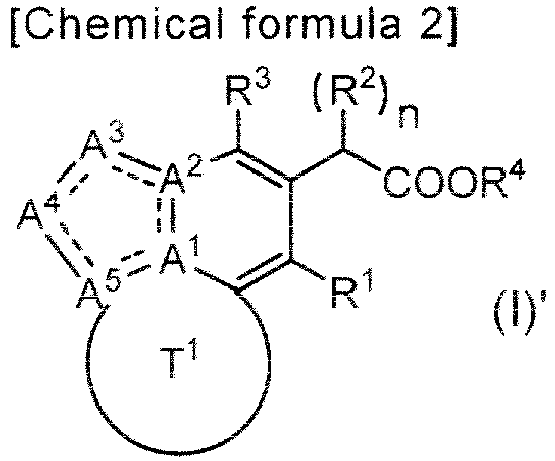
wherein- A1 is C, CR1A, or N;
- A2 is C, CR2A, or N;
- A3 is CR3A, CR3A R3B, N, NR3C, O, S, SO, or SO2;
- A4 is CR4A, CR4A R4B, N, NR4C O, S, SO, or SO2;
- A5 is C, CR5A, or N;
- R1A, R2A, R3A, R3B, R4A, R4B, and R5A are each independently hydrogen, halogen, hydroxy, substituted or unsubstituted alkyl, substituted or unsubstituted alkenyl, substituted or unsubstituted alkynyl, substituted or unsubstituted alkyloxy, substituted or unsubstituted alkenyloxy, substituted or unsubstituted alkynyloxy, substituted or unsubstituted aromatic carbocyclyl, substituted or unsubstituted non-aromatic carbocyclyl, substituted or unsubstituted aromatic heterocyclyl, substituted or unsubstituted non-aromatic heterocyclyl, substituted or unsubstituted aromatic carbocyclyloxy, substituted or unsubstituted non-aromatic carbocyclyloxy, substituted or unsubstituted aromatic heterocyclyloxy, substituted or unsubstituted non-aromatic heterocyclyloxy, substituted or unsubstituted aromatic carbocyclylthio, substituted or unsubstituted non-aromatic carbocyclylthio, substituted or unsubstituted aromatic heterocyclylthio, substituted or unsubstituted non-aromatic heterocyclylthio, substituted or unsubstituted aromatic carbocyclylamino, substituted or unsubstituted non-aromatic carbocyclylamino, substituted or unsubstituted aromatic heterocyclylamino, substituted or unsubstituted non-aromatic heterocyclylamino, substituted or unsubstituted carbonyl, or substituted or unsubstituted carbamoyl;
- R3C and R4C are each independently hydrogen, substituted or unsubstituted alkyl, substituted or unsubstituted alkenyl, substituted or unsubstituted alkynyl, substituted or unsubstituted alkyloxy, substituted or unsubstituted alkenyloxy, substituted or unsubstituted alkynyloxy, substituted or unsubstituted aromatic carbocyclyl, substituted or unsubstituted non-aromatic carbocyclyl, substituted or unsubstituted aromatic heterocyclyl, or substituted or unsubstituted non-aromatic heterocyclyl; or,
- R3A and R3B may be taken together to form oxo, R4A and R4B may be taken together to form oxo;
- R3A and R4A may be taken together with an adjacent atom to form substituted or unsubstituted monocyclic carbocycle, or substituted or unsubstituted monocyclic heterocycle, the carbocycle or heterocycle may be further fused to;
- R3A and R4C may be taken together with an adjacent atom to form substituted or unsubstituted monocyclic heterocycle, the heterocycle may be further fused to;
- R3C and R4A may be taken together with an adjacent atom to form substituted or unsubstituted monocyclic heterocycle, tne heterocycle may be further fused to;
- R3C and R4C may be taken together with an adjacent atom to form substituted or unsubstituted monocyclic heterocycle, the heterocycle may be further fused to;
- R3A and R3B may be taken together with an adjacent atom to form substituted or unsubstituted spiro ring, the spiro ring may be further fused to;
- R4A and R4B may be taken together with an adjacent atom to form substituted or unsubstituted spiro ring, the spiro ring may be further fused to;
- R4B may be taken together with an atom on the circular arc of T1 ring to form substituted or unsubstituted monocyclic carbocycle or substituted or unsubstituted monocyclic heterocycle, the carbocycle or heterocycle may be further fused to;
- R4C may be taken together with an atom on the circular arc of T1 ring to form substituted or unsubstituted monocyclic heterocycle, the heterocycle may be further fused to;
- the broken line means the presence or absence of bond, the adjacent line do not exist at the same time;
- T1 ring is substituted or unsubstituted monocyclic carbocycle, or substituted or unsubstituted monocyclic heterocycle, (1) the carbocycle or heterocycle may be fused with the other substituted or unsubstituted carbocycle or substituted or unsubstituted heterocycle, and/or (2) two atoms which are not adjacent to one another constituting the carbocycle or heterocycle may be bridged by substituted or unsubstituted alkylene, substituted or unsubstituted alkenylene or substituted or unsubstituted alkynylene;
- R1 is halogen, cyano, nitro or -X1-R11,
- X1 is a bond, -O-, -S-, -NR12-, -CO-, -SO-, -SO2- -O-CO-, -CO-O-, -NR12-CO-, -CO-NR12-,-NR12-CO-O-, -NR12-CO-NR13-, -NR12-SO2-, or -SO2-NR12-,
- R11 is a hydrogen atom, substituted or unsubstituted alkyl, substituted or unsubstituted alkenyl, substituted or unsubstituted alkynyl, substituted or unsubstituted carbocyclyl, or substituted or unsubstituted heterocyclyl,
- R12 and R13 are each independently a hydrogen atom, substituted or unsubstituted alkyl, substituted or unsubstituted alkenyl or substituted or unsubstituted alkynyl,
- when X1 is -NR12-, -CO-NR12- or -SO2-NR12-, R11 and R12 may be taken together with an adjacent nitrogen atom to form substituted or unsubstituted heterocyclyl,
- when X1 is -NR12-CO-NR13-, R11 and R13 may be taken together with an adjacent nitrogen atom to form substituted or unsubstituted heterocyclyl;
- R2 is each independently substituted or unsubstituted alkyl, substituted or unsubstituted alkenyl, substituted or unsubstituted alkynyl, substituted or unsubstituted alkyloxy, substituted or unsubstituted alkenyloxy, substituted or unsubstituted alkynyloxy, substituted or unsubstituted cycloalkyloxy, or substituted or unsubstituted cycloalkenyloxy;
- n is 1 or 2;
- R3 is hydrogen, substituted or unsubstituted aromatic carbocyclyl, substituted or unsubstituted non-aromatic carbocyclyl, substituted or unsubstituted aromatic heterocyclyl, substituted or unsubstituted non-aromatic heterocyclyl, or non-cyclic group;
and - R4 is hydrogen or a carboxy protecting group).
- (1") A compound represented by the following formula (I)':

wherein- A1 is C, CR1A, or N;
- A2 is C, CR2A, or N;
- A3 is CR3A CR3A R3B, N, NR3C, O, S, SO, or SO2;
- A4 is CR4A, CR4A R4B, N, NR4C, O, S, SO, or SO2;
- A5 is C, CR5A, or N;
- R1A, R2A, R3A, R3B, R4A, R4B, and R5A are each independently hydrogen, halogen, hydroxy, substituted or unsubstituted alkyl, substituted or unsubstituted alkenyl, substituted or unsubstituted alkynyl, substituted or unsubstituted alkyloxy, substituted or unsubstituted alkenyloxy, substituted or unsubstituted alkynyloxy, substituted or unsubstituted alkylcarbonyl, substituted or unsubstituted alkenylcarbonyl, substituted or unsubstituted alkynylcarbonyl, substituted or unsubstituted aromatic carbocyclyl, substituted or unsubstituted non-aromatic carbocyclyl, substituted or unsubstituted aromatic heterocyclyl, substituted or unsubstituted non-aromatic heterocyclyl, substituted or unsubstituted aromatic carbocyclyloxy, substituted or unsubstituted non-aromatic carbocyclyloxy, substituted or unsubstituted aromatic heterocyclyloxy, substituted or unsubstituted non-aromatic heterocyclyloxy, substituted or unsubstituted aromatic carbocyclylthio, substituted or unsubstituted non-aromatic carbocyclylthio, substituted or unsubstituted aromatic heterocyclylthio, substituted or unsubstituted non-aromatic heterocyclylthio, substituted or unsubstituted aromatic carbocyclylamino, substituted or unsubstituted non-aromatic carbocyclylamino, substituted or unsubstituted aromatic heterocyclylamino, substituted or unsubstituted non-aromatic heterocyclylamino, substituted or unsubstituted aromatic carbocyclylcarbonyl, substituted or unsubstituted non-aromatic carbocyclylcarbonyl, substituted or unsubstituted aromatic heterocyclylcarbonyl, substituted or unsubstituted non-aromatic heterocyclylcarbonyl, substituted or unsubstituted aromatic carbocyclylalkylcarbonyl, substituted or unsubstituted non-aromatic carbocyclylalkylcarbonyl, substituted or unsubstituted aromatic heterocyclylalkylcarbonyl, substituted or unsubstituted non-aromatic heterocyclylalkylcarbonyl, or substituted or unsubstituted carbamoyl;
- R3C and R4C are each independently hydrogen, substituted or unsubstituted alkyl, substituted or unsubstituted alkenyl, substituted or unsubstituted alkynyl, substituted or unsubstituted alkyloxy, substituted or unsubstituted alkenyloxy, substituted or unsubstituted alkynyloxy, substituted or unsubstituted aromatic carbocyclyl, substituted or unsubstituted non-aromatic carbocyclyl, substituted or unsubstituted aromatic heterocyclyl, or substituted or unsubstituted non-aromatic heterocyclyl; or,
- R3A and R3B may be taken together to form oxo, R4A and R4B may be taken together to form oxo;
- R3A and R4A may be taken together with an adjacent atom to form substituted or unsubstituted monocyclic carbocycle, or substituted or unsubstituted monocyclic heterocycle, the carbocycle or heterocycle may be further fused to;
- R3A and R4C may be taken together with an adjacent atom to form substituted or unsubstituted monocyclic heterocycle, the heterocycle may be further fused to;
- R3C and R4A may be taken together with an adjacent atom to form substituted or unsubstituted monocyclic heterocycle, the heterocycle may be further fused to;
- R3C and R4C may be taken together with an adjacent atom to form substituted or unsubstituted monocyclic heterocycle, the heterocycle may be further fused to;
- R3A and R3B may be taken together with an adjacent atom to form substituted or unsubstituted spiro ring, the spiro ring may be further fused to;
- R4A and R4B may be taken together with an adjacent atom to form substituted or unsubstituted spiro ring, the spiro ring may be further fused to;
- R4B may be taken together with an atom on the circular arc of T1 ring to form substituted or unsubstituted monocyclic carbocycle, or substituted or unsubstituted monocyclic heterocycle, the carbocycle or heterocycle may be further fused to;
- R4C may be taken together with an atom on the circular arc of T1 ring to form substituted or unsubstituted monocyclic heterocycle, the heterocycle may be further fused to;
- the broken line means the presence or absence of bond, the adjacent broken lines do not exist at the same time;
- T1 ring is substituted or unsubstituted monocyclic carbocycle, or substituted or unsubstituted monocyclic heterocycle, (1) the carbocycle or heterocycle may be fused with the other substituted or unsubstituted carbocycle or substituted or unsubstituted heterocycle, and/or (2) two atoms which are not adjacent to one another constituting the carbocycle or heterocycle may be bridged by substituted or unsubstituted alkylene, substituted or unsubstituted alkenylene, or substituted or unsubstituted alkynylene;
- R1 is halogen, cyano, nitro or -X1-R11,
- X1 is a bond, -O-, -S-, -NR12-, -CO-, -SO-, -SO2-, -O-CO-, -CO-O-, -NR12-CO-, -CO-NR12-,-NR12-CO-O-, -NR12-CO-NR13-, -NR12-SO2-, or -SO2-NR12,
- R11 is a hydrogen atom, substituted or unsubstituted alkyl, substituted or unsubstituted alkenyl, substituted or unsubstituted alkynyl, substituted or unsubstituted carbocyclyl, or substituted or unsubstituted heterocyclyl,
- R12 and R13 are each independently a hydrogen atom, substituted or unsubstituted alkyl, substituted or unsubstituted alkenyl or substituted or unsubstituted alkynyl,
- when X1 is -NR12-, -CO-NR12-, or -SO2-NR12-, R11 and R12 may be taken together with an adjacent nitrogen atom to form substituted or unsubstituted heterocyclyl,
- when X1 is -NR12-CO-NR13-, R11 and R13 may be taken together with an adjacent nitrogen atom to form substituted or unsubstituted heterocyclyl;
- R2 is each independently substituted or unsubstituted alkyl, substituted or unsubstituted alkenyl, substituted or unsubstituted alkynyl, substituted or unsubstituted alkyloxy, substituted or unsubstituted alkenyloxy substituted or unsubstituted alkynyloxy, substituted or unsubstituted cycloalkyloxy, or substituted or unsubstituted cycloalkenyloxy;
- n is 1 or 2;
- R3 is hydrogen, substituted or unsubstituted aromatic carbocyclyl, substituted or unsubstituted non-aromatic carbocyclyl, substituted or unsubstituted aromatic heterocyclyl, substituted or unsubstituted non-aromatic heterocyclyl, or non-cyclic group;
and - R4 is hydrogen or a carboxy protecting group).
- (2) The compound or its pharmaceutically acceptable salt according to the above (1), (1') or (1"), represented by any one of the following formula:

- (3) The compound or its pharmaceutically acceptable salt according to the above (1), (1') or (1"), wherein at least one of the following conditions 1) to 3) is fulfilled:
- 1) A3 is N, NR3C, O, S, SO, or SO2:
- 2) A4 is N, NR4C, O, S, SO, or SO2 :
- 3) A5 is N.
- (4) The compound or its pharmaceutically acceptable salt according to the above (1), (1'), (1") or (2), A3 is CR3A; A4 is C R4A; and A5 is N.
- (5) The compound or its pharmaceutically acceptable salt according to the above (1), (1'), (1") or (2), A3 is N or NR3C; A4 is CR4A; and A5 is C.
- (6) The compound or its pharmaceutically acceptable salt according to the above (1), (1'), (1") or (2), A3 is N or NR3C; A4 is CR4A; and A5 is C or N.
- (7) The compound or its pharmaceutically acceptable shalt according to the above (1), (1'), (1") or (2), A3 is O or S; A4 is CR4A or N; and A5 is C.
- (8) The compound or its pharmaceutically acceptable salt according to the above (1), (1'), or (1"), represented by formula (I-A):

- (9) The compound or its pharmaceutically acceptable salt according to the above (8), represented by any one of the following formula:

- (10) The compound or its pharmaceutically acceptable salt according to the above (1), (1') or (1"), represented by the following formula (I-B):

- (11) The compound or its pharmaceutically acceptable salt according to the above (10), represented by any one of the following formula:

- (12) The compound or its pharmaceutical acceptable salt according to the above (1), (1') or (1"), represented by the following formula (I-C):

- (13) The compound or its pharmaceutically acceptable salt according to the above (12), represented by any one of the following formula:

- (14) The compound or its pharmaceutically acceptable salt according to any one of the above (1), (1'), (1"), (2) to (13), wherein T1 ring is any one of the following structure:

- wherein A1, A5 and A6 are as defined in the above (1), (1') or (1");
- Ra is hydrogen, substituted or unsubstituted alkyl, substituted or unsubstituted alkenyl, substituted or unsubstituted carbocyclyl, substituted or unsubstituted heterocyclyl, -CORa1,-SORa2, or -SO2Ra3 (Ra1, R2a, and Ra3 are each independently hydrogen, substituted or unsubstituted alkyl, substituted or unsubstituted alkenyl, substituted or unsubstituted carbocyclyl, or substituted or unsubstituted heterocyclyl;
- m is an integer of 0 to 5;
- L is -SO2-, -SO-, -CO-, or -CRbRc-; and
- Rb and Rc are each independenly hydrogen, substituted or unsubstituted alkyl, substituted or unsubstituted alkenyl, substituted or unsubstituted carbocyclyl, substituted or unsubstituted heterocyclyl, or Rb and Rc mey be taken together to form oxo.
- (14') The compound or its pharmaceutically acceptable salt according to any one of the above (1), (1'), (1"), (2) to (13), wherein T1 ring is any one of the following structures:

- wherein A1 and A5 are as defined in the above (1') or (1 ");
- Ra is hydrogen, substituted or unsubstituted alkyl, substituted or unsubstituted alkenyl, substituted or unsubstituted carbocyclyl, substituted or unsubstituted heterocyclyl, -CORa1,-SORa2, or -SO2Ra3 (Ra1, Ra2, and Ra3 are each independently hydrogen, substituted or unsubstituted alkyl, substituted or unsubstituted alkenyl, substituted or unsubstituted carbocyclyl, or substituted or unsubstituted heterocyclyl;
- m is an integer of 0 to 5;
- L is -SO2-, -SO-, -CO-, or -CRbRc-; and
- Rb and Rc are each independently hydrogen, substituted or unsubstituted alkyl, substituted or unsubstituted alkenyl, substituted or unsubstituted carbocyclyl, substituted or unsubstituted heterocyclyl, or Rb and Rc may be taken together to form oxo.
- (15) The compound or its pharmaceutically acceptable salt according to any one of the above (1), (1'), (1"), (2) to (13), wherein T1 ring is any one of the following structures:

- (15') The compound or its pharmaceutically acceptable salt according to any one of the above (1), (1'), (1"), (2) to (13), wherein T1 ring is any one of the following structures:

- (16) The compound or its pharmaceutically acceptable salt according to the above (1), (1') or (1") represented by any one of the following formula:


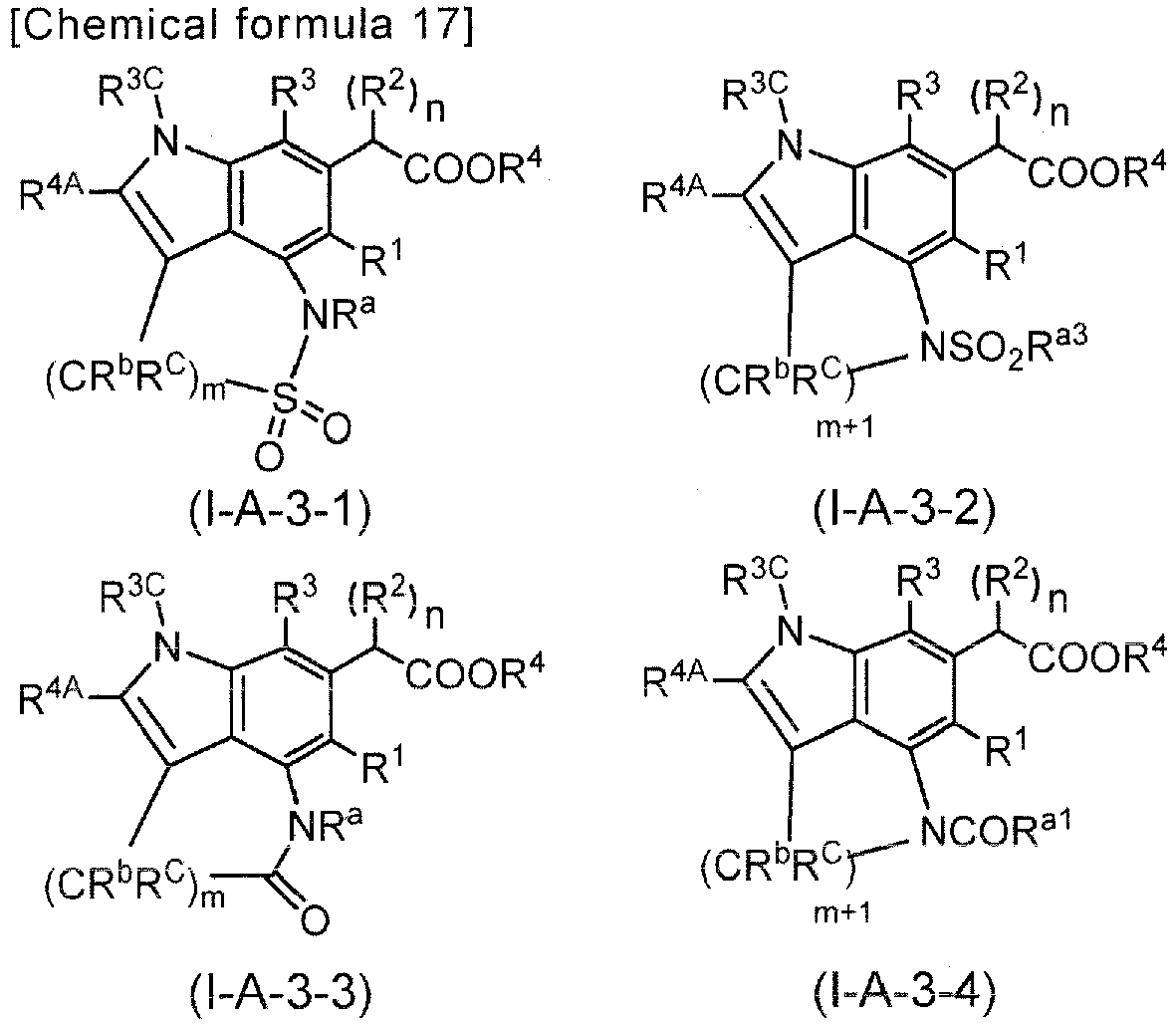


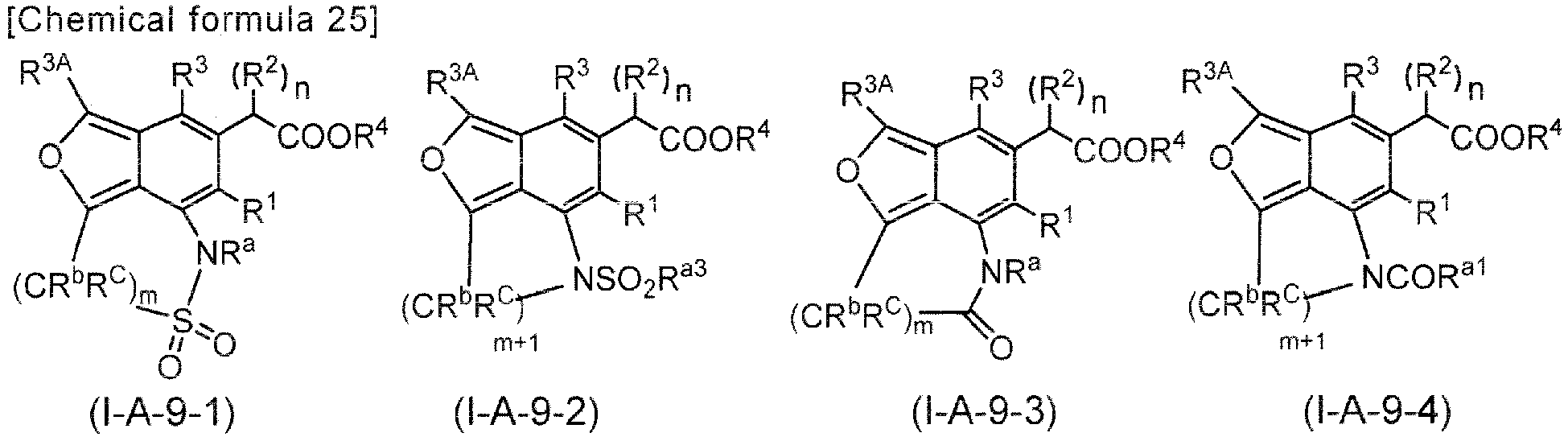

- (17) The compound or its pharmaceutically acceptable salt according to the above (1), (1') or (1") represented by any one of the following formula:


- (18) The compound or its pharmaceutically acceptable salt according to the above (1), (1') or (1") represented by any one of the following formula:


- (19) The compound or its pharmaceutically acceptable salt according to any one of the above (8) to (13), wherein T1 ring is the structure represented by the formula (T1-2-1), (T1-2-2) or (T1-2-3) described in the above (15).
- (20) The compound or its pharmaceutically acceptable salt according to any one of the above (1), (1'), (1"), (2) to (19), wherein R1 is alkyl.
- (21) The compound or its pharmaceutically acceptable salt according to any one of the above (1), (1'), (1"), (2) to (19), wherein n is 1, and R2 is alkyloxy.
- (22) The compound or its pharmaceutically acceptable salt according to any one of the above (1), (1'), (1"), (2) to (19), wherein R4 is hydrogen.
- (23) The compound or its pharmaceutically acceptable salt according to any one of the above (1), (1'), (1"), (2) to (19), R3 is substituted or unsubstituted aromatic carbocyclyl, substituted or unsubstituted non-aromatic carbocyclyl, substituted or unsubstituted aromatic heterocyclyl, or substituted or unsubstituted non-aromatic heterocyclyl.
- (24) The compound or its pharmaceutically acceptable salt according to any one of the above (1), (1'), (1"), (2) to (19), wherein R1 is alkyl; n is 1, R2 is alkyloxy; R4 is hydrogen; and R3 is substituted or unsubstituted aromatic carbocyclyl, substituted or unsubstituted non-aromatic carbocyclyl, substituted or unsubstituted aromatic heterocyclyl, or substituted or unsubstituted non-aromatic heterocyclyl.
- (25) The compound or its pharmaceutically acceptable salt according to any one of the above (14) to (19), wherein R1 is alkyl; n is 1, R2 is alkyloxy; R4 is hydrogen; R3 is substituted or unsubstituted aromatic carbocyclyl, substituted or unsubstituted non-aromatic carbocyclyl, substituted or unsubstituted aromatic heterocyclyl, or substituted or unsubstituted non-aromatic heterocyclyl; m is an integer of 0 to 3; and Rb and Rc are each independently hydrogen or alkyl.
- (26) The compound or its pharmaceutically acceptable salt according to the above (1), (1') or (1") represented by the following formula:

Preferable example of the compound (I-A-1) is the compound (I-A-1-1) to (I-A-1-5) described in the above (16), more preferably the compound described in the following (27) to (31). - (27) The compound or its pharmaceutically acceptable salt according to the above (26) represented by the following formula:
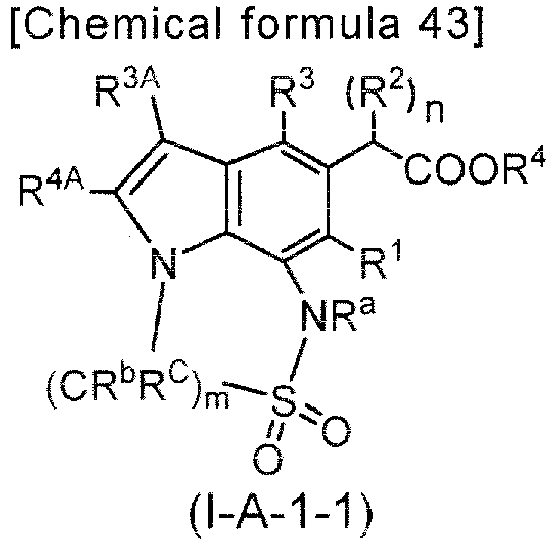
- (28) The compound or its pharmaceutically acceptable salt according to the above (26) represented by the following formula:

- (29) The compound or its pharmaceutically acceptable salt according to the above (26) represented by the following formula:

- (30) The compound or its pharmaceutically acceptable salt according to the above (26) represented by the following formula:

- (31) The compound or its pharmaceutically acceptable salt according to the above (26) represented by the following formula:

- (32) A pharmaceutical composition comprising the compound or its pharmaceutically acceptable salt according to any one of the above (1), (1'), (1"), (2) to (31).
- (33) The pharmaceutical composition according to the above (32), having anti-virus activity.
- (34) The pharmaceutical composition according to the above (32), having anti-HIV activity.
- (35) A method of treating or preventing a HIV infectious disease, which comprises administering the compound or its pharmaceutically acceptable salt according to any one of the above (1), (1'), (1"), (2) to (31).
- (36) Use of the compound or its pharmaceutically acceptable salt according to any one of the above (1), (1'), (1"), (2) to (31), for manufacturing a therapeutic or prophylactic agent for a HIV infectious disease.
- (37) The compound or its pharmaceutically acceptable salt according to any one of the above (1), (1'), (1"), (2) to (31) for treating or preventing a HIV infectious disease.
- (38) A pharmaceutical composition comprising the compound or its pharmaceutically acceptable salt according to any one of the above (1), (1'), (1"), (2) to (31), for the oral administration.
- (39) The pharmaceutical composition according to (38), which is a tablet, powder, granule, capsule, pill, film, suspension, emulsion, elixir, syrup, lemonade, spirit, aromatic water, extract, decoction or tincture.
- (40) The pharmaceutical composition according to (39), which is a sugarcoated tablet, film-coated tablet, enteric-coated tablet, sustained-release tablet, troche tablet, sublingual tablet, buccal tablet, chewable tablet, orally dispersing tablet, dry syrup, soft capsule, micro capsule or sustained-release capsule.
- (41) A pharmaceutical composition comprising the compound or its pharmaceutically acceptable salt according to any one of the above (1), (1'), (1"), (2) to (31), for parenteral administration.
- (42) The pharmaceutical composition according to (41) for dermal, subcutaneous, intravenous, intraarterial, intramuscular, intraperitoneal, transmucosal, inhalation, transnasal, ophthalmic, inner ear, or vaginal administration.
- (43) The pharmaceutical composition according to (41) or (42), which is injection, infusion, eye drop, nose drop, ear drop, aerosol, inhalation, lotion, impregnation, liniment, mouthwash, enema, ointment, plaster, jelly, cream, patch, cataplasm, external powder or suppository.
- (44) A pharmaceutical composition comprising the compound or its pharmaceutically acceptable salt according to any one of the above (1), (1'), (1"), (2) to (31), for a pediatric or geriatric patient.
- (45) A pharmaceutical composition comprising a combination of the compound or its pharmaceutically acceptable salt according to any one of the above (1), (1'), (1"), (2) to (31), and a reverse transcriptase inhibitor, a protease inhibitor, integrase inhibitor or the other anti-HIV drug.
- (46) A pharmaceutical composition comprising the compound or its pharmaceutically acceptable salt according to any one of the above (1), (1'), (1"), (2) to (31), for a combination treatment with a reverse transcriptase inhibitor, a protease inhibitor, integrase inhibitor, or the other anti-HIV drug.
- The present invention moreover provides the following invention.
- A method for treatment or prevention of viral infection (example: HIV infection) characterized by administering to a human the above compound or its pharmaceutically acceptable salt.
- The above compound or its pharmaceutically acceptable salt, for the treatment or prevention of viral infection (example: HIV infention).
- The compound of the present invention has a replication inhibitory activity on a virus, particularly HIV (example: HIV-1), a mutant virus thereof and a resistant virus thereof. Accordingly, the compound of the present invention is useful in the prevention or treatment of viral infections (example: AIDS) and the like. Moreover, the present invention provides a synthetic intermediate for an antiviral drug.
- Each meaning of terms used herein is described below. Each term, alone or in combination with another word, is used in the same meanig.
- "Halogen" includes a fluorine atom, a chroline atom, a bromine atom, and an iodine atom. A fluorine atom and a chlorine atom are especially preferable.
- "Alkyl" includes C1 to C15, preferably C1 to C10, more preferably C1 to C6, and further preferably C1 to C4 linear or branched hydrocarbon group. For example, it includes methyl, ethyl, n-propyl, isopropyl, n-butyl, isobutyl, sec-butyl, tert-butyl, n-pentyl, isopentyl, neopentyl, n-hexyl, isohexyl, n-heptyl, isoheptyl, n-octyl, isooctyl, n-nonyl, n-decyl and the like.
- A preferred embodiment of "alkyl" is methyl, methyl, ethyl, n-propyl, isopropyl, n-butyl, isobutyl, sec-butyl, tert-butyl, or n-pentyl. A more preferred embodiment is methyl, ethyl, n-propyl, isopropyl, or tert-butyl.
- "Alkenyl" includes a C2 to C15, preferably C2 to C10, more preferably C2 to C6 and further preferably C2 to C4 linear or branched hydrocarbon group having one or more double bond(s) at any position(s). For example, it includes vinyl, allyl, propenyl, isopropenyl, butenyl, isobutenyl, prenyl, butadienyl, pentenyl, isopentenyl, pentadienyl, hexenyl, isohexenyl, hexadienyl, heptenyl, octenyl, nonenyl, decenyl, undecenyl, dodecenyl, tridecenyl, tetradecenyl, pentadecenyl and the like.
- A preferred embodiment of "alkenyl" is vinyl, allyl, propenyl, isopropenyl or butenyl.
- "Alkynyl" includes a C2 to C10, preferably C2 to C8, more preferably C2 to C6 and further preferably C2 to C4 linear or branched hydrocarbon group having one or more triple bond(s) at any position(s). For example, it includes ethynyl, propynyl, buthynyl, pentynyl, hexynyl, heptynyl, octynyl, nonynyl, decynyl and the like. These may have further a double bond at any available position.
- A preferred embodiment of "alkynyl" is ethynyl, propynyl, buthynyl, or pentynyl.
- "Alkylene" includes a C1 to C15, preferably C1 to C10, more preferably C1 to C10, further preferably C1 to C4 linear or branched divalent hydrocarbon group having one or more double bond(s) at any position(s). For example, it includes methylene, ethylene, trimethylene, propylene, tetramethylene, pentamethylene, hexamethylene and the like.
- "Alkenylene" includes a C2 to C15, preferably C2 to C10, more prefetrably C2 to C6 and further preferably C2 to C4 linear or branched bivalent hydrocarbon group having one or more triple bond(s) at any position(s). For example, it includes vinylene, propenylene, butenylene, pentenylene and the like.
- "Alkynylene" includes a C2 to C15, preferably C2 to C10, more preferably C2 to C6 and further preferably C2 to C4 linear or branched divalent hydrocarbon group having one or more double bond(s) at any position(s). Furthermore, it may have double bond(s) at any position(s). For example, it includes ethynylene, propynylene, butynylene, pentynylene, hexynylene and the like.
- "Carbocycle" includes a hydrocarbon group, which is monocyclic or polycyclic having two or more rings. In addition, the "carbocycle" also includes a fused ring, a spiro ring and a crosslinked ring. Constituent atom(s) of fused ring, the spiro ring and the crosslinked ring may include heteroatom(s). "Monocyclic carbocycle" means monocyclic carbocycle, it includes aromatic carbocycle and non-aromatic carbocycle.
- As "monocyclic aromatic carbocycle", benzene ring is exemplified.
- As "monocyclic non-aromatic carbocycle", the monocyclic non-aromatic carbocycle consisting of C3 to C16 is preferred, more preferably C3 to C12, and further preferably C4 to C8. For example, cycloalkane, cycloalkene or the like is exemplified.
- As "cycloalkane", cyclopropane, cyclobutane, cyclopentane, cyclohexane, cycloheptane, cyclooctane, cyclononane or the like is exemplified.
- As "cycloalkene", cyclopropene, cyclobutene, cyclopentene, cyclohexene, cycloheptene, cyclohexadiene or the like is exemplified.
- "Heterocycle" means a ring, which is monocyclic or polycyclic having two or more rings, containing one or more, preferably 1 to 4, and same or different of heteroatom(s) selected independently from O, S and N. In addition, the "heterocycle" also includes a fused ring, a spiro ring and a crosslinked ring. Constituent atom(s) of the fused ring, the spiro ring and the crosslinked ring may not include heteroatom(s). "Monocyclic heterocycle" means monocyclic heterocycle, and includes aromatic heterocycle and non-aromatic heterocycle. "Heterocycle" which is polycyclic having two or more rings, includes a fused ring wherein a heterocycle which is monocycle or polycyclic having two or more rings, is fused with a ring of the above "carbocycle". "Heterocycle" is preferably 5 to 7-membered or 8 to 12-membered ring.
- As "monocyclic aromatic heterocycle", 5 to 6-membered aromatic heterocycle is exemplified.
- As "monocyclic non-aromatic heterocycle", 5 to 10-membered non-aromatic heterocycle is exemplified.
- "Carbocycle" and "heterocycle" also includes a ring having a crosslinked ring or a spiro ring. "Crosslinked ring" means a ring having a crosslinked structure in which two atoms, which are not adjacent to one another, constituting the ring is bridged by alkylene, alkenylene, alkynylene or the like.

- "Carbocyclyl" means a monocyclic or polycyclic having two or more rings hydrocarbon group, and includes a fused cyclic group, a spiro cyclic group and a crosslinked cyclic group. Carbocyclyl includes aromatic carbocyclyl and non-aromatic carbocyclyl.
- "Heterocyclyl" means a cyclic group, which is monocyclic or polycyclic having two or more rings, containing one or more, preferably 1 to 4, and same or different of heteroatom(s) selected independently from O, S and N. In addtion, "heterocyclyl" includes a fused cyclic group, a spiro cyclic group and a crosslinked cyclic group. Constituent atom(s) of the fused cyclic group, the spiro cyclic group and the crosslinked cyclic group may not include heteroatom(s). "Heterocyclyl" includes aromatic heterocyclyl and non-aromatic heterocyclyl. "Heterocyclyl" which is polycyclic having two or more rings includes a fused cyclic group wherein a heterocycle which is monocyclic or polycyclic having two or more rings, is fused with a ring of the above "carbocycle". "Heterocyclyl" is preferably 5 to 7-membered.
- "Aromatic carbocycle" includes a cyclic aromatic hydrocarbon ring which is monocyclic or polycyclic having two or more rings. For example, benzene ring, naphthalene ring, anthracene ring, phenanthrene ring or the like is exemplified.
- An embodiment of "aromatic carbocycle" includes benzene ring, naphthalene ring. Another embodiment thereof includes benzene ring.
- "Aromatic carbocyclyl" means a cyclic hydrocarbon group which is monocyclic or polycyclic having two or more rings. For example, phenyl, naphthyl, anthryl, phenanthryl or the like is exemplified.
- A preferred embodiment of "aromatic carbocyclyl" includes phenyl.
- "Non-aromatic carbocycle" includes a cyclic saturated hydrocarbon ring or a cyclic unsaturated non-aromatic hydrocarbon ring, which is monocyclic or polycyclic having two or more rings. "Non-aromatic carbocycle" which is polycyclic having two or more rings, includes a fused ring wherein a non-aromatic carbocycle, which is monocylic or polycyclic having two or more rings, is fused with a ring of the above "aromatic carbocycle".
- In addition, "non-aromatic carbocycle" also includes a ring having a bridge or a ring to form a spiro ring.

- Monocyclic non-aromatic carbocycle is preferably C3 to C16, more preferably C3 to C12, and further preferably C3 to C8. For example, cyclopropane, cyclobutane, cyclopentane, cyclohexane, cycloheptane, cyclooctane, cyclononane, cyclodecane, cyclopropene, cyclobutene, cyclopentene, cyclohexene, cycloheptene, cyclohexadiene or the like is exemplified.
- Non-aromatic carbocycle which is polycyclic having two or more rings includes, for example, indane, indene, acenaphthalene, tetrahydronaphhalene, fluorine and the like.
- "Non-aromatic carbocyclyl" means a cyclic saturated hydrocarbon group or a cyclic unsaturated non-aromatic hydrocarbon, which is monocyclic or polycyclic having two or more rings. Non-aromaic carbocyclyl which is polycyclic having two or more rings includes a fused cyclic group wherein a non-aromatic carbocyclyl, which is "monocyclic or polycyclic having two or more rings, is fused with a ring of the above "aromatic carbocyclyl".
- In addition, the "non-aromatic carbocyclyl" also includes a group having a bridge or a group to form a spiro ring as follows:

- Monocyclic non-aromatic carbocyclyl is preferably C3 to C16, more preferably C3 to C12, and further preferably C4 to C8. For example, cycloalkyl, cycloalkenyl or the like is exemplified.
- "Cycloalkyl" is preferably C3 to C10, more preferably C3 to C7, and includes cyclopropyl, cyclobutyl, cyclopentyl, cyclohexyl, cycloheptyl, cyclooctyl, cyclononyl, cyclodecyl and the like.
- "Cycloalkenyl" includes cyclopropenyl, cyclobutenyl, cyclopentenyl, cyclohexenyl, cycloheptenyl, cyclohexadienyl and the like.
- Non-aromatic carbocyclyl which is polycyclic having two or more rings includes, for example, indanyl, indenyl, acenaphthyl, tetrahydronaphthyl, fluorenyl, dihydroindenyl and the like.
- "Aromatic heterocycle" means an aromatic ring, which is monocyclic or polycyclic having two or more rigns, containing one or more and same or different of heteroatom(s) selected independently from O, S and N.
- "Aromatic heterocycle", which is polycylic having two or more rings, includes a fused ring wherein an aromatic heterocycle, which is monocyclic or polycyclic having two or more rings, is fused with a ring of the above "aromatic carbocycle".
- Monocyclic aromatic heterocycle is preferably 5- to 8-membered, more preferably 5- or 6-membered. For example, pyrrole, imidazole, pyrazole, pyridine, pyridazine, pyrimidine, pyrazine, triazole, triazine, tetrazole, furan, thiophen, isoxazole, oxazole, oxadiazole, isothiazole, thiazole, thiadiazole or the like is exemplified.
- Bicyclic aromatic heterocycle includes, for example, indoline, isoindoline, indazoline, indolidine, quinoline, isoquinoline, cinnoline, phthalazine, quinazoline, naphthyridine, quinoxaline, purine, puteridine, benzimidazole, benzisoxazole, benzoxazole, benzoxadiazole, benzoisothiazole, benzothiazole, benzothiazole, benzofuran, isobenzofuran, benzothiophen, benzotriazole, imidazopyridine, triazolopyridine, imidazothiazole, pyrradinopyridazine, oxazolopyridine, thiazolopyridine and the like.
- Aromatic heterocycle which is polycyclic having three or more rings includes, for example, carbazole, acridine, xanthene, phenothiazine, phenoxathiine, phenoxazine, dibenzofuran and the like.
- "Aromatic heterocyclyl" means an aromatic cyclic group, which is monocyclic or polycyclic having two or more rings, containing one or more and same or different of heteroatom(s) selected independently from O, S and N.
- Aromatic heterocyclyl, which is polycyclic having two or more rings, includes a fused cyclic group wherein an aromatic heterocyclyl which is monocyclic or polycyclic having two or more rings is fised with the ring of the above "aromatic carbocyclyl".
- Monocyclic aromatic heterocyclyl is preferably 5 to 10-membered, more preferably 5- or 6-membered. For example, pyrrolyl, imidazolyl, pyrazolyl, pyridyl, pyridazinyl, pyrimidinyl, pyrazinyl, triazolyl, triazinyl, tetrazolyl, furyl, thienyl, isoxazolyl, oxazolyl, oxadiazolyl, isothiazolyl, thiazolyl, thiadiazolyl or the like is exemplified.
- Bicyclic aromatic heterocyciyi is preferably 8 to 18-membered ring. For example, it includes indolyl, isoindolyl, indazolyl, indolidinyl, quinolinyl, isoquinolinyl, cinnnolinyl, phthalazinyl, quinazolinyl, naphthylidinyl, quinoxalinyl, prynyl, puteriinyl, banzmidazolyl, benzisooxazolyl, benzoxazolyl, benzoxadiazolyl, benzisothiazolyl, benzothiazolyl, benzothiadiazolyl, benzofuryl, isobenzofuryl, benzothienyl, benzotriazolyl, imidazopyridyl, triazolopyridyl, imidazothiazolyl, pyrazinopyridazine, oxzolopyridyl, thiazolopyridyl and the like.
- Aromatic heterocyclyl, which is polycyclic having three or more rings, is preferably 11 to 26-membered ring. For example, it includes carbazolyl, acridinyl, xanthenyl, phenothiazinyl, phenoxathiinyl, phenoxazinyl, dibenzofuryl and the like.
- "Non-aromatic heterocycle" includes a non-aromatic ring, which is monocyclic or polycyclic having two or more rings, containing one or more and same or different of heteroatom(s) independently selected from O, S and N.
- "Non-aromatic heterocycle", which is polycyclic having two or more rings, includes a fused ring wherein a non-aromatic heterocycle, which is monocyclic or polycyclic having two or more ring(s), is fused with a ring of the above "aromatic carbocycle", "non-aromatic carbocycle", and/or "aromatic heterocycle".
- In addition, the "non-aromatic heterocycle" also includes a ring having a bridge or a ring to form a spiro ring as follows.

- Monocyclic non-aromatic heterocycle is preferably 3 to 8-membered, more preferably 5 or 6-membered ring. For example, it includes dioxane, thiirane, oxyrane, oxetane, oxathiorane, azetidine, thiane, thiazolidine, pyrrolidine, pyrroline, imidazolidine, imidazoline, pyrazolidine, pyrazoline, piperidine, piperazine, morpholine, thiomorpholine, dihydropyridine, tetrahydropyridine, tetrahydrofuran, tetrahydropyran, dihydrothiazoline, tetrahydrothiazoline, tetrahydroisothiazoline, dihydrooxadine, hexahydroazepine, tetrahydrodiazepine, tetrahydropyridazine, hexahydropyrimidine, dioxolane, dioxazine, aziridine, dioxoline, oxepane, thiolane, thiazie and the like.
- Non-aromatic heterocycle which is polycyclic having two or more rings includes, for example, indoline, isoindoline, chromane, isochromane and the like.
- "Non-aromatic heterocyclyl" means a non-aromatic cyclic group, which is monocyclyl or polycyclyl having two or more rings, containing one or more and same or differenet heteroatom(s) independently selected from O, S and N.
- "Non-aromatic heterocyclyl" which is polycyclic having two or more rings, includes a fused cyclic group wherein a non-aromatic heterocyclyl, which is monocyclic or polycyclic having two or more rings, is fused with a ring of the above "aromatic carbocyclyl", "non-aromatic carbocyclyl", and/or "aromatic heterocyclyl".
- In addition, the "non-aromatic heterocyclyl" also includes a group having a bridge or a group to form a spiro ring as follows.

- Monocyclic non-aromatic heterocyclyl is preferably 3 to 8-mebmbered, more preferably 5 or 6-membered ring. For example, it includes dioxanyl, thiiranyl, oxyranyl, oxetanyl, oxathioianyl, azetidinyl, thianyl, thiazolidinyl, pyrrolidinyl, pyrrolinyl, imidazolidinyl, imidazolinyl, pyrazolidinyl, pyrazolinyl, piperidinyl, piperazinyl, morpholinyl, morpholino, thiomorpholinyl, thiomorpholino, dihydropyridyl, tetrahydropyridyl, tetrahydrofuryl, tetrahydropyranyl, dihydrothiazolyl, tetrahydrothiazolyl, tetrahydroisothiazolyl, dihydrooxadinyl, hexahidroazepinyl, tetrahydrodiazepinyl, tetrahydropyridazinyl, hexahydropyrimidinyl, dioxolanyl, dioxadinyl, aziridinyl, dioxolinyl, oxepanyl, thiolanyl, thiinyl, thiazinyl and the like.
- Non-aromatic heterocyclyl which is polycyclic having two or more rings includes, for example, indolinyl, isoindolinyl, chromanyl, isochromanyl, dihydrobenzofuryl, benzodioxolyl, benzodioxanyl, benzomorpholinyl and the like.
- "Hydroxyalkyl" means a group wherein hydrogen atom(s) attached to a carbon atom(s) of the above "alkyl" is replaced with one or more hydroxyl group(s). For example, it includes hydroxymethyl, 1-hydroxyethyl, 2-hydroxyethyl, 1-hydroxypropyl, 2-hydroxypropyl, 1,2-hydroxyethyl and the like.
- A preferred embodiment of "hydroxyalkyl" is hydroxymethyl.
- "Alkyloxy" means a group wherein the above "alkyl" is bonded to an oxygen atom. For example, it includes methoxy, ethoxy, n-propyloxy, isopropyloxy, n-butyloxy, tert-butyloxy, isobutyloxy, sec-butyloxy, pentyloxy, isopentyloxy, hexyloxy and the like.
- A preferred embodiment of "alkyloxy" is methoxy, ethoxy, n-propyloxy, isopropyloxy, tert-butyloxy or the like.
- "Alkenyloxy" means a group wherein the "alkenyl" is bonded to an oxygen atom. For example, it includes vinyloxy, allyloxy, 1-propenyloxy, 2-butenyloxy, 2-petenyloxy, 2-hexenyloxy, 2-heptenyloxy, 2-octenyloxy and the like.
- "Alkynyloxy" means a group wherein the above "alkynyl" is bonded to an oxygen atom. For example, it includes ethynyloxy, 1-propynyloxy, 2-propynyloxy, 2-buthynyloxy, 2-pentynyloxy, 2-hexynyloxy, 2-heptynyloxy, 2-octynyloxy and the like.
- "Haloalkyl" means a group wherein one or more "halogen" described above is bonded to the above "alkyl". For example, it includes monofluoromethyl, monofluoroethyl, monofluoropropyl, 2,2,3,3,3-pentafluoropropyl, monochloromethyl, trifluoromethyl, trichloromethyl, 2,2,2-trifluoroethyl, 2,2,2-trichloroethyl, 1,2-dibromoethyl, 1,1,1-trifluoropropane-2-yl and the like.
- A preferred embodiment of "haloalkyl" is trifluoromethyl, trichloromethyl or the like.
- "Haloalkyloxy" means a group wherein the above "haloalkyl" is bonded to an oxygen atom. For example, it includes monofluoromethoxy, monofuluoroethoxy, trifluoromethoxy, trichloromethoxy, trifluoroethoxy, trichloroethoxy and the like.
- A preferred embodiment of "haloalkyloxy" is trifluoromethoxy or trichloromethoxy.
- "Alkyloxyalkyl" means a group wherein the above "alkyloxy" is bonded to the above "alkyl". For example, it includes methoxymethyl, methoxyethyl, ethoxylmethyl and the like.
- "Alkyloxyalkyloxy" means a group wherein the above "alkyloxy" is bonded to the above "alkyloxy". For example, it includes methoxymethoxy, methoxyethoxy, ethoxymethoxy, ethoxyethoxy and the like.
- "Alkylcarbonyl" means a group wherein the above "alkyl" is bonded to a carbonyl group. For example, it includes methylcarbonyl, ethylcarbonyl, propylcarbonyl, isopropylcarbonyl, tert-butylcarbonyl, isobutylcarbonyl, sec-butylcarbonyl, pentylcarbonyl, isopentylcarbonyl, hexylcarbonyl and the like.
- A preferred embodiment of "alkylcarbonyl" is methylcarbonyl, ethylcarbonyl, or n-propylcarbonyl.
- "Alkenylcarbonyl" means a group wherein the above "alkenyl" is bonded to a carbonyl group. For example, it includes ethylenylcarbonyl, propenylcarbonyl and the like.
- "Alkynylcarbonyl" means a group wherein the above "alkynyl" is bonded to a carbonyl group. For example, it includes ethynylcarbonyl, propynylcarbonyl and the like.
- "Monoalkylamino" means a group wherein a hydrogen atom attached to a nitrogen atom of an amino group is replaced with the above "alkyl". For example, it includes methylamino, ethylamino, isopropylamino and the like.
- A preferred embodiment of "monoalkylamino" is methylamino or ethylamino.
- "Dialkylamino" means a group wherein two hydrogen atoms attached to a nitrogen atom of an amino group are replaced with two "alkyl" described above. These two alkyl groups may be the same or different. For example, it includes dimethylamino, diethylamino, N, N-diisopropylamino, N-methyl-N-ethylamino, N-isopropyl-N-ethylamino and the like.
- A preferred embodiment of "dialkylamino" is dimethylamino or diethylamino.
- "Alkylsulfonyl" means a group wherein the above "alkyl" is bonded to a sulfonyl group. For example, it includes methylsulfonyl, ethylsulfonyl, propylsulfonyl, isopropylsulfonyl, tert-butylsulfonyl, isobutylsulfonyl, sec-butylsulfonyl and the like.
- A preferred embodiment of "alkylsulfonyl" is methylsulfonyl or ethylsulfonyl.
- "Alkenylsulfonyl" means a group wherein the above "alkenyl" is bonded to a sulfonyl group. For example, it includes ethylenylsulfonyl, propenylsulfonyl and the like.
- "Alkynylsulfonyl" means a group wherein the above "alkynyl" is bonded to a sulfonyl group. For example, it includes ethynylsulfonyl, propynylsulfonyl and the like.
- "Monoalkylcarbonylamino" means a group wherein a hydrogen atom attached to a nitrogen atom of an amino group is replaced with the above "alkylcarbonyl". For example, it includes methylcarbonylamino, ethylcarbonylamino, propylcarbonylamino, isopropylcarbonylamino, tert-butylcarbonylamino, isobutylcarbonylamino, sec-butylcarbonylamino and the like.
- A preferred embodiment of "monoalkylcarbonylamino" is methylcarbonylamino or ethylcarbonylamino.
- "Dialkylcarbonylamino" means a group wherein two hydrogen atoms attached to a nitrogen atom of an amino group is replaced with the above "alkylcarbonyl". These two alkylcarbonyl groups may be the same or different. For exmaple, it includes dimethylcarbonylamino, diethylcarbonylamino, N, N-diisopropylcarbonylamino and the like.
- A preferred embodiment of "dialkylcarbonylamino" is dimethylcarbonylamino or diethylcarbonylamino.
- "Monoalkylsulfonylamino" means a group wherein a hydrogen atom attached to a nitrogen atom of an amino group is replaced with the above "alkylsulfonyl". For example, it includes methylsulfonylamino, ethylsulfonylamino, propylsulfonylamino, isopropylsulfonylamino, tert-butylsulfonylamino, isobutylsulfonylamino, sec-butylsulfonylamino and the like.
- A preferred embodiment of "monoalkylsulfonylamino" is methylsulfonylamino or ethylsulfonylamino.
- "Dialkylsulfonylamino" means a group wherein two hydrogen atoms attached to a nitrogen atom of an amino group are replaced with the above "alkylsulfonyl". These two alkylsulfonyl groups may be the same or different For example, it includes dimethylsulfonylamino, diethylsulfonylamino, N, N-diisopropylsulfonylamino and the like.
- A preferred embodiment of "dialkylcarbonylamino" is dimethylsulfonylamino or diethylsulfonylamino.
- "Alkylimino" means a group wherein a hydrogen atom attached to a nitrogen atom of an imino group is replaced with the above "alkyl". For example, it includes methylimino, ethylimino, n-propylimino, isopropylimino and the like.
- "Alkenylimino" means a group wherein a hydrogen atom attached to a nitorogen atom of an imino group is replaced with the above "alkenyl". For example, it includes ethylenylimino, propenylimino and the like.
- "Alkynylimino" means a group wherein a hydrogen atom attached to a nitrogen atom of an imino group is replaced with the above "alkynyl". For example, it includes ethynylimino, propynylimino and the like.
- "Alkylcarbonylimino" means a group wherein a hydrogen atom attached to a nitrogen atom of an imino group is replaced with the above "alkylcarbonyl". For example, it includes methylcarbonylimino, ethylcarbonylimino, n-propylcarbonylimino, isopropylcarbonylimino and the like.
- "Alkenylcarbonylimino" means a group wherein a hydrogen atom attached to a nitrogen atom of an imino group is replaced with the above "alkenylcarbonyl". For example, it includes ethylenylcarbonylimino, propenylcarbonylimino and the like.
- "Alkynylcarbonylimino" means a group wherein a hydrogen atom attached to a nitrogen atom of an imino group is replaced with the above "alkynylcarbonyl". For example, it includes ethynylcarbonylimino, propynylcarbonylimino and the like.
- "Alkyloxyimino" means a group wherein a hydrogen atom attached to a nitrogen atom of an imino group is replaced with the above "alkyloxy". For example, it includes methyloxyimino, ethyloxyimino, n-propyloxyimino, isopropyloxyimino and the like.
- "Alkenyloxyimino" means a group wherein a hydrogen atom attached to a nitrogen atom of an imino group is replaced with the above "alkenyloxy". For example, it includes ethylenyloxyimino, propenyloxyimino and the like.
- "Alkynyloxyimino" means a group wherein a hydrogen atom attached to a nitrogen atom of an imino group is replaced with the above "alkynyloxy". For example, it includes ethynyloxyimino, propynyloxyimino and the like.
- "Alkylcarbonyloxy" means a group whrerein the above "alkylcarbonyl" is bonded to an oxygen atom. For example, it includes methylcarbonyloxy, ethylcarbonyloxy, propylcarbonyloxy, isopropylcarbonyloxy, tert-butylcarbonyloxy, isobutylcarbonyloxy, sec-butylcarbonyloxy and the like.
- A preferred embodiment of "alkylcarbonyloxy" is methylcarbonyloxy or ethylcarbonyloxy.
- "Alkenylcarbonyloxy" means a group wherein the above "alkenylcarbonyl" is bonded to an oxygen atom. For example, it includes ethylenylcarbonyloxy, propenylcarbonyloxy and the like.
- "Alkynylcarbonyloxy" means a group wherein the above "alkynylcarbonyl" is bonded to an oxygen atom. For example, it includes ethynylcarbonyloxy, propynylcarbonyloxy and the like.
- "Alkylsulfonyloxy" means a group wherein the above "alkylsulfonyl" is bonded to an oxygen atom. For example, it includes methylsulfonyloxy, ethylsulfonyloxy, propylsulfonyloxy, isopropylsulfonyloxy, tert-butylsulfonyloxy, isobutylsulfonyloxy, sec-butylsulfonyloxy and the like.
- A preferred embodiment of "alkylsulfonyloxy" is methylsulfonyloxy or ethylsulfonyloxy.
- "Alkenylsulfonyloxy" means a group wherein the above "alkenylsulfonyl" is bonded to an oxygen atom. For example, it includes ethylenylsulfonyloxy, propenylsulfonyloxy and the like.
- "Alkynylsulfonyloxy" means a group wherein the above "alkynylsulfonyl" is bonded to an oxygen atom. For example, it includes ethynylsulfonyloxy, propynylsulfonyloxy and the like.
- "Alkyloxycarbonyl" means a group wherein the above "alkyloxy" is bonded to a carbonyl group. For example, it includes methyloxycarbonyl, ethyloxycarbonyl, propyloxycarbonyl, isopropyloxycarbonyl, tert-butyloxycarbonyl, isobutyloxycarbonyl, sec-butyloxycarbonyl, pentyloxycarbonyl, isopentyloxycarbonyl, hexyloxycarbonyl and the like.
- A preferred embodiment of "alkyloxycarbonyl" is methyloxycarbonyl, ethyloxycarbonyl, or propyloxycarbonyl.
- "Alkenyloxycarbonyl" means a group wherein the above "alkenyloxy" is bonded to a carbonyl group. For example, it includes ethylenyloxycarbonyl, propenyloxycarbonyl and the like.
- "Alkynyloxycarbonyl" means a group wherein the above "alkynyloxy" is bonded to a carbonyl group. For example, it includes ethynyloxycarbonyl, propynyloxycarbonyl and the like.
- "Alkylsulfanyl" means a group wherein a hydrogen atom attached to a sulfur atom of an sulfanyl group is replaced with the above "alkyl". For example, it includes methylsulfanyl, ethylsulfanyl, n-propylsulfanyl, isopropylsulfanyl and the like.
- "Alkenylsulfanyl" means a group wherein a hydrogen atom attached to a sulfur atom of a sulfanyl group is replaced with the above "alkenyl". For example, it includes ethylenylsulfanyl, propenylsulfanyl and the like.
- "Alkynylsulfanyl" means a group wherein a hydrogen atom attached to a sulfur atom of a sulfanyl group is replaced with the above "alkynyl". For example, it includes ethynylsulfanyl or propynylsulfanyl and the like.
- "Alkylsulfinyl" means a group wherein the above "alkyl" is bonded to a sulfinyl group. For example, it includes methylsulfinyl, ethylsulfinyl, n-propylsulfinyl, isopropylsulfinyl and the like.
- "Alkenylsulfinyl" means a group wherein the above "alkenyl" is bonded to a sulfinyl group. For example, it includes ethylenylsulfinyl, propenylsulfinyl and the like.
- "Alkynylsulfinyl" means a group wherein the above "alkynyl" is bonded to a sulfinyl group. For example, it includes ethynylsulfinyl, propynylsulfinyl and the like.
- "Monoalkylcarbamoyl" means a group wherein a hydrogen atom attached to a nitrogen atom of carbamoyl group is replaced with the above "alkyl". For example, it includes methylcarbamoyl, ethylcarbamoyl and the like.
- "Dialkylcarbamoyl" means a group wherein two hydrogen atoms attached to a nitrogen atom of a carbamoyl group are replaced with the above "alkyl". These two alkyl groups may be the same or different. For example, it includes dimethylcarbamoyl, diethylcarbamoyl and the like.
- "Monoalkylsulfamoyl" means a group wherein a hydrogen atom attached to a nitrogen atom of a sulfamoyl group is replaced with the above "alkyl". For example, it includes methylsulfamoyl, dimethylsulfamoyl and the like.
- "Dialkylsulfamoyl" means a group wherein two hydrogen atoms attached to a nitrogen atom of a sulfamyl group are replaced with the above "alkyl". These two alkyl groups may be the same or different. For example, it includes dimethylcarbamoyl, diethylcarbamoyl and the like.
- "Trialkylsilyl" means a group wherein three "alkyl" groups described above are bonded to a silicon atom. These three alkyl may be the same or different. For example, it includes trimethylsilyl, triethylsilyl, tert-butyldimethylsilyl and the like.
- The alkyl part of "aromatic carbocyclylalkyl", "non-aromatic carbocyclylalkyl", "aromatic heterocyclylalkyl", "non-aromatic heterocyclylalkyl", "aromatic carbocyclylalkyloxy", "non-aromatic carbocyclylalkyloxy", "aromatic heterocyclylalkyloxy", "non-aromatic heterocyclylalkyloxy", "aromatic carbocyclylalkylsulfanyl", "non-aromatic carbocyclylalkylsulfanyl", "aromatic heterocyclylalkylsulfanyl", "non-aromatic heterocyclylalkylsulfanyl", "aromatic carbocyclylalkyloxycarbonyl", "non-aromatic carbocyclylalkyloxycarbonyl", "aromatic heterocyclylalkyloxycarbonyl", "non-aromatic heterocyclylalkyloxycarbonyl", "aromatic carbocyclylalkyloxyalkyl", "non-aromatic carbocyclylalkyloxyalkyl", "aromatic heterocyclylalkyloxyalkyl", "non-aromatic heterocyclylalkyloxyalkyl", "aromatic carbocyclylalkylamino", "non-aromatic carbocyclylalkylamino", "aromatic heterocyclylalkylamino" and "non-aromatic heterocyclylalkylamino" is also same as the above "alkyl".
- "Aromatic carbocyclylalkyl" or "aralkyl" means an alkyl substituted with one or more "aromatic carbocyclyl" described above. For example, it includes benzyl, phenethyl, phenylpropynyl, benzhydryl, trityl, naphthylmethyl, a group of the formula:

- A preferred embodiment of "aromatic carbocyclylalkyl" is benzyl, phenethyl, or benzhydryl.
- "Non-aromatic carbocyclylalkyl" means an alkyl substituted with one or more "non-aromatic carbocyclyl" described above. In addition, "non-aromatic carbocyclylalkyl" also includes "non-aromatic carbocyclylalkyl" wherein the alkyl part is substituted with the above "aromatic carbocyclyl". For example, it includes cyclopropylmethyl, cyclobutylmethyl, cyclopentylmethyl, cyclohexylmethyl, a group of the formula:

- "Aromatic heterocyclylalkyl" means an alkyl substituted with one or more "aromatic heterocyclyl" described above. In addition, "aromatic heterocyclylalkyl" also includes "aromatic heterocyclylalkyl" wherein the alkyl part is substituted with the above "aromatic carbocyclyl" and/or "non-aromatic carbocyclyl". For example, it includes pyridylmethyl, furanylmethyl, imidazolylmethyl, indolylmethyl, benzothiophenylmethyl, oxazolylmethyl, isoxazolylmethyl, thiazolylmethyl, isothiazolylmethyl, pyrazolylmethyl, isopyrazolylmethyl, pyrrolidinylmethyl, benzoxazolylmethyl, groups of the formula:
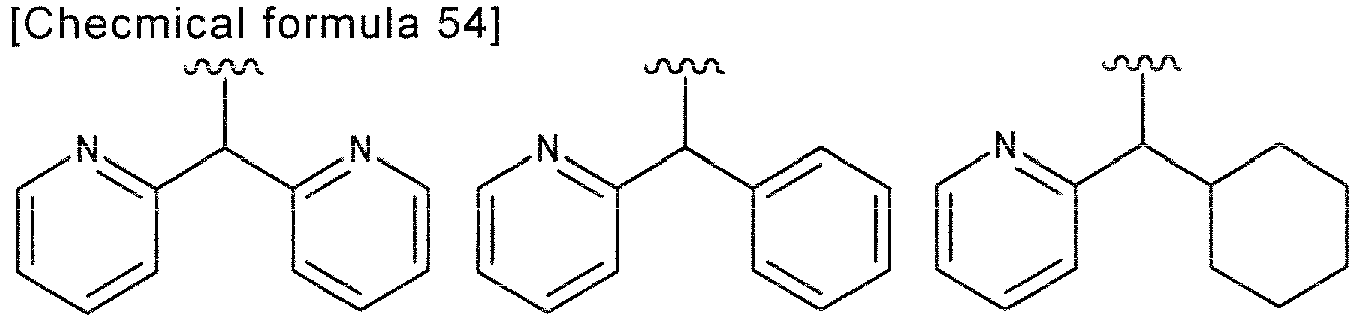
- "Non-aromatic heterocyclylalkyl" means an alkyl substituted with one or more "non-aromatic heterocyclyl" described above. In addition, "non-aromatic heterocyclylalkyl" also includes "non-aromatic heterocyclylalkyl" wherein the alkyl part is substituted with the above "aromatic carbocyclyl", "non-aromatic carbocyclyl" and/or "aromatic heterocyclyl". For example, it includes tetrahydropyranylmethyl, morpholinylethyl, piperidinylmethyl, piperazinylmethyl, groups of the formula:

- "Aromatic carbocyclylalkyloxy" means an alkyloxy substituted with one or more "aromatic carbocyclyl" described above. For example, it includes benzyloxy, phenetyloxy, phenylpropyloxy, benzhydryloxy, trityloxy, naphthylmethyloxy, a group of the formula:

- "Non-aromatic carbocyclylalkyloxy" means an alkyloxy substituted with one or more "non-aromatic carbocyclyl" described above. In addition, "non-aromatic carbocyclylalkyloxy" includes "non-aromatic carbocyclylalkyloxy" wherein the alkyl part is substituted with the above "aromatic carbocyclyl". For example, it includes cyclopropylmethyloxy, cyclobutylmethyloxy, cyclopentylmethyloxy, cyclohexylmethyloxy, a group of the formula:
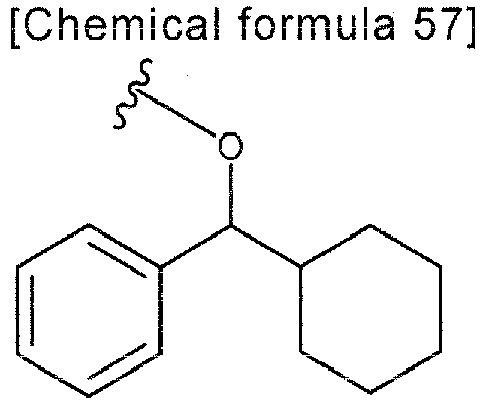
- "Aromatic heterocyclylalkyloxy" means alkyloxy substituted with one or more "aromatic heterocyclyl" described above. In addition, "aromatic heterocyclylalkyloxy" also includes "aromatic heterocyclylalkyloxy" wherein the alkyl group is substituted with the above "aromatic carbocyclyl" and/or "non-aromatic carbocyclyl". For example, it includes pyridylmethyloxy, furanylmethyloxy, imidazolylmethyloxy, indolylmethyloxy, benzothiophenylmethyloxy, oxazolylmethyloxy, isoxazolylmethyloxy, thiazolylmethyloxy, isothiazolylmethyloxy, pyrazolylmethyloxy, isopyrazolylmethyloxy, pyrrolidinylmethyloxy, benzoxazolylmethyloxy, groups of the formula:

- "Non-aromatic heterocyclylalkyloxy" means an alkyloxy substituted with one or more "non-aromatic heterocyclyl" described above. In addition, "non-aromatic heterocyclylalkyloxy" also includes "non-aromatic heterocyclylalkyloxy" wherein the alkyl part is substituted with the above "aromatic carbocyclyl", "non-aromatic carbocyclyl" and/or "aromatic heterocyclyl". For example, it includes tetrahydropyranylmethyloxy, morpholinylethyloxy, piperidinylmethyloxy, piperazinylmethyloxy, groups of the formula:

- "Aromatic carbocyclylalkylsulfanyl" means an alkylsufanyl substituted with one or more "aromatic carbocyclyl" described above. For example, it includes benzylsulfanyl, phenethylsulfanyl, phenylpopynylsulfanyl, benzhydrylsulfanyl, tritylsulfanyl, naphthylmethylsulfanyl and the like.
- "Non-aromatic carbocyclylalkylsulfanyl" means an alkylsulfanyl substituted with one or more "non-aromatic carbocyclyl" described above. In addition, "non-aromatic carbocyclylalkylsulfanyl" also includes "non-aromatic carbocyclylalkylsulfanyl" wherein the alkyl part is substituted with the above "aromatic carbocyclyl". For example, it includes cyclopropylmethylsulfanyl, cyclobutylmethylsulfanyl, cyclopentylmethylsulfanyl, cyclohexylmethylsulfanyl and the like.
- "Aromatic heterocyclylalkylsulfanyl" means an alkyl sulfanyl substituted with one or more "aromatic heterocyclyl" described above. In addition, "aromatic heterocyclylalkylsulfanyl" also includes "aromatic heterocyclylalkylsulfanyl" wherein the alkyl part is substituted with the above "aromatic carbocyclyl" and/or "non-aromatic carbocyclyl". For example, it includes pyridylmethylsulfanyl, furanylmethylsulfanyl, imidazolylmethylsulfanyl, indolylmethylsulfanyl, benzothiophenylmethylsulfanyl, oxazolylmethylsulfanyl, isoxazolylmethylsulfanyl, thiazolylmethylsulfanyl, isothiazolylmethylsulfanyl, pyrazolylmethylsulfanyl, isopyrazolylmethylsulfanyl, pyrrolidinylmethylsulfanyl, benzoxazolylmethylsulfanyl and the like.
- "Non-aromatic heterocyclylalkylsulfanyl" means an alkylsulfanyl substituted with one or more "non-aromatic heterocyclyl" described above. In addition, "non-aromatic heterocyclylalkylsulfanyl" also includes "non-aromatic heterocyclylalkylsulfanyl" wherein the alkyl part is substituted with the above "aromatic carbocyclyl", "non-aromatic carbocyclyl" and/or "aromatic heterocyclyl". For example, it includes tetrahydropyranylmethylsulfanyl, morpholinylethylsulfanyl, piperidinylmethylsulfanyl, piperazinylmethylsulfanyl and the like.
- "Aromatic carbocyclylalkyloxycarbonyl" means an alkyloxycarbonyl substituted with one or more "aromatic carbocyclyl" described above. For example, it includes benzyloxycarbonyl, phenethyloxycarbonyl, phenylpropynyloxycarbonyl, benzhydryloxycarbonyl, trityloxycarbonyl, naphthylmethyloxycarbonyl, a group of the formula:

- "Non-aromatic carbocyclylalkyloxycarbonyl" means an alkyloxycarbonyl substituted with one or more "non-aromatic carbocyclyl" described above. In addition, "non-aromatic carbocyclylalkyloxycarbonyl" also includes "non-aromatic carbocyclylalkyloxycarbonyl" wherein the alkyl part is substituted with the above "aromatic carbocyclyl". For example, it includes cyclopropylmethyloxycarbonyl, cyclobutylmethyloxycarbonyl, cyclopentylmethyloxycarbonyl, cyclohexylmethyloxycarbonyl, a group of the formula:

- "Aromatic heterocyclylalkyloxycarbonyl" means an alkylocycarbonyl substituted with one or more "aromatic heterocyclyl" described above. In addition, "aromatic heterocyclylalkyloxycarbonyl" also includes "aromatic heterocyclylalkyloxycarbonyl" wherein the alkyl part is substituted with the above "aromatic carbocyclyl" and/or "non-aromatic carbocyclyl". For example, it includes pyridylmethyloxycarbonyl, furanylmethyloxycarbonyl, imidazolylmethyloxycarbonyl, indolylmethyloxycarbonyl, benzothiophenylmethyloxycarbonyl, oxazolylmethyloxycarbonyl, isoxazolylmethyloxycarbonyl, thiazolylmethyloxycarbonyl, isothiazolylmethyloxycarbonyl, pyrazolylmethyloxycarbonyl, isopyrazolylmethyloxycarbonyl, pyrrolidinylmethyloxycarbonyl, benzoxazolylmethyloxycarbonyl, groups of the formula:

- "Non-aromatic heterocyclylalkyloxycarbonyl" means an alkyloxycarbonyl substituted with one or more "non-aromatic heterocyclyl" described above. In addition, "non-aromatic heterocyclylalkyloxycarbonyl" also includes "non-aromatic heterocyclylalkyloxycarbonyl" wherein the alkyl part is substituted with the above "aromatic carbocyclyl", "non-aromatic carbocyclyl" and/or "aromatic heterocyclyl". For example, it includes tetrahydropyranylmethyloxy, morpholinylethyloxy, piperidinylmethyloxy, piperazinylmethyloxy, groups of the formula:

- "Aromatic carbocyclylalkyloxyalkyl" means an alkyloxyalkyl substituted with one or more "aromatic carbocyclyl" described above. For example, it includes benzyloxymethyl, phenethyloxymethyl, phenylpropynyloxymethyl, benzhydryloxymethyl, trityloxymethyl, naphthylmethyloxymethyl, a group of the formula:

- "Non-aromatic carbocyclylalkyloxyalkyl" means an alkyloxyalkyl substituted with one or more "non-aromatic carbocyclyl" described above. In addition, "non-aromatic carbocyclylalkyloxyalkyl" also includes "non-aromatic carbocyclylalkyloxyalkyl" wherein the alkyl part bonded to the non-aromatic carbocycle is substituted with the above "aromatic carbocyclyl". For example, it includes cyclopropylmethyloxymethyl, cyclobutylmethyloxymethyl, cyclopentylmethyloxymethyl, cyclohexylmethyloxymethyl, a group of the formula:

- "Aromatic heterocyclylalkyloxyalkyl" means an alkyloxyalkyl substituted with one or more "aromatic heterocyclyl" described above. In addition, "aromatic heterocyclylalkyloxyalkyl" also includes "aromatic heterocyclylalkyloxyalkyl" wherein the alkyl part bonded to the aromatic heterocycle is substituted with the above "aromatic carbocyclyl" and/or "non-aromatic carbocyclyl". For example, it includes pyridylmethyloxymethyl, furanylmethyloxymethyl, imidazolylmethyloxymethyl, indolylmethyloxymethyl, banzothiophenylmethyloxymethyl, oxazolylmethyloxymethyl, isoxazolylmethyloxymethyl, thiazolylmethyloxymethyl, isothiazolylmethyloxymethyl, pyrazolylmethyloxymethyl, isopyrazolylmethyloxymethyl, pyrrolidinylmethyloxymethyl, benzoxazolylmethyloxymethyl, groups of the formula:

- "Non-aromatic heterocyclylalkyloxyalkyl" means an alkyloxyalkyl substituted with one or more "non-aromatic heterocyclyl" described above. In addition, "non-aromatic heterocyclylalkyloxy" also includes "non-aromatic heterocyclylalkyloxyalkyl" wherein the alkyl part bonded to the non-aromatic heterocycle is substituted with the above "aromatic carbocyclyl", "non-aromatic carbocyclyl" and/or "aromatic heterocyclyl". For example, it includes tetrahydropyranylmethyloxymethyl, morpholinylethyloxymethyl, piperidinylmethyloxymethyl, piperazinylmethyloxymethyl, groups of the formula:

- "Aromatic carbocyclylalkylamino" means a group wherein one or two hydrogen atom(s) attached to a nitrogen atom of an amino group is(are) replaced with the above "aromatic carbocyclylalkyl". For example, it includes benzylamino, phenethylamino, phenylpropynylamino, benzhydrylamino, tritylamino, naphthylmethylamino, dibenzylamino and the like.
- "Non-aromatic carbocyclylalkylamino" means a group wherein one or two hydrogen atom(s) attached to a nitrogen atom of an amino group is(are) replaced with the above "non-aromatic carbocyclylalkyl". For example, it includes cyclopropylmethylamino, cyclobutylmethylamino, cyclopentylmethylamino, cyclohexylmethylamino and the like.
- "Aromatic heterocyclylalkylamino" means a group wherein one or two hydrogen atom(s) attached to a nitrogen atom of an amino group is(are) replaced with the above "aromatic heterocyclylalkyl". For example, it includes pyridylmethylamino, furanylmethylamino, imidazolylmethylamino, indolylmethylamino, benzothiophenylmethylamino, oxazolylmethylamino, isoxazolylmethylamino, thiazolylmethylamino, isothiazolylmethylamino, pyrazolylmethylamino, isopyrazolylmethylamino, pyrrolidinylmethylamino, benzoxazolylmethylamino and the like.
- "Non-aromatic heterocyclylalkylamino" means a group wherein one or two hydrogen atom(s) attached to a nitrogen atom of an amino group is(are) replaced with the above "non-aromatic heterocyclylalkyl". For example, it includes tetrahydropyranylmethylamino, morpholinylethylamino, piperidinylmethylamino, piperazinylmethylamino and the like.
- The "aromatic carbocycleoxy" part of "aromatic carbocycleamino", "aromatic carbocyclylcarbonyl", "aromatic carbocycleoxycarbonyl", "aromatic carbocyclylcarbonylamino", "aromatic carbocyclesulfanyl", and "aromatic carbocycle sulfonyl" is same as the above "aromatic carbocyclyl".
- "Aromatic carbocycle oxy" means a group wherein "aromatic carbocycle" is bonded to an oxygen atom. For example, it includes phenyloxy, naphthyloxy and the like.
- "Aromatic carbocycle amino" means a group wherein one or two hydrogen atom(s) attached to a nitrogen atom of an amino group is(are) replaced with "aromatic carbocycle". For example, it includes phenylamino, naphthylamino and the like.
- "Aromatic carbocyclylcarbonyl" means a group wherein "aromatic carbocycle" is bonded to a carbonyl group. For example, it includes phenylcarbonyl, naphthylcarbonyl and the like. "Aromatic carbocycle oxycarbonyl" means a group wherein the above "aromatic carbocycle oxy" is bonded to a carbonyl group. For example, it includes phenyloxycarbonyl, naphthyloxycarbonyl and the like.
- "Aromatic carbocyclylcarbonylamino" means a group wherein one or two hydrogen atom attached to a nitrogen atom of an amino group is(are) replaced with the above "aromatic carbocyclylcarbonyl". For example, it includes phenylcarbonylamino, naphthylcarbonylamino and the like.
- "Aromatic carbocycle sulfanyl" means a group wherein a hydrogen atom attached to a sulfur atom of a sulfanyl group is replaced with "aromatic carbocycle". For example, it includes phenylsulfanyl, naphthylsulfanyl and the like.
- "Aromatic carbocycle sulfonyl" means a group wherein "aromatic carbocycle" is bonded to a sulfonyl group. For example, it includes phenylsulfonyl, naphthylsulfonyl and the like.
- The "non-aromatic carbocycle" part of "non-aromatic carbocycle oxy", "non-aromatic carbocycle amino", "non-aromatic carbocyclylcarbonyl", "non-aromatic carbocycle oxycarbonyl", "non-aromatic carbocyclylcarbonylamino", "non-aromatic carbocycle, sulfanyl", and "non-aromatic carbocycle sulfonyl" is same as the above "non-aromatic carbocyclyl".
- "Non-aromatic carbocycle oxy" means a group wherein "non-aromatic carbocycle" is bonded to an oxygen atom. For example, it includes cyclopropyloxy, cyclohexyloxy, cyclohexenyloxy and the like.
- "Non-aromatic carbocycle amino" means a group wherein one or two hydrogen atom(s) attached to a nitrogen atom of an amino group is(are) replaced with "non-aromatic carbocycle". For example, it includes cyclopropylamino, cyclohexylamino, cyclohexenylamino and the like.
- "Non-aromatic carbocyclylcarbonyl" means a group wherein "non-aromatic carbocycle" is bonded to a carbonyl group. For example, it includes cyclopropylcarbonyl, cyclohexylcarbonyl, cyclohexenylcarbonyl and the like.
- "Non-aromatic carbocycle oxycarbonyl" means a group wherein the above "non-aromatic carbocycle oxy" is bonded to a carbonyl group. For example, it includes cyclopropyloxycarbonyl, cyclohexyloxycarbonyl, cyclohexenyloxycarbonyl and the like.
- "Non-aromatic carbocyclylcarbonylamino" means a group wherein one or two hydrogen atom(s) attached to a nitrogen atom of an amino group is(are) replaced with the above "non-aromatic carbocyclylcarbonyl". For example, it includes cyclopropylcarbonylamino, cyclohexylcarbonylamino, cyclohexenylcarbonylamino and the like.
- "Non-aromatic carbocycle sulfanyl" means a group wherein a hydrogen atom attached to a sulfur atom of a sulfanyl group is replaced with "non-aromatic carbocycle". For example, it includes cyclopropylsulfanyl, cyclohexylsulfanyl, cyclohexenylsulfanyl and the like.
- "Non-aromatic carbocycle sulfonyl" means a group wherein "non-aromatic carbocycle" is bonded to a sulfonyl group. For example, it includes cyclopropylsulfonyl, cyclohexylsulfonyl, cyclohexenylsulfonyl and the like.
- The "aromatic heterocycle" part of "aromatic heterocycle oxy", "aromatic heterocycle amino", "aromatic heterocyclylcarbonyl", "aromatic heterocycle oxycarbonyl", "aromatic heterocyclylcarbonyl amino", "aromatic heterocycle sulfanyl", and "aromatic heterocycle sulfonyl" is same as the above "aromatic heterocyclyl".
- "Aromatic heterocycle oxy" means a group wherein "aromatic heterocycle" is bonded to an oxygen atom. For example, it includes pyridyloxy, oxazolyloxy and the like.
- "Aromatic heterocycle amino" means a group wherein one or two hydrogen atom attached to a nitrogen atom of an amino group is(are) replaced with "aromatic heterocycle". For example, it includes pyridylamino, oxazolylamino and the like.
- "Aromatic heterocyclylcarbonyl" means a group wherein "aromatic heterocycle" is bonded to a carbonyl group. For example, it includes pyridylcarbonyl, oxazolylcarbonyl and the like.
- "Aromatic heterocycle oxycarbonyl" means a group wherein the above "aromatic heterocycle oxy" is bonded to a carbonyl group. For example, it includes pyridyloxycarbonyl, oxazolyloxycarbonyl and the like.
- "Aromatic heterocyclylcarbonylamino" means a group wherein one or two hydrogen atom attached to a nitrogen atom of an amino group is(are) replaced with the above "aromatic heterocyclylcarbonyl". For example, it includes pyridylcarbonylamino, oxazolylcarbonylamino and the like.
- "Aromatic heterocycle sulfanyl" means a group wherein a hydrogen atom attacehed to a sulfur atom of a sulfanyl group is replaced with "aromatic heterocycle". For example, it includes pyridylsulfanyl, oxazolylsulfanyl and the like.
- "Aromatic heterocycle sulfonyl" means a group wherein "aromatic heterocycle" is bonded to a sulfonyl group. For example, it includes pyridylsulfonyl, oxazolylsulfonyl and the like.
- The "non-aromatic heterocycle" part of "non-aromatic heterocycle oxy", "non-aromatic heterocycle amino", "non-aromatic heterocyclylcarbonyl", "non-aromatic heterocycle oxycarbonyl", "non-aromatic heterocyclylcarbonylamino", "non-aromatic heterocycle sulfanyl", and "non-aromatic heterocycle sulfonyl" is same as the above "non-aromatic heterocyclyl".
- "Non-aromatic heterocycle oxy" means a group wherein "non-aromatic heterocycle" is bonded to an oxygen atom. For example, it includes piperidinyloxy, tetrahydrofuryloxy and the like.
- "Non-aromatic heterocycle amino" means a group wherein a hydrogen atom attached a nitrogen atom of an amino group is replaced with "non-aromatic heterocycle". For example, it includes piperidinylamino, tetrahydrofurylamino and the like.
- "Non-aromatic heterocyclylcarbonyl" means a group wherein "non-aromatic heterocycle" is bonded to a carbonyl group. For example, it includes piperidinylcarbonyl, tetrahydrofurylcarbonyl and the like.
- "Non-aromatic heterocycle oxycarbonyl" means a group wherein the above "non-aromatic heterocycle oxy" is bonded to a carbonyl group. For example, it includes piperidinyloxycarbonyl, tetrahydrofuryloxycarbonyl and the like.
- "Non-aromatic heterocyclylcarbonylamino" means a group wherein one or two hydrogen atom attached to a nitrogen atom of an amino group is(are) replaced with the above "non-aromatic heterocyclylcarbonyl". For example, it includes piperidinylcarbonylamino, tetrahydrofurylcarbonylamino and the like.
- "Non-aromatic heterocycle sulfanyl" means a group wherein a hydrogen atom attached to a sulfur atom of a sulfanyl group is replaced with the above "non-aromatic heterocycle". For example, it includes piperidinylsulfanyl, tetrahydrofurylsulfanyl and the like.
- "Non-aromatic heterocycle sulfonyl" means a group wherein "non-aromatic heterocycle" is bonded to a sulfonyl group. For example, it includes piperidinylsulfonyl, tetrahydrofurylsulfonyl and the like.
- The substituents of "substituted or unsubstituted alkyl", "substituted or unsubstituted alkenyl", "substituted or unsubstituted alkynyl", "substituted or unsubstituted haloalkyl", "substituted or unsubstituted alkyloxy", "substituted or unsubstituted alkenyloxy", "substituted or unsubstituted alkynyloxy", "substituted or unsubstituted haloalkyloxy", "substituted or unsubstituted alkylcarbonyl", "substituted or unsubstituted alkenylcarbonyl", "substituted or unsubstituted alkynylcarbonyl", "substituted or unsubstituted monoalkylamino", "substituted or unsubstituted dialkylamino", "substituted or unsubstituted alkylsulfonyl", "substituted or unsubstituted alkenylsulfonyl", "substituted or unsubstituted alkynylsulfonyl", "substituted or unsubstituted monoalkylcarbonylamino", "substituted or unsubstituted dialkylcarbonylamino", "substituted or unsubstituted monoalkylsulfonylamino", "substituted or unsubstituted dialkylsulfonylamino", "substituted or unsubstituted alkylimino", "substituted or unsubstituted alkenylimino", "substituted or unsubstituted alkynylimino", "substituted or unsubstituted alkylcarbonylimino", "substituted or unsubstituted alkenylcarbonylimino", "substituted or unsubstituted alkynylcarbonylimino", "substituted or unsubstituted alkyloxyimino", "substituted or unsubstituted alkenyloxyimino", "substituted or unsubstituted alkynyloxyimino", "substituted or unsubstituted alkylcarbonyloxy", "substituted or unsubstituted alkenylcarbonyloxy", "substituted or unsubstituted alkynylcarbonyloxy", "substituted or unsubstituted alkylsulfonyloxy", "substituted or unsubstituted alkenylsulfonyloxy", "substituted or unsubstituted alkynylsulfonyloxy", "substituted or unsubstituted alkyloxycarbonyl", "substituted or unsubstituted alkenyloxycarbonyl", "substituted or unsubstituted alkynyloxycarbonyl", "substituted or unsubstituted alkylsulfanyl", "substituted or unsubstituted alkenylsulfanyl", "substituted or unsubstituted alkynylsulfanyl", "substituted or unsubstituted alkylsulfinyl", "substituted or unsubstituted alkenylsulfinyl", "substituted or unsubstituted alkynylsulfinyl", "substituted or unsubstituted monoalkylcarbamoyl", "substituted or unsubstituted dialkylcarbamoyl", "substituted or unsubstituted monoalkylsulfamoyl", "substituted or unsubstituted dialkylsulfamoyl", "substituted or unsubstituted alkylene", "substituted or unsubstituted alkenylene" and "substituted or unsubstituted alkynylene" and the like include the following Substiutuent group. A carbon atom at any position(s) may be bonded to the same or different and one or more group(s) selected from the following Substituent group. The substituent(s) is(are) preferably 1 to 4, more preferably 1 to 3.
Substituent group: halogen, hydroxy, carboxy, formyl, formyl oxy, sulfanyl, sulfino, sulfo, thioformyl, thiocarboxy, dithiocarboxy, thiocarbamoyl, cyano, nitro, nitroso, azido, hydradino, ureido, amidino, guanidino, trialkylsilyl, alkyloxy, alkenyloxy, alkynyloxy, haloalkyloxy, alkyl carbonyl, alkenyl carbonyl, alkynyl carbonyl, alkylsulfonyl, alkenyl sulfonyl, alkynyl sulfonyl, alkylcarbonyloxy, alkenylcarbonyloxy, alkynylcarbonyloxy, alkylsulfonyloxy, alkenylsulfonyloxy, alkynylsulfonyloxy, alkyloxycarbonyl, alkenyloxycarbonyl, alkynyloxycarbonyl, alkylsulfanyl, alkenylsulfanyl, alkynylsulfanyl, alkylsulfinyl, alkenylsulfinyl, alkynylsulfinyl, substituted or unsubstituted amino, substituted or unsubstituted imino, substituted or unsubstituted carbamoyl, substituted or unsubstituted sulfamoyl substituted or unsubstituted aromatic carbocyclyl, substituted or unsubstituted non-aromatic carbocyclyl, substituted or unsubstituted aromatic heterocyclyl, substituted or unsubstituted non-aromatic heterocyclyl, substituted or unsubstituted aromatic carbocycle oxy, substituted or unsubstituted non-aromatic carbocycle oxy, substituted or unsubstituted aromatic heterocycle oxy, substituted or unsubstituted non-aromatic heterocycle oxy, substituted or unsubstituted aromatic carbocyclylcarbonyl, substituted or unsubstituted non-aromatic carbocyclylcarbonyl, substituted or unsubstituted aromatic heterocyclylcarbonyl, substituted or unsubstituted non-aromatic heterocyclylcarbonyl, substituted or unsubstituted aromatic carbocycle oxycarbonyl, substituted or unsubstituted non-aromatic carbocycle oxycarbonyl, substituted or unsubstituted aromatic heterocycle oxycarbonyl, substituted or unsubstituted non-aromatic heterocycle oxycarbonyl, substituted or unsubstituted aromatic carbocyclylalkyloxy, substituted or unsubstituted non-aromatic carbocyclylalkyloxy, substituted or unsubstituted aromatic heterocyclylalkyloxy, substituted or unsubstituted non-aromatic heterocyclylalkyloxy, substituted or unsubstituted aromatic carbocyclylalkylsulfanyl, substituted or unsubstituted non-aromatic carbocyclylalkylsulfanyl, substituted or unsubstituted aromatic heterocyclylalkylsulfanyl, substituted or unsubstituted non-aromatic heterocyclylalkylsulfanyl, substituted or unsubstituted aromatic carbocyclylalkyloxycarbonyl, substituted or unsubstituted non-aromatic carbocyclylalkyloxycarbonyl, substituted or unsubstituted aromatic heterocyclylalkyloxycarbonyl, substituted or unsubstituted non-aromatic heterocyclylalkyloxycarbonyl, substituted or unsubstituted aromatic carbocycle sulfanyl, substituted or unsubstituted non-aromatic carbocycle sulfanyl, substituted or unsubstituted aromatic heterocycle sulfanyl, substituted or unsubstituted non-aromatic heterocycle sulfanyl, substituted or unsubstituted non-aromatic carbocycle sulfonyl, substituted or unsubstituted aromatic carbocycle sulfonyl, substituted or unsubstituted aromatic heterocycle sulfonyl, and substituted or unsubstituted non-aromatic heterocycle sulfonyl. - The substituents on the ring of "aromatic carbocycle", "non-aromatic carbocycle", "aromatic heterocycle", and "non-aromatic heterocycle" in "substituted or unsubstituted aromatic carbocyclyl", "substituted or unsubstituted non-aromatic carbocyclyl", "substituted or unsubstituted aromatic heterocyclyl", "substituted or unsubstituted non-aromatic heterocyclyl", "substituted or unsubstituted aromatic carbocycle oxy", "substituted or unsubstituted non-aromatic carbocycle oxy", "substituted or unsubstituted aromatic heterocycle oxy", "substituted or unsubstituted non-aromatic heterocycle oxy", "substituted or unsubstituted aromatic carbocycle amino", "substituted or unsubstituted non-aromatic carbocycle amino", "substituted or unsubstituted aromatic heterocycle amino", "substituted or unsubstituted non-aromatic heterocycle amino", "substituted or unsubstituted aromatic carbocyclylcarbonyl", "substituted or unsubstituted non-aromatic carbocyclylcarbonyl", "substituted or unsubstituted aromatic heterocyclylcarbonyl", "substituted or unsubstituted non-aromatic heterocyclylcarbonyl", "substituted or unsubstituted aromatic carbocycle oxycarbonyl", "substituted or unsubstituted non-aromatic carbocycle oxycarbonyl", "substituted or unsubstituted aromatic heterocycle oxycarbonyl", "substituted or unsubstituted non-aromatic heterocycle oxycarbonyl", "substituted or unsubstituted aromatic carbocycle sulfanyl", "substituted or unsubstituted non-aromatic carbocycle sulfanyl", "substituted or unsubstituted aromatic heterocycle sulfanyl", "substituted or unsubstituted non-aromatic heterocycle sulfanyl", "substituted or unsubstituted aromatic carbocycle sulfonyl", "substituted or unsubstituted non-aromatic carbocycle sulfonyl", "substituted or unsubstituted aromatic heterocycle sulfonyl", and "substituted or unsubstituted non-aromatic heterocycle sulfonyl", and the substituents on the ring of "carbocycle" and "heterocycle", include the following Substituent group. An atom at any position(s) on the ring may be bonded to the same or deffirent and one or more group(s) selected from the following Substituent Group. The substituent(s) is(are) preferably 1 to 4, more preferably 1 to 3 group(s).
Substituent Group : halogen, hydroxy, carboxy, formyl, formyl oxy, sulfanyl, sulfino, sulfo, thioformyl, thiocarboxy, dithiocarboxy, thiocarbamoyl, cyano, nitro, nitroso, azido, hydradino, ureido, amidino, guanidino, trialkylsilyl, alkyl, alkenyl, alkynyl, haloalkyl, hydroxyalkyl, alkyloxy, alkenyloxy, alkynyloxy, haloalkyloxy, alkyloxyalkyl, alkyloxyalkyloxy, alkylcarbonyl, alkenylcarbonyl, alkynylcarbonyl, alkylsulfonyl, alkenylsulfonyl, alkynylsulfonyl, alkylcarbonyloxy, alkenylcarbonyloxy, alkynylcarbonyloxy, alkylsulfonyloxy, alkenylsulfonyloxy, alkynylsulfonyloxy, alkyloxycarbonyl, alkenyloxycarbonyl, alkynyloxycarbonyl, alkylsulfanyl, alkenylsulfanyl, alkynylsulfanyl, alkylsulfinyl, alkenylsulfinyl, alkynylsulfinyl, substituted or unsubstituted amino, substituted or unsubstituted imino, substituted or unsubstituted carbamoyl, substituted or unsubstituted sulfamoyl, substituted or unsubstituted aromatic carbocyclyl, substituted or unsubstituted non-aromatic carbocyclyl, substituted or unsubstituted aromatic heterocyclyl, substituted or unsubstituted non-aromatic heterocyclyl, substituted or unsubstituted aromatic carbocycle oxy, substituted or unsubstituted non-aromatic carbocycle oxy, substituted or unsubstituted aromatic heterocycle oxy, substituted or unsubstituted non-aromatic heterocycle oxy, substituted or unsubstituted aromatic carbocyclylcarbonyl, substituted or unsubstituted non-aromatic carbocyclylcarbonyl, substituted or unsubstituted aromatic heterocyclylcarbonyl, substituted or unsubstituted non-aromatic heterocyclylcarbonyl, substituted or unsubstituted aromatic carbocycle oxycarbonyl, substituted or unsubstituted non-aromatic carbocycle oxycarbonyl, substituted or unsubstituted aromatic heterocycle oxycarbonyl, substituted or unsubstituted non-aromatic heterocycle oxycarbonyl, substituted or unsubstituted aromatic carbocyclylalkyl, substituted or unsubstituted non-aromatic carbocyclylalkyl, substituted or unsubstituted aromatic heterocyclylalkyl, substituted or unsubstituted non-aromatic heterocyclylalkyl, substituted or unsubstituted aromatic carbocyclylalkyloxy, substituted or unsubstituted non-aromatic carbocyclylalkyloxy, substituted or unsubstituted aromatic heterocyclylalkyloxy, substituted or unsubstituted non-aromatic heterocyclylalkyloxy, substituted or unsubstituted aromatic carbocyclylalkylsulfanyl, substituted or unsubstituted non-aromatic carbocyclylalkylsulfanyl, substituted or unsubstituted aromatic heterocyclylalkylsulfanyl, substituted or unsubstituted non-aromatic heterocyclylalkylsulfanyl, substituted or unsubstituted aromatic carbocyclylalkyloxycarbonyl, substituted or unsubstituted non-aromatic carbocyclylalkyloxycarbonyl, substituted or unsubstituted aromatic heterocyclylalkyloxycarbonyl, substituted or unsubstituted non-aromatic heterocyclylalkyloxycarbonyl, substituted or unsubstituted aromatic carbocyclylalkyloxyalkyl, substituted or unsubstituted non-aromatic carbocyclylalkyloxyalkyl, substituted or unsubstituted aromatic heterocyclylalkyloxyalkyl, substituted or unsubstituted non-aromatic heterocyclylalkyloxyalkyl, substituted or unsubstituted aromatic carbocycle sulfanyl, substituted or unsubstituted non-aromatic carbocycle sulfanyl, substituted or unsubstituted aromatic heterocycle sulfanyl, substituted or unsubstituted non-aromatic heterocycle sulfanyl, substituted or unsubstituted aromatic carbocycle sulfonyl, substituted or unsubstituted non-aromatic carbocycle sulfonyl, substituted or unsubstituted aromatic heterocycle sulfonyl, and substituted or unsubstituted non-aromatic heterocycle sulfonyl. - In addition, "substituted or unsubstituted", "non-aromatic carbocyclyl" and "substituted or unsubstituted non-aromatic heterocycly optionally sudtituted with "oxo".

- In addition, "substituted or unsubstituted non-aromatic carbocycly" and "substituted or unsubstituted non-aromatic heterocyclyl" include a case forming a bridge by alkylene, alkenylene or alkynylene, or a spiro ring with the other ring, for example cycloalkane, cycloalkene, cycloalkyne, oxylane, oxetane, thiirane and the like.

- The non-aromatic carbocycle and non-aromatic heterocycle part of the above "substituted or unsubstituted non-aromatic carbocycle oxy", "substituted or unsubstituted non-aromatic heterocycle oxy", "substituted or unsubstituted non-aromatic carbocyclylcarbonyl", "substituted or unsubstituted non-aromatic heterocyclylcarbonyl", "substituted or unsubstituted non-aromatic carbocycle oxycarbonyl", "substituted or unsubstituted non-aromatic heterocycle oxycarbonyl", "substituted or unsubstituted non-aromatic carbocyclylalkyl", "substituted or unsubstituted" non-aromatic heterocyclylalkyl", "substituted or unsubstituted non-aromatic carbocyclylalkyloxy", "substituted or unsubstituted non-aromatic heterocyclylalkyloxy", "substituted or unsubstituted non-aromatic carbocyclylalkylsulfanyl", "substituted or unsubstituted non-aromatic heterocyclylalkylsulfanyl", "substituted or unsubstituted non-aromatic carbocyclylalkyloxycarbonyl", "substituted or unsubstituted non-aromatic heterocyclylalkyloxycarbonyl", "substituted or unsubstituted non-aromatic carbocyclylalkyloxyalkyl", "substituted or unsubstituted non-aromatic heterocyclylalkyloxyalkyl", "substituted or unsubstituted non-aromatic carbocycle sulfanyl", "substituted or unsubstituted non-aromatic heterocycle sulfanyl", "substituted or unsubstituted non-aromatic carbocycle sulfonyl", "substituted or unsubstituted non-aromatic heterocycle sulfonyl", "substituted or unsubstituted carbocycle" and "substituted or unsubstituted heterocycle" may be optionally substituted with "oxo" as above.
- "Substituted or unsubstituted amino" includes an amino optionally substituted with one or two group(s) selected from the following Substituent Group.
Substituent Group: hydroxy, cyano, alkyl, alkenyl, alkynyl, haloalkyl, haloalkenyl, haloalkynyl, alkyloxy, alkenyloxy, alkynyloxy, haloalkyloxy, haloalkenyloxy, haloalkynyloxy, alkylcarbonyl, alkenylcarbonyl, alkynylcarbonyl, haloalkylcarbonyl, haloalkenylcarbonyl, haloalkynylcarbonyl, alkylsulfonyl, haloalkylsulfonyl, substituted or unsubstituted carbamoyl, substituted or unsubstituted alkyloxycarbonyl, substituted or unsubstituted aromatic carbocyclyl., substituted or unsubstituted non-aromatic carbocyclyl, substituted or unsubstituted aromatic heterocyclyl, substituted or unsubstituted non-aromatic heterocyclyl, substituted or unsubstituted aromatic carbocyclylalkyl, substituted or unsubstituted non-aromatic carbocyclylalkyl, substituted or unsubstituted aromatic heterocyclylalkyl, substituted or unsubstituted non-aromatic heterocyclylalkyl, substituted or unsubstituted aromatic carbocyclylcarbonyl, substituted or unsubstituted non-aromatic carbocyclylcarbonyl, substituted or unsubstituted aromatic heterocyclylcarbonyl, substituted or unsubstituted non-aromatic heterocyclylcarbonyl, substituted or unsubstituted aromatic carbocyclylcarbamoyl, substituted or unsubstituted non-aromatic carbocyclylcarbamoyl, substituted or unsubstituted aromatic heterocyclylcarbamoyl, substituted or unsubstituted non-aromatic heterocyclylcarbamoyl, substituted or unsubstituted aromatic carbocyclylalkylcarbonyl, substituted or unsubstituted non-aromatic carbocyclylalkylcarbonyl, substituted or unsubstituted aromatic heterocyclylalkylcarbonyl, substituted or unsubstituted non-aromatic heterocyclylalkylcarbonyl, substituted or unsubstituted aromatic carbocyclylalkyloxycarbonyl, substituted or unsubstituted non-aromatic carbocyclylalkyloxycarbonyl, substituted or unsubstituted aromatic heterocyclylalkyloxycarbonyl, and substituted or unsubstituted non-aromatic heterocyclylalkyloxycarbonyl. - An embodiment of "substituted or unsubstituted amino" includes amino, methylamino, dimethylamino, ethylamino, diethylamino, ethylmethylamino, cyclocpropylamino, cyclohexylamino, benzylamino, acetylamino, benzoylamino, methylsulfonylamino, tetrahydropyranylamino, tetrahydrofuranylamino, morpholinoamino, morpholinylamino, piperidinylamino, piperazinylamino and the like. Another embodiment thereof includes amino, methylamino, dimethylamino, ethylmethylamino, diethylamino, acetylamino, methylsulfonylamino, tetrahydropyranylamino, tetrahydrofuranylamino, morpholinoamino, piperidinylamino and the like.
- "Substituted or unsubstituted imino" includes an imino optionally substituted with a group selected from the following Substituent Group.
Substituent Group: hydroxy, alkyl, alkenyl, alkynyl, haloalkyl, haloalkenyl, haloalkynyl, alkyloxy, alkenyloxy, alkynyloxy, haloalkyloxy, haloalkenyloxy, haloalkynyloxy, alkylcarbonyl, alkenylcarbonyl, alkynylcarbonyl, haloalkylcarbonyl, haloalkenylcarbonyl, haloalkynylcarbonyl, amino, alkylamino, haloalkylamino, substituted or unsubstituted aromatic carbocyclyl, substituted or unsubstituted non-aromatic carbocyclyl, substituted or unsubstituted aromatic heterocyclyl, and substituted or unsubstituted non-aromatic heterocyclyl. - An embodiment of "substituted or unsubstituted imino" includes imino, methylimino, ethylimino, cyclopropylimino, cyclohexylimino, acetylimino, tetrahydropyranylimino, tetrahydrofuranylimino, morpholinoimino, morpholinylimino, piperidinylimino, piperazinylimino and the like.
- "Substituted or unsubstituted carbamoyl" includes a carbamoyl optionally substituted with one or two group(s) selected from the following Subsituent Group.
Subsituent Group: hydroxy, cyano, amino, alkyl, alkenyl, alkynyl, haloalkyl, haloalkenyl, haloalkynyl, hydroxyalkyl, alkylamino, alkylcarbonyl, alkenylcarbonyl, alkynylcarbonyl, alkylsulfonyl, alkylcarbonylamino, alkenylcarbonylamino, substituted or unsubstituted aromatic carbocyclyl, substituted or unsubstituted non-aromatic carbocyclyl, substituted or unsubstituted aromatic heterocyclyl, substituted or unsubstituted non-aromatic heterocyclyl, substituted or unsubstituted aromatic carbocyclylalkyl, substituted or unsubstituted non-aromatic carbocyclylalkyl, substituted or unsubstituted aromatic heterocyclylalkyl, and substituted or unsubstituted non-aromatic heterocyclylalkyl. - An embodiment of "substituted or unsubstituted carbamoyl" includes carbamoyl, N-methylcarbamoyl, N, N-dimethylcarbamoyl, N-ethyl-N-methylcarbamoyl, N, N-diethylcarbamoyl, N-n-propylaminocarbamoyl, N-isopropylcarbamoyl, N-morpholino carbamoyl, N-tetrahydrofuranylcarbamoyl, N-piperidylcarbamoyl, N-tetrahydropyranylcarbamoyl, N-benzylcarbamoyl, N-acetylcarbamoyl, N-methylsulfonylcarbamoyl, N-(2,2,2-trifuluoroethyl)carbamoyl, N-(2-hydroxy-1-methylethyl)carbamoyl and the like. Another embodiment thereof includes carbamoyl, N-methylcarbamoyl, N,N-dimethylcarbamoyl, N-n-propylaminocarbamoyl, N-isopropylcarbamoyl, N-morpholinocarbamoyl, N-tetrahydrofuranylcarbamoyl, N-piperidylcarbamoyl, N-tetrahydropyranylcarbamoyl, N-methylsulfonylcarbamoyl, N-(2,2,2-trifluoroethyl)carbamoyl, N-(2-hydroxy-1-methylethyl)carbamoyl and the like.
- "Substituted or unsubstituted sulfamoyl" includes an aminosulfonyl optionally substituted with one or two group(s) selected from the following Substituent Group.
Substituent Group: alkyl, alkenyl, alkynyl, haloalkyl, haloalkenyl, haloalkynyl, hydroxyalkyl, alkylcarbonyl, substituted or unsubstituted aromatic carbocyclyl, substituted or unsubstituted non-aromatic carbocyclyl, substituted or unsubstituted aromatic heterocyclyl, substituted or unsubstituted non-aromatic heterocyclyl, substituted or unsubstituted aromatic carbocyclylalkyl, substituted or unsubstituted non-aromatic carbocyclylalkyl, substituted or unsubstituted aromatic heterocyclylalkyl, and substituted or unsubstituted non-aromatic heterocyclylalkyl. - An embodiment of "substituted or unsubstituted sulfamoyl" includes sulfamoyl, N-methyl sulfamoyl, N,N-dimethyl sulfamoyl, N-ethyl-N-methylsulfamoyl, N,N-diethylsulfamoyl, N-n-propylaminosulfamoyl, N-isopropylsulfamoyl, N-morpholinosulfamoyl, N-tetrahydrofuranylsulfamoyl, N-pyperidylsulfamoyl, N-tetrahydropyranylsulfamoyl, N-benzylsulfamoyl, N-acetylsulfamoyl, N-methylsulfonylsulfamoyl and the like. Another embodiment includes sulfamoyl, N-methylsulfamoyl, N, N-dimethylsulfamoyl, N-n-propylaminosulfamoyl, N-isopropylsulfamoyl, N-morpholinosulfamoyl, N-tetrahydrofranylsulfamoyl, N-piperidylsulfamoyl, N-tetrahydropyranylsulfamoyl, N-methylsulfonylsulfamoyl and the like.
- "Non-cyclic group" is preferably other than hydrogen atom. An example thereof is substituted or unsubstituted alkyl, substituted or unsubstituted alkenyl, substituted or unsubstituted alkynyl, substituted or unsubstituted alkoxy, substituted or unsubstituted alkylamino, or substituted or unsubstituted alkylthio. The substituent(s) thereof include the same or different 1 to 4, preferably 1 to 2 groups selected from the Substituent Group A. The bonding atom in "non-cyclic group"to the benzene ring of the core structure does not form a ring, and may be bonded to arbitrary ring.
- Substituent Group A: aryl optionally substituted with Substituent Group B, cycloalkyl optionally substituted with Substituent Group B, heterocyclyl (preferably 5- to 7-membered ring) optionally substituted with Substituent Group B.
- Substituent Group B: halogen, hydroxy, alkyl or alkyloxy.
- The present invention provides a variety of compounds encompassed by the following compounds (I) or (I)'.

- The compound (I) or (I)' has a basic skeleton of the tricyclic structure which is a [6+5]-membered ring fused with a ring represented by T1. The basic skeleton can have various subsitutents unless generated a bad effect to the anti HIV replication inhibitory activity as a main activity, and may form further fused rings and the like.
- Preffered embodiment of the compound (I) includes the compound (I)'.
- Preffered embodiments of each group are exemplified as below.
- R1 is halogen, cyano, nitro or -X1-R11.
- X1 is a bond, -O-, -S-, -NR12-, -CO-, -SO-, -SO2-, -O-CO-, -CO-O-, -NR12-CO-, -CO-NR12-, -NR12-CO-O-, -NR12-CO-NR13-, -NR12-SO2- or -SO2-NR12-,
- R11 is a hydrogen atom, substituted or unsubstituted alkyl, substituted or unsubstituted alkenyl, substituted or unsubstituted alkynyl, substituted or unsubstituted carbocyclyl, or substituted or unsubstituted heterocyclyl,
- R12 and R13 are each independently a hydrogen atom, substituted or unsubstituted alkyl, substituted or unsubstituted alkenyl or substituted or unsubstituted alkynyl,
- When X1 is -NR12-, -CO-NR12-or -SO2-NR12-, R11 and R12 may be taken together with an adjacent nitrogen atom to form substituted or unsubstituted heterocyclyl, when X1 is -NR12-CO-NR13-, R11 and R13 may be taken together with an adjacent nitrogen atom to form substituted or unsubstituted heterocyclyl.
- R1 is preferably a hydrogen atom, substituted or unsubstituted alkyl, or substituted or unsubstituted alkenyl, more preferably a hydrogen atom or alkyl, further preferably linear or branched alkyl having C1 to C4, particularly preferably methyl. The substituent of "substituted or unsubstituted" in R1 includes hydroxy, alkoxy, halogen, halogenated alkyl, halogenated alkoxy, amino, alkylamino and the like.
- R2 is each independently substituted or unsubstituted alkyl, substituted or unsubstituted alkenyl, substituted or unsubstituted alkynyl, substituted or unsubstituted alkyloxy, substituted or unsubstituted alkenyloxy, substituted or unsubstituted alkynyloxy, substituted or unsubstituted cycloalkyloxy, or substituted or unsubstituted cycloalkenyloxy. It is preferably substituted or unsubstituted alkyl, substituted or unsubstituted alkenyl, substituted or unsubstituted alkyl oxy, or substituted or unsubstituted alkenyloxy, more preferably substituted or unsubstituted alkyloxy, substituted or unsubstituted alkenyloxy, particularly preferably alkyloxy. Alkyloxy is preferably linear or branched alkyloxy having C1 to C6, more preferably t-butyloxy. The substituent of "substituted or unsubstituted" in R2 includes hydroxy, alkoxy, halogen, halogenated alkyl, halogenated alkoxy, amino, alkylamino and the like.
- n is 1 or 2, preferably 1.
- When n is 1, R2 preferably takes the following steric structure.

- R3 is hydrogen, substituted or unsubstituted aromatic carbocyclyl, substituted or unsubstituted non-aromatic carbocyclyl, substituted or unsubstituted aromatic heterocyclyl, substituted or unsubstituted non-aromatic heterocyclyl, or non-cyclic group, preferably substituted or unsubstituted aromatic carbocyclyl, substituted or unsubstituted non-aromatic carbocyclyl, substituted or unsubstituted aromatic heterocyclyl, substituted or unsubstituted non-aromatic heterocyclyl, more preferably substituted or unsubstituted aromatic carbocyclyl. The substituent on these ring are exemplified by the following R31 to R35.
- R3 is preferably substituted or unsubstituted aromatic carbocyclyl or non-aromatic cyclyl, preferably 5 to 7-membered ring, and may be fused and have a bridged structure. The part of fused ring is 5 to 10-membered, may be monocyclic or bicyclic. Substituted or unsubstituted aromatic carbocyclyl includes the benzene ring exemplified by the following formula.

- R31, R32, R33, R34 and R35 are each independently, preferably a hydrogen atom, halogen, hydroxy, amino, alkyl, cycloalkyl, alkenyl, alkynyl, haloalkyl, alkyloxy, alkenyloxy, alkynyloxy haloalkyl, haloalkyloxy, carboxy, carbamoyl, or alkylamino, more preferably a hydrogen atom, halogen, hydroxy, amino, alkyl or alkyl oxy, further preferably hydrogen, fuluoro, chloro, bromo, hydroxy, amino, methyl, ethyl or methyloxy, particulary preferably hydrogen, halogen, hydroxy, methyl or ethyl.
- R31 and R32, R32 and R33, R33 and R34, and R34 and R35 may be each independently taken together with an adjacent atom to form substituted or unsubstituted aromatic carbocycle, substituted or unsubstituted non-aromatic carbocycle, substituted or unsubstituted aromatic heterocycle or substituted or unsubstituted non-aromatic heterocycle. These rings are preferably 5 to 8-membered, more preferably 5 or 6-membered, further preferably 6-membered. The two groups which are not adjacent to each other in R31, R32, R33, R34 and R35 may be taken together to form a bridged structure. The bridged structure includes substituted or unsubstituted alkylene or substituted or unsubstituted alkenylene. The substituent of "substituted or unsubstituted" is preferably alkyl, cycloalkyl, cycloalkylalkyl, alkoxy, alkoxyalkyl, halogen, halogenated alkyl, amino, alkylamino, hydroxy, oxo, carboxy, carbamoyl or phenyl, more preferably halogen, alkyl, alkoxy, amino, hydroxy and/or oxo, further preferably methyl, ethyl, F, Br, amino, hydroxy and the like.
- R3 may be more preferably fused with one or two carbocycle or heterocycle (e.g., 5 to 7-membered ring). More preferred example is cyclyl exemplified as below. The ring of carbocycle, heterocycle, phenyl, non-aromatic carbocycle, or the following cyclyl may be the same or different 1 to 4 substituents (e.g., halogen, hydroxy, alkoxy, amino, mono- or dialkylamino, alkyl, halogenated alkyl, hydroxyalkyl, aminoalkyl, oxo, cyano).
- Non-cyclic group in R3 is preferably other than hydrogen. Examples thereof are substituted or unsubstituted alkyl, substituted or unsubstituted alkenyl, substituted or unsubstituted alkynyl, substituted or unsubstituted alkoxy, substituted or unsubstituted alkylamino, or substituted or unsubstituted alkylthio. The substituents of "substituted or unsubstituted" are the same or different 1 to 4, preferably 1 to 2 group(s) selected from the above Substituent Group A. The bonding atom to the benzene ring of the core structure in the non-cyclic group does not constitute a ring, and may be bonded to an arbitrary ring. Non-cyclic group in R3 is preferably alkenyl, cycloalkyl alkyl, cycloalkyl oxy or the like. Another embodiment of non-cyclic group in R3 is alkenyl, substituted or unsubstituted aromatic carbocycle alkenyl, substituted or unsubstituted non-aromatic carbocycle alkenyl, substituted or unsubstituted aromatic heterocycle alkenyl, substituted or unsubstituted non-aromatic heterocycle alkenyl, substituted or unsubstituted aromatic carbocycle alkynyl, substituted or unsubstituted non-aromatic carbocycle alkynyl, substituted or unsubstituted aromatic heterocycle alkynyl, or substituted or unsubstituted non-aromatic heterocycle alkynyl, more preferably alkenyl, cycloalkyl alkenyl or the like. The substituents of "substituted or unsubstituted" are the same or different 1 to 4, preferably 1 to 2, group(s) selected from the above Substituent Group A.
- R3 is more preferable the following group.


- R3 may be cyclic amine wherein the bonding site with the benzene ring of the compound (I) or (I)', which is a core structure, is nitrogen atom, preferably saturated cyclic amine. The cyclic amine is 5 to 7-membered heterocycle optionally substituted, fused, and/or crosslinked, and may be included O atom and/or S atom as a ring constituent atom. The substiuent is preferably alkyl, cycloalkyl, oxo, hydroxy, halogen, alkoxy and the like. The cyclic amine is exemplified as follows.

- R3 may be substituted or unsubstituted non-aromatic carbocyclyl having one or two double bond in the ring or substituted or unsubstituted non-aromatic heterocyclyl having one or two double bonds in the ring. The carbocyclyl or heterocyclyl is preferably 5 to 7-membered ring. The substituent is preferably alkyl, cycloalkyl, oxo, hydroxy, halogen, alkoxy or the like.

- Moreover, R3 may be selected from the following groups.

- One embodiment of the isomers of the compound (I) or (I)' includes stereoisomers identified by the direction of R3 ring, but the present invention includes all of those isomers and racemics.
- R4 is hydrogen, a carboxy protecting group or, substituted or unsubstituted alkyl, substituted or unsubstituted alkenyl, substituted or unsubstituted alkynyl, substituted or unsubstituted aromatic carbocyclyl, substituted or unsubstituted non-aromatic carbocyclyl, substituted or unsubstituted aromatic heterocyclyl, or substituted or unsubstituted non-aromatic heterocyclyl or the like, preferably hydrogen. The compound, wherein R4 is other than hydrogen and is converted to hydrogen by hydrolysis or deprotection of a carboxy protecting group, is particularly useful as a synthetic intermediate. Also the compound, wherein R4 is other than hydrogen and can be converted to hydrogen inside the body, is useful as a prodrug. Examples of carboxy protecting groups are preferably alkyl (example: methyl, ethyl, t-butyl), aralkyl (example: benzyl), more preferably C1 to C4 alkyl.
- A1 is C, CR1A, or N, preferably C or N, more preferably C.
A2 is C, CR2A, or N, preferably C.
A3 is CR3A, CR3AR3B, N, NR3C, O, S, SO, or SO2, preferably CR3A. R3A is preferably hydrogen or alkyl, more preferably hydrogen or C1 to C6 alkyl.
A4 is CR4A, CR4AR4B, N, NR4C, O, S, SO, or SO2, preferably CR4A. R4A is preferably hydrogen, alkyl, substituted or unsubstituted amino, substituted or unsubstituted carbamoyl, substituted or unsubstituted phenyl, or substituted or unsubstituted heterocyclyl (example: 4 to 6-membered ring). The substituents of "substituted or unsubstituted amino" include alkyl, halogenated alkyl, carbamoyl, alkyl carbamoyl, alkyl carbonyl, alkyloxycarbonyl, aromatic carbocyclyl optionally substituted with Substituent Group A, non-aromatic carbocyclyl optionally substituted with Substituent Group A, aromatic heterocyclyl optionally substituted with Substituent Group A, non-aromatic heterocyclyl optionally substituted with Substituent Group A, aromatic carbocyclylalkyl optionally substituted with Substituent Group A, aromatic carbocyclylalkyl optionally substituted with Substituent Group A, aromatic heterocyclylalkyl optionally substituted with Substituent Group A, non-aromatic heterocyclylalkyl optionally substituted with Substituent Group A, aromatic carbocyclylalkylcarbonyl optionally substituted with Substituent Group A, non-aromatic carbocyclylalkylcarbonyl optionally substituted with Substituent Group A, aromatic heterocyclylalkylcarbonyl optionally substituted with Substituent Group A, non-aromatic heterocyclylalkyl carbonyl optionally substituted with Substituent Group A, aromatic carbocyclylalkyloxycarbonyl optionally substituted with Substituent Group A, non-aromatic carbocyclylalkyloxycarbonyl optionally substituted with Substituent Group A, aromatic heterocyclylalkyloxycarbonyl optionally substituted with Substituent Group A, non-aromatic heterocyclylalkyloxycarbonyl optionally substituted with Substituent Group A. The substitutents of "substituted or unsubstituted phenyl or heterocyclyl" include Substituent Group A: alkyl, alkenyl, alkynyl, alkoxy, hydroxy, alkoxyalkyl, hydroxyalkyl, halogen, halogenated alkyl, halogenated alkoxy, amino, alkylamino, aminoalkyl, carbamoyl, alkylcarbamoyl, benzyl, halogenated benzyl.
R4A is more preferably hydrogen, alkyl, substituted or unsubstituted phenyl, or substituted or unsubstituted heterocyclyl (example: 4- to 6-membered ring). The substituents of "substituted or unsubstituted" includes alkyl, alkenyl, alkynyl, alkoxy, hydroxy, alkoxyalkyl, hydroxyalkyl, halogen, halogenated alkyl, halogenated alkoxy, amino, alkylamino, aminoalkyl, carbamoyl, alkylcarbamoyl, benzyl, halogenated benzyl.
A5 is C, CR5A, or N, preferably N or C.
A6 is C, CR6A, or N, preferably N or C, more preferably C.
In A1 to A5, N atoms are preferably up to three. - R1A, R2A, R3A, R3B, R4A, R4B, R5A, and R6A are each independently selected from the group consisting of hydrogen, halogen, hydroxy, carboxy, formyl, formyloxy, substituted or unsubstituted alkyl, substituted or unsubstituted alkenyl, substituted or unsubstituted alkynyl, substituted or unsubstituted alkyloxy, substituted or unsubstituted alkenyloxy, substituted or unsubstituted alkynyloxy, substituted or unsubstituted alkylcarbonyl, substituted or unsubstituted alkenylcarbonyl, substituted or unsubstituted alkynylcarbonyl, substituted or unsubstituted aromatic carbocyclyl, substituted or unsubstituted non-aromatic carbocyclyl, substituted or unsubstituted aromatic heterocyclyl, substituted or unsubstituted non-aromatic heterocyclyl, substituted or unsubstituted aromatic carbocycle oxy, substituted or unsubstituted non-aromatic carbocycle oxy, substituted or unsubstituted aromatic heterocycle oxy, substituted or unsubstituted non-aromatic heterocycle oxy, substituted or unsubstituted aromatic carbocycle thio, substituted or unsubstituted non-aromatic carbocycle thio, substituted or unsubstituted aromatic heterocycle thio, substituted or unsubstituted non-aromatic heterocycle thio, substituted or unsubstituted aromatic carbocycle amino, substituted or unsubstituted non-aromatic carbocycle amino, substituted or unsubstituted aromatic heterocycle amino, substituted or unsubstituted non-aromatic heterocycle amino, substituted or unsubstituted aromatic carbocyclylcarbonyl, substituted or unsubstituted non-aromatic carbocyclylcarbonyl, substituted or unsubstituted aromatic heterocyclylcarbonyl, substituted or unsubstituted non-aromatic heterocyclylcarbonyl, substituted or unsubstituted aromatic carbocyclylalkylcarbonyl, substituted or unsubstituted non-aromatic carbocyclylalkylcarbonyl, substituted or unsubstituted aromatic heterocyclylalkylcarbonyl, substituted or unsubstituted non-aromatic heterocyclylalkylcarbonyl, substituted or unsubstituted amino, and substituted or unsubstituted carbamoyl.
Moreover, R3A and R3B may be taken together to form oxo, R4A and R4B may be taken together to form oxo.
The substituents of "substituted or unsubstituted" include same or different 1 to 4, preferably 1 to 2, substitutent(s) selected from alkyl, alkoxy, hydroxy, halogen, halogenated alkyl, halogenated alkoxy, amino, alkylamino, substituted or unsubstituted phenyl (example of a substituent: alkyl, alkoxy, hydroxy, halogen), substituted or unsubstituted phenyloxy (example of a substituent: alkyl, alkoxy, hydroxy, halogen), substituted or unsubstituted benzyloxy (example of a substituent: alkyl, alkoxy, hydroxy, halogen), and substituted or unsubstituted heterocyclyl (example: 4- to 6-membered ring, (example of a substituent: alkyl, alkoxy, hydroxy, halogen, heterocyclyl)).
Preferred examples of R1A, R2A, R3A, R3B, R4A, R4B, and R5A are each independently hydrogen, alkyl, substituted or unsubstituted phenyl, or substituted or unsubstituted heterocyclyl (example: 4 to 6-membered ring). Preferred examples of the substituents of "substituted or unsubstituted" include alkyl, alkenyl, alkynyl, alkoxy, hydroxy, alkoxyalkyl, hydroxyalkyl, halogen, halogenated alkyl, halogenated alkoxy, amino, alkylamino, carbamoyl, alkylcarbamoyl, benzyl, halogenated benzyl, phenyl, halogenated phenyl, heterocyclyl, alkylheterocyclyl.
R6A is preferably hydrogen. - Examples of R1A, R2A, R3A, R3B, R4A, R4B, and R5A include the following groups. Particulaly preferably, R4A is the following groups.

- R3C and R4C are each independently hydrogen, substituted or unsubstituted alkyl, substituted or unsubstituted alkenyl, substituted or unsubstituted alkynyl, substituted or unsubstituted alkyloxy, substituted or unsubstituted alkenyloxy, substituted or unsubstituted alkynyloxy, substituted or unsubstituted aromatic carbocyclyl, substituted or unsubstituted non-aromatic carbocyclyl, substituted or unsubstituted aromatic heterocyclyl, or substituted or unsubstituted non-aromatic heterocyclyl, preferably each independently hydrogen or alkyl. Preferred example of the substituents of "substituted or unsubstituted" include alkyl, alkenyl, alkynyl, alkoxy, hydroxy, alkoxyalkyl, hydroxyalkyl, halogen, halogenated alkyl, halogenated alkoxy, amino, alkylamino, carbamoyl, alkylcarbamoyl, benzyl, halogenated benzyl.
- R3A and R4A may be taken together with an adjacent atom to form substituted or unsubstituted monocyclic carbocycle or substituted or unsubstituted monocyclic heterocycle. The carbocycle or heterocycle may be further fused to. For example, the compound (I) is represented by the following structure.

- R3A and R4C may be taken together with an adjacent atom to form substituted or unsubstituted monocyclic heterocycle, the heterocycle may be further fused to. For example, the compound (I) is represented by the following structure.

- R3C and R4A may be taken together with an adjacent atom to form substituted or unsubstituted monocyclic heterocycle, the heterocycle may be further fused to. For example, the compound (I) is represented by the following structure.

- R3C and R4C may be taken together with an adjacent atom to form substituted or unsubstituted monocyclic heterocycle, the heterocycle may be further fused to. For example, the compound (I) is represented by the following structure.

- Preferred embodiment of the above any one of T2 ring is represented as follows.

- R3A and R3B may be taken together with an adjacent atom to form a substituted or unsubstituted spiro ring, the spiro ring may be further fused to. For example, the compound (I) is represented by the following structure.

- R4A and R4B may be taken together with an adjacent atom to form a substituted or unsubstituted spiro ring, the spiro ring may be further fused to. For example, the compound (I) is represented by the following structure.

- R4B may be taken together with a carbon atom or nitgrogen atom on the arc of T1 ring to form substituted or unsubstituted monocyclic carbocycle, or substituted or unsubstituted monocyclic heterocycle. The carbocycle or heterocycle may be further fused to. For example, the compound (I) is represented by the following structure.

- R4C may be taken together with a carbon atom or nitrogen atom on the arc of T1 ring to form a substituted or unsubstituted monocyclic heterocycle, the heterocycle may be further fused to. For example, the compound (I) is represented by the following structure.

- In each compound having T2 to T6 ring, (A1 , A2 )is preferably (C, C), (C, N) or (N, C). A5 is preferably N or C.
- R1 may be taken together with a carbon atom or nitrogen atom on the arc of T1 ring to form substituted or unsubstituted monocyclic carbocycle or substituted or unsubstituted monocyclic heterocycle, the carbocycle or heterocycle may be further fused to. For example, the compound (I) is represented by the following structure.

- In the compound (I) and (I)', the broken line means the presence or absence of bond, the adjacent broken lines are not presence at the same time, the carbon atoms at 1 st, 2nd, 3rd positions are sp2 carbon. As a preferred embodiment thereof, the broken line was bonded between A1 and A2, and A3 and A4.
- The constituent atom of T1 ring at a para position from R3 is carbon atom.
- T1 ring is preferably substituted or unsubstituted 5 to 12-membered ring, more preferably 5 to 10-membered ring. T1 ring is further preferably 5 to 8-membered ring. T1 ring is preferably heterocycle, more preferably non-aromatic heterocycle, the constituent atom of the heterocycle preferably includes one to two nitrogen atom(s), or one to two nitrogen atom(s) and one sulfur atom.
- T2 ring is preferably substituted or unsubstituted 5 to 12-membered ring, more preferably 5 to 10-membered ring, further preferably 5 to 8-membered heterocycle.
- T3 ring and T4 ring are each independently preferably substituted or unsubstituted 3 to 9-membered ring, more preferably 5 to 7-membered non-aromatic carbocycle or non-aromatic heterocycle.
- T5 ring and T6 ring are each independently preferably substituted or unsubstituted 5 to 20-membered ring, more preferably 5 to 15-membered ring, further preferably 5 to 10-membered ring.
- T7 ring is preferably substituted or unsubstituted 5 to 12-membered ring, more preferably 5 to 10-membered ring, further preferably 5 to 8- membered heterocycle.
- When monocyclic carbocycles or monocyclic heterocycles in T1 ring, T2 ring, T3 ring, T4 ring, T5 ring, T6 ring, and T7 ring are each independently further fused to, the fused ring preferably includes substituted or unsubstituted 5 to 12-membered ring, more preferably 5 to 10-membered ring, further preferably 5 to 8-membered monocyclic carbocycle or heterocycle. The substituents on the monocyclic carbocycle or monocyclic heterocycle includes the same or different one to four, preferably one to two, substituent(s) each independently selected from oxo, hydroxy, halogen, amino, alkylamino, substituted or unsubstituted alkyl, substituted or unsubstituted alkenyl, substituted or unsubstituted alkynyl, -CORa1, -SORa2, -SO2Ra3(Ra1, Ra2, and Ra3 are each independently hydrogen, substituted or unsubstituted alkyl, substituted or unsubstituted alkenyl, substituted or unsubstituted carbocyclyl, or substituted or unsubstituted heterocyclyl, substituted or unsubstituted alkyloxy, substituted or unsubstituted alkenyloxy, substituted or unsubstituted alkynyloxy, substituted or unsubstituted aromatic carbocyclyl, substituted or unsubstituted non-aromatic carbocyclyl, substituted or unsubstituted aromatic heterocyclyl, substituted or unsubstituted non-aromatic heterocyclyl, substituted or unsubstituted aromatic carbocyclyloxy, substituted or unsubstituted non-aromatic carbocyclyloxy, substituted or unsubstituted aromatic heterocyclyloxy, substituted or unsubstituted non-aromatic heterocyclyloxy, substituted or unsubstituted aromatic carbocyclylthio, substituted or unsubstituted non-aromatic carbocyclylthio, substituted or unsubstituted aromatic heterocyclylthio, substituted or unsubstituted non-aromatic heterocyclylthio, substituted or unsubstituted alkylcarbonyl, substituted or unsubstituted alkenylcarbonyl, substituted or unsubstituted aromatic carbocyclylcarbonyl, substituted or unsubstituted non-aromatic carbocyclylcarbonyl, substituted or unsubstituted aromatic heterocyclylcarbonyl, substituted or unsubstituted non-aromatic heterocyclylcarbonyl, substituted or unsubstituted aromatic carbocyclyloxycarbonyl, substituted or unsubstituted non-aromatic carbocyclyloxycarbonyl, substituted or unsubstituted aromatic heterocyclyloxycarbonyl, substituted or unsubstituted non-aromatic heterocyclyloxycarbonyl, substituted or unsubstituted aromatic carbocyclylthiocarbonyl, substituted or unsubstituted non-aromatic carbocyclylthiocarbonyl, substituted or unsubstituted aromatic heterocyclylthiocarbonyl, substituted or unsubstituted non-aromatic heterocyclylthiocarbonyl, substituted or unsubstituted aromatic carbocyclylcarbonyloxy, substituted or unsubstituted non-aromatic carbocyclyl carbonyloxy, substituted or unsubstituted aromatic heterocyclylcarbonyloxy, substituted or unsubstituted non-aromatic heterocyclylcarbonyloxy, substituted or unsubstituted aromatic carbocyclylamino, substituted or unsubstituted non-aromatic carbocyclyl amino, substituted or unsubstituted aromatic heterocyclyl amino, substituted or unsubstituted non-aromatic heterocyclyl amino, formyl, and substituted or unsubstituted carbamoyl, substituted or unsubstituted formylalkyl, substituted or unsubstituted carbamoylalkyl, or the after defined Ra, Rb, and Rc. The substituents of "substituted or unsubstituted" include the same or different 1 to 4, preferably 1 to 2 substituent(s) selected from alkyl, alkenyl, alkynyl, alkoxy, hydroxy, alkoxyalkyl, hydroxyalkyl, halogen, halogenated alkyl, halogenated alkoxy, amino, alkylamino, substituted or unsubstituted phenyl (example of a substituent: alkyl, alkoxy, hydroxy, halogen), substituted or unsubstituted phenyloxy (example of a substituent: alkyl, alkoxy, hydroxy, halogen), substituted or unsubstituted benzyloxy (example of a substituent: alkyl, alkoxy, hydroxy, halogen), substituted or unsubstituted heterocyclyl (e.g., 4 to 6-membered, (example of a substituent: alkyl, alkoxy, hydroxy, halogen)), substituted or unsubstituted heterocyclylalkyl, substituted or unsubstituted heterocyclyloxy, and substituted or unsubstituted heterocyclyl amino.
- The two atoms, which is not adjacent to each other, constituting monocyclic carbocycle or heterocycle in T1 ring may be bridged by substituted or unsubstituted alkylene, substituted or unsubstituted alkenylene or substituted or unsubstituted alkynylene. The substituents of the alkylene, alkenylene or alkynylene include methyl, ethyl, halogen, hydroxy, alkoxy, halogenated alkyl, halogenated alkoxy, amino, methyl amino, carbamoyl, phenyl and the like.
- T1 ring, preferably includes the structure represented as follows.

- T1 ring is more preferably (T1-1) or (T1-2).
- Ra is hydrogen, substituted or unsubstituted alkyl, substituted or unsubstituted alkenyl, substituted or unsubstituted carbocyclyl, substituted or unsubstituted heterocyclyl, -CORa1, - SORa2, or -SO2Ra3 (wherein Ra1, Ra2, and Ra3 are each independently hydrogen, substituted or unsubstituted alkyl, substituted or unsubstituted alkenyl, substituted or unsubstituted carbocyclyl, or substituted or unsubstituted heterocyclyl). The substituents of "substituted or unsubstituted" include alkyl, alkenyl, alkynyl, alkoxy, hydroxy, alkoxyalkyl, hydroxyalkyl, halogen, halogenated alkyl, halogenated alkoxy, amino, alkylamino, amino alkyl, carbamoyl, alkylcarbamoyl, benzyl, halogenated benzyl. Ra is preferably hydrogen, C1 to C6 alkyl, phenyl, 5 to 7-membered heterocyclyl, -CORa1, or -SO2Ra3. Ra1, Ra2 and Ra3 are each independently preferably hydrogen, C1 to C6 alkyl, phenyl, or 5 to 7-membered heterocyclyl. m is an integer of 0 to 5, preferably an integer of 1 to 3.
- L is -SO2-, -SO-, -CO-, or -CRbRc-, preferably -SO2-, -CO-, or -CH2-.
- Rb and Rc are each independently preferably hydrogen, substituted or unsubstituted alkyl, substituted or unsubstituted alkenyl, substituted or unsubstituted alkynyl, substituted or unsubstituted alkyloxy, substituted or unsubstituted carbocyclyl, substituted or unsubstituted heterocyclyl, halogen, hydroxy, amino, alkylamino, substituted or unsubstituted carbamoyl, Rb and Rc may be taken together to form oxo. The substituents of "substituted or unsubstituted" include halogen, hydroxy, alkoxy, halogenated alkyl, halogenated alkoxy, amino, alkylamino, carbamoyl, alkylcarbamoyl, phenyl, halogenated phenyl, heterocyclyl (e.g., 5 to 7-membered).
- Rb and Rc are each independently preferably oxo or C1 to C6 alkyl.
- T1 ring includes more preferably the structure represented as follows.

- The compound (I) includes a compound comprising any combination selected from the above mentioned preferred embodiments of R1 to R4 and n, the above mentioned preferred embodiments of A1 to A6 , and the above mentioned preferred embodiments of T1 to T7 ring. More preferred embodiments of the compound (I) include the above mentioned the compound (I-A), (I-B) and (I-C).
- Preferred embodiments of the compound (I-A) include the above mentioned the compound (I-A-1), (I-A-2), (I-A-3), (I-A-4), (I-A-5), (I-A-6), (I-A-5'), (I-A-6'), (I-A-7), (I-A-8), (I-A-9), and (I-A-10), more preferably the compound (I-A-1), (I-A-3), (I-A-4), (I-A-5), and (I-A-8), more preferably the compound (I-A-1-1), (I-A-1-2), (I-A-1-3), (I-A-1-4), (I-A-1-5), (I-A-2-1), (I-A-2-2), (I-A-2-3), (I-A-2-4), (I-A-3-1), (I-A-3-2), (I-A-3-3), (I-A-3-4), (I-A-4-1), (I-A-4-2), (I-A-4-3), (I-A-4-4), (I-A-5-1), (I-A-5-2), (I-A-5-3), (I-A-5-4), (I-A-6-1), (I-A-6-2), (I-A-6-3), (I-A-6-4), (I-A-5'-1), (I-A-5'-2), (I-A-5'-3), (I-A-5'-4), (I-A-6'-1), (I-A-6'-2), (I-A-6'-3), (I-A-6'-4) (I-A-7-1), (I-A-7-2), (I-A-7-3), (I-A-7-4), (I-A-8-1), (I-A-8-2), (I-A-8-3), (l-A-8-4), (l-A-9-1), (I-A-9-2), (I-A-9-3), (I-A-9-4), (I-A-10-1), (I-A-10-2), (I-A-10-3), and (I-A-10-4). Particularly preferable is the compound (I-A-1-1), (I-A-1-2), (I-A-1-3), (I-A-1-4), (I-A-1-5).
The other symbols of these compound or preferred embodiments of the substituents are as defined above. - Preferred embodiment of the compound (I-B) include the above mentioned compound (I-B-1), (I-B-2), (I-B-3), (I-B-4), (I-B-5), (I-B-6), (I-B-7), (I-B-8), and (I-B-9), more prefelably the compound (I-B-3) and (I-B-4), further preferably the compound (I-B-1-1), (I-B-1-2), (I-B-1-3), (I-B-1-4), (I-B-2-1), (I-B-2-2), (I-B-2-3), (I-B-2-4), (I-B-3-1), (I-B-3-2), (I-B-3-3), (I-B-3-4), (I-B-4-1), (I-B-4-2), (I-B-4-3), (I-B-4-4), (I-B-5-1), (I-B-5-2), (I-B-5-3), (I-B-5-4), (I-B-6-1), (I-B-6-2), (I-B-6-3), (I-B-6-4), (I-B-7-1), (I-B-7-2), (I-B-7-3), (I-B-7-4), (I-B-8-1), (I-B-8-2), (I-B-8-3), (I-B-8-4), (I-B-9-1), (I-B-9-2), (I-B-9-3), and (I-B-9-4).
The other symbols of these compound or preferred embodiments of the substituents are as defined above. - Preferred embodiment of the compound (I-C) include the above mentioned compound (I-C-1), (I-C-2), (I-C-3), (I-C-4), (I-C-5) and (I-C-6), more preferably the compound (I-C-1-1), (I-C-1-2), (I-C-1-3), (I-C-1-4), (I-C-2-1), (I-C-2-2), (I-C-2-3), (I-C-2-4), (I-C-3-1), (I-C-3-2), (I-C-3-3), (I-C-3-4), (I-C-4-1), (I-C-4-2), (I-C-4-3), (I-C-4-4), (I-C-5-1), (I-C-5-2), (I-C-5-3), (I-C-5-4), (I-C-6-1), (I-C-6-2), (I-C-6-3), and (I-C-6-4). The other symbols of these compound or preferred embodiments of the substituents are as defined above.
- Moreover, in the above preferred compound, the present invention includes a compound wherein the part of T1 ring is the structure represented by the above formula (T1 -2-1), (T1-2-2), (T1-2-3), (T1-3) or (T1-4). The other symbols of these compound or preferred embodiments of the substituents are as defined above.
- The compound of the present invention has a strong HIV replication inhibition activity. More preferably, it is excellent in various useful pharmacokinetics and/or safety and the like as a pharmaceutical. These profiles are remarkably improved by devising, for example, the type or position of heteroatoms on the ring or the type or position of substituents on the ring.
- The compound of the present invention includes all possible isomers, preferably stereo isomers (e.g., keto-enol isomers, imine-enamine isomers, diastereo isomers, atropisomers, optical isomers, rotamers etc.), racemates or mixtures thereof. Although these isomers are often easily separated by optical resolution, crystallization, chromatographic separation and the like, these may be displayed in the same flat structural. Also, when these isomers can be separated by chromatographic separation, they are distinguishable by a peak time (RT).
- One or more hydrogens, carbons and/or other atoms of the compounds represented by the formula (I) may be substituted by an isotope of hydrogen, carbon and/or the other atom. Examples of the isotope include hydrogen, carbon, nitrogen, oxygen, phosphorus, sulfur, fluorine, iodine and chlorine, like 2H 3H, 11C, 13C, 14C, 15N, 18O, 17O, 31P, 32P, 35S 18F, 123I and 36Cl. The compound represented by the formula (I) also includes compounds substituted with the isotope. The compound substituted with the isotope is also useful as a pharmaceutical, and includes all radiolabeled materials of the compounds represented by the formula (I). Also, a "radiolabeling method" for producing the "radiolabeled material" is also included in the present invention, and it is useful as a research and/or diagnostic tool in metabolism pharmacokinetic studies and binding assays.
- The radiolabeled material of the compound represented by the formula (I) can be prepared by a method well known in the art. For example, a tritium-labeled compound represented by the formula (I) can be prepared, for example, by introducing tritium into a particular compound represented by the formula (I) by catalytic dehalogenation using tritium. This method includes reacting a precursor, in which the compound represented by the formula (I) is properly substituted with halogen, with tritium gas, in the presence of an appropriate catalyst, for example, Pd/C, in the presence or absence of a base. As the appropriate method for preparing other tritium-labeled compound, document of Isotopes in the Physical and Biomedical Sciences, Vol. 1, Labeled Compounds (Part A), Chapter 6 (1987) can be referred. A 14C-labeled compound can be prepared by using a raw material having a 14C carbon.
- Examples of the pharmaceutically acceptable salt of the compound represented by the formula (I) include salts of the compound represented by the formula (I) with an alkali metal (e.g., lithium, sodium, potassium, etc.), an alkaline earth metal (e.g., calcium, barium, etc.), magnesium, a transition metal (e.g., zinc, iron, etc.), ammonia, an organic base (e.g., trimethylamine, triethylamine, dicyclohexylamine, ethanolamine, diethanolamine, triethanolamine, meglumine, diethanolamine, ethylenediamine, pyridine, picoline, quinolone, etc.) and an amino acid, or salts with an inorganic acid (e.g., hydrochloric acid, sulfuric acid, nitric acid, carbonic acid, hydrobromic acid, phosphoric acid, hydroiodic acid, etc.) and an organic acid (e.g., formic acid, acetic acid, propionic acid, trifluoroacetic acid, citric acid, lactic acid, tartaric acid, oxalic acid, maleic acid, fumaric acid, mandelic acid, glutaric acid, malic acid, benzoic acid, phthalic acid, ascorbic acid, benzenesulfonic acid, p-toluenesulfonic acid, methanesulfonic acid, ethanesulfonic acid, etc.). Examples include, particularly, salts with hydrochloric acid, sulfuric acid, phosphoric acid, tartaric acid, or methanesulfonic acid, and the like. These salts can be formed by a method usually carried out.
- The compound of the present invention can be produced, for example, according to the general synthesis method described below. In addition, extraction, purification and the like may be performed by a treatment performed in a normal experiment of organic chemistry. The synthesis of the compound of present invention can be carried out while referring to the method known in the art. The present invention also provides intermediates and final compounds in the following general synthetic methods. The type of substituent(s) in wach compound and preferred embodiments are as defined above.
- The compound (I) can be synthesized by appropriately combining known reactions to the person skilled in the art using compounds known to the public or commercially available reagents. Preferably, a reaction for forming fused ring, a reaction for forming side chains, reduction reaction, oxidation reaction, hydrolysis reaction, Friedel-Crafts reaction, coupling reaction, protecting reaction, deprotection reaction and the like may be performed as appropriate using benzene derivatives or pyridine derivatives having leaving group(s) such as halogen, nitro group(s), (substituted) amino group(s), (protected) amino group(s), alkyl group(s), (protected) hydroxy group(s), ester group(s) or the like as starting materials. Also each substituent(s) (R3,-C(R2)n-COOR4, R1) on the 6-membered mother skeleton may be present in the compounds of the starting material, or be introduced after forming a T1 ring.
- As reaction solvents, for example, DMF, THF, dioxane, DME, tetrahydrofuran, acetone, acetonitrile, alcohol (eg. methanol, ethanol), ethyl acetate, DMSO, dichloromethane, dichloroethane, toluene, chloroform, benzene, toluene, xylene, water or a mixture selected from thereof can be used as appropriate. As bases, for example, pyridine, lutidine, triethylamine, potassium carbonate, sodium carbonate, cesium carbonate, sodium hydride, N, N-diisopropylethylamine or the like can be used as appropriate.
- T1 ring, is preferably formed after synthesized a bicyclic benzene derivative or pyridine derivative. In one embodiment, when T1 ring is T1-1, the compound (I-X) including the compound(I) or the intermediate(s) thereof can be synthesized through the following steps. The said reaction, for example, may be performed according to the method described in
WO2004/094430 .
- When the compound (I-X) is the compound (i), the compound (I-X) is represented by the following formula.

- The above reactions in detail are as follows.
- (1) In the case that L is C=O or SO2 :
- (Step 1)
The compound (III) can be obtained by reacting the compound (II) with the compound (IV) in the presence of base (e.g., pyridine) and suitable reagent(s) (e.g., DMAP) if necessary, in a solvent (e.g., dichloromethane), at a suitable temperature (e.g., 0°C to 100°C, preferably room temperature), for suitable time (e.g., a few minutes to several ten hours). - (Step 2)
The compound (I-X) can be obtained by reacting the compound (III) in the presence of deprotonating agents (eg. sodium hydride), in a solvent (e.g., DMF), at a suitable temperature (e.g., 0°C to 150°C, preferably about 100°C), when A5 is N.
The compound (I-X) can be obtained by performing the intramolecular Friedel-Crafts reaction using the compound (III), wherein X1-(CRbRc)-is C1-C(O)-, in the presence of Lewis acid (e.g., aluminium chloride, titanium tetraisopropoxide (IV)), when A5 is C.
- (Step 1)
- (2) In the case that L is -(CRbRc)-:
- (2-1) When A5 is N, the compound (II) is reacted in the presence of bases (e.g., potassium carbonate), in a solvent (e.g., DMF), at a suitable temperature (e.g., 0°C to 100°C, preferably room temperature) in Step 1. In Step 2, the compound (I-X) can be obtained by reacting the compound (III) in the presence of deprotonating reagents (e.g., sodium hydride) if necessary, at suitable temperature (e.g., room temperature to 100°C).
- (2-2) When A5 is C, the compound (III) is obtained by reacting the compound (II), preferably wherein Ra is -CORa1, -SORa2, or -SO2Ra3, in the presence of bases (e.g., potassium carbonate), in a solvent (e.g., DMF, acetonitrile), at a suitable temeperature (e.g., 0°C to 100°C, preferably room temperature) in Step 1. In Step 2, for example, the compound (I-X) can be obtained by performing the intramolecular Friedel-Crafts reaction using the compound (III), wherein X1-(CRbRc)- is Cl-C(O)-, and Lewis acid (e.g., alminium chloride, titanium chloride (IV)).
-

- The compound a3 is obtained by reacting the compound a1 and the compound a2 according to the indole synthesis of Fischer.
- The compound a4 is obtained by reducing the compound a3. The reduction is preferably performed by refluxing iron powder and ammonium chloride or tin (II) chloride in ethanol.
- The compound a5 is obtained by putting the compound a4 to the reaction forming T1 ring described above [1].
- For example, the compound a6 is obtained by reacting the compound a5 with a boron reagent (R3-boronic acid) in the presence of a transition metal reagent and ligand (e.g., Pd2(dba)3/RuPhos) and base (e.g., sodium carbonate), in a solvent(e.g., mixture of dioxane and water), at a suitable temperature (e.g., reflux temperature).
- For example, the compound a7 is obtained by reacting the compound a6 with NBS in a solvent (e.g., DMF, dichloromethane), preferably at room temperature to under ice-cooling.
- The compound a9 is obtained by reacting the compound a7 and the compound a8 according to a coupling reaction with silyl enol ether having a methyl group (Journal of the American Chemical Society, 2004, 126, 5182-5191.).
- The compound (I-A-1) is obtained by reaction the compound a9 in the presence of bases (e.g., sodium hydrate), in a solvent (e.g., THF, a mixture of methanol and water), at a suitable temperature (e.g., about 50°C). The compound (I-A-1) can be also converted into a variety of carboxylic acid equivalents or carboxylic acid by methods known to those skilled person in the art.
-

- The compound a11 can be obtained by reacting the compound a10 in DMF, DMA, THF, dioxane and the like or a mixture thereof, with a phosphine, such as tri-t-butylphosphine, tricyclohexylphosphine, triphenylphosphine or the like, a catalyst, such as dibenzylideneacetone palladium, palladium acetate, dichlorobistriphenylphosphine palladium and the like, zinc fluoride and silyl enol ether added, at 50°C to 150°C, preferably at 70°C to 130°C, for 0.1 to 8 hours, preferably 0.5 to 2 hours.
- The compound a12 can be obtained by reacting the compound a11 in a solvent such as acetic acid, hydrochloric acid, sulfuric acid or the like or a mixture thereof, with a reductant such as zinc, iron, tin chloride or the like added, at -20°C to 80°C, preferably 0°C to 60°C, for 0.1 to 8 hours, preferably 0.5 to 2 hours. Or the compound a12 can be obtained by reacting the compound a11 in a solvent such as methanol, ethyl acetate, acetic acid or the like, or a mixture thereof, with a catalyst such as Pd/X, Pd(OH)2, Raney-Ni or the like added, under hydrogen atmosphere, at -30°C to 80°C, preferably 0°C to 50°C, for 0.1 to 8 hours, preferably 0.5 to 2 hours.
- The compound a13 can be obtained by reacting the compound a12 in a solvent such as dichloromethane, chloroform, dichloriethane or the like or a mixture thereof, with a brominating reagent such as bromine or NBS added, at -50°C to 50°C, preferably -30°C to 30°C, for 0.1 to 4 hours, preferably 0.5 to 1 hour.
- The compound a14 can be obtained by reactind the compound a13 in a solvent such as DMF, DMA, THF, dioxane, water or the like or a mixture thereof, with an aqueous solution of a base such as K2CO3, Na2CO3, K3PO4 or the like, a boronic acid or a borate synthesized in a known method or commercially avallable and a catalyst such as PdCl2(dtbpf), Pd(PPh3)4, PdCl2(dppf) or the like added, at 50°C to 150°C, preferably 70°C to 130°C, for 0.1 to 8 hours, preferably 0.5 to 2 hours.
- The compound a15 can be obtained in the same manner as Step 3.
- The compound a16 can be obtained by reacting the compound a15 in a solvent such as dichloromethane, chloroform, dichloroethane or the like or a mixture thereof, with an oxidant such as mCPBA,peracetic acid or the like added, at 0°C to 120°C, preferably 30°C to 90°C, for 0.1 to 10 hours, preferably 0.5 to 4 hours.
- The compound a17 can be obtained by reacting the compound a16 in a solvent such as toluene, DMF, DMA, THF, dioxane and the like or a mixture thereof, with a phosphine such as BINAP, xantphos or the like, a catalyst such as dibenzylideneacetone palladium, palladium acetate or the like, a bese such as cesium carbonate, potassium carbonate or the like and acetoamide added, at 50°C to 150°C, preferably 70°C to 130°C, for 0.1 to 8 hours, preferably 0.5 to 2 hours.
- The compound a18 can be obtained by reacting the compound a17 in a solvent such as methanol, ethanol or the like or a mixture thereof, with a base such as cesium carbonate, potassium carbonate or the like, at 50°C to 150°C, preferably 70°C to 130°C, for 0.1 to 10 hours, preferable 0.5 to 4 hours.
- The compound a19 can be obtained by reacting the compound a18 in a solvent such as methanol, ethanol or the like or a mixture thereof, with an iodinating reagent such as iodine or NIS added, at -50°C to 50°C, preferably -30°C to 30°C, for 0.1 to 4 hours, preferably 0.5 to 1 hour.
- The compound a20 can be obtained by reacting the compound a19 in a solvent such as DMF, DMA, THF, dioxane or the like or a mixture thereof, with a base such as Et3N, DIPEA or the like, substituted alkyne synthesized in a known method or commercially available, and a catalyst such as PdCl2(PPh3)4, Pd(PPh3)4, PdCl2(dppf) added, at 50°C to 150°C, preferably 70°C to 130°C, for 0.1 to 8 hours, preferably 0.5 to 2 hours.
- The compound a21 can be obtained by reacting the compound a20 in a solvent such as DMF, THF or the like or a mixture thereof, with a base such as t-BuOK, potassium carbonate or the like added, at -20°C to 80°C, preferably 0°C o 60°C, for 0.1 to 4 hours, preferably 0.5 to 1 hour.
- The compound a22 can be obtained in the same manner as Step 2.
- The compound a23 can be obtained by reacting the compound a22 in a solvent such as dichloromethane, DMF, DMA or the like or a mixture thereof, with a base such as cesium carbonate, pyridine, Et3N or the like, an alkylation reagent synthesized in a known method or commercially available such as methle iodide, MsCl, AcCl, MeNCO or the like, a sulfonylation reagent, acid chloride, and isocyanate added, at -50°C to 50°C, preferably -30°C to 30°C, for 0.1 to 4 hours, preferably 0.5 to 1 hour.
- The compound a24 can be obtained by reacting the compound a23 in a solvent such as DMF, DMA, THF or the like or a mixture thereof, with a base such as cesium carbonate, potassium carbonate or the like, an alkylation reagent synthesized in a known method or commercially available such as 1,2-dibromoethane, 1,3-dibromopropane, chloroacetylchloride, chloromethyl sulfonyl chloride or the like, acid chloride or sulfonyl chloride or the like added, at -20°C to 80°C, preferably 0°C to 60°C, for 0.1 to 8 hours, preferably 0.5 to 2 hours.
- The compound (I-A-1') can be obtained by reacting the compound a24 in a solvent such as methanol, THF, dioxane or the like or a mixture thereof, with a base such as sodium hydrate aqueous solution, sodium hydrate aqueous solution, potassium hydrate aqueous solution, lithium hydrate aqueous solution or the like added, at 10°C to 110°C, preferably 30°C to 90°C, for 0.1 to 8 hours, preferably 0.5 to 1 hour.
-

- It can be carried out according to Step 1 in the synthesis of the compound (I-A-1').
- The carboxylic acid derivertive can be obtained by reacting the compound a26 in a mixture of THF-water, with a mixture of hydrogen peroxide and lithium hydrate aqueous solution added, at -20°C to 10°C, preferably -10°C to 10°C, for 0.1 to 5 hours, preferably 0.1 to 1 hour. The compound a27 can be obtained by reacting the obtained carboxylic acid deriverive in a solvent of DMF, DME, THF or the like, with a base such as potassium carbonate, sodium carbonate or the like, and an alkyl halide such as benzyl bromide, methyl iodide, at 0°C to 100°C preferaly 20°C to 50°C, for 0.5 to 24 hours, preferably 1 to 5 hours. Or the compound a27 can be obtained by esterifing with diphenyl diazomethane/diethylether solution or the like added.
- It can be carried out according to Step 2, 3, 9, 6, 7, 8, 9, 10, 11, 12, 13, 14, 4, 15 in the synthesis of the compound (I-A-1')
-

- The compound a41 can be obtained by reacting the compound a36 under solvent free condition or in a solvent such as DMSO, DMF, acetonitrile, methanol buthanol or the like, with a base such as ammonium, a cyclic amine, a base such as potassium catbonate, triethylamine, ethyl diisopropylamine, potassium t-butoxide or the like, at 0°C to 200°C, preferably 50°C to 150°C, for 1 to 72 hours, preferably 1 to 24 hours.
- It can be carried out according to Step a compound 12, 13, 14, 15 in a synthesis of the compound (I-A-1').
-

- The compound a 43 can be obtained by reacing the compound a42 in a solvent such as hexane, THF, DMF or the like or a mixture thereof, with 4,4'-di-tert-butyl-2,2'-bipyridine , bispinacoldiborone, and an iridium catalyst such as 1,5-cyclooctadiene methoxy iridium or the like added, at 50°C to 150°C, preferably 70°C to 130°C, for 0.1 to 8 hours, preferably 0.5 to 2 hours.
- The compound a44 can be obtained by reacting the compound a43 in a solvent such as DMF, DMA, THF, dioxane, water or the like or a mixture thereof, with a aqueous solution of base such as K2CO3, Na2CO3, K3PO4 or the like, alkenyl halide, aryl halide, alkyl halide, and a catalyst such as PdCl2(dtbpf), Pd(PPh3)4, PdCl2(dppf) or the like added, at 50°C to 150°C, preferably 70°C to 130°C, for 0.1 to 8 hours, preferably 0.5 to 2 hours.
- The compound (I-A-1") can be obtained by reacting the compound a44 in a solvent such as methanol, THF, dioxane or the like or a mixture thereof, with a base such as sodium hydrate aqueous solution, potassium hydrate aqueous solution, lithium hydrate aqueous solution or the like added, at 10°C to 110°C, preferably 30°C to 90°C, for 0.1 to 8 hours, preferably 0.5 to 1 hour.
-
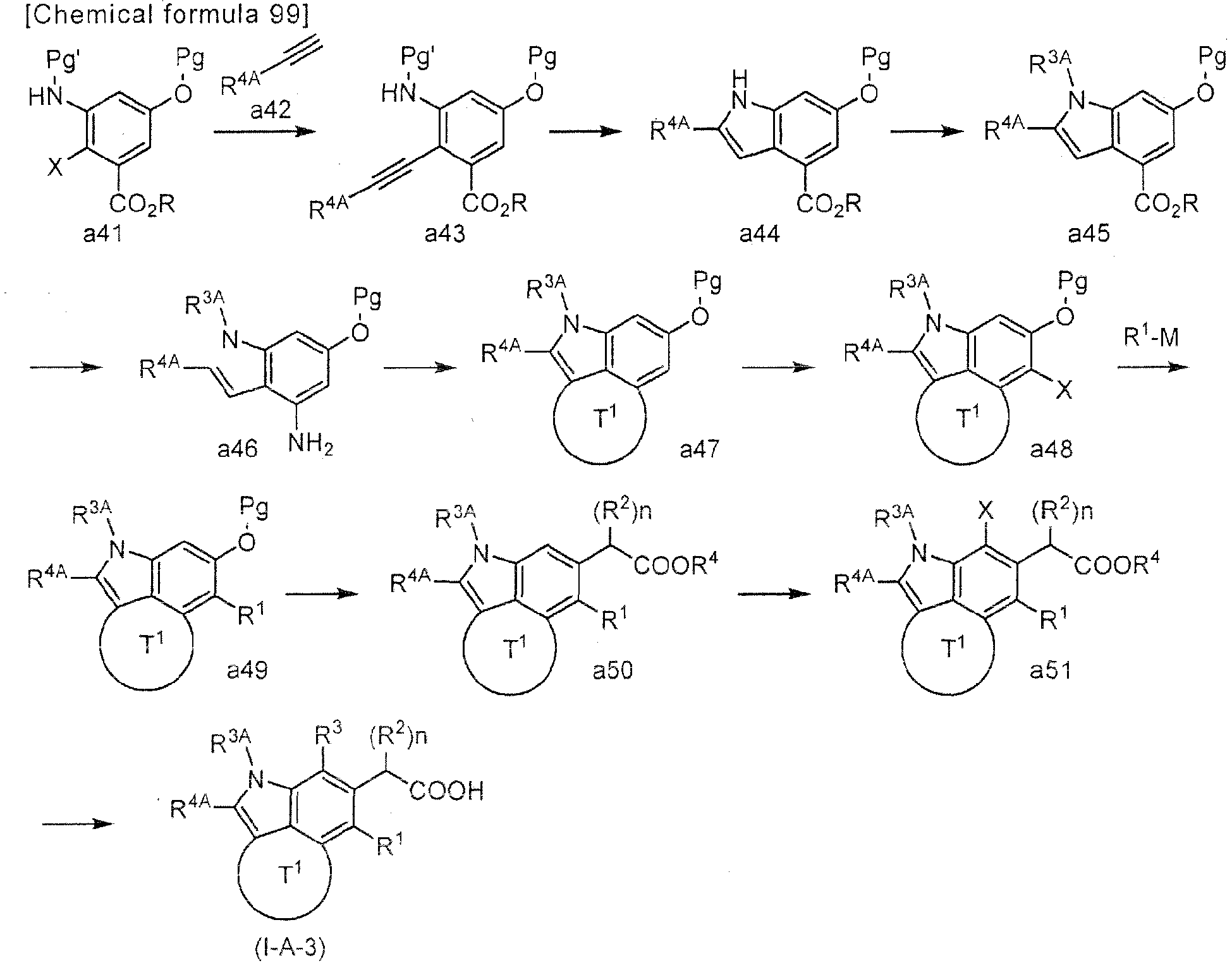
wherein Pg is a hydroxy protecting group (e.g., SEM group, benzyl group); Pg' is an amino protecting group (e.g., Act; X is a leaving group (e.g., I, Br); R is a carboxy protecting group; the other symbols are as defined above. - The compound a43 can be obtained by putting the compound a41 and the compound a42 to the Sonogashira coupling reaction.
- The compound a44 can be obtained by reacting the compound a43 in the presence of a base (e.g., TBAF. potassium tert-butoxide), in a solvent (e.g., THF), at a suitable temperature (e.g., 0°C to 100°C, preferably about 70°C).
- The compound a45 can be obtained by reacting the compound a44 with an alkylating reagent having R3A (e.g., methyl iodide in the case that R3A is methyl group), in the presence of a base (e.g., cesium carbonate), in a solvbent (e.g., acetonitrile), at a suitable temperature (e.g., from room temperature to about 60°C).
- The ester group of the compound a45 is hydrolyzed into a carboxyl group by reacting the compound a45 in the presence of a base (e.g., sodium hydrate), in a solvent (e.g., THF, a mixture of methanol and water), at a suitable temperature (e.g., from room temperature to about 50°C). Thereafter, the compound a46 can be obtained by subsequently converting the carboxyl group to an amino group, e.g., by Curtius reaction with DPPA etc.
- The compound a47 can be obtained by putting the compound a46 to the reaction forming T1 ring described above [1].
- The compound a48 can be obtained by reacting the compound a47 with a halogenating reagent (e.g., NIS), in a solvent (e.g., DMF, dichloromethane), at a suitable temperature (e.g., under ice cooling to reflux temperature).
- The compound a49 can be obtained by reacting the compound a48 with R1-M (e.g., R1-botonic acid), in the presence of a suitable transition metal and ligand to be used in a coupling reaction (e.g., Pd2(dba)3, RuPhos) and a base (e.g., potassium phosphate), in a solvent (e.g., dioxane), a suitable temperature (e.g., from about 50 °C to reflux temperature).
- The compound a50 can be obtained by deprotecting a hydroxyl protecting group of the compound a49, and then conducting according to Step 4 in the synthesis of the compound (I-A-7), and then conducting according to Step 6 in the synthesis of the compound (l-A-1).
- The compound a51 can be obtained by reacting the compound a50 with a halogenating reagent (e.g., NIS), in a solvent (e.g., DMF, dichloromethane), at a suitable temperature (e.g., under ice-cooling to reflux temperature).
- It can be carried out according to Step 4, 7 in the synthesis of the compound (I-A-1).
-

- The compound a53 can be obtained by reacting the compound a52, for example, according to the synthesis method described in Journal of Organic Chemistry, 2013, 78(17), 8217-8231.
- The compound a54 can be obtained by reacting the compound a53 with R4A-CHO, for example, according to the synthesis method described in Angewandte Chemie, International Edition, 2012, 51(46), 11589-11593.
- For example, it can be carried out according to Step 4, 5 in the synthesis of the compound (I-B-5).
- The compound a56 can be obtained by reacting the compound a55 with a halogenating reagent (e.g., NIS), in a solvent (e.g., DMF, dichloromethane), at a suitable temeperature (e.g., under ice-cooling to reflux temperature).
- It can be carried out according to Step 6, 7 in the synthesis of the compound (I-A-1).
-

- The compound a58 can be obtained by reacting the compound a57 with a halogenating reagent (e.g., NIS), in a solvent (e.g., DMF, dichloromethane), at a suitable temperature (e.g., under ice-cooling to reflux temparature).
- The compound a60 can be obtained by putting the compound a58 and a compound a59 to the Sonogashira coupling reaction.
- The compound a61 can be obtained by reacting the compound a60 in the presence of a transition metal catalyst (e.g., palladium or copper), in a solvent (e.g., dioxane, THF, toluene), preferably from room temperature to reflux temperateure.
- The compound a62 can be obtained by reacting the compound a61 with trifluoromethanesulfonic acid anhydride, in a presence of a base (e.g., pyridine), in a solvent (e.g., dichloromethane), at a suitable temperature (e.g., inder ice-cooling).
- It can be carried out according to Step 6, 2 in the synthesis of the compound (I-A-1).
- It can be carried out according to the formation reaction of T1 ring described above [1].
- It can be carried out according to Steps 5, 4, 7 in the synthesis of the compound (I-A-1).
-

- The compound a67 can be obtained by introducing a methylthio group into the compound a66. As the reaction conditions, 1) a coupling reaction of dimethyl sulfide with a transition metal (Tetrahedron Letters, 2006, 47(29), 5059-5062.), or 2) a thiophenol formation by a coupling reaction with a thioacetate salt and a transition metal and subsequient methylation with a methylation reagent (Beilstein Journal of Organic Chemistry, 2013, 9, 467-475.) are exemplified.
- It can be carried out according to Step 6 in the synthesis of the compound (I-A-1).
- The compound a69 can be obtained by reacting the compound a68 with a halogenating reagent (e.g., NIS), in a solvent (e.g., DMF, dichloromethane), at a suitable temperature (e.g., under ice-cooling to reflux temperature).
- The compound a71 can be obtained by putting the compound a69 and the compound a70 to the Sonogashira coupling reaction.
- The compound a72 can be obtained by conducting dehalogenation by catalytic reduction after the formation of thiazole ring via a halonium cation using the compound a71 according to the method described in Journal of Organic Chemistry, 2002, 67(6), 1905-1909.
- It can be carried out according to Steps 6 to 10 in the synthesis of the compound (I-A-7).
-

- The compound b3 can be obtained by reacting the compound b1 and the compound b2, for example according to the method described in Journal of Heterocycle Chemistry, 2013, 50(3), 638-644.
- It can be carried out according to Step 4 in the synthesis of the compound (I-A-1).
- it can be carried out according to Step 2, 3 in the synthesis of the compound (I-B-5).
- It can be carried out according to Step 2 in the synthesis of the compound (I-A-1), subsequent the T1 ring forming reaction according to Step 7 in the synthesis of the compound (I-A-1).
-

- The compound (2) can be obtained by reacting the compound (1), X-NH2 (X is a leaving group (eg. ArS03-, (O2 N)2 PhO-) and an acetylene group having R4A group, according to the method described in Bioorganic & Medicinal Chemistry Letters, 2013, 23(19), 5311-5316. Pg (: hydroxy protecting group) is preferably benzyl.
- It can be carried out according to the T1 ring forming reaction described above.
- It can be carried out according to Step 6 in the synthesis of the compound (I-A-1).
- It can be carried out according to Step 4 in the synthesis of the compound (I-A-7) and Step 4, 7 in the synthesis of the compound (I-A-1) after deprotection the hydroxy protecting group (Pg).
-

- The compound b11 can be obtained by reacting the compound b10, for example, according to the method in
WO2004/046133 . - It can be carried out according to Step 4 in the synthesis of the compound (I-A-7) after deprotection of the hydroxy protecting group (Pg).
- it can be carried out according to Step 6 in the synthesis of the compound (I-A-1).
- The ester group of the compound b13 is converted to carboxyl group by hydroysis in the presence of a base (e.g., sodium hydrate), in a solvent (e.g., THF, a mixture of methanol and water), at a suitable temperature (e.g., from room temperature to about 50°C). Thereafter, subsequently the compound b14 can be obtained by converting a carboxyl group to an amino group by Curtius reaction using DPPA, for example.
- It can be carried out according to the T1 ring forming reaction described above.
- It can be carried out according to Step 7 in the synthesis of the compound (I-A-1).
-

- The compound c3 can be obtained by reacting the compound c1 and the compound c2, for example, according to the method described in Journal of Medicinal Chemistry, 1987, 30(11), 2047-51., in a solvent (e.g., ethanol), at a suitable temperature (e.g., room temperature to reflux temperature).
- For example, according to the method described in
WO2006/036816 , the compound c3 is reacted with diphenyl imine using a suitable transition metal, ligand, base, and solvent for a coupling reaction (e.g., palladium acetate, BINAP, cesium carbonate and toluene), at a suitable temperature (e.g., about 100°C to reflux temperature). After that, the compound c4 can be obtained by conducting deprotection of a diphenylmethyl group from an amino group under acidic condition (eg. dilute hydrochloric acid), in a solvent (e.g., THF), at a suitable temperature (e.g., room temperature to reflux temperature). - It can be carried out according to the T1 ring forming reaction described above.
- The compound c6 can be obtained by reacting the compound c5 with a halogenating reagent (e.g., NIS), in a solvent (e.g., DMF, dichloromethane), at a suitable temperature (e.g., under ice-cooling to reflux temperature).
- It can be carried out according to Step 5 in the synthesis of the compound (I-A-1).
- It can be carried out according to Step 2, 3 in the synthesis of the compound (I-B-5).
- It can be carried out according to Step 7 in the synthesis of the compound (I-A-1).
- The final compound obtained by the above process can be convered to a further compound of the present invention by carrying out a well-known chemical modification to a person skilled in the art. When the functional groups (e.g., hydroxy, amino, carboxy) exist in each reaction before and after, it may be optionally conducted to protecting or deprotecting reaction for the functional groups by well-known reaction to the skilled person in the art (ref: Organic Synthesis, written by T. W. Greene, John Wiley & Sons Inc. (1991)).
- The compound of the present invention has an inhibitory effect on HIV replication, thus is useful as a therapeutic agent and/or prophylactic agent of viral infections such as AIDS or the like.
- In HIV replication inhibition activity of the compound of the present invention, for example, in the following Experimental Example 1, preferably, EC50 value is 100nM or less, more preferably 50nM or less, more preferably 20nM or less, particularly preferably 10nM or less. EC90 value is also available in the evaluation of this activity. Also, preferred compound has strong virus mutations resistance. More preferred compound has high C24/EC50 value (C24: blood concentration after administration 24 hours).
- Preferably, the compound of the present invention has any or all of excellent characteristics described below.
- a) Has a weak inhibitory effect on CYP enzymes (e.g., CYP1A2, CYP2C9, CYP2C19, CYP2D6, CYP3A4, etc.).
- b) Shows good pharmacokinetics such as high bioavailability and moderate clearance.
- c) Has high metabolic stability.
- d) Shows no irreversible inhibitory effect on a CYP enzyme (e.g., CYP3A4) within a concentration range in the measurement conditions described herein.
- e) Has no mutagenicity.
- f) Has low risk on the cardiovascular system.
- g) Shows high solubility.
- h) Shows strong efficacy also against resistant viruses.
- i) Has high stability in aqueous solution.
- j) Has high light stability and/or low or no phototoxity.
- k) It is difficult to develop a resistant virus.
- The pharmaceutical composition of the present invention can be administered orally or parenterally. Methods for parenteral administration include dermal, subcutaneous, intravenous, intraarterial, intramusclear, intraperitneal, transmucosal, inhalation, transnasal, ophthalmic, inner ear or vaginal administration and the like.
- In case of oral administration, any forms, wich are usually used, such as oral solid formulations (e.g., tablets, powder, granyles, capsules, pills, films or the like), oral liquid formulations (e.g., suspension, emulsion, elixir, syrup, lemonade, spirit, aromatic water, extract, decoction, tincture or the like) or the like may prepared. The tablets can be sugar coated tablets, film coated tablets, enteric-coating tablets, sustained-release tablets, troche tablets, sublingual tablets, buccal tablets, chewable tablets or orally dispersing tablets. Powders and granules can be dry syrups. Capsules can be soft capsules, micro capsules or sustained-release capsules.
- In the case of parenteral administration, any forms, which are usually used, such as injections, drips, external preparations (e.g., ophthalmic drops, nasal drops, ear drops, aerosols, inhalations, lotion, infusion, liniment, mouthwash, enema, ointment, plaster, jelly, cream, patch, cataplasm, external powder, suppository or the like) or the like can be preferably administered. Injections can be emulsions whose type is O/W, W/O, O/W/O, W/O/W or the like.
- The pharmaceutical composition may be manufactured by mixing an effective amount of the compound of the present invention with various pharmaceutical additives suitable for the formulation, such as excipients, binders, moistening agents, disintegrants, lubricants, diluents or the like. Furthermore, the pharmaceutical composition can be for pediatric patients, geriatric patients, serious cases or operations by appropriately changing the effective amount of the compound of the present invention, formulation and/or various pharmaceutical additives. The pediatric pharmaceutical compositions are preferably administered to patients under 12 or 15 years old. In addition, the pediatric pharmaceutical compositions can be administered to patients who are under 27 days old after the birth, 28 days to 23 months old after the birth, 2 to 11 years old, or 12 to 16 years old, or 18 years old. The geriatric pharmaceutical compositions are preferably administered to patients who are 65 years old or over.
- Although the dosage of a pharmaceutical composition of the present invention should be determined in consideration of the patient's age and body weight, the type and degree of diseases, the administration route and the like, a usual oral dosage is 0.05 to 100 and preferably 0.1 to 10 mg/kg/day. For parenteral administration, although the dosage highly varies with administration routes, a usual dosage is 0.005 to 10 and preferably 0.01 to 1 mg/kg/day. The dosage may be administered in one to several divisions per day.
- The compound of the present invention can be used in combination with a reverse transcriptase inhibitor, a protease inhibitor, an integrase inhibitor, other anti-HIV drug, or the like (hereinafter, abbreviated as concomitant drug), for the purpose of enhancement of action of the compound, reduction of the dosage amount of the compound, or the like. At this time, the time of administration of the compound of the present invention and the concomitant drug is not limited, and, these may be adminidtered simultaneously, or may be administered with a time difference, to the administration subject. Futhermore, the compound of the present invention and the concomitant drug may be administered as two types of preparations containing each active ingredient, or may be administered as a single preparation containing both active ingredients.
- The dosage amount of the concomitant drug can be appropriately selected based on the clinically used dose. In addition, the blending ratio of the compound of the present invention to the concomitant drug can be appropriately selected depending on the administration subject, administration route, target disease, symptoms, combination and the like. For example, when the administration subject in a human, 0.01 to 100 parts by weight of the concomitant dug may be used, based on 1 part by weight of the compound of the present invention.
- In addition, the compound of the present invention can be used, in the field of gene therapy, to prevent infection of retroviral vectors from spreading to other parts than the object tissues when using a retroviral vector based on HIV and MLV. in particular, when a vector is transmitted to cells and the like in a test tube and then returned to the body, by administering the compound of the present invention in advance, it is possible to prevent unnecessary infection in the body.
- Examples of the reverse transcriptase inhibitor include AZT, 3TC, didanosine, zalcitabine, Sanirubujin, abacavir, tenofovir, emtricitabine, Nebirabin, efavirenz, capravirine, etracirine, delavirdine and the like.
- Examples of the protease inhibitor include indinavir, ritonavir, saquinavir, nelfinavir, amprenavir, Atazanavir, lopinavir, fosamprenavir, darunavir, atanazavir, Brecanavir, Tipranavir and the like.
- Examples of the integrase inhibitor include raltegravir, Elvitegravir, JTK-656, Dolutegravir (S-349572), S-265744 and the like.
- Examples of other anti-HIV drugs include entry inhibitors such as maraviroc and vivriviroc and the like, fusion inhibitors such as enfuvirtide, sifuvirtide, albuvirtide and the like.
- Hereinafter, the present invention will be described in more detail with reference to examples and reference examples of the present invention and test examples, but the present invention is not limited by these examples.
-
- Flow rate: 0.8 mL/min; UV detection wavelength: 254nm;
- Mobile phase: [A]: a 0.1% formic acid-containing aqueous solution, [B]: a 0.1% formic acid-containing acetonitrile solution
- a linear gradient of 5% to 100% solvent [B] was carried out in 3.5 minutes, and 100% solvent [B] was kept for 0.5 minutes.
-
- Flow rate: 1.6 mL/min; UV detection wavelength: 254nm;
- Mobile phase: [A]: a 0.1 % formic acid-containing aqueous solution, [B]: a 0.1 % formic acid-containing acetonitrile solution
- Gradient: a linear gradient of 10% to 100% solvent [B] was carried out in 3 minutes, and 100% solvent [B] was kept for 0.5 minutes.
-
- Flow rate: 1.6 mL/min; UV detection wavelength: 254nm;
- Movile phase: [A]: a 0.1% formic acid-containing aqueous solution, [B]: a 0. 1% formic acid-containing acetonitrile solution
- Gradient: a linear gradient of 10% to 100% solvent [B] was carried out in 8 minutes, and 100% solvent [B] was kept for 0.5 minutes.
-
- Flow rate: 0.8 mL/min; UV detection wavelength: 254nm;
- Mobile phase: [A] a 0.1 % formic acid-containing aqueous solution, [B] a 0.1 % formic acid-containing acetonitrile solution
- Gradient: a linear gradient of 5% to 100% solvent [B] was carried out in 9.5 minutes, and 100% solvent [B] was kept for 0.5 minutes.
-
- Ac: Acetyl
- n-Bu: n-butyl
- t-Bu: tert-butyl
- BINAP: 2,2'-bis.diphenylphosphino)-1,1'-binaphthyl
- Bn: benzyl
- DMA: N,N-dimethylacetoamide
- DME: dimethoxyethane
- DMF: N,N-dimethylformamide
- DCM: dichloromethane
- DMAP: N,N-dimethyl-4-aminopyridine
- DMSO: dimethyl suldoxide
- DPPA: diphenyl phosphoryl azido
- dppf: 1,1'-bis(diphenylphosphino)ferrocene
- dppp: 1,3-bis(diphenylphosphino)propane
- dtbpf: 1,1'-di-tert-butyl phosphino ferrocene
- Et: ethyl
- Fmoc: 9-fluorenylmethyl oxycarbonyl
- Me: methyl
- Ms: methyl sulfonyl
- NBS: N-bromosuccineimide
- NCS: N-chlorosuccineimide
- NIS: N-iodesuccineimide
- Ph: phenyl
- Pd2 (dba)3 : tris(dibenzylideneacetone)dipalladium(0)
- SEM: 2-(trimethylsilyl)ethoxymethyl
- TBAF: tetra-n-butyl ammonium fluoride
- TBS: tert-butyl dimethylsil
- THF: tetrahydro furan
- Tf: trifluoromethaesulfonyl
- TFA: trifluoroacetic acid
- TMS: trimethylsilyl
- Ts: p-toluenesulfonyl
- RuPhos: 2-dicyciohexylphosphino-2',6'-diisopropoxy-1,1'-biphenyl
-

- To a solution of the compound i1 (7.0g, 34.6 mmol) in methanol (70mL) was added dropwise acetic acid anhydride (3.60mL, 38.1mol), and the mixture was refluxed for 0.5 hours. The reaction mixture was concentrated under reduced pressure, the obtained residue was dissolved in ethyl acetate, and the organic layer was washed with water and brine, dried over anhydrous sodium sulfate, and then concentrated under reduced pressure to yield the compound i2 (8.322g, yield 98%).
1 H-NMR (CDCl3)δ: 2.13 (s, 3H), 2.28 (s, 3H), 5.42 (brs, 1 H), 6.95 (brs, 1H), 7.09 (s,1H), 7.60 (s, 1 H).
LC/MS (ESI): m/z = 243.95, 245.95 [M+H]+ - To a suspension of the compound i2 (8.322g, 34.1mmol) in acetonitrile (42mL) was added cesium carbonate (13.33g, 40.9mmol) and methyl iodide (2.3mL, 36.8mmol), and the mixture was refluxed for 0.5 hours. After cooling to room temperature, water was added to the reaction mixture, and the mixture was extracted with ethyl acetate, the organic layer was washed with aqueous sodium carbonate solution, water and brine, dried over anhydrous sodium sulfate, and then concentrated under reduced pressure to yield the compound i3 (8.68g, yield 99%).
1 H-NMR (CDCl3) δ: 2.15 (s, 3H), 2.31 (s, 3H), 3.78 (s, 3H), 6.97 (brs, 1 H), 7.55 (s, 1 H). LC/MS (ESI): m/z = 257.95, 259.95 [M+H]+ . - To a solution of the compound i3 (8.68g, 33.6mmol) in concentrated sulfuric acid (86mL) was added dropwise a solution of concentrated nitric acid (2.25mL, 35.3mmol) in concentrated sulfuric acid (4.6mL) under ice with sodium chloride cooling, and the mixture was stirred for 0.5 hours at room temperature. The reaction mixture was poured into ice water, the precipitate was collected by filtration and washed with water, and dissolved in chloroform and washed with water. The resulting chloroform solution was purified by silica gel column chromatography (ethyl acetate - chloroform) to yield the compound i4 (3.87g, yield 38%).
1 H-NMR (CDCl3) δ: 2.19 (s, 3H), 2.37 (s, 3H), 3.82 (s, 3H), 8.10 (brs, 1 H), 8.36 (s, 1 H). LC/MS (ESI): m/z = 302.95, 304.90 [M+H]+ . - To a solution of the compound i4 (3.87g, 12.77mmol) in THF (30mL) and methanol (15mL) was added 2mol/L aqueous sodium hydride solution (12.8mL, 25.5mmol), the mixture was refluxed for 3 hours. The reaction mixture was cooled to room temperature, aqueous ammonium chloride solution was added, and the mixture was extracted with ethyl acetate. The organic layer was washed with aqueous ammonium chloride solution, water and brine, and dried over anhydrous sodium sulfate, and then concentrated under recuded pressure to yield the compound i5 (3.35g, yiled 100%).
1 H-NMR (CDCl3) δ: 2.41 (s, 3H), 3.75 (s, 3H), 4.83 (brs, 2H), 6.92 (s, 1H).
LC/MS (ESI): m/z = 260.95, 262.95 [M+H]+. - To a solution of the compound i5 (3.33g, -12.75mmol) in ethanol (33mL) was added silver sulfate solution (6.21g, 19.93mmol), and added iodine (4.85g, 19.14mmol) under ice-cooling, and the mixture was stirred for 7.5 hours at room temperature. To the reaction mixture was added aqueous sodium bicarbonate carefully, added ethyl acetate, and the mixture was stirred, after that the insoluble materials was filtered out. The resulting filtrate was washed with aqueous sodium thiosulfate solution, aqueous sodium bicarbonate solution and brine, dried over anhydrous sodium sulfate, and concentrated under reduced pressure, to yield a crude product of the compound i6 (5.06g).
LC/MS (ESI): m/z = 386.85, 388.80 [M+H]+. - To a suspension of the compound i6 (4.94g, 12.77mmol) in acetic acid (50mL) was added acetic anhydride (26.4mL, 281 mmol), the mixture was refluxed overnight. To the reaction mixture was added water (200mL), and the mixture was extracted with ethyl acetate. The organic layer was washed with water and brine, dried over anhydrous sodium sulfate, and then concentrated under reduced pressure. The resulting residue was dissolved in THF (20mL) and methanol (20mL), aqueous sodium carbonate solution (2mmol/L, 20mL) was added, and the mixture was stirred for 1.5 hours at 50°C. The reaction solution was cooled to room temperature, and aqueous citric acid solution was added to the solution, and the mixture was extracted with ethyl acetate. The organic layer was washed with aqueous citric acid solution was brine, dried over anhydrous sodium sulfate, and concentrated under reduced pressure ro yield a crude product of the compound i7 (5.54g).
LC/MS (ESI): m/z = 428.85, 430.85 [M+H]+ . - To a suspension of the compound i7 (5.48g, 12.77mmol) in dichloromethane (165mL) cooled in dry ice-acetone bath was added boron tribromide (1mol/L dichloromethane solution, 38.3mL, 38.3mmol) dropwise, and the mixture was stirred overnight while heating to room temperature. The reaction mixture was added aqueous sodium bicarbonate solution under ice-cooling thereto, and the insoluble materials were removed by Celite filtration. The filtrate was extracted with aqueous sodium bicarbonate solution, and washed with chloroform. The aqueous phase was neutralized with aqueous citric acid solution to pH5, and extracted with ethyl acetate. The organic layer was washed with water and brine, dried over anhydrous sodium sulfate, and concentrated under reduced pressure to yield a brown amorphous residue (1.73g). After the chloroform layer used by washing was dried over anhydrous sodium sulfate and concentrated under reduced pressure to yield a brown amorphous residue (1.29g).
- The combined both residues (3.02g) were dissolved in THF (60mL), diisopropylethylamine (2.04mL, 11.64mmol), trimethylsilyl ethoxymthoxy chloride (1.74mL, 9.78mmol) was added thereto under ice-cooling, and the mixture was stirred for 1 hour. The reaction mixture was added aqueous ammonium chloride solution and ethyl acetate, and the mixture was extracted with ethyl acetate. The organic layer was washed with aqueous ammonium chloride solution, water and brine, dried over anhydrous sodium sulfate, and concentrated under reduced pressure. The resulting residue was purified by silica gel column chromatography (ethyl acetate - chloroform) to yield the compound i8 (2.37g, yield 60%).
1H-NMR (CDCl3)δ: 0.04 (s, 9H), 1.00 (t, 2H, J = 8.5 Hz), 2.18 (s, 3H), 2.29 (s, 3H), 3.91 (t, 2H, J = 8.5 Hz), 5.14 (s, 2H), 6.96 (brs, 1H).
LC/MS (ESI): m/z = 544.95, 546.95 [M+H]+ . -

- To a solution of the compound i9 (10g, 46.3mmol) in DMF (100mL) was added ZnF2 (14.36g, 139mmol), t-Bu3P (2.24mL, 9.26mmol), Pd(dba)2 (2.66g, 4.63mmol), (Z)-((2-(t-butoxy)-1-methoxyvinyl)oxy)trimethylsilane (30.3g, 139mmol), the mixture was stirred at 100°C for 1 hour under nitrogen atmosphere. The reaction solution was added water, extracted with ethyl acetate, the organic layer was washed with water, dried over anhydrous sodium sulfate, and concentrated under reduced pressure. The resulting residue was purified by silica gel chlomn chromatography (hexane - ethyl acetate) to yield a crude product of the compound i10 (16.1g).
- To a solution of a crude product i10 (16.1g) in acetic acid (160mL) was added Zn (30.3g, 463mmol) under ice-cooling, the mixture was stirred at room temperature for 1 hour. The reaction solution was filtered, the filtrate was concentrated under reduced pressure. The resulting residue was purified by silica gel column chromatography (hexane - ethyl acetate) to yield the compound i11 (10.74g, yield for 2 steps 92%). 1 H-NMR (CDCl3) δ: 1.22(s, 9H), 2.21(s, 3H), 3.66(s, 3H), 5.22(s, 1 H), 6.64(d, 1H, J=7.3Hz), 6.97-7.04(m. 2H).
- To a solution of the compound i11 (10.7g, 42.6mmol) in DMF (100mL) was added NBS (7.2g, 40.4mmol) under ice-cooling, the mixture was stirred at room temperature for 10 minutes. The reaction solution was added aqueous sodium bicarbonate solution, aqueous sodium thiosulfate solution, extracted with ethyl acetate, and the organic layer was washed with water, dried over anhydrous sodium sulfate, concentrated under reduced pressure. The resulting residue was purified by silica gel column chromatography (hexane - ethyl acetate) to yield the compound i12 (12.0g, yield 90%).
LC/MS (ESI): m/z = 330.95 [M+H]+. - To a solution of the compound i12 (11.9g, 36mmol) in DMF (120mL) was added 2mol/L aqueous potassium carbonate solution (54.1 mL, 108mmol), p-tolylboronic acid (7.35g, 54.1mmol), and PdCl2(dtbpf) (2.35g, 3.6mmol), the mixture was stirred at 100°C under a nitrogen atomosphere. The reaction solution was added water, extracted with ethyl acetate, the organic layer was washed with water, dried over anhydrous sodium sulfate, and concentrated under reduced pressure. The resulting residue was purified by silica gel column chromatography (hexane - ethyl acetate) to yield the compound i13 (10.8g, yield 88%).
LC/MS (ESI): m/z = 342.15 [M+H]+. - The compound i14 (12.8g, yield 97%) was obtained by reacting the compound i13 (10.7g, 31.3mmol) in the same manner as Step 3 of Reference Example 2.
LC/MS (ESI): m/z = 420.10 [M+H]+. - A solution of the compound i14 (7.5g, 17.84mmol) in dichloroethane (80mL) was added m-CPBA (17.6g, 71.4mmol) under ice-cooling, the mixture was refluxed for 2 hours. To the reaction solution was aqueous sodium bicarbonate solution, aqueous sodium thiosulfate solution, and the mixture was extracted with chloroform, the organic layer was washed with water, dried over anhydrous sodium sulfate, and concentrated under reduced pressure. The obtained residue was purified by silica gel column chromatography (hexane - ethyl acetate) to yield the compound i15 (5.81g, yield 72%).
1H-NMR (CDCl3) δ: 0.89(s, 9H), 2.36(s, 3H), 2.43(s, 3H), 3.78(s, 3H), 5.26(s, 1 H), 7.24-7.27(m, 4H), 7.40(s, 1 H). - To a solution of the compound i15 (6.2g, 13.77mmol) in toluene (60mL) was added cesium carbonate (13.46g, 41.3mmol), acetoamide (2.44g, 41.3mmol), BINAP (857mg, 1.38mmol), and palladium acetate (309mg, 1.38mmol), the mixture was refluxed under nitrogen atomosphere for 2 hours. The reaction solution was filtered, the filtrate was concentrated under reduced pressure, and the obtained residue was purified by silica gel column chromatography (hexane - ethyl acetate) to yield the compound i16 (3.57g, yield 61%).
LC/MS (ESI): m/z = 451.20 [M+Na]+. - To a solution of the compound i16 (3.5g, 8.17mmol) in methanol (35mL) was added potassium carbonate (5.64g, 40.8mmol), the mixture was refluxed for 5 hours. Water was added to the reaction solution, extracted with chloroform, the organic layer was washed with water, dried over anhydrous sodium sulfate, and concentrated under reduced pressure. The obtained residue was washed with diisopropylether to yield the compound i17 (2.89g, yield 92%).
LC/MS (ESI): m/z = 409.15 [M+Na]+. - To a solution of the compound i17 (2.8g, 7.25mmol) in ethanol (30mL) was added silver nitrate (2.46g, 14.49mmol) and iodine (3.68g, 14.49mmol) under ice-cooling, the mixture was stirred at room temperature for 2.5 hours. The insoluble materials were removed by filtration, aqueous sodium bicarbonate solution and aqueous sodium thiosulfate solution were added to the filtrate, extracted with ethyl acetate, the organic layer was washed with water, dried over anhydrous sodium sulfate, concentrated under reduced pressure. The obtained residue was purified by silica gel column chromatography (hexane - ethyl acetate) to yield the compound i18 (3.51g, yield 95%).
LC/MS (ESI): m/z = 535.00 [M+Na]+. -
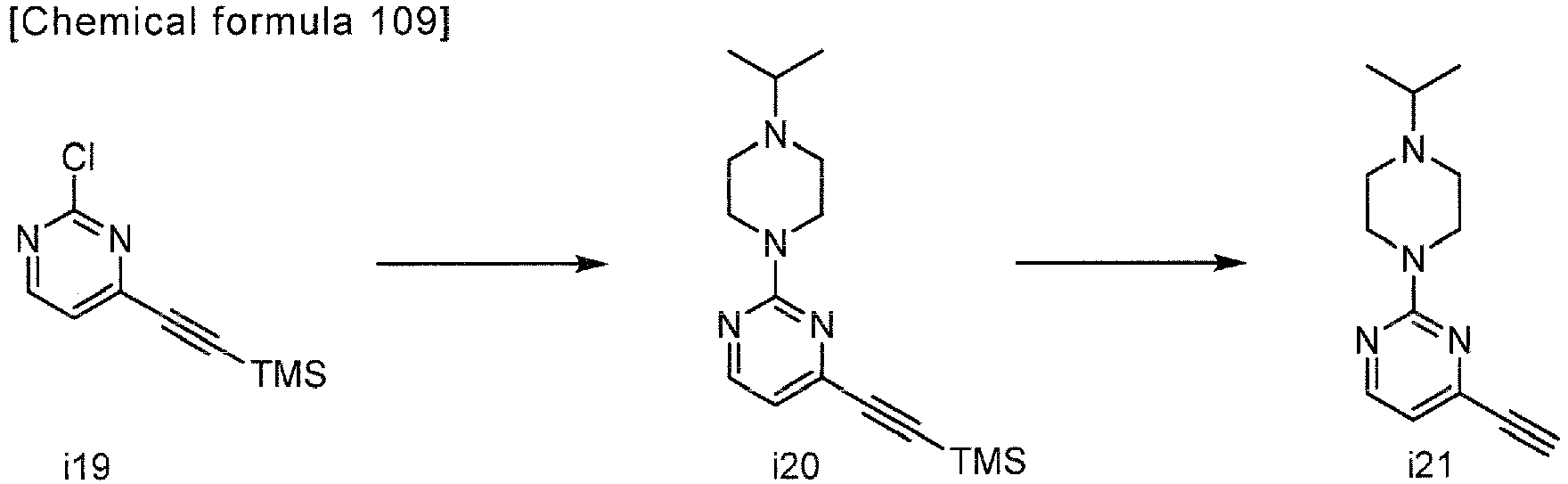
- To a solution of the compound i19 in DMF(20mL) was added 1-isopropylpiperazine (4.85mL, 34.2mmol), the mixture was stirred at 60°C for 1 hour. Water was added to the reaction solution, and extracted with ethyl acetate, the organic layer was washed with water, dried over anhydrous sodium sulfate, and concentrated under reduced pressure. The obtained residue was purified by silica gel column chromatography (ethyl acetate) to yield the compound i20 (2.54g, yield 74%).
LC/MS (ESI): m/z = 303.20 [M+H]+. - To a solution of the compound i20 in methanol was added potassium hydroxide, the mixture was stirred at room temperature for 30 minutes. The reaction solution was concentrated under reduced pressure, and the obtained residue was purified by silica gel column chromatography (ethyl acetate) to yield the compound i21 (1.17g, yield 61%). LC/MS (ESI): m/z = 231.05 [M+H]+.
-

- To a suspension of the compound i8 (1.41g, 2.59mmol), PdCl2 (PPh3)2 (182mg, 0.259mmol), and copper iodide (I) (74mg, 0.388mmol) in DMF (28mL) was added ethynylbenzene (568µL, 5.17mmol), triethylamine (1.79mL, 12.93mmol), and tetrabutylammonium iodide (1.43g, 3.88mmol) under nitrogen atomosphere, the mixture was stirred at 60°C overnight. The reaction solution was diluted with ethyl acetate, aqueous citric acid solution was added thereto, and then the mixture was stirred, and extracted with ethyl acetate. The organic layer was washed with aqueous citric acid solution, water and brine, dried over anhydrous sodium sulfate, and concentrated under reduced pressure.
- To a solution of the obtained residue in dichloromethane (20mL) was added diisopropylethylamine (542µL, 3.10mmol), and trimethyl silylethoxymethoxy chloride (481µL, 2.71mmol) under ice-cooling, the mixture was stirred at room temperature for 2.5 hours. Aqueous ammonium chloride solution was added to the reaction solution, extracted with chloroform, and the organic layer was washed with brine, dried over anhydrous sodium sulfate, and concentrated under reduced pressure. The obtained residue was purified by silica gel column chromatography (ethyl acetate - chloroform) to yield the compound 1 (910mg, yiled 68%).
1H-NMR (CDCl3) δ: 0.05 (s, 9H), 1.01 (t, 2H, J = 8.5 Hz), 2.21 (s, 3H), 2.38 (s, 3H), 3.93 (t, 2H, J = 8.5 Hz), 5.16 (s, 2H), 7.39-7.42 (m, 3H), 7.53-7.56 (m, 2H).
LC/MS (ESI):m/z = 519.10, 521.10 [M+H]+. - To a solution of the compound 1 (910mg, 1.75mmol) in THF (20mL) was added tetrabutylammonium bromide / THF solution (1mol/L, 4.4mL), the mixture was stirred at 70°C for 2 hours. The reaction solution was cooled to room temperature, aqueous ammonium chloride solution was added thereto, extracted with ethyl acetate, and then the organic layer was washed with water and brine, dried over anhydrous sodium sulfate, concentrated under reduced pressure. The obtained residue was purified by silica gel column chromatography (ethyl acetate - hexane) to yield the compound 2 (431 mg, yiled 52%).
1H-NMR (CDCl3) δ: 0.06 (s, 9H), 1.01-1.08 (m, 2H), 2.81 (s, 3H), 3.96-4.02 (m, 2H), 5.16 (s, 2H), 6.92 (d, 1 H, J = 2.5 Hz), 7.38-7.43 (m, 1 H), 7.50 (t, 2H, J = 7.6 Hz), 7.72 (d, 2H, J = 7.5 Hz), 10.03 (s, 1H).
LC/MS (ESI): m/z = 477.00, 479.05 [M+H]+. - To 6-chromanylboronic acid (58mg, 0.324mmol), Pd2 (dba)3 (7.9mg, 8.63µmol), RuPhos (12mg, 26µmol), and potassium phosphate (183mg, 0.863mmol) were added a solution of the compound 2 (103mg, 0.216mg) in dioxane (1mL) under nitrogen atomosphere, the mixture was stirred at 120°C for 50 minutes under microwave irradiation. The reaction solution was diluted with ethyl acetate, aqueous ammonium chloride solution was added thereto, extracted with ethyl acetate, and the organic layer was washed with water and brine, dried over anhydrous sodium sulfate, and concentrated under reduced pressure. The obtained residue was purified by silica gel column chromatography (ethyl acetate - hexane) to yield the compound 3 (92.4mg, yield 81%).
1H-NMR (CDCl3 δ: 0.00 (s, 9H), 0.83 (t, 2H, J = 8.5 Hz), 2.07-2.12 (m, 2H), 2.83 (s, 3H), 2.89 (t, 2H, J = 6.3 Hz), 3.49 (t, 2H, J = 8.5 Hz), 4.28 (t, 2H, J = 5.0 Hz), 4.67 (s, 2H), 6.77 (d, 1H, J = 1.8 Hz), 6.94 (d, 1H, J = 8.3 Hz), 7.32 (s, 1H), 7.34-7.40 (m, 2H), 7.41-7.49 (m, 2H), 7.68 (d, 2H, J = 7.7 Hz), 10.10 (s, 1H).
LC/MS (ESI): m/z = 531.25 [M+H]+. - The compound 4 (114mg, yield 86%) was obtained by reacting the compound 3 (121mg, 0.228mmol) in the same manner as Step 4 in Example 3.
1H-NMR (CDCl3) δ: 2.05-2.13 (m, 2H), 2.85-2.90 (m, 5H), 4.26-4.31 (m, 2H), 6.83 (s, 1H), 6.96 (d, 1H, J = 8.5 Hz), 7.22-7.31 (m, 2H), 7.38-7.43 (m, 1H), 7.48 (t, 2H, J = 7.4 Hz), 7.69 (d, 2H, J = 7.5 Hz), 10.18 (s, 1 H).
LC/MS (ESI): m/z = 533.10 [M+H]+. - The compound 5 (90mg, yield 80%) was obtained by reacting the compound 4 (113mg, 0.212mmol) in the same manner as Step 5 in Example 5.
LC/MS (ESI): m/z = 529.15 [M+H]+. - To a suspension of the compound 5 (56mg, 0.106mmol) and tin chloride (II) (100mg, 0.53mmol) in ethanol (5mL) was refluxed for 6 hours under nitrogen atomosphere. The reaction solution was cooled to room temperature, aqueous sodium bicarbonate solution and ethyl acetate was added thereto, the mixture was filtered by celite. The filtrate was extract with ethyl acetate, and the organic layer was washed with water and birne, dried over anhydrous sodium sulfate, concentrated under reduced pressure. The obtained residue was silica gel cholumn chromatography (ethyl acetate - hexane) to yield the compound 6 (30.4 mg, yield 57%).
1H-NMR (CDCl3) δ: 2.05-2.11 (m, 2H), 2.25 (s, 3H), 2.72-2.93 (m, 2H), 3.54 (br s, 2H), 3.71 (d, 3H, J = 9.3 Hz), 4.27 (t, 2H, J = 5.0 Hz), 5.43 (d, 1 H, J = 7.0 Hz), 6.48 (s, 1H), 6.88 (dd, 1 H, J = 8.1, 5.3 Hz), 7.13-7.30 (m, 3H), 7.35-7.41 (m, 2H), 7.58-7.63 (m, 2H), 8.30 (s, 1H). LC/MS (ESI): m/z = 499.20 [M+H]+. - To a solution of the compound 6 (20mg, 40µmol) in dichloromethane (1mL) was added pyridine (8.11µL, 0.10mmol), and DMAP (0.5mg, 4µmol), then added chloromethane sulfonyl chloride (4.74µL, 52µmol), the mixture was stirred at room temperature overnight. To the reaction solution was added aqueous citric acid solution, the mixture was extracted with dichloromethane, and the organic layer was concentrated under reduced pressure, the obtained residue was purified by silica gel column chromatography (ethyl acetate - hexane) to yield the compound 7 (22.7mg, yield 93%).
LC/MS (ESI): m/z = 611.15, 613.15 [M+H]+. - To a solution of the compound 7 (22.7mg, 37µmol) in DMA was added sodium hydride (60% oil suspension, 8.9mg, 0.23mmol) under nitrogen atomosphere, the mixture was stirred at 100 °C. The reaction solution was cooled to room temperature, added aqueous citric acid solution and stirred, and then extracted with dichloromethane, concentrated under reduced pressure. The obtained residue was purified by silica gel column chromatography (methanol - chloroform) to yield the compound I-3 (20.2mg, 74%).
1H-NMR (CDCl3 ) δ: 0.95 (s, 9H), 1.26 (t, 2H, J = 7.0 Hz), 2.35 (d, 3H, J = 3.6 Hz), 2.87 (t, 2H, J = 6.1 Hz), 4.27 (t, 2H, J = 5.0 Hz), 4.90-4.97 (m, 1H), 5.23-5.34 (m, 1H), 5.63 (s, 1H), 6.39 (d, 1H, J = 6.3 Hz), 6.91 (t, 1H, J = 9.0 Hz), 7.18 (t, 1 H, J = 8.2 Hz), 7.27-7.45 (m, 7H), 10.15 (s, 1H).
LC/MS (ESI): m/z = 561.15 [M+H]+. -

- To a suspension of the compound 8 (10g, 42.7mmol) in ethanol (50mL) was added hydrazine monohydrate (6.23mL, 128mmol) under ice-cooling, and the mixture was stirred at room temperature overnight. The precipitate was collected by filtration and washed with washing solution to yield a crude product of the compound 9 (10.20g).
1H-NMR (CDCl3) δ: 2.46 (s, 3H), 3.70 (s, 2H), 6.73 (s, 1 H), 7.63 (s, 1H), 7.80 (br s, 1H). LC/MS (ESI): m/z = 245.80, 247.85 [M+H]+. - To the compound 9 (3.68g, 15.0mmol) was added propiophenone (2.39mL, 18mmol), trifluoroacetic acid (23mL, 299mmol) under ice-cooling, and the mixture was stirred at 120°C for 30minutes in a sealed tube. The reaction solution was added water and hexane, the precipitate was collected by filtration, washed with hexane. The obtained solid was purified by silica gel column chromatography (ethyl acetate - hexane) to yield the compound 10 (2.44g, yield 47%).
1H-NMR (CDCl3) δ: 2.65 (s, 3H), 2.79 (s, 3H), 7.43-7.49 (m, 1H), 7.50-7.59 (m, 4H), 9.97 (s, 1 H).
LC/MS (ESI): m/z = 344.90, 346.90 [M+H]+. - To a suspension of the compound 10 (1.00g, 2.90mmol) in ethanol (200mL) was added iron powder (1.94g, 34.8mmol) and ammonium chloride (6.20g, 116mmol), the mixture was refluxed for 7 hours. The reaction solution was cooled to room temperature and filtered through celite, and the residue was washed ethyl acetate and water. The combined filtrate and washing solution was extracted with ethyl acetate, the organic layer was washed with brine, dried over anhydrous sodium sulfate, and concentrated under reduced pressure.
- To the resulting residue in dichloromethane (180mL) solution was added pyridine (586µL, 7.24mmol), and added methanesulfonic anhydride (555mg, 3.19mmol) under ice-cooling, the mixture was stirred at room temperature for 1.5 hours. The reaction solution was added aqueous ammonium chloride solution, extracted with chloroform, and the organic layer was dried over anhydrous sodium sulfate, and concentrated under reduced pressure. The obtained residue was purified by silica gel column chromatography (ethyl acetate - hexane) to yield the compound 11 (792mg, yield 70%).
1H-NMR (CDCl3) δ: 2.42 (3H, s), 2.64 (3H, s), 3.00 (3H, s), 6.08 (1H, s), 7.17 (1H, s), 7.39 (1 H, t, J = 7.0 Hz), 7.48 (2H, t, J = 7.5 Hz), 7.55 (2H, d, J = 7.5 Hz), 9.12 (1H, s).
LC/MS (ESI): m/z = 392.90, 394.90 [M+H]+. - To a solution of the compound 11 (493mg, 1.25mmol) in DMF (5mL) was added cesium carbonate (1.225g, 3.76mmol) and 1,3-dibromopropane (165µL, 1.63mmol), and the mixture was stirred at room temperature 10hours. To the reaction solution was added aqueous ammonium chloride solution, the mixture was extracted with ethyl acetate, the organic layer was washed with aqueous ammonium chloride solution, aqueous sodium bicarbonate solution, water and brine, dried over anhydrous sodium sulfate, and concentrated under reduced pressure. The obtained residue was purified by silica gel column chromatography (ethyl acetate - chloroform) to yield the compound 12 (476mg, yield 88%).
1H-NMR (CDCl3) δ: 1.87-1.99 (m, 1H), 2.14-2.24 (m, 1 H), 2.44 (s, 6H), 3.14 (s, 3H), 3.62-3.71 (m, 1H), 3.78-3.86 (m, 1H), 4.19 (dt, 1H, J = 15.0, 7.5 Hz), 4.49 (t, 1H, J = 12.8 Hz), 7.16 (s, 1 H), 7.35 (d, 2H, J = 7.4 Hz), 7.42 (t, 1H, J = 7.1 Hz), 7.49 (t, 2H, J = 7.4 Hz). LC/MS (ESI): m/z = 433.00, 434.95 [M+H]+. - To the compound 12 (100mg, 0.231mmol), p-tolylboronic acid (41mg, 0.30,,mmol), Pd2 (dba)3 (5.3mg, 5.8mmol), and RuPhos(16.2mg, 0.035mmol) was added dioxane (2mL) and aqueous sodium carbonate solution (2mol/L, 462µL, 0.923mmol), and the mixture was stirred at 12°C for 15 minuntes under microwave irradiation. Water was added to the reaction solution, followed by extraction with ethyl acetate, the organic layer was washed wit water and brine, dried over anhydrous sodium sulfate, and concentrated under reduced pressure. The obtained residue was purified by silica gel column chromatography (ethyl acetate / hexane) to yield the compound 13 (93mg, yield 91%).
1H-NMR (CDCl3) δ: 1.75 (s, 3H), 1.96-2.08 (m, 1 H), 2.20-2.29 (m, 1H), 2.42 (s, 3H), 2.50 (s, 3H), 3.18 (s, 3H), 3.69-3.78 (m, 1H), 3.79-3.87 (m, 1H), 4.25 (dt, 1H, J = 15.0, 7.5 Hz), 4.54 (t, 1H, J = 12.5 Hz), 6.84 (s, 1H), 7.21 (d, 2H, J = 7.8 Hz), 7.32-7.37 (m, 4H), 7.39 (d, 1H, J = 6.4 Hz), 7.43-7.49 (m, 2H).
LC/MS (ESI): m/z = 445.10 [M+H]+. - The compound 14 (33mg, yield 61%) was obtained by reacting the compound 13 (46mg, 0.103mmol) in the same manner as Step 3 in Reference Example 2.
1H-NMR (CDCl3 ) δ: 1.45 (s, 3H), 1.54 (s, 3H), 1.92-2.04 (m, 1 H), 2.15-2.26 (m, 1 H), 2.44 (s, 3H), 2.61 (s, 3H), 3.16 (s, 3H), 3.68-3.77 (m, 1 H), 3.77-3.85 (m, 1 H), 4.31 (dt, 1 H, J = 15.0, 7.5 Hz), 4.51 (t, 1 H, J = 12.8 Hz), 7.19 (t, 1 H, J = 8.0 Hz), 7.24 (d, 2H, J = 8.3 Hz), 7.31 (d, 2H, J = 7.3 Hz), 7.38 (t, 1H, J = 6.5 Hz), 7.44 (t, 2H, J = 7.5 Hz).
LC/MS (ESi): m/z = 523.10, 525.10 [M+H]+. - The compound 14 (33mg, 0.063mmol) was reacted in the same manner as Step 5 in Example 3 to yield a diastereomeric mixture of the compound 15 (24.4mg, yield 66%) as a yellow amorphous. Althogh the mixture can be separarated, they isomerize at room temperature, therefore they lead to the next step as a diastereomeric mixture.
Both diastereomers: LC/MS (ESI): m/z = 589.25 [M+H]+. - The compound 15 (33mg, 0.056mmol) was reacted in the same manner as Step 8 in Example3 to yield a diastereomeric mixture of the compound I-5 (13.4m, yield 42%) as a white solid. Although the mixture can be separated, they isomerize at room temperature, therefore they lead to the next step as a diastereomeric mixture.
Both diastereomer: LC/MS (ESI): m/z = 575.20 [M+H]+. -

- To a solution of the compound i8 (500mg, 0.917mmol) in acetonitrile (10mL) solution was added cesium carbonate (418mg, 1.28 mmol) and allyl bromide (95µL, 1.1mmol), the mixture was stirred at room temperature overnight. Aqueous ammonium chloride solution was added to the reaction solution, followed by extraction with chloroform and concentration under reduced pressure. The resulting residue was purified by silica gel column chromatography (ethyl acetate - hexane) to yield the compound 16 (398mg, yield 74%). LC/MS (ESI): m/z = 585.00, 586.95 [M+H]+.
- To a suspension of the compound 16 (1.354g, 2.313mmol) in acetonitrile (27mL) was added diisopropylethyl amine (1.2mL, 6.94mmol) and tetrakistriphenylphosphine palladium (134mg, 0.116mmol), the mixture was stirred at room temperature for 6 days. Aqueous ammonium chloride solution was added to the reaction solution, followed by extraction with ethyl acetate, and the organic layer was washed with aqueous ammonium chloride solution, water and brine, dried over anhydrous sodium sulfate, and concentrated under reduced pressure. The obtained residue was purified by silica gel column chromatography (ethyl acetate - hexane) to yield the compound 17 (562mg, yield 53%).
1H-NMR (CDCl3) δ: 0.04 (s, 9H), 1.02 (t, 2H, J = 8.5 Hz), 2.46 (s, 3H), 2.53 (s, 3H), 2.58 (s, 3H), 3.95 (t, 2H, J = 8.5 Hz), 5.12 (s, 2H), 7.24 (s, 1H).
LC/MS (ESI): m/z = 935.05, 937.05, 939.055 [2M+Na]+. - A suspension of the compound 17 (202mg, 0.442mmol), (5-methylchromane-6-yl)boronic acid (170mg, 0.883mmol), PdCl2 (dtbpf) (8.6mg, 0.013mmol), dioxane (3mL), and aqueous sodium carbonate solution (2mol/L, 0.88mL, 1.77mmol) was sealed tube under nitrogen atomosphere and stirred at 150°C for 30 minutes under microwave irradiation. To the reaction solution was added aqueous ammonium chloride solution and ethyl acetate, the mixture was filtered through celite, and the filtrate was extracted with ethyl acetate. The organic layer was washed with aqueous ammonium chloride solution, aqueous sodium bicarbonate, and brine, dried over anhydrous sodium sulfate, and concentrated under reduced pressure. The obtained residue was purified by silica gel column chromatography (ethyl acetate - hexane) to yield the compound 18 (78mg, yield 37%).
1H-NMR (CDCl3) δ: 0.02 (s, 9H), 0.83-0.86 (m, 2H), 1.61 (s, 3H), 1.93 (s, 3H), 2.10-2.15 (m, 2H), 2.73 (t, 2H, J = 6.4 Hz), 2.81 (s, 3H), 3.30-3.43 (m, 2H), 4.22 (t, 2H, J = 5.1 Hz), 4.68 (dd, 2H, J = 9.6, 5.2 Hz), 6.76 (d, 1H, J = 8.4 Hz). 6.98 (d, 1H, J = 8.3 Hz), 7.02 (s, 1H), 9.66 (brs, 1H).
LC/MS (ESI): m/z = 481.10 [M-H]-. - To a solution of the compound 18 (117mg, 0.242mmol) in THF (1mL) and methanol (1mL) was added hydrochloric acid (2mol/L, 0.24mL, 0.485mmol), the mixture was stirred at 60°C for an hour. Water was added to the reaction solution and extracted with chloroform. The organic layer was concentrated under reduced pressure, the obtained residue was purified by silica gel column chromatography (chloroform) to yield a solid (77mg).
- To the solution of the obtained solid (77mg) in dichloromethane (2mL) was added pyridine (0.141mL, 0.568mmol), and added trifluoromethanesulfonic anhydride (0.11 mL, 0.656mmol) under ice-cooling, and the mixture was stirred at room temperature for 4 hours. To the reaction mixture was added aqueous ammonium chloride solution followed by extraction with dichloromethane and concentration under reduced pressure. The obtained residue was purified by silica gel chromatography (ethyl acetate - hexane) to yield the compound 19 (104mg, yield 98%).
LC/MS (ESI): m/z = 485.00 [M+H]+. - To a suspension of the compound 19 (49mg, 0.101mmol), Pd2 (dba)3 (14mg, 0.015mmol), RuPhos (43mg, 0.091mmol), zinc fluoride (II) (52mg, 0.506mmol) in DMF (2mL) was added ((2-(t-butoxy)-1-methoxyvinyl)oxy)trimethylsilane (177mg, 0.809mmol), the mixture was stirred at 130°C for 6 hours under nitrogen atomosphere. The reaction solution was cooled to room temperature, and aqueous ammonium chloride solution and chloroform was added to the mixture, the mixture was extracted with chloroform and concentrated under reduced pressure. The obtained residue was purified by silica gel chromatography (ethyl acetate - hexane) to yield the compound 20 (41mg, yield 84%).
LC/MS (ESI): m/z = 479.10 [M-H]-. - To a suspension of the compound 20 (76mg, 0.158mmol) in ethanol was added ammonium chloride (169mg, 3.16mmol) and iron powder (71 mg, 1.27mmol), the mixture was refluxed for 4 hours. The reaction solution was filtered through celite, the residue was washed with ethyl acetate and water, and the combined filtrate was extracted with ethyl acetate. The organic layer was washed with brine, dried over anhydrous sodium sulfate, and concentrated under reduced pressure to yield a residue.
- To a dichloromethane solution of the resulting residue after addition pyridine (0.0384mL, 0.475mmol) was added methanesulfonic anhydride (35.8mg, 0.206mmol) under ice-cooling, the mixture was stirred at room temperature for 1 hour. Aqueous ammonium chloride solution was added to the reaction solution, extracted with dichloromethane, and concentrated under reduced pressure. The obtained residue was purified by silica gel chromatography (ethyl acetate - hexane) to yield the compound 21 (42.5mg, yield 51%). LC/MS (ESI): m/z = 527.10 [M-H]-.
- To a suspension of the compound 21 (31mg, 0.059mmol) and cesium carbonate (86mg, 264mmol) in DMF was added 1,2-dicromoethane (9.6µL, 0.111 mmol), the mixture was stirred at room temperature for 19 hours. The reaction solution was added aqueous ammonium chloride solution and extracted with chloroform, the organic layer was concentrated under reduced pressure. The obtained residue was purified by silica gel chromatography (ethyl acetate - hexane) to yield the compound 22 (30.7mg, yield 94%).
LC/MS (ESI): m/z = 555.25 [M+H]+. - To a solution of the compound 22 (30mg, 0.054mmol) in THF and methanol (each 0.3mL) was added aqueous sodium hydrate solution (2mol/L, 0.54mL, 1.08mmol), the mixture was stirred at 65°C for 9.5 hours. The reaction solution was cooled to room temperature, stirred with aqueous ammonium chloride solution and chloroform and extracted with chloroform, and concentrated under reduced pressure. The obtained residue was purified by silica gel column chromatography (chloroform) to yield the desired compound (27.4mg, yield 93%) as an atropisomeric mixture. The mixture was purified by preparative TLC to yield the compound I-6 (4.7mg) as a single isomer.
1H-NMR (CDCl3) δ: 0.79-0.89 (m, 1H), 1.12 (s, 9H), 1.47 (s, 3H), 1.98 (s, 3H), 2.07-2.13 (m, 2H), 2.45 (br s, 3H), 2.66-2.75 (m, 2H), 2.98 (s, 3H), 3.51 (br s, 1 H), 4.20 (t, 2H, J = 4.9 Hz), 4.37 (br s, 2H), 5.33 (s, 1 H), 6.69 (d, 1 H, J = 8.4 Hz), 6.71 (s, 1 H), 6.97-7.02 (m, 1H), 9.92 (br s, 1H).
LC/MS (ESI): m/z = 539.15 [M-H]-. -

- To a solution of the compound i18 (1g, 1.95mmol) in DMF (10mL) was added Et3 N (0.812mL, 5.86mmol), 2-chloro-4-ethynylpyridine (806mg, 5.86mmol), copper iodide (37.2mg, 0.195mmol), and PdCl2 (PPh3)2(137mg, 0.195mmol), the mixture was stirred under nitrogen atomosphere at 100 °C for 1 hour. Water was added to the reaction solution, extracted with ethyl acetate, and the organic layer was washed water, dried over anhydrous sodium sulfate, concentrated under reduced pressure. The obtained residue was purified by silica gel chromatography (hexane - ethyl acetate) to yield the compound 23 (574mg, yield 56%). LC/MS (ESI):m/z = 522.20 [M+H]+.
- To a solution of the compound 23 (570mg, 1.09mmol) in DMF (6mL) was added potassium carbonate (1.51g, 10.92mmol), the mixture was stirred at 100 °C for 6 hours. Water was added to the reaction solution, and extracted with ethyl acetate, the organic layer was washed with water, dried over anhydrous sodium sulfate, and concentrated under reduced pressure. The obtained residue was purified by silica gel column chromatography (hexane - ethyl acetate) to yield the compound 24 (413mg, yield 73%).
LC/MS (ESI): m/z = 522.15 [M+H]+. - To a solution of the compound 24 (420mg, 0.805mmol) in acetic acid (4mL) was added zinc (316mg, 2.82mmol) under ice-cooling, the mixture was stirred at room temperature for 1 hour. The reaction solution was filtered, the filtrate was concentrated under reduced pressure, the obtained yield was purified by silica gel column chromatography (hexane - ethyl acetate) to yield the compound 25 (388mg, yield 98%).
LC/MS (ESI): m/z = 492.2 [M+H]+. - To a solution of the compound 25 (375mg, 0.762mmol) in dichloromethane (4mL) was added pyridine (0.123mL, 1.524mmol) and methanesulfonyl anhydride (199mg, 1.143mmol), the mixture was stirred at room temperature for 10 minutes. Aqueous ammonium chloride solution was added to the reaction solution, extracted with chloroform, washed with water, dried over anhydrous sodium sulfate, and concentrated under reduced pressure. The obtained residue was purified by silica gel column chromatography (hexane - ethyl acetate) to yield the compound 26 (397mg, yield 91%).
LC/MS (ESI): m/z = 570.15 [M+H]+. - The compound 27 (348mg, yield 98%) was obtained by reacting the compound 26 (340mg, 0.596mmol) in the same manner as Step 7 in Example 3.
LC/MS (ESI): m/z = 596.05 [M+H]+. - To a solution of the compound 27 (100mg, 0.168mmol) in DMF (1mL) was added 2mol/L aqueous potassium carbonate solution (0.252mL, 0.503mmol), (1-methyl-1H-indazole-5-yl) boronic acid (44.3mg, 0.252mmol), and PdCl2 (dtbpf) (10.93mg, 0.017mmol), the mixture was stirred at 100°C under nitrogen atmosphere. Water was added to the reaction solution and extracted with ethyl acetate, and the organic layer was washed with water, dried with anhydrous sodium sulfate, concentrated under reduced pressure. The obtained residue was purified by silica gel column chromatography (hexane - ethyl acetate) to yield the compound 28 (116mg, yield 100%).
LC/MS (ESI): m/z = 692.30 [M+H]+. - The compound I-8 (105mg, yield 92%) was obtained by reacting the compound 28 (116mg, 0.168mmol) in the same manner as Step 8 in Example 3.
LC/MS (ESI): m/z = 678.30 [M+H]+.
1H-NMR (CDCl3) δ: 0.95(s, 9H), 2.47(s, 3H), 2.49(s, 3H), 3.25(s, 3H), 3.42(br,1H), 4.12(s, 3H), 4.31 (br, 2H), 4.82(br, 1H), 5.57 (s, 1H), 6.60(s, 1 H), 7.20-7.52(m, 5H), 7.68-7.70(m, 1H), 7.85(br, 1 H), 8.05-8.14(m, 1H), 8.36(br, 1 H), 8.68-8.75(m, 1 H). -

- To a solution of the compound i12 (30g, 91mmol) in ethanol (300mL) added silver nitrite (30.9g, 182mmol) and iodine (46.1 g, 182mmol) under ice-cooling, the mixture was stirred at room temperature for 4 hours. The insoluble materials were filtered out, to the filtrate was added aqueous sodium bicarbonate solution and aqueous sodium thiosulfate solution, the mixture was extracted with chloroform, washed with water, dried over anhydrous sodium sulfate solution, and concentrated under reduced pressure. The obtained residue was purified by silica gel column chromatography (hexane - ethyl acetate) to yield the compound 29 (24.46g, yield 59%).
LC/MS (ESI): m/z = 455.90 [M+H]+ - The compound 30 (15.0g, yield 61%) was obtained by reacting the compound 29 (23.1g, 50.6mmol) in the same manner as Step 6 in Reference Example 2.
1H-NMR (CDCl3 ) δ: 1.22(s, 9H), 2.37(s, 3H), 3.71 (s, 3H), 5.77(s, 1 H), 7.98(s, 1 H) - The compound 31 (4.2g, yield 32%) was obtained by reacting the compound 30 (15.5g, 31.9mmol) in the same manner as Step 7 in Reference Example 2.
LC/MS (ESI): m/z = 438.95 [M+Na]+ - The compound 32 (2.6g, yield 48%) was obtained by reacting the compound 31 (6g, 14.38mmol) in the same manner as Step 8 in Reference Example 2.
LC/MS (ESI): m/z = 374.95 [M+H]+ - The compound 33 (4.5g, yield 94%) was obtained by reacting the compound 32 (3.6g, 9.59mmol) in the same manner as Step 9 in Reference Example 2.
LC/MS (ESI): m/z = 499.10 [M-H]- - To a solution of the compound 33 (1g, 1.99mmol) in DMF (10mL) was added Et3 N(1.11mL, 7.98mmol), 5-(4-ethynylpyridine-2-yl)-1-methyl-1H-indazole (1.40g 5.99mmol), copper iodide (38.0mg, 0.20mmol), and PdCl2(PPh3)2 (140mg, 0.20mmol), the mixture was stirred at 100°C under nitrogen atmosphere for 1 hour. Warer was added to the reaction solution, extracted with ethyl acetate, and the organic layer was washed with water, dried over anhydrous sodium sulfate, and concentrated under reduced pressure. The obtained residue was purified by silica gel column chromatography (hexane - ethyl acetate) to yield the compound 34 (1.11 g, yiled 92%).
LC/MS (ESI): m/z = 606.15 [M+H]+ - To a solution of the compound 34 (2.7g, 4.45mmol) in THF (27mL) was added 1mol/L - TBAF THF solution (6.68mL, 6.68mmol), the mixture was refluxed for 1 hour. Water was added to the reaction solution, extracted with ethyl acetate, and the organic layer was washed with water, dried over anhydrous sodium sulfate, concentrated under reduced pressure. The obtained residue was purified by silica gel column chromatography (hexane - ethyl acetate) to yield the compound 35 (2.35g, yield 87%).
LC/MS (ESI): m/z = 606.15 [M+H]+ - To a solution of the compound 35 (2.4g, 3.96mmol) in ethanol (24mL) and water (8mL) was added ammonium chloride (2.11g, 39.6mmol) and iron (1.11g, 19.8mmol), the mixture was refluxed for 1.5 hours. The reaction solution was filtered, the filtrate was extracted after addition water, and the organic layer was washed with water, dried over anhydrous sodium sulfate, concentrated under reduced pressure. The obtained residue was purified by silica gel column chromatography (chloroform - methanol) to yield the compound 36 (2.14g, yield 94%).
LC/MS (ESI): m/z = 576.10 [M+H]+ - To a solution of the compound 36 (1.61g, 2.79mmol) in dichloromethane (16mL) was added pyridine (0.452mL, 5.59mmol) and chloroacetyl chloride (0.333mL, 4.19mmol), the mixture was stirred at room temperature for 30 miniutes. Water was added to the reaction solution, the resulting solid was collected by filtration to yield the compound 37 (1.96g, yield 107%).
LC/MS (ESI): m/z = 652.00 [M+H]+ - To a solution of the compound 37 (1.82g, 2.79mmol) in DMF (20mL) was added sodium hydride (279mg, 6.97mmol), the mixture was stirred at room temperature for 2 hours. 2mol/L hydrochloric acid was added to the reaction solution, extracted with ethyl acetate, and the organic layer was washed with water, dried over anhydrous sodium sulfate, concentrated under reduced pressure. The obtained residue was purified by silica gel column chromatography (chloroform - methanol) to yield the compound 38 (528mg, yield 31%).
LC/MS (ESI): m/z = 616.00 [M+H]+ - To a solution of the compound 38 (1.32g, 2.14mmol) in THF (14mL) was added 1mol/L - borane in THF solution (6.42mL, 6.42mmol), the mixture was refluxed for 2 hours under nitrogen atmosphere. To the reaction solution was added methanol and 2mol/L hydrochloric acid, and the mixture was extracted with ethyl acetate, the organic layer was wased with water, dried over anhydrous sodium sulfate, and concentrated under reduced pressure. The obtained residue was purified by silica gel column chromatography (hexane - ethyl acetate) to yield the compound 39 (800mg, yield 62%).
LC/MS (ESI): m/z = 602.05 [M+H]+ - To a solution of the compound 39 (200mg, 0.332mmol) in DMF (2mL) was added potassium carbonate (92mg, 0.664mmol), and methyl iodide (0.042mL, 0.664mmol), the mixture was stirred at 60°C for 1 hour. Water was added to the reaction solution and extracted with ethyl acetate, and the organic layer was washed with water, dried over anhydrous sodium sulfate, concentrated under reduced pressure. The obtained residue was purified by silica gel column chromatography (hexane - ethyl aceate) to yield the compound 40 (126mg, yield 62%).
LC/MS (ESI): m/z = 616.05 [M+H]+ - The compound 41 (122mg, yield 99%) was obtained by reacting the compound 40 (120mg, 0.195mmol) in the same manner as Step 5 in Reference Example 2.
LC/MS (ESI): m/z = 628.20 [M+H]+ - The compound I-30 (68.2mg, yield 58%) was obtained by reacting the compound 41 (120mg, 0.191mmol) in the same manner as Step 8 in Example 3.
LC/MS (ESI): m/z = 614.15 [M+H]+
1H-NMR (CDCl3)δ:0.94(s, 9H), 2.45(s, 3H), 2.49(s, 3H), 2.89(s, 3H), 3.36-3.53(m, 2H), 4.12(s, 3H), 4.23-4.33(m, 1H), 4.36-4.46(m, 1H), 5.61(s, 1H), 6.58(s, 1 H), 7.28-7.47(m, 4H), 7.49(d, 2H, J =8.6Hz), 7.66(d, 1H, J =7.3Hz), 7.89(s, 1H), 8.07(s, 1H), 8.11(d, 1H, J =8.6Hz), 8.36(s, 1H), 8.71(d, 1H, J =5.1Hz) -

- To a solution of the compound 33 (1.00g, 2.00mmol) in DMF (10.0mL) was added propargyl alcohol (0.239mL, 4.00mmol), triethylamine (0.554mL, 4,00mmol), bistriphenylphosphine palladium dichloride (140mg, 0.200mmol) and copper iodide (76.0mg, 0.400mmol), the mixture was stirred at 60°C for 20 hours under nitrogen atmosphere. The reaction solution was cooled to room temperature and poured into an aqueous ammonium chloride solution with ice water, and then extracted with ethyl acetate. The organic layer was washed with saturated aqueous sodium chloride solution, dried over anhydrous sodium sulfate, concentrated under reduced pressure. The obtained residue was purified by silica gel chromatography (hexane - ethyl acetate) to yield the compound 42 (643mg, yield 74.9%). MS(ESI) m/z: 429.0 [M+H]+
- To a solution of the compound 42 (640mg, 1.49mmol) in dichloromethane (6.40mL) was added manganese dioxide (648mg, 7.45mmol), the mixture was stirred at 40°C for 9 hours. The reaction mixture was cooled to room temperature, filtered through celite, the filtrate was concentrated under reduced pressure. The obtained residue was purified by silica gel chromatlgrapy (hexane - ethyl acetate) to yield the compound 43 (562mg, yield 88.2%).
MS(ESI) m/z: 424.9 [M-H]- - To a mixed solution of the compound 43 (460mg, 1.08mmol) and 2-methyl-2-butene(1.14mL, 10.8mmol) in dioxane (4.00mL) and water(0.75mL) was added sodium dihydrogen phosphate (310mg, 2.58mmol) and 80% sodium chlorite (146mg, 1.29mmol) under ice-cooling, the mixture was stirred at room temperature for 40 minutes. The reaction solution was poured into saturated aqueous ammonium chloride solution and ice-water, and extracrted with ethyl acetate. The organic layer was washed with saturated aqueous sodium chloride, dried over anhydrous sodium sulfate, concentrated reduced pressure. The obtained residue was dried under reduced pressure at 60°C to yield the crude compound 44 (485mg).
MS(ESI) m/z: 443.0 [M+H]+ - To a solution of the crude compound 44 (389mg, 0.878mmol) in THF (3.89mL) was added, N-methylmorpholine (0.289mL, 2.63mmol), and isobutyl chlorocarbonate (0.115mL, 0.878mmol) under cooling with brine, the solution was stirred at the same temperature for 10 minutes. To the reaction solution, 3, 3-dimethyl butane-1-amine (0.170mL, 1,32mmol) was added, the mixture was further stirred at the same temperature for 20 minuntes. The reaction solution was poured into 2mol/L hydrochloric acid solution and ice-water, and extracted with ethyl acetate. The organic layer was washed with saturated aqueous sodium hydrocarbonate solution and saturated aqueous sodium chloride solution, dried over anhydrous sodium sulfate, concentrated under reduced pressure. The obtained residue was purified by silica gel chromatography (hexane - ethyl acetate) to yield the compound 45 (271 mg, yield 58.7%).
MS(ESI) m/z: 526.1 [M+H]+ - The compound 46 (231 mg, yield 85.9%) was obtained by reacting the compound 45 (269mg, 0.511 mmol) in the same manner as Step 7 in Example 5.
MS(ESI) m/z: 526.1 [M+H]+ - The compound 47 (208mg, yield for 3 steps 79.6%) was obtained by reacting the compound 46 (229mg, 0.435mmol) in the same manner as Step 6, 7 in Example 3.
MS(ESI) m/z: 617.1 [M+NH4]+ - The compound 48 (199mg, yield 87.6%) was obtained by reacting the compound 47 (223mg, 0.371 mmol) in the same manner as Step 5 in Reference Example 2.
MS(ESI) m/z: 612.2 [M+H]+ - The compound I-31 (173mg, yield 89.9%) was obtained by reacting the compound 48 (197mg, 0.322mmol) in the same manner as Step 8 in Example 3.
MS(ESI) m/z: 598.2 [M+H]+ -

- To a solution of the compound 33 (5g, 9.98mmol) in DMF (50mL) was added Et3N (5.53mL, 39.9mmol), trimethylsilylacetylene (4.23mL, 29.9mmol), copper iodide (190mg, 0.99mmol), and PdCl2(PPh3)2 (700mg, 0.99mmol), the mixture was stirred at 100°C for 1 hour under nitrogen atmosphere. Water was added to the reaction solution, and extracted with ethyl acetate, and the organic layer was washed with water, dried over anhydrous sodium sulfate, concentrated under reduced pressure. The obtained residue was purified by silica gel column chromatography (hexane - ethyl acetate) to yield the compound 49 (4.0g, yield 85%).
LC/MS (ESI): m/z = 396.8 [de-TMS body + H]+ - The compound 50 (2.37g, yield 70%) was obtained by reacting the compound 49 (4g, 8.48mmol) in the same manner as Step 7 in Example 5.
LC/MS (ESI): m/z = 396.9 [M-H]- - The compound 51 (1.89g, yield 86%) was obtained by reacting the compound 50 (2.37g, 5.94mmol) in the same manner as Step 8 in Example 5.
LC/MS (ESI): m/z = 369.00 [M+H]+ - The compound 52 (2.23g, yield 98%) was obtained by reacting the compound 51 (1.89g, 5.12mmol) in the same manner as Step 9 in Example 5.
LC/MS (ESI): m/z = 444.90 [M+H]+ - To a solution of the compound 52 (750mg, 1.68mmol) in DMF (7.5mL) was added sodium hydride (202mg, 3.37mmol) and sodium iodide (504mg, 3.37mmol) under ice-cooling, the mixture was stirred at room temperature for 30 minutes. The reaction solution was extracted with ethyl acetate after addition of 2mol/L hydrochloric acid under ice-cooling, the organic layer was washed with water, dried over anhydrous sodium sulfate, concentrated under reduced pressure. The obtained residue was purified by silica gel column chromatography (hexane - ethyl acetate) to yield the compound 53 (576mg, yield 84%). LC/MS (ESI): m/z = 430.85 [M+Na]+
- To a solution of the compound 53 (896mg, 2.19mmol) in DMF (9mL) was added 2mol/L aqueous potassium carbonate solution (3.28mL, 6.57mmol), p-tolylboronic acid (446mg, 3.28mmol), and PdCl2 (dtbpf) (143mg, 0.219mmol), the mixture was stirred at 100°C under nitrogen atmosphere for 1 hour. The reaction solution was extracted with ethyl acetate after addition of water, and the organic layer was washed with water, dried over anhydrous sodium sulfate, concentrated under reduced pressure. The obtained residue was purified by silica gel column chromatography (hexane - ethyl acetate) to yield the compound 54 (759mg, yield 82%).
LC/MS (ESI): m/z = 442.95 [M+Na]+ - The compound 55 (250mg, yield 74%) was obtained by reacting the compound 54 (350mg, 0.832mmol) in the same manner as Step 11 in Example 5.
LC/MS (ESI): m/z = 407.05 [M+H]+ - The compound 56 (222mg, yield 86%) was obtained by reacting the compound 55 (250mg, 0.615mmol) in the same manner as Step 12 in Example 5.
LC/MS (ESI): m/z = 421.05 [M+H]+ - The compound I-36 (22mg, yield 57%) was obtained by reacting the compound 56 (40mg, 0.095mmol) in the same manner as Step 8 in Example 3.
LC/MS (ESI): m/z = 407.90 [M+H]+
1 H-NMR (CDCl3) δ:0.91(s, 9H), 2.43(s, 3H), 2.45(s, 3H), 2.79(s, 3H), 3.39-3.46(m, 2H), 4.07-4.15(2H, m), 5.61(1H, s), 6.19(1H, d, J=3.0Hz), 6.99(1H, d, J=3.0Hz), 7.26-7.27(2H, m), 7.41(1H, d, J=7.5Hz), 7.60(1H, d, J=7.5Hz), 10.0(1H, brs) -

- To a solution of the compound 33 (2.5g, 4.99mmol) in THF (25mL) was added sodium hydride (599mg, 15.0mmol) under ice-cooling, the mixture was stirred at room temperature for 10 minutes under nitrogen atmosphere. Then carbonyldiimidazole (2.43g, 15.0mmol) was added to the reaction mixture, the mixture was stirred at room temperature for 1 hour, 28% aqueous ammonia solution (3.37mL, 49.9mmol) was added to the mixture, and the mixture was stirred at room temperature for 2 hours. The reaction solution was extracted with chloroform after addition of 2mol/L hydrochloric acid, the organic layer was washed with water, dried over anhydrous sodium sulfate, concentrated under reduced pressure. The obtained residue was purified by silica gel column chromatography (hexane - ethyl acetate) to yield the compound 57 (2.2g, yield 81%).
LC/MS (ESI): m/z = 541.90 [M-H]- - To a solution of the compound 57 (1.88g, 3.45mmol) in DMF (19mL) was added DBU (1.04mL, 6.91mmol) and copper iodide (6.58g, 34.5mmol), the mixture was stirred at 80°C under nitrogen atmosphere for 3.5 hours. The insoluble materials were filtered through celite, the filtrate was extracted with ethyl acetate after addition of 2mol/L hydrochloric acid, the organic layer was washed with water, dried over anhydrous sodium sulfate, concentrated under reduced pressure. The obtained residue was purified by silica gel column chromatography (hexane - ethyl acetate) to yield the compound 58 (1.19g, yield 83%). LC/MS (ESI): m/z = 414.00 [M-H]-
- The compound 59 (1.17g, yield 99%) was obtained by reacting the compound 58 (1.28g, 3.08mmol) in the same manner as Step 8 in Example 5.
LC/MS (ESI): m/z = 384.00 [M-H]- - The compound 60 (2.23g, yield 98%) was obtained by reacting the compound 59 (1.15g, 2.98mmol) in the same manner as Step 9 in Example 5.
LC/MS (ESI): m/z = 461.95 [M-H]- - The compound 61 (576mg, yield 84%) was obtained by reacing the compound 60 (1.12g, 2.42mmol) in the same manner as Step 10 in Example 5.
LC/MS (ESI): m/z = 424.00 [M-H]- - The compound 62 (165mg, yield 87%) was obtained by reacting the compound 61 (185mg, 0.434mmol) in the same manner as Step 6 in Example 7.
LC/MS (ESI): m/z = 436.10 [M-H]- - The compound 63 (138mg, yield 86%) was obtained by reacting the compound 62 (165mg, 0.377mmol) in the same manner as Step 11 in Example 5.
LC/MS (ESI): m/z = 424.00 [M+H]+ - The compound I-37 (22mg, yield 57%) was obtained by reacting the compound 63 (30mg, 0.071mmol) in the same manner as Step 8 in Example 3.
LC/MS (ESI): m/z = 408.15 [M-H]-
1H-NMR (CDCl3) δ: 0.93(9H, s), 2.17(3H, s), 2.42(3H, s), 3.52-3.64(2H, m), 3.93-3.98(2H, m), 5.30(1 H, s), 5.43(1 H, s), 7.15-7.31(3H, m), 7.51(1H, d, J=7.6Hz) - The following compounds were synthesized using commercially available compounds or the above intermediates according to the above Examples or the above General methods. In the table, "Comp. No." means a compound number, "Struct" means chemical structure formula, "Ms cond." means the above mesurement condition of LC/MS (liquid chromatography / mass spectrometry), "RT(min)" means retention time (minute).
[Table 1] Comp. No. Struct Ms cond. RT(min) MS I-001 
(2) 2.15 469.05 [M-H]- I-002 
(2) 2.35 575.2 [M+H]+ I-003 
(2) 2.39 561.15 [M+H]+ I-004 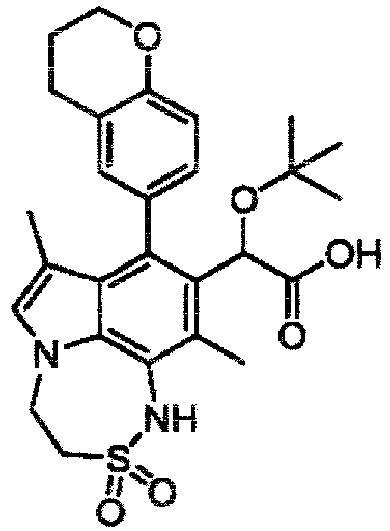
(2) 2.05 511.1 [M-H]- I-005 
(2) 2.65 575.2 [M+H]+ 2.79 [Table 2] Comp. No. Struct Ms cond. RT(min) MS I-006 
(2) 2.29 539.15 [M-H]- I-007 
(2) 2.69 561.25 [M+H]+ I-008 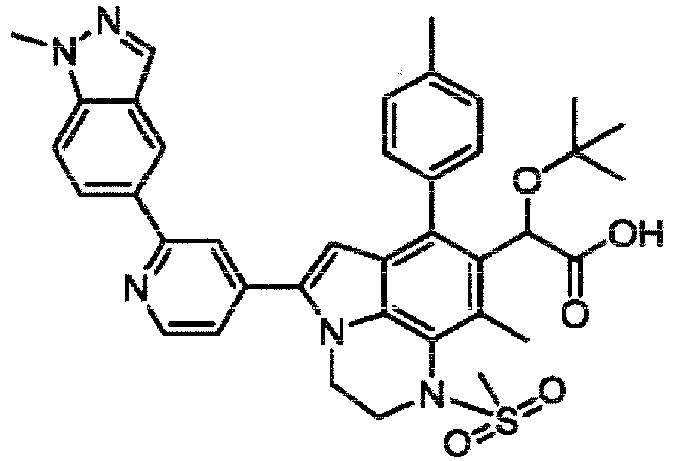
(2) 2.25 678.3 [M+H] I-009 
(2) 1.65 675.76 [M+H] I-010 
(2) 2.48 582.11 [M+H] [Table 3] Comp. No. Struct Ms cond. RT(min) MS I-011 
(2) 2.26 678.55 [M+H]+ I-012 
(2) 2.29 642.2 [M+H]+ I-013 
(2) 2.29 642.2 [M+H]+ I-014 
(2) 2.16 752.6 [M+H]+ I-015 
(2) 2.48 696.9 [M+H]+ [Table 4] Comp. No. Struct Ms RT(min) MS I-016 
(2) 2.29 698.2 [M+H]+ I-017 
(2) 1.61 674.3 [M+H]+ I-018 
(2) 2.14 716.5 [M+H]+ I-019 
(2) 2.15 614.25 [M+H]+ I-020 
(2) 2.33 628.25 [M+H]+ [Table 5] Comp. No. Struct Ms cond. RT(min) MS I-021 
(2) 1.62 685.2 [M+H]+ I-022 
(2) 1.87 735.25 [M+H]+ I-023 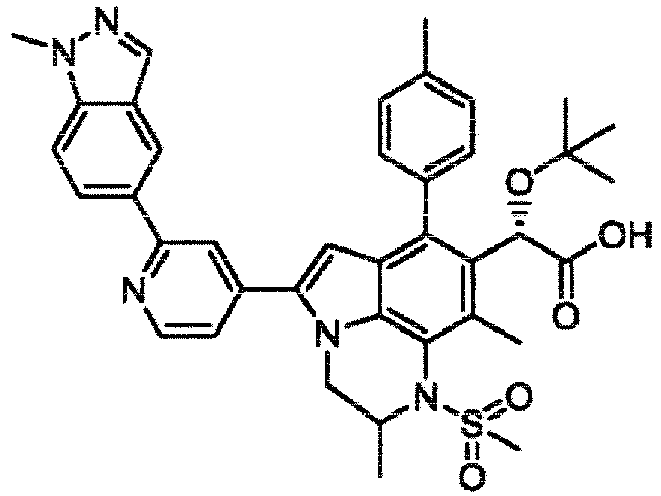
(2) 2.27 692.8 [M+H]+ I-024 
(1) 2.75 658.2 [M+H]+ I-025 
(2) 2.25 650.15 [M+H]+ [Table 6] Comp. No. Struct Ms cond. RT(min) MS I-026 
(2) 2.49 660.3 [M+H]+ I-027 
(2) 1.91 699.05 [M+H]+ I-028 
(2) 2.26 662.2 [M+H]+ I-029 
(2) 2.38 664.2 [M+H]+ I-030 
(2) 2.35 614.15 [M+H]+ [Table 7] Comp. No. Struct Ms cond. RT(min) MS I-031 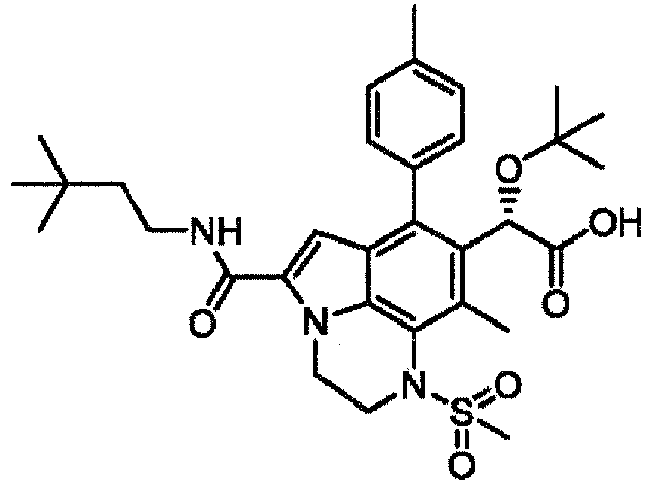
(1) 2.72 598.2 [M+H]+ I-032 
(1) 2.48 604.1 [M+H]+ I-033 
(2) 2.4 618.1 [M+H]+ [Table 8] Comp. No. Struct MS cond. RT(min) MS I-034 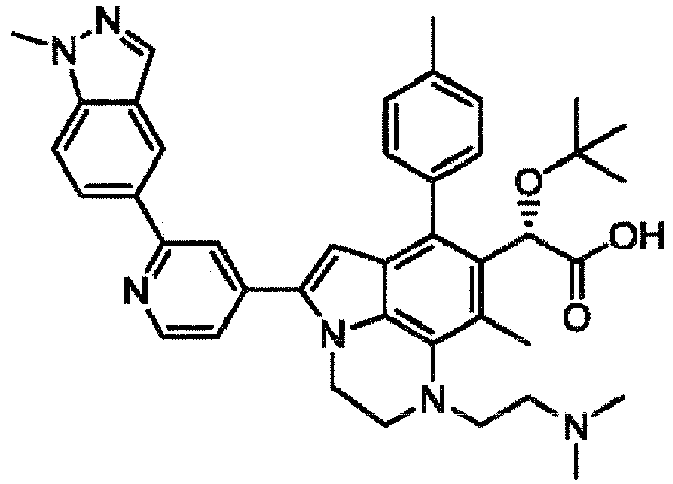
(2) 1.69 671.25 [M+H]+ I-035 
(1) 2.74 534.3 [M+H]+ I-036 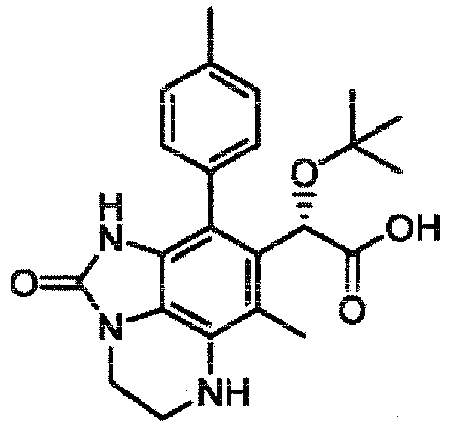
(2) 1.63 408.15 [M-H]- I-037 
(2) 2.61 605.15 [M+H]+ I-038 
(2) 1.98 437 [M+H]+ I-039 
(1) 2.17 465.1 [M+H]+ [Table 9] Comp. No. Struct MS cond. RT(min) MS I-040 
(1) 2.3 478.2 [M+H]+ I-041 
(2) 2.31 489 [M+H]+ I-042 
(2) 1.68 507.1 [M+H]+ I-043 
(1) 2.03 423.2 [M+H]+ I-044 
(1) 1.88 450.4 [M+H]+ - The present invention further provides the following compounds.
-


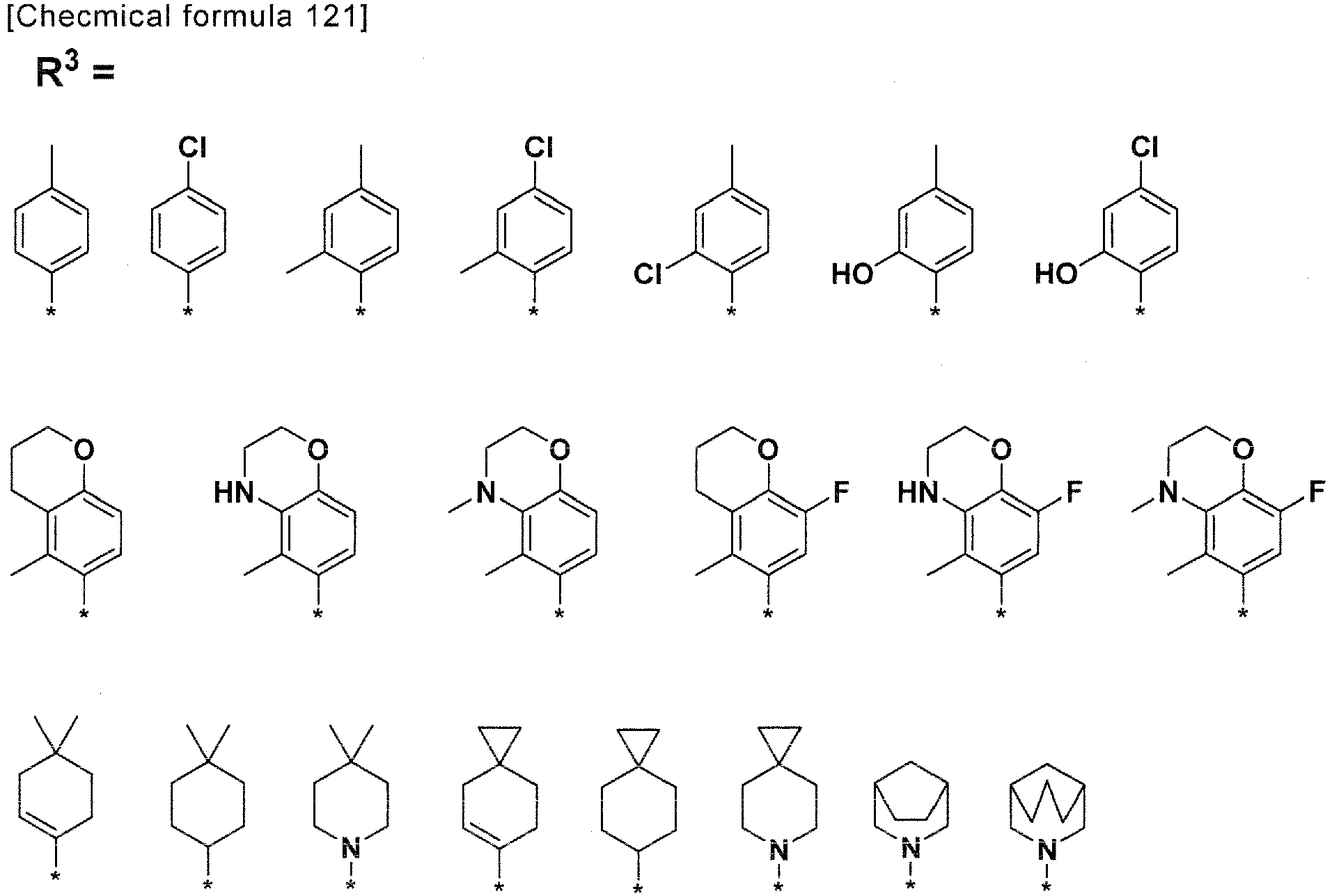
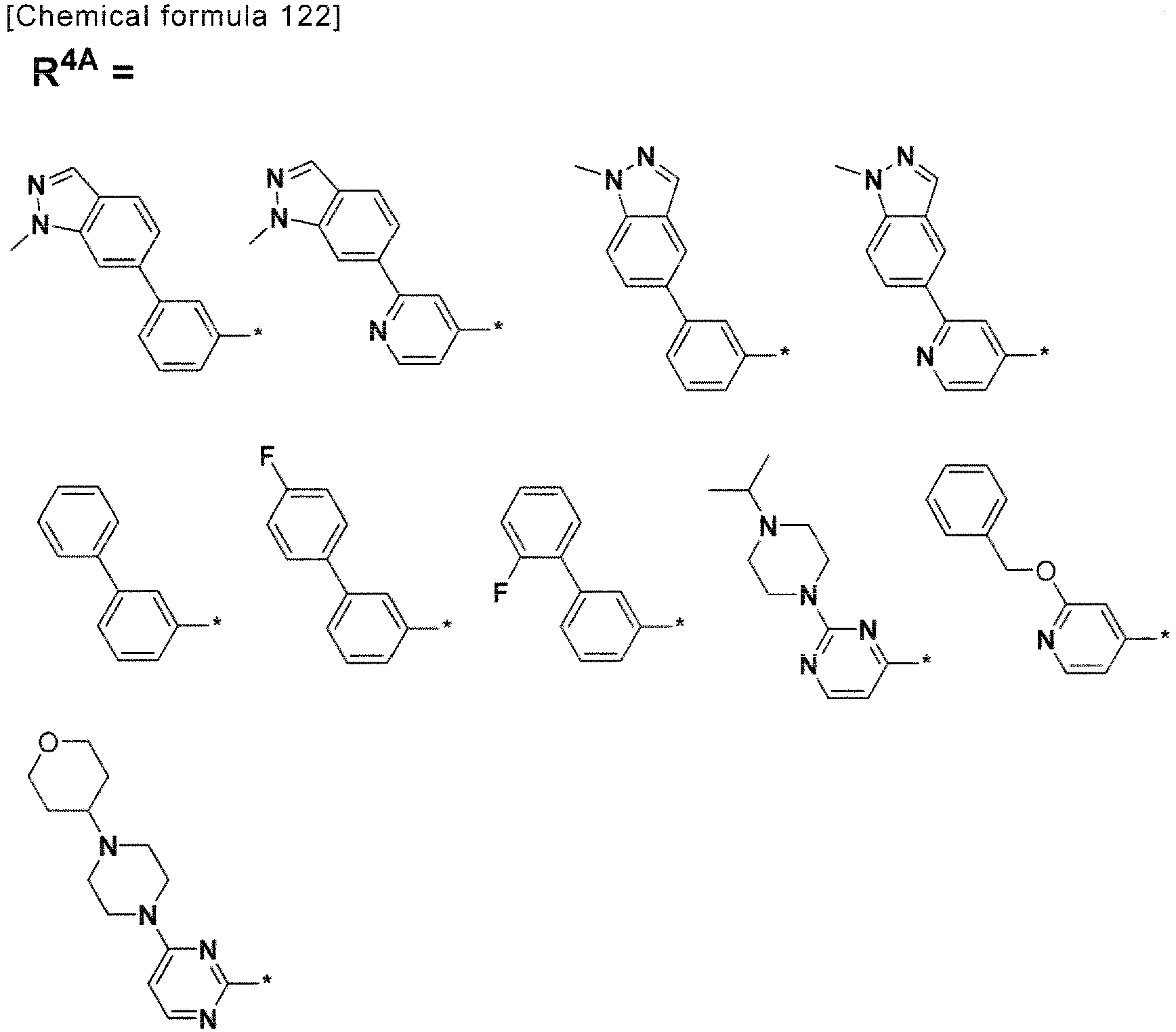
-
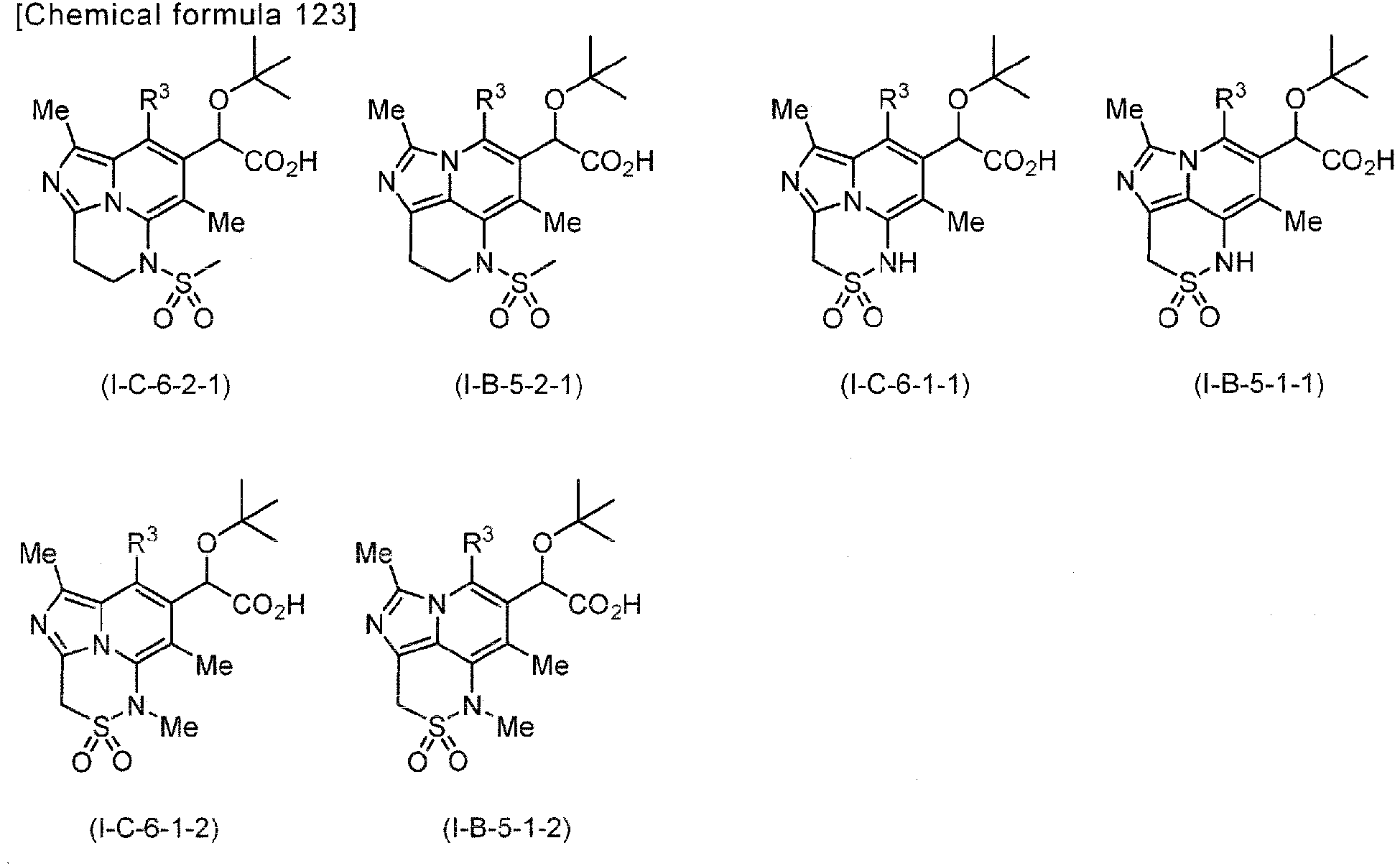


-


- The present invention further provides the following compounds.
-


- The biology assay of the compound of the present invention is described below.
- HIV (HTLV-IIIB strain) persistent infected human T cell strain Molt-4 clone8 was cultured in 10% Fetal Bovine Serum-containing RPMI-1640 medium and the supernatant was filtered, then the virus titer was measured and the solution was stored at -80°C. Each anti-human immunodeficiency virus active substance was diluted with the above cultured medium to the designated concentration, which was dispensed into 96 well micro plate by 50µL. Next, a MT-4 cell suspended liquid was dispensed by 100µL (2.5 × 10⁴ cells), then the above HIV-containing supernatant diluted with the above cultured medium was added thereto by 50µl (60 pfu (plaque forming unit)).
- The obtained mixture was cultured at 37°C in CO2 incubator for four days, then 3-(4,5-dimethylthiazole-2-yl)-2,5-diphenyltetrazolynium bromide (MTT) 5mg/mL in PBS was added to each well by 30µL, followed by 1 hr-cultivation. In this step, as formazan was precipitated by reduction of MTT in living cells, the cell supernatant was removed from all was by 150µL, then a 150µL of solution (10% Triton X-100 and 0.4% (v/v)-HCl containing isopropanol) was added thereto, followed by shaking with a plate mixer, to elute formazan. The formazan was measured with a microreader at OD: 560nm and 690nm (reference wavelength) and the result was compared with the reference. EC50 means the compound concentration at which cell cytotoxicity by virus is inhibited 50%.
-
[Table 10] Comp. No. EC50(nM) Comp. No. EC50(nM) Comp. No. EC50(nM) I-006 14 I-016 3.9 I-025 89 I-008 5.9 I-017 9.1 I-026 3.7 I-009 32 I-018 1.1 I-027 1.7 I-010 16 I-019 6 I-028 3.3 I-011 2.3 I-020 3.6 I-029 2.4 I-012 3.7 I-021 3.8 I-030 1.9 I-013 3.4 I-022 4 I-031 2.9 I-014 1.3 I-023 0.82 I-032 5.2 I-015 4 I-024 4.2 [Table 11] Comp. No. EC50(nM) Comp. No. EC50(nM) I-034 2.4 I-040 67 I-035 5.2 I-041 4.6 I-037 0.4 I-044 44 I-039 53 - Using commercially available pooled human hepatic microsome, and employing, as markers, 7-ethoxyresorufin O-deethylation (CYP1A2), tolbutamide methyl-hydroxylation (CYP2C9), mephenytoin 4'-hydroxylation (CYP2C19), dextromethorphan O-demethylation (CYP2D6), and terfenadine hydroxylation (CYP3A4) as typical substrate metabolism reactions of human main five CYP enzyme forms (CYP1A2, 2C9, 2C19, 2D6, 3A4) an inhibitory degree of each metabolite production amount by a test compound was assessed.
- The reaction conditions were as follows: substrate, 0.5µmol/L ethoxyresorufin (CYP1A2), 100µmol/L tolbutamide (CYP2C9), 50µmol/L S-mephenytoin (CYP2C19), 5µmol/L dextromethorphan (CYP2D6), 1 µmol/L terfenedine (CYP3A4); reaction time, 15 minutes; reaction temperature, 37°C; enzyme, pooled human hepatic microsome 0.2mg protein/mL; test drug concentration, 1, 5, 10, 20 µmol/L (four points).
- Each five kinds of substrates, human hepatic microsome, and a test drug in 50mmol/L Hepes buffer as a reaction solution was added to a 96-well plate as the composition ad described above, NADPH, as a coenzyme was added to initiate metabolism reactions as markers and, after the incubation at 37°C for 15 minutes, a methanol/acetonitrile = 1/1 (V/V) solution was added to stop the reaction. After the centrifugation at 3000 rpm for 15 minutes, resorufin (CYP1A2 metabolite) in the supernatant was quantified by a fluorescent multilabel counter and tolbutamide hydroxide (CYP2C9 metabolite), mephenytoin 4' hydroxide (CYP2C19 metabolite), dextrorphan (CYP2D6 metabolite), and terfenadine alcohol (CYP3A4 metabolite) were quantified by LC/MS/MS.
- A reaction system containing only DMSO which is a solvent for dissolving a drug was adopted as a control (100%), and the remaining activity (%) was calculated, then IC50 was calculated by reverse presumption with a logistic model using a concentration and an inhibition rate.
- The CYP3A4 fluorescent MBI test is to investigate the enhancement of CYP3A4 inhibitionof a compound by a metabolism reaction. 7-Benzyloxytrifluoromethylcoumarin (7-BFC) is debenzylated by the CYP3A4 enzyme to produce 7-hydroxytrifluoromethylcoumarin (HFC), a metabolite emitting fluorescent light. The test was performed using 7-HFC-producing reaction as an index.
- The reaction conditions were as follows: substrate 5.6µmol/L 7-BFC; pre-reaction time, 0or 30 minutes; reaction time, 15 minutes; reaction temperature, 25°C (room temperature); CYP3A4 content (expressed in Eschericha coli), at pre-reaction 62.5pmol/mL, at reaction 6.25 pmol/mL (at 10-fold dilution); test drug concentration, 0.625, 1.25, 2.5, 5, 10, 20 µmol/L (six points).
- An enzyme in a K-Pi buffer (pH 7.4) and a test drug solution as a pre-reaction solution were added to a 96-well plate so that it was 1/10 siluted by a substrate in a K-Pi buffer, NADPH as a co-factor was added to initiate a reaction as an index (without preincubation) and, after a predetermined time of a reaction, acetonitrile / 0.5mol/L Tris (trishydroxyaminomethane) = 4/1(V/V) was added to stop the reaction. In addition, NADPH was added to a remaining preincubation solution to initiate a preincubation (with preincubation) and, after a predetermined time of a preincubation, a part was transferred to another plate so that it was 1/10 siluted with a substrate and a K-Pi buffer to initiate a reaction as an index. After a predetermined time of a reaction, acetonitrile / 0.5mol/L Tris (trishydroxyaminomethane) = 4/1 was added to stop the reaction. For the plate on which each index reaction had been performed, a fluorescent value of 7-HFC which is a metabolite was measured with a fluorescent plate reader. (Ex = 420nm, Em = 535nm)
- Addition of only DMSO, which is a solvent dissolving a drug to a reaction system was adopted as a control (100%), remaining activity (%) was calculated at each concentration of a test drug added as the solution, and IC50 was calculated by reverse-presumption by a logistic model using a concentration and an inhibition rate. A case where the difference of IC50 values was 5 µmol/L or more was defined as (+) and, a case where the difference was 3 µmol/L or less was defined as (-).
- CYP3A4 (MDZ) MBI test is a test of investigating mechanism based inhibition (MBI) ability on CYP3A4 inhibition of a compound by enhancement of a metabolism reaction. CYP3A4 inhibition is evaluated using 1-hydroxylation reaction of midazolam (MDZ) by pooled human liver microsomes as an index.
- The reaction conditions are as follows: substrate, 10µmo)/L MDZ; pre-reaction time, 0 or 30 minutes; substrate reaction time, 2 minutes; reaction temperature, 37°C; protein content of pooled human liver microsomes, at pre-reaction time 0.5 mg/mL, at reaction time 0.05mg/mL (at 10-fold dilution); concentrations of the compound of the present invention, 1, 5, 10, 20 µmol/L (four points).
- Pooled human liver microsomes in K-Pi buffer (pH 7.4) and a solution of the compound of the present invention as a pre-reaction solution were added to a 96-well plate at the composition of the pre-reaction. A part of pre-reaction solution was transferred to another 96-well plate, and 1/10 diluted by a substrate in K-Pi buffer NADPH as a co-factor was added in order to initiate a reaction as an index (without preincubation). After a predetermined time of a reaction, methanol/acetonitrile = 1/1 (V/V) solution was added in order to stop the reaction. On the other hand, NADPH was also added to a remaining pre-reaction solution in order to initiate a preincubation (with preincubation). After a predetermined time of a preincubation, a part was transferred to another 96-well plate, and 1/10 diluted by a substrate in K-Pi buffer in order to initiate a reaction as an index. After a predetermined time of a reation, methanol/acetonitrile = 1/1 (V/V) solution was added in order to stop the reaction. After centrifuged at 3000rpm for 15 minuntes, 1-hydroxymidazolam in the supernatant was quantified by LC/MS/MS.
- The sample adding DMSO to a reaction system instead of a solution of the compound of the present invention is adopted as a control (100%) because DMSO is used as a solvent to dissolve the compound of the present invention. Remaining activity (%) is calculated at each concentration of the compound of the present invention added as the solution, and IC-value is calculated by reverse-presumption by a logistic model using a concentration and an inhibition rate. Shifted IC value is calculated as "IC of preincubation at 0min / IC of preincubation at 30min". When a shifted IC is 1.5 or more, this is defined as positive. When a shifted IC is 1.0 or less, this is defined as negative.
- Commercially available pooled human hepatic microsomes and a test compound were reacted for a constant time, then a remaining rate was calculated by comparing a reacted sample and an unreacted sample, thereby a degree of metabolism of the test compound in liver was assessed.
- A reaction was performed (oxidative reaction) at 37°C for 0 minute or 30 miniutes in the presence of 1 mmol/L NADPH in 0.2mL of a buffer (50mmol/L Tris-HCl, pH 7.4, 150mmol/L potassium chloride, 10mmol/L magnesium chloride) containing 0.5mg protein/mL of human liver microsomes. After the reaction, 50µL of the reaction solution was added to 100uL of a methanol/acetonitrile = 1/1 (v/v), mixed and centrifuged at 3000 rpm for 15 minutes. The test compound in the supernatant was quantified by LC/MS/MS, and a remaining amount of the test compound after the reaction wad calculated, letting a compound amount at 0 minute reaction time to be 100%. Hydrolysis reaction was performed in the absence of NADPH and glucuronidation reaction was in the presence of 5mM UDP-glucuronic acid in place of NADPH, followed by similar operations.
- The solubility of the compound of the present invention was determined under 1% DMSO addition conditions. A 10mmol/L solution of the compound was prepared with DMSO, and 6µL of the solution was added to 594µL of an artificial intestinal juice (: water and a 118mL solution of 0.2mol/L NaOH reagent are added to 250mL of 0.2mol/L potassium dihydrogen phosphate reagent to reach 1000mL) with a pH of 6.8. The mixture was left standing for 16 hours at 25°C, and the mixture was vacuum-filtered. The filtrate was two-fold diluted with methanol/water = 1/1 (v/v), and the compound concentration in the filtrate was measured with HPLC or LC/MS/MS by the absolute calibration method.
- The mutagenicity of the compound of the present invention was assaied.
- 20µL of freezing-stored rat typhoid bacillus (Salmonella typhimurium TA98 strain, TA 100strain) was inoculated on 10mL of a liquid nutrient medium (2.5% Oxoid nutrient broth No.2), and this was cultured before shaking at 37°C for 10 hours. 9mL of a bacterial solution of the TA98 strain was centrifuged (2000 × g, 10 minutes) to remove a culturing solution. The bacteria was suspended in F buffer (K2HPO4: 3.5g/L, KH2PO4: 1g/L, (NH4)2SO4: 1g/L, trisodium citrate dihydrate: 0.25g/L, MgSO4·7H2O: 0.1g/L), and the suspension was added to 110mL of an Exposure medium (Micro F buffer containing Biotin: 8µg/mL, histidine: 0.2µg/mL, glucose: 8mg/mL). The TA100 strain was added to 120mL of the Exposure medium per 3.16mL of the bacterial solution to prepare a test bacterial solution. Each 12µL of a test substance DMSO solution (several stage dilution from maximum dose 50mg/mL at 2 to 3-fold ratio), DMSO as a negative control, 50µg/mL of 4-nitroquinoline-1-oxide DMSO solution for the TA98 strain, 0.25µg/mL of 2-(2-furyl)-3-(5-nitro-2-furyl)acrylamide DMSO solution for the TA100 strain each under the non-metabolism activating condition, 40µg/mL of 2-aminoanthracene DMSO solution for the TA98 strain, 20µg/mL of 2-aminoanthracene DMSO solution for the TA100 strain each under the metabolism condition all as a positive control, and 588µL of the test bacterial solution (a mixed solution of 498µl of the test bacteria! solution and 90µL of S9 mix under the metabolism activating condition) were mixed, and this was shaking-cultured at 37°C for 90 minutes. 460µL of the bacterial solution exposed to the test substance was mixed with 2300µL of an Indicator medium (Micro F buffer containing biotin: 8µg/mL, histidine: 0.2µg/mL, glucose: 8mg/mL, Bromo Cresol Purple: 37.5µg/mL), each 50µL was dispensed into microplate 48 wells/dose, and this was subjected to stationary culturing at 37°C for 3 days. Since a well containing a bacterium which has obtained the proliferation ability by mutation of an amino acid (histidine) synthesizing enzyme gene turns from purple to yellow due to a pH change, the bacterium proliferation well shich has turner to yellow in 48 wells per dose is counted, and was assessed by comparing with a negative control group. (-) means that mutagenicity is negative and (+) is positive.
- Materials and methods for studies an oral absorption
- (1) Animal: mouse or SD rats are used.
- (2) Breeding conditions: mouse or SD rats were allowed to freely take solid feed and sterilized tap water.
- (3) Dose and grouping: orally or intravenously administered at a predetermined dose; grouping is as follows (Dose depends on the compound)
Oral administration: 1 to 30 mg/kg (n=2 to 3)
Intravenous administration: 0.5 to 10 mg/kg (n=2 to 3) - (4) Preparation of dosing solution: for oral adminidtration, in a solution or a suspension state; for intravenous administration, in a solubilized state.
- (5) Administration method: in oral administration, forcedly administer into ventriculus with oralprobe; in intravenous administration, administer from caudal vein with a needle-equipped syringe.
- (6) Evaluation items: blood is collected over time, and the plasma concentration of drug is measured by LC/MS/MS.
- (7) Statistical analysis: regarding the transition of the plasma concentration, the area under the plasma concentration-time curve (AUC) is calculated by non-linear least squares program WinNonlin (Registered trademark), and the bioavailability (BA) is calculated from the AUCs of the oral administration group and intravenous administration group.
- For the purpose of assessing risk of an electrocardiogram QT interval prolongation, effectson delayed rectifier K+ current (IKr), which plays an important role in the ventricular repolarization process of the compound of the present invention, was studied using HEK293 cells expressing human ether-a-go-go related gene (hERG) channel.
- After a cell was retained at a membrane potential of -80mV by whole cell patch clamp method using an automated patch clamp system (PatchXpress 7000A, Axon Instruments Inc.), IKr induced by depolarization pulse stimulation at +40mV for 2 seconds and, further, repolarization pulse stimulation at -50 mV for 2 seconds was recorded. After the generated current was stabilized, extracellular solution (NaCl: 135mmol/L, KCI: 5.4 mmol/L, NaH2 PO4 : 0.3mmol/L, CaCl2 · 2H2O: 1.8mmol/L, MgCl2 · 6H2O: 1mmol/L, glucose: 10mmol/L, HEPES(4-(2-hydroxyethyl)-1-piperazineethanesulfonic acid, 4-(2-hydroxyethyl)-1-piperazine ethanesulfonic acid): 10mmol/L, pH = 7.4) in which the test compound had been dissolved at an objective concentration was applied to the cell under the room temperature condition for 10 minutes. From the recording IKr an absolute value of the tail peak current was measured based on the current value at the resting membrane potential using an analysis software (DataXpress ver.1, Molecular Devices Corporation). Further, the inhibition relative to the tail peak current before application of the test substance was calculated, and compared with the vehicle-applied group (0.1 % dimethyl sulfoxide solution) to access influence of the test substance on IKr.
(Result) The inhibition ratio in the compound concentration 5µmol/L was shown. - Appropriate amounts of the test substances are put into appropriate containers. To the respective containers are added 200µL of JP-1 fluid (sodium chloride 2.0g, hydrochloric acid 7.0mL and water to reach 1000mL), 200µL of JP-2 fluid (phosphate buffer (pH 6.8) 500mL and water 500mL), and 200µL of 20mmol/L TCA (sodium taurocholate) / JP-2 fluid (TCA 1.08 g and JP-2 fluid to reach 100µL). IN the case that all amount of the test compound is dissolved after the addition of the test fluid, the test compound is added as appropriate.
- The containers are sealed, and shaken for 1 hour at 37°C. The mixtures are filtered, and 100µL of methanol is added to each of he filtrate (100µL) so that the filtrates are two-fold diluted. The dilution ratio may be changed if necessary. The dilutions are observed for bubbles and precipitates, and then the containers are sealed and shaken. Quantification is performed by HPLC with an absolute calibration method.
- The compound of the present invention is dissolved at the target concentration, and is mixed with the red blood cell suspension on a microplate. The mixture is irradiated with fluorexcent UV lamps under the condition of 10 J/cm2 in the UVA and UVB. After the irradiation, a supernatant of the mixture is collected and is transferred to a microplate. Absorbance of the supernatants is measured at 540nm and 630nm, and phototoxicity of the compound is determined based on the optical density. In the study, two endpoints of 540nm and 630nm are indicated of lipid membffrane (met-hemoglobin formation), respectively.
- The compound of the present invention is useful as a medicament used as a therapeutic or prophylactic agent for virus infection disease such as AIDS, or an intermediate thereof.
Claims (36)
- A compound represented by the following formula (I):

whereinA1 is C, CR1A, or N;A2 is C, CR2A, or N;A3 is CR3A, CR3AR3B, N, NR3C, O, S, SO, or SO2;A4 is CR4a, CR4AR4B, N, NR4C, O, Z, SO, or SO2;A5 is C, CR5A, or N;A6 is C, CR6A, or N;R1A, R2A, R3A, R3B, R4A, R4B, R5A, and R6A are each independently hydrogen, halogen, hydroxy, substituted or unsubstituted alkyl, substituted or unsubstituted alkenyl, substituted or unsubstituted alkynyl, substituted or unsubstituted alkyl oxy, substituted or unsubstituted alkenyloxy, substituted or unsubstituted alkynyloxy, substituted or unsubstituted alkyl carbonyl, substituted or unsubstituted alkenyl carbonyl, substituted or unsubstituted alkynyl carbonyl, substituted or unsubstituted aromatic carbocyclyl, substituted or unsubstituted non-aromatic carbocyclyl, substituted or unsubstituted aromatic heterocyclyl, substituted or unsubstituted non-aromatic heterocyclyl, substituted or unsubstituted aromatic carbocycle oxy, substituted or unsubstituted non-aromatic carbocycle oxy, substituted or unsubstituted aromatic heterocycle oxy, substituted or unsubstituted non-aromatic heterocycle oxy, substituted or unsubstituted aromatic carbocycle thio, substituted or unsubstituted non-aromatic carbocycle thio, substituted or unsubstituted aromatic heterocycle thio, substituted or unsubstituted non-aromatic heterocycle thio, substituted or unsubstituted aromatic carbocycle amino, substituted or unsubstituted non-aromatic carbocycle amino, substituted or unsubstituted aromatic heterocycle amino, substituted or unsubstituted non-aromatic heterocycle amino, substituted or unsubstituted aromatic carbocyclylcarbonyl, substituted or unsubstituted non-aromatic carbocyclylcarbonyl, substituted or unsubstituted aromatic heterocyclylcarbonyl, substituted or unsubstituted non-aromatic heterocyclylcarbonyl, substituted or unsubstituted aromatic carbocyclylalkylcarbonyl, substituted or unsubstituted aromatic carbocyclylalkylcarbonyl, substituted or unsubstituted aromatic heterocyclylalkyl carbonyl, substituted or unsubstituted non-aromatic heterocyclylalkylcarbonyl, substituted or unsubstituted amino, or substituted or unsubstituted carbamoyl;R3C and R4C are each independently hydrogen, substituted or unsubstituted alkyl, substituted or unsubstituted alkenyl, substituted or unsubstituted alkynyl, substituted or unsubstituted alkyl oxy, substituted or unsubstituted alkenyloxy, substituted or unsubstituted alkynyloxy, substituted or unsubstituted aromatic carbocyclyl, substituted or unsubstituted non-aromatic carbocyclyl, substituted or unsubstituted aromatic heterocyclyl, or substituted or unsubstituted non-aromatic heterocyclyl; or,R3A and R3B may be taken together to form oxo, R4A and R4B may be taken together to form oxo;R3A and R4A may be taken together with an adjacent atom to form substituted or unsubstituted monocyclic carbocycle, or substituted or unsubstituted monocyclic heterocycle, the carbocycle or heterocycle may be further fused to;R3A and R4C may be taken together with an adjacent atom to form substituted or unsubstituted monocyclic heterocycle, the heterocycle may be further fused to;R3C and R4A may be taken together with an adjacent atom to form substituted or unsubstituted monocyclic heterocycle, the heterocycle may be further fused to;R3C and R4C may be taken together with an adjacent atom to form substituted or unsubstituted monocyclic heterocycle, the heterocycle may be further fused to;R3A and R3B may be taken together with an adjacent atom to form substituted or unsubstituted spiro ring, the spiro ring may be further fused to;R4A and R4B may be taken together with an adjacent atom to form substituted or unsubstituted spiro ring, the spiro ring may be further fused to;R4B may be taken together with an atom on the circular arc of T1 ring to form substituted or unsubstituted monocyclic carbocycle, or substituted or unsubstituted monocyclic heterocycle, the carbocycle or heterocycle may be further fused to;R4C may be taken together with an atom on the circular arc of T1 ring to form substituted or unsubstituted Monocyclic heterocycle, the heterocycle may be further fused to,the broken line means the presence or absence of bond, the adjacent broken lines do not exist at the same time, the carbon atoms on 1st, 2nd, and 3rd position are sp2 carbon;T1 ring is substituted or unsubstituted monocyclic carbocycle or substituted or unsubstituted monocyclic heterocycle, (1) the carbocycle or heterocycle may be fused with the other substituted or unsubstituted carbocycle or substituted or unsubstituted heterocycle, and/or (2) two atoms which are not adjacent to one another constituting the carbocycle or heterocycle may be bridged by substituted or unsubstituted alkylene, substituted or unsubstituted alkenylene or substituted or unsubstituted alkynylene;R1 is halogen, cyano, nitro or -X1 -R11,X1 is a bond, -O-, -S-, -NR12-, -CO-, -SO-, -SO2-, -O-CO-, -CO-O-, -NR12-CO-, -CO-NR12-, - NR12-CO-O-, -NR12-CO-NR13-, -NR12-SO2- or -SO2-NR12-,R11 is hydrogen atom, substituted or unsubstituted alkyl, substituted or unsubstituted alkenyl, substituted or unsubstituted alkynyl, substituted or unsubstituted carbocyclyl, or substituted or unsubstituted heterocyclyl,R12 and R13 are each independently hydrogen atom, substituted or unsubstituted alkyl, substituted or unsubstituted alkenyl or substituted or unsubstituted alkynyl,when X1 is -NR12-, -CO-NR12- or -SO2-NR12-, R11 and R12 may be taken together with an adjacent nitrogen atom to form substituted or unsubstituted heterocyclyl,X1 is -NR12 -CO-NR13 -, R11 and R13 may be taken together with an adjacent nitrogen atom to form substituted or unsubstituted heterocyclyl,R1 may be taken together with a carbon atom or a nitrogen atom on the circular arc of T1 ring to form substituted or unsubstituted monocyclic carbocycle, or substituted or unsubstituted monocyclic heterocycle, the carbocycle or heterocycle may be further fused to;R2 is each substituted or unsubstituted alkyl, substituted or unsubstituted alkenyl, substituted or unsubstituted alkynyl, substituted or unsubstituted alkyloxy, substituted or unsubstituted alkenyloxy, substituted or unsubstituted alkynyloxy, substituted or unsubstituted cycloalkyloxy, or substituted or unsubstituted cycloalkenyloxy;n is 1 or 2;R3 is substituted or unsubstituted aromatic carbocyclyl, substituted or unsubstituted non-aromatic carbocyclyl, substituted or unsubstituted aromatic heterocyclyl, substituted or unsubstituted non-aromatic heterocyclyl, substituted or unsubstituted aromatic carbocycle alkenyl, substituted or unsubstituted non-aromatic carbocycle, alkenyl, substituted or unsubstituted aromatic heterocycle alkenyl, substituted or unsubstituted non-aromatic heterocycle alkenyl, substituted or unsubstituted aromatic carbocycle alkynyl, substituted or unsubstituted non-aromatic carbocycle alkynyl, substituted or unsubstituted aromatic heterocycle alkynyl, or substituted or unsubstituted non-aromatic heterocycle alkynyl;
andR4 is hydrogen or a carboxy protecting group. - The compound or its pharmaceutically acceptable salt according to Claim 1, represented by any one of the following formula:

- The compound or its pharmaceutically acceptable salt according to Claims 1 or 2, wherein at least one of the following conditions 1) to 3) is fulfilled:1) A3 is N, NR3C, O, S, SO, or SO2:2) A4 is N, NR4C=, O, S, SO, or SO2:3) A5 is N.
- The compound or its pharmaceutically acceptable salt according to Claim 1 or 2, wherein A3 is R3A ; A4 is R4A ; and A5 is N.
- The compound or its pharmaceutically acceptable salt according to Claim 1 or 2, wherein A3 is or NR3C ; A4 is R4A ; and A5 is C.
- The compound or its pharmaceutically acceptable salt according to Claim 1 or 2, wherein A3 is N or NR3C ; A4 is CR4A ; and A5 is C or N.
- The compound or its pharmaceutically acceptable salt according to Claim 1 or 2, wherein A3 is O or S; A4 is CR4A or N; and A5 is C.
- The compound or its pharmaceutically acceptable salt according to Claim 1, represented by the following formula (I-A):
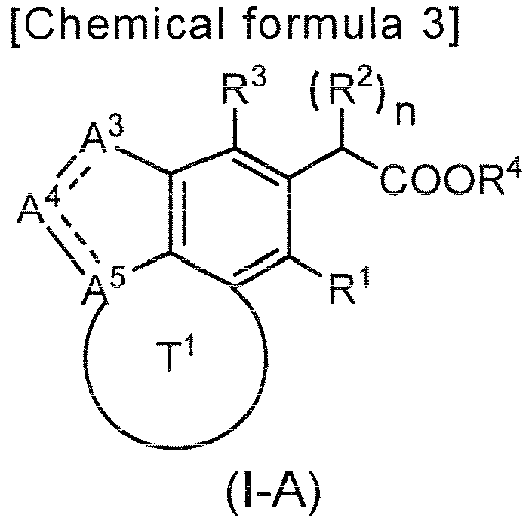
- The compound or its pharmaceutically acceptable salt according to Claim 8, represented by any one of the following formula:

- The compound or its pharmaceutically acceptable salt according to Claim 1, represented by the following formula (I-B):

- The compound or its pharmaceutically acceptable salt according to Claim 10, represented by any one of the following formula:
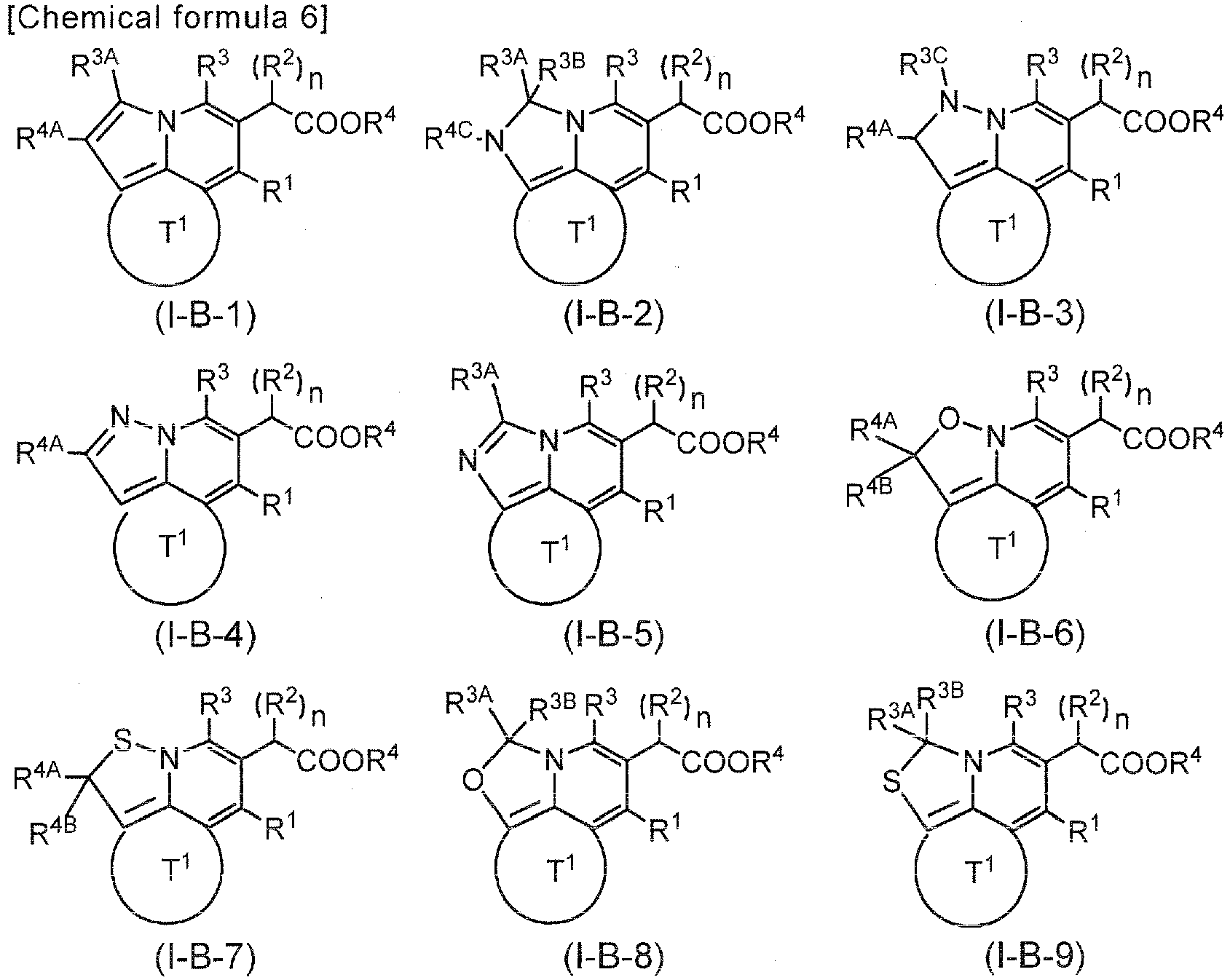
- The compound or its pharmaceutically acceptable salt according to Claim 1, represented by the following formula (I-C):

- The compound or its pharmaceutically acceptable salt according to Claim 12, represented by any one of the following formula:

- The compound or its pharmaceutically acceptable salt according to any one of Claims 1 to 13, wherein T1 ring is any one of the following structure:
 wherein A1 and A5 are as defined in Claim 1;Ra is hydrogen, substituted or unsubstituted alkyl, substituted or unsubstituted alkenyl, substituted or unsubstituted carbocyclyl, substituted or unsubstituted heterocyclyl, -CORa1, - SORa2, or -SO2 Ra3 (Ra1, Ra2, and Ra3 are each independently hydrogen, substituted or unsubstituted alkyl, substituted or unsubstituted alkenyl, substituted or unsubstituted carbocyclyl, or substituted or unsubstituted heterocyclyl;m is an integer of 0 to 5;L is -SO2-, -SO-, -CO-, or -CRbRc-; andRb and Rc are each independently hydrogen, substituted or unsubstituted alkyl, substituted or unsubstituted alkenyl, substituted or unsubstituted carbocyclyl, substituted or unsubstituted heterocyclyl, or Rb and Rc may be taken together to form oxo.
 - The compound or its pharmaceutically acceptable salt according to any one of Claims 1 to 13, wherein T1 ring is any one of the following structures:

- The compound or its pharmaceutically acceptable salt according to Claim 1, represented by any one of the following formula:


- The compound or its pharmaceutically acceptable salt according to Claim 1, represented by any one of the following formula:


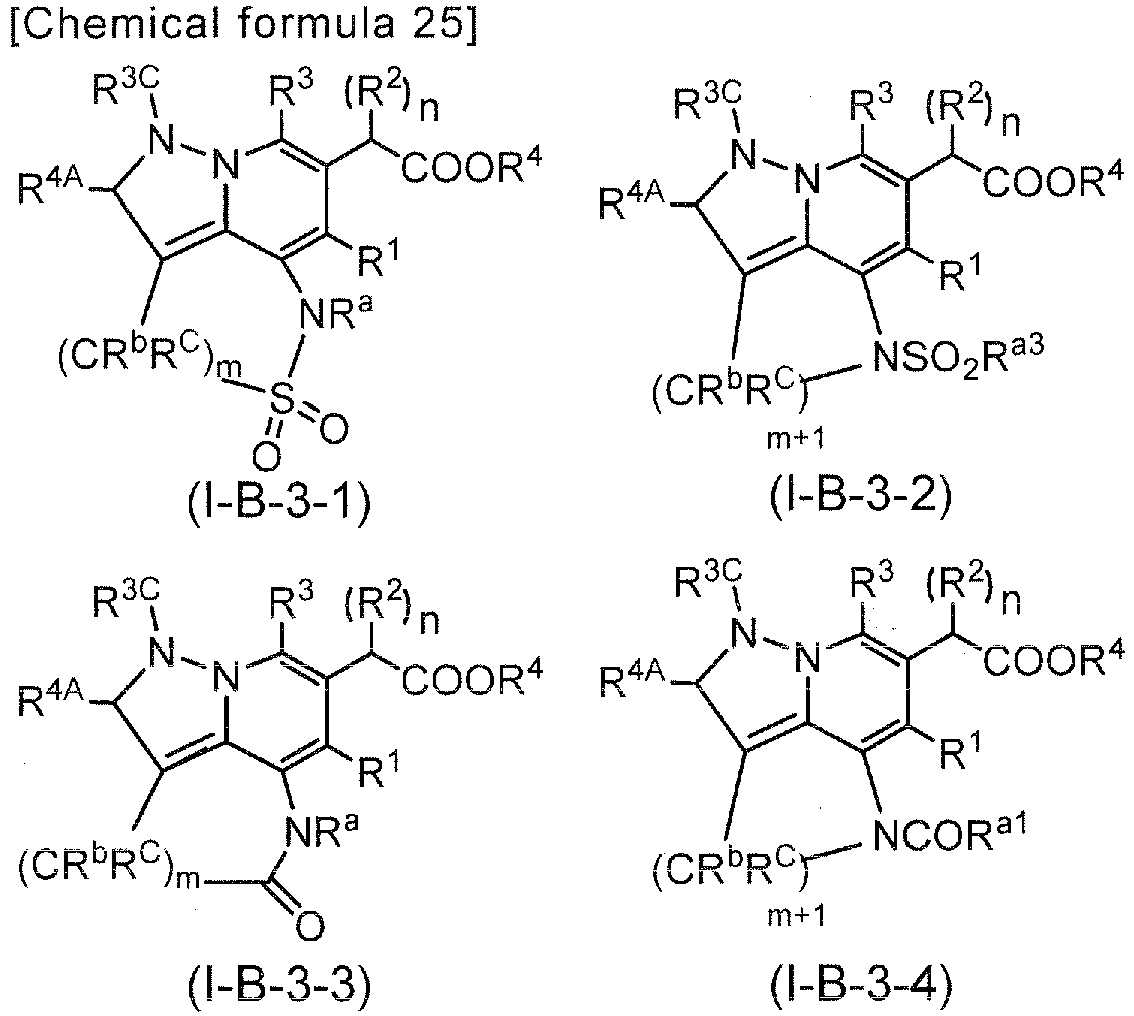


- The compound or its pharmaceutically acceptable salt according to Claim 1, represented by any one of the following formula:

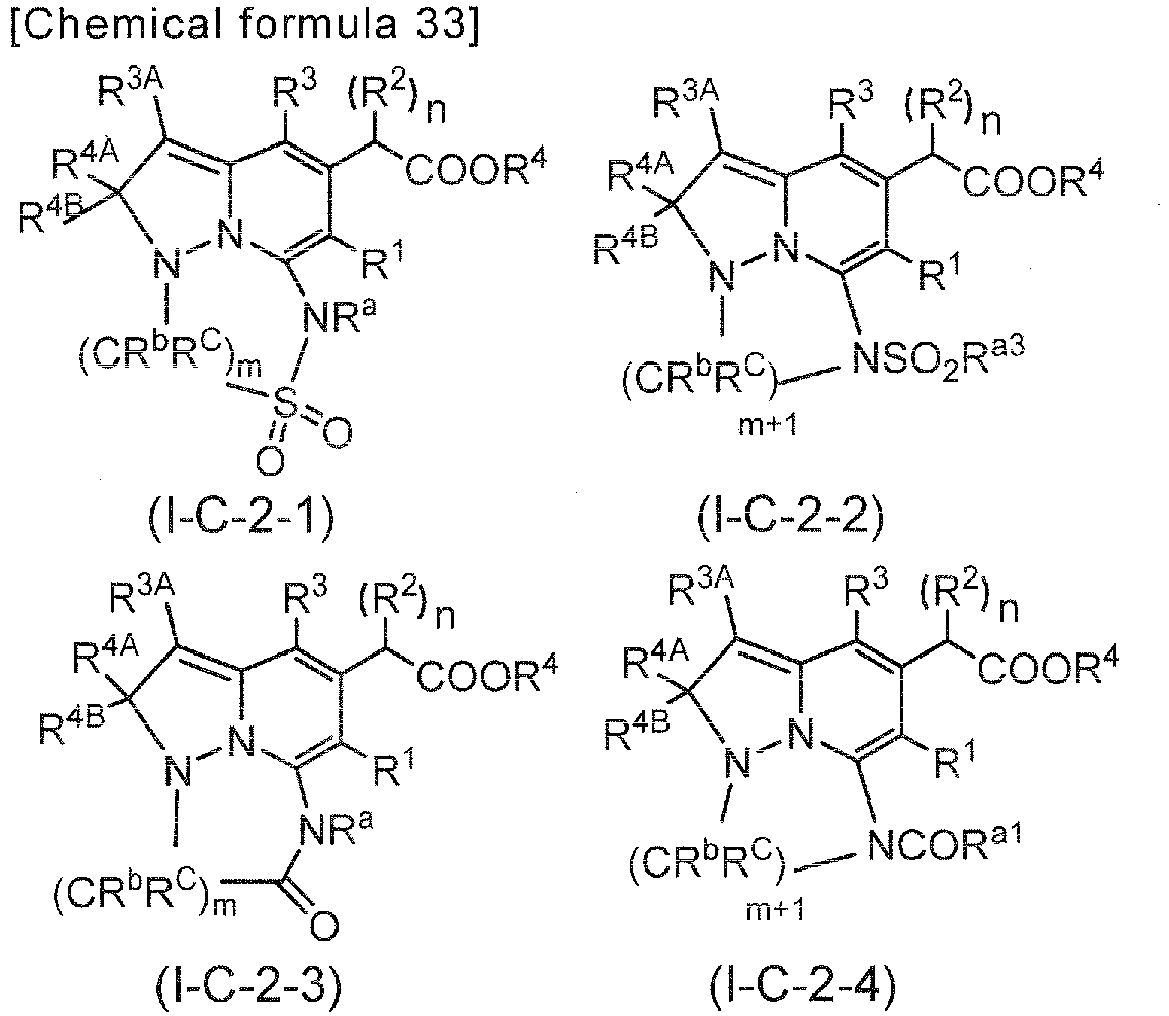


- The compound or its pharmaceutically acceptable salt according to any one of Claims 8 to 13, wherein T1 ring is any one of the structure represented by the formula (T1 -2-1), (T1 -2-2) or (T1 -2-3) described in Claim 15.
- The compound or its pharmaceutically acceptable salt according to any one of Claims 1 to 19, wherein R1 is alkyl.
- The compound or its pharmaceutically acceptable salt, according to any one of Claims 1 to 19, wherein n is 1, and R2 is alkyloxy.
- The compound or its pharmaceutically acceptable salt according to any one of Claims 1 to 19, wherein R4 is hydrogen.
- The compound or its pharmaceutically acceptable salt according to any one of Claims 1 to 19, wherein R3 is substituted or unsubstituted aromatic carbocyclyl, substituted or unsubstituted non-aromatic carbocyclyl, substituted or unsubstituted aromatic heterocyclyl, or substituted or unsubstituted non-aromatic heterocyclyl.
- The compound or its pharmaceutically acceptable salt according to any one of Claims 1 to 19, wherein R1 is alkyl; n is 1, R2 is alkyloxy; R4 is hydrogen; and R3 is substituted or unsubstituted aromatic carbocyclyl, substituted or unsubstituted non-aromatic carbocyclyl, substituted or unsubstituted aromatic heterocyclyl, or substituted or unsubstituted non-aromatic heterocyclyl.
- The compound or its pharmaceutically acceptable salt according to any one of Claims 14 to 19, wherein R1 is alkyl; n is 1, R2 is alkyloxy; R4 is hydrogen; R3 is substituted or unsubstituted aromatic carbocyclyl, substituted or unsubstituted non-aromatic carbocyclyl, substituted or unsubstituted aromatic heterocyclyl, or substituted or unsubstituted non-aromatic heterocyclyl; m is an integer of 1 to 3; and Rb and Rc are each independently hydrogen or alkyl.
- The compound or its pharmaceutically acceptable salt according to Claim 1, represented by the following formula:

- The compound or its pharmaceutically acceptable salt according to Claim 26, represented by the following formula:

- The compound or its pharmaceutically acceptable salt according to Claim 26, represented by the following formula:

- The compound or its pharmaceutically acceptable salt according to Claim 26, represented by the following formula:

- The compound or its pharmaceutically acceptable salt according to Claim 26, represented by the following formula:

- The compound or its pharmaceutically acceptable salt according to Claim 26, represented by the following formula:

- A pharmaceutical composition comprising the compound or its pharmaceutically acceptable salt according to any one of Claims 1 to 31.
- The pharmaceutical composition according to Claim 32, having anti-virus activity.
- The pharmaceutical composition according to Claim 32, having anti-HIV activity.
- A method of treating or preventing a HIV infectious disease, which comprises administering the compound or its pharmaceutically acceptable salt according to any one of Claims 1 to 31.
- The compound or its pharmaceutically acceptable salt according to Claims 1 to 31 for treating or preventing a HIV infectious disease.
Applications Claiming Priority (4)
| Application Number | Priority Date | Filing Date | Title |
|---|---|---|---|
| JP2014102007 | 2014-05-16 | ||
| JP2014156077 | 2014-07-31 | ||
| JP2015008313 | 2015-01-20 | ||
| PCT/JP2015/063972 WO2015174511A1 (en) | 2014-05-16 | 2015-05-15 | Tricyclic heterocyclic derivative having hiv replication-inhibiting effect |
Publications (2)
| Publication Number | Publication Date |
|---|---|
| EP3144311A1 true EP3144311A1 (en) | 2017-03-22 |
| EP3144311A4 EP3144311A4 (en) | 2018-01-03 |
Family
ID=54480047
Family Applications (1)
| Application Number | Title | Priority Date | Filing Date |
|---|---|---|---|
| EP15793640.2A Withdrawn EP3144311A4 (en) | 2014-05-16 | 2015-05-15 | Tricyclic heterocyclic derivative having hiv replication-inhibiting effect |
Country Status (4)
| Country | Link |
|---|---|
| US (1) | US9975906B2 (en) |
| EP (1) | EP3144311A4 (en) |
| JP (1) | JP6579549B2 (en) |
| WO (1) | WO2015174511A1 (en) |
Cited By (3)
| Publication number | Priority date | Publication date | Assignee | Title |
|---|---|---|---|---|
| US9975906B2 (en) | 2014-05-16 | 2018-05-22 | Shionogi & Co., Ltd. | Tricyclic heterocycle derivatives having HIV replication inhibitory effect |
| EP3305789A4 (en) * | 2015-05-29 | 2018-11-21 | Shionogi & Co., Ltd. | Nitrogen-containing tricyclic derivative having hiv replication inhibitory activity |
| US12564595B2 (en) | 2019-11-28 | 2026-03-03 | Shionogi & Co., Ltd. | Prophylactic and therapeutic pharmaceutical agent for HIV infectious diseases characterized by comprising combination of integrase inhibitor and anti-HIV agent |
Families Citing this family (4)
| Publication number | Priority date | Publication date | Assignee | Title |
|---|---|---|---|---|
| JP6689013B2 (en) * | 2016-11-28 | 2020-04-28 | 塩野義製薬株式会社 | Pharmaceutical composition containing nitrogen-containing tricyclic derivative |
| AU2017367714B2 (en) * | 2016-12-02 | 2020-11-12 | Merck Sharp & Dohme Corp. | Tricyclic heterocycle compounds useful as HIV integrase inhibitors |
| EP4074712A1 (en) * | 2021-04-13 | 2022-10-19 | Siegfried AG | Process for the synthesis of 1,3-dihydro-imidazo[4,5-b]pyridin-2-one and/or derivatives thereof |
| CN115677681A (en) * | 2021-07-23 | 2023-02-03 | 上海挚盟医药科技有限公司 | Preparation method of hepatitis B virus nucleocapsid inhibitor |
Family Cites Families (61)
| Publication number | Priority date | Publication date | Assignee | Title |
|---|---|---|---|---|
| EP0882046A1 (en) | 1996-02-21 | 1998-12-09 | Darwin Discovery Limited | Quinolones and their therapeutic use |
| AU710876B2 (en) | 1996-02-21 | 1999-09-30 | Darwin Discovery Limited | Quinolones and their therapeutic use |
| DE19946289A1 (en) | 1999-09-28 | 2001-03-29 | Basf Ag | Benzodiazepine derivatives, their production and use |
| EP1458720B1 (en) * | 2001-12-19 | 2009-03-18 | Janssen Pharmaceutica N.V. | 1,8-annelated quinoline derivatives substituted with carbon-linked triazoles as farnesyl transferase inhibitors |
| US7026311B2 (en) | 2002-01-10 | 2006-04-11 | Abbott Gmbh & Co., Kg | Dibenzodiazepine derivatives, their preparation and use |
| JP2004256531A (en) | 2003-02-07 | 2004-09-16 | Takeda Chem Ind Ltd | Tricyclic ring compound, method for producing the same and use of the same |
| WO2004069834A1 (en) | 2003-02-07 | 2004-08-19 | Takeda Pharmaceutical Company Limited | Tricyclic compound, process for producing the same, and use |
| AR056918A1 (en) | 2005-01-10 | 2007-11-07 | Tibotec Pharm Ltd | 2-OXO-3-CIANO-1,6A-DIAZA-TETRAHIDRO-FLUORANTENOS 1,5,6-REPLACED, PROCESS OF PREPARATION OF THE COMPOUND AND PHARMACEUTICAL COMPOSITION |
| AU2006279034A1 (en) | 2005-08-05 | 2007-02-15 | Astrazeneca Ab | Tricyclic benzimidazoles and their use as metabotropic glutamate receptor modulators |
| US7939545B2 (en) | 2006-05-16 | 2011-05-10 | Boehringer Ingelheim International Gmbh | Inhibitors of human immunodeficiency virus replication |
| EP2574610A1 (en) | 2007-11-15 | 2013-04-03 | Gilead Sciences, Inc. | Inhibitors of human immonodeficiency virus replication |
| HRP20120328T2 (en) | 2007-11-15 | 2012-09-30 | Gilead Sciences | Inhibitors of human immunodeficiency virus replication |
| CA2705338A1 (en) | 2007-11-16 | 2009-05-22 | Boehringer Ingelheim International Gmbh | Inhibitors of human immunodeficiency virus replication |
| WO2009062285A1 (en) | 2007-11-16 | 2009-05-22 | Boehringer Ingelheim International Gmbh | Inhibitors of human immunodeficiency virus replication |
| US8338441B2 (en) | 2009-05-15 | 2012-12-25 | Gilead Sciences, Inc. | Inhibitors of human immunodeficiency virus replication |
| GB0908394D0 (en) | 2009-05-15 | 2009-06-24 | Univ Leuven Kath | Novel viral replication inhibitors |
| GB0913636D0 (en) | 2009-08-05 | 2009-09-16 | Univ Leuven Kath | Novel viral replication inhibitors |
| KR101483834B1 (en) | 2009-12-23 | 2015-01-16 | 카트호리이케 유니버시타이트 로이펜 | Novel antiviral compounds |
| AP2013006706A0 (en) * | 2010-07-02 | 2013-02-28 | Gilead Sciences Inc | Napht-2-ylacetic acid derivatives to treat AIDS |
| PH12013500015A1 (en) * | 2010-07-02 | 2013-02-18 | Gilead Sciences Inc | 2 -quinolinyl- acetic acid derivatives as hiv antiviral compounds |
| US8633200B2 (en) | 2010-09-08 | 2014-01-21 | Bristol-Myers Squibb Company | Inhibitors of human immunodeficiency virus replication |
| BR112013011737A2 (en) | 2010-11-15 | 2016-08-09 | Univ Leuven Kath | compound, use of a compound pharmaceutical composition, and method of treating or preventing an HIV infection |
| CN103429595B (en) | 2010-11-15 | 2015-10-21 | Viiv保健英国有限公司 | Inhibitors of HIV Replication |
| US9029391B2 (en) | 2011-01-24 | 2015-05-12 | Viiv Healthcare Uk Limited | Isoquinoline compounds and methods for treating HIV |
| EP2508511A1 (en) | 2011-04-07 | 2012-10-10 | Laboratoire Biodim | Inhibitors of viral replication, their process of preparation and their therapeutical uses |
| EP2511273B8 (en) | 2011-04-15 | 2019-06-26 | Hivih | Inhibitors of viral replication, their process of preparation and their therapeutical uses |
| UA111841C2 (en) | 2011-04-21 | 2016-06-24 | Гіліад Сайєнсіз, Інк. | BENZOTHIAZOL COMPOUNDS AND THEIR PHARMACEUTICAL APPLICATION |
| WO2013002357A1 (en) | 2011-06-30 | 2013-01-03 | 塩野義製薬株式会社 | Hiv replication inhibitor |
| EP2731436B1 (en) | 2011-07-15 | 2017-03-08 | VIIV Healthcare UK Limited | 2-(pyrrolo[2,3-b]pyridine-5-yl)-2-(t-butoxy)-acetic acid derivatives as hiv replication inhibitors for the treatment of aids |
| US8791108B2 (en) | 2011-08-18 | 2014-07-29 | Bristol-Myers Squibb Company | Inhibitors of human immunodeficiency virus replication |
| US9012642B2 (en) | 2011-09-22 | 2015-04-21 | Viiv Healthcare Uk Limited | Pyrrolopyridinone compounds and methods for treating HIV |
| WO2013062028A1 (en) * | 2011-10-25 | 2013-05-02 | 塩野義製薬株式会社 | Hiv replication inhibitor |
| CN104066732B (en) | 2011-11-15 | 2016-04-13 | 韩国化学硏究院 | Novel antiviral Pyrrolopyridine derivatives and preparation method thereof |
| WO2013103738A1 (en) | 2012-01-04 | 2013-07-11 | Gilead Sciences, Inc. | Napthalene acetic acid derivatives against hiv infection |
| US9376392B2 (en) | 2012-01-04 | 2016-06-28 | Gilead Sciences, Inc. | 2-(tert-butoxy)-2-(7-methylquinolin-6-yl) acetic acid derivatives for treating AIDS |
| US8629276B2 (en) | 2012-02-15 | 2014-01-14 | Bristol-Myers Squibb Company | Inhibitors of human immunodeficiency virus replication |
| US9034882B2 (en) | 2012-03-05 | 2015-05-19 | Bristol-Myers Squibb Company | Inhibitors of human immunodeficiency virus replication |
| US9006235B2 (en) | 2012-03-06 | 2015-04-14 | Bristol-Myers Squibb Company | Inhibitors of human immunodeficiency virus replication |
| WO2013157622A1 (en) * | 2012-04-19 | 2013-10-24 | 塩野義製薬株式会社 | Hiv replication inhibitor |
| US9096586B2 (en) | 2012-04-20 | 2015-08-04 | Gilead Sciences, Inc. | Therapeutic compounds |
| ES2647437T3 (en) | 2012-07-12 | 2017-12-21 | Viiv Healthcare Uk Limited | Compounds and procedures for treating HIV |
| US8906929B2 (en) | 2012-08-16 | 2014-12-09 | Bristol-Myers Squibb Company | Inhibitors of human immunodeficiency virus replication |
| EP2716632A1 (en) | 2012-10-05 | 2014-04-09 | Laboratoire Biodim | Inhibitors of viral replication, their process of preparation and their therapeutical uses |
| EP2716639A1 (en) | 2012-10-05 | 2014-04-09 | Laboratoire Biodim | Inhibitors of viral replication, their process of preparation and their therapeutical uses |
| EP2719685A1 (en) | 2012-10-11 | 2014-04-16 | Laboratoire Biodim | Inhibitors of viral replication, their process of preparation and their therapeutical uses |
| TW201441197A (en) | 2013-01-31 | 2014-11-01 | Shionogi & Co | HIV replication inhibitor |
| US9580431B2 (en) | 2013-03-13 | 2017-02-28 | VIIV Healthcare UK (No.5) Limited | Inhibitors of human immunodeficiency virus replication |
| JP2016512507A (en) | 2013-03-13 | 2016-04-28 | ブリストル−マイヤーズ スクイブ カンパニーBristol−Myers Squibb Company | Inhibitors of human immunodeficiency virus replication |
| EP2970274B1 (en) | 2013-03-14 | 2017-03-01 | VIIV Healthcare UK (No.5) Limited | Inhibitors of human immunodeficiency virus replication |
| EP3107913B1 (en) | 2014-02-19 | 2018-07-04 | VIIV Healthcare UK (No.5) Limited | Inhibitors of human immunodeficiency virus replication |
| WO2015147247A1 (en) | 2014-03-28 | 2015-10-01 | 塩野義製薬株式会社 | Tricyclic derivative having hiv replication inhibitory activity |
| WO2015174511A1 (en) | 2014-05-16 | 2015-11-19 | 塩野義製薬株式会社 | Tricyclic heterocyclic derivative having hiv replication-inhibiting effect |
| WO2015179448A1 (en) | 2014-05-21 | 2015-11-26 | Gilead Sciences, Inc. | Therapeutic compounds |
| LT3166925T (en) | 2014-07-08 | 2018-06-11 | Viiv Healthcare Uk Limited | Isoindoline derivatives for use in the treatment of a viral infection |
| CA2954733A1 (en) | 2014-07-22 | 2016-01-28 | Viiv Healthcare Uk Limited | Isoindolinone derivatives useful as antiviral agents |
| CA2958591A1 (en) | 2014-08-27 | 2016-03-03 | VIIV Healthcare UK (No.5) Limited | Inhibitors of human immunodeficiency virus replication |
| TW201720798A (en) | 2015-09-17 | 2017-06-16 | Viiv醫療保健英國有限公司 | Benzoazepine derivatives |
| EP3383866A1 (en) | 2015-12-04 | 2018-10-10 | ViiV Healthcare UK Limited | Tetrahydroisoquinoline derivatives |
| JP2018536000A (en) | 2015-12-04 | 2018-12-06 | ヴィーブ ヘルスケア ユーケー リミテッド | Isoindoline derivatives |
| EP3383864A1 (en) | 2015-12-04 | 2018-10-10 | ViiV Healthcare UK Limited | Isoindoline derivatives |
| JP2018536001A (en) | 2015-12-04 | 2018-12-06 | ヴィーブ ヘルスケア ユーケー リミテッド | Isoindoline derivatives |
-
2015
- 2015-05-15 WO PCT/JP2015/063972 patent/WO2015174511A1/en not_active Ceased
- 2015-05-15 JP JP2016519309A patent/JP6579549B2/en not_active Expired - Fee Related
- 2015-05-15 EP EP15793640.2A patent/EP3144311A4/en not_active Withdrawn
- 2015-05-15 US US15/311,757 patent/US9975906B2/en not_active Expired - Fee Related
Cited By (5)
| Publication number | Priority date | Publication date | Assignee | Title |
|---|---|---|---|---|
| US9975906B2 (en) | 2014-05-16 | 2018-05-22 | Shionogi & Co., Ltd. | Tricyclic heterocycle derivatives having HIV replication inhibitory effect |
| EP3305789A4 (en) * | 2015-05-29 | 2018-11-21 | Shionogi & Co., Ltd. | Nitrogen-containing tricyclic derivative having hiv replication inhibitory activity |
| US10494380B2 (en) | 2015-05-29 | 2019-12-03 | Shionogi & Co., Ltd. | Nitrogen-containing tricyclic derivatives having HIV replication inhibitory activity |
| US10870661B2 (en) | 2015-05-29 | 2020-12-22 | Shionogi & Co., Ltd. | Nitrogen-containing tricyclic derivatives having HIV replication inhibitory activity |
| US12564595B2 (en) | 2019-11-28 | 2026-03-03 | Shionogi & Co., Ltd. | Prophylactic and therapeutic pharmaceutical agent for HIV infectious diseases characterized by comprising combination of integrase inhibitor and anti-HIV agent |
Also Published As
| Publication number | Publication date |
|---|---|
| EP3144311A4 (en) | 2018-01-03 |
| US9975906B2 (en) | 2018-05-22 |
| US20170107234A1 (en) | 2017-04-20 |
| JP6579549B2 (en) | 2019-09-25 |
| WO2015174511A1 (en) | 2015-11-19 |
| JPWO2015174511A1 (en) | 2017-04-20 |
Similar Documents
| Publication | Publication Date | Title |
|---|---|---|
| US12098151B2 (en) | Arenavirus growth inhibitor comprising polycyclic carbamoyl pyridone derivative | |
| US9975906B2 (en) | Tricyclic heterocycle derivatives having HIV replication inhibitory effect | |
| CN111094288B (en) | Fused ring derivatives with MGAT-2 inhibitory activity | |
| US11124486B2 (en) | 6-membered heterocyclic derivatives and pharmaceutical composition comprising the same | |
| AU2016271762A1 (en) | Nitrogen-containing tricyclic derivative having HIV replication inhibitory activity | |
| EP2952503B1 (en) | Carboxylic acid derivatives as hiv replication inhibitor | |
| TW201838966A (en) | Substituted dihydroindene-4-carboxamides and analogs thereof, and methods using same | |
| CN112533922A (en) | Polycyclic pyridone derivatives | |
| JP2019001806A (en) | New alkylene derivatives | |
| WO2013002357A1 (en) | Hiv replication inhibitor | |
| EP4110781B1 (en) | 1,3,4-oxadiazole derivative compounds as histone deacetylase 6 inhibitor, and the pharmaceutical composition comprising the same | |
| CN111148734B (en) | Pyrrole-2-formamide compound and preparation method and application thereof | |
| JP6689013B2 (en) | Pharmaceutical composition containing nitrogen-containing tricyclic derivative | |
| TW202317093A (en) | Fused heterocyclic derivative having hiv replication inhibitory activity | |
| HK1187906A (en) | Thiazolylphenyl-benzenesulfonamido derivatives as kinase inhibitors |
Legal Events
| Date | Code | Title | Description |
|---|---|---|---|
| STAA | Information on the status of an ep patent application or granted ep patent |
Free format text: STATUS: THE INTERNATIONAL PUBLICATION HAS BEEN MADE |
|
| PUAI | Public reference made under article 153(3) epc to a published international application that has entered the european phase |
Free format text: ORIGINAL CODE: 0009012 |
|
| STAA | Information on the status of an ep patent application or granted ep patent |
Free format text: STATUS: REQUEST FOR EXAMINATION WAS MADE |
|
| 17P | Request for examination filed |
Effective date: 20161205 |
|
| AK | Designated contracting states |
Kind code of ref document: A1 Designated state(s): AL AT BE BG CH CY CZ DE DK EE ES FI FR GB GR HR HU IE IS IT LI LT LU LV MC MK MT NL NO PL PT RO RS SE SI SK SM TR |
|
| AX | Request for extension of the european patent |
Extension state: BA ME |
|
| DAV | Request for validation of the european patent (deleted) | ||
| A4 | Supplementary search report drawn up and despatched |
Effective date: 20171130 |
|
| RIC1 | Information provided on ipc code assigned before grant |
Ipc: A61K 31/554 20060101ALI20171124BHEP Ipc: A61K 31/519 20060101ALI20171124BHEP Ipc: C07D 487/06 20060101AFI20171124BHEP Ipc: A61K 31/5513 20060101ALI20171124BHEP Ipc: A61P 31/18 20060101ALI20171124BHEP Ipc: A61P 31/12 20060101ALI20171124BHEP Ipc: C07D 513/06 20060101ALI20171124BHEP |
|
| STAA | Information on the status of an ep patent application or granted ep patent |
Free format text: STATUS: EXAMINATION IS IN PROGRESS |
|
| 17Q | First examination report despatched |
Effective date: 20210611 |
|
| STAA | Information on the status of an ep patent application or granted ep patent |
Free format text: STATUS: THE APPLICATION HAS BEEN WITHDRAWN |
|
| 18W | Application withdrawn |
Effective date: 20211015 |