EP3134474B1 - Polymer blend for metal plating - Google Patents
Polymer blend for metal plating Download PDFInfo
- Publication number
- EP3134474B1 EP3134474B1 EP15721152.5A EP15721152A EP3134474B1 EP 3134474 B1 EP3134474 B1 EP 3134474B1 EP 15721152 A EP15721152 A EP 15721152A EP 3134474 B1 EP3134474 B1 EP 3134474B1
- Authority
- EP
- European Patent Office
- Prior art keywords
- styrene
- weight
- acrylonitrile
- molding composition
- thermoplastic molding
- Prior art date
- Legal status (The legal status is an assumption and is not a legal conclusion. Google has not performed a legal analysis and makes no representation as to the accuracy of the status listed.)
- Active
Links
Classifications
-
- C—CHEMISTRY; METALLURGY
- C08—ORGANIC MACROMOLECULAR COMPOUNDS; THEIR PREPARATION OR CHEMICAL WORKING-UP; COMPOSITIONS BASED THEREON
- C08L—COMPOSITIONS OF MACROMOLECULAR COMPOUNDS
- C08L9/00—Compositions of homopolymers or copolymers of conjugated diene hydrocarbons
- C08L9/06—Copolymers with styrene
-
- B—PERFORMING OPERATIONS; TRANSPORTING
- B29—WORKING OF PLASTICS; WORKING OF SUBSTANCES IN A PLASTIC STATE IN GENERAL
- B29B—PREPARATION OR PRETREATMENT OF THE MATERIAL TO BE SHAPED; MAKING GRANULES OR PREFORMS; RECOVERY OF PLASTICS OR OTHER CONSTITUENTS OF WASTE MATERIAL CONTAINING PLASTICS
- B29B7/00—Mixing; Kneading
- B29B7/002—Methods
-
- B—PERFORMING OPERATIONS; TRANSPORTING
- B29—WORKING OF PLASTICS; WORKING OF SUBSTANCES IN A PLASTIC STATE IN GENERAL
- B29B—PREPARATION OR PRETREATMENT OF THE MATERIAL TO BE SHAPED; MAKING GRANULES OR PREFORMS; RECOVERY OF PLASTICS OR OTHER CONSTITUENTS OF WASTE MATERIAL CONTAINING PLASTICS
- B29B7/00—Mixing; Kneading
- B29B7/74—Mixing; Kneading using other mixers or combinations of mixers, e.g. of dissimilar mixers ; Plant
- B29B7/7476—Systems, i.e. flow charts or diagrams; Plants
- B29B7/7495—Systems, i.e. flow charts or diagrams; Plants for mixing rubber
-
- B—PERFORMING OPERATIONS; TRANSPORTING
- B29—WORKING OF PLASTICS; WORKING OF SUBSTANCES IN A PLASTIC STATE IN GENERAL
- B29B—PREPARATION OR PRETREATMENT OF THE MATERIAL TO BE SHAPED; MAKING GRANULES OR PREFORMS; RECOVERY OF PLASTICS OR OTHER CONSTITUENTS OF WASTE MATERIAL CONTAINING PLASTICS
- B29B7/00—Mixing; Kneading
- B29B7/80—Component parts, details or accessories; Auxiliary operations
- B29B7/88—Adding charges, i.e. additives
-
- C—CHEMISTRY; METALLURGY
- C08—ORGANIC MACROMOLECULAR COMPOUNDS; THEIR PREPARATION OR CHEMICAL WORKING-UP; COMPOSITIONS BASED THEREON
- C08L—COMPOSITIONS OF MACROMOLECULAR COMPOUNDS
- C08L25/00—Compositions of, homopolymers or copolymers of compounds having one or more unsaturated aliphatic radicals, each having only one carbon-to-carbon double bond, and at least one being terminated by an aromatic carbocyclic ring; Compositions of derivatives of such polymers
- C08L25/02—Homopolymers or copolymers of hydrocarbons
- C08L25/04—Homopolymers or copolymers of styrene
- C08L25/08—Copolymers of styrene
- C08L25/12—Copolymers of styrene with unsaturated nitriles
-
- C—CHEMISTRY; METALLURGY
- C08—ORGANIC MACROMOLECULAR COMPOUNDS; THEIR PREPARATION OR CHEMICAL WORKING-UP; COMPOSITIONS BASED THEREON
- C08L—COMPOSITIONS OF MACROMOLECULAR COMPOUNDS
- C08L69/00—Compositions of polycarbonates; Compositions of derivatives of polycarbonates
-
- C—CHEMISTRY; METALLURGY
- C23—COATING METALLIC MATERIAL; COATING MATERIAL WITH METALLIC MATERIAL; CHEMICAL SURFACE TREATMENT; DIFFUSION TREATMENT OF METALLIC MATERIAL; COATING BY VACUUM EVAPORATION, BY SPUTTERING, BY ION IMPLANTATION OR BY CHEMICAL VAPOUR DEPOSITION, IN GENERAL; INHIBITING CORROSION OF METALLIC MATERIAL OR INCRUSTATION IN GENERAL
- C23C—COATING METALLIC MATERIAL; COATING MATERIAL WITH METALLIC MATERIAL; SURFACE TREATMENT OF METALLIC MATERIAL BY DIFFUSION INTO THE SURFACE, BY CHEMICAL CONVERSION OR SUBSTITUTION; COATING BY VACUUM EVAPORATION, BY SPUTTERING, BY ION IMPLANTATION OR BY CHEMICAL VAPOUR DEPOSITION, IN GENERAL
- C23C18/00—Chemical coating by decomposition of either liquid compounds or solutions of the coating forming compounds, without leaving reaction products of surface material in the coating; Contact plating
- C23C18/16—Chemical coating by decomposition of either liquid compounds or solutions of the coating forming compounds, without leaving reaction products of surface material in the coating; Contact plating by reduction or substitution, e.g. electroless plating
- C23C18/1601—Process or apparatus
- C23C18/1633—Process of electroless plating
- C23C18/1635—Composition of the substrate
- C23C18/1639—Substrates other than metallic, e.g. inorganic or organic or non-conductive
- C23C18/1641—Organic substrates, e.g. resin, plastic
-
- C—CHEMISTRY; METALLURGY
- C23—COATING METALLIC MATERIAL; COATING MATERIAL WITH METALLIC MATERIAL; CHEMICAL SURFACE TREATMENT; DIFFUSION TREATMENT OF METALLIC MATERIAL; COATING BY VACUUM EVAPORATION, BY SPUTTERING, BY ION IMPLANTATION OR BY CHEMICAL VAPOUR DEPOSITION, IN GENERAL; INHIBITING CORROSION OF METALLIC MATERIAL OR INCRUSTATION IN GENERAL
- C23C—COATING METALLIC MATERIAL; COATING MATERIAL WITH METALLIC MATERIAL; SURFACE TREATMENT OF METALLIC MATERIAL BY DIFFUSION INTO THE SURFACE, BY CHEMICAL CONVERSION OR SUBSTITUTION; COATING BY VACUUM EVAPORATION, BY SPUTTERING, BY ION IMPLANTATION OR BY CHEMICAL VAPOUR DEPOSITION, IN GENERAL
- C23C18/00—Chemical coating by decomposition of either liquid compounds or solutions of the coating forming compounds, without leaving reaction products of surface material in the coating; Contact plating
- C23C18/16—Chemical coating by decomposition of either liquid compounds or solutions of the coating forming compounds, without leaving reaction products of surface material in the coating; Contact plating by reduction or substitution, e.g. electroless plating
- C23C18/1601—Process or apparatus
- C23C18/1633—Process of electroless plating
- C23C18/1646—Characteristics of the product obtained
- C23C18/165—Multilayered product
- C23C18/1653—Two or more layers with at least one layer obtained by electroless plating and one layer obtained by electroplating
-
- C—CHEMISTRY; METALLURGY
- C23—COATING METALLIC MATERIAL; COATING MATERIAL WITH METALLIC MATERIAL; CHEMICAL SURFACE TREATMENT; DIFFUSION TREATMENT OF METALLIC MATERIAL; COATING BY VACUUM EVAPORATION, BY SPUTTERING, BY ION IMPLANTATION OR BY CHEMICAL VAPOUR DEPOSITION, IN GENERAL; INHIBITING CORROSION OF METALLIC MATERIAL OR INCRUSTATION IN GENERAL
- C23C—COATING METALLIC MATERIAL; COATING MATERIAL WITH METALLIC MATERIAL; SURFACE TREATMENT OF METALLIC MATERIAL BY DIFFUSION INTO THE SURFACE, BY CHEMICAL CONVERSION OR SUBSTITUTION; COATING BY VACUUM EVAPORATION, BY SPUTTERING, BY ION IMPLANTATION OR BY CHEMICAL VAPOUR DEPOSITION, IN GENERAL
- C23C18/00—Chemical coating by decomposition of either liquid compounds or solutions of the coating forming compounds, without leaving reaction products of surface material in the coating; Contact plating
- C23C18/16—Chemical coating by decomposition of either liquid compounds or solutions of the coating forming compounds, without leaving reaction products of surface material in the coating; Contact plating by reduction or substitution, e.g. electroless plating
- C23C18/18—Pretreatment of the material to be coated
- C23C18/20—Pretreatment of the material to be coated of organic surfaces, e.g. resins
- C23C18/2006—Pretreatment of the material to be coated of organic surfaces, e.g. resins by other methods than those of C23C18/22 - C23C18/30
- C23C18/2046—Pretreatment of the material to be coated of organic surfaces, e.g. resins by other methods than those of C23C18/22 - C23C18/30 by chemical pretreatment
- C23C18/2073—Multistep pretreatment
- C23C18/2086—Multistep pretreatment with use of organic or inorganic compounds other than metals, first
-
- C—CHEMISTRY; METALLURGY
- C23—COATING METALLIC MATERIAL; COATING MATERIAL WITH METALLIC MATERIAL; CHEMICAL SURFACE TREATMENT; DIFFUSION TREATMENT OF METALLIC MATERIAL; COATING BY VACUUM EVAPORATION, BY SPUTTERING, BY ION IMPLANTATION OR BY CHEMICAL VAPOUR DEPOSITION, IN GENERAL; INHIBITING CORROSION OF METALLIC MATERIAL OR INCRUSTATION IN GENERAL
- C23C—COATING METALLIC MATERIAL; COATING MATERIAL WITH METALLIC MATERIAL; SURFACE TREATMENT OF METALLIC MATERIAL BY DIFFUSION INTO THE SURFACE, BY CHEMICAL CONVERSION OR SUBSTITUTION; COATING BY VACUUM EVAPORATION, BY SPUTTERING, BY ION IMPLANTATION OR BY CHEMICAL VAPOUR DEPOSITION, IN GENERAL
- C23C18/00—Chemical coating by decomposition of either liquid compounds or solutions of the coating forming compounds, without leaving reaction products of surface material in the coating; Contact plating
- C23C18/16—Chemical coating by decomposition of either liquid compounds or solutions of the coating forming compounds, without leaving reaction products of surface material in the coating; Contact plating by reduction or substitution, e.g. electroless plating
- C23C18/18—Pretreatment of the material to be coated
- C23C18/20—Pretreatment of the material to be coated of organic surfaces, e.g. resins
- C23C18/22—Roughening, e.g. by etching
- C23C18/24—Roughening, e.g. by etching using acid aqueous solutions
-
- C—CHEMISTRY; METALLURGY
- C23—COATING METALLIC MATERIAL; COATING MATERIAL WITH METALLIC MATERIAL; CHEMICAL SURFACE TREATMENT; DIFFUSION TREATMENT OF METALLIC MATERIAL; COATING BY VACUUM EVAPORATION, BY SPUTTERING, BY ION IMPLANTATION OR BY CHEMICAL VAPOUR DEPOSITION, IN GENERAL; INHIBITING CORROSION OF METALLIC MATERIAL OR INCRUSTATION IN GENERAL
- C23C—COATING METALLIC MATERIAL; COATING MATERIAL WITH METALLIC MATERIAL; SURFACE TREATMENT OF METALLIC MATERIAL BY DIFFUSION INTO THE SURFACE, BY CHEMICAL CONVERSION OR SUBSTITUTION; COATING BY VACUUM EVAPORATION, BY SPUTTERING, BY ION IMPLANTATION OR BY CHEMICAL VAPOUR DEPOSITION, IN GENERAL
- C23C18/00—Chemical coating by decomposition of either liquid compounds or solutions of the coating forming compounds, without leaving reaction products of surface material in the coating; Contact plating
- C23C18/16—Chemical coating by decomposition of either liquid compounds or solutions of the coating forming compounds, without leaving reaction products of surface material in the coating; Contact plating by reduction or substitution, e.g. electroless plating
- C23C18/31—Coating with metals
- C23C18/32—Coating with nickel, cobalt or mixtures thereof with phosphorus or boron
- C23C18/34—Coating with nickel, cobalt or mixtures thereof with phosphorus or boron using reducing agents
-
- C—CHEMISTRY; METALLURGY
- C08—ORGANIC MACROMOLECULAR COMPOUNDS; THEIR PREPARATION OR CHEMICAL WORKING-UP; COMPOSITIONS BASED THEREON
- C08L—COMPOSITIONS OF MACROMOLECULAR COMPOUNDS
- C08L2205/00—Polymer mixtures characterised by other features
- C08L2205/02—Polymer mixtures characterised by other features containing two or more polymers of the same C08L -group
- C08L2205/025—Polymer mixtures characterised by other features containing two or more polymers of the same C08L -group containing two or more polymers of the same hierarchy C08L, and differing only in parameters such as density, comonomer content, molecular weight, structure
-
- C—CHEMISTRY; METALLURGY
- C08—ORGANIC MACROMOLECULAR COMPOUNDS; THEIR PREPARATION OR CHEMICAL WORKING-UP; COMPOSITIONS BASED THEREON
- C08L—COMPOSITIONS OF MACROMOLECULAR COMPOUNDS
- C08L2205/00—Polymer mixtures characterised by other features
- C08L2205/03—Polymer mixtures characterised by other features containing three or more polymers in a blend
-
- C—CHEMISTRY; METALLURGY
- C08—ORGANIC MACROMOLECULAR COMPOUNDS; THEIR PREPARATION OR CHEMICAL WORKING-UP; COMPOSITIONS BASED THEREON
- C08L—COMPOSITIONS OF MACROMOLECULAR COMPOUNDS
- C08L2207/00—Properties characterising the ingredient of the composition
- C08L2207/04—Thermoplastic elastomer
Definitions
- the present invention relates to polymer blends for metal plating, in particular for electroplating, metal-plated polymer blends and their uses e. g. for automotive applications.
- the need for automotive exterior chromed applications with excellent surface appearance and good scratch/scuff resistance is well known.
- Typical exterior chrome applications e.g. grilles/wheel covers
- require no surface defects such as pits, scratches upon initial factory installation and over ten years field performance without delamination, blisters or cracks.
- ABS Acrylonitrile-Butadiene-Styrene
- ABS+PC ABS and Polycarbonate
- WO 99/65991 discloses a thermoplastic molding composition and a molded article comprising the composition which surface is coated with an electrolessly deposited metallic material.
- the composition comprises 51 to 90 parts by weight (pbw) of an aromatic polycarbonate, up to 30 pbw of a rubber free styrene-acrylonitrile copolymer (SAN), 5 to 30 pbw of a first graft copolymer and 1 to 15 pbw of a second graft copolymer, and a wax added to said resin.
- SAN rubber free styrene-acrylonitrile copolymer
- US 4,847,153 discloses a metal plated molded part prepared from a thermoplastic molding composition comprising a blend of a polycarbonate (20 to 95, preferably 30 to 80 phr, in all examples 52 wt.-%), an ABS graft polymer and an elastomeric rubber. Molded discs were coated with layers of metals by electroless plating.
- JP-A 2010-159457 discloses a method for direct electroplating of plastics, in particular of PC/ABS-blends.
- the PC/ABS-plastic material contains not less than 50% of polycarbonate.
- JP-A 2011-236263 describes an ABS+PC resin composition for metal-plating and a plated resin product.
- the resin composition is composed of graft copolymers A1 and A2 based on diene rubbers, a SAN-copolymer and a polycarbonate resin.
- the content of the polycarbonate resin is between 20 and 70 mass%, preferably between 35 and 65 mass%.
- WO 2013/115903 discloses a thermoplastic polycarbonate blend composition with improved electroplate adhesion.
- a further object of the invention is to provide metal-plated molded articles which have an improved plating grade, good adhesion and thermal cycling adherence while still maintaining superior mechanical properties.
- An important pre-condition is the benign processing behavior, it is important to the processor that the "temperature window" of processing is broad.
- a first aspect of the invention is a thermoplastic molding composition comprising (or consisting of) components A) to C):
- styrene is often partly or completely replaced by ⁇ -methylstyrene and acrylonitrile is often partly or completely replaced by methyl methacrylate.
- the invention also relates to a thermoplastic molding composition
- a thermoplastic molding composition comprising as component B a copolymer of styrene and acrylonitrile, which in a preferred embodiment is made from 69 to 81% by weight of styrene and from 19 to 31% by weight of acrylonitrile.
- the invention also relates to a thermoplastic molding composition
- a thermoplastic molding composition comprising as component B 30 to 40 wt.% of a copolymer of styrene and acrylonitrile, which is made by continuous bulk polymerization, and which contains from 69 to 81% by weight of styrene and from 19 to 31% by weight of acrylonitrile, in particular contains 75.5 weight % of styrene and 24.5 weight % of acrylonitrile.
- the invention also relates to a thermoplastic molding composition, comprising as component A a graft rubber copolymer obtained by emulsion polymerization, preferably made of styrene and acrylonitrile in a weight ratio of 80:20 to 65:35 in the presence of at least one polybutadien, such as a polymer latex (a) of butadiene.
- component A a graft rubber copolymer obtained by emulsion polymerization, preferably made of styrene and acrylonitrile in a weight ratio of 80:20 to 65:35 in the presence of at least one polybutadien, such as a polymer latex (a) of butadiene.
- the invention also relates to a thermoplastic molding composition
- a thermoplastic molding composition comprising as component A two or more graft rubber polymers (A1), (A2), (A3), etc. which are different in the mean particle diameter d 50 of the polymer latex (a) of the conjugated diene.
- the component A can e.g. comprise two, three or four different poly-butadien rubbers.
- the invention also relates to a thermoplastic molding composition, comprising as component A three graft rubber polymers (A1), (A2), (A3), wherein the mean particle diameter d 50 of the polymer latex (a1) is 230 to 330 nm, the mean particle diameter d 50 of the polymer latex (a2) is 340 to 480 nm, and the mean particle diameter d 50 of the polymer latex (a3) is 10 to 220 nm.
- the invention also relates to the use of the thermoplastic molding composition as described above for covering surfaces, in particular for electroplating.
- the invention also relates to a shaped article comprising the thermoplastic molding composition as described above, where the surface preferably is coated with an electroplated metal.
- the Use of the metal-plated shaped article for automotive applications is also one aspect of the invention.
- the electroplating process of the invention comprises the following steps:
- thermoplastic molding compositions comprising (or consisting of) components A) to C) in the following amounts:
- composition of the invention may contain one or more additives D, such as plasticizers, waxes, antioxidants, plating additives, silicone oil, stabilizers, flame-retardants, fibers, mineral fibers, mineral fillers, dyes, pigments and the like.
- additives D such as plasticizers, waxes, antioxidants, plating additives, silicone oil, stabilizers, flame-retardants, fibers, mineral fibers, mineral fillers, dyes, pigments and the like.
- Said additives D may optionally be present in the polymer composition in low amounts such as 0.1 to 5 parts by weight, preferably 0.1 to 3 parts by weight, per 100 parts resin of the total of components A, B, and C.
- polymer composition as afore-mentioned can optionally comprise one or more other rubber-free thermoplastic polymers E, such as polyesters and polyamides.
- Said polymers E can be added in amounts of 0.1 to 10 parts by weight, per 100 parts resin of the total of components A, B, and C.
- thermoplastic polymer E it is preferred that no further thermoplastic polymer E is present.
- the average particle size d 50 of the graft rubber copolymer (A) is generally from 50 to 700 nm, preferably from 60 to 600 nm, and particularly preferably from 70 to 500 nm.
- the particle size distribution of the graft rubber copolymer (A) can be mono-, bi-, or poly-modal. The particle size distribution can be determined by standard methods.
- the particle size distribution of the graft rubber copolymer (A) is bimodal, and the first maximum of the particle size distribution lies within the range from 80 to 150 nm, and the second maximum of the particle size distribution lies within the range from 200 to 500 nm.
- the particle size distribution of the graft rubber copolymer (A) is tri-modal, and the first maximum of the particle size distribution lies within the range from 80 to 150 nm, and the second and third maximum of the particle size distribution lies within the range from 200 to 500 nm.
- graft polymer (A) To achieve a bi-, tri- or polymodal particle size distribution of the graft polymer (A), it is possible to prepare, separately from one another in the usual manner, two or more different graft polymers A1), A2) etc. differing in their mean particle size, and to mix said graft polymers A1), A2) etc. in the desired mixing ratio.
- an agglomeration step can be carried out by use of an agglomeration copolymer, in order to adjust the particle sizes and particle size distributions in a controlled manner.
- a suitable graft rubber copolymer (A) prepared by aid of an agglomeration copolymer and the corresponding agglomeration process are disclosed in WO 2008/020012 (in particular: pages 3, line 31 to page 4, line 8 and pages 13, line 27 to page 15, line 33).
- the polymer latex (a) is usually produced by emulsion polymerization of a conjugated diene, preferably butadiene and/or isoprene, more preferably butadiene.
- a conjugated diene preferably butadiene and/or isoprene, more preferably butadiene.
- butadiene means 1,3-butadiene.
- emulsion polymerization according to the so-called seed polymerization technique, in which first of all a finely particulate polymer, preferably a butadiene, a butadiene/styrene or a styrene polymer, is produced as seed latex and is then polymerised further with diene monomers into larger particles (see for example in Houben-Weyl, Methoden der Organischen Chemie, Makromolekulare Stoffe, Part 1, p. 339 (1961), Thieme Verlag Stuttgart ).
- the process is preferably carried out using a seed batch process or a continuous seed flow process.
- co-monomers there may be used up to 50 wt. % (referred to the total amount of monomer used for the butadiene polymer production) of one or more monomers copolymerisable with butadiene and/or isoprene, preferably butadiene.
- Suitable monomers include: chloroprene, acrylonitrile, styrene, [alpha]-methyl styrene, C 1 -C 4 -alkylstyrenes, C 1 -C 8 -alkyl acrylates, C 1 -C 8 -alkyl meth-acrylates, alkylene glycol diacrylates, alkylene glycol dimethacrylates, divinyl benzene; butadiene is preferably used alone or mixed with up to 20 wt. %, preferably with up to 10 wt. %, of styrene and/or acrylonitrile.
- styrene derivatives like alpha-methylstyrene, as well as alkyl-(meth)acrylates on N-phenylmaleinimide are examples for comonomers.
- all radically copolymerizable monomers are suitable. The amount has to be carefully selected, so that the resulting rubber latex still has rubber like properties (i.e. functions as impact modifier) at room temperature, preferably also down to -40 °C.
- butadiene polymers such as polybutadiene, butadiene/styrene copolymers, butadiene/acrylonitrile copolymers, or polymers obtained from the aforementioned monomers.
- other finely particulate latex polymers for example polystyrene or styrene copolymers, poly(methyl methacrylate) or methyl methacrylate copolymers, as well as polymers of other vinyl monomers.
- Preferred seed latex polymers are polybutadiene latices.
- seed latices with a mean particle diameter d 50 of 10 to 220 nm, preferably 20 to 210 nm, more preferably 30 to 200 nm, even more preferably 80 to 150 nm, are used in the production of the polymer latex (a).
- seed latices with mean particle diameters d50 above 80 nm, preferably above 90 nm and particularly preferably above 100 nm
- the seed latices themselves may also preferably be produced by seed polymerization.
- seed latices with mean particle diameters d 50 of 10 to 60 nm, preferably 20 to 50 nm.
- two or more graft rubber polymers (A1), (A2), (A3) etc. are used as component (A), which are different in the mean particle diameter d 50 of the polymer latex (a) of the conjugated diene.
- the graft rubber polymer (A) is a mixture of graft rubber polymer (A1), graft rubber polymer (A2), and optionally graft rubber polymer (A3).
- the graft rubber polymer (A1) is obtained by emulsion polymerization of styrene and acrylonitrile in a weight ratio of 95:5 to 50:50, styrene and/or acrylonitrile being able to be partially or completely replaced by [alpha]-methylstyrene, methyl methacrylate or N-phenylmaleimide or mixtures thereof, in the presence of a polymer latex (a1) of butadiene having a mean particle diameter d 50 of 230 to 330 nm, preferably 240 to 320 nm and particularly preferably 250 to 310 nm.
- the polymer latex (a1) has a mean particle diameter d 50 of 230 to 330 nm, preferably 240 to 320 nm and particularly preferably 250 to 310 nm.
- the gel content of (a1) is 30 to 80 wt. %, preferably 40 to 75 wt. % and particularly preferably 45 to 70 wt. %. The gel content is measured by standard methods.
- the graft rubber polymer (A2) is obtained by emulsion polymerization of styrene and acrylonitrile in a weight ratio of 95:5 to 50:50, styrene and/or acrylonitrile being able to be partially or completely replaced by [alpha]-methylstyrene, methyl methacrylate or N-phenylmaleimide or mixtures thereof, in the presence of a polymer latex (a2) of butadiene having a mean particle diameter d 50 of 340 to 480 nm, preferably 350 to 470 nm, and particularly preferably 360 to 460 nm.
- the polymer latex (a2) has a mean particle diameter d 50 of 340 to 480 nm, preferably 350 to 470 nm, and particularly preferably 360 to 460 nm.
- the gel content of (a2) is 50 to 95 wt. %, preferably 55 to 90 wt. %, and particularly preferably 60 to 85 wt. %.
- the graft rubber polymer (A3) is obtained by emulsion polymerization of styrene and acrylonitrile in a weight ratio of 95:5 to 50:50, styrene and/or acrylonitrile being able to be partially or completely replaced by [alpha]-methylstyrene, methyl methacrylate or N-phenylmaleimide or mixtures thereof, in the presence of a polymer latex (a3) of butadiene having a mean particle diameter d 50 of 10 to 220 nm, preferably 20 to 210 nm, particularly preferably 30 to 200 nm, more preferably 80 to 150 nm.
- the butadiene polymer latex (a3) has a mean particle diameter d 50 of 10 to 220 nm, preferably 20 to 210 nm, particularly preferably 30 to 200 nm, and more preferably 80 to 150 nm.
- the gel content of (a3) is 30 to 98 wt. %, preferably 40 to 95 wt. %, and particularly preferably 50 to 92 wt. %.
- the seed latex preferably a butadiene polymer (PB) latex, has a mean particle diameter d 50 of 10 to 60 nm, preferably 20 to 50 nm.
- PB butadiene polymer
- the gel content of the seed latex is 10 to 95 wt. %, preferably 20 to 90 wt. %, and particularly preferably 30 to 85 wt. %.
- the mean particle diameter d-50 may be determined by ultracentrifuge measurements (see W. Scholtan, H. Lange: Kolloid Z. & Z. Polymere 250, p. 782 to 796 (1972 )), the specified values for the gel content referring to the determination according to the wire cage method in toluene (see Houben-Weyl, Methoden der Organischen Chemie, Makromolekulare Stoffe, Part 1, p. 307 (1961), Thieme Verlag Stuttgart ).
- the gel contents of the butadiene polymer latices may in principle be adjusted in a manner known per se by employing suitable reaction conditions (e.g. high reaction temperature and/or polymerization up to a high conversion, as well as optionally the addition of crosslinking substances in order to achieve a high gel content, or for example low reaction temperature and/or termination of the polymerization reaction before too high a degree of crosslinking has occurred, as well as optionally the addition of molecular weight regulators, such as for example n-dodecyl mercaptan or t-dodecyl mercaptan in order to achieve a low gel content).
- suitable reaction conditions e.g. high reaction temperature and/or polymerization up to a high conversion, as well as optionally the addition of crosslinking substances in order to achieve a high gel content, or for example low reaction temperature and/or termination of the polymerization reaction before too high a degree of crosslinking has occurred, as well as optionally the addition of molecular weight regulators
- emulsifiers there may be used conventional anionic emulsifiers such as alkyl sulfates, alkyl sulfonates, aralkyl sulfonates, soaps of saturated or unsaturated fatty acids, as well as alkaline disproportionated or hydrogenated abietinic acid or tall oil acid, and preferably emulsifiers are used containing carboxyl groups (e.g. salts of C 10 -C 18 fatty acids, disproportionated abietinic acid, emulsifiers according to DE-OS 36 39 904 and DE-OS 39 13 509 ).
- carboxyl groups e.g. salts of C 10 -C 18 fatty acids, disproportionated abietinic acid, emulsifiers according to DE-OS 36 39 904 and DE-OS 39 13 509 .
- the preparation of the graft rubber polymers (A1), (A2) and (A3) may be carried out in any appropriate manner by separate grafting of the butadiene polymer latices (a1), (a2) and (a3) in separate reactions or by joint grafting of arbitrary mixtures selected from the butadiene polymer latices (a1), (a2) and (a3) during one reaction or two reactions or three reactions.
- the graft polymerization(s) may be carried out according to any suitable processes but is/are preferably carried out in such a way that the monomer mixture is continuously added to the butadiene polymer latex (a1) and/or to the butadiene polymer latex (a2) and/or to the butadiene polymer latex (a3) and/or to arbitrary mixtures selected from the butadiene polymer latices (a1), (a2) and (a3), and is polymerised.
- % (referred to the total amount of the monomers used in the graft polymerization) of one or more monomers, are polymerised in the presence of 50 to 85 parts by weight, preferably 60 to 80 parts by weight (in each case referred to solids) of the butadiene polymer latex (a1) and/or of the butadiene polymer latex (a2) and/or of the butadiene polymer latex (a3) and/or arbitrary mixtures selected from the butadiene polymer latices (a1), (a2), and (a3).
- the monomers used in the graft polymerization are preferably mixtures of styrene and acrylonitrile in a weight ratio of 95:5 to 50:50, particularly preferably in a weight ratio of 80:20 to 65:35, wherein styrene and/or acrylonitrile may be wholly or partially replaced by copolymerisable monomers, preferably by [alpha]-methylstyrene, methyl methacrylate or N-phenylmaleimide.
- copolymerisable vinyl monomers may additionally be used in amounts of up to ca. 10 wt. % (referred to the total amount of the monomers).
- graft monomers are mixtures of styrene and acrylonitrile alone in a weight ratio of 95:5 to 50:50, particularly preferably in a weight ratio of 80:20 to 65:35.
- molecular weight regulators may be used in the graft polymerization, preferably in amounts of 0.01 to 2 wt. %, particularly preferably in amounts of 0.05 to 1 wt. % (in each case referred to the total amount of monomers in the graft polymerization stage).
- Suitable molecular weight regulators are for example alkyl mercaptans such as n-dodecyl mercaptan, t-dodecyl mercaptan; dimeric [alpha]-methylstyrene; terpinolene.
- Suitable initiators include inorganic and organic peroxide, e.g. H 2 O 2 , di-tert.-butyl peroxide, cumene hydroperoxide, dicyclohexyl percarbonate, tert.-butyl hydroperoxide, p-menthane hydroperoxide, azo initiators such as azobisisobutyronitrile, persalts such as ammonium, sodium or potassium persulfate, potassium perphosphate, sodium perborate, as well as redox systems.
- inorganic and organic peroxide e.g. H 2 O 2
- di-tert.-butyl peroxide cumene hydroperoxide
- dicyclohexyl percarbonate tert.-butyl hydroperoxide
- p-menthane hydroperoxide p-menthane hydroperoxide
- azo initiators such as azobisisobutyronitrile
- persalts such as ammonium, sodium or potassium
- Redox systems consist as a rule of an organic oxidising agent and a reducing agent, in which connection heavy metal ions may in addition be present in the reaction medium (see Houben-Weyl, Methoden der Organischen Chemie, Vol. 14/1, pp. 263 to 297 ).
- the polymerization temperature is in general 25°C to 160 °C, preferably 40°C to 90° C. Suitable emulsifiers are mentioned above.
- the graft polymerization may be carried out under normal temperature conditions, i.e. isothermally; the graft polymerization is however preferably carried out so that the temperature difference between the start and end of the reaction is at least 10°C, preferably at least 15°C, and particularly preferably at least 20° C.
- the graft polymerization may preferably be carried out by continuous addition of the monomers in such a way that 55 to 90 wt. %, preferably 60 to 80 wt. % and particularly preferably 65 to 75 wt. % of the total amount of monomers used in the graft polymerization are metered in during the first half of the overall time for metering in the monomers; the remaining proportion of the monomers is metered in within the second half of the overall time for metering in the monomers.
- the rubber-free, thermoplastic vinyl copolymer component (B) of the present invention contains
- the weight average molecular weight (as determined by light scattering or sedimentation) of the copolymer of component (B) is often in the range of 15,000 to 200,000 g/mol.
- Particularly preferred ratios by weight of the components making up the copolymer B are 60 to 95 percent of (B1) and 40 to 5 percent of (B2).
- copolymers (B) containing proportions of incorporated monomer units (B2) of ⁇ 32 wt. %.
- Particularly preferred copolymers (B) include those of styrene with acrylonitrile, optionally with methyl methacrylate; copolymers of alpha-methyl styrene with acrylonitrile, optionally with methyl methacrylate and copolymers of styrene and alpha-methyl styrene with acrylonitrile, optionally with methyl methacrylate.
- copolymers as component (B) made from, based on (B),
- copolymers (B) those having a viscosity number VN (determined according to DIN 53726 at 25°C, 0.5% by weight in dimethylformamide) of from 50 to 120 ml/g are in particular preferred.
- copolymers of component B are known and the methods for their preparation, for instance, by radical polymerization, more particularly by emulsion, suspension, solution and bulk polymerization are also well documented in the literature.
- Suitable polycarbonate resins for preparing the copolymer of the present invention are homo-polycarbonates and co-polycarbonates and mixtures thereof.
- the polycarbonates generally have a weight average molecular weight of 10,000 to 200,000, preferably 20,000 to 80,000, and their melt flow rate, per ASTM D-1238 at 300° C, is about 1 to about 65 g/10 min., preferably about 2 to 15 g/10 min.
- They may be prepared, for example, by the known diphasic interface process from a carbonic acid derivative such as phosgene and dihydroxy compounds by polycondensation (see DE 2,063,050 ; 2,063,052 ; 1,570,703 ; 2,211,956 ; 2,211,957 and 2,248,817 ; French Patent 1,561,518 ; and the monograph by H. Schnell,"Chemistry and Physics of Polycarbonates", Interscience Publishers, New York, New York, 1964 ).
- dihydroxy compounds suitable for the preparation of the polycarbonates of the invention conform to the structural formulae (1) or (2), wherein A denotes an alkylene group with 1 to 8 carbon atoms, an alkylidene group with 2 to 8 carbon atoms, a cycloalkylene group with 5 to 15 carbon atoms, a cycloalkylidene group with 5 to 15 carbon atoms, a carbonyl group, an oxygen atom, a sulfur atom, a thionyl group (-SO-) or a sulfonyl group (-SO 2 -) or a radical conforming to e and g both denote the number 0 to 1; Z denotes F, Cl, Br or C 1 -C 4 alkyl and if several Z radicals are substituents in one aryl radical, they may be identical or different from one another; d denotes an integer of from 0 to 4; and f denotes an integer of from 0 to 3.
- dihydroxy compounds useful in the practice of the invention are hydroquinone, resorcinol, bis- (hydroxyphenyl)-alkanes, bis(hydroxyphenyl)-ethers, bis- (hydroxyphenyl)-ketones, bis-(hydroxyphenyl)sulfoxides, bis-(hydroxyphenyl)-sulfides, bis-(hydroxyphenyl)-sulfones, ⁇ , ⁇ -bis-(hydroxyphenyl)-diisopropyl-benzenes, as well as their nuclear- alkylated compounds and dihydroxydiphenyl cycloalkanes.
- suitable bisphenols are 2,2-bis- (4-hydroxyphenyl)-propane (bisphenol A), 2,4-bis- (4-hydroxyphenyl)-2-methylbutane, 1,1-bis- (4-hydroxyphenyl)-cyclohexane, ⁇ , ⁇ '-bis-(4-hydroxy-phenyl)-p-diisopropylbenzene, 2,2-bis-(3-methyl-4-hydroxyphenyl)propane, 2,2-bis- (3-chloro-4-hydroxyphenyl)-propane, bis-(3, 5-dimethyl-4hydroxyphenyl)-methane, 2,2-bis- (3, 5-dimethyl-4-hydroxyphenyl)-propane, bis-(3, 5-dimethyl-4-hydroxyphenyl)-sulfide, bis- (3, 5-dimethyl-4-hydroxy- phenyl)-sulfoxide, bis-(3, 5-dimethyl-4-hydroxyphenyl)-sulfone, dihydroxybenzophenone, 2,4-bis- (4
- aromatic bisphenols examples include 2,2-bis-(4-hydroxyphenyl)-propane, 2,2-bis-(3, 5-dimethyl-4-hydroxyphenyl)propane, 1,1-bis-(4-hydroxyphenyl)-cyclohexane and 1,1-bis- (4-hydroxyphenyl)-3,3,5-trimethylcyclohexane.
- the most preferred bisphenol is 2,2-bis-(4-hydroxyphenyl)-propane (bisphenol A).
- the polycarbonates of the invention may entail in their structure units derived from one or more of the suitable bisphenols.
- phenolphthalein-based polycarbonates such as are described in US-Patents 3,036,036 and 4,210,741 , both incorporated by reference herein.
- the polycarbonates of the invention may be branched by condensing therein small quantities,e. g. 0.05 to 2.0 mole % (relative to bisphenols) of polyhydroxy compounds.
- polyhydroxyl compounds which may be used for this purpose: phloroglucinol; 6-tri-(4-hydroxyphenyl)-heptane; 1,1,1-tri-(4-hydroxyphenyl)-ethane; tri- (4-hydroxyphenyl)-phenylmethane; 2,2-bis- [4, 4-(4,4'-dihydroxydiphenyl)]-cyclohexyl-propane; 2,4-bis- (4-hydroxy-1-isopropylidine)-phenol; 2,6-bis- (2'-dihydroxy-5'-methylbenzyl)-4-methylphenol ; 2,4- dihydroxybenzoic acid; 2- (4-hydroxyphenyl)-2- (2, 4-dihydroxy-phenyl)-propane and 1,4-bis- (4, 4'-dihydroxytriphenylmethyl)-benzene.
- Some of the other polyfunctional compounds are 2,4-dihydroxy-benzoic acid, trimesic acid, cyanuric chloride and 3,3-bis-(4-hydroxyphenyl)-2-oxo-2, 3-dihydroindote.
- Suitable polycarbonate resins are available in commerce, for instance, Makrolon® FCR, Makrolon 2600, Makrolon 2800 and Makrolon 3100, all of which are bisphenol based homopolycarbonate resins differing in terms of their respective molecular weights and characterized in that their melt flow indices (MFR) per ASTM D-1238 are about 16.5 to 24, 13 to 16, 7.5 to 13.0 and 3.5 to 6.5 g/10 min., respectively. These are products of Bayer MaterialScience.
- a polycarbonate resin suitable in the practice of the invention is known and its structure and methods of preparation have been disclosed, for example, in US-Patents 3,030,331 ; 3,169,121 ; 3,395,119 ; 3,729,447 ; 4,255,556 ; 4,260,731 ; 4,369,303 ; and 5,227,458 .
- composition of the invention may advantageously contain usual additives (D) such as plasticizers, waxes, antioxidants, plating additives, silicone oil, stabilizers, flame-retardants, fibers, mineral fibers, mineral fillers, dyes, pigments and the like.
- additives such as plasticizers, waxes, antioxidants, plating additives, silicone oil, stabilizers, flame-retardants, fibers, mineral fibers, mineral fillers, dyes, pigments and the like.
- inventive polymer composition follows conventional procedures which are well known in the art. Usually, however, they are extrusion blended or compounded in a high intensity blender such as a Banbury Mixer or twin-screw extruder.
- a high intensity blender such as a Banbury Mixer or twin-screw extruder.
- thermoplastic molding composition can be formed into shaped articles by a variety of means such as injection molding, extrusion, compression forming, vacuum forming, blow molding etc. well established in the art.
- One further subject of the invention is the use of the inventive polymer blend for electroplating.
- a further subject of the invention is a metal-plated shaped article comprising the afore-mentioned inventive polymer blend.
- the surface of the shaped article is at least partially or preferably totally coated with one or more electroplated metal.
- the metal-plated shaped article is obtainable by usual processes for metal plating of polymer blends such as a i) conventional electroplating process or ii) a direct plating process. Such processes have been already described and are known in the art.
- a suitable conventional electroplating process i) usually comprises the following steps:
- a suitable direct plating process ii) usually comprises the following steps: ii1) providing of a substrate made from the inventive polymer blend, ii2) optionally cleaning/rinsing, ii3) etching, ii4) activation, ii5) deposition of one or more metal layers by electroplating (e.g. copper, nickel, chromium).
- the conventional electroplating process is preferred.
- the etching process is carried out by use of usual etching reagents such as a system based on chromic acid.
- etching reagents such as a system based on chromic acid.
- agents for this purpose can be used.
- Pd/Sn-solutions for activation are preferably used.
- the thickness of the single layers is in the range of from 0.1 to 50 ⁇ m.
- the chemical deposited layer if present, is usually a thin layer in the range of from 0.1 to 0.5 ⁇ m.
- the top layer is preferably a copper, nickel or chromium layer. In automotive applications the top layer is usually a chromium layer.
- a further subject of the invention is the use of the afore-mentioned inventive metal-plated - in particular chromium-plated - shaped article comprising the inventive polymer composition for automotive applications, in particular exterior applications such as automotive front grilles and wheel covers.
- the metal-plated polymer blend shows an improved adhesion between the metal layer and the plastic material. Furthermore the plating grade and thermal cycling adherence of the inventive polymer blend is improved and the mechanical properties are excellent.
- a linear polycarbonate based on bisphenol A having a melt viscosity of 4.5 grams per 10 minutes at 300° C with 1.2 kg load; ASTM D 1238.
- ABS Graft Polymer 1 (component A)
- % produced by free-radical seed polymerization using a polybutadiene seed latex with a mean particle diameter d50 of 137 nm are adjusted with water to a solids content of ca. 20 wt. %, heated to 59°C, following which 0.5 part by weight of potassium peroxodisulfate (dissolved in water) is added.
- the graft latex is coagulated, after adding ca. 1.0 part by weight of a phenolic antioxidant, with a magnesium sulfate/acetic acid mixture, and after washing with water the resultant moist powder is dried at 70°C.
- an anionically emulsified polybutadiene latex with a mean particle diameter d50 of 137 nm and a gel content of 88 wt. %, produced by free-radical seed polymerization using a polybutadiene seed latex with a mean particle diameter d50 of 48 nm are adjusted with water to a solids content of ca. 20 wt. %, heated to 59°C, following which 0.5 part by weight of potassium peroxodisulfate (dissolved in water) is added.
- the graft latex is coagulated, after adding ca. 1.0 part by weight of a phenolic antioxidant, with a magnesium sulfate/acetic acid mixture, and after washing with water the resultant moist powder is dried at 70°C.
- ABS Graft Polymer I ABS Graft Polymer I
- a redox initiator system consisting of tert.-butyl hydroperoxide and sodium ascorbate
- a persulfate initiator system consisting of potassium peroxodisulfate
- ABS Graft Polymer II ABS Graft Polymer II
- Co-Precipitated mixture of ABS Graft Polymers 3 and 4 in a weight ratio of 75:25 75 parts by weight (based on solids) of the graft polymer 3 in latex form and 25 parts by weight (based on solids) of the graft polymer 4 in latex form are mixed homogeneously; the graft polymer latex mixture is then precipitated under the action of a 1:1 magnesium sulfate/acetic acid mixture. After washing with water, drying is carried out at 70°C.
- SAN - a copolymer of styrene and acrylonitrile made by continuous bulk polymerization.
- the copolymer contains 75.5 weight % styrene and 24.5 weight % acrylonitrile.
- Each of the exemplified compositions contained 0.2 parts by weight of butyl stearate per 100 parts by weight resin of the total of components A, B, and C.
- the pelletized material is then injection molded into specimens for testing. A part of the specimens was directly tested in a multi axial impact test according to DIN EN ISO 6603-2.
- Melt flow (MVR 220 °C / 10 kg) was measured according to ISO 1133. Peel strength was measured according to ASTM-D 903.
- Plated plaques tested for the peel test according to DIN 53494 were prepared under the following electroplating bath conditions: Chromic acid etching: 9 minutes at 68.4°C Activator: 3 minutes at 24.6°C pretreatment: colloidal Accelerator: 3 minutes at 50.4°C pretreatment: colloidal Chemical Nickel: 10 minutes at 63.9°C Pre-Nickel: 10 minutes at 50.7°C Copper: 60 minutes at 20°C current density: 3 A/dm 2
- the copper layer had a thickness of 40 ⁇ m.
- Plated plaques tested for the multi axial impact test according to DIN EN ISO 6603-2 were prepared under the following electroplating bath conditions: Chromic acid etching: 9 minutes at 67.9°C Activator: 3 minutes at 25.5°C pretreatment: colloidal Accelerator: 3 minutes at 50.2°C pretreatment: colloidal Chemical Nickel: 10 minutes at 64.1°C Pre-Nickel: 10 minutes at 51.3°C Copper: 30 minutes at 20°C current density: 3 A/dm 2 Bright Nickel: 10 minutes at 53.3°C current density: 3 A/dm 2
- Table 1 shows the composition (in weight percent) of the polymer blends tested and the corresponding mechanical data obtained by the afore-mentioned tests.
- Table 1 Comparative example 1 Example 1 non-inventive Example 2 non-inventive Example 3 Comp. ex. 2 PC (wt.%) 0 30 45 45 60 SAN (wt.%) 63 35 20 20 20 ABS graft polymer (wt.%) 37 35 35 35 20 ABS graft polymer ABS I ABS I ABS I ABS II ABS I and ABS II Temperature range possible for molded plaques (precondition: not higher than 300 °C due to formation of high amounts of residual monomers) 180-300 °C 220-300 230-300 230-300 250-300 Impact energy of molded plaque (J) (Energy at maximal Force) 53 72 64 65 >70 Impact energy of metal plated molded plaque (J) 9 23 17 16 n/a maximal Impact force of plated plaque (N) 2800 4300 3600 3650 n/a Peel strength (N/cm) 7 9,3
- test results show that the inventive polymer blend shows improved mechanical properties in comparison to polymer blends with different components.
- the test results of the inventive metal-plated polymer blend show an improved adhesion (peel strength) between the metal layer and the polymer material and mechanical properties in comparison to non-inventive polymer blends.
Landscapes
- Chemical & Material Sciences (AREA)
- Organic Chemistry (AREA)
- Chemical Kinetics & Catalysis (AREA)
- Mechanical Engineering (AREA)
- Engineering & Computer Science (AREA)
- General Chemical & Material Sciences (AREA)
- Materials Engineering (AREA)
- Metallurgy (AREA)
- Health & Medical Sciences (AREA)
- Medicinal Chemistry (AREA)
- Polymers & Plastics (AREA)
- Inorganic Chemistry (AREA)
- Compositions Of Macromolecular Compounds (AREA)
Description
- The present invention relates to polymer blends for metal plating, in particular for electroplating, metal-plated polymer blends and their uses e. g. for automotive applications. The need for automotive exterior chromed applications with excellent surface appearance and good scratch/scuff resistance is well known. Typical exterior chrome applications (e.g. grilles/wheel covers) require no surface defects such as pits, scratches upon initial factory installation and over ten years field performance without delamination, blisters or cracks.
- The trend in the auto industry is to continue to use (co)polymers such as Acrylonitrile-Butadiene-Styrene (ABS) and blends made from ABS and Polycarbonate (ABS+PC) for chrome plating.
-
WO 99/65991 -
US 4,847,153 discloses a metal plated molded part prepared from a thermoplastic molding composition comprising a blend of a polycarbonate (20 to 95, preferably 30 to 80 phr, in all examples 52 wt.-%), an ABS graft polymer and an elastomeric rubber. Molded discs were coated with layers of metals by electroless plating. -
JP-A 2010-159457 -
JP-A 2011-236263 -
WO 2013/115903 discloses a thermoplastic polycarbonate blend composition with improved electroplate adhesion. The composition comprises 40 to 75 wt.%, preferably 45 to 55 wt.%, of a polycarbonate resin, 40 to 48 wt.% of a first impact modifier (ABS graft copolymer) and 1 to 7 wt.% of a second impact modifier (methacrylate butadiene styrene = MBS). Molded plaques were produced and electroplated. - The properties of the finished chrome-plated parts according to the state of the art such as surface quality, impact resistance, and scratch/scuff resistance are not yet satisfying for the original equipment manufacturers or end use customers. Thus, there is a need for metal plateable plastics with improved properties as afore mentioned.
- Therefore, it is an object of the invention to provide (co)polymer blends for metal plating, in particular electroplating, which are metal-plateable, in particular chrome-plateable, and deliver a high initial quality and a maximum long term quality.
- A further object of the invention is to provide metal-plated molded articles which have an improved plating grade, good adhesion and thermal cycling adherence while still maintaining superior mechanical properties. An important pre-condition is the benign processing behavior, it is important to the processor that the "temperature window" of processing is broad.
- A first aspect of the invention is a thermoplastic molding composition comprising (or consisting of) components A) to C):
- A) 30 to 40 wt.% of at least one graft rubber copolymer (A), obtained by emulsion polymerization of styrene and acrylonitrile in a weight ratio of 95:5 to 50:50, styrene and/or acrylonitrile being able to be partially or completely replaced by [alpha]-methylstyrene, methyl methacrylate or N-phenylmaleimide or mixtures thereof, in the presence of at least one polymer latex (a) of a conjugated diene;
- B) 30 to 40 wt.% of at least one rubber free vinyl copolymer of 50 to 99 percent (B1) and 1 to 50 percent (B2), the percent values being relative to the weight of the copolymer, where (B1) is at least one member selected from the group consisting of styrene, α-methyl styrene, nucleus-substituted styrene, and methyl methacrylate and where (B2) is at least one member selected from the group consisting of acrylonitrile, methyl methacrylate, maleic anhydride, N-alkyl-substituted maleic imide and N-aryl-substituted maleic imide;
- C) 25 to 45 %, preferred 25 to 34% by weight of at least one aromatic polycarbonate;
- In the above mentioned copolymers A) and B), styrene is often partly or completely replaced by α-methylstyrene and acrylonitrile is often partly or completely replaced by methyl methacrylate.
- The invention also relates to a thermoplastic molding composition comprising as component B a copolymer of styrene and acrylonitrile, which in a preferred embodiment is made from 69 to 81% by weight of styrene and from 19 to 31% by weight of acrylonitrile.
- The invention also relates to a thermoplastic molding composition comprising as component B 30 to 40 wt.% of a copolymer of styrene and acrylonitrile, which is made by continuous bulk polymerization, and which contains from 69 to 81% by weight of styrene and from 19 to 31% by weight of acrylonitrile, in particular contains 75.5 weight % of styrene and 24.5 weight % of acrylonitrile.
- The invention also relates to a thermoplastic molding composition, comprising as component A a graft rubber copolymer obtained by emulsion polymerization, preferably made of styrene and acrylonitrile in a weight ratio of 80:20 to 65:35 in the presence of at least one polybutadien, such as a polymer latex (a) of butadiene.
- The invention also relates to a thermoplastic molding composition comprising as component A two or more graft rubber polymers (A1), (A2), (A3), etc. which are different in the mean particle diameter d50 of the polymer latex (a) of the conjugated diene. The component A can e.g. comprise two, three or four different poly-butadien rubbers.
- The invention also relates to a thermoplastic molding composition, comprising as component A three graft rubber polymers (A1), (A2), (A3), wherein the mean particle diameter d50 of the polymer latex (a1) is 230 to 330 nm, the mean particle diameter d50 of the polymer latex (a2) is 340 to 480 nm, and the mean particle diameter d50 of the polymer latex (a3) is 10 to 220 nm.
- The invention also relates to the use of the thermoplastic molding composition as described above for covering surfaces, in particular for electroplating.
- The invention also relates to a shaped article comprising the thermoplastic molding composition as described above, where the surface preferably is coated with an electroplated metal. The Use of the metal-plated shaped article for automotive applications is also one aspect of the invention.
- The electroplating process of the invention comprises the following steps:
- i1) providing of a substrate made from a thermoplastic molding composition according to any of claims 1 to 8,
- i2) optionally cleaning/rinsing,
- i3) etching,
- i4) activation,
- i5) acceleration,
- i6) electroless chemical metal plating, in particular nickel,
- i7) deposition of one or more metal layers, in particular copper, nickel or chromium) by electroplating.
- Preferred are thermoplastic molding compositions comprising (or consisting of) components A) to C) in the following amounts:
- Component A) - 30 to 40 wt.%,
- Component B) - 30 to 40 wt.%,
- Component C) - 28 to 32 wt.%,
- In addition, the composition of the invention may contain one or more additives D, such as plasticizers, waxes, antioxidants, plating additives, silicone oil, stabilizers, flame-retardants, fibers, mineral fibers, mineral fillers, dyes, pigments and the like.
- Said additives D may optionally be present in the polymer composition in low amounts such as 0.1 to 5 parts by weight, preferably 0.1 to 3 parts by weight, per 100 parts resin of the total of components A, B, and C.
- Furthermore the polymer composition as afore-mentioned can optionally comprise one or more other rubber-free thermoplastic polymers E, such as polyesters and polyamides. Said polymers E can be added in amounts of 0.1 to 10 parts by weight, per 100 parts resin of the total of components A, B, and C.
- According to one embodiment of the invention, it is preferred that no further thermoplastic polymer E is present.
- The average particle size d50 of the graft rubber copolymer (A) is generally from 50 to 700 nm, preferably from 60 to 600 nm, and particularly preferably from 70 to 500 nm. The particle size distribution of the graft rubber copolymer (A) can be mono-, bi-, or poly-modal. The particle size distribution can be determined by standard methods.
- According to one embodiment, the particle size distribution of the graft rubber copolymer (A) is bimodal, and the first maximum of the particle size distribution lies within the range from 80 to 150 nm, and the second maximum of the particle size distribution lies within the range from 200 to 500 nm.
- According to a further embodiment, the particle size distribution of the graft rubber copolymer (A) is tri-modal, and the first maximum of the particle size distribution lies within the range from 80 to 150 nm, and the second and third maximum of the particle size distribution lies within the range from 200 to 500 nm.
- To achieve a bi-, tri- or polymodal particle size distribution of the graft polymer (A), it is possible to prepare, separately from one another in the usual manner, two or more different graft polymers A1), A2) etc. differing in their mean particle size, and to mix said graft polymers A1), A2) etc. in the desired mixing ratio.
- As an alternative for achieving bi-, tri- or poly-modal particle size distributions of the graft polymer (A), between the preparation of the polymer latex (a), and the grafting of the graft co-monomers on said polymer latex as graft base, an agglomeration step can be carried out by use of an agglomeration copolymer, in order to adjust the particle sizes and particle size distributions in a controlled manner. The person skilled in the art is aware of various processes for partial or complete agglomeration of the graft (B1), see
EP-A 1 305 345 ,EP-A 029 613 EP-A 007 810 DE-A 12 33 131 ,DE-A 12 58 076 andDE-A 21 01 650 . - A suitable graft rubber copolymer (A) prepared by aid of an agglomeration copolymer and the corresponding agglomeration process are disclosed in
WO 2008/020012 (in particular: pages 3, line 31 to page 4, line 8 and pages 13, line 27 to page 15, line 33). - The polymer latex (a) is usually produced by emulsion polymerization of a conjugated diene, preferably butadiene and/or isoprene, more preferably butadiene.
In the context of this invention butadiene means 1,3-butadiene. - Optional, but preferred is the emulsion polymerization according to the so-called seed polymerization technique, in which first of all a finely particulate polymer, preferably a butadiene, a butadiene/styrene or a styrene polymer, is produced as seed latex and is then polymerised further with diene monomers into larger particles (see for example in Houben-Weyl, Methoden der Organischen Chemie, Makromolekulare Stoffe, Part 1, p. 339 (1961), Thieme Verlag Stuttgart). In this connection the process is preferably carried out using a seed batch process or a continuous seed flow process.
- As co-monomers there may be used up to 50 wt. % (referred to the total amount of monomer used for the butadiene polymer production) of one or more monomers copolymerisable with butadiene and/or isoprene, preferably butadiene. Examples of suitable monomers include: chloroprene, acrylonitrile, styrene, [alpha]-methyl styrene, C1-C4-alkylstyrenes, C1-C8-alkyl acrylates, C1-C8-alkyl meth-acrylates, alkylene glycol diacrylates, alkylene glycol dimethacrylates, divinyl benzene; butadiene is preferably used alone or mixed with up to 20 wt. %, preferably with up to 10 wt. %, of styrene and/or acrylonitrile. Also styrene derivatives like alpha-methylstyrene, as well as alkyl-(meth)acrylates on N-phenylmaleinimide are examples for comonomers. In gerenal, all radically copolymerizable monomers are suitable. The amount has to be carefully selected, so that the resulting rubber latex still has rubber like properties (i.e. functions as impact modifier) at room temperature, preferably also down to -40 °C.
- As seed latex polymers there are preferably used butadiene polymers such as polybutadiene, butadiene/styrene copolymers, butadiene/acrylonitrile copolymers, or polymers obtained from the aforementioned monomers. In principle there may also be used other finely particulate latex polymers, for example polystyrene or styrene copolymers, poly(methyl methacrylate) or methyl methacrylate copolymers, as well as polymers of other vinyl monomers.
- Preferred seed latex polymers are polybutadiene latices.
- In this context, seed latices with a mean particle diameter d50 of 10 to 220 nm, preferably 20 to 210 nm, more preferably 30 to 200 nm, even more preferably 80 to 150 nm, are used in the production of the polymer latex (a).
- When using seed latices with mean particle diameters d50 above 80 nm, preferably above 90 nm and particularly preferably above 100 nm, the seed latices themselves may also preferably be produced by seed polymerization. For this purpose there are preferably used seed latices with mean particle diameters d50 of 10 to 60 nm, preferably 20 to 50 nm.
- According to one embodiment of the invention two or more graft rubber polymers (A1), (A2), (A3) etc. are used as component (A), which are different in the mean particle diameter d50 of the polymer latex (a) of the conjugated diene.
- According to a preferred embodiment of the invention the graft rubber polymer (A) is a mixture of graft rubber polymer (A1), graft rubber polymer (A2), and optionally graft rubber polymer (A3).
- The graft rubber polymer (A1) is obtained by emulsion polymerization of styrene and acrylonitrile in a weight ratio of 95:5 to 50:50, styrene and/or acrylonitrile being able to be partially or completely replaced by [alpha]-methylstyrene, methyl methacrylate or N-phenylmaleimide or mixtures thereof, in the presence of a polymer latex (a1) of butadiene having a mean particle diameter d50 of 230 to 330 nm, preferably 240 to 320 nm and particularly preferably 250 to 310 nm.
- The polymer latex (a1) has a mean particle diameter d50 of 230 to 330 nm, preferably 240 to 320 nm and particularly preferably 250 to 310 nm. The gel content of (a1) is 30 to 80 wt. %, preferably 40 to 75 wt. % and particularly preferably 45 to 70 wt. %. The gel content is measured by standard methods.
- The graft rubber polymer (A2) is obtained by emulsion polymerization of styrene and acrylonitrile in a weight ratio of 95:5 to 50:50, styrene and/or acrylonitrile being able to be partially or completely replaced by [alpha]-methylstyrene, methyl methacrylate or N-phenylmaleimide or mixtures thereof, in the presence of a polymer latex (a2) of butadiene having a mean particle diameter d50 of 340 to 480 nm, preferably 350 to 470 nm, and particularly preferably 360 to 460 nm.
- The polymer latex (a2) has a mean particle diameter d50 of 340 to 480 nm, preferably 350 to 470 nm, and particularly preferably 360 to 460 nm. The gel content of (a2) is 50 to 95 wt. %, preferably 55 to 90 wt. %, and particularly preferably 60 to 85 wt. %.
- The graft rubber polymer (A3) is obtained by emulsion polymerization of styrene and acrylonitrile in a weight ratio of 95:5 to 50:50, styrene and/or acrylonitrile being able to be partially or completely replaced by [alpha]-methylstyrene, methyl methacrylate or N-phenylmaleimide or mixtures thereof, in the presence of a polymer latex (a3) of butadiene having a mean particle diameter d50 of 10 to 220 nm, preferably 20 to 210 nm, particularly preferably 30 to 200 nm, more preferably 80 to 150 nm.
- The butadiene polymer latex (a3) has a mean particle diameter d50 of 10 to 220 nm, preferably 20 to 210 nm, particularly preferably 30 to 200 nm, and more preferably 80 to 150 nm.
- The gel content of (a3) is 30 to 98 wt. %, preferably 40 to 95 wt. %, and particularly preferably 50 to 92 wt. %.
- The seed latex, preferably a butadiene polymer (PB) latex, has a mean particle diameter d50 of 10 to 60 nm, preferably 20 to 50 nm.
- The gel content of the seed latex is 10 to 95 wt. %, preferably 20 to 90 wt. %, and particularly preferably 30 to 85 wt. %.
- The mean particle diameter d-50 may be determined by ultracentrifuge measurements (see W. Scholtan, H. Lange: Kolloid Z. & Z. Polymere 250, p. 782 to 796 (1972)), the specified values for the gel content referring to the determination according to the wire cage method in toluene (see Houben-Weyl, Methoden der Organischen Chemie, Makromolekulare Stoffe, Part 1, p. 307 (1961), Thieme Verlag Stuttgart).
- The gel contents of the butadiene polymer latices may in principle be adjusted in a manner known per se by employing suitable reaction conditions (e.g. high reaction temperature and/or polymerization up to a high conversion, as well as optionally the addition of crosslinking substances in order to achieve a high gel content, or for example low reaction temperature and/or termination of the polymerization reaction before too high a degree of crosslinking has occurred, as well as optionally the addition of molecular weight regulators, such as for example n-dodecyl mercaptan or t-dodecyl mercaptan in order to achieve a low gel content). As emulsifiers there may be used conventional anionic emulsifiers such as alkyl sulfates, alkyl sulfonates, aralkyl sulfonates, soaps of saturated or unsaturated fatty acids, as well as alkaline disproportionated or hydrogenated abietinic acid or tall oil acid, and preferably emulsifiers are used containing carboxyl groups (e.g. salts of C10-C18 fatty acids, disproportionated abietinic acid, emulsifiers according to
DE-OS 36 39 904 DE-OS 39 13 509 - The preparation of the graft rubber polymers (A1), (A2) and (A3) may be carried out in any appropriate manner by separate grafting of the butadiene polymer latices (a1), (a2) and (a3) in separate reactions or by joint grafting of arbitrary mixtures selected from the butadiene polymer latices (a1), (a2) and (a3) during one reaction or two reactions or three reactions.
- In this connection the graft polymerization(s) may be carried out according to any suitable processes but is/are preferably carried out in such a way that the monomer mixture is continuously added to the butadiene polymer latex (a1) and/or to the butadiene polymer latex (a2) and/or to the butadiene polymer latex (a3) and/or to arbitrary mixtures selected from the butadiene polymer latices (a1), (a2) and (a3), and is polymerised.
- In this connection special monomer/rubber ratios are preferably maintained and the monomers are added in a manner known per se to the rubber.
- In order to produce the components (A1), (A2) and (A3) according to the preferred embodiment of the invention, preferably 15 to 50 parts by weight, particularly preferably 20 to 40 parts by weight, of a mixture of styrene and acrylonitrile that may optionally contain up to 50 wt. % (referred to the total amount of the monomers used in the graft polymerization) of one or more monomers, are polymerised in the presence of 50 to 85 parts by weight, preferably 60 to 80 parts by weight (in each case referred to solids) of the butadiene polymer latex (a1) and/or of the butadiene polymer latex (a2) and/or of the butadiene polymer latex (a3) and/or arbitrary mixtures selected from the butadiene polymer latices (a1), (a2), and (a3).
- The monomers used in the graft polymerization are preferably mixtures of styrene and acrylonitrile in a weight ratio of 95:5 to 50:50, particularly preferably in a weight ratio of 80:20 to 65:35, wherein styrene and/or acrylonitrile may be wholly or partially replaced by copolymerisable monomers, preferably by [alpha]-methylstyrene, methyl methacrylate or N-phenylmaleimide. In principle arbitrary further copolymerisable vinyl monomers may additionally be used in amounts of up to ca. 10 wt. % (referred to the total amount of the monomers).
- In particular preferred as graft monomers are mixtures of styrene and acrylonitrile alone in a weight ratio of 95:5 to 50:50, particularly preferably in a weight ratio of 80:20 to 65:35.
- In addition molecular weight regulators may be used in the graft polymerization, preferably in amounts of 0.01 to 2 wt. %, particularly preferably in amounts of 0.05 to 1 wt. % (in each case referred to the total amount of monomers in the graft polymerization stage).
- Suitable molecular weight regulators are for example alkyl mercaptans such as n-dodecyl mercaptan, t-dodecyl mercaptan; dimeric [alpha]-methylstyrene; terpinolene.
- Suitable initiators that may be used include inorganic and organic peroxide, e.g. H2O2, di-tert.-butyl peroxide, cumene hydroperoxide, dicyclohexyl percarbonate, tert.-butyl hydroperoxide, p-menthane hydroperoxide, azo initiators such as azobisisobutyronitrile, persalts such as ammonium, sodium or potassium persulfate, potassium perphosphate, sodium perborate, as well as redox systems. Redox systems consist as a rule of an organic oxidising agent and a reducing agent, in which connection heavy metal ions may in addition be present in the reaction medium (see Houben-Weyl, Methoden der Organischen Chemie, Vol. 14/1, pp. 263 to 297).
- The polymerization temperature is in general 25°C to 160 °C, preferably 40°C to 90° C. Suitable emulsifiers are mentioned above.
- The graft polymerization may be carried out under normal temperature conditions, i.e. isothermally; the graft polymerization is however preferably carried out so that the temperature difference between the start and end of the reaction is at least 10°C, preferably at least 15°C, and particularly preferably at least 20° C.
- In order to produce the components A1), A2) and A3) according to one of the preferred embodiments of the invention, the graft polymerization may preferably be carried out by continuous addition of the monomers in such a way that 55 to 90 wt. %, preferably 60 to 80 wt. % and particularly preferably 65 to 75 wt. % of the total amount of monomers used in the graft polymerization are metered in during the first half of the overall time for metering in the monomers; the remaining proportion of the monomers is metered in within the second half of the overall time for metering in the monomers.
- The rubber-free, thermoplastic vinyl copolymer component (B)
of the present invention, contains - B1) 50 to 99 percent relative to the weight of the copolymer of at least one member selected from the group consisting of styrene, alpha methyl styrene, nucleus-substituted styrene and methylmethacrylate and
- B2) 1 to 50 percent relative to the weight of the copolymer of at least one member selected from the group consisting of acrylonitrile, methyl methacrylate, maleic anhydride, N-alkyl-substituted maleicimide and N-aryl-substituted maleic imide.
- The weight average molecular weight (as determined by light scattering or sedimentation) of the copolymer of component (B) is often in the range of 15,000 to 200,000 g/mol.
- Particularly preferred ratios by weight of the components making up the copolymer B are 60 to 95 percent of (B1) and 40 to 5 percent of (B2).
- Particularly preferred are copolymers (B) containing proportions of incorporated monomer units (B2) of < 32 wt. %.
- Particularly preferred copolymers (B) include those of styrene with acrylonitrile, optionally with methyl methacrylate; copolymers of alpha-methyl styrene with acrylonitrile, optionally with methyl methacrylate and copolymers of styrene and alpha-methyl styrene with acrylonitrile, optionally with methyl methacrylate.
- More preferred are copolymers (B) of styrene with acrylonitrile of the SAN type incorporating comparatively little acrylonitrile (not more than 31% by weight).
- Most preferred are copolymers as component (B) made from, based on (B),
- B1) from 69 to 81% by weight of at least one vinylaromatic monomer, in particular styrene, and
- B2) from 19 to 31% by weight of acrylonitrile.
- Among the afore-mentioned most preferred copolymers (B) those having a viscosity number VN (determined according to DIN 53726 at 25°C, 0.5% by weight in dimethylformamide) of from 50 to 120 ml/g are in particular preferred.
- The copolymers of component B are known and the methods for their preparation, for instance, by radical polymerization, more particularly by emulsion, suspension, solution and bulk polymerization are also well documented in the literature.
- Details concerning the production of these resins are described for example in
US 4,009,226 andUS 4,181,788 . Vinyl resins produced by bulk polymerization or solution polymerization have proved to be particularly suitable. The copolymers may be added alone or as an arbitrary mixture. - Suitable polycarbonate resins for preparing the copolymer of the present invention are homo-polycarbonates and co-polycarbonates and mixtures thereof.
- The polycarbonates generally have a weight average molecular weight of 10,000 to 200,000, preferably 20,000 to 80,000, and their melt flow rate, per ASTM D-1238 at 300° C, is about 1 to about 65 g/10 min., preferably about 2 to 15 g/10 min. They may be prepared, for example, by the known diphasic interface process from a carbonic acid derivative such as phosgene and dihydroxy compounds by polycondensation (see
DE 2,063,050 ;2,063,052 ;1,570,703 ;2,211,956 ;2,211,957 and2,248,817 ; French Patent1,561,518 - In the present context, dihydroxy compounds suitable for the preparation of the polycarbonates of the invention conform to the structural formulae (1) or (2),

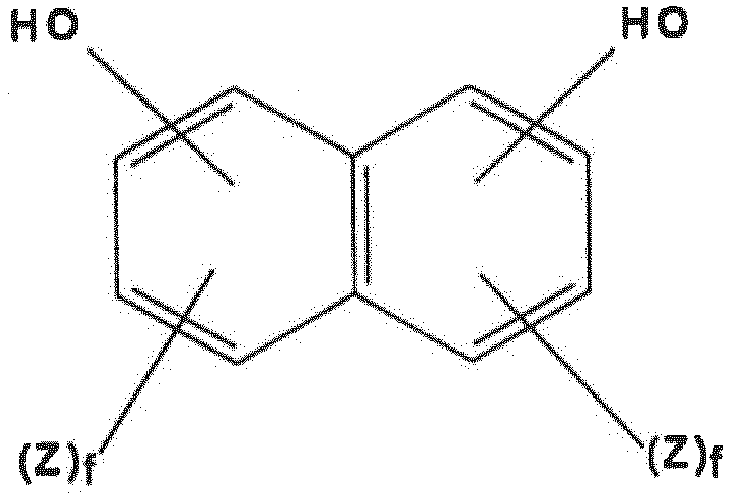
A denotes an alkylene group with 1 to 8 carbon atoms, an alkylidene group with 2 to 8 carbon atoms, a cycloalkylene group with 5 to 15 carbon atoms, a cycloalkylidene group with 5 to 15 carbon atoms, a carbonyl group, an oxygen atom, a sulfur atom, a thionyl group (-SO-) or a sulfonyl group (-SO2-) or a radical conforming to
- Among the dihydroxy compounds useful in the practice of the invention are hydroquinone, resorcinol, bis- (hydroxyphenyl)-alkanes, bis(hydroxyphenyl)-ethers, bis- (hydroxyphenyl)-ketones, bis-(hydroxyphenyl)sulfoxides, bis-(hydroxyphenyl)-sulfides, bis-(hydroxyphenyl)-sulfones, α,α-bis-(hydroxyphenyl)-diisopropyl-benzenes, as well as their nuclear- alkylated compounds and dihydroxydiphenyl cycloalkanes. These and further suitable aromatic dihydroxy compounds are described, for example, in
US-Patents 5,227,458 ;5,105,004 ;5,126,428 ;5,109,076 ;5,104,723 ;5,086,157 ;3,028,356 ;2,999,835 ;3,148,172 ;2,991,273 ;3,271,367 ; and2,999,846 . - Further examples of suitable bisphenols are 2,2-bis- (4-hydroxyphenyl)-propane (bisphenol A), 2,4-bis- (4-hydroxyphenyl)-2-methylbutane, 1,1-bis- (4-hydroxyphenyl)-cyclohexane, α,α'-bis-(4-hydroxy-phenyl)-p-diisopropylbenzene, 2,2-bis-(3-methyl-4-hydroxyphenyl)propane, 2,2-bis- (3-chloro-4-hydroxyphenyl)-propane, bis-(3, 5-dimethyl-4hydroxyphenyl)-methane, 2,2-bis- (3, 5-dimethyl-4-hydroxyphenyl)-propane, bis-(3, 5-dimethyl-4-hydroxyphenyl)-sulfide, bis- (3, 5-dimethyl-4-hydroxy- phenyl)-sulfoxide, bis-(3, 5-dimethyl-4-hydroxyphenyl)-sulfone, dihydroxybenzophenone, 2,4-bis- (3, 5-dimethyl-4-hydroxyphenyl)-cyclohexane, α,α'-bis-(3,5-dimethyl-4-hydroxyphenyl)-p-diisopropylbenzene and 4,4'-sulfonyl diphenol.
- Examples of particularly preferred aromatic bisphenols are 2,2-bis-(4-hydroxyphenyl)-propane, 2,2-bis-(3, 5-dimethyl-4-hydroxyphenyl)propane, 1,1-bis-(4-hydroxyphenyl)-cyclohexane and 1,1-bis- (4-hydroxyphenyl)-3,3,5-trimethylcyclohexane. The most preferred bisphenol is 2,2-bis-(4-hydroxyphenyl)-propane (bisphenol A).
- The polycarbonates of the invention may entail in their structure units derived from one or more of the suitable bisphenols.
- Among the resins suitable in the practice of the invention are phenolphthalein-based polycarbonates, copolycarbonates and terpolycarbonates such as are described in
US-Patents 3,036,036 and4,210,741 , both incorporated by reference herein. - The polycarbonates of the invention may be branched by condensing therein small quantities,e. g. 0.05 to 2.0 mole % (relative to bisphenols) of polyhydroxy compounds.
- Polycarbonates of this type have been described, for example, in German Offenlegungsschriften
DE 1,570,533 ;2,116,974 and2,113,374 ; British Patents885,442 and1,079,821 andU. S. Patent 3,544,514 . The following are some examples of polyhydroxyl compounds which may be used for this purpose: phloroglucinol; 6-tri-(4-hydroxyphenyl)-heptane; 1,1,1-tri-(4-hydroxyphenyl)-ethane; tri- (4-hydroxyphenyl)-phenylmethane; 2,2-bis- [4, 4-(4,4'-dihydroxydiphenyl)]-cyclohexyl-propane; 2,4-bis- (4-hydroxy-1-isopropylidine)-phenol; 2,6-bis- (2'-dihydroxy-5'-methylbenzyl)-4-methylphenol ; 2,4- dihydroxybenzoic acid; 2- (4-hydroxyphenyl)-2- (2, 4-dihydroxy-phenyl)-propane and 1,4-bis- (4, 4'-dihydroxytriphenylmethyl)-benzene. Some of the other polyfunctional compounds are 2,4-dihydroxy-benzoic acid, trimesic acid, cyanuric chloride and 3,3-bis-(4-hydroxyphenyl)-2-oxo-2, 3-dihydroindote. - In addition to the polycondensation process mentioned above, other processes for the preparation of the polycarbonates of the invention are polycondensation in a homogeneous phase and transesterification. The suitable processes are disclosed in the incorporated herein by reference
US-Patents 3,028,365 ;2,999,846 ;3,153,008 and2,991,273 . The preferred process for the preparation of polycarbonates is the interfacial polycondensation process. Other methods of synthesis in forming the polycarbonates of the invention such as disclosed inUS 3,912,688 , may be used. - Suitable polycarbonate resins are available in commerce, for instance, Makrolon® FCR, Makrolon 2600, Makrolon 2800 and Makrolon 3100, all of which are bisphenol based homopolycarbonate resins differing in terms of their respective molecular weights and characterized in that their melt flow indices (MFR) per ASTM D-1238 are about 16.5 to 24, 13 to 16, 7.5 to 13.0 and 3.5 to 6.5 g/10 min., respectively. These are products of Bayer MaterialScience.
-
- As already mentioned above, in addition, the composition of the invention may advantageously contain usual additives (D) such as plasticizers, waxes, antioxidants, plating additives, silicone oil, stabilizers, flame-retardants, fibers, mineral fibers, mineral fillers, dyes, pigments and the like.
- The preparation of the inventive polymer composition follows conventional procedures which are well known in the art. Usually, however, they are extrusion blended or compounded in a high intensity blender such as a Banbury Mixer or twin-screw extruder.
- The inventive thermoplastic molding composition can be formed into shaped articles by a variety of means such as injection molding, extrusion, compression forming, vacuum forming, blow molding etc. well established in the art.
- One further subject of the invention is the use of the inventive polymer blend for electroplating.
- A further subject of the invention is a metal-plated shaped article comprising the afore-mentioned inventive polymer blend. The surface of the shaped article is at least partially or preferably totally coated with one or more electroplated metal.
- The metal-plated shaped article is obtainable by usual processes for metal plating of polymer blends such as a i) conventional electroplating process or ii) a direct plating process. Such processes have been already described and are known in the art.
- A suitable conventional electroplating process i) usually comprises the following steps:
- i1) providing of a substrate made from the (inventive) polymer blend,
- i2) optionally cleaning/rinsing,
- i3) etching,
- i4) activation,
- i5) acceleration,
- i6) electroless chemical metal plating (e.g. nickel),
- i7) deposition of one or more metal layers
(e.g. copper, nickel, chromium) by electroplating. - A suitable direct plating process ii) usually comprises the following steps: ii1) providing of a substrate made from the inventive polymer blend, ii2) optionally cleaning/rinsing, ii3) etching, ii4) activation, ii5) deposition of one or more metal layers by electroplating (e.g. copper, nickel, chromium).
- For the preparation of the metal-plated shaped article the conventional electroplating process is preferred.
- The etching process is carried out by use of usual etching reagents such as a system based on chromic acid. For the activation and acceleration step commonly used agents for this purpose can be used. Pd/Sn-solutions for activation are preferably used.
- The thickness of the single layers is in the range of from 0.1 to 50 µm. The chemical deposited layer, if present, is usually a thin layer in the range of from 0.1 to 0.5 µm. The top layer is preferably a copper, nickel or chromium layer. In automotive applications the top layer is usually a chromium layer.
- A further subject of the invention is the use of the afore-mentioned inventive metal-plated - in particular chromium-plated - shaped article comprising the inventive polymer composition for automotive applications, in particular exterior applications such as automotive front grilles and wheel covers.
- The metal-plated polymer blend shows an improved adhesion between the metal layer and the plastic material. Furthermore the plating grade and thermal cycling adherence of the inventive polymer blend is improved and the mechanical properties are excellent.
- The invention is further described by the following examples and claims.
- A linear polycarbonate based on bisphenol A, having a melt viscosity of 4.5 grams per 10 minutes at 300° C with 1.2 kg load; ASTM D 1238.
- 29 parts by weight (calculated as solids) of an anionically emulsified polybutadiene latex with a mean particle diameter d50 of 305 nm and a gel content of 55 wt. %, produced by free-radical seed polymerization using a polybutadiene seed latex with a mean particle diameter d50 of 111 nm, and 29 parts by weight (calculated as solids) of an anionically emulsified polybutadiene latex with a mean particle diameter d50 of 412 nm and a gel content of 84 wt. % produced by free-radical seed polymerization using a polybutadiene seed latex with a mean particle diameter d50 of 137 nm, are adjusted with water to a solids content of ca. 20 wt. %, heated to 59°C, following which 0.5 part by weight of potassium peroxodisulfate (dissolved in water) is added.
- 42 parts by weight of a mixture of 73 wt. % of styrene, 27 wt. % of acrylonitrile and 0.12 part by weight of tert.-dodecyl mercaptan are then metered in uniformly within 6 hours; parallel to this 1 part by weight (calculated as solids) of the sodium salt of a resin acid mixture (Dresinate 731, Abieta Chemie GmbH, Gersthofen, Germany, dissolved in alkaline adjusted water) is metered in over a period of 6 hours. During the course of the 6 hours the reaction temperature is raised from 59°C to 80°C. After a post-reaction time of 2 hours at 80°C the graft latex is coagulated, after adding ca. 1.0 part by weight of a phenolic antioxidant, with a magnesium sulfate/acetic acid mixture, and after washing with water the resultant moist powder is dried at 70°C.
- 50 parts by weight (calculated as solids) of an anionically emulsified polybutadiene latex with a mean particle diameter d50 of 137 nm and a gel content of 88 wt. %, produced by free-radical seed polymerization using a polybutadiene seed latex with a mean particle diameter d50 of 48 nm are adjusted with water to a solids content of ca. 20 wt. %, heated to 59°C, following which 0.5 part by weight of potassium peroxodisulfate (dissolved in water) is added.
- 50 parts by weight of a mixture of 73 wt. % of styrene, 27 wt. % of acrylonitrile and 0.15 part by weight of tert.-dodecyl mercaptan are then metered in uniformly within 6 hours; parallel to this 1 part by weight (calculated as solids) of the sodium salt of a resin acid mixture (Dresinate 731, Abieta Chemie GmbH, Gersthofen, Germany, dissolved in alkaline adjusted water) is metered in over a period of 6 hours. During the course of the 6 hours the reaction temperature is raised from 59°C to 80°C. After a post-reaction time of 2 hours at 80°C, the graft latex is coagulated, after adding ca. 1.0 part by weight of a phenolic antioxidant, with a magnesium sulfate/acetic acid mixture, and after washing with water the resultant moist powder is dried at 70°C.
- mixture of ABS Graft Polymers 1 and 2 in a weight ratio of 60:40
- Graft polymer prepared by free-radical emulsion polymerization (using a redox initiator system consisting of tert.-butyl hydroperoxide and sodium ascorbate) of 40 parts by weight of styrene and acrylonitrile in a ratio by weight of 73:27, in the presence of 60 parts by weight of a particulate, crosslinked polybutadiene rubber latex (mean particle diameter d50=345 nm), working up by precipitation under the action of a 1:1 magnesium sulfate/acetic acid mixture, washing with water and drying at 70°C.
- Graft polymer prepared by free-radical emulsion polymerization (using a persulfate initiator system consisting of potassium peroxodisulfate) of 40 parts by weight of styrene and acrylonitrile in a ratio by weight of 73:27 in the presence of 60 parts by weight of a particulate, crosslinked polybutadiene rubber latex (mean particle diameter d50=345 nm), working up by precipitation under the action of a 1:1 magnesium sulfate/acetic acid mixture, washing with water and drying at 70°C.
- Co-Precipitated mixture of ABS Graft Polymers 3 and 4 in a weight ratio of 75:25
75 parts by weight (based on solids) of the graft polymer 3 in latex form and 25 parts by weight (based on solids) of the graft polymer 4 in latex form are mixed homogeneously; the graft polymer latex mixture is then precipitated under the action of a 1:1 magnesium sulfate/acetic acid mixture. After washing with water, drying is carried out at 70°C. - SAN - a copolymer of styrene and acrylonitrile made by continuous bulk polymerization. The copolymer contains 75.5 weight % styrene and 24.5 weight % acrylonitrile.
- Each of the exemplified compositions (see Table 1) contained 0.2 parts by weight of butyl stearate per 100 parts by weight resin of the total of components A, B, and C.
- An extrusion process physically blended the components of the polymer blends of each example. This was carried out in a commercially available 34 mm Leistritz twin-screw extruder (24: 1 L : D screw; 250 revolutions per minute; at 260°C). A commercial antioxidant having no criticality in the present context was included in the compositional makeup at a level of 0.1% by weight. The die temperature was 260°C. The extruded material is passed through a water bath and pelletized.
- The pelletized material is then injection molded into specimens for testing. A part of the specimens was directly tested in a multi axial impact test according to DIN EN ISO 6603-2.
- Melt flow (MVR 220 °C / 10 kg) was measured according to ISO 1133.
Peel strength was measured according to ASTM-D 903. - The "Temperature range possible for molded plaques" was determined by step-wise increasing injection molding temperature, beginning at 170 °C, by 10 °C. Samples were taken at each step and the optical quality of the sample was determined by a collective of 5 persons. Scales of optical assessments were:
1 = glossy, defect free surface; 2 = glossy surface but with small defects; 3 = partly glossy and significant defects; 4 = incomplete filling of the mold. - Once a specimen scored between 1 and 2, the related injection molding temperature was approved as being suitable for molding.
- Another part of the specimens was metal plated:
Plated plaques tested for the peel test according to DIN 53494 were prepared under the following electroplating bath conditions:Chromic acid etching: 9 minutes at 68.4°C Activator: 3 minutes at 24.6°C pretreatment: colloidal Accelerator: 3 minutes at 50.4°C pretreatment: colloidal Chemical Nickel: 10 minutes at 63.9°C Pre-Nickel: 10 minutes at 50.7°C Copper: 60 minutes at 20°C current density: 3 A/dm2 - The copper layer had a thickness of 40 µm.
- Plated plaques tested for the multi axial impact test according to DIN EN ISO 6603-2 were prepared under the following electroplating bath conditions:
Chromic acid etching: 9 minutes at 67.9°C Activator: 3 minutes at 25.5°C pretreatment: colloidal Accelerator: 3 minutes at 50.2°C pretreatment: colloidal Chemical Nickel: 10 minutes at 64.1°C Pre-Nickel: 10 minutes at 51.3°C Copper: 30 minutes at 20°C current density: 3 A/dm2 Bright Nickel: 10 minutes at 53.3°C current density: 3 A/dm2 - Table 1 shows the composition (in weight percent) of the polymer blends tested and the corresponding mechanical data obtained by the afore-mentioned tests.
Table 1 Comparative example 1 Example 1 non-inventive Example 2 non-inventive Example 3 Comp. ex. 2 PC (wt.%) 0 30 45 45 60 SAN (wt.%) 63 35 20 20 20 ABS graft polymer (wt.%) 37 35 35 35 20 ABS graft polymer ABS I ABS I ABS I ABS II ABS I and ABS II Temperature range possible for molded plaques (precondition: not higher than 300 °C due to formation of high amounts of residual monomers) 180-300 °C 220-300 230-300 230-300 250-300 Impact energy of molded plaque (J) (Energy at maximal Force) 53 72 64 65 >70 Impact energy of metal plated molded plaque (J) 9 23 17 16 n/a maximal Impact force of plated plaque (N) 2800 4300 3600 3650 n/a Peel strength (N/cm) 7 9,3 8 7,7 n/a Typical Melt flow MVR at 220°C/10 min >10 5-10 <5 <5 <5 Hole size after impact (1= biggest, 3= smallest) 1 3 2 2 n/a Classification of Dart Impact testing YU (yielding unstable cracking) YS (yielding stable cracking) YU YU n/a n/a: not available - The test results show that the inventive polymer blend shows improved mechanical properties in comparison to polymer blends with different components. The test results of the inventive metal-plated polymer blend show an improved adhesion (peel strength) between the metal layer and the polymer material and mechanical properties in comparison to non-inventive polymer blends.
Claims (10)
- Thermoplastic molding composition comprising components A) to C):A) 30 to 40 wt.% of at least one graft rubber copolymer (A) obtained by emulsion polymerization of styrene and acrylonitrile in a weight ratio of 95:5 to 50:50, styrene and/or acrylonitrile being able to be partially or completely replaced by [alpha]-methylstyrene, methyl methacrylate or N-phenylmaleimide or mixtures thereof, in the presence of at least one polymer latex (a) of a conjugated diene;B) 30 to 40 wt.% of at least one rubber free vinyl copolymer of 50 to 99 percent (B1) and 1 to 50 percent (B2), the percent being relative to the weight of the copolymer, where (B1) is at least one member selected from the group consisting of styrene, α-methyl styrene, nucleus-substituted styrene, and methyl methacrylate and where (B2) is at least one member selected from the group consisting of acrylonitrile, methyl methacrylate, maleic anhydride, N-alkyl-substituted maleic imide and N-aryl-substituted maleic imide; andC) 25 to 34 wt.-% by weight of at least one aromatic polycarbonate;wherein the sum of components A), B) and C) totals 100% by weight.
- Thermoplastic molding composition according to claim 1, comprising as component B a copolymer of styrene and acrylonitrile, which is made from 69 to 81% by weight of styrene and from 19 to 31% by weight of acrylonitrile.
- Thermoplastic molding composition according to claim 1 or 2, comprising as component B 30 to 40 wt.% of a copolymer of styrene and acrylonitrile, which is made by continuous bulk polymerization, and which contains from 69 to 81% by weight of styrene and from 19 to 31% by weight of acrylonitrile, in particular contains 75.5 weight % of styrene and 24.5 weight % of acrylonitrile.
- Thermoplastic molding composition according to any one of claim 1 to 3, comprising as component A a graft rubber copolymer obtained by emulsion polymerization of styrene and acrylonitrile in a weight ratio of 80:20 to 65:35 in the presence of at least one polymer latex (a) of butadiene.
- Thermoplastic molding composition according to any one of claim 1 to 4, comprising as component A two or more graft rubber polymers (A1), (A2), (A3) etc. which are different in the mean particle diameter d50 of the polymer latex (a) of the conjugated diene.
- Thermoplastic molding composition according to claim 5, comprising as component A three graft rubber polymers (A1), (A2), (A3), wherein the mean particle diameter d50 of the polymer latex (a1) is 230 to 330 nm, the mean particle diameter d50 of the polymer latex (a2) is 340 to 480 nm, and the mean particle diameter d50 of the polymer latex (a3) is 10 to 220 nm.
- Use of the thermoplastic molding composition according to any of claims 1 to 6 for electroplating.
- A shaped article comprising the thermoplastic molding composition according to any of claims 1 to 6, which surface is coated with an electroplated metal.
- Use of the metal-plated shaped article according to claim 8 for automotive applications.
- An electroplating process comprising the following steps:i1) providing of a substrate made from a thermoplastic molding
composition according to any of claims 1 to 6,i2) optionally cleaning/rinsing,i3) etching,i4) activation,i5) acceleration,i6) electroless chemical metal plating, in particular nickel,i7) deposition of one or more metal layers, in particular copper, nickel or chromium) by electroplating.
Applications Claiming Priority (2)
| Application Number | Priority Date | Filing Date | Title |
|---|---|---|---|
| EP14165951 | 2014-04-25 | ||
| PCT/EP2015/058877 WO2015162239A1 (en) | 2014-04-25 | 2015-04-24 | Polymer blend for metal plating |
Publications (3)
| Publication Number | Publication Date |
|---|---|
| EP3134474A1 EP3134474A1 (en) | 2017-03-01 |
| EP3134474B1 true EP3134474B1 (en) | 2019-10-02 |
| EP3134474B2 EP3134474B2 (en) | 2026-01-07 |
Family
ID=50543502
Family Applications (1)
| Application Number | Title | Priority Date | Filing Date |
|---|---|---|---|
| EP15721152.5A Active EP3134474B2 (en) | 2014-04-25 | 2015-04-24 | Polymer blend for metal plating |
Country Status (4)
| Country | Link |
|---|---|
| US (2) | US20170044355A1 (en) |
| EP (1) | EP3134474B2 (en) |
| ES (1) | ES2753375T5 (en) |
| WO (1) | WO2015162239A1 (en) |
Families Citing this family (6)
| Publication number | Priority date | Publication date | Assignee | Title |
|---|---|---|---|---|
| KR101954063B1 (en) * | 2015-11-05 | 2019-03-05 | 주식회사 엘지화학 | Polycarbonate-abs alloy resin composition having improved electroplate adhesion and molded article comprising the same |
| CN106674960B (en) * | 2016-12-14 | 2018-11-13 | 上海锦湖日丽塑料有限公司 | A kind of electroless coating PC/ABS alloy materials and preparation method thereof suitable for double-shot moulding |
| JP6218347B1 (en) * | 2017-07-21 | 2017-10-25 | ユーエムジー・エービーエス株式会社 | Thermoplastic resin composition for plating, resin molded product and plated product |
| KR102360594B1 (en) * | 2018-09-21 | 2022-02-09 | 주식회사 엘지화학 | Thermoplastic resin composition, method for producing the same and metal plated molding product therefrom |
| CN114555701B (en) * | 2019-10-21 | 2024-07-30 | Sabic环球技术有限责任公司 | Polymer composition for use in electroless plating, method of electroless plating, and polymer article made by electroless plating |
| JP7299399B1 (en) | 2022-10-24 | 2023-06-27 | テクノUmg株式会社 | Graft copolymers, resin compositions for plating, molded products and plated products |
Citations (5)
| Publication number | Priority date | Publication date | Assignee | Title |
|---|---|---|---|---|
| US4212774A (en) | 1977-08-20 | 1980-07-15 | Karsten Idel | Recovery of high-quality polycarbonate from polycarbonate scrap |
| US20030036586A1 (en) | 2000-02-23 | 2003-02-20 | Herbert Eichenauer | Abs moulding material with improved workability and a high lustre |
| US20130158183A1 (en) | 2011-06-20 | 2013-06-20 | Styrolution (Jersey) Limited | Impact modified polycarbonate compositions |
| WO2013100336A1 (en) | 2011-12-29 | 2013-07-04 | Cheil Industries Inc. | Thermoplastic resin composition and molded product using the same |
| US20130203909A1 (en) | 2012-02-03 | 2013-08-08 | Amit S. Kulkarni | Polycarbonate blends having improved electroplate adhesion |
Family Cites Families (3)
| Publication number | Priority date | Publication date | Assignee | Title |
|---|---|---|---|---|
| FR2661184A1 (en) * | 1990-04-19 | 1991-10-25 | Borg Warner Chemical Europ Bv | MOLDING COMPOSITIONS BASED ON AROMATIC POLYCARBONATE RESIN, ABS POLYMERIZATION AND SAN COPOLYMER HAVING MATERIAL SURFACE ASPECT. |
| TWI230726B (en) * | 1998-06-17 | 2005-04-11 | Bayer Ag | Thermoplastic molding compositions having improved plateability |
| CN102367327B (en) * | 2011-08-31 | 2014-04-16 | 上海锦湖日丽塑料有限公司 | Electroplated PC/ABS alloy and its preparation method |
-
2015
- 2015-04-24 EP EP15721152.5A patent/EP3134474B2/en active Active
- 2015-04-24 ES ES15721152T patent/ES2753375T5/en active Active
- 2015-04-24 WO PCT/EP2015/058877 patent/WO2015162239A1/en not_active Ceased
- 2015-04-24 US US15/305,838 patent/US20170044355A1/en not_active Abandoned
-
2019
- 2019-08-13 US US16/539,200 patent/US20190359800A1/en not_active Abandoned
Patent Citations (5)
| Publication number | Priority date | Publication date | Assignee | Title |
|---|---|---|---|---|
| US4212774A (en) | 1977-08-20 | 1980-07-15 | Karsten Idel | Recovery of high-quality polycarbonate from polycarbonate scrap |
| US20030036586A1 (en) | 2000-02-23 | 2003-02-20 | Herbert Eichenauer | Abs moulding material with improved workability and a high lustre |
| US20130158183A1 (en) | 2011-06-20 | 2013-06-20 | Styrolution (Jersey) Limited | Impact modified polycarbonate compositions |
| WO2013100336A1 (en) | 2011-12-29 | 2013-07-04 | Cheil Industries Inc. | Thermoplastic resin composition and molded product using the same |
| US20130203909A1 (en) | 2012-02-03 | 2013-08-08 | Amit S. Kulkarni | Polycarbonate blends having improved electroplate adhesion |
Non-Patent Citations (14)
| Title |
|---|
| ANDREAS CHRISOCHOOU: "Styrenic Copolymers", 2002, BAYER AG, article "3.2 Two Phase Systems", pages: 1, 11 - 22, 43, XP055713821 |
| ANONYMOUS: "ELIX Ultra 4105 / LUSTRAN Ultra 4105", ELIX POLYMERS DATA SHEET, September 2011 (2011-09-01), pages 1 - 2, XP055713183 |
| ANONYMOUS: "ELIX™ 158 I High rubber content Acrylonitrile Butadiene Styrene modifier used to improve toughness of engineering thermoplastics & PVC.", ELIX POLYMERS TECHNICAL INFORMATION, 25 May 2012 (2012-05-25), pages 1 - 2, XP055713296 |
| ANONYMOUS: "ELIX™ 260 G High flow SAN copolymer.", ELIX POLYMERS TECHNICAL INFORMATION, 25 May 2012 (2012-05-25), pages 1 - 2, XP055713188 |
| ANONYMOUS: "ELIX™ 280 G High Molecular Weight SAN copolymer", ELIX POLYMERS TECHNICAL INFORMATION,, 25 June 2012 (2012-06-25), pages 1 - 2, XP055713191 |
| B.D. GESNER: "Phase Separation of Some Acrylonitrile - Butadiene - Styrene Resins", J. POL. SCI. PART A, vol. 3, 1965, pages 3825 - 3831, XP055713824 |
| FISCHER ET AL.: "Characterization of Acrylonitrile-Butadiene-Styrene Terpolymers by Computer Aided FT-IR Spectroscopy", ANGEW. MAKROMOL. CHEM., vol. 149, 1987, pages 179 - 187, XP055516449 |
| GUPTA ET AL.: "FT-IR Studies of e-plastic obtained from obsolete computers", J. CHEM. PHARM. RES., vol. 3, no. 5, 2011, pages 660 - 667, XP055713831 |
| MCCASKIE ET AL.: "Plating on Plastics. A survey of mechanisms for adhering metal films to plastic surfaces", MET. FINISH., vol. 104, no. 5, 2006, pages 31 - 39, XP055713834 |
| OLIVERA ET AL.: "Plating of acrylonitrile-butadiene-styrene (ABS) plastic: a review", J. MATER. SCI., vol. 51, no. 8, 2016, pages 3657 - 3674, XP035914683, DOI: 10.1007/s10853-015-9668-7 |
| SANCHES ET AL.: "Evaluation of FT-IR (UATR and Transmission) Techniques for Determination of AN Content in NBR Samples", POL. CIENCIA TECNOL., vol. 18, no. 3, 2008, pages 249 - 255, XP055713829 |
| SULUB ET AL.: "Determination of polymer blends composed of polycarbonate and rubber entities using near-infrared (NIR) spectroscopy and multivariate calibration", POL. TESTING, vol. 32, 2013, pages 802 - 809, XP055713827 |
| VERLEYE ET AL.: "Easy Identification of Plastics and Rubbers", 2001, RAPRA TECHNOLOGY LTD., article "3.4.11 PC", pages: 55 - 57, XP055713820 |
| ZAMANI ET AL.: "Characterization of Rubber Phase in Acrylonitrile- Butadiene-Styrene Polymers", J. APPL. POL. SCI., vol. 114, 2009, pages 1908 - 1913, XP055516444, DOI: 10.1002/app.30371 |
Also Published As
| Publication number | Publication date |
|---|---|
| US20190359800A1 (en) | 2019-11-28 |
| EP3134474A1 (en) | 2017-03-01 |
| ES2753375T5 (en) | 2026-03-30 |
| ES2753375T3 (en) | 2020-04-08 |
| US20170044355A1 (en) | 2017-02-16 |
| EP3134474B2 (en) | 2026-01-07 |
| WO2015162239A1 (en) | 2015-10-29 |
Similar Documents
| Publication | Publication Date | Title |
|---|---|---|
| US20190359800A1 (en) | Polymer blend for metal plating | |
| CN101268142B (en) | Resin composition for direct metal plating, molded article, and metal plated molded article | |
| CA2334998C (en) | Thermoplastic molding compositions having improved plateability | |
| EP2537895B1 (en) | Impact modified polycarbonate compositions | |
| US4665125A (en) | Thermoplastic resin composition of a polycarbonate and vinyl aromatic-vinyl cyanide comonomers/diene rubber graft copolymer | |
| EP2743311B1 (en) | Alkyl (meth)acrylate-based thermoplastic resin composition and thermoplastic resin having adjusted scratch resistance and yellowness | |
| JPS6225179B2 (en) | ||
| JP4716577B2 (en) | Thermoplastic composition for molding showing weather resistance | |
| KR100876200B1 (en) | Polycarbonate Thermoplastic Resin Composition | |
| JPH0346497B2 (en) | ||
| TWI880020B (en) | Thermoplastic resin composition, method of preparing the same, and molded article including the same | |
| WO2018008669A1 (en) | Resin composition for plating, and plated molded article | |
| EP4269457A1 (en) | Resin composition for plating | |
| CA2299874C (en) | Weatherable molding composition having improved surface appearance | |
| JP7459283B2 (en) | Thermoplastic resin composition, its method of manufacture and molded article containing same | |
| CA2365270A1 (en) | Compositions containing polycarbonate and grafted rubber having improved low-temperature toughness | |
| KR100639043B1 (en) | Low-gloss, scratch-resistant polycarbonate-based alloy thermoplastic resin composition using crosslinked organic microparticles | |
| JP2022187748A (en) | Thermoplastic resin composition and molded article | |
| KR20010052949A (en) | Thermoplastic Molding Compositions Having Improved Plateability | |
| CN108690339A (en) | Thermoplastic resin composition and molded article | |
| JP2002294059A (en) | Polycarbonate resin composition and polycarbonate resin plated molded product | |
| TWI486392B (en) | Resin composition | |
| CA2357523C (en) | Compositions containing polycarbonate and grafted rubber having improved low-temperature toughness | |
| JP2011219693A (en) | Resin composition for coating polystyrene-based resin and coated molding | |
| MXPA00012373A (en) | Thermoplastic molding compositions having improved plateability |
Legal Events
| Date | Code | Title | Description |
|---|---|---|---|
| STAA | Information on the status of an ep patent application or granted ep patent |
Free format text: STATUS: THE INTERNATIONAL PUBLICATION HAS BEEN MADE |
|
| PUAI | Public reference made under article 153(3) epc to a published international application that has entered the european phase |
Free format text: ORIGINAL CODE: 0009012 |
|
| STAA | Information on the status of an ep patent application or granted ep patent |
Free format text: STATUS: REQUEST FOR EXAMINATION WAS MADE |
|
| 17P | Request for examination filed |
Effective date: 20161110 |
|
| AK | Designated contracting states |
Kind code of ref document: A1 Designated state(s): AL AT BE BG CH CY CZ DE DK EE ES FI FR GB GR HR HU IE IS IT LI LT LU LV MC MK MT NL NO PL PT RO RS SE SI SK SM TR |
|
| AX | Request for extension of the european patent |
Extension state: BA ME |
|
| DAV | Request for validation of the european patent (deleted) | ||
| DAX | Request for extension of the european patent (deleted) | ||
| STAA | Information on the status of an ep patent application or granted ep patent |
Free format text: STATUS: EXAMINATION IS IN PROGRESS |
|
| 17Q | First examination report despatched |
Effective date: 20170905 |
|
| GRAP | Despatch of communication of intention to grant a patent |
Free format text: ORIGINAL CODE: EPIDOSNIGR1 |
|
| STAA | Information on the status of an ep patent application or granted ep patent |
Free format text: STATUS: GRANT OF PATENT IS INTENDED |
|
| RIC1 | Information provided on ipc code assigned before grant |
Ipc: C08L 55/02 20060101AFI20190423BHEP Ipc: C08L 25/12 20060101ALI20190423BHEP Ipc: C08L 69/00 20060101ALI20190423BHEP Ipc: C23C 18/16 20060101ALI20190423BHEP |
|
| INTG | Intention to grant announced |
Effective date: 20190520 |
|
| GRAS | Grant fee paid |
Free format text: ORIGINAL CODE: EPIDOSNIGR3 |
|
| GRAA | (expected) grant |
Free format text: ORIGINAL CODE: 0009210 |
|
| STAA | Information on the status of an ep patent application or granted ep patent |
Free format text: STATUS: THE PATENT HAS BEEN GRANTED |
|
| AK | Designated contracting states |
Kind code of ref document: B1 Designated state(s): AL AT BE BG CH CY CZ DE DK EE ES FI FR GB GR HR HU IE IS IT LI LT LU LV MC MK MT NL NO PL PT RO RS SE SI SK SM TR |
|
| RAP1 | Party data changed (applicant data changed or rights of an application transferred) |
Owner name: INEOS STYROLUTION GROUP GMBH |
|
| REG | Reference to a national code |
Ref country code: GB Ref legal event code: FG4D |
|
| RIN1 | Information on inventor provided before grant (corrected) |
Inventor name: WIEDEL, EUGEN Inventor name: EISENTRAEGER, FRANK Inventor name: NIESSNER, NORBERT |
|
| REG | Reference to a national code |
Ref country code: CH Ref legal event code: EP Ref country code: AT Ref legal event code: REF Ref document number: 1186126 Country of ref document: AT Kind code of ref document: T Effective date: 20191015 |
|
| REG | Reference to a national code |
Ref country code: DE Ref legal event code: R096 Ref document number: 602015039025 Country of ref document: DE |
|
| REG | Reference to a national code |
Ref country code: IE Ref legal event code: FG4D |
|
| REG | Reference to a national code |
Ref country code: NL Ref legal event code: FP |
|
| REG | Reference to a national code |
Ref country code: LT Ref legal event code: MG4D |
|
| REG | Reference to a national code |
Ref country code: ES Ref legal event code: FG2A Ref document number: 2753375 Country of ref document: ES Kind code of ref document: T3 Effective date: 20200408 |
|
| REG | Reference to a national code |
Ref country code: AT Ref legal event code: MK05 Ref document number: 1186126 Country of ref document: AT Kind code of ref document: T Effective date: 20191002 |
|
| PG25 | Lapsed in a contracting state [announced via postgrant information from national office to epo] |
Ref country code: AT Free format text: LAPSE BECAUSE OF FAILURE TO SUBMIT A TRANSLATION OF THE DESCRIPTION OR TO PAY THE FEE WITHIN THE PRESCRIBED TIME-LIMIT Effective date: 20191002 Ref country code: SE Free format text: LAPSE BECAUSE OF FAILURE TO SUBMIT A TRANSLATION OF THE DESCRIPTION OR TO PAY THE FEE WITHIN THE PRESCRIBED TIME-LIMIT Effective date: 20191002 Ref country code: LV Free format text: LAPSE BECAUSE OF FAILURE TO SUBMIT A TRANSLATION OF THE DESCRIPTION OR TO PAY THE FEE WITHIN THE PRESCRIBED TIME-LIMIT Effective date: 20191002 Ref country code: BG Free format text: LAPSE BECAUSE OF FAILURE TO SUBMIT A TRANSLATION OF THE DESCRIPTION OR TO PAY THE FEE WITHIN THE PRESCRIBED TIME-LIMIT Effective date: 20200102 Ref country code: PT Free format text: LAPSE BECAUSE OF FAILURE TO SUBMIT A TRANSLATION OF THE DESCRIPTION OR TO PAY THE FEE WITHIN THE PRESCRIBED TIME-LIMIT Effective date: 20200203 Ref country code: FI Free format text: LAPSE BECAUSE OF FAILURE TO SUBMIT A TRANSLATION OF THE DESCRIPTION OR TO PAY THE FEE WITHIN THE PRESCRIBED TIME-LIMIT Effective date: 20191002 Ref country code: NO Free format text: LAPSE BECAUSE OF FAILURE TO SUBMIT A TRANSLATION OF THE DESCRIPTION OR TO PAY THE FEE WITHIN THE PRESCRIBED TIME-LIMIT Effective date: 20200102 Ref country code: PL Free format text: LAPSE BECAUSE OF FAILURE TO SUBMIT A TRANSLATION OF THE DESCRIPTION OR TO PAY THE FEE WITHIN THE PRESCRIBED TIME-LIMIT Effective date: 20191002 Ref country code: LT Free format text: LAPSE BECAUSE OF FAILURE TO SUBMIT A TRANSLATION OF THE DESCRIPTION OR TO PAY THE FEE WITHIN THE PRESCRIBED TIME-LIMIT Effective date: 20191002 Ref country code: GR Free format text: LAPSE BECAUSE OF FAILURE TO SUBMIT A TRANSLATION OF THE DESCRIPTION OR TO PAY THE FEE WITHIN THE PRESCRIBED TIME-LIMIT Effective date: 20200103 |
|
| PG25 | Lapsed in a contracting state [announced via postgrant information from national office to epo] |
Ref country code: RS Free format text: LAPSE BECAUSE OF FAILURE TO SUBMIT A TRANSLATION OF THE DESCRIPTION OR TO PAY THE FEE WITHIN THE PRESCRIBED TIME-LIMIT Effective date: 20191002 Ref country code: HR Free format text: LAPSE BECAUSE OF FAILURE TO SUBMIT A TRANSLATION OF THE DESCRIPTION OR TO PAY THE FEE WITHIN THE PRESCRIBED TIME-LIMIT Effective date: 20191002 Ref country code: CZ Free format text: LAPSE BECAUSE OF FAILURE TO SUBMIT A TRANSLATION OF THE DESCRIPTION OR TO PAY THE FEE WITHIN THE PRESCRIBED TIME-LIMIT Effective date: 20191002 Ref country code: IS Free format text: LAPSE BECAUSE OF FAILURE TO SUBMIT A TRANSLATION OF THE DESCRIPTION OR TO PAY THE FEE WITHIN THE PRESCRIBED TIME-LIMIT Effective date: 20200224 |
|
| REG | Reference to a national code |
Ref country code: DE Ref legal event code: R026 Ref document number: 602015039025 Country of ref document: DE |
|
| PLBI | Opposition filed |
Free format text: ORIGINAL CODE: 0009260 |
|
| PG25 | Lapsed in a contracting state [announced via postgrant information from national office to epo] |
Ref country code: AL Free format text: LAPSE BECAUSE OF FAILURE TO SUBMIT A TRANSLATION OF THE DESCRIPTION OR TO PAY THE FEE WITHIN THE PRESCRIBED TIME-LIMIT Effective date: 20191002 |
|
| PLAX | Notice of opposition and request to file observation + time limit sent |
Free format text: ORIGINAL CODE: EPIDOSNOBS2 |
|
| 26 | Opposition filed |
Opponent name: ELIX POLYMERS, S.L. Effective date: 20200616 |
|
| PG2D | Information on lapse in contracting state deleted |
Ref country code: IS |
|
| PG25 | Lapsed in a contracting state [announced via postgrant information from national office to epo] |
Ref country code: RO Free format text: LAPSE BECAUSE OF FAILURE TO SUBMIT A TRANSLATION OF THE DESCRIPTION OR TO PAY THE FEE WITHIN THE PRESCRIBED TIME-LIMIT Effective date: 20191002 Ref country code: DK Free format text: LAPSE BECAUSE OF FAILURE TO SUBMIT A TRANSLATION OF THE DESCRIPTION OR TO PAY THE FEE WITHIN THE PRESCRIBED TIME-LIMIT Effective date: 20191002 Ref country code: EE Free format text: LAPSE BECAUSE OF FAILURE TO SUBMIT A TRANSLATION OF THE DESCRIPTION OR TO PAY THE FEE WITHIN THE PRESCRIBED TIME-LIMIT Effective date: 20191002 Ref country code: IS Free format text: LAPSE BECAUSE OF FAILURE TO SUBMIT A TRANSLATION OF THE DESCRIPTION OR TO PAY THE FEE WITHIN THE PRESCRIBED TIME-LIMIT Effective date: 20200202 |
|
| PG25 | Lapsed in a contracting state [announced via postgrant information from national office to epo] |
Ref country code: SK Free format text: LAPSE BECAUSE OF FAILURE TO SUBMIT A TRANSLATION OF THE DESCRIPTION OR TO PAY THE FEE WITHIN THE PRESCRIBED TIME-LIMIT Effective date: 20191002 Ref country code: IT Free format text: LAPSE BECAUSE OF FAILURE TO SUBMIT A TRANSLATION OF THE DESCRIPTION OR TO PAY THE FEE WITHIN THE PRESCRIBED TIME-LIMIT Effective date: 20191002 Ref country code: SM Free format text: LAPSE BECAUSE OF FAILURE TO SUBMIT A TRANSLATION OF THE DESCRIPTION OR TO PAY THE FEE WITHIN THE PRESCRIBED TIME-LIMIT Effective date: 20191002 |
|
| PLBB | Reply of patent proprietor to notice(s) of opposition received |
Free format text: ORIGINAL CODE: EPIDOSNOBS3 |
|
| PG25 | Lapsed in a contracting state [announced via postgrant information from national office to epo] |
Ref country code: SI Free format text: LAPSE BECAUSE OF FAILURE TO SUBMIT A TRANSLATION OF THE DESCRIPTION OR TO PAY THE FEE WITHIN THE PRESCRIBED TIME-LIMIT Effective date: 20191002 Ref country code: MC Free format text: LAPSE BECAUSE OF FAILURE TO SUBMIT A TRANSLATION OF THE DESCRIPTION OR TO PAY THE FEE WITHIN THE PRESCRIBED TIME-LIMIT Effective date: 20191002 |
|
| REG | Reference to a national code |
Ref country code: CH Ref legal event code: PL |
|
| PG25 | Lapsed in a contracting state [announced via postgrant information from national office to epo] |
Ref country code: LU Free format text: LAPSE BECAUSE OF NON-PAYMENT OF DUE FEES Effective date: 20200424 Ref country code: LI Free format text: LAPSE BECAUSE OF NON-PAYMENT OF DUE FEES Effective date: 20200430 Ref country code: CH Free format text: LAPSE BECAUSE OF NON-PAYMENT OF DUE FEES Effective date: 20200430 |
|
| GBPC | Gb: european patent ceased through non-payment of renewal fee |
Effective date: 20200424 |
|
| PG25 | Lapsed in a contracting state [announced via postgrant information from national office to epo] |
Ref country code: GB Free format text: LAPSE BECAUSE OF NON-PAYMENT OF DUE FEES Effective date: 20200424 Ref country code: IE Free format text: LAPSE BECAUSE OF NON-PAYMENT OF DUE FEES Effective date: 20200424 |
|
| PG25 | Lapsed in a contracting state [announced via postgrant information from national office to epo] |
Ref country code: TR Free format text: LAPSE BECAUSE OF FAILURE TO SUBMIT A TRANSLATION OF THE DESCRIPTION OR TO PAY THE FEE WITHIN THE PRESCRIBED TIME-LIMIT Effective date: 20191002 Ref country code: MT Free format text: LAPSE BECAUSE OF FAILURE TO SUBMIT A TRANSLATION OF THE DESCRIPTION OR TO PAY THE FEE WITHIN THE PRESCRIBED TIME-LIMIT Effective date: 20191002 Ref country code: CY Free format text: LAPSE BECAUSE OF FAILURE TO SUBMIT A TRANSLATION OF THE DESCRIPTION OR TO PAY THE FEE WITHIN THE PRESCRIBED TIME-LIMIT Effective date: 20191002 |
|
| PG25 | Lapsed in a contracting state [announced via postgrant information from national office to epo] |
Ref country code: MK Free format text: LAPSE BECAUSE OF FAILURE TO SUBMIT A TRANSLATION OF THE DESCRIPTION OR TO PAY THE FEE WITHIN THE PRESCRIBED TIME-LIMIT Effective date: 20191002 |
|
| APAH | Appeal reference modified |
Free format text: ORIGINAL CODE: EPIDOSCREFNO |
|
| APBM | Appeal reference recorded |
Free format text: ORIGINAL CODE: EPIDOSNREFNO |
|
| APBP | Date of receipt of notice of appeal recorded |
Free format text: ORIGINAL CODE: EPIDOSNNOA2O |
|
| APBQ | Date of receipt of statement of grounds of appeal recorded |
Free format text: ORIGINAL CODE: EPIDOSNNOA3O |
|
| PLAB | Opposition data, opponent's data or that of the opponent's representative modified |
Free format text: ORIGINAL CODE: 0009299OPPO |
|
| R26 | Opposition filed (corrected) |
Opponent name: ELIX POLYMERS, S.L. Effective date: 20200616 |
|
| APBU | Appeal procedure closed |
Free format text: ORIGINAL CODE: EPIDOSNNOA9O |
|
| PUAH | Patent maintained in amended form |
Free format text: ORIGINAL CODE: 0009272 |
|
| STAA | Information on the status of an ep patent application or granted ep patent |
Free format text: STATUS: PATENT MAINTAINED AS AMENDED |
|
| REG | Reference to a national code |
Ref country code: CH Ref legal event code: M12 Free format text: ST27 STATUS EVENT CODE: U-0-0-M10-M12 (AS PROVIDED BY THE NATIONAL OFFICE) Effective date: 20251210 |
|
| 27A | Patent maintained in amended form |
Effective date: 20260107 |
|
| AK | Designated contracting states |
Kind code of ref document: B2 Designated state(s): AL AT BE BG CH CY CZ DE DK EE ES FI FR GB GR HR HU IE IS IT LI LT LU LV MC MK MT NL NO PL PT RO RS SE SI SK SM TR |
|
| REG | Reference to a national code |
Ref country code: DE Ref legal event code: R102 Ref document number: 602015039025 Country of ref document: DE |
|
| REG | Reference to a national code |
Ref country code: NL Ref legal event code: FP |
|
| REG | Reference to a national code |
Ref country code: ES Ref legal event code: DC2A Ref document number: 2753375 Country of ref document: ES Kind code of ref document: T5 Effective date: 20260330 |
|
| PGFP | Annual fee paid to national office [announced via postgrant information from national office to epo] |
Ref country code: NL Payment date: 20260422 Year of fee payment: 12 |
|
| PGFP | Annual fee paid to national office [announced via postgrant information from national office to epo] |
Ref country code: ES Payment date: 20260520 Year of fee payment: 12 |
|
| PGFP | Annual fee paid to national office [announced via postgrant information from national office to epo] |
Ref country code: DE Payment date: 20260423 Year of fee payment: 12 |
|
| PGFP | Annual fee paid to national office [announced via postgrant information from national office to epo] |
Ref country code: BE Payment date: 20260422 Year of fee payment: 12 |
|
| PGFP | Annual fee paid to national office [announced via postgrant information from national office to epo] |
Ref country code: FR Payment date: 20260422 Year of fee payment: 12 |