EP3132871B1 - Stranggiessvorrichtung für platte mit titan oder titanlegierung - Google Patents
Stranggiessvorrichtung für platte mit titan oder titanlegierung Download PDFInfo
- Publication number
- EP3132871B1 EP3132871B1 EP15779618.6A EP15779618A EP3132871B1 EP 3132871 B1 EP3132871 B1 EP 3132871B1 EP 15779618 A EP15779618 A EP 15779618A EP 3132871 B1 EP3132871 B1 EP 3132871B1
- Authority
- EP
- European Patent Office
- Prior art keywords
- molten metal
- mold
- torch
- slab
- plasma torch
- Prior art date
- Legal status (The legal status is an assumption and is not a legal conclusion. Google has not performed a legal analysis and makes no representation as to the accuracy of the status listed.)
- Not-in-force
Links
Images





Classifications
-
- B—PERFORMING OPERATIONS; TRANSPORTING
- B22—CASTING; POWDER METALLURGY
- B22D—CASTING OF METALS; CASTING OF OTHER SUBSTANCES BY THE SAME PROCESSES OR DEVICES
- B22D11/00—Continuous casting of metals, i.e. casting in indefinite lengths
- B22D11/10—Supplying or treating molten metal
- B22D11/11—Treating the molten metal
- B22D11/114—Treating the molten metal by using agitating or vibrating means
- B22D11/115—Treating the molten metal by using agitating or vibrating means by using magnetic fields
-
- B—PERFORMING OPERATIONS; TRANSPORTING
- B22—CASTING; POWDER METALLURGY
- B22D—CASTING OF METALS; CASTING OF OTHER SUBSTANCES BY THE SAME PROCESSES OR DEVICES
- B22D11/00—Continuous casting of metals, i.e. casting in indefinite lengths
-
- B—PERFORMING OPERATIONS; TRANSPORTING
- B22—CASTING; POWDER METALLURGY
- B22D—CASTING OF METALS; CASTING OF OTHER SUBSTANCES BY THE SAME PROCESSES OR DEVICES
- B22D11/00—Continuous casting of metals, i.e. casting in indefinite lengths
- B22D11/001—Continuous casting of metals, i.e. casting in indefinite lengths of specific alloys
-
- B—PERFORMING OPERATIONS; TRANSPORTING
- B22—CASTING; POWDER METALLURGY
- B22D—CASTING OF METALS; CASTING OF OTHER SUBSTANCES BY THE SAME PROCESSES OR DEVICES
- B22D11/00—Continuous casting of metals, i.e. casting in indefinite lengths
- B22D11/04—Continuous casting of metals, i.e. casting in indefinite lengths into open-ended moulds
-
- B—PERFORMING OPERATIONS; TRANSPORTING
- B22—CASTING; POWDER METALLURGY
- B22D—CASTING OF METALS; CASTING OF OTHER SUBSTANCES BY THE SAME PROCESSES OR DEVICES
- B22D11/00—Continuous casting of metals, i.e. casting in indefinite lengths
- B22D11/04—Continuous casting of metals, i.e. casting in indefinite lengths into open-ended moulds
- B22D11/041—Continuous casting of metals, i.e. casting in indefinite lengths into open-ended moulds for vertical casting
-
- B—PERFORMING OPERATIONS; TRANSPORTING
- B22—CASTING; POWDER METALLURGY
- B22D—CASTING OF METALS; CASTING OF OTHER SUBSTANCES BY THE SAME PROCESSES OR DEVICES
- B22D21/00—Casting non-ferrous metals or metallic compounds so far as their metallurgical properties are of importance for the casting procedure; Selection of compositions therefor
- B22D21/002—Castings of light metals
- B22D21/005—Castings of light metals with high melting point, e.g. Be 1280 degrees C, Ti 1725 degrees C
-
- B—PERFORMING OPERATIONS; TRANSPORTING
- B22—CASTING; POWDER METALLURGY
- B22D—CASTING OF METALS; CASTING OF OTHER SUBSTANCES BY THE SAME PROCESSES OR DEVICES
- B22D27/00—Treating the metal in the mould while it is molten or ductile ; Pressure or vacuum casting
- B22D27/02—Use of electric or magnetic effects
-
- F—MECHANICAL ENGINEERING; LIGHTING; HEATING; WEAPONS; BLASTING
- F27—FURNACES; KILNS; OVENS; RETORTS
- F27D—DETAILS OR ACCESSORIES OF FURNACES, KILNS, OVENS OR RETORTS, IN SO FAR AS THEY ARE OF KINDS OCCURRING IN MORE THAN ONE KIND OF FURNACE
- F27D27/00—Stirring devices for molten material
-
- H—ELECTRICITY
- H05—ELECTRIC TECHNIQUES NOT OTHERWISE PROVIDED FOR
- H05H—PLASMA TECHNIQUE; PRODUCTION OF ACCELERATED ELECTRICALLY-CHARGED PARTICLES OR OF NEUTRONS; PRODUCTION OR ACCELERATION OF NEUTRAL MOLECULAR OR ATOMIC BEAMS
- H05H1/00—Generating plasma; Handling plasma
- H05H1/24—Generating plasma
- H05H1/26—Plasma torches
- H05H1/32—Plasma torches using an arc
- H05H1/44—Plasma torches using an arc using more than one torch
Definitions
- the present invention relates to a continuous casting device for a slab made of titanium or a titanium alloy.
- Continuous casting of an ingot is commonly performed by injecting metal melted by vacuum arc melting or electron beam melting into a bottomless mold and withdrawing the metal downward while being solidified.
- Patent Document 1 discloses an automatic control method for plasma melting casting, in which titanium or a titanium alloy is subjected to plasma arc melting in an argon gas atmosphere and injected into a mold for solidification. Performing the plasma arc melting in an inert gas atmosphere, unlike the electron beam melting in vacuum, allows casting of not only pure titanium, but also a titanium alloy.
- Patent Document 2 discloses a continuous casting device comprising: a bottomed raw material melting hearth; a bottomed intermediate hearth; a bottomless mold having a rectangular cross section; plasma torches for heating a melt surface of molten metal in the raw material melting hearth, the intermediate hearth and the mold; and an electromagnetic stirring device for stirring the melt surface in the raw material melting hearth.
- Non-Patent Literature 1 discloses a continuous casting device as defined in the preamble of claim 1.
- Non-Patent Literature 1 D.R. Malley et al.: "Control of Plasma Hearth Melted Ingot Surfaces", Proc. of 10th Int. Vacuum Metallurgy Conference, vol. 1, 1 January 1990, pp. 178-188
- An object of the present invention is to provide a continuous casting device for a slab made of titanium or a titanium alloy, capable of casting a slab having an excellent casting surface condition.
- the present inventors as a result of trial-and-error attempts to solve the above-mentioned problem, have found that it is possible to cast a slab having an excellent casting surface condition by adjusting a torch moving cycle, an average heat input quantity, and a molten metal advection time within a predetermined numerical value range.
- the continuous casting device of the present invention is a device as defined in claim 1.
- the torch moving cycle a time required for the plasma torch to complete a single round of movement in the predetermined moving pattern, is set to 20 sec or more and 40 sec or less. This can reduce nonuniformity caused by a temporal change and a spatial variation in heat input quantities to the melt surface of the molten metal due to a movement of the plasma torch.
- the average heat input quantity to the individual portion resulting from dividing the initial solidification portion into the plurality of portions in the peripheral direction of the mold is set to 1.0MW/m 2 or more and 2.0MW/m 2 or less. This can reduce the nonuniformity in the heat input quantities over the entire periphery of peripheral parts of the melt surface of the molten metal.
- the molten metal advection time representing a time required for the molten metal to travel the length of the torch heating region along the long side direction of the mold is set to 3.5 sec or less. This can uniformize surface temperatures of the slab. By uniformizing the heat input quantities over the entire periphery of the peripheral parts of the melt surface of the molten metal in this manner, it becomes possible to cast the slab having an excellent casting surface condition.
- a continuous casting device (continuous casting device) 1 for a slab made of titanium or a titanium alloy is a continuous casting device for continuously casting a slab made of titanium or a titanium alloy by injecting molten metal of titanium or a titanium alloy subjected to plasma arc melting into a bottomless mold having a rectangular cross section and withdrawing the molten metal downward while being solidified.
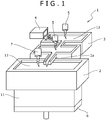
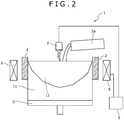
- This continuous casting device 1 comprises, as shown in Fig. 1 as a perspective view and Fig. 2 as a cross-section view, a mold 2, a cold hearth 3, a source charging device 4, a plasma torch 5, a starting block 6, and a plasma torch 7, an electromagnetic stirring device 8, and a controller (controlling device) 9. It is noted that the electromagnetic stirring device 8 and the controller 9 are not shown in Fig. 1 .
- the continuous casting device 1 is surrounded by an inert gas atmosphere containing argon gas, helium gas, and the like.
- the source charging device 4 supplies a source of titanium or a titanium alloy, such as sponge titanium and scrap, into the cold hearth 3.
- the plasma torch 5 is disposed above the cold hearth 3 and melts the source inside the cold hearth 3 by generating plasma arcs.
- the cold hearth 3 injects molten metal 12 having the source melted into the mold 2 from an injecting portion 3a at a predetermined flow rate.
- the mold 2 is made of copper and formed in a bottomless shape having a rectangular cross section. At least a part of a wall portion of the mold 2 formed in a rectangular cylindrical shape is configured to circulate water inside the wall portion for cooling.
- the starting block 6 is movable in an up and down direction by a drive portion not shown, and able to block a lower side opening of the mold 2.
- the plasma torch 7 is disposed above the mold 2 and configured to move above a melt surface of molten metal 12 in a predetermined moving pattern by a moving means not shown, thereby heating the melt surface of the molten metal 12 injected into the mold 2 by plasma arcs.
- the controller 9 controls the movement of the plasma torch 7.
- the electromagnetic stirring device 8 is a device having a coil iron core wound by an EMS coil and disposed on a side of the mold 2. It stirs at least the melt surface of the molten metal 12 inside the mold 2 by electromagnetic stirring driven by alternating current.
- the controller 9 controls the electromagnetic stirring of the electromagnetic stirring device 8.
- solidification of the molten metal 12 injected into the mold 2 begins from a contact surface between the molten metal 12 and the mold 2 having a water-cooling system. Then, as the starting block 6 blocking the lower side opening of the mold 2 is lowered at a predetermined speed, a slab 11 in a rectangular cylindrical shape formed by solidifying the molten metal 12 is continuously cast while being withdrawn downward from the mold 2.
- the continuous casting device 1 may comprise a flux supplying device for supplying flux in a solid phase or a liquid phase to the melt surface of the molten metal 12 inside the mold 2.
- a flux supplying device for supplying flux in a solid phase or a liquid phase to the melt surface of the molten metal 12 inside the mold 2.
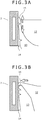
- Fig. 3A and Fig. 3B are explanatory diagrams each illustrating a causing mechanism of a surface defect.
- the mold 2 contacts with a surface of a solidified shell 13 only near the melt surface of the molten metal 12 (a region extending from the melt surface to an about 10mm depth) that is heated by the plasma arcs or the electron beam.
- the slab 11 undergoes thermal shrinkage, thus an air gap 14 is generated between the slab 11 and the mold 2. Then, as shown in Fig.
- each depicting a model diagram of the mold 2 seen from above when the slab 11 having a large size of, for example, 250 ⁇ 1500mm is continuously cast by the plasma arc melting, there is a limitation to a heating range of the plasma torch 7.
- heating the entire melt surface requires a plurality of the plasma torches 7 having a large output.
- two plasma torches 7 having a large output are used.
- the plasma torch 7 since the slab 11 is thick, the plasma torch 7 needs to be rotationally moved along the mold 2 in order to suppress the growth of the solidified shell 13 at short side and corner parts of the mold 2.
- Arrows in Fig. 5A and Fig. 5B indicate a moving route of the plasma torch 7.
- Each of the plasma torches 7 turns clockwise about 62.5mm inside from a mold wall of the mold 2.
- the output of each plasma torch 7 is, for example, 750kW.
- an electromagnetic stirring device 8 is disposed on a side of the mold 2 and used to stir at least the melt surface of the molten metal 12 inside the mold 2 by electromagnetic induction.
- electromagnetic stirring caused by the electromagnetic stirring device 8, a horizontally rotating flow (turning flow) is generated on or near the melt surface of the molten metal 12.
- the molten metal 12 having a higher temperature, residing at the long side parts of the mold 2 is transferred to the short side and the corner parts of the mold 2, where the solidified shell 13 tends to grow. This mitigates temperature rise of the molten metal 12 at the long side parts of the mold 2, where the plasma torch 7 stays longer, and temperature drop of the molten metal 12 at the short side and the corner parts of the mold 2, where the plasma torch 7 stays shorter.
- a direction of the turning flow at least on the melt surface of the molten metal 12 may be the same as the turning direction of the plasma torch 7 or a direction opposite thereto. However, turning at least the melt surface of the molten metal 12 in a direction opposite to the turning direction of the plasma torch 7 can reduce a fluctuation range in a surface temperature of the slab 11.
- the slab 11 having a large size When the slab 11 having a large size is continuously cast, it is required to accelerate a flow rate of the molten metal 12 by a strong stirring force in order to transfer heat to the entire melt surface by the electromagnetic stirring.
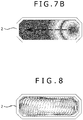
- Fig. 7A and Fig. 7B each depicting a model diagram of the mold 2 seen from above, when the slab 11 having a small size of, for example, 125 ⁇ 375mm is continuously cast by the plasma arc melting, the entire melt surface can be heated by a single plasma torch 7 small in output owing to a small area of the melt surface. Further, since the slab 11 is thin, the growth of the solidified shell 13 can be suppressed at the short side and the corner parts of the mold 2 by reciprocating the plasma torch 7 on the same line. It is noted that arrows in Fig. 7A and Fig. 7B indicate a moving route of the plasma torch 7. The output of the plasma torch 7 is, for example, 200 to 250kW.
- Fig. 8 depicting a model diagram of the mold 2 seen from above, when the slab 11 having a small size is continuously cast, the heat can be still transferred to the entire melt surface by the turning flow of the molten metal 12 having a slow flow rate due to a weak stirring force of the electromagnetic stirring.
- the number, an output, and a moving pattern of the plasma torch 7 required for smoothing a casting surface depend on the size of the slab 11 to be cast. Further, the stirring force of the electromagnetic stirring required for smoothing a casting surface depends on the size of the slab 11 to be cast.
- the present inventors as a result of trial-and-error attempts to cast the slab 11 having an excellent casting surface condition, have found that it is possible to cast the slab 11 having an excellent casting surface condition by adjusting a torch moving cycle, an average heat input quantity, and a molten metal advection time within a predetermined numerical value range.
- the slab 11 having an excellent casting surface condition can be cast by adjusting the torch moving cycle to 20 sec or more and 40 sec or less, the average heat input quantity to 1.0MW/m 2 or more and 2.0MW/m 2 or less, and the molten metal advection time to 3.5 sec or less.
- the torch moving cycle is a time required for the plasma torch 7 to complete a single round of movement in a predetermined moving pattern over the melt surface. Specifically, the torch moving cycle is obtained by dividing a moving distance of the plasma torch 7 per round by an average moving speed of the plasma torch 7.
- Fig. 5A and Fig. 5B when the slab 11 having a large size is cast, two plasma torches 7 are each rotationally moved at a predetermined speed over the melt surface.
- the torch moving cycle is a time required for the plasma torch 7 to complete one rotation.
- Fig. 7A and Fig. 7B when the slab 11 having a small size is cast, the plasma torch 7 is reciprocally moved at a predetermined speed over the melt surface.
- the torch moving cycle is a time required for the plasma torch 7 to complete one reciprocating motion.
- a length of the long side of the slab 11 in a horizontal cross section is denoted as 2W.
- the mold 2 shown in Fig. 9 is for casting the slab 11 having a large size, and corresponds to the mold 2 shown in Fig. 5A and Fig. 5B .
- the mold 2 shown in Fig. 10 is for casting the slab 11 having a small size, and corresponds to the mold 2 shown in Fig. 7A and Fig. 7B .
- the nonuniformity caused by the temporal change and the spatial variation in the heat input quantity to the melt surface of the molten metal 12 can be reduced by setting the torch moving cycle T to 20 sec or more and 40 sec or less.
- the torch moving cycle T was calculated by flow and solidification calculation in order to obtain the slab 11 having an excellent casting surface over the entire periphery. The result is shown in Table 1.
- Table 1 Slab width 2W[mm] Number of plasma torch A[-] Average moving speed Vt[mm/sec] Torch moving cycle T[sec] 750 1 50 30 1000 1 50 40 1000 2 50 20 1250 2 50 25 1500 2 50 30
- a maximum value of the average moving speed Vt is about 50mm/sec. Further, it is estimated that a limit value of the slab width up to which the single plasma torch 7 can be used for casting is about 1000mm. Based on these, it was found that the slab 11 having an excellent casting surface over the entire periphery could be obtained by setting the torch moving cycle T to 20 sec or more and 40 sec or less.
- the average heat input quantity is obtained by dividing the initial solidification portion 15 (a portion where the molten metal 12 is initially solidified upon contacting with the mold 2) (see Fig. 3A and Fig. 3B ) into a plurality of portions in a peripheral direction of the mold 2, and calculating an average of heat input quantities to each of the portions in a length direction of the corresponding portion along the mold 2.
- the initial solidification portion 15 is divided into a total of twelve portions 15a along the inner periphery of the mold 2, consisting of corners (1) to (4), long sides 1/4 (1) and (2), long sides 1/2 (1) and (2), long sides 3/4 (1) and (2), and short sides (1) and (2). Then the average heat input quantity is obtained in each of the portions 15a.
- the growth of the solidified shell 13 near the melt surface of the molten metal 12 is significantly influenced by the heat input condition to the initial solidification portion 15. As shown in Fig. 3A , if the heat input to the initial solidification portion 15 is excessive, the "tearing-off defect" occurs. On the other hand, as shown in Fig. 3B , if the heat input to the initial solidification portion 15 is not sufficient, the "molten metal-covering defect" occurs.
- the nonuniformity in the heat input quantity over the entire periphery of peripheral parts of the melt surface of the molten metal 12 can be reduced by setting the average heat input quantity to 1.0MW/m 2 or more and 2.0MW 1m 2 or less.
- Case (1) shows the average heat input quantities in a case where the slab 11 having a large size of 250mm x 1500mm is cast using two plasma torches 7 each having an output of 750kW, as shown in Fig. 5A .
- Case (2) shows the average heat input quantities in a case where the slab 11 having a small size of 125mm x 375mm is cast using the single plasma torch 7 having an output of 200kW, as shown in Fig. 7A .
- a slab average heat input quantity obtained by multiplying the average heat input quantity by a correction value may be used instead of the average heat input quantity.
- the correction value herein is a value based on a length of the mold 2 surrounding a torch heating region.
- the torch heating region is a region of the melt surface of the molten metal 12, which is heated by the individual plasma torch 7.
- the torch heating region 17 is surrounded on its three sides with the mold 2.
- the torch heating region 17 is surrounded on its four sides with the mold 2. Consequently, a cooling capacity of the mold 2 is larger in the torch heating region 17 surrounded on its four sides with the mold 2 than the one surrounded on its three sides with the mold 2.
- the slab average heat input quantity obtained by correcting the average heat input quantity with a correction value ⁇ is used.
- the correction value ⁇ is calculated from the following formula (1) using lengths of the long side 2W (mm) and the short side t (mm) of the mold 2 shown in Fig. 7A .
- Case (2) when the output value of the plasma torch 7 is multiplied by the correction value ⁇ , the output becomes 250kW.
- the slab average heat input quantities obtained by correcting the average heat input quantities in Case (2) with the correction value ⁇ are shown as Case (3) in Fig. 12 .
- the growth of the solidified shell 13 near the melt surface of the molten metal 12 can be suitably suppressed by setting the slab average heat input quantity in each portion 15a to 1.0MW/m 2 or more and 2.0MW/m 2 or less. By this, the slab 11 having an excellent casting surface can be obtained.
- the molten metal advection time is a time required for the molten metal 12 stirred electromagnetically to travel a length of the torch heating region 17 (torch effective heating width) along the long side direction of the mold 2.
- the molten metal advection time is a value obtained by dividing the torch effective heating width by an average flow rate of the molten metal 12 while being transferred by electromagnetic stirring.
- the torch heating region 17 of each plasma torch 7 is half of the melt surface of the molten metal 12.
- the torch effective heating width in this case is one half of the length of the long side of the mold 2.
- the torch heating region 17 of the plasma torch 7 is all the melt surface of the molten metal 12.
- the torch effective heating width in this case is the entire length of the long side of the mold 2.
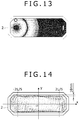
- Fig. 13 depicting a model diagram of the mold 2 seen from above
- the melt surface of the molten metal 12 on the right side of the figure becomes apart from the plasma torch 7, thereby having a lower temperature.
- the melt surface of the molten metal 12 on the left side having a higher temperature, is transferred to the melt surface on the right side by electromagnetic stirring. This mitigates the temperature drop of the molten metal 12 as compared to a case where the electromagnetic stirring is not performed and can thus uniformize the surface temperature of the slab.
- a degree of change in the surface temperature of the slab 11 over time also varies. Specifically, as the molten metal advection time becomes shorter, a temporal change of the surface temperature of the slab 11 becomes smaller, and eventually, the surface temperature of the slab 11 can be uniformized.
- the surface temperature of the slab 11 can be uniformized by setting the molten metal advection time Tm to 3.5 sec or less.
- the molten metal advection time required for obtaining the slab 11 having an excellent casting surface over the entire periphery was calculated by flow and solidification calculation.
- the molten metal advection time was obtained by using an average value of the flow rates (absolute values) in the x-axis direction in a range of-2L / 5 ⁇ x ⁇ 2L / 5 at positions 10mm away from the inner surface of the mold 2.
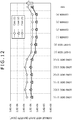
- Fig. 15 shows a relation between the molten metal advection time and an index of occurrence frequency of irregularities.
- Case (1) represents calculation results in the case where the slab 11 having a large size of 250mm x 1500mm was cast using two plasma torches 7 each having an output of 750kW, as shown in Fig. 5A .
- Case (2) represents calculation results in the case where the slab 11 having a small size of 125mm x 375mm was cast using the single plasma torch 7 having an output of 200kW, as shown in Fig. 7A .
- Case (3) represents calculation results of Case (2) after correcting the output value of the plasma torch 7 in Case (2) by the correction value to 250kW.
- the torch moving cycle representing a time required for the plasma torch 7 to complete a single round of movement in the predetermined moving pattern is set to 20 sec or more and 40 sec or less. This can reduce the nonuniformity caused by the temporal change and the spatial variation in the heat input quantity to the melt surface of the molten metal 12 due to a movement of the plasma torch 7. Further, the average heat input quantity to the individual portion 15a resulting from dividing the initial solidification portion 15 into the plurality of the portions 15a in the peripheral direction of the mold 2 is set to 1.0MW/m 2 or more and 2.0MW/m 2 or less.
- the molten metal advection time representing a time required for the molten metal 12 to travel the length of the torch heating region 17 along the long side direction of the mold 2 is set to 3.5 sec or less. This can uniformize the surface temperature of the slab 11. By uniformizing the heat input quantity over the entire periphery of the peripheral parts of the melt surface of the molten metal 12 in this manner, it becomes possible to cast the slab 11 having an excellent casting surface condition.
Landscapes
- Engineering & Computer Science (AREA)
- Mechanical Engineering (AREA)
- Physics & Mathematics (AREA)
- Plasma & Fusion (AREA)
- General Engineering & Computer Science (AREA)
- Spectroscopy & Molecular Physics (AREA)
- Continuous Casting (AREA)
Claims (1)
- Stranggießvorrichtung (1) zum Stranggießen einer Bramme (11), die aus Titan oder einer Titanlegierung besteht, indem eine durch Schmelzen von Titan oder einer Titanlegierung angefertigte Metallschmelze (12) in eine bodenlose Form (2) injiziert wird und die Metallschmelze (12) nach unten herausgezogen wird, während sie erstarren gelassen wird, wobei die Vorrichtung (1) Folgendes umfasst:einen Plasmabrenner (5) zum Erhitzen einer Schmelzoberfläche der Metallschmelze (12) in der Form (2), während er sich in einem vorbestimmten Bewegungsmuster über die Schmelzoberfläche der Metallschmelze (12) bewegt, wobei der Plasmabrenner (5) oberhalb der Form (2) angeordnet ist; undeine elektromagnetische Rührvorrichtung (8) zum Rühren zumindest der Schmelzoberfläche der Metallschmelze (12) durch elektromagnetisches Rühren, wobei die elektromagnetische Rührvorrichtung (8) an einer Seite der Form (2) angeordnet ist,dadurch gekennzeichnet, dassdie Form (2) einen rechteckigen Querschnitt hat unddie Vorrichtung (1) Folgendes hat:einen Brennerbewegungszyklus T von 20 s oder mehr und 40 s oder weniger, wobei der Brennerbewegungszyklus T eine Zeit ist, die der Plasmabrenner (5) benötigt, um im vorbestimmten Bewegungsmuster eine einzelne Bewegungsrunde zu absolvieren, und die durch T = 4W / (A · Vt) berechnet wird, wobei 2W eine Länge einer langen Seite der Bramme (11) in einem horizontalen Querschnitt darstellt, A die Anzahl des Plasmabrenners (5) darstellt und Vt eine durchschnittliche Bewegungsgeschwindigkeit des Plasmabrenners (5) darstellt, während er sich im vorbestimmten Bewegungsmuster bewegt;eine durchschnittliche Wärmeeintragsmenge von 1,0 MW/m2 oder mehr und 2,0 MW/m2 oder weniger, wobei die durchschnittliche Wärmeeintragsmenge ermittelt wird, indem ein Ersterstarrungsabschnitt (15), wo die Metallschmelze (12) bei Kontakt mit der Form (2) zuerst erstarrt, in einer Umfangsrichtung der Form (2) in eine Vielzahl von Abschnitte (15a) unterteilt wird und ein Durchschnitt von Wärmeeintragsmengen in jeden der Abschnitte (15a) in einer Längenrichtung des entsprechenden Abschnitts (15a) entlang der Form (2) berechnet wird; undeine Metallschmelze-Advektionszeit Tm von 3,5 s oder weniger, wobei die Metallschmelze-Advektionszeit durch Tm = L / Vm berechnet wird, wobei L eine Länge eines Brennerheizbereichs (17) entlang einer langen Seitenrichtung der Form (2) darstellt, der Brennerheizbereich (17) ein Bereich der Schmelzoberfläche der Metallschmelze (12) ist, der durch den einzelnen Plasmabrenner (5) erhitzt wird, und Vm eine durchschnittliche Fließgeschwindigkeit der Metallschmelze (12) darstellt, während sie durch elektromagnetisches Rühren die Länge L durchwandert, und eine Zeit darstellt, die die Metallschmelze (12) benötigt, um die Länge (L) des Brennerheizbereichs (17) entlang der langen Seitenrichtung der Form (2) zu durchwandern.
Applications Claiming Priority (2)
| Application Number | Priority Date | Filing Date | Title |
|---|---|---|---|
| JP2014083532A JP6279963B2 (ja) | 2014-04-15 | 2014-04-15 | チタンまたはチタン合金からなるスラブの連続鋳造装置 |
| PCT/JP2015/058628 WO2015159648A1 (ja) | 2014-04-15 | 2015-03-20 | チタンまたはチタン合金からなるスラブの連続鋳造装置 |
Publications (3)
| Publication Number | Publication Date |
|---|---|
| EP3132871A1 EP3132871A1 (de) | 2017-02-22 |
| EP3132871A4 EP3132871A4 (de) | 2017-11-15 |
| EP3132871B1 true EP3132871B1 (de) | 2020-04-29 |
Family
ID=54323862
Family Applications (1)
| Application Number | Title | Priority Date | Filing Date |
|---|---|---|---|
| EP15779618.6A Not-in-force EP3132871B1 (de) | 2014-04-15 | 2015-03-20 | Stranggiessvorrichtung für platte mit titan oder titanlegierung |
Country Status (4)
| Country | Link |
|---|---|
| US (2) | US20170087625A1 (de) |
| EP (1) | EP3132871B1 (de) |
| JP (1) | JP6279963B2 (de) |
| WO (1) | WO2015159648A1 (de) |
Families Citing this family (3)
| Publication number | Priority date | Publication date | Assignee | Title |
|---|---|---|---|---|
| KR102442579B1 (ko) * | 2015-12-01 | 2022-09-08 | 재단법인 포항산업과학연구원 | 티타늄 주조 부품의 제조 방법 |
| JP6611331B2 (ja) * | 2016-01-07 | 2019-11-27 | 株式会社神戸製鋼所 | チタンまたはチタン合金からなるスラブの連続鋳造方法 |
| JP7039489B2 (ja) | 2016-05-18 | 2022-03-22 | ミラティ セラピューティクス, インコーポレイテッド | Kras g12c阻害剤 |
Family Cites Families (13)
| Publication number | Priority date | Publication date | Assignee | Title |
|---|---|---|---|---|
| GB2013542B (en) * | 1978-02-01 | 1982-01-20 | Concast Ag | Continuous casting mould |
| AU5940490A (en) * | 1989-06-26 | 1991-01-17 | Nrc, Inc. | Production of ingots for microcomposite manufacture by plasma melting |
| US5273101A (en) * | 1991-06-05 | 1993-12-28 | General Electric Company | Method and apparatus for casting an arc melted metallic material in ingot form |
| JP3077387B2 (ja) | 1992-06-15 | 2000-08-14 | 大同特殊鋼株式会社 | 自動制御プラズマ溶解鋳造方法および自動制御プラズマ溶解鋳造装置 |
| DE60037944T2 (de) * | 2000-12-28 | 2009-01-22 | Sumco Corp. | Kontinuierliches giessverfahren für silizium |
| US6868896B2 (en) * | 2002-09-20 | 2005-03-22 | Edward Scott Jackson | Method and apparatus for melting titanium using a combination of plasma torches and direct arc electrodes |
| WO2009077661A1 (fr) * | 2007-12-17 | 2009-06-25 | Rotelec | Procédé et équipement électromagnétique associé pour la mise en rotation d'un métal en fusion au sein d'une lingotière de coulée continue de brames. |
| JP5774419B2 (ja) * | 2011-09-02 | 2015-09-09 | 株式会社神戸製鋼所 | チタンまたはチタン合金からなるスラブの連続鋳造装置 |
| JP5730738B2 (ja) * | 2011-10-07 | 2015-06-10 | 株式会社神戸製鋼所 | チタンまたはチタン合金からなるスラブの連続鋳造方法および連続鋳造装置 |
| JP5878398B2 (ja) * | 2012-03-06 | 2016-03-08 | 株式会社神戸製鋼所 | チタン溶解装置 |
| JP5918572B2 (ja) * | 2012-03-06 | 2016-05-18 | 株式会社神戸製鋼所 | チタン鋳塊およびチタン合金鋳塊の連続鋳造装置および連続鋳造方法 |
| JP5896811B2 (ja) * | 2012-04-02 | 2016-03-30 | 株式会社神戸製鋼所 | チタンまたはチタン合金からなる鋳塊の連続鋳造用の鋳型およびこれを備えた連続鋳造装置 |
| JP6087155B2 (ja) * | 2013-01-23 | 2017-03-01 | 株式会社神戸製鋼所 | チタンまたはチタン合金からなるスラブの連続鋳造方法 |
-
2014
- 2014-04-15 JP JP2014083532A patent/JP6279963B2/ja not_active Expired - Fee Related
-
2015
- 2015-03-20 US US15/127,834 patent/US20170087625A1/en not_active Abandoned
- 2015-03-20 EP EP15779618.6A patent/EP3132871B1/de not_active Not-in-force
- 2015-03-20 WO PCT/JP2015/058628 patent/WO2015159648A1/ja not_active Ceased
-
2017
- 2017-09-28 US US15/718,005 patent/US9908174B2/en not_active Expired - Fee Related
Non-Patent Citations (1)
| Title |
|---|
| None * |
Also Published As
| Publication number | Publication date |
|---|---|
| US9908174B2 (en) | 2018-03-06 |
| WO2015159648A1 (ja) | 2015-10-22 |
| EP3132871A4 (de) | 2017-11-15 |
| US20180015534A1 (en) | 2018-01-18 |
| US20170087625A1 (en) | 2017-03-30 |
| JP6279963B2 (ja) | 2018-02-14 |
| EP3132871A1 (de) | 2017-02-22 |
| JP2015202512A (ja) | 2015-11-16 |
Similar Documents
| Publication | Publication Date | Title |
|---|---|---|
| US9908174B2 (en) | Continuous casting device for slab comprising titanium or titanium alloy | |
| JP6611331B2 (ja) | チタンまたはチタン合金からなるスラブの連続鋳造方法 | |
| RU2623526C2 (ru) | Способ непрерывного литья слитка из титана или титанового сплава | |
| RU2623524C2 (ru) | Способ непрерывного литья сляба из титана или титанового сплава | |
| EP2944397B1 (de) | Stranggussverfahren für gussblock aus titan oder titanlegierung | |
| JP5730738B2 (ja) | チタンまたはチタン合金からなるスラブの連続鋳造方法および連続鋳造装置 | |
| JP5896811B2 (ja) | チタンまたはチタン合金からなる鋳塊の連続鋳造用の鋳型およびこれを備えた連続鋳造装置 | |
| JP5774438B2 (ja) | チタンまたはチタン合金からなるスラブの連続鋳造方法および連続鋳造装置 | |
| JP5627015B2 (ja) | チタンまたはチタン合金からなるスラブの連続鋳造方法および連続鋳造装置 | |
| JP6234841B2 (ja) | チタンまたはチタン合金からなる鋳塊の連続鋳造装置 | |
| JP2015160213A (ja) | チタンまたはチタン合金からなるスラブの連続鋳造方法 | |
| RU2633145C2 (ru) | Установка непрерывного литья слитков, полученных из титана или титанового сплава | |
| CN112210673A (zh) | 一种电子束表面热解去除高温合金中夹杂物的方法 | |
| US20140202654A1 (en) | Continuous casting equipment for titanium or titanium alloy slab | |
| JP2017185504A (ja) | チタンまたはチタン合金からなるスラブの連続鋳造方法 |
Legal Events
| Date | Code | Title | Description |
|---|---|---|---|
| STAA | Information on the status of an ep patent application or granted ep patent |
Free format text: STATUS: THE INTERNATIONAL PUBLICATION HAS BEEN MADE |
|
| PUAI | Public reference made under article 153(3) epc to a published international application that has entered the european phase |
Free format text: ORIGINAL CODE: 0009012 |
|
| STAA | Information on the status of an ep patent application or granted ep patent |
Free format text: STATUS: REQUEST FOR EXAMINATION WAS MADE |
|
| 17P | Request for examination filed |
Effective date: 20160920 |
|
| AK | Designated contracting states |
Kind code of ref document: A1 Designated state(s): AL AT BE BG CH CY CZ DE DK EE ES FI FR GB GR HR HU IE IS IT LI LT LU LV MC MK MT NL NO PL PT RO RS SE SI SK SM TR |
|
| AX | Request for extension of the european patent |
Extension state: BA ME |
|
| DAV | Request for validation of the european patent (deleted) | ||
| DAX | Request for extension of the european patent (deleted) | ||
| A4 | Supplementary search report drawn up and despatched |
Effective date: 20171013 |
|
| RIC1 | Information provided on ipc code assigned before grant |
Ipc: B22D 11/115 20060101ALI20171009BHEP Ipc: B22D 11/00 20060101AFI20171009BHEP Ipc: B22D 11/041 20060101ALI20171009BHEP Ipc: B22D 11/04 20060101ALI20171009BHEP |
|
| RIC1 | Information provided on ipc code assigned before grant |
Ipc: B22D 11/041 20060101ALI20190808BHEP Ipc: B22D 11/115 20060101ALI20190808BHEP Ipc: B22D 11/00 20060101AFI20190808BHEP Ipc: B22D 11/04 20060101ALI20190808BHEP |
|
| GRAP | Despatch of communication of intention to grant a patent |
Free format text: ORIGINAL CODE: EPIDOSNIGR1 |
|
| STAA | Information on the status of an ep patent application or granted ep patent |
Free format text: STATUS: GRANT OF PATENT IS INTENDED |
|
| GRAJ | Information related to disapproval of communication of intention to grant by the applicant or resumption of examination proceedings by the epo deleted |
Free format text: ORIGINAL CODE: EPIDOSDIGR1 |
|
| STAA | Information on the status of an ep patent application or granted ep patent |
Free format text: STATUS: REQUEST FOR EXAMINATION WAS MADE |
|
| INTG | Intention to grant announced |
Effective date: 20190930 |
|
| INTC | Intention to grant announced (deleted) | ||
| GRAP | Despatch of communication of intention to grant a patent |
Free format text: ORIGINAL CODE: EPIDOSNIGR1 |
|
| STAA | Information on the status of an ep patent application or granted ep patent |
Free format text: STATUS: GRANT OF PATENT IS INTENDED |
|
| INTG | Intention to grant announced |
Effective date: 20191206 |
|
| GRAS | Grant fee paid |
Free format text: ORIGINAL CODE: EPIDOSNIGR3 |
|
| GRAA | (expected) grant |
Free format text: ORIGINAL CODE: 0009210 |
|
| STAA | Information on the status of an ep patent application or granted ep patent |
Free format text: STATUS: THE PATENT HAS BEEN GRANTED |
|
| AK | Designated contracting states |
Kind code of ref document: B1 Designated state(s): AL AT BE BG CH CY CZ DE DK EE ES FI FR GB GR HR HU IE IS IT LI LT LU LV MC MK MT NL NO PL PT RO RS SE SI SK SM TR |
|
| REG | Reference to a national code |
Ref country code: GB Ref legal event code: FG4D |
|
| REG | Reference to a national code |
Ref country code: CH Ref legal event code: EP |
|
| REG | Reference to a national code |
Ref country code: DE Ref legal event code: R096 Ref document number: 602015051716 Country of ref document: DE |
|
| REG | Reference to a national code |
Ref country code: AT Ref legal event code: REF Ref document number: 1262543 Country of ref document: AT Kind code of ref document: T Effective date: 20200515 |
|
| REG | Reference to a national code |
Ref country code: IE Ref legal event code: FG4D |
|
| REG | Reference to a national code |
Ref country code: NL Ref legal event code: MP Effective date: 20200429 |
|
| REG | Reference to a national code |
Ref country code: LT Ref legal event code: MG4D |
|
| PG25 | Lapsed in a contracting state [announced via postgrant information from national office to epo] |
Ref country code: SE Free format text: LAPSE BECAUSE OF FAILURE TO SUBMIT A TRANSLATION OF THE DESCRIPTION OR TO PAY THE FEE WITHIN THE PRESCRIBED TIME-LIMIT Effective date: 20200429 Ref country code: PT Free format text: LAPSE BECAUSE OF FAILURE TO SUBMIT A TRANSLATION OF THE DESCRIPTION OR TO PAY THE FEE WITHIN THE PRESCRIBED TIME-LIMIT Effective date: 20200831 Ref country code: NO Free format text: LAPSE BECAUSE OF FAILURE TO SUBMIT A TRANSLATION OF THE DESCRIPTION OR TO PAY THE FEE WITHIN THE PRESCRIBED TIME-LIMIT Effective date: 20200729 Ref country code: FI Free format text: LAPSE BECAUSE OF FAILURE TO SUBMIT A TRANSLATION OF THE DESCRIPTION OR TO PAY THE FEE WITHIN THE PRESCRIBED TIME-LIMIT Effective date: 20200429 Ref country code: IS Free format text: LAPSE BECAUSE OF FAILURE TO SUBMIT A TRANSLATION OF THE DESCRIPTION OR TO PAY THE FEE WITHIN THE PRESCRIBED TIME-LIMIT Effective date: 20200829 Ref country code: GR Free format text: LAPSE BECAUSE OF FAILURE TO SUBMIT A TRANSLATION OF THE DESCRIPTION OR TO PAY THE FEE WITHIN THE PRESCRIBED TIME-LIMIT Effective date: 20200730 Ref country code: LT Free format text: LAPSE BECAUSE OF FAILURE TO SUBMIT A TRANSLATION OF THE DESCRIPTION OR TO PAY THE FEE WITHIN THE PRESCRIBED TIME-LIMIT Effective date: 20200429 |
|
| REG | Reference to a national code |
Ref country code: AT Ref legal event code: MK05 Ref document number: 1262543 Country of ref document: AT Kind code of ref document: T Effective date: 20200429 |
|
| PG25 | Lapsed in a contracting state [announced via postgrant information from national office to epo] |
Ref country code: HR Free format text: LAPSE BECAUSE OF FAILURE TO SUBMIT A TRANSLATION OF THE DESCRIPTION OR TO PAY THE FEE WITHIN THE PRESCRIBED TIME-LIMIT Effective date: 20200429 Ref country code: RS Free format text: LAPSE BECAUSE OF FAILURE TO SUBMIT A TRANSLATION OF THE DESCRIPTION OR TO PAY THE FEE WITHIN THE PRESCRIBED TIME-LIMIT Effective date: 20200429 Ref country code: LV Free format text: LAPSE BECAUSE OF FAILURE TO SUBMIT A TRANSLATION OF THE DESCRIPTION OR TO PAY THE FEE WITHIN THE PRESCRIBED TIME-LIMIT Effective date: 20200429 Ref country code: BG Free format text: LAPSE BECAUSE OF FAILURE TO SUBMIT A TRANSLATION OF THE DESCRIPTION OR TO PAY THE FEE WITHIN THE PRESCRIBED TIME-LIMIT Effective date: 20200729 |
|
| PG25 | Lapsed in a contracting state [announced via postgrant information from national office to epo] |
Ref country code: NL Free format text: LAPSE BECAUSE OF FAILURE TO SUBMIT A TRANSLATION OF THE DESCRIPTION OR TO PAY THE FEE WITHIN THE PRESCRIBED TIME-LIMIT Effective date: 20200429 Ref country code: AL Free format text: LAPSE BECAUSE OF FAILURE TO SUBMIT A TRANSLATION OF THE DESCRIPTION OR TO PAY THE FEE WITHIN THE PRESCRIBED TIME-LIMIT Effective date: 20200429 |
|
| PG25 | Lapsed in a contracting state [announced via postgrant information from national office to epo] |
Ref country code: RO Free format text: LAPSE BECAUSE OF FAILURE TO SUBMIT A TRANSLATION OF THE DESCRIPTION OR TO PAY THE FEE WITHIN THE PRESCRIBED TIME-LIMIT Effective date: 20200429 Ref country code: IT Free format text: LAPSE BECAUSE OF FAILURE TO SUBMIT A TRANSLATION OF THE DESCRIPTION OR TO PAY THE FEE WITHIN THE PRESCRIBED TIME-LIMIT Effective date: 20200429 Ref country code: SM Free format text: LAPSE BECAUSE OF FAILURE TO SUBMIT A TRANSLATION OF THE DESCRIPTION OR TO PAY THE FEE WITHIN THE PRESCRIBED TIME-LIMIT Effective date: 20200429 Ref country code: DK Free format text: LAPSE BECAUSE OF FAILURE TO SUBMIT A TRANSLATION OF THE DESCRIPTION OR TO PAY THE FEE WITHIN THE PRESCRIBED TIME-LIMIT Effective date: 20200429 Ref country code: AT Free format text: LAPSE BECAUSE OF FAILURE TO SUBMIT A TRANSLATION OF THE DESCRIPTION OR TO PAY THE FEE WITHIN THE PRESCRIBED TIME-LIMIT Effective date: 20200429 Ref country code: EE Free format text: LAPSE BECAUSE OF FAILURE TO SUBMIT A TRANSLATION OF THE DESCRIPTION OR TO PAY THE FEE WITHIN THE PRESCRIBED TIME-LIMIT Effective date: 20200429 Ref country code: ES Free format text: LAPSE BECAUSE OF FAILURE TO SUBMIT A TRANSLATION OF THE DESCRIPTION OR TO PAY THE FEE WITHIN THE PRESCRIBED TIME-LIMIT Effective date: 20200429 Ref country code: CZ Free format text: LAPSE BECAUSE OF FAILURE TO SUBMIT A TRANSLATION OF THE DESCRIPTION OR TO PAY THE FEE WITHIN THE PRESCRIBED TIME-LIMIT Effective date: 20200429 |
|
| REG | Reference to a national code |
Ref country code: DE Ref legal event code: R097 Ref document number: 602015051716 Country of ref document: DE |
|
| PG25 | Lapsed in a contracting state [announced via postgrant information from national office to epo] |
Ref country code: SK Free format text: LAPSE BECAUSE OF FAILURE TO SUBMIT A TRANSLATION OF THE DESCRIPTION OR TO PAY THE FEE WITHIN THE PRESCRIBED TIME-LIMIT Effective date: 20200429 Ref country code: PL Free format text: LAPSE BECAUSE OF FAILURE TO SUBMIT A TRANSLATION OF THE DESCRIPTION OR TO PAY THE FEE WITHIN THE PRESCRIBED TIME-LIMIT Effective date: 20200429 |
|
| PLBE | No opposition filed within time limit |
Free format text: ORIGINAL CODE: 0009261 |
|
| STAA | Information on the status of an ep patent application or granted ep patent |
Free format text: STATUS: NO OPPOSITION FILED WITHIN TIME LIMIT |
|
| 26N | No opposition filed |
Effective date: 20210201 |
|
| PGFP | Annual fee paid to national office [announced via postgrant information from national office to epo] |
Ref country code: FR Payment date: 20210210 Year of fee payment: 7 |
|
| PG25 | Lapsed in a contracting state [announced via postgrant information from national office to epo] |
Ref country code: SI Free format text: LAPSE BECAUSE OF FAILURE TO SUBMIT A TRANSLATION OF THE DESCRIPTION OR TO PAY THE FEE WITHIN THE PRESCRIBED TIME-LIMIT Effective date: 20200429 |
|
| PGFP | Annual fee paid to national office [announced via postgrant information from national office to epo] |
Ref country code: DE Payment date: 20210310 Year of fee payment: 7 |
|
| PG25 | Lapsed in a contracting state [announced via postgrant information from national office to epo] |
Ref country code: MC Free format text: LAPSE BECAUSE OF FAILURE TO SUBMIT A TRANSLATION OF THE DESCRIPTION OR TO PAY THE FEE WITHIN THE PRESCRIBED TIME-LIMIT Effective date: 20200429 |
|
| REG | Reference to a national code |
Ref country code: CH Ref legal event code: PL |
|
| GBPC | Gb: european patent ceased through non-payment of renewal fee |
Effective date: 20210320 |
|
| REG | Reference to a national code |
Ref country code: BE Ref legal event code: MM Effective date: 20210331 |
|
| PG25 | Lapsed in a contracting state [announced via postgrant information from national office to epo] |
Ref country code: CH Free format text: LAPSE BECAUSE OF NON-PAYMENT OF DUE FEES Effective date: 20210331 Ref country code: LI Free format text: LAPSE BECAUSE OF NON-PAYMENT OF DUE FEES Effective date: 20210331 Ref country code: LU Free format text: LAPSE BECAUSE OF NON-PAYMENT OF DUE FEES Effective date: 20210320 Ref country code: IE Free format text: LAPSE BECAUSE OF NON-PAYMENT OF DUE FEES Effective date: 20210320 Ref country code: GB Free format text: LAPSE BECAUSE OF NON-PAYMENT OF DUE FEES Effective date: 20210320 |
|
| PG25 | Lapsed in a contracting state [announced via postgrant information from national office to epo] |
Ref country code: BE Free format text: LAPSE BECAUSE OF NON-PAYMENT OF DUE FEES Effective date: 20210331 |
|
| REG | Reference to a national code |
Ref country code: DE Ref legal event code: R119 Ref document number: 602015051716 Country of ref document: DE |
|
| PG25 | Lapsed in a contracting state [announced via postgrant information from national office to epo] |
Ref country code: FR Free format text: LAPSE BECAUSE OF NON-PAYMENT OF DUE FEES Effective date: 20220331 Ref country code: DE Free format text: LAPSE BECAUSE OF NON-PAYMENT OF DUE FEES Effective date: 20221001 |
|
| PG25 | Lapsed in a contracting state [announced via postgrant information from national office to epo] |
Ref country code: HU Free format text: LAPSE BECAUSE OF FAILURE TO SUBMIT A TRANSLATION OF THE DESCRIPTION OR TO PAY THE FEE WITHIN THE PRESCRIBED TIME-LIMIT; INVALID AB INITIO Effective date: 20150320 |
|
| PG25 | Lapsed in a contracting state [announced via postgrant information from national office to epo] |
Ref country code: CY Free format text: LAPSE BECAUSE OF FAILURE TO SUBMIT A TRANSLATION OF THE DESCRIPTION OR TO PAY THE FEE WITHIN THE PRESCRIBED TIME-LIMIT Effective date: 20200429 |
|
| PG25 | Lapsed in a contracting state [announced via postgrant information from national office to epo] |
Ref country code: MK Free format text: LAPSE BECAUSE OF FAILURE TO SUBMIT A TRANSLATION OF THE DESCRIPTION OR TO PAY THE FEE WITHIN THE PRESCRIBED TIME-LIMIT Effective date: 20200429 |
|
| PG25 | Lapsed in a contracting state [announced via postgrant information from national office to epo] |
Ref country code: MT Free format text: LAPSE BECAUSE OF FAILURE TO SUBMIT A TRANSLATION OF THE DESCRIPTION OR TO PAY THE FEE WITHIN THE PRESCRIBED TIME-LIMIT Effective date: 20200429 |
|
| PG25 | Lapsed in a contracting state [announced via postgrant information from national office to epo] |
Ref country code: TR Free format text: LAPSE BECAUSE OF FAILURE TO SUBMIT A TRANSLATION OF THE DESCRIPTION OR TO PAY THE FEE WITHIN THE PRESCRIBED TIME-LIMIT Effective date: 20200429 |