EP3129397B1 - Peptidic dual glp-1 / glucagon receptor agonists derived from exendin-4 - Google Patents
Peptidic dual glp-1 / glucagon receptor agonists derived from exendin-4 Download PDFInfo
- Publication number
- EP3129397B1 EP3129397B1 EP15713899.1A EP15713899A EP3129397B1 EP 3129397 B1 EP3129397 B1 EP 3129397B1 EP 15713899 A EP15713899 A EP 15713899A EP 3129397 B1 EP3129397 B1 EP 3129397B1
- Authority
- EP
- European Patent Office
- Prior art keywords
- ethoxy
- carboxy
- amino acid
- butyryl
- compound
- Prior art date
- Legal status (The legal status is an assumption and is not a legal conclusion. Google has not performed a legal analysis and makes no representation as to the accuracy of the status listed.)
- Active
Links
- 0 CCCCCCCCCCCCCCCC(N[C@@](CCC(N[C@@](CCC(*)=O)C(O)=O)=O)C(O)=O)=O Chemical compound CCCCCCCCCCCCCCCC(N[C@@](CCC(N[C@@](CCC(*)=O)C(O)=O)=O)C(O)=O)=O 0.000 description 2
Classifications
-
- C—CHEMISTRY; METALLURGY
- C07—ORGANIC CHEMISTRY
- C07K—PEPTIDES
- C07K14/00—Peptides having more than 20 amino acids; Gastrins; Somatostatins; Melanotropins; Derivatives thereof
- C07K14/435—Peptides having more than 20 amino acids; Gastrins; Somatostatins; Melanotropins; Derivatives thereof from animals; from humans
- C07K14/575—Hormones
- C07K14/57563—Vasoactive intestinal peptide [VIP]; Related peptides
-
- A—HUMAN NECESSITIES
- A61—MEDICAL OR VETERINARY SCIENCE; HYGIENE
- A61K—PREPARATIONS FOR MEDICAL, DENTAL OR TOILETRY PURPOSES
- A61K38/00—Medicinal preparations containing peptides
- A61K38/16—Peptides having more than 20 amino acids; Gastrins; Somatostatins; Melanotropins; Derivatives thereof
- A61K38/17—Peptides having more than 20 amino acids; Gastrins; Somatostatins; Melanotropins; Derivatives thereof from animals; from humans
- A61K38/22—Hormones
- A61K38/2271—Neuropeptide Y
-
- A—HUMAN NECESSITIES
- A61—MEDICAL OR VETERINARY SCIENCE; HYGIENE
- A61K—PREPARATIONS FOR MEDICAL, DENTAL OR TOILETRY PURPOSES
- A61K38/00—Medicinal preparations containing peptides
- A61K38/16—Peptides having more than 20 amino acids; Gastrins; Somatostatins; Melanotropins; Derivatives thereof
- A61K38/17—Peptides having more than 20 amino acids; Gastrins; Somatostatins; Melanotropins; Derivatives thereof from animals; from humans
- A61K38/22—Hormones
- A61K38/26—Glucagons
-
- A—HUMAN NECESSITIES
- A61—MEDICAL OR VETERINARY SCIENCE; HYGIENE
- A61K—PREPARATIONS FOR MEDICAL, DENTAL OR TOILETRY PURPOSES
- A61K38/00—Medicinal preparations containing peptides
- A61K38/16—Peptides having more than 20 amino acids; Gastrins; Somatostatins; Melanotropins; Derivatives thereof
- A61K38/17—Peptides having more than 20 amino acids; Gastrins; Somatostatins; Melanotropins; Derivatives thereof from animals; from humans
- A61K38/22—Hormones
- A61K38/28—Insulins
-
- A—HUMAN NECESSITIES
- A61—MEDICAL OR VETERINARY SCIENCE; HYGIENE
- A61K—PREPARATIONS FOR MEDICAL, DENTAL OR TOILETRY PURPOSES
- A61K45/00—Medicinal preparations containing active ingredients not provided for in groups A61K31/00 - A61K41/00
- A61K45/06—Mixtures of active ingredients without chemical characterisation, e.g. antiphlogistics and cardiaca
-
- A—HUMAN NECESSITIES
- A61—MEDICAL OR VETERINARY SCIENCE; HYGIENE
- A61P—SPECIFIC THERAPEUTIC ACTIVITY OF CHEMICAL COMPOUNDS OR MEDICINAL PREPARATIONS
- A61P3/00—Drugs for disorders of the metabolism
- A61P3/04—Anorexiants; Antiobesity agents
-
- A—HUMAN NECESSITIES
- A61—MEDICAL OR VETERINARY SCIENCE; HYGIENE
- A61P—SPECIFIC THERAPEUTIC ACTIVITY OF CHEMICAL COMPOUNDS OR MEDICINAL PREPARATIONS
- A61P3/00—Drugs for disorders of the metabolism
- A61P3/06—Antihyperlipidemics
-
- A—HUMAN NECESSITIES
- A61—MEDICAL OR VETERINARY SCIENCE; HYGIENE
- A61P—SPECIFIC THERAPEUTIC ACTIVITY OF CHEMICAL COMPOUNDS OR MEDICINAL PREPARATIONS
- A61P3/00—Drugs for disorders of the metabolism
- A61P3/08—Drugs for disorders of the metabolism for glucose homeostasis
- A61P3/10—Drugs for disorders of the metabolism for glucose homeostasis for hyperglycaemia, e.g. antidiabetics
-
- A—HUMAN NECESSITIES
- A61—MEDICAL OR VETERINARY SCIENCE; HYGIENE
- A61P—SPECIFIC THERAPEUTIC ACTIVITY OF CHEMICAL COMPOUNDS OR MEDICINAL PREPARATIONS
- A61P5/00—Drugs for disorders of the endocrine system
- A61P5/48—Drugs for disorders of the endocrine system of the pancreatic hormones
- A61P5/50—Drugs for disorders of the endocrine system of the pancreatic hormones for increasing or potentiating the activity of insulin
-
- A—HUMAN NECESSITIES
- A61—MEDICAL OR VETERINARY SCIENCE; HYGIENE
- A61P—SPECIFIC THERAPEUTIC ACTIVITY OF CHEMICAL COMPOUNDS OR MEDICINAL PREPARATIONS
- A61P9/00—Drugs for disorders of the cardiovascular system
-
- A—HUMAN NECESSITIES
- A61—MEDICAL OR VETERINARY SCIENCE; HYGIENE
- A61P—SPECIFIC THERAPEUTIC ACTIVITY OF CHEMICAL COMPOUNDS OR MEDICINAL PREPARATIONS
- A61P9/00—Drugs for disorders of the cardiovascular system
- A61P9/10—Drugs for disorders of the cardiovascular system for treating ischaemic or atherosclerotic diseases, e.g. antianginal drugs, coronary vasodilators, drugs for myocardial infarction, retinopathy, cerebrovascula insufficiency, renal arteriosclerosis
-
- A—HUMAN NECESSITIES
- A61—MEDICAL OR VETERINARY SCIENCE; HYGIENE
- A61P—SPECIFIC THERAPEUTIC ACTIVITY OF CHEMICAL COMPOUNDS OR MEDICINAL PREPARATIONS
- A61P9/00—Drugs for disorders of the cardiovascular system
- A61P9/12—Antihypertensives
-
- C—CHEMISTRY; METALLURGY
- C07—ORGANIC CHEMISTRY
- C07K—PEPTIDES
- C07K14/00—Peptides having more than 20 amino acids; Gastrins; Somatostatins; Melanotropins; Derivatives thereof
- C07K14/435—Peptides having more than 20 amino acids; Gastrins; Somatostatins; Melanotropins; Derivatives thereof from animals; from humans
- C07K14/575—Hormones
- C07K14/605—Glucagons
-
- A—HUMAN NECESSITIES
- A61—MEDICAL OR VETERINARY SCIENCE; HYGIENE
- A61K—PREPARATIONS FOR MEDICAL, DENTAL OR TOILETRY PURPOSES
- A61K2300/00—Mixtures or combinations of active ingredients, wherein at least one active ingredient is fully defined in groups A61K31/00 - A61K41/00
-
- A—HUMAN NECESSITIES
- A61—MEDICAL OR VETERINARY SCIENCE; HYGIENE
- A61K—PREPARATIONS FOR MEDICAL, DENTAL OR TOILETRY PURPOSES
- A61K38/00—Medicinal preparations containing peptides
Definitions
- the present invention relates to exendin-4 peptide analogues which activate the glucagon-like peptide 1 (GLP-1) and the glucagon (GCG) receptor and optionally the glucose-dependent insulinotropic polypeptide (GIP) receptor and their medical use, for example in the treatment of disorders of the metabolic syndrome, including diabetes and obesity, as well as reduction of excess food intake.
- GLP-1 glucagon-like peptide 1
- GCP glucose-dependent insulinotropic polypeptide
- Exendin-4 is a 39 amino acid peptide which is produced by the salivary glands of the Gila monster (Heloderma suspectum) ( Eng J. et al., J. Biol. Chem., 1992, 267, 7402-05 ). Exendin-4 is an activator of the glucagon-like peptide-1 (GLP-1) receptor, whereas it shows only very low activation of the GIP receptor and does not activate the glucagon receptor (see Table 1).
- Table 1 Potencies of exendin-4 at human GLP-1, GIP and Glucagon receptors (indicated in pM) at increasing concentrations and measuring the formed cAMP as described in Methods.
- Exendin-4 shares many of the glucoregulatory actions observed with GLP-1. Clinical and non-clinical studies have shown that exendin-4 has several beneficial antidiabetic properties including a glucose dependent enhancement in insulin synthesis and secretion, glucose dependent suppression of glucagon secretion, slowing down gastric emptying, reduction of food intake and body weight, and an increase in beta-cell mass and markers of beta cell function ( Gentilella R et al., Diabetes Obes Metab., 11:544-56, 2009 ; Norris SL et al., Diabet Med., 26:837-46, 2009 ; Bunck MC et al., Diabetes Care., 34:2041-7, 2011 ).
- exendin-4 is more resistant to cleavage by dipeptidyl peptidase-4 (DPP4) resulting in a longer half-life and duration of action in vivo ( Eng J., Diabetes, 45 (Suppl 2):152A (abstract 554), 1996 ; Deacon CF, Horm Metab Res, 36: 761-5, 2004 ).
- DPP4 dipeptidyl peptidase-4
- Exendin-4 was also shown to be much more stable towards degradation by neutral endopeptidase (NEP), when compared to GLP-1, glucagon or oxyntomodulin ( Druce MR et al., Endocrinology, 150(4), 1712-1721, 2009 ).
- NEP neutral endopeptidase
- exendin-4 is chemically labile due to methionine oxdiation in position 14 ( Hargrove DM et al., Regul. Pept., 141: 113-9, 2007 ) as well as deamidation and isomerization of asparagine in position 28 ( WO 2004/035623 ).
- exendin-4 is shown as SEQ ID NO: 1: HGEGTFTSDLSKQMEEEAVRLFIEWLKNGGPSSGAPPPS-NH 2
- GLP-1(7-36)-amide The amino acid sequence of GLP-1(7-36)-amide is shown as SEQ ID NO: 2: HAEGTFTSDVSSYLEGQAAKEFIAWLVKGR-NH 2
- Liraglutide is a marketed chemically modified GLP-1 analogue in which, among other modifications, a fatty acid is linked to a lysine in position 20 leading to a prolonged duration of action ( Drucker DJ et al, Nature Drug Disc. Rev. 9, 267-268, 2010 ; Buse, JB et al., Lancet, 374:39-47, 2009 ).
- Liraglutide is shown as SEQ ID NO: 3: HAEGTFTSDVSSYLEGQAAK((S)-4-Carboxy-4-hexadecanoylamino-butyryl-) EFIAWLVRGRG-OH
- Glucagon is a 29-amino acid peptide which is released into the bloodstream when circulating glucose is low.
- Glucagon's amino acid sequence is shown as SEQ ID NO: 5: HSQGTFTSDYSKYLDSRRAQDFVQWLMNT-OH
- GIP glucose-dependent insulinotropic polypeptide
- GIP and GLP-1 are the two gut enteroendocrine cell-derived hormones accounting for the incretin effect, which accounts for over 70% of the insulin response to an oral glucose challenge ( Baggio LL, Drucker DJ. Biology of incretins: GLP-1 and GIP. Gastroenterology 2007; 132: 2131-2157 ).
- GIP's amino acid sequence is shown as SEQ ID NO: 4: YAEGTFISDYSIAMDKIHQQDFVNWLLAQKGKKNDWKHNITQ-OH
- GLP-1 receptor agonists such as GLP-1, liraglutide and exendin-4
- FPG and PPG fasting and postprandial glucose
- Peptides which bind and activate the GLP-1 receptor are described in patent applications WO 98/08871 A1 , WO2008/081418 A1 and WO2008/023050 A1 .
- Peptides which bind and activate both the GLP-1 and the glucagon receptor and optionally the GIP receptor, and improve glycaemic control, suppress body weight gain and reduce food intake are described in patent applications WO 2008/071972 , WO 2008/101017 , WO 2009/155258 , WO 2010/096052 , WO 2010/096142 , WO 2011/075393 , WO 2008/152403 , WO 2010/070251 , WO 2010/070252 , WO 2010/070253 , WO 2010/070255 , WO 2011/160630 , WO 2011/006497 , WO 2011/087671 , WO 2011/087672 , WO2011 /117415 , WO2011/117416 , WO 2012/177443 WO 2012/177444 , WO 2012/150503 , WO 2013/004983 , WO 2013/092703 , WO 2014/041195 and WO 2014/041375
- mixed agonists of the GLP-1 receptor, the glucagon receptor and optionally the GIP receptor can be designed as analogues of the native GLP-1 or glucagon sequences.
- Bloom et al. disclose that peptides which bind and activate both the glucagon and the GLP-1 receptor can be constructed as hybrid molecules from glucagon and exendin-4, where the N-terminal part (e.g. residues 1-14 or 1-24) originates from glucagon and the C-terminal part (e.g. residues 15-39 or 25-39) originates from exendin-4.
- Such peptides comprise glucagon's amino acid motif YSKY in position 10-13.
- Krstenansky et al show the importance of these residues 10-13 of glucagon for its receptor interactions and activation of adenylate cyclase.
- residues Tyr10 and Tyr13 which are known to contribute to the fibrillation of glucagon ( DE Otzen, Biochemistry, 45, 14503-14512, 2006 ) are replaced by Leu in position 10 and Gln, a nonaromatic polar amino acid, in position 13.
- This replacement especially in combination with isoleucine in position 23 and glutamate in position 24, leads to exendin-4 derivatives with potentially improved biophysical properties as solubility or aggregation behaviour in solution.
- exendin-4 derivatives which not only show agonistic activity at the GLP-1 receptor but also at the glucagon receptor and optionally the GIP receptor and which have only 4 or 5 amino acid exchanges compared to native exendin-4 including - amongst others - in position 14 an amino acid substituted with a lipophilic side-chain (e.g. a fatty acid combined with a linker).
- a lipophilic side-chain e.g. a fatty acid combined with a linker
- NEP neutral endopeptidase
- DPP4 dipeptidyl peptidase-4
- Compounds of this invention preferably are soluble not only at neutral pH, but also at pH 4.5. This property potentially allows co-formulation for a combination therapy with an insulin or insulin derivative and preferably with a basal insulin like insulin glargine /Lantus®.
- the invention provides a peptidic compound having the formula (I):
- the compounds of the invention are GLP-1 and glucagon receptor agonists and optionally GIP receptor agonists as determined by the observation that they are capable of stimulating intracellular cAMP formation in the assay system described in Methods.
- the peptidic compound particularly with a lysine at position 14 which is further substituted with a lipophilic residue, exhibits a relative activity of at least 0.1% (i.e. EC 50 ⁇ 700 pM), preferably at least 1% (i.e. EC 50 ⁇ 70 pM) and more preferably at least 5% (i.e. EC 50 ⁇ 14 pM) compared to that of GLP-1(7-36)-amide at the GLP-1 receptor.
- 0.1% i.e. EC 50 ⁇ 700 pM
- preferably at least 1% i.e. EC 50 ⁇ 70 pM
- more preferably at least 5% i.e. EC 50 ⁇ 14 pM
- the peptidic compound particularly with a lysine at position 14 which is further substituted with a lipophilic residue, exhibits a relative activity of at least 0.1% (i.e. EC 50 ⁇ 1000 pM), more preferably 0.3% (i.e. EC 50 ⁇ 333 pM) and even more preferably 1% (i.e. EC 50 ⁇ 100 pM) compared to that of natural glucagon at the glucagon receptor.
- the peptidic compound particularly with a lysine at position 14 which is further substituted with a lipophilic residue, exhibits a relative activity of at least 0.01% (i.e. EC 50 ⁇ 4000 pM), preferably at least 0.02% (i.e. EC 50 ⁇ 2000 pM), more preferably at least 0.04% (i.e. EC 50 ⁇ 1000 pM), more preferably at least 0.1% (i.e. EC 50 ⁇ 400 pM), and even more preferably at least 0.2% (i.e. EC 50 ⁇ 200 pM) compared to that of natural GIP at the GIP receptor.
- a relative activity of at least 0.01% i.e. EC 50 ⁇ 4000 pM
- preferably at least 0.02% i.e. EC 50 ⁇ 2000 pM
- more preferably at least 0.04% i.e. EC 50 ⁇ 1000 pM
- more preferably at least 0.1% i.e. EC 50
- the term "activity” as used herein preferably refers to the capability of a compound to activate the human GLP-1 receptor, the human glucagon receptor and optionally the human GIP receptor. More preferably the term “activity” as used herein refers to the capability of a compound to stimulate intracellular cAMP formation.
- the term "relative activity” as used herein is understood to refer to the capability of a compound to activate a receptor in a certain ratio as compared to another receptor agonist or as compared to another receptor. The activation of the receptors by the agonists (e.g. by measuring the cAMP level) is determined as described herein, e.g. as described in Example 4.
- the compounds of the invention have an EC 50 for hGLP-1 receptor of 500 pM or less, preferably of 200 pM or less, more more preferably of 100 pM or less, more preferably of 75 pM or less, more preferably of 50 pM or less, more preferably of 40 pM or less, more preferably of 30 pM or less, and more preferably of 20 pM or less.
- the compounds of the invention have an EC 50 for hGlucagon receptor of 500 pM or less, more preferably of 300 pM or less, more preferably of 200 pM or less, more preferably of 150 pM or less, more preferably of 100 pM or less.
- the compounds of the invention have optionally an EC 50 for hGIP receptor of 2000 pM or less, preferably of 500 pM or less, more preferably of 200 pM or less, more preferably of 150 pM or less, more preferably of 100 pM or less.
- the compounds of the invention have an EC 50 for hGLP-1 receptor of 500 pM or less, preferably of 200 pM or less, more preferably of 150 pM or less, more preferably of 100 pM or less, more preferably of 90 pM or less, more preferably of 80 pM or less, more preferably of 70 pM or less, more preferably of 60 pM or less, more preferably of 50 pM or less, more preferably of 40 pM or less, more preferably of 30 pM or less, and more preferably of 20 pM or less, and/or an EC 50 for hGlucagon receptor of 500 pM or less, preferably of 400 pM or less, more preferably of 350 pM or less, more preferably of 200 pM or less, more preferably of 150 pM or less, more preferably of 100 pM or less, and/or optionally an EC 50 for hGIP receptor of 2000 pM or less, preferably of 500 pM or less
- the EC 50 for both receptors i.e. for the hGLP-1 receptor and for the hGlucagon receptor, is 500 pM or less, more preferably 200 pM or less, more preferably 100 pM or less, more preferably 75 pM or less, more preferably 50 pM or less, more preferably 25 pM or less.
- the EC 50 for all three receptors i.e. for the hGLP-1 receptor, for the hGlucagon receptor and for the hGIP receptor, is 500 pM or less, more preferably 200 pM or less, more preferably 100 pM or less, more preferably 75 pM or less, more preferably 50 pM or less, more preferably 25 pM or less.
- the EC 50 for hGLP-1 receptor, hGlucagon receptor and hGIP receptor may be determined as described in the Methods herein and as used to generate the results described in Example 4.
- the compounds of the invention have the ability to reduce the intestinal passage, to increase the gastric content and/or to reduce the food intake of a patient. These activities of the compounds of the invention can be assessed in animal models known to the skilled person and also described herein in the Methods.
- the compounds of the invention have the ability to reduce blood glucose level, and/or to reduce HbA1c levels of a patient. These activities of the compounds of the invention can be assessed in animal models known to the skilled person and also described herein in the Methods.
- the compounds of the invention also have the ability to reduce body weight of a patient. These activities of the compounds of the invention can be assessed in animal models known to the skilled person and also described herein in the Methods.
- peptidic compounds of the formula (I), particularly those with a lysine (or close analogues) at position 14 which is further substituted with a lipophilic residue showed very potent GLP-1 receptor and glucagon receptor and optionally GIP receptor activation.
- compounds of the invention preferably have a high solubility at acidic and/or physiological pH values, e.g. at pH 4.5 and/or at pH 7.4 at 25°C, in another embodiment at least 0.5 mg/ml and in a particular embodiment at least 1.0 mg/ml.
- compounds of the invention preferably have a high stability when stored in solution.
- Preferred assay conditions for determining the stability is storage for 7 days at 40°C in solution at pH 4.5 or pH 7.4.
- the remaining amount of peptide is determined by chromatographic analyses as described in Methods and Examples.
- the remaining peptide is at least 80%, more preferably at least 85%, even more preferably at least 90% and even more preferably at least 95%.
- the compounds of the present invention comprise a peptide moiety which is a linear sequence of 39 amino carboxylic acids, particularly ⁇ -amino carboxylic acids linked by peptide, i.e. carboxamide, bonds.
- R 1 is NH 2 and in a further embodiment R 1 is OH.
- stereoisomers particularly enantiomers of these groups, either S- or R-enantiomers.
- R in Table 2 is intended to mean the attachment site of -Z-C(O)-R 5 at the peptide back bone, i.e. particularly the ⁇ -amino group of Lys.
- a further embodiment relates to a group of compounds, wherein X14 represents Lys wherein the -NH 2 side chain group is functionalized with a group -Z-C(O)R 5 , wherein Z represents a group selected from ⁇ E, ⁇ E- ⁇ E, AEEAc-AEEAc- ⁇ E and AEEAc-AEEAc-AEEAc and R 5 represents a group selected from pentadecanyl, heptadecanyl or 16-carboxy-hexadecanyl .
- a further embodiment relates to a group of compounds, wherein X14 represents Lys wherein the -NH 2 side chain group is functionalized with a group -Z-C(O)R 5 , wherein Z represents a group selected from ⁇ E, ⁇ E- ⁇ E, AEEAc-AEEAc- ⁇ E and AEEAc-AEEAc-AEEAc and R 5 represents a group selected from pentadecanyl or heptadecanyl.
- a further embodiment relates to a group of compounds, wherein X2 represents Ser, X3 represents an amino acid residue selected from Gln and His, X14 represents Lys wherein the -NH 2 side chain group is functionalized by (S)-4-Carboxy-4-octadecanoylamino-butyryl-, (S)-4-Carboxy-4-((S)-4-carboxy-4-hexadecanoylamino-butyrylamino)-butyryl-, X15 represents Glu, X28 represents Ala, R 1 represents NH 2 , or a salt or solvate thereof.
- a further embodiment relates to a group of compounds, wherein X2 represents D-Ser, X3 represents an amino acid residue selected from Gln and His, X14 represents Lys wherein the -NH 2 side chain group is functionalized by (S)-4-Carboxy-4-hexadecanoylamino-butyryl-, (S)-4-Carboxy-4-octadecanoylamino-butyryl-, (S)-4-Carboxy-4-((S)-4-carboxy-4-hexadecanoylamino-butyrylamino)-butyryl, X15 represents an amino acid residue selected from Glu and Asp, X28 represents an amino acid residue selected from Ala and Lys, R 1 represents NH 2 , or a salt or solvate thereof.
- a further embodiment relates to a group of compounds, wherein X2 represents Aib, X3 represents an amino acid residue selected from Gln and His, X14 represents Lys wherein the -NH 2 side chain group is functionalized by (S)-4-Carboxy-4-hexadecanoylamino-butyryl-, (S)-4-Carboxy-4-octadecanoylamino-butyryl-, (S)-4-Carboxy-4-((S)-4-carboxy-4-hexadecanoylamino-butyrylamino)-butyryl-, (2- ⁇ 2-[2-(2- ⁇ 2-[(4S)-4-Carboxy-4-hexadecanoylamino-butyrylamino]-ethoxy ⁇ -ethoxy)-acetylamino]-ethoxy ⁇ -ethoxy)-acetyl, (2- ⁇ 2-[2-(2- ⁇ 2-[(4S)-4-Carboxy-4-oc
- a further embodiment relates to a group of compounds, wherein X2 represents Aib, X3 represents an amino acid residue selected from Gln and His, X14 represents Lys wherein the -NH 2 side chain group is functionalized by (S)-4-Carboxy-4-hexadecanoylamino-butyryl-, (S)-4-Carboxy-4-octadecanoylamino-butyryl-, (S)-4-Carboxy-4-((S)-4-carboxy-4-hexadecanoylamino-butyrylamino)-butyryl-, (2- ⁇ 2-[2-(2- ⁇ 2-[(4S)-4-Carboxy-4-hexadecanoylamino-butyrylamino]-ethoxy ⁇ -ethoxy)-acetylamino]-ethoxy ⁇ -ethoxy)-acetyl, (2- ⁇ 2-[2-(2- ⁇ 2-[(4S)-4-Carboxy-4-oc
- a further embodiment relates to a group of compounds, wherein X2 represents an amino acid residue selected from Ser, D-Ser and Aib, X3 represents Gln, X14 represents Lys wherein the -NH 2 side chain group is functionalized by (S)-4-Carboxy-4-hexadecanoylamino-butyryl-, (S)-4-Carboxy-4-octadecanoylamino-butyryl-, (S)-4-Carboxy-4-((S)-4-carboxy-4-hexadecanoylamino-butyrylamino)-butyryl-, X15 represents an amino acid residue selected from Glu and Asp, X28 represents an amino acid residue selected from Ala and Lys, R 1 represents NH 2 , or a salt or solvate thereof.
- a further embodiment relates to a group of compounds, wherein X2 represents an amino acid residue selected from Ser, D-Ser and Aib, X3 represents His, X14 represents Lys wherein the -NH 2 side chain group is functionalized by (S)-4-Carboxy-4-hexadecanoylamino-butyryl-, (S)-4-Carboxy-4-octadecanoylamino-butyryl-, (S)-4-Carboxy-4-((S)-4-carboxy-4-hexadecanoylamino-butyrylamino)-butyryl-, (2- ⁇ 2-[2-(2- ⁇ 2-[(4S)-4-Carboxy-4-hexadecanoylamino-butyrylamino]-ethoxy ⁇ -ethoxy)-acetylamino]-ethoxy ⁇ -ethoxy)-acetyl, (2- ⁇ 2-[2-(2- ⁇ 2-[(4S)-4-Carboxy-4
- a further embodiment relates to a group of compounds, wherein X2 represents an amino acid residue selected from Ser, D-Ser and Aib, X3 represents His, X14 represents Lys wherein the -NH 2 side chain group is functionalized by (S)-4-Carboxy-4-hexadecanoylamino-butyryl-, (S)-4-Carboxy-4-octadecanoylamino-butyryl-, (S)-4-Carboxy-4-((S)-4-carboxy-4-hexadecanoylamino-butyrylamino)-butyryl-, (2- ⁇ 2-[2-(2- ⁇ 2-[(4S)-4-Carboxy-4-hexadecanoylamino-butyrylamino]-ethoxy ⁇ -ethoxy)-acetylamino]-ethoxy ⁇ -ethoxy)-acetyl, (2- ⁇ 2-[2-(2- ⁇ 2-[(4S)-4-Carboxy-4
- a further embodiment relates to a group of compounds, wherein X2 represents an amino acid residue selected from Ser, D-Ser and Aib, X3 represents an amino acid residue selected from Gln and His, X14 represents Lys wherein the -NH 2 side chain group is functionalized by (S)-4-Carboxy-4-octadecanoylamino-butyryl-, X15 represents an amino acid residue selected from Glu and Asp, X28 represents an amino acid residue selected from Ala and Lys, R 1 represents NH 2 , or a salt or solvate thereof.
- a further embodiment relates to a group of compounds, wherein X2 represents an amino acid residue selected from D-Ser and Aib, X3 represents an amino acid residue selected from Gln and His, X14 represents Lys wherein the -NH 2 side chain group is functionalized by (S)-4-Carboxy-4-hexadecanoylamino-butyryl-, X15 represents Glu, X28 represents Ala, R 1 represents NH 2 , or a salt or solvate thereof.
- a further embodiment relates to a group of compounds, wherein X2 represents an amino acid residue selected from Ser, D-Ser and Aib, X3 represents an amino acid residue selected from Gln and His, X14 represents Lys wherein the -NH 2 side chain group is functionalized by (S)-4-Carboxy-4-((S)-4-carboxy-4-hexadecanoylamino-butyrylamino)-butyryl-, X15 represents an amino acid residue selected from Glu and Asp, X28 represents an amino acid residue selected from Ala and Lys, R 1 represents NH 2 , or a salt or solvate thereof.
- a further embodiment relates to a group of compounds, wherein X2 represents an amino acid residue selected from Ser, D-Ser and Aib, X3 represents an amino acid residue selected from Gln and His, X14 represents Lys wherein the -NH 2 side chain group is functionalized by (S)-4-Carboxy-4-hexadecanoylamino-butyryl-, (S)-4-Carboxy-4-octadecanoylamino-butyryl-, (S)-4-Carboxy-4-((S)-4-carboxy-4-hexadecanoylamino-butyrylamino)-butyryl-, (2- ⁇ 2-[2-(2- ⁇ 2-[(4S)-4-Carboxy-4-hexadecanoylamino-butyrylamino]-ethoxy ⁇ -ethoxy)-acetylamino]-ethoxy ⁇ -ethoxy)-acetyl, (2- ⁇ 2-[2-(2- ⁇ 2-[
- a further embodiment relates to a group of compounds, wherein X2 represents an amino acid residue selected from Ser, D-Ser and Aib, X3 represents an amino acid residue selected from Gln and His, X14 represents Lys wherein the -NH 2 side chain group is functionalized by (S)-4-Carboxy-4-hexadecanoylamino-butyryl-, (S)-4-Carboxy-4-octadecanoylamino-butyryl-, (S)-4-Carboxy-4-((S)-4-carboxy-4-hexadecanoylamino-butyrylamino)-butyryl-, (2- ⁇ 2-[2-(2- ⁇ 2-[(4S)-4-Carboxy-4-hexadecanoylamino-butyrylamino]-ethoxy ⁇ -ethoxy)-acetylamino]-ethoxy ⁇ -ethoxy)-acetyl, (2- ⁇ 2-[2-(2- ⁇ 2-[
- a further embodiment relates to a group of compounds, wherein X2 represents an amino acid residue selected from D-Ser and Aib, X3 represents an amino acid residue selected from Gln and His, X14 represents Lys wherein the -NH 2 side chain group is functionalized by (S)-4-Carboxy-4-octadecanoylamino-butyryl-, (S)-4-Carboxy-4-((S)-4-carboxy-4-hexadecanoylamino-butyrylamino)-butyryl-, X15 represents Asp, X28 represents Ala, R 1 represents NH 2 , or a salt or solvate thereof.
- a further embodiment relates to a group of compounds, wherein X2 represents an amino acid residue selected from Ser, D-Ser and Aib, X3 represents an amino acid residue selected from Gln and His, X14 represents Lys wherein the -NH 2 side chain group is functionalized by (S)-4-Carboxy-4-hexadecanoylamino-butyryl-, (S)-4-Carboxy-4-octadecanoylamino-butyryl-, (S)-4-Carboxy-4-((S)-4-carboxy-4-hexadecanoylamino-butyrylamino)-butyryl-, (2- ⁇ 2-[2-(2- ⁇ 2-[(4S)-4-Carboxy-4-hexadecanoylamino-butyrylamino]-ethoxy ⁇ -ethoxy)-acetylamino]-ethoxy ⁇ -ethoxy)-acetyl, (2- ⁇ 2-[2-(2- ⁇ 2-[
- a further embodiment relates to a group of compounds, wherein X2 represents an amino acid residue selected from Ser, D-Ser and Aib, X3 represents an amino acid residue selected from Gln and His, X14 represents Lys wherein the -NH 2 side chain group is functionalized by (S)-4-Carboxy-4-hexadecanoylamino-butyryl-, (S)-4-Carboxy-4-octadecanoylamino-butyryl-, (S)-4-Carboxy-4-((S)-4-carboxy-4-hexadecanoylamino-butyrylamino)-butyryl-, (2- ⁇ 2-[2-(2- ⁇ 2-[(4S)-4-Carboxy-4-hexadecanoylamino-butyrylamino]-ethoxy ⁇ -ethoxy)-acetylamino]-ethoxy ⁇ -ethoxy)-acetyl, (2- ⁇ 2-[2-(2- ⁇ 2-[
- a further embodiment relates to a group of compounds, wherein X2 represents an amino acid residue selected from D-Ser and Aib, X3 represents an amino acid residue selected from Gln and His, X14 represents Lys wherein the -NH 2 side chain group is functionalized by (S)-4-Carboxy-4-octadecanoylamino-butyryl-, (S)-4-Carboxy-4-((S)-4-carboxy-4-hexadecanoylamino-butyrylamino)-butyryl-, X15 represents Glu, X28 represents Lys, R 1 represents NH 2 , or a salt or solvate thereof.
- a further embodiment relates to a group of compounds, wherein X2 represents Aib, X3 represents His, X14 represents Lys wherein the -NH 2 side chain group is functionalized by (S)-4-Carboxy-4-hexadecanoylamino-butyryl-, (S)-4-Carboxy-4-octadecanoylamino-butyryl-, (S)-4-Carboxy-4-((S)-4-carboxy-4-hexadecanoylamino-butyrylamino)-butyryl, X15 represents an amino acid residue selected from Glu and Asp, X28 represents Ala, R 1 represents NH 2 , or a salt or solvate thereof.
- a further embodiment relates to a group of compounds, wherein X14 represents Lys, wherein the -NH 2 side chain group is functionalized by (S)-4-Carboxy-4-hexadecanoylamino-butyryl-, (S)-4-Carboxy-4-octadecanoylamino-butyryl-, (S)-4-Carboxy-4-((S)-4-carboxy-4-hexadecanoylamino-butyrylamino)-butyryl- or a salt or solvate thereof.
- a still further embodiment relates to a group of compounds, wherein X14 represents Lys, wherein the -NH 2 side chain group is functionalized by (S)-4-Carboxy-4-((S)-4-carboxy-4-hexadecanoylamino-butyrylamino)-butyryl-. or a salt or solvate thereof.
- peptidic compounds of formula (I) are the compounds of SEQ ID NO: 6-31 as well as salts and/or solvates thereof.
- peptidic compounds of formula (I) are the compounds of SEQ ID NO: 6-29 and 31 as well as salts and/or solvates thereof.
- peptidic compounds of formula (I) are the compounds of SEQ ID NO: 8, 11 and 12 as well as salts and/or solvates thereof.
- the invention further provides a nucleic acid (which may be DNA or RNA) encoding said compound, an expression vector comprising such a nucleic acid, and a host cell containing such a nucleic acid or expression vector.
- a nucleic acid which may be DNA or RNA
- the present invention provides a composition comprising a compound of the invention in admixture with a carrier.
- the composition is a pharmaceutically acceptable composition and the carrier is a pharmaceutically acceptable carrier.
- the compound of the invention may be in the form of a salt, e.g. a pharmaceutically acceptable salt or a solvate, e.g. a hydrate.
- the present invention provides a composition for use in a method of medical treatment, particularly in human medicine.
- the nucleic acid or the expression vector may be used as therapeutic agents, e.g. in gene therapy.
- the compounds of formula (I) are suitable for therapeutic application without an additional therapeutically effective agent. In other embodiments, however, the compounds are used together with at least one additional therapeutically active agent, as described in "combination therapy”.
- the compounds of formula (I) are particularly suitable for the treatment or prevention of diseases or disorders caused by, associated with and/or accompanied by disturbances in carbohydrate and/or lipid metabolism, e.g. for the treatment or prevention of hyperglycemia, type 2 diabetes, impaired glucose tolerance, type 1 diabetes, obesity and metabolic syndrome. Further, the compounds of the invention are particularly suitable for the treatment or prevention of degenerative diseases, particularly neurodegenerative diseases.
- the compounds described find use, inter alia, in preventing weight gain or promoting weight loss.
- preventing is meant inhibiting or reducing when compared to the absence of treatment, and is not necessarily meant to imply complete cessation of a disorder.
- the compounds of the invention may cause a decrease in food intake and/or increase in energy expenditure, resulting in the observed effect on body weight.
- the compounds of the invention may have a beneficial effect on circulating cholesterol levels, being capable of improving lipid levels, particularly LDL, as well as HDL levels (e.g. increasing HDL/LDL ratio).
- the compounds of the invention can be used for direct or indirect therapy of any condition caused or characterised by excess body weight, such as the treatment and/or prevention of obesity, morbid obesity, obesity linked inflammation, obesity linked gallbladder disease, obesity induced sleep apnea. They may also be used for treatment and prevention of the metabolic syndrome, diabetes, hypertension, atherogenic dyslipidemia, atherosclerosis, arteriosclerosis, coronary heart disease, or stroke. Their effects in these conditions may be as a result of or associated with their effect on body weight, or may be independent thereof.
- Preferred medical uses include delaying or preventing disease progression in type 2 diabetes, treating metabolic syndrome, treating obesity or preventing overweight, for decreasing food intake, increase energy expenditure, reducing body weight, delaying the progression from impaired glucose tolerance (IGT) to type 2 diabetes; delaying the progression from type 2 diabetes to insulin-requiring diabetes; regulating appetite; inducing satiety; preventing weight regain after successful weight loss; treating a disease or state related to overweight or obesity; treating bulimia; treating binge eating; treating atherosclerosis, hypertension, type 2 diabetes, IGT, dyslipidemia, coronary heart disease, hepatic steatosis, treatment of beta-blocker poisoning, use for inhibition of the motility of the gastrointestinal tract, useful in connection with investigations of the gastrointestinal tract using techniques such as X-ray, CT- and NMR-scanning.
- ITT impaired glucose tolerance
- Further preferred medical uses include treatment or prevention of degenerative disorders, particularly neurodegenerative disorders such as Alzheimer's disease, Parkinson's disease, Huntington's disease, ataxia, e.g spinocerebellar ataxia, Kennedy disease, myotonic dystrophy, Lewy body dementia, multi-systemic atrophy, amyotrophic lateral sclerosis, primary lateral sclerosis, spinal muscular atrophy, prion-associated diseases, e.g.
- neurodegenerative disorders such as Alzheimer's disease, Parkinson's disease, Huntington's disease, ataxia, e.g spinocerebellar ataxia, Kennedy disease, myotonic dystrophy, Lewy body dementia, multi-systemic atrophy, amyotrophic lateral sclerosis, primary lateral sclerosis, spinal muscular atrophy, prion-associated diseases, e.g.
- Creutzfeldt-Jacob disease multiple sclerosis, telangiectasia, Batten disease, corticobasal degeneration, subacute combined degeneration of spinal cord, Tabes dorsalis, Tay-Sachs disease, toxic encephalopathy, infantile Refsum disease, Refsum disease, neuroacanthocytosis, Niemann-Pick disease, Lyme disease, Machado-Joseph disease, Sandhoff disease, Shy-Drager syndrome, wobbly hedgehog syndrome, proteopathy, cerebral ⁇ -amyloid angiopathy, retinal ganglion cell degeneration in glaucoma, synucleinopathies, tauopathies, frontotemporal lobar degeneration (FTLD), dementia, cadasil syndrome, hereditary cerebral hemorrhage with amyloidosis, Alexander disease, seipinopathies, familial amyloidotic neuropathy, senile systemic amyloidosis, serpinopathies, AL (light chain) amyloido
- Further medical uses include treatment of bone related disorders, such as osteoporosis or osteoarthritis, etc., where increased bone formation and decreased bone resorption might be beneficial.
- amino acid sequences of the present invention contain the conventional one letter and three letter codes for naturally occuring amino acids, as well as generally accepted three letter codes for other amino acids, such as Aib (a-aminoisobutyric acid), Orn (ornithin), Dab (2,4-diamino butyric acid) or Dap (2,3-diamino propionic acid).
- Aib a-aminoisobutyric acid
- Orn ornithin
- Dab 2,4-diamino butyric acid
- Dap 2,3-diamino propionic acid
- native exendin-4" refers to native exendin-4 having the sequence HGEGTFTSDLSKQMEEEAVRLFIEWLKNGGPSSGAPPPS-NH 2 (SEQ ID NO: 1).
- the invention provides peptidic compounds as defined above.
- the peptidic compounds of the present invention comprise a linear backbone of amino carboxylic acids linked by peptide, i.e. carboxamide bonds.
- the amino carboxylic acids are ⁇ -amino carboxylic acids and more preferably L- ⁇ -amino carboxylic acids, unless indicated otherwise.
- the peptidic compounds preferably comprise a backbone sequence of 39amino carboxylic acids.
- the peptidic compounds of the present invention may have unmodified side-chains, but carry at least one modification at one of the side chains.
- sequence of the peptidic moiety (I) differs from native exendin-4 at least at one of those positions which are stated to allow variation.
- Amino acids within the peptide moiety (I) can be considered to be numbered consecutively from 0 to 39 in the conventional N-terminal to C-terminal direction.
- Reference to a "position" within peptidic moiety (I) should be constructed accordingly, as should reference to positions within native exendin-4 and other molecules, e.g., in exendin-4, His is at position 1, Gly at position 2, ..., Met at position 14, ... and Ser at position 39.
- An amino acid residue with an -NH 2 side chain group e.g. Lys, Orn, Dab or Dap, is functionalized in that at least one H atom of the -NH 2 side chain group is replaced by -Z-C(O)-R 5 , wherein R 5 comprises a lipophilic moiety, e.g. an acyclic linear or branched (C 8 -C 30 ) saturated or unsaturated hydrocarbon group, which is unsubstituted or substituted e.g. by halogen,-OH and/or CO 2 H and Z comprises a linker in all stereoisomeric forms, e.g. a linker comprising one or more, e.g.
- Preferred groups R 5 comprise a lipophilic moiety, e.g. an acyclic linear or branched (C 12 -C 20 ) saturated or unsaturated hydrocarbon group, e.g. pentadecanyl, hexadecanyl or heptadecanyl, which is unsubstituted or substituted by CO 2 H, more preferably pentadecanyl, heptadecanyl or 16-carboxy-hexadecanyl.
- a lipophilic moiety e.g. an acyclic linear or branched (C 12 -C 20 ) saturated or unsaturated hydrocarbon group, e.g. pentadecanyl, hexadecanyl or heptadecanyl, which is unsubstituted or substituted by CO 2 H, more preferably pentadecanyl, heptadecanyl or 16-carboxy-hexadecanyl.
- amino acid linker groups are selected from ⁇ E, ⁇ E- ⁇ E, AEEAc-AEEAc- ⁇ E and AEEAc-AEEAc-AEEAc.
- the amino acid linker group is ⁇ E.
- the amino acid linker group is ⁇ E- ⁇ E.
- the amino acid linker group is AEEAc-AEEAc- ⁇ E.
- the amino acid linker group is AEEAc-AEEAc-AEEAc.
- the present invention provides a composition comprising a compound of the invention as described herein, or a salt or solvate thereof, in admixture with a carrier.
- the present invention provides a composition
- a composition comprising a compound of the invention as described herein, or a salt or solvate thereof, in admixture with a carrier.
- the invention also provides the use of a compound of the present invention for use as a medicament, particularly for the treatment of a condition as described below.
- the invention also provides a composition wherein the composition is a pharmaceutically acceptable composition, and the carrier is a pharmaceutically acceptable carrier.
- peptides that are described in this invention. These methods include but are not limited to synthetic approaches and recombinant gene expression. Thus, one way of preparing these peptides is the synthesis in solution or on a solid support and subsequent isolation and purification. A different way of preparing the peptides is gene expression in a host cell in which a DNA sequence encoding the peptide has been introduced. Alternatively, the gene expression can be achieved without utilizing a cell system. The methods described above may also be combined in any way.
- a preferred way to prepare the peptides of the present invention is solid phase synthesis on a suitable resin.
- Solid phase peptide synthesis is a well-established methodology (see for example: Stewart and Young, Solid Phase Peptide Synthesis, Pierce Chemical Co., Rockford, III., 1984 ; E. Atherton and R. C. Sheppard, Solid Phase Peptide Synthesis. A Practical Approach, Oxford-IRL Press, New York, 1989 ).
- Solid phase synthesis is initiated by attaching an N-terminally protected amino acid with its carboxy terminus to an inert solid support carrying a cleavable linker.
- This solid support can be any polymer that allows coupling of the initial amino acid, e.g.
- trityl resin a chlorotrityl resin, a Wang resin or a Rink resin in which the linkage of the carboxy group (or carboxamide for Rink resin) to the resin is sensitive to acid (when Fmoc strategy is used).
- the polymer support must be stable under the conditions used to deprotect the ⁇ -amino group during the peptide synthesis.
- the ⁇ -amino protecting group of this amino acid is removed.
- the remaining protected amino acids are then coupled one after the other in the order represented by the peptide sequence using appropriate amide coupling reagents, for example BOP, HBTU, HATU or DIC (N,N'-diisopropylcarbodiimide) / HOBt (1-hydroxybenzotriazole), wherein BOP, HBTU and HATU are used with tertiary amine bases.
- the liberated N-terminus can be functionalized with groups other than amino acids, for example carboxylic acids, etc.
- a lysine may be protected with an ivDde ([1-(4,4-dimethyl-2,6-dioxocyclohex-1-ylidene)-3-methylbutyl) protecting group ( S.R. Chhabra et al., Tetrahedron Lett. 39, (1998), 1603 ) which is labile to a very nucleophilic base, for example 4% hydrazine in DMF (dimethyl formamide).
- ivDde [1-(4,4-dimethyl-2,6-dioxocyclohex-1-ylidene)-3-methylbutyl
- the ivDde group can be selectively removed using 4% hydrazine in DMF and the corresponding free amino group can then be further modified, e.g. by acylation.
- the lysine can alternatively be coupled to a protected amino acid and the amino group of this amino acid can then be deprotected resulting in another free amino group which can be acylated or attached to further amino acids.
- peptide is cleaved from the resin. This can be achieved by using King's cocktail ( D. S. King, C. G. Fields, G. B. Fields, Int. J. Peptide Protein Res. 36, 1990, 255-266 ).
- the raw material can then be purified by chromatography, e.g. preparative RP-HPLC, if necessary.
- potency or “in vitro potency” is a measure for the ability of a compound to activate the receptors for GLP-1, glucagon or GIP in a cell-based assay. Numerically, it is expressed as the "EC50 value", which is the effective concentration of a compound that induces a half maximal increase of response (e.g. formation of intracellular cAMP) in a dose-response experiment.
- Metabolic syndrome is a combination of medical disorders that, when occurring together, increase the risk of developing type 2 diabetes, as well as atherosclerotic vascular disease, e.g. heart disease and stroke.
- Defining medical parameters for the metabolic syndrome include diabetes mellitus, impaired glucose tolerance, raised fasting glucose, insulin resistance, urinary albumin secretion, central obesity, hypertension, elevated triglycerides, elevated LDL cholesterol and reduced HDL cholesterol.
- Obesity is a medical condition in which excess body fat has accumulated to the extent that it may have an adverse effect on health and life expectancy and due to its increasing prevalence in adults and children it has become one of the leading preventable causes of death in modern world. It increases the likelihood of various other diseases, including heart disease, type 2 diabetes, obstructive sleep apnea, certain types of cancer, as well as osteoarthritis, and it is most commonly caused by a combination of excess food intake, reduced energy expenditure, as well as genetic susceptibility.
- Diabetes mellitus often simply called diabetes, is a group of metabolic diseases in which a person has high blood sugar levels, either because the body does not produce enough insulin, or because cells do not respond to the insulin that is produced.
- the most common types of diabetes are: (1) type 1 diabetes, where the body fails to produce insulin; (2) type 2 diabetes, where the body fails to use insulin properly, combined with an increase in insulin deficiency over time, and (3) gestational diabetes, where women develop diabetes due to their pregnancy. All forms of diabetes increase the risk of long-term complications, which typically develop after many years.
- macrovascular disease arising from atherosclerosis of larger blood vessels
- microvascular disease arising from damage of small blood vessels.
- macrovascular disease conditions are ischemic heart disease, myocardial infarction, stroke and peripheral vascular disease.
- microvascular diseases are diabetic retinopathy, diabetic nephropathy, as well as diabetic neuropathy.
- the receptors for GLP-1 and GIP as well as glucagon are members of the family of 7-transmembrane-spanning, heterotrimeric G-protein coupled receptors. They are structurally related to each other and share not only a significant level of sequence identity, but have also similar mechanisms of ligand recognition and intracellular signaling pathways.
- GLP-1, GIP and glucagon share regions of high sequence identity/similarity.
- GLP-1 and glucagon are produced from a common precursor, preproglucagon, which is differentially processed in a tissue-specific manner to yield e.g. GLP-1 in intestinal endocrine cells and glucagon in alpha cells of pancreatic islets.
- GIP is derived from a larger proGIP prohormone precursor and is synthesized and released from K-cells located in the small intestine.
- the peptidic incretin hormones GLP-1 and GIP are secreted by intestinal endocrine cells in response to food and account for up to 70% of meal-stimulated insulin secretion.
- GLP-1 secretion is reduced in subjects with impaired glucose tolerance or type 2 diabetes, whereas responsiveness to GLP-1 is still preserved in these patients.
- targeting of the GLP-1 receptor with suitable agonists offers an attractive approach for treatment of metabolic disorders, including diabetes.
- the receptor for GLP-1 is distributed widely, being found mainly in pancreatic islets, brain, heart, kidney and the gastrointestinal tract. In the pancreas, GLP-1 acts in a strictly glucose-dependent manner by increasing secretion of insulin from beta cells. This glucose-dependency shows that activation of GLP-1 receptors is unlikely to cause hypoglycemia.
- the receptor for GIP is broadly expressed in peripheral tissues including pancreatic islets, adipose tissue, stomach, small intestine, heart, bone, lung, kidney, testis, adrenal cortex, pituitary, endothelial cells, trachea, spleen, thymus, thyroid and brain. Consistent with its biological function as incretin hormone, the pancreatic ⁇ -cell express the highest levels of the receptor for GIP in humans. There is some clinical evidence that the GIP-receptor mediated signaling could be impaired in patients with T2DM but GIP-action is shown to be reversible and can be restored with improvement of the diabetic status. Of note, the stimulation of insulin secretion by both incretin hormones, GIP and GLP-1 is strictly glucosed-dependent ensuring a mechanism associated with a low risk for hypoglycemia.
- GLP-1 and GIP have been shown to promote glucose sensitivity, neogenesis, proliferation, transcription of proinsulin and hypertrophy, as well as antiapoptosis.
- a peptide with dual agonistic activity for the GLP-1 and the GIP receptor could be anticipated to have additive or synergistic anti-diabetic benefit.
- Other relevant effects of GLP-1 beyond the pancreas include delayed gastric emptying, increased satiety, decreased food intake, reduction of body weight, as well as neuroprotective and cardioprotective effects. In patients with type 2 diabetes, such extrapancreatic effects could be particularly important considering the high rates of comorbidities like obesity and cardiovascular disease.
- Glucagon is a 29 amino acid peptide hormone that is produced by pancreatic alpha cells and released into the bloodstream when circulating glucose is low.
- An important physiological role of glucagon is to stimulate glucose output in the liver, which is a process providing the major counterregulatory mechanism for insulin in maintaining glucose homeostasis in vivo.
- Glucagon receptors are however also expressed in extrahepatic tissues such as kidney, heart, adipocytes, lymphoblasts, brain, retina, adrenal gland and gastrointestinal tract, suggesting a broader physiological role beyond glucose homeostasis. Accordingly, recent studies have reported that glucagon has therapeutically positive effects on energy management, including stimulation of energy expenditure and thermogenesis, accompanied by reduction of food intake and body weight loss. Altogether, stimulation of glucagon receptors might be useful in the treatment of obesity and the metabolic syndrome.
- Oxyntomodulin is a peptide hormone consisting of glucagon with an eight amino acids encompassing C-terminal extension. Like GLP-1 and glucagon, it is pre-formed in preproglucagon and cleaved and secreted in a tissue-specific manner by endocrinal cells of the small bowel. Oxyntomodulin is known to stimulate both the receptors for GLP-1 and glucagon and is therefore the prototype of a dual agonist.
- GLP-1 and GIP are known for their anti-diabetic effects
- GLP-1 and glucagon are both known for their food intake-suppressing effects
- glucagon is also a mediator of additional energy expenditure, it is conceivable that a combination of the activities of the two or three hormones in one molecule can yield a powerful medication for treatment of the metabolic syndrome and in particular its components diabetes and obesity.
- the compounds of the invention may be used for treatment of glucose intolerance, insulin resistance, pre-diabetes, increased fasting glucose (hyperglycemia), type 2 diabetes, hypertension, dyslipidemia, arteriosclerosis, coronary heart disease, peripheral artery disease, stroke or any combination of these individual disease components.
- they may be used for control of appetite, feeding and calory intake, increase of energy expenditure, prevention of weight gain, promotion of weight loss, reduction of excess body weight and altogether treatment of obesity, including morbid obesity.
- the compounds of the invention are agonists for the receptors for the GLP-1 and for the glucagon as well as optionally the GIP receptor (e.g. "dual or trigonal agonists").
- GIP receptor e.g. "dual or trigonal agonists”
- Such peptides that are GLP-1/glucagon receptor co-agonists, or GLP-1/glucagon/GIP receptor co-agonists may provide therapeutic benefit to address a clinical need for targeting the metabolic syndrome by allowing simultaneous treatment of diabetes and obesity.
- the compounds are useful in the treatment or prevention of hyperglycemia, type 2 diabetes, obesity.
- the effects of the compounds of the invention may be mediated in whole or in part via an effect on body weight, or independent thereof.
- diseases to be treated are neurodegenerative diseases such as Alzheimer's disease or Parkinson's disease, or other degenerative diseases as described above.
- exendin-4 Compared to GLP-1, glucagon and oxyntomodulin, exendin-4 has beneficial physicochemical properties, such as solubility and stability in solution and under physiological conditions (including enzymatic stability towards degradation by enzymes, such as DPP4 or NEP), which results in a longer duration of action in vivo. Therefore, exendin-4 might serve as good starting scaffold to obtain exendin-4 analogues with dual or even triple pharmacologies, e.g., GLP-1/glucagon and optionally in addition GIP receptor agonism.
- exendin-4 has been shown to be chemically labile due to methionine oxdiation in position 14 as well as deamidation and isomerization of asparagine in position 28. Therefore, stability might be further improved by substitution of methionine at position 14 and the avoidance of sequences that are known to be prone to degradation via aspartimide formation, especially Asp-Gly or Asn-Gly at positions 28 and 29.
- composition indicates a mixture containing ingredients that are compatible when mixed and which may be administered.
- a pharmaceutical composition may include one or more medicinal drugs. Additionally, the pharmaceutical composition may include carriers, buffers, acidifying agents, alkalizing agents, solvents, adjuvants, tonicity adjusters, emollients, expanders, preservatives, physical and chemical stabilizers e.g. surfactants, antioxidants and other components, whether these are considered active or inactive ingredients.
- Guidance for the skilled in preparing pharmaceutical compositions may be found, for example, in Remington: The Science and Practice of Pharmacy, (20th ed.) ed. A. R. Gennaro A. R., 2000, Lippencott Williams & Wilkins and in R.C.Rowe et al (Ed), Handbook of Pharmaceutical Excipients, PhP, May 2013 update.
- exendin-4 peptide derivatives of the present invention, or salts thereof, are administered in conjunction with an acceptable pharmaceutical carrier, diluent, or excipient as part of a pharmaceutical composition.
- a "pharmaceutically acceptable carrier” is a carrier which is physiologically acceptable (e.g. physiologically acceptable pH) while retaining the therapeutic properties of the substance with which it is administered.
- Standard acceptable pharmaceutical carriers and their formulations are known to one skilled in the art and described, for example, in Remington: The Science and Practice of Pharmacy, (20th ed.) ed. A. R. Gennaro A. R., 2000, Lippencott Williams & Wilkins and in R.C.Rowe et al (Ed), Handbook of Pharmaceutical excipients, PhP, May 2013 update.
- One exemplary pharmaceutically acceptable carrier is physiological saline solution.
- carriers are selected from the group of buffers (e.g. citrate/citric acid), acidifying agents (e.g. hydrochloric acid), alkalizing agents (e.g. sodium hydroxide), preservatives (e.g. phenol), co-solvents (e.g. polyethylene glycol 400), tonicity adjusters (e.g. mannitol), stabilizers (e.g. surfactant, antioxidants, amino acids).
- buffers e.g. citrate/citric acid
- acidifying agents e.g. hydrochloric acid
- alkalizing agents e.g. sodium hydroxide
- preservatives e.g. phenol
- co-solvents e.g. polyethylene glycol 400
- tonicity adjusters e.g. mannitol
- stabilizers e.g. surfactant, antioxidants, amino acids
- Concentrations used are in a range that is physiologically acceptable.
- Acceptable pharmaceutical carriers or diluents include those used in formulations suitable for oral, rectal, nasal or parenteral (including subcutaneous, intramuscular, intravenous, intradermal, and transdermal) administration.
- the compounds of the present invention will typically be administered parenterally.
- pharmaceutically acceptable salt means salts of the compounds of the invention which are safe and effective for use in mammals.
- Pharmaceutically acceptable salts may include, but are not limited to, acid addition salts and basic salts.
- acid addition salts include chloride, sulfate, hydrogen sulfate, (hydrogen) phosphate, acetate, citrate, tosylate or mesylate salts.
- basic salts include salts with inorganic cations, e.g. alkaline or alkaline earth metal salts such as sodium, potassium, magnesium or calcium salts and salts with organic cations such as amine salts. Further examples of pharmaceutically acceptable salts are described in Remington: The Science and Practice of Pharmacy, (20th ed.) ed.
- solvate means complexes of the compounds of the invention or salts thereof with solvent molecules, e.g. organic solvent molecules and/or water.
- the exendin-4 derivative in monomeric or oligomeric form.
- terapéuticaally effective amount of a compound refers to a nontoxic but sufficient amount of the compound to provide the desired effect.
- the amount of a compound of the formula (I) necessary to achieve the desired biological effect depends on a number of factors, for example the specific compound chosen, the intended use, the mode of administration and the clinical condition of the patient.
- An appropriate "effective" amount in any individual case may be determined by one of ordinary skill in the art using routine experimentation
- the "therapeutically effective amount” of a compound of the formula (I) is about 0.01 to 50 mg/dose, preferably 0.1 to 10 mg/dose.
- compositions of the invention are those suitable for parenteral (for example subcutaneous, intramuscular, intradermal or intravenous), oral, rectal, topical and peroral (for example sublingual) administration, although the most suitable mode of administration depends in each individual case on the nature and severity of the condition to be treated and on the nature of the compound of formula (I) used in each case.
- Suitable pharmaceutical compositions may be in the form of separate units, for example capsules, tablets and powders in vials or ampoules, each of which contains a defined amount of the compound; as powders or granules; as solution or suspension in an aqueous or nonaqueous liquid; or as an oil-in-water or water-in-oil emulsion. It may be provided in single or multiple dose injectable form, for example in the form of a pen.
- the compositions may, as already mentioned, be prepared by any suitable pharmaceutical method which includes a step in which the active ingredient and the carrier (which may consist of one or more additional ingredients) are brought into contact.
- the pharmaceutical composition may be provided together with a device for application, for example together with a syringe, an injection pen or an autoinjector.
- a device for application for example together with a syringe, an injection pen or an autoinjector.
- Such devices may be provided separate from a pharmaceutical composition or prefilled with the pharmaceutical composition.
- the compounds of the present invention can be widely combined with other pharmacologically active compounds, such as all drugs mentioned in the Rote Liste 2014, e.g. with all weight-reducing agents or appetite suppressants mentioned in the Rote Liste 2014, chapter 1, all lipid-lowering agents mentioned in the Rote Liste 2014, chapter 58, all antihypertensives and nephroprotectives, mentioned in the Rote Liste 2014, or all diuretics mentioned in the Rote Liste 2014, chapter 36.
- pharmacologically active compounds such as all drugs mentioned in the Rote Liste 2014, e.g. with all weight-reducing agents or appetite suppressants mentioned in the Rote Liste 2014, chapter 1, all lipid-lowering agents mentioned in the Rote Liste 2014, chapter 58, all antihypertensives and nephroprotectives, mentioned in the Rote Liste 2014, or all diuretics mentioned in the Rote Liste 2014, chapter 36.
- the active ingredient combinations can be used especially for a synergistic improvement in action. They can be applied either by separate administration of the active ingredients to the patient or in the form of combination products in which a plurality of active ingredients are present in one pharmaceutical preparation. When the active ingredients are administered by separate administration of the active ingredients, this can be done simultaneously or successively.
- active substances which are suitable for such combinations include in particular those which for example potentiate the therapeutic effect of one or more active substances with respect to one of the indications mentioned and/or which allow the dosage of one or more active substances to be reduced.
- Therapeutic agents which are suitable for combinations include, for example, antidiabetic agents such as: Insulin and Insulin derivatives, for example: Glargine / Lantus®, 270 - 330U/mL of insulin glargine ( EP 2387989 A ), 300U/mL of insulin glargine ( EP 2387989 A ), Glulisin / Apidra®, Detemir / Levemir®, Lispro / Humalog® / Liprolog®, Degludec / DegludecPlus, Aspart, basal insulin and analogues (e.g.LY-2605541, LY2963016, NN1436), PEGylated insulin Lispro, Humulin®, Linjeta, SuliXen®, NN1045, Insulin plus Symlin, PE0139, fast-acting and short-acting insulins (e.g.
- antidiabetic agents such as: Insulin and Insulin derivatives, for example
- Linjeta PH20, NN1218, HinsBet
- API-002 hydrogel
- oral, inhalable, transdermal and sublingual insulins e.g. Exubera®, Nasulin®, Afrezza, Tregopil, TPM 02, Capsulin, Oral-lyn®, Cobalamin® oral insulin, ORMD-0801, NN1953, NN1954, NN1956, VIAtab, Oshadi oral insulin.
- insulin derivatives which are bonded to albumin or another protein by a bifunctional linker.
- GLP-1, GLP-1 analogues and GLP-1 receptor agonists for example: Lixisenatide / AVE0010 / ZP10 / Lyxumia, Exenatide / Exendin-4 / Byetta / Bydureon / ITCA 650 / AC-2993, Liraglutide / Victoza, Semaglutide, Taspoglutide, Syncria / Albiglutide, Dulaglutide, rExendin-4, CJC-1134-PC, PB-1023, TTP-054, Langlenatide / HM-11260C, CM-3, GLP-1 Eligen, ORMD-0901, NN-9924, NN-9926, NN-9927, Nodexen, Viador-GLP-1, CVX-096, ZYOG-1, ZYD-1, GSK-2374697, DA-3091, MAR-701, MAR709, ZP-2929, ZP-3022, TT-401, BHM-
- DPP4 inhibitors for example: Alogliptin / Nesina, Trajenta / Linagliptin / BI-1356 / Ondero / Trajenta / Tradjenta / Trayenta / Tradzenta, Saxagliptin / Onglyza, Sitagliptin / Januvia / Xelevia / Tesave / Janumet / Velmetia, Galvus / Vildagliptin, Anagliptin, Gemigliptin, Teneligliptin, Melogliptin, Trelagliptin, DA-1229, Omarigliptin / MK-3102, KM-223, Evogliptin, ARI-2243, PBL-1427, Pinoxacin.
- SGLT2 inhibitors for example: Invokana / Canaglifozin, Forxiga / Dapagliflozin, Remoglifozin, Sergliflozin, Empagliflozin, Ipragliflozin, Tofogliflozin, Luseogliflozin, LX-4211, Ertuglifozin / PF-04971729, RO-4998452, EGT-0001442, KGA-3235 / DSP-3235, LIK066, SBM-TFC-039,
- Biguanides e.g. Metformin, Buformin, Phenformin
- Thiazolidinediones e.g. Pioglitazone, Rivoglitazone, Rosiglitazone, Troglitazone
- dual PPAR agonists e.g. Aleglitazar, Muraglitazar, Tesaglitazar
- Sulfonylureas e.g. Tolbutamide, Glibenclamide, Glimepiride/Amaryl, Glipizide
- Meglitinides e.g. Nateglinide, Repaglinide, Mitiglinide
- Alpha-glucosidase inhibitors e.g. Acarbose, Miglitol, Voglibose
- Amylin and Amylin analogues e.g. Pramlintide, Symlin.
- GPR119 agonists e.g. GSK-263A, PSN-821, MBX-2982, APD-597, ZYG-19, DS-8500
- GPR40 agonists e.g. Fasiglifam / TAK-875, TUG-424, P-1736, JTT-851, GW9508.
- Suitable combination partners are: Cycloset, inhibitors of 11-beta-HSD (e.g. LY2523199, BMS770767, RG-4929, BMS816336, AZD-8329, HSD-016, BI-135585), activators of glucokinase (e.g. TTP-399, AMG-151, TAK-329, GKM-001), inhibitors of DGAT (e.g. LCQ-908), inhibitors of protein tyrosinephosphatase 1 (e.g.
- Trodusquemine inhibitors of glucose-6-phosphatase, inhibitors of fructose-1,6-bisphosphatase, inhibitors of glycogen phosphorylase, inhibitors of phosphoenol pyruvate carboxykinase, inhibitors of glycogen synthase kinase, inhibitors of pyruvate dehydrokinase, alpha2-antagonists, CCR-2 antagonists, SGLT-1 inhibitors (e.g. LX-2761), dual SGLT2 / SGLT1 inhibitors.
- SGLT-1 inhibitors e.g. LX-2761
- dual SGLT2 / SGLT1 inhibitors dual SGLT2 / SGLT1 inhibitors.
- One or more lipid lowering agents are also suitable as combination partners, such as for example: HMG-CoA-reductase inhibitors (e.g. Simvastatin, Atorvastatin), fibrates (e.g. Bezafibrate, Fenofibrate), nicotinic acid and the derivatives thereof (e.g. Niacin), PPAR-(alpha, gamma or alpha/gamma) agonists or modulators (e.g. Aleglitazar), PPAR-delta agonists, ACAT inhibitors (e.g. Avasimibe), cholesterol absorption inhibitors (e.g. Ezetimibe), Bile acid-binding substances (e.g. Cholestyramine), ileal bile acid transport inhibitors, MTP inhibitors, or modulators of PCSK9.
- HMG-CoA-reductase inhibitors e.g. Simvastatin, Atorvastatin
- fibrates e.g. Bezafib
- HDL-raising compounds such as: CETP inhibitors (e.g. Torcetrapib, Anacetrapid, Dalcetrapid, Evacetrapid, JTT-302, DRL-17822, TA-8995) or ABC1 regulators.
- CETP inhibitors e.g. Torcetrapib, Anacetrapid, Dalcetrapid, Evacetrapid, JTT-302, DRL-17822, TA-8995
- ABC1 regulators e.g., ABC1 regulators.
- Suitable combination partners are one or more active substances for the treatment of obesity, such as for example: Sibutramine, Tesofensine, Orlistat, antagonists of the cannabinoid-1 receptor, MCH-1 receptor antagonists, MC4 receptor agonists, NPY5 or NPY2 antagonists (e.g. Velneperit), beta-3-agonists, leptin or leptin mimetics, agonists of the 5HT2c receptor (e.g. Lorcaserin), or the combinations of bupropione/naltrexone, bupropione/zonisamide, bupropione/phentermine or pramlintide/metreleptin.
- active substances for the treatment of obesity such as for example: Sibutramine, Tesofensine, Orlistat, antagonists of the cannabinoid-1 receptor, MCH-1 receptor antagonists, MC4 receptor agonists, NPY5 or NPY2 antagonists (e.g. Velneperit), beta-3-agonists,
- Suitable combination partners are: Further gastrointestinal peptides such as Peptide YY 3-36 (PYY3-36) or analogues thereof, pancreatic polypeptide (PP) or analogues thereof.
- Further gastrointestinal peptides such as Peptide YY 3-36 (PYY3-36) or analogues thereof, pancreatic polypeptide (PP) or analogues thereof.
- Glucagon receptor agonists or antagonists GIP receptor agonists or antagonists, ghrelin antagonists or inverse agonists, Xenin and analogues thereof.
- angiotensin II receptor antagonists e.g. telmisartan, candesartan, valsartan, losartan, eprosartan, irbesartan, olmesartan, tasosartan, azilsartan
- ACE inhibitors e.g. telmisartan, candesartan, valsartan, losartan, eprosartan, irbesartan, olmesartan, tasosartan, azilsartan
- ACE inhibitors e.g. telmisartan, candesartan, valsartan, losartan, eprosartan, irbesartan, olmesartan, tasosartan, azilsartan
- ACE inhibitors e.g. telmisartan, candesartan, valsartan, losartan, eprosartan, irbe
- this invention relates to the use of a compound according to the invention or a physiologically acceptable salt thereof combined with at least one of the active substances described above as a combination partner, for preparing a medicament which is suitable for the treatment or prevention of diseases or conditions which can be affected by binding to the receptors for GLP-1 and glucagon and by modulating their activity.
- This is preferably a disease in the context of the metabolic syndrome, particularly one of the diseases or conditions listed above, most particularly diabetes or obesity or complications thereof.
- the use of the compound according to the invention, or a physiologically acceptable salt thereof, in combination with another active substance may take place simultaneously or at staggered times, but particularly within a short space of time. If they are administered simultaneously, the two active substances are given to the patient together; if they are used at staggered times, the two active substances are given to the patient within a period of less than or equal to 12 hours, but particularly less than or equal to 6 hours.
- this invention relates to a medicament which comprises a compound according to the invention or a physiologically acceptable salt of such a compound and at least one of the active substances described above as combination partners, optionally together with one or more inert carriers and/or diluents.
- the compound according to the invention, or physiologically acceptable salt or solvate thereof, and the additional active substance to be combined therewith may both be present together in one formulation, for example a tablet or capsule, or separately in two identical or different formulations, for example as so-called kit-of-parts.
- Rink-Amide resins (4-(2',4'-Dimethoxyphenyl-Fmoc-aminomethyl)-phenoxyacetamido-norleucylaminomethyl resin, Merck Biosciences; 4-[(2,4-Dimethoxyphenyl)(Fmoc-amino)methyl]phenoxy acetamido methyl resin, Agilent Technologies) were used for the synthesis of peptide amides with loadings in the range of 0.2-0.7 mmol/g.
- Fmoc protected natural amino acids were purchased from Protein Technologies Inc., Senn Chemicals, Merck Biosciences, Novabiochem, Iris Biotech, Bachem, Chem-Impex International or MATRIX Innovation. The following standard amino acids were used throughout the syntheses: Fmoc-L-Ala-OH, Fmoc-Arg(Pbf)-OH, Fmoc-L-Asn(Trt)-OH, Fmoc-L-Asp(OtBu)-OH, Fmoc-L-Cys(Trt)-OH, Fmoc-L-Gln(Trt)-OH, Fmoc-L-Glu(OtBu)-OH, Fmoc-Gly-OH, Fmoc-L-His(Trt)-OH, Fmoc-L-Ile-OH, Fmoc-L-Leu-OH, Fmoc-L-Lys(Boc)-OH, Fmoc-
- the solid phase peptide syntheses were performed for example on a Prelude Peptide Synthesizer (Protein Technologies Inc) or similar automated synthesizer using standard Fmoc chemistry and HBTU/DIPEA activation. DMF was used as the solvent. Deprotection : 20% piperidine/DMF for 2 x 2.5 min. Washes: 7 x DMF. Coupling 2:5:10 200 mM AA / 500 mM HBTU / 2M DIPEA in DMF 2 x for 20 min. Washes: 5 x DMF.
- Fmoc-L-Lys(ivDde)-OH or Fmoc-L-Lys(Mmt)-OH was used in the corresponding position.
- the ivDde group was removed according to a modified literature procedure ( S.R. Chhabra et al., Tetrahedron Lett. 39, (1998), 1603 ), using 4% hydrazine hydrate in DMF.
- the Mmt group was removed by repeated treatment with 1% TFA in dichloromethane.
- the following acylations were carried out by treating the resin with the N-hydroxy succinimide esters of the desired acid or using coupling reagents like HBTU/DIPEA or HOBt/DIC.
- peptides were synthesized by a manual synthesis procedure: 0.3 g Desiccated Rink amide MBHA Resin (0.66 mmol/g) was placed in a polyethylene vessel equipped with a polypropylene filter. Resin was swelled in DCM (15 ml) for 1 h and DMF (15 ml) for 1h. The Fmoc group on the resin was de-protected by treating it twice with 20% (v/v) piperidine/DMF solution for 5 and 15 min. The resin was washed with DMF/DCM/DMF (6:6:6 time each). A Kaiser test (quantitative method) was used for the conformation of removal of Fmoc from solid support.
- the unreacted amino group, if any, in the resin was capped used acetic anhydride/pyridine/DCM (1:8:8) for 20 minutes to avoid any deletion of the sequence.
- resin was washed with DCM/DMF/DCM/DMF (6/6/6/6 time each).
- the Fmoc group on the C-terminal amino acid attached peptidyl resin was deprotected by treating it twice with 20% (v/v) piperidine/DMF solution for 5 and 15 min.
- the resin was washed with DMF/DCM/DMF (6:6:6 time each).
- the Kaiser test on peptide resin aliquot upon completion of Fmoc-deprotection was positive.
- the ⁇ -amino group of lysine used as branching point or modification point was deprotected by using 2.5% hydrazine hydrate in DMF for 15 min x 2 and washed with DMF/DCM/DMF (6:6:6 time each).
- the ⁇ -carboxyl end of glutamic acid was attached to the ⁇ -amino group of Lys using Fmoc-Glu(OH)-OtBu with DIC/HOBt method (5 equivalent excess with respect to resin loading) in DMF.
- the mixture was rotated on a rotor at room temperature for 2 h.
- the resin was filtered and washed with DMF/DCM/DMF (6x30 ml each).
- the Fmoc group on the glutamic acid was de-protected by treating it twice with 20% (v/v) piperidine/DMF solution for 5 and 15 min (25 ml each). The resin was washed with DMF/ DCM/DMF (6:6:6 time each). A Kaiser test on peptide resin aliquot upon completion of Fmoc-deprotection was positive. If the side-chain branching also contains one more ⁇ -glutamic acid, a second Fmoc-Glu(OH)-OtBu used for the attachment to the free amino group of ⁇ -glutamic acid with DIC/HOBt method (5 equivalent excess with respect to resin loading) in DMF. The mixture was rotated on a rotor at room temperature for 2 h.
- Resin was filtered and washed with DMF/ DCM/DMF (6x30 ml each).
- the Fmoc group on the ⁇ -glutamic acid was de-protected by treating it twice with 20% (v/v) piperidine/DMF solution for 5 and 15 min (25 mL).
- the resin was washed with DMF/ DCM/DMF (6:6:6 time each).
- a Kaiser test on peptide resin aliquot upon completion of Fmoc-deprotection was positive.
- Palmitic Acid & Stearic Acid attachment to side chains of Glutamic acid
- the crude peptides were purified either on an ⁇ kta Purifier System, a Jasco semiprep HPLC System or a Agilent 1100 HPLC system. Preparative RP-C18-HPLC columns of different sizes and with different flow rates were used depending on the amount of crude peptide to be purified. Acetonitrile + 0.1% TFA (B) and water + 0.1% TFA (A) were employed as eluents. Product-containing fractions were collected and lyophilized to obtain the purified product, typically as TFA salt.
- the target concentration was 10 mg pure compound/ml. Therefore, solutions from solid samples were prepared in different buffer systems with a concentration of 10 mg/mL compound based on the previously determined %purity. HPLC-UV was performed after 2 h of gentle agitation from the supernatant, which was obtained by 20 min of centrifugation at 4500 rpm.
- solubility was then determined by comparison of a 0.2 ⁇ L-injection with the UV peak areas obtained with a stock solution of the peptide at a concentration of 1.2 mg/mL in DMSO (based on % purity), injecting various volumes ranging from 0.2 - 2 ⁇ l. This analysis also served as starting point (t0) for the stability testing.
- % remaining peptide peak area peptide t 7 x 100 / peak area peptide t 0.
- the stability is expressed as "% remaining peptide”.
- Agonism of compounds for the receptors was determined by functional assays measuring cAMP response of HEK-293 cell lines stably expressing human GLP-1,glucagon or GIP receptor.
- cAMP content of cells was determined using a kit from Cisbio Corp. (cat. no. 62AM4PEC) based on HTRF (Homogenous Time Resolved Fluorescence).
- DMEM fetal bovine serum
- FBS fetal bovine serum
- test compound in assay buffer was added to the wells, followed by incubation for 30 minutes at room temperature.
- HTRF reagents diluted in lysis buffer (kit components)
- the plates were incubated for 1 hr, followed by measurement of the fluorescence ratio at 665 / 620 nm.
- In vitro potency of agonists was quantified by determining the concentrations that caused 50% activation of maximal response (EC50).
- mice are dosed 1 mg/kg subcutaneously (s.c.). The mice are sacrified and blood samples are collected after 0.25, 0.5, 1, 2, 4, 8, 16 and 24 hours post application. Plasma samples are analyzed after protein precipitation via liquid chromatography mass spectrometry (LC/MS). PK parameters and half-life were calculated using WinonLin Version 5.2.1 (non-compartment model).
- mice Female NMRI-mice of a body weight between 20 and 30 g are used. Mice are adapted to housing conditions for at least one week.
- mice are overnight fasted, while water remains available all the time. On the study day, mice are weighed, single-caged and allowed access to 500 mg of feed for 30 min, while water is removed. At the end of the 30 min feeding period, remaining feed is removed and weighed. 60 min later, a coloured, non-caloric bolus is instilled via gavage into the stomach. The test compound / reference compound or its vehicle in the control group is administered subcutaneously, to reach Cmax when coloured bolus is administered. After another 30 min, the animals are sacrificed and the stomach and the small intestine prepared. The filled stomach is weighed, emptied, carefully cleaned and dried and reweighed. The calculated stomach content indicates the degree of gastric emptying.
- the small intestine is straightened without force and measured in length. Then the distance from the gastric beginning of the gut to the tip of the farthest travelled intestinal content bolus is measured. The intestinal passage is given as relation in percent of the latter distance and the total length of the small intestine. Comparable data can be obtained for both female and male mice.
- mice Female NMRI-mice of a body weight between 20 and 30 g are used. Mice are adapted to housing conditions for at least one week and for at least one day single-caged in the assessment equipment, when basal data are recorded simultaneously. On the study day, test product is administered subcutaneously close to the lights-off phase (12 h lights off) and assessment of feed consumption is directly started afterwards. Assessment included continued monitoring (every 30 min) over 22 hours. Repetition of this procedure over several days is possible. Restriction of assessment to 22 hours is for practical reasons to allow for reweighing of animals, refilling of feed and water and drug administration between procedures. Results can be assessed as cumulated data over 22 hours or differentiated to 30 min intervals. Comparable data can be obtained for both female and male mice.
- mice 8 week old, female diabetic dbdb-mice of mean non-fasted glucose value of 14.5 mmol/l and a body weight of 37-40 g are used. Mice are individually marked and are adapted to housing conditions for at least one week.
- mice 7 days prior to study start, baseline values for non-fasted glucose and HbA1c are determined, 5 days prior to study start, mice are assigned to groups and cages (5 mice per cage, 10 per group) according to their HbA1c values to ensure even distribution of lower and higher values between groups (stratification).
- mice are treated for 4 weeks, by twice daily subcutaneous administration in the morning and the afternoon. Blood samples from the tail tip are obtained for HbA1c on study day 21 and oral glucose tolerance is assessed in the 4th week.
- mice Female diabetic dbdb-mice of mean non-fasted glucose value of 20-22 mmol/l and a body weight of 42 g +/- 0.6 g (SEM) are used. Mice are individually marked and are adapted to housing conditions for at least one week.
- Table 4 List of peptides that can be synthesized in an analogous way.
- Potencies of peptidic compounds at the GLP-1, glucagon and GIP receptors were determined by exposing cells expressing human glucagon receptor (hGCG R), human GIP (hGIP R) and human GLP-1 receptor (hGLP-1 R) to the listed compounds at increasing concentrations and measuring the formed cAMP as described in Methods.
- Exendin-4 derivatives with activity at the human GLP-1 receptor (hGLP-1 R), human glucagon receptor (hGCG R) and human GIP (hGIP R) are shown in Table 6.
- Table 6 EC50 values of exendin-4 peptide analogues at GLP-1, glucagon and GIP receptors (indicated in pM) SEQ ID NO EC50 hGLP-1R EC50 hGlucagon-R EC50 hGIP-R 1 0.4 >10000000 12500.0 6 9.4 309.0 60.7 7 6.5 5.8 25.6 8 4.5 24.5 25.8 9 4.0 24.9 475.0 10 3.4 6.9 71.1 11 1.4 8.9 7.9 12 3.3 12.8 8.8 13 1.4 22.5 79.0 14 4.1 58.4 437.0 15 4.4 64.0 555.0 16 4.5 65.2 527.0 17 8.6 79.2 1420.0 18 3.0 225.0 747.0 19 3.5 129.0 400.0 20 3.7 11.7 28.1 21 0.8 85
- inventive exendin-4 derivatives comprising a functionalized amino acid with a lipophilic attachment in position 14 has been tested versus corresponding compounds having in this position 14 a 'non-functionalized' amino acid or an acetylated lysine residue with otherwise identical amino acid sequence.
- the reference pair compounds and the corresponding EC50 values at GLP-1, glucagon and GIP receptors (indicated in pM) are given in Table 7.
- the inventive exendin-4 derivatives show a superior activity on the glucagon receptor in comparison to the compounds with a 'non-functionalized' amino acid or an acetylated lysine in position 14. Table 7.
- exendin-4 derivatives comprising a non-functionalized amino acid in position 14 vs. exendin-4 derivatives comprising a functionalized amino acid in position 14 with otherwise identical amino acid sequence.
- EC50 values at GLP-1, glucagon and GIP receptors are indicated in pM.
Landscapes
- Health & Medical Sciences (AREA)
- Life Sciences & Earth Sciences (AREA)
- Chemical & Material Sciences (AREA)
- General Health & Medical Sciences (AREA)
- Medicinal Chemistry (AREA)
- Organic Chemistry (AREA)
- Pharmacology & Pharmacy (AREA)
- Animal Behavior & Ethology (AREA)
- Public Health (AREA)
- Veterinary Medicine (AREA)
- Endocrinology (AREA)
- Engineering & Computer Science (AREA)
- Bioinformatics & Cheminformatics (AREA)
- Zoology (AREA)
- Proteomics, Peptides & Aminoacids (AREA)
- Gastroenterology & Hepatology (AREA)
- Epidemiology (AREA)
- Diabetes (AREA)
- Molecular Biology (AREA)
- Biochemistry (AREA)
- Toxicology (AREA)
- Biophysics (AREA)
- Genetics & Genomics (AREA)
- Chemical Kinetics & Catalysis (AREA)
- Nuclear Medicine, Radiotherapy & Molecular Imaging (AREA)
- General Chemical & Material Sciences (AREA)
- Immunology (AREA)
- Vascular Medicine (AREA)
- Heart & Thoracic Surgery (AREA)
- Cardiology (AREA)
- Obesity (AREA)
- Hematology (AREA)
- Child & Adolescent Psychology (AREA)
- Urology & Nephrology (AREA)
- Emergency Medicine (AREA)
- Medicines That Contain Protein Lipid Enzymes And Other Medicines (AREA)
- Peptides Or Proteins (AREA)
Description
- The present invention relates to exendin-4 peptide analogues which activate the glucagon-like peptide 1 (GLP-1) and the glucagon (GCG) receptor and optionally the glucose-dependent insulinotropic polypeptide (GIP) receptor and their medical use, for example in the treatment of disorders of the metabolic syndrome, including diabetes and obesity, as well as reduction of excess food intake.
- Exendin-4 is a 39 amino acid peptide which is produced by the salivary glands of the Gila monster (Heloderma suspectum) (Eng J. et al., J. Biol. Chem., 1992, 267, 7402-05). Exendin-4 is an activator of the glucagon-like peptide-1 (GLP-1) receptor, whereas it shows only very low activation of the GIP receptor and does not activate the glucagon receptor (see Table 1).
Table 1: Potencies of exendin-4 at human GLP-1, GIP and Glucagon receptors (indicated in pM) at increasing concentrations and measuring the formed cAMP as described in Methods. SEQ ID NO: peptide EC50 hGLP-1 R [pM] EC50 hGIP R [pM] EC50 hGlucagon R [pM] 1 exendin-4 0.4 12500.0 >10000000 - Exendin-4 shares many of the glucoregulatory actions observed with GLP-1. Clinical and non-clinical studies have shown that exendin-4 has several beneficial antidiabetic properties including a glucose dependent enhancement in insulin synthesis and secretion, glucose dependent suppression of glucagon secretion, slowing down gastric emptying, reduction of food intake and body weight, and an increase in beta-cell mass and markers of beta cell function (Gentilella R et al., Diabetes Obes Metab., 11:544-56, 2009; Norris SL et al., Diabet Med., 26:837-46, 2009; Bunck MC et al., Diabetes Care., 34:2041-7, 2011).
- These effects are beneficial not only for diabetics but also for patients suffering from obesity. Patients with obesity have a higher risk of getting diabetes, hypertension, hyperlipidemia, cardiovascular and musculoskeletal diseases.
- Relative to GLP-1 and GIP, exendin-4 is more resistant to cleavage by dipeptidyl peptidase-4 (DPP4) resulting in a longer half-life and duration of action in vivo (Eng J., Diabetes, 45 (Suppl 2):152A (abstract 554), 1996; Deacon CF, Horm Metab Res, 36: 761-5, 2004).
- Exendin-4 was also shown to be much more stable towards degradation by neutral endopeptidase (NEP), when compared to GLP-1, glucagon or oxyntomodulin (Druce MR et al., Endocrinology, 150(4), 1712-1721, 2009).
- Nevertheless, exendin-4 is chemically labile due to methionine oxdiation in position 14 (Hargrove DM et al., Regul. Pept., 141: 113-9, 2007) as well as deamidation and isomerization of asparagine in position 28 (
WO 2004/035623 ). - The amino acid sequence of exendin-4 is shown as SEQ ID NO: 1:
HGEGTFTSDLSKQMEEEAVRLFIEWLKNGGPSSGAPPPS-NH2 - The amino acid sequence of GLP-1(7-36)-amide is shown as SEQ ID NO: 2:
HAEGTFTSDVSSYLEGQAAKEFIAWLVKGR-NH2 - Liraglutide is a marketed chemically modified GLP-1 analogue in which, among other modifications, a fatty acid is linked to a lysine in position 20 leading to a prolonged duration of action (Drucker DJ et al, Nature Drug Disc. Rev. 9, 267-268, 2010; Buse, JB et al., Lancet, 374:39-47, 2009).
- The amino acid sequence of Liraglutide is shown as SEQ ID NO: 3:
HAEGTFTSDVSSYLEGQAAK((S)-4-Carboxy-4-hexadecanoylamino-butyryl-) EFIAWLVRGRG-OH - Glucagon is a 29-amino acid peptide which is released into the bloodstream when circulating glucose is low. Glucagon's amino acid sequence is shown as SEQ ID NO: 5:
HSQGTFTSDYSKYLDSRRAQDFVQWLMNT-OH - During hypoglycemia, when blood glucose levels drop below normal, glucagon signals the liver to break down glycogen and release glucose, causing an increase of blood glucose levels to reach a normal level. Recent publications suggest that glucagon has in addition beneficial effects on reduction of body fat mass, reduction of food intake, and increase of energy expenditure (KM Heppner, Physiology & Behavior 2010, 100, 545-548).
- GIP (glucose-dependent insulinotropic polypeptide) is a 42 amino acid peptide that is released from intestinal K-cells following food intake. GIP and GLP-1 are the two gut enteroendocrine cell-derived hormones accounting for the incretin effect, which accounts for over 70% of the insulin response to an oral glucose challenge (Baggio LL, Drucker DJ. Biology of incretins: GLP-1 and GIP. Gastroenterology 2007; 132: 2131-2157).
- GIP's amino acid sequence is shown as SEQ ID NO: 4:
YAEGTFISDYSIAMDKIHQQDFVNWLLAQKGKKNDWKHNITQ-OH - Holst (Physiol. Rev. 2007, 87, 1409) and Meier (Nat. Rev. Endocrinol. 2012, 8, 728) describe that GLP-1 receptor agonists, such as GLP-1, liraglutide and exendin-4, improve glycemic control in patients with T2DM by reducing fasting and postprandial glucose (FPG and PPG). Peptides which bind and activate the GLP-1 receptor are described in patent applications
WO 98/08871 A1 WO2008/081418 A1 andWO2008/023050 A1 . - Designing hybrid molecules which combine agonism on the GLP-1 receptor, the glucagon receptor and optionally the GIP receptor offers the therapeutic potential to achieve better reduction of blood glucose levels, increased insulin secretion and an even more pronounced significant effect on body weight reduction compared to the marketed GLP-1 agonist Liraglutide (Hjort et al. Journal of Biological Chemistry, 269, 30121-30124,1994; Day JW et al, Nature Chem Biol, 5: 749-757, 2009).
- Peptides which bind and activate both the GLP-1 and the glucagon receptor and optionally the GIP receptor, and improve glycaemic control, suppress body weight gain and reduce food intake are described in patent applications
WO 2008/071972 ,WO 2008/101017 ,WO 2009/155258 ,WO 2010/096052 ,WO 2010/096142 ,WO 2011/075393 ,WO 2008/152403 ,WO 2010/070251 ,WO 2010/070252 ,WO 2010/070253 ,WO 2010/070255 ,WO 2011/160630 ,WO 2011/006497 ,WO 2011/087671 ,WO 2011/087672 ,WO2011 /117415 ,WO2011/117416 ,WO 2012/177443 WO 2012/177444 ,WO 2012/150503 ,WO 2013/004983 ,WO 2013/092703 ,WO 2014/041195 andWO 2014/041375 . - These applications disclose that mixed agonists of the GLP-1 receptor, the glucagon receptor and optionally the GIP receptor can be designed as analogues of the native GLP-1 or glucagon sequences.
-
Bloom et al. (WO 2006/134340 ) disclose that peptides which bind and activate both the glucagon and the GLP-1 receptor can be constructed as hybrid molecules from glucagon and exendin-4, where the N-terminal part (e.g. residues 1-14 or 1-24) originates from glucagon and the C-terminal part (e.g. residues 15-39 or 25-39) originates from exendin-4. Such peptides comprise glucagon's amino acid motif YSKY in position 10-13. Krstenansky et al (Biochemistry, 25, 3833-3839, 1986) show the importance of these residues 10-13 of glucagon for its receptor interactions and activation of adenylate cyclase. - In the exendin-4 derivatives described in this invention, several of the underlying residues are different from glucagon and the peptides described in
WO 2006/134340 . In particular residues Tyr10 and Tyr13, which are known to contribute to the fibrillation of glucagon (DE Otzen, Biochemistry, 45, 14503-14512, 2006) are replaced by Leu in position 10 and Gln, a nonaromatic polar amino acid, in position 13. This replacement, especially in combination with isoleucine in position 23 and glutamate in position 24, leads to exendin-4 derivatives with potentially improved biophysical properties as solubility or aggregation behaviour in solution. The non-conservative replacement of an aromatic amino acid with a polar amino acid in position 13 of an exendin-4 analogue surprisingly leads to peptides with high activity on the glucagon receptor, keeping their activity on the GLP-1 receptor (see alsoWO2013/186240 . - Compounds of this invention are exendin-4 derivatives, which not only show agonistic activity at the GLP-1 receptor but also at the glucagon receptor and optionally the GIP receptor and which have only 4 or 5 amino acid exchanges compared to native exendin-4 including - amongst others - in position 14 an amino acid substituted with a lipophilic side-chain (e.g. a fatty acid combined with a linker).
- Surprisingly, it was found that the modification of the amino acids in position 2 and 3 of native exendin-4 in combination with a fatty acid acylated residue in position 14 leads to peptides with a significantly higher glucagon receptor activity than the corresponding peptides with otherwise identical amino acid sequence with methionine (as in exendin-4) or leucine in position 14 (see Table 7). Additionally, this fatty acid functionalization in position 14 results in an improved pharmacokinetic profile.
- Compounds of this invention are more resistant to cleavage by neutral endopeptidase (NEP) and dipeptidyl peptidase-4 (DPP4), resulting in a longer half-life and duration of action in vivo, when compared with native GLP-1 and glucagon.
- Compounds of this invention preferably are soluble not only at neutral pH, but also at pH 4.5. This property potentially allows co-formulation for a combination therapy with an insulin or insulin derivative and preferably with a basal insulin like insulin glargine /Lantus®.
- Provided herein are exendin-4 analogues with only 4 or 5 amino acid modifications (compared to native exendin-4) which potently activate not only the GLP-1 receptor but also the glucagon receptor and optionally the GIP receptor. In these exendin-4 analogues - among other substitutions - methionine at position 14 is replaced by an amino acid carrying an -NH2 group in the side-chain, which is further substituted with a lipophilic side-chain (e.g. a fatty acid optionally combined with a linker).
- The invention provides a peptidic compound having the formula (I):

- X2 represents an amino acid residue selected from Ser, D-Ser and Aib,
- X3 represents an amino acid residue selected from Gln and His,
- X14 represents an amino acid residue with a functionalized -NH2 side chain group, selected from the group consisting of Lys, Orn, Dab, or Dap, wherein the -NH2 side chain group is functionalized by -Z-C(O)-R5, wherein
- Z represents a linker in all stereoisomeric forms and
- R5 is a moiety comprising up to 50 carbon atoms and heteroatoms selected from N and O,
- X15 represents an amino acid residue selected from Glu and Asp,
- X28 represents an amino acid residue selected from Ala and Lys,
- R1 is NH2 or OH,
or a salt or solvate thereof. - The compounds of the invention are GLP-1 and glucagon receptor agonists and optionally GIP receptor agonists as determined by the observation that they are capable of stimulating intracellular cAMP formation in the assay system described in Methods.
- In addition, the peptidic compound, particularly with a lysine at position 14 which is further substituted with a lipophilic residue, exhibits a relative activity of at least 0.1% (i.e. EC50 < 700 pM), preferably at least 1% (i.e. EC50 < 70 pM) and more preferably at least 5% (i.e. EC50 < 14 pM) compared to that of GLP-1(7-36)-amide at the GLP-1 receptor.
- In addition, the peptidic compound, particularly with a lysine at position 14 which is further substituted with a lipophilic residue, exhibits a relative activity of at least 0.1% (i.e. EC50 < 1000 pM), more preferably 0.3% (i.e. EC50 < 333 pM) and even more preferably 1% (i.e. EC50 < 100 pM) compared to that of natural glucagon at the glucagon receptor.
- Optionally, in some embodiments, the peptidic compound, particularly with a lysine at position 14 which is further substituted with a lipophilic residue, exhibits a relative activity of at least 0.01% (i.e. EC50 < 4000 pM), preferably at least 0.02% (i.e. EC50 < 2000 pM), more preferably at least 0.04% (i.e. EC50 < 1000 pM), more preferably at least 0.1% (i.e. EC50 < 400 pM), and even more preferably at least 0.2% (i.e. EC50 < 200 pM) compared to that of natural GIP at the GIP receptor.
- The term "activity" as used herein preferably refers to the capability of a compound to activate the human GLP-1 receptor, the human glucagon receptor and optionally the human GIP receptor. More preferably the term "activity" as used herein refers to the capability of a compound to stimulate intracellular cAMP formation. The term "relative activity" as used herein is understood to refer to the capability of a compound to activate a receptor in a certain ratio as compared to another receptor agonist or as compared to another receptor. The activation of the receptors by the agonists (e.g. by measuring the cAMP level) is determined as described herein, e.g. as described in Example 4.
- According to one embodiment, the compounds of the invention have an EC50 for hGLP-1 receptor of 500 pM or less, preferably of 200 pM or less, more more preferably of 100 pM or less, more preferably of 75 pM or less, more preferably of 50 pM or less, more preferably of 40 pM or less, more preferably of 30 pM or less, and more preferably of 20 pM or less.
- According to one embodiment, the compounds of the invention have an EC50 for hGlucagon receptor of 500 pM or less, more preferably of 300 pM or less, more preferably of 200 pM or less, more preferably of 150 pM or less, more preferably of 100 pM or less.
- According to another embodiment, the compounds of the invention have optionally an EC50 for hGIP receptor of 2000 pM or less, preferably of 500 pM or less, more preferably of 200 pM or less, more preferably of 150 pM or less, more preferably of 100 pM or less.
- According to another embodiment, the compounds of the invention have an EC50 for hGLP-1 receptor of 500 pM or less, preferably of 200 pM or less, more preferably of 150 pM or less, more preferably of 100 pM or less, more preferably of 90 pM or less, more preferably of 80 pM or less, more preferably of 70 pM or less, more preferably of 60 pM or less, more preferably of 50 pM or less, more preferably of 40 pM or less, more preferably of 30 pM or less, and more preferably of 20 pM or less, and/or an EC50 for hGlucagon receptor of 500 pM or less, preferably of 400 pM or less, more preferably of 350 pM or less, more preferably of 200 pM or less, more preferably of 150 pM or less, more preferably of 100 pM or less, and/or optionally an EC50 for hGIP receptor of 2000 pM or less, preferably of 500 pM or less, more preferably of 200 pM or less, more preferably of 150 pM or less, more preferably of 100 pM or less.
- In still another embodiment, the EC50 for both receptors, i.e. for the hGLP-1 receptor and for the hGlucagon receptor, is 500 pM or less, more preferably 200 pM or less, more preferably 100 pM or less, more preferably 75 pM or less, more preferably 50 pM or less, more preferably 25 pM or less.
- In still another embodiment, the EC50 for all three receptors, i.e. for the hGLP-1 receptor, for the hGlucagon receptor and for the hGIP receptor, is 500 pM or less, more preferably 200 pM or less, more preferably 100 pM or less, more preferably 75 pM or less, more preferably 50 pM or less, more preferably 25 pM or less.
- The EC50 for hGLP-1 receptor, hGlucagon receptor and hGIP receptor may be determined as described in the Methods herein and as used to generate the results described in Example 4.
- The compounds of the invention have the ability to reduce the intestinal passage, to increase the gastric content and/or to reduce the food intake of a patient. These activities of the compounds of the invention can be assessed in animal models known to the skilled person and also described herein in the Methods.
- The compounds of the invention have the ability to reduce blood glucose level, and/or to reduce HbA1c levels of a patient. These activities of the compounds of the invention can be assessed in animal models known to the skilled person and also described herein in the Methods.
- The compounds of the invention also have the ability to reduce body weight of a patient. These activities of the compounds of the invention can be assessed in animal models known to the skilled person and also described herein in the Methods.
- Surprisingly, it was found that peptidic compounds of the formula (I), particularly those with a lysine (or close analogues) at position 14 which is further substituted with a lipophilic residue, showed very potent GLP-1 receptor and glucagon receptor and optionally GIP receptor activation.
- It is described in the literature (Murage EN et al., Bioorg. Med. Chem. 16 (2008), 10106-10112), that a GLP-1 analogue with an acetylated lysine at position14 showed significantly reduced potency on the GLP-1 receptor compared to natural GLP-1.
- Furthermore, oxidation (in vitro or in vivo) of methionine, present in the core structure of exendin-4, is not possible anymore for peptidic compounds of the formula (I).
- Further, compounds of the invention preferably have a high solubility at acidic and/or physiological pH values, e.g. at pH 4.5 and/or at pH 7.4 at 25°C, in another embodiment at least 0.5 mg/ml and in a particular embodiment at least 1.0 mg/ml.
- Furthermore, according to one embodiment, compounds of the invention preferably have a high stability when stored in solution. Preferred assay conditions for determining the stability is storage for 7 days at 40°C in solution at pH 4.5 or pH 7.4. The remaining amount of peptide is determined by chromatographic analyses as described in Methods and Examples. Preferably, after 7 days at 40°C in solution at pH 4.5 or pH 7.4, the remaining peptide is at least 80%, more preferably at least 85%, even more preferably at least 90% and even more preferably at least 95%.
- Preferably, the compounds of the present invention comprise a peptide moiety which is a linear sequence of 39 amino carboxylic acids, particularly α-amino carboxylic acids linked by peptide, i.e. carboxamide, bonds.
- In a further embodiment, R1 is NH2 and in a further embodiment R1 is OH.
- Specific preferred examples for -Z-C(O)-R5 groups are listed in the following Table 2, which are selected from (S)-4-Carboxy-4-hexadecanoylamino-butyryl-, (S)-4-Carboxy-4-octadecanoylamino-butyryl-, (S)-4-Carboxy-4-((S)-4-carboxy-4-hexadecanoylamino-butyrylamino)-butyryl-, (2-{2-[2-(2-{2-[(4S)-4-Carboxy-4-hexadecanoylamino-butyrylamino]-ethoxy}-ethoxy)-acetylamino]-ethoxy}-ethoxy)-acetyl, (2-{2-[2-(2-{2-[(4S)-4-Carboxy-4-octadecanoylamino-butyrylamino]-ethoxy}-ethoxy)-acetylamino]-ethoxy}-ethoxy)-acetyl, [2-(2-{2-[2-(2-{2-[2-(2-Octadecanoylamino-ethoxy)-ethoxy]-acetylamino}-ethoxy)-ethoxy]-acetylamino}-ethoxy)-ethoxy]-acetyl-, (2-{2-[2-(2-{2-[(4S)-4-Carboxy-4-(17-carboxy-heptadecanoyl)amino-butyrylamino]-ethoxy}-ethoxy)-acetylamino]-ethoxy}-ethoxy)-acetyl.
- Further preferred are stereoisomers, particularly enantiomers of these groups, either S- or R-enantiomers. The term "R" in Table 2 is intended to mean the attachment site of -Z-C(O)-R5 at the peptide back bone, i.e. particularly the ε-amino group of Lys.
Table 2 Structure / IUPAC name 
yE-x70 (S)-4-Carboxy-4-octadecanoylamino-butyryl- 
yE-x53 (S)-4-Carboxy-4-hexadecanoylamino-butyryl- 
γE-γE-x53 (S)-4-Carboxy-4-((S)-4-carboxy-4-hexadecanoylamino-butyrylamino)-butyryl- 
AEEAc-AEEAc-γE-x53 (2-{2-[2-(2-{2-[(4S)-4-Carboxy-4-hexadecanoylamino-butyrylamino]-ethoxy}-ethoxy)-acetylamino]-ethoxy}-ethoxy)-acetyl 
AEEAc-AEEAc-γE-x70 (2-{2-[2-(2-{2-[(4S)-4-Carboxy-4-octadecanoylamino-butyrylamino]-ethoxy}-ethoxy)-acetylamino]-ethoxy}-ethoxy)-acetyl 
AEEAc-AEEAc-AEEAc-x70 [2-(2-{2-[2-(2-{2-[2-(2-Octadecanoylamino-ethoxy)-ethoxy]-acetylamino}-ethoxy)-ethoxy]-acetylamino}-ethoxy)-ethoxy]-acetyl- 
AEEAc-AEEAc-γE-x99 (2-{2-[2-(2-{2-[(4S)-4-Carboxy-4-(17-carboxy-heptadecanoyl)amino-butyrylamino]-ethoxy}-ethoxy)-acetylamino]-ethoxy}-ethoxy)-acetyl - A further embodiment relates to a group of compounds, wherein
X14 represents Lys wherein the -NH2 side chain group is functionalized with a group -Z-C(O)R5, wherein
Z represents a group selected from γE, γE-γE, AEEAc-AEEAc-γE and AEEAc-AEEAc-AEEAc and
R5 represents a group selected from pentadecanyl, heptadecanyl or 16-carboxy-hexadecanyl . - A further embodiment relates to a group of compounds, wherein
X14 represents Lys wherein the -NH2 side chain group is functionalized with a group -Z-C(O)R5, wherein
Z represents a group selected from γE, γE-γE, AEEAc-AEEAc-γE and AEEAc-AEEAc-AEEAc and
R5 represents a group selected from pentadecanyl or heptadecanyl. - A further embodiment relates to a group of compounds, wherein
X2 represents Ser,
X3 represents an amino acid residue selected from Gln and His,
X14 represents Lys wherein the -NH2 side chain group is functionalized by (S)-4-Carboxy-4-octadecanoylamino-butyryl-, (S)-4-Carboxy-4-((S)-4-carboxy-4-hexadecanoylamino-butyrylamino)-butyryl-,
X15 represents Glu,
X28 represents Ala,
R1 represents NH2,
or a salt or solvate thereof. - A further embodiment relates to a group of compounds, wherein
X2 represents D-Ser,
X3 represents an amino acid residue selected from Gln and His,
X14 represents Lys wherein the -NH2 side chain group is functionalized by (S)-4-Carboxy-4-hexadecanoylamino-butyryl-, (S)-4-Carboxy-4-octadecanoylamino-butyryl-, (S)-4-Carboxy-4-((S)-4-carboxy-4-hexadecanoylamino-butyrylamino)-butyryl,
X15 represents an amino acid residue selected from Glu and Asp,
X28 represents an amino acid residue selected from Ala and Lys,
R1 represents NH2,
or a salt or solvate thereof. - A further embodiment relates to a group of compounds, wherein
X2 represents Aib,
X3 represents an amino acid residue selected from Gln and His,
X14 represents Lys wherein the -NH2 side chain group is functionalized by (S)-4-Carboxy-4-hexadecanoylamino-butyryl-, (S)-4-Carboxy-4-octadecanoylamino-butyryl-, (S)-4-Carboxy-4-((S)-4-carboxy-4-hexadecanoylamino-butyrylamino)-butyryl-, (2-{2-[2-(2-{2-[(4S)-4-Carboxy-4-hexadecanoylamino-butyrylamino]-ethoxy}-ethoxy)-acetylamino]-ethoxy}-ethoxy)-acetyl, (2-{2-[2-(2-{2-[(4S)-4-Carboxy-4-octadecanoylamino-butyrylamino]-ethoxy}-ethoxy)-acetylamino]-ethoxy}-ethoxy)-acetyl, [2-(2-{2-[2-(2-{2-[2-(2-Octadecanoylamino-ethoxy)-ethoxy]-acetylamino}-ethoxy)-ethoxy]-acetylamino}-ethoxy)-ethoxy]-acetyl-, (2-{2-[2-(2-{2-[(4S)-4-Carboxy-4-(17-carboxy-heptadecanoyl)amino-butyrylamino]-ethoxy}-ethoxy)-acetylamino]-ethoxy}-ethoxy)-acetyl,
X15 represents an amino acid residue selected from Glu and Asp,
X28 represents an amino acid residue selected from Ala and Lys, R1 represents NH2,
or a salt or solvate thereof. - A further embodiment relates to a group of compounds, wherein
X2 represents Aib,
X3 represents an amino acid residue selected from Gln and His,
X14 represents Lys wherein the -NH2 side chain group is functionalized by (S)-4-Carboxy-4-hexadecanoylamino-butyryl-, (S)-4-Carboxy-4-octadecanoylamino-butyryl-, (S)-4-Carboxy-4-((S)-4-carboxy-4-hexadecanoylamino-butyrylamino)-butyryl-, (2-{2-[2-(2-{2-[(4S)-4-Carboxy-4-hexadecanoylamino-butyrylamino]-ethoxy}-ethoxy)-acetylamino]-ethoxy}-ethoxy)-acetyl, (2-{2-[2-(2-{2-[(4S)-4-Carboxy-4-octadecanoylamino-butyrylamino]-ethoxy}-ethoxy)-acetylamino]-ethoxy}-ethoxy)-acetyl, [2-(2-{2-[2-(2-{2-[2-(2-Octadecanoylamino-ethoxy)-ethoxy]-acetylamino}-ethoxy)-ethoxy]-acetylamino}-ethoxy)-ethoxy]-acetyl-,
X15 represents an amino acid residue selected from Glu and Asp,
X28 represents an amino acid residue selected from Ala and Lys,
R1 represents NH2,
or a salt or solvate thereof. - A further embodiment relates to a group of compounds, wherein
X2 represents an amino acid residue selected from Ser, D-Ser and Aib,
X3 represents Gln,
X14 represents Lys wherein the -NH2 side chain group is functionalized by (S)-4-Carboxy-4-hexadecanoylamino-butyryl-, (S)-4-Carboxy-4-octadecanoylamino-butyryl-, (S)-4-Carboxy-4-((S)-4-carboxy-4-hexadecanoylamino-butyrylamino)-butyryl-,
X15 represents an amino acid residue selected from Glu and Asp,
X28 represents an amino acid residue selected from Ala and Lys,
R1 represents NH2,
or a salt or solvate thereof. - A further embodiment relates to a group of compounds, wherein
X2 represents an amino acid residue selected from Ser, D-Ser and Aib,
X3 represents His,
X14 represents Lys wherein the -NH2 side chain group is functionalized by (S)-4-Carboxy-4-hexadecanoylamino-butyryl-, (S)-4-Carboxy-4-octadecanoylamino-butyryl-, (S)-4-Carboxy-4-((S)-4-carboxy-4-hexadecanoylamino-butyrylamino)-butyryl-, (2-{2-[2-(2-{2-[(4S)-4-Carboxy-4-hexadecanoylamino-butyrylamino]-ethoxy}-ethoxy)-acetylamino]-ethoxy}-ethoxy)-acetyl, (2-{2-[2-(2-{2-[(4S)-4-Carboxy-4-octadecanoylamino-butyrylamino]-ethoxy}-ethoxy)-acetylamino]-ethoxy}-ethoxy)-acetyl, [2-(2-{2-[2-(2-{2-[2-(2-Octadecanoylamino-ethoxy)-ethoxy]-acetylamino}-ethoxy)-ethoxy]-acetylamino}-ethoxy)-ethoxy]-acetyl-, (2-{2-[2-(2-{2-[(4S)-4-Carboxy-4-(17-carboxy-heptadecanoyl)amino-butyrylamino]-ethoxy}-ethoxy)-acetylamino]-ethoxy}-ethoxy)-acetyl,
X15 represents an amino acid residue selected from Glu and Asp,
X28 represents an amino acid residue selected from Ala and Lys,
R1 represents NH2,
or a salt or solvate thereof. - A further embodiment relates to a group of compounds, wherein
X2 represents an amino acid residue selected from Ser, D-Ser and Aib,
X3 represents His,
X14 represents Lys wherein the -NH2 side chain group is functionalized by (S)-4-Carboxy-4-hexadecanoylamino-butyryl-, (S)-4-Carboxy-4-octadecanoylamino-butyryl-, (S)-4-Carboxy-4-((S)-4-carboxy-4-hexadecanoylamino-butyrylamino)-butyryl-, (2-{2-[2-(2-{2-[(4S)-4-Carboxy-4-hexadecanoylamino-butyrylamino]-ethoxy}-ethoxy)-acetylamino]-ethoxy}-ethoxy)-acetyl, (2-{2-[2-(2-{2-[(4S)-4-Carboxy-4-octadecanoylamino-butyrylamino]-ethoxy}-ethoxy)-acetylamino]-ethoxy}-ethoxy)-acetyl, [2-(2-{2-[2-(2-{2-[2-(2-Octadecanoylamino-ethoxy)-ethoxy]-acetylamino}-ethoxy)-ethoxy]-acetylamino}-ethoxy)-ethoxy]-acetyl-,
X15 represents an amino acid residue selected from Glu and Asp,
X28 represents an amino acid residue selected from Ala and Lys,
R1 represents NH2,
or a salt or solvate thereof. - A further embodiment relates to a group of compounds, wherein
X2 represents an amino acid residue selected from Ser, D-Ser and Aib,
X3 represents an amino acid residue selected from Gln and His,
X14 represents Lys wherein the -NH2 side chain group is functionalized by (S)-4-Carboxy-4-octadecanoylamino-butyryl-,
X15 represents an amino acid residue selected from Glu and Asp, X28 represents an amino acid residue selected from Ala and Lys,
R1 represents NH2,
or a salt or solvate thereof. - A further embodiment relates to a group of compounds, wherein
X2 represents an amino acid residue selected from D-Ser and Aib,
X3 represents an amino acid residue selected from Gln and His,
X14 represents Lys wherein the -NH2 side chain group is functionalized by (S)-4-Carboxy-4-hexadecanoylamino-butyryl-,
X15 represents Glu,
X28 represents Ala,
R1 represents NH2,
or a salt or solvate thereof. - A further embodiment relates to a group of compounds, wherein
X2 represents an amino acid residue selected from Ser, D-Ser and Aib,
X3 represents an amino acid residue selected from Gln and His,
X14 represents Lys wherein the -NH2 side chain group is functionalized by (S)-4-Carboxy-4-((S)-4-carboxy-4-hexadecanoylamino-butyrylamino)-butyryl-,
X15 represents an amino acid residue selected from Glu and Asp,
X28 represents an amino acid residue selected from Ala and Lys,
R1 represents NH2,
or a salt or solvate thereof. - A further embodiment relates to a group of compounds, wherein
X2 represents an amino acid residue selected from Ser, D-Ser and Aib,
X3 represents an amino acid residue selected from Gln and His,
X14 represents Lys wherein the -NH2 side chain group is functionalized by (S)-4-Carboxy-4-hexadecanoylamino-butyryl-, (S)-4-Carboxy-4-octadecanoylamino-butyryl-, (S)-4-Carboxy-4-((S)-4-carboxy-4-hexadecanoylamino-butyrylamino)-butyryl-, (2-{2-[2-(2-{2-[(4S)-4-Carboxy-4-hexadecanoylamino-butyrylamino]-ethoxy}-ethoxy)-acetylamino]-ethoxy}-ethoxy)-acetyl, (2-{2-[2-(2-{2-[(4S)-4-Carboxy-4-octadecanoylamino-butyrylamino]-ethoxy}-ethoxy)-acetylamino]-ethoxy}-ethoxy)-acetyl, [2-(2-{2-[2-(2-{2-[2-(2-Octadecanoylamino-ethoxy)-ethoxy]-acetylamino}-ethoxy)-ethoxy]-acetylamino}-ethoxy)-ethoxy]-acetyl-, (2-{2-[2-(2-{2-[(4S)-4-Carboxy-4-(17-carboxy-heptadecanoyl)amino-butyrylamino]-ethoxy}-ethoxy)-acetylamino]-ethoxy}-ethoxy)-acetyl,
X15 represents Glu,
X28 represents an amino acid residue selected from Ala and Lys,
R1 represents NH2,
or a salt or solvate thereof. - A further embodiment relates to a group of compounds, wherein
X2 represents an amino acid residue selected from Ser, D-Ser and Aib,
X3 represents an amino acid residue selected from Gln and His,
X14 represents Lys wherein the -NH2 side chain group is functionalized by (S)-4-Carboxy-4-hexadecanoylamino-butyryl-, (S)-4-Carboxy-4-octadecanoylamino-butyryl-, (S)-4-Carboxy-4-((S)-4-carboxy-4-hexadecanoylamino-butyrylamino)-butyryl-, (2-{2-[2-(2-{2-[(4S)-4-Carboxy-4-hexadecanoylamino-butyrylamino]-ethoxy}-ethoxy)-acetylamino]-ethoxy}-ethoxy)-acetyl, (2-{2-[2-(2-{2-[(4S)-4-Carboxy-4-octadecanoylamino-butyrylamino]-ethoxy}-ethoxy)-acetylamino]-ethoxy}-ethoxy)-acetyl, [2-(2-{2-[2-(2-{2-[2-(2-Octadecanoylamino-ethoxy)-ethoxy]-acetylamino}-ethoxy)-ethoxy]-acetylamino}-ethoxy)-ethoxy]-acetyl-,
X15 represents Glu,
X28 represents an amino acid residue selected from Ala and Lys,
R1 represents NH2,
or a salt or solvate thereof. - A further embodiment relates to a group of compounds, wherein
X2 represents an amino acid residue selected from D-Ser and Aib,
X3 represents an amino acid residue selected from Gln and His,
X14 represents Lys wherein the -NH2 side chain group is functionalized by (S)-4-Carboxy-4-octadecanoylamino-butyryl-, (S)-4-Carboxy-4-((S)-4-carboxy-4-hexadecanoylamino-butyrylamino)-butyryl-,
X15 represents Asp,
X28 represents Ala,
R1 represents NH2,
or a salt or solvate thereof. - A further embodiment relates to a group of compounds, wherein
X2 represents an amino acid residue selected from Ser, D-Ser and Aib,
X3 represents an amino acid residue selected from Gln and His,
X14 represents Lys wherein the -NH2 side chain group is functionalized by (S)-4-Carboxy-4-hexadecanoylamino-butyryl-, (S)-4-Carboxy-4-octadecanoylamino-butyryl-, (S)-4-Carboxy-4-((S)-4-carboxy-4-hexadecanoylamino-butyrylamino)-butyryl-, (2-{2-[2-(2-{2-[(4S)-4-Carboxy-4-hexadecanoylamino-butyrylamino]-ethoxy}-ethoxy)-acetylamino]-ethoxy}-ethoxy)-acetyl, (2-{2-[2-(2-{2-[(4S)-4-Carboxy-4-octadecanoylamino-butyrylamino]-ethoxy}-ethoxy)-acetylamino]-ethoxy}-ethoxy)-acetyl, [2-(2-{2-[2-(2-{2-[2-(2-Octadecanoylamino-ethoxy)-ethoxy]-acetylamino}-ethoxy)-ethoxy]-acetylamino}-ethoxy)-ethoxy]-acetyl-, (2-{2-[2-(2-{2-[(4S)-4-Carboxy-4-(17-carboxy-heptadecanoyl)amino-butyrylamino]-ethoxy}-ethoxy)-acetylamino]-ethoxy}-ethoxy)-acetyl,
X15 represents an amino acid residue selected from Glu and Asp,
X28 represents Ala,
R1 represents NH2,
or a salt or solvate thereof. - A further embodiment relates to a group of compounds, wherein
X2 represents an amino acid residue selected from Ser, D-Ser and Aib,
X3 represents an amino acid residue selected from Gln and His,
X14 represents Lys wherein the -NH2 side chain group is functionalized by (S)-4-Carboxy-4-hexadecanoylamino-butyryl-, (S)-4-Carboxy-4-octadecanoylamino-butyryl-, (S)-4-Carboxy-4-((S)-4-carboxy-4-hexadecanoylamino-butyrylamino)-butyryl-, (2-{2-[2-(2-{2-[(4S)-4-Carboxy-4-hexadecanoylamino-butyrylamino]-ethoxy}-ethoxy)-acetylamino]-ethoxy}-ethoxy)-acetyl, (2-{2-[2-(2-{2-[(4S)-4-Carboxy-4-octadecanoylamino-butyrylamino]-ethoxy}-ethoxy)-acetylamino]-ethoxy}-ethoxy)-acetyl, [2-(2-{2-[2-(2-{2-[2-(2-Octadecanoylamino-ethoxy)-ethoxy]-acetylamino}-ethoxy)-ethoxy]-acetylamino}-ethoxy)-ethoxy]-acetyl-,
X15 represents an amino acid residue selected from Glu and Asp, X28 represents Ala,
R1 represents NH2,
or a salt or solvate thereof. - A further embodiment relates to a group of compounds, wherein
X2 represents an amino acid residue selected from D-Ser and Aib,
X3 represents an amino acid residue selected from Gln and His,
X14 represents Lys wherein the -NH2 side chain group is functionalized by (S)-4-Carboxy-4-octadecanoylamino-butyryl-, (S)-4-Carboxy-4-((S)-4-carboxy-4-hexadecanoylamino-butyrylamino)-butyryl-,
X15 represents Glu,
X28 represents Lys,
R1 represents NH2,
or a salt or solvate thereof. - A further embodiment relates to a group of compounds, wherein
X2 represents Aib,
X3 represents His,
X14 represents Lys wherein the -NH2 side chain group is functionalized by (S)-4-Carboxy-4-hexadecanoylamino-butyryl-, (S)-4-Carboxy-4-octadecanoylamino-butyryl-, (S)-4-Carboxy-4-((S)-4-carboxy-4-hexadecanoylamino-butyrylamino)-butyryl,
X15 represents an amino acid residue selected from Glu and Asp, X28 represents Ala,
R1 represents NH2,
or a salt or solvate thereof. - A further embodiment relates to a group of compounds, wherein
X14 represents Lys, wherein the -NH2 side chain group is functionalized by (S)-4-Carboxy-4-hexadecanoylamino-butyryl-, (S)-4-Carboxy-4-octadecanoylamino-butyryl-, (S)-4-Carboxy-4-((S)-4-carboxy-4-hexadecanoylamino-butyrylamino)-butyryl-
or a salt or solvate thereof. - A still further embodiment relates to a group of compounds, wherein
X14 represents Lys, wherein the -NH2 side chain group is functionalized by (S)-4-Carboxy-4-((S)-4-carboxy-4-hexadecanoylamino-butyrylamino)-butyryl-.
or a salt or solvate thereof. - Specific examples of peptidic compounds of formula (I) are the compounds of SEQ ID NO: 6-31 as well as salts and/or solvates thereof.
- Specific examples of peptidic compounds of formula (I) are the compounds of SEQ ID NO: 6-29 and 31 as well as salts and/or solvates thereof.
- Specific examples of peptidic compounds of formula (I) are the compounds of SEQ ID NO: 8, 11 and 12 as well as salts and/or solvates thereof.
- In certain embodiments, i.e. when the compound of formula (I) comprises genetically encoded amino acid residues, the invention further provides a nucleic acid (which may be DNA or RNA) encoding said compound, an expression vector comprising such a nucleic acid, and a host cell containing such a nucleic acid or expression vector.
- In a further aspect, the present invention provides a composition comprising a compound of the invention in admixture with a carrier. In preferred embodiments, the composition is a pharmaceutically acceptable composition and the carrier is a pharmaceutically acceptable carrier. The compound of the invention may be in the form of a salt, e.g. a pharmaceutically acceptable salt or a solvate, e.g. a hydrate. In still a further aspect, the present invention provides a composition for use in a method of medical treatment, particularly in human medicine.
- In certain embodiments, the nucleic acid or the expression vector may be used as therapeutic agents, e.g. in gene therapy.
- The compounds of formula (I) are suitable for therapeutic application without an additional therapeutically effective agent. In other embodiments, however, the compounds are used together with at least one additional therapeutically active agent, as described in "combination therapy".
- The compounds of formula (I) are particularly suitable for the treatment or prevention of diseases or disorders caused by, associated with and/or accompanied by disturbances in carbohydrate and/or lipid metabolism, e.g. for the treatment or prevention of hyperglycemia, type 2 diabetes, impaired glucose tolerance, type 1 diabetes, obesity and metabolic syndrome. Further, the compounds of the invention are particularly suitable for the treatment or prevention of degenerative diseases, particularly neurodegenerative diseases.
- The compounds described find use, inter alia, in preventing weight gain or promoting weight loss. By "preventing" is meant inhibiting or reducing when compared to the absence of treatment, and is not necessarily meant to imply complete cessation of a disorder.
- The compounds of the invention may cause a decrease in food intake and/or increase in energy expenditure, resulting in the observed effect on body weight.
- Independently of their effect on body weight, the compounds of the invention may have a beneficial effect on circulating cholesterol levels, being capable of improving lipid levels, particularly LDL, as well as HDL levels (e.g. increasing HDL/LDL ratio).
- Thus, the compounds of the invention can be used for direct or indirect therapy of any condition caused or characterised by excess body weight, such as the treatment and/or prevention of obesity, morbid obesity, obesity linked inflammation, obesity linked gallbladder disease, obesity induced sleep apnea. They may also be used for treatment and prevention of the metabolic syndrome, diabetes, hypertension, atherogenic dyslipidemia, atherosclerosis, arteriosclerosis, coronary heart disease, or stroke. Their effects in these conditions may be as a result of or associated with their effect on body weight, or may be independent thereof.
- Preferred medical uses include delaying or preventing disease progression in type 2 diabetes, treating metabolic syndrome, treating obesity or preventing overweight, for decreasing food intake, increase energy expenditure, reducing body weight, delaying the progression from impaired glucose tolerance (IGT) to type 2 diabetes; delaying the progression from type 2 diabetes to insulin-requiring diabetes; regulating appetite; inducing satiety; preventing weight regain after successful weight loss; treating a disease or state related to overweight or obesity; treating bulimia; treating binge eating; treating atherosclerosis, hypertension, type 2 diabetes, IGT, dyslipidemia, coronary heart disease, hepatic steatosis, treatment of beta-blocker poisoning, use for inhibition of the motility of the gastrointestinal tract, useful in connection with investigations of the gastrointestinal tract using techniques such as X-ray, CT- and NMR-scanning.
- Further preferred medical uses include treatment or prevention of degenerative disorders, particularly neurodegenerative disorders such as Alzheimer's disease, Parkinson's disease, Huntington's disease, ataxia, e.g spinocerebellar ataxia, Kennedy disease, myotonic dystrophy, Lewy body dementia, multi-systemic atrophy, amyotrophic lateral sclerosis, primary lateral sclerosis, spinal muscular atrophy, prion-associated diseases, e.g. Creutzfeldt-Jacob disease, multiple sclerosis, telangiectasia, Batten disease, corticobasal degeneration, subacute combined degeneration of spinal cord, Tabes dorsalis, Tay-Sachs disease, toxic encephalopathy, infantile Refsum disease, Refsum disease, neuroacanthocytosis, Niemann-Pick disease, Lyme disease, Machado-Joseph disease, Sandhoff disease, Shy-Drager syndrome, wobbly hedgehog syndrome, proteopathy, cerebral β-amyloid angiopathy, retinal ganglion cell degeneration in glaucoma, synucleinopathies, tauopathies, frontotemporal lobar degeneration (FTLD), dementia, cadasil syndrome, hereditary cerebral hemorrhage with amyloidosis, Alexander disease, seipinopathies, familial amyloidotic neuropathy, senile systemic amyloidosis, serpinopathies, AL (light chain) amyloidosis (primary systemic amyloidosis), AH (heavy chain) amyloidosis, AA (secondary) amyloidosis, aortic medial amyloidosis, ApoAI amyloidosis, ApoAII amyloidosis, ApoAIV amyloidosis, familial amyloidosis of the Finnish type (FAF), Lysozyme amyloidosis, Fibrinogen amyloidosis, Dialysis amyloidosis, Inclusion body myositis/myopathy, Cataracts, Retinitis pigmentosa with rhodopsin mutations, medullary thyroid carcinoma, cardiac atrial amyloidosis, pituitary prolactinoma, Hereditary lattice corneal dystrophy, Cutaneous lichen amyloidosis, Mallory bodies, corneal lactoferrin amyloidosis, pulmonary alveolar proteinosis, odontogenic (Pindborg) tumor amyloid, cystic fibrosis, sickle cell disease or critical illness myopathy (CIM).
- Further medical uses include treatment of bone related disorders, such as osteoporosis or osteoarthritis, etc., where increased bone formation and decreased bone resorption might be beneficial.
- The amino acid sequences of the present invention contain the conventional one letter and three letter codes for naturally occuring amino acids, as well as generally accepted three letter codes for other amino acids, such as Aib (a-aminoisobutyric acid), Orn (ornithin), Dab (2,4-diamino butyric acid) or Dap (2,3-diamino propionic acid).
- The term "native exendin-4" refers to native exendin-4 having the sequence HGEGTFTSDLSKQMEEEAVRLFIEWLKNGGPSSGAPPPS-NH2 (SEQ ID NO: 1).
- The invention provides peptidic compounds as defined above.
- The peptidic compounds of the present invention comprise a linear backbone of amino carboxylic acids linked by peptide, i.e. carboxamide bonds. Preferably, the amino carboxylic acids are α-amino carboxylic acids and more preferably L-α-amino carboxylic acids, unless indicated otherwise. The peptidic compounds preferably comprise a backbone sequence of 39amino carboxylic acids.
- The peptidic compounds of the present invention may have unmodified side-chains, but carry at least one modification at one of the side chains.
- For the avoidance of doubt, in the definitions provided herein, it is generally intended that the sequence of the peptidic moiety (I) differs from native exendin-4 at least at one of those positions which are stated to allow variation. Amino acids within the peptide moiety (I) can be considered to be numbered consecutively from 0 to 39 in the conventional N-terminal to C-terminal direction. Reference to a "position" within peptidic moiety (I) should be constructed accordingly, as should reference to positions within native exendin-4 and other molecules, e.g., in exendin-4, His is at position 1, Gly at position 2, ..., Met at position 14, ... and Ser at position 39.
- An amino acid residue with an -NH2 side chain group, e.g. Lys, Orn, Dab or Dap, is functionalized in that at least one H atom of the -NH2 side chain group is replaced by -Z-C(O)-R5, wherein R5 comprises a lipophilic moiety, e.g. an acyclic linear or branched (C8-C30) saturated or unsaturated hydrocarbon group, which is unsubstituted or substituted e.g. by halogen,-OH and/or CO2H and Z comprises a linker in all stereoisomeric forms, e.g. a linker comprising one or more, e.g. 1 to 5, preferably 1, 2 or 3 amino acid linker groups selected from the group γ-Glutamate (γE) and AEEAc. Preferred groups R5 comprise a lipophilic moiety, e.g. an acyclic linear or branched (C12-C20) saturated or unsaturated hydrocarbon group, e.g. pentadecanyl, hexadecanyl or heptadecanyl, which is unsubstituted or substituted by CO2H, more preferably pentadecanyl, heptadecanyl or 16-carboxy-hexadecanyl. In one embodiment amino acid linker groups are selected from γE, γE-γE, AEEAc-AEEAc-γE and AEEAc-AEEAc-AEEAc. In another embodiment the amino acid linker group is γE. In another embodiment the amino acid linker group is γE-γE. In another embodiment the amino acid linker group is AEEAc-AEEAc-γE. In another embodiment the amino acid linker group is AEEAc-AEEAc-AEEAc.
In a further aspect, the present invention provides a composition comprising a compound of the invention as described herein, or a salt or solvate thereof, in admixture with a carrier. - In a further aspect, the present invention provides a composition comprising a compound of the invention as described herein, or a salt or solvate thereof, in admixture with a carrier.
- The invention also provides the use of a compound of the present invention for use as a medicament, particularly for the treatment of a condition as described below.
- The invention also provides a composition wherein the composition is a pharmaceutically acceptable composition, and the carrier is a pharmaceutically acceptable carrier.
- The skilled person is aware of a variety of different methods to prepare the peptides that are described in this invention. These methods include but are not limited to synthetic approaches and recombinant gene expression. Thus, one way of preparing these peptides is the synthesis in solution or on a solid support and subsequent isolation and purification. A different way of preparing the peptides is gene expression in a host cell in which a DNA sequence encoding the peptide has been introduced. Alternatively, the gene expression can be achieved without utilizing a cell system. The methods described above may also be combined in any way.
- A preferred way to prepare the peptides of the present invention is solid phase synthesis on a suitable resin. Solid phase peptide synthesis is a well-established methodology (see for example: Stewart and Young, Solid Phase Peptide Synthesis, Pierce Chemical Co., Rockford, III., 1984; E. Atherton and R. C. Sheppard, Solid Phase Peptide Synthesis. A Practical Approach, Oxford-IRL Press, New York, 1989). Solid phase synthesis is initiated by attaching an N-terminally protected amino acid with its carboxy terminus to an inert solid support carrying a cleavable linker. This solid support can be any polymer that allows coupling of the initial amino acid, e.g. a trityl resin, a chlorotrityl resin, a Wang resin or a Rink resin in which the linkage of the carboxy group (or carboxamide for Rink resin) to the resin is sensitive to acid (when Fmoc strategy is used). The polymer support must be stable under the conditions used to deprotect the α-amino group during the peptide synthesis.
- After the first amino acid has been coupled to the solid support, the α-amino protecting group of this amino acid is removed. The remaining protected amino acids are then coupled one after the other in the order represented by the peptide sequence using appropriate amide coupling reagents, for example BOP, HBTU, HATU or DIC (N,N'-diisopropylcarbodiimide) / HOBt (1-hydroxybenzotriazole), wherein BOP, HBTU and HATU are used with tertiary amine bases. Alternatively, the liberated N-terminus can be functionalized with groups other than amino acids, for example carboxylic acids, etc.
- Usually, reactive side-chain groups of the amino acids are protected with suitable blocking groups. These protecting groups are removed after the desired peptides have been assembled. They are removed concomitantly with the cleavage of the desired product from the resin under the same conditions. Protecting groups and the procedures to introduce protecting groups can be found in Protective Groups in Organic Synthesis, 3rd ed., Greene, T. W. and Wuts, P. G. M., Wiley & Sons (New York: 1999).
- In some cases it might be desirable to have side-chain protecting groups that can selectively be removed while other side-chain protecting groups remain intact. In this case the liberated functionality can be selectively functionalized. For example, a lysine may be protected with an ivDde ([1-(4,4-dimethyl-2,6-dioxocyclohex-1-ylidene)-3-methylbutyl) protecting group (S.R. Chhabra et al., Tetrahedron Lett. 39, (1998), 1603) which is labile to a very nucleophilic base, for example 4% hydrazine in DMF (dimethyl formamide). Thus, if the N-terminal amino group and all side-chain functionalities are protected with acid labile protecting groups, the ivDde group can be selectively removed using 4% hydrazine in DMF and the corresponding free amino group can then be further modified, e.g. by acylation. The lysine can alternatively be coupled to a protected amino acid and the amino group of this amino acid can then be deprotected resulting in another free amino group which can be acylated or attached to further amino acids.
- Finally the peptide is cleaved from the resin. This can be achieved by using King's cocktail (D. S. King, C. G. Fields, G. B. Fields, Int. J. Peptide Protein Res. 36, 1990, 255-266). The raw material can then be purified by chromatography, e.g. preparative RP-HPLC, if necessary.
- As used herein, the term "potency" or "in vitro potency" is a measure for the ability of a compound to activate the receptors for GLP-1, glucagon or GIP in a cell-based assay. Numerically, it is expressed as the "EC50 value", which is the effective concentration of a compound that induces a half maximal increase of response (e.g. formation of intracellular cAMP) in a dose-response experiment.
- Metabolic syndrome is a combination of medical disorders that, when occurring together, increase the risk of developing type 2 diabetes, as well as atherosclerotic vascular disease, e.g. heart disease and stroke. Defining medical parameters for the metabolic syndrome include diabetes mellitus, impaired glucose tolerance, raised fasting glucose, insulin resistance, urinary albumin secretion, central obesity, hypertension, elevated triglycerides, elevated LDL cholesterol and reduced HDL cholesterol.
- Obesity is a medical condition in which excess body fat has accumulated to the extent that it may have an adverse effect on health and life expectancy and due to its increasing prevalence in adults and children it has become one of the leading preventable causes of death in modern world. It increases the likelihood of various other diseases, including heart disease, type 2 diabetes, obstructive sleep apnea, certain types of cancer, as well as osteoarthritis, and it is most commonly caused by a combination of excess food intake, reduced energy expenditure, as well as genetic susceptibility.
- Diabetes mellitus, often simply called diabetes, is a group of metabolic diseases in which a person has high blood sugar levels, either because the body does not produce enough insulin, or because cells do not respond to the insulin that is produced. The most common types of diabetes are: (1) type 1 diabetes, where the body fails to produce insulin; (2) type 2 diabetes, where the body fails to use insulin properly, combined with an increase in insulin deficiency over time, and (3) gestational diabetes, where women develop diabetes due to their pregnancy. All forms of diabetes increase the risk of long-term complications, which typically develop after many years. Most of these long-term complications are based on damage to blood vessels and can be divided into the two categories "macrovascular" disease, arising from atherosclerosis of larger blood vessels and "microvascular" disease, arising from damage of small blood vessels. Examples for macrovascular disease conditions are ischemic heart disease, myocardial infarction, stroke and peripheral vascular disease. Examples for microvascular diseases are diabetic retinopathy, diabetic nephropathy, as well as diabetic neuropathy.
- The receptors for GLP-1 and GIP as well as glucagon are members of the family of 7-transmembrane-spanning, heterotrimeric G-protein coupled receptors. They are structurally related to each other and share not only a significant level of sequence identity, but have also similar mechanisms of ligand recognition and intracellular signaling pathways.
- Similarly, the peptides GLP-1, GIP and glucagon share regions of high sequence identity/similarity. GLP-1 and glucagon are produced from a common precursor, preproglucagon, which is differentially processed in a tissue-specific manner to yield e.g. GLP-1 in intestinal endocrine cells and glucagon in alpha cells of pancreatic islets. GIP is derived from a larger proGIP prohormone precursor and is synthesized and released from K-cells located in the small intestine.
The peptidic incretin hormones GLP-1 and GIP are secreted by intestinal endocrine cells in response to food and account for up to 70% of meal-stimulated insulin secretion. Evidence suggests that GLP-1 secretion is reduced in subjects with impaired glucose tolerance or type 2 diabetes, whereas responsiveness to GLP-1 is still preserved in these patients. Thus, targeting of the GLP-1 receptor with suitable agonists offers an attractive approach for treatment of metabolic disorders, including diabetes. The receptor for GLP-1 is distributed widely, being found mainly in pancreatic islets, brain, heart, kidney and the gastrointestinal tract. In the pancreas, GLP-1 acts in a strictly glucose-dependent manner by increasing secretion of insulin from beta cells. This glucose-dependency shows that activation of GLP-1 receptors is unlikely to cause hypoglycemia. Also the receptor for GIP is broadly expressed in peripheral tissues including pancreatic islets, adipose tissue, stomach, small intestine, heart, bone, lung, kidney, testis, adrenal cortex, pituitary, endothelial cells, trachea, spleen, thymus, thyroid and brain. Consistent with its biological function as incretin hormone, the pancreatic β-cell express the highest levels of the receptor for GIP in humans. There is some clinical evidence that the GIP-receptor mediated signaling could be impaired in patients with T2DM but GIP-action is shown to be reversible and can be restored with improvement of the diabetic status. Of note, the stimulation of insulin secretion by both incretin hormones, GIP and GLP-1 is strictly glucosed-dependent ensuring a mechanism associated with a low risk for hypoglycemia. - At the beta cell level, GLP-1 and GIP have been shown to promote glucose sensitivity, neogenesis, proliferation, transcription of proinsulin and hypertrophy, as well as antiapoptosis. A peptide with dual agonistic activity for the GLP-1 and the GIP receptor could be anticipated to have additive or synergistic anti-diabetic benefit. Other relevant effects of GLP-1 beyond the pancreas include delayed gastric emptying, increased satiety, decreased food intake, reduction of body weight, as well as neuroprotective and cardioprotective effects. In patients with type 2 diabetes, such extrapancreatic effects could be particularly important considering the high rates of comorbidities like obesity and cardiovascular disease. Further GIP actions in peripheral tissues beyond the pancreas comprise increased bone formation and decreased bone resorption as well as neuroprotective effects which might be beneficial for the treatment of osteoporosis and cognitive defects like Alzheimer's disease.
Glucagon is a 29 amino acid peptide hormone that is produced by pancreatic alpha cells and released into the bloodstream when circulating glucose is low. An important physiological role of glucagon is to stimulate glucose output in the liver, which is a process providing the major counterregulatory mechanism for insulin in maintaining glucose homeostasis in vivo.
Glucagon receptors are however also expressed in extrahepatic tissues such as kidney, heart, adipocytes, lymphoblasts, brain, retina, adrenal gland and gastrointestinal tract, suggesting a broader physiological role beyond glucose homeostasis. Accordingly, recent studies have reported that glucagon has therapeutically positive effects on energy management, including stimulation of energy expenditure and thermogenesis, accompanied by reduction of food intake and body weight loss. Altogether, stimulation of glucagon receptors might be useful in the treatment of obesity and the metabolic syndrome. - Oxyntomodulin is a peptide hormone consisting of glucagon with an eight amino acids encompassing C-terminal extension. Like GLP-1 and glucagon, it is pre-formed in preproglucagon and cleaved and secreted in a tissue-specific manner by endocrinal cells of the small bowel. Oxyntomodulin is known to stimulate both the receptors for GLP-1 and glucagon and is therefore the prototype of a dual agonist.
- As GLP-1 and GIP are known for their anti-diabetic effects, GLP-1 and glucagon are both known for their food intake-suppressing effects and glucagon is also a mediator of additional energy expenditure, it is conceivable that a combination of the activities of the two or three hormones in one molecule can yield a powerful medication for treatment of the metabolic syndrome and in particular its components diabetes and obesity.
- Accordingly, the compounds of the invention may be used for treatment of glucose intolerance, insulin resistance, pre-diabetes, increased fasting glucose (hyperglycemia), type 2 diabetes, hypertension, dyslipidemia, arteriosclerosis, coronary heart disease, peripheral artery disease, stroke or any combination of these individual disease components.
- In addition, they may be used for control of appetite, feeding and calory intake, increase of energy expenditure, prevention of weight gain, promotion of weight loss, reduction of excess body weight and altogether treatment of obesity, including morbid obesity.
- The compounds of the invention are agonists for the receptors for the GLP-1 and for the glucagon as well as optionally the GIP receptor (e.g. "dual or trigonal agonists"). Such peptides that are GLP-1/glucagon receptor co-agonists, or GLP-1/glucagon/GIP receptor co-agonists may provide therapeutic benefit to address a clinical need for targeting the metabolic syndrome by allowing simultaneous treatment of diabetes and obesity.
- Further disease states and health conditions which could be treated with the compounds of the invention are obesity-linked inflammation, obesity-linked gallbladder disease and obesity-induced sleep apnea.
- In one embodiment the compounds are useful in the treatment or prevention of hyperglycemia, type 2 diabetes, obesity.
- Although all these conditions could be associated directly or indirectly with obesity, the effects of the compounds of the invention may be mediated in whole or in part via an effect on body weight, or independent thereof.
- Further, diseases to be treated are neurodegenerative diseases such as Alzheimer's disease or Parkinson's disease, or other degenerative diseases as described above.
- Compared to GLP-1, glucagon and oxyntomodulin, exendin-4 has beneficial physicochemical properties, such as solubility and stability in solution and under physiological conditions (including enzymatic stability towards degradation by enzymes, such as DPP4 or NEP), which results in a longer duration of action in vivo. Therefore, exendin-4 might serve as good starting scaffold to obtain exendin-4 analogues with dual or even triple pharmacologies, e.g., GLP-1/glucagon and optionally in addition GIP receptor agonism.
- Nevertheless, also exendin-4 has been shown to be chemically labile due to methionine oxdiation in position 14 as well as deamidation and isomerization of asparagine in position 28. Therefore, stability might be further improved by substitution of methionine at position 14 and the avoidance of sequences that are known to be prone to degradation via aspartimide formation, especially Asp-Gly or Asn-Gly at positions 28 and 29.
- The term "pharmaceutical composition" indicates a mixture containing ingredients that are compatible when mixed and which may be administered. A pharmaceutical composition may include one or more medicinal drugs. Additionally, the pharmaceutical composition may include carriers, buffers, acidifying agents, alkalizing agents, solvents, adjuvants, tonicity adjusters, emollients, expanders, preservatives, physical and chemical stabilizers e.g. surfactants, antioxidants and other components, whether these are considered active or inactive ingredients. Guidance for the skilled in preparing pharmaceutical compositions may be found, for example, in Remington: The Science and Practice of Pharmacy, (20th ed.) ed. A. R. Gennaro A. R., 2000, Lippencott Williams & Wilkins and in R.C.Rowe et al (Ed), Handbook of Pharmaceutical Excipients, PhP, May 2013 update.
- The exendin-4 peptide derivatives of the present invention, or salts thereof, are administered in conjunction with an acceptable pharmaceutical carrier, diluent, or excipient as part of a pharmaceutical composition. A "pharmaceutically acceptable carrier" is a carrier which is physiologically acceptable (e.g. physiologically acceptable pH) while retaining the therapeutic properties of the substance with which it is administered. Standard acceptable pharmaceutical carriers and their formulations are known to one skilled in the art and described, for example, in Remington: The Science and Practice of Pharmacy, (20th ed.) ed. A. R. Gennaro A. R., 2000, Lippencott Williams & Wilkins and in R.C.Rowe et al (Ed), Handbook of Pharmaceutical excipients, PhP, May 2013 update. One exemplary pharmaceutically acceptable carrier is physiological saline solution.
- In one embodiment carriers are selected from the group of buffers (e.g. citrate/citric acid), acidifying agents (e.g. hydrochloric acid), alkalizing agents (e.g. sodium hydroxide), preservatives (e.g. phenol), co-solvents (e.g. polyethylene glycol 400), tonicity adjusters (e.g. mannitol), stabilizers (e.g. surfactant, antioxidants, amino acids).
- Concentrations used are in a range that is physiologically acceptable.
- Acceptable pharmaceutical carriers or diluents include those used in formulations suitable for oral, rectal, nasal or parenteral (including subcutaneous, intramuscular, intravenous, intradermal, and transdermal) administration. The compounds of the present invention will typically be administered parenterally.
- The term "pharmaceutically acceptable salt" means salts of the compounds of the invention which are safe and effective for use in mammals. Pharmaceutically acceptable salts may include, but are not limited to, acid addition salts and basic salts. Examples of acid addition salts include chloride, sulfate, hydrogen sulfate, (hydrogen) phosphate, acetate, citrate, tosylate or mesylate salts. Examples of basic salts include salts with inorganic cations, e.g. alkaline or alkaline earth metal salts such as sodium, potassium, magnesium or calcium salts and salts with organic cations such as amine salts. Further examples of pharmaceutically acceptable salts are described in Remington: The Science and Practice of Pharmacy, (20th ed.) ed. A. R. Gennaro A. R., 2000, Lippencott Williams & Wilkins or in Handbook of Pharmaceutical Salts, Properties, Selection and Use, e.d. P. H. Stahl, C. G. Wermuth, 2002, jointly published by Verlag Helvetica Chimica Acta, Zurich, Switzerland, and Wiley-VCH, Weinheim, Germany.
- The term "solvate" means complexes of the compounds of the invention or salts thereof with solvent molecules, e.g. organic solvent molecules and/or water.
- In the pharmaceutical composition, the exendin-4 derivative can be in monomeric or oligomeric form.
- The term "therapeutically effective amount" of a compound refers to a nontoxic but sufficient amount of the compound to provide the desired effect. The amount of a compound of the formula (I) necessary to achieve the desired biological effect depends on a number of factors, for example the specific compound chosen, the intended use, the mode of administration and the clinical condition of the patient. An appropriate "effective" amount in any individual case may be determined by one of ordinary skill in the art using routine experimentation For example the "therapeutically effective amount" of a compound of the formula (I) is about 0.01 to 50 mg/dose, preferably 0.1 to 10 mg/dose.
- Pharmaceutical compositions of the invention are those suitable for parenteral (for example subcutaneous, intramuscular, intradermal or intravenous), oral, rectal, topical and peroral (for example sublingual) administration, although the most suitable mode of administration depends in each individual case on the nature and severity of the condition to be treated and on the nature of the compound of formula (I) used in each case.
- Suitable pharmaceutical compositions may be in the form of separate units, for example capsules, tablets and powders in vials or ampoules, each of which contains a defined amount of the compound; as powders or granules; as solution or suspension in an aqueous or nonaqueous liquid; or as an oil-in-water or water-in-oil emulsion. It may be provided in single or multiple dose injectable form, for example in the form of a pen. The compositions may, as already mentioned, be prepared by any suitable pharmaceutical method which includes a step in which the active ingredient and the carrier (which may consist of one or more additional ingredients) are brought into contact.
- In certain embodiments the pharmaceutical composition may be provided together with a device for application, for example together with a syringe, an injection pen or an autoinjector. Such devices may be provided separate from a pharmaceutical composition or prefilled with the pharmaceutical composition.
- The compounds of the present invention, dual agonists for the GLP-1 and glucagon receptors, can be widely combined with other pharmacologically active compounds, such as all drugs mentioned in the Rote Liste 2014, e.g. with all weight-reducing agents or appetite suppressants mentioned in the Rote Liste 2014, chapter 1, all lipid-lowering agents mentioned in the Rote Liste 2014, chapter 58, all antihypertensives and nephroprotectives, mentioned in the Rote Liste 2014, or all diuretics mentioned in the Rote Liste 2014, chapter 36.
- The active ingredient combinations can be used especially for a synergistic improvement in action. They can be applied either by separate administration of the active ingredients to the patient or in the form of combination products in which a plurality of active ingredients are present in one pharmaceutical preparation. When the active ingredients are administered by separate administration of the active ingredients, this can be done simultaneously or successively.
- Most of the active ingredients mentioned hereinafter are disclosed in the USP Dictionary of USAN and International Drug Names, US Pharmacopeia, Rockville 2011.
- Other active substances which are suitable for such combinations include in particular those which for example potentiate the therapeutic effect of one or more active substances with respect to one of the indications mentioned and/or which allow the dosage of one or more active substances to be reduced.
- Therapeutic agents which are suitable for combinations include, for example, antidiabetic agents such as:
Insulin and Insulin derivatives, for example: Glargine / Lantus®, 270 - 330U/mL of insulin glargine (EP 2387989 A ), 300U/mL of insulin glargine (EP 2387989 A ), Glulisin / Apidra®, Detemir / Levemir®, Lispro / Humalog® / Liprolog®, Degludec / DegludecPlus, Aspart, basal insulin and analogues (e.g.LY-2605541, LY2963016, NN1436), PEGylated insulin Lispro, Humulin®, Linjeta, SuliXen®, NN1045, Insulin plus Symlin, PE0139, fast-acting and short-acting insulins (e.g. Linjeta, PH20, NN1218, HinsBet), (APC-002)hydrogel, oral, inhalable, transdermal and sublingual insulins (e.g. Exubera®, Nasulin®, Afrezza, Tregopil, TPM 02, Capsulin, Oral-lyn®, Cobalamin® oral insulin, ORMD-0801, NN1953, NN1954, NN1956, VIAtab, Oshadi oral insulin). Additionally included are also those insulin derivatives which are bonded to albumin or another protein by a bifunctional linker. - GLP-1, GLP-1 analogues and GLP-1 receptor agonists, for example: Lixisenatide / AVE0010 / ZP10 / Lyxumia, Exenatide / Exendin-4 / Byetta / Bydureon / ITCA 650 / AC-2993, Liraglutide / Victoza, Semaglutide, Taspoglutide, Syncria / Albiglutide, Dulaglutide, rExendin-4, CJC-1134-PC, PB-1023, TTP-054, Langlenatide / HM-11260C, CM-3, GLP-1 Eligen, ORMD-0901, NN-9924, NN-9926, NN-9927, Nodexen, Viador-GLP-1, CVX-096, ZYOG-1, ZYD-1, GSK-2374697, DA-3091, MAR-701, MAR709, ZP-2929, ZP-3022, TT-401, BHM-034. MOD-6030, CAM-2036, DA-15864, ARI-2651, ARI-2255, Exenatide-XTEN and Glucagon-Xten.
- DPP4 inhibitors, for example: Alogliptin / Nesina, Trajenta / Linagliptin / BI-1356 / Ondero / Trajenta / Tradjenta / Trayenta / Tradzenta, Saxagliptin / Onglyza, Sitagliptin / Januvia / Xelevia / Tesave / Janumet / Velmetia, Galvus / Vildagliptin, Anagliptin, Gemigliptin, Teneligliptin, Melogliptin, Trelagliptin, DA-1229, Omarigliptin / MK-3102, KM-223, Evogliptin, ARI-2243, PBL-1427, Pinoxacin.
- SGLT2 inhibitors, for example: Invokana / Canaglifozin, Forxiga / Dapagliflozin, Remoglifozin, Sergliflozin, Empagliflozin, Ipragliflozin, Tofogliflozin, Luseogliflozin, LX-4211, Ertuglifozin / PF-04971729, RO-4998452, EGT-0001442, KGA-3235 / DSP-3235, LIK066, SBM-TFC-039,
- Biguanides (e.g. Metformin, Buformin, Phenformin), Thiazolidinediones (e.g. Pioglitazone, Rivoglitazone, Rosiglitazone, Troglitazone), dual PPAR agonists (e.g. Aleglitazar, Muraglitazar, Tesaglitazar), Sulfonylureas (e.g. Tolbutamide, Glibenclamide, Glimepiride/Amaryl, Glipizide), Meglitinides (e.g. Nateglinide, Repaglinide, Mitiglinide), Alpha-glucosidase inhibitors (e.g. Acarbose, Miglitol, Voglibose), Amylin and Amylin analogues (e.g. Pramlintide, Symlin).
- GPR119 agonists (e.g. GSK-263A, PSN-821, MBX-2982, APD-597, ZYG-19, DS-8500), GPR40 agonists (e.g. Fasiglifam / TAK-875, TUG-424, P-1736, JTT-851, GW9508).
- Other suitable combination partners are: Cycloset, inhibitors of 11-beta-HSD (e.g. LY2523199, BMS770767, RG-4929, BMS816336, AZD-8329, HSD-016, BI-135585), activators of glucokinase (e.g. TTP-399, AMG-151, TAK-329, GKM-001), inhibitors of DGAT (e.g. LCQ-908), inhibitors of protein tyrosinephosphatase 1 (e.g. Trodusquemine), inhibitors of glucose-6-phosphatase, inhibitors of fructose-1,6-bisphosphatase, inhibitors of glycogen phosphorylase, inhibitors of phosphoenol pyruvate carboxykinase, inhibitors of glycogen synthase kinase, inhibitors of pyruvate dehydrokinase, alpha2-antagonists, CCR-2 antagonists, SGLT-1 inhibitors (e.g. LX-2761), dual SGLT2 / SGLT1 inhibitors.
- One or more lipid lowering agents are also suitable as combination partners, such as for example: HMG-CoA-reductase inhibitors (e.g. Simvastatin, Atorvastatin), fibrates (e.g. Bezafibrate, Fenofibrate), nicotinic acid and the derivatives thereof (e.g. Niacin), PPAR-(alpha, gamma or alpha/gamma) agonists or modulators (e.g. Aleglitazar), PPAR-delta agonists, ACAT inhibitors (e.g. Avasimibe), cholesterol absorption inhibitors (e.g. Ezetimibe), Bile acid-binding substances (e.g. Cholestyramine), ileal bile acid transport inhibitors, MTP inhibitors, or modulators of PCSK9.
- HDL-raising compounds such as: CETP inhibitors (e.g. Torcetrapib, Anacetrapid, Dalcetrapid, Evacetrapid, JTT-302, DRL-17822, TA-8995) or ABC1 regulators.
- Other suitable combination partners are one or more active substances for the treatment of obesity, such as for example: Sibutramine, Tesofensine, Orlistat, antagonists of the cannabinoid-1 receptor, MCH-1 receptor antagonists, MC4 receptor agonists, NPY5 or NPY2 antagonists (e.g. Velneperit), beta-3-agonists, leptin or leptin mimetics, agonists of the 5HT2c receptor (e.g. Lorcaserin), or the combinations of bupropione/naltrexone, bupropione/zonisamide, bupropione/phentermine or pramlintide/metreleptin.
- Other suitable combination partners are:
Further gastrointestinal peptides such as Peptide YY 3-36 (PYY3-36) or analogues thereof, pancreatic polypeptide (PP) or analogues thereof. - Glucagon receptor agonists or antagonists, GIP receptor agonists or antagonists, ghrelin antagonists or inverse agonists, Xenin and analogues thereof.
- Moreover, combinations with drugs for influencing high blood pressure, chronic heart failure or atherosclerosis, such as e.g.: Angiotensin II receptor antagonists (e.g. telmisartan, candesartan, valsartan, losartan, eprosartan, irbesartan, olmesartan, tasosartan, azilsartan), ACE inhibitors, ECE inhibitors, diuretics, beta-blockers, calcium antagonists, centrally acting hypertensives, antagonists of the alpha-2-adrenergic receptor, inhibitors of neutral endopeptidase, thrombocyte aggregation inhibitors and others or combinations thereof are suitable.
- In another aspect, this invention relates to the use of a compound according to the invention or a physiologically acceptable salt thereof combined with at least one of the active substances described above as a combination partner, for preparing a medicament which is suitable for the treatment or prevention of diseases or conditions which can be affected by binding to the receptors for GLP-1 and glucagon and by modulating their activity. This is preferably a disease in the context of the metabolic syndrome, particularly one of the diseases or conditions listed above, most particularly diabetes or obesity or complications thereof.
- The use of the compounds according to the invention, or a physiologically acceptable salt thereof, in combination with one or more active substances may take place simultaneously, separately or sequentially.
- The use of the compound according to the invention, or a physiologically acceptable salt thereof, in combination with another active substance may take place simultaneously or at staggered times, but particularly within a short space of time. If they are administered simultaneously, the two active substances are given to the patient together; if they are used at staggered times, the two active substances are given to the patient within a period of less than or equal to 12 hours, but particularly less than or equal to 6 hours.
- Consequently, in another aspect, this invention relates to a medicament which comprises a compound according to the invention or a physiologically acceptable salt of such a compound and at least one of the active substances described above as combination partners, optionally together with one or more inert carriers and/or diluents.
- The compound according to the invention, or physiologically acceptable salt or solvate thereof, and the additional active substance to be combined therewith may both be present together in one formulation, for example a tablet or capsule, or separately in two identical or different formulations, for example as so-called kit-of-parts.
-
- AA
- amino acid
- AEEAc
- (2-(2-aminoethoxy)ethoxy)acetyl
- cAMP
- cyclic adenosine monophosphate
- Boc
- tert-butyloxycarbonyl
- BOP
- (benzotriazol-1-yloxy)tris(dimethylamino)phosphonium hexafluorophosphate
- BSA
- bovine serum albumin
- tBu
- tertiary butyl
- DCM
- dichloromethane
- Dde
- 1-(4,4-dimethyl-2,6-dioxocyclohexylidene)-ethyl
- ivDde
- 1-(4,4-dimethyl-2,6-dioxocyclohexylidene)-3-methyl-butyl
- DIC
- N,N'-diisopropylcarbodiimide
- DIPEA
- N,N-diisopropylethylamine
- DMEM
- Dulbecco's modified Eagle's medium
- DMF
- dimethyl formamide
- DMS
- dimethylsulfide
- EDT
- ethanedithiol
- FA
- formic acid
- FBS
- fetal bovine serum
- Fmoc
- fluorenylmethyloxycarbonyl
- HATU
- O-(7-azabenzotriazol-1-yl)-N,N,N',N'-tetramethyluronium hexafluorophosphate
- HBSS
- Hanks' Balanced Salt Solution
- HBTU
- 2-(1H-benzotriazol-1-yl)-1,1,3,3-tetramethyl-uronium hexafluorophosphate
- HEPES
- 2-[4-(2-hydroxyethyl)piperazin-1-yl]ethanesulfonic acid
- HOBt
- 1-hydroxybenzotriazole
- HOSu
- N-hydroxysuccinimide
- HPLC
- High Performance Liquid Chromatography
- HTRF
- Homogenous Time Resolved Fluorescence
- IBMX
- 3-isobutyl-1-methylxanthine
- LC/MS
- Liquid Chromatography/Mass Spectrometry
- Mmt
- monomethoxy-trityl
- Palm
- palmitoyl
- PBS
- phosphate buffered saline
- PEG
- polyethylene glycole
- PK
- pharmacokinetic
- RP-HPLC
- reversed-phase high performance liquid chromatography
- Stea
- stearyl
- TFA
- trifluoroacetic acid
- Trt
- trityl
- UV
- ultraviolet
- γE
- γ-Glutamate
- Different Rink-Amide resins (4-(2',4'-Dimethoxyphenyl-Fmoc-aminomethyl)-phenoxyacetamido-norleucylaminomethyl resin, Merck Biosciences; 4-[(2,4-Dimethoxyphenyl)(Fmoc-amino)methyl]phenoxy acetamido methyl resin, Agilent Technologies) were used for the synthesis of peptide amides with loadings in the range of 0.2-0.7 mmol/g.
- Fmoc protected natural amino acids were purchased from Protein Technologies Inc., Senn Chemicals, Merck Biosciences, Novabiochem, Iris Biotech, Bachem, Chem-Impex International or MATRIX Innovation. The following standard amino acids were used throughout the syntheses: Fmoc-L-Ala-OH, Fmoc-Arg(Pbf)-OH, Fmoc-L-Asn(Trt)-OH, Fmoc-L-Asp(OtBu)-OH, Fmoc-L-Cys(Trt)-OH, Fmoc-L-Gln(Trt)-OH, Fmoc-L-Glu(OtBu)-OH, Fmoc-Gly-OH, Fmoc-L-His(Trt)-OH, Fmoc-L-Ile-OH, Fmoc-L-Leu-OH, Fmoc-L-Lys(Boc)-OH, Fmoc-L-Met-OH, Fmoc-L-Phe-OH, Fmoc-L-Pro-OH, Fmoc-L-Ser(tBu)-OH, Fmoc-L-Thr(tBu)-OH, Fmoc-L-Trp(Boc)-OH, Fmoc-L-Tyr(tBu)-OH, Fmoc-L-Val-OH.
- In addition, the following special amino acids were purchased from the same suppliers as above: Fmoc-L-Lys(ivDde)-OH, Fmoc-L-Lys(Mmt)-OH, Fmoc-Aib-OH, Fmoc-D-Ser(tBu)-OH, Fmoc-D-Ala-OH, Boc-L-His(Boc)-OH (available as toluene solvate) and Boc-L-His(Trt)-OH.
- The solid phase peptide syntheses were performed for example on a Prelude Peptide Synthesizer (Protein Technologies Inc) or similar automated synthesizer using standard Fmoc chemistry and HBTU/DIPEA activation. DMF was used as the solvent. Deprotection : 20% piperidine/DMF for 2 x 2.5 min. Washes: 7 x DMF. Coupling 2:5:10 200 mM AA / 500 mM HBTU / 2M DIPEA in DMF 2 x for 20 min. Washes: 5 x DMF.
- In cases where a Lys-side-chain was modified, Fmoc-L-Lys(ivDde)-OH or Fmoc-L-Lys(Mmt)-OH was used in the corresponding position. After completion of the synthesis, the ivDde group was removed according to a modified literature procedure (S.R. Chhabra et al., Tetrahedron Lett. 39, (1998), 1603), using 4% hydrazine hydrate in DMF. The Mmt group was removed by repeated treatment with 1% TFA in dichloromethane. The following acylations were carried out by treating the resin with the N-hydroxy succinimide esters of the desired acid or using coupling reagents like HBTU/DIPEA or HOBt/DIC.
- All the peptides that had been synthesized were cleaved from the resin with King's cleavage cocktail consisting of 82.5% TFA, 5% phenol, 5% water, 5% thioanisole, 2.5% EDT. The crude peptides were then precipitated in diethyl or diisopropyl ether, centrifuged, and lyophilized. Peptides were analyzed by analytical HPLC and checked by ESI mass spectrometry. Crude peptides were purified by a conventional preparative HPLC purification procedure.
- Alternatively, peptides were synthesized by a manual synthesis procedure: 0.3 g Desiccated Rink amide MBHA Resin (0.66 mmol/g) was placed in a polyethylene vessel equipped with a polypropylene filter. Resin was swelled in DCM (15 ml) for 1 h and DMF (15 ml) for 1h. The Fmoc group on the resin was de-protected by treating it twice with 20% (v/v) piperidine/DMF solution for 5 and 15 min. The resin was washed with DMF/DCM/DMF (6:6:6 time each). A Kaiser test (quantitative method) was used for the conformation of removal of Fmoc from solid support. The C-terminal Fmoc-amino acid (5 equiv. excess corresponding to resin loading) in dry DMF was added to the de-protected resin and coupling was initiated with 5 equivalent excess of DIC and HOBt in DMF. The concentration of each reactant in the reaction mixture was approximately 0.4 M. The mixture was rotated on a rotor at room temperature for 2 h. Resin was filtered and washed with DMF/DCM/DMF (6:6:6 time each). Kaiser test on peptide resin aliquot upon completion of coupling was negative (no colour on the resin). After the first amino acid attachment, the unreacted amino group, if any, in the resin was capped used acetic anhydride/pyridine/DCM (1:8:8) for 20 minutes to avoid any deletion of the sequence. After capping, resin was washed with DCM/DMF/DCM/DMF (6/6/6/6 time each). The Fmoc group on the C-terminal amino acid attached peptidyl resin was deprotected by treating it twice with 20% (v/v) piperidine/DMF solution for 5 and 15 min. The resin was washed with DMF/DCM/DMF (6:6:6 time each). The Kaiser test on peptide resin aliquot upon completion of Fmoc-deprotection was positive.
- The remaining amino acids in target sequence on Rink amide MBHA Resin were sequentially coupled using Fmoc AA/DIC/HOBt method using 5 equivalent excess corresponding to resin loading in DMF. The concentration of each reactant in the reaction mixture was approximately 0.4 M. The mixture was rotated on a rotor at room temperature for 2 h. Resin was filtered and washed with DMF/DCM/DMF (6:6:6 time each). After each coupling step and Fmoc deprotection step, a Kaiser test was carried out to confirm the completeness of the reaction.
After the completion of the linear sequence, the ε-amino group of lysine used as branching point or modification point was deprotected by using 2.5% hydrazine hydrate in DMF for 15 min x 2 and washed with DMF/DCM/DMF (6:6:6 time each). The γ-carboxyl end of glutamic acid was attached to the ε-amino group of Lys using Fmoc-Glu(OH)-OtBu with DIC/HOBt method (5 equivalent excess with respect to resin loading) in DMF. The mixture was rotated on a rotor at room temperature for 2 h. The resin was filtered and washed with DMF/DCM/DMF (6x30 ml each). The Fmoc group on the glutamic acid was de-protected by treating it twice with 20% (v/v) piperidine/DMF solution for 5 and 15 min (25 ml each). The resin was washed with DMF/ DCM/DMF (6:6:6 time each). A Kaiser test on peptide resin aliquot upon completion of Fmoc-deprotection was positive. If the side-chain branching also contains one more γ-glutamic acid, a second Fmoc-Glu(OH)-OtBu used for the attachment to the free amino group of γ-glutamic acid with DIC/HOBt method (5 equivalent excess with respect to resin loading) in DMF. The mixture was rotated on a rotor at room temperature for 2 h. Resin was filtered and washed with DMF/ DCM/DMF (6x30 ml each). The Fmoc group on the γ-glutamic acid was de-protected by treating it twice with 20% (v/v) piperidine/DMF solution for 5 and 15 min (25 mL). The resin was washed with DMF/ DCM/DMF (6:6:6 time each). A Kaiser test on peptide resin aliquot upon completion of Fmoc-deprotection was positive. - Palmitic Acid & Stearic Acid attachment to side chains of Glutamic acid:
- To the free amino group of γ-glutamic acid, palmitic acid or stearic acid (5 equiv.) dissolved in DMF was added and coupling was initiated by the addition of DIC (5 equiv.) and HOBt (5 equiv.) in DMF. The resin was washed with DMF/DCM/DMF (6:6:6 time each).
- Final cleavage of peptide from the resin:
The peptidyl resin synthesized by manual synthesis was washed with DCM (6x10 ml), MeOH (6x10 ml) and ether (6x10 ml) and dried in vacuum desiccators overnight. The cleavage of the peptide from the solid support was achieved by treating the peptide-resin with reagent cocktail (80.0% TFA / 5% thioanisole/5% phenol/ 2.5 % EDT, 2.5 % DMS and 5 % DCM) at room temperature for 3 h. Cleavage mixture was collected by filtration and the resin was washed with TFA (2 ml) and DCM (2 x 5 ml). The excess TFA and DCM was concentrated to small volume under nitrogen and a small amount of DCM (5-10 ml) was added to the residue and evaporated under nitrogen. The process was repeated 3-4 times to remove most of the volatile impurities. The residue was cooled to 0°C and anhydrous ether was added to precipitate the peptide. The precipitated peptide was centrifuged and the supernatant ether was removed and fresh ether was added to the peptide and re-centrifuged. The crude sample was preparative HPLC purified and lyophilized. The identity of peptide was confirmed by LCMS. -
column: Waters ACQUITY UPLC® BEH™ C18 1.7 µm (150 x 2.1 mm) at 50 °C solvent: H2O+1 %FA : ACN+1%FA (flow 0.6 ml/min) gradient: 95:5 (0 min) to 95:5 (1 min) to 35:65 (3 min) to 55:45 (23 min) to 5:95 (24 min) to 75:5 (25 min) to 95:5 (30 min) -
column: Waters ACQUITY UPLC® CSH™ C18 1.7 µm (150 x 2.1mm) at 50 °C solvent: H2O+0.5%TFA : ACN+0.35%TFA (flow 0.5 ml/min) gradient: 80:20 (0 min) to 80:20 (3 min) to 25:75 (23 min) to 2:98 (23.5 min) to 2:98 (30.5 min) to 80:20 (31 min) to 80:20 (37 min) -
column: YMC-PACK-ODS-A, C18 (10x250mm,5µm), 25°C solvent: H2O+0.1%TFA : ACN+0.1%TFA (flow 1 ml/min) gradient: 0-2 min = 20-30 % buffer B, 2-30 min = 30-60 % buffer B -
column: Phenomenex Kinetich, C18 (2), (20x250mm, 5 µm), 25°C solvent: H2O+0.1%TFA : ACN+0.1%TFA (flow 1 ml/min) gradient: 0-2 min = 2 % buffer B, 2-5 min = 2-20 % buffer B, 5-11.5 min = 20-27 % buffer B, 11.5-35 min = 27 % buffer B, 35-35.01 min = 27-100 % buffer B with a flow rate of 20 mL/min. - The crude peptides were purified either on an Äkta Purifier System, a Jasco semiprep HPLC System or a Agilent 1100 HPLC system. Preparative RP-C18-HPLC columns of different sizes and with different flow rates were used depending on the amount of crude peptide to be purified. Acetonitrile + 0.1% TFA (B) and water + 0.1% TFA (A) were employed as eluents. Product-containing fractions were collected and lyophilized to obtain the purified product, typically as TFA salt.
- Prior to the testing of solubility and stability of a peptide batch, its purity (HPLC-UV) was determined.
- For solubility testing, the target concentration was 10 mg pure compound/ml. Therefore, solutions from solid samples were prepared in different buffer systems with a concentration of 10 mg/mL compound based on the previously determined %purity. HPLC-UV was performed after 2 h of gentle agitation from the supernatant, which was obtained by 20 min of centrifugation at 4500 rpm.
- The solubility was then determined by comparison of a 0.2µL-injection with the UV peak areas obtained with a stock solution of the peptide at a concentration of 1.2 mg/mL in DMSO (based on % purity), injecting various volumes ranging from 0.2 - 2µl. This analysis also served as starting point (t0) for the stability testing.
- For stability testing, an aliquot of the supernatant obtained for solubility was stored for 7 days at 40°C. After that time course, the sample was centrifuged for 20 min at 4500 rpm and 0.2µL of the supernatant were analysed with HPLC-UV.
- For determination of the amount of the remaining peptide, the peak areas of the target compound at t0 and t7 were compared, resulting in "% remaining peptide", following the equation

- As HPLC/UPLC method Method B has been used, detecting at 214 nm.
- Agonism of compounds for the receptors was determined by functional assays measuring cAMP response of HEK-293 cell lines stably expressing human GLP-1,glucagon or GIP receptor.
- cAMP content of cells was determined using a kit from Cisbio Corp. (cat. no. 62AM4PEC) based on HTRF (Homogenous Time Resolved Fluorescence). For preparation, cells were split into T175 culture flasks and grown overnight to near confluency in medium (DMEM / 10% FBS). Medium was then removed and cells washed with PBS lacking calcium and magnesium, followed by proteinase treatment with accutase (Sigma-Aldrich cat. no. A6964). Detached cells were washed and resuspended in assay buffer (1 x HBSS; 20 mM HEPES, 0.1% BSA, 2 mM IBMX) and cellular density determined. They were then diluted to 400000 cells/ml and 25 µl-aliquots dispensed into the wells of 96-well plates. For measurement, 25 µl of test compound in assay buffer was added to the wells, followed by incubation for 30 minutes at room temperature. After addition of HTRF reagents diluted in lysis buffer (kit components), the plates were incubated for 1 hr, followed by measurement of the fluorescence ratio at 665 / 620 nm. In vitro potency of agonists was quantified by determining the concentrations that caused 50% activation of maximal response (EC50).
- Mice are dosed 1 mg/kg subcutaneously (s.c.). The mice are sacrified and blood samples are collected after 0.25, 0.5, 1, 2, 4, 8, 16 and 24 hours post application. Plasma samples are analyzed after protein precipitation via liquid chromatography mass spectrometry (LC/MS). PK parameters and half-life were calculated using WinonLin Version 5.2.1 (non-compartment model).
- Female NMRI-mice of a body weight between 20 and 30 g are used. Mice are adapted to housing conditions for at least one week.
- Mice are overnight fasted, while water remains available all the time. On the study day, mice are weighed, single-caged and allowed access to 500 mg of feed for 30 min, while water is removed. At the end of the 30 min feeding period, remaining feed is removed and weighed. 60 min later, a coloured, non-caloric bolus is instilled via gavage into the stomach. The test compound / reference compound or its vehicle in the control group is administered subcutaneously, to reach Cmax when coloured bolus is administered. After another 30 min, the animals are sacrificed and the stomach and the small intestine prepared. The filled stomach is weighed, emptied, carefully cleaned and dried and reweighed. The calculated stomach content indicates the degree of gastric emptying. The small intestine is straightened without force and measured in length. Then the distance from the gastric beginning of the gut to the tip of the farthest travelled intestinal content bolus is measured. The intestinal passage is given as relation in percent of the latter distance and the total length of the small intestine.
Comparable data can be obtained for both female and male mice. - Statistical analyses are performed with Everstat 6.0 by 1-way-ANOVA, followed by Dunnetts or Newman-Keuls as post-hoc test, respectively. Differences are considered statistically significant at the p < 0.05 level. As post hoc test Dunnet's Test is applied to compare versus vehicle control, only. Newman-Keul's Test is applied for all pairwise comparisons (i.e. versus vehicle and reference groups).
- Female NMRI-mice of a body weight between 20 and 30 g are used. Mice are adapted to housing conditions for at least one week and for at least one day single-caged in the assessment equipment, when basal data are recorded simultaneously. On the study day, test product is administered subcutaneously close to the lights-off phase (12 h lights off) and assessment of feed consumption is directly started afterwards. Assessment included continued monitoring (every 30 min) over 22 hours. Repetition of this procedure over several days is possible. Restriction of assessment to 22 hours is for practical reasons to allow for reweighing of animals, refilling of feed and water and drug administration between procedures. Results can be assessed as cumulated data over 22 hours or differentiated to 30 min intervals.
Comparable data can be obtained for both female and male mice. - Statistical analyses are performed with Everstat 6.0 by two-way ANOVA on repeated measures and Dunnett's post-hoc analyses. Differences are considered statistically significant at the p < 0.05 level.
- C57BL/6 Harlan mice are housed in groups in a specific pathogen-free barrier facility on a 12h light/dark cycle with free access to water and standard or high-fat diet. After prefeeding on high-fat diet, mice are stratified to treatment groups (n = 8), so that each group has similar mean body weight. An age-matched group with ad-libitum access to standard chow is included as standard control group. Before the experiment, mice are subcutaneously (s.c.) injected with vehicle solution and weighed for 3 days to acclimate them to the procedures.
- 1) Acute effect on blood glucose in fed female DIO mice: initial blood samples are taken just before first administration (s.c.) of vehicle (phosphate buffer solution) or the exendin-4 derivatives (dissolved in phosphate buffer), respectively. The volume of administration is 5 mL/kg. The animals have access to water and their corresponding diet during the experiment. Blood glucose levels are measured at t = 0 h, t = 1 h, t = 2 h, t = 3 h, t = 4h, t = 6 h and t = 24 h (method: Accu-Check glucometer). Blood sampling is performed by tail incision without anaesthesia.
- 2) Chronic effect on body weight in female DIO mice: mice are treated twice daily s.c. in the morning and in the evening, respectively, at the beginning and the end of the light phase with either vehicle or exendin-4 derivatives for 4 weeks. Body weight is recorded daily. Two days before start of treatment and on day 26, total fat mass is measured by nuclear magnetic resonance (NMR).
- Statistical analyses are performed with Everstat 6.0 by repeated measures two-way ANOVA and Dunnetts post-hoc analyses (glucose profile) and 1-way-ANOVA, followed by Dunnetts post-hoc test (body weight, body fat). Differences versus vehicle-treated DIO control mice are considered statistically significant at the p < 0.05 level.
- 8 week old, female diabetic dbdb-mice of mean non-fasted glucose value of 14.5 mmol/l and a body weight of 37-40 g are used. Mice are individually marked and are adapted to housing conditions for at least one week.
- 7 days prior to study start, baseline values for non-fasted glucose and HbA1c are determined, 5 days prior to study start, mice are assigned to groups and cages (5 mice per cage, 10 per group) according to their HbA1c values to ensure even distribution of lower and higher values between groups (stratification).
- Mice are treated for 4 weeks, by twice daily subcutaneous administration in the morning and the afternoon. Blood samples from the tail tip are obtained for HbA1c on study day 21 and oral glucose tolerance is assessed in the 4th week.
- An oral glucose tolerance test is done in the morning without prior extra compound administration to majorly assess the effect of chronic treatment and less of acute compound administration. Mice are fasted for 4 hours prior to oral glucose administration (2 g/kg, t = 0 min). Blood samples are drawn prior to glucose administration and at 15, 30, 60, 90, 120, and 180 min. Feed is returned after the last blood sampling. Results are represented as change from baseline, glucose in mmol/l and HbA1c in %.
- Statistical analyses are performed with Everstat Version 6.0 based on SAS by 1-way-ANOVA, followed by Dunnett's post-hoc test against vehicle-control. Differences are considered statistically significant at the p < 0.05 level.
- Female diabetic dbdb-mice of mean non-fasted glucose value of 20-22 mmol/l and a body weight of 42 g +/- 0.6 g (SEM) are used. Mice are individually marked and are adapted to housing conditions for at least one week.
- 3-5 days prior to study start mice are assigned to groups and cages (4 mice per cage, 8 per group) according to their non-fasted glucose values to ensure even distribution of lower and higher values between groups (stratification). On the study day, mice are weighed and dosed (t = 0). Immediately prior to compound administration feed is removed while water remains available, and a first blood sample at a tail incision is drawn (baseline). Further blood samples are drawn at the tail incision at 30, 60, 90, 120, 240, 360, and 480 min.
- Statistical analyses are performed with Everstat Version 6.0 based on SAS by 2-way-ANOVA on repeated measures, followed by Dunnett's post-hoc test against vehicle-control. Differences are considered statistically significant at the p < 0.05 level.
- The invention is further illustrated by the following examples.
- The manual synthesis procedure as described in Methods was carried out on a desiccated Rink amide MBHA Resin (0.66 mmol/g). The Fmoc-synthesis strategy was applied with DIC/HOBt -activation. In position 14 Fmoc-Lys(ivDde)-OH and in position 1 Boc-His(Boc)-OH were used. The ivDde-group was cleaved from the peptide on resin according to a modified literature procedure (S.R. Chhabra et al., Tetrahedron Lett. 39, (1998), 1603), using 4% hydrazine hydrate in DMF. The peptide was cleaved from the resin with King's cocktail (D. S. King, C. G. Fields, G. B. Fields, Int. J. Peptide Protein Res. 36, 1990, 255-266). The crude product was purified via preparative RP-HPLC using an acetonitrile/water gradient (both buffers with 0.1% TFA). The purified peptide was analysed by LCMS (Method C). Deconvolution of the mass signals found under the peak with retention time 12.66 min revealed the peptide mass 4557.6 which is in line with the expected value of 4558.22.
- The manual synthesis procedure as described in Methods was carried out on a desiccated Rink amide MBHA Resin (0.66 mmol/g). The Fmoc-synthesis strategy was applied with DIC/HOBt -activation. In position 14 Fmoc-Lys(ivDde)-OH and in position 1 Boc-His(Boc)-OH were used. The ivDde-group was cleaved from the peptide on resin according to a modified literature procedure (S.R. Chhabra et al., Tetrahedron Lett. 39, (1998), 1603), using 4% hydrazine hydrate in DMF. The peptide was cleaved from the resin with King's cocktail (D. S. King, C. G. Fields, G. B. Fields, Int. J. Peptide Protein Res. 36, 1990, 255-266). The crude product was purified via preparative RP-HPLC using an acetonitrile/water gradient (both buffers with 0.1% TFA). The purified peptide was analysed by LCMS (Method D). Deconvolution of the mass signals found under the peak with retention time 14.40 min revealed the peptide mass 4673.6 which is in line with the expected value of 4673.32.
- In an analogous way, the following peptides SEQ ID NO: 6, 7, 9, 10 and 12-29 and 31-35 were synthesized and characterized (Method A-D), see Table 3.
Table 3: list of synthesized peptides and comparison of calculated vs. found molecular weight. SEQ ID NO calc. Mass found mass Monoisotopic or average mass 6 4563.2 4561.6 average 7 4572.2 4571.6 average 8 4558.2 4557.6 average 9 4574.2 4574,7 average 10 4574.2 4573.7 average 11 4673.3 4673.6 average 12 4544.2 4543.2 average 13 4675.3 4676.1 average 14 4546.2 4546.2 average 15 4560.2 4560,0 average 16 4565.2 4564,5 average 17 4622.3 4621,3 average 18 4537.2 4536,4 average 19 4551.2 4550.7 average 20 4565.2 4564,4 average 21 4661.3 4660.6 average 22 4666.3 4665.4 average 23 4649.4 4649,2 monoisotopic 24 4664.3 4662.9 average 25 4574.2 4573.7 average 26 4663.4 4663,39 monoisotopic 27 4831.5 4831,60 monoisotopic 28 4859.6 4859,70 monoisotopic 29 4875.4 4875,70 monoisotopic 31 4727.5 4727.5 monoisotopic 32 4179.7 4178.7 average 33 4181.7 4181.4 average 34 4218.7 4217.7 average 35 4220.7 4220.1 average - In an analogous way, the following peptides of Table 4 can be synthesized:
Table 4: List of peptides that can be synthesized in an analogous way. SEQ ID NO 30 - Solubility and stability of peptidic compounds were assessed as described in Methods. The results are given in Table 5.
Table 5: Stability and solubility SEQ ID NO: Stability (pH4.5) [%] Stability (pH7.4) [%] Solubility (pH4.5) [µg/ml] Solubility (pH7.4) [µg/ml] 1 (Exendin-4) 100.0 77.5 933.6 1000 9 - - >5000 >5000 10 92.7 93.4 >5000 >5000 11 97.5 95.8 >5000 >5000 12 96.7 92.0 >5000 >5000 16 94.0 98.0 >5000 >5000 20 95.6 95.2 >5000 >5000 - Potencies of peptidic compounds at the GLP-1, glucagon and GIP receptors were determined by exposing cells expressing human glucagon receptor (hGCG R), human GIP (hGIP R) and human GLP-1 receptor (hGLP-1 R) to the listed compounds at increasing concentrations and measuring the formed cAMP as described in Methods.
- The results for Exendin-4 derivatives with activity at the human GLP-1 receptor (hGLP-1 R), human glucagon receptor (hGCG R) and human GIP (hGIP R) are shown in Table 6.
Table 6. EC50 values of exendin-4 peptide analogues at GLP-1, glucagon and GIP receptors (indicated in pM) SEQ ID NO EC50 hGLP-1R EC50 hGlucagon-R EC50 hGIP-R 1 0.4 >10000000 12500.0 6 9.4 309.0 60.7 7 6.5 5.8 25.6 8 4.5 24.5 25.8 9 4.0 24.9 475.0 10 3.4 6.9 71.1 11 1.4 8.9 7.9 12 3.3 12.8 8.8 13 1.4 22.5 79.0 14 4.1 58.4 437.0 15 4.4 64.0 555.0 16 4.5 65.2 527.0 17 8.6 79.2 1420.0 18 3.0 225.0 747.0 19 3.5 129.0 400.0 20 3.7 11.7 28.1 21 0.8 85.9 99.4 22 1.9 81.6 143.0 23 1.2 124.0 350.0 24 4.5 261.0 19.9 25 8.1 39.9 407.0 26 1.4 18.7 44.7 27 1.4 23.4 9.5 28 3.8 17.1 17.0 29 4.7 17.9 47.6 - A selection of inventive exendin-4 derivatives comprising a functionalized amino acid with a lipophilic attachment in position 14 has been tested versus corresponding compounds having in this position 14 a 'non-functionalized' amino acid or an acetylated lysine residue with otherwise identical amino acid sequence. The reference pair compounds and the corresponding EC50 values at GLP-1, glucagon and GIP receptors (indicated in pM) are given in Table 7. As shown, the inventive exendin-4 derivatives show a superior activity on the glucagon receptor in comparison to the compounds with a 'non-functionalized' amino acid or an acetylated lysine in position 14.
Table 7. Comparison of exendin-4 derivatives comprising a non-functionalized amino acid in position 14 vs. exendin-4 derivatives comprising a functionalized amino acid in position 14 with otherwise identical amino acid sequence. EC50 values at GLP-1, glucagon and GIP receptors are indicated in pM. (K=lysine, M=methionine, γE-x53=(S)-4-Carboxy-4-hexadecanoylamino-butyryl-, γE-x70=(S)-4-Carboxy-4-octadecanoylamino-butyryl-,Ac=acetate, γE-γE-x53=(S)-4-Carboxy-4-((S)-4-carboxy-4-hexadecanoylamino-butyrylamino)-butyryl-) SEQ ID NO EC50 hGLP-1R EC50 hGlucagon-R EC50 hGIP-1 residue in position 14 32 0.6 406.0 12.7 M 34 0.7 828.5 25.4 K(Ac) 7 6.5 5.8 25.6 K(γE-x70) 11 1.4 8.9 7.9 K(γE-γE-x53) 12 3.3 12.8 8.8 K(γE-x53) 33 0.6 1480.0 1930.0 M 35 0.4 2860.0 4040.0 K(Ac) 13 1.4 22.5 79.0 K(γE-γE-x53) 14 4.1 58.4 437.0 K(γE-x53) 25 8.1 39.9 407.0 K(γE-x70) - Pharmacokinetic profiles were determined as described in Methods. Calculated T1/2 and Cmax values are shown in Table 8.
Table 8. Pharmacokinetic profiles of exendin-4 derivatives in mice. SEQ ID NO T1/2 [h] Cmax [ng/ml] 11 3.3 3510 20 4.5 4020 Table 9. Sequences SEQ. ID sequence 1 
2 
3 
4 
5 
6 
7 
8 

9 
10 
11 
12 
13 
14 
15 
16 
17 
18 
19 
20 
21 
22 
23 
24 
25 
26 
27 
28 
29 
30 
31 
32 
33 
34 
35 
-
- <110> Sanofi
- <120> Peptidic dual GLP-1 / Glucagon Receptor Agonists derived from
Exendin-4 - <130>
DE2014/031 - <150>
EP14305503.6
<151> 2014-04-07 - <160> 35
- <170> PatentIn version 3.5
- <210> 1
<211> 39
<212> PRT
<213> Heloderma suspectum - <220>
<221> MOD_RES
<222> (39)..(39)
<223> Amidated C-terminus - <400> 1

- <210> 2
<211> 30
<212> PRT
<213> Homo sapiens - <220>
<221> MOD_RES
<222> (30)..(30)
<223> Amidated C-terminus - <400> 2

- <210> 3
<211> 29
<212> PRT
<213> Homo sapiens - <400> 3

- <210> 4
<211> 31
<212> PRT
<213> Artificial Sequence - <220>
<223> Artificial polypeptide - <220>
<221> MOD_RES
<222> (20)..(20)
<223> Lys is functionalized at the amino side chain group as Lys((S)-4-carboxy-4-hexadecanoylamino-butyryl) - <400> 4

- <210> 5
<211> 42
<212> PRT
<213> Homo sapiens - <400> 5

- <210> 6
<211> 39
<212> PRT
<213> Artificial Sequence - <220>
<223> Artificial polypeptide - <220>
<221> MOD_RES
<222> (2)..(2)
<223> Xaa is Aib - <220>
<221> MOD_RES
<222> (14)..(14)
<223> Lys is functionalized at the amino side chain group as Lys((S)-4-carboxy-4-octadecanoylamino-butyryl) - <220>
<221> MOD_RES
<222> (39)..(39)
<223> Amidated C-terminus - <400> 6

- <210> 7
<211> 39
<212> PRT
<213> Artificial Sequence - <220>
<223> Artificial polypeptide - <220>
<221> MOD_RES
<222> (2)..(2)
<223> Xaa is Aib - <220>
<221> MOD_RES
<222> (14)..(14)
<223> Lys is functionalized at the amino side chain group as Lys((S)-4-carboxy-4-octadecanoylamino-butyryl) - <220>
<221> MOD_RES
<222> (39)..(39)
<223> Amidated C-terminus - <400> 7


- <210> 8
<211> 39
<212> PRT
<213> Artificial Sequence - <220>
<223> Artificial polypeptide - <220>
<221> MOD_RES
<222> (2)..(2)
<223> Xaa is Aib - <220>
<221> MOD_RES
<222> (14)..(14)
<223> Lys is functionalized at the amino side chain group as Lys((S)-4-carboxy-4-octadecanoylamino-butyryl) - <220>
<221> MOD_RES
<222> (39)..(39)
<223> Amidated C-terminus - <400> 8
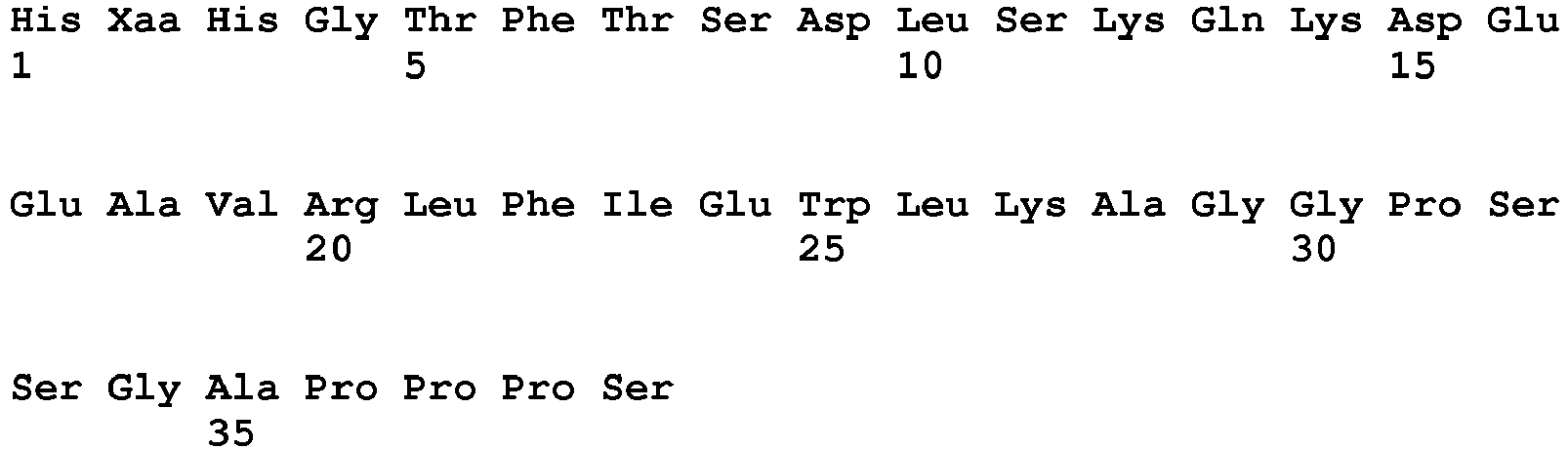
- <210> 9
<211> 39
<212> PRT
<213> Artificial Sequence - <220>
<223> Artificial polypeptide - <220>
<221> MOD_RES
<222> (2)..(2)
<223> Xaa is D-Ser - <220>
<221> MOD_RES
<222> (14)..(14)
<223> Lys is functionalized at the amino side chain group as Lys((S)-4-carboxy-4-octadecanoylamino-butyryl) - <220>
<221> MOD_RES
<222> (39)..(39)
<223> Amidated C-terminus - <400> 9

- <210> 10
<211> 39
<212> PRT
<213> Artificial Sequence - <220>
<223> Artificial polypeptide - <220>
<221> MOD_RES
<222> (14)..(14)
<223> Lys is functionalized at the amino side chain group as Lys((S)-4-carboxy-4-octadecanoylamino-butyryl) - <220>
<221> MOD_RES
<222> (39)..(39)
<223> Amidated C-terminus - <400> 10

- <210> 11
<211> 39
<212> PRT
<213> Artificial Sequence - <220>
<223> Artificial polypeptide - <220>
<221> MOD_RES
<222> (2)..(2)
<223> Xaa is Aib - <220>
<221> MOD_RES
<222> (14)..(14)
<223> Lys is functionalized at the amino side chain group as Lys((S)-4-carboxy-4((S)-4-carboxy-4-hexadecanoylamino-butyrylamin o)-butyryl) - <220>
<221> MOD_RES
<222> (39)..(39)
<223> Amidated C-terminus - <400> 11

- <210> 12
<211> 39
<212> PRT
<213> Artificial Sequence - <220>
<223> Artificial polypeptide - <220>
<221> MOD_RES
<222> (2)..(2)
<223> Xaa is Aib - <220>
<221> MOD_RES
<222> (14)..(14)
<223> Lys is functionalized at the amino side chain group as Lys((S)-4-carboxy-4-hexadecanoylamino-butyryl) - <220>
<221> MOD_RES
<222> (39)..(39)
<223> Amidated C-terminus - <400> 12
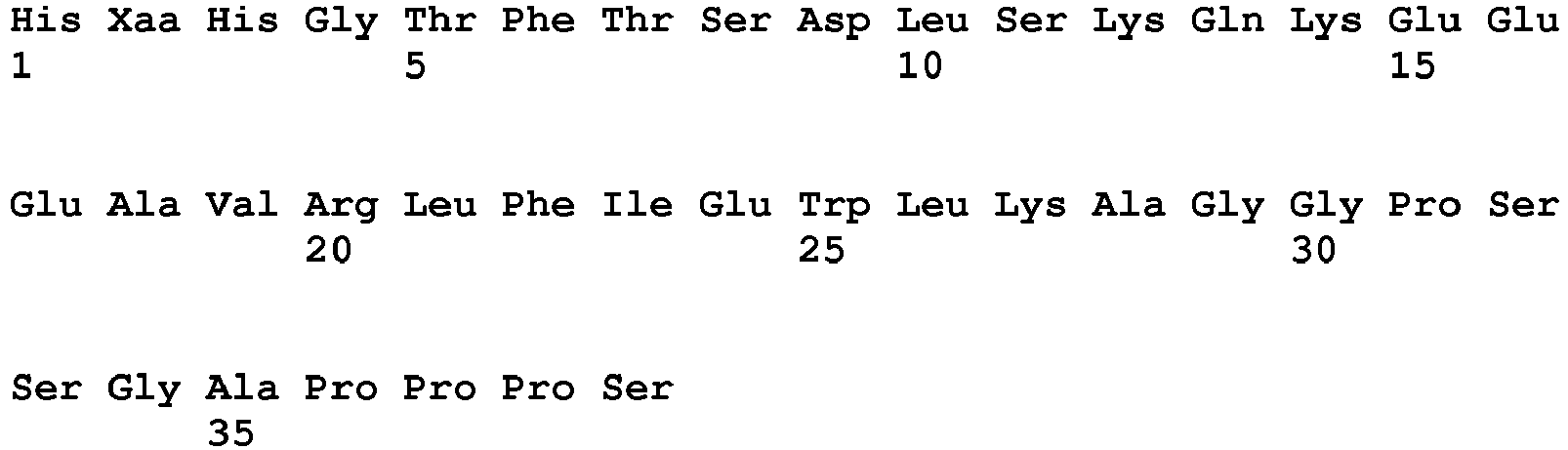
- <210> 13
<211> 39
<212> PRT
<213> Artificial Sequence - <220>
<223> Artificial polypeptide - <220>
<221> MOD_RES
<222> (2)..(2)
<223> Xaa is D-Ser - <220>
<221> MOD_RES
<222> (14)..(14)
<223> Lys is functionalized at the amino side chain group as Lys((S)-4-carboxy-4-((S)-4-carboxy-4-hexadecanoylamino-butyrylami no)-butyryl) - <220>
<221> MOD_RES
<222> (39)..(39)
<223> Amidated C-terminus - <400> 13

- <210> 14
<211> 39
<212> PRT
<213> Artificial Sequence - <220>
<223> Artificial polypeptide - <220>
<221> MOD_RES
<222> (2)..(2)
<223> Xaa is D-Ser - <220>
<221> MOD_RES
<222> (14)..(14)
<223> Lys is functionalized at the amino side chain group as Lys((S)-4-carboxy-4-hexadecanoylamino-butyryl) - <220>
<221> MOD_RES
<222> (39)..(39)
<223> Amidated C-terminus - <400> 14

- <210> 15
<211> 39
<212> PRT
<213> Artificial Sequence - <220>
<223> Artificial polypeptide - <220>
<221> MOD_RES
<222> (2)..(2)
<223> Xaa is D-Ser - <220>
<221> MOD_RES
<222> (14)..(14)
<223> Lys is functionalized at the amino side chain group as Lys((S)-4-carboxy-4-octadecanoylamino-butyryl) - <220>
<221> MOD_RES
<222> (39)..(39)
<223> Amidated C-terminus - <400> 15


- <210> 16
<211> 39
<212> PRT
<213> Artificial Sequence - <220>
<223> Artificial polypeptide - <220>
<221> MOD_RES
<222> (2)..(2)
<223> Xaa is D-Ser - <220>
<221> MOD_RES
<222> (14)..(14)
<223> Lys is functionalized at the amino side chain group as Lys((S)-4-carboxy-4-octadecanoylamino-butyryl) - <220>
<221> MOD_RES
<222> (39)..(39)
<223> Amidated C-terminus - <400> 16

- <210> 17
<211> 39
<212> PRT
<213> Artificial Sequence - <220>
<223> Artificial polypeptide - <220>
<221> MOD_RES
<222> (2)..(2)
<223> Xaa is D-Ser - <220>
<221> MOD_RES
<222> (14)..(14)
<223> Lys is functionalized at the amino side chain group as Lys((S)-4-carboxy-4-octadecanoylamino-butyryl) - <220>
<221> MOD_RES
<222> (39)..(39)
<223> Amidated C-terminus - <400> 17

- <210> 18
<211> 39
<212> PRT
<213> Artificial Sequence - <220>
<223> Artificial polypeptide - <220>
<221> MOD_RES
<222> (2)..(2)
<223> Xaa is D-Ser - <220>
<221> MOD_RES
<222> (14)..(14)
<223> Lys is functionalized at the amino side chain group as Lys((S)-4-carboxy-4-hexadecanoylamino-butyryl) - <220>
<221> MOD_RES
<222> (39)..(39)
<223> Amidated C-terminus - <400> 18

- <210> 19
<211> 39
<212> PRT
<213> Artificial Sequence - <220>
<223> Artificial polypeptide - <220>
<221> MOD_RES
<222> (2)..(2)
<223> Xaa is D-Ser - <220>
<221> MOD_RES
<222> (14)..(14)
<223> Lys is functionalized at the amino side chain group as Lys((S)-4-carboxy-4-octadecanoylamino-butyryl) - <220>
<221> MOD_RES
<222> (39)..(39)
<223> Amidated C-terminus - <400> 19

- <210> 20
<211> 39
<212> PRT
<213> Artificial Sequence - <220>
<223> Artificial polypeptide - <220>
<221> MOD_RES
<222> (14)..(14)
<223> Lys is functionalized at the amino side chain group as Lys((S)-4-carboxy-4-octadecanoylamino-butyryl) - <220>
<221> MOD_RES
<222> (39)..(39)
<223> Amidated C-terminus - <400> 20


- <210> 21
<211> 39
<212> PRT
<213> Artificial Sequence - <220>
<223> Artificial polypeptide - <220>
<221> MOD_RES
<222> (2)..(2)
<223> Xaa is D-Ser - <220>
<221> MOD_RES
<222> (14)..(14)
<223> Lys is functionalized at the amino side chain group as Lys((S)-4-carboxy-4-((S)-4-carboxy-4-hexadecanoylamino-butyrylami no)-butyryl) - <220>
<221> MOD_RES
<222> (39)..(39)
<223> Amidated C-terminus - <400> 21

- <210> 22
<211> 39
<212> PRT
<213> Artificial Sequence - <220>
<223> Artificial polypeptide - <220>
<221> MOD_RES
<222> (2)..(2)
<223> Xaa is D-Ser - <220>
<221> MOD_RES
<222> (14)..(14)
<223> Lys is functionalized at the amino side chain group as Lys((S)-4-carboxy-4-((S)-4-carboxy-4-hexadecanoylamino-butyrylami no)-butyryl) - <220>
<221> MOD_RES
<222> (39)..(39)
<223> Amidated C-terminus - <400> 22

- <210> 23
<211> 39
<212> PRT
<213> Artificial Sequence - <220>
<223> Artificial polypeptide - <220>
<221> MOD_RES
<222> (2)..(2)
<223> Xaa is D-Ser - <220>
<221> MOD_RES
<222> (14)..(14)
<223> Lys is functionalized at the amino side chain group as Lys((S)-4-carboxy-4-((S)-4-carboxy-4-hexadecanoylamino-butyrylami no)-butyryl) - <220>
<221> MOD_RES
<222> (39)..(39)
<223> Amidated C-terminus - <400> 23

- <210> 24
<211> 39
<212> PRT
<213> Artificial Sequence - <220>
<223> Artificial polypeptide - <220>
<221> MOD_RES
<222> (2)..(2)
<223> Xaa is Aib - <220>
<221> MOD_RES
<222> (14)..(14)
<223> Lys is functionalized at the amino side chain group as Lys((S)-4-carboxy-4-((S)-4-carboxy-4-hexadecanoylamino-butyrylami no)-butyryl) - <220>
<221> MOD_RES
<222> (39)..(39)
<223> Amidated C-terminus - <400> 24

- <210> 25
<211> 39
<212> PRT
<213> Artificial Sequence - <220>
<223> Artificial polypeptide - <220>
<221> MOD_RES
<222> (2)..(2)
<223> Xaa is D-Ser - <220>
<221> MOD_RES
<222> (14)..(14)
<223> Lys is functionalized at the amino side chain group as Lys((S)-4-carboxy-4-octadecanoylamino-butyryl) - <220>
<221> MOD_RES
<222> (39)..(39)
<223> Amidated C-terminus - <400> 25

- <210> 26
<211> 39
<212> PRT
<213> Artificial Sequence - <220>
<223> Artificial polypeptide - <220>
<221> MOD_RES
<222> (14)..(14)
<223> Lys is functionalized at the amino side chain group as Lys((S)-4-carboxy-4-((S)-4-carboxy-4-hexadecanoylamino-butyrylami no)-butyryl) - <220>
<221> MOD_RES
<222> (39)..(39)
<223> Amidated C-terminus - <400> 26

- <210> 27
<211> 39
<212> PRT
<213> Artificial Sequence - <220>
<223> Artificial polypeptide - <220>
<221> MOD_RES
<222> (2)..(2)
<223> Xaa is Aib - <220>
<221> MOD_RES
<222> (14)..(14)
<223> Lys is functionalized at the amino side chain group as Lys((2-{2-[2-(2-{2-[(4S)-4-Carboxy-4-hexadecanoylamino-butyryl ami no]-ethoxy}-ethoxy)-acetylamino]-ethoxy}-ethoxy)-acetyl) - <220>
<221> MOD_RES
<222> (39)..(39)
<223> Amidated C-terminus - <400> 27

- <210> 28
<211> 39
<212> PRT
<213> Artificial Sequence - <220>
<223> Artificial polypeptide - <220>
<221> MOD_RES
<222> (2)..(2)
<223> Xaa is Aib - <220>
<221> MOD_RES
<222> (14)..(14)
<223> Lys is functionalized at the amino side chain group as Lys((2-{2-[2-(2-{2-[(4S)-4-Carboxy-4-octadecanoylamino-butyryl ami no]-ethoxy}-ethoxy)-acetylamino]-ethoxy}-ethoxy)-acetyl) - <220>
<221> MOD_RES
<222> (39)..(39)
<223> Amidated C-terminus - <400> 28


- <210> 29
<211> 39
<212> PRT
<213> Artificial Sequence - <220>
<223> Artificial polypeptide - <220>
<221> MOD_RES
<222> (2)..(2)
<223> Xaa is Aib - <220>
<221> MOD_RES
<222> (14)..(14)
<223> Lys is functionalized at the amino side chain group as Lys([2-(2-{2-[2-(2-{2-[2-(2-Octadecanoylamino-ethoxy)-ethoxy]-ace tylamino}-ethoxy)-ethoxy]-acetylamino}-ethoxy)-ethoxy]-acetyl) - <220>
<221> MOD_RES
<222> (39)..(39)
<223> Amidated C-terminus - <400> 29

- <210> 30
<211> 39
<212> PRT
<213> Artificial Sequence - <220>
<223> Artificial polypeptide - <220>
<221> MOD_RES
<222> (2)..(2)
<223> Xaa is Aib - <220>
<221> MOD_RES
<222> (14)..(14)
<223> Lys is functionalized at the amino side chain group as Lys((2-{2-[2-(2-{2-[(4S)-4-Carboxy-4-(17-carboxy-heptadecanoyl)am ino-butyrylamino]-ethoxy}-ethoxy)-acetylamino]-ethoxy}-ethoxy)-ac etyl) - <220>
<221> MOD_RES
<222> (39)..(39)
<223> Amidated C-terminus - <400> 30

- <210> 31
<211> 39
<212> PRT
<213> Artificial Sequence - <220>
<223> Artificial polypeptide - <220>
<221> MOD_RES
<222> (2)..(2)
<223> Xaa is Aib - <220>
<221> MOD_RES
<222> (14)..(14)
<223> Lys is functionalized at the amino side chain group as Lys((S)-4-Carboxy-4-((S)-4-carboxy-4-hexadecanoylamino-butyrylami no)-butyryl) - <220>
<221> MOD_RES
<222> (39)..(39)
<223> Amidated C-terminus - <400> 31

- <210> 32
<211> 39
<212> PRT
<213> Artificial Sequence - <220>
<223> Artificial polypeptide - <220>
<221> MOD_RES
<222> (2)..(2)
<223> Xaa is Aib - <220>
<221> MOD_RES
<222> (39)..(39)
<223> Amidated C-terminus - <400> 32

- <210> 33
<211> 39
<212> PRT
<213> Artificial Sequence - <220>
<223> Artificial polypeptide - <220>
<221> MOD_RES
<222> (2)..(2)
<223> Xaa is D-Ser - <220>
<221> MOD_RES
<222> (39)..(39)
<223> Amidated C-terminus - <400> 33

- <210> 34
<211> 39
<212> PRT
<213> Artificial Sequence - <220>
<223> Artificial polypeptide - <220>
<221> MOD_RES
<222> (2)..(2)
<223> Xaa is Aib - <220>
<221> MOD_RES
<222> (14)..(14)
<223> Lys is functionalized at the amino side chain group as Lys(Acetyl) - <220>
<221> MOD_RES
<222> (39)..(39)
<223> Amidated C-terminus - <400> 34
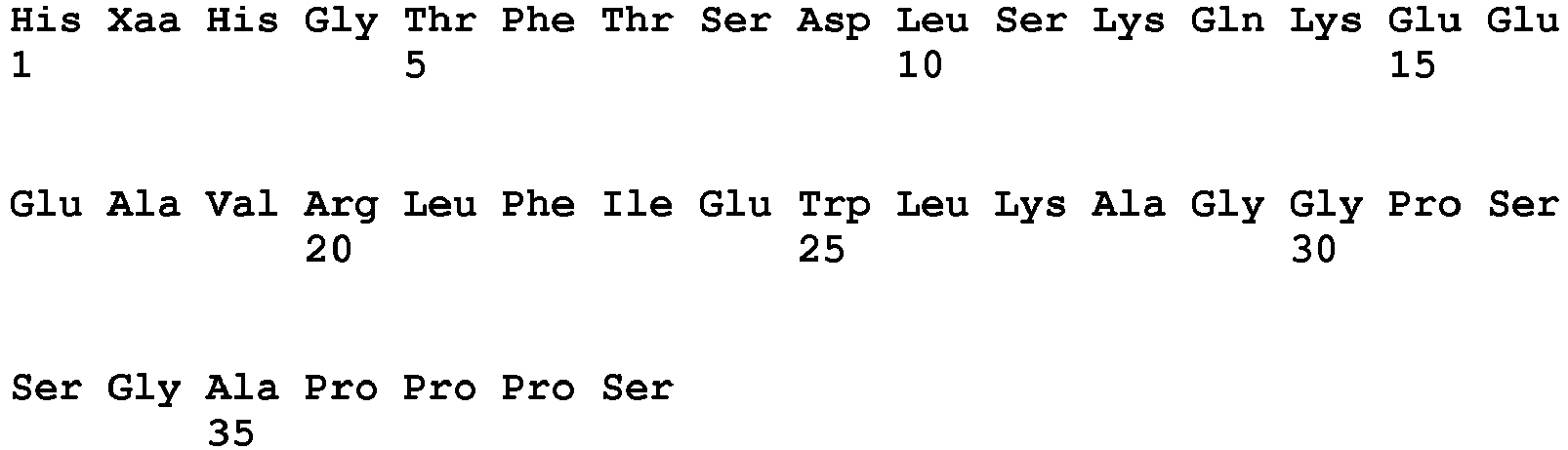
- <210> 35
<211> 39
<212> PRT
<213> Artificial Sequence - <220>
<223> Artificial polypeptide - <220>
<221> MOD_RES
<222> (2)..(2)
<223> Xaa is D-Ser - <220>
<221> MOD_RES
<222> (14)..(14)
<223> Lys is functionalized at the amino side chain group as Lys(Acetyl) - <220>
<221> MOD_RES
<222> (39)..(39)
<223> Amidated C-terminus - <400> 35
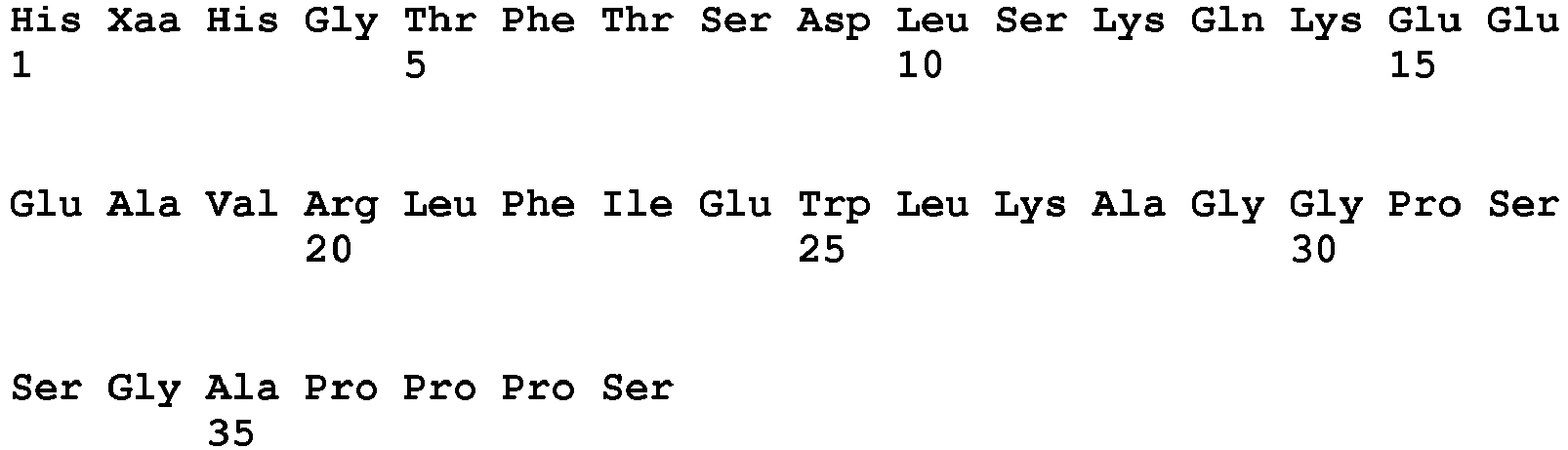
Claims (29)
- A peptidic compound having the formula (I):
 X2 represents an amino acid residue selected from Ser, D-Ser and Aib,X3 represents an amino acid residue selected from Gln and His,X14 represents an amino acid residue with a functionalized -NH2 side chain group, selected from the group consisting of Lys, Orn, Dab, or Dap, wherein the -NH2 side chain group is functionalized by -Z-C(O)-R5, whereinZ represents a linker in all stereoisomeric forms andR5 is a moiety comprising up to 50 carbon atoms and heteroatoms selected from N and O,X15 represents an amino acid residue selected from Glu and Asp,X28 represents an amino acid residue selected from Ala and Lys,R1 is NH2 or OH,or a salt or solvate thereof.
 - A compound of claim 1, wherein
R1 is NH2
or a salt or solvate thereof. - A compound according to any one of claims 1 - 2, wherein the peptidic compound has a relative activity of at least 0.1% compared to that of natural glucagon at the glucagon receptor.
- A compound according to any one of claims 1 - 3, wherein the peptidic compound exhibits a relative activity of at least 0.1% compared to that of GLP-1(7-36)-amide at the GLP-1 receptor.
- A compound of any one of claims 1 - 4, wherein
X14 represents Lys wherein the -NH2 side chain group is functionalized with a group -Z-C(O)R5 , wherein
Z represents a group selected from γE, γE-γE, AEEAc-AEEAc-γE and AEEAc-AEEAc-AEEAc and
R5 represents a group selected from pentadecanyl, heptadecanyl or 16-carboxy-hexadecanyl. - A compound of any one of claims 1 - 5, wherein
X14 represents Lys wherein the -NH2 side chain group is functionalized with a group -Z-C(O)R5 , wherein
Z represents a group selected from γE, γE-γE, AEEAc-AEEAc-γE and AEEAc-AEEAc-AEEAc and
R5 represents a group selected from pentadecanyl or heptadecanyl. - A compound of any one of claims 1 - 6, wherein
X2 represents Ser,
X3 represents an amino acid residue selected from Gln and His,
X14 represents Lys wherein the -NH2 side chain group is functionalized by (S)-4-Carboxy-4-octadecanoylamino-butyryl-, (S)-4-Carboxy-4-((S)-4-carboxy-4-hexadecanoylamino-butyrylamino)-butyryl-,
X15 represents Glu,
X28 represents Ala,
R1 represents NH2,
or a salt or solvate thereof. - A compound of any one of claims 1 - 6, wherein
X2 represents D-Ser,
X3 represents an amino acid residue selected from Gln and His,
X14 represents Lys wherein the -NH2 side chain group is functionalized by (S)-4-Carboxy-4-hexadecanoylamino-butyryl-, (S)-4-Carboxy-4-octadecanoylamino-butyryl-, (S)-4-Carboxy-4-((S)-4-carboxy-4-hexadecanoylamino-butyrylamino)-butyryl,
X15 represents an amino acid residue selected from Glu and Asp,
X28 represents an amino acid residue selected from Ala and Lys,
R1 represents NH2,
or a salt or solvate thereof. - A compound of any one of claims 1 - 6, wherein
X2 represents Aib,
X3 represents an amino acid residue selected from Gln and His,
X14 represents Lys wherein the -NH2 side chain group is functionalized by (S)-4-Carboxy-4-hexadecanoylamino-butyryl-, (S)-4-Carboxy-4-octadecanoylamino-butyryl-, (S)-4-Carboxy-4-((S)-4-carboxy-4-hexadecanoylamino-butyrylamino)-butyryl-, (2-{2-[2-(2-{2-[(4S)-4-Carboxy-4-hexadecanoylamino-butyrylamino]-ethoxy}-ethoxy)-acetylamino]-ethoxy}-ethoxy)-acetyl, (2-{2-[2-(2-{2-[(4S)-4-Carboxy-4-octadecanoylamino-butyrylamino]-ethoxy}-ethoxy)-acetylamino]-ethoxy}-ethoxy)-acetyl, [2-(2-{2-[2-(2-{2-[2-(2-Octadecanoylamino-ethoxy)-ethoxy]-acetylamino}-ethoxy)-ethoxy]-acetylamino}-ethoxy)-ethoxy]-acetyl-,
X15 represents an amino acid residue selected from Glu and Asp,
X28 represents an amino acid residue selected from Ala and Lys,
R1 represents NH2,
or a salt or solvate thereof. - A compound of any one of claims 1 - 6, wherein
X2 represents an amino acid residue selected from Ser, D-Ser and Aib,
X3 represents Gln,
X14 represents Lys wherein the -NH2 side chain group is functionalized by (S)-4-Carboxy-4-hexadecanoylamino-butyryl-, (S)-4-Carboxy-4-octadecanoylamino-butyryl-, (S)-4-Carboxy-4-((S)-4-carboxy-4-hexadecanoylamino-butyrylamino)-butyryl-,
X15 represents an amino acid residue selected from Glu and Asp,
X28 represents an amino acid residue selected from Ala and Lys,
R1 represents NH2,
or a salt or solvate thereof. - A compound of any one of claims 1 - 6, wherein
X2 represents an amino acid residue selected from Ser, D-Ser and Aib,
X3 represents His,
X14 represents Lys wherein the -NH2 side chain group is functionalized by (S)-4-Carboxy-4-hexadecanoylamino-butyryl-, (S)-4-Carboxy-4-octadecanoylamino-butyryl-, (S)-4-Carboxy-4-((S)-4-carboxy-4-hexadecanoylamino-butyrylamino)-butyryl-, (2-{2-[2-(2-{2-[(4S)-4-Carboxy-4-hexadecanoylamino-butyrylamino]-ethoxy}-ethoxy)-acetylamino]-ethoxy}-ethoxy)-acetyl, (2-{2-[2-(2-{2-[(4S)-4-Carboxy-4-octadecanoylamino-butyrylamino]-ethoxy}-ethoxy)-acetylamino]-ethoxy}-ethoxy)-acetyl, [2-(2-{2-[2-(2-{2-[2-(2-Octadecanoylamino-ethoxy)-ethoxy]-acetylamino}-ethoxy)-ethoxy]-acetylamino}-ethoxy)-ethoxy]-acetyl-,
X15 represents an amino acid residue selected from Glu and Asp,
X28 represents an amino acid residue selected from Ala and Lys,
R1 represents NH2,
or a salt or solvate thereof. - A compound of any one of claims 1 - 6, wherein
X2 represents an amino acid residue selected from Ser, D-Ser and Aib,
X3 represents an amino acid residue selected from Gln and His,
X14 represents Lys wherein the -NH2 side chain group is functionalized by (S)-4-Carboxy-4-hexadecanoylamino-butyryl-, (S)-4-Carboxy-4-octadecanoylamino-butyryl-, (S)-4-Carboxy-4-((S)-4-carboxy-4-hexadecanoylamino-butyrylamino)-butyryl-, (2-{2-[2-(2-{2-[(4S)-4-Carboxy-4-hexadecanoylamino-butyrylamino]-ethoxy}-ethoxy)-acetylamino]-ethoxy}-ethoxy)-acetyl, (2-{2-[2-(2-{2-[(4S)-4-Carboxy-4-octadecanoylamino-butyrylamino]-ethoxy}-ethoxy)-acetylamino]-ethoxy}-ethoxy)-acetyl, [2-(2-{2-[2-(2-{2-[2-(2-Octadecanoylamino-ethoxy)-ethoxy]-acetylamino}-ethoxy)-ethoxy]-acetylamino}-ethoxy)-ethoxy]-acetyl-,
X15 represents Glu,
X28 represents an amino acid residue selected from Ala and Lys,
R1 represents NH2,
or a salt or solvate thereof. - A compound of any one of claims 1 - 6, wherein
X2 represents an amino acid residue selected from D-Ser and Aib,
X3 represents an amino acid residue selected from Gln and His,
X14 represents Lys wherein the -NH2 side chain group is functionalized by (S)-4-Carboxy-4-octadecanoylamino-butyryl-, (S)-4-Carboxy-4-((S)-4-carboxy-4-hexadecanoylamino-butyrylamino)-butyryl-,
X15 represents Asp,
X28 represents Ala,
R1 represents NH2,
or a salt or solvate thereof. - A compound of any one of claims 1 - 6, wherein
X2 represents an amino acid residue selected from Ser, D-Ser and Aib,
X3 represents an amino acid residue selected from Gln and His,
X14 represents Lys wherein the -NH2 side chain group is functionalized by (S)-4-Carboxy-4-hexadecanoylamino-butyryl-, (S)-4-Carboxy-4-octadecanoylamino-butyryl-, (S)-4-Carboxy-4-((S)-4-carboxy-4-hexadecanoylamino-butyrylamino)-butyryl-, (2-{2-[2-(2-{2-[(4S)-4-Carboxy-4-hexadecanoylamino-butyrylamino]-ethoxy}-ethoxy)-acetylamino]-ethoxy}-ethoxy)-acetyl, (2-{2-[2-(2-{2-[(4S)-4-Carboxy-4-octadecanoylamino-butyrylamino]-ethoxy}-ethoxy)-acetylamino]-ethoxy}-ethoxy)-acetyl, [2-(2-{2-[2-(2-{2-[2-(2-Octadecanoylamino-ethoxy)-ethoxy]-acetylamino}-ethoxy)-ethoxy]-acetylamino}-ethoxy)-ethoxy]-acetyl-,
X15 represents an amino acid residue selected from Glu and Asp,
X28 represents Ala,
R1 represents NH2,
or a salt or solvate thereof. - A compound of any one of claims 1 - 6, wherein
X2 represents an amino acid residue selected from D-Ser and Aib,
X3 represents an amino acid residue selected from Gln and His,
X14 represents Lys wherein the -NH2 side chain group is functionalized by (S)-4-Carboxy-4-octadecanoylamino-butyryl-, (S)-4-Carboxy-4-((S)-4-carboxy-4-hexadecanoylamino-butyrylamino)-butyryl-,
X15 represents Glu,
X28 represents Lys,
R1 represents NH2,
or a salt or solvate thereof. - A compound of any one of claims 1 - 6, wherein
X2 represents Aib,
X3 represents His,
X14 represents Lys wherein the -NH2 side chain group is functionalized by (S)-4-Carboxy-4-hexadecanoylamino-butyryl-, (S)-4-Carboxy-4-octadecanoylamino-butyryl-, (S)-4-Carboxy-4-((S)-4-carboxy-4-hexadecanoylamino-butyrylamino)-butyryl,
X15 represents an amino acid residue selected from Glu and Asp,
X28 represents Ala,
R1 represents NH2,
or a salt or solvate thereof. - The compound of any one of claims 1 - 16, selected from the compounds of SEQ ID NO: 6-31, as well as salts and solvates thereof.
- The compound of any one of claims 1 - 17, selected from the compounds of SEQ ID NO: 6-29 and 31, as well as salts and solvates thereof.
- The compound of claim 1, wherein the compound is represented by SEQ ID NO: 11, or a salt or solvate thereof.
- The compound of claim 1, wherein the compound is represented by SEQ ID NO: 12, or a salt or solvate thereof.
- The compound of claim 1, wherein the compound is represented by SEQ ID NO: 20, or a salt or solvate thereof.
- The compound of any one of claims 1 - 21 for use in medicine, particularly in human medicine.
- The compound of any one of claims 1 - 21 for use according to claim 22, which is present as an active agent in a pharmaceutical composition together with at least one pharmaceutically acceptable carrier.
- The compound of any one of claims 1 - 21 for use according to claim 22 or 23, together with at least one additional therapeutically active agent, wherein the additional therapeutically active agent is selected from the series of Insulin and Insulin derivatives, GLP-1, GLP-1 analogues and GLP-1 receptor agonists, polymer bound GLP-1 and GLP-1 analogues, dual GLP1/glucagon agonists, dual GLP1/GIP agonists, PYY3-36 or analogues thereof, pancreatic polypeptide or analogues thereof, Glucagon receptor agonists, GIP receptor agonists or antagonists, ghrelin antagonists or inverse agonists, Xenin and analogues thereof, DDP4 inhibitors, SGLT2 inhibitors, dual SGLT2 / SGLT1 inhibitors, Biguanides, Thiazolidinediones, dual PPAR agonists, Sulfonylureas, Meglitinides, alpha-glucosidase inhibitors, Amylin and Amylin analogues, GPR119 agonists, GPR40 agonists, GPR120 agonists, GPR142 agonists, systemic or low-absorbable TGR5 agonists, Cycloset, inhibitors of 11-beta-HSD, activators of glucokinase, inhibitors of DGAT, inhibitors of protein tyrosinephosphatase 1, inhibitors of glucose-6-phosphatase, inhibitors of fructose-1,6-bisphosphatase, inhibitors of glycogen phosphorylase, inhibitors of phosphoenol pyruvate carboxykinase, inhibitors of glycogen synthase kinase, inhibitors of pyruvate dehydrogenase kinase, alpha2-antagonists, CCR-2 antagonists, modulators of glucose transporter-4, Somatostatin receptor 3 agonists, HMG-CoA-reductase inhibitors, fibrates, nicotinic acid and the derivatives thereof, nicotinic acid receptor 1 agonists, PPAR-alpha, gamma or alpha/gamma agonists or modulators, PPAR-delta agonists, ACAT inhibitors, cholesterol absorption inhibitors, bile acid-binding substances, IBAT inhibitors, MTP inhibitors, modulators of PCSK9, LDL receptor up-regulators by liver selective thyroid hormone receptor β agonists, HDL-raising compounds, lipid metabolism modulators, PLA2 inhibitors , ApoA-I enhancers, thyroid hormone receptor agonists, cholesterol synthesis inhibitors, omega-3 fatty acids and derivatives thereof, active substances for the treatment of obesity, such as Sibutramine, Tesofensine, Orlistat, CB-1receptor antagonists, MCH-1 antagonists, MC4 receptor agonists and partial agonists, NPY5 or NPY2 antagonists, NPY4 agonists, beta-3-agonists, leptin or leptin mimetics, agonists of the 5HT2c receptor, or the combinations of bupropione/naltrexone (CONTRAVE), bupropione/zonisamide (EMPATIC), bupropione/phentermine or pramlintide/metreleptin, QNEXA (Phentermine+ topiramate), lipase inhibitors, angiogenesis inhibitors, H3 antagonists, AgRP inhibitors, triple monoamine uptake inhibitors (norepinephrine and acetylcholine), MetAP2 inhibitors, nasal formulation of the calcium channel blocker diltiazem, antisense against production of fibroblast growth factor receptor 4, prohibitin targeting peptide-1, drugs for influencing high blood pressure, chronic heart failure or atherosclerosis, such as angiotensin II receptor antagonists, ACE inhibitors, ECE inhibitors, diuretics, beta-blockers, calcium antagonists, centrally acting hypertensives, antagonists of the alpha-2-adrenergic receptor, inhibitors of neutral endopeptidase, thrombocyte aggregation inhibitors.
- The compound of any one of claims 1 - 21 for use in the treatment of glucose intolerance, insulin resistance, pre-diabetes, increased fasting glucose (hyperglycemia), type 2 diabetes, hypertension, dyslipidemia, arteriosclerosis, coronary heart disease, peripheral artery disease, stroke or any combination of these individual disease components.
- The compound of any one of claims 1 - 21 which is suitable for use in control of appetite, feeding and calory intake, increase of energy expenditure, prevention of weight gain, promotion of weight loss, reduction of excess body weight, or which is for use in the treatment of obesity, including morbid obesity.
- The compound of any one of claims 1 - 21 for use in the treatment or prevention of hyperglycemia, type 2 diabetes, obesity.
- The compound of any one of claims 1 - 21 for use in the simultaneous treatment of diabetes and obesity.
- A pharmaceutical composition comprising at least one compound according to any one of claims 1 - 21 or a physiologically acceptable salt or a solvate of any of them.
Applications Claiming Priority (2)
| Application Number | Priority Date | Filing Date | Title |
|---|---|---|---|
| EP14305503 | 2014-04-07 | ||
| PCT/EP2015/057418 WO2015155141A1 (en) | 2014-04-07 | 2015-04-02 | Peptidic dual glp-1 / glucagon receptor agonists derived from exendin-4 |
Publications (2)
| Publication Number | Publication Date |
|---|---|
| EP3129397A1 EP3129397A1 (en) | 2017-02-15 |
| EP3129397B1 true EP3129397B1 (en) | 2019-01-09 |
Family
ID=50513191
Family Applications (1)
| Application Number | Title | Priority Date | Filing Date |
|---|---|---|---|
| EP15713899.1A Active EP3129397B1 (en) | 2014-04-07 | 2015-04-02 | Peptidic dual glp-1 / glucagon receptor agonists derived from exendin-4 |
Country Status (15)
| Country | Link |
|---|---|
| US (1) | US9771406B2 (en) |
| EP (1) | EP3129397B1 (en) |
| JP (1) | JP6612251B2 (en) |
| KR (1) | KR20160143727A (en) |
| CN (1) | CN106414488B (en) |
| AR (1) | AR099977A1 (en) |
| AU (1) | AU2015243612B2 (en) |
| BR (1) | BR112016022465A2 (en) |
| CA (1) | CA2944683A1 (en) |
| IL (1) | IL247769A0 (en) |
| MX (1) | MX2016013243A (en) |
| RU (1) | RU2016141925A (en) |
| SG (1) | SG11201607522YA (en) |
| TW (1) | TW201625669A (en) |
| WO (1) | WO2015155141A1 (en) |
Families Citing this family (42)
| Publication number | Priority date | Publication date | Assignee | Title |
|---|---|---|---|---|
| UA116217C2 (en) | 2012-10-09 | 2018-02-26 | Санофі | Exendin-4 derivatives as dual glp1/glucagon agonists |
| HUE035803T2 (en) | 2012-12-21 | 2018-05-28 | Sanofi Sa | Dual glp1/gip or trigonal glp1/gip/glucagon agonists |
| EP3080154B1 (en) | 2013-12-13 | 2018-02-07 | Sanofi | Dual glp-1/gip receptor agonists |
| WO2015086728A1 (en) | 2013-12-13 | 2015-06-18 | Sanofi | Exendin-4 peptide analogues as dual glp-1/gip receptor agonists |
| WO2015086730A1 (en) | 2013-12-13 | 2015-06-18 | Sanofi | Non-acylated exendin-4 peptide analogues |
| TW201609797A (en) | 2013-12-13 | 2016-03-16 | 賽諾菲公司 | Dual GLP-1/glucagon receptor agonists |
| BR112016017402A2 (en) | 2014-02-21 | 2017-10-17 | Medimmune Ltd | anti-pcsk9 ~ glp-1 fusions and methods for use |
| TW201625668A (en) | 2014-04-07 | 2016-07-16 | 賽諾菲公司 | Exendin-4 derivatives as peptidic dual GLP-1/glucagon receptor agonists |
| TW201625669A (en) | 2014-04-07 | 2016-07-16 | 賽諾菲公司 | Peptidic dual GLP-1/glucagon receptor agonists derived from Exendin-4 |
| TW201625670A (en) | 2014-04-07 | 2016-07-16 | 賽諾菲公司 | Dual GLP-1/glucagon receptor agonists derived from EXENDIN-4 |
| US9932381B2 (en) | 2014-06-18 | 2018-04-03 | Sanofi | Exendin-4 derivatives as selective glucagon receptor agonists |
| WO2016168388A2 (en) | 2015-04-14 | 2016-10-20 | Palatin Technologies, Inc. | Therapies for obesity, diabetes and related indications |
| AR105319A1 (en) | 2015-06-05 | 2017-09-27 | Sanofi Sa | PROPHARMS THAT INCLUDE A DUAL AGONIST GLU-1 / GLUCAGON CONJUGATE HIALURONIC ACID CONNECTOR |
| TW201706291A (en) | 2015-07-10 | 2017-02-16 | 賽諾菲公司 | New EXENDIN-4 derivatives as selective peptidic dual GLP-1/glucagon receptor agonists |
| TWI622596B (en) | 2015-10-26 | 2018-05-01 | 美國禮來大藥廠 | Glucagon receptor agonist |
| TW201821434A (en) | 2016-10-10 | 2018-06-16 | 法商賽諾菲公司 | Method of preparing peptides comprising a lipophilically modified lysine side chain |
| AR110299A1 (en) | 2016-12-02 | 2019-03-13 | Sanofi Sa | CONJUGATES UNDERSTANDING A DUAL GLP-1 / GLUCAGON AGONIST, A CONNECTOR AND Hyaluronic Acid |
| AR110300A1 (en) | 2016-12-02 | 2019-03-13 | Sanofi Sa | COMPOUNDS AS TRIGONAL PEPTIDE AGONISTS OF GLP1 / GLUCAGÓN / GIP RECEPTORS |
| AR110301A1 (en) * | 2016-12-02 | 2019-03-13 | Sanofi Sa | COMPOUNDS AS GLP1 / GLUCAGÓN / GIP RECEPTING AGENISTS |
| CN115304666B (en) * | 2017-11-24 | 2025-09-19 | 浙江道尔生物科技有限公司 | Glucagon analogues for the treatment of metabolic disorders |
| SG11202010016QA (en) | 2018-04-10 | 2020-11-27 | Sanofi Aventis Deutschland | Lixisenatide synthesis with capping |
| MX2020010716A (en) | 2018-04-10 | 2021-03-09 | Sanofi Aventis Deutschland | METHOD TO CLEAVE FROM THE SOLID PHASE PEPTIDES LINKED TO A SOLID PHASE. |
| TW202015735A (en) | 2018-05-30 | 2020-05-01 | 法商賽諾菲公司 | Conjugate including GLP-1/L-glycoside/GIP triple receptor agonist, linker and hyaluronic acid |
| US12187773B2 (en) * | 2018-12-03 | 2025-01-07 | Antag Therapeutics Aps | Modified GIP peptide analogues |
| BR112021013924A2 (en) | 2019-01-18 | 2021-09-21 | Astrazeneca Ab | PCSK9 INHIBITORS AND METHODS OF USING THEM |
| WO2020150473A2 (en) | 2019-01-18 | 2020-07-23 | Dogma Therapeutics, Inc. | Pcsk9 inhibitors and methods of use thereof |
| CN111040022B (en) * | 2019-12-23 | 2021-12-14 | 万新医药科技(苏州)有限公司 | Triple agonist targeting glucagon-like peptide-1 receptor, glucagon receptor, and gastric inhibitory peptide receptor |
| PE20221595A1 (en) * | 2020-01-13 | 2022-10-10 | Hanmi Pharm Ind Co Ltd | THERAPEUTIC USE OF A LONG-ACTING CONJUGATE OF A TRIPLE AGONIST THAT HAS ACTIVITY IN ALL GLUCAGON/GLP-1/GIP RECEPTORS FOR LUNG DISEASES |
| AU2021233745B2 (en) * | 2020-03-11 | 2024-05-02 | Anygen Co., Ltd. | Composition for anti-diabetes and anti-obesity comprising novel compound |
| WO2022065898A1 (en) * | 2020-09-25 | 2022-03-31 | 한미약품 주식회사 | Pharmaceutical composition for preventing or treating bone diseases, comprising triple agonist or conjugate thereof having activity with respect to all of glucagon, glp-1 and glp receptors |
| JP2023546384A (en) * | 2020-10-16 | 2023-11-02 | ハンミ ファーマシューティカル カンパニー リミテッド | Use of triple active substance having activity against all glucagon, GLP-1 and GIP receptors to treat sequelae of respiratory infectious diseases |
| CN116615254A (en) * | 2020-10-16 | 2023-08-18 | 韩美药品株式会社 | Use of trigonometric agonists active on all of glucagon, GLP-1 and GIP receptors for the treatment of sequelae of respiratory tract infectious diseases |
| WO2022090447A1 (en) | 2020-10-30 | 2022-05-05 | Novo Nordisk A/S | Glp-1, gip and glucagon receptor triple agonists |
| CN114349828B (en) * | 2020-11-27 | 2023-12-08 | 江苏师范大学 | GLP-1/glucagon receptor dual agonist and application thereof |
| KR20240118914A (en) | 2021-01-20 | 2024-08-05 | 바이킹 테라퓨틱스 인코포레이티드 | Compositions and methods for the treatment of metabolic and liver disorders |
| CN115057910A (en) * | 2021-02-08 | 2022-09-16 | 上海翰森生物医药科技有限公司 | Complement activity regulator, preparation method and medical application thereof |
| CN115521368B (en) * | 2021-06-25 | 2024-08-23 | 江苏鸿永医药技术有限公司 | Exendin-4 derivatives |
| CA3231953A1 (en) | 2021-09-15 | 2023-03-23 | Brian Lian | Compositions and methods for the treatment of metabolic and liver disorders |
| CN115536739B (en) * | 2022-07-04 | 2023-04-14 | 北京惠之衡生物科技有限公司 | Preparation method of GLP-1 receptor and GCG receptor co-agonist polypeptide derivative |
| CN117417411B (en) * | 2022-09-28 | 2025-08-29 | 广东东阳光药业股份有限公司 | GLP-1/GCG/GIP triple receptor agonist and its use |
| CN118878642A (en) * | 2024-05-28 | 2024-11-01 | 上海辛禧医药科技事务所 | A co-agonist targeting GLP-1R, GIPR and GCGR |
| US12303604B1 (en) | 2024-10-16 | 2025-05-20 | Currax Pharmaceuticals Llc | Pharmaceutical formulations comprising naltrexone and/or bupropion |
Family Cites Families (419)
| Publication number | Priority date | Publication date | Assignee | Title |
|---|---|---|---|---|
| US6284727B1 (en) | 1993-04-07 | 2001-09-04 | Scios, Inc. | Prolonged delivery of peptides |
| NZ250844A (en) | 1993-04-07 | 1996-03-26 | Pfizer | Treatment of non-insulin dependant diabetes with peptides; composition |
| US5424286A (en) | 1993-05-24 | 1995-06-13 | Eng; John | Exendin-3 and exendin-4 polypeptides, and pharmaceutical compositions comprising same |
| US5641757A (en) | 1994-12-21 | 1997-06-24 | Ortho Pharmaceutical Corporation | Stable 2-chloro-2'-deoxyadenosine formulations |
| DE69740096D1 (en) | 1996-08-08 | 2011-02-17 | Amylin Pharmaceuticals Inc | Pharmaceutical composition with an exendin-4-peptide |
| US6458924B2 (en) | 1996-08-30 | 2002-10-01 | Novo Nordisk A/S | Derivatives of GLP-1 analogs |
| DE122009000079I2 (en) | 1996-08-30 | 2011-06-16 | Novo Nordisk As Novo Alle | GLP-1 DERIVATIVES |
| JP4798814B2 (en) | 1997-01-07 | 2011-10-19 | アミリン・ファーマシューティカルズ,インコーポレイテッド | Use of exendin and its agonists to reduce food intake |
| US7312196B2 (en) | 1997-01-08 | 2007-12-25 | Amylin Pharmaceuticals, Inc. | Formulations for amylin agonist peptides |
| US6410511B2 (en) | 1997-01-08 | 2002-06-25 | Amylin Pharmaceuticals, Inc. | Formulations for amylin agonist peptides |
| US6723530B1 (en) | 1997-02-05 | 2004-04-20 | Amylin Pharmaceuticals, Inc. | Polynucleotides encoding proexendin, and methods and uses thereof |
| ES2293688T5 (en) | 1997-08-08 | 2011-05-04 | Amylin Pharmaceuticals, Inc. | NEW EXENDINE ANALOG COMPOUNDS. |
| US7157555B1 (en) | 1997-08-08 | 2007-01-02 | Amylin Pharmaceuticals, Inc. | Exendin agonist compounds |
| CA2309356C (en) | 1997-11-14 | 2010-09-21 | Amylin Pharmaceuticals, Inc. | Novel exendin agonist compounds |
| NZ504258A (en) | 1997-11-14 | 2002-12-20 | Amylin Pharmaceuticals Inc | Exendin 3 and 4 agonist compounds for the treatment of diabetes |
| US7220721B1 (en) | 1997-11-14 | 2007-05-22 | Amylin Pharmaceuticals, Inc. | Exendin agonist peptides |
| US7223725B1 (en) | 1997-11-14 | 2007-05-29 | Amylin Pharmaceuticals, Inc. | Exendin agonist compounds |
| ES2316161T3 (en) | 1998-01-09 | 2009-04-01 | Amylin Pharmaceuticals, Inc. | FORMULATIONS FOR PEPTIDES AGONIST AMILINA WITH INSULIN. |
| US6703359B1 (en) | 1998-02-13 | 2004-03-09 | Amylin Pharmaceuticals, Inc. | Inotropic and diuretic effects of exendin and GLP-1 |
| AU3247799A (en) | 1998-02-27 | 1999-09-15 | Novo Nordisk A/S | Glp-1 derivatives of glp-1 and exendin with protracted profile of action |
| AU757658B2 (en) | 1998-03-09 | 2003-02-27 | Zealand Pharma A/S | Pharmacologically active peptide conjugates having a reduced tendency towards enzymatic hydrolysis |
| AU2612599A (en) | 1998-03-13 | 1999-10-11 | Novo Nordisk A/S | Stabilized aqueous peptide solutions |
| US6998387B1 (en) | 1998-03-19 | 2006-02-14 | Amylin Pharmaceuticals, Inc. | Human appetite control by glucagon-like peptide receptor binding compounds |
| JP2002517469A (en) | 1998-06-12 | 2002-06-18 | バイオネブラスカ,インコーポレイテッド | Glucagon-like peptide-1 improves β-cell response to glucose in subjects with impaired glucose tolerance |
| US7056734B1 (en) | 1998-08-10 | 2006-06-06 | The United States Of America As Represented By The Department Of Health And Human Services, Nih | Differentiation of non-insulin producing cells into insulin producing cells by GLP-1 or exendin-4 and uses thereof |
| WO2000015224A1 (en) | 1998-09-17 | 2000-03-23 | Eli Lilly And Company | Protein formulations |
| US6429197B1 (en) | 1998-10-08 | 2002-08-06 | Bionebraska, Inc. | Metabolic intervention with GLP-1 or its biologically active analogues to improve the function of the ischemic and reperfused brain |
| US6284725B1 (en) | 1998-10-08 | 2001-09-04 | Bionebraska, Inc. | Metabolic intervention with GLP-1 to improve the function of ischemic and reperfused tissue |
| US7259136B2 (en) | 1999-04-30 | 2007-08-21 | Amylin Pharmaceuticals, Inc. | Compositions and methods for treating peripheral vascular disease |
| CA2358107C (en) | 1998-12-22 | 2011-08-23 | Eli Lilly And Company | Shelf-stable formulation of glucagon-like peptide-1 |
| JP2002538084A (en) | 1999-01-14 | 2002-11-12 | アミリン・ファーマシューティカルズ,インコーポレイテッド | How to control glucagon |
| US7399489B2 (en) | 1999-01-14 | 2008-07-15 | Amylin Pharmaceuticals, Inc. | Exendin analog formulations |
| RU2242244C2 (en) | 1999-01-14 | 2004-12-20 | Амилин Фармасьютикалз, Инк. | New compositions of exendine agonists and methods of their administration |
| US20030087820A1 (en) | 1999-01-14 | 2003-05-08 | Young Andrew A. | Novel exendin agonist formulations and methods of administration thereof |
| US6451974B1 (en) | 1999-03-17 | 2002-09-17 | Novo Nordisk A/S | Method of acylating peptides and novel acylating agents |
| CA2361830A1 (en) | 1999-03-17 | 2000-09-21 | Novo Nordisk A/S | Method for acylating peptides and novel acylating agents |
| BR0010705A (en) | 1999-04-30 | 2002-02-05 | Amylin Pharmaceuticals Inc | Modified exendins and exendin agonists |
| US6924264B1 (en) | 1999-04-30 | 2005-08-02 | Amylin Pharmaceuticals, Inc. | Modified exendins and exendin agonists |
| PT1180121E (en) | 1999-05-17 | 2004-03-31 | Conjuchem Inc | LONG-TERM INSULINOTROPIC PEPTIDES |
| US6514500B1 (en) | 1999-10-15 | 2003-02-04 | Conjuchem, Inc. | Long lasting synthetic glucagon like peptide {GLP-!} |
| US6849714B1 (en) | 1999-05-17 | 2005-02-01 | Conjuchem, Inc. | Protection of endogenous therapeutic peptides from peptidase activity through conjugation to blood components |
| US6887470B1 (en) | 1999-09-10 | 2005-05-03 | Conjuchem, Inc. | Protection of endogenous therapeutic peptides from peptidase activity through conjugation to blood components |
| US6482799B1 (en) | 1999-05-25 | 2002-11-19 | The Regents Of The University Of California | Self-preserving multipurpose ophthalmic solutions incorporating a polypeptide antimicrobial |
| US6506724B1 (en) | 1999-06-01 | 2003-01-14 | Amylin Pharmaceuticals, Inc. | Use of exendins and agonists thereof for the treatment of gestational diabetes mellitus |
| US6344180B1 (en) | 1999-06-15 | 2002-02-05 | Bionebraska, Inc. | GLP-1 as a diagnostic test to determine β-cell function and the presence of the condition of IGT and type II diabetes |
| US6528486B1 (en) | 1999-07-12 | 2003-03-04 | Zealand Pharma A/S | Peptide agonists of GLP-1 activity |
| US6972319B1 (en) | 1999-09-28 | 2005-12-06 | Bayer Pharmaceuticals Corporation | Pituitary adenylate cyclase activating peptide (PACAP)receptor 3 (R3) agonists and their pharmacological methods of use |
| GB9930882D0 (en) | 1999-12-30 | 2000-02-23 | Nps Allelix Corp | GLP-2 formulations |
| WO2001051078A1 (en) | 2000-01-10 | 2001-07-19 | Amylin Pharmaceuticals, Inc. | Use of exendins and agonists thereof for modulation of triglyceride levels and treatment of dyslipidemia |
| CN1487836A (en) | 2000-03-14 | 2004-04-07 | 埃米林药品公司 | Effects of glucagon-like peptide 1(7-36) on motility of gastric antrum pyloric duodenum |
| WO2001087322A2 (en) | 2000-05-17 | 2001-11-22 | Bionebraska, Inc. | Peptide pharmaceutical formulations |
| AU2001263230B2 (en) | 2000-05-19 | 2005-03-10 | Amylin Pharmaceuticals, Llc | Treatment of acute coronary syndrome with glp-1 |
| EP1317412A1 (en) | 2000-08-18 | 2003-06-11 | Emisphere Technologies, Inc. | Compounds and compositions for delivering active agents |
| US7507714B2 (en) | 2000-09-27 | 2009-03-24 | Bayer Corporation | Pituitary adenylate cyclase activating peptide (PACAP) receptor 3 (R3) agonists and their pharmacological methods of use |
| CA2395165C (en) | 2000-10-20 | 2012-05-22 | Mario Ehlers | Treatment of hibernating myocardium and diabetic cardiomyopathy with a glp-1 peptide |
| SI1724284T1 (en) | 2000-12-07 | 2009-12-31 | Lilly Co Eli | GLP-1 fusion proteins |
| AU2002239384B2 (en) | 2000-12-13 | 2007-01-11 | Eli Lilly And Company | Chronic treatment regimen using glucagon-like insulinotropic peptides |
| GB2371227A (en) | 2001-01-10 | 2002-07-24 | Grandis Biotech Gmbh | Crystallisation - resistant aqueous growth hormone formulations |
| US6573237B2 (en) | 2001-03-16 | 2003-06-03 | Eli Lilly And Company | Protein formulations |
| CN1162446C (en) | 2001-05-10 | 2004-08-18 | 上海华谊生物技术有限公司 | Insulinotropic hormone secretion peptide derivative |
| JP2005506956A (en) | 2001-06-01 | 2005-03-10 | イーライ・リリー・アンド・カンパニー | Long-acting GLP-1 formulation |
| ES2298378T3 (en) | 2001-06-28 | 2008-05-16 | Novo Nordisk A/S | STABLE FORMULATION OF MODIFIED GLP-1. |
| JP3935487B2 (en) | 2001-07-16 | 2007-06-20 | フーベルト・ケスター | Capturing compounds, collections thereof, and methods for analyzing proteomes and composite compositions |
| EP1411968B1 (en) | 2001-07-31 | 2008-09-17 | THE GOVERNMENT OF THE UNITED STATES OF AMERICA, as represented by THE SECRETARY, DEPARTMENT OF HEALTH AND HUMAN SERVICES | Glp-1 exendin-4 peptide analogs and uses thereof |
| WO2003020201A2 (en) | 2001-08-28 | 2003-03-13 | Eli Lilly And Company | Pre-mixes of glp-1 and basal insulin |
| EP1448222A4 (en) | 2001-10-19 | 2006-05-17 | Lilly Co Eli | Biphasic mixtures of glp-1 and insulin |
| WO2003059934A2 (en) | 2001-12-21 | 2003-07-24 | Human Genome Sciences, Inc. | Albumin fusion proteins |
| CA2841097A1 (en) | 2001-12-21 | 2003-07-24 | Human Genome Sciences, Inc. | Albumin and g-csf fusion proteins |
| US7105489B2 (en) | 2002-01-22 | 2006-09-12 | Amylin Pharmaceuticals, Inc. | Methods and compositions for treating polycystic ovary syndrome |
| AU2003208945B2 (en) | 2002-02-20 | 2008-05-01 | Emisphere Technologies, Inc | Method for administering GLP-1 molecules |
| CA2476934C (en) | 2002-02-27 | 2009-06-16 | Immunex Corporation | Stabilized tnfr-fc composition comprising arginine |
| ES2319634T3 (en) | 2002-03-11 | 2009-05-11 | Caprotec Bioanalytics Gmbh | COMPOUNDS AND METHODS TO ANALYZE THE PROTEOM. |
| US7141240B2 (en) | 2002-03-12 | 2006-11-28 | Cedars-Sinai Medical Center | Glucose-dependent insulin-secreting cells transfected with a nucleotide sequence encoding GLP-1 |
| EP1494704A1 (en) | 2002-04-04 | 2005-01-12 | Novo Nordisk A/S | Glp-1 agonist and cardiovascular complications |
| US6861236B2 (en) | 2002-05-24 | 2005-03-01 | Applied Nanosystems B.V. | Export and modification of (poly)peptides in the lantibiotic way |
| US20040037826A1 (en) | 2002-06-14 | 2004-02-26 | Michelsen Birgitte Koch | Combined use of a modulator of CD3 and a GLP-1 compound |
| WO2003105897A1 (en) | 2002-06-14 | 2003-12-24 | Novo Nordisk A/S | Combined use of a modulator of cd3 and a glp-1 compound |
| DE10227232A1 (en) | 2002-06-18 | 2004-01-15 | Aventis Pharma Deutschland Gmbh | Sour insulin preparations with improved stability |
| MXPA04012497A (en) | 2002-07-04 | 2005-07-14 | Zealand Pharma As | Glp-1 and methods for treating diabetes. |
| US20070065469A1 (en) | 2002-07-09 | 2007-03-22 | Michael Betz | Liquid formulations with high concentration of human growth hormone (high) comprising glycine |
| AU2003249992A1 (en) | 2002-07-09 | 2004-01-23 | Sandoz Ag | Liquid formulations with high concentration of human growth hormone (hgh) comprising phenol |
| US20040038865A1 (en) | 2002-08-01 | 2004-02-26 | Mannkind Corporation | Cell transport compositions and uses thereof |
| US20080260838A1 (en) | 2003-08-01 | 2008-10-23 | Mannkind Corporation | Glucagon-like peptide 1 (glp-1) pharmaceutical formulations |
| EP1545457A4 (en) | 2002-08-01 | 2009-07-01 | Mannkind Corp | Cell transport compositions and uses thereof |
| CA2496249C (en) | 2002-08-21 | 2012-01-24 | Boehringer Ingelheim Pharma Gmbh & Co. Kg | 8-[3-amino-piperidin-1-yl]-xanthines, the production thereof and the use of the same as medicaments |
| US7407955B2 (en) | 2002-08-21 | 2008-08-05 | Boehringer Ingelheim Pharma Gmbh & Co., Kg | 8-[3-amino-piperidin-1-yl]-xanthines, the preparation thereof and their use as pharmaceutical compositions |
| BR0314996A (en) | 2002-10-02 | 2005-08-09 | Zealand Pharma As | Composition, pharmaceutically acceptable composition, method for producing the composition, methods for stabilizing exendin-4 (1-39) or a variant, derivative or analogue thereof against degradation, before, during or after intended use, to treat diseases, to treat disease states associated with elevated blood glucose levels, to regulate blood glucose levels, to regulate gastric emptying, to stimulate the release of insulin in a mammal to reduce blood glucose level in a mammal, to reduce the level of plasma lipids in a mammal, to reduce mortality and morbidity after myocardial infarction in a mammal, to stimulate insulin release in a mammal, and to produce a stabilized exendin (1-39), and stabilized exendin (1-39) |
| US6969702B2 (en) | 2002-11-20 | 2005-11-29 | Neuronova Ab | Compounds and methods for increasing neurogenesis |
| US20050209142A1 (en) | 2002-11-20 | 2005-09-22 | Goran Bertilsson | Compounds and methods for increasing neurogenesis |
| US20050009847A1 (en) | 2002-11-20 | 2005-01-13 | Goran Bertilsson | Compounds and methods for increasing neurogenesis |
| EP1610811A4 (en) | 2002-12-17 | 2008-03-26 | Amylin Pharmaceuticals Inc | Prevention and treatment of cardiac arrhythmias |
| US20040209803A1 (en) | 2002-12-19 | 2004-10-21 | Alain Baron | Compositions for the treatment and prevention of nephropathy |
| US7790681B2 (en) | 2002-12-17 | 2010-09-07 | Amylin Pharmaceuticals, Inc. | Treatment of cardiac arrhythmias with GLP-1 receptor ligands |
| WO2004089280A2 (en) | 2003-04-08 | 2004-10-21 | Yeda Research And Development Co. Ltd. | Reversible pegylated drugs |
| WO2004089985A1 (en) | 2003-04-11 | 2004-10-21 | Novo Nordisk A/S | Stable pharmaceutical compositions |
| EP1633384B1 (en) | 2003-05-15 | 2012-03-14 | Trustees Of Tufts College | Stable analogs of glp-1 |
| US7947261B2 (en) | 2003-05-23 | 2011-05-24 | Nektar Therapeutics | Conjugates formed from polymer derivatives having particular atom arrangements |
| PT2644206T (en) | 2003-05-23 | 2019-07-10 | Nektar Therapeutics | Peg derivatives containing two peg chains |
| US8008255B2 (en) | 2003-05-30 | 2011-08-30 | Amylin Pharmaceuticals, Inc. | Methods and compositions for enhanced transmucosal delivery of peptides and proteins |
| EP1633391B1 (en) | 2003-06-03 | 2011-10-19 | Novo Nordisk A/S | Stabilized pharmaceutical peptide compositions |
| ES2375056T3 (en) | 2003-06-03 | 2012-02-24 | Novo Nordisk A/S | PEPT� COMPOSITIONS STABILIZED PHARMACEUTICAL DICAS |
| KR101308912B1 (en) | 2003-06-03 | 2013-09-23 | 노보 노르디스크 에이/에스 | Stabilized pharmaceutical peptide compositions |
| AU2004243531B2 (en) | 2003-06-03 | 2009-11-05 | Novo Nordisk A/S | Stabilized pharmaceutical peptide compositions |
| US8921311B2 (en) | 2003-08-01 | 2014-12-30 | Mannkind Corporation | Method for treating hyperglycemia |
| AU2004261353B2 (en) | 2003-08-05 | 2009-12-10 | Novo Nordisk A/S | Novel insulin derivatives |
| PL1664108T3 (en) | 2003-08-21 | 2010-03-31 | Novo Nordisk As | Separation of polypeptides comprising a racemized amino acid |
| US20060247167A1 (en) | 2003-09-01 | 2006-11-02 | Novo Nordisk A/S | Stable formulations of peptides |
| WO2005021022A2 (en) | 2003-09-01 | 2005-03-10 | Novo Nordisk A/S | Stable formulations of peptides |
| TW200522976A (en) | 2003-09-19 | 2005-07-16 | Novo Nordisk As | Novel plasma protein affinity tags |
| US20060287221A1 (en) | 2003-11-13 | 2006-12-21 | Novo Nordisk A/S | Soluble pharmaceutical compositions for parenteral administration comprising a GLP-1 peptide and an insulin peptide of short time action for treatment of diabetes and bulimia |
| JP4800959B2 (en) | 2003-11-13 | 2011-10-26 | ノヴォ ノルディスク アー/エス | Soluble pharmaceutical composition for parenteral administration comprising GLP-1 peptide and short-acting insulin peptide for the treatment of diabetes and bulimia |
| US20050281879A1 (en) | 2003-11-14 | 2005-12-22 | Guohua Chen | Excipients in drug delivery vehicles |
| US20050106214A1 (en) | 2003-11-14 | 2005-05-19 | Guohua Chen | Excipients in drug delivery vehicles |
| KR101243648B1 (en) | 2003-11-20 | 2013-03-14 | 노보 노르디스크 에이/에스 | Propylene glycol-containing peptide formulations which are optimal for production and for use in injection devices |
| EP1750752A2 (en) | 2003-11-20 | 2007-02-14 | Neuronova AB | Compounds and methods for increasing neurogenesis |
| ES2369895T3 (en) | 2003-12-03 | 2011-12-07 | Novo Nordisk A/S | MONOCATENARY INSULIN. |
| US9539337B2 (en) | 2003-12-10 | 2017-01-10 | Nektar Therapeutics | Compositions comprising two different populations of polymer-active agent conjugates |
| US20060210614A1 (en) | 2003-12-26 | 2006-09-21 | Nastech Pharmaceutical Company Inc. | Method of treatment of a metabolic disease using intranasal administration of exendin peptide |
| US20050143303A1 (en) | 2003-12-26 | 2005-06-30 | Nastech Pharmaceutical Company Inc. | Intranasal administration of glucose-regulating peptides |
| EP1789440A4 (en) | 2004-02-11 | 2008-03-12 | Amylin Pharmaceuticals Inc | PANCREAS POLYPEPTIDE FAMILY MOTIVES AND POLYPEPTIDES CONTAINING THEM |
| US8076288B2 (en) | 2004-02-11 | 2011-12-13 | Amylin Pharmaceuticals, Inc. | Hybrid polypeptides having glucose lowering activity |
| RU2385878C2 (en) | 2004-02-11 | 2010-04-10 | Амилин Фармасьютикалз, Инк. | Peptide having amylin properties (versions) and use thereof (versions) |
| KR20140011431A (en) | 2004-02-11 | 2014-01-28 | 아밀린 파마슈티칼스, 엘엘씨. | Hybrid polypeptides with selectable properties |
| US7399744B2 (en) | 2004-03-04 | 2008-07-15 | Amylin Pharmaceuticals, Inc. | Methods for affecting body composition |
| CN1968700A (en) | 2004-04-15 | 2007-05-23 | 阿尔克姆斯有限公司 | polymer based sustained release device |
| US7456254B2 (en) | 2004-04-15 | 2008-11-25 | Alkermes, Inc. | Polymer-based sustained release device |
| US20060110423A1 (en) | 2004-04-15 | 2006-05-25 | Wright Steven G | Polymer-based sustained release device |
| US20090069226A1 (en) | 2004-05-28 | 2009-03-12 | Amylin Pharmaceuticals, Inc. | Transmucosal delivery of peptides and proteins |
| WO2005117584A2 (en) | 2004-05-28 | 2005-12-15 | Amylin Pharmaceuticals, Inc | Improved transmucosal delivery of peptides and proteins |
| US8410047B2 (en) | 2004-06-11 | 2013-04-02 | Novo Nordisk A/S | Counteracting drug-induced obesity using GLP-1 agonists |
| CN101027318B (en) | 2004-07-19 | 2016-05-25 | 比奥孔有限公司 | Insulin-oligomer conjugates, preparations and uses thereof |
| JP2008507280A (en) | 2004-07-21 | 2008-03-13 | アンブレツクス・インコーポレイテツド | Biosynthetic polypeptides using non-naturally encoded amino acids |
| EA200700391A1 (en) | 2004-08-03 | 2007-10-26 | Байорексис Текнолоджи, Инк. | COMBINED TREATMENT WITH THE APPLICATION OF TRANSFERRIN SLIP PROTEINS CONTAINING GLP-1 |
| JP4965446B2 (en) | 2004-08-31 | 2012-07-04 | ノヴォ ノルディスク アー/エス | Use of tris (hydroxymethyl) aminomethane for the stabilization of peptides, polypeptides and proteins |
| DE102004043153B4 (en) | 2004-09-03 | 2013-11-21 | Philipps-Universität Marburg | Invention relating to GLP-1 and exendin |
| US20080280814A1 (en) | 2004-09-17 | 2008-11-13 | Novo Nordisk A/S | Pharmaceutical Compositions Containing Insulin and Insulinotropic Peptide |
| MX2007003968A (en) | 2004-10-01 | 2008-03-04 | Ramscor Inc | Conveniently implantable sustained release drug compositions. |
| JP5107713B2 (en) | 2004-10-07 | 2012-12-26 | ノヴォ ノルディスク アー/エス | Delayed exendin-4 compound |
| US7595294B2 (en) | 2004-10-08 | 2009-09-29 | Transition Therapeutics, Inc. | Vasoactive intestinal polypeptide pharmaceuticals |
| US20060089325A1 (en) | 2004-10-13 | 2006-04-27 | Sanjay Bhanot | Antisense modulation of PTP1B expression |
| US7442682B2 (en) | 2004-10-19 | 2008-10-28 | Nitto Denko Corporation | Transepithelial delivery of peptides with incretin hormone activities |
| CN101056650A (en) | 2004-11-12 | 2007-10-17 | 诺和诺德公司 | Stable formulations of insulinotropic peptides |
| ES2575984T3 (en) | 2004-11-12 | 2016-07-04 | Novo Nordisk A/S | Stable formulations of peptides containing an acylated GLP-1 analogue and a basal insulin |
| RU2413530C9 (en) | 2004-11-12 | 2021-05-18 | Ново Нордиск А/С | Stable preparations of insulin peptides |
| JP5185624B2 (en) | 2004-12-02 | 2013-04-17 | ドマンティス リミテッド | Bispecific antibodies targeting serum albumin and GLP-1 or PYY |
| EP2360180A3 (en) | 2004-12-13 | 2012-02-08 | Amylin Pharmaceuticals Inc. | Pancreatic polypeptide family motifs, polypeptides and methods comprising the same |
| JP5243041B2 (en) | 2004-12-21 | 2013-07-24 | ネクター セラピューティックス | Stabilized polymer thiol reagent |
| JP2008525452A (en) | 2004-12-22 | 2008-07-17 | イーライ リリー アンド カンパニー | GLP-1 analog fusion protein preparation |
| EP1838336A2 (en) | 2004-12-24 | 2007-10-03 | Amylin Pharmaceuticals, Inc. | Use of glp-1 and agonists thereof to prevent cardiac myocyte apoptosis |
| US8097586B2 (en) | 2005-01-14 | 2012-01-17 | Wuxi Grandchamp Pharmaceutical Technology Co., Ltd. | Modified exedins and uses thereof |
| US8716221B2 (en) | 2005-01-14 | 2014-05-06 | Wuxi Grandchamp Pharmaceutical Technology Co., Ltd. | Modified exendins and uses thereof |
| US20080233053A1 (en) | 2005-02-07 | 2008-09-25 | Pharmalight Inc. | Method and Device for Ophthalmic Administration of Active Pharmaceutical Ingredients |
| US8263545B2 (en) | 2005-02-11 | 2012-09-11 | Amylin Pharmaceuticals, Inc. | GIP analog and hybrid polypeptides with selectable properties |
| CA2597649A1 (en) | 2005-02-11 | 2006-08-17 | Amylin Pharmaceuticals, Inc. | Gip analog and hybrid polypeptides with selectable properties |
| WO2006097535A2 (en) | 2005-03-18 | 2006-09-21 | Novo Nordisk A/S | Peptide agonists of the glucagon family with secretin like activity |
| DK1888103T3 (en) | 2005-04-11 | 2012-04-23 | Amylin Pharmaceuticals Inc | USE OF GLP-1, EXENDIN AND AGONISTS THEREOF TO DELAY OR PREVENT CARDIAL REMODELING |
| JP4979686B2 (en) | 2005-04-24 | 2012-07-18 | ノボ・ノルデイスク・エー/エス | Injection device |
| CN101180081B (en) | 2005-05-25 | 2015-08-26 | 诺沃-诺迪斯克有限公司 | Stable polypeptide formulations |
| US8097239B2 (en) | 2005-06-06 | 2012-01-17 | Camurus Ab | Controlled-release formulations |
| EP1891105B1 (en) | 2005-06-13 | 2012-04-11 | Imperial Innovations Limited | Oxyntomodulin analogues and their effects on feeding behaviour |
| GB0511986D0 (en) | 2005-06-13 | 2005-07-20 | Imp College Innovations Ltd | Novel compounds and their effects on feeding behaviour |
| CA2611823C (en) | 2005-06-16 | 2013-07-30 | Nektar Therapeutics Al, Corporation | Conjugates having a degradable linkage and polymeric reagents useful in preparing such conjugates |
| BRPI0614257A2 (en) | 2005-08-04 | 2011-03-15 | Nektar Therapeutics Al Corp | conjugates of a portion of g-csf and a polymer |
| CA2658678A1 (en) | 2005-08-06 | 2007-02-15 | Gerald J. Prud'homme | Composition and method for prevention and treatment of type i diabetes |
| EP1922336B1 (en) | 2005-08-11 | 2012-11-21 | Amylin Pharmaceuticals, LLC | Hybrid polypeptides with selectable properties |
| PL2347762T3 (en) | 2005-08-19 | 2019-09-30 | Amylin Pharmaceuticals, Llc | Exendin for treating diabetes and reducing body weight |
| MX373000B (en) | 2005-09-14 | 2020-05-21 | Mannkind Corp | METHOD FOR FORMULATING A DRUG BASED ON INCREASING THE AFFINITY OF ACTIVE AGENTS TOWARDS THE SURFACES OF CRYSTALLINE MICROPARTICLES. |
| AU2006292377B2 (en) | 2005-09-20 | 2011-03-03 | Emisphere Technologies, Inc. | Use of a DPP-IV inhibitor to reduce hypoglycemic events |
| WO2007047834A2 (en) | 2005-10-18 | 2007-04-26 | Biocon Limited | Oral peptide conjugates for metabolic diseases |
| WO2007047997A2 (en) | 2005-10-19 | 2007-04-26 | Smartcells, Inc. | Methods for reducing the mitogenicity of lectin compositions |
| CA2913805A1 (en) | 2005-11-07 | 2007-05-18 | Indiana University Research And Technology Corporation | Glucagon analogs exhibiting physiological solubility and stability |
| US8039432B2 (en) | 2005-11-09 | 2011-10-18 | Conjuchem, Llc | Method of treatment of diabetes and/or obesity with reduced nausea side effect |
| US8293726B2 (en) | 2005-12-02 | 2012-10-23 | Vianova Labs, Inc. | Treatment of cancer and other diseases |
| EP1965828A2 (en) | 2005-12-02 | 2008-09-10 | Nastech Pharmaceutical Company Inc. | Pharmaceutical formulation for increased epithelial permeability of glucose-regulating peptide |
| WO2007067964A2 (en) | 2005-12-08 | 2007-06-14 | Nastech Pharmaceutical Company Inc. | Mucosal delivery of stabilized formulations of exendin |
| WO2007075534A2 (en) | 2005-12-16 | 2007-07-05 | Nektar Therapeutics Al, Corporation | Polymer conjugates of glp-1 |
| US20130172274A1 (en) | 2005-12-20 | 2013-07-04 | Duke University | Methods and compositions for delivering active agents with enhanced pharmacological properties |
| US8841255B2 (en) | 2005-12-20 | 2014-09-23 | Duke University | Therapeutic agents comprising fusions of vasoactive intestinal peptide and elastic peptides |
| EP1971355B1 (en) | 2005-12-20 | 2020-03-11 | Duke University | Methods and compositions for delivering active agents with enhanced pharmacological properties |
| CA2637569C (en) | 2006-01-18 | 2013-01-08 | Yuhua Li | Pharmaceutical compositions with enhanced stability |
| JP2009525986A (en) | 2006-02-03 | 2009-07-16 | メディミューン,エルエルシー | Protein preparation |
| US7704953B2 (en) | 2006-02-17 | 2010-04-27 | Mdrna, Inc. | Phage displayed cell binding peptides |
| AU2007227202B2 (en) | 2006-03-21 | 2013-08-22 | Amylin Pharmaceuticals, Llc | Peptide-peptidase inhibitor conjugates and methods of using same |
| AU2007238574B2 (en) | 2006-04-13 | 2011-08-18 | Ipsen Pharma S.A.S. | Pharmaceutical compositions of hGLP-1, exendin-4 and analogs thereof |
| RU2409349C2 (en) | 2006-04-14 | 2011-01-20 | Маннкайнд Корпорейшн | Pharmaceutical compositions, containing glucagon-like peptide (glp-1) |
| DE202006006388U1 (en) | 2006-04-20 | 2007-08-30 | Tegometall (International) Ag | Shelf shelf |
| PE20080251A1 (en) | 2006-05-04 | 2008-04-25 | Boehringer Ingelheim Int | USES OF DPP IV INHIBITORS |
| EP2029160A2 (en) | 2006-05-12 | 2009-03-04 | Amylin Pharmaceuticals, Inc. | Methods to restore glycemic control |
| EP2021014A1 (en) | 2006-05-26 | 2009-02-11 | Brystol-Myers Squibb Company | Sustained release glp-1 receptor modulators |
| MX2008015107A (en) | 2006-05-26 | 2008-12-09 | Amylin Pharmaceuticals Inc | Composition and methods for treatment of congestive heart failure. |
| DK2038423T3 (en) | 2006-06-21 | 2013-04-02 | Biocon Ltd | METHOD FOR PREPARING BIOLOGICALLY ACTIVE POLYPEPTIDES WITH INSULINOTROPIC ACTIVITY |
| SI2494959T1 (en) | 2006-07-05 | 2015-04-30 | Foamix Pharmaceuticals Ltd. | Dicarboxylic acid foamable vehicle and pharmaceutical compositions thereof |
| DK2046826T3 (en) | 2006-07-24 | 2011-10-24 | Biorexis Pharmaceutical Corp | Exendin-fusion proteins |
| US7928186B2 (en) | 2006-08-02 | 2011-04-19 | Phoenix Pharmaceuticals, Inc. | Cell permeable bioactive peptide conjugates |
| AU2007281433A1 (en) | 2006-08-04 | 2008-02-07 | Nastech Pharmaceutical Company Inc. | Compositions for intranasal delivery of human insulin and uses thereof |
| PL2359808T3 (en) | 2006-08-09 | 2013-10-31 | Intarcia Therapeutics Inc | Osmotic delivery systems and piston assemblies |
| US8497240B2 (en) | 2006-08-17 | 2013-07-30 | Amylin Pharmaceuticals, Llc | DPP-IV resistant GIP hybrid polypeptides with selectable properties |
| JP5399244B2 (en) | 2006-08-17 | 2014-01-29 | アミリン・ファーマシューティカルズ,リミテッド・ライアビリティ・カンパニー | DPP-IV resistant GIP hybrid polypeptide with selectable properties |
| US20090318353A1 (en) | 2006-08-25 | 2009-12-24 | Novo Nordisk A/S | Acylated Exendin-4 Compounds |
| CN101125207B (en) | 2006-11-14 | 2012-09-05 | 上海华谊生物技术有限公司 | Exedin or its analogs with polyethylene glycol groups and their preparations and uses |
| US20100168011A1 (en) | 2006-12-12 | 2010-07-01 | Amylin Pharmaceuticals, Inc. | Pharmaceutical Formulations and Methods for Making the Same |
| TWI428346B (en) | 2006-12-13 | 2014-03-01 | Imp Innovations Ltd | Novel compounds and their effects on feeding behaviour |
| US20090098130A1 (en) | 2007-01-05 | 2009-04-16 | Bradshaw Curt W | Glucagon-like protein-1 receptor (glp-1r) agonist compounds |
| CN101578102B (en) | 2007-01-05 | 2013-07-17 | 印第安纳大学研究及科技有限公司 | Glucagon analogs exhibiting enhanced solubility in physiological pH buffers |
| RU2432361C2 (en) * | 2007-01-05 | 2011-10-27 | КовЭкс Текнолоджиз Айэлэнд Лимитед | Glucagon-like protein-1 receptor (glp-1r) agonist compounds |
| CN101663317A (en) * | 2007-01-05 | 2010-03-03 | CovX科技爱尔兰有限公司 | glucagon-like protein-1 receptor (glp-1r) agonist compounds |
| WO2008098212A2 (en) | 2007-02-08 | 2008-08-14 | Diobex, Inc. | Extended release formulations of glucagon and other peptides and proteins |
| NZ578948A (en) | 2007-02-15 | 2012-03-30 | Univ Indiana Res & Tech Corp | Glucagon/glp-1 receptor co-agonists |
| US8420598B2 (en) | 2007-04-20 | 2013-04-16 | B & L Delipharm Corp. | Mono modified exendin with polyethylene glycol or its derivatives and uses thereof |
| EP2157967B1 (en) | 2007-04-23 | 2013-01-16 | Intarcia Therapeutics, Inc | Suspension formulations of insulinotropic peptides and uses thereof |
| US8236760B2 (en) | 2007-04-27 | 2012-08-07 | Cedars-Sinsai Medical Center | Use of GLP-1 receptor agonists for the treatment of short bowel syndrome |
| US7829664B2 (en) | 2007-06-01 | 2010-11-09 | Boehringer Ingelheim International Gmbh | Modified nucleotide sequence encoding glucagon-like peptide-1 (GLP-1), nucleic acid construct comprising same for production of glucagon-like peptide-1 (GLP-1), human cells comprising said construct and insulin-producing constructs, and methods of use thereof |
| WO2008148839A2 (en) | 2007-06-08 | 2008-12-11 | Ascendis Pharma As | Long-acting polymeric prodrugs of exendin |
| WO2008152403A1 (en) | 2007-06-15 | 2008-12-18 | Zealand Pharma A/S | Glucagon analogues |
| KR20100020516A (en) | 2007-07-10 | 2010-02-22 | 일라이 릴리 앤드 캄파니 | Glp-1-fc fusion protein formulation |
| US20110034373A1 (en) | 2007-08-03 | 2011-02-10 | Eli Lilly And Company | Use of an fgf-21 compound and a glp-1 compound for the treatment of obesity |
| CN101366692A (en) | 2007-08-15 | 2009-02-18 | 江苏豪森药业股份有限公司 | Stable Exenatide formulation |
| PT2193142E (en) | 2007-08-30 | 2015-04-22 | Curedm Group Holdings Llc | Compositions and methods of using proislet peptides and analogs thereof |
| US20100261637A1 (en) | 2007-09-05 | 2010-10-14 | Novo Nordisk A/S | Peptides derivatized with a-b-c-d- and their therapeutical use |
| US20100256056A1 (en) | 2007-09-07 | 2010-10-07 | Zheng Xin Dong | Analogues of exendin-4 and exendin-3 |
| US8785396B2 (en) | 2007-10-24 | 2014-07-22 | Mannkind Corporation | Method and composition for treating migraines |
| KR20100090692A (en) | 2007-10-24 | 2010-08-16 | 맨카인드 코포레이션 | Delivery of active agents |
| KR101736502B1 (en) | 2007-10-24 | 2017-05-16 | 맨카인드 코포레이션 | Method of preventing adverse effects by glp-1 |
| WO2009058734A1 (en) | 2007-10-30 | 2009-05-07 | Indiana University Research And Technology Corporation | Compounds exhibiting glucagon antagonist and glp-1 agonist activity |
| CA2707861A1 (en) | 2007-10-30 | 2009-05-07 | Indiana University Research And Technology Corporation | Glucagon antagonists |
| CN101861333A (en) | 2007-11-16 | 2010-10-13 | 诺沃-诺迪斯克有限公司 | Pharmaceutical composition comprising a GLP-1 peptide or exendin-4 peptide and a basal insulin peptide |
| WO2009067268A1 (en) | 2007-11-23 | 2009-05-28 | Michael Rothkopf | Methods of enhancing diabetes resolution |
| CN101444618B (en) | 2007-11-26 | 2012-06-13 | 杭州九源基因工程有限公司 | Pharmaceutical preparation containing exenatide |
| JP2011506442A (en) | 2007-12-11 | 2011-03-03 | コンジュケム バイオテクノロジーズ インコーポレイテッド | Formulation of insulinotropic peptide conjugate |
| US20110065633A1 (en) | 2008-01-30 | 2011-03-17 | Indiana University Research And Technology Corporation | Ester-based peptide prodrugs |
| LT2237799T (en) | 2008-02-01 | 2019-07-25 | Ascendis Pharma A/S | A PREPARATION INCLUDING A LOWER LINKER |
| SG188126A1 (en) | 2008-02-06 | 2013-03-28 | Biocon Ltd | Fermentation media comprising urea-like nitrogen sources and its use for the production of secondary metabolits, enzymes and recombinant proteias |
| WO2009114959A1 (en) | 2008-03-20 | 2009-09-24 | 中国人民解放军军事医学科学院毒物药物研究所 | Injectalble sustained-release pharmaceutical formulation and method for preparing it |
| EP2282763B1 (en) | 2008-04-07 | 2013-12-11 | National Institute Of Immunology | Process for preparing supramolecular calcitonin assemblies (SCA) |
| US20090280169A1 (en) | 2008-05-07 | 2009-11-12 | Merrion Research Iii Limited | Compositions of peptides and processes of preparation thereof |
| ES2552646T3 (en) | 2008-05-21 | 2015-12-01 | Amylin Pharmaceuticals, Inc. | Exendins to lower cholesterol and triglycerides |
| US8329419B2 (en) | 2008-05-23 | 2012-12-11 | Amylin Pharmaceuticals, Llc | GLP-1 receptor agonist bioassays |
| MY155524A (en) | 2008-06-13 | 2015-10-30 | Mannkind Corp | A dry powder inhaler and system for drug delivery |
| US8485180B2 (en) | 2008-06-13 | 2013-07-16 | Mannkind Corporation | Dry powder drug delivery system |
| BRPI0914889A2 (en) | 2008-06-17 | 2015-11-24 | Otsuka Chemical Co Ltd | oligosaccharide chain added glp-1 peptide |
| CA2728284C (en) | 2008-06-17 | 2019-09-10 | Richard D. Dimarchi | Glucagon/glp-1 receptor co-agonists |
| ES2558842T3 (en) | 2008-06-17 | 2016-02-09 | Indiana University Research And Technology Corporation | Mixed agonists based on GIP for the treatment of metabolic disorders and obesity |
| TWI541023B (en) | 2008-06-17 | 2016-07-11 | 印第安納大學科技研究公司 | Glucagon analogs exhibiting enhanced solubility and stability in physiological ph buffers |
| CN105727261A (en) | 2008-06-27 | 2016-07-06 | 杜克大学 | Therapeutic agents comprising elastic peptides |
| EP2303247A4 (en) | 2008-07-21 | 2012-08-01 | Syneron Medical Ltd | Transdermal system for extended delivery of incretins and incretin mimetic peptides |
| WO2010013012A2 (en) | 2008-08-01 | 2010-02-04 | Lund University Bioscience Ab | Novel polypeptides and uses thereof |
| CN101670096B (en) | 2008-09-11 | 2013-01-16 | 杭州九源基因工程有限公司 | Medicinal preparation containing exenatide |
| PT3228320T (en) | 2008-10-17 | 2020-03-26 | Sanofi Aventis Deutschland | Combination of an insulin and a glp-1 agonist |
| HUE031900T2 (en) | 2008-12-10 | 2017-08-28 | Glaxosmithkline Llc | Pharmaceutical compositions of albiglutide |
| ES2502218T3 (en) | 2008-12-15 | 2014-10-03 | Zealand Pharma A/S | Glucagon analogues |
| AU2008365557A1 (en) | 2008-12-15 | 2011-07-21 | Zealand Pharma A/S | Glucagon analogues |
| MA32970B1 (en) | 2008-12-15 | 2012-01-02 | Zealand Pharma As | Isotope glucagon |
| US8642540B2 (en) | 2008-12-15 | 2014-02-04 | Zealand Pharma A/S | Glucagon analogues |
| EP2376097A4 (en) | 2008-12-19 | 2012-10-03 | Univ Indiana Res & Tech Corp | AMID-BASED PEPTIDE PRODRUGS OF THE GLUCAGON SUPERFAMILY |
| CN101538323B (en) | 2009-01-13 | 2012-05-09 | 深圳翰宇药业股份有限公司 | Method for purifying Exenatide |
| WO2010096052A1 (en) | 2009-02-19 | 2010-08-26 | Merck Sharp & Dohme Corp. | Oxyntomodulin analogs |
| MX2011009251A (en) | 2009-03-04 | 2011-11-18 | Mannkind Corp | An improved dry powder drug delivery system. |
| AU2010220255B2 (en) | 2009-03-05 | 2014-09-04 | Sanofi-Aventis Deutschland Gmbh | Drug delivery device with retractable needle |
| US8642544B2 (en) | 2009-04-01 | 2014-02-04 | Amylin Pharmaceuticals, Llc | N-terminus conformationally constrained GLP-1 receptor agonist compounds |
| WO2010118034A2 (en) | 2009-04-06 | 2010-10-14 | Board Of Regents, The University Of Texas System | Cyclic peptide analogues for non-invasive imaging of pancreatic beta-cells |
| CN102439044B (en) | 2009-04-22 | 2014-08-13 | 阿特根公司 | Fusion protein or fusion peptide with increased in vivo half-life maintained by sustained release in vivo and method for increasing in vivo half-life using the fusion protein or fusion peptide |
| CN101870728A (en) | 2009-04-23 | 2010-10-27 | 派格生物医药(苏州)有限公司 | Novel exendin variants and conjugates thereof |
| CN101559041B (en) | 2009-05-19 | 2014-01-15 | 中国科学院过程工程研究所 | Polypeptide medicament sustained release microsphere or microcapsule preparation with uniform grain size and preparation method thereof |
| AU2010251140B2 (en) | 2009-05-20 | 2015-01-29 | Sanofi-Aventis Deutschland Gmbh | A bung for drug containing cartridges in drug delivery devices |
| DK2432527T3 (en) | 2009-05-20 | 2019-12-16 | Sanofi Aventis Deutschland | SYSTEM CONTAINING A PHARMACEUTICAL ADMINISTRATION DEVICE AND A PATTERN PROVIDED WITH A PROP, AND PROCEDURE FOR IDENTIFYING THE PATTERN |
| US20120231022A1 (en) | 2009-05-28 | 2012-09-13 | Amylin Pharmaceuticals, Inc. | Glp-1 receptor agonist compounds for sleep enhancement |
| CN102802657A (en) | 2009-06-11 | 2012-11-28 | 诺沃-诺迪斯克有限公司 | GLP-1 and FGF21 combinations for treatment of diabetes type 2 |
| WO2010148089A1 (en) | 2009-06-16 | 2010-12-23 | Indiana University Research And Technology Corporation | Gip receptor-active glucagon compounds |
| WO2011000095A1 (en) | 2009-07-02 | 2011-01-06 | Angiochem Inc. | Multimeric peptide conjugates and uses thereof |
| JP6054742B2 (en) | 2009-07-13 | 2016-12-27 | ジーランド ファーマ アクティーゼルスカブ | Acylated glucagon analogues |
| CN101601646B (en) | 2009-07-22 | 2011-03-23 | 南京凯瑞尔纳米生物技术有限公司 | Nasal cavity drop for treating diabetes and preparation method thereof |
| WO2011011675A1 (en) | 2009-07-23 | 2011-01-27 | Zelos Therapeutics, Inc. | Pharmaceutically acceptable formulations/compositions for peptidyl drugs |
| KR20120089843A (en) | 2009-07-31 | 2012-08-14 | 사노피-아벤티스 도이칠란트 게엠베하 | Prodrugs comprising an insulin linker conjugate |
| WO2011017835A1 (en) | 2009-08-11 | 2011-02-17 | Nanjing University | Preparation method of protein or peptide nanoparticles for in vivo drug delivery by unfolding and refolding |
| CN101993485B (en) | 2009-08-20 | 2013-04-17 | 重庆富进生物医药有限公司 | Peptide analog homologous dimer capable of accelerating insulin secretion and application thereof |
| US20120148586A1 (en) | 2009-08-27 | 2012-06-14 | Joyce Ching Tsu Chou | Glucagon-like protein-1 receptor (glp-1r) agonists for treating autoimmune disorders |
| KR20120092611A (en) | 2009-09-30 | 2012-08-21 | 글락소 그룹 리미티드 | Drug fusions and conjugates with extended half life |
| EP2490708B1 (en) | 2009-10-22 | 2013-03-27 | Biodel Inc. | Stabilized glucagon solutions |
| US20110097386A1 (en) | 2009-10-22 | 2011-04-28 | Biodel, Inc. | Stabilized glucagon solutions |
| US9610329B2 (en) | 2009-10-22 | 2017-04-04 | Albireo Pharma, Inc. | Stabilized glucagon solutions |
| CA2778890A1 (en) | 2009-10-30 | 2011-05-05 | Otsuka Chemical Co., Ltd. | Glycosylated form of antigenic glp-1 analogue |
| WO2011056713A2 (en) | 2009-11-03 | 2011-05-12 | Amylin Pharmaceuticals, Inc. | Glp-1 receptor agonist compounds for obstructive sleep apnea |
| SG10201500871TA (en) | 2009-11-13 | 2015-04-29 | Sanofi Aventis Deutschland | Pharmaceutical composition comprising a glp-1 agonist and methionine |
| JP5832439B2 (en) | 2009-11-13 | 2015-12-16 | サノフィ−アベンティス・ドイチュラント・ゲゼルシャフト・ミット・ベシュレンクテル・ハフツング | Pharmaceutical composition comprising a GLP-1 agonist, insulin and methionine |
| US8912335B2 (en) | 2009-12-15 | 2014-12-16 | Metabolic Solutions Development Company, Llc | PPAR-sparing thiazolidinedione salts for the treatment of metabolic diseases |
| KR20120092712A (en) | 2009-12-15 | 2012-08-21 | 메타볼릭 솔루션스 디벨롭먼트 컴퍼니, 엘엘씨 | Ppar-sparing thiazolidinediones and combinations for the treatment of diabetes mellitis and other metabolic diseases |
| CN102917705A (en) | 2009-12-15 | 2013-02-06 | 新陈代谢解决方案开发公司 | PPAR-sparing thiazolidinediones and combinations for the treatment of neurodegenerative diseases |
| EP2512470B1 (en) | 2009-12-15 | 2016-11-30 | Octeta Therapeutics, LLC | Ppar-sparing thiazolidinediones and combinations for the treatment of neurodegenerative diseases |
| US20120329711A1 (en) | 2009-12-16 | 2012-12-27 | Nordisk A/S | Glp-1 receptor agonist compounds with a modified n-terminus |
| WO2011075393A2 (en) | 2009-12-18 | 2011-06-23 | Indiana University Research And Technology Corporation | Glucagon/glp-1 receptor co-agonists |
| WO2011075623A1 (en) | 2009-12-18 | 2011-06-23 | Latitude Pharmaceuticals, Inc. | One - phase gel compos ition compri s ing phos pholi pids |
| CN101798588B (en) | 2009-12-21 | 2015-09-09 | 上海仁会生物制药股份有限公司 | GLP-1 receptor stimulant Determination of biological activity method |
| JO2976B1 (en) | 2009-12-22 | 2016-03-15 | ايلي ليلي اند كومباني | Oxyntomodulin peptide analogue |
| AR079344A1 (en) | 2009-12-22 | 2012-01-18 | Lilly Co Eli | PEPTIDAL ANALOG OF OXINTOMODULIN, PHARMACEUTICAL COMPOSITION THAT UNDERSTANDS AND USES TO PREPARE A USEFUL MEDICINAL PRODUCT TO TREAT NON-INSULINED INDEPENDENT DIABETES AND / OR OBESITY |
| WO2011088837A1 (en) | 2010-01-20 | 2011-07-28 | Zealand Pharma A/S | Treatment of cardiac conditions |
| KR20120123443A (en) | 2010-01-27 | 2012-11-08 | 인디애나 유니버시티 리서치 앤드 테크놀로지 코퍼레이션 | Glucagon antagonist - gip agonist conjugates and composition for the treatment of metabolic disorders and obesity |
| DK3427779T3 (en) | 2010-02-01 | 2021-02-15 | Sanofi Aventis Deutschland | CARTRIDGE HOLDER, MEDICINE ADMINISTRATION DEVICE AND PROCEDURE FOR HOLDING A CARTRIDGE IN A CARTRIDGE HOLDER |
| WO2011109784A1 (en) | 2010-03-05 | 2011-09-09 | Conjuchem, Llc | Formulation of insulinotropic peptide conjugates |
| AR080592A1 (en) | 2010-03-26 | 2012-04-18 | Lilly Co Eli | PEPTIDE WITH ACTIVITY FOR GIP-R AND GLP-1-R, FAMILY FORMULATION THAT UNDERSTANDS IT, ITS USE TO PREPARE A USEFUL MEDICINAL PRODUCT FOR THE TREATMENT OF MELLITUS DIABETES AND TO INDICATE WEIGHT LOSS |
| KR20130018410A (en) | 2010-03-26 | 2013-02-21 | 노보 노르디스크 에이/에스 | Novel glucagon analogues |
| RU2012153753A (en) | 2010-05-13 | 2014-06-20 | Индиана Юниверсити Рисерч Энд Текнолоджи Корпорейшн | Glucagon superfamily peptides with activity in relation to G-protein-coupled receptors |
| ES2661228T3 (en) | 2010-05-13 | 2018-03-28 | Indiana University Research And Technology Corporation | Glucagon superfamily peptides that show nuclear hormone receptor activity |
| AU2011202239C1 (en) | 2010-05-19 | 2017-03-16 | Sanofi | Long-acting formulations of insulins |
| SG185437A1 (en) | 2010-05-20 | 2012-12-28 | Glaxo Group Ltd | Improved anti-serum albumin binding variants |
| US8263554B2 (en) | 2010-06-09 | 2012-09-11 | Amylin Pharmaceuticals, Inc. | Methods of using GLP-1 receptor agonists to treat pancreatitis |
| CN101891823B (en) | 2010-06-11 | 2012-10-03 | 北京东方百泰生物科技有限公司 | Exendin-4 and analog fusion protein thereof |
| US8636711B2 (en) | 2010-06-14 | 2014-01-28 | Legacy Emanuel Hospital & Health Center | Stabilized glucagon solutions and uses therefor |
| RU2531455C2 (en) | 2010-06-21 | 2014-10-20 | Маннкайнд Корпорейшн | Systems and methods for dry powder drugs delivery |
| AR081975A1 (en) | 2010-06-23 | 2012-10-31 | Zealand Pharma As | GLUCAGON ANALOGS |
| US9234023B2 (en) | 2010-06-24 | 2016-01-12 | Biousian Biosystems, Inc. | Glucagon-like peptide-1 glycopeptides |
| US8778872B2 (en) | 2010-06-24 | 2014-07-15 | Indiana University Research And Technology Corporation | Amide based glucagon superfamily peptide prodrugs |
| WO2011163473A1 (en) | 2010-06-25 | 2011-12-29 | Indiana University Research And Technology Corporation | Glucagon analogs exhibiting enhanced solubility and stability in physiological ph buffers |
| US20120046225A1 (en) | 2010-07-19 | 2012-02-23 | The Regents Of The University Of Colorado, A Body Corporate | Stable glucagon formulations for the treatment of hypoglycemia |
| WO2012012352A2 (en) | 2010-07-19 | 2012-01-26 | Amidebio, Llc | Modified peptides and proteins |
| JP2013535471A (en) | 2010-07-28 | 2013-09-12 | アミリン・ファーマシューティカルズ,リミテッド・ライアビリティ・カンパニー | GLP-1 receptor agonist compounds having stabilized regions |
| CN102397558B (en) | 2010-09-09 | 2013-08-14 | 中国人民解放军军事医学科学院毒物药物研究所 | Positioning pegylation modified compound of Exendin-4 analog and application thereof |
| EP2438930A1 (en) | 2010-09-17 | 2012-04-11 | Sanofi-Aventis Deutschland GmbH | Prodrugs comprising an exendin linker conjugate |
| BR112013007442A2 (en) | 2010-09-28 | 2019-09-24 | Amylin Pharmaceuticals Llc | constructed polypeptides having enhanced duration of action |
| WO2012059764A1 (en) | 2010-11-03 | 2012-05-10 | Arecor Limited | Novel composition comprising glucagon |
| MX376862B (en) | 2010-11-09 | 2025-03-07 | Mannkind Corp | COMPOSITION COMPRISING A SEROTONIN RECEPTOR AGONIST AND A DICETOPIPERAZINE FOR THE TREATMENT OF MIGRAINES. |
| EP2460552A1 (en) | 2010-12-06 | 2012-06-06 | Sanofi-Aventis Deutschland GmbH | Drug delivery device with locking arrangement for dose button |
| MX377589B (en) | 2010-12-16 | 2025-03-10 | Novo Nordisk As | Solid compositions comprising a glp-1 agonist and a salt of n-(8-(2-hydroxybenzoyl)amino)caprylic acid |
| RU2013133803A (en) * | 2010-12-22 | 2015-01-27 | Маркадиа Байотек, Инк. | METHODS FOR TREATING METABOLIC DISTURBANCES AND OBESITY BY USING PEPTIDS BASED ON GLUCAGON, ACTIVE AGAINST GUIP AND GLP RECEPTORS |
| NZ612297A (en) * | 2010-12-22 | 2015-10-30 | Univ Indiana Res & Tech Corp | Glucagon analogs exhibiting gip receptor activity |
| WO2012088157A2 (en) | 2010-12-22 | 2012-06-28 | Amylin Pharmaceuticals, Inc. | Glp-1 receptor agonists for islet cell transplantation |
| CN102532301B (en) | 2010-12-31 | 2014-09-03 | 上海医药工业研究院 | Novel Exendin-4 analogues and preparation method thereof |
| US20120208755A1 (en) | 2011-02-16 | 2012-08-16 | Intarcia Therapeutics, Inc. | Compositions, Devices and Methods of Use Thereof for the Treatment of Cancers |
| CN102100906A (en) | 2011-02-18 | 2011-06-22 | 深圳翰宇药业股份有限公司 | Medicinal preparation of exenatide and preparation method thereof |
| WO2012122535A2 (en) | 2011-03-10 | 2012-09-13 | Xeris Pharmaceuticals, Inc. | Stable formulations for parenteral injection of peptide drugs |
| CN102718858B (en) | 2011-03-29 | 2014-07-02 | 天津药物研究院 | Glucagon-like peptide-1 (GLP-1) analogue monomer and dimer, preparation method therefor and application thereof |
| CN106928341B (en) | 2011-03-30 | 2021-06-01 | 上海仁会生物制药股份有限公司 | Fixed-point mono-substituted pegylated Exendin analogue and preparation method thereof |
| US9790262B2 (en) | 2011-04-05 | 2017-10-17 | Longevity Biotech, Inc. | Compositions comprising glucagon analogs and methods of making and using the same |
| WO2012140647A2 (en) | 2011-04-11 | 2012-10-18 | Yeda Research And Development Co. Ltd | Albumin binding probes and drug conjugates thereof |
| WO2012150503A2 (en) | 2011-05-03 | 2012-11-08 | Zealand Pharma A/S | Glu-glp-1 dual agonist signaling-selective compounds |
| CN102766204B (en) | 2011-05-05 | 2014-10-15 | 天津药物研究院 | Glucagon-like peptide-1 mutant polypeptide, its preparation method and application thereof |
| CA3134906A1 (en) | 2011-05-18 | 2012-11-22 | Mederis Diabetes, Llc | Improved peptide pharmaceuticals for insulin resistance |
| WO2012162547A2 (en) | 2011-05-25 | 2012-11-29 | Amylin Pharmaceuticals, Inc. | Long duration dual hormone conjugates |
| UA113626C2 (en) | 2011-06-02 | 2017-02-27 | A COMPOSITION FOR THE TREATMENT OF DIABETES CONTAINING THE DURABLE INSULIN CON conjugate AND THE DUAL ACTION INSULINOTROPIC PIPIDE | |
| HRP20181591T1 (en) | 2011-06-10 | 2018-11-30 | Hanmi Science Co., Ltd. | NEW OXYNTOMODULIN DERIVATIVES AND PHARMACEUTICAL PREPARATIONS FOR THE TREATMENT OF OBESITY CONTAINING THEM |
| KR102002783B1 (en) | 2011-06-10 | 2019-07-24 | 베이징 한미 파마슈티컬 컴퍼니 리미티드 | Glucose dependent insulinotropic polypeptide analogs, pharmaceutical compositions and use thereof |
| TWI601744B (en) | 2011-06-17 | 2017-10-11 | 韓美科學股份有限公司 | Complex comprising acid modulator and immunoglobulin fragment and use thereof |
| EP2720712B1 (en) | 2011-06-17 | 2016-03-02 | Halozyme, Inc. | Stable formulations of a hyaluronan-degrading enzyme |
| JP6184404B2 (en) | 2011-06-22 | 2017-08-23 | インディアナ ユニヴァーシティ リサーチ アンド テクノロジー コーポレイション | Glucagon / GLP-1 receptor co-agonist |
| CN103857408B (en) | 2011-06-22 | 2017-04-12 | 印第安那大学科技研究公司 | Glucagon/glp-1 receptor co-agonists |
| US20140220134A1 (en) | 2011-06-24 | 2014-08-07 | Astrazeneca Pharamceuticals LP | Method for treating diabetes with extended release formulation of glp-1 receptor agonists |
| KR101357117B1 (en) | 2011-06-28 | 2014-02-06 | 비앤엘델리팜 주식회사 | PEGylated Exendin-4 analogues or its derivatives, preparation method thereof and pharmaceutical composition containing the same for preventing and treating a diabetes |
| WO2013004983A1 (en) | 2011-07-04 | 2013-01-10 | Imperial Innovations Limited | Novel compounds and their effects on feeding behaviour |
| JP6006309B2 (en) | 2011-07-08 | 2016-10-12 | アミリン・ファーマシューティカルズ, リミテッド・ライアビリティ・カンパニーAmylin Pharmaceuticals, Llc | Engineered polypeptides with increased duration of action and reduced immunogenicity |
| WO2013021143A1 (en) | 2011-08-10 | 2013-02-14 | Adocia | Injectable solution of at least one type of basal insulin |
| US20130084277A1 (en) | 2011-08-24 | 2013-04-04 | Phasebio Pharmaceuticals, Inc. | Formulations of active agents for sustained release |
| CN103189389B (en) | 2011-09-03 | 2017-08-11 | 深圳市健元医药科技有限公司 | New analogs of GLP I and its production and use |
| MX354705B (en) | 2011-09-23 | 2018-03-16 | Novo Nordisk As | Novel glucagon analogues. |
| SG11201401175SA (en) | 2011-10-28 | 2014-09-26 | Sanofi Aventis Deutschland | Treatment protocol of diabetes type 2 |
| CN102363633B (en) | 2011-11-16 | 2013-11-20 | 天津拓飞生物科技有限公司 | Glucagon like peptide-1 mutant polypeptide and preparation method, medicinal composition and use thereof |
| BR112014007124A2 (en) | 2011-11-17 | 2017-06-13 | Univ Indiana Res & Tech Corp | superfamily of gluxagon peptides that exhibit glucocorticoid receptor activity |
| ES2784629T3 (en) | 2011-11-29 | 2020-09-29 | Jurox Pty Ltd | Stable injectable pharmaceutical compositions comprising 2-hydroxypropyl-beta-cyclodextrin and alfaxalone |
| ES2923757T3 (en) | 2011-12-16 | 2022-09-30 | Modernatx Inc | Modified mRNA compositions |
| JP6165168B2 (en) | 2011-12-22 | 2017-07-19 | ファイザー・インク | Anti-diabetic compounds |
| KR20140114845A (en) | 2011-12-23 | 2014-09-29 | 질랜드 파마 에이/에스 | Glucagon analogues |
| JP2015503565A (en) | 2011-12-29 | 2015-02-02 | ラティチュード ファーマシューティカルズ インコーポレイテッドLatitude Pharmaceuticals, Inc. | Stabilized glucagon nanoemulsion |
| US9198971B2 (en) | 2012-01-09 | 2015-12-01 | Adocia | Injectable solution at pH 7 comprising at least one basal insulin the pI of which is between 5.8 and 8.5 and a substituted co-polyamino acid |
| WO2013151664A1 (en) | 2012-04-02 | 2013-10-10 | modeRNA Therapeutics | Modified polynucleotides for the production of proteins |
| WO2013148966A1 (en) | 2012-03-28 | 2013-10-03 | Amylin Pharmaceuticals, Llc | Transmucosal delivery of engineered polypeptides |
| WO2013148871A1 (en) | 2012-03-28 | 2013-10-03 | Amylin Pharmaceuticals, Llc | Engineered polypeptides |
| CN104411338A (en) | 2012-04-02 | 2015-03-11 | 现代治疗公司 | Modified polynucleotides for the production of biologics and proteins associated with human disease |
| CN102649947A (en) | 2012-04-20 | 2012-08-29 | 无锡和邦生物科技有限公司 | Cell strain for measuring bioactivity of GLP-1 and functional analogue thereof and application of cell strain |
| WO2013163162A1 (en) | 2012-04-24 | 2013-10-31 | Amylin Pharmaceuticals, Llc | Site-specific enzymatic modification of exendins and analogs thereof |
| US20130289241A1 (en) | 2012-04-26 | 2013-10-31 | Shanghai Ambiopharm, Inc. | Method for preparing exenatide |
| US8901484B2 (en) | 2012-04-27 | 2014-12-02 | Sanofi-Aventis Deutschland Gmbh | Quantification of impurities for release testing of peptide products |
| WO2013182217A1 (en) | 2012-04-27 | 2013-12-12 | Sanofi-Aventis Deutschland Gmbh | Quantification of impurities for release testing of peptide products |
| EA028929B1 (en) | 2012-05-03 | 2018-01-31 | Зилэнд Фарма А/С | Glucagon-like-peptide-2 (glp-2) analogues |
| EP2664374A1 (en) | 2012-05-15 | 2013-11-20 | F. Hoffmann-La Roche AG | Lysin-glutamic acid dipeptide derivatives |
| CN103421094A (en) | 2012-05-24 | 2013-12-04 | 上海医药工业研究院 | Polypeptide compound with EPO-like activity |
| US20150174209A1 (en) | 2012-05-25 | 2015-06-25 | Amylin Pharmaceuticals. Llc | Insulin-pramlintide compositions and methods for making and using them |
| JP2015525226A (en) * | 2012-06-14 | 2015-09-03 | サノフイ | Exendin-4 peptide analog |
| SI2864350T1 (en) * | 2012-06-21 | 2018-08-31 | Indiana University Research And Technology Corporation | Analogs of glucagon exhibiting gip receptor activity |
| AU2013289957B2 (en) | 2012-07-12 | 2017-02-23 | Mannkind Corporation | Dry powder drug delivery systems and methods |
| NZ704043A (en) | 2012-07-23 | 2017-07-28 | Zealand Pharma As | Glucagon analogues |
| AR094821A1 (en) | 2012-07-25 | 2015-09-02 | Hanmi Pharm Ind Co Ltd | LIQUID FORMULATION OF AN INSULINOTROPIC PEPTIDE CONJUGATE OF PROLONGED ACTION |
| KR101968344B1 (en) | 2012-07-25 | 2019-04-12 | 한미약품 주식회사 | A composition for treating hyperlipidemia comprising oxyntomodulin analog |
| AR092862A1 (en) | 2012-07-25 | 2015-05-06 | Hanmi Pharm Ind Co Ltd | LIQUID FORMULATION OF PROLONGED ACTION INSULIN AND AN INSULINOTROPIC PEPTIDE AND PREPARATION METHOD |
| US20150258198A1 (en) | 2012-08-14 | 2015-09-17 | Wockhardt Limited | Pharmaceutical microparticulate compositions of polypeptides |
| US20150224176A1 (en) | 2012-08-14 | 2015-08-13 | Wockhardt Limited | Pharmaceutical microparticulate compositions of polypeptides |
| CN102816244A (en) | 2012-08-23 | 2012-12-12 | 无锡和邦生物科技有限公司 | Fusion protein of exendin-4 peptide and human serum albumin (HSA) and preparation method thereof |
| CN102827270A (en) | 2012-09-13 | 2012-12-19 | 无锡和邦生物科技有限公司 | Pegylated exenatide ramification and use thereof |
| US9546205B2 (en) | 2012-09-17 | 2017-01-17 | Imperial Innovations Limited | Peptide analogues of glucagon and GLP1 |
| TWI608013B (en) | 2012-09-17 | 2017-12-11 | 西蘭製藥公司 | Glucagon analog |
| UA116217C2 (en) | 2012-10-09 | 2018-02-26 | Санофі | Exendin-4 derivatives as dual glp1/glucagon agonists |
| KR101993393B1 (en) | 2012-11-06 | 2019-10-01 | 한미약품 주식회사 | A composition for treating diabetes or diabesity comprising oxyntomodulin analog |
| EA039082B1 (en) | 2012-11-06 | 2021-12-01 | Ханми Фарм. Ко., Лтд. | Liquid formulation of protein conjugate comprising oxyntomodulin and an immunoglobulin fragment |
| WO2014081872A1 (en) | 2012-11-20 | 2014-05-30 | Mederis Diabetes, Llc | Improved peptide pharmaceuticals for insulin resistance |
| TWI617574B (en) | 2012-12-11 | 2018-03-11 | 梅迪繆思有限公司 | Glucagon and glp-1 co-agonists for the treatment of obesity |
| HUE035803T2 (en) * | 2012-12-21 | 2018-05-28 | Sanofi Sa | Dual glp1/gip or trigonal glp1/gip/glucagon agonists |
| CN103908657A (en) | 2012-12-31 | 2014-07-09 | 复旦大学附属华山医院 | Use of glucagons-like peptide-1 analogue in preparation of ophthalmic disease drug |
| CA2902352A1 (en) | 2013-03-14 | 2014-09-18 | Medimmune Limited | Pegylated glucagon and glp-1 co-agonists for the treatment of obesity |
| JP6538645B2 (en) | 2013-03-14 | 2019-07-03 | インディアナ ユニバーシティー リサーチ アンド テクノロジー コーポレーションIndiana University Research And Technology Corporation | Insulin-incretin complex |
| US20160058881A1 (en) | 2013-03-15 | 2016-03-03 | Indiana University Research And Technology Corporation | Prodrugs with prolonged action |
| BR112015025464A2 (en) | 2013-04-18 | 2017-10-10 | Novo Nordisk As | stable, prolonged glp-1 / glucagon receptor coagonists for medical use |
| JP2014227368A (en) | 2013-05-21 | 2014-12-08 | 国立大学法人帯広畜産大学 | Glucagon analog for treating diabetes mellitus and hyperglycemia condition |
| CN103304660B (en) | 2013-07-12 | 2016-08-10 | 上海昂博生物技术有限公司 | A kind of synthetic method of Arg34Lys26-(N-EPSILON-(N-ALPHA-Palmitoyl-L-GAMMA-glutamyl))-GLP-1[7-37] |
| CN103405753B (en) | 2013-08-13 | 2016-05-11 | 上海仁会生物制药股份有限公司 | Stable insulin secretion accelerating peptide liquid drugs injection pharmaceutical composition |
| AR098065A1 (en) | 2013-10-17 | 2016-04-27 | Zealand Pharma As | GLUCAGON ANALOGS ACCILATED |
| US9988429B2 (en) | 2013-10-17 | 2018-06-05 | Zealand Pharma A/S | Glucagon analogues |
| AU2014345570B2 (en) | 2013-11-06 | 2019-01-24 | Zealand Pharma A/S | Glucagon-GLP-1-GIP triple agonist compounds |
| TW201609798A (en) | 2013-12-13 | 2016-03-16 | 賽諾菲公司 | EXENDIN-4 peptide analogues |
| TW201609797A (en) | 2013-12-13 | 2016-03-16 | 賽諾菲公司 | Dual GLP-1/glucagon receptor agonists |
| WO2015086728A1 (en) | 2013-12-13 | 2015-06-18 | Sanofi | Exendin-4 peptide analogues as dual glp-1/gip receptor agonists |
| WO2015086731A1 (en) | 2013-12-13 | 2015-06-18 | Sanofi | Exendin-4 peptide analogues as dual glp-1/glucagon receptor agonists |
| WO2015086730A1 (en) | 2013-12-13 | 2015-06-18 | Sanofi | Non-acylated exendin-4 peptide analogues |
| EP3080154B1 (en) | 2013-12-13 | 2018-02-07 | Sanofi | Dual glp-1/gip receptor agonists |
| CN103665148B (en) | 2013-12-17 | 2016-05-11 | 中国药科大学 | A kind of Polypeptide-k of Orally-administrable and method for making thereof and purposes |
| CN103980358B (en) | 2014-01-03 | 2016-08-31 | 杭州阿诺生物医药科技股份有限公司 | A kind of method preparing Arg34Lys26-(N-EPSILON-(N-ALPHA-Palmitoyl-L-GAMMA-glutamyl))-GLP-1[7-37] |
| JP6641280B2 (en) | 2014-01-09 | 2020-02-05 | サノフイSanofi | Stabilized pharmaceutical formulations of insulin analogues and / or insulin derivatives |
| KR20160104726A (en) | 2014-01-09 | 2016-09-05 | 사노피 | Stabilized glycerol free pharmaceutical formulations of insulin analogues and/or insulin derivatives |
| TW201625669A (en) | 2014-04-07 | 2016-07-16 | 賽諾菲公司 | Peptidic dual GLP-1/glucagon receptor agonists derived from Exendin-4 |
| TW201625670A (en) * | 2014-04-07 | 2016-07-16 | 賽諾菲公司 | Dual GLP-1/glucagon receptor agonists derived from EXENDIN-4 |
| TW201625668A (en) | 2014-04-07 | 2016-07-16 | 賽諾菲公司 | Exendin-4 derivatives as peptidic dual GLP-1/glucagon receptor agonists |
| US9932381B2 (en) | 2014-06-18 | 2018-04-03 | Sanofi | Exendin-4 derivatives as selective glucagon receptor agonists |
| CN106519015B (en) | 2014-09-23 | 2020-04-17 | 深圳市图微安创科技开发有限公司 | Oxyntomodulin analogues |
-
2015
- 2015-04-01 TW TW104110617A patent/TW201625669A/en unknown
- 2015-04-02 BR BR112016022465A patent/BR112016022465A2/en not_active IP Right Cessation
- 2015-04-02 CN CN201580030156.7A patent/CN106414488B/en active Active
- 2015-04-02 MX MX2016013243A patent/MX2016013243A/en unknown
- 2015-04-02 KR KR1020167030711A patent/KR20160143727A/en not_active Withdrawn
- 2015-04-02 AU AU2015243612A patent/AU2015243612B2/en not_active Ceased
- 2015-04-02 EP EP15713899.1A patent/EP3129397B1/en active Active
- 2015-04-02 RU RU2016141925A patent/RU2016141925A/en not_active Application Discontinuation
- 2015-04-02 CA CA2944683A patent/CA2944683A1/en not_active Abandoned
- 2015-04-02 JP JP2016559819A patent/JP6612251B2/en active Active
- 2015-04-02 WO PCT/EP2015/057418 patent/WO2015155141A1/en not_active Ceased
- 2015-04-02 SG SG11201607522YA patent/SG11201607522YA/en unknown
- 2015-04-06 US US14/679,777 patent/US9771406B2/en active Active
- 2015-04-07 AR ARP150101049A patent/AR099977A1/en unknown
-
2016
- 2016-09-12 IL IL247769A patent/IL247769A0/en unknown
Non-Patent Citations (1)
| Title |
|---|
| None * |
Also Published As
| Publication number | Publication date |
|---|---|
| CA2944683A1 (en) | 2015-10-15 |
| US20150322129A1 (en) | 2015-11-12 |
| AU2015243612A1 (en) | 2016-10-13 |
| CN106414488A (en) | 2017-02-15 |
| CN106414488B (en) | 2021-06-08 |
| IL247769A0 (en) | 2016-11-30 |
| SG11201607522YA (en) | 2016-10-28 |
| TW201625669A (en) | 2016-07-16 |
| EP3129397A1 (en) | 2017-02-15 |
| BR112016022465A2 (en) | 2017-10-10 |
| JP6612251B2 (en) | 2019-11-27 |
| AU2015243612B2 (en) | 2018-11-22 |
| US9771406B2 (en) | 2017-09-26 |
| WO2015155141A1 (en) | 2015-10-15 |
| KR20160143727A (en) | 2016-12-14 |
| RU2016141925A (en) | 2018-05-08 |
| MX2016013243A (en) | 2017-02-23 |
| AR099977A1 (en) | 2016-08-31 |
| JP2017512800A (en) | 2017-05-25 |
| RU2016141925A3 (en) | 2018-11-19 |
Similar Documents
| Publication | Publication Date | Title |
|---|---|---|
| EP3129395B1 (en) | Exendin-4 derivatives as peptidic dual glp-1 / glucagon receptor agonists | |
| AU2015243612B2 (en) | Peptidic dual GLP-1 / Glucagon Receptor Agonists derived from Exendin-4 | |
| EP3129396B1 (en) | Dual glp-1 / glucagon receptor agonists derived from exendin-4 | |
| EP2934567B1 (en) | Exendin-4 derivatives as dual glp1/gip- or trigonal glp1/gip/glucagon agonists | |
| EP3080154B1 (en) | Dual glp-1/gip receptor agonists | |
| EP2906595B1 (en) | Exendin-4 derivatives as dual glp1/glucagon agonists | |
| EP3080150B1 (en) | Exendin-4 peptide analogues as dual glp-1/gip receptor agonists | |
| US20170008944A1 (en) | Exendin-4 Derivatives as Selective Peptidic Dual GLP-1/Glucagon Receptor Agonists | |
| US20150166625A1 (en) | Exendin-4 Peptide Analogues | |
| US20150164997A1 (en) | Dual GLP-1/Glucagon Receptor Agonists | |
| EP3080152A1 (en) | Non-acylated exendin-4 peptide analogues | |
| HK1262784A1 (en) | Functionalized exendin-4 derivatives | |
| HK1211233B (en) | Exendin-4 derivatives as dual glp1/gip- or trigonal glp1/gip/glucagon agonists | |
| HK1209766B (en) | Exendin-4 derivatives as dual glp1/glucagon agonists |
Legal Events
| Date | Code | Title | Description |
|---|---|---|---|
| STAA | Information on the status of an ep patent application or granted ep patent |
Free format text: STATUS: THE INTERNATIONAL PUBLICATION HAS BEEN MADE |
|
| PUAI | Public reference made under article 153(3) epc to a published international application that has entered the european phase |
Free format text: ORIGINAL CODE: 0009012 |
|
| STAA | Information on the status of an ep patent application or granted ep patent |
Free format text: STATUS: REQUEST FOR EXAMINATION WAS MADE |
|
| 17P | Request for examination filed |
Effective date: 20161107 |
|
| AK | Designated contracting states |
Kind code of ref document: A1 Designated state(s): AL AT BE BG CH CY CZ DE DK EE ES FI FR GB GR HR HU IE IS IT LI LT LU LV MC MK MT NL NO PL PT RO RS SE SI SK SM TR |
|
| AX | Request for extension of the european patent |
Extension state: BA ME |
|
| DAV | Request for validation of the european patent (deleted) | ||
| RAP1 | Party data changed (applicant data changed or rights of an application transferred) |
Owner name: SANOFI |
|
| STAA | Information on the status of an ep patent application or granted ep patent |
Free format text: STATUS: EXAMINATION IS IN PROGRESS |
|
| 17Q | First examination report despatched |
Effective date: 20170918 |
|
| REG | Reference to a national code |
Ref country code: HK Ref legal event code: DE Ref document number: 1229340 Country of ref document: HK |
|
| GRAP | Despatch of communication of intention to grant a patent |
Free format text: ORIGINAL CODE: EPIDOSNIGR1 |
|
| STAA | Information on the status of an ep patent application or granted ep patent |
Free format text: STATUS: GRANT OF PATENT IS INTENDED |
|
| INTG | Intention to grant announced |
Effective date: 20180726 |
|
| GRAS | Grant fee paid |
Free format text: ORIGINAL CODE: EPIDOSNIGR3 |
|
| GRAA | (expected) grant |
Free format text: ORIGINAL CODE: 0009210 |
|
| STAA | Information on the status of an ep patent application or granted ep patent |
Free format text: STATUS: THE PATENT HAS BEEN GRANTED |
|
| AK | Designated contracting states |
Kind code of ref document: B1 Designated state(s): AL AT BE BG CH CY CZ DE DK EE ES FI FR GB GR HR HU IE IS IT LI LT LU LV MC MK MT NL NO PL PT RO RS SE SI SK SM TR |
|
| AX | Request for extension of the european patent |
Extension state: BA ME |
|
| REG | Reference to a national code |
Ref country code: GB Ref legal event code: FG4D |
|
| REG | Reference to a national code |
Ref country code: CH Ref legal event code: EP Ref country code: AT Ref legal event code: REF Ref document number: 1087161 Country of ref document: AT Kind code of ref document: T Effective date: 20190115 |
|
| REG | Reference to a national code |
Ref country code: DE Ref legal event code: R096 Ref document number: 602015023168 Country of ref document: DE |
|
| REG | Reference to a national code |
Ref country code: IE Ref legal event code: FG4D |
|
| REG | Reference to a national code |
Ref country code: NL Ref legal event code: MP Effective date: 20190109 |
|
| REG | Reference to a national code |
Ref country code: LT Ref legal event code: MG4D |
|
| PG25 | Lapsed in a contracting state [announced via postgrant information from national office to epo] |
Ref country code: NL Free format text: LAPSE BECAUSE OF FAILURE TO SUBMIT A TRANSLATION OF THE DESCRIPTION OR TO PAY THE FEE WITHIN THE PRESCRIBED TIME-LIMIT Effective date: 20190109 |
|
| REG | Reference to a national code |
Ref country code: AT Ref legal event code: MK05 Ref document number: 1087161 Country of ref document: AT Kind code of ref document: T Effective date: 20190109 |
|
| PG25 | Lapsed in a contracting state [announced via postgrant information from national office to epo] |
Ref country code: ES Free format text: LAPSE BECAUSE OF FAILURE TO SUBMIT A TRANSLATION OF THE DESCRIPTION OR TO PAY THE FEE WITHIN THE PRESCRIBED TIME-LIMIT Effective date: 20190109 Ref country code: LT Free format text: LAPSE BECAUSE OF FAILURE TO SUBMIT A TRANSLATION OF THE DESCRIPTION OR TO PAY THE FEE WITHIN THE PRESCRIBED TIME-LIMIT Effective date: 20190109 Ref country code: SE Free format text: LAPSE BECAUSE OF FAILURE TO SUBMIT A TRANSLATION OF THE DESCRIPTION OR TO PAY THE FEE WITHIN THE PRESCRIBED TIME-LIMIT Effective date: 20190109 Ref country code: PL Free format text: LAPSE BECAUSE OF FAILURE TO SUBMIT A TRANSLATION OF THE DESCRIPTION OR TO PAY THE FEE WITHIN THE PRESCRIBED TIME-LIMIT Effective date: 20190109 Ref country code: NO Free format text: LAPSE BECAUSE OF FAILURE TO SUBMIT A TRANSLATION OF THE DESCRIPTION OR TO PAY THE FEE WITHIN THE PRESCRIBED TIME-LIMIT Effective date: 20190409 Ref country code: FI Free format text: LAPSE BECAUSE OF FAILURE TO SUBMIT A TRANSLATION OF THE DESCRIPTION OR TO PAY THE FEE WITHIN THE PRESCRIBED TIME-LIMIT Effective date: 20190109 Ref country code: PT Free format text: LAPSE BECAUSE OF FAILURE TO SUBMIT A TRANSLATION OF THE DESCRIPTION OR TO PAY THE FEE WITHIN THE PRESCRIBED TIME-LIMIT Effective date: 20190509 |
|
| PG25 | Lapsed in a contracting state [announced via postgrant information from national office to epo] |
Ref country code: RS Free format text: LAPSE BECAUSE OF FAILURE TO SUBMIT A TRANSLATION OF THE DESCRIPTION OR TO PAY THE FEE WITHIN THE PRESCRIBED TIME-LIMIT Effective date: 20190109 Ref country code: LV Free format text: LAPSE BECAUSE OF FAILURE TO SUBMIT A TRANSLATION OF THE DESCRIPTION OR TO PAY THE FEE WITHIN THE PRESCRIBED TIME-LIMIT Effective date: 20190109 Ref country code: HR Free format text: LAPSE BECAUSE OF FAILURE TO SUBMIT A TRANSLATION OF THE DESCRIPTION OR TO PAY THE FEE WITHIN THE PRESCRIBED TIME-LIMIT Effective date: 20190109 Ref country code: BG Free format text: LAPSE BECAUSE OF FAILURE TO SUBMIT A TRANSLATION OF THE DESCRIPTION OR TO PAY THE FEE WITHIN THE PRESCRIBED TIME-LIMIT Effective date: 20190409 Ref country code: IS Free format text: LAPSE BECAUSE OF FAILURE TO SUBMIT A TRANSLATION OF THE DESCRIPTION OR TO PAY THE FEE WITHIN THE PRESCRIBED TIME-LIMIT Effective date: 20190509 Ref country code: GR Free format text: LAPSE BECAUSE OF FAILURE TO SUBMIT A TRANSLATION OF THE DESCRIPTION OR TO PAY THE FEE WITHIN THE PRESCRIBED TIME-LIMIT Effective date: 20190410 |
|
| REG | Reference to a national code |
Ref country code: DE Ref legal event code: R097 Ref document number: 602015023168 Country of ref document: DE |
|
| PG25 | Lapsed in a contracting state [announced via postgrant information from national office to epo] |
Ref country code: EE Free format text: LAPSE BECAUSE OF FAILURE TO SUBMIT A TRANSLATION OF THE DESCRIPTION OR TO PAY THE FEE WITHIN THE PRESCRIBED TIME-LIMIT Effective date: 20190109 Ref country code: SK Free format text: LAPSE BECAUSE OF FAILURE TO SUBMIT A TRANSLATION OF THE DESCRIPTION OR TO PAY THE FEE WITHIN THE PRESCRIBED TIME-LIMIT Effective date: 20190109 Ref country code: CZ Free format text: LAPSE BECAUSE OF FAILURE TO SUBMIT A TRANSLATION OF THE DESCRIPTION OR TO PAY THE FEE WITHIN THE PRESCRIBED TIME-LIMIT Effective date: 20190109 Ref country code: AL Free format text: LAPSE BECAUSE OF FAILURE TO SUBMIT A TRANSLATION OF THE DESCRIPTION OR TO PAY THE FEE WITHIN THE PRESCRIBED TIME-LIMIT Effective date: 20190109 Ref country code: RO Free format text: LAPSE BECAUSE OF FAILURE TO SUBMIT A TRANSLATION OF THE DESCRIPTION OR TO PAY THE FEE WITHIN THE PRESCRIBED TIME-LIMIT Effective date: 20190109 Ref country code: DK Free format text: LAPSE BECAUSE OF FAILURE TO SUBMIT A TRANSLATION OF THE DESCRIPTION OR TO PAY THE FEE WITHIN THE PRESCRIBED TIME-LIMIT Effective date: 20190109 Ref country code: IT Free format text: LAPSE BECAUSE OF FAILURE TO SUBMIT A TRANSLATION OF THE DESCRIPTION OR TO PAY THE FEE WITHIN THE PRESCRIBED TIME-LIMIT Effective date: 20190109 Ref country code: AT Free format text: LAPSE BECAUSE OF FAILURE TO SUBMIT A TRANSLATION OF THE DESCRIPTION OR TO PAY THE FEE WITHIN THE PRESCRIBED TIME-LIMIT Effective date: 20190109 |
|
| PLBE | No opposition filed within time limit |
Free format text: ORIGINAL CODE: 0009261 |
|
| STAA | Information on the status of an ep patent application or granted ep patent |
Free format text: STATUS: NO OPPOSITION FILED WITHIN TIME LIMIT |
|
| PG25 | Lapsed in a contracting state [announced via postgrant information from national office to epo] |
Ref country code: SM Free format text: LAPSE BECAUSE OF FAILURE TO SUBMIT A TRANSLATION OF THE DESCRIPTION OR TO PAY THE FEE WITHIN THE PRESCRIBED TIME-LIMIT Effective date: 20190109 |
|
| REG | Reference to a national code |
Ref country code: CH Ref legal event code: PL |
|
| 26N | No opposition filed |
Effective date: 20191010 |
|
| REG | Reference to a national code |
Ref country code: BE Ref legal event code: MM Effective date: 20190430 |
|
| PG25 | Lapsed in a contracting state [announced via postgrant information from national office to epo] |
Ref country code: LU Free format text: LAPSE BECAUSE OF NON-PAYMENT OF DUE FEES Effective date: 20190402 Ref country code: MC Free format text: LAPSE BECAUSE OF FAILURE TO SUBMIT A TRANSLATION OF THE DESCRIPTION OR TO PAY THE FEE WITHIN THE PRESCRIBED TIME-LIMIT Effective date: 20190109 |
|
| PG25 | Lapsed in a contracting state [announced via postgrant information from national office to epo] |
Ref country code: LI Free format text: LAPSE BECAUSE OF NON-PAYMENT OF DUE FEES Effective date: 20190430 Ref country code: CH Free format text: LAPSE BECAUSE OF NON-PAYMENT OF DUE FEES Effective date: 20190430 |
|
| PG25 | Lapsed in a contracting state [announced via postgrant information from national office to epo] |
Ref country code: BE Free format text: LAPSE BECAUSE OF NON-PAYMENT OF DUE FEES Effective date: 20190430 Ref country code: SI Free format text: LAPSE BECAUSE OF FAILURE TO SUBMIT A TRANSLATION OF THE DESCRIPTION OR TO PAY THE FEE WITHIN THE PRESCRIBED TIME-LIMIT Effective date: 20190109 |
|
| PG25 | Lapsed in a contracting state [announced via postgrant information from national office to epo] |
Ref country code: TR Free format text: LAPSE BECAUSE OF FAILURE TO SUBMIT A TRANSLATION OF THE DESCRIPTION OR TO PAY THE FEE WITHIN THE PRESCRIBED TIME-LIMIT Effective date: 20190109 |
|
| PG25 | Lapsed in a contracting state [announced via postgrant information from national office to epo] |
Ref country code: IE Free format text: LAPSE BECAUSE OF NON-PAYMENT OF DUE FEES Effective date: 20190402 |
|
| PG25 | Lapsed in a contracting state [announced via postgrant information from national office to epo] |
Ref country code: CY Free format text: LAPSE BECAUSE OF FAILURE TO SUBMIT A TRANSLATION OF THE DESCRIPTION OR TO PAY THE FEE WITHIN THE PRESCRIBED TIME-LIMIT Effective date: 20190109 |
|
| PG25 | Lapsed in a contracting state [announced via postgrant information from national office to epo] |
Ref country code: HU Free format text: LAPSE BECAUSE OF FAILURE TO SUBMIT A TRANSLATION OF THE DESCRIPTION OR TO PAY THE FEE WITHIN THE PRESCRIBED TIME-LIMIT; INVALID AB INITIO Effective date: 20150402 Ref country code: MT Free format text: LAPSE BECAUSE OF FAILURE TO SUBMIT A TRANSLATION OF THE DESCRIPTION OR TO PAY THE FEE WITHIN THE PRESCRIBED TIME-LIMIT Effective date: 20190109 |
|
| PG25 | Lapsed in a contracting state [announced via postgrant information from national office to epo] |
Ref country code: MK Free format text: LAPSE BECAUSE OF FAILURE TO SUBMIT A TRANSLATION OF THE DESCRIPTION OR TO PAY THE FEE WITHIN THE PRESCRIBED TIME-LIMIT Effective date: 20190109 |
|
| REG | Reference to a national code |
Ref country code: HK Ref legal event code: WD Ref document number: 1229340 Country of ref document: HK |
|
| PGFP | Annual fee paid to national office [announced via postgrant information from national office to epo] |
Ref country code: GB Payment date: 20260313 Year of fee payment: 12 |
|
| PGFP | Annual fee paid to national office [announced via postgrant information from national office to epo] |
Ref country code: FR Payment date: 20260309 Year of fee payment: 12 |
|
| PGFP | Annual fee paid to national office [announced via postgrant information from national office to epo] |
Ref country code: DE Payment date: 20260305 Year of fee payment: 12 |