EP3129348B1 - Verfahren zur ruthenium-katalysierten umvinylierung von carbonsäuren - Google Patents
Verfahren zur ruthenium-katalysierten umvinylierung von carbonsäuren Download PDFInfo
- Publication number
- EP3129348B1 EP3129348B1 EP15711222.8A EP15711222A EP3129348B1 EP 3129348 B1 EP3129348 B1 EP 3129348B1 EP 15711222 A EP15711222 A EP 15711222A EP 3129348 B1 EP3129348 B1 EP 3129348B1
- Authority
- EP
- European Patent Office
- Prior art keywords
- acid
- oac
- reactant
- vinyl ester
- process according
- Prior art date
- Legal status (The legal status is an assumption and is not a legal conclusion. Google has not performed a legal analysis and makes no representation as to the accuracy of the status listed.)
- Active
Links
Images
Classifications
-
- C—CHEMISTRY; METALLURGY
- C07—ORGANIC CHEMISTRY
- C07C—ACYCLIC OR CARBOCYCLIC COMPOUNDS
- C07C67/00—Preparation of carboxylic acid esters
- C07C67/30—Preparation of carboxylic acid esters by modifying the acid moiety of the ester, such modification not being an introduction of an ester group
- C07C67/333—Preparation of carboxylic acid esters by modifying the acid moiety of the ester, such modification not being an introduction of an ester group by isomerisation; by change of size of the carbon skeleton
- C07C67/343—Preparation of carboxylic acid esters by modifying the acid moiety of the ester, such modification not being an introduction of an ester group by isomerisation; by change of size of the carbon skeleton by increase in the number of carbon atoms
-
- B—PERFORMING OPERATIONS; TRANSPORTING
- B01—PHYSICAL OR CHEMICAL PROCESSES OR APPARATUS IN GENERAL
- B01J—CHEMICAL OR PHYSICAL PROCESSES, e.g. CATALYSIS OR COLLOID CHEMISTRY; THEIR RELEVANT APPARATUS
- B01J31/00—Catalysts comprising hydrides, coordination complexes or organic compounds
- B01J31/16—Catalysts comprising hydrides, coordination complexes or organic compounds containing coordination complexes
- B01J31/22—Organic complexes
- B01J31/2204—Organic complexes the ligands containing oxygen or sulfur as complexing atoms
- B01J31/2208—Oxygen, e.g. acetylacetonates
-
- C—CHEMISTRY; METALLURGY
- C07—ORGANIC CHEMISTRY
- C07C—ACYCLIC OR CARBOCYCLIC COMPOUNDS
- C07C51/00—Preparation of carboxylic acids or their salts, halides or anhydrides
- C07C51/09—Preparation of carboxylic acids or their salts, halides or anhydrides from carboxylic acid esters or lactones
-
- C—CHEMISTRY; METALLURGY
- C07—ORGANIC CHEMISTRY
- C07C—ACYCLIC OR CARBOCYCLIC COMPOUNDS
- C07C51/00—Preparation of carboxylic acids or their salts, halides or anhydrides
- C07C51/347—Preparation of carboxylic acids or their salts, halides or anhydrides by reactions not involving formation of carboxyl groups
- C07C51/353—Preparation of carboxylic acids or their salts, halides or anhydrides by reactions not involving formation of carboxyl groups by isomerisation; by change of size of the carbon skeleton
-
- C—CHEMISTRY; METALLURGY
- C07—ORGANIC CHEMISTRY
- C07C—ACYCLIC OR CARBOCYCLIC COMPOUNDS
- C07C67/00—Preparation of carboxylic acid esters
- C07C67/10—Preparation of carboxylic acid esters by reacting carboxylic acids or symmetrical anhydrides with ester groups or with a carbon-halogen bond
-
- B—PERFORMING OPERATIONS; TRANSPORTING
- B01—PHYSICAL OR CHEMICAL PROCESSES OR APPARATUS IN GENERAL
- B01J—CHEMICAL OR PHYSICAL PROCESSES, e.g. CATALYSIS OR COLLOID CHEMISTRY; THEIR RELEVANT APPARATUS
- B01J2231/00—Catalytic reactions performed with catalysts classified in B01J31/00
- B01J2231/40—Substitution reactions at carbon centres, e.g. C-C or C-X, i.e. carbon-hetero atom, cross-coupling, C-H activation or ring-opening reactions
-
- B—PERFORMING OPERATIONS; TRANSPORTING
- B01—PHYSICAL OR CHEMICAL PROCESSES OR APPARATUS IN GENERAL
- B01J—CHEMICAL OR PHYSICAL PROCESSES, e.g. CATALYSIS OR COLLOID CHEMISTRY; THEIR RELEVANT APPARATUS
- B01J2531/00—Additional information regarding catalytic systems classified in B01J31/00
- B01J2531/80—Complexes comprising metals of Group VIII as the central metal
- B01J2531/82—Metals of the platinum group
- B01J2531/821—Ruthenium
Definitions
- the invention relates to a process for the Umvinylierung a Eduktcarbonklare with a Eduktvinylester to a product vinyl ester and the corresponding acid of Eduktvinylesters in the presence of one or more ruthenium catalysts.
- the transvinylation of carboxylic acids serves to prepare vinyl esters. This is understood to mean the transfer of a vinyl unit of a starting vinyl ester (1V) to a reactant carboxylic acid (2S) to generate a product vinyl ester (2V) and the corresponding acid of the starting vinyl ester (1S).
- ruthenium compounds are also used as catalyst in the prior art for the transvinylation of vinyl esters with carboxylic acids. Ruthenium compounds are characterized by their high solubility, low volatility and high thermal stability. There is also a high temperature-inducible activity.
- Atmosphere is transferred to the active catalyst species.
- this complex is used as a catalyst in the transvinylation of various carboxylic acids. While the reaction in Examples 2, 5 and 6 takes place under carbon monoxide atmosphere and at reaction times of 3 and 4.5 hours, the Umvinyltechnik carried out in Example 14 at 100 ° C under nitrogen atmosphere. The significantly longer reaction time of 19 h is due to a slower formation of the active catalyst species in the absence of carbon monoxide. The use of [Ru 3 O (OAc) 6 (H 2 O) 3 ] OAc in a continuous process is not described.
- the EP 497340 A2 ( US5210207 ) describes a Umvinyl michsvon to represent product vinyl esters whose boiling points are higher than that of the reactant vinyl ester. By reactive distillation of at least one of the product components, the equilibrium of the reaction is shifted to the product side. Preference is given to this in EP 351603 A2 described Ru catalysts used.
- Example 8 is used as a catalyst [Ru 3 O (OAc) 6 (H 2 O) 3 ] OAc, it being noted that the turnover is slowed down in contrast to a Ru carbonyl carboxylate. This suggests that the reaction of the employed [Ru 3 O (OAc) 6 (H 2 O) 3 ] OAc to the active catalyst species under the reaction conditions of Example 8 is slow.
- the WO 2013/117294 A1 describes a continuous process for the preparation of carboxylic acid vinyl esters.
- the transition metal-catalyzed Umvinylmaschine is operated in the steady state and the reaction mixture separated in a subsequent step.
- WO 2013/117295 describes a further embodiment of this method with a subsequent derivatization of the resulting conjugate acid of the starting vinyl ester.
- Pd catalysts are used for the Umvinyltechnik.
- ruthenium dicarbonyl acetate is used as Ru catalyst.
- Carbonyl-free ruthenium carboxylates are not described as catalysts.
- Ru catalysts in the transvinylation reaction has distinct advantages over Pd catalysts in terms of solubility, volatility, thermal stability and thermally inducible activity.
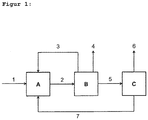
- the basic sequence of the method according to the invention is in FIG. 1 shown.
- the educts (1) are fed to a reactor (A) individually or as a mixture.
- the Umvinyl michsretress takes place.
- the resulting reaction mixture (2) is freed from educt vinyl ester (3) and its corresponding acid (4) in a distillation apparatus (B).
- the starting vinyl ester (3) is optionally recycled to the reactor (A).
- From the remaining product mixture (5) is then the product vinyl ester (6) in a distillation apparatus (C) completely or partially separated.
- the remaining catalyst-containing reaction sump (7) is returned to the reactor (A) and thus the catalyst is used again.
- reactor (A) stirred tank, stirred tank cascades or tubular reactors can be used.
- the reactor (A) is a tubular reactor.
- R can be an aliphatic radical having 1 to 12 C atoms or can be a cycloaliphatic radical having up to 12 C atoms, or an aromatic radical having up to 12 carbon atoms.
- R low molecular weight Eduktvinylester, wherein R is an alkyl group having 1 to 6 carbon atoms, for example, vinyl acetate, vinyl propionate and vinyl pivalate.
- Particularly preferred is the use of vinyl acetate.
- the reactor is fed to at least one Eduktcarbonklare the general formula R'-COOH, where R 'may be an aliphatic radical having 1 to 22 carbon atoms, or may be a cycloaliphatic radical having up to 22 carbon atoms, or an aromatic radical with up to 22 carbon atoms can be.
- R ' may be an aliphatic radical having 1 to 22 carbon atoms, or may be a cycloaliphatic radical having up to 22 carbon atoms, or an aromatic radical with up to 22 carbon atoms can be.
- Preference is given to using educt carboxylic acids of the aforementioned classes of compounds having 6 to 18 carbon atoms.
- caproic acid examples include caproic acid, cyclohexanecarboxylic acid, n-heptanoic acid, 2-methylhexanoic acid, 2-ethylhexanoic acid, n-octanoic acid, n-nonanoic acid, isononanoic acid, neononanoic acid, n-decanoic acid, neodecanoic acid, lauric acid, myristic acid, palmitic acid, stearic acid, benzoic acid, naphthalenecarboxylic acid.
- Versatic acids R alpha-branched carboxylic acids having 9 to 12 C atoms from the company Momentive
- neo-acids having 9 to 12 C atoms and fatty acids such as lauric acid, myristic acid, palmitic acid, stearic acid are particularly preferred.
- the catalyst used is a carbonyl-free Ru (III) carboxylate.
- the addition can take place in solid and dissolved form.
- the carbonyl-free Ru (III) carboxylate is preferably used in dissolved form.
- Carboxylates which can be used are carboxylates of carboxylic acids of the general formula R "-COOH, where R" can be an aliphatic radical having 1 to 22 C atoms, or a cycloaliphatic radical having up to 22 C atoms, or an aromatic radical with up to 22 carbon atoms can be.
- carboxylates of the following carboxylic acids examples include acetic acid, propionic acid, n-butyric acid, isobutyric acid, n-valeric acid, 2-methylbutyric acid, 3-methylbutyric acid, pivalic acid, caproic acid, cyclohexanecarboxylic acid, n-heptanoic acid, 2-methylhexanoic acid, 2-ethylhexanoic acid, n-octanoic acid, n-nonanoic acid, isononanoic acid, neononanoic acid, n-decanoic acid, neodecanoic acid, lauric acid, myristic acid, palmitic acid, stearic acid, benzoic acid, naphthalenecarboxylic acid.
- a Ru (III) acetate Preference is given to the use of a Ru (III) acetate.
- the stated carbonyl-free Ru (III) carboxylates are also accessible by reaction of RuCl 3 with the corresponding carboxylic acid by methods known to those skilled in the art.
- Suitable solvents are the carboxylic acids just described. Preference is given to the use of acetic acid.
- the concentration of the carbonyl-free Ru (III) carboxylate in the solvent may be 0.01 to 50 wt .-%, preferably 0.1 to 20 wt .-%, particularly preferably 1 to 10 wt .-%.
- the ruthenium catalyst is typically used in concentrations of 0.1 to 10,000 ppm (ruthenium content based on the reaction mass of starting vinyl ester and educt carboxylic acid), the use of from 1 to 1000 ppm (content of ruthenium based on the reaction mass of starting vinyl ester and educt carboxylic acid) being preferred.
- a polymerization inhibitor may be added to the starting materials.
- TEMPO 2,2,6,6-tetramethylpiperidinyloxy
- an anhydride of the respective reactant carboxylic acid can be added as starting material.
- Examples of these are mixed or symmetrical anhydrides of the following acids: acetic acid, propionic acid, n-butyric acid, isobutyric acid, n-valeric acid, 2-methylbutyric acid, 3-methylbutyric acid, pivalic acid, caproic acid, cyclohexanecarboxylic acid, n-heptanoic acid, 2-methylhexanoic acid, 2-ethylhexanoic acid , n-octanoic acid, n-nonanoic acid, isononanoic acid, neononanoic acid, n-decanoic acid, neodecanoic acid, lauric acid, myristic acid, palmitic acid, stearic acid, benzoic acid, naphthalenecarboxylic acid.
- the symmetrical anhydrides of the educt carboxylic acid are preferably used.
- the molar ratio of starting vinyl ester to educt carboxylic acid can be from 1:10 to 10: 1.
- the Umvinyl ist is generally carried out at a temperature of 110 ° C to 170 ° C, preferably at a temperature of 120 ° C to 150 ° C.
- the pressure at which the Umvinyl mich is dependent on the temperature and is generally ⁇ 2 bar abs., Preferably 5 to 15 bar abs., And most preferably 5 to 10 bar abs ..
- the reaction is without supply of carbon monoxide and preferably in a protective gas atmosphere, for example Nitrogen, in a conventional manner performed.
- the residence time in the reactor in the process according to the invention is generally 0.25 to 5 hours, preferably 1 hour to 4 hours.
- the separation of the product mixture obtained takes place only after completion of the transvinylation, preferably by distillation in corresponding distillation columns.
- the pressure and temperature of the distillation and the design of the distillation columns depend on the components present in the product mixture and can be determined for example by means of routine experiments by a person skilled in the art. Consequently, no reactive distillation or azeotropic distillation is carried out in the process according to the invention.
- the unreacted residue of the starting vinyl ester and its corresponding acid are each separated from the product mixture in a first step.
- the Eduktvinylester thus obtained may optionally be recycled for re-Umvinyltechnik in the reactor.
- the corresponding acid of the Eduktvinylesters thus obtained can be used as starting material in other chemical processes; in the case of acetic acid, for example, for the production of vinyl acetate.
- the product vinyl ester is removed from the product mixture remaining after separation of the starting vinyl ester and its corresponding acid by distillation at least partially or completely separated.
- the resulting reaction bottom which Eduktcarbonchure, anhydrides of Eduktcarbonchure, ruthenium catalyst and optionally other components such as vinyl acetate or polymeric components may contain, with the addition of fresh starting materials and optionally fresh, carbonyl-free Ru (III) carboxylate in the reactor for a re-Umvinyl mich recycled.
- the substeps of the process can be carried out batchwise, semicontinuously and fully continuously.
- the process is preferably carried out fully continuously.
- Carbonyl-free Ru (III) carboxylate complexes can be used as catalysts in the transvinylation of carboxylic acids with the process according to the invention. Surprisingly, it has been found that at temperatures of ⁇ 110 ° C, even at residence times in the reaction zone of less than 5 h, the Ru-carboxylate species can be converted into the active species.
- the indicated conversions refer in all cases to the starting component starting material carboxylic acid (2S) or starting vinyl ester (IV) used in the lower molar fraction.
- the example shows that when using ruthenium acetate solution as a catalyst at a temperature of 140 ° C, the formation of the catalytically active species within residence times less than 5 hours. After 1.5 hours, the equilibrium state of the reaction is reached.
Landscapes
- Chemical & Material Sciences (AREA)
- Organic Chemistry (AREA)
- Engineering & Computer Science (AREA)
- Oil, Petroleum & Natural Gas (AREA)
- Chemical Kinetics & Catalysis (AREA)
- Inorganic Chemistry (AREA)
- Materials Engineering (AREA)
- Organic Low-Molecular-Weight Compounds And Preparation Thereof (AREA)
- Low-Molecular Organic Synthesis Reactions Using Catalysts (AREA)
Description
- Die Erfindung betrifft ein Verfahren zur Umvinylierung einer Eduktcarbonsäure mit einem Eduktvinylester zu einem Produktvinylester und der korrespondierenden Säure des Eduktvinylesters in Gegenwart von einem oder mehreren Rutheniumkatalysatoren.
- Die Umvinylierung von Carbonsäuren dient der Darstellung von Vinylestern. Darunter versteht man die Übertragung einer Vinyl-Einheit eines Eduktvinylesters (1V) auf eine Eduktcarbonsäure (2S) unter Generierung eines Produktvinylesters (2V) und der korrespondierenden Säure des Eduktvinylesters (1S).

- Aus der
EP 376075 B1 - Neben Palladium-Katalysatoren und Quecksilber-Katalysatoren werden im Stand der Technik zur Umvinylierung von Vinylestern mit Carbonsäuren auch Ruthenium-Verbindungen als Katalysator eingesetzt. Ruthenium-Verbindungen zeichnen sich durch ihre hohe Löslichkeit, geringe Flüchtigkeit und hohe thermische Stabilität aus. Hinzu kommt eine hohe, Temperatur-induzierbare Aktivität.
- In der
EP 351603 A2 EP 506070 US 4981973 ,US 5155253 ) wird ein Verfahren zur Umvinylierung von Carbonsäuren unter Verwendung verschiedener Ru-Verbindungen als Katalysatoren beschrieben. Die Autoren postulieren eine [Ru(CO)2RCO2]-Einheit als entscheidendes Strukturelement bei der Bildung der aktiven Spezies. Demzufolge können alle Ru-Verbindungen als Katalysatoren eingesetzt werden, die sich in situ in dieses Strukturelement umwandeln lassen. Als geeignete Ausgangsspezies wird unter anderem der industriell verfügbare trinukleare Ru-Komplex [Ru3O(OAc)6(H2O)3]OAc genannt und es wird festgestellt, dass dieses carbonyl-freie Ruthenium-Carboxylat auch unter Stickstoff- statt Kohlenstoffmonoxid-Atmosphäre in die aktive Katalysatorspezies überführt wird. In Beispiel 2, 5, 6 und 14 wird dieser Komplex als Katalysator in der Umvinylierung verschiedener Carbonsäuren eingesetzt. Während die Umsetzung in den Beispielen 2, 5 und 6 unter Kohlenstoffmonoxid-Atmosphäre und bei Reaktionsdauern von 3 bzw. 4,5 Stunden stattfindet, erfolgt die Umvinylierung in Beispiel 14 bei 100°C unter Stickstoffatmosphäre. Die dabei signifikant längere Reaktionsdauer von 19 h ist auf eine verlangsamte Formierung der aktiven Katalysatorspezies in Abwesenheit von Kohlenstoffmonoxid zurückzuführen. Der Einsatz von [Ru3O(OAc)6(H2O)3]OAc in einem kontinuierlichen Verfahren wird nicht beschrieben. - In Adv. Synth. Catal. 2013, 355, 2845 - 2859 wird die Theorie der
EP 351603 A2 - Die
EP 497340 A2 US5210207 ) beschreibt ein Umvinylierungsverfahren zur Darstellung von Produktvinylestern, deren Siedepunkte höher liegen als die der Eduktvinylester. Durch Reaktivdestillation von mindestens einer der Produktkomponenten wird das Gleichgewicht der Reaktion auf die Produktseite verschoben. Bevorzugt werden hierfür die inEP 351603 A2 - In der
WO 92/09554 A1 EP 351603 A2 - Die
WO 2013/117294 A1 beschreibt ein kontinuierliches Verfahren zur Darstellung von Carbonsäurevinylestern. Die übergangsmetallkatalysierte Umvinylierung wird im stationären Zustand betrieben und das Reaktionsgemisch in einem Folgeschritt aufgetrennt.WO 2013/117295 beschreibt eine weitere Ausgestaltung dieses Verfahrens mit einer nachträglichen Derivatisierung der entstehenden, konjugaten Säure des Eduktvinylesters. In den Beispielen beider Schriften werden hauptsächlich Pd-Katalysatoren für die Umvinylierung eingesetzt. In zwei Beispielen wird als Ru-Katalysator Ruthenium-Dicarbonylacetat eingesetzt. Carbonylfreie Rutheniumcarboxylate werden als Katalysatoren nicht beschrieben. - Die Verwendung von Ru-Katalysatoren in der Umvinylierungsreaktion birgt deutliche Vorteile gegenüber Pd-Katalysatoren hinsichtlich Löslichkeit, Flüchtigkeit, thermische Stabilität und thermisch induzierbarer Aktivität. Zahlreiche Ru-Verbindungen lassen sich in situ zu aktiven Ru-Spezies umwandeln. Aufgrund ihrer großtechnischen Verfügbarkeit sind dabei vor allem Ruthenium(III)chlorid und der trinukleare, carbonylfreie Ru-Acetat-Komplex [Ru3O(OAc)6(H2O)n(AcOH)3-n]OAc mit n = 0 bis 3, oder dessen (Lösungsmittel-freies) Analogon [Ru3O(OAc)6]OAc vorteilhaft. Während ersterer durch Zugabe einer Base erst formiert werden muss, benötigt der Ru-Acetat-Komplex gemäß dem Stand der Technik eine Kohlenstoffmonoxid-Atmosphäre um in kurzen Reaktionszeiten zur aktiven Spezies umgewandelt zu werden. Die Vermeidung einer Kohlenstoffmonoxid-Zuführung ist aus sicherheitstechnischen Gründen jedoch höchst erstrebenswert. Ein Verfahren, in dem ein kommerziell verfügbarer Katalysator ohne Zusatz von Kohlenstoffmonoxid innerhalb kurzer Reaktionszeiten in die aktive Spezies überführt wird und daher für den Einsatz in kontinuierlichen Umvinylierungsprozessen geeignet ist, ist bislang unbekannt.
- Es bestand daher die Aufgabe ein Umvinylierungsverfahren zu entwickeln, bei dem der eingesetzte Katalysator ohne Zusatz von Kohlenstoffmonoxid innerhalb der Verweilzeit in der Reaktionszone in die katalytisch aktive Spezies überführt wird.
- Gegenstand der Erfindung ist ein Verfahren zur Umvinylierung einer Eduktcarbonsäure mit einem Eduktvinylester zu einem Produktvinylester und der korrespondierenden Säure des Eduktvinylesters in Gegenwart von einem oder mehreren Rutheniumkatalysatoren, wobei
- a) der Eduktvinylester, die Eduktcarbonsäure und ein Ruthenium-katalysator dem Reaktor zugeführt werden, und
- b) die Umvinylierungsreaktion durchgeführt wird,
- c) die Reaktion bei einer Temperatur von 110°C bis 170°C durchgeführt wird
- d) nach Abschluss der Umvinylierungsreaktion der Eduktvinylester und die korrespondierende Säure aus dem Reaktionsgemisch destillativ abgetrennt werden,
- e) aus dem Sumpfprodukt der Destillation der Produktvinylester destillativ abgetrennt wird, und
- f) das verbleibende Reaktionsgemisch in den Reaktor zurückgeführt wird.
- Der prinzipielle Ablauf des erfindungsgemäßen Verfahrens ist in
Figur 1 dargestellt. Die Edukte (1) werden einem Reaktor (A) einzeln oder als Gemisch zugeführt. Im Reaktor (A) erfolgt die Umvinylierungsreaktion. Das resultierende Reaktionsgemisch (2) wird in einer Destillationsvorrichtung (B) von Eduktvinylester (3) und dessen korrespondierender Säure (4) befreit. Der Eduktvinylester (3) wird gegebenenfalls dem Reaktor (A) zurückgeführt. Vom verbleibenden Produktgemisch (5) wird anschließend der Produktvinylester (6) in einer Destillationsvorrichtung (C) vollständig oder teilweise abgetrennt. Der zurückbleibende Katalysatorhaltige Reaktionssumpf (7) wird in den Reaktor (A) zurückgeführt und der Katalysator somit erneut eingesetzt. - Als Reaktor (A) können Rührkessel, Rührkessel-Kaskaden oder Rohrreaktoren eingesetzt werden. Vorzugsweise ist der Reaktor (A) ein Rohrreaktor.
- Als Eduktvinylester können beliebige Carbonsäurevinylester der allgemeinen Formel R-C(O)O-CH=CH2 eingesetzt werden, wobei R ein aliphatischen Rest mit 1 bis 12 C-Atomen sein kann, oder ein cycloaliphatischer Rest mit bis zu 12 C-Atomen sein kann, oder ein aromatischer Rest mit bis zu 12 C-Atomen sein kann. Bevorzugt ist die Verwendung niedermolekularer Eduktvinylester, wobei R ein Alkylrest mit 1 bis 6 C-Atomen ist, beispielsweise Vinylacetat, Vinylpropionat und Vinylpivalat. Besonders bevorzugt ist die Verwendung von Vinylacetat.
- Ferner wird dem Reaktor mindestens eine Eduktcarbonsäure der allgemeinen Formel R'-COOH zugeführt, wobei R' ein aliphatischer Rest mit 1 bis 22 C-Atomen sein kann, oder ein cycloaliphatischer Rest mit bis zu 22 C-Atomen sein kann, oder ein aromatischer Rest mit bis zu 22 C-Atomen sein kann. Bevorzugt werden Eduktcarbonsäuren der genannten Verbindungsklassen mit 6 bis 18 C-Atomen eingesetzt. Beispiele hierfür sind Capronsäure, Cyclohexancarbonsäure, n-Heptansäure, 2-Methylhexansäure, 2-Ethylhexansäure, n-Octansäure, n-Nonansäure, Isononansäure, Neononansäure, n-Decansäure, Neodecansäure, Laurinsäure, Myristinsäure, Palmitinsäure, Stearinsäure, Benzoesäure, Naphthalincarbonsäure. Besonders bevorzugt werden VersaticsäurenR (alphaverzweigte Carbonsäuren mit 9 bis 12 C-Atomen der Fa. Momentive) oder Neo-Säuren mit 9 bis 12 C-Atomen und Fettsäuren wie Laurinsäure, Myristinsäure, Palmitinsäure, Stearinsäure.
- Als Katalysator wird ein carbonylfreies Ru(III)-Carboxylat eingesetzt. Die Zugabe kann in fester und gelöster Form erfolgen. Bevorzugt wird das carbonylfreie Ru(III)-Carboxylat in gelöster Form eingesetzt. Als Carboxylate können Carboxylate von Carbonsäuren der allgemeinen Formel R"-COOH eingesetzt werden, wobei R" ein aliphatischer Rest mit 1 bis 22 C-Atomen sein kann, oder ein cycloaliphatischer Rest mit bis zu 22 C-Atomen sein kann, oder ein aromatischer Rest mit bis zu 22 C-Atomen sein kann. Beispiele hierfür sind die Carboxylate folgender Carbonsäuren: Essigsäure, Propionsäure, n-Buttersäure, iso-Buttersäure, n-Valeriansäure, 2-Methylbuttersäure, 3-Methylbüttersäure, Pivalinsäure, Capronsäure, Cyclohexancarbonsäure, n-Heptansäure, 2-Methylhexansäure, 2-Ethylhexansäure, n-Octansäure, n-Nonansäure, Isononansäure, Neononansäure, n-Decansäure, Neodecansäure, Laurinsäure, Myristinsäure, Palmitinsäure, Stearinsäure, Benzoesäure, Naphthalincarbonsäure. Bevorzugt ist die Verwendung eines Ru(III)-Acetats.
- Die carbonylfreien Ru(III)-Carboxylate sind kommerziell erhältlich, beispielsweise das Ru(III)-Carboxylat der Formel [Ru3O(OAc)6(H2O)n(AcOH)3-n]OAc mit n =0 bis 3 oder der Formel [Ru3O(OAc)6]OAc, wobei Ac jeweils für einen Rest CH3-C=O steht. Die genannten carbonylfreien Ru(III)-Carboxylate sind auch durch Umsetzung von RuCl3 mit der entsprechenden Carbonsäure mittels dem Fachmann bekannter Verfahren zugänglich. [Ru3O(OAc)6(H2O)n(AcOH)3-n]OAc mit n = 0 bis 3 oder [Ru3O(OAc)6]OAc kann beispielsweise mittels Umsetzung von RuCl3 mit Essigsäure und Natriumacetat in Ethanol erhalten werden.
- Als Lösungsmittel eignen sich die gerade beschriebenen Carbonsäuren. Bevorzugt ist die Verwendung von Essigsäure. Die Konzentration des carbonylfreien Ru(III)-Carboxylats im Lösungsmittel kann 0,01 bis 50 Gew.-% betragen, bevorzugt 0,1 bis 20 Gew.-%, besonders bevorzugt 1 bis 10 Gew.-%.
- Besonders bevorzugt wird eine Lösung von Ruthenium(III)-Acetat in Essigsäure, am meisten bevorzugt eine Lösung von [Ru3O(OAc)6(H2O)n(AcOH)3-n]OAc mit n =0 bis 3 oder [Ru3O(OAc)6]OAc jeweils in Essigsäure eingesetzt.
- Der Rutheniumkatalysator wird typischerweise in Konzentrationen von 0,1 bis 10000 ppm (Gehalt Ruthenium bezogen auf die Reaktionsmasse aus Eduktvinylester und Eduktcarbonsäure) eingesetzt, bevorzugt ist die Verwendung von 1 bis 1000 ppm (Gehalt Ruthenium bezogen auf die Reaktionsmasse aus Eduktvinylester und Eduktcarbonsäure).
- Den Edukten kann gegebenenfalls ein Polymerisationsinhibitor zugesetzt werden. Bevorzugt werden 100 bis 10000 ppm, bezogen auf die Reaktionsmasse aus Eduktvinylester und Eduktcarbonsäure, Polymerisationsinhibitor eingesetzt. Beispiele für Polymerisationsinhibitoren sind Hydrochinon, Methoxyhydrochinon, tertiär-Butylcatechol, Phenothiazin oder Nitroxidradikale wie TEMPO oder 4-OH-TEMPO (TEMPO = 2,2,6,6-Tetramethylpiperidinyloxyl). Bevorzugt ist die Verwendung von Phenothiazin oder Hydrochinon.
- Gegebenenfalls kann auch ein Anhydrid der jeweiligen Eduktcarbonsäure als Edukt zugegeben werden. Die gegebenenfalls zugeführten Anhydride der Eduktcarbonsäure der allgemeinen Formel R1-C(O)-O-C(O)-R2 können als gemischte (R1 ≠ R2) oder symmetrische (R1 = R2) Anhydride vorliegen, wobei R1 und R2 jeweils einen aliphatischen Rest mit 1 bis 22 C-Atomen, oder einen cycloliphatischen Rest mit bis zu 22 C-Atomen oder einen aromatischen Rest mit bis zu 22 C-Atomen darstellt. Beispiele hierfür sind gemischte oder symmetrische Anhydride folgender Säuren: Essigsäure, Propionsäure, n-Buttersäure, iso-Buttersäure, n-Valeriansäure, 2-Methylbuttersäure, 3-Methylbuttersäure, Pivalinsäure, Capronsäure, Cyclohexancarbonsäure, n-Heptansäure, 2-Methylhexansäure, 2 Ethylhexansäure, n-Octansäure, n-Nonansäure, Isononansäure, Neononansäure, n-Decansäure, Neodecansäure, Laurinsäure, Myristinsäure, Palmitinsäure, Stearinsäure, Benzoesäure, Naphtalincarbonsäure. Bevorzugt werden die symmetrischen Anhydride der Eduktcarbonsäure eingesetzt.
- Zur Umvinylierung können die Reaktanden Eduktvinylester, Eduktcarbonsäure und Ru-Katalysator, sowie gegebenenfalls Inhibitor sowie gegebenenfalls Anhydrid der Eduktcarbonsäure, dem Reaktor einzeln oder in einem Gemisch zugeführt werden.
- Das molare Verhältnis von Eduktvinylester zu Eduktcarbonsäure kann 1 : 10 bis 10 : 1 betragen. Bevorzugt ist ein Verhältnis von Eduktvinylester zu Eduktcarbonsäure von 1 : 2 bis 8 : 1, besonders bevorzugt ist ein Verhältnis von 1 : 1 bis 6 : 1.
- Die Umvinylierung wird im Allgemeinen bei einer Temperatur von 110°C bis 170°C, vorzugsweise bei einer Temperatur von 120°C bis 150°C durchgeführt. Der Druck, bei welchem die Umvinylierung erfolgt, ist von der Temperatur abhängig und beträgt im Allgemeinen ≥ 2 bar abs., vorzugsweise 5 bis 15 bar abs., und am meisten bevorzugt 5 bis 10 bar abs.. Die Reaktion wird ohne Zuführung von Kohlenstoffmonoxid und bevorzugt in einer Schutzgasatmosphäre, beispielsweise Stickstoff, in an sich bekannter Weise, durchgeführt.
- Die Verweilzeit im Reaktor beträgt bei dem erfindungsgemäßen Verfahren im Allgemeinen 0,25 bis 5 Stunden, vorzugsweise 1 Stunde bis 4 Stunden.
- Im Unterschied zu einer Reaktivdestillation erfolgt im erfindungsgemäßen Verfahren die Auftrennung des erhaltenen Produktgemisches erst nach Abschluss der Umvinylierung vorzugsweise mittels Destillation in entsprechenden Destillationskolonnen. Druck und Temperatur der Destillation sowie die Auslegung der Destillationskolonnen hängen von den im Produktgemisch vorliegenden Komponenten ab und können beispielsweise mittels Routineversuchen vom Fachmann ermittelt werden. Bei dem erfindungsgemäßen Verfahren wird folglich keine Reaktivdestillation oder Azeotropdestillation durchgeführt.
- Bei der Auftrennung des Produktgemisches werden in einem ersten Schritt der nicht umgesetzte Rest des Eduktvinylesters und dessen korrespondierende Säure jeweils aus dem Produktgemisch abgetrennt. Der damit erhaltene Eduktvinylester kann gegebenenfalls zur neuerlichen Umvinylierung in den Reaktor zurückgeführt werden. Die damit erhaltene korrespondierende Säure des Eduktvinylesters kann als Edukt in anderen chemischen Prozessen eingesetzt werden; im Falle von Essigsäure beispielsweise zur Herstellung von Vinylacetat.
- In einer bevorzugten Ausführungsform wird der Produktvinylester aus dem, nach Abtrennung des Eduktvinylesters und dessen korrespondierende Säure, verbleibenden Produktgemisch durch Destillation zumindest teilweise oder vollständig abgetrennt. Der resultierende Reaktionssumpf, welcher Eduktcarbonsäure, Anhydride der Eduktcarbonsäure, Ruthenium-Katalysator und gegebenenfalls weitere Komponenten wie Produktvinylester oder polymere Bestandteile enthalten kann, wird unter Zusatz von frischen Edukten und gegebenenfalls frischem, carbonylfreiem Ru(III)-Carboxylat in den Reaktor für eine neuerliche Umvinylierung zurückgeführt.
- Der Zusatz von frischen Edukten und gegebenenfalls frischem, carbonylfreiem Ru(III)-Carboxylat in den Reaktor für eine neuerliche Umvinylierung kann jeweils im Gemisch mit dem zurückgeführten Reaktionssumpf erfolgen oder jeweils getrennt vom zurückgeführten Reaktionssumpf erfolgen.
- Die Teilschritte des Verfahrens, sowohl die Umvinylierung als auch die Aufarbeitungsschritte, können diskontinuierlich, semikontinuierlich und vollkontinuierlich durchgeführt werden. Das Verfahren wird bevorzugt vollkontinuierlich durchgeführt.
- Mit dem erfindungsgemäßen Verfahren können carbonylfreie Ru(III)-Carboxylat-Komplexe als Katalysatoren in der Umvinylierung von Carbonsäuren eingesetzt werden. Überraschend wurde gefunden, dass bei Temperaturen von ≥ 110°C, selbst bei Verweilzeiten in der Reaktionszone von kleiner als 5 h die Ru-Carboxylat-Spezies in die aktive Spezies überführt werden kann.
- Durch das erfindungsgemäße Verfahren ist keine Kohlenstoffmonoxid-Zuführung nötig. Ferner wird der Einsatz kommerziell erhältlicher Katalysatoren in kontinuierlichen Umvinylierungsprozessen möglich.
- Die nachfolgenden Beispiele dienen der näheren Erläuterung der Erfindung.
- Die angegebenen Umsätze beziehen sich in allen Fällen auf die im geringeren molaren Anteil eingesetzte Ausgangskomponente Eduktcarbonsäure (2S) oder Eduktvinylester (IV). Der Umsatz U ist definiert als U (%) = 100 x (n0-nE)/n0, wobei n0 die Stoffmenge der Ausgangskomponente zu Beginn der Reaktion und nE die Stoffmenge am Ende der Reaktion darstellt.
- Umvinylierung mit Ru-Acetat-Lösung als Katalysator bei 100°C.
- In einem 100 ml Berghoff-Autoklav wurden 25,0 g (125 mmol) Laurinsäure, 43,0 g (500 mmol) Vinylacetat und 0,69 g (0,9 mmol) [Ru3O(OAc)6(H2O)3]OAc (4,5 Gew.-% Ru, gelöst in Essigsäure der Fa. Umicore) bei 2,0 bar abs. 6 Stunden lang auf 100°C erhitzt.
- Umvinylierung mit Ru-Acetat-Lösung als Katalysator bei 140°C.
- In einem 100 ml Berghoff-Autoklav wurden 25,0 g (125 mmol) Laurinsäure, 43,0 g (500 mmol) Vinylacetat und 0,69 g (0,9 mmol) [Ru3O(OAc)6(H2O)3]OAc (4,5 Gew.-% Ru, gelöst in Essigsäure der Fa. Umicore) bei 6,0 bar abs. 5 Stunden lang auf 140°C erhitzt.
- In beiden Fällen wurden in definierten Zeitabständen Proben genommen und die für die Berechnung von Umsatz benötigten molaren Anteile im Reaktionsgemisch mittels quantitativer NMR-Spektroskopie ermittelt.
Zeit [h] Umsatz Laurinsäure[%] V.Bsp. 1 100°C Bsp. 2 140°C 0 0 0 1,5 0, 9 78,4 3 1,6 79,7 4,5 2,6 79,3 - Das Beispiel zeigt, dass bei Verwendung von Ruthenium-Acetat-Lösung als Katalysator bei einer Temperatur von 140°C die Bildung der katalytisch aktiven Spezies innerhalb Verweilzeiten kleiner 5 Stunden erfolgt. Bereits nach 1,5 Stunden ist der Gleichgewichtszustand der Reaktion erreicht.
als Rutheniumkatalysator ein carbonylfreies Ru(III)-Carboxylat eingesetzt wird, und kein Kohlenstoffmonoxid zugeführt wird,
Claims (10)
- Verfahren zur Umvinylierung einer Eduktcarbonsäure mit einem Eduktvinylester zu einem Produktvinylester und der korrespondierenden Säure des Eduktvinylesters in Gegenwart von einem oder mehreren Rutheniumkatalysatoren, wobeia) der Eduktvinylester, die Eduktcarbonsäure und ein Rutheniumkatalysator dem Reaktor zugeführt werden, undb) die Umvinylierungsreaktion durchgeführt wird,dadurch gekennzeichnet, dass
als Rutheniumkatalysator ein carbonylfreies Ru(III)-Carboxylat eingesetzt wird, und kein Kohlenstoffmonoxid zugeführt wird,c) die Reaktion bei einer Temperatur von 110°C bis 170°C durchgeführt wirdd) nach Abschluss der Umvinylierungsreaktion der Eduktvinylester und die korrespondierende Säure aus dem Reaktionsgemisch destillativ abgetrennt werden,e) aus dem Sumpfprodukt der Destillation der Produktvinylester destillativ abgetrennt wird, undf) das verbleibende Reaktionsgemisch in den Reaktor zurückgeführt wird. - Verfahren nach Anspruch 1, dadurch gekennzeichnet, dass die Verweilzeit in der Reaktionszone 0,25 bis 5 Stunden beträgt.
- Verfahren nach Anspruch 1 oder 2, dadurch gekennzeichnet, dass die Reaktion bei einer Temperatur von 120°C bis 150°C durchgeführt wird.
- Verfahren nach Anspruch 1 bis 3, dadurch gekennzeichnet, dass [Ru3O(OAc)6(H2O)n(AcOH)3-n]OAc mit n = 0 bis 3 oder [Ru3O(OAc)6]OAc als Rutheniumkatalysator eingesetzt wird.
- Verfahren nach Anspruch 1 bis 4, dadurch gekennzeichnet, dass als Rutheniumkatalysator eine Lösung von [Ru3O(OAc)6(H2O)n(AcOH)3-n]OAc mit n = 0 bis 3 oder [Ru3O(OAc)6]OAc jeweils in Essigsäure eingesetzt wird.
- Verfahren nach Anspruch 1 bis 5, dadurch gekennzeichnet, dass als Eduktvinylester ein Carbonsäurevinylester der allgemeinen Formel R-C(O)O-CH=CH2 eingesetzt wird, wobei R ein aliphatischen Rest mit 1 bis 12 C-Atomen ist, oder ein cycloaliphatischer Rest mit bis zu 12 C-Atomen ist, oder ein aromatischer Rest mit bis zu 12 C-Atomen ist.
- Verfahren nach Anspruch 1 bis 5, dadurch gekennzeichnet, dass als Eduktvinylester Vinylacetat eingesetzt wird.
- Verfahren nach Anspruch 1 bis 7, dadurch gekennzeichnet, dass als Eduktcarbonsäure eine Carbonsäure der allgemeinen Formel R'-COOH eingesetzt wird, wobei R' ein aliphatischer Rest mit 1 bis 22 C-Atomen ist, oder ein cycloaliphatischer Rest mit bis zu 22 C-Atomen ist, oder ein aromatischer Rest mit bis zu 22 C-Atomen ist.
- Verfahren nach Anspruch 1 bis 7, dadurch gekennzeichnet, dass als Eduktcarbonsäure eine Carbonsäure eingesetzt wird aus der Gruppe umfassend Versaticsäuren und Neo-Säuren, jeweils mit 9 bis 12 C-Atomen, und Fettsäuren wie Laurinsäure, Myristinsäure, Palmitinsäure, Stearinsäure.
- Verfahren nach Anspruch 1 bis 7, dadurch gekennzeichnet, dass ein Anhydrid der jeweiligen Eduktcarbonsäure als Edukt zugegeben wird.
Applications Claiming Priority (2)
| Application Number | Priority Date | Filing Date | Title |
|---|---|---|---|
| DE102014206916.5A DE102014206916A1 (de) | 2014-04-10 | 2014-04-10 | Verfahren zur Ruthenium-katalysierten Umvinylierung von Carbonsäuren |
| PCT/EP2015/056109 WO2015154979A1 (de) | 2014-04-10 | 2015-03-23 | Verfahren zur ruthenium-katalysierten umvinylierung von carbonsäuren |
Publications (2)
| Publication Number | Publication Date |
|---|---|
| EP3129348A1 EP3129348A1 (de) | 2017-02-15 |
| EP3129348B1 true EP3129348B1 (de) | 2018-05-02 |
Family
ID=52697448
Family Applications (1)
| Application Number | Title | Priority Date | Filing Date |
|---|---|---|---|
| EP15711222.8A Active EP3129348B1 (de) | 2014-04-10 | 2015-03-23 | Verfahren zur ruthenium-katalysierten umvinylierung von carbonsäuren |
Country Status (5)
| Country | Link |
|---|---|
| US (1) | US9695104B2 (de) |
| EP (1) | EP3129348B1 (de) |
| CN (1) | CN106164036B (de) |
| DE (1) | DE102014206916A1 (de) |
| WO (1) | WO2015154979A1 (de) |
Families Citing this family (2)
| Publication number | Priority date | Publication date | Assignee | Title |
|---|---|---|---|---|
| DE102014210835A1 (de) | 2014-06-06 | 2015-12-17 | Wacker Chemie Ag | Verfahren zur Trennung von hochsiedenden Carbonsäurevinylester/Carbonsäure-Gemischen |
| DE102015216373A1 (de) | 2015-08-27 | 2017-03-02 | Wacker Chemie Ag | Verfahren zur katalytischen Umvinylierung von Carbonsäuren |
Family Cites Families (9)
| Publication number | Priority date | Publication date | Assignee | Title |
|---|---|---|---|---|
| US5155253A (en) | 1988-06-30 | 1992-10-13 | Union Carbide Chemicals & Plastics Technology Corporation | Transvinylation process for the preparation of thermally labile vinyl compounds and for vinyl compounds prepared from thermally labile acids |
| US4981973A (en) | 1988-06-30 | 1991-01-01 | Union Carbide Chemicals And Plastics Company, Inc. | Transvinylation reaction |
| JPH02172946A (ja) | 1988-12-26 | 1990-07-04 | Shinetsu Sakusan Vinyl Kk | カルボン酸アルケニルエステルの製造方法 |
| ECSP910793A (es) | 1990-11-30 | 1992-12-21 | Union Carbide Chem Plastics Co Inc | La tecnologia de transvinilacion ayudada azeotropica |
| CA2073510A1 (en) | 1990-12-03 | 1992-06-04 | Celltech Therapeutics Limited | Peptidyl derivatives |
| US5210207A (en) | 1991-01-31 | 1993-05-11 | Union Carbide Chemicals & Plastics Technology Corporation | Transvinylation process by reactive distillation |
| US8921593B2 (en) * | 2010-05-04 | 2014-12-30 | Celanese International Corporation | Process for the semi-continuous transvinylation of carboxylic acids with vinyl acetate |
| DE102012002282A1 (de) | 2012-02-06 | 2013-08-08 | Oxea Gmbh | Verfahren zur Herstellung von Vinylestern |
| DE102012002274A1 (de) | 2012-02-06 | 2013-08-08 | Oxea Gmbh | Verfahren zur Koppelproduktion von Vinylestern und Essigsäurefolgeprodukten oder Propionsäurefolgeprodukten |
-
2014
- 2014-04-10 DE DE102014206916.5A patent/DE102014206916A1/de not_active Withdrawn
-
2015
- 2015-03-23 US US15/302,745 patent/US9695104B2/en active Active
- 2015-03-23 WO PCT/EP2015/056109 patent/WO2015154979A1/de not_active Ceased
- 2015-03-23 EP EP15711222.8A patent/EP3129348B1/de active Active
- 2015-03-23 CN CN201580018900.1A patent/CN106164036B/zh active Active
Non-Patent Citations (1)
| Title |
|---|
| None * |
Also Published As
| Publication number | Publication date |
|---|---|
| US9695104B2 (en) | 2017-07-04 |
| WO2015154979A1 (de) | 2015-10-15 |
| EP3129348A1 (de) | 2017-02-15 |
| DE102014206916A1 (de) | 2015-10-15 |
| US20170036988A1 (en) | 2017-02-09 |
| CN106164036A (zh) | 2016-11-23 |
| CN106164036B (zh) | 2018-03-30 |
Similar Documents
| Publication | Publication Date | Title |
|---|---|---|
| EP2812307B1 (de) | Verfahren zur herstellung von vinylestern | |
| EP2812306B1 (de) | Transvinylierung als erste stufe einer koppelproduktion von vinylestern und essigsäure- oder propionsäurefolgeprodukten | |
| DE69206162T2 (de) | Transvinylierungsverfahren durch reaktive Destillation. | |
| EP3074373B1 (de) | Verfahren zur ruthenium-katalysierten umvinylierung von carbonsäuren | |
| DE2713195B2 (de) | Verfahren zur Herstellung von Butandicarbonsäureestern | |
| EP0008412B1 (de) | Verfahren zur Herstellung von Butandicarbonsäureestern | |
| EP0001242B1 (de) | Verfahren zur Herstellung von Butandicarbonsäureestern | |
| EP3074372B1 (de) | Verfahren zur ruthenium-katalysierten umvinylierung von carbonsäuren | |
| DE102014206916A1 (de) | Verfahren zur Ruthenium-katalysierten Umvinylierung von Carbonsäuren | |
| EP0021010B1 (de) | Verfahren zur Herstellung von Butandicarbonsäureestern | |
| EP3129137B1 (de) | Verfahren zur darstellung einer aktiven ruthenium-katalysatorlösung für die umvinylierung von carbonsäuren | |
| EP0042928B1 (de) | Verfahren zur Herstellung von Fettsäureestern | |
| EP3209633B1 (de) | Verfahren zur katalytischen umvinylierung von carbonsäuren | |
| EP3152187B1 (de) | Verfahren zur trennung von hochsiedenden carbonsäurevinylester/carbonsäure-gemischen | |
| EP2855409B1 (de) | Verfahren zur aufarbeitung von gemischen | |
| DE19904200A1 (de) | Verfahren zur Herstellung von 3-Alkensäureestern und ein Katalysator zur Durchführung des Verfahrens | |
| EP0003306A1 (de) | Verfahren zur Herstellung von Butandicarbonsäureestern | |
| CH553735A (de) | Verfahren zur herstellung von diphenylen. |
Legal Events
| Date | Code | Title | Description |
|---|---|---|---|
| STAA | Information on the status of an ep patent application or granted ep patent |
Free format text: STATUS: THE INTERNATIONAL PUBLICATION HAS BEEN MADE |
|
| PUAI | Public reference made under article 153(3) epc to a published international application that has entered the european phase |
Free format text: ORIGINAL CODE: 0009012 |
|
| STAA | Information on the status of an ep patent application or granted ep patent |
Free format text: STATUS: REQUEST FOR EXAMINATION WAS MADE |
|
| 17P | Request for examination filed |
Effective date: 20160921 |
|
| AK | Designated contracting states |
Kind code of ref document: A1 Designated state(s): AL AT BE BG CH CY CZ DE DK EE ES FI FR GB GR HR HU IE IS IT LI LT LU LV MC MK MT NL NO PL PT RO RS SE SI SK SM TR |
|
| AX | Request for extension of the european patent |
Extension state: BA ME |
|
| DAV | Request for validation of the european patent (deleted) | ||
| DAX | Request for extension of the european patent (deleted) | ||
| GRAP | Despatch of communication of intention to grant a patent |
Free format text: ORIGINAL CODE: EPIDOSNIGR1 |
|
| STAA | Information on the status of an ep patent application or granted ep patent |
Free format text: STATUS: GRANT OF PATENT IS INTENDED |
|
| RIC1 | Information provided on ipc code assigned before grant |
Ipc: C07C 53/08 20060101ALI20171019BHEP Ipc: C07C 51/09 20060101ALI20171019BHEP Ipc: C07C 51/353 20060101ALI20171019BHEP Ipc: C07C 69/01 20060101ALI20171019BHEP Ipc: C07C 67/10 20060101AFI20171019BHEP Ipc: C07C 67/343 20060101ALI20171019BHEP |
|
| INTG | Intention to grant announced |
Effective date: 20171117 |
|
| GRAS | Grant fee paid |
Free format text: ORIGINAL CODE: EPIDOSNIGR3 |
|
| GRAA | (expected) grant |
Free format text: ORIGINAL CODE: 0009210 |
|
| STAA | Information on the status of an ep patent application or granted ep patent |
Free format text: STATUS: THE PATENT HAS BEEN GRANTED |
|
| AK | Designated contracting states |
Kind code of ref document: B1 Designated state(s): AL AT BE BG CH CY CZ DE DK EE ES FI FR GB GR HR HU IE IS IT LI LT LU LV MC MK MT NL NO PL PT RO RS SE SI SK SM TR |
|
| REG | Reference to a national code |
Ref country code: GB Ref legal event code: FG4D Free format text: NOT ENGLISH |
|
| REG | Reference to a national code |
Ref country code: CH Ref legal event code: EP Ref country code: AT Ref legal event code: REF Ref document number: 995081 Country of ref document: AT Kind code of ref document: T Effective date: 20180515 |
|
| REG | Reference to a national code |
Ref country code: DE Ref legal event code: R096 Ref document number: 502015004126 Country of ref document: DE Ref country code: IE Ref legal event code: FG4D Free format text: LANGUAGE OF EP DOCUMENT: GERMAN |
|
| REG | Reference to a national code |
Ref country code: NL Ref legal event code: FP |
|
| REG | Reference to a national code |
Ref country code: LT Ref legal event code: MG4D |
|
| PG25 | Lapsed in a contracting state [announced via postgrant information from national office to epo] |
Ref country code: ES Free format text: LAPSE BECAUSE OF FAILURE TO SUBMIT A TRANSLATION OF THE DESCRIPTION OR TO PAY THE FEE WITHIN THE PRESCRIBED TIME-LIMIT Effective date: 20180502 Ref country code: LT Free format text: LAPSE BECAUSE OF FAILURE TO SUBMIT A TRANSLATION OF THE DESCRIPTION OR TO PAY THE FEE WITHIN THE PRESCRIBED TIME-LIMIT Effective date: 20180502 Ref country code: FI Free format text: LAPSE BECAUSE OF FAILURE TO SUBMIT A TRANSLATION OF THE DESCRIPTION OR TO PAY THE FEE WITHIN THE PRESCRIBED TIME-LIMIT Effective date: 20180502 Ref country code: BG Free format text: LAPSE BECAUSE OF FAILURE TO SUBMIT A TRANSLATION OF THE DESCRIPTION OR TO PAY THE FEE WITHIN THE PRESCRIBED TIME-LIMIT Effective date: 20180802 Ref country code: NO Free format text: LAPSE BECAUSE OF FAILURE TO SUBMIT A TRANSLATION OF THE DESCRIPTION OR TO PAY THE FEE WITHIN THE PRESCRIBED TIME-LIMIT Effective date: 20180802 Ref country code: SE Free format text: LAPSE BECAUSE OF FAILURE TO SUBMIT A TRANSLATION OF THE DESCRIPTION OR TO PAY THE FEE WITHIN THE PRESCRIBED TIME-LIMIT Effective date: 20180502 |
|
| PG25 | Lapsed in a contracting state [announced via postgrant information from national office to epo] |
Ref country code: GR Free format text: LAPSE BECAUSE OF FAILURE TO SUBMIT A TRANSLATION OF THE DESCRIPTION OR TO PAY THE FEE WITHIN THE PRESCRIBED TIME-LIMIT Effective date: 20180803 Ref country code: RS Free format text: LAPSE BECAUSE OF FAILURE TO SUBMIT A TRANSLATION OF THE DESCRIPTION OR TO PAY THE FEE WITHIN THE PRESCRIBED TIME-LIMIT Effective date: 20180502 Ref country code: LV Free format text: LAPSE BECAUSE OF FAILURE TO SUBMIT A TRANSLATION OF THE DESCRIPTION OR TO PAY THE FEE WITHIN THE PRESCRIBED TIME-LIMIT Effective date: 20180502 Ref country code: HR Free format text: LAPSE BECAUSE OF FAILURE TO SUBMIT A TRANSLATION OF THE DESCRIPTION OR TO PAY THE FEE WITHIN THE PRESCRIBED TIME-LIMIT Effective date: 20180502 |
|
| PG25 | Lapsed in a contracting state [announced via postgrant information from national office to epo] |
Ref country code: CZ Free format text: LAPSE BECAUSE OF FAILURE TO SUBMIT A TRANSLATION OF THE DESCRIPTION OR TO PAY THE FEE WITHIN THE PRESCRIBED TIME-LIMIT Effective date: 20180502 Ref country code: SK Free format text: LAPSE BECAUSE OF FAILURE TO SUBMIT A TRANSLATION OF THE DESCRIPTION OR TO PAY THE FEE WITHIN THE PRESCRIBED TIME-LIMIT Effective date: 20180502 Ref country code: PL Free format text: LAPSE BECAUSE OF FAILURE TO SUBMIT A TRANSLATION OF THE DESCRIPTION OR TO PAY THE FEE WITHIN THE PRESCRIBED TIME-LIMIT Effective date: 20180502 Ref country code: RO Free format text: LAPSE BECAUSE OF FAILURE TO SUBMIT A TRANSLATION OF THE DESCRIPTION OR TO PAY THE FEE WITHIN THE PRESCRIBED TIME-LIMIT Effective date: 20180502 Ref country code: DK Free format text: LAPSE BECAUSE OF FAILURE TO SUBMIT A TRANSLATION OF THE DESCRIPTION OR TO PAY THE FEE WITHIN THE PRESCRIBED TIME-LIMIT Effective date: 20180502 Ref country code: EE Free format text: LAPSE BECAUSE OF FAILURE TO SUBMIT A TRANSLATION OF THE DESCRIPTION OR TO PAY THE FEE WITHIN THE PRESCRIBED TIME-LIMIT Effective date: 20180502 |
|
| REG | Reference to a national code |
Ref country code: DE Ref legal event code: R097 Ref document number: 502015004126 Country of ref document: DE |
|
| PG25 | Lapsed in a contracting state [announced via postgrant information from national office to epo] |
Ref country code: SM Free format text: LAPSE BECAUSE OF FAILURE TO SUBMIT A TRANSLATION OF THE DESCRIPTION OR TO PAY THE FEE WITHIN THE PRESCRIBED TIME-LIMIT Effective date: 20180502 Ref country code: IT Free format text: LAPSE BECAUSE OF FAILURE TO SUBMIT A TRANSLATION OF THE DESCRIPTION OR TO PAY THE FEE WITHIN THE PRESCRIBED TIME-LIMIT Effective date: 20180502 |
|
| PLBE | No opposition filed within time limit |
Free format text: ORIGINAL CODE: 0009261 |
|
| STAA | Information on the status of an ep patent application or granted ep patent |
Free format text: STATUS: NO OPPOSITION FILED WITHIN TIME LIMIT |
|
| 26N | No opposition filed |
Effective date: 20190205 |
|
| PG25 | Lapsed in a contracting state [announced via postgrant information from national office to epo] |
Ref country code: SI Free format text: LAPSE BECAUSE OF FAILURE TO SUBMIT A TRANSLATION OF THE DESCRIPTION OR TO PAY THE FEE WITHIN THE PRESCRIBED TIME-LIMIT Effective date: 20180502 |
|
| PG25 | Lapsed in a contracting state [announced via postgrant information from national office to epo] |
Ref country code: MC Free format text: LAPSE BECAUSE OF FAILURE TO SUBMIT A TRANSLATION OF THE DESCRIPTION OR TO PAY THE FEE WITHIN THE PRESCRIBED TIME-LIMIT Effective date: 20180502 |
|
| REG | Reference to a national code |
Ref country code: CH Ref legal event code: PL |
|
| PG25 | Lapsed in a contracting state [announced via postgrant information from national office to epo] |
Ref country code: LU Free format text: LAPSE BECAUSE OF NON-PAYMENT OF DUE FEES Effective date: 20190323 Ref country code: AL Free format text: LAPSE BECAUSE OF FAILURE TO SUBMIT A TRANSLATION OF THE DESCRIPTION OR TO PAY THE FEE WITHIN THE PRESCRIBED TIME-LIMIT Effective date: 20180502 |
|
| REG | Reference to a national code |
Ref country code: BE Ref legal event code: MM Effective date: 20190331 |
|
| PG25 | Lapsed in a contracting state [announced via postgrant information from national office to epo] |
Ref country code: CH Free format text: LAPSE BECAUSE OF NON-PAYMENT OF DUE FEES Effective date: 20190331 Ref country code: IE Free format text: LAPSE BECAUSE OF NON-PAYMENT OF DUE FEES Effective date: 20190323 Ref country code: LI Free format text: LAPSE BECAUSE OF NON-PAYMENT OF DUE FEES Effective date: 20190331 |
|
| PG25 | Lapsed in a contracting state [announced via postgrant information from national office to epo] |
Ref country code: FR Free format text: LAPSE BECAUSE OF NON-PAYMENT OF DUE FEES Effective date: 20190331 Ref country code: BE Free format text: LAPSE BECAUSE OF NON-PAYMENT OF DUE FEES Effective date: 20190331 |
|
| PG25 | Lapsed in a contracting state [announced via postgrant information from national office to epo] |
Ref country code: TR Free format text: LAPSE BECAUSE OF FAILURE TO SUBMIT A TRANSLATION OF THE DESCRIPTION OR TO PAY THE FEE WITHIN THE PRESCRIBED TIME-LIMIT Effective date: 20180502 |
|
| PG25 | Lapsed in a contracting state [announced via postgrant information from national office to epo] |
Ref country code: MT Free format text: LAPSE BECAUSE OF FAILURE TO SUBMIT A TRANSLATION OF THE DESCRIPTION OR TO PAY THE FEE WITHIN THE PRESCRIBED TIME-LIMIT Effective date: 20180502 Ref country code: PT Free format text: LAPSE BECAUSE OF FAILURE TO SUBMIT A TRANSLATION OF THE DESCRIPTION OR TO PAY THE FEE WITHIN THE PRESCRIBED TIME-LIMIT Effective date: 20180903 |
|
| REG | Reference to a national code |
Ref country code: AT Ref legal event code: MM01 Ref document number: 995081 Country of ref document: AT Kind code of ref document: T Effective date: 20200323 |
|
| PG25 | Lapsed in a contracting state [announced via postgrant information from national office to epo] |
Ref country code: CY Free format text: LAPSE BECAUSE OF FAILURE TO SUBMIT A TRANSLATION OF THE DESCRIPTION OR TO PAY THE FEE WITHIN THE PRESCRIBED TIME-LIMIT Effective date: 20180502 |
|
| PG25 | Lapsed in a contracting state [announced via postgrant information from national office to epo] |
Ref country code: IS Free format text: LAPSE BECAUSE OF FAILURE TO SUBMIT A TRANSLATION OF THE DESCRIPTION OR TO PAY THE FEE WITHIN THE PRESCRIBED TIME-LIMIT Effective date: 20180902 |
|
| PG25 | Lapsed in a contracting state [announced via postgrant information from national office to epo] |
Ref country code: HU Free format text: LAPSE BECAUSE OF FAILURE TO SUBMIT A TRANSLATION OF THE DESCRIPTION OR TO PAY THE FEE WITHIN THE PRESCRIBED TIME-LIMIT; INVALID AB INITIO Effective date: 20150323 |
|
| PG25 | Lapsed in a contracting state [announced via postgrant information from national office to epo] |
Ref country code: AT Free format text: LAPSE BECAUSE OF NON-PAYMENT OF DUE FEES Effective date: 20200323 |
|
| PG25 | Lapsed in a contracting state [announced via postgrant information from national office to epo] |
Ref country code: MK Free format text: LAPSE BECAUSE OF FAILURE TO SUBMIT A TRANSLATION OF THE DESCRIPTION OR TO PAY THE FEE WITHIN THE PRESCRIBED TIME-LIMIT Effective date: 20180502 |
|
| P01 | Opt-out of the competence of the unified patent court (upc) registered |
Effective date: 20230510 |
|
| REG | Reference to a national code |
Ref country code: DE Ref legal event code: R081 Ref document number: 502015004126 Country of ref document: DE Owner name: WACKER CHEMIE AG, DE Free format text: FORMER OWNER: WACKER CHEMIE AG, 81737 MUENCHEN, DE |
|
| PGFP | Annual fee paid to national office [announced via postgrant information from national office to epo] |
Ref country code: GB Payment date: 20260324 Year of fee payment: 12 |
|
| PGFP | Annual fee paid to national office [announced via postgrant information from national office to epo] |
Ref country code: DE Payment date: 20260319 Year of fee payment: 12 |
|
| PGFP | Annual fee paid to national office [announced via postgrant information from national office to epo] |
Ref country code: NL Payment date: 20260319 Year of fee payment: 12 |