EP3129052B1 - Optimal dosing of a cd19-antibody drug conjugate - Google Patents
Optimal dosing of a cd19-antibody drug conjugate Download PDFInfo
- Publication number
- EP3129052B1 EP3129052B1 EP15775944.0A EP15775944A EP3129052B1 EP 3129052 B1 EP3129052 B1 EP 3129052B1 EP 15775944 A EP15775944 A EP 15775944A EP 3129052 B1 EP3129052 B1 EP 3129052B1
- Authority
- EP
- European Patent Office
- Prior art keywords
- dose
- cd19a
- sgn
- adc
- administered
- Prior art date
- Legal status (The legal status is an assumption and is not a legal conclusion. Google has not performed a legal analysis and makes no representation as to the accuracy of the status listed.)
- Not-in-force
Links
Images






Classifications
-
- A—HUMAN NECESSITIES
- A61—MEDICAL OR VETERINARY SCIENCE; HYGIENE
- A61K—PREPARATIONS FOR MEDICAL, DENTAL OR TOILETRY PURPOSES
- A61K47/00—Medicinal preparations characterised by the non-active ingredients used, e.g. carriers or inert additives; Targeting or modifying agents chemically bound to the active ingredient
- A61K47/50—Medicinal preparations characterised by the non-active ingredients used, e.g. carriers or inert additives; Targeting or modifying agents chemically bound to the active ingredient the non-active ingredient being chemically bound to the active ingredient, e.g. polymer-drug conjugates
- A61K47/51—Medicinal preparations characterised by the non-active ingredients used, e.g. carriers or inert additives; Targeting or modifying agents chemically bound to the active ingredient the non-active ingredient being chemically bound to the active ingredient, e.g. polymer-drug conjugates the non-active ingredient being a modifying agent
- A61K47/68—Medicinal preparations characterised by the non-active ingredients used, e.g. carriers or inert additives; Targeting or modifying agents chemically bound to the active ingredient the non-active ingredient being chemically bound to the active ingredient, e.g. polymer-drug conjugates the non-active ingredient being a modifying agent the modifying agent being an antibody, an immunoglobulin or a fragment thereof, e.g. an Fc-fragment
- A61K47/6835—Medicinal preparations characterised by the non-active ingredients used, e.g. carriers or inert additives; Targeting or modifying agents chemically bound to the active ingredient the non-active ingredient being chemically bound to the active ingredient, e.g. polymer-drug conjugates the non-active ingredient being a modifying agent the modifying agent being an antibody, an immunoglobulin or a fragment thereof, e.g. an Fc-fragment the modifying agent being an antibody or an immunoglobulin bearing at least one antigen-binding site
- A61K47/6851—Medicinal preparations characterised by the non-active ingredients used, e.g. carriers or inert additives; Targeting or modifying agents chemically bound to the active ingredient the non-active ingredient being chemically bound to the active ingredient, e.g. polymer-drug conjugates the non-active ingredient being a modifying agent the modifying agent being an antibody, an immunoglobulin or a fragment thereof, e.g. an Fc-fragment the modifying agent being an antibody or an immunoglobulin bearing at least one antigen-binding site the antibody targeting a determinant of a tumour cell
- A61K47/6867—Medicinal preparations characterised by the non-active ingredients used, e.g. carriers or inert additives; Targeting or modifying agents chemically bound to the active ingredient the non-active ingredient being chemically bound to the active ingredient, e.g. polymer-drug conjugates the non-active ingredient being a modifying agent the modifying agent being an antibody, an immunoglobulin or a fragment thereof, e.g. an Fc-fragment the modifying agent being an antibody or an immunoglobulin bearing at least one antigen-binding site the antibody targeting a determinant of a tumour cell the tumour determinant being from a cell of a blood cancer
-
- C—CHEMISTRY; METALLURGY
- C07—ORGANIC CHEMISTRY
- C07K—PEPTIDES
- C07K16/00—Immunoglobulins [IG], e.g. monoclonal or polyclonal antibodies
- C07K16/18—Immunoglobulins [IG], e.g. monoclonal or polyclonal antibodies against material from animals or humans
- C07K16/28—Immunoglobulins [IG], e.g. monoclonal or polyclonal antibodies against material from animals or humans against receptors, cell surface antigens or cell surface determinants
- C07K16/30—Immunoglobulins [IG], e.g. monoclonal or polyclonal antibodies against material from animals or humans against receptors, cell surface antigens or cell surface determinants from tumour cells
- C07K16/3061—Blood cells
-
- A—HUMAN NECESSITIES
- A61—MEDICAL OR VETERINARY SCIENCE; HYGIENE
- A61K—PREPARATIONS FOR MEDICAL, DENTAL OR TOILETRY PURPOSES
- A61K47/00—Medicinal preparations characterised by the non-active ingredients used, e.g. carriers or inert additives; Targeting or modifying agents chemically bound to the active ingredient
- A61K47/50—Medicinal preparations characterised by the non-active ingredients used, e.g. carriers or inert additives; Targeting or modifying agents chemically bound to the active ingredient the non-active ingredient being chemically bound to the active ingredient, e.g. polymer-drug conjugates
- A61K47/51—Medicinal preparations characterised by the non-active ingredients used, e.g. carriers or inert additives; Targeting or modifying agents chemically bound to the active ingredient the non-active ingredient being chemically bound to the active ingredient, e.g. polymer-drug conjugates the non-active ingredient being a modifying agent
- A61K47/68—Medicinal preparations characterised by the non-active ingredients used, e.g. carriers or inert additives; Targeting or modifying agents chemically bound to the active ingredient the non-active ingredient being chemically bound to the active ingredient, e.g. polymer-drug conjugates the non-active ingredient being a modifying agent the modifying agent being an antibody, an immunoglobulin or a fragment thereof, e.g. an Fc-fragment
- A61K47/6801—Drug-antibody or immunoglobulin conjugates defined by the pharmacologically or therapeutically active agent
- A61K47/6803—Drugs conjugated to an antibody or immunoglobulin, e.g. cisplatin-antibody conjugates
- A61K47/6811—Drugs conjugated to an antibody or immunoglobulin, e.g. cisplatin-antibody conjugates the drug being a protein or peptide, e.g. transferrin or bleomycin
- A61K47/6817—Toxins
-
- A—HUMAN NECESSITIES
- A61—MEDICAL OR VETERINARY SCIENCE; HYGIENE
- A61P—SPECIFIC THERAPEUTIC ACTIVITY OF CHEMICAL COMPOUNDS OR MEDICINAL PREPARATIONS
- A61P35/00—Antineoplastic agents
- A61P35/02—Antineoplastic agents specific for leukemia
-
- C—CHEMISTRY; METALLURGY
- C07—ORGANIC CHEMISTRY
- C07K—PEPTIDES
- C07K16/00—Immunoglobulins [IG], e.g. monoclonal or polyclonal antibodies
- C07K16/18—Immunoglobulins [IG], e.g. monoclonal or polyclonal antibodies against material from animals or humans
- C07K16/28—Immunoglobulins [IG], e.g. monoclonal or polyclonal antibodies against material from animals or humans against receptors, cell surface antigens or cell surface determinants
- C07K16/2803—Immunoglobulins [IG], e.g. monoclonal or polyclonal antibodies against material from animals or humans against receptors, cell surface antigens or cell surface determinants against the immunoglobulin superfamily
-
- A—HUMAN NECESSITIES
- A61—MEDICAL OR VETERINARY SCIENCE; HYGIENE
- A61K—PREPARATIONS FOR MEDICAL, DENTAL OR TOILETRY PURPOSES
- A61K39/00—Medicinal preparations containing antigens or antibodies
- A61K2039/545—Medicinal preparations containing antigens or antibodies characterised by the dose, timing or administration schedule
-
- C—CHEMISTRY; METALLURGY
- C07—ORGANIC CHEMISTRY
- C07K—PEPTIDES
- C07K2317/00—Immunoglobulins specific features
- C07K2317/20—Immunoglobulins specific features characterized by taxonomic origin
- C07K2317/24—Immunoglobulins specific features characterized by taxonomic origin containing regions, domains or residues from different species, e.g. chimeric, humanized or veneered
Definitions
- This invention relates to optimal dose regimens for treatment of B-linage acute lymphoblastic leukemia (B-ALL or ALL) using a CD19-antibody drug conjugate.
- CD19 is a member of the immunoglobulin superfamily. See , e.g., Tedder & Isaacs, J Immunol, 143:712-717 (1989 ) and Del Nagro et al., Immunol Res, 31:119-131 (2005 ). It is a B cell-specific marker not known to be expressed by any cell outside of the B lineage. CD19 expression is maintained upon malignant transformation, thus, CD19 is found on malignant cells in the majority of patients with B-cell leukemia or non-Hodgkin lymphoma.
- SGN-CD19A is a CD19-directed antibody-drug conjugate (ADC) consisting of three components: 1) the humanized antibody hBU12, specific for human CD19, 2) the microtubule disrupting agent, monomethyl auristatin F (MMAF), and 3) a stable linker, maleimidocaproyl, that covalently attaches MMAF to hBU12.
- ADC CD19-directed antibody-drug conjugate
- SGN-CD19A activity has recently been assessed in a phase 1 clinical trial for treatment of patients with B-linage acute lymphoblastic leukemia (B-ALL).
- B-ALL B-linage acute lymphoblastic leukemia
- the trial is intended to provide information on the safety of the SGN-CD19A molecule in a human patient population.
- Clinical trials also provide data on the pharmacokinetics and efficacy of the SGN-CD19A molecule in treating B-ALL. For best usage of the drug, an optimum dosing regimen would be useful for prescribing physicians.
- the present invention solves this and other problems.
- SGN-CD19A which is the anti CD19 humanised antibody BU12 conjugated to the microtubule - disrupting agent monomethyl auristatin F (MMAF), tested in a Phase I study in acute leuikemia and lymphoma.
- MMAF monomethyl auristatin F
- WO 2012/162561 discloses the use of CD19-ADC for treating acute lymphoblastic leukemia.
- US 7 968 687 B2 discloses the preparation of CD19 binding agents and their use in treating disease.
- the present invention provides a method for use in treating acute lymphoblastic leukemia (ALL) by first administering a loading dose of a CD19-antibody drug conjugate, wherein the CD19-antibody drug conjugate (CD19-ADC) is a humanized BU12 antibody conjugated to an mcMMAF molecule, followed by administering a maintenance dose of the CD19-antibody drug conjugate, the maintenance dose being 2.0 mg/kg body weight every three weeks.
- the humanized hBU12 antibody has a light chain variable region of SEQ ID NO:1 and a heavy chain variable region of SEQ ID NO:2.
- the subject has a high disease burden and is sensitive to treatment with the CD19 ADC; the loading dose for such subject is 2.0 mg/kg body weight and is administered on days one and eight of a three week cycle.
- the loading dose can be administered in a single three week cycle or two three or four loading doses can be administered before a maintenance dose is started.
- the 2 mg/kg maintenance dose is administered on day one of a three week cycle for multiple three week cycles.
- maintenance doses are given for between one and ten three week cycles.
- maintenance doses are given for between ten and twenty three week cycles.
- the administration of the CD19 ADC is intravenous administration.
- the CD19 ADC maintenance dose is administered at a dose required to maintain 90% occupancy of the CD19 receptor on blast cells.
- the disclosure provides a method of treating a subject with ALL that has a high disease burden and is insensitive to treatment with the CD19 ADC using a loading dose followed by a maintenance dose.
- a subject is treated with a 5 mg/kg loading dose of the CD19-ADC that is a humanized BU12 antibody conjugated to an mcMMAF molecule, which is administered on days one and eight of a three week cycle.
- the loading dose can be administered in a single three week cycle or two three or four loading doses can be administered before a maintenance dose is started.
- the maintenance dose is 3 mg/kg and is administered on day one of a three week cycle for multiple three week cycles. In some embodiments, maintenance doses are given for between one and ten three week cycles.
- maintenance doses are given for between ten and twenty three week cycles.
- the administration of the CD19 ADC is intravenous administration.
- the CD19 ADC maintenance dose is administered at a dose required to maintain 90% occupancy of the CD 19 receptor on blast cells.
- the disclosure provides a method of treating a subject having acute lymphoblastic leukemia (ALL) by administering a fixed dose of a CD19-antibody drug conjugate, wherein the CD19-antibody drug conjugate (CD19-ADC) is a humanized BU12 antibody conjugated to an mcMMAF molecule, wherein the dose intensity is about 1 mg/kg/week.
- the humanized hBU12 antibody has a light chain variable region of SEQ ID NO:1 and a heavy chain variable region of SEQ ID NO:2.
- the fixed dose is 1.6 mg/kg body weight and is administered on days one and seven of a three week cycle.
- the fixed dose is 2.2 mg/kg body weight and is administered every two weeks.
- the fixed dose is 3.0 mg/kg body weight and is administered every three weeks. In some embodiments, fixed doses are given for between one and ten cycles. In further embodiments, fixed doses are given for between ten and twenty cycles. In additional embodiments, fixed doses are administered for up to 50 cycles. In preferred embodiments, the administration of the CD19 ADC is intravenous administration. In further embodiments, the CD19 ADC maintenance dose is administered at a dose required to maintain 90% occupancy of the CD19 receptor on blast cells.
- CD 19 refers to "cluster of differentiation protein 19", a human protein that is expressed on human B cells.
- the amino acid sequence of human CD19 is known and is disclosed, e.g., at NCBI Reference Sequence: NP_001171569.1.
- CD19-associated disorder and “CD19-associated disease” refer to any condition that would benefit from treatment with a CD19-antibody drug conjugate (CD19-ADC), such as SGN-CD19A, as described herein.
- CD19-ADC CD19-antibody drug conjugate
- disorders to be treated herein include CD19 expressing cancers, including hematological malignancies, benign and malignant tumors, leukemias and lymphoid malignancies, as well as inflammatory, angiogenic and immunologic disorders. Specific examples of disorders are disclosed infra.
- B cell malignancies also referred to as B-cell lineage malignancies
- B-cell lineage malignancies are treatable by the methods of the present invention.
- B cell malignancies include any malignancy that is derived from a cell of the B cell lineage.
- treatment and “therapy”, and the like, as used herein, are meant to include therapeutic or suppressive measures for a disease or disorder leading to any clinically desirable or beneficial effect, including, but not limited to, alleviation or relief of one or more symptoms, regression, slowing or cessation of progression of the disease or disorder.
- treatment can include a decrease or elimination of a clinical or diagnostic symptom of a CD 19-expressing disorder after the onset of the clinical or diagnostic symptom by administration of an anti-CD19 antibody or other CD19 binding agent to a subject. Treatment can be evidenced as a decrease in the severity of a symptom, the number of symptoms, or frequency of relapse.
- subject or “patient” may be used interchangeably and refer to mammals such as human patients and non-human primates, as well as experimental animals such as rabbits, dogs, cats, rats, mice, and other animals. Accordingly, the term “subject” or “patient” as used herein means any mammalian patient or subject to which the CD19 binding agents of the invention can be administered. In preferred embodiments, the terms subject or patient are used to refer to human patients.
- subjects may include those that have been diagnosed with a CD19 expressing cancer, including, for example, B cell lymphoma or B cell leukemia, including, non-Hodgkin lymphoma, chronic lymphocytic leukemia, and acute lymphoblastic leukemia. In certain aspects of the present disclosure, the subject will have a refractory or relapsed CD19 expressing cancer
- a subject with a refractory CD19 expressing cancer is a subject who does not respond to therapy, i.e., the subject continues to experience disease progression despite therapy.
- a subject with a relapsed CD19 expressing cancer is a subject who has responded to the therapy at one point, but has had a recurrence or further progression of disease following the response.
- an effective amount refers to the amount of a CD19-ADC, e.g., SGN-CD19A, that is sufficient to inhibit the occurrence or ameliorate one or more clinical or diagnostic symptoms of a CD19-associated disorder in a subject.
- An effective amount of an agent is administered according to the methods described herein in an "effective regimen.”
- the term "effective regimen” refers to a combination of amount of the agent and dosage frequency adequate to maintain high CD 19 occupancy, which may accomplish treatment or prevention of a CD19-associated disorder.
- an effective regimen maintains near complete, e.g., greater than 90%, CD19 occupancy on CD19-expressing cells during dosing intervals.
- pharmaceutically acceptable refers to those compounds, materials, compositions, and/or dosage forms that are, within the scope of sound medical judgment, suitable for contact with the tissues of human beings and animals without excessive toxicity, irritation, allergic response, or other problems or complications commensurate with a reasonable benefit/risk ratio.
- pharmaceutically compatible ingredient refers to a pharmaceutically acceptable diluent, adjuvant, excipient, or vehicle with which a CD19-ADC, e.g., SGN-CD19A is administered.
- pharmaceutically compatible ingredient refers to a pharmaceutically acceptable diluent, adjuvant, excipient, or vehicle with which a CD19-ADC, e.g., SGN-CD19A, is administered.
- the term “about” denotes an approximate range of plus or minus 10% from a specified value. For instance, the language “about 20%” encompasses a range of 18-22%. As used herein, about also includes the exact amount. Hence “about 20%” means “about 20%” and also “20%.”
- the present disclosure provides optimized dosage schedules for administration of the SGN-CD19A drug to patients suffering from acute lymphoblastic leukemia (ALL).
- ALL acute lymphoblastic leukemia
- results from an early stage clinical trial indicate that SGN-CD19A exhibits a complex relationship between pharmacokinetics (PK) and pharmacodynamics (PD).
- PK pharmacokinetics
- PD pharmacodynamics
- a model was generated to describe the relationship of SGN-CD19A clearance and its effect on ALL tumor cells. Using the model, SGN-CD19A dosing schedules can be devised to maximize tumor cell cytotoxicity and minimize off target toxicity in the patient.
- SGN-CD19A is an antibody drug conjugate (ADC) produced by the conjugation of the drug-linker intermediate maleimidocaproyl monomethyl auristatin F (mcMMAF) to the humanized antibody hBU12 ( Figure 1 ).
- ADC antibody drug conjugate
- mcMMAF maleimidocaproyl monomethyl auristatin F
- SGN CD19A has an average of four drugs per antibody molecule.
- hBU12 is an IgG1 antibody and the variable regions are joined to human heavy and light constant regions.
- US Patent No. 7,968,687 also provides methods for the synthesis of mcMMAF and its conjugation to hBU12.
- SGN-CD19A therefore, is an ADC that delivers mcMMAF to CD19-positive cells.
- mcMMAF is a tubulin-binding molecule.
- SGN-CD19A has a proposed multi-step mechanism of action initiated by binding to their target on the cell surface and subsequent internalization. After cell surface binding, internalization, and trafficking of SGN-CD19A through the endocytic pathway, proteolytic degradation of hBU12 in the lysosomes releases the cysteine adduct of the drug linker in the form of cys-mcMMAF, which then becomes available for tubulin binding.
- cys-mcMMAF and mcMMAF are used interchangeably herein. Binding of the released drug to tubulin disrupts the cellular microtubule network, leading to G2/M phase cell cycle arrest and subsequent onset of apoptosis in the targeted cell.
- ALL acute lymphoblastic leukemia
- B-ALL B-lineage acute lymphoblastic leukemia
- ALL is a cancer of the white blood cells that is characterized by uncontrolled growth of lymphoblasts or immature white blood cells. Lymphoblasts are also referred to as "blasts", herein. Blasts typically grow in the bone marrow and crowd out normal blood cells. Blasts cells may be seen in blood, but diagnoses is typically done be review of bone marrow biopsy.
- SGN-CD19A is first administered via intravenous infusion to the central compartment.
- the central compartment includes plasma, bone marrow, and rapidly perfused tissues.
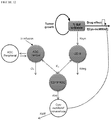
- SGN-CD19A is then cleared from the central compartment at the rate of "CL" and may also diffuse to and from the more slowly perfused tissues, peripheral compartment, both through linear kinetics.
- SGN-CD19A in the central compartment binds to CD19 expressed on cancer cells, e.g., leukemia or lymphoma cells, to form a CD19-SGN-CD19A complex.
- the complex is internalized into the cancer cells, where the cytotoxin, cys-mcMMAF, is released after catabolism of SGN-CD19A.
- the intracellular cys-mcMMAF causes cancer cell growth arrest and death in a concentration-dependent manner. It is assumed that the majority of leukemia blast cells resides in bone marrow and replicate at a rate governed by the Gompertz growth law, which is faster at low disease burden and becomes slower with increasing disease burden. It is also assumed that all leukemia blast cells in a given patient have the same CD19 expression level and the total CD 19 in a patient is determined by the cellular expression level and disease burden at any given time.
- the model structure is shown in Figure 12 .
- SGN-CD19A is formulated for patients in a sterile pharmaceutically acceptable excipient and then administered to patients. Typically, administration is by intravenous methods.
- a preferred pharmaceutically acceptable formulation for SGN-CD19A is 15 mg/ml in 10 mM potassium phosphate, pH 6.0, 0.02% w/v polysorbate 80, and 60 mg/ml sucrose.
- the optimal doses and schedules of SGN-CD19A for treatment of ALL were determined based on a number of patient disease characteristics, for example, disease burden and CD19 expression levels.
- High disease burden in this model was defined as a packed (100% replaced), hypercellular bone marrow as assessed on bone marrow biopsy or aspirate.
- Low disease burden was defined as 10% of the bone marrow replaced by blasts as assessed on bone marrow biopsy or aspirate.
- High CD19 expression was defined as a CD19 MFI value of 45 at baseline and low expression was 4.5 at baseline.
- Another relevant characteristic is the sensitivity (coefficient of 0.00019 on drug effect) or lack of sensitivity (coefficient of 0.00006) of the cancer to an anti-CD 19 treatment, such as SGN-CD19A.
- SGN-CD19A can be administered to ALL patients on a fixed dose schedule.
- a fixed dose schedule is a schedule that is unvaried over time.
- it is important to maintain the dose intensity i.e., the amount of SGN-CD19A per unit of patient weight per unit of time, at about 1 mg/kg/week. This dose intensity will be beneficial to patients regardless of their disease burden or sensitivity to treatment.
- acceptable fixed dose schedules of SGN-CD19A include 1.6 mg/kg given on days one and eight of a three week cycle, 2.2 mg/kg every two weeks, or 3.0 mg/kg every three weeks.
- SGN-CD19A can also be administered to ALL patients using a higher loading dose and/or more frequent loading doses followed by lower and/or less frequent maintenance doses.
- the loading dose is greater than the maintenance dose.
- 2 mg/kg given every three weeks is an acceptable maintenance dose following one cycle of 2 mg/kg given on days one and eight of a three week cycle.
- a single cycle of loading dose of more frequent dosing is given, but more can be administered, as needed, to decrease disease burden and induce remission before switching to maintenance dose schedule.
- one, two three or four loading doses can be given before starting maintenance doses. Maintenance doses are given, e.g., for two-20 three week cycles, at the 2 mg/kg dose level.
- 3 mg/kg given every three weeks is an acceptable maintenance dose following a loading dose of 5 mg/kg given every three weeks.
- a single loading dose is given, but more can be administered, as needed, to decrease disease burden and induce remission.
- multiple loading doses e.g., one, two three or four loading doses loading doses can be given before starting maintenance doses.
- Maintenance doses are given, e.g., for two-20 three week cycles, at the 3 mg/kg dose level.
- Example 1 Model of SGN-CD19A dosing for treatment of ALL based on a semi-mechanistic PK/PD model.
- SGN-CD19A was administered intravenously (IV) on a weekly schedule (first 2 weeks of a 21-day cycle on Days 1 and 8. Dose levels were escalated.
- Adult patients were initially enrolled in cohorts of 2, starting with dose level 1. For the first 6 patients, complete dose limiting toxicity information was available before the next patient cohort was enrolled. After the first 6 patients, 3 patients at a time could be enrolled and in the DLT period. Once one patient finished the DLT period, another patient could be enrolled. Estimates of safety were determined by a continuous reassessment model, and an algorithm allocated patients to dose levels. Dose levels are shown in Table 1.
- Table 1 Dose escalation schedule
- Dose Level Schedule A Weekly Dose (mg/kg)
- Schedule B Q3 week Dose (mg/kg) 1 0.3 0.5 2 0.6 1 3 1 2 4 1.3 3 5 1.6 4 6 2 5 7 2.3 6 8 3 - 9 3.8 - 10 4.5 -
- Plasma SGN-CD19A levels - SGN-CD19A was administered on days 1 and 8 of a 21 day cycle at the indicated dose levels. Blood was drawn from patients at the schedule time for PK and PD measurements (Table 2). The concentrations of plasma SGN-CD19A were determined using enzyme linked immunosorbent assays (ELISA). Briefly, a monoclonal antibody specific to the MMAF portion of the antibody-drug conjugate was used to capture the SGN-CD19A antibody from plasma. Bound SGN-CD19A was detected by a biotin conjugated anti-ID19A detection antibody followed by addition of a polymer horseradish peroxidase conjugated to streptavidin (poly HRP-SA). For detection TMB (3,3',5,5' tetramethylbenzidine) was used which was converted from colorless TMB to a colored TMB derivative.
- ELISA enzyme linked immunosorbent assays
- Unbound CD19 receptor protein on blasts - Blasts were isolated from cryopreserved patient blood and incubated labeled hBU12 antibody (hBU12-AF488). After incubation the cells were assayed by flow cytometry for its fluorescence intensity expressed as mean fluorescence intensity (MFI).
- MFI mean fluorescence intensity
- SGN-CD19A bound to blast cells - Blast cells were isolated from patient blood and incubated with a labeled antibody specific for MMAF (SG15.22-AF647). After washing to remove unbound labeled antibody, cells were assayed by flow cytometry for its fluorescence intensity expressed as MFI.
- Patient disease was monitored by bone marrow aspiration and/or biopsy at indicated times.
- a pathologist reviewed bone marrow slides from patients and assessed for percentage of bone marrow cells that were malignant blasts, as well as the total amount of space in the bone marrow that was taken up by cells (cellularity).
- Disease burden was a product of the cellularity and the percentage of the bone marrow that was replaced by malignant blasts.
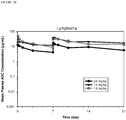
- SGN-CD19A was administered to ALL patients at levels up to 2.0 mg/kg on days 1 and 8 of a 21 day cycle. Plasma levels of SGN-CD19A were measured per protocol-defined schedule (Table 2). Results are shown in Figure 2A . Following iv infusion administration, the levels of plasma SGN-CD19A generally reached Cmax at the end of infusion and decreased in a multiexponential manner. The PK profiles showed a more rapid decline of the SGN-CD19A plasma concentration at lower dose levels, indicating non-linear PK. In contrast, when SGN-CD19A was administered to lymphoma patients the PK profiles are similar among different dose levels, as shown in Figure 2B
- a semi-mechanistic integrated PK-PD model was developed based on the mechanism of action of SGN-CD19A and the clinical PK and PD data from the ongoing first-in-human dose-escalation study in adult and pediatric patients with relapsed or refractory B cell leukemia or highly aggressive B-cell lymphoma (CT.gov NCT01786096).
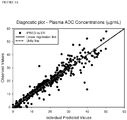
- Plasma SGN-CD19A ADC concentration-time profiles were described by a two-compartment PK model with both linear and nonlinear clearance pathways. The nonlinear clearance was modeled as target-mediated disposition through binding to cell membrane CD19 and internalization of the complex.
- Antitumor effects in the form of reduced bone marrow disease burden were modeled using a cell-kill PK-PD model driven by the internalized cys-mcMMAF concentrations. Both PK and PD data were fitted simultaneously using NONMEM® version 7.1.2.
- SGN-CD19A exhibited a biphasic PK curve, indicating rapid clearance of the drug. As the dose of SGN-CD19A increased the PK curve became monophasic indicating slower clearance of the drug.
- SGN-CD19A clearance occurred through two mechanisms: clearance through whole body catabolism and clearance through uptake by tumor cells. Over time SGN-CD19A was taken up by ALL tumor cells, killing the tumor cells and reducing the tumor burden. Thus, over time, the rate of clearance through tumor uptake decreased and less SGN-CD19A was needed to kill tumor cells.
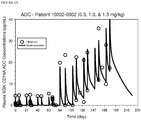
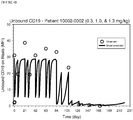
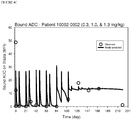
- Figures 4A-4D show observed and predicted values for a single ALL patient over a period of time.
- 0.3 mg/kg SGN-CD19A was administered on days 1 and 8 of cycles 1-4; 1.0 mg/kg SGN-CD19A was administered on days 1 and 8 of cycles 5-8; and 1.3 mg/kg was administered on days 1 and 8 of cycle 9.
- ADC plasma SGN-CD19A
- Figure 4B levels of observed unbound CD19 MFI on blast cells were plotted against time and then overlaid with the predicted values from the model.
- Model simulations were conducted for alternative doses and schedules, including more frequent dose or loading dose regimens followed by maintenance dose regimens, and for ALL patients with different baseline disease characteristics.
- the first simulation was for an ALL patient with high baseline CD19 expression and 100% bone marrow blasts and hypercellularity in bone marrow.
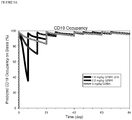
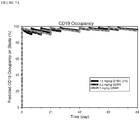
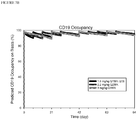
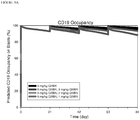
- SGN-CD19A was administered on a fixed dosage schedules: 1.6 mg/kg on days 1 and 8 of a 21 day cycle; 2.2 mg/kg every two weeks; or 3 mg/kg every three weeks.
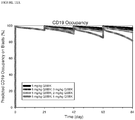
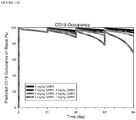
- the model was used to predict the percentage of CD19 on blast cells that were bound to SGN-CD19A (CD19 occupancy). High target saturation was assumed to occur if 90% of the CD19 proteins on blasts were occupied.
- Figure 5A provides the results for cancer that is sensitive to treatment
- Figure 5B provides the results for a cancer that is insensitive to treatment. Simulation results suggest that at dose intensity of ⁇ 1 mg/kg/week, all dosing schedules appear to achieve high and comparable target occupancy by SGN-CD19A after Cycle 1; however, target saturation could drop to lower level in Cycle 1.
- the remaining simulations tested more frequent doses or loading doses of SGN-CD19A followed by less frequent and/or lower maintenance doses.
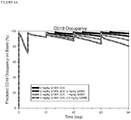
- a simulation was run for an ALL patient with high baseline CD19 expression and 100% bone marrow blasts and hypercellularity.
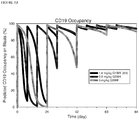
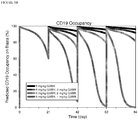
- the dose scenario used 2 mg/kg dose given on days 1 and 8 of a twenty-one day cycle for the entire test period.
- the other doses started with 2 mg/kg given on days 1 and 8 of a twenty-one day cycle, followed by 2, 1 or 0.5 mg/kg given every three weeks.
- Figure 8A provides the results for cancer that is sensitive to treatment
- Figure 8B provides the results for a cancer that is less sensitive to treatment. Simulation results suggest that when given every three weeks a dose of 2 mg/kg is needed to achieve high CD19 occupancy by SGN-CD19A during maintenance for sensitive disease while more than 2 mg/kg is needed for less sensitive disease.
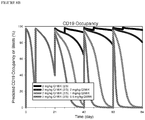
- a loading dose simulation was run for an ALL patient with high baseline CD19 expression and 100% bone marrow blasts and hypercellularity.
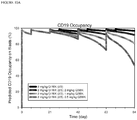
- This loading dose scenario used 5 mg/kg given on days 1 of a twenty-one day cycle for the entire test period.
- the other doses started with 5 mg/kg given on days 1 of a twenty-one day cycle, followed by 3, 2, or 1 mg/kg given every three weeks.
- Figure 9A provides the results for cancer that is sensitive to treatment
- Figure 9B provides the results for a cancer that is less sensitive to treatment. Simulation results suggest that when given every three weeks a dose of 2 mg/kg is needed to achieve high CD 19 occupancy by SGN-CD19A during maintenance for sensitive disease while 3 mg/kg is needed for less sensitive disease.
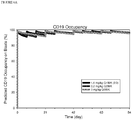
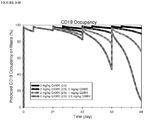
- a loading dose simulation was run for an ALL patient with low baseline CD19 expression and 100% bone marrow blasts with blast hypercellularity.
- This dose scenario used 2 mg/kg given on days 1 and 8 of a twenty-one day cycle for the entire test period.
- the other doses started with 2 mg/kg given on days 1 and 8 of a twenty-one day cycle, followed by 2, 1 or 0.5 mg/kg given every three weeks.
- Figure 10A provides the results for cancer that is sensitive to treatment
- Figure 10B provides the results for a cancer that is less sensitive to treatment. Simulation results suggest that when given every three weeks a dose of 2 mg/kg is needed to achieve high CD19 occupancy by SGN-CD19A during maintenance for sensitive and less sensitive diseases.
- a loading dose simulation was run for an ALL patient with low baseline CD19 expression and 100% bone marrow blasts with blast hypercellularity.
- This loading dose scenario used 5 mg/kg given on days 1 of a twenty-one day cycle for the entire test period.
- the other doses started with 5 mg/kg given on days 1 of a twenty-one day cycle, followed by 3, 2, or 1 mg/kg given every three weeks.
- Figure 11A provides the results for cancer that is sensitive to treatment
- Figure 11B provides the results for a cancer that is less sensitive to treatment. Simulation results suggest that when given every three weeks a dose of 2 mg/kg is needed to achieve high CD19 occupancy by SGN-CD19A during maintenance for sensitive and less sensitive diseases.
Landscapes
- Health & Medical Sciences (AREA)
- Life Sciences & Earth Sciences (AREA)
- Chemical & Material Sciences (AREA)
- Immunology (AREA)
- Bioinformatics & Cheminformatics (AREA)
- Engineering & Computer Science (AREA)
- General Health & Medical Sciences (AREA)
- Medicinal Chemistry (AREA)
- Organic Chemistry (AREA)
- Cell Biology (AREA)
- Molecular Biology (AREA)
- Pharmacology & Pharmacy (AREA)
- Animal Behavior & Ethology (AREA)
- Public Health (AREA)
- Veterinary Medicine (AREA)
- Hematology (AREA)
- Epidemiology (AREA)
- Biophysics (AREA)
- Biochemistry (AREA)
- Proteomics, Peptides & Aminoacids (AREA)
- Genetics & Genomics (AREA)
- Oncology (AREA)
- Toxicology (AREA)
- Chemical Kinetics & Catalysis (AREA)
- Nuclear Medicine, Radiotherapy & Molecular Imaging (AREA)
- General Chemical & Material Sciences (AREA)
- Medicines That Contain Protein Lipid Enzymes And Other Medicines (AREA)
- Pharmaceuticals Containing Other Organic And Inorganic Compounds (AREA)
- Medicines Containing Antibodies Or Antigens For Use As Internal Diagnostic Agents (AREA)
- Peptides Or Proteins (AREA)
- Medicinal Preparation (AREA)
Applications Claiming Priority (2)
| Application Number | Priority Date | Filing Date | Title |
|---|---|---|---|
| US201461976790P | 2014-04-08 | 2014-04-08 | |
| PCT/US2015/024732 WO2015157297A1 (en) | 2014-04-08 | 2015-04-07 | Optimal dosing of a cd19-antibody drug conjugate |
Publications (3)
| Publication Number | Publication Date |
|---|---|
| EP3129052A1 EP3129052A1 (en) | 2017-02-15 |
| EP3129052A4 EP3129052A4 (en) | 2017-11-15 |
| EP3129052B1 true EP3129052B1 (en) | 2020-06-03 |
Family
ID=54288332
Family Applications (1)
| Application Number | Title | Priority Date | Filing Date |
|---|---|---|---|
| EP15775944.0A Not-in-force EP3129052B1 (en) | 2014-04-08 | 2015-04-07 | Optimal dosing of a cd19-antibody drug conjugate |
Country Status (12)
| Country | Link |
|---|---|
| US (1) | US20170182178A1 (enExample) |
| EP (1) | EP3129052B1 (enExample) |
| JP (1) | JP2017512801A (enExample) |
| KR (1) | KR20160141727A (enExample) |
| CN (1) | CN106170300A (enExample) |
| AU (1) | AU2015244004A1 (enExample) |
| CA (1) | CA2941154A1 (enExample) |
| EA (1) | EA201692016A1 (enExample) |
| IL (1) | IL247526A0 (enExample) |
| MX (1) | MX2016012258A (enExample) |
| SG (1) | SG11201607133QA (enExample) |
| WO (1) | WO2015157297A1 (enExample) |
Families Citing this family (4)
| Publication number | Priority date | Publication date | Assignee | Title |
|---|---|---|---|---|
| US20190233522A1 (en) * | 2016-07-08 | 2019-08-01 | Genmab A/S | New dosage regimens for antibody drug conjugates based on anti-axl antibodies |
| KR102442736B1 (ko) | 2017-06-14 | 2022-09-16 | 에이디씨 테라퓨틱스 에스에이 | 항-cd19 adc의 투여를 위한 투약량 체제 |
| CN109069584A (zh) * | 2017-06-29 | 2018-12-21 | 成都华创生物技术有限公司 | 一种trail类蛋白持续抑制肿瘤细胞生长的给药方法 |
| WO2019119822A1 (en) * | 2017-12-23 | 2019-06-27 | Uwell Biopharma Inc. | Pharmaceutical chimeric receptor composition and method thereof |
Family Cites Families (5)
| Publication number | Priority date | Publication date | Assignee | Title |
|---|---|---|---|---|
| ES2605443T3 (es) * | 2003-11-06 | 2017-03-14 | Seattle Genetics, Inc. | Conjugados de auristatina con anticuerpos anti-HER2 o anti-CD22 y su uso en terapia |
| CN101903403B (zh) * | 2007-10-19 | 2016-03-16 | 西雅图基因公司 | Cd19结合剂及其应用 |
| JP6055404B2 (ja) * | 2010-06-15 | 2016-12-27 | ゲンマブ エー/エス | 組織因子に対するヒト抗体薬物結合体 |
| JP6121906B2 (ja) * | 2010-10-22 | 2017-04-26 | シアトル ジェネティクス,インコーポレーテッド | アウリスタチン系抗体薬物複合体とPI3K−AKTmTOR経路インヒビターの間の相乗効果 |
| DK2714738T3 (en) * | 2011-05-24 | 2019-01-28 | Zyngenia Inc | MULTIVALENT AND MONOVALENT MULTISPECIFIC COMPLEXES AND THEIR APPLICATIONS |
-
2015
- 2015-04-07 CN CN201580019099.2A patent/CN106170300A/zh active Pending
- 2015-04-07 US US15/129,727 patent/US20170182178A1/en not_active Abandoned
- 2015-04-07 JP JP2016559853A patent/JP2017512801A/ja active Pending
- 2015-04-07 SG SG11201607133QA patent/SG11201607133QA/en unknown
- 2015-04-07 CA CA2941154A patent/CA2941154A1/en not_active Abandoned
- 2015-04-07 EP EP15775944.0A patent/EP3129052B1/en not_active Not-in-force
- 2015-04-07 EA EA201692016A patent/EA201692016A1/ru unknown
- 2015-04-07 MX MX2016012258A patent/MX2016012258A/es unknown
- 2015-04-07 WO PCT/US2015/024732 patent/WO2015157297A1/en not_active Ceased
- 2015-04-07 AU AU2015244004A patent/AU2015244004A1/en not_active Abandoned
- 2015-04-07 KR KR1020167027123A patent/KR20160141727A/ko not_active Withdrawn
-
2016
- 2016-08-29 IL IL247526A patent/IL247526A0/en unknown
Non-Patent Citations (1)
| Title |
|---|
| None * |
Also Published As
| Publication number | Publication date |
|---|---|
| JP2017512801A (ja) | 2017-05-25 |
| AU2015244004A1 (en) | 2016-09-15 |
| KR20160141727A (ko) | 2016-12-09 |
| US20170182178A1 (en) | 2017-06-29 |
| EP3129052A1 (en) | 2017-02-15 |
| EP3129052A4 (en) | 2017-11-15 |
| CA2941154A1 (en) | 2015-10-15 |
| MX2016012258A (es) | 2017-01-06 |
| EA201692016A1 (ru) | 2017-01-30 |
| IL247526A0 (en) | 2016-11-30 |
| WO2015157297A1 (en) | 2015-10-15 |
| SG11201607133QA (en) | 2016-09-29 |
| CN106170300A (zh) | 2016-11-30 |
Similar Documents
| Publication | Publication Date | Title |
|---|---|---|
| US12144818B2 (en) | Method for treating cancer in a human patient by administering an anti-CD37 immunoconjugate using various dosing regimens | |
| JP6181273B2 (ja) | B細胞悪性腫瘍の症状の治療のための抗cd19メイタンシンノイドイムノコンジュゲート抗体の使用 | |
| US11395796B2 (en) | Anti-CD37 immunoconjugate and anti-CD20 antibody combinations | |
| Socinski et al. | Phase 1/2 study of the CD56-targeting antibody-drug conjugate lorvotuzumab mertansine (IMGN901) in combination with carboplatin/etoposide in small-cell lung cancer patients with extensive-stage disease | |
| CN112546217B (zh) | 用于治疗肿瘤的抗b7-h1抗体 | |
| US7794713B2 (en) | Compositions and methods for the treatment and prevention of hyperproliferative diseases | |
| Cura et al. | Phase I and pharmacokinetics study of crotoxin (cytotoxic PLA2, NSC-624244) in patients with advanced cancer | |
| US20220175916A1 (en) | Methods and compositions for treating chronic effects of radiation and chemical exposure | |
| US20120315273A1 (en) | Treating skin cancer | |
| JP2004527456A (ja) | Egf受容体拮抗剤による過増殖性の疾患の治療 | |
| MY151449A (en) | Tumor therapy with an antibody for vascular endothelial growth factor and an antibody for human epithelial growth factor receptor type 2 | |
| TW201311274A (zh) | 包含抗-cd19類美登素(maytansinoid)免疫結合物及利妥昔單抗(rituximab)之用於治療cd19+b-細胞惡性症狀之組合療法 | |
| IL178042A (en) | Pharmaceutical compositions containing anti-alpha5beta1 antibodies for inhibiting cancer cell proliferation | |
| KR20180121571A (ko) | Liv1-adc와 화학요법제를 사용한 병용 요법 | |
| US20170182178A1 (en) | Optimal dosing of a cd19-antibody drug conjugate | |
| CN101678101A (zh) | 可用于诊断和治疗b细胞慢性淋巴细胞白血病的能够在肿瘤细胞中诱导凋亡的药物组合物 | |
| JP6591665B2 (ja) | T−dm1難治性がん患者のsyd985処置 | |
| WO2006078336A2 (en) | Compositions and methods for the treatment and prevention of hyperproliferative diseases | |
| WO2018017928A1 (en) | Combination therapy using a cd19-adc and rchp | |
| WO2012137645A1 (ja) | 抗癌剤に起因する異痛症の予防及び/又は治療剤 | |
| OA16782A (en) | Use of anti-CD19 maytansinoid immunoconjugate antibody for the treatment of Bcell malignancies symptoms. |
Legal Events
| Date | Code | Title | Description |
|---|---|---|---|
| STAA | Information on the status of an ep patent application or granted ep patent |
Free format text: STATUS: THE INTERNATIONAL PUBLICATION HAS BEEN MADE |
|
| PUAI | Public reference made under article 153(3) epc to a published international application that has entered the european phase |
Free format text: ORIGINAL CODE: 0009012 |
|
| STAA | Information on the status of an ep patent application or granted ep patent |
Free format text: STATUS: REQUEST FOR EXAMINATION WAS MADE |
|
| 17P | Request for examination filed |
Effective date: 20160920 |
|
| AK | Designated contracting states |
Kind code of ref document: A1 Designated state(s): AL AT BE BG CH CY CZ DE DK EE ES FI FR GB GR HR HU IE IS IT LI LT LU LV MC MK MT NL NO PL PT RO RS SE SI SK SM TR |
|
| AX | Request for extension of the european patent |
Extension state: BA ME |
|
| DAV | Request for validation of the european patent (deleted) | ||
| DAX | Request for extension of the european patent (deleted) | ||
| RIC1 | Information provided on ipc code assigned before grant |
Ipc: A61K 47/42 20170101ALI20171003BHEP Ipc: A61K 39/395 20060101AFI20171003BHEP Ipc: C07K 16/28 20060101ALI20171003BHEP |
|
| A4 | Supplementary search report drawn up and despatched |
Effective date: 20171017 |
|
| RIC1 | Information provided on ipc code assigned before grant |
Ipc: A61K 39/395 20060101AFI20171010BHEP Ipc: A61K 47/42 20170101ALI20171010BHEP Ipc: C07K 16/28 20060101ALI20171010BHEP |
|
| REG | Reference to a national code |
Ref country code: HK Ref legal event code: DE Ref document number: 1233949 Country of ref document: HK |
|
| STAA | Information on the status of an ep patent application or granted ep patent |
Free format text: STATUS: EXAMINATION IS IN PROGRESS |
|
| 17Q | First examination report despatched |
Effective date: 20180814 |
|
| RIC1 | Information provided on ipc code assigned before grant |
Ipc: A61K 47/42 20170101ALI20190214BHEP Ipc: A61K 39/395 20060101AFI20190214BHEP Ipc: C07K 16/28 20060101ALI20190214BHEP Ipc: A61P 35/02 20060101ALI20190214BHEP |
|
| GRAP | Despatch of communication of intention to grant a patent |
Free format text: ORIGINAL CODE: EPIDOSNIGR1 |
|
| STAA | Information on the status of an ep patent application or granted ep patent |
Free format text: STATUS: GRANT OF PATENT IS INTENDED |
|
| INTG | Intention to grant announced |
Effective date: 20200103 |
|
| GRAS | Grant fee paid |
Free format text: ORIGINAL CODE: EPIDOSNIGR3 |
|
| GRAA | (expected) grant |
Free format text: ORIGINAL CODE: 0009210 |
|
| STAA | Information on the status of an ep patent application or granted ep patent |
Free format text: STATUS: THE PATENT HAS BEEN GRANTED |
|
| AK | Designated contracting states |
Kind code of ref document: B1 Designated state(s): AL AT BE BG CH CY CZ DE DK EE ES FI FR GB GR HR HU IE IS IT LI LT LU LV MC MK MT NL NO PL PT RO RS SE SI SK SM TR |
|
| REG | Reference to a national code |
Ref country code: GB Ref legal event code: FG4D |
|
| REG | Reference to a national code |
Ref country code: CH Ref legal event code: EP Ref country code: AT Ref legal event code: REF Ref document number: 1276308 Country of ref document: AT Kind code of ref document: T Effective date: 20200615 |
|
| REG | Reference to a national code |
Ref country code: DE Ref legal event code: R096 Ref document number: 602015053795 Country of ref document: DE |
|
| REG | Reference to a national code |
Ref country code: LT Ref legal event code: MG4D |
|
| PG25 | Lapsed in a contracting state [announced via postgrant information from national office to epo] |
Ref country code: GR Free format text: LAPSE BECAUSE OF FAILURE TO SUBMIT A TRANSLATION OF THE DESCRIPTION OR TO PAY THE FEE WITHIN THE PRESCRIBED TIME-LIMIT Effective date: 20200904 Ref country code: LT Free format text: LAPSE BECAUSE OF FAILURE TO SUBMIT A TRANSLATION OF THE DESCRIPTION OR TO PAY THE FEE WITHIN THE PRESCRIBED TIME-LIMIT Effective date: 20200603 Ref country code: NO Free format text: LAPSE BECAUSE OF FAILURE TO SUBMIT A TRANSLATION OF THE DESCRIPTION OR TO PAY THE FEE WITHIN THE PRESCRIBED TIME-LIMIT Effective date: 20200903 Ref country code: SE Free format text: LAPSE BECAUSE OF FAILURE TO SUBMIT A TRANSLATION OF THE DESCRIPTION OR TO PAY THE FEE WITHIN THE PRESCRIBED TIME-LIMIT Effective date: 20200603 Ref country code: FI Free format text: LAPSE BECAUSE OF FAILURE TO SUBMIT A TRANSLATION OF THE DESCRIPTION OR TO PAY THE FEE WITHIN THE PRESCRIBED TIME-LIMIT Effective date: 20200603 |
|
| REG | Reference to a national code |
Ref country code: NL Ref legal event code: MP Effective date: 20200603 |
|
| PG25 | Lapsed in a contracting state [announced via postgrant information from national office to epo] |
Ref country code: HR Free format text: LAPSE BECAUSE OF FAILURE TO SUBMIT A TRANSLATION OF THE DESCRIPTION OR TO PAY THE FEE WITHIN THE PRESCRIBED TIME-LIMIT Effective date: 20200603 Ref country code: RS Free format text: LAPSE BECAUSE OF FAILURE TO SUBMIT A TRANSLATION OF THE DESCRIPTION OR TO PAY THE FEE WITHIN THE PRESCRIBED TIME-LIMIT Effective date: 20200603 Ref country code: LV Free format text: LAPSE BECAUSE OF FAILURE TO SUBMIT A TRANSLATION OF THE DESCRIPTION OR TO PAY THE FEE WITHIN THE PRESCRIBED TIME-LIMIT Effective date: 20200603 Ref country code: BG Free format text: LAPSE BECAUSE OF FAILURE TO SUBMIT A TRANSLATION OF THE DESCRIPTION OR TO PAY THE FEE WITHIN THE PRESCRIBED TIME-LIMIT Effective date: 20200903 |
|
| REG | Reference to a national code |
Ref country code: AT Ref legal event code: MK05 Ref document number: 1276308 Country of ref document: AT Kind code of ref document: T Effective date: 20200603 |
|
| PG25 | Lapsed in a contracting state [announced via postgrant information from national office to epo] |
Ref country code: AL Free format text: LAPSE BECAUSE OF FAILURE TO SUBMIT A TRANSLATION OF THE DESCRIPTION OR TO PAY THE FEE WITHIN THE PRESCRIBED TIME-LIMIT Effective date: 20200603 Ref country code: NL Free format text: LAPSE BECAUSE OF FAILURE TO SUBMIT A TRANSLATION OF THE DESCRIPTION OR TO PAY THE FEE WITHIN THE PRESCRIBED TIME-LIMIT Effective date: 20200603 |
|
| PG25 | Lapsed in a contracting state [announced via postgrant information from national office to epo] |
Ref country code: EE Free format text: LAPSE BECAUSE OF FAILURE TO SUBMIT A TRANSLATION OF THE DESCRIPTION OR TO PAY THE FEE WITHIN THE PRESCRIBED TIME-LIMIT Effective date: 20200603 Ref country code: ES Free format text: LAPSE BECAUSE OF FAILURE TO SUBMIT A TRANSLATION OF THE DESCRIPTION OR TO PAY THE FEE WITHIN THE PRESCRIBED TIME-LIMIT Effective date: 20200603 Ref country code: RO Free format text: LAPSE BECAUSE OF FAILURE TO SUBMIT A TRANSLATION OF THE DESCRIPTION OR TO PAY THE FEE WITHIN THE PRESCRIBED TIME-LIMIT Effective date: 20200603 Ref country code: CZ Free format text: LAPSE BECAUSE OF FAILURE TO SUBMIT A TRANSLATION OF THE DESCRIPTION OR TO PAY THE FEE WITHIN THE PRESCRIBED TIME-LIMIT Effective date: 20200603 Ref country code: PT Free format text: LAPSE BECAUSE OF FAILURE TO SUBMIT A TRANSLATION OF THE DESCRIPTION OR TO PAY THE FEE WITHIN THE PRESCRIBED TIME-LIMIT Effective date: 20201006 Ref country code: IT Free format text: LAPSE BECAUSE OF FAILURE TO SUBMIT A TRANSLATION OF THE DESCRIPTION OR TO PAY THE FEE WITHIN THE PRESCRIBED TIME-LIMIT Effective date: 20200603 Ref country code: AT Free format text: LAPSE BECAUSE OF FAILURE TO SUBMIT A TRANSLATION OF THE DESCRIPTION OR TO PAY THE FEE WITHIN THE PRESCRIBED TIME-LIMIT Effective date: 20200603 Ref country code: SM Free format text: LAPSE BECAUSE OF FAILURE TO SUBMIT A TRANSLATION OF THE DESCRIPTION OR TO PAY THE FEE WITHIN THE PRESCRIBED TIME-LIMIT Effective date: 20200603 |
|
| PG25 | Lapsed in a contracting state [announced via postgrant information from national office to epo] |
Ref country code: PL Free format text: LAPSE BECAUSE OF FAILURE TO SUBMIT A TRANSLATION OF THE DESCRIPTION OR TO PAY THE FEE WITHIN THE PRESCRIBED TIME-LIMIT Effective date: 20200603 Ref country code: SK Free format text: LAPSE BECAUSE OF FAILURE TO SUBMIT A TRANSLATION OF THE DESCRIPTION OR TO PAY THE FEE WITHIN THE PRESCRIBED TIME-LIMIT Effective date: 20200603 Ref country code: IS Free format text: LAPSE BECAUSE OF FAILURE TO SUBMIT A TRANSLATION OF THE DESCRIPTION OR TO PAY THE FEE WITHIN THE PRESCRIBED TIME-LIMIT Effective date: 20201003 |
|
| REG | Reference to a national code |
Ref country code: DE Ref legal event code: R097 Ref document number: 602015053795 Country of ref document: DE |
|
| PLBE | No opposition filed within time limit |
Free format text: ORIGINAL CODE: 0009261 |
|
| STAA | Information on the status of an ep patent application or granted ep patent |
Free format text: STATUS: NO OPPOSITION FILED WITHIN TIME LIMIT |
|
| PG25 | Lapsed in a contracting state [announced via postgrant information from national office to epo] |
Ref country code: DK Free format text: LAPSE BECAUSE OF FAILURE TO SUBMIT A TRANSLATION OF THE DESCRIPTION OR TO PAY THE FEE WITHIN THE PRESCRIBED TIME-LIMIT Effective date: 20200603 |
|
| 26N | No opposition filed |
Effective date: 20210304 |
|
| PG25 | Lapsed in a contracting state [announced via postgrant information from national office to epo] |
Ref country code: SI Free format text: LAPSE BECAUSE OF FAILURE TO SUBMIT A TRANSLATION OF THE DESCRIPTION OR TO PAY THE FEE WITHIN THE PRESCRIBED TIME-LIMIT Effective date: 20200603 |
|
| PG25 | Lapsed in a contracting state [announced via postgrant information from national office to epo] |
Ref country code: MC Free format text: LAPSE BECAUSE OF FAILURE TO SUBMIT A TRANSLATION OF THE DESCRIPTION OR TO PAY THE FEE WITHIN THE PRESCRIBED TIME-LIMIT Effective date: 20200603 |
|
| PG25 | Lapsed in a contracting state [announced via postgrant information from national office to epo] |
Ref country code: LU Free format text: LAPSE BECAUSE OF NON-PAYMENT OF DUE FEES Effective date: 20210407 |
|
| REG | Reference to a national code |
Ref country code: BE Ref legal event code: MM Effective date: 20210430 |
|
| PG25 | Lapsed in a contracting state [announced via postgrant information from national office to epo] |
Ref country code: CH Free format text: LAPSE BECAUSE OF NON-PAYMENT OF DUE FEES Effective date: 20210430 Ref country code: LI Free format text: LAPSE BECAUSE OF NON-PAYMENT OF DUE FEES Effective date: 20210430 |
|
| PG25 | Lapsed in a contracting state [announced via postgrant information from national office to epo] |
Ref country code: IE Free format text: LAPSE BECAUSE OF NON-PAYMENT OF DUE FEES Effective date: 20210407 |
|
| PG25 | Lapsed in a contracting state [announced via postgrant information from national office to epo] |
Ref country code: IS Free format text: LAPSE BECAUSE OF FAILURE TO SUBMIT A TRANSLATION OF THE DESCRIPTION OR TO PAY THE FEE WITHIN THE PRESCRIBED TIME-LIMIT Effective date: 20201003 |
|
| PG25 | Lapsed in a contracting state [announced via postgrant information from national office to epo] |
Ref country code: BE Free format text: LAPSE BECAUSE OF NON-PAYMENT OF DUE FEES Effective date: 20210430 |
|
| PGFP | Annual fee paid to national office [announced via postgrant information from national office to epo] |
Ref country code: GB Payment date: 20220427 Year of fee payment: 8 Ref country code: FR Payment date: 20220425 Year of fee payment: 8 Ref country code: DE Payment date: 20220427 Year of fee payment: 8 |
|
| PG25 | Lapsed in a contracting state [announced via postgrant information from national office to epo] |
Ref country code: HU Free format text: LAPSE BECAUSE OF FAILURE TO SUBMIT A TRANSLATION OF THE DESCRIPTION OR TO PAY THE FEE WITHIN THE PRESCRIBED TIME-LIMIT; INVALID AB INITIO Effective date: 20150407 |
|
| PG25 | Lapsed in a contracting state [announced via postgrant information from national office to epo] |
Ref country code: CY Free format text: LAPSE BECAUSE OF FAILURE TO SUBMIT A TRANSLATION OF THE DESCRIPTION OR TO PAY THE FEE WITHIN THE PRESCRIBED TIME-LIMIT Effective date: 20200603 |
|
| REG | Reference to a national code |
Ref country code: DE Ref legal event code: R119 Ref document number: 602015053795 Country of ref document: DE Ref country code: HK Ref legal event code: WD Ref document number: 1233949 Country of ref document: HK |
|
| GBPC | Gb: european patent ceased through non-payment of renewal fee |
Effective date: 20230407 |
|
| PG25 | Lapsed in a contracting state [announced via postgrant information from national office to epo] |
Ref country code: GB Free format text: LAPSE BECAUSE OF NON-PAYMENT OF DUE FEES Effective date: 20230407 |
|
| PG25 | Lapsed in a contracting state [announced via postgrant information from national office to epo] |
Ref country code: GB Free format text: LAPSE BECAUSE OF NON-PAYMENT OF DUE FEES Effective date: 20230407 Ref country code: FR Free format text: LAPSE BECAUSE OF NON-PAYMENT OF DUE FEES Effective date: 20230430 Ref country code: DE Free format text: LAPSE BECAUSE OF NON-PAYMENT OF DUE FEES Effective date: 20231103 |
|
| PG25 | Lapsed in a contracting state [announced via postgrant information from national office to epo] |
Ref country code: MK Free format text: LAPSE BECAUSE OF FAILURE TO SUBMIT A TRANSLATION OF THE DESCRIPTION OR TO PAY THE FEE WITHIN THE PRESCRIBED TIME-LIMIT Effective date: 20200603 |
|
| PG25 | Lapsed in a contracting state [announced via postgrant information from national office to epo] |
Ref country code: MT Free format text: LAPSE BECAUSE OF FAILURE TO SUBMIT A TRANSLATION OF THE DESCRIPTION OR TO PAY THE FEE WITHIN THE PRESCRIBED TIME-LIMIT Effective date: 20200603 |
|
| PG25 | Lapsed in a contracting state [announced via postgrant information from national office to epo] |
Ref country code: TR Free format text: LAPSE BECAUSE OF FAILURE TO SUBMIT A TRANSLATION OF THE DESCRIPTION OR TO PAY THE FEE WITHIN THE PRESCRIBED TIME-LIMIT Effective date: 20200603 |