EP3118359B1 - Verfahren zur herstellung eines bandes - Google Patents
Verfahren zur herstellung eines bandes Download PDFInfo
- Publication number
- EP3118359B1 EP3118359B1 EP16179548.9A EP16179548A EP3118359B1 EP 3118359 B1 EP3118359 B1 EP 3118359B1 EP 16179548 A EP16179548 A EP 16179548A EP 3118359 B1 EP3118359 B1 EP 3118359B1
- Authority
- EP
- European Patent Office
- Prior art keywords
- ribbon
- compaction
- pressing roller
- mat
- unit
- Prior art date
- Legal status (The legal status is an assumption and is not a legal conclusion. Google has not performed a legal analysis and makes no representation as to the accuracy of the status listed.)
- Active
Links
Images
Classifications
-
- D—TEXTILES; PAPER
- D03—WEAVING
- D03D—WOVEN FABRICS; METHODS OF WEAVING; LOOMS
- D03D3/00—Woven fabrics characterised by their shape
- D03D3/005—Tapes or ribbons not otherwise provided for
-
- D—TEXTILES; PAPER
- D03—WEAVING
- D03D—WOVEN FABRICS; METHODS OF WEAVING; LOOMS
- D03D13/00—Woven fabrics characterised by the special disposition of the warp or weft threads, e.g. with curved weft threads, with discontinuous warp threads, with diagonal warp or weft
-
- D—TEXTILES; PAPER
- D03—WEAVING
- D03D—WOVEN FABRICS; METHODS OF WEAVING; LOOMS
- D03D15/00—Woven fabrics characterised by the material, structure or properties of the fibres, filaments, yarns, threads or other warp or weft elements used
- D03D15/40—Woven fabrics characterised by the material, structure or properties of the fibres, filaments, yarns, threads or other warp or weft elements used characterised by the structure of the yarns or threads
- D03D15/49—Woven fabrics characterised by the material, structure or properties of the fibres, filaments, yarns, threads or other warp or weft elements used characterised by the structure of the yarns or threads textured; curled; crimped
-
- D—TEXTILES; PAPER
- D06—TREATMENT OF TEXTILES OR THE LIKE; LAUNDERING; FLEXIBLE MATERIALS NOT OTHERWISE PROVIDED FOR
- D06C—FINISHING, DRESSING, TENTERING OR STRETCHING TEXTILE FABRICS
- D06C21/00—Shrinking by compressing
Definitions
- the present invention relates to a production process for producing a ribbon, in particular to be used for items of clothing, having the features set out in the preamble of the main claim.
- the invention further relates to a ribbon obtained with the process of the invention.
- the ribbons also known as edgings, are produced from various yarns and with various weaving techniques in accordance with the yarn used for the item of clothing for which they are intended and the thickness and the characteristics of the item of clothing for which they are intended, respectively.
- those ribbons be adapted to the deformations, such as, for example, lengthening, of the material of the item of clothing to which they are applied.
- a preferred type of known ribbons is formed by ribbons of cotton, which are not, however, sufficiently adapted to the deformations of the material to which they are applied, generating undesirable tensions and unsightly and irritating wrinkles for the user.
- US2013/008554 describes a process for obtaining a web according to the known art.
- US4,051,215 describes a process for treating woven textiles fabrics Therefore, there is a requirement to provide a woven ribbon, that is to say, a ribbon formed by interlacing warp and weft threads, which is at the same time resistant, elastic and well tolerated by the user.
- the sanforizing process provides for the compaction of the material as a result of a combined mechanical and thermal action so as to shrink the material in the direction of the length.
- the problem which is addressed by the present invention is to provide a production process for a ribbon, in particular for items of clothing, as well as a ribbon which is obtained with that process, which are configured to overcome the drawbacks mentioned above with reference to the cited prior art.
- an object of the invention is to develop a process which allows an elastic woven ribbon to be obtained.
- ribbon is intended to be understood to mean a strip of material to be used as an edging, or trimming, in an item of clothing.
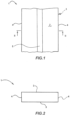
- the ribbon 1 is of planar form, in which there are defined a first face 2 and a second face 3 which are opposite each other and which are intended to constitute during use, that is to say, when the ribbon 1 is applied to an item of clothing (not illustrated in the appended Figures), respectively, the visible face and the concealed face, that is to say, the face which is arranged in contact with the item of clothing to which the ribbon 1 is applied.
- the ribbon 1 is delimited by two opposing longitudinal edges 4 which are provided with selvedge in order to ensure the dimensional stability thereof and to prevent occurrences of fraying.
- the ribbon 1 is woven, that is to say, produced by interlacing at least a first plurality of warp threads and a second plurality of warp threads with at least one weft thread.
- the ribbon 1 is obtained with a non-symmetrical weaving design, that is to say, so that there is on the two opposing faces 2, 3 of the ribbon a prevalence of threads of one of the two pluralities of warp threads, for example, a prevalence of threads of the first plurality of threads on the first face 2 and a prevalence of threads of the second plurality of threads on the second face 3, respectively, or vice versa.
- weaving scheme or ratio is intended to be understood to mean the minimum number of warp threads and weft threads necessary to represent the weaving.
- the ribbon 1 is woven using a weaving scheme at a ratio of 1:3.
- the threads of the first plurality and the second plurality of warp threads may be produced from mutually different materials.
- the threads of the first plurality of threads are intended to form in a prevalent manner the visible face 2 of the ribbon 1 so as to be positioned in some applications in contact with the skin of the user.
- the first plurality of warp threads may be produced from any synthetic or natural fibre, provided that it is of the discontinuous type (or "cotton staple fibre” type fibre), so as to allow the compaction process.
- the first plurality of warp threads is of cotton staple fibre type fiber.
- the second plurality of warp threads is of textured polyamide (textured nylon), that is to say, subjected to a texturing processing operation in order to increase the volume and cotton elasticity or textured polyester.
- the texturing process being modified advantageously, it is possible to vary the deformability and the elasticity of the nylon or the polyester obtained.
- the weft threads of the ribbon 1 are preferably of cotton, in order to facilitate the dyeing in a bath of the item to which the ribbon 1 is applied.
- the threads of the ribbon are woven so as to generate on the visible face 2 a decorative element 5 with a desired pattern which may optionally be produced in contrasting colours with respect to the colour of the threads of the first plurality of threads.
- the ribbon 1 is provided with one or more decorative elements in accordance with the decorative effect which it is desirable to produce, or also without decorative elements.
- the ribbon 1 is subjected to a sanforizing process, that is to say, controlled compaction of the fibres of the ribbon, as will be better explained below.
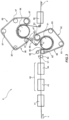
- the sanforizing plant 6 comprises a plurality of processing units which are intended to subject the ribbon 1 to different steps of the sanforizing process and movement means for moving the ribbon 1 in the advance direction indicated by the arrow F, along a processing path which passes successively through the various processing units in which the ribbon 1 is subjected in succession to the various steps of the sanforizing process.
- the movement means comprise a plurality of motorized rollers which are intended to move the ribbon 1 through the various processing units provided.
- the plurality of processing units comprise an atomization unit 41, a vapour humidification unit 42, a first compaction unit 50 and a second compaction unit 55 and a cooling unit 60 which are successively positioned over the processing path of the ribbon 1.
- the sanforizing plant 6 may comprise a single compaction unit or also more than two compaction units.
- the ribbon 1 is initially supplied to the atomization unit 41, in which it is subjected to an atomized water jet at ambient temperature, between 15°C and 30°C, for a time between approximately 5 seconds and approximately 10 seconds, in order to bring about a first cold humidification of the ribbon 1. Subsequently, the ribbon 1 is supplied to a vapour humidification unit 42, in which it is subjected to a saturated vapour jet at a temperature T1 between 110°C and 180°C, preferably between 130°C and 150°C, for a time ⁇ between 4 and 10 seconds, preferably between 6 and 8 seconds.
- the ribbon 1 is subjected in the vapour humidification unit 42 to a vapour jet at a temperature of approximately 135°C, resulting from saturated vapour at a pressure of approximately 2.5 relative bar.
- the vapour humidification unit 42 comprises a first and a second humidification device, which are designated 43 and 44, respectively, and which are arranged in series over the processing path and have such dimensions that the ribbon 1 has a processing time between 3 and 6 seconds in the first device 43 and between 2 and 5 seconds in the second device 44, respectively.
- the ribbon 1 which is warm and damp, is supplied, also by means of a motorized roller 54, to a first compaction unit 50 in order to be subjected to a process of controlled compaction for the fibres of the ribbon itself.
- the motorized roller 54 is actuated in such a manner that the ribbon 1 is caused to advance at a supply speed V1 through the vapour humidification unit 42 and towards the inlet of the first compaction unit 50.
- the sanforizing plant 6 further comprises a first braking mat 46 which is supported by a roller 45 and which is intended to interact with the ribbon 1 in order to brake it at the inlet of the first compaction unit 50 so as to control the degree of compaction thereof.
- roller 45 can be rotated so as to vary the length of the portion of the first braking mat 46 which is intended to interact with the ribbon 1. In that manner, it is possible to vary the force with which the ribbon 1 is braked at the inlet of the first compaction unit 50 and the curling effect of the fibres of the ribbon 1.
- the first braking mat 46 is produced from Teflon, or another material with a low friction coefficient, so that the ribbon 1 can readily slide thereon.
- the roller 45 and the first braking mat 46 act as guide elements for the ribbon 1.
- the roller 45 and the first braking mat 46 act as adjustable braking elements for the ribbon 1 itself in order to vary the curling effect of the fibres of the ribbon 1 at the inlet of the first compaction unit 50.
- the first compaction unit 50 comprises a first pressing roller 51 and a first compaction mat 52 which is wound in a ring-like manner on a plurality of rotatable rollers 53 in the opposite direction to the first pressing roller 51, so as to cooperate therewith in order to move and compact the ribbon 1, which is caused to pass between the first pressing roller 51 and the first compaction mat 52.
- the movement speed V2 is imposed as a function of the shrinkage of the ribbon 1 which is predetermined by the compaction step and the degree of pressing which has to be applied to the ribbon 1.
- the first compaction mat 52 is constructed from a material having a high level of resistance to temperature and prevents the relative sliding of the ribbon 1 with respect to the first pressing roller 51.
- the ribbon 1 is supplied to a second compaction unit 55 by means of a pretensioning roller 47.
- the ribbon 1 is supplied to the second compaction unit 55 at the movement speed V2.
- a second braking mat 48 which is supported by a corresponding support roller 49 and which is intended to interact with the ribbon 1 in order to brake it in the region of the inlet of the second compaction unit 55, so as to control the degree of curling thereof and therefore the degree of compaction.
- the ribbon 1 is supplied to the second compaction unit 55 in such a manner that the second face 3 is directed against the second pressing roller 56 and the first face 2 is directed against the second compaction mat 58. Therefore, the ribbon 1 is supplied to the second compaction unit 55 with opposite orientation with respect to that at the inlet to the first compaction unit 50. This allows processing in a similar manner of both faces 2, 3 of the ribbon 1 and an increase of the elasticity obtained.
- the second peripheral movement speed V3 measured at the external surface of the second pressing roller 56 corresponds to the speed at which the ribbon 1 is moved in the region of the second pressing roller 56.
- the second movement speed V3 is selected in accordance with the shrinkage of the ribbon 1 which is provided in the second compaction unit 55.
- the ribbon 1 accumulates at the inlet of the second compaction unit 55, curling in the direction of advance F.
- the second braking mat 48 allows control and adjustment of the curling of the ribbon 1 at the inlet of the second compaction unit 55 and allows the curled ribbon to be compressed against the second compaction mat 58.
- the ribbon 1 is further compressed in the curled formation, thereby obtaining the compression of the fibres.
- the ribbon 1 is therefore moved along the processing path of the ribbon 1 at decreasing speeds so as to produce the curling thereof.
- the rotation speed of the motorized roller 54, the first pressing roller 51 and the second pressing roller 56 that is to say, by varying the relationship between the speeds V2/V1 and/or V3/V2, it is possible to vary the degree of curling obtained in respect of the ribbon 1.
- the ribbon 1 is supplied to the cooling unit 60, in which it is cooled, for example, by means of forced ventilation with ambient air, in order to fix the fibres of the ribbon in the compacted, curled condition thereof and to make it possible to subsequently pack them.
- the ribbon obtained may be subjected to additional finishing processing operations, where provided.
- the ribbon 1 obtained with the process of the present invention advantageously has a substantial elasticity, in particular greater than the individual elasticity of the fibres which form it.
- the above-described process allows a ribbon having a first face, preferably the visible face, to be obtained with a prevalence of cotton fibres, having a percentage of elastic extension in a longitudinal direction between 10% and 25%, far greater than the extension of a conventional ribbon of cotton subjected to sanforizing.
- the ribbon further has all the advantages of a conventional ribbon of cotton, including the optimum touch of the visible face and the adaptability of the item to processing operations involving dyeing in a bath.
- the ribbon obtained with the process according to the invention allows an elastic extension between approximately 10% and 15%, that is to say, an extension greater, at least by a few percentage units, than the elastic extension of a ribbon with a prevalence of warp threads of polyester which is constructed with the conventional methods and which is subjected to a conventional sanforizing process.
Landscapes
- Engineering & Computer Science (AREA)
- Textile Engineering (AREA)
- Treatment Of Fiber Materials (AREA)
Claims (13)
- Verfahren zum Herstellen eines Bandes, insbesondere für Kleidungsstücke, das folgende Schritte umfasst:- Weben eines Bandes (1) durch Verflechten von zumindest einer ersten Vielzahl von Kettfäden, die aus Fasern des Baumwollstapelfasertyps hergestellt sind, und einer zweiten Vielzahl von Kettfäden, die aus texturiertem Polyamid oder texturiertem Polyester hergestellt sind, mit zumindest einem Schussfaden gemäß einem derartigen nicht symmetrischen Webschema, dass dabei auf einer ersten Seite (2) und einer zweiten Seite (3) des Bandes (1), die einander gegenüberliegen, ein Übergewicht an Fäden der ersten Vielzahl bzw. der zweiten Vielzahl erzeugt wird, wobei das Webschema die Mindestanzahl von Kettfäden und Schussfäden ist, die zur Darstellung des Webmusters erforderlich sind, dadurch gekennzeichnet, dass das Verfahren ferner folgenden Schritt umfasst,- Unterziehen des Bandes einem Sanforisierungsprozess, der in einer Sanforisierungsanlage (6) durchgeführt wird, die eine Zerstäubungseinheit (41), eine Dampfbefeuchtungseinheit (42), eine erste Verdichtungseinheit (50), eine zweite Verdichtungseinheit (55) und eine Kühleinheit (60) umfasst, die nacheinander über dem Bearbeitungsweg des Bandes (1) positioniert sind.
- Verfahren nach dem vorhergehenden Anspruch, wobei das Verfahren das Zuführen des Bandes (1) zur zweiten Verdichtungseinheit (55) mit entgegengesetzter Ausrichtung in Bezug auf diejenige am Einlass zur ersten Verdichtungseinheit (50) umfasst, um beide Seiten (2, 3) des Bandes (1) auf die gleiche Weise zu verarbeiten und die Elastizität des Bandes (1) zu erhöhen.
- Verfahren nach Anspruch 1 oder 2, wobei die erste Verdichtungseinheit (50) eine erste Anpresswalze (51) und eine erste Verdichtungsmatte (52) umfasst, die ringförmig auf eine Vielzahl von drehbaren Walzen (53) in entgegengesetzter Richtung zur ersten Anpresswalze (51) gewickelt ist, um mit dieser zum Bewegen und zum Verdichten des Bandes (1) zusammenzuwirken, das zwischen der ersten Anpresswalze (51) und der ersten Verdichtungsmatte (52) hindurchgeführt wird, wobei die zweite Verdichtungseinheit (55) eine zweite Anpresswalze (56) und eine zweite Verdichtungsmatte (58) umfasst, die ringförmig auf eine zweite Vielzahl von Walzen (57) gewickelt ist, die sich in entgegengesetzter Richtung zur zweiten Anpresswalze (56) drehen können, um mit dieser zum Bewegen und zum Verdichten des Bandes (1) zusammenzuwirken, wobei das Verfahren das Zuführen des Bandes (1) zur ersten Verdichtungseinheit (51), sodass die erste Fläche (2) gegen die erste Anpresswalze (51) gerichtet ist und die zweite Fläche (3) gegen die erste Verdichtungsmatte (52) gerichtet ist, und das Zuführen des Bandes (1) zur zweiten Verdichtungseinheit (55) derart umfasst, dass die zweite Fläche (3) gegen die zweite Anpresswalze (56) gerichtet ist und die erste Fläche (2) gegen die zweite Verdichtungsmatte (58) gerichtet ist.
- Verfahren nach einem der vorhergehenden Ansprüche, wobei die erste Vielzahl von Kettfäden aus Baumwolle oder Polyester gebildet ist.
- Verfahren nach einem der vorangehenden Ansprüche, wobei das Webschema ein Verhältnis von kleiner oder gleich 1:2 aufweist.
- Verfahren nach einem der vorangehenden Ansprüche, wobei das Webschema ein Verhältnis von 1:3 aufweist.
- Verfahren nach einem der vorhergehenden Ansprüche, wobei der Sanforisierungsprozess einen Verdichtungsschritt umfasst, bei dem das Band zwischen zumindest einer Anpresswalze (51, 56) und zumindest einer Verdichtungsmatte (52, 58) in einer gekräuselten Konfiguration verdichtet wird, wobei das Band (1) mit einer Geschwindigkeit (V1, V2) zugeführt wird, die größer als die Bewegungsgeschwindigkeit (V2, V3) ist, mit der eine Bewegung zwischen der zumindest einen Anpresswalze (51, 56) und der zumindest einen Verdichtungsmatte (52, 58) bewirkt wird, um ein Kräuseln des Bandes am Eingang des Verdichtungsschrittes zu bewirken.
- Verfahren nach dem vorhergehenden Anspruch, das ferner das Vorschieben des Bandes (1) mit einer Zufuhrgeschwindigkeit (V1) in Richtung einer ersten Verdichtungseinheit (50) des Verdichtungsschritts, die mit einer Anpresswalze (51) versehen ist, und das Einstellen der Drehgeschwindigkeit der Anpresswalze (51) umfasst, sodass das Band (1) von der Anpresswalze (51) mit einer Bewegungsgeschwindigkeit (V2) bewegt wird, die kleiner als die Zufuhrgeschwindigkeit (V1) ist, wobei die Bewegungsgeschwindigkeit (V2) zwischen 0,75 und 0,95 der Zuführgeschwindigkeit (V1) liegt, vorzugsweise etwa 0,8 beträgt.
- Verfahren nach dem vorhergehenden Anspruch, das ferner das Vorschieben des Bandes (1) mit der Zufuhrgeschwindigkeit (V2) in Richtung einer zweiten Verdichtungseinheit (55) des Verdichtungsschritts, die mit einer zweiten Anpresswalze (56) versehen ist, und das Einstellen der Drehgeschwindigkeit der zweiten Anpresswalze (56) umfasst, sodass das Band (1) von der zweiten Anpresswalze (56) mit einer zweiten Bewegungsgeschwindigkeit (V3) bewegt wird, die geringer als die Bewegungsgeschwindigkeit (V2) ist, wobei die zweite Bewegungsgeschwindigkeit (V2) zwischen 0,90 und 0,98 der Bewegungsgeschwindigkeit (V2) liegt, vorzugsweise etwa 0,95 beträgt.
- Verfahren nach einem der vorhergehenden Ansprüche, das ferner das Führen des Bandes (1) mittels geeigneter Führungselemente (45, 46) in Richtung des Verdichtungsschritts umfasst.
- Verfahren nach dem vorhergehenden Anspruch, wobei das Band (1) am Einlass des Verdichtungsschritts zum Zusammenwirken mit einer Bremsmatte (46, 48) bestimmt ist, die zwischen der zumindest einen Anpresswalze (51, 56) und der zumindest einen Verdichtungsmatte (52, 58) derart angeordnet ist, dass diese durch die Bremsmatte (46, 48) gebremst wird.
- Verfahren nach dem vorhergehenden Anspruch, wobei eine Längenverstellung der zwischen der zumindest einen Anpresswalze (51, 56) und der zumindest einen Verdichtungsmatte (52, 58) angeordneten Bremsmatte (46, 48) vorgesehen ist.
- Verfahren nach einem der Ansprüche 7 bis 9, dadurch gekennzeichnet, dass das Sanforisieren vor dem Verdichtungsschritt einen Befeuchtungsschritt umfasst, bei dem das Band (1) während einer Zeit T zwischen 4 und 10 Sekunden, vorzugsweise zwischen 6 und 8 Sekunden, einem Dampfstrahl bei einer Temperatur zwischen etwa 110°C und 180°C, vorzugsweise zwischen 130°C und 150°C, ausgesetzt wird, um das Band zu befeuchten.
Applications Claiming Priority (1)
| Application Number | Priority Date | Filing Date | Title |
|---|---|---|---|
| ITUB2015A002274A ITUB20152274A1 (it) | 2015-07-17 | 2015-07-17 | Processo di produzione di un nastro e nastro cosi' ottenuto |
Publications (2)
| Publication Number | Publication Date |
|---|---|
| EP3118359A1 EP3118359A1 (de) | 2017-01-18 |
| EP3118359B1 true EP3118359B1 (de) | 2024-08-28 |
Family
ID=54364493
Family Applications (1)
| Application Number | Title | Priority Date | Filing Date |
|---|---|---|---|
| EP16179548.9A Active EP3118359B1 (de) | 2015-07-17 | 2016-07-14 | Verfahren zur herstellung eines bandes |
Country Status (2)
| Country | Link |
|---|---|
| EP (1) | EP3118359B1 (de) |
| IT (1) | ITUB20152274A1 (de) |
Families Citing this family (2)
| Publication number | Priority date | Publication date | Assignee | Title |
|---|---|---|---|---|
| IT201700038489A1 (it) * | 2017-04-07 | 2018-10-07 | Red Carpet S R L | Una macchina compattatrice |
| IT201700038512A1 (it) * | 2017-04-07 | 2018-10-07 | Red Carpet S R L | Una macchina compattatrice |
Citations (1)
| Publication number | Priority date | Publication date | Assignee | Title |
|---|---|---|---|---|
| FR1334360A (fr) * | 1962-05-30 | 1963-08-09 | D Ducarin Ets | Nouveau tissu élastique et son procédé de fabrication |
Family Cites Families (6)
| Publication number | Priority date | Publication date | Assignee | Title |
|---|---|---|---|---|
| US4051215A (en) * | 1975-02-24 | 1977-09-27 | Unitika Kabushiki Kaisha | Process for imparting elasticity to woven textile fabrics |
| DE2706787C2 (de) * | 1977-02-17 | 1990-05-31 | Karl Otto Braun Kg, 6759 Wolfstein | Elastische Mullbinde |
| US4316928A (en) * | 1979-11-09 | 1982-02-23 | Milliken Research Corporation | Mechanically surface finished textile material |
| US20030114063A1 (en) * | 1998-01-27 | 2003-06-19 | Burlington Industries, Inc. | Polyester hospitality fabrics |
| DE202009005804U1 (de) * | 2009-04-17 | 2009-06-25 | Julius Boos Jr. Gmbh & Co. Kg | Gewebtes dehnbares Band |
| GB201004692D0 (en) * | 2010-03-19 | 2010-05-05 | Toray Textiles Europ Ltd | Fabric for personal protection garments |
-
2015
- 2015-07-17 IT ITUB2015A002274A patent/ITUB20152274A1/it unknown
-
2016
- 2016-07-14 EP EP16179548.9A patent/EP3118359B1/de active Active
Patent Citations (1)
| Publication number | Priority date | Publication date | Assignee | Title |
|---|---|---|---|---|
| FR1334360A (fr) * | 1962-05-30 | 1963-08-09 | D Ducarin Ets | Nouveau tissu élastique et son procédé de fabrication |
Also Published As
| Publication number | Publication date |
|---|---|
| ITUB20152274A1 (it) | 2017-01-17 |
| EP3118359A1 (de) | 2017-01-18 |
Similar Documents
| Publication | Publication Date | Title |
|---|---|---|
| US2820277A (en) | Method and apparatus for making a hooked pile fabric | |
| EP3118359B1 (de) | Verfahren zur herstellung eines bandes | |
| US3091912A (en) | Method of processing stretch yarn and yarns produced thereby | |
| US9790623B2 (en) | Device for continuously processing a thread-like material | |
| KR101217164B1 (ko) | 저융점사를 이용한 광택소재 직물 및 그 제조방법 | |
| US3129485A (en) | Production of novelty bulked yarn | |
| BE1023785B1 (nl) | Werkwijze voor het produceren van een textielproduct | |
| EP3121323B1 (de) | Verfahren zur herstellung eines bandes mit gedruckten verzierungen und damit hergestelltes band | |
| US3478401A (en) | Method and apparatus for treating textile yarn | |
| US2857651A (en) | Curled yarns, curled yarn fabrics and method for making same | |
| CN112095268A (zh) | 用于借助于弹性带来压实连续的纺织基材的设备 | |
| AU778354B2 (en) | Method of producing stretchable fabrics | |
| JPS607745B2 (ja) | 経編み物及びその製造方法 | |
| CA1167627A (en) | Longitudinal compressive treatment method and apparatus for web materials | |
| US3396445A (en) | Method for texturizing yarns | |
| EP3688217B1 (de) | Vorrichtung und verfahren zum schrumpfen von gewebe | |
| KR20030023791A (ko) | 음영무늬직물 및 그를 제조하기 위한 음영무늬가공장치 | |
| US2919484A (en) | Ornamentation of fabrics | |
| US2317375A (en) | Method of treating fabric, and fabric | |
| JPS6314100B2 (de) | ||
| JP2006312792A (ja) | 織布の加熱処理方法 | |
| GB1005592A (en) | Production of variably bulked yarns | |
| KR101179495B1 (ko) | 신발끈 표면에 대한 광택처리 방법 | |
| GB1163138A (en) | Treatment of Fabrics. | |
| US4006516A (en) | Process for imparting a crushed appearance to pile fabric |
Legal Events
| Date | Code | Title | Description |
|---|---|---|---|
| PUAI | Public reference made under article 153(3) epc to a published international application that has entered the european phase |
Free format text: ORIGINAL CODE: 0009012 |
|
| STAA | Information on the status of an ep patent application or granted ep patent |
Free format text: STATUS: THE APPLICATION HAS BEEN PUBLISHED |
|
| AK | Designated contracting states |
Kind code of ref document: A1 Designated state(s): AL AT BE BG CH CY CZ DE DK EE ES FI FR GB GR HR HU IE IS IT LI LT LU LV MC MK MT NL NO PL PT RO RS SE SI SK SM TR |
|
| AX | Request for extension of the european patent |
Extension state: BA ME |
|
| STAA | Information on the status of an ep patent application or granted ep patent |
Free format text: STATUS: REQUEST FOR EXAMINATION WAS MADE |
|
| 17P | Request for examination filed |
Effective date: 20170718 |
|
| RBV | Designated contracting states (corrected) |
Designated state(s): AL AT BE BG CH CY CZ DE DK EE ES FI FR GB GR HR HU IE IS IT LI LT LU LV MC MK MT NL NO PL PT RO RS SE SI SK SM TR |
|
| STAA | Information on the status of an ep patent application or granted ep patent |
Free format text: STATUS: EXAMINATION IS IN PROGRESS |
|
| 17Q | First examination report despatched |
Effective date: 20210329 |
|
| RAP3 | Party data changed (applicant data changed or rights of an application transferred) |
Owner name: RIBBONTEX S.R.L. UNINOMINALE |
|
| RAP3 | Party data changed (applicant data changed or rights of an application transferred) |
Owner name: RIBBONTEX S.R.L. |
|
| GRAP | Despatch of communication of intention to grant a patent |
Free format text: ORIGINAL CODE: EPIDOSNIGR1 |
|
| STAA | Information on the status of an ep patent application or granted ep patent |
Free format text: STATUS: GRANT OF PATENT IS INTENDED |
|
| INTG | Intention to grant announced |
Effective date: 20240319 |
|
| GRAS | Grant fee paid |
Free format text: ORIGINAL CODE: EPIDOSNIGR3 |
|
| GRAA | (expected) grant |
Free format text: ORIGINAL CODE: 0009210 |
|
| STAA | Information on the status of an ep patent application or granted ep patent |
Free format text: STATUS: THE PATENT HAS BEEN GRANTED |
|
| AK | Designated contracting states |
Kind code of ref document: B1 Designated state(s): AL AT BE BG CH CY CZ DE DK EE ES FI FR GB GR HR HU IE IS IT LI LT LU LV MC MK MT NL NO PL PT RO RS SE SI SK SM TR |
|
| REG | Reference to a national code |
Ref country code: GB Ref legal event code: FG4D |
|
| REG | Reference to a national code |
Ref country code: CH Ref legal event code: EP |
|
| REG | Reference to a national code |
Ref country code: DE Ref legal event code: R096 Ref document number: 602016089085 Country of ref document: DE |
|
| REG | Reference to a national code |
Ref country code: IE Ref legal event code: FG4D |
|
| REG | Reference to a national code |
Ref country code: LT Ref legal event code: MG9D |
|
| PG25 | Lapsed in a contracting state [announced via postgrant information from national office to epo] |
Ref country code: NO Free format text: LAPSE BECAUSE OF FAILURE TO SUBMIT A TRANSLATION OF THE DESCRIPTION OR TO PAY THE FEE WITHIN THE PRESCRIBED TIME-LIMIT Effective date: 20241128 |
|
| REG | Reference to a national code |
Ref country code: AT Ref legal event code: MK05 Ref document number: 1718052 Country of ref document: AT Kind code of ref document: T Effective date: 20240828 |
|
| PG25 | Lapsed in a contracting state [announced via postgrant information from national office to epo] |
Ref country code: NL Free format text: LAPSE BECAUSE OF FAILURE TO SUBMIT A TRANSLATION OF THE DESCRIPTION OR TO PAY THE FEE WITHIN THE PRESCRIBED TIME-LIMIT Effective date: 20240828 Ref country code: PL Free format text: LAPSE BECAUSE OF FAILURE TO SUBMIT A TRANSLATION OF THE DESCRIPTION OR TO PAY THE FEE WITHIN THE PRESCRIBED TIME-LIMIT Effective date: 20240828 Ref country code: GR Free format text: LAPSE BECAUSE OF FAILURE TO SUBMIT A TRANSLATION OF THE DESCRIPTION OR TO PAY THE FEE WITHIN THE PRESCRIBED TIME-LIMIT Effective date: 20241129 Ref country code: PT Free format text: LAPSE BECAUSE OF FAILURE TO SUBMIT A TRANSLATION OF THE DESCRIPTION OR TO PAY THE FEE WITHIN THE PRESCRIBED TIME-LIMIT Effective date: 20241230 Ref country code: FI Free format text: LAPSE BECAUSE OF FAILURE TO SUBMIT A TRANSLATION OF THE DESCRIPTION OR TO PAY THE FEE WITHIN THE PRESCRIBED TIME-LIMIT Effective date: 20240828 |
|
| PG25 | Lapsed in a contracting state [announced via postgrant information from national office to epo] |
Ref country code: BG Free format text: LAPSE BECAUSE OF FAILURE TO SUBMIT A TRANSLATION OF THE DESCRIPTION OR TO PAY THE FEE WITHIN THE PRESCRIBED TIME-LIMIT Effective date: 20240828 |
|
| PG25 | Lapsed in a contracting state [announced via postgrant information from national office to epo] |
Ref country code: LV Free format text: LAPSE BECAUSE OF FAILURE TO SUBMIT A TRANSLATION OF THE DESCRIPTION OR TO PAY THE FEE WITHIN THE PRESCRIBED TIME-LIMIT Effective date: 20240828 |
|
| REG | Reference to a national code |
Ref country code: NL Ref legal event code: MP Effective date: 20240828 |
|
| PG25 | Lapsed in a contracting state [announced via postgrant information from national office to epo] |
Ref country code: IS Free format text: LAPSE BECAUSE OF FAILURE TO SUBMIT A TRANSLATION OF THE DESCRIPTION OR TO PAY THE FEE WITHIN THE PRESCRIBED TIME-LIMIT Effective date: 20241228 Ref country code: AT Free format text: LAPSE BECAUSE OF FAILURE TO SUBMIT A TRANSLATION OF THE DESCRIPTION OR TO PAY THE FEE WITHIN THE PRESCRIBED TIME-LIMIT Effective date: 20240828 |
|
| PG25 | Lapsed in a contracting state [announced via postgrant information from national office to epo] |
Ref country code: HR Free format text: LAPSE BECAUSE OF FAILURE TO SUBMIT A TRANSLATION OF THE DESCRIPTION OR TO PAY THE FEE WITHIN THE PRESCRIBED TIME-LIMIT Effective date: 20240828 |
|
| PG25 | Lapsed in a contracting state [announced via postgrant information from national office to epo] |
Ref country code: RS Free format text: LAPSE BECAUSE OF FAILURE TO SUBMIT A TRANSLATION OF THE DESCRIPTION OR TO PAY THE FEE WITHIN THE PRESCRIBED TIME-LIMIT Effective date: 20241128 Ref country code: ES Free format text: LAPSE BECAUSE OF FAILURE TO SUBMIT A TRANSLATION OF THE DESCRIPTION OR TO PAY THE FEE WITHIN THE PRESCRIBED TIME-LIMIT Effective date: 20240828 |
|
| PG25 | Lapsed in a contracting state [announced via postgrant information from national office to epo] |
Ref country code: RS Free format text: LAPSE BECAUSE OF FAILURE TO SUBMIT A TRANSLATION OF THE DESCRIPTION OR TO PAY THE FEE WITHIN THE PRESCRIBED TIME-LIMIT Effective date: 20241128 Ref country code: PT Free format text: LAPSE BECAUSE OF FAILURE TO SUBMIT A TRANSLATION OF THE DESCRIPTION OR TO PAY THE FEE WITHIN THE PRESCRIBED TIME-LIMIT Effective date: 20241230 Ref country code: PL Free format text: LAPSE BECAUSE OF FAILURE TO SUBMIT A TRANSLATION OF THE DESCRIPTION OR TO PAY THE FEE WITHIN THE PRESCRIBED TIME-LIMIT Effective date: 20240828 Ref country code: NO Free format text: LAPSE BECAUSE OF FAILURE TO SUBMIT A TRANSLATION OF THE DESCRIPTION OR TO PAY THE FEE WITHIN THE PRESCRIBED TIME-LIMIT Effective date: 20241128 Ref country code: NL Free format text: LAPSE BECAUSE OF FAILURE TO SUBMIT A TRANSLATION OF THE DESCRIPTION OR TO PAY THE FEE WITHIN THE PRESCRIBED TIME-LIMIT Effective date: 20240828 Ref country code: LV Free format text: LAPSE BECAUSE OF FAILURE TO SUBMIT A TRANSLATION OF THE DESCRIPTION OR TO PAY THE FEE WITHIN THE PRESCRIBED TIME-LIMIT Effective date: 20240828 Ref country code: IS Free format text: LAPSE BECAUSE OF FAILURE TO SUBMIT A TRANSLATION OF THE DESCRIPTION OR TO PAY THE FEE WITHIN THE PRESCRIBED TIME-LIMIT Effective date: 20241228 Ref country code: HR Free format text: LAPSE BECAUSE OF FAILURE TO SUBMIT A TRANSLATION OF THE DESCRIPTION OR TO PAY THE FEE WITHIN THE PRESCRIBED TIME-LIMIT Effective date: 20240828 Ref country code: GR Free format text: LAPSE BECAUSE OF FAILURE TO SUBMIT A TRANSLATION OF THE DESCRIPTION OR TO PAY THE FEE WITHIN THE PRESCRIBED TIME-LIMIT Effective date: 20241129 Ref country code: FI Free format text: LAPSE BECAUSE OF FAILURE TO SUBMIT A TRANSLATION OF THE DESCRIPTION OR TO PAY THE FEE WITHIN THE PRESCRIBED TIME-LIMIT Effective date: 20240828 Ref country code: ES Free format text: LAPSE BECAUSE OF FAILURE TO SUBMIT A TRANSLATION OF THE DESCRIPTION OR TO PAY THE FEE WITHIN THE PRESCRIBED TIME-LIMIT Effective date: 20240828 Ref country code: BG Free format text: LAPSE BECAUSE OF FAILURE TO SUBMIT A TRANSLATION OF THE DESCRIPTION OR TO PAY THE FEE WITHIN THE PRESCRIBED TIME-LIMIT Effective date: 20240828 Ref country code: AT Free format text: LAPSE BECAUSE OF FAILURE TO SUBMIT A TRANSLATION OF THE DESCRIPTION OR TO PAY THE FEE WITHIN THE PRESCRIBED TIME-LIMIT Effective date: 20240828 |
|
| PG25 | Lapsed in a contracting state [announced via postgrant information from national office to epo] |
Ref country code: DK Free format text: LAPSE BECAUSE OF FAILURE TO SUBMIT A TRANSLATION OF THE DESCRIPTION OR TO PAY THE FEE WITHIN THE PRESCRIBED TIME-LIMIT Effective date: 20240828 Ref country code: RO Free format text: LAPSE BECAUSE OF FAILURE TO SUBMIT A TRANSLATION OF THE DESCRIPTION OR TO PAY THE FEE WITHIN THE PRESCRIBED TIME-LIMIT Effective date: 20240828 Ref country code: SM Free format text: LAPSE BECAUSE OF FAILURE TO SUBMIT A TRANSLATION OF THE DESCRIPTION OR TO PAY THE FEE WITHIN THE PRESCRIBED TIME-LIMIT Effective date: 20240828 |
|
| PG25 | Lapsed in a contracting state [announced via postgrant information from national office to epo] |
Ref country code: EE Free format text: LAPSE BECAUSE OF FAILURE TO SUBMIT A TRANSLATION OF THE DESCRIPTION OR TO PAY THE FEE WITHIN THE PRESCRIBED TIME-LIMIT Effective date: 20240828 |
|
| PG25 | Lapsed in a contracting state [announced via postgrant information from national office to epo] |
Ref country code: CZ Free format text: LAPSE BECAUSE OF FAILURE TO SUBMIT A TRANSLATION OF THE DESCRIPTION OR TO PAY THE FEE WITHIN THE PRESCRIBED TIME-LIMIT Effective date: 20240828 |
|
| PG25 | Lapsed in a contracting state [announced via postgrant information from national office to epo] |
Ref country code: SK Free format text: LAPSE BECAUSE OF FAILURE TO SUBMIT A TRANSLATION OF THE DESCRIPTION OR TO PAY THE FEE WITHIN THE PRESCRIBED TIME-LIMIT Effective date: 20240828 Ref country code: IT Free format text: LAPSE BECAUSE OF FAILURE TO SUBMIT A TRANSLATION OF THE DESCRIPTION OR TO PAY THE FEE WITHIN THE PRESCRIBED TIME-LIMIT Effective date: 20240828 |
|
| REG | Reference to a national code |
Ref country code: DE Ref legal event code: R097 Ref document number: 602016089085 Country of ref document: DE |
|
| PLBE | No opposition filed within time limit |
Free format text: ORIGINAL CODE: 0009261 |
|
| STAA | Information on the status of an ep patent application or granted ep patent |
Free format text: STATUS: NO OPPOSITION FILED WITHIN TIME LIMIT |
|
| 26N | No opposition filed |
Effective date: 20250530 |
|
| PG25 | Lapsed in a contracting state [announced via postgrant information from national office to epo] |
Ref country code: SE Free format text: LAPSE BECAUSE OF FAILURE TO SUBMIT A TRANSLATION OF THE DESCRIPTION OR TO PAY THE FEE WITHIN THE PRESCRIBED TIME-LIMIT Effective date: 20240828 |
|
| PGFP | Annual fee paid to national office [announced via postgrant information from national office to epo] |
Ref country code: DE Payment date: 20250722 Year of fee payment: 10 |
|
| PGFP | Annual fee paid to national office [announced via postgrant information from national office to epo] |
Ref country code: FR Payment date: 20250725 Year of fee payment: 10 |