EP3115091A1 - Motorsteuerungs- und regeleinrichtung insbesondere für ein elektrisch angetriebens skate- oder longboard - Google Patents
Motorsteuerungs- und regeleinrichtung insbesondere für ein elektrisch angetriebens skate- oder longboard Download PDFInfo
- Publication number
- EP3115091A1 EP3115091A1 EP16001508.7A EP16001508A EP3115091A1 EP 3115091 A1 EP3115091 A1 EP 3115091A1 EP 16001508 A EP16001508 A EP 16001508A EP 3115091 A1 EP3115091 A1 EP 3115091A1
- Authority
- EP
- European Patent Office
- Prior art keywords
- longboard
- skateboard
- sensor
- electric motor
- skate
- Prior art date
- Legal status (The legal status is an assumption and is not a legal conclusion. Google has not performed a legal analysis and makes no representation as to the accuracy of the status listed.)
- Granted
Links
- 230000001105 regulatory effect Effects 0.000 claims abstract description 16
- 230000033001 locomotion Effects 0.000 claims abstract description 7
- 230000001133 acceleration Effects 0.000 claims description 7
- 230000008859 change Effects 0.000 claims description 6
- 238000006243 chemical reaction Methods 0.000 claims description 3
- 230000003287 optical effect Effects 0.000 claims description 3
- 230000000694 effects Effects 0.000 claims description 2
- 230000011664 signaling Effects 0.000 claims description 2
- 238000005259 measurement Methods 0.000 claims 1
- 230000008901 benefit Effects 0.000 abstract description 3
- 230000001960 triggered effect Effects 0.000 abstract description 2
- 238000000034 method Methods 0.000 description 4
- 230000003321 amplification Effects 0.000 description 3
- 238000003199 nucleic acid amplification method Methods 0.000 description 3
- 230000008569 process Effects 0.000 description 3
- 230000002441 reversible effect Effects 0.000 description 3
- 230000005540 biological transmission Effects 0.000 description 2
- 238000001514 detection method Methods 0.000 description 2
- 230000004913 activation Effects 0.000 description 1
- 239000003086 colorant Substances 0.000 description 1
- 238000010276 construction Methods 0.000 description 1
- 230000001276 controlling effect Effects 0.000 description 1
- 230000006378 damage Effects 0.000 description 1
- 230000009849 deactivation Effects 0.000 description 1
- 230000009191 jumping Effects 0.000 description 1
- 230000035939 shock Effects 0.000 description 1
- 239000004575 stone Substances 0.000 description 1
- 238000005728 strengthening Methods 0.000 description 1
- 239000000725 suspension Substances 0.000 description 1
- 230000007704 transition Effects 0.000 description 1
Images


Classifications
-
- A—HUMAN NECESSITIES
- A63—SPORTS; GAMES; AMUSEMENTS
- A63C—SKATES; SKIS; ROLLER SKATES; DESIGN OR LAYOUT OF COURTS, RINKS OR THE LIKE
- A63C17/00—Roller skates; Skate-boards
- A63C17/12—Roller skates; Skate-boards with driving mechanisms
-
- A—HUMAN NECESSITIES
- A63—SPORTS; GAMES; AMUSEMENTS
- A63C—SKATES; SKIS; ROLLER SKATES; DESIGN OR LAYOUT OF COURTS, RINKS OR THE LIKE
- A63C17/00—Roller skates; Skate-boards
- A63C17/01—Skateboards
- A63C17/014—Wheel arrangements
- A63C17/015—Wheel arrangements with wheels arranged in two pairs
-
- A—HUMAN NECESSITIES
- A63—SPORTS; GAMES; AMUSEMENTS
- A63C—SKATES; SKIS; ROLLER SKATES; DESIGN OR LAYOUT OF COURTS, RINKS OR THE LIKE
- A63C2203/00—Special features of skates, skis, roller-skates, snowboards and courts
- A63C2203/12—Electrically powered or heated
-
- A—HUMAN NECESSITIES
- A63—SPORTS; GAMES; AMUSEMENTS
- A63C—SKATES; SKIS; ROLLER SKATES; DESIGN OR LAYOUT OF COURTS, RINKS OR THE LIKE
- A63C2203/00—Special features of skates, skis, roller-skates, snowboards and courts
- A63C2203/18—Measuring a physical parameter, e.g. speed, distance
-
- A—HUMAN NECESSITIES
- A63—SPORTS; GAMES; AMUSEMENTS
- A63C—SKATES; SKIS; ROLLER SKATES; DESIGN OR LAYOUT OF COURTS, RINKS OR THE LIKE
- A63C2203/00—Special features of skates, skis, roller-skates, snowboards and courts
- A63C2203/24—Processing or storing data, e.g. with electronic chip
Definitions
- the invention relates to a motor control and regulating device, which is particularly suitable for an electrically driven skate or longboard. It can have four or fewer wheels and, as a special skateboard version, a double-suspended front axle.
- the invention is also applicable to electrically driven unicycles, so-called Monowheels.
- the skateboard and the longboard are each a board with two axes and four wheels in which the user can move by the repulsion with one leg.
- the technical development of the skateboard is also characterized by the fact that more and more skateboards have a drive and prove to be an alternative means of transportation.
- An associated technical challenge is the provision of suitable engine controls.
- Out DE 20 2010 004 820 U1 is a portable electronically controlled drive system, which is characterized by the activation or deactivation of the drive by means of brake, electrical switch or sensor reading.
- the DE 100 34 277 A1 discloses a variable speed engine control system including a speed sensing sensor and a wheel provided encoder and a wireless remote control or provided on a handlebar stepless switch or performed by means of foot pedal operation.
- the DE 10 2009 036 924 A1 describes a skateboard in which the electric motor is controllable by a designed as a gun controller, rocker controller or joystick controller. With the controller, more than one electric motor can be operated individually or together, and a forward and reverse drive can also be controlled.
- skateboard is characterized in recent decades by a sporty expression of skateboarding in conjunction with the expression of a variety of feats. Steering the skateboard by shifting your weight and jumping with the skateboard in conjunction with turning the user's board and body are common practice. For this purpose, the upturned tip and the upturned end of the deck are used. Above all, the user must master the skateboard sliding, a braking technique in which the speed of a moving skateboard is braked by crossing the board up to 90 ° to the direction of travel and the wheels skid over the ground, thus braking the vehicle.
- the freedom of movement of the driver is partially limited.
- Objects carried by hand such as a remote control, may limit the safety of the driver and in unfavorable cases may also be the cause of falls and injuries.
- the aforementioned controls do not take into account the situations and forces involved in skateboard sliding and in the tricks of the drivers. Skilled skateboarders are thus able to impart an impulse to the board by means of certain swinging motions of their body and thus significantly prolong the phase until the onset of repulsion with the leg. These lateral forces acting thereby are not taken up by the mentioned technical solutions.
- the object of the invention is therefore to provide a motor control and -regel adopted especially for an electrically operated skateboard or longboard that allows a higher degree of freedom of movement and safety for the driver, which has a low weight and absorbs the laterally acting forces and this Strengthening forces to increase speed.
- a motor control and regulating device in particular for an electrically driven skateboard or longboard, which has a sensor for detecting lateral forces acting on the skateboard or longboard, a sensor system for speed control of an electric motor, a sensor system for measuring speed and direction of non-driven passive rollers of the skate or longboard, a sensor for detecting the steering angle of the skateboard or longboard in relation to the direction of travel and electronic data processing with an integrated controller comprising the processing of the signals received by the sensor, the speed and direction of the electric motor controls.
- a reversal of the direction of rotation of the electric motor is triggered by the invention almost in real time as soon as the skateboard exceeds an angle defined in the direction of travel and is therefore no longer in a roll mode but in a slide mode.
- Experienced drivers can endlessly move without skipping the direction of travel on one level with the skate or longboard and without having to push it with his foot again.
- the drivers quickly adapt to the possible speed control in this way. Since the driver has full freedom of movement in the hand and foot area, the invention also gives him a higher degree of safety.
- An embodiment of the invention provides that the skate or longboard has a pressure sensor or another sensor for detecting the weight of the driver acting on the skate or longboard.
- a preferred embodiment of the invention provides that the skateboard or longboard has a light-emitting diode that is visible to a driver, preferably a multicolor light-emitting diode, or another optical signal generator for signaling information about the operating state of the skateboard or longboard.
- the engine control and regulating device preferably has a piezo loudspeaker or another acoustic signal generator, which gives the driver acoustic signals for the operating state of the skateboard or longboard.
- the rotational speed of the electric motor can be controlled dynamically and / or constantly with respect to a minimum and / or maximum speed of the skateboard or longboard and / or the controller activates the drive rollers when a predefined speed is exceeded as brake rollers.
- the direction of rotation of the electric motor is reversible as soon as the skateboard or longboard crosses at first by more than 90 ° to the direction of travel and then retains the direction of travel when rotated by a further 90 °.
- a further particularly preferred embodiment of the invention provides that the controller does not control the rotational speed of the electric motor again when the skateboard or longboard is rotated by 180.degree.
- the sensor is in relation to the angular position of the deck in relation to the direction of travel and the sensor report stable values with regard to the detected speed of the non-driven passive rollers.
- the forces detected by an acceleration sensor and acting laterally on the skateboard or longboard are preferably converted into a thrust force and an amplification factor for the electric motor.
- the thrust can be controlled by means of a potentiometer or another setpoint generator in conjunction with the controller.
- the conversion of the forces acting laterally on the skateboard or longboard into a thrust force can be switched off.
- the controller controls the number of revolutions of the electric motor so that when using the skateboard or longboard after a rotation through 180 ° and after changing the direction of rotation of the electric motor, the freewheeling gear produces no braking effect on further travel of the skate or longboard ,
- the controller may change the direction of rotation of the electric motor when the user of the skateboard or longboard performs this jump or makes it turn and rotate about its longitudinal axis.
- FIG. 1 shows an embodiment in a schematic representation arranged on the underside of the deck 18 of a skateboard construction of components of the engine control and regulating device according to the invention.
- On the deck 18 of the skateboard 1 a total of four arranged on the axes 12 rollers 3, 26 and a freewheel gear 4 are provided.
- the adopted axis angle of the suspension of the axles 12 determines the steering direction and the steering angle.
- the electric motor 6, in this embodiment, a brushless three-phase motor, is supplied by the accumulator 2 with electric energy. Instead of the accumulator 2, a battery can also be used.
- the exemplary embodiment of the skateboard 1 shown here has the driven, so-called active roller 3 and non-driven, so-called passive rollers 26.
- the drive roller 3 is mechanically connected via a not shown here transmission, a chain or a toothed belt with the electronically controlled drive system ,
- the number of revolutions of the passive rollers 26 is measured by the sensor 13.
- the combined sensor 11, here the sensor with the identifier MPU-6050, combines the acceleration sensor to measure the drive strength of the electric motor 6 and the gyro sensor for detecting the steering angle of the skateboard in relation to the direction of travel 15.
- Controller 10 connected potentiometer 19 is provided.
- a weight sensor arranged on the top of the deck 18 but not shown here reports the "user status" when an adjustable measured value is exceeded.
- the LED status indicator 23, the piezo speaker 24 and the display 25 are arranged on the deck 18 so that their signals are well perceived by the user.
- the LED status indicator 23 is designed as a multi-color diode in the colors red / green and gives the driver of the skateboard 1 with the color "green" the information that the skateboard 1 is ready to drive.
- another optical signal transmitter can also be used.
- the MPU-6050 sensor After turning on the board, the MPU-6050 sensor must initialize. This process requires about 20 seconds in the present example. Only then is the skateboard 1 ready to drive.
- the MPU 6050 sensor As long as the LED status indicator 23 is lit in the color "red", the MPU 6050 sensor is not yet initialized and consequently the board is not ready to drive.
- a flashing LED status indicator 23 signals the driver a fault. About the initialization or the readiness for travel, the driver with the piezo speaker or another signal generator and an acoustic signal can be given. Likewise, it can be given a warning to the battery discharge state.
- various information can be communicated to the driver, such as the status of the battery 2 and the speed, the maximum, the current and the average speed, as well as the distance traveled as well as information on the set driving mode, such as a deactivated motor reverse.
- the electric motor 6 To use the skateboard 1, it is pushed by the driver. Due to the mechanical freewheel gear 4, the electric motor 6 initially remains passive. He does not turn. When a certain speed is exceeded, which is detected by means of the sensor 13 on the passive rollers 26, the electric motor 6 drives the mechanical connection formed by a gear, a chain or a toothed belt in a lower-speed manner. However, there is still no thrust on the arranged active roller. 3 If the driver now moves the skateboard 1 so that lateral forces on the skateboard 1 become active, the acceleration sensor 11 detects this change and the microprocessor in the controller 10 processes the obtained measured values into a lateral thrust force and generates in real time the resulting amplification factor for the electric Drive. If no lateral thrust force is generated, the electric motor 6 interrupts its drive and continues to run through the freewheel device 4 undertourig. And when falling below a certain predetermined speed, the controller switches off the electric motor 6 and expires in a standby mode.
- This operation of the invention proves to be a particular advantage over the known prior art, because only from the detection of the direction of rotation of the passive rollers 26 of the skateboard 1 and the rotational speed of the passive rollers 26, this process can not be realized. So if the skateboard 1 has been rotated by a total of 180 ° can be continued without braking by the over-rotated freewheel gear while maintaining the previous direction of travel. Only with the help of the gyro sensor 11, which acts as a "compass" for the skateboard and measures in real time the change in the steering angle, it can act as a trigger for the reversal of the direction of rotation of the electric motor 6.
- the electric motor 6 can be used again as a drive after the change of direction.
- FIG. 3 shows in a test drive the influence of measured lateral forces and their conversion into shear forces on the speed over a period of about 30 seconds.
- the profile of the measured values acquired by the sensor 11 is the Lateral forces shown.
- the data series 21 shows the progression of the speed of the skateboard 1 with a maximum speed of 22 km / h and the data series 22 the calculated gain factor.
- the measured values clearly show the influence of the lateral forces converted into a thrust force to the point when the skateboard 1 was braked by the driver after accelerating.
- Piezzo's can also be used as a sensor for the vibrations caused by the road surface. If one of the front wheels rolls over a stone, the rear roller should also do this with a time delay. Any unevenness on the road is recorded first by the first piezo in the front axle, then by the second piezo in the rear axle. Similar signals (vibrations from the ground) are thus measured twice. If these vibrations are measured and the time delay calculated as a function of the speed traveled, these can then also be analyzed in the controller and mathematically filtered out. By the road surface related shocks can be hidden in this way as well as the occurrence of the driver isolated on the board can be detected and used as a trigger signal for a driving application. Thus, a single occurrence on the moving skateboard may mean that the current speed is to be held until the next corner or until the sensor is operated again by the driver.
Landscapes
- Motorcycle And Bicycle Frame (AREA)
- Electric Propulsion And Braking For Vehicles (AREA)
Abstract
Description
- Die Erfindung betrifft eine Motorsteuerungs- und -regeleinrichtung, die insbesondere für ein elektrisch angetriebenes Skate- oder Longboard geeignet ist. Es kann vier oder weniger Rollen sowie als spezielle Skateboard-Ausführung eine zweifach aufgehängte Vorderachse aufweisen. Die Erfindung ist aber auch für elektrisch angetriebene Einräder, sogenannte Monowheels, anwendbar.
- Das Skateboard und das Longboard sind jeweils ein Brett mit zwei Achsen und vier Rädern bei dem sich der Benutzer durch das Abstoßen mit einem Bein fortbewegen kann. Die technische Entwicklung des Skatebords ist auch dadurch gekennzeichnet, dass immer mehr Skateboards über einen Antrieb verfügen und sich als ein alternatives Fortbewegungsmittel erweisen. Eine damit verbundene technische Herausforderung ist die Bereitstellung geeigneter Motorsteuerungen.
- Aus
DE 20 2010 004 820 U1 geht ein tragbares elektronisch geregeltes Antriebssystem hervor, das durch die Aktivierung oder Deaktivierung des Antriebes mittels Bremse, elektrischem Schalter oder Sensormesswert gekennzeichnet ist. - Die
DE 100 34 277 A1 offenbart eine für einen bestimmten Geschwindigkeitsbereich einstellbare Motorsteuerung, die einen Sensor zur Drehzahlerfassung und einen am Rad vorgesehenen Geber sowie eine drahtlose Fernbedienung oder einen an einer Lenkstange vorgesehenen stufenlosen Schalter oder eine mittels Fußpedal erfolgte Bedienung umfasst. - Die
DE 10 2009 036 924 A1 beschreibt ein Skateboard bei dem der Elektromotor durch einen als Pistolencontroller, Wippencontroller oder Joystick ausgebildeten Controller steuerbar ist. Mit dem Controller können zudem mehrere Elektromotoren einzeln oder gemeinsam betrieben und auch ein Vorwärts- und Rückwärtsfahren gesteuert werden. - Die Benutzung des Skateboards ist in den letzten Jahrzehnten durch eine sportliche Ausprägung des Skateboardens in Verbindung mit der Ausprägung einer Vielfalt von Kunststücken gekennzeichnet. Lenkungen des Skateboards durch Gewichtsverlagerungen sowie Sprünge mit dem Skateboard in Verbindung mit Drehungen des Brettes und des Körpers des Benutzers sind gängige Praxis. Hierfür werden die hochgebogene Spitze und das hochgebogene Ende des Decks genutzt.
Vor allem muss der Benutzer das Skateboard-Sliding beherrschen, eine Bremstechnik, bei der die Geschwindigkeit eines fahrenden Skateboards durch Querstellen des Brettes bis zu 90° zur Fahrtrichtung abgebremst wird und die Räder über den Untergrund schlittern und so das Gefährt bremsen. - Mit den aufgezeigten technischen Lösungen ist die Bewegungsfreiheit des Fahrers zum Teil eingeschränkt. In der Hand mitgeführte Gegenstände, wie zum Beispiel eine Fernbedienung können die Sicherheit des Fahrers einschränken und in ungünstigen Fällen auch ursächlich für Stürze und Verletzungen sein.
Hinzu kommt, dass die genannten Steuerungen die beim Skateboard-Sliding und bei den Tricks der Fahrer auftretenden Situationen und wirkenden Kräfte nicht berücksichtigen. So sind geübte Skateboardfahrer in der Lage, durch bestimmte Schwungbewegungen ihres Körpers einen Impuls auf das Brett zu übertragen und so die Phase bis zum Einsetzen des Abstoßens mit dem Bein deutlich zu verlängern. Diese dabei wirkenden lateralen Kräfte werden durch die genannten technischen Lösungen nicht aufgenommen. - Aufgabe der Erfindung ist es daher, eine Motorsteuerungs- und -regeleinrichtung insbesondere für ein elektrisch betriebenes Skate- oder Longboard bereitzustellen, dass ein höheres Maß an Bewegungsfreiheit und Sicherheit für den Fahrer ermöglicht, die ein geringes Gewicht aufweist und die lateral wirkende Kräfte aufnimmt und diese Kräfte die Geschwindigkeit beeinflussend verstärkt.
- Erfindungsgemäß wird die Aufgabe durch eine Motorsteuerungs- und -regeleinrichtung insbesondere für ein elektrisch angetriebenes Skate- oder Longboard gelöst, die eine Sensorik zur Erfassung seitlich zur Fahrtrichtung auf das Skate- oder Longboard wirkender Kräfte, eine Sensorik zur Drehzahlkontrolle eines Elektromotors, eine Sensorik zur Messung von Drehzahl und Drehrichtung von nichtangetriebenen passiven Rollen des Skate- oder Longboards, einen Sensor zur Erfassung des Einschlagwinkels des Skate- oder Longbord im Verhältnis zur Fahrtrichtung sowie eine elektronische Datenverarbeitung mit einem integrierten Controller umfasst, der unter Verarbeitung der durch die Sensorik erhaltenen Signale die Drehzahl und -richtung des Elektromotors steuert.
- Mit der Erfindung verbindet sich der besondere Vorzug, dass seitlich auf das Skate- oder Longboard wirkende Kräfte in eine Lateral-Schubkraft umgelenkt werden und so die Fortbewegung wirksam unterstützt wird. Ohne eine externe Steuerung wird durch die Erfindung nahezu in Echtzeit eine Drehrichtungsumkehr des Elektromotors ausgelöst, sobald das Skatebord einen in Fahrtrichtung festgelegten Winkel überschreitet und es sich daher nicht mehr in einem Roll-Modus, sondern in einem Slide-Modus befindet. Geübte Fahrer können sich damit endlos, ohne die Fahrtrichtung zu wechseln, auf einer Ebene mit dem Skate- oder Longboard fortbewegen und ohne es mit dem Fuß erneut anschieben zu müssen. Unterstützt durch die einfache Handhabung des mit der Erfindung ausgestatteten Skate- oder Longboard eignen sich die Fahrer die auf diese Weise mögliche Geschwindigkeitsregelung schnell an. Da der Fahrer im Hand- und Fußbereich volle Bewegungsfreiheit hat gibt ihm die Erfindung auch ein höheres Maß an Sicherheit.
- Eine Ausführungsform der Erfindung sieht vor, dass das Skate- oder Longboard einen Drucksensor oder einen anderen Sensor zur Erfassung des auf das Skate- oder Longboard wirkenden Gewichtes des Fahrers aufweist.
- Eine bevorzugte Ausführungsform der Erfindung sieht vor, dass das Skate- oder Longboard eine für einen Fahrer sichtbare Leuchtdiode, vorzugsweise eine Mehrfarben-Leuchtdiode, oder einen anderen optischen Signalgeber zur Signalisierung von Informationen zum Betriebszustand des Skate- oder Longboards aufweist.
- Vorzugsweise weist die Motorsteuerungs- und -regeleinrichtung einen Piezzo-Lautsprecher oder einen anderen akustischen Signalgeber auf, der dem Fahrer akustische Signale zum Betriebszustand des Skate- oder Longboard gibt.
- Gemäß einer weiteren Ausführungsform ist die Drehzahl des Elektromotors dynamisch und/oder konstant auch im Hinblick auf eine Mindest- und/oder Höchstgeschwindigkeit des Skate- oder Longboard regelbar und/oder aktiviert der Controller die Antriebsrollen bei Überschreiten einer vorgegebenen Geschwindigkeit als Bremsrollen.
- Gemäß einer besonders bevorzugten Ausführungsform der Erfindung ist die Drehrichtung des Elektromotors umkehrbar, sobald das Skate- oder Longboard sich zunächst um mehr als 90° zur Fahrtrichtung querstellt und danach bei Drehung um weitere 90° die Fahrtrichtung beibehält.
- Eine weitere besonders bevorzugte Ausführungsform der Erfindung sieht vor, dass der Controller bei der Drehung des Skate- oder Longboard um 180° die Drehzahl des Elektromotors erst dann wieder steuert, wenn der Sensor in Bezug auf die Winkelstellung des Decks im Verhältnis zur Fahrtrichtung und der Sensor hinsichtlich der erfassten Drehzahl der nichtangetriebenen passiven Rollen jeweils stabile Werte melden.
- Bevorzugt werden durch die Datenverarbeitung mit dem Controller die durch einen Beschleunigungssensor erfassten und seitlich auf das Skate- oder Longboard wirkenden Kräfte in eine Schubkraft und in einen Verstärkungsfaktor für den Elektromotor umgewandelt.
- Nach einer weiteren Ausführungsform ist die Schubkraft mittels eines Potenziometers oder eines anderen Sollwertgebers in Verbindung mit dem Controller regelbar.
- Vorzugsweise ist die Umwandlung der seitlich auf das Skate- oder Longboard wirkenden Kräfte in eine Schubkraft abschaltbar.
- Gemäß einer weiteren besonders bevorzugten Ausführungsform der Erfindung steuert der Controller die Umdrehungszahl des Elektromotors so, dass bei Benutzung des Skate- oder Longboard nach einer Drehung um 180° und nach Änderung der Drehrichtung des Elektromotors das Freilaufgetriebe keine Bremswirkung bei Weiterfahrt des Skate- oder Longboard erzeugt.
- Es ist vorgesehen, dass der Controller die Drehrichtung des Elektromotors ändern kann, wenn der Benutzer des Skate- oder Longboard mit diesem Sprünge durchführt oder es in eine Drehbewegung bringt und es um dessen Längsachse dreht.
- Im Folgenden soll die Erfindung an Hand von Zeichnungen näher erläutert werden. Es zeigen:
- Fig. 1
- in schematischer Darstellung die Anordnung von Bauelementen der erfindungsgemäßen Motorsteuer- und -regeleinrichtung an der Unterseite eines Skateboards;
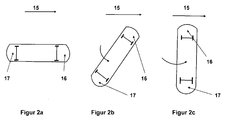
- Fig. 2a,2b, 2c
- in schematischer Darstellung 3 Stufen des Skateboard-Sliding;
- Fig. 3
- die Darstellung seitlich auf ein Skateboard wirkender Kräfte und deren Einfluss auf die Geschwindigkeit des Skateboards in Abhängigkeit von der Zeit.
-
Figur 1 zeigt an einem Ausführungsbeispiel in schematischer Darstellung den auf der Unterseite des Decks 18 eines Skateboards angeordneten Aufbau von Bauelementen der erfindungsgemäßen Motorsteuerungs- und -regeleinrichtung. Am Deck 18 des Skatebord 1 sind insgesamt vier an den Achsen 12 angeordnete Rollen 3, 26 und ein Freilaufgetriebe 4 vorgesehen. Der eingeschlagene Achsenwinkel der Aufhängung der Achsen 12 bestimmt die Lenkrichtung und den Lenkwinkel. Der Elektromotor 6, bei diesem Ausführungsbeispiel ein bürstenloser Drehstrommotor, wird durch den Akkumulator 2 mit Elektroenergie versorgt. An Stelle des Akkumulators 2 kann auch eine Batterie verwendet werden.
Die hier exemplarisch dargestellte Variante des Skateboard 1 verfügt über die angetriebene, sogenannte aktive Rolle 3 und über nicht angetriebene, sogenannte passive Rollen 26. Die Antriebsrolle 3 ist mechanisch über ein hier nicht dargestelltes Getriebe, eine Kette oder einen Zahnriemen mit dem elektronisch regelbaren Antriebssystem verbunden. Die Umdrehungszahl der passiven Rollen 26 wird durch den Sensor 13 gemessen. Der kombinierte Sensors 11, hier der Sensor mit der Kennung MPU-6050, vereint den Beschleunigungssensor zur Messung der Antriebsstärke des Elektromotors 6 und den Gyro-Sensor zur Erfassung des Einschlagwinkels des Skateboards im Verhältnis zur Fahrtrichtung 15. Zur Regelung der Lateralschubkraft ist das mit dem Controller 10 verbundene Potenziometer 19 vorgesehen.
Ein auf der Oberseite des Decks 18 angeordneter aber hier nicht dargestellter Gewichtssensor meldet bei Überschreiten eines einstellbaren Messwertes den "Benutzerstatus"
Auf dem Deck 18 und mit dem Controller 10 verbunden sind des Weiteren vorgesehen, die LED-Statusanzeige 23, der Piezzo-Lautsprecher 24 und das Display 25 als Segmentanzeige. Es versteht sich, dass die LED-Statusanzeige 23, der Piezzo-Lautsprecher 24 und das Display 25 so am Deck 18 angeordnet sind, dass deren Signale vom Benutzer gut wahrnehmbar sind.
Die LED-Statusanzeige 23 ist als Mehrfarbendiode in den Farben Rot/Grün ausgeführt und gibt dem Fahrer des Skateboard 1 mit der Farbe "Grün" die Information, dass das Skateboard 1 fahrbereit ist. Es kann jedoch auch ein anderer optischer Signalgeber zum Einsatz kommen. Nach dem Einschalten des Boards muss sich der MPU-6050-Sensor initialisieren. Dieser Vorgang erfordert im vorliegenden Beispiel ca. 20 Sekunden. Erst danach ist das Skateboard 1 fahrbereit.
Solange die LED-Statusanzeige 23 in der Farbe "Rot" leuchtet ist der MPU-6050-Sensor noch nicht initialisiert und das Board folglich nicht fahrbereit. Eine blinkende LED-Statusanzeige 23 signalisiert dem Fahrer eine Störung.
Über die erfolgte Initialisierung oder die Fahrbereitschaft kann dem Fahrer mit dem Piezzo-Lautsprecher oder einem anderen Signalgeber auch ein akustisches ein Signal gegeben werden. Ebenso kann ihm ein Warnsignal zum Akku-Entladungszustand gegeben werden. Mit der Segmentanzeige 25 können dem Fahrer verschiedene Informationen vermittelt werden, so zum Beispiel zum Status des Akkus 2 und zur Geschwindigkeit, der maximalen, der aktuellen und der durchschnittlichen Geschwindigkeit, sowie zu der zurückgelegten Strecke als auch Angaben zum eingestellten Fahrmodus, wie beispielsweise eine deaktivierte Motordrehrichtungsumkehr. - Um das Skateboard 1 zu benutzen wird es durch den Fahrer angeschoben. Durch das mechanische Freilaufgetriebe 4 bleibt der Elektromotor 6 zunächst passiv. Er dreht sich nicht mit. Bei Überschreiten einer bestimmten Drehzahl, die mittels des Sensors 13 an den passiven Rollen 26 erfasst wird, treibt der Elektromotor 6 die durch ein Getriebe, eine Kette oder einen Zahnriemen ausgebildete mechanische Verbindung untertourig an. Es erfolgt jedoch noch kein Schub an der angeordneten aktiven Rolle 3.
Bewegt nun der Fahrer das Skateboard 1 so, dass seitliche Kräfte auf das Skateboard 1 wirksam werden, erfasst der Beschleunigungssensor 11 diese Veränderung und der Mikroprozessor im Controller 10 verarbeitet die erhaltenen Messwerte in eine laterale Schubkraft und erzeugt in Echtzeit den sich ergebenden Verstärkungsfaktor für den elektrischen Antrieb. Sofern keine laterale Schubkraft erzeugt wird, unterbricht der Elektromotor 6 seinen Antrieb und läuft durch die Freilaufvorrichtung 4 untertourig weiter. Und beim Unterschreiten einer bestimmten, vorgegebenen Geschwindigkeit schaltet die Steuerung den Elektromotor 6 ab und verfällt in einen Standby-Modus. - In einer Bildfolge zeigen die
Figuren 2a, 2b und 2c das Querstellen des Skateboards 1 um 90° und den Übergang vom Fahrmodus in den Slide-Modus. Die durchschnittliche Wendezeit um das Skateboard 1 um 90° zu drehen und in den Slide-Modus zu bringen beträgt 500 ms bis 700 ms. Dies wird durch die erfindungsgemäße Motorsteuer- und regeleinrichtung in Echtzeit über die Winkelstellung der Ausrichtung des Decks 18 zur Fahrtrichtung 15 mittels des Gyro-Sensors 11 erkannt. In einer sehr kurzen Zeitspanne wird der Elektromotor 6 in Erfassung des sich abzeichnenden Wendemanövers auf null Umdrehungen abgebremst, die zuletzt gemessene Geschwindigkeit und abgeleitete Motorumdrehungszahl zwischengespeichert und der Elektromotor 6 in entgegengesetzter Drehrichtung übertourig wieder beschleunigt, um einen optimalen Freilauf zu ermöglichen, wenn das Skateboard um weitere 90° eingeschlagen wird.
Bei einer 180° Drehung des Skateboards 1 stehen die aktive Rolle 3 und die passiven Rollen 26 für einen winzigen Augenblick still.
Erst wenn der Controller 10 für die vom Gyro-Sensor 11 in Bezug auf die Winkelstellung des Decks 18 im Verhältnis zur Fahrtrichtung 15 und die vom Sensor 13 hinsichtlich der Drehzahl der nichtangetriebenen passiven Rollen jeweils Stabilität in den gemeldeten Werten, gleichbleibende bzw. sich nur gering verändernde Werte, festgestellt hat, also der Sliding-Modus beendet wurde, steuert der Controller 10 wieder die Drehzahl des Elektromotors 6. - Diese Funktionsweise der Erfindung erweist sich als ein besonderer Vorzug gegenüber dem bekannten Stand der Technik, denn allein aus der Erfassung der Drehrichtung der passiven Rollen 26 des Skateboards 1 und der Umdrehungsgeschwindigkeit der passiven Rollen 26 kann dieser Vorgang nicht realisiert werden. Wenn also das Skateboard 1 um insgesamt 180° gedreht wurde kann unter Beibehaltung der bisherigen Fahrtrichtung bremsfrei durch das überdrehte Freilaufgetriebe weitergefahren werden. Nur mit Hilfe des Gyro-Sensors 11, der wie ein "Kompass" für das Skateboard wirkt und in Echtzeit die Veränderung des Einschlagwinkels misst, kann er als Trigger für die Umkehr der Drehrichtung des Elektromotors 6 wirken.
- Wird nun das Skateboard erneut um 180° gedreht und der Sensor 13 und der Gyro-Sensor 11 liefern stabile Werte, kann der Elektromotor 6 nach erfolgter Drehrichtungsänderung wieder als Antrieb verwendet werden.
-
Figur 3 zeigt bei einer Testfahrt den Einfluss gemessener Lateralkräfte und deren Umwandlung in Schubkräfte auf die Geschwindigkeit über einen Zeitraum von ca. 30 Sekunden. In der Datenreihe 20 ist der Verlauf der vom Sensor 11 erfassten Messwerte der Lateralkräfte dargestellt. Die Datenreihe 21 zeigt den Verlauf der Geschwindigkeit des Skateboardes 1 mit einer maximalen Geschwindigkeit von 22 km/h und die Datenreihe 22 den kalkulierten Verstärkungsfaktor. Deutlich zeigen die Messwerte den Einfluss der in eine Schubkraft umgewandelten lateralen Kräfte bis zu dem Punkt, als das Skateboard 1 vom Fahrer nach dem Beschleunigen ausgebremst wurde. - Das vorgenannte Beispiel ist nicht auf die darin beschriebene Ausführungsform der Erfindung beschränkt.
So können an der Spitze des Skatebords, eingearbeitet in Deck und für den Fahrer sichtbar, zwei ebenfalls mehrfarbige LED eingearbeitet sein, um beispielsweise gemessene Seitwärtskräfte dem Fahrer durch Farbänderung zu signalisieren oder ihm bei entladenem Akku 6 oder einem Fehlerzustand ein Warnsignal zu geben. Auch können mehr als eine Rolle als aktive Rollen 3 fungieren. - Mit 2 Piezzo-Sensoren, jeweils unter der vorderen und hinteren Achse des Skateboards könnten die Parameter für die Beschleunigung automatisch angepasst werden und zwar in Abhängigkeit vom Gewicht des Fahrers für längere beziehungsweise kürzere Beschleunigungsmomente.
- Piezzo's können aber auch als Sensor für die vom Straßenbelag verursachten Erschütterungen verwendet werden.
Wenn eine der vorderen Rollen über einen Stein fährt, sollte die hintere Rolle dies zeitversetzt ebenfalls tun. Jede Unebenheit auf der Straße wird zuerst vom ersten Piezzo in der Vorderachse, dann vom zweiten Piezzo in der Hinterachse registriert.
Ähnliche Signale (Erschütterungen vom Untergrund) werden also 2 x gemessen. Wenn diese Erschütterungen gemessen und in Abhängigkeit von der gefahrenen Geschwindigkeit der zeitliche Versatz errechnet werden, können diese dann auch im Controller analysiert und mathematisch ausgefiltert werden.
Durch den Straßenbelag bedingte Erschütterungen können auf diese Weise ebenso ausgeblendet, wie das Auftreten des Fahrers auf das Board isoliert erfasst werden und als Trigger Signal für eine Fahr-Anwendung verwendet werden kann. So kann ein einmaliges Auftreten bei dem fahrenden Skateboard bedeuten, dass die aktuelle Geschwindigkeit bis zur nächsten Kurve oder so lange zu halten ist, bis der Sensor durch den Fahrer erneut bedient wird. -
- 1
- Skateboard, Longboard
- 2
- Akku
- 3
- Angetriebene aktive Rolle
- 4
- Freilaufgetriebe
- 5
- Kette oder Zahnriemen
- 6
- Elektromotor
- 7
- Antriebsmotor-Zuleitung
- 8
- Einrichtung zur Drehzahlkontrolle des Motors
- 9
- Kabel für die Datenübertragung zur Geschwindigkeitskontrolle
- 10
- Controller
- 11
- Se3nsor, Beschleunigungssensor, Gyrometer
- 12
- Achse
- 13
- Sensor zur Messung der Drehzahl und Erfassung der Drehrichtung
- 14
- Kipppunkt
- 15
- Fahrtrichtung
- 16
- Vorderer Teil des Skateboard
- 17
- Hinterer Teil des Skateboard
- 18
- Deck
- 19
- Potenziometer zur Regelung des Beschleunigungsfaktors
- 20
- Datenreihe der gemessenen Lateralkräfte,
- 21
- Datenreihe der Geschwindigkeit
- 22
- Datenreihe zum kalkulierten Verstärkungsfaktor
- 23
- LED Statusanzeige
- 24
- Piezzo Lautsprecher
- 25
- Display (Segmentanzeige)
- 26
- Nichtangetriebene passive Rollen
Claims (12)
- Motorsteuerungs- und -regeleinrichtung insbesondere für ein elektrisch angetriebenes Skate- oder Longboard, dadurch gekennzeichnet, dass sie eine Sensorik zur Erfassung seitlich zur Fahrtrichtung (15) auf das Skate- oder Longboard wirkender Kräfte, eine Sensorik (8) zur Drehzahlkontrolle eines Elektromotors (6), eine Sensorik (13) zur Messung von Drehzahl und Drehrichtung von nichtangetriebenen Rollen (26) des Skate- oder Longboard (1), einen Sensor (11) zur Erfassung des Einschlagwinkels des Skate- oder Longbords (1) im Verhältnis zur Fahrtrichtung (15) sowie eine elektronische Datenverarbeitung mit einem integrierten Controller (10) umfasst, der unter Verarbeitung der durch die Sensorik erhaltenen Signale die Drehzahl und -richtung des Elektromotors (6) steuert.
- Motorsteuerungs- und -regeleinrichtung nach Anspruch1, dadurch gekennzeichnet, dass das Skate- oder Longboard (1) einen Drucksensor oder einen anderen Sensor zur Erfassung des auf das Skateboard (1) wirkenden Gewichtes aufweist.
- Motorsteuerungs- und -regeleinrichtung nach Anspruch 1 oder 2, dadurch gekennzeichnet, dass es eine für einen Fahrer sichtbare Leuchtdiode (23) oder einen anderen optischen Signalgeber zur Signalisierung von Informationen zum Betriebszustand des Skate- oder Longboards (1) aufweist.
- Motorsteuerungs- und -regeleinrichtung nach mindestens einem der Ansprüche 1 bis 3, dadurch gekennzeichnet, dass es einen Piezzo-Lautsprecher (24) oder einen anderen Signalgeber besitzt, der dem Fahrer akustische Signale zum Betriebszustand des Skate- oder Longboards (1) gibt.
- Motorsteuerung und -regeleinrichtung nach mindestens einem der Ansprüche 1 bis 4, dadurch gekennzeichnet, dass die Drehzahl des Elektromotors (6) dynamisch und/oder konstant auch im Hinblick auf eine Mindest- und/oder Höchstgeschwindigkeit des Skate- oder Longboards (1) regelbar ist und/oder der Controller (10) bei Überschreiten einer vorgegebenen Geschwindigkeit die Antriebsrollen (3) als Bremsrollen aktiviert.
- Motorsteuerung und -regeleinrichtung nach mindestens einem der Ansprüche 1 bis 5, dadurch gekennzeichnet, dass sie die Drehrichtung des Elektromotors (6) umkehrt, sobald das Skate- oder Longboard (1) sich zunächst um mehr als 90° zur Fahrtrichtung (15) querstellt und danach bei Drehung um weitere 90° die Fahrtrichtung (15) beibehält.
- Motorsteuerung und -regeleinrichtung nach mindestens einem der Ansprüche 1 bis 6, dadurch gekennzeichnet, dass der Controller (10) bei der Drehung des Skate- oder Longboards (1) um 180° die Drehzahl des Elektromotors (6) erst dann wieder steuert, wenn der Sensor (11) in Bezug auf die Winkelstellung des Decks (18) im Verhältnis zur Fahrtrichtung (15) und der Sensor (13) hinsichtlich der erfassten Drehzahl der nichtangetriebenen passiven Rollen (26) jeweils stabile Werte melden.
- Motorsteuerung und -regeleinrichtung nach mindestens einem der Ansprüche 1 bis 7, dadurch gekennzeichnet, dass die Datenverarbeitung mit dem Controller (10) die durch einen Beschleunigungssensor (11) erfassten und seitlich auf das Skate- oder Longboard (1) wirkenden Kräfte in eine Schubkraft und einen Verstärkungsfaktor für den Elektromotor (6) umwandelt.
- Motorsteuerungs- und -regeleinrichtung nach mindestens einem der Ansprüche 1 bis 8, dadurch gekennzeichnet, dass mittels eines Potenziometers (21) oder eines anderen Sollwertgebers in Verbindung mit dem Controller (10) die Schubkraft regelbar ist
- Motorsteuerungs- und -regeleinrichtung nach mindestens einem der Ansprüche 1 bis 9, dadurch gekennzeichnet, dass die Umwandlung der seitlich auf das Skate- oder Longboard (1) wirkenden Kräfte in eine Schubkraft abschaltbar ist.
- Motorsteuerungs- und -regeleinrichtung nach mindestens einem der Ansprüche 1 bis 10, dadurch gekennzeichnet, dass bei Benutzung des Skate- oder Longboards (1) nach einer Drehung um 180° und der Elektromotor (6) seine Drehrichtung geändert hat, der Controller (10) die Umdrehungszahl des Elektromotors (6) so steuert, dass das Freilaufgetriebe (4) keine Bremswirkung bei Weiterfahrt des Skate- oder Longboards (1) erzeugt.
- Motorsteuerungs- und -regeleinrichtung nach mindestens einem der Ansprüche 1 bis 11, dadurch gekennzeichnet, dass der Controller (10) die Drehrichtung des Elektromotors (6) ändern kann, wenn der Benutzer des Skate- oder Longboards (1) mit diesem Sprünge durchführt, es um dessen Längsachse dreht oder es in eine Drehbewegung bringt.
Applications Claiming Priority (1)
| Application Number | Priority Date | Filing Date | Title |
|---|---|---|---|
| DE202015004862.5U DE202015004862U1 (de) | 2015-07-10 | 2015-07-10 | Motorsteuerungs- und -regeleinrichtung insbesondere für ein elektrisch angetriebenes Skate- oder Longboard |
Publications (2)
| Publication Number | Publication Date |
|---|---|
| EP3115091A1 true EP3115091A1 (de) | 2017-01-11 |
| EP3115091B1 EP3115091B1 (de) | 2018-01-31 |
Family
ID=53884410
Family Applications (1)
| Application Number | Title | Priority Date | Filing Date |
|---|---|---|---|
| EP16001508.7A Not-in-force EP3115091B1 (de) | 2015-07-10 | 2016-07-05 | Motorsteuerungs- und regeleinrichtung insbesondere für ein elektrisch angetriebens skate- oder longboard |
Country Status (3)
| Country | Link |
|---|---|
| US (1) | US9987547B2 (de) |
| EP (1) | EP3115091B1 (de) |
| DE (1) | DE202015004862U1 (de) |
Families Citing this family (28)
| Publication number | Priority date | Publication date | Assignee | Title |
|---|---|---|---|---|
| US8186693B2 (en) | 2008-03-06 | 2012-05-29 | Leverage Design Ltd. | Transportation device with pivoting axle |
| CN202987412U (zh) | 2012-01-20 | 2013-06-12 | 雷泽美国有限责任公司 | 用于个人移动式车辆的制动组件及个人移动式车辆 |
| USD693414S1 (en) | 2012-03-15 | 2013-11-12 | Razor Usa Llc | Electric scooter |
| WO2016141235A1 (en) * | 2015-03-03 | 2016-09-09 | Inboard Technology, Inc. | Deck for a powered skateboard |
| FR3034680B1 (fr) * | 2015-04-09 | 2017-04-28 | Commissariat Energie Atomique | Appareil de locomotion a roulettes |
| US10617935B2 (en) | 2015-10-16 | 2020-04-14 | Globe International Nominees Pty Ltd | Motorized wheel assembly with quick release |
| USD810836S1 (en) | 2015-10-29 | 2018-02-20 | Razor Usa Llc | Electric scooter |
| AU2016352184A1 (en) * | 2015-11-10 | 2018-04-26 | Globe International Nominees Pty Ltd | Electric vehicle interfaces and control systems |
| EP3405361B1 (de) | 2016-01-22 | 2023-03-15 | Razor USA LLC | Heckantriebseinheit und fahrzeug für persönliche mobilität |
| US12403974B2 (en) | 2016-01-22 | 2025-09-02 | Razor Usa Llc | Electric scooter |
| US11975794B2 (en) | 2016-01-22 | 2024-05-07 | Razor Usa Llc | Freewheeling electric scooter |
| WO2018013994A1 (en) * | 2016-07-15 | 2018-01-18 | Razor Usa Llc | Powered mobility systems |
| DE102017000490A1 (de) | 2017-01-20 | 2018-07-26 | Drive & Innovation Gmbh & Co. Kg | Anordnung zur Informations- oder Befehlseingabe für ein zumindest ternporär und/oder anteilig mit der Muskelkraft einer Bedienperson antreibbares Fahrzeug |
| DE102017000888A1 (de) | 2017-02-01 | 2018-08-02 | Maronad GmbH | Longboard für Trainingszwecke |
| US10160503B1 (en) * | 2017-08-05 | 2018-12-25 | Hui Zheng | Electric skateboard with motion assistant gravity control |
| USD912180S1 (en) | 2017-09-18 | 2021-03-02 | Razor Usa Llc | Personal mobility vehicle |
| US10766559B1 (en) * | 2018-02-10 | 2020-09-08 | Royce Nelson | Vehicle with shock-absorbing platform |
| DE102018111583A1 (de) * | 2018-05-15 | 2019-11-21 | Schaeffler Technologies AG & Co. KG | Elektrifizierter Leichttransporter, sowie ein Regelverfahren zum selbsttätigen Anpassen eines Leistungsabgabebereichs oder Beschleunigungsbereichs für einen solchen elektrifizierten Leichttransporter |
| EP3810297A4 (de) | 2018-06-01 | 2022-01-19 | Razor USA LLC | Persönliche mobilitätsfahrzeuge mit abnehmbarer antriebsanordnung |
| CN108434709A (zh) * | 2018-06-05 | 2018-08-24 | 北京小米移动软件有限公司 | 滑板控制方法及滑板 |
| USD1020912S1 (en) | 2018-06-05 | 2024-04-02 | Razor Usa Llc | Electric scooter |
| DE102019212389B4 (de) * | 2019-08-19 | 2022-03-17 | Friedrich-Alexander Universität Erlangen-Nürnberg | Verfahren zum Betrieb eines Paares Skates |
| US11352039B1 (en) * | 2020-05-19 | 2022-06-07 | Tyler Milam | Shopping cart security system |
| WO2022032136A1 (en) | 2020-08-07 | 2022-02-10 | Razor Usa Llc | Electric scooter with removable battery |
| USD1050269S1 (en) | 2020-09-14 | 2024-11-05 | Razor Usa Llc | Scooter |
| USD1072062S1 (en) | 2020-09-14 | 2025-04-22 | Razor Usa Llc | Electric scooter |
| USD1053956S1 (en) | 2020-09-14 | 2024-12-10 | Razor Usa Llc | Scooter |
| US12403385B2 (en) * | 2022-08-18 | 2025-09-02 | Sicheng Tan | Adaptive control of electric skateboard |
Citations (5)
| Publication number | Priority date | Publication date | Assignee | Title |
|---|---|---|---|---|
| US6050357A (en) * | 1995-05-31 | 2000-04-18 | Empower Corporation | Powered skateboard |
| DE10013009A1 (de) * | 2000-03-16 | 2001-09-20 | Manfred Hune | Verfahren zur Fehlerkorrektur bei Tachometern für Rollschuhen |
| DE10034277A1 (de) | 2000-07-14 | 2002-01-24 | Martin Kammerer | Motorisierter Roller |
| DE202010004820U1 (de) | 2010-04-10 | 2010-08-05 | Koslowski, Helmut | Tragbares elektronisch geregeltes Antriebssystem für Skateboards und Tretroller |
| DE102009036924A1 (de) | 2009-08-11 | 2011-02-24 | Andreas Reinauer | Skateboard |
Family Cites Families (5)
| Publication number | Priority date | Publication date | Assignee | Title |
|---|---|---|---|---|
| US6302230B1 (en) | 1999-06-04 | 2001-10-16 | Deka Products Limited Partnership | Personal mobility vehicles and methods |
| GB2402113A (en) | 2003-05-28 | 2004-12-01 | Shen-Keng Lin | Skateboard with drive mode control |
| DE20319055U1 (de) | 2003-12-01 | 2004-07-15 | Pflüger, Maik | Motorisierte auf Rollen gelagerte Plattform für die aufrechte Fortbewegung einer Person |
| JP4290020B2 (ja) * | 2004-01-23 | 2009-07-01 | ヤマハ株式会社 | 移動装置および移動装置システム |
| DE102013113643A1 (de) | 2013-12-06 | 2015-06-11 | Innovated Transport Systems Ug (Haftungsbeschränkt) | Fahrzeug für die Fortbewegung eines Fahrers mit einer auf einem Boden und in beliebige Richtungen abrollenden Kugel |
-
2015
- 2015-07-10 DE DE202015004862.5U patent/DE202015004862U1/de not_active Expired - Lifetime
-
2016
- 2016-07-05 EP EP16001508.7A patent/EP3115091B1/de not_active Not-in-force
- 2016-07-08 US US15/205,415 patent/US9987547B2/en not_active Expired - Fee Related
Patent Citations (5)
| Publication number | Priority date | Publication date | Assignee | Title |
|---|---|---|---|---|
| US6050357A (en) * | 1995-05-31 | 2000-04-18 | Empower Corporation | Powered skateboard |
| DE10013009A1 (de) * | 2000-03-16 | 2001-09-20 | Manfred Hune | Verfahren zur Fehlerkorrektur bei Tachometern für Rollschuhen |
| DE10034277A1 (de) | 2000-07-14 | 2002-01-24 | Martin Kammerer | Motorisierter Roller |
| DE102009036924A1 (de) | 2009-08-11 | 2011-02-24 | Andreas Reinauer | Skateboard |
| DE202010004820U1 (de) | 2010-04-10 | 2010-08-05 | Koslowski, Helmut | Tragbares elektronisch geregeltes Antriebssystem für Skateboards und Tretroller |
Also Published As
| Publication number | Publication date |
|---|---|
| EP3115091B1 (de) | 2018-01-31 |
| US9987547B2 (en) | 2018-06-05 |
| US20170007910A1 (en) | 2017-01-12 |
| DE202015004862U1 (de) | 2015-08-04 |
Similar Documents
| Publication | Publication Date | Title |
|---|---|---|
| EP3115091B1 (de) | Motorsteuerungs- und regeleinrichtung insbesondere für ein elektrisch angetriebens skate- oder longboard | |
| DE60315116T2 (de) | Fahrzeuglenksystem mit einem Notbetriebsmodus im Falle eines Ausfalls eines Radlenk-Aktuators | |
| WO1989006117A1 (fr) | Procede pour stabiliser un vehicule a roues a un seul essieu, et vehicule ainsi stabilise | |
| DE112009000828B4 (de) | Ferngesteuertes Spielzeugfahrzeug | |
| EP2941766A1 (de) | Drift-trainingsassistenzsystem für ein kraftfahrzeug | |
| DE4424297A1 (de) | Rover Board | |
| DE102016116329B4 (de) | Geschwindigkeitsbegrenzung für ein selbstbalancierendes Fahrzeug | |
| DE202015003807U1 (de) | Spielfahrzeugsystem | |
| EP1502769A3 (de) | Landwirtschaftliches Fahrzeug | |
| DE102017119355B4 (de) | Selbständiges Aufrichten eines selbstbalancierenden Fahrzeuges | |
| DE102009048902B4 (de) | Verfahren und Vorrichtung für die sichere Lenkung eines Kraftfahrzeugs | |
| DE10139101A1 (de) | Verfahren und Vorrichtung zur Spurstabilisierung von Gelenkfahrzeugen, insbesondere Gelenkbussen | |
| DE102015014845B3 (de) | Fußfahrzeug | |
| DE102017122917B4 (de) | Stützvorrichtung zur Abstützung eines Einspurfahrzeugs, sowie Einspurfahrzeug mit zumindest einer solchen Stützvorrichtung und Steuerverfahren | |
| EP2669153B1 (de) | Vorrichtung zur Fahrstabilisierung eines Rangiersystems für einen Anhänger | |
| DE102020200052B4 (de) | Stehfahrzeug mit Geschwindigkeitshaltefunktion | |
| DE102016210505A1 (de) | System zur Überwachung eines Natursportlers und Verfahren zum Betrieb des Systems | |
| DE202017105543U1 (de) | Selbständiges Aufrichten eines selbstbalancierenden Fahrzeuges | |
| DE102019205300B4 (de) | Personenfortbewegung mit einem Stehfahrzeug | |
| DE102016116327A1 (de) | Geschwindigkeitsbegrenzung für ein selbstbalancierendes Fahrzeug | |
| WO2024067965A1 (de) | Verfahren zum automatisierten stabilisieren einer fluglage eines fahrrads, steuereinrichtung, computerprogrammprodukt, computerlesbares medium, fahrrad | |
| EP2481333A1 (de) | Willkürlich eine Fläche abfahrendes, mobiles Flächenbehandlungsgerät | |
| DE102020125036B3 (de) | Arbeitsmaschine | |
| DE102020101334A1 (de) | Sicherheitsmodus für selbstbalancierende Fahrzeuge | |
| DE102020101335A1 (de) | Sicherheitsmodus für selbstbalancierende Fahrzeuge |
Legal Events
| Date | Code | Title | Description |
|---|---|---|---|
| PUAI | Public reference made under article 153(3) epc to a published international application that has entered the european phase |
Free format text: ORIGINAL CODE: 0009012 |
|
| AK | Designated contracting states |
Kind code of ref document: A1 Designated state(s): AL AT BE BG CH CY CZ DE DK EE ES FI FR GB GR HR HU IE IS IT LI LT LU LV MC MK MT NL NO PL PT RO RS SE SI SK SM TR |
|
| AX | Request for extension of the european patent |
Extension state: BA ME |
|
| 17P | Request for examination filed |
Effective date: 20170117 |
|
| RBV | Designated contracting states (corrected) |
Designated state(s): AL AT BE BG CH CY CZ DE DK EE ES FI FR GB GR HR HU IE IS IT LI LT LU LV MC MK MT NL NO PL PT RO RS SE SI SK SM TR |
|
| RIC1 | Information provided on ipc code assigned before grant |
Ipc: A63C 17/12 20060101ALI20170703BHEP Ipc: A63C 17/01 20060101AFI20170703BHEP |
|
| GRAP | Despatch of communication of intention to grant a patent |
Free format text: ORIGINAL CODE: EPIDOSNIGR1 |
|
| INTG | Intention to grant announced |
Effective date: 20170904 |
|
| GRAS | Grant fee paid |
Free format text: ORIGINAL CODE: EPIDOSNIGR3 |
|
| GRAA | (expected) grant |
Free format text: ORIGINAL CODE: 0009210 |
|
| AK | Designated contracting states |
Kind code of ref document: B1 Designated state(s): AL AT BE BG CH CY CZ DE DK EE ES FI FR GB GR HR HU IE IS IT LI LT LU LV MC MK MT NL NO PL PT RO RS SE SI SK SM TR |
|
| REG | Reference to a national code |
Ref country code: GB Ref legal event code: FG4D Free format text: NOT ENGLISH Ref country code: CH Ref legal event code: EP |
|
| REG | Reference to a national code |
Ref country code: AT Ref legal event code: REF Ref document number: 966816 Country of ref document: AT Kind code of ref document: T Effective date: 20180215 |
|
| REG | Reference to a national code |
Ref country code: IE Ref legal event code: FG4D Free format text: LANGUAGE OF EP DOCUMENT: GERMAN |
|
| REG | Reference to a national code |
Ref country code: DE Ref legal event code: R096 Ref document number: 502016000509 Country of ref document: DE |
|
| REG | Reference to a national code |
Ref country code: NL Ref legal event code: FP |
|
| REG | Reference to a national code |
Ref country code: LT Ref legal event code: MG4D |
|
| REG | Reference to a national code |
Ref country code: FR Ref legal event code: PLFP Year of fee payment: 3 |
|
| PG25 | Lapsed in a contracting state [announced via postgrant information from national office to epo] |
Ref country code: FI Free format text: LAPSE BECAUSE OF FAILURE TO SUBMIT A TRANSLATION OF THE DESCRIPTION OR TO PAY THE FEE WITHIN THE PRESCRIBED TIME-LIMIT Effective date: 20180131 Ref country code: LT Free format text: LAPSE BECAUSE OF FAILURE TO SUBMIT A TRANSLATION OF THE DESCRIPTION OR TO PAY THE FEE WITHIN THE PRESCRIBED TIME-LIMIT Effective date: 20180131 Ref country code: NO Free format text: LAPSE BECAUSE OF FAILURE TO SUBMIT A TRANSLATION OF THE DESCRIPTION OR TO PAY THE FEE WITHIN THE PRESCRIBED TIME-LIMIT Effective date: 20180430 Ref country code: ES Free format text: LAPSE BECAUSE OF FAILURE TO SUBMIT A TRANSLATION OF THE DESCRIPTION OR TO PAY THE FEE WITHIN THE PRESCRIBED TIME-LIMIT Effective date: 20180131 Ref country code: HR Free format text: LAPSE BECAUSE OF FAILURE TO SUBMIT A TRANSLATION OF THE DESCRIPTION OR TO PAY THE FEE WITHIN THE PRESCRIBED TIME-LIMIT Effective date: 20180131 |
|
| PG25 | Lapsed in a contracting state [announced via postgrant information from national office to epo] |
Ref country code: GR Free format text: LAPSE BECAUSE OF FAILURE TO SUBMIT A TRANSLATION OF THE DESCRIPTION OR TO PAY THE FEE WITHIN THE PRESCRIBED TIME-LIMIT Effective date: 20180501 Ref country code: PL Free format text: LAPSE BECAUSE OF FAILURE TO SUBMIT A TRANSLATION OF THE DESCRIPTION OR TO PAY THE FEE WITHIN THE PRESCRIBED TIME-LIMIT Effective date: 20180131 Ref country code: RS Free format text: LAPSE BECAUSE OF FAILURE TO SUBMIT A TRANSLATION OF THE DESCRIPTION OR TO PAY THE FEE WITHIN THE PRESCRIBED TIME-LIMIT Effective date: 20180131 Ref country code: BG Free format text: LAPSE BECAUSE OF FAILURE TO SUBMIT A TRANSLATION OF THE DESCRIPTION OR TO PAY THE FEE WITHIN THE PRESCRIBED TIME-LIMIT Effective date: 20180430 Ref country code: SE Free format text: LAPSE BECAUSE OF FAILURE TO SUBMIT A TRANSLATION OF THE DESCRIPTION OR TO PAY THE FEE WITHIN THE PRESCRIBED TIME-LIMIT Effective date: 20180131 Ref country code: LV Free format text: LAPSE BECAUSE OF FAILURE TO SUBMIT A TRANSLATION OF THE DESCRIPTION OR TO PAY THE FEE WITHIN THE PRESCRIBED TIME-LIMIT Effective date: 20180131 Ref country code: IS Free format text: LAPSE BECAUSE OF FAILURE TO SUBMIT A TRANSLATION OF THE DESCRIPTION OR TO PAY THE FEE WITHIN THE PRESCRIBED TIME-LIMIT Effective date: 20180531 |
|
| PG25 | Lapsed in a contracting state [announced via postgrant information from national office to epo] |
Ref country code: MT Free format text: LAPSE BECAUSE OF FAILURE TO SUBMIT A TRANSLATION OF THE DESCRIPTION OR TO PAY THE FEE WITHIN THE PRESCRIBED TIME-LIMIT Effective date: 20180131 |
|
| PG25 | Lapsed in a contracting state [announced via postgrant information from national office to epo] |
Ref country code: RO Free format text: LAPSE BECAUSE OF FAILURE TO SUBMIT A TRANSLATION OF THE DESCRIPTION OR TO PAY THE FEE WITHIN THE PRESCRIBED TIME-LIMIT Effective date: 20180131 Ref country code: IT Free format text: LAPSE BECAUSE OF FAILURE TO SUBMIT A TRANSLATION OF THE DESCRIPTION OR TO PAY THE FEE WITHIN THE PRESCRIBED TIME-LIMIT Effective date: 20180131 Ref country code: EE Free format text: LAPSE BECAUSE OF FAILURE TO SUBMIT A TRANSLATION OF THE DESCRIPTION OR TO PAY THE FEE WITHIN THE PRESCRIBED TIME-LIMIT Effective date: 20180131 Ref country code: AL Free format text: LAPSE BECAUSE OF FAILURE TO SUBMIT A TRANSLATION OF THE DESCRIPTION OR TO PAY THE FEE WITHIN THE PRESCRIBED TIME-LIMIT Effective date: 20180131 |
|
| REG | Reference to a national code |
Ref country code: DE Ref legal event code: R097 Ref document number: 502016000509 Country of ref document: DE |
|
| PG25 | Lapsed in a contracting state [announced via postgrant information from national office to epo] |
Ref country code: CZ Free format text: LAPSE BECAUSE OF FAILURE TO SUBMIT A TRANSLATION OF THE DESCRIPTION OR TO PAY THE FEE WITHIN THE PRESCRIBED TIME-LIMIT Effective date: 20180131 Ref country code: SK Free format text: LAPSE BECAUSE OF FAILURE TO SUBMIT A TRANSLATION OF THE DESCRIPTION OR TO PAY THE FEE WITHIN THE PRESCRIBED TIME-LIMIT Effective date: 20180131 Ref country code: SM Free format text: LAPSE BECAUSE OF FAILURE TO SUBMIT A TRANSLATION OF THE DESCRIPTION OR TO PAY THE FEE WITHIN THE PRESCRIBED TIME-LIMIT Effective date: 20180131 Ref country code: DK Free format text: LAPSE BECAUSE OF FAILURE TO SUBMIT A TRANSLATION OF THE DESCRIPTION OR TO PAY THE FEE WITHIN THE PRESCRIBED TIME-LIMIT Effective date: 20180131 |
|
| PLBE | No opposition filed within time limit |
Free format text: ORIGINAL CODE: 0009261 |
|
| STAA | Information on the status of an ep patent application or granted ep patent |
Free format text: STATUS: NO OPPOSITION FILED WITHIN TIME LIMIT |
|
| 26N | No opposition filed |
Effective date: 20181102 |
|
| PG25 | Lapsed in a contracting state [announced via postgrant information from national office to epo] |
Ref country code: SI Free format text: LAPSE BECAUSE OF FAILURE TO SUBMIT A TRANSLATION OF THE DESCRIPTION OR TO PAY THE FEE WITHIN THE PRESCRIBED TIME-LIMIT Effective date: 20180131 |
|
| PG25 | Lapsed in a contracting state [announced via postgrant information from national office to epo] |
Ref country code: MC Free format text: LAPSE BECAUSE OF FAILURE TO SUBMIT A TRANSLATION OF THE DESCRIPTION OR TO PAY THE FEE WITHIN THE PRESCRIBED TIME-LIMIT Effective date: 20180131 Ref country code: LU Free format text: LAPSE BECAUSE OF NON-PAYMENT OF DUE FEES Effective date: 20180705 |
|
| REG | Reference to a national code |
Ref country code: BE Ref legal event code: MM Effective date: 20180731 |
|
| REG | Reference to a national code |
Ref country code: IE Ref legal event code: MM4A |
|
| PG25 | Lapsed in a contracting state [announced via postgrant information from national office to epo] |
Ref country code: IE Free format text: LAPSE BECAUSE OF NON-PAYMENT OF DUE FEES Effective date: 20180705 |
|
| PG25 | Lapsed in a contracting state [announced via postgrant information from national office to epo] |
Ref country code: BE Free format text: LAPSE BECAUSE OF NON-PAYMENT OF DUE FEES Effective date: 20180731 |
|
| PGFP | Annual fee paid to national office [announced via postgrant information from national office to epo] |
Ref country code: NL Payment date: 20190722 Year of fee payment: 4 |
|
| PGFP | Annual fee paid to national office [announced via postgrant information from national office to epo] |
Ref country code: FR Payment date: 20190724 Year of fee payment: 4 |
|
| REG | Reference to a national code |
Ref country code: CH Ref legal event code: PL |
|
| PG25 | Lapsed in a contracting state [announced via postgrant information from national office to epo] |
Ref country code: TR Free format text: LAPSE BECAUSE OF FAILURE TO SUBMIT A TRANSLATION OF THE DESCRIPTION OR TO PAY THE FEE WITHIN THE PRESCRIBED TIME-LIMIT Effective date: 20180131 |
|
| PG25 | Lapsed in a contracting state [announced via postgrant information from national office to epo] |
Ref country code: PT Free format text: LAPSE BECAUSE OF FAILURE TO SUBMIT A TRANSLATION OF THE DESCRIPTION OR TO PAY THE FEE WITHIN THE PRESCRIBED TIME-LIMIT Effective date: 20180131 Ref country code: LI Free format text: LAPSE BECAUSE OF NON-PAYMENT OF DUE FEES Effective date: 20190731 Ref country code: CH Free format text: LAPSE BECAUSE OF NON-PAYMENT OF DUE FEES Effective date: 20190731 |
|
| PG25 | Lapsed in a contracting state [announced via postgrant information from national office to epo] |
Ref country code: CY Free format text: LAPSE BECAUSE OF FAILURE TO SUBMIT A TRANSLATION OF THE DESCRIPTION OR TO PAY THE FEE WITHIN THE PRESCRIBED TIME-LIMIT Effective date: 20180131 Ref country code: MK Free format text: LAPSE BECAUSE OF NON-PAYMENT OF DUE FEES Effective date: 20180131 Ref country code: HU Free format text: LAPSE BECAUSE OF FAILURE TO SUBMIT A TRANSLATION OF THE DESCRIPTION OR TO PAY THE FEE WITHIN THE PRESCRIBED TIME-LIMIT; INVALID AB INITIO Effective date: 20160705 |
|
| PGFP | Annual fee paid to national office [announced via postgrant information from national office to epo] |
Ref country code: DE Payment date: 20200513 Year of fee payment: 5 |
|
| REG | Reference to a national code |
Ref country code: NL Ref legal event code: MM Effective date: 20200801 |
|
| GBPC | Gb: european patent ceased through non-payment of renewal fee |
Effective date: 20200705 |
|
| PG25 | Lapsed in a contracting state [announced via postgrant information from national office to epo] |
Ref country code: GB Free format text: LAPSE BECAUSE OF NON-PAYMENT OF DUE FEES Effective date: 20200705 Ref country code: NL Free format text: LAPSE BECAUSE OF NON-PAYMENT OF DUE FEES Effective date: 20200801 Ref country code: FR Free format text: LAPSE BECAUSE OF NON-PAYMENT OF DUE FEES Effective date: 20200731 |
|
| REG | Reference to a national code |
Ref country code: DE Ref legal event code: R119 Ref document number: 502016000509 Country of ref document: DE |
|
| PG25 | Lapsed in a contracting state [announced via postgrant information from national office to epo] |
Ref country code: DE Free format text: LAPSE BECAUSE OF NON-PAYMENT OF DUE FEES Effective date: 20220201 |
|
| REG | Reference to a national code |
Ref country code: AT Ref legal event code: MM01 Ref document number: 966816 Country of ref document: AT Kind code of ref document: T Effective date: 20210705 |
|
| PG25 | Lapsed in a contracting state [announced via postgrant information from national office to epo] |
Ref country code: AT Free format text: LAPSE BECAUSE OF NON-PAYMENT OF DUE FEES Effective date: 20210705 |