EP3106456A1 - Polymerizable compound, polymerizable composition, polymer, and optical isomer - Google Patents
Polymerizable compound, polymerizable composition, polymer, and optical isomer Download PDFInfo
- Publication number
- EP3106456A1 EP3106456A1 EP15749035.0A EP15749035A EP3106456A1 EP 3106456 A1 EP3106456 A1 EP 3106456A1 EP 15749035 A EP15749035 A EP 15749035A EP 3106456 A1 EP3106456 A1 EP 3106456A1
- Authority
- EP
- European Patent Office
- Prior art keywords
- group
- substituted
- carbon atoms
- unsubstituted
- compound
- Prior art date
- Legal status (The legal status is an assumption and is not a legal conclusion. Google has not performed a legal analysis and makes no representation as to the accuracy of the status listed.)
- Granted
Links
- 150000001875 compounds Chemical class 0.000 title claims abstract description 220
- 239000000203 mixture Substances 0.000 title claims abstract description 61
- 229920000642 polymer Polymers 0.000 title claims abstract description 49
- 230000003287 optical effect Effects 0.000 title description 3
- 125000004432 carbon atom Chemical group C* 0.000 claims abstract description 97
- 125000003118 aryl group Chemical group 0.000 claims abstract description 34
- 125000000217 alkyl group Chemical group 0.000 claims abstract description 31
- 125000001931 aliphatic group Chemical group 0.000 claims abstract description 26
- 125000004435 hydrogen atom Chemical group [H]* 0.000 claims abstract description 20
- 239000000126 substance Substances 0.000 claims abstract description 18
- 125000002723 alicyclic group Chemical group 0.000 claims abstract description 13
- 125000003342 alkenyl group Chemical group 0.000 claims abstract description 11
- 239000003999 initiator Substances 0.000 claims description 24
- SNVLJLYUUXKWOJ-UHFFFAOYSA-N methylidenecarbene Chemical compound C=[C] SNVLJLYUUXKWOJ-UHFFFAOYSA-N 0.000 claims description 24
- 125000005843 halogen group Chemical group 0.000 claims description 18
- 230000000379 polymerizing effect Effects 0.000 claims description 15
- 125000000843 phenylene group Chemical group C1(=C(C=CC=C1)*)* 0.000 claims description 13
- 125000001997 phenyl group Chemical group [H]C1=C([H])C([H])=C(*)C([H])=C1[H] 0.000 claims description 10
- 125000004957 naphthylene group Chemical group 0.000 claims description 9
- 125000002947 alkylene group Chemical group 0.000 claims description 6
- 125000001624 naphthyl group Chemical group 0.000 claims description 5
- 125000002529 biphenylenyl group Chemical group C1(=CC=CC=2C3=CC=CC=C3C12)* 0.000 claims description 4
- -1 t-butoxy group Chemical group 0.000 description 61
- XEKOWRVHYACXOJ-UHFFFAOYSA-N Ethyl acetate Chemical compound CCOC(C)=O XEKOWRVHYACXOJ-UHFFFAOYSA-N 0.000 description 57
- 238000006243 chemical reaction Methods 0.000 description 50
- 239000002904 solvent Substances 0.000 description 45
- 239000010408 film Substances 0.000 description 36
- YXFVVABEGXRONW-UHFFFAOYSA-N Toluene Chemical compound CC1=CC=CC=C1 YXFVVABEGXRONW-UHFFFAOYSA-N 0.000 description 33
- WYURNTSHIVDZCO-UHFFFAOYSA-N Tetrahydrofuran Chemical compound C1CCOC1 WYURNTSHIVDZCO-UHFFFAOYSA-N 0.000 description 32
- 239000000047 product Substances 0.000 description 32
- 239000006185 dispersion Substances 0.000 description 30
- 150000001728 carbonyl compounds Chemical class 0.000 description 24
- 239000000758 substrate Substances 0.000 description 22
- ZMANZCXQSJIPKH-UHFFFAOYSA-N Triethylamine Chemical compound CCN(CC)CC ZMANZCXQSJIPKH-UHFFFAOYSA-N 0.000 description 21
- 239000011541 reaction mixture Substances 0.000 description 21
- 239000007787 solid Substances 0.000 description 21
- 239000000243 solution Substances 0.000 description 19
- KFZMGEQAYNKOFK-UHFFFAOYSA-N Isopropanol Chemical compound CC(C)O KFZMGEQAYNKOFK-UHFFFAOYSA-N 0.000 description 18
- 238000000034 method Methods 0.000 description 16
- YLQBMQCUIZJEEH-UHFFFAOYSA-N tetrahydrofuran Natural products C=1C=COC=1 YLQBMQCUIZJEEH-UHFFFAOYSA-N 0.000 description 16
- YMWUJEATGCHHMB-UHFFFAOYSA-N Dichloromethane Chemical compound ClCCl YMWUJEATGCHHMB-UHFFFAOYSA-N 0.000 description 15
- 238000005160 1H NMR spectroscopy Methods 0.000 description 14
- IJGRMHOSHXDMSA-UHFFFAOYSA-N Atomic nitrogen Chemical compound N#N IJGRMHOSHXDMSA-UHFFFAOYSA-N 0.000 description 14
- RTZKZFJDLAIYFH-UHFFFAOYSA-N Diethyl ether Chemical compound CCOCC RTZKZFJDLAIYFH-UHFFFAOYSA-N 0.000 description 13
- 230000015572 biosynthetic process Effects 0.000 description 13
- ZWEHNKRNPOVVGH-UHFFFAOYSA-N 2-Butanone Chemical compound CCC(C)=O ZWEHNKRNPOVVGH-UHFFFAOYSA-N 0.000 description 12
- HEMHJVSKTPXQMS-UHFFFAOYSA-M Sodium hydroxide Chemical compound [OH-].[Na+] HEMHJVSKTPXQMS-UHFFFAOYSA-M 0.000 description 12
- 125000002496 methyl group Chemical group [H]C([H])([H])* 0.000 description 12
- 239000000178 monomer Substances 0.000 description 12
- 239000003960 organic solvent Substances 0.000 description 12
- 125000001424 substituent group Chemical group 0.000 description 12
- 238000003786 synthesis reaction Methods 0.000 description 12
- 239000002585 base Substances 0.000 description 11
- HEDRZPFGACZZDS-UHFFFAOYSA-N Chloroform Chemical compound ClC(Cl)Cl HEDRZPFGACZZDS-UHFFFAOYSA-N 0.000 description 10
- PMZURENOXWZQFD-UHFFFAOYSA-L Sodium Sulfate Chemical compound [Na+].[Na+].[O-]S([O-])(=O)=O PMZURENOXWZQFD-UHFFFAOYSA-L 0.000 description 10
- BGTOWKSIORTVQH-UHFFFAOYSA-N cyclopentanone Chemical compound O=C1CCCC1 BGTOWKSIORTVQH-UHFFFAOYSA-N 0.000 description 10
- 239000010410 layer Substances 0.000 description 10
- VLKZOEOYAKHREP-UHFFFAOYSA-N n-Hexane Chemical compound CCCCCC VLKZOEOYAKHREP-UHFFFAOYSA-N 0.000 description 10
- KWYUFKZDYYNOTN-UHFFFAOYSA-M Potassium hydroxide Chemical compound [OH-].[K+] KWYUFKZDYYNOTN-UHFFFAOYSA-M 0.000 description 9
- 125000003545 alkoxy group Chemical group 0.000 description 9
- 230000000694 effects Effects 0.000 description 9
- 239000012788 optical film Substances 0.000 description 9
- 238000006116 polymerization reaction Methods 0.000 description 9
- XLYOFNOQVPJJNP-UHFFFAOYSA-N water Substances O XLYOFNOQVPJJNP-UHFFFAOYSA-N 0.000 description 9
- 0 C*C(C)c1cc(C)cc(*C)c1 Chemical compound C*C(C)c1cc(C)cc(*C)c1 0.000 description 8
- IAZDPXIOMUYVGZ-WFGJKAKNSA-N Dimethyl sulfoxide Chemical compound [2H]C([2H])([2H])S(=O)C([2H])([2H])[2H] IAZDPXIOMUYVGZ-WFGJKAKNSA-N 0.000 description 8
- HEDRZPFGACZZDS-MICDWDOJSA-N Trichloro(2H)methane Chemical compound [2H]C(Cl)(Cl)Cl HEDRZPFGACZZDS-MICDWDOJSA-N 0.000 description 8
- 238000000576 coating method Methods 0.000 description 8
- 229940125904 compound 1 Drugs 0.000 description 8
- JHIVVAPYMSGYDF-UHFFFAOYSA-N cyclohexanone Chemical compound O=C1CCCCC1 JHIVVAPYMSGYDF-UHFFFAOYSA-N 0.000 description 8
- 229910052731 fluorine Inorganic materials 0.000 description 8
- 125000001153 fluoro group Chemical group F* 0.000 description 8
- VHYFNPMBLIVWCW-UHFFFAOYSA-N 4-Dimethylaminopyridine Chemical compound CN(C)C1=CC=NC=C1 VHYFNPMBLIVWCW-UHFFFAOYSA-N 0.000 description 7
- 125000001301 ethoxy group Chemical group [H]C([H])([H])C([H])([H])O* 0.000 description 7
- 239000004973 liquid crystal related substance Substances 0.000 description 7
- 125000000956 methoxy group Chemical group [H]C([H])([H])O* 0.000 description 7
- SKTCDJAMAYNROS-UHFFFAOYSA-N methoxycyclopentane Chemical compound COC1CCCC1 SKTCDJAMAYNROS-UHFFFAOYSA-N 0.000 description 7
- 229910052757 nitrogen Inorganic materials 0.000 description 7
- CLFRCXCBWIQVRN-UHFFFAOYSA-N 2,5-dihydroxybenzaldehyde Chemical compound OC1=CC=C(O)C(C=O)=C1 CLFRCXCBWIQVRN-UHFFFAOYSA-N 0.000 description 6
- FPQQSJJWHUJYPU-UHFFFAOYSA-N 3-(dimethylamino)propyliminomethylidene-ethylazanium;chloride Chemical compound Cl.CCN=C=NCCCN(C)C FPQQSJJWHUJYPU-UHFFFAOYSA-N 0.000 description 6
- CSCPPACGZOOCGX-UHFFFAOYSA-N Acetone Chemical compound CC(C)=O CSCPPACGZOOCGX-UHFFFAOYSA-N 0.000 description 6
- UHOVQNZJYSORNB-UHFFFAOYSA-N Benzene Chemical compound C1=CC=CC=C1 UHOVQNZJYSORNB-UHFFFAOYSA-N 0.000 description 6
- XTHFKEDIFFGKHM-UHFFFAOYSA-N Dimethoxyethane Chemical compound COCCOC XTHFKEDIFFGKHM-UHFFFAOYSA-N 0.000 description 6
- PEDCQBHIVMGVHV-UHFFFAOYSA-N Glycerine Chemical compound OCC(O)CO PEDCQBHIVMGVHV-UHFFFAOYSA-N 0.000 description 6
- OAKJQQAXSVQMHS-UHFFFAOYSA-N Hydrazine Chemical compound NN OAKJQQAXSVQMHS-UHFFFAOYSA-N 0.000 description 6
- ZMXDDKWLCZADIW-UHFFFAOYSA-N N,N-Dimethylformamide Chemical compound CN(C)C=O ZMXDDKWLCZADIW-UHFFFAOYSA-N 0.000 description 6
- 229910052801 chlorine Inorganic materials 0.000 description 6
- 238000001035 drying Methods 0.000 description 6
- 239000004210 ether based solvent Substances 0.000 description 6
- 125000001495 ethyl group Chemical group [H]C([H])([H])C([H])([H])* 0.000 description 6
- IKDUDTNKRLTJSI-UHFFFAOYSA-N hydrazine hydrate Chemical compound O.NN IKDUDTNKRLTJSI-UHFFFAOYSA-N 0.000 description 6
- 238000004519 manufacturing process Methods 0.000 description 6
- 239000011368 organic material Substances 0.000 description 6
- 238000010898 silica gel chromatography Methods 0.000 description 6
- RYHBNJHYFVUHQT-UHFFFAOYSA-N 1,4-Dioxane Chemical compound C1COCCO1 RYHBNJHYFVUHQT-UHFFFAOYSA-N 0.000 description 5
- MEKOFIRRDATTAG-UHFFFAOYSA-N 2,2,5,8-tetramethyl-3,4-dihydrochromen-6-ol Chemical compound C1CC(C)(C)OC2=C1C(C)=C(O)C=C2C MEKOFIRRDATTAG-UHFFFAOYSA-N 0.000 description 5
- LFQSCWFLJHTTHZ-UHFFFAOYSA-N Ethanol Chemical compound CCO LFQSCWFLJHTTHZ-UHFFFAOYSA-N 0.000 description 5
- DHXVGJBLRPWPCS-UHFFFAOYSA-N Tetrahydropyran Chemical compound C1CCOCC1 DHXVGJBLRPWPCS-UHFFFAOYSA-N 0.000 description 5
- 238000009835 boiling Methods 0.000 description 5
- 239000003795 chemical substances by application Substances 0.000 description 5
- 125000001309 chloro group Chemical group Cl* 0.000 description 5
- 238000009833 condensation Methods 0.000 description 5
- 238000000605 extraction Methods 0.000 description 5
- 239000000706 filtrate Substances 0.000 description 5
- 238000010438 heat treatment Methods 0.000 description 5
- 239000012046 mixed solvent Substances 0.000 description 5
- 150000003254 radicals Chemical class 0.000 description 5
- 229910052938 sodium sulfate Inorganic materials 0.000 description 5
- 235000011152 sodium sulphate Nutrition 0.000 description 5
- 239000004094 surface-active agent Substances 0.000 description 5
- DYLIWHYUXAJDOJ-OWOJBTEDSA-N (e)-4-(6-aminopurin-9-yl)but-2-en-1-ol Chemical compound NC1=NC=NC2=C1N=CN2C\C=C\CO DYLIWHYUXAJDOJ-OWOJBTEDSA-N 0.000 description 4
- SCYULBFZEHDVBN-UHFFFAOYSA-N 1,1-Dichloroethane Chemical compound CC(Cl)Cl SCYULBFZEHDVBN-UHFFFAOYSA-N 0.000 description 4
- KUDUQBURMYMBIJ-UHFFFAOYSA-N 2-prop-2-enoyloxyethyl prop-2-enoate Chemical compound C=CC(=O)OCCOC(=O)C=C KUDUQBURMYMBIJ-UHFFFAOYSA-N 0.000 description 4
- KWOLFJPFCHCOCG-UHFFFAOYSA-N Acetophenone Chemical compound CC(=O)C1=CC=CC=C1 KWOLFJPFCHCOCG-UHFFFAOYSA-N 0.000 description 4
- DKPFZGUDAPQIHT-UHFFFAOYSA-N Butyl acetate Natural products CCCCOC(C)=O DKPFZGUDAPQIHT-UHFFFAOYSA-N 0.000 description 4
- IAZDPXIOMUYVGZ-UHFFFAOYSA-N Dimethylsulphoxide Chemical compound CS(C)=O IAZDPXIOMUYVGZ-UHFFFAOYSA-N 0.000 description 4
- 229920000106 Liquid crystal polymer Polymers 0.000 description 4
- 239000004977 Liquid-crystal polymers (LCPs) Substances 0.000 description 4
- SECXISVLQFMRJM-UHFFFAOYSA-N N-Methylpyrrolidone Chemical compound CN1CCCC1=O SECXISVLQFMRJM-UHFFFAOYSA-N 0.000 description 4
- OFBQJSOFQDEBGM-UHFFFAOYSA-N Pentane Chemical compound CCCCC OFBQJSOFQDEBGM-UHFFFAOYSA-N 0.000 description 4
- 150000008065 acid anhydrides Chemical class 0.000 description 4
- 150000001408 amides Chemical class 0.000 description 4
- 229940072049 amyl acetate Drugs 0.000 description 4
- PGMYKACGEOXYJE-UHFFFAOYSA-N anhydrous amyl acetate Natural products CCCCCOC(C)=O PGMYKACGEOXYJE-UHFFFAOYSA-N 0.000 description 4
- PXKLMJQFEQBVLD-UHFFFAOYSA-N bisphenol F Chemical compound C1=CC(O)=CC=C1CC1=CC=C(O)C=C1 PXKLMJQFEQBVLD-UHFFFAOYSA-N 0.000 description 4
- 125000003178 carboxy group Chemical group [H]OC(*)=O 0.000 description 4
- 230000000052 comparative effect Effects 0.000 description 4
- 150000008282 halocarbons Chemical class 0.000 description 4
- MNWFXJYAOYHMED-UHFFFAOYSA-M heptanoate Chemical compound CCCCCCC([O-])=O MNWFXJYAOYHMED-UHFFFAOYSA-M 0.000 description 4
- FUZZWVXGSFPDMH-UHFFFAOYSA-N hexanoic acid Chemical compound CCCCCC(O)=O FUZZWVXGSFPDMH-UHFFFAOYSA-N 0.000 description 4
- 125000002887 hydroxy group Chemical group [H]O* 0.000 description 4
- 238000005259 measurement Methods 0.000 description 4
- 229920001223 polyethylene glycol Polymers 0.000 description 4
- 230000035484 reaction time Effects 0.000 description 4
- 150000003839 salts Chemical class 0.000 description 4
- JYEUMXHLPRZUAT-UHFFFAOYSA-N 1,2,3-triazine Chemical compound C1=CN=NN=C1 JYEUMXHLPRZUAT-UHFFFAOYSA-N 0.000 description 3
- WNXJIVFYUVYPPR-UHFFFAOYSA-N 1,3-dioxolane Chemical compound C1COCO1 WNXJIVFYUVYPPR-UHFFFAOYSA-N 0.000 description 3
- LMDZBCPBFSXMTL-UHFFFAOYSA-N 1-Ethyl-3-(3-dimethylaminopropyl)carbodiimide Substances CCN=C=NCCCN(C)C LMDZBCPBFSXMTL-UHFFFAOYSA-N 0.000 description 3
- UHFFVFAKEGKNAQ-UHFFFAOYSA-N 2-benzyl-2-(dimethylamino)-1-(4-morpholin-4-ylphenyl)butan-1-one Chemical compound C=1C=C(N2CCOCC2)C=CC=1C(=O)C(CC)(N(C)C)CC1=CC=CC=C1 UHFFVFAKEGKNAQ-UHFFFAOYSA-N 0.000 description 3
- LWRBVKNFOYUCNP-UHFFFAOYSA-N 2-methyl-1-(4-methylsulfanylphenyl)-2-morpholin-4-ylpropan-1-one Chemical compound C1=CC(SC)=CC=C1C(=O)C(C)(C)N1CCOCC1 LWRBVKNFOYUCNP-UHFFFAOYSA-N 0.000 description 3
- WKBOTKDWSSQWDR-UHFFFAOYSA-N Bromine atom Chemical group [Br] WKBOTKDWSSQWDR-UHFFFAOYSA-N 0.000 description 3
- OKKJLVBELUTLKV-UHFFFAOYSA-N Methanol Chemical compound OC OKKJLVBELUTLKV-UHFFFAOYSA-N 0.000 description 3
- LRHPLDYGYMQRHN-UHFFFAOYSA-N N-Butanol Chemical compound CCCCO LRHPLDYGYMQRHN-UHFFFAOYSA-N 0.000 description 3
- IMNFDUFMRHMDMM-UHFFFAOYSA-N N-Heptane Chemical compound CCCCCCC IMNFDUFMRHMDMM-UHFFFAOYSA-N 0.000 description 3
- AMQJEAYHLZJPGS-UHFFFAOYSA-N N-Pentanol Chemical compound CCCCCO AMQJEAYHLZJPGS-UHFFFAOYSA-N 0.000 description 3
- CTQNGGLPUBDAKN-UHFFFAOYSA-N O-Xylene Chemical compound CC1=CC=CC=C1C CTQNGGLPUBDAKN-UHFFFAOYSA-N 0.000 description 3
- 239000004642 Polyimide Substances 0.000 description 3
- DKGAVHZHDRPRBM-UHFFFAOYSA-N Tert-Butanol Chemical compound CC(C)(C)O DKGAVHZHDRPRBM-UHFFFAOYSA-N 0.000 description 3
- 239000002253 acid Substances 0.000 description 3
- 239000000654 additive Substances 0.000 description 3
- 230000000996 additive effect Effects 0.000 description 3
- 239000005456 alcohol based solvent Substances 0.000 description 3
- 150000004945 aromatic hydrocarbons Chemical class 0.000 description 3
- 238000004132 cross linking Methods 0.000 description 3
- 125000004093 cyano group Chemical group *C#N 0.000 description 3
- 239000003759 ester based solvent Substances 0.000 description 3
- 239000000852 hydrogen donor Substances 0.000 description 3
- 125000003253 isopropoxy group Chemical group [H]C([H])([H])C([H])(O*)C([H])([H])[H] 0.000 description 3
- 239000000463 material Substances 0.000 description 3
- 125000000449 nitro group Chemical group [O-][N+](*)=O 0.000 description 3
- 229920001721 polyimide Polymers 0.000 description 3
- 125000001436 propyl group Chemical group [H]C([*])([H])C([H])([H])C([H])([H])[H] 0.000 description 3
- 239000008096 xylene Substances 0.000 description 3
- ZXHDVRATSGZISC-UHFFFAOYSA-N 1,2-bis(ethenoxy)ethane Chemical compound C=COCCOC=C ZXHDVRATSGZISC-UHFFFAOYSA-N 0.000 description 2
- YXIWHUQXZSMYRE-UHFFFAOYSA-N 1,3-benzothiazole-2-thiol Chemical compound C1=CC=C2SC(S)=NC2=C1 YXIWHUQXZSMYRE-UHFFFAOYSA-N 0.000 description 2
- AZQWKYJCGOJGHM-UHFFFAOYSA-N 1,4-benzoquinone Chemical compound O=C1C=CC(=O)C=C1 AZQWKYJCGOJGHM-UHFFFAOYSA-N 0.000 description 2
- 238000001644 13C nuclear magnetic resonance spectroscopy Methods 0.000 description 2
- KWVGIHKZDCUPEU-UHFFFAOYSA-N 2,2-dimethoxy-2-phenylacetophenone Chemical compound C=1C=CC=CC=1C(OC)(OC)C(=O)C1=CC=CC=C1 KWVGIHKZDCUPEU-UHFFFAOYSA-N 0.000 description 2
- LEJBBGNFPAFPKQ-UHFFFAOYSA-N 2-(2-prop-2-enoyloxyethoxy)ethyl prop-2-enoate Chemical compound C=CC(=O)OCCOCCOC(=O)C=C LEJBBGNFPAFPKQ-UHFFFAOYSA-N 0.000 description 2
- XFCMNSHQOZQILR-UHFFFAOYSA-N 2-[2-(2-methylprop-2-enoyloxy)ethoxy]ethyl 2-methylprop-2-enoate Chemical compound CC(=C)C(=O)OCCOCCOC(=O)C(C)=C XFCMNSHQOZQILR-UHFFFAOYSA-N 0.000 description 2
- INQDDHNZXOAFFD-UHFFFAOYSA-N 2-[2-(2-prop-2-enoyloxyethoxy)ethoxy]ethyl prop-2-enoate Chemical compound C=CC(=O)OCCOCCOCCOC(=O)C=C INQDDHNZXOAFFD-UHFFFAOYSA-N 0.000 description 2
- HCLJOFJIQIJXHS-UHFFFAOYSA-N 2-[2-[2-(2-prop-2-enoyloxyethoxy)ethoxy]ethoxy]ethyl prop-2-enoate Chemical compound C=CC(=O)OCCOCCOCCOCCOC(=O)C=C HCLJOFJIQIJXHS-UHFFFAOYSA-N 0.000 description 2
- 125000003903 2-propenyl group Chemical group [H]C([*])([H])C([H])=C([H])[H] 0.000 description 2
- CARNFEUGBMWTON-UHFFFAOYSA-N 3-(2-prop-2-enoxyethoxy)prop-1-ene Chemical compound C=CCOCCOCC=C CARNFEUGBMWTON-UHFFFAOYSA-N 0.000 description 2
- VVBLNCFGVYUYGU-UHFFFAOYSA-N 4,4'-Bis(dimethylamino)benzophenone Chemical compound C1=CC(N(C)C)=CC=C1C(=O)C1=CC=C(N(C)C)C=C1 VVBLNCFGVYUYGU-UHFFFAOYSA-N 0.000 description 2
- DTBNPTQBRPZVCZ-UHFFFAOYSA-N 4-(7-oxonon-8-enoxy)benzoic acid Chemical compound OC(=O)C1=CC=C(OCCCCCCC(=O)C=C)C=C1 DTBNPTQBRPZVCZ-UHFFFAOYSA-N 0.000 description 2
- DBCAQXHNJOFNGC-UHFFFAOYSA-N 4-bromo-1,1,1-trifluorobutane Chemical compound FC(F)(F)CCCBr DBCAQXHNJOFNGC-UHFFFAOYSA-N 0.000 description 2
- ZCYVEMRRCGMTRW-UHFFFAOYSA-N 7553-56-2 Chemical group [I] ZCYVEMRRCGMTRW-UHFFFAOYSA-N 0.000 description 2
- QTBSBXVTEAMEQO-UHFFFAOYSA-M Acetate Chemical compound CC([O-])=O QTBSBXVTEAMEQO-UHFFFAOYSA-M 0.000 description 2
- RGSFGYAAUTVSQA-UHFFFAOYSA-N Cyclopentane Chemical compound C1CCCC1 RGSFGYAAUTVSQA-UHFFFAOYSA-N 0.000 description 2
- QOSSAOTZNIDXMA-UHFFFAOYSA-N Dicylcohexylcarbodiimide Chemical compound C1CCCCC1N=C=NC1CCCCC1 QOSSAOTZNIDXMA-UHFFFAOYSA-N 0.000 description 2
- 239000012359 Methanesulfonyl chloride Substances 0.000 description 2
- LSDPWZHWYPCBBB-UHFFFAOYSA-N Methanethiol Chemical compound SC LSDPWZHWYPCBBB-UHFFFAOYSA-N 0.000 description 2
- NTIZESTWPVYFNL-UHFFFAOYSA-N Methyl isobutyl ketone Chemical compound CC(C)CC(C)=O NTIZESTWPVYFNL-UHFFFAOYSA-N 0.000 description 2
- UIHCLUNTQKBZGK-UHFFFAOYSA-N Methyl isobutyl ketone Natural products CCC(C)C(C)=O UIHCLUNTQKBZGK-UHFFFAOYSA-N 0.000 description 2
- UFWIBTONFRDIAS-UHFFFAOYSA-N Naphthalene Chemical compound C1=CC=CC2=CC=CC=C21 UFWIBTONFRDIAS-UHFFFAOYSA-N 0.000 description 2
- NBIIXXVUZAFLBC-UHFFFAOYSA-N Phosphoric acid Chemical compound OP(O)(O)=O NBIIXXVUZAFLBC-UHFFFAOYSA-N 0.000 description 2
- 239000004793 Polystyrene Substances 0.000 description 2
- JUJWROOIHBZHMG-UHFFFAOYSA-N Pyridine Chemical compound C1=CC=NC=C1 JUJWROOIHBZHMG-UHFFFAOYSA-N 0.000 description 2
- CDBYLPFSWZWCQE-UHFFFAOYSA-L Sodium Carbonate Chemical compound [Na+].[Na+].[O-]C([O-])=O CDBYLPFSWZWCQE-UHFFFAOYSA-L 0.000 description 2
- UIIMBOGNXHQVGW-UHFFFAOYSA-M Sodium bicarbonate Chemical compound [Na+].OC([O-])=O UIIMBOGNXHQVGW-UHFFFAOYSA-M 0.000 description 2
- NINIDFKCEFEMDL-UHFFFAOYSA-N Sulfur Chemical compound [S] NINIDFKCEFEMDL-UHFFFAOYSA-N 0.000 description 2
- QAOWNCQODCNURD-UHFFFAOYSA-N Sulfuric acid Chemical compound OS(O)(=O)=O QAOWNCQODCNURD-UHFFFAOYSA-N 0.000 description 2
- 239000006096 absorbing agent Substances 0.000 description 2
- 150000001338 aliphatic hydrocarbons Chemical class 0.000 description 2
- ZIXLDMFVRPABBX-UHFFFAOYSA-N alpha-methylcyclopentanone Natural products CC1CCCC1=O ZIXLDMFVRPABBX-UHFFFAOYSA-N 0.000 description 2
- VSCWAEJMTAWNJL-UHFFFAOYSA-K aluminium trichloride Chemical compound Cl[Al](Cl)Cl VSCWAEJMTAWNJL-UHFFFAOYSA-K 0.000 description 2
- 150000001412 amines Chemical class 0.000 description 2
- 125000000129 anionic group Chemical group 0.000 description 2
- 238000007611 bar coating method Methods 0.000 description 2
- ISAOCJYIOMOJEB-UHFFFAOYSA-N benzoin Chemical compound C=1C=CC=CC=1C(O)C(=O)C1=CC=CC=C1 ISAOCJYIOMOJEB-UHFFFAOYSA-N 0.000 description 2
- 239000004305 biphenyl Substances 0.000 description 2
- IISBACLAFKSPIT-UHFFFAOYSA-N bisphenol A Chemical compound C=1C=C(O)C=CC=1C(C)(C)C1=CC=C(O)C=C1 IISBACLAFKSPIT-UHFFFAOYSA-N 0.000 description 2
- WTEOIRVLGSZEPR-UHFFFAOYSA-N boron trifluoride Chemical compound FB(F)F WTEOIRVLGSZEPR-UHFFFAOYSA-N 0.000 description 2
- BTANRVKWQNVYAZ-UHFFFAOYSA-N butan-2-ol Chemical compound CCC(C)O BTANRVKWQNVYAZ-UHFFFAOYSA-N 0.000 description 2
- 125000002091 cationic group Chemical group 0.000 description 2
- 230000005494 condensation Effects 0.000 description 2
- 229920001577 copolymer Polymers 0.000 description 2
- 125000000753 cycloalkyl group Chemical group 0.000 description 2
- 230000018044 dehydration Effects 0.000 description 2
- 238000006297 dehydration reaction Methods 0.000 description 2
- 125000004386 diacrylate group Chemical group 0.000 description 2
- ZUOUZKKEUPVFJK-UHFFFAOYSA-N diphenyl Chemical compound C1=CC=CC=C1C1=CC=CC=C1 ZUOUZKKEUPVFJK-UHFFFAOYSA-N 0.000 description 2
- 239000012153 distilled water Substances 0.000 description 2
- 150000002148 esters Chemical class 0.000 description 2
- 235000019441 ethanol Nutrition 0.000 description 2
- STVZJERGLQHEKB-UHFFFAOYSA-N ethylene glycol dimethacrylate Substances CC(=C)C(=O)OCCOC(=O)C(C)=C STVZJERGLQHEKB-UHFFFAOYSA-N 0.000 description 2
- 238000011156 evaluation Methods 0.000 description 2
- 238000005227 gel permeation chromatography Methods 0.000 description 2
- 239000011521 glass Substances 0.000 description 2
- 125000004836 hexamethylene group Chemical group [H]C([H])([*:2])C([H])([H])C([H])([H])C([H])([H])C([H])([H])C([H])([H])[*:1] 0.000 description 2
- GNOIPBMMFNIUFM-UHFFFAOYSA-N hexamethylphosphoric triamide Chemical compound CN(C)P(=O)(N(C)C)N(C)C GNOIPBMMFNIUFM-UHFFFAOYSA-N 0.000 description 2
- 229910010272 inorganic material Inorganic materials 0.000 description 2
- 239000011147 inorganic material Substances 0.000 description 2
- 229910052740 iodine Inorganic materials 0.000 description 2
- ZXEKIIBDNHEJCQ-UHFFFAOYSA-N isobutanol Chemical compound CC(C)CO ZXEKIIBDNHEJCQ-UHFFFAOYSA-N 0.000 description 2
- ZFSLODLOARCGLH-UHFFFAOYSA-N isocyanuric acid Chemical compound OC1=NC(O)=NC(O)=N1 ZFSLODLOARCGLH-UHFFFAOYSA-N 0.000 description 2
- 125000001449 isopropyl group Chemical group [H]C([H])([H])C([H])(*)C([H])([H])[H] 0.000 description 2
- 125000000654 isopropylidene group Chemical group C(C)(C)=* 0.000 description 2
- 239000005453 ketone based solvent Substances 0.000 description 2
- 150000002576 ketones Chemical class 0.000 description 2
- QARBMVPHQWIHKH-UHFFFAOYSA-N methanesulfonyl chloride Chemical compound CS(Cl)(=O)=O QARBMVPHQWIHKH-UHFFFAOYSA-N 0.000 description 2
- 125000005948 methanesulfonyloxy group Chemical group 0.000 description 2
- 125000006606 n-butoxy group Chemical group 0.000 description 2
- 125000004108 n-butyl group Chemical group [H]C([H])([H])C([H])([H])C([H])([H])C([H])([H])* 0.000 description 2
- 125000001298 n-hexoxy group Chemical group [H]C([H])([H])C([H])([H])C([H])([H])C([H])([H])C([H])([H])C([H])([H])O* 0.000 description 2
- 125000001280 n-hexyl group Chemical group C(CCCCC)* 0.000 description 2
- 125000003935 n-pentoxy group Chemical group [H]C([H])([H])C([H])([H])C([H])([H])C([H])([H])C([H])([H])O* 0.000 description 2
- 125000000740 n-pentyl group Chemical group [H]C([H])([H])C([H])([H])C([H])([H])C([H])([H])C([H])([H])* 0.000 description 2
- 125000003506 n-propoxy group Chemical group [H]C([H])([H])C([H])([H])C([H])([H])O* 0.000 description 2
- 125000004123 n-propyl group Chemical group [H]C([H])([H])C([H])([H])C([H])([H])* 0.000 description 2
- 239000002736 nonionic surfactant Substances 0.000 description 2
- TVMXDCGIABBOFY-UHFFFAOYSA-N octane Chemical compound CCCCCCCC TVMXDCGIABBOFY-UHFFFAOYSA-N 0.000 description 2
- 125000000962 organic group Chemical group 0.000 description 2
- VLTRZXGMWDSKGL-UHFFFAOYSA-N perchloric acid Chemical compound OCl(=O)(=O)=O VLTRZXGMWDSKGL-UHFFFAOYSA-N 0.000 description 2
- 229920002223 polystyrene Polymers 0.000 description 2
- 239000002244 precipitate Substances 0.000 description 2
- BDERNNFJNOPAEC-UHFFFAOYSA-N propan-1-ol Chemical compound CCCO BDERNNFJNOPAEC-UHFFFAOYSA-N 0.000 description 2
- 125000002572 propoxy group Chemical group [*]OC([H])([H])C(C([H])([H])[H])([H])[H] 0.000 description 2
- BBEAQIROQSPTKN-UHFFFAOYSA-N pyrene Chemical compound C1=CC=C2C=CC3=CC=CC4=CC=C1C2=C43 BBEAQIROQSPTKN-UHFFFAOYSA-N 0.000 description 2
- 125000005920 sec-butoxy group Chemical group 0.000 description 2
- 125000002914 sec-butyl group Chemical group [H]C([H])([H])C([H])([H])C([H])(*)C([H])([H])[H] 0.000 description 2
- 238000004528 spin coating Methods 0.000 description 2
- 238000005507 spraying Methods 0.000 description 2
- HXJUTPCZVOIRIF-UHFFFAOYSA-N sulfolane Chemical compound O=S1(=O)CCCC1 HXJUTPCZVOIRIF-UHFFFAOYSA-N 0.000 description 2
- 229910052717 sulfur Inorganic materials 0.000 description 2
- 239000011593 sulfur Substances 0.000 description 2
- YBBRCQOCSYXUOC-UHFFFAOYSA-N sulfuryl dichloride Chemical compound ClS(Cl)(=O)=O YBBRCQOCSYXUOC-UHFFFAOYSA-N 0.000 description 2
- 125000000999 tert-butyl group Chemical group [H]C([H])([H])C(*)(C([H])([H])[H])C([H])([H])[H] 0.000 description 2
- 125000000383 tetramethylene group Chemical group [H]C([H])([*:1])C([H])([H])C([H])([H])C([H])([H])[*:2] 0.000 description 2
- 125000000391 vinyl group Chemical group [H]C([*])=C([H])[H] 0.000 description 2
- JNELGWHKGNBSMD-UHFFFAOYSA-N xanthone Chemical compound C1=CC=C2C(=O)C3=CC=CC=C3OC2=C1 JNELGWHKGNBSMD-UHFFFAOYSA-N 0.000 description 2
- QNODIIQQMGDSEF-UHFFFAOYSA-N (1-hydroxycyclohexyl)-phenylmethanone Chemical compound C=1C=CC=CC=1C(=O)C1(O)CCCCC1 QNODIIQQMGDSEF-UHFFFAOYSA-N 0.000 description 1
- MXFQRSUWYYSPOC-UHFFFAOYSA-N (2,2-dimethyl-3-prop-2-enoyloxypropyl) prop-2-enoate Chemical compound C=CC(=O)OCC(C)(C)COC(=O)C=C MXFQRSUWYYSPOC-UHFFFAOYSA-N 0.000 description 1
- NAWXUBYGYWOOIX-SFHVURJKSA-N (2s)-2-[[4-[2-(2,4-diaminoquinazolin-6-yl)ethyl]benzoyl]amino]-4-methylidenepentanedioic acid Chemical compound C1=CC2=NC(N)=NC(N)=C2C=C1CCC1=CC=C(C(=O)N[C@@H](CC(=C)C(O)=O)C(O)=O)C=C1 NAWXUBYGYWOOIX-SFHVURJKSA-N 0.000 description 1
- CMVOHVUZQVHHOB-UHFFFAOYSA-N (4-pentylphenyl) 4-(2-prop-2-enoyloxyethyl)benzoate Chemical compound C1=CC(CCCCC)=CC=C1OC(=O)C1=CC=C(CCOC(=O)C=C)C=C1 CMVOHVUZQVHHOB-UHFFFAOYSA-N 0.000 description 1
- GRMURAFLFDDENF-UHFFFAOYSA-N 1,1'-biphenyl;4-[6-(2-methylprop-2-enoyloxy)hexoxy]benzoic acid Chemical compound C1=CC=CC=C1C1=CC=CC=C1.CC(=C)C(=O)OCCCCCCOC1=CC=C(C(O)=O)C=C1 GRMURAFLFDDENF-UHFFFAOYSA-N 0.000 description 1
- CYIGRWUIQAVBFG-UHFFFAOYSA-N 1,2-bis(2-ethenoxyethoxy)ethane Chemical compound C=COCCOCCOCCOC=C CYIGRWUIQAVBFG-UHFFFAOYSA-N 0.000 description 1
- NWUYHJFMYQTDRP-UHFFFAOYSA-N 1,2-bis(ethenyl)benzene;1-ethenyl-2-ethylbenzene;styrene Chemical compound C=CC1=CC=CC=C1.CCC1=CC=CC=C1C=C.C=CC1=CC=CC=C1C=C NWUYHJFMYQTDRP-UHFFFAOYSA-N 0.000 description 1
- BIGYLAKFCGVRAN-UHFFFAOYSA-N 1,3,4-thiadiazolidine-2,5-dithione Chemical compound S=C1NNC(=S)S1 BIGYLAKFCGVRAN-UHFFFAOYSA-N 0.000 description 1
- VDYWHVQKENANGY-UHFFFAOYSA-N 1,3-Butyleneglycol dimethacrylate Chemical compound CC(=C)C(=O)OC(C)CCOC(=O)C(C)=C VDYWHVQKENANGY-UHFFFAOYSA-N 0.000 description 1
- YHMYGUUIMTVXNW-UHFFFAOYSA-N 1,3-dihydrobenzimidazole-2-thione Chemical compound C1=CC=C2NC(S)=NC2=C1 YHMYGUUIMTVXNW-UHFFFAOYSA-N 0.000 description 1
- PXGZQGDTEZPERC-UHFFFAOYSA-N 1,4-cyclohexanedicarboxylic acid Chemical compound OC(=O)C1CCC(C(O)=O)CC1 PXGZQGDTEZPERC-UHFFFAOYSA-N 0.000 description 1
- UEIPWOFSKAZYJO-UHFFFAOYSA-N 1-(2-ethenoxyethoxy)-2-[2-(2-ethenoxyethoxy)ethoxy]ethane Chemical compound C=COCCOCCOCCOCCOC=C UEIPWOFSKAZYJO-UHFFFAOYSA-N 0.000 description 1
- ZDQNWDNMNKSMHI-UHFFFAOYSA-N 1-[2-(2-prop-2-enoyloxypropoxy)propoxy]propan-2-yl prop-2-enoate Chemical compound C=CC(=O)OC(C)COC(C)COCC(C)OC(=O)C=C ZDQNWDNMNKSMHI-UHFFFAOYSA-N 0.000 description 1
- WHVCGSUZBJVDAE-UHFFFAOYSA-N 1-[4,5-diphenyl-2-(2,4,6-tribromophenyl)imidazol-2-yl]-4,5-diphenyl-2-(2,4,6-tribromophenyl)imidazole Chemical compound BrC1=CC(Br)=CC(Br)=C1C(N1C2(N=C(C(=N2)C=2C=CC=CC=2)C=2C=CC=CC=2)C=2C(=CC(Br)=CC=2Br)Br)=NC(C=2C=CC=CC=2)=C1C1=CC=CC=C1 WHVCGSUZBJVDAE-UHFFFAOYSA-N 0.000 description 1
- RWEAGLZFYKQPLZ-UHFFFAOYSA-N 1-[4,5-diphenyl-2-(2,4,6-trichlorophenyl)imidazol-2-yl]-4,5-diphenyl-2-(2,4,6-trichlorophenyl)imidazole Chemical compound ClC1=CC(Cl)=CC(Cl)=C1C(N1C2(N=C(C(=N2)C=2C=CC=CC=2)C=2C=CC=CC=2)C=2C(=CC(Cl)=CC=2Cl)Cl)=NC(C=2C=CC=CC=2)=C1C1=CC=CC=C1 RWEAGLZFYKQPLZ-UHFFFAOYSA-N 0.000 description 1
- HXOBUSUMZBTCHM-UHFFFAOYSA-N 1-[4-(4-butylcyclohexyl)cyclohexyl]-2-methylprop-2-en-1-one Chemical group C1CC(CCCC)CCC1C1CCC(C(=O)C(C)=C)CC1 HXOBUSUMZBTCHM-UHFFFAOYSA-N 0.000 description 1
- HMIBQFXWSUBFTG-UHFFFAOYSA-N 1-[4-(diethylamino)phenyl]ethanone Chemical compound CCN(CC)C1=CC=C(C(C)=O)C=C1 HMIBQFXWSUBFTG-UHFFFAOYSA-N 0.000 description 1
- SHCVJAHSLIXZRI-UHFFFAOYSA-N 1-[4-[2-(4-pentylphenyl)ethynyl]phenyl]prop-2-en-1-one Chemical compound C1=CC(CCCCC)=CC=C1C#CC1=CC=C(C(=O)C=C)C=C1 SHCVJAHSLIXZRI-UHFFFAOYSA-N 0.000 description 1
- QIOQZELYYWGWGC-UHFFFAOYSA-N 1-[4-[4-(3,4-difluorophenyl)cyclohexyl]cyclohexyl]prop-2-en-1-one Chemical group C1=C(F)C(F)=CC=C1C1CCC(C2CCC(CC2)C(=O)C=C)CC1 QIOQZELYYWGWGC-UHFFFAOYSA-N 0.000 description 1
- SAMJGBVVQUEMGC-UHFFFAOYSA-N 1-ethenoxy-2-(2-ethenoxyethoxy)ethane Chemical compound C=COCCOCCOC=C SAMJGBVVQUEMGC-UHFFFAOYSA-N 0.000 description 1
- 239000012956 1-hydroxycyclohexylphenyl-ketone Substances 0.000 description 1
- VFFFESPCCPXZOQ-UHFFFAOYSA-N 2,2-bis(hydroxymethyl)propane-1,3-diol;oxirane Chemical compound C1CO1.OCC(CO)(CO)CO VFFFESPCCPXZOQ-UHFFFAOYSA-N 0.000 description 1
- DXUMYHZTYVPBEZ-UHFFFAOYSA-N 2,4,6-tris(trichloromethyl)-1,3,5-triazine Chemical compound ClC(Cl)(Cl)C1=NC(C(Cl)(Cl)Cl)=NC(C(Cl)(Cl)Cl)=N1 DXUMYHZTYVPBEZ-UHFFFAOYSA-N 0.000 description 1
- RDNCVBKPZYTNCT-UHFFFAOYSA-N 2,5-bis(methylamino)-1h-pyridine-2-thiol Chemical compound CNC1=CNC(S)(NC)C=C1 RDNCVBKPZYTNCT-UHFFFAOYSA-N 0.000 description 1
- IETCLBGYEVVQQL-UHFFFAOYSA-N 2-(2,4-dibromophenyl)-1-[2-(2,4-dibromophenyl)-4,5-diphenylimidazol-2-yl]-4,5-diphenylimidazole Chemical compound BrC1=CC(Br)=CC=C1C(N1C2(N=C(C(=N2)C=2C=CC=CC=2)C=2C=CC=CC=2)C=2C(=CC(Br)=CC=2)Br)=NC(C=2C=CC=CC=2)=C1C1=CC=CC=C1 IETCLBGYEVVQQL-UHFFFAOYSA-N 0.000 description 1
- JKQRNTIBBOTABS-UHFFFAOYSA-N 2-(2,4-dichlorophenyl)-1-[2-(2,4-dichlorophenyl)-4,5-diphenylimidazol-2-yl]-4,5-diphenylimidazole Chemical compound ClC1=CC(Cl)=CC=C1C(N1C2(N=C(C(=N2)C=2C=CC=CC=2)C=2C=CC=CC=2)C=2C(=CC(Cl)=CC=2)Cl)=NC(C=2C=CC=CC=2)=C1C1=CC=CC=C1 JKQRNTIBBOTABS-UHFFFAOYSA-N 0.000 description 1
- RXPLWIYPJFSJCC-UHFFFAOYSA-N 2-(2-bromophenyl)-1-[2-(2-bromophenyl)-4,5-diphenylimidazol-2-yl]-4,5-diphenylimidazole Chemical compound BrC1=CC=CC=C1C(N1C2(N=C(C(=N2)C=2C=CC=CC=2)C=2C=CC=CC=2)C=2C(=CC=CC=2)Br)=NC(C=2C=CC=CC=2)=C1C1=CC=CC=C1 RXPLWIYPJFSJCC-UHFFFAOYSA-N 0.000 description 1
- MHDULSOPQSUKBQ-UHFFFAOYSA-N 2-(2-chlorophenyl)-1-[2-(2-chlorophenyl)-4,5-diphenylimidazol-2-yl]-4,5-diphenylimidazole Chemical compound ClC1=CC=CC=C1C(N1C2(N=C(C(=N2)C=2C=CC=CC=2)C=2C=CC=CC=2)C=2C(=CC=CC=2)Cl)=NC(C=2C=CC=CC=2)=C1C1=CC=CC=C1 MHDULSOPQSUKBQ-UHFFFAOYSA-N 0.000 description 1
- IEXIIPOUMNDEEJ-UHFFFAOYSA-N 2-(2-methylprop-2-enoyloxy)butyl 2-methylprop-2-enoate Chemical compound CC(=C)C(=O)OC(CC)COC(=O)C(C)=C IEXIIPOUMNDEEJ-UHFFFAOYSA-N 0.000 description 1
- JJBFVQSGPLGDNX-UHFFFAOYSA-N 2-(2-methylprop-2-enoyloxy)propyl 2-methylprop-2-enoate Chemical compound CC(=C)C(=O)OC(C)COC(=O)C(C)=C JJBFVQSGPLGDNX-UHFFFAOYSA-N 0.000 description 1
- XBYTTXAEDHUVAH-UHFFFAOYSA-N 2-(4-butoxyphenyl)-4,6-bis(trichloromethyl)-1,3,5-triazine Chemical compound C1=CC(OCCCC)=CC=C1C1=NC(C(Cl)(Cl)Cl)=NC(C(Cl)(Cl)Cl)=N1 XBYTTXAEDHUVAH-UHFFFAOYSA-N 0.000 description 1
- QRHHZFRCJDAUNA-UHFFFAOYSA-N 2-(4-methoxyphenyl)-4,6-bis(trichloromethyl)-1,3,5-triazine Chemical compound C1=CC(OC)=CC=C1C1=NC(C(Cl)(Cl)Cl)=NC(C(Cl)(Cl)Cl)=N1 QRHHZFRCJDAUNA-UHFFFAOYSA-N 0.000 description 1
- MTPIZGPBYCHTGQ-UHFFFAOYSA-N 2-[2,2-bis(2-prop-2-enoyloxyethoxymethyl)butoxy]ethyl prop-2-enoate Chemical compound C=CC(=O)OCCOCC(CC)(COCCOC(=O)C=C)COCCOC(=O)C=C MTPIZGPBYCHTGQ-UHFFFAOYSA-N 0.000 description 1
- WMYINDVYGQKYMI-UHFFFAOYSA-N 2-[2,2-bis(hydroxymethyl)butoxymethyl]-2-ethylpropane-1,3-diol Chemical compound CCC(CO)(CO)COCC(CC)(CO)CO WMYINDVYGQKYMI-UHFFFAOYSA-N 0.000 description 1
- JFZBUNLOTDDXNY-UHFFFAOYSA-N 2-[2-(2-methylprop-2-enoyloxy)propoxy]propyl 2-methylprop-2-enoate Chemical compound CC(=C)C(=O)OCC(C)OCC(C)OC(=O)C(C)=C JFZBUNLOTDDXNY-UHFFFAOYSA-N 0.000 description 1
- ZJRNXDIVAGHETA-UHFFFAOYSA-N 2-[2-(3,4-dimethoxyphenyl)ethenyl]-4,6-bis(trichloromethyl)-1,3,5-triazine Chemical compound C1=C(OC)C(OC)=CC=C1C=CC1=NC(C(Cl)(Cl)Cl)=NC(C(Cl)(Cl)Cl)=N1 ZJRNXDIVAGHETA-UHFFFAOYSA-N 0.000 description 1
- BLLZAHSARJPHSO-UHFFFAOYSA-N 2-[2-(4-ethoxyphenyl)ethenyl]-4,6-bis(trichloromethyl)-1,3,5-triazine Chemical compound C1=CC(OCC)=CC=C1C=CC1=NC(C(Cl)(Cl)Cl)=NC(C(Cl)(Cl)Cl)=N1 BLLZAHSARJPHSO-UHFFFAOYSA-N 0.000 description 1
- XOPKKHCDIAYUSK-UHFFFAOYSA-N 2-[2-(5-methylfuran-2-yl)ethenyl]-4,6-bis(trichloromethyl)-1,3,5-triazine Chemical compound O1C(C)=CC=C1C=CC1=NC(C(Cl)(Cl)Cl)=NC(C(Cl)(Cl)Cl)=N1 XOPKKHCDIAYUSK-UHFFFAOYSA-N 0.000 description 1
- PNDRGJCVJPHPOZ-UHFFFAOYSA-N 2-[2-(furan-2-yl)ethenyl]-4,6-bis(trichloromethyl)-1,3,5-triazine Chemical compound ClC(Cl)(Cl)C1=NC(C(Cl)(Cl)Cl)=NC(C=CC=2OC=CC=2)=N1 PNDRGJCVJPHPOZ-UHFFFAOYSA-N 0.000 description 1
- HWSSEYVMGDIFMH-UHFFFAOYSA-N 2-[2-[2-(2-methylprop-2-enoyloxy)ethoxy]ethoxy]ethyl 2-methylprop-2-enoate Chemical compound CC(=C)C(=O)OCCOCCOCCOC(=O)C(C)=C HWSSEYVMGDIFMH-UHFFFAOYSA-N 0.000 description 1
- OWDBMKZHFCSOOL-UHFFFAOYSA-N 2-[2-[2-(2-methylprop-2-enoyloxy)propoxy]propoxy]propyl 2-methylprop-2-enoate Chemical compound CC(=C)C(=O)OC(C)COC(C)COC(C)COC(=O)C(C)=C OWDBMKZHFCSOOL-UHFFFAOYSA-N 0.000 description 1
- OHCUUVLMXARGTH-UHFFFAOYSA-N 2-[2-[2-(2-prop-2-enoyloxypropoxy)propoxy]propoxy]propyl prop-2-enoate Chemical compound C=CC(=O)OCC(C)OCC(C)OCC(C)OCC(C)OC(=O)C=C OHCUUVLMXARGTH-UHFFFAOYSA-N 0.000 description 1
- LTHJXDSHSVNJKG-UHFFFAOYSA-N 2-[2-[2-[2-(2-methylprop-2-enoyloxy)ethoxy]ethoxy]ethoxy]ethyl 2-methylprop-2-enoate Chemical compound CC(=C)C(=O)OCCOCCOCCOCCOC(=O)C(C)=C LTHJXDSHSVNJKG-UHFFFAOYSA-N 0.000 description 1
- BIVJXJNCTSUKAT-UHFFFAOYSA-N 2-[2-[2-[2-(2-methylprop-2-enoyloxy)propoxy]propoxy]propoxy]propyl 2-methylprop-2-enoate Chemical compound CC(=C)C(=O)OCC(C)OCC(C)OCC(C)OCC(C)OC(=O)C(C)=C BIVJXJNCTSUKAT-UHFFFAOYSA-N 0.000 description 1
- OIWDCQBUVPYYJU-UHFFFAOYSA-N 2-[4-(4-cyanophenyl)phenoxy]ethyl prop-2-enoate Chemical group C1=CC(OCCOC(=O)C=C)=CC=C1C1=CC=C(C#N)C=C1 OIWDCQBUVPYYJU-UHFFFAOYSA-N 0.000 description 1
- BBIBEQJQLBQFGW-UHFFFAOYSA-N 2-[4-(4-methoxyphenyl)phenoxy]ethyl 2-methylprop-2-enoate Chemical group C1=CC(OC)=CC=C1C1=CC=C(OCCOC(=O)C(C)=C)C=C1 BBIBEQJQLBQFGW-UHFFFAOYSA-N 0.000 description 1
- TXBCBTDQIULDIA-UHFFFAOYSA-N 2-[[3-hydroxy-2,2-bis(hydroxymethyl)propoxy]methyl]-2-(hydroxymethyl)propane-1,3-diol Chemical compound OCC(CO)(CO)COCC(CO)(CO)CO TXBCBTDQIULDIA-UHFFFAOYSA-N 0.000 description 1
- RSROEZYGRKHVMN-UHFFFAOYSA-N 2-ethyl-2-(hydroxymethyl)propane-1,3-diol;oxirane Chemical compound C1CO1.CCC(CO)(CO)CO RSROEZYGRKHVMN-UHFFFAOYSA-N 0.000 description 1
- MQUMNTKHZXNYGW-UHFFFAOYSA-N 2-ethyl-2-(hydroxymethyl)propane-1,3-diol;propane-1,3-diol Chemical compound OCCCO.CCC(CO)(CO)CO MQUMNTKHZXNYGW-UHFFFAOYSA-N 0.000 description 1
- XMLYCEVDHLAQEL-UHFFFAOYSA-N 2-hydroxy-2-methyl-1-phenylpropan-1-one Chemical compound CC(C)(O)C(=O)C1=CC=CC=C1 XMLYCEVDHLAQEL-UHFFFAOYSA-N 0.000 description 1
- FLFWJIBUZQARMD-UHFFFAOYSA-N 2-mercapto-1,3-benzoxazole Chemical compound C1=CC=C2OC(S)=NC2=C1 FLFWJIBUZQARMD-UHFFFAOYSA-N 0.000 description 1
- LETDRANQSOEVCX-UHFFFAOYSA-N 2-methyl-4,6-bis(trichloromethyl)-1,3,5-triazine Chemical compound CC1=NC(C(Cl)(Cl)Cl)=NC(C(Cl)(Cl)Cl)=N1 LETDRANQSOEVCX-UHFFFAOYSA-N 0.000 description 1
- MWDGNKGKLOBESZ-UHFFFAOYSA-N 2-oxooctanal Chemical compound CCCCCCC(=O)C=O MWDGNKGKLOBESZ-UHFFFAOYSA-N 0.000 description 1
- IYVREKCXXJTLAP-UHFFFAOYSA-N 2-prop-2-enoyloxybutyl prop-2-enoate Chemical compound C=CC(=O)OC(CC)COC(=O)C=C IYVREKCXXJTLAP-UHFFFAOYSA-N 0.000 description 1
- VFZKVQVQOMDJEG-UHFFFAOYSA-N 2-prop-2-enoyloxypropyl prop-2-enoate Chemical compound C=CC(=O)OC(C)COC(=O)C=C VFZKVQVQOMDJEG-UHFFFAOYSA-N 0.000 description 1
- NCNNNERURUGJAB-UHFFFAOYSA-N 3-[2,2-bis(3-prop-2-enoyloxypropoxymethyl)butoxy]propyl prop-2-enoate Chemical compound C=CC(=O)OCCCOCC(CC)(COCCCOC(=O)C=C)COCCCOC(=O)C=C NCNNNERURUGJAB-UHFFFAOYSA-N 0.000 description 1
- XSSOJMFOKGTAFU-UHFFFAOYSA-N 3-[2-(2-prop-2-enoxyethoxy)ethoxy]prop-1-ene Chemical compound C=CCOCCOCCOCC=C XSSOJMFOKGTAFU-UHFFFAOYSA-N 0.000 description 1
- ZEWNANDAGSVPKE-UHFFFAOYSA-N 3-[2-[2-(2-prop-2-enoxyethoxy)ethoxy]ethoxy]prop-1-ene Chemical compound C=CCOCCOCCOCCOCC=C ZEWNANDAGSVPKE-UHFFFAOYSA-N 0.000 description 1
- LOTZOIWSPWSBCZ-UHFFFAOYSA-N 3-[2-[2-[2-(2-prop-2-enoxyethoxy)ethoxy]ethoxy]ethoxy]prop-1-ene Chemical compound C=CCOCCOCCOCCOCCOCC=C LOTZOIWSPWSBCZ-UHFFFAOYSA-N 0.000 description 1
- FQMIAEWUVYWVNB-UHFFFAOYSA-N 3-prop-2-enoyloxybutyl prop-2-enoate Chemical compound C=CC(=O)OC(C)CCOC(=O)C=C FQMIAEWUVYWVNB-UHFFFAOYSA-N 0.000 description 1
- XOJWAAUYNWGQAU-UHFFFAOYSA-N 4-(2-methylprop-2-enoyloxy)butyl 2-methylprop-2-enoate Chemical compound CC(=C)C(=O)OCCCCOC(=O)C(C)=C XOJWAAUYNWGQAU-UHFFFAOYSA-N 0.000 description 1
- AJNHPKJRGODCJR-UHFFFAOYSA-N 4-(2-prop-2-enoyloxyethyl)benzoic acid Chemical compound OC(=O)C1=CC=C(CCOC(=O)C=C)C=C1 AJNHPKJRGODCJR-UHFFFAOYSA-N 0.000 description 1
- YDIYEOMDOWUDTJ-UHFFFAOYSA-N 4-(dimethylamino)benzoic acid Chemical compound CN(C)C1=CC=C(C(O)=O)C=C1 YDIYEOMDOWUDTJ-UHFFFAOYSA-N 0.000 description 1
- JYMNQRQQBJIMCV-UHFFFAOYSA-N 4-(dimethylamino)benzonitrile Chemical compound CN(C)C1=CC=C(C#N)C=C1 JYMNQRQQBJIMCV-UHFFFAOYSA-N 0.000 description 1
- ARJUGLWKXOLVIN-UHFFFAOYSA-N 4-[2-(2-methylprop-2-enoyloxy)ethoxy]benzoic acid Chemical compound CC(=C)C(=O)OCCOC1=CC=C(C(O)=O)C=C1 ARJUGLWKXOLVIN-UHFFFAOYSA-N 0.000 description 1
- OXHBFZNVVFITAC-UHFFFAOYSA-N 4-[2-(2-methylprop-2-enoyloxy)ethoxy]benzoic acid;4-phenylbenzonitrile Chemical compound C1=CC(C#N)=CC=C1C1=CC=CC=C1.CC(=C)C(=O)OCCOC1=CC=C(C(O)=O)C=C1 OXHBFZNVVFITAC-UHFFFAOYSA-N 0.000 description 1
- BLLOXKZNPPDLGM-UHFFFAOYSA-N 4-[2-[4,6-bis(trichloromethyl)-1,3,5-triazin-2-yl]ethenyl]-n,n-diethyl-3-methylaniline Chemical compound CC1=CC(N(CC)CC)=CC=C1C=CC1=NC(C(Cl)(Cl)Cl)=NC(C(Cl)(Cl)Cl)=N1 BLLOXKZNPPDLGM-UHFFFAOYSA-N 0.000 description 1
- 125000000590 4-methylphenyl group Chemical group [H]C1=C([H])C(=C([H])C([H])=C1*)C([H])([H])[H] 0.000 description 1
- JFGNPFHJZTWOKE-UHFFFAOYSA-N 4-phenylbenzonitrile;4-(2-prop-2-enoyloxyethoxy)benzoic acid Chemical compound C1=CC(C#N)=CC=C1C1=CC=CC=C1.OC(=O)C1=CC=C(OCCOC(=O)C=C)C=C1 JFGNPFHJZTWOKE-UHFFFAOYSA-N 0.000 description 1
- JHWGFJBTMHEZME-UHFFFAOYSA-N 4-prop-2-enoyloxybutyl prop-2-enoate Chemical compound C=CC(=O)OCCCCOC(=O)C=C JHWGFJBTMHEZME-UHFFFAOYSA-N 0.000 description 1
- SAPGBCWOQLHKKZ-UHFFFAOYSA-N 6-(2-methylprop-2-enoyloxy)hexyl 2-methylprop-2-enoate Chemical compound CC(=C)C(=O)OCCCCCCOC(=O)C(C)=C SAPGBCWOQLHKKZ-UHFFFAOYSA-N 0.000 description 1
- VWDSGKYABCFREO-UHFFFAOYSA-N 6-(4-hydroxyphenoxy)hexyl prop-2-enoate Chemical compound OC1=CC=C(OCCCCCCOC(=O)C=C)C=C1 VWDSGKYABCFREO-UHFFFAOYSA-N 0.000 description 1
- FIHBHSQYSYVZQE-UHFFFAOYSA-N 6-prop-2-enoyloxyhexyl prop-2-enoate Chemical compound C=CC(=O)OCCCCCCOC(=O)C=C FIHBHSQYSYVZQE-UHFFFAOYSA-N 0.000 description 1
- 229910015900 BF3 Inorganic materials 0.000 description 1
- XWUNIDGEMNBBAQ-UHFFFAOYSA-N Bisphenol A ethoxylate diacrylate Chemical compound C=1C=C(OCCOC(=O)C=C)C=CC=1C(C)(C)C1=CC=C(OCCOC(=O)C=C)C=C1 XWUNIDGEMNBBAQ-UHFFFAOYSA-N 0.000 description 1
- 229910021532 Calcite Inorganic materials 0.000 description 1
- 239000004215 Carbon black (E152) Substances 0.000 description 1
- BVKZGUZCCUSVTD-UHFFFAOYSA-L Carbonate Chemical compound [O-]C([O-])=O BVKZGUZCCUSVTD-UHFFFAOYSA-L 0.000 description 1
- 229920002284 Cellulose triacetate Polymers 0.000 description 1
- ZAMOUSCENKQFHK-UHFFFAOYSA-N Chlorine atom Chemical compound [Cl] ZAMOUSCENKQFHK-UHFFFAOYSA-N 0.000 description 1
- 239000004986 Cholesteric liquid crystals (ChLC) Substances 0.000 description 1
- RYGMFSIKBFXOCR-UHFFFAOYSA-N Copper Chemical compound [Cu] RYGMFSIKBFXOCR-UHFFFAOYSA-N 0.000 description 1
- 229910021591 Copper(I) chloride Inorganic materials 0.000 description 1
- 229920000742 Cotton Polymers 0.000 description 1
- XDTMQSROBMDMFD-UHFFFAOYSA-N Cyclohexane Chemical compound C1CCCCC1 XDTMQSROBMDMFD-UHFFFAOYSA-N 0.000 description 1
- 238000004566 IR spectroscopy Methods 0.000 description 1
- DGAQECJNVWCQMB-PUAWFVPOSA-M Ilexoside XXIX Chemical compound C[C@@H]1CC[C@@]2(CC[C@@]3(C(=CC[C@H]4[C@]3(CC[C@@H]5[C@@]4(CC[C@@H](C5(C)C)OS(=O)(=O)[O-])C)C)[C@@H]2[C@]1(C)O)C)C(=O)O[C@H]6[C@@H]([C@H]([C@@H]([C@H](O6)CO)O)O)O.[Na+] DGAQECJNVWCQMB-PUAWFVPOSA-M 0.000 description 1
- 239000002841 Lewis acid Substances 0.000 description 1
- WHXSMMKQMYFTQS-UHFFFAOYSA-N Lithium Chemical class [Li] WHXSMMKQMYFTQS-UHFFFAOYSA-N 0.000 description 1
- OFOBLEOULBTSOW-UHFFFAOYSA-N Malonic acid Chemical compound OC(=O)CC(O)=O OFOBLEOULBTSOW-UHFFFAOYSA-N 0.000 description 1
- RJUFJBKOKNCXHH-UHFFFAOYSA-N Methyl propionate Chemical compound CCC(=O)OC RJUFJBKOKNCXHH-UHFFFAOYSA-N 0.000 description 1
- FXHOOIRPVKKKFG-UHFFFAOYSA-N N,N-Dimethylacetamide Chemical compound CN(C)C(C)=O FXHOOIRPVKKKFG-UHFFFAOYSA-N 0.000 description 1
- 238000005481 NMR spectroscopy Methods 0.000 description 1
- 239000004677 Nylon Substances 0.000 description 1
- 239000004952 Polyamide Substances 0.000 description 1
- 239000004962 Polyamide-imide Substances 0.000 description 1
- 239000004695 Polyether sulfone Substances 0.000 description 1
- 239000004697 Polyetherimide Substances 0.000 description 1
- 239000004372 Polyvinyl alcohol Substances 0.000 description 1
- KEAYESYHFKHZAL-UHFFFAOYSA-N Sodium Chemical class [Na] KEAYESYHFKHZAL-UHFFFAOYSA-N 0.000 description 1
- FAPWRFPIFSIZLT-UHFFFAOYSA-M Sodium chloride Chemical class [Na+].[Cl-] FAPWRFPIFSIZLT-UHFFFAOYSA-M 0.000 description 1
- 244000028419 Styrax benzoin Species 0.000 description 1
- 235000000126 Styrax benzoin Nutrition 0.000 description 1
- 235000008411 Sumatra benzointree Nutrition 0.000 description 1
- 229910021627 Tin(IV) chloride Inorganic materials 0.000 description 1
- GWEVSGVZZGPLCZ-UHFFFAOYSA-N Titan oxide Chemical compound O=[Ti]=O GWEVSGVZZGPLCZ-UHFFFAOYSA-N 0.000 description 1
- DAKWPKUUDNSNPN-UHFFFAOYSA-N Trimethylolpropane triacrylate Chemical compound C=CC(=O)OCC(CC)(COC(=O)C=C)COC(=O)C=C DAKWPKUUDNSNPN-UHFFFAOYSA-N 0.000 description 1
- OKKRPWIIYQTPQF-UHFFFAOYSA-N Trimethylolpropane trimethacrylate Chemical compound CC(=C)C(=O)OCC(CC)(COC(=O)C(C)=C)COC(=O)C(C)=C OKKRPWIIYQTPQF-UHFFFAOYSA-N 0.000 description 1
- 238000010751 Ullmann type reaction Methods 0.000 description 1
- 238000006959 Williamson synthesis reaction Methods 0.000 description 1
- NNLVGZFZQQXQNW-ADJNRHBOSA-N [(2r,3r,4s,5r,6s)-4,5-diacetyloxy-3-[(2s,3r,4s,5r,6r)-3,4,5-triacetyloxy-6-(acetyloxymethyl)oxan-2-yl]oxy-6-[(2r,3r,4s,5r,6s)-4,5,6-triacetyloxy-2-(acetyloxymethyl)oxan-3-yl]oxyoxan-2-yl]methyl acetate Chemical compound O([C@@H]1O[C@@H]([C@H]([C@H](OC(C)=O)[C@H]1OC(C)=O)O[C@H]1[C@@H]([C@@H](OC(C)=O)[C@H](OC(C)=O)[C@@H](COC(C)=O)O1)OC(C)=O)COC(=O)C)[C@@H]1[C@@H](COC(C)=O)O[C@@H](OC(C)=O)[C@H](OC(C)=O)[C@H]1OC(C)=O NNLVGZFZQQXQNW-ADJNRHBOSA-N 0.000 description 1
- SEEVRZDUPHZSOX-WPWMEQJKSA-N [(e)-1-[9-ethyl-6-(2-methylbenzoyl)carbazol-3-yl]ethylideneamino] acetate Chemical compound C=1C=C2N(CC)C3=CC=C(C(\C)=N\OC(C)=O)C=C3C2=CC=1C(=O)C1=CC=CC=C1C SEEVRZDUPHZSOX-WPWMEQJKSA-N 0.000 description 1
- PYFBWEHMMRRITQ-UHFFFAOYSA-N [1-(6-benzoyl-9-ethylcarbazol-3-yl)ethylideneamino] acetate Chemical compound C=1C=C2N(CC)C3=CC=C(C(C)=NOC(C)=O)C=C3C2=CC=1C(=O)C1=CC=CC=C1 PYFBWEHMMRRITQ-UHFFFAOYSA-N 0.000 description 1
- DTNXNPRUBLQHSF-UHFFFAOYSA-N [1-[9-ethyl-6-(3-methylbenzoyl)carbazol-3-yl]ethylideneamino] acetate Chemical compound C=1C=C2N(CC)C3=CC=C(C(C)=NOC(C)=O)C=C3C2=CC=1C(=O)C1=CC=CC(C)=C1 DTNXNPRUBLQHSF-UHFFFAOYSA-N 0.000 description 1
- ULQMPOIOSDXIGC-UHFFFAOYSA-N [2,2-dimethyl-3-(2-methylprop-2-enoyloxy)propyl] 2-methylprop-2-enoate Chemical compound CC(=C)C(=O)OCC(C)(C)COC(=O)C(C)=C ULQMPOIOSDXIGC-UHFFFAOYSA-N 0.000 description 1
- LGWMDELKBMPKSQ-UHFFFAOYSA-N [4-(4-cyanophenyl)phenyl] prop-2-enoate Chemical group C1=CC(OC(=O)C=C)=CC=C1C1=CC=C(C#N)C=C1 LGWMDELKBMPKSQ-UHFFFAOYSA-N 0.000 description 1
- RNSDNSBFNFOCHD-UHFFFAOYSA-N [4-(4-decylphenyl)phenyl] prop-2-enoate Chemical group C1=CC(CCCCCCCCCC)=CC=C1C1=CC=C(OC(=O)C=C)C=C1 RNSDNSBFNFOCHD-UHFFFAOYSA-N 0.000 description 1
- GTPIPKKUAQEFAN-UHFFFAOYSA-N [[1-(4-benzoylphenyl)-1-oxooctan-2-ylidene]amino] benzoate Chemical compound C=1C=C(C(=O)C=2C=CC=CC=2)C=CC=1C(=O)C(CCCCCC)=NOC(=O)C1=CC=CC=C1 GTPIPKKUAQEFAN-UHFFFAOYSA-N 0.000 description 1
- YYWWBHUDCOHXJS-UHFFFAOYSA-N [[1-oxo-1-(4-phenylsulfanylphenyl)heptan-2-ylidene]amino] benzoate Chemical compound C=1C=C(SC=2C=CC=CC=2)C=CC=1C(=O)C(CCCCC)=NOC(=O)C1=CC=CC=C1 YYWWBHUDCOHXJS-UHFFFAOYSA-N 0.000 description 1
- LOCXTTRLSIDGPS-UHFFFAOYSA-N [[1-oxo-1-(4-phenylsulfanylphenyl)octan-2-ylidene]amino] benzoate Chemical compound C=1C=C(SC=2C=CC=CC=2)C=CC=1C(=O)C(CCCCCC)=NOC(=O)C1=CC=CC=C1 LOCXTTRLSIDGPS-UHFFFAOYSA-N 0.000 description 1
- 239000003377 acid catalyst Substances 0.000 description 1
- 125000003647 acryloyl group Chemical group O=C([*])C([H])=C([H])[H] 0.000 description 1
- 238000007259 addition reaction Methods 0.000 description 1
- 229910052783 alkali metal Inorganic materials 0.000 description 1
- 150000001340 alkali metals Chemical class 0.000 description 1
- 125000004450 alkenylene group Chemical group 0.000 description 1
- 125000002521 alkyl halide group Chemical group 0.000 description 1
- 229910000147 aluminium phosphate Inorganic materials 0.000 description 1
- 125000003277 amino group Chemical group 0.000 description 1
- 230000003667 anti-reflective effect Effects 0.000 description 1
- 239000003963 antioxidant agent Substances 0.000 description 1
- 230000003078 antioxidant effect Effects 0.000 description 1
- 101150059062 apln gene Proteins 0.000 description 1
- 125000006615 aromatic heterocyclic group Chemical group 0.000 description 1
- 229960002130 benzoin Drugs 0.000 description 1
- RWCCWEUUXYIKHB-UHFFFAOYSA-N benzophenone Chemical compound C=1C=CC=CC=1C(=O)C1=CC=CC=C1 RWCCWEUUXYIKHB-UHFFFAOYSA-N 0.000 description 1
- 239000012965 benzophenone Substances 0.000 description 1
- 125000003236 benzoyl group Chemical group [H]C1=C([H])C([H])=C(C([H])=C1[H])C(*)=O 0.000 description 1
- 235000010290 biphenyl Nutrition 0.000 description 1
- MQDJYUACMFCOFT-UHFFFAOYSA-N bis[2-(1-hydroxycyclohexyl)phenyl]methanone Chemical compound C=1C=CC=C(C(=O)C=2C(=CC=CC=2)C2(O)CCCCC2)C=1C1(O)CCCCC1 MQDJYUACMFCOFT-UHFFFAOYSA-N 0.000 description 1
- VYHBFRJRBHMIQZ-UHFFFAOYSA-N bis[4-(diethylamino)phenyl]methanone Chemical compound C1=CC(N(CC)CC)=CC=C1C(=O)C1=CC=C(N(CC)CC)C=C1 VYHBFRJRBHMIQZ-UHFFFAOYSA-N 0.000 description 1
- MIOPJNTWMNEORI-UHFFFAOYSA-N camphorsulfonic acid Chemical compound C1CC2(CS(O)(=O)=O)C(=O)CC1C2(C)C MIOPJNTWMNEORI-UHFFFAOYSA-N 0.000 description 1
- 238000001460 carbon-13 nuclear magnetic resonance spectrum Methods 0.000 description 1
- 150000001732 carboxylic acid derivatives Chemical class 0.000 description 1
- 239000003054 catalyst Substances 0.000 description 1
- 239000001913 cellulose Substances 0.000 description 1
- 229920002678 cellulose Polymers 0.000 description 1
- 239000003153 chemical reaction reagent Substances 0.000 description 1
- 239000003638 chemical reducing agent Substances 0.000 description 1
- 239000000460 chlorine Substances 0.000 description 1
- 238000004440 column chromatography Methods 0.000 description 1
- 150000004696 coordination complex Chemical class 0.000 description 1
- 229910052802 copper Inorganic materials 0.000 description 1
- 239000010949 copper Substances 0.000 description 1
- OXBLHERUFWYNTN-UHFFFAOYSA-M copper(I) chloride Chemical compound [Cu]Cl OXBLHERUFWYNTN-UHFFFAOYSA-M 0.000 description 1
- 229940045803 cuprous chloride Drugs 0.000 description 1
- 238000007766 curtain coating Methods 0.000 description 1
- 150000001924 cycloalkanes Chemical group 0.000 description 1
- 125000000392 cycloalkenyl group Chemical group 0.000 description 1
- WJTCGQSWYFHTAC-UHFFFAOYSA-N cyclooctane Chemical group C1CCCCCCC1 WJTCGQSWYFHTAC-UHFFFAOYSA-N 0.000 description 1
- 125000000664 diazo group Chemical group [N-]=[N+]=[*] 0.000 description 1
- 238000007607 die coating method Methods 0.000 description 1
- SMBQBQBNOXIFSF-UHFFFAOYSA-N dilithium Chemical class [Li][Li] SMBQBQBNOXIFSF-UHFFFAOYSA-N 0.000 description 1
- 125000002147 dimethylamino group Chemical group [H]C([H])([H])N(*)C([H])([H])[H] 0.000 description 1
- 238000003618 dip coating Methods 0.000 description 1
- 238000007598 dipping method Methods 0.000 description 1
- 238000004821 distillation Methods 0.000 description 1
- 238000005401 electroluminescence Methods 0.000 description 1
- 238000010894 electron beam technology Methods 0.000 description 1
- 238000000921 elemental analysis Methods 0.000 description 1
- 239000003480 eluent Substances 0.000 description 1
- 125000003700 epoxy group Chemical group 0.000 description 1
- LJUJMKJGPIXNAK-UHFFFAOYSA-N ethyl 4-[2-(2-chlorophenyl)-1-[2-(2-chlorophenyl)-4,5-bis(4-ethoxycarbonylphenyl)imidazol-2-yl]-5-(4-ethoxycarbonylphenyl)imidazol-4-yl]benzoate Chemical compound C1=CC(C(=O)OCC)=CC=C1C1=NC(N2C(=C(N=C2C=2C(=CC=CC=2)Cl)C=2C=CC(=CC=2)C(=O)OCC)C=2C=CC(=CC=2)C(=O)OCC)(C=2C(=CC=CC=2)Cl)N=C1C1=CC=C(C(=O)OCC)C=C1 LJUJMKJGPIXNAK-UHFFFAOYSA-N 0.000 description 1
- 229940093499 ethyl acetate Drugs 0.000 description 1
- 125000000816 ethylene group Chemical group [H]C([H])([*:1])C([H])([H])[*:2] 0.000 description 1
- 238000007765 extrusion coating Methods 0.000 description 1
- 239000004744 fabric Substances 0.000 description 1
- 239000000835 fiber Substances 0.000 description 1
- GVEPBJHOBDJJJI-UHFFFAOYSA-N fluoranthrene Natural products C1=CC(C2=CC=CC=C22)=C3C2=CC=CC3=C1 GVEPBJHOBDJJJI-UHFFFAOYSA-N 0.000 description 1
- 239000003349 gelling agent Substances 0.000 description 1
- 150000004676 glycans Chemical class 0.000 description 1
- 238000007756 gravure coating Methods 0.000 description 1
- 235000019382 gum benzoic Nutrition 0.000 description 1
- 150000004820 halides Chemical class 0.000 description 1
- 230000002140 halogenating effect Effects 0.000 description 1
- 125000004970 halomethyl group Chemical group 0.000 description 1
- DMEGYFMYUHOHGS-UHFFFAOYSA-N heptamethylene Natural products C1CCCCCC1 DMEGYFMYUHOHGS-UHFFFAOYSA-N 0.000 description 1
- 239000012456 homogeneous solution Substances 0.000 description 1
- 229920001519 homopolymer Polymers 0.000 description 1
- 229930195733 hydrocarbon Natural products 0.000 description 1
- 150000002440 hydroxy compounds Chemical class 0.000 description 1
- 150000007529 inorganic bases Chemical class 0.000 description 1
- 239000003456 ion exchange resin Substances 0.000 description 1
- 229920003303 ion-exchange polymer Polymers 0.000 description 1
- 229940035429 isobutyl alcohol Drugs 0.000 description 1
- 150000007517 lewis acids Chemical class 0.000 description 1
- 239000007788 liquid Substances 0.000 description 1
- 238000004949 mass spectrometry Methods 0.000 description 1
- 238000002844 melting Methods 0.000 description 1
- 230000008018 melting Effects 0.000 description 1
- AUHZEENZYGFFBQ-UHFFFAOYSA-N mesitylene Substances CC1=CC(C)=CC(C)=C1 AUHZEENZYGFFBQ-UHFFFAOYSA-N 0.000 description 1
- 125000001827 mesitylenyl group Chemical group [H]C1=C(C(*)=C(C([H])=C1C([H])([H])[H])C([H])([H])[H])C([H])([H])[H] 0.000 description 1
- 229910052751 metal Inorganic materials 0.000 description 1
- 239000002184 metal Substances 0.000 description 1
- 229910044991 metal oxide Inorganic materials 0.000 description 1
- 150000004706 metal oxides Chemical class 0.000 description 1
- 229940017219 methyl propionate Drugs 0.000 description 1
- 125000001570 methylene group Chemical group [H]C([H])([*:1])[*:2] 0.000 description 1
- 238000002156 mixing Methods 0.000 description 1
- YKYONYBAUNKHLG-UHFFFAOYSA-N n-Propyl acetate Natural products CCCOC(C)=O YKYONYBAUNKHLG-UHFFFAOYSA-N 0.000 description 1
- 229920001778 nylon Polymers 0.000 description 1
- 150000007530 organic bases Chemical class 0.000 description 1
- 239000012044 organic layer Substances 0.000 description 1
- AICOOMRHRUFYCM-ZRRPKQBOSA-N oxazine, 1 Chemical compound C([C@@H]1[C@H](C(C[C@]2(C)[C@@H]([C@H](C)N(C)C)[C@H](O)C[C@]21C)=O)CC1=CC2)C[C@H]1[C@@]1(C)[C@H]2N=C(C(C)C)OC1 AICOOMRHRUFYCM-ZRRPKQBOSA-N 0.000 description 1
- FZUGPQWGEGAKET-UHFFFAOYSA-N parbenate Chemical compound CCOC(=O)C1=CC=C(N(C)C)C=C1 FZUGPQWGEGAKET-UHFFFAOYSA-N 0.000 description 1
- 125000004817 pentamethylene group Chemical group [H]C([H])([*:2])C([H])([H])C([H])([H])C([H])([H])C([H])([H])[*:1] 0.000 description 1
- 239000000049 pigment Substances 0.000 description 1
- FSDNTQSJGHSJBG-UHFFFAOYSA-N piperidine-4-carbonitrile Chemical compound N#CC1CCNCC1 FSDNTQSJGHSJBG-UHFFFAOYSA-N 0.000 description 1
- 230000010287 polarization Effects 0.000 description 1
- 229920003229 poly(methyl methacrylate) Polymers 0.000 description 1
- 229920003050 poly-cycloolefin Polymers 0.000 description 1
- 229920002647 polyamide Polymers 0.000 description 1
- 229920002312 polyamide-imide Polymers 0.000 description 1
- 239000004417 polycarbonate Substances 0.000 description 1
- 229920000515 polycarbonate Polymers 0.000 description 1
- 229920000728 polyester Polymers 0.000 description 1
- 229920006393 polyether sulfone Polymers 0.000 description 1
- 229920001601 polyetherimide Polymers 0.000 description 1
- 229920000139 polyethylene terephthalate Polymers 0.000 description 1
- 239000005020 polyethylene terephthalate Substances 0.000 description 1
- 239000004926 polymethyl methacrylate Substances 0.000 description 1
- 229920005650 polypropylene glycol diacrylate Polymers 0.000 description 1
- 229920005651 polypropylene glycol dimethacrylate Polymers 0.000 description 1
- 229920001282 polysaccharide Polymers 0.000 description 1
- 239000005017 polysaccharide Substances 0.000 description 1
- 229920001343 polytetrafluoroethylene Polymers 0.000 description 1
- 239000004810 polytetrafluoroethylene Substances 0.000 description 1
- 229920002451 polyvinyl alcohol Polymers 0.000 description 1
- 239000004800 polyvinyl chloride Substances 0.000 description 1
- 229920000915 polyvinyl chloride Polymers 0.000 description 1
- 239000011148 porous material Substances 0.000 description 1
- 239000000843 powder Substances 0.000 description 1
- 229940090181 propyl acetate Drugs 0.000 description 1
- 125000004805 propylene group Chemical group [H]C([H])([H])C([H])([*:1])C([H])([H])[*:2] 0.000 description 1
- 238000000425 proton nuclear magnetic resonance spectrum Methods 0.000 description 1
- 238000000746 purification Methods 0.000 description 1
- UMJSCPRVCHMLSP-UHFFFAOYSA-N pyridine Natural products COC1=CC=CN=C1 UMJSCPRVCHMLSP-UHFFFAOYSA-N 0.000 description 1
- 238000001953 recrystallisation Methods 0.000 description 1
- 239000011347 resin Substances 0.000 description 1
- 229920005989 resin Polymers 0.000 description 1
- 239000004065 semiconductor Substances 0.000 description 1
- 230000035945 sensitivity Effects 0.000 description 1
- 238000000926 separation method Methods 0.000 description 1
- 229910052710 silicon Inorganic materials 0.000 description 1
- 239000010703 silicon Substances 0.000 description 1
- 239000002356 single layer Substances 0.000 description 1
- 238000007767 slide coating Methods 0.000 description 1
- 229910052708 sodium Inorganic materials 0.000 description 1
- 239000011734 sodium Substances 0.000 description 1
- 229910000030 sodium bicarbonate Inorganic materials 0.000 description 1
- 235000017557 sodium bicarbonate Nutrition 0.000 description 1
- 229910000029 sodium carbonate Inorganic materials 0.000 description 1
- 238000000967 suction filtration Methods 0.000 description 1
- 238000001308 synthesis method Methods 0.000 description 1
- 230000002194 synthesizing effect Effects 0.000 description 1
- 229920002994 synthetic fiber Polymers 0.000 description 1
- 239000012209 synthetic fiber Substances 0.000 description 1
- 238000012719 thermal polymerization Methods 0.000 description 1
- 239000013008 thixotropic agent Substances 0.000 description 1
- HPGGPRDJHPYFRM-UHFFFAOYSA-J tin(iv) chloride Chemical compound Cl[Sn](Cl)(Cl)Cl HPGGPRDJHPYFRM-UHFFFAOYSA-J 0.000 description 1
- OGIDPMRJRNCKJF-UHFFFAOYSA-N titanium oxide Inorganic materials [Ti]=O OGIDPMRJRNCKJF-UHFFFAOYSA-N 0.000 description 1
- XJDNKRIXUMDJCW-UHFFFAOYSA-J titanium tetrachloride Chemical compound Cl[Ti](Cl)(Cl)Cl XJDNKRIXUMDJCW-UHFFFAOYSA-J 0.000 description 1
- ITMCEJHCFYSIIV-UHFFFAOYSA-N triflic acid Chemical compound OS(=O)(=O)C(F)(F)F ITMCEJHCFYSIIV-UHFFFAOYSA-N 0.000 description 1
- 125000002023 trifluoromethyl group Chemical group FC(F)(F)* 0.000 description 1
- 125000003258 trimethylene group Chemical group [H]C([H])([*:2])C([H])([H])C([H])([H])[*:1] 0.000 description 1
- NQPDZGIKBAWPEJ-UHFFFAOYSA-N valeric acid Chemical compound CCCCC(O)=O NQPDZGIKBAWPEJ-UHFFFAOYSA-N 0.000 description 1
Classifications
-
- C—CHEMISTRY; METALLURGY
- C07—ORGANIC CHEMISTRY
- C07C—ACYCLIC OR CARBOCYCLIC COMPOUNDS
- C07C251/00—Compounds containing nitrogen atoms doubly-bound to a carbon skeleton
- C07C251/72—Hydrazones
- C07C251/88—Hydrazones having also the other nitrogen atom doubly-bound to a carbon atom, e.g. azines
-
- C—CHEMISTRY; METALLURGY
- C07—ORGANIC CHEMISTRY
- C07C—ACYCLIC OR CARBOCYCLIC COMPOUNDS
- C07C251/00—Compounds containing nitrogen atoms doubly-bound to a carbon skeleton
- C07C251/72—Hydrazones
- C07C251/86—Hydrazones having doubly-bound carbon atoms of hydrazone groups bound to carbon atoms of six-membered aromatic rings
-
- C—CHEMISTRY; METALLURGY
- C08—ORGANIC MACROMOLECULAR COMPOUNDS; THEIR PREPARATION OR CHEMICAL WORKING-UP; COMPOSITIONS BASED THEREON
- C08F—MACROMOLECULAR COMPOUNDS OBTAINED BY REACTIONS ONLY INVOLVING CARBON-TO-CARBON UNSATURATED BONDS
- C08F222/00—Copolymers of compounds having one or more unsaturated aliphatic radicals, each having only one carbon-to-carbon double bond, and at least one being terminated by a carboxyl radical and containing at least one other carboxyl radical in the molecule; Salts, anhydrides, esters, amides, imides, or nitriles thereof
- C08F222/10—Esters
- C08F222/1006—Esters of polyhydric alcohols or polyhydric phenols
- C08F222/102—Esters of polyhydric alcohols or polyhydric phenols of dialcohols, e.g. ethylene glycol di(meth)acrylate or 1,4-butanediol dimethacrylate
- C08F222/1025—Esters of polyhydric alcohols or polyhydric phenols of dialcohols, e.g. ethylene glycol di(meth)acrylate or 1,4-butanediol dimethacrylate of aromatic dialcohols
-
- C—CHEMISTRY; METALLURGY
- C09—DYES; PAINTS; POLISHES; NATURAL RESINS; ADHESIVES; COMPOSITIONS NOT OTHERWISE PROVIDED FOR; APPLICATIONS OF MATERIALS NOT OTHERWISE PROVIDED FOR
- C09K—MATERIALS FOR MISCELLANEOUS APPLICATIONS, NOT PROVIDED FOR ELSEWHERE
- C09K19/00—Liquid crystal materials
- C09K19/04—Liquid crystal materials characterised by the chemical structure of the liquid crystal components, e.g. by a specific unit
- C09K19/06—Non-steroidal liquid crystal compounds
- C09K19/08—Non-steroidal liquid crystal compounds containing at least two non-condensed rings
- C09K19/10—Non-steroidal liquid crystal compounds containing at least two non-condensed rings containing at least two benzene rings
- C09K19/24—Non-steroidal liquid crystal compounds containing at least two non-condensed rings containing at least two benzene rings linked by a chain containing nitrogen-to-nitrogen bonds
-
- C—CHEMISTRY; METALLURGY
- C09—DYES; PAINTS; POLISHES; NATURAL RESINS; ADHESIVES; COMPOSITIONS NOT OTHERWISE PROVIDED FOR; APPLICATIONS OF MATERIALS NOT OTHERWISE PROVIDED FOR
- C09K—MATERIALS FOR MISCELLANEOUS APPLICATIONS, NOT PROVIDED FOR ELSEWHERE
- C09K19/00—Liquid crystal materials
- C09K19/04—Liquid crystal materials characterised by the chemical structure of the liquid crystal components, e.g. by a specific unit
- C09K19/38—Polymers
- C09K19/3804—Polymers with mesogenic groups in the main chain
- C09K19/3809—Polyesters; Polyester derivatives, e.g. polyamides
-
- C—CHEMISTRY; METALLURGY
- C08—ORGANIC MACROMOLECULAR COMPOUNDS; THEIR PREPARATION OR CHEMICAL WORKING-UP; COMPOSITIONS BASED THEREON
- C08F—MACROMOLECULAR COMPOUNDS OBTAINED BY REACTIONS ONLY INVOLVING CARBON-TO-CARBON UNSATURATED BONDS
- C08F220/00—Copolymers of compounds having one or more unsaturated aliphatic radicals, each having only one carbon-to-carbon double bond, and only one being terminated by only one carboxyl radical or a salt, anhydride ester, amide, imide or nitrile thereof
- C08F220/02—Monocarboxylic acids having less than ten carbon atoms; Derivatives thereof
- C08F220/10—Esters
- C08F220/26—Esters containing oxygen in addition to the carboxy oxygen
- C08F220/30—Esters containing oxygen in addition to the carboxy oxygen containing aromatic rings in the alcohol moiety
- C08F220/303—Esters containing oxygen in addition to the carboxy oxygen containing aromatic rings in the alcohol moiety and one or more carboxylic moieties in the chain
-
- C—CHEMISTRY; METALLURGY
- C09—DYES; PAINTS; POLISHES; NATURAL RESINS; ADHESIVES; COMPOSITIONS NOT OTHERWISE PROVIDED FOR; APPLICATIONS OF MATERIALS NOT OTHERWISE PROVIDED FOR
- C09K—MATERIALS FOR MISCELLANEOUS APPLICATIONS, NOT PROVIDED FOR ELSEWHERE
- C09K19/00—Liquid crystal materials
- C09K19/04—Liquid crystal materials characterised by the chemical structure of the liquid crystal components, e.g. by a specific unit
- C09K2019/0444—Liquid crystal materials characterised by the chemical structure of the liquid crystal components, e.g. by a specific unit characterized by a linking chain between rings or ring systems, a bridging chain between extensive mesogenic moieties or an end chain group
- C09K2019/0448—Liquid crystal materials characterised by the chemical structure of the liquid crystal components, e.g. by a specific unit characterized by a linking chain between rings or ring systems, a bridging chain between extensive mesogenic moieties or an end chain group the end chain group being a polymerizable end group, e.g. -Sp-P or acrylate
Definitions
- the present invention relates to a polymerizable compound, a polymerizable composition, and a polymer that can produce an optical film that achieves uniform conversion of polarized light over a wide wavelength band, and also relates to an optically anisotropic product.
- a flat panel display that utilizes an optical film (e.g., polarizer and retardation film) can achieve high-resolution display, and has been widely used as a display device that exhibits excellent performance.
- an optical film e.g., polarizer and retardation film
- a known retardation film has a problem in that polarized light that passes through the retardation film is converted into colored polarized light.
- various wideband retardation films that can achieve uniform retardation with respect to light over a wide wavelength band (i.e., retardation films having reverse wavelength dispersion) have been studied (see Patent Literature 1 to 6, for example).
- the low-molecular-weight polymerizable compounds or the polymerizable compositions disclosed in Patent Literature 7 to 24 have a number of problems in that reverse wavelength dispersion may be insufficient, or it may be difficult to apply the low-molecular-weight polymerizable compounds or the polymerizable compositions to a film due to a high melting point, or the temperature range in which liquid crystallinity is obtained may be very narrow, or the solubility in a solvent normally used for an industrial process may be low.
- these low-molecular-weight polymerizable compounds and the like are synthesized by a plurality of steps using a synthesis method that utilizes an expensive reagent, an increase in cost occurs.
- An object of the invention is to provide a novel polymerizable compound and the like that have practical thermal properties, exhibit excellent solubility in a general-purpose solvent, can be produced at low cost, and can produce an optical film that achieves uniform conversion of polarized light over a wide wavelength band.
- the inventors conducted extensive studies in order to solve the above problem. As a result, the inventors found that a polymer having reverse wavelength dispersion can be easily obtained by copolymerizing a polymerizable compound represented by the following formula (I) and a polymerizable compound that produces a polymer having normal wavelength dispersion, and an optical film that achieves uniform conversion of polarized light over a wide wavelength band, and exhibits satisfactory performance can be produced at low cost by utilizing an optically anisotropic product produced using the resulting polymer. This finding has led to the completion of the invention.
- the polymerizable compound according to one aspect of the invention can provide reverse wavelength dispersion when merely added to another polymerizable compound having normal wavelength dispersion.
- the optically anisotropic product according to one aspect of the invention includes the polymer according to one aspect of the invention, it is possible to easily and inexpensively produce an optical film that achieves uniform conversion of polarized light over a wide wavelength band, and exhibits satisfactory performance by utilizing the optically anisotropic product.
- Specific application examples of the optical film (optically anisotropic product) include an antireflective film that may suitably be used to prevent reflection from a touch panel or an organic electroluminescence device when used in combination with a polarizer.
- a polymerizable compound, a polymerizable composition, a polymer, and an optically anisotropic product according to the exemplary embodiments of the invention are described in detail below.
- a polymerizable compound according to one embodiment of the invention is a compound represented by the formula. (I).
- Each of Q 1 to Q 4 in the formula (I) independently represents a hydrogen atom, or a substituted or unsubstituted alkyl group having 1 to 6 carbon atoms.
- substituted or unsubstituted used herein in connection with a group or the like means that the group or the like is unsubstituted, or substituted with a substituent (hereinafter the same).
- alkyl group having 1 to 6 carbon atoms examples include a methyl group, an ethyl group, an n-propyl group, an isopropyl group, an n-butyl group, a sec-butyl group, a t-butyl group, an n-pentyl group, an n-hexyl group, and the like.
- Examples of a substituent that may substitute the alkyl group having 1 to 6 carbon atoms include a halogen atom such as a fluorine atom, a chlorine atom, a bromine atom, and an iodine atom; an alkoxy group having 1 to 6 carbon atoms, such as a methoxy group, an ethoxy group, an n-propoxy group, an isopropoxy group, an n-butoxy group, a sec-butoxy group, a t-butoxy group, an n-pentyloxy group, and an n-hexyloxy group; and the like.
- a fluorine atom, a methoxy group, and an ethoxy group are preferable.
- each of Q 1 to Q 4 be independently a hydrogen atom or an alkyl group having 1 to 6 carbon atoms, and more preferably a hydrogen atom or a methyl group.
- X in the general formula (I) represents a substituted or unsubstituted divalent aromatic group having 4 to 12 carbon atoms.
- the aromatic group represented by X may be a monocyclic aromatic group, a polycyclic aromatic group, or an aromatic group in which a plurality of aromatic rings are bonded.
- Examples of the aromatic group represented by X include the groups respectively represented by the following formulas. Note that "-" in the following formulas indicates a chemical bond (hereinafter the same).
- aromatic groups may be substituted with a substituent at an arbitrary position.
- a halogen atom, an alkyl group having 1 to 6 carbon atoms, and an alkoxy group having 1 to 6 carbon atoms are preferable, and a fluorine atom, an alkyl group having 1 to 3 carbon atoms, such as a methyl group, an ethyl group, and a propyl group, and an alkoxy group having 1 to 3 carbon atoms, such as a methoxy group, an ethoxy group, and a propoxy group, are more preferable.
- X is preferably a substituted or unsubstituted phenylene group, a substituted or unsubstituted naphthylene group, or a substituted or unsubstituted biphenylene group, more preferably a substituted or unsubstituted phenylene group or a substituted or unsubstituted naphthylene group, still more preferably the group represented by the following formula (X1) or the group represented by the following formula (X2), and particularly preferably the group represented by the formula (X1), in order to ensure that the intended effects of the invention can be more advantageously achieved.
- a x in the general formula (I) represents the group represented by the formula (II).
- R 1 represents a hydrogen atom or an alkyl group having 1 to 6 carbon atoms.
- Examples of the alkyl group having 1 to 6 carbon atoms represented by R 1 include a methyl group, an ethyl group, an n-propyl group, an isopropyl group, an n-butyl group, a sec-butyl group, a t-butyl group, an n-pentyl group, an n-hexyl group, and the like.
- R 1 is preferably a hydrogen atom or an alkyl group having 1 to 4 carbon atoms.
- G 1x and G 2x independently represents a substituted or unsubstituted divalent aliphatic group having 1 to 20 carbon atoms.
- divalent aliphatic group having 1 to 20 carbon atoms examples include an aliphatic group having a linear structure; an aliphatic group having an alicyclic structure such as a saturated cyclic hydrocarbon (cycloalkane) structure or an unsaturated cyclic hydrocarbon (cycloolefin) structure; and the like.
- Examples of a substituent that may substitute the divalent aliphatic group having 1 to 20 carbon atoms include a halogen atom such as a fluorine atom, a chlorine atom, a bromine atom, and an iodine atom; an alkoxy group having 1 to 6 carbon atoms, such as a methoxy group, an ethoxy group, an n-propoxy group, an isopropoxy group, an n-butoxy group, a sec-butoxy group, a t-butoxy group, an n-pentyloxy group, and an n-hexyloxy group; and the like.
- a fluorine atom, a methoxy group, and an ethoxy group are preferable.
- R 2 represents a hydrogen atom or an alkyl group having 1 to 6 carbon atoms (mentioned above in connection with R 1 ), and preferably a hydrogen atom or a methyl group.
- each of G 1 and G 2 be independently a substituted or unsubstituted divalent aliphatic group having 1 to 12 carbon atoms, more preferably a substituted or unsubstituted aliphatic group having a linear structure (e.g., an alkylene group having 1 to 12 carbon atoms or an alkenylene group having 2 to 12 carbon atoms), still more preferably an alkylene group having 1 to 12 carbon atoms (e.g., methylene group, ethylene group, trimethylene group, propylene group, tetramethylene group, pentamethylene group, hexamethylene group, or octamethylene group), and particularly preferably a tetramethylene group (-(CH 2 ) 4 -) or a hexamethylene group (-(CH 2 ) 6 -), in order to ensure that the intended effects of the invention can be more advantageously achieved.
- a substituted or unsubstituted aliphatic group having a linear structure e.
- Each of Z 1x and Z 2x independently represents an alkenyl group having 2 to 10 carbon atoms that is unsubstituted, or substituted with a halogen atom.
- the number of carbon atoms of the alkenyl group is preferably 2 to 6.
- Examples of the halogen atom that may substitute the alkenyl group represented by Z 1 and Z 2 include a fluorine atom, a chlorine atom, a bromine atom, and the like. Among these, a chlorine atom is preferable.
- a 1x represents a substituted or unsubstituted trivalent aromatic group.
- the trivalent aromatic group may be a trivalent carbocyclic aromatic group, or may be a trivalent heterocyclic aromatic group. It is preferable that the trivalent aromatic group be a trivalent carbocyclic aromatic group, and more preferably a group among the trivalent benzene ring group and the trivalent naphthalene ring groups respectively represented by the following formulas.
- the substituents Y 1x and Y 2x are also included in the following formulas so that the bonding state can be readily understood (Y 1x and Y 2x are the same as defined above (hereinafter the same)).
- a 1x is more preferably a group among the groups respectively represented by the following formulas (A11) to (A 18), and particularly preferably the group represented by the formula (A11).
- the trivalent aromatic group represented by A 1x may be substituted with a substituent.
- Each of A 2x and A 3x independently represents a substituted or unsubstituted divalent aromatic group having 4 to 30 carbon atoms.
- the aromatic group represented by A 2x and A 3x may be either a monocyclic aromatic group or a polycyclic aromatic group.
- aromatic group represented by A 2x and A 3X include the following groups.
- the above organic groups that may be represented by A 2x and A 3x may be substituted with a substituent at an arbitrary position.
- R c is an alkyl group having 1 to 6 carbon atoms.
- a halogen atom, an alkyl group having 1 to 6 carbon atoms, and an alkoxy group having 1 to 6 carbon atoms are preferable, and a fluorine atom, an alkyl group having 1 to 3 carbon atoms, such as a methyl group, an ethyl group, and a propyl group, and an alkoxy group having 1 to 3 carbon atoms, such as a methoxy group, an ethoxy group, and a propoxy group, are more preferable.
- each of A 2x and A 3x be independently a substituted or unsubstituted phenylene group or a substituted or unsubstituted naphthylene group, more preferably the group represented by the following formula (A21) or (A22), and particularly preferably the group represented by the formula (A21), in order to ensure that the intended effects of the invention can be more advantageously achieved.
- a y in the general formula (I) represents the group represented by the formula (III).
- R 3 represents a hydrogen atom or an alkyl group having 1 to 6 carbon atoms (mentioned above in connection with R 1 ).
- G 1y and G 2y independently represents a substituted or unsubstituted divalent aliphatic group having 1 to 20 carbon atoms (mentioned above in connection with G 1x and G 2x ).
- Each of Z 1y and Z 2y independently represents an alkenyl group having 2 to 10 carbon atoms that is substituted with a halogen atom, or unsubstituted (mentioned above in connection with Z 1x and Z 2x ).
- a 1y represents a substituted or unsubstituted trivalent aromatic group (mentioned above in connection with A 1x ).
- Each of A 4y and A 5y independently represents a substituted or unsubstituted aromatic group having 4 to 30 carbon atoms (mentioned above in connection with A 2x and A 3x ).
- Each of A 2y and A 3y independently represents a substituted or unsubstituted divalent alicyclic hydrocarbon group having 3 to 30 carbon atoms.
- Examples of the divalent alicyclic hydrocarbon group having 3 to 30 carbon atoms include a cycloalkanediyl group having 3 to 30 carbon atoms, a divalent fused alicyclic group having 10 to 30 carbon atoms, and the like.
- Examples of the cycloalkanediyl group having 3 to 30 carbon atoms include a cyclopropanediyl group; a cyclobutanediyl group such as a cyclobutane-1,2-diyl group and a cyclobutane-1,3-diyl group; a cyclopentanediyl group such as a cyclopentane-1,2-diyl group and a cyclopentane-1,3-diyl group; a cyclohexanediyl group such as a cyclohexane-1,2-diyl group, a cyclohexane-1,3-diyl group, and a cyclohexane-1,4-diyl group; a cycloheptanediyl group such as a cyeloheptane-1,2-diyl group, a cyclohept
- Examples of the divalent fused alicyclic group having 10 to 30 carbon atoms include a decalindiyl group such as a decalin-2,5-diyl group and a decalin-2,7-diyl group; an adamantanediyl group such as an adamantane-1,2-diyl group and an adamantane-1,3-diyl group; a bicyclo[2.2.1]heptanediyl group such as a bicyclo[2.2.1]heptane-2,3-diyl group, a bicyclo[2.2.1]heptane-2,5-diyl group, and a bicyclo[2.2.1]heptane-2,6-diyl group; and the like.
- a decalindiyl group such as a decalin-2,5-diyl group and a decalin-2,7-diyl group
- These divalent alicyclic hydrocarbon groups may be substituted with a substituent at an arbitrary position.
- substituents include those mentioned above in connection with the aromatic ring included in A x .
- a 2y and A 3y are preferably a divalent alicyclic hydrocarbon group having 3 to 12 carbon atoms, more preferably a cycloalkanediyl group having 3 to 12 carbon atoms, still more preferably a group among the groups respectively represented by the following formulas (A31) to (A34), and particularly preferably the group represented by the formula (A32).
- the divalent alicyclic hydrocarbon group having 3 to 30 carbon atoms is classified into a cis-stereoisomer and a trans-stereoisomer that differ in the steric configuration of the carbon atoms bonded to Y 1y and Y 3y (or Y 2y and Y 4y ).
- a cyclohexane-1,4-diyl group is classified into a cis-isomer (A32a) and a trans-isomer (A32b) (see below).
- the divalent alicyclic hydrocarbon group having 3 to 30 carbon atoms may be a cis-isomer, a trans-isomer, or a mixture including a cis-isomer and a trans-isomer. Note that it is preferable that the divalent alicyclic hydrocarbon group having 3 to 30 carbon atoms be a trans-isomer since an excellent alignment capability can be obtained.
- n in the general formula (I) represents 0 or 1, and preferably 0.
- polymerizable compound represented by the general formula (I) may be a stereoisomer based on the carbon-nitrogen double bond. These stereoisomers are also intended to be included within the scope of the invention.
- the polymerizable compound according to one embodiment of the invention may be produced using an arbitrary method.
- the polymerizable compound may be produced using the following production methods.
- Production method 1 wherein A x , A 1y to A 5y , Y 1y to Y 8y , G 1y , G 2y , Z 1y , Z 2y , Q 1 to Q 4 , X, and n are the same as defined above, L represents a leaving group (e.g., hydroxyl group, halogen atom, methanesulfonyloxy group, or p-toluenesulfonyloxy group), and
- step 1 the compound represented by the formula (2) (compound (2)) is reacted with the compound represented by the formula (1) (compound (1)) in an appropriate solvent in a molar ratio (compound (2):compound (1)) of 1:1 (step 1) to obtain the compound represented by the formula (3) (compound (3)).
- step 2 The carbonyl compound represented by the formula (4a) (carbonyl compound (4a)) is reacted with the compound (3) in an appropriate solvent in a molar ratio (carbonyl compound (4a):compound (3)) of 1:1 to 1:2 (preferably 1:1 to 1:1.5) (step 2) to obtain the compound represented by the formula (5) (compound (5)).
- the compound (5) is isolated, and sequentially reacted with the carbonyl compound represented by the formula (6) (carbonyl compound (6)) and the compound represented by the formula (7) (compound (7)) in an appropriate solvent in a molar ratio (compound (5):compound (6) (compound (7))) of 1:1.5 to 1.5:1 (steps 3 and 4) to produce the target polymerizable compound represented by the formula (I-1) (polymerizable compound (I-1)).
- steps 3 and 4 may be performed after the step 2 without isolating the compound (5).
- the solvent used for the above reactions is not particularly limited as long as the solvent is inert to the reactions.
- the solvent include an alcohol-based solvent such as methyl alcohol, ethyl alcohol, n-propyl alcohol, isopropyl alcohol, n-butyl alcohol, isobutyl alcohol, sec-butyl alcohol, tert-butyl alcohol, n-pentyl alcohol, and amyl alcohol; an ether-based solvent such as diethyl ether, tetrahydrofuran, 1,2-dimethoxyethane, 1,4-dioxane, and cyclopentyl methyl ether; an ester-based solvent such as ethyl acetate, propyl acetate, and methyl propionate; an aromatic hydrocarbon-based solvent such as benzene, toluene, and xylene; an aliphatic hydrocarbon-based solvent such as n-pentane, n-hexane, and n-h
- an alcohol-based solvent, an ether-based solvent, and a mixed solvent including an alcohol-based solvent and an ether-based solvent are preferable.
- the solvent may be used in an appropriate amount taking account of the type of each compound, the reaction scale, and the like.
- the solvent is normally used in an amount of 1 to 100 g per gram (total mass) of the compounds used for the reaction.
- the reaction proceeds smoothly when the reaction temperature is set within the range from -10°C to the boiling point of the solvent.
- the reaction time is determined taking account of the reaction scale, but is normally set to several minutes to several tens of hours.
- the target polymerizable compound can be produced by reacting the compound (5) with 2-fold equivalents of the carbonyl compound (6).
- the carbonyl compound (4a) is reacted with the compound (1) in an appropriate solvent in a molar ratio (carbonyl compound (4a):compound (1)) of 1:1 to 1:1.2 to obtain the compound represented by the formula (3') (compound (3')) (step 1).
- the compound (3') is isolated, and reacted with the carbonyl compound represented by the formula (4b) (carbonyl compound (4b)) in an appropriate solvent in a molar ratio (compound (3'):carbonyl compound (4b)) of 1:1 to 1:1.2 (step 2) to produce the target polymerizable compound represented by the formula (I).
- the step 2 may be performed after the step 1 without isolating the compound (3').
- the compound (1) wherein n is 1 (compound (1')) may be produced as described below.
- the compound (1') may be produced by reacting the compound represented by the formula (9) (compound (9)) with 2 equivalents or more of the hydrazine (8) in an appropriate solvent.
- the solvent used for the above reaction is not particularly limited as long as the solvent is inert to the reaction.
- Examples of the solvent include those mentioned above in connection with the method for producing the polymerizable compound (I-1).
- the reaction proceeds smoothly when the reaction temperature is set within the range from -10°C to the boiling point of the solvent.
- the reaction time is determined taking account of the reaction scale, but is normally set to several minutes to several hours.
- hydrazine monohydrate is normally used as the compound (1).
- a commercially available product may be used directly as hydrazine.
- An ether linkage may be formed as described below, for example.
- the dihydroxy compound represented by the formula (10) (compound (10)) is reacted with the compound represented by the formula (11) (compound (11)) in a molar ratio (compound (10):compound (11)) of 1:2 to 1:4 (preferably 1:2 to 1:3) to produce the target compound (4') with high selectivity in high yield.
- the target product may be obtained by effecting the reaction in the presence of a dehydration-condensation agent (e.g., 1-ethyl-3-(3-dimethylaminopropyl)carbodiimide hydrochloride (WSC) or dicyclohexylcarbodiimide).
- a dehydration-condensation agent e.g., 1-ethyl-3-(3-dimethylaminopropyl)carbodiimide hydrochloride (WSC) or dicyclohexylcarbodiimide.
- the dehydration-condensation agent is normally used in an amount of 1 to 3 mol based on 1 mol of the compound (11).
- the target product may be obtained by effecting the reaction in the presence of a base.
- the base examples include an organic base such as triethylamine, pyridine, and 4-(dimethylamino)pyridine, and an inorganic base such as sodium hydroxide, sodium carbonate, and sodium hydrogen carbonate.
- organic base such as triethylamine, pyridine, and 4-(dimethylamino)pyridine
- an inorganic base such as sodium hydroxide, sodium carbonate, and sodium hydrogen carbonate.
- the base is normally used in an amount of 1 to 3 mol based on 1 mol of the compound (11).
- the target product may be obtained in the same manner as in the case where L is a halogen atom.
- Examples of the solvent used for the above reaction include a chlorine-based solvent such as chloroform and methylene chloride; an amide-based solvent such as N-methylpyrrolidone, N,N-dimethylformamide, N,N-dimethylacetamide, and hexamethylphosphoric triamide; an ether-based solvent such as 1,4-dioxane, cyclopentyl methyl ether, tetrahydrofuran, tetrahydropyran, and cyclopentyl methyl ether; a sulfur-containing solvent such as dimethyl sulfoxide and sulfolane; an aromatic hydrocarbon-based solvent such as benzene, toluene, and xylene; an aliphatic hydrocarbon-based solvent such as n-pentane, n-hexane, and n-octane; an alicyclic hydrocarbon-based solvent such as cyclopentane and cyclohexane; a mixed solvent
- the solvent may be used in an appropriate amount taking account of the type of each compound, the reaction scale, and the like.
- the solvent is normally used in an amount of 1 to 50 g per gram of the hydroxy compound (10).
- the reaction proceeds smoothly when the reaction temperature is set within the range from -10°C to the boiling point of the solvent.
- the reaction time is determined taking account of the reaction scale, but is normally set to several minutes to several tens of hours.
- the carbonyl compound (4b) may be synthesized by reacting the compound (2) with the compound (6) and the compound (7) substantially in the same manner as in the case of synthesizing the carbonyl compound (4a).
- the compound (6) and the compound (7) may be produced substantially in the same manner as the compound (11).
- the compound (6') when the compound (6) is a compound represented by the following formula (6') (compound (6')), the compound (6') may be produced as described below using a dicarboxylic acid represented by the formula (12) (compound (12)).
- R represents an alkyl group (e.g., methyl group or ethyl group) or a substituted or unsubstituted aryl group (e.g., phenyl group or p-methylphenyl group).
- the sulfonyl chloride represented by the formula (13) is reacted with the compound (12) in the presence of a base (e.g., triethylamine or 4-(dimethylamino)pyridine).
- a base e.g., triethylamine or 4-(dimethylamino)pyridine.
- the compound (14) and a base are added to the reaction mixture to effect a reaction.
- a base e.g., triethylamine or 4-(dimethylamino)pyridine
- the sulfonyl chloride is normally used in an amount of 0.5 to 0.7 equivalents based on 1 equivalent of the compound (12).
- the compound (14) is normally used in an amount of 0.5 to 0.6 equivalents based on 1 equivalent of the compound (12).
- the base is normally used in an amount of 0.5 to 0.7 equivalents based on 1 equivalent of the compound (12).
- the reaction temperature is set to 20 to 30°C.
- the reaction time is determined taking account of the reaction scale and the like, but is normally set to several minutes to several hours.
- Examples of a solvent used for the above reaction include those mentioned above in connection with the solvent that may be used when producing the compound (4'). It is preferable to use an ether as the solvent.
- the solvent may be used in an appropriate amount taking account of the type of each compound, the reaction scale, and the like.
- the solvent is normally used in an amount of 1 to 50 g per gram of the compound (12).
- the target product is isolated by performing a post-treatment operation that is normally employed in synthetic organic chemistry, optionally followed by a known purification-separation means such as column chromatography, recrystallization, or distillation.
- the structure of the target product may be identified by measurement/elemental analysis (e.g., NMR spectrometry, IR spectrometry, or mass spectrometry), and the like.
- measurement/elemental analysis e.g., NMR spectrometry, IR spectrometry, or mass spectrometry
- a polymerizable composition according to one embodiment of the invention includes at least one polymerizable compound according to one embodiment of the invention, and an initiator.
- the initiator is used in order to more efficiently polymerize the polymerizable compound according to one embodiment of the invention.
- the initiator may be appropriately selected taking account of the type of the polymerizable group included in the polymerizable compound.
- a radical initiator may be used when the polymerizable group is a radically polymerizable group
- an anionic initiator may be used when the polymerizable group is an anionically polymerizable group
- a cationic initiator may be used when the polymerizable group is a cationically polymerizable group.
- radical initiator examples include a thermal radical generator that is a compound that generates active species that initiate the polymerization of the polymerizable compound upon heating, and a photo-radical generator that is a compound that generates active species that initiate the polymerization of the polymerizable compound upon exposure to exposure light (e.g., visible rays, ultraviolet rays (e.g., i-line), deep ultraviolet rays, electron beams, or X-rays). Note that it is preferable to use the photo-radical generator.
- exposure light e.g., visible rays, ultraviolet rays (e.g., i-line), deep ultraviolet rays, electron beams, or X-rays. Note that it is preferable to use the photo-radical generator.
- Examples of the photo-radical generator include an acetophenone-based compound, a biimidazole-based compound, a triazine-based compound, an O-acyloxime-based compound, an onium salt-based compound, a benzoin-based compound, a benzophenone-based compound, an ⁇ -diketone-based compound, a polynuclear quinone-based compound, a xanthone-based compound, a diazo-based compound, an imide sulfonate-based compound, and the like. These compounds generate either or both of active radicals and an active acid upon exposure. These photo-radical generators may be used either alone or in combination.
- acetophenone-based compound examples include 2-hydroxy-2-methyl-1-phenylpropan-1-one, 2-methyl-1-[4-(methylthio)phenyl]-2-morpholinopropan-1-one, 2-benzyl-2-dimethylamino-1-(4-morpholinophenyl)butan-1-one, 1-hydroxycyclohexyl phenyl ketone, 2,2-dimethoxy-1,2-diphenylethan-1-one, 1,2-octanedione, 2-benzyl-2-dimethylamino-4'-morpholinobutyrophenone, and the like.
- biimidazole-based compound examples include 2,2'-bis(2-chlorophenyl)-4,4',5,5'-tetrakis(4-ethoxycarbonylphenyl)-1,2'-biimidazole, 21,2'-bis(2-bromophenyl)-4,4',5,5'-tetrakis(4-ethoxycarbonylphenyl)-1,2'-biimidazole, 2,2'-bis(2-chlorophenyl)-4,4',5,5'-tetraphenyl-1,2'-biimidazole, 2,2'-bis(2,4-dichlorophenyl)-4,4',5,5'-tetraphenyl-1,2'-biimidazole, 2,2'-bis(2,4,6-trichlorophenyl)-4,4',5,5'-tetraphenyl-1,2'-biimidazole, 2,2'-bis(2,4,
- biimidazole-based compound When using a biimidazole-based compound as a photo initiator, it is preferable to use a hydrogen donor in combination with the biimidazole-based compound in order to further improve sensitivity.
- hydrogen donor refers to a compound that can donate a hydrogen atom to radicals generated by the biimidazole-based compound upon exposure.
- a mercaptan-based compound (see below), an amine-based compound (see below), and the like are preferable as the hydrogen donor.
- Examples of the mercaptan-based compound include 2-mercaptobenzothiazole, 2-mercaptobenzoxazole, 2-mercaptobenzimidazole, 2,5-dimercapto-1,3,4-thiadiazole, 2-mercapto-2,5-dimethylaminopyridine, and the like.
- Examples of the amine-based compound include 4,4'-bis(dimethylamino)benzophenone, 4,4'-bis(diethylamino)benzophenone, 4-diethylaminoacetophenone, 4-dimethylaminopropiophenone, ethyl-4-dimethylaminobenzoate, 4-dimethylaminobenzoic acid, 4-dimethylaminobenzonitrile, and the like.
- the triazine-based compound include a triazine-based compound that includes a halomethyl group, such as 2,4,6-tris(trichloromethyl)-s-triazine, 2-methyl-4,6-bis(trichloromethyl)-s-triazine, 2-[2-(5-methylfuran-2-yl)ethenyl]-4,6-bis(trichloromethyl)-s-triazine, 2-[2-(furan-2-yl)ethenyl]-4,6-bis(trichloromethyl)-s-triazine, 2-[2-(4-diethylamino-2-methylphenyl)ethenyl]-4,6-bis(trichloromethyl)-s-triazine, 2-[2-(3,4-dimethoxyphenyl)ethenyl]-4,6-bis(trichloromethyl)-s-triazine, 2-(4-methoxyphenyl)-4,6-bis(t
- O-acyloxime-based compound examples include 1-[4-(phenylthio)phenyl]heptane-1,2-dione-2-(O-benzoyloxime), 1-[4-(phenylthio)phenyl]octane-1,2-dione-2-(O-benzoyloxime), 1 -[4-(benzoyl)phenyl]octane-1,2-dione-2-(O-benzoyloxime), 1-[9-ethyl-6-(2-methylbenzoyl)-9H-carbazol-3-yl]ethanone-1-(O-acetyloxime), 1-[9-ethyl-6-(3-methylbenzoyl)-9H-carbazol-3-yl]ethanone-1-(O-acetyloxime), 1-(9-ethyl-6-benzoyl-9H-carbazol-3-yl)ethanone-1-(O-acetyloxime), ethanone-1-(
- a commercially available product may be used directly as the photo-radical generator.
- Specific examples of a commercially available product that may be used as the photo-radical generator include Irgacure 907, Irgacure 184, Irgacure 369, Irgacure 651, Irgacure 819, Irgacure 907, and Irgacure OXE02 (manufactured by BASF); Adekaoptomer N1919 (manufactured by Adeka Corporation); and the like.
- anionic initiator examples include an alkyllithium compound; a monolithium salt or a monosodium salt of biphenyl, naphthalene, pyrene, and the like; a polyfunctional initiator such as a dilithium salt and a trilithium salt; and the like.
- Examples of the cationic initiator include a proton acid such as sulfuric acid, phosphoric acid, perchloric acid, and trifluoromethanesulfonic acid; a Lewis acid such as boron trifluoride, aluminum chloride, titanium tetrachloride, and tin tetrachloride; an aromatic onium salt or a combination of an aromatic onium salt and a reducing agent; and the like.
- a proton acid such as sulfuric acid, phosphoric acid, perchloric acid, and trifluoromethanesulfonic acid
- a Lewis acid such as boron trifluoride, aluminum chloride, titanium tetrachloride, and tin tetrachloride
- an aromatic onium salt or a combination of an aromatic onium salt and a reducing agent and the like.
- These initiators may be used either alone or in combination.
- the initiator is normally used to prepare the polymerizable composition according to one embodiment of the invention in a ratio of 0.1 to 30 parts by weight, and preferably 0.5 to 10 parts by weight, based on 100 parts by weight of the polymerizable compound.
- a surfactant is added to the polymerizable composition according to one embodiment of the invention in order to adjust the surface tension of the polymerizable composition.
- the surfactant is not particularly limited.
- a nonionic surfactant is normally preferable as the surfactant.
- the nonionic surfactant include an oligomer having a molecular weight of about several thousand, such as KH-40 (manufactured by AGC Seimi Chemical Co., Ltd.).
- the surfactant is normally added to the polymerizable composition according to one embodiment of the invention in a ratio of 0.01 to 10 parts by weight, and preferably 0.1 to 2 parts by weight, based on 100 parts by weight of the polymerizable compound.
- the polymerizable composition according to one embodiment of the invention may further include an additional additive such as an additional copolymerizable monomer (described later), a metal, a metal complex, a dye, a pigment, a fluorescent material, a phosphorescent material, a leveling agent, a thixotropic agent, a gelling agent, a polysaccharide, a UV absorber, an IR (infrared) absorber, an antioxidant, an ion-exchange resin, and a metal oxide (e.g., titanium oxide).
- an additional additive such as an additional copolymerizable monomer (described later), a metal, a metal complex, a dye, a pigment, a fluorescent material, a phosphorescent material, a leveling agent, a thixotropic agent, a gelling agent, a polysaccharide, a UV absorber, an IR (infrared) absorber, an antioxidant, an ion-exchange resin, and a metal
- the polymerizable composition according to one embodiment of the invention may be prepared by mixing and dissolving given amounts of the polymerizable compound according to one embodiment of the invention, the initiator, and an optional additive in an appropriate organic solvent.
- organic solvent examples include a ketone such as cyclopentanone, cyclohexanone, and methyl ethyl ketone; an acetate such as butyl acetate and amyl acetate; a halogenated hydrocarbon such as chloroform, dichloromethane, and dichloroethane; an ether such as 1,4-dioxane, cyclopentyl methyl ether, tetrahydrofuran, tetrahydropyran, and 1,3-dioxolane; and the like.
- a ketone such as cyclopentanone, cyclohexanone, and methyl ethyl ketone
- an acetate such as butyl acetate and amyl acetate
- a halogenated hydrocarbon such as chloroform, dichloromethane, and dichloroethane
- an ether such as 1,4-dioxane, cyclopentyl
- the polymerizable composition thus obtained is useful as a material for producing a polymer according to one embodiment of the invention, or producing an optically anisotropic product according to one embodiment of the invention (described below).
- a polymer according to one embodiment of the invention is (1) a polymer obtained by polymerizing the polymerizable compound according to one embodiment of the invention, or (2) a polymer obtained by polymerizing the polymerizable composition according to one embodiment of the invention.
- polymerization refers to a chemical reaction in a broad sense including a normal polymerization reaction and a crosslinking reaction.
- the polymer obtained by polymerizing the polymerizable compound according to one embodiment of the invention may be a homopolymer of the polymerizable compound according to one embodiment of the invention, a copolymer of two or more types of the polymerizable compounds according to one embodiment of the invention, or a copolymer of the polymerizable compound according to one embodiment of the invention and an additional copolymerizable monomer.
- Examples of the additional copolymerizable monomer include a commercially available product such as LC-242 (manufactured by BASF), the compounds disclosed in JP-A-2007-002208 , JP-A-2009-173893 , JP-A-2009-274984 , JP-A-2010-030979 , JP-A-2010-031223 , JP-A-2011-006360 , PCT/JP2012/060011 ( WO2012/141245 ), PCT/JP2012/061321 ( WO2012/147904 ), PCT/JP2012/064111 ( WO2012/169424 ), PCT/JP2012/065202 ( WO2012/176679 ), and PCT2012/067906 , and the like.
- LC-242 manufactured by BASF
- additional copolymerizable monomer examples include 4'-methoxyphenyl 4-(2-methacryloyloxyethyloxy)benzoate, biphenyl 4-(6-methacryloyloxyhexyloxy)benzoate, 4'-cyanobiphenyl 4-(2-acryloyloxyethyloxy)benzoate, 4'-cyanobiphenyl 4-(2-methacryloyloxyethyloxy)benzoate, 3',4'-difluorophenyl 4-(2-methacryloyloxyethyloxy)benzoate, naphthyl 4-(2-methacryloyloxyethyloxy)benzoate, 4-acryloyloxy-4'-decylbiphenyl, 4-acryloyloxy-4'-cyanobiphenyl, 4-(2-acryloyloxyethyloxy)-4'-cyanobiphenyl, 4-(2-methacryloyloxyethyloxy)-4'-
- a polyfunctional monomer that includes a plurality of polymerizable unsaturated groups may also be used as the additional copolymerizable monomer.
- Examples of such a polyfunctional monomer include an alkanediol diacrylate such as 1,2-butanediol diacrylate, 1,3-butanediol diacrylate, 1,4-butanediol diacrylate, neopentanediol diacrylate, and 1,6-hexanediol diacrylate; an alkanediol dimethacrylate such as 1,2-butanediol dimethacrylate, 1,3-butanediol dimethacrylate, 1,4-butanediol dimethacrylate, neopentanediol dimethacrylate, and 1,6-hexanediol dimethacrylate; a (poly)ethylene glycol diacrylate such as ethylene glycol diacrylate, diethylene glycol diacrylate, triethylene glycol diacrylate, and tetraethylene glycol diacrylate; a (poly)propylene glycol di
- the polymerizable compound according to one embodiment of the invention may be (co)polymerized optionally together with the additional copolymerizable monomer in the presence of an appropriate initiator.
- the initiator may be used in a ratio identical to that of the initiator included in the polymerizable composition.
- a polymer preferably a liquid crystal polymer
- reverse wavelength dispersion i.e., ideal wideband wavelength dispersion
- a polymer obtained by polymerizing an additional polymerizable compound exhibits normal wavelength dispersion
- a polymer (preferably a liquid crystal polymer) that exhibits reverse wavelength dispersion by copolymerizing the additional polymerizable compound with the polymerizable compound according to one embodiment of the invention.
- the polymerizable compound according to one embodiment of the invention and the additional monomer are normally used in a weight ratio of 1:9 to 9:1, preferably 2:8 to 8:2, and more preferably 3:7 to 7:3.
- the polymer (1) may be produced by (A) (co)polymerizing the polymerizable compound optionally together with the additional copolymerizable monomer in an appropriate organic solvent in the presence of an appropriate initiator, isolating the target polymer, dissolving the polymer in an appropriate organic solvent to prepare a solution, applying the solution to an appropriate substrate to obtain a film, and drying the film, followed by optional heating, or (B) applying a solution prepared by dissolving the polymerizable compound and an initiator in an organic solvent optionally together with the additional copolymerizable monomer to a substrate using a known coating method, removing the solvent, and effecting polymerization by applying heat or activated energy rays, for example.
- Examples of the initiator include those mentioned above in connection with the initiator included in the polymerizable composition.
- the organic solvent used for the polymerization reaction when implementing the method (A) is not particularly limited as long as the organic solvent is inert.
- the organic solvent include an aromatic hydrocarbon such as toluene, xylene, and mesitylene; a ketone such as cyclohexanone, cyclopentanone, and methyl ethyl ketone; an acetate such as butyl acetate and amyl acetate; a halogenated hydrocarbon such as chloroform, dichloromethane, and dichloroethane; an ether such as cyclopentyl methyl ether, tetrahydrofuran, and tetrahydropyran; and the like. It is preferable to use a compound having a boiling point of 60 to 250°C, and more preferably 60 to 150°C, from the viewpoint of handling capability.
- Examples of the organic solvent used to dissolve the polymer when implementing the method (A) include a ketone-based solvent such as acetone, methyl ethyl ketone, methyl isobutyl ketone, cyclopentanone, and cyclohexanone; an ester-based solvent such as butyl acetate and amyl acetate; a halogenated hydrocarbon-based solvent such as dichloromethane, chloroform, and dichloroethane; an ether-based solvent such as tetrahydrofuran, tetrahydropyran, 1,2-dimethoxyethane, 1,4-dioxane, cyclopentyl methyl ether, and 1,3-dioxolane; and the like.
- a ketone-based solvent such as acetone, methyl ethyl ketone, methyl isobutyl ketone, cyclopentanone, and cyclohexanone
- Examples of the organic solvent used when implementing the method (B) include a ketone-based solvent such as acetone, methyl ethyl ketone, methyl isobutyl ketone, cyclopentanone, and cyclohexanone; an ester-based solvent such as butyl acetate and amyl acetate; a halogenated hydrocarbon-based solvent such as dichloromethane, chloroform, and dichloroethane; an ether-based solvent such as tetrahydrofuran (THF), tetrahydropyran, 1,2-dimethoxyethane, 1,4-dioxane, cyclopentyl methyl ether, 1,3-dioxolane; and the like.
- a compound having a boiling point of 60 to 200°C is preferable from the viewpoint of handling capability.
- a substrate formed of a known organic or inorganic material may be used as the substrate.
- the organic material include a polycycloolefin (e.g., Zeonex and Zeonor (registered trademark) (manufactured by Zeon Corporation); Arton (registered trademark) (manufactured by JSR Corporation); and Apel (registered trademark) (manufactured by Mitsui Chemicals Inc.)), polyethylene terephthalate, a polycarbonate, a polyimide, a polyamide, polymethyl methacrylate, polystyrene, polyvinyl chloride, polytetrafluoroethylene, cellulose, cellulose triacetate, polyethersulfone, and the like.
- the inorganic material include silicon, glass, calcite, and the like. It is preferable to use an organic material.
- the substrate may be a single-layer substrate, or may be a laminate.
- the substrate is preferably a substrate formed of an organic material, and more preferably a resin film that is formed of the organic material.
- the polymer solution (method (A)) or the solution subjected to polymerization (method (B)) may be applied to the substrate using a known coating method.
- the coating method include a curtain coating method, an extrusion coating method, a roll coating method, a spin coating method, a dip coating method, a bar coating method, a spray coating method, a slide coating method, a print coating method, and the like.
- the polymer according to one embodiment of the invention can be easily obtained by polymerizing the polymerizable composition according to one embodiment of the invention. It is preferable to use the polymerizable composition that includes the initiator (particularly a photoinitiator) in order to more efficiently effect polymerization.
- the polymer according to one embodiment of the invention using the method (B) that applies the polymerizable composition according to one embodiment of the invention to a substrate, and polymerizes the applied polymerizable composition.
- the substrate include a substrate used to produce an optically anisotropic product (described later), and the like.
- the polymerizable composition according to one embodiment of the invention may be applied to the substrate using a known coating method (e.g., bar coating method, spin coating method, roll coating method, gravure coating method, spray coating method, die coating method, cap coating method, or dipping method).
- a known organic solvent may be added to the polymerizable composition according to one embodiment of the invention in order to improve the applicability of the polymerizable composition.
- the polymerizable compound according to one embodiment of the invention or the polymerizable composition according to one embodiment of the invention may be polymerized by applying activated energy rays, or utilizing a thermal polymerization method, for example. It is preferable to polymerize the polymerizable compound or the polymerizable composition by applying activated energy rays since heating is unnecessary (i.e., the reaction can be effected at room temperature). It is preferable to apply light (e.g., ultraviolet rays) to the polymerizable compound or the polymerizable composition since the operation is simple.
- activated energy rays e.g., ultraviolet rays
- the temperature during application of light is preferably set to 30°C or less.
- the UV irradiance is normally set to 1 W/m 2 to 10 kW/m 2 , and preferably 5 W/m 2 to 2 kW/m 2 .
- a polymer obtained by polymerizing the polymerizable compound according to one embodiment of the invention or the polymerizable composition according to one embodiment of the invention may be removed from the substrate, and used alone, or may be used directly as an optical film organic material or the like without removing it from the substrate.
- the number average molecular weight of the polymer according to one embodiment of the invention thus obtained is preferably 500 to 500,000, and more preferably 5000 to 300,000.
- the number average molecular weight of the polymer may be measured by gel permeation chromatography (GPC) using monodisperse polystyrene as a standard (eluent: tetrahydrofuran (THF)).
- the polymer according to one embodiment of the invention has a structure in which crosslinking points are uniformly present within the molecule, and exhibits a high crosslinking efficiency and excellent hardness.
- the polymer according to one embodiment of the invention makes it possible to inexpensively produce an optical film that achieves uniform conversion of polarized light over a wide wavelength band, and exhibits satisfactory performance.
- An optically anisotropic product according to one embodiment of the invention includes (is produced using) the polymer according to one embodiment of the invention.
- the optically anisotropic product according to one embodiment of the invention may be obtained by forming an alignment film on a substrate, and forming a liquid crystal layer on the alignment film using the polymer according to one embodiment of the invention.
- the alignment film is formed on the surface of the substrate in order to achieve the in-plane alignment of an organic semiconductor compound in one direction.
- the alignment film includes a polymer such as a polyimide, polyvinyl alcohol, polyester, polyallylate, polyamideimide, or polyetherimide.
- the alignment film may be obtained by applying a solution (alignment film-forming composition) that includes such a polymer to the substrate to form a film, drying the film, and performing a rubbing treatment in one direction, for example.
- the thickness of the alignment film is preferably 0.001 to 5 ⁇ m, and more preferably 0.001 to 1 ⁇ m.
- the rubbing treatment may be performed on the alignment film or the substrate.
- the rubbing treatment may be implemented using an arbitrary method.
- the alignment film may be rubbed in a given direction using a roll around which a cloth or felt formed of synthetic fibers (e.g., nylon) or natural fibers (e.g., cotton) is wound. It is preferable to wash (clean) the alignment film with isopropyl alcohol or the like after completion of the rubbing treatment in order to remove a fine powder (foreign substance) formed during the rubbing treatment, and clean the surface of the alignment film.
- the alignment film may be provided with a function of achieving the in-plane alignment of a cholesteric liquid crystal layer in one direction by applying polarized ultraviolet rays to the surface of the alignment film.
- the liquid crystal layer may be formed on the alignment film using the polymer according to one embodiment of the invention by utilizing the method described above in connection with the polymer according to one embodiment of the invention.
- the optically anisotropic product according to one embodiment of the invention is produced using the polymer according to one embodiment of the invention, the optically anisotropic product can be produced at low cost, achieves uniform conversion of polarized light over a wide wavelength band, and exhibits satisfactory performance.
- Examples of the application of the optically anisotropic product according to one embodiment of the invention include a retardation film, an alignment film for a liquid crystal display device (liquid crystal display), a polarizer, a viewing angle enhancement film, a color filter, a low-pass filter, an optical polarization prism, an optical filter, and the like.
- the structure of the target product was identified by 1 H-NMR and 13 C-NMR.
- a four-necked reactor equipped with a thermometer was charged with 20 g (144.8 mmol) of 2,5-dihydroxybenzaldehyde, 105.8 g (362.0 mmol) of 4-(6-acryloylhex-1-yloxy)benzoic acid (manufactured by DKSH Japan K.K.), 5.3 g (43.4 mmol) of 4-(dimethylamino)pyridine, and 200 ml of N-methylpyrrolidone under a nitrogen stream to prepare a homogeneous solution.
- a three-necked reactor equipped with a thermometer was charged with 17.98 g (104.42 mmol) of trans-1,4-cyclohexanedicarboxylic acid and 180 ml of tetrahydrofuran (THF) under a nitrogen stream.
- THF tetrahydrofuran
- the reactor was immersed in a water bath to adjust the temperature of the reaction mixture to 20°C.
- 6.34 g (62.65 mmol) of triethylamine was added dropwise to the reaction mixture over 10 minutes while maintaining the temperature of the reaction mixture at 20 to 30°C. After the dropwise addition, the mixture was stirred at 25°C for 2 hours.
- a four-necked reactor equipped with a thermometer was charged with 780 mg (6.49 mmol) of the intermediate A synthesized in the step 1,4.55 g (6.18 mmol) of the intermediate B synthesized in the step 2, 3ml of ethanol, and 20 ml of THF under a nitrogen stream to prepare a solution.
- the mixture was stirred at 25°C for 1 hour.
- the reaction mixture was added to 200 ml of water, followed by extraction with 400 ml of ethyl acetate.
- a three-necked reactor equipped with a thermometer was charged with 1.31 g (3.14 mmol) of the intermediate C synthesized in the step 3 and 20 ml of THF under a nitrogen stream. After the addition of 378 mg (0.786 mmol) of methanesulfonyl chloride to the mixture, the reactor was immersed in a water bath to adjust the temperature of the reaction mixture to 20°C. 334 mg (3.30 mmol) of triethylamine was slowly added dropwise to the reaction mixture while maintaining the temperature of the reaction mixture at 20 to 30°C. After the dropwise addition, the mixture was stirred at 25°C for 2 hours.
- the reactor was immersed in a water bath to adjust the temperature of the reaction mixture to 15°C. 239 mg (2.36 mmol) of triethylamine was slowly added dropwise to the reaction mixture while maintaining the temperature of the reaction mixture at 20 to 30°C. After the dropwise addition, the mixture was stirred at 25°C for 2 hours. After completion of the reaction, 100 ml of distilled water was added to the reaction mixture, followed by extraction twice with 100 ml of ethyl acetate.
- a four-necked reactor equipped with a thermometer was charged with 20 g (144.8 mmol) of 2,5-dihydroxybenzaldehyde, 105.8 g (362.0 mmol) of 4-(6-acryloylhex-1-yloxy)benzoic acid (manufactured by DKSH Japan K.K.), 5.3 g (43.4 mmol) of 4-(dimethylamino)pyridine, and 200 ml of N-methylpyrrolidone under a nitrogen stream to prepare a solution.
- a four-necked reactor equipped with a thermometer was charged with 1.5 g (2.18 mmol) of the intermediate E, 2 ml of 2-propanol, and 5 ml of THF under a nitrogen stream to prepare a solution. After the addition of 80 mg (1.59 mmol) of hydrazine monohydrate to the solution, the mixture was stirred at 25°C for 21 hours. After completion of the reaction, 2-propanol and THF were evaporated from the reaction mixture under reduced pressure using a rotary evaporator to obtain a yellow solid.
- Example 1 0.4 g of the compound 1 obtained in Example 1, 0.6 g of a compound 1r ("LC242" manufactured by BASF) (see below), 30 mg of a photoinitiator ("Adekaoptomer N-1919" manufactured by Adeka Corporation), and 100 mg of a 1% cyclopentanone solution of a surfactant ("KH-40" manufactured by AGC Seimi Chemical Co., Ltd.) were dissolved in 2.3 g of cyclopentanone. The solution was filtered through a disposable filter having a pore size of 0.45 ⁇ m to prepare a polymerizable composition 1.
- a polymerizable composition 2 was prepared substantially in the same manner as in Example 2, except that the compound ⁇ obtained in Synthesis Example 1 was used instead of the compound 1.
- a polymerizable composition 3 was prepared substantially in the same manner as in Example 2, except that 1.0 g of the compound ⁇ obtained in Synthesis Example 1 was used instead of the compound 1 (0.4 g) and the compound 1r (0.6g).
- Each of the polymerizable compositions 1 to 3 was polymerized using the following method to obtain a polymer. The retardation was measured, and the wavelength dispersion was evaluated using the resulting polymers.
- Each of the polymerizable compositions 1 to 3 was applied to a transparent glass substrate provided with a polyimide alignment film subjected to a rubbing treatment (manufactured by E.H.C. Co., Ltd.) using a #4 wire bar.
- the resulting film was dried for 1 minute at the temperature shown in Table 2, and subjected to an alignment treatment for 1 minute at the temperature shown in Table 2 to form a liquid crystal layer.
- Ultraviolet rays were applied to the liquid crystal layer at a dose of 2,000 mJ/cm 2 to effect polymerization to prepare a wavelength dispersion measurement sample.
- the retardation between 400 nm and 800 nm was measured using the sample utilizing an ellipsometer ("M2000U” manufactured by J. A. Woollam).
- ⁇ retardation at 449.9 nm / retardation at 548.5 nm
- ⁇ retardation at 650.2 nm / retardation at 548.5 nm
- the value ⁇ is smaller than 1, and the value ⁇ is larger than 1 when ideal wideband wavelength dispersion (reverse wavelength dispersion) is achieved.
- the values ⁇ and ⁇ are almost identical to each other when flat wavelength dispersion is achieved.
- the value ⁇ is larger than 1, and the value ⁇ is smaller than 1 when normal dispersion is achieved.
- flat wavelength dispersion and reverse wavelength dispersion are preferable, and reverse wavelength dispersion is particularly preferable.
- Table 1 shows the thickness ( ⁇ m) of the liquid crystal polymer films obtained by polymerizing the polymerizable compositions, the retardation (Re) at a wavelength of 548.5 nm, and the values ⁇ and ⁇ .
- Example 2 When the compound 1 obtained in Example 1 was added to the compound 1 r (Example 2), reverse wavelength dispersion was obtained (i.e., ⁇ 1 and ⁇ >1).
- a polymer that exhibits reverse wavelength dispersion can be obtained by polymerizing a polymerizable composition obtained by adding the compound according to one embodiment of the invention (compound 1) to a compound that exhibits normal wavelength dispersion.
Landscapes
- Chemical & Material Sciences (AREA)
- Organic Chemistry (AREA)
- Crystallography & Structural Chemistry (AREA)
- Engineering & Computer Science (AREA)
- Materials Engineering (AREA)
- Chemical Kinetics & Catalysis (AREA)
- Health & Medical Sciences (AREA)
- Medicinal Chemistry (AREA)
- Polymers & Plastics (AREA)
- Addition Polymer Or Copolymer, Post-Treatments, Or Chemical Modifications (AREA)
- Organic Low-Molecular-Weight Compounds And Preparation Thereof (AREA)
- Polarising Elements (AREA)
- Polymerisation Methods In General (AREA)
Abstract
Description
- The present invention relates to a polymerizable compound, a polymerizable composition, and a polymer that can produce an optical film that achieves uniform conversion of polarized light over a wide wavelength band, and also relates to an optically anisotropic product.
- A flat panel display (FPD) that utilizes an optical film (e.g., polarizer and retardation film) can achieve high-resolution display, and has been widely used as a display device that exhibits excellent performance.
- However, a known retardation film has a problem in that polarized light that passes through the retardation film is converted into colored polarized light. In order to solve this problem, various wideband retardation films that can achieve uniform retardation with respect to light over a wide wavelength band (i.e., retardation films having reverse wavelength dispersion) have been studied (see Patent Literature 1 to 6, for example).
- It has been desired to reduce the thickness of the flat panel display as much as possible along with an improvement in performance and widespread use of mobile information terminals (e.g., mobile personal computer and mobile phone). Therefore, a reduction in thickness of the retardation film has also been desired. It has been considered that the thickness of the retardation film can be most effectively reduced by producing the retardation film by applying a polymerizable composition that includes a low-molecular-weight polymerizable compound to a film substrate. Low-molecular-weight polymerizable compounds having excellent wavelength dispersion and polymerizable compositions using such polymerizable compounds have been proposed (see Patent Literature 7 to 24).
- However, the low-molecular-weight polymerizable compounds or the polymerizable compositions disclosed in Patent Literature 7 to 24 have a number of problems in that reverse wavelength dispersion may be insufficient, or it may be difficult to apply the low-molecular-weight polymerizable compounds or the polymerizable compositions to a film due to a high melting point, or the temperature range in which liquid crystallinity is obtained may be very narrow, or the solubility in a solvent normally used for an industrial process may be low. Moreover, since these low-molecular-weight polymerizable compounds and the like are synthesized by a plurality of steps using a synthesis method that utilizes an expensive reagent, an increase in cost occurs.
-
- Patent Literature 1:
JP-A-10-68816 - Patent Literature 2:
JP-A-10-90521 - Patent Literature 3:
JP-A-11-52131 - Patent Literature 4:
JP-A-2000-284126 US20020159005A1 ) - Patent Literature 5:
JP-A-2001-4837 - Patent Literature 6:
WO2000/026705 - Patent Literature 7:
JP-A-2002-267838 - Patent Literature 8:
JP-A-2003-160540 US20030102458A1 ) - Patent Literature 9:
JP-A-2005-208414 - Patent Literature 10:
JP-A-2005-208415 - Patent Literature 11:
JP-A-2005-208416 - Patent Literature 12:
JP-A-2005-289980 US20070176145A1 ) - Patent Literature 13:
JP-A-2006-330710 US20090072194A1 ) - Patent Literature 14:
JP-A-2009-179563 US20090189120A1 ) - Patent Literature 15:
JP-A-2010-31223 - Patent Literature 16:
JP-A-2011-6360 - Patent Literature 17:
JP-A-2011-6361 - Patent Literature 18:
JP-A-2011-42606 - Patent Literature 19:
JP-T-2010-537954 US20100201920A1 ) - Patent Literature 20:
JP-T-2010-537955 US20100301271A1 ) - Patent Literature 21:
WO2006/05200 US20070298191A1 ) - Patent Literature 22: United States Patent No.
6,139,771 - Patent Literature 23: United States Patent No.
6,203,724 - Patent Literature 24: United States Patent No.
5,567,349 - The invention was conceived in view of the above situation. An object of the invention is to provide a novel polymerizable compound and the like that have practical thermal properties, exhibit excellent solubility in a general-purpose solvent, can be produced at low cost, and can produce an optical film that achieves uniform conversion of polarized light over a wide wavelength band.
- The inventors conducted extensive studies in order to solve the above problem. As a result, the inventors found that a polymer having reverse wavelength dispersion can be easily obtained by copolymerizing a polymerizable compound represented by the following formula (I) and a polymerizable compound that produces a polymer having normal wavelength dispersion, and an optical film that achieves uniform conversion of polarized light over a wide wavelength band, and exhibits satisfactory performance can be produced at low cost by utilizing an optically anisotropic product produced using the resulting polymer. This finding has led to the completion of the invention.
- Several aspects of the invention provide the following polymerizable compound (see (1) to (7)), polymerizable composition (see (8)), polymer (see (9)), and optically anisotropic product (see (10)).
- (1) A polymerizable compound represented by the following general formula (I),

- wherein each of Q1 to Q4 independently represents a hydrogen atom, or a substituted or unsubstituted alkyl group having 1 to 6 carbon atoms,
- X represents a substituted or unsubstituted divalent aromatic group having 4 to 12 carbon atoms,
- Ax represents a group represented by the following general formula (II),

- wherein "*" indicates a bonding position,
- each of Y1x to Y6x independently represents a chemical single bond, -O-, -S-, -O-C(=O)-, -C(=O)-O-, -O-C(=O)-O-, -NR1-C(=O)-, -C(=O)-NR1-, -O-C(=O)-NR1-,
- -NR1-C(=O)-O-, -NR1-C(=O)-NR1-, -O-NR1-, or -NR1-O-, R1 represents a hydrogen atom or an alkyl group having 1 to 6 carbon atoms,
- each of G1x and G2x independently represents a substituted or unsubstituted divalent aliphatic group having 1 to 20 carbon atoms that optionally includes -O-, -S-, -O-C(=O)-, -C(=O)-O-, -O-C(=O)-O-, -NR2-C(=O)-, -C(=O)-NR2-, -NR2-, or -C(=O)-, provided that a case where the aliphatic group includes two or more contiguous -O- or
- -S- is excluded,
- R2 represents a hydrogen atom or an alkyl group having 1 to 6 carbon atoms, each of Z1x and Z2x independently represents an alkenyl group having 2 to 10 carbon atoms that is substituted with a halogen atom, or unsubstituted,
- A1x represents a substituted or unsubstituted trivalent aromatic group, and each of A2x and A3x independently represents a substituted or unsubstituted divalent aromatic group having 4 to 30 carbon atoms,
- Ay represents a group represented by the following general formula,

- wherein each of Y1y to Y8y independently represents a chemical single bond, -O-, -S-, -O-C(=O)-, -C(=O)-O-, -O-C(=O)-O-, -NR3-C(=O)-, -C(=O)-NR3-, -O-C(=O)-NR3-, -NR3-C(=O)-O-, -NR3-C(=O)-NR3-, -O-NR3-, or -NR3-O-, R3 represents a hydrogen atom or an alkyl group having 1 to 6 carbon atoms, each of G1y and G2y independently represents a substituted or unsubstituted divalent aliphatic group having 1 to 20 carbon atoms that optionally includes -O-, -S-, -O-C(=O)-, -C(=O)-O-, -O-C(=O)-O-, -NR4-C(=O)-, -C(=O)-NR4-, -NR4-, or -C(=O)-, provided that a case where the aliphatic group includes two or more contiguous -O- or -S- is excluded,
- R4 represents a hydrogen atom or an alkyl group having 1 to 6 carbon atoms,
- each of Z1y and Z2y independently represents an alkenyl group having 2 to 10 carbon atoms that is substituted with a halogen atom, or unsubstituted,
- A1y represents a substituted or unsubstituted trivalent aromatic group,
- each of A2y and A3y independently represents a substituted or unsubstituted divalent alicyclic hydrocarbon group having 3 to 30 carbon atoms, and
- each of A4y and A5y independently represents a substituted or unsubstituted aromatic group having 4 to 30 carbon atoms, and
- n represents 0 or 1.
- (2) The polymerizable compound according to (1), wherein each of A1x and A1y is independently a substituted or unsubstituted trivalent benzene ring group, or a substituted or unsubstituted trivalent naphthalene ring group, and each of A2x, A3x, and A2y to A5y is independently a substituted or unsubstituted phenylene group, or a substituted or unsubstituted naphthylene group.
- (3) The polymerizable compound according to (1) or (2), wherein each of Y1x to Y6x and Y1y to Y8y is independently a chemical single bond, -O-, -O-C(=O)-, -C(=O)-O-, or -O-C(=O)-O-.
- (4) The polymerizable compound according to any one of (1) to (3), wherein each of Z1x, Z2x, Z1y, and Z2y is independently CH2=CH-, CH2=C(CH3)-, or CH2=C(C1)-.
- (5) The polymerizable compound according to any one of (1) to (4), wherein each of G1x, G2x, G1y, and G2y is independently a substituted or unsubstituted divalent aliphatic group having 1 to 12 carbon atoms that optionally includes -O-, -O-C(=O)-, -C(=O)-O-, or -C(=O)-, provided that a case where the aliphatic group includes two or more contiguous -O- is excluded.
- (6) The polymerizable compound according to any one of (1) to (5), wherein X is a substituted or unsubstituted phenylene group, a substituted or unsubstituted naphthylene group, or a substituted or unsubstituted biphenylene group.
- (7) The polymerizable compound according to any one of (1) to (6), wherein each of A1x and A1y is independently a substituted or unsubstituted trivalent benzene ring group, each of A2x, A3x, A4y, and A5y is independently a substituted or unsubstituted phenylene group, each of Y1x to Y6x and Y1y to Y8y is independently a chemical single bond, -O-, -O-C(=O)-, -C(=O)-O-, or -O-C(=O)-O-, each of Z1x, Z2x, Z1y, and Z2y is independently CH2=CH-, CH2=C(CH3)-, or CH2=C(C1)-, and each of G1x, G2x, G1y, and G2y is independently a divalent alkylene group having 1 to 12 carbon atoms.
- (8) A polymerizable composition including at least one polymerizable compound according to any one of (1) to (7), and an initiator.
- (9) A polymer obtained by polymerizing the polymerizable compound according to any one of (1) to (7), or polymerizing the polymerizable composition according to (8).
- (10) An optically anisotropic product including the polymer according to (9).
- The polymerizable compound according to one aspect of the invention can provide reverse wavelength dispersion when merely added to another polymerizable compound having normal wavelength dispersion.
- Therefore, it is possible to inexpensively obtain an optical film that achieves uniform conversion of polarized light over a wide wavelength band, and exhibits satisfactory performance, by utilizing the polymerizable compound according to one aspect of the invention, the polymerizable composition that utilizes the polymerizable compound, and the polymer produced using the polymerizable compound.
- Since the optically anisotropic product according to one aspect of the invention includes the polymer according to one aspect of the invention, it is possible to easily and inexpensively produce an optical film that achieves uniform conversion of polarized light over a wide wavelength band, and exhibits satisfactory performance by utilizing the optically anisotropic product. Specific application examples of the optical film (optically anisotropic product) include an antireflective film that may suitably be used to prevent reflection from a touch panel or an organic electroluminescence device when used in combination with a polarizer.
- A polymerizable compound, a polymerizable composition, a polymer, and an optically anisotropic product according to the exemplary embodiments of the invention are described in detail below.
- A polymerizable compound according to one embodiment of the invention is a compound represented by the formula. (I).
- Each of Q1 to Q4 in the formula (I) independently represents a hydrogen atom, or a substituted or unsubstituted alkyl group having 1 to 6 carbon atoms.
- Note that the expression "substituted or unsubstituted" used herein in connection with a group or the like means that the group or the like is unsubstituted, or substituted with a substituent (hereinafter the same).
- Examples of the alkyl group having 1 to 6 carbon atoms (that is substituted or unsubstituted) include a methyl group, an ethyl group, an n-propyl group, an isopropyl group, an n-butyl group, a sec-butyl group, a t-butyl group, an n-pentyl group, an n-hexyl group, and the like.
- Examples of a substituent that may substitute the alkyl group having 1 to 6 carbon atoms include a halogen atom such as a fluorine atom, a chlorine atom, a bromine atom, and an iodine atom; an alkoxy group having 1 to 6 carbon atoms, such as a methoxy group, an ethoxy group, an n-propoxy group, an isopropoxy group, an n-butoxy group, a sec-butoxy group, a t-butoxy group, an n-pentyloxy group, and an n-hexyloxy group; and the like. Among these, a fluorine atom, a methoxy group, and an ethoxy group are preferable.
- It is preferable that each of Q1 to Q4 be independently a hydrogen atom or an alkyl group having 1 to 6 carbon atoms, and more preferably a hydrogen atom or a methyl group.
- X in the general formula (I) represents a substituted or unsubstituted divalent aromatic group having 4 to 12 carbon atoms.
- The aromatic group represented by X may be a monocyclic aromatic group, a polycyclic aromatic group, or an aromatic group in which a plurality of aromatic rings are bonded.
- Examples of the aromatic group represented by X include the groups respectively represented by the following formulas. Note that "-" in the following formulas indicates a chemical bond (hereinafter the same).


- These aromatic groups may be substituted with a substituent at an arbitrary position. Examples of the substituent include a halogen atom, a cyano group, a hydroxyl group, an alkyl group having 1 to 6 carbon atoms, an alkoxy group having 1 to 6 carbon atoms, a nitro group, a -C(=O)-ORa group (wherein Ra represents an alkyl group having 1 to 6 carbon atoms), and the like. Among these, a halogen atom, an alkyl group having 1 to 6 carbon atoms, and an alkoxy group having 1 to 6 carbon atoms are preferable, and a fluorine atom, an alkyl group having 1 to 3 carbon atoms, such as a methyl group, an ethyl group, and a propyl group, and an alkoxy group having 1 to 3 carbon atoms, such as a methoxy group, an ethoxy group, and a propoxy group, are more preferable.
- X is preferably a substituted or unsubstituted phenylene group, a substituted or unsubstituted naphthylene group, or a substituted or unsubstituted biphenylene group, more preferably a substituted or unsubstituted phenylene group or a substituted or unsubstituted naphthylene group, still more preferably the group represented by the following formula (X1) or the group represented by the following formula (X2), and particularly preferably the group represented by the formula (X1), in order to ensure that the intended effects of the invention can be more advantageously achieved.


- Ax in the general formula (I) represents the group represented by the formula (II).
- Each of Y1x to Y6x in the general formula (II) independently represents a chemical single bond, -O-, -S-, -O-C(=O)-, -C(=O)-O-, -O-C(=O)-O-, -NR1-C(=O)-, -C(=O)-NR1-, -O-C(=O)-NR1-, -NR1-C(=O)-O-, -NR1-C(=O)-NR1-, -O-NR1-, or -NR1-O-.
- R1 represents a hydrogen atom or an alkyl group having 1 to 6 carbon atoms.
- Examples of the alkyl group having 1 to 6 carbon atoms represented by R1 include a methyl group, an ethyl group, an n-propyl group, an isopropyl group, an n-butyl group, a sec-butyl group, a t-butyl group, an n-pentyl group, an n-hexyl group, and the like.
- R1 is preferably a hydrogen atom or an alkyl group having 1 to 4 carbon atoms.
- It is preferable that each of Y1x to Y6x be independently a chemical single bond, -O-, -O-C(=O)-, -C(=O)-O-, or -O-C(=O)-O-.
- Each of G1x and G2x independently represents a substituted or unsubstituted divalent aliphatic group having 1 to 20 carbon atoms.
- Examples of the divalent aliphatic group having 1 to 20 carbon atoms include an aliphatic group having a linear structure; an aliphatic group having an alicyclic structure such as a saturated cyclic hydrocarbon (cycloalkane) structure or an unsaturated cyclic hydrocarbon (cycloolefin) structure; and the like.
- Examples of a substituent that may substitute the divalent aliphatic group having 1 to 20 carbon atoms include a halogen atom such as a fluorine atom, a chlorine atom, a bromine atom, and an iodine atom; an alkoxy group having 1 to 6 carbon atoms, such as a methoxy group, an ethoxy group, an n-propoxy group, an isopropoxy group, an n-butoxy group, a sec-butoxy group, a t-butoxy group, an n-pentyloxy group, and an n-hexyloxy group; and the like. Among these, a fluorine atom, a methoxy group, and an ethoxy group are preferable.
- The aliphatic group optionally includes -O-, -S-, -O-C(=O)-, -C(=O)-O-, -O-C(=O)-O-, -NR2-C(=O)-, -C(=O)-NR2-, -NR2-, or -C(=O)-, provided that a case where the aliphatic group includes two or more contiguous -O- or -S-is excluded.
- Among these, -O-, -O-C(=O)-, -C(=O)-O-, and -C(=O)- are preferable.
- R2 represents a hydrogen atom or an alkyl group having 1 to 6 carbon atoms (mentioned above in connection with R1), and preferably a hydrogen atom or a methyl group.
- Specific examples of the aliphatic group that includes the above group include -CH2-CH2-O-CH2-CH2-, -CH2-CH2-S-CH2-CH2-, -CH2-CH2-O-C(=O)-CH2-CH2-, -CH2-CH2-C(=O)-O-CH2-CH2-, -CH2-CH2-C(=O)-O-CH2-, -CH2-O-C(=O)-O-CH2-CH2-, -CH2-CH2-NR2-C(=O)-CH2-CH2-, -CH2-CH2-C(=O)-NR2-CH2-, -CH2-NR2-CH2-CH2-, -CH2-C(=O)-CH2-, and the like.
- It is preferable that each of G1 and G2 be independently a substituted or unsubstituted divalent aliphatic group having 1 to 12 carbon atoms, more preferably a substituted or unsubstituted aliphatic group having a linear structure (e.g., an alkylene group having 1 to 12 carbon atoms or an alkenylene group having 2 to 12 carbon atoms), still more preferably an alkylene group having 1 to 12 carbon atoms (e.g., methylene group, ethylene group, trimethylene group, propylene group, tetramethylene group, pentamethylene group, hexamethylene group, or octamethylene group), and particularly preferably a tetramethylene group (-(CH2)4-) or a hexamethylene group (-(CH2)6-), in order to ensure that the intended effects of the invention can be more advantageously achieved.
- Each of Z1x and Z2x independently represents an alkenyl group having 2 to 10 carbon atoms that is unsubstituted, or substituted with a halogen atom.
- The number of carbon atoms of the alkenyl group is preferably 2 to 6. Examples of the halogen atom that may substitute the alkenyl group represented by Z1 and Z2 include a fluorine atom, a chlorine atom, a bromine atom, and the like. Among these, a chlorine atom is preferable.
- Specific examples of the alkenyl group having 2 to 10 carbon atoms represented by Z1x and Z2x include CH2=CH-, CH2=C(CH3)-, CH2=CH-CH2-, CH3-CH=CH-, CH2=CH-CH2-CH2-, CH2=C(CH3)-CH2-CH2-, (CH3)2C=CH-CH2-, (CH3)2C=CH-CH2-CH2-, CH2=C(C1)-, CH2=C(CH3)-CH2-, CH3-CH=CH-CH2-, and the like.
- It is preferable that each of Z1x and Z2x be independently CH2=CH2-, CH2=C(CH3)-, CH2=C(C1)-, CH2=CH-CH2-, CH2=C(CH3)-CH2-, or CH2=C(CH3)-CH2-CH2-, more preferably CH2=CH2-, CH2=C(CH3)-, or CH2=C(C1)-, and still more preferably CH2=CH2-, in order to ensure that the intended effects of the invention can be more advantageously achieved.
- A1x represents a substituted or unsubstituted trivalent aromatic group. The trivalent aromatic group may be a trivalent carbocyclic aromatic group, or may be a trivalent heterocyclic aromatic group. It is preferable that the trivalent aromatic group be a trivalent carbocyclic aromatic group, and more preferably a group among the trivalent benzene ring group and the trivalent naphthalene ring groups respectively represented by the following formulas. Note that the substituents Y1x and Y2x are also included in the following formulas so that the bonding state can be readily understood (Y1x and Y2x are the same as defined above (hereinafter the same)).


- A1x is more preferably a group among the groups respectively represented by the following formulas (A11) to (A 18), and particularly preferably the group represented by the formula (A11).


- The trivalent aromatic group represented by A1x may be substituted with a substituent. Examples of the substituent include a halogen atom such as a fluorine atom and a chlorine atom; a cyano group; an alkyl group having 1 to 6 carbon atoms, such as a methyl group, an ethyl group, and a propyl group; an alkenyl group having 2 to 6 carbon atoms, such as a vinyl group and an allyl group; an alkyl halide group having 1 to 6 carbon atoms, such as a trifluoromethyl group; a substituted amino group such as a dimethylamino group; an alkoxy group having 1 to 6 carbon atoms, such as a methoxy group, an ethoxy group, and an isopropoxy group; a nitro group; an aryl group such as a phenyl group and a naphthyl group; a -C(=O)-ORb group; an -SO2Rb group; and the like. Note that Rb represents an alkyl group having 1 to 6 carbon atoms or an aryl group having 6 to 14 carbon atoms.
- Each of A2x and A3x independently represents a substituted or unsubstituted divalent aromatic group having 4 to 30 carbon atoms.
- The aromatic group represented by A2x and A3x may be either a monocyclic aromatic group or a polycyclic aromatic group.
- Specific examples of the aromatic group represented by A2x and A3X include the following groups.


- The above organic groups that may be represented by A2x and A3x may be substituted with a substituent at an arbitrary position. Examples of the substituent include a halogen atom, a cyano group, a hydroxyl group, an alkyl group having 1 to 6 carbon atoms, an alkoxy group having 1 to 6 carbon atoms, a nitro group, a -C(=O)-ORc group, and the like. Note that Rc is an alkyl group having 1 to 6 carbon atoms. Among these, a halogen atom, an alkyl group having 1 to 6 carbon atoms, and an alkoxy group having 1 to 6 carbon atoms are preferable, and a fluorine atom, an alkyl group having 1 to 3 carbon atoms, such as a methyl group, an ethyl group, and a propyl group, and an alkoxy group having 1 to 3 carbon atoms, such as a methoxy group, an ethoxy group, and a propoxy group, are more preferable.
- It is preferable that each of A2x and A3x be independently a substituted or unsubstituted phenylene group or a substituted or unsubstituted naphthylene group, more preferably the group represented by the following formula (A21) or (A22), and particularly preferably the group represented by the formula (A21), in order to ensure that the intended effects of the invention can be more advantageously achieved.


- Ay in the general formula (I) represents the group represented by the formula (III).
- Each of Y1y to Y8y independently represents a chemical single bond, -O-, -S-, -O-C(=O)-, -C(=O)-O-, -O-C(=O)-O-, -NR3-C(=O)-, -C(=O)-NR3-, -O-C(=O)-NR3-, -NR3-C(=O)-O-, -NR3-C(=O)-NR3-, -O-NR3-, or -NR3-O- (mentioned above in connection with Y1x to Y6x). R3 represents a hydrogen atom or an alkyl group having 1 to 6 carbon atoms (mentioned above in connection with R1).
- Each of G1y and G2y independently represents a substituted or unsubstituted divalent aliphatic group having 1 to 20 carbon atoms (mentioned above in connection with G1x and G2x).
- Each of Z1y and Z2y independently represents an alkenyl group having 2 to 10 carbon atoms that is substituted with a halogen atom, or unsubstituted (mentioned above in connection with Z1x and Z2x).
- A1y represents a substituted or unsubstituted trivalent aromatic group (mentioned above in connection with A1x).
- Each of A4y and A5y independently represents a substituted or unsubstituted aromatic group having 4 to 30 carbon atoms (mentioned above in connection with A2x and A3x).
- Each of A2y and A3y independently represents a substituted or unsubstituted divalent alicyclic hydrocarbon group having 3 to 30 carbon atoms.
- Examples of the divalent alicyclic hydrocarbon group having 3 to 30 carbon atoms include a cycloalkanediyl group having 3 to 30 carbon atoms, a divalent fused alicyclic group having 10 to 30 carbon atoms, and the like.
- Examples of the cycloalkanediyl group having 3 to 30 carbon atoms include a cyclopropanediyl group; a cyclobutanediyl group such as a cyclobutane-1,2-diyl group and a cyclobutane-1,3-diyl group; a cyclopentanediyl group such as a cyclopentane-1,2-diyl group and a cyclopentane-1,3-diyl group; a cyclohexanediyl group such as a cyclohexane-1,2-diyl group, a cyclohexane-1,3-diyl group, and a cyclohexane-1,4-diyl group; a cycloheptanediyl group such as a cyeloheptane-1,2-diyl group, a cycloheptane-1,3-diyl group, and a cycloheptane-1,4-diyl group; a cyclooctanediyl group such as a cyclooctane-1,2-diyl group, a cyclooctane-1,3-diyl group, a cyclooctane-1,4-diyl group, and a cyclooctane-1,5-diyl group; a cyclodecanediyl group such as a cyclodecane-1,2-diyl group, a cyclodecane-1,3-diyl group, a cyclodecane-1,4-diyl group, and a cyclodecane-1,5-diyl group; a cyclododecanediyl group such as a cyclododecane-1,2-diyl group, a cyclododecane-1,3-diyl group, a cyclododecane-1,4-diyl group, and a cyclododecane-1,5-diyl group; a cyclotetradecanediyl group such as a cyclotetradecane-1,2-diyl group, a cyclotetradecane-1,3-diyl group, a cyclotetradecane-1,4-diyl group, a cyclotetradecane-1,5-diyl group, and a cyclotetradecane-1,7-diyl group; a cycloeicosanediyl group such as a cycloeicosane-1,2-diyl group and a cycloeicosane-1,10-diyl group; and the like.
- Examples of the divalent fused alicyclic group having 10 to 30 carbon atoms include a decalindiyl group such as a decalin-2,5-diyl group and a decalin-2,7-diyl group; an adamantanediyl group such as an adamantane-1,2-diyl group and an adamantane-1,3-diyl group; a bicyclo[2.2.1]heptanediyl group such as a bicyclo[2.2.1]heptane-2,3-diyl group, a bicyclo[2.2.1]heptane-2,5-diyl group, and a bicyclo[2.2.1]heptane-2,6-diyl group; and the like.
- These divalent alicyclic hydrocarbon groups may be substituted with a substituent at an arbitrary position. Examples of the substituent include those mentioned above in connection with the aromatic ring included in Ax.
- A2y and A3y are preferably a divalent alicyclic hydrocarbon group having 3 to 12 carbon atoms, more preferably a cycloalkanediyl group having 3 to 12 carbon atoms, still more preferably a group among the groups respectively represented by the following formulas (A31) to (A34), and particularly preferably the group represented by the formula (A32).

- The divalent alicyclic hydrocarbon group having 3 to 30 carbon atoms is classified into a cis-stereoisomer and a trans-stereoisomer that differ in the steric configuration of the carbon atoms bonded to Y1y and Y3y (or Y2y and Y4y). For example, a cyclohexane-1,4-diyl group is classified into a cis-isomer (A32a) and a trans-isomer (A32b) (see below).

- The divalent alicyclic hydrocarbon group having 3 to 30 carbon atoms may be a cis-isomer, a trans-isomer, or a mixture including a cis-isomer and a trans-isomer. Note that it is preferable that the divalent alicyclic hydrocarbon group having 3 to 30 carbon atoms be a trans-isomer since an excellent alignment capability can be obtained.
- n in the general formula (I) represents 0 or 1, and preferably 0.
- It is preferable that the polymerizable compound according to one embodiment of the invention that is represented by the formula (I) be (i) the polymerizable compound represented by the general formula (I) wherein each of A1x and A1y is independently a substituted or unsubstituted trivalent benzene ring group, or a substituted or unsubstituted trivalent naphthalene ring group, each of A2x, A3x, A4y, and A5y is independently a substituted or unsubstituted phenylene group, or a substituted or unsubstituted naphthylene group, each of Y1x to Y6x and Y1y to Y8y is independently a chemical single bond, -O-, -O-C(=O)-, -C(=O)-O-, or -O-C(=O)-O-, each of Z1x to Z3x and Z1y to Z8y is independently CH2=CH-, CH2=C(CH3)-, or CH2=C(C1)-, each of G1x, G2x, G1y, and G2y is independently a substituted or unsubstituted divalent aliphatic group having 1 to 12 carbon atoms that optionally includes -O-, -O-C(=O)-, -C(=O)-O-, or -C(=O)-, provided that a case where the aliphatic group includes two or more contiguous -O- is excluded, and X is a substituted or unsubstituted phenylene group, a substituted or unsubstituted naphthylene group, or a substituted or unsubstituted biphenylene group, in order to ensure that the intended effects of the invention can be more advantageously achieved.
- It is more preferable that the polymerizable compound according to one embodiment of the invention that is represented by the general formula (I) be (ii) the polymerizable compound represented by the general formula (I) wherein each of A1x and A1y is independently a substituted or unsubstituted trivalent benzene ring group, each of A2x, A3x, A4y, and A5y is independently a substituted or unsubstituted phenylene group, each of Y1x to Y6x and Y1y to Y8y is independently a chemical single bond, -O-, -O-C(=O)-, -C(=O)-O-, or -O-C(=O)-O-, each of Z1x, Z2x, Z1y, and Z2y is independently CH2=CH-, CH2=C(CH3)-, or CH2=C(C1)-, and each of G1x, G2x, G1y, and G2y is independently a divalent alkylene group having 1 to 12 carbon atoms.
- It is particularly preferable that the polymerizable compound according to one embodiment of the invention that is represented by the general formula (I) be (iii) the polymerizable compound represented by the general formula (I) wherein n is 0, each of A1x and A1y is independently a substituted or unsubstituted trivalent benzene ring group, each of A2x, A3x, A4y, and A5y is independently a substituted or unsubstituted phenylene group, each of Y1x to Y6x and Y1y to Y8y is independently a chemical single bond, -O-, -O-C(=O)-, -C(=O)-O-, or -O-C(=O)-O-, each of Z1x, Z2x, Z1y, and Z2y is independently CH2=CH-, CH2=C(CH3)-, or CH2=C(C1)-, and each of G1x, G2x, G1y, and G2y is independently a divalent alkylene group having 1 to 12 carbon atoms.
- Note that the polymerizable compound represented by the general formula (I) may be a stereoisomer based on the carbon-nitrogen double bond. These stereoisomers are also intended to be included within the scope of the invention.
- The polymerizable compound according to one embodiment of the invention may be produced using an arbitrary method. For example, the polymerizable compound may be produced using the following production methods. Production method 1
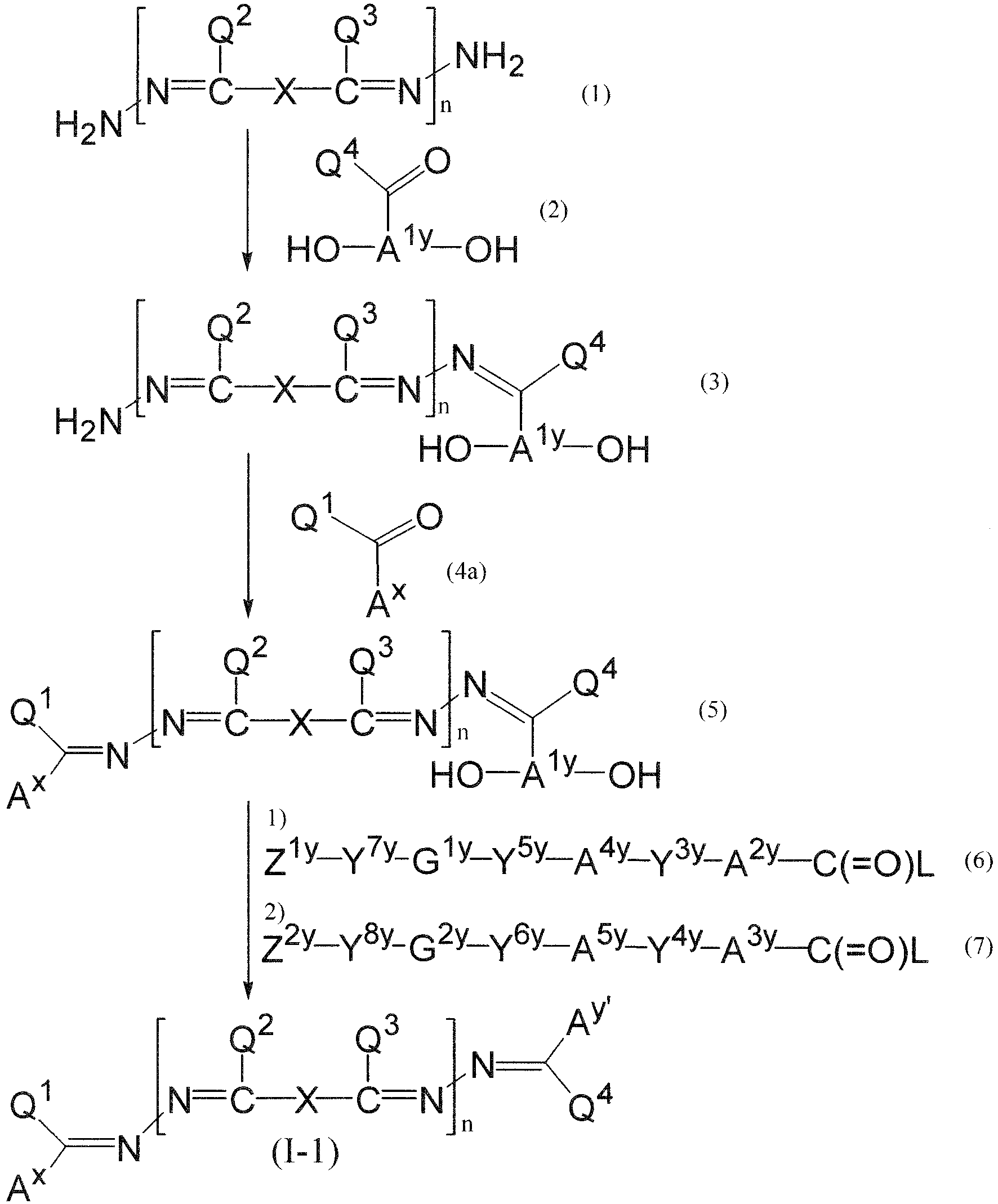

- Specifically, the compound represented by the formula (2) (compound (2)) is reacted with the compound represented by the formula (1) (compound (1)) in an appropriate solvent in a molar ratio (compound (2):compound (1)) of 1:1 (step 1) to obtain the compound represented by the formula (3) (compound (3)).
- The carbonyl compound represented by the formula (4a) (carbonyl compound (4a)) is reacted with the compound (3) in an appropriate solvent in a molar ratio (carbonyl compound (4a):compound (3)) of 1:1 to 1:2 (preferably 1:1 to 1:1.5) (step 2) to obtain the compound represented by the formula (5) (compound (5)). The compound (5) is isolated, and sequentially reacted with the carbonyl compound represented by the formula (6) (carbonyl compound (6)) and the compound represented by the formula (7) (compound (7)) in an appropriate solvent in a molar ratio (compound (5):compound (6) (compound (7))) of 1:1.5 to 1.5:1 (steps 3 and 4) to produce the target polymerizable compound represented by the formula (I-1) (polymerizable compound (I-1)).
- Note that the steps 3 and 4 may be performed after the step 2 without isolating the compound (5).
- The solvent used for the above reactions is not particularly limited as long as the solvent is inert to the reactions. Examples of the solvent include an alcohol-based solvent such as methyl alcohol, ethyl alcohol, n-propyl alcohol, isopropyl alcohol, n-butyl alcohol, isobutyl alcohol, sec-butyl alcohol, tert-butyl alcohol, n-pentyl alcohol, and amyl alcohol; an ether-based solvent such as diethyl ether, tetrahydrofuran, 1,2-dimethoxyethane, 1,4-dioxane, and cyclopentyl methyl ether; an ester-based solvent such as ethyl acetate, propyl acetate, and methyl propionate; an aromatic hydrocarbon-based solvent such as benzene, toluene, and xylene; an aliphatic hydrocarbon-based solvent such as n-pentane, n-hexane, and n-heptane; an amide-based solvent such as N,N-dimethylformamide, N-methylpyrrolidone, and hexamethylphosphoric acid triamide; a sulfur-containing solvent such as dimethyl sulfoxide and sulfolane; a mixed solvent including two or more solvents among these solvents; and the like.
- Among these, an alcohol-based solvent, an ether-based solvent, and a mixed solvent including an alcohol-based solvent and an ether-based solvent are preferable.
- The solvent may be used in an appropriate amount taking account of the type of each compound, the reaction scale, and the like. The solvent is normally used in an amount of 1 to 100 g per gram (total mass) of the compounds used for the reaction.
- The reaction proceeds smoothly when the reaction temperature is set within the range from -10°C to the boiling point of the solvent. The reaction time is determined taking account of the reaction scale, but is normally set to several minutes to several tens of hours.
- When the compound (6) and the compound (7) are identical to each other, the target polymerizable compound can be produced by reacting the compound (5) with 2-fold equivalents of the carbonyl compound (6).
-

- When using the production method 2, the carbonyl compound (4a) is reacted with the compound (1) in an appropriate solvent in a molar ratio (carbonyl compound (4a):compound (1)) of 1:1 to 1:1.2 to obtain the compound represented by the formula (3') (compound (3')) (step 1). The compound (3') is isolated, and reacted with the carbonyl compound represented by the formula (4b) (carbonyl compound (4b)) in an appropriate solvent in a molar ratio (compound (3'):carbonyl compound (4b)) of 1:1 to 1:1.2 (step 2) to produce the target polymerizable compound represented by the formula (I). Note that the step 2 may be performed after the step 1 without isolating the compound (3').
- The above reactions may be effected substantially in the same manner as the reaction between the compound (3) and the carbonyl compound (4a).
- The compound (1) wherein n is 1 (compound (1')) may be produced as described below.

- Specifically, the compound (1') may be produced by reacting the compound represented by the formula (9) (compound (9)) with 2 equivalents or more of the hydrazine (8) in an appropriate solvent.
- The solvent used for the above reaction is not particularly limited as long as the solvent is inert to the reaction. Examples of the solvent include those mentioned above in connection with the method for producing the polymerizable compound (I-1).
- The reaction proceeds smoothly when the reaction temperature is set within the range from -10°C to the boiling point of the solvent. The reaction time is determined taking account of the reaction scale, but is normally set to several minutes to several hours.
- When the compound (1) is hydrazine (n=0), hydrazine monohydrate is normally used as the compound (1). A commercially available product may be used directly as hydrazine.
- The carbonyl compounds (4a) and (4b) may be produced by appropriately bonding and modifying a plurality of known compounds having the desired structure by arbitrarily combining an ether linkage (-O-)-forming reaction, an ester linkage (-C(=O)-O- or -O-C(=O)-)-forming reaction, a carbonate linkage (-O-C(=O)-O-)-forming reaction, and an amide linkage (-C(=O)NH- or -NHC(=O)-)-forming reaction.
- An ether linkage may be formed as described below, for example.
- (i) A compound represented by D1-hal (wherein hal represents a halogen atom (hereinafter the same)) and a compound represented by D2-OMet (wherein Met represents an alkali metal (mainly sodium) (hereinafter the same)) are mixed and condensed (Williamson synthesis). Note that D1 and D2 represent an arbitrary organic group (hereinafter the same).
- (ii) A compound represented by D1-hal and a compound represented by D2-OH are mixed and condensed in the presence of a base (e.g., sodium hydroxide or potassium hydroxide).
- (iii) A compound represented by D1-J (wherein J represents an epoxy group) and a compound represented by D2-OH are mixed and condensed in the presence of a base (e.g., sodium hydroxide or potassium hydroxide).
- (iv) A compound represented by D1-ofn (wherein ofn represents a group that includes an unsaturated bond) and a compound represented by D2-OMet are mixed and subjected to an addition reaction in the presence of a base (e.g., sodium hydroxide or potassium hydroxide).
- (v) A compound represented by D1-hal and a compound represented by D2-OMet are mixed and condensed in the presence of copper or cuprous chloride (Ullmann condensation).
An ester linkage and an amide linkage may be formed as described below, for example. - (vi) A compound represented by D1-COOH and a compound represented by D2-OH or D2-NH2 are subjected to dehydration and condensation in the presence of a dehydration-condensation agent (e.g., N,N-dicyclohexylcarbodiimide).
- (vii) A compound represented by D1-COOH is reacted with a halogenating agent to obtain a compound represented by D1-CO-hal, and the compound represented by D1-CO-hal is reacted with a compound represented by D2-OH or D2-NH2 in the presence of a base.
- (viii) A compound represented by D1-COOH is reacted with an acid anhydride to obtain a mixed acid anhydride, and the mixed acid anhydride is reacted with a compound represented by D2-OH or D2-NH2.
- (ix) A compound represented by D1-COOH and a compound represented by D2-OH or D2-NH2 are subjected to dehydration and condensation in the presence of an acid catalyst or a base catalyst.
- The carbonyl compound (4a) wherein the group represented by Z2x-Y6x-G2x-Y4x-A3x-Y2x- is identical to the group represented by Z1x-Y5x-G1x-Y3x-A2x-Y1x-, and Y1x is a group represented by -C(=O)-O- (hereinafter referred to as "compound (4')") may be produced by the following reaction.

- Specifically, the dihydroxy compound represented by the formula (10) (compound (10)) is reacted with the compound represented by the formula (11) (compound (11)) in a molar ratio (compound (10):compound (11)) of 1:2 to 1:4 (preferably 1:2 to 1:3) to produce the target compound (4') with high selectivity in high yield.
- When the compound (11) is the compound (carboxylic acid) represented by the formula (11) wherein L is a hydroxyl group, the target product may be obtained by effecting the reaction in the presence of a dehydration-condensation agent (e.g., 1-ethyl-3-(3-dimethylaminopropyl)carbodiimide hydrochloride (WSC) or dicyclohexylcarbodiimide).
- The dehydration-condensation agent is normally used in an amount of 1 to 3 mol based on 1 mol of the compound (11).
- When the compound (11) is the compound (acid halide) represented by the formula (11) wherein L is a halogen atom, the target product may be obtained by effecting the reaction in the presence of a base.
- Examples of the base include an organic base such as triethylamine, pyridine, and 4-(dimethylamino)pyridine, and an inorganic base such as sodium hydroxide, sodium carbonate, and sodium hydrogen carbonate.
- The base is normally used in an amount of 1 to 3 mol based on 1 mol of the compound (11).
- When the compound (11) is the compound (mixed acid anhydride) represented by the formula (11) wherein L is a methanesulfonyloxy group or a p-toluenesulfonyloxy group, the target product may be obtained in the same manner as in the case where L is a halogen atom.
- Examples of the solvent used for the above reaction include a chlorine-based solvent such as chloroform and methylene chloride; an amide-based solvent such as N-methylpyrrolidone, N,N-dimethylformamide, N,N-dimethylacetamide, and hexamethylphosphoric triamide; an ether-based solvent such as 1,4-dioxane, cyclopentyl methyl ether, tetrahydrofuran, tetrahydropyran, and cyclopentyl methyl ether; a sulfur-containing solvent such as dimethyl sulfoxide and sulfolane; an aromatic hydrocarbon-based solvent such as benzene, toluene, and xylene; an aliphatic hydrocarbon-based solvent such as n-pentane, n-hexane, and n-octane; an alicyclic hydrocarbon-based solvent such as cyclopentane and cyclohexane; a mixed solvent including two or more solvents among these solvents; and the like.
- The solvent may be used in an appropriate amount taking account of the type of each compound, the reaction scale, and the like. The solvent is normally used in an amount of 1 to 50 g per gram of the hydroxy compound (10).
- The reaction proceeds smoothly when the reaction temperature is set within the range from -10°C to the boiling point of the solvent. The reaction time is determined taking account of the reaction scale, but is normally set to several minutes to several tens of hours.
- The carbonyl compound (4b) may be synthesized by reacting the compound (2) with the compound (6) and the compound (7) substantially in the same manner as in the case of synthesizing the carbonyl compound (4a).
- The compound (6) and the compound (7) may be produced substantially in the same manner as the compound (11).
- For example, when the compound (6) is a compound represented by the following formula (6') (compound (6')), the compound (6') may be produced as described below using a dicarboxylic acid represented by the formula (12) (compound (12)).

- Specifically, the sulfonyl chloride represented by the formula (13) is reacted with the compound (12) in the presence of a base (e.g., triethylamine or 4-(dimethylamino)pyridine).
- The compound (14) and a base (e.g., triethylamine or 4-(dimethylamino)pyridine) are added to the reaction mixture to effect a reaction.
- The sulfonyl chloride is normally used in an amount of 0.5 to 0.7 equivalents based on 1 equivalent of the compound (12).
- The compound (14) is normally used in an amount of 0.5 to 0.6 equivalents based on 1 equivalent of the compound (12).
- The base is normally used in an amount of 0.5 to 0.7 equivalents based on 1 equivalent of the compound (12).
- The reaction temperature is set to 20 to 30°C. The reaction time is determined taking account of the reaction scale and the like, but is normally set to several minutes to several hours.
- Examples of a solvent used for the above reaction include those mentioned above in connection with the solvent that may be used when producing the compound (4'). It is preferable to use an ether as the solvent.
- The solvent may be used in an appropriate amount taking account of the type of each compound, the reaction scale, and the like. The solvent is normally used in an amount of 1 to 50 g per gram of the compound (12).
- After completion of the reaction, the target product is isolated by performing a post-treatment operation that is normally employed in synthetic organic chemistry, optionally followed by a known purification-separation means such as column chromatography, recrystallization, or distillation.
- The structure of the target product may be identified by measurement/elemental analysis (e.g., NMR spectrometry, IR spectrometry, or mass spectrometry), and the like.
- It is possible to easily obtain a polymer (preferably a liquid crystal polymer) that exhibits reverse wavelength dispersion (i.e., ideal wideband wavelength dispersion) by utilizing the polymerizable compound according to one embodiment of the invention (described later).
- A polymerizable composition according to one embodiment of the invention includes at least one polymerizable compound according to one embodiment of the invention, and an initiator. The initiator is used in order to more efficiently polymerize the polymerizable compound according to one embodiment of the invention.
- The initiator may be appropriately selected taking account of the type of the polymerizable group included in the polymerizable compound. For example, a radical initiator may be used when the polymerizable group is a radically polymerizable group, an anionic initiator may be used when the polymerizable group is an anionically polymerizable group, and a cationic initiator may be used when the polymerizable group is a cationically polymerizable group.
- Examples of the radical initiator include a thermal radical generator that is a compound that generates active species that initiate the polymerization of the polymerizable compound upon heating, and a photo-radical generator that is a compound that generates active species that initiate the polymerization of the polymerizable compound upon exposure to exposure light (e.g., visible rays, ultraviolet rays (e.g., i-line), deep ultraviolet rays, electron beams, or X-rays). Note that it is preferable to use the photo-radical generator.
- Examples of the photo-radical generator include an acetophenone-based compound, a biimidazole-based compound, a triazine-based compound, an O-acyloxime-based compound, an onium salt-based compound, a benzoin-based compound, a benzophenone-based compound, an α-diketone-based compound, a polynuclear quinone-based compound, a xanthone-based compound, a diazo-based compound, an imide sulfonate-based compound, and the like. These compounds generate either or both of active radicals and an active acid upon exposure. These photo-radical generators may be used either alone or in combination.
- Specific examples of the acetophenone-based compound include
2-hydroxy-2-methyl-1-phenylpropan-1-one,
2-methyl-1-[4-(methylthio)phenyl]-2-morpholinopropan-1-one,
2-benzyl-2-dimethylamino-1-(4-morpholinophenyl)butan-1-one, 1-hydroxycyclohexyl
phenyl ketone, 2,2-dimethoxy-1,2-diphenylethan-1-one, 1,2-octanedione,
2-benzyl-2-dimethylamino-4'-morpholinobutyrophenone, and the like. - Specific examples of the biimidazole-based compound include
2,2'-bis(2-chlorophenyl)-4,4',5,5'-tetrakis(4-ethoxycarbonylphenyl)-1,2'-biimidazole,
21,2'-bis(2-bromophenyl)-4,4',5,5'-tetrakis(4-ethoxycarbonylphenyl)-1,2'-biimidazole,
2,2'-bis(2-chlorophenyl)-4,4',5,5'-tetraphenyl-1,2'-biimidazole,
2,2'-bis(2,4-dichlorophenyl)-4,4',5,5'-tetraphenyl-1,2'-biimidazole,
2,2'-bis(2,4,6-trichlorophenyl)-4,4',5,5'-tetraphenyl-1,2'-biimidazole,
2,2'-bis(2-bromophenyl)-4,4',5,5'-tetraphenyl-1,2'-biimidazole,
2,2'-bis(2,4-dibromophenyl)-4,4',5,5'-tetraphenyl-1,2'-biimidazole,
2,2'-bis(2,4,6-tribromophenyl)-4,4',5,5'-tetraphenyl-1,2'-biimidazole, and the like. - When using a biimidazole-based compound as a photo initiator, it is preferable to use a hydrogen donor in combination with the biimidazole-based compound in order to further improve sensitivity.
- The term "hydrogen donor" used herein refers to a compound that can donate a hydrogen atom to radicals generated by the biimidazole-based compound upon exposure. A mercaptan-based compound (see below), an amine-based compound (see below), and the like are preferable as the hydrogen donor.
- Examples of the mercaptan-based compound include 2-mercaptobenzothiazole, 2-mercaptobenzoxazole, 2-mercaptobenzimidazole, 2,5-dimercapto-1,3,4-thiadiazole, 2-mercapto-2,5-dimethylaminopyridine, and the like. Examples of the amine-based compound include 4,4'-bis(dimethylamino)benzophenone, 4,4'-bis(diethylamino)benzophenone, 4-diethylaminoacetophenone, 4-dimethylaminopropiophenone, ethyl-4-dimethylaminobenzoate, 4-dimethylaminobenzoic acid, 4-dimethylaminobenzonitrile, and the like.
- Specific examples of the triazine-based compound include a triazine-based compound that includes a halomethyl group, such as
2,4,6-tris(trichloromethyl)-s-triazine, 2-methyl-4,6-bis(trichloromethyl)-s-triazine,
2-[2-(5-methylfuran-2-yl)ethenyl]-4,6-bis(trichloromethyl)-s-triazine,
2-[2-(furan-2-yl)ethenyl]-4,6-bis(trichloromethyl)-s-triazine,
2-[2-(4-diethylamino-2-methylphenyl)ethenyl]-4,6-bis(trichloromethyl)-s-triazine,
2-[2-(3,4-dimethoxyphenyl)ethenyl]-4,6-bis(trichloromethyl)-s-triazine,
2-(4-methoxyphenyl)-4,6-bis(trichloromethyl)-s-triazine,
2-(4-ethoxystyryl)-4,6-bis(trichloromethyl)-s-triazine, and
2-(4-n-butoxyphenyl)-4,6-bis(trichloromethyl)-s-triazine. - Specific examples of the O-acyloxime-based compound include 1-[4-(phenylthio)phenyl]heptane-1,2-dione-2-(O-benzoyloxime), 1-[4-(phenylthio)phenyl]octane-1,2-dione-2-(O-benzoyloxime), 1 -[4-(benzoyl)phenyl]octane-1,2-dione-2-(O-benzoyloxime), 1-[9-ethyl-6-(2-methylbenzoyl)-9H-carbazol-3-yl]ethanone-1-(O-acetyloxime), 1-[9-ethyl-6-(3-methylbenzoyl)-9H-carbazol-3-yl]ethanone-1-(O-acetyloxime), 1-(9-ethyl-6-benzoyl-9H-carbazol-3-yl)ethanone-1-(O-acetyloxime), ethanone-1-[9-ethyl-6-(2-methyl-4-tetrahydrofuranylbenzoyl)-9H-carbazol-3-yl]-1-(O-acetyloxime), ethanone-1-[9-ethyl-6-(2-methyl-4-tetrahydropyranylbenzoyl)-9H-carbazol-3-yl]-1-(O-acetyloxime), ethanone-1-[9-ethyl-6-(2-methyl-5-tetrahydrofuranylbenzoyl)-9H-carbazol-3-yl]-1-(O-acetyloxime), ethanone-1-[9-ethyl-6-(2-methyl-5-tetrahydropyranylbenzoyl)-9H-carbazol-3-yl]-1-(O-acetyloxime), ethanone-1-[9-ethyl-6-{2-methyl-4-(2,2-dimethyl-1,3-dioxolanyl)benzoyl}-9H-carbazol-3-yl]-1-(O-acetyloxime), ethanone-1-[9-ethyl-6-(2-methyl-4-tetrahydrofuranylmethoxybenzoyl)-9H-carbazol-3-yl]-1-(O-acetyloxime), ethanone-1-[9-ethyl-6-(2-methyl-4-tetrahydropyranylmethoxybenzoyl)-9H-carbazol-3-yl]-1-(O-acetyloxime), ethanone-1-[9-ethyl-6-(2-methyl-5-tetrahydrofuranylmethoxybenzoyl)-9H-carbazol-3-yl]-1-(O-acetyloxime), ethanone-1-[9-ethyl-6-(2-methylbenzoyl)-9H-carbazol-3-yl]-1-(O-acetyloxime), ethanone-1-[9-ethyl-6-(2-methyl-5-tetrahydropyranylmethoxybenzoyl)-9H-carbazol-3-yl]-1-(O-acetyloxime), ethanone-1-[9-ethyl-6-{2-methyl-4-(2,2-dimethyl-1,3-dioxolanyl)methoxybenzoyl}-9H-carbazol-3-yl]-1-(O-acetyloxime), and the like.
- A commercially available product may be used directly as the photo-radical generator. Specific examples of a commercially available product that may be used as the photo-radical generator include Irgacure 907, Irgacure 184, Irgacure 369, Irgacure 651, Irgacure 819, Irgacure 907, and Irgacure OXE02 (manufactured by BASF); Adekaoptomer N1919 (manufactured by Adeka Corporation); and the like.
- Examples of the anionic initiator include an alkyllithium compound; a monolithium salt or a monosodium salt of biphenyl, naphthalene, pyrene, and the like; a polyfunctional initiator such as a dilithium salt and a trilithium salt; and the like.
- Examples of the cationic initiator include a proton acid such as sulfuric acid, phosphoric acid, perchloric acid, and trifluoromethanesulfonic acid; a Lewis acid such as boron trifluoride, aluminum chloride, titanium tetrachloride, and tin tetrachloride; an aromatic onium salt or a combination of an aromatic onium salt and a reducing agent; and the like.
- These initiators may be used either alone or in combination.
- The initiator is normally used to prepare the polymerizable composition according to one embodiment of the invention in a ratio of 0.1 to 30 parts by weight, and preferably 0.5 to 10 parts by weight, based on 100 parts by weight of the polymerizable compound.
- It is preferable to add a surfactant to the polymerizable composition according to one embodiment of the invention in order to adjust the surface tension of the polymerizable composition. The surfactant is not particularly limited. A nonionic surfactant is normally preferable as the surfactant. Examples of the nonionic surfactant include an oligomer having a molecular weight of about several thousand, such as KH-40 (manufactured by AGC Seimi Chemical Co., Ltd.). The surfactant is normally added to the polymerizable composition according to one embodiment of the invention in a ratio of 0.01 to 10 parts by weight, and preferably 0.1 to 2 parts by weight, based on 100 parts by weight of the polymerizable compound.
- The polymerizable composition according to one embodiment of the invention may further include an additional additive such as an additional copolymerizable monomer (described later), a metal, a metal complex, a dye, a pigment, a fluorescent material, a phosphorescent material, a leveling agent, a thixotropic agent, a gelling agent, a polysaccharide, a UV absorber, an IR (infrared) absorber, an antioxidant, an ion-exchange resin, and a metal oxide (e.g., titanium oxide). Each additive is normally added to the polymerizable composition according to one embodiment of the invention in a ratio of 0.1 to 20 parts by weight based on 100 parts by weight of the polymerizable compound.
- The polymerizable composition according to one embodiment of the invention may be prepared by mixing and dissolving given amounts of the polymerizable compound according to one embodiment of the invention, the initiator, and an optional additive in an appropriate organic solvent.
- Examples of the organic solvent include a ketone such as cyclopentanone, cyclohexanone, and methyl ethyl ketone; an acetate such as butyl acetate and amyl acetate; a halogenated hydrocarbon such as chloroform, dichloromethane, and dichloroethane; an ether such as 1,4-dioxane, cyclopentyl methyl ether, tetrahydrofuran, tetrahydropyran, and 1,3-dioxolane; and the like.
- The polymerizable composition thus obtained is useful as a material for producing a polymer according to one embodiment of the invention, or producing an optically anisotropic product according to one embodiment of the invention (described below).
- A polymer according to one embodiment of the invention is (1) a polymer obtained by polymerizing the polymerizable compound according to one embodiment of the invention, or (2) a polymer obtained by polymerizing the polymerizable composition according to one embodiment of the invention.
- The term "polymerization" used herein refers to a chemical reaction in a broad sense including a normal polymerization reaction and a crosslinking reaction.
- The polymer obtained by polymerizing the polymerizable compound according to one embodiment of the invention may be a homopolymer of the polymerizable compound according to one embodiment of the invention, a copolymer of two or more types of the polymerizable compounds according to one embodiment of the invention, or a copolymer of the polymerizable compound according to one embodiment of the invention and an additional copolymerizable monomer.
- Examples of the additional copolymerizable monomer include a commercially available product such as LC-242 (manufactured by BASF), the compounds disclosed in
JP-A-2007-002208 JP-A-2009-173893 JP-A-2009-274984 JP-A-2010-030979 JP-A-2010-031223 JP-A-2011-006360 PCT/JP2012/060011 WO2012/141245 ),PCT/JP2012/061321 WO2012/147904 ),PCT/JP2012/064111 WO2012/169424 ),PCT/JP2012/065202 WO2012/176679 ), andPCT2012/067906 , and the like. - Further examples of the additional copolymerizable monomer include 4'-methoxyphenyl 4-(2-methacryloyloxyethyloxy)benzoate, biphenyl 4-(6-methacryloyloxyhexyloxy)benzoate, 4'-cyanobiphenyl 4-(2-acryloyloxyethyloxy)benzoate, 4'-cyanobiphenyl 4-(2-methacryloyloxyethyloxy)benzoate, 3',4'-difluorophenyl 4-(2-methacryloyloxyethyloxy)benzoate, naphthyl 4-(2-methacryloyloxyethyloxy)benzoate, 4-acryloyloxy-4'-decylbiphenyl, 4-acryloyloxy-4'-cyanobiphenyl, 4-(2-acryloyloxyethyloxy)-4'-cyanobiphenyl, 4-(2-methacryloyloxyethyloxy)-4'-methoxybiphenyl, 4-(2-methacryloyloxyethyloxy)-4'-(4"-fluorobenzyloxy)-biphenyl, 4-acryloyloxy-4'-propylcyclohexylphenyl, 4-methacryloyl-4'-butylbicyclohexyl, 4-acryloyl-4'-amyltolane, 4-acryloyl-4'-(3,4-difluorophenyl)bicyclohexyl, (4-amylphenyl) 4-(2-acryloyloxyethyl)benzoate, (4-(4'-propylcyclohexyl)phenyl) 4-(2-acryloyloxyethyl)benzoate, and the like.
- A polyfunctional monomer that includes a plurality of polymerizable unsaturated groups (e.g., acryloyl group, methacryloyl group, vinyl group, and allyl group) may also be used as the additional copolymerizable monomer.
- Examples of such a polyfunctional monomer include an alkanediol diacrylate such as 1,2-butanediol diacrylate, 1,3-butanediol diacrylate, 1,4-butanediol diacrylate, neopentanediol diacrylate, and 1,6-hexanediol diacrylate; an alkanediol dimethacrylate such as 1,2-butanediol dimethacrylate, 1,3-butanediol dimethacrylate, 1,4-butanediol dimethacrylate, neopentanediol dimethacrylate, and 1,6-hexanediol dimethacrylate; a (poly)ethylene glycol diacrylate such as ethylene glycol diacrylate, diethylene glycol diacrylate, triethylene glycol diacrylate, and tetraethylene glycol diacrylate; a (poly)propylene glycol diacrylate such as propylene glycol diacrylate, dipropylene glycol diacrylate, tripropylene glycol diacrylate, and tetrapropylene glycol diacrylate; a (poly)ethylene glycol dimethacrylate such as ethylene glycol dimethacrylate, diethylene glycol dimethacrylate, triethylene glycol dimethacrylate, and tetraethylene glycol dimethacrylate; a (poly)propylene glycol dimethacrylate such as propylene glycol dimethacrylate, dipropylene glycol dimethacrylate, tripropylene glycol dimethacrylate, and tetrapropylene glycol dimethacrylate; a (poly)ethylene glycol divinyl ether such as ethylene glycol divinyl ether, diethylene glycol divinyl ether, triethylene glycol divinyl ether, and tetraethylene glycol divinyl ether; a (poly)ethylene glycol diallyl ether such as ethylene glycol diallyl ether, diethylene glycol diallyl ether, triethylene glycol diallyl ether, and tetraethylene glycol diallyl ether; bisphenol F ethoxylate diacrylate; bisphenol F ethoxylate dimethacrylate; bisphenol A ethoxylate diacrylate; bisphenol A ethoxylate dimethacrylate; trimethylolpropane triacrylate; trimethylolpropane trimethacrylate; trimethylolpropane ethoxylate triacrylate; trimethylolpropane ethoxylate trimethacrylate; trimethylolpropane propoxylate triacrylate; trimethylolpropane propoxylate trimethacrylate; isocyanuric acid ethoxylate triacrylate; glycerol ethoxylate triacrylate; glycerol propoxylate triacrylate; pentaerythritol ethoxylate tetraacrylate; ditrimethylolpropane ethoxylate tetraacrylate; dipentaerythritol ethoxylate hexaacrylate; and the like.
- The polymerizable compound according to one embodiment of the invention may be (co)polymerized optionally together with the additional copolymerizable monomer in the presence of an appropriate initiator. The initiator may be used in a ratio identical to that of the initiator included in the polymerizable composition.
- It is possible to easily obtain a polymer (preferably a liquid crystal polymer) that exhibits reverse wavelength dispersion (i.e., ideal wideband wavelength dispersion) by utilizing the polymerizable compound according to one embodiment of the invention and the additional copolymerizable monomer in combination. Specifically, even when a polymer obtained by polymerizing an additional polymerizable compound exhibits normal wavelength dispersion, it is possible to easily obtain a polymer (preferably a liquid crystal polymer) that exhibits reverse wavelength dispersion by copolymerizing the additional polymerizable compound with the polymerizable compound according to one embodiment of the invention.
- The polymerizable compound according to one embodiment of the invention and the additional monomer are normally used in a weight ratio of 1:9 to 9:1, preferably 2:8 to 8:2, and more preferably 3:7 to 7:3.
- The polymer (1) may be produced by (A) (co)polymerizing the polymerizable compound optionally together with the additional copolymerizable monomer in an appropriate organic solvent in the presence of an appropriate initiator, isolating the target polymer, dissolving the polymer in an appropriate organic solvent to prepare a solution, applying the solution to an appropriate substrate to obtain a film, and drying the film, followed by optional heating, or (B) applying a solution prepared by dissolving the polymerizable compound and an initiator in an organic solvent optionally together with the additional copolymerizable monomer to a substrate using a known coating method, removing the solvent, and effecting polymerization by applying heat or activated energy rays, for example.
- Examples of the initiator include those mentioned above in connection with the initiator included in the polymerizable composition.
- The organic solvent used for the polymerization reaction when implementing the method (A) is not particularly limited as long as the organic solvent is inert. Examples of the organic solvent include an aromatic hydrocarbon such as toluene, xylene, and mesitylene; a ketone such as cyclohexanone, cyclopentanone, and methyl ethyl ketone; an acetate such as butyl acetate and amyl acetate; a halogenated hydrocarbon such as chloroform, dichloromethane, and dichloroethane; an ether such as cyclopentyl methyl ether, tetrahydrofuran, and tetrahydropyran; and the like. It is preferable to use a compound having a boiling point of 60 to 250°C, and more preferably 60 to 150°C, from the viewpoint of handling capability.
- Examples of the organic solvent used to dissolve the polymer when implementing the method (A) include a ketone-based solvent such as acetone, methyl ethyl ketone, methyl isobutyl ketone, cyclopentanone, and cyclohexanone; an ester-based solvent such as butyl acetate and amyl acetate; a halogenated hydrocarbon-based solvent such as dichloromethane, chloroform, and dichloroethane; an ether-based solvent such as tetrahydrofuran, tetrahydropyran, 1,2-dimethoxyethane, 1,4-dioxane, cyclopentyl methyl ether, and 1,3-dioxolane; and the like.
- Examples of the organic solvent used when implementing the method (B) include a ketone-based solvent such as acetone, methyl ethyl ketone, methyl isobutyl ketone, cyclopentanone, and cyclohexanone; an ester-based solvent such as butyl acetate and amyl acetate; a halogenated hydrocarbon-based solvent such as dichloromethane, chloroform, and dichloroethane; an ether-based solvent such as tetrahydrofuran (THF), tetrahydropyran, 1,2-dimethoxyethane, 1,4-dioxane, cyclopentyl methyl ether, 1,3-dioxolane; and the like. Among these, a compound having a boiling point of 60 to 200°C is preferable from the viewpoint of handling capability.
- A substrate formed of a known organic or inorganic material may be used as the substrate. Examples of the organic material include a polycycloolefin (e.g., Zeonex and Zeonor (registered trademark) (manufactured by Zeon Corporation); Arton (registered trademark) (manufactured by JSR Corporation); and Apel (registered trademark) (manufactured by Mitsui Chemicals Inc.)), polyethylene terephthalate, a polycarbonate, a polyimide, a polyamide, polymethyl methacrylate, polystyrene, polyvinyl chloride, polytetrafluoroethylene, cellulose, cellulose triacetate, polyethersulfone, and the like. Examples of the inorganic material include silicon, glass, calcite, and the like. It is preferable to use an organic material.
- The substrate may be a single-layer substrate, or may be a laminate.
- The substrate is preferably a substrate formed of an organic material, and more preferably a resin film that is formed of the organic material.
- The polymer solution (method (A)) or the solution subjected to polymerization (method (B)) may be applied to the substrate using a known coating method. Examples of the coating method include a curtain coating method, an extrusion coating method, a roll coating method, a spin coating method, a dip coating method, a bar coating method, a spray coating method, a slide coating method, a print coating method, and the like.
- The polymer according to one embodiment of the invention can be easily obtained by polymerizing the polymerizable composition according to one embodiment of the invention. It is preferable to use the polymerizable composition that includes the initiator (particularly a photoinitiator) in order to more efficiently effect polymerization.
- Specifically, it is preferable to produce the polymer according to one embodiment of the invention using the method (B) that applies the polymerizable composition according to one embodiment of the invention to a substrate, and polymerizes the applied polymerizable composition. Examples of the substrate include a substrate used to produce an optically anisotropic product (described later), and the like.
- The polymerizable composition according to one embodiment of the invention may be applied to the substrate using a known coating method (e.g., bar coating method, spin coating method, roll coating method, gravure coating method, spray coating method, die coating method, cap coating method, or dipping method). A known organic solvent may be added to the polymerizable composition according to one embodiment of the invention in order to improve the applicability of the polymerizable composition. In this case, it is preferable to remove the organic solvent by natural drying, drying by heating, drying under reduced pressure, drying by heating under reduced pressure, or the like, after applying the polymerizable composition to the substrate.
- The polymerizable compound according to one embodiment of the invention or the polymerizable composition according to one embodiment of the invention may be polymerized by applying activated energy rays, or utilizing a thermal polymerization method, for example. It is preferable to polymerize the polymerizable compound or the polymerizable composition by applying activated energy rays since heating is unnecessary (i.e., the reaction can be effected at room temperature). It is preferable to apply light (e.g., ultraviolet rays) to the polymerizable compound or the polymerizable composition since the operation is simple.
- The temperature during application of light (irradiation) is preferably set to 30°C or less. The UV irradiance is normally set to 1 W/m2 to 10 kW/m2, and preferably 5 W/m2 to 2 kW/m2.
- A polymer obtained by polymerizing the polymerizable compound according to one embodiment of the invention or the polymerizable composition according to one embodiment of the invention may be removed from the substrate, and used alone, or may be used directly as an optical film organic material or the like without removing it from the substrate.
- The number average molecular weight of the polymer according to one embodiment of the invention thus obtained is preferably 500 to 500,000, and more preferably 5000 to 300,000. When the number average molecular weight of the polymer is within the above range, the resulting film exhibits high hardness and an excellent handling capability. The number average molecular weight of the polymer may be measured by gel permeation chromatography (GPC) using monodisperse polystyrene as a standard (eluent: tetrahydrofuran (THF)).
- It is considered that the polymer according to one embodiment of the invention has a structure in which crosslinking points are uniformly present within the molecule, and exhibits a high crosslinking efficiency and excellent hardness.
- The polymer according to one embodiment of the invention makes it possible to inexpensively produce an optical film that achieves uniform conversion of polarized light over a wide wavelength band, and exhibits satisfactory performance.
- An optically anisotropic product according to one embodiment of the invention includes (is produced using) the polymer according to one embodiment of the invention.
- The optically anisotropic product according to one embodiment of the invention may be obtained by forming an alignment film on a substrate, and forming a liquid crystal layer on the alignment film using the polymer according to one embodiment of the invention.
- The alignment film is formed on the surface of the substrate in order to achieve the in-plane alignment of an organic semiconductor compound in one direction.
- The alignment film includes a polymer such as a polyimide, polyvinyl alcohol, polyester, polyallylate, polyamideimide, or polyetherimide. The alignment film may be obtained by applying a solution (alignment film-forming composition) that includes such a polymer to the substrate to form a film, drying the film, and performing a rubbing treatment in one direction, for example.
- The thickness of the alignment film is preferably 0.001 to 5 μm, and more preferably 0.001 to 1 μm.
- The rubbing treatment may be performed on the alignment film or the substrate. The rubbing treatment may be implemented using an arbitrary method. For example, the alignment film may be rubbed in a given direction using a roll around which a cloth or felt formed of synthetic fibers (e.g., nylon) or natural fibers (e.g., cotton) is wound. It is preferable to wash (clean) the alignment film with isopropyl alcohol or the like after completion of the rubbing treatment in order to remove a fine powder (foreign substance) formed during the rubbing treatment, and clean the surface of the alignment film.
- The alignment film may be provided with a function of achieving the in-plane alignment of a cholesteric liquid crystal layer in one direction by applying polarized ultraviolet rays to the surface of the alignment film.
- The liquid crystal layer may be formed on the alignment film using the polymer according to one embodiment of the invention by utilizing the method described above in connection with the polymer according to one embodiment of the invention.
- Since the optically anisotropic product according to one embodiment of the invention is produced using the polymer according to one embodiment of the invention, the optically anisotropic product can be produced at low cost, achieves uniform conversion of polarized light over a wide wavelength band, and exhibits satisfactory performance.
- Examples of the application of the optically anisotropic product according to one embodiment of the invention include a retardation film, an alignment film for a liquid crystal display device (liquid crystal display), a polarizer, a viewing angle enhancement film, a color filter, a low-pass filter, an optical polarization prism, an optical filter, and the like.
- The invention is further described below by way of examples. Note that the invention is not limited to the following examples.
-
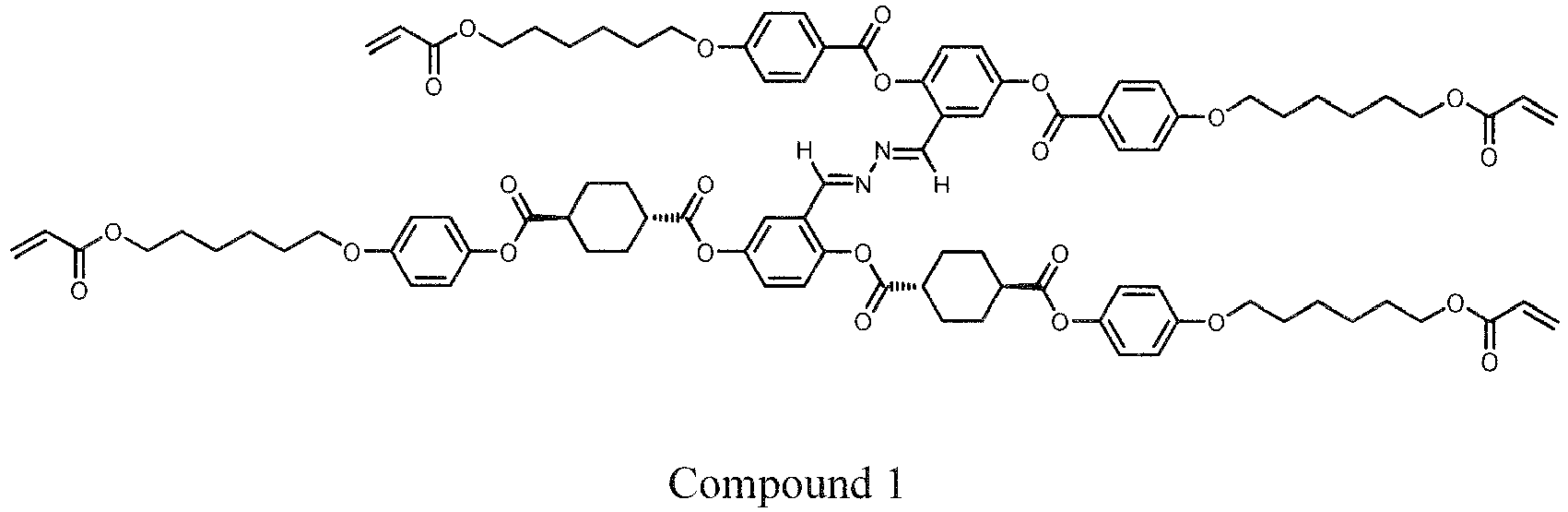
-

- A four-necked reactor equipped with a thermometer was charged with 5.3 ml (109 mmol) of hydrazine monohydrate and 25 ml of 2-propanol under a nitrogen stream to prepare a solution. After the addition of 3.00 g (21.7 mmol) of 2,5-dihydroxybenzaldehyde to the solution, the mixture was stirred at 25°C for 30 minutes. After completion of the reaction, a solid precipitate was filtered off by suction filtration. The solid was washed with 2-propanol, and air-dried to obtain 1.82 g of an intermediate A as a white solid (yield: 55.1%). The intermediate A was used directly for the subsequent reaction without purification.
- The structure of the target product was identified by 1H-NMR and 13C-NMR.
- The 1H-NMR spectrum data and the 13C-NMR spectrum data are shown below. 1H-NMR (500 MHz, DMSO-d6, TMS, δ ppm): 10.59 (brs, 1H), 8.75 (brs, 1H), 7.82 (s, 1H), 6.81 (s, 2H), 6.617 (d, 1H, J=3.0 Hz), 6.615 (d, 1H, J=9.0 Hz), 6.54 (dd, 1H, J=3.0 Hz, 9.0 Hz)
13C-NMR (125 MHz, DMSO-d6, TMS, δ ppm): 149.5, 149.1, 141.4, 119.9, 116.1, 115.6, 113.6 -

- A four-necked reactor equipped with a thermometer was charged with 20 g (144.8 mmol) of 2,5-dihydroxybenzaldehyde, 105.8 g (362.0 mmol) of 4-(6-acryloylhex-1-yloxy)benzoic acid (manufactured by DKSH Japan K.K.), 5.3 g (43.4 mmol) of 4-(dimethylamino)pyridine, and 200 ml of N-methylpyrrolidone under a nitrogen stream to prepare a homogeneous solution. After the addition of 83.3 g (434.4 mmol) of 1-ethyl-3-(3-dimethylaminopropyl)carbodiimide hydrochloride (WSC) to the solution, the mixture was stirred at 25°C for 12 hours. After completion of the reaction, the reaction mixture was added to 1.51 of water, followed by extraction with 500 ml of ethyl acetate. The ethyl acetate layer was dried over anhydrous sodium sulfate, and sodium sulfate was filtered off. Ethyl acetate was evaporated from the filtrate under reduced pressure using a rotary evaporator to obtain a light yellow solid. The light yellow solid was purified by silica gel column chromatography (toluene:ethyl acetate=9:1 (volume ratio (hereinafter the same))) to obtain 75 g of an intermediate B as a white solid (yield: 75.4%).
- The structure of the target product was identified by 1H-NMR.
1H-NMR (400 MHz, CDCl3, TMS, δ ppm): 10.20 (s, 1H), 8.18-8.12 (m, 4H), 7.78 (d, 1H, J=2.8 Hz), 7.52 (dd, 1H, J=2.8 Hz, 8.7 Hz), 7.38 (d, 1H, J=8.7 Hz), 7.00-6.96 (m, 4H), 6.40 (dd, 2H, J=1.4 Hz, 17.4 Hz), 6.12 (dd, 2H, J=10.6 Hz, 17.4 Hz), 5.82 (dd, 2H, J=1.4 Hz, 10.6 Hz), 4.18 (t, 4H, J=6.4 Hz), 4.08-4.04 (m, 4H), 1.88-1.81 (m, 4H), 1.76-1.69 (m, 4H), 1.58-1.42 (m, 8H) -

- A three-necked reactor equipped with a thermometer was charged with 17.98 g (104.42 mmol) of trans-1,4-cyclohexanedicarboxylic acid and 180 ml of tetrahydrofuran (THF) under a nitrogen stream. After the addition of 6.58 g (57.43 mmol) of methanesulfonyl chloride to the mixture, the reactor was immersed in a water bath to adjust the temperature of the reaction mixture to 20°C. 6.34 g (62.65 mmol) of triethylamine was added dropwise to the reaction mixture over 10 minutes while maintaining the temperature of the reaction mixture at 20 to 30°C. After the dropwise addition, the mixture was stirred at 25°C for 2 hours.
- After the addition of 0.64 g (5.22 mmol) of 4-(dimethylamino)pyridine and 13.80 g (52.21 mmol) of 4-(6-acryloyloxyhex-1-yloxy)phenol (manufactured by DKSH) to the reaction mixture, the reactor was immersed in a water bath to adjust the temperature of the reaction mixture to 15°C. 6.34 g (62.65 mmol) of triethylamine was added dropwise to the reaction mixture over 10 minutes while maintaining the temperature of the reaction mixture at 20 to 30°C. After the dropwise addition, the mixture was stirred at 25°C for 2 hours. After completion of the reaction, 1,000 ml of distilled water and 100 ml of a saturated sodium chloride solution were added to the reaction mixture, followed by extraction twice with 400 ml of ethyl acetate. The organic layer was collected, and dried over anhydrous sodium sulfate, and sodium sulfate was filtered off. The solvent was evaporated from the filtrate using a rotary evaporator, and the residue was purified by silica gel column chromatography (THF:toluene=1:9) to obtain 14.11 g of an intermediate C as a white solid (yield: 65%).
- The structure of the target product was identified by 1H-NMR.
1H-NMR (500 MHz, DMSO-d6, TMS, δ ppm): 12.12 (s, 1H), 6.99 (d, 2H, J=9.0 Hz), 6.92 (d, 2H, J=9.0 Hz), 6.32 (dd, 1H, J=1.5 Hz, 17.5 Hz), 6.17 (dd, 1H, J=10.0 Hz, 17.5 Hz), 5.93 (dd, 1H, J=1.5 Hz, 10.0 Hz), 4.11 (t, 2H, J=6.5 Hz), 3.94 (t, 2H, J=6.5 Hz), 2.48-2.56 (m, 1H), 2.18-2.26 (m, 1H), 2.04-2.10 (m, 2H), 1.93-2.00 (m, 2H), 1.59-1.75 (m, 4H), 1.35-1.52 (m, 8H) -

- A four-necked reactor equipped with a thermometer was charged with 780 mg (6.49 mmol) of the intermediate A synthesized in the step 1,4.55 g (6.18 mmol) of the intermediate B synthesized in the step 2, 3ml of ethanol, and 20 ml of THF under a nitrogen stream to prepare a solution. After the addition of 69.7 mg (0.30 mmol) of (±)-10-camphorsulfonic acid to the solution, the mixture was stirred at 25°C for 1 hour. After completion of the reaction, the reaction mixture was added to 200 ml of water, followed by extraction with 400 ml of ethyl acetate. The ethyl acetate layer was dried over anhydrous sodium sulfate, and sodium sulfate was filtered off. Ethyl acetate was evaporated from the filtrate under reduced pressure using a rotary evaporator to obtain a yellow solid. The yellow solid was purified by silica gel column chromatography (toluene:ethyl acetate=90:10) to obtain 1.77 g of a compound D as a yellow solid (yield: 34.9%).
- The structure of the target product was identified by 1H-NMR.
1H-NMR (500 MHz, DMSO-d6, TMS, δ ppm): 10.17 (s, 1H), 9.03 (s, 1H), 8.71 (s, 1H), 8.68 (s, 1H), 8.15 (d, 2H, J=9.0 Hz), 8.12 (d, 2H, J=9.0 Hz), 7.94 (d, 1H, J=3.0 Hz), 7.55 (dd, 1H, J=3.0 Hz, 8.5 Hz), 7.51 (d, 1H, J=8.5 Hz), 7.15 (d, 2H, J=9.0 Hz), 7.14 (d, 2H, J=9.0 Hz), 7.02 (d, 1H, J=3.0 Hz), 6.81 (dd, 1H, J=3.0 Hz, 9.0 Hz), 6.75 (d, 1H, J=9.0 Hz), 6.33 (dd, 2H, J=1.5 Hz, 17.5 Hz), 6.18 (dd, 2H, J=10.5 Hz, 17.5 Hz), 5.94 (dd, 2H, J=1.5 Hz, 10.5 Hz), 4.13 (t, 4H, J=6.5 Hz), 4.11 (t, 4H, J=6.5 Hz), 1.74-1.81 (m, 4H), 1.63-1.68 (m, 4H), 1.38-1.50 (m, 8H) - A three-necked reactor equipped with a thermometer was charged with 1.31 g (3.14 mmol) of the intermediate C synthesized in the step 3 and 20 ml of THF under a nitrogen stream. After the addition of 378 mg (0.786 mmol) of methanesulfonyl chloride to the mixture, the reactor was immersed in a water bath to adjust the temperature of the reaction mixture to 20°C. 334 mg (3.30 mmol) of triethylamine was slowly added dropwise to the reaction mixture while maintaining the temperature of the reaction mixture at 20 to 30°C. After the dropwise addition, the mixture was stirred at 25°C for 2 hours.
- After the addition of 48.0 mg (0.393 mmol) of 4-(dimethylamino)pyridine and 645 mg (0.786 mmol) of the intermediate D synthesized in the step 4 to the reaction mixture, the reactor was immersed in a water bath to adjust the temperature of the reaction mixture to 15°C. 239 mg (2.36 mmol) of triethylamine was slowly added dropwise to the reaction mixture while maintaining the temperature of the reaction mixture at 20 to 30°C. After the dropwise addition, the mixture was stirred at 25°C for 2 hours. After completion of the reaction, 100 ml of distilled water was added to the reaction mixture, followed by extraction twice with 100 ml of ethyl acetate. The ethyl acetate layer was collected, and dried over anhydrous sodium sulfate, and sodium sulfate was filtered off. Ethyl acetate was evaporated from the filtrate under reduced pressure using a rotary evaporator to obtain a light yellow solid. The light yellow solid was purified by silica gel column chromatography (toluene:ethyl acetate=90:10) to obtain 771 mg of a compound 1 as a white solid (yield: 60.5%).
- The structure of the target product was identified by 1H-NMR.
1H-NMR (500 MHz, CDCl3, TMS, δ ppm): 8.72 (s, 1H), 8.57 (s, 1H), 8.19 (d, 2H, J=9.0 Hz), 8.16 (d, 2H, J=9.0 Hz), 8.07 (d, 1H, J=3.0 Hz), 7.79 (d, 1H, J=3.0 Hz), 7.39 (dd, 1H, J=3.0 Hz, 9.0 Hz), 7.31 (d, 1H, J=9.0 Hz), 7.18 (dd, 1H, J=3.0 Hz, 8.5 Hz), 7.13 (d, 1H, J=8.5 Hz), 7.01 (d, 2H, J=8.5 Hz), 6.96-6.99 (m, 6H), 6.87 (d, 4H, J=9.0 Hz), 6.38-6.43 (m, 4H), 6.09-6.16 (m, 4H), 5.81-5.84 (m, 4H), 4.184 (t, 4H, J=6.5 Hz), 4.175 (t, 4H, J=6.5 Hz), 4.07 (t, 2H, J=6.5 Hz), 4.05 (t, 2H, J=6.5 Hz), 3.94 (t, 4H, J=6.5 Hz), 2.50-2.73 (m, 4H), 2.24-2.31 (m, 8H), 1.76-1.92 (m, 8H), 1.61-1.74 (m, 16H), 1.42-1.57 (m, 16H) -

-

- A four-necked reactor equipped with a thermometer was charged with 20 g (144.8 mmol) of 2,5-dihydroxybenzaldehyde, 105.8 g (362.0 mmol) of 4-(6-acryloylhex-1-yloxy)benzoic acid (manufactured by DKSH Japan K.K.), 5.3 g (43.4 mmol) of 4-(dimethylamino)pyridine, and 200 ml of N-methylpyrrolidone under a nitrogen stream to prepare a solution. After the addition of 83.3 g (434.4 mmol) of 1-ethyl-3-(3-dimethylaminopropyl)carbodiimide hydrochloride (WSC) to the solution, the mixture was stirred at 25°C for 12 hours. After completion of the reaction, the reaction mixture was added to 1.5l of water, followed by extraction with 500 ml of ethyl acetate. The ethyl acetate layer was dried over anhydrous sodium sulfate, and sodium sulfate was filtered off. Ethyl acetate was evaporated from the filtrate under reduced pressure using a rotary evaporator to obtain a light yellow solid. The light yellow solid was purified by silica gel column chromatography (toluene:ethyl acetate=9:1) to obtain 75 g of an intermediate E as a white solid (yield: 75.4%).
- The structure of the target product was identified by 1H-NMR.
1H-NMR (400 MHz, CDCl3, TMS, δ ppm): 10.20 (s, 1H), 8.18-8.12 (m, 4H), 7.78 (d, 1H, J=2.8 Hz), 7.52 (dd, 1H, J=2.8 Hz, 8.7 Hz), 7.38 (d, 1H, J=8.7 Hz), 7.00-6.96 (m, 4H), 6.40 (dd, 2H, J=1.4 Hz, 17.4 Hz), 6.12 (dd, 2H, J=10.6 Hz, 17.4 Hz), 5.82 (dd, 2H, J=1.4 Hz, 10.6 Hz), 4.18 (t, 4H, J=6.4 Hz), 4.08-4.04 (m, 4H), 1.88-1.81 (m, 4H), 1.76-1.69 (m, 4H), 1.58-1.42 (m, 8H) - A four-necked reactor equipped with a thermometer was charged with 1.5 g (2.18 mmol) of the intermediate E, 2 ml of 2-propanol, and 5 ml of THF under a nitrogen stream to prepare a solution. After the addition of 80 mg (1.59 mmol) of hydrazine monohydrate to the solution, the mixture was stirred at 25°C for 21 hours. After completion of the reaction, 2-propanol and THF were evaporated from the reaction mixture under reduced pressure using a rotary evaporator to obtain a yellow solid. The yellow solid was recrystallized from a mixed solvent (toluene:hexane=1:1), and a solid precipitate was filtered off, and washed with a mixed solvent (toluene:hexane=1:1). The resulting solid was purified by silica gel column chromatography (toluene:ethyl acetate=90:10 to 85:15 (gradient)) to obtain 1.1 g of a compound α as a light yellow solid (yield: 50.5%).
- The structure of the target product was identified by 1H-NMR.
1H-NMR (500 MHz, CDCl3, TMS, δ ppm): 8.68 (s, 2H), 8.15 (d, 4H, J=9.0 Hz), 8.12 (d, 4H, J=9.0 Hz), 7.98 (d, 2H, J=3.0 Hz), 7.35 (dd, 2H, J=3.0 Hz, 9.0 Hz), 7.29 (d, 2H, J=9.0 Hz), 6.964 (d, 4H, J=9.0 Hz), 6.957 (d, 4H, J=9.0 Hz), 6.410 (dd, 2H, J=1.5 Hz, 17.5 Hz), 6.407 (dd, 2H, J=1.5 Hz, 17.5 Hz), 6.132 (dd, 2H, J=10.5 Hz, 17.5 Hz), 6.128 (dd, 2H, J=10.5 Hz, 17.5 Hz), 5.829 (dd, 2H, J=1.5 Hz, 10.5 Hz), 5.825 (dd, 2H, J=1.5 Hz, 10.5 Hz), 4.188 (t, 4H, J=6.5 Hz), 4.182 (t, 4H, J=6.5 Hz), 4.048 (t, 4H, J=6.5 Hz), 4.045 (t, 4H, J=6.5 Hz), 1.87-1.81 (m, 8H), 1.76-1.70 (m, 8H), 1.59-1.43 (m, 16H) - 0.4 g of the compound 1 obtained in Example 1, 0.6 g of a compound 1r ("LC242" manufactured by BASF) (see below), 30 mg of a photoinitiator ("Adekaoptomer N-1919" manufactured by Adeka Corporation), and 100 mg of a 1% cyclopentanone solution of a surfactant ("KH-40" manufactured by AGC Seimi Chemical Co., Ltd.) were dissolved in 2.3 g of cyclopentanone. The solution was filtered through a disposable filter having a pore size of 0.45 μm to prepare a polymerizable composition 1.

- A polymerizable composition 2 was prepared substantially in the same manner as in Example 2, except that the compound α obtained in Synthesis Example 1 was used instead of the compound 1.
- A polymerizable composition 3 was prepared substantially in the same manner as in Example 2, except that 1.0 g of the compound α obtained in Synthesis Example 1 was used instead of the compound 1 (0.4 g) and the compound 1r (0.6g).
- Each of the polymerizable compositions 1 to 3 was polymerized using the following method to obtain a polymer. The retardation was measured, and the wavelength dispersion was evaluated using the resulting polymers.
- Each of the polymerizable compositions 1 to 3 was applied to a transparent glass substrate provided with a polyimide alignment film subjected to a rubbing treatment (manufactured by E.H.C. Co., Ltd.) using a #4 wire bar. The resulting film was dried for 1 minute at the temperature shown in Table 2, and subjected to an alignment treatment for 1 minute at the temperature shown in Table 2 to form a liquid crystal layer. Ultraviolet rays were applied to the liquid crystal layer at a dose of 2,000 mJ/cm2 to effect polymerization to prepare a wavelength dispersion measurement sample.
- The retardation between 400 nm and 800 nm was measured using the sample utilizing an ellipsometer ("M2000U" manufactured by J. A. Woollam).
- The wavelength dispersion was evaluated based on the values α and β that were calculated as described below using the measured retardation.


- The value α is smaller than 1, and the value β is larger than 1 when ideal wideband wavelength dispersion (reverse wavelength dispersion) is achieved. The values α and β are almost identical to each other when flat wavelength dispersion is achieved. The value α is larger than 1, and the value β is smaller than 1 when normal dispersion is achieved.
- Specifically, flat wavelength dispersion and reverse wavelength dispersion are preferable, and reverse wavelength dispersion is particularly preferable.
- Table 1 shows the thickness (μm) of the liquid crystal polymer films obtained by polymerizing the polymerizable compositions, the retardation (Re) at a wavelength of 548.5 nm, and the values α and β.

- As is clear from the results of Comparative Example 2, the compound 1r had normal dispersion since α>1 and β<1.
- When the compound 1 obtained in Example 1 was added to the compound 1 r (Example 2), reverse wavelength dispersion was obtained (i.e., α<1 and β>1).
- When the compound α was added to the compound 1r (Comparative Example 1), reverse wavelength dispersion was not obtained (i.e., α>1 and β<1).
- It was thus confirmed that a polymer that exhibits reverse wavelength dispersion can be obtained by polymerizing a polymerizable composition obtained by adding the compound according to one embodiment of the invention (compound 1) to a compound that exhibits normal wavelength dispersion.
Claims (10)
- A polymerizable compound represented by a general formula (I),
 wherein each of Q1 to Q4 independently represents a hydrogen atom, or a substituted or unsubstituted alkyl group having 1 to 6 carbon atoms,X represents a substituted or unsubstituted divalent aromatic group having 4 to 12 carbon atoms,Ax represents a group represented by a general formula (II),
 wherein "*" indicates a bonding position,each of Y1x to Y6X independently represents a chemical single bond, -O-, -S-, -O-C(=O)-, -C(=O)-O-, -O-C(=O)-O-, -NR1-C(=O)-, -C(=O)-NR1-, -O-C(=O)-NR1-,-NR1-C(=O)-O-, -NR1-C(=O)-NR1-, -O-NR1-, or -NR1-O-, R1 represents a hydrogen atom or an alkyl group having 1 to 6 carbon atoms,each of G1x and G2x independently represents a substituted or unsubstituted divalent aliphatic group having 1 to 20 carbon atoms that optionally includes -O-, -S-, -O-C(=O)-, -C(=O)-O-, -O-C(=O)-O-, -NR2-C(=O)-, -C(=O)-NR2-, -NR2-, or -C(=O)-, provided that a case where the aliphatic group includes two or more contiguous -O- or -S- is excluded,R2 represents a hydrogen atom or an alkyl group having 1 to 6 carbon atoms, each of Z1x and Z2x independently represents an alkenyl group having 2 to 10 carbon atoms that is substituted with a halogen atom, or unsubstituted,A1x represents a substituted or unsubstituted trivalent aromatic group, and each of A2x and A3x independently represents a substituted or unsubstituted divalent aromatic group having 4 to 30 carbon atoms,Ay represents a group represented by a general formula (III),
 wherein each of Y1y to Y8y independently represents a chemical single bond, -O-, -S-, -O-C(=O)-, -C(=O)-O-, -O-C(=O)-O-, -NR3-C(=O)-, -C(=O)-NR3-, -O-C(=O)-NR3-, -NR3-C(=O)-O-, -NR3-C(=O)-NR3-, -O-NR3-, or -NR3-O-,R3 represents a hydrogen atom or an alkyl group having 1 to 6 carbon atoms,each of G1y and G2y independently represents a substituted or unsubstituted divalent aliphatic group having 1 to 20 carbon atoms that optionally includes -O-, -S-, -O-C(=O)-, -C(=O)-O-, -O-C(=O)-O-, -NR4-C(=O)-, -C(=O)-NR4-, -NR4-, or -C(=O)-, provided that a case where the aliphatic group includes two or more contiguous -O- or -S- is excluded,R4 represents a hydrogen atom or an alkyl group having 1 to 6 carbon atoms, each of Z1y and Z2y independently represents an alkenyl group having 2 to 10 carbon atoms that is substituted with a halogen atom, or unsubstituted,A1y represents a substituted or unsubstituted trivalent aromatic group,each of A2y and A3y independently represents a substituted or unsubstituted divalent alicyclic hydrocarbon group having 3 to 30 carbon atoms, andeach of A4y and A5y independently represents a substituted or unsubstituted aromatic group having 4 to 30 carbon atoms, andn represents 0 or 1.
 - The polymerizable compound according to claim 1, wherein each of A1x and A1y is independently a substituted or unsubstituted trivalent benzene ring group, or a substituted or unsubstituted trivalent naphthalene ring group, and each of A2x, A3x, A4y, and A5y is independently a substituted or unsubstituted phenylene group, or a substituted or unsubstituted naphthylene group.
- The polymerizable compound according to claim 1 or 2, wherein each of Y1x to Y6x and Y1y , to Y8y is independently a chemical single bond, -O-, -O-C(=O)-, -C(=O)-O-, or -O-C(=O)-O-.
- The polymerizable compound according to any one of claims 1 to 3, wherein each of Z1x, Z2x, Z1y, and Z2y is independently CH2=CH-, CH2=C(CH3)-, or CH2=C(Cl)-.
- The polymerizable compound according to any one of claims 1 to 4, wherein each of G1x, G2x, G1y, and G2y is independently a substituted or unsubstituted divalent aliphatic group having 1 to 12 carbon atoms that optionally includes -O-, -O-C(=O)-, -C(=O)-O-, or -C(=O)-, provided that a case where the aliphatic group includes two or more contiguous -O- is excluded.
- The polymerizable compound according to any one of claims 1 to 5, wherein X is a substituted or unsubstituted phenylene group, a substituted or unsubstituted naphthylene group, or a substituted or unsubstituted biphenylene group.
- The polymerizable compound according to any one of claims 1 to 6, wherein each of A1X and A1y is independently a substituted or unsubstituted trivalent benzene ring group, each of A2x, A3x, A4y, and A5y is independently a substituted or unsubstituted phenylene group, each of y1x to Y6x and Y1y to Y8y is independently a chemical single bond, -O-, -O-C(=O)-, -C(=O)-O-, or -O-C(=O)-O-, each of Z1x, Z2x, Z1y, and Z2y is independently CH2=CH-, CH2=C(CH3)-, or CH2=C(Cl)-, and each of G1x, G2x, G1y, and G2y is independently a divalent alkylene group having 1 to 12 carbon atoms.
- A polymerizable composition comprising at least one polymerizable compound according to any one of claims 1 to 7, and an initiator.
- A polymer obtained by polymerizing the polymerizable compound according to any one of claims 1 to 7, or polymerizing the polymerizable composition according to claim 8.
- An optically anisotropic product comprising the polymer according to claim 9.
Applications Claiming Priority (2)
| Application Number | Priority Date | Filing Date | Title |
|---|---|---|---|
| JP2014024677 | 2014-02-12 | ||
| PCT/JP2015/053533 WO2015122385A1 (en) | 2014-02-12 | 2015-02-09 | Polymerizable compound, polymerizable composition, polymer, and optical isomer |
Publications (3)
| Publication Number | Publication Date |
|---|---|
| EP3106456A1 true EP3106456A1 (en) | 2016-12-21 |
| EP3106456A4 EP3106456A4 (en) | 2017-10-04 |
| EP3106456B1 EP3106456B1 (en) | 2018-10-24 |
Family
ID=53800128
Family Applications (1)
| Application Number | Title | Priority Date | Filing Date |
|---|---|---|---|
| EP15749035.0A Not-in-force EP3106456B1 (en) | 2014-02-12 | 2015-02-09 | Polymerizable compound, polymerizable composition, polymer, and optical isomer |
Country Status (6)
| Country | Link |
|---|---|
| US (1) | US10392343B2 (en) |
| EP (1) | EP3106456B1 (en) |
| JP (1) | JP6575360B2 (en) |
| KR (1) | KR102273081B1 (en) |
| CN (1) | CN105960392B (en) |
| WO (1) | WO2015122385A1 (en) |
Families Citing this family (17)
| Publication number | Priority date | Publication date | Assignee | Title |
|---|---|---|---|---|
| JP6217999B2 (en) | 2014-10-09 | 2017-10-25 | Dic株式会社 | Polymerizable compound and optical anisotropic body |
| KR102624959B1 (en) | 2014-12-04 | 2024-01-16 | 디아이씨 가부시끼가이샤 | Polymerizable compound, composition, polymer, optically anisotropic body, liquid crystal display device and organic el element |
| WO2016104317A1 (en) * | 2014-12-25 | 2016-06-30 | Dic株式会社 | Polymerizable compound and optically anisotropic object |
| US11697695B2 (en) | 2015-01-16 | 2023-07-11 | Dic Corporation | Polymerizable composition and optically anisotropic body using same |
| WO2016114211A1 (en) * | 2015-01-16 | 2016-07-21 | Dic株式会社 | Polymerizable compound and optically anisotropic body |
| KR102552212B1 (en) * | 2015-01-16 | 2023-07-06 | 디아이씨 가부시끼가이샤 | Polymerizable composition and optically anisotropic body |
| JP6255632B2 (en) | 2015-01-16 | 2018-01-10 | Dic株式会社 | Polymerizable composition and optical anisotropic body using the same |
| WO2016136533A1 (en) | 2015-02-24 | 2016-09-01 | Dic株式会社 | Polymerizable compound and optical isomer |
| US11046889B2 (en) | 2015-12-08 | 2021-06-29 | Dic Corporation | Polymerizable compound and optically anisotropic body |
| EP3546444A1 (en) | 2016-11-22 | 2019-10-02 | Zeon Corporation | Polymerizable compound, polymerizable composition, polymer, optical film, optically anisotropic body, polarizing plate, flat-panel display device, organic electroluminescence display device, antireflection film, and compound |
| WO2018123586A1 (en) | 2016-12-27 | 2018-07-05 | 日本ゼオン株式会社 | Polymerizable compound, polymerizable liquid crystal mixture, polymer, optical film, optically anisotropic body, polarizing sheet, display device, antireflective film, and compound |
| WO2018168778A1 (en) | 2017-03-17 | 2018-09-20 | 日本ゼオン株式会社 | Polymerizable compound, polymerizable liquid crystal mixture, polymer, optical film, optically anisotropic body, polarizing plate, display device, antireflection film, and compound |
| KR20190128644A (en) | 2017-03-23 | 2019-11-18 | 니폰 제온 가부시키가이샤 | Polymerizable compound and its manufacturing method, polymerizable composition, polymer, optical film, optically anisotropic body, polarizing plate, display device, antireflection film, and compound and method of use thereof |
| JP7255484B2 (en) | 2017-08-23 | 2023-04-11 | 日本ゼオン株式会社 | Polymerizable liquid crystal material, polymerizable liquid crystal composition, polymer, optical film, optical anisotropic body, polarizing plate, antireflection film, display device, and method for producing polymerizable liquid crystal composition |
| KR102195455B1 (en) | 2018-05-03 | 2020-12-28 | 주식회사 엘지화학 | Polymerizable liquid crystal compound, liquid crystal composition for optical element, polymer, optically anisotropic body, and optical element for display device |
| KR102196632B1 (en) | 2018-05-03 | 2020-12-30 | 주식회사 엘지화학 | Polymerizable liquid crystal compound, liquid crystal composition for optical element, polymer, optically anisotropic body, and optical element for display device |
| CN113968881B (en) * | 2021-10-26 | 2024-06-18 | 佛山科学技术学院 | Compound for mitochondrial targeted photoactivated fluorescence imaging and preparation method and application thereof |
Family Cites Families (42)
| Publication number | Priority date | Publication date | Assignee | Title |
|---|---|---|---|---|
| US5567349A (en) | 1994-03-30 | 1996-10-22 | Hoffmann-La Roche Inc. | Photo cross-linkable liquid crystals |
| US6139771A (en) | 1997-04-04 | 2000-10-31 | Displaytech, Inc. | Mesogenic materials with anomalous birefringence dispersion and high second order susceptibility (X.sup.(2)). |
| JPH1090521A (en) | 1996-07-24 | 1998-04-10 | Sumitomo Chem Co Ltd | Polarization axis rotating laminated phase difference plate and projection type liquid crystal display device using the same |
| JPH1068816A (en) | 1996-08-29 | 1998-03-10 | Sharp Corp | Phase difference plate and circularly polarizing plate |
| JPH1152131A (en) | 1997-08-01 | 1999-02-26 | Sumitomo Bakelite Co Ltd | Phase difference plate and polarizing element using the same |
| CA2316828C (en) | 1998-10-30 | 2010-02-23 | Teijin Limited | Retardation film and optical device employing it |
| US6400433B1 (en) | 1998-11-06 | 2002-06-04 | Fuji Photo Film Co., Ltd. | Circularly polarizing plate comprising linearly polarizing membrane and quarter wave plate |
| JP3734211B2 (en) | 1999-01-27 | 2006-01-11 | 富士写真フイルム株式会社 | Retardation plate, circularly polarizing plate, and reflective liquid crystal display device |
| DE19855757A1 (en) | 1998-12-03 | 2000-06-21 | Merck Patent Gmbh | Cross-bridged cyclohexane derivatives and liquid-crystalline medium |
| JP2001004837A (en) | 1999-06-22 | 2001-01-12 | Fuji Photo Film Co Ltd | Phase difference plate and circular polarization plate |
| JP4320125B2 (en) | 2001-03-06 | 2009-08-26 | 富士フイルム株式会社 | Retardation film |
| JP4074155B2 (en) | 2001-09-17 | 2008-04-09 | 富士フイルム株式会社 | Four-membered ring compound, birefringent medium and optical member using the same |
| JP2005208415A (en) | 2004-01-23 | 2005-08-04 | Nitto Denko Corp | Reverse wavelength dispersion retardation film, polarizing plate and display device using the same |
| JP2005208414A (en) | 2004-01-23 | 2005-08-04 | Nitto Denko Corp | Reverse wavelength dispersion retardation film, polarizing plate and display device using the same |
| JP2005208416A (en) | 2004-01-23 | 2005-08-04 | Nitto Denko Corp | Reverse wavelength dispersion retardation film, polarizing plate and display device using the same |
| JP4606195B2 (en) | 2004-03-08 | 2011-01-05 | 富士フイルム株式会社 | Liquid crystal compound, liquid crystal composition, polymer, retardation plate, and elliptically polarizing plate |
| CN101056903B (en) | 2004-11-11 | 2012-02-08 | 住友化学株式会社 | Optical film |
| JP4186980B2 (en) | 2004-11-11 | 2008-11-26 | 住友化学株式会社 | Optical film |
| JP5209181B2 (en) * | 2005-03-15 | 2013-06-12 | 富士フイルム株式会社 | Compound, composition, retardation plate, elliptically polarizing plate, and liquid crystal display device |
| KR20080012841A (en) | 2005-04-28 | 2008-02-12 | 스미또모 가가꾸 가부시끼가이샤 | Film and its manufacturing method |
| JP5088769B2 (en) | 2005-04-28 | 2012-12-05 | 住友化学株式会社 | Film and manufacturing method thereof |
| JP5401822B2 (en) * | 2007-04-24 | 2014-01-29 | 日本ゼオン株式会社 | Polymerizable liquid crystal compound, polymerizable liquid crystal composition, liquid crystal polymer and optical anisotropic body |
| KR101489540B1 (en) | 2007-09-03 | 2015-02-03 | 메르크 파텐트 게엠베하 | Calamitic mesogenic compounds |
| JP5606912B2 (en) | 2007-09-03 | 2014-10-15 | メルク パテント ゲゼルシャフト ミット ベシュレンクテル ハフツング | Fluorene derivative |
| JP2011509241A (en) * | 2007-12-21 | 2011-03-24 | ジョージア・テック・リサーチ・コーポレーション | Romp-polymerizable electron transport material based on bis-oxadiazole moiety |
| JP5453798B2 (en) | 2007-12-28 | 2014-03-26 | 住友化学株式会社 | Compound, optical film and method for producing optical film |
| JP5391682B2 (en) | 2007-12-28 | 2014-01-15 | 住友化学株式会社 | Compound, optical film and method for producing optical film |
| JP5373293B2 (en) | 2008-01-29 | 2013-12-18 | 富士フイルム株式会社 | Compound, liquid crystal composition and anisotropic material |
| JP2009274984A (en) | 2008-05-14 | 2009-11-26 | Sumitomo Chemical Co Ltd | Compound, optical film and method for producing optical film |
| JP2011006360A (en) | 2009-06-26 | 2011-01-13 | Sumitomo Chemical Co Ltd | Compound, optical film and method for producing optical film |
| JP5453956B2 (en) | 2009-06-26 | 2014-03-26 | 住友化学株式会社 | Compound, optical film and method for producing optical film |
| JP2011042606A (en) | 2009-08-20 | 2011-03-03 | Sumitomo Chemical Co Ltd | Compound, optical film and process for producing optical film |
| JP5411770B2 (en) * | 2010-03-29 | 2014-02-12 | 富士フイルム株式会社 | Polymerizable liquid crystal compound, polymerizable liquid crystal composition, polymer, and film |
| WO2012141245A1 (en) | 2011-04-15 | 2012-10-18 | 日本ゼオン株式会社 | Polymerizable compound, polymerizable composition, polymer, and optically anisotropic body |
| CN103492363B (en) * | 2011-04-27 | 2016-08-24 | 日本瑞翁株式会社 | Polymerizable compounds, polymerizable compositions, polymers, and optically anisotropic substances |
| CN103582626B (en) | 2011-06-10 | 2016-01-13 | 日本瑞翁株式会社 | Polymerizable compounds, polymerizable compositions, polymers, and optically anisotropic substances |
| CN103608331B (en) | 2011-06-24 | 2015-06-10 | 日本瑞翁株式会社 | Polymerizable compounds, polymerizable compositions, polymers, and optically anisotropic substances |
| JP5967092B2 (en) | 2011-07-29 | 2016-08-10 | 日本ゼオン株式会社 | Method for adjusting wavelength dispersion of optical anisotropic body and polymerizable composition |
| JP2013071951A (en) * | 2011-09-27 | 2013-04-22 | Canon Inc | Compound having azo pigment skeleton, pigment dispersant including the compound, pigment composition, pigment dispersion, ink and resist composition for color filter |
| KR102094007B1 (en) | 2012-07-09 | 2020-03-26 | 제온 코포레이션 | Polymerizable compound, polymerizable composition, polymer, optically anisotropic body, and method for producing polymerizable compound |
| EP2910579B1 (en) | 2012-10-19 | 2018-03-21 | Zeon Corporation | Polymerizable compound, polymerizable composition, polymer, and optically anisotropic substance |
| EP2963068B1 (en) * | 2013-02-15 | 2017-08-23 | Zeon Corporation | Polymerizable compound, polymerizable composition, polymer, and optically anisotropic body |
-
2015
- 2015-02-09 KR KR1020167021408A patent/KR102273081B1/en not_active Expired - Fee Related
- 2015-02-09 US US15/114,159 patent/US10392343B2/en active Active
- 2015-02-09 JP JP2015562813A patent/JP6575360B2/en active Active
- 2015-02-09 EP EP15749035.0A patent/EP3106456B1/en not_active Not-in-force
- 2015-02-09 WO PCT/JP2015/053533 patent/WO2015122385A1/en not_active Ceased
- 2015-02-09 CN CN201580007050.5A patent/CN105960392B/en active Active
Also Published As
| Publication number | Publication date |
|---|---|
| US20170008833A1 (en) | 2017-01-12 |
| JPWO2015122385A1 (en) | 2017-03-30 |
| US10392343B2 (en) | 2019-08-27 |
| KR102273081B1 (en) | 2021-07-02 |
| EP3106456A4 (en) | 2017-10-04 |
| JP6575360B2 (en) | 2019-09-18 |
| WO2015122385A1 (en) | 2015-08-20 |
| EP3106456B1 (en) | 2018-10-24 |
| KR20160122139A (en) | 2016-10-21 |
| CN105960392B (en) | 2018-06-22 |
| CN105960392A (en) | 2016-09-21 |
Similar Documents
| Publication | Publication Date | Title |
|---|---|---|
| EP3106456B1 (en) | Polymerizable compound, polymerizable composition, polymer, and optical isomer | |
| EP2719683B1 (en) | Polymerizable compound, polymerizable composition, polymer, and optically anisotropic body | |
| EP3330300B1 (en) | Polymerizable compound, polymerizable composition, polymer, and optically anisotropic substance | |
| EP2913349B1 (en) | Polymerizable compound, polymerizable composition, polymer, and optical anistropic body | |
| US10954443B2 (en) | Polymerizable compound, polymerizable composition, polymer, and optically anisotropic product | |
| EP2963068B1 (en) | Polymerizable compound, polymerizable composition, polymer, and optically anisotropic body | |
| US10730844B2 (en) | Polymerizable compound, polymerizable composition, polymer, and optically anisotropic product | |
| EP2727904B1 (en) | Polymerizable compounds, polymerizable composition, polymer, and optically anisotropic body |
Legal Events
| Date | Code | Title | Description |
|---|---|---|---|
| PUAI | Public reference made under article 153(3) epc to a published international application that has entered the european phase |
Free format text: ORIGINAL CODE: 0009012 |
|
| STAA | Information on the status of an ep patent application or granted ep patent |
Free format text: STATUS: REQUEST FOR EXAMINATION WAS MADE |
|
| 17P | Request for examination filed |
Effective date: 20160825 |
|
| AK | Designated contracting states |
Kind code of ref document: A1 Designated state(s): AL AT BE BG CH CY CZ DE DK EE ES FI FR GB GR HR HU IE IS IT LI LT LU LV MC MK MT NL NO PL PT RO RS SE SI SK SM TR |
|
| AX | Request for extension of the european patent |
Extension state: BA ME |
|
| DAX | Request for extension of the european patent (deleted) | ||
| A4 | Supplementary search report drawn up and despatched |
Effective date: 20170904 |
|
| RIC1 | Information provided on ipc code assigned before grant |
Ipc: C07C 251/88 20060101AFI20170825BHEP Ipc: C08F 20/34 20060101ALI20170825BHEP Ipc: C09K 19/38 20060101ALI20170825BHEP |
|
| GRAP | Despatch of communication of intention to grant a patent |
Free format text: ORIGINAL CODE: EPIDOSNIGR1 |
|
| STAA | Information on the status of an ep patent application or granted ep patent |
Free format text: STATUS: GRANT OF PATENT IS INTENDED |
|
| INTG | Intention to grant announced |
Effective date: 20180528 |
|
| GRAS | Grant fee paid |
Free format text: ORIGINAL CODE: EPIDOSNIGR3 |
|
| GRAA | (expected) grant |
Free format text: ORIGINAL CODE: 0009210 |
|
| STAA | Information on the status of an ep patent application or granted ep patent |
Free format text: STATUS: THE PATENT HAS BEEN GRANTED |
|
| AK | Designated contracting states |
Kind code of ref document: B1 Designated state(s): AL AT BE BG CH CY CZ DE DK EE ES FI FR GB GR HR HU IE IS IT LI LT LU LV MC MK MT NL NO PL PT RO RS SE SI SK SM TR |
|
| REG | Reference to a national code |
Ref country code: CH Ref legal event code: EP |
|
| REG | Reference to a national code |
Ref country code: IE Ref legal event code: FG4D |
|
| REG | Reference to a national code |
Ref country code: CH Ref legal event code: NV Representative=s name: RENTSCH PARTNER AG, CH Ref country code: AT Ref legal event code: REF Ref document number: 1056487 Country of ref document: AT Kind code of ref document: T Effective date: 20181115 |
|
| REG | Reference to a national code |
Ref country code: DE Ref legal event code: R096 Ref document number: 602015018724 Country of ref document: DE |
|
| REG | Reference to a national code |
Ref country code: NL Ref legal event code: FP |
|
| REG | Reference to a national code |
Ref country code: LT Ref legal event code: MG4D |
|
| REG | Reference to a national code |
Ref country code: AT Ref legal event code: MK05 Ref document number: 1056487 Country of ref document: AT Kind code of ref document: T Effective date: 20181024 |
|
| PG25 | Lapsed in a contracting state [announced via postgrant information from national office to epo] |
Ref country code: AT Free format text: LAPSE BECAUSE OF FAILURE TO SUBMIT A TRANSLATION OF THE DESCRIPTION OR TO PAY THE FEE WITHIN THE PRESCRIBED TIME-LIMIT Effective date: 20181024 Ref country code: PL Free format text: LAPSE BECAUSE OF FAILURE TO SUBMIT A TRANSLATION OF THE DESCRIPTION OR TO PAY THE FEE WITHIN THE PRESCRIBED TIME-LIMIT Effective date: 20181024 Ref country code: NO Free format text: LAPSE BECAUSE OF FAILURE TO SUBMIT A TRANSLATION OF THE DESCRIPTION OR TO PAY THE FEE WITHIN THE PRESCRIBED TIME-LIMIT Effective date: 20190124 Ref country code: LV Free format text: LAPSE BECAUSE OF FAILURE TO SUBMIT A TRANSLATION OF THE DESCRIPTION OR TO PAY THE FEE WITHIN THE PRESCRIBED TIME-LIMIT Effective date: 20181024 Ref country code: HR Free format text: LAPSE BECAUSE OF FAILURE TO SUBMIT A TRANSLATION OF THE DESCRIPTION OR TO PAY THE FEE WITHIN THE PRESCRIBED TIME-LIMIT Effective date: 20181024 Ref country code: FI Free format text: LAPSE BECAUSE OF FAILURE TO SUBMIT A TRANSLATION OF THE DESCRIPTION OR TO PAY THE FEE WITHIN THE PRESCRIBED TIME-LIMIT Effective date: 20181024 Ref country code: BG Free format text: LAPSE BECAUSE OF FAILURE TO SUBMIT A TRANSLATION OF THE DESCRIPTION OR TO PAY THE FEE WITHIN THE PRESCRIBED TIME-LIMIT Effective date: 20190124 Ref country code: IS Free format text: LAPSE BECAUSE OF FAILURE TO SUBMIT A TRANSLATION OF THE DESCRIPTION OR TO PAY THE FEE WITHIN THE PRESCRIBED TIME-LIMIT Effective date: 20190224 Ref country code: LT Free format text: LAPSE BECAUSE OF FAILURE TO SUBMIT A TRANSLATION OF THE DESCRIPTION OR TO PAY THE FEE WITHIN THE PRESCRIBED TIME-LIMIT Effective date: 20181024 Ref country code: ES Free format text: LAPSE BECAUSE OF FAILURE TO SUBMIT A TRANSLATION OF THE DESCRIPTION OR TO PAY THE FEE WITHIN THE PRESCRIBED TIME-LIMIT Effective date: 20181024 |
|
| PG25 | Lapsed in a contracting state [announced via postgrant information from national office to epo] |
Ref country code: GR Free format text: LAPSE BECAUSE OF FAILURE TO SUBMIT A TRANSLATION OF THE DESCRIPTION OR TO PAY THE FEE WITHIN THE PRESCRIBED TIME-LIMIT Effective date: 20190125 Ref country code: AL Free format text: LAPSE BECAUSE OF FAILURE TO SUBMIT A TRANSLATION OF THE DESCRIPTION OR TO PAY THE FEE WITHIN THE PRESCRIBED TIME-LIMIT Effective date: 20181024 Ref country code: PT Free format text: LAPSE BECAUSE OF FAILURE TO SUBMIT A TRANSLATION OF THE DESCRIPTION OR TO PAY THE FEE WITHIN THE PRESCRIBED TIME-LIMIT Effective date: 20190224 Ref country code: SE Free format text: LAPSE BECAUSE OF FAILURE TO SUBMIT A TRANSLATION OF THE DESCRIPTION OR TO PAY THE FEE WITHIN THE PRESCRIBED TIME-LIMIT Effective date: 20181024 Ref country code: RS Free format text: LAPSE BECAUSE OF FAILURE TO SUBMIT A TRANSLATION OF THE DESCRIPTION OR TO PAY THE FEE WITHIN THE PRESCRIBED TIME-LIMIT Effective date: 20181024 |
|
| REG | Reference to a national code |
Ref country code: DE Ref legal event code: R097 Ref document number: 602015018724 Country of ref document: DE |
|
| PG25 | Lapsed in a contracting state [announced via postgrant information from national office to epo] |
Ref country code: DK Free format text: LAPSE BECAUSE OF FAILURE TO SUBMIT A TRANSLATION OF THE DESCRIPTION OR TO PAY THE FEE WITHIN THE PRESCRIBED TIME-LIMIT Effective date: 20181024 Ref country code: CZ Free format text: LAPSE BECAUSE OF FAILURE TO SUBMIT A TRANSLATION OF THE DESCRIPTION OR TO PAY THE FEE WITHIN THE PRESCRIBED TIME-LIMIT Effective date: 20181024 Ref country code: IT Free format text: LAPSE BECAUSE OF FAILURE TO SUBMIT A TRANSLATION OF THE DESCRIPTION OR TO PAY THE FEE WITHIN THE PRESCRIBED TIME-LIMIT Effective date: 20181024 |
|
| PG25 | Lapsed in a contracting state [announced via postgrant information from national office to epo] |
Ref country code: SK Free format text: LAPSE BECAUSE OF FAILURE TO SUBMIT A TRANSLATION OF THE DESCRIPTION OR TO PAY THE FEE WITHIN THE PRESCRIBED TIME-LIMIT Effective date: 20181024 Ref country code: EE Free format text: LAPSE BECAUSE OF FAILURE TO SUBMIT A TRANSLATION OF THE DESCRIPTION OR TO PAY THE FEE WITHIN THE PRESCRIBED TIME-LIMIT Effective date: 20181024 Ref country code: SM Free format text: LAPSE BECAUSE OF FAILURE TO SUBMIT A TRANSLATION OF THE DESCRIPTION OR TO PAY THE FEE WITHIN THE PRESCRIBED TIME-LIMIT Effective date: 20181024 Ref country code: RO Free format text: LAPSE BECAUSE OF FAILURE TO SUBMIT A TRANSLATION OF THE DESCRIPTION OR TO PAY THE FEE WITHIN THE PRESCRIBED TIME-LIMIT Effective date: 20181024 |
|
| PLBE | No opposition filed within time limit |
Free format text: ORIGINAL CODE: 0009261 |
|
| STAA | Information on the status of an ep patent application or granted ep patent |
Free format text: STATUS: NO OPPOSITION FILED WITHIN TIME LIMIT |
|
| 26N | No opposition filed |
Effective date: 20190725 |
|
| PG25 | Lapsed in a contracting state [announced via postgrant information from national office to epo] |
Ref country code: SI Free format text: LAPSE BECAUSE OF FAILURE TO SUBMIT A TRANSLATION OF THE DESCRIPTION OR TO PAY THE FEE WITHIN THE PRESCRIBED TIME-LIMIT Effective date: 20181024 Ref country code: LU Free format text: LAPSE BECAUSE OF NON-PAYMENT OF DUE FEES Effective date: 20190209 Ref country code: MC Free format text: LAPSE BECAUSE OF FAILURE TO SUBMIT A TRANSLATION OF THE DESCRIPTION OR TO PAY THE FEE WITHIN THE PRESCRIBED TIME-LIMIT Effective date: 20181024 |
|
| REG | Reference to a national code |
Ref country code: BE Ref legal event code: MM Effective date: 20190228 |
|
| REG | Reference to a national code |
Ref country code: IE Ref legal event code: MM4A |
|
| PG25 | Lapsed in a contracting state [announced via postgrant information from national office to epo] |
Ref country code: IE Free format text: LAPSE BECAUSE OF NON-PAYMENT OF DUE FEES Effective date: 20190209 |
|
| PG25 | Lapsed in a contracting state [announced via postgrant information from national office to epo] |
Ref country code: BE Free format text: LAPSE BECAUSE OF NON-PAYMENT OF DUE FEES Effective date: 20190228 Ref country code: FR Free format text: LAPSE BECAUSE OF NON-PAYMENT OF DUE FEES Effective date: 20190228 |
|
| PG25 | Lapsed in a contracting state [announced via postgrant information from national office to epo] |
Ref country code: TR Free format text: LAPSE BECAUSE OF FAILURE TO SUBMIT A TRANSLATION OF THE DESCRIPTION OR TO PAY THE FEE WITHIN THE PRESCRIBED TIME-LIMIT Effective date: 20181024 |
|
| PGFP | Annual fee paid to national office [announced via postgrant information from national office to epo] |
Ref country code: NL Payment date: 20200130 Year of fee payment: 6 Ref country code: GB Payment date: 20200129 Year of fee payment: 6 Ref country code: DE Payment date: 20200129 Year of fee payment: 6 |
|
| PGFP | Annual fee paid to national office [announced via postgrant information from national office to epo] |
Ref country code: CH Payment date: 20200213 Year of fee payment: 6 |
|
| PG25 | Lapsed in a contracting state [announced via postgrant information from national office to epo] |
Ref country code: MT Free format text: LAPSE BECAUSE OF NON-PAYMENT OF DUE FEES Effective date: 20190209 |
|
| PG25 | Lapsed in a contracting state [announced via postgrant information from national office to epo] |
Ref country code: CY Free format text: LAPSE BECAUSE OF FAILURE TO SUBMIT A TRANSLATION OF THE DESCRIPTION OR TO PAY THE FEE WITHIN THE PRESCRIBED TIME-LIMIT Effective date: 20181024 |
|
| PG25 | Lapsed in a contracting state [announced via postgrant information from national office to epo] |
Ref country code: HU Free format text: LAPSE BECAUSE OF FAILURE TO SUBMIT A TRANSLATION OF THE DESCRIPTION OR TO PAY THE FEE WITHIN THE PRESCRIBED TIME-LIMIT; INVALID AB INITIO Effective date: 20150209 |
|
| REG | Reference to a national code |
Ref country code: DE Ref legal event code: R119 Ref document number: 602015018724 Country of ref document: DE |
|
| GBPC | Gb: european patent ceased through non-payment of renewal fee |
Effective date: 20210209 |
|
| PG25 | Lapsed in a contracting state [announced via postgrant information from national office to epo] |
Ref country code: LI Free format text: LAPSE BECAUSE OF NON-PAYMENT OF DUE FEES Effective date: 20210228 Ref country code: CH Free format text: LAPSE BECAUSE OF NON-PAYMENT OF DUE FEES Effective date: 20210228 |
|
| REG | Reference to a national code |
Ref country code: NL Ref legal event code: MM Effective date: 20210301 |
|
| PG25 | Lapsed in a contracting state [announced via postgrant information from national office to epo] |
Ref country code: NL Free format text: LAPSE BECAUSE OF NON-PAYMENT OF DUE FEES Effective date: 20210301 |
|
| PG25 | Lapsed in a contracting state [announced via postgrant information from national office to epo] |
Ref country code: GB Free format text: LAPSE BECAUSE OF NON-PAYMENT OF DUE FEES Effective date: 20210209 Ref country code: DE Free format text: LAPSE BECAUSE OF NON-PAYMENT OF DUE FEES Effective date: 20210901 |
|
| PG25 | Lapsed in a contracting state [announced via postgrant information from national office to epo] |
Ref country code: MK Free format text: LAPSE BECAUSE OF FAILURE TO SUBMIT A TRANSLATION OF THE DESCRIPTION OR TO PAY THE FEE WITHIN THE PRESCRIBED TIME-LIMIT Effective date: 20181024 |