EP3105744B1 - System and method for occupancy estimation - Google Patents
System and method for occupancy estimation Download PDFInfo
- Publication number
- EP3105744B1 EP3105744B1 EP15702676.6A EP15702676A EP3105744B1 EP 3105744 B1 EP3105744 B1 EP 3105744B1 EP 15702676 A EP15702676 A EP 15702676A EP 3105744 B1 EP3105744 B1 EP 3105744B1
- Authority
- EP
- European Patent Office
- Prior art keywords
- time
- passage
- occupancy
- estimation
- average
- Prior art date
- Legal status (The legal status is an assumption and is not a legal conclusion. Google has not performed a legal analysis and makes no representation as to the accuracy of the status listed.)
- Not-in-force
Links
Images

Classifications
-
- G—PHYSICS
- G06—COMPUTING OR CALCULATING; COUNTING
- G06V—IMAGE OR VIDEO RECOGNITION OR UNDERSTANDING
- G06V20/00—Scenes; Scene-specific elements
- G06V20/50—Context or environment of the image
- G06V20/52—Surveillance or monitoring of activities, e.g. for recognising suspicious objects
-
- G—PHYSICS
- G05—CONTROLLING; REGULATING
- G05B—CONTROL OR REGULATING SYSTEMS IN GENERAL; FUNCTIONAL ELEMENTS OF SUCH SYSTEMS; MONITORING OR TESTING ARRANGEMENTS FOR SUCH SYSTEMS OR ELEMENTS
- G05B15/00—Systems controlled by a computer
- G05B15/02—Systems controlled by a computer electric
-
- G—PHYSICS
- G06—COMPUTING OR CALCULATING; COUNTING
- G06T—IMAGE DATA PROCESSING OR GENERATION, IN GENERAL
- G06T7/00—Image analysis
- G06T7/70—Determining position or orientation of objects or cameras
-
- G—PHYSICS
- G07—CHECKING-DEVICES
- G07C—TIME OR ATTENDANCE REGISTERS; REGISTERING OR INDICATING THE WORKING OF MACHINES; GENERATING RANDOM NUMBERS; VOTING OR LOTTERY APPARATUS; ARRANGEMENTS, SYSTEMS OR APPARATUS FOR CHECKING NOT PROVIDED FOR ELSEWHERE
- G07C1/00—Registering, indicating or recording the time of events or elapsed time, e.g. time-recorders for work people
- G07C1/10—Registering, indicating or recording the time of events or elapsed time, e.g. time-recorders for work people together with the recording, indicating or registering of other data, e.g. of signs of identity
-
- G—PHYSICS
- G07—CHECKING-DEVICES
- G07C—TIME OR ATTENDANCE REGISTERS; REGISTERING OR INDICATING THE WORKING OF MACHINES; GENERATING RANDOM NUMBERS; VOTING OR LOTTERY APPARATUS; ARRANGEMENTS, SYSTEMS OR APPARATUS FOR CHECKING NOT PROVIDED FOR ELSEWHERE
- G07C9/00—Individual registration on entry or exit
- G07C9/30—Individual registration on entry or exit not involving the use of a pass
- G07C9/38—Individual registration on entry or exit not involving the use of a pass with central registration
-
- G—PHYSICS
- G06—COMPUTING OR CALCULATING; COUNTING
- G06T—IMAGE DATA PROCESSING OR GENERATION, IN GENERAL
- G06T2207/00—Indexing scheme for image analysis or image enhancement
- G06T2207/30—Subject of image; Context of image processing
- G06T2207/30242—Counting objects in image
Definitions
- This application relates to a method, a computer-readable medium and an apparatus determining an occupancy in a designated area, and in particular to a method, a computer-readable medium and an apparatus determining an occupancy in a designated area by counting the number of passage into the designated area.
- occupancy counting systems are well-known and commercially available. In general, occupancy counting systems are based on the difference between the total number of people walking in and out of the area.
- Document WO 2013/128326 A1 discloses a people counting apparatus. When a moving person crosses a boundary line between two areas, it is determined whether the person is entering or exiting the sub area. This is done using a directional movement sensor. The expected occupancy of a specific area is based on the number of passages in and passages out detected. The goal is to monitor human presence in rooms to provide optimal lighting and room temperature.
- US2006067456 discloses system for counting a number of people or other moving objects entering or leaving a space has a camera which provides an image of an entrance to the space.
- a data processor identifies moving objects in the image. The data processor is configured to count people or other objects which enter or leave an area within the image for two or more segments of a boundary of the area. Accuracy of the counting system can be monitored by comparing the counts for the different segments.
- a disadvantage is that the counting in both directions will start to diverge from the truth, thus making the error to accumulate over time.
- the propagated error will be in proportion of the total amount of visitors. Since occupancy naturally has a lower physical upper limit than the total amount of visitors during a day, the error will eventually be large enough to render the estimate void.
- Another disadvantage is that this method requires calibration from the user. If it can be established that an area is empty or contains a specific amount of people, the error can be removed. If this kind of reset cannot be made, the accumulated error is never removed.
- the inventors are thus utilizing statistic data, such as average occupancy time, as input to the occupancy estimation in an insightful manner.
- the statistical data is thus not used just as output data for later analysis by for example sales or security staff, but is actually taken into consideration by the system to provide a more reliable occupancy estimation.
- FIG 1 is a schematic view of a system 100 according to the teachings herein.
- the system 100 comprises a camera 260.
- the camera 260 is arranged to monitor an entry or exit to a designated area 110.
- the designated area 110 being an area for which the occupancy is to be determined.
- One example of such a designated area 110 is a shop, in which example the camera 260 is arranged to monitor the shop entrance.
- the designated area 110 may be of any shape and may also be an open area or an enclosed area.
- the camera 260 is arranged to monitor the entry/exit of the designated area which from now on will be referred to as a passage line 120.
- the passage line may be a virtual line or, for better accuracy for determining a passage over the passage line 120, an area that an object has to pass through for the camera 260 to register a passage.
- a passage may thus be both an exit and an entry depending on the direction of the object and a passage time is the time when the passage is detected.
- the camera 260 comprises a controller which is configured to determine whether a passage is detected or not, and in one embodiment the camera 260 is arranged to provide image data, such as an image stream, to a (remote) controller which determines whether a passage is detected or not.
- the camera 260 is connected to (or part of) an apparatus 200 for determining an occupancy in a designated area. It should be noted that the apparatus may comprise at least one camera 260 and/or be connected to at least one camera 260 and that the cameras 260 may be remote and/or comprised in the apparatus 200.
- the occupancy of a designated area is defined as the number of objects, such as people, vehicles, animals, etc that is currently occupying the designated area.
- FIG. 2 shows a schematic view of the general structure of such an apparatus.
- the apparatus 200 comprises a controller 210 which is configured to determine at least one passage time; wherein said passage time is a time for a detected passage into and/or out of said area based on an image stream received from the at least one camera 260.
- the controller 210 of the apparatus may be a controller for the camera 260.
- the controller may in one embodiment be configured to determine the at least one passage time by receiving the passage time from a controller of the camera 260.
- the camera controller is taken to be comprised in the controller 210 of the apparatus for the purposes of this description. How a passage and a passage time is determined is well-known in the art and will not be discussed in further detail.
- the controller 210 is also responsible for the overall operation of the apparatus 200 and is preferably implemented by any commercially available CPU ("Central Processing Unit"), DSP ("Digital Signal Processor") or any other electronic programmable logic device.
- the controller 210 is configured to read instructions from a memory 240 and execute these instructions to control the operation of the apparatus 100.
- the memory 240 may be implemented using any commonly known technology for computer-readable memories such as ROM, RAM, SRAM, DRAM, CMOS, FLASH, DDR, SDRAM or some other memory technology.
- the memory 240 is used for various purposes by the controller 210, one of them being for storing application data and program instructions
- the apparatus 200 further comprises a communication interface 230, which is adapted to allow the apparatus 200 to communicate with other devices through the use of different communication technologies.
- Such communication technologies may be wired or wireless. Examples of such wired technologies are Universal Serial Bus (USB) and Ethernet to name a few. It should be noted that other technologies exist and are taken to be an obvious equivalent for such wired communication interfaces. Examples of such wireless technologies are IEEE 802.11, IEEE 802.15, ZigBee, WirelessHART, WIFI, Bluetooth®, W-CDMA/HSPA, GSM, UTRAN and LTE to name a few. It should be noted that other technologies exist and are taken to be an obvious equivalent for such wireless communication interfaces.
- the apparatus 200 is further equipped with a camera 260.
- the camera 260 is a digital camera that is arranged to take video or still photographs by recording images on an electronic image sensor (not shown).
- the camera 260 may be operably connected to the controller 210 to provide the controller with a video stream 265, i.e. the series of images captured, for further processing possibly for determining a passage time.
- the apparatus 200 is housed in a same housing (not shown) as the camera 260.
- the camera 260 is an external camera or source of an image stream.
- the apparatus 200 further comprises a user interface 220 for presenting occupancy information to a user, and possibly for receiving user commands relating to settings or control of the apparatus 200.
- references to 'computer-readable storage medium', 'computer program product', 'tangibly embodied computer program' etc. or a 'controller', 'computer', 'processor' etc. should be understood to encompass not only computers having different architectures such as single /multi- processor architectures and sequential (Von Neumann)/parallel architectures but also specialized circuits such as field-programmable gate arrays (FPGA), application specific circuits (ASIC), signal processing devices and other devices.
- References to computer program, instructions, code etc. should be understood to encompass software for a programmable processor or firmware such as, for example, the programmable content of a hardware device whether instructions for a processor, or configuration settings for a fixed-function device, gate array or programmable logic device etc.
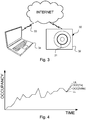
- Figure 3 shows a schematic view of a computer-readable medium as described in the above.
- the computer-readable medium 30 is in this embodiment a data disc 30.
- the data disc 30 is a magnetic data storage disc.
- the data disc 30 is configured to carry instructions 31 that when loaded into a controller, such as a processor, executes a method or procedure according to the embodiments disclosed above.
- the data disc 30 is arranged to be connected to or within and read by a reading device 32, for loading the instructions into the controller.
- a reading device 32 in combination with one (or several) data disc(s) 30 is a hard drive.
- the computer-readable medium can also be other mediums such as compact discs, digital video discs, flash memories or other memory technologies commonly used.
- the instructions 31 may also be downloaded to a computer data reading device 34, such as an apparatus 200 according to figure 2 , possibly being a computer or other device capable of reading computer coded data on a computer-readable medium, by comprising the instructions 31 in a computer-readable signal 33 which is transmitted via a wireless (or wired) interface (for example via the Internet) to the computer data reading device 34 for loading the instructions 31 into a controller.
- a computer-readable signal 33 is one type of a computer-readable medium 30.
- the instructions may be stored in a memory (not shown explicitly in figure 3 , but referenced 240 in figure 2 ) of the computer 34.
- references to computer program, instructions, code etc. should be understood to encompass software for a programmable processor or firmware such as, for example, the programmable content of a hardware device whether instructions for a processor, or configuration settings for a fixed-function device, gate array or programmable logic device etc.
- software for a programmable processor or firmware such as, for example, the programmable content of a hardware device whether instructions for a processor, or configuration settings for a fixed-function device, gate array or programmable logic device etc.
- the apparatus 200 is configured to determine the occupancy of a designated area 110, by making an estimation of the number of objects presently occupying the designated area 110.
- the estimation is based on an average occupying time Ta spent in the designated area 110.
- the controller 210 is configured to determine the occupancy in an area by determining how many objects have entered within the last time equal to the average occupying time.
- the controller can determine or estimate whether the object entering at passage time (P) is still inside the area or has left the area. If it is estimated that the object is still in the area, the estimation sum OCC will be increased by 1. The controller then determines that occupancy for the designated area 110 is given by the estimation sum OCC.
- the estimation sum OCC is cleverly defined so that it can not take a negative value and the error is proportional to the current occupancy, not the total amount of objects counted during the day. As such any error will not be cumulative as in the prior art. This is highly beneficial as a system would not need to be restarted or reset continuously to reduce the error.
- the error is inversely proportional to the number of occupants and will therefore decrease (at least relatively seen) as the number of occupants grows.
- occupancy counting systems are used foremostly for counting large number of occupants, this feature is highly beneficial.
- Another manner of determining the estimation of the occupancy is to maintain a set of occupants and determine the size of this set to be the estimation of the occupancy.
- the controller may be configured to maintain a set of passages that is larger than the occupancy set so that the occupancy set may be amended to include older passages P should the average occupancy time increase.
- the controller is configured to determine the average occupancy time by weighting the passage times so that older passages are given less importance than more recent passages. This is especially useful for systems estimating the occupancy over longer time periods and allows for increasing the accuracy of the determination.
- the controller is configured to apply a linear weighting to the passage times. In one embodiment the controller is configured to apply a non-linear weighting to the passage times.
- Ta average occupancy time
- the controller may be configured to determine an average occupancy time (Ta) by assigning a preset or received average occupancy time.
- the controller is configured to determine the average occupancy time by storing a passage time for when an object has passed into (Pi) or out of (Po) the designated area 110.
- the average occupancy time (Ta) is then based on a difference between at least one passage time into an area (Pi) and at least one passage time out of an area (Po).
- the controller is configured to determine the average occupancy time by the difference between the at least one passage time into and the at least one passage time out of the designated area 110 over time, that is to determine the average occupancy time based on a plurality of passages.
- the average occupancy time can be updated continuously or at intervals.
- the average occupancy time will, in such embodiments, be dynamic.
- the controller is, in one embodiment, configured to weight the passage times into and out of the designated area 110 so that older times are less prominent when determining the average occupancy time. This allows for taking recent changes in behaviour into account when determining the average occupancy time.
- the controller is configured to determine the average occupancy time by using at least one weight function w.
- the weight function (w) is based on an estimation (Te) of the average occupancy time.
- weight function is to attenuate older passages. Objects who passed into the area more recent than Te time ago, are more likely to still be in the area than to have left it.
- Pij ⁇ J 1 N wi Pij , Te
- the average occupancy time will be more accurate when the estimation (Te) of the average occupancy time is close to the true average occupancy time (Ta).
- the controller may determine the estimated average occupancy time (Te) as the difference of the times for the passages in to the designated area and the times for the passages out of the designated area as has been disclosed above.
- the estimated average occupancy time is determined for the 10, 20, 50 or 100 first passages.
- the exact number of possible estimations in A depends on the actual usage.
- the possible estimations for a department store may be the set of [3 to 45] minutes.
- the controller may be configured to determine the average occupancy time (Ta) as the first maximum, i.e. the smallest estimation providing a minimum.
- the set A may be divided into a subset by determining an initial average occupancy time by determining the difference of the times for the passages in to the designated area and the times for the passages out of the designated area as has been disclosed above and centering the subset of A around this difference.
- the set A may be reduced to the subset [9 to 19] minutes. This will provide an average occupancy time that is close to a true average occupancy time and reduce the risk of using a false average being a result of selecting an incorrect or false minima.
- the apparatus may further be configured to adapt the estimated occupancy by comparing the estimation to a determined change in occupancy.
- Figure 4 shows a graph of the estimated occupancy over time. The graph shows how the occupancy estimation changes over time for a given average occupancy time.
- the apparatus is configured to determine the occupancy based on the average occupancy time without counting any passages out of the designated area (apart from a dynamic update of the average occupancy time) there may be an error present in the estimated occupancy.
- the apparatus 200 may be configured to adapt the estimation by detecting the actual number of passages in (Ni) and the number of passages out (No) of the designated area 110 over a time period (Tx). The actual change of the estimated occupancy would then equal the difference between the number of passages in and the number of passages out of the designated area 110.
- OCC T OCC T ⁇ Tx + Ni ⁇ No
- T is the present time
- OCC(T) is the estimated occupancy at time T
- OCC(T-Tx) is the estimated occupancy a time period Tx before the present time T.
- This calculation may be used to determine whether the average occupancy time (Ta) used is a good estimate or not. If the difference between present occupancy being determined based on the average occupancy time as above (OCC[Ta]) and the present occupancy being determined based on a previous occupancy and the number of passages in and out of the designated area (OCC[NiNo]) is large, the average occupancy time being used is not a good one and could be updated.
- the apparatus may thus be configured to regularly or from time to time determine the reliability of the average occupancy time and if it is determined that the average occupancy time is not reliable, the apparatus will update the average occupancy time.
- the average occupancy time is determined to be reliable if the difference between the two occupancies is below a threshold, i.e. if
- the threshold may be selected depending on the time period used for determining the reliability (Tx) and the actual application, i.e. the size and use of the designated area. In one embodiment the threshold is based on the number of passages during for example one minute (or the time period Tx). In one embodiment the threshold is set to 10% of the number of passages.
- the passages may be passages in to and/or passages out of the designated area.
- the time period used for determining the reliability is 1 minute. In one embodiment Tx is 1-5 minutes. In one embodiment Tx is 1-10 minutes.
- the update may be performed in any of the manners disclosed above for determining the average waiting time. If the difference between the two occupancies is positive the average occupancy time should be decreased. If the difference between the two occupancies is negative the average occupancy time should be increased.
- the apparatus may also be configured to determine whether the present occupancy being determined based on the average occupancy time as above (OCC[Ta]) diverges from the present occupancy being determined based on a previous occupancy and the number of passages in and out of the designated area (OCC[NiNo]) and in response thereto adapt the estimated occupancy.
- OCC[Ta] average occupancy time as above
- OCC[NiNo] the number of passages in and out of the designated area
- the apparatus is configured to determine a new average occupancy time and base the occupancy estimation on the newly determined average occupancy time.
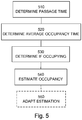
- Figure 5 shows a flowchart for a general method of the teachings herein.
- At least one passage time (P) is determined 510 and based on this, an average occupancy time is determined 520. It is then determined if a passage 530 into a designated area can be estimated to still be in, i.e. still occupy, the designated area by comparing the time for the passage with the present time and the average occupancy time 530 and determine an estimation 540 of the present occupancy in the designated area to equal the number of such passages.
- the average occupancy time can be determined as a weighted average or as a linear difference of passage times as has been disclosed above.
- the estimated occupancy may be adapted 550 based on the number of actual passages into and out of the designated area.
Landscapes
- Physics & Mathematics (AREA)
- General Physics & Mathematics (AREA)
- Engineering & Computer Science (AREA)
- Theoretical Computer Science (AREA)
- General Engineering & Computer Science (AREA)
- Automation & Control Theory (AREA)
- Computer Vision & Pattern Recognition (AREA)
- Multimedia (AREA)
- Alarm Systems (AREA)
- Traffic Control Systems (AREA)
- Closed-Circuit Television Systems (AREA)
- Time Recorders, Dirve Recorders, Access Control (AREA)
Applications Claiming Priority (2)
| Application Number | Priority Date | Filing Date | Title |
|---|---|---|---|
| SE1450175 | 2014-02-14 | ||
| PCT/EP2015/051147 WO2015121041A1 (en) | 2014-02-14 | 2015-01-21 | System and method for occupancy estimation |
Publications (2)
| Publication Number | Publication Date |
|---|---|
| EP3105744A1 EP3105744A1 (en) | 2016-12-21 |
| EP3105744B1 true EP3105744B1 (en) | 2018-05-02 |
Family
ID=52450066
Family Applications (1)
| Application Number | Title | Priority Date | Filing Date |
|---|---|---|---|
| EP15702676.6A Not-in-force EP3105744B1 (en) | 2014-02-14 | 2015-01-21 | System and method for occupancy estimation |
Country Status (6)
| Country | Link |
|---|---|
| US (1) | US10210394B2 (enExample) |
| EP (1) | EP3105744B1 (enExample) |
| JP (1) | JP6263281B2 (enExample) |
| KR (1) | KR101759691B1 (enExample) |
| CN (1) | CN106164984B (enExample) |
| WO (1) | WO2015121041A1 (enExample) |
Families Citing this family (8)
| Publication number | Priority date | Publication date | Assignee | Title |
|---|---|---|---|---|
| US10282656B2 (en) * | 2017-01-11 | 2019-05-07 | Thomas Danaher Harvey | Method and device for detecting unauthorized tranfer between persons |
| US10810481B2 (en) * | 2017-01-11 | 2020-10-20 | Thomas Danaher Harvey | Method and system to count movements of persons from vibrations in a floor |
| JP7158828B2 (ja) * | 2017-05-31 | 2022-10-24 | キヤノン株式会社 | 情報処理装置、情報処理方法およびプログラム |
| US11184968B2 (en) * | 2017-10-17 | 2021-11-23 | Signify Holding B.V. | Occupancy sensor calibration and occupancy estimation |
| US11193683B2 (en) * | 2019-12-31 | 2021-12-07 | Lennox Industries Inc. | Error correction for predictive schedules for a thermostat |
| EP4139836B1 (en) * | 2020-04-24 | 2026-02-11 | Alarm.com Incorporated | Enhanced property access with video analytics |
| US11983963B2 (en) | 2020-07-24 | 2024-05-14 | Alarm.Com Incorporated | Anti-spoofing visual authentication |
| KR102304910B1 (ko) | 2021-01-11 | 2021-09-27 | 알리코제약(주) | 칸데사르탄을 함유하는 안정한 약학적 조성물 |
Family Cites Families (12)
| Publication number | Priority date | Publication date | Assignee | Title |
|---|---|---|---|---|
| JPH077080B2 (ja) * | 1990-11-27 | 1995-01-30 | 技研トレーディング株式会社 | 平均滞留時間の測定装置 |
| JP2612777B2 (ja) * | 1990-12-28 | 1997-05-21 | 技研トラステム株式会社 | 平均滞留時間の測定装置 |
| JP2004288727A (ja) * | 2003-03-19 | 2004-10-14 | Seiko Epson Corp | Cmp装置、cmp研磨方法、半導体装置及びその製造方法 |
| US7692684B2 (en) * | 2004-09-27 | 2010-04-06 | Point Grey Research Inc. | People counting systems and methods |
| JP2008217289A (ja) * | 2007-03-02 | 2008-09-18 | Mitsubishi Precision Co Ltd | 人数計測システム |
| WO2008153948A1 (en) * | 2007-06-07 | 2008-12-18 | Sorensen Associates Inc | Traffic and population counting device system and method |
| CN100596192C (zh) | 2007-09-17 | 2010-03-24 | 深圳先进技术研究院 | 一种基于视频的智能数人系统及其处理方法 |
| TWI411975B (zh) * | 2008-11-06 | 2013-10-11 | Ind Tech Res Inst | 顧客流量等級預測方法及應用其之空調溫度控制方法 |
| CN101739653A (zh) * | 2008-11-13 | 2010-06-16 | 上海汇纳网络信息科技有限公司 | 客流分析系统 |
| JP5583451B2 (ja) * | 2010-03-31 | 2014-09-03 | 綜合警備保障株式会社 | 人数計測装置、精度評価方法 |
| JP2015512042A (ja) * | 2012-02-29 | 2015-04-23 | コーニンクレッカ フィリップス エヌ ヴェ | 区域内の人の存在を監視する装置、方法及びシステム |
| CN103325115B (zh) | 2013-06-14 | 2016-08-10 | 上海交通大学 | 一种基于头顶摄像头的监控行人计数的方法 |
-
2015
- 2015-01-21 EP EP15702676.6A patent/EP3105744B1/en not_active Not-in-force
- 2015-01-21 WO PCT/EP2015/051147 patent/WO2015121041A1/en not_active Ceased
- 2015-01-21 JP JP2016569004A patent/JP6263281B2/ja not_active Expired - Fee Related
- 2015-01-21 US US15/118,198 patent/US10210394B2/en active Active
- 2015-01-21 KR KR1020167025585A patent/KR101759691B1/ko not_active Expired - Fee Related
- 2015-01-21 CN CN201580008417.5A patent/CN106164984B/zh not_active Expired - Fee Related
Non-Patent Citations (1)
| Title |
|---|
| None * |
Also Published As
| Publication number | Publication date |
|---|---|
| EP3105744A1 (en) | 2016-12-21 |
| US10210394B2 (en) | 2019-02-19 |
| JP6263281B2 (ja) | 2018-01-17 |
| CN106164984A (zh) | 2016-11-23 |
| KR101759691B1 (ko) | 2017-07-19 |
| WO2015121041A1 (en) | 2015-08-20 |
| JP2017510916A (ja) | 2017-04-13 |
| CN106164984B (zh) | 2020-04-24 |
| US20170161562A1 (en) | 2017-06-08 |
| KR20160122256A (ko) | 2016-10-21 |
Similar Documents
| Publication | Publication Date | Title |
|---|---|---|
| US10210394B2 (en) | System and method for occupancy estimation | |
| JP2017510916A5 (enExample) | ||
| US11059349B2 (en) | Enhanced climate control | |
| WO2017061371A1 (ja) | 行動検知システム、行動検知装置、行動検知方法、および行動検知プログラム | |
| US9791872B2 (en) | Method and apparatus for an energy saving heating, ventilation, and air conditioning (HVAC) control system | |
| US20240112337A1 (en) | Vehicular driver monitoring system with health monitoring | |
| CA3055187A1 (en) | Medical adverse event prediction, reporting, and prevention | |
| US10902639B2 (en) | Information processing apparatus, information processing method, and program | |
| AU2016269459A1 (en) | Methods and systems for automatic vehicle maintainance scheduling | |
| KR102644487B1 (ko) | 체온 예측 장치 및 방법, 그리고 체온 예측 장치를 학습시키는 방법 | |
| JP2018205872A (ja) | 情報処理装置、情報処理方法およびプログラム | |
| JP2017153420A (ja) | 動物用トイレ、健康状態判定装置およびユーザ端末 | |
| CN106913313B (zh) | 一种睡眠监测方法及系统 | |
| CN114376520B (zh) | 用于监测睡眠的方法、装置及存储介质 | |
| US9959635B2 (en) | State determination device, eye closure determination device, state determination method, and storage medium | |
| CN111079560A (zh) | 一种摔倒监测方法、装置及终端设备 | |
| CN108334820A (zh) | 信息处理设备、信息处理方法和存储介质 | |
| CN120583911A (zh) | 基于约简的生物识别数据集的统计分析的实时睡眠预测 | |
| JP6290614B2 (ja) | 顔認識ゲートシステム及び顔認識ゲートシステムプログラム | |
| US12106857B2 (en) | Complex care tool | |
| CN111158481A (zh) | 一种提示方法、装置及计算机可读存储介质 | |
| KR101996163B1 (ko) | 활동량 산출 시스템, 활동량 산출 장치, 활동량 산출 방법 및 컴퓨터 판독 가능한 기록 매체 | |
| JP2015046093A (ja) | 行動予測システム、行動予測装置、行動予測方法、行動予測プログラム及び行動予測プログラムを記録した記録媒体 | |
| CN115192003B (zh) | 一种镇静水平的自动评估方法及相关产品 | |
| US20190274634A1 (en) | Event prediction system, sensor signal processing system, event prediction method, and non-transitory storage medium |
Legal Events
| Date | Code | Title | Description |
|---|---|---|---|
| PUAI | Public reference made under article 153(3) epc to a published international application that has entered the european phase |
Free format text: ORIGINAL CODE: 0009012 |
|
| STAA | Information on the status of an ep patent application or granted ep patent |
Free format text: STATUS: REQUEST FOR EXAMINATION WAS MADE |
|
| 17P | Request for examination filed |
Effective date: 20160824 |
|
| AK | Designated contracting states |
Kind code of ref document: A1 Designated state(s): AL AT BE BG CH CY CZ DE DK EE ES FI FR GB GR HR HU IE IS IT LI LT LU LV MC MK MT NL NO PL PT RO RS SE SI SK SM TR |
|
| AX | Request for extension of the european patent |
Extension state: BA ME |
|
| DAX | Request for extension of the european patent (deleted) | ||
| GRAP | Despatch of communication of intention to grant a patent |
Free format text: ORIGINAL CODE: EPIDOSNIGR1 |
|
| STAA | Information on the status of an ep patent application or granted ep patent |
Free format text: STATUS: GRANT OF PATENT IS INTENDED |
|
| INTG | Intention to grant announced |
Effective date: 20180201 |
|
| GRAS | Grant fee paid |
Free format text: ORIGINAL CODE: EPIDOSNIGR3 |
|
| GRAA | (expected) grant |
Free format text: ORIGINAL CODE: 0009210 |
|
| STAA | Information on the status of an ep patent application or granted ep patent |
Free format text: STATUS: THE PATENT HAS BEEN GRANTED |
|
| AK | Designated contracting states |
Kind code of ref document: B1 Designated state(s): AL AT BE BG CH CY CZ DE DK EE ES FI FR GB GR HR HU IE IS IT LI LT LU LV MC MK MT NL NO PL PT RO RS SE SI SK SM TR |
|
| REG | Reference to a national code |
Ref country code: GB Ref legal event code: FG4D |
|
| REG | Reference to a national code |
Ref country code: CH Ref legal event code: EP Ref country code: AT Ref legal event code: REF Ref document number: 996057 Country of ref document: AT Kind code of ref document: T Effective date: 20180515 |
|
| REG | Reference to a national code |
Ref country code: SE Ref legal event code: TRGR |
|
| REG | Reference to a national code |
Ref country code: DE Ref legal event code: R096 Ref document number: 602015010660 Country of ref document: DE Ref country code: IE Ref legal event code: FG4D |
|
| REG | Reference to a national code |
Ref country code: DE Ref legal event code: R096 Ref document number: 602015010660 Country of ref document: DE |
|
| REG | Reference to a national code |
Ref country code: NL Ref legal event code: MP Effective date: 20180502 |
|
| REG | Reference to a national code |
Ref country code: LT Ref legal event code: MG4D |
|
| PG25 | Lapsed in a contracting state [announced via postgrant information from national office to epo] |
Ref country code: LT Free format text: LAPSE BECAUSE OF FAILURE TO SUBMIT A TRANSLATION OF THE DESCRIPTION OR TO PAY THE FEE WITHIN THE PRESCRIBED TIME-LIMIT Effective date: 20180502 Ref country code: BG Free format text: LAPSE BECAUSE OF FAILURE TO SUBMIT A TRANSLATION OF THE DESCRIPTION OR TO PAY THE FEE WITHIN THE PRESCRIBED TIME-LIMIT Effective date: 20180802 Ref country code: ES Free format text: LAPSE BECAUSE OF FAILURE TO SUBMIT A TRANSLATION OF THE DESCRIPTION OR TO PAY THE FEE WITHIN THE PRESCRIBED TIME-LIMIT Effective date: 20180502 Ref country code: FI Free format text: LAPSE BECAUSE OF FAILURE TO SUBMIT A TRANSLATION OF THE DESCRIPTION OR TO PAY THE FEE WITHIN THE PRESCRIBED TIME-LIMIT Effective date: 20180502 Ref country code: NO Free format text: LAPSE BECAUSE OF FAILURE TO SUBMIT A TRANSLATION OF THE DESCRIPTION OR TO PAY THE FEE WITHIN THE PRESCRIBED TIME-LIMIT Effective date: 20180802 |
|
| PG25 | Lapsed in a contracting state [announced via postgrant information from national office to epo] |
Ref country code: RS Free format text: LAPSE BECAUSE OF FAILURE TO SUBMIT A TRANSLATION OF THE DESCRIPTION OR TO PAY THE FEE WITHIN THE PRESCRIBED TIME-LIMIT Effective date: 20180502 Ref country code: LV Free format text: LAPSE BECAUSE OF FAILURE TO SUBMIT A TRANSLATION OF THE DESCRIPTION OR TO PAY THE FEE WITHIN THE PRESCRIBED TIME-LIMIT Effective date: 20180502 Ref country code: GR Free format text: LAPSE BECAUSE OF FAILURE TO SUBMIT A TRANSLATION OF THE DESCRIPTION OR TO PAY THE FEE WITHIN THE PRESCRIBED TIME-LIMIT Effective date: 20180803 Ref country code: HR Free format text: LAPSE BECAUSE OF FAILURE TO SUBMIT A TRANSLATION OF THE DESCRIPTION OR TO PAY THE FEE WITHIN THE PRESCRIBED TIME-LIMIT Effective date: 20180502 Ref country code: NL Free format text: LAPSE BECAUSE OF FAILURE TO SUBMIT A TRANSLATION OF THE DESCRIPTION OR TO PAY THE FEE WITHIN THE PRESCRIBED TIME-LIMIT Effective date: 20180502 |
|
| REG | Reference to a national code |
Ref country code: AT Ref legal event code: MK05 Ref document number: 996057 Country of ref document: AT Kind code of ref document: T Effective date: 20180502 |
|
| PG25 | Lapsed in a contracting state [announced via postgrant information from national office to epo] |
Ref country code: AT Free format text: LAPSE BECAUSE OF FAILURE TO SUBMIT A TRANSLATION OF THE DESCRIPTION OR TO PAY THE FEE WITHIN THE PRESCRIBED TIME-LIMIT Effective date: 20180502 Ref country code: DK Free format text: LAPSE BECAUSE OF FAILURE TO SUBMIT A TRANSLATION OF THE DESCRIPTION OR TO PAY THE FEE WITHIN THE PRESCRIBED TIME-LIMIT Effective date: 20180502 Ref country code: PL Free format text: LAPSE BECAUSE OF FAILURE TO SUBMIT A TRANSLATION OF THE DESCRIPTION OR TO PAY THE FEE WITHIN THE PRESCRIBED TIME-LIMIT Effective date: 20180502 Ref country code: RO Free format text: LAPSE BECAUSE OF FAILURE TO SUBMIT A TRANSLATION OF THE DESCRIPTION OR TO PAY THE FEE WITHIN THE PRESCRIBED TIME-LIMIT Effective date: 20180502 Ref country code: SK Free format text: LAPSE BECAUSE OF FAILURE TO SUBMIT A TRANSLATION OF THE DESCRIPTION OR TO PAY THE FEE WITHIN THE PRESCRIBED TIME-LIMIT Effective date: 20180502 Ref country code: CZ Free format text: LAPSE BECAUSE OF FAILURE TO SUBMIT A TRANSLATION OF THE DESCRIPTION OR TO PAY THE FEE WITHIN THE PRESCRIBED TIME-LIMIT Effective date: 20180502 Ref country code: EE Free format text: LAPSE BECAUSE OF FAILURE TO SUBMIT A TRANSLATION OF THE DESCRIPTION OR TO PAY THE FEE WITHIN THE PRESCRIBED TIME-LIMIT Effective date: 20180502 |
|
| REG | Reference to a national code |
Ref country code: DE Ref legal event code: R097 Ref document number: 602015010660 Country of ref document: DE |
|
| PG25 | Lapsed in a contracting state [announced via postgrant information from national office to epo] |
Ref country code: IT Free format text: LAPSE BECAUSE OF FAILURE TO SUBMIT A TRANSLATION OF THE DESCRIPTION OR TO PAY THE FEE WITHIN THE PRESCRIBED TIME-LIMIT Effective date: 20180502 Ref country code: SM Free format text: LAPSE BECAUSE OF FAILURE TO SUBMIT A TRANSLATION OF THE DESCRIPTION OR TO PAY THE FEE WITHIN THE PRESCRIBED TIME-LIMIT Effective date: 20180502 |
|
| PLBE | No opposition filed within time limit |
Free format text: ORIGINAL CODE: 0009261 |
|
| STAA | Information on the status of an ep patent application or granted ep patent |
Free format text: STATUS: NO OPPOSITION FILED WITHIN TIME LIMIT |
|
| 26N | No opposition filed |
Effective date: 20190205 |
|
| PG25 | Lapsed in a contracting state [announced via postgrant information from national office to epo] |
Ref country code: SI Free format text: LAPSE BECAUSE OF FAILURE TO SUBMIT A TRANSLATION OF THE DESCRIPTION OR TO PAY THE FEE WITHIN THE PRESCRIBED TIME-LIMIT Effective date: 20180502 |
|
| PG25 | Lapsed in a contracting state [announced via postgrant information from national office to epo] |
Ref country code: MC Free format text: LAPSE BECAUSE OF FAILURE TO SUBMIT A TRANSLATION OF THE DESCRIPTION OR TO PAY THE FEE WITHIN THE PRESCRIBED TIME-LIMIT Effective date: 20180502 |
|
| REG | Reference to a national code |
Ref country code: CH Ref legal event code: PL |
|
| PG25 | Lapsed in a contracting state [announced via postgrant information from national office to epo] |
Ref country code: LU Free format text: LAPSE BECAUSE OF NON-PAYMENT OF DUE FEES Effective date: 20190121 |
|
| REG | Reference to a national code |
Ref country code: BE Ref legal event code: MM Effective date: 20190131 |
|
| REG | Reference to a national code |
Ref country code: IE Ref legal event code: MM4A |
|
| PG25 | Lapsed in a contracting state [announced via postgrant information from national office to epo] |
Ref country code: BE Free format text: LAPSE BECAUSE OF NON-PAYMENT OF DUE FEES Effective date: 20190131 Ref country code: AL Free format text: LAPSE BECAUSE OF FAILURE TO SUBMIT A TRANSLATION OF THE DESCRIPTION OR TO PAY THE FEE WITHIN THE PRESCRIBED TIME-LIMIT Effective date: 20180502 |
|
| PG25 | Lapsed in a contracting state [announced via postgrant information from national office to epo] |
Ref country code: CH Free format text: LAPSE BECAUSE OF NON-PAYMENT OF DUE FEES Effective date: 20190131 Ref country code: LI Free format text: LAPSE BECAUSE OF NON-PAYMENT OF DUE FEES Effective date: 20190131 |
|
| PG25 | Lapsed in a contracting state [announced via postgrant information from national office to epo] |
Ref country code: IE Free format text: LAPSE BECAUSE OF NON-PAYMENT OF DUE FEES Effective date: 20190121 |
|
| PG25 | Lapsed in a contracting state [announced via postgrant information from national office to epo] |
Ref country code: TR Free format text: LAPSE BECAUSE OF FAILURE TO SUBMIT A TRANSLATION OF THE DESCRIPTION OR TO PAY THE FEE WITHIN THE PRESCRIBED TIME-LIMIT Effective date: 20180502 |
|
| PG25 | Lapsed in a contracting state [announced via postgrant information from national office to epo] |
Ref country code: PT Free format text: LAPSE BECAUSE OF FAILURE TO SUBMIT A TRANSLATION OF THE DESCRIPTION OR TO PAY THE FEE WITHIN THE PRESCRIBED TIME-LIMIT Effective date: 20180903 Ref country code: MT Free format text: LAPSE BECAUSE OF NON-PAYMENT OF DUE FEES Effective date: 20190121 |
|
| PG25 | Lapsed in a contracting state [announced via postgrant information from national office to epo] |
Ref country code: CY Free format text: LAPSE BECAUSE OF FAILURE TO SUBMIT A TRANSLATION OF THE DESCRIPTION OR TO PAY THE FEE WITHIN THE PRESCRIBED TIME-LIMIT Effective date: 20180502 |
|
| PG25 | Lapsed in a contracting state [announced via postgrant information from national office to epo] |
Ref country code: IS Free format text: LAPSE BECAUSE OF FAILURE TO SUBMIT A TRANSLATION OF THE DESCRIPTION OR TO PAY THE FEE WITHIN THE PRESCRIBED TIME-LIMIT Effective date: 20180902 |
|
| PG25 | Lapsed in a contracting state [announced via postgrant information from national office to epo] |
Ref country code: HU Free format text: LAPSE BECAUSE OF FAILURE TO SUBMIT A TRANSLATION OF THE DESCRIPTION OR TO PAY THE FEE WITHIN THE PRESCRIBED TIME-LIMIT; INVALID AB INITIO Effective date: 20150121 |
|
| REG | Reference to a national code |
Ref country code: DE Ref legal event code: R081 Ref document number: 602015010660 Country of ref document: DE Owner name: AXIS AB, SE Free format text: FORMER OWNER: COGNIMATICS AB, LUND, SE |
|
| REG | Reference to a national code |
Ref country code: GB Ref legal event code: 732E Free format text: REGISTERED BETWEEN 20220303 AND 20220309 |
|
| PG25 | Lapsed in a contracting state [announced via postgrant information from national office to epo] |
Ref country code: MK Free format text: LAPSE BECAUSE OF FAILURE TO SUBMIT A TRANSLATION OF THE DESCRIPTION OR TO PAY THE FEE WITHIN THE PRESCRIBED TIME-LIMIT Effective date: 20180502 |
|
| P01 | Opt-out of the competence of the unified patent court (upc) registered |
Effective date: 20230505 |
|
| PGFP | Annual fee paid to national office [announced via postgrant information from national office to epo] |
Ref country code: GB Payment date: 20231219 Year of fee payment: 10 |
|
| PGFP | Annual fee paid to national office [announced via postgrant information from national office to epo] |
Ref country code: SE Payment date: 20231219 Year of fee payment: 10 Ref country code: FR Payment date: 20231219 Year of fee payment: 10 |
|
| PGFP | Annual fee paid to national office [announced via postgrant information from national office to epo] |
Ref country code: DE Payment date: 20231219 Year of fee payment: 10 |
|
| REG | Reference to a national code |
Ref country code: DE Ref legal event code: R119 Ref document number: 602015010660 Country of ref document: DE |
|
| REG | Reference to a national code |
Ref country code: SE Ref legal event code: EUG |
|
| GBPC | Gb: european patent ceased through non-payment of renewal fee |
Effective date: 20250121 |
|
| PG25 | Lapsed in a contracting state [announced via postgrant information from national office to epo] |
Ref country code: DE Free format text: LAPSE BECAUSE OF NON-PAYMENT OF DUE FEES Effective date: 20250801 |
|
| PG25 | Lapsed in a contracting state [announced via postgrant information from national office to epo] |
Ref country code: GB Free format text: LAPSE BECAUSE OF NON-PAYMENT OF DUE FEES Effective date: 20250121 |
|
| PG25 | Lapsed in a contracting state [announced via postgrant information from national office to epo] |
Ref country code: FR Free format text: LAPSE BECAUSE OF NON-PAYMENT OF DUE FEES Effective date: 20250131 |
|
| PG25 | Lapsed in a contracting state [announced via postgrant information from national office to epo] |
Ref country code: SE Free format text: LAPSE BECAUSE OF NON-PAYMENT OF DUE FEES Effective date: 20250122 |