EP3085762A1 - Method for producing gel detergent - Google Patents
Method for producing gel detergent Download PDFInfo
- Publication number
- EP3085762A1 EP3085762A1 EP13899808.3A EP13899808A EP3085762A1 EP 3085762 A1 EP3085762 A1 EP 3085762A1 EP 13899808 A EP13899808 A EP 13899808A EP 3085762 A1 EP3085762 A1 EP 3085762A1
- Authority
- EP
- European Patent Office
- Prior art keywords
- formula
- saturated
- carbon atoms
- alkyl group
- molten material
- Prior art date
- Legal status (The legal status is an assumption and is not a legal conclusion. Google has not performed a legal analysis and makes no representation as to the accuracy of the status listed.)
- Granted
Links
Images




Classifications
-
- C—CHEMISTRY; METALLURGY
- C11—ANIMAL OR VEGETABLE OILS, FATS, FATTY SUBSTANCES OR WAXES; FATTY ACIDS THEREFROM; DETERGENTS; CANDLES
- C11D—DETERGENT COMPOSITIONS; USE OF SINGLE SUBSTANCES AS DETERGENTS; SOAP OR SOAP-MAKING; RESIN SOAPS; RECOVERY OF GLYCEROL
- C11D11/00—Special methods for preparing compositions containing mixtures of detergents
- C11D11/0094—Process for making liquid detergent compositions, e.g. slurries, pastes or gels
-
- C—CHEMISTRY; METALLURGY
- C11—ANIMAL OR VEGETABLE OILS, FATS, FATTY SUBSTANCES OR WAXES; FATTY ACIDS THEREFROM; DETERGENTS; CANDLES
- C11D—DETERGENT COMPOSITIONS; USE OF SINGLE SUBSTANCES AS DETERGENTS; SOAP OR SOAP-MAKING; RESIN SOAPS; RECOVERY OF GLYCEROL
- C11D1/00—Detergent compositions based essentially on surface-active compounds; Use of these compounds as a detergent
- C11D1/02—Anionic compounds
- C11D1/04—Carboxylic acids or salts thereof
-
- C—CHEMISTRY; METALLURGY
- C11—ANIMAL OR VEGETABLE OILS, FATS, FATTY SUBSTANCES OR WAXES; FATTY ACIDS THEREFROM; DETERGENTS; CANDLES
- C11D—DETERGENT COMPOSITIONS; USE OF SINGLE SUBSTANCES AS DETERGENTS; SOAP OR SOAP-MAKING; RESIN SOAPS; RECOVERY OF GLYCEROL
- C11D1/00—Detergent compositions based essentially on surface-active compounds; Use of these compounds as a detergent
- C11D1/02—Anionic compounds
- C11D1/04—Carboxylic acids or salts thereof
- C11D1/06—Ether- or thioether carboxylic acids
-
- C—CHEMISTRY; METALLURGY
- C11—ANIMAL OR VEGETABLE OILS, FATS, FATTY SUBSTANCES OR WAXES; FATTY ACIDS THEREFROM; DETERGENTS; CANDLES
- C11D—DETERGENT COMPOSITIONS; USE OF SINGLE SUBSTANCES AS DETERGENTS; SOAP OR SOAP-MAKING; RESIN SOAPS; RECOVERY OF GLYCEROL
- C11D1/00—Detergent compositions based essentially on surface-active compounds; Use of these compounds as a detergent
- C11D1/02—Anionic compounds
- C11D1/04—Carboxylic acids or salts thereof
- C11D1/10—Amino carboxylic acids; Imino carboxylic acids; Fatty acid condensates thereof
-
- C—CHEMISTRY; METALLURGY
- C11—ANIMAL OR VEGETABLE OILS, FATS, FATTY SUBSTANCES OR WAXES; FATTY ACIDS THEREFROM; DETERGENTS; CANDLES
- C11D—DETERGENT COMPOSITIONS; USE OF SINGLE SUBSTANCES AS DETERGENTS; SOAP OR SOAP-MAKING; RESIN SOAPS; RECOVERY OF GLYCEROL
- C11D1/00—Detergent compositions based essentially on surface-active compounds; Use of these compounds as a detergent
- C11D1/88—Ampholytes; Electroneutral compounds
- C11D1/90—Betaines
-
- C—CHEMISTRY; METALLURGY
- C11—ANIMAL OR VEGETABLE OILS, FATS, FATTY SUBSTANCES OR WAXES; FATTY ACIDS THEREFROM; DETERGENTS; CANDLES
- C11D—DETERGENT COMPOSITIONS; USE OF SINGLE SUBSTANCES AS DETERGENTS; SOAP OR SOAP-MAKING; RESIN SOAPS; RECOVERY OF GLYCEROL
- C11D1/00—Detergent compositions based essentially on surface-active compounds; Use of these compounds as a detergent
- C11D1/88—Ampholytes; Electroneutral compounds
- C11D1/92—Sulfobetaines ; Sulfitobetaines
-
- C—CHEMISTRY; METALLURGY
- C11—ANIMAL OR VEGETABLE OILS, FATS, FATTY SUBSTANCES OR WAXES; FATTY ACIDS THEREFROM; DETERGENTS; CANDLES
- C11D—DETERGENT COMPOSITIONS; USE OF SINGLE SUBSTANCES AS DETERGENTS; SOAP OR SOAP-MAKING; RESIN SOAPS; RECOVERY OF GLYCEROL
- C11D1/00—Detergent compositions based essentially on surface-active compounds; Use of these compounds as a detergent
- C11D1/88—Ampholytes; Electroneutral compounds
- C11D1/94—Mixtures with anionic, cationic or non-ionic compounds
-
- C—CHEMISTRY; METALLURGY
- C11—ANIMAL OR VEGETABLE OILS, FATS, FATTY SUBSTANCES OR WAXES; FATTY ACIDS THEREFROM; DETERGENTS; CANDLES
- C11D—DETERGENT COMPOSITIONS; USE OF SINGLE SUBSTANCES AS DETERGENTS; SOAP OR SOAP-MAKING; RESIN SOAPS; RECOVERY OF GLYCEROL
- C11D17/00—Detergent materials or soaps characterised by their shape or physical properties
- C11D17/0008—Detergent materials or soaps characterised by their shape or physical properties aqueous liquid non soap compositions
- C11D17/003—Colloidal solutions, e.g. gels; Thixotropic solutions or pastes
-
- C—CHEMISTRY; METALLURGY
- C11—ANIMAL OR VEGETABLE OILS, FATS, FATTY SUBSTANCES OR WAXES; FATTY ACIDS THEREFROM; DETERGENTS; CANDLES
- C11D—DETERGENT COMPOSITIONS; USE OF SINGLE SUBSTANCES AS DETERGENTS; SOAP OR SOAP-MAKING; RESIN SOAPS; RECOVERY OF GLYCEROL
- C11D3/00—Other compounding ingredients of detergent compositions covered in group C11D1/00
- C11D3/16—Organic compounds
- C11D3/20—Organic compounds containing oxygen
- C11D3/2003—Alcohols; Phenols
- C11D3/2006—Monohydric alcohols
-
- C—CHEMISTRY; METALLURGY
- C11—ANIMAL OR VEGETABLE OILS, FATS, FATTY SUBSTANCES OR WAXES; FATTY ACIDS THEREFROM; DETERGENTS; CANDLES
- C11D—DETERGENT COMPOSITIONS; USE OF SINGLE SUBSTANCES AS DETERGENTS; SOAP OR SOAP-MAKING; RESIN SOAPS; RECOVERY OF GLYCEROL
- C11D3/00—Other compounding ingredients of detergent compositions covered in group C11D1/00
- C11D3/16—Organic compounds
- C11D3/20—Organic compounds containing oxygen
- C11D3/2003—Alcohols; Phenols
- C11D3/2065—Polyhydric alcohols
-
- C—CHEMISTRY; METALLURGY
- C11—ANIMAL OR VEGETABLE OILS, FATS, FATTY SUBSTANCES OR WAXES; FATTY ACIDS THEREFROM; DETERGENTS; CANDLES
- C11D—DETERGENT COMPOSITIONS; USE OF SINGLE SUBSTANCES AS DETERGENTS; SOAP OR SOAP-MAKING; RESIN SOAPS; RECOVERY OF GLYCEROL
- C11D3/00—Other compounding ingredients of detergent compositions covered in group C11D1/00
- C11D3/16—Organic compounds
- C11D3/20—Organic compounds containing oxygen
- C11D3/22—Carbohydrates or derivatives thereof
- C11D3/222—Natural or synthetic polysaccharides, e.g. cellulose, starch, gum, alginic acid or cyclodextrin
Definitions
- the present invention relates to a method of producing a gel detergent.
- a detergent is categorized into solid-type, liquid-type, and gel-type in accordance with its appearance.
- gel-type detergent gives a unique feeling to a user, and thus has high commercial value and marketability.
- a method of producing gel-type detergent has been known to include the steps of mixing ingredients such as gelling agent and detergent composition, stirring the mixture thus obtained while heating to gel-like product, and flowing the gel-like product into a mold to solidify the gel-like product.
- Patent Document 1 discloses a gel-type, semi-solid cleaner in which anionic surfactants, amphoteric surfactants, and naturally derived gelling agent are blended and where a template is used as a mold.
- the gel detergent contains a large amount of moisture and the gelling agent is perishable, microorganisms such as bacteria are likely to propagate and it takes time to clean the mold for next use. Further, since various dies must be prepared for molding desired gel detergents with various sizes, production of the gel detergent becomes inefficient.
- Patent Document 2 discloses a gel detergent where cleaning components and a polysaccharide are blended and which is produced using a cylindrical mold. However, Patent Document 2 is silent on the material for the cylindrical mold.
- the present invention is made in view of the foregoing.
- a rubbery composition as a mold, the mold is not needed to be cleaned, thereby providing a simplified method of producing a gel-type detergent with high productivity.
- R is a saturated or unsaturated alkyl group having 12 to 22 carbon atoms; and M is Na, K or amine salt,
- A-2) polyoxyethylene alkyl ether carboxylate (alkyl group having 12-22 carbon atoms, saturated or unsaturated):
- R is a saturated or unsaturated alkyl group having 12 to 22 carbon atoms; n represents 1 to 20 on average; R 1 is saturated alkyl group having 1 or 2 carbon atoms; and M is Na, K or amine salt,
- R represents a saturated or unsaturated alkyl group having 12 to 22 carbon atoms
- R 2 is -H, -CH 3 , or -CH 2 CH 2 COOM
- M represents Na, K or amine salt
- R represents a saturated or unsaturated alkyl group having 12 to 22 carbon atoms
- M represents Na, K or amine salt
- R represents a saturated or unsaturated alkyl group having 12 to 22 carbon atoms
- M represents Na, K or amine salt
- R represents a saturated or unsaturated alkyl group having 12 to 22 carbon atoms
- M represents Na, K or amine salt, (B-4):
- R represents a saturated or unsaturated alkyl group having 12 to 22 carbon atoms
- M represents Na, K or amine salt
- R represents a saturated or unsaturated alkyl group having 12 to 22 carbon atoms
- M represents Na, K or amine salt
- R represents a saturated or unsaturated alkyl group having 12 to 22 carbon atoms
- M represents Na, K or amine salt
- R represents a saturated or unsaturated alkyl group having 12 to 22 carbon atoms
- M represents Na, K or amine salt
- R represents a saturated or unsaturated alkyl group having 12 to 22 carbon atoms
- M represents Na, K or amine salt
- (C-1) a water-soluble polymer derived from a plant or a seaweed: xyloglucan, guar gum, locust bean gum, agarose, carrageenan, gum arabic, sodium alginate, glucomannan, pectin
- R represents a saturated or unsaturated alkyl group having 12 to 22 carbon atoms; n represents 1 to 20 on average; and M represents Na, K or amine salt.
- R represents a saturated or unsaturated alkyl group having 12 to 22 carbon atoms; n represents 1 to 20 on average; and M represents Na, K or amine salt.
- the number of steps is reduced, thereby providing a method of producing a gel detergent with high productivity.
- a cleaning composition may contain one or more selected from Group A and/or Group B.
- Anionic surfactants of (Group A) are (A-1) carboxylate, (A-2) polyoxyethylene alkyl ether carboxylate (alkyl group having 12-22 carbon atoms, saturated or unsaturated) or (A-3) sodium, potassium or amine salt of N-acylamino acid.
- (A-1) carboxylate is preferably one represented by the following formula:
- R is a saturated or unsaturated alkyl group having 12 to 22 carbon atoms; and M represents Na, K or amine salt.
- Fatty acid used in (A-1) carboxylate may be enough if it may be generally blended in the detergent, and includes, but is not limited, saturated or unsaturated, linear or branched fatty acid having alkyl group of 8 to 22 carbon atoms or natural fat.
- the saturated or unsaturated. linear or branched fatty acid having 8 to 22 carbon atoms may be, for example, capric acid, lauric acid, myristic acid, palmitic acid, stearic acid, eicosanoic acid, behenic acid, oleic acid, linoleic acid , linolenic acid, erucic acid, isopalmitic acid, isostearic acid, or neodecanoate.
- Natural fat may be, for example, coconut oil, palm oil, palm kernel oil, cottonseed oil, apricot kernel oil, avocado oil, olive oil, grape seed oil, or corn oil.
- the alkali agent to be used as a salt of carboxylic acid salts may include, but is not limited to, inorganic alkali such as sodium hydroxide, potassium hydroxide, sodium carbonate, and potassium carbonate, L-arginine of basic amino acid, organic alkali such as monoethanolamine, diethanolamine, triethanolamine, and etc., polyhydric alcohol amine such as ethanolamine, aminomethyl propanol, aminoethyl propanediol, aminomethyl propanediol, or alkylamine such as diisopropanolamine, triisopropanolamine, and monoisopropanolamine. From the viewpoint of low-temperature stability, potassium hydroxide or triethanolamine is preferred, potassium hydroxide is more preferable.
- inorganic alkali such as sodium hydroxide, potassium hydroxide, sodium carbonate, and potassium carbonate
- L-arginine of basic amino acid organic alkali such as monoethanolamine, diethanolamine, triethanolamine, and etc.
- fatty acid potassium salt which is referred to as "potassium soap base” may be preferably used.
- the fatty acid potassium salt is one produced by a blending and cooking method of adding potassium hydroxide to natural fat and oil and heating them.
- the fatty acid potassium salt contains potassium laurate, potassium myristate and etc. as main components, and also contains unreacted fat and oil inevitably derived from the above method and glycerin that is created by decomposition.
- Polyoxyethylene alkyl ether carboxylates (alkyl group having 12 to 22 carbon atoms, saturated or unsaturated) may be preferably one represented by the following formula:
- R is a saturated or unsaturated alkyl group having 12 to 22 carbon atoms; n represents 1 to 20 on average; R 1 is saturated alkyl group having 1 or 2 carbon atoms; and M is Na, K or amine salt.
- polyoxyethylene alkyl ether carboxylate may be represented by one which is obtained by addition polymerization of 4-5 moles of ethylene oxide to lauryl alcohol and reaction of the resultant compound with monochloroacetic acid.
- R represents a saturated or unsaturated alkyl group having 12 to 22 carbon atoms; n represents 1 to 20 on average; and M represents Na, K or amine salt.
- polyoxyethylene alkyl ether carboxylate (A-2) polyoxyethylene alkyl ether carboxylate, (A-2-2) polyoxyethylene alkyl ether propionate (alkyl group having 12-22 carbon atoms, saturated or unsaturated) is preferred in terms of stability in hard water, and desirable cleaning performance when used together with sodium laurate, and/or sodium myristate.
- polyoxyethylene alkyl ether propionate alkyl group having 12-22 carbon atoms, saturated or unsaturated
- R represents a saturated or unsaturated alkyl group having 12 to 22 carbon atoms; n represents 1 to 20 on average; and M represents Na, K or amine salt.
- R represents a saturated or unsaturated alkyl group having 12 to 22 carbon atoms
- R 2 is -H, -CH 3 , or -CH 2 CH 2 COOM
- M represents Na, K or amine salt.
- amphoteric surfactant of (group B) may be represented by the following formula (B-1) to (B-8):
- R represents a saturated or unsaturated alkyl group having 12 to 22 carbon atoms
- M represents Na, K or amine salt.
- R represents a saturated or unsaturated alkyl group having 12 to 22 carbon atoms
- M represents Na, K or amine salt.
- R represents a saturated or unsaturated alkyl group having 12 to 22 carbon atoms
- M represents Na, K or amine salt.
- R represents a saturated or unsaturated alkyl group having 12 to 22 carbon atoms
- M represents Na, K or amine salt.
- R represents a saturated or unsaturated alkyl group having 12 to 22 carbon atoms
- M represents Na, K or amine salt.
- R represents a saturated or unsaturated alkyl group having 12 to 22 carbon atoms
- M represents Na, K or amine salt.
- R represents a saturated or unsaturated alkyl group having 12 to 22 carbon atoms
- M represents Na, K or amine salt.
- R represents a saturated or unsaturated alkyl group having 12 to 22 carbon atoms
- M represents Na, K or amine salt.
- amphoteric surfactant having a hydroxyl group has an interaction with water-soluble natural polymer, and greatly contributes to gelation, it is preferably contained in the gel detergent.
- an alkyl amide propyl betaine as represented by (B-6) is preferred.
- 2-alkyl-N-carboxymethyl-N-hydroxyethyl imidazolinium betaine is more preferable.
- the gelling agent may contain one or more selected from (group C) as follows:
- Xanthan gum gellan gum, pullulan, curdlan, sodium hyaluronate.
- the gel detergent has pH 8 to pH 11 in accordance with 1wt% aqueous solution calculation in view of low irritation to the skin.
- the gelling agent preferably has alkali resistance, salt resistance, and heat resistance.
- xyloglucan from tamarind seed gum, guar gum, carrageenan, and locust bean gum as the water-soluble polymer with salt resistance and heat resistance are also derived from plants, and preferred in terms of environmental protection.
- the amount of gelling agent per the total weight of the gel detergent is preferably 0.1 wt% to 10 wt%, more preferably 1 wt% to 5 wt%. If the gelling agent is contained in an amount less than 1 wt% per the total weight of the gel detergent, it is difficult to be solidified into a gel. On the other hand, if the gelling agent exceeds 10 wt% per the total weight of the gel detergent, excessive solidification occurs, thereby compromising the foamability. As a result, easy foamability and cleaning power cannot be obtained in use.
- 1 wt% aqueous solution of the gelling agent is preferably used in the viscosity of 5mPa ⁇ s to 9000mPa ⁇ s, more preferably 1000mPa ⁇ s to 8000mPa ⁇ s, further preferably 2000mPa ⁇ s to 6000mPa ⁇ s. If the viscosity is beyond the range of 5mPa ⁇ s to 9000mPa ⁇ s, the handling becomes worse.
- the gel detergent improves foamability, foam quality, and moisture-retaining property to the skin, and has thickening property due to the interaction with the gelling agent such as water-soluble polymer.
- the gel detergent preferably contains one or more monohydric or polyhydric alcohol(s).
- monohydric or polyhydric alcohol(s) examples include monohydric alcohols such as ethanol, propyl alcohol, and isopropyl alcohol, polyhydric alcohols such as isopentyl diol, propylene glycol, dipropylene glycol, 1,2-hexanediol, pentylene glycol, polyethylene glycol (molecular weight of 400 to 7000), polypropylene glycol (molecular weight 400), diglycerin, 1,3-butylene glycol, glycerin and inositol, or sugar or sugar alcohols such as sucrose, lactose, xylitol, maltitol, mannitol, maltose, sorbitol, fructose, glucose, trehalose, erythritol, raffinose, lactitol, sultose, isosultose, and starch syrup.
- monohydric alcohols such as ethanol, propyl alcohol,
- the amount of monohydric or polyhydric alcohol per the total weight of the gel detergent is preferably 2 wt% to 50 wt%, more preferably 10 wt% to 40wt%.
- the amount of sugar or sugar alcohol per the total weight of the gel detergent is preferably 0.5 wt% to 50 wt%, more preferably 3 wt% to 30 wt%.
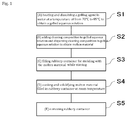
- FIG. 1 is a flow chart illustrating steps for implementing a method of producing a gel detergent in accordance with a first embodiment of the present invention.
- the first embodiment of the present invention is performed by (A) heating and dissolving a gelling agent in water at a temperature of 70°C to 85°C to obtain a gelled aqueous solution (Step S1); (B) adding a cleaning composition to the gelled aqueous solution and dispersing the cleaning composition in the gelled aqueous solution to obtain a molten material (Step S2); (C) filling the molten material in a rubbery container for molding while stirring the molten material (Step S3); and (D) cooling and solidifying the molten material filled in a rubbery container (Step S4); and (E) removing the rubbery container (Step S5).
- step S1 the gelling agent is heated and dissolved in water at a temperature of 70°C to 85°C to obtain a gelled aqueous solution.
- the gelled aqueous solution is obtained by heating at a temperature of 70°C to 85°C for a predetermined period (e.g., 15 minutes to 3 hours) to swell the gelling agent and by mixing and dissolving the gelling agent in water.
- Fig. 5 is a schematic sectional view of an exemplary tank for implementing the process in accordance with the present invention.
- the gelling agent and water are supplied into the tank 10 which is equipped with a heater 11 as shown in Fig. 5 .
- the gelled aqueous solution is stirred by stirring means such as a stirring blade equipped inside the tank 10 and thus uniformly mixed. If the heating temperature is lower than 70°C, there is a risk that dissolution of the gelling agent becomes incomplete. On the other hand, if the heating temperature exceeds 85°C, there is a risk that the gelling agent is de
- Step 1 if the monohydric or polyhydric alcohol is contained in the gel detergent, monohydric or polyhydric alcohol is added, and the gelling agent and water are heated and dissolved at a temperature of 70°C to 85°C to obtain the gelled aqueous solution.
- step S2 the cleaning composition is added to and dispersed in the gelled aqueous solution to obtain the molten material.
- the dispersing is preferably performed with heating for a predetermined period (e.g., 1 hours to 2 hours) such that the cleaning composition is uniformly dispersed in the gelled aqueous solution.
- the heating temperature can be properly determined depending on the melting point of the gelling agent and cleaning composition. Generally, the heating temperature is preferably equal to or above the melting point of the source material having the highest melting point, and is preferably 65°C to 85°C for the purpose of ensuring compatibility between the dissolution of the source material and the prevention of the denaturation of the gelling agent.
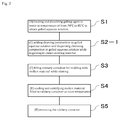
- FIG. 2 is a flow chart illustrating steps for implementing a method of producing a gel detergent in accordance with a second embodiment of the present invention.
- the cleaning composition is added to and dispersed in the gelled aqueous solution while degassing to obtain the molten material in Step (B). This step is referred to as "Step G (Step S2-1)".
- Fig. 6 is a schematic sectional view of an exemplary vacuum device for implementing the process in accordance with the present invention.
- Step S2-1 the gelled aqueous solution and the cleaning composition charged in a vacuum reactor 21 are heated and stirred by actuating a jacket 24 which is provided with stirring means 22 such as a stirring blade and heating means of the vacuum device 20, and the inside of the vacuum reactor 21 becomes pressure-reduced, or vacuum by actuating a vacuum pump 23, thereby uniformly mixing the molten material and removing air bubbles.
- the stirring means 22 of the vacuum device is preferably an anchor mixer that is equipped with a scraper 25.
- the stirring means 22 of the vacuum device preferably has a peripheral velocity of from 5m/sec to 25/sec. Furthermore, in terms of air bubble removal efficiency, the vacuum device 20 preferably has vacuum degree of from 15Kpa (abs) to 75Kpa (abs).
- the above steps are preferably performed for a period of 1 hour to 1.5 hours in order to prevent moisture loss in the molten material. In a case where heating is performed, the above steps are preferably carried out in a stepwise manner.
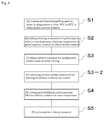
- FIG. 3 is a flow chart illustrating steps for implementing a method of producing a gel detergent in accordance with a third embodiment of the present invention.
- a fatty acid potassium salt is added to and dispersed in the gelled aqueous solution while degassing to obtain adjusted material in Step (B) where the cleaning composition is added to and dispersed in the gelled aqueous solution to obtain the molten material.
- Step (H) Step S2-2
- the cleaning composition other than the fatty acid potassium salt is added to the adjusted material in Step (B). This step is referred to as "Step (I) (Step S2-3).
- the gel detergent in accordance with the embodiment of the present invention may properly contain, in addition to the gelling agent and the cleaning composition, other components, for example, preservatives (ethylparaben, butylparaben, and etc.), powders (pigments, dyes, resins, and etc.), fragrances, moisturizing agents, physiologically active ingredients, salts, solvents, pearl producing agents, neutralizing agents, pH adjusting agents, and enzymes unless the objective of the invention is not deteriorated.
- the component(s) is blended in the molten material where the cleaning composition is sufficiently dissolved in the gelling aqueous solution. For example, if a gold leaf is contained in the gel detergent, the gold leaf dispersed in alcohol solvent is added to the molten material, and mixed and dispersed in the molten material.
- step S3 the rubbery container is filled with the molten material while stirring.
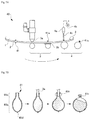
- Fig. 7A shows the step (C) where the rubbery container for molding is filled with the molten material
- Fig. 7B is an enlarged view of the step (C).
- a plurality of notch portions 2 is formed at regular pitch in the outer periphery of the rotatable table 1 of the filling device 40.
- the filling device 40 is provided with an injection portion 3 and a removal portion 4.
- the roratable table 1 intermittently rotates with the rubbery container coupled thereto.
- the rubbery container 41 is coupled to the notch portion 2 which is disposed anterior to the injection portion 3.
- an injector 3a descends when the rotatable table 1 is stopped, and comes in close contact with the top surface of the rubbery container 41.
- the rubbery container 41 is filled with a certain amount of the molten material. If the injector 31 is elevated as it is, the molten material overflows from the rubbery container 41.
- the rubbery container 41 has an opening 41a for filling the molten material, and an expansion portion 41b that inflates or expands in a substantially spherical shape or a substantially oval spherical shape.
- the material for the rubbery container 41 may be material such as natural latex and synthetic latex which is generally used can be employed, without limitation.
- coloring or pattern can be made on the outside of the gel detergent.
- the amount of the molten material filled is not particularly limited, in a case where, for example, 100g of the molten material is filled, the rubbery container inflates or expands into a substantially spherical shape with a diameter of 5cm.
- Fig. 4 is a flow chart illustrating steps for implementing a method of producing a gel detergent in accordance a fourth embodiment of the present invention. It is preferable that that the step (F) (Step S3-2) where residual molten material is removed from the opening of the rubbery container by suction is preferably performed between the step (C) and the step (D).
- the removal portion 4 of the filling device 40 is preferably provided with, for example, a suctioning device 41 which removes the residual molten material overflowing from the rubbery container 41 from the opening 41a of the rubbery container by suction.
- the suctioning pump 4b of the suctioning device 4 suctions the gases inside a suctioning nozzle to recover the residual molten material and simultaneously remove the rubbery container 41 from the notch portion 2 due to the suction pressure.
- Figure 7C is a cross-sectional view of an exemplary filling apparatus for filling the rubbery container for molding with molten material for implementing the process in accordance with the present invention.
- the filling device 40 elevates and descends the injector 3a by means of a cylindrical cam.
- the injector 3a is provided with a plunger 5 which is slidably mounted to a center portion of the injector 3a, and elevated or descended by an injector-actuating cam 7.
- the plunger 5 is elevated or descended by a plunger-actuating cam 6.
- the injector 3a is descended by the injector-actuating cam 7 to come in contact with the top surface of the rotatable table 1.
- the plunger 5 is pushed and descended by the plunger-actuating cam 6.
- the tank 8 of the filling device 40 is mounted to the upper portion of the filling device 40, and is filled with the molten material for insertion or filling.
- the molten material is supplied from the tank 8 of the filling device with stirring function through a pipe 9 into the injector 3a, and flows into the rubbery container 41 by descending the plunger 5.
- a cam shaft 47 that is coupled to each cam is actuated through a chain 43 by a motor 42, and the rotatable table 1 is rotated through a chain 44, the intermittent actuating device 45 and a chain 46 by the motor 42.
- the molten material In view of filling properties, it is preferable to cool the molten material at 60°C to 65°C. If the molten material is cooled at a temperature less than 60°C, the molten is easily solidified, and exhibits poor filling properties in the rubbery container 41. On the other hand, if the molten material is cooled at a temperature higher than 65°C, the variation in the weight of the gel detergent which is filled may occur. Furthermore, the step (C) of filling the rubbery container for molding with the molten material is preferably carried out at a filling rate (velocity) of from 33g/sec to 50g/sec. If the filling rate is less than 33/sec, the molten material is easily solidified. On the other hand, if the filling rate is greater than 50g/sec, air may be entrapped in the rubbery container 41.
- a filling rate velocity
- step S4 the molten material that is filled in the rubbery container 31 is solidified at a room temperature.
- Fig. 8 is a schematic diagram showing an exemplary apparatus for cooling and solidifying the molten material that is filled in the rubbery container 41 for molding for the purpose of implementing the process of the present invention.
- the molten material that is filled in the rubbery container 41 is received in a holder 51 of a storage box 50 such that the fastened opening 41 is downwardly disposed, and the storage box 50 leaves to stand at a room temperature.
- the molten material is cooled and solidified for a period of 1 days to 2 days until the center portion of the molten material is solidified. As a result, gel-like cleaning material is obtained.
- step S5 the rubbery container is removed.
- Fig. 9 shows the step (E) of removing the rubbery container in accordance with the process of the present invention.
- the rubbery container 41 is ruptured by an instrument 61 having a pointed tip such as a needle, thereby removing the rubbery container 41 and taking out a gel detergent 62 inside the rubbery container 41. Since the rubbery container 41 is inflated or expanded into a substantially spherical shape or a substantially oval spherical shape by the filling of the gel detergent 62, due to a small hole that is generated on the surface of the rubbery container 41 the rubbery container 41 can be easily ruptured.
- the rubbery container 41 preferably has a protruding portion 41d on the side thereof opposite to the opening 41a.
- the ruptured rubber film is inclined to shrink at once, which may damage the outer contour or shape of the gel detergent 62.
- the rubbery container 41 is provided with the protrusion 41d, the rubber film gently shrinks in comparison to the rubbery container 41 without the protrusion 41d. As a result, the rubbery container 41 can be ruptured without damaging the outer contour or shape of the gel detergent 62.
- Step S1 Components ⁇ 5> and ⁇ 6> were added to and dispersed in a mixture of components ⁇ 2> and ⁇ 3> and the resultant mixture was added to component ⁇ 1>.
- the mixture thus obtained was heated to 85°C, stirred, and dissolved (Step S1).
- components ⁇ 7> - ⁇ 12> were mixed, molten, and stirred to obtain a homogeneous molten material (Step S2).
- Step S3 While maintaining the molten material at a temperature of 65°C to 80°C with stirring, the molten material was filled in a rubbery container for molding.
- the molten material filled in the rubbery container was allowed to stand at a room temperature (Step S4).
- the rubbery container was removed with a toothpick (Step S5) to obtain a gel detergent.
- Step S1 Components ⁇ 5> and ⁇ 6> were added to and dispersed in a mixture of components ⁇ 2> - ⁇ 4> and the resultant mixture was added to component ⁇ 1>.
- the mixture thus obtained was heated to 85°C, stirred, and dissolved (Step S1).
- components ⁇ 7> - ⁇ 12> were mixed, heated to 75-85°C, and dissolved, and component ⁇ 13> was added thereto.
- the mixture thus obtained was stirred to obtain a homogeneous molten material (Step S2).
- Step S3 While maintaining the molten material at a temperature of 65°C to 80°C with stirring, the molten material was filled in a rubbery container for molding.
- the molten material filled in the rubbery container was allowed to stand at a room temperature (Step S4).
- the rubbery container was removed with a toothpick (Step S5) to obtain a gel detergent.
- Step S2 Components ⁇ 4> and ⁇ 5> were added to and dispersed in components ⁇ 2> and ⁇ 3>, and the resultant mixture was added to a component ⁇ 1>.
- the mixture thus obtained was heated to 85°C, stirred, and dissolved (Step S1).
- component ⁇ 6> was mixed with the resultant mixture, and the mixture thus obtained was stirred to obtain a homogeneous molten material (Step S2).
- Step S3 While maintaining the molten material at a temperature of 65°C to 80°C with stirring, the molten material was filled in a rubbery container for molding.
- the molten material filled in the rubbery container was allowed to stand at a room temperature (Step S4).
- the rubbery container was removed with a toothpick (Step S5) to obtain a gel detergent.
- Step S2 Components ⁇ 4> and ⁇ 5> were added to and dispersed in components ⁇ 2> and ⁇ 3>, and the resultant mixture was added to component ⁇ 1>.
- the mixture thus obtained was heated to 85°C, stirred, and dissolved (Step S1).
- component ⁇ 6> was mixed with the resultant mixture, and the mixture thus obtained was stirred to obtain a homogeneous molten material (Step S2).
- Step S3 While maintaining the molten material at a temperature of 65°C to 75°C with stirring, the molten material was filled in a rubbery container for molding.
- the molten material filled in the rubbery container was allowed to stand at a room temperature (Step S4).
- the rubbery container was removed with a toothpick (Step S5) to obtain a gel detergent.
- Step S1 Components ⁇ 3> and ⁇ 4> were added to and dispersed in component ⁇ 2>, and the mixture thus obtained was heated to 85°C, stirred, and dissolved (Step S1).
- components ⁇ 5> and ⁇ 6> were sequentially added to the resultant mixture, and the mixture thus obtained was stirred and dissolved while heating to 75-85°C.
- components ⁇ 7> - ⁇ 9> were added to adjust pH to 10.0.
- a homogeneous molten material was obtained (Step S2).
- the molten material was filled in a rubbery container for molding while stirring (Step S3).
- the molten material filled in the rubbery container was allowed to stand at a room temperature (Step S4).
- the rubbery container was removed with a toothpick (Step S5) to obtain a gel detergent.
- Step S1 Components ⁇ 5> and ⁇ 6> were added to and dispersed in components ⁇ 2> and ⁇ 3>, and the resultant mixture was added to component ⁇ 1>.
- the mixture thus obtained was heated to 85°C, stirred, and dissolved (Step S1).
- component ⁇ 6> was mixed to the resultant mixture, and the mixture thus obtained was heated to 70-85°C, and stirred to obtain a homogeneous molten material (Step S2).
- the molten material was filled in a rubbery container for molding while stirring (step S3).
- the molten material filled in the rubbery container was allowed to stand at a room temperature (Step S4).
- the rubbery container is removed with a toothpick (Step S5) to obtain a gel detergent.
Landscapes
- Chemical & Material Sciences (AREA)
- Life Sciences & Earth Sciences (AREA)
- Wood Science & Technology (AREA)
- Engineering & Computer Science (AREA)
- Chemical Kinetics & Catalysis (AREA)
- Oil, Petroleum & Natural Gas (AREA)
- Organic Chemistry (AREA)
- Health & Medical Sciences (AREA)
- Emergency Medicine (AREA)
- Dispersion Chemistry (AREA)
- Molecular Biology (AREA)
- Detergent Compositions (AREA)
- Cosmetics (AREA)
Abstract
Description
- The present invention relates to a method of producing a gel detergent.
- Conventionally, a detergent is categorized into solid-type, liquid-type, and gel-type in accordance with its appearance. Among them, gel-type detergent gives a unique feeling to a user, and thus has high commercial value and marketability.
- A method of producing gel-type detergent has been known to include the steps of mixing ingredients such as gelling agent and detergent composition, stirring the mixture thus obtained while heating to gel-like product, and flowing the gel-like product into a mold to solidify the gel-like product.
- For example, Patent Document 1 discloses a gel-type, semi-solid cleaner in which anionic surfactants, amphoteric surfactants, and naturally derived gelling agent are blended and where a template is used as a mold. However, since the gel detergent contains a large amount of moisture and the gelling agent is perishable, microorganisms such as bacteria are likely to propagate and it takes time to clean the mold for next use. Further, since various dies must be prepared for molding desired gel detergents with various sizes, production of the gel detergent becomes inefficient.
-
Patent Document 2 discloses a gel detergent where cleaning components and a polysaccharide are blended and which is produced using a cylindrical mold. However,Patent Document 2 is silent on the material for the cylindrical mold. -
- [Patent Document 1] Japanese Patent Publication No.
2013-100305 (A - [Patent Document 2] Japanese Patent Publication No.
2013-147455 (A - The present invention is made in view of the foregoing. By employing a rubbery composition as a mold, the mold is not needed to be cleaned, thereby providing a simplified method of producing a gel-type detergent with high productivity.
- (1) One aspect of the present invention provides a method of producing a gel detergent, comprising the steps of: (A) heating and dissolving a gelling agent in water at a temperature of from 70°C to 85°C to obtain a gelled aqueous solution; (B) adding a cleaning composition to the gelled aqueous solution, and heating and dispersing the cleaning composition in the gelled aqueous solution so as to obtain a molten material; (C) filling a rubbery container for molding with the molten material; (D) cooling and solidifying the molten material filled in the rubbery container at a room temperature; and (E) removing the rubbery container.
- (2) In the method according to (1), in step (C), the molten material may be filled at a filling rate of from 33g/sec to 50g/sec.
- (3) In the method according to (1) or (2), the step of (F) removing a residual molten material from an opening of the rubbery container may be performed after step (C) and prior to step (D).
- (4) In the method according to any of (1)-(3), the rubbery container may have a protrusion on a side opposite to an opening thereof.
- (5) In the method according to any of (1)-(4), the cleaning composition may contain one or more selected from Group A and/or Group B, and the gelling agent may contain one or more selected from Group C.
-
[Formula 1] R-COOM
- In the formula, R is a saturated or unsaturated alkyl group having 12 to 22 carbon atoms; and M is Na, K or amine salt,
-
[Formula 2] R-O(CH2CH2O)nR1COOM
- In the formula, R is a saturated or unsaturated alkyl group having 12 to 22 carbon atoms; n represents 1 to 20 on average; R1 is saturated alkyl group having 1 or 2 carbon atoms; and M is Na, K or amine salt,
-

- In the formula, R represents a saturated or unsaturated alkyl group having 12 to 22 carbon atoms; R2 is -H, -CH3, or -CH2CH2COOM; and M represents Na, K or amine salt,
-
[Formula 6] R-NH-CH2-COOM
- In the formula, R represents a saturated or unsaturated alkyl group having 12 to 22 carbon atoms; and M represents Na, K or amine salt,
-

- In the formula, R represents a saturated or unsaturated alkyl group having 12 to 22 carbon atoms; and M represents Na, K or amine salt,
-
[Formula 8] R-NH-CH2CH2-COOM
- In the formula, R represents a saturated or unsaturated alkyl group having 12 to 22 carbon atoms; and M represents Na, K or amine salt, (B-4):

- In the formula, R represents a saturated or unsaturated alkyl group having 12 to 22 carbon atoms; and M represents Na, K or amine salt,
-

- In the formula, R represents a saturated or unsaturated alkyl group having 12 to 22 carbon atoms; and M represents Na, K or amine salt,
-

- In the formula, R represents a saturated or unsaturated alkyl group having 12 to 22 carbon atoms; and M represents Na, K or amine salt,
-

- In the formula, R represents a saturated or unsaturated alkyl group having 12 to 22 carbon atoms; and M represents Na, K or amine salt,
-

- In the formula, R represents a saturated or unsaturated alkyl group having 12 to 22 carbon atoms; and M represents Na, K or amine salt,
-
- (6) In the method according to (5), the (A-1) carboxylate may comprise a fatty acid potassium salt.
- (7) In the method according to (5), the (A-2) polyoxyethylene alkyl ether carboxylate (alkyl group having 12-22 carbon atoms, saturated or unsaturated) may contain the following (A-2-1) or (A-2-2).
-
[Formula 3] R-O(CH2CH2O)nCH2COOM
- In the formula, R represents a saturated or unsaturated alkyl group having 12 to 22 carbon atoms; n represents 1 to 20 on average; and M represents Na, K or amine salt.
-
[Formula 4] R-OCCH2CH2O)nCH2CH2COOM
- In the formula, R represents a saturated or unsaturated alkyl group having 12 to 22 carbon atoms; n represents 1 to 20 on average; and M represents Na, K or amine salt.
- (8) In the method according to any of (1)-(7), the gel detergent may further contain one or more monohydric or polyhydric alcohol.
- (9) In the method according to any of (1)-(8), step (B) may include the step of (F) adding the cleaning composition to the gelled aqueous solution and dispersing the cleaning composition in the gelled aqueous solution while degassing to obtain the molten material.
- (10) In the method according to (8), step (B) comprises the steps of (H) adding a fatty acid potassium salt to the gelled aqueous solution and dispersing the fatty acid potassium salt in the gelled aqueous solution while degassing to obtain an adjusted material, and (I) adding the cleaning composition other than the fatty acid potassium salt to the adjusted material and dispersing the cleaning composition other than the fatty acid potassium salt in the adjusted material while degassing to obtain the molten material.
- According to the present invention, the number of steps is reduced, thereby providing a method of producing a gel detergent with high productivity.
-
-
Fig. 1 is a flow chart illustrating steps for implementing a method of producing a gel detergent in accordance with a first embodiment of the present invention. -
Fig. 2 is a flow chart illustrating steps for implementing a method of producing a gel detergent in accordance with a second embodiment of the present invention. -
Fig. 3 is a flow chart illustrating steps for implementing a method of producing a gel detergent in accordance with a third embodiment of the present invention. -
Fig. 4 is a flow chart illustrating steps for implementing a method of producing a gel detergent in accordance with a fourth embodiment of the present invention. -
Fig. 5 is a schematic sectional view of an exemplary tank for implementing the process in accordance with the present invention. -
Fig. 6 is a schematic sectional view of an exemplary vacuum device for implementing the process in accordance with the present invention. -
Fig. 7A shows the step of filling a rubbery container for molding with molten material. -
Fig. 7B is an enlarged view of filling step. -
FIG. 7C is a cross-sectional view of an exemplary filling apparatus for filling the rubbery container for molding with molten material for implementing the process in accordance with the present invention -
Fig. 8 is a schematic diagram showing an exemplary apparatus for cooling and solidifying molten material that is filled in a rubbery container for molding for the purpose of implementing the process in accordance with the present invention -
Fig. 9 shows the step of removing a rubbery container in accordance with the embodiment of the present invention. - A preferred embodiment of a method of producing a gel detergent in accordance with the present invention (hereinafter, referred to as an "embodiment") will be hereinafter described in detail. It should be noted that the same reference sign is imparted to the same part or element throughout the description of the embodiment(s).
- In accordance with the manufacturing method of the present invention, a cleaning composition may contain one or more selected from Group A and/or Group B.
- Anionic surfactants of (Group A) are (A-1) carboxylate, (A-2) polyoxyethylene alkyl ether carboxylate (alkyl group having 12-22 carbon atoms, saturated or unsaturated) or (A-3) sodium, potassium or amine salt of N-acylamino acid.
-
[Formula 1] R-COOM
- In the formula, R is a saturated or unsaturated alkyl group having 12 to 22 carbon atoms; and M represents Na, K or amine salt.
- Fatty acid used in (A-1) carboxylate may be enough if it may be generally blended in the detergent, and includes, but is not limited, saturated or unsaturated, linear or branched fatty acid having alkyl group of 8 to 22 carbon atoms or natural fat. The saturated or unsaturated. linear or branched fatty acid having 8 to 22 carbon atoms may be, for example, capric acid, lauric acid, myristic acid, palmitic acid, stearic acid, eicosanoic acid, behenic acid, oleic acid, linoleic acid , linolenic acid, erucic acid, isopalmitic acid, isostearic acid, or neodecanoate. Natural fat may be, for example, coconut oil, palm oil, palm kernel oil, cottonseed oil, apricot kernel oil, avocado oil, olive oil, grape seed oil, or corn oil.
- The alkali agent to be used as a salt of carboxylic acid salts may include, but is not limited to, inorganic alkali such as sodium hydroxide, potassium hydroxide, sodium carbonate, and potassium carbonate, L-arginine of basic amino acid, organic alkali such as monoethanolamine, diethanolamine, triethanolamine, and etc., polyhydric alcohol amine such as ethanolamine, aminomethyl propanol, aminoethyl propanediol, aminomethyl propanediol, or alkylamine such as diisopropanolamine, triisopropanolamine, and monoisopropanolamine. From the viewpoint of low-temperature stability, potassium hydroxide or triethanolamine is preferred, potassium hydroxide is more preferable.
- Among these carboxylates, fatty acid potassium salt which is referred to as "potassium soap base" may be preferably used. The fatty acid potassium salt is one produced by a blending and cooking method of adding potassium hydroxide to natural fat and oil and heating them. The fatty acid potassium salt contains potassium laurate, potassium myristate and etc. as main components, and also contains unreacted fat and oil inevitably derived from the above method and glycerin that is created by decomposition.
-
[Formula 2] R-O(CH2CH2O)nR1COOM
- In the formula, R is a saturated or unsaturated alkyl group having 12 to 22 carbon atoms; n represents 1 to 20 on average; R1 is saturated alkyl group having 1 or 2 carbon atoms; and M is Na, K or amine salt.
- Among (A-2) polyoxyethylene alkyl ether carboxylates, (A-2-1) polyoxyethylene alkyl ether acetates as shown by the following formula is preferred in terms of suppressed skin irritation.
[Formula 3] R-O(CH2CH2O)nCH2COOM
- In the formula, R represents a saturated or unsaturated alkyl group having 12 to 22 carbon atoms; n represents 1 to 20 on average; and M represents Na, K or amine salt.
- Furthermore, among (A-2) polyoxyethylene alkyl ether carboxylate, (A-2-2) polyoxyethylene alkyl ether propionate (alkyl group having 12-22 carbon atoms, saturated or unsaturated) is preferred in terms of stability in hard water, and desirable cleaning performance when used together with sodium laurate, and/or sodium myristate.
[Formula 4] R-OCCH2CH2O)nCH2CH2COOM
- In the formula, R represents a saturated or unsaturated alkyl group having 12 to 22 carbon atoms; n represents 1 to 20 on average; and M represents Na, K or amine salt.
- Specific examples of (A-2-2) are polyoxyethylene lauryl ether sodium acetate (n = 4, R = C12, M = Na) such as Neohitenol ECL-30S (DKS Co., Ltd.), BEAULIGHT LCA (Sanyo Chemical Industries, Ltd.), Enagicol EC-30 (Lion Co., Ltd.) and the like.
-

- In the formula, R represents a saturated or unsaturated alkyl group having 12 to 22 carbon atoms; R2 is -H, -CH3, or -CH2CH2COOM; and M represents Na, K or amine salt.
- The amphoteric surfactant of (group B) may be represented by the following formula (B-1) to (B-8):
-
[Formula 6] R-NH-CH2-COOM
- In the formula, R represents a saturated or unsaturated alkyl group having 12 to 22 carbon atoms; and M represents Na, K or amine salt.
-

- In the formula, R represents a saturated or unsaturated alkyl group having 12 to 22 carbon atoms; and M represents Na, K or amine salt.
-
[Formula 8] R-NH-CH2CH2-COOM
- In the formula, R represents a saturated or unsaturated alkyl group having 12 to 22 carbon atoms; and M represents Na, K or amine salt.
-
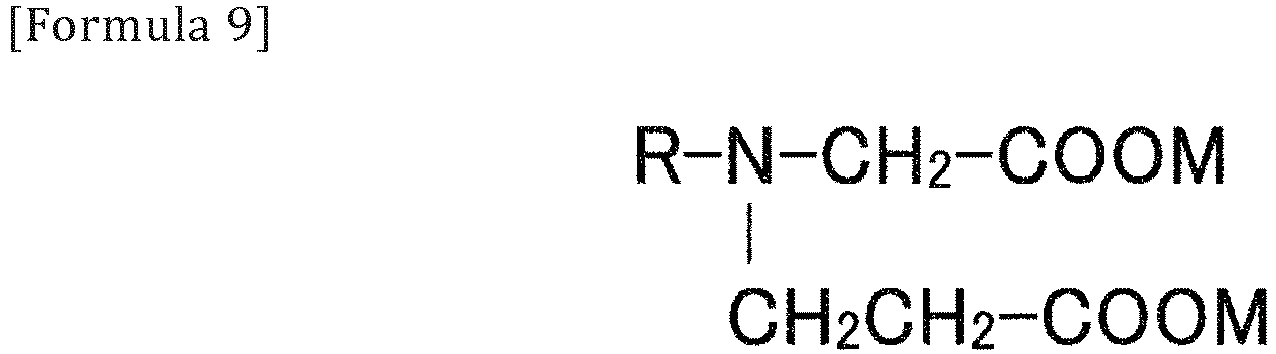
- In the formula, R represents a saturated or unsaturated alkyl group having 12 to 22 carbon atoms; and M represents Na, K or amine salt.
-

- In the formula, R represents a saturated or unsaturated alkyl group having 12 to 22 carbon atoms; and M represents Na, K or amine salt.
-

- In the formula, R represents a saturated or unsaturated alkyl group having 12 to 22 carbon atoms; and M represents Na, K or amine salt.
-

- In the formula, R represents a saturated or unsaturated alkyl group having 12 to 22 carbon atoms; and M represents Na, K or amine salt.
-

- In the formula, R represents a saturated or unsaturated alkyl group having 12 to 22 carbon atoms; and M represents Na, K or amine salt.
- Since amphoteric surfactant having a hydroxyl group has an interaction with water-soluble natural polymer, and greatly contributes to gelation, it is preferably contained in the gel detergent. In addition, in terms of low irritation to the skin, stability in hard water, and foaming power, an alkyl amide propyl betaine as represented by (B-6) is preferred. In terms of cleaning performance, foaming power, and low irritation to eye membrane, 2-alkyl-N-carboxymethyl-N-hydroxyethyl imidazolinium betaine is more preferable.
- The gelling agent may contain one or more selected from (group C) as follows:
- Xanthan gum, gellan gum, pullulan, curdlan, sodium hyaluronate.
- It is preferable that the gel detergent has
pH 8 topH 11 in accordance with 1wt% aqueous solution calculation in view of low irritation to the skin. For this purpose, the gelling agent preferably has alkali resistance, salt resistance, and heat resistance. Among these, xyloglucan from tamarind seed gum, guar gum, carrageenan, and locust bean gum as the water-soluble polymer with salt resistance and heat resistance are also derived from plants, and preferred in terms of environmental protection. - The amount of gelling agent per the total weight of the gel detergent is preferably 0.1 wt% to 10 wt%, more preferably 1 wt% to 5 wt%. If the gelling agent is contained in an amount less than 1 wt% per the total weight of the gel detergent, it is difficult to be solidified into a gel. On the other hand, if the gelling agent exceeds 10 wt% per the total weight of the gel detergent, excessive solidification occurs, thereby compromising the foamability. As a result, easy foamability and cleaning power cannot be obtained in use.
- 1 wt% aqueous solution of the gelling agent is preferably used in the viscosity of 5mPa·s to 9000mPa·s, more preferably 1000mPa·s to 8000mPa·s, further preferably 2000mPa·s to 6000mPa·s. If the viscosity is beyond the range of 5mPa·s to 9000mPa·s, the handling becomes worse.
- The gel detergent improves foamability, foam quality, and moisture-retaining property to the skin, and has thickening property due to the interaction with the gelling agent such as water-soluble polymer. For the reasons, the gel detergent preferably contains one or more monohydric or polyhydric alcohol(s).
- Examples of monohydric or polyhydric alcohol(s) include monohydric alcohols such as ethanol, propyl alcohol, and isopropyl alcohol, polyhydric alcohols such as isopentyl diol, propylene glycol, dipropylene glycol, 1,2-hexanediol, pentylene glycol, polyethylene glycol (molecular weight of 400 to 7000), polypropylene glycol (molecular weight 400), diglycerin, 1,3-butylene glycol, glycerin and inositol, or sugar or sugar alcohols such as sucrose, lactose, xylitol, maltitol, mannitol, maltose, sorbitol, fructose, glucose, trehalose, erythritol, raffinose, lactitol, sultose, isosultose, and starch syrup.
- The amount of monohydric or polyhydric alcohol per the total weight of the gel detergent is preferably 2 wt% to 50 wt%, more preferably 10 wt% to 40wt%. The amount of sugar or sugar alcohol per the total weight of the gel detergent is preferably 0.5 wt% to 50 wt%, more preferably 3 wt% to 30 wt%.
-
FIG. 1 is a flow chart illustrating steps for implementing a method of producing a gel detergent in accordance with a first embodiment of the present invention. The first embodiment of the present invention is performed by (A) heating and dissolving a gelling agent in water at a temperature of 70°C to 85°C to obtain a gelled aqueous solution (Step S1); (B) adding a cleaning composition to the gelled aqueous solution and dispersing the cleaning composition in the gelled aqueous solution to obtain a molten material (Step S2); (C) filling the molten material in a rubbery container for molding while stirring the molten material (Step S3); and (D) cooling and solidifying the molten material filled in a rubbery container (Step S4); and (E) removing the rubbery container (Step S5). - In step S1, the gelling agent is heated and dissolved in water at a temperature of 70°C to 85°C to obtain a gelled aqueous solution. The gelled aqueous solution is obtained by heating at a temperature of 70°C to 85°C for a predetermined period (e.g., 15 minutes to 3 hours) to swell the gelling agent and by mixing and dissolving the gelling agent in water.
Fig. 5 is a schematic sectional view of an exemplary tank for implementing the process in accordance with the present invention. The gelling agent and water are supplied into thetank 10 which is equipped with aheater 11 as shown inFig. 5 . The gelled aqueous solution is stirred by stirring means such as a stirring blade equipped inside thetank 10 and thus uniformly mixed. If the heating temperature is lower than 70°C, there is a risk that dissolution of the gelling agent becomes incomplete. On the other hand, if the heating temperature exceeds 85°C, there is a risk that the gelling agent is denatured. - In Step 1, if the monohydric or polyhydric alcohol is contained in the gel detergent, monohydric or polyhydric alcohol is added, and the gelling agent and water are heated and dissolved at a temperature of 70°C to 85°C to obtain the gelled aqueous solution.
- In step S2, the cleaning composition is added to and dispersed in the gelled aqueous solution to obtain the molten material. The dispersing is preferably performed with heating for a predetermined period (e.g., 1 hours to 2 hours) such that the cleaning composition is uniformly dispersed in the gelled aqueous solution. The heating temperature can be properly determined depending on the melting point of the gelling agent and cleaning composition. Generally, the heating temperature is preferably equal to or above the melting point of the source material having the highest melting point, and is preferably 65°C to 85°C for the purpose of ensuring compatibility between the dissolution of the source material and the prevention of the denaturation of the gelling agent.
- In order to prevent air bubbles which are created by the addition of the cleaning composition from being entrapped and improve the transparency of the gel detergent, it is preferable to degas the molten material using a vacuum device.
Figure 2 is a flow chart illustrating steps for implementing a method of producing a gel detergent in accordance with a second embodiment of the present invention. In accordance with the second embodiment, the cleaning composition is added to and dispersed in the gelled aqueous solution while degassing to obtain the molten material in Step (B). This step is referred to as "Step G (Step S2-1)".Fig. 6 is a schematic sectional view of an exemplary vacuum device for implementing the process in accordance with the present invention. In Step S2-1, the gelled aqueous solution and the cleaning composition charged in avacuum reactor 21 are heated and stirred by actuating ajacket 24 which is provided with stirring means 22 such as a stirring blade and heating means of thevacuum device 20, and the inside of thevacuum reactor 21 becomes pressure-reduced, or vacuum by actuating avacuum pump 23, thereby uniformly mixing the molten material and removing air bubbles. In order to remove any attachment from the inner wall of thevacuum reactor 21 and retaining material in the lower portion of thevacuum reactor 21, the stirring means 22 of the vacuum device is preferably an anchor mixer that is equipped with ascraper 25. In order to mix the molten material with high viscosity, the stirring means 22 of the vacuum device preferably has a peripheral velocity of from 5m/sec to 25/sec. Furthermore, in terms of air bubble removal efficiency, thevacuum device 20 preferably has vacuum degree of from 15Kpa (abs) to 75Kpa (abs). In a case where the step where the cleaning composition is added to and dispersed in the gelled aqueous solution to obtain the molten material, and the degassing step are simultaneously performed ion thevacuum device 20, the above steps are preferably performed for a period of 1 hour to 1.5 hours in order to prevent moisture loss in the molten material. In a case where heating is performed, the above steps are preferably carried out in a stepwise manner. -
FIG. 3 is a flow chart illustrating steps for implementing a method of producing a gel detergent in accordance with a third embodiment of the present invention. In accordance with the third embodiment, a fatty acid potassium salt is added to and dispersed in the gelled aqueous solution while degassing to obtain adjusted material in Step (B) where the cleaning composition is added to and dispersed in the gelled aqueous solution to obtain the molten material. This step is referred to as "Step (H)" (Step S2-2). In accordance with the third embodiment, the cleaning composition other than the fatty acid potassium salt is added to the adjusted material in Step (B). This step is referred to as "Step (I) (Step S2-3). In a case where the fatty acid potassium salt is contained in the gel detergent, it is difficult to remove air bubbles therefrom. For the reasons, when obtaining the molten material from the gelled aqueous solution, it is preferable to perform the steps S2-2 and S2-3 and to perform degassing step twice. - The gel detergent in accordance with the embodiment of the present invention may properly contain, in addition to the gelling agent and the cleaning composition, other components, for example, preservatives (ethylparaben, butylparaben, and etc.), powders (pigments, dyes, resins, and etc.), fragrances, moisturizing agents, physiologically active ingredients, salts, solvents, pearl producing agents, neutralizing agents, pH adjusting agents, and enzymes unless the objective of the invention is not deteriorated. In view of dispersibility, it is preferable that the component(s) is blended in the molten material where the cleaning composition is sufficiently dissolved in the gelling aqueous solution. For example, if a gold leaf is contained in the gel detergent, the gold leaf dispersed in alcohol solvent is added to the molten material, and mixed and dispersed in the molten material.
- In step S3, the rubbery container is filled with the molten material while stirring.
Fig. 7A shows the step (C) where the rubbery container for molding is filled with the molten material, andFig. 7B is an enlarged view of the step (C). - A plurality of
notch portions 2 is formed at regular pitch in the outer periphery of the rotatable table 1 of the fillingdevice 40. The fillingdevice 40 is provided with aninjection portion 3 and aremoval portion 4. The roratable table 1 intermittently rotates with the rubbery container coupled thereto. Therubbery container 41 is coupled to thenotch portion 2 which is disposed anterior to theinjection portion 3. In theinjection portion 3, aninjector 3a descends when the rotatable table 1 is stopped, and comes in close contact with the top surface of therubbery container 41. As such, therubbery container 41 is filled with a certain amount of the molten material. If the injector 31 is elevated as it is, the molten material overflows from therubbery container 41. For the reasons, due to afastening device 3b which is mounted to the outer periphery of the rotatable table 1 theopening 41a is fastened by afastening member 41c, and theinjector 3a is then elevated. Therubbery container 41 which is filled with the molten material is rotated, and removed from thenotch portion 2 at theremoval portion 4. - As shown in
FIG. 7B , therubbery container 41 has anopening 41a for filling the molten material, and anexpansion portion 41b that inflates or expands in a substantially spherical shape or a substantially oval spherical shape. The material for therubbery container 41 may be material such as natural latex and synthetic latex which is generally used can be employed, without limitation. By employing therubbery container 41 having coloring or transferable pattern on the inside thereof, coloring or pattern can be made on the outside of the gel detergent. Furthermore, while the amount of the molten material filled is not particularly limited, in a case where, for example, 100g of the molten material is filled, the rubbery container inflates or expands into a substantially spherical shape with a diameter of 5cm. -
Fig. 4 is a flow chart illustrating steps for implementing a method of producing a gel detergent in accordance a fourth embodiment of the present invention. It is preferable that that the step (F) (Step S3-2) where residual molten material is removed from the opening of the rubbery container by suction is preferably performed between the step (C) and the step (D). In a case where the step S3-2 is performed, theremoval portion 4 of the fillingdevice 40 is preferably provided with, for example, asuctioning device 41 which removes the residual molten material overflowing from therubbery container 41 from theopening 41a of the rubbery container by suction. Thesuctioning pump 4b of thesuctioning device 4 suctions the gases inside a suctioning nozzle to recover the residual molten material and simultaneously remove therubbery container 41 from thenotch portion 2 due to the suction pressure. -
Figure 7C is a cross-sectional view of an exemplary filling apparatus for filling the rubbery container for molding with molten material for implementing the process in accordance with the present invention. The fillingdevice 40 elevates and descends theinjector 3a by means of a cylindrical cam. Theinjector 3a is provided with aplunger 5 which is slidably mounted to a center portion of theinjector 3a, and elevated or descended by an injector-actuating cam 7. Theplunger 5 is elevated or descended by a plunger-actuating cam 6. When the rotatable table 1 is stopped, theinjector 3a is descended by the injector-actuating cam 7 to come in contact with the top surface of the rotatable table 1. Subsequently, theplunger 5 is pushed and descended by the plunger-actuating cam 6. Thetank 8 of the fillingdevice 40 is mounted to the upper portion of the fillingdevice 40, and is filled with the molten material for insertion or filling. When theplunger 5 is elevated, the molten material is supplied from thetank 8 of the filling device with stirring function through apipe 9 into theinjector 3a, and flows into therubbery container 41 by descending theplunger 5. Acam shaft 47 that is coupled to each cam is actuated through achain 43 by amotor 42, and the rotatable table 1 is rotated through achain 44, theintermittent actuating device 45 and achain 46 by themotor 42. - In view of filling properties, it is preferable to cool the molten material at 60°C to 65°C. If the molten material is cooled at a temperature less than 60°C, the molten is easily solidified, and exhibits poor filling properties in the
rubbery container 41. On the other hand, if the molten material is cooled at a temperature higher than 65°C, the variation in the weight of the gel detergent which is filled may occur. Furthermore, the step (C) of filling the rubbery container for molding with the molten material is preferably carried out at a filling rate (velocity) of from 33g/sec to 50g/sec. If the filling rate is less than 33/sec, the molten material is easily solidified. On the other hand, if the filling rate is greater than 50g/sec, air may be entrapped in therubbery container 41. - In step S4, the molten material that is filled in the rubbery container 31 is solidified at a room temperature.
Fig. 8 is a schematic diagram showing an exemplary apparatus for cooling and solidifying the molten material that is filled in therubbery container 41 for molding for the purpose of implementing the process of the present invention. The molten material that is filled in therubbery container 41 is received in aholder 51 of astorage box 50 such that the fastenedopening 41 is downwardly disposed, and thestorage box 50 leaves to stand at a room temperature. The molten material is cooled and solidified for a period of 1 days to 2 days until the center portion of the molten material is solidified. As a result, gel-like cleaning material is obtained. - In step S5, the rubbery container is removed.
Fig. 9 shows the step (E) of removing the rubbery container in accordance with the process of the present invention. Therubbery container 41 is ruptured by aninstrument 61 having a pointed tip such as a needle, thereby removing therubbery container 41 and taking out agel detergent 62 inside therubbery container 41. Since therubbery container 41 is inflated or expanded into a substantially spherical shape or a substantially oval spherical shape by the filling of thegel detergent 62, due to a small hole that is generated on the surface of therubbery container 41 therubbery container 41 can be easily ruptured. - As shown in
Fig. 7B , therubbery container 41 preferably has a protrudingportion 41d on the side thereof opposite to theopening 41a. When therubbery container 41 is ruptured in step S5, the ruptured rubber film is inclined to shrink at once, which may damage the outer contour or shape of thegel detergent 62. However, if therubbery container 41 is provided with theprotrusion 41d, the rubber film gently shrinks in comparison to therubbery container 41 without theprotrusion 41d. As a result, therubbery container 41 can be ruptured without damaging the outer contour or shape of thegel detergent 62. - The embodiment of the present invention will be further illustrated by the following examples. However, the present invention is not limited in any way by the following examples. The percentage(s), proportion(s) and part(s) referred to in the detailed description, examples and claims are based on the weight, and represents approximate values, unless otherwise indicated. Examples 1 to 6 were prepared according to the flow chart of the process as shown in
FIG. 1 . -
- <1> purified water 67.9%
- <2> glycerin 10.0%
- <3> dipropylene glycol 7.0%
- <4> 1,2-hexane glycol 2.5%
- <5> xyloglucan (Glyloid 6C, DSP Gokyo Food & Chemical Co., Ltd.) 0.8%
- <6> xanthan gum 0.2%
- <7> lauric acid 5.9%
- <8> myristic acid 2.2%
- <9> palmitic acid 1.0%
- <10> stearic acid 0.4%
- <11> oleic acid 0.6%
- <12> caustic soda 1.5%
- Components <5> and <6> were added to and dispersed in a mixture of components <2> and <3> and the resultant mixture was added to component <1>. The mixture thus obtained was heated to 85°C, stirred, and dissolved (Step S1). Next, components <7> - <12> were mixed, molten, and stirred to obtain a homogeneous molten material (Step S2). Next, while maintaining the molten material at a temperature of 65°C to 80°C with stirring, the molten material was filled in a rubbery container for molding (Step S3). The molten material filled in the rubbery container was allowed to stand at a room temperature (Step S4). The rubbery container was removed with a toothpick (Step S5) to obtain a gel detergent.
-
- <1> purified water 48.4%
- <2> sorbitol 10.0%
- <3> propanediol 10.0%
- <4> 1,2-hexane glycol 2.5%
- <5> xyloglucan (Glyloid 6C) 1.0%
- <6> xanthan gum 0.5%
- <7> lauric acid 5.9%
- <8> myristic acid 2.2%
- <9> palmitic acid 1.0%
- <10> stearic acid 0.3%
- <11> oleic acid 0.6%
- <12> potassium hydroxide 2.60%
- <13> lauric acid amide propyl hydroxy sulfobetaine solution (Softazoline LSB // Kawaken Fine Chemicals Co., Ltd.) 15.0%
- Components <5> and <6> were added to and dispersed in a mixture of components <2> - <4> and the resultant mixture was added to component <1>. The mixture thus obtained was heated to 85°C, stirred, and dissolved (Step S1). Next, components <7> - <12> were mixed, heated to 75-85°C, and dissolved, and component <13> was added thereto. The mixture thus obtained was stirred to obtain a homogeneous molten material (Step S2). Next, while maintaining the molten material at a temperature of 65°C to 80°C with stirring, the molten material was filled in a rubbery container for molding (Step S3). The molten material filled in the rubbery container was allowed to stand at a room temperature (Step S4). The rubbery container was removed with a toothpick (Step S5) to obtain a gel detergent.
-
- <1> purified water 48.0%
- <2> dipropylene glycol 7.0%
- <3> 1,2-hexane glycol 2.5%
- <4> xanthan gum 0.5%
- <5> carrageenan 2.0%
- <6> coconut oil fatty acid amide propyl betaine solution (Obazorin CAB30 / Toho Chemical Industry Co., Ltd.) 40.0%
- Components <4> and <5> were added to and dispersed in components <2> and <3>, and the resultant mixture was added to a component <1>. The mixture thus obtained was heated to 85°C, stirred, and dissolved (Step S1). Next, component <6> was mixed with the resultant mixture, and the mixture thus obtained was stirred to obtain a homogeneous molten material (Step S2). Next, while maintaining the molten material at a temperature of 65°C to 80°C with stirring, the molten material was filled in a rubbery container for molding (Step S3). The molten material filled in the rubbery container was allowed to stand at a room temperature (Step S4). The rubbery container was removed with a toothpick (Step S5) to obtain a gel detergent.
-
- <1> purified water 58.5%
- <2> dipropylene glycol 7.0%
- <3> 1,2-hexane glycol 2.5%
- <4> carrageenan 2.0%
- <5> polyoxyethylene lauryl ether sodium acetate (Neohitenol ECL-30S/DKS Co., Ltd.) 30.0%
- Components <4> and <5> were added to and dispersed in components <2> and <3>, and the resultant mixture was added to component <1>. The mixture thus obtained was heated to 85°C, stirred, and dissolved (Step S1). Next, component <6> was mixed with the resultant mixture, and the mixture thus obtained was stirred to obtain a homogeneous molten material (Step S2). Next, while maintaining the molten material at a temperature of 65°C to 75°C with stirring, the molten material was filled in a rubbery container for molding (Step S3). The molten material filled in the rubbery container was allowed to stand at a room temperature (Step S4). The rubbery container was removed with a toothpick (Step S5) to obtain a gel detergent.
-
- <1> purified water 59.5%
- <2> 1,2-hexane glycol 2.5%
- <3> xyloglucan (Glyloid 6C) 0.7%
- <4> xanthan gum 0.3%
- <5> potassium soap base (100%) 12.0%
- <6> lauric acid amide propyl hydroxy sulfobetaine solution (Softazoline LSB / Kawaken Fine Chemicals Co., Ltd.) 15.0%
- <7> glycerin 10.0%
- <8> citric acid appropriate amount
- <9> sodium citrate appropriate amount
- Components <3> and <4> were added to and dispersed in component <2>, and the mixture thus obtained was heated to 85°C, stirred, and dissolved (Step S1). Next, components <5> and <6> were sequentially added to the resultant mixture, and the mixture thus obtained was stirred and dissolved while heating to 75-85°C. Next, components <7> - <9> were added to adjust pH to 10.0. As such, a homogeneous molten material was obtained (Step S2). Next, the molten material was filled in a rubbery container for molding while stirring (Step S3). The molten material filled in the rubbery container was allowed to stand at a room temperature (Step S4). The rubbery container was removed with a toothpick (Step S5) to obtain a gel detergent.
-
- <1> purified water 36.5%
- <2> dipropylene glycol 10.0%
- <3> 1,2-hexane glycol 2.5%
- <4> xanthan gum 0.5%
- <5> locust bean gum 0.5%
- <6> coconut oil fatty acid amide propyl betaine solution (Obazorin CAB30 / Toho Chemical Industry Co., Ltd.) 50.0%
- Components <5> and <6> were added to and dispersed in components <2> and <3>, and the resultant mixture was added to component <1>. The mixture thus obtained was heated to 85°C, stirred, and dissolved (Step S1). Next, component <6> was mixed to the resultant mixture, and the mixture thus obtained was heated to 70-85°C, and stirred to obtain a homogeneous molten material (Step S2). Next, the molten material was filled in a rubbery container for molding while stirring (step S3). The molten material filled in the rubbery container was allowed to stand at a room temperature (Step S4). The rubbery container is removed with a toothpick (Step S5) to obtain a gel detergent.
- While a preferred embodiment of the present invention has been shown and described with particularity, it will be appreciated that various changes and modifications may suggest themselves to one having ordinary skill in the art upon being apprised of the present invention. It is also intended to encompass all such changes and modifications as fall within the scope and spirit of the appended claims.
-
- 1
- rotatable table
- 2
- notch portion
- 3
- injection portion
- 3a
- injector
- 3b
- fastening device
- 4
- removable portion
- 4a
- suctioning device
- 4b
- suctioning pump
- 4c
- suctioning nozzle
- 5
- plunger
- 6
- plunger-actuating cam
- 7
- injector-actuating cam
- 8
- tank of filling device
- 9
- pipe
- 10
- tank
- 11
- heater
- 12
- stirring means
- 13
- gelling aqueous solution
- 20
- vacuum apparatus
- 21
- vacuum reactor
- 22
- stirring means of vacuum device
- 23
- vacuum pump
- 24
- jacket
- 25
- scraper
- 40
- filling device
- 41
- rubbery container
- 41a
- opening
- 41b
- expansion portion
- 41c
- fastening member
- 41d
- protrusion
- 42
- motor
- 43, 44, and 46
- chain
- 45
- intermittent actuating device
- 47
- cam shaft
- 50
- storage box
- 51
- holder
- 61
- instrument having pointed tip
- 62
- gel detergent
Claims (10)
- A method of producing a gel detergent, comprising the steps of:(A) heating and dissolving a gelling agent in water at a temperature of from 70°C to 85°C to obtain a gelled aqueous solution;(B) adding a cleaning composition to the gelled aqueous solution and dispersing the cleaning composition in the gelled aqueous solution so as to obtain a molten material;(C) filling a rubbery container for molding with the molten material;(D) cooling and solidifying the molten material filled in the rubbery container at a room temperature; and(E) removing the rubbery container.
- The method according to claim 1, wherein in step (C), the molten material is filled at a filling rate of from 33g/sec to 50g/sec.
- The method according to claim 1 or 2, further comprising the step of (F) removing a residual molten material from an opening of the rubbery container after step (C) and prior to step (D).
- The method according to any of claims 1-3, wherein the rubbery container has a protrusion on a side opposite to an opening thereof.
- The method according to any of claims 1-4, wherein the cleaning composition contains one or more selected from Group A and/or Group B, and the gelling agent contains one or more selected from Group C,(Group A) an anionic surfactant:(A-1) carboxylate:
[Formula 1] R-COOM
in the formula, R is a saturated or unsaturated alkyl group having 12 to 22 carbon atoms; and M is Na, K or amine salt,(A-2) polyoxyethylene alkyl ether carboxylate (alkyl group having 12-22 carbon atoms, saturated or unsaturated):
[Formula 2] R-O(CH2CH2O)nR1COOM
in the formula, R is a saturated or unsaturated alkyl group having 12 to 22 carbon atoms; n represents 1 to 20 on average; R1 is saturated alkyl group having 1 or 2 carbon atoms; and M is Na, K or amine salt,(A-3) sodium, potassium or amine salt of N-acylamino acid: (Group B) an amphoteric surfactant:(B-1):
[Formula 6] R-NH-CH2-COOM
in the formula, R represents a saturated or unsaturated alkyl group having 12 to 22 carbon atoms; and M represents Na, K or amine salt,(B-2): (B-3):
[Formula 8] R-NH-CH2CH2-COOM
in the formula, R represents a saturated or unsaturated alkyl group having 12 to 22 carbon atoms; and M represents Na, K or amine salt,(B-4): (B-5):
 (B-6):
 (B-7):
 (B-8):
 (Group C) the gelling agent(C-1) a water-soluble polymer derived from a plant or a seaweed:xyloglucan, guar gum, locust bean gum, agarose, carrageenan, gum arabic, sodium alginate, glucomannan, pectin; or(C-2) water-soluble polymer that is produced by microbial fermentation xanthan gum, gellan gum, pullulan, curdlan, sodium hyaluronate
 - The method according to claim 5, wherein the (A-1) carboxylate comprises a fatty acid potassium salt.
- The method according to claim 5, wherein the (A-2) polyoxyethylene alkyl ether carboxylate (alkyl group having 12-22 carbon atoms, saturated or unsaturated) comprises (A-2-1) polyoxyethylene alkyl ether acetate as represented by [Formula 3] or (A-2-2) polyoxyethylene alkyl ether propionate as represented by [Formula 4],
[Formula 3] R-O(CH2CH2O)nCH2COOM
in the formula, R represents a saturated or unsaturated alkyl group having 12 to 22 carbon atoms; n represents 1 to 20 on average; and M represents Na, K or amine salt,
[Formula 4] R-O(CH2CH2O)nCH2CH2COOM
in the formula, R represents a saturated or unsaturated alkyl group having 12 to 22 carbon atoms; n represents 1 to 20 on average; and M represents Na, K or amine salt. - The method according to any of claims 1-7, wherein the gel detergent further comprises one or more monohydric or polyhydric alcohol.
- The method according to any of claims 1-8, wherein step (B) comprises the step of (G) adding the cleaning composition to the gelled aqueous solution and dispersing the cleaning composition in the gelled aqueous solution while degassing to obtain the molten material.
- The method according to claim 7, wherein step (B) comprises the steps of (H) adding a fatty acid potassium salt to the gelled aqueous solution and dispersing the fatty acid potassium salt in the gelled aqueous solution while degassing to obtain an adjusted material, and (I) adding the cleaning composition other than the fatty acid potassium salt to the adjusted material and dispersing the cleaning composition other than the fatty acid potassium salt in the adjusted material while degassing to obtain the molten material.
Applications Claiming Priority (1)
| Application Number | Priority Date | Filing Date | Title |
|---|---|---|---|
| PCT/JP2013/084366 WO2015092939A1 (en) | 2013-12-20 | 2013-12-20 | Method for producing gel detergent |
Publications (3)
| Publication Number | Publication Date |
|---|---|
| EP3085762A1 true EP3085762A1 (en) | 2016-10-26 |
| EP3085762A4 EP3085762A4 (en) | 2017-08-02 |
| EP3085762B1 EP3085762B1 (en) | 2021-06-16 |
Family
ID=53402331
Family Applications (1)
| Application Number | Title | Priority Date | Filing Date |
|---|---|---|---|
| EP13899808.3A Active EP3085762B1 (en) | 2013-12-20 | 2013-12-20 | Method for producing gel detergent |
Country Status (6)
| Country | Link |
|---|---|
| EP (1) | EP3085762B1 (en) |
| JP (1) | JP6322214B2 (en) |
| KR (1) | KR102072833B1 (en) |
| CN (3) | CN110499221A (en) |
| ES (1) | ES2881233T3 (en) |
| WO (1) | WO2015092939A1 (en) |
Cited By (1)
| Publication number | Priority date | Publication date | Assignee | Title |
|---|---|---|---|---|
| WO2023198324A1 (en) * | 2022-04-13 | 2023-10-19 | Henkel Ag & Co. Kgaa | Process for manufacturing a detergent portion unit |
Families Citing this family (7)
| Publication number | Priority date | Publication date | Assignee | Title |
|---|---|---|---|---|
| JP2014139307A (en) * | 2012-12-22 | 2014-07-31 | Neige Corporation:Kk | Method for producing gelled detergent |
| US11319566B2 (en) | 2017-04-14 | 2022-05-03 | Capsugel Belgium Nv | Process for making pullulan |
| HRP20250979T1 (en) | 2017-04-14 | 2025-10-24 | Capsugel Belgium Nv | Pullulan capsules |
| JP6886741B1 (en) * | 2019-12-25 | 2021-06-16 | 資生堂ホネケーキ工業株式会社 | Gel-like cleaning agent |
| CN113430077A (en) * | 2021-08-04 | 2021-09-24 | 王盛龙 | Enzyme-containing laundry gel ball and preparation method thereof |
| DE102022203706A1 (en) * | 2022-04-13 | 2023-10-19 | Henkel Ag & Co. Kgaa | Process for producing a detergent portion unit |
| KR102571190B1 (en) * | 2022-12-16 | 2023-08-28 | 권명주 | Cleansing balm composition and manufacturing method thereof |
Family Cites Families (26)
| Publication number | Priority date | Publication date | Assignee | Title |
|---|---|---|---|---|
| JP2634459B2 (en) * | 1989-05-09 | 1997-07-23 | ポーラ化成工業株式会社 | Molding method for molding soap |
| JPH03119953A (en) * | 1989-10-03 | 1991-05-22 | Mitsubishi Rayon Co Ltd | Treating agent for prawn and treatment |
| JP3062854B2 (en) * | 1992-07-23 | 2000-07-12 | 石川島播磨重工業株式会社 | Multi-layer powder molding method |
| CN1099703A (en) * | 1993-09-02 | 1995-03-08 | 王枫林 | Magic series arts and crafts and making method in egg, melon, fruit, nut and container |
| JPH07102280A (en) * | 1993-10-02 | 1995-04-18 | Sanei Gen F F I Inc | Manufacturing method of powdered fragrance |
| JPH0799920A (en) * | 1993-10-05 | 1995-04-18 | Sanei Gen F F I Inc | Manufacturing method of powdered flavor |
| JPH0734687U (en) * | 1993-12-06 | 1995-06-27 | 直行 井上 | Confectionery in a rubber container |
| JP3392980B2 (en) * | 1995-04-10 | 2003-03-31 | 花王株式会社 | Aqueous gel detergent composition |
| JPH10250779A (en) * | 1997-03-10 | 1998-09-22 | Asahi Denka Kogyo Kk | Method for taking out stored items from elastic rubber thin film container and opening device used therefor |
| JPH11226103A (en) * | 1998-02-13 | 1999-08-24 | Okamoto Ind Inc | Aroma diffusing decorative article |
| JP2000025868A (en) * | 1998-07-06 | 2000-01-25 | Katsuya Gomi | Bag for packaging food and method of using the same |
| US6362156B1 (en) * | 1998-12-16 | 2002-03-26 | Unilever Home & Personal Care, Usa, Division Of Conopco, Inc. | Pourable transparent/translucent liquid detergent composition with suspended particles |
| GB9900150D0 (en) * | 1999-01-05 | 1999-02-24 | Unilever Plc | Treatment for fabrics |
| JP2002348474A (en) * | 2001-05-23 | 2002-12-04 | Dow Corning Toray Silicone Co Ltd | Polyorganosiloxane microemulsion composition and cosmetic raw material |
| JP2003253246A (en) * | 2001-12-27 | 2003-09-10 | Sanyo Chem Ind Ltd | Water-based gel molded article and article using the same |
| US7947766B2 (en) * | 2003-06-06 | 2011-05-24 | The Procter & Gamble Company | Crosslinking systems for hydroxyl polymers |
| CN100558278C (en) * | 2008-09-11 | 2009-11-11 | 范社强 | Water cup with metal pattern and manufacturing method thereof |
| CN101357561B (en) * | 2008-09-16 | 2010-06-09 | 范社强 | Coating method of metal coat with stereo pattern |
| CN101947828A (en) * | 2010-07-14 | 2011-01-19 | 金时代 | Latex plate manufacturing equipment and latex plate manufacturing method |
| CN102275310B (en) * | 2011-04-29 | 2013-05-08 | 江苏技术师范学院 | High-pressure water tank formation device and method for polymer-based carbon fiber composite material |
| CN102218827B (en) * | 2011-04-29 | 2013-11-06 | 江苏理工学院 | High pressure gas tank forming device and method for polymer matrix carbon fiber composite materials |
| CN102352060A (en) * | 2011-08-07 | 2012-02-15 | 冀州市振华橡塑制品厂 | Meteorological balloon and preparation method thereof |
| JP2013100305A (en) * | 2011-12-28 | 2013-05-23 | Neige Corporation:Kk | Gel and semi-solid detergent |
| JP5020415B1 (en) * | 2012-01-19 | 2012-09-05 | 牛乳石鹸共進社株式会社 | Gel-like cleaning material |
| JP3183270U (en) * | 2013-02-21 | 2013-05-09 | 有限会社富貴堂 | Mixed confectionery |
| JP6249612B2 (en) * | 2013-03-04 | 2017-12-20 | 株式会社みやびコスメティックス | Cosmetic packaging |
-
2013
- 2013-12-20 CN CN201910738879.2A patent/CN110499221A/en active Pending
- 2013-12-20 CN CN201910739084.3A patent/CN110591827A/en active Pending
- 2013-12-20 JP JP2015553321A patent/JP6322214B2/en active Active
- 2013-12-20 KR KR1020167015997A patent/KR102072833B1/en active Active
- 2013-12-20 ES ES13899808T patent/ES2881233T3/en active Active
- 2013-12-20 CN CN201380081777.9A patent/CN105849246B/en active Active
- 2013-12-20 WO PCT/JP2013/084366 patent/WO2015092939A1/en not_active Ceased
- 2013-12-20 EP EP13899808.3A patent/EP3085762B1/en active Active
Cited By (1)
| Publication number | Priority date | Publication date | Assignee | Title |
|---|---|---|---|---|
| WO2023198324A1 (en) * | 2022-04-13 | 2023-10-19 | Henkel Ag & Co. Kgaa | Process for manufacturing a detergent portion unit |
Also Published As
| Publication number | Publication date |
|---|---|
| CN110499221A (en) | 2019-11-26 |
| WO2015092939A1 (en) | 2015-06-25 |
| CN110591827A (en) | 2019-12-20 |
| CN105849246A (en) | 2016-08-10 |
| EP3085762A4 (en) | 2017-08-02 |
| CN105849246B (en) | 2019-08-16 |
| EP3085762B1 (en) | 2021-06-16 |
| KR20160100303A (en) | 2016-08-23 |
| KR102072833B1 (en) | 2020-02-03 |
| ES2881233T3 (en) | 2021-11-29 |
| JPWO2015092939A1 (en) | 2017-03-16 |
| JP6322214B2 (en) | 2018-05-09 |
Similar Documents
| Publication | Publication Date | Title |
|---|---|---|
| EP3085762B1 (en) | Method for producing gel detergent | |
| JP7361267B2 (en) | gel-like cleaning agent | |
| JP2014024875A (en) | Liquid detergent held in non-gas foamer container | |
| KR102106392B1 (en) | Liquid detergent composition | |
| KR101419508B1 (en) | Composition of hydrogel soap having improving hardness of surfaceity, hydrogel soap and Preparing method thereof | |
| JP6975932B2 (en) | Method for manufacturing gel-like cleaning agent | |
| TWI527900B (en) | Fra e-kneaded soap and method for making a frame-kneaded soap | |
| JP5950373B2 (en) | Manufacturing method of frame kneaded soap | |
| HK40017649A (en) | Method for producing gel detergent | |
| HK40017648A (en) | Method for producing gel detergent | |
| CN103509655A (en) | Liquid detergent contained in non-gaseous foaming container | |
| JP2019073562A (en) | Xyloglucan-containing gel composition | |
| JP7607975B2 (en) | Xyloglucan-containing gel composition | |
| JP7471160B2 (en) | Cleansing agent | |
| JP6268595B2 (en) | Creamy detergent composition | |
| JP2022071947A (en) | Gel-like cleaning agent preparation kit | |
| CN109745236A (en) | A kind of compound face cleaning cream and preparation method thereof | |
| JP2015189674A (en) | Creamy detergent composition | |
| JP2003306694A (en) | Transparent solid detergent | |
| JP2015078139A (en) | Detergent composition |
Legal Events
| Date | Code | Title | Description |
|---|---|---|---|
| PUAI | Public reference made under article 153(3) epc to a published international application that has entered the european phase |
Free format text: ORIGINAL CODE: 0009012 |
|
| 17P | Request for examination filed |
Effective date: 20160705 |
|
| AK | Designated contracting states |
Kind code of ref document: A1 Designated state(s): AL AT BE BG CH CY CZ DE DK EE ES FI FR GB GR HR HU IE IS IT LI LT LU LV MC MK MT NL NO PL PT RO RS SE SI SK SM TR |
|
| AX | Request for extension of the european patent |
Extension state: BA ME |
|
| DAX | Request for extension of the european patent (deleted) | ||
| A4 | Supplementary search report drawn up and despatched |
Effective date: 20170630 |
|
| RIC1 | Information provided on ipc code assigned before grant |
Ipc: C11D 3/37 20060101ALI20170626BHEP Ipc: C11D 17/00 20060101ALN20170626BHEP Ipc: C11D 1/94 20060101ALN20170626BHEP Ipc: C11D 1/06 20060101ALI20170626BHEP Ipc: C11D 1/90 20060101ALI20170626BHEP Ipc: C11D 3/22 20060101ALN20170626BHEP Ipc: C11D 11/00 20060101AFI20170626BHEP Ipc: C11D 1/10 20060101ALI20170626BHEP Ipc: C11D 17/08 20060101ALI20170626BHEP Ipc: C11D 3/382 20060101ALI20170626BHEP Ipc: C11D 1/88 20060101ALI20170626BHEP Ipc: C11D 3/20 20060101ALI20170626BHEP Ipc: C11D 1/04 20060101ALI20170626BHEP Ipc: C11D 1/92 20060101ALI20170626BHEP |
|
| STAA | Information on the status of an ep patent application or granted ep patent |
Free format text: STATUS: EXAMINATION IS IN PROGRESS |
|
| 17Q | First examination report despatched |
Effective date: 20190102 |
|
| GRAP | Despatch of communication of intention to grant a patent |
Free format text: ORIGINAL CODE: EPIDOSNIGR1 |
|
| RIC1 | Information provided on ipc code assigned before grant |
Ipc: C11D 3/37 20060101ALI20201210BHEP Ipc: C11D 1/94 20060101ALN20201210BHEP Ipc: C11D 1/88 20060101ALI20201210BHEP Ipc: C11D 1/10 20060101ALI20201210BHEP Ipc: C11D 1/06 20060101ALI20201210BHEP Ipc: C11D 3/382 20060101ALI20201210BHEP Ipc: C11D 17/00 20060101ALN20201210BHEP Ipc: C11D 3/22 20060101ALN20201210BHEP Ipc: C11D 3/20 20060101ALI20201210BHEP Ipc: C11D 1/90 20060101ALI20201210BHEP Ipc: C11D 1/92 20060101ALI20201210BHEP Ipc: C11D 1/04 20060101ALI20201210BHEP Ipc: C11D 17/08 20060101ALI20201210BHEP Ipc: C11D 11/00 20060101AFI20201210BHEP |
|
| STAA | Information on the status of an ep patent application or granted ep patent |
Free format text: STATUS: GRANT OF PATENT IS INTENDED |
|
| RIC1 | Information provided on ipc code assigned before grant |
Ipc: C11D 11/00 20060101AFI20201211BHEP Ipc: C11D 3/22 20060101ALN20201211BHEP Ipc: C11D 1/06 20060101ALI20201211BHEP Ipc: C11D 1/92 20060101ALI20201211BHEP Ipc: C11D 1/90 20060101ALI20201211BHEP Ipc: C11D 1/94 20060101ALN20201211BHEP Ipc: C11D 1/88 20060101ALI20201211BHEP Ipc: C11D 17/00 20060101ALN20201211BHEP Ipc: C11D 1/10 20060101ALI20201211BHEP Ipc: C11D 3/382 20060101ALI20201211BHEP Ipc: C11D 3/37 20060101ALI20201211BHEP Ipc: C11D 17/08 20060101ALI20201211BHEP Ipc: C11D 1/04 20060101ALI20201211BHEP Ipc: C11D 3/20 20060101ALI20201211BHEP |
|
| INTG | Intention to grant announced |
Effective date: 20210114 |
|
| GRAS | Grant fee paid |
Free format text: ORIGINAL CODE: EPIDOSNIGR3 |
|
| GRAA | (expected) grant |
Free format text: ORIGINAL CODE: 0009210 |
|
| STAA | Information on the status of an ep patent application or granted ep patent |
Free format text: STATUS: THE PATENT HAS BEEN GRANTED |
|
| AK | Designated contracting states |
Kind code of ref document: B1 Designated state(s): AL AT BE BG CH CY CZ DE DK EE ES FI FR GB GR HR HU IE IS IT LI LT LU LV MC MK MT NL NO PL PT RO RS SE SI SK SM TR |
|
| REG | Reference to a national code |
Ref country code: GB Ref legal event code: FG4D |
|
| REG | Reference to a national code |
Ref country code: CH Ref legal event code: EP |
|
| REG | Reference to a national code |
Ref country code: DE Ref legal event code: R096 Ref document number: 602013078004 Country of ref document: DE |
|
| REG | Reference to a national code |
Ref country code: AT Ref legal event code: REF Ref document number: 1402366 Country of ref document: AT Kind code of ref document: T Effective date: 20210715 |
|
| REG | Reference to a national code |
Ref country code: IE Ref legal event code: FG4D |
|
| REG | Reference to a national code |
Ref country code: LT Ref legal event code: MG9D |
|
| PG25 | Lapsed in a contracting state [announced via postgrant information from national office to epo] |
Ref country code: HR Free format text: LAPSE BECAUSE OF FAILURE TO SUBMIT A TRANSLATION OF THE DESCRIPTION OR TO PAY THE FEE WITHIN THE PRESCRIBED TIME-LIMIT Effective date: 20210616 Ref country code: BG Free format text: LAPSE BECAUSE OF FAILURE TO SUBMIT A TRANSLATION OF THE DESCRIPTION OR TO PAY THE FEE WITHIN THE PRESCRIBED TIME-LIMIT Effective date: 20210916 Ref country code: LT Free format text: LAPSE BECAUSE OF FAILURE TO SUBMIT A TRANSLATION OF THE DESCRIPTION OR TO PAY THE FEE WITHIN THE PRESCRIBED TIME-LIMIT Effective date: 20210616 Ref country code: FI Free format text: LAPSE BECAUSE OF FAILURE TO SUBMIT A TRANSLATION OF THE DESCRIPTION OR TO PAY THE FEE WITHIN THE PRESCRIBED TIME-LIMIT Effective date: 20210616 |
|
| REG | Reference to a national code |
Ref country code: AT Ref legal event code: MK05 Ref document number: 1402366 Country of ref document: AT Kind code of ref document: T Effective date: 20210616 |
|
| REG | Reference to a national code |
Ref country code: NL Ref legal event code: MP Effective date: 20210616 |
|
| REG | Reference to a national code |
Ref country code: ES Ref legal event code: FG2A Ref document number: 2881233 Country of ref document: ES Kind code of ref document: T3 Effective date: 20211129 |
|
| PG25 | Lapsed in a contracting state [announced via postgrant information from national office to epo] |
Ref country code: SE Free format text: LAPSE BECAUSE OF FAILURE TO SUBMIT A TRANSLATION OF THE DESCRIPTION OR TO PAY THE FEE WITHIN THE PRESCRIBED TIME-LIMIT Effective date: 20210616 Ref country code: RS Free format text: LAPSE BECAUSE OF FAILURE TO SUBMIT A TRANSLATION OF THE DESCRIPTION OR TO PAY THE FEE WITHIN THE PRESCRIBED TIME-LIMIT Effective date: 20210616 Ref country code: NO Free format text: LAPSE BECAUSE OF FAILURE TO SUBMIT A TRANSLATION OF THE DESCRIPTION OR TO PAY THE FEE WITHIN THE PRESCRIBED TIME-LIMIT Effective date: 20210916 Ref country code: GR Free format text: LAPSE BECAUSE OF FAILURE TO SUBMIT A TRANSLATION OF THE DESCRIPTION OR TO PAY THE FEE WITHIN THE PRESCRIBED TIME-LIMIT Effective date: 20210917 Ref country code: LV Free format text: LAPSE BECAUSE OF FAILURE TO SUBMIT A TRANSLATION OF THE DESCRIPTION OR TO PAY THE FEE WITHIN THE PRESCRIBED TIME-LIMIT Effective date: 20210616 |
|
| PG25 | Lapsed in a contracting state [announced via postgrant information from national office to epo] |
Ref country code: RO Free format text: LAPSE BECAUSE OF FAILURE TO SUBMIT A TRANSLATION OF THE DESCRIPTION OR TO PAY THE FEE WITHIN THE PRESCRIBED TIME-LIMIT Effective date: 20210616 Ref country code: PT Free format text: LAPSE BECAUSE OF FAILURE TO SUBMIT A TRANSLATION OF THE DESCRIPTION OR TO PAY THE FEE WITHIN THE PRESCRIBED TIME-LIMIT Effective date: 20211018 Ref country code: NL Free format text: LAPSE BECAUSE OF FAILURE TO SUBMIT A TRANSLATION OF THE DESCRIPTION OR TO PAY THE FEE WITHIN THE PRESCRIBED TIME-LIMIT Effective date: 20210616 Ref country code: AT Free format text: LAPSE BECAUSE OF FAILURE TO SUBMIT A TRANSLATION OF THE DESCRIPTION OR TO PAY THE FEE WITHIN THE PRESCRIBED TIME-LIMIT Effective date: 20210616 Ref country code: SK Free format text: LAPSE BECAUSE OF FAILURE TO SUBMIT A TRANSLATION OF THE DESCRIPTION OR TO PAY THE FEE WITHIN THE PRESCRIBED TIME-LIMIT Effective date: 20210616 Ref country code: SM Free format text: LAPSE BECAUSE OF FAILURE TO SUBMIT A TRANSLATION OF THE DESCRIPTION OR TO PAY THE FEE WITHIN THE PRESCRIBED TIME-LIMIT Effective date: 20210616 Ref country code: EE Free format text: LAPSE BECAUSE OF FAILURE TO SUBMIT A TRANSLATION OF THE DESCRIPTION OR TO PAY THE FEE WITHIN THE PRESCRIBED TIME-LIMIT Effective date: 20210616 Ref country code: CZ Free format text: LAPSE BECAUSE OF FAILURE TO SUBMIT A TRANSLATION OF THE DESCRIPTION OR TO PAY THE FEE WITHIN THE PRESCRIBED TIME-LIMIT Effective date: 20210616 |
|
| PG25 | Lapsed in a contracting state [announced via postgrant information from national office to epo] |
Ref country code: PL Free format text: LAPSE BECAUSE OF FAILURE TO SUBMIT A TRANSLATION OF THE DESCRIPTION OR TO PAY THE FEE WITHIN THE PRESCRIBED TIME-LIMIT Effective date: 20210616 |
|
| REG | Reference to a national code |
Ref country code: DE Ref legal event code: R097 Ref document number: 602013078004 Country of ref document: DE |
|
| PLBE | No opposition filed within time limit |
Free format text: ORIGINAL CODE: 0009261 |
|
| STAA | Information on the status of an ep patent application or granted ep patent |
Free format text: STATUS: NO OPPOSITION FILED WITHIN TIME LIMIT |
|
| PG25 | Lapsed in a contracting state [announced via postgrant information from national office to epo] |
Ref country code: DK Free format text: LAPSE BECAUSE OF FAILURE TO SUBMIT A TRANSLATION OF THE DESCRIPTION OR TO PAY THE FEE WITHIN THE PRESCRIBED TIME-LIMIT Effective date: 20210616 |
|
| 26N | No opposition filed |
Effective date: 20220317 |
|
| PG25 | Lapsed in a contracting state [announced via postgrant information from national office to epo] |
Ref country code: AL Free format text: LAPSE BECAUSE OF FAILURE TO SUBMIT A TRANSLATION OF THE DESCRIPTION OR TO PAY THE FEE WITHIN THE PRESCRIBED TIME-LIMIT Effective date: 20210616 |
|
| PG25 | Lapsed in a contracting state [announced via postgrant information from national office to epo] |
Ref country code: MC Free format text: LAPSE BECAUSE OF FAILURE TO SUBMIT A TRANSLATION OF THE DESCRIPTION OR TO PAY THE FEE WITHIN THE PRESCRIBED TIME-LIMIT Effective date: 20210616 |
|
| REG | Reference to a national code |
Ref country code: BE Ref legal event code: MM Effective date: 20211231 |
|
| PG25 | Lapsed in a contracting state [announced via postgrant information from national office to epo] |
Ref country code: LU Free format text: LAPSE BECAUSE OF NON-PAYMENT OF DUE FEES Effective date: 20211220 Ref country code: IE Free format text: LAPSE BECAUSE OF NON-PAYMENT OF DUE FEES Effective date: 20211220 |
|
| PG25 | Lapsed in a contracting state [announced via postgrant information from national office to epo] |
Ref country code: BE Free format text: LAPSE BECAUSE OF NON-PAYMENT OF DUE FEES Effective date: 20211231 |
|
| PG25 | Lapsed in a contracting state [announced via postgrant information from national office to epo] |
Ref country code: HU Free format text: LAPSE BECAUSE OF FAILURE TO SUBMIT A TRANSLATION OF THE DESCRIPTION OR TO PAY THE FEE WITHIN THE PRESCRIBED TIME-LIMIT; INVALID AB INITIO Effective date: 20131220 |
|
| P01 | Opt-out of the competence of the unified patent court (upc) registered |
Effective date: 20230320 |
|
| PG25 | Lapsed in a contracting state [announced via postgrant information from national office to epo] |
Ref country code: CY Free format text: LAPSE BECAUSE OF FAILURE TO SUBMIT A TRANSLATION OF THE DESCRIPTION OR TO PAY THE FEE WITHIN THE PRESCRIBED TIME-LIMIT Effective date: 20210616 |
|
| PG25 | Lapsed in a contracting state [announced via postgrant information from national office to epo] |
Ref country code: MK Free format text: LAPSE BECAUSE OF FAILURE TO SUBMIT A TRANSLATION OF THE DESCRIPTION OR TO PAY THE FEE WITHIN THE PRESCRIBED TIME-LIMIT Effective date: 20210616 |
|
| PG25 | Lapsed in a contracting state [announced via postgrant information from national office to epo] |
Ref country code: MT Free format text: LAPSE BECAUSE OF FAILURE TO SUBMIT A TRANSLATION OF THE DESCRIPTION OR TO PAY THE FEE WITHIN THE PRESCRIBED TIME-LIMIT Effective date: 20210616 |
|
| PG25 | Lapsed in a contracting state [announced via postgrant information from national office to epo] |
Ref country code: TR Free format text: LAPSE BECAUSE OF FAILURE TO SUBMIT A TRANSLATION OF THE DESCRIPTION OR TO PAY THE FEE WITHIN THE PRESCRIBED TIME-LIMIT Effective date: 20210616 |
|
| REG | Reference to a national code |
Ref country code: CH Ref legal event code: U11 Free format text: ST27 STATUS EVENT CODE: U-0-0-U10-U11 (AS PROVIDED BY THE NATIONAL OFFICE) Effective date: 20260101 |
|
| PGFP | Annual fee paid to national office [announced via postgrant information from national office to epo] |
Ref country code: DE Payment date: 20251211 Year of fee payment: 13 |
|
| PGFP | Annual fee paid to national office [announced via postgrant information from national office to epo] |
Ref country code: GB Payment date: 20251219 Year of fee payment: 13 |
|
| PGFP | Annual fee paid to national office [announced via postgrant information from national office to epo] |
Ref country code: IT Payment date: 20251223 Year of fee payment: 13 |
|
| PGFP | Annual fee paid to national office [announced via postgrant information from national office to epo] |
Ref country code: FR Payment date: 20251223 Year of fee payment: 13 |
|
| PGFP | Annual fee paid to national office [announced via postgrant information from national office to epo] |
Ref country code: ES Payment date: 20260130 Year of fee payment: 13 |
|
| PGFP | Annual fee paid to national office [announced via postgrant information from national office to epo] |
Ref country code: CH Payment date: 20260101 Year of fee payment: 13 |