EP3077525B1 - Verfahren zur herstellung von succinatester - Google Patents
Verfahren zur herstellung von succinatester Download PDFInfo
- Publication number
- EP3077525B1 EP3077525B1 EP14867372.6A EP14867372A EP3077525B1 EP 3077525 B1 EP3077525 B1 EP 3077525B1 EP 14867372 A EP14867372 A EP 14867372A EP 3077525 B1 EP3077525 B1 EP 3077525B1
- Authority
- EP
- European Patent Office
- Prior art keywords
- succinic acid
- succinate
- fermentation broth
- acid
- alcohol
- Prior art date
- Legal status (The legal status is an assumption and is not a legal conclusion. Google has not performed a legal analysis and makes no representation as to the accuracy of the status listed.)
- Active
Links
Images










Classifications
-
- C—CHEMISTRY; METALLURGY
- C12—BIOCHEMISTRY; BEER; SPIRITS; WINE; VINEGAR; MICROBIOLOGY; ENZYMOLOGY; MUTATION OR GENETIC ENGINEERING
- C12P—FERMENTATION OR ENZYME-USING PROCESSES TO SYNTHESISE A DESIRED CHEMICAL COMPOUND OR COMPOSITION OR TO SEPARATE OPTICAL ISOMERS FROM A RACEMIC MIXTURE
- C12P7/00—Preparation of oxygen-containing organic compounds
- C12P7/62—Carboxylic acid esters
-
- C—CHEMISTRY; METALLURGY
- C07—ORGANIC CHEMISTRY
- C07C—ACYCLIC OR CARBOCYCLIC COMPOUNDS
- C07C51/00—Preparation of carboxylic acids or their salts, halides or anhydrides
- C07C51/02—Preparation of carboxylic acids or their salts, halides or anhydrides from salts of carboxylic acids
-
- C—CHEMISTRY; METALLURGY
- C07—ORGANIC CHEMISTRY
- C07C—ACYCLIC OR CARBOCYCLIC COMPOUNDS
- C07C51/00—Preparation of carboxylic acids or their salts, halides or anhydrides
- C07C51/09—Preparation of carboxylic acids or their salts, halides or anhydrides from carboxylic acid esters or lactones
-
- C—CHEMISTRY; METALLURGY
- C07—ORGANIC CHEMISTRY
- C07C—ACYCLIC OR CARBOCYCLIC COMPOUNDS
- C07C51/00—Preparation of carboxylic acids or their salts, halides or anhydrides
- C07C51/42—Separation; Purification; Stabilisation; Use of additives
- C07C51/43—Separation; Purification; Stabilisation; Use of additives by change of the physical state, e.g. crystallisation
-
- C—CHEMISTRY; METALLURGY
- C07—ORGANIC CHEMISTRY
- C07C—ACYCLIC OR CARBOCYCLIC COMPOUNDS
- C07C67/00—Preparation of carboxylic acid esters
- C07C67/08—Preparation of carboxylic acid esters by reacting carboxylic acids or symmetrical anhydrides with the hydroxy or O-metal group of organic compounds
-
- C—CHEMISTRY; METALLURGY
- C07—ORGANIC CHEMISTRY
- C07C—ACYCLIC OR CARBOCYCLIC COMPOUNDS
- C07C67/00—Preparation of carboxylic acid esters
- C07C67/48—Separation; Purification; Stabilisation; Use of additives
- C07C67/58—Separation; Purification; Stabilisation; Use of additives by liquid-liquid treatment
-
- C—CHEMISTRY; METALLURGY
- C12—BIOCHEMISTRY; BEER; SPIRITS; WINE; VINEGAR; MICROBIOLOGY; ENZYMOLOGY; MUTATION OR GENETIC ENGINEERING
- C12P—FERMENTATION OR ENZYME-USING PROCESSES TO SYNTHESISE A DESIRED CHEMICAL COMPOUND OR COMPOSITION OR TO SEPARATE OPTICAL ISOMERS FROM A RACEMIC MIXTURE
- C12P7/00—Preparation of oxygen-containing organic compounds
- C12P7/40—Preparation of oxygen-containing organic compounds containing a carboxyl group including Peroxycarboxylic acids
- C12P7/44—Polycarboxylic acids
- C12P7/46—Dicarboxylic acids having four or less carbon atoms, e.g. fumaric acid, maleic acid
-
- Y—GENERAL TAGGING OF NEW TECHNOLOGICAL DEVELOPMENTS; GENERAL TAGGING OF CROSS-SECTIONAL TECHNOLOGIES SPANNING OVER SEVERAL SECTIONS OF THE IPC; TECHNICAL SUBJECTS COVERED BY FORMER USPC CROSS-REFERENCE ART COLLECTIONS [XRACs] AND DIGESTS
- Y02—TECHNOLOGIES OR APPLICATIONS FOR MITIGATION OR ADAPTATION AGAINST CLIMATE CHANGE
- Y02E—REDUCTION OF GREENHOUSE GAS [GHG] EMISSIONS, RELATED TO ENERGY GENERATION, TRANSMISSION OR DISTRIBUTION
- Y02E50/00—Technologies for the production of fuel of non-fossil origin
- Y02E50/10—Biofuels, e.g. bio-diesel
Definitions
- the present invention is in the field of producing specialty and commodity organic chemicals using biocatalysts that have been modified to increase their ability to produce one or other chemicals using renewable carbon resources.
- the present invention is related to producing 1,4-butanediol, gamma-butyrolactone and tetrahydrofuran from a succinic acid salt obtained from renewable carbon resources through biological fermentation involving biocatalysts. More specifically, the present invention is related to the production of succinate ester from a succinic acid salt present in a fermentation broth.
- BDO 1,4-butanediol
- GBL gamma-butyrolactone
- THF tetrahydrofuran
- crystalline succinic acid is useful industrial chemicals.
- BDO is currently used as an industrial solvent in the manufacture of plastics and polyesters.
- BDO is also a precursor to useful chemicals like GBL and THF. It is a protic polar solvent, which is miscible with water.
- GBL is used as a solvent to replace environmentally harmful chlorinated solvents.
- GBL is an intermediate product in the preparation of pyrrolidones used as a raw material in the manufacture of herbicides, rubber additives and pharmaceuticals.
- THF is an aprotic, miscible solvent used in organic chemistry. It is also widely used in the production of resins and polymers.
- BDO The typical process to produce BDO starts from petrochemical derived acetylene which is reacted with formaldehyde using Reppe chemistry. The resulting 1,4-butynediol is then hydrogenated to form BDO.
- the most economical route for BDO manufacturing uses butane as a raw material.
- butane is oxidized to produce maleic anhydride which in turn is converted to BDO via the BP/Lurgi Geminox process or the Davy Technology Process.
- the BP/Lurgi Geminox process recovers maleic anhydride as maleic acid and performs liquid-phase hydrogenation to produce a mixture of BDO with THF and/or GBL.
- maleic anhydride is esterified to dimethyl maleate, which is then vaporized and fed to a vapor-phase hydrogenation system to produce dimethyl succinate.
- Dimethyl succinate undergoes hydrogenolysis reaction to produce GBL and BDO, which can be further converted into THF. These products are separated by distillation and methanol is recycled back to the esterification reactor.
- Bio-succinic acid can be polymerized with BDO to form a biodegradable polybutylene succinate (PBS) polymer.
- PBS polybutylene succinate
- bio-succinic acid in an aqueous fermentation broth can be esterified with alcohol to make dialkylsuccinate, which in turn can be subjected to vapor-phase hydrogenation reaction to yield BDO, GBL, and THF.
- the route from bio-succinic acid to BDO via an alkyl ester of succinic acid has a significant advantage in reducing the carbon dioxide (CO 2 ) footprint over the conventional petro-based process for BDO manufacturing.
- CO 2 carbon dioxide
- the E. coli strain useful in succinic acid production directly consumes CO 2 in order to make succinic acid.
- the E. coli strain producing succinic acid through a fermentation process requires about 0.5 mole of CO 2 to make each mole of succinic acid. 7 C 6 H 12 O 6 dextrose + 6 CO 2 ⁇ 12 C 4 H 6 O 4 succinic acid + 6 H 2 O
- the succinic acid fermentation process involving bacterial biocatalysts is typically maintained at near neutral pH by adding base to the fermentor as succinic acid is being produced.
- succinic acid is being produced.
- the product at the end of fermentation is in the form of a succinate salt.
- Several methods have been proposed to convert succinate salt back to succinic acid.
- several methods have been proposed for the esterification of the succinic acid recovered from fermentation broth as well as the conversion of succinic acid ester into BDO, GBL, and THF through hydrogenation reactions.
- the present invention provides an integrated process for recovering succinic acid with minimal impurities from a fermentation broth and alkylating it to produce succinate ester.
- the core separation technologies of different downstream routes include lime precipitation, chromatography including simulated moving bed chromatography, electro dialysis (ED), reactive extraction, adsorption involving ion exchange resins or zeolites, crystallization, etc. Most of these approaches are principally functional in lab and even at pilot scale, but industrial success will depend on scalability, operability, robustness, yield and costs.
- the objective of the present invention is to provide a novel process for recovering succinate ester from fermentation broth containing ammonium succinate which is cost-effective when scaled to industrial level.
- U.S. Patent No. 5,168,055 disclosed a process for recovering succinic acid from a fermentation broth containing a succinic acid salt. According to this process, sulfuric acid is added to the broth to produce succinic acid and calcium sulfate (gypsum). Calcium sulfate resulting from this acidification process has very little to no commercial value and typically ends up as a landfill waste stream from the process.
- U.S. Patents Nos. 5,034,105 and 5,143,834 disclosed an electro dialysis (ED) process to split a succinic acid salt in a fermentation broth to yield a base and succinic acid. Such a process has an advantage as no sulfate by-product is generated.
- an electro dialysis membrane is often subject to fouling from various proteins, macromolecules and multivalent ions in the fermentation broth leading to a very high replacement cost.
- Crystallization is one of the oldest separation and purification techniques known to civilization. Crystallization could be regarded as not only the final purification step but also the first recovery step for the downstream separation of succinic acid. Due to its robustness, operability and cost effectiveness, crystallization and precipitation from solutions are responsible for 70% of all solid materials produced by the chemical industry.
- WO2011/123269 discloses a process for making THF, GBL, and BDO from diammonium succinate salt present in a fermentation broth.
- the process involves boiling the fermentation broth at above atmospheric pressure and at temperature of between 100-300°C.
- the objective of this process was to form overhead product containing water and ammonia and a liquid bottom product containing succinic acid and at least 20 wt% of water to prevent formation of amide by-products.
- a polar high-boiling solvent may be used in this step.
- the bottom product is cooled to form solid portion containing succinic acid.
- the solid is recovered and hydrogenated in the presence of hydrogenation catalyst to produce THF, GBL and BDO.
- Example 4 in this patent application starts with 80 gram of 36% diammonium succinate solution and 80 gram of triglyme. During the evaporation, an additional amount of 3300g of water has to be gradually fed to the distilling mixture in order to prevent formation of side products, such as succinamic acid and succinimide. A total of 3313g of distillate was taken in the end. Then the solution was cooled down to precipitate 7.1g of solid. The solid had to be recrystallized again by adding 7.1g of hot water and cooled down to produce 3.9g of succinic acid. The succinic acid yield toward the crystal was calculated to be only 17% and it still contains 0.099wt% of succinamic acid.
- This process has an economic disadvantage as so much water needs to be added to the reaction (3300g water for 80 g of feed in this case) only to be distilled off. If this process is scaled up to an industrial level, it will require large amount of thermal energy for evaporation.
- U.S. Patent Nos. 5,958,744 and 6,265,190 disclose a method that requires concentration of disodium succinate containing fermentation broth to 30% w/w and adjusting pH to 1.5-1.8 by adding ammonium, H 2 SO 4 and NH 4 SO 4 to yield succinic acid and ammonium sulfate. At this pH range, the solubility of succinic acid is low causing it to precipitate out. The precipitated succinic acid is redissolved in methanol. To produce a pure succinic acid, the methanol is evaporated and the succinic acid is recrystallized out. Ammonium sulfate is insoluble in methanol.
- Methanol is added into ammonium sulfate crystallizer to help ammonium sulfate to crash out.
- the co-product ammonium sulfate can be cracked thermally, preferably at about 290-310°C into ammonia and ammonium bisulfate.
- the evaporated methanol and water vapor could be condensed and reused.
- the level of impurities such as sulfur in the succinic acid obtained according to this process is not known.
- succinic acid esters with minimal sulfur content in the range of 100 ppm, preferably less than 50 ppm and most preferably less than 10 ppm as the hydrogenation catalysts used in the conversion of succinate ester to its hydrogenated products such as BDO, GBL and THF are known to be sensitive to sulfur contamination.
- the present invention provides a novel and simple method for recovering succinic acid from a fermentation broth containing a succinic acid salt through acidification and estrifying succinic acid to yield dialkyl succinate which in turn is subjected to hydrogenation reaction to produce BDO, GBL and THF.
- BDO succinic acid
- GBL succinic acid salt
- THF dialkyl succinate
- This present invention provides a process for preparing succinate ester from a succinic acid salt present in a fermentation broth.
- the succinate ester produced according to the present invention is hydrogenated to produce products selected from a group consisting of 1,4-butanediol (BDO), tetrahydrofuran (THF) and gamma-butyrolactone (GBL).
- BDO 1,4-butanediol
- THF tetrahydrofuran
- GBL gamma-butyrolactone
- Succinic acid salt suitable for the present invention is produced using bacterial and fungal biocatalysts including yeast.
- Biocatalysts for succinic acid production can utilize a variety of carbon sources including glucose, sucrose, glycerol and cellulosic hydrolysates.
- Succinic acid is accumulated in the fermentation broth as a salt having a counter ion selected from a group consisting of alkaline metal, alkaline earth metal, ammonium, or alkyl ammonium group.
- Succinic acid is recovered as a free acid by means of acidifying the clarified fermentation broth using stronger acids.
- phosphoric acid is used to acidify the fermentation broth containing ammonium succinate leading to the release of succinic acid and ammonium phosphate.
- ammonium succinate is preferentially used in the present invention.
- the processes according to the present invention enable maximum recovery of succinic acid from a fermentation broth containing ammonium succinate and its conversion into succinate ester in a cost-effective manner.
- succinic acid ester is obtained using a process involving evaporation, filtration, acidification-associated double displacement reaction, controlled crystallization, esterification and fractional distillation steps.
- acidification of the fermentation broth containing ammonium succinate is carried out with a strong acid such as sulfuric acid (not within the scope of the invention) or phosphoric acid. This acidification of fermentation broth containing ammonium succinate causes a double displacement reaction where the cations and anions exchange partners.
- Ammonium succinate reacts with strong acid in a double displacement reaction leading to the formation of free succinic acid and an ammonium salt such as ammonium sulfate or ammonium phosphate depending on the nature of the strong acid added to the fermentation broth.
- an ammonium salt such as ammonium sulfate or ammonium phosphate depending on the nature of the strong acid added to the fermentation broth.
- the acidified fermentation broth is subjected to evaporation under vacuum at an elevated temperature and a controlled crystallization process at a lower temperature.
- the succinic acid crystal from this first crystallization step is dissolved in an alcohol and subjected to an esterification reaction to produce a succinic acid ester which is purified through fractional distillation.
- the acidified fermentation broth is cooled to crystallize the succinic acid.
- the fermentation broth is subjected to evaporation before subjecting it to acidification.
- the fermentation broth is subjected to evaporation and filtered before acidification step.
- the succinic acid obtained from first crystallization step is subjected to a recrystallization step to further improve the quality of the succinic acid crystals.
- the acidified fermentation broth is filtered or centrifuged to separate succinic acid crystals from mother liquor at the end of first crystallization step.
- the mother liquor from the first crystallization step is subjected to another evaporation step at an elevated temperature under vacuum followed by a second crystallization step at lower temperature under vacuum leading to co-crystallization of ammonium salt and succinic acid resulting from double displacement reaction.
- the co-crystallized product from the second crystallization step is dissolved or washed using methanol to separate the ammonium salt from succinic acid.
- Ammonium salt is insoluble in methanol and is recovered as crystalline ammonium salt through centrifugation or filtration while succinic acid is readily dissolved in methanol.
- the methanol phase containing succinic acid is subjected to an esterification reaction, either separately or combined with succinic acid from first crystallization step to produce succinic acid ester which is further purified through fractional distillation.
- fermentation broth containing succinic acid salt is concentrated through evaporation followed by a salting out step.
- the concentrated succinic acid salt is mixed with an organic solvent, e.g. methanol, ethanol, etc., to recover succinic acid salt as a solid precipitate while most of the impurities in the fermentation broth are retained in the organic solvent-water phase.
- an organic solvent e.g. methanol, ethanol, etc.
- succinic acid salt is recovered from methanol-water phase by distillation for reuse and the residual succinic acid salt in the aqueous phase is recycled back to the salting out step to maximize succinic acid salt recovery.
- Succinic acid salt recovered as a solid precipitate is mixed with methanol and subjected to a double displacement reaction with a strong acid to produce free succinic acid and newly formed ammonium salt of strong acid as the products of a double displacement reaction.
- sulfuric acid is used in the double displacement reaction to yield succinic acid and ammonium sulfate.
- Succinic acid is fully soluble in methanol while the ammonium salt resulting from double displacement reaction is insoluble in methanol and recovered as a solid precipitate. Since sulfuric acid is capable of acting as an esterification catalyst as well, the succinic acid formed as a result of double displacement reaction in the presence of methanol is esterified to certain extent resulting in a mixture of succinic acid, monomethyl succinate, and dimethyl succinate in the methanol phase. By means of providing suitable condition for esterification reaction, the free succinic acid resulting from double displacement reaction in methanol phase can be fully esterified and dimethyl ester is recovered from methanol phase through fractional distillation. The dimethyl ester can be converted into other desirable esters such as diethyl succinate ester, dipropyl succinate ester and dibutyl succinate ester through appropriate transesterification reaction.
- the succinic acid ester obtained according to the present invention is suitable for catalytic vapor-phase hydrogenation procedure to yield hydrogenation products such as BDO, GBL, and THF.
- the succinate ester can also be hydrolyzed to yield highly pure succinic acid.
- bio-succinic acid means succinic acid derived from renewable carbon sources through fermentation process involving biocatalysts. Succinic acid is accumulated in the fermentation broth as a succinic acid salt which is subjected to down-stream processing to recover succinic acid.
- bio-BDO means BDO derived from hydrogenation reaction involving bio-succinic acid as a starting material.
- bio-succinic acid is esterified to produce bio-succinic acid ester which in turn is used as a substrate in the hydrogenation reaction to yield bio-BDO.
- the term “evaporation” means subjecting an aqueous solution to elevated temperatures to reduce the water content of the aqueous solution.
- the evaporation process is preferentially carried out under vacuum
- concentration means reducing the solvent content of an aqueous solution with reference to its solute content.
- the term "acidification” means adding an acid to an aqueous solution to reduce the pH of the said aqueous solution.
- the acidification of the fermentation broth containing a succinic acid salt in accordance with the present invention can be achieved either in a single step or in two steps.
- the acidification of the fermentation broth done in a single step is referred as “one-stage acidification” or "normal crystallization process”.
- the fermentation broth containing a succinic acid salt is acidified in two steps, it is referred as "two-stage acidification”.
- the pH of the fermentation broth is lowered from pH 6.5 to an intermediate point (typically around pH 2.8-3.0) followed by a controlled crystallization step. Crystals formed by the first stage process are not harvested, but used as seeds to the second stage where the pH of the solution is further lowered to pH 2.2-2.5 and more succinic acid crystallizes out as the temperature is lowered.
- crystalstallization means to precipitate dissolved solute in an aqueous solution by means of varying the temperature of the aqueous solution.
- controlled crystallization means to precipitate dissolved solute in an aqueous solution by means of varying the temperature of the aqueous solution in a pre-defined rate.
- filtration means removal of particulate matter in a solution by means of passing the solution through a coarse filter to retain the particulate matter.
- the filtration process is carried out either under gravitational flow or differential pressure across the membrane.
- first crystallization means the recovery of succinic acid from fermentation broth containing ammonium succinate following an acidification step.
- the acidification step involves the addition of an acid to the fermentation broth containing ammonium succinate to bring the pH of the fermentation broth to 2.4 or below.
- the term "second crystallization” means the recovery of ammonium sulfate or ammonium phosphate from the mother liquor resulting from the removal of succinic acid in the first crystallization step.
- a fermentation broth containing ammonium succinate is used.
- sulfuric acid not within the scope of the invention
- ammonium sulfate is recovered in the second crystallization step.
- phosphoric acid is used in the acidification step
- ammonium phosphate is recovered in the second crystallization step.
- salting out means precipitating ammonium succinate from a fermentation broth with dissolved ammonium succinate with the addition of methanol.
- the resulting ammonium succinate precipitate is recovered either through filtration or centrifugation.
- salt splitting means a double displacement reaction in which ammonium succinate is mixed with sulfuric acid in the presence of methanol. Presence of sulfuric acid causes the protonation of succinic acid from ammonium succinate accompanied by the formation of ammonium sulfate. Succinic acid resulting from double displacement reaction simultaneously enters into an esterification reaction with methanol in the presence of sulfuric acid as a catalyst leading to the accumulation of monomethyl succinate and dimethyl succinate. Depending on the rate of double displacement reaction and esterification reaction, varying amounts of succinic acid, ammonium sulfate, monomethyl succinate and dimethyl succinate accumulate in the reaction mixture at the end of the salt splitting reaction.
- double displacement reaction means a chemical reaction in which the anions and cations exchange partners.
- a proton from sulfuric acid replaces the ammonium cation in ammonium succinate leading to the formation of succinic acid.
- ammonium cation reacts with sulfate anion of sulfuric acid to form ammonium sulfate.
- the term "quality of succinic acid crystals" means relative purity of the succinic acid crystals recovered using the process according to the present invention.
- the objective of the present invention is to recover succinic acid crystals from a fermentation broth containing ammonium succinate with minimal sulfur content so that there is no interference in the functioning of the catalysts that are useful in the further downstream processing leading to the production of BDO, THF and GBL.
- the present invention provides a method for producing BDO, GBL and THF from succinic acid derived from a fermentation process.
- Figure 1 provides a process flow diagram for the production of biomass-derived BDO, GBL, and THF.
- a succinic acid producing fermentation suitable for the present invention a variety of biocatalysts and a wide range of substrates suitable for microbial fermentation are used.
- the biocatalyst suitable for the present invention can be derived from a variety of microorganisms ranging from gram negative bacteria to fungi including yeast strains.
- the carbohydrate materials suitable for the present invention are glucose, sucrose, glycerol and lignocellulosic hydrolysates obtained from a variety of materials rich in six-carbon and five-carbon sugars. It is preferable to have the biocatalysts with the ability to use both six-carbon and five-carbon sugars simultaneously.
- One desirable characteristic of any biocatalyst suitable for the present invention is that biocatalysts show a high titer and high yield for succinic acid production.
- succinic acid yield and “yield” refer to the mole of the succinic acid produced per mole of carbohydrate material consumed.
- succinic acid titer and "titer” as used in the present invention refer to the amount of succinic acid produced per unit volume of the fermentation broth per unit period of time (g/L/hr).
- Another desirable feature of the biocatalysts suitable for the present invention is the ability to grow in a minimal mineral salt medium without the need for any additional nutrient sources such as yeast extract or corn steep liquor.
- the fermentation process can be carried out either under anaerobic condition or aerobic condition or microaerobic condition.
- inorganic alkali and trace nutrient chemicals are added to the fermentor to maintain the condition where the organisms can function optimally.
- E. coli strain KJ122 obtained through genetic manipulations produces succinic acid at the highest yield when the pH is around 6.5-7.0.
- the pH of the fermentation medium decreases significantly.
- bases such as potassium hydroxide, sodium hydroxide, and ammonium hydroxide are added gradually during the course of the fermentation.
- the succinic acid accumulates in the fermentation medium as succinic acid salt.
- succinic acid accumulates at the end of fermentation in the form of diammonium succinate.
- desired chemical molecules such as BDO, GBL, and THF
- the fermentation broth containing succinic acid in the form of a salt is subjected to centrifugation and appropriate filtration steps to get rid of most of the particulate material in the fermentation broth including the cell mass and proteins.
- the centrifugation and filtration steps are referred as clarification step and the fermentation broth after clarification step is referred as clarified fermentation broth.
- an acidification step is followed.
- phosphoric acid as a proton source is provided. Generally, this can be also achieved by using an ion-exchange resin (not within the scope of the invention).
- succinate salt is split on the surface of the resin and depending on the charge on the resin either the succinate or its counter cation is retained on the surface of the resin.
- succinate counter cation is retained on the surface of the resin.
- a clarified fermentation broth containing ammonium succinate is acidified with a strong acid such as sulfuric acid (not within the scope of the invention) or phosphoric acid
- succinic acid and a corresponding ammonium salt such as ammonium sulfate or ammonium phosphate accumulate in the aqueous phase.
- the aqueous phase is concentrated preferably under vacuum to remove water and volatile carboxylic acids such as acetic acid and formic acid.
- the solution is concentrated to above 20 wt% of succinic acid and the crystallization of succinic acid is carried out by reducing the temperature of the mixture until its solubility limit at the corresponding temperature is lower than succinic acid concentration.
- the acidification of the fermentation process is carried out in a single step to yield succinic acid for crystallization process.
- the target pH of 2.0 to 2.4 is achieved in a single step followed by the crystallization of resulting succinic acid.
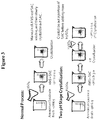
- a two-stage acidification of the fermentation broth comprising succinic acid is provided to control the super saturation level during crystallization process.
- the pH of the fermentation broth is reduced to pH 2.5 to 3.5 followed by first crystallization step.
- the pH of the fermentation broth is further reduced to pH 2.0 to 2.5 followed by second crystallization step ( Figure 3 ).
- acidification leading to pH adjustment can be done within the crystallizer or in the dissolution loops of crystal fines. If acidification is done in the fines dissolution loop, the exothermal reaction resulting from acidification process will help to dissolve crystal fines instead of using steam.
- the succinic acid crystals are separated from mother liquor using centrifugation.
- the solid succinic acid crystal is dissolved in methanol to remove any remaining ammonium sulfate.
- Ammonium sulfate has a much lower solubility in methanol and can be recovered as solid precipitate from a methanolic solution.
- the succinic acid is fully dissolved in methanol.
- Succinic acid in methanolic solution is subjected to esterification reaction leading to the formation of dimethyl succinate which is further purified by fractional distillation.
- the mother liquor obtained after the removal of solid crystalline succinic acid is further concentrated through evaporation at the elevated temperature under vacuum and subjected to crystallization reaction at lower temperature to precipitate ammonium sulfate.
- This crystallization step is referred as "second crystallization" step.
- the ammonium succinate precipitate resulting from the second crystallization step may have certain level of succinic acid crystals.
- Succinic acid in the ammonium sulfate precipitate can be recovered by means of dissolving precipitate from second crystallization reaction in methanol. While succinic acid is fully soluble in methanol, ammonium sulfate is relatively insoluble in methanol.
- Ammonium sulfate is recovered as a white precipitates while succinic acid remains fully dissolved in methanol.
- the ammonium sulfate obtained from methanol dissolution step can be used as a fertilizer or subjected to thermal degradation to produce ammonia and sulfuric acid which can be recycled into the process for recovering succinic acid from fermentation broth ( Figure 4 ).
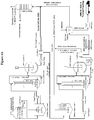
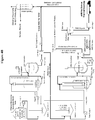
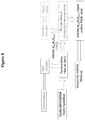
- ammonium phosphate is recovered as a co-product which can be used as a fertilizer or subjected to thermal degradation to yield phosphoric acid used in the process for recovering succinic acid from fermentation broth containing ammonium succinate ( Figures 6A , 6B , 7 and 8 ).
- the succinic acid recovered from fermentation broth through acidification process as described above is subjected to further downstream chemical processing as described below to obtain desired chemicals such as BDO, GBL and THF.
- desired chemicals such as BDO, GBL and THF.
- the process begins with the esterification of succinic acid in the presence of an esterification catalyst.
- the esterification is carried out in the absence of any exogenous esterification catalyst and such an esterification process is referred as autocatalytic esterification reaction.
- DMC Dimethyl carbonate
- the esterification catalyst suitable for the present purpose may be a heterogeneous or homogeneous catalyst.
- the esterification reaction can be run using a variety of catalysts that include; zeolites (X, Y, L, beta, ZSM-5, etc.), crystalline and amorphous metal oxides (silica and alumina), alkali modified zeolites (Na, K, Li, Cs, Ru, La, etc.), anion modified metal oxides and zeolites (SO 4 , PO 4 , BO 3 , etc.), cation resins (Amberlyst-15, Amberlyst-70 etc.), alkaline hydroxides (NaOH, NH 4 OH, KOH, etc.) and alkaline alkoxides.
- zeolites X, Y, L, beta, ZSM-5, etc.
- crystalline and amorphous metal oxides siliconca and alumina
- alkali modified zeolites Na, K, Li, Cs, Ru, La
- the succinic acid ester thus produced can be purified further through fractional distillation.
- butyl ester of succinic acid is produced first.
- Other types of esters such as methyl, ethyl and propyl esters of succinic acid can be obtained from butyl ester of succinic acid through transesterification process.
- the esterification is done at the industrial scale, it may require the use of certain heterogeneous esterification catalysts. Under those conditions it is necessary to make sure that succinic acid feedstock to be used in the esterification reaction in the presence of such heterogeneous catalysts does not have contaminants that could interfere with the functioning of the esterification catalysts.
- succinic acid is esterified with an alcohol under super atmospheric pressure and at an elevated temperature substantially between 100°C and 300°C.
- a lower monohydric alcohol is used, the pressure should be high enough to minimize its vaporization, which would otherwise occur at such temperature, so that the reactions are kept in the liquid state in the reaction zone.
- a number of alcohols may be used in this esterification process, especially the methyl, ethyl, isopropyl, butyl, hexyl, octyl, and similar monohydric aliphatic compounds. It is preferable to run the reaction autocatalytically or use a homogeneous catalyst in the esterification reaction.
- Heterogeneous acid catalysts can be subjected to fouling when in contact with succinic acid stream that has not been purified to remove cations.
- Sulfuric acid, phosphoric acid, hydrochloric acid, and organic acids such as alkanesulfonic acid and arylsulfonic acids are suitable homogeneous catalysts.
- Water formed in the esterification reaction is removed by allowing the hot reaction mixture to pass from the reaction zone at elevated pressure into a zone at atmospheric pressure, whereby water is flashed off.
- a novel process for the recovery of succinic acid and dimethyl succinate from the fermentation broth containing ammonium succinate.
- fermentation broth containing ammonium succinate is concentrated 4-5 five times using evaporation at elevated temperature and mixed with methanol or ethanol leading to the precipitation of ammonium succinate.
- methanol as a solvent
- ammonium succinate is precipitated as pure white crystalline solid while the impurities originally present in the fermentation broth is retained in the mother liquor ( Figure 9 and 10 ).
- ethanol as a solvent
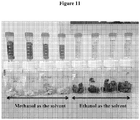
- ammonium succinate is precipitated out along with most of the impurities originally present in the fermentation broth.
- the ammonium succinate containing solid fraction resulting from ethanol treatment of fermentation broth is dark colored and the mother liquor is light-colored ( Figure 11 ).
- the white crystalline ammonium succinate fraction obtained after methanol addition to the fermentation broth can be re-suspended in methanol in the presence of sufficient amount of sulfuric acid to initiate a double displacement reaction leading to the formation of succinic acid and ammonium sulfate.
- Ammonium sulfate being relatively insoluble in methanol solution would precipitate out of methanol phase.
- Succinic acid resulting from double displacement reaction would also undergo an esterification reaction in the presence of sulfuric acid as a catalyst leading to the formation of dimethyl ester which can be further purified through fractional distillation ( Figure 12 ).
- KJ122 E. coli C, ⁇ ldhA, ⁇ adhE, ⁇ ackA, ⁇ focA-pflB, ⁇ mgsA, ⁇ poxB, ⁇ tdcDE, ⁇ citF, ⁇ aspC, ⁇ sfcA ) was used in the present invention.
- KJ122 was derived from E. coli C (ATCC 8739) strain through genetic modifications as described by Jantama et al (2008a; 2008b) and in the International Patent Applications published under Patent Cooperation Treaty with International Publication Nos. WO 2008/115958 and WO 2010/115067 .
- E. coli strain KJ122 is capable of fermenting 10% glucose in AM1 mineral media to produce 88 g/L succinate, normalized for base addition, in 72 hours.
- AM1 medium contains 2.63 g/L (NH 4 ) 2 HPO 4 , 0.87 g/L NH 4 H 2 PO 4 , 1.5 mM MgSO 4 , 1.0 mM betaine, and 1.5 ml/L trace elements.
- the trace elements are prepared as a 1000X stock and contained the following components: 1.6 g/L FeCl 3 , 0.2 g/L CoCl 2 •6H 2 O, 0.1 g/L CuCl 2 , 0.2 g/L ZnCl 2 •4H 2 O, 0.2 g/L NaMoO 4 , 0.05 g/L H 3 BO 3 , and 0.33 g/L MnCl 2 •4H 2 O.
- the pH of the fermentation broth is maintained at pH 7.0 with: 1:4 (6 N KOH: 3 M K 2 CO 3 ) (1.2 N KOH, 2.4 M K 2 CO 3 ) or any other suitable base including ammonium hydroxide.
- corn steep liquor was added. It is a byproduct from the corn wet-milling industry. When compared to the yeast extract and peptone, it is an inexpensive source of vitamins and trace elements.
- Organic acid and sugar analysis The concentration of various organic acids and sugars were measured by HPLC. Succinic acid, sugars, and other organic acids present in the fermentation broth were analyzed on an Agilent 1200 HPLC apparatus with a BioRad Aminex HPX-87H column. A BioRad Microguard Cation H + was used as a guard column. The standards for HPLC analysis were prepared in 0.008N sulfuric acid. The HPLC column temperature was maintained at 50°C. Sulfuric acid at 0.008N concentration was used as a mobile phase at the flow rate of 0.6 ml/min. Quantification of various components was done by measuring their absorption at 210 nm. Quantification of sugars and other components was done using a refractive index detector.
- ICP-OES Inductively Coupled Plasma Optical Emission Spectrometry
- the samples are then placed in an auto sampler connected to the ICP-OES, with a quality control in the first, middle, and last position.
- the ICP-OES will then analyzed the standards, generate a calibration curve, and analyze the samples.
- the software will then calculate the ppm for each substance detected, and from there the initial concentration of the substance can be determined based upon the dilution factor when the sample was prepared.
- Ion Chromatography Determination of chlorides, sulfates, phosphates and ammonium using Ion Chromatography (IC). The concentration of ammonium and various anions can be quantified using Ion Chromatography. Samples were analyzed using a Donex 1100 Ion Chromatography instrument with an AS-DV auto sampler. Standards from 0.04 to 30ppm are prepared in deionized water and a calibration curve is generated prior to each run. Samples are diluted so the analyte of interest falls within the calibration curve. For ammonium analysis a Dionex CS16 column is used with a CG16 guard column and a CSRS400 suppressor. 35mM Methanesulfonic acid is used as an eluent.
- a Dionex AS17-HC column is used with a AG17-HC guard column and a ASRS400 suppressor.
- 28mM Sodium Hydroxide is used as an eluent for cation analysis. Quantification is done by measuring the conductivity response of each component.
- Amino acids are measured by HPLC. Samples were analyzed on an Agilent 1100 HPLC with online derivataization and a fluorescence detector. A Phenomenex Gemini C18 column is used with a phosphate buffer and solvent gradient to elute the compounds. Samples and standards are diluted with 0.1M hydrochloric acid and derivitized with OPA reagent prior to injection. Quantification of amino acid is done by measuring the response from a fluorescence detector with excitation at 338nm and emission at 450nm.
- Diammonium succinate fermentation broth prepared in Example 1 was used in this experiment. 49ml of 36.25N sulfuric acid was used to acidify 1200ml of fermentation broth to pH 2.0. Then 1010g of the acidified broth was evaporated in a rotary evaporator under vacuum at 70°C to obtain 330g of concentrated broth. The condensate was analyzed and found to contain 0.8 g/L of acetic acid. The concentrated broth was cooled down by a step-wise cooling profile at the rate of -5°C every 30 minutes in an orbital shaker set at 200 rpm. The crystal was filtered under vacuum to obtain 55.75g of wet crystals. The crystal was subsequently washed with 25ml of deionized water and dried overnight at 50°C.
- Diammonium succinate fermentation broth prepared in Example 1 was used in this experiment. 1038g of the broth was concentrated in a rotary evaporator to 416g under vacuum. Some brown solids precipitated out of the solution. The condensate was analyzed and was found to contain 2.8 g/L of ammonia. The concentrated broth was divided into three portions. Portion 1 (99.92g) was filtered to remove solids and then acidified with 8ml of 36.25N H 2 SO 4 to pH 2.0. Portion 2 (84.66g) was acidified with 8ml of 36.25N H 2 SO 4 to pH 2.0. Portion 3 was saved as a reference. During the acidification step, white precipitate started to form at pH 5.2 and more came out of solution as the pH dropped further.
- Diammonium succinate fermentation broth prepared in Example 1 was used in this experiment. 1010g of the broth was concentrated under reduced pressure at 70°C in a rotary evaporator to 264g. The condensate was analyzed and found to contain 2.1 g/L of ammonia. Some brown solids precipitated out of solution. However, the broth was not filtered. The solution was acidified with 34.85ml of 36.25N H 2 SO 4 to the pH of 2.07. Then, a controlled crystallization was performed in an orbital shaker by cooling at the rate of 5°C every 30 minutes to room temperature. The crystal was filtered and washed with 40ml of deionized water and then dried at 50°C overnight. The crystal composition is shown in Table 2.
- the succinic acid crystal had a surprisingly very high purity of 99 wt% succinic acid even without a filtration step after evaporation.
- the amount of reduction in ammonium ion, sulfur, phosphorus, and amino acid is greater than 10 fold. This process corresponds to the process illustrated in the Figure 2 as "Flow sheet 2b".
- a 10 wt% aqueous solution of synthetic diammonium succinate was prepared by dissolving reagent grade succinic acid in water and then aqueous ammonia was added to the solution. 45ml of the solution was charged under atmospheric pressure into a 75ml vessel of Multi-Parr reactor model 5000. The solution was heated up to various temperatures and held for a period of time. After that the solution was immediately cooled down by running cooling water through a cold finger. Then the reactor content was emptied and the composition of the product was analyzed. The results are shown in Table 3. These results showed that increasing temperature and the exposure duration can increase the formation of amide by-products.
- the process according to this invention recommends the evaporation process to be conducted under reduced pressure, which should be advantageous in reducing the yield loss of succinic acid to amides.
- Liquid samples 1 and 2 were obtained from a large volume fermentation (85,000 liters) run using KJ122 strain as described in the Example 1.
- Liquid sample 1 is diammonium succinate fermentation broth after centrifugation to separate cell mass.
- Liquid sample 2 is diammonium succinate fermentation broth after centrifugation and an acidification step with sulfuric acid to pH 4.5.
- Approximately 45kg of each liquid sample was used to generate crude succinic crystal using the following procedures: (1) approximately 45kg of each sample was concentrated ⁇ 3x via evaporation at reduced pressure.
- Concentrated ammonium succinate was filtered by a filter press using 5-micron and 0.5-micron membranes.
- Diammonium succinate fermentation broth prepared in Example 1 was used in this experiment. 36.25N sulfuric acid was used to adjust the broth down to pH 2.4. The pH adjusted broth was then passed through a 0.5 micron filter. Then 1600mL of the acidified broth was evaporated in a rotary evaporator under vacuum at 70°C to obtain 440mL of concentrated broth. The condensate was analyzed and found to contain 8 g/L of acetic acid. The concentrated broth was cooled down by a step-wise cooling profile at the rate of -5°C every 30 minutes in an orbital shaker set at 200 rpm. The crystal was filtered under vacuum to obtain 74.2g of wet crystals.
- the crystal was subsequently washed with 25ml of deionized water and dried overnight under vacuum.
- the recovery of succinic acid as the crystal was calculated to be 73%.
- the composition of dry crystal was analyzed and is shown in Tables 7. The crystals showed very high succinic acid purity of 99%.
- Diammonium succinate fermentation broth prepared in Example 1 was used in this experiment. Succinic acid crystals were recovered following the procedure described in Example 7. The filtrate after removing the succinic acid crystals contained 423g of mother liquor. This mother liquor was evaporated in a rotary evaporator under vacuum at 70°C to obtain 215g of concentrated slurry. The slurry was filtered under vacuum to obtain 83g of wet crystals. The wet crystals had a composition of 15 wt% succinic acid and 72wt% ammonium sulfate. The wet crystals were mixed with 200mL methanol and filtered under vacuum to obtain 54g of crystals. The composition of crystals and methanol filtrate were analyzed and the results are shown in Table 7. The final AMS crystals showed a high ammonium sulfate concentration with ⁇ 1% impurities, 0.2% succinic acid.
- Example 8 The methanol filtrate from Example 8 was combined with 20 g of Amberlyst 36 and heated for 6hrs at 60C under atmospheric pressure. After heating, the final liquid was analyzed and the composition was 71g/L dimethyl succinate, 14g/L monomethyl succinate and 0.5 g/L succinic acid.
- Diammonium succinate solution prepared by dissolving 258 g/L ammonium succinate (equivalent to 200 g/L SAC) at 60°C was titrated with concentrated phosphoric acid to pH2.0, 2.5, and 3.0 and a controlled crystallization was performed in an orbital shaker by cooling at the rate of -5°C every hour to room temperature.
- the resulting succinic acid crystal was filtered and analyzed.
- the composition of succinic acid crystal resulting from acidification with phosphoric acid is shown in Table 8.
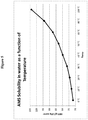
- the resulting succinic acid crystal had a very little ammonium diphosphate (ADP) even without a water rinsing step. Since ADP has high solubility in water ( ⁇ 55% at 25 C), mother liquor can retain approximately half its weight of ADP. Water rinsing of succinic acid crystals should be applied as it will improve the quality of succinic acid crystals.
- Table 8 shows results of recovery of succinic acid crystals from phosphate solution at pH 2, pH2.5 and pH3.
- Free succinic acid has much lower solubility in water than its diammonium salt.
- pH is 1 unit below the 1 st pKa of an organic acid, about 10% of the organic acid is in its salt form.
- pH is 2 units below the 1 st pKa of an organic acid, only about 1 % of the organic acid is in its salt form. Since the 1 st pKa value of succinic acid is 4.2, if solution is acidified to 2.2, 99% of succinic acid will be in free acid form, which will be much easier to crystallize.
- Table 8 show that when crystallization is performed at pH 3.0, 10.18 g of succinate still remained in solution and only 42 % crystallization yield was achieved. However when pH values were adjusted to 2 and 2.5, the SAC crystal yield were 69% and 58 % respectively. For these reasons, it is suggested that it is better to maintain industrial scale crystallization of succinic acid preferentially around the pH range of pH 2.0 to pH2.5.
- 2L fermentation broth was concentrated in a rotary evaporator, under vacuum at.
- the chemical composition of feed introduced into the evaporator, concentrate recovered from evaporator and the condensate from evaporator is shown in Table 9.
- the condensate stream showed 2.96 g/l of NH4 + ion and ⁇ 10 ppm of other ions.
- the loss of NH4 + ion to the condensate stream was observed to be approximately 9% by wt.
- the concentrate stream showed small formation of Succinimide by-product.
- the methanol:diammonium succinate broth weight ratios 2x, 3x and 4x were tested in three different glass beakers. 3 glass beakers were used with different amount of methanol concentrations 64.38g, 96.57g & 128.77g representing 2x, 3x & 4x ratios respectively was added to 50 ml of concentrate recovered from evaporator and the solutions were stirred on a hot plate at room temperature for 2 hours. This time was sufficient to precipitate out solids from the diammonium succinate solution resulting in slurry that was separated into solid and liquid stream using 0.22 micron Nalgene® vacuum filters. Solids and liquids were weighed and analyzed.
- Masses of solids collected for samples with 2x, 3x, & 4x ratio were 26.64g, 32.08g & 22.18g respectively whereas the masses of filtrate collected for samples with 2x, 3x & 4x ratios were 93.76g, 120.17g & 160.14g respectively.
- This filtrate can be sent to a distillation step for the recovery of methanol. Water can also be recovered or recycled back to dilute diammonium succinate stream before concentration step.
- diammonium succinate weight ratios 2x, 3x and 4x experiments were combined together to make up the feed for the next step known as the salt splitting reaction step.
- diammonium succinate solid is re-suspended in methanol, the reaction is catalyzed by using a mineral acid to split the diammonium succinate salt into an succinic acid and an inorganic salt.
- AMS succinic acid and ammonium sulfate
- AMS is an inorganic salt that has low solubility in methanol and therefore it precipitates out of the solution. Succinic acid released during the salt splitting step undergoes esterification in the presence of sulfuric acid as a catalyst leading to the formation of dimethyl succinate.
- Fermentation broth comprising ammonium succinate was subjected to centrifugation and evaporation followed by an ultrafiltration step.
- the permeate from ultrafiltration step was concentrated to 250.4 g/L succinic acid equivalent and subjected to either one-stage or two-stage acidification process.
- the pH of the fermentation broth was brought down to pH 2. 2 to 2.4 in a single step and the resulting precipitate was redissolved by elevating the temperature to 80°C. Subsequently the temperature of the acidified fermentation broth was gradually lowered to 30°C at the rate of 5°C/hour to initiate the crystallization process.
- the same protocol for crystallization was followed except the acidification was carried out in two stages.
- Figure 13A provides a comparison of yield and purity of the succinic acid crystals from one-stage acidification process and two-stage acidification process.
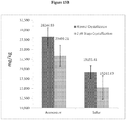
- Figure 13B provides the comparison of ammonium and sulfur impurities in the succinic acid crystals obtained through one-stage acidification process and two-stage acidification process.
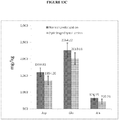
- Figure 13C provides the comparison of level of aspartic acid, glutamic acid and alanine in the succinic acid crystals resulting from one-stage acidification process and two-stage acidification process.
- the one-stage acidification process is referred as "Normal Crystallization" process
- fermentation broth comprising ammonium succinate was subjected to centrifugation and evaporation followed by an ultrafiltration step.
- the permeate from ultrafiltration step contained 66 grams of succinic acid salt per liter.
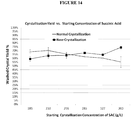
- This permeate from ultrafiltration step was concentrated up to six different concentrations (184, 210, 255, 285, 316, and 360 [g/L]) using Rotovap operated around 80-90 RPM and at 70-80°C.
- the resulting slurry was filtered using a vacuum Nalgene filters (2.0 ⁇ m) at room temperature.
- About 1.2g samples of the wet crude crystals were washed using a 1:1 (wt/wt) ratio of room temperature deionized water using Millipore's low-binding Durapore PVDF membrane (5.0 ⁇ m) centrifuge tube in the tabletop Beckman Accuspin centrifuge operated at ⁇ 1000 g. Each sample was washed with half of the DI water for two minutes followed by a second wash with the other half of DI water for another two minutes. The two minutes duration included start-up spin time but excluded time taken to reach zero RPM.
- Figure 15B provides the level of various amino acid impurities in the succinic acid crystals obtained from one-stage acidification process (1 stage) and two-stage acidification process (2pH stages).
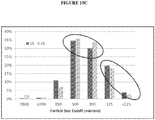
- Figure 15C provides the particle size distribution of succinic acid crystals obtained from one-stage acidification process (1S) and two-stage acidification process (2S).
- the SAC crystals obtained using two-stage acidification process had less fines with the particle size of 125 microns or lesser.
- the two-stage scidificaiton process yielded crystals distributed around 300 to 500 micron range.
- the bell-shaped curve for crystal distribution under two-stage acidification process was found narrower suggesting the crystal size distribution under two-stage acidification process was more uniform. As a result there were lesser impurities as they are washed away earlier in the process.
- Fermentation broth containing ammonium succinate was produced using the fermentation process described in Example 1. This broth was passed through an ultra filtration unit and used to produce succinic acid crystals using two-stage pH controlled crystallization as described in Example 12.
- the mother liquor from the succinic acid crystallization had a composition of 54 g/L succinic acid, 47 g/L acetic acid, 270 g/L sulfate, 123 g/L ammonium and 13 g/L phosphate. This material then had 20% of the volume evaporated in a rotary evaporator. The remaining slurry was heated to 80°C and slowly cooled at 5 degrees Celsius per hour to 30°C. The crystals were then filtered and dried under vacuum at room temperature. The composition of the crystals was >98 wt% ammonium sulfate with approximately 1% succinic acid.
Landscapes
- Chemical & Material Sciences (AREA)
- Organic Chemistry (AREA)
- Engineering & Computer Science (AREA)
- Life Sciences & Earth Sciences (AREA)
- Zoology (AREA)
- Wood Science & Technology (AREA)
- Oil, Petroleum & Natural Gas (AREA)
- Health & Medical Sciences (AREA)
- Microbiology (AREA)
- General Chemical & Material Sciences (AREA)
- Chemical Kinetics & Catalysis (AREA)
- Biochemistry (AREA)
- Bioinformatics & Cheminformatics (AREA)
- General Engineering & Computer Science (AREA)
- General Health & Medical Sciences (AREA)
- Genetics & Genomics (AREA)
- Biotechnology (AREA)
- Crystallography & Structural Chemistry (AREA)
- Preparation Of Compounds By Using Micro-Organisms (AREA)
- Organic Low-Molecular-Weight Compounds And Preparation Thereof (AREA)
Claims (11)
- Verfahren zur Herstellung von Succinatester, umfassend die Schritte:(a) Fermentieren von Kohlenhydratsubstraten unter Verwendung eines Biokatalysators, um ein Succinatsalz herzustellen;(b) Klären der Fermentationsbrühe, um den Biokatalysator und unlösliche Bestandteile zu entfernen;(c) Ansäuern der Fermentationsbrühe aus Schritt (b) mit Phosphorsäure;(d) kontrolliertes Kristallisieren von Bernsteinsäure in der angesäuerten Fermentationsbrühe aus Schritt (c);(e) Abtrennen der kristallinen Bernsteinsäure von der Mutterlauge;(f) Auflösen des kristallinen Bernsteinsäurekristalls aus Schritt (e) in einem Alkohol;(g) Verestern der in Alkohol aufgelösten Bernsteinsäure aus Schritt (f); und(h) Rückgewinnen des Bernsteinsäureesters durch Destillation.
- Verfahren zur Herstellung von Succinatester nach Anspruch 1, wobei der Alkohol Methanol ist.
- Verfahren zur Herstellung von Succinatester nach Anspruch 1, wobei der Alkohol Ethanol ist.
- Verfahren zur Herstellung von Succinatester nach Anspruch 1, weiter umfassend die Schritte:(a) Überführen der Mutterlauge zu einem Verdampfer, um eine konzentrierte Mutterlauge herzustellen;(b) Überführen der konzentrierten Mutterlauge zu einem Kristallisator, um eine Aufschlämmung herzustellen;(c) Zentrifugieren der Aufschlämmung aus Schritt (b), um einen Niederschlag zu erhalten, und Waschen des Niederschlags in einem Alkohol, um Ammoniumsulfat als Kristalle und eine Bernsteinsäure umfassende Alkoholfraktion rückzugewinnen;(d) Verestern der Bernsteinsäure in Alkohol aus Schritt (c); und(e) Destillieren des Bernsteinsäureesters aus Schritt (d).
- Verfahren zur Herstellung von Succinatester nach Anspruch 4, wobei der Alkohol Ethanol ist.
- Verfahren zur Herstellung von Succinatester nach Anspruch 4, wobei der Alkohol Methanol ist.
- Verfahren zur Herstellung von Bernsteinsäure, umfassend die Schritte:(a) Fermentieren von Kohlenhydratsubstraten unter Verwendung eines Biokatalysators, um ein Succinatsalz herzustellen;(b) Klären der Fermentationsbrühe, um den Biokatalysator und unlösliche Bestandteile zu entfernen;(c) Ansäuern der Fermentationsbrühe aus Schritt (b) mit Phosphorsäure;(d) kontrolliertes Kristallisieren von Bernsteinsäure in der angesäuerten Fermentationsbrühe aus Schritt (c);(e) Abtrennen der kristallinen Bernsteinsäure von der Mutterlauge;(f) Auflösen des kristallinen Bernsteinsäurekristalls aus Schritt (e) in einem Alkohol;(g) Überführen der Mutterlauge zu einem Verdampfer, um eine konzentrierte Mutterlauge herzustellen;(h) Überführen der konzentrierten Mutterlauge zu einem Kristallisator, um eine Aufschlämmung herzustellen;(i) Zentrifugieren der Aufschlämmung aus Schritt (h), um einen Niederschlag zu erhalten, und Waschen des Niederschlags in einem Alkohol, um Ammoniumsulfat als Kristalle und eine Bernsteinsäure umfassende Alkoholfraktion rückzugewinnen;(j) Vereinigen der Bernsteinsäure umfassenden Alkoholfraktion aus Schritt (i) mit der in Alkohol aufgelösten Bernsteinsäure aus Schritt (f);(k) Verestern der Bernsteinsäure in Alkohol aus Schritt (j);(l) Destillieren des Bernsteinsäureesters aus Schritt (k); und(m) Hydrolysieren des Bernsteinsäureesters aus Schritt (l), um Bernsteinsäure herzustellen.
- Verfahren zur Herstellung von Succinatester, umfassend die Schritte:(a) Fermentieren von Kohlenhydratsubstraten unter Verwendung eines Biokatalysators, um ein Succinatsalz herzustellen;(b) Klären der Fermentationsbrühe, um den Biokatalysator und unlösliche Bestandteile zu entfernen;(c) Mischen der Fermentationsbrühe aus Schritt (b) mit einem Alkohol, um das Succinatsalz auszusalzen;(d) Filtrieren des ausgesalzenen Succinatsalzes aus Schritt (c);(e) erneutes Auflösen des ausgesalzenen Succinatsalzes aus Schritt (d) in Methanol in der Gegenwart von Schwefelsäure, was den Niederschlag von Sulfat herbeiführt;(f) Filtrieren des Sulfats aus Schritt (e) und Rückgewinnen des Bernsteinsäure und Dimethylsuccinat umfassenden Filtrats;(g) Verestern der Bernsteinsäure in dem Filtrat aus Schritt (f); und(h) Rückgewinnen des Bernsteinsäureesters durch Destillation.
- Verfahren zur Herstellung von Succinatester nach Anspruch 8, wobei der zum Aussalzen des Succinatsalzes verwendete Alkohol Methanol ist.
- Verfahren zur Herstellung von Succinatester nach Anspruch 8, wobei der Schwefelgehalt des Succinatesters unterhalb eines Werts von 50 ppm liegt.
- Verfahren zur Herstellung von Succinatester nach Anspruch 8, wobei der Schwefelgehalt des Succinatesters unterhalb eines Werts von 10 ppm liegt.
Applications Claiming Priority (2)
| Application Number | Priority Date | Filing Date | Title |
|---|---|---|---|
| US201361912578P | 2013-12-06 | 2013-12-06 | |
| PCT/US2014/068823 WO2015085185A1 (en) | 2013-12-06 | 2014-12-05 | A process for preparing succinate ester |
Publications (3)
| Publication Number | Publication Date |
|---|---|
| EP3077525A1 EP3077525A1 (de) | 2016-10-12 |
| EP3077525A4 EP3077525A4 (de) | 2017-07-12 |
| EP3077525B1 true EP3077525B1 (de) | 2019-02-27 |
Family
ID=53274168
Family Applications (1)
| Application Number | Title | Priority Date | Filing Date |
|---|---|---|---|
| EP14867372.6A Active EP3077525B1 (de) | 2013-12-06 | 2014-12-05 | Verfahren zur herstellung von succinatester |
Country Status (7)
| Country | Link |
|---|---|
| US (2) | US20160304912A1 (de) |
| EP (1) | EP3077525B1 (de) |
| AR (1) | AR098639A1 (de) |
| CA (1) | CA2930711C (de) |
| ES (1) | ES2725930T3 (de) |
| TW (1) | TW201538477A (de) |
| WO (1) | WO2015085185A1 (de) |
Families Citing this family (6)
| Publication number | Priority date | Publication date | Assignee | Title |
|---|---|---|---|---|
| DE102015216815A1 (de) * | 2015-09-02 | 2017-03-02 | Thyssenkrupp Ag | Verfahren und Anlage zur Gewinnung einer in einem Fermentationsprozess hergestellten Carbonsäure |
| CN106554279B (zh) * | 2015-09-28 | 2018-12-11 | 中国石化扬子石油化工有限公司 | 一种从丁二酸发酵液中提取丁二酸二酯的方法 |
| KR102025867B1 (ko) * | 2017-07-13 | 2019-09-27 | 씨제이제일제당 주식회사 | 인산을 발효액 또는 발효 폐액으로부터 회수 및 재사용하는 방법 |
| CN110241024A (zh) * | 2019-06-13 | 2019-09-17 | 西北农林科技大学 | 一种类丁二酸酯生产菌的筛选方法 |
| CN116082198B (zh) * | 2023-02-07 | 2024-04-26 | 河北新启元能源技术开发股份有限公司 | 一种琥珀酸二异辛酯磺酸钠的合成方法 |
| EE202400016A (et) * | 2024-08-14 | 2026-03-16 | Kerogen OÜ | Meetod kukersiidi oksüdeerimise reaktsioonisegust di-ja tri-karboksüülhapete eraldamiseks |
Family Cites Families (26)
| Publication number | Priority date | Publication date | Assignee | Title |
|---|---|---|---|---|
| US2565487A (en) | 1948-12-27 | 1951-08-28 | Edward M Filachione | Production of esters |
| US2722541A (en) | 1950-08-02 | 1955-11-01 | Henry E Schulz | Process of esterifying butyl lactate |
| US2766273A (en) | 1951-05-04 | 1956-10-09 | Pfizer & Co C | Esterification of acids |
| FR2308611A1 (fr) | 1975-04-24 | 1976-11-19 | Rhone Poulenc Ind | Procede de recuperation de l'acide acetique a partir de ses solutions aqueuses de faible concentration |
| US4405717A (en) | 1981-10-26 | 1983-09-20 | Cpc International Inc. | Recovery of acetic acid from a fermentation broth |
| US4444881A (en) | 1981-10-26 | 1984-04-24 | Cpc International Inc. | Recovery of organic acids from a fermentation broth |
| DE3332018A1 (de) | 1983-09-06 | 1985-03-21 | Basf Ag, 6700 Ludwigshafen | Verfahren zur herstellung von bernsteinsaeurediestern |
| US5168055A (en) | 1986-06-11 | 1992-12-01 | Rathin Datta | Fermentation and purification process for succinic acid |
| US5143834A (en) | 1986-06-11 | 1992-09-01 | Glassner David A | Process for the production and purification of succinic acid |
| US4885247A (en) | 1988-04-19 | 1989-12-05 | Michigan Biotechnology Institute | Recovery and purification of lactate salts from whole fermentation broth by electrodialysis |
| US5068418A (en) | 1989-05-08 | 1991-11-26 | Uop | Separation of lactic acid from fermentation broth with an anionic polymeric absorbent |
| US5034105A (en) | 1989-07-27 | 1991-07-23 | Michigan Biotechnology Institute | Carboxylic acid purification and crystallization process |
| KR930008304B1 (ko) | 1990-04-27 | 1993-08-27 | 미쯔비시 덴끼 가부시끼가이샤 | 진동 검출기 |
| US5210296A (en) | 1990-11-19 | 1993-05-11 | E. I. Du Pont De Nemours And Company | Recovery of lactate esters and lactic acid from fermentation broth |
| US5132456A (en) | 1991-05-07 | 1992-07-21 | The Regents Of The University Of California | Sorption of carboxylic acid from carboxylic salt solutions at PHS close to or above the pKa of the acid, with regeneration with an aqueous solution of ammonia or low-molecular-weight alkylamine |
| US5510526A (en) | 1993-06-29 | 1996-04-23 | Cargill, Incorporated | Lactic acid production, separation and/or recovery process |
| US5352825A (en) | 1993-07-06 | 1994-10-04 | Hoarmann & Reimer Corp. | Recovery of organic acid salts from impure process streams by addition of bases |
| DE4341770A1 (de) | 1993-12-08 | 1995-06-14 | Basf Ag | Verfahren zur Herstellung von Milchsäureestern |
| US5405992A (en) | 1994-04-28 | 1995-04-11 | Uop | Process for concurrent esterification and separation using a simulated moving bed |
| US5502240A (en) | 1995-06-09 | 1996-03-26 | Aristech Chemical Corporation | Esterification process using a titamium zeolite catalyst |
| US5958744A (en) | 1997-08-18 | 1999-09-28 | Applied Carbochemicals | Succinic acid production and purification |
| KR101631719B1 (ko) | 2007-03-20 | 2016-06-24 | 유니버시티 오브 플로리다 리서치 파운데이션, 인크. | 유효한 숙시네이트 및 말레이트 제조를 위한 물질 및 방법 |
| KR20090066958A (ko) * | 2007-12-20 | 2009-06-24 | 한국과학기술원 | 배양액의 결정화에 의한 숙신산 정제방법 |
| US20120058530A1 (en) | 2009-04-02 | 2012-03-08 | University Of Florida Research Foundation Inc. | Engineering the pathway for succinate production |
| US8466300B2 (en) | 2010-04-01 | 2013-06-18 | Bioamber International S.A.R.L. | Processes for the production of hydrogenated products |
| DE102010025167A1 (de) | 2010-06-25 | 2011-12-29 | Uhde Gmbh | Verfahren zur Abtrennung, Gewinnung und Reinigung von Bernsteinsäure |
-
2014
- 2014-12-04 TW TW103142165A patent/TW201538477A/zh unknown
- 2014-12-05 AR ARP140104539A patent/AR098639A1/es unknown
- 2014-12-05 US US15/101,015 patent/US20160304912A1/en not_active Abandoned
- 2014-12-05 CA CA2930711A patent/CA2930711C/en active Active
- 2014-12-05 ES ES14867372T patent/ES2725930T3/es active Active
- 2014-12-05 WO PCT/US2014/068823 patent/WO2015085185A1/en not_active Ceased
- 2014-12-05 EP EP14867372.6A patent/EP3077525B1/de active Active
-
2019
- 2019-05-21 US US16/418,641 patent/US20200010860A1/en not_active Abandoned
Non-Patent Citations (1)
| Title |
|---|
| None * |
Also Published As
| Publication number | Publication date |
|---|---|
| EP3077525A4 (de) | 2017-07-12 |
| WO2015085185A1 (en) | 2015-06-11 |
| US20160304912A1 (en) | 2016-10-20 |
| TW201538477A (zh) | 2015-10-16 |
| CA2930711C (en) | 2023-05-23 |
| AR098639A1 (es) | 2016-06-01 |
| CA2930711A1 (en) | 2015-06-11 |
| ES2725930T3 (es) | 2019-09-30 |
| US20200010860A1 (en) | 2020-01-09 |
| EP3077525A1 (de) | 2016-10-12 |
Similar Documents
| Publication | Publication Date | Title |
|---|---|---|
| US20200010860A1 (en) | Process for preparing succinate ester | |
| Din et al. | Lactic acid separation and recovery from fermentation broth by ion-exchange resin: A review | |
| EP1005562B1 (de) | Bernsteinsäure herstellung und reinigung | |
| US20150057425A1 (en) | Process for the crystallization of succinic acid | |
| KR101543199B1 (ko) | L-메티오닌 및 관련 산물의 생산방법 | |
| JP6223681B2 (ja) | 乳酸を製造する方法 | |
| JP5814946B2 (ja) | コハク酸を製造する方法 | |
| EP2370586B1 (de) | Verfahren zur Herstellung eines monovalenten Bernsteinsäuresalzes | |
| US20160304431A1 (en) | A process for preparing succinic acid and succinate ester | |
| KR20100122773A (ko) | 발효액으로부터 숙신산을 분리 및 정제하는 방법 | |
| EP2749649B1 (de) | Verfahren zur trennung und reinigung von 1,4-diaminobutan aus einer fermentierten lösung | |
| ES2728258T3 (es) | Procedimiento de fabricación de ácido succínico a partir de un caldo de fermentación utilizando nanofiltración para purificar aguas madres recicladas | |
| US20120259138A1 (en) | Methods and systems of producing dicarboxylic acids | |
| US20240279152A1 (en) | Methods of producing dialkyl malonate esters and uses thereof | |
| US20150005510A1 (en) | Method for conversion of diammonium succinate in fermentation broth to 2-pyrrolidone and n-methylpyrrolidone | |
| WO2025049212A2 (en) | Process for the purification of pentamethylenediamine from lysine whole broth | |
| KR20240038445A (ko) | 알킬 3-하이드록시프로피오네이트의 제조 방법 | |
| KR20140140254A (ko) | 불포화 카르복실산 또는 그 에스테르의 제조방법 |
Legal Events
| Date | Code | Title | Description |
|---|---|---|---|
| PUAI | Public reference made under article 153(3) epc to a published international application that has entered the european phase |
Free format text: ORIGINAL CODE: 0009012 |
|
| 17P | Request for examination filed |
Effective date: 20160630 |
|
| AK | Designated contracting states |
Kind code of ref document: A1 Designated state(s): AL AT BE BG CH CY CZ DE DK EE ES FI FR GB GR HR HU IE IS IT LI LT LU LV MC MK MT NL NO PL PT RO RS SE SI SK SM TR |
|
| AX | Request for extension of the european patent |
Extension state: BA ME |
|
| DAX | Request for extension of the european patent (deleted) | ||
| A4 | Supplementary search report drawn up and despatched |
Effective date: 20170613 |
|
| RIC1 | Information provided on ipc code assigned before grant |
Ipc: C07C 67/08 20060101ALI20170607BHEP Ipc: C12P 7/62 20060101AFI20170607BHEP Ipc: C07C 69/40 20060101ALI20170607BHEP Ipc: C07C 51/43 20060101ALI20170607BHEP Ipc: C07C 55/10 20060101ALI20170607BHEP |
|
| STAA | Information on the status of an ep patent application or granted ep patent |
Free format text: STATUS: EXAMINATION IS IN PROGRESS |
|
| 17Q | First examination report despatched |
Effective date: 20180201 |
|
| RAP1 | Party data changed (applicant data changed or rights of an application transferred) |
Owner name: PTTGC INNOVATION AMERICA CORPORATION |
|
| GRAP | Despatch of communication of intention to grant a patent |
Free format text: ORIGINAL CODE: EPIDOSNIGR1 |
|
| STAA | Information on the status of an ep patent application or granted ep patent |
Free format text: STATUS: GRANT OF PATENT IS INTENDED |
|
| INTG | Intention to grant announced |
Effective date: 20180924 |
|
| GRAS | Grant fee paid |
Free format text: ORIGINAL CODE: EPIDOSNIGR3 |
|
| GRAA | (expected) grant |
Free format text: ORIGINAL CODE: 0009210 |
|
| STAA | Information on the status of an ep patent application or granted ep patent |
Free format text: STATUS: THE PATENT HAS BEEN GRANTED |
|
| AK | Designated contracting states |
Kind code of ref document: B1 Designated state(s): AL AT BE BG CH CY CZ DE DK EE ES FI FR GB GR HR HU IE IS IT LI LT LU LV MC MK MT NL NO PL PT RO RS SE SI SK SM TR |
|
| REG | Reference to a national code |
Ref country code: GB Ref legal event code: FG4D |
|
| REG | Reference to a national code |
Ref country code: CH Ref legal event code: EP |
|
| REG | Reference to a national code |
Ref country code: AT Ref legal event code: REF Ref document number: 1101387 Country of ref document: AT Kind code of ref document: T Effective date: 20190315 |
|
| REG | Reference to a national code |
Ref country code: IE Ref legal event code: FG4D |
|
| REG | Reference to a national code |
Ref country code: DE Ref legal event code: R096 Ref document number: 602014042096 Country of ref document: DE |
|
| REG | Reference to a national code |
Ref country code: NL Ref legal event code: MP Effective date: 20190227 |
|
| REG | Reference to a national code |
Ref country code: LT Ref legal event code: MG4D |
|
| PG25 | Lapsed in a contracting state [announced via postgrant information from national office to epo] |
Ref country code: LT Free format text: LAPSE BECAUSE OF FAILURE TO SUBMIT A TRANSLATION OF THE DESCRIPTION OR TO PAY THE FEE WITHIN THE PRESCRIBED TIME-LIMIT Effective date: 20190227 Ref country code: NO Free format text: LAPSE BECAUSE OF FAILURE TO SUBMIT A TRANSLATION OF THE DESCRIPTION OR TO PAY THE FEE WITHIN THE PRESCRIBED TIME-LIMIT Effective date: 20190527 Ref country code: NL Free format text: LAPSE BECAUSE OF FAILURE TO SUBMIT A TRANSLATION OF THE DESCRIPTION OR TO PAY THE FEE WITHIN THE PRESCRIBED TIME-LIMIT Effective date: 20190227 Ref country code: PT Free format text: LAPSE BECAUSE OF FAILURE TO SUBMIT A TRANSLATION OF THE DESCRIPTION OR TO PAY THE FEE WITHIN THE PRESCRIBED TIME-LIMIT Effective date: 20190627 Ref country code: SE Free format text: LAPSE BECAUSE OF FAILURE TO SUBMIT A TRANSLATION OF THE DESCRIPTION OR TO PAY THE FEE WITHIN THE PRESCRIBED TIME-LIMIT Effective date: 20190227 Ref country code: FI Free format text: LAPSE BECAUSE OF FAILURE TO SUBMIT A TRANSLATION OF THE DESCRIPTION OR TO PAY THE FEE WITHIN THE PRESCRIBED TIME-LIMIT Effective date: 20190227 |
|
| PG25 | Lapsed in a contracting state [announced via postgrant information from national office to epo] |
Ref country code: LV Free format text: LAPSE BECAUSE OF FAILURE TO SUBMIT A TRANSLATION OF THE DESCRIPTION OR TO PAY THE FEE WITHIN THE PRESCRIBED TIME-LIMIT Effective date: 20190227 Ref country code: RS Free format text: LAPSE BECAUSE OF FAILURE TO SUBMIT A TRANSLATION OF THE DESCRIPTION OR TO PAY THE FEE WITHIN THE PRESCRIBED TIME-LIMIT Effective date: 20190227 Ref country code: BG Free format text: LAPSE BECAUSE OF FAILURE TO SUBMIT A TRANSLATION OF THE DESCRIPTION OR TO PAY THE FEE WITHIN THE PRESCRIBED TIME-LIMIT Effective date: 20190527 Ref country code: GR Free format text: LAPSE BECAUSE OF FAILURE TO SUBMIT A TRANSLATION OF THE DESCRIPTION OR TO PAY THE FEE WITHIN THE PRESCRIBED TIME-LIMIT Effective date: 20190528 Ref country code: IS Free format text: LAPSE BECAUSE OF FAILURE TO SUBMIT A TRANSLATION OF THE DESCRIPTION OR TO PAY THE FEE WITHIN THE PRESCRIBED TIME-LIMIT Effective date: 20190627 Ref country code: HR Free format text: LAPSE BECAUSE OF FAILURE TO SUBMIT A TRANSLATION OF THE DESCRIPTION OR TO PAY THE FEE WITHIN THE PRESCRIBED TIME-LIMIT Effective date: 20190227 |
|
| REG | Reference to a national code |
Ref country code: AT Ref legal event code: MK05 Ref document number: 1101387 Country of ref document: AT Kind code of ref document: T Effective date: 20190227 |
|
| REG | Reference to a national code |
Ref country code: ES Ref legal event code: FG2A Ref document number: 2725930 Country of ref document: ES Kind code of ref document: T3 Effective date: 20190930 |
|
| PG25 | Lapsed in a contracting state [announced via postgrant information from national office to epo] |
Ref country code: DK Free format text: LAPSE BECAUSE OF FAILURE TO SUBMIT A TRANSLATION OF THE DESCRIPTION OR TO PAY THE FEE WITHIN THE PRESCRIBED TIME-LIMIT Effective date: 20190227 Ref country code: AL Free format text: LAPSE BECAUSE OF FAILURE TO SUBMIT A TRANSLATION OF THE DESCRIPTION OR TO PAY THE FEE WITHIN THE PRESCRIBED TIME-LIMIT Effective date: 20190227 Ref country code: SK Free format text: LAPSE BECAUSE OF FAILURE TO SUBMIT A TRANSLATION OF THE DESCRIPTION OR TO PAY THE FEE WITHIN THE PRESCRIBED TIME-LIMIT Effective date: 20190227 Ref country code: CZ Free format text: LAPSE BECAUSE OF FAILURE TO SUBMIT A TRANSLATION OF THE DESCRIPTION OR TO PAY THE FEE WITHIN THE PRESCRIBED TIME-LIMIT Effective date: 20190227 Ref country code: EE Free format text: LAPSE BECAUSE OF FAILURE TO SUBMIT A TRANSLATION OF THE DESCRIPTION OR TO PAY THE FEE WITHIN THE PRESCRIBED TIME-LIMIT Effective date: 20190227 Ref country code: RO Free format text: LAPSE BECAUSE OF FAILURE TO SUBMIT A TRANSLATION OF THE DESCRIPTION OR TO PAY THE FEE WITHIN THE PRESCRIBED TIME-LIMIT Effective date: 20190227 |
|
| REG | Reference to a national code |
Ref country code: DE Ref legal event code: R097 Ref document number: 602014042096 Country of ref document: DE |
|
| PG25 | Lapsed in a contracting state [announced via postgrant information from national office to epo] |
Ref country code: SM Free format text: LAPSE BECAUSE OF FAILURE TO SUBMIT A TRANSLATION OF THE DESCRIPTION OR TO PAY THE FEE WITHIN THE PRESCRIBED TIME-LIMIT Effective date: 20190227 Ref country code: PL Free format text: LAPSE BECAUSE OF FAILURE TO SUBMIT A TRANSLATION OF THE DESCRIPTION OR TO PAY THE FEE WITHIN THE PRESCRIBED TIME-LIMIT Effective date: 20190227 |
|
| PG25 | Lapsed in a contracting state [announced via postgrant information from national office to epo] |
Ref country code: AT Free format text: LAPSE BECAUSE OF FAILURE TO SUBMIT A TRANSLATION OF THE DESCRIPTION OR TO PAY THE FEE WITHIN THE PRESCRIBED TIME-LIMIT Effective date: 20190227 |
|
| PLBE | No opposition filed within time limit |
Free format text: ORIGINAL CODE: 0009261 |
|
| STAA | Information on the status of an ep patent application or granted ep patent |
Free format text: STATUS: NO OPPOSITION FILED WITHIN TIME LIMIT |
|
| 26N | No opposition filed |
Effective date: 20191128 |
|
| PG25 | Lapsed in a contracting state [announced via postgrant information from national office to epo] |
Ref country code: SI Free format text: LAPSE BECAUSE OF FAILURE TO SUBMIT A TRANSLATION OF THE DESCRIPTION OR TO PAY THE FEE WITHIN THE PRESCRIBED TIME-LIMIT Effective date: 20190227 |
|
| PG25 | Lapsed in a contracting state [announced via postgrant information from national office to epo] |
Ref country code: TR Free format text: LAPSE BECAUSE OF FAILURE TO SUBMIT A TRANSLATION OF THE DESCRIPTION OR TO PAY THE FEE WITHIN THE PRESCRIBED TIME-LIMIT Effective date: 20190227 |
|
| REG | Reference to a national code |
Ref country code: DE Ref legal event code: R119 Ref document number: 602014042096 Country of ref document: DE |
|
| REG | Reference to a national code |
Ref country code: CH Ref legal event code: PL |
|
| REG | Reference to a national code |
Ref country code: BE Ref legal event code: MM Effective date: 20191231 |
|
| PG25 | Lapsed in a contracting state [announced via postgrant information from national office to epo] |
Ref country code: MC Free format text: LAPSE BECAUSE OF FAILURE TO SUBMIT A TRANSLATION OF THE DESCRIPTION OR TO PAY THE FEE WITHIN THE PRESCRIBED TIME-LIMIT Effective date: 20190227 |
|
| GBPC | Gb: european patent ceased through non-payment of renewal fee |
Effective date: 20191205 |
|
| PG25 | Lapsed in a contracting state [announced via postgrant information from national office to epo] |
Ref country code: LU Free format text: LAPSE BECAUSE OF NON-PAYMENT OF DUE FEES Effective date: 20191205 Ref country code: GB Free format text: LAPSE BECAUSE OF NON-PAYMENT OF DUE FEES Effective date: 20191205 Ref country code: FR Free format text: LAPSE BECAUSE OF NON-PAYMENT OF DUE FEES Effective date: 20191231 Ref country code: IE Free format text: LAPSE BECAUSE OF NON-PAYMENT OF DUE FEES Effective date: 20191205 Ref country code: DE Free format text: LAPSE BECAUSE OF NON-PAYMENT OF DUE FEES Effective date: 20200701 |
|
| PG25 | Lapsed in a contracting state [announced via postgrant information from national office to epo] |
Ref country code: BE Free format text: LAPSE BECAUSE OF NON-PAYMENT OF DUE FEES Effective date: 20191231 Ref country code: LI Free format text: LAPSE BECAUSE OF NON-PAYMENT OF DUE FEES Effective date: 20191231 Ref country code: CH Free format text: LAPSE BECAUSE OF NON-PAYMENT OF DUE FEES Effective date: 20191231 |
|
| PG25 | Lapsed in a contracting state [announced via postgrant information from national office to epo] |
Ref country code: CY Free format text: LAPSE BECAUSE OF FAILURE TO SUBMIT A TRANSLATION OF THE DESCRIPTION OR TO PAY THE FEE WITHIN THE PRESCRIBED TIME-LIMIT Effective date: 20190227 |
|
| PG25 | Lapsed in a contracting state [announced via postgrant information from national office to epo] |
Ref country code: HU Free format text: LAPSE BECAUSE OF FAILURE TO SUBMIT A TRANSLATION OF THE DESCRIPTION OR TO PAY THE FEE WITHIN THE PRESCRIBED TIME-LIMIT; INVALID AB INITIO Effective date: 20141205 Ref country code: MT Free format text: LAPSE BECAUSE OF FAILURE TO SUBMIT A TRANSLATION OF THE DESCRIPTION OR TO PAY THE FEE WITHIN THE PRESCRIBED TIME-LIMIT Effective date: 20190227 |
|
| PG25 | Lapsed in a contracting state [announced via postgrant information from national office to epo] |
Ref country code: MK Free format text: LAPSE BECAUSE OF FAILURE TO SUBMIT A TRANSLATION OF THE DESCRIPTION OR TO PAY THE FEE WITHIN THE PRESCRIBED TIME-LIMIT Effective date: 20190227 |
|
| REG | Reference to a national code |
Ref country code: ES Ref legal event code: PC2A Owner name: PTT GLOBAL CHEMICAL PUBLIC COMPANY LIMITED Effective date: 20240702 |
|
| PGFP | Annual fee paid to national office [announced via postgrant information from national office to epo] |
Ref country code: ES Payment date: 20260119 Year of fee payment: 12 |
|
| PGFP | Annual fee paid to national office [announced via postgrant information from national office to epo] |
Ref country code: IT Payment date: 20251231 Year of fee payment: 12 |