EP3073936B1 - Medizinisches implantat - Google Patents
Medizinisches implantat Download PDFInfo
- Publication number
- EP3073936B1 EP3073936B1 EP14820761.6A EP14820761A EP3073936B1 EP 3073936 B1 EP3073936 B1 EP 3073936B1 EP 14820761 A EP14820761 A EP 14820761A EP 3073936 B1 EP3073936 B1 EP 3073936B1
- Authority
- EP
- European Patent Office
- Prior art keywords
- cage structure
- retaining ring
- implant
- implant according
- anchor elements
- Prior art date
- Legal status (The legal status is an assumption and is not a legal conclusion. Google has not performed a legal analysis and makes no representation as to the accuracy of the status listed.)
- Active
Links
Images


Classifications
-
- A—HUMAN NECESSITIES
- A61—MEDICAL OR VETERINARY SCIENCE; HYGIENE
- A61B—DIAGNOSIS; SURGERY; IDENTIFICATION
- A61B17/00—Surgical instruments, devices or methods
- A61B17/12—Surgical instruments, devices or methods for ligaturing or otherwise compressing tubular parts of the body, e.g. blood vessels or umbilical cord
- A61B17/12022—Occluding by internal devices, e.g. balloons or releasable wires
- A61B17/12099—Occluding by internal devices, e.g. balloons or releasable wires characterised by the location of the occluder
- A61B17/12122—Occluding by internal devices, e.g. balloons or releasable wires characterised by the location of the occluder within the heart
-
- A—HUMAN NECESSITIES
- A61—MEDICAL OR VETERINARY SCIENCE; HYGIENE
- A61B—DIAGNOSIS; SURGERY; IDENTIFICATION
- A61B17/00—Surgical instruments, devices or methods
- A61B17/12—Surgical instruments, devices or methods for ligaturing or otherwise compressing tubular parts of the body, e.g. blood vessels or umbilical cord
- A61B17/12022—Occluding by internal devices, e.g. balloons or releasable wires
- A61B17/12131—Occluding by internal devices, e.g. balloons or releasable wires characterised by the type of occluding device
- A61B17/12168—Occluding by internal devices, e.g. balloons or releasable wires characterised by the type of occluding device having a mesh structure
- A61B17/12172—Occluding by internal devices, e.g. balloons or releasable wires characterised by the type of occluding device having a mesh structure having a pre-set deployed three-dimensional shape
-
- A—HUMAN NECESSITIES
- A61—MEDICAL OR VETERINARY SCIENCE; HYGIENE
- A61F—FILTERS IMPLANTABLE INTO BLOOD VESSELS; PROSTHESES; DEVICES PROVIDING PATENCY TO, OR PREVENTING COLLAPSING OF, TUBULAR STRUCTURES OF THE BODY, e.g. STENTS; ORTHOPAEDIC, NURSING OR CONTRACEPTIVE DEVICES; FOMENTATION; TREATMENT OR PROTECTION OF EYES OR EARS; BANDAGES, DRESSINGS OR ABSORBENT PADS; FIRST-AID KITS
- A61F2/00—Filters implantable into blood vessels; Prostheses, i.e. artificial substitutes or replacements for parts of the body; Appliances for connecting them with the body; Devices providing patency to, or preventing collapsing of, tubular structures of the body, e.g. stents
- A61F2/82—Devices providing patency to, or preventing collapsing of, tubular structures of the body, e.g. stents
- A61F2/844—Devices providing patency to, or preventing collapsing of, tubular structures of the body, e.g. stents folded prior to deployment
-
- A—HUMAN NECESSITIES
- A61—MEDICAL OR VETERINARY SCIENCE; HYGIENE
- A61F—FILTERS IMPLANTABLE INTO BLOOD VESSELS; PROSTHESES; DEVICES PROVIDING PATENCY TO, OR PREVENTING COLLAPSING OF, TUBULAR STRUCTURES OF THE BODY, e.g. STENTS; ORTHOPAEDIC, NURSING OR CONTRACEPTIVE DEVICES; FOMENTATION; TREATMENT OR PROTECTION OF EYES OR EARS; BANDAGES, DRESSINGS OR ABSORBENT PADS; FIRST-AID KITS
- A61F2/00—Filters implantable into blood vessels; Prostheses, i.e. artificial substitutes or replacements for parts of the body; Appliances for connecting them with the body; Devices providing patency to, or preventing collapsing of, tubular structures of the body, e.g. stents
- A61F2/82—Devices providing patency to, or preventing collapsing of, tubular structures of the body, e.g. stents
- A61F2/848—Devices providing patency to, or preventing collapsing of, tubular structures of the body, e.g. stents having means for fixation to the vessel wall, e.g. barbs
-
- A—HUMAN NECESSITIES
- A61—MEDICAL OR VETERINARY SCIENCE; HYGIENE
- A61F—FILTERS IMPLANTABLE INTO BLOOD VESSELS; PROSTHESES; DEVICES PROVIDING PATENCY TO, OR PREVENTING COLLAPSING OF, TUBULAR STRUCTURES OF THE BODY, e.g. STENTS; ORTHOPAEDIC, NURSING OR CONTRACEPTIVE DEVICES; FOMENTATION; TREATMENT OR PROTECTION OF EYES OR EARS; BANDAGES, DRESSINGS OR ABSORBENT PADS; FIRST-AID KITS
- A61F2/00—Filters implantable into blood vessels; Prostheses, i.e. artificial substitutes or replacements for parts of the body; Appliances for connecting them with the body; Devices providing patency to, or preventing collapsing of, tubular structures of the body, e.g. stents
- A61F2/82—Devices providing patency to, or preventing collapsing of, tubular structures of the body, e.g. stents
- A61F2/86—Stents in a form characterised by the wire-like elements; Stents in the form characterised by a net-like or mesh-like structure
- A61F2/90—Stents in a form characterised by the wire-like elements; Stents in the form characterised by a net-like or mesh-like structure characterised by a net-like or mesh-like structure
-
- A—HUMAN NECESSITIES
- A61—MEDICAL OR VETERINARY SCIENCE; HYGIENE
- A61B—DIAGNOSIS; SURGERY; IDENTIFICATION
- A61B17/00—Surgical instruments, devices or methods
- A61B17/0057—Implements for plugging an opening in the wall of a hollow or tubular organ, e.g. for sealing a vessel puncture or closing a cardiac septal defect
- A61B2017/00575—Implements for plugging an opening in the wall of a hollow or tubular organ, e.g. for sealing a vessel puncture or closing a cardiac septal defect for closure at remote site, e.g. closing atrial septum defects
- A61B2017/00579—Barbed implements
-
- A—HUMAN NECESSITIES
- A61—MEDICAL OR VETERINARY SCIENCE; HYGIENE
- A61B—DIAGNOSIS; SURGERY; IDENTIFICATION
- A61B17/00—Surgical instruments, devices or methods
- A61B17/0057—Implements for plugging an opening in the wall of a hollow or tubular organ, e.g. for sealing a vessel puncture or closing a cardiac septal defect
- A61B2017/00575—Implements for plugging an opening in the wall of a hollow or tubular organ, e.g. for sealing a vessel puncture or closing a cardiac septal defect for closure at remote site, e.g. closing atrial septum defects
- A61B2017/00597—Implements comprising a membrane
-
- A—HUMAN NECESSITIES
- A61—MEDICAL OR VETERINARY SCIENCE; HYGIENE
- A61B—DIAGNOSIS; SURGERY; IDENTIFICATION
- A61B17/00—Surgical instruments, devices or methods
- A61B17/0057—Implements for plugging an opening in the wall of a hollow or tubular organ, e.g. for sealing a vessel puncture or closing a cardiac septal defect
- A61B2017/00575—Implements for plugging an opening in the wall of a hollow or tubular organ, e.g. for sealing a vessel puncture or closing a cardiac septal defect for closure at remote site, e.g. closing atrial septum defects
- A61B2017/00632—Occluding a cavity, i.e. closing a blind opening
-
- A—HUMAN NECESSITIES
- A61—MEDICAL OR VETERINARY SCIENCE; HYGIENE
- A61F—FILTERS IMPLANTABLE INTO BLOOD VESSELS; PROSTHESES; DEVICES PROVIDING PATENCY TO, OR PREVENTING COLLAPSING OF, TUBULAR STRUCTURES OF THE BODY, e.g. STENTS; ORTHOPAEDIC, NURSING OR CONTRACEPTIVE DEVICES; FOMENTATION; TREATMENT OR PROTECTION OF EYES OR EARS; BANDAGES, DRESSINGS OR ABSORBENT PADS; FIRST-AID KITS
- A61F2/00—Filters implantable into blood vessels; Prostheses, i.e. artificial substitutes or replacements for parts of the body; Appliances for connecting them with the body; Devices providing patency to, or preventing collapsing of, tubular structures of the body, e.g. stents
- A61F2/82—Devices providing patency to, or preventing collapsing of, tubular structures of the body, e.g. stents
- A61F2/848—Devices providing patency to, or preventing collapsing of, tubular structures of the body, e.g. stents having means for fixation to the vessel wall, e.g. barbs
- A61F2002/8483—Barbs
-
- A—HUMAN NECESSITIES
- A61—MEDICAL OR VETERINARY SCIENCE; HYGIENE
- A61F—FILTERS IMPLANTABLE INTO BLOOD VESSELS; PROSTHESES; DEVICES PROVIDING PATENCY TO, OR PREVENTING COLLAPSING OF, TUBULAR STRUCTURES OF THE BODY, e.g. STENTS; ORTHOPAEDIC, NURSING OR CONTRACEPTIVE DEVICES; FOMENTATION; TREATMENT OR PROTECTION OF EYES OR EARS; BANDAGES, DRESSINGS OR ABSORBENT PADS; FIRST-AID KITS
- A61F2/00—Filters implantable into blood vessels; Prostheses, i.e. artificial substitutes or replacements for parts of the body; Appliances for connecting them with the body; Devices providing patency to, or preventing collapsing of, tubular structures of the body, e.g. stents
- A61F2/82—Devices providing patency to, or preventing collapsing of, tubular structures of the body, e.g. stents
- A61F2/848—Devices providing patency to, or preventing collapsing of, tubular structures of the body, e.g. stents having means for fixation to the vessel wall, e.g. barbs
- A61F2002/8486—Devices providing patency to, or preventing collapsing of, tubular structures of the body, e.g. stents having means for fixation to the vessel wall, e.g. barbs provided on at least one of the ends
Definitions
- the invention relates to a medical implant for closing the auricula sinistra of a patient in an endovascular way, which has a basket structure made up of a large number of webs, which is connected proximally via connecting webs to a retaining ring and is limited distally by a ring of converging webs, the implant being made of a self-expanding material, having the shape of a slotted tube in a contracted state and, after expansion, assuming a basket structure with a diameter that is larger than that of the retaining ring.
- the auriculae atrii or atrial appendages are protuberances of the atria of the heart in mammals.
- the left atrial appendage medically known as the left auricula, lies adjacent to the trunk of the pulmonary artery and is a common site for blood clots, particularly in patients with atrial fibrillation, which can lead to a stroke.
- the prevention of thrombi in the auricula sinistra therefore represents an effective stroke prophylaxis in at-risk patients.
- LAA left atrial appendage
- the correct and reliable anchoring of the implants is often a problem.
- the size and shape of the auricula sinistra can vary from patient to patient and can be narrower and wider, especially with regard to the access opening. Implants that are tensioned by the expansion with the walls of the auricula can therefore slip if they are not optimally seated and thus not optimally fulfill their purpose. In such cases, thrombi can still be washed away, especially when the patient is under physical strain.
- U.S. 2003/220667 A1 discloses an implant for closing the left auricle having a self-expanding frame.
- U.S. 2004/122467 A1 also discloses an implant for closing the auricula sinistra, which has a self-expanding frame, the frame having anchoring elements at the distal end.
- U.S. 2011/054515 A1 and CN 202 143 640 U each disclose an implant for closing the auricula sinistra, which has a basket-shaped frame, the frame having anchoring elements.
- the implant according to the invention has a retaining ring which is connected via a plurality of webs to a cage structure arranged distally to the retaining ring.
- the basket structure is greatly expanded compared to the retaining ring. It is formed by a large number of webs, which expediently form a mesh or network structure.
- the cage structure ends proximally in the retaining ring, it is open distally and is delimited by a ring of webs arranged in a zigzag shape and converging.
- the basket structure consists of a network of webs that branch out and converge again.
- the implant For anchoring in the muscle tissue of the auricula sinistra according to alternative (a), the implant has one or more anchor elements that protrude beyond the basket structure. Each anchor element terminates in a barbed tip designed to hook into muscle tissue.
- the implant according to the invention has several anchoring elements which protrude laterally from the cage structure, curve proximally and are intended to be laterally supported against the muscle tissue of the auricula sinistra.
- the anchoring elements form a second proximally open basket, with the ends of the anchoring elements defining the edge of the basket and being supported on the muscle tissue laterally from the entrance of the auricula sinistra.
- the ends of the anchor elements can optionally also have barbs, but it is usually sufficient for the tips to be rounded. In the latter case, too, there is secure support through the expansion in the auricula sinistra.
- the anchoring elements emanate directly from the retaining ring and protrude beyond the basket structure so that they can be brought into contact with the muscle tissue of the left auricle.
- the anchor element or elements are located on the distal tips of the rim of the cage structure.
- the barbs can point outwards or inwards; preferably the barbs are located on the outside. If there are several anchor elements, these are preferably distributed evenly over the rim, with not every point of the rim having to have an anchor element.
- anchor element or each anchor element starts from the retaining ring of the implant and runs through the cage structure and protrudes distally beyond it.
- the anchor element or elements are thus located approximately in the middle of the basket structure.
- a regular distribution of the anchor elements is preferred if several anchor elements are provided.
- the medical implant according to the invention is transported to its place of use via a conventional catheter and released from the catheter there.
- the catheter In the catheter, it is in a reduced-volume, contracted and stretched form and essentially has the shape of a tube with multiple slits.
- the shape corresponds to the tube from which the implant was created by laser cutting.
- the implant Upon release from the catheter, the implant assumes the expanded shape imparted by an annealing process, i. H. the basket shape with the anchor elements protruding beyond it.
- the implant guided in the catheter is connected to a guide element, preferably a guide catheter or guide wire, via the retaining ring by means of a coupling mechanism.
- a guide element preferably a guide catheter or guide wire
- the implant is then pushed into the auricula sinistera using a guide element and expanded.
- the anchor elements located in the center of the basket structure are outside the basket with their tips and barbs.
- the necessary pressure can be exerted by means of a guide catheter and/or guide wire in order to anchor the tips with the barbs in the muscle tissue on the posterior wall of the auricle.
- the tips with the barbs grow in and out without any problems reliably hold the implant in the selected position.
- the guiding element is detached from the implant in the usual manner and withdrawn together with the catheter.
- Such coupling mechanisms are known and have been described many times.
- the basket structure of the medical implant according to the invention is usually connected to the retaining ring via 6 to 12 connecting webs.
- the implant according to the invention can fulfill its purpose as a thrombus filter even without a cover or covering.
- the medical implant is expediently provided with a cover in the proximal area, for example a polyurethane, polyester or Teflon film.
- a cover in the proximal area, for example a polyurethane, polyester or Teflon film.
- the connecting webs extending from the retaining ring with perforations that can be used to sew the cover.
- the cover can also be fixed by gluing or by (repeated) immersion of the implant in a plastic solution or dispersion.
- the implants preferably have one or more anchor elements inside the basket, which, starting from the retaining ring (a), project spear-like out of the opening of the basket structure and have a tip with at least one barb.
- the tip and barb are located outside of the basket structure and are capable of penetrating and hooking into the muscle tissue of the left auricle when appropriate pressure is applied during placement using the guide wire.
- the anchor elements protrude laterally beyond the cage structure and are curved proximally, so that they support the implant against the side wall in the entry area of the left auricula.
- a combination of the two variants (a) and (b) is also possible.
- the implant is reliably fixed in such a way that the proximal part of the basket with the retaining ring in the entrance area is located.
- the basket with or without a cover shields the auricula sinistra and prevents thrombi from being flushed out.
- the anchor elements form the distal end of the basket.
- one anchor element according to alternative (a) is sufficient, but the implant preferably has two or more anchor elements which are distributed evenly over the circumference of the retaining ring.
- An arrangement with two anchor elements that face each other on the retaining ring is particularly preferred.
- the anchor elements in the center of the basket run essentially parallel to one another at about the middle of the basket structure.
- a large number of anchor elements is expedient, with the number being based on the number of connecting webs between the retaining ring and basket.
- the anchoring elements are distributed evenly over the circumference of the retaining ring. They are expediently arranged between two connecting webs in each case.
- the basket structure preferably has a network of branching and converging webs that form diamond-shaped structures. Converging webs in the distal area result in a ring of converging webs with a zigzag course, the tips of which are preferably rounded. A meandering, rounded course is also possible. When arranging the anchor elements on the rim, a zigzag course with anchor elements placed on the tips of the rim is preferred.
- the central retaining ring is preferably arranged in a central depression in the basket structure. This means that the connecting webs between the retaining ring and the cage structure run in an S-shape, ie starting from the distal side of the retaining ring they first turn proximally before they orientate themselves distally again and merge into the cage structure.
- the anchor elements are arranged distally to the cage structure and extend laterally beyond the cage structure.
- the anchoring elements emanate from a holding tube, which in turn is connected to the holding ring of the basket structure.
- the holding tube expediently has a somewhat smaller diameter than the holding ring and is fitted into it and connected to the holding ring, for example welded.
- the anchor elements are preferably connected to one another in pairs at the tips, so that they form a type of loop.
- the tips can be bent back onto the basket, so that the anchor elements brace themselves with their outer surfaces on the periphery against the auricula sinistra.
- the implants according to the invention consist of a flexible, self-expanding material.
- This material can be a metal or a plastic, but is suitably a metal alloy with shape memory properties.
- shape-memory metals are able, under external pressure, to assume the original production-related shape and, when this pressure is removed, to assume a later imprinted shape, which is fixed by tempering, again. This allows such implants to be transported in a small diameter catheter and then expanded upon release from the catheter.
- the implants according to the invention are also produced from a tube by laser cutting and brought into the expanded form by subsequent thermal forming.
- the implants of the present invention when made from one shape shape memory alloy, can also consist of two parts cut from separate tubes.
- the basket can be made from one tube and the anchor elements from a second tube, with a retaining ring in each case is available.
- the two parts are connected, in particular welded, to form an implant.
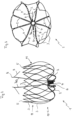
- FIG. 1 shows a cutting pattern for an implant according to alternative (a) in a two-dimensional representation, ie in a cut open and spread out form, before the thermal forming.
- the representation thus shows the originally processed pipe in a two-dimensional representation.
- a plurality of connecting webs 2 emanate from a retaining ring 4, each of which has a plurality of perforations 6 which are used to sew a covering, for example with a Teflon film, onto it.
- the connecting webs 2 each merge into two basket webs 3 which are networked with one another in an intersection plane 11 .
- two basket webs 3 converge to form a rounded tip 5, with the total number of tips 5 forming the ring-shaped distal boundary of the basket 10.
- a hook element 9 is defined by incisions, which forms the barb 9 of the tip 8 in the deformed state.
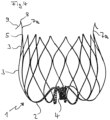
- FIG. 2 shows an implant according to alternative (a) in a lateral photographic representation with the retaining ring 4 and the cage structure 10.
- a plurality of connecting webs 2 proceed from the retaining ring and branch off to the cage structure 10 with their cage webs 3.
- the basket webs 3, which emanate from the connecting webs 2, converge in a plane 11 to branch out again and converge again.
- tips 5 are formed, which are preferably rounded.
- Two spear-shaped anchor elements 7a extend from the retaining ring 4 and form a barb 9 in the region of their tip 8 . These anchoring elements protrude beyond the basket structure 10 and serve to anchor the implant muscle tissue of the auricula sinistra in relation to the entrance.
- the basket structure 10 comes to rest on the walls, the proximal end with the retaining ring 4 is arranged in the entry area.
- the connecting webs 2, which connect the retaining ring 4 to the basket structure 10 and its web elements, have a multiply curved course, such that they first run proximally and are then bent in a semicircle towards the basket 10 distally.
- the webs 2 have perforations 6 for fixing a cover, as in 1 shown.
- Implants according to the invention are connected via the retaining ring 4 with a standard coupling mechanism to a guide catheter, which leads through a catheter to the attending physician. These techniques are well known and widely described. It is also understood that the retaining ring 4 can be closed in a suitable manner to prevent thrombi from being flushed out, for example by fitted elements, struts notched out of the retaining ring or the coupling mechanism fitted into the retaining ring, for example in the form of a plate or ball, which interact with a pincer-shaped retaining element of the guide catheter or wire.
- FIG. 3 shows the implant according to 2 photographed from the proximal side.
- the retaining ring 4 is connected to the actual basket, which is formed by the basket webs 3, via eight connecting webs 2.
- Each connecting web 2 merges into two webs 3 that form the basket in the form of a network.
- the periphery of 3 is formed by the mesh structure of the basket, which terminates distally in the rim formed by the tips 5.
- the connecting webs 2 have a large number of perforations 6 which serve to fix a cover covering the implant, in the case shown by sewing.
- a cover can consist of a Teflon film, for example.
- glue the cover it is also easily possible to glue the cover, to brace it or to connect it to the implant structure by immersion or electrospinning.
- the retaining elements 7a which end in a tip 8, extend centrally from the retaining ring 4.
- the barbs 9 start from the tip 8 and point to the periphery of the basket in the case shown. The cutout from which the barb 9 was released can be seen in the holding element on the left.
- FIG. 4 shows a further variant of an implant according to alternative (a), in which the holding elements 7 with tip 8 and barbs 9 emanate from tips 5 of the crown structure of the implant. Not every tip is connected to a holding element; preferably there are two or four holding elements arranged at regular intervals.
- proximal in the sense of the description designates the side of the implant pointing towards the attending physician and catheter, the term “distal” the side of the implant pointing away from the attending physician and catheter and towards the rear wall of the auricula sinistra.
- FIG. 5 shows an implant according to alternative (b) according to the invention.
- the implant 1 has connecting webs 2 emerging from the retaining ring 4 , which branch into the webs 3 which form the actual basket 10 .
- the webs 3 are networked with one another and end in points 5, which are athromatically rounded.
- Variant (b) is characterized by anchor elements 7b, which emanate from the retaining ring 4 between the connecting webs 2 and extend laterally outwards, leaving the region of the basket 10 in the process.
- the anchor elements 7b have a curved course d. H. they are curved proximally. In this way they form a basket that runs in the opposite direction to the basket 10 . They form a ring of arms that hit the wall in the auricula sinistra and thereby fix the implant.
- FIG. 6 shows another photograph of the implant from figure 5 , in this case connected to a guide wire 13, which can be released by twisting after implantation.
- the basket structure formed by the connecting webs 2 and the webs 3 and ending in the tips 5 distal to the guide wire 13 can be clearly seen.
- the anchoring elements 7b start from the retaining ring 4, are arranged between adjacent connecting webs 2 and have a curved profile in such a way that they extend out of the basket 10 to the outside.
- the curvature of the anchor elements 7b causes them to assume an outward and backward (proximal) course in their end region. This is the basis of the locking effect that holds the implant at the implantation site in the auricula sinistra.
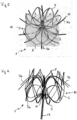
- the anchoring elements 7b extend from a holding tube 14, which is fitted into the holding ring 4 at its proximal end and is connected to it.
- the anchor elements 7 b begin at the distal end of the holding tube 14 , of which two adjacent ones are combined to form a loop which ends in a rounded tip 15 .
- the tip of the anchor elements 7b is bent inwards, ie bent back onto the basket.
- the anchoring element 7b is intended to be anchored or braced peripherally with the outside in the auricula sinistra.
- the inwardly curved one Tip 15 of the loop formed by two elements 7b on the one hand prevents damage to the tissue and on the other hand causes tension in the anchor elements 7b, which uses the anchoring of the implant.
- the holding tube 14 can be seen, the proximal end of which is fitted into the holding ring 4 .
- the retaining ring 4 is the starting point of the basket structure 10, which is formed from the webs 2 and 3, the webs 3 being brought together in points 5.
- the anchoring elements 7b start distally from the holding tube 14 and extend laterally beyond the basket structure with a curve towards the proximal side of the implant 1, the ends of the anchoring elements 7b being curved back onto the basket.
- Two adjacent anchor elements 7b each form a loop which ends in a point 15 pointing in the direction of the basket.
- the anchor elements 7b brace themselves peripherally against the wall of the auricula sinistra and thus ensure that the implant is retained at the site of use.
Landscapes
- Health & Medical Sciences (AREA)
- Engineering & Computer Science (AREA)
- Biomedical Technology (AREA)
- Life Sciences & Earth Sciences (AREA)
- Animal Behavior & Ethology (AREA)
- Veterinary Medicine (AREA)
- Public Health (AREA)
- Vascular Medicine (AREA)
- General Health & Medical Sciences (AREA)
- Heart & Thoracic Surgery (AREA)
- Surgery (AREA)
- Cardiology (AREA)
- Oral & Maxillofacial Surgery (AREA)
- Transplantation (AREA)
- Molecular Biology (AREA)
- Medical Informatics (AREA)
- Nuclear Medicine, Radiotherapy & Molecular Imaging (AREA)
- Reproductive Health (AREA)
- Prostheses (AREA)
- Surgical Instruments (AREA)
- Media Introduction/Drainage Providing Device (AREA)
Description
- Die Erfindung betrifft medizinisches Implantat zum Verschließen der auricula sinistra eines Patienten auf endovaskulärem Weg, das eine Korbstruktur aus einer Vielzahl von Stegen aufweist, die proximal über Verbindungsstege mit einem Haltering verbunden ist und distal von einem Kranz zusammenlaufender Stege begrenzt ist, wobei das Implantat aus einem selbstexpandierenden Material besteht, in einem kontrahierten Zustand die Form eines geschlitzten Rohrs hat und nach der Expansion eine Korbstruktur mit einem gegenüber dem Haltering erweiterten Durchmesser annimmt.
- Die auriculae atrii oder Vorhofohren sind Ausstülpungen der Vorhöfe des Herzens bei Säugetieren. Das linke Vorhofohr, medizinisch als auricula sinistra bezeichnet, liegt neben dem Strang der Lungenarterie und ist, insbesondere bei Patienten mit Vorhofflimmern, ein häufiger Entstehungsort für Blutgerinnsel, die zu einem Schlaganfall führen können. Die Verhinderung von Thromben in der auricula sinistra stellt daher eine wirksame Schlaganfallprophylaxe bei gefährdeten Patienten dar.
- Für diese Schlaganfallprophylaxe wurden Implantate entwickelt, die in den Ausstülpungen eingesetzt werden und den Zugang zumeist über ein Geflecht oder eine Folie verschließen. In der angelsächsischen Literatur werden diese Implantate als LAA-Okkluder bezeichnet (LAA: left atrial appendage). Diese Implantate werden in die Ausstülpungen eingesetzt und dort über Verspannungselemente verankert; sie schließen mit ihrem proximalen Ende den Zugang ab. Die Einbringung erfolgt zumeist über endovaskuläre Techniken d.h. mit einem Katheter, durch den das Implantat in volumenreduzierter Form an den Einsatzort verbracht, dort aus dem Katheter ausgebracht und expandiert wird. Für die Expansion werden in der Regel selbstexpandierende Materialien verwandt, beispielsweise Formgedächtnislegierungen.
- Die richtige und zuverlässige Verankerung der Implantate ist häufig ein Problem. Größe und Form der auricula sinistra kann von Patient zu Patient unterschiedlich sein und insbesondere hinsichtlich der Zugangsöffnung enger und weiter ausfallen. Implantate, die durch die Expansion mit den Wandungen der auricula verspannt werden, können deshalb bei nicht optimalem Sitz verrutschen und hierdurch ihren Zweck nicht optimal erfüllen. In solchen Fällen kann es immer noch zur Abschwemmung von Thromben kommen, insbesondere bei körperlicher Belastung des Patienten.
-
US 2003/220667 A1 offenbart ein Implantat zum Verschließen der auricula sinistra, welches einen selbst-expandierenden Rahmen aufweist. -
US 2004/122467 A1 offenbart ebenfalls ein Implantat zum Verschließen der auricula sinistra, welches einen selbst-expandierenden Rahmen aufweist, wobei der Rahmen am distalen Ende Ankerelemente aufweist. -
US 2011/054515 A1 undCN 202 143 640 U offenbaren jeweils ein Implantat zum Verschließen der auricula sinistra, welches einen korbförmigen Rahmen aufweist, wobei der Rahmen Ankerelemente aufweist. - Angesichts dessen ist es Aufgabe der Erfindung, ein Implantat für die auricula sinistra bereitzustellen, das einen zuverlässigen Sitz und eine optimale Abschirmung gegen den Blutkreislauf gewährleistet.
- Diese Aufgabe wird mit einem Implant der eingangs genannten Art gelöst, dass ein oder mehrere Ankerelemente aufweist, welche proximal direkt mit dem Haltering verbunden sind, wobei
- a) das oder die Ankerelemente distal eine Spitze mit Widerhaken aufweisen, mit Spitze und Widerhaken über die Korbstruktur hinausragen und dazu bestimmt sind, mit Spitze und Widerhaken im Muskelgewebe der auricula sinistra verankert zu werden, oder
- b) das oder die Ankerelemente lateral über die Korbstruktur hinausragen, nach proximal gekrümmt verlaufen und dazu bestimmt sind, sich gegen das Muskelgewebe der auricula sinistra seitlich abzustützen, oder
- c) eine Kombination der Alternativen (a) und (b).
- Alle Alternativen (a) bis (c) sind geeignet, einen zuverlässigen Sitz des Implantats in der der auricula sinistra zu gewährleisten, dadurch, dass ein Fixierung des Implantats in der der auricula sinistra gegeben ist. Das erfindungsgemäße Implantat deckt lediglich Alternative (b) ab.
- Das erfindungsgemäße Implantat weist einen Haltering auf, der über eine Mehrzahl von Stegen mit einer distal zum Haltering angeordneten Korbstruktur verbunden ist. Die Korbstruktur ist im expandierten Zustand des Implantats gegenüber dem Haltering stark erweitert. Sie wird von einer Vielzahl von Stegen gebildet, die zweckmäßigerweise eine Maschen- oder Netzstruktur ausbilden. Während die Korbstruktur proximal in dem Haltering ausläuft, ist sie distal offen und wird von einem Kranz zickzackförmig angeordneter und zusammenlaufender Stege begrenzt. Insbesondere besteht die Korbstruktur aus einem Netzwerk von sich verzweigenden und wieder zusammenlaufenden Stegen.
- Zur Verankerung im Muskelgewebe der auricula sinistra gemäß Alternative (a) weist das Implantat ein oder mehrere Ankerelemente auf, die über die Korbstruktur hinausragen. Jedes Ankerelement endet in einer Spitze mit einem Widerhaken, die dazu bestimmt sind, im Muskelgewebe einzuhaken.
- Zur Verankerung in der auricula sinistra gemäß Alternative (b) weist das erfindungsgemäße Implantat mehrere Ankerelemente auf, die lateral aus der Korbstruktur hinausragen, nach proximal gekrümmt verlaufen und dazu bestimmt sind, sich gegen das Muskelgewebe der auricula sinistra seitlich abzustützen. In diesem Fall bilden die Ankerelemente einen zweiten nach proximal offenen Korb, wobei die Enden der Ankerelemente den Rand des Korbes definiert und sich am Muskelgewebe seitlich vom Eingang der auricula sinistra abstützen. Auch in diesem Fall können die Enden der Ankerelemente, gegebenenfalls auch Widerhaken aufweisen, jedoch ist es in der Regel ausreichend, dass die Spitzen abgerundet sind. Auch im letzteren Fall folgt eine sichere Abstützung durch die Verspreizung in der auricula sinistra.
- Die Ankerelemente gehen direkt vom Haltering aus und ragen über die Korbstruktur hinaus, sodass sie mit dem Muskelgewebe der auricula sinistra in Kontakt gebracht werden können. Gemäß einer Ausführungsform der Alternative (a) befinden sich das oder die Ankerelemente an den distalen Spitzen des Kranzes der Korbstruktur. Dabei können die Widerhaken nach außen oder nach innen weisen; vorzugsweise sind die Widerhaken an der Außenseite angeordnet. Sind mehrere Ankerelemente vorhanden, sind diese vorzugsweise gleichmäßig über den Kranz verteilt, wobei nicht jede Spitze des Kranzes ein Ankerelement aufweisen muss.
- Bevorzugt ist aber eine Variante gemäß Alternative (a), bei der das Ankerelement oder jedes Ankerelement von dem Haltering des Implantats ausgeht und durch die Korbstruktur hindurch verläuft und distal über diese hinausragt. Das oder die Ankerelemente befinden sich damit in etwa der Mitte der Korbstruktur. Auch hier ist eine regelmäßige Verteilung der Ankerelemente bevorzugt, sofern mehrere Ankerelemente vorgesehen sind.
- Das erfindungsgemäße medizinische Implantat wird über einen üblichen Katheter an seinen Einsatzort transportiert und dort aus dem Katheter freigesetzt. Im Katheter liegt es in einer volumenreduzierten, kontrahierten und gestreckten Form vor und hat im Wesentlichen die Form eines mehrfach geschlitzten Rohres. Die Form entspricht dem Rohr, aus dem das Implantat durch Laserschneiden erzeugt wurde.
- Nach der Freisetzung aus dem Katheter nimmt das Implantat die expandierte Form an, die ihm durch ein Temperverfahren aufgeprägt worden ist, d. h. die Korbform mit den darüber hinaus ragenden Ankerelementen.
- Zur Platzierung ist das im Katheter geführte Implantat über den Haltering mittels eines Kupplungsmechanismus mit einem Führungselement verbunden, vorzugsweise einem Führungskatheter oder -draht. Bei der Implantierung wird das Implantat dann mittels Führungselement in die auricula sinistera hineingeschoben und zur Expansion gebracht. Nach der Expansion sind die im Zentrum der Korbstruktur angeordneten Ankerelemente mit ihren Spitzen und Widerhaken außerhalb des Korbes. Mittels Führungskatheter und/oder Führungsdraht kann der erforderliche Druck ausgeübt werden, um die Spitzen mit den Widerhaken in dem Muskelgewebe an der hinteren Wand der auricula zu verankern. Die Spitzen mit den Widerhaken wachsen problemlos ein und halten das Implantat in der einmal gewählten Stellung zuverlässig fest. Nach der Platzierung wird das Führungselement auf übliche Art und Weise vom Implantat gelöst und zusammen mit dem Katheter zurückgezogen. Derartige Kupplungsmechanismen sind bekannt und vielfach beschrieben.
- Die Korbstruktur des erfindungsgemäßen medizinischen Implantats ist in der Regel über 6 bis 12 Verbindungsstege mit dem Haltering verbunden. Bewährt hat sich eine Anzahl von 8 oder 10 Verbindungsstegen, die sich anschließend zur Korbstruktur verzweigen und distal zum abschließenden Kranz erneut vereinigen.
- Das erfindungsgemäße Implantat kann bei hinreichender Dichte der Stege seinen Zweck als Thrombenfilter auch ohne eine Abdeckung oder Bespannung erfüllen. Zweckmäßigerweise ist das medizinische Implantat im proximalen Bereich aber mit einer Abdeckung versehen, beispielsweise eine Polyurethan-, Polyester oder Teflonfolie. Um eine solche Abdeckung an der Korbstruktur festzulegen, ist es zweckmäßig, die vom Haltering ausgehenden Verbindungsstege mit Perforationen zu versehen, die zum Vernähen der Abdeckung verwandt werden können. Die Abdeckung kann aber auch durch Verkleben festgelegt werden oder durch (wiederholtes) Tauchen des Implantates in eine Kunststofflösung oder -dispersion erzeugt werden.
- Die Implantate weisen vorzugsweise im Inneren des Korbs ein oder mehrere Ankerelemente auf, die, ausgehend vom Haltering (a) speerförmig aus der Öffnung der Korbstruktur herausragen und eine Spitze mit wenigstens einem Widerhaken aufweisen. Spitze und Widerhaken befinden sich außerhalb der Korbstruktur und sind geeignet, bei geeigneter Druckausübung bei der Platzierung mittels Führungsdraht in das Muskelgewebe der auricula sinistra einzudringen und sich dort zu verhaken. Gemäß Alternative (b) ragen die Ankerelemente lateral über die Korbstruktur hinaus und sind nach proximal gekrümmt, so dass sie das Implantat gegen die Seitenwand im Eingangsbereich der auricula sinistra abstützen. Eine Kombination der beiden Varianten (a) und (b) ist ebenfalls möglich. Auf diese Art und Weise wird das Implantat zuverlässig so fixiert, dass sich der proximale Teil des Korbs mit dem Haltering im Eingangsbereich befindet. Der Korb mit oder ohne Abdeckung schirmt damit die auricula sinistra ab und verhindert das Ausschwemmen von Thromben.
- Entsprechendes gilt bei Anordnung der Ankerelemente am Korbkranz; in diesem Fall bilden die Ankerelemente das distale Ende des Korbes.
- Im Prinzip ist ein Ankerelement gemäß Alternative (a) ausreichend, vorzugsweise weist das Implantat aber zwei oder mehr Ankerelemente auf, die gleichmäßig über den Umfang des Halterings verteilt sind. Besonders bevorzugt ist eine Anordnung mit zwei Ankerelementen, die einander am Haltering gegenüberstehen. Die Ankerelemente im Zentrum des Korbes verlaufen im Wesentlichen parallel zueinander in etwa der Mitte der Korbstruktur.
- Gemäß Alternative (b) ist eine Vielzahl von Ankerelementen zweckmäßig, wobei sie die Zahl an der Zahl der Verbindungsstege zwischen Haltering und Korb orientiert. Auch hier sind die Ankerelemente gleichmäßig über den Umfang des Halterings verteilt. Zweckmäßigerweise sind sie zwischen jeweils zwei Verbindungsstegen angeordnet.
- Wie schon dargestellt weist die Korbstruktur vorzugsweise ein Netzwerk sich verzweigender und zusammenlaufender Stege auf, die rautenförmige Strukturen ausbilden. Durch zusammenlaufende Stege im distalen Bereich entsteht ein Kranz zusammenlaufender Stege mit zickzackförmigem Verlauf, dessen Spitzen vorzugsweise abgerundet sind. Ein mäandrierender, gerundeter Verlauf ist ebenfalls möglich. Bei Anordnung der Ankerelemente am Kranz ist ein zickzackförmiger Verlauf mit auf die Spitzen des Kranzes aufgesetzten Ankerelementen bevorzugt.
- Am proximalen Ende der Korbstruktur ist der zentrale Haltering vorzugsweise in einer zentralen Eintiefung der Korbstruktur angeordnet. Dies bedeutet, dass die Verbindungsstege zwischen Haltering und Korbstruktur einen S-förmigen verlaufen nehmen, d. h. ausgehend von der distalen Seite des Halterings sich zunächst nach proximal wenden, bevor sie sich erneut nach distal orientieren und in die Korbstruktur übergehen.
- Gemäß einer weiteren Ausführungsform der Erfindung sind die Ankerelemente distal zur Korbstruktur angeordnet und erstrecken sich lateral über die Korbstruktur hinaus. In diesem Fall gehen die Ankerelemente von einem Halterohr aus, das seinerseits mit dem Haltering der Korbstruktur verbunden ist. Das Halterohr hat zweckmäßigerweise einen etwas geringeren Durchmesser als der Haltering und ist in diesen eingepasst und mit dem Haltering verbunden, etwa verschweißt.
- Die Ankerelemente sind in dieser Ausführungsform vorzugsweise paarweise miteinander an den Spitzen verbunden, so dass sie eine Art Schlaufe bilden. Dabei können die Spitzen auf den Korb zurückgebogen sein, so dass sich die Ankerelemente mit ihren Außenflächen an der Peripherie gegen die auricula sinistra verspannen.
- Die erfindungsgemäßen Implantate bestehen aus einen flexiblen, selbst expandierenden Material. Dieses Material kann ein Metall oder ein Kunststoff sein, ist zweckmäßigerweise aber eine Metalllegierung mit Formgedächtniseigenschaften. Besonders bevorzugt sind Nickel-Titan-Legierungen, beispielsweise Nitinol. Die Herstellung von Implantaten aus diesen Materialien und die Umformung durch Tempern sind vielfach beschrieben. Derartige Formgedächtnismetalle sind in der Lage, unter äußerem Zwang die ursprüngliche herstellungsbedingte Form einzunehmen und bei Wegfall dieses Zwangs eine später aufgeprägte Form, die durch Tempern fixiert wird, erneut einzunehmen. Dies erlaubt den Transport solcher Implantate in einem Katheter mit geringem Durchmesser und die anschließende Expansion nach Freisetzung aus dem Katheter.
- Entsprechend werden auch die erfindungsgemäßen Implantate durch Laserschneiden aus einem Rohr gefertigt und durch anschließendes thermisches Umformen in die expandierte Form gebracht.
- Die erfindungsgemäßen Implantate, wenn aus einer Form Gedächtnislegierung gefertigt, können auch aus zwei Teilen bestehen, die aus separaten Rohren geschnitten werden. So kann aus einem Rohr der Korb gefertigt werden und aus einem zweiten Rohr die Ankerelemente, wobei in jedem Fall ein Haltering vorhanden ist. Die beiden Teile werden zu einem Implantat verbunden, insbesondere verschweißt.
- Die Erfindung wird durch die beiliegenden Abbildungen näher erläutert. Es zeigen:
- Fig. 1:
- Ein Schnittmuster für ein Implantat gemäß Alternative (a) in flächiger Darstellung;
- Fig. 2:
- eine seitliche Darstellung eines aus einem Rohr gemäß
Fig. 1 geformten Implantats; - Fig. 3:
- eine Darstellung des Implantats gemäß
Fig. 2 von der proximalen Seite; - Fig. 4:
- eine seitliche Darstellung einer weiteren Ausführungsform eines Implantats gemäß Alternative (a);
- Fig. 5:
- eine fotografische Darstellung einer Ausführungsform eines erfindungs-gemäßen Implantats gemäß Alternative (b);
- Fig. 6:
- eine weitere Fotografie des Implantats gemäß
Fig. 5 , angekoppelt an einen Führungsdraht; - Fig. 7:
- eine weitere Ausführungsform eines erfindungsgemäßen Implantats mit distal zur Korbstruktur angeordneten Ankerelementen; und
- Fig. 8:
- eine seitliche Darstellung des Implantats von
Fig. 7 . -
Fig. 1 zeigt ein Schnittmuster für ein Implantat gemäß Alternative (a) in flächiger Darstellung, d. h. in aufgeschnittener und ausgebreiteter Form, vor der thermischen Umformung. Die Darstellung zeigt somit das ursprünglich bearbeitete Rohr in flächiger Darstellung. - Von einem Haltering 4 geht eine Mehrzahl von Verbindungsstegen 2 aus, die jeweils mehrere Perforationen 6 zeigen, die dazu dienen, eine Bespannung, beispielsweise mit einer Teflonfolie, daran zu vernähen. Die Verbindungsstege 2 gehen jeweils in zwei Korbstege 3 über, die in einer Kreuzungsebene 11 miteinander vernetzt sind. Im distalen Bereich der Korbstruktur 10 laufen jeweils zwei Korbstege 3 zu einer abgerundeten Spitze 5 zusammen, wobei die Gesamtzahl der Spitzen 5 die kranzförmige distale Begrenzung des Korbs 10 ausbilden.
- Ausgehend vom Haltering 4 sind zwei Ankerelemente 7a ausgeschnitten, die in einer Spitze 8 enden. Durch Einschnitte wird ein Hakenelement 9 definiert, das in umgeformtem Zustand den Widerhaken 9 der Spitze 8 ausbildet.
-
Fig. 2 zeigt ein Implantat gemäß Alternative (a) in seitlicher photographischer Wiedergabe mit dem Haltering 4 und der Korbstruktur 10. Vom Haltering geht eine Mehrzahl von Verbindungsstegen 2 aus, die sich zur Korbstruktur 10 mit ihren Korbstegen 3 verzweigen. Die Korbstege 3, die von den Verbindungsstegen 2 ausgehen, laufen in einer Ebene 11 zusammen, um sich erneut zu verzweigen und wieder zusammenzulaufen. An den Verbindungsstellen im distalen Bereich des Korbes werden Spitzen 5 ausgebildet, die vorzugsweise abgerundet gestaltet werden. - Vom Haltering 4 gehen zwei speerförmig ausgebildete Ankerelemente 7a aus, die im Bereich ihrer Spitze 8 einen Widerhaken 9 ausbilden. Diese Ankerelemente ragen über die Korbstruktur 10 hinaus und dienen dazu, das Implantatmuskelgewebe der auricula sinistra gegenüber dem Eingang zu verankern. Die Korbstruktur 10 kommt dabei an den Wänden zu liegen, das proximale Ende mit dem Haltering 4 ist im Eingangsbereich angeordnet.
- Die Verbindungsstege 2, die den Haltering 4 mit der Korbstruktur 10 und seinen Stegelementen verbinden, haben einen mehrfach gekrümmten Verlauf, dergestalt, dass sie zunächst nach proximal verlaufen und anschließend halbkreisförmig zum Korb 10 nach distal umgebogen sind. Die Stege 2 weisen Perforationen 6 zur Festlegung einer Abdeckung auf, wie in
Fig. 1 gezeigt. - Erfindungsgemäße Implantate sind über den Haltering 4 mit einem üblichen Kupplungsmechanismus mit einem Führungskatheter verbunden, der durch einen Katheter zum behandelnden Arzt führt. Diese Techniken sind allgemein bekannt und vielfach beschrieben. Es versteht sich auch, dass der Haltering 4 zur Verhinderung der Ausschwemmung von Thromben auf eine geeignete Weise verschlossen sein kann, beispielsweise durch eingepasste Elemente, aus dem Haltering ausgeklinkte Streben oder den in den Haltering eingepassten Kupplungsmechanismus, etwa in Form einer Platte oder Kugel, die mit einem zangenförmigen Halteelement des Führungskatheters oder -drahts zusammenwirken.
-
Fig. 3 zeigt das Implantat gemäßFig. 2 von der proximalen Seite in photographischer Wiedergabe. Der Haltering 4 ist über acht Verbindungsstege 2 mit dem eigentlichen Korb verbunden, der durch die Korbstege 3 gebildet wird. Jeder Verbindungssteg 2 geht in zwei Stegen 3 über, die den Korb in Form eines Netzwerks ausbilden. Die Peripherie derFig. 3 wird durch die Maschenstruktur des Korbs gebildet, die in dem von den Spitzen 5 gebildeten Kranz distal endet. - Die Verbindungsstege 2 weisen eine Vielzahl von Perforationen 6 aus, die dazu dienen, eine das Implantat bedeckende Abdeckung festzulegen, im gezeigten Fall durch Festnähen. Eine solche Abdeckung kann beispielsweise aus einer Teflonfolie bestehen. Es ist aber ohne Weiteres möglich, die Abdeckung auch zu verkleben, zu verspannen oder durch Tauchen oder Elektrospinnen mit der Implantatstruktur zu verbinden.
- Vom Haltering 4 gehen zentral die Halteelemente 7a aus, die in einer Spitze 8 enden. Die Widerhaken 9 gehen von der Spitze 8 aus und weisen im dargestellten Fall zur Peripherie des Korbs. Zu erkennen ist in dem Halteelement links der Ausschnitt, aus dem der Widerhaken 9 ausgeklinkt wurde.
-
Fig. 4 zeigt eine weitere Variante eines Implantats gemäß Alternative (a), bei dem die Halteelemente 7 mit Spitze 8 und Widerhaken 9 von Spitzen 5 der Kranzsstruktur des Implantats ausgehen. Nicht jede Spitze ist mit einem Halteelement verbunden; vorzugsweise sind zwei oder vier Halteelemente vorhanden, die in regelmäßigen Abständen angeordnet sind. - Der Begriff "proximal" im Sinne der Beschreibung bezeichnet die zum behandelnden Arzt und Katheter weisende Seite des Implantats, der Begriff "distal" die vom behandelnden Arzt und Katheter wegweisende und zur hinteren Wand der auricula sinistra weisende Seite des Implantats.
-
Fig. 5 zeigt ein erfindungsgemäßes Implantat gemäß Alternative (b). Das Implantat 1 weist aus dem Haltering 4 hervorgehende Verbindungsstege 2 auf, die sich in die Stege 3, die den eigentlichen Korb 10 bilden, aufgabeln. Die Stege 3 sind miteinander vernetzt und enden in Spitzen 5, die athromatisch abgerundet sind. - Die Variante (b) zeichnet sich durch Ankerelemente 7b aus, die zwischen den Verbindungsstegen 2 vom Haltering 4 ausgehen und sich lateral nach außen strecken und dabei den Bereich des Korbs 10 verlassen. Die Ankerelemente 7b haben einen gekrümmten Verlauf d. h. sie sind nach proximal gekrümmt. Auf diese Art und Weise bilden sie eine zum Korb 10 gegenläufigen Korb aus. Sie bilden ein Kranz von Armen, die in der auricula sinistra gegen die Wand stoßen und das Implantat dabei fixieren.
-
Fig. 6 zeigt eine weitere Fotografie des Implantats vonFig. 5 , in diesem Fall verbunden mit einem Führungsdraht 13, der nach der Implantation durch Verdrehen gelöst werden kann. Deutlich zu erkennen ist die von den Verbindungsstegen 2 und den Stegen 3 gebildete Korbstruktur, die in den Spitzen 5 distal zum Führungsdraht 13 endet. Die Ankerelemente 7b gehen, wie die Verbindungsstege 2, vom Haltering 4 aus, sind zwischen benachbarten Verbindungsstegen 2 angeordnet und haben einen gekrümmten Verlauf dergestalt, dass sie sich aus dem Korb 10 nach außen erstrecken. Die Krümmung der Ankerelemente 7b führt dazu, dass sie in ihrem Endbereich einen nach außen und rückwärts gerichteten (proximal) Verlauf annehmen. Hierauf beruht die Sperrwirkung, die das Implantat am Implantationsort in der auricula sinistra festhält. -
Fig. 7 zeigt eine weitere Variante des erfindungsgemäßen Implantats 1 von proximal. Ausgehend von dem Haltering 4 bilden die Stege 2 und 3 den Korb 10 (nicht gesondert bezeichnet). Die Ankerelemente 7b gehen von einem Halterohr 14 aus, das an seinem proximalen Ende in den Haltering 4 eingepasst und mit diesem verbunden ist. Am distalen Ende des Halterohrs 14 beginnen die Ankerelemente 7b, von denen jeweils zwei benachbarte zu einer Schlaufe zusammengefasst sind, die in einer gerundeten Spitze 15 endet. Die Spitze der Ankerelemente 7b ist einwärts gebogen, d. h. auf den Korb zurückgebogen. Das Ankerelement 7b ist dazu bestimmt, sich peripher mit der Außenseite in der auricula sinistra zu verankern bzw. zu verspreizen. Die einwärts gekrümmte Spitze 15 der von zwei Elementen 7b gebildeten Schlaufe verhindert zum einen eine Verletzung des Gewebes und bewirkt zum anderen eine Spannung der Ankerelemente 7b, die der Verankerung des Implantats nutzt. -
Fig. 8 ist eine Darstellung des Implantats anFig. 7 von der Seite her. Zu erkennen ist das Halterohr 14, das mit seinem proximalen Ende in den Haltering 4 eingepasst ist. Der Haltering 4 ist der Ausgangspunkt der Korbstruktur 10, die aus den Stegen 2 und 3 gebildet wird, wobei die Stege 3 in Spitzen 5 zusammengeführt sind. - Die Ankerelemente 7b gehen distal vom Halterohr 14 aus und erstrecken sich lateral über die Korbstruktur hinaus mit einer Krümmung zur proximalen Seite des Implantats 1, wobei die Enden der Ankerelemente 7b auf den Korb zurückgekrümmt sind. Jeweils zwei benachbarte Ankerelemente 7b bilden eine Schlaufe, die in einer in Richtung auf den Korb zeigenden Spitze 15 auslaufen. Die Ankerelemente 7b verspannen sich peripher gegen die Wandung der auricula sinistra und sorgen so für den Erhalt des Implantats am Einsatzort.
Claims (16)
- Medizinisches Implantat (1) zum Verschließen der auricula sinistra eines Patienten auf endovaskulärem Weg, das eine Korbstruktur (10) aus einer Vielzahl von Stegen (3) aufweist, die proximal über Verbindungsstege (2) mit einem Haltering (4) verbunden ist und die distal offen ist und von einem Kranz zusammenlaufender Stege (3) begrenzt ist, wobei das Implantat (1) aus einem selbstexpandierenden Material besteht, in einem kontrahierten Zustand die Form eines geschlitzten Rohrs hat und nach der Expansion die Korbstruktur (10) mit einem gegenüber dem Haltering (4) erweiterten Durchmesser annimmt, wobei nach der Expansion innerhalb der Korbstruktur (10) oder distal zur Korbstruktur (10) mehrere Ankerelemente (7) angeordnet sind, die proximal direkt mit dem Haltering (4) verbunden sind, und die Ankerelemente (7b) lateral über die Korbstruktur (10) hinausragen, nach proximal gekrümmt verlaufen und dazu bestimmt sind, sich gegen das Muskelgewebe der auricula sinistra seitlich abzustützen.
- Implantat nach Anspruch 1, wobei die Ankerelemente (7b) gleichmäßig über den Umfang des Halterings (4) angeordnet sind.
- Implantat nach einem der vorstehenden Ansprüche, wobei die Ankerelemente (7b) innerhalb der Korbstruktur angeordnet und direkt mit dem Haltering (4) verbunden sind.
- Implantat nach einem der vorstehenden Ansprüche, wobei die vom Haltering (4) ausgehenden Verbindungsstege (2) zur Korbstruktur (10) Perforationen (6) aufweisen.
- Implantat nach einem der vorstehenden Ansprüchen, wobei das Implantat weiterhin eine Abdeckung im proximalen Bereich aufweist.
- Implantat nach Anspruch 5, wobei die Abdeckung aus einer Teflonfolie besteht.
- Implantat nach Anspruch 5 oder 6, wobei die Abdeckung über die Perforationen mit der Korbstruktur (10) vernäht ist.
- Implantat nach einem der vorstehenden Ansprüche, wobei die Korbstruktur (10) von einem Netzwerk sich verzweigender und zusammenlaufender Stege (3) gebildet wird.
- Implantat nach einem der vorstehenden Ansprüche, wobei der distale Kranz der Korbstruktur (10) abgerundete Spitzen (5) aufweist.
- Implantat nach einem der vorstehenden Ansprüche, wobei das Implantat weiterhin eine Kupplung für einen Führungskatheter am Haltering (4) aufweist.
- Implantat nach einem der vorstehenden Ansprüche, wobei die Korbstruktur (10) im proximalen Bereich eine zentrale Eintiefung aufweist, in der der Haltering (4) angeordnet ist.
- Implantat nach einem der vorstehenden Ansprüche, wobei die Ankerelemente (7b) jeweils zwischen zwei Verbindungsstegen (2) am Haltering (4) angeordnet sind.
- Implantat nach einem der vorstehenden Ansprüche, wobei die Ankerelemente (7b) abgerundete Enden (12) aufweisen.
- Implantat nach Anspruch 1, wobei die Ankerelemente (7b) distal zur Korbstruktur (10) angeordnet sind, lateral über die Korbstruktur (10) hinausragen und über ein Halterohr (14) mit dem Haltering (4) verbunden sind.
- Implantat nach Anspruch 14, wobei benachbarte Ankerelemente (7b) paarweise miteinander verbunden sind, wobei die Spitzen der Ankerelemente (7b) in Richtung auf die Korbstruktur (10) zurückgebogen sind.
- Implantat nach einem der vorstehenden Ansprüche, wobei Haltering (4), Korbstruktur (10) und Ankerelemente (7b) aus einem Formgedächtnismetall bestehen.
Applications Claiming Priority (2)
| Application Number | Priority Date | Filing Date | Title |
|---|---|---|---|
| DE102013019890.9A DE102013019890A1 (de) | 2013-11-28 | 2013-11-28 | Medizinisches Implantat |
| PCT/EP2014/075942 WO2015079023A1 (de) | 2013-11-28 | 2014-11-28 | Medizinisches implantat |
Publications (2)
| Publication Number | Publication Date |
|---|---|
| EP3073936A1 EP3073936A1 (de) | 2016-10-05 |
| EP3073936B1 true EP3073936B1 (de) | 2023-07-26 |
Family
ID=52232137
Family Applications (1)
| Application Number | Title | Priority Date | Filing Date |
|---|---|---|---|
| EP14820761.6A Active EP3073936B1 (de) | 2013-11-28 | 2014-11-28 | Medizinisches implantat |
Country Status (10)
| Country | Link |
|---|---|
| US (1) | US10034786B2 (de) |
| EP (1) | EP3073936B1 (de) |
| JP (1) | JP6527514B2 (de) |
| CN (1) | CN106163425B (de) |
| BR (1) | BR112016012108B1 (de) |
| DE (1) | DE102013019890A1 (de) |
| ES (1) | ES2958514T3 (de) |
| PL (1) | PL3073936T3 (de) |
| RU (1) | RU2688695C1 (de) |
| WO (1) | WO2015079023A1 (de) |
Families Citing this family (18)
| Publication number | Priority date | Publication date | Assignee | Title |
|---|---|---|---|---|
| US11399842B2 (en) | 2013-03-13 | 2022-08-02 | Conformal Medical, Inc. | Devices and methods for excluding the left atrial appendage |
| CN106923884B (zh) * | 2015-12-31 | 2018-12-21 | 先健科技(深圳)有限公司 | 左心耳封堵器 |
| CN106923886B (zh) * | 2015-12-31 | 2022-04-22 | 先健科技(深圳)有限公司 | 左心耳封堵器 |
| CN106923883B (zh) * | 2015-12-31 | 2019-09-03 | 先健科技(深圳)有限公司 | 左心耳封堵器 |
| JP7071350B2 (ja) | 2016-10-27 | 2022-05-18 | コンフォーマル・メディカル・インコーポレイテッド | 左心耳を排除するためのデバイスおよび方法 |
| US11426172B2 (en) | 2016-10-27 | 2022-08-30 | Conformal Medical, Inc. | Devices and methods for excluding the left atrial appendage |
| CN110831520B (zh) * | 2017-04-27 | 2022-11-15 | 波士顿科学国际有限公司 | 具有织物保持倒钩的闭塞医疗装置 |
| EP3403596A1 (de) | 2017-05-16 | 2018-11-21 | Universitätsklinikum Jena | Implantations- und verankerungssystem für einen vorhofohrokkluder |
| US11173023B2 (en) * | 2017-10-16 | 2021-11-16 | W. L. Gore & Associates, Inc. | Medical devices and anchors therefor |
| WO2019161072A1 (en) * | 2018-02-14 | 2019-08-22 | Boston Scientific Scimed, Inc. | Occlusive medical device |
| DE102019100531B4 (de) | 2019-01-10 | 2021-08-19 | Qatna Medical GmbH | Okkludereinführsystem und Einführeinheit |
| DE102019100530B4 (de) | 2019-01-10 | 2021-05-06 | Qatna Medical GmbH | Okkluder und System zur Einführung eines Okkluders |
| EP3911276A4 (de) * | 2019-01-14 | 2022-09-28 | Valfix Medical Ltd. | Anker und schlösser für perkutane klappenimplantate |
| US12144508B2 (en) | 2019-02-08 | 2024-11-19 | Conformal Medical, Inc. | Devices and methods for excluding the left atrial appendage |
| CN118717212A (zh) * | 2019-02-08 | 2024-10-01 | 保形医疗公司 | 用于除去左心耳的装置 |
| DE102020101456A1 (de) * | 2020-01-22 | 2021-07-22 | Andramed Gmbh | Valvulotom |
| CN111870286B (zh) * | 2020-07-24 | 2024-07-16 | 广东脉搏医疗科技有限公司 | 一种无铆型封堵器 |
| US20230048873A1 (en) * | 2021-08-13 | 2023-02-16 | Boston Scientific Scimed, Inc. | Left Atrial Appendage Implant with Distal Engagement Element |
Citations (2)
| Publication number | Priority date | Publication date | Assignee | Title |
|---|---|---|---|---|
| WO2012166804A1 (en) * | 2011-06-03 | 2012-12-06 | Reverse Medical Corporation | Embolic implant and method of use |
| EP3120786A1 (de) * | 2013-06-26 | 2017-01-25 | W. L. Gore & Associates, Inc. | Raumfüllende vorrichtungen |
Family Cites Families (28)
| Publication number | Priority date | Publication date | Assignee | Title |
|---|---|---|---|---|
| US7128073B1 (en) * | 1998-11-06 | 2006-10-31 | Ev3 Endovascular, Inc. | Method and device for left atrial appendage occlusion |
| US6689150B1 (en) * | 1999-10-27 | 2004-02-10 | Atritech, Inc. | Filter apparatus for ostium of left atrial appendage |
| US6994092B2 (en) * | 1999-11-08 | 2006-02-07 | Ev3 Sunnyvale, Inc. | Device for containing embolic material in the LAA having a plurality of tissue retention structures |
| US6962598B2 (en) * | 2001-07-02 | 2005-11-08 | Rubicon Medical, Inc. | Methods, systems, and devices for providing embolic protection |
| CA2474324C (en) * | 2002-01-25 | 2011-09-20 | Atritech, Inc. | Atrial appendage blood filtration systems |
| US7338530B2 (en) * | 2003-11-24 | 2008-03-04 | Checkmed Systems, Inc. | Stent |
| JP2010527742A (ja) * | 2007-05-31 | 2010-08-19 | レックス メディカル リミテッド パートナーシップ | 左心耳用閉鎖体デバイス |
| US20090171386A1 (en) * | 2007-12-28 | 2009-07-02 | Aga Medical Corporation | Percutaneous catheter directed intravascular occlusion devices |
| EP2389135A2 (de) * | 2008-12-17 | 2011-11-30 | Sanjay Shrivastava | Verfahren und vorrichtung zum filtern eines körperlumens |
| DE102009024390A1 (de) | 2009-06-09 | 2010-12-16 | Bentley Surgical Gmbh | Medizinisches Implantat zum Verschließen von Gefäßöffnungen |
| US10631969B2 (en) * | 2009-06-17 | 2020-04-28 | Coherex Medical, Inc. | Medical device for modification of left atrial appendage and related systems and methods |
| WO2010148246A2 (en) * | 2009-06-17 | 2010-12-23 | Coherex Medical, Inc. | Medical device for modification of left atrial appendage and related systems and methods |
| US9649115B2 (en) * | 2009-06-17 | 2017-05-16 | Coherex Medical, Inc. | Medical device for modification of left atrial appendage and related systems and methods |
| US20110054515A1 (en) * | 2009-08-25 | 2011-03-03 | John Bridgeman | Device and method for occluding the left atrial appendage |
| US9072603B2 (en) * | 2010-02-24 | 2015-07-07 | Medtronic Ventor Technologies, Ltd. | Mitral prosthesis and methods for implantation |
| US8579964B2 (en) * | 2010-05-05 | 2013-11-12 | Neovasc Inc. | Transcatheter mitral valve prosthesis |
| WO2012054776A1 (en) * | 2010-10-21 | 2012-04-26 | Medtronic Inc | Mitral bioprosthesis with low ventricular profile |
| CN202143640U (zh) * | 2011-06-01 | 2012-02-15 | 先健科技(深圳)有限公司 | 左心耳封堵器 |
| US9554806B2 (en) * | 2011-09-16 | 2017-01-31 | W. L. Gore & Associates, Inc. | Occlusive devices |
| CN202335893U (zh) * | 2011-10-31 | 2012-07-18 | 上海形状记忆合金材料有限公司 | 左心耳封堵装置 |
| EP2773270B1 (de) * | 2011-11-01 | 2020-02-26 | Coherex Medical, Inc. | Medizinisches system zur modifikation des linken vorhofanhangs |
| CN103917169B (zh) * | 2011-11-09 | 2016-11-09 | 波士顿科学国际有限公司 | 封堵器 |
| US20150133989A1 (en) * | 2012-04-20 | 2015-05-14 | Inceptus Medical, Llc | Expandable occlusion devices and methods of use |
| US20140135817A1 (en) * | 2012-11-14 | 2014-05-15 | Boston Scientific Scimed, Inc. | Left atrial appendage closure implant |
| RU128101U1 (ru) * | 2012-12-17 | 2013-05-20 | Общество с ограниченной ответственностью "Ангиолайн интервеншионал девайс" | Окклюдер |
| US11911258B2 (en) * | 2013-06-26 | 2024-02-27 | W. L. Gore & Associates, Inc. | Space filling devices |
| CN106413589A (zh) * | 2014-06-11 | 2017-02-15 | 奥特鲁泰克控股有限公司 | 左心耳封堵器 |
| DE102015104785A1 (de) * | 2015-03-27 | 2016-09-29 | Pfm Medical Ag | Vorrichtung zum Verschließen eines Herzohrs |
-
2013
- 2013-11-28 DE DE102013019890.9A patent/DE102013019890A1/de not_active Ceased
-
2014
- 2014-11-28 JP JP2016534927A patent/JP6527514B2/ja active Active
- 2014-11-28 PL PL14820761.6T patent/PL3073936T3/pl unknown
- 2014-11-28 CN CN201480073257.8A patent/CN106163425B/zh active Active
- 2014-11-28 ES ES14820761T patent/ES2958514T3/es active Active
- 2014-11-28 EP EP14820761.6A patent/EP3073936B1/de active Active
- 2014-11-28 RU RU2016125511A patent/RU2688695C1/ru active
- 2014-11-28 US US15/039,331 patent/US10034786B2/en active Active
- 2014-11-28 BR BR112016012108-2A patent/BR112016012108B1/pt active IP Right Grant
- 2014-11-28 WO PCT/EP2014/075942 patent/WO2015079023A1/de not_active Ceased
Patent Citations (2)
| Publication number | Priority date | Publication date | Assignee | Title |
|---|---|---|---|---|
| WO2012166804A1 (en) * | 2011-06-03 | 2012-12-06 | Reverse Medical Corporation | Embolic implant and method of use |
| EP3120786A1 (de) * | 2013-06-26 | 2017-01-25 | W. L. Gore & Associates, Inc. | Raumfüllende vorrichtungen |
Also Published As
| Publication number | Publication date |
|---|---|
| CN106163425B (zh) | 2022-01-07 |
| JP6527514B2 (ja) | 2019-06-05 |
| RU2688695C1 (ru) | 2019-05-22 |
| BR112016012108B1 (pt) | 2022-03-03 |
| US20170156898A1 (en) | 2017-06-08 |
| BR112016012108A2 (de) | 2017-08-08 |
| EP3073936A1 (de) | 2016-10-05 |
| PL3073936T3 (pl) | 2024-02-05 |
| ES2958514T3 (es) | 2024-02-09 |
| DE102013019890A1 (de) | 2015-05-28 |
| RU2016125511A (ru) | 2018-01-10 |
| WO2015079023A1 (de) | 2015-06-04 |
| JP2017503538A (ja) | 2017-02-02 |
| US10034786B2 (en) | 2018-07-31 |
| CN106163425A (zh) | 2016-11-23 |
Similar Documents
| Publication | Publication Date | Title |
|---|---|---|
| EP3073936B1 (de) | Medizinisches implantat | |
| EP2259728B1 (de) | Vorrichtung zum verschluss von defekten im gefässsystem | |
| EP1948030B1 (de) | Occlusionsinstrument zum verschliessen eines herzohres | |
| EP1722695B1 (de) | Vorrichtung zur rekanalisierung eines hohlraums, organwegs oder gef sses | |
| DE69533985T2 (de) | Stent | |
| EP2571431B1 (de) | Medizinische vorrichtung zum entfernen von konkrementen | |
| EP1648342B1 (de) | Geflochtener stent zur implantation in ein blutgefäss | |
| DE60031413T2 (de) | Medizinische vorrichtungen aus nitinol mit erzielter variabler steifheit durch wärmebehandlung | |
| EP2706929B1 (de) | Thrombektomievorrichtung | |
| EP1962702B1 (de) | Vorrichtung zur Entfernung von Thromben aus Blutgefässen | |
| DE69633824T2 (de) | Vorrichtung zur implantierung in einem blutgefäss beziehungsweise in einem hohlen körperlumen | |
| EP3302373B1 (de) | Gefässstütze | |
| EP1667608B1 (de) | Stent mit endständigen verankerungselementen | |
| EP3764928B1 (de) | Thrombektomievorrichtung | |
| DE29825257U1 (de) | Perkutane kathetergeführte Verschlussvorrichtungen | |
| EP2698130B1 (de) | Verfahren zum Herstellen eines Körperimplantats | |
| WO2014026870A9 (de) | Implantierbare einrichtung zur verwendung im menschlichen und/oder tierischen körper zum ersatz einer organklappe | |
| EP3389511B1 (de) | Implantat | |
| DE102010035543A1 (de) | Medizinische Vorrichtung und System mit einer derartigen Vorrichtung | |
| DE102012107175B4 (de) | Medizinische Verschlussvorrichtung und System mit einer derartigen Verschlussvorrichtung | |
| DE202020107453U1 (de) | Stent, insbesondere zur Behandlung von Erkrankungen der Halsschlagader | |
| WO2018210907A1 (de) | Implantations- und verankerungssystem für einen vorhofohrokkluder | |
| EP3320862B1 (de) | Einrichtung zum positionieren und freisetzen eines verschlussimplantats zum verschliessen des linken herzohrs | |
| DE20314392U1 (de) | Stent mit endständigen Verankerungselementen | |
| DE102023120362A1 (de) | Medizinisches Implantat und Set |
Legal Events
| Date | Code | Title | Description |
|---|---|---|---|
| PUAI | Public reference made under article 153(3) epc to a published international application that has entered the european phase |
Free format text: ORIGINAL CODE: 0009012 |
|
| 17P | Request for examination filed |
Effective date: 20160628 |
|
| AK | Designated contracting states |
Kind code of ref document: A1 Designated state(s): AL AT BE BG CH CY CZ DE DK EE ES FI FR GB GR HR HU IE IS IT LI LT LU LV MC MK MT NL NO PL PT RO RS SE SI SK SM TR |
|
| AX | Request for extension of the european patent |
Extension state: BA ME |
|
| RIN1 | Information on inventor provided before grant (corrected) |
Inventor name: OBRADOVIC, MILISAV |
|
| DAX | Request for extension of the european patent (deleted) | ||
| STAA | Information on the status of an ep patent application or granted ep patent |
Free format text: STATUS: EXAMINATION IS IN PROGRESS |
|
| 17Q | First examination report despatched |
Effective date: 20171108 |
|
| RAP1 | Party data changed (applicant data changed or rights of an application transferred) |
Owner name: BENTLEY INNOMED GMBH |
|
| GRAP | Despatch of communication of intention to grant a patent |
Free format text: ORIGINAL CODE: EPIDOSNIGR1 |
|
| STAA | Information on the status of an ep patent application or granted ep patent |
Free format text: STATUS: GRANT OF PATENT IS INTENDED |
|
| RIC1 | Information provided on ipc code assigned before grant |
Ipc: A61B 17/00 20060101ALN20230201BHEP Ipc: A61B 17/12 20060101AFI20230201BHEP |
|
| INTG | Intention to grant announced |
Effective date: 20230215 |
|
| GRAS | Grant fee paid |
Free format text: ORIGINAL CODE: EPIDOSNIGR3 |
|
| GRAA | (expected) grant |
Free format text: ORIGINAL CODE: 0009210 |
|
| STAA | Information on the status of an ep patent application or granted ep patent |
Free format text: STATUS: THE PATENT HAS BEEN GRANTED |
|
| AK | Designated contracting states |
Kind code of ref document: B1 Designated state(s): AL AT BE BG CH CY CZ DE DK EE ES FI FR GB GR HR HU IE IS IT LI LT LU LV MC MK MT NL NO PL PT RO RS SE SI SK SM TR |
|
| REG | Reference to a national code |
Ref country code: CH Ref legal event code: EP |
|
| REG | Reference to a national code |
Ref country code: IE Ref legal event code: FG4D Free format text: LANGUAGE OF EP DOCUMENT: GERMAN |
|
| REG | Reference to a national code |
Ref country code: DE Ref legal event code: R096 Ref document number: 502014016641 Country of ref document: DE |
|
| REG | Reference to a national code |
Ref country code: NL Ref legal event code: FP |
|
| REG | Reference to a national code |
Ref country code: LT Ref legal event code: MG9D |
|
| PG25 | Lapsed in a contracting state [announced via postgrant information from national office to epo] |
Ref country code: GR Free format text: LAPSE BECAUSE OF FAILURE TO SUBMIT A TRANSLATION OF THE DESCRIPTION OR TO PAY THE FEE WITHIN THE PRESCRIBED TIME-LIMIT Effective date: 20231027 |
|
| PG25 | Lapsed in a contracting state [announced via postgrant information from national office to epo] |
Ref country code: IS Free format text: LAPSE BECAUSE OF FAILURE TO SUBMIT A TRANSLATION OF THE DESCRIPTION OR TO PAY THE FEE WITHIN THE PRESCRIBED TIME-LIMIT Effective date: 20231126 |
|
| PG25 | Lapsed in a contracting state [announced via postgrant information from national office to epo] |
Ref country code: SE Free format text: LAPSE BECAUSE OF FAILURE TO SUBMIT A TRANSLATION OF THE DESCRIPTION OR TO PAY THE FEE WITHIN THE PRESCRIBED TIME-LIMIT Effective date: 20230726 Ref country code: RS Free format text: LAPSE BECAUSE OF FAILURE TO SUBMIT A TRANSLATION OF THE DESCRIPTION OR TO PAY THE FEE WITHIN THE PRESCRIBED TIME-LIMIT Effective date: 20230726 Ref country code: PT Free format text: LAPSE BECAUSE OF FAILURE TO SUBMIT A TRANSLATION OF THE DESCRIPTION OR TO PAY THE FEE WITHIN THE PRESCRIBED TIME-LIMIT Effective date: 20231127 Ref country code: NO Free format text: LAPSE BECAUSE OF FAILURE TO SUBMIT A TRANSLATION OF THE DESCRIPTION OR TO PAY THE FEE WITHIN THE PRESCRIBED TIME-LIMIT Effective date: 20231026 Ref country code: LV Free format text: LAPSE BECAUSE OF FAILURE TO SUBMIT A TRANSLATION OF THE DESCRIPTION OR TO PAY THE FEE WITHIN THE PRESCRIBED TIME-LIMIT Effective date: 20230726 Ref country code: LT Free format text: LAPSE BECAUSE OF FAILURE TO SUBMIT A TRANSLATION OF THE DESCRIPTION OR TO PAY THE FEE WITHIN THE PRESCRIBED TIME-LIMIT Effective date: 20230726 Ref country code: IS Free format text: LAPSE BECAUSE OF FAILURE TO SUBMIT A TRANSLATION OF THE DESCRIPTION OR TO PAY THE FEE WITHIN THE PRESCRIBED TIME-LIMIT Effective date: 20231126 Ref country code: HR Free format text: LAPSE BECAUSE OF FAILURE TO SUBMIT A TRANSLATION OF THE DESCRIPTION OR TO PAY THE FEE WITHIN THE PRESCRIBED TIME-LIMIT Effective date: 20230726 Ref country code: GR Free format text: LAPSE BECAUSE OF FAILURE TO SUBMIT A TRANSLATION OF THE DESCRIPTION OR TO PAY THE FEE WITHIN THE PRESCRIBED TIME-LIMIT Effective date: 20231027 Ref country code: FI Free format text: LAPSE BECAUSE OF FAILURE TO SUBMIT A TRANSLATION OF THE DESCRIPTION OR TO PAY THE FEE WITHIN THE PRESCRIBED TIME-LIMIT Effective date: 20230726 |
|
| REG | Reference to a national code |
Ref country code: ES Ref legal event code: FG2A Ref document number: 2958514 Country of ref document: ES Kind code of ref document: T3 Effective date: 20240209 |
|
| REG | Reference to a national code |
Ref country code: DE Ref legal event code: R097 Ref document number: 502014016641 Country of ref document: DE |
|
| PG25 | Lapsed in a contracting state [announced via postgrant information from national office to epo] |
Ref country code: SM Free format text: LAPSE BECAUSE OF FAILURE TO SUBMIT A TRANSLATION OF THE DESCRIPTION OR TO PAY THE FEE WITHIN THE PRESCRIBED TIME-LIMIT Effective date: 20230726 Ref country code: RO Free format text: LAPSE BECAUSE OF FAILURE TO SUBMIT A TRANSLATION OF THE DESCRIPTION OR TO PAY THE FEE WITHIN THE PRESCRIBED TIME-LIMIT Effective date: 20230726 Ref country code: EE Free format text: LAPSE BECAUSE OF FAILURE TO SUBMIT A TRANSLATION OF THE DESCRIPTION OR TO PAY THE FEE WITHIN THE PRESCRIBED TIME-LIMIT Effective date: 20230726 Ref country code: DK Free format text: LAPSE BECAUSE OF FAILURE TO SUBMIT A TRANSLATION OF THE DESCRIPTION OR TO PAY THE FEE WITHIN THE PRESCRIBED TIME-LIMIT Effective date: 20230726 Ref country code: CZ Free format text: LAPSE BECAUSE OF FAILURE TO SUBMIT A TRANSLATION OF THE DESCRIPTION OR TO PAY THE FEE WITHIN THE PRESCRIBED TIME-LIMIT Effective date: 20230726 Ref country code: SK Free format text: LAPSE BECAUSE OF FAILURE TO SUBMIT A TRANSLATION OF THE DESCRIPTION OR TO PAY THE FEE WITHIN THE PRESCRIBED TIME-LIMIT Effective date: 20230726 |
|
| PLBE | No opposition filed within time limit |
Free format text: ORIGINAL CODE: 0009261 |
|
| STAA | Information on the status of an ep patent application or granted ep patent |
Free format text: STATUS: NO OPPOSITION FILED WITHIN TIME LIMIT |
|
| REG | Reference to a national code |
Ref country code: CH Ref legal event code: PL |
|
| PG25 | Lapsed in a contracting state [announced via postgrant information from national office to epo] |
Ref country code: MC Free format text: LAPSE BECAUSE OF FAILURE TO SUBMIT A TRANSLATION OF THE DESCRIPTION OR TO PAY THE FEE WITHIN THE PRESCRIBED TIME-LIMIT Effective date: 20230726 |
|
| 26N | No opposition filed |
Effective date: 20240429 |
|
| PG25 | Lapsed in a contracting state [announced via postgrant information from national office to epo] |
Ref country code: LU Free format text: LAPSE BECAUSE OF NON-PAYMENT OF DUE FEES Effective date: 20231128 |
|
| PG25 | Lapsed in a contracting state [announced via postgrant information from national office to epo] |
Ref country code: CH Free format text: LAPSE BECAUSE OF NON-PAYMENT OF DUE FEES Effective date: 20231130 |
|
| GBPC | Gb: european patent ceased through non-payment of renewal fee |
Effective date: 20231128 |
|
| PG25 | Lapsed in a contracting state [announced via postgrant information from national office to epo] |
Ref country code: MC Free format text: LAPSE BECAUSE OF FAILURE TO SUBMIT A TRANSLATION OF THE DESCRIPTION OR TO PAY THE FEE WITHIN THE PRESCRIBED TIME-LIMIT Effective date: 20230726 Ref country code: LU Free format text: LAPSE BECAUSE OF NON-PAYMENT OF DUE FEES Effective date: 20231128 Ref country code: CH Free format text: LAPSE BECAUSE OF NON-PAYMENT OF DUE FEES Effective date: 20231130 Ref country code: SI Free format text: LAPSE BECAUSE OF FAILURE TO SUBMIT A TRANSLATION OF THE DESCRIPTION OR TO PAY THE FEE WITHIN THE PRESCRIBED TIME-LIMIT Effective date: 20230726 |
|
| REG | Reference to a national code |
Ref country code: BE Ref legal event code: MM Effective date: 20231130 |
|
| PG25 | Lapsed in a contracting state [announced via postgrant information from national office to epo] |
Ref country code: GB Free format text: LAPSE BECAUSE OF NON-PAYMENT OF DUE FEES Effective date: 20231128 |
|
| PG25 | Lapsed in a contracting state [announced via postgrant information from national office to epo] |
Ref country code: BE Free format text: LAPSE BECAUSE OF NON-PAYMENT OF DUE FEES Effective date: 20231130 |
|
| PG25 | Lapsed in a contracting state [announced via postgrant information from national office to epo] |
Ref country code: FR Free format text: LAPSE BECAUSE OF NON-PAYMENT OF DUE FEES Effective date: 20231130 |
|
| PG25 | Lapsed in a contracting state [announced via postgrant information from national office to epo] |
Ref country code: GB Free format text: LAPSE BECAUSE OF NON-PAYMENT OF DUE FEES Effective date: 20231128 Ref country code: FR Free format text: LAPSE BECAUSE OF NON-PAYMENT OF DUE FEES Effective date: 20231130 Ref country code: BE Free format text: LAPSE BECAUSE OF NON-PAYMENT OF DUE FEES Effective date: 20231130 |
|
| PG25 | Lapsed in a contracting state [announced via postgrant information from national office to epo] |
Ref country code: BG Free format text: LAPSE BECAUSE OF FAILURE TO SUBMIT A TRANSLATION OF THE DESCRIPTION OR TO PAY THE FEE WITHIN THE PRESCRIBED TIME-LIMIT Effective date: 20230726 |
|
| PG25 | Lapsed in a contracting state [announced via postgrant information from national office to epo] |
Ref country code: BG Free format text: LAPSE BECAUSE OF FAILURE TO SUBMIT A TRANSLATION OF THE DESCRIPTION OR TO PAY THE FEE WITHIN THE PRESCRIBED TIME-LIMIT Effective date: 20230726 |
|
| PG25 | Lapsed in a contracting state [announced via postgrant information from national office to epo] |
Ref country code: CY Free format text: LAPSE BECAUSE OF FAILURE TO SUBMIT A TRANSLATION OF THE DESCRIPTION OR TO PAY THE FEE WITHIN THE PRESCRIBED TIME-LIMIT; INVALID AB INITIO Effective date: 20141128 |
|
| PG25 | Lapsed in a contracting state [announced via postgrant information from national office to epo] |
Ref country code: HU Free format text: LAPSE BECAUSE OF FAILURE TO SUBMIT A TRANSLATION OF THE DESCRIPTION OR TO PAY THE FEE WITHIN THE PRESCRIBED TIME-LIMIT; INVALID AB INITIO Effective date: 20141128 |
|
| PG25 | Lapsed in a contracting state [announced via postgrant information from national office to epo] |
Ref country code: TR Free format text: LAPSE BECAUSE OF FAILURE TO SUBMIT A TRANSLATION OF THE DESCRIPTION OR TO PAY THE FEE WITHIN THE PRESCRIBED TIME-LIMIT Effective date: 20230726 |
|
| PGFP | Annual fee paid to national office [announced via postgrant information from national office to epo] |
Ref country code: NL Payment date: 20251119 Year of fee payment: 12 |
|
| PGFP | Annual fee paid to national office [announced via postgrant information from national office to epo] |
Ref country code: DE Payment date: 20251127 Year of fee payment: 12 |
|
| PGFP | Annual fee paid to national office [announced via postgrant information from national office to epo] |
Ref country code: AT Payment date: 20251117 Year of fee payment: 12 |
|
| PGFP | Annual fee paid to national office [announced via postgrant information from national office to epo] |
Ref country code: IT Payment date: 20251128 Year of fee payment: 12 |
|
| PGFP | Annual fee paid to national office [announced via postgrant information from national office to epo] |
Ref country code: IE Payment date: 20251120 Year of fee payment: 12 |
|
| PGFP | Annual fee paid to national office [announced via postgrant information from national office to epo] |
Ref country code: PL Payment date: 20251119 Year of fee payment: 12 |
|
| PGFP | Annual fee paid to national office [announced via postgrant information from national office to epo] |
Ref country code: ES Payment date: 20251216 Year of fee payment: 12 |