EP3070720A1 - Electronic component and production method therefor - Google Patents
Electronic component and production method therefor Download PDFInfo
- Publication number
- EP3070720A1 EP3070720A1 EP14862954.6A EP14862954A EP3070720A1 EP 3070720 A1 EP3070720 A1 EP 3070720A1 EP 14862954 A EP14862954 A EP 14862954A EP 3070720 A1 EP3070720 A1 EP 3070720A1
- Authority
- EP
- European Patent Office
- Prior art keywords
- exterior packaging
- packaging material
- aluminum hydroxide
- silicone resin
- resin
- Prior art date
- Legal status (The legal status is an assumption and is not a legal conclusion. Google has not performed a legal analysis and makes no representation as to the accuracy of the status listed.)
- Granted
Links
Images


Classifications
-
- H—ELECTRICITY
- H01—ELECTRIC ELEMENTS
- H01C—RESISTORS
- H01C17/00—Apparatus or processes specially adapted for manufacturing resistors
- H01C17/02—Apparatus or processes specially adapted for manufacturing resistors adapted for manufacturing resistors with envelope or housing
-
- C—CHEMISTRY; METALLURGY
- C09—DYES; PAINTS; POLISHES; NATURAL RESINS; ADHESIVES; COMPOSITIONS NOT OTHERWISE PROVIDED FOR; APPLICATIONS OF MATERIALS NOT OTHERWISE PROVIDED FOR
- C09D—COATING COMPOSITIONS, e.g. PAINTS, VARNISHES OR LACQUERS; FILLING PASTES; CHEMICAL PAINT OR INK REMOVERS; INKS; CORRECTING FLUIDS; WOODSTAINS; PASTES OR SOLIDS FOR COLOURING OR PRINTING; USE OF MATERIALS THEREFOR
- C09D7/00—Features of coating compositions, not provided for in group C09D5/00; Processes for incorporating ingredients in coating compositions
- C09D7/40—Additives
- C09D7/60—Additives non-macromolecular
- C09D7/61—Additives non-macromolecular inorganic
-
- H—ELECTRICITY
- H01—ELECTRIC ELEMENTS
- H01C—RESISTORS
- H01C1/00—Details
- H01C1/02—Housing; Enclosing; Embedding; Filling the housing or enclosure
- H01C1/034—Housing; Enclosing; Embedding; Filling the housing or enclosure the housing or enclosure being formed as coating or mould without outer sheath
-
- H—ELECTRICITY
- H01—ELECTRIC ELEMENTS
- H01C—RESISTORS
- H01C7/00—Non-adjustable resistors formed as one or more layers or coatings; Non-adjustable resistors made from powdered conducting material or powdered semi-conducting material with or without insulating material
- H01C7/10—Non-adjustable resistors formed as one or more layers or coatings; Non-adjustable resistors made from powdered conducting material or powdered semi-conducting material with or without insulating material voltage responsive, i.e. varistors
-
- H—ELECTRICITY
- H01—ELECTRIC ELEMENTS
- H01C—RESISTORS
- H01C7/00—Non-adjustable resistors formed as one or more layers or coatings; Non-adjustable resistors made from powdered conducting material or powdered semi-conducting material with or without insulating material
- H01C7/10—Non-adjustable resistors formed as one or more layers or coatings; Non-adjustable resistors made from powdered conducting material or powdered semi-conducting material with or without insulating material voltage responsive, i.e. varistors
- H01C7/102—Varistor boundary, e.g. surface layers
-
- C—CHEMISTRY; METALLURGY
- C08—ORGANIC MACROMOLECULAR COMPOUNDS; THEIR PREPARATION OR CHEMICAL WORKING-UP; COMPOSITIONS BASED THEREON
- C08K—Use of inorganic or non-macromolecular organic substances as compounding ingredients
- C08K3/00—Use of inorganic substances as compounding ingredients
- C08K3/18—Oxygen-containing compounds, e.g. metal carbonyls
- C08K3/20—Oxides; Hydroxides
- C08K3/22—Oxides; Hydroxides of metals
- C08K2003/2217—Oxides; Hydroxides of metals of magnesium
- C08K2003/2224—Magnesium hydroxide
-
- C—CHEMISTRY; METALLURGY
- C08—ORGANIC MACROMOLECULAR COMPOUNDS; THEIR PREPARATION OR CHEMICAL WORKING-UP; COMPOSITIONS BASED THEREON
- C08K—Use of inorganic or non-macromolecular organic substances as compounding ingredients
- C08K3/00—Use of inorganic substances as compounding ingredients
- C08K3/18—Oxygen-containing compounds, e.g. metal carbonyls
- C08K3/20—Oxides; Hydroxides
- C08K3/22—Oxides; Hydroxides of metals
- C08K2003/2227—Oxides; Hydroxides of metals of aluminium
-
- C—CHEMISTRY; METALLURGY
- C08—ORGANIC MACROMOLECULAR COMPOUNDS; THEIR PREPARATION OR CHEMICAL WORKING-UP; COMPOSITIONS BASED THEREON
- C08K—Use of inorganic or non-macromolecular organic substances as compounding ingredients
- C08K3/00—Use of inorganic substances as compounding ingredients
- C08K3/18—Oxygen-containing compounds, e.g. metal carbonyls
- C08K3/20—Oxides; Hydroxides
- C08K3/22—Oxides; Hydroxides of metals
-
- H—ELECTRICITY
- H01—ELECTRIC ELEMENTS
- H01C—RESISTORS
- H01C7/00—Non-adjustable resistors formed as one or more layers or coatings; Non-adjustable resistors made from powdered conducting material or powdered semi-conducting material with or without insulating material
- H01C7/10—Non-adjustable resistors formed as one or more layers or coatings; Non-adjustable resistors made from powdered conducting material or powdered semi-conducting material with or without insulating material voltage responsive, i.e. varistors
- H01C7/1006—Thick film varistors
Definitions
- a technique of this disclosure relates to an electronic component such as a voltage nonlinear resistor and relates to a technique for imparting flame retardancy or incombustibility to an exterior packaging material covering an element.
- Various devices such as electronic devices and electric devices include a combustible material such as plastic used for a housing etc., for the purpose of weight saving and, additionally, since electronic components are mounted at higher density due to requirements for a reduced device size etc., a burnout of an electronic component causes damages of adjacent electronic component and an entire device.
- a combustible material such as plastic used for a housing etc.
- a varistor (voltage nonlinear resistor) is used as an electronic component protecting electronic components and a device from such an inconvenience.
- the varistor has voltage nonlinear resistance characteristics in which resistance drastically decreases in response to a rise in applied voltage, and is therefore used as a surge absorption element.
- the varistor on the both surfaces of a sintered body acquired by molding of zinc oxide powder mixed with a trace amount of bismuth oxide powder etc. in a metal mold into a disk shape followed by sintering at 1000 [°C] or higher, disk-shaped electrodes with a diameter smaller than the sintered body are baked and, after lead wires are connected by solder to respective outer surfaces of the electrodes to form an element, this element is coated with an epoxy resin to form an exterior packaging.
- This exterior packaging fulfills a function of increasing the mechanical strength and heat resistance of the varistor.
- the varistor is generally used for protecting electronic components and a device from an external or internal surge and, if the varistor absorbs a surge exceeding a limit of absorption energy, the varistor may be broken and put into a short-circuit state, resulting in the risk of combustion of an exterior packaging material thereof.
- the exterior packaging material of the varistor is typically made with an inorganic filler component and an epoxy resin component and the combustion of the exterior packaging material is attributable to combustion of the epoxy resin component.
- a flame-retardant material is used for the exterior packaging material.
- This flame-retardant material used is, for example, an epoxy resin containing bromine or antimony, which is a flame-retardant agent.
- the epoxy resin may combust if the varistor generates heat in a continuous manner. Once the epoxy resin combusts, the combustion may continue until a combustible component in the exterior packaging material disappears.
- this exterior packaging material is made incombustible by adding a flame-retardant agent that is bromine or antimony.
- a flame-retardant agent that is bromine or antimony.
- the resign itself is reduced in a heated flow rate (fluidity), which makes it difficult to form an exterior packaging film.
- powder resign coating the formation of an exterior packaging film becomes difficult at a resin amount of 30 [wt%] or less. If a combustible component in an exterior packaging material is reduced to a combustion limit amount or less, the exterior packaging material can be made incombustible.
- a bromine-based flame-retardant agent has a function of suppressing combustion of a resin component through gasification.
- a gasified bromine component imposes a heavy environmental burden such as ozone layer depletion and the usage thereof tends to be limited.
- a varistor With regard to making a varistor exterior packaging material incombustible, a varistor is known that has a silicone resin used as a coating material excellent in incombustibility in a protective coat (e.g., Patent Document 1).
- a varistor that is improved in flame retardancy of an exterior packaging material by adding aluminum hydroxide or magnesium hydroxide as a flame-retardant agent to a silicone resin or silicone elastomer so as to restrain ceramic contents and the exterior packaging material itself from scattering by rubber elasticity of the silicone resin or silicone elastomer (e.g., Patent Document 2).
- a varistor is also known that is coated by using as an exterior packaging material a silicone rubber acquired by adding a hardening agent to a liquid silicone main agent and adding aluminum hydroxide to these two agents (e.g., Patent Document 3).
- Electronic components including varistors are required to have higher overvoltage while maintaining conventional overvoltage characteristics.
- a silicone-based resin material is essential, while the material is expensive.
- a production method for an electronic component using an exterior packaging material containing a silicone resin comprises a step of dipping an element into an exterior packaging material containing a silicone resin to which aluminum hydroxide or magnesium hydroxide and a nonpolar solvent are added, an additive amount of the aluminum hydroxide or the magnesium hydroxide being controlled to a range of 60 [wt.%] or more to less than 70 [wt.%]; a step of drying the exterior packaging material formed on a surface of the element to evaporate the nonpolar solvent and cause a silicone resin component to appear on a surface of the exterior packaging material; and a curing step of curing the exterior packaging material.
- the additive amount of the aluminum hydroxide or the magnesium hydroxide may be within a range of 60 [wt. %] or more to 65 [wt. %] or less.
- the aluminum hydroxide or the magnesium hydroxide may have an average particle diameter within a range of 15 [ ⁇ m] or more to less than 50 [ ⁇ m].
- the nonpolar solvent may have a vapor pressure of 0.5 to 10 [kPa].
- an electronic component uses an exterior packaging material containing a silicone resin, a nonpolar solvent and aluminum hydroxide or magnesium hydroxide is added to the silicone resin, the aluminum hydroxide or the magnesium hydroxide is added in an additive amount within a range of 60 [wt.%] or more to less than 70 [wt.%], the nonpolar solvent appears on and evaporates from a surface of the exterior packaging material by drying, and the silicone resin appears and cures on the surface of the exterior packaging material.
- the aluminum hydroxide or the magnesium hydroxide may have an average particle diameter within a range of 15 [ ⁇ m] or more to less than 50 [ ⁇ m].
- the exterior packaging material may contain the aluminum hydroxide or the magnesium hydroxide having a concentration gradient from 84 to 100 [%] in the depth direction within 30 [%] from the exterior packaging material surface.
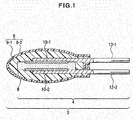
- Fig. 1 shows a cross section of a varistor.
- This varistor 2 is a voltage nonlinear resistor and is an example of an electronic component of this disclosure.
- the varistor 2 includes a voltage nonlinear resistor element (hereinafter simply referred to as the "element") 4 having a surface covered with an exterior packaging material 6.
- the element 4 is an example of a varistor element.
- the ceramic element 8 is, for example, a sintered body mainly made of zinc oxide and having magnesium oxide, bismuth oxide, cobalt oxide, etc. added thereto.
- This sintered body is, for example, a cylinder having a diameter of about 10 [mm].
- Electrodes 10-1, 10-2 are disposed on a surface of the ceramic element 8.
- a lead wire 12-1 is connected to the electrode 10-1 by solder and a lead wire 12-2 is connected to the electrode 10-2 by solder.
- the exterior packaging material 6 includes an exterior packaging resin layer 6-1 and a glass layer 6-2.
- the exterior packaging resin layer 6-1 and the glass layer 6-2 are examples of a first coating layer and a second coating layer, respectively.
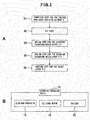
- a of Fig. 2 depicts an order of steps of a production method for the varistor 2.
- the production method for the varistor 2 includes a formation step S1 for an element, a dip step S2, a drying step S3, a curing step S4, and a coating step S5.
- the element 4 is formed.
- the ceramic element 8 of the element 4 is acquired by sintering zinc oxide that is a main component with magnesium oxide, bismuth oxide, cobalt oxide, etc. added thereto.
- a sintered body acquired by this sintering is, for example, a cylinder having a diameter of about 10 [mm].
- the electrode 10-1 and the electrode 10-2 are printed and fired on one surface side and the other surface side, respectively, of the ceramic element 8.
- the lead wire 12-1 described above is connected to the electrode 10-1 by soldering and the lead wire 12-2 is connected to the electrode 10-2 by soldering.
- the formation step S1 for the element 4 is followed by the dip step S2.
- This dip step S2 includes forming the exterior packaging resin layer 6-1 of the exterior packaging material 6 on the element 4 acquired at the formation step S1 for the element.
- an exterior packaging resin 14 is used for the exterior packaging resin layer 6-1.
- aluminum hydroxide 18 and a solvent 20 are added to a silicone resin 16 in the exterior packaging resin 14.
- the range of the additive amount is preferably 60 [wt.%] or more to 65 [wt.%] or less.
- the solvent 20 may be, for example, a solvent species of nonpolar solvents compatible with the silicone resin 16. Since a solvent incompatible with the silicone resin 16 repels the silicone resin 16, a pin hole is generated during drying or an air bubble remains inside the exterior packaging resin layer 6-1, and the compatibility with the silicone resin 16 is important.
- the nonpolar solvent may be any of benzene, toluene, xylene, and cyclohexane, for example.
- the addition of the solvent 20 can make the viscosity of the exterior packaging resin 14 lower and can increase a compounded amount of the aluminum hydroxide 18 relative to the exterior packaging resin 14, so that the formability of the exterior packaging resin 14 is improved. Moreover, since the aluminum hydroxide 18 can uniformly be dispersed, an insulation withstand voltage can be prevented from decreasing due to localization of the aluminum hydroxide 18 in the planar direction of the exterior packaging resin layer 6-1.
- the exterior packaging resin layer 6-1 of the varistor 2 is a one-layer structure and, therefore, unlike a two-layer structure, a pin hole generated in the exterior packaging resin layer 6-1 cannot be covered with a second layer. Therefore, the exterior packaging resin layer 6-1 of the varistor 2 must prevent the localization of the aluminum hydroxide 18 and the pin hole while increasing a compounding ratio of the aluminum hydroxide 18 for improving the flame retardancy.
- the solvent 20 that is a nonpolar solvent compatible with the aluminum hydroxide 18 is added to the silicone resin 16. This configuration must make the viscosity lower without generating the pin hole in the exterior packaging resin 14 and prevent the localization of the aluminum hydroxide 18 so as to achieve both the improvement in the insulation withstand voltage and the maintenance of the formability of an outer surface.
- a higher vapor pressure leads to generation of the pin hole, resulting in an unfavorable surface state of the exterior packaging resin layer 6-1.
- a lower vapor pressure makes the time required for evaporation of the solvent 20 longer at the drying step although the surface state of the exterior packaging resin layer 6-1 is favorable.
- Fig. 3 shows a dip treatment into the exterior packaging resin 14 of the ceramic element 8.
- a dip treatment tank 22 is filled with the exterior packaging resin 14 having lower viscosity.
- a surface of the element 4 is covered with the exterior packaging resin 14 and the exterior packaging resin layer 6-1 described above is formed on the surface of the element 4 as shown in B of Fig. 3 .
- This dip treatment is followed by the drying step S3.
- a large portion of the solvent 20 is volatilized from the exterior packaging resin 14 forming the exterior packaging resin layer 6-1 of the element 4.
- the exterior packaging resin 14 is not completely cured.
- This drying step S3 is preferably performed at normal temperature (20 to 30 [°C]).
- the drying step S3 is followed by the curing step S4.
- the exterior packaging resin layer 6-1 is heat-treated and cured.
- the exterior packaging resin layer 6-1 is given by this curing.
- the solvent 20 remaining after the termination of the drying step S3 is evaporated by the heat treatment and the silicone resin component is caused to appear on the surface of the exterior packaging resin layer 6-1.
- the solvent remaining in the exterior packaging resin 14 moves to the surface of the exterior packaging resin layer 6-1, appears on the surface, and evaporates.
- the silicone resin component appears on the surface of the exterior packaging resin layer 6-1 along with the solvent 20 moving to the surface of the exterior packaging resin layer 6-1.
- the conditions of the curing step may be set as needed and may include a temperature set to 150 [°C], for example, and a curing time set to one hour, for example.
- the region 611 is a thin skin layer and has, for example, a thickness of about 30 [%] of the whole resin thickness.
- the thickness of the region 611 is an example of a depth from the surface of the exterior packaging material 6.
- the aluminum hydroxide 18 has a concentration of about 84 to 100 [%] of the resin compounding ratio, for example.
- the aluminum hydroxide 18 has a concentration of about 100 to 109 [%] of the resin compounding ratio, for example.
- a first region 621, a second region 622, and a third region 623 are formed.
- the region 621 is a thin skin layer and, within 30 [%] in the depth direction from the surface of the thin skin layer, the aluminum hydroxide 18 has a concentration of about 84 to 100 [%] of the resin compounding ratio, for example.
- the aluminum hydroxide 18 In the region 622, within 50 [%] in the depth direction from the surface of the thin skin layer, the aluminum hydroxide 18 has a concentration of about 90 to 100 [%] of the resin compounding ratio.
- the aluminum hydroxide 18 has a concentration of about 100 to 119 [%] of the resin compounding ratio, for example.
- concentrations represent a concentration gradient due to movement of the resin component during curing and the values are maximum estimated values relative to the resin compounding ratio. Since the aluminum hydroxide 18 is supplied from an upper layer to a lower layer, a concentration in the upper layer acquired by subtracting a portion having moved to the lower layer is defined as a concentration range. This concentration range is an average value of a corresponding region and it is considered that a portion having a concentration lower than a lower limit value may locally exist. Therefore, in this treatment, the ranges of the regions 611, 621 may be reduced by 16 [%] of the average minimum values of the regions 611, 621 and the ranges of the regions 612, 622 may be increased by 9 [%] of the average maximum values of the regions 612, 622.
- the concentrations of the aluminum hydroxide 18 are values measured by energy dispersive X-ray spectrometry (EDX).
- the curing step S4 is followed by the coating step S5.
- the coating step S5 the surface of the exterior packaging resin layer 6-1 is subjected to glass coating.
- the element 4 covered with the exterior packaging resin layer 6-1 is immersed into, for example, silica sol, to form a glass coat.
- This glass coat is heat-treated and cured to form the glass layer 6-2.
- the varistor 2 shown in Fig. 1 is acquired.
- a criterion of determination of incombustibility with respect to overvoltage breakdown is that duration of flaming less than 1 [second] indicates effective incombustibility.
- the duration of flaming is less than 1 [second] at the compounding ratio of 60 [wt.%] or more and incombustibility is recognized.
- the duration of flaming is equal to or less than 0.5 [second] at the compounding ratio of 65 [wt.%] or more and preferable incombustibility is recognized.
- the incombustibility is recognized as the duration of flaming less than 1.0 [second] and, when the range of the additive amount of the aluminum hydroxide 18 is from 60 [wt.%] or more to 65 [wt.%] or less, the incombustibility is more preferable. Therefore, the incombustibility of the varistor 2 can be increased while reducing the silicone resin 16.
- a and B of Fig. 6 show measurement values and a graph thereof, respectively.
- B of Fig. 6 includes b, c, and d corresponding to average particle diameters of 15 [ ⁇ m], 30 [ ⁇ m], and 50 [ ⁇ m], respectively.
- a withstand voltage [kV/mm] of 10 [kV/mm] or more is determined as effective insulation withstand voltage.
- the effective insulation withstand voltage of 10 [kV/mm] or more is acquired at a compounding ratio of 65 [wt.%] or less.
- the aluminum hydroxide 18 is added within a range less than 70 [wt.%] to the silicone resin 16 used as a main agent, the effective insulation withstand voltage of 10 [kV/mm] or more is acquired preferably at 60 [wt.%] to 65 [wt.%] and the overvoltage characteristics of the varistor 2 can be maintained.
- the compounding ratio is 60 [wt.%] to 65 [wt.%]
- the average particle diameter of 30 [ ⁇ m] is most preferable.
- a gloss of the surface of the exterior packaging resin layer 6-1 was determined and indicated by ⁇ when the surface was glossy, ⁇ when the gloss is reduced, and ⁇ when the gloss has disappeared.
- the surface of the exterior packaging resin layer 6-1 is preferably glossy so as not to impair the beauty of appearance.
- the rating etc. of the varistor may be printed by a laser on the surface of the exterior packaging resin layer 6-1. In this case, if the laser printing is performed on the glossy surface of the exterior packaging resin layer 6-1, legibility is improved as compared to when the surface is in an uneven state.
- the formation of a gloss layer reduces roughness of a surface state due to high content of the aluminum hydroxide 18 and is effective for improving the beauty of appearance and for preventing scratches due to scraping between packed products.
- the range of the additive amount is preferably set to 60 [wt.%] or more to 65 [wt.%] or less.
- the magnesium hydroxide has the density of 2.36 [g/cm 3 ] and is substantially the same as aluminum hydroxide having the density of 2.42 [g/cm 3 ]. Therefore, the additive amount of the magnesium hydroxide may be set to the conditions equivalent to those in the case of adding the aluminum hydroxide 18 described above based on the weight ratio to the silicone resin 16, for example.
- the average particle diameter of the magnesium hydroxide may be set to a range of 15 [ ⁇ m] or more to less than 50 [ ⁇ m]. Additionally, in the process of forming the exterior packaging resin layer 6-1 of the varistor 2 in the case of adding magnesium hydroxide to the exterior packaging resin 14, the conditions of addition and the conditions of formation of the exterior packaging resin layer 6-1 may be set as in the case of adding the aluminum hydroxide 18 described in the embodiment and the process procedure may be performed in the same way.
- the technique of this disclosure is highly useful since aluminum hydroxide or magnesium hydroxide is added to a silicone resin contained in an exterior packaging material of a varistor to maintain the incombustible property of the silicone resin in accordance with an additive amount thereof and to decrease the used amount of the silicone resin so as to reduce manufacturing costs.
Landscapes
- Engineering & Computer Science (AREA)
- Microelectronics & Electronic Packaging (AREA)
- Chemical & Material Sciences (AREA)
- Physics & Mathematics (AREA)
- Electromagnetism (AREA)
- Manufacturing & Machinery (AREA)
- Inorganic Chemistry (AREA)
- Life Sciences & Earth Sciences (AREA)
- Materials Engineering (AREA)
- Wood Science & Technology (AREA)
- Organic Chemistry (AREA)
- Thermistors And Varistors (AREA)
- Compositions Of Macromolecular Compounds (AREA)
- Apparatuses And Processes For Manufacturing Resistors (AREA)
- Structures Or Materials For Encapsulating Or Coating Semiconductor Devices Or Solid State Devices (AREA)
Abstract
Description
- A technique of this disclosure relates to an electronic component such as a voltage nonlinear resistor and relates to a technique for imparting flame retardancy or incombustibility to an exterior packaging material covering an element.
- Various devices such as electronic devices and electric devices include a combustible material such as plastic used for a housing etc., for the purpose of weight saving and, additionally, since electronic components are mounted at higher density due to requirements for a reduced device size etc., a burnout of an electronic component causes damages of adjacent electronic component and an entire device.
- A varistor (voltage nonlinear resistor) is used as an electronic component protecting electronic components and a device from such an inconvenience. The varistor has voltage nonlinear resistance characteristics in which resistance drastically decreases in response to a rise in applied voltage, and is therefore used as a surge absorption element.
- In an example of the varistor, on the both surfaces of a sintered body acquired by molding of zinc oxide powder mixed with a trace amount of bismuth oxide powder etc. in a metal mold into a disk shape followed by sintering at 1000 [°C] or higher, disk-shaped electrodes with a diameter smaller than the sintered body are baked and, after lead wires are connected by solder to respective outer surfaces of the electrodes to form an element, this element is coated with an epoxy resin to form an exterior packaging. This exterior packaging fulfills a function of increasing the mechanical strength and heat resistance of the varistor.
- The varistor is generally used for protecting electronic components and a device from an external or internal surge and, if the varistor absorbs a surge exceeding a limit of absorption energy, the varistor may be broken and put into a short-circuit state, resulting in the risk of combustion of an exterior packaging material thereof. The exterior packaging material of the varistor is typically made with an inorganic filler component and an epoxy resin component and the combustion of the exterior packaging material is attributable to combustion of the epoxy resin component.
- Therefore, a flame-retardant material is used for the exterior packaging material. This flame-retardant material used is, for example, an epoxy resin containing bromine or antimony, which is a flame-retardant agent. However, although being flame-retardant, the epoxy resin may combust if the varistor generates heat in a continuous manner. Once the epoxy resin combusts, the combustion may continue until a combustible component in the exterior packaging material disappears.
- It is known that this exterior packaging material is made incombustible by adding a flame-retardant agent that is bromine or antimony. When the flame-retardant agent is increased, the resign itself is reduced in a heated flow rate (fluidity), which makes it difficult to form an exterior packaging film. In the case of powder resign coating, the formation of an exterior packaging film becomes difficult at a resin amount of 30 [wt%] or less. If a combustible component in an exterior packaging material is reduced to a combustion limit amount or less, the exterior packaging material can be made incombustible.
- A bromine-based flame-retardant agent has a function of suppressing combustion of a resin component through gasification. A gasified bromine component imposes a heavy environmental burden such as ozone layer depletion and the usage thereof tends to be limited.
- With regard to making a varistor exterior packaging material incombustible, a varistor is known that has a silicone resin used as a coating material excellent in incombustibility in a protective coat (e.g., Patent Document 1).
- With regard to combustion suppression of a silicone resin, a varistor is known that is improved in flame retardancy of an exterior packaging material by adding aluminum hydroxide or magnesium hydroxide as a flame-retardant agent to a silicone resin or silicone elastomer so as to restrain ceramic contents and the exterior packaging material itself from scattering by rubber elasticity of the silicone resin or silicone elastomer (e.g., Patent Document 2).
- A varistor is also known that is coated by using as an exterior packaging material a silicone rubber acquired by adding a hardening agent to a liquid silicone main agent and adding aluminum hydroxide to these two agents (e.g., Patent Document 3).
-
- Patent Document 1: Japanese Laid-Open Patent Publication No.
6-215910 - Patent Document 2: Japanese Laid-Open Patent Publication No.
2005-277100 - Patent Document 3: Japanese Laid-Open Patent Publication No.
2006-286986 - Electronic components including varistors are required to have higher overvoltage while maintaining conventional overvoltage characteristics. For such electronic components, a silicone-based resin material is essential, while the material is expensive.
- It is therefore an object of the present invention to reduce a silicone resin while maintaining incombustibility and insulation withstand voltage characteristics.
- To achieve the object, according to an aspect of the technique of this disclosure, a production method for an electronic component using an exterior packaging material containing a silicone resin comprises a step of dipping an element into an exterior packaging material containing a silicone resin to which aluminum hydroxide or magnesium hydroxide and a nonpolar solvent are added, an additive amount of the aluminum hydroxide or the magnesium hydroxide being controlled to a range of 60 [wt.%] or more to less than 70 [wt.%]; a step of drying the exterior packaging material formed on a surface of the element to evaporate the nonpolar solvent and cause a silicone resin component to appear on a surface of the exterior packaging material; and a curing step of curing the exterior packaging material.
- In the production method for an electronic component, the additive amount of the aluminum hydroxide or the magnesium hydroxide may be within a range of 60 [wt. %] or more to 65 [wt. %] or less.
- In the production method for an electronic component, the aluminum hydroxide or the magnesium hydroxide may have an average particle diameter within a range of 15 [µm] or more to less than 50 [µm].
- In the production method for an electronic component, the nonpolar solvent may have a vapor pressure of 0.5 to 10 [kPa].
- To achieve the object, according to an aspect of the technique of this disclosure, an electronic component uses an exterior packaging material containing a silicone resin, a nonpolar solvent and aluminum hydroxide or magnesium hydroxide is added to the silicone resin, the aluminum hydroxide or the magnesium hydroxide is added in an additive amount within a range of 60 [wt.%] or more to less than 70 [wt.%], the nonpolar solvent appears on and evaporates from a surface of the exterior packaging material by drying, and the silicone resin appears and cures on the surface of the exterior packaging material.
- In the electronic component, the aluminum hydroxide or the magnesium hydroxide may have an average particle diameter within a range of 15 [µm] or more to less than 50 [µm].
- In the electronic component, the exterior packaging material may contain the aluminum hydroxide or the magnesium hydroxide having a concentration gradient from 84 to 100 [%] in the depth direction within 30 [%] from the exterior packaging material surface.
- According to the present invention, any of the following effects are provided.
- (1) The silicone resin can be reduced while maintaining incombustibility and insulation withstand voltage characteristics of the exterior packaging material.
- (2) Even if a varistor is instantaneously destroyed due to application of overvoltage exceeding a rated voltage, an exterior packaging resin can be restrained from scattering.
- (3) A used amount of the silicone resin can be decreased and a manufacturing cost can be reduced.
- Other objects, features, and advantages of the present invention will further be clarified by reference to the accompanying drawings and embodiments.
-
-
Fig. 1 is a cross-sectional view of a varistor according to a first embodiment. -
Fig. 2 is a diagram of process steps of a producing method and an exterior packaging resin for the varistor. -
Fig. 3 is a diagram of a dip treatment of an exterior packaging resign layer. -
Fig. 4 is a cross-sectional view of states of the exterior packaging resign layer and a glass layer. -
Fig. 5 is a diagram of experiment results of incombustibility. -
Fig. 6 is a diagram of experiment results of insulation withstand voltage. -
Fig. 7 is a diagram of evaluation results of a surface state of the exterior packaging resign layer. -
Fig. 1 shows a cross section of a varistor. - This
varistor 2 is a voltage nonlinear resistor and is an example of an electronic component of this disclosure. - The
varistor 2 includes a voltage nonlinear resistor element (hereinafter simply referred to as the "element") 4 having a surface covered with anexterior packaging material 6. Theelement 4 is an example of a varistor element. - For the
element 4, aceramic element 8 is used. Theceramic element 8 is, for example, a sintered body mainly made of zinc oxide and having magnesium oxide, bismuth oxide, cobalt oxide, etc. added thereto. This sintered body is, for example, a cylinder having a diameter of about 10 [mm]. - Electrodes 10-1, 10-2 are disposed on a surface of the
ceramic element 8. A lead wire 12-1 is connected to the electrode 10-1 by solder and a lead wire 12-2 is connected to the electrode 10-2 by solder. - By way of example, the
exterior packaging material 6 includes an exterior packaging resin layer 6-1 and a glass layer 6-2. The exterior packaging resin layer 6-1 and the glass layer 6-2 are examples of a first coating layer and a second coating layer, respectively. - A of
Fig. 2 depicts an order of steps of a production method for thevaristor 2. - The production method for the
varistor 2 includes a formation step S1 for an element, a dip step S2, a drying step S3, a curing step S4, and a coating step S5. - At the formation step S1 for an element, the
element 4 is formed. By way of example, theceramic element 8 of theelement 4 is acquired by sintering zinc oxide that is a main component with magnesium oxide, bismuth oxide, cobalt oxide, etc. added thereto. A sintered body acquired by this sintering is, for example, a cylinder having a diameter of about 10 [mm]. The electrode 10-1 and the electrode 10-2 are printed and fired on one surface side and the other surface side, respectively, of theceramic element 8. - The lead wire 12-1 described above is connected to the electrode 10-1 by soldering and the lead wire 12-2 is connected to the electrode 10-2 by soldering.
- The formation step S1 for the
element 4 is followed by the dip step S2. This dip step S2 includes forming the exterior packaging resin layer 6-1 of theexterior packaging material 6 on theelement 4 acquired at the formation step S1 for the element. By way of example, anexterior packaging resin 14 is used for the exterior packaging resin layer 6-1. As shown in B ofFig. 2 ,aluminum hydroxide 18 and a solvent 20 are added to asilicone resin 16 in theexterior packaging resin 14. - The
aluminum hydroxide 18 is added within a range less than 70 [weight percent=wt.%] to thesilicone resin 16 that is a main agent. The range of the additive amount is preferably 60 [wt.%] or more to 65 [wt.%] or less. - The solvent 20 may be, for example, a solvent species of nonpolar solvents compatible with the
silicone resin 16. Since a solvent incompatible with thesilicone resin 16 repels thesilicone resin 16, a pin hole is generated during drying or an air bubble remains inside the exterior packaging resin layer 6-1, and the compatibility with thesilicone resin 16 is important. The nonpolar solvent may be any of benzene, toluene, xylene, and cyclohexane, for example. - The addition of the solvent 20 can make the viscosity of the
exterior packaging resin 14 lower and can increase a compounded amount of thealuminum hydroxide 18 relative to theexterior packaging resin 14, so that the formability of theexterior packaging resin 14 is improved. Moreover, since thealuminum hydroxide 18 can uniformly be dispersed, an insulation withstand voltage can be prevented from decreasing due to localization of thealuminum hydroxide 18 in the planar direction of the exterior packaging resin layer 6-1. - The exterior packaging resin layer 6-1 of the
varistor 2 is a one-layer structure and, therefore, unlike a two-layer structure, a pin hole generated in the exterior packaging resin layer 6-1 cannot be covered with a second layer. Therefore, the exterior packaging resin layer 6-1 of thevaristor 2 must prevent the localization of thealuminum hydroxide 18 and the pin hole while increasing a compounding ratio of thealuminum hydroxide 18 for improving the flame retardancy. Thus, the solvent 20 that is a nonpolar solvent compatible with thealuminum hydroxide 18 is added to thesilicone resin 16. This configuration must make the viscosity lower without generating the pin hole in theexterior packaging resin 14 and prevent the localization of thealuminum hydroxide 18 so as to achieve both the improvement in the insulation withstand voltage and the maintenance of the formability of an outer surface. The nonpolar solvent preferably has a vapor pressure (=volatility) of 0.5 to 10 [kPa] or around 0.5 to 10 [kPa]. A higher vapor pressure leads to generation of the pin hole, resulting in an unfavorable surface state of the exterior packaging resin layer 6-1. On the other hand, a lower vapor pressure makes the time required for evaporation of the solvent 20 longer at the drying step although the surface state of the exterior packaging resin layer 6-1 is favorable. -
Fig. 3 shows a dip treatment into theexterior packaging resin 14 of theceramic element 8. - As shown in A of
Fig. 3 , adip treatment tank 22 is filled with theexterior packaging resin 14 having lower viscosity. By dipping theelement 4 into theexterior packaging resin 14 and pulling up theelement 4 from theexterior packaging resin 14, a surface of theelement 4 is covered with theexterior packaging resin 14 and the exterior packaging resin layer 6-1 described above is formed on the surface of theelement 4 as shown in B ofFig. 3 . - This dip treatment is followed by the drying step S3. At the drying step S3, a large portion of the solvent 20 is volatilized from the
exterior packaging resin 14 forming the exterior packaging resin layer 6-1 of theelement 4. At this step, theexterior packaging resin 14 is not completely cured. - This drying step S3 is preferably performed at normal temperature (20 to 30 [°C]).
- The drying step S3 is followed by the curing step S4. At the curing step S4, the exterior packaging resin layer 6-1 is heat-treated and cured. The exterior packaging resin layer 6-1 is given by this curing. At the curing step S4, the solvent 20 remaining after the termination of the drying step S3 is evaporated by the heat treatment and the silicone resin component is caused to appear on the surface of the exterior packaging resin layer 6-1. In particular, by being subjected to the heat treatment, the solvent remaining in the
exterior packaging resin 14 moves to the surface of the exterior packaging resin layer 6-1, appears on the surface, and evaporates. In this case, the silicone resin component appears on the surface of the exterior packaging resin layer 6-1 along with the solvent 20 moving to the surface of the exterior packaging resin layer 6-1. Subsequently, the silicone resin component having appeared on the surface of the exterior packaging resin layer 6-1 is further subjected to the heat treatment and cured, becoming glossy. The conditions of the curing step may be set as needed and may include a temperature set to 150 [°C], for example, and a curing time set to one hour, for example. - There are a first design shown in A of
Fig. 4 and a second design shown in B ofFig. 4 as such a treatment. In the first design, as shown in A ofFig. 4 , afirst region 611 and asecond region 612 are formed on the surface of theelement 4. Theregion 611 is a thin skin layer and has, for example, a thickness of about 30 [%] of the whole resin thickness. The thickness of theregion 611 is an example of a depth from the surface of theexterior packaging material 6. In theregion 611, within 30 [%] in the depth direction from the surface of the thin skin layer, thealuminum hydroxide 18 has a concentration of about 84 to 100 [%] of the resin compounding ratio, for example. In theregion 612, at 30 [%] or more in the depth direction from the surface of the thin skin layer, thealuminum hydroxide 18 has a concentration of about 100 to 109 [%] of the resin compounding ratio, for example. - In the second design, a
first region 621, asecond region 622, and athird region 623 are formed. Theregion 621 is a thin skin layer and, within 30 [%] in the depth direction from the surface of the thin skin layer, thealuminum hydroxide 18 has a concentration of about 84 to 100 [%] of the resin compounding ratio, for example. In theregion 622, within 50 [%] in the depth direction from the surface of the thin skin layer, thealuminum hydroxide 18 has a concentration of about 90 to 100 [%] of the resin compounding ratio. In theregion 623, at 50 [%] or more in the depth direction from the surface of the thin skin layer, thealuminum hydroxide 18 has a concentration of about 100 to 119 [%] of the resin compounding ratio, for example. These concentrations represent a concentration gradient due to movement of the resin component during curing and the values are maximum estimated values relative to the resin compounding ratio. Since thealuminum hydroxide 18 is supplied from an upper layer to a lower layer, a concentration in the upper layer acquired by subtracting a portion having moved to the lower layer is defined as a concentration range. This concentration range is an average value of a corresponding region and it is considered that a portion having a concentration lower than a lower limit value may locally exist. Therefore, in this treatment, the ranges of theregions regions regions regions - The concentrations of the
aluminum hydroxide 18 are values measured by energy dispersive X-ray spectrometry (EDX). - The curing step S4 is followed by the coating step S5. At the coating step S5, the surface of the exterior packaging resin layer 6-1 is subjected to glass coating. In this glass coating, the
element 4 covered with the exterior packaging resin layer 6-1 is immersed into, for example, silica sol, to form a glass coat. This glass coat is heat-treated and cured to form the glass layer 6-2. As a result, thevaristor 2 shown inFig. 1 is acquired. -
- (1) Since the
silicone resin 16 is used as a main agent and thealuminum hydroxide 18 is added at less than 70 [wt.%], more preferably 60 to 65 [wt.%], thesilicone region 16 can accordingly be reduced. As a result, costs such as material costs can be reduced. - (2) The solvent 20 can be added to the
exterior packaging resin 14 to restrain the viscosity from increasing due to thealuminum hydroxide 18. In particular, since the viscosity of theexterior packaging resin 14 is reduced by adding the solvent 20, a larger amount of thealuminum hydroxide 18 can be contained and the formability of the exterior packaging resin layer 6-1 can be improved by theexterior packaging resin 14. - (3) Since the viscosity of the
exterior packaging resin 14 is reduced by adding the solvent 20, the localization of thealuminum hydroxide 18 can be prevented with respect to theexterior packaging resin 14. As a result, the insulation withstand voltage of thevaristor 2 can be prevented from decreasing due to the localization of thealuminum hydroxide 18 in the exterior packaging resin layer 6-1. Therefore, excellent overvoltage characteristics are acquired. - (4) Since the
silicone resin 16 can be caused to appear on the surface of the exterior packaging resin layer 6-1 in association with the evaporation of the solvent 20 at the curing step, the surface of thevaristor 2 can be made glossy. - (5) Since the
silicone resin 16 has flexibility, even if the varistor is instantaneously destroyed due to application of overvoltage exceeding a rated voltage, the exterior packaging resin layer 6-1 can be restrained from scattering. - (6) Since the surface of the exterior packaging resin layer 6-1 is in a glossy state, legibility is improved when the rating etc. of the varistor are printed by a laser on the surface of the exterior packaging resin layer 6-1.
- (7) By causing the
silicone resin 16 to appear on the surface of the exterior packaging resin layer 6-1, scratches can be prevented from being formed on the surface and scratch resistance is improved. - (8) Since the nonpolar solvent is used for the solvent 20, the solvent 20 is compatible with the
silicone resin 16, and a pin hole can be prevented from being generated in the exterior packaging resin layer 6-1. As a result, the insulation withstand voltage of thevaristor 2 can further be prevented from decreasing. - (9) Since the exterior packaging resin layer 6-1 has the concentration of the
aluminum hydroxide 18 made higher as it approaches theelement 4, the effect of suppressing the combustion of theelement 4 is further increased. - This evaluation of incombustibility relates to flaming characteristics of the
varistor 2. In this evaluation experiment, when AC voltage was applied at the applied voltage ratio of 85 [%] (varistor voltage V1 [mA]×0.85), duration of flaming of the exterior packaging resin layer 6-1 of theexterior packaging material 6 was measured for each compounding ratio [wt.%] by using the particle diameter [µm] of thealuminum hydroxide 18 as a parameter. A and B ofFig. 5 show measurement values and a graph thereof, respectively. B ofFig. 5 includes a, b, c, and d corresponding to average particle diameters of 10 [µm], 15 [µm], 30 [µm], and 50 [µm], respectively. - In this evaluation of incombustibility, a criterion of determination of incombustibility with respect to overvoltage breakdown is that duration of flaming less than 1 [second] indicates effective incombustibility.
- According to this evaluation experiment, when the average particle diameter is 30 [µm] or more, the duration of flaming is less than 1 [second] at the compounding ratio of 55 [wt.%] or more and incombustibility is recognized.
- When the average particle diameter is less than 30 [µm], the duration of flaming is less than 1 [second] at the compounding ratio of 60 [wt.%] or more and incombustibility is recognized.
- Even when the average particle diameter is 10 [µm] to 50 [µm], the duration of flaming is equal to or less than 0.5 [second] at the compounding ratio of 65 [wt.%] or more and preferable incombustibility is recognized.
- As described above, by adding the
aluminum hydroxide 18 within a range less than 70 [wt.%] to thesilicone resin 16 used as a main agent, the incombustibility is recognized as the duration of flaming less than 1.0 [second] and, when the range of the additive amount of thealuminum hydroxide 18 is from 60 [wt.%] or more to 65 [wt.%] or less, the incombustibility is more preferable. Therefore, the incombustibility of thevaristor 2 can be increased while reducing thesilicone resin 16. - In this evaluation experiment of insulation withstand voltage, the insulation breakdown at a compounding ratio [wt.%] was measured by using the particle diameter [µm] of the
aluminum hydroxide 18 as a parameter. A and B ofFig. 6 show measurement values and a graph thereof, respectively. B ofFig. 6 includes b, c, and d corresponding to average particle diameters of 15 [µm], 30 [µm], and 50 [µm], respectively. - In this evaluation of insulation withstand voltage, a withstand voltage [kV/mm] of 10 [kV/mm] or more is determined as effective insulation withstand voltage.
- According to this evaluation experiment, regardless of the average particle diameters of 15 [µm], 30 [µm], and 50 [µm], the effective insulation withstand voltage of 10 [kV/mm] or more is acquired at a compounding ratio of 65 [wt.%] or less.
- Therefore, if the
aluminum hydroxide 18 is added within a range less than 70 [wt.%] to thesilicone resin 16 used as a main agent, the effective insulation withstand voltage of 10 [kV/mm] or more is acquired preferably at 60 [wt.%] to 65 [wt.%] and the overvoltage characteristics of thevaristor 2 can be maintained. When the compounding ratio is 60 [wt.%] to 65 [wt.%], the average particle diameter of 30 [µm] is most preferable. - This evaluation of a surface state was performed by visually observing a surface quality of the exterior packaging resin layer 6-1 formed on the
element 4.Fig. 7 shows evaluation results thereof. - In this evaluation, a gloss of the surface of the exterior packaging resin layer 6-1 was determined and indicated by ○ when the surface was glossy, Δ when the gloss is reduced, and × when the gloss has disappeared.
- In the evaluation of the gloss, regardless of the particle diameter, the gloss of the surface has disappeared when the compounding ratio of the
aluminum hydroxide 18 is set to 70 [wt. %]. - Although the gloss of the surface of the exterior packaging resin layer 6-1 does not directly affect the function of the
varistor 2, the surface of the exterior packaging resin layer 6-1 is preferably glossy so as not to impair the beauty of appearance. Additionally, the rating etc. of the varistor may be printed by a laser on the surface of the exterior packaging resin layer 6-1. In this case, if the laser printing is performed on the glossy surface of the exterior packaging resin layer 6-1, legibility is improved as compared to when the surface is in an uneven state. The formation of a gloss layer reduces roughness of a surface state due to high content of thealuminum hydroxide 18 and is effective for improving the beauty of appearance and for preventing scratches due to scraping between packed products. -
- (1) In the embodiment, the curing step S4 is followed by the coating step S5 for the glass coating on the surface of the exterior packaging resin layer 6-1 to form the glass layer 6-2; however, the glass layer 6-2 may not be provided.
- (2) Although the
exterior packaging resin 14 forming the exterior packaging resin layer 6-1 has been described as having thealuminum hydroxide 18 and the solvent 20 added to thesilicone resin 16 in the embodiment, this is not a limitation. To thesilicone resin 16, for example, magnesium hydroxide may be added as a flame-retardant agent along with the solvent 20. - The magnesium hydroxide is added within a range less than 70 [weight percent=wt.%] to, for example, the
silicone resin 16 that is a main agent. The range of the additive amount is preferably set to 60 [wt.%] or more to 65 [wt.%] or less. The magnesium hydroxide has the density of 2.36 [g/cm3] and is substantially the same as aluminum hydroxide having the density of 2.42 [g/cm3]. Therefore, the additive amount of the magnesium hydroxide may be set to the conditions equivalent to those in the case of adding thealuminum hydroxide 18 described above based on the weight ratio to thesilicone resin 16, for example. - The average particle diameter of the magnesium hydroxide may be set to a range of 15 [µm] or more to less than 50 [µm]. Additionally, in the process of forming the exterior packaging resin layer 6-1 of the
varistor 2 in the case of adding magnesium hydroxide to theexterior packaging resin 14, the conditions of addition and the conditions of formation of the exterior packaging resin layer 6-1 may be set as in the case of adding thealuminum hydroxide 18 described in the embodiment and the process procedure may be performed in the same way. - (a) With this configuration, the
exterior packaging resin 14 with the magnesium hydroxide added can have a dehydration start temperature set higher as compared to the case of adding thealuminum hydroxide 18. In particular, theexterior packaging resin 14 has the dehydration start temperature of about 200 [°C] when aluminum hydroxide is added, and has the dehydration start temperature of about 300 [°C] when magnesium hydroxide is added. When thevaristor 2 locally generates heat due to application of a surge, theexterior packaging material 6 undergoes "dehydration" → "gasification" → "swelling" → "exfoliation of resin" → "spark" → "failure mode." When the dehydration start temperature of theexterior packaging resin 14 is made higher, thevaristor 2 can function under a higher heat generation temperature and can be utilized in an electronic device to which a larger surge voltage is possible applied. - (b) Since the
silicone resin 16 is used as a main agent and magnesium hydroxide is added at less than 70 [wt.%], more preferably 60 to 65 [wt.%], thesilicone region 16 can accordingly be reduced. As a result, costs such as material costs can be reduced. - (c) The solvent 20 can be added to the
exterior packaging resin 14 to restrain the viscosity from increasing due to magnesium hydroxide. In particular, since the viscosity of theexterior packaging resin 14 is reduced by adding the solvent 20, a larger amount of magnesium hydroxide can be contained and the formability of the exterior packaging resin layer 6-1 can be improved by theexterior packaging resin 14. - (d) Since the viscosity of the
exterior packaging resin 14 is reduced by adding the solvent 20, the localization of magnesium hydroxide can be prevented with respect to theexterior packaging resin 14. As a result, the insulation withstand voltage of thevaristor 2 can be prevented from decreasing due to the localization of magnesium hydroxide in the exterior packaging resin layer 6-1. Therefore, excellent overvoltage characteristics are acquired. - (e) Since the
silicone resin 16 can be caused to appear on the surface of the exterior packaging resin layer 6-1 in association with the evaporation of the solvent 20 at the curing step, the surface of thevaristor 2 can be made glossy. - (f) Since the
silicone resin 16 has flexibility, even if the varistor is instantaneously destroyed due to application of overvoltage exceeding a rated voltage, the exterior packaging resin layer 6-1 can be restrained from scattering. - (g) Since the surface of the exterior packaging resin layer 6-1 is in a glossy state, legibility is improved when the rating etc. of the varistor are printed by a laser on the surface of the exterior packaging resin layer 6-1.
- (h) By causing the
silicone resin 16 to appear on the surface of the exterior packaging resin layer 6-1, scratches can be prevented from being formed on the surface and scratch resistance is improved. - (i) Since the nonpolar solvent is used for the solvent 20, the solvent 20 is compatible with the
silicone resin 16, and a pin hole can be prevented from being generated in the exterior packaging resin layer 6-1. As a result, the insulation withstand voltage of thevaristor 2 can further be prevented from decreasing. - (j) Since the exterior packaging resin layer 6-1 has the concentration of magnesium hydroxide made higher as it approaches the
element 4, the effect of suppressing the combustion of theelement 4 is further increased. - As described above, the most preferable embodiment etc. of the present invention have been described. The present invention is not limited to the above description and can variously be modified and altered by those skilled in the art based on the spirit of the invention described in claims or disclosed in modes for carrying out the invention. These modifications and alterations obviously fall within the scope of the present invention.
- The technique of this disclosure is highly useful since aluminum hydroxide or magnesium hydroxide is added to a silicone resin contained in an exterior packaging material of a varistor to maintain the incombustible property of the silicone resin in accordance with an additive amount thereof and to decrease the used amount of the silicone resin so as to reduce manufacturing costs.
-
- 2
- varistor
- 4
- voltage nonlinear resistor element
- 6
- exterior packaging material
- 6-1
- exterior packaging resin layer
- 6-2
- glass layer
- 8
- ceramic element
- 10-1, 10-2
- electrode
- 12-1, 12-2
- lead wire
- 14
- exterior packaging resin
- 16
- silicone resin
- 18
- aluminum hydroxide
- 20
- solvent
- 22
- dip treatment tank
- 611, 621
- first region
- 612, 622
- second region
- 623
- third region
Claims (7)
- A production method for an electronic component using an exterior packaging material containing a silicone resin, the method comprising:a step of dipping an element into an exterior packaging material containing a silicone resin to which aluminum hydroxide or magnesium hydroxide and a nonpolar solvent are added, an additive amount of the aluminum hydroxide or the magnesium hydroxide being controlled to a range of 60 [wt.%] or more to less than 70 [wt.%];a step of drying the exterior packaging material formed on a surface of the element to evaporate the nonpolar solvent and cause a silicone resin component to appear on a surface of the exterior packaging material; anda curing step of curing the exterior packaging material.
- The production method for an electronic component according to claim 1, wherein the additive amount of the aluminum hydroxide or the magnesium hydroxide is within a range of 60 [wt.%] or more to 65 [wt.%] or less.
- The production method for an electronic component according to claim 1 or 2, wherein the aluminum hydroxide or the magnesium hydroxide has an average particle diameter within a range of 15 [µm] or more to less than 50 [µm].
- The production method for an electronic component according to any one of claims 1 to 3, wherein the nonpolar solvent has a vapor pressure of 0.5 to 10 [kPa].
- An electronic component using an exterior packaging material containing a silicone resin, wherein a nonpolar solvent and aluminum hydroxide or magnesium hydroxide is added to the silicone resin, the aluminum hydroxide or the magnesium hydroxide is added in an additive amount within a range of 60 [wt.%] or more to less than 70 [wt.%], the nonpolar solvent appears on and evaporates from a surface of the exterior packaging material by drying, and the silicone resin appears and cures on the surface of the exterior packaging material.
- The electronic component according to claim 5, wherein the aluminum hydroxide or the magnesium hydroxide has an average particle diameter within a range of 15 [µm] or more to less than 50 [µm].
- The electronic component according to claim 5 or 6, wherein the exterior packaging material contains the aluminum hydroxide or the magnesium hydroxide having a concentration gradient from 84 to 100 [%] in the depth direction within 30 [%] from the exterior packaging material surface.
Applications Claiming Priority (2)
| Application Number | Priority Date | Filing Date | Title |
|---|---|---|---|
| JP2013235138 | 2013-11-13 | ||
| PCT/JP2014/005679 WO2015072138A1 (en) | 2013-11-13 | 2014-11-12 | Electronic component and production method therefor |
Publications (3)
| Publication Number | Publication Date |
|---|---|
| EP3070720A1 true EP3070720A1 (en) | 2016-09-21 |
| EP3070720A4 EP3070720A4 (en) | 2017-11-29 |
| EP3070720B1 EP3070720B1 (en) | 2019-06-12 |
Family
ID=53057088
Family Applications (1)
| Application Number | Title | Priority Date | Filing Date |
|---|---|---|---|
| EP14862954.6A Active EP3070720B1 (en) | 2013-11-13 | 2014-11-12 | Electronic component and production method therefor |
Country Status (7)
| Country | Link |
|---|---|
| US (1) | US9892830B2 (en) |
| EP (1) | EP3070720B1 (en) |
| JP (1) | JP6561839B2 (en) |
| KR (1) | KR102181912B1 (en) |
| CN (1) | CN105706189B (en) |
| TW (1) | TWI646560B (en) |
| WO (1) | WO2015072138A1 (en) |
Families Citing this family (4)
| Publication number | Priority date | Publication date | Assignee | Title |
|---|---|---|---|---|
| JP6822766B2 (en) * | 2015-01-22 | 2021-01-27 | 旭化成株式会社 | Mold containing polyamide resin composition |
| KR102507857B1 (en) * | 2016-11-04 | 2023-03-08 | 주식회사 아모텍 | Protection device for open mode and electric apparatus with the same |
| KR102486920B1 (en) * | 2016-11-03 | 2023-01-10 | 주식회사 아모텍 | Method for manufacturing protection device for open mode |
| CN112614639B (en) * | 2020-12-01 | 2022-04-26 | 辰硕电子(九江)有限公司 | MOV chip is with having explosion-proof pressure release's big module MOV installation component |
Family Cites Families (23)
| Publication number | Priority date | Publication date | Assignee | Title |
|---|---|---|---|---|
| GB8806497D0 (en) * | 1988-03-18 | 1988-04-20 | Mortile Acoustic Ind Ltd | Non-toxic fire retardant thermoplastic material |
| JPH06215910A (en) * | 1993-01-14 | 1994-08-05 | Tama Electric Co Ltd | Varistor with thermal fuse |
| JP3305941B2 (en) | 1996-01-22 | 2002-07-24 | 株式会社村田製作所 | Electronic components |
| TW394961B (en) * | 1997-03-20 | 2000-06-21 | Ceratech Corp | Low capacitance chip varistor and fabrication method thereof |
| TW464885B (en) * | 1999-10-04 | 2001-11-21 | Tdk Corp | Voltage nonlinear resistor and manufacturing method thereof |
| JP2001291427A (en) * | 2000-04-06 | 2001-10-19 | Dow Corning Toray Silicone Co Ltd | Electrically insulating thin film-forming resin composition and method for forming electrically insulating thin film |
| JP2004247479A (en) * | 2003-02-13 | 2004-09-02 | Nippon Chemicon Corp | Electronic component |
| JP2004281934A (en) * | 2003-03-18 | 2004-10-07 | Nippon Chemicon Corp | Electronic component and method for manufacturing the same |
| JP2005243746A (en) * | 2004-02-24 | 2005-09-08 | Nippon Chemicon Corp | Varistor |
| JP5047454B2 (en) | 2004-03-24 | 2012-10-10 | 日本ケミコン株式会社 | Electronic components |
| JP2006002029A (en) * | 2004-06-17 | 2006-01-05 | Fujikura Ltd | Polyolefin flame-retardant resin composition and heat-resistant and wear-resistant flame-retardant insulated wire |
| SE527949C2 (en) * | 2004-12-22 | 2006-07-18 | Abb Research Ltd | Method of producing a varistor |
| JP4650622B2 (en) * | 2005-03-31 | 2011-03-16 | 日本ケミコン株式会社 | Voltage nonlinear resistor |
| JP4572275B2 (en) * | 2006-07-10 | 2010-11-04 | 福井県 | Flame retardant processing of organic polymer materials |
| CN101302343A (en) * | 2008-07-10 | 2008-11-12 | 天津市凯华绝缘材料有限公司 | Flame-retardant organosilicon powder encapsulating material for electronic component |
| DE102009023846B4 (en) * | 2009-02-03 | 2024-02-01 | Tdk Electronics Ag | Varistor ceramic, multilayer component comprising the varistor ceramic, manufacturing process for the varistor ceramic |
| JP2010192539A (en) | 2009-02-16 | 2010-09-02 | Nippon Chemicon Corp | Method for manufacturing electronic component |
| CN101630553B (en) * | 2009-07-17 | 2011-10-12 | 立昌先进科技股份有限公司 | A kind of preparation method of zinc oxide varistor |
| TW201205606A (en) * | 2010-07-16 | 2012-02-01 | Yageo Corp | Manufacturing method of overvoltage protector |
| CN101962519A (en) * | 2010-09-18 | 2011-02-02 | 海宁市科泰克金属表面技术有限公司 | Liquid insulating glue for cable joint |
| GB201119826D0 (en) * | 2011-11-17 | 2011-12-28 | Dow Corning | Silicone resin |
| JP2013145794A (en) * | 2012-01-13 | 2013-07-25 | Canon Inc | Imprint device and imprint method, manufacturing method of article using the same |
| JP5974574B2 (en) | 2012-03-23 | 2016-08-23 | 富士ゼロックス株式会社 | Resin composition and resin molded body |
-
2014
- 2014-11-12 EP EP14862954.6A patent/EP3070720B1/en active Active
- 2014-11-12 CN CN201480060992.5A patent/CN105706189B/en active Active
- 2014-11-12 KR KR1020167012114A patent/KR102181912B1/en active Active
- 2014-11-12 TW TW103139248A patent/TWI646560B/en active
- 2014-11-12 WO PCT/JP2014/005679 patent/WO2015072138A1/en not_active Ceased
- 2014-11-12 JP JP2015547640A patent/JP6561839B2/en active Active
-
2016
- 2016-05-10 US US15/150,903 patent/US9892830B2/en not_active Expired - Fee Related
Also Published As
| Publication number | Publication date |
|---|---|
| CN105706189A (en) | 2016-06-22 |
| US20160254081A1 (en) | 2016-09-01 |
| EP3070720B1 (en) | 2019-06-12 |
| WO2015072138A1 (en) | 2015-05-21 |
| US9892830B2 (en) | 2018-02-13 |
| CN105706189B (en) | 2019-05-03 |
| JPWO2015072138A1 (en) | 2017-03-16 |
| KR102181912B1 (en) | 2020-11-23 |
| EP3070720A4 (en) | 2017-11-29 |
| JP6561839B2 (en) | 2019-08-21 |
| TW201530572A (en) | 2015-08-01 |
| TWI646560B (en) | 2019-01-01 |
| KR20160083004A (en) | 2016-07-11 |
Similar Documents
| Publication | Publication Date | Title |
|---|---|---|
| KR101190900B1 (en) | Electronic component manufacturing method | |
| US9892830B2 (en) | Electronic component and production method therefor | |
| US8974706B2 (en) | Dielectric material with non-linear dielectric constant | |
| WO2017026391A1 (en) | Dc cable, and method for manufacturing composition and dc cable | |
| CN1639809A (en) | Coated varistor | |
| JP4650622B2 (en) | Voltage nonlinear resistor | |
| JP5157349B2 (en) | Electronic components | |
| JP5679873B2 (en) | Arc resistant insulation and circuit breakers | |
| JP7536178B2 (en) | Semiconductive member, stator coil and rotating electric machine | |
| JP2004281934A (en) | Electronic component and method for manufacturing the same | |
| JP5364285B2 (en) | Electronic component and method for forming exterior film of electronic component | |
| JP5047454B2 (en) | Electronic components | |
| US11873403B2 (en) | Electric field grading composition, methods of making the same, and composite articles including the same | |
| CN209388805U (en) | Voltage dependent resistor | |
| Li et al. | Characterization of water absorbed epoxy insulating coating material used in ZnO varistors by dielectric measurements | |
| JP2005243746A (en) | Varistor | |
| JP2004247479A (en) | Electronic component | |
| TWI703186B (en) | Coating composition, coating and varistor containing the coating | |
| JP4513938B2 (en) | Electronic components | |
| JP2004039999A (en) | Varistor and manufacturing method thereof | |
| KR102218896B1 (en) | Electrostatic discharge protection composition and electrostatic discharge protection device using the same | |
| TWM573883U (en) | Varistor |
Legal Events
| Date | Code | Title | Description |
|---|---|---|---|
| PUAI | Public reference made under article 153(3) epc to a published international application that has entered the european phase |
Free format text: ORIGINAL CODE: 0009012 |
|
| 17P | Request for examination filed |
Effective date: 20160509 |
|
| AK | Designated contracting states |
Kind code of ref document: A1 Designated state(s): AL AT BE BG CH CY CZ DE DK EE ES FI FR GB GR HR HU IE IS IT LI LT LU LV MC MK MT NL NO PL PT RO RS SE SI SK SM TR |
|
| AX | Request for extension of the european patent |
Extension state: BA ME |
|
| DAX | Request for extension of the european patent (deleted) | ||
| A4 | Supplementary search report drawn up and despatched |
Effective date: 20171102 |
|
| RIC1 | Information provided on ipc code assigned before grant |
Ipc: C09D 7/12 20060101ALI20171025BHEP Ipc: H01C 17/02 20060101AFI20171025BHEP Ipc: H01C 7/10 20060101ALI20171025BHEP Ipc: C08K 3/22 20060101ALI20171025BHEP Ipc: H01C 1/034 20060101ALI20171025BHEP Ipc: H01C 7/102 20060101ALI20171025BHEP |
|
| REG | Reference to a national code |
Ref country code: DE Ref legal event code: R079 Ref document number: 602014048398 Country of ref document: DE Free format text: PREVIOUS MAIN CLASS: H01C0017020000 Ipc: H01C0007120000 |
|
| GRAP | Despatch of communication of intention to grant a patent |
Free format text: ORIGINAL CODE: EPIDOSNIGR1 |
|
| STAA | Information on the status of an ep patent application or granted ep patent |
Free format text: STATUS: GRANT OF PATENT IS INTENDED |
|
| RIC1 | Information provided on ipc code assigned before grant |
Ipc: C09D 7/61 20180101ALI20181217BHEP Ipc: H01C 17/02 20060101ALI20181217BHEP Ipc: H01C 7/102 20060101ALI20181217BHEP Ipc: H01C 7/12 20060101AFI20181217BHEP Ipc: H01C 1/034 20060101ALI20181217BHEP Ipc: H01C 7/10 20060101ALI20181217BHEP Ipc: C08K 3/22 20060101ALI20181217BHEP |
|
| INTG | Intention to grant announced |
Effective date: 20190122 |
|
| GRAS | Grant fee paid |
Free format text: ORIGINAL CODE: EPIDOSNIGR3 |
|
| GRAA | (expected) grant |
Free format text: ORIGINAL CODE: 0009210 |
|
| STAA | Information on the status of an ep patent application or granted ep patent |
Free format text: STATUS: THE PATENT HAS BEEN GRANTED |
|
| AK | Designated contracting states |
Kind code of ref document: B1 Designated state(s): AL AT BE BG CH CY CZ DE DK EE ES FI FR GB GR HR HU IE IS IT LI LT LU LV MC MK MT NL NO PL PT RO RS SE SI SK SM TR |
|
| REG | Reference to a national code |
Ref country code: GB Ref legal event code: FG4D |
|
| REG | Reference to a national code |
Ref country code: CH Ref legal event code: EP |
|
| REG | Reference to a national code |
Ref country code: AT Ref legal event code: REF Ref document number: 1143641 Country of ref document: AT Kind code of ref document: T Effective date: 20190615 |
|
| REG | Reference to a national code |
Ref country code: DE Ref legal event code: R096 Ref document number: 602014048398 Country of ref document: DE |
|
| REG | Reference to a national code |
Ref country code: IE Ref legal event code: FG4D |
|
| REG | Reference to a national code |
Ref country code: NL Ref legal event code: MP Effective date: 20190612 |
|
| REG | Reference to a national code |
Ref country code: LT Ref legal event code: MG4D |
|
| PG25 | Lapsed in a contracting state [announced via postgrant information from national office to epo] |
Ref country code: SE Free format text: LAPSE BECAUSE OF FAILURE TO SUBMIT A TRANSLATION OF THE DESCRIPTION OR TO PAY THE FEE WITHIN THE PRESCRIBED TIME-LIMIT Effective date: 20190612 Ref country code: AL Free format text: LAPSE BECAUSE OF FAILURE TO SUBMIT A TRANSLATION OF THE DESCRIPTION OR TO PAY THE FEE WITHIN THE PRESCRIBED TIME-LIMIT Effective date: 20190612 Ref country code: NO Free format text: LAPSE BECAUSE OF FAILURE TO SUBMIT A TRANSLATION OF THE DESCRIPTION OR TO PAY THE FEE WITHIN THE PRESCRIBED TIME-LIMIT Effective date: 20190912 Ref country code: FI Free format text: LAPSE BECAUSE OF FAILURE TO SUBMIT A TRANSLATION OF THE DESCRIPTION OR TO PAY THE FEE WITHIN THE PRESCRIBED TIME-LIMIT Effective date: 20190612 Ref country code: LT Free format text: LAPSE BECAUSE OF FAILURE TO SUBMIT A TRANSLATION OF THE DESCRIPTION OR TO PAY THE FEE WITHIN THE PRESCRIBED TIME-LIMIT Effective date: 20190612 Ref country code: HR Free format text: LAPSE BECAUSE OF FAILURE TO SUBMIT A TRANSLATION OF THE DESCRIPTION OR TO PAY THE FEE WITHIN THE PRESCRIBED TIME-LIMIT Effective date: 20190612 |
|
| PG25 | Lapsed in a contracting state [announced via postgrant information from national office to epo] |
Ref country code: GR Free format text: LAPSE BECAUSE OF FAILURE TO SUBMIT A TRANSLATION OF THE DESCRIPTION OR TO PAY THE FEE WITHIN THE PRESCRIBED TIME-LIMIT Effective date: 20190913 Ref country code: LV Free format text: LAPSE BECAUSE OF FAILURE TO SUBMIT A TRANSLATION OF THE DESCRIPTION OR TO PAY THE FEE WITHIN THE PRESCRIBED TIME-LIMIT Effective date: 20190612 Ref country code: BG Free format text: LAPSE BECAUSE OF FAILURE TO SUBMIT A TRANSLATION OF THE DESCRIPTION OR TO PAY THE FEE WITHIN THE PRESCRIBED TIME-LIMIT Effective date: 20190912 Ref country code: RS Free format text: LAPSE BECAUSE OF FAILURE TO SUBMIT A TRANSLATION OF THE DESCRIPTION OR TO PAY THE FEE WITHIN THE PRESCRIBED TIME-LIMIT Effective date: 20190612 |
|
| REG | Reference to a national code |
Ref country code: AT Ref legal event code: MK05 Ref document number: 1143641 Country of ref document: AT Kind code of ref document: T Effective date: 20190612 |
|
| PG25 | Lapsed in a contracting state [announced via postgrant information from national office to epo] |
Ref country code: AT Free format text: LAPSE BECAUSE OF FAILURE TO SUBMIT A TRANSLATION OF THE DESCRIPTION OR TO PAY THE FEE WITHIN THE PRESCRIBED TIME-LIMIT Effective date: 20190612 Ref country code: NL Free format text: LAPSE BECAUSE OF FAILURE TO SUBMIT A TRANSLATION OF THE DESCRIPTION OR TO PAY THE FEE WITHIN THE PRESCRIBED TIME-LIMIT Effective date: 20190612 Ref country code: EE Free format text: LAPSE BECAUSE OF FAILURE TO SUBMIT A TRANSLATION OF THE DESCRIPTION OR TO PAY THE FEE WITHIN THE PRESCRIBED TIME-LIMIT Effective date: 20190612 Ref country code: RO Free format text: LAPSE BECAUSE OF FAILURE TO SUBMIT A TRANSLATION OF THE DESCRIPTION OR TO PAY THE FEE WITHIN THE PRESCRIBED TIME-LIMIT Effective date: 20190612 Ref country code: CZ Free format text: LAPSE BECAUSE OF FAILURE TO SUBMIT A TRANSLATION OF THE DESCRIPTION OR TO PAY THE FEE WITHIN THE PRESCRIBED TIME-LIMIT Effective date: 20190612 Ref country code: PT Free format text: LAPSE BECAUSE OF FAILURE TO SUBMIT A TRANSLATION OF THE DESCRIPTION OR TO PAY THE FEE WITHIN THE PRESCRIBED TIME-LIMIT Effective date: 20191014 Ref country code: SK Free format text: LAPSE BECAUSE OF FAILURE TO SUBMIT A TRANSLATION OF THE DESCRIPTION OR TO PAY THE FEE WITHIN THE PRESCRIBED TIME-LIMIT Effective date: 20190612 |
|
| PG25 | Lapsed in a contracting state [announced via postgrant information from national office to epo] |
Ref country code: SM Free format text: LAPSE BECAUSE OF FAILURE TO SUBMIT A TRANSLATION OF THE DESCRIPTION OR TO PAY THE FEE WITHIN THE PRESCRIBED TIME-LIMIT Effective date: 20190612 Ref country code: IS Free format text: LAPSE BECAUSE OF FAILURE TO SUBMIT A TRANSLATION OF THE DESCRIPTION OR TO PAY THE FEE WITHIN THE PRESCRIBED TIME-LIMIT Effective date: 20191012 Ref country code: IT Free format text: LAPSE BECAUSE OF FAILURE TO SUBMIT A TRANSLATION OF THE DESCRIPTION OR TO PAY THE FEE WITHIN THE PRESCRIBED TIME-LIMIT Effective date: 20190612 Ref country code: ES Free format text: LAPSE BECAUSE OF FAILURE TO SUBMIT A TRANSLATION OF THE DESCRIPTION OR TO PAY THE FEE WITHIN THE PRESCRIBED TIME-LIMIT Effective date: 20190612 |
|
| REG | Reference to a national code |
Ref country code: DE Ref legal event code: R097 Ref document number: 602014048398 Country of ref document: DE |
|
| PG25 | Lapsed in a contracting state [announced via postgrant information from national office to epo] |
Ref country code: TR Free format text: LAPSE BECAUSE OF FAILURE TO SUBMIT A TRANSLATION OF THE DESCRIPTION OR TO PAY THE FEE WITHIN THE PRESCRIBED TIME-LIMIT Effective date: 20190612 |
|
| PLBE | No opposition filed within time limit |
Free format text: ORIGINAL CODE: 0009261 |
|
| STAA | Information on the status of an ep patent application or granted ep patent |
Free format text: STATUS: NO OPPOSITION FILED WITHIN TIME LIMIT |
|
| PG25 | Lapsed in a contracting state [announced via postgrant information from national office to epo] |
Ref country code: DK Free format text: LAPSE BECAUSE OF FAILURE TO SUBMIT A TRANSLATION OF THE DESCRIPTION OR TO PAY THE FEE WITHIN THE PRESCRIBED TIME-LIMIT Effective date: 20190612 Ref country code: PL Free format text: LAPSE BECAUSE OF FAILURE TO SUBMIT A TRANSLATION OF THE DESCRIPTION OR TO PAY THE FEE WITHIN THE PRESCRIBED TIME-LIMIT Effective date: 20190612 |
|
| 26N | No opposition filed |
Effective date: 20200313 |
|
| PG25 | Lapsed in a contracting state [announced via postgrant information from national office to epo] |
Ref country code: IS Free format text: LAPSE BECAUSE OF FAILURE TO SUBMIT A TRANSLATION OF THE DESCRIPTION OR TO PAY THE FEE WITHIN THE PRESCRIBED TIME-LIMIT Effective date: 20200224 Ref country code: SI Free format text: LAPSE BECAUSE OF FAILURE TO SUBMIT A TRANSLATION OF THE DESCRIPTION OR TO PAY THE FEE WITHIN THE PRESCRIBED TIME-LIMIT Effective date: 20190612 |
|
| REG | Reference to a national code |
Ref country code: CH Ref legal event code: PL |
|
| PG2D | Information on lapse in contracting state deleted |
Ref country code: IS |
|
| PG25 | Lapsed in a contracting state [announced via postgrant information from national office to epo] |
Ref country code: LU Free format text: LAPSE BECAUSE OF NON-PAYMENT OF DUE FEES Effective date: 20191112 Ref country code: CH Free format text: LAPSE BECAUSE OF NON-PAYMENT OF DUE FEES Effective date: 20191130 Ref country code: MC Free format text: LAPSE BECAUSE OF FAILURE TO SUBMIT A TRANSLATION OF THE DESCRIPTION OR TO PAY THE FEE WITHIN THE PRESCRIBED TIME-LIMIT Effective date: 20190612 Ref country code: LI Free format text: LAPSE BECAUSE OF NON-PAYMENT OF DUE FEES Effective date: 20191130 |
|
| REG | Reference to a national code |
Ref country code: BE Ref legal event code: MM Effective date: 20191130 |
|
| GBPC | Gb: european patent ceased through non-payment of renewal fee |
Effective date: 20191112 |
|
| PG25 | Lapsed in a contracting state [announced via postgrant information from national office to epo] |
Ref country code: IE Free format text: LAPSE BECAUSE OF NON-PAYMENT OF DUE FEES Effective date: 20191112 Ref country code: GB Free format text: LAPSE BECAUSE OF NON-PAYMENT OF DUE FEES Effective date: 20191112 Ref country code: FR Free format text: LAPSE BECAUSE OF NON-PAYMENT OF DUE FEES Effective date: 20191130 |
|
| PG25 | Lapsed in a contracting state [announced via postgrant information from national office to epo] |
Ref country code: BE Free format text: LAPSE BECAUSE OF NON-PAYMENT OF DUE FEES Effective date: 20191130 |
|
| PG25 | Lapsed in a contracting state [announced via postgrant information from national office to epo] |
Ref country code: CY Free format text: LAPSE BECAUSE OF FAILURE TO SUBMIT A TRANSLATION OF THE DESCRIPTION OR TO PAY THE FEE WITHIN THE PRESCRIBED TIME-LIMIT Effective date: 20190612 |
|
| PG25 | Lapsed in a contracting state [announced via postgrant information from national office to epo] |
Ref country code: MT Free format text: LAPSE BECAUSE OF FAILURE TO SUBMIT A TRANSLATION OF THE DESCRIPTION OR TO PAY THE FEE WITHIN THE PRESCRIBED TIME-LIMIT Effective date: 20190612 Ref country code: HU Free format text: LAPSE BECAUSE OF FAILURE TO SUBMIT A TRANSLATION OF THE DESCRIPTION OR TO PAY THE FEE WITHIN THE PRESCRIBED TIME-LIMIT; INVALID AB INITIO Effective date: 20141112 |
|
| PG25 | Lapsed in a contracting state [announced via postgrant information from national office to epo] |
Ref country code: MK Free format text: LAPSE BECAUSE OF FAILURE TO SUBMIT A TRANSLATION OF THE DESCRIPTION OR TO PAY THE FEE WITHIN THE PRESCRIBED TIME-LIMIT Effective date: 20190612 |
|
| P01 | Opt-out of the competence of the unified patent court (upc) registered |
Effective date: 20230731 |
|
| PGFP | Annual fee paid to national office [announced via postgrant information from national office to epo] |
Ref country code: DE Payment date: 20251119 Year of fee payment: 12 |