EP3067202B1 - Anti-wear sheet, production method for the same, and anti-wear-sheet application method - Google Patents
Anti-wear sheet, production method for the same, and anti-wear-sheet application method Download PDFInfo
- Publication number
- EP3067202B1 EP3067202B1 EP14870040.4A EP14870040A EP3067202B1 EP 3067202 B1 EP3067202 B1 EP 3067202B1 EP 14870040 A EP14870040 A EP 14870040A EP 3067202 B1 EP3067202 B1 EP 3067202B1
- Authority
- EP
- European Patent Office
- Prior art keywords
- wear
- resin layer
- sheet
- photo
- resin
- Prior art date
- Legal status (The legal status is an assumption and is not a legal conclusion. Google has not performed a legal analysis and makes no representation as to the accuracy of the status listed.)
- Not-in-force
Links
Images


Classifications
-
- B—PERFORMING OPERATIONS; TRANSPORTING
- B32—LAYERED PRODUCTS
- B32B—LAYERED PRODUCTS, i.e. PRODUCTS BUILT-UP OF STRATA OF FLAT OR NON-FLAT, e.g. CELLULAR OR HONEYCOMB, FORM
- B32B27/00—Layered products comprising a layer of synthetic resin
- B32B27/18—Layered products comprising a layer of synthetic resin characterised by the use of special additives
- B32B27/20—Layered products comprising a layer of synthetic resin characterised by the use of special additives using fillers, pigments, thixotroping agents
-
- B—PERFORMING OPERATIONS; TRANSPORTING
- B32—LAYERED PRODUCTS
- B32B—LAYERED PRODUCTS, i.e. PRODUCTS BUILT-UP OF STRATA OF FLAT OR NON-FLAT, e.g. CELLULAR OR HONEYCOMB, FORM
- B32B27/00—Layered products comprising a layer of synthetic resin
- B32B27/06—Layered products comprising a layer of synthetic resin as the main or only constituent of a layer, which is next to another layer of the same or of a different material
- B32B27/08—Layered products comprising a layer of synthetic resin as the main or only constituent of a layer, which is next to another layer of the same or of a different material of synthetic resin
-
- B—PERFORMING OPERATIONS; TRANSPORTING
- B32—LAYERED PRODUCTS
- B32B—LAYERED PRODUCTS, i.e. PRODUCTS BUILT-UP OF STRATA OF FLAT OR NON-FLAT, e.g. CELLULAR OR HONEYCOMB, FORM
- B32B27/00—Layered products comprising a layer of synthetic resin
- B32B27/30—Layered products comprising a layer of synthetic resin comprising vinyl (co)polymers; comprising acrylic (co)polymers
-
- B—PERFORMING OPERATIONS; TRANSPORTING
- B32—LAYERED PRODUCTS
- B32B—LAYERED PRODUCTS, i.e. PRODUCTS BUILT-UP OF STRATA OF FLAT OR NON-FLAT, e.g. CELLULAR OR HONEYCOMB, FORM
- B32B27/00—Layered products comprising a layer of synthetic resin
- B32B27/30—Layered products comprising a layer of synthetic resin comprising vinyl (co)polymers; comprising acrylic (co)polymers
- B32B27/306—Layered products comprising a layer of synthetic resin comprising vinyl (co)polymers; comprising acrylic (co)polymers comprising vinyl acetate or vinyl alcohol (co)polymers
-
- B—PERFORMING OPERATIONS; TRANSPORTING
- B32—LAYERED PRODUCTS
- B32B—LAYERED PRODUCTS, i.e. PRODUCTS BUILT-UP OF STRATA OF FLAT OR NON-FLAT, e.g. CELLULAR OR HONEYCOMB, FORM
- B32B5/00—Layered products characterised by the non- homogeneity or physical structure, i.e. comprising a fibrous, filamentary, particulate or foam layer; Layered products characterised by having a layer differing constitutionally or physically in different parts
- B32B5/02—Layered products characterised by the non- homogeneity or physical structure, i.e. comprising a fibrous, filamentary, particulate or foam layer; Layered products characterised by having a layer differing constitutionally or physically in different parts characterised by structural features of a fibrous or filamentary layer
- B32B5/024—Woven fabric
-
- B—PERFORMING OPERATIONS; TRANSPORTING
- B32—LAYERED PRODUCTS
- B32B—LAYERED PRODUCTS, i.e. PRODUCTS BUILT-UP OF STRATA OF FLAT OR NON-FLAT, e.g. CELLULAR OR HONEYCOMB, FORM
- B32B7/00—Layered products characterised by the relation between layers; Layered products characterised by the relative orientation of features between layers, or by the relative values of a measurable parameter between layers, i.e. products comprising layers having different physical, chemical or physicochemical properties; Layered products characterised by the interconnection of layers
- B32B7/04—Interconnection of layers
- B32B7/06—Interconnection of layers permitting easy separation
-
- B—PERFORMING OPERATIONS; TRANSPORTING
- B32—LAYERED PRODUCTS
- B32B—LAYERED PRODUCTS, i.e. PRODUCTS BUILT-UP OF STRATA OF FLAT OR NON-FLAT, e.g. CELLULAR OR HONEYCOMB, FORM
- B32B7/00—Layered products characterised by the relation between layers; Layered products characterised by the relative orientation of features between layers, or by the relative values of a measurable parameter between layers, i.e. products comprising layers having different physical, chemical or physicochemical properties; Layered products characterised by the interconnection of layers
- B32B7/04—Interconnection of layers
- B32B7/12—Interconnection of layers using interposed adhesives or interposed materials with bonding properties
-
- B—PERFORMING OPERATIONS; TRANSPORTING
- B64—AIRCRAFT; AVIATION; COSMONAUTICS
- B64C—AEROPLANES; HELICOPTERS
- B64C11/00—Propellers, e.g. of ducted type; Features common to propellers and rotors for rotorcraft
- B64C11/16—Blades
- B64C11/20—Constructional features
- B64C11/205—Constructional features for protecting blades, e.g. coating
-
- B—PERFORMING OPERATIONS; TRANSPORTING
- B64—AIRCRAFT; AVIATION; COSMONAUTICS
- B64C—AEROPLANES; HELICOPTERS
- B64C3/00—Wings
-
- F—MECHANICAL ENGINEERING; LIGHTING; HEATING; WEAPONS; BLASTING
- F04—POSITIVE - DISPLACEMENT MACHINES FOR LIQUIDS; PUMPS FOR LIQUIDS OR ELASTIC FLUIDS
- F04D—NON-POSITIVE-DISPLACEMENT PUMPS
- F04D29/00—Details, component parts, or accessories
- F04D29/18—Rotors
- F04D29/181—Axial flow rotors
-
- F—MECHANICAL ENGINEERING; LIGHTING; HEATING; WEAPONS; BLASTING
- F04—POSITIVE - DISPLACEMENT MACHINES FOR LIQUIDS; PUMPS FOR LIQUIDS OR ELASTIC FLUIDS
- F04D—NON-POSITIVE-DISPLACEMENT PUMPS
- F04D29/00—Details, component parts, or accessories
- F04D29/26—Rotors specially for elastic fluids
- F04D29/32—Rotors specially for elastic fluids for axial flow pumps
- F04D29/38—Blades
-
- B—PERFORMING OPERATIONS; TRANSPORTING
- B32—LAYERED PRODUCTS
- B32B—LAYERED PRODUCTS, i.e. PRODUCTS BUILT-UP OF STRATA OF FLAT OR NON-FLAT, e.g. CELLULAR OR HONEYCOMB, FORM
- B32B2260/00—Layered product comprising an impregnated, embedded, or bonded layer wherein the layer comprises an impregnation, embedding, or binder material
- B32B2260/02—Composition of the impregnated, bonded or embedded layer
- B32B2260/021—Fibrous or filamentary layer
-
- B—PERFORMING OPERATIONS; TRANSPORTING
- B32—LAYERED PRODUCTS
- B32B—LAYERED PRODUCTS, i.e. PRODUCTS BUILT-UP OF STRATA OF FLAT OR NON-FLAT, e.g. CELLULAR OR HONEYCOMB, FORM
- B32B2262/00—Composition or structural features of fibres which form a fibrous or filamentary layer or are present as additives
- B32B2262/10—Inorganic fibres
- B32B2262/101—Glass fibres
-
- B—PERFORMING OPERATIONS; TRANSPORTING
- B32—LAYERED PRODUCTS
- B32B—LAYERED PRODUCTS, i.e. PRODUCTS BUILT-UP OF STRATA OF FLAT OR NON-FLAT, e.g. CELLULAR OR HONEYCOMB, FORM
- B32B2264/00—Composition or properties of particles which form a particulate layer or are present as additives
- B32B2264/10—Inorganic particles
- B32B2264/102—Oxide or hydroxide
-
- B—PERFORMING OPERATIONS; TRANSPORTING
- B32—LAYERED PRODUCTS
- B32B—LAYERED PRODUCTS, i.e. PRODUCTS BUILT-UP OF STRATA OF FLAT OR NON-FLAT, e.g. CELLULAR OR HONEYCOMB, FORM
- B32B2264/00—Composition or properties of particles which form a particulate layer or are present as additives
- B32B2264/10—Inorganic particles
- B32B2264/105—Metal
-
- B—PERFORMING OPERATIONS; TRANSPORTING
- B32—LAYERED PRODUCTS
- B32B—LAYERED PRODUCTS, i.e. PRODUCTS BUILT-UP OF STRATA OF FLAT OR NON-FLAT, e.g. CELLULAR OR HONEYCOMB, FORM
- B32B2264/00—Composition or properties of particles which form a particulate layer or are present as additives
- B32B2264/10—Inorganic particles
- B32B2264/107—Ceramic
-
- B—PERFORMING OPERATIONS; TRANSPORTING
- B32—LAYERED PRODUCTS
- B32B—LAYERED PRODUCTS, i.e. PRODUCTS BUILT-UP OF STRATA OF FLAT OR NON-FLAT, e.g. CELLULAR OR HONEYCOMB, FORM
- B32B2307/00—Properties of the layers or laminate
- B32B2307/40—Properties of the layers or laminate having particular optical properties
- B32B2307/41—Opaque
-
- B—PERFORMING OPERATIONS; TRANSPORTING
- B32—LAYERED PRODUCTS
- B32B—LAYERED PRODUCTS, i.e. PRODUCTS BUILT-UP OF STRATA OF FLAT OR NON-FLAT, e.g. CELLULAR OR HONEYCOMB, FORM
- B32B2307/00—Properties of the layers or laminate
- B32B2307/50—Properties of the layers or laminate having particular mechanical properties
- B32B2307/554—Wear resistance
-
- B—PERFORMING OPERATIONS; TRANSPORTING
- B32—LAYERED PRODUCTS
- B32B—LAYERED PRODUCTS, i.e. PRODUCTS BUILT-UP OF STRATA OF FLAT OR NON-FLAT, e.g. CELLULAR OR HONEYCOMB, FORM
- B32B2405/00—Adhesive articles, e.g. adhesive tapes
-
- B—PERFORMING OPERATIONS; TRANSPORTING
- B32—LAYERED PRODUCTS
- B32B—LAYERED PRODUCTS, i.e. PRODUCTS BUILT-UP OF STRATA OF FLAT OR NON-FLAT, e.g. CELLULAR OR HONEYCOMB, FORM
- B32B2556/00—Patches, e.g. medical patches, repair patches
-
- B—PERFORMING OPERATIONS; TRANSPORTING
- B32—LAYERED PRODUCTS
- B32B—LAYERED PRODUCTS, i.e. PRODUCTS BUILT-UP OF STRATA OF FLAT OR NON-FLAT, e.g. CELLULAR OR HONEYCOMB, FORM
- B32B2571/00—Protective equipment
-
- B—PERFORMING OPERATIONS; TRANSPORTING
- B32—LAYERED PRODUCTS
- B32B—LAYERED PRODUCTS, i.e. PRODUCTS BUILT-UP OF STRATA OF FLAT OR NON-FLAT, e.g. CELLULAR OR HONEYCOMB, FORM
- B32B2605/00—Vehicles
- B32B2605/18—Aircraft
Definitions
- the present disclosure relates to an anti-wear sheet for improving anti-wear performance of an object to be protected, a production method for the same, and an anti-wear-sheet application method.
- an anti-wear material is often applied to a location of wear on equipment such as a wind turbine blade, an airplane blade, or a fan or an inner wall surface of piping of various industrial plants, for instance, to protect the equipment from wear.
- a wind turbine blade may be damaged by erosion from being repetitively hit by rain drops or dust.
- blades are increased in size and damage is more serious at blade tips with an increased tip speed, which may lead to a rapid decrease in power-generation efficiency.
- a resin liner is applied to a location of wear on a blade to prevent wear.
- a sea-water pipe for cooling an industrial plant may be damaged by erosion from carrying seawater containing sand.
- a liner is applied to an inner wall surface of a pipe to prevent abrasion loss of the pipe.
- Patent Document 1 discloses a method of forming a resin layer on an object to be protected. In this method, mixture of resin particles and ceramic powder is disposed on an object to be protected, and the mixture is pressurized while being heated, and thereby a resin layer including ceramic powder is formed on the object to be protected.
- Patent Document 1 involves placing mixture of resin particles and ceramic powder on an object to be protected, as well as pressurizing and melting the mixture, and thus application would be difficult without well-prepared facilities. Thus, it may be difficult to adopt the method described in Patent Document 1 for on-site repair of an object to be protected that has been damaged by erosion.
- an anti-wear layer can be formed on an object to be protected by applying a resin composition in slurry form (coating) containing ceramic powder onto the object.
- An object of at least one embodiment of the present invention is to provide an anti-wear sheet which can be applied without extensive facilities and which can achieve both improved anti-wear performance and high workability, as well as a method of producing the same and a method of applying an anti-wear sheet.
- An anti-wear sheet for improving anti-wear performance of an object to be protected, according to present claim 1.
- the contained amount of the hard particles has less influence on workability than in a method of forming an anti-wear layer by applying a resin composition in slurry form (coating) containing ceramic powder to an object to be protected, and thus it is possible to increase the contained amount of the hard particles in the resin layer of the anti-wear sheet to improve anti-wear performance. Accordingly, it is possible to improve anti-wear performance and ensure good workability at the same time.
- the photo-curable resin supports the hard particles and forms the resin layer, and thereby the resin layer can be cured basically by light irradiation alone, which makes it possible to improve workability.
- the photo-curable resin can be replaced by thermosetting resin or thermoplastic resin, a device for heating the resin layer would be required in that case, which makes application too extensive and difficult to be performed at a high altitude or in a narrow space. Moreover, uniform heating is difficult, and thus results may be uneven in a finished product.
- the photo-curable resin is used, it is possible to cure the resin layer uniformly by using natural light without involving an elaborate device for application, for instance, and thereby high workability can be achieved.
- the light-shielding film disposed on a side of the resin layer it is possible to suppress curing of the resin layer while the resin layer is being attached to the object to be protected after the release film is peeled off.
- the release film may also have a light-shielding property.
- the release film disposed on the other side of the resin layer it is possible to prevent the resin layer from adhering to another substance during storage.
- the anti-wear sheet further comprises a shape-maintaining base material embedded in the resin layer.
- the shape-maintaining base material maintains the shape of the sheet to some extent, and thereby transportation and application of the anti-wear sheet to an object to be protected are facilitated.
- a ratio by weight of the hard particles to the photo-curable resin is from 1 to 6.
- the ratio by weight of the hard particles to the photo-curable resin being one or more, it is possible to obtain an anti-wear sheet with a small amount of abrasion loss and high anti-wear performance. Also, with the ratio by weight of the hard particles to the photo-curable resin being six or less, it is possible to prevent generation of a poorly-cured section.
- the resin layer has a thickness of from 1mm to 5mm.
- the resin layer having a thickness of 1mm or more With the resin layer having a thickness of 1mm or more, a layer can be readily formed during production of the anti-wear sheet, and sufficient anti-wear performance can be readily ensured for the resin layer. Also, with the resin layer having a thickness of 5mm or less, sufficient light permeability can be achieved for the resin layer, and the resin layer can be light-cured securely during application of the anti-wear sheet.
- the photo-curable resin comprises vinyl ester resin.
- the hard particles comprises ceramic powder. Further, the hard particles may comprise ceramic powder containing alumina.
- a method of producing an anti-wear sheet for improving anti-wear performance of an object to be protected comprises the steps disclosed in present claim 6.
- the contained amount of the hard particles has less influence on workability than in a method of forming an anti-wear layer by applying a resin composition in slurry form (coating) containing ceramic powder to an object to be protected, and thus it is possible to increase the contained amount of the hard particles in the resin layer of the anti-wear sheet to improve anti-wear performance. Accordingly, it is possible to improve anti-wear performance and ensure good workability at the same time.
- the photo-curable resin supports the hard particles and forms the resin layer, and the resin layer can be cured basically by light irradiation alone, which makes it possible to improve workability.
- the light-shielding film disposed on a side of the resin layer it is possible to suppress curing of the resin layer while the resin layer is being attached to the object to be protected after the release film is peeled off.
- the release film may also have a light-shielding property.
- the release film disposed on the other side of the resin layer it is possible to prevent the resin layer from adhering to another substance during storage.
- the preparing step comprises dispersing the photo-curable resin and the hard particles in a solvent to prepare the resin composition having fluidity, and the solvent is volatilized after the forming step.
- the forming step comprises embedding a shape-maintaining base material in the resin layer.
- an anti-wear sheet with a large length or diameter has a certain shape-maintaining function, and thereby it is possible to attach the anti-wear sheet readily to an object to be protected.
- the preparing step comprises adding the hard particles to the photo-curable resin so that a ratio by weight of the hard particles to the photo-curable resin is from 1 to 6.
- the ratio by weight of the hard particles to the photo-curable resin being one or more, it is possible to obtain an anti-wear sheet with a small amount of abrasion loss and high anti-wear performance. Also, with the ratio by weight of the hard particles to the photo-curable resin being 6 or less, it is possible to prevent generation of a poorly-cured section.
- the forming step comprises forming the resin composition into a sheet shape so that the resin layer has a thickness of from 1mm to 5mm.
- the resin layer having a thickness of 1mm or more With the resin layer having a thickness of 1mm or more, a layer can be readily formed during production of the anti-wear sheet, and sufficient anti-wear performance can be readily ensured for the resin layer. Also, with the resin layer having a thickness of 5mm or less, sufficient light permeability can be achieved for the resin layer, and the resin layer can be light-cured securely during application of the anti-wear sheet.
- a method of applying an anti-wear sheet for improving anti-wear performance of an object to be protected to the object, the anti-wear sheet according to present claim 1, comprises the steps disclosed in present claim 10.
- the contained amount of the hard particles has less influence on workability than in a method of forming an anti-wear layer by applying a resin composition in slurry form (coating) containing ceramic powder to an object to be protected, and thus it is possible to increase the contained amount of the hard particles in the resin layer of the anti-wear sheet to improve anti-wear performance. Accordingly, it is possible to improve anti-wear performance and ensure good workability at the same time.
- the photo-curable resin supports the hard particles and forms the resin layer
- the resin layer can be cured basically by light irradiation alone, which makes it possible to improve workability.
- the light-shielding film disposed on a side of the resin layer it is possible to suppress curing of the resin layer while the resin layer is being attached to the object to be protected after the release film is peeled off.
- the release film may also have a light-shielding property.
- the release film disposed on the other side of the resin layer it is possible to prevent the resin layer from adhering to another substance during storage.
- An object to be protected comprising a surface applied with an anti-wear sheet according to present claim 1, wherein the object to be protected is any one of a wind turbine blade, a rotary blade of an airplane, a fixed wing of an airplane or a rotary blade of an axial fan, also belongs to present invention.
- the present invention it is possible to improve anti-wear performance of a resin layer and ensure good workability of an anti-wear sheet at the same time. Further, since the photo-curable resin supports the hard particles and forms the resin layer, the resin layer can be cured basically by light irradiation alone, which makes it possible to improve workability.
- An anti-wear sheet according to an embodiment of the present invention is used to improve anti-wear performance of an object to be protected.
- An anti-wear sheet according to embodiments of the present invention will now be described, and then a method of producing the anti-wear sheet and a method of applying the anti-wear sheet will be described in this order.
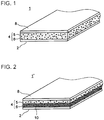
- FIG. 1 is a perspective view of an anti-wear sheet according to an embodiment.
- the anti-wear sheet 1 includes a release film 2, a resin layer 4, and a light-shielding film 8.
- the release film 2 is disposed on a side of the resin layer 4, and is readily separatable from the resin layer 4.
- the release film 2 may be a film coated with silicone.
- the release film 2 may have a light-shielding property.
- the release film 2 includes a material capable of absorbing or reflecting light having a wavelength that promotes polymerizing reaction of photo-curable resin 5 described below.
- the resin layer 4 includes the photo-curable resin 5 and ceramic powder 6 supported by the photo-curable resin 5.
- the photo-curable resin 5 is in a non-cured or half-cured state, and has an adhesive property (tack) strong enough to adhere the resin layer 4 to an object to be protected.
- the photo-curable resin 5 is not particularly limited as long as the photo-curable resin 5 is such a resin that polymerizing reaction of the resin develops by being irradiated with light of a specific wavelength, and may be epoxy resin, vinyl ester resin, or the like.
- the ceramic powder 6 may contain alumina. Instead of the ceramic powder 6, optional hard particles (e.g. metal powder) harder than the photo-curable resin 5 may be used.
- optional hard particles e.g. metal powder
- harder than the photo-curable resin 5 may be used.
- the resin layer 4 may have a thickness of from 1mm to 5mm.
- the resin layer 4 having a thickness of 1mm or more, a layer can be readily formed during production of the anti-wear sheet 1, and sufficient anti-wear performance can be readily ensured for the resin layer 4. Also, with the resin layer 4 having a thickness of 5mm or less, sufficient light permeability can be achieved for the resin layer 4, and the resin layer 4 can be light-cured securely during application of the anti-wear sheet 1.
- the ratio by weight of the ceramic powder 6 to the photo-curable resin 5 may be from 1 to 6.
- the ratio by weight of the ceramic powder 6 to the photo-curable resin 5 being 1 or more, it is possible to form the anti-wear sheet 1 with a small amount of abrasion loss and high anti-wear performance. Also, with the ratio by weight of the ceramic powder 6 to the photo-curable resin 5 being 6 or less, it is possible to prevent generation of a poorly-cured section.
- the light-shielding film 8 is disposed on the opposite side of the resin layer 4 from the release film 2. Further, the release film 8 has a light-shielding property.
- the light-shielding film 8 includes a material capable of absorbing or reflecting light having a wavelength that promotes polymerizing reaction of the photo-curable resin 5. Further, the light-shielding film 8 may be readily separatable from the resin layer 4.
- FIG. 2 is a perspective view of an anti-wear sheet according to present invention.
- the same parts as those in FIG. 1 are associated with the same reference numerals and not described in detail.
- the anti-wear sheet 1' includes the release film 2, the resin layer 4 with a glass fiber 10, and the light-shielding film 8.
- the glass fiber 10 is embedded in the resin layer 4 to serve as a shape-maintaining base material.
- a shape-maintaining base material to be embedded in the resin layer 4 is not particularly limited as long as the shape-maintaining base material can help maintain the shape of the resin layer 4 in a non-cured or half-cured state, and may be a material other than the glass fiber 10.
- the glass fiber 10 may include fibers laid in one direction, or woven fibers.
- the glass fiber 10 may be disposed on a side adjacent to the release film 2 within the resin layer 4.
- the glass fiber 10 mainly functions as a shape-maintaining base material, and has little or no contribution to anti-wear performance.
- the glass fiber 10 being disposed on the side of an object to be protected (i.e., on the side adjacent to the release film 2), it is possible to improve the shape-maintaining performance without sacrificing the anti-wear performance of the anti-wear sheet 1'.
- the shape-maintaining base material (glass fiber 10) maintains the shape of the anti-wear sheet 1' to some extent, and thereby transportation of the anti-wear sheet 1' and application of the anti-wear sheet 1' to an object 20 to be protected are facilitated.
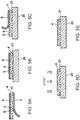
- FIGs. 3A to 3D are diagrams showing a process of producing an anti-wear sheet not according to the invention.
- the ceramic powder 6 is added to the photo-curable resin 5 to prepare a resin composition 7 which includes the photo-curable resin 5 and the ceramic powder 6 and has fluidity.
- the photo-curable resin 5 and the ceramic powder 6 may be dispersed in a solvent to obtain the resin composition 7 in slurry form.
- the ceramic powder 6 may be added to the photo-curable resin 5 so that the ratio by weight of the ceramic powder 6 to the photo-curable resin 5 is from 1 to 6.
- the resin composition 7 prepared as in FIG. 3A is spread out to a uniform thickness on the release film 2 depicted in FIG. 3B , and thereby the resin layer 4 in FIG. 3C is obtained.
- the resin composition 7 contains a solvent
- the solvent may be volatilized from the resin composition 7 spread out onto the release film 2 to obtain the resin layer 4. Accordingly, it is possible to maintain a sheet shape even after moving the anti-wear sheet 1 in a finished state.
- the resin composition 7 may be formed into a sheet shape so that the resin layer 4 has a thickness of from 1 mm to 5mm.
- the light-shielding film 8 is attached onto the resin layer 4 as depicted in FIG. 3D .
- the resin layer 4 includes the glass fiber 10 embedded therein to serve as a shape-maintaining base material.
- FIGs. 4A to 4D are diagrams showing a process of producing an anti-wear sheet according to another embodiment.
- the ceramic powder 6 is added to the photo-curable resin 5 to prepare the resin composition 7 including the photo-curable resin 5 and the ceramic powder 6 and having fluidity.
- the glass fiber 10 depicted in FIG. 4C is put on the release film 2 depicted in FIG. 4B .
- the resin composition 7 prepared as in FIG. 4A is spread out to a uniform thickness to obtain the resin layer 4 in FIG. 4D .
- the glass fiber 10 is put on the release film 2 and then the resin composition 7 is applied to the release film 2 so that the glass fiber 10 is disposed on the side of the object 20 to be protected, and thereby it is possible to improve the shape-maintaining performance without sacrificing the anti-wear performance of the anti-wear sheet 1'.
- the resin composition 7 contains a solvent, the solvent may be volatilized from the resin composition 7 spread out onto the release film 2 to obtain the resin layer 4.
- the light-shielding film 8 is attached to the resin layer 4 as depicted in FIG. 4E .
- the production methods described with references to FIGs. 3A to 3D and FIGs. 4A to 4E may be performed by using either a roll-to-roll processing or a single-wafer processing.
- the release film 2 and the light-shielding film 8 are reeled out from respective rolls, and moved while undergoing the above described forming step and attaching step, and then the anti-wear sheet 1, 1' in a finished state is reeled again to create a roll.
- the anti-wear sheet 1 is processed by pieces, by applying the resin composition 7 to the release film 2 to form the resin layer 4, and then attaching the light-shielding film 8 to the resin layer 4.
- the light-shielding film 8 may be prepared in advance, the resin composition 7 may be applied onto the light-shielding film 8 to form the resin layer 4, and the release film 2 may be attached to the resin layer 4.
- the anti-wear sheet 1, 1' produced as described above may be stored in a light-shielding bag to prevent photo-curable resin from starting to cure.
- a light-shielding bag includes a material capable of absorbing or reflecting light having a wavelength that promotes polymerizing reaction of the photo-curable resin 5.
- a release-film removing step the release film 2 of the anti-wear sheet 1 depicted in FIG. 5A is peeled off. Then, in a release-film attaching step, as depicted in FIG. 5B , the anti-wear sheet 1 is placed on the object 20 to be protected so that a surface of the anti-wear sheet 1 exposed by removal of the release film 2 contacts a protection surface 21 of the object 20 to be protected. Subsequently, in a light-shielding-film removing step, as depicted in FIG. 5C , the light-shielding film 8 is removed from the release film attached to the protection surface 21 of the object 20 to be protected. Then, as depicted in FIG.
- the resin layer 4 exposed by removal of the light-shielding film 8 is irradiated with light and cured. It is sufficient if light to irradiate the resin layer 4 includes light of a wavelength that promotes polymerizing reaction of the photo-curable resin 5, and the light may be natural light or artificial light emitted by an optional light source. Accordingly, as depicted in FIG. 5E , an anti-wear material including the resin layer 4 is applied onto the protection surface 21 of the object 20 to be protected.
- the contained amount of the ceramic powder 6 has less influence on workability than in a method of forming an anti-wear layer by applying a resin composition in slurry form (coating) containing ceramic powder to an object to be protected, and thus it is possible to increase the contained amount of the ceramic powder 6 in the resin layer 4 of the anti-wear sheet 1 to improve anti-wear performance. Accordingly, it is possible to improve anti-wear performance and ensure good workability at the same time.
- the photo-curable resin 5 supports the ceramic powder 6 and forms the resin layer 4, and thereby the resin layer 4 can be cured basically by light irradiation alone, which makes it possible to improve workability.
- the photo-curable resin 5 can be replaced by thermosetting resin or thermoplastic resin, a device for heating the resin layer 4 would be required in that case, which makes application too extensive and difficult to be performed at a high altitude or in a narrow space. Moreover, uniform heating is difficult, and thus results may be uneven in a finished product.
- the photo-curable resin 5 is used, it is possible to cure the resin layer 4 uniformly by using natural light without involving an elaborate device for application, for instance, and thereby high workability can be achieved.
- the light-shielding film 8 disposed on a side of the resin layer 4, it is possible to suppress curing of the resin layer 4 while the resin layer 4 is being attached to the object 20 to be protected after the release film 2 is peeled off. It should be noted that the release film 2 may also have a light-shielding property. Moreover, with the release film 2 disposed on the other side of the resin layer 4, it is possible to prevent the resin layer 4 from adhering to another substance during storage.
- a Taber abrasion test is a test to abrade a specimen by continuous friction with two abrading wheels that roll on the specimen mounted to a rotary platform like a disk.
- a Taber abrasion test was performed in accordance with Japanese Industrial Standard (JIS) K7204 on two specimens: the anti-wear sheet 1 produced by the production method described in FIG. 2 and attached to the object 20 to be protected, which is an embodiment; and a specimen with mixture coating of photo-curable resin and ceramic powder applied to an object to be protected, which is a comparative example.
- JIS Japanese Industrial Standard
- photo-curable polyester resin was used as photo-curable resin
- alumina of a grain size #2000 was used as ceramic powder.
- photo-curable polyester resin and ceramic powder were mixed at a ratio of 100:150 to produce the coating.
- This coating was applied to a protection surface of an object to be protected to a thickness of 2mm, and then irradiated for 20 minutes with ultraviolet from a UV lamp (1000W) positioned at an irradiation distance of 200mm from the application surface, before conducting the following abrasion test.
- a UV lamp 1000W
- photo-curable polyester resin and ceramic powder were mixed at a ratio of 100:350 to produce the resin composition.
- the resin composition was spread out onto the release film to form a resin layer of 2mm thickness, and the light-shielding film was attached onto the resin layer to obtain the anti-wear sheet 1.
- This anti-wear sheet 1, from which the release film 2 is removed, was attached to the protection surface 21 of the object 20 to be protected, the light-shielding film 8 then peeled off, and then irradiated for 20 minutes with ultraviolet from a UV lamp (1000W) positioned at an irradiation distance of 200mm from the application surface, which is the same condition as the comparative example, before conducting the following abrasion test.
- a UV lamp 1000W
- a tester provided with abrading wheels CS-17 was used to apply a load to each specimen for a duration of 1000 cycles, using loads of 1000mg, and an amount of abrasion loss in a sheet by the abrading wheels was measured.
- the amount of abrasion loss from the object to be protected coated with the mixture coating of the comparative example was 80mg, whereby the amount of abrasion loss from the object to be protected with the anti-wear sheet 1 of the embodiment attached thereto was 132mg.
- the difference in the amount of abrasion loss between the comparative example and the embodiment may be due to the contained amount of ceramic powder.
- the anti-wear sheet 1 was produced and thus a large amount of ceramic powder could be contained, which may have been the reason why the amount of abrasion loss was reduced considerably. Accordingly, the anti-wear sheet 1 of the embodiment can achieve extremely high anti-wear performance and therefore is effective.
- the anti-wear sheet described in the embodiments of the present invention can be applied to various wear locations, especially to wear locations damaged by erosion, such as a wind turbine blade, a rotary blade of a rotary-blade airplane, a fixed wing of a fixed-wing airplane (main wings, tail, aileron, etc.), and an axial fan or a piping inner wall surface of various industrial plants.
Landscapes
- Engineering & Computer Science (AREA)
- Mechanical Engineering (AREA)
- Aviation & Aerospace Engineering (AREA)
- General Engineering & Computer Science (AREA)
- Textile Engineering (AREA)
- Laminated Bodies (AREA)
Applications Claiming Priority (2)
| Application Number | Priority Date | Filing Date | Title |
|---|---|---|---|
| JP2013256902A JP6317098B2 (ja) | 2013-12-12 | 2013-12-12 | 耐摩耗用シート及びその製造方法、並びに耐摩耗用シートの施工方法 |
| PCT/JP2014/082811 WO2015087962A1 (ja) | 2013-12-12 | 2014-12-11 | 耐摩耗用シート及びその製造方法、並びに耐摩耗用シートの施工方法 |
Publications (3)
| Publication Number | Publication Date |
|---|---|
| EP3067202A1 EP3067202A1 (en) | 2016-09-14 |
| EP3067202A4 EP3067202A4 (en) | 2016-11-30 |
| EP3067202B1 true EP3067202B1 (en) | 2017-11-15 |
Family
ID=53371261
Family Applications (1)
| Application Number | Title | Priority Date | Filing Date |
|---|---|---|---|
| EP14870040.4A Not-in-force EP3067202B1 (en) | 2013-12-12 | 2014-12-11 | Anti-wear sheet, production method for the same, and anti-wear-sheet application method |
Country Status (5)
| Country | Link |
|---|---|
| US (1) | US10213996B2 (enExample) |
| EP (1) | EP3067202B1 (enExample) |
| JP (1) | JP6317098B2 (enExample) |
| CN (1) | CN105848893B (enExample) |
| WO (1) | WO2015087962A1 (enExample) |
Families Citing this family (3)
| Publication number | Priority date | Publication date | Assignee | Title |
|---|---|---|---|---|
| US10760600B2 (en) * | 2017-10-27 | 2020-09-01 | General Electric Company | Method of applying riblets to an aerodynamic surface |
| JP6588119B2 (ja) * | 2018-03-29 | 2019-10-09 | 三菱重工業株式会社 | 風車翼の補修、補強又は付属部品の取り付け方法 |
| US11299654B2 (en) | 2019-08-20 | 2022-04-12 | Roller Bearing Company Of America, Inc. | Permanent, self-adhering, self-lubricating, anti-wear composite system |
Family Cites Families (9)
| Publication number | Priority date | Publication date | Assignee | Title |
|---|---|---|---|---|
| JP2841081B2 (ja) * | 1989-08-03 | 1998-12-24 | 昭和飛行機工業株式会社 | 耐摩耗材の製造方法 |
| JP3043005U (ja) * | 1997-04-30 | 1997-11-11 | エスジーシー下水道センター株式会社 | 管内面の部分補修材 |
| JPH1161361A (ja) | 1997-08-13 | 1999-03-05 | Mitsubishi Heavy Ind Ltd | 耐熱耐摩耗材料 |
| US6713144B2 (en) * | 1999-12-28 | 2004-03-30 | Nippon Shokubai Co., Ltd. | Multilayer material |
| JP2002018991A (ja) * | 2000-07-04 | 2002-01-22 | Showa Highpolymer Co Ltd | 硬化性プリプレグ,その製造方法及び硬化方法 |
| JP2002265635A (ja) * | 2001-03-14 | 2002-09-18 | Nippon Shokubai Co Ltd | シート状補強材 |
| JP4236416B2 (ja) * | 2001-04-02 | 2009-03-11 | ジャパンコンポジット株式会社 | シート状補強材及びその製造方法 |
| JP2003071994A (ja) | 2001-09-06 | 2003-03-12 | Hoshino Sansho:Kk | 機能性シート |
| JP2006104394A (ja) * | 2004-10-08 | 2006-04-20 | Asahi Kasei Chemicals Corp | 保護フィルム付光硬化性プリプレグシート |
-
2013
- 2013-12-12 JP JP2013256902A patent/JP6317098B2/ja active Active
-
2014
- 2014-12-11 US US15/103,222 patent/US10213996B2/en not_active Expired - Fee Related
- 2014-12-11 CN CN201480067000.1A patent/CN105848893B/zh not_active Expired - Fee Related
- 2014-12-11 EP EP14870040.4A patent/EP3067202B1/en not_active Not-in-force
- 2014-12-11 WO PCT/JP2014/082811 patent/WO2015087962A1/ja not_active Ceased
Non-Patent Citations (1)
| Title |
|---|
| None * |
Also Published As
| Publication number | Publication date |
|---|---|
| EP3067202A1 (en) | 2016-09-14 |
| CN105848893A (zh) | 2016-08-10 |
| US20160354999A1 (en) | 2016-12-08 |
| CN105848893B (zh) | 2018-04-03 |
| EP3067202A4 (en) | 2016-11-30 |
| US10213996B2 (en) | 2019-02-26 |
| JP6317098B2 (ja) | 2018-04-25 |
| JP2015112808A (ja) | 2015-06-22 |
| WO2015087962A1 (ja) | 2015-06-18 |
Similar Documents
| Publication | Publication Date | Title |
|---|---|---|
| EP3067202B1 (en) | Anti-wear sheet, production method for the same, and anti-wear-sheet application method | |
| Duan et al. | Effects of compaction and UV exposure on performance of acrylate/glass‐fiber composites cured layer by layer | |
| JP5633078B2 (ja) | 乾式研磨法による脆弱試料薄片の作製法 | |
| GB2449862B (en) | Method for producing abrasive tips for gas turbine blades | |
| RU2014129622A (ru) | Способ получения однородных матированных покрытий с помощью радиационного отверждения | |
| CN103103883B (zh) | 雾面隔离纸的制备方法 | |
| ES2967531T3 (es) | Lámina de separación recubierta de silicona con una capacidad especial de embutición en vacío | |
| RU2625237C2 (ru) | Способ обработки волоконно-пластмассового композита роторной лопасти, заготовка в виде составного композита и ультрафиолетовая лампа для затвердевания затвердевающего с помощью ультрафиолета матричного материала | |
| RU2016103279A (ru) | Способ подготовки подложки для термического напыления металлического покрытия | |
| JP2014126546A5 (enExample) | ||
| WO2010117440A3 (en) | Reinforced uv-a curable composite compositions and methods | |
| CN109641809A (zh) | 热障涂层修复组合物及其使用方法 | |
| EP1683627A1 (en) | Method and apparatus for repairing a composite article | |
| WO2015151611A1 (ja) | 積層造形物の製造装置、製造方法及び液状原料 | |
| CN107814969A (zh) | 一种半透明镜面幻彩膜及其制备方法 | |
| WO2016062768A3 (en) | Method of coating substrate | |
| US9283598B2 (en) | Methods, systems, and devices for radio-frequency assisted removal of sealant | |
| US10815974B2 (en) | Method of repairing or reinforcing wind turbine blade, or attaching accessory part to wind turbine blade | |
| PL236872B1 (pl) | Sposób powlekania powierzchni metalowej przeznaczonej do przyjmowania elastomeru, zestaw do powlekania i narzędzie zawierające powleczoną powierzchnię | |
| Gao et al. | A study on radiation effect of< 200 keV protons on M40J/epoxy composites | |
| JP2015112808A5 (enExample) | ||
| CN105670490A (zh) | 一种uv固化保护涂料及其制备方法 | |
| Jing et al. | Improving the anti-thermal-shock properties of Sc2O3-Y2O3-ZrO2-CaF2-PHB abradable coatings by fabricating the textures on ceramic matrix composites: experiment verification and numerical analysis | |
| CN104130720A (zh) | 一种延伸固化的紫外光固化胶及制备方法 | |
| CN107297690B (zh) | 耐热耐磨型金刚砂切割线的光化学制备方法 |
Legal Events
| Date | Code | Title | Description |
|---|---|---|---|
| PUAI | Public reference made under article 153(3) epc to a published international application that has entered the european phase |
Free format text: ORIGINAL CODE: 0009012 |
|
| 17P | Request for examination filed |
Effective date: 20160606 |
|
| AK | Designated contracting states |
Kind code of ref document: A1 Designated state(s): AL AT BE BG CH CY CZ DE DK EE ES FI FR GB GR HR HU IE IS IT LI LT LU LV MC MK MT NL NO PL PT RO RS SE SI SK SM TR |
|
| AX | Request for extension of the european patent |
Extension state: BA ME |
|
| A4 | Supplementary search report drawn up and despatched |
Effective date: 20161102 |
|
| RIC1 | Information provided on ipc code assigned before grant |
Ipc: B32B 7/06 20060101ALI20161026BHEP Ipc: B32B 27/20 20060101AFI20161026BHEP Ipc: B32B 5/02 20060101ALI20161026BHEP Ipc: C09J 7/02 20060101ALI20161026BHEP Ipc: C08J 5/24 20060101ALI20161026BHEP |
|
| DAX | Request for extension of the european patent (deleted) | ||
| GRAP | Despatch of communication of intention to grant a patent |
Free format text: ORIGINAL CODE: EPIDOSNIGR1 |
|
| INTG | Intention to grant announced |
Effective date: 20170428 |
|
| GRAS | Grant fee paid |
Free format text: ORIGINAL CODE: EPIDOSNIGR3 |
|
| GRAA | (expected) grant |
Free format text: ORIGINAL CODE: 0009210 |
|
| AK | Designated contracting states |
Kind code of ref document: B1 Designated state(s): AL AT BE BG CH CY CZ DE DK EE ES FI FR GB GR HR HU IE IS IT LI LT LU LV MC MK MT NL NO PL PT RO RS SE SI SK SM TR |
|
| REG | Reference to a national code |
Ref country code: CH Ref legal event code: EP Ref country code: GB Ref legal event code: FG4D Ref country code: AT Ref legal event code: REF Ref document number: 945855 Country of ref document: AT Kind code of ref document: T Effective date: 20171115 |
|
| REG | Reference to a national code |
Ref country code: IE Ref legal event code: FG4D |
|
| REG | Reference to a national code |
Ref country code: DE Ref legal event code: R096 Ref document number: 602014017428 Country of ref document: DE Ref country code: FR Ref legal event code: PLFP Year of fee payment: 4 |
|
| REG | Reference to a national code |
Ref country code: NL Ref legal event code: MP Effective date: 20171115 |
|
| REG | Reference to a national code |
Ref country code: LT Ref legal event code: MG4D |
|
| REG | Reference to a national code |
Ref country code: AT Ref legal event code: MK05 Ref document number: 945855 Country of ref document: AT Kind code of ref document: T Effective date: 20171115 |
|
| PG25 | Lapsed in a contracting state [announced via postgrant information from national office to epo] |
Ref country code: FI Free format text: LAPSE BECAUSE OF FAILURE TO SUBMIT A TRANSLATION OF THE DESCRIPTION OR TO PAY THE FEE WITHIN THE PRESCRIBED TIME-LIMIT Effective date: 20171115 Ref country code: NO Free format text: LAPSE BECAUSE OF FAILURE TO SUBMIT A TRANSLATION OF THE DESCRIPTION OR TO PAY THE FEE WITHIN THE PRESCRIBED TIME-LIMIT Effective date: 20180215 Ref country code: LT Free format text: LAPSE BECAUSE OF FAILURE TO SUBMIT A TRANSLATION OF THE DESCRIPTION OR TO PAY THE FEE WITHIN THE PRESCRIBED TIME-LIMIT Effective date: 20171115 Ref country code: SE Free format text: LAPSE BECAUSE OF FAILURE TO SUBMIT A TRANSLATION OF THE DESCRIPTION OR TO PAY THE FEE WITHIN THE PRESCRIBED TIME-LIMIT Effective date: 20171115 Ref country code: ES Free format text: LAPSE BECAUSE OF FAILURE TO SUBMIT A TRANSLATION OF THE DESCRIPTION OR TO PAY THE FEE WITHIN THE PRESCRIBED TIME-LIMIT Effective date: 20171115 Ref country code: NL Free format text: LAPSE BECAUSE OF FAILURE TO SUBMIT A TRANSLATION OF THE DESCRIPTION OR TO PAY THE FEE WITHIN THE PRESCRIBED TIME-LIMIT Effective date: 20171115 |
|
| PG25 | Lapsed in a contracting state [announced via postgrant information from national office to epo] |
Ref country code: AT Free format text: LAPSE BECAUSE OF FAILURE TO SUBMIT A TRANSLATION OF THE DESCRIPTION OR TO PAY THE FEE WITHIN THE PRESCRIBED TIME-LIMIT Effective date: 20171115 Ref country code: BG Free format text: LAPSE BECAUSE OF FAILURE TO SUBMIT A TRANSLATION OF THE DESCRIPTION OR TO PAY THE FEE WITHIN THE PRESCRIBED TIME-LIMIT Effective date: 20180215 Ref country code: GR Free format text: LAPSE BECAUSE OF FAILURE TO SUBMIT A TRANSLATION OF THE DESCRIPTION OR TO PAY THE FEE WITHIN THE PRESCRIBED TIME-LIMIT Effective date: 20180216 Ref country code: LV Free format text: LAPSE BECAUSE OF FAILURE TO SUBMIT A TRANSLATION OF THE DESCRIPTION OR TO PAY THE FEE WITHIN THE PRESCRIBED TIME-LIMIT Effective date: 20171115 Ref country code: HR Free format text: LAPSE BECAUSE OF FAILURE TO SUBMIT A TRANSLATION OF THE DESCRIPTION OR TO PAY THE FEE WITHIN THE PRESCRIBED TIME-LIMIT Effective date: 20171115 Ref country code: RS Free format text: LAPSE BECAUSE OF FAILURE TO SUBMIT A TRANSLATION OF THE DESCRIPTION OR TO PAY THE FEE WITHIN THE PRESCRIBED TIME-LIMIT Effective date: 20171115 |
|
| PG25 | Lapsed in a contracting state [announced via postgrant information from national office to epo] |
Ref country code: CZ Free format text: LAPSE BECAUSE OF FAILURE TO SUBMIT A TRANSLATION OF THE DESCRIPTION OR TO PAY THE FEE WITHIN THE PRESCRIBED TIME-LIMIT Effective date: 20171115 Ref country code: CY Free format text: LAPSE BECAUSE OF FAILURE TO SUBMIT A TRANSLATION OF THE DESCRIPTION OR TO PAY THE FEE WITHIN THE PRESCRIBED TIME-LIMIT Effective date: 20171115 Ref country code: EE Free format text: LAPSE BECAUSE OF FAILURE TO SUBMIT A TRANSLATION OF THE DESCRIPTION OR TO PAY THE FEE WITHIN THE PRESCRIBED TIME-LIMIT Effective date: 20171115 Ref country code: DK Free format text: LAPSE BECAUSE OF FAILURE TO SUBMIT A TRANSLATION OF THE DESCRIPTION OR TO PAY THE FEE WITHIN THE PRESCRIBED TIME-LIMIT Effective date: 20171115 Ref country code: SK Free format text: LAPSE BECAUSE OF FAILURE TO SUBMIT A TRANSLATION OF THE DESCRIPTION OR TO PAY THE FEE WITHIN THE PRESCRIBED TIME-LIMIT Effective date: 20171115 |
|
| REG | Reference to a national code |
Ref country code: CH Ref legal event code: PL |
|
| REG | Reference to a national code |
Ref country code: DE Ref legal event code: R097 Ref document number: 602014017428 Country of ref document: DE |
|
| PG25 | Lapsed in a contracting state [announced via postgrant information from national office to epo] |
Ref country code: IT Free format text: LAPSE BECAUSE OF FAILURE TO SUBMIT A TRANSLATION OF THE DESCRIPTION OR TO PAY THE FEE WITHIN THE PRESCRIBED TIME-LIMIT Effective date: 20171115 Ref country code: RO Free format text: LAPSE BECAUSE OF FAILURE TO SUBMIT A TRANSLATION OF THE DESCRIPTION OR TO PAY THE FEE WITHIN THE PRESCRIBED TIME-LIMIT Effective date: 20171115 Ref country code: SM Free format text: LAPSE BECAUSE OF FAILURE TO SUBMIT A TRANSLATION OF THE DESCRIPTION OR TO PAY THE FEE WITHIN THE PRESCRIBED TIME-LIMIT Effective date: 20171115 Ref country code: PL Free format text: LAPSE BECAUSE OF FAILURE TO SUBMIT A TRANSLATION OF THE DESCRIPTION OR TO PAY THE FEE WITHIN THE PRESCRIBED TIME-LIMIT Effective date: 20171115 |
|
| REG | Reference to a national code |
Ref country code: IE Ref legal event code: MM4A |
|
| PLBE | No opposition filed within time limit |
Free format text: ORIGINAL CODE: 0009261 |
|
| STAA | Information on the status of an ep patent application or granted ep patent |
Free format text: STATUS: NO OPPOSITION FILED WITHIN TIME LIMIT |
|
| PG25 | Lapsed in a contracting state [announced via postgrant information from national office to epo] |
Ref country code: LU Free format text: LAPSE BECAUSE OF NON-PAYMENT OF DUE FEES Effective date: 20171211 Ref country code: MT Free format text: LAPSE BECAUSE OF NON-PAYMENT OF DUE FEES Effective date: 20171211 |
|
| REG | Reference to a national code |
Ref country code: BE Ref legal event code: MM Effective date: 20171231 |
|
| 26N | No opposition filed |
Effective date: 20180817 |
|
| PG25 | Lapsed in a contracting state [announced via postgrant information from national office to epo] |
Ref country code: IE Free format text: LAPSE BECAUSE OF NON-PAYMENT OF DUE FEES Effective date: 20171211 |
|
| PG25 | Lapsed in a contracting state [announced via postgrant information from national office to epo] |
Ref country code: BE Free format text: LAPSE BECAUSE OF NON-PAYMENT OF DUE FEES Effective date: 20171231 Ref country code: SI Free format text: LAPSE BECAUSE OF FAILURE TO SUBMIT A TRANSLATION OF THE DESCRIPTION OR TO PAY THE FEE WITHIN THE PRESCRIBED TIME-LIMIT Effective date: 20171115 Ref country code: CH Free format text: LAPSE BECAUSE OF NON-PAYMENT OF DUE FEES Effective date: 20171231 Ref country code: LI Free format text: LAPSE BECAUSE OF NON-PAYMENT OF DUE FEES Effective date: 20171231 |
|
| PG25 | Lapsed in a contracting state [announced via postgrant information from national office to epo] |
Ref country code: MC Free format text: LAPSE BECAUSE OF FAILURE TO SUBMIT A TRANSLATION OF THE DESCRIPTION OR TO PAY THE FEE WITHIN THE PRESCRIBED TIME-LIMIT Effective date: 20171115 Ref country code: HU Free format text: LAPSE BECAUSE OF FAILURE TO SUBMIT A TRANSLATION OF THE DESCRIPTION OR TO PAY THE FEE WITHIN THE PRESCRIBED TIME-LIMIT; INVALID AB INITIO Effective date: 20141211 |
|
| PG25 | Lapsed in a contracting state [announced via postgrant information from national office to epo] |
Ref country code: MK Free format text: LAPSE BECAUSE OF FAILURE TO SUBMIT A TRANSLATION OF THE DESCRIPTION OR TO PAY THE FEE WITHIN THE PRESCRIBED TIME-LIMIT Effective date: 20171115 |
|
| PG25 | Lapsed in a contracting state [announced via postgrant information from national office to epo] |
Ref country code: TR Free format text: LAPSE BECAUSE OF FAILURE TO SUBMIT A TRANSLATION OF THE DESCRIPTION OR TO PAY THE FEE WITHIN THE PRESCRIBED TIME-LIMIT Effective date: 20171115 |
|
| PG25 | Lapsed in a contracting state [announced via postgrant information from national office to epo] |
Ref country code: PT Free format text: LAPSE BECAUSE OF FAILURE TO SUBMIT A TRANSLATION OF THE DESCRIPTION OR TO PAY THE FEE WITHIN THE PRESCRIBED TIME-LIMIT Effective date: 20171115 |
|
| PG25 | Lapsed in a contracting state [announced via postgrant information from national office to epo] |
Ref country code: AL Free format text: LAPSE BECAUSE OF FAILURE TO SUBMIT A TRANSLATION OF THE DESCRIPTION OR TO PAY THE FEE WITHIN THE PRESCRIBED TIME-LIMIT Effective date: 20171115 Ref country code: IS Free format text: LAPSE BECAUSE OF FAILURE TO SUBMIT A TRANSLATION OF THE DESCRIPTION OR TO PAY THE FEE WITHIN THE PRESCRIBED TIME-LIMIT Effective date: 20180315 |
|
| PGFP | Annual fee paid to national office [announced via postgrant information from national office to epo] |
Ref country code: GB Payment date: 20231102 Year of fee payment: 10 |
|
| PGFP | Annual fee paid to national office [announced via postgrant information from national office to epo] |
Ref country code: FR Payment date: 20231108 Year of fee payment: 10 Ref country code: DE Payment date: 20231031 Year of fee payment: 10 |
|
| REG | Reference to a national code |
Ref country code: DE Ref legal event code: R119 Ref document number: 602014017428 Country of ref document: DE |
|
| GBPC | Gb: european patent ceased through non-payment of renewal fee |
Effective date: 20241211 |
|
| PG25 | Lapsed in a contracting state [announced via postgrant information from national office to epo] |
Ref country code: DE Free format text: LAPSE BECAUSE OF NON-PAYMENT OF DUE FEES Effective date: 20250701 |
|
| PG25 | Lapsed in a contracting state [announced via postgrant information from national office to epo] |
Ref country code: GB Free format text: LAPSE BECAUSE OF NON-PAYMENT OF DUE FEES Effective date: 20241211 |
|
| PG25 | Lapsed in a contracting state [announced via postgrant information from national office to epo] |
Ref country code: FR Free format text: LAPSE BECAUSE OF NON-PAYMENT OF DUE FEES Effective date: 20241231 |