EP3052644B1 - Detektion von seltenen mikrobiologischen nukleinsäuren - Google Patents
Detektion von seltenen mikrobiologischen nukleinsäuren Download PDFInfo
- Publication number
- EP3052644B1 EP3052644B1 EP14777631.4A EP14777631A EP3052644B1 EP 3052644 B1 EP3052644 B1 EP 3052644B1 EP 14777631 A EP14777631 A EP 14777631A EP 3052644 B1 EP3052644 B1 EP 3052644B1
- Authority
- EP
- European Patent Office
- Prior art keywords
- virus
- nucleic acid
- organism
- group
- micro
- Prior art date
- Legal status (The legal status is an assumption and is not a legal conclusion. Google has not performed a legal analysis and makes no representation as to the accuracy of the status listed.)
- Active
Links
- 150000007523 nucleic acids Chemical class 0.000 title claims description 212
- 102000039446 nucleic acids Human genes 0.000 title claims description 204
- 108020004707 nucleic acids Proteins 0.000 title claims description 204
- 238000001514 detection method Methods 0.000 title claims description 96
- 230000002906 microbiologic effect Effects 0.000 title description 5
- 238000000034 method Methods 0.000 claims description 203
- 241000700605 Viruses Species 0.000 claims description 172
- 244000005700 microbiome Species 0.000 claims description 74
- 108020004414 DNA Proteins 0.000 claims description 69
- 239000012472 biological sample Substances 0.000 claims description 50
- 210000004027 cell Anatomy 0.000 claims description 37
- 238000000338 in vitro Methods 0.000 claims description 34
- 238000003199 nucleic acid amplification method Methods 0.000 claims description 33
- 230000003321 amplification Effects 0.000 claims description 32
- 238000004519 manufacturing process Methods 0.000 claims description 26
- 241000282414 Homo sapiens Species 0.000 claims description 24
- 238000012512 characterization method Methods 0.000 claims description 21
- 238000004925 denaturation Methods 0.000 claims description 18
- 230000036425 denaturation Effects 0.000 claims description 18
- 241001135569 Human adenovirus 5 Species 0.000 claims description 17
- 241001465754 Metazoa Species 0.000 claims description 17
- 101710163270 Nuclease Proteins 0.000 claims description 14
- 239000013060 biological fluid Substances 0.000 claims description 14
- 241000894006 Bacteria Species 0.000 claims description 12
- 239000000872 buffer Substances 0.000 claims description 12
- 238000002360 preparation method Methods 0.000 claims description 12
- 238000004153 renaturation Methods 0.000 claims description 12
- 241001480512 Mammalian orthoreovirus 3 Species 0.000 claims description 11
- 241000204031 Mycoplasma Species 0.000 claims description 10
- 238000011156 evaluation Methods 0.000 claims description 10
- 241000233866 Fungi Species 0.000 claims description 9
- 241000202894 Mycoplasma orale Species 0.000 claims description 9
- 230000001939 inductive effect Effects 0.000 claims description 9
- 238000010839 reverse transcription Methods 0.000 claims description 9
- 102000007056 Recombinant Fusion Proteins Human genes 0.000 claims description 8
- 108010008281 Recombinant Fusion Proteins Proteins 0.000 claims description 8
- 238000004113 cell culture Methods 0.000 claims description 8
- 150000001875 compounds Chemical class 0.000 claims description 8
- 241001493065 dsRNA viruses Species 0.000 claims description 8
- 210000004408 hybridoma Anatomy 0.000 claims description 8
- 239000013641 positive control Substances 0.000 claims description 8
- 241000283690 Bos taurus Species 0.000 claims description 7
- 241000711549 Hepacivirus C Species 0.000 claims description 7
- 241000700721 Hepatitis B virus Species 0.000 claims description 7
- 108091028043 Nucleic acid sequence Proteins 0.000 claims description 7
- 210000001236 prokaryotic cell Anatomy 0.000 claims description 7
- 241000206602 Eukaryota Species 0.000 claims description 6
- 241000204028 Mycoplasma arginini Species 0.000 claims description 5
- 241000202952 Mycoplasma fermentans Species 0.000 claims description 5
- 241000204022 Mycoplasma gallisepticum Species 0.000 claims description 5
- 241000202938 Mycoplasma hyorhinis Species 0.000 claims description 5
- 241000202934 Mycoplasma pneumoniae Species 0.000 claims description 5
- 241000202942 Mycoplasma synoviae Species 0.000 claims description 5
- 240000004808 Saccharomyces cerevisiae Species 0.000 claims description 5
- 241000202915 Spiroplasma citri Species 0.000 claims description 5
- 210000004369 blood Anatomy 0.000 claims description 5
- 239000008280 blood Substances 0.000 claims description 5
- KIUKXJAPPMFGSW-DNGZLQJQSA-N (2S,3S,4S,5R,6R)-6-[(2S,3R,4R,5S,6R)-3-Acetamido-2-[(2S,3S,4R,5R,6R)-6-[(2R,3R,4R,5S,6R)-3-acetamido-2,5-dihydroxy-6-(hydroxymethyl)oxan-4-yl]oxy-2-carboxy-4,5-dihydroxyoxan-3-yl]oxy-5-hydroxy-6-(hydroxymethyl)oxan-4-yl]oxy-3,4,5-trihydroxyoxane-2-carboxylic acid Chemical compound CC(=O)N[C@H]1[C@H](O)O[C@H](CO)[C@@H](O)[C@@H]1O[C@H]1[C@H](O)[C@@H](O)[C@H](O[C@H]2[C@@H]([C@@H](O[C@H]3[C@@H]([C@@H](O)[C@H](O)[C@H](O3)C(O)=O)O)[C@H](O)[C@@H](CO)O2)NC(C)=O)[C@@H](C(O)=O)O1 KIUKXJAPPMFGSW-DNGZLQJQSA-N 0.000 claims description 4
- 102000008186 Collagen Human genes 0.000 claims description 4
- 108010035532 Collagen Proteins 0.000 claims description 4
- 241000192125 Firmicutes Species 0.000 claims description 4
- HTTJABKRGRZYRN-UHFFFAOYSA-N Heparin Chemical compound OC1C(NC(=O)C)C(O)OC(COS(O)(=O)=O)C1OC1C(OS(O)(=O)=O)C(O)C(OC2C(C(OS(O)(=O)=O)C(OC3C(C(O)C(O)C(O3)C(O)=O)OS(O)(=O)=O)C(CO)O2)NS(O)(=O)=O)C(C(O)=O)O1 HTTJABKRGRZYRN-UHFFFAOYSA-N 0.000 claims description 4
- 238000002659 cell therapy Methods 0.000 claims description 4
- 229960005188 collagen Drugs 0.000 claims description 4
- 229920001436 collagen Polymers 0.000 claims description 4
- 238000001415 gene therapy Methods 0.000 claims description 4
- 229920000669 heparin Polymers 0.000 claims description 4
- 229960002897 heparin Drugs 0.000 claims description 4
- 229920002674 hyaluronan Polymers 0.000 claims description 4
- 229960003160 hyaluronic acid Drugs 0.000 claims description 4
- 238000013411 master cell bank Methods 0.000 claims description 4
- 239000000463 material Substances 0.000 claims description 4
- 229960005486 vaccine Drugs 0.000 claims description 4
- FGUUSXIOTUKUDN-IBGZPJMESA-N C1(=CC=CC=C1)N1C2=C(NC([C@H](C1)NC=1OC(=NN=1)C1=CC=CC=C1)=O)C=CC=C2 Chemical compound C1(=CC=CC=C1)N1C2=C(NC([C@H](C1)NC=1OC(=NN=1)C1=CC=CC=C1)=O)C=CC=C2 FGUUSXIOTUKUDN-IBGZPJMESA-N 0.000 claims description 3
- 241000283073 Equus caballus Species 0.000 claims description 3
- 238000005096 rolling process Methods 0.000 claims description 3
- 108091069025 single-strand RNA Proteins 0.000 claims description 3
- 241000710780 Bovine viral diarrhea virus 1 Species 0.000 claims description 2
- 241000238631 Hexapoda Species 0.000 claims description 2
- 241001430197 Mollicutes Species 0.000 claims description 2
- 241000283984 Rodentia Species 0.000 claims description 2
- 230000000415 inactivating effect Effects 0.000 claims description 2
- 241001515965 unidentified phage Species 0.000 claims description 2
- 108091032973 (ribonucleotides)n+m Proteins 0.000 claims 2
- -1 FluA H3N8 Chemical compound 0.000 claims 1
- 241000713196 Influenza B virus Species 0.000 claims 1
- PPBOKXIGFIBOGK-BDTUAEFFSA-N bvdv Chemical compound C([C@@H](C(=O)N[C@@H](CCCCN)C(=O)N[C@@H](CCC(N)=O)C(=O)N[C@@H]([C@@H](C)CC)C(=O)N[C@@H](CC(N)=O)C(=O)N[C@@H](CCCNC(N)=N)C(=O)NCC(=O)N[C@@H](CC(C)C)C(=O)N[C@@H](CCCCN)C(=O)N[C@@H](CCCCN)C(O)=O)NC(=O)[C@H](CC(C)C)NC(=O)[C@H](CO)NC(=O)[C@H](CC=1C=CC(O)=CC=1)NC(=O)[C@@H](NC(=O)[C@H](CC(C)C)NC(=O)[C@H](CC(O)=O)NC(=O)[C@H](CC(C)C)NC(=O)[C@@H](N)C(C)C)[C@@H](C)CC)C1=CN=CN1 PPBOKXIGFIBOGK-BDTUAEFFSA-N 0.000 claims 1
- 102000053602 DNA Human genes 0.000 description 64
- 239000000523 sample Substances 0.000 description 53
- 239000000047 product Substances 0.000 description 46
- 238000011529 RT qPCR Methods 0.000 description 37
- 238000007481 next generation sequencing Methods 0.000 description 34
- 238000000605 extraction Methods 0.000 description 25
- 241000714177 Murine leukemia virus Species 0.000 description 24
- 229920002477 rna polymer Polymers 0.000 description 24
- 239000000203 mixture Substances 0.000 description 23
- 102100034343 Integrase Human genes 0.000 description 22
- 230000035945 sensitivity Effects 0.000 description 21
- 108010092799 RNA-directed DNA polymerase Proteins 0.000 description 20
- 230000003612 virological effect Effects 0.000 description 20
- 239000002773 nucleotide Substances 0.000 description 19
- 125000003729 nucleotide group Chemical group 0.000 description 19
- 238000003556 assay Methods 0.000 description 11
- 238000006243 chemical reaction Methods 0.000 description 11
- 239000003795 chemical substances by application Substances 0.000 description 11
- 244000052769 pathogen Species 0.000 description 11
- 241000120506 Bluetongue virus Species 0.000 description 10
- 241000701106 Bovine adenovirus 3 Species 0.000 description 10
- 241000701922 Bovine parvovirus Species 0.000 description 10
- 102000004190 Enzymes Human genes 0.000 description 8
- 108090000790 Enzymes Proteins 0.000 description 8
- VYPSYNLAJGMNEJ-UHFFFAOYSA-N Silicium dioxide Chemical compound O=[Si]=O VYPSYNLAJGMNEJ-UHFFFAOYSA-N 0.000 description 8
- 239000002299 complementary DNA Substances 0.000 description 8
- 238000012163 sequencing technique Methods 0.000 description 8
- 239000012634 fragment Substances 0.000 description 7
- 208000037798 influenza B Diseases 0.000 description 7
- 108020004463 18S ribosomal RNA Proteins 0.000 description 6
- 241000829111 Human polyomavirus 1 Species 0.000 description 6
- 238000012165 high-throughput sequencing Methods 0.000 description 6
- 108090000623 proteins and genes Proteins 0.000 description 6
- 238000011895 specific detection Methods 0.000 description 6
- 239000006228 supernatant Substances 0.000 description 6
- 241000701242 Adenoviridae Species 0.000 description 5
- 241001339993 Anelloviridae Species 0.000 description 5
- 241000776207 Bornaviridae Species 0.000 description 5
- 241001227615 Bovine foamy virus Species 0.000 description 5
- 241000714198 Caliciviridae Species 0.000 description 5
- 241001533399 Circoviridae Species 0.000 description 5
- 241000711573 Coronaviridae Species 0.000 description 5
- 241000711950 Filoviridae Species 0.000 description 5
- 241000710781 Flaviviridae Species 0.000 description 5
- 241000700739 Hepadnaviridae Species 0.000 description 5
- 241000724675 Hepatitis E virus Species 0.000 description 5
- 241000709721 Hepatovirus A Species 0.000 description 5
- 241001122120 Hepeviridae Species 0.000 description 5
- 241000700586 Herpesviridae Species 0.000 description 5
- 241000701024 Human betaherpesvirus 5 Species 0.000 description 5
- 241000701041 Human betaherpesvirus 7 Species 0.000 description 5
- 241001502974 Human gammaherpesvirus 8 Species 0.000 description 5
- 241000701027 Human herpesvirus 6 Species 0.000 description 5
- 241000725303 Human immunodeficiency virus Species 0.000 description 5
- 241000701460 JC polyomavirus Species 0.000 description 5
- 241000712464 Orthomyxoviridae Species 0.000 description 5
- 241001631646 Papillomaviridae Species 0.000 description 5
- 241000711504 Paramyxoviridae Species 0.000 description 5
- 241000701945 Parvoviridae Species 0.000 description 5
- 241000150350 Peribunyaviridae Species 0.000 description 5
- 241000709664 Picornaviridae Species 0.000 description 5
- 241001631648 Polyomaviridae Species 0.000 description 5
- 241000928435 Porcine circovirus 1 Species 0.000 description 5
- 241001673669 Porcine circovirus 2 Species 0.000 description 5
- 241000700625 Poxviridae Species 0.000 description 5
- 241000711798 Rabies lyssavirus Species 0.000 description 5
- 241000702247 Reoviridae Species 0.000 description 5
- 241000712907 Retroviridae Species 0.000 description 5
- 241000711931 Rhabdoviridae Species 0.000 description 5
- 241000710924 Togaviridae Species 0.000 description 5
- 241000369696 Vesivirus Species 0.000 description 5
- 206010051511 Viral diarrhoea Diseases 0.000 description 5
- 241000710886 West Nile virus Species 0.000 description 5
- 108700010877 adenoviridae proteins Proteins 0.000 description 5
- 230000000295 complement effect Effects 0.000 description 5
- 239000000356 contaminant Substances 0.000 description 5
- 210000001519 tissue Anatomy 0.000 description 5
- FAPWRFPIFSIZLT-UHFFFAOYSA-M Sodium chloride Chemical compound [Na+].[Cl-] FAPWRFPIFSIZLT-UHFFFAOYSA-M 0.000 description 4
- 210000003527 eukaryotic cell Anatomy 0.000 description 4
- 239000011159 matrix material Substances 0.000 description 4
- 230000000813 microbial effect Effects 0.000 description 4
- 230000001717 pathogenic effect Effects 0.000 description 4
- 238000011002 quantification Methods 0.000 description 4
- 238000003753 real-time PCR Methods 0.000 description 4
- 239000000377 silicon dioxide Substances 0.000 description 4
- 108020000999 Viral RNA Proteins 0.000 description 3
- 230000007423 decrease Effects 0.000 description 3
- 238000010790 dilution Methods 0.000 description 3
- 239000012895 dilution Substances 0.000 description 3
- 230000000694 effects Effects 0.000 description 3
- 238000005516 engineering process Methods 0.000 description 3
- 229910052739 hydrogen Inorganic materials 0.000 description 3
- 239000001257 hydrogen Substances 0.000 description 3
- 230000002441 reversible effect Effects 0.000 description 3
- JKMHFZQWWAIEOD-UHFFFAOYSA-N 2-[4-(2-hydroxyethyl)piperazin-1-yl]ethanesulfonic acid Chemical compound OCC[NH+]1CCN(CCS([O-])(=O)=O)CC1 JKMHFZQWWAIEOD-UHFFFAOYSA-N 0.000 description 2
- 102000004163 DNA-directed RNA polymerases Human genes 0.000 description 2
- 108090000626 DNA-directed RNA polymerases Proteins 0.000 description 2
- KCXVZYZYPLLWCC-UHFFFAOYSA-N EDTA Chemical compound OC(=O)CN(CC(O)=O)CCN(CC(O)=O)CC(O)=O KCXVZYZYPLLWCC-UHFFFAOYSA-N 0.000 description 2
- 241000713772 Human immunodeficiency virus 1 Species 0.000 description 2
- 101710203526 Integrase Proteins 0.000 description 2
- 241000713869 Moloney murine leukemia virus Species 0.000 description 2
- 238000002944 PCR assay Methods 0.000 description 2
- 241000723806 Sugarcane mosaic virus Species 0.000 description 2
- 238000004458 analytical method Methods 0.000 description 2
- 230000001580 bacterial effect Effects 0.000 description 2
- 239000012148 binding buffer Substances 0.000 description 2
- 239000012620 biological material Substances 0.000 description 2
- 230000015572 biosynthetic process Effects 0.000 description 2
- 238000002330 electrospray ionisation mass spectrometry Methods 0.000 description 2
- 238000010438 heat treatment Methods 0.000 description 2
- 238000011534 incubation Methods 0.000 description 2
- 150000002500 ions Chemical class 0.000 description 2
- 239000012139 lysis buffer Substances 0.000 description 2
- 239000011780 sodium chloride Substances 0.000 description 2
- 238000012360 testing method Methods 0.000 description 2
- XLYOFNOQVPJJNP-UHFFFAOYSA-N water Substances O XLYOFNOQVPJJNP-UHFFFAOYSA-N 0.000 description 2
- GNFTZDOKVXKIBK-UHFFFAOYSA-N 3-(2-methoxyethoxy)benzohydrazide Chemical compound COCCOC1=CC=CC(C(=O)NN)=C1 GNFTZDOKVXKIBK-UHFFFAOYSA-N 0.000 description 1
- 241000701844 Bacillus virus phi29 Species 0.000 description 1
- 241000195493 Cryptophyta Species 0.000 description 1
- 241000196324 Embryophyta Species 0.000 description 1
- 208000031886 HIV Infections Diseases 0.000 description 1
- 241000702617 Human parvovirus B19 Species 0.000 description 1
- 241001500351 Influenzavirus A Species 0.000 description 1
- 108091061960 Naked DNA Proteins 0.000 description 1
- 238000012408 PCR amplification Methods 0.000 description 1
- 241001504982 Pepper cryptic virus 1 Species 0.000 description 1
- 241000702619 Porcine parvovirus Species 0.000 description 1
- 206010036790 Productive cough Diseases 0.000 description 1
- 238000003559 RNA-seq method Methods 0.000 description 1
- 108020004682 Single-Stranded DNA Proteins 0.000 description 1
- 208000005652 acute fatty liver of pregnancy Diseases 0.000 description 1
- 210000004381 amniotic fluid Anatomy 0.000 description 1
- 238000000137 annealing Methods 0.000 description 1
- 230000003466 anti-cipated effect Effects 0.000 description 1
- 210000000941 bile Anatomy 0.000 description 1
- 239000003918 blood extract Substances 0.000 description 1
- 210000001124 body fluid Anatomy 0.000 description 1
- 239000010839 body fluid Substances 0.000 description 1
- 210000001175 cerebrospinal fluid Anatomy 0.000 description 1
- 210000003756 cervix mucus Anatomy 0.000 description 1
- 230000003196 chaotropic effect Effects 0.000 description 1
- 239000013043 chemical agent Substances 0.000 description 1
- 238000003776 cleavage reaction Methods 0.000 description 1
- 230000000052 comparative effect Effects 0.000 description 1
- 239000012141 concentrate Substances 0.000 description 1
- 238000010276 construction Methods 0.000 description 1
- 238000001816 cooling Methods 0.000 description 1
- 230000003247 decreasing effect Effects 0.000 description 1
- 230000001419 dependent effect Effects 0.000 description 1
- 238000013461 design Methods 0.000 description 1
- 230000001627 detrimental effect Effects 0.000 description 1
- 230000002255 enzymatic effect Effects 0.000 description 1
- 238000006911 enzymatic reaction Methods 0.000 description 1
- 210000003608 fece Anatomy 0.000 description 1
- 239000012530 fluid Substances 0.000 description 1
- 239000001963 growth medium Substances 0.000 description 1
- 210000000514 hepatopancreas Anatomy 0.000 description 1
- 210000004251 human milk Anatomy 0.000 description 1
- 235000020256 human milk Nutrition 0.000 description 1
- 230000007062 hydrolysis Effects 0.000 description 1
- 238000006460 hydrolysis reaction Methods 0.000 description 1
- 230000003301 hydrolyzing effect Effects 0.000 description 1
- 206010022000 influenza Diseases 0.000 description 1
- 239000007788 liquid Substances 0.000 description 1
- 210000002751 lymph Anatomy 0.000 description 1
- 238000002493 microarray Methods 0.000 description 1
- 238000010606 normalization Methods 0.000 description 1
- 230000008520 organization Effects 0.000 description 1
- 239000002245 particle Substances 0.000 description 1
- 239000013612 plasmid Substances 0.000 description 1
- 229920000642 polymer Polymers 0.000 description 1
- 238000012545 processing Methods 0.000 description 1
- 230000000750 progressive effect Effects 0.000 description 1
- 102000004169 proteins and genes Human genes 0.000 description 1
- 238000000746 purification Methods 0.000 description 1
- 238000012175 pyrosequencing Methods 0.000 description 1
- 238000011084 recovery Methods 0.000 description 1
- 210000003296 saliva Anatomy 0.000 description 1
- 238000007480 sanger sequencing Methods 0.000 description 1
- 230000007017 scission Effects 0.000 description 1
- 210000000582 semen Anatomy 0.000 description 1
- 239000004065 semiconductor Substances 0.000 description 1
- 238000007841 sequencing by ligation Methods 0.000 description 1
- 210000002966 serum Anatomy 0.000 description 1
- 239000007787 solid Substances 0.000 description 1
- 239000002904 solvent Substances 0.000 description 1
- 238000001228 spectrum Methods 0.000 description 1
- 210000003802 sputum Anatomy 0.000 description 1
- 208000024794 sputum Diseases 0.000 description 1
- 210000004243 sweat Anatomy 0.000 description 1
- 238000003786 synthesis reaction Methods 0.000 description 1
- 210000001138 tear Anatomy 0.000 description 1
- 238000000870 ultraviolet spectroscopy Methods 0.000 description 1
- 210000002700 urine Anatomy 0.000 description 1
- 210000003501 vero cell Anatomy 0.000 description 1
- 238000012070 whole genome sequencing analysis Methods 0.000 description 1
Images
Classifications
-
- C—CHEMISTRY; METALLURGY
- C12—BIOCHEMISTRY; BEER; SPIRITS; WINE; VINEGAR; MICROBIOLOGY; ENZYMOLOGY; MUTATION OR GENETIC ENGINEERING
- C12Q—MEASURING OR TESTING PROCESSES INVOLVING ENZYMES, NUCLEIC ACIDS OR MICROORGANISMS; COMPOSITIONS OR TEST PAPERS THEREFOR; PROCESSES OF PREPARING SUCH COMPOSITIONS; CONDITION-RESPONSIVE CONTROL IN MICROBIOLOGICAL OR ENZYMOLOGICAL PROCESSES
- C12Q1/00—Measuring or testing processes involving enzymes, nucleic acids or microorganisms; Compositions therefor; Processes of preparing such compositions
- C12Q1/70—Measuring or testing processes involving enzymes, nucleic acids or microorganisms; Compositions therefor; Processes of preparing such compositions involving virus or bacteriophage
- C12Q1/701—Specific hybridization probes
- C12Q1/706—Specific hybridization probes for hepatitis
-
- C—CHEMISTRY; METALLURGY
- C12—BIOCHEMISTRY; BEER; SPIRITS; WINE; VINEGAR; MICROBIOLOGY; ENZYMOLOGY; MUTATION OR GENETIC ENGINEERING
- C12Q—MEASURING OR TESTING PROCESSES INVOLVING ENZYMES, NUCLEIC ACIDS OR MICROORGANISMS; COMPOSITIONS OR TEST PAPERS THEREFOR; PROCESSES OF PREPARING SUCH COMPOSITIONS; CONDITION-RESPONSIVE CONTROL IN MICROBIOLOGICAL OR ENZYMOLOGICAL PROCESSES
- C12Q1/00—Measuring or testing processes involving enzymes, nucleic acids or microorganisms; Compositions therefor; Processes of preparing such compositions
- C12Q1/68—Measuring or testing processes involving enzymes, nucleic acids or microorganisms; Compositions therefor; Processes of preparing such compositions involving nucleic acids
- C12Q1/6806—Preparing nucleic acids for analysis, e.g. for polymerase chain reaction [PCR] assay
-
- C—CHEMISTRY; METALLURGY
- C12—BIOCHEMISTRY; BEER; SPIRITS; WINE; VINEGAR; MICROBIOLOGY; ENZYMOLOGY; MUTATION OR GENETIC ENGINEERING
- C12Q—MEASURING OR TESTING PROCESSES INVOLVING ENZYMES, NUCLEIC ACIDS OR MICROORGANISMS; COMPOSITIONS OR TEST PAPERS THEREFOR; PROCESSES OF PREPARING SUCH COMPOSITIONS; CONDITION-RESPONSIVE CONTROL IN MICROBIOLOGICAL OR ENZYMOLOGICAL PROCESSES
- C12Q1/00—Measuring or testing processes involving enzymes, nucleic acids or microorganisms; Compositions therefor; Processes of preparing such compositions
- C12Q1/68—Measuring or testing processes involving enzymes, nucleic acids or microorganisms; Compositions therefor; Processes of preparing such compositions involving nucleic acids
- C12Q1/6844—Nucleic acid amplification reactions
-
- C—CHEMISTRY; METALLURGY
- C12—BIOCHEMISTRY; BEER; SPIRITS; WINE; VINEGAR; MICROBIOLOGY; ENZYMOLOGY; MUTATION OR GENETIC ENGINEERING
- C12Q—MEASURING OR TESTING PROCESSES INVOLVING ENZYMES, NUCLEIC ACIDS OR MICROORGANISMS; COMPOSITIONS OR TEST PAPERS THEREFOR; PROCESSES OF PREPARING SUCH COMPOSITIONS; CONDITION-RESPONSIVE CONTROL IN MICROBIOLOGICAL OR ENZYMOLOGICAL PROCESSES
- C12Q1/00—Measuring or testing processes involving enzymes, nucleic acids or microorganisms; Compositions therefor; Processes of preparing such compositions
- C12Q1/68—Measuring or testing processes involving enzymes, nucleic acids or microorganisms; Compositions therefor; Processes of preparing such compositions involving nucleic acids
- C12Q1/6876—Nucleic acid products used in the analysis of nucleic acids, e.g. primers or probes
- C12Q1/6888—Nucleic acid products used in the analysis of nucleic acids, e.g. primers or probes for detection or identification of organisms
- C12Q1/689—Nucleic acid products used in the analysis of nucleic acids, e.g. primers or probes for detection or identification of organisms for bacteria
-
- C—CHEMISTRY; METALLURGY
- C12—BIOCHEMISTRY; BEER; SPIRITS; WINE; VINEGAR; MICROBIOLOGY; ENZYMOLOGY; MUTATION OR GENETIC ENGINEERING
- C12Q—MEASURING OR TESTING PROCESSES INVOLVING ENZYMES, NUCLEIC ACIDS OR MICROORGANISMS; COMPOSITIONS OR TEST PAPERS THEREFOR; PROCESSES OF PREPARING SUCH COMPOSITIONS; CONDITION-RESPONSIVE CONTROL IN MICROBIOLOGICAL OR ENZYMOLOGICAL PROCESSES
- C12Q1/00—Measuring or testing processes involving enzymes, nucleic acids or microorganisms; Compositions therefor; Processes of preparing such compositions
- C12Q1/70—Measuring or testing processes involving enzymes, nucleic acids or microorganisms; Compositions therefor; Processes of preparing such compositions involving virus or bacteriophage
- C12Q1/701—Specific hybridization probes
-
- C—CHEMISTRY; METALLURGY
- C12—BIOCHEMISTRY; BEER; SPIRITS; WINE; VINEGAR; MICROBIOLOGY; ENZYMOLOGY; MUTATION OR GENETIC ENGINEERING
- C12N—MICROORGANISMS OR ENZYMES; COMPOSITIONS THEREOF; PROPAGATING, PRESERVING, OR MAINTAINING MICROORGANISMS; MUTATION OR GENETIC ENGINEERING; CULTURE MEDIA
- C12N15/00—Mutation or genetic engineering; DNA or RNA concerning genetic engineering, vectors, e.g. plasmids, or their isolation, preparation or purification; Use of hosts therefor
- C12N15/09—Recombinant DNA-technology
- C12N15/10—Processes for the isolation, preparation or purification of DNA or RNA
- C12N15/1003—Extracting or separating nucleic acids from biological samples, e.g. pure separation or isolation methods; Conditions, buffers or apparatuses therefor
-
- C—CHEMISTRY; METALLURGY
- C12—BIOCHEMISTRY; BEER; SPIRITS; WINE; VINEGAR; MICROBIOLOGY; ENZYMOLOGY; MUTATION OR GENETIC ENGINEERING
- C12N—MICROORGANISMS OR ENZYMES; COMPOSITIONS THEREOF; PROPAGATING, PRESERVING, OR MAINTAINING MICROORGANISMS; MUTATION OR GENETIC ENGINEERING; CULTURE MEDIA
- C12N15/00—Mutation or genetic engineering; DNA or RNA concerning genetic engineering, vectors, e.g. plasmids, or their isolation, preparation or purification; Use of hosts therefor
- C12N15/09—Recombinant DNA-technology
- C12N15/10—Processes for the isolation, preparation or purification of DNA or RNA
- C12N15/1034—Isolating an individual clone by screening libraries
- C12N15/1093—General methods of preparing gene libraries, not provided for in other subgroups
-
- C—CHEMISTRY; METALLURGY
- C12—BIOCHEMISTRY; BEER; SPIRITS; WINE; VINEGAR; MICROBIOLOGY; ENZYMOLOGY; MUTATION OR GENETIC ENGINEERING
- C12Q—MEASURING OR TESTING PROCESSES INVOLVING ENZYMES, NUCLEIC ACIDS OR MICROORGANISMS; COMPOSITIONS OR TEST PAPERS THEREFOR; PROCESSES OF PREPARING SUCH COMPOSITIONS; CONDITION-RESPONSIVE CONTROL IN MICROBIOLOGICAL OR ENZYMOLOGICAL PROCESSES
- C12Q2600/00—Oligonucleotides characterized by their use
- C12Q2600/158—Expression markers
Definitions
- the present invention relates to a method as defined in the claims for the in vitro detection, in a biological sample, of at least one rare nucleic acid molecule from a micro-organism or a virus, wherein said method comprises a step of treatment of the nucleic acid molecules of said biological sample with a double-strand specific nuclease.
- the present invention also relates to a method as defined in the claims for the characterization of a biological product, and to a method for the evaluation of a manufacturing process for the preparation of a biological product, said methods comprising a step of treatment of the nucleic acid molecules with a double-strand specific nuclease.
- the present invention also relates to the use as defined in the claims of a double-strand specific nuclease for the in vitro detection, in a biological sample, of a rare nucleic acid molecule of a micro-organism or a virus, for the characterization of a biological product and/or for the evaluation of a manufacturing process for the preparation of a biological product.
- the present invention also relates to a kit as defined in the claims for the detection of at least one rare nucleic acid from a micro-organism or a virus.
- qPCR Human Immunodeficiency virus type 1 (HIV-1) strains (Gardner et al., 2003).
- HIV-1 Human Immunodeficiency virus type 1
- the detection of different amplified sequences in a multiplex qPCR is limited to 4 or 5 targets.
- an exhaustive control is needed, a high quantity of sample is needed to perform all qPCR assays.
- High Throughput Sequencing also named Next-Generation Sequencing (NGS)
- NGS Next-Generation Sequencing
- HTS High Throughput Sequencing
- NGS Next-Generation Sequencing
- the strength and the main advantage of NGS is its capacity to detect the full spectrum of micro-organisms (Barzon et al., 2011) without an "a priori" testing.
- Other advantage is the direct identification of the pathogen if the detected sequences are present in an available database such as Genbank.
- PCR/ESI-MS electrospray Ionization Mass spectroscopy
- sensitivity is driven by the quantity of the nucleic acid molecules.
- increasing the sensitivity relies on decreasing the level of non-interesting sequences which, in the case of a microbiological diagnostic, is nucleic acid molecules from the host.
- the greatest possible number of copies of a sequence, or "reads" need to be generated. However, in some cases, said greatest number may not be sufficient to detect a contaminant.
- a modified VIDISCA method (Virus discovery based on cDNA-AFLP (amplified fragment length polymorphism)) was used in order to decrease the amount of rRNA in a sample (Vries et al., 2010). Also, Cheval et al. (2011) describe the use of rolling circle amplification (RCA) using Phi 29 in a MRC5 supernatant spiked with different viruses at a concentration near the LOD (Limit of Detection). As disclosed in Cheval et al., the Phi29 amplification increases the sensitivity of HTS samples and detects 7 out of 9 viruses with a spike at 3 x LOD and 4 out of 9 viruses with a spike at 0.8 x LOD. However comparative assays demonstrate the highest sensitivity of qPCR.
- Cheval et al. (Journal of clinical microbiology, vol.49, n°9, 29 June 2011 ) discloses the use of HTS technology to detect different virus simultaneously in a given biological sample, but this document does not disclose DSN treatment.
- DSN treatment is known from Charul Gijavanekar et al. (Analytical biochemistry, vol.421, n°1, 1 February 2012 ) in a method for detecting rare target nucleic acids with a sensitive PCR, but this document uses cDNA fragments from plasmids PUC and not a biological sample as claimed in the present invention.
- the present invention relates to a method based on the decrease of predominant nucleic acid molecules in a sample comprising nucleic acids, due to the use of a duplex specific nuclease (DSN) at the pre-amplification level, which can act as a normalized method to enhance rare nucleic acids for the in vitro preparation of a sample comprising nucleic acid molecules, wherein said sample is treated with a double-strand specific nuclease before any amplification step.
- DSN duplex specific nuclease
- a treatment with a double-strand specific nuclease relatively decreases the amount of predominant double stranded DNA molecules and increases the proportion of rare nucleic acid molecules in the sample.
- a method according to the invention allows to lower the bias in the generation of DNA libraries and to reach sensitivity similar or superior to that of qPCR, which is the most sensitive assay to date.
- a method according to the present invention presents the following advantages:
- the present invention is directed to a method as defined in the claims for the detection with high sensitivity of a micro-organism or a viral agent in a biological sample, such as a cell supernatant, said method comprising a step of treatment of the nucleic acid molecules with a double-strand specific nuclease.
- This protocol is designed for the detection of any micro-organism or virus, enveloped or naked, single or double stranded DNA or RNA.
- a method of the present invention provides a general scheme that can be applied to the detection with a high sensitivity of rare nucleic acid molecule from any microbiological or viral agent.
- the present invention relates to the subject of the claims.
- the present disclosure further relates to a method for the in vitro detection in a biological sample of the presence of at least one rare nucleic acid from a micro-organism or a virus, said method comprising the steps of:
- biological sample designates in the present disclosure any sample or extract susceptible to comprise, or comprising, any biological material. More preferably, a biological sample in a method disclosed herein comprises nucleic acid molecules and even more preferably, a biological sample in a method disclosed herein comprises nucleic acid molecules and cells.
- the present invention relates to a method for the in vitro detection in a biological sample of at least one rare nucleic acid from a micro-organism or a virus, wherein said biological sample is prepared from a material chosen in the group consisting of: a human biological fluid or tissue, an animal biological fluid or tissue, a culture of a human or an animal biological fluid or tissue, a culture of eukaryotic cells, a culture of prokaryotic cells, a culture of both eukaryotic and prokaryotic cells.
- a biological sample is prepared from a biological material by the use of methods such as the extraction or the purification of the biological sample to be adapted for performing a method according to the invention.
- biological fluid a fluid is defined as a liquid originating from the body and possibly excreted or secreted.
- said body fluid or tissue is chosen in the group consisting of: plasma, serum, whole blood, whole blood extract, urine, feces, sweat, lymph, amniotic fluid, bile, breast milk, saliva, sputum, tears, semen, vaginal secretion, aqueous humour, vitreous humour and cerebrospinal fluid.
- the present invention relates to a method for the in vitro detection in a biological sample of at least one rare nucleic acid from a micro-organism or a virus, wherein said biological sample is a bio-therapeutic product, preferably chosen in the group consisting of: recombinant protein, monoclonal antibody, vaccine, cell therapy product, gene therapy product, products of human or animal origin such as blood-derived products, heparin, hyaluronic acid and collagen.
- a bio-therapeutic product preferably chosen in the group consisting of: recombinant protein, monoclonal antibody, vaccine, cell therapy product, gene therapy product, products of human or animal origin such as blood-derived products, heparin, hyaluronic acid and collagen.
- the invention relates to a method for the in vitro detection in a biological sample of at least one rare nucleic acid from a micro-organism or a virus, wherein the culture of a human or an animal biological fluid or tissue comprises cells from a cell culture, wherein said cell culture comprises eukaryotic cells, prokaryotic cells or a combination thereof.
- Eukaryotic cells include human, animal, plants, fungi and unicellular eukaryotes such as yeasts.
- Prokaryotic cells include bacteria as well as archea.
- a biological sample is chosen in the group consisting of: cells from a cell culture infected by a virus, cells from a hybridoma production such as mouse/human hybridomas used for the production of monoclonal antibodies, and cells susceptible to be used for the production of a recombinant protein.
- the invention relates to a method for the in vitro detection in a biological sample of at least one rare nucleic acid from a micro-organism or a virus, wherein said biological sample is a sample from a cell bank, preferably chosen in the group consisting of: a master cell bank, a working cell bank and a production cell bank.
- nucleic acid it is intended to designate polymer molecules comprising natural or artificial nucleotides, and preferably deoxyribonucleic acid (DNA) and/or ribonucleic acid (RNA).
- a "rare nucleic acid molecule” is a molecule which is present in a sample in a limited proportion or frequency, in concentration of bases of this nucleic acid molecule, comparatively to the total amount of nucleic acid molecules comprised in said biological sample.
- the present invention relates to a method for the detection in a biological sample of at least one rare nucleic acid molecule, wherein, when compared to the total amount of nucleic acid molecules, said at least one rare nucleic acid molecule is present at a proportion comprised between about 1/10 4 and about 1/10 9 , preferably between about 1/10 5 and about 1/10 8 , more preferably between about 1/10 6 and about 1/10 7 , wherein "about” is intended to mean +/- 10%.
- a "rare nucleic acid molecule” is a nucleic acid molecule of a micro-organism or of a virus defined as a function of the limit of detection (LOD) of said micro-organism or a virus.
- micro-organism it is intended a microbial agent or a microscopic organism chosen among eukaryotes and prokaryotes.
- the extraction of nucleic acid molecules from a biological sample can be performed by any of the methods described for isolating nucleic acid molecules, such as methods described in Maniatis T. et al. (Edition 1999), well known by a person skilled in the art of manipulating nucleic acid molecules and biological products comprising said nucleic acid molecules.
- the extraction of the nucleic acid is performed by selecting an extraction procedure that is highly efficient even in the absence of carrier molecule such as RNA carrier.
- carrier molecule such as RNA carrier.
- RNA carrier such as Silica-adembeads (Ademtech) and NucleoSpin RNA virus (Macherey Nagel) may be used.
- extracting the nucleic acid molecules is performed in the absence of any molecule defined as a RNA carrier, which are used in some protocols for purifying and concentrating nucleic acids.
- the RNA carrier can act as a matrix in further steps and be a main contaminant sequence in further HTS.
- nucleic acid denaturation is intended the step wherein nucleic acid complementary strands, or nucleic acid complementary structures in a single nucleic acid strand, are dissociated. Double strand nucleic acid molecules and double strand nucleic acid structures are formed by non-covalent association through hydrogen-bonds between complementary nucleotides, nucleic acid denaturation occurs by the breakage of said hydrogen-bonds.
- the nucleotide composition of a strand may influence the conditions for denaturation-renaturation, as G and C bases may be linked by 3 hydrogen bonds and A and T bases may be linked by 2 hydrogen bonds.
- Strands comprising a high proportion of G and C bases will be less easily submitted to denaturation than a strand comprising a lower proportion of G and C bases.
- Nucleic acids denaturation is reversible. A person skilled in the art will easily determine the conditions for inducing denaturation and renaturation.
- inducing the denaturation of double strand nucleic acid molecules can be achieved by any method submitting nucleic acids to any physical or chemical agent able to destabilize hydrogen bonds, such as a raised temperature, pH, solvents, high ionic concentration and alcalinic agents.
- An enzymatic agent may also be able to induce said hydrogen-bonds breakage and denaturation.
- An example of a usable agent is a chaotropic element.
- Nucleic acid denaturation is reversible, when denaturation has been induced by raising the temperature, a step of temperature cooling allows renaturation, wherein complementary strands re-assemble with formation of hydrogen-bonds.
- a step of temperature cooling allows renaturation, wherein complementary strands re-assemble with formation of hydrogen-bonds.
- any method leading to the extraction of the nucleic acid from said agent may allow the renaturation of said nucleic acid.
- a method according to the invention for the in vitro detection of a rare nucleic acid from a micro-organism or a virus comprises a step of inducing the denaturation of nucleic acids molecules wherein nucleic acid samples are placed at a temperature comprised between about 85 °C and about 105 °C, preferably between about 90 °C and about 100 °C, and preferably about 95 °C.
- the term "about” designates a possible variation of more or less 10%.
- the renaturation step comprises the progressive return back to the initial temperature, to allow the re-association of complementary double strand nucleic acids, during an annealing step.
- a method according to the invention for the in vitro detection of a rare nucleic acid from a micro-organism or a virus comprises a step of inducing the renaturation of nucleic acid molecules wherein nucleic acid are placed at a temperature of about 70°C for the time necessary for renaturation, preferably for at least 4 hours. Nucleic acids denaturation and renaturation may be performed in a thermal cycler and may be easily monitored by UV spectroscopy at 260 nm.
- inducing the denaturation of the double strand nucleic acid molecules is achieved by any method known by a person skilled in the art to induce said denaturation, preferably by submitting said nucleic acid sample to an elevated temperature.
- a method according to the invention for the in vitro detection of a rare nucleic acid from a micro-organism or a virus comprises a step of inducing the denaturation of the double-strand nucleic acid molecules wherein nucleic acid are placed at a temperature of about 95 °C, followed by a step of inducing the renaturation of the double-strand nucleic acid molecules wherein nucleic acid are placed at a temperature of about 70 °C for at least 4 hours.
- the temperature of about 70°C ensures that renaturation occurs in a very specific manner and limits wrong pairing.
- a “duplex specific nuclease” or “double strand specific nuclease” is an enzyme that specifically cleaves double strand or paired DNA molecules, or double strand or paired DNA structures in a DNA molecule, and that cleaves paired nucleic acid molecules consisting of a paired DNA and RNA molecules.
- the treatment with a duplex specific nuclease leads to the specific cleavage of DNA molecules in double stranded DNA and in DNA-RNA hybrid duplexes, and does not noticeably cleave single strand DNA.
- DSN purified from hepatopancreas of Red King (Kamchatka) crab (Shagin et al., 2002) can be cited. DSN also discriminates between perfectly and nonperfectly matched short DNA duplexes.
- DSN is widely used for full-length enriched cDNA normalization (Zhulidov et al., 2004; Bogdanova et al., 2011a) and for construction of normalized RNA-seq libraries for next generation sequencing (Christodoulou et al., 2011).
- the concentration of the nucleic acid molecules corresponds to concentrating the nucleic acid molecules until their concentration is of at least 2 times the initial concentration. This concentration is adapted to the performance of the subsequent enzymatic reactions.
- the concentration of the nucleic acid molecules may be performed via the use of an extraction kit, such as smart D-N Ademkit.
- This procedure efficiently removes the DSN enzyme and concentrates the nucleic acids.
- the DSN is inactivated or eliminated by any method known to inactivate or eliminate an enzyme, such as heating or physically extracting the enzyme.
- DSN may be extracted by using the extraction procedure smart D-N Ademkit.
- the nucleic acid molecules are amplified by using any method known by a person skilled in the art.
- the amplification of the nucleic acids is performed by the rolling circle amplification (RCA).
- DNA fragments are firstly ligated and then amplified by the Phi29 enzyme.
- the Phi 29 enzyme is not efficient for processing small genomes if the number of genome copies is close to or inferior to 1000 genomes.
- the ligation step is performed to ligate these small fragments so that they can be amplified in the RCA amplification. Any commercial kit for RCA may be used for this step.
- the RCA procedure is performed according to the qiagen® WTA kit.
- a DNA library is a collection of DNA or cDNA that represents the known DNA or cDNA sequences from a particular organism or sample.
- a DNA library is preferably a cDNA library, comprising cDNA fragments obtained from reverse transcription of RNA molecules.
- NGS DNA or cDNA fragments can directly be used as the library for clonal amplification if necessary.
- NGS next-generation sequencing
- the present invention relates to a method for the in vitro detection of the presence of at least one rare nucleic acid from a micro-organism or a virus in a sample wherein, in step a), nucleic acid molecules comprise DNA molecules, RNA molecules or a combination thereof, and wherein the extraction of the nucleic acid molecules is followed by the reverse transcription of the RNA molecules of step a).
- reverse transcription of the RNA defines the method wherein RNA molecules of the sample are contacted with a reverse transcriptase enzyme in conditions adapted for the generation of a cDNA molecule from the RNA molecules.
- a reverse transcriptase enzyme Any reverse transcriptase may be used in a method according to the invention, however transcriptase RNase H minus or transcriptase with reduced RNase H activity are preferred.
- reverse transcription of the RNA molecules is performed using engineering or non-modified reverse transcriptase (RT), more preferably superscript III RT (Life technologies).
- the present invention relates to a method for the in vitro detection of at least one rare nucleic acid from a micro-organism or a virus in a sample wherein the DNA library of step f) is treated with a DSN, before performing step g).
- the present invention relates to a method for the detection of at least one rare nucleic acid molecule in a sample wherein said at least one rare nucleic acid molecule is a nucleic acid molecule of a micro-organism.
- a micro-organism, or a microbial agent is a microscopic organism chosen among eukaryotes, such as yeasts, fungi, algae, protozoa, and prokaryotes, such as bacteria and archea.
- Bacteria include Gram positive and Gram negative bacteria.
- the present invention relates to a method for the detection of at least one microbial agent, wherein said microbial agent is chosen in the group consisting of: Gram positive bacteria, gram negative bacteria, mycobacteria, mycoplasmas and fungi.
- the nature of the genome of said micro-organism is chosen in the group consisting of: double-strand DNA, single-strand DNA, double-strand RNA and single-strand RNA.
- the present invention relates to a method for the detection of the presence of at least one rare nucleic acid from a mycoplasma.
- the present invention relates to a method for the detection of the presence of at least one rare nucleic acid from a mycoplasma chosen in the group consisting of: Mycoplasma hyorhinis , Mycoplasma pneumoniae , Acheloplasma laidlawii , Mycoplasma fermentans , Mycoplasma orale , Spiroplasma citri , Mycoplasma synoviae , Mycoplasma gallisepticum and Mycoplasma arginini.
- the present invention relates to a method for the detection of the presence of at least one rare nucleic acid from Mycoplasma orale.
- the present invention relates to a method for the detection of at least one rare nucleic acid molecule in a sample wherein said at least one rare nucleic acid molecule is a nucleic acid molecule of a virus.
- the present invention relates to a method for the detection of at least one rare nucleic acid molecule from a virus in a sample wherein the genome of said virus is encapsulated. In another particular embodiment, the present invention relates to a method for the detection of at least one rare nucleic acid molecule from a virus in a sample wherein the genome of said virus is free.
- the present invention relates to a method for the detection of at least one rare nucleic acid molecule from a virus in a sample wherein said virus is chosen in the group consisting of: double-strand DNA virus, single-strand DNA virus, double-strand RNA virus and single-strand RNA virus.
- the present invention relates to a method for the detection of at least one rare nucleic acid molecule from a virus in a sample, wherein said virus is a "segmented virus", whose genome is divided in separate parts.
- the present invention relates to a method for the detection of at least one rare nucleic acid molecule from a virus in a sample, wherein said virus is a "non-segmented virus", whose genome is not divided in separate parts.
- the present invention relates to a method for the detection of at least one rare nucleic acid molecule from a virus in a sample wherein said virus is chosen in the group consisting of: human virus, simian virus, rodent virus, equine virus, bovine virus, porcine virus, insect virus and bacteriophages.
- the present invention relates to a method for the in vitro detection in a biological sample of at least one rare nucleic acid from a virus, wherein said virus is chosen in the group consisting of:
- the present invention relates to a method for the in vitro detection in a biological sample of at least one rare nucleic acid from a virus, wherein said virus is chosen in the group consisting of: bovine viral diarrhoea virus (BVDV); bovine adenovirus type 3 (BAV3); bovine parvovirus (BPV); bluetongue virus (BTV), BT-2 strain; bovine syncytial virus (BRSV), TN strain; reovirus type 3 (Reo3), Abney strain MLV PPV, influenza B, FluA H3N8 and rabies virus.
- BVDV bovine viral diarrhoea virus
- BAV3 bovine adenovirus type 3
- BAV3 bovine parvovirus
- BTV bluetongue virus
- BTV bluetongue virus
- BT-2 strain bovine syncytial virus
- BRSV bovine syncytial virus
- Reo3 Abney strain MLV PPV, influenza B, FluA
- the present invention relates to a method for the in vitro detection in a biological sample of at least one rare nucleic acid from a virus, wherein the specific detection of said virus is performed by using at least one, preferably two, specific primers, wherein said primers are chosen in the group consisting of:
- the present invention also relates to a method for the characterization for the presence and/or the level of at least one micro-organism or virus of a biological sample, said method comprising a method according to the invention for the in vitro detection in said biological sample of at least one rare nucleic acid from a micro-organism or a virus, and the characterization of said biological sample for the presence and/or the level of said at least one micro-organism or virus.
- characterization for the presence and/or the level of at least one micro-organism or virus is intended the determination of the presence or absence of at least one micro-organism or virus and/or, if present, the quantity of said least one micro-organism or virus.
- a method of the present invention for the characterization for the presence and/or the level of at least one micro-organism or virus of a biological product is a method for the determination of the presence and/or level of a contaminating micro-organism or virus in a biological product.
- the present invention relates to a method for the characterization for the presence and/or the level of at least one micro-organism of a biological product, said method comprising a method according to the invention for the in vitro detection in a biological sample of at least one rare nucleic acid from said micro-organism, and the characterization of said biological product for the presence and/or the level of said at least one micro-organism, wherein said micro-organism is chosen in the group of: Gram positive bacteria, Gram negative bacteria, mycoplasma, yeast and fungi.
- the present invention relates to a method for the characterization for the presence and/or the level in a biological product of at least one micro-organism, said method comprising a method according to the invention for the in vitro detection in a said biological product of at least one rare nucleic acid from said micro-organism, and the characterization of said biological product for the presence and/or the level of said at least one micro-organism, wherein said micro-organism is a mycoplasma chosen in the group consisting of: Mycoplasma hyorhinis , Mycoplasma pneumoniae , Acheloplasma laidlawii , Mycoplasma fermentans , Mycoplasma orale , Spiroplasma citri , Mycoplasma synoviae , Mycoplasma gallisepticum and Mycoplasma arginini.
- the present invention relates to a method for the characterization for the presence and/or the level in a biological product of at least one virus, said method comprising a method according to the invention for the in vitro detection in said biological product of said at least one rare nucleic acid from said virus, and the characterization of said biological product for the presence and/or the level of said at least one virus, wherein said virus is chosen in the group of: Adenoviridae, Anelloviridae, Bornaviridae, Bunyaviridae, Caliciviridae, Circoviridae, Coronaviridae , Filoviridae, Flaviviridae, Hepadnaviridae, Hepeviridae, Herpesviridae, Orthomyxoviridae, Papillomaviridae, Paramyxoviridae, Parvoviridae, Picornaviridae, Polyomaviridae, Poxviridae, Reoviridae, Retrovirida
- the present invention relates to a method for the characterization for the presence and/or the level in a biological product of at least one virus, said method comprising a method according to the invention for the in vitro detection in said biological product of said at least one rare nucleic acid from said virus, and the characterization of said biological product for the presence and/or the level of said at least one virus, wherein said virus is chosen in the group consisting of: adenovirus 5, vesivirus 2117, Porcine circovirus type 1 and 2, Hepatitis C virus, West Nile virus, Hepatitis B virus, Hepatitis E virus, HSV, HCMV, EBV, HHV-6, HHV-7, HHV-8, RSV-A, RSV-B, B19, MVM, PPV, Hepatitis A virus, human polyomavirus BK and JC, MyCV, Human Immunodeficiency virus, Murine leukemia virus, bovine viral diarrhoea virus (BV
- a method of the present invention for the characterization for the presence and/or the level of at least one micro-organism or virus of a biological product is a method for the evaluation of the safety of a biological product, wherein the determination of the presence and/or the level of said at least one micro-organism or virus is compared to the known acceptable presence and/or level of a given micro-organism or virus in a particular biological product.
- the present invention relates to a method for the evaluation of a manufacturing process for the preparation of a biological product, said method comprising a method for the in vitro detection of at least one rare nucleic acid from a micro-organism or a virus in a biological sample according to the invention, wherein said in vitro detection in said biological product of at least one rare nucleic acid from a micro-organism or a virus is performed at least two different stages of said manufacturing process.
- the present invention relates to a method for the evaluation of a manufacturing process for the preparation of a biological product, said method comprising a method according to the invention for the in vitro detection in said biological product of at least one rare nucleic acid from a micro-organism, wherein said micro-organism is chosen in the group consisting of: Gram positive bacteria, Gram negative bacteria, mycoplasma, yeast and fungi.
- the present invention relates to a method for the evaluation of a manufacturing process for the preparation of a biological product, said method comprising a method according to the invention for the in vitro detection in said biological product of at least one rare nucleic acid from a micro-organism, wherein said micro-organism is a mycoplasma chosen in the group consisting of: Mycoplasma hyorhinis , Mycoplasma pneumoniae , Acheloplasma laidlawii , Mycoplasma fermentans , Mycoplasma orale , Spiroplasma citri , Mycoplasma synoviae , Mycoplasma gallisepticum and Mycoplasma arginini.
- mycoplasma chosen in the group consisting of: Mycoplasma hyorhinis , Mycoplasma pneumoniae , Acheloplasma laidlawii , Mycoplasma fermentans , Mycoplasma orale , Spiroplasma citri , Mycoplasma synoviae
- the present invention relates to a method for the evaluation of a manufacturing process for the preparation of a biological product, said method comprising a method according to the invention for the in vitro detection in said biological product of at least one rare nucleic acid from a micro-organism, wherein said micro-organism is a virus chosen in the group consisting of: Adenoviridae, Anelloviridae, Bornaviridae, Bunyaviridae, Caliciviridae, Circoviridae, Coronaviridae , Filoviridae, Flaviviridae, Hepadnaviridae, Hepeviridae, Herpesviridae, Orthomyxoviridae, Papillomaviridae, Paramyxoviridae, Parvoviridae, Picornaviridae, Polyomaviridae, Poxviridae, Reoviridae, Retroviridae, Rhabdoviridae, and Togavirid
- the present invention relates to a method for the evaluation of a manufacturing process for the preparation of a biological product, said method comprising a method according to the invention for the in vitro detection in said biological product of at least one rare nucleic acid from a micro-organism, wherein said micro-organism is a virus chosen in the group consisting of: adenovirus 5, vesivirus 2117, Porcine circovirus type 1 and 2, Hepatitis C virus, West Nile virus, Hepatitis B virus, Hepatitis E virus, HSV, HCMV, EBV, HHV-6, HHV-7, HHV-8, RSV-A, RSV-B, B19, MVM, PPV, Hepatitis A virus, human polyomavirus BK and JC, MyCV, Human Immunodeficiency virus, Murine leukemia virus, bovine viral diarrhoea virus (BVDV); bovine adenovirus type 3 (BAV3); bovine
- the present invention relates to a method for the characterization for the presence and/or the level in a biological product of at least one virus, said method comprising a method according to the invention for the in vitro detection in said biological product of said at least one rare nucleic acid from said virus, and the characterization of said biological product for the presence and/or the level of said at least one virus, wherein said virus is chosen in the group of: Adenoviridae, Anelloviridae, Bornaviridae, Bunyaviridae, Caliciviridae, Circoviridae, Coronaviridae , Filoviridae, Flaviviridae, Hepadnaviridae, Hepeviridae, Herpesviridae, Orthomyxoviridae, Papillomaviridae, Paramyxoviridae, Parvoviridae, Picornaviridae, Polyomaviridae, Poxviridae, Reoviridae, Retrovirida
- the present invention relates to a method for the characterization for the presence and/or the level in a biological product of at least one virus, said method comprising a method according to the invention for the in vitro detection in said biological product of said at least one rare nucleic acid from said virus, and the characterization of said biological product for the presence and/or the level of said at least one virus, wherein said virus is chosen in the group of: adenovirus 5, vesivirus 2117, Porcine circovirus type 1 and 2, Hepatitis C virus, West Nile virus, Hepatitis B virus, Hepatitis E virus, HSV, HCMV, EBV, HHV-6, HHV-7, HHV-8, RSV-A, RSV-B, B19, MVM, PPV, Hepatitis A virus, human polyomavirus BK and JC, MyCV, Human Immunodeficiency virus, Murine leukemia virus, bovine viral diarrhoea virus (BVDV); bo
- the present invention relates to a method for the identification in a biological sample of at least one micro-organism or virus, said method comprising a method for the in vitro detection of at least one rare nucleic acid from a micro-organism or a virus in a sample according to the invention, and a step of identification of at least one micro-organism or virus from the nucleic acid sequence of a molecule of the DNA library generated during said detection method.
- the present disclosure also relates to the use of DSN in a method for the detection of at least one rare nucleic acid molecule in a sample.
- the present invention relates to the use of DSN in a method as defined in the claims for the detection of at least one rare nucleic acid molecule of a micro-organism or a virus in a sample, according to the invention, wherein nucleic acid molecules are contacted with DSN at least before the step of amplifying said nucleic acid molecules.
- the present disclosure also relates to the use of DSN in a method for the detection of at least one rare nucleic acid of a micro-organism or a virus in a sample, according to the invention, wherein nucleic acid molecules are contacted with DSN before and after the step of amplifying said nucleic acid molecules.
- kits for the detection in a biological sample of at least one rare nucleic acid molecule from a micro-organism or a virus wherein said kit comprises a DSN and at least one compound chosen in the group consisting of: buffers, positive control and instructions for use.
- the present invention relates to the use of a kit in a method as defined in the claims which comprises:
- kit disclosed herein comprises:
- kit disclosed herein comprises:
- kit disclosed herein comprises:
- a kit disclosed herein comprises:
- Table 1 summarizes the number of reads that needs to be generated for the detection in a sample prepared from a contaminated host, of one viral particle of PCV1, which is the smallest viral genome known, and of PRV, which represent a bigger viral genome size. Table 1 is based on the hypothesis that said viral genome is present in a sample comprising either 1 ⁇ g or 1 ng of total nucleic acid molecules, and that sequences are uniformly amplified when using NGS protocols. Table 1 PCV1 PRV Viral genome quantity 1 1 1 1 1 Viral genome size (nt) 1,700 1,700 170,000 170,000 Host DNA quantity (g) 10 -6 10 -9 10 -6 10 -9 Number of NGS reads needed 10 12 10 09 10 10 10 07
- the number of reads is dependent of the size of the viral genome, with small genome size increase the number of reads by the order of 2 log10 compared to higher genome size. Although the capacity of NGS machine is increasing, the total number of reads could be too important for the machines capacity.
- adenovirus type 5 human adenovirus type 5 (HADV-5 or Adeno 5, or Ade5; produced and titrated in A 549 cells)
- parvovirus B19 B19, World Health Organization stock, NIBSC 99/800, titre expressed in International Units
- Human polyomavirus BK BK ATCC-837
- NADL strain of bovine viral diarrhea virus BVDV-1-NADL or BVDV, produced and titrated in MDBK cells
- hepatitis B virus HBV, WHO stock, NIBSC 97/750, titre expressed in IU
- equine influenza virus A InfA or FluA H3N8, produced in MDCK cells and titrated in genome copies (gc) per ml by quantitative PCR
- Moloney Murine leukemia Moloney Murine leukemia
- Table 2 summarizes the virus tested, their origin and their dilution as a function of their limit of detection (LOD).
- Table 2 Virus Reference Concentration (x LOD) Adeno 5 ATCC VR-5 1 B19 NIBSC 99/800 1 BK ATCC VR-837 1 BVDV ATCC VR-534 1 HBV NIBSC 97/750 0.1 FluA H3N8 ATCC VR-317 1 MLV ATCC VR-190 0.07 PPV ATCC VR-742 1 reovirus 3 ATCC VR-232 1
- nucleic acid sequence of the primers used for PCR assays are the following:
- the nucleic acids extraction procedure was performed with the QIAamp viral RNA mini kit (Qiagen) according to the manufacturer's instruction: 140 ⁇ L of samples were extracted, and nucleic acids (DNA and RNA) were eluted in a final volume of 100 ⁇ l. Reverse transcription was performed on the eluted fraction using the Reverse Transcriptase SuperScript III (Invitrogen Inc.) according to the manufacturer's instructions.
- the nucleic acids extraction procedure was performed with the Silica Adembeads kit (Ademtech) according to the manufacturer's instruction: 250 ⁇ L of samples were extracted, and nucleic acids (DNA and RNA) were eluted in a final volume of 60 ⁇ l.
- Reverse transcription was performed on 28 ⁇ l of the eluted fraction using the Reverse Transcriptase SuperScript III (Invitrogen Inc.) according to the manufacturer's instruction.
- the bias amplification phenomenon is based on the low frequency of target, which are far less detected and amplified when compared to higher number of sequence in the same reaction. This leads to the sequencing of the mainly nucleic acids of the host and this could lead to the absence of detection of the contaminant. This could be detrimental in the use of HTS in the detection of low level of contaminant when they are dispersed in biological samples containing high level of host nucleic acids.
- a MRC5 supernatant was artificially spiked with 9 different viruses at a concentration close to the limit of qPCR detection of said virus, as described in example 1.
- two series of samples were prepared:
- NGS method 1 Virus dilutions are identical to those previously published in Cheval et al., (2011) describing a NGS method (NGS method 1), to allow a comparison of the sensitivity of a method of the present invention (NGS method 2) with the sensitivity of qPCR and of NGS-method 1 described in prior art.
- NGS method 2 a method of the present invention
- Table 3 summarizes the name and references of the viruses.
- a volume of 150 ⁇ L of each sample was extracted using a nucleospin RNA virus kit (Macherey-Nagel), and then amplified by the bacteriophage Phi29 polymerase based multiple-displacement-amplification (MDA).
- MDA multiple-displacement-amplification
- the nucleic acids extraction procedure was performed with the Silica Adembeads kit (Ademtech) according to the manufacturer's instruction: 250 ⁇ L of samples were extracted, and nucleic acids (DNA and RNA) were eluted in a final volume of 60 ⁇ l. Reverse transcription was performed on 28 ⁇ l of the eluted fraction using the Reverse Transcriptase SuperScript III (Invitrogen Inc.) (Berthet et al, 2008).
- the DSN treatment was performed following the RT step: 70 ⁇ l of the RT reaction were mixed with 22.75 ⁇ l of 4x hybridation buffer (Hepes NaCl 1M EDTA) and heat denatured at 98°C for 3 minutes. The reaction was then maintained for 4 hours at 70°C before the addition of 10.5 ⁇ l of prewarmed 2X DSN buffer and 1.75 ⁇ l of the DSN enzyme (Evrogen), the reaction was incubated for 10 minutes at 70°C. The reaction was stopped by adding 100 ⁇ l of a 2X stop reaction and subjected to a smart extraction for removing the DSN and concentrating the nucleic acids that has been diluted during the preceding steps.
- 4x hybridation buffer Hepes NaCl 1M EDTA
- the 200 ⁇ l samples were mixed with 200 ⁇ l of lysis buffer, 200 ⁇ l of binding buffer and 2 ⁇ l of Smart D-N-Adembeads (Ademtech). The mixture was mixed twice during 5 minutes incubation and eluted with 10 ⁇ l of water for 5 min. The resulting nucleic acid molecules were submitted to ligation and amplified by using the QuantiTect Whole Transcriptome Kit (Qiagen) following the manufacturer's instruction.
- Qiagen QuantiTect Whole Transcriptome Kit
- Table 4 presents for each virus the number of detected sequences for NGS method-1 and NGS method-2 (method of present invention) and the detection frequency by qPCR. Table 4 also summarizes the frequency of detected virus for each method and in each condition (Mix 1 and mix 2).
- Table 4 Virus Mix 1 (0.8 x LOD) Mix 2 (3 x LOD) qPCR NGS method 1 NGS method 2 Method of present invention qPCR NGS method 1 NGS method 2 Method of present invention
- Adeno 5 0/2 4 60 2 / 2 13 224 BVDV 2/2 1 18 2/2 2 56 H3N8 0/2 0 39 2 / 2 10 84 PPV 2 / 2 0 5 2/2 0 16 reovirus 3 2 / 2 0 174 2/2 0 154 SCMV 2/2 662 5462 2/2 2142 13598 Influenza B 0/2 0 68 0 / 2 4 166 HBV 2/2 0 21 2/2 2 40 B19 1/2 6 3 1/2 2 8 HCV 1 / 2
- NGS method 1 and NGS method 2 detected respectively 7, 4 and 9 out of 10 viruses.
- NGS method 1 and NGS method 2 detected respectively 9, 7 and 9 out of 10 viruses.
- Example 4 Detection of viral and bacterial sequences in a biological sample.
- Mycoplasma Orale is characterized by a genome composed of double stranded DNA of approximately 680 kpb) Table 5 Pathogens Reference LOD MLV ATCC VR-190 1x MVM Deutsches Krebabatechnik, Heidelberg 1x PCV1 ATCC CCL-33 1x Mycoplasma Orale CIP 104969T 10cfu/ml
- the nucleic acids extraction procedure was performed with the Silica Adembeads kit (Ademtech) according to the manufacturer's instruction: 250 ⁇ L of samples were extracted, and nucleic acids (DNA and RNA) were eluted in a final volume of 60 ⁇ l. Reverse transcription was performed on 28 ⁇ l of the eluted fraction using the Reverse Transcriptase SuperScript III (Invitrogen Inc.) (Berthet et al, 2008).
- the DSN treatment was performed following the RT step: 70 ⁇ l of the RT reaction were mixed with 22.75 ⁇ l of 4x hybridation buffer (Hepes NaCl 1M EDTA) and heat denatured at 98°C for 3 minutes. The reaction was then maintained for 4 hours at 70°C before the addition of 10.5 ⁇ l of prewarmed 2X DSN buffer and 1.75 ⁇ l of the DSN enzyme (Evrogen), the reaction was incubated for 10 minutes at 70°C. The reaction was stopped by adding 100 ⁇ l of a 2X stop reaction and subjected to a smart extraction for removing the DSN and concentrating the nucleic acids that has been diluted during the preceding steps.
- 4x hybridation buffer Hepes NaCl 1M EDTA
- the 200 ⁇ l samples were mixed with 200 ⁇ l of lysis buffer, 200 ⁇ l of binding buffer and 2 ⁇ l of Smart D-N-Adembeads (Ademtech). The mixture was mixed twice during 5 minutes incubation and eluted with 10 ⁇ l of water at 70°C for 5 min. The resulting nucleic acid molecules were submitted to ligation and amplified by using the QuantiTect Whole Transcriptome Kit (Qiagen) following the manufacturer's instruction.
- Qiagen QuantiTect Whole Transcriptome Kit
- nucleic acid sequence of the primers used for PCR assays are the following:
- Table 6 presents, for each pathogen, the number of detected sequences by using the method of present invention ("NGS") and the number of cycle threshold (Cp) detected by qPCR.
- NGS the number of detected sequences by using the method of present invention
- Cp cycle threshold
- the method of the present invention detected the smallest mammalian virus known, PCV-1 and a mycoplasma specie belonging to the bacteria family.
- Example 5 Sensitivity of a method of the invention depending on extraction
- Table 7 Virus Reference Mix B concentration (x LOD) Mix C concentration (x LOD) Adeno 5 ATCC VR-5 1 0.1 B19 NIBSC 99/800 1 1 BK ATCC VR-837 1 0.1 BVDV ATCC VR-534 1 0.1 HBV NIBSC 97/750 0.1 0.1 FluA H3N8 ATCC VR-317 1 0.1 MLV ATCC VR-190 0.07 0.007 PPV ATCC VR-742 1 0.1 reovirus 3 ATCC VR-232 1 0.1
- Table 8 presents the number of detected sequences Cq obtained by performing qPCR after using each of the extraction kits, and the number of different sequences detected by using a method according to the invention.
- bold and underlined characters are indicative of the detection of duplicates of the virus sequence, whereas normal characters indicate that only one sequence was detected.
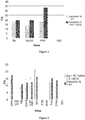
- the sample preparation with a method according to the invention allows the detection of 8 out of 9 viruses detected in the Mix B (1 LOD), showing that the method of the invention is at least as sensitive as qPCR for this amount of contaminating virus.
Landscapes
- Chemical & Material Sciences (AREA)
- Life Sciences & Earth Sciences (AREA)
- Organic Chemistry (AREA)
- Health & Medical Sciences (AREA)
- Proteomics, Peptides & Aminoacids (AREA)
- Zoology (AREA)
- Wood Science & Technology (AREA)
- Engineering & Computer Science (AREA)
- Analytical Chemistry (AREA)
- Immunology (AREA)
- Molecular Biology (AREA)
- Bioinformatics & Cheminformatics (AREA)
- Biotechnology (AREA)
- Biophysics (AREA)
- Physics & Mathematics (AREA)
- Genetics & Genomics (AREA)
- Biochemistry (AREA)
- Microbiology (AREA)
- General Engineering & Computer Science (AREA)
- General Health & Medical Sciences (AREA)
- Chemical Kinetics & Catalysis (AREA)
- Virology (AREA)
- Communicable Diseases (AREA)
- Measuring Or Testing Involving Enzymes Or Micro-Organisms (AREA)
Claims (15)
- Verfahren für die in vitro-Feststellung des Vorhandenseins von mindestens einer seltenen Nukleinsäure von einem Mikroorganismus oder einem Virus in einer biologischen Probe, wobei das Verfahren die folgenden Schritte umfasst:a) Extrahieren der Nukleinsäuremoleküle aus einer biologischen Probe, wobei die Nukleinsäuremoleküle doppelsträngige Nukleinsäuremoleküle, einzelsträngige Nukleinsäuremoleküle oder eine Kombination derselben umfassen,b) Auslösen der Denaturierung und Renaturierung der doppelsträngigen Nukleinsäuremoleküle von Schritt a),c) Kontaktieren des Produktes von Schritt b) mit einer duplex-spezifischen Nuklease (DSN),d) Inaktivieren und/oder Extrahieren der DSN aus dem Produkt von Schritt c) und Konzentrieren der Nukleinsäuremoleküle,e) Amplifizieren der Nukleinsäuremoleküle des Produktes von Schritt d),f) Erstellen einer DNA-Bibliothek aus dem Produkt von Schritt e),g) Bestimmen der Nukleinsäuresequenz von Molekülen der DNA-Bibliothek von Schritt f) und Feststellen von mindestens einer seltenen Nukleinsäuren von einem Mikroorganismus oder einem Virus aus der Nukleinsäuresequenz,wobei die biologische Probe aus einem Material hergestellt wird, das in der Gruppe gewählt wird, die besteht aus: einem menschlichen biologischen Fluid oder Gewebe, einem tierischen biologischen Fluid oder Gewebe, einer Kultur eines menschlichen oder eines tierischen biologischen Fluids oder Gewebes, einer Kultur von menschlichen, tierischen, pilzlichen oder einzelligen Eukaryoten-Zellen, prokaryotischen Zellen oder einer Kombination derselben, oder einem biotherapeutischen Produkt, vorzugsweise gewählt in der Gruppe, die besteht aus: rekombinantes Protein, monoclonalen Antikörpern, Vakzine, Zelltherapieprodukt, Gentherapieprodukt, Produkte von menschlichem oder tierischem Ursprung, wie zum Beispiel von Blut stammenden Produkten, Heparin, Hyaluronsäure und Kollagen, oder Zellen aus einer Zellkultur, die mit einem Virus infiziert ist, Zellen, von einem Hybridom erzeugt, wie zum Beispiel Maus-/menschliche Hybridome, die für die Herstellung von monoclonalen Antikörpern verwendet werden, und Zellen, die empfindlich sind, um für die Herstellung eines rekombinanten Proteins verwendet zu werden, oder aus einer Zellbank, vorzugsweise gewählt in der Gruppe, die besteht aus: einer Master-Zellbank, einer Arbeitszellbank und einer Produktionszellbank.
- Verfahren nach Anspruch 1, wobei in Schritt a) die Nukleinsäuremoleküle DNA-Moleküle, RNA-Moleküle oder eine Kombination derselben umfassen, und wobei dem Extrahieren der Nukleinsäuremoleküle die reverse Transkription der RNA-Moleküle von Schritt a) folgt.
- Verfahren nach Anspruch 1 oder 2, wobei in Schritt e) die Amplifikation der Nukleinsäuremoleküle durch Rolling-Circle-Amplifikation (RCA) ausgeführt wird.
- Verfahren nach einem der Ansprüche 1 bis 3, wobei der Mikroorganismus in der Gruppe gewählt wird, die besteht aus: grampositiven Bakterien, gramnegativen Bakterien, Mycoplasmen, Hefen und Pilzen.
- Verfahren nach Anspruch 4, wobei der Mikroorganismus ein Mycoplasma ist, das in der Gruppe gewählt wird, die besteht aus: Mycoplasma hyorhinis, Mycoplasma pneumoniae, Acheloplasma laidlawii, Mycoplasma fermentans, Mycoplasma orale, Spiroplasma citri, Mycoplasma synoviae, Mycoplasma gallisepticum and Mycoplasma arginini.
- Verfahren nach einem der Ansprüche 1 bis 3, wobei das mindestens eine seltene Nukleinsäuremolekül ein Nukleinsäuremolekül eines Virus ist.
- Verfahren nach Anspruch 6, wobei das Virus in der Gruppe gewählt wird, die besteht aus: doppelsträngiges DNA-Virus, einzelsträngiges DNA-Virus, doppelsträngiges RNA-Virus und einzelsträngiges RNA-Virus, segmentiertes Virus und nicht-segmentiertes Virus.
- Verfahren nach Anspruch 7, wobei das Virus in der Gruppe gewählt wird, die besteht aus: menschlichem Virus, Simianvirus, Nagetiervirus, Pferdevirus, Rindervirus, Schweinevirus, Insektenvirus und Bakteriophagen.
- Verfahren nach Anspruch 7 oder 8, wobei das Virus in der Gruppe gewählt wird, die besteht aus: Hepatitis C-Virus (HCV), Hepatitis B-Virus (HBV), B19, Adenovirus 5, BK, BVDV, FluA H3N8, MLV, PPV, Reovirus 3 und Influenza B-Virus.
- Verfahren zur Charakterisierung einer biologischen Probe, wobei das Verfahren die Feststellung von mindestens einer seltenen Nukleinsäure von einem Mikroorganismus oder Virus nach einem der Ansprüche 1 bis 9 und die Charakterisierung der biologischen Probe für das Vorhandensein und/oder die Menge des mindestens einen Mikroorganismus oder Virus umfasst.
- Verfahren zur Bewertung eines Herstellungsprozesses für die Präparation einer biologischen Probe, wobei das Verfahren die Feststellung, in der biologischen Probe, von mindestens einer seltenen Nukleinsäure von einem Mikroorganismus oder Virus nach einem der Ansprüche 1 bis 9 umfasst, wobei die Feststellung der seltenen Nukleinsäure von einem Mikroorganismus oder Virus in mindestens zwei Stufen des Herstellungsprozesses ausgeführt wird.
- Verwendung, bei dem Verfahren nach Anspruch 1, einer DSN für die Feststellung, in einer biologischen Probe, von mindestens einer seltenen Nukleinsäure von einem Mikroorganismus oder einem Virus, wobei die biologische Probe aus einem Material präpariert wird, das in der Gruppe gewählt wird, die besteht aus: einem menschlichen biologischen Fluid oder Gewebe, einem tierischen biologischen Fluid oder Gewebe, einer Kultur eines menschlichen oder eines tierischen biologischen Fluids oder Gewebes, einer Kultur von menschlichen, tierischen, pilzlichen oder einzelligen Eukaryoten-Zellen, prokaryotischen Zellen oder einer Kombination derselben, oder einem biotherapeutischen Produkt, vorzugsweise gewählt in der Gruppe, die besteht aus: rekombinantem Protein, monoclonalen Antikörpern, Vakzine, Zelltherapieprodukt, Gentherapieprodukt, Produkte von menschlichem oder tierischem Ursprung, wie zum Beispiel von Blut stammenden Produkten, Heparin, Hyaluronsäure und Kollagen, oder Zellen aus einer Zellkultur, die mit einem Virus infiziert ist, Zellen, von einem Hybridom erzeugt, wie zum Beispiel Maus-/menschliche Hybridome, die für die Herstellung von monoclonalen Antikörpern verwendet werden, und Zellen, die empfindlich sind, um für die Herstellung eines rekombinanten Proteins verwendet zu werden, oder aus einer Zellbank, vorzugsweise gewählt in der Gruppe, die besteht aus: einer Master-Zellbank, einer Arbeitszellbank und einer Produktionszellbank.
- Verwendung nach Anspruch 12, bei einem Verfahren, das einen Schritt des Amplifizierens von Nukleinsäuremolekülen umfasst, wobei die Verwendung der DSN zumindest vor dem Schritt des Amplifizierens der Nukleinsäuremoleküle ausgeführt wird.
- Verwendung eines Ausrüstungssatzes bei dem Verfahren nach Anspruch 1 für die Feststellung, in einer biologischen Probe, von mindestens einer seltenen Nukleinsäure von einem Mikroorganismus oder einem Virus, die DSN und mindestens eine Verbindung enthält, die in der Gruppe gewählt wird, bestehend aus: Puffer, Positivkontrolle und Anweisungen zur Verwendung, wobei die biologische Probe aus einem Material präpariert wird, das in der Gruppe gewählt wird, die besteht aus: einem menschlichen biologischen Fluid oder Gewebe, einem tierischen biologischen Fluid oder Gewebe, einer Kultur eines menschlichen oder eines tierischen biologischen Fluids oder Gewebes, einer Kultur von menschlichen, tierischen, pilzlichen oder einzelligen Eukaryoten-Zellen, prokaryotischen Zellen oder einer Kombination derselben, oder einem biotherapeutischen Produkt, vorzugsweise gewählt in der Gruppe, die besteht aus: rekombinantem Protein, monoclonalen Antikörpern, Vakzine, Zelltherapieprodukt, Gentherapieprodukt, Produkte von menschlichem oder tierischem Ursprung, wie zum Beispiel von Blut stammenden Produkten, Heparin, Hyaluronsäure und Kollagen, oder Zellen aus einer Zellkultur, die mit einem Virus infiziert ist, Zellen, von einem Hybridom erzeugt, wie zum Beispiel Maus-/menschliche Hybridome, die für die Herstellung von monoclonalen Antikörpern verwendet werden, und Zellen, die empfindlich sind, um für die Herstellung eines rekombinanten Proteins verwendet zu werden, oder aus einer Zellbank, vorzugsweise gewählt in der Gruppe, die besteht aus: einer Master-Zellbank, einer Arbeitszellbank und einer Produktionszellbank.
- Verwendung eines Ausrüstungssatzes nach Anspruch 14 bei dem Verfahren nach Anspruch 1, wobei der Ausrüstungsansatz die folgenden Elemente umfasst:a) eine DSN,b) mindestens eine Verbindung, die in der Gruppe gewählt wird, bestehend aus: Puffer, Positivkontrolle und Anweisungen zur Verwendung, undc) mindestens ein Primer, der in der Lage ist, den mindestens einen Mikroorganismus oder Virus spezifisch festzustellen.
Priority Applications (1)
| Application Number | Priority Date | Filing Date | Title |
|---|---|---|---|
| EP14777631.4A EP3052644B1 (de) | 2013-10-01 | 2014-10-01 | Detektion von seltenen mikrobiologischen nukleinsäuren |
Applications Claiming Priority (3)
| Application Number | Priority Date | Filing Date | Title |
|---|---|---|---|
| EP13306360 | 2013-10-01 | ||
| PCT/EP2014/071025 WO2015049278A1 (en) | 2013-10-01 | 2014-10-01 | Detection of rare microbiological nucleic acids |
| EP14777631.4A EP3052644B1 (de) | 2013-10-01 | 2014-10-01 | Detektion von seltenen mikrobiologischen nukleinsäuren |
Publications (2)
| Publication Number | Publication Date |
|---|---|
| EP3052644A1 EP3052644A1 (de) | 2016-08-10 |
| EP3052644B1 true EP3052644B1 (de) | 2019-07-10 |
Family
ID=49326622
Family Applications (1)
| Application Number | Title | Priority Date | Filing Date |
|---|---|---|---|
| EP14777631.4A Active EP3052644B1 (de) | 2013-10-01 | 2014-10-01 | Detektion von seltenen mikrobiologischen nukleinsäuren |
Country Status (6)
| Country | Link |
|---|---|
| US (1) | US20160215354A1 (de) |
| EP (1) | EP3052644B1 (de) |
| JP (1) | JP2016531561A (de) |
| CN (1) | CN105916998A (de) |
| CA (1) | CA2925942C (de) |
| WO (1) | WO2015049278A1 (de) |
Families Citing this family (11)
| Publication number | Priority date | Publication date | Assignee | Title |
|---|---|---|---|---|
| WO2016196358A1 (en) * | 2015-05-29 | 2016-12-08 | Epicentre Technologies Corporation | Methods of analyzing nucleic acids |
| CN106399542B (zh) * | 2016-10-26 | 2019-09-17 | 沈阳优宁生物科技有限公司 | 一种肺炎支原体的滚环恒温扩增快速检测引物及试剂盒 |
| CN106987657B (zh) * | 2017-04-21 | 2020-06-09 | 广西壮族自治区兽医研究所 | 用于鉴别牛病毒腹泻病毒和牛轮状病毒的引物组合及其应用 |
| CN108315494A (zh) * | 2018-04-26 | 2018-07-24 | 新疆畜牧科学院畜牧业质量标准研究所(新疆维吾尔自治区种羊与羊毛羊绒质量安全监督检验中心) | 一种检测牛病毒性腹泻病毒的试剂盒 |
| AU2019365821C1 (en) | 2018-10-22 | 2025-08-14 | Gen-Probe Incorporated | Compositions and methods for amplifying, detecting or quantifying human polyomavirus BK virus |
| US12152281B2 (en) * | 2019-05-30 | 2024-11-26 | Trizell Ltd. | Gene therapy vector contamination assay |
| EP4022086B1 (de) | 2019-08-27 | 2025-08-06 | F. Hoffmann-La Roche AG | Zusammensetzungen und verfahren zur amplifikation und detektion von hepatitis-b-virus-rna, einschliesslich aus cccdna transkribierter hbv-rna |
| CN112410467A (zh) * | 2020-11-23 | 2021-02-26 | 深圳市赛格诺生物科技有限公司 | 一种检测甲型和乙型流感病毒的冻干型荧光rt-pcr试剂及方法 |
| CN115851719A (zh) * | 2021-06-11 | 2023-03-28 | 山东舜丰生物科技有限公司 | 一种基于crispr技术检测病原微生物的方法 |
| CN114300046A (zh) * | 2021-12-28 | 2022-04-08 | 武汉百奥维凡生物科技有限公司 | 宏病毒组新病毒鉴定方法 |
| CN117721178A (zh) * | 2022-09-19 | 2024-03-19 | 深圳吉因加医学检验实验室 | 一种基于dsn构建微生物测序文库的方法与试剂盒 |
Family Cites Families (16)
| Publication number | Priority date | Publication date | Assignee | Title |
|---|---|---|---|---|
| AU2002346662A1 (en) * | 2001-12-04 | 2003-06-17 | Euregen Llc | Methods and compositions for selectively cleaving dna containing duplex acids in a complex nucleic acid mixture |
| JP2006525023A (ja) * | 2003-04-29 | 2006-11-09 | ジーイー・ヘルスケア・バイオサイエンス・コーポレイション | 核酸配列の多重開始増幅 |
| US20120045747A1 (en) * | 2010-08-23 | 2012-02-23 | Samsung Techwin Co., Ltd. | Kit for detecting hepatitis b virus and method for detecting hepatitis b virus using the same |
| EP1999276A4 (de) * | 2006-03-14 | 2010-08-04 | Genizon Biosciences Inc | Verfahren und mittel zur nukleinsäuresequenzierung |
| RU2008146089A (ru) * | 2006-05-24 | 2010-05-27 | Конинклейке Филипс Электроникс Н.В. (Nl) | Твердая биосенсорная подложка с интегрированным регулированием температуры и способ ее изготовления |
| WO2008021010A2 (en) * | 2006-08-07 | 2008-02-21 | Stratagene California | Methods for real-time quantitative pcr |
| JP5517284B2 (ja) * | 2008-09-03 | 2014-06-11 | 西川ゴム工業株式会社 | 耐熱性2本鎖特異的核酸分解酵素 |
| US20110287492A1 (en) * | 2008-12-04 | 2011-11-24 | Keygene N.V. | Method for the reduction of repetitive sequences in adapter-ligated restriction fragments |
| CN101597630B (zh) * | 2009-03-19 | 2011-12-21 | 浙江大学 | 一种双链特异性DNA酶介导的cDNA均一化消减杂交方法 |
| US8999643B2 (en) * | 2009-09-22 | 2015-04-07 | Children's Medical Research Institute | Methods and assays for the detection of alternative lengthening of telomeres (ALT) activity in cells |
| CN101851786A (zh) * | 2009-12-11 | 2010-10-06 | 香港城市大学深圳研究院 | 一种海洋青鳉鱼特异性组织的均一化cDNA文库及制备方法 |
| US9045536B2 (en) * | 2009-12-23 | 2015-06-02 | Merck Sharp & Dohme Corp. | Cell line 3M |
| WO2012032512A2 (en) * | 2010-09-07 | 2012-03-15 | Smart Biotech Ltd. | Methods and kits for the detection of an infection in subjects with low specific antibody levels |
| CN102533956B (zh) * | 2010-12-22 | 2014-05-14 | 深圳华大基因科技服务有限公司 | 一种提高原核生物转录组高通量测序效率的方法 |
| US20130316331A1 (en) * | 2011-01-26 | 2013-11-28 | Ramot At Tel-Aviv University Ltd. | Detection of infection by a microorganism using small rna sequencing subtraction and assembly |
| CN103160611B (zh) * | 2013-04-12 | 2015-07-15 | 武汉大学 | 一种microRNA检测探针和检测microRNA的方法 |
-
2014
- 2014-10-01 EP EP14777631.4A patent/EP3052644B1/de active Active
- 2014-10-01 JP JP2016520018A patent/JP2016531561A/ja active Pending
- 2014-10-01 CN CN201480063231.5A patent/CN105916998A/zh active Pending
- 2014-10-01 US US15/026,703 patent/US20160215354A1/en not_active Abandoned
- 2014-10-01 CA CA2925942A patent/CA2925942C/en active Active
- 2014-10-01 WO PCT/EP2014/071025 patent/WO2015049278A1/en not_active Ceased
Non-Patent Citations (1)
| Title |
|---|
| None * |
Also Published As
| Publication number | Publication date |
|---|---|
| EP3052644A1 (de) | 2016-08-10 |
| CN105916998A (zh) | 2016-08-31 |
| CA2925942A1 (en) | 2015-04-09 |
| JP2016531561A (ja) | 2016-10-13 |
| CA2925942C (en) | 2022-05-03 |
| US20160215354A1 (en) | 2016-07-28 |
| WO2015049278A1 (en) | 2015-04-09 |
Similar Documents
| Publication | Publication Date | Title |
|---|---|---|
| CA2925942C (en) | Detection of rare microbiological nucleic acids | |
| EP4497833A2 (de) | Typ-iii-crispr/cas-basierte diagnostik | |
| US20220372558A1 (en) | Method and Kit of Detecting the Absence of Micro-Organisms | |
| WO2002099129A2 (en) | Designing degenerate pcr primers | |
| WO2021050755A1 (en) | Novel class 2 type ii and type v crispr-cas rna-guided endonucleases | |
| CN119286993A (zh) | 用于即时核酸检测的组合物和方法 | |
| US20240076752A1 (en) | Methods for detection of nucleic acids | |
| DK3129499T3 (en) | UNIVERSAL CHECK FOR SEQUENCE ASSAYS | |
| US20230160023A1 (en) | Rna virus detection method | |
| WO2001077379A2 (en) | A method of cell detection | |
| EP3387149B1 (de) | Isothermische amplifizierung zur detektion von influenza virus in einer probe. | |
| EP3438280B1 (de) | Hämoplasmadetektionsverfahren | |
| CN117265143A (zh) | 一种病原微生物检测的探针组、方法及其应用 | |
| US20210207125A1 (en) | Method of isolating nucleic acids for long sequencing reads | |
| US10894981B2 (en) | Method for fragmenting double-stranded RNA and use of the same | |
| WO2026071125A1 (ja) | 真菌検査方法、プライマーセット、試薬セット及び細菌・真菌検査方法 | |
| WO2026071123A1 (ja) | 細菌検査方法、プライマーセット、試薬セット及び細菌・真菌検査方法 | |
| US20220042119A1 (en) | Detection of dna sequences as risk factors for hiv infection | |
| EP4101934A1 (de) | Verfahren und kits zum nachweis einer viralen infektion in einer biologischen probe | |
| TW202540443A (zh) | 偵測微生物之方法 |
Legal Events
| Date | Code | Title | Description |
|---|---|---|---|
| PUAI | Public reference made under article 153(3) epc to a published international application that has entered the european phase |
Free format text: ORIGINAL CODE: 0009012 |
|
| 17P | Request for examination filed |
Effective date: 20160427 |
|
| AK | Designated contracting states |
Kind code of ref document: A1 Designated state(s): AL AT BE BG CH CY CZ DE DK EE ES FI FR GB GR HR HU IE IS IT LI LT LU LV MC MK MT NL NO PL PT RO RS SE SI SK SM TR |
|
| AX | Request for extension of the european patent |
Extension state: BA ME |
|
| DAX | Request for extension of the european patent (deleted) | ||
| STAA | Information on the status of an ep patent application or granted ep patent |
Free format text: STATUS: EXAMINATION IS IN PROGRESS |
|
| 17Q | First examination report despatched |
Effective date: 20170707 |
|
| REG | Reference to a national code |
Ref country code: DE Ref legal event code: R079 Ref document number: 602014049869 Country of ref document: DE Free format text: PREVIOUS MAIN CLASS: C12Q0001680000 Ipc: C12Q0001680600 |
|
| RIC1 | Information provided on ipc code assigned before grant |
Ipc: C12Q 1/6806 20180101AFI20181214BHEP Ipc: C12Q 1/6844 20180101ALI20181214BHEP |
|
| GRAP | Despatch of communication of intention to grant a patent |
Free format text: ORIGINAL CODE: EPIDOSNIGR1 |
|
| STAA | Information on the status of an ep patent application or granted ep patent |
Free format text: STATUS: GRANT OF PATENT IS INTENDED |
|
| INTG | Intention to grant announced |
Effective date: 20190131 |
|
| GRAS | Grant fee paid |
Free format text: ORIGINAL CODE: EPIDOSNIGR3 |
|
| GRAA | (expected) grant |
Free format text: ORIGINAL CODE: 0009210 |
|
| STAA | Information on the status of an ep patent application or granted ep patent |
Free format text: STATUS: THE PATENT HAS BEEN GRANTED |
|
| AK | Designated contracting states |
Kind code of ref document: B1 Designated state(s): AL AT BE BG CH CY CZ DE DK EE ES FI FR GB GR HR HU IE IS IT LI LT LU LV MC MK MT NL NO PL PT RO RS SE SI SK SM TR |
|
| REG | Reference to a national code |
Ref country code: GB Ref legal event code: FG4D |
|
| REG | Reference to a national code |
Ref country code: CH Ref legal event code: EP Ref country code: AT Ref legal event code: REF Ref document number: 1153641 Country of ref document: AT Kind code of ref document: T Effective date: 20190715 |
|
| REG | Reference to a national code |
Ref country code: DE Ref legal event code: R096 Ref document number: 602014049869 Country of ref document: DE |
|
| REG | Reference to a national code |
Ref country code: IE Ref legal event code: FG4D |
|
| REG | Reference to a national code |
Ref country code: CH Ref legal event code: NV Representative=s name: MICHELI AND CIE SA, CH |
|
| REG | Reference to a national code |
Ref country code: NL Ref legal event code: FP |
|
| REG | Reference to a national code |
Ref country code: LT Ref legal event code: MG4D |
|
| REG | Reference to a national code |
Ref country code: AT Ref legal event code: MK05 Ref document number: 1153641 Country of ref document: AT Kind code of ref document: T Effective date: 20190710 |
|
| PG25 | Lapsed in a contracting state [announced via postgrant information from national office to epo] |
Ref country code: FI Free format text: LAPSE BECAUSE OF FAILURE TO SUBMIT A TRANSLATION OF THE DESCRIPTION OR TO PAY THE FEE WITHIN THE PRESCRIBED TIME-LIMIT Effective date: 20190710 Ref country code: AT Free format text: LAPSE BECAUSE OF FAILURE TO SUBMIT A TRANSLATION OF THE DESCRIPTION OR TO PAY THE FEE WITHIN THE PRESCRIBED TIME-LIMIT Effective date: 20190710 Ref country code: NO Free format text: LAPSE BECAUSE OF FAILURE TO SUBMIT A TRANSLATION OF THE DESCRIPTION OR TO PAY THE FEE WITHIN THE PRESCRIBED TIME-LIMIT Effective date: 20191010 Ref country code: SE Free format text: LAPSE BECAUSE OF FAILURE TO SUBMIT A TRANSLATION OF THE DESCRIPTION OR TO PAY THE FEE WITHIN THE PRESCRIBED TIME-LIMIT Effective date: 20190710 Ref country code: BG Free format text: LAPSE BECAUSE OF FAILURE TO SUBMIT A TRANSLATION OF THE DESCRIPTION OR TO PAY THE FEE WITHIN THE PRESCRIBED TIME-LIMIT Effective date: 20191010 Ref country code: PT Free format text: LAPSE BECAUSE OF FAILURE TO SUBMIT A TRANSLATION OF THE DESCRIPTION OR TO PAY THE FEE WITHIN THE PRESCRIBED TIME-LIMIT Effective date: 20191111 Ref country code: LT Free format text: LAPSE BECAUSE OF FAILURE TO SUBMIT A TRANSLATION OF THE DESCRIPTION OR TO PAY THE FEE WITHIN THE PRESCRIBED TIME-LIMIT Effective date: 20190710 Ref country code: HR Free format text: LAPSE BECAUSE OF FAILURE TO SUBMIT A TRANSLATION OF THE DESCRIPTION OR TO PAY THE FEE WITHIN THE PRESCRIBED TIME-LIMIT Effective date: 20190710 |
|
| PG25 | Lapsed in a contracting state [announced via postgrant information from national office to epo] |
Ref country code: RS Free format text: LAPSE BECAUSE OF FAILURE TO SUBMIT A TRANSLATION OF THE DESCRIPTION OR TO PAY THE FEE WITHIN THE PRESCRIBED TIME-LIMIT Effective date: 20190710 Ref country code: IS Free format text: LAPSE BECAUSE OF FAILURE TO SUBMIT A TRANSLATION OF THE DESCRIPTION OR TO PAY THE FEE WITHIN THE PRESCRIBED TIME-LIMIT Effective date: 20191110 Ref country code: GR Free format text: LAPSE BECAUSE OF FAILURE TO SUBMIT A TRANSLATION OF THE DESCRIPTION OR TO PAY THE FEE WITHIN THE PRESCRIBED TIME-LIMIT Effective date: 20191011 Ref country code: AL Free format text: LAPSE BECAUSE OF FAILURE TO SUBMIT A TRANSLATION OF THE DESCRIPTION OR TO PAY THE FEE WITHIN THE PRESCRIBED TIME-LIMIT Effective date: 20190710 Ref country code: LV Free format text: LAPSE BECAUSE OF FAILURE TO SUBMIT A TRANSLATION OF THE DESCRIPTION OR TO PAY THE FEE WITHIN THE PRESCRIBED TIME-LIMIT Effective date: 20190710 Ref country code: ES Free format text: LAPSE BECAUSE OF FAILURE TO SUBMIT A TRANSLATION OF THE DESCRIPTION OR TO PAY THE FEE WITHIN THE PRESCRIBED TIME-LIMIT Effective date: 20190710 |
|
| PG25 | Lapsed in a contracting state [announced via postgrant information from national office to epo] |
Ref country code: TR Free format text: LAPSE BECAUSE OF FAILURE TO SUBMIT A TRANSLATION OF THE DESCRIPTION OR TO PAY THE FEE WITHIN THE PRESCRIBED TIME-LIMIT Effective date: 20190710 |
|
| PG25 | Lapsed in a contracting state [announced via postgrant information from national office to epo] |
Ref country code: EE Free format text: LAPSE BECAUSE OF FAILURE TO SUBMIT A TRANSLATION OF THE DESCRIPTION OR TO PAY THE FEE WITHIN THE PRESCRIBED TIME-LIMIT Effective date: 20190710 Ref country code: DK Free format text: LAPSE BECAUSE OF FAILURE TO SUBMIT A TRANSLATION OF THE DESCRIPTION OR TO PAY THE FEE WITHIN THE PRESCRIBED TIME-LIMIT Effective date: 20190710 Ref country code: PL Free format text: LAPSE BECAUSE OF FAILURE TO SUBMIT A TRANSLATION OF THE DESCRIPTION OR TO PAY THE FEE WITHIN THE PRESCRIBED TIME-LIMIT Effective date: 20190710 Ref country code: IT Free format text: LAPSE BECAUSE OF FAILURE TO SUBMIT A TRANSLATION OF THE DESCRIPTION OR TO PAY THE FEE WITHIN THE PRESCRIBED TIME-LIMIT Effective date: 20190710 Ref country code: RO Free format text: LAPSE BECAUSE OF FAILURE TO SUBMIT A TRANSLATION OF THE DESCRIPTION OR TO PAY THE FEE WITHIN THE PRESCRIBED TIME-LIMIT Effective date: 20190710 |
|
| PG25 | Lapsed in a contracting state [announced via postgrant information from national office to epo] |
Ref country code: SK Free format text: LAPSE BECAUSE OF FAILURE TO SUBMIT A TRANSLATION OF THE DESCRIPTION OR TO PAY THE FEE WITHIN THE PRESCRIBED TIME-LIMIT Effective date: 20190710 Ref country code: SM Free format text: LAPSE BECAUSE OF FAILURE TO SUBMIT A TRANSLATION OF THE DESCRIPTION OR TO PAY THE FEE WITHIN THE PRESCRIBED TIME-LIMIT Effective date: 20190710 Ref country code: CZ Free format text: LAPSE BECAUSE OF FAILURE TO SUBMIT A TRANSLATION OF THE DESCRIPTION OR TO PAY THE FEE WITHIN THE PRESCRIBED TIME-LIMIT Effective date: 20190710 Ref country code: MC Free format text: LAPSE BECAUSE OF FAILURE TO SUBMIT A TRANSLATION OF THE DESCRIPTION OR TO PAY THE FEE WITHIN THE PRESCRIBED TIME-LIMIT Effective date: 20190710 Ref country code: IS Free format text: LAPSE BECAUSE OF FAILURE TO SUBMIT A TRANSLATION OF THE DESCRIPTION OR TO PAY THE FEE WITHIN THE PRESCRIBED TIME-LIMIT Effective date: 20200224 |
|
| REG | Reference to a national code |
Ref country code: DE Ref legal event code: R097 Ref document number: 602014049869 Country of ref document: DE |
|
| PLBE | No opposition filed within time limit |
Free format text: ORIGINAL CODE: 0009261 |
|
| STAA | Information on the status of an ep patent application or granted ep patent |
Free format text: STATUS: NO OPPOSITION FILED WITHIN TIME LIMIT |
|
| PG2D | Information on lapse in contracting state deleted |
Ref country code: IS |
|
| PG25 | Lapsed in a contracting state [announced via postgrant information from national office to epo] |
Ref country code: LU Free format text: LAPSE BECAUSE OF NON-PAYMENT OF DUE FEES Effective date: 20191001 |
|
| 26N | No opposition filed |
Effective date: 20200603 |
|
| PG25 | Lapsed in a contracting state [announced via postgrant information from national office to epo] |
Ref country code: SI Free format text: LAPSE BECAUSE OF FAILURE TO SUBMIT A TRANSLATION OF THE DESCRIPTION OR TO PAY THE FEE WITHIN THE PRESCRIBED TIME-LIMIT Effective date: 20190710 |
|
| PG25 | Lapsed in a contracting state [announced via postgrant information from national office to epo] |
Ref country code: IE Free format text: LAPSE BECAUSE OF NON-PAYMENT OF DUE FEES Effective date: 20191001 |
|
| PG25 | Lapsed in a contracting state [announced via postgrant information from national office to epo] |
Ref country code: CY Free format text: LAPSE BECAUSE OF FAILURE TO SUBMIT A TRANSLATION OF THE DESCRIPTION OR TO PAY THE FEE WITHIN THE PRESCRIBED TIME-LIMIT Effective date: 20190710 |
|
| PG25 | Lapsed in a contracting state [announced via postgrant information from national office to epo] |
Ref country code: HU Free format text: LAPSE BECAUSE OF FAILURE TO SUBMIT A TRANSLATION OF THE DESCRIPTION OR TO PAY THE FEE WITHIN THE PRESCRIBED TIME-LIMIT; INVALID AB INITIO Effective date: 20141001 Ref country code: MT Free format text: LAPSE BECAUSE OF FAILURE TO SUBMIT A TRANSLATION OF THE DESCRIPTION OR TO PAY THE FEE WITHIN THE PRESCRIBED TIME-LIMIT Effective date: 20190710 |
|
| PG25 | Lapsed in a contracting state [announced via postgrant information from national office to epo] |
Ref country code: MK Free format text: LAPSE BECAUSE OF FAILURE TO SUBMIT A TRANSLATION OF THE DESCRIPTION OR TO PAY THE FEE WITHIN THE PRESCRIBED TIME-LIMIT Effective date: 20190710 |
|
| PGFP | Annual fee paid to national office [announced via postgrant information from national office to epo] |
Ref country code: NL Payment date: 20221021 Year of fee payment: 9 Ref country code: FR Payment date: 20221006 Year of fee payment: 9 |
|
| PGFP | Annual fee paid to national office [announced via postgrant information from national office to epo] |
Ref country code: GB Payment date: 20221121 Year of fee payment: 9 Ref country code: DE Payment date: 20221114 Year of fee payment: 9 |
|
| PGFP | Annual fee paid to national office [announced via postgrant information from national office to epo] |
Ref country code: CH Payment date: 20221129 Year of fee payment: 9 Ref country code: BE Payment date: 20221027 Year of fee payment: 9 |
|
| REG | Reference to a national code |
Ref country code: DE Ref legal event code: R119 Ref document number: 602014049869 Country of ref document: DE |
|
| REG | Reference to a national code |
Ref country code: CH Ref legal event code: PL |
|
| REG | Reference to a national code |
Ref country code: NL Ref legal event code: MM Effective date: 20231101 |
|
| REG | Reference to a national code |
Ref country code: BE Ref legal event code: MM Effective date: 20231031 |
|
| GBPC | Gb: european patent ceased through non-payment of renewal fee |
Effective date: 20231001 |
|
| PG25 | Lapsed in a contracting state [announced via postgrant information from national office to epo] |
Ref country code: GB Free format text: LAPSE BECAUSE OF NON-PAYMENT OF DUE FEES Effective date: 20231001 |
|
| PG25 | Lapsed in a contracting state [announced via postgrant information from national office to epo] |
Ref country code: CH Free format text: LAPSE BECAUSE OF NON-PAYMENT OF DUE FEES Effective date: 20231031 Ref country code: NL Free format text: LAPSE BECAUSE OF NON-PAYMENT OF DUE FEES Effective date: 20231101 |
|
| PG25 | Lapsed in a contracting state [announced via postgrant information from national office to epo] |
Ref country code: NL Free format text: LAPSE BECAUSE OF NON-PAYMENT OF DUE FEES Effective date: 20231101 Ref country code: GB Free format text: LAPSE BECAUSE OF NON-PAYMENT OF DUE FEES Effective date: 20231001 Ref country code: FR Free format text: LAPSE BECAUSE OF NON-PAYMENT OF DUE FEES Effective date: 20231031 Ref country code: DE Free format text: LAPSE BECAUSE OF NON-PAYMENT OF DUE FEES Effective date: 20240501 Ref country code: CH Free format text: LAPSE BECAUSE OF NON-PAYMENT OF DUE FEES Effective date: 20231031 |
|
| PG25 | Lapsed in a contracting state [announced via postgrant information from national office to epo] |
Ref country code: BE Free format text: LAPSE BECAUSE OF NON-PAYMENT OF DUE FEES Effective date: 20231031 |