EP2992268B1 - Verfahren und anlage zur abtrennung von schwermetallen von phosphorhaltigem ausgangsmaterial - Google Patents
Verfahren und anlage zur abtrennung von schwermetallen von phosphorhaltigem ausgangsmaterial Download PDFInfo
- Publication number
- EP2992268B1 EP2992268B1 EP13722355.8A EP13722355A EP2992268B1 EP 2992268 B1 EP2992268 B1 EP 2992268B1 EP 13722355 A EP13722355 A EP 13722355A EP 2992268 B1 EP2992268 B1 EP 2992268B1
- Authority
- EP
- European Patent Office
- Prior art keywords
- reactor
- starting material
- process according
- alkaline source
- heated
- Prior art date
- Legal status (The legal status is an assumption and is not a legal conclusion. Google has not performed a legal analysis and makes no representation as to the accuracy of the status listed.)
- Active
Links
Images
Classifications
-
- F—MECHANICAL ENGINEERING; LIGHTING; HEATING; WEAPONS; BLASTING
- F23—COMBUSTION APPARATUS; COMBUSTION PROCESSES
- F23G—CREMATION FURNACES; CONSUMING WASTE PRODUCTS BY COMBUSTION
- F23G5/00—Incineration of waste; Incinerator constructions; Details, accessories or control therefor
- F23G5/02—Incineration of waste; Incinerator constructions; Details, accessories or control therefor with pretreatment
-
- B—PERFORMING OPERATIONS; TRANSPORTING
- B01—PHYSICAL OR CHEMICAL PROCESSES OR APPARATUS IN GENERAL
- B01J—CHEMICAL OR PHYSICAL PROCESSES, e.g. CATALYSIS OR COLLOID CHEMISTRY; THEIR RELEVANT APPARATUS
- B01J8/00—Chemical or physical processes in general, conducted in the presence of fluids and solid particles; Apparatus for such processes
- B01J8/18—Chemical or physical processes in general, conducted in the presence of fluids and solid particles; Apparatus for such processes with fluidised particles
- B01J8/24—Chemical or physical processes in general, conducted in the presence of fluids and solid particles; Apparatus for such processes with fluidised particles according to "fluidised-bed" technique
-
- C—CHEMISTRY; METALLURGY
- C01—INORGANIC CHEMISTRY
- C01B—NON-METALLIC ELEMENTS; COMPOUNDS THEREOF; METALLOIDS OR COMPOUNDS THEREOF NOT COVERED BY SUBCLASS C01C
- C01B25/00—Phosphorus; Compounds thereof
- C01B25/16—Oxyacids of phosphorus; Salts thereof
- C01B25/26—Phosphates
- C01B25/265—General methods for obtaining phosphates
-
- C—CHEMISTRY; METALLURGY
- C05—FERTILISERS; MANUFACTURE THEREOF
- C05B—PHOSPHATIC FERTILISERS
- C05B17/00—Other phosphatic fertilisers, e.g. soft rock phosphates, bone meal
-
- F—MECHANICAL ENGINEERING; LIGHTING; HEATING; WEAPONS; BLASTING
- F23—COMBUSTION APPARATUS; COMBUSTION PROCESSES
- F23G—CREMATION FURNACES; CONSUMING WASTE PRODUCTS BY COMBUSTION
- F23G7/00—Incinerators or other apparatus for consuming industrial waste, e.g. chemicals
- F23G7/001—Incinerators or other apparatus for consuming industrial waste, e.g. chemicals for sludges or waste products from water treatment installations
-
- C—CHEMISTRY; METALLURGY
- C02—TREATMENT OF WATER, WASTE WATER, SEWAGE, OR SLUDGE
- C02F—TREATMENT OF WATER, WASTE WATER, SEWAGE, OR SLUDGE
- C02F11/00—Treatment of sludge; Devices therefor
- C02F11/004—Sludge detoxification
-
- C—CHEMISTRY; METALLURGY
- C02—TREATMENT OF WATER, WASTE WATER, SEWAGE, OR SLUDGE
- C02F—TREATMENT OF WATER, WASTE WATER, SEWAGE, OR SLUDGE
- C02F11/00—Treatment of sludge; Devices therefor
- C02F11/06—Treatment of sludge; Devices therefor by oxidation
-
- C—CHEMISTRY; METALLURGY
- C02—TREATMENT OF WATER, WASTE WATER, SEWAGE, OR SLUDGE
- C02F—TREATMENT OF WATER, WASTE WATER, SEWAGE, OR SLUDGE
- C02F2101/00—Nature of the contaminant
- C02F2101/10—Inorganic compounds
- C02F2101/20—Heavy metals or heavy metal compounds
-
- C—CHEMISTRY; METALLURGY
- C02—TREATMENT OF WATER, WASTE WATER, SEWAGE, OR SLUDGE
- C02F—TREATMENT OF WATER, WASTE WATER, SEWAGE, OR SLUDGE
- C02F9/00—Multistage treatment of water, waste water or sewage
-
- F—MECHANICAL ENGINEERING; LIGHTING; HEATING; WEAPONS; BLASTING
- F23—COMBUSTION APPARATUS; COMBUSTION PROCESSES
- F23G—CREMATION FURNACES; CONSUMING WASTE PRODUCTS BY COMBUSTION
- F23G2201/00—Pretreatment
- F23G2201/30—Pyrolysing
- F23G2201/302—Treating pyrosolids
-
- F—MECHANICAL ENGINEERING; LIGHTING; HEATING; WEAPONS; BLASTING
- F23—COMBUSTION APPARATUS; COMBUSTION PROCESSES
- F23G—CREMATION FURNACES; CONSUMING WASTE PRODUCTS BY COMBUSTION
- F23G2201/00—Pretreatment
- F23G2201/30—Pyrolysing
- F23G2201/303—Burning pyrogases
-
- F—MECHANICAL ENGINEERING; LIGHTING; HEATING; WEAPONS; BLASTING
- F23—COMBUSTION APPARATUS; COMBUSTION PROCESSES
- F23G—CREMATION FURNACES; CONSUMING WASTE PRODUCTS BY COMBUSTION
- F23G2209/00—Specific waste
- F23G2209/12—Sludge, slurries or mixtures of liquids
-
- Y—GENERAL TAGGING OF NEW TECHNOLOGICAL DEVELOPMENTS; GENERAL TAGGING OF CROSS-SECTIONAL TECHNOLOGIES SPANNING OVER SEVERAL SECTIONS OF THE IPC; TECHNICAL SUBJECTS COVERED BY FORMER USPC CROSS-REFERENCE ART COLLECTIONS [XRACs] AND DIGESTS
- Y02—TECHNOLOGIES OR APPLICATIONS FOR MITIGATION OR ADAPTATION AGAINST CLIMATE CHANGE
- Y02W—CLIMATE CHANGE MITIGATION TECHNOLOGIES RELATED TO WASTEWATER TREATMENT OR WASTE MANAGEMENT
- Y02W10/00—Technologies for wastewater treatment
- Y02W10/40—Valorisation of by-products of wastewater, sewage or sludge processing
Definitions
- the present invention is directed to a process and a plant for separating heavy metals from phosphoric starting material.
- Phosphate is a very important nutrient for the photosynthesis of plants so that more than 90 % of the global production of phosphate is processed to phosphorus fertilizers.
- the availability of phosphorus is limited.
- sewage sludge ash which often contains a considerable amount of phosphorus and which usually is disposed of in a landfill, as a source to recover phosphorus. It has been proposed to burn phosphorus containing sewage sludge to obtain a phosphorus containing ash with a phosphorus content of 8 to 20 wt.-%.
- the main chemical components of the resulting sewage sludge ashes are SiO 2 , CaO, Al 2 O 3 , Fe 2 O 3 and P 2 O 5 .
- the ashes also contain heavy metals, such as lead, cadmium, arsenic, chrome, copper, nickel, zinc or mercury. As the content of these elements exceeds the limits provided by official regulations and as the plant availability of its phosphate compounds is poor, the sewage sludge ash as such cannot be used as fertilizer and has to be processed beforehand.
- Application PCT/EP2012/061986 describes a process for the separation of heavy metals from phosphorus-containing sewage sludge ash, wherein the starting material is heated to a temperature of between 700°C and 1.100°C in a first reactor, combustion gases are withdrawn and the heated starting material is transferred to a second reactor where chlorides of alkaline and earth alkaline metals are added.
- thermochemical treatment of sewage sludge ashes for phosphorus recovery discloses a thermochemical treatment of sewage sludge ashes for phosphorus recovery is disclosed wherein chloride salts are added to remove heavy metals.
- the process according to the invention uses an alkaline source to convert the phosphorous contained in the starting material into soluble phosphate compounds.
- the alkaline source is selected from the group consisting of sodium carbonates, sodium hydroxides, potassium carbonates and potassium hydroxides.
- the alkaline source is Na 2 CO 3 (soda ash).
- the alkaline source is added in an amount of 2-80 wt.-%, preferably 10-50 wt.-% of the starting material.
- elemental carbon is used to reduce the heavy metal components of the starting material for subsequent elimination.
- the elemental carbon source is selected from the group consisting of pulverized lignites, dry sewage sludge or dry biomass.
- the elemental carbon source is pre-dried sewage sludge.
- the elemental carbon source is added in an amount of 1-40 wt.-%, preferably 3-15 wt.-% of the starting material.
- a mixture of air and fuel are supplied to said first reactor.
- any fuel capable of producing the required temperatures inside the first reactor can be used.
- Preferred fuels according to the invention are natural gas, sewage sludge and phosphorus containing biomass such as farmyard manure or animal by-products.
- the starting material is pre-heated to a temperature of 300 to 800°C, preferably 400 to 600 °C, and more preferably 520-580°C, prior to the heating in the first reactor of step (i).
- Said pre-heating is preferably done in multiple stages in order to cool down the combustion gas to a suitable temperature for the preheating of the alkaline source. If soda ash is used as alkaline source, its melting point is 851 °C, so that it should not be directly contacted with the hot combustion gas exiting the first reactor.
- the alkaline source is pre-heated in a second pre-heating stage preferably to a temperature of 200 to 500°C, preferably 300 to 400°C, prior to the introduction into the second reactor.
- the process according to the invention is advantageous compared to the state of the art in several aspects.
- step (iii) Since the major amount of flue gas is generated in the first reactor of step (i), the dimensions of the second reactor in step (iii) can be significantly reduced. Furthermore, there is no need to heat gaseous compounds in the second reactor in step (iii) that are not used in the reaction, thereby drastically reducing energy requirements compared to the state of the art processes.
- the pre-heating of the alkaline source in step (ii) of the process according to the invention further reduces the energy necessary to heat the second reactor in step (iii).
- the mixture of the alkaline source and the elemental carbon source in the second reactor in step (iii) enhances the decomposition of the alkaline source and therefore the formation of soluble phosphate compounds.
- step (iii) is cooled below the condensation temperature of the heavy metal compounds to allow for their precipitation and removal.
- the remaining, phosphorus rich solids leave the reactor and are conveyed to a finishing section to manufacture straight phosphorus or complex fertilizer.
- the phosphorus rich solids withdrawn from the second reactor in step (iii) may be mixed with a high grade straight phosphorus carrier and/or a nutrition carrier to obtain highly valuable phosphate fertilizer.
- the solids may be homogenized and granulated to facilitate the further handling.
- the combustion gases from step (i) are fed into a cyclone separator and subsequently into a Venturi section of the first preheating stage.
- combustion gases are withdrawn from the cyclone separator, enter a Venturi section of a second preheating section and are admixed with an alkaline source according to step (ii).
- the present invention is also directed to a plant for separating heavy metals from phosphoric starting material according to claim 12 which is adapted to perform the process as described above.
- the plant comprises a first reactor for heating the material having at least one line for withdrawing combustion gas, a first preheating stage for preheating the starting material, a second preheating stage for heating an alkaline source, and a second reactor for heating the heated starting material and the preheated alkaline source as well as an elemental carbon source having at least one line for withdrawing process gas and at least one line for withdrawing a product stream.
- the first reactor of step (i) is a fluidized bed reactor, operating with an expanded solids surface that ensures an ideal heat transfer.
- the second reactor in step (iii) preferably is a rotary kiln.
- the first and/or the second pre-heating stage each comprises a Venturi section and a cyclone separator.
- the Venturi section assists in mixing the added material with the hot gas while in the cyclone separator the solids are separated from the gas and then transferred to the first and second reactor, respectively.
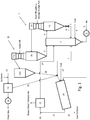
- a phosphorous-containing raw or starting material such as sewage sludge or biomass ash or rock phosphate is pneumatically conveyed from non-illustrated storage silos to a first preheating stage 2 comprising a Venturi section 2a and a cyclone separator 2b.
- the starting material is intensively mixed with a hot combustion gas withdrawn from a first reactor 1 and heated to a temperature of 400 to 600°C, preferably about 575°C.
- the cyclone separator 2b the solid material is separated from the gas and transferred via line 3 into the first reactor 1, which preferably is a fluidized bed reactor.
- the preheated starting material is heated by the combustion of fuel, such as natural gas, biomass or sewage sludge supplied through fuel line 4 with air supplied through air line 5.
- fuel such as natural gas, biomass or sewage sludge supplied through fuel line 4 with air supplied through air line 5.
- the air may be introduced under elevated pressure via compressor 6.
- the starting material is heated to a temperature of 700 to 1.100°C, preferably 900 to 1.000°C and in particular about 950°C.
- the thus heated starting material is withdrawn from the first reactor 1 through line 7 and is fed to a second reactor 20, preferably a rotary kiln reactor.
- the level of the inventory in the first reactor 1 can be controlled by a seal pot 8 such as described in document WO 2008/104250 A , a dip leg seal or the like.
- the combustion gases are withdrawn from the first reactor 1 through line 9 into a cyclone separator 10 for separating the gas from the solid material.
- the solid material is withdrawn at the bottom of the cyclone separator 10 and transferred to the second reactor 20 through line 7.
- the hot combustion gases enter into the Venturi section 2a of the first preheating stage 2 for preheating the starting material.
- the gas is withdrawn at the top and enters a Venturi section 11a of a second preheating stage 11 where soda ash is added as a preferred alkaline source and mixed with the heating gas.
- the mixture then is transferred into a cyclone separator 11b for separating the solids from the gas.
- the alkaline source is preheated to 300 to 400°C, preferably about 360°C, and then transferred into the second reactor 20 through line 16.
- the gas is withdrawn at the top of cyclone separator 11b and transferred into separator 13 via line 12, where the solids are separated from the gas after a suitable, calcium or sodium based, sorbent such as calcium hydrate, calcium carbonate or sodium hydrogen carbonate has been added.
- a filter 14 preferably an electrostatic precipitator and other suitable cleaning device, for recovering additional solids that may be introduced into the second reactor 20 though line 15, the clean gas is removed from the plant.
- the starting material supplied from the first reactor 1 through line 7 and the alkaline source supplied through lines 15, 16 is introduced into the second reactor 20 and heated therein to a temperature of 700 to 1.100, preferably 900 to 1.000°C and in particular about 950°C.
- an elemental carbon source in particular pre-dried sewage sludge, biomass, pulverized lignite or coal and/or coke, is fed to the second reactor 20 through line 17.
- Air may be introduced through line 5.
- the compounds may be mixed before entering the second reactor 20 or supplied separately and mixed within reactor 20, preferably by rotation.
- the alkaline source decomposes into X + Y (where X is the alkaline ion and Y is a carbonate or hydrogen anion) and the elemental carbon source reduces the heavy metals to their elemental form.
- X is the alkaline ion and Y is a carbonate or hydrogen anion
- elemental carbon source reduces the heavy metals to their elemental form.
- soda ash the reaction is as follows: Na 2 CO 3 + C ⁇ Na 2 O + 2CO
- the heavy metals evaporate and leave the second reactor 20 with the process gas through line 21.
- the remaining, phosphorus rich solids leave the second reactor 20 through a gas-tight outlet and product line 22 and are cooled.
- the semi-product withdrawn through product line 22 is free from toxic heavy metals and conveyed to a finishing section (not shown) where it is manufactured to straight phosphorus or complex fertilizers.
- the process gas from the second reactor 20 contains the elemental heavy metals. Said process gas is transmitted via line 21 into separator 23 where it is quenched to about 200-400°C with fresh air or water to condensate the heavy metal compounds to solid particles. These particles are captured in a baghouse filter(not shown) as filter dust. Alternatively, the solids may be separated from the gas by electrostatic precipitation. Until heavy metal recycling will be commercially viable, the filter dust will be deposited as secondary waste. Finally, the purified process gas is fed back into first reactor 1 via line 24.
- the semi-product already complies with the requirements of the fertilizer act.
- concentration of toxic substances and particularly of cadmium and uranium is one to two orders of magnitude below the respective concentrations in phosphate rock based fertilizers.
- a measured amount of a high grade straight phosphorus (P) carrier may be added to the semi-product.
- the semi-product is analyzed online for its concentration of P 2 O 5 and one or several guiding heavy metals.
- a measured quantity of triple-superphosphate (TSP) or phosphoric acid is admixed and homogenized.
- TSP triple-superphosphate
- phosphate rock is used instead of TSP to adjust the P-concentration.
- the product is homogenized and granulated in a mixer-granulator and - depending on the final purpose - finished as dust free powder or as final granules. From this stage, the product has become the final product of the plant that either will be sold to the agricultural product distributors or to fertilizer manufacturers.
- the plant can be extended to manufacture complex fertilizers by admixture of additional nutrient carriers.
- This step requires additional silos/storing facilities and the corresponding design of the finishing section of the plant to handle the additional nutrient and fertilizer quantities.
- the product and additional nutrient carriers are conveyed and fed to the mixer-granulator in ratios determined by the target fertilizer type.
- complex fertilizer granules of homogenous composition and a determined corn size distribution are produced that comply with all requirements in terms of threshold values, tolerances and nutrient solubility.
- the raw material, ash does not contain combustible and halogenic-organic substances. It mainly consists of phosphate, calcium, silicon, iron and aluminum compounds.
- the starting material treatment capacity of the plant may be e.g. 4-10 tons per hour.
- Raw materials are heated by natural gas burners or by combusting sewage sludge or biomass, and energy is efficiently recycled within the plant.
- Process emissions are effectively controlled by a sequence of adsorption reactors and baghouse filters.
- the heavy metals are captured as dry filter dust and safely disposed of in a landfill.
- Additional nutrient carriers are exclusively licensed fertilizers as ammonium sulfate, potassium chloride (MOP), potassium sulfate (SOP) and converter slag.
- MOP potassium chloride
- SOP potassium sulfate
- Converter slag Tri-superphosphate and the finished products will be stored in silos or as bulk material in covered warehouses. Binders and coating agents and - on demand - phosphorus and sulfuric acid are stored in compliance with legal requirements.
Landscapes
- Engineering & Computer Science (AREA)
- Chemical & Material Sciences (AREA)
- Organic Chemistry (AREA)
- Mechanical Engineering (AREA)
- General Engineering & Computer Science (AREA)
- Environmental & Geological Engineering (AREA)
- Inorganic Chemistry (AREA)
- Water Supply & Treatment (AREA)
- Combustion & Propulsion (AREA)
- Chemical Kinetics & Catalysis (AREA)
- Fertilizers (AREA)
- Processing Of Solid Wastes (AREA)
- Life Sciences & Earth Sciences (AREA)
- Hydrology & Water Resources (AREA)
- Treatment Of Sludge (AREA)
- Manufacture And Refinement Of Metals (AREA)
Claims (15)
- Ein Verfahren zum Abtrennen von Schwermetallen aus phosphorhaltigem Ausgangsmaterial umfassend die folgenden Schritte:(i) Aufheizen des Ausgangsmaterials auf eine Temperatur von 600°C bis 1200°C in einem ersten Reaktor (1) und Abziehen von Verbrennungsgas;(ii) Verwenden des Verbrennungsgases aus Schritt (i) zum Vorwärmen einer alkalischen Quelle; und(iii) Übertragen des aufgeheizten Ausgangsmaterials aus Schritt (i) und der aufgeheizten alkalischen Quelle aus Schritt (ii) zu einem zweiten Reaktor (20), Hinzufügen einer Quelle elementaren Kohlenstoffs, Aufheizen auf eine Temperatur von 700°C bis 1100°C und Abziehen von Prozessgas und einem Produktstrom.
- Das Verfahren nach Anspruch 1, dadurch gekennzeichnet, dass das Ausgangsmaterial vor dem Schritt (i) in wenigstens einer Vorwärmestufe (2) auf eine Temperatur von 300°C bis 800°C vorgewärmt wird.
- Das Verfahren nach Anspruch 1 oder 2, dadurch gekennzeichnet, dass das Ausgangsmaterial vor dem Schritt (i) in mehreren Stufen vorgewärmt wird.
- Das Verfahren nach einem der vorhergehenden Ansprüche, dadurch gekennzeichnet, dass die alkalische Quelle vor dem Einbringen in den zweiten Reaktor (20) in einer zweiten Vorwärmestufe (11) auf eine Temperatur von 200°C bis 500°C vorgewärmt wird.
- Das Verfahren nach einem der vorhergehenden Ansprüche, dadurch gekennzeichnet, dass die alkalische Quelle aus der Gruppe ausgewählt wird, die aus Natriumcarbonaten, Natriumhydroxiden, Kaliumcarbonaten und Kaliumhydroxiden oder Kombinationen hiervon besteht, wobei die alkalische Quelle vorzugsweise kalziniertes Soda ist.
- Das Verfahren nach einem der vorhergehenden Ansprüche, dadurch gekennzeichnet, dass die alkalische Quelle in einer Menge von 2 bis 80 Gewichtsprozent, vorzugsweise 10 bis 50 Gewichtsprozent des Ausgangsmaterials hinzugefügt wird.
- Das Verfahren nach einem der vorhergehenden Ansprüche, dadurch gekennzeichnet, dass die Quelle elementaren Kohlenstoffs aus der Gruppe ausgewählt wird, die aus pulverisierten Ligniten, trockenem Klärschlamm, trockener Biomasse, pulverisierter Braunkohle, Kohle und/oder Koks oder einer Kombination hiervon besteht, und wobei die Quelle elementaren Kohlenstoffs vorzugsweise in einer Menge von 1 bis 40 Gewichtsprozent, stärker bevorzugt 3 bis 15 Gewichtsprozent des Ausgangsmaterials hinzugefügt wird.
- Das Verfahren nach Anspruch 2, dadurch gekennzeichnet, dass die Verbrennungsgase aus Schritt (i) in einen Zyklonabscheider (10) und anschließend in einen Venturi-Abschnitt (2a) der ersten Vorwärmstufe (2) eingebracht werden.
- Das Verfahren nach einem der vorhergehenden Ansprüche, dadurch gekennzeichnet, dass die Verbrennungsgase aus Schritt (i) von einem Zyklonabscheider (2b) abgezogen werden, in einen Venturi-Abschnitt (11a) eintreten und gemäß Schritt (ii) mit einer alkalischen Quelle gemischt werden.
- Das Verfahren nach einem der vorhergehenden Ansprüche, dadurch gekennzeichnet, dass das Prozessgas in Schritt (iii) unter die Kondensationstemperatur der Schwermetallverbindungen gekühlt wird, um ihre Abscheidung und Entfernung zu ermöglichen.
- Das Verfahren nach Anspruch 10, dadurch gekennzeichnet, dass das schwermetallfreie Prozessgas in den ersten Reaktor (1) zurückgeführt wird.
- Eine Anlage zum Abtrennen von Schwermetall aus phosphorhaltigem Ausgangsmaterial, die dazu ausgestaltet ist, ein Verfahren nach einem der vorhergehenden Ansprüche durchzuführen, wobei die Anlage einen ersten Reaktor (1), der dazu ausgestaltet ist, das Ausgangsmaterial auf eine Temperatur von 600°C bis 1200°C aufzuheizen, eine erste Vorwärmestufe (2) zum Vorwärmen des Ausgangsmaterials, eine zweite Vorwärmestufe (11) zum Aufheizen einer alkalischen Quelle und einen zweiten Reaktor (20), der dazu ausgestaltet ist, das aufgeheizte Ausgangsmaterial und die vorgewärmte alkalische Quelle sowie eine Quelle elementaren Kohlenstoffs auf eine Temperatur von 700°C bis 1100°C aufzuheizen, und der wenigstens eine Leitung (21) zum Abziehen von Prozessgas und wenigstens eine Produktleitung (22) zum Abziehen eines Produktstroms hat, aufweist, und wobei der erste Reaktor (1) wenigstens eine Leitung zum Abziehen von Verbrennungsgas zum Vorwärmen der alkalischen Quelle aufweist.
- Die Anlage nach Anspruch 12, dadurch gekennzeichnet, dass die erste Vorwärmestufe (2) zum Vorwärmen des Ausgangsmaterials, das dem ersten Reaktor (1) zugeführt wird, mehrere Stufen aufweist.
- Die Anlage nach Anspruch 12 oder 13, dadurch gekennzeichnet, dass die erste und/oder die zweite Vorwärmestufe (2; 11) jeweils einen Venturi-Abschnitt (2a; 11a) und einen Zyklonabscheider (2b, 11b) aufweist.
- Die Anlage nach einem der Ansprüche 12 bis 14, dadurch gekennzeichnet, dass der erste Reaktor (1) ein Wirbelschichtreaktor und/oder dass der zweite Reaktor (20) ein Drehrohrofen ist.
Applications Claiming Priority (1)
| Application Number | Priority Date | Filing Date | Title |
|---|---|---|---|
| PCT/EP2013/059285 WO2014177228A1 (en) | 2013-05-03 | 2013-05-03 | Process and plant for separating heavy metals from phosphoric starting material |
Publications (2)
| Publication Number | Publication Date |
|---|---|
| EP2992268A1 EP2992268A1 (de) | 2016-03-09 |
| EP2992268B1 true EP2992268B1 (de) | 2020-01-15 |
Family
ID=48430715
Family Applications (1)
| Application Number | Title | Priority Date | Filing Date |
|---|---|---|---|
| EP13722355.8A Active EP2992268B1 (de) | 2013-05-03 | 2013-05-03 | Verfahren und anlage zur abtrennung von schwermetallen von phosphorhaltigem ausgangsmaterial |
Country Status (10)
| Country | Link |
|---|---|
| US (1) | US10081545B2 (de) |
| EP (1) | EP2992268B1 (de) |
| JP (1) | JP6174787B2 (de) |
| KR (1) | KR101782709B1 (de) |
| CN (1) | CN105324609B (de) |
| CA (1) | CA2910015A1 (de) |
| IL (1) | IL242276B (de) |
| MA (1) | MA38622B1 (de) |
| TN (1) | TN2015000478A1 (de) |
| WO (1) | WO2014177228A1 (de) |
Families Citing this family (2)
| Publication number | Priority date | Publication date | Assignee | Title |
|---|---|---|---|---|
| DE102016103349A1 (de) * | 2016-02-25 | 2017-08-31 | Outotec (Finland) Oy | Verfahren und Vorrichtung zur thermischen Behandlung eines verunreinigten Feststoffes |
| CN111315500A (zh) * | 2017-06-07 | 2020-06-19 | 金熙濬 | 重金属的分离方法 |
Family Cites Families (22)
| Publication number | Priority date | Publication date | Assignee | Title |
|---|---|---|---|---|
| DE2729277A1 (de) * | 1977-06-29 | 1979-01-04 | Saarberg Fernwaerme Gmbh | Verfahren zur behandlung von schlaemmen oder aschen, insbesondere von klaerschlamm oder klaerschlammaschen |
| US4450146A (en) * | 1982-09-30 | 1984-05-22 | Stauffer Chemical Company | Heat recovery in P2 O5 production process |
| US4618483A (en) * | 1985-07-26 | 1986-10-21 | Stauffer Chemical Company | Heat recovery through oxidation of elemental phosphorus in a fluidized bed |
| DE59707290D1 (de) * | 1997-10-13 | 2002-06-20 | Alstom | Verfahren zur Aufbereitung von Schlacke und/oder Asche aus der thermischen Behandlung von Müll |
| US6022514A (en) * | 1998-05-18 | 2000-02-08 | Nkk Corporation | Method for recovering phosphorus from organic sludge |
| JP3917775B2 (ja) * | 1999-03-30 | 2007-05-23 | 三菱重工業株式会社 | 焼却灰の資源化方法 |
| GB2359125A (en) * | 2000-02-08 | 2001-08-15 | Green Island Environmental Tec | Integrated cement production and waste disposal facility |
| KR20020009165A (ko) | 2000-07-25 | 2002-02-01 | 김형벽ㅂ | 중금속 함유 폐수 처리장치 |
| JP2003112988A (ja) * | 2001-10-01 | 2003-04-18 | Japan Sewage Works Agency | リン肥料製造方法 |
| DE10243840B4 (de) | 2002-09-13 | 2004-07-22 | BAM Bundesanstalt für Materialforschung und -prüfung | Verfahren zur Abtrennung von umweltrelevanten Schwermetallen aus Klärschlammasche |
| JP4040035B2 (ja) * | 2004-06-17 | 2008-01-30 | 住友重機械工業株式会社 | 下水汚泥の処理方法および装置 |
| KR101277392B1 (ko) * | 2005-01-06 | 2013-06-20 | 산키 고교 가부시키가이샤 | 인산비료 제조방법 및 그 장치 |
| AT503073B1 (de) * | 2006-05-03 | 2009-08-15 | Ash Dec Umwelt Ag | Verfahren zur abtrennung von schwermetallen und ascheagglomerat |
| CN101210281A (zh) * | 2006-12-29 | 2008-07-02 | 铜陵有色设计研究院 | 一种含铜硫酸冷烧渣的综合利用方法及装置 |
| DE102007009758B4 (de) | 2007-02-27 | 2024-11-28 | Metso Outotec Finland Oy | Verfahren und Vorrichtung zur Regelung eines Feststoffstromes |
| JP5382679B2 (ja) | 2008-03-31 | 2014-01-08 | 国立大学法人広島大学 | リン酸塩回収方法 |
| JP5478921B2 (ja) | 2009-03-26 | 2014-04-23 | バブコック日立株式会社 | 排煙処理装置と方法 |
| HRP20140255T1 (hr) | 2009-12-09 | 2014-04-25 | Klose, Ingeborg | Postupak proizvodnje fosfata i spojeva koji sadrže fosfate, posebno zemnoalkalnih fosfata, zemnoalkalnih silikofosfata ili zemnoalkalnih oksida |
| AT509221B1 (de) * | 2009-12-28 | 2011-07-15 | Holcim Technology Ltd | Verfahren zum verwerten von phosphorhaltigen alternativen brennstoffen bei der zementherstellung |
| CN102277284A (zh) * | 2010-06-09 | 2011-12-14 | 江苏丰山三栋保健食品有限责任公司 | 保健蛇酒及其制备方法 |
| AT509593B1 (de) * | 2010-11-15 | 2011-10-15 | Sgl Carbon Se | Verfahren zum aufarbeiten von organischen abfallstoffen |
| US9840415B2 (en) | 2012-06-21 | 2017-12-12 | Outotec (Finland) Oy | Process and plant for separating heavy metals from phosphoric starting material |
-
2013
- 2013-05-03 CA CA2910015A patent/CA2910015A1/en not_active Abandoned
- 2013-05-03 EP EP13722355.8A patent/EP2992268B1/de active Active
- 2013-05-03 JP JP2016510952A patent/JP6174787B2/ja active Active
- 2013-05-03 US US14/888,315 patent/US10081545B2/en active Active
- 2013-05-03 TN TN2015000478A patent/TN2015000478A1/en unknown
- 2013-05-03 CN CN201380076311.XA patent/CN105324609B/zh not_active Expired - Fee Related
- 2013-05-03 MA MA38622A patent/MA38622B1/fr unknown
- 2013-05-03 WO PCT/EP2013/059285 patent/WO2014177228A1/en not_active Ceased
- 2013-05-03 KR KR1020157034194A patent/KR101782709B1/ko active Active
-
2015
- 2015-10-26 IL IL242276A patent/IL242276B/en active IP Right Grant
Non-Patent Citations (1)
| Title |
|---|
| None * |
Also Published As
| Publication number | Publication date |
|---|---|
| MA38622B1 (fr) | 2017-06-30 |
| EP2992268A1 (de) | 2016-03-09 |
| CN105324609A (zh) | 2016-02-10 |
| JP6174787B2 (ja) | 2017-08-02 |
| TN2015000478A1 (en) | 2017-04-06 |
| US20160075555A1 (en) | 2016-03-17 |
| WO2014177228A1 (en) | 2014-11-06 |
| CN105324609B (zh) | 2018-03-30 |
| KR20160003835A (ko) | 2016-01-11 |
| US10081545B2 (en) | 2018-09-25 |
| KR101782709B1 (ko) | 2017-09-27 |
| JP2016523790A (ja) | 2016-08-12 |
| MA38622A1 (fr) | 2016-08-31 |
| CA2910015A1 (en) | 2014-11-06 |
| IL242276B (en) | 2019-12-31 |
Similar Documents
| Publication | Publication Date | Title |
|---|---|---|
| US10259752B2 (en) | Production of citrate soluble phosphates by calcination of secondary phosphate sources with a sodium-sulfuric compound | |
| US4503018A (en) | Desulfurization of phosphogypsum | |
| Gorazda et al. | Phosphorus cycle-possibilities for its rebuilding. | |
| EP3681845B1 (de) | Nährstoff und energierückgewinnung aus abwasserschlamm und düngen | |
| Canziani et al. | Phosphorus recovery—recent developments and case studies | |
| US11167989B2 (en) | Method for recovering phosphorus | |
| US9840415B2 (en) | Process and plant for separating heavy metals from phosphoric starting material | |
| EP2992268B1 (de) | Verfahren und anlage zur abtrennung von schwermetallen von phosphorhaltigem ausgangsmaterial | |
| Wang et al. | Converting woody biomass ash and CO2 into valuable resources via a sustainable chelation approach | |
| WO2014158058A1 (ru) | Способ получения фосфорсодержащего удобрения из илового осадка городских водоочистных сооружений и удобрение, полученное таким способом | |
| EP2864511A1 (de) | Verfahren und anlage zur abtrennung von schwermetallen aus einem phosphorsäureausgangsmaterial |
Legal Events
| Date | Code | Title | Description |
|---|---|---|---|
| PUAI | Public reference made under article 153(3) epc to a published international application that has entered the european phase |
Free format text: ORIGINAL CODE: 0009012 |
|
| 17P | Request for examination filed |
Effective date: 20151022 |
|
| AK | Designated contracting states |
Kind code of ref document: A1 Designated state(s): AL AT BE BG CH CY CZ DE DK EE ES FI FR GB GR HR HU IE IS IT LI LT LU LV MC MK MT NL NO PL PT RO RS SE SI SK SM TR |
|
| AX | Request for extension of the european patent |
Extension state: BA ME |
|
| DAX | Request for extension of the european patent (deleted) | ||
| STAA | Information on the status of an ep patent application or granted ep patent |
Free format text: STATUS: EXAMINATION IS IN PROGRESS |
|
| 17Q | First examination report despatched |
Effective date: 20161115 |
|
| GRAP | Despatch of communication of intention to grant a patent |
Free format text: ORIGINAL CODE: EPIDOSNIGR1 |
|
| STAA | Information on the status of an ep patent application or granted ep patent |
Free format text: STATUS: GRANT OF PATENT IS INTENDED |
|
| INTG | Intention to grant announced |
Effective date: 20190902 |
|
| GRAS | Grant fee paid |
Free format text: ORIGINAL CODE: EPIDOSNIGR3 |
|
| GRAA | (expected) grant |
Free format text: ORIGINAL CODE: 0009210 |
|
| STAA | Information on the status of an ep patent application or granted ep patent |
Free format text: STATUS: THE PATENT HAS BEEN GRANTED |
|
| AK | Designated contracting states |
Kind code of ref document: B1 Designated state(s): AL AT BE BG CH CY CZ DE DK EE ES FI FR GB GR HR HU IE IS IT LI LT LU LV MC MK MT NL NO PL PT RO RS SE SI SK SM TR |
|
| REG | Reference to a national code |
Ref country code: CH Ref legal event code: EP Ref country code: GB Ref legal event code: FG4D |
|
| REG | Reference to a national code |
Ref country code: IE Ref legal event code: FG4D |
|
| REG | Reference to a national code |
Ref country code: DE Ref legal event code: R096 Ref document number: 602013065097 Country of ref document: DE |
|
| REG | Reference to a national code |
Ref country code: AT Ref legal event code: REF Ref document number: 1225472 Country of ref document: AT Kind code of ref document: T Effective date: 20200215 |
|
| REG | Reference to a national code |
Ref country code: NL Ref legal event code: FP |
|
| REG | Reference to a national code |
Ref country code: SE Ref legal event code: TRGR |
|
| REG | Reference to a national code |
Ref country code: NO Ref legal event code: T2 Effective date: 20200115 |
|
| REG | Reference to a national code |
Ref country code: LT Ref legal event code: MG4D |
|
| PG25 | Lapsed in a contracting state [announced via postgrant information from national office to epo] |
Ref country code: FI Free format text: LAPSE BECAUSE OF FAILURE TO SUBMIT A TRANSLATION OF THE DESCRIPTION OR TO PAY THE FEE WITHIN THE PRESCRIBED TIME-LIMIT Effective date: 20200115 Ref country code: PT Free format text: LAPSE BECAUSE OF FAILURE TO SUBMIT A TRANSLATION OF THE DESCRIPTION OR TO PAY THE FEE WITHIN THE PRESCRIBED TIME-LIMIT Effective date: 20200607 Ref country code: RS Free format text: LAPSE BECAUSE OF FAILURE TO SUBMIT A TRANSLATION OF THE DESCRIPTION OR TO PAY THE FEE WITHIN THE PRESCRIBED TIME-LIMIT Effective date: 20200115 |
|
| PG25 | Lapsed in a contracting state [announced via postgrant information from national office to epo] |
Ref country code: HR Free format text: LAPSE BECAUSE OF FAILURE TO SUBMIT A TRANSLATION OF THE DESCRIPTION OR TO PAY THE FEE WITHIN THE PRESCRIBED TIME-LIMIT Effective date: 20200115 Ref country code: GR Free format text: LAPSE BECAUSE OF FAILURE TO SUBMIT A TRANSLATION OF THE DESCRIPTION OR TO PAY THE FEE WITHIN THE PRESCRIBED TIME-LIMIT Effective date: 20200416 Ref country code: LV Free format text: LAPSE BECAUSE OF FAILURE TO SUBMIT A TRANSLATION OF THE DESCRIPTION OR TO PAY THE FEE WITHIN THE PRESCRIBED TIME-LIMIT Effective date: 20200115 Ref country code: IS Free format text: LAPSE BECAUSE OF FAILURE TO SUBMIT A TRANSLATION OF THE DESCRIPTION OR TO PAY THE FEE WITHIN THE PRESCRIBED TIME-LIMIT Effective date: 20200515 Ref country code: BG Free format text: LAPSE BECAUSE OF FAILURE TO SUBMIT A TRANSLATION OF THE DESCRIPTION OR TO PAY THE FEE WITHIN THE PRESCRIBED TIME-LIMIT Effective date: 20200415 |
|
| REG | Reference to a national code |
Ref country code: DE Ref legal event code: R097 Ref document number: 602013065097 Country of ref document: DE |
|
| PG25 | Lapsed in a contracting state [announced via postgrant information from national office to epo] |
Ref country code: ES Free format text: LAPSE BECAUSE OF FAILURE TO SUBMIT A TRANSLATION OF THE DESCRIPTION OR TO PAY THE FEE WITHIN THE PRESCRIBED TIME-LIMIT Effective date: 20200115 Ref country code: RO Free format text: LAPSE BECAUSE OF FAILURE TO SUBMIT A TRANSLATION OF THE DESCRIPTION OR TO PAY THE FEE WITHIN THE PRESCRIBED TIME-LIMIT Effective date: 20200115 Ref country code: CZ Free format text: LAPSE BECAUSE OF FAILURE TO SUBMIT A TRANSLATION OF THE DESCRIPTION OR TO PAY THE FEE WITHIN THE PRESCRIBED TIME-LIMIT Effective date: 20200115 Ref country code: LT Free format text: LAPSE BECAUSE OF FAILURE TO SUBMIT A TRANSLATION OF THE DESCRIPTION OR TO PAY THE FEE WITHIN THE PRESCRIBED TIME-LIMIT Effective date: 20200115 Ref country code: SM Free format text: LAPSE BECAUSE OF FAILURE TO SUBMIT A TRANSLATION OF THE DESCRIPTION OR TO PAY THE FEE WITHIN THE PRESCRIBED TIME-LIMIT Effective date: 20200115 Ref country code: EE Free format text: LAPSE BECAUSE OF FAILURE TO SUBMIT A TRANSLATION OF THE DESCRIPTION OR TO PAY THE FEE WITHIN THE PRESCRIBED TIME-LIMIT Effective date: 20200115 Ref country code: DK Free format text: LAPSE BECAUSE OF FAILURE TO SUBMIT A TRANSLATION OF THE DESCRIPTION OR TO PAY THE FEE WITHIN THE PRESCRIBED TIME-LIMIT Effective date: 20200115 Ref country code: SK Free format text: LAPSE BECAUSE OF FAILURE TO SUBMIT A TRANSLATION OF THE DESCRIPTION OR TO PAY THE FEE WITHIN THE PRESCRIBED TIME-LIMIT Effective date: 20200115 |
|
| REG | Reference to a national code |
Ref country code: AT Ref legal event code: MK05 Ref document number: 1225472 Country of ref document: AT Kind code of ref document: T Effective date: 20200115 |
|
| PLBE | No opposition filed within time limit |
Free format text: ORIGINAL CODE: 0009261 |
|
| STAA | Information on the status of an ep patent application or granted ep patent |
Free format text: STATUS: NO OPPOSITION FILED WITHIN TIME LIMIT |
|
| 26N | No opposition filed |
Effective date: 20201016 |
|
| PG25 | Lapsed in a contracting state [announced via postgrant information from national office to epo] |
Ref country code: AT Free format text: LAPSE BECAUSE OF FAILURE TO SUBMIT A TRANSLATION OF THE DESCRIPTION OR TO PAY THE FEE WITHIN THE PRESCRIBED TIME-LIMIT Effective date: 20200115 Ref country code: IT Free format text: LAPSE BECAUSE OF FAILURE TO SUBMIT A TRANSLATION OF THE DESCRIPTION OR TO PAY THE FEE WITHIN THE PRESCRIBED TIME-LIMIT Effective date: 20200115 Ref country code: MC Free format text: LAPSE BECAUSE OF FAILURE TO SUBMIT A TRANSLATION OF THE DESCRIPTION OR TO PAY THE FEE WITHIN THE PRESCRIBED TIME-LIMIT Effective date: 20200115 |
|
| PG25 | Lapsed in a contracting state [announced via postgrant information from national office to epo] |
Ref country code: PL Free format text: LAPSE BECAUSE OF FAILURE TO SUBMIT A TRANSLATION OF THE DESCRIPTION OR TO PAY THE FEE WITHIN THE PRESCRIBED TIME-LIMIT Effective date: 20200115 Ref country code: SI Free format text: LAPSE BECAUSE OF FAILURE TO SUBMIT A TRANSLATION OF THE DESCRIPTION OR TO PAY THE FEE WITHIN THE PRESCRIBED TIME-LIMIT Effective date: 20200115 |
|
| REG | Reference to a national code |
Ref country code: BE Ref legal event code: MM Effective date: 20200531 |
|
| GBPC | Gb: european patent ceased through non-payment of renewal fee |
Effective date: 20200503 |
|
| PG25 | Lapsed in a contracting state [announced via postgrant information from national office to epo] |
Ref country code: LU Free format text: LAPSE BECAUSE OF NON-PAYMENT OF DUE FEES Effective date: 20200503 |
|
| PG25 | Lapsed in a contracting state [announced via postgrant information from national office to epo] |
Ref country code: GB Free format text: LAPSE BECAUSE OF NON-PAYMENT OF DUE FEES Effective date: 20200503 Ref country code: FR Free format text: LAPSE BECAUSE OF NON-PAYMENT OF DUE FEES Effective date: 20200531 Ref country code: IE Free format text: LAPSE BECAUSE OF NON-PAYMENT OF DUE FEES Effective date: 20200503 |
|
| PG25 | Lapsed in a contracting state [announced via postgrant information from national office to epo] |
Ref country code: BE Free format text: LAPSE BECAUSE OF NON-PAYMENT OF DUE FEES Effective date: 20200531 |
|
| PG25 | Lapsed in a contracting state [announced via postgrant information from national office to epo] |
Ref country code: HR Free format text: LAPSE BECAUSE OF FAILURE TO SUBMIT A TRANSLATION OF THE DESCRIPTION OR TO PAY THE FEE WITHIN THE PRESCRIBED TIME-LIMIT Effective date: 20210323 |
|
| PG25 | Lapsed in a contracting state [announced via postgrant information from national office to epo] |
Ref country code: TR Free format text: LAPSE BECAUSE OF FAILURE TO SUBMIT A TRANSLATION OF THE DESCRIPTION OR TO PAY THE FEE WITHIN THE PRESCRIBED TIME-LIMIT Effective date: 20200115 Ref country code: MT Free format text: LAPSE BECAUSE OF FAILURE TO SUBMIT A TRANSLATION OF THE DESCRIPTION OR TO PAY THE FEE WITHIN THE PRESCRIBED TIME-LIMIT Effective date: 20200115 Ref country code: CY Free format text: LAPSE BECAUSE OF FAILURE TO SUBMIT A TRANSLATION OF THE DESCRIPTION OR TO PAY THE FEE WITHIN THE PRESCRIBED TIME-LIMIT Effective date: 20200115 |
|
| PG25 | Lapsed in a contracting state [announced via postgrant information from national office to epo] |
Ref country code: MK Free format text: LAPSE BECAUSE OF FAILURE TO SUBMIT A TRANSLATION OF THE DESCRIPTION OR TO PAY THE FEE WITHIN THE PRESCRIBED TIME-LIMIT Effective date: 20200115 Ref country code: AL Free format text: LAPSE BECAUSE OF FAILURE TO SUBMIT A TRANSLATION OF THE DESCRIPTION OR TO PAY THE FEE WITHIN THE PRESCRIBED TIME-LIMIT Effective date: 20200115 |
|
| REG | Reference to a national code |
Ref country code: NL Ref legal event code: PD Owner name: METSO MINERALS OY; FI Free format text: DETAILS ASSIGNMENT: CHANGE OF OWNER(S), MERGE; FORMER OWNER NAME: OUTOTEC (FINLAND) OY Effective date: 20230118 Ref country code: NL Ref legal event code: HC Owner name: METSO OUTOTEC FINLAND OY; FI Free format text: DETAILS ASSIGNMENT: CHANGE OF OWNER(S), CHANGE OF OWNER(S) NAME; FORMER OWNER NAME: METSO MINERALS OY Effective date: 20230118 |
|
| REG | Reference to a national code |
Ref country code: DE Ref legal event code: R081 Ref document number: 602013065097 Country of ref document: DE Owner name: METSO OUTOTEC FINLAND OY, FI Free format text: FORMER OWNER: OUTOTEC (FINLAND) OY, ESPOO, FI Ref country code: DE Ref legal event code: R081 Ref document number: 602013065097 Country of ref document: DE Owner name: METSO METALS OY, FI Free format text: FORMER OWNER: OUTOTEC (FINLAND) OY, ESPOO, FI |
|
| REG | Reference to a national code |
Ref country code: NO Ref legal event code: CHAD Owner name: METSO OUTOTEC FINLAND OY, FI |
|
| REG | Reference to a national code |
Ref country code: NL Ref legal event code: PD Owner name: METSO OUTOTEC METALS OY; FI Free format text: DETAILS ASSIGNMENT: CHANGE OF OWNER(S), ASSIGNMENT; FORMER OWNER NAME: OUTOTEC (FINLAND) OY Effective date: 20240403 Ref country code: NL Ref legal event code: HC Owner name: METSO METALS OY; FI Free format text: DETAILS ASSIGNMENT: CHANGE OF OWNER(S), CHANGE OF OWNER(S) NAME; FORMER OWNER NAME: METSO OUTOTEC METALS OY Effective date: 20240403 |
|
| REG | Reference to a national code |
Ref country code: DE Ref legal event code: R081 Ref document number: 602013065097 Country of ref document: DE Owner name: METSO METALS OY, FI Free format text: FORMER OWNER: METSO OUTOTEC FINLAND OY, HELSINKI, FI |
|
| PGFP | Annual fee paid to national office [announced via postgrant information from national office to epo] |
Ref country code: NL Payment date: 20250521 Year of fee payment: 13 |
|
| PGFP | Annual fee paid to national office [announced via postgrant information from national office to epo] |
Ref country code: DE Payment date: 20250521 Year of fee payment: 13 |
|
| PGFP | Annual fee paid to national office [announced via postgrant information from national office to epo] |
Ref country code: NO Payment date: 20250523 Year of fee payment: 13 |
|
| PGFP | Annual fee paid to national office [announced via postgrant information from national office to epo] |
Ref country code: CH Payment date: 20250601 Year of fee payment: 13 |
|
| PGFP | Annual fee paid to national office [announced via postgrant information from national office to epo] |
Ref country code: SE Payment date: 20250521 Year of fee payment: 13 |