EP2990782A2 - Robustes kolorimetrisches verarbeitungsverfahren für sensoren auf papierbasis - Google Patents
Robustes kolorimetrisches verarbeitungsverfahren für sensoren auf papierbasis Download PDFInfo
- Publication number
- EP2990782A2 EP2990782A2 EP15181307.8A EP15181307A EP2990782A2 EP 2990782 A2 EP2990782 A2 EP 2990782A2 EP 15181307 A EP15181307 A EP 15181307A EP 2990782 A2 EP2990782 A2 EP 2990782A2
- Authority
- EP
- European Patent Office
- Prior art keywords
- color
- test
- channel
- area
- absorption
- Prior art date
- Legal status (The legal status is an assumption and is not a legal conclusion. Google has not performed a legal analysis and makes no representation as to the accuracy of the status listed.)
- Ceased
Links
Images





Classifications
-
- G—PHYSICS
- G01—MEASURING; TESTING
- G01N—INVESTIGATING OR ANALYSING MATERIALS BY DETERMINING THEIR CHEMICAL OR PHYSICAL PROPERTIES
- G01N21/00—Investigating or analysing materials by the use of optical means, i.e. using sub-millimetre waves, infrared, visible or ultraviolet light
- G01N21/75—Systems in which material is subjected to a chemical reaction, the progress or the result of the reaction being investigated
- G01N21/77—Systems in which material is subjected to a chemical reaction, the progress or the result of the reaction being investigated by observing the effect on a chemical indicator
- G01N21/78—Systems in which material is subjected to a chemical reaction, the progress or the result of the reaction being investigated by observing the effect on a chemical indicator producing a change of colour
-
- G—PHYSICS
- G01—MEASURING; TESTING
- G01N—INVESTIGATING OR ANALYSING MATERIALS BY DETERMINING THEIR CHEMICAL OR PHYSICAL PROPERTIES
- G01N21/00—Investigating or analysing materials by the use of optical means, i.e. using sub-millimetre waves, infrared, visible or ultraviolet light
- G01N21/17—Systems in which incident light is modified in accordance with the properties of the material investigated
- G01N21/25—Colour; Spectral properties, i.e. comparison of effect of material on the light at two or more different wavelengths or wavelength bands
- G01N21/251—Colorimeters; Construction thereof
- G01N21/253—Colorimeters; Construction thereof for batch operation, i.e. multisample apparatus
-
- G—PHYSICS
- G01—MEASURING; TESTING
- G01N—INVESTIGATING OR ANALYSING MATERIALS BY DETERMINING THEIR CHEMICAL OR PHYSICAL PROPERTIES
- G01N21/00—Investigating or analysing materials by the use of optical means, i.e. using sub-millimetre waves, infrared, visible or ultraviolet light
- G01N21/84—Systems specially adapted for particular applications
- G01N21/8483—Investigating reagent band
-
- G—PHYSICS
- G06—COMPUTING OR CALCULATING; COUNTING
- G06F—ELECTRIC DIGITAL DATA PROCESSING
- G06F18/00—Pattern recognition
- G06F18/20—Analysing
- G06F18/22—Matching criteria, e.g. proximity measures
-
- G—PHYSICS
- G06—COMPUTING OR CALCULATING; COUNTING
- G06T—IMAGE DATA PROCESSING OR GENERATION, IN GENERAL
- G06T7/00—Image analysis
- G06T7/90—Determination of colour characteristics
-
- H—ELECTRICITY
- H04—ELECTRIC COMMUNICATION TECHNIQUE
- H04N—PICTORIAL COMMUNICATION, e.g. TELEVISION
- H04N17/00—Diagnosis, testing or measuring for television systems or their details
- H04N17/02—Diagnosis, testing or measuring for television systems or their details for colour television signals
-
- G—PHYSICS
- G01—MEASURING; TESTING
- G01N—INVESTIGATING OR ANALYSING MATERIALS BY DETERMINING THEIR CHEMICAL OR PHYSICAL PROPERTIES
- G01N21/00—Investigating or analysing materials by the use of optical means, i.e. using sub-millimetre waves, infrared, visible or ultraviolet light
- G01N21/75—Systems in which material is subjected to a chemical reaction, the progress or the result of the reaction being investigated
- G01N21/77—Systems in which material is subjected to a chemical reaction, the progress or the result of the reaction being investigated by observing the effect on a chemical indicator
- G01N2021/7756—Sensor type
- G01N2021/7759—Dipstick; Test strip
-
- G—PHYSICS
- G01—MEASURING; TESTING
- G01N—INVESTIGATING OR ANALYSING MATERIALS BY DETERMINING THEIR CHEMICAL OR PHYSICAL PROPERTIES
- G01N21/00—Investigating or analysing materials by the use of optical means, i.e. using sub-millimetre waves, infrared, visible or ultraviolet light
- G01N21/17—Systems in which incident light is modified in accordance with the properties of the material investigated
- G01N21/25—Colour; Spectral properties, i.e. comparison of effect of material on the light at two or more different wavelengths or wavelength bands
- G01N21/27—Colour; Spectral properties, i.e. comparison of effect of material on the light at two or more different wavelengths or wavelength bands using photo-electric detection ; circuits for computing concentration
- G01N21/274—Calibration, base line adjustment, drift correction
-
- G—PHYSICS
- G01—MEASURING; TESTING
- G01N—INVESTIGATING OR ANALYSING MATERIALS BY DETERMINING THEIR CHEMICAL OR PHYSICAL PROPERTIES
- G01N2201/00—Features of devices classified in G01N21/00
- G01N2201/04—Batch operation; multisample devices
- G01N2201/0461—Simultaneous, e.g. video imaging
Definitions
- Paper-based sensing i.e. paper based test devices
- paper-based test devices Paper-based sensing
- a user In existing test strip applications, a user has to manually compare resultant colors to a set of colors on a reference card. This is neither user friendly nor reliable.
- Recently some companies have developed phone 'apps' to automate the test strip reading process using a phone camera.
- the present disclosure provides for a colorimetric processing method for paper based sensors comprising: taking a picture of a colorimetric paper sensor for colorimetric reactions; identifying the type of paper sensor by image processing; identifying one color channel in which both a dye and reference color have near zero absorption and wherein the color channels in which both dye and the reference color have absorption; identifying the known absorption ratio between the dye and the reference color in each color channel; separating each test area in the channel from the non-test areas; normalizing each absorption channel by the near zero absorption channel to remove spatial variation; calibrating the test area reading with the reference color and a substrate white in the composite image; and, reporting the concentration of a test substance analyte based on the calibrated reading in each test area.
- the present disclosure further provides for colorimetric processing method for paper based sensors comprising: using a camera and taking a picture of a colorimetric paper sensor for colorimetric reactions; identifying the type of paper sensor by image processing; identifying one color channel in which both a dye and reference color have near zero absorption and wherein the color channels in which both the dye and the reference color have absorption; identifying the known absorption ratio between the dye and the reference color in each color channel; separating each test area in the channel from the non-test areas; and, normalizing each absorption channel by the near zero absorption channel to remove spatial variation.
- the colorimetric paper sensor is a biomedical paper sensor.
- the paper sensor includes a plurality of axially radiating test zones, wherein each of the axially radiating test zones are divided by wax ink barrier walls. Each of the axially radiating test zones can contain a unique test reagent therein.
- a reference region surrounds the plurality of axially radiating test zones, wherein the reference region includes a calibration color area, including a predeterminable color for comparing to one or more of the axially radiating test zones.
- the present disclosure further provides for a colorimetric processing method for paper based sensors comprising: taking a picture of a colorimetric paper sensor for colorimetric reactions; identifying the type of paper sensor by image processing; identifying one color channel in which both a dye and reference color have near zero absorption and wherein the color channels in which both the dye and the reference color have absorption; identifying the known absorption ratio between the dye and the reference color in each color channel; separating each test area in the channel from the non-test areas; and, normalizing each absorption channel by the near zero absorption channel to remove spatial variation.
- the colorimetric paper sensor is a biomedical paper sensor.
- the paper sensor can include a plurality of axially radiating test zones, wherein each of the axially radiating test zones are divided by wax ink barrier walls. Each of the axially radiating test zones can contain a unique test reagent therein.
- a reference region can surround the plurality of axially radiating test zones.
- a total device area can include the combined areas of a reference region area and the axially radiating test zones area. The axially radiating test zones area can be at least 37.5% of the total device area.
- the reference region area further includes a substrate region separating the axially radiating test zones area and the calibration color area.
- the present disclosure still further provides for a colorimetric processing method for paper based sensors comprising: taking a picture of a colorimetric paper sensor for colorimetric reactions; identifying the type of paper sensor by image processing; identifying one color channel in which both a dye and reference color have near zero absorption and wherein the color channels in which both the dye and the reference color have absorption; identifying the known absorption ratio between the dye and the reference color in each color channel; separating each test area in the channel from the non-test areas; and, normalizing each absorption channel by the near zero absorption channel to remove spatial variation.
- the colorimetric paper sensor is a biomedical paper sensor.
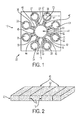
- a paper-based sensor or paper-based test device 10 is a small biomedical device made of paper, wax, and reagents that can analyze bioassays in test fluids or test liquids such as blood, urine and saliva.
- the hydrophobic barrier walls 16, 18 are made of wax that penetrates through the entire thickness of the paper 20 (i.e. hydrophilic matrix) to create and separate (i.e. divide) various fluidic components such as a series of test regions 30, 31, 32, 33, 34, 35, 36, 37, fluid entrances 40, 41, 42, 43, 44, 45, 46, 47, transport channels 50, 51, 52, 53, 54, 55, 56, 57, and mixers or reagents.
- the transport channels 50-57 can be hydrophobic (i.e. wax) channels extending through the hydrophilic matrix paper 20.
- Various reagents with various and/or different concentrations can be pre-deposited on the test regions 30-37.
- capillary forces pull portions of the test fluid 70 to associated multiple test regions 30-37 and upon contacting the pre-deposited reagents, react with the respective portions of test fluid 70.
- a signal, color change, or color shade is generated if a specific analyte is present in the test fluid 70; for instance, a color shade or change develops where the color density varies as a result of the concentration of the analyte.
- the color change or shade can be captured and recorded by an imaging device such as a smart phone or camera phone and can then be processed by an algorithm to calculate the concentration of each analyte based on a calibration curve or color scale of the device.
- the diagnostic results and/or raw data (if the image processing and diagnostic analysis is done on the server side) can be uploaded to a data server where the user's or patient's history can be stored for inquiry and advanced data analytics can be performed which can help to detect and prevent adverse health conditions/diseases.
- the user's data analytics or predictive analytics can be used for trend monitoring, health screening, risk assessment, et al.; the results of which can include non-adverse health conditions.
- Test strips are simplex (one test per strip), while paper sensors can be multiplex (multiple tests on one device).
- Traditional test strips require relatively more test fluid than paper sensors.
- Test strips are fabricated by analog technology, while paper sensors can be digitally printed and quantitatively analyzed which enables greater customization and personalization.
- paper based sensors Use of paper based sensors is an emerging technology that provides advantages over traditional test strips in terms of cost and multiplexing.
- the current paper based sensors require a user to provide a certain amount of test liquid (blood, urine, etc.) to ensure the accuracy of the test.
- the level of multiplexing is typically limited by the printing resolution and straightness of printed wax vertical walls/barriers.
- the current method of reading colorimetric information uses either a separate manual reference card or uses a mobile application available in the market that can suffer from the variability for individual reading devices (camera, illumination, light conditions, surrounding light conditions, etc.). It is important to come up with novel designs for the paper based sensor that can achieve a higher level of multiplexing than the current devices available in the market, and can provide higher readout accuracy regardless of the variation from individual reading devices.
- the present disclosure provides for a design and construction of paper sensors or test devices 100 that have an increased total test area relative to an overall fixed device area. This novel design and construction increases the extent of multiplexing and improves the readout accuracy.
- the present disclosure provides for a device 100 that includes several unique features. The resolution of the wax barriers are high so that the device can achieve higher levels of multiplexing and can include larger overall test area, relative to the overall device area, for increased read out accuracy.
- a reference region, including a calibration color area can be directly printed on the paper sensor for direct side-by-side comparison to the corresponding colorimetric reactions in respective test regions. This can eliminate the use of a separate reference card, which has been theretofore necessary for 'reading' and interpreting paper based sensors.
- Prior art paper based sensors 10 are typically made through a manual oven process.
- the wax in hydrophobic channels 50-57 needs to spread more laterally (reflow) to achieve a total penetration through the paper.
- the size of the test areas 30-37 and the level of multiplexing are limited relative to an overall fixed device size due to the non-uniformity/large channel variation caused by uncontrolled reflow of wax.
- the paper-based sensor 100 can include a channel structural area 124 which increases the readout accuracy and level of multiplexing without requiring a larger test sample (i.e. blood).
- a reference or calibration reference color area 126 can include a distinct area and can be directly printed on the device either as part of the channel structure or as an additional pattern.
- An auxiliary information area 128 can surround the test area 110.
- a paper sensor device 200 can include the following components: a structural forming layer 216, an optional filter membrane layer 212, and at least two laminating layers 218, 220.
- the structure forming layer 216 can include a channel structural area 224, a test area 210, a calibration reference area 226, and auxiliary information area 228.
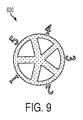
- the segmented test zones 230-235 can be arranged in an axially symmetric or axially radiating manner.
- the total test area 210 is from about 25% to about 60%, and preferably at least 37.5% of the total device area 202.
- the minimum area of individual test zones 230-235 can be about 5mm 2 . Comparing to the prior art devices ( Figure 1 ), the individual test zones 230-235, of the present disclosure, are at least three (3) times larger. Test zones 230-235 are surrounded and divided by wax ink barrier walls 236, 237, 238, 239, 240, 241 (i.e.
- solid ink barriers with a wall width of about 100 um for maximizing the area of the test regions or zones 230-235 relative to a limited space or area for the device 202. It is to be appreciated that a majority of the volume of a test sample is utilized and reaches, i.e. reacts with, the reagents in each of the test zones 230-235.
- One exemplary test panel can include respective reagents in test zones 230-235 for measuring levels of triglyceride, total cholesterol, HDL (i.e. three individual test zones).
- Another exemplary test panel can include respective reagents in test zones for measuring lipid panel, i.e. levels of triglyceride, total cholesterol, HDL, Hemoglobin A1C (HbA1C), glucose (i.e. five individual test zones).
- each test zone 230-235 has a different reagent. It is to be appreciated that each test zone can alternatively have a different concentration of the same reagent to measure different levels of a single bioassay.
- Auxiliary information or identifying text (for example, GL, TG, HbA1C, HDL, TC labels; manufacturer name and date; etc.) that indicates the type of test in each test zone 230-235 can be printed outside and adjacent to the test zones or regions (i.e. auxiliary information area 228).
- Auxiliary information or identifying text (for example, GL represents glucose, TG represents triglyceride, A1C represents hemoglobin, HDL represents HDL cholesterol, and TC represents total cholesterol) labels the type of test in each test zone 230-235 and can be printed outside and adjacent to the test zones or regions (i.e. reference regions).
- the optional filter membrane layer 212 can have a separation membrane 217 (i.e. plasma separation) that covers the total test area 210.
- the optional filter membrane 217 can have a partial separation membrane and partial "other materials" (i.e. paper) to enable the controlled flow of the test sample.
- the plasma separation membrane 217 can include a series of pores on the top surface as well as the bottom surface. The series of pores can have a pore sized gradient between the top surface and the bottom surface. In particular, the pore size on the top surface can be greater than the pore size on the bottom surface.
- Membrane layer 212 and structural forming layer 216 can be sandwiched between laminate film layers 218, 220.
- a hole 221 that is smaller than the size of the membrane 217 can be cut in the bottom lamination layer 220 at the backside of the device ( Fig. 5 ).
- the plasma separation membrane 217 is visible on the backside of the device 200 when the device 200 is in the assembled arrangement.
- the present disclosure proposes a design of a biomedical paper sensor 200 which can determine the concentration of biological materials in fluids such as blood, urine, and saliva.
- the sensor 200 can contain axially radiating and/or axially symmetric test zones 230-235 arranged similar to slices of a pie (for example) divided by wax ink barriers 236-241 formed by a process that produces thin walls.
- Each test zone 230-235 can contain a unique test reagent and is identified by printed text (not shown) in area 228.
- the region 226 of the device outside of the test zone 230-235 can be printed with a uniform reference color. Additionally, the color of the wax wall can also serve as a reference color when it is not clear.
- Benefits of the sensor 200 include increased accuracy in the measurement of the concentration of biological materials due to the larger area of the test zones. Benefits also include the integration of the reference or calibration color 226 into the sensor 200 which simplifies a visual calibration review, check, or comparison for quantification of the concentration of the test fluid (i.e. test sample).
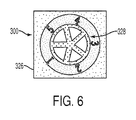
- Identifying a reference or calibration color area can include a substrate region 328 between the test zones 1, 2, 3, 4, 5 and a calibration color area or region 326. Areas 326, 327, and 328 can be used as reference color areas or contrast color areas. Areas 327 and 328 can be any color to provide contrast (black, color, contrast color, etc.) between the test zones 1-5 and reference areas 326, 327, and 328. It is to be appreciated that the calibration reference area 326 can be separated into multiple sub-areas including separate reference colors associated with each sub-area (not shown). The multiple color reference areas enable use of reagents with different dye colors in test zones 1-5.
- the reference region can include a first calibration color area including a first predeterminable color for comparing to one or more of the axial test zones.
- the reference region can further include a second calibration color area including a second predeterminable color for comparing to one or more of the axial test zones.
- the first and second calibration color areas can each include first and second predeterminable colors, respectively, for comparing to one or more of the axial test zones to report or indicate the concentration of at least two test substance analytes based on the calibrated reading in each test area.
- the substrate region 328 can include a contrasting color to distinguish between the test zones 1-5 and the calibration color area 326.
- the Triglyceride paper sensor 300 can display a gradient of color change in the test zones 1-5 due to different concentrations of the Triglyceride.
- the color change or color shade of test zones 1-5 can be compared to the reference color 326 (i.e. magenta).
- the color change or color density represents the concentration of Triglyceride (for example) from associated test zones 1, 2, 3, 4, 5 and can include concentrations of 100, 150, 200, 250, 300 mg/dL, respectively.
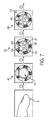
- Figure 7 displays a method of using a paper sensor device 400.
- a blood sample B is taken from a patient or user and placed or 'sucked' into the bottom of the device, i.e. the test area 410, of the paper sensor 400 (step 1).
- the paper sensor 400 can be turned right side up wherein the blood sample processing can be viewed 420 (step 2).
- the assay development proceeds in which the blood sample B makes contact with the respective reagents in the test zones 430, 431, 432, 433, 434 (step 3). After the sample has reacted to the reagents, the developed assay is subsequently formed 440 (step 4).
- Identifying a reference or calibration color area can include substrate regions 447 and 448 between the test zones 430-434 and a calibration color area or region 446.
- the substrate regions 447 and 448 can include contrasting colors to distinguish between the test zones 430-434 and the calibration color area 446.
- the paper sensor 400 can display a gradient of color change in the test zones 430-434 due to different types of reagents, and/or different concentrations of a reagent, that can measure different levels of a bioassay.
- each type of analyte (GL, TG, HbA1C, HDL, TC) can be a different reagent, and each analyte/reagent pair can have an associated calibration curve for color reference.
- color change in the test zones 430-434 can be due to different concentrations of the same reagent in each test zone.
- the test zones 430-434 can be compared to the calibration or reference color 446 (i.e. magenta). In this manner, the biomedical paper sensor 400 is used for determining a concentration of biological materials contained in fluids (i.e. blood sample).
- paper based sensors offer advantages over traditional test strips in terms of cost and multiplexing.
- a user has to manually compare resultant colors to a set of colors on a reference card.
- Phone 'apps' can be used to automate the test strip reading process by utilizing the associated phone camera. But the different types and models of cameras, along with the various lighting conditions, presents a challenge to obtain accurate colorimetric measurements.
- the present disclosure provides a colorimetric processing method that can take advantage of a sensor design and does not rely on total intensity as the concentration measurement.
- the unique sensor design can include two features: a reference color that is printed directly on the paper sensor as a part of the wax channels by a wax printer; and, the reference color and dye colors used in colorimetric reaction are matched in terms of their near-zero absorption in a specific spectral range (e.g. red, green, blue).
- the processing method can divide color information into two parts: near-zero absorption part and absorption part, and then use near-zero absorption channel to normalize absorption channels.
- the method includes the following: taking a picture of vendor or source specific colorimetric paper sensors; the vendor specific paper sensors can include a design wherein the reference color and dye can have little or near-zero absorption in at least one channel for colorimetric reaction; identifying the type of paper sensor by image processing (i.e.
- the reference color or region can include one or more calibration color areas having predeterminable colors for comparing to one or more of the test areas or zones for reporting or indicating the concentration of test substance (analyte) based on calibrated reading in each test area.
- the calibration color area can include multiple sections. Each section can have a distinct predeterminable color used for a specific analyte.
- two calibration color sections can comprise one red section and one blue section.
- the red section can be used to calibrate HbA1C and the blue section can be used to calibrate HDL.
- Figure 8 displays an exemplary paper sensor for a triglyceride test.
- the sensor image 500 displays a total RGB sensor image produced from a phone camera (i.e. first phone camera).
- Image 510 represents a sensor image from the phone camera and its associated red channel spectral range.
- Image 520 represents a sensor image from the phone camera and its associated green channel spectral range.
- Image 530 represents a sensor image from the phone camera and its associated blue channel spectral range. It is to be appreciated that both the dye and the reference color can show minimized absorption in the red channel 510.
- a binary image 600 can be used from the red channel to locate the test areas.
- a near-zero absorption channel can be used to normalize an image 700 (i.e. blue channel normalized by red channel) and its segmented test areas. The normalized image then enables construction of a resultant composite image.
- another or second phone camera can capture nearly the identical sensor image (after normalizing) wherein a composite image displays consistent concentrations of test substances.
- a sensor image from a second phone camera shows a total RGB channel 800, its associated red channel 810 spectral range, its associated green channel 820 spectral range, and its associate blue channel 830 spectral range.
- the exemplary readings from two separate cameras thus display nearly identical images.
- similar triglyceride concentration levels are processed from the two separate camera readings.
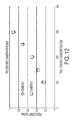
- Figure 12 displays the triglyceride concentrations of respective test zones 1, 2, 3, 4, 5 from the sensor images 500, 800 respectively.
- Figure 12 plots the resultant signals relative to triglyceride concentrations plotting the processed camera readings from the first phone camera 500 and the second phone camera 800.
- the present disclosure proposes a colorimetric method that couples sensor design with image processing to enable automated evaluation of test results obtained by paper-based sensors.
- the proposed method can match ink color and dye used in colorimetric reaction in terms of their absorption in spectral ranges (e.g., red, green, blue).
- the near-zero absorption channel is then used to normalize absorption channels and construct a composite image.
- a normalized image can be extracted by normalizing the blue channel by the red channel with given information about the absorption ratio of reference color in both blue and red channels.
- Benefits of the invention include enabling an automated method to evaluate test results obtained by paper based sensors.
- the exemplary embodiment also relates to an apparatus for performing the operations discussed herein.
- This apparatus may be specially constructed for the required purposes, or it may comprise a general-purpose computer selectively activated or reconfigured by a computer program stored in the computer.
- a computer program may be stored in a computer readable storage medium, such as, but is not limited to, any type of disk including floppy disks, optical disks, CD-ROMs, and magnetic-optical disks, read-only memories (ROMs), random access memories (RAMs), EPROMs, EEPROMs, magnetic or optical cards, or any type of media suitable for storing electronic instructions, and each coupled to a computer system bus.
- a machine-readable medium includes any mechanism for storing or transmitting information in a form readable by a machine (e.g., a computer).
- a machine-readable medium includes read only memory ("ROM”); random access memory (“RAM”); magnetic disk storage media; optical storage media; flash memory devices; and electrical, optical, acoustical or other form of propagated signals (e.g., carrier waves, infrared signals, digital signals, etc.), just to mention a few examples.
- the methods illustrated throughout the specification may be implemented in a computer program product that may be executed on a computer.
- the computer program product may comprise a non-transitory computer-readable recording medium on which a control program is recorded, such as a disk, hard drive, or the like.
- a non-transitory computer-readable recording medium such as a disk, hard drive, or the like.
- Common forms of non-transitory computer-readable media include, for example, floppy disks, flexible disks, hard disks, magnetic tape, or any other magnetic storage medium, CD-ROM, DVD, or any other optical medium, a RAM, a PROM, an EPROM, a FLASH-EPROM, or other memory chip or cartridge, or any other tangible medium from which a computer can read and use.
- the method may be implemented in transitory media, such as a transmittable carrier wave in which the control program is embodied as a data signal using transmission media, such as acoustic or light waves, such as those generated during radio wave and infrared data communications, and the like.
- transitory media such as a transmittable carrier wave
- the control program is embodied as a data signal using transmission media, such as acoustic or light waves, such as those generated during radio wave and infrared data communications, and the like.
- the present disclosure proposes a new colorimetric process method that combines both sensor design and image processing to achieve robust and accurate result readings from paper based sensors with various different cameras and/or under various different lighting conditions.
- a print reference color can be incorporated along with hydrophobic channels on a paper sensor substrate during device fabrication.
- the present disclosure provides a method for matching ink color and dye used in colorimetric reaction in terms of their absorption in a specific spectral range (e.g. red, blue).
- the process further uses near-zero absorption channels to normalize absorption channels and construct a composite image.
- the reading can be further calibrated with known reference ink colors and substrate white. This invention provides the user with real-time quantitative results.
Landscapes
- Engineering & Computer Science (AREA)
- Physics & Mathematics (AREA)
- Health & Medical Sciences (AREA)
- Life Sciences & Earth Sciences (AREA)
- General Physics & Mathematics (AREA)
- Chemical & Material Sciences (AREA)
- General Health & Medical Sciences (AREA)
- Pathology (AREA)
- Immunology (AREA)
- Analytical Chemistry (AREA)
- Biochemistry (AREA)
- Theoretical Computer Science (AREA)
- Computer Vision & Pattern Recognition (AREA)
- Chemical Kinetics & Catalysis (AREA)
- Plasma & Fusion (AREA)
- Molecular Biology (AREA)
- Data Mining & Analysis (AREA)
- Biomedical Technology (AREA)
- Signal Processing (AREA)
- Spectroscopy & Molecular Physics (AREA)
- Multimedia (AREA)
- Bioinformatics & Cheminformatics (AREA)
- Evolutionary Computation (AREA)
- General Engineering & Computer Science (AREA)
- Evolutionary Biology (AREA)
- Bioinformatics & Computational Biology (AREA)
- Artificial Intelligence (AREA)
- Investigating Or Analysing Materials By The Use Of Chemical Reactions (AREA)
- Automatic Analysis And Handling Materials Therefor (AREA)
- Inspection Of Paper Currency And Valuable Securities (AREA)
- Image Processing (AREA)
- Color Image Communication Systems (AREA)
Applications Claiming Priority (2)
| Application Number | Priority Date | Filing Date | Title |
|---|---|---|---|
| US201462041181P | 2014-08-25 | 2014-08-25 | |
| US14/799,969 US9686540B2 (en) | 2014-06-23 | 2015-07-15 | Robust colorimetric processing method for paper based sensors |
Publications (2)
| Publication Number | Publication Date |
|---|---|
| EP2990782A2 true EP2990782A2 (de) | 2016-03-02 |
| EP2990782A3 EP2990782A3 (de) | 2016-05-25 |
Family
ID=53938152
Family Applications (1)
| Application Number | Title | Priority Date | Filing Date |
|---|---|---|---|
| EP15181307.8A Ceased EP2990782A3 (de) | 2014-08-25 | 2015-08-17 | Robustes kolorimetrisches verarbeitungsverfahren für sensoren auf papierbasis |
Country Status (4)
| Country | Link |
|---|---|
| US (1) | US9686540B2 (de) |
| EP (1) | EP2990782A3 (de) |
| JP (1) | JP6407821B2 (de) |
| CN (1) | CN105388144B (de) |
Families Citing this family (37)
| Publication number | Priority date | Publication date | Assignee | Title |
|---|---|---|---|---|
| US9933359B2 (en) * | 2014-06-23 | 2018-04-03 | Xerox Corporation | Vendor exclusivity security feature for paper-based diagnostic solution |
| US10274433B1 (en) * | 2015-09-30 | 2019-04-30 | Vium, Inc. | Device and method of measuring animal health |
| EP3239929B1 (de) * | 2016-04-27 | 2019-06-12 | Canon Kabushiki Kaisha | Bildverarbeitungsvorrichtung, bildverarbeitungsverfahren und programm |
| US9857372B1 (en) | 2016-10-17 | 2018-01-02 | Reliant Immune Diagnostics, LLC | Arbovirus indicative birth defect risk test |
| US11693002B2 (en) | 2016-10-17 | 2023-07-04 | Reliant Immune Diagnostics, Inc. | System and method for variable function mobile application for providing medical test results using visual indicia to determine medical test function type |
| US12009078B2 (en) | 2016-10-17 | 2024-06-11 | Reliant Immune Diagnostics, Inc. | System and method for medical escalation and intervention that is a direct result of a remote diagnostic test |
| US11579145B2 (en) * | 2016-10-17 | 2023-02-14 | Reliant Immune Diagnostics, Inc. | System and method for image analysis of medical test results |
| US11107585B2 (en) | 2016-10-17 | 2021-08-31 | Reliant Immune Diagnostics, Inc | System and method for a digital consumer medical wallet and storehouse |
| US11802868B2 (en) | 2016-10-17 | 2023-10-31 | Reliant Immune Diagnostics, Inc. | System and method for variable function mobile application for providing medical test results |
| US11651866B2 (en) | 2016-10-17 | 2023-05-16 | Reliant Immune Diagnostics, Inc. | System and method for real-time insurance quote in response to a self-diagnostic test |
| US10902951B2 (en) | 2016-10-17 | 2021-01-26 | Reliant Immune Diagnostics, Inc. | System and method for machine learning application for providing medical test results using visual indicia |
| CZ307248B6 (cs) * | 2017-02-03 | 2018-04-25 | Univerzita PalackĂ©ho v Olomouci | Přenosné nízkonákladové zařízení pro multiparametrovou chemickou analýzu |
| EP3685159A4 (de) | 2017-09-21 | 2021-06-09 | Becton, Dickinson and Company | Kit zur probenahme von gefährlichen schadstoffen und schnelltest |
| JP7344198B2 (ja) | 2017-09-21 | 2023-09-13 | ベクトン・ディキンソン・アンド・カンパニー | 有害汚染物質の検査のための境界決め用テンプレート |
| JP7223749B2 (ja) | 2017-09-21 | 2023-02-16 | ベクトン・ディキンソン・アンド・カンパニー | 危険汚染物質の試験における高ダイナミックレンジの分析器 |
| JP7277442B2 (ja) | 2017-09-21 | 2023-05-19 | ベクトン・ディキンソン・アンド・カンパニー | 有害汚染物質検査のための拡張現実デバイス |
| WO2019060265A1 (en) | 2017-09-21 | 2019-03-28 | Becton, Dickinson And Company | SAMPLING SYSTEMS AND TECHNIQUES FOR COLLECTING HAZARDOUS CONTAMINANTS WITH HIGH CAPTURING AND RELOADING EFFECTIVENESS |
| EP3684944B1 (de) | 2017-09-21 | 2025-01-01 | Becton, Dickinson and Company | Kit zur probenahme von gefährlichen schadstoffen und schnelltest |
| AU2018337648B2 (en) * | 2017-09-21 | 2024-04-18 | Becton, Dickinson And Company | Reactive demarcation template for hazardous contaminant testing |
| JP6519624B2 (ja) * | 2017-10-04 | 2019-05-29 | ウシオ電機株式会社 | 管理システム |
| CN107796808A (zh) * | 2017-10-13 | 2018-03-13 | 窦晓鸣 | 一种便携式检测仪 |
| CN110554030A (zh) * | 2018-05-31 | 2019-12-10 | 上海仪龙生物科技有限公司 | 一种用于检测微量样品的芯片装置 |
| JP6677273B2 (ja) * | 2018-05-31 | 2020-04-08 | 佳則 山口 | マイクロサンプリングチップ及びそのマイクロサンプリングチップを用いる検査装置 |
| JP2022017614A (ja) * | 2018-11-06 | 2022-01-26 | 学校法人慶應義塾 | 分析装置、分析方法及び分析用回転体 |
| EP3650843B1 (de) * | 2018-11-07 | 2022-01-19 | Roche Diabetes Care GmbH | Verfahren und vorrichtungen zur durchführung einer analytischen messung |
| JP7479385B2 (ja) | 2019-01-28 | 2024-05-08 | ベクトン・ディキンソン・アンド・カンパニー | 一体化されたスワブ及び検査デバイスを有する有害汚染物質採取デバイス |
| JP6817549B2 (ja) * | 2019-03-06 | 2021-01-20 | ウシオ電機株式会社 | 管理システム |
| JP2022544918A (ja) * | 2019-08-08 | 2022-10-24 | テストカード リミテッド | 体液検査方法 |
| BR112022002527A2 (pt) | 2019-08-29 | 2022-05-10 | Canon Kk | Método para produção de dispositivo de microcanal |
| EP4058775A1 (de) | 2019-11-13 | 2022-09-21 | Scanwell Health, Inc. | Diagnostische testkits zur probenvorbereitung und analyse |
| JP7480610B2 (ja) * | 2020-07-09 | 2024-05-10 | 株式会社リコー | 処理装置、方法、及びプログラム |
| GB2615900B (en) * | 2020-08-24 | 2026-01-21 | Davis Randall | Methods and apparatuses for detecting biomolecules |
| AU2021345448A1 (en) | 2020-09-17 | 2023-04-20 | Scanwell Health, Inc. | Diagnostic test kits and methods of analyzing the same |
| USD970033S1 (en) | 2020-10-23 | 2022-11-15 | Becton, Dickinson And Company | Cartridge imaging background device |
| CN116324382A (zh) | 2020-10-23 | 2023-06-23 | 贝克顿·迪金森公司 | 用于测试设备的成像和基于图像的分析的系统和方法 |
| CN112394061B (zh) * | 2020-11-26 | 2021-07-30 | 南京大学 | 一种基于移动终端拍摄比色法的汗液多成分含量和酸碱度同时检测方法 |
| CN113933294B (zh) * | 2021-11-08 | 2023-07-18 | 中国联合网络通信集团有限公司 | 浓度检测方法及装置 |
Citations (9)
| Publication number | Priority date | Publication date | Assignee | Title |
|---|---|---|---|---|
| US20110111517A1 (en) | 2008-03-27 | 2011-05-12 | President And Fellows Of Harvard College | Paper-based microfluidic systems |
| US20110123398A1 (en) | 2008-03-27 | 2011-05-26 | President And Fellows Of Harvard College | Three-dimensional microfluidic devices |
| US20120053930A1 (en) | 2002-12-18 | 2012-03-01 | At&T Intellectual Property Ii, L.P. | System and method of providing a spoken dialog interface to a website |
| US20120181184A1 (en) | 2009-03-06 | 2012-07-19 | President And Fellows Of Harvard College | Microfluidic, electrochemical devices |
| US20120198685A1 (en) | 2010-10-07 | 2012-08-09 | Aurecyl Dalla Bernardina Junior | Method to produce an electrode with a low level of hydrogen and low absorption of moisture |
| US20120257188A1 (en) | 2011-04-08 | 2012-10-11 | William Marsh Rice University | Paper based spectrophotometric detection of blood hemoglobin concentration |
| US20130034869A1 (en) | 2010-02-03 | 2013-02-07 | President And Fellows Of Harvard College | Devices and methods for multiplexed assays |
| US8377710B2 (en) | 2006-10-18 | 2013-02-19 | President And Fellows Of Harvard College | Lateral flow and flow-through bioassay devices based on patterned porous media, methods of making same, and methods of using same |
| US20130084630A1 (en) | 2011-09-27 | 2013-04-04 | Diagnostics For All, Inc. | Quantitative microfluidic devices |
Family Cites Families (51)
| Publication number | Priority date | Publication date | Assignee | Title |
|---|---|---|---|---|
| GB1050651A (de) | ||||
| US2712508A (en) | 1950-08-31 | 1955-07-05 | Massey Peter Jay | Method and apparatus for preparing thin films of high melting point thermoplastics and the application thereof to paper and the like |
| US3145118A (en) | 1960-09-13 | 1964-08-18 | Beloit Iron Works | Method of waxing paper and paper board and apparatus |
| CH530038A (fr) | 1970-06-17 | 1972-10-31 | Battelle Memorial Institute | Matériel d'enregistrement d'informations sensible à l'action de rayonnements électromagnétiques activants et utilisation de ce matériel |
| US3982056A (en) | 1974-10-15 | 1976-09-21 | International Paper Company | Method for improving the printability characteristics of gloss calendered paper |
| JPS59779B2 (ja) | 1977-01-20 | 1984-01-09 | 株式会社京都第一科学 | 尿等の分析方法 |
| US4606264A (en) | 1985-01-04 | 1986-08-19 | Wartsila-Appleton, Incorporated | Method and apparatus for temperature gradient calendering |
| US5055884A (en) | 1989-12-20 | 1991-10-08 | Eastman Kodak Company | Electrostatographic equipment with multiplex fuser |
| US5317127A (en) | 1992-08-28 | 1994-05-31 | Pitney Bowes Inc. | Apparatus including air blowing and infrared light means for drying ink on a sheet |
| US5614933A (en) | 1994-06-08 | 1997-03-25 | Tektronix, Inc. | Method and apparatus for controlling phase-change ink-jet print quality factors |
| JPH09174901A (ja) | 1995-12-27 | 1997-07-08 | Alps Electric Co Ltd | 熱転写プリンタ |
| US5972780A (en) | 1996-08-22 | 1999-10-26 | Nippon Telegraph Telephone Corporation | Thin film forming apparatus and method |
| US5891228A (en) | 1997-01-08 | 1999-04-06 | Markem Corporation | Hot melt jet ink composition |
| US6375871B1 (en) | 1998-06-18 | 2002-04-23 | 3M Innovative Properties Company | Methods of manufacturing microfluidic articles |
| US6196675B1 (en) | 1998-02-25 | 2001-03-06 | Xerox Corporation | Apparatus and method for image fusing |
| US6537615B2 (en) | 1998-11-12 | 2003-03-25 | Paper Technology Foundation Inc. | Steam-assisted paper impregnation |
| US6458867B1 (en) | 1999-09-28 | 2002-10-01 | Scimed Life Systems, Inc. | Hydrophilic lubricant coatings for medical devices |
| US6686184B1 (en) | 2000-05-25 | 2004-02-03 | President And Fellows Of Harvard College | Patterning of surfaces utilizing microfluidic stamps including three-dimensionally arrayed channel networks |
| JP2003121260A (ja) * | 2001-10-12 | 2003-04-23 | Fuji Photo Film Co Ltd | 比色測定装置及び比色測定方法 |
| US6723500B2 (en) | 2001-12-05 | 2004-04-20 | Lifescan, Inc. | Test strips having reaction zones and channels defined by a thermally transferred hydrophobic barrier |
| US7402279B2 (en) | 2002-10-31 | 2008-07-22 | Agilent Technologies, Inc. | Device with integrated microfluidic and electronic components |
| EP1443325A1 (de) * | 2003-02-01 | 2004-08-04 | Roche Diagnostics GmbH | System und Verfahren zur Bestimmung eines Koagulationsparameters |
| JP4158563B2 (ja) | 2003-03-12 | 2008-10-01 | ブラザー工業株式会社 | 両面記録装置 |
| US8200775B2 (en) | 2005-02-01 | 2012-06-12 | Newsilike Media Group, Inc | Enhanced syndication |
| US7065308B2 (en) | 2003-11-24 | 2006-06-20 | Xerox Corporation | Transfer roll engagement method for minimizing media induced motion quality disturbances |
| WO2005066613A1 (en) | 2003-12-31 | 2005-07-21 | President And Fellows Of Harvard College | Assay device and method |
| US7887750B2 (en) * | 2004-05-05 | 2011-02-15 | Bayer Healthcare Llc | Analytical systems, devices, and cartridges therefor |
| FR2873815B1 (fr) * | 2004-08-02 | 2006-11-24 | Inodiag Sa | Dispositif de lecture pour lames portant des micro depots supports de reaction biologique |
| US20070059718A1 (en) | 2005-09-15 | 2007-03-15 | Mehmet Toner | Systems and methods for enrichment of analytes |
| KR101257975B1 (ko) | 2005-10-26 | 2013-04-30 | 제너럴 일렉트릭 캄파니 | 분석대상물 동시 측정 방법 및 시스템 |
| US7723120B2 (en) * | 2005-10-26 | 2010-05-25 | General Electric Company | Optical sensor array system and method for parallel processing of chemical and biochemical information |
| US10876193B2 (en) | 2006-09-29 | 2020-12-29 | University Of Rochester | Nanostructured materials, methods, and applications |
| US7969624B2 (en) | 2006-12-11 | 2011-06-28 | Xerox Corporation | Method and system for identifying optimal media for calibration and control |
| US7454880B1 (en) | 2007-05-31 | 2008-11-25 | Xerox Corporation | Personalized medication packaging |
| US8793006B2 (en) | 2008-11-25 | 2014-07-29 | California Institute Of Technology | Method and apparatus for the controlled fabrication of micro and nanoscale structures by thermocapillary lithography |
| AU2010221117A1 (en) | 2009-03-06 | 2011-09-29 | President And Fellows Of Harvard College | Methods of micropatterning paper-based microfluidics |
| JP5365382B2 (ja) | 2009-03-24 | 2013-12-11 | 富士ゼロックス株式会社 | 画像形成装置 |
| US8627867B2 (en) | 2009-04-21 | 2014-01-14 | Bae Systems Information And Electronic Systems Integration Inc. | System and method for microelectronics lamination press |
| NZ597217A (en) * | 2009-06-30 | 2013-02-22 | Univ Monash | Quantitative and self-calibrating chemical analysis using paper-based microfluidic systems |
| US9339194B2 (en) * | 2010-03-08 | 2016-05-17 | Cernoval, Inc. | System, method and article for normalization and enhancement of tissue images |
| US8303103B2 (en) | 2010-05-28 | 2012-11-06 | Xerox Corporation | Peak position drum maintenance unit for a printing device |
| GB201014805D0 (en) * | 2010-09-07 | 2010-10-20 | Multi Sense Technologies Ltd | Microfluidics based assay device |
| WO2013010178A1 (en) | 2011-07-14 | 2013-01-17 | Brigham And Women's Hospital, Inc. | System and method for integration of mobile device imaging with microchip elisa |
| WO2013071301A1 (en) * | 2011-11-10 | 2013-05-16 | The Administrators Of The Tulane Educational Fund | Paper based diagnostic test |
| US8807730B2 (en) | 2011-12-22 | 2014-08-19 | Eastman Kodak Company | Inkjet printing on semi-porous or non-absorbent surfaces |
| US9506855B2 (en) | 2012-02-03 | 2016-11-29 | University Of Cincinnati | Method and system for analyzing a colorimetric assay |
| US9311520B2 (en) * | 2012-08-08 | 2016-04-12 | Scanadu Incorporated | Method and apparatus for performing and quantifying color changes induced by specific concentrations of biological analytes in an automatically calibrated environment |
| US9096079B2 (en) | 2012-10-11 | 2015-08-04 | Eastman Kodak Company | Dryer impinging heating liquid onto moistened medium |
| CN105164514A (zh) | 2013-01-21 | 2015-12-16 | 康奈尔大学 | 基于智能手机的装置和用于获取可重复的定量比色测量的方法 |
| JP6567495B2 (ja) | 2013-03-15 | 2019-08-28 | コンフォテクス コーポレーション | 窓周りの装飾を製作するためのシステムにおいてプリフォーム積層体を搬送する方法 |
| JP6129776B2 (ja) * | 2014-03-28 | 2017-05-17 | 京セラドキュメントソリューションズ株式会社 | 紙種検出装置及び紙種検出方法 |
-
2015
- 2015-07-15 US US14/799,969 patent/US9686540B2/en active Active
- 2015-08-17 JP JP2015160367A patent/JP6407821B2/ja active Active
- 2015-08-17 EP EP15181307.8A patent/EP2990782A3/de not_active Ceased
- 2015-08-20 CN CN201510515457.0A patent/CN105388144B/zh active Active
Patent Citations (9)
| Publication number | Priority date | Publication date | Assignee | Title |
|---|---|---|---|---|
| US20120053930A1 (en) | 2002-12-18 | 2012-03-01 | At&T Intellectual Property Ii, L.P. | System and method of providing a spoken dialog interface to a website |
| US8377710B2 (en) | 2006-10-18 | 2013-02-19 | President And Fellows Of Harvard College | Lateral flow and flow-through bioassay devices based on patterned porous media, methods of making same, and methods of using same |
| US20110111517A1 (en) | 2008-03-27 | 2011-05-12 | President And Fellows Of Harvard College | Paper-based microfluidic systems |
| US20110123398A1 (en) | 2008-03-27 | 2011-05-26 | President And Fellows Of Harvard College | Three-dimensional microfluidic devices |
| US20120181184A1 (en) | 2009-03-06 | 2012-07-19 | President And Fellows Of Harvard College | Microfluidic, electrochemical devices |
| US20130034869A1 (en) | 2010-02-03 | 2013-02-07 | President And Fellows Of Harvard College | Devices and methods for multiplexed assays |
| US20120198685A1 (en) | 2010-10-07 | 2012-08-09 | Aurecyl Dalla Bernardina Junior | Method to produce an electrode with a low level of hydrogen and low absorption of moisture |
| US20120257188A1 (en) | 2011-04-08 | 2012-10-11 | William Marsh Rice University | Paper based spectrophotometric detection of blood hemoglobin concentration |
| US20130084630A1 (en) | 2011-09-27 | 2013-04-04 | Diagnostics For All, Inc. | Quantitative microfluidic devices |
Also Published As
| Publication number | Publication date |
|---|---|
| CN105388144A (zh) | 2016-03-09 |
| US9686540B2 (en) | 2017-06-20 |
| EP2990782A3 (de) | 2016-05-25 |
| JP6407821B2 (ja) | 2018-10-17 |
| US20160057413A1 (en) | 2016-02-25 |
| CN105388144B (zh) | 2019-09-06 |
| JP2016045200A (ja) | 2016-04-04 |
Similar Documents
| Publication | Publication Date | Title |
|---|---|---|
| US9686540B2 (en) | Robust colorimetric processing method for paper based sensors | |
| EP2990118B1 (de) | Entwurf eines papiersensors | |
| US9933359B2 (en) | Vendor exclusivity security feature for paper-based diagnostic solution | |
| US20170184506A1 (en) | Reagent test strips comprising reference regions for measurement with colorimetric test platform | |
| Grudpan et al. | Applications of everyday IT and communications devices in modern analytical chemistry: A review | |
| US9606115B2 (en) | Analyte detection methods and devices | |
| KR20160131011A (ko) | 분석물의 변화의 정량화 | |
| US20250389667A1 (en) | Metabolite detection apparatus and method of detecting metabolites | |
| US11002725B2 (en) | Device and method for unit use sensor testing | |
| EP4476525B1 (de) | Verfahren zur bestimmung eines farberwartungsbereiches zur bewertung der plausibilität eines angenommenen reaktionszeitwertes, der bei einer analytischen messung auf der basis einer farbbildungsreaktion verwendet wird, system und mobiles gerät | |
| WO2026008668A1 (en) | Analytical measurement method for detecting multiple analytes in a bodily fluid | |
| KR20210041558A (ko) | 체액 샘플의 분석물 농도를 측정하기 위한 장치 및 방법 | |
| HK40012527A (en) | Metabolite detection apparatus and method of detecting metabolites | |
| HK40012527B (en) | Metabolite detection apparatus and method of detecting metabolites |
Legal Events
| Date | Code | Title | Description |
|---|---|---|---|
| PUAI | Public reference made under article 153(3) epc to a published international application that has entered the european phase |
Free format text: ORIGINAL CODE: 0009012 |
|
| AK | Designated contracting states |
Kind code of ref document: A2 Designated state(s): AL AT BE BG CH CY CZ DE DK EE ES FI FR GB GR HR HU IE IS IT LI LT LU LV MC MK MT NL NO PL PT RO RS SE SI SK SM TR |
|
| AX | Request for extension of the european patent |
Extension state: BA ME |
|
| RIN1 | Information on inventor provided before grant (corrected) |
Inventor name: KANUNGO, MANDAKINI Inventor name: LIU, XING Inventor name: ZHOU, JING Inventor name: JIA, NANCY Y. Inventor name: HONG, WEI |
|
| PUAL | Search report despatched |
Free format text: ORIGINAL CODE: 0009013 |
|
| AK | Designated contracting states |
Kind code of ref document: A3 Designated state(s): AL AT BE BG CH CY CZ DE DK EE ES FI FR GB GR HR HU IE IS IT LI LT LU LV MC MK MT NL NO PL PT RO RS SE SI SK SM TR |
|
| AX | Request for extension of the european patent |
Extension state: BA ME |
|
| RIC1 | Information provided on ipc code assigned before grant |
Ipc: G01N 21/25 20060101ALN20160419BHEP Ipc: G01N 21/78 20060101AFI20160419BHEP Ipc: G01N 21/84 20060101ALI20160419BHEP Ipc: G01N 21/27 20060101ALN20160419BHEP |
|
| STAA | Information on the status of an ep patent application or granted ep patent |
Free format text: STATUS: REQUEST FOR EXAMINATION WAS MADE |
|
| 17P | Request for examination filed |
Effective date: 20161125 |
|
| RBV | Designated contracting states (corrected) |
Designated state(s): AL AT BE BG CH CY CZ DE DK EE ES FI FR GB GR HR HU IE IS IT LI LT LU LV MC MK MT NL NO PL PT RO RS SE SI SK SM TR |
|
| STAA | Information on the status of an ep patent application or granted ep patent |
Free format text: STATUS: EXAMINATION IS IN PROGRESS |
|
| 17Q | First examination report despatched |
Effective date: 20190917 |
|
| STAA | Information on the status of an ep patent application or granted ep patent |
Free format text: STATUS: THE APPLICATION HAS BEEN REFUSED |
|
| 18R | Application refused |
Effective date: 20210205 |