EP2986263B1 - Maschine zur herstellung eines absorbierenden artikels - Google Patents
Maschine zur herstellung eines absorbierenden artikels Download PDFInfo
- Publication number
- EP2986263B1 EP2986263B1 EP14727919.4A EP14727919A EP2986263B1 EP 2986263 B1 EP2986263 B1 EP 2986263B1 EP 14727919 A EP14727919 A EP 14727919A EP 2986263 B1 EP2986263 B1 EP 2986263B1
- Authority
- EP
- European Patent Office
- Prior art keywords
- woven fabric
- layer
- station
- web
- absorbent
- Prior art date
- Legal status (The legal status is an assumption and is not a legal conclusion. Google has not performed a legal analysis and makes no representation as to the accuracy of the status listed.)
- Not-in-force
Links
- 230000002745 absorbent Effects 0.000 title claims description 111
- 239000002250 absorbent Substances 0.000 title claims description 111
- 239000010410 layer Substances 0.000 claims description 140
- 239000004745 nonwoven fabric Substances 0.000 claims description 87
- 239000000463 material Substances 0.000 claims description 55
- 101001092930 Homo sapiens Prosaposin Proteins 0.000 claims description 36
- 239000002861 polymer material Substances 0.000 claims description 33
- 102100023792 ETS domain-containing protein Elk-4 Human genes 0.000 claims description 19
- 101000884714 Homo sapiens Beta-defensin 4A Proteins 0.000 claims description 19
- 101001048716 Homo sapiens ETS domain-containing protein Elk-4 Proteins 0.000 claims description 19
- 239000000853 adhesive Substances 0.000 claims description 18
- 230000001070 adhesive effect Effects 0.000 claims description 18
- 102100023794 ETS domain-containing protein Elk-3 Human genes 0.000 claims description 17
- 101001048720 Homo sapiens ETS domain-containing protein Elk-3 Proteins 0.000 claims description 17
- 239000012790 adhesive layer Substances 0.000 claims description 15
- 238000011144 upstream manufacturing Methods 0.000 claims description 14
- 238000005304 joining Methods 0.000 claims description 10
- 238000007789 sealing Methods 0.000 claims description 4
- 239000007788 liquid Substances 0.000 description 16
- 229920002678 cellulose Polymers 0.000 description 7
- 239000001913 cellulose Substances 0.000 description 7
- 229920000247 superabsorbent polymer Polymers 0.000 description 7
- 238000010521 absorption reaction Methods 0.000 description 5
- -1 polyethylene Polymers 0.000 description 5
- 230000004044 response Effects 0.000 description 4
- 239000004698 Polyethylene Substances 0.000 description 3
- 238000009826 distribution Methods 0.000 description 3
- 238000004519 manufacturing process Methods 0.000 description 3
- 229920000573 polyethylene Polymers 0.000 description 3
- 239000008187 granular material Substances 0.000 description 2
- 230000014759 maintenance of location Effects 0.000 description 2
- 230000035699 permeability Effects 0.000 description 2
- 229920003043 Cellulose fiber Polymers 0.000 description 1
- 239000004743 Polypropylene Substances 0.000 description 1
- 230000004888 barrier function Effects 0.000 description 1
- 239000011230 binding agent Substances 0.000 description 1
- 230000015572 biosynthetic process Effects 0.000 description 1
- 230000001427 coherent effect Effects 0.000 description 1
- 238000009792 diffusion process Methods 0.000 description 1
- 230000005484 gravity Effects 0.000 description 1
- 238000009434 installation Methods 0.000 description 1
- 238000000034 method Methods 0.000 description 1
- 230000005012 migration Effects 0.000 description 1
- 238000013508 migration Methods 0.000 description 1
- 239000000203 mixture Substances 0.000 description 1
- 239000002245 particle Substances 0.000 description 1
- 229920000642 polymer Polymers 0.000 description 1
- 229920001155 polypropylene Polymers 0.000 description 1
- 230000008569 process Effects 0.000 description 1
- 230000007480 spreading Effects 0.000 description 1
- 238000003892 spreading Methods 0.000 description 1
- 238000010998 test method Methods 0.000 description 1
Images


Classifications
-
- A—HUMAN NECESSITIES
- A61—MEDICAL OR VETERINARY SCIENCE; HYGIENE
- A61F—FILTERS IMPLANTABLE INTO BLOOD VESSELS; PROSTHESES; DEVICES PROVIDING PATENCY TO, OR PREVENTING COLLAPSING OF, TUBULAR STRUCTURES OF THE BODY, e.g. STENTS; ORTHOPAEDIC, NURSING OR CONTRACEPTIVE DEVICES; FOMENTATION; TREATMENT OR PROTECTION OF EYES OR EARS; BANDAGES, DRESSINGS OR ABSORBENT PADS; FIRST-AID KITS
- A61F13/00—Bandages or dressings; Absorbent pads
- A61F13/15—Absorbent pads, e.g. sanitary towels, swabs or tampons for external or internal application to the body; Supporting or fastening means therefor; Tampon applicators
- A61F13/53—Absorbent pads, e.g. sanitary towels, swabs or tampons for external or internal application to the body; Supporting or fastening means therefor; Tampon applicators characterised by the absorbing medium
- A61F13/531—Absorbent pads, e.g. sanitary towels, swabs or tampons for external or internal application to the body; Supporting or fastening means therefor; Tampon applicators characterised by the absorbing medium having a homogeneous composition through the thickness of the pad
- A61F13/532—Absorbent pads, e.g. sanitary towels, swabs or tampons for external or internal application to the body; Supporting or fastening means therefor; Tampon applicators characterised by the absorbing medium having a homogeneous composition through the thickness of the pad inhomogeneous in the plane of the pad
- A61F13/5323—Absorbent pads, e.g. sanitary towels, swabs or tampons for external or internal application to the body; Supporting or fastening means therefor; Tampon applicators characterised by the absorbing medium having a homogeneous composition through the thickness of the pad inhomogeneous in the plane of the pad having absorbent material located in discrete regions, e.g. pockets
-
- A—HUMAN NECESSITIES
- A61—MEDICAL OR VETERINARY SCIENCE; HYGIENE
- A61F—FILTERS IMPLANTABLE INTO BLOOD VESSELS; PROSTHESES; DEVICES PROVIDING PATENCY TO, OR PREVENTING COLLAPSING OF, TUBULAR STRUCTURES OF THE BODY, e.g. STENTS; ORTHOPAEDIC, NURSING OR CONTRACEPTIVE DEVICES; FOMENTATION; TREATMENT OR PROTECTION OF EYES OR EARS; BANDAGES, DRESSINGS OR ABSORBENT PADS; FIRST-AID KITS
- A61F13/00—Bandages or dressings; Absorbent pads
- A61F13/15—Absorbent pads, e.g. sanitary towels, swabs or tampons for external or internal application to the body; Supporting or fastening means therefor; Tampon applicators
- A61F13/15577—Apparatus or processes for manufacturing
- A61F13/15699—Forming webs by bringing together several webs, e.g. by laminating or folding several webs, with or without additional treatment of the webs
-
- A—HUMAN NECESSITIES
- A61—MEDICAL OR VETERINARY SCIENCE; HYGIENE
- A61F—FILTERS IMPLANTABLE INTO BLOOD VESSELS; PROSTHESES; DEVICES PROVIDING PATENCY TO, OR PREVENTING COLLAPSING OF, TUBULAR STRUCTURES OF THE BODY, e.g. STENTS; ORTHOPAEDIC, NURSING OR CONTRACEPTIVE DEVICES; FOMENTATION; TREATMENT OR PROTECTION OF EYES OR EARS; BANDAGES, DRESSINGS OR ABSORBENT PADS; FIRST-AID KITS
- A61F13/00—Bandages or dressings; Absorbent pads
- A61F13/15—Absorbent pads, e.g. sanitary towels, swabs or tampons for external or internal application to the body; Supporting or fastening means therefor; Tampon applicators
- A61F13/53—Absorbent pads, e.g. sanitary towels, swabs or tampons for external or internal application to the body; Supporting or fastening means therefor; Tampon applicators characterised by the absorbing medium
- A61F13/534—Absorbent pads, e.g. sanitary towels, swabs or tampons for external or internal application to the body; Supporting or fastening means therefor; Tampon applicators characterised by the absorbing medium having an inhomogeneous composition through the thickness of the pad
- A61F13/53409—Absorbent pads, e.g. sanitary towels, swabs or tampons for external or internal application to the body; Supporting or fastening means therefor; Tampon applicators characterised by the absorbing medium having an inhomogeneous composition through the thickness of the pad having a folded core
- A61F13/53436—Absorbent pads, e.g. sanitary towels, swabs or tampons for external or internal application to the body; Supporting or fastening means therefor; Tampon applicators characterised by the absorbing medium having an inhomogeneous composition through the thickness of the pad having a folded core having an undulated or corrugated cross-section
-
- A—HUMAN NECESSITIES
- A61—MEDICAL OR VETERINARY SCIENCE; HYGIENE
- A61F—FILTERS IMPLANTABLE INTO BLOOD VESSELS; PROSTHESES; DEVICES PROVIDING PATENCY TO, OR PREVENTING COLLAPSING OF, TUBULAR STRUCTURES OF THE BODY, e.g. STENTS; ORTHOPAEDIC, NURSING OR CONTRACEPTIVE DEVICES; FOMENTATION; TREATMENT OR PROTECTION OF EYES OR EARS; BANDAGES, DRESSINGS OR ABSORBENT PADS; FIRST-AID KITS
- A61F13/00—Bandages or dressings; Absorbent pads
- A61F13/15—Absorbent pads, e.g. sanitary towels, swabs or tampons for external or internal application to the body; Supporting or fastening means therefor; Tampon applicators
- A61F13/53—Absorbent pads, e.g. sanitary towels, swabs or tampons for external or internal application to the body; Supporting or fastening means therefor; Tampon applicators characterised by the absorbing medium
- A61F13/539—Absorbent pads, e.g. sanitary towels, swabs or tampons for external or internal application to the body; Supporting or fastening means therefor; Tampon applicators characterised by the absorbing medium characterised by the connection of the absorbent layers with each other or with the outer layers
-
- A—HUMAN NECESSITIES
- A61—MEDICAL OR VETERINARY SCIENCE; HYGIENE
- A61F—FILTERS IMPLANTABLE INTO BLOOD VESSELS; PROSTHESES; DEVICES PROVIDING PATENCY TO, OR PREVENTING COLLAPSING OF, TUBULAR STRUCTURES OF THE BODY, e.g. STENTS; ORTHOPAEDIC, NURSING OR CONTRACEPTIVE DEVICES; FOMENTATION; TREATMENT OR PROTECTION OF EYES OR EARS; BANDAGES, DRESSINGS OR ABSORBENT PADS; FIRST-AID KITS
- A61F13/00—Bandages or dressings; Absorbent pads
- A61F13/15—Absorbent pads, e.g. sanitary towels, swabs or tampons for external or internal application to the body; Supporting or fastening means therefor; Tampon applicators
- A61F13/15577—Apparatus or processes for manufacturing
- A61F2013/15821—Apparatus or processes for manufacturing characterized by the apparatus for manufacturing
- A61F2013/15861—Apparatus or processes for manufacturing characterized by the apparatus for manufacturing for bonding
- A61F2013/1591—Apparatus or processes for manufacturing characterized by the apparatus for manufacturing for bonding via adhesive
-
- A—HUMAN NECESSITIES
- A61—MEDICAL OR VETERINARY SCIENCE; HYGIENE
- A61F—FILTERS IMPLANTABLE INTO BLOOD VESSELS; PROSTHESES; DEVICES PROVIDING PATENCY TO, OR PREVENTING COLLAPSING OF, TUBULAR STRUCTURES OF THE BODY, e.g. STENTS; ORTHOPAEDIC, NURSING OR CONTRACEPTIVE DEVICES; FOMENTATION; TREATMENT OR PROTECTION OF EYES OR EARS; BANDAGES, DRESSINGS OR ABSORBENT PADS; FIRST-AID KITS
- A61F13/00—Bandages or dressings; Absorbent pads
- A61F13/15—Absorbent pads, e.g. sanitary towels, swabs or tampons for external or internal application to the body; Supporting or fastening means therefor; Tampon applicators
- A61F13/53—Absorbent pads, e.g. sanitary towels, swabs or tampons for external or internal application to the body; Supporting or fastening means therefor; Tampon applicators characterised by the absorbing medium
- A61F13/534—Absorbent pads, e.g. sanitary towels, swabs or tampons for external or internal application to the body; Supporting or fastening means therefor; Tampon applicators characterised by the absorbing medium having an inhomogeneous composition through the thickness of the pad
- A61F2013/53445—Absorbent pads, e.g. sanitary towels, swabs or tampons for external or internal application to the body; Supporting or fastening means therefor; Tampon applicators characterised by the absorbing medium having an inhomogeneous composition through the thickness of the pad from several sheets
-
- A—HUMAN NECESSITIES
- A61—MEDICAL OR VETERINARY SCIENCE; HYGIENE
- A61F—FILTERS IMPLANTABLE INTO BLOOD VESSELS; PROSTHESES; DEVICES PROVIDING PATENCY TO, OR PREVENTING COLLAPSING OF, TUBULAR STRUCTURES OF THE BODY, e.g. STENTS; ORTHOPAEDIC, NURSING OR CONTRACEPTIVE DEVICES; FOMENTATION; TREATMENT OR PROTECTION OF EYES OR EARS; BANDAGES, DRESSINGS OR ABSORBENT PADS; FIRST-AID KITS
- A61F13/00—Bandages or dressings; Absorbent pads
- A61F13/15—Absorbent pads, e.g. sanitary towels, swabs or tampons for external or internal application to the body; Supporting or fastening means therefor; Tampon applicators
- A61F13/53—Absorbent pads, e.g. sanitary towels, swabs or tampons for external or internal application to the body; Supporting or fastening means therefor; Tampon applicators characterised by the absorbing medium
- A61F13/534—Absorbent pads, e.g. sanitary towels, swabs or tampons for external or internal application to the body; Supporting or fastening means therefor; Tampon applicators characterised by the absorbing medium having an inhomogeneous composition through the thickness of the pad
- A61F2013/5349—Absorbent pads, e.g. sanitary towels, swabs or tampons for external or internal application to the body; Supporting or fastening means therefor; Tampon applicators characterised by the absorbing medium having an inhomogeneous composition through the thickness of the pad being a tissue-wrapped core
Definitions
- This invention relates to a machine for making an absorbent sanitary article, such as a baby nappy or the like, and to a machine for making articles of this kind.
- nappies comprise an absorbent pad or padding which is normally enclosed between a permeable inner layer of non-woven fabric and an impermeable outer layer of polyethylene.
- Absorbent pads of known type comprise an absorbent core made of an absorbent material, such as, for example, granules of superabsorbent polymer material (SAP) inside a mixture of containment cellulose pulp (fluff) and absorbent material binder, sandwiched between two layers of non-woven fabric.
- SAP superabsorbent polymer material
- absorbent cores with more and more granular superabsorbent material and less and less cellulose pulp, and even absorbent cores that are totally free of cellulose.
- absorbent pads comprising absorbent cores made of superabsorbent polymer material and substantially free of cellulose is described in document EP2444046 .
- the padding described in that prior art document comprises a first layer of non-woven fabric, a second layer of non-woven fabric and the cellulose free absorbent material enclosed between the two layers of non-woven fabric.
- the two layers of non-woven fabric are joined by seals which are suitably made in such a way as to form a plurality of cells containing the absorbent material.
- the seals which separate the cells are uninterrupted so as to better contain and position the absorbent material, especially when the product is new, unused and the superabsorbent material dry.
- the seals have suitable breaks in them so as to improve the diffusion of the liquid and optimize its absorption by the absorbent material.
- the seals compress the absorbent material, limiting its freedom of expansion and thus its absorbing capacity.
- the absorbent material may increase in volume until it tears the seals and migrates into an adjacent cell, thus altering its optimal distribution within the pad.
- the breaks in the seals may allow the granules of absorbent material to move through them relative to their optimal distribution, even when dry.
- the main technical purpose of this invention is to propose an absorbent sanitary article which is free of the above mentioned disadvantages.
- the aim of this invention is to propose an absorbent sanitary article whose padding is substantially free of cellulose and where the absorbent material is allowed to spread in a suitably controlled manner.
- the numeral 1 denotes an absorbent sanitary article, only partly illustrated, such as for example, a baby nappy, to which express reference is hereinafter made without thereby limiting the scope of the invention, sanitary towels or the like.
- the article 1 has a main direction of extension D, a front portion and a rear portion.
- the main extension is the longitudinal one, that is the extension measured between the front portion and the rear portion of the article 1.
- the article 1 comprises an inner layer 2 permeable to liquids, also known as “top sheet”, preferably defined by a piece of non-woven fabric, and an outer layer 3 impermeable to liquids, also known as “back sheet”, preferably defined by a sheet of polyethylene.
- top sheet and the back sheet are joined to each other in known manner to define the outer container of the article 1.
- the article 1 comprises an absorbent pad 4 interposed between the permeable inner layer 2 and the impermeable outer layer 3 and delimited by an outer perimeter 4a, illustrated partly in Figure 5 .
- the pad 4 comprises a first layer NW1 of non-woven fabric and a second layer NW2 of non-woven fabric at least partly joined to the first layer, as explained in more detail below.
- the pad 4 comprises a core 5 interposed between the first layer NW1 and the second layer NW2.
- the core 5 comprises a spread 6 of absorbent material, preferably a polymer known as superabsorbent polymer or SAP, to which express reference is made herein without thereby limiting the invention and which is not further described.
- a spread 6 of absorbent material preferably a polymer known as superabsorbent polymer or SAP, to which express reference is made herein without thereby limiting the invention and which is not further described.
- the spread 6 of absorbent polymer material comprises at least a first absorbent polymer material SAP1.
- the spread 6 of absorbent polymer material comprises a first absorbent polymer material SAP1 and a second absorbent polymer material SAP2.
- the response time to liquid of the second material SAP2 is, generally speaking, longer than the response time to liquid of the first material SAP1.
- the response time to liquid is a specific property of the superabsorbent material.
- the response time to liquid may, for example, be a function of the permeability and/or liquid retaining capacity and/or absorption and/or retention and/or absorption against pressure of the superabsorbent polymer material.
- the performance of superabsorbent polymer materials is determined mainly, in substantially known manner, by: permeability coefficient , apparent specific gravity (bulk density) , flow rate, centrifuge retention capacity (CRC) and particle size distribution (PSD).
- WSP Worldwide Strategic Partners
- the first material SAP1 starts absorbing liquid before the second material SAP2 which starts absorbing the liquid at a later stage. That way, during the initial stages of absorption, the second absorbent material SAP2 is permeable to the liquid which is thus free to reach the first absorbent material SAP1.
- the core 5, that is, the part of the pad 4 between the layers NW1 and NW2, comprises a third layer 7 of non-woven fabric which is also interposed between the first and second layers NW1 and NW2 of non-woven fabric.
- the layer 7 of non-woven fabric is defined by a piece of a continuous web 8 of non-woven fabric.
- the layer 7 extends substantially for the full length of the pad 4.
- the layer 7 of non-woven fabric is not continuous along the main direction, that is to say, for each pad 4, it is composed of two or more pieces of the web 8.
- the layer 7 is as long as the entire pad 4 or, alternatively, is shorter than the pad 4 and preferably located in a median portion of the pad along the main direction of extension D.
- the layer 7 is made of a non-woven fabric whose grammage ( Grams per Square Metre, GSM ) is much greater than the grammage of the non-woven fabric used for the layers NW1 and NW2.
- GSM Grams per Square Metre
- the grammage of the layers NW1 and NW2 is between 8 gsm and 20 gsm, whilst the grammage of the layer 7 may be up to 400 gsm.
- a preferred grammage for the layer 7 is between 80 gsm and 160 gsm, in particular equal to 120 gsm.
- the fibres of the layer 7 are much more open than the fibres of the layers NW1 and NW2.
- the layer 7 is preferably made from a non-woven fabric known as "high loft", which is an extruded non-woven fabric of substantially known type and composed typically of polypropylene and polyethylene, to which express reference is made herein without thereby limiting the invention.
- the high loft layer 7 defines, in the core 5, a buffer layer where the liquid remains until the absorbent material SAP1 and/or SAP2 absorbs the liquid.
- the absorbent sanitary article 1 comprises connecting means operating between the first layer NW1 of non-woven fabric, the second layer NW2 of non-woven fabric and the third layer 7 of non-woven fabric in order to join them and to define the pad 4.
- the connecting means comprise a plurality of seals 9.
- the layers NW1, NW2 and 7 are interconnected by the seals 9.
- the connecting means comprise a perimeter seal 9a along the perimeter 4a of the pad 4, which prevents the absorbent material SAP1 and/or SAP2 from leaking out.
- the perimeter seal 9a runs preferably along the longitudinal edges of the pad 4.
- the perimeter seal 9a runs preferably also along the transversal edges of the pad 4.
- the seals 9 are uninterrupted, whilst in alternative embodiments not illustrated, the seals 9 have breaks in them.
- the seals 9 define in the pad 4 a plurality of cells 10 each containing a part of the spread 6 of absorbent material.
- all the cells 10 contain the same absorbent material, for example SAP1 or SAP2, preferably in the same quantity.
- the pad 4 comprises cells 10a filled with the first absorbent material SAP1 and cells 10b containing the first and the second absorbent material SAP1 and SAP2.
- the cells 10b are located in a median portion of the pad 4 along the main direction of extension D of the pad 4 itself.
- the cells 10b are located more towards the front portion of the article 1 and away from the rear portion.
- the cells 10b contain a larger quantity of absorbent material SAP1 and/or SAP2 for better absorption in the central zone of the article 1.
- the layer NW1 is located on the impermeable outer layer 3.
- the spread 6 of absorbent polymer material is located on the layer NW1 of non-woven fabric.
- the pad 4 comprises an adhesive layer 11 between the layer NW1 of non-woven fabric and the spread 6 of absorbent polymer material.
- the layer 7 of high loft non-woven fabric is located on the spread 6 of absorbent material.
- the pad 4 comprises an adhesive layer 11 a between the layer 7 and the spread 6 of absorbent polymer material.
- the layer NW2 is located on the high loft layer 7 and the permeable inner layer 2 is positioned on the layer NW2.
- the pad 4 comprises an adhesive layer 11 b between the layer 7 and the layer NW2.
- the layer NW1 is located on the impermeable outer layer 3.
- the spread 6 of absorbent polymer material is located on the layer NW1 of non-woven fabric and, preferably, the adhesive layer 11 is interposed between the layer NW1 and the spread 6.
- the layer 7 of high loft non-woven fabric is located on the spread 6 of absorbent material.
- the embodiment illustrated comprises a second spread 12 of absorbent material located on the high loft layer 7.
- the pad 4 comprises an adhesive layer 16 between the high loft layer 7 and the spread 12 of absorbent polymer material.
- the second layer NW2 is located on the spread 12 to close the pad 4.
- the pad 4 comprises the adhesive layer 11b between the high loft layer 7 and the spread 12 of absorbent material.
- the first spread 6 of absorbent material comprises the first absorbent polymer material SAP1
- the second spread 12 of absorbent material comprises the second absorbent polymer material SAP2.
- each cell 10 contains the same quantity of absorbent material SAP1 and of absorbent material SAP2.
- the permeable inner layer 2 is positioned on the layer NW2 to define the outer structure of the absorbent sanitary article 1.
- the layer NW1 is located on the impermeable outer layer 3.
- the layer 7 of high loft non-woven fabric is located on the layer NW1.
- the pad 4 comprises an adhesive layer 11 between the layer NW1 and the layer 7.
- the spread 6 of absorbent polymer material is located on the layer 7 of non-woven fabric.
- the pad 4 comprises an adhesive layer 14 between the layer 7 of non-woven fabric and the spread 6 of absorbent polymer material.
- the layer NW2 is located on the spread 6 of absorbent polymer material and the permeable inner layer 2 is positioned on the layer NW2.
- the pad 4 comprises an adhesive layer 11 b between the layer NW2 of non-woven fabric and the spread 6 of absorbent polymer material.
- the absorbent sanitary article 1 comprises a further layer 15 of non-woven fabric illustrated, for simplicity, only in Figure 1 .
- the layer 15 is thus interposed between the pad 4 and the permeable inner layer 2.
- the layer 15 is glued to the layer NW2 and the pad 4 comprises an adhesive layer 16 between the layer NW2 and the layer 15 which is glued to the non-woven fabric NW2 on the side opposite the core 5.
- the layer 15 is in the form of pre-cut pieces which are glued to the non-woven fabric NW2 on the side opposite the core 5.
- the layer 15 makes the article 1 more comfortable because it defines a relatively softer layer between the absorbent material and the body of a wearer not illustrated.
- the layer 15 of non-woven fabric is preferably similar to the layer 7 whose properties apply also to the layer 15.
- the layer 15, too, is preferably made of high loft non-woven fabric.
- the adhesive layers 11, 11 a, 11 b, 14, 16 meet process requirements in that they keep the different layers of the pad 4 in position during the assembly thereof.
- absorbent articles comprise further accessory components, such as, for example, elastic bands, faecal barriers and side tabs, which vary the complexity of the structure and production process of the absorbent articles to different degrees and which are not described here because they do not form part of this invention.
- accessory components such as, for example, elastic bands, faecal barriers and side tabs, which vary the complexity of the structure and production process of the absorbent articles to different degrees and which are not described here because they do not form part of this invention.
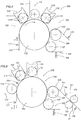
- the numeral 200 denotes in its entirety a machine for making absorbent sanitary articles 1.
- the machine 200 comprises a line, of substantially known type and not illustrated, for feeding at least one continuous web of impermeable material used to make the impermeable outer layer 3.
- the machine 200 comprises a forming unit 100 for making the absorbent pads 4 to form a succession of the pads 4 and to associate them with the continuous web of impermeable material.
- the unit 100 comprises a system for feeding a first web 101 of non-woven fabric in a feed direction V along a path P for defining the first layer NW1 of non-woven fabric.
- the feed system comprises a suction roller 102 for holding down and feeding at least the first web 101 of non-woven fabric and rotatable in a clockwise direction.
- the roller or drum 102 uses suction to hold down the web 101 and, preferably, the further layers of the article 1 subsequently placed on the web 101, as will become clearer as this description continues.
- the unit 100 comprises a station 103 for placing a second web 104 of non-woven fabric on the first web 101 of non-woven fabric to define the second layer NW2 of non-woven fabric of the pad 4.
- the station 103 comprises a roller 105 for transferring the second web 104 and tangent to the suction roller 102.
- the roller 105 is preferably rotatable in anticlockwise direction.
- the unit 100 comprises a station 106 for joining, in particular sealing, the second web 104 to the first web 101 so as to close the layers NW1 and NW2 on the cores 5 of the pads 4.
- the joining station 106 comprises a contact roller 107, for example rotatable in anticlockwise direction, tangent to the suction roller 102 and located downstream of the transfer roller 105 relative to the feed direction V of the absorbent pads 4.
- the roller 107 has on its outside surface a pattern of the seals 9, 9a.
- the joining station 106 comprises a sonotrode 108, of substantially known type, for making the seals 9, 9a and facing the outside surface of the roller 107.
- the sonotrode 108 acts on the contact roller 107 and, more specifically, makes the seals 9, 9a based on the predetermined pattern.
- the roller 105 itself acts as a contact roller, that is to say, it substitutes the roller 107, and the sonotrode 108 acts directly on the roller 105.
- the roller 102 is the contact roller, that is to say, it has the pattern of seals on its outside surface and the sonotrode 108 is a rotary sonotrode tangent to the roller 102.
- this embodiment comprises two sequentially rotating sonotrodes.
- the unit 100 comprises a first station 109 for laying out the first 6 of absorbent polymer material on the web 101 of non-woven fabric.
- the station 109 is operatively positioned upstream of the first placing station 103 relative to the first feed direction V.
- the station 109 comprises a laying-out roller 110 which is rotatable, for example in anticlockwise direction, and which is substantially tangent to the suction roller 102.
- the roller 110 is provided, on its outside cylindrical surface, with a plurality of pockets 111, each feeding and placing along the path P a portion of the absorbent material SAP1 and/or SAP2 of the first spread 6 of superabsorbent polymer material.
- the forming unit 100 comprises a second station 112 for placing a third web 113 of non-woven fabric on the first web 101 of non-woven fabric to define the layer 7 of non-woven fabric.
- the station 112 is located upstream of the station 103 relative to the feed direction V.
- the station 112 is located downstream of the laying-out station 109 relative to the feed direction V.
- the station 112 applies the web 113 to the web 104 in such a way that the web 113 will be on top of the web 101 in the pad 4.
- the station 112 is located downstream of the laying-out station 109 in the sense that it acts on the web 104 to apply the web 113 thereto, and the web 104 which, as mentioned above will define the layer NW2 of the pad 4, is applied to the web 101 after the material has been laid out at the station 109.
- the forming unit 100 comprises a second station 114, shown by the dashed lines, for laying out the second spread 12 of absorbent polymer material.
- the second station 114 is located downstream of the first laying-out station 109 and upstream of the second placing station 112, relative to the feed direction V.
- the second laying-out station 114 comprises a laying-out roller 115 substantially tangent to the suction roller 102 and rotatable, for example, in anticlockwise direction.
- the roller 115 is provided, on its outside cylindrical surface, with a plurality of pockets 116, each feeding and placing along the path P a portion of the absorbent material SAP1 and/or SAP2 of the second spread 12 of superabsorbent polymer material.
- the forming unit 100 comprises an adhesive dispenser 117 operating on the web 101 upstream of the laying-out station 109 to apply the layer 11 on the web 101 of non-woven fabric.
- the forming unit 100 comprises a second adhesive dispenser 118 operating at the first placing station 103 to spread the adhesive 11 b on the second web 102.
- the adhesive 11b keeps the web 113 in position relative to the web 104 and the unit 100 comprises an adhesive dispenser 119 for applying the adhesive 11 a to the layer 113 once the latter has been glued to the web 104.
- the dispenser 119 restores the layer of adhesive which will go on top of the absorbent material.
- the station 112 for placing the web 113 is located upstream of the first laying-out station 109 and downstream of the adhesive dispenser 117, relative to the feed direction V.
- the unit 100 comprises an adhesive dispenser 120 for applying the adhesive 11 to the layer 113 once the latter has been glued to the web 101.
- the dispenser 120 restores the layer of adhesive which will go under the absorbent material.
- the second station 114 for laying out the second spread 12 of absorbent material is located downstream of the station 112 for placing the web 113 and upstream of the station 103 for placing the web 104, relative to the feed direction V.
- the unit 100 for forming the pad 4 comprises a station 121 for applying the layer 15 to the web 104.
- the application station 121 comprises a roller 122 for feeding the layer 15 of high loft non-woven fabric and a contact roller 123 tangent to the roller 122 at the web 104.
- the station 121 comprises a dispenser 124 for spreading the adhesive 16 on the web 104, upstream of the rollers 122 and 123 relative to the feed direction of the web 102 in such a way that the rollers 122 and 123 cause the web 104 to be joined to the layer 15.
- the machine 200 comprises a line, of substantially known type and not illustrated, for feeding and applying at least one continuous web of permeable material used to make the permeable inner layer 2.
- the pads 4 are interposed between the outer layer 3 and the inner layer 2.
- the layer 7 of loft or high loft non-woven fabric helps hold the core 5 together better, especially if the seals 9, 9a are torn and, in practice, makes up for the absence of cellulose fibre, or fluff, in the absorbent core 5.
- the absorbent material SAP1, SAP2 is embedded in the layer 7 and is thus made more stable.
- the layer 15 on the outside of the core 5 makes the article 1 more comfortable, especially in the case where the absorbent material SAP1, SAP2 is directed towards the wearer's skin.
- the adhesive layers limit the migration of the absorbent material both when the absorbent material is dry and during the formation of the pad 4.
Landscapes
- Health & Medical Sciences (AREA)
- Engineering & Computer Science (AREA)
- Life Sciences & Earth Sciences (AREA)
- Biomedical Technology (AREA)
- Heart & Thoracic Surgery (AREA)
- Vascular Medicine (AREA)
- Epidemiology (AREA)
- Animal Behavior & Ethology (AREA)
- General Health & Medical Sciences (AREA)
- Public Health (AREA)
- Veterinary Medicine (AREA)
- Manufacturing & Machinery (AREA)
- Absorbent Articles And Supports Therefor (AREA)
- Orthopedics, Nursing, And Contraception (AREA)
- External Artificial Organs (AREA)
Claims (14)
- Maschine zur Herstellung absorbierender Hygieneartikel (1), aufweisend eine Hauptlängsausdehnungsrichtung (D) und umfassend- eine durchlässige Innenschicht (2);- eine undurchlässige Außenschicht (3);- eine absorbierende Einlage (4), die zwischen der durchlässigen Innenschicht (2) und der undurchlässigen Außenschicht (3) eingesetzt ist, und umfassend:- eine erste Schicht (NW1) aus Vliesstoff;- eine zweite Schicht (NW2) aus Vliesstoff, die teilweise mit der ersten Schicht (NW1) aus Vliesstoff zusammengefügt ist;- einen absorbierenden Kern (5), der zwischen der ersten und der zweiten Schicht (NW1, NW2) aus Vliesstoff eingefügt ist, wobei der absorbierende Kern (5) eine Spanne (6) aus absorbierendem Polymermaterial (SAP1, SAP2) umfasst;- eine Vielzahl an Siegeln (9, 9a), um die erste Schicht (NW1) aus Vliesstoff mit der zweiten Schicht (NW2) aus Vliesstoff zu verbinden;- eine dritte Schicht (7) aus Vliesstoff, die zwischen der ersten und der zweiten Schicht (NW1, NW2) aus Vliesstoff eingesetzt ist, wobei die Maschine eine Anlage zum Zuführen von mindestens einer durchgehenden Bahn aus undurchlässigem Material zum Definieren der undurchlässigen Außenschicht (3), eine Anlage zum Zuführen von mindestens einer durchgehenden Bahn aus durchlässigem Material zum Definieren der durchlässigen Innenschicht (2) und mindestens eine Einheit (100) zum Formen der absorbierenden Einlagen (4) zum Formen einer Abfolge an absorbierenden Einlagen (4) und zum Assoziieren der absorbierenden Einlagen (4) mit der durchgehenden Bahn aus undurchlässigem Material umfasst, wobei die Formungseinheit (100) ein System zum Zuführen einer ersten Bahn (101) aus Vliesstoff in einer Zuführungsrichtung (V) entlang eines Wegs (P) zum Definieren der ersten Schicht (NW1) aus Vliesstoff, eine erste Station (103) zum Platzieren einer zweiten Bahn (104) aus Vliesstoff auf der ersten Bahn (101) aus Vliesstoff zum Definieren der zweiten Schicht (NW2) aus Vliesstoff, eine Station (106) zum Zusammenfügen der zweiten Bahn (104) aus Vliesstoff mit der ersten Bahn (101) aus Vliesstoff, eine erste Station (109) zum Ausbringen der ersten Spanne (6) aus absorbierendem Polymermaterial auf der ersten Bahn (101) aus Vliesstoff umfasst, betriebswirksam positioniert vor der ersten Platzierungsstation (103) relativ zur ersten Zuführungsrichtung (V), wobei die Maschine dadurch gekennzeichnet ist, dass die Formungseinheit (100) eine zweite Station (112) umfasst, um eine dritte Bahn (113) aus Vliesstoff zwischen der ersten Bahn (101) aus Vliesstoff und der zweiten Bahn (104) aus Vliesstoff zu platzieren, die die dritte Schicht (7) aus Vliesstoff definiert und die vor der ersten Platzierungsstation (103) relativ zur Zuführungsrichtung (V) arbeitet.
- Maschine nach Anspruch 1, wobei die zweite Platzierungsstation (112) nach der ersten Ausbringungsstation (109) relativ zur Zuführungsrichtung angeordnet ist.
- Maschine nach Anspruch 2, wobei die Formungseinheit (100) eine zweite Station (114) zum Ausbringen einer zweiten Spanne (12) aus absorbierendem Polymermaterial umfasst und nach der zweiten Platzierungsstation (112) und nach der ersten Platzierungsstation (103) relativ zur Zuführungsrichtung (V) angeordnet ist.
- Maschine nach Anspruch 2, wobei die Formungseinheit (100) eine zweite Station (112) zum Ausbringen einer zweiten Spanne (12) aus absorbierendem Polymermaterial umfasst und nach der ersten Platzierungsstation (109) und vor der ersten Platzierungsstation (103) relativ zur Zuführungsrichtung (V) angeordnet ist.
- Maschine nach einem der Ansprüche 1 bis 4, wobei die Formungseinheit (100) eine erste Haftmittelausgabevorrichtung (117) umfasst, die am Zuführungssystem arbeitet, um eine Haftmittelschicht (11) zwischen der ersten Schicht (NW1) aus Vliesstoff und der dritten Schicht (7) aus Vliesstoff oder zwischen der ersten Schicht (NW1) aus Vliesstoff und der Spanne (6) aus absorbierendem Polymermaterial zu verteilen, wobei die erste Haftmittelausgabevorrichtung (117) vor der ersten Ausbringungsstation (109) relativ zur Zuführungsrichtung angeordnet ist.
- Maschine nach einem der Ansprüche 1 bis 5, wobei die Formungseinheit (100) eine zweite Haftmittelausgabevorrichtung (118) umfasst, die an der ersten Platzierungsstation (103) arbeitet, um eine Haftmittelschicht (11b) zwischen der ersten Spanne (6) aus absorbierendem Polymermaterial und der zweiten Schicht (NW2) aus Vliesstoff oder zwischen einer zweiten Spanne (12) aus absorbierendem Polymermaterial und der zweiten Schicht (NW2) aus Vliesstoff oder zwischen der dritten Schicht (7) aus Vliesstoff und der zweiten Schicht (NW2) aus Vliesstoff zu verteilen.
- Maschine nach Anspruch 5, wobei die zweite Platzierungsstation (112) vor der ersten Ausbringungsstation (109) und nach der ersten Haftmittelausgabevorrichtung (117) relativ zur Zuführungsrichtung angeordnet ist.
- Maschine nach Anspruch 7, wobei die Formungseinheit eine dritte Haftmittelausgabevorrichtung (120) umfasst, die nach der zweiten Platzierungsstation (112) und vor oder nach der ersten Ausbringungsstation (109 angeordnet ist und die eine Haftmittelschicht (14) zwischen der dritten Schicht (7) aus Vliesstoff und der Spanne (6) aus absorbierendem Polymermaterial verteilt.
- Maschine nach einem der Ansprüche 1 bis 8, wobei das Zuführungssystem eine Saugwalze (102) umfasst, um zumindest die erste Bahn (101) aus Vliesstoff nach unten zu halten und zuzuführen.
- Maschine nach Anspruch 9, wobei die erste Ausbringungsstation (109) und/oder die zweite Ausbringungsstation (114) eine Ausbringungswalze (110, 115) umfassen, die die Saugwalze (102) im Wesentlichen berührt und die an ihrer zylindrischen außenseitigen Oberfläche mit einer Vielzahl an Taschen (111, 116) versehen ist, von denen eine jede einen Abschnitt der ersten und/oder zweiten Spanne (6, 12) aus absorbierendem Polymermaterial zuführt und entlang des Wegs (P) platziert.
- Maschine nach Anspruch 9 oder 10, wobei die erste Station (103) zum Platzieren der zweiten Bahn (104) aus Vliesstoff eine Walze (105) umfasst, die die zweite Bahn (104) aus Vliesstoff transferiert und die die zweite Saugwalze (102) berührt, und die Zusammenfügungsstation (106) eine Kontaktwalze (107) umfasst, die die Saugwalze (102) berührt und nach der Transferwalze (105) relativ zur Zuführungsrichtung (V) der absorbierenden Einlagen (4) angeordnet ist, wobei die Zusammenfügungsstation (106) mindestens eine Sonotrode (108) umfasst, um die absorbierenden Einlagen (4) zu siegeln und auf die Kontaktwalze (107) zu wirken, wobei die Kontaktwalze (107) an ihrer außenseitigen Oberfläche ein vorgegebenes Muster an Siegeln (9, 9a) aufweist.
- Maschine nach einem der Ansprüche 1 bis 11, wobei die Formungseinheit (100) eine Station (121) zum Anbringen einer vierten Schicht (15) aus Vliesstoff an der zweiten Bahn (104) aus Vliesstoff umfasst, wobei die Anbringungsstation (121) eine Walze (122) zum Zuführen der vierten Schicht (15) aus Vliesstoff umfasst, die die zweite Bahn (104) aus Vliesstoff berührt, wobei die Anbringungsstation (121) eine Haftmittelausgabevorrichtung (124) umfasst, die auf der zweiten Bahn (104) aus Vliesstoff arbeitet und vor der Walze (121) zum Zuführen der vierten Schicht (15) aus Vliesstoff relativ zur Zuführungsrichtung der zweiten Bahn (104) aus Vliesstoff angeordnet ist.
- Maschine nach Anspruch 9 oder 10, wobei die erste Station (103) zum Platzieren der zweiten Bahn (104) aus Vliesstoff eine Walze (105) umfasst, die die zweite Bahn (104) aus Vliesstoff transferiert und die Saugwalze (102) berührt, wobei die Zusammenfügungsstation (106) die Transferwalze (105) umfasst, wobei die Transferwalze an ihrer außenseitigen zylindrischen Oberfläche ein vorgegebenes Muster an Siegeln umfasst und eine Kontaktwalze definiert, wobei die Zusammenfügungsstation (106) mindestens eine Sonotrode (108) umfasst, um die absorbierenden Einlagen (4) zu siegeln und auf die Kontaktwalze (107) zu wirken.
- Maschine nach Anspruch 9 oder 10, wobei die Zusammenfügungsstation (106) die Saugwalze (102) umfasst, wobei die Saugwalze an ihrer außenseitigen zylindrischen Oberfläche ein vorgegebenes Muster an Siegeln umfasst und eine Kontaktwalze definiert, wobei die Zusammenfügungsstation (106) mindestens eine sich drehende Sonotrode umfasst, um die absorbierenden Einlagen (4) zu siegeln und auf die Saugwalze (102) zu wirken.
Applications Claiming Priority (2)
| Application Number | Priority Date | Filing Date | Title |
|---|---|---|---|
| IT000176A ITBO20130176A1 (it) | 2013-04-18 | 2013-04-18 | Articolo igienico assorbente e macchina per realizzare tale articolo. |
| PCT/IB2014/060800 WO2014170859A1 (en) | 2013-04-18 | 2014-04-17 | Absorbent sanitary article and machine for making the article |
Publications (2)
| Publication Number | Publication Date |
|---|---|
| EP2986263A1 EP2986263A1 (de) | 2016-02-24 |
| EP2986263B1 true EP2986263B1 (de) | 2017-01-11 |
Family
ID=48626528
Family Applications (1)
| Application Number | Title | Priority Date | Filing Date |
|---|---|---|---|
| EP14727919.4A Not-in-force EP2986263B1 (de) | 2013-04-18 | 2014-04-17 | Maschine zur herstellung eines absorbierenden artikels |
Country Status (8)
| Country | Link |
|---|---|
| US (1) | US20160045379A1 (de) |
| EP (1) | EP2986263B1 (de) |
| JP (1) | JP6403755B2 (de) |
| CN (1) | CN105208990B (de) |
| BR (1) | BR112015026419A2 (de) |
| IT (1) | ITBO20130176A1 (de) |
| PH (1) | PH12015502335B1 (de) |
| WO (1) | WO2014170859A1 (de) |
Cited By (2)
| Publication number | Priority date | Publication date | Assignee | Title |
|---|---|---|---|---|
| US11389345B2 (en) | 2013-03-15 | 2022-07-19 | Dsg Technology Holdings Ltd. | Method of making an absorbent composite |
| US11426311B2 (en) | 2013-03-15 | 2022-08-30 | Dsg Technology Holdings Ltd. | Method of making an absorbent composite and absorbent articles employing the same |
Families Citing this family (18)
| Publication number | Priority date | Publication date | Assignee | Title |
|---|---|---|---|---|
| WO2012170781A1 (en) | 2011-06-10 | 2012-12-13 | The Procter & Gamble Company | Disposable diapers |
| PL2740449T3 (pl) | 2012-12-10 | 2019-07-31 | The Procter & Gamble Company | Artykuł chłonny o wysokiej zawartości materiału chłonnego |
| PL2813201T3 (pl) | 2013-06-14 | 2018-04-30 | The Procter And Gamble Company | Wyrób chłonny i wkład chłonny tworzący kanały w stanie mokrym |
| EP2851048B1 (de) | 2013-09-19 | 2018-09-05 | The Procter and Gamble Company | Absorbierende Kerne mit materialfreien Bereichen |
| EP3251647A1 (de) | 2016-05-31 | 2017-12-06 | Drylock Technologies N.V. | Absorbierende struktur mit trennschicht |
| IT201700031281A1 (it) * | 2017-03-22 | 2018-09-22 | Gdm Spa | Apparato e metodo di formatura di una imbottitura assorbente. |
| DE102017120736A1 (de) * | 2017-09-08 | 2019-03-14 | Alfred Kärcher SE & Co. KG | Behältereinrichtung für ein Bodenreinigungsgerät und Bodenreinigungsgerät |
| CN109953853B (zh) * | 2017-12-26 | 2021-10-22 | 大王制纸株式会社 | 吸收性物品 |
| JP6531197B1 (ja) | 2018-03-30 | 2019-06-12 | 大王製紙株式会社 | 吸収性物品 |
| ES2884136T3 (es) | 2018-04-05 | 2021-12-10 | Drylock Tech Nv | Artículo absorbente con núcleo absorbente reducido |
| JP6689317B2 (ja) * | 2018-06-08 | 2020-04-28 | ユニ・チャーム株式会社 | 吸収性物品の吸収体 |
| JP7118105B2 (ja) * | 2020-04-06 | 2022-08-15 | ユニ・チャーム株式会社 | 吸収性物品の吸収体 |
| EP4175597A1 (de) * | 2020-07-06 | 2023-05-10 | Ontex BV | Saugfähiger artikel mit verbessertem kern und herstellungsverfahren |
| EP3936098B1 (de) * | 2020-07-06 | 2022-05-04 | Ontex BV | Saugfähiger artikel mit verbessertem kern und verfahren zur herstellung |
| US20230248580A1 (en) * | 2020-07-06 | 2023-08-10 | Ontex Bv | Absorbent article with improved core and method of making |
| PL3936096T3 (pl) * | 2020-07-06 | 2023-01-09 | Ontex Bv | Wyrób chłonny z ulepszonym rdzeniem i sposób wytwarzania |
| EP3936097B1 (de) * | 2020-07-06 | 2026-03-04 | Ontex BV | Vorrichtung und verfahren zur herstellung von absorbierenden artikeln mit verbessertem kern |
| EP4108219B1 (de) * | 2021-06-24 | 2024-09-25 | Fameccanica.Data S.p.A. | Maschine und verfahren zur herstellung von sanitärprodukten |
Family Cites Families (19)
| Publication number | Priority date | Publication date | Assignee | Title |
|---|---|---|---|---|
| JPS6323078Y2 (de) * | 1985-06-28 | 1988-06-24 | ||
| JP2693813B2 (ja) * | 1989-03-28 | 1997-12-24 | 大日本印刷株式会社 | 機能性を有する吸水シートの製造方法 |
| JPH02303826A (ja) * | 1989-05-19 | 1990-12-17 | Dainippon Printing Co Ltd | 機能性を有する吸水シート |
| US5830202A (en) * | 1994-08-01 | 1998-11-03 | The Procter & Gamble Company | Absorbent comprising upper and lower gel layers |
| EP0695541B2 (de) * | 1994-08-01 | 2004-03-31 | THE PROCTER & GAMBLE COMPANY | Absorbierende Struktur mit einer oberen Lage und einer unteren Lage aus absorbierendem Gel und Verfahren zur Herstellung |
| US5938650A (en) * | 1995-08-09 | 1999-08-17 | Fibertech Group, Inc. | Absorbent core for absorbing body liquids and method |
| US5891120A (en) * | 1997-01-30 | 1999-04-06 | Paragon Trade Brands, Inc. | Absorbent article comprising topsheet, backsheet and absorbent core with liquid transferring layer near backsheet |
| EP0959165A4 (de) * | 1997-12-04 | 2000-04-19 | Mitsui Chemicals Inc | Biegbarer verbundvliesstoff |
| US20030022237A1 (en) * | 2000-09-27 | 2003-01-30 | Feder John N. | Novel human G-protein coupled receptor, HGPRBMY4, expressed highly in prostate, colon, and lung |
| JP4502586B2 (ja) * | 2003-03-12 | 2010-07-14 | 株式会社リブドゥコーポレーション | 使い捨て吸収性物品 |
| US20050054998A1 (en) * | 2003-09-05 | 2005-03-10 | Poccia John F. | Absorbent article |
| IT1390737B1 (it) * | 2008-07-04 | 2011-09-23 | Gdm Spa | Macchina per la realizzazione di articoli assorbenti. |
| IT1399148B1 (it) * | 2009-03-09 | 2013-04-11 | Gdm Spa | Impianto per la realizzazione di artocoli igienici intimi. |
| JP5318747B2 (ja) * | 2009-12-28 | 2013-10-16 | 株式会社リブドゥコーポレーション | 吸収性物品 |
| JP2012010980A (ja) * | 2010-06-30 | 2012-01-19 | Unicharm Corp | 薄型吸収性物品 |
| FR2966039B3 (fr) * | 2010-10-13 | 2012-11-09 | Romanova Bva Starter | Structure absorbante pour un systeme de gestion des fluides integre |
| PL2627295T3 (pl) * | 2010-10-13 | 2018-08-31 | Drylock Technologies Nv | Struktura chłonna |
| EP2444046A1 (de) | 2010-10-20 | 2012-04-25 | Vynka Bvba | Umweltfreundliche absorbierende Struktur |
| JP5885954B2 (ja) * | 2011-07-29 | 2016-03-16 | ユニ・チャーム株式会社 | 芯材の製造方法 |
-
2013
- 2013-04-18 IT IT000176A patent/ITBO20130176A1/it unknown
-
2014
- 2014-04-17 WO PCT/IB2014/060800 patent/WO2014170859A1/en not_active Ceased
- 2014-04-17 EP EP14727919.4A patent/EP2986263B1/de not_active Not-in-force
- 2014-04-17 BR BR112015026419A patent/BR112015026419A2/pt not_active IP Right Cessation
- 2014-04-17 US US14/783,234 patent/US20160045379A1/en not_active Abandoned
- 2014-04-17 CN CN201480027042.2A patent/CN105208990B/zh not_active Expired - Fee Related
- 2014-04-17 JP JP2016508273A patent/JP6403755B2/ja not_active Expired - Fee Related
-
2015
- 2015-10-08 PH PH12015502335A patent/PH12015502335B1/en unknown
Non-Patent Citations (1)
| Title |
|---|
| None * |
Cited By (3)
| Publication number | Priority date | Publication date | Assignee | Title |
|---|---|---|---|---|
| US11389345B2 (en) | 2013-03-15 | 2022-07-19 | Dsg Technology Holdings Ltd. | Method of making an absorbent composite |
| US11426311B2 (en) | 2013-03-15 | 2022-08-30 | Dsg Technology Holdings Ltd. | Method of making an absorbent composite and absorbent articles employing the same |
| US11903805B2 (en) | 2013-03-15 | 2024-02-20 | Dsg Technology Holdings Ltd. | Method of making an absorbent composite and absorbent articles employing the same |
Also Published As
| Publication number | Publication date |
|---|---|
| CN105208990A (zh) | 2015-12-30 |
| BR112015026419A2 (pt) | 2017-07-25 |
| PH12015502335B1 (en) | 2018-07-13 |
| EP2986263A1 (de) | 2016-02-24 |
| ITBO20130176A1 (it) | 2014-10-19 |
| CN105208990B (zh) | 2019-11-05 |
| JP6403755B2 (ja) | 2018-10-10 |
| JP2016515458A (ja) | 2016-05-30 |
| WO2014170859A1 (en) | 2014-10-23 |
| US20160045379A1 (en) | 2016-02-18 |
| PH12015502335A1 (en) | 2016-02-22 |
Similar Documents
| Publication | Publication Date | Title |
|---|---|---|
| EP2986263B1 (de) | Maschine zur herstellung eines absorbierenden artikels | |
| KR102321369B1 (ko) | 흡수 복합재의 제작 방법 및 이를 이용하는 흡수 물품들 | |
| CN106232073B (zh) | 具有多层折叠吸收芯的吸收性用品 | |
| JP2026040473A (ja) | 吸収複合材、吸収複合材を用いた吸収物品、並びに吸収複合材及び/又は吸収物品の製造方法、製造システム、及び製造装置 | |
| CA2869870C (en) | Unitary absorbent structures comprising an absorbent core and/or an acquisition and dispersion layer for absorbent articles | |
| JP5200309B2 (ja) | 超吸収性材料を含有する拡大可能な凹部を備える衛生物品用の吸収体および製造方法 | |
| ES2842441T3 (es) | Método para producir una estructura compuesta | |
| US20130066290A1 (en) | Bodily fluid absorbent structure and method for manufacturing the same | |
| CN109771141A (zh) | 一种干爽吸收物品的制备方法 | |
| US20160030257A1 (en) | Absorbent sanitary article and machine for making the article | |
| CN110169872A (zh) | 一种mw型高分子复合芯体及其制备方法 | |
| US20170079848A1 (en) | Method for making absorbent articles | |
| US20210038441A1 (en) | Apparatus and method for forming an absorbent pad | |
| HK40121597A (zh) | 制备吸收复合物的方法和采用其的吸收制品 |
Legal Events
| Date | Code | Title | Description |
|---|---|---|---|
| PUAI | Public reference made under article 153(3) epc to a published international application that has entered the european phase |
Free format text: ORIGINAL CODE: 0009012 |
|
| 17P | Request for examination filed |
Effective date: 20151111 |
|
| AK | Designated contracting states |
Kind code of ref document: A1 Designated state(s): AL AT BE BG CH CY CZ DE DK EE ES FI FR GB GR HR HU IE IS IT LI LT LU LV MC MK MT NL NO PL PT RO RS SE SI SK SM TR |
|
| AX | Request for extension of the european patent |
Extension state: BA ME |
|
| DAX | Request for extension of the european patent (deleted) | ||
| REG | Reference to a national code |
Ref country code: DE Ref legal event code: R079 Ref document number: 602014006253 Country of ref document: DE Free format text: PREVIOUS MAIN CLASS: A61F0013532000 Ipc: A61F0013150000 |
|
| GRAP | Despatch of communication of intention to grant a patent |
Free format text: ORIGINAL CODE: EPIDOSNIGR1 |
|
| RIC1 | Information provided on ipc code assigned before grant |
Ipc: A61F 13/534 20060101ALI20160801BHEP Ipc: A61F 13/532 20060101ALI20160801BHEP Ipc: A61F 13/15 20060101AFI20160801BHEP Ipc: A61F 13/539 20060101ALI20160801BHEP |
|
| INTG | Intention to grant announced |
Effective date: 20160830 |
|
| RIN1 | Information on inventor provided before grant (corrected) |
Inventor name: PIANTONI, MATTEO Inventor name: SOLI, VALERIO |
|
| GRAS | Grant fee paid |
Free format text: ORIGINAL CODE: EPIDOSNIGR3 |
|
| GRAA | (expected) grant |
Free format text: ORIGINAL CODE: 0009210 |
|
| AK | Designated contracting states |
Kind code of ref document: B1 Designated state(s): AL AT BE BG CH CY CZ DE DK EE ES FI FR GB GR HR HU IE IS IT LI LT LU LV MC MK MT NL NO PL PT RO RS SE SI SK SM TR |
|
| REG | Reference to a national code |
Ref country code: GB Ref legal event code: FG4D |
|
| REG | Reference to a national code |
Ref country code: CH Ref legal event code: EP |
|
| REG | Reference to a national code |
Ref country code: AT Ref legal event code: REF Ref document number: 860584 Country of ref document: AT Kind code of ref document: T Effective date: 20170115 |
|
| REG | Reference to a national code |
Ref country code: IE Ref legal event code: FG4D |
|
| REG | Reference to a national code |
Ref country code: DE Ref legal event code: R096 Ref document number: 602014006253 Country of ref document: DE |
|
| REG | Reference to a national code |
Ref country code: SE Ref legal event code: TRGR |
|
| REG | Reference to a national code |
Ref country code: LT Ref legal event code: MG4D |
|
| REG | Reference to a national code |
Ref country code: NL Ref legal event code: MP Effective date: 20170111 |
|
| REG | Reference to a national code |
Ref country code: AT Ref legal event code: MK05 Ref document number: 860584 Country of ref document: AT Kind code of ref document: T Effective date: 20170111 |
|
| PG25 | Lapsed in a contracting state [announced via postgrant information from national office to epo] |
Ref country code: NL Free format text: LAPSE BECAUSE OF FAILURE TO SUBMIT A TRANSLATION OF THE DESCRIPTION OR TO PAY THE FEE WITHIN THE PRESCRIBED TIME-LIMIT Effective date: 20170111 |
|
| PG25 | Lapsed in a contracting state [announced via postgrant information from national office to epo] |
Ref country code: NO Free format text: LAPSE BECAUSE OF FAILURE TO SUBMIT A TRANSLATION OF THE DESCRIPTION OR TO PAY THE FEE WITHIN THE PRESCRIBED TIME-LIMIT Effective date: 20170411 Ref country code: FI Free format text: LAPSE BECAUSE OF FAILURE TO SUBMIT A TRANSLATION OF THE DESCRIPTION OR TO PAY THE FEE WITHIN THE PRESCRIBED TIME-LIMIT Effective date: 20170111 Ref country code: LT Free format text: LAPSE BECAUSE OF FAILURE TO SUBMIT A TRANSLATION OF THE DESCRIPTION OR TO PAY THE FEE WITHIN THE PRESCRIBED TIME-LIMIT Effective date: 20170111 Ref country code: GR Free format text: LAPSE BECAUSE OF FAILURE TO SUBMIT A TRANSLATION OF THE DESCRIPTION OR TO PAY THE FEE WITHIN THE PRESCRIBED TIME-LIMIT Effective date: 20170412 Ref country code: IS Free format text: LAPSE BECAUSE OF FAILURE TO SUBMIT A TRANSLATION OF THE DESCRIPTION OR TO PAY THE FEE WITHIN THE PRESCRIBED TIME-LIMIT Effective date: 20170511 Ref country code: HR Free format text: LAPSE BECAUSE OF FAILURE TO SUBMIT A TRANSLATION OF THE DESCRIPTION OR TO PAY THE FEE WITHIN THE PRESCRIBED TIME-LIMIT Effective date: 20170111 |
|
| PG25 | Lapsed in a contracting state [announced via postgrant information from national office to epo] |
Ref country code: ES Free format text: LAPSE BECAUSE OF FAILURE TO SUBMIT A TRANSLATION OF THE DESCRIPTION OR TO PAY THE FEE WITHIN THE PRESCRIBED TIME-LIMIT Effective date: 20170111 Ref country code: LV Free format text: LAPSE BECAUSE OF FAILURE TO SUBMIT A TRANSLATION OF THE DESCRIPTION OR TO PAY THE FEE WITHIN THE PRESCRIBED TIME-LIMIT Effective date: 20170111 Ref country code: PT Free format text: LAPSE BECAUSE OF FAILURE TO SUBMIT A TRANSLATION OF THE DESCRIPTION OR TO PAY THE FEE WITHIN THE PRESCRIBED TIME-LIMIT Effective date: 20170511 Ref country code: BG Free format text: LAPSE BECAUSE OF FAILURE TO SUBMIT A TRANSLATION OF THE DESCRIPTION OR TO PAY THE FEE WITHIN THE PRESCRIBED TIME-LIMIT Effective date: 20170411 Ref country code: RS Free format text: LAPSE BECAUSE OF FAILURE TO SUBMIT A TRANSLATION OF THE DESCRIPTION OR TO PAY THE FEE WITHIN THE PRESCRIBED TIME-LIMIT Effective date: 20170111 Ref country code: PL Free format text: LAPSE BECAUSE OF FAILURE TO SUBMIT A TRANSLATION OF THE DESCRIPTION OR TO PAY THE FEE WITHIN THE PRESCRIBED TIME-LIMIT Effective date: 20170111 Ref country code: AT Free format text: LAPSE BECAUSE OF FAILURE TO SUBMIT A TRANSLATION OF THE DESCRIPTION OR TO PAY THE FEE WITHIN THE PRESCRIBED TIME-LIMIT Effective date: 20170111 |
|
| REG | Reference to a national code |
Ref country code: DE Ref legal event code: R097 Ref document number: 602014006253 Country of ref document: DE |
|
| PG25 | Lapsed in a contracting state [announced via postgrant information from national office to epo] |
Ref country code: IT Free format text: LAPSE BECAUSE OF FAILURE TO SUBMIT A TRANSLATION OF THE DESCRIPTION OR TO PAY THE FEE WITHIN THE PRESCRIBED TIME-LIMIT Effective date: 20170111 Ref country code: EE Free format text: LAPSE BECAUSE OF FAILURE TO SUBMIT A TRANSLATION OF THE DESCRIPTION OR TO PAY THE FEE WITHIN THE PRESCRIBED TIME-LIMIT Effective date: 20170111 Ref country code: SK Free format text: LAPSE BECAUSE OF FAILURE TO SUBMIT A TRANSLATION OF THE DESCRIPTION OR TO PAY THE FEE WITHIN THE PRESCRIBED TIME-LIMIT Effective date: 20170111 Ref country code: RO Free format text: LAPSE BECAUSE OF FAILURE TO SUBMIT A TRANSLATION OF THE DESCRIPTION OR TO PAY THE FEE WITHIN THE PRESCRIBED TIME-LIMIT Effective date: 20170111 Ref country code: CZ Free format text: LAPSE BECAUSE OF FAILURE TO SUBMIT A TRANSLATION OF THE DESCRIPTION OR TO PAY THE FEE WITHIN THE PRESCRIBED TIME-LIMIT Effective date: 20170111 |
|
| PLBE | No opposition filed within time limit |
Free format text: ORIGINAL CODE: 0009261 |
|
| STAA | Information on the status of an ep patent application or granted ep patent |
Free format text: STATUS: NO OPPOSITION FILED WITHIN TIME LIMIT |
|
| PG25 | Lapsed in a contracting state [announced via postgrant information from national office to epo] |
Ref country code: SM Free format text: LAPSE BECAUSE OF FAILURE TO SUBMIT A TRANSLATION OF THE DESCRIPTION OR TO PAY THE FEE WITHIN THE PRESCRIBED TIME-LIMIT Effective date: 20170111 Ref country code: DK Free format text: LAPSE BECAUSE OF FAILURE TO SUBMIT A TRANSLATION OF THE DESCRIPTION OR TO PAY THE FEE WITHIN THE PRESCRIBED TIME-LIMIT Effective date: 20170111 |
|
| REG | Reference to a national code |
Ref country code: CH Ref legal event code: PL |
|
| 26N | No opposition filed |
Effective date: 20171012 |
|
| REG | Reference to a national code |
Ref country code: IE Ref legal event code: MM4A |
|
| REG | Reference to a national code |
Ref country code: FR Ref legal event code: ST Effective date: 20171229 |
|
| PG25 | Lapsed in a contracting state [announced via postgrant information from national office to epo] |
Ref country code: FR Free format text: LAPSE BECAUSE OF NON-PAYMENT OF DUE FEES Effective date: 20170502 Ref country code: MC Free format text: LAPSE BECAUSE OF FAILURE TO SUBMIT A TRANSLATION OF THE DESCRIPTION OR TO PAY THE FEE WITHIN THE PRESCRIBED TIME-LIMIT Effective date: 20170111 |
|
| PG25 | Lapsed in a contracting state [announced via postgrant information from national office to epo] |
Ref country code: LI Free format text: LAPSE BECAUSE OF NON-PAYMENT OF DUE FEES Effective date: 20170430 Ref country code: CH Free format text: LAPSE BECAUSE OF NON-PAYMENT OF DUE FEES Effective date: 20170430 Ref country code: SI Free format text: LAPSE BECAUSE OF FAILURE TO SUBMIT A TRANSLATION OF THE DESCRIPTION OR TO PAY THE FEE WITHIN THE PRESCRIBED TIME-LIMIT Effective date: 20170111 Ref country code: LU Free format text: LAPSE BECAUSE OF NON-PAYMENT OF DUE FEES Effective date: 20170417 |
|
| REG | Reference to a national code |
Ref country code: BE Ref legal event code: MM Effective date: 20170430 |
|
| PG25 | Lapsed in a contracting state [announced via postgrant information from national office to epo] |
Ref country code: IE Free format text: LAPSE BECAUSE OF NON-PAYMENT OF DUE FEES Effective date: 20170417 |
|
| PG25 | Lapsed in a contracting state [announced via postgrant information from national office to epo] |
Ref country code: BE Free format text: LAPSE BECAUSE OF NON-PAYMENT OF DUE FEES Effective date: 20170430 |
|
| PG25 | Lapsed in a contracting state [announced via postgrant information from national office to epo] |
Ref country code: MT Free format text: LAPSE BECAUSE OF NON-PAYMENT OF DUE FEES Effective date: 20170417 |
|
| GBPC | Gb: european patent ceased through non-payment of renewal fee |
Effective date: 20180417 |
|
| PG25 | Lapsed in a contracting state [announced via postgrant information from national office to epo] |
Ref country code: GB Free format text: LAPSE BECAUSE OF NON-PAYMENT OF DUE FEES Effective date: 20180417 |
|
| PG25 | Lapsed in a contracting state [announced via postgrant information from national office to epo] |
Ref country code: HU Free format text: LAPSE BECAUSE OF FAILURE TO SUBMIT A TRANSLATION OF THE DESCRIPTION OR TO PAY THE FEE WITHIN THE PRESCRIBED TIME-LIMIT; INVALID AB INITIO Effective date: 20140417 |
|
| PGFP | Annual fee paid to national office [announced via postgrant information from national office to epo] |
Ref country code: DE Payment date: 20190429 Year of fee payment: 6 |
|
| PGFP | Annual fee paid to national office [announced via postgrant information from national office to epo] |
Ref country code: SE Payment date: 20190429 Year of fee payment: 6 |
|
| PG25 | Lapsed in a contracting state [announced via postgrant information from national office to epo] |
Ref country code: CY Free format text: LAPSE BECAUSE OF FAILURE TO SUBMIT A TRANSLATION OF THE DESCRIPTION OR TO PAY THE FEE WITHIN THE PRESCRIBED TIME-LIMIT Effective date: 20170111 |
|
| PG25 | Lapsed in a contracting state [announced via postgrant information from national office to epo] |
Ref country code: MK Free format text: LAPSE BECAUSE OF FAILURE TO SUBMIT A TRANSLATION OF THE DESCRIPTION OR TO PAY THE FEE WITHIN THE PRESCRIBED TIME-LIMIT Effective date: 20170111 |
|
| PG25 | Lapsed in a contracting state [announced via postgrant information from national office to epo] |
Ref country code: TR Free format text: LAPSE BECAUSE OF FAILURE TO SUBMIT A TRANSLATION OF THE DESCRIPTION OR TO PAY THE FEE WITHIN THE PRESCRIBED TIME-LIMIT Effective date: 20170111 |
|
| PG25 | Lapsed in a contracting state [announced via postgrant information from national office to epo] |
Ref country code: AL Free format text: LAPSE BECAUSE OF FAILURE TO SUBMIT A TRANSLATION OF THE DESCRIPTION OR TO PAY THE FEE WITHIN THE PRESCRIBED TIME-LIMIT Effective date: 20170111 |
|
| REG | Reference to a national code |
Ref country code: DE Ref legal event code: R119 Ref document number: 602014006253 Country of ref document: DE |
|
| PG25 | Lapsed in a contracting state [announced via postgrant information from national office to epo] |
Ref country code: DE Free format text: LAPSE BECAUSE OF NON-PAYMENT OF DUE FEES Effective date: 20201103 Ref country code: SE Free format text: LAPSE BECAUSE OF NON-PAYMENT OF DUE FEES Effective date: 20200418 |