EP2986261B1 - Machine and method for making absorbent sanitary articles - Google Patents
Machine and method for making absorbent sanitary articles Download PDFInfo
- Publication number
- EP2986261B1 EP2986261B1 EP14722355.6A EP14722355A EP2986261B1 EP 2986261 B1 EP2986261 B1 EP 2986261B1 EP 14722355 A EP14722355 A EP 14722355A EP 2986261 B1 EP2986261 B1 EP 2986261B1
- Authority
- EP
- European Patent Office
- Prior art keywords
- absorbent
- detecting device
- superabsorbent polymer
- unit
- absorbent pad
- Prior art date
- Legal status (The legal status is an assumption and is not a legal conclusion. Google has not performed a legal analysis and makes no representation as to the accuracy of the status listed.)
- Active
Links
Images

Classifications
-
- A—HUMAN NECESSITIES
- A61—MEDICAL OR VETERINARY SCIENCE; HYGIENE
- A61F—FILTERS IMPLANTABLE INTO BLOOD VESSELS; PROSTHESES; DEVICES PROVIDING PATENCY TO, OR PREVENTING COLLAPSING OF, TUBULAR STRUCTURES OF THE BODY, e.g. STENTS; ORTHOPAEDIC, NURSING OR CONTRACEPTIVE DEVICES; FOMENTATION; TREATMENT OR PROTECTION OF EYES OR EARS; BANDAGES, DRESSINGS OR ABSORBENT PADS; FIRST-AID KITS
- A61F13/00—Bandages or dressings; Absorbent pads
- A61F13/15—Absorbent pads, e.g. sanitary towels, swabs or tampons for external or internal application to the body; Supporting or fastening means therefor; Tampon applicators
- A61F13/15577—Apparatus or processes for manufacturing
- A61F13/15772—Control
-
- A—HUMAN NECESSITIES
- A61—MEDICAL OR VETERINARY SCIENCE; HYGIENE
- A61F—FILTERS IMPLANTABLE INTO BLOOD VESSELS; PROSTHESES; DEVICES PROVIDING PATENCY TO, OR PREVENTING COLLAPSING OF, TUBULAR STRUCTURES OF THE BODY, e.g. STENTS; ORTHOPAEDIC, NURSING OR CONTRACEPTIVE DEVICES; FOMENTATION; TREATMENT OR PROTECTION OF EYES OR EARS; BANDAGES, DRESSINGS OR ABSORBENT PADS; FIRST-AID KITS
- A61F13/00—Bandages or dressings; Absorbent pads
- A61F13/15—Absorbent pads, e.g. sanitary towels, swabs or tampons for external or internal application to the body; Supporting or fastening means therefor; Tampon applicators
- A61F13/15577—Apparatus or processes for manufacturing
- A61F13/15617—Making absorbent pads from fibres or pulverulent material with or without treatment of the fibres
- A61F13/15658—Forming continuous, e.g. composite, fibrous webs, e.g. involving the application of pulverulent material on parts thereof
-
- A—HUMAN NECESSITIES
- A61—MEDICAL OR VETERINARY SCIENCE; HYGIENE
- A61F—FILTERS IMPLANTABLE INTO BLOOD VESSELS; PROSTHESES; DEVICES PROVIDING PATENCY TO, OR PREVENTING COLLAPSING OF, TUBULAR STRUCTURES OF THE BODY, e.g. STENTS; ORTHOPAEDIC, NURSING OR CONTRACEPTIVE DEVICES; FOMENTATION; TREATMENT OR PROTECTION OF EYES OR EARS; BANDAGES, DRESSINGS OR ABSORBENT PADS; FIRST-AID KITS
- A61F13/00—Bandages or dressings; Absorbent pads
- A61F13/15—Absorbent pads, e.g. sanitary towels, swabs or tampons for external or internal application to the body; Supporting or fastening means therefor; Tampon applicators
- A61F13/15577—Apparatus or processes for manufacturing
- A61F13/15764—Transferring, feeding or handling devices; Drives
-
- A—HUMAN NECESSITIES
- A61—MEDICAL OR VETERINARY SCIENCE; HYGIENE
- A61F—FILTERS IMPLANTABLE INTO BLOOD VESSELS; PROSTHESES; DEVICES PROVIDING PATENCY TO, OR PREVENTING COLLAPSING OF, TUBULAR STRUCTURES OF THE BODY, e.g. STENTS; ORTHOPAEDIC, NURSING OR CONTRACEPTIVE DEVICES; FOMENTATION; TREATMENT OR PROTECTION OF EYES OR EARS; BANDAGES, DRESSINGS OR ABSORBENT PADS; FIRST-AID KITS
- A61F13/00—Bandages or dressings; Absorbent pads
- A61F13/15—Absorbent pads, e.g. sanitary towels, swabs or tampons for external or internal application to the body; Supporting or fastening means therefor; Tampon applicators
- A61F13/15577—Apparatus or processes for manufacturing
- A61F13/15804—Plant, e.g. involving several steps
-
- G—PHYSICS
- G01—MEASURING; TESTING
- G01N—INVESTIGATING OR ANALYSING MATERIALS BY DETERMINING THEIR CHEMICAL OR PHYSICAL PROPERTIES
- G01N22/00—Investigating or analysing materials by the use of microwaves or radio waves, i.e. electromagnetic waves with a wavelength of one millimetre or more
- G01N22/02—Investigating the presence of flaws
Definitions
- This invention relates to a machine and a method for making absorbent sanitary articles.
- absorbent sanitary articles comprise an impermeable layer, for example of polyethylene, a layer of non-woven fabric permeable to liquids and an absorbent pad sandwiched therebetween.
- absorbent articles comprise further accessory components, such as, for example, elastic bands, faecal barriers and side tabs, which vary the complexity of the structure and production process of the absorbent articles to different degrees.
- Prior art machines for making absorbent sanitary articles comprise a line for feeding a continuous web of impermeable material along which there are a plurality of operating units which provide the continuous web with the basic and accessory components needed to make up the finished absorbent article.
- the absorbent pad is made mainly from natural fibres (known as “fluff”) uniformly blended with superabsorbent polymer material (“SAP”)
- the absorbent pad may also comprise one or more discrete absorbent layers made mainly or exclusively of superabsorbent polymer material ("SAP").
- SAP superabsorbent polymer material
- the prior art teaches the use of an inductive sensor capable of detecting the weight and density profile of the entire pad.
- sensors of this kind tend to be unstable during machine operation and need to be calibrated frequently.
- inductive sensors do not allow the weight and density profile of individual absorbent materials making up the pad, such as fluff and "SAP" to be detected distinctly from each other, because sensors of this kind are unable to distinguish each single absorbent material used to make the pad.
- This invention has for an aim to provide a machine and a method for making absorbent sanitary articles, as described in claims 1 to 7, and which overcome the above mentioned disadvantages of the prior art.
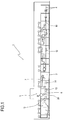
- the numeral 1 denotes in its entirety a machine for making absorbent sanitary articles .
- An absorbent article 4 comprises a sheet of permeable material and a sheet of impermeable material having, sandwiched between them, an absorbent pad 2 constituting the part of the article whose function is to absorb liquids.
- the absorbent pad 2 comprises at least a first absorbent material 8.
- the first absorbent material 8 is made mainly from natural fibre material (fluff) 8a uniformly blended with superabsorbent polymer material (“SAP”) 8b.
- the first absorbent material 8 is made mainly or only from natural fibre material (fluff) 8a or superabsorbent polymer material (“SAP”) 8b.
- the pad 2 also comprises at least one discrete layer 9 of superabsorbent polymer material (“SAP”) 9a defining a second absorbent material.
- SAP superabsorbent polymer material
- the superabsorbent polymer material used is superabsorbent polymer material in granular form.
- the absorbent pad 2 comprises a plurality of absorbent materials 8a, 8b, 9a.
- the "SAP" 8a of the first absorbent material 8 is of the same type as the "SAP” 9a defining the discrete layers 9 of the absorbent pad 2.
- the "SAP" 8a of the first absorbent material 8 is of a different type from the "SAP" 9a defining the discrete layers 9 of the absorbent pad 2.
- the machine 1 comprises a line 3 for feeding at least one continuous web 7 of impermeable material used to make the above mentioned sheet of impermeable material.
- the machine 1 comprises a unit 5 for forming and applying a succession 20 of absorbent pads 2 and located along the feed line 3.
- the unit 5 is substantially tangent to the feed line 3 at a release station 6.
- the article may comprise different accessory components, such as, for example, elastic bands, faecal barriers and side tabs.
- These accessory components are made in respective operating units which are located along the feed line 3 and which feed the respective accessory components to the continuous web 7 of impermeable material.
- the position of these operating units is a function of the zone of application of the respective accessory components on the continuous web 7 of impermeable material.
- the unit 5 for forming and applying a succession 20 of absorbent pads 2 comprises at least one system 27, 28, 29 for metering a respective absorbent material 8a, 8b, 9a.
- the unit 5 comprises a forming drum 36 by which the absorbent pads 2 are formed.
- the drum 36 is substantially tangent to the feed line 3.
- the drum 36 On its peripheral surface, the drum 36 has one or more suction recesses 38.
- the suction recesses 38 are located on the peripheral surface of the drum 36 at a predetermined spacing P.
- absorbent pads 2 are gradually formed inside respective suction recesses 38 and, once completed, are released onto the feed line 3 by the drum 36 itself.
- the forming and application unit 5 comprises a hood 26 for feeding the absorbent materials 8a, 8b, 9a making up the absorbent pad 2.
- the hood 26 is mounted in such a way as to peripherally face at least part of the peripheral surface of the drum 36.
- the unit 5 comprises a first system 27 for metering the natural fibre material (fluff) 8a and a second system 28 for metering the superabsorbent polymer material (“SAP”) 8b of the absorbent material 8.
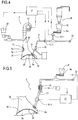
- the unit 5 also comprises a third system 29 for metering the superabsorbent polymer material (“SAP") 9a defining the discrete layer 9 of the absorbent pad 2, as illustrated in Figure 4 .
- the first, second and third metering systems 27, 28, 29 are preferably connected to the feed hood 26.
- the third metering system 29 comprises at least one metering device 30 and one feeding duct 31 connected to the metering device 30 at the outfeed of the metering device 30 itself.
- the feeding duct 31 comprises, along at least one stretch of it, an intermittent valve 32 defining valve means 32.
- the valve means 32 are driven by an actuator unit 37.
- the feeding duct 31 is connected to a pressurized air source 33.
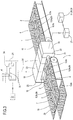
- the machine 1 comprises a device 10 for detecting at least one between the weight, density profile (or weight profile) parameters of at least one of the absorbent materials 8a, 8b, 9a defining the absorbent pad 2.
- the detecting device 10 comprises at least one microwave resonator 11 capable of detecting distinctly one or more absorbent materials 8a, 8b, 9a defining the absorbent pad 2.
- the detecting device 10 with the microwave resonator 11 it is possible to detect, distinctly from each other, the weights and density profiles (or weight profiles) of the natural fibre material (fluff) 8a, of the superabsorbent polymer material (“SAP”) 8b of the absorbent material 8 and of the superabsorbent polymer material (“SAP”) 9a defining the discrete layer 9 of the absorbent pad 2.
- the weights and density profiles or weight profiles
- the microwave resonator 11 emits waves at a certain resonance frequency and, depending on the material inspected, generates a certain resonance curve characterized by a resonance frequency and a mean resonance amplitude.
- the detecting device 10 is capable of detecting and distinguishing each material making up the inspected object and to calculate its weight and/or density profile (or weight profile).
- the detecting device 10 is mounted along the feed line 3 downstream of the unit 5 for forming and applying the absorbent pad 2.
- the detecting device 10 is substantially in the shape of a parallelepiped.
- the detecting device 10 comprises a top wall 23, a bottom wall 24 and two side walls or flanks 25.
- the microwave resonator 11 is located at the top wall 23 of the detecting device 10.
- the detecting device 10 defines a closed field for the microwave resonator 11.
- the detecting device 10 In order to inspect the absorbent pad 2, the detecting device 10 has a through slot 16 through which at least the succession 20 of absorbent pads 2 runs in a predetermined infeed to outfeed direction.
- the detecting device 10 is located immediately downstream of the unit 5.
- the feed line 3 comprises at least one stretch having a single conveyor belt 17 for conveying the continuous web 7 of impermeable material.
- the detecting device 10 Mounted along that stretch is the detecting device 10, with the conveyor belt 17 and the succession 20 of absorbent pads 2 conveyed thereby running in and out through the slot 16 in the detecting device.
- the detecting device 10 is crossed by the conveyor belt 17, by the continuous web 7 of impermeable material and by the succession 20 of absorbent pads 2.
- the microwave resonator 11 is positioned to face and directed towards the conveyor belt 17 and the succession 20 of absorbent pads 2.
- the microwave resonator 11 is located at the top wall 23 of the detecting device 10.
- the feed line 3 comprises at least one stretch having a first and a second conveyor belt 18 and 19 for conveying the continuous web 7 of impermeable material.
- the detecting device 10 is interposed between the first and second conveyor belts 18 and 19 in such a way that at least the continuous web 7 of impermeable material and the succession 20 of absorbent pads 2, conveyed by the first and second belts 18 and 19, pass through the detecting device 10.
- the microwave resonator 11 is located at the top wall 23 of the detecting device 10 in such a way as to face and be directed towards the continuous web 7 of impermeable material and the succession 20 of absorbent pads 2.
- the second embodiment differs from the first embodiment in that no conveyor belt 18 and 19 transporting the continuous web 7 of impermeable material passes through the detecting device 10.
- the detecting device 10 comprises at least one removable element 22.
- the conveyor belt 17 and/or the continuous web 7 of impermeable material can be inserted into the slot 16 of the detecting device 10.
- the removable element 22 defines one of the flanks 25 of the detecting device 10.
- the detecting device 10 must be calibrated to detect only the absorbent materials 8a, 8b, 9a making up the pad 2 itself.
- the detecting device 10 To calibrate the detecting device 10, it is necessary to make the elements to be excluded during detection of the absorbent pad 2 pass through the detecting device 10, such as, for example, the continuous web 7 of impermeable material, the conveyor belt 17 and, if necessary, other accessory components of the absorbent article 4.
- the detecting device 10 is preferably calibrated during start-up of the machine 1.
- the detecting device 10 excludes from detection the resonance curves relating to the components of the absorbent article 4 being formed along the feed line 3, with the exception of the absorbent materials 8a, 8b, 9a of the absorbent pad 2.
- the machine 1 comprises along the feed line 3 at least a first and a second detecting device 13 and 14.
- the first detecting device 13 is located upstream of the unit 5 and the second detecting device 14 is located downstream of the unit 5.
- the first detecting device 13 is configured to calibrate the second detecting device 14 by detecting all the components of the absorbent article 4 being formed along the feed line 3 to be excluded during detection by the second detecting device 14.
- the machine 1 comprises a control and drive unit 21 connected to the detecting device 10.
- the control and drive unit 21 is configured to receive from the detecting device 10 at least one between the weight, density profile (or weight profile) parameters of at least one of the absorbent materials 8a, 8b, 9a of the pad 2 and to compare it with a respective reference parameter.
- control and drive unit 21 is configured to drive, as a function of that deviation, the system 27, 28, 29 for metering the respective absorbent material 8a, 8b, 9a .
- control and drive unit 21 is configured to receive from the detecting device 10 at least one between the weight, density profile (or weight profile) parameters of the superabsorbent polymer material 9a defining the discrete layer 9 and to compare it with a respective reference parameter.
- control and drive unit 21 is configured to drive, as a function of that deviation, the third system 29 for metering the respective superabsorbent polymer material 9a.
- the correct contribution in weight of the superabsorbent polymer material 9a defining the discrete absorbent layers 9 is fundamental for guaranteeing effective absorption of liquids by the absorbent pad 2.
- control and drive unit 21 is configured to reject the article comprising the defective absorbent pad 2.
- the detecting device 10 is configured to detect the position 34 of the discrete layer 9 of superabsorbent polymer material 9a inside the absorbent pad 2.
- detected position 34 is meant the density profile, or weight profile, or both the profiles of the discrete absorbent layer 9 along a main longitudinal direction of extension of the absorbent pad 2.
- the device 10 for detecting the absorbent pad 2 sends the detected position 34 of the discrete layer 9 of superabsorbent polymer material 9a to the control and drive unit 21.
- the control and drive unit 21 compares the position 34 detected by the detecting device 10 with a reference position 35 and calculates the deviation "d" between the detected position 34 and the reference position 35.
- the control and drive unit 21 is configured to drive the actuator unit 37 and to bring the valve means 32 into phase with the rotation of the forming drum 36 as a function of the deviation "d".
- the detecting device 10 of the second and third embodiments is configured to detect the density profile, or weight profile, or both the profiles of the discrete absorbent layer 9, preferably step by step.
- the density profile, or weight profile, or both the profiles detected is the profile of the discrete absorbent layer 9 along a main longitudinal direction of extension of the absorbent pad 2.
- the density profile, or weight profile, or both the profiles of the discrete absorbent layer 9 defines the position 34 detected by the detecting device 10.
- the detecting device 10 sends the detected position 34 to the control and drive unit 21 and the latter compares the position 34 with the reference position 35 and calculates its deviation "d".
- control and drive unit 21 drives the actuator unit 37 to reset the valve means 32 in phase with the drum 36.
- the position 34 detected by the detecting device 10 is the detection signal 34 of the detecting device 10 and the reference position 35 is the reference signal 35 of the detecting device 10.
- At least one detecting device 10 is mounted along a stretch of the feeding duct 31 downstream of the metering device 30 of the third metering system 29.
- At least one detecting device 10 is mounted along the feeding duct 31 downstream of the intermittent valve 32.
- the detecting device 10 is substantially tubular in shape so it can be installed along the feeding duct 31.
- the microwave resonator 11 is installed in such a way as to be directed towards the inside of the feeding duct 31.
- the detecting device 10 detects the weight of one charge of superabsorbent polymer material ("SAP") 9a used to define the discrete absorbent layer 9 of superabsorbent polymer material 9a and sends that parameter to the control and drive unit 21.
- the control and drive unit 21 is configured to receive the weight and to compare it with a respective reference weight or reference parameter.
- control and drive unit 21 is configured to operate on the third metering system 29, and more specifically, on the metering device 30, to reset the weight of the charge of superabsorbent polymer material 9a equal to the reference weight.
- This invention also relates to a method for making absorbent sanitary articles. More specifically, the method comprises a step of feeding at least one continuous web 7 of impermeable material along a feed line 3, a step of forming and applying a succession 20 of absorbent pads 2 along the continuous web 7 by means of a forming and application unit 5.
- the step of forming and applying a succession 20 of absorbent pads 2 comprises a step of feeding a charge of superabsorbent polymer material 9a to a forming drum 36 through a feeding duct 31 comprising valve means 32 driven by a specific actuator unit 37.
- the method comprises a step of sending a detection signal 34 indicating that the superabsorbent polymer material 9a has been detected and a step of comparing the detection signal 34 with a reference signal 35.
- the method comprises a step of detecting at least one between the weight, density profile (or weight profile) parameters of at least one of the absorbent materials 8a, 8b, 9a defining the absorbent pad 2.
- the method further comprises a step of sending at least one between the weight, density profile (or weight profile) parameters of at least one of the absorbent materials 8a, 8b, 9a to a control and drive unit 21 and a step of comparing the detected parameter with a respective reference parameter.
- a yet further a step of the method comprises driving a system 27, 28, 29 for metering the respective absorbent material as a function of the deviation of the detected parameter from the reference parameter.
- the detection step comprises a step of detecting at least one between the weight, density profile (or weight profile) parameters of the superabsorbent polymer material 9a defining the discrete layers 9 of the absorbent pad 2.
- the method comprises a step of sending at least one between the weight, density profile (or weight profile) parameters of the superabsorbent polymer material 9a to a control and drive unit 21 and a step of comparing the detected parameter with a respective reference parameter; and a step of sending a feedback drive signal to a system 29 for metering the superabsorbent polymer material 9a defining the discrete layers 9 of the absorbent pad 2 as a function of the deviation of the detected parameter from the reference parameter.
- the step of detecting at least one between the weight, density profile (or weight profile) parameters of at least one of the absorbent materials 8a, 8b, 9a occurs downstream of the unit 5 for forming and applying the absorbent pad 2.
- the step of detecting at least one between the weight, density profile (or weight profile) parameters of at least one of the absorbent materials 8a, 8b, 9a occurs during the formation of the absorbent pad 2 in the above mentioned unit 5 for forming and applying the succession 20 of absorbent pads 2.
- the method comprises a step of driving the actuator unit 37 of the valve means 32 into phase with the drum 36.
- the detection signal 34 indicating that the superabsorbent polymer material 9a has been detected is generated when the charge of superabsorbent polymer material 9a passes in the feeding duct 31 downstream of the valve means 32.
- the step of sending a detection signal 34 indicating that the superabsorbent polymer material 9a has been detected comprises a step of detecting the position 35 of the discrete layer 9 of superabsorbent polymer material 9a and a step of comparing the detected position 34 with a reference position 35.
- the method comprises a step of driving the actuator unit 37 of the valve means 32 into phase with the drum 36 as a function of the deviation between the detected position 34 and the reference position 35.
- the detecting device 10 comprising a microwave resonator 11 is not affected, in detecting the specified parameters, by external factors such as the temperature and humidity of the operating environment.
- microwave resonator 11 allows distinguishing each absorbent material 8a, 8b, 9a defining the pad and to calculate the weight and density profile (or weight profile) of each material.
- the detecting device 10 makes it possible to detect whether or not the intermittent valve means 32 are in phase with the forming drum 36 and, if they are not in phase, to reset the actuator unit 37 in phase with the forming drum 36 by means of the control and drive unit 21.
- detecting the position of the discrete layer 9 of superabsorbent polymer material 9a constituting the discrete layers 9 of the pad 2 by means of the detecting device 10 allows considerable savings in terms of labour cost because it is no longer necessary for an operator to be present at the end of the feed line 3 to check the correct position of the discrete layer 9.
Landscapes
- Health & Medical Sciences (AREA)
- Engineering & Computer Science (AREA)
- Life Sciences & Earth Sciences (AREA)
- General Health & Medical Sciences (AREA)
- Epidemiology (AREA)
- Heart & Thoracic Surgery (AREA)
- Vascular Medicine (AREA)
- Biomedical Technology (AREA)
- Animal Behavior & Ethology (AREA)
- Public Health (AREA)
- Veterinary Medicine (AREA)
- Manufacturing & Machinery (AREA)
- Physics & Mathematics (AREA)
- Botany (AREA)
- Electromagnetism (AREA)
- Chemical & Material Sciences (AREA)
- Analytical Chemistry (AREA)
- Biochemistry (AREA)
- General Physics & Mathematics (AREA)
- Immunology (AREA)
- Pathology (AREA)
- Absorbent Articles And Supports Therefor (AREA)
- Orthopedics, Nursing, And Contraception (AREA)
- Solid-Sorbent Or Filter-Aiding Compositions (AREA)
- Bakery Products And Manufacturing Methods Therefor (AREA)
Applications Claiming Priority (2)
| Application Number | Priority Date | Filing Date | Title |
|---|---|---|---|
| IT000173A ITBO20130173A1 (it) | 2013-04-17 | 2013-04-17 | Macchina e metodo per la realizzazione di articoli assorbenti igienici. |
| PCT/IB2014/060525 WO2014170796A1 (en) | 2013-04-17 | 2014-04-08 | Machine and method for making absorbent sanitary articles |
Publications (2)
| Publication Number | Publication Date |
|---|---|
| EP2986261A1 EP2986261A1 (en) | 2016-02-24 |
| EP2986261B1 true EP2986261B1 (en) | 2019-08-28 |
Family
ID=48626526
Family Applications (1)
| Application Number | Title | Priority Date | Filing Date |
|---|---|---|---|
| EP14722355.6A Active EP2986261B1 (en) | 2013-04-17 | 2014-04-08 | Machine and method for making absorbent sanitary articles |
Country Status (7)
| Country | Link |
|---|---|
| US (1) | US10610419B2 (enExample) |
| EP (1) | EP2986261B1 (enExample) |
| JP (1) | JP6487903B2 (enExample) |
| CN (1) | CN105324096B (enExample) |
| BR (1) | BR112015026353A2 (enExample) |
| IT (1) | ITBO20130173A1 (enExample) |
| WO (1) | WO2014170796A1 (enExample) |
Families Citing this family (4)
| Publication number | Priority date | Publication date | Assignee | Title |
|---|---|---|---|---|
| DE102016114287A1 (de) | 2016-08-02 | 2018-02-08 | Tews Elektronik Gmbh & Co. Kg | Vorrichtung und Verfahren zur Messung von absorbierenden Hygieneartikeln |
| DE102016114286B3 (de) | 2016-08-02 | 2018-01-18 | Tews Elektronik Gmbh & Co. Kg | Verfahren zur Messung von absorbierenden Hygieneartikeln |
| IT201800003660A1 (it) * | 2018-03-16 | 2019-09-16 | Gd Spa | Unità e metodo di ispezione per il controllo qualitativo di cartucce monouso per sigarette elettroniche |
| JP6942112B2 (ja) * | 2018-12-14 | 2021-09-29 | ユニ・チャーム株式会社 | 吸収性物品を製造する方法及び装置 |
Family Cites Families (14)
| Publication number | Priority date | Publication date | Assignee | Title |
|---|---|---|---|---|
| US4646510A (en) * | 1986-01-31 | 1987-03-03 | Acumeter Laboratories, Inc. | Method of and apparatus for making powder-filled pouches and the like |
| US5359525A (en) * | 1990-05-01 | 1994-10-25 | Kimberly-Clark Corporation | Apparatus and method for registration control of assembled components |
| ATE288581T1 (de) * | 1998-08-31 | 2005-02-15 | Malcam Ltd | Mikrowellenresonator zur kontinuierlichen auswertung von faserigen stoffen |
| JP3732459B2 (ja) | 2002-05-30 | 2006-01-05 | ユニ・チャーム株式会社 | 表示要素形成方法 |
| DE202005001756U1 (de) * | 2004-02-12 | 2005-05-04 | Trützschler GmbH & Co KG | Mikrowellensensor zur Messung einer dielektrischen Eigenschaft eines Produkts |
| JP4884204B2 (ja) * | 2006-12-26 | 2012-02-29 | 花王株式会社 | 吸収体の製造方法 |
| US20110287170A1 (en) | 2007-12-05 | 2011-11-24 | Innovent, An Unincorporated Division Of Standex International Corporation | Method and apparatus for applying particulate |
| DE102007063209A1 (de) | 2007-12-20 | 2009-06-25 | Paul Hartmann Aktiengesellschaft | Verfahren zum Herstellen von Inkontinenzartikeln in Höschenform |
| ITBO20080002A1 (it) * | 2008-01-03 | 2009-07-04 | Gdm Spa | Macchina e metodo per la piegatura di sbozzati per la realizzazione di pannolini. |
| DE102009004457A1 (de) * | 2009-01-13 | 2010-07-22 | Tews Elektronik Gmbh & Co. Kg | Verfahren und Vorrichtung zur Messung von Masse und Dichte und/oder zur Messung der Feuchte von portionierten Einheiten |
| IT1399149B1 (it) * | 2009-03-09 | 2013-04-11 | Gdm Spa | Unita' per la realizzazione di imbottiture assorbenti per pannolini. |
| US8460495B2 (en) * | 2009-12-30 | 2013-06-11 | Curt G. Joa, Inc. | Method for producing absorbent article with stretch film side panel and application of intermittent discrete components of an absorbent article |
| JP5191564B2 (ja) | 2011-10-17 | 2013-05-08 | 花王株式会社 | 吸収体の製造方法 |
| DE102011121918B3 (de) * | 2011-12-22 | 2013-01-17 | Tews Elektronik Gmbh & Co. Kg | Verfahren und Vorrichtung zur Messung der Position von Segmenten mit absorbierenden Substanzen in Multisegmentfilterstäben der tabakverarbeitenden Industrie |
-
2013
- 2013-04-17 IT IT000173A patent/ITBO20130173A1/it unknown
-
2014
- 2014-04-08 CN CN201480034077.9A patent/CN105324096B/zh not_active Expired - Fee Related
- 2014-04-08 WO PCT/IB2014/060525 patent/WO2014170796A1/en not_active Ceased
- 2014-04-08 JP JP2016508258A patent/JP6487903B2/ja active Active
- 2014-04-08 EP EP14722355.6A patent/EP2986261B1/en active Active
- 2014-04-08 US US14/784,403 patent/US10610419B2/en active Active
- 2014-04-08 BR BR112015026353A patent/BR112015026353A2/pt not_active IP Right Cessation
Non-Patent Citations (1)
| Title |
|---|
| None * |
Also Published As
| Publication number | Publication date |
|---|---|
| WO2014170796A1 (en) | 2014-10-23 |
| JP6487903B2 (ja) | 2019-03-20 |
| CN105324096B (zh) | 2020-02-07 |
| EP2986261A1 (en) | 2016-02-24 |
| ITBO20130173A1 (it) | 2014-10-18 |
| BR112015026353A2 (pt) | 2017-07-25 |
| US20180303679A1 (en) | 2018-10-25 |
| JP2016516510A (ja) | 2016-06-09 |
| CN105324096A (zh) | 2016-02-10 |
| US10610419B2 (en) | 2020-04-07 |
Similar Documents
| Publication | Publication Date | Title |
|---|---|---|
| EP2986262B1 (en) | Machine and method for making absorbent sanitary articles | |
| US9101512B2 (en) | Absorbent-body manufacturing apparatus | |
| US9096405B2 (en) | Defective-workpiece discharging device | |
| US10610419B2 (en) | Machine and method for making absorbent sanitary articles | |
| JP5191564B2 (ja) | 吸収体の製造方法 | |
| JP4884204B2 (ja) | 吸収体の製造方法 | |
| AU2010219818B2 (en) | Apparatus and method of manufacturing absorbent article | |
| JP5677865B2 (ja) | 吸収体の厚さを薄くする装置、及び方法 | |
| JP5986842B2 (ja) | 吸収性物品に係る個別包装品の連結品の製造装置、及び製造方法 | |
| JP2016515456A5 (enExample) | ||
| JP6318449B2 (ja) | 吸収体の製造における積繊繊維の掻き取り量の検査装置及び検査方法、並びに該検査方法を用いた吸収体の製造方法 | |
| JP2016516510A5 (enExample) | ||
| JP2014059256A (ja) | 異物検査方法及び装置 | |
| CN111317615A (zh) | 制造吸收性物品的方法和装置 | |
| JP6210798B2 (ja) | 異物検出方法及び異物検出装置 | |
| EP1279389A2 (en) | A feed unit supplying strip material to a line for the manufacture of personal hygiene items | |
| JP2017080057A (ja) | 吸収体の製造装置及び製造方法 | |
| IT201800007383A1 (it) | Apparato per produrre articoli, procedimento e programma per elaboratore | |
| IT201800007386A1 (it) | Apparato per produrre articoli, procedimento e programma per elaboratore |
Legal Events
| Date | Code | Title | Description |
|---|---|---|---|
| PUAI | Public reference made under article 153(3) epc to a published international application that has entered the european phase |
Free format text: ORIGINAL CODE: 0009012 |
|
| 17P | Request for examination filed |
Effective date: 20151111 |
|
| AK | Designated contracting states |
Kind code of ref document: A1 Designated state(s): AL AT BE BG CH CY CZ DE DK EE ES FI FR GB GR HR HU IE IS IT LI LT LU LV MC MK MT NL NO PL PT RO RS SE SI SK SM TR |
|
| AX | Request for extension of the european patent |
Extension state: BA ME |
|
| DAX | Request for extension of the european patent (deleted) | ||
| STAA | Information on the status of an ep patent application or granted ep patent |
Free format text: STATUS: EXAMINATION IS IN PROGRESS |
|
| 17Q | First examination report despatched |
Effective date: 20170412 |
|
| GRAP | Despatch of communication of intention to grant a patent |
Free format text: ORIGINAL CODE: EPIDOSNIGR1 |
|
| STAA | Information on the status of an ep patent application or granted ep patent |
Free format text: STATUS: GRANT OF PATENT IS INTENDED |
|
| INTG | Intention to grant announced |
Effective date: 20190322 |
|
| GRAS | Grant fee paid |
Free format text: ORIGINAL CODE: EPIDOSNIGR3 |
|
| GRAA | (expected) grant |
Free format text: ORIGINAL CODE: 0009210 |
|
| STAA | Information on the status of an ep patent application or granted ep patent |
Free format text: STATUS: THE PATENT HAS BEEN GRANTED |
|
| AK | Designated contracting states |
Kind code of ref document: B1 Designated state(s): AL AT BE BG CH CY CZ DE DK EE ES FI FR GB GR HR HU IE IS IT LI LT LU LV MC MK MT NL NO PL PT RO RS SE SI SK SM TR |
|
| REG | Reference to a national code |
Ref country code: GB Ref legal event code: FG4D |
|
| REG | Reference to a national code |
Ref country code: CH Ref legal event code: EP |
|
| REG | Reference to a national code |
Ref country code: DE Ref legal event code: R096 Ref document number: 602014052498 Country of ref document: DE |
|
| REG | Reference to a national code |
Ref country code: AT Ref legal event code: REF Ref document number: 1171458 Country of ref document: AT Kind code of ref document: T Effective date: 20190915 |
|
| REG | Reference to a national code |
Ref country code: IE Ref legal event code: FG4D |
|
| REG | Reference to a national code |
Ref country code: NL Ref legal event code: MP Effective date: 20190828 |
|
| REG | Reference to a national code |
Ref country code: LT Ref legal event code: MG4D |
|
| PG25 | Lapsed in a contracting state [announced via postgrant information from national office to epo] |
Ref country code: HR Free format text: LAPSE BECAUSE OF FAILURE TO SUBMIT A TRANSLATION OF THE DESCRIPTION OR TO PAY THE FEE WITHIN THE PRESCRIBED TIME-LIMIT Effective date: 20190828 Ref country code: LT Free format text: LAPSE BECAUSE OF FAILURE TO SUBMIT A TRANSLATION OF THE DESCRIPTION OR TO PAY THE FEE WITHIN THE PRESCRIBED TIME-LIMIT Effective date: 20190828 Ref country code: NL Free format text: LAPSE BECAUSE OF FAILURE TO SUBMIT A TRANSLATION OF THE DESCRIPTION OR TO PAY THE FEE WITHIN THE PRESCRIBED TIME-LIMIT Effective date: 20190828 Ref country code: SE Free format text: LAPSE BECAUSE OF FAILURE TO SUBMIT A TRANSLATION OF THE DESCRIPTION OR TO PAY THE FEE WITHIN THE PRESCRIBED TIME-LIMIT Effective date: 20190828 Ref country code: FI Free format text: LAPSE BECAUSE OF FAILURE TO SUBMIT A TRANSLATION OF THE DESCRIPTION OR TO PAY THE FEE WITHIN THE PRESCRIBED TIME-LIMIT Effective date: 20190828 Ref country code: NO Free format text: LAPSE BECAUSE OF FAILURE TO SUBMIT A TRANSLATION OF THE DESCRIPTION OR TO PAY THE FEE WITHIN THE PRESCRIBED TIME-LIMIT Effective date: 20191128 Ref country code: PT Free format text: LAPSE BECAUSE OF FAILURE TO SUBMIT A TRANSLATION OF THE DESCRIPTION OR TO PAY THE FEE WITHIN THE PRESCRIBED TIME-LIMIT Effective date: 20191230 Ref country code: BG Free format text: LAPSE BECAUSE OF FAILURE TO SUBMIT A TRANSLATION OF THE DESCRIPTION OR TO PAY THE FEE WITHIN THE PRESCRIBED TIME-LIMIT Effective date: 20191128 |
|
| PG25 | Lapsed in a contracting state [announced via postgrant information from national office to epo] |
Ref country code: RS Free format text: LAPSE BECAUSE OF FAILURE TO SUBMIT A TRANSLATION OF THE DESCRIPTION OR TO PAY THE FEE WITHIN THE PRESCRIBED TIME-LIMIT Effective date: 20190828 Ref country code: IS Free format text: LAPSE BECAUSE OF FAILURE TO SUBMIT A TRANSLATION OF THE DESCRIPTION OR TO PAY THE FEE WITHIN THE PRESCRIBED TIME-LIMIT Effective date: 20191228 Ref country code: LV Free format text: LAPSE BECAUSE OF FAILURE TO SUBMIT A TRANSLATION OF THE DESCRIPTION OR TO PAY THE FEE WITHIN THE PRESCRIBED TIME-LIMIT Effective date: 20190828 Ref country code: GR Free format text: LAPSE BECAUSE OF FAILURE TO SUBMIT A TRANSLATION OF THE DESCRIPTION OR TO PAY THE FEE WITHIN THE PRESCRIBED TIME-LIMIT Effective date: 20191129 Ref country code: AL Free format text: LAPSE BECAUSE OF FAILURE TO SUBMIT A TRANSLATION OF THE DESCRIPTION OR TO PAY THE FEE WITHIN THE PRESCRIBED TIME-LIMIT Effective date: 20190828 Ref country code: ES Free format text: LAPSE BECAUSE OF FAILURE TO SUBMIT A TRANSLATION OF THE DESCRIPTION OR TO PAY THE FEE WITHIN THE PRESCRIBED TIME-LIMIT Effective date: 20190828 |
|
| REG | Reference to a national code |
Ref country code: AT Ref legal event code: MK05 Ref document number: 1171458 Country of ref document: AT Kind code of ref document: T Effective date: 20190828 |
|
| PG25 | Lapsed in a contracting state [announced via postgrant information from national office to epo] |
Ref country code: TR Free format text: LAPSE BECAUSE OF FAILURE TO SUBMIT A TRANSLATION OF THE DESCRIPTION OR TO PAY THE FEE WITHIN THE PRESCRIBED TIME-LIMIT Effective date: 20190828 |
|
| PG25 | Lapsed in a contracting state [announced via postgrant information from national office to epo] |
Ref country code: DK Free format text: LAPSE BECAUSE OF FAILURE TO SUBMIT A TRANSLATION OF THE DESCRIPTION OR TO PAY THE FEE WITHIN THE PRESCRIBED TIME-LIMIT Effective date: 20190828 Ref country code: AT Free format text: LAPSE BECAUSE OF FAILURE TO SUBMIT A TRANSLATION OF THE DESCRIPTION OR TO PAY THE FEE WITHIN THE PRESCRIBED TIME-LIMIT Effective date: 20190828 Ref country code: PL Free format text: LAPSE BECAUSE OF FAILURE TO SUBMIT A TRANSLATION OF THE DESCRIPTION OR TO PAY THE FEE WITHIN THE PRESCRIBED TIME-LIMIT Effective date: 20190828 Ref country code: RO Free format text: LAPSE BECAUSE OF FAILURE TO SUBMIT A TRANSLATION OF THE DESCRIPTION OR TO PAY THE FEE WITHIN THE PRESCRIBED TIME-LIMIT Effective date: 20190828 Ref country code: EE Free format text: LAPSE BECAUSE OF FAILURE TO SUBMIT A TRANSLATION OF THE DESCRIPTION OR TO PAY THE FEE WITHIN THE PRESCRIBED TIME-LIMIT Effective date: 20190828 |
|
| PG25 | Lapsed in a contracting state [announced via postgrant information from national office to epo] |
Ref country code: SM Free format text: LAPSE BECAUSE OF FAILURE TO SUBMIT A TRANSLATION OF THE DESCRIPTION OR TO PAY THE FEE WITHIN THE PRESCRIBED TIME-LIMIT Effective date: 20190828 Ref country code: CZ Free format text: LAPSE BECAUSE OF FAILURE TO SUBMIT A TRANSLATION OF THE DESCRIPTION OR TO PAY THE FEE WITHIN THE PRESCRIBED TIME-LIMIT Effective date: 20190828 Ref country code: SK Free format text: LAPSE BECAUSE OF FAILURE TO SUBMIT A TRANSLATION OF THE DESCRIPTION OR TO PAY THE FEE WITHIN THE PRESCRIBED TIME-LIMIT Effective date: 20190828 Ref country code: IS Free format text: LAPSE BECAUSE OF FAILURE TO SUBMIT A TRANSLATION OF THE DESCRIPTION OR TO PAY THE FEE WITHIN THE PRESCRIBED TIME-LIMIT Effective date: 20200224 |
|
| REG | Reference to a national code |
Ref country code: DE Ref legal event code: R097 Ref document number: 602014052498 Country of ref document: DE |
|
| PLBE | No opposition filed within time limit |
Free format text: ORIGINAL CODE: 0009261 |
|
| STAA | Information on the status of an ep patent application or granted ep patent |
Free format text: STATUS: NO OPPOSITION FILED WITHIN TIME LIMIT |
|
| PG2D | Information on lapse in contracting state deleted |
Ref country code: IS |
|
| 26N | No opposition filed |
Effective date: 20200603 |
|
| PG25 | Lapsed in a contracting state [announced via postgrant information from national office to epo] |
Ref country code: SI Free format text: LAPSE BECAUSE OF FAILURE TO SUBMIT A TRANSLATION OF THE DESCRIPTION OR TO PAY THE FEE WITHIN THE PRESCRIBED TIME-LIMIT Effective date: 20190828 |
|
| PG25 | Lapsed in a contracting state [announced via postgrant information from national office to epo] |
Ref country code: MC Free format text: LAPSE BECAUSE OF FAILURE TO SUBMIT A TRANSLATION OF THE DESCRIPTION OR TO PAY THE FEE WITHIN THE PRESCRIBED TIME-LIMIT Effective date: 20190828 |
|
| REG | Reference to a national code |
Ref country code: CH Ref legal event code: PL |
|
| PG25 | Lapsed in a contracting state [announced via postgrant information from national office to epo] |
Ref country code: FR Free format text: LAPSE BECAUSE OF NON-PAYMENT OF DUE FEES Effective date: 20200430 Ref country code: CH Free format text: LAPSE BECAUSE OF NON-PAYMENT OF DUE FEES Effective date: 20200430 Ref country code: LI Free format text: LAPSE BECAUSE OF NON-PAYMENT OF DUE FEES Effective date: 20200430 Ref country code: LU Free format text: LAPSE BECAUSE OF NON-PAYMENT OF DUE FEES Effective date: 20200408 |
|
| REG | Reference to a national code |
Ref country code: BE Ref legal event code: MM Effective date: 20200430 |
|
| PG25 | Lapsed in a contracting state [announced via postgrant information from national office to epo] |
Ref country code: BE Free format text: LAPSE BECAUSE OF NON-PAYMENT OF DUE FEES Effective date: 20200430 |
|
| GBPC | Gb: european patent ceased through non-payment of renewal fee |
Effective date: 20200408 |
|
| PG25 | Lapsed in a contracting state [announced via postgrant information from national office to epo] |
Ref country code: IE Free format text: LAPSE BECAUSE OF NON-PAYMENT OF DUE FEES Effective date: 20200408 Ref country code: GB Free format text: LAPSE BECAUSE OF NON-PAYMENT OF DUE FEES Effective date: 20200408 |
|
| PG25 | Lapsed in a contracting state [announced via postgrant information from national office to epo] |
Ref country code: MT Free format text: LAPSE BECAUSE OF FAILURE TO SUBMIT A TRANSLATION OF THE DESCRIPTION OR TO PAY THE FEE WITHIN THE PRESCRIBED TIME-LIMIT Effective date: 20190828 Ref country code: CY Free format text: LAPSE BECAUSE OF FAILURE TO SUBMIT A TRANSLATION OF THE DESCRIPTION OR TO PAY THE FEE WITHIN THE PRESCRIBED TIME-LIMIT Effective date: 20190828 |
|
| PG25 | Lapsed in a contracting state [announced via postgrant information from national office to epo] |
Ref country code: MK Free format text: LAPSE BECAUSE OF FAILURE TO SUBMIT A TRANSLATION OF THE DESCRIPTION OR TO PAY THE FEE WITHIN THE PRESCRIBED TIME-LIMIT Effective date: 20190828 |
|
| P01 | Opt-out of the competence of the unified patent court (upc) registered |
Effective date: 20230526 |
|
| PGFP | Annual fee paid to national office [announced via postgrant information from national office to epo] |
Ref country code: DE Payment date: 20250429 Year of fee payment: 12 |
|
| PGFP | Annual fee paid to national office [announced via postgrant information from national office to epo] |
Ref country code: IT Payment date: 20250422 Year of fee payment: 12 |