EP2984047B1 - Bioactive glass scaffolds, and method of making - Google Patents
Bioactive glass scaffolds, and method of making Download PDFInfo
- Publication number
- EP2984047B1 EP2984047B1 EP13750831.3A EP13750831A EP2984047B1 EP 2984047 B1 EP2984047 B1 EP 2984047B1 EP 13750831 A EP13750831 A EP 13750831A EP 2984047 B1 EP2984047 B1 EP 2984047B1
- Authority
- EP
- European Patent Office
- Prior art keywords
- glass
- scaffold
- beads
- fibers
- shielded
- Prior art date
- Legal status (The legal status is an assumption and is not a legal conclusion. Google has not performed a legal analysis and makes no representation as to the accuracy of the status listed.)
- Active
Links
Images



Classifications
-
- C—CHEMISTRY; METALLURGY
- C03—GLASS; MINERAL OR SLAG WOOL
- C03B—MANUFACTURE, SHAPING, OR SUPPLEMENTARY PROCESSES
- C03B29/00—Reheating glass products for softening or fusing their surfaces; Fire-polishing; Fusing of margins
-
- C—CHEMISTRY; METALLURGY
- C03—GLASS; MINERAL OR SLAG WOOL
- C03B—MANUFACTURE, SHAPING, OR SUPPLEMENTARY PROCESSES
- C03B19/00—Other methods of shaping glass
- C03B19/06—Other methods of shaping glass by sintering, e.g. by cold isostatic pressing of powders and subsequent sintering, by hot pressing of powders, by sintering slurries or dispersions not undergoing a liquid phase reaction
-
- A—HUMAN NECESSITIES
- A61—MEDICAL OR VETERINARY SCIENCE; HYGIENE
- A61L—METHODS OR APPARATUS FOR STERILISING MATERIALS OR OBJECTS IN GENERAL; DISINFECTION, STERILISATION OR DEODORISATION OF AIR; CHEMICAL ASPECTS OF BANDAGES, DRESSINGS, ABSORBENT PADS OR SURGICAL ARTICLES; MATERIALS FOR BANDAGES, DRESSINGS, ABSORBENT PADS OR SURGICAL ARTICLES
- A61L15/00—Chemical aspects of, or use of materials for, bandages, dressings or absorbent pads
- A61L15/07—Stiffening bandages
- A61L15/08—Stiffening bandages containing inorganic materials, e.g. plaster of Paris
-
- A—HUMAN NECESSITIES
- A61—MEDICAL OR VETERINARY SCIENCE; HYGIENE
- A61L—METHODS OR APPARATUS FOR STERILISING MATERIALS OR OBJECTS IN GENERAL; DISINFECTION, STERILISATION OR DEODORISATION OF AIR; CHEMICAL ASPECTS OF BANDAGES, DRESSINGS, ABSORBENT PADS OR SURGICAL ARTICLES; MATERIALS FOR BANDAGES, DRESSINGS, ABSORBENT PADS OR SURGICAL ARTICLES
- A61L15/00—Chemical aspects of, or use of materials for, bandages, dressings or absorbent pads
- A61L15/16—Bandages, dressings or absorbent pads for physiological fluids such as urine or blood, e.g. sanitary towels, tampons
- A61L15/42—Use of materials characterised by their function or physical properties
- A61L15/425—Porous materials, e.g. foams or sponges
-
- A—HUMAN NECESSITIES
- A61—MEDICAL OR VETERINARY SCIENCE; HYGIENE
- A61L—METHODS OR APPARATUS FOR STERILISING MATERIALS OR OBJECTS IN GENERAL; DISINFECTION, STERILISATION OR DEODORISATION OF AIR; CHEMICAL ASPECTS OF BANDAGES, DRESSINGS, ABSORBENT PADS OR SURGICAL ARTICLES; MATERIALS FOR BANDAGES, DRESSINGS, ABSORBENT PADS OR SURGICAL ARTICLES
- A61L24/00—Surgical adhesives or cements; Adhesives for colostomy devices
- A61L24/001—Use of materials characterised by their function or physical properties
- A61L24/0036—Porous materials, e.g. foams or sponges
-
- A—HUMAN NECESSITIES
- A61—MEDICAL OR VETERINARY SCIENCE; HYGIENE
- A61L—METHODS OR APPARATUS FOR STERILISING MATERIALS OR OBJECTS IN GENERAL; DISINFECTION, STERILISATION OR DEODORISATION OF AIR; CHEMICAL ASPECTS OF BANDAGES, DRESSINGS, ABSORBENT PADS OR SURGICAL ARTICLES; MATERIALS FOR BANDAGES, DRESSINGS, ABSORBENT PADS OR SURGICAL ARTICLES
- A61L24/00—Surgical adhesives or cements; Adhesives for colostomy devices
- A61L24/02—Surgical adhesives or cements; Adhesives for colostomy devices containing inorganic materials
-
- A—HUMAN NECESSITIES
- A61—MEDICAL OR VETERINARY SCIENCE; HYGIENE
- A61L—METHODS OR APPARATUS FOR STERILISING MATERIALS OR OBJECTS IN GENERAL; DISINFECTION, STERILISATION OR DEODORISATION OF AIR; CHEMICAL ASPECTS OF BANDAGES, DRESSINGS, ABSORBENT PADS OR SURGICAL ARTICLES; MATERIALS FOR BANDAGES, DRESSINGS, ABSORBENT PADS OR SURGICAL ARTICLES
- A61L27/00—Materials for grafts or prostheses or for coating grafts or prostheses
- A61L27/02—Inorganic materials
- A61L27/10—Ceramics or glasses
-
- A—HUMAN NECESSITIES
- A61—MEDICAL OR VETERINARY SCIENCE; HYGIENE
- A61L—METHODS OR APPARATUS FOR STERILISING MATERIALS OR OBJECTS IN GENERAL; DISINFECTION, STERILISATION OR DEODORISATION OF AIR; CHEMICAL ASPECTS OF BANDAGES, DRESSINGS, ABSORBENT PADS OR SURGICAL ARTICLES; MATERIALS FOR BANDAGES, DRESSINGS, ABSORBENT PADS OR SURGICAL ARTICLES
- A61L27/00—Materials for grafts or prostheses or for coating grafts or prostheses
- A61L27/50—Materials characterised by their function or physical properties, e.g. injectable or lubricating compositions, shape-memory materials, surface modified materials
- A61L27/56—Porous materials, e.g. foams or sponges
-
- C—CHEMISTRY; METALLURGY
- C03—GLASS; MINERAL OR SLAG WOOL
- C03B—MANUFACTURE, SHAPING, OR SUPPLEMENTARY PROCESSES
- C03B19/00—Other methods of shaping glass
- C03B19/09—Other methods of shaping glass by fusing powdered glass in a shaping mould
-
- C—CHEMISTRY; METALLURGY
- C03—GLASS; MINERAL OR SLAG WOOL
- C03B—MANUFACTURE, SHAPING, OR SUPPLEMENTARY PROCESSES
- C03B19/00—Other methods of shaping glass
- C03B19/10—Forming beads
- C03B19/108—Forming porous, sintered or foamed beads
-
- C—CHEMISTRY; METALLURGY
- C03—GLASS; MINERAL OR SLAG WOOL
- C03B—MANUFACTURE, SHAPING, OR SUPPLEMENTARY PROCESSES
- C03B32/00—Thermal after-treatment of glass products not provided for in groups C03B19/00, C03B25/00 - C03B31/00 or C03B37/00, e.g. crystallisation, eliminating gas inclusions or other impurities; Hot-pressing vitrified, non-porous, shaped glass products
- C03B32/02—Thermal crystallisation, e.g. for crystallising glass bodies into glass-ceramic articles
-
- Y—GENERAL TAGGING OF NEW TECHNOLOGICAL DEVELOPMENTS; GENERAL TAGGING OF CROSS-SECTIONAL TECHNOLOGIES SPANNING OVER SEVERAL SECTIONS OF THE IPC; TECHNICAL SUBJECTS COVERED BY FORMER USPC CROSS-REFERENCE ART COLLECTIONS [XRACs] AND DIGESTS
- Y02—TECHNOLOGIES OR APPLICATIONS FOR MITIGATION OR ADAPTATION AGAINST CLIMATE CHANGE
- Y02P—CLIMATE CHANGE MITIGATION TECHNOLOGIES IN THE PRODUCTION OR PROCESSING OF GOODS
- Y02P40/00—Technologies relating to the processing of minerals
- Y02P40/50—Glass production, e.g. reusing waste heat during processing or shaping
- Y02P40/57—Improving the yield, e-g- reduction of reject rates
Definitions
- This invention relates to a biocompatible scaffold for implantation into mammals to facilitate tissue repair and tissue regeneration.
- Porous bioactive glass scaffolds have been of interest for biomaterial design for some time.
- a microstructure that can stimulate the healing process and promote tissue growth while being made from a material that will eventually degrade is attractive.
- highly porous materials inherently have low strength which can be a major detriment.
- Another major hurdle to be overcome is the poor handleability of porous scaffolds as they easily break when handled, can easily get tangled together, and ultimately become ineffective for the intended purpose.
- the majority of the orthopedic industry uses dense particles of cadaver bone, calcium phosphate based ceramics, or bioactive glass in their devices as they have the required strength and handleability required during surgery.
- silicate based bioactive glasses such as 45S5 and S53P4
- 45S5 and S53P4 are currently used in products approved by the US Food and Drug Administration and other world safety organizations for use in implantable devices such as orthopedic implants and are known to be capable of making three dimensional porous scaffolds.
- Glasses with compositions similar to 45S5 and S53P4 crystallize rapidly when heated above each glasses respective glass transition temperature (T g ), making viscous sintering by traditional heat treatments difficult without crystallization. Therefore, currently there are no amorphous, rigid, and porous scaffolds composed of silicate glasses are commercially available.
- Silicate glass particles that are larger than >500 ⁇ m can take years to fully react with body fluids and be converted to the inorganic component of bone known as hydroxyapatite (HA) because, large particles of glass (>500 ⁇ m) leave voids in healing tissue that take years to remodel into natural tissue, and the large particles have a relatively small surface area mass ratio and don't allow for tissue penetration by bone or blood vessels.
- HA hydroxyapatite
- Porous scaffolds allow for tissue penetration, and the surface area available for reaction with body fluids is relatively large and penetrates throughout the entire scaffold, which significantly reduces conversion time to HA and final remodeling.
- the conversion kinetics of silicate glass 45S5 to HA has been shown to slow from the contracting volume model to the diffusion model once the silica gel layer achieves a thickness great enough to become the diffusion barrier. This is the reason why a porous scaffold composed of 45S5 will convert to HA in a matter of weeks as opposed to a solid glass 45S5 bead of comparable size that could take years.
- the crystallization properties and glass transition properties of a particular glass are important when treating glass and making it into a porous scaffold.
- Glass compositions composed of relatively low concentrations of glass forming oxides and relatively high concentrations of alkaline and alkaline earth oxides tend to crystallize rapidly when heated above the glass transition temperature, making bonding by viscous flow difficult. Therefore the ability to make porous materials or scaffolds rigid from these glasses by traditional thermal treatments has not been possible.
- glass is bonded by heating above the glass transition temperature to a viscosity appropriate for viscous flow.
- the viscosity used for processing can vary with the application. Glasses used for such applications are designed to resist crystallization at the processing temperatures because the mobility of ions is high. The more fluid the glass, typically the easier it may be for a glass to crystallize, but this is dependent on how close the glass composition is to a crystalline phase and how great the activation energy is to allow the glass to crystallize.
- the glasses that will benefit from this method of bonding require relatively low energy input to allow the atoms to rearrange and start forming crystals.
- the formation of crystals, especially at the particle surface, is what inhibits the viscous flow of these particles.
- Crystalline phases that crystallize from glass typically melt at significantly higher temperatures than the temperatures required for crystallization; therefore the crystals do not form a viscous flow that would aid in the sintering process.
- the tendency towards crystallization increases as the surface area to volume ratio of the glass component increases, so the smaller the component, the greater the tendency toward surface crystallization and inhibited bonding.
- Scaffolds particularly those designed for use as bone grafts, should be highly porous (>50%) and are often formed by infusing a slurry composed of glass particles and other organic and inorganic components into a preform (foam or sponge or other porous polymer) that must be slowly burned out prior to sintering.
- a preform foam or sponge or other porous polymer
- the heating rate is typically kept low, a few °C/min, to the sintering temperature, and then the sintered part is slow cooled as to eliminate thermal shock of the glass/ceramic scaffold.
- these methods are not effective in making rigid glass scaffolds.
- the graph shown in Fig. 1 describes the usable regions of interest for the possible heat treatments of the following invention.
- Sintering bioactive glass is a time-temperature-crystallization dependent process, and no single component can be ignored.
- scaffolds discussed in the literature are rough and sharp, which is not an issue for bench scale testing, but can be a significant problem for clinicians such as orthopedic surgeons that want to press on the implant material without puncturing a glove.
- a punctured glove opens the clinician and the patient up to possible disease transmission, and the clinician could be injured by the implant material if it were to penetrate the clinician's skin. Therefore, no fully amorphous scaffolds composed of silicate based 45S5 or S53P4 bioactive glass are currently approved for by the FDA for clinical use.
- the surface roughness of a scaffold is certainly a disadvantage from a handling point of view, but in a product such as bone putty or even just a single phase implant material such as loose granules, the rough edges make each scaffold catch on one another decreasing the flowability of the particles. This decrease in flowability decreases the overall scaffold loading the putty can incorporate as the putty itself acts as a lubricant to improve the handleability.
- the debris from broken edges may also increase the overall immune response as macrophages try to remove/engulf the small particles.
- a shielded glass scaffold comprising a mixture of bioactive glass fibers and bioactive glass beads, some of the fibers and beads fused to one another to form a sintered agglomerate; said sintered agglomerate being encased by a shield of fused glass, the shield having pores therein, wherein said shield is formed by dropping the sintered agglomerate through a propane/oxygen flame at a temperature between 1982 °C and 2815 °C (3600°F and 5100°F), and for a time capable of forming a fused periphery around a center of loose glass fibers and glass beads.
- One concept of the invention is a glass, or glass-ceramic bead with an internal porous scaffold microstructure that is surrounded by an amorphous shield and prepared without a volatile component, or binder and pore former.
- the shield serves to protect the internal porous microstructure of the shield while increasing the overall strength of the porous microstructure and improve the flowability of the beads either by themselves or in devices such as biologically degradable putty that would be used in bone or soft tissue augmentation or regeneration.
- the open porosity present inside the bead will allow for enhanced degradability in-vivo as compared to solid particles or spheres and also promote the growth of tissues including but not limited to all types of bone, soft tissue, blood vessels, and nerves.
- the internal microstructure are directionally oriented or randomly oriented network of fibers, randomly oriented network of fibers mixed with glass beads, or it can be composed of interconnected pores formed by the partial fusing of glass particles.
- the shielded scaffolds may comprise one or more glass compositions for purposes of controlling degradation, biological stimulation, or antimicrobial properties to name a few.
- the subject invention involves a method of preparing shielded glass scaffolds comprising the steps of:
- the method packages the porous scaffold and retains the desired degradability and porous microstructure of a scaffold in an encapsulated shell that increases the scaffold strength and lubricity prior to implantation and improves handleability when used as a standalone graft material or a component of a putty.
- protecting the bioactive glass scaffold microstructure can be effected prior to and during the implantation and will enhance the microstructures available in markets such as orthopedic, spine, and soft tissue wound healing.
- a powder of bioactive glass is crushed and wetted.
- the wetted powder is mixed to make the wet particles stick together and form agglomerates, which may then be sintered or used as putty.
- Another embodiment is composed of sintered fiber granules made by a similar method, i.e., fiber balls are made by mixing glass fibers and glass beads and vibrating, which in turn forms interlocking structures that are then placed in a ceramic crucible for heat treatment.
- the resulting porous rigid granule comprises of sintered fibers and beads.
- Another embodiment uses the previously mentioned interlocking fibers and beads and flame sinters the granules by dropping the interlocking structures through a flame which forms a relatively smooth porous shield surrounding a core of unbound or loose fibers and beads.
- Another embodiment involves sintering the particulate or fiber scaffold in a crucible first, then heating in a flame to form a surface layer shield, and once it has passed through the flame and collected it is ready for use.
- Bioactive glass can be Silicate bioactive glass, Borate bioactive glass or Phosphate bioactive glass. While all these glasses may be used in the subject invention, Silicate bioactive glass, such as 45S5 and S53P4 is preferred.
- Silicate bioactive glass generally has a composition of sodium carbonate, calcium carbonate, phosphorus pentoxide and silica, such as a glass composition having about 45-60 mol % silica and a 2-10 molar ratio of calcium to phosphate. Glass materials having this or a similar composition, demonstrate the formation of a silica-rich layer and a calcium phosphate film on the materials surface in an aqueous environment that readily bonds the glass material to bone.
- compositional variations can be made, through the addition of compositions such as magnesia, potassium oxide, boric oxide, and other compounds, though it is generally known that a silica content between 45-60 mol % at the interfacial layer is advantageous to the formation of the silica-rich layer with the calcium phosphate film to promote the formation of bonds between the scaffold, the natural bone and soft tissue materials.
- Glass compounds are more easily formed into a fiber when the material can be melted and drawn into a fiber while amorphous.
- Bioactive and bioresorbable materials that can be fabricated into a fiber form without devitrification during the fiber drawing process require high silica content and both sodium oxide and potassium oxide to provide a mixed alkali effect to maintain an amorphous structure when drawn into a fiber.
- Various compounds of mixed alkali and high-silica content glasses that can be easily pulled into fibers have demonstrated both bioactivity and bioresorbability.
- the first step in crystallizing a glass is the formation of nuclei in the glass.
- Nuclei can be formed by imperfections in the glass such as on a surface, or by thermal treatments. Numerous studies exist for the nucleation and growth of glass ceramics, and in particular the Na 2 Ca 2 SiO 3 O 9 glass is of interest since this is the phase 45S5 forms when crystallized.
- the glass is heated quickly (a minimum of ⁇ 300 to 400°C/min upwards of 200,000°C/sec heat rate) through the nucleation temperature range so as to suppress nucleation and crystal growth, therefore allowing viscous flow to occur between the particles for a short time ( ⁇ 1sec to 10 to 20 min), and then cooling again at a rate ⁇ 1000 to 2500°C/min to 200,000°C/sec. This method of fast heating and cooling reduces the crystallization effects of a glass with high crystallization affinity and allows for the formation of a porous scaffold.
- Each component of the fiber/bead un-sintered scaffold (fibers and beads) on its own is a flowable material made of individual fibers or beads.
- the fibers and beads interlock, forming balls that are approximately 0.5 to 4mm in diameter, are soft to the touch, yet compressible as shown in Fig 8 .
- the compressibility comes from the individual glass components which are much stronger individually than if the individual components were lightly sintered, or bonded together with a polymeric phase as other bioactive glass scaffolds known in the art.
- the individual glass components can move and reconstitute; which is a significant advantage over traditional scaffold materials.
- the interlocking of the fibers and beads keeps the granules from disassociating when wet, and absorb blood and other liquids well.
- the capillary action inside the granule assists in the transfer of liquid from one granule to the next.
- the granules should be expected to adsorb any liquid that will wet glass similarly, which includes, but is not limited to water based solutions or mixtures, alcohol solutions or mixtures, and petroleum based liquids or gels.
- these granules are beneficial for blood loss control (hemostasis), adsorbing bone marrow aspirate, delivering drugs at the site of surgery, as a bone grafting/dental scaffold, as a soft tissue scaffold, or as components of a composite scaffold such as, but not limited to a bone wrap or wound dressing as exemplary applications.
- the unsintered fiber/bead balls may also be used to treat hard and soft tissue wounds.
- the fiber ranges from 20 ⁇ m to 3mm in length, 300 nm to 30 ⁇ m in diameter, with 90% of the beads in the range of 30 to 425 ⁇ m in diameter, with 10-50% fibers and 40-90% beads, preferably 25% fiber and 75% beads.
- the fiber and beads are gently mixed to form a fiber/bead agglomerate as shown in Fig 8 .
- the fiber/bead agglomerate may be used at this point for bone/tissue repair, or a component thereof, or as a component of a putty, a cement or a tissue wrap.
- the agglomerate When used as a putty or cement, the agglomerate, being flexible, is simply pushed into place in a body cavity, where, over time, it will support tissue and/or bone in growths and acts as a restorable tissue/bone scaffold for the repair of damaged and/or diseased tissue/bone.
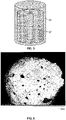
- the agglomerates thus formed can be placed in a ceramic crucible 25 and heat treated at a temperature above the glass transition but below the glass melting temperature (Tm) for a matter of minutes, typically in a kiln or electric furnace at 480°C to 600°C (900°F to 1100°F) to form granules ( Figs 2 and 3 ).
- Tm glass melting temperature
- the time at that temperature will vary dependent on the temperature. For instance at 480°C (900°F) about ten minutes will suffice, whereas less time is needed at higher temperatures.
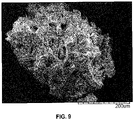
- Fig 9 When only particles are used to form the balls, the result is depicted in Fig 9 .
- the granules are removed from the crucible and cooled rapidly on a thermally conductive material, such as a copper plate.
- a thermally conductive material such as a copper plate.
- a void in the shape of a cylinder 27 is left down the center of the crucible. This is done so that the fibers do not act as an insulator and block heat from reaching the material at the center of the crucible. Also, once the granules have bonded, they are difficult to remove without damaging the granules.
- the void allows heat to penetrate the granules evenly, and the core allows material to flow upon removal and eliminates damaging the granules prior to cooling below T g .
- a schematic of the agglomerate loading in the crucible is shown in Fig 5 .
- the sintered agglomerates are then passed through a propane/oxygen flame and quickly cooled, thereby forming a shielded glass scaffold, i.e., a ball having a fused glass exterior around an interior of fiber/granules.
- a shielded glass scaffold i.e., a ball having a fused glass exterior around an interior of fiber/granules.
- the fused periphery may be made thicker or thinner.
- Approximately 100g of the crushed mixture is placed in an 20.32cm (8 inch) stainless steel pan and sprayed with water enough to wet the surface of the powder. The sprayed mixture is then gently mixed allowing the wet particles to stick together.
- Agglomerates of powder can be made upwards of 1cm, but the size of 1 to 6mm is optimal.
- the agglomerates are collected and placed in a ceramic crucible, where they are heated to above the glass transition temperature but below the glass melt temperature for about ten minutes about 480°C (900°F) for 45S5, and then rapidly cooled to result in the sintered fiber/bead particle of Figs 2 and 3 .
- the fiber/bead interlocking structure is directly heated in the flame, with no initial sintering.
- the sintered particle is directly heated in a flame.
- the fiber/bead interlocking structures of Fig 8 are placed in the hopper 11 shown in Fig 4 and with a vibratory feeder 12 directed into the flame 13 of a burner 15, the flame comprising mixed and combusted oxygen and propane.
- the flame settings vary with glass composition and burner size, but oxygen and propane are both required.
- the resulting temperature in the flame is therefore 1982°C to 2815°C (3600°F to 5100°F).
- Each agglomerate has the exterior fused in a fraction of a second while in the flame, leaving loose fibers and beads in the center. It is then blown into a collection tube 17 and cooled below the glass crystallization and glass transition temperature (Tg).
- the embodiment utilizing a sintered fiber/bead interlocking structure may also be passed through a flame and result in an fused agglomerate with a variable thickness of the fused exterior as above, but the center is not loose.
- the collection tube 17 is set at an angle between 15 and 45 degrees and fixed with a vibrator 19 to allow the fused granules to exit the tube into a collection pan 21 where the granules cool to room temperature.
- the time each agglomerate is in the flame ranges from 1/100th to 1/4th of a second.
- the image of the resulting shielded granule is shown in Fig 6 .
- the rounded glassy surface is evident, but there is a fibrous core present in the center that will allow for tissue ingrowth and enhanced conversion compared to a solid glass particle or bead as shown in Figs 6 and 7 .
- Fig 6 is an SEM image, showing the surface of a shielded fiber/bead granule of about 1.1-2.0mm diameter.
- the surface of the granule is covered with windows or pores that allows for tissue growth and fluid penetration.
- the approximate size range of the pores is ⁇ 10 ⁇ m to ⁇ 200 ⁇ m, which is sufficient for tissue infiltration. Due to the increased surface area of the internal porous microstructure, the rate of reaction of the porous granule is much higher than a solid glass sphere.
- Fig 7 shows the porous fiber/bead granule of Fig 6 formed from a non-sintered agglomerate and fractured in two; the external and internal microstructures are visible.
- the shield is the outer fused perimeter of the granule.
- the center of the fractured granule contains loose fibers and beads.
- the broken scaffold of Fig 7 shows the porous glassy shell covering the somewhat loose internal fiber network.
- the surface of the scaffolds has thin windows covering the surface that were formed at high temperature as the glass granules were melted and trapped gas (air) and made bubbles.
- the glass windows will quickly hydrate when in contact with liquids such as body fluids or blood and allow fluids to penetrate the scaffold and allow for growth of new tissues while improving the material properties and handling ability for clinicians.
Landscapes
- Chemical & Material Sciences (AREA)
- Health & Medical Sciences (AREA)
- Engineering & Computer Science (AREA)
- Materials Engineering (AREA)
- Organic Chemistry (AREA)
- Animal Behavior & Ethology (AREA)
- Veterinary Medicine (AREA)
- Public Health (AREA)
- General Health & Medical Sciences (AREA)
- Epidemiology (AREA)
- Life Sciences & Earth Sciences (AREA)
- Dispersion Chemistry (AREA)
- Manufacturing & Machinery (AREA)
- Inorganic Chemistry (AREA)
- Ceramic Engineering (AREA)
- Dermatology (AREA)
- Medicinal Chemistry (AREA)
- Surgery (AREA)
- Transplantation (AREA)
- Oral & Maxillofacial Surgery (AREA)
- Crystallography & Structural Chemistry (AREA)
- Physics & Mathematics (AREA)
- Thermal Sciences (AREA)
- Hematology (AREA)
- Materials For Medical Uses (AREA)
- Glass Compositions (AREA)
Applications Claiming Priority (1)
| Application Number | Priority Date | Filing Date | Title |
|---|---|---|---|
| PCT/US2013/036418 WO2014168631A1 (en) | 2013-04-12 | 2013-04-12 | Bioactive glass scaffolds, and method of making |
Publications (3)
| Publication Number | Publication Date |
|---|---|
| EP2984047A1 EP2984047A1 (en) | 2016-02-17 |
| EP2984047A4 EP2984047A4 (en) | 2017-01-18 |
| EP2984047B1 true EP2984047B1 (en) | 2022-06-15 |
Family
ID=51689886
Family Applications (1)
| Application Number | Title | Priority Date | Filing Date |
|---|---|---|---|
| EP13750831.3A Active EP2984047B1 (en) | 2013-04-12 | 2013-04-12 | Bioactive glass scaffolds, and method of making |
Country Status (8)
| Country | Link |
|---|---|
| EP (1) | EP2984047B1 (https=) |
| JP (1) | JP5982730B2 (https=) |
| KR (1) | KR101677066B1 (https=) |
| CN (1) | CN104334503B (https=) |
| AU (1) | AU2013221955B2 (https=) |
| ES (1) | ES2924235T3 (https=) |
| MX (1) | MX356872B (https=) |
| WO (1) | WO2014168631A1 (https=) |
Families Citing this family (19)
| Publication number | Priority date | Publication date | Assignee | Title |
|---|---|---|---|---|
| CA2988615C (en) | 2014-06-09 | 2023-08-08 | The Royal Institution For The Advancement Of Learning/Mcgill University | Borate-glass biomaterials |
| GB201415005D0 (en) * | 2014-08-22 | 2014-10-08 | Univ Nottingham | Porous and non-pourous bodies |
| US10492921B2 (en) | 2015-04-29 | 2019-12-03 | Institute for Musculoskeletal Science and Education, Ltd. | Implant with arched bone contacting elements |
| US10449051B2 (en) | 2015-04-29 | 2019-10-22 | Institute for Musculoskeletal Science and Education, Ltd. | Implant with curved bone contacting elements |
| CN110946681B (zh) | 2015-04-29 | 2021-12-24 | 肌肉骨骼科学教育研究所有限公司 | 线圈状的植入物和系统及其使用方法 |
| US10709570B2 (en) | 2015-04-29 | 2020-07-14 | Institute for Musculoskeletal Science and Education, Ltd. | Implant with a diagonal insertion axis |
| CN106913908B (zh) * | 2015-12-25 | 2020-05-26 | 北京瑞健高科生物科技有限公司 | 一种具有结构记忆特性的细胞生长支架 |
| US10478312B2 (en) | 2016-10-25 | 2019-11-19 | Institute for Musculoskeletal Science and Education, Ltd. | Implant with protected fusion zones |
| US11033394B2 (en) | 2016-10-25 | 2021-06-15 | Institute for Musculoskeletal Science and Education, Ltd. | Implant with multi-layer bone interfacing lattice |
| US10357377B2 (en) | 2017-03-13 | 2019-07-23 | Institute for Musculoskeletal Science and Education, Ltd. | Implant with bone contacting elements having helical and undulating planar geometries |
| US10512549B2 (en) | 2017-03-13 | 2019-12-24 | Institute for Musculoskeletal Science and Education, Ltd. | Implant with structural members arranged around a ring |
| EP4445922A3 (en) * | 2017-07-31 | 2024-12-04 | KCI USA, Inc. | Bioresorbable dressing with structural support |
| US10744001B2 (en) | 2017-11-21 | 2020-08-18 | Institute for Musculoskeletal Science and Education, Ltd. | Implant with improved bone contact |
| US10940015B2 (en) | 2017-11-21 | 2021-03-09 | Institute for Musculoskeletal Science and Education, Ltd. | Implant with improved flow characteristics |
| US10512495B2 (en) | 2017-12-28 | 2019-12-24 | Industrial Technology Research Institute | Method for fabricating medical device and applications thereof |
| TWI647032B (zh) * | 2017-12-28 | 2019-01-11 | 財團法人工業技術研究院 | 醫療元件的製作方法及其應用 |
| DE102018114946B3 (de) | 2018-06-21 | 2019-04-25 | Klinikum Nürnberg Medical School GmbH | Bioaktiver Träger |
| DE102019124879B4 (de) | 2019-08-03 | 2026-03-26 | Klinikum Nürnberg Medical School GmbH | Bioaktiver Träger |
| CN114455834B (zh) * | 2022-01-17 | 2023-03-21 | 华南理工大学 | 一种高强度生物活性玻璃支架及其3d打印方法 |
Citations (1)
| Publication number | Priority date | Publication date | Assignee | Title |
|---|---|---|---|---|
| EP2695623A1 (en) * | 2011-04-05 | 2014-02-12 | Reg4Life Regeneration Technology, S.A. | Bioactive glass compositions, their applications and respective preparation methods |
Family Cites Families (21)
| Publication number | Priority date | Publication date | Assignee | Title |
|---|---|---|---|---|
| DE2935198C2 (de) * | 1979-08-31 | 1981-12-24 | Heraeus Quarzschmelze Gmbh, 6450 Hanau | Verfahren zur werkzeugfreien Herstellung von porösen Formkörpern aus Quarzglas und Verwendung dieser Formkörper |
| FR2566384B1 (fr) * | 1984-06-21 | 1986-09-05 | Saint Gobain Vitrage | Perfectionnements aux techniques de production de microspheres en verre |
| US4867931A (en) * | 1986-02-10 | 1989-09-19 | Materials Technology Corporation | Methods for producing fiber reinforced microspheres made from dispersed particle compositions |
| WO1997016384A1 (en) * | 1995-11-01 | 1997-05-09 | Minnesota Mining And Manufacturing Company | Methods of making fused particulates by flame fusion |
| US6254981B1 (en) * | 1995-11-02 | 2001-07-03 | Minnesota Mining & Manufacturing Company | Fused glassy particulates obtained by flame fusion |
| WO2001003709A1 (en) * | 1999-07-08 | 2001-01-18 | Cap Biotechnology, Inc. | Calcium-containing structures and methods of making and using the same |
| US20020139147A1 (en) * | 2001-01-30 | 2002-10-03 | Janas Victor F. | Glass scaffolds with controlled resorption rates and methods for making same |
| JP2008545866A (ja) * | 2005-06-10 | 2008-12-18 | チバ ホールディング インコーポレーテッド | プラズマトーチを使用する粒子の処理方法 |
| JP4854024B2 (ja) * | 2006-04-04 | 2012-01-11 | コバレントマテリアル株式会社 | 多孔体 |
| WO2009012455A1 (en) * | 2007-07-18 | 2009-01-22 | Oxane Materials, Inc. | Proppants with carbide and/or nitride phases |
| US8353966B2 (en) * | 2009-01-15 | 2013-01-15 | The Curators Of The University Of Missouri | Scaffold for bone and tissue repair in mammals |
| IN2012DN01107A (https=) * | 2009-07-10 | 2015-04-10 | Bio2 Technologies Inc | |
| US8481066B2 (en) * | 2009-07-16 | 2013-07-09 | The Curators Of The University Of Missouri | Scaffold for tissue regeneration in mammals |
| US8287896B2 (en) * | 2010-01-06 | 2012-10-16 | The Curators Of The University Of Missouri | Scaffolds with trace element for tissue regeneration in mammals |
| US8337875B2 (en) * | 2009-07-16 | 2012-12-25 | The Curators Of The University Of Missouri | Controlling vessel growth and directionality in mammals and implantable material |
| JP5721712B2 (ja) * | 2009-07-16 | 2015-05-20 | ザ・キュレーターズ・オブ・ザ・ユニバーシティ・オブ・ミズーリThe Curators Of The University Of Missouri | 哺乳類の組織再生用の微量元素含有スキャフォールド |
| US8673018B2 (en) * | 2010-02-05 | 2014-03-18 | AMx Tek LLC | Methods of using water-soluble inorganic compounds for implants |
| US20120219635A1 (en) * | 2010-05-06 | 2012-08-30 | Bio2 Technologies, Inc. | Devices and Methods for Tissue Engineering |
| EP2619154A4 (en) * | 2010-09-21 | 2015-11-25 | Oxane Materials Inc | LIGHT SUPPORT OF IMPROVED STRENGTH AND METHOD FOR THE PRODUCTION THEREOF |
| CA2840235C (en) * | 2011-07-13 | 2017-11-14 | Oxane Materials, Inc. | Low surface friction proppants |
| US8449904B1 (en) * | 2012-03-26 | 2013-05-28 | Mosci, Corp. | Bioactive glass scaffolds, and method of making |
-
2013
- 2013-04-12 EP EP13750831.3A patent/EP2984047B1/en active Active
- 2013-04-12 KR KR1020147001206A patent/KR101677066B1/ko active Active
- 2013-04-12 AU AU2013221955A patent/AU2013221955B2/en active Active
- 2013-04-12 ES ES13750831T patent/ES2924235T3/es active Active
- 2013-04-12 MX MX2013009806A patent/MX356872B/es active IP Right Grant
- 2013-04-12 WO PCT/US2013/036418 patent/WO2014168631A1/en not_active Ceased
- 2013-04-12 CN CN201380000851.XA patent/CN104334503B/zh active Active
- 2013-04-12 JP JP2015511483A patent/JP5982730B2/ja active Active
Patent Citations (1)
| Publication number | Priority date | Publication date | Assignee | Title |
|---|---|---|---|---|
| EP2695623A1 (en) * | 2011-04-05 | 2014-02-12 | Reg4Life Regeneration Technology, S.A. | Bioactive glass compositions, their applications and respective preparation methods |
Also Published As
| Publication number | Publication date |
|---|---|
| CN104334503A (zh) | 2015-02-04 |
| ES2924235T3 (es) | 2022-10-05 |
| AU2013221955B2 (en) | 2017-06-22 |
| AU2013221955A1 (en) | 2014-10-30 |
| JP2015520636A (ja) | 2015-07-23 |
| JP5982730B2 (ja) | 2016-08-31 |
| MX356872B (es) | 2018-06-18 |
| MX2013009806A (es) | 2015-05-14 |
| KR20150008036A (ko) | 2015-01-21 |
| EP2984047A4 (en) | 2017-01-18 |
| CN104334503B (zh) | 2017-03-01 |
| WO2014168631A1 (en) | 2014-10-16 |
| KR101677066B1 (ko) | 2016-11-17 |
| EP2984047A1 (en) | 2016-02-17 |
Similar Documents
| Publication | Publication Date | Title |
|---|---|---|
| EP2984047B1 (en) | Bioactive glass scaffolds, and method of making | |
| US8449904B1 (en) | Bioactive glass scaffolds, and method of making | |
| US10273181B2 (en) | Bioactive glass scaffolds, and method of making | |
| KR101683328B1 (ko) | 조직공학용 장치 및 방법 | |
| US20120219635A1 (en) | Devices and Methods for Tissue Engineering | |
| US9775721B2 (en) | Resorbable interbody device | |
| US11225430B2 (en) | Bioactive glass scaffolds, and method of making | |
| CA2828216C (en) | Bioactive glass scaffolds, and method of making |
Legal Events
| Date | Code | Title | Description |
|---|---|---|---|
| PUAI | Public reference made under article 153(3) epc to a published international application that has entered the european phase |
Free format text: ORIGINAL CODE: 0009012 |
|
| 17P | Request for examination filed |
Effective date: 20130827 |
|
| AK | Designated contracting states |
Kind code of ref document: A1 Designated state(s): AL AT BE BG CH CY CZ DE DK EE ES FI FR GB GR HR HU IE IS IT LI LT LU LV MC MK MT NL NO PL PT RO RS SE SI SK SM TR |
|
| AX | Request for extension of the european patent |
Extension state: BA ME |
|
| DAX | Request for extension of the european patent (deleted) | ||
| A4 | Supplementary search report drawn up and despatched |
Effective date: 20161215 |
|
| RIC1 | Information provided on ipc code assigned before grant |
Ipc: C03B 19/06 20060101ALI20161209BHEP Ipc: C03B 29/00 20060101AFI20161209BHEP Ipc: C03B 19/09 20060101ALI20161209BHEP |
|
| STAA | Information on the status of an ep patent application or granted ep patent |
Free format text: STATUS: EXAMINATION IS IN PROGRESS |
|
| 17Q | First examination report despatched |
Effective date: 20171013 |
|
| GRAP | Despatch of communication of intention to grant a patent |
Free format text: ORIGINAL CODE: EPIDOSNIGR1 |
|
| STAA | Information on the status of an ep patent application or granted ep patent |
Free format text: STATUS: GRANT OF PATENT IS INTENDED |
|
| INTG | Intention to grant announced |
Effective date: 20220104 |
|
| GRAS | Grant fee paid |
Free format text: ORIGINAL CODE: EPIDOSNIGR3 |
|
| GRAA | (expected) grant |
Free format text: ORIGINAL CODE: 0009210 |
|
| STAA | Information on the status of an ep patent application or granted ep patent |
Free format text: STATUS: THE PATENT HAS BEEN GRANTED |
|
| AK | Designated contracting states |
Kind code of ref document: B1 Designated state(s): AL AT BE BG CH CY CZ DE DK EE ES FI FR GB GR HR HU IE IS IT LI LT LU LV MC MK MT NL NO PL PT RO RS SE SI SK SM TR |
|
| REG | Reference to a national code |
Ref country code: CH Ref legal event code: EP Ref country code: GB Ref legal event code: FG4D |
|
| REG | Reference to a national code |
Ref country code: IE Ref legal event code: FG4D |
|
| REG | Reference to a national code |
Ref country code: DE Ref legal event code: R096 Ref document number: 602013081860 Country of ref document: DE |
|
| REG | Reference to a national code |
Ref country code: AT Ref legal event code: REF Ref document number: 1498313 Country of ref document: AT Kind code of ref document: T Effective date: 20220715 |
|
| REG | Reference to a national code |
Ref country code: ES Ref legal event code: FG2A Ref document number: 2924235 Country of ref document: ES Kind code of ref document: T3 Effective date: 20221005 |
|
| REG | Reference to a national code |
Ref country code: LT Ref legal event code: MG9D |
|
| REG | Reference to a national code |
Ref country code: NL Ref legal event code: MP Effective date: 20220615 |
|
| PG25 | Lapsed in a contracting state [announced via postgrant information from national office to epo] |
Ref country code: SE Free format text: LAPSE BECAUSE OF FAILURE TO SUBMIT A TRANSLATION OF THE DESCRIPTION OR TO PAY THE FEE WITHIN THE PRESCRIBED TIME-LIMIT Effective date: 20220615 Ref country code: NO Free format text: LAPSE BECAUSE OF FAILURE TO SUBMIT A TRANSLATION OF THE DESCRIPTION OR TO PAY THE FEE WITHIN THE PRESCRIBED TIME-LIMIT Effective date: 20220915 Ref country code: LT Free format text: LAPSE BECAUSE OF FAILURE TO SUBMIT A TRANSLATION OF THE DESCRIPTION OR TO PAY THE FEE WITHIN THE PRESCRIBED TIME-LIMIT Effective date: 20220615 Ref country code: HR Free format text: LAPSE BECAUSE OF FAILURE TO SUBMIT A TRANSLATION OF THE DESCRIPTION OR TO PAY THE FEE WITHIN THE PRESCRIBED TIME-LIMIT Effective date: 20220615 Ref country code: GR Free format text: LAPSE BECAUSE OF FAILURE TO SUBMIT A TRANSLATION OF THE DESCRIPTION OR TO PAY THE FEE WITHIN THE PRESCRIBED TIME-LIMIT Effective date: 20220916 Ref country code: FI Free format text: LAPSE BECAUSE OF FAILURE TO SUBMIT A TRANSLATION OF THE DESCRIPTION OR TO PAY THE FEE WITHIN THE PRESCRIBED TIME-LIMIT Effective date: 20220615 Ref country code: BG Free format text: LAPSE BECAUSE OF FAILURE TO SUBMIT A TRANSLATION OF THE DESCRIPTION OR TO PAY THE FEE WITHIN THE PRESCRIBED TIME-LIMIT Effective date: 20220915 |
|
| REG | Reference to a national code |
Ref country code: AT Ref legal event code: MK05 Ref document number: 1498313 Country of ref document: AT Kind code of ref document: T Effective date: 20220615 |
|
| PG25 | Lapsed in a contracting state [announced via postgrant information from national office to epo] |
Ref country code: RS Free format text: LAPSE BECAUSE OF FAILURE TO SUBMIT A TRANSLATION OF THE DESCRIPTION OR TO PAY THE FEE WITHIN THE PRESCRIBED TIME-LIMIT Effective date: 20220615 Ref country code: LV Free format text: LAPSE BECAUSE OF FAILURE TO SUBMIT A TRANSLATION OF THE DESCRIPTION OR TO PAY THE FEE WITHIN THE PRESCRIBED TIME-LIMIT Effective date: 20220615 |
|
| PG25 | Lapsed in a contracting state [announced via postgrant information from national office to epo] |
Ref country code: NL Free format text: LAPSE BECAUSE OF FAILURE TO SUBMIT A TRANSLATION OF THE DESCRIPTION OR TO PAY THE FEE WITHIN THE PRESCRIBED TIME-LIMIT Effective date: 20220615 |
|
| PG25 | Lapsed in a contracting state [announced via postgrant information from national office to epo] |
Ref country code: SM Free format text: LAPSE BECAUSE OF FAILURE TO SUBMIT A TRANSLATION OF THE DESCRIPTION OR TO PAY THE FEE WITHIN THE PRESCRIBED TIME-LIMIT Effective date: 20220615 Ref country code: SK Free format text: LAPSE BECAUSE OF FAILURE TO SUBMIT A TRANSLATION OF THE DESCRIPTION OR TO PAY THE FEE WITHIN THE PRESCRIBED TIME-LIMIT Effective date: 20220615 Ref country code: RO Free format text: LAPSE BECAUSE OF FAILURE TO SUBMIT A TRANSLATION OF THE DESCRIPTION OR TO PAY THE FEE WITHIN THE PRESCRIBED TIME-LIMIT Effective date: 20220615 Ref country code: PT Free format text: LAPSE BECAUSE OF FAILURE TO SUBMIT A TRANSLATION OF THE DESCRIPTION OR TO PAY THE FEE WITHIN THE PRESCRIBED TIME-LIMIT Effective date: 20221017 Ref country code: EE Free format text: LAPSE BECAUSE OF FAILURE TO SUBMIT A TRANSLATION OF THE DESCRIPTION OR TO PAY THE FEE WITHIN THE PRESCRIBED TIME-LIMIT Effective date: 20220615 Ref country code: CZ Free format text: LAPSE BECAUSE OF FAILURE TO SUBMIT A TRANSLATION OF THE DESCRIPTION OR TO PAY THE FEE WITHIN THE PRESCRIBED TIME-LIMIT Effective date: 20220615 Ref country code: AT Free format text: LAPSE BECAUSE OF FAILURE TO SUBMIT A TRANSLATION OF THE DESCRIPTION OR TO PAY THE FEE WITHIN THE PRESCRIBED TIME-LIMIT Effective date: 20220615 |
|
| PG25 | Lapsed in a contracting state [announced via postgrant information from national office to epo] |
Ref country code: PL Free format text: LAPSE BECAUSE OF FAILURE TO SUBMIT A TRANSLATION OF THE DESCRIPTION OR TO PAY THE FEE WITHIN THE PRESCRIBED TIME-LIMIT Effective date: 20220615 Ref country code: IS Free format text: LAPSE BECAUSE OF FAILURE TO SUBMIT A TRANSLATION OF THE DESCRIPTION OR TO PAY THE FEE WITHIN THE PRESCRIBED TIME-LIMIT Effective date: 20221015 |
|
| REG | Reference to a national code |
Ref country code: DE Ref legal event code: R097 Ref document number: 602013081860 Country of ref document: DE |
|
| PG25 | Lapsed in a contracting state [announced via postgrant information from national office to epo] |
Ref country code: AL Free format text: LAPSE BECAUSE OF FAILURE TO SUBMIT A TRANSLATION OF THE DESCRIPTION OR TO PAY THE FEE WITHIN THE PRESCRIBED TIME-LIMIT Effective date: 20220615 |
|
| PLBE | No opposition filed within time limit |
Free format text: ORIGINAL CODE: 0009261 |
|
| STAA | Information on the status of an ep patent application or granted ep patent |
Free format text: STATUS: NO OPPOSITION FILED WITHIN TIME LIMIT |
|
| PG25 | Lapsed in a contracting state [announced via postgrant information from national office to epo] |
Ref country code: DK Free format text: LAPSE BECAUSE OF FAILURE TO SUBMIT A TRANSLATION OF THE DESCRIPTION OR TO PAY THE FEE WITHIN THE PRESCRIBED TIME-LIMIT Effective date: 20220615 |
|
| 26N | No opposition filed |
Effective date: 20230316 |
|
| PG25 | Lapsed in a contracting state [announced via postgrant information from national office to epo] |
Ref country code: SI Free format text: LAPSE BECAUSE OF FAILURE TO SUBMIT A TRANSLATION OF THE DESCRIPTION OR TO PAY THE FEE WITHIN THE PRESCRIBED TIME-LIMIT Effective date: 20220615 |
|
| P01 | Opt-out of the competence of the unified patent court (upc) registered |
Effective date: 20230527 |
|
| PG25 | Lapsed in a contracting state [announced via postgrant information from national office to epo] |
Ref country code: LU Free format text: LAPSE BECAUSE OF NON-PAYMENT OF DUE FEES Effective date: 20230412 |
|
| REG | Reference to a national code |
Ref country code: BE Ref legal event code: MM Effective date: 20230430 |
|
| PG25 | Lapsed in a contracting state [announced via postgrant information from national office to epo] |
Ref country code: MC Free format text: LAPSE BECAUSE OF FAILURE TO SUBMIT A TRANSLATION OF THE DESCRIPTION OR TO PAY THE FEE WITHIN THE PRESCRIBED TIME-LIMIT Effective date: 20220615 |
|
| PG25 | Lapsed in a contracting state [announced via postgrant information from national office to epo] |
Ref country code: MC Free format text: LAPSE BECAUSE OF FAILURE TO SUBMIT A TRANSLATION OF THE DESCRIPTION OR TO PAY THE FEE WITHIN THE PRESCRIBED TIME-LIMIT Effective date: 20220615 |
|
| PG25 | Lapsed in a contracting state [announced via postgrant information from national office to epo] |
Ref country code: BE Free format text: LAPSE BECAUSE OF NON-PAYMENT OF DUE FEES Effective date: 20230430 |
|
| PG25 | Lapsed in a contracting state [announced via postgrant information from national office to epo] |
Ref country code: BG Free format text: LAPSE BECAUSE OF FAILURE TO SUBMIT A TRANSLATION OF THE DESCRIPTION OR TO PAY THE FEE WITHIN THE PRESCRIBED TIME-LIMIT Effective date: 20220615 |
|
| PG25 | Lapsed in a contracting state [announced via postgrant information from national office to epo] |
Ref country code: BG Free format text: LAPSE BECAUSE OF FAILURE TO SUBMIT A TRANSLATION OF THE DESCRIPTION OR TO PAY THE FEE WITHIN THE PRESCRIBED TIME-LIMIT Effective date: 20220615 |
|
| PGFP | Annual fee paid to national office [announced via postgrant information from national office to epo] |
Ref country code: DE Payment date: 20250218 Year of fee payment: 13 |
|
| PGFP | Annual fee paid to national office [announced via postgrant information from national office to epo] |
Ref country code: ES Payment date: 20250519 Year of fee payment: 13 |
|
| PGFP | Annual fee paid to national office [announced via postgrant information from national office to epo] |
Ref country code: IT Payment date: 20250430 Year of fee payment: 13 |
|
| PGFP | Annual fee paid to national office [announced via postgrant information from national office to epo] |
Ref country code: FR Payment date: 20250422 Year of fee payment: 13 |
|
| PGFP | Annual fee paid to national office [announced via postgrant information from national office to epo] |
Ref country code: CH Payment date: 20250501 Year of fee payment: 13 |
|
| PG25 | Lapsed in a contracting state [announced via postgrant information from national office to epo] |
Ref country code: CY Free format text: LAPSE BECAUSE OF FAILURE TO SUBMIT A TRANSLATION OF THE DESCRIPTION OR TO PAY THE FEE WITHIN THE PRESCRIBED TIME-LIMIT; INVALID AB INITIO Effective date: 20130412 |
|
| PGFP | Annual fee paid to national office [announced via postgrant information from national office to epo] |
Ref country code: IE Payment date: 20250428 Year of fee payment: 13 |
|
| PG25 | Lapsed in a contracting state [announced via postgrant information from national office to epo] |
Ref country code: HU Free format text: LAPSE BECAUSE OF FAILURE TO SUBMIT A TRANSLATION OF THE DESCRIPTION OR TO PAY THE FEE WITHIN THE PRESCRIBED TIME-LIMIT; INVALID AB INITIO Effective date: 20130412 |
|
| PG25 | Lapsed in a contracting state [announced via postgrant information from national office to epo] |
Ref country code: TR Free format text: LAPSE BECAUSE OF FAILURE TO SUBMIT A TRANSLATION OF THE DESCRIPTION OR TO PAY THE FEE WITHIN THE PRESCRIBED TIME-LIMIT Effective date: 20220615 |
|
| PGFP | Annual fee paid to national office [announced via postgrant information from national office to epo] |
Ref country code: GB Payment date: 20260324 Year of fee payment: 14 |