EP2983232A1 - Lithium-akkumulator, der ein material für positive elektroden auf basis eines spezifischen kohlenstoffmaterials umfasst, das durch spezifische organische verbindungen funktionalisiert ist - Google Patents
Lithium-akkumulator, der ein material für positive elektroden auf basis eines spezifischen kohlenstoffmaterials umfasst, das durch spezifische organische verbindungen funktionalisiert ist Download PDFInfo
- Publication number
- EP2983232A1 EP2983232A1 EP15180023.2A EP15180023A EP2983232A1 EP 2983232 A1 EP2983232 A1 EP 2983232A1 EP 15180023 A EP15180023 A EP 15180023A EP 2983232 A1 EP2983232 A1 EP 2983232A1
- Authority
- EP
- European Patent Office
- Prior art keywords
- compound
- group
- positive electrode
- carbon
- electron
- Prior art date
- Legal status (The legal status is an assumption and is not a legal conclusion. Google has not performed a legal analysis and makes no representation as to the accuracy of the status listed.)
- Granted
Links
Images


Classifications
-
- H—ELECTRICITY
- H01—ELECTRIC ELEMENTS
- H01M—PROCESSES OR MEANS, e.g. BATTERIES, FOR THE DIRECT CONVERSION OF CHEMICAL ENERGY INTO ELECTRICAL ENERGY
- H01M4/00—Electrodes
- H01M4/02—Electrodes composed of, or comprising, active material
- H01M4/13—Electrodes for accumulators with non-aqueous electrolyte, e.g. for lithium-accumulators; Processes of manufacture thereof
- H01M4/137—Electrodes based on electro-active polymers
-
- H—ELECTRICITY
- H01—ELECTRIC ELEMENTS
- H01M—PROCESSES OR MEANS, e.g. BATTERIES, FOR THE DIRECT CONVERSION OF CHEMICAL ENERGY INTO ELECTRICAL ENERGY
- H01M10/00—Secondary cells; Manufacture thereof
- H01M10/05—Accumulators with non-aqueous electrolyte
- H01M10/052—Li-accumulators
- H01M10/0525—Rocking-chair batteries, i.e. batteries with lithium insertion or intercalation in both electrodes; Lithium-ion batteries
-
- H—ELECTRICITY
- H01—ELECTRIC ELEMENTS
- H01M—PROCESSES OR MEANS, e.g. BATTERIES, FOR THE DIRECT CONVERSION OF CHEMICAL ENERGY INTO ELECTRICAL ENERGY
- H01M4/00—Electrodes
- H01M4/02—Electrodes composed of, or comprising, active material
- H01M4/13—Electrodes for accumulators with non-aqueous electrolyte, e.g. for lithium-accumulators; Processes of manufacture thereof
- H01M4/133—Electrodes based on carbonaceous material, e.g. graphite-intercalation compounds or CFx
-
- H—ELECTRICITY
- H01—ELECTRIC ELEMENTS
- H01M—PROCESSES OR MEANS, e.g. BATTERIES, FOR THE DIRECT CONVERSION OF CHEMICAL ENERGY INTO ELECTRICAL ENERGY
- H01M4/00—Electrodes
- H01M4/02—Electrodes composed of, or comprising, active material
- H01M4/36—Selection of substances as active materials, active masses, active liquids
- H01M4/58—Selection of substances as active materials, active masses, active liquids of inorganic compounds other than oxides or hydroxides, e.g. sulfides, selenides, tellurides, halogenides or LiCoFy; of polyanionic structures, e.g. phosphates, silicates or borates
- H01M4/583—Carbonaceous material, e.g. graphite-intercalation compounds or CFx
- H01M4/587—Carbonaceous material, e.g. graphite-intercalation compounds or CFx for inserting or intercalating light metals
-
- H—ELECTRICITY
- H01—ELECTRIC ELEMENTS
- H01M—PROCESSES OR MEANS, e.g. BATTERIES, FOR THE DIRECT CONVERSION OF CHEMICAL ENERGY INTO ELECTRICAL ENERGY
- H01M4/00—Electrodes
- H01M4/02—Electrodes composed of, or comprising, active material
- H01M4/36—Selection of substances as active materials, active masses, active liquids
- H01M4/60—Selection of substances as active materials, active masses, active liquids of organic compounds
-
- H—ELECTRICITY
- H01—ELECTRIC ELEMENTS
- H01M—PROCESSES OR MEANS, e.g. BATTERIES, FOR THE DIRECT CONVERSION OF CHEMICAL ENERGY INTO ELECTRICAL ENERGY
- H01M4/00—Electrodes
- H01M4/02—Electrodes composed of, or comprising, active material
- H01M4/36—Selection of substances as active materials, active masses, active liquids
- H01M4/60—Selection of substances as active materials, active masses, active liquids of organic compounds
- H01M4/602—Polymers
- H01M4/606—Polymers containing aromatic main chain polymers
-
- H—ELECTRICITY
- H01—ELECTRIC ELEMENTS
- H01M—PROCESSES OR MEANS, e.g. BATTERIES, FOR THE DIRECT CONVERSION OF CHEMICAL ENERGY INTO ELECTRICAL ENERGY
- H01M4/00—Electrodes
- H01M4/02—Electrodes composed of, or comprising, active material
- H01M4/36—Selection of substances as active materials, active masses, active liquids
- H01M4/60—Selection of substances as active materials, active masses, active liquids of organic compounds
- H01M4/602—Polymers
- H01M4/606—Polymers containing aromatic main chain polymers
- H01M4/608—Polymers containing aromatic main chain polymers containing heterocyclic rings
-
- H—ELECTRICITY
- H01—ELECTRIC ELEMENTS
- H01M—PROCESSES OR MEANS, e.g. BATTERIES, FOR THE DIRECT CONVERSION OF CHEMICAL ENERGY INTO ELECTRICAL ENERGY
- H01M10/00—Secondary cells; Manufacture thereof
- H01M10/05—Accumulators with non-aqueous electrolyte
- H01M10/052—Li-accumulators
-
- H—ELECTRICITY
- H01—ELECTRIC ELEMENTS
- H01M—PROCESSES OR MEANS, e.g. BATTERIES, FOR THE DIRECT CONVERSION OF CHEMICAL ENERGY INTO ELECTRICAL ENERGY
- H01M4/00—Electrodes
- H01M4/02—Electrodes composed of, or comprising, active material
- H01M2004/026—Electrodes composed of, or comprising, active material characterised by the polarity
- H01M2004/028—Positive electrodes
-
- H—ELECTRICITY
- H01—ELECTRIC ELEMENTS
- H01M—PROCESSES OR MEANS, e.g. BATTERIES, FOR THE DIRECT CONVERSION OF CHEMICAL ENERGY INTO ELECTRICAL ENERGY
- H01M4/00—Electrodes
- H01M4/02—Electrodes composed of, or comprising, active material
- H01M4/36—Selection of substances as active materials, active masses, active liquids
- H01M4/362—Composites
-
- H—ELECTRICITY
- H01—ELECTRIC ELEMENTS
- H01M—PROCESSES OR MEANS, e.g. BATTERIES, FOR THE DIRECT CONVERSION OF CHEMICAL ENERGY INTO ELECTRICAL ENERGY
- H01M4/00—Electrodes
- H01M4/02—Electrodes composed of, or comprising, active material
- H01M4/62—Selection of inactive substances as ingredients for active masses, e.g. binders, fillers
- H01M4/624—Electric conductive fillers
- H01M4/625—Carbon or graphite
-
- Y—GENERAL TAGGING OF NEW TECHNOLOGICAL DEVELOPMENTS; GENERAL TAGGING OF CROSS-SECTIONAL TECHNOLOGIES SPANNING OVER SEVERAL SECTIONS OF THE IPC; TECHNICAL SUBJECTS COVERED BY FORMER USPC CROSS-REFERENCE ART COLLECTIONS [XRACs] AND DIGESTS
- Y02—TECHNOLOGIES OR APPLICATIONS FOR MITIGATION OR ADAPTATION AGAINST CLIMATE CHANGE
- Y02E—REDUCTION OF GREENHOUSE GAS [GHG] EMISSIONS, RELATED TO ENERGY GENERATION, TRANSMISSION OR DISTRIBUTION
- Y02E60/00—Enabling technologies; Technologies with a potential or indirect contribution to GHG emissions mitigation
- Y02E60/10—Energy storage using batteries
Definitions
- the present invention relates to novel lithium accumulators as well as positive electrode materials, and more particularly, to positive electrode materials based on a specifically functionalized carbon material, in order to be able to be used in positive electrodes of lithium accumulators.
- the field of the invention can thus be defined as that of energy storage devices, in particular that of lithium electrochemical accumulators.
- the energy storage devices are conventionally electrochemical accumulators operating on the principle of electrochemical cells capable of delivering an electric current thanks to the presence in each of them of a pair of electrodes (respectively, a positive electrode and a negative electrode) separated by an electrolyte, the electrodes comprising specific materials capable of reacting in an oxidation-reduction reaction, whereby there is production of electrons at the origin of the electric current and productions of ions that will circulate from one electrode to another through an electrolyte.
- lithium batteries have largely detuned the other accumulators mentioned above because the continuous improvement of lithium-ion battery performance in terms of energy density. Indeed, the lithium-ion accumulators make it possible to obtain densities of mass and volume energy (which can be greater than 180 Wh.kg -1 ) much higher than those of the Ni-MH and Ni-Cd accumulators (being able to go from 50 at 100 Wh.kg -1 ) and lead acid (ranging from 30 to 35 Wh.kg -1 ).
- the Li-ion accumulators may have a higher nominal cell voltage than other accumulators (for example, a nominal voltage of the order of 3.6 V for a cell employing, as electrode materials the LiCoO2 / graphite pair against a nominal voltage of the order of 1.5 V for the other aforementioned accumulators).
- lithium-ion accumulators are therefore particularly interesting for areas where autonomy is a paramount criterion, as is the case in the fields of computing, video, telephony, transport such as electric vehicles, hybrid vehicles, or medical, space, microelectronics.
- autonomy is a paramount criterion, as is the case in the fields of computing, video, telephony, transport such as electric vehicles, hybrid vehicles, or medical, space, microelectronics.
- the technology of lithium-ion accumulators today sees its performance cap.
- the positive electrode comprises, as an active material, elemental sulfur or a sulfur derivative, such as only lithium sulfide or lithium polysulfide.
- sulfur as the active material of a positive electrode is particularly attractive because sulfur has a very high theoretical specific capacity up to more than 10 times higher than that obtained for conventional positive electrode materials. (in the order of 1675 mAh / g instead of 140 mAh / g for LiCoO 2 ).
- sulfur is abundantly present on the planet and is therefore characterized by low costs. Finally, it is not very toxic. All these qualities contribute to make it particularly attractive for large scale implementation, especially for electric vehicles, especially since lithium / sulfur accumulators can achieve mass energy densities that can range from 300 to 600 Wh.g -1 against 200-250 Whg -1 at the maximum expected for lithium-ion accumulators.
- this type of battery has an original discharge mechanism without insertion / de-insertion reactions of lithium ions as for lithium-ion accumulators.
- the reaction at the origin of the current generation i.e., when the battery is in discharge mode) involves an oxidation reaction of lithium to the negative electrode which produces electrons, which will supply the external circuit to which the positive and negative electrodes are connected, and a sulfur reduction reaction to the positive electrode.
- the overall reaction is as follows: S 8 + 16Li ⁇ 8Li 2 S which is the sum of the sulfur reduction reaction at the positive electrode (S 8 + 16e - ⁇ 8S 2 -) and the oxidation reaction of lithium at the negative electrode (Li ⁇ Li + + e - ) .
- the reaction involves an exchange of 16 electrons, which justifies the high specific capacity of sulfur (1675 mAh.g -1 ).
- the active ingredient which is elemental sulfur
- the sulfur cyclic molecules are reduced and form linear chains of lithium polysulfides, of the general formula Li 2 S n , with n being able to go from 2 to 8. Since the starting molecule is S 8 , the first compounds formed are long chain lithium polysulfides, such as Li 2 S 8 or Li 2 S 6 .
- the first discharge step therefore consists of the solubilization of the active material in the electrolyte, and the production of long-chain lithium polysulfides in solution. Then, as the sulfur reduction continues, the chain length of the polysulfides is gradually reduced, and compounds such as Li 2 S 5 , Li 2 S 4 or Li 2 S 2 are formed in solution. Finally, the final reduction product is lithium sulphide (Li 2 S), which is insoluble in organic electrolytes.
- Lithium / sulfur technology has several disadvantages, which justify the reason why it is not yet commercialized at present.
- the elemental sulfur used as positive electrode active material constitutes an electronic insulator and can not therefore be used alone to constitute the positive electrode but only in association with an electrically conductive material, such as than a carbonaceous material like carbon black.
- lithium polysulfides can cause an increase in the viscosity of the electrolyte and thus a decrease in ionic mobility, and can also diffuse through the electrolyte, corrode the negative electrode and create a self-discharge phenomenon. 'accumulator.
- the positive electrode comprises, as active material, organic molecules comprising at least one electron-withdrawing group, that is to say a group capable of collecting electrons during the discharge of the accumulator, such as carbonyl groups such as, more specifically, quinone groups.
- the inventors have set themselves the objective of developing new lithium batteries based on positive electrode active materials, which are not able to be dissolved in electrolytes during the discharge of the electrolyte. 'accumulator.
- the invention relates to a lithium battery comprising at least one electrochemical cell comprising an electrolyte disposed between a positive electrode and a negative electrode, said positive electrode comprising a positive electrode material comprising a carbon material selected from nanotubes of carbon, graphene or graphene derivatives selected from graphene oxides, reduced graphene oxides, which carbonaceous material is covalently functionalized with at least one organic compound comprising at least one electron-withdrawing group.
- positive electrode is meant, conventionally, in what precedes and what follows, the electrode which acts as a cathode, when the generator delivers current (that is to say when it is in the process of discharge) and which acts as anode when the generator is in charging process.
- negative electrode is meant, conventionally, in what precedes and what follows, the electrode which acts as anode, when the generator delivers current (that is to say when it is in the process of discharge ) and which acts cathode, when the generator is in process of charge.
- electron-withdrawing group we mean a group capable of attracting electrons and, specifically, in our case, capable of attracting the electrons during a reduction reaction to form a reduced group, and more specifically during a reduction reaction occurring at the positive electrode, when the lithium accumulator is in the process of discharge.
- the compound (s) carrying at least one such group thus constitute the active material of the positive electrode, that is to say the material involved in the charge and discharge reactions of the accumulator.
- the positive electrode materials used in the lithium accumulators of the invention do not have the disadvantages of those of the prior art, in particular as regards the solubilization of the materials in the electrolytes, since the organic compound or compounds comprising at least one electron-withdrawing group is covalently immobilized on the carbonaceous material, which itself is not soluble. As a result, the electrode materials remain confined within the positive electrode.
- the organic compound comprising at least one electron-withdrawing group can be a compound comprising one or more cyclic groups, for example one or more aryl groups, at least one of which groups carries at least one Electroattractor group.
- the electron-withdrawing group may advantageously be chosen from carbonyl groups, disulfide groups and thiocarbonyl groups.
- a compound that covalently functionalises a carbonaceous material corresponds to the following formula (VI): the bond interspersed with a brace indicating that the attachment of the compound concerned covalently to the carbonaceous material is effected via this connection.
- Compounds comprising, as electron-withdrawing group, a carbonyl group may also be compounds of the "polymer" type comprising at least one repeating unit, which repetitive unit comprises one or more rings, one of which is a ring comprising at least one ring. minus one carbonyl group.
- such compounds may comprise at least one repeating unit of the quinone family, such as anthraquinones.
- a compound comprising, as a repeating unit, a repeating unit of formula (VI ') as follows: the two bonds intersecting the carbon-carbon bonds indicating that they are bonded to one of the carbon atoms of the benzene ring, which they intersect the carbon-carbon bond, the polymer resulting from the repetition of said repeating unit which can be bonded to the carbonaceous material via an organic group forming a bridge between the repeating unit concerned and the carbonaceous material, such a bridging organic group can meet the following formula: the bond interspersed with a brace indicating that the group is bonded to the wall of the carbon nanotubes by a carbon atom of the benzene ring, the other bond intersecting the benzene ring indicating that the group is linked to another repeating pattern.
- Suitable compounds for the invention comprising, as the electron-withdrawing group, a disulfide group may also be cyclic compounds having one or more rings, wherein at least one ring has a disulfide group.
- Compounds meeting this specificity may be cyclic compounds comprising at least one aromatic ring attached to at least one ring comprising a disulfide group.
- Such compounds may meet one of the following formulas (VII) to (X): the bond intersecting the carbon-carbon bond indicating that the bond between the benzene ring (s) and the carbonaceous material is by one of the carbon atoms of this or these rings; these compounds exhibiting respectively the standard potentials calculated with the counterion Li + in acetonitrile (vs Li + / Li) as follows: 2.78; 1.88; 1.82 and 1.73.
- Compounds meeting this specificity may also be compounds of the "polymer” type comprising at least one repeating unit, which repetitive unit comprises one or more rings, one of whose rings is a ring comprising a disulfide group.
- such compounds may comprise at least one repeating unit corresponding to one of the following formulas (XI) to (XV): said repeating units can be bonded to the carbonaceous material via an organic group forming a bridge between the repeating unit concerned and the carbonaceous material, the two bonds intersecting the carbon-carbon bonds for the formulas (XIII) to (XV) indicating that they are bonded to one of the carbon atoms of the benzene ring, which they intersect the carbon-carbon bond.
- the compound comprising such a repeating unit may be bonded to the carbonaceous material by an organic group forming a bridge of the following formula: one of the carbon atoms of the benzene ring (represented by a bond intersecting a carbon-carbon bond of the ring) being bonded to a repeating unit of formula (XV) and another carbon atom of the benzene ring (represented by the other bond intersecting a carbon-carbon bond of the ring) being covalently bonded to the carbonaceous material.
- Such a compound bonded to a carbonaceous material can respond in particular to the following formula:
- the preferred compounds are those for which said ring comprises 4 atoms (it being understood that two of these atoms are sulfur atoms).
- the reduced form thereof corresponds to: the bond intersecting the carbon-carbon bond of the benzene ring indicating that the bond between the benzene ring and the carbonaceous material is by one of the carbon atoms of this ring.
- the existence of the disulfide group will allow the electrochemical reaction to occur by breaking SS bonds, while maintaining an anchor point on the carbonaceous material, thus avoiding the dissolution of the active material in the electrolyte with which the material is intended to be brought into contact.
- the carbonaceous material may consist of carbon nanotubes, graphene or a graphene derivative chosen from graphene oxides and reduced graphene oxides.
- graphene it is specified that it is, in the strict sense, a monoplane crystal in the form of a plane of carbon (or sheet of carbon), where the atoms are positioned in a regular order of hexagonal structure , the thickness of this plane (or sheet) corresponding to that of a carbon atom thus corresponding to a thickness less than one nanometer, which does not exclude that it can coexist with multiple layers (for example, 2 at 10 layers), in which case we speak of "Few Layer Graphene” (also known by the abbreviation FLG).
- carbon nanotubes it may be single-walled carbon nanotubes (known by the abbreviation SWNT) or multi-sheets (known by the abbreviation MWNT).
- SWNT single-walled carbon nanotubes
- MWNT multi-sheets
- the negative electrode of the accumulators of the invention may comprise, for example, lithium in metallic form and, according to a particular embodiment, be in lithium metal (which means that it does not comprise other ingredients) or well may comprise a material capable of inserting and disinserting lithium, such as a carbonaceous material such as graphite, an oxide material such as Li 4 Ti 5 O 12 or an element capable of forming an alloy with lithium, such as silicon or tin.
- a material capable of inserting and disinserting lithium such as a carbonaceous material such as graphite, an oxide material such as Li 4 Ti 5 O 12 or an element capable of forming an alloy with lithium, such as silicon or tin.
- the positive electrode for its part, may comprise, in addition to the specific positive electrode material defined above, for example, a binder, such as a polymeric binder (such as polyvinylidene fluoride, cellulose) so as to improve the resistance of the electrode.
- a binder such as a polymeric binder (such as polyvinylidene fluoride, cellulose) so as to improve the resistance of the electrode.
- the positive electrode may also consist solely of a material according to the invention.
- the electrolyte may comprise, in general, a lithium salt, for example, chosen from LiClO 4 , LiAsF 6 , LiPF 6 , LiBF 4 , LiRfSO 3 , LiCH 3 SO 3 , LiN (RfSO 2 ) 2.
- a lithium salt for example, chosen from LiClO 4 , LiAsF 6 , LiPF 6 , LiBF 4 , LiRfSO 3 , LiCH 3 SO 3 , LiN (RfSO 2 ) 2.
- Rf is selected from F or a perfluoroalkyl group having from 1 to 8 carbon atoms, lithium trifluoromethanesulfonylimide (known by the abbreviation LiTFSI), lithium bis (oxalato) borate (known by the abbreviation LiBOB), bis lithium (perfluorethylsulfonyl) imide (also known by the abbreviation LiBETI), lithium fluoroalkylphosphate (known by the abbreviation LiFAP).
- LiTFSI lithium trifluoromethanesulfonylimide
- LiBOB lithium bis (oxalato) borate
- LiBETI bis lithium (perfluorethylsulfonyl) imide
- LiFAP lithium fluoroalkylphosphate
- the lithium salt is preferably dissolved in an aprotic polar solvent, for example an aprotic polar solvent selected from carbonate solvents, ether solvents, ester solvents, sulfone solvents and nitrile solvents.
- an aprotic polar solvent selected from carbonate solvents, ether solvents, ester solvents, sulfone solvents and nitrile solvents.
- the electrolyte may be made to imbibe at least one separator element disposed between the two electrodes of the accumulator.
- group of the cleavable salt type is meant, in the context of the invention, a group chosen from the group consisting of diazonium salts, ammonium salts, phosphonium salts and iodonium salts. and the sulphonium salts, which salt is capable of being cleaved during a grafting step.
- the organic compound comprising at least one electron-withdrawing group or precursor thereof and at least one other group, which is a cleavable salt-type group may be a compound comprising one or more cyclic groups, for example, one or more aryl groups, at least one of these groups carries at least one electron-withdrawing group and at least one of these groups carries at least one cleavage salt-type group, such as a diazonium group.
- it may be a compound further comprising, as an electron-withdrawing group, a carbonyl group.
- Examples that may be mentioned include quinone compounds carrying at least one diazonium group, such as a compound of the following formula: with X - being as defined above, X - may be in particular a tetrafluoroborate anion, the N 2 + X - group may be bonded to any of the carbon atoms of the two benzene rings.
- these cleavable salts are capable, under certain non-electrochemical or electrochemical conditions, of forming, by cleavage, during step b), species capable of participating in chemical reactions, whereby they are grafted covalently to the carbonaceous material.
- the grafting step may consist of radical chemical grafting under non-electrochemical conditions.
- non-electrochemical conditions in the context of the present invention in the absence of electrical voltage.
- the non-electrochemical conditions used are conditions which allow the formation of radical entities from the compound comprising, inter alia, at least one group of the cleavable salt type, in the absence of the application of a any electrical voltage at the carbon material on which the compound is intended to be grafted. These conditions involve parameters such as, for example, the presence of a reducing agent.
- the term "radical chemical grafting” refers in particular to the use of highly reactive, typically radical, molecular entities capable of forming covalent bond bonds with the carbonaceous material, said molecular entities being generated independently of the surface on which they are to be grafted. So, the grafting reaction leads to the formation of covalent bonds between the surface area of the carbonaceous material to which the compound is to be grafted and the radical moiety resulting from cleavage of the aforementioned cleavable salt type group.
- the grafting step may consist of a reduction step of the diazonium group by a reducing agent, whereby it N 2 nitrogen release, the resulting compound being a radical compound (the free radical being formed on the initially carbon carrier of the diazonium group) which reacts with the carbonaceous material to form a covalent bond.
- the reducing agent may be in particular a metal, such as iron, sodium ascorbate or hypophosphorous acid.
- reaction scheme of such a reaction with a specific compound can be as follows:
- the grafting step may consist of electrochemical grafting.
- electrochemical grafting is understood to mean an electro-initiated and localized grafting of the compound comprising at least one cleavable salt type group on the carbonaceous material.
- the carbonaceous material is brought to a potential greater than or equal to a threshold electrical potential determined with respect to a reference electrode, said threshold electric potential being the potential beyond which the grafting of the compound comprising at least one group of the cleavable salt type.
- the application of this potential makes it possible in particular to polarize the carbonaceous material while reducing the carrier compound of at least one group of the cleavable salt type. It is specified that, depending on the nature of the aforementioned compound, once grafted, it may have another reactive function vis-à-vis another radical and capable of initiating a radical polymerization that does not depend on any electrical potential.
- This variant of the present invention can be implemented in an electrolysis cell comprising different electrodes: a working electrode constituted by the carbonaceous material, a counter electrode, for example a platinum electrode, as well as an electrode of reference, for example, an Ag / AgNO 3 type electrode and comprising an electrolyte consisting of an organic solution comprising a salt (such as a lithium salt) and the compound comprising, inter alia, at least one group of the cleavable salt type;
- the conditions applied for the electrochemical grafting may be those of a cyclic voltammetry or of a chronopotentiometry, for which a number of cycles are applied until reduction or even, preferably, disappearance of the reduction peak of the salt-type group cleavable (this is for example around 0.45 V vs Ag / AgNO 3 when this group is a diazonium group), the reduction of the group being an indica that the compound is grafted onto the carbonaceous material.
- the organic compound comprising at least one electron-withdrawing or precursor group thereof and at least one other group, which is a cleavable salt-type group, may be prepared prior to step a) and especially directly in the presence of the carbonaceous material (in which case we can speak of preparation in situ ).
- these compounds include, inter alia, a cleavable salt group, which is a diazonium group
- they may be prepared by reaction of corresponding amine compounds (i.e. compounds comprising instead of the future group diazonium an amine group) with NaNO 2 in an acid medium or with NOBF 4 in an organic medium.
- positive electrode materials that may be included in the constitution of the accumulators of the invention, some are original materials, these materials being positive electrode materials for lithium accumulator comprising a carbon material chosen from carbon nanotubes. , graphene or graphene derivatives chosen from graphene oxides, reduced graphene oxides, which carbonaceous material is covalently functionalized with at least one organic compound comprising at least one electron-withdrawing group, which is a disulfide group.
- Such an organic compound may in particular be part of the family of cyclic compounds comprising one or more rings, in which at least one ring contains a disulfide group.
- Compounds meeting this specificity may be cyclic compounds comprising at least one aromatic ring attached to at least one ring comprising a disulfide group.
- Such compounds may meet one of the following formulas (VII) to (X): the bond intersecting the carbon-carbon bond indicating that the bond between the benzene ring (s) and the carbonaceous material is by one of the carbon atoms of this or these rings; these compounds presenting respectively the standard potentials calculated with Li + counter-ion in acetonitrile (vs Li + / Li): 2.78; 1.88; 1.82 and 1.73.
- Compounds meeting this specificity may also be compounds of the "polymer” type comprising at least one repeating unit, which repetitive unit comprises one or more rings, one of whose rings is a ring comprising a disulfide group.
- such compounds may comprise at least one repeating unit corresponding to one of the following formulas (XI) to (XV): said repeating units can be bonded to the carbonaceous material via an organic group forming a bridge between the repeating unit concerned and the carbonaceous material, the two bonds intersecting the carbon-carbon bonds for the formulas (XIII) to (XV) indicating that they are bonded to one of the carbon atoms of the benzene ring, which they intersect the carbon-carbon bond.
- the compound comprising such a repeating unit may be bonded to the carbonaceous material by an organic group forming a bridge of the following formula: one of the carbon atoms of the benzene ring (represented by a bond intersecting a carbon-carbon bond of the ring) being bonded to a repeating unit of formula (XV) and another carbon atom of the benzene ring (represented by the other bond intersecting a carbon-carbon bond of the ring) being covalently bonded to the carbonaceous material.
- Such a compound bonded to a carbonaceous material can respond in particular to the following formula:
- the preferred compounds are those for which said ring comprises 4 atoms (it being understood that two of these atoms are sulfur atoms).
- the invention relates to a positive electrode comprising a positive electrode material comprising a material as defined above.
- This example illustrates the preparation of a carbon material according to the invention consisting of multi-walled carbon nanotubes covalently functionalized with polymers comprising, as a repeating unit, a repeating unit of the following formula: the two bonds intersecting the carbon-carbon bonds indicating that they are bonded to one of the carbon atoms of the benzene ring, which they intersect the carbon-carbon bond, the polymer resulting from the repetition of said repeating unit being bonded to the carbonaceous material via an organic group forming a bridge between the repeating unit concerned and the carbonaceous material, this organic group forming a bridge having the following formula: the bond interspersed with a brace indicating that the group is bonded to the wall of the carbon nanotubes by a carbon atom of the benzene ring, the other bond intersecting the benzene ring indicating that the group is linked to another repetitive pattern.
- the carbon nanotubes used are multiwall nanotubes (NC-3100) obtained from Nanocyl.
- the diazoanthraquinone compound is prepared from 2-aminoanthraquinone according to the following reaction scheme:
- the diazoanthraquinone compound is thus prepared by reducing 2-aminoanthraquinone with an excess of nitrosonium tetrafluoroborate NOBF 4 in dichloromethane at 0 ° C for 2 hours.
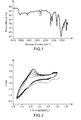
- the product obtained is analyzed by infrared spectrocopy, the spectrum obtained being represented on the figure 1 illustrating the evolution of the transmittance (in%) as a function of the number of waves (in cm -1 ).
- the band at 2300 cm -1 is the signature of the presence of the diazo functions N 2 + .
- the grafting of the diazoanthraquinone compound prepared in step b) is carried out by reduction of the diazonium function, whereby the elimination of N 2 and the concomitant formation of an anthraquinone polymer around the carbon nanotubes as explained at the beginning of Example 1
- the carbon nanotubes purified in step a) are dispersed in N-methyl-2-pyrrolidone by sonication for 30 minutes.
- the diazoanthraquinone compound prepared according to step b) is then added at a level of 1 equivalent per carbon (ie one molecule per carbon atom) followed by a spatula tip of iron powder.
- the dispersion is stirred for 12 hours.
- the nanotubes are then recovered by filtration on a polytetrafluoroethylene membrane (having a pore size of 0.45 ⁇ m) and then washed with 1M hydrochloric acid and then with water.
- the carbon nanotubes thus grafted are finally dried without vacuum.
- the system After degassing the electrolyte by bubbling N 2 , the system is subjected to a cyclic voltammetry, consisting of cycling between -1.25 to +1 V / Ag-Ag + (10 -3 M in acetonitrile). with a scanning speed of 100 mV.s -1 , the number of cycles carried out being 10, the cycling curves being represented on the figure 2 (I expressed in mA as a function of the potential E expressed in V)). This figure shows a reduction peak at -0.45 V, which corresponds to the reduction peak of the diazonium function.
- Example 1 the preparation of a lithium battery in the form of a button cell comprising, as a positive electrode, the electrode formed of a material obtained in Example 1 is illustrated.
- the accumulator was assembled in a glove box under an inert atmosphere of argon.
- the electrolyte impregnates the two aforementioned separator discs as well as the porosity of the positive electrode. It consists of an organic electrolyte comprising a 50/50 mixture of tetraethylene glycol dimethyl ether (TEGDME) / 1,3-dioxolane (DIOX) solvents comprising a lithium lithium bis (trifluoromethanesulfonyl) imide (LiTFSI) 1M salt.
- TEGDME tetraethylene glycol dimethyl ether
- DIOX 1,3-dioxolane
- LiTFSI lithium lithium bis (trifluoromethanesulfonyl) imide
- the inert atmosphere mentioned above is used to avoid any reaction of the metallic lithium constituting the negative electrode and the electrolyte with the water and the oxygen of the ambient air.
- the resulting accumulator is subjected to a cyclic voltammetric test, consisting of cycling between +1.5 to +3.5 V / Li-Li + at a scanning rate of 10 mV.s.sup.- 1 . the number of cycles carried out being 50 at most, an example of cycling curves being represented on the figure 4 (I expressed in mA as a function of the potential E expressed in V)). It is possible to observe in this figure a reduction peak at 2.10 V vs Li + / Li, which corresponds to the reduction peak of the carbonyl functions of the anthraquinone group.
- test A the experimental conditions are as follows.
- the system After degassing the electrolyte by bubbling N 2 , the system is subjected to a cyclic voltammetry, consisting of cycling between -1.5 to +0.25 V / Ag-Ag + (10 -3 M in the acetonitrile) at a scanning rate of 100 mV.s.sup.- 1 , the number of cycles carried out being 10, the cycling curves being represented on the figure 5 (I expressed in mA as a function of the potential E expressed in V)). No peaks are observed on these curves.
- a cyclic voltammetry consisting of cycling between -1.5 to +0.25 V / Ag-Ag + (10 -3 M in the acetonitrile) at a scanning rate of 100 mV.s.sup.- 1 , the number of cycles carried out being 10, the cycling curves being represented on the figure 5 (I expressed in mA as a function of the potential E expressed in V)). No peaks are observed on these curves.
- test B the experimental conditions are as follows.
- the system After degassing the electrolyte by bubbling N 2 , the system is subjected to a cyclic voltammetry, consisting of cycling between -1.0 to +1.02 V / Ag-Ag + (10 -3 M in acetonitrile) at a scanning rate of 100 mV.s -1 , the number of cycles carried out being 5, the cycling curves being represented on the figure 6 (I expressed in mA as a function of the potential E expressed in V)).
- a cyclic voltammetry consisting of cycling between -1.0 to +1.02 V / Ag-Ag + (10 -3 M in acetonitrile) at a scanning rate of 100 mV.s -1 , the number of cycles carried out being 5, the cycling curves being represented on the figure 6 (I expressed in mA as a function of the potential E expressed in V)).
- the peak at +2.10 V is due to the anthraquinone compounds grafted to the surface of the carbon nanotubes.
- charge / discharge profiles were also carried out under conditions similar to those set out above, except that ungrafted carbon nanotubes were used as electrode material. has highlighted the significant contribution of the grafted anthraquinone compound. Specific capacities up to 20 times higher have been obtained for the accumulator according to the invention.
- Curve c indicates the obtaining of a significantly lower specific capacitance (around 25 mAh.g -1 of electrode) for identical experimental conditions. Indeed, the active material not grafted to the nanotubes dissolves partially in the electrolyte and causes a significant loss of capacity.
- the electrolyte took on a brown color, a sign of the dissolution of the anthraquinone molecule in the solvent.
- the new cathode material proposed thus preserves the system of the loss of capacity in cycling by immobilizing the active material to the positive electrode.
- the accumulator according to the invention has excellent resistance to cycling.
- the covalent graft preserves the system of the loss of capacity in cycling by immobilizing the active material at the level of the positive electrode, which means, in other words, that there is no dissolution of the active ingredient in the electrolyte, unlike other systems of the prior art.
- This example illustrates the preparation of a compound comprising a precursor group of a disulfide electroattractant group and comprising a diazonium group, which compound is capable of being grafted, covalently, to a carbonaceous material, such as carbon nanotubes.
- This compound has the following formula:
- Compound 5 is obtained by reaction of compound 4 (2 g) with NOBF 4 (1.3 g) in dichloromethane at 0 ° C for 2 hours. The solvent is evaporated and the resulting product is dried under vacuum.
- Compound 6 can be obtained, before grafting, by reaction with a solution of methanol hydroxide in air.
- XPS spectrometry X-ray induced photoelectron spectrometry
- graft polymer which, for the carbon nanotubes obtained by route II, has the following formula: a single grafted compound having been represented, for reasons of simplification, on the formula above, knowing that it is understood that several compounds of this type are grafted, covalently, to carbon nanotubes.
- the system After degassing the electrolyte by bubbling N 2 , the system is subjected to a cyclic voltammetry, consisting of cycling between -1.5 to +0.25 V / Ag-Ag + (10 -3 M in the acetonitrile) at a scanning rate of 100 mV.s.sup.- 1 , the cycling curves (I expressed in mA as a function of the potential E expressed in V) being represented on the figure 10 (curve a) for with the ungrafted nanotube system and curve b) with the grafted nanotube system).
- buttons cell comprising, as positive electrode, an electrode formed of grafted carbon nanotubes and a button cell comprising, as positive electrode, an electrode formed of carbon nanotubes.
- non-grafted, button cells responding, moreover, to the same specificities as those described in Example 2.
- the electrolyte has turned brown-green, a sign of the dissolution of the sulfur molecule in the solvent.
- the new cathode material proposed thus preserves the system of the loss of capacity in cycling by immobilizing the active material to the positive electrode.
Landscapes
- Chemical & Material Sciences (AREA)
- Chemical Kinetics & Catalysis (AREA)
- Electrochemistry (AREA)
- General Chemical & Material Sciences (AREA)
- Engineering & Computer Science (AREA)
- Materials Engineering (AREA)
- Inorganic Chemistry (AREA)
- Manufacturing & Machinery (AREA)
- Battery Electrode And Active Subsutance (AREA)
- Secondary Cells (AREA)
Applications Claiming Priority (1)
| Application Number | Priority Date | Filing Date | Title |
|---|---|---|---|
| FR1457713A FR3024801A1 (fr) | 2014-08-08 | 2014-08-08 | Materiau d'electrode positive a base d'un materiau carbone specifique fonctionnalise par des composes organiques specifiques |
Publications (2)
| Publication Number | Publication Date |
|---|---|
| EP2983232A1 true EP2983232A1 (de) | 2016-02-10 |
| EP2983232B1 EP2983232B1 (de) | 2017-09-13 |
Family
ID=52016727
Family Applications (1)
| Application Number | Title | Priority Date | Filing Date |
|---|---|---|---|
| EP15180023.2A Not-in-force EP2983232B1 (de) | 2014-08-08 | 2015-08-06 | Lithium-akkumulator, der ein material für positive elektroden auf basis eines spezifischen kohlenstoffmaterials umfasst, das durch spezifische organische verbindungen funktionalisiert ist |
Country Status (3)
| Country | Link |
|---|---|
| US (1) | US10497932B2 (de) |
| EP (1) | EP2983232B1 (de) |
| FR (1) | FR3024801A1 (de) |
Cited By (5)
| Publication number | Priority date | Publication date | Assignee | Title |
|---|---|---|---|---|
| CN105895915A (zh) * | 2016-06-23 | 2016-08-24 | 华南师范大学 | 一种蒽醌-2-羧酸锂/石墨烯纳米复合物及制备与应用 |
| CN108172786A (zh) * | 2017-12-22 | 2018-06-15 | 上海交通大学 | 一种基于稠环化合物的锂电池负极材料及其制备方法 |
| EP3288548A4 (de) * | 2015-04-30 | 2018-10-31 | Parion Sciences, Inc. | Neuartige prodrugs von dithiol-mukolytika |
| WO2020099793A1 (fr) * | 2018-11-16 | 2020-05-22 | Universite D'angers | Nouvelles molécules p-conjuguées à base de benzothioxanthène pour le stockage de l'énergie |
| US10968233B2 (en) | 2015-01-30 | 2021-04-06 | Parion Sciences, Inc. | Monothiol mucolytic agents |
Families Citing this family (5)
| Publication number | Priority date | Publication date | Assignee | Title |
|---|---|---|---|---|
| CN105551820B (zh) * | 2016-03-01 | 2018-04-10 | 聊城大学 | 一种超级电容器电极材料及其制备方法 |
| KR102069836B1 (ko) * | 2016-03-03 | 2020-01-23 | 주식회사 엘지화학 | 리튬-설퍼 전지용 전해액 및 이를 포함하는 리튬-설퍼 전지 |
| FR3083618B1 (fr) | 2018-07-09 | 2021-03-12 | Commissariat Energie Atomique | Dispositif portable de microscopie electrochimique, kits le comprenant et leurs utilisations |
| JP7026252B2 (ja) * | 2018-09-27 | 2022-02-25 | 株式会社村田製作所 | リチウムイオン二次電池用電解液およびリチウムイオン二次電池 |
| US12467900B2 (en) * | 2022-08-03 | 2025-11-11 | GM Global Technology Operations LLC | Systems and methods for assessing reference electrode assemblies for electrochemical cells |
Family Cites Families (6)
| Publication number | Priority date | Publication date | Assignee | Title |
|---|---|---|---|---|
| FR2961639B1 (fr) | 2010-06-17 | 2012-12-21 | Commissariat Energie Atomique | Accumulateur electrochimique au lithium a architecture bipolaire comprenant un additif d'electrolyte specifique |
| FR2961636B1 (fr) | 2010-06-17 | 2013-10-18 | Commissariat Energie Atomique | Accumulateur electrochimique au lithium a architecture bipolaire specifique |
| FR2973036B1 (fr) | 2011-03-22 | 2013-04-26 | Commissariat Energie Atomique | Procede de preparation d'un film organique a la surface d'un support solide par transfert ou par projection |
| FR2979755B1 (fr) | 2011-09-02 | 2015-06-05 | Commissariat Energie Atomique | Accumulateur electrochimique de type lithium-soufre (li-s) et son procede de realisation |
| FR2986716B1 (fr) | 2012-02-13 | 2017-10-20 | Commissariat Energie Atomique | Procede de fonctionnalisation de nano-objets en carbone, composition comprenant des nano-objets en carbone fonctionnalises en suspension dans un solvant organique et ses utilisations |
| US9368831B2 (en) * | 2013-06-10 | 2016-06-14 | Nanotek Instruments, Inc. | Lithium secondary batteries containing non-flammable quasi-solid electrolyte |
-
2014
- 2014-08-08 FR FR1457713A patent/FR3024801A1/fr active Pending
-
2015
- 2015-08-06 EP EP15180023.2A patent/EP2983232B1/de not_active Not-in-force
- 2015-08-07 US US14/820,613 patent/US10497932B2/en not_active Expired - Fee Related
Non-Patent Citations (7)
| Title |
|---|
| ANGEW.CHEM.INT.ED., vol. 52, 2013, pages 9162 - 9166 |
| GREGORY G WILDGOOSE ET AL: "Chemically Modified Carbon Nanotubes for Use in Electroanalysis", MICROCHIMICA ACTA ; AN INTERNATIONAL JOURNAL ON MICRO AND TRACEANALYSIS, SPRINGER-VERLAG, VI, vol. 152, no. 3-4, 30 November 2005 (2005-11-30), pages 187 - 214, XP019377233, ISSN: 1436-5073, DOI: 10.1007/S00604-005-0449-X * |
| GRGORY POGNON ET AL: "Performance and stability of electrochemical capacitor based on anthraquinone modified activated carbon", JOURNAL OF POWER SOURCES, ELSEVIER SA, CH, vol. 196, no. 8, 27 September 2010 (2010-09-27), pages 4117 - 4122, XP028359620, ISSN: 0378-7753, [retrieved on 20101010], DOI: 10.1016/J.JPOWSOUR.2010.09.097 * |
| K.W. LEITNER ET AL: "Combination of redox capacity and double layer capacitance in composite electrodes through immobilization of an organic redox couple on carbon black", ELECTROCHIMICA ACTA, vol. 50, no. 1, 9 September 2004 (2004-09-09), pages 199 - 204, XP055183501, ISSN: 0013-4686, DOI: 10.1016/j.electacta.2004.07.030 * |
| KLEMEN PIRNAT ET AL: "Electrochemically stabilised quinone based electrode composites for Li-ion batteries", JOURNAL OF POWER SOURCES, ELSEVIER SA, CH, vol. 199, 17 October 2011 (2011-10-17), pages 308 - 314, XP028117028, ISSN: 0378-7753, [retrieved on 20111020], DOI: 10.1016/J.JPOWSOUR.2011.10.068 * |
| NAT.MAT, vol. 8, 2009, pages 500 - 506 |
| PIERRE LE BARNY ET AL: "Covalently functionalized single-walled carbon nanotubes and graphene composite electrodes for pseudocapacitor application", PROCEEDINGS OF SPIE, vol. 8814, 24 September 2013 (2013-09-24), pages 88140I, XP055097426, ISSN: 0277-786X, DOI: 10.1117/12.2030011 * |
Cited By (9)
| Publication number | Priority date | Publication date | Assignee | Title |
|---|---|---|---|---|
| US10968233B2 (en) | 2015-01-30 | 2021-04-06 | Parion Sciences, Inc. | Monothiol mucolytic agents |
| EP3288548A4 (de) * | 2015-04-30 | 2018-10-31 | Parion Sciences, Inc. | Neuartige prodrugs von dithiol-mukolytika |
| US10526283B2 (en) | 2015-04-30 | 2020-01-07 | Parion Sciences, Inc. | Prodrugs of dithiol mucolytic agents |
| CN105895915A (zh) * | 2016-06-23 | 2016-08-24 | 华南师范大学 | 一种蒽醌-2-羧酸锂/石墨烯纳米复合物及制备与应用 |
| CN105895915B (zh) * | 2016-06-23 | 2018-06-26 | 华南师范大学 | 一种蒽醌-2-羧酸锂/石墨烯纳米复合物及制备与应用 |
| CN108172786A (zh) * | 2017-12-22 | 2018-06-15 | 上海交通大学 | 一种基于稠环化合物的锂电池负极材料及其制备方法 |
| CN108172786B (zh) * | 2017-12-22 | 2020-04-03 | 上海交通大学 | 一种基于稠环化合物的锂电池负极材料及其制备方法 |
| WO2020099793A1 (fr) * | 2018-11-16 | 2020-05-22 | Universite D'angers | Nouvelles molécules p-conjuguées à base de benzothioxanthène pour le stockage de l'énergie |
| FR3088639A1 (fr) * | 2018-11-16 | 2020-05-22 | Universite D'angers | Nouvelles molecules p-conjuguees a base de benzothioxanthene pour le stockage de l'energie |
Also Published As
| Publication number | Publication date |
|---|---|
| US20160043386A1 (en) | 2016-02-11 |
| US10497932B2 (en) | 2019-12-03 |
| EP2983232B1 (de) | 2017-09-13 |
| FR3024801A1 (fr) | 2016-02-12 |
Similar Documents
| Publication | Publication Date | Title |
|---|---|---|
| EP2983232B1 (de) | Lithium-akkumulator, der ein material für positive elektroden auf basis eines spezifischen kohlenstoffmaterials umfasst, das durch spezifische organische verbindungen funktionalisiert ist | |
| EP3103155B1 (de) | Spezifische lithiumbatterien mit wasserfreien elektrolyten auf der basis von sulfonverbindungen | |
| EP3414788B1 (de) | Elektrochrome elektrode für energiespeicher | |
| EP2396841B1 (de) | Verfahren zur herstellung einer mischung aus einer elektrodenaktiven pulververbindung und elektrisch leitende pulververbindung, daraus resultierende mischung sowie elektrode, zelle und batterie dafür | |
| WO2013004945A1 (fr) | Accumulateur lithium/soufre | |
| EP3146545B1 (de) | Elektrode für eine fotovoltaikbatterie | |
| CA3082962C (fr) | Utilisation d'un melange de sels a titre d'additif dans une batterie au lithium gelifiee | |
| WO2016207497A1 (fr) | Procédé de préparation d'une électrode composite | |
| EP3928367A1 (de) | Elektrolyt auf nitrillösungsmittelbasis für organische batterie | |
| FR3107614A1 (fr) | Procédé de préparation d’un matériau composite particulaire pour électrode organique | |
| EP3331064B1 (de) | Anwendung von 4,5-imidazoldicarboxylsäure als aktives material einer elektrode | |
| EP3327832B1 (de) | Verfahren zur herstellung einer positiven elektrode für eine lithium-schwefel-batterie | |
| EP3457471B1 (de) | Herstellungsverfahren einer elektrode für einen lithium-schwefel-akku mit einer grossen aktiven oberfläche | |
| EP4310943A1 (de) | Referenzelektrode auf der basis von organischem n-material | |
| EP4310957A1 (de) | Referenzelektrode auf basis von organischem material vom p-typ | |
| EP3659201B1 (de) | Lithium-schwefel-batteriezelle mit einem spezifischen separator | |
| EP4365985A1 (de) | Herstellung einer referenzelektrode aus einem elektroaktiven material in einem zwischenladungszustand | |
| EP3327831B1 (de) | Verfahren zur herstellung einer porösen positiven elektrode für eine lithium-schwefel-batterie | |
| EP4365975A1 (de) | Herstellung eines aktiven materials für eine referenzelektrode | |
| EP4287229A1 (de) | Referenzelektrode für einen superkondensator | |
| WO2022090669A2 (fr) | Accumulateur électrochimique à architecture bipolaire comportant, comme matériau actif d'électrode, un matériau commun à toutes les électrodes | |
| EP3648206A1 (de) | Elektrochemischer generator auf lithiumbasis vom typ lithium-schwefel, der ein spezifisches negatives elektrodenmaterial umfasst |
Legal Events
| Date | Code | Title | Description |
|---|---|---|---|
| PUAI | Public reference made under article 153(3) epc to a published international application that has entered the european phase |
Free format text: ORIGINAL CODE: 0009012 |
|
| AK | Designated contracting states |
Kind code of ref document: A1 Designated state(s): AL AT BE BG CH CY CZ DE DK EE ES FI FR GB GR HR HU IE IS IT LI LT LU LV MC MK MT NL NO PL PT RO RS SE SI SK SM TR |
|
| AX | Request for extension of the european patent |
Extension state: BA ME |
|
| 17P | Request for examination filed |
Effective date: 20160721 |
|
| RBV | Designated contracting states (corrected) |
Designated state(s): AL AT BE BG CH CY CZ DE DK EE ES FI FR GB GR HR HU IE IS IT LI LT LU LV MC MK MT NL NO PL PT RO RS SE SI SK SM TR |
|
| STAA | Information on the status of an ep patent application or granted ep patent |
Free format text: STATUS: EXAMINATION IS IN PROGRESS |
|
| 17Q | First examination report despatched |
Effective date: 20161118 |
|
| GRAP | Despatch of communication of intention to grant a patent |
Free format text: ORIGINAL CODE: EPIDOSNIGR1 |
|
| STAA | Information on the status of an ep patent application or granted ep patent |
Free format text: STATUS: GRANT OF PATENT IS INTENDED |
|
| RIC1 | Information provided on ipc code assigned before grant |
Ipc: H01M 10/052 20100101ALN20170307BHEP Ipc: H01M 4/587 20100101ALN20170307BHEP Ipc: H01M 4/36 20060101ALN20170307BHEP Ipc: H01M 4/60 20060101AFI20170307BHEP Ipc: H01M 4/62 20060101ALN20170307BHEP Ipc: H01M 4/137 20100101ALN20170307BHEP |
|
| RIC1 | Information provided on ipc code assigned before grant |
Ipc: H01M 4/60 20060101AFI20170313BHEP Ipc: H01M 4/587 20100101ALN20170313BHEP Ipc: H01M 4/62 20060101ALN20170313BHEP Ipc: H01M 4/137 20100101ALN20170313BHEP Ipc: H01M 10/052 20100101ALN20170313BHEP Ipc: H01M 4/36 20060101ALN20170313BHEP |
|
| INTG | Intention to grant announced |
Effective date: 20170330 |
|
| GRAS | Grant fee paid |
Free format text: ORIGINAL CODE: EPIDOSNIGR3 |
|
| GRAA | (expected) grant |
Free format text: ORIGINAL CODE: 0009210 |
|
| STAA | Information on the status of an ep patent application or granted ep patent |
Free format text: STATUS: THE PATENT HAS BEEN GRANTED |
|
| AK | Designated contracting states |
Kind code of ref document: B1 Designated state(s): AL AT BE BG CH CY CZ DE DK EE ES FI FR GB GR HR HU IE IS IT LI LT LU LV MC MK MT NL NO PL PT RO RS SE SI SK SM TR |
|
| REG | Reference to a national code |
Ref country code: GB Ref legal event code: FG4D Free format text: NOT ENGLISH |
|
| REG | Reference to a national code |
Ref country code: CH Ref legal event code: EP |
|
| REG | Reference to a national code |
Ref country code: IE Ref legal event code: FG4D Free format text: LANGUAGE OF EP DOCUMENT: FRENCH |
|
| REG | Reference to a national code |
Ref country code: AT Ref legal event code: REF Ref document number: 928960 Country of ref document: AT Kind code of ref document: T Effective date: 20171015 |
|
| REG | Reference to a national code |
Ref country code: DE Ref legal event code: R096 Ref document number: 602015004673 Country of ref document: DE |
|
| REG | Reference to a national code |
Ref country code: NL Ref legal event code: MP Effective date: 20170913 |
|
| REG | Reference to a national code |
Ref country code: LT Ref legal event code: MG4D |
|
| PG25 | Lapsed in a contracting state [announced via postgrant information from national office to epo] |
Ref country code: NO Free format text: LAPSE BECAUSE OF FAILURE TO SUBMIT A TRANSLATION OF THE DESCRIPTION OR TO PAY THE FEE WITHIN THE PRESCRIBED TIME-LIMIT Effective date: 20171213 Ref country code: HR Free format text: LAPSE BECAUSE OF FAILURE TO SUBMIT A TRANSLATION OF THE DESCRIPTION OR TO PAY THE FEE WITHIN THE PRESCRIBED TIME-LIMIT Effective date: 20170913 Ref country code: LT Free format text: LAPSE BECAUSE OF FAILURE TO SUBMIT A TRANSLATION OF THE DESCRIPTION OR TO PAY THE FEE WITHIN THE PRESCRIBED TIME-LIMIT Effective date: 20170913 Ref country code: FI Free format text: LAPSE BECAUSE OF FAILURE TO SUBMIT A TRANSLATION OF THE DESCRIPTION OR TO PAY THE FEE WITHIN THE PRESCRIBED TIME-LIMIT Effective date: 20170913 Ref country code: SE Free format text: LAPSE BECAUSE OF FAILURE TO SUBMIT A TRANSLATION OF THE DESCRIPTION OR TO PAY THE FEE WITHIN THE PRESCRIBED TIME-LIMIT Effective date: 20170913 |
|
| REG | Reference to a national code |
Ref country code: AT Ref legal event code: MK05 Ref document number: 928960 Country of ref document: AT Kind code of ref document: T Effective date: 20170913 |
|
| PG25 | Lapsed in a contracting state [announced via postgrant information from national office to epo] |
Ref country code: BG Free format text: LAPSE BECAUSE OF FAILURE TO SUBMIT A TRANSLATION OF THE DESCRIPTION OR TO PAY THE FEE WITHIN THE PRESCRIBED TIME-LIMIT Effective date: 20171213 Ref country code: ES Free format text: LAPSE BECAUSE OF FAILURE TO SUBMIT A TRANSLATION OF THE DESCRIPTION OR TO PAY THE FEE WITHIN THE PRESCRIBED TIME-LIMIT Effective date: 20170913 Ref country code: LV Free format text: LAPSE BECAUSE OF FAILURE TO SUBMIT A TRANSLATION OF THE DESCRIPTION OR TO PAY THE FEE WITHIN THE PRESCRIBED TIME-LIMIT Effective date: 20170913 Ref country code: GR Free format text: LAPSE BECAUSE OF FAILURE TO SUBMIT A TRANSLATION OF THE DESCRIPTION OR TO PAY THE FEE WITHIN THE PRESCRIBED TIME-LIMIT Effective date: 20171214 Ref country code: RS Free format text: LAPSE BECAUSE OF FAILURE TO SUBMIT A TRANSLATION OF THE DESCRIPTION OR TO PAY THE FEE WITHIN THE PRESCRIBED TIME-LIMIT Effective date: 20170913 |
|
| PG25 | Lapsed in a contracting state [announced via postgrant information from national office to epo] |
Ref country code: NL Free format text: LAPSE BECAUSE OF FAILURE TO SUBMIT A TRANSLATION OF THE DESCRIPTION OR TO PAY THE FEE WITHIN THE PRESCRIBED TIME-LIMIT Effective date: 20170913 |
|
| PG25 | Lapsed in a contracting state [announced via postgrant information from national office to epo] |
Ref country code: PL Free format text: LAPSE BECAUSE OF FAILURE TO SUBMIT A TRANSLATION OF THE DESCRIPTION OR TO PAY THE FEE WITHIN THE PRESCRIBED TIME-LIMIT Effective date: 20170913 Ref country code: RO Free format text: LAPSE BECAUSE OF FAILURE TO SUBMIT A TRANSLATION OF THE DESCRIPTION OR TO PAY THE FEE WITHIN THE PRESCRIBED TIME-LIMIT Effective date: 20170913 Ref country code: CZ Free format text: LAPSE BECAUSE OF FAILURE TO SUBMIT A TRANSLATION OF THE DESCRIPTION OR TO PAY THE FEE WITHIN THE PRESCRIBED TIME-LIMIT Effective date: 20170913 |
|
| PG25 | Lapsed in a contracting state [announced via postgrant information from national office to epo] |
Ref country code: AT Free format text: LAPSE BECAUSE OF FAILURE TO SUBMIT A TRANSLATION OF THE DESCRIPTION OR TO PAY THE FEE WITHIN THE PRESCRIBED TIME-LIMIT Effective date: 20170913 Ref country code: SK Free format text: LAPSE BECAUSE OF FAILURE TO SUBMIT A TRANSLATION OF THE DESCRIPTION OR TO PAY THE FEE WITHIN THE PRESCRIBED TIME-LIMIT Effective date: 20170913 Ref country code: EE Free format text: LAPSE BECAUSE OF FAILURE TO SUBMIT A TRANSLATION OF THE DESCRIPTION OR TO PAY THE FEE WITHIN THE PRESCRIBED TIME-LIMIT Effective date: 20170913 Ref country code: IS Free format text: LAPSE BECAUSE OF FAILURE TO SUBMIT A TRANSLATION OF THE DESCRIPTION OR TO PAY THE FEE WITHIN THE PRESCRIBED TIME-LIMIT Effective date: 20180113 Ref country code: SM Free format text: LAPSE BECAUSE OF FAILURE TO SUBMIT A TRANSLATION OF THE DESCRIPTION OR TO PAY THE FEE WITHIN THE PRESCRIBED TIME-LIMIT Effective date: 20170913 Ref country code: IT Free format text: LAPSE BECAUSE OF FAILURE TO SUBMIT A TRANSLATION OF THE DESCRIPTION OR TO PAY THE FEE WITHIN THE PRESCRIBED TIME-LIMIT Effective date: 20170913 |
|
| REG | Reference to a national code |
Ref country code: DE Ref legal event code: R097 Ref document number: 602015004673 Country of ref document: DE |
|
| PLBE | No opposition filed within time limit |
Free format text: ORIGINAL CODE: 0009261 |
|
| STAA | Information on the status of an ep patent application or granted ep patent |
Free format text: STATUS: NO OPPOSITION FILED WITHIN TIME LIMIT |
|
| PG25 | Lapsed in a contracting state [announced via postgrant information from national office to epo] |
Ref country code: DK Free format text: LAPSE BECAUSE OF FAILURE TO SUBMIT A TRANSLATION OF THE DESCRIPTION OR TO PAY THE FEE WITHIN THE PRESCRIBED TIME-LIMIT Effective date: 20170913 |
|
| 26N | No opposition filed |
Effective date: 20180614 |
|
| REG | Reference to a national code |
Ref country code: FR Ref legal event code: PLFP Year of fee payment: 4 |
|
| PG25 | Lapsed in a contracting state [announced via postgrant information from national office to epo] |
Ref country code: MT Free format text: LAPSE BECAUSE OF FAILURE TO SUBMIT A TRANSLATION OF THE DESCRIPTION OR TO PAY THE FEE WITHIN THE PRESCRIBED TIME-LIMIT Effective date: 20170913 |
|
| PG25 | Lapsed in a contracting state [announced via postgrant information from national office to epo] |
Ref country code: SI Free format text: LAPSE BECAUSE OF FAILURE TO SUBMIT A TRANSLATION OF THE DESCRIPTION OR TO PAY THE FEE WITHIN THE PRESCRIBED TIME-LIMIT Effective date: 20170913 |
|
| PG25 | Lapsed in a contracting state [announced via postgrant information from national office to epo] |
Ref country code: MC Free format text: LAPSE BECAUSE OF FAILURE TO SUBMIT A TRANSLATION OF THE DESCRIPTION OR TO PAY THE FEE WITHIN THE PRESCRIBED TIME-LIMIT Effective date: 20170913 |
|
| REG | Reference to a national code |
Ref country code: CH Ref legal event code: PL |
|
| PG25 | Lapsed in a contracting state [announced via postgrant information from national office to epo] |
Ref country code: LU Free format text: LAPSE BECAUSE OF NON-PAYMENT OF DUE FEES Effective date: 20180806 Ref country code: LI Free format text: LAPSE BECAUSE OF NON-PAYMENT OF DUE FEES Effective date: 20180831 Ref country code: CH Free format text: LAPSE BECAUSE OF NON-PAYMENT OF DUE FEES Effective date: 20180831 |
|
| REG | Reference to a national code |
Ref country code: BE Ref legal event code: MM Effective date: 20180831 |
|
| REG | Reference to a national code |
Ref country code: IE Ref legal event code: MM4A |
|
| PG25 | Lapsed in a contracting state [announced via postgrant information from national office to epo] |
Ref country code: IE Free format text: LAPSE BECAUSE OF NON-PAYMENT OF DUE FEES Effective date: 20180806 |
|
| PG25 | Lapsed in a contracting state [announced via postgrant information from national office to epo] |
Ref country code: BE Free format text: LAPSE BECAUSE OF NON-PAYMENT OF DUE FEES Effective date: 20180831 |
|
| PG25 | Lapsed in a contracting state [announced via postgrant information from national office to epo] |
Ref country code: TR Free format text: LAPSE BECAUSE OF FAILURE TO SUBMIT A TRANSLATION OF THE DESCRIPTION OR TO PAY THE FEE WITHIN THE PRESCRIBED TIME-LIMIT Effective date: 20170913 |
|
| PG25 | Lapsed in a contracting state [announced via postgrant information from national office to epo] |
Ref country code: PT Free format text: LAPSE BECAUSE OF FAILURE TO SUBMIT A TRANSLATION OF THE DESCRIPTION OR TO PAY THE FEE WITHIN THE PRESCRIBED TIME-LIMIT Effective date: 20170913 |
|
| PG25 | Lapsed in a contracting state [announced via postgrant information from national office to epo] |
Ref country code: HU Free format text: LAPSE BECAUSE OF FAILURE TO SUBMIT A TRANSLATION OF THE DESCRIPTION OR TO PAY THE FEE WITHIN THE PRESCRIBED TIME-LIMIT; INVALID AB INITIO Effective date: 20150806 Ref country code: CY Free format text: LAPSE BECAUSE OF FAILURE TO SUBMIT A TRANSLATION OF THE DESCRIPTION OR TO PAY THE FEE WITHIN THE PRESCRIBED TIME-LIMIT Effective date: 20170913 Ref country code: MK Free format text: LAPSE BECAUSE OF NON-PAYMENT OF DUE FEES Effective date: 20170913 |
|
| PG25 | Lapsed in a contracting state [announced via postgrant information from national office to epo] |
Ref country code: AL Free format text: LAPSE BECAUSE OF FAILURE TO SUBMIT A TRANSLATION OF THE DESCRIPTION OR TO PAY THE FEE WITHIN THE PRESCRIBED TIME-LIMIT Effective date: 20170913 |
|
| PGFP | Annual fee paid to national office [announced via postgrant information from national office to epo] |
Ref country code: FR Payment date: 20200831 Year of fee payment: 6 Ref country code: GB Payment date: 20200820 Year of fee payment: 6 Ref country code: DE Payment date: 20200806 Year of fee payment: 6 |
|
| REG | Reference to a national code |
Ref country code: DE Ref legal event code: R119 Ref document number: 602015004673 Country of ref document: DE |
|
| GBPC | Gb: european patent ceased through non-payment of renewal fee |
Effective date: 20210806 |
|
| PG25 | Lapsed in a contracting state [announced via postgrant information from national office to epo] |
Ref country code: GB Free format text: LAPSE BECAUSE OF NON-PAYMENT OF DUE FEES Effective date: 20210806 Ref country code: FR Free format text: LAPSE BECAUSE OF NON-PAYMENT OF DUE FEES Effective date: 20210831 Ref country code: DE Free format text: LAPSE BECAUSE OF NON-PAYMENT OF DUE FEES Effective date: 20220301 |