EP2976112B1 - Verbesserungen an und in zusammenhang mit kollagenhaltigen materialien - Google Patents
Verbesserungen an und in zusammenhang mit kollagenhaltigen materialien Download PDFInfo
- Publication number
- EP2976112B1 EP2976112B1 EP14712740.1A EP14712740A EP2976112B1 EP 2976112 B1 EP2976112 B1 EP 2976112B1 EP 14712740 A EP14712740 A EP 14712740A EP 2976112 B1 EP2976112 B1 EP 2976112B1
- Authority
- EP
- European Patent Office
- Prior art keywords
- collagen
- functionalised
- ethylenically unsaturated
- suitably
- composition
- Prior art date
- Legal status (The legal status is an assumption and is not a legal conclusion. Google has not performed a legal analysis and makes no representation as to the accuracy of the status listed.)
- Active
Links
Images
Classifications
-
- A—HUMAN NECESSITIES
- A61—MEDICAL OR VETERINARY SCIENCE; HYGIENE
- A61L—METHODS OR APPARATUS FOR STERILISING MATERIALS OR OBJECTS IN GENERAL; DISINFECTION, STERILISATION OR DEODORISATION OF AIR; CHEMICAL ASPECTS OF BANDAGES, DRESSINGS, ABSORBENT PADS OR SURGICAL ARTICLES; MATERIALS FOR BANDAGES, DRESSINGS, ABSORBENT PADS OR SURGICAL ARTICLES
- A61L27/00—Materials for grafts or prostheses or for coating grafts or prostheses
- A61L27/14—Macromolecular materials
- A61L27/22—Polypeptides or derivatives thereof, e.g. degradation products
- A61L27/24—Collagen
-
- A—HUMAN NECESSITIES
- A61—MEDICAL OR VETERINARY SCIENCE; HYGIENE
- A61L—METHODS OR APPARATUS FOR STERILISING MATERIALS OR OBJECTS IN GENERAL; DISINFECTION, STERILISATION OR DEODORISATION OF AIR; CHEMICAL ASPECTS OF BANDAGES, DRESSINGS, ABSORBENT PADS OR SURGICAL ARTICLES; MATERIALS FOR BANDAGES, DRESSINGS, ABSORBENT PADS OR SURGICAL ARTICLES
- A61L15/00—Chemical aspects of, or use of materials for, bandages, dressings or absorbent pads
- A61L15/16—Bandages, dressings or absorbent pads for physiological fluids such as urine or blood, e.g. sanitary towels, tampons
- A61L15/22—Bandages, dressings or absorbent pads for physiological fluids such as urine or blood, e.g. sanitary towels, tampons containing macromolecular materials
- A61L15/32—Proteins, polypeptides; Degradation products or derivatives thereof, e.g. albumin, collagen, fibrin, gelatin
- A61L15/325—Collagen
-
- A—HUMAN NECESSITIES
- A61—MEDICAL OR VETERINARY SCIENCE; HYGIENE
- A61L—METHODS OR APPARATUS FOR STERILISING MATERIALS OR OBJECTS IN GENERAL; DISINFECTION, STERILISATION OR DEODORISATION OF AIR; CHEMICAL ASPECTS OF BANDAGES, DRESSINGS, ABSORBENT PADS OR SURGICAL ARTICLES; MATERIALS FOR BANDAGES, DRESSINGS, ABSORBENT PADS OR SURGICAL ARTICLES
- A61L15/00—Chemical aspects of, or use of materials for, bandages, dressings or absorbent pads
- A61L15/16—Bandages, dressings or absorbent pads for physiological fluids such as urine or blood, e.g. sanitary towels, tampons
- A61L15/42—Use of materials characterised by their function or physical properties
- A61L15/425—Porous materials, e.g. foams or sponges
-
- A—HUMAN NECESSITIES
- A61—MEDICAL OR VETERINARY SCIENCE; HYGIENE
- A61L—METHODS OR APPARATUS FOR STERILISING MATERIALS OR OBJECTS IN GENERAL; DISINFECTION, STERILISATION OR DEODORISATION OF AIR; CHEMICAL ASPECTS OF BANDAGES, DRESSINGS, ABSORBENT PADS OR SURGICAL ARTICLES; MATERIALS FOR BANDAGES, DRESSINGS, ABSORBENT PADS OR SURGICAL ARTICLES
- A61L15/00—Chemical aspects of, or use of materials for, bandages, dressings or absorbent pads
- A61L15/16—Bandages, dressings or absorbent pads for physiological fluids such as urine or blood, e.g. sanitary towels, tampons
- A61L15/42—Use of materials characterised by their function or physical properties
- A61L15/60—Liquid-swellable gel-forming materials, e.g. super-absorbents
-
- A—HUMAN NECESSITIES
- A61—MEDICAL OR VETERINARY SCIENCE; HYGIENE
- A61L—METHODS OR APPARATUS FOR STERILISING MATERIALS OR OBJECTS IN GENERAL; DISINFECTION, STERILISATION OR DEODORISATION OF AIR; CHEMICAL ASPECTS OF BANDAGES, DRESSINGS, ABSORBENT PADS OR SURGICAL ARTICLES; MATERIALS FOR BANDAGES, DRESSINGS, ABSORBENT PADS OR SURGICAL ARTICLES
- A61L27/00—Materials for grafts or prostheses or for coating grafts or prostheses
- A61L27/50—Materials characterised by their function or physical properties, e.g. injectable or lubricating compositions, shape-memory materials, surface modified materials
- A61L27/52—Hydrogels or hydrocolloids
-
- A—HUMAN NECESSITIES
- A61—MEDICAL OR VETERINARY SCIENCE; HYGIENE
- A61L—METHODS OR APPARATUS FOR STERILISING MATERIALS OR OBJECTS IN GENERAL; DISINFECTION, STERILISATION OR DEODORISATION OF AIR; CHEMICAL ASPECTS OF BANDAGES, DRESSINGS, ABSORBENT PADS OR SURGICAL ARTICLES; MATERIALS FOR BANDAGES, DRESSINGS, ABSORBENT PADS OR SURGICAL ARTICLES
- A61L27/00—Materials for grafts or prostheses or for coating grafts or prostheses
- A61L27/50—Materials characterised by their function or physical properties, e.g. injectable or lubricating compositions, shape-memory materials, surface modified materials
- A61L27/56—Porous materials, e.g. foams or sponges
-
- C—CHEMISTRY; METALLURGY
- C08—ORGANIC MACROMOLECULAR COMPOUNDS; THEIR PREPARATION OR CHEMICAL WORKING-UP; COMPOSITIONS BASED THEREON
- C08F—MACROMOLECULAR COMPOUNDS OBTAINED BY REACTIONS ONLY INVOLVING CARBON-TO-CARBON UNSATURATED BONDS
- C08F289/00—Macromolecular compounds obtained by polymerising monomers on to macromolecular compounds not provided for in groups C08F251/00 - C08F287/00
-
- C—CHEMISTRY; METALLURGY
- C08—ORGANIC MACROMOLECULAR COMPOUNDS; THEIR PREPARATION OR CHEMICAL WORKING-UP; COMPOSITIONS BASED THEREON
- C08H—DERIVATIVES OF NATURAL MACROMOLECULAR COMPOUNDS
- C08H1/00—Macromolecular products derived from proteins
- C08H1/06—Macromolecular products derived from proteins derived from horn, hoofs, hair, skin or leather
-
- C—CHEMISTRY; METALLURGY
- C08—ORGANIC MACROMOLECULAR COMPOUNDS; THEIR PREPARATION OR CHEMICAL WORKING-UP; COMPOSITIONS BASED THEREON
- C08J—WORKING-UP; GENERAL PROCESSES OF COMPOUNDING; AFTER-TREATMENT NOT COVERED BY SUBCLASSES C08B, C08C, C08F, C08G or C08H
- C08J3/00—Processes of treating or compounding macromolecular substances
- C08J3/24—Crosslinking, e.g. vulcanising, of macromolecules
-
- C—CHEMISTRY; METALLURGY
- C08—ORGANIC MACROMOLECULAR COMPOUNDS; THEIR PREPARATION OR CHEMICAL WORKING-UP; COMPOSITIONS BASED THEREON
- C08J—WORKING-UP; GENERAL PROCESSES OF COMPOUNDING; AFTER-TREATMENT NOT COVERED BY SUBCLASSES C08B, C08C, C08F, C08G or C08H
- C08J3/00—Processes of treating or compounding macromolecular substances
- C08J3/28—Treatment by wave energy or particle radiation
-
- C—CHEMISTRY; METALLURGY
- C08—ORGANIC MACROMOLECULAR COMPOUNDS; THEIR PREPARATION OR CHEMICAL WORKING-UP; COMPOSITIONS BASED THEREON
- C08L—COMPOSITIONS OF MACROMOLECULAR COMPOUNDS
- C08L89/00—Compositions of proteins; Compositions of derivatives thereof
- C08L89/04—Products derived from waste materials, e.g. horn, hoof or hair
- C08L89/06—Products derived from waste materials, e.g. horn, hoof or hair derived from leather or skin, e.g. gelatin
-
- A—HUMAN NECESSITIES
- A61—MEDICAL OR VETERINARY SCIENCE; HYGIENE
- A61L—METHODS OR APPARATUS FOR STERILISING MATERIALS OR OBJECTS IN GENERAL; DISINFECTION, STERILISATION OR DEODORISATION OF AIR; CHEMICAL ASPECTS OF BANDAGES, DRESSINGS, ABSORBENT PADS OR SURGICAL ARTICLES; MATERIALS FOR BANDAGES, DRESSINGS, ABSORBENT PADS OR SURGICAL ARTICLES
- A61L2430/00—Materials or treatment for tissue regeneration
-
- C—CHEMISTRY; METALLURGY
- C08—ORGANIC MACROMOLECULAR COMPOUNDS; THEIR PREPARATION OR CHEMICAL WORKING-UP; COMPOSITIONS BASED THEREON
- C08J—WORKING-UP; GENERAL PROCESSES OF COMPOUNDING; AFTER-TREATMENT NOT COVERED BY SUBCLASSES C08B, C08C, C08F, C08G or C08H
- C08J2389/00—Characterised by the use of proteins; Derivatives thereof
-
- C—CHEMISTRY; METALLURGY
- C08—ORGANIC MACROMOLECULAR COMPOUNDS; THEIR PREPARATION OR CHEMICAL WORKING-UP; COMPOSITIONS BASED THEREON
- C08J—WORKING-UP; GENERAL PROCESSES OF COMPOUNDING; AFTER-TREATMENT NOT COVERED BY SUBCLASSES C08B, C08C, C08F, C08G or C08H
- C08J2389/00—Characterised by the use of proteins; Derivatives thereof
- C08J2389/04—Products derived from waste materials, e.g. horn, hoof or hair
- C08J2389/06—Products derived from waste materials, e.g. horn, hoof or hair derived from leather or skin
Definitions
- the present invention relates to collagen based materials, particularly though not exclusively to collagen based polymeric materials and to methods of manufacturing the same.
- Biomaterials have been used in a wide range of pharmaceutical and medical applications such as, among others, tissue repair and regeneration, wound care, surgical haemostats, and haemorrhage control.
- a wide variety of products have been generated in different material forms such as film dressings, hydrocolloids, foam dressings, alginate dressings, hydrogels, non-adherent dressings, antimicrobial dressings, cleansing and debridement products, tissue engineering products and pharmacological products, which have been generated from either natural or synthetic sources.
- Collagen is the main protein of the human body and provides tissues with unique structural organisation, mechanical properties and biological function. For this reason collagen-based biomaterials have been of great interest to the field. Collagen-based biomaterials can be processed into many forms including sponges, fibrous materials, scaffolds, and composite materials meaning applications are not limited. As a result, collagen-based biomaterials have been widely applied in the biomedical field in the fabrication of orthopaedic devices such as degenerative disc treatments, vascular devices such as heart valves and vascular grafts, and haemostat biomaterial. It has also been used in the context of wound treatment, for example in the fabrication of biomaterials where porous collagen-based materials are commonly used as scaffolds for tissue regeneration. The porous structure enables cellular growth, proliferation, migration and infiltration into a damaged site.
- a key advantage of the porous structure of collagen-based biomaterials is that they allow the diffusion of nutrients through the structure enabling cells to grow and proliferate.
- the pores are necessary to promote cellular proliferation during the tissue regeneration process, they render collagen-based biomaterial mechanically weak.
- collagen-based biomaterial instability has been observed in the form of shrinkage of the material. This ultimately results in non-controlled alteration of the biomaterial architecture and macroscopic geometry.
- Collagen scaffolds have traditionally been limited to being either porous but weak structures or dense but strong structures.
- Crosslinking generally increases the mechanical properties of a material.
- crosslinking reagents widely used include N-(3-dimethylaminopropyl)-N'-ethylcarbodiimide hydrochloride (EDC), glutaraldehyde (GTA), and hexamethylene diisocyanate (HDI).
- EDC N-(3-dimethylaminopropyl)-N'-ethylcarbodiimide hydrochloride
- GTA glutaraldehyde
- HDI hexamethylene diisocyanate
- problems with this approach include systematic variation of mechanical properties, cyto- and immune-incompatibility, and lack of preservation of protein structure.
- both GTA and HDI crosslinking may lead to the presence of unreacted functional groups, most likely aldehyde or amine groups in the collagen matrix.
- the present invention aims to address at least one disadvantage associated with the prior art whether discussed herein or otherwise.
- a collagen based polymeric material comprising collagen molecules and/or collagen derived molecules which have been functionalised by the addition of one or more ethylenically unsaturated moieties and which have been cross-linked via said moieties and characterised in that one or more ethylenically unsaturated moiety is 4-vinylbenzyl chloride (4VBC).
- VBC 4-vinylbenzyl chloride
- the collagen based polymeric material comprises a hydrogel and/or biomaterial.
- the collagen based polymeric material comprises a biomimetic material.
- the collagen based polymeric material comprises an irradiation cured material.
- the collagen based polymeric material comprises a photo cured material.
- the collagen based polymeric material comprises collagen and/or collagen derived molecules which have been functionalised by reaction with one or more ethylenically unsaturated molecules.
- the collagen based polymeric material comprises collagen molecules which have been functionalised by reaction with one or more vinyl molecules.
- the collagen based polymeric material comprises collagen and/or collagen derived molecules which have been functionalised by the addition of one or more ethylenically unsaturated moieties and which have been cross-linked via said ethylenically unsaturated moieties in an irradiation initiated polymerisation reaction.
- the collagen based polymeric material comprises collagen and/or collagen derived molecules which have been functionalised by the addition of one or more ethylenically unsaturated moieties and which have been cross-linked via said ethylenically unsaturated moieties in a photo polymerisation reaction.
- the collagen based polymeric material comprises collagen molecules which have been functionalised by the addition of one or more ethylenically unsaturated moieties and which have been cross-linked via said ethylenically unsaturated moieties.
- the collagen based polymeric material comprises collagen molecules and/or collagen derived molecules which have been functionalised by the addition of one or more moieties containing a vinyl group and which have been cross-linked via the vinyl groups.
- the collagen based polymeric material comprises collagen molecules which have been functionalised by the addition of one or more moieties containing a vinyl group and which have been cross-linked via the vinyl groups.
- the collagen based polymeric material comprises collagen which has been functionalised with vinyl bearing functional molecules.
- the collagen based polymeric material may comprise collagen which has been isolated from ECM of connective tissues and functionalised with vinyl bearing functional molecules.
- a collagen based polymeric material comprising collagen molecules which have been functionalised by the addition of one or more moieties containing vinyl groups and which have been cross-linked via said vinyl groups.
- a method of producing a collagen based polymeric material comprising cross linking functionalised collagen and/or collagen derived molecules having one or more ethylenically unsaturated moieties and characterised in that one or more ethylenically unsaturated moiety is 4-vinylbenzyl chloride (4VBC).
- VBC 4-vinylbenzyl chloride
- the method comprises forming functionalised collagen and/or collagen derived molecules and then cross linking said functionalised collagen and/or collagen derived molecules.
- the method may comprise taking a composition comprising functionalised collagen and/or collagen derived molecules and then cross linking said functionalised collagen and/or collagen derived molecules.
- the method comprises the steps of:
- a method of producing a collagen based polymeric material comprising the steps of:
- the collagen based polymeric material comprises a hydrogel and/or biomaterial.
- the collagen based polymeric material comprises a biomimetic material.
- the collagen based polymeric material comprises a material according to the first aspect.
- the method may comprise any feature as described in relation to the first aspect.
- the method comprises an irradiation curing step.
- the method comprises crosslinking of the functionalised collagen and/or collagen derived molecules in step (b) in an irradiation initiated polymerisation reaction.
- the method comprises a photo curing step.
- the method comprises crosslinking of the functionalised collagen and/or collagen derived molecules in step (b) in a photo polymerisation reaction.
- the method comprises functionalising collagen and/or collagen derived molecules by reaction with one or more ethylenically unsaturated molecules.
- the method comprises functionalising collagen by reaction with one or more vinyl molecules.
- the method comprises functionalising collagen molecules with one or more ethylenically unsaturated moieties and cross-linking said molecules via the unsaturated moieties;
- the method comprises functionalising collagen molecules and/or collagen derived molecules by the addition of one or more moieties comprising a vinyl group and cross-linking said molecules via the vinyl groups.
- the method comprises functionalising collagen molecules by the addition of one or more moieties containing a vinyl group and cross-linking said molecules via the vinyl groups.
- the method comprises functionalising collagen with vinyl bearing functional molecules.
- the method may comprise functionalising collagen which has been isolated from ECM of connective tissues with vinyl bearing functional molecules.
- the method may use a composition according to the third aspect.
- a method of producing a collagen based polymeric material comprising the steps of:
- a collagen based composition comprising a functionalised collagen and/or collagen derived molecule, wherein the collagen and/or collagen derived molecule is functionalised by addition of one or more ethylenically unsaturated moieties and characterised in that one or more ethylenically unsaturated moiety is 4-vinylbenzyl chloride (4VBC).
- VBC 4-vinylbenzyl chloride
- the composition comprises a functionalised collagen wherein the collagen and/or collagen derived molecule is functionalised by addition of one or more ethylenically unsaturated moieties.
- the composition comprises a functionalised collagen wherein the collagen and/or collagen derived molecule is functionalised by addition of one or more moieties comprising a vinyl group.
- the composition comprises a composition suitable for use in forming a material according to the first aspect.
- the composition comprises a composition for use in a method according to the second aspect.
- the composition comprises a composition for use in step (b) of a method according to the second aspect.
- composition may comprise any feature as described in relation to the first or second aspect.
- composition may be produced by a method according to step (a) of the method of the second aspect.
- the material according to the first aspect of the present invention and/or the composition according to the second aspect of the present invention and/or the composition according to the third aspect of the present invention may comprise features as described hereafter.
- the material according to the first aspect of the present invention comprises functionalised collagen which has a preserved triple helical structure.
- the material produced by the method of the second aspect of the present invention comprises functionalised collagen which has a preserved triple helical structure.
- the composition according to the third aspect of the present invention comprises functionalised collagen which has a preserved triple helical structure.
- the quaternary structure of the functionalised collagen may be determined by analysis of the denaturation temperature of the protein.
- the denaturation temperature may be determined by any means known to a person skilled in the art.
- the denaturation temperature is determined by circular dichroism spectroscopy.
- the amount of triple-helically structured collagen may be determined by any suitable means.
- the amount of triple-helically structured collagen may be determined using circular dichroism spectroscopy.
- Unfunctionalised collagen displays a positive maximum absorption band at about 210 nm - 230 nm relating to triple helix conformation.
- Unfunctionalised collagen also displays a negative minimum absorption band at about 190 nm relating to random coil conformation.
- the amount of triple-helically structured collagen may be measured as a ratio of the intensity of the absorption band for the material/composition containing functionalised collagen relative to that for to unfunctionalised collagen.
- the triple helix conformation may be quantified via Attenuated total reflectance-Fourier transform infrared spectroscopy in non-soluble collagen hydrogels, for example by the method disclosed by B. B. Doyle, E. G. Bendit and E. R. Blout, Biopolymers, 1975, 14, 940-944 ..
- the amount of triple-helically structured collagen may be measured as a ratio of the intensity of the absorption band for the material/composition containing functionalised collagen relative to that for to unfunctionalised collagen wherein the ratio is determined by the negative minimum absorption peak at about 190 nm of a circular dichroism spectrum.
- the amount of triple-helically structured collagen may be measured as a ratio of the intensity of the absorption band for the material/composition containing functionalised collagen relative to that for to unfunctionalised collagen wherein the ratio is determined by the positive maximum absorption peak at about 210 nm - 230 nm, more preferably at about 221 nm, of a circular dichroism spectrum.
- the ratio of the intensity of the absorption band for the material/composition containing functionalised collagen relative to that for unfunctionalised collagen may be up to 1:1.
- the ratio of the intensity of the absorption band for the material/composition containing functionalised collagen relative to that for unfunctionalised collagen may be at least 0.5:1.
- the degree of triple helix preservation in resulting materials may be quantified via determination of FTIR absorption ratio between amide III and 1450 cm -1 bands ( A III / A 1450 ). This quantity should be equal to one in the case of completely preserved triple helix structure ( L. He, C. Mu, J. Shi, Q. Zhang, B. Shi and W. Lin, Int. J. Biol. Macromol., 2011, 48, 354-359 ).
- the collagen may be of any type, including but not limited to, types I, II, III, and IV or any combination thereof.
- the collagen is type I collagen.
- the collagen may be atelopeptide or telopeptide-containing collagen.
- the collagen may be type II collagen.
- the collagen may be type III collagen.
- the collagen may be type IV collagen.
- the collagen may be any combination of types I, II, III, and IV collagen.
- the collagen may be obtained from any suitable source.
- Collagen may be extracted and purified from any suitable source.
- the collagen may be obtained from a biological source.
- collagen may be extracted and purified from a human, mammalian, or avian source.
- Examples of convenient mammalian and avian sources are, but are not limited to chicken, bovine, porcine, ovine, murine, lupine or equine.
- Suitable sources of collagen include, but are not limited to, skin, tendons, bone, cartilage, ligaments, fascia, intestinal submucosa, and placenta.
- the collagen may be isolated from ECM of connective tissues.
- the collagen may be extracted and purified from rat tails. Suitable methods of extraction of collagen will be well known to a person skilled in the art.
- collagen may be recombinantly produced. Methods of recombinant collagen production will be well known to a person skilled in the art.
- Collagen may be artificially synthesised.
- the ethylenically unsaturated moieties can be any suitable moeities.
- ethylenically unsaturated monomer we mean to refer to any monomer including any one or more unsaturated C-C bond(s) in a compound such as those found in alkenes, alkynes, conjugated and unconjugated dienes, functional alkenes etc.
- the ethylenically unsaturated monomer may be flexible or rigid.
- the ethylenically unsaturated monomer may be hydrophilic or hydrophobic.
- the ethylenically unsaturated monomer is glycidyl methacrylate (GMA), 4-vinylbenzyl chloride (4VBC), or methacrylic anhydride (MA).
- the ethylenically unsaturated monomer may be glycidyl methacrylate (GMA).
- the ethylenically unsaturated monomer may be 4-vinylbenzyl chloride (4VBC).
- the ethylenically unsaturated monomer may be methacrylic anhydride (MA).
- glycidyl methacrylate is used as a flexible, hydrophilic monomer.
- 4-vinylbenzene chloride is used as a rigid, hydrophobic monomer.
- the ethylenically unsaturated monomer is glycidyl methacrylate or 4-vinylbenzyl chloride or methacrylic anhydride.
- the selection of the ethylenically unsaturated monomer may be based on the material properties required in the product.
- 4-VBC-based systems may be stiffer and take up more water, GMA-based systems may be more elastic but swell less.
- MA-based systems may show intermediate properties between 4-VBC-based systems and MA-based systems.
- the ethylenically unsaturated monomer may be coupled to the collagen by any suitable method.
- the ethylenically unstaurated monomer may be coupled to the collagen by any suitable reaction.
- the ethylenically unsaturated monomer is coupled to the collagen via an electrophilic substitution reaction.
- Any suitable electrophile may be used. Exemplary electrophiles include, but are not limited to, activated esters, activated amides, Michael acceptors, alkyl halides, aryl halides, acyl halides, and isothiocyanates.
- the electrophile is an alkyl halide.
- the electrophile is an epoxy group.
- the electrophile is an ester group.
- Functional groups which may be involved in the reaction include the ⁇ -amino functions of lysine and hydroxylysine, hydroxyl functions of serine, threonine and tyrosine, and thiol groups of cysteine.
- the functionalisation is chemo-selective.
- the functionalisation is predominantly on the lysine side chains of the collagen.
- ⁇ -amino functions of lysine are known to be highly reactive species and will therefore be the predominant reaction.
- the functionalisation may occur via amine groups.
- the functionalisation may occur by the amine group of lysine side chains.
- the material according to the first aspect comprises collagen molecules which have been reacted at one or more lysine groups thereof to combine them with one or more ethylenically unsaturated monomers and which monomers have then been reacted to cross link collagen molecules and form the collagen based polymeric material.
- the method according to the second aspect comprises reacting collagen molecules at one or more lysine groups thereof to combine it with one or more ethylenically unsaturated monomers and then reacting said monomers to cross link collagen molecules and to form the collagen based polymeric material.
- the composition according to the third aspect comprises collagen molecules which have been reacted at one or more lysine groups thereof to combine them with one or more ethylenically unsaturated monomers.
- the degree of collagen functionalisation may be controlled so as to influence the properties of the final composition.
- the degree of functionalisation may be between 15 mol% and 90 mol%, more preferably between 5 mol% and 100 mol%, suitably, between 20 and 95 mol%, most preferably between 30 and 90 mol%.
- the degree of functionalisation may be selected depending on the required properties of the hydrogel.
- the collagen functionalisation reaction may be carried out in any suitable medium.
- the collagen functionalisation reaction is carried out in an aqueous medium.
- the collagen functionalisation reaction is carried out in an acidic solution.
- the collagen functionalisation reaction may be carried out in a medium comprising hydrochloric acid (HCI). More preferably the collagen functionalisation reaction may be carried out in an aqueous medium comprising hydrochloric acid (HCI).
- the collagen functionalisation reaction may be carried out in a medium containing any suitable concentration of acid.
- the collagen functionalisation reaction is carried out in a medium containing up to 50 mM acid, suitably up to 40 mM, more suitably up to 30 mM, preferably up to 20 mM, most preferably up to 10 mM acid.
- the collagen may be present at any suitable concentration.
- the collagen is preferably present at a concentration of between about 0.2 wt% and 1.0 wt%, more preferably between about 0.25 wt% and 0.5 wt%, most preferably about 0.25 wt%.
- the collagen functionalisation reaction may be carried out at any suitable temperature. In one preferred embodiment the collagen functionalisation reaction is carried out at about 10-25 °C Most preferably, the collagen functionalisation reaction is carried out at about 25 °C.
- the collagen may be stirred in the reaction medium for any suitable period of time.
- the collagen may be stirred in the reaction medium until a clear solution is obtained.
- this may be up to 12 hours, more suitably up to 16 hours, most suitably up to 24 hours.
- the collagen is fully solubilised in the reaction medium.
- the reaction mixture containing collagen may be neutralised prior to addition of the ethylenically unsaturated monomer.
- the reaction mixture may be neutralised by any suitable method.
- the reaction mixture may be neutralised via the addition of an alkali.
- the reaction mixture is neutralised via the addition of NaOH.
- the reaction mixture is neutralised to a pH between 7.2 and 7.5, more preferably to a pH of 7.4.
- a surfactant may be added to the reaction mixture.
- a surfactant may be added to increase the miscibility of the ethylenically unsaturated monomer.
- surfactant we mean to refer to any compound that increases the miscibility of the ethylenically unsaturated monomer in solution, especially in aqueous solution.
- the surfactant may be any suitable surfactant.
- the surfactant is a non-toxic surfactant.
- the surfactant is a polymeric compound, such as a polysorbate or a poly(ethylene oxide)-poly(propylene oxide)-poly(ethylene oxide) triblock (PEO-PPO-PEO) copolymer .
- the surfactant is polysorbate-20, PEO 40 -PPO 20 -PEO- 40 , or any combination thereof.
- the surfactant may be selected from the Tween ® or Pluronic ® family.
- the surfactant may be present at any suitable concentration.
- the surfactant is present at a concentration of between 0.1 wt% and 2.0 wt%, preferably at a concentration of between 0.5 wt% and 1.5 wt%, most preferably at a concentration of 1.0 wt%. It will be known to a person skilled in the art that the concentration of surfactant may vary depending on the type of surfactant used.
- the ethylenically unsaturated monomer may be added to the reaction mixture at any suitable molar ratio of monomer to lysine.
- the molar ratio may be between 5:1 and 150:1. More preferably the molar ratio is any one of 10:1, 25:1, 50:1, and 75:1. Most preferably the molar ratio is between 25:1 and 75:1.
- the molar ratio of monomer to lysine may for example be between 25:1 and 50:1. It will be appreciated by a person skilled in the art that the molar ratio may be varied to achieve varying mechanical properties of the material.
- a catalyst may also be added to the reaction mixture.
- the catalyst may be any suitable catalyst.
- the catalyst is triethylamine (TEA).
- TAA triethylamine
- the molar ratio of catalyst to ethylenically unsaturated monomer is preferably between 1:5 and 2:1, more preferably between 1:2 and 1.5:1, most preferably 1:1. If no catalyst is added to the reaction the degree of functionalisation may be minimal.
- the collagen functionalisation reaction may proceed for any suitable period of time.
- the functionalisation reaction is allowed to proceed for up to 24 hours.
- the functionalisation reaction is allowed to proceed for at least 8 hours.
- the functionalization reaction may proceed for up to between 8 and 24 hours.
- the collagen functionalisation reaction may be stopped by any suitable means.
- the reaction may be stopped by dialysis.
- the collagen functionalisation reaction is stopped by combination with reaction stopping means, suitably by combination with a coagulation agent, suitably by combination with a coagulation liquid.
- the collagen functionalisation reaction is suitably stopped by the addition of a coagulation liquid.
- the coagulation liquid may be any suitable coagulation liquid for collagen.
- the coagulation liquid may be any suitable organic solvent, e.g. acetone, ethanol, methanol. In a preferred embodiment the coagulation liquid is ethanol.
- the volume excess of the coagulation liquid is between 5- and 15-fold, more preferably 10-fold.
- the precipitation of functionalised collagen is allowed to proceed for at least about 12 hours, more preferably at least about 16 hours, most preferably at least about 24 hours.
- the addition of a coagulation liquid may be found to increase the reaction yield and/or enhance purification and/or may be quicker when compared to the conventional method of dialysis.
- the precipitated functionalised collagen may be harvested by any suitable means.
- the precipitated functionalised collagen is harvested by centrifugation.
- centrifugation is carried out at up to 20,000 rpm, more suitably up to 10,000 rpm.
- Centrifugation may be carried out at any suitable temperature for any suitable period of time. In a preferred embodiment centrifugation is carried out at a temperature of between about 4 °C and 20 °C for up to 60 minutes. It will be appreciated by those skilled in the art that the speed and length of time of centrifugation may vary depending on the specifications of the equipment used.
- Functionalised collagen may be crosslinked in any aqueous solution. More preferably functionalised collagen may be crosslinked in a buffered aqueous solution. Alternatively, functionalised collagen may be crosslinked in diluted hydrochloric acid solution.
- the solution is phosphate buffered saline (PBS) or 10 mM HCI solution.
- PBS is meant a water-based salt solution containing sodium chloride, sodium phosphate, and, in some formulations, potassium chloride and potassium phosphate.
- a suitable PBS composition may be 0.01 M phosphate buffered saline (NaCl 0.138 M; KCI - 0.0027 M).
- PBS solutions may be prepared by any method known to a person skilled in the art, for example but not limited to using PBS buffer tablets.
- the concentration of the buffer may be suitably selected to maintain a desired pH.
- the pH is preferably from 7 to 8, more preferably from 7.2 to 7.6, most preferably 7.4.
- the crosslinking reaction mixture may comprise any suitable concentration of functionalised collagen.
- the crosslinking reaction mixture preferably comprises between 0.5 and 1.5 wt% of functionalised collagen, more preferably 0.7 to 1.0 wt%, most preferably 0.7 wt%.
- a photoinitiator may be added to the crosslinking reaction mixture.
- photoinitiator we mean to refer to any compound which, on absorption of light, generates a reactive species (which may be, for example, an ion or radical) and initiates a polymerisation reaction.
- the photoinitiator may be any suitable photoinitiator.
- the photoinitiator may be a cationic photoinitiator or a radical photoinitiator.
- the photoinitiator is a radical photoinitiator.
- the radical photoinitiator may be a type I or type II photoinitiator.
- the photoinitiator is water-compatible. By water-compatible we mean to refer to compounds whose reactivity is not inhibited by water.
- the photoinitiator is a cyto-compatible photoinitiator.
- the photoinitiator is Irgacure ® 2959 [4-(2-hydroxyethoxy)phenyl-(2-hydroxy-2-propyl)ketone] (12959).
- the crosslinking reaction mixture preferably comprises between about 0.2 wt% and 2.0 wt% photoinitiator, more preferably between 0.5 wt% and 1.5 wt%, most preferably 1.0 wt%. It will be appreciated to a person skilled in the art that the amount of photoinitiator may vary depending on the photoinitiator used.
- a crosslinking reaction mixture may be prepared via stirring of functionalized collagen in previously-mentioned aqueous solution at 4 °C untill a clear solution is formed. More preferably, a solution is formed after at least 24 hours stirring, most preferably between 24 and 60 hours stirring.
- the cross linking reaction is suitably carried out in the dark.
- in the dark we mean to refer to the absence of UV or visible light.
- the UV irradiation stage may be carried out in any suitable receptacle.
- the receptacle is optically clear.
- the receptacle may be a Petri dish.
- air bubbles may be removed from the functionalised collagen solution following the stirring stage.
- Air bubbles may be removed by any method known in the art.
- the air bubbles are removed by incubation in a vacuum desiccator.
- the functionalised collagen is crosslinked by UV light irradiation. It is known by a person skilled in the art that the wavelength used for the UV light irradiation may depend upon the photoinitiator used. Any photoinitiator with aborbance in the range of 200-400 nm may be applied.
- functionalised collagen may be irradiated with UV light at a wavelength of 365 nm in the presence of Irgacure ® 2959.
- the UV irradiation may proceed for about 10 to 60 minutes, more preferably about 20 to 30 minutes.
- the irradiation may proceed for at least 20 minutes for each side of a sample, most preferably for 30 minutes for each sample side.
- the formed collagen based polymeric material may be washed.
- the formed collagen based polymeric material may be washed via any suitable method.
- the formed collagen based polymeric material is washed with distilled water and/or PBS solution.
- the formed collagen based polymeric material is washed for up to at least 24 hours, more preferably up to at least 48 hours, most preferably up to at least 72 hours.
- the material according to the first aspect of the present invention may be stable in any solution.
- the material according to the first aspect of the present invention is stable in water.
- the material according to the first aspect of the present invention is stable in aqueous solution.
- the material according to the first aspect of the present invention has increased mechanical stability and reduced water uptake when compared to non-functionalised collagen.
- a composition according to the first aspect may have suitable mechanical stability as measured by any suitable means. Suitable methods for measuring the mechanical stability of the material will be well known to a person skilled in the art.
- the mechanical stability of collagen based polymeric material is measured by the compressive modulus ( E ).
- the compressive modulus is measured in Pa, more preferably kPa.
- the compressive modulus is between 0.01 kPa and 300 kPa, preferably between 50 kPa and 300 kPa, more preferably between 100 kPa and 300 kPa, more preferably 200 kPa to 300 kPa, most preferably between 250 kPa and 300 kPa.
- the compressive modulus is at least about 100 kPa.
- a composition according to the first aspect may have a suitable swelling ratio as measured by any suitable means. Suitable methods for measuring the swelling ratio of the material will be well known to a person skilled in the art.
- the swelling ratio may be between 100 wt% and 3000 wt%.
- the swelling ratio is higher than at least 100 wt%, preferably higher than at least 500 wt%, more preferably higher than at least 1000 wt%, most preferably higher than at least 2000 wt%. In a most preferred embodiment the swelling ratio is at least about 2500 wt%.
- the composition according to the first aspect of the present invention is biocompatible.
- vital cells may be observed after direct and indirect culture and following material degradation.
- a composition according to the first aspect may have a suitable degradation time and the degradation time of the material may be measured by any suitable means. Suitable methods for measuring the degradation time of the material will be well known to a person skilled in the art.
- the degradation time of the material may be between about 3 and 90 days.
- the composition may comprise a filler phase, suitably a ceramic filler phase. Addition of a ceramic filler phase in the material may ensure a degradation time higher than 30 days.
- the degradation time is higher than at least 3 days, preferably higher than at least 10 days, preferably higher than at least 20 days, preferably higher than at least 30 days, more preferably higher than at least 40 days, most preferably higher than at least 50 days. In a most preferred embodiment the degradation time is at least about 60 days.
- a composition according to the first aspect may have a suitable denaturation temperature (T d ) and the denaturation temperature of the material may be measured by any suitable means. Suitable methods for measuring the denaturation temperature of the material will be well known to a person skilled in the art.
- the denaturation temperature may be between about 60 and 90 °C.
- the denaturation temperature is at least about 60 °C, more preferably at least 70 °C, most preferably at least 80 °C. In a most preferred embodiment the denaturation temperature is at least about 90 °C.
- a method according to the second aspect of the present invention may provide greater control over the degree of functionalisation in step (a) so that material geometry and internal architecture can be controlled and tuned in step (b).
- Functionalised collagen materials may be in the form of cast films, fibres, filaments or scaffolds.
- suitable methods may include wet spinning, electrospinning, or combinations thereof wherein the fibre or filament is formed by phase separation following extrusion of the functionalised collagen.
- a method of producing a collagen based polymeric material in the form of one or more fibres and/or one or more filaments and/or one or more films wherein the method comprises cross linking functionalised collagen and/or collagen derived molecules having one or more ethylenically unsaturated moieties and characterised in that one or more ethylenically unsaturated moiety is 4-vinylbenzyl chloride (4VBC).
- the method comprises functionalising collagen and/or collagen derived molecules by the addition of one or more ethylenically unsaturated moieties.
- the method comprises combining the functionalised collagen and/or collagen derived molecules with a vehicle.
- the method comprises wet spinning the functionalised collagen and/or collagen derived molecules.
- a method of producing a collagen based polymeric material in the form of one or more fibres and/or one or more filaments and/or one or more films wherein the method comprises the steps of:
- the method comprises a method of forming fibres.
- the method comprises a method of forming filaments.
- the method may comprise a method of forming films.
- the method comprises a method according to the second aspect.
- the method may comprise an feature as described in relation to the second aspect.
- the method may comprise manufacturing a material according to the first aspect.
- the method may use a composition according to the third aspect.
- fibre diameter and/or length can be easily varied. It will be appreciated by a person skilled in the art that variability of fibre diameter and/or size will be necessary depending on the targeted application.
- step (a) of the fourth aspect and the amounts present are as defined in relation to the first, second and third aspects of the present invention.
- Steps (b) and (c) of the fourth aspect may be carried out with a functionalised collagen composition according to the third aspect of the present invention.
- Steps (b) and (c) may be carried out with any suitable concentration of functionalised collagen.
- concentration of functionalised collagen is between about 5 wt% and 16 wt%, more preferably between about 5 wt% and 10 wt%, most preferably 8 wt%.
- step (b) we mean to refer to any medium in which functionalised collagen is solubilised.
- solubilisation of collagen based components has been achieved by using toxic solvents such as 1,1,1,3,3,3-hexafluoro-2-propanol (HFIP).
- HFIP 1,1,1,3,3,3-hexafluoro-2-propanol
- the use of toxic solvents may render cast films, fibres, filaments or scaffolds cytotoxic and may limit their applications.
- the functionalised collagen according to the present invention has a conserved triple helical structure.
- the functionalised collagen according to the present invention may be more amenable to solubilisation in non-toxic vehicles.
- the functionalised collagen according to the present invention may be more amenable to solubilisation in cyto-compatible vehicles. More suitably the functionalised collagen according to the present invention may be more amenable to solubilization in aqueous or organic vehicles or combination thereof.
- the vehicle of step (b) may be any suitable medium.
- the medium may comprise, for example but not limited to, ethanol and PBS.
- PBS solutions may be prepared by any method known to a person skilled in the art, for example using PBS buffer tablets.
- the PBS buffer has a higher salt concentration that standard PBS buffer.
- the salt concentration is 1-20 fold higher that standard PBS buffer, more preferably 1-10 fold, most preferably 5-fold higher.
- the volume ratio of ethanol to PBS is between 1:1 and 1:5, more preferably between 1:1 and 1:2, most preferably 1:1.
- the vehicle is PBS buffer only.
- the solution containing the vehicle and functionalised collagen may be stirred for any suitable period of time.
- the solution may be stirred for between about 24 and 72 hours.
- the solution is stirred for at least up to about 24 hours, more preferably at least up to about 48 hours.
- the solution is stirred for less than at least 72 hours, more preferably less than about 60 hours, most preferably less than about 50 hours.
- the solution is stirred for about 48 hours.
- the solution may be stirred at about any suitable temperature, most suitably about 25 °C.
- step (c) may be carried out by any method known to a person skilled in the art. Electrospinning, force-spinning or centrifugal spinning may be used wherein the extruded polymer jets are directed in to a suitable coagulating system.
- the functionalised collagen containing solution may be loaded into any wet spinning extrusion system known in the art. As a non-limiting example, the functionalised collagen containing solution is loaded into a syringe. In another embodiment the functionalised collagen containing solution is loaded into an industrially-applicable system. As a further non-limiting example, the functionalised collagen containing solution is loaded in to a tank.
- filaments are then formed as the extruded polymer jets emerge from the spinneret.
- the filaments may then be optionally stretched before then drying and winding on to a suitable package.
- the filaments may also be chopped to make staple fibres at the end of this process.
- the functionalised collagen containing solution may be wet spun against any suitable coagulating system.
- suitable system we mean to refer to any system, solvent and/or nonsolvent system and any combination thereof that causes the phase separation of the functionalised collagen upon contact.
- the solution is non-cytotoxic.
- the solution is an ethanol solution, acetone solution, methanol solution and any combination thereof
- a photoinitiator may be added during or after any of steps (b) and/or (c).
- photoinitiator we mean to refer to any compound which, on absorption of light, generates a reactive species (which may be, for example, an ion or radical) and initiates a polymerisation reaction.
- the photoinitiator may be any suitable photoinitiator.
- the photoinitiator may be a cationic photoinitiator or a radical photoinitiator.
- the photoinitiator is a radical photoinitiator.
- the radical photoinitiator may be a type I or type II photoinitiator.
- the photoinitiator is water-compatible.
- the photoinitiator is a cyto-compatible photoinitiator.
- the photoinitiator is Irgacure ® 2959 [4-(2-hydroxyethoxy)phenyl-(2-hydroxy-2-propyl)ketone] (12959).
- Photoinitiation may be carried out during or after any of steps (b) and (c) or during or after fibre formation. Alternatively, photoinitiation can be carried out simultaneously with fibre formation. Alternatively fibre formation can be obtained simultaneously to introduce covalent crosslinking.
- a photoinitiator is added before and/or during step (b).
- a photoinitiator is added to the solution against which the functionalised collagen is spun in step (c).
- the photoinitiator may be added at any step of the process according to the fourth aspect of the present invention, it may be advantageous to add the photoinitiator to the solution against which the functionalised collagen is spun in step (c). This is because the photoinitiator may interfere with the spinning stability if added before step (c).
- the solid fibres and/or filaments may be collected in any suitable form.
- the solid fibres and/or filaments may be collected in the form of webs, tows, yarns, or may be coated directly onto three-dimensional objects such as pre-formed implants.
- the solid fibres and/or filaments may be collected in the form of nonwovens.
- the functionalised collagen fibres and/or filaments and/or films according to the fourth aspect of the present invention may be of any suitable diameter.
- the diameter may be between about 0.01 ⁇ m and 50 ⁇ m. It will be appreciate by a person skilled in the art that the diameter of the functionalised collagen fibres and/or filaments and/or films may be varied depending on the application.
- the functionalised collagen fibres and/or filaments and/or films according to the fourth aspect of the present invention may be of any suitable pore size.
- the pore size may be between about 5 ⁇ m and 350 ⁇ m. It will be appreciated by a person skilled in the art that the pore size of the functionalised collagen fibres and/or filaments and/or films may be varied depending on the application.
- Webs, tows, yarns and/or nonwovens of functionalised collagen fibres and/or filaments and/or films according to the fourth aspect of the present invention may be of any suitable pore size.
- the pore size may be between about 5 ⁇ m and 350 ⁇ m. It will be appreciated by a person skilled in the art that the pore size of the webs, tows, yarns and/or nonwovens of functionalised collagen fibres and/or filaments and/or films may be varied depending on the application.
- compositions and processes of the present invention may have applications in tissue repair and regeneration, for example as scaffolds for periodontal ligament repair, cancellous bone repair in maxillofacial application, around implants, periodontal defects, and bifurcation defects among many others.
- the compositions and processes of the present invention may have applications in wound treatment and management, for example as wound dressings and fibrous patches among many others.
- a collagen based polymeric material comprising collagen and/or collagen derived moieties cross linked to one another via moieties added at lysine terminations of the collagen and/or collagen derived moieties.
- the polymeric material displays full biocompatibility.
- the polymeric material displays high water uptake, suitably>1000 wt.%.
- the polymeric material displays high compression modulus, suitably>100 kPa.
- a collagen based polymeric material comprising collagen moieties cross linked to one another via moieties added at lysine terminations of the collagen molecules.
- the composition comprises a composition according to the first aspect.
- the composition may comprise any feature as described in relation to the first, second, third and/or fourth aspect.
- Type I collagen was isolated from rat tail tendons. Frozen rat tails were thawed in ethanol for 20 minutes. Individual tendons were pulled from the tendon sheath, minced, and placed in 17.4 M acetic acid solution at 4 °C for 72 hours. After 72 hours, the mixture was centrifuged at 20, 000 rpm for 1 hour. The pellet was discarded and the crude collagen solution was neutralised with 0.1 M NaOH. The solution was stirred overnight (16-24 hours) at 4 °C before a further centrifugation step at 10,000 rpm for 45 minutes at 4 °C. The supernatant was removed and an equal volume of 17.4 M acetic acid was added to re-solubilise the collagen pellet. The mixture was freeze-dried to obtain the collagen.
- GMA-functionalised collagen was stirred in PBS solution containing 1 wt% Irgacure ® 2959 [4-(2-hydroxyethoxy)phenyl-(2-hydroxy-2-propyl)ketone] (I2959) at 4 °C for 48 hours.
- the PBS-Irgacure ® solution was prepared by stirring at 50 °C in the dark until a clear solution was obtained.
- the resulting solution was then poured into a Petri dish and incubated in a vacuum dessicator (25 °C, up to 20 minutes) to remove air bubbles.
- Crosslinking was achieved by UV irradiation using a Spectroline UV lamp ] at 365 nm and an intensity of 9 mW/cm 2 for 20 minutes on each side of the Petri dish.
- the formed hydrogel was washed in distilled water and PBS to remove unreacted compounds for at least 48 hours.
- 4-vinylbenzyl chloride (4VBC)-functionalised collagen was prepared by the same method outlined for example 1.
- 4VBC-functionalised collagen was stirred in 10 mM HCI solution containing 1 wt% Irgacure ® 2959 [4-(2-hydroxyethoxy)phenyl-(2-hydroxy-2-propyl)ketone] (I2959) at 4 °C for 48 hours.
- the resulting solution was then poured into a Petri dish and incubated in a vacuum desiccator (25 °C, up to 20 minutes) to remove air bubbles.
- Crosslinking was achieved by UV irradiation using a Spectroline UV lamp at 365 nm and an intensity of 9 mW/cm 2 for 20 minutes on each side of the Petri dish.
- the formed hydrogel was washed in distilled water and PBS to remove unreacted compounds for at least 48 hours.
- Methacrylic anhydride (MA)-functionalised collagen was prepared by the same method outlined in Example 1.
- MA photo-crosslinked methacrylic anhydride
- the photo-crosslinked methacrylic anhydride (MA)-functionalised collagen hydrogel was prepared by the same method outlined in Example 1.
- Aquacel ® is a sodium carboxymethylcellulose-based wound dressing manufactured by Convatec. It is produced as a textile fibre and is available both as a 'ribbon' for packing cavities, and as a flat non-woven pad for application to larger open wounds.
- Collagen functionalisation was also investigated by 1 H-NMR. 10 mg of dry sample was dissolved in 1 mL deuterium oxide and the 1 H-NMR spectra was recorded on a Bruker Avance spectrophotometer (55 MHz).
- Raman spectra were also obtained to investigate the collagen functionalisation.
- a Renishaw microscope with 2 exciting lasers HeNe at 663 nm, IR diode laser at 780 nm was used to obtain Raman spectra of dry samples (up to 100 mg).
- Attenuated Total Reflectance Fourier-Transform Infrared was also carried out on dry samples (up to 100 mg) using a Perkin-Elmer Spectrum BX spotlight spectrophotometer with diamond ATR attachment. Scans were conducted from 4000 to 600 cm -1 with 64 repetitions averaged for each spectrum. Resolution was 4 cm -1 and interval scanning was 2 cm -1 .
- CD spectra were obtained with a Jasco J-715 spectropolarimeter. Samples had a concentration of 0.2 mg/mL in 10 mM HCI. CD spectra were acquired with a 2 nm band width and 20 nm/min scanning speed. Solutions were measured in a quartz cell with a pathlength of 1.0 mm. Temperature ramp measurements at a fixed wavelength of 221 nm were conducted between 20 and 60 °C with a 20 °C/hour heating rate. The denaturation temperature ( T d ) was determined as the mid-point of thermal-transition.
- WAXS Wide Angle X-ray Scattering
- DSC temperature scans were conducted over a 10 to 200 °C temperature range at a 10 °C/min heating rate. 10 - 15 mg samples were used for each measurement.
- the DSC cell was calibrated using indium with 20 °C/min heating rate under 50 cm 3 /min nitrogen atmosphere.
- Sample morphological investigations were carried out via SEM and EDS (JEOL SM-35, cool stage) in fully hydrated hydrogels in order to identify any structural or morphological feature.
- WU % W s ⁇ W d W d ⁇ 100 wherein W s and W d are swollen and dry samples respectively. Swollen samples were blotted on blotting paper prior to measurement of W s .
- Cytotoxicity assays were conducted with L929 mouse fibroblasts and ⁇ -sterilised photo-crosslinked samples by the EN DIN ISO standard 10993-5. 0.1 mg of dry ⁇ -sterilised sample was incubated in 1 mL cell culture medium (Dulbecco's Modified Eagle Medium) at 37 °C for 72 hours. Sample extract was collected and added to 80% confluent L929 cells. Dimethyl sulfoxide (DMSO) and virkon were used as negative controls. Double strength media was used as a positive control. Cell morphology was investigated after 48 hours cell culture using a transmitted light microscope in phase contrast mode (Zeiss, Germany).
- DMSO dimethyl sulfoxide
- Samples are coded as CRT-XXXX YY, XXXX and YY have the same meaning as reported in table 1, while CRT is used here to identify the sample as collagen hydrogel instead of functionalized collagen.
- Sample Shrinking Temperature / °C Equilibrium Water Uptake / wt% Compressive Modulus / kPa Compressive Stress at Break / kPa Compression at Break / kPa Collagen 67 ⁇ 7 2863 ⁇ 404 - - - CRT-4VBC 25 - 2770 ⁇ 123 247 ⁇ 103 35 ⁇ 19 41 ⁇ 6 CRT-4VBC 50 - 2980 ⁇ 660 226 ⁇ 33 36 ⁇ 13 35 ⁇ 2 CRT-GMA 10 64 ⁇ 2 1956 ⁇ 316 - - CRT-GMA 25 79 ⁇ 3 1230 ⁇ 179 136 ⁇ 57 28 ⁇ 6 73 ⁇ 3 CRT-GMA 50 105 ⁇ 1 707 ⁇ 31 51
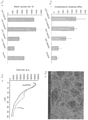
- Figure 1 shows compression modulus of collagen hydrogels (CRT-4VBC25, CRT-4VBC50, CRT-GMA25, CRT-GMA50) and Aquacel ® , as commercially available wound dressing reference.
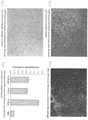
- Figure 2 shows an SEM picture of hydrogel CRT-GMA50 in hydrated conditions.
- Figure 3 shows water uptake of collagen hydrogels and Aquacel ® and
- Figure 4 shows a wide angle x-ray scattering spectra of dry collagen materials.
- Figure 4 there is shown wide-angle x-ray scattering of in-house isolated collagen from rat-tail (gray), photo-crosslinked GMA-functionalised collagen (solid black) and photo-crosslinked 4VBC-functionalised collagen (dashed back).
- Figures 5, 6 and 7 show a L929 cell morphology picture following culture on exemplarily GMA-based hydrogel extract ( Figure 5 ) and cell culture medium ( Figure 6 ); vital cells cultured in contact with the hydrogel after 24 hours ( Figure 7).
- Figure 8 shows LDH assay of cells cultured on sample extracts of GMA-based hydrogel.
Landscapes
- Health & Medical Sciences (AREA)
- Chemical & Material Sciences (AREA)
- Life Sciences & Earth Sciences (AREA)
- Medicinal Chemistry (AREA)
- Veterinary Medicine (AREA)
- Public Health (AREA)
- Epidemiology (AREA)
- Animal Behavior & Ethology (AREA)
- General Health & Medical Sciences (AREA)
- Polymers & Plastics (AREA)
- Chemical Kinetics & Catalysis (AREA)
- Organic Chemistry (AREA)
- Dermatology (AREA)
- Engineering & Computer Science (AREA)
- Materials Engineering (AREA)
- Dispersion Chemistry (AREA)
- Oral & Maxillofacial Surgery (AREA)
- Transplantation (AREA)
- Hematology (AREA)
- Biophysics (AREA)
- Biochemistry (AREA)
- Materials For Medical Uses (AREA)
- Peptides Or Proteins (AREA)
Claims (14)
- Kollagen-basiertes polymeres Material, umfassend Kollagenmoleküle und/oder von Kollagen abgeleitete Moleküle, die durch Zufügen von einem oder mehreren ethylenisch ungesättigten Anteilen funktionalisiert worden sind und die über diese Anteile vernetzt worden sind, und dadurch gekennzeichnet, dass einer oder mehrere ethylenisch ungesättigte Anteile 4-Vinylbenzylchlorid (4VBC) ist/sind.
- Kollagen-basiertes polymeres Material nach Anspruch 1, wobei das Material Kollagenmoleküle umfasst, die durch Zufügen von 4-Vinylbenzylchlorid (4VBC)-Anteilen funktionalisiert worden sind und die über diese Anteile vernetzt worden sind.
- Verfahren zum Produzieren eines Kollagen-basierten polymeren Materials, wobei das Verfahren Vernetzen von funktionalisiertem Kollagen und/oder funktionalisierten von Kollagen abgeleiteten Molekülen mit einem oder mehreren ethylenisch ungesättigten Anteilen umfasst, und dadurch gekennzeichnet, dass ein oder mehrere ethylenisch ungesättigte Anteile 4-Vinylbenzylchlorid (4VBC) ist/sind.
- Verfahren nach Anspruch 3, wobei das Verfahren die Schritte umfasst:(a) Funktionalisieren von Kollagen und/oder von Kollagen abgeleiteten Molekülen durch Zufügen von 4-Vinylbenzylchlorid (4VBC)-Anteilen; und(b) Vernetzen des funktionalisierten Kollagens und/oder der von Kollagen abgeleiteten Moleküle von (a).
- Kollagen-basierte Zusammensetzung, umfassend ein funktionalisiertes Kollagen und/oder von Kollagen abgeleitetes Molekül, wobei das Kollagen und/oder von Kollagen abgeleitete Molekül durch Zufügen von einem oder mehreren ethylenisch ungesättigten Anteilen funktionalisiert ist, und dadurch gekennzeichnet, dass ein oder mehrere ethylenisch ungesättigte Anteile 4-Vinylbenzylchlorid (4VBC) ist/sind.
- Verfahren zum Produzieren eines Kollagen-basierten polymeren Materials in Form von einer oder mehreren Fasern und/oder einem oder mehreren Filamenten und/oder einem oder mehreren Filmen, wobei das Verfahren Vernetzen von funktionalisiertem Kollagen und/oder funktionalisierten von Kollagen abgeleiteten Molekülen mit einem oder mehreren ethylenisch ungesättigten Anteilen umfasst, und dadurch gekennzeichnet, dass ein oder mehrere ethylenisch ungesättigte Anteile 4-Vinylbenzylchlorid (4VBC) ist/sind.
- Verfahren nach Anspruch 6, wobei das Verfahren die Schritte des Produzierens eines Kollagen-basierten polymeren Materials in Form von einer oder mehreren Fasern und/oder einem oder mehreren Filamenten umfasst, und wobei das Verfahren umfasst:(a) Funktionalisieren von Kollagen und/oder von Kollagen abgeleiteten Molekülen mit 4-Vinylbenzylchlorid (4VBC);(b) Kombinieren des funktionalisierten Kollagens und/oder der funktionalisierten von Kollagen abgeleiteten Moleküle mit einem PBS-Puffer; und(c) Nassverspinnen des funktionalisierten Kollagens und/oder der funktionalisierten von Kollagen abgeleiteten Moleküle; undwobei während oder nach den Schritten (b) und/oder (c) ein Photoinitiator zugegeben wird.
- Verfahren nach den Ansprüchen 6 oder 7, wobei die gebildeten Kollagenfasern und/oder -filamente einen Durchmesser zwischen 0,01 µm und 50 µm haben.
- Material, Zusammensetzung oder Verfahren nach einem der vorhergehenden Ansprüche, wobei das Material oder die Zusammensetzung funktionalisiertes Kollagen umfasst, das eine konservierte dreifache Helixstruktur aufweist.
- Material, Zusammensetzung oder Verfahren nach einem der vorhergehenden Ansprüche, wobei [4-(2-Hydroxyethoxy)phenyl-(2-hydroxy-2-propyl)keton] (Irgacure® 2959) als Photoinitiator zum Vernetzen verwendet wird.
- Material, Zusammensetzung oder Verfahren nach einem der vorhergehenden Ansprüche, wobei der Funktionalisierungsgrad des Kollagens steuerbar ist und zwischen 5 Mol.% und 100 Mol.% variabel ist.
- Material, Zusammensetzung oder Verfahren nach einem der vorhergehenden Ansprüche, wobei der Kompressionsmodul (E) des Materials zwischen 50 kPa und 300 kPa liegt und/oder wobei das Quellverhältnis des Materials größer als mindestens 100 Gew.% ist.
- Material, Zusammensetzung oder Verfahren nach einem der vorhergehenden Ansprüche, wobei die Abbauzeit des Materials länger als mindestens 3 Tage ist, und/oder wobei die Denaturierungstemperatur des Materials zwischen 60 und 90 °C liegt.
- Material, Zusammensetzung oder Verfahren nach einem der vorhergehenden Ansprüche, wobei das Material ein Hydrogel ist und/oder ein Biomaterial ist, und/oder wobei das Material sowohl vor als auch nach dem Abbau biokompatibel ist.
Applications Claiming Priority (2)
| Application Number | Priority Date | Filing Date | Title |
|---|---|---|---|
| GBGB1305281.6A GB201305281D0 (en) | 2013-03-22 | 2013-03-22 | Improvements in and relating to collagen based materials |
| PCT/GB2014/050893 WO2014147415A1 (en) | 2013-03-22 | 2014-03-21 | Improvements in and relating to collagen based materials |
Publications (2)
| Publication Number | Publication Date |
|---|---|
| EP2976112A1 EP2976112A1 (de) | 2016-01-27 |
| EP2976112B1 true EP2976112B1 (de) | 2022-02-16 |
Family
ID=48226876
Family Applications (1)
| Application Number | Title | Priority Date | Filing Date |
|---|---|---|---|
| EP14712740.1A Active EP2976112B1 (de) | 2013-03-22 | 2014-03-21 | Verbesserungen an und in zusammenhang mit kollagenhaltigen materialien |
Country Status (4)
| Country | Link |
|---|---|
| US (1) | US10046087B2 (de) |
| EP (1) | EP2976112B1 (de) |
| GB (1) | GB201305281D0 (de) |
| WO (1) | WO2014147415A1 (de) |
Families Citing this family (16)
| Publication number | Priority date | Publication date | Assignee | Title |
|---|---|---|---|---|
| CN106009011A (zh) * | 2016-06-06 | 2016-10-12 | 陕西科技大学 | 一种乙烯基改性胶原蛋白膜的制备方法 |
| CN106049055B (zh) * | 2016-06-06 | 2019-04-09 | 陕西科技大学 | 一种高吸湿透湿性海岛型超细纤维合成革基布的制备方法 |
| CN105936671A (zh) * | 2016-06-06 | 2016-09-14 | 陕西科技大学 | 一种乙烯基胶原蛋白的制备方法 |
| CN105862420B (zh) * | 2016-06-06 | 2018-04-24 | 陕西科技大学 | 一种改性海岛型超细纤维合成革基布的制备方法 |
| CA3028114A1 (en) | 2016-06-17 | 2017-12-21 | Universidad De Los Andes | Gelatin polymer derived from natural sources of cold-adapted marine species and uses thereof |
| CN107137784A (zh) * | 2017-05-08 | 2017-09-08 | 青岛大学 | 深海鱼胶原蛋白肽水凝胶 |
| CN108187130B (zh) * | 2017-09-15 | 2020-08-18 | 海宁侏罗纪生物科技有限公司 | 一种用于生物损伤修复或止血的试剂及其应用 |
| CN109553783A (zh) * | 2017-09-26 | 2019-04-02 | 中国科学院苏州纳米技术与纳米仿生研究所 | 一种光固化水凝胶及其制备方法与应用 |
| CN110818921B (zh) * | 2018-08-13 | 2022-07-12 | 中国科学院苏州纳米技术与纳米仿生研究所 | 可快速固化的双交联水凝胶及其制备方法与应用 |
| CN111359011A (zh) * | 2020-03-31 | 2020-07-03 | 东华大学 | 一种提升酰胺化反应用于制备蛋白质生物墨水的方法 |
| WO2024002806A1 (en) | 2022-07-01 | 2024-01-04 | Evonik Operations Gmbh | Photocrosslinkable recombinant bacterial collagen-like proteins |
| WO2024188844A1 (en) | 2023-03-16 | 2024-09-19 | Evonik Operations Gmbh | Functionalized recombinant bacterial collagen-like proteins |
| CN120917036A (zh) | 2023-03-16 | 2025-11-07 | 赢创运营有限公司 | 巯基化的重组细菌胶原样蛋白 |
| PL446675A1 (pl) | 2023-11-08 | 2025-05-12 | Akademia Górniczo-Hutnicza im. Stanisława Staszica w Krakowie | Sposób otrzymywania jednorodnej zawiesiny kolagenu, zastosowanie jednorodnej zawiesiny kolagenu, sposób otrzymywania hydrożelowych materiałów na bazie kolagenu, sposób otrzymywania kolagenowej folii i/lub warstwy i/lub podłoża do hodowli, sposób otrzymywania kolagenowych wydruków oraz sposoby otrzymywania porowatych kształtek kolagenowych |
| GB202413878D0 (en) | 2024-09-20 | 2024-11-06 | Univ Leeds Innovations Ltd | Polymeric materials |
| CN119455843A (zh) * | 2024-11-14 | 2025-02-18 | 西北大学 | 一种光交联制备重组胶原蛋白微球的方法 |
Family Cites Families (7)
| Publication number | Priority date | Publication date | Assignee | Title |
|---|---|---|---|---|
| YU36328B (en) * | 1973-07-18 | 1983-06-30 | Elastin Werk Ag | Method of manufacturing red foils for packing sausages |
| US5104957A (en) * | 1990-02-28 | 1992-04-14 | Autogenesis Technologies, Inc. | Biologically compatible collagenous reaction product and articles useful as medical implants produced therefrom |
| AU736784B2 (en) | 1997-06-03 | 2001-08-02 | Celltran Limited | New medicaments based on polymers composed of methacrylamide-modified gelatin |
| EP1741453A3 (de) * | 2005-07-07 | 2007-01-17 | Nipro Corporation | Collagensubstrat, dessen Herstellung und Verwendung |
| FR2920786B1 (fr) * | 2007-09-07 | 2010-09-10 | Univ Claude Bernard Lyon | Fibres creuses, notamment multi membranaires, leur procede de preparation par filage et dispositif pour la mise en oeuvre dudit procede |
| WO2010048281A1 (en) * | 2008-10-21 | 2010-04-29 | Emory University | Composite biomimetic materials |
| US8658711B2 (en) * | 2010-09-29 | 2014-02-25 | Rutgers, The State University Of New Jersey | Process for the synthesis of methacrylate-derivatized type-1 collagen and derivatives thereof |
-
2013
- 2013-03-22 GB GBGB1305281.6A patent/GB201305281D0/en not_active Ceased
-
2014
- 2014-03-21 EP EP14712740.1A patent/EP2976112B1/de active Active
- 2014-03-21 US US14/778,656 patent/US10046087B2/en active Active
- 2014-03-21 WO PCT/GB2014/050893 patent/WO2014147415A1/en not_active Ceased
Also Published As
| Publication number | Publication date |
|---|---|
| WO2014147415A1 (en) | 2014-09-25 |
| US10046087B2 (en) | 2018-08-14 |
| EP2976112A1 (de) | 2016-01-27 |
| US20160051727A1 (en) | 2016-02-25 |
| GB201305281D0 (en) | 2013-05-01 |
Similar Documents
| Publication | Publication Date | Title |
|---|---|---|
| US10046087B2 (en) | Collagen based materials | |
| Sadeghi et al. | Carboxymethyl cellulose-human hair keratin hydrogel with controlled clindamycin release as antibacterial wound dressing | |
| Hernández‐Rangel et al. | Collagen based electrospun materials for skin wounds treatment | |
| Li et al. | The preparation of hyaluronic acid grafted pullulan polymers and their use in the formation of novel biocompatible wound healing film | |
| Goodarzi et al. | Preparation and in vitro characterization of cross-linked collagen–gelatin hydrogel using EDC/NHS for corneal tissue engineering applications | |
| Kato et al. | Mechanical properties of collagen fibres: a comparison of reconstituted and rat tail tendon fibres | |
| RU2230752C2 (ru) | Поперечносшитые гиалуроновые кислоты и их применение в медицине | |
| AU773826B2 (en) | Hyaluronic acid gel composition, process for producing the same, and medical material containing the same | |
| Kirker et al. | Glycosaminoglycan hydrogel films as bio-interactive dressings for wound healing | |
| AU707022B2 (en) | Compositions containing polyanionic polysaccharides and hydrophobic bioabsorbable polymers | |
| JP4214051B2 (ja) | エラスチン架橋体およびその製造方法 | |
| Valentino et al. | Formulation development of collagen/chitosan-based porous scaffolds for skin wounds repair and regeneration | |
| CN109821061B (zh) | 一种以胶原纺丝和透明质酸为基材的粘附性仿生凝胶 | |
| JP2021027996A (ja) | ヒアルロン酸/コラーゲン系真皮充填剤組成物およびそれを作製するための方法 | |
| JP2018177818A (ja) | ヒアルロン酸/コラーゲン系真皮充填剤組成物およびそれを作製するための方法 | |
| KR101678402B1 (ko) | 창상치료용 알긴산 하이드로젤 및 그 제조방법 | |
| EP0648239A1 (de) | Biovertragliches polymerkonjugat | |
| Bao et al. | Development and characterization of a photo-cross-linked functionalized type-I collagen (Oreochromis niloticus) and polyethylene glycol diacrylate hydrogel | |
| CN106039416A (zh) | 壳聚糖—丝胶蛋白复合生物支架及其制备方法和应用 | |
| Galateanu et al. | Silk-based hydrogels for biomedical applications | |
| Marin et al. | The effect of crosslinking agents on the properties of type II collagen biomaterials | |
| CN102906109A (zh) | 化学修饰水溶性弹性蛋白、化学修饰水溶性弹性蛋白与胶原的混合凝胶以及它们的制造方法 | |
| CN117205366B (zh) | 面部填充用胶原蛋白-透明质酸复合水凝胶及其制备方法 | |
| Min et al. | Degradable and tunable keratin-fibrinogen hydrogel as controlled release system for skin tissue regeneration | |
| CN110624103A (zh) | 用于治疗皮肤异常的生物材料装置和局部组合物 |
Legal Events
| Date | Code | Title | Description |
|---|---|---|---|
| PUAI | Public reference made under article 153(3) epc to a published international application that has entered the european phase |
Free format text: ORIGINAL CODE: 0009012 |
|
| 17P | Request for examination filed |
Effective date: 20150923 |
|
| AK | Designated contracting states |
Kind code of ref document: A1 Designated state(s): AL AT BE BG CH CY CZ DE DK EE ES FI FR GB GR HR HU IE IS IT LI LT LU LV MC MK MT NL NO PL PT RO RS SE SI SK SM TR |
|
| AX | Request for extension of the european patent |
Extension state: BA ME |
|
| DAX | Request for extension of the european patent (deleted) | ||
| STAA | Information on the status of an ep patent application or granted ep patent |
Free format text: STATUS: EXAMINATION IS IN PROGRESS |
|
| 17Q | First examination report despatched |
Effective date: 20181004 |
|
| GRAP | Despatch of communication of intention to grant a patent |
Free format text: ORIGINAL CODE: EPIDOSNIGR1 |
|
| STAA | Information on the status of an ep patent application or granted ep patent |
Free format text: STATUS: GRANT OF PATENT IS INTENDED |
|
| INTG | Intention to grant announced |
Effective date: 20210309 |
|
| GRAJ | Information related to disapproval of communication of intention to grant by the applicant or resumption of examination proceedings by the epo deleted |
Free format text: ORIGINAL CODE: EPIDOSDIGR1 |
|
| STAA | Information on the status of an ep patent application or granted ep patent |
Free format text: STATUS: EXAMINATION IS IN PROGRESS |
|
| INTC | Intention to grant announced (deleted) | ||
| GRAP | Despatch of communication of intention to grant a patent |
Free format text: ORIGINAL CODE: EPIDOSNIGR1 |
|
| STAA | Information on the status of an ep patent application or granted ep patent |
Free format text: STATUS: GRANT OF PATENT IS INTENDED |
|
| INTG | Intention to grant announced |
Effective date: 20210831 |
|
| GRAS | Grant fee paid |
Free format text: ORIGINAL CODE: EPIDOSNIGR3 |
|
| GRAA | (expected) grant |
Free format text: ORIGINAL CODE: 0009210 |
|
| STAA | Information on the status of an ep patent application or granted ep patent |
Free format text: STATUS: THE PATENT HAS BEEN GRANTED |
|
| AK | Designated contracting states |
Kind code of ref document: B1 Designated state(s): AL AT BE BG CH CY CZ DE DK EE ES FI FR GB GR HR HU IE IS IT LI LT LU LV MC MK MT NL NO PL PT RO RS SE SI SK SM TR |
|
| REG | Reference to a national code |
Ref country code: GB Ref legal event code: FG4D |
|
| REG | Reference to a national code |
Ref country code: CH Ref legal event code: EP |
|
| REG | Reference to a national code |
Ref country code: DE Ref legal event code: R096 Ref document number: 602014082505 Country of ref document: DE |
|
| REG | Reference to a national code |
Ref country code: AT Ref legal event code: REF Ref document number: 1468491 Country of ref document: AT Kind code of ref document: T Effective date: 20220315 |
|
| REG | Reference to a national code |
Ref country code: IE Ref legal event code: FG4D |
|
| REG | Reference to a national code |
Ref country code: LT Ref legal event code: MG9D |
|
| REG | Reference to a national code |
Ref country code: NL Ref legal event code: MP Effective date: 20220216 |
|
| REG | Reference to a national code |
Ref country code: AT Ref legal event code: MK05 Ref document number: 1468491 Country of ref document: AT Kind code of ref document: T Effective date: 20220216 |
|
| PG25 | Lapsed in a contracting state [announced via postgrant information from national office to epo] |
Ref country code: SE Free format text: LAPSE BECAUSE OF FAILURE TO SUBMIT A TRANSLATION OF THE DESCRIPTION OR TO PAY THE FEE WITHIN THE PRESCRIBED TIME-LIMIT Effective date: 20220216 Ref country code: RS Free format text: LAPSE BECAUSE OF FAILURE TO SUBMIT A TRANSLATION OF THE DESCRIPTION OR TO PAY THE FEE WITHIN THE PRESCRIBED TIME-LIMIT Effective date: 20220216 Ref country code: PT Free format text: LAPSE BECAUSE OF FAILURE TO SUBMIT A TRANSLATION OF THE DESCRIPTION OR TO PAY THE FEE WITHIN THE PRESCRIBED TIME-LIMIT Effective date: 20220616 Ref country code: NO Free format text: LAPSE BECAUSE OF FAILURE TO SUBMIT A TRANSLATION OF THE DESCRIPTION OR TO PAY THE FEE WITHIN THE PRESCRIBED TIME-LIMIT Effective date: 20220516 Ref country code: NL Free format text: LAPSE BECAUSE OF FAILURE TO SUBMIT A TRANSLATION OF THE DESCRIPTION OR TO PAY THE FEE WITHIN THE PRESCRIBED TIME-LIMIT Effective date: 20220216 Ref country code: LT Free format text: LAPSE BECAUSE OF FAILURE TO SUBMIT A TRANSLATION OF THE DESCRIPTION OR TO PAY THE FEE WITHIN THE PRESCRIBED TIME-LIMIT Effective date: 20220216 Ref country code: HR Free format text: LAPSE BECAUSE OF FAILURE TO SUBMIT A TRANSLATION OF THE DESCRIPTION OR TO PAY THE FEE WITHIN THE PRESCRIBED TIME-LIMIT Effective date: 20220216 Ref country code: ES Free format text: LAPSE BECAUSE OF FAILURE TO SUBMIT A TRANSLATION OF THE DESCRIPTION OR TO PAY THE FEE WITHIN THE PRESCRIBED TIME-LIMIT Effective date: 20220216 Ref country code: BG Free format text: LAPSE BECAUSE OF FAILURE TO SUBMIT A TRANSLATION OF THE DESCRIPTION OR TO PAY THE FEE WITHIN THE PRESCRIBED TIME-LIMIT Effective date: 20220516 |
|
| PG25 | Lapsed in a contracting state [announced via postgrant information from national office to epo] |
Ref country code: PL Free format text: LAPSE BECAUSE OF FAILURE TO SUBMIT A TRANSLATION OF THE DESCRIPTION OR TO PAY THE FEE WITHIN THE PRESCRIBED TIME-LIMIT Effective date: 20220216 Ref country code: LV Free format text: LAPSE BECAUSE OF FAILURE TO SUBMIT A TRANSLATION OF THE DESCRIPTION OR TO PAY THE FEE WITHIN THE PRESCRIBED TIME-LIMIT Effective date: 20220216 Ref country code: GR Free format text: LAPSE BECAUSE OF FAILURE TO SUBMIT A TRANSLATION OF THE DESCRIPTION OR TO PAY THE FEE WITHIN THE PRESCRIBED TIME-LIMIT Effective date: 20220517 Ref country code: FI Free format text: LAPSE BECAUSE OF FAILURE TO SUBMIT A TRANSLATION OF THE DESCRIPTION OR TO PAY THE FEE WITHIN THE PRESCRIBED TIME-LIMIT Effective date: 20220216 Ref country code: AT Free format text: LAPSE BECAUSE OF FAILURE TO SUBMIT A TRANSLATION OF THE DESCRIPTION OR TO PAY THE FEE WITHIN THE PRESCRIBED TIME-LIMIT Effective date: 20220216 |
|
| PG25 | Lapsed in a contracting state [announced via postgrant information from national office to epo] |
Ref country code: IS Free format text: LAPSE BECAUSE OF FAILURE TO SUBMIT A TRANSLATION OF THE DESCRIPTION OR TO PAY THE FEE WITHIN THE PRESCRIBED TIME-LIMIT Effective date: 20220616 |
|
| PG25 | Lapsed in a contracting state [announced via postgrant information from national office to epo] |
Ref country code: SM Free format text: LAPSE BECAUSE OF FAILURE TO SUBMIT A TRANSLATION OF THE DESCRIPTION OR TO PAY THE FEE WITHIN THE PRESCRIBED TIME-LIMIT Effective date: 20220216 Ref country code: SK Free format text: LAPSE BECAUSE OF FAILURE TO SUBMIT A TRANSLATION OF THE DESCRIPTION OR TO PAY THE FEE WITHIN THE PRESCRIBED TIME-LIMIT Effective date: 20220216 Ref country code: RO Free format text: LAPSE BECAUSE OF FAILURE TO SUBMIT A TRANSLATION OF THE DESCRIPTION OR TO PAY THE FEE WITHIN THE PRESCRIBED TIME-LIMIT Effective date: 20220216 Ref country code: EE Free format text: LAPSE BECAUSE OF FAILURE TO SUBMIT A TRANSLATION OF THE DESCRIPTION OR TO PAY THE FEE WITHIN THE PRESCRIBED TIME-LIMIT Effective date: 20220216 Ref country code: DK Free format text: LAPSE BECAUSE OF FAILURE TO SUBMIT A TRANSLATION OF THE DESCRIPTION OR TO PAY THE FEE WITHIN THE PRESCRIBED TIME-LIMIT Effective date: 20220216 Ref country code: CZ Free format text: LAPSE BECAUSE OF FAILURE TO SUBMIT A TRANSLATION OF THE DESCRIPTION OR TO PAY THE FEE WITHIN THE PRESCRIBED TIME-LIMIT Effective date: 20220216 |
|
| REG | Reference to a national code |
Ref country code: CH Ref legal event code: PL |
|
| REG | Reference to a national code |
Ref country code: DE Ref legal event code: R097 Ref document number: 602014082505 Country of ref document: DE |
|
| PG25 | Lapsed in a contracting state [announced via postgrant information from national office to epo] |
Ref country code: MC Free format text: LAPSE BECAUSE OF FAILURE TO SUBMIT A TRANSLATION OF THE DESCRIPTION OR TO PAY THE FEE WITHIN THE PRESCRIBED TIME-LIMIT Effective date: 20220216 Ref country code: AL Free format text: LAPSE BECAUSE OF FAILURE TO SUBMIT A TRANSLATION OF THE DESCRIPTION OR TO PAY THE FEE WITHIN THE PRESCRIBED TIME-LIMIT Effective date: 20220216 |
|
| REG | Reference to a national code |
Ref country code: BE Ref legal event code: MM Effective date: 20220331 |
|
| PLBE | No opposition filed within time limit |
Free format text: ORIGINAL CODE: 0009261 |
|
| STAA | Information on the status of an ep patent application or granted ep patent |
Free format text: STATUS: NO OPPOSITION FILED WITHIN TIME LIMIT |
|
| 26N | No opposition filed |
Effective date: 20221117 |
|
| PG25 | Lapsed in a contracting state [announced via postgrant information from national office to epo] |
Ref country code: LU Free format text: LAPSE BECAUSE OF NON-PAYMENT OF DUE FEES Effective date: 20220321 Ref country code: LI Free format text: LAPSE BECAUSE OF NON-PAYMENT OF DUE FEES Effective date: 20220331 Ref country code: CH Free format text: LAPSE BECAUSE OF NON-PAYMENT OF DUE FEES Effective date: 20220331 |
|
| PG25 | Lapsed in a contracting state [announced via postgrant information from national office to epo] |
Ref country code: SI Free format text: LAPSE BECAUSE OF FAILURE TO SUBMIT A TRANSLATION OF THE DESCRIPTION OR TO PAY THE FEE WITHIN THE PRESCRIBED TIME-LIMIT Effective date: 20220216 Ref country code: BE Free format text: LAPSE BECAUSE OF NON-PAYMENT OF DUE FEES Effective date: 20220331 |
|
| P01 | Opt-out of the competence of the unified patent court (upc) registered |
Effective date: 20230426 |
|
| PG25 | Lapsed in a contracting state [announced via postgrant information from national office to epo] |
Ref country code: HU Free format text: LAPSE BECAUSE OF FAILURE TO SUBMIT A TRANSLATION OF THE DESCRIPTION OR TO PAY THE FEE WITHIN THE PRESCRIBED TIME-LIMIT; INVALID AB INITIO Effective date: 20140321 |
|
| PG25 | Lapsed in a contracting state [announced via postgrant information from national office to epo] |
Ref country code: MK Free format text: LAPSE BECAUSE OF FAILURE TO SUBMIT A TRANSLATION OF THE DESCRIPTION OR TO PAY THE FEE WITHIN THE PRESCRIBED TIME-LIMIT Effective date: 20220216 Ref country code: CY Free format text: LAPSE BECAUSE OF FAILURE TO SUBMIT A TRANSLATION OF THE DESCRIPTION OR TO PAY THE FEE WITHIN THE PRESCRIBED TIME-LIMIT Effective date: 20220216 |
|
| PG25 | Lapsed in a contracting state [announced via postgrant information from national office to epo] |
Ref country code: TR Free format text: LAPSE BECAUSE OF FAILURE TO SUBMIT A TRANSLATION OF THE DESCRIPTION OR TO PAY THE FEE WITHIN THE PRESCRIBED TIME-LIMIT Effective date: 20220216 |
|
| PG25 | Lapsed in a contracting state [announced via postgrant information from national office to epo] |
Ref country code: MT Free format text: LAPSE BECAUSE OF FAILURE TO SUBMIT A TRANSLATION OF THE DESCRIPTION OR TO PAY THE FEE WITHIN THE PRESCRIBED TIME-LIMIT Effective date: 20220216 |
|
| PGFP | Annual fee paid to national office [announced via postgrant information from national office to epo] |
Ref country code: GB Payment date: 20260217 Year of fee payment: 13 |
|
| PGFP | Annual fee paid to national office [announced via postgrant information from national office to epo] |
Ref country code: DE Payment date: 20260320 Year of fee payment: 13 Ref country code: IE Payment date: 20260323 Year of fee payment: 13 |
|
| PGFP | Annual fee paid to national office [announced via postgrant information from national office to epo] |
Ref country code: FR Payment date: 20260325 Year of fee payment: 13 |
|
| PGFP | Annual fee paid to national office [announced via postgrant information from national office to epo] |
Ref country code: IT Payment date: 20260331 Year of fee payment: 13 |