EP2968643B1 - Tonkomposite sowie deren anwendungen - Google Patents
Tonkomposite sowie deren anwendungen Download PDFInfo
- Publication number
- EP2968643B1 EP2968643B1 EP14767699.3A EP14767699A EP2968643B1 EP 2968643 B1 EP2968643 B1 EP 2968643B1 EP 14767699 A EP14767699 A EP 14767699A EP 2968643 B1 EP2968643 B1 EP 2968643B1
- Authority
- EP
- European Patent Office
- Prior art keywords
- clay
- polymer
- product
- organo
- modified clay
- Prior art date
- Legal status (The legal status is an assumption and is not a legal conclusion. Google has not performed a legal analysis and makes no representation as to the accuracy of the status listed.)
- Active
Links
Images


Classifications
-
- A—HUMAN NECESSITIES
- A61—MEDICAL OR VETERINARY SCIENCE; HYGIENE
- A61L—METHODS OR APPARATUS FOR STERILISING MATERIALS OR OBJECTS IN GENERAL; DISINFECTION, STERILISATION OR DEODORISATION OF AIR; CHEMICAL ASPECTS OF BANDAGES, DRESSINGS, ABSORBENT PADS OR SURGICAL ARTICLES; MATERIALS FOR BANDAGES, DRESSINGS, ABSORBENT PADS OR SURGICAL ARTICLES
- A61L15/00—Chemical aspects of, or use of materials for, bandages, dressings or absorbent pads
- A61L15/16—Bandages, dressings or absorbent pads for physiological fluids such as urine or blood, e.g. sanitary towels, tampons
- A61L15/18—Bandages, dressings or absorbent pads for physiological fluids such as urine or blood, e.g. sanitary towels, tampons containing inorganic materials
-
- A—HUMAN NECESSITIES
- A61—MEDICAL OR VETERINARY SCIENCE; HYGIENE
- A61L—METHODS OR APPARATUS FOR STERILISING MATERIALS OR OBJECTS IN GENERAL; DISINFECTION, STERILISATION OR DEODORISATION OF AIR; CHEMICAL ASPECTS OF BANDAGES, DRESSINGS, ABSORBENT PADS OR SURGICAL ARTICLES; MATERIALS FOR BANDAGES, DRESSINGS, ABSORBENT PADS OR SURGICAL ARTICLES
- A61L15/00—Chemical aspects of, or use of materials for, bandages, dressings or absorbent pads
- A61L15/16—Bandages, dressings or absorbent pads for physiological fluids such as urine or blood, e.g. sanitary towels, tampons
- A61L15/42—Use of materials characterised by their function or physical properties
- A61L15/44—Medicaments
-
- A—HUMAN NECESSITIES
- A61—MEDICAL OR VETERINARY SCIENCE; HYGIENE
- A61L—METHODS OR APPARATUS FOR STERILISING MATERIALS OR OBJECTS IN GENERAL; DISINFECTION, STERILISATION OR DEODORISATION OF AIR; CHEMICAL ASPECTS OF BANDAGES, DRESSINGS, ABSORBENT PADS OR SURGICAL ARTICLES; MATERIALS FOR BANDAGES, DRESSINGS, ABSORBENT PADS OR SURGICAL ARTICLES
- A61L15/00—Chemical aspects of, or use of materials for, bandages, dressings or absorbent pads
- A61L15/16—Bandages, dressings or absorbent pads for physiological fluids such as urine or blood, e.g. sanitary towels, tampons
- A61L15/42—Use of materials characterised by their function or physical properties
- A61L15/46—Deodorants or malodour counteractants, e.g. to inhibit the formation of ammonia or bacteria
-
- A—HUMAN NECESSITIES
- A61—MEDICAL OR VETERINARY SCIENCE; HYGIENE
- A61L—METHODS OR APPARATUS FOR STERILISING MATERIALS OR OBJECTS IN GENERAL; DISINFECTION, STERILISATION OR DEODORISATION OF AIR; CHEMICAL ASPECTS OF BANDAGES, DRESSINGS, ABSORBENT PADS OR SURGICAL ARTICLES; MATERIALS FOR BANDAGES, DRESSINGS, ABSORBENT PADS OR SURGICAL ARTICLES
- A61L2300/00—Biologically active materials used in bandages, wound dressings, absorbent pads or medical devices
- A61L2300/40—Biologically active materials used in bandages, wound dressings, absorbent pads or medical devices characterised by a specific therapeutic activity or mode of action
- A61L2300/402—Anaestetics, analgesics, e.g. lidocaine
-
- A—HUMAN NECESSITIES
- A61—MEDICAL OR VETERINARY SCIENCE; HYGIENE
- A61L—METHODS OR APPARATUS FOR STERILISING MATERIALS OR OBJECTS IN GENERAL; DISINFECTION, STERILISATION OR DEODORISATION OF AIR; CHEMICAL ASPECTS OF BANDAGES, DRESSINGS, ABSORBENT PADS OR SURGICAL ARTICLES; MATERIALS FOR BANDAGES, DRESSINGS, ABSORBENT PADS OR SURGICAL ARTICLES
- A61L2300/00—Biologically active materials used in bandages, wound dressings, absorbent pads or medical devices
- A61L2300/40—Biologically active materials used in bandages, wound dressings, absorbent pads or medical devices characterised by a specific therapeutic activity or mode of action
- A61L2300/404—Biocides, antimicrobial agents, antiseptic agents
Definitions
- This disclosure relates to clay composites sheets and films prepared without adding polymer additives.
- This disclosure provides methods of preparing clay composite sheets and their applications such as for antimicrobial wound dressing, and drug delivery.
- Clay is an aluminosilicate, which has a layered sheet-like structure with silica tetrahedral bonded to alumina octahedral in different ratios through Van der Waal's forces.
- Types of clay with a 2:1 ratio of tetrahedral to octahedral are known as smectite clays.
- a common type of smectite clay is Montmorillonite (MMT).
- Clays are common ingredients in pharmaceutical products. Clay minerals are naturally occurring inorganic cationic exchangers and so they can undergo ion exchange with basic drugs in solution. In addition to ion-exchange, organic molecules can bond to clays via physical adsorption and ion-dipole interactions of acidic and nonionized molecules. For example, Wai and Banker demonstrated the loading of alkaloids in montmorillonite clay.
- Montmorillonite is one of the most widely used medicinal clays. Studies have shown that MMT is non-toxic and thus has no side effects. Montmorillonite and its products have a broad spectrum of applications in medicine for cleansing and protection of skin, antibacterial activity and blood clotting capabilities. Clay can also accelerate healing in simple wounds.
- MMT has also been used in the delivery of vitamins such as thiamine hydrochloride (Vitamin B1; VB1) and pyridoxine hydrochloride (Vitamin B6; VB6) to the intestinal environment. The controlled release of VB1/VB6 was observed.
- vitamins such as thiamine hydrochloride (Vitamin B1; VB1) and pyridoxine hydrochloride (Vitamin B6; VB6)
- Clays are the most optimum materials for storage and delivery systems for drugs such as analgesics because of the mechanical and chemical stability of clay. For example, Fentanyl has been loaded into a metakaolin clay, which provided a mechanically strong sustained drug release medium.
- clay particles are dispersed in aqueous drug solutions, dispersions are allowed to equilibrate for a suitable time, and finally solid particulates are recovered and dried.
- Clay in the particulate form are not suitable for use in preparing topical wound dressing or for transdermal application of drugs because these methods require a continuous film so that drugs can diffuse without interruption from the dressing. In the case of clay particles there does not exist a continuous path for drugs to diffuse from the clay particles to wound or skin surface. Clays in the form of thin sheets are preferable for topical wound dressing and transdermal drug delivery applications.
- Clay sheets made using polymer binders which are commonly known as 'polymer-clay composites' are available in the market.
- the polymers act as a medium to disperse clay particles and to provide mechanical stability to the polymer-clay composite sheets.
- the clay nanocomposite of various polymeric materials such as polystyrene, nylon-6, polyaniline, polymethyl methacrylate (PMMA), polyurethane, polyethylene, poly (styrene-co-acrylonitrile), polyaniline, polypyrrole, polysulfone, polyacrylates, polyimide and epoxy have been investigated for a variety of applications.
- clay sheets without any polymer additives in certain applications where polymer additives can hinder or reduce the permeation of moisture, or chemicals or drugs though the clay sheets. It is also preferable to have a continuous sheet clay uninterrupted by the polymer matrix. In this way special properties of clay particles such as adsorption, permeability, high temperature stability, ion-exchange property, hemostasis property, and wound healing property can be fully utilized without being disturbed by the properties of polymer additives.
- WO 2008/152417 A2 discloses an antimicrobial polymer nanocomposite comprising an antimicrobial polymeric material and a clay to form an organoclay and dispersing the organoclay in a polymeric matrix.
- Antimicrobial silver-nylon dressing product known in the prior art prevents infection at a surgical site, enhances negative pressure therapy and help treat burns and wounds.
- These dressings have a permanently plated metallic surface. They continuously deliver a flow of silver ions into the wound, can be used for up to 7 days, do not increase the number of contaminating microbes before sterilization and do not stain.
- Another prior art product contains two layers of silver-coated polyethylene mesh, enclosing a layer of rayon and polyester.
- the silver is put on the polyethylene mesh in a vapor deposition process. This process leads to the formation of nanocrystals of the metallic silver which help fight against the various gram positive and negative bacteria.
- This product is mainly used as a barrier layer for burns and donor sites. The difference between these products and this disclosure is that these products release silver into the wounded area to fight the microbes.
- the silver ions in this disclosure are contained within the clay film.
- Burns are among the most painful and debilitating battlefield wounds faced by the US warfighter. Burn wounds turn deadly when infection sets in. Since military operations began in Iraq in March 2003, hundreds of US military personnel have sustained burn injuries from explosions and other implements of war such as lED's. Not only is acute burn injury pain a source of immense suffering, but it has been linked to debilitating chronic pain and stress-related disorders. Severe pain is felt during acute treatment and rehabilitation, especially during dressing changes, debridement's, and skin grafting, and continues through long-term follow up.
- the backbone of burn analgesia is opioid therapy, typically administered via oral or parenteral routes.
- topical analgesics can be used to protect the burn wound from infection and thereby aid in wound healing if an antimicrobial property can be imparted onto them
- NSAIDs nonsteroidal anti-inflammatory drugs
- adjuvant analgesics Treatment for reducing the pain involves the usage of common and opioid analgesics, nonsteroidal anti-inflammatory drugs (NSAIDs) and adjuvant analgesics.
- NSAIDs nonsteroidal anti-inflammatory drugs
- opioid drugs are applied locally on the skin, the main analgesic action of opioids occurs only in the spinal cord. This will require the drug to be absorbed into the blood and travel from the skin surface to the spinal cord.
- Local anesthetic creams have been used in burn wound dressings.
- Lidocaine prilocaine cream has been used as a topical anesthetic by physicians performing plastic surgery and in patients with face burn injury.
- Topical application of loperamide also reduced the pain in full-thickness burn wounds by acting on the peripheral nociceptors. Therefore, a combination of local anesthetics such as lidocaine and opioid drugs such as fentanyl may be incorporated in to the clay sheets and can be used in transdermal pain medication.
- DMC Dimethyl Carbonate
- Dimethyl carbonate is used as a substitute for toxic products such as phosgene as well as traditional methylation agents.
- Other applications include as a solvent for coatings, an octane booster in petrol, and as a component of diesel.
- DMC has shown immense promise as an electrolyte solvent for lithium battery applications due to its inherent safety and robustness. Despite the enormous promise of its industrial use, this chemical is currently entirely imported from China and Japan. Recently, South Korea has entered into the global DMC production foray.
- Other global chemical industries include EniChem (Italy), Bayer (Germany) and Catalytic Distillation Technologies (Netherlands), and to a certain extent, BASF (Germany).
- Carbon dioxide conversion to DMC is a very challenging and sensitive reaction, because of the high Carbon dioxide activation energy required to convert Carbon dioxide and methanol. Most reports concentrate on gas phase reaction and conversion of carbon dioxide to DMC with 3.5% yield.
- the disclosure provides a polymer-free organo-modified clay product which has a clay and an organic compound; the organo-modified clay product is a film as defined in claim 1.
- the disclosed organo-modified clay product is referred to as polymer-free because polymer is not added for preparation of the clay product.
- the clay is montmorillonite, kaolinite, smectite, and bentonite.
- the organic compound is betaine, betaine hydrochloride, choline chloride, 3-Benzyl-5-(2-hydroxymethyl)-4-methylthiazolium chloride, 3-Benzyl-5-(2-hydroxymethyl)-4-methylthiazolium bromide, 3-Benzyl-5-(2-hydroxymethyl)-4-methylthiazolium fluoride or 3-Benzyl-5-(2-hydroxymethyl)-4-methylthiazolium iodide.
- a thickness of the polymer-free organo-modified clay product ranges from about 1 micrometer to about 500 micrometer. In some embodiments, a thickness of the polymer-free organo-modified clay product ranges from about 1 micrometer to about 100 micrometer. In some embodiments, a thickness of the polymer-free organo-modified clay product ranges from about 20 micrometer to about 60 micrometer. In some embodiments, a thickness of the polymer-free organo-modified clay product is about 50 micrometer.
- the polymer-free organo-modified clay product achieves a bending radius of curvature ranging from about 0.4 millimeter to about 10 centimeter. The bending radius of curvature is achieved without breaking the polymer-free organo-modified clay product. In some embodiments, the polymer-free organo-modified clay product achieves a bending radius of curvature ranging from about 0.3 millimeter to about 10 millimeter. In some embodiments, the polymer-free organo-modified clay product achieves a bending radius of curvature of about 0.5 millimeter. In some embodiments, the polymer-free organo-modified clay product achieves a bending radius of curvature of about 0.4 millimeter.
- the polymer-free organo-modified clay product has greater than 50 % absorption of visible light. In some embodiments, the polymer-free organo-modified clay product is non-transparent. In some embodiments of the polymer-free organo-modified clay product, when the thickness of the product was about 50 micrometer, the film had greater than 50% absorption of visible light. In some embodiments, when the organo-modified clay product was further modified by addition of silver, the film absorbed greater than 82% of the visible light.
- the polymer-free organo-modified clay product includes an antimicrobial agent.
- the antimicrobial agent is silver ion, copper, iodine, proflavine, silver-containing compounds, copper containing compounds, quarternary ammonium compounds, or quarternary phosphonium compounds.
- Silver-containing compounds include but not limited to silver sulfadiazine, silver nitrate, silver oxide, and silver carbonate;
- copper containing compounds include but not limited to copper oxide, copper sulfate, copper acetate, and copper nitrate;
- quarternary ammonium compounds include but not limited to benzalkonium alkyl chloride, cethyl trialkyl ammonium chloride, and alkyl diemthyl benzyl ammonium chloride and quarternary phosphonium compounds include but not limited to alkyl trimethyl phosphonium chloride and dialkyl dimethyl phosphonium bromide.
- the polymer-free organo-modified clay product includes an analgesic.
- the analgesic can be opioid analgesics, nonsteroidal anti-inflammatory drugs (NSAIDs) and adjuvant analgesics, capsaicin, clonidine, ketamine, Morphine, fentanyl, Buprenorphine or cannabinoids.
- NSAIDs nonsteroidal anti-inflammatory drugs
- adjuvant analgesics capsaicin, clonidine, ketamine, Morphine, fentanyl, Buprenorphine or cannabinoids.
- Some embodiments provide an antimicrobial dressing having the polymer-free organo-modified clay product. Some embodiments provide a burn wound dressing having the polymer-free organo-modified clay product.
- Some embodiments provide a method of antimicrobial treatment by administering the polymer-free organo-modified clay product.
- Some embodiments provide a method of treating burns by administering the polymer-free organo-modified clay product.
- Some embodiments provide a method of preparing a polymer-free organo-modified clay product, the method is as defined in claims 8-11.
- the method includes mixing a clay particle and an organo-containing solution to form a slurry.
- 'Organo-containing solution' can be defined as 'an organic chemical dissolved in a solvent including but not limited to water and ethanol'.
- the slurry is cast on a substrate to obtain a slurry cast.
- the slurry cast is dried to obtain a dried product of the slurry on the substrate.
- the dried slurry product is separated from the substrate.
- the separated dried slurry product is the polymer-free organo-modified clay product.
- the polymer-free organo-modified clay product is a film.
- the substrate if the substrate is glass, then the dried slurry product has to be removed from glass substrate.
- the substrate if the substrate is fabric or nylon, the dried slurry product need not be removed from the fabric or nylon.
- the resulting dried slurry product on the fabric or nylon substrate can together form part of a wound dressing product.
- dried slurry need not be removed from a nylon or fabric substrate.
- the substrate can be a silicone sheet, a fabric, or a glass surface.
- the fabric is nylon.
- the viscosity of the slurry prepared for spreading on the substrate ranges from about 0.002 to 0.02 Pa*s (2 to 20 centipoise). In some embodiments of the method when the product is prepared at a temperature of about 25 °C, the viscosity of the slurry prepared for spreading on the substrate ranges from about 0.005 to 0.01 Pa*s (5 to 10 centipoise). In some embodiments drying the slurry casted on the substrate is performed under conditions of slow, air. In some embodiments drying the slurry casted on the substrate is performed at 20-25 degrees Centigrade under ambient, room temperature conditions.
- Some embodiments provide a method of preparing a polymer-free organo-modified clay product.
- the method includes mixing a clay particle and an organo-containing solution to form a slurry. Then the slurry is casted on a substrate to form a slurry casted on a substrate product. Then the slurry casted on the substrate is dried to obtain the polymer-free organo-modified clay product.
- the organo-modified clay product can be a film, a sheet, a mat or a membrane.
- Some embodiments, as defined in claim 8, provide a method of preparing a polymer-free organo-modified clay product having an antimicrobial agent.
- the method includes mixing a clay particle and an organo-containing solution. Then an antimicrobial agent containing solution is added to obtain a slurry.
- the slurry is casted onto a substrate.
- the casted slurry and substrate are subjected to drying and a dried slurry is obtained on the substrate.
- the dried slurry is separated from the substrate to obtain the organo-modified clay product containing the antimicrobial agent.
- Some embodiments, as defined in claim 9, provide a method of preparing a polymer-free organo-modified clay product having an analgesic.
- the method includes mixing a clay particle and an organo-containing solution. Then an analgesic containing solution is added and a slurry is obtained. The slurry is casted on a substrate and dried to obtain a dried slurry on the substrate. The dried slurry is separated from the substrate to obtain the polymer-free organo-modified clay product having the analgesic compound.
- the wound dressing has a polymer-free organo-modified clay product having an antimicrobial agent as defined in claim 1.
- the wound dressing has successive layers of the following: a hydrogel adhesive with a hydrophobic backing; a polymer-free organo-modified clay product having an antimicrobial agent; and, a nylon membrane.
- Some embodiments, as defined in claim 10, provide a method of preparing an antimicrobial wound dressing.
- the method includes successively layering the following: a hydrogel adhesive with a hydrophobic backing; a polymer-free organo-modified clay product having an antimicrobial agent; and, a nylon membrane.
- the method includes successively layering the following: a nylon membrane, then a polymer-free organo-modified clay product having an antimicrobial agent; and, then a hydrogel adhesive with a hydrophobic backing.
- an analgesic wound dressing obtained by a method according to claim 11.
- the analgesic wound dressing includes a polymer-free organo-modified clay product having an analgesic.
- the wound dressing has successive layers of the following: a hydrogel adhesive with a hydrophobic backing; a polymer-free organo-modified clay product having an analgesic and, a nylon membrane.
- Some embodiments, according to claim 11, provide a method of preparing an analgesic wound dressing.
- the method includes successively layering the following: a hydrogel adhesive with a hydrophobic backing; then a polymer-free organo-modified clay product having an analgesic and, then a nylon membrane.
- the successive layering can be as follows: nylon membrane, then then a polymer-free organo-modified clay product having an analgesic followed by a hydrogel adhesive with a hydrophobic backing.
- the disclosure relates to preparation, properties and applications of thin clay sheets.
- Montmorillonite clay has excellent adsorbent as well as particle clumping properties. Cations such as sodium, lithium, and potassium reside in the gap between these layers known as the gallery or the interlayer. The gallery allows for 3 processes to occur: hydrophobic modification, intercalation and exfoliation.
- Intercalation is when an organic component is inserted in between the gallery, causing expansion, yet still maintaining a well-defined spatial relationship between the layers. Intercalation causes the gallery to expand up to 1 to 2 angstrom. Exfoliation is a delaminating process where the gallery expands to the point where the layers completely separate from each other. This is accomplished through the adsorption of desired molecules. During exfoliation, packets of clay platelets separate from one another. Platelets at the outermost region of each packet cleave off, exposing more platelets for separation. The gallery expands up to 20 to 30 angstrom in the case of exfoliation, almost 20 times more than intercalation.
- organo-modified clay sheet made by using zwitter ions (ionic compounds containing both positive and negative ions in the same molecule) such as Betaine, Betaine hydrochloride, Choline chloride, 3-Benzyl-5-(2-hydroxymethyl)-4-methylthiazolium chloride and bromide, chloride, fluoride and iodide salts of tetraheptylammonium and cetyltrimethylammonium cations; all of them having a very high charge density to intercalate the clay layer intergallery.
- zwitter ions ionic compounds containing both positive and negative ions in the same molecule
- Solvents that can be used for making the clay and organo-modified clay may include water, alcohols, organic solvents such as toluene, dimethyl formamide, dimethyl carbonate, chloroform, and acetonitrile.
- the drying times required for formation of clay and organo-modified films ranges from about 0 to about 24 days. In some embodiments, the drying time ranges from about 1 minute to about 24 hours. In some embodiments, the drying time ranges from about 5 to about 12 hours.
- the curing can be accelerated by heating using a microwave, or Ultra Violet radiation or Infrared radiation or conventional heat source. Low humidity can also accelerate the curing.
- the disclosed teachings provide preparation of clay in the form of thin film, cut into desirable sizes.
- the disclosure provides fabrication of a clay film covered with mesh and put onto the adhesive material that serves as the base of the bandage.
- Some embodiments use clay film in a wound dressing. Some embodiments use clay film in a burn wound dressing. Some embodiments use clay film in an antimicrobial dressing for gram negative and gram positive bacteria. Some embodiments use clay film in a hemostatic dressing.
- Some embodiments use clay film as a permeable, semi-permeable and non-permeable membrane.
- Some embodiments use clay film self-extinguishing membrane and film.
- the disclosure relates to synthesis of organo-modified clay films that can be incorporated with metal and non-metallic cations and able to make small to large dimension free standing clay films and membranes upon drying.
- Organomodified clay can be exchanged with any group I (monocationic), group II (dicationic), group III (tricationic), alkali metal, alkaline earth metal or combination of groups I, II and III metal species and ions, and nano and micro sized particles form.
- Organo-modified clay can be exchanged with any transition metal, late transition metal, lanthanide metal, heavy elements in ionic and nano and micro sized particles form.
- Organo-modified clay can be exchanged with organic molecules including but not limited to pharmacological drugs, vitamins, and nutrients
- Some embodiments use clay sheets to provide controlled delivery of analgesic drugs to burn wounds while assisting in wound healing with its antimicrobial and moisture control properties.
- the disclosure provides a polymer-free organo-modified clay product.
- the organo-modified clay product has a clay and an organic compound.
- the organo-modified clay product is alternatively referred to in the disclosure as a film.
- the disclosed organo-modified clay product is referred to as polymer-free because polymer is not added for preparation of the clay product.
- the clay is montmorillonite, kaolinite, smectite, and bentonite.
- the organic compound is betaine, betaine hydrochloride, choline chloride, 3-Benzyl-5-(2-hydroxymethyl)-4-methylthiazolium chloride, 3-Benzyl-5-(2-hydroxymethyl)-4-methylthiazolium bromide, 3-Benzyl-5-(2-hydroxymethyl)-4-methylthiazolium fluoride or 3-Benzyl-5-(2-hydroxymethyl)-4-methylthiazolium iodide.
- a thickness of the polymer-free organo-modified clay product ranges from about 1 micrometer to about 500 micrometer. In some embodiments, a thickness of the polymer-free organo-modified clay product ranges from about 1 micrometer to about 100 micrometer. In some embodiments, a thickness of the polymer-free organo-modified clay product ranges from about 20 micrometer to about 60 micrometer. In some embodiments, a thickness of the polymer-free organo-modified clay product is about 50 micrometer.
- the polymer-free organo-modified clay product achieves a bending radius of curvature ranging from about 0.4 millimeter to about 10 centimeter. The bending radius of curvature is achieved without breaking the polymer-free organo-modified clay product. In some embodiments, the polymer-free organo-modified clay product achieves a bending radius of curvature ranging from about 0.3 millimeter to about 10 millimeter. In some embodiments, the polymer-free organo-modified clay product achieves a bending radius of curvature of about 0.5 millimeter. In some embodiments, the polymer-free organo-modified clay product achieves a bending radius of curvature of about 0.4 millimeter.
- the polymer-free organo-modified clay product has greater than 50 % absorption of visible light. In some embodiments, the polymer-free organo-modified clay product is non-transparent. In some embodiments of the polymer-free organo-modified clay product, when the thickness of the product was about 50 micrometer, the film had greater than 50% absorption of visible light. In some embodiments, when the organo-modified clay product was further modified by addition of silver, the film absorbed greater than 82% of the visible light.
- organo-modified clay materials stand out from the rest, as till date there is no available literature on synthesis of free-standing organo-modified or unmodified clay films that are prepared without using polymers or binders.
- Clay tends to swell when water is drawn into the interlayer space, allowing the cations to become easily exchangeable.
- an N,N,N -trimethylglycine, also known as Betaine is intercalated into the clay.
- the hydroxyl groups of clay attach to the Betaine, expanding the clay.
- the silver ions in silver nitrate exchange with the sodium cations and take their place within the interstitial space as well.
- silver ions in silver nitrate is the main driving force for eliminating the microbes.
- Silver ions tend to have antiseptic properties used for controlling burn and eye infections.
- Silver ions have the ability to disrupt the bacterial cell wall, penetrate the cell and disrupt the physiological function of cell respiration and metabolites.
- silver is a bactericidal against more than 150 species of bacteria, viruses, yeast and fungi, including MRSA, MDR, Klebsiella and Pseudomonas species.
- Water acts as an essential component in the antimicrobial bandage as well. Although most of it evaporates after the clay film is cast, some of it may remain within the clay film to provide moisture to the wound.
- Organo-modified Silver-clay film can be used as an antimicrobial wound dressing.
- the bare clay and organo-modified clay films that can be used as burn and or wound bandages with membranes and adhesive patches can also be used to stop bleeding hence can be used as a hemostatic agent or bandage against wound bleeding and healing in 0-100 minutes time interval.
- the purpose of this product is to fulfill the function of a bandage as well as kill microbes, when applied to the wound.
- the product achieves its purpose of eliminating bacteria in less than 5 min-32 hour depending on the bacterial colony size.
- the bandages can be made available in three different film sizes ranging from 0.1 cm by 0.1 cm to 100 m by 100 m sizes ( Figure 1 ). These sizes are produced to cater to small, medium or large wounds.
- the larger film products are also referred to as sheets.
- a smaller size of the film product is cut and is referred to as a mat.
- the silver clay sheet may also work effectively in eliminating other different types of microbes such as fungi or algae as well.
- Silver-clay sheets serve multiple purposes in the burn and scar healing process.
- Clay has well-known property to retain moisture and has been used as a promoter for hemostasis.
- Clay with optimal silver concentrations can reduce the cost without compromising the efficacy of the silver.
- hydrogel dressings in the treatment of hypertrophic scars. It may be due to the hydrogel dressing's ability to hydrate the damaged tissue, and allow oxygen to permeate to the surface of the skin. This will help in a localized increase in oxygen concentration leading to a down-regulation of signals that stimulate growth near the skin surface, thus preventing or reducing scar formation.
- the final product was easily contoured as a bandage (strip or roll) with a silicone-based hydrogel adhesive.
- the bandage served as a burn and wound care product, which has huge commercial market for military and civilian casualties.
- the wound dressing can be applied to numerous applications, such as burn, wound and surgical care, and also in water filtration systems and for food packaging.
- the polymer-free organo-modified clay product includes an antimicrobial agent.
- the antimicrobial agent is silver ion, copper, iodine, proflavine, silver-containing compounds, copper containing compounds, quarternary ammonium compounds, or quarternary phosphonium compounds.
- Silver-containing compounds include but not limited to silver sulfadiazine, silver nitrate, silver oxide, and silver carbonate; copper containing compounds include but not limited to copper oxide, copper sulfate, copper acetate, and copper nitrate; quarternary ammonium compounds include but not limited to benzalkonium alkyl chloride, cethyl trialkyl ammonium chloride, and alkyl diemthyl benzyl ammonium chloride and quarternary phosphonium compounds include but not limited to alkyl trimethyl phosphonium chloride and dialkyl dimethyl phosphonium bromide.
- the polymer-free organo-modified clay product includes an analgesic.
- the analgesic can be opioid analgesics, nonsteroidal anti-inflammatory drugs (NSAIDs) and adjuvant analgesics, capsaicin, clonidine, ketamine, Morphine, fentanyl, Buprenorphine or cannabinoids.
- NSAIDs nonsteroidal anti-inflammatory drugs
- adjuvant analgesics capsaicin, clonidine, ketamine, Morphine, fentanyl, Buprenorphine or cannabinoids.
- Some embodiments provide an antimicrobial dressing having the polymer-free organo-modified clay product. Some embodiments provide a burn wound dressing having the polymer-free organo-modified clay product.
- Some embodiments provide a method of antimicrobial treatment by administering the polymer-free organo-modified clay product.
- Some embodiments provide a method of treating burns by administering the polymer-free organo-modified clay product.
- Some embodiments provide a method of preparing a polymer-free organo-modified clay product.
- the method includes mixing a clay particle and an organo-containing solution to form a slurry. Then the slurry is casted on a substrate to obtain a slurry casted on a substrate. Then the slurry casted on the substrate is dried to obtain a dried product of the slurry on the substrate. Then the dried slurry product is separated from the substrate. The separated dried slurry product is the polymer-free organo-modified clay product.
- the polymer-free organo-modified clay product can be a film, a sheet, a mat or a membrane.
- the substrate if the substrate is glass, then the dried slurry product has to be removed from glass substrate.
- the substrate if the substrate is fabric or nylon, the dried slurry product need not be removed from the fabric or nylon.
- the resulting dried slurry product on the fabric or nylon substrate can together form part of a wound dressing product.
- dried slurry need not be removed from a nylon or fabric substrate.
- the substrate can be a silicone sheet, a fabric, or a glass surface.
- the fabric is nylon.
- the viscosity of the slurry prepared for spreading on the substrate ranges from about 0.002 to 0.02 Pa*s (2 to 20 centipoise). In some embodiments of the method when the product is prepared at a temperature of about 25 ?C, the viscosity of the slurry prepared for spreading on the substrate ranges from about 0.005 to 0.01 Pa*s (5 to 10 centipoise). In some embodiments drying the slurry casted on the substrate is performed under conditions of slow, air. In some embodiments drying the slurry casted on the substrate is performed at 20-25 degrees Centigrade under ambient, room temperature conditions.
- Some embodiments provide a method of preparing a polymer-free organo-modified clay product.
- the method includes mixing a clay particle and an organo-containing solution to form a slurry. Then the slurry is casted on a substrate to form a slurry casted on a substrate product. Then the slurry casted on the substrate is dried to obtain the polymer-free organo-modified clay product.
- the organo-modified clay product can be a film, a sheet, a mat or a membrane.
- Some embodiments provide a method of preparing a polymer-free organo-modified clay product having an antimicrobial agent.
- the method includes mixing a clay particle and an organo-containing solution. Then an antimicrobial agent containing solution is added to obtain a slurry.
- the slurry is casted onto a substrate.
- the casted slurry and substrate are subjected to drying and a dried slurry is obtained on the substrate.
- the dried slurry is separated from the substrate to obtain the organo-modified clay product containing the antimicrobial agent.
- Some embodiments provide a method of preparing a polymer-free organo-modified clay product having an analgesic.
- the method includes mixing a clay particle and an organo-containing solution. Then an analgesic containing solution is added and a slurry is obtained. The slurry is casted on a substrate and dried to obtain a dried slurry on the substrate. The dried slurry is separated from the substrate to obtain the polymer-free organo-modified clay product having the analgesic compound.
- the wound dressing has a polymer-free organo-modified clay product having an antimicrobial agent.
- the wound dressing has successive layers of the following: a hydrogel adhesive with a hydrophobic backing; a polymer-free organo-modified clay product having an antimicrobial agent; and, a nylon membrane.
- Some embodiments provide a method of preparing an antimicrobial wound dressing.
- the method includes successively layering the following: a hydrogel adhesive with a hydrophobic backing; a polymer-free organo-modified clay product having an antimicrobial agent; and, a nylon membrane.
- the method includes successively layering the following: a nylon membrane, then a polymer-free organo-modified clay product having an antimicrobial agent; and, then a hydrogel adhesive with a hydrophobic backing.
- an analgesic wound dressing includes a polymer-free organo-modified clay product having an analgesic.
- the wound dressing has successive layers of the following: a hydrogel adhesive with a hydrophobic backing; a polymer-free organo-modified clay product having an analgesic and, a nylon membrane.
- Some embodiments provide a transdermal wound dressing.
- Some embodiments provide a method of preparing a transdermal wound dressing.
- Some embodiments provide a method of preparing an analgesic wound dressing.
- the method includes successively layering the following: a hydrogel adhesive with a hydrophobic backing; then a polymer-free organo-modified clay product having an analgesic and, then a nylon membrane.
- the successive layering can be as follows: nylon membrane, then then a polymer-free organo-modified clay product having an analgesic followed by a hydrogel adhesive with a hydrophobic backing.
- Viscosity measurement of the clay slurry was performed to determine the viscosity required to optimize the flow ability of the clay slurry for the fabrication of clay sheets. Viscosity is the quantity that describes a fluid's resistance to flow and is heavily dependent on temperature.
- the viscosity of the slurry prepared in the example 1 was measured using a Brookfield DV-II + Pro Viscometer (Brookfield Instrument Laboratories Inc., Middleboro, MA) using a #42 spindle at 25-200 RPM speed. The measurement is carried out at temperatures of 23-25 degree C.
- Table 1 viscosity of betaine-clay slurry as a function of spindle speed is provided.
- Table 1 Speed (rpm) Viscosity (cP) 25 7.94 50 5.95 75 3.97 100 3.97 125 3.18 150 2.65 175 2.27 200 2.48
- the viscosity measurements showed that the consistency of the clay mixture before it was cast was similar to that of milk (about 8 cP at 25 degree C).
- the viscosity of the slurry ranging from about 2 centipoise to 20 centipoise depending on the concentration of the clay in the mixture, yielded highly flowable slurry to form uniformly thick and mechanically durable clay sheets.
- Casting of clay on nylon fabric provided additional benefits compared to dry-casting of the clay alone.
- the added benefit was to shape and cut, or to even stitch pieces together gave us the option to create new shapes that might be needed with odd-shaped injuries located on areas such as the hands or feet.
- the first batch of the organo-clay film turned out to be very thick and did not flow smoothly onto the glass after it was cast.
- the film after drying, felt very thick as well and since it didn't homogenize well, clumps could be observed.
- the film had a light shade of gray, unlike the dark gray or black that was expected.
- the film had many uneven areas, with some parts being very thin and some parts being very thick. It was easy to peel off the parts that were considerably thick.
- the reason for the clay film mixture being so thick was thought to be due to the fact that silver nitrate was added before the Betaine.
- the first batch was discarded because of all the problems mentioned above and a new batch was made with a modification in the procedure, which was the addition of Betaine before the silver. The purpose for this is so that the Betaine can intercalate within the interlayer first and then the silver can exchange with the cations, primarily sodium.
- the second batch turned out to be much smoother and flowed easily (similar to milk) onto the glass. There were no areas that were thinner or thicker than the rest.
- the color of the mixture as it was being cast was a peachy brown and the mixture spread on the glass by itself, as it was being poured.
- the film was observed to be black in color towards the outside and lighter gray towards the inside. Since the film was appropriately thin, it was a bit difficult to initially start peeling it off from the glass but then it slid off easily. Circular rings of black and gray were also found on the film. These rings were observed on the other batches as well.
- the gray area is restricted in the middle unlike, where a lot more gray is observed. Also there is no brownish area in the middle either. Although a couple of rings can be observed, they are less in number compared to previous films.
- Thickness of the clay sheet prepared according to the Example 1 was measured using a micrometer. The average thickness obtained from the clay product samples was about 50 micrometer.
- the optical absorption spectra of clay films was measured on a Beckman DU 530 UV-VIS Spectrophotometer using fixed wavelength (600nm) mode.
- the percentage absorption of 600 nm wavelength light by the clay film having a thickness of about 50 micrometer was 56%.
- the percentage absorption by silver-clay film having a thickness of about 50 micrometer was 82%.
- the flexibility of the clay films was determined by measuring the maximum bending angle and the corresponding radius of curvature before breaking of the product.
- the bending angle was measured by mounting a rectangular clay specimen of size 2 inch by 2 inch and 50 micrometer thickness on a Mitutoyo No. 180-301B protractor head mounted to a Mitutoyo No. 180-703 steel rule.
- the measured angle of bending at the break of the clay sample was 36 degree.
- the radius of curvature derived from the bend angle at the break of the sample was about 0.5 mm.
- Figure 1C provides a photograph of the clay film rolled up to show its flexibility.
- the bending angle at the break of a rectangular silver-clay specimen of size 2 inch by 2 inch and 30 micrometer thickness of the clay sample was 30 degree.
- the radius of curvature derived from the bend angle at break of the sample was about 0.4 mm.
- the efficacy of silver ion-exchanged clay sheet was tested using the antibacterial susceptibility test, (agar diffusion test) which utilizes the size and presence of the zone of inhibition to measure antimicrobial effectiveness.
- the testing process was carried out by spreading a thin layer of bacteria, grown in a growth medium, over the agar and then placing the circular cutouts of the clay film on top. The purpose was to determine the zone of bacterial growth inhibition around the pieces of film.
- Typical gram negative and gram positive bacteria for a single test were Escherichia coli, Staphylococcus epidermidis, Staphylococcus aureus and Bacillus subtilis. Unmodified Clay sheets were used as control samples along with silver ion-exchanged clay sheets in the antimicrobial tests.
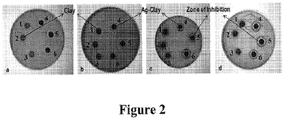
- Photographs showing the zone of inhibition for all 4 types of bacteria by Silver organo-modified clay film disks (labeled as 4, 5 and 6 in Figure 2 ) along with control pristine clay film discs (labeled as 1, 2 and 3 in the Figure 2 ) are provided in Figure 2 .
- the smallest zone was for B. subtilis and the largest was for S. epidermidis.
- gram-positive bacteria are easier to kill and since S. epidermidis is a gram-positive bacterium, it could explain why the zone of inhibition for it is larger within the incubated time period (48 hours).
- the unmodified betaine-clay sheet control specimens did not exhibit a zone of bacterial growth inhibition.
- the homogenizer was then used to create a uniform viscosity throughout the mixture. It was used until lumps of clay were no longer visibly settled at the bottom.
- the mixture was allowed to sit for 24 hours.
- the homogenizer was then used to create a uniform viscosity throughout the mixture. It was used until lumps of clay were no longer visibly settled at the bottom.
- the mixture was allowed to sit for 24 hours.
- Nylon fabric was cut into a smaller segment that was large enough to tightly wrap around a glass-casting sheet. Tape was used on the back to securely fasten the fabric onto the glass sheet.
- Nylon clay film was then rolled on to a dowel.
- This experiment was to test the efficacy of anti- bacterial Nylon fabric samples from 0.4wt% silver slurry, nylon fabric samples from 0.5wt% silver slurry and untreated nylon fabric was used as a control.
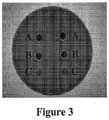
- Bacillis subtilis was the bacteria type used for testing; pre-made 1mL of growth media was dropped onto hardened agar using a micro pipette. The bacterium was then spread evenly in the Petri-dish upon the agar using a UV-sterilized rubber policeman.
- Zones of Inhibition can be clearly noted by the distinctive halo-like effect around the Silver Clay Nylon punch outs, both on the 0.4 wt% silver (labeled as A in the Figure 3 ) and 0.5wt% silver (labeled as B in the Figure 3 ) t concentrations. There was no zone of inhibition observed for control uncoated-nylon fabric sample (labeled as C in the Figure 3 ).
- WVTR values were measured to determine the moisture retention ability of the Nylon-Cast silver clay sheet.
- the moisture permeability of the silver clay sheet was determined by measuring the water vapor transmission rate (WVTR) across the material as stipulated by a modified ASTM standard method E96.
- the test involved mounting a disc of the test material in a specially designed vial containing water. The material was positioned across the opening of the cup, in a desiccator at 35 degree C and with relative humidity maintained at 15 to 20 percent. The weight of the water filled vial with the test material was measured at hourly intervals to calculate the amount of water loss per hour.
- Dressings with WVTR values less than 35 g per square meter per hour can be defined as moisture retentive.
- Typical WVTR values observed for silver organo-modified clay sheets were 16 to 36 g per square meter per hour depending on the thickness and amount of silver present in the clay sheet.
- a prototype burn bandage was developed by successive layering of (a) Nylon membrane (b) silver clay sheets and (c) hydrogel adhesive. Typical Dimensions were as follows. Silver clay sheet: 1.5 inch by 2.4 inch; Delnet Membrane: 2 inch by 3 inch; Hydrogel sheet: 3 inch by 4 inch; Cover slip: either cut to the size of the hydrogel or cut to 3 inch by 5.5 inch.
- Schematic diagram of the antimicrobial burn wound dressing is provided in Figure 3 .
- the nylon membrane serves as a porous membrane to control moisture flow to the organo-modified silver clay film, while at the same keeping the film and place and preventing particles from the film breaking off into the wound.
- Clay sheet acted as a moderator layer between the wound surface and hydrogel.
- the hydrogel bandage provided both adhesive to hold the bandage in place and a soothing cooling sensation beneficial for burn care.
- the hydrogel was also a water reservoir to keep the wound surface moist.
- the multilayer wound dressing was packaged in heat-sealable foil pouches.
- the final product was easily contoured as a bandage (strip or roll) with a silicone-based hydrogel adhesive.
- Silver clay sheet antimicrobial wound dressing was evaluated using animal burn wound models.
- Wound dressing was prepared as in Example 13. Two Buffalo cross pigs were randomized to three treatment protocols after full thickness burns were created. Contact burns were created paravertebral under aseptic conditions. A Rhinhart Electric Dehorner was heated to a maximum temperature of 1,000 degree F and was placed on the dorsum of the animal until the proper depth of 1 cm was reached (typically 10 seconds). A total of six burn sites, each 11 square centimeter was created on the dorsum of the animal with 4-5 cm between each site.
- the wound received three treatment protocols, namely Gauze, silvadine cream and silver clay sheet dressing.
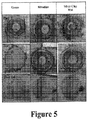
- Silver clay wound dressing was prepared as described in the Example 13. Dressings were changed 3 times a week for the first 14 days for the gauze and silvadine cream treatments. The silver clay sheet dressing was changed only every 7 days. Photographs showing the wound healing progress is provided in Figure 5 .
- Silver clay sheet (or mat) dressing required less daily care and dressing changes as compared to the other two treatments unmedicated gauze and silvadine cream for the first 10 days. Time to full granulation for each group was 14 days.
- silver clay sheet dressing demonstrated similar healing activity with that of Silvadene® cream, albeit with significantly less wound care and number of dressing changes.
- clay sheets as transdermal delivery patches were evaluated by measuring the uptake and release of organic dyes by the clay sheets.
- a clay sheet similar to the one described in the Example 1 as dipped in methylene blue dye solution in water.
- 10 g sodium-exchanged montmorillonite clay (PGW) clay, 190 g deionized water and 1.7 g anhydrous Betaine were added in a bottle and left to stir for 24 h.
- the slurry was casted onto a silicone sheet. After drying the clay sheet was easily peeled off from the tray surface. Then a 2 inch by 2 inch sheet was cut from the dried clay sheet and dipped in methylene blue dye solution in water. After 5 minutes the clay sheet was taken out of the methylene blue solution.
- the color of the clay sheet turned from yellowish brown to dark blue due to the uptake of the organic dye.
- organic chemicals such as drugs could be loaded onto a clay sheet and used as transdermal patches for drug delivery. After 5 minutes the clay sheet was taken out of the methylene blue solution. The color of the clay sheet turned from yellowish brown to dark blue due to the uptake of the organic dye. This change in color was similar to loading of drugs to a patch.
- the dye loaded-clay sheet was then placed in a phosphate buffer solution. The dye was slowly released into the solution with the clay sheet intact. This experiment showed that the clay sheets could be used in preparing a drug delivery patch.
- Clay sheets as prepared in the Example 1 were used as fire-resistant sheet. Clay sheet are a safe-alternative to asbestos because clay sheet are inorganic materials similar to asbestos but without the harmful side effects.
- clay sheets as a membrane for separating organic molecule from a mixture
- Clay sheet produced as in the example 1 were tested for use as a membrane for separation technologies, such as Dimethyl carbonate-Methanol-water under ambient conditions.
- Betaine-Clay membrane submerged in DMC per Methanol per Water Solution 30 mL Dimethyl Carbonate, 60 mL Methanol and 5 mL of distilled water were mixed together in a 500 mL beaker. 3 such mixtures were in separate beakers
Landscapes
- Health & Medical Sciences (AREA)
- Chemical & Material Sciences (AREA)
- Life Sciences & Earth Sciences (AREA)
- Engineering & Computer Science (AREA)
- Materials Engineering (AREA)
- Epidemiology (AREA)
- Hematology (AREA)
- Animal Behavior & Ethology (AREA)
- General Health & Medical Sciences (AREA)
- Public Health (AREA)
- Veterinary Medicine (AREA)
- Inorganic Chemistry (AREA)
- Medicinal Preparation (AREA)
- Materials For Medical Uses (AREA)
- Pharmaceuticals Containing Other Organic And Inorganic Compounds (AREA)
Claims (11)
- Polymerfreies, organomodifiziertes Tonprodukt, umfassend einen Ton, eine organische Verbindung ausgewählt aus der Gruppe bestehend aus Betain, Betainhydrochlorid, Cholinchlorid, 3-Benzyl-5-(2-hydroxymethyl)-4-methylthiazoliumchlorid, 3-Benzyl-5-(2-hydroxymethyl)-4-methylthiazoliumbromide, 3-Benzyl-5-(2-hydroxymethyl)-4-methylthiazoliumfluorid und 3-Benzyl-5-(2-hydroxymethyl)-4-methylthiazoliumiodid und ein antimikrobielles Mittel ausgewählt aus der Gruppe bestehend aus Silberion, Kupfer, Iod, Proflavin, silberhaltigen Verbindungen, kupferhaltigen Verbindungen, quartären Ammoniumverbindungen und quartären Phosphoniumverbindungen, wobei das polymerfreie, organomodifizierte Tonprodukt ein Film ist.
- Polymerfreies, organomodifiziertes Tonprodukt nach Anspruch 1, wobei der Ton aus der Gruppe ausgewählt ist bestehend aus Montmorillonit, Kaolinit, Smektit und Bentonit.
- Polymerfreies, organomodifiziertes Tonprodukt nach Anspruch 1, wobei eine Dicke des polymerfreien, organomodifizierten Tonprodukts in einem Bereich von 1 Mikrometer bis 500 Mikrometern liegt.
- Polymerfreies, organomodifiziertes Tonprodukt nach Anspruch 1, ferner ein schmerzlinderndes Mittel umfassend.
- Polymerfreies, organomodifiziertes Tonprodukt nach Anspruch 4, wobei das schmerzlindernde Mittel aus der Gruppe ausgewählt ist bestehend aus schmerzlindernden Opioidmitteln, nichtsteroidalen entzündungshemmenden Arzneimitteln (NSAID) und wirkungsverstärkenden schmerzlindernden Mitteln, Capsaicin, Clonidin, Ketamin, Morphium, Fentanyl, Buprenorphin und Cannabinoiden.
- Antimikrobieller Verband umfassend das polymerfreie, organomodifizierte Tonprodukt nach Anspruch 1.
- Verband für Verbrennungswunden umfassend das polymerfreie, organomodifizierte Tonprodukt nach einem der Ansprüche 1 und 4.
- Verfahren für die Herstellung eines polymerfreien, organomodifizierten Tonprodukts, umfassend ein antimikrobielles Mittel, wobei das Verfahren Folgendes umfasst:(a) Mischen eines Tonteilchens und einer organohaltigen Lösung;(b) Zusetzen eines antimikrobiellen Mittels, das eine Lösung enthält, zu dem Produkt aus Schritt (a), um eine Aufschlämmung zu erhalten;(c) Gießen der Aufschlämmung aus Schritt (b) auf ein Substrat;(d) Trocknen des Produkts aus Schritt (c), um eine getrocknete Aufschlämmung auf dem Substrat aus Schritt (c) zu erhalten;(e) Trennen der getrockneten Aufschlämmung aus Schritt (d) von dem Substrat, um das organomodifizierte Tonprodukt zu erhalten, das das antimikrobielle Mittel enthält.
- Verfahren für die Herstellung eines polymerfreien, organomodifizierten Tonprodukts, umfassend ein schmerzlinderndes Mittel, wobei das Verfahren Folgendes umfasst:(a) Mischen eines Tonteilchens und einer organohaltigen Lösung;(b) Zusetzen eines schmerzlindernden Mittels zu dem Produkt aus Schritt (a) um eine Aufschlämmung zu erhalten;(c) Gießen der Aufschlämmung aus Schritt (b) auf ein Substrat;(d) Trocknen des Produkts aus Schritt (c), um eine getrocknete Aufschlämmung auf dem Substrat zu erhalten;(e) Trennen der getrockneten Aufschlämmung aus Schritt (d) von dem Substrat, um das polymerfreie, organomodifizierte Tonprodukt zu erhalten, das die schmerzlindernde Verbindung enthält.
- Verfahren für die Herstellung eines antimikrobiellen Wundverbands, umfassend ein polymerfreies, organomodifiziertes Tonprodukt, das ein antimikrobielles Mittel aufweist, wobei das Verfahren das aufeinanderfolgende schichtförmige Aufbringen Folgender umfasst:(a) eines Hydrogelklebstoffs mit einer hydrophoben Rückschicht;(b) eines polymerfreien, organomodifizierten Tonprodukts, das ein antimikrobielles Mittel aufweist; und(c) einer Nylonmembran,wobei der antimikrobielle Wundverband erhalten wird.
- Verfahren für die Herstellung eines schmerzstillenden Wundverbands, umfassend das polymerfreie, organomodifizierte Tonprodukt, das ein schmerzlinderndes Mittel aufweist, wobei das Verfahren das aufeinanderfolgende schichtförmige Aufbringen Folgender umfasst:(a) eines Hydrogelklebstoffs mit einer hydrophoben Rückschicht;(b) eines polymerfreien, organomodifizierten Tonprodukts, das ein schmerzlinderndes Mittel aufweist; und(c) einer Nylonmembran,wobei der schmerzlindernde Wundverband erhalten wird.
Applications Claiming Priority (3)
| Application Number | Priority Date | Filing Date | Title |
|---|---|---|---|
| US201361794420P | 2013-03-15 | 2013-03-15 | |
| US14/210,082 US10046079B2 (en) | 2013-03-15 | 2014-03-13 | Clay composites and their applications |
| PCT/US2014/027388 WO2014152481A1 (en) | 2013-03-15 | 2014-03-14 | Clay composites and their applications |
Publications (3)
| Publication Number | Publication Date |
|---|---|
| EP2968643A1 EP2968643A1 (de) | 2016-01-20 |
| EP2968643A4 EP2968643A4 (de) | 2016-12-07 |
| EP2968643B1 true EP2968643B1 (de) | 2018-09-05 |
Family
ID=51530740
Family Applications (1)
| Application Number | Title | Priority Date | Filing Date |
|---|---|---|---|
| EP14767699.3A Active EP2968643B1 (de) | 2013-03-15 | 2014-03-14 | Tonkomposite sowie deren anwendungen |
Country Status (5)
| Country | Link |
|---|---|
| US (1) | US10046079B2 (de) |
| EP (1) | EP2968643B1 (de) |
| AU (1) | AU2014239628A1 (de) |
| CA (1) | CA2906799A1 (de) |
| WO (1) | WO2014152481A1 (de) |
Families Citing this family (11)
| Publication number | Priority date | Publication date | Assignee | Title |
|---|---|---|---|---|
| US10272172B2 (en) * | 2013-03-15 | 2019-04-30 | Materials Modification Inc | Multifunctional transdermal dressing for wounds |
| CA3007747A1 (en) * | 2015-11-10 | 2017-05-18 | Materials Modification Inc. | Multifunctional transdermal dressing for wounds |
| JP6836885B2 (ja) * | 2016-11-21 | 2021-03-03 | クニミネ工業株式会社 | モンモリロナイトスラリー、粘土膜およびモンモリロナイトスラリーの製造方法 |
| CN110534742B (zh) * | 2019-07-16 | 2021-05-28 | 江汉大学 | 一种锂硫电池正极复合材料的制备方法 |
| CA3150161A1 (en) | 2019-08-13 | 2021-02-18 | Darlene E. MCCORD | Non-activated, amorphous, ph neutral, two-part bedside-ready clay delivery system that treats pathogen infections in humans and animals |
| WO2022173660A1 (en) * | 2021-02-10 | 2022-08-18 | Corning Incorporated | Antimicrobial composite film and method for making the same |
| WO2023076855A1 (en) | 2021-10-25 | 2023-05-04 | Mccord Darlene E | Coated medicinal clay compositions, pharmaceutical compositions, and delivery of cation sources and methods of use thereof |
| KR102907544B1 (ko) * | 2022-05-19 | 2026-01-02 | 한양대학교 에리카산학협력단 | 습도 감응형 작동기, 이를 포함하는 습도센서 및 전기스위치 |
| CN116139322B (zh) * | 2023-04-07 | 2024-08-16 | 南通大学 | 一种创面敷料及其制备方法 |
| US20240359143A1 (en) * | 2023-04-27 | 2024-10-31 | University Of Central Florida Research Foundation, Inc. | Zwitterion-promoted hybrid 2d silicate-based membranes for energy applications |
| CN116874058B (zh) * | 2023-09-07 | 2023-12-15 | 杭州尚善若水环保科技有限公司 | 一种混合药剂及其制备方法与用途 |
Family Cites Families (46)
| Publication number | Priority date | Publication date | Assignee | Title |
|---|---|---|---|---|
| US3761590A (en) | 1970-05-18 | 1973-09-25 | Research Corp | Silver sulfadiazine used in the treatment of burns |
| US4020150A (en) | 1973-11-14 | 1977-04-26 | Michael Ebert | Administration of silver sulfadiazine and radioactive derivatives thereof |
| JPS5729213B2 (de) | 1974-11-12 | 1982-06-21 | ||
| US4049802A (en) | 1975-03-19 | 1977-09-20 | Research Corporation | Zinc sulfadiazine and its use in the treatment of burns |
| US4088754A (en) | 1976-03-02 | 1978-05-09 | Research Corporation | Water-soluble cerium (cerous) salts in burn therapy |
| US4078058A (en) | 1976-07-13 | 1978-03-07 | Research Corporation | Cerium sulfadiazine for treating burns |
| US4393048A (en) | 1980-02-15 | 1983-07-12 | The United States Of America As Represented By The Secretary Of The Army | Protective gel composition for wounds |
| US4384117A (en) | 1980-03-18 | 1983-05-17 | The United States Of America As Represented By The Secretary Of The Army | Silver metachloridine |
| US4404197A (en) | 1981-05-15 | 1983-09-13 | Fox Jr Charles L | Antimicrobial compositions containing 1-ethyl-6-fluoro-1,4-dihydro-4-dihydro-4-oxo-7-(1-piperazinyl)-3-quinoline carboxylic acid or metal salts thereof and silver sulfadiazine |
| US4551139A (en) | 1982-02-08 | 1985-11-05 | Marion Laboratories, Inc. | Method and apparatus for burn wound treatment |
| US4446124A (en) | 1983-03-31 | 1984-05-01 | Fox Jr Charles L | Wound dressing comprising silver sulfadiazine incorporated in animal tissue |
| US4599226A (en) | 1983-03-31 | 1986-07-08 | Genetic Laboratories, Inc. | Wound dressing comprising silver sulfadiazine incorporated in animal tissue and method of preparation |
| US4559223A (en) | 1983-05-20 | 1985-12-17 | Daltex Medical Sciences, Inc. | Silver sulfadiazine and/or zinc sulfadiazine-containing toothpaste or oral medicament |
| US4581028A (en) | 1984-04-30 | 1986-04-08 | The Trustees Of Columbia University In The City Of New York | Infection-resistant materials and method of making same through use of sulfonamides |
| US5334588A (en) | 1987-02-25 | 1994-08-02 | The Trustees Of Columbia University In The City Of New York | Composition for inhibiting transmission of hepatitis B virus |
| US4952411A (en) | 1987-02-25 | 1990-08-28 | Trustees Of Columbia University In The City Of New York | Method of inhibiting the transmission of AIDS virus |
| US5143717A (en) | 1987-12-30 | 1992-09-01 | Code Blue Medical Corporation | Burn foam and delivery system |
| US4769078A (en) * | 1988-03-07 | 1988-09-06 | United Catalysts, Inc. | Organophilic clay modified with betaine type compounds |
| US5374432A (en) | 1989-07-28 | 1994-12-20 | The Trustees Of Columbia University Of The City Of New York | Topical anti-infective ointment containing silver or silver salts and antibiotics |
| US5330980A (en) | 1992-08-25 | 1994-07-19 | Shin Jae S | Medicament for the topical treatment of skin |
| EP0604103B1 (de) | 1992-12-15 | 1999-03-17 | JOHNSON & JOHNSON CONSUMER PRODUCTS, INC. | Hydrogellaminat, Wundverbände und Verbundmaterialien und Verfahren zu deren Herstellung |
| WO1994020074A1 (en) | 1993-03-12 | 1994-09-15 | The Procter & Gamble Company | Adsorbate compositions |
| US5653994A (en) | 1993-10-25 | 1997-08-05 | Schneider; Norman S. | Composition and methods for treating burns and other trauma of the skin |
| WO1997002038A1 (en) | 1995-06-30 | 1997-01-23 | Capelli Christopher C | Silver-based pharmaceutical compositions |
| CN1062129C (zh) | 1995-09-14 | 2001-02-21 | 徐荣祥 | 药物基质及其用途 |
| US5753269A (en) | 1995-12-27 | 1998-05-19 | Bayer Corporation | Otic microbial combinations |
| US6015816A (en) | 1996-02-29 | 2000-01-18 | The Research Foundation Of State University Of New York | Antimicrobial compositions |
| US6093414A (en) | 1997-08-11 | 2000-07-25 | Christopher C. Capelli | Silver-based antimicrobial compositions |
| US5785972A (en) | 1997-01-10 | 1998-07-28 | Tyler; Kathleen A. | Colloidal silver, honey, and helichrysum oil antiseptic composition and method of application |
| AU7484198A (en) | 1997-05-12 | 1998-12-08 | Sage Pharmaceuticals, Inc. | Topical spray for burn treatment and anti-infection |
| US6716895B1 (en) | 1999-12-15 | 2004-04-06 | C.R. Bard, Inc. | Polymer compositions containing colloids of silver salts |
| US7179849B2 (en) | 1999-12-15 | 2007-02-20 | C. R. Bard, Inc. | Antimicrobial compositions containing colloids of oligodynamic metals |
| KR100452972B1 (ko) * | 2000-05-16 | 2004-10-14 | 주식회사 삼양사 | 경피투여용 하이드로젤 조성물 |
| KR20030033076A (ko) | 2000-09-25 | 2003-04-26 | 바이엘 코포레이션 | 고막이 파열된 동물을 치료하기 위한 귀용 미생물 배합물 |
| WO2003047636A2 (en) | 2001-12-03 | 2003-06-12 | C.R. Bard, Inc. | Microbe-resistant medical device, microbe-resistant polymeric coating and methods for producing same |
| US7285576B2 (en) | 2003-03-12 | 2007-10-23 | 3M Innovative Properties Co. | Absorbent polymer compositions, medical articles, and methods |
| US7745509B2 (en) | 2003-12-05 | 2010-06-29 | 3M Innovative Properties Company | Polymer compositions with bioactive agent, medical articles, and methods |
| EP1747723A1 (de) | 2005-07-29 | 2007-01-31 | Southwest Jiaotong University | Anorganischer antimikrobieller Wirkstoff enthaltend Zinkoxid und Silberionen im Kristallgitter des Zinkoxids und Verfahren zu dessen Herstellung |
| US20070166399A1 (en) | 2006-01-13 | 2007-07-19 | 3M Innovative Properties Company | Silver-containing antimicrobial articles and methods of manufacture |
| US7520923B2 (en) | 2007-03-22 | 2009-04-21 | Mvp Textiles & Apparel, Inc. | Antimicrobial filtration article |
| GB2450475A (en) * | 2007-06-12 | 2008-12-31 | Univ Nottingham Trent | Antimicrobial polymer nanocomposite |
| US8206814B2 (en) | 2008-02-11 | 2012-06-26 | National Institute Of Advanced Industrial Science And Technology | Film made from denatured clay |
| US8343403B2 (en) | 2008-07-16 | 2013-01-01 | The United States Of America As Represented By The Administrator Of The National Aeronautics And Space Administration | Method for making a microporous membrane |
| JP5327318B2 (ja) | 2009-05-15 | 2013-10-30 | 東亞合成株式会社 | 銀系無機抗菌剤およびその製造方法 |
| WO2011125244A1 (ja) | 2010-04-09 | 2011-10-13 | 三菱マテリアル株式会社 | 焼結体形成用の粘土状組成物、焼結体形成用の粘土状組成物用粉末、焼結体形成用の粘土状組成物の製造方法、銀焼結体及び銀焼結体の製造方法 |
| EP2663582B1 (de) | 2011-01-13 | 2018-07-11 | Austin Research Labs Corp. | Dispersionen mit hoher beladung zur behandlung von infektionen |
-
2014
- 2014-03-13 US US14/210,082 patent/US10046079B2/en active Active
- 2014-03-14 EP EP14767699.3A patent/EP2968643B1/de active Active
- 2014-03-14 AU AU2014239628A patent/AU2014239628A1/en not_active Abandoned
- 2014-03-14 WO PCT/US2014/027388 patent/WO2014152481A1/en not_active Ceased
- 2014-03-14 CA CA2906799A patent/CA2906799A1/en not_active Abandoned
Non-Patent Citations (1)
| Title |
|---|
| None * |
Also Published As
| Publication number | Publication date |
|---|---|
| CA2906799A1 (en) | 2014-09-25 |
| US10046079B2 (en) | 2018-08-14 |
| WO2014152481A1 (en) | 2014-09-25 |
| AU2014239628A1 (en) | 2015-10-15 |
| US20140276484A1 (en) | 2014-09-18 |
| EP2968643A4 (de) | 2016-12-07 |
| EP2968643A1 (de) | 2016-01-20 |
Similar Documents
| Publication | Publication Date | Title |
|---|---|---|
| EP2968643B1 (de) | Tonkomposite sowie deren anwendungen | |
| EP3558399B1 (de) | Mehrschichtiges wundpflegeprodukt mit perforierter ablöseschicht | |
| Wu et al. | Silver nanoparticle/bacterial cellulose gel membranes for antibacterial wound dressing: investigation in vitro and in vivo | |
| KR101377569B1 (ko) | 항균성 창상 피복재 및 그 제조방법 | |
| MX2008011571A (es) | Metodo para producir apositos humedos con agente antimicrobiano unido a plata y apositos humedos producidos mediante el metodo. | |
| RU2330673C1 (ru) | Способ получения антимикробного препарата | |
| CN102492182A (zh) | 含稀土元素的壳聚糖和/或其衍生物生物薄膜 | |
| Deng et al. | Antioxidant and antibacterial hydrogel formed by protocatechualdehyde–ferric iron complex and aminopolysaccharide for infected wound healing | |
| Zhang et al. | Multi‐Enzyme Mimetic Microneedles with Spatiotemporal Control: Eradicating Biofilms, Resolving Oxidative Stress, and Revascularizing Diabetic Wounds | |
| Donnadio et al. | Carboxymethylcellulose films containing chlorhexidine–zirconium phosphate nanoparticles: Antibiofilm activity and cytotoxicity | |
| Li et al. | A near-infrared responsive hydrogel loaded with Prussian blue-based nanocarriers for CO gas therapy of infected wounds | |
| Hamid et al. | Construction of sodium alginate/palladium nanoparticles SA/Pd NPs aerogel for in vitro and in vivo antibacterial and wound healing applications | |
| JP2022547185A (ja) | 金属-有機骨格体を含む傷治癒用組成物 | |
| CN102271720B (zh) | 含有一氧化氮的组合物和敷料 | |
| Wang et al. | Block cationic copolymer/quaternary ammonium chitosan-based composite antibacterial hydrogel dressings with NIR photothermal effects for bacteria-infected wound healing | |
| Wang et al. | Design and development of pH-responsive levofloxacin-loaded metal-organic framework for the promising treatment of pediatric abdominal wound repair | |
| US10272172B2 (en) | Multifunctional transdermal dressing for wounds | |
| GB2508237A (en) | An ozone releasing wound dressing | |
| RU2270646C2 (ru) | Перевязочное средство | |
| RU64056U1 (ru) | Медицинское гемостатическое и ранозаживляющее изделие | |
| Devi et al. | Injectable, Self-Healing, Ultrasonic-Triggered Piezocatalytic Hydrogels for Enhanced Antibacterial Efficacy and Wound Healing: An In Vitro Study | |
| RU2588968C1 (ru) | Состав для биологически активной гелевой повязки | |
| CA3007747A1 (en) | Multifunctional transdermal dressing for wounds | |
| Rafati et al. | A new efficient skin dressing based on sodium alginate− graphene oxide bionanocomposite hydrogel to expedite wound healing process | |
| Chevala et al. | Multifunctional and multilayer surgical sealant for a better patient safety |
Legal Events
| Date | Code | Title | Description |
|---|---|---|---|
| PUAI | Public reference made under article 153(3) epc to a published international application that has entered the european phase |
Free format text: ORIGINAL CODE: 0009012 |
|
| 17P | Request for examination filed |
Effective date: 20151015 |
|
| AK | Designated contracting states |
Kind code of ref document: A1 Designated state(s): AL AT BE BG CH CY CZ DE DK EE ES FI FR GB GR HR HU IE IS IT LI LT LU LV MC MK MT NL NO PL PT RO RS SE SI SK SM TR |
|
| AX | Request for extension of the european patent |
Extension state: BA ME |
|
| DAX | Request for extension of the european patent (deleted) | ||
| A4 | Supplementary search report drawn up and despatched |
Effective date: 20161104 |
|
| RIC1 | Information provided on ipc code assigned before grant |
Ipc: A61L 15/18 20060101AFI20161028BHEP |
|
| GRAP | Despatch of communication of intention to grant a patent |
Free format text: ORIGINAL CODE: EPIDOSNIGR1 |
|
| STAA | Information on the status of an ep patent application or granted ep patent |
Free format text: STATUS: GRANT OF PATENT IS INTENDED |
|
| INTG | Intention to grant announced |
Effective date: 20180327 |
|
| RAP1 | Party data changed (applicant data changed or rights of an application transferred) |
Owner name: MATERIALS MODIFICATION INC. |
|
| GRAS | Grant fee paid |
Free format text: ORIGINAL CODE: EPIDOSNIGR3 |
|
| GRAA | (expected) grant |
Free format text: ORIGINAL CODE: 0009210 |
|
| STAA | Information on the status of an ep patent application or granted ep patent |
Free format text: STATUS: THE PATENT HAS BEEN GRANTED |
|
| AK | Designated contracting states |
Kind code of ref document: B1 Designated state(s): AL AT BE BG CH CY CZ DE DK EE ES FI FR GB GR HR HU IE IS IT LI LT LU LV MC MK MT NL NO PL PT RO RS SE SI SK SM TR |
|
| REG | Reference to a national code |
Ref country code: GB Ref legal event code: FG4D |
|
| REG | Reference to a national code |
Ref country code: CH Ref legal event code: EP |
|
| REG | Reference to a national code |
Ref country code: AT Ref legal event code: REF Ref document number: 1037097 Country of ref document: AT Kind code of ref document: T Effective date: 20180915 |
|
| REG | Reference to a national code |
Ref country code: IE Ref legal event code: FG4D |
|
| REG | Reference to a national code |
Ref country code: DE Ref legal event code: R096 Ref document number: 602014031837 Country of ref document: DE |
|
| REG | Reference to a national code |
Ref country code: NL Ref legal event code: MP Effective date: 20180905 |
|
| REG | Reference to a national code |
Ref country code: SE Ref legal event code: TRGR |
|
| REG | Reference to a national code |
Ref country code: LT Ref legal event code: MG4D |
|
| PG25 | Lapsed in a contracting state [announced via postgrant information from national office to epo] |
Ref country code: FI Free format text: LAPSE BECAUSE OF FAILURE TO SUBMIT A TRANSLATION OF THE DESCRIPTION OR TO PAY THE FEE WITHIN THE PRESCRIBED TIME-LIMIT Effective date: 20180905 Ref country code: NO Free format text: LAPSE BECAUSE OF FAILURE TO SUBMIT A TRANSLATION OF THE DESCRIPTION OR TO PAY THE FEE WITHIN THE PRESCRIBED TIME-LIMIT Effective date: 20181205 Ref country code: RS Free format text: LAPSE BECAUSE OF FAILURE TO SUBMIT A TRANSLATION OF THE DESCRIPTION OR TO PAY THE FEE WITHIN THE PRESCRIBED TIME-LIMIT Effective date: 20180905 Ref country code: GR Free format text: LAPSE BECAUSE OF FAILURE TO SUBMIT A TRANSLATION OF THE DESCRIPTION OR TO PAY THE FEE WITHIN THE PRESCRIBED TIME-LIMIT Effective date: 20181206 Ref country code: LT Free format text: LAPSE BECAUSE OF FAILURE TO SUBMIT A TRANSLATION OF THE DESCRIPTION OR TO PAY THE FEE WITHIN THE PRESCRIBED TIME-LIMIT Effective date: 20180905 Ref country code: BG Free format text: LAPSE BECAUSE OF FAILURE TO SUBMIT A TRANSLATION OF THE DESCRIPTION OR TO PAY THE FEE WITHIN THE PRESCRIBED TIME-LIMIT Effective date: 20181205 |
|
| REG | Reference to a national code |
Ref country code: AT Ref legal event code: MK05 Ref document number: 1037097 Country of ref document: AT Kind code of ref document: T Effective date: 20180905 |
|
| PG25 | Lapsed in a contracting state [announced via postgrant information from national office to epo] |
Ref country code: HR Free format text: LAPSE BECAUSE OF FAILURE TO SUBMIT A TRANSLATION OF THE DESCRIPTION OR TO PAY THE FEE WITHIN THE PRESCRIBED TIME-LIMIT Effective date: 20180905 Ref country code: LV Free format text: LAPSE BECAUSE OF FAILURE TO SUBMIT A TRANSLATION OF THE DESCRIPTION OR TO PAY THE FEE WITHIN THE PRESCRIBED TIME-LIMIT Effective date: 20180905 Ref country code: AL Free format text: LAPSE BECAUSE OF FAILURE TO SUBMIT A TRANSLATION OF THE DESCRIPTION OR TO PAY THE FEE WITHIN THE PRESCRIBED TIME-LIMIT Effective date: 20180905 |
|
| PG25 | Lapsed in a contracting state [announced via postgrant information from national office to epo] |
Ref country code: ES Free format text: LAPSE BECAUSE OF FAILURE TO SUBMIT A TRANSLATION OF THE DESCRIPTION OR TO PAY THE FEE WITHIN THE PRESCRIBED TIME-LIMIT Effective date: 20180905 Ref country code: IT Free format text: LAPSE BECAUSE OF FAILURE TO SUBMIT A TRANSLATION OF THE DESCRIPTION OR TO PAY THE FEE WITHIN THE PRESCRIBED TIME-LIMIT Effective date: 20180905 Ref country code: AT Free format text: LAPSE BECAUSE OF FAILURE TO SUBMIT A TRANSLATION OF THE DESCRIPTION OR TO PAY THE FEE WITHIN THE PRESCRIBED TIME-LIMIT Effective date: 20180905 Ref country code: NL Free format text: LAPSE BECAUSE OF FAILURE TO SUBMIT A TRANSLATION OF THE DESCRIPTION OR TO PAY THE FEE WITHIN THE PRESCRIBED TIME-LIMIT Effective date: 20180905 Ref country code: CZ Free format text: LAPSE BECAUSE OF FAILURE TO SUBMIT A TRANSLATION OF THE DESCRIPTION OR TO PAY THE FEE WITHIN THE PRESCRIBED TIME-LIMIT Effective date: 20180905 Ref country code: RO Free format text: LAPSE BECAUSE OF FAILURE TO SUBMIT A TRANSLATION OF THE DESCRIPTION OR TO PAY THE FEE WITHIN THE PRESCRIBED TIME-LIMIT Effective date: 20180905 Ref country code: EE Free format text: LAPSE BECAUSE OF FAILURE TO SUBMIT A TRANSLATION OF THE DESCRIPTION OR TO PAY THE FEE WITHIN THE PRESCRIBED TIME-LIMIT Effective date: 20180905 Ref country code: PL Free format text: LAPSE BECAUSE OF FAILURE TO SUBMIT A TRANSLATION OF THE DESCRIPTION OR TO PAY THE FEE WITHIN THE PRESCRIBED TIME-LIMIT Effective date: 20180905 Ref country code: IS Free format text: LAPSE BECAUSE OF FAILURE TO SUBMIT A TRANSLATION OF THE DESCRIPTION OR TO PAY THE FEE WITHIN THE PRESCRIBED TIME-LIMIT Effective date: 20190105 |
|
| PG25 | Lapsed in a contracting state [announced via postgrant information from national office to epo] |
Ref country code: PT Free format text: LAPSE BECAUSE OF FAILURE TO SUBMIT A TRANSLATION OF THE DESCRIPTION OR TO PAY THE FEE WITHIN THE PRESCRIBED TIME-LIMIT Effective date: 20190105 Ref country code: SK Free format text: LAPSE BECAUSE OF FAILURE TO SUBMIT A TRANSLATION OF THE DESCRIPTION OR TO PAY THE FEE WITHIN THE PRESCRIBED TIME-LIMIT Effective date: 20180905 Ref country code: SM Free format text: LAPSE BECAUSE OF FAILURE TO SUBMIT A TRANSLATION OF THE DESCRIPTION OR TO PAY THE FEE WITHIN THE PRESCRIBED TIME-LIMIT Effective date: 20180905 |
|
| REG | Reference to a national code |
Ref country code: DE Ref legal event code: R097 Ref document number: 602014031837 Country of ref document: DE |
|
| PLBE | No opposition filed within time limit |
Free format text: ORIGINAL CODE: 0009261 |
|
| STAA | Information on the status of an ep patent application or granted ep patent |
Free format text: STATUS: NO OPPOSITION FILED WITHIN TIME LIMIT |
|
| PG25 | Lapsed in a contracting state [announced via postgrant information from national office to epo] |
Ref country code: DK Free format text: LAPSE BECAUSE OF FAILURE TO SUBMIT A TRANSLATION OF THE DESCRIPTION OR TO PAY THE FEE WITHIN THE PRESCRIBED TIME-LIMIT Effective date: 20180905 |
|
| 26N | No opposition filed |
Effective date: 20190606 |
|
| PG25 | Lapsed in a contracting state [announced via postgrant information from national office to epo] |
Ref country code: SI Free format text: LAPSE BECAUSE OF FAILURE TO SUBMIT A TRANSLATION OF THE DESCRIPTION OR TO PAY THE FEE WITHIN THE PRESCRIBED TIME-LIMIT Effective date: 20180905 |
|
| PG25 | Lapsed in a contracting state [announced via postgrant information from national office to epo] |
Ref country code: MC Free format text: LAPSE BECAUSE OF FAILURE TO SUBMIT A TRANSLATION OF THE DESCRIPTION OR TO PAY THE FEE WITHIN THE PRESCRIBED TIME-LIMIT Effective date: 20180905 |
|
| REG | Reference to a national code |
Ref country code: CH Ref legal event code: PL |
|
| PG25 | Lapsed in a contracting state [announced via postgrant information from national office to epo] |
Ref country code: LU Free format text: LAPSE BECAUSE OF NON-PAYMENT OF DUE FEES Effective date: 20190314 |
|
| REG | Reference to a national code |
Ref country code: BE Ref legal event code: MM Effective date: 20190331 |
|
| PG25 | Lapsed in a contracting state [announced via postgrant information from national office to epo] |
Ref country code: CH Free format text: LAPSE BECAUSE OF NON-PAYMENT OF DUE FEES Effective date: 20190331 Ref country code: LI Free format text: LAPSE BECAUSE OF NON-PAYMENT OF DUE FEES Effective date: 20190331 Ref country code: IE Free format text: LAPSE BECAUSE OF NON-PAYMENT OF DUE FEES Effective date: 20190314 |
|
| PG25 | Lapsed in a contracting state [announced via postgrant information from national office to epo] |
Ref country code: FR Free format text: LAPSE BECAUSE OF NON-PAYMENT OF DUE FEES Effective date: 20190331 Ref country code: BE Free format text: LAPSE BECAUSE OF NON-PAYMENT OF DUE FEES Effective date: 20190331 |
|
| PG25 | Lapsed in a contracting state [announced via postgrant information from national office to epo] |
Ref country code: TR Free format text: LAPSE BECAUSE OF FAILURE TO SUBMIT A TRANSLATION OF THE DESCRIPTION OR TO PAY THE FEE WITHIN THE PRESCRIBED TIME-LIMIT Effective date: 20180905 |
|
| PG25 | Lapsed in a contracting state [announced via postgrant information from national office to epo] |
Ref country code: MT Free format text: LAPSE BECAUSE OF NON-PAYMENT OF DUE FEES Effective date: 20190314 |
|
| PG25 | Lapsed in a contracting state [announced via postgrant information from national office to epo] |
Ref country code: CY Free format text: LAPSE BECAUSE OF FAILURE TO SUBMIT A TRANSLATION OF THE DESCRIPTION OR TO PAY THE FEE WITHIN THE PRESCRIBED TIME-LIMIT Effective date: 20180905 |
|
| PG25 | Lapsed in a contracting state [announced via postgrant information from national office to epo] |
Ref country code: HU Free format text: LAPSE BECAUSE OF FAILURE TO SUBMIT A TRANSLATION OF THE DESCRIPTION OR TO PAY THE FEE WITHIN THE PRESCRIBED TIME-LIMIT; INVALID AB INITIO Effective date: 20140314 |
|
| PG25 | Lapsed in a contracting state [announced via postgrant information from national office to epo] |
Ref country code: MK Free format text: LAPSE BECAUSE OF FAILURE TO SUBMIT A TRANSLATION OF THE DESCRIPTION OR TO PAY THE FEE WITHIN THE PRESCRIBED TIME-LIMIT Effective date: 20180905 |
|
| PGFP | Annual fee paid to national office [announced via postgrant information from national office to epo] |
Ref country code: SE Payment date: 20250217 Year of fee payment: 12 |
|
| PGFP | Annual fee paid to national office [announced via postgrant information from national office to epo] |
Ref country code: GB Payment date: 20250217 Year of fee payment: 12 |
|
| PGFP | Annual fee paid to national office [announced via postgrant information from national office to epo] |
Ref country code: DE Payment date: 20250415 Year of fee payment: 12 |