EP2955592B1 - Mobiles endgerät vom uhrentyp - Google Patents
Mobiles endgerät vom uhrentyp Download PDFInfo
- Publication number
- EP2955592B1 EP2955592B1 EP15169026.0A EP15169026A EP2955592B1 EP 2955592 B1 EP2955592 B1 EP 2955592B1 EP 15169026 A EP15169026 A EP 15169026A EP 2955592 B1 EP2955592 B1 EP 2955592B1
- Authority
- EP
- European Patent Office
- Prior art keywords
- mobile terminal
- heat
- type mobile
- watch type
- working fluid
- Prior art date
- Legal status (The legal status is an assumption and is not a legal conclusion. Google has not performed a legal analysis and makes no representation as to the accuracy of the status listed.)
- Not-in-force
Links
- 239000012530 fluid Substances 0.000 claims description 103
- 239000000843 powder Substances 0.000 claims description 16
- 238000010521 absorption reaction Methods 0.000 claims description 13
- 210000000707 wrist Anatomy 0.000 claims description 4
- 239000012212 insulator Substances 0.000 claims description 3
- 239000012780 transparent material Substances 0.000 claims description 3
- 238000001816 cooling Methods 0.000 description 46
- 239000003792 electrolyte Substances 0.000 description 38
- 238000010586 diagram Methods 0.000 description 36
- 238000004891 communication Methods 0.000 description 19
- 230000006870 function Effects 0.000 description 19
- 230000005855 radiation Effects 0.000 description 16
- 230000005484 gravity Effects 0.000 description 13
- 239000000463 material Substances 0.000 description 11
- 230000008859 change Effects 0.000 description 6
- 235000012489 doughnuts Nutrition 0.000 description 5
- 238000000034 method Methods 0.000 description 5
- HBBGRARXTFLTSG-UHFFFAOYSA-N Lithium ion Chemical compound [Li+] HBBGRARXTFLTSG-UHFFFAOYSA-N 0.000 description 4
- 229910001416 lithium ion Inorganic materials 0.000 description 4
- 238000000926 separation method Methods 0.000 description 4
- OKTJSMMVPCPJKN-UHFFFAOYSA-N Carbon Chemical compound [C] OKTJSMMVPCPJKN-UHFFFAOYSA-N 0.000 description 3
- 238000009835 boiling Methods 0.000 description 3
- 238000013461 design Methods 0.000 description 3
- 230000000694 effects Effects 0.000 description 3
- 230000008569 process Effects 0.000 description 3
- 238000012545 processing Methods 0.000 description 3
- 229920005989 resin Polymers 0.000 description 3
- 239000011347 resin Substances 0.000 description 3
- PXHVJJICTQNCMI-UHFFFAOYSA-N Nickel Chemical compound [Ni] PXHVJJICTQNCMI-UHFFFAOYSA-N 0.000 description 2
- 230000009286 beneficial effect Effects 0.000 description 2
- 239000012809 cooling fluid Substances 0.000 description 2
- 238000009792 diffusion process Methods 0.000 description 2
- 230000005611 electricity Effects 0.000 description 2
- 239000010439 graphite Substances 0.000 description 2
- 229910002804 graphite Inorganic materials 0.000 description 2
- 150000002500 ions Chemical class 0.000 description 2
- 229910003002 lithium salt Inorganic materials 0.000 description 2
- 159000000002 lithium salts Chemical class 0.000 description 2
- 238000007726 management method Methods 0.000 description 2
- 229910052751 metal Inorganic materials 0.000 description 2
- 239000002184 metal Substances 0.000 description 2
- 238000012986 modification Methods 0.000 description 2
- 230000004048 modification Effects 0.000 description 2
- 230000003287 optical effect Effects 0.000 description 2
- 238000006479 redox reaction Methods 0.000 description 2
- 238000009751 slip forming Methods 0.000 description 2
- 239000000126 substance Substances 0.000 description 2
- 238000012546 transfer Methods 0.000 description 2
- 230000008016 vaporization Effects 0.000 description 2
- RYGMFSIKBFXOCR-UHFFFAOYSA-N Copper Chemical compound [Cu] RYGMFSIKBFXOCR-UHFFFAOYSA-N 0.000 description 1
- 206010012335 Dependence Diseases 0.000 description 1
- WHXSMMKQMYFTQS-UHFFFAOYSA-N Lithium Chemical compound [Li] WHXSMMKQMYFTQS-UHFFFAOYSA-N 0.000 description 1
- 230000001133 acceleration Effects 0.000 description 1
- 230000003213 activating effect Effects 0.000 description 1
- 230000004075 alteration Effects 0.000 description 1
- 229910052799 carbon Inorganic materials 0.000 description 1
- 230000001413 cellular effect Effects 0.000 description 1
- 239000004020 conductor Substances 0.000 description 1
- 229910052802 copper Inorganic materials 0.000 description 1
- 239000010949 copper Substances 0.000 description 1
- 238000001514 detection method Methods 0.000 description 1
- 230000036541 health Effects 0.000 description 1
- 238000005286 illumination Methods 0.000 description 1
- 239000007788 liquid Substances 0.000 description 1
- 229910052744 lithium Inorganic materials 0.000 description 1
- 229910002102 lithium manganese oxide Inorganic materials 0.000 description 1
- VLXXBCXTUVRROQ-UHFFFAOYSA-N lithium;oxido-oxo-(oxomanganiooxy)manganese Chemical compound [Li+].[O-][Mn](=O)O[Mn]=O VLXXBCXTUVRROQ-UHFFFAOYSA-N 0.000 description 1
- 230000007257 malfunction Effects 0.000 description 1
- 238000004519 manufacturing process Methods 0.000 description 1
- 239000012528 membrane Substances 0.000 description 1
- 238000010295 mobile communication Methods 0.000 description 1
- 229910052759 nickel Inorganic materials 0.000 description 1
- 230000000149 penetrating effect Effects 0.000 description 1
- 229920000642 polymer Polymers 0.000 description 1
- 230000004044 response Effects 0.000 description 1
- 239000005060 rubber Substances 0.000 description 1
- 239000012266 salt solution Substances 0.000 description 1
- 229910052710 silicon Inorganic materials 0.000 description 1
- 239000010703 silicon Substances 0.000 description 1
- 239000010454 slate Substances 0.000 description 1
- 239000004984 smart glass Substances 0.000 description 1
- 239000011343 solid material Substances 0.000 description 1
- 230000005236 sound signal Effects 0.000 description 1
- 229920003002 synthetic resin Polymers 0.000 description 1
- 239000000057 synthetic resin Substances 0.000 description 1
- 230000001960 triggered effect Effects 0.000 description 1
Images













Classifications
-
- H—ELECTRICITY
- H04—ELECTRIC COMMUNICATION TECHNIQUE
- H04M—TELEPHONIC COMMUNICATION
- H04M1/00—Substation equipment, e.g. for use by subscribers
- H04M1/02—Constructional features of telephone sets
- H04M1/0202—Portable telephone sets, e.g. cordless phones, mobile phones or bar type handsets
-
- G—PHYSICS
- G04—HOROLOGY
- G04G—ELECTRONIC TIME-PIECES
- G04G21/00—Input or output devices integrated in time-pieces
-
- H—ELECTRICITY
- H05—ELECTRIC TECHNIQUES NOT OTHERWISE PROVIDED FOR
- H05K—PRINTED CIRCUITS; CASINGS OR CONSTRUCTIONAL DETAILS OF ELECTRIC APPARATUS; MANUFACTURE OF ASSEMBLAGES OF ELECTRICAL COMPONENTS
- H05K7/00—Constructional details common to different types of electric apparatus
- H05K7/20—Modifications to facilitate cooling, ventilating, or heating
- H05K7/2029—Modifications to facilitate cooling, ventilating, or heating using a liquid coolant with phase change in electronic enclosures
- H05K7/20336—Heat pipes, e.g. wicks or capillary pumps
-
- H—ELECTRICITY
- H05—ELECTRIC TECHNIQUES NOT OTHERWISE PROVIDED FOR
- H05K—PRINTED CIRCUITS; CASINGS OR CONSTRUCTIONAL DETAILS OF ELECTRIC APPARATUS; MANUFACTURE OF ASSEMBLAGES OF ELECTRICAL COMPONENTS
- H05K7/00—Constructional details common to different types of electric apparatus
- H05K7/20—Modifications to facilitate cooling, ventilating, or heating
- H05K7/2039—Modifications to facilitate cooling, ventilating, or heating characterised by the heat transfer by conduction from the heat generating element to a dissipating body
Definitions
- the present invention relates to a watch type mobile terminal improving a heat emission function using a density difference of a fluid.
- Terminals may be generally classified as mobile/portable terminals or stationary terminals according to their mobility. Mobile terminals may also be classified as handheld terminals or vehicle mounted terminals according to whether or not a user can directly carry the terminal.
- Mobile terminals have become increasingly more functional. Examples of such functions include data and voice communications, capturing images and video via a camera, recording audio, playing music files via a speaker system, and displaying images and video on a display. Some mobile terminals include additional functionality which supports game playing, while other terminals are configured as multimedia players. More recently, mobile terminals have been configured to receive broadcast and multicast signals which permit viewing of content such as videos and television programs.
- the terminal As functions of a terminal are diversifying, the terminal is implemented as a form of a multimedia player equipped with such complex functions as capturing a picture or a video, playing music or a video file, gaming, broadcast reception and the like.
- a mobile terminal is considered as a personal belonging
- various designs can be applied to the mobile terminal to express individuality of a user.
- the device is carried by a hand or is carried in a pocket in a manner of being manufactured by a size capable of being held by a hand.
- the mobile terminal may have a chance to be damaged due to a loss or a drop of the mobile terminal.
- a wearable terminal of various forms capable of being worn on a wrist like a watch, being hanged on a necklace or being worn at a waist of a user is appearing.
- a size and a function of a wearable terminal may vary according to a wearing form.
- a wearable terminal of various forms can be utilized according to a necessity of a user.
- An object of the present invention is to provide a watch type mobile terminal in consideration of a heat emission performance using a fluid without powder.
- a watch type mobile terminal includes a main body configured to include an electric apparatus unit in which an electronic part is mounted, a band configured to be worn on a wrist of a user in a manner of being combined with the main body, a heat pipe configured to include a first pipe positioned at the main body and a second pipe positioned at the band wherein the first pipe and the second pipe forms a loop in a manner of being connected with each other, a first working fluid injected into the heat pipe and a second working fluid different from the first working fluid in density.
- the first pipe can be arranged in the vicinity of a main board mounted on the main body.
- the first pipe can be arranged according to outskirts of the main body.
- Thickness of the first pipe can be formed as thinner than thickness of the second pipe.
- the band can further include an insulator formed on a first side which is in contact with a body of the user.
- the band can further include a heat radiating bump formed on a second side which is not in contact with a body of the user.
- the second pipe can further include a velocity reducing bump formed on a surface of a side adjacent to a body of the user.
- the watch type mobile terminal further includes a metallic ball positioned at the inside of the heat pipe, a density of the metallic ball can be formed as heavier than a density of the first working fluid and a density of the second working fluid.
- the watch type mobile terminal further includes a heat absorption bar positioned at the inside of the heat pipe, a density of the heat absorption bar may correspond to a median value between a density of the first working fluid and a density of the second working fluid.
- the heat pipe is formed by a transparent material, a position of the band corresponding to the heat pipe is transparent and the band can further include a powder or a piece inserted into the first working fluid or the second working fluid.
- the watch type mobile terminal further includes a powder or a piece, the powder or the piece injected into the inside of the heat pipe, the powder or the piece similar to the first working fluid or the second working fluid in density, the powder or the piece of a high heat conductivity rate.
- a watch type mobile terminal includes a main body configured to include an electric apparatus unit in which an electronic part is mounted, a battery mounted on the electronic apparatus unit and a main board arranged in the vicinity of one side of the battery, wherein the battery includes a housing, a plurality of channel walls exposed to an internal wall of the housing and expanded in one direction, a battery cell positioned at the inside of the housing and an electrolyte injected into a plurality of channels, which are formed by the housing, the battery cell and the channel walls.
- a height of the channel wall can be formed according to a separation distance between the battery cell and the internal wall of the housing.
- the channel wall can form channels continuously formed on the top and the bottom in a manner of connecting channel walls formed on the top side and channel walls formed on the bottom side with each other.
- the main board can further include a display unit positioned at one side of the main body and positioned at another side of the main body.
- a space between channel walls formed on one side of the battery can be formed as narrower than a space between channel walls formed on another side of the battery.
- a height of a channel wall formed on one side of the battery can be formed as lower than a height of a channel wall formed on another side of the battery.
- a hydraulic diameter of each channel can be formed by a diameter between 500 ⁇ m and 1000 ⁇ m.
- the electrolyte can be injected as much as 30 % to 70 % of a total volume of the channel.
- a watch type mobile terminal includes a main body configured to include an electric apparatus unit in which an electronic part is mounted, a main board positioned at the bottom of the main body and a cooling barrel formed on an outer circumstance of the main body.
- a longitudinal section of the cooling barrel includes an internal space of a donut shape.
- the watch type mobile terminal further includes a shield can positioned at a top side.
- the shied can is able to be extended to the bottom of the cooling barrel.
- the watch type mobile terminal can further include a TIP (thermal interface pad) positioned between the shield can and an IC formed on the main board.
- TIP thermo interface pad
- the watch type mobile terminal can further include a plurality of heat radiation pins positioned at the top of the cooling barrel.
- the cooling barrel can consist of a plurality of cells which are divided from each other.
- the cooling barrel can include a side curved from the top to the bottom, which is positioned at an external of the cooling barrel.
- the watch type mobile terminal can further include a working fluid injected into the cooling barrel.
- the internal space of the donut shape includes a space of an inside direction of the main body smaller than a space of an outside direction of the main body.
- Mobile terminals presented herein may be implemented using a variety of different types of terminals. Examples of such terminals include cellular phones, smart phones, user equipment, laptop computers, digital broadcast terminals, personal digital assistants (PDAs), portable multimedia players (PMPs), navigators, portable computers (PCs), slate PCs, tablet PCs, ultra books, wearable devices (for example, smart watches, smart glasses, head mounted displays (HMDs)), and the like.
- PDAs personal digital assistants
- PMPs portable multimedia players
- PCs portable computers
- slate PCs slate PCs
- tablet PCs tablet PCs
- ultra books ultra books
- wearable devices for example, smart watches, smart glasses, head mounted displays (HMDs)
- FIGS. 1 and 2 where FIG. 1 is a block diagram of a mobile terminal in accordance with the present disclosure, and FIG. 2 are conceptual views of one example of the mobile terminal, viewed from different directions.
- the mobile terminal 100 is shown having components such as a wireless communication unit 110, an input unit 120, a sensing unit 140, an output unit 150, an interface unit 160, a memory 170, a controller 180, and a power supply unit 190. It is understood that implementing all of the illustrated components is not a requirement, and that greater or fewer components may alternatively be implemented.
- the mobile terminal 100 is shown having wireless communication unit 110 configured with several commonly implemented components.
- the wireless communication unit 110 typically includes one or more components which permit wireless communication between the mobile terminal 100 and a wireless communication system or network within which the mobile terminal is located.
- the wireless communication unit 110 typically includes one or more modules which permit communications such as wireless communications between the mobile terminal 100 and a wireless communication system, communications between the mobile terminal 100 and another mobile terminal, communications between the mobile terminal 100 and an external server. Further, the wireless communication unit 110 typically includes one or more modules which connect the mobile terminal 100 to one or more networks.
- the wireless communication unit 110 includes one or more of a broadcast receiving module 111, a mobile communication module 112, a wireless Internet module 113, a short-range communication module 114, and a location information module 115.
- the input unit 120 includes a camera 121 for obtaining images or video, a microphone 122, which is one type of audio input device for inputting an audio signal, and a user input unit 123 (for example, a touch key, a push key, a mechanical key, a soft key, and the like) for allowing a user to input information.
- Data for example, audio, video, image, and the like
- controller 180 may analyze and process data (for example, audio, video, image, and the like) according to device parameters, user commands, and combinations thereof
- the sensing unit 140 is typically implemented using one or more sensors configured to sense internal information of the mobile terminal, the surrounding environment of the mobile terminal, user information, and the like.
- the sensing unit 140 is shown having a proximity sensor 141 and an illumination sensor 142.
- the sensing unit 140 may alternatively or additionally include other types of sensors or devices, such as a touch sensor, an acceleration sensor, a magnetic sensor, a G-sensor, a gyroscope sensor, a motion sensor, an RGB sensor, an infrared (IR) sensor, a finger scan sensor, a ultrasonic sensor, an optical sensor (for example, camera 121), a microphone 122, a battery gauge, an environment sensor (for example, a barometer, a hygrometer, a thermometer, a radiation detection sensor, a thermal sensor, and a gas sensor, among others), and a chemical sensor (for example, an electronic nose, a health care sensor, a biometric sensor, and the like), to name a few.
- the mobile terminal 100 may be configured to utilize information obtained from sensing unit 140, and in particular, information obtained from one or more sensors of the sensing unit 140, and combinations thereof.
- the output unit 150 is typically configured to output various types of information, such as audio, video, tactile output, and the like.
- the output unit 150 is shown having a display unit 151, an audio output module 152, a haptic module 153, and an optical output module 154.
- the display unit 151 may have an inter-layered structure or an integrated structure with a touch sensor in order to facilitate a touch screen.
- the touch screen may provide an output interface between the mobile terminal 100 and a user, as well as function as the user input unit 123 which provides an input interface between the mobile terminal 100 and the user.
- the interface unit 160 serves as an interface with various types of external devices that can be coupled to the mobile terminal 100.
- the interface unit 160 may include any of wired or wireless ports, external power supply ports, wired or wireless data ports, memory card ports, ports for connecting a device having an identification module, audio input/output (I/O) ports, video I/O ports, earphone ports, and the like.
- the mobile terminal 100 may perform assorted control functions associated with a connected external device, in response to the external device being connected to the interface unit 160.
- the memory 170 is typically implemented to store data to support various functions or features of the mobile terminal 100.
- the memory 170 may be configured to store application programs executed in the mobile terminal 100, data or instructions for operations of the mobile terminal 100, and the like. Some of these application programs may be downloaded from an external server via wireless communication. Other application programs may be installed within the mobile terminal 100 at time of manufacturing or shipping, which is typically the case for basic functions of the mobile terminal 100 (for example, receiving a call, placing a call, receiving a message, sending a message, and the like). It is common for application programs to be stored in the memory 170, installed in the mobile terminal 100, and executed by the controller 180 to perform an operation (or function) for the mobile terminal 100.
- the controller 180 typically functions to control overall operation of the mobile terminal 100, in addition to the operations associated with the application programs.
- the controller 180 may provide or process information or functions appropriate for a user by processing signals, data, information and the like, which are input or output by the various components depicted in Fig. 1A, or activating application programs stored in the memory 170. As one example, the controller 180 controls some or all of the components illustrated in FIGS. 1A-1C according to the execution of an application program that have been stored in the memory 170.
- the power supply unit 190 can be configured to receive external power or provide internal power in order to supply appropriate power required for operating elements and components included in the mobile terminal 100.
- the power supply unit 190 may include a battery, and the battery may be configured to be embedded in the terminal body, or configured to be detachable from the terminal body.
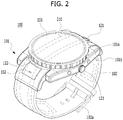
- FIG. 2 is a perspective view illustrating one example of a watch-type mobile terminal 100 in accordance with another exemplary embodiment.
- the watch-type mobile terminal 100 includes a main body 101 with a display unit 151 and a band 102 connected to the main body 101.
- the main body 101 may include a case having a certain appearance.
- the case may include a first case 101a and a second case 101b cooperatively defining an inner space for accommodating various electronic components.
- a single case may alternatively be implemented, with such a case being configured to define the inner space, thereby implementing a watch type mobile terminal 100 with a uni-body.
- the watch type mobile terminal 100 can perform wireless communication, and an antenna for the wireless communication can be installed in the main body 101.
- the antenna may extend its function using the case.
- a case including a conductive material may be electrically connected to the antenna to extend a ground area or a radiation area.
- the display unit 151 is shown located at the front side of the main body 101 so that displayed information is viewable to a user.
- the display unit 151 includes a touch sensor so that the display unit can function as a touch screen.
- window 151a is positioned on the first case 101a to form a front surface of the terminal body together with the first case 101a.
- the illustrated embodiment includes audio output module 152, a camera 121, a microphone 122, and a user input unit 123 positioned on the main body 101.
- audio output module 152 When the display unit 151 is implemented as a touch screen, additional function keys may be minimized or eliminated.
- the user input unit 123 may be omitted.
- the band 102 is commonly worn on the user's wrist and may be made of a flexible material for facilitating wearing of the device.
- the band 102 may be made of fur, rubber, silicon, synthetic resin, or the like.
- the band 102 may also be configured to be detachable from the main body 101. Accordingly, the band 102 may be replaceable with various types of bands according to a user's preference.
- the band 102 may be used for extending the performance of the antenna.
- the band may include therein a ground extending portion (not shown) electrically connected to the antenna to extend a ground area.
- the band 102 may include fastener 102a.
- the fastener 102a may be implemented into a buckle type, a snap-fit hook structure, a Velcro® type, or the like, and include a flexible section or material.
- the drawing illustrates an example that the fastener 102a is implemented using a buckle.
- the IC module 186 includes an AP (application process) chip driving an OS of a mobile terminal and various applications, a GPU (graphic processing unit) controlling an image outputted via a display unit 151, a power management chip and the like.
- AP application process
- GPU graphics processing unit
- the IC module 186 can be damaged.
- a device directly contacted with a body of a user as a watch type mobile terminal 100 if heat is directly delivered to skin of the user, the user may be in danger of burn and the like. Hence, it is necessary to distribute the heat occurred in the IC module 186.
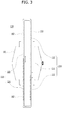
- FIG. 3 and FIG. 4 are diagrams for a pipe of a watch type mobile terminal according to one embodiment of the present invention.
- the watch type mobile terminal according to the present invention includes a main body 101 and a heat pipe 210 penetrating a band 102.
- the heat pipe 210 includes a first pipe 211 positioned at the main body 101 and a second pipe 212 positioned at a band 102 part.
- the first pipe 211 and the second pipe 212 are connected with each other and form a single loop.
- the heat pipe 210 can be positioned at outskirts of the main body 101 according to a shape of the main body 101.
- FIG. 5 and FIG. 6 are diagrams for a cross section of the main body 101 shown in FIG. 3 and FIG. 4 .
- the heat pipe 210 when the heat pipe 210 penetrates the main body 101, the heat pipe 210 can be arranged in the vicinity of a mainboard.
- the heat pipe 210 can be interposed between a battery and a mainboard.
- the heat pipe 2210 can be arranged in a manner of being one-sided.
- the heat pipe 210 is arranged as shown in FIG. 3 and FIG. 5 , since the heat pipe is adjacent to an IC module 186 corresponding to a heat emitting part, it is beneficial in terms of heat absorption. Yet, since a structure of the watch type mobile terminal 100 should be modified, it may bring a structural limitation as well. In order to solve the aforementioned problem, as shown in FIG. 4 , if the heat pipe is arranged according to the outskirts of the main body 101, a change of a legacy structure can be minimized. Or, as shown in FIG. 6 , the heat pipe 210 can be arranged at the side of the mainboard and the battery.
- FIG. 4 to FIG. 6 shows embodiments that the heat pipe 210 forms a single loop
- the heat pipe 210 can be partly divided into a plurality of pipes. As the number of pipes is increasing, an area of a surface is also widened. By doing so, heat transfer efficiency may increase as well.
- a material of high heat conductivity can be used for the heat pipe 210. If a band 102 is flexible, a flexible resin can be used for a second pipe 212 part only. Yet, since the resin corresponds to a material of low heat conductivity, such a material of high heat conductivity as graphite and the like can be mixed with the resin.
- the second pipe 212 can be implemented by cutting a grove on the band 102 without inserting a separate tubular member into the band 102.
- a working fluid 220 is injected into the inside of the heat pipe 210, the working fluid 200 is moving around the heat pipe, absorbs heat in a first pipe 211 positioned at the main body 101 and emits heat in a second pipe 212 positioned at the band 102.
- the working fluid is a fluid of which heat conductivity is high. If ambient temperature is high, the working fluid absorbs heat well and if the ambient temperature is low, the working fluid emits heat so that the heat of the main body 101 is radiated from the band 102. By doing so, it may prevent the main body 101 from being overheated.
- the working fluid 220 absorbs heat, a volume of the working fluid expands and density of the working fluid becomes smaller.
- the working fluid 220 has a characteristic tend to move to an upper part of a working fluid 220 of low temperature. Hence, the working fluid 220 moves according to the heat pipe 210. Yet, if a single type of working fluid 220 is used only, since density of the working fluid is same, the working fluid may not move although a watch type mobile terminal 100 moves.
- a plurality of materials of different density are injected into the inside of the heat pipe 210.
- the working fluid In case of a fixed heat pipe, if there exists a difference in density of a working fluid, the working fluid is not circulated at all. Yet, since a watch type mobile terminal 100 according to the present invention is worn on a body of a user, the working fluid is continuously moving and the working fluid is changing according to a direction of gravity of the watch type mobile terminal 100 due to the movement. If the watch type mobile terminal is moving, the second working fluid 222 of bigger density moves to the direction of gravity and the first working fluid 221 of smaller density moves to a direction opposite to the direction of gravity.
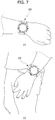
- FIG. 7 and FIG. 8 are diagrams for explaining a position of a working fluid 220 according to a posture of a user wearing a watch type mobile terminal according to the present invention.
- FIG. 7 if a down direction corresponds to a direction of gravity, FIG. 7 (a) shows that a bottom/right part of the watch type mobile terminal shown in FIG. 3 is positioned at the direction of gravity and FIG. 7 (b) shows that an upper/right part of the watch type mobile terminal shown in FIG. 3 is positioned at the direction of gravity.
- the second working fluid 222 of heavy density is positioned at the bottom/right as shown in FIG. 8 (a) .
- the second working fluid 222 of heavy density is positioned at the upper/left as shown in FIG. 8 (b) .
- FIG. 7 is a diagram for a transformed example of a heat pipe of a watch type mobile terminal according to one embodiment of the present invention.
- a heat pipe 210 can be configured in a manner that thickness of a first pipe 211 and thickness of a second pipe 212 are different from each other. If a cross section area of the heat pipe 210 is small, a same amount of working fluid 220 moves fast to pass through the heat pipe. Hence, thermal diffusion efficiency can be increased by making a cross section area of the first pipe 211 smaller than a cross section area of the second pipe 212.
- a heat-absorbed working fluid 220 moves fast in the first pipe 211 of which the cross section area is small and a working fluid 220 of low temperature flows in the first pipe 211.
- a heat absorption efficiency may be enhanced. Since the working fluid 220 slowly moves in the second pipe 212 of which the cross section area is big, heat, which is absorbed in a heat carrier, can be sufficiently emitted in a band 102 part.
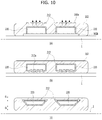
- FIG. 10 is a diagram for embodiments of a pipe of a watch type mobile terminal 100 according to one embodiment of the present invention. It is preferable to implement an area of a surface as wide as possible in a second pipe 212 positioned at a band 102 part to emit heat.
- a bump 102a can be formed on a part (hereinafter called a first side) not in contact with a body of a user to emit heat in a direction not in contact with the body of the user.
- a thermal insulator 102b is added to a part (hereinafter called a second side) in contact with the body of the user to minimize heat delivered to the body of the user.
- a velocity of a working fluid 220 can be reduced by forming a bump 212a in the inside of a second pipe 212 of a band 102 in a direction of the second side. If the velocity of the working fluid 220 of the second side direction is reduced compared to the velocity of the working fluid 220 of the first side direction due to a frictional force originated from the bump, heat of the main body 101 is absorbed and the hot working fluid 220 supplied from the first pipe 211 is supplied to the second pipe 212 in the first side direction. A temperature of the working fluid 220 of the first side direction is relative higher than a temperature of the working fluid 220 of the second side direction.
- a shape of the second pipe 212 can be formed in a manner that a shape of the first side direction is wide and a shape of the second side direction is narrow.
- the first side direction may emit relatively more heat compared to the second side direction.
- a position of the second pipe 212 can be arranged in a manner of being more adjacent to the first side direction (d1 ⁇ d2).
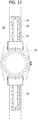
- FIGS. 11 to 13 are diagrams for a transformed example of a heat pipe of a watch type mobile terminal according to one embodiment of the present invention.
- a heat absorption bar 255 including a density of a medium size between a density of a first working fluid 221 and a density of a second working fluid 222 can be further included in the inside of a heat pipe 210.
- the heat absorption bar 255 is a solid material of a high heat conductivity.
- the heat absorption bar 255 can absorbs ambient heat while moving between the first working fluid 221 and the second working fluid 222.
- a plurality of heat absorption bars 255 can be included in a boundary between the first working fluid 221 and the second working fluid 222 of both sides. Or, a single heat absorption bar can be included in the boundary between the first working fluid 221 and the second working fluid 222 of one side only.
- a metallic ball 226 of a density bigger than a density of the first working fluid 221 and a density of the second working fluid 222 can be included in the inside of the heat pipe 210.
- the metallic ball 226 moves in the heat pipe 210 according to a change of a direction of gravity. Since the density of the metallic ball is big, the metallic ball can come and go between the first working fluid 221 and the second working fluid 222. Due to the movement of the metallic ball, a movement of the first working fluid 221 and a movement of the second working fluid 222 can be activated. By doing so, thermal diffusion efficiency can be enhanced with the help of a convection current of the working fluid.
- a metallic ball 226 absorbs heat in a high temperature and emits heat in a low temperature, heat may be radiated by the metallic ball 226 as well.
- a second pipe 212 of a band 102 part and a second band 102 can be made up of a transparent material to see the inside of a heat pipe 210.
- a powder 227 or a piece including such an image as character and the like can be injected into a working fluid 220 in the inside of the heat pipe 210.
- a density of the powder or the piece is similar to a density of the working fluid 220 or is little bit bigger than the density of the working fluid, if a state of being inclined to a specific direction is maintained, the powder or the piece moves to a direction of gravity. Yet, the direction of gravity of a watch type mobile terminal changes in a short time period, it may seem like the powder 227 or the piece is floating in the working fluid 220.
- FIG. 14 is a diagram for a cross section of a watch type mobile terminal according to one embodiment of the present invention.
- a display unit 151 is positioned at the top of the drawing and a bottom part becomes a bottom side in contact with a body of a user.
- a battery 191, a main board 185 and an audio output unit 153 and the like are arranged in the inside of a case 101a/101b.
- the battery 191 of the watch type mobile terminal uses a chargeable secondary cell for a long period usage.
- the secondary cell charges electricity, which is generated in the course of triggering oxidation-reduction reaction of a material between anode and cathode triggered by electric current supplied by an external power source. Inversely, the secondary cell discharges electricity in a manner of converting chemical energy into electrical energy to supply power. It is able to repeatedly use the secondary cell.
- Main components of the secondary cell include a separation membrane, anode, cathode and electrolyte.
- Examples of the secondary cell include a nickel battery, an ion battery, a lithium ion battery, a polymer battery and the like according to a filling material of the secondary cell.
- a lithium ion battery using lithium which is the lightest metal
- a lithium-manganese oxide is used for a (+) electrode and a carbon is used for a (-) electrode and an electrolyte (lithium salt solution) in which lithium salt is melted to facilitate lithium-ion is filled between the two electrodes.
- the electrolyte plays a role of a medium of moving an electron between the two electrodes.
- the two electrodes can store lithium-ion in an atomic grid structure, respectively.
- FIG. 15 is a disassembled perspective diagram for a battery 191 structure of a watch type mobile terminal 100 according to one embodiment of the present invention.
- Main components of the battery 191 include a battery cell 1915 consisting of a (+) electrode and a (-) electrode of the battery 191 and an electrolyte used for moving ion between the electrodes.
- the battery 191 is equipped with a housing 1911. Since the housing 1911 is bigger than the battery cell 1915, the electrolyte is injected into a separation space between the battery cell 1915 and the housing 1911.
- the IC module 186 includes an AP (application process) chip driving an OS of a mobile terminal and various applications, a GPU (graphic processing unit) controlling an image outputted via a display unit 151, a power management chip and the like.
- AP application process
- GPU graphics processing unit
- the IC module 186 Since the IC module 186 is equipped with electronic circuits concentrated on a small space, the IC module corresponds to a representative heat emitting part generating heat when driving. If heat is concentrated on a specific part, the IC module 186 can be damaged. In case of such a device directly contacted with a body of a user as a watch type mobile terminal 100, if heat is directly delivered to skin of the user, the user may be in danger of burn and the like. Hence, it is necessary to distribute the heat occurred in the IC module 186.
- a heat radiation structure is added to the battery 191 to absorb heat of a main board 185 positioned in the vicinity of one side (A) and radiate the heat from another side of the battery 191.
- the radiation structure is added to the battery 191, the heat can be distributed using a convection phenomenon of an electrolyte without using a separate heat sink and a working fluid.
- the battery 191 according to the present invention additionally includes a channel 1913 as well as the structure consisting of the housing 1911, the battery cell 1915 and the electrolyte.
- heat occurred in a main board 185 can be diffused using a convection phenomenon, which is observed while the electrolyte injected between the housing 1911 and the battery cell 1915 is moving around according to the channel 1913.
- FIG. 16 is diagram for a cross section of the battery 191 of the watch type mobile terminal according to one embodiment of the present invention.
- the battery includes a plurality of channel walls 1912 extended in one direction from an inner wall of the housing 1911.
- a space consisting of the channel walls 1912, the housing 1911 and the battery cell 1915 becomes a channel 1913.
- a height h1/h2 of the channel wall 1912 corresponds to a separation space between the housing and the battery cell. Since the battery cell 1915 forms one side of the channel 1913, an electrolyte may trigger an oxidation-reduction reaction in a manner of being in contact with the battery cell 1915 and circulate according to the channel 1913 due to a temperature difference in the watch type mobile terminal 100.
- the channel wall 1912 can be continuously formed to be connected with one side and another side of the housing 1911, the electrolyte absorbs and radiates heat in a manner of moving around in one side and another side of the battery 191 according to the channel 1913 and the heat can be diffused by convection.
- the moving speed of the electrolyte flowing in the channel 1913 is determined by a size of a hydraulic diameter of the channel 1913 formed by the channel wall 1912, the housing 1911 and the battery cell 1915.
- the hydraulic diameter (D) is a value converted into a diameter of the channel 1913 of a circular form to compare an area of the channel 1913 of a quadrangular form with each other.
- a size of the hydraulic diameter may be determined by a size of between 500 ⁇ m and 100 ⁇ m. Yet, the size of the hydraulic diameter may vary according to such a characteristic as a boiling point of the electrolyte, a viscosity of the electrolyte and the like.
- a moving speed of the electrolyte is fast and ambient heat can be easily absorbed.
- the moving speed of the electrolyte is slow and it is able to secure time for radiating energy stored in the electrolyte to around the channel.
- a size of the channel 1913 of one side (A) adjacent to a main board can be made to be small to easily absorb heat and a size of the channel 1913 of another side (B) separated from the main board can be made to be big to efficiently radiate heat. By doing so, it may increase an absorption rate of the heat occurred in the main board 185 and increase a radiation rate of the heat in a position separated from the main board 185.
- the size of the channel 1913 can be differently configured in a manner of adjusting a space (d) between channel walls 1912 or differentiating heights (h1 > h2) of the channel walls 1912.
- a gravity direction is not constant and may vary.
- a user since a user is using the watch type mobile terminal, since the user operates the watch type mobile terminal while directly watching a display unit 151, an arrangement of the watch type mobile terminal 100 is maintained in a state that the display unit 151 is arranged to face the upper part. Since an IC module 186 generates more heat when the user operates the watch type mobile terminal compared to a standby state, a great amount of heat is generated when the watch type mobile terminal is in use. Hence, a radiation performance is most important.
- an electrolyte positioned at one side (A) of the battery 191 absorbs heat of the main board 185. Since the electrolyte, which have absorbed the heat, has small density, the electrolyte moves to an upper part and may be able to radiate the heat at another side (B) of the battery 191.
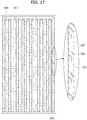
- FIG. 17 is a diagram for channels 1913 formed in a battery 191 of a watch type mobile terminal 100 according to one embodiment of the present invention.
- An electrolyte 1916 injected into a channel 1913 absorbs heat and the electrolyte can be partly vaporized.
- the vaporized electrolytic steam 1917 moves in a direction opposite to a gravity direction due to a weigh difference with the electrolyte 1916 and the electrolyte 1916 is pushed in the gravity direction.
- a channel 1913 of one side of the battery 191 which is adjacent to the main board 185 is called an evaporator.
- the electrolyte 1916 is liquefied in a channel 1913 of another side of the battery 191, it may be called a condenser.
- a place between the evaporator and the condenser can be called a bubble/slug oscillator.
- the electrolyte 1916 changes to a gaseous state in a manner of absorbing heat in the evaporator (A), moves to the condenser (C) while making a phase change in the bubble/slug oscillator and radiates heat in the condenser (C) and makes a phase change again to a liquid state.
- the electrolyte 1916 is injected into the channel as much as 30 % to 70 % of a total volume of the channel 1913 and the channel is maintained in a vacuum state, a boiling point of the electrolyte is lowered compared to the boiling point of the electrolyte under air pressure. By doing so, an amount of vaporizing the electrolyte may increase. As vaporizing and liquefying are actively occurred, a heat transfer rate of a watch type mobile terminal can be improved.
- FIG. 18 is a perspective diagram for a different example of a watch type mobile terminal 100 according to a different embodiment of the present invention.
- the watch type mobile terminal includes a cooling barrel 400 which is formed on a circumstance of a main body 101.
- the cooling barrel 400 delivers heat of one side to another side via a flow path formed inside of the cooling barrel and may be able to radiate the heat at the another side.
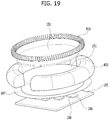
- FIG. 19 is a disassembled perspective diagram for a watch type mobile terminal 100 according to one embodiment of the present invention
- FIG. 20 is a diagram for a cross section of a watch type mobile terminal 100 according to one embodiment of the present invention.
- FIG. 19 and FIG. 20 show a cooling barrel 400 positioned at outskirts, a battery 191 positioned at the inside of the cooling barrel 400, a display unit 151 positioned at the top of the battery 191, a shield can 187 and a main board 185 positioned at the bottom of the battery 191.
- Various electronic parts including an IC module 186 are mounted on the main board 185.
- the IC module 186 is in charge of a control of the watch type mobile terminal 100. Since the IC module 186 is equipped with electronic circuits concentrated on a small space, the IC module corresponds to a representative heat emitting part generating heat when driving.
- the IC module 186 can be damaged.
- a device directly contacted with a body of a user as a watch type mobile terminal 100 if heat is directly delivered to skin of the user, the user may be in danger of burn and the like. Hence, it is necessary to distribute the heat generated by the IC module 186.
- the heat generated by the IC module 186 can be radiated in a manner of putting the cooling barrel 400 on the outskirts circumstance of the watch type mobile terminal 100.
- an internal space 401 of the cooling barrel 400 is made up of a donut shape, an internal fluid of the cooling barrel 400 can circulate up and down while moving according to the donut shape of the internal space 401.
- the internal space 401 of the cooling barrel 400 is maintained as an empty space, heat can be radiated by convection of air. If a cooling fluid is injected into the internal space 401 of the cooling barrel 400, heat can be radiated by convection of the cooling fluid.
- the shield can 187 includes an upper board positioned at an upper side of the main board 185 and a sidewall to form a space separated from the main board 185.
- An IC module 186 and the like can be positioned at the space formed by the sidewall and the upper board.
- the shield can 187 provides a surface capable of protecting the IC module 186 and the surface capable of safely putting a different part (in the present embodiment, a battery) on the upper board of the main board 185.
- the shield can 187 is configured by a metal of a high heat conductivity rate, heat generated by the IC module 186 can move according to the shied can 187. As shown in FIG. 20 , the heat of the IC module 186 can be delivered to the cooling barrel 400 in a manner of extending the shied can 187 to the bottom part of the cooling barrel 400.
- the heat generated by the IC module should be delivered to the shield can 187 by a radiation scheme. If the shield can 187 is directly in contact with the IC module 186 for efficiency of heat delivery, the IC module 186 is in danger of being damaged.
- a TIP (thermal interface pad) 188 made up of a material of a high heat conductivity rate and elastic can be inserted into the space between the shield can 187 and the IC module 186. Since heat is able to be delivered to the shield can 187 via the TIM 188 using a heat conductivity scheme, a heat delivery efficiency rate increases and the IC module 186 can be protected due to the elasticity of the TIM.
- the cooling barrel 400 can be additionally installed in the outside of the case of the watch type mobile terminal 100 or the cooling barrel itself may construct a part of the case as well.
- An internal side of the cooling barrel is a side on which electronic apparatus is mounted.
- Such electronic parts as a battery 191 and the like can be mounted on the inside of the cooling barrel.
- the cooling barrel 400 can include a curved side to induce a fluid circulating in the cooling barrel to be flowed.
- FIG. 21 shows a cooling barrel including an internal side configured by a straight line to utilize an internal space 401 and an external side configured by a curved side to expedite convection of heat.
- the velocity of the moving fluid becomes slow in a part where an area of the flow path is wide and the velocity of the moving fluid becomes fast in a part where an area of the flow path is narrow. If the velocity of the moving fluid is fast, a new fluid is constantly flowed in and it is beneficial for absorbing ambient heat. If the velocity of the moving fluid is slow, heat stored in the moving fluid can be radiated while the moving fluid is moving slowly.
- a heat absorption rate can be increased in a manner that an internal moving fluid moves fast in a part configured to absorb heat and heat of the moving fluid can be sufficiently radiated in a manner that the internal moving fluid moves slowly in a part configured to radiate heat.
- a heat radiation pin 410 can be further included in the external side of the cooling barrel 400. Since a moving fluid of high temperature is positioned at the top of the cooling barrel 400, as shown in FIG. 20 , the heat radiation pin 410 can be positioned at the top of the cooling barrel 400 to increase a heat emission efficiency. The heat radiation pin can be positioned at the side of the cooling barrel as well.
- the heat radiation pin 410 expands an area of a surface used for emitting heat using a material of a high heat conductivity rate to increase the heat emission efficiency. As shown in FIG. 19 , since the heat radiation pins are arranged to circumstance of a front side of the watch type mobile terminal 100, the heat radiation pins can be transformed by various shapes in consideration of a design aspect.
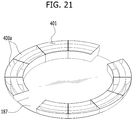
- FIG. 21 is a diagram for a cross section of a cooling barrel 400 part of a watch type mobile terminal 100 according to one embodiment of the present invention.
- the cooling barrel 400 can be divided into a plurality of cells 400a. If the cooling barrel is configured by a plurality of the cells 400a, since an internal space 401 of the cooling barrel 400 becomes narrower, circulation may be more facilitated. When temperature of a specific part of the watch type mobile terminal increases, if whole of the cooling barrel 400 is configured by a single space, circulation of a moving fluid is tardy. On the contrary, if the cooling barrel is configured by a plurality of the cells, a moving fluid of the cell in which temperature is went up can be circulated only. Hence, radiation of heat can be easily performed.
- FIG. 22 is a diagram for a watch type mobile terminal 100 according to a different embodiment of the present invention
- FIG. 23 is a diagram for a cross section of a barrel part of a watch type mobile terminal 100 according to a different embodiment of the present invention.
- the present embodiment can also applied to a watch type mobile terminal 100 of a rectangle form.
- a cooling barrel 400 can be arranged to a circumstance of the watch type mobile terminal 100 in a manner of configuring the cooling barrel with a plurality of cells 400a.
- the cooling barrel 400 can be partly omitted for such a part exposed to a side of a case 101a/101b as an interface unit 160, an audio output unit 153, microphone 122, a user input unit 123 and the like.
- the cooling barrel 400 of the watch type mobile terminal 100 can also include a curved side in an external side of the cooling barrel to expedite circulation of a moving fluid.
- it is able to improve a function of radiating heat using a heat convection phenomenon without using power.
- a watch type mobile terminal Since a watch type mobile terminal is able to radiate heat from a band 102 using a heat pipe 210, malfunction of the watch type mobile terminal can be reduced.
- a convection scheme Compared to a legacy scheme used to diffuse heat with a heat conductivity scheme using a heat radiation plate made up of such a material of a high heat conductivity rate as a copper plate or a graphite sheet, a convection scheme has a heat conductivity rate higher than the legacy scheme.
Landscapes
- Engineering & Computer Science (AREA)
- Physics & Mathematics (AREA)
- Microelectronics & Electronic Packaging (AREA)
- Thermal Sciences (AREA)
- General Physics & Mathematics (AREA)
- Signal Processing (AREA)
- Electric Clocks (AREA)
- Thermotherapy And Cooling Therapy Devices (AREA)
Claims (11)
- Mobiles Endgerät vom Uhrentyp, das aufweist:einen Hauptkörper (101), der aufgebaut ist, um eine elektronische Vorrichtungseinheit zu enthalten, in der ein elektronischer Teil montiert ist;ein Band (102), das aufgebaut ist, um an einem Handgelenk eines Benutzers in einer Weise getragen zu werden, in der es mit dem Hauptkörper kombiniert ist;eine Wärmeleitung (210), die aufgebaut ist um eine erste Leitung (211), die an dem Hauptkörper (101) positioniert ist, und eine zweite Leitung, die an dem Band (102) positioniert ist, zu enthalten, wobei die erste Leitung (211) und die zweite Leitung (212) eine Schleife in einer Weise bilden, in der sie miteinander verbunden sind;ein erstes Arbeitsfluid (221), das in die Wärmeleitung eingespritzt wird; undein zweites Arbeitsfluid (222), das sich in der Dichte von dem ersten Arbeitsfluid (221) unterscheidet.
- Endgerät vom Uhrentyp nach Anspruch 1, wobei die erste Leitung (211) aufgebaut ist, um in der Nähe einer Hauptplatine angeordnet zu sein, die auf dem Hauptkörper montiert ist.
- Endgerät vom Uhrentyp nach Anspruch 1 oder 2, wobei die erste Leitung (211) aufgebaut ist, um entsprechend Außenbereichen des Hauptkörpers angeordnet zu werden.
- Endgerät vom Uhrentyp nach einem der Ansprüche 1 bis 3, wobei eine Querschnittfläche der ersten Leitung (211) dünner als eine Querschnittfläche der zweiten Leitung ist.
- Endgerät vom Uhrentyp nach einem der Ansprüche 1 bis 4, wobei das Band (102) derart aufgebaut ist, dass es auf einer ersten Seite, die mit einem Körper des Benutzers in Kontakt ist, einen Isolator enthält.
- Endgerät vom Uhrentyp nach einem der Ansprüche 1 bis 5, wobei das Band (102) derart aufgebaut ist, dass es ferner einen Wärmestrahlungshöcker enthält, der auf einer zweiten Seite ausgebildet ist, die nicht in Kontakt mit einem Körper des Benutzers ist.
- Endgerät vom Uhrentyp nach einem der Ansprüche 1 bis 6, wobei die zweite Leitung (212) aufgebaut ist, um ferner einen geschwindigkeitsverringernden Höcker zu enthalten, der auf einer Oberfläche einer Seite benachbart zu einem Körper des Benutzers ausgebildet ist.
- Endgerät vom Uhrentyp nach einem der Ansprüche 1 bis 7, das ferner eine metallische Kugel aufweist, die im Inneren der Wärmeleitung positioniert ist,
wobei eine Dichte der metallischen Kugel schwerer als eine Dichte des ersten Arbeitsfluids (221) und eine Dichte des zweiten Arbeitsfluids ist. - Endgerät vom Uhrentyp nach einem der Ansprüche 1 bis 7, das ferner einen Wärmeaufnahmestab aufweist, der im Inneren der Wärmeleitung positioniert ist,
wobei eine Dichte des Wärmeaufnahmestabs einem Medianwert zwischen einer Dichte des ersten Arbeitsfluids (221) und einer Dichte des zweiten Arbeitsfluids entspricht. - Endgerät vom Uhrentyp nach einem der Ansprüche 1 bis 7, wobei die Wärmeleitung (210) derart aufgebaut ist, dass sie aus einem transparenten Material ausgebildet ist, wobei eine Position des Bands (102), die der Wärmeleitung (210) entspricht, transparent ist, und wobei das Band (102) derart aufgebaut ist, dass es ferner ein Pulver oder ein Teil enthält, das in das erste Arbeitsfluid (221) oder das zweite Arbeitsfluid eingesetzt ist.
- Endgerät vom Uhrentyp nach einem der Ansprüche 1 bis 7, das ferner ein Pulver oder ein Teil aufweist, wobei das Pulver oder das Teil in das Innere der Wärmleitung eingespritzt wird, wobei das Pulver oder das Teil eine ähnliche Dichte wie das erst Arbeitsfluid (221) der das zweite Arbeitsfluid (222) hat, wobei das Pulver oder das Teil eine hohe Wärmeleitähigkeitsrate hat.
Applications Claiming Priority (3)
| Application Number | Priority Date | Filing Date | Title |
|---|---|---|---|
| KR1020140063425A KR102194922B1 (ko) | 2014-05-27 | 2014-05-27 | 와치타입 이동 단말기 |
| KR1020140063423A KR102201747B1 (ko) | 2014-05-27 | 2014-05-27 | 와치타입 이동 단말기 |
| KR1020140063424A KR102204616B1 (ko) | 2014-05-27 | 2014-05-27 | 와치타입 이동 단말기 |
Publications (3)
| Publication Number | Publication Date |
|---|---|
| EP2955592A2 EP2955592A2 (de) | 2015-12-16 |
| EP2955592A3 EP2955592A3 (de) | 2016-05-25 |
| EP2955592B1 true EP2955592B1 (de) | 2017-04-12 |
Family
ID=53199852
Family Applications (1)
| Application Number | Title | Priority Date | Filing Date |
|---|---|---|---|
| EP15169026.0A Not-in-force EP2955592B1 (de) | 2014-05-27 | 2015-05-22 | Mobiles endgerät vom uhrentyp |
Country Status (2)
| Country | Link |
|---|---|
| US (1) | US9826073B2 (de) |
| EP (1) | EP2955592B1 (de) |
Families Citing this family (15)
| Publication number | Priority date | Publication date | Assignee | Title |
|---|---|---|---|---|
| EP3131376B1 (de) * | 2014-06-04 | 2021-08-04 | Huawei Technologies Co., Ltd. | Elektronische vorrichtung |
| US9965003B2 (en) * | 2015-07-09 | 2018-05-08 | Htc Corporation | Electronic assembly and electronic device |
| US9652005B2 (en) * | 2015-07-13 | 2017-05-16 | Qualcomm Incorporated | Thermal solution for wearable devices by using wrist band as heat sink |
| JPWO2017073010A1 (ja) * | 2015-10-27 | 2018-08-16 | ソニー株式会社 | 電子機器 |
| WO2017081833A1 (ja) * | 2015-11-10 | 2017-05-18 | ソニー株式会社 | 電子機器 |
| KR102483377B1 (ko) * | 2015-11-30 | 2023-01-02 | 삼성전자주식회사 | 전자 장치 및 전자 장치 제조방법 |
| CN106922103B (zh) * | 2015-12-24 | 2019-10-29 | 联想(北京)有限公司 | 散热装置和电子设备 |
| KR102583890B1 (ko) | 2016-02-18 | 2023-10-05 | 삼성전자주식회사 | 열 수집/확산 구조를 가진 전자 장치 |
| TWI590751B (zh) * | 2016-08-26 | 2017-07-01 | 宏碁股份有限公司 | 可攜式電子裝置 |
| CN107801353B (zh) * | 2016-09-07 | 2019-08-06 | 宏碁股份有限公司 | 便携式电子装置 |
| JPWO2018135140A1 (ja) * | 2017-01-19 | 2019-11-07 | ソニー株式会社 | 複合材料、電子機器および電子機器の製造方法 |
| US10146277B1 (en) * | 2017-09-13 | 2018-12-04 | Motorola Solutions, Inc. | Vehicle adapter and sealed cooling system for portable communications device |
| CN108762052A (zh) * | 2018-05-23 | 2018-11-06 | 深圳市沃特沃德股份有限公司 | 智能穿戴设备 |
| US10823969B1 (en) * | 2018-12-14 | 2020-11-03 | Google Llc | Heat transfer through frame component of head-mounted device |
| WO2020255952A1 (ja) * | 2019-06-19 | 2020-12-24 | 昭和電工マテリアルズ株式会社 | ユーザ用装置、及びケース |
Family Cites Families (12)
| Publication number | Priority date | Publication date | Assignee | Title |
|---|---|---|---|---|
| US5560423A (en) * | 1994-07-28 | 1996-10-01 | Aavid Laboratories, Inc. | Flexible heat pipe for integrated circuit cooling apparatus |
| US6446706B1 (en) * | 2000-07-25 | 2002-09-10 | Thermal Corp. | Flexible heat pipe |
| US6772445B2 (en) * | 2001-12-19 | 2004-08-10 | Benjamin Yeager | Cooling bracelet |
| US7701716B2 (en) * | 2008-06-18 | 2010-04-20 | Apple Inc. | Heat-transfer mechanism including a liquid-metal thermal coupling |
| KR101007174B1 (ko) | 2008-11-05 | 2011-01-12 | 한국전자통신연구원 | 박형 냉각소자 |
| DE202013007763U1 (de) | 2013-08-29 | 2013-09-11 | Asia Vital Components Co., Ltd. | Kühlstruktur und tragbares elektronisches Gerät mit dieser Kühlstruktur |
| KR20150091905A (ko) * | 2014-02-04 | 2015-08-12 | 엘지전자 주식회사 | 증기 챔버 |
| TWI537693B (zh) * | 2014-11-10 | 2016-06-11 | Asia Vital Components Co Ltd | 穿戴式錶帶散熱結構 |
| US9529396B2 (en) * | 2014-11-28 | 2016-12-27 | Asia Vital Components Co., Ltd. | Heat dissipation structure of intelligent wearable device |
| US9367105B1 (en) * | 2014-11-28 | 2016-06-14 | Asia Vital Components Co., Ltd. | Heat dissipation structure for wearable mobile device |
| US20160201994A1 (en) * | 2015-01-12 | 2016-07-14 | Asia Vital Components Co., Ltd. | Carrier with heat dissipation structure |
| US9652005B2 (en) * | 2015-07-13 | 2017-05-16 | Qualcomm Incorporated | Thermal solution for wearable devices by using wrist band as heat sink |
-
2015
- 2015-03-10 US US14/643,784 patent/US9826073B2/en not_active Expired - Fee Related
- 2015-05-22 EP EP15169026.0A patent/EP2955592B1/de not_active Not-in-force
Non-Patent Citations (1)
| Title |
|---|
| None * |
Also Published As
| Publication number | Publication date |
|---|---|
| US9826073B2 (en) | 2017-11-21 |
| EP2955592A3 (de) | 2016-05-25 |
| US20150350392A1 (en) | 2015-12-03 |
| EP2955592A2 (de) | 2015-12-16 |
Similar Documents
| Publication | Publication Date | Title |
|---|---|---|
| US9826073B2 (en) | Watch type mobile terminal | |
| EP3794414B1 (de) | Intelligente uhr mit flexiblem anzeigefeld | |
| US10959350B2 (en) | Mobile terminal | |
| ES2921994T3 (es) | Dispositivo electrónico con antena de bastidor metálico | |
| KR102097500B1 (ko) | 이동 단말기 | |
| KR102228857B1 (ko) | 휴대 전자기기 | |
| KR102709687B1 (ko) | 방열 구조 및 그를 포함하는 전자 장치 | |
| KR101998343B1 (ko) | 냉각 구조를 포함하는 전자 장치 | |
| US20160037681A1 (en) | Mobile terminal | |
| KR102186842B1 (ko) | 이동 단말기 | |
| CN104869184B (zh) | 具有散热片的移动通信终端 | |
| KR102348241B1 (ko) | 안테나 어레이 및 안테나 어레이를 포함하는 전자 장치 | |
| KR20220154153A (ko) | 플렉서블 디스플레이 장치 | |
| EP3255967A1 (de) | Mobiles endgerät | |
| CN109256612A (zh) | 包含阵列天线的电子装置 | |
| US9654857B2 (en) | Mobile terminal | |
| CN108810200A (zh) | 显示装置 | |
| KR102834319B1 (ko) | 기판 적층 구조체 및 인터포저 블록 | |
| US20190273336A1 (en) | Electronic device having flexible connector | |
| KR102098099B1 (ko) | 이동 단말기 | |
| CN113438876A (zh) | 具有集热/散热结构的电子设备 | |
| KR20160009914A (ko) | 이동 단말기 | |
| KR20200008644A (ko) | 이동 단말기 | |
| US20190132430A1 (en) | Mobile terminal | |
| US20180263501A1 (en) | Electronic device and control method therefor |
Legal Events
| Date | Code | Title | Description |
|---|---|---|---|
| PUAI | Public reference made under article 153(3) epc to a published international application that has entered the european phase |
Free format text: ORIGINAL CODE: 0009012 |
|
| 17P | Request for examination filed |
Effective date: 20150522 |
|
| AK | Designated contracting states |
Kind code of ref document: A2 Designated state(s): AL AT BE BG CH CY CZ DE DK EE ES FI FR GB GR HR HU IE IS IT LI LT LU LV MC MK MT NL NO PL PT RO RS SE SI SK SM TR |
|
| AX | Request for extension of the european patent |
Extension state: BA ME |
|
| PUAL | Search report despatched |
Free format text: ORIGINAL CODE: 0009013 |
|
| AK | Designated contracting states |
Kind code of ref document: A3 Designated state(s): AL AT BE BG CH CY CZ DE DK EE ES FI FR GB GR HR HU IE IS IT LI LT LU LV MC MK MT NL NO PL PT RO RS SE SI SK SM TR |
|
| AX | Request for extension of the european patent |
Extension state: BA ME |
|
| RIC1 | Information provided on ipc code assigned before grant |
Ipc: H05K 7/20 20060101ALI20160418BHEP Ipc: H04M 1/02 20060101ALI20160418BHEP Ipc: G04G 21/00 20100101AFI20160418BHEP |
|
| GRAP | Despatch of communication of intention to grant a patent |
Free format text: ORIGINAL CODE: EPIDOSNIGR1 |
|
| STAA | Information on the status of an ep patent application or granted ep patent |
Free format text: STATUS: GRANT OF PATENT IS INTENDED |
|
| RBV | Designated contracting states (corrected) |
Designated state(s): AL AT BE BG CH CY CZ DE DK EE ES FI FR GB GR HR HU IE IS IT LI LT LU LV MC MK MT NL NO PL PT RO RS SE SI SK SM TR |
|
| INTG | Intention to grant announced |
Effective date: 20161110 |
|
| RIC1 | Information provided on ipc code assigned before grant |
Ipc: H04M 1/02 20060101ALI20161028BHEP Ipc: H05K 7/20 20060101ALI20161028BHEP Ipc: G04G 21/00 20100101AFI20161028BHEP |
|
| GRAS | Grant fee paid |
Free format text: ORIGINAL CODE: EPIDOSNIGR3 |
|
| GRAA | (expected) grant |
Free format text: ORIGINAL CODE: 0009210 |
|
| STAA | Information on the status of an ep patent application or granted ep patent |
Free format text: STATUS: THE PATENT HAS BEEN GRANTED |
|
| AK | Designated contracting states |
Kind code of ref document: B1 Designated state(s): AL AT BE BG CH CY CZ DE DK EE ES FI FR GB GR HR HU IE IS IT LI LT LU LV MC MK MT NL NO PL PT RO RS SE SI SK SM TR |
|
| REG | Reference to a national code |
Ref country code: GB Ref legal event code: FG4D |
|
| REG | Reference to a national code |
Ref country code: CH Ref legal event code: EP |
|
| REG | Reference to a national code |
Ref country code: IE Ref legal event code: FG4D |
|
| REG | Reference to a national code |
Ref country code: AT Ref legal event code: REF Ref document number: 884488 Country of ref document: AT Kind code of ref document: T Effective date: 20170515 |
|
| REG | Reference to a national code |
Ref country code: DE Ref legal event code: R096 Ref document number: 602015002187 Country of ref document: DE |
|
| REG | Reference to a national code |
Ref country code: FR Ref legal event code: PLFP Year of fee payment: 3 |
|
| REG | Reference to a national code |
Ref country code: NL Ref legal event code: MP Effective date: 20170412 |
|
| REG | Reference to a national code |
Ref country code: LT Ref legal event code: MG4D |
|
| REG | Reference to a national code |
Ref country code: AT Ref legal event code: MK05 Ref document number: 884488 Country of ref document: AT Kind code of ref document: T Effective date: 20170412 |
|
| PG25 | Lapsed in a contracting state [announced via postgrant information from national office to epo] |
Ref country code: NL Free format text: LAPSE BECAUSE OF FAILURE TO SUBMIT A TRANSLATION OF THE DESCRIPTION OR TO PAY THE FEE WITHIN THE PRESCRIBED TIME-LIMIT Effective date: 20170412 |
|
| PG25 | Lapsed in a contracting state [announced via postgrant information from national office to epo] |
Ref country code: HR Free format text: LAPSE BECAUSE OF FAILURE TO SUBMIT A TRANSLATION OF THE DESCRIPTION OR TO PAY THE FEE WITHIN THE PRESCRIBED TIME-LIMIT Effective date: 20170412 Ref country code: NO Free format text: LAPSE BECAUSE OF FAILURE TO SUBMIT A TRANSLATION OF THE DESCRIPTION OR TO PAY THE FEE WITHIN THE PRESCRIBED TIME-LIMIT Effective date: 20170712 Ref country code: GR Free format text: LAPSE BECAUSE OF FAILURE TO SUBMIT A TRANSLATION OF THE DESCRIPTION OR TO PAY THE FEE WITHIN THE PRESCRIBED TIME-LIMIT Effective date: 20170713 Ref country code: FI Free format text: LAPSE BECAUSE OF FAILURE TO SUBMIT A TRANSLATION OF THE DESCRIPTION OR TO PAY THE FEE WITHIN THE PRESCRIBED TIME-LIMIT Effective date: 20170412 Ref country code: ES Free format text: LAPSE BECAUSE OF FAILURE TO SUBMIT A TRANSLATION OF THE DESCRIPTION OR TO PAY THE FEE WITHIN THE PRESCRIBED TIME-LIMIT Effective date: 20170412 Ref country code: AT Free format text: LAPSE BECAUSE OF FAILURE TO SUBMIT A TRANSLATION OF THE DESCRIPTION OR TO PAY THE FEE WITHIN THE PRESCRIBED TIME-LIMIT Effective date: 20170412 Ref country code: LT Free format text: LAPSE BECAUSE OF FAILURE TO SUBMIT A TRANSLATION OF THE DESCRIPTION OR TO PAY THE FEE WITHIN THE PRESCRIBED TIME-LIMIT Effective date: 20170412 |
|
| PG25 | Lapsed in a contracting state [announced via postgrant information from national office to epo] |
Ref country code: PL Free format text: LAPSE BECAUSE OF FAILURE TO SUBMIT A TRANSLATION OF THE DESCRIPTION OR TO PAY THE FEE WITHIN THE PRESCRIBED TIME-LIMIT Effective date: 20170412 Ref country code: BG Free format text: LAPSE BECAUSE OF FAILURE TO SUBMIT A TRANSLATION OF THE DESCRIPTION OR TO PAY THE FEE WITHIN THE PRESCRIBED TIME-LIMIT Effective date: 20170712 Ref country code: SE Free format text: LAPSE BECAUSE OF FAILURE TO SUBMIT A TRANSLATION OF THE DESCRIPTION OR TO PAY THE FEE WITHIN THE PRESCRIBED TIME-LIMIT Effective date: 20170412 Ref country code: RS Free format text: LAPSE BECAUSE OF FAILURE TO SUBMIT A TRANSLATION OF THE DESCRIPTION OR TO PAY THE FEE WITHIN THE PRESCRIBED TIME-LIMIT Effective date: 20170412 Ref country code: IS Free format text: LAPSE BECAUSE OF FAILURE TO SUBMIT A TRANSLATION OF THE DESCRIPTION OR TO PAY THE FEE WITHIN THE PRESCRIBED TIME-LIMIT Effective date: 20170812 Ref country code: LV Free format text: LAPSE BECAUSE OF FAILURE TO SUBMIT A TRANSLATION OF THE DESCRIPTION OR TO PAY THE FEE WITHIN THE PRESCRIBED TIME-LIMIT Effective date: 20170412 |
|
| REG | Reference to a national code |
Ref country code: DE Ref legal event code: R097 Ref document number: 602015002187 Country of ref document: DE |
|
| PG25 | Lapsed in a contracting state [announced via postgrant information from national office to epo] |
Ref country code: DK Free format text: LAPSE BECAUSE OF FAILURE TO SUBMIT A TRANSLATION OF THE DESCRIPTION OR TO PAY THE FEE WITHIN THE PRESCRIBED TIME-LIMIT Effective date: 20170412 Ref country code: CZ Free format text: LAPSE BECAUSE OF FAILURE TO SUBMIT A TRANSLATION OF THE DESCRIPTION OR TO PAY THE FEE WITHIN THE PRESCRIBED TIME-LIMIT Effective date: 20170412 Ref country code: SK Free format text: LAPSE BECAUSE OF FAILURE TO SUBMIT A TRANSLATION OF THE DESCRIPTION OR TO PAY THE FEE WITHIN THE PRESCRIBED TIME-LIMIT Effective date: 20170412 Ref country code: EE Free format text: LAPSE BECAUSE OF FAILURE TO SUBMIT A TRANSLATION OF THE DESCRIPTION OR TO PAY THE FEE WITHIN THE PRESCRIBED TIME-LIMIT Effective date: 20170412 Ref country code: RO Free format text: LAPSE BECAUSE OF FAILURE TO SUBMIT A TRANSLATION OF THE DESCRIPTION OR TO PAY THE FEE WITHIN THE PRESCRIBED TIME-LIMIT Effective date: 20170412 Ref country code: MC Free format text: LAPSE BECAUSE OF FAILURE TO SUBMIT A TRANSLATION OF THE DESCRIPTION OR TO PAY THE FEE WITHIN THE PRESCRIBED TIME-LIMIT Effective date: 20170412 |
|
| PLBE | No opposition filed within time limit |
Free format text: ORIGINAL CODE: 0009261 |
|
| STAA | Information on the status of an ep patent application or granted ep patent |
Free format text: STATUS: NO OPPOSITION FILED WITHIN TIME LIMIT |
|
| REG | Reference to a national code |
Ref country code: IE Ref legal event code: MM4A |
|
| PG25 | Lapsed in a contracting state [announced via postgrant information from national office to epo] |
Ref country code: IT Free format text: LAPSE BECAUSE OF FAILURE TO SUBMIT A TRANSLATION OF THE DESCRIPTION OR TO PAY THE FEE WITHIN THE PRESCRIBED TIME-LIMIT Effective date: 20170412 Ref country code: SM Free format text: LAPSE BECAUSE OF FAILURE TO SUBMIT A TRANSLATION OF THE DESCRIPTION OR TO PAY THE FEE WITHIN THE PRESCRIBED TIME-LIMIT Effective date: 20170412 |
|
| 26N | No opposition filed |
Effective date: 20180115 |
|
| PG25 | Lapsed in a contracting state [announced via postgrant information from national office to epo] |
Ref country code: LU Free format text: LAPSE BECAUSE OF NON-PAYMENT OF DUE FEES Effective date: 20170522 |
|
| REG | Reference to a national code |
Ref country code: FR Ref legal event code: PLFP Year of fee payment: 4 |
|
| REG | Reference to a national code |
Ref country code: BE Ref legal event code: MM Effective date: 20170531 |
|
| PG25 | Lapsed in a contracting state [announced via postgrant information from national office to epo] |
Ref country code: IE Free format text: LAPSE BECAUSE OF NON-PAYMENT OF DUE FEES Effective date: 20170522 |
|
| PG25 | Lapsed in a contracting state [announced via postgrant information from national office to epo] |
Ref country code: SI Free format text: LAPSE BECAUSE OF FAILURE TO SUBMIT A TRANSLATION OF THE DESCRIPTION OR TO PAY THE FEE WITHIN THE PRESCRIBED TIME-LIMIT Effective date: 20170412 |
|
| PG25 | Lapsed in a contracting state [announced via postgrant information from national office to epo] |
Ref country code: BE Free format text: LAPSE BECAUSE OF NON-PAYMENT OF DUE FEES Effective date: 20170531 |
|
| PG25 | Lapsed in a contracting state [announced via postgrant information from national office to epo] |
Ref country code: MT Free format text: LAPSE BECAUSE OF NON-PAYMENT OF DUE FEES Effective date: 20170522 |
|
| REG | Reference to a national code |
Ref country code: CH Ref legal event code: PL |
|
| PG25 | Lapsed in a contracting state [announced via postgrant information from national office to epo] |
Ref country code: CH Free format text: LAPSE BECAUSE OF NON-PAYMENT OF DUE FEES Effective date: 20180531 Ref country code: LI Free format text: LAPSE BECAUSE OF NON-PAYMENT OF DUE FEES Effective date: 20180531 |
|
| PG25 | Lapsed in a contracting state [announced via postgrant information from national office to epo] |
Ref country code: HU Free format text: LAPSE BECAUSE OF FAILURE TO SUBMIT A TRANSLATION OF THE DESCRIPTION OR TO PAY THE FEE WITHIN THE PRESCRIBED TIME-LIMIT; INVALID AB INITIO Effective date: 20150522 |
|
| PG25 | Lapsed in a contracting state [announced via postgrant information from national office to epo] |
Ref country code: CY Free format text: LAPSE BECAUSE OF FAILURE TO SUBMIT A TRANSLATION OF THE DESCRIPTION OR TO PAY THE FEE WITHIN THE PRESCRIBED TIME-LIMIT Effective date: 20170412 |
|
| PG25 | Lapsed in a contracting state [announced via postgrant information from national office to epo] |
Ref country code: MK Free format text: LAPSE BECAUSE OF FAILURE TO SUBMIT A TRANSLATION OF THE DESCRIPTION OR TO PAY THE FEE WITHIN THE PRESCRIBED TIME-LIMIT Effective date: 20170412 |
|
| PG25 | Lapsed in a contracting state [announced via postgrant information from national office to epo] |
Ref country code: TR Free format text: LAPSE BECAUSE OF FAILURE TO SUBMIT A TRANSLATION OF THE DESCRIPTION OR TO PAY THE FEE WITHIN THE PRESCRIBED TIME-LIMIT Effective date: 20170412 |
|
| PG25 | Lapsed in a contracting state [announced via postgrant information from national office to epo] |
Ref country code: PT Free format text: LAPSE BECAUSE OF FAILURE TO SUBMIT A TRANSLATION OF THE DESCRIPTION OR TO PAY THE FEE WITHIN THE PRESCRIBED TIME-LIMIT Effective date: 20170412 |
|
| PG25 | Lapsed in a contracting state [announced via postgrant information from national office to epo] |
Ref country code: AL Free format text: LAPSE BECAUSE OF FAILURE TO SUBMIT A TRANSLATION OF THE DESCRIPTION OR TO PAY THE FEE WITHIN THE PRESCRIBED TIME-LIMIT Effective date: 20170412 |
|
| PGFP | Annual fee paid to national office [announced via postgrant information from national office to epo] |
Ref country code: FR Payment date: 20200408 Year of fee payment: 6 |
|
| PGFP | Annual fee paid to national office [announced via postgrant information from national office to epo] |
Ref country code: GB Payment date: 20200408 Year of fee payment: 6 |
|
| PGFP | Annual fee paid to national office [announced via postgrant information from national office to epo] |
Ref country code: DE Payment date: 20210406 Year of fee payment: 7 |
|
| GBPC | Gb: european patent ceased through non-payment of renewal fee |
Effective date: 20210522 |
|
| PG25 | Lapsed in a contracting state [announced via postgrant information from national office to epo] |
Ref country code: GB Free format text: LAPSE BECAUSE OF NON-PAYMENT OF DUE FEES Effective date: 20210522 |
|
| PG25 | Lapsed in a contracting state [announced via postgrant information from national office to epo] |
Ref country code: FR Free format text: LAPSE BECAUSE OF NON-PAYMENT OF DUE FEES Effective date: 20210531 |
|
| REG | Reference to a national code |
Ref country code: DE Ref legal event code: R119 Ref document number: 602015002187 Country of ref document: DE |
|
| PG25 | Lapsed in a contracting state [announced via postgrant information from national office to epo] |
Ref country code: DE Free format text: LAPSE BECAUSE OF NON-PAYMENT OF DUE FEES Effective date: 20221201 |