EP2955198A1 - (Ethylene, vinyl acetal) copolymers and their use in lithographic printing plate precursors - Google Patents
(Ethylene, vinyl acetal) copolymers and their use in lithographic printing plate precursors Download PDFInfo
- Publication number
- EP2955198A1 EP2955198A1 EP14172254.6A EP14172254A EP2955198A1 EP 2955198 A1 EP2955198 A1 EP 2955198A1 EP 14172254 A EP14172254 A EP 14172254A EP 2955198 A1 EP2955198 A1 EP 2955198A1
- Authority
- EP
- European Patent Office
- Prior art keywords
- group
- optionally substituted
- moieties
- coating
- copolymer
- Prior art date
- Legal status (The legal status is an assumption and is not a legal conclusion. Google has not performed a legal analysis and makes no representation as to the accuracy of the status listed.)
- Granted
Links
- 229920001577 copolymer Polymers 0.000 title claims abstract description 62
- 238000007639 printing Methods 0.000 title claims description 65
- 239000002243 precursor Substances 0.000 title claims description 53
- -1 vinyl acetal Chemical class 0.000 title description 107
- 229920002554 vinyl polymer Polymers 0.000 title description 41
- DHKHKXVYLBGOIT-UHFFFAOYSA-N acetaldehyde Diethyl Acetal Natural products CCOC(C)OCC DHKHKXVYLBGOIT-UHFFFAOYSA-N 0.000 title description 30
- VGGSQFUCUMXWEO-UHFFFAOYSA-N Ethene Chemical compound C=C VGGSQFUCUMXWEO-UHFFFAOYSA-N 0.000 title description 22
- 239000005977 Ethylene Substances 0.000 title description 22
- 125000003118 aryl group Chemical group 0.000 claims abstract description 35
- 125000001072 heteroaryl group Chemical group 0.000 claims abstract description 19
- 125000002887 hydroxy group Chemical group [H]O* 0.000 claims abstract description 17
- 239000001257 hydrogen Substances 0.000 claims abstract description 12
- 229910052739 hydrogen Inorganic materials 0.000 claims abstract description 12
- 238000010521 absorption reaction Methods 0.000 claims abstract description 11
- 125000005647 linker group Chemical group 0.000 claims abstract description 11
- 229910052736 halogen Inorganic materials 0.000 claims abstract description 7
- 150000002367 halogens Chemical class 0.000 claims abstract description 7
- 125000004122 cyclic group Chemical group 0.000 claims abstract description 6
- 125000002777 acetyl group Chemical group [H]C([H])([H])C(*)=O 0.000 claims abstract 6
- 238000000576 coating method Methods 0.000 claims description 98
- 239000011248 coating agent Substances 0.000 claims description 95
- 229920005989 resin Polymers 0.000 claims description 59
- 239000011347 resin Substances 0.000 claims description 59
- 239000011230 binding agent Substances 0.000 claims description 24
- 125000004435 hydrogen atom Chemical class [H]* 0.000 claims description 16
- 125000000547 substituted alkyl group Chemical group 0.000 claims description 16
- 125000001424 substituent group Chemical group 0.000 claims description 15
- 229920001568 phenolic resin Polymers 0.000 claims description 12
- 239000005011 phenolic resin Substances 0.000 claims description 12
- 238000001035 drying Methods 0.000 claims description 10
- IMROMDMJAWUWLK-UHFFFAOYSA-N Ethenol Chemical group OC=C IMROMDMJAWUWLK-UHFFFAOYSA-N 0.000 claims description 9
- NBIIXXVUZAFLBC-UHFFFAOYSA-N Phosphoric acid Chemical group OP(O)(O)=O NBIIXXVUZAFLBC-UHFFFAOYSA-N 0.000 claims description 9
- 125000000217 alkyl group Chemical group 0.000 claims description 9
- 125000000565 sulfonamide group Chemical group 0.000 claims description 8
- KXGFMDJXCMQABM-UHFFFAOYSA-N 2-methoxy-6-methylphenol Chemical compound [CH]OC1=CC=CC([CH])=C1O KXGFMDJXCMQABM-UHFFFAOYSA-N 0.000 claims description 7
- 125000004429 atom Chemical group 0.000 claims description 7
- 229920003986 novolac Polymers 0.000 claims description 7
- 229920003987 resole Polymers 0.000 claims description 6
- 230000005660 hydrophilic surface Effects 0.000 claims description 4
- 229910052702 rhenium Inorganic materials 0.000 claims description 4
- UFHFLCQGNIYNRP-UHFFFAOYSA-N Hydrogen Chemical compound [H][H] UFHFLCQGNIYNRP-UHFFFAOYSA-N 0.000 claims description 3
- 125000002837 carbocyclic group Chemical group 0.000 claims description 3
- 125000003178 carboxy group Chemical group [H]OC(*)=O 0.000 claims description 3
- 125000006165 cyclic alkyl group Chemical group 0.000 claims description 3
- 125000005462 imide group Chemical group 0.000 claims description 3
- 238000004519 manufacturing process Methods 0.000 claims description 3
- 125000002560 nitrile group Chemical group 0.000 claims description 3
- 125000000542 sulfonic acid group Chemical group 0.000 claims description 3
- XSQUKJJJFZCRTK-UHFFFAOYSA-N urea group Chemical group NC(=O)N XSQUKJJJFZCRTK-UHFFFAOYSA-N 0.000 claims description 3
- 230000007935 neutral effect Effects 0.000 claims description 2
- 150000002431 hydrogen Chemical class 0.000 abstract 1
- 239000010410 layer Substances 0.000 description 72
- 239000000975 dye Substances 0.000 description 64
- 229920000642 polymer Polymers 0.000 description 55
- 239000000243 solution Substances 0.000 description 50
- XLYOFNOQVPJJNP-UHFFFAOYSA-N water Substances O XLYOFNOQVPJJNP-UHFFFAOYSA-N 0.000 description 38
- 150000001875 compounds Chemical class 0.000 description 36
- 239000000203 mixture Substances 0.000 description 36
- ZMXDDKWLCZADIW-UHFFFAOYSA-N N,N-Dimethylformamide Chemical compound CN(C)C=O ZMXDDKWLCZADIW-UHFFFAOYSA-N 0.000 description 34
- 150000001241 acetals Chemical group 0.000 description 32
- ARXJGSRGQADJSQ-UHFFFAOYSA-N 1-methoxypropan-2-ol Chemical compound COCC(C)O ARXJGSRGQADJSQ-UHFFFAOYSA-N 0.000 description 31
- 238000006243 chemical reaction Methods 0.000 description 27
- 239000011541 reaction mixture Substances 0.000 description 21
- 239000002253 acid Substances 0.000 description 20
- 239000000178 monomer Substances 0.000 description 20
- OKKJLVBELUTLKV-UHFFFAOYSA-N Methanol Chemical compound OC OKKJLVBELUTLKV-UHFFFAOYSA-N 0.000 description 18
- FXHOOIRPVKKKFG-UHFFFAOYSA-N N,N-Dimethylacetamide Chemical compound CN(C)C(C)=O FXHOOIRPVKKKFG-UHFFFAOYSA-N 0.000 description 18
- 229940113088 dimethylacetamide Drugs 0.000 description 18
- 238000004090 dissolution Methods 0.000 description 18
- 229910052782 aluminium Inorganic materials 0.000 description 17
- XAGFODPZIPBFFR-UHFFFAOYSA-N aluminium Chemical compound [Al] XAGFODPZIPBFFR-UHFFFAOYSA-N 0.000 description 17
- NIXOWILDQLNWCW-UHFFFAOYSA-M Acrylate Chemical compound [O-]C(=O)C=C NIXOWILDQLNWCW-UHFFFAOYSA-M 0.000 description 16
- 238000002679 ablation Methods 0.000 description 16
- 238000011161 development Methods 0.000 description 16
- 238000000034 method Methods 0.000 description 16
- 230000000052 comparative effect Effects 0.000 description 15
- VYPSYNLAJGMNEJ-UHFFFAOYSA-N Silicium dioxide Chemical compound O=[Si]=O VYPSYNLAJGMNEJ-UHFFFAOYSA-N 0.000 description 14
- 239000000126 substance Substances 0.000 description 14
- HRPVXLWXLXDGHG-UHFFFAOYSA-N Acrylamide Chemical compound NC(=O)C=C HRPVXLWXLXDGHG-UHFFFAOYSA-N 0.000 description 13
- ISWSIDIOOBJBQZ-UHFFFAOYSA-N Phenol Natural products OC1=CC=CC=C1 ISWSIDIOOBJBQZ-UHFFFAOYSA-N 0.000 description 13
- 239000000976 ink Substances 0.000 description 13
- HEMHJVSKTPXQMS-UHFFFAOYSA-M Sodium hydroxide Chemical compound [OH-].[Na+] HEMHJVSKTPXQMS-UHFFFAOYSA-M 0.000 description 12
- 239000003795 chemical substances by application Substances 0.000 description 12
- 238000001914 filtration Methods 0.000 description 12
- 125000000391 vinyl group Chemical group [H]C([*])=C([H])[H] 0.000 description 12
- RGHHSNMVTDWUBI-UHFFFAOYSA-N 4-hydroxybenzaldehyde Chemical compound OC1=CC=C(C=O)C=C1 RGHHSNMVTDWUBI-UHFFFAOYSA-N 0.000 description 11
- 150000001299 aldehydes Chemical class 0.000 description 11
- 229920006324 polyoxymethylene Polymers 0.000 description 11
- 239000002904 solvent Substances 0.000 description 11
- 238000011282 treatment Methods 0.000 description 11
- 239000004615 ingredient Substances 0.000 description 10
- 239000003112 inhibitor Substances 0.000 description 10
- 239000005871 repellent Substances 0.000 description 10
- WEVYAHXRMPXWCK-UHFFFAOYSA-N Acetonitrile Chemical compound CC#N WEVYAHXRMPXWCK-UHFFFAOYSA-N 0.000 description 9
- YMWUJEATGCHHMB-UHFFFAOYSA-N Dichloromethane Chemical compound ClCCl YMWUJEATGCHHMB-UHFFFAOYSA-N 0.000 description 9
- LFQSCWFLJHTTHZ-UHFFFAOYSA-N Ethanol Chemical compound CCO LFQSCWFLJHTTHZ-UHFFFAOYSA-N 0.000 description 9
- 125000002496 methyl group Chemical group [H]C([H])([H])* 0.000 description 9
- IAVREABSGIHHMO-UHFFFAOYSA-N 3-hydroxybenzaldehyde Chemical compound OC1=CC=CC(C=O)=C1 IAVREABSGIHHMO-UHFFFAOYSA-N 0.000 description 8
- IAZDPXIOMUYVGZ-UHFFFAOYSA-N Dimethylsulphoxide Chemical compound CS(C)=O IAZDPXIOMUYVGZ-UHFFFAOYSA-N 0.000 description 8
- AFVFQIVMOAPDHO-UHFFFAOYSA-N Methanesulfonic acid Chemical compound CS(O)(=O)=O AFVFQIVMOAPDHO-UHFFFAOYSA-N 0.000 description 8
- 238000004458 analytical method Methods 0.000 description 8
- 229920002451 polyvinyl alcohol Polymers 0.000 description 8
- 238000002360 preparation method Methods 0.000 description 8
- PYOKUURKVVELLB-UHFFFAOYSA-N trimethyl orthoformate Chemical compound COC(OC)OC PYOKUURKVVELLB-UHFFFAOYSA-N 0.000 description 8
- WSFSSNUMVMOOMR-UHFFFAOYSA-N Formaldehyde Chemical compound O=C WSFSSNUMVMOOMR-UHFFFAOYSA-N 0.000 description 7
- 239000007864 aqueous solution Substances 0.000 description 7
- 239000013078 crystal Substances 0.000 description 7
- 239000003480 eluent Substances 0.000 description 7
- 239000000463 material Substances 0.000 description 7
- 238000012545 processing Methods 0.000 description 7
- 239000004094 surface-active agent Substances 0.000 description 7
- QGKMIGUHVLGJBR-UHFFFAOYSA-M (4z)-1-(3-methylbutyl)-4-[[1-(3-methylbutyl)quinolin-1-ium-4-yl]methylidene]quinoline;iodide Chemical compound [I-].C12=CC=CC=C2N(CCC(C)C)C=CC1=CC1=CC=[N+](CCC(C)C)C2=CC=CC=C12 QGKMIGUHVLGJBR-UHFFFAOYSA-M 0.000 description 6
- LHENQXAPVKABON-UHFFFAOYSA-N 1-methoxypropan-1-ol Chemical compound CCC(O)OC LHENQXAPVKABON-UHFFFAOYSA-N 0.000 description 6
- ZTQSAGDEMFDKMZ-UHFFFAOYSA-N Butyraldehyde Chemical compound CCCC=O ZTQSAGDEMFDKMZ-UHFFFAOYSA-N 0.000 description 6
- QAOWNCQODCNURD-UHFFFAOYSA-N Sulfuric acid Chemical compound OS(O)(=O)=O QAOWNCQODCNURD-UHFFFAOYSA-N 0.000 description 6
- NSOXQYCFHDMMGV-UHFFFAOYSA-N Tetrakis(2-hydroxypropyl)ethylenediamine Chemical compound CC(O)CN(CC(C)O)CCN(CC(C)O)CC(C)O NSOXQYCFHDMMGV-UHFFFAOYSA-N 0.000 description 6
- 238000005299 abrasion Methods 0.000 description 6
- 150000007513 acids Chemical class 0.000 description 6
- 125000003545 alkoxy group Chemical group 0.000 description 6
- 230000004888 barrier function Effects 0.000 description 6
- 230000015572 biosynthetic process Effects 0.000 description 6
- 239000002245 particle Substances 0.000 description 6
- 125000001997 phenyl group Chemical group [H]C1=C([H])C([H])=C(*)C([H])=C1[H] 0.000 description 6
- 230000035945 sensitivity Effects 0.000 description 6
- 229940124530 sulfonamide Drugs 0.000 description 6
- JOXIMZWYDAKGHI-UHFFFAOYSA-N toluene-4-sulfonic acid Chemical compound CC1=CC=C(S(O)(=O)=O)C=C1 JOXIMZWYDAKGHI-UHFFFAOYSA-N 0.000 description 6
- ZWEHNKRNPOVVGH-UHFFFAOYSA-N 2-Butanone Chemical compound CCC(C)=O ZWEHNKRNPOVVGH-UHFFFAOYSA-N 0.000 description 5
- FUGYGGDSWSUORM-UHFFFAOYSA-N 4-hydroxystyrene Chemical compound OC1=CC=C(C=C)C=C1 FUGYGGDSWSUORM-UHFFFAOYSA-N 0.000 description 5
- BPQQTUXANYXVAA-UHFFFAOYSA-N Orthosilicate Chemical compound [O-][Si]([O-])([O-])[O-] BPQQTUXANYXVAA-UHFFFAOYSA-N 0.000 description 5
- PPBRXRYQALVLMV-UHFFFAOYSA-N Styrene Chemical compound C=CC1=CC=CC=C1 PPBRXRYQALVLMV-UHFFFAOYSA-N 0.000 description 5
- 238000006359 acetalization reaction Methods 0.000 description 5
- 230000002378 acidificating effect Effects 0.000 description 5
- 125000003277 amino group Chemical group 0.000 description 5
- 230000008901 benefit Effects 0.000 description 5
- IISBACLAFKSPIT-UHFFFAOYSA-N bisphenol A Chemical compound C=1C=C(O)C=CC=1C(C)(C)C1=CC=C(O)C=C1 IISBACLAFKSPIT-UHFFFAOYSA-N 0.000 description 5
- 239000003153 chemical reaction reagent Substances 0.000 description 5
- 239000000994 contrast dye Substances 0.000 description 5
- 230000002708 enhancing effect Effects 0.000 description 5
- 239000011888 foil Substances 0.000 description 5
- 230000002209 hydrophobic effect Effects 0.000 description 5
- 125000004464 hydroxyphenyl group Chemical group 0.000 description 5
- 239000003960 organic solvent Substances 0.000 description 5
- 229920001296 polysiloxane Polymers 0.000 description 5
- 235000019422 polyvinyl alcohol Nutrition 0.000 description 5
- 239000011241 protective layer Substances 0.000 description 5
- SMQUZDBALVYZAC-UHFFFAOYSA-N salicylaldehyde Chemical compound OC1=CC=CC=C1C=O SMQUZDBALVYZAC-UHFFFAOYSA-N 0.000 description 5
- 239000000377 silicon dioxide Substances 0.000 description 5
- 229960001866 silicon dioxide Drugs 0.000 description 5
- 238000003786 synthesis reaction Methods 0.000 description 5
- OKTJSMMVPCPJKN-UHFFFAOYSA-N Carbon Chemical compound [C] OKTJSMMVPCPJKN-UHFFFAOYSA-N 0.000 description 4
- DGAQECJNVWCQMB-PUAWFVPOSA-M Ilexoside XXIX Chemical compound C[C@@H]1CC[C@@]2(CC[C@@]3(C(=CC[C@H]4[C@]3(CC[C@@H]5[C@@]4(CC[C@@H](C5(C)C)OS(=O)(=O)[O-])C)C)[C@@H]2[C@]1(C)O)C)C(=O)O[C@H]6[C@@H]([C@H]([C@@H]([C@H](O6)CO)O)O)O.[Na+] DGAQECJNVWCQMB-PUAWFVPOSA-M 0.000 description 4
- 239000004372 Polyvinyl alcohol Substances 0.000 description 4
- 125000002947 alkylene group Chemical group 0.000 description 4
- PNEYBMLMFCGWSK-UHFFFAOYSA-N aluminium oxide Inorganic materials [O-2].[O-2].[O-2].[Al+3].[Al+3] PNEYBMLMFCGWSK-UHFFFAOYSA-N 0.000 description 4
- 239000002585 base Substances 0.000 description 4
- 125000001797 benzyl group Chemical group [H]C1=C([H])C([H])=C(C([H])=C1[H])C([H])([H])* 0.000 description 4
- 229910052799 carbon Inorganic materials 0.000 description 4
- 125000002843 carboxylic acid group Chemical group 0.000 description 4
- 125000001309 chloro group Chemical group Cl* 0.000 description 4
- 239000000428 dust Substances 0.000 description 4
- 125000001301 ethoxy group Chemical group [H]C([H])([H])C([H])([H])O* 0.000 description 4
- 125000001495 ethyl group Chemical group [H]C([H])([H])C([H])([H])* 0.000 description 4
- LEQAOMBKQFMDFZ-UHFFFAOYSA-N glyoxal Chemical compound O=CC=O LEQAOMBKQFMDFZ-UHFFFAOYSA-N 0.000 description 4
- 230000001965 increasing effect Effects 0.000 description 4
- 150000002576 ketones Chemical class 0.000 description 4
- 239000007788 liquid Substances 0.000 description 4
- 229940098779 methanesulfonic acid Drugs 0.000 description 4
- BDAGIHXWWSANSR-UHFFFAOYSA-N methanoic acid Natural products OC=O BDAGIHXWWSANSR-UHFFFAOYSA-N 0.000 description 4
- 125000000956 methoxy group Chemical group [H]C([H])([H])O* 0.000 description 4
- 150000007524 organic acids Chemical class 0.000 description 4
- 150000002894 organic compounds Chemical class 0.000 description 4
- TWNQGVIAIRXVLR-UHFFFAOYSA-N oxo(oxoalumanyloxy)alumane Chemical compound O=[Al]O[Al]=O TWNQGVIAIRXVLR-UHFFFAOYSA-N 0.000 description 4
- 150000002989 phenols Chemical class 0.000 description 4
- 230000005855 radiation Effects 0.000 description 4
- 230000002829 reductive effect Effects 0.000 description 4
- GHMLBKRAJCXXBS-UHFFFAOYSA-N resorcinol Chemical compound OC1=CC=CC(O)=C1 GHMLBKRAJCXXBS-UHFFFAOYSA-N 0.000 description 4
- 235000012239 silicon dioxide Nutrition 0.000 description 4
- 239000011734 sodium Substances 0.000 description 4
- 239000000758 substrate Substances 0.000 description 4
- 125000004001 thioalkyl group Chemical group 0.000 description 4
- 239000002699 waste material Substances 0.000 description 4
- JESXATFQYMPTNL-UHFFFAOYSA-N 2-ethenylphenol Chemical compound OC1=CC=CC=C1C=C JESXATFQYMPTNL-UHFFFAOYSA-N 0.000 description 3
- XLLXMBCBJGATSP-UHFFFAOYSA-N 2-phenylethenol Chemical class OC=CC1=CC=CC=C1 XLLXMBCBJGATSP-UHFFFAOYSA-N 0.000 description 3
- KGIGUEBEKRSTEW-UHFFFAOYSA-N 2-vinylpyridine Chemical compound C=CC1=CC=CC=N1 KGIGUEBEKRSTEW-UHFFFAOYSA-N 0.000 description 3
- CSCPPACGZOOCGX-UHFFFAOYSA-N Acetone Chemical compound CC(C)=O CSCPPACGZOOCGX-UHFFFAOYSA-N 0.000 description 3
- ZAMOUSCENKQFHK-UHFFFAOYSA-N Chlorine atom Chemical compound [Cl] ZAMOUSCENKQFHK-UHFFFAOYSA-N 0.000 description 3
- VEXZGXHMUGYJMC-UHFFFAOYSA-N Hydrochloric acid Chemical compound Cl VEXZGXHMUGYJMC-UHFFFAOYSA-N 0.000 description 3
- 229910019142 PO4 Inorganic materials 0.000 description 3
- 239000004793 Polystyrene Substances 0.000 description 3
- 125000004036 acetal group Chemical group 0.000 description 3
- 229910052783 alkali metal Inorganic materials 0.000 description 3
- 229910000272 alkali metal oxide Inorganic materials 0.000 description 3
- 229910052910 alkali metal silicate Inorganic materials 0.000 description 3
- 150000001340 alkali metals Chemical class 0.000 description 3
- 125000003342 alkenyl group Chemical group 0.000 description 3
- 229910000147 aluminium phosphate Inorganic materials 0.000 description 3
- 238000007743 anodising Methods 0.000 description 3
- 125000000732 arylene group Chemical group 0.000 description 3
- 125000004104 aryloxy group Chemical group 0.000 description 3
- 125000000751 azo group Chemical group [*]N=N[*] 0.000 description 3
- 150000001735 carboxylic acids Chemical class 0.000 description 3
- 239000000460 chlorine Substances 0.000 description 3
- 229910052801 chlorine Inorganic materials 0.000 description 3
- KRKNYBCHXYNGOX-UHFFFAOYSA-N citric acid Chemical compound OC(=O)CC(O)(C(O)=O)CC(O)=O KRKNYBCHXYNGOX-UHFFFAOYSA-N 0.000 description 3
- 239000008199 coating composition Substances 0.000 description 3
- 238000001212 derivatisation Methods 0.000 description 3
- 238000002474 experimental method Methods 0.000 description 3
- 239000012530 fluid Substances 0.000 description 3
- 229940093915 gynecological organic acid Drugs 0.000 description 3
- 238000010438 heat treatment Methods 0.000 description 3
- 125000005549 heteroarylene group Chemical group 0.000 description 3
- 150000002430 hydrocarbons Chemical group 0.000 description 3
- 238000004895 liquid chromatography mass spectrometry Methods 0.000 description 3
- RLSSMJSEOOYNOY-UHFFFAOYSA-N m-cresol Chemical compound CC1=CC=CC(O)=C1 RLSSMJSEOOYNOY-UHFFFAOYSA-N 0.000 description 3
- WSFSSNUMVMOOMR-NJFSPNSNSA-N methanone Chemical compound O=[14CH2] WSFSSNUMVMOOMR-NJFSPNSNSA-N 0.000 description 3
- 239000002480 mineral oil Substances 0.000 description 3
- 235000010446 mineral oil Nutrition 0.000 description 3
- 235000005985 organic acids Nutrition 0.000 description 3
- 235000021317 phosphate Nutrition 0.000 description 3
- 239000002985 plastic film Substances 0.000 description 3
- 229920006255 plastic film Polymers 0.000 description 3
- 229920001713 poly(ethylene-co-vinyl alcohol) Polymers 0.000 description 3
- 229920002223 polystyrene Polymers 0.000 description 3
- 230000008569 process Effects 0.000 description 3
- 239000000047 product Substances 0.000 description 3
- 150000003839 salts Chemical class 0.000 description 3
- 239000000741 silica gel Substances 0.000 description 3
- 229910002027 silica gel Inorganic materials 0.000 description 3
- 150000004760 silicates Chemical class 0.000 description 3
- 229910052911 sodium silicate Inorganic materials 0.000 description 3
- 239000007787 solid Substances 0.000 description 3
- 238000010998 test method Methods 0.000 description 3
- 125000005000 thioaryl group Chemical group 0.000 description 3
- 238000011071 total organic carbon measurement Methods 0.000 description 3
- 239000001003 triarylmethane dye Substances 0.000 description 3
- 238000000870 ultraviolet spectroscopy Methods 0.000 description 3
- MKRBAPNEJMFMHU-UHFFFAOYSA-N 1-benzylpyrrole-2,5-dione Chemical compound O=C1C=CC(=O)N1CC1=CC=CC=C1 MKRBAPNEJMFMHU-UHFFFAOYSA-N 0.000 description 2
- KJCVRFUGPWSIIH-UHFFFAOYSA-N 1-naphthol Chemical class C1=CC=C2C(O)=CC=CC2=C1 KJCVRFUGPWSIIH-UHFFFAOYSA-N 0.000 description 2
- 238000005160 1H NMR spectroscopy Methods 0.000 description 2
- BTQAJGSMXCDDAJ-UHFFFAOYSA-N 2,4,6-trihydroxybenzaldehyde Chemical compound OC1=CC(O)=C(C=O)C(O)=C1 BTQAJGSMXCDDAJ-UHFFFAOYSA-N 0.000 description 2
- OVSKIKFHRZPJSS-UHFFFAOYSA-N 2,4-D Chemical compound OC(=O)COC1=CC=C(Cl)C=C1Cl OVSKIKFHRZPJSS-UHFFFAOYSA-N 0.000 description 2
- IUNJCFABHJZSKB-UHFFFAOYSA-N 2,4-dihydroxybenzaldehyde Chemical compound OC1=CC=C(C=O)C(O)=C1 IUNJCFABHJZSKB-UHFFFAOYSA-N 0.000 description 2
- NKTOLZVEWDHZMU-UHFFFAOYSA-N 2,5-xylenol Chemical compound CC1=CC=C(C)C(O)=C1 NKTOLZVEWDHZMU-UHFFFAOYSA-N 0.000 description 2
- NIXOWILDQLNWCW-UHFFFAOYSA-N 2-Propenoic acid Natural products OC(=O)C=C NIXOWILDQLNWCW-UHFFFAOYSA-N 0.000 description 2
- KEZYHIPQRGTUDU-UHFFFAOYSA-N 2-[dithiocarboxy(methyl)amino]acetic acid Chemical compound SC(=S)N(C)CC(O)=O KEZYHIPQRGTUDU-UHFFFAOYSA-N 0.000 description 2
- SJSOFNCYXJUNBT-UHFFFAOYSA-N 3,4,5-trimethoxybenzoic acid Chemical compound COC1=CC(C(O)=O)=CC(OC)=C1OC SJSOFNCYXJUNBT-UHFFFAOYSA-N 0.000 description 2
- IBGBGRVKPALMCQ-UHFFFAOYSA-N 3,4-dihydroxybenzaldehyde Chemical compound OC1=CC=C(C=O)C=C1O IBGBGRVKPALMCQ-UHFFFAOYSA-N 0.000 description 2
- DOZRDZLFLOODMB-UHFFFAOYSA-N 3,5-di-tert-Butyl-4-hydroxybenzaldehyde Chemical compound CC(C)(C)C1=CC(C=O)=CC(C(C)(C)C)=C1O DOZRDZLFLOODMB-UHFFFAOYSA-N 0.000 description 2
- TUAMRELNJMMDMT-UHFFFAOYSA-N 3,5-xylenol Chemical compound CC1=CC(C)=CC(O)=C1 TUAMRELNJMMDMT-UHFFFAOYSA-N 0.000 description 2
- YNGIFMKMDRDNBQ-UHFFFAOYSA-N 3-ethenylphenol Chemical compound OC1=CC=CC(C=C)=C1 YNGIFMKMDRDNBQ-UHFFFAOYSA-N 0.000 description 2
- VISOTGQYFFULBK-UHFFFAOYSA-N 3-hydroxy-4-phenylpyrrole-2,5-dione Chemical class O=C1C(=O)NC(O)=C1C1=CC=CC=C1 VISOTGQYFFULBK-UHFFFAOYSA-N 0.000 description 2
- OSWFIVFLDKOXQC-UHFFFAOYSA-N 4-(3-methoxyphenyl)aniline Chemical compound COC1=CC=CC(C=2C=CC(N)=CC=2)=C1 OSWFIVFLDKOXQC-UHFFFAOYSA-N 0.000 description 2
- NPFYZDNDJHZQKY-UHFFFAOYSA-N 4-Hydroxybenzophenone Chemical compound C1=CC(O)=CC=C1C(=O)C1=CC=CC=C1 NPFYZDNDJHZQKY-UHFFFAOYSA-N 0.000 description 2
- IKHGUXGNUITLKF-UHFFFAOYSA-N Acetaldehyde Chemical compound CC=O IKHGUXGNUITLKF-UHFFFAOYSA-N 0.000 description 2
- NLHHRLWOUZZQLW-UHFFFAOYSA-N Acrylonitrile Chemical compound C=CC#N NLHHRLWOUZZQLW-UHFFFAOYSA-N 0.000 description 2
- USFZMSVCRYTOJT-UHFFFAOYSA-N Ammonium acetate Chemical compound N.CC(O)=O USFZMSVCRYTOJT-UHFFFAOYSA-N 0.000 description 2
- RGHNJXZEOKUKBD-SQOUGZDYSA-N D-gluconic acid Chemical compound OC[C@@H](O)[C@@H](O)[C@H](O)[C@@H](O)C(O)=O RGHNJXZEOKUKBD-SQOUGZDYSA-N 0.000 description 2
- IAZDPXIOMUYVGZ-WFGJKAKNSA-N Dimethyl sulfoxide Chemical compound [2H]C([2H])([2H])S(=O)C([2H])([2H])[2H] IAZDPXIOMUYVGZ-WFGJKAKNSA-N 0.000 description 2
- LYCAIKOWRPUZTN-UHFFFAOYSA-N Ethylene glycol Chemical compound OCCO LYCAIKOWRPUZTN-UHFFFAOYSA-N 0.000 description 2
- 229920000219 Ethylene vinyl alcohol Polymers 0.000 description 2
- LRHPLDYGYMQRHN-UHFFFAOYSA-N N-Butanol Chemical compound CCCCO LRHPLDYGYMQRHN-UHFFFAOYSA-N 0.000 description 2
- KKCBUQHMOMHUOY-UHFFFAOYSA-N Na2O Inorganic materials [O-2].[Na+].[Na+] KKCBUQHMOMHUOY-UHFFFAOYSA-N 0.000 description 2
- 229920002845 Poly(methacrylic acid) Polymers 0.000 description 2
- NBBJYMSMWIIQGU-UHFFFAOYSA-N Propionic aldehyde Chemical compound CCC=O NBBJYMSMWIIQGU-UHFFFAOYSA-N 0.000 description 2
- XUIMIQQOPSSXEZ-UHFFFAOYSA-N Silicon Chemical compound [Si] XUIMIQQOPSSXEZ-UHFFFAOYSA-N 0.000 description 2
- 229920002125 Sokalan® Polymers 0.000 description 2
- KKEYFWRCBNTPAC-UHFFFAOYSA-N Terephthalic acid Chemical compound OC(=O)C1=CC=C(C(O)=O)C=C1 KKEYFWRCBNTPAC-UHFFFAOYSA-N 0.000 description 2
- GWEVSGVZZGPLCZ-UHFFFAOYSA-N Titan oxide Chemical compound O=[Ti]=O GWEVSGVZZGPLCZ-UHFFFAOYSA-N 0.000 description 2
- XTXRWKRVRITETP-UHFFFAOYSA-N Vinyl acetate Chemical compound CC(=O)OC=C XTXRWKRVRITETP-UHFFFAOYSA-N 0.000 description 2
- QYKIQEUNHZKYBP-UHFFFAOYSA-N Vinyl ether Chemical compound C=COC=C QYKIQEUNHZKYBP-UHFFFAOYSA-N 0.000 description 2
- 239000011354 acetal resin Substances 0.000 description 2
- 150000001252 acrylic acid derivatives Chemical class 0.000 description 2
- 239000004480 active ingredient Substances 0.000 description 2
- WNLRTRBMVRJNCN-UHFFFAOYSA-N adipic acid Chemical compound OC(=O)CCCCC(O)=O WNLRTRBMVRJNCN-UHFFFAOYSA-N 0.000 description 2
- 150000001298 alcohols Chemical class 0.000 description 2
- 125000001931 aliphatic group Chemical group 0.000 description 2
- 239000012670 alkaline solution Substances 0.000 description 2
- 238000005804 alkylation reaction Methods 0.000 description 2
- 125000000129 anionic group Chemical group 0.000 description 2
- 125000002178 anthracenyl group Chemical group C1(=CC=CC2=CC3=CC=CC=C3C=C12)* 0.000 description 2
- 239000001000 anthraquinone dye Substances 0.000 description 2
- 239000002518 antifoaming agent Substances 0.000 description 2
- 239000000987 azo dye Substances 0.000 description 2
- HUMNYLRZRPPJDN-UHFFFAOYSA-N benzaldehyde Chemical compound O=CC1=CC=CC=C1 HUMNYLRZRPPJDN-UHFFFAOYSA-N 0.000 description 2
- WPYMKLBDIGXBTP-UHFFFAOYSA-N benzoic acid Chemical compound OC(=O)C1=CC=CC=C1 WPYMKLBDIGXBTP-UHFFFAOYSA-N 0.000 description 2
- LLEMOWNGBBNAJR-UHFFFAOYSA-N biphenyl-2-ol Chemical compound OC1=CC=CC=C1C1=CC=CC=C1 LLEMOWNGBBNAJR-UHFFFAOYSA-N 0.000 description 2
- 229960002836 biphenylol Drugs 0.000 description 2
- 229920001400 block copolymer Polymers 0.000 description 2
- 125000001246 bromo group Chemical group Br* 0.000 description 2
- 125000004432 carbon atom Chemical group C* 0.000 description 2
- 239000003054 catalyst Substances 0.000 description 2
- 125000002091 cationic group Chemical group 0.000 description 2
- 125000004218 chloromethyl group Chemical group [H]C([H])(Cl)* 0.000 description 2
- 239000003086 colorant Substances 0.000 description 2
- 229910052593 corundum Inorganic materials 0.000 description 2
- 125000001995 cyclobutyl group Chemical group [H]C1([H])C([H])([H])C([H])(*)C1([H])[H] 0.000 description 2
- 125000000113 cyclohexyl group Chemical group [H]C1([H])C([H])([H])C([H])([H])C([H])(*)C([H])([H])C1([H])[H] 0.000 description 2
- 125000001511 cyclopentyl group Chemical group [H]C1([H])C([H])([H])C([H])([H])C([H])(*)C1([H])[H] 0.000 description 2
- 230000006378 damage Effects 0.000 description 2
- 230000001419 dependent effect Effects 0.000 description 2
- 230000004069 differentiation Effects 0.000 description 2
- POULHZVOKOAJMA-UHFFFAOYSA-N dodecanoic acid Chemical compound CCCCCCCCCCCC(O)=O POULHZVOKOAJMA-UHFFFAOYSA-N 0.000 description 2
- 238000010828 elution Methods 0.000 description 2
- 239000000839 emulsion Substances 0.000 description 2
- 239000012467 final product Substances 0.000 description 2
- UZCGKGPEKUCDTF-UHFFFAOYSA-N fluazinam Chemical compound [O-][N+](=O)C1=CC(C(F)(F)F)=C(Cl)C([N+]([O-])=O)=C1NC1=NC=C(C(F)(F)F)C=C1Cl UZCGKGPEKUCDTF-UHFFFAOYSA-N 0.000 description 2
- 235000019253 formic acid Nutrition 0.000 description 2
- 238000009472 formulation Methods 0.000 description 2
- 125000000524 functional group Chemical group 0.000 description 2
- HYBBIBNJHNGZAN-UHFFFAOYSA-N furfural Chemical compound O=CC1=CC=CO1 HYBBIBNJHNGZAN-UHFFFAOYSA-N 0.000 description 2
- 125000002541 furyl group Chemical group 0.000 description 2
- 238000005227 gel permeation chromatography Methods 0.000 description 2
- KWIUHFFTVRNATP-UHFFFAOYSA-N glycine betaine Chemical compound C[N+](C)(C)CC([O-])=O KWIUHFFTVRNATP-UHFFFAOYSA-N 0.000 description 2
- 229940015043 glyoxal Drugs 0.000 description 2
- 125000005842 heteroatom Chemical group 0.000 description 2
- 230000007062 hydrolysis Effects 0.000 description 2
- 238000006460 hydrolysis reaction Methods 0.000 description 2
- 238000003384 imaging method Methods 0.000 description 2
- 125000002346 iodo group Chemical group I* 0.000 description 2
- 150000002500 ions Chemical class 0.000 description 2
- 125000000959 isobutyl group Chemical group [H]C([H])([H])C([H])(C([H])([H])[H])C([H])([H])* 0.000 description 2
- 125000001972 isopentyl group Chemical group [H]C([H])([H])C([H])(C([H])([H])[H])C([H])([H])C([H])([H])* 0.000 description 2
- QQVIHTHCMHWDBS-UHFFFAOYSA-N isophthalic acid Chemical compound OC(=O)C1=CC=CC(C(O)=O)=C1 QQVIHTHCMHWDBS-UHFFFAOYSA-N 0.000 description 2
- 125000001449 isopropyl group Chemical group [H]C([H])([H])C([H])(*)C([H])([H])[H] 0.000 description 2
- KWGKDLIKAYFUFQ-UHFFFAOYSA-M lithium chloride Chemical compound [Li+].[Cl-] KWGKDLIKAYFUFQ-UHFFFAOYSA-M 0.000 description 2
- 238000005259 measurement Methods 0.000 description 2
- FQPSGWSUVKBHSU-UHFFFAOYSA-N methacrylamide Chemical compound CC(=C)C(N)=O FQPSGWSUVKBHSU-UHFFFAOYSA-N 0.000 description 2
- XJRBAMWJDBPFIM-UHFFFAOYSA-N methyl vinyl ether Chemical compound COC=C XJRBAMWJDBPFIM-UHFFFAOYSA-N 0.000 description 2
- 125000004108 n-butyl group Chemical group [H]C([H])([H])C([H])([H])C([H])([H])C([H])([H])* 0.000 description 2
- 125000001280 n-hexyl group Chemical group C(CCCCC)* 0.000 description 2
- 125000000740 n-pentyl group Chemical group [H]C([H])([H])C([H])([H])C([H])([H])C([H])([H])C([H])([H])* 0.000 description 2
- 125000004123 n-propyl group Chemical group [H]C([H])([H])C([H])([H])C([H])([H])* 0.000 description 2
- 125000001624 naphthyl group Chemical group 0.000 description 2
- 125000001971 neopentyl group Chemical group [H]C([*])([H])C(C([H])([H])[H])(C([H])([H])[H])C([H])([H])[H] 0.000 description 2
- QWVGKYWNOKOFNN-UHFFFAOYSA-N o-cresol Chemical compound CC1=CC=CC=C1O QWVGKYWNOKOFNN-UHFFFAOYSA-N 0.000 description 2
- GJYCVCVHRSWLNY-UHFFFAOYSA-N ortho-butylphenol Natural products CCCCC1=CC=CC=C1O GJYCVCVHRSWLNY-UHFFFAOYSA-N 0.000 description 2
- IWDCLRJOBJJRNH-UHFFFAOYSA-N p-cresol Chemical compound CC1=CC=C(O)C=C1 IWDCLRJOBJJRNH-UHFFFAOYSA-N 0.000 description 2
- LPNBBFKOUUSUDB-UHFFFAOYSA-N p-toluic acid Chemical compound CC1=CC=C(C(O)=O)C=C1 LPNBBFKOUUSUDB-UHFFFAOYSA-N 0.000 description 2
- 230000035515 penetration Effects 0.000 description 2
- 125000001792 phenanthrenyl group Chemical group C1(=CC=CC=2C3=CC=CC=C3C=CC12)* 0.000 description 2
- NBIIXXVUZAFLBC-UHFFFAOYSA-K phosphate Chemical compound [O-]P([O-])([O-])=O NBIIXXVUZAFLBC-UHFFFAOYSA-K 0.000 description 2
- 239000010452 phosphate Substances 0.000 description 2
- ABLZXFCXXLZCGV-UHFFFAOYSA-N phosphonic acid group Chemical group P(O)(O)=O ABLZXFCXXLZCGV-UHFFFAOYSA-N 0.000 description 2
- 150000003009 phosphonic acids Chemical class 0.000 description 2
- 150000003014 phosphoric acid esters Chemical class 0.000 description 2
- XNGIFLGASWRNHJ-UHFFFAOYSA-N phthalic acid Chemical compound OC(=O)C1=CC=CC=C1C(O)=O XNGIFLGASWRNHJ-UHFFFAOYSA-N 0.000 description 2
- 239000000049 pigment Substances 0.000 description 2
- 239000004584 polyacrylic acid Substances 0.000 description 2
- 229910052913 potassium silicate Inorganic materials 0.000 description 2
- 235000019353 potassium silicate Nutrition 0.000 description 2
- 125000004076 pyridyl group Chemical group 0.000 description 2
- 125000000714 pyrimidinyl group Chemical group 0.000 description 2
- WQGWDDDVZFFDIG-UHFFFAOYSA-N pyrogallol Chemical compound OC1=CC=CC(O)=C1O WQGWDDDVZFFDIG-UHFFFAOYSA-N 0.000 description 2
- 125000003548 sec-pentyl group Chemical group [H]C([H])([H])C([H])([H])C([H])([H])C([H])(*)C([H])([H])[H] 0.000 description 2
- 125000005373 siloxane group Chemical group [SiH2](O*)* 0.000 description 2
- 229910052708 sodium Inorganic materials 0.000 description 2
- 235000019795 sodium metasilicate Nutrition 0.000 description 2
- WMLIJOUAGPIENT-UHFFFAOYSA-M sodium;3-[2-hydroxyethyl-[2-(octanoylamino)ethyl]amino]propanoate Chemical compound [Na+].CCCCCCCC(=O)NCCN(CCO)CCC([O-])=O WMLIJOUAGPIENT-UHFFFAOYSA-M 0.000 description 2
- 238000005507 spraying Methods 0.000 description 2
- 238000003756 stirring Methods 0.000 description 2
- 150000003455 sulfinic acids Chemical class 0.000 description 2
- 150000003456 sulfonamides Chemical class 0.000 description 2
- 230000003746 surface roughness Effects 0.000 description 2
- 238000012360 testing method Methods 0.000 description 2
- 125000003944 tolyl group Chemical group 0.000 description 2
- 125000003866 trichloromethyl group Chemical group ClC(Cl)(Cl)* 0.000 description 2
- ZDPHROOEEOARMN-UHFFFAOYSA-N undecanoic acid Chemical compound CCCCCCCCCCC(O)=O ZDPHROOEEOARMN-UHFFFAOYSA-N 0.000 description 2
- HGBOYTHUEUWSSQ-UHFFFAOYSA-N valeric aldehyde Natural products CCCCC=O HGBOYTHUEUWSSQ-UHFFFAOYSA-N 0.000 description 2
- 229910001845 yogo sapphire Inorganic materials 0.000 description 2
- OKJFKPFBSPZTAH-UHFFFAOYSA-N (2,4-dihydroxyphenyl)-(4-hydroxyphenyl)methanone Chemical compound C1=CC(O)=CC=C1C(=O)C1=CC=C(O)C=C1O OKJFKPFBSPZTAH-UHFFFAOYSA-N 0.000 description 1
- HZBSQYSUONRRMW-UHFFFAOYSA-N (2-hydroxyphenyl) 2-methylprop-2-enoate Chemical group CC(=C)C(=O)OC1=CC=CC=C1O HZBSQYSUONRRMW-UHFFFAOYSA-N 0.000 description 1
- MUTGBJKUEZFXGO-OLQVQODUSA-N (3as,7ar)-3a,4,5,6,7,7a-hexahydro-2-benzofuran-1,3-dione Chemical compound C1CCC[C@@H]2C(=O)OC(=O)[C@@H]21 MUTGBJKUEZFXGO-OLQVQODUSA-N 0.000 description 1
- KMOUUZVZFBCRAM-OLQVQODUSA-N (3as,7ar)-3a,4,7,7a-tetrahydro-2-benzofuran-1,3-dione Chemical compound C1C=CC[C@@H]2C(=O)OC(=O)[C@@H]21 KMOUUZVZFBCRAM-OLQVQODUSA-N 0.000 description 1
- 125000004178 (C1-C4) alkyl group Chemical group 0.000 description 1
- ICADGBQWACXGQV-UHFFFAOYSA-N 1,3-dihydroxyanthracene-2-carbaldehyde Chemical compound C1=CC=C2C=C(C(O)=C(C(O)=C3)C=O)C3=CC2=C1 ICADGBQWACXGQV-UHFFFAOYSA-N 0.000 description 1
- RYHBNJHYFVUHQT-UHFFFAOYSA-N 1,4-Dioxane Chemical compound C1COCCO1 RYHBNJHYFVUHQT-UHFFFAOYSA-N 0.000 description 1
- WDQFELCEOPFLCZ-UHFFFAOYSA-N 1-(2-hydroxyethyl)pyrrolidin-2-one Chemical compound OCCN1CCCC1=O WDQFELCEOPFLCZ-UHFFFAOYSA-N 0.000 description 1
- OITQDWKMIPXGFL-UHFFFAOYSA-N 1-hydroxy-2-naphthaldehyde Chemical compound C1=CC=C2C(O)=C(C=O)C=CC2=C1 OITQDWKMIPXGFL-UHFFFAOYSA-N 0.000 description 1
- AWRYPIXTWQTPSZ-UHFFFAOYSA-N 1-hydroxy-9,10-dioxoanthracene-2-carbaldehyde Chemical compound O=C1C2=CC=CC=C2C(=O)C2=C1C=CC(C=O)=C2O AWRYPIXTWQTPSZ-UHFFFAOYSA-N 0.000 description 1
- HIDBROSJWZYGSZ-UHFFFAOYSA-N 1-phenylpyrrole-2,5-dione Chemical compound O=C1C=CC(=O)N1C1=CC=CC=C1 HIDBROSJWZYGSZ-UHFFFAOYSA-N 0.000 description 1
- HEWZVZIVELJPQZ-UHFFFAOYSA-N 2,2-dimethoxypropane Chemical compound COC(C)(C)OC HEWZVZIVELJPQZ-UHFFFAOYSA-N 0.000 description 1
- HTQNYBBTZSBWKL-UHFFFAOYSA-N 2,3,4-trihydroxbenzophenone Chemical compound OC1=C(O)C(O)=CC=C1C(=O)C1=CC=CC=C1 HTQNYBBTZSBWKL-UHFFFAOYSA-N 0.000 description 1
- XRUGBBIQLIVCSI-UHFFFAOYSA-N 2,3,4-trimethylphenol Chemical compound CC1=CC=C(O)C(C)=C1C XRUGBBIQLIVCSI-UHFFFAOYSA-N 0.000 description 1
- DGXAGETVRDOQFP-UHFFFAOYSA-N 2,6-dihydroxybenzaldehyde Chemical compound OC1=CC=CC(O)=C1C=O DGXAGETVRDOQFP-UHFFFAOYSA-N 0.000 description 1
- SMZOUWXMTYCWNB-UHFFFAOYSA-N 2-(2-methoxy-5-methylphenyl)ethanamine Chemical compound COC1=CC=C(C)C=C1CCN SMZOUWXMTYCWNB-UHFFFAOYSA-N 0.000 description 1
- FALRKNHUBBKYCC-UHFFFAOYSA-N 2-(chloromethyl)pyridine-3-carbonitrile Chemical compound ClCC1=NC=CC=C1C#N FALRKNHUBBKYCC-UHFFFAOYSA-N 0.000 description 1
- IXQGCWUGDFDQMF-UHFFFAOYSA-N 2-Ethylphenol Chemical compound CCC1=CC=CC=C1O IXQGCWUGDFDQMF-UHFFFAOYSA-N 0.000 description 1
- BYACHAOCSIPLCM-UHFFFAOYSA-N 2-[2-[bis(2-hydroxyethyl)amino]ethyl-(2-hydroxyethyl)amino]ethanol Chemical compound OCCN(CCO)CCN(CCO)CCO BYACHAOCSIPLCM-UHFFFAOYSA-N 0.000 description 1
- HUHGPYXAVBJSJV-UHFFFAOYSA-N 2-[3,5-bis(2-hydroxyethyl)-1,3,5-triazinan-1-yl]ethanol Chemical compound OCCN1CN(CCO)CN(CCO)C1 HUHGPYXAVBJSJV-UHFFFAOYSA-N 0.000 description 1
- OJPDDQSCZGTACX-UHFFFAOYSA-N 2-[n-(2-hydroxyethyl)anilino]ethanol Chemical compound OCCN(CCO)C1=CC=CC=C1 OJPDDQSCZGTACX-UHFFFAOYSA-N 0.000 description 1
- WBIQQQGBSDOWNP-UHFFFAOYSA-N 2-dodecylbenzenesulfonic acid Chemical compound CCCCCCCCCCCCC1=CC=CC=C1S(O)(=O)=O WBIQQQGBSDOWNP-UHFFFAOYSA-N 0.000 description 1
- WVNIWWGCVMYYJZ-UHFFFAOYSA-N 2-ethenyl-4-methylpyridine Chemical compound CC1=CC=NC(C=C)=C1 WVNIWWGCVMYYJZ-UHFFFAOYSA-N 0.000 description 1
- CBECDWUDYQOTSW-UHFFFAOYSA-N 2-ethylbut-3-enal Chemical compound CCC(C=C)C=O CBECDWUDYQOTSW-UHFFFAOYSA-N 0.000 description 1
- DILXLMRYFWFBGR-UHFFFAOYSA-N 2-formylbenzene-1,4-disulfonic acid Chemical compound OS(=O)(=O)C1=CC=C(S(O)(=O)=O)C(C=O)=C1 DILXLMRYFWFBGR-UHFFFAOYSA-N 0.000 description 1
- NTCCNERMXRIPTR-UHFFFAOYSA-N 2-hydroxy-1-naphthaldehyde Chemical compound C1=CC=CC2=C(C=O)C(O)=CC=C21 NTCCNERMXRIPTR-UHFFFAOYSA-N 0.000 description 1
- LWHYPHJOERCQFK-UHFFFAOYSA-N 2-hydroxyanthracene-1-carbaldehyde Chemical compound C1=CC=CC2=CC3=C(C=O)C(O)=CC=C3C=C21 LWHYPHJOERCQFK-UHFFFAOYSA-N 0.000 description 1
- JITOHJHWLTXNCU-UHFFFAOYSA-N 2-methyl-n-(4-methylphenyl)sulfonylprop-2-enamide Chemical compound CC(=C)C(=O)NS(=O)(=O)C1=CC=C(C)C=C1 JITOHJHWLTXNCU-UHFFFAOYSA-N 0.000 description 1
- QTWJRLJHJPIABL-UHFFFAOYSA-N 2-methylphenol;3-methylphenol;4-methylphenol Chemical compound CC1=CC=C(O)C=C1.CC1=CC=CC(O)=C1.CC1=CC=CC=C1O QTWJRLJHJPIABL-UHFFFAOYSA-N 0.000 description 1
- JWAZRIHNYRIHIV-UHFFFAOYSA-N 2-naphthol Chemical compound C1=CC=CC2=CC(O)=CC=C21 JWAZRIHNYRIHIV-UHFFFAOYSA-N 0.000 description 1
- 125000000094 2-phenylethyl group Chemical group [H]C1=C([H])C([H])=C(C([H])=C1[H])C([H])([H])C([H])([H])* 0.000 description 1
- WFCSWCVEJLETKA-UHFFFAOYSA-N 2-piperazin-1-ylethanol Chemical compound OCCN1CCNCC1 WFCSWCVEJLETKA-UHFFFAOYSA-N 0.000 description 1
- LCHYEKKJCUJAKN-UHFFFAOYSA-N 2-propylphenol Chemical compound CCCC1=CC=CC=C1O LCHYEKKJCUJAKN-UHFFFAOYSA-N 0.000 description 1
- WJQOZHYUIDYNHM-UHFFFAOYSA-N 2-tert-Butylphenol Chemical compound CC(C)(C)C1=CC=CC=C1O WJQOZHYUIDYNHM-UHFFFAOYSA-N 0.000 description 1
- IWPZKOJSYQZABD-UHFFFAOYSA-N 3,4,5-trimethoxybenzoic acid Natural products COC1=CC(OC)=CC(C(O)=O)=C1 IWPZKOJSYQZABD-UHFFFAOYSA-N 0.000 description 1
- YTFVRYKNXDADBI-SNAWJCMRSA-N 3,4,5-trimethoxycinnamic acid Chemical compound COC1=CC(\C=C\C(O)=O)=CC(OC)=C1OC YTFVRYKNXDADBI-SNAWJCMRSA-N 0.000 description 1
- PCYGLFXKCBFGPC-UHFFFAOYSA-N 3,4-Dihydroxy hydroxymethyl benzene Natural products OCC1=CC=C(O)C(O)=C1 PCYGLFXKCBFGPC-UHFFFAOYSA-N 0.000 description 1
- DAUAQNGYDSHRET-UHFFFAOYSA-N 3,4-dimethoxybenzoic acid Chemical compound COC1=CC=C(C(O)=O)C=C1OC DAUAQNGYDSHRET-UHFFFAOYSA-N 0.000 description 1
- JHZOXYGFQMROFJ-UHFFFAOYSA-N 3,5-dibromo-2-hydroxybenzaldehyde Chemical compound OC1=C(Br)C=C(Br)C=C1C=O JHZOXYGFQMROFJ-UHFFFAOYSA-N 0.000 description 1
- FABVMBDCVAJXMB-UHFFFAOYSA-N 3,5-dichloro-2-hydroxybenzaldehyde Chemical compound OC1=C(Cl)C=C(Cl)C=C1C=O FABVMBDCVAJXMB-UHFFFAOYSA-N 0.000 description 1
- WZJJWQVBLSPALW-UHFFFAOYSA-N 3-[n-(2-hydroxyethyl)anilino]propanenitrile Chemical compound N#CCCN(CCO)C1=CC=CC=C1 WZJJWQVBLSPALW-UHFFFAOYSA-N 0.000 description 1
- CXJAFLQWMOMYOW-UHFFFAOYSA-N 3-chlorofuran-2,5-dione Chemical compound ClC1=CC(=O)OC1=O CXJAFLQWMOMYOW-UHFFFAOYSA-N 0.000 description 1
- DPZYLEIWHTWHCU-UHFFFAOYSA-N 3-ethenylpyridine Chemical compound C=CC1=CC=CN=C1 DPZYLEIWHTWHCU-UHFFFAOYSA-N 0.000 description 1
- 125000004208 3-hydroxyphenyl group Chemical group [H]OC1=C([H])C([H])=C([H])C(*)=C1[H] 0.000 description 1
- QZYCWJVSPFQUQC-UHFFFAOYSA-N 3-phenylfuran-2,5-dione Chemical compound O=C1OC(=O)C(C=2C=CC=CC=2)=C1 QZYCWJVSPFQUQC-UHFFFAOYSA-N 0.000 description 1
- LKVFCSWBKOVHAH-UHFFFAOYSA-N 4-Ethoxyphenol Chemical compound CCOC1=CC=C(O)C=C1 LKVFCSWBKOVHAH-UHFFFAOYSA-N 0.000 description 1
- WFCQTAXSWSWIHS-UHFFFAOYSA-N 4-[bis(4-hydroxyphenyl)methyl]phenol Chemical compound C1=CC(O)=CC=C1C(C=1C=CC(O)=CC=1)C1=CC=C(O)C=C1 WFCQTAXSWSWIHS-UHFFFAOYSA-N 0.000 description 1
- KFDVPJUYSDEJTH-UHFFFAOYSA-N 4-ethenylpyridine Chemical compound C=CC1=CC=NC=C1 KFDVPJUYSDEJTH-UHFFFAOYSA-N 0.000 description 1
- BCLVKHGKEGFPJV-UHFFFAOYSA-N 4-ethoxy-3-hydroxybenzaldehyde Chemical compound CCOC1=CC=C(C=O)C=C1O BCLVKHGKEGFPJV-UHFFFAOYSA-N 0.000 description 1
- LORPDGZOLAPNHP-UHFFFAOYSA-N 4-hydroxynaphthalene-1-carbaldehyde Chemical compound C1=CC=C2C(O)=CC=C(C=O)C2=C1 LORPDGZOLAPNHP-UHFFFAOYSA-N 0.000 description 1
- 125000004203 4-hydroxyphenyl group Chemical group [H]OC1=C([H])C([H])=C(*)C([H])=C1[H] 0.000 description 1
- BTJIUGUIPKRLHP-UHFFFAOYSA-N 4-nitrophenol Chemical compound OC1=CC=C([N+]([O-])=O)C=C1 BTJIUGUIPKRLHP-UHFFFAOYSA-N 0.000 description 1
- JAGRUUPXPPLSRX-UHFFFAOYSA-N 4-prop-1-en-2-ylphenol Chemical group CC(=C)C1=CC=C(O)C=C1 JAGRUUPXPPLSRX-UHFFFAOYSA-N 0.000 description 1
- UTCFOFWMEPQCSR-UHFFFAOYSA-N 5-formylsalicylic acid Chemical compound OC(=O)C1=CC(C=O)=CC=C1O UTCFOFWMEPQCSR-UHFFFAOYSA-N 0.000 description 1
- PRYNJOJHKYNLIS-UHFFFAOYSA-N 6-hydroxynaphthalene-2-carbaldehyde Chemical compound C1=C(C=O)C=CC2=CC(O)=CC=C21 PRYNJOJHKYNLIS-UHFFFAOYSA-N 0.000 description 1
- ZCYVEMRRCGMTRW-UHFFFAOYSA-N 7553-56-2 Chemical compound [I] ZCYVEMRRCGMTRW-UHFFFAOYSA-N 0.000 description 1
- 229920000178 Acrylic resin Polymers 0.000 description 1
- 239000004925 Acrylic resin Substances 0.000 description 1
- 239000005995 Aluminium silicate Substances 0.000 description 1
- QGZKDVFQNNGYKY-UHFFFAOYSA-O Ammonium Chemical compound [NH4+] QGZKDVFQNNGYKY-UHFFFAOYSA-O 0.000 description 1
- CIWBSHSKHKDKBQ-JLAZNSOCSA-N Ascorbic acid Natural products OC[C@H](O)[C@H]1OC(=O)C(O)=C1O CIWBSHSKHKDKBQ-JLAZNSOCSA-N 0.000 description 1
- 239000005711 Benzoic acid Substances 0.000 description 1
- BVKZGUZCCUSVTD-UHFFFAOYSA-M Bicarbonate Chemical compound OC([O-])=O BVKZGUZCCUSVTD-UHFFFAOYSA-M 0.000 description 1
- 229930185605 Bisphenol Natural products 0.000 description 1
- DPUOLQHDNGRHBS-UHFFFAOYSA-N Brassidinsaeure Natural products CCCCCCCCC=CCCCCCCCCCCCC(O)=O DPUOLQHDNGRHBS-UHFFFAOYSA-N 0.000 description 1
- WKBOTKDWSSQWDR-UHFFFAOYSA-N Bromine atom Chemical compound [Br] WKBOTKDWSSQWDR-UHFFFAOYSA-N 0.000 description 1
- BVKZGUZCCUSVTD-UHFFFAOYSA-L Carbonate Chemical compound [O-]C([O-])=O BVKZGUZCCUSVTD-UHFFFAOYSA-L 0.000 description 1
- VEXZGXHMUGYJMC-UHFFFAOYSA-M Chloride anion Chemical compound [Cl-] VEXZGXHMUGYJMC-UHFFFAOYSA-M 0.000 description 1
- KRKNYBCHXYNGOX-UHFFFAOYSA-K Citrate Chemical compound [O-]C(=O)CC(O)(CC([O-])=O)C([O-])=O KRKNYBCHXYNGOX-UHFFFAOYSA-K 0.000 description 1
- FBPFZTCFMRRESA-FSIIMWSLSA-N D-Glucitol Natural products OC[C@H](O)[C@H](O)[C@@H](O)[C@H](O)CO FBPFZTCFMRRESA-FSIIMWSLSA-N 0.000 description 1
- RGHNJXZEOKUKBD-UHFFFAOYSA-N D-gluconic acid Natural products OCC(O)C(O)C(O)C(O)C(O)=O RGHNJXZEOKUKBD-UHFFFAOYSA-N 0.000 description 1
- FEWJPZIEWOKRBE-JCYAYHJZSA-N Dextrotartaric acid Chemical compound OC(=O)[C@H](O)[C@@H](O)C(O)=O FEWJPZIEWOKRBE-JCYAYHJZSA-N 0.000 description 1
- OIFBSDVPJOWBCH-UHFFFAOYSA-N Diethyl carbonate Chemical compound CCOC(=O)OCC OIFBSDVPJOWBCH-UHFFFAOYSA-N 0.000 description 1
- URXZXNYJPAJJOQ-UHFFFAOYSA-N Erucic acid Natural products CCCCCCC=CCCCCCCCCCCCC(O)=O URXZXNYJPAJJOQ-UHFFFAOYSA-N 0.000 description 1
- KIWBPDUYBMNFTB-UHFFFAOYSA-N Ethyl hydrogen sulfate Chemical compound CCOS(O)(=O)=O KIWBPDUYBMNFTB-UHFFFAOYSA-N 0.000 description 1
- IAYPIBMASNFSPL-UHFFFAOYSA-N Ethylene oxide Chemical compound C1CO1 IAYPIBMASNFSPL-UHFFFAOYSA-N 0.000 description 1
- PXGOKWXKJXAPGV-UHFFFAOYSA-N Fluorine Chemical compound FF PXGOKWXKJXAPGV-UHFFFAOYSA-N 0.000 description 1
- 108010010803 Gelatin Proteins 0.000 description 1
- 239000004354 Hydroxyethyl cellulose Substances 0.000 description 1
- 229920000663 Hydroxyethyl cellulose Polymers 0.000 description 1
- 239000005639 Lauric acid Substances 0.000 description 1
- PEEHTFAAVSWFBL-UHFFFAOYSA-N Maleimide Chemical compound O=C1NC(=O)C=C1 PEEHTFAAVSWFBL-UHFFFAOYSA-N 0.000 description 1
- CERQOIWHTDAKMF-UHFFFAOYSA-M Methacrylate Chemical compound CC(=C)C([O-])=O CERQOIWHTDAKMF-UHFFFAOYSA-M 0.000 description 1
- CERQOIWHTDAKMF-UHFFFAOYSA-N Methacrylic acid Chemical compound CC(=C)C(O)=O CERQOIWHTDAKMF-UHFFFAOYSA-N 0.000 description 1
- NTIZESTWPVYFNL-UHFFFAOYSA-N Methyl isobutyl ketone Chemical compound CC(C)CC(C)=O NTIZESTWPVYFNL-UHFFFAOYSA-N 0.000 description 1
- UIHCLUNTQKBZGK-UHFFFAOYSA-N Methyl isobutyl ketone Natural products CCC(C)C(C)=O UIHCLUNTQKBZGK-UHFFFAOYSA-N 0.000 description 1
- SECXISVLQFMRJM-UHFFFAOYSA-N N-Methylpyrrolidone Chemical compound CN1CCCC1=O SECXISVLQFMRJM-UHFFFAOYSA-N 0.000 description 1
- YTFVRYKNXDADBI-UHFFFAOYSA-N O-Methylsinapic acid Natural products COC1=CC(C=CC(O)=O)=CC(OC)=C1OC YTFVRYKNXDADBI-UHFFFAOYSA-N 0.000 description 1
- 229930040373 Paraformaldehyde Natural products 0.000 description 1
- QLZHNIAADXEJJP-UHFFFAOYSA-N Phenylphosphonic acid Chemical compound OP(O)(=O)C1=CC=CC=C1 QLZHNIAADXEJJP-UHFFFAOYSA-N 0.000 description 1
- LGRFSURHDFAFJT-UHFFFAOYSA-N Phthalic anhydride Natural products C1=CC=C2C(=O)OC(=O)C2=C1 LGRFSURHDFAFJT-UHFFFAOYSA-N 0.000 description 1
- 229920003171 Poly (ethylene oxide) Polymers 0.000 description 1
- 229920002396 Polyurea Polymers 0.000 description 1
- GOOHAUXETOMSMM-UHFFFAOYSA-N Propylene oxide Chemical compound CC1CO1 GOOHAUXETOMSMM-UHFFFAOYSA-N 0.000 description 1
- 239000004115 Sodium Silicate Substances 0.000 description 1
- FEWJPZIEWOKRBE-UHFFFAOYSA-N Tartaric acid Natural products [H+].[H+].[O-]C(=O)C(O)C(O)C([O-])=O FEWJPZIEWOKRBE-UHFFFAOYSA-N 0.000 description 1
- BOTDANWDWHJENH-UHFFFAOYSA-N Tetraethyl orthosilicate Chemical compound CCO[Si](OCC)(OCC)OCC BOTDANWDWHJENH-UHFFFAOYSA-N 0.000 description 1
- GSEJCLTVZPLZKY-UHFFFAOYSA-N Triethanolamine Chemical compound OCCN(CCO)CCO GSEJCLTVZPLZKY-UHFFFAOYSA-N 0.000 description 1
- GPVDHNVGGIAOQT-UHFFFAOYSA-N Veratric acid Natural products COC1=CC=C(C(O)=O)C(OC)=C1 GPVDHNVGGIAOQT-UHFFFAOYSA-N 0.000 description 1
- 239000006096 absorbing agent Substances 0.000 description 1
- IKHGUXGNUITLKF-XPULMUKRSA-N acetaldehyde Chemical compound [14CH]([14CH3])=O IKHGUXGNUITLKF-XPULMUKRSA-N 0.000 description 1
- 150000008065 acid anhydrides Chemical class 0.000 description 1
- 239000003377 acid catalyst Substances 0.000 description 1
- 229920006243 acrylic copolymer Polymers 0.000 description 1
- 239000011149 active material Substances 0.000 description 1
- 230000010933 acylation Effects 0.000 description 1
- 238000005917 acylation reaction Methods 0.000 description 1
- 239000000654 additive Substances 0.000 description 1
- 239000001361 adipic acid Substances 0.000 description 1
- 235000011037 adipic acid Nutrition 0.000 description 1
- 125000003158 alcohol group Chemical group 0.000 description 1
- 239000003513 alkali Substances 0.000 description 1
- 150000008044 alkali metal hydroxides Chemical class 0.000 description 1
- 125000003282 alkyl amino group Chemical group 0.000 description 1
- 230000029936 alkylation Effects 0.000 description 1
- 125000000304 alkynyl group Chemical group 0.000 description 1
- 235000012211 aluminium silicate Nutrition 0.000 description 1
- 150000001412 amines Chemical class 0.000 description 1
- 125000004397 aminosulfonyl group Chemical group NS(=O)(=O)* 0.000 description 1
- 239000002280 amphoteric surfactant Substances 0.000 description 1
- 239000003945 anionic surfactant Substances 0.000 description 1
- 238000002048 anodisation reaction Methods 0.000 description 1
- 239000000010 aprotic solvent Substances 0.000 description 1
- 150000003934 aromatic aldehydes Chemical class 0.000 description 1
- 150000004945 aromatic hydrocarbons Chemical class 0.000 description 1
- 239000011668 ascorbic acid Substances 0.000 description 1
- 235000010323 ascorbic acid Nutrition 0.000 description 1
- 229960005070 ascorbic acid Drugs 0.000 description 1
- JPIYZTWMUGTEHX-UHFFFAOYSA-N auramine O free base Chemical compound C1=CC(N(C)C)=CC=C1C(=N)C1=CC=C(N(C)C)C=C1 JPIYZTWMUGTEHX-UHFFFAOYSA-N 0.000 description 1
- 235000010233 benzoic acid Nutrition 0.000 description 1
- 229960003237 betaine Drugs 0.000 description 1
- 230000001588 bifunctional effect Effects 0.000 description 1
- OWMVSZAMULFTJU-UHFFFAOYSA-N bis-tris Chemical compound OCCN(CCO)C(CO)(CO)CO OWMVSZAMULFTJU-UHFFFAOYSA-N 0.000 description 1
- 238000007664 blowing Methods 0.000 description 1
- 238000009835 boiling Methods 0.000 description 1
- GDTBXPJZTBHREO-UHFFFAOYSA-N bromine Substances BrBr GDTBXPJZTBHREO-UHFFFAOYSA-N 0.000 description 1
- 229910052794 bromium Inorganic materials 0.000 description 1
- 239000012928 buffer substance Substances 0.000 description 1
- JHIWVOJDXOSYLW-UHFFFAOYSA-N butyl 2,2-difluorocyclopropane-1-carboxylate Chemical compound CCCCOC(=O)C1CC1(F)F JHIWVOJDXOSYLW-UHFFFAOYSA-N 0.000 description 1
- 125000000484 butyl group Chemical group [H]C([*])([H])C([H])([H])C([H])([H])C([H])([H])[H] 0.000 description 1
- 235000013877 carbamide Nutrition 0.000 description 1
- 125000003917 carbamoyl group Chemical group [H]N([H])C(*)=O 0.000 description 1
- 235000014633 carbohydrates Nutrition 0.000 description 1
- 150000001720 carbohydrates Chemical class 0.000 description 1
- 150000004649 carbonic acid derivatives Chemical class 0.000 description 1
- 150000004653 carbonic acids Chemical class 0.000 description 1
- 125000002915 carbonyl group Chemical group [*:2]C([*:1])=O 0.000 description 1
- 125000005606 carbostyryl group Chemical group 0.000 description 1
- 238000010538 cationic polymerization reaction Methods 0.000 description 1
- 239000003093 cationic surfactant Substances 0.000 description 1
- 229920002301 cellulose acetate Polymers 0.000 description 1
- 229910000420 cerium oxide Inorganic materials 0.000 description 1
- 238000012512 characterization method Methods 0.000 description 1
- 238000001311 chemical methods and process Methods 0.000 description 1
- 238000007385 chemical modification Methods 0.000 description 1
- 239000007795 chemical reaction product Substances 0.000 description 1
- 230000015271 coagulation Effects 0.000 description 1
- 238000005345 coagulation Methods 0.000 description 1
- 239000011247 coating layer Substances 0.000 description 1
- 229910052681 coesite Inorganic materials 0.000 description 1
- 238000002485 combustion reaction Methods 0.000 description 1
- 239000008139 complexing agent Substances 0.000 description 1
- 238000011109 contamination Methods 0.000 description 1
- 238000001816 cooling Methods 0.000 description 1
- 238000007334 copolymerization reaction Methods 0.000 description 1
- 238000012937 correction Methods 0.000 description 1
- 238000005260 corrosion Methods 0.000 description 1
- 230000007797 corrosion Effects 0.000 description 1
- 229930003836 cresol Natural products 0.000 description 1
- 229910052906 cristobalite Inorganic materials 0.000 description 1
- 229920006037 cross link polymer Polymers 0.000 description 1
- 238000004132 cross linking Methods 0.000 description 1
- ZXJXZNDDNMQXFV-UHFFFAOYSA-M crystal violet Chemical compound [Cl-].C1=CC(N(C)C)=CC=C1[C+](C=1C=CC(=CC=1)N(C)C)C1=CC=C(N(C)C)C=C1 ZXJXZNDDNMQXFV-UHFFFAOYSA-M 0.000 description 1
- 238000002425 crystallisation Methods 0.000 description 1
- 230000008025 crystallization Effects 0.000 description 1
- 125000004093 cyano group Chemical group *C#N 0.000 description 1
- 150000004292 cyclic ethers Chemical class 0.000 description 1
- 125000000753 cycloalkyl group Chemical group 0.000 description 1
- ILUAAIDVFMVTAU-UHFFFAOYSA-N cyclohex-4-ene-1,2-dicarboxylic acid Chemical compound OC(=O)C1CC=CCC1C(O)=O ILUAAIDVFMVTAU-UHFFFAOYSA-N 0.000 description 1
- 125000000596 cyclohexenyl group Chemical group C1(=CCCCC1)* 0.000 description 1
- 125000002433 cyclopentenyl group Chemical group C1(=CCCC1)* 0.000 description 1
- 125000001559 cyclopropyl group Chemical group [H]C1([H])C([H])([H])C1([H])* 0.000 description 1
- 230000003247 decreasing effect Effects 0.000 description 1
- 230000007547 defect Effects 0.000 description 1
- 230000003111 delayed effect Effects 0.000 description 1
- 239000001002 diarylmethane dye Substances 0.000 description 1
- 150000001993 dienes Chemical class 0.000 description 1
- MTHSVFCYNBDYFN-UHFFFAOYSA-N diethylene glycol Chemical compound OCCOCCO MTHSVFCYNBDYFN-UHFFFAOYSA-N 0.000 description 1
- 239000004205 dimethyl polysiloxane Substances 0.000 description 1
- ASMQGLCHMVWBQR-UHFFFAOYSA-M diphenyl phosphate Chemical compound C=1C=CC=CC=1OP(=O)([O-])OC1=CC=CC=C1 ASMQGLCHMVWBQR-UHFFFAOYSA-M 0.000 description 1
- 238000007598 dipping method Methods 0.000 description 1
- KPUWHANPEXNPJT-UHFFFAOYSA-N disiloxane Chemical class [SiH3]O[SiH3] KPUWHANPEXNPJT-UHFFFAOYSA-N 0.000 description 1
- 239000006185 dispersion Substances 0.000 description 1
- 238000004821 distillation Methods 0.000 description 1
- 230000000694 effects Effects 0.000 description 1
- 239000003792 electrolyte Substances 0.000 description 1
- 238000005265 energy consumption Methods 0.000 description 1
- 239000003822 epoxy resin Substances 0.000 description 1
- DPUOLQHDNGRHBS-KTKRTIGZSA-N erucic acid Chemical compound CCCCCCCC\C=C/CCCCCCCCCCCC(O)=O DPUOLQHDNGRHBS-KTKRTIGZSA-N 0.000 description 1
- 150000002148 esters Chemical class 0.000 description 1
- 238000005530 etching Methods 0.000 description 1
- UYMKPFRHYYNDTL-UHFFFAOYSA-N ethenamine Chemical class NC=C UYMKPFRHYYNDTL-UHFFFAOYSA-N 0.000 description 1
- RTZKZFJDLAIYFH-UHFFFAOYSA-N ether Substances CCOCC RTZKZFJDLAIYFH-UHFFFAOYSA-N 0.000 description 1
- 239000000945 filler Substances 0.000 description 1
- 239000012847 fine chemical Substances 0.000 description 1
- 229910052731 fluorine Inorganic materials 0.000 description 1
- 239000011737 fluorine Substances 0.000 description 1
- 125000001153 fluoro group Chemical group F* 0.000 description 1
- 239000012634 fragment Substances 0.000 description 1
- 229910021485 fumed silica Inorganic materials 0.000 description 1
- ANSXAPJVJOKRDJ-UHFFFAOYSA-N furo[3,4-f][2]benzofuran-1,3,5,7-tetrone Chemical compound C1=C2C(=O)OC(=O)C2=CC2=C1C(=O)OC2=O ANSXAPJVJOKRDJ-UHFFFAOYSA-N 0.000 description 1
- 239000007789 gas Substances 0.000 description 1
- 239000008273 gelatin Substances 0.000 description 1
- 229920000159 gelatin Polymers 0.000 description 1
- 235000019322 gelatine Nutrition 0.000 description 1
- 235000011852 gelatine desserts Nutrition 0.000 description 1
- 230000009477 glass transition Effects 0.000 description 1
- 239000000174 gluconic acid Substances 0.000 description 1
- 235000012208 gluconic acid Nutrition 0.000 description 1
- 229920000578 graft copolymer Polymers 0.000 description 1
- 238000004442 gravimetric analysis Methods 0.000 description 1
- 125000000623 heterocyclic group Chemical group 0.000 description 1
- 229920001477 hydrophilic polymer Polymers 0.000 description 1
- 230000003165 hydrotropic effect Effects 0.000 description 1
- PQPVPZTVJLXQAS-UHFFFAOYSA-N hydroxy-methyl-phenylsilicon Chemical class C[Si](O)C1=CC=CC=C1 PQPVPZTVJLXQAS-UHFFFAOYSA-N 0.000 description 1
- WGCNASOHLSPBMP-UHFFFAOYSA-N hydroxyacetaldehyde Natural products OCC=O WGCNASOHLSPBMP-UHFFFAOYSA-N 0.000 description 1
- 235000019447 hydroxyethyl cellulose Nutrition 0.000 description 1
- 229920006150 hyperbranched polyester Polymers 0.000 description 1
- 238000007654 immersion Methods 0.000 description 1
- 238000002329 infrared spectrum Methods 0.000 description 1
- 230000002401 inhibitory effect Effects 0.000 description 1
- 239000003999 initiator Substances 0.000 description 1
- 239000011256 inorganic filler Substances 0.000 description 1
- 229910003475 inorganic filler Inorganic materials 0.000 description 1
- 229910001506 inorganic fluoride Inorganic materials 0.000 description 1
- 229940030980 inova Drugs 0.000 description 1
- 238000007689 inspection Methods 0.000 description 1
- 230000003993 interaction Effects 0.000 description 1
- 230000009878 intermolecular interaction Effects 0.000 description 1
- PNDPGZBMCMUPRI-UHFFFAOYSA-N iodine Chemical compound II PNDPGZBMCMUPRI-UHFFFAOYSA-N 0.000 description 1
- 239000011630 iodine Substances 0.000 description 1
- 229910052740 iodine Inorganic materials 0.000 description 1
- 150000002505 iron Chemical class 0.000 description 1
- 125000004491 isohexyl group Chemical group C(CCC(C)C)* 0.000 description 1
- 125000000555 isopropenyl group Chemical group [H]\C([H])=C(\*)C([H])([H])[H] 0.000 description 1
- NLYAJNPCOHFWQQ-UHFFFAOYSA-N kaolin Chemical compound O.O.O=[Al]O[Si](=O)O[Si](=O)O[Al]=O NLYAJNPCOHFWQQ-UHFFFAOYSA-N 0.000 description 1
- TYQCGQRIZGCHNB-JLAZNSOCSA-N l-ascorbic acid Chemical compound OC[C@H](O)[C@H]1OC(O)=C(O)C1=O TYQCGQRIZGCHNB-JLAZNSOCSA-N 0.000 description 1
- 150000002605 large molecules Chemical class 0.000 description 1
- 239000004816 latex Substances 0.000 description 1
- 229920000126 latex Polymers 0.000 description 1
- 230000031700 light absorption Effects 0.000 description 1
- FDZZZRQASAIRJF-UHFFFAOYSA-M malachite green Chemical compound [Cl-].C1=CC(N(C)C)=CC=C1C(C=1C=CC=CC=1)=C1C=CC(=[N+](C)C)C=C1 FDZZZRQASAIRJF-UHFFFAOYSA-M 0.000 description 1
- 229940107698 malachite green Drugs 0.000 description 1
- FPYJFEHAWHCUMM-UHFFFAOYSA-N maleic anhydride Chemical compound O=C1OC(=O)C=C1 FPYJFEHAWHCUMM-UHFFFAOYSA-N 0.000 description 1
- 239000006224 matting agent Substances 0.000 description 1
- 230000007246 mechanism Effects 0.000 description 1
- DZVCFNFOPIZQKX-LTHRDKTGSA-M merocyanine Chemical compound [Na+].O=C1N(CCCC)C(=O)N(CCCC)C(=O)C1=C\C=C\C=C/1N(CCCS([O-])(=O)=O)C2=CC=CC=C2O\1 DZVCFNFOPIZQKX-LTHRDKTGSA-M 0.000 description 1
- 229940100630 metacresol Drugs 0.000 description 1
- 229910052751 metal Inorganic materials 0.000 description 1
- 239000002184 metal Substances 0.000 description 1
- 239000000113 methacrylic resin Substances 0.000 description 1
- 230000005012 migration Effects 0.000 description 1
- 238000013508 migration Methods 0.000 description 1
- 238000012986 modification Methods 0.000 description 1
- VMGAPWLDMVPYIA-HIDZBRGKSA-N n'-amino-n-iminomethanimidamide Chemical compound N\N=C\N=N VMGAPWLDMVPYIA-HIDZBRGKSA-N 0.000 description 1
- MXDDRENDTSVWLG-UHFFFAOYSA-N n-(4-methylphenyl)sulfonylprop-2-enamide Chemical compound CC1=CC=C(S(=O)(=O)NC(=O)C=C)C=C1 MXDDRENDTSVWLG-UHFFFAOYSA-N 0.000 description 1
- 125000004370 n-butenyl group Chemical group [H]\C([H])=C(/[H])C([H])([H])C([H])([H])* 0.000 description 1
- HGUZQMQXAHVIQC-UHFFFAOYSA-N n-methylethenamine Chemical compound CNC=C HGUZQMQXAHVIQC-UHFFFAOYSA-N 0.000 description 1
- BPCNEKWROYSOLT-UHFFFAOYSA-N n-phenylprop-2-enamide Chemical compound C=CC(=O)NC1=CC=CC=C1 BPCNEKWROYSOLT-UHFFFAOYSA-N 0.000 description 1
- JTHNLKXLWOXOQK-UHFFFAOYSA-N n-propyl vinyl ketone Natural products CCCC(=O)C=C JTHNLKXLWOXOQK-UHFFFAOYSA-N 0.000 description 1
- 239000001005 nitro dye Substances 0.000 description 1
- 125000000449 nitro group Chemical group [O-][N+](*)=O 0.000 description 1
- 229910052757 nitrogen Inorganic materials 0.000 description 1
- 125000004433 nitrogen atom Chemical group N* 0.000 description 1
- 239000001006 nitroso dye Substances 0.000 description 1
- 239000002736 nonionic surfactant Substances 0.000 description 1
- 238000007645 offset printing Methods 0.000 description 1
- 230000003287 optical effect Effects 0.000 description 1
- 229920000620 organic polymer Polymers 0.000 description 1
- 150000002905 orthoesters Chemical class 0.000 description 1
- 230000003647 oxidation Effects 0.000 description 1
- 238000007254 oxidation reaction Methods 0.000 description 1
- BMMGVYCKOGBVEV-UHFFFAOYSA-N oxo(oxoceriooxy)cerium Chemical compound [Ce]=O.O=[Ce]=O BMMGVYCKOGBVEV-UHFFFAOYSA-N 0.000 description 1
- RVTZCBVAJQQJTK-UHFFFAOYSA-N oxygen(2-);zirconium(4+) Chemical compound [O-2].[O-2].[Zr+4] RVTZCBVAJQQJTK-UHFFFAOYSA-N 0.000 description 1
- QNGNSVIICDLXHT-UHFFFAOYSA-N para-ethylbenzaldehyde Natural products CCC1=CC=C(C=O)C=C1 QNGNSVIICDLXHT-UHFFFAOYSA-N 0.000 description 1
- 229920002866 paraformaldehyde Polymers 0.000 description 1
- SQYNKIJPMDEDEG-UHFFFAOYSA-N paraldehyde Chemical compound CC1OC(C)OC(C)O1 SQYNKIJPMDEDEG-UHFFFAOYSA-N 0.000 description 1
- 229960003868 paraldehyde Drugs 0.000 description 1
- 230000036961 partial effect Effects 0.000 description 1
- 125000005010 perfluoroalkyl group Chemical group 0.000 description 1
- 239000013500 performance material Substances 0.000 description 1
- CMPQUABWPXYYSH-UHFFFAOYSA-N phenyl phosphate Chemical compound OP(O)(=O)OC1=CC=CC=C1 CMPQUABWPXYYSH-UHFFFAOYSA-N 0.000 description 1
- WRAQQYDMVSCOTE-UHFFFAOYSA-N phenyl prop-2-enoate Chemical class C=CC(=O)OC1=CC=CC=C1 WRAQQYDMVSCOTE-UHFFFAOYSA-N 0.000 description 1
- 125000000843 phenylene group Chemical group C1(=C(C=CC=C1)*)* 0.000 description 1
- MLCHBQKMVKNBOV-UHFFFAOYSA-N phenylphosphinic acid Chemical compound OP(=O)C1=CC=CC=C1 MLCHBQKMVKNBOV-UHFFFAOYSA-N 0.000 description 1
- 150000003008 phosphonic acid esters Chemical class 0.000 description 1
- 150000003013 phosphoric acid derivatives Chemical class 0.000 description 1
- 229920003023 plastic Polymers 0.000 description 1
- 239000004033 plastic Substances 0.000 description 1
- 229920000233 poly(alkylene oxides) Polymers 0.000 description 1
- 229920000435 poly(dimethylsiloxane) Polymers 0.000 description 1
- 229920006122 polyamide resin Polymers 0.000 description 1
- 229920006289 polycarbonate film Polymers 0.000 description 1
- 238000006068 polycondensation reaction Methods 0.000 description 1
- 229920000647 polyepoxide Polymers 0.000 description 1
- 229920006267 polyester film Polymers 0.000 description 1
- 229920001225 polyester resin Polymers 0.000 description 1
- 239000004645 polyester resin Substances 0.000 description 1
- 229920006290 polyethylene naphthalate film Polymers 0.000 description 1
- 229920000139 polyethylene terephthalate Polymers 0.000 description 1
- 239000005020 polyethylene terephthalate Substances 0.000 description 1
- 229920001228 polyisocyanate Polymers 0.000 description 1
- 239000005056 polyisocyanate Substances 0.000 description 1
- 239000003505 polymerization initiator Substances 0.000 description 1
- 238000006116 polymerization reaction Methods 0.000 description 1
- 230000000379 polymerizing effect Effects 0.000 description 1
- 229920005862 polyol Polymers 0.000 description 1
- 150000003077 polyols Chemical class 0.000 description 1
- 229920001451 polypropylene glycol Polymers 0.000 description 1
- 229920005749 polyurethane resin Polymers 0.000 description 1
- 229920002689 polyvinyl acetate Polymers 0.000 description 1
- 229920000036 polyvinylpyrrolidone Polymers 0.000 description 1
- 239000001267 polyvinylpyrrolidone Substances 0.000 description 1
- 235000013855 polyvinylpyrrolidone Nutrition 0.000 description 1
- 239000003755 preservative agent Substances 0.000 description 1
- 230000002335 preservative effect Effects 0.000 description 1
- BDERNNFJNOPAEC-UHFFFAOYSA-N propan-1-ol Chemical compound CCCO BDERNNFJNOPAEC-UHFFFAOYSA-N 0.000 description 1
- 230000001681 protective effect Effects 0.000 description 1
- 230000005588 protonation Effects 0.000 description 1
- 229940079877 pyrogallol Drugs 0.000 description 1
- 238000004445 quantitative analysis Methods 0.000 description 1
- 239000010453 quartz Substances 0.000 description 1
- 230000001105 regulatory effect Effects 0.000 description 1
- BOLDJAUMGUJJKM-LSDHHAIUSA-N renifolin D Natural products CC(=C)[C@@H]1Cc2c(O)c(O)ccc2[C@H]1CC(=O)c3ccc(O)cc3O BOLDJAUMGUJJKM-LSDHHAIUSA-N 0.000 description 1
- 230000001846 repelling effect Effects 0.000 description 1
- 239000013557 residual solvent Substances 0.000 description 1
- 238000007788 roughening Methods 0.000 description 1
- 239000013049 sediment Substances 0.000 description 1
- 239000004065 semiconductor Substances 0.000 description 1
- 238000001542 size-exclusion chromatography Methods 0.000 description 1
- 239000010802 sludge Substances 0.000 description 1
- NTHWMYGWWRZVTN-UHFFFAOYSA-N sodium silicate Chemical compound [Na+].[Na+].[O-][Si]([O-])=O NTHWMYGWWRZVTN-UHFFFAOYSA-N 0.000 description 1
- 235000019794 sodium silicate Nutrition 0.000 description 1
- 229940032158 sodium silicate Drugs 0.000 description 1
- 239000002689 soil Substances 0.000 description 1
- 230000007928 solubilization Effects 0.000 description 1
- 238000005063 solubilization Methods 0.000 description 1
- 239000000600 sorbitol Substances 0.000 description 1
- 125000006850 spacer group Chemical group 0.000 description 1
- 230000007480 spreading Effects 0.000 description 1
- 238000003892 spreading Methods 0.000 description 1
- 229910001220 stainless steel Inorganic materials 0.000 description 1
- 239000010935 stainless steel Substances 0.000 description 1
- 239000007858 starting material Substances 0.000 description 1
- 229910052682 stishovite Inorganic materials 0.000 description 1
- 238000003860 storage Methods 0.000 description 1
- 150000003440 styrenes Chemical class 0.000 description 1
- 125000005504 styryl group Chemical group 0.000 description 1
- 125000003107 substituted aryl group Chemical group 0.000 description 1
- 238000006467 substitution reaction Methods 0.000 description 1
- 229940014800 succinic anhydride Drugs 0.000 description 1
- 125000000475 sulfinyl group Chemical group [*:2]S([*:1])=O 0.000 description 1
- 150000003460 sulfonic acids Chemical class 0.000 description 1
- 125000000472 sulfonyl group Chemical group *S(*)(=O)=O 0.000 description 1
- 239000001117 sulphuric acid Substances 0.000 description 1
- 235000011149 sulphuric acid Nutrition 0.000 description 1
- KCDXJAYRVLXPFO-UHFFFAOYSA-N syringaldehyde Chemical compound COC1=CC(C=O)=CC(OC)=C1O KCDXJAYRVLXPFO-UHFFFAOYSA-N 0.000 description 1
- COBXDAOIDYGHGK-UHFFFAOYSA-N syringaldehyde Natural products COC1=CC=C(C=O)C(OC)=C1O COBXDAOIDYGHGK-UHFFFAOYSA-N 0.000 description 1
- 239000011975 tartaric acid Substances 0.000 description 1
- 235000002906 tartaric acid Nutrition 0.000 description 1
- AUHHYELHRWCWEZ-UHFFFAOYSA-N tetrachlorophthalic anhydride Chemical compound ClC1=C(Cl)C(Cl)=C2C(=O)OC(=O)C2=C1Cl AUHHYELHRWCWEZ-UHFFFAOYSA-N 0.000 description 1
- RLQWHDODQVOVKU-UHFFFAOYSA-N tetrapotassium;silicate Chemical compound [K+].[K+].[K+].[K+].[O-][Si]([O-])([O-])[O-] RLQWHDODQVOVKU-UHFFFAOYSA-N 0.000 description 1
- 229920001169 thermoplastic Polymers 0.000 description 1
- 210000001519 tissue Anatomy 0.000 description 1
- 239000004408 titanium dioxide Substances 0.000 description 1
- 229910052723 transition metal Inorganic materials 0.000 description 1
- 150000003624 transition metals Chemical class 0.000 description 1
- 125000005627 triarylcarbonium group Chemical group 0.000 description 1
- 229910052905 tridymite Inorganic materials 0.000 description 1
- 238000002211 ultraviolet spectrum Methods 0.000 description 1
- 150000003672 ureas Chemical class 0.000 description 1
- ROVRRJSRRSGUOL-UHFFFAOYSA-N victoria blue bo Chemical compound [Cl-].C12=CC=CC=C2C(NCC)=CC=C1C(C=1C=CC(=CC=1)N(CC)CC)=C1C=CC(=[N+](CC)CC)C=C1 ROVRRJSRRSGUOL-UHFFFAOYSA-N 0.000 description 1
- ZTWTYVWXUKTLCP-UHFFFAOYSA-N vinylphosphonic acid Chemical compound OP(O)(=O)C=C ZTWTYVWXUKTLCP-UHFFFAOYSA-N 0.000 description 1
- 239000003232 water-soluble binding agent Substances 0.000 description 1
- 238000009736 wetting Methods 0.000 description 1
- 150000003739 xylenols Chemical class 0.000 description 1
- 229910001928 zirconium oxide Inorganic materials 0.000 description 1
Classifications
-
- C—CHEMISTRY; METALLURGY
- C08—ORGANIC MACROMOLECULAR COMPOUNDS; THEIR PREPARATION OR CHEMICAL WORKING-UP; COMPOSITIONS BASED THEREON
- C08F—MACROMOLECULAR COMPOUNDS OBTAINED BY REACTIONS ONLY INVOLVING CARBON-TO-CARBON UNSATURATED BONDS
- C08F8/00—Chemical modification by after-treatment
- C08F8/30—Introducing nitrogen atoms or nitrogen-containing groups
-
- B—PERFORMING OPERATIONS; TRANSPORTING
- B41—PRINTING; LINING MACHINES; TYPEWRITERS; STAMPS
- B41C—PROCESSES FOR THE MANUFACTURE OR REPRODUCTION OF PRINTING SURFACES
- B41C1/00—Forme preparation
- B41C1/10—Forme preparation for lithographic printing; Master sheets for transferring a lithographic image to the forme
- B41C1/1008—Forme preparation for lithographic printing; Master sheets for transferring a lithographic image to the forme by removal or destruction of lithographic material on the lithographic support, e.g. by laser or spark ablation; by the use of materials rendered soluble or insoluble by heat exposure, e.g. by heat produced from a light to heat transforming system; by on-the-press exposure or on-the-press development, e.g. by the fountain of photolithographic materials
-
- B—PERFORMING OPERATIONS; TRANSPORTING
- B41—PRINTING; LINING MACHINES; TYPEWRITERS; STAMPS
- B41C—PROCESSES FOR THE MANUFACTURE OR REPRODUCTION OF PRINTING SURFACES
- B41C1/00—Forme preparation
- B41C1/10—Forme preparation for lithographic printing; Master sheets for transferring a lithographic image to the forme
- B41C1/1066—Forme preparation for lithographic printing; Master sheets for transferring a lithographic image to the forme by spraying with powders, by using a nozzle, e.g. an ink jet system, by fusing a previously coated powder, e.g. with a laser
-
- B—PERFORMING OPERATIONS; TRANSPORTING
- B41—PRINTING; LINING MACHINES; TYPEWRITERS; STAMPS
- B41N—PRINTING PLATES OR FOILS; MATERIALS FOR SURFACES USED IN PRINTING MACHINES FOR PRINTING, INKING, DAMPING, OR THE LIKE; PREPARING SUCH SURFACES FOR USE AND CONSERVING THEM
- B41N1/00—Printing plates or foils; Materials therefor
- B41N1/12—Printing plates or foils; Materials therefor non-metallic other than stone, e.g. printing plates or foils comprising inorganic materials in an organic matrix
- B41N1/14—Lithographic printing foils
-
- C—CHEMISTRY; METALLURGY
- C08—ORGANIC MACROMOLECULAR COMPOUNDS; THEIR PREPARATION OR CHEMICAL WORKING-UP; COMPOSITIONS BASED THEREON
- C08F—MACROMOLECULAR COMPOUNDS OBTAINED BY REACTIONS ONLY INVOLVING CARBON-TO-CARBON UNSATURATED BONDS
- C08F210/00—Copolymers of unsaturated aliphatic hydrocarbons having only one carbon-to-carbon double bond
- C08F210/02—Ethene
-
- C—CHEMISTRY; METALLURGY
- C08—ORGANIC MACROMOLECULAR COMPOUNDS; THEIR PREPARATION OR CHEMICAL WORKING-UP; COMPOSITIONS BASED THEREON
- C08F—MACROMOLECULAR COMPOUNDS OBTAINED BY REACTIONS ONLY INVOLVING CARBON-TO-CARBON UNSATURATED BONDS
- C08F216/00—Copolymers of compounds having one or more unsaturated aliphatic radicals, each having only one carbon-to-carbon double bond, and at least one being terminated by an alcohol, ether, aldehydo, ketonic, acetal or ketal radical
- C08F216/38—Copolymers of compounds having one or more unsaturated aliphatic radicals, each having only one carbon-to-carbon double bond, and at least one being terminated by an alcohol, ether, aldehydo, ketonic, acetal or ketal radical by an acetal or ketal radical
-
- C—CHEMISTRY; METALLURGY
- C08—ORGANIC MACROMOLECULAR COMPOUNDS; THEIR PREPARATION OR CHEMICAL WORKING-UP; COMPOSITIONS BASED THEREON
- C08F—MACROMOLECULAR COMPOUNDS OBTAINED BY REACTIONS ONLY INVOLVING CARBON-TO-CARBON UNSATURATED BONDS
- C08F218/00—Copolymers of compounds having one or more unsaturated aliphatic radicals, each having only one carbon-to-carbon double bond, and at least one being terminated by an acyloxy radical of a saturated carboxylic acid, of carbonic acid or of a haloformic acid
- C08F218/02—Esters of monocarboxylic acids
- C08F218/04—Vinyl esters
- C08F218/10—Vinyl esters of monocarboxylic acids containing three or more carbon atoms
-
- C—CHEMISTRY; METALLURGY
- C08—ORGANIC MACROMOLECULAR COMPOUNDS; THEIR PREPARATION OR CHEMICAL WORKING-UP; COMPOSITIONS BASED THEREON
- C08F—MACROMOLECULAR COMPOUNDS OBTAINED BY REACTIONS ONLY INVOLVING CARBON-TO-CARBON UNSATURATED BONDS
- C08F8/00—Chemical modification by after-treatment
- C08F8/28—Condensation with aldehydes or ketones
-
- C—CHEMISTRY; METALLURGY
- C09—DYES; PAINTS; POLISHES; NATURAL RESINS; ADHESIVES; COMPOSITIONS NOT OTHERWISE PROVIDED FOR; APPLICATIONS OF MATERIALS NOT OTHERWISE PROVIDED FOR
- C09B—ORGANIC DYES OR CLOSELY-RELATED COMPOUNDS FOR PRODUCING DYES, e.g. PIGMENTS; MORDANTS; LAKES
- C09B69/00—Dyes not provided for by a single group of this subclass
- C09B69/10—Polymeric dyes; Reaction products of dyes with monomers or with macromolecular compounds
- C09B69/105—Polymeric dyes; Reaction products of dyes with monomers or with macromolecular compounds containing a methine or polymethine dye
-
- C—CHEMISTRY; METALLURGY
- C09—DYES; PAINTS; POLISHES; NATURAL RESINS; ADHESIVES; COMPOSITIONS NOT OTHERWISE PROVIDED FOR; APPLICATIONS OF MATERIALS NOT OTHERWISE PROVIDED FOR
- C09D—COATING COMPOSITIONS, e.g. PAINTS, VARNISHES OR LACQUERS; FILLING PASTES; CHEMICAL PAINT OR INK REMOVERS; INKS; CORRECTING FLUIDS; WOODSTAINS; PASTES OR SOLIDS FOR COLOURING OR PRINTING; USE OF MATERIALS THEREFOR
- C09D129/00—Coating compositions based on homopolymers or copolymers of compounds having one or more unsaturated aliphatic radicals, each having only one carbon-to-carbon double bond, and at least one being terminated by an alcohol, ether, aldehydo, ketonic, acetal, or ketal radical; Coating compositions based on hydrolysed polymers of esters of unsaturated alcohols with saturated carboxylic acids; Coating compositions based on derivatives of such polymers
- C09D129/14—Homopolymers or copolymers of acetals or ketals obtained by polymerisation of unsaturated acetals or ketals or by after-treatment of polymers of unsaturated alcohols
-
- G—PHYSICS
- G03—PHOTOGRAPHY; CINEMATOGRAPHY; ANALOGOUS TECHNIQUES USING WAVES OTHER THAN OPTICAL WAVES; ELECTROGRAPHY; HOLOGRAPHY
- G03F—PHOTOMECHANICAL PRODUCTION OF TEXTURED OR PATTERNED SURFACES, e.g. FOR PRINTING, FOR PROCESSING OF SEMICONDUCTOR DEVICES; MATERIALS THEREFOR; ORIGINALS THEREFOR; APPARATUS SPECIALLY ADAPTED THEREFOR
- G03F7/00—Photomechanical, e.g. photolithographic, production of textured or patterned surfaces, e.g. printing surfaces; Materials therefor, e.g. comprising photoresists; Apparatus specially adapted therefor
- G03F7/004—Photosensitive materials
- G03F7/039—Macromolecular compounds which are photodegradable, e.g. positive electron resists
-
- G—PHYSICS
- G03—PHOTOGRAPHY; CINEMATOGRAPHY; ANALOGOUS TECHNIQUES USING WAVES OTHER THAN OPTICAL WAVES; ELECTROGRAPHY; HOLOGRAPHY
- G03F—PHOTOMECHANICAL PRODUCTION OF TEXTURED OR PATTERNED SURFACES, e.g. FOR PRINTING, FOR PROCESSING OF SEMICONDUCTOR DEVICES; MATERIALS THEREFOR; ORIGINALS THEREFOR; APPARATUS SPECIALLY ADAPTED THEREFOR
- G03F7/00—Photomechanical, e.g. photolithographic, production of textured or patterned surfaces, e.g. printing surfaces; Materials therefor, e.g. comprising photoresists; Apparatus specially adapted therefor
- G03F7/004—Photosensitive materials
- G03F7/09—Photosensitive materials characterised by structural details, e.g. supports, auxiliary layers
- G03F7/11—Photosensitive materials characterised by structural details, e.g. supports, auxiliary layers having cover layers or intermediate layers, e.g. subbing layers
-
- G—PHYSICS
- G03—PHOTOGRAPHY; CINEMATOGRAPHY; ANALOGOUS TECHNIQUES USING WAVES OTHER THAN OPTICAL WAVES; ELECTROGRAPHY; HOLOGRAPHY
- G03F—PHOTOMECHANICAL PRODUCTION OF TEXTURED OR PATTERNED SURFACES, e.g. FOR PRINTING, FOR PROCESSING OF SEMICONDUCTOR DEVICES; MATERIALS THEREFOR; ORIGINALS THEREFOR; APPARATUS SPECIALLY ADAPTED THEREFOR
- G03F7/00—Photomechanical, e.g. photolithographic, production of textured or patterned surfaces, e.g. printing surfaces; Materials therefor, e.g. comprising photoresists; Apparatus specially adapted therefor
- G03F7/16—Coating processes; Apparatus therefor
-
- G—PHYSICS
- G03—PHOTOGRAPHY; CINEMATOGRAPHY; ANALOGOUS TECHNIQUES USING WAVES OTHER THAN OPTICAL WAVES; ELECTROGRAPHY; HOLOGRAPHY
- G03F—PHOTOMECHANICAL PRODUCTION OF TEXTURED OR PATTERNED SURFACES, e.g. FOR PRINTING, FOR PROCESSING OF SEMICONDUCTOR DEVICES; MATERIALS THEREFOR; ORIGINALS THEREFOR; APPARATUS SPECIALLY ADAPTED THEREFOR
- G03F7/00—Photomechanical, e.g. photolithographic, production of textured or patterned surfaces, e.g. printing surfaces; Materials therefor, e.g. comprising photoresists; Apparatus specially adapted therefor
- G03F7/16—Coating processes; Apparatus therefor
- G03F7/168—Finishing the coated layer, e.g. drying, baking, soaking
-
- G—PHYSICS
- G03—PHOTOGRAPHY; CINEMATOGRAPHY; ANALOGOUS TECHNIQUES USING WAVES OTHER THAN OPTICAL WAVES; ELECTROGRAPHY; HOLOGRAPHY
- G03F—PHOTOMECHANICAL PRODUCTION OF TEXTURED OR PATTERNED SURFACES, e.g. FOR PRINTING, FOR PROCESSING OF SEMICONDUCTOR DEVICES; MATERIALS THEREFOR; ORIGINALS THEREFOR; APPARATUS SPECIALLY ADAPTED THEREFOR
- G03F7/00—Photomechanical, e.g. photolithographic, production of textured or patterned surfaces, e.g. printing surfaces; Materials therefor, e.g. comprising photoresists; Apparatus specially adapted therefor
- G03F7/20—Exposure; Apparatus therefor
- G03F7/2002—Exposure; Apparatus therefor with visible light or UV light, through an original having an opaque pattern on a transparent support, e.g. film printing, projection printing; by reflection of visible or UV light from an original such as a printed image
- G03F7/2004—Exposure; Apparatus therefor with visible light or UV light, through an original having an opaque pattern on a transparent support, e.g. film printing, projection printing; by reflection of visible or UV light from an original such as a printed image characterised by the use of a particular light source, e.g. fluorescent lamps or deep UV light
- G03F7/2006—Exposure; Apparatus therefor with visible light or UV light, through an original having an opaque pattern on a transparent support, e.g. film printing, projection printing; by reflection of visible or UV light from an original such as a printed image characterised by the use of a particular light source, e.g. fluorescent lamps or deep UV light using coherent light; using polarised light
-
- G—PHYSICS
- G03—PHOTOGRAPHY; CINEMATOGRAPHY; ANALOGOUS TECHNIQUES USING WAVES OTHER THAN OPTICAL WAVES; ELECTROGRAPHY; HOLOGRAPHY
- G03F—PHOTOMECHANICAL PRODUCTION OF TEXTURED OR PATTERNED SURFACES, e.g. FOR PRINTING, FOR PROCESSING OF SEMICONDUCTOR DEVICES; MATERIALS THEREFOR; ORIGINALS THEREFOR; APPARATUS SPECIALLY ADAPTED THEREFOR
- G03F7/00—Photomechanical, e.g. photolithographic, production of textured or patterned surfaces, e.g. printing surfaces; Materials therefor, e.g. comprising photoresists; Apparatus specially adapted therefor
- G03F7/26—Processing photosensitive materials; Apparatus therefor
- G03F7/30—Imagewise removal using liquid means
- G03F7/3085—Imagewise removal using liquid means from plates or webs transported vertically; from plates suspended or immersed vertically in the processing unit
-
- G—PHYSICS
- G03—PHOTOGRAPHY; CINEMATOGRAPHY; ANALOGOUS TECHNIQUES USING WAVES OTHER THAN OPTICAL WAVES; ELECTROGRAPHY; HOLOGRAPHY
- G03F—PHOTOMECHANICAL PRODUCTION OF TEXTURED OR PATTERNED SURFACES, e.g. FOR PRINTING, FOR PROCESSING OF SEMICONDUCTOR DEVICES; MATERIALS THEREFOR; ORIGINALS THEREFOR; APPARATUS SPECIALLY ADAPTED THEREFOR
- G03F7/00—Photomechanical, e.g. photolithographic, production of textured or patterned surfaces, e.g. printing surfaces; Materials therefor, e.g. comprising photoresists; Apparatus specially adapted therefor
- G03F7/26—Processing photosensitive materials; Apparatus therefor
- G03F7/30—Imagewise removal using liquid means
- G03F7/32—Liquid compositions therefor, e.g. developers
- G03F7/322—Aqueous alkaline compositions
-
- G—PHYSICS
- G03—PHOTOGRAPHY; CINEMATOGRAPHY; ANALOGOUS TECHNIQUES USING WAVES OTHER THAN OPTICAL WAVES; ELECTROGRAPHY; HOLOGRAPHY
- G03F—PHOTOMECHANICAL PRODUCTION OF TEXTURED OR PATTERNED SURFACES, e.g. FOR PRINTING, FOR PROCESSING OF SEMICONDUCTOR DEVICES; MATERIALS THEREFOR; ORIGINALS THEREFOR; APPARATUS SPECIALLY ADAPTED THEREFOR
- G03F7/00—Photomechanical, e.g. photolithographic, production of textured or patterned surfaces, e.g. printing surfaces; Materials therefor, e.g. comprising photoresists; Apparatus specially adapted therefor
- G03F7/26—Processing photosensitive materials; Apparatus therefor
- G03F7/40—Treatment after imagewise removal, e.g. baking
-
- B—PERFORMING OPERATIONS; TRANSPORTING
- B41—PRINTING; LINING MACHINES; TYPEWRITERS; STAMPS
- B41C—PROCESSES FOR THE MANUFACTURE OR REPRODUCTION OF PRINTING SURFACES
- B41C2210/00—Preparation or type or constituents of the imaging layers, in relation to lithographic printing forme preparation
- B41C2210/02—Positive working, i.e. the exposed (imaged) areas are removed
-
- B—PERFORMING OPERATIONS; TRANSPORTING
- B41—PRINTING; LINING MACHINES; TYPEWRITERS; STAMPS
- B41C—PROCESSES FOR THE MANUFACTURE OR REPRODUCTION OF PRINTING SURFACES
- B41C2210/00—Preparation or type or constituents of the imaging layers, in relation to lithographic printing forme preparation
- B41C2210/06—Developable by an alkaline solution
-
- B—PERFORMING OPERATIONS; TRANSPORTING
- B41—PRINTING; LINING MACHINES; TYPEWRITERS; STAMPS
- B41C—PROCESSES FOR THE MANUFACTURE OR REPRODUCTION OF PRINTING SURFACES
- B41C2210/00—Preparation or type or constituents of the imaging layers, in relation to lithographic printing forme preparation
- B41C2210/24—Preparation or type or constituents of the imaging layers, in relation to lithographic printing forme preparation characterised by a macromolecular compound or binder obtained by reactions involving carbon-to-carbon unsaturated bonds, e.g. acrylics, vinyl polymers
-
- B—PERFORMING OPERATIONS; TRANSPORTING
- B41—PRINTING; LINING MACHINES; TYPEWRITERS; STAMPS
- B41C—PROCESSES FOR THE MANUFACTURE OR REPRODUCTION OF PRINTING SURFACES
- B41C2210/00—Preparation or type or constituents of the imaging layers, in relation to lithographic printing forme preparation
- B41C2210/26—Preparation or type or constituents of the imaging layers, in relation to lithographic printing forme preparation characterised by a macromolecular compound or binder obtained by reactions not involving carbon-to-carbon unsaturated bonds
Definitions
- the present invention relates to (ethylene, vinyl acetal) copolymers and to lithographic printing plate precursors including such copolymers.
- Lithographic printing typically involves the use of a so-called printing master such as a printing plate which is mounted on a cylinder of a rotary printing press.
- the master carries a lithographic image on its surface and a print is obtained by applying ink to said image and then transferring the ink from the master onto a receiver material, which is typically paper.
- ink as well as an aqueous fountain solution also called dampening liquid
- dampening liquid are supplied to the lithographic image which consists of oleophilic (or hydrophobic, i.e. ink-accepting, water-repelling) areas as well as hydrophilic (or oleophobic, i.e. water-accepting, ink-repelling) areas.
- driographic printing the lithographic image consists of ink-accepting and ink-abhesive (ink-repelling) areas and during driographic printing, only ink is supplied to the master.
- Lithographic printing masters are generally obtained by the image-wise exposure and processing of an imaging material called plate precursor.
- the coating of the precursor is exposed image-wise to heat or light, typically by means of a digitally modulated exposure device such as a laser, which triggers a (physico-)chemical process, such as ablation, polymerization, insolubilization by cross-linking of a polymer or by particle coagulation of a thermoplastic polymer latex, solubilization by the destruction of intermolecular interactions or by increasing the penetrability of a development barrier layer.
- a digitally modulated exposure device such as a laser
- a (physico-)chemical process such as ablation, polymerization, insolubilization by cross-linking of a polymer or by particle coagulation of a thermoplastic polymer latex, solubilization by the destruction of intermolecular interactions or by increasing the penetrability of a development barrier layer.
- the most popular plate precursors require wet processing since the exposure produces a difference of solubility or of rate of dissolution in a developer between the exposed and the non-exposed areas of the coating.
- the exposed areas of the coating dissolve in the developer while the non-exposed areas remain resistant to the developer.
- the non-exposed areas of the coating dissolve in the developer while the exposed areas remain resistant to the developer.
- Most plates contain a hydrophobic coating on a hydrophilic support, so that the areas which remain resistant to the developer define the ink-accepting, printing areas of the plate while the hydrophilic support is revealed by the dissolution of the coating in the developer at the non-printing areas.
- lithographic printing plates contain polymeric binders such as phenolic resins which can be baked in order to increase the run length on the press.
- polymeric binders such as phenolic resins which can be baked in order to increase the run length on the press.
- phenolic resins which can be baked in order to increase the run length on the press.
- printing plate materials which provide a high run length without baking have become more popular because the post-bake oven can be eliminated leading to reduced energy consumption and less floor space.
- the trend towards higher printing speeds on web presses and the use of recycled paper require plate coatings that are characterised by a high abrasion resistance. Unbaked phenolic resins such as novolac, resol or poly(vinyl phenol) have a poor abrasion resistance and cannot provide a high run length in such conditions.
- Suitable poly(vinyl acetal) resins are described in US 5,262,270 ; US 5,169,897 ; US 5,534,381 ; US 6,458,511 ; US 6,541,181 ; US 6,087,066 ; US 6,270,938 ; WO 2001/9682 ; EP 1 162 209 ; US 6,596,460 ; US 6,458,503 ; US 6,783,913 ; US 6,818,378 ; US 6,596,456 ; WO 2002/73315 ; WO 2002/96961 ; WO 2003/79113 ; WO 2004/20484 ; WO 2004/81662 ; EP 1 627 732 ; WO 2007/17162 ; WO 2008/103258 ; US 6,255,033 ; WO 2009/5582 ; WO 2009/85093 ; WO 2001/09682 ; US 2009/4599 ; WO 2009/99518 ; US 2006/130689 ; US 2003/166750
- Poly(vinyl acetal) resins are prepared in the art by acetalisation of poly(vinyl alcohol) with aldehydes.
- Poly(vinyl acetals) used for lithographic printing plate coatings typically comprise both a hydrophobic acetal moiety, which provides the ink-acceptance, and an hydroxyl substituted aromatic acetal moiety, which produces the solubility differentiation in an alkaline developer upon exposure.
- Such poly(vinyl acetal) resins are typically prepared by the acetalisation of poly(vinyl alcohol) with a mixture of aldehydes, e.g. an aliphatic aldehyde such as butyraldehyde mixed with a phenolic aldehyde such as hydroxybenzaldehyde.
- aldehydes e.g. an aliphatic aldehyde such as butyraldehyde mixed with a phenolic aldehyde such as hydroxybenzaldehyde.
- the physical and chemical properties of such poly(vinyl acetal) resins are highly dependent on the degree of acetalysation, the ratio of the aliphatic and the aromatic acetal moieties, the stereochemistry and the random or block nature of the acetal resin. Small shifts in process conditions during the preparation of the known acetal resins may produce significant differences in the structure of the obtained resin and thus in significant differences of their properties.
- an infrared laser is used to image infrared radiation sensitive precursors.
- These infrared radiation sensitive precursors have as a common ingredient a compound that triggers the imaging mechanism by absorbing and converting the infrared radiation, which is used to image the precursors, into heat.
- Such compounds are often dyes, commonly referred to as IR-dyes. It has been observed that such IR-dyes, present as major ingredients in the coating of the precursors, can also have a negative impact on these precursors. For example, it has been observed that IR-dyes may be inhomogeneously distributed or even form aggregates in the coating of a printing plate due to their poor solubility in common coating solvents.
- Such aggregates may tend to form so-called hot spots in the coating leading to unwanted partial ablation.
- ablation debris may contaminate the electronics and optics of exposure devices.
- IR-dyes may form crystals in the coating which may locally influence the solubilisation behaviour of the coating. As a result, a poor differentiation between image and non-image areas may be obtained leading to a poor printing quality.
- the occurrence of these crystallization defects may become more pronounced when the printing plate precursor is stored before exposure and development, i.e. the storage stability of the precursor is poor.
- EP 1 297 950 discloses a heat-sensitive lithographic printing plate precursor comprising a polymer which is soluble in an aqueous alkaline solution and which comprises at least one chromophoric moiety having a light absorption maximum in the wavelength range between 400 and 780 nm.
- US 6,124,425 discloses a reactive infrared absorbing polymer having a molecular weight of more than 5000 which comprises a near infrared absorbing segment, a processing segment and a thermally reactive segment.
- WO 2001/94123 discloses a printing form precursor which includes on a substrate a thermally imageable coating including a polymer comprising a pendant infrared absorbing agent and a cover layer. Such precursors avoid migration of the dyes and errors in manufacturing leading to inconsistent batches.
- This object is realised by the (ethylene, vinyl acetal) copolymer defined in claim 1, of which the hydrophobicity is defined by ethylenic moieties in the backbone of the polymer which can be controlled independently from the acetal moieties.
- these polymers provide an improved sensitivity and abrasion resistance compared to poly(vinyl acetal) resins of the prior art while the balance between the ink acceptance, arising from the ethylenic moieties, and the solubility in an alkaline developer, arising form the acetal moieties, can be controlled efficiently.
- the (ethylene, vinyl acetal) copolymer of claim 1 comprises (i) a plurality of ethylenic moieties A having a structure according to the following formula: wherein R 2 and R 3 independently represent hydrogen, a halogen or an optionally substituted linear, branched or cyclic alk(en)yl group, or an optionally substituted aromatic group or heteroaromatic group, and (ii) a plurality of acetal moieties B having a structure according to the following formula: wherein
- the poly(vinyl acetal) resin of the present invention is a copolymer comprising a plurality of ethylenic moieties A, a plurality of acetal moieties B and a plurality of acetal moieties C and/or moieties D.
- the term "ethylenic moiety" is generally understood as the monomeric unit - i.e. the building block making up the polymer - obtained after polymerisation of optionally substituted ethylene.
- the ethylenic moieties comprise -CH 2 -CH 2 - as well as mono- and/or di-substituted derivatives thereof.
- the poly(vinyl acetal) resin of the present invention is further also referred to herein as the "(ethylene, vinyl acetal) copolymer".
- the (ethylene, vinyl acetal) copolymer may be a random or a block-copolymer.
- the copolymer may include alternating sequences of blocks consisting of the ethylenic moieties A and blocks consisting of the acetal moieties B and blocks consisting of the acetal moieties C and/or moieties D.
- Such blocks may range from small blocks, e.g. comprising less than 5 moieties - i.e. 1, 2, 3, 4 or 5 moieties - up to blocks comprising 100 moieties or more.
- the blocks including the ethylenic moieties A, the blocks including the acetal moieties B and the blocks including the acetal moieties C and/or moieties D independently include about 10 to 90, 15 to 80 or 20 to 60 ethylenic moieties.
- the moieties A may be all the same or different.
- the moieties B, C and/or D may be all the same or different.
- the acetal moieties B have a structure according to the following formula: wherein
- Suitable examples of the aromatic group include a phenyl, benzyl, tolyl, ortho- meta- or para-xylyl group, naphtyl, anthracenyl, phenanthrenyl group and/or combinations thereof, which may contain, besides the at least one hydroxyl group, further optional substituents.
- the heteroaromatic group is preferably selected from an optionally substituted furyl, pyridyl, pyrimidyl, pyrazoyl, thiofenyl group and/or combinations thereof, all including at least one hydroxyl group.
- the optional substituents on the aromatic or heteroaromatic group may be selected from additional hydroxy substituents, an alkyl group such as a methyl or ethyl group, an alkoxy group such as a methoxy or an ethoxy group, an aryloxy group, a thioalkyl group, a thioaryl group, -SH, an azo group such as an azoalkyl or azoaryl group, a thioalkyl, amino, ethenyl, phenyl, alkyl, alkenyl, alkynyl, cycloalkyl, aryl, heteroaryl or heteroalicyclic group and/or combinations thereof.
- an alkyl group such as a methyl or ethyl group
- an alkoxy group such as a methoxy or an ethoxy group
- an aryloxy group such as a methoxy or an ethoxy group
- a thioalkyl group such as
- R 1 is an optionally substituted phenol or naphthol group such as an optionally substituted 2-,3- or 4-hydroxyphenyl group, a 2,3-, 2,4-, 2,5-dihydroxyphenyl, a 1,2,3-trihydroxyphenyl or a hydroxynaphthyl group. More preferably, R 1 is an optionally substituted phenol group.
- the optional substitutents are preferably an alkoxy group such as a methoxy or an ethoxy group.
- the substituents optionally present on the alkylene, the arylene or the heteroarylene group may be represented by an alkyl group, a hydroxyl group, an amino group, a (di)alkylamino group, an alkoxy group, a phosponic acid group or a salt thereof.
- the divalent linking group L 1 represents an optionally substituted alkylene, arylene or heteroarylene. Most preferably, L 1 represents -CH 2 -, -CH 2 -CH 2 -, -CH 2 -CH 2 -CH 2 - or a phenylene group.
- the acetal moieties B have a structure according to the following formula : wherein R 1 is as defined above.
- the ethylenic moieties A have a structure according to the following formula : wherein R 2 and R 3 independently represent hydrogen, a halogen such as chloro, bromo or iodo group, or an optionally substituted linear, branched or cyclic alk(en)yl group - i.e. an alkyl or alkenyl group - or an optionally substituted aromatic group or an optionally substituted heteroaromatic group.
- R 2 and R 3 independently represent hydrogen, a halogen such as chloro, bromo or iodo group, or an optionally substituted linear, branched or cyclic alk(en)yl group - i.e. an alkyl or alkenyl group - or an optionally substituted aromatic group or an optionally substituted heteroaromatic group.
- alkyl group examples are a methyl, ethyl, n-propyl, n-butyl, n-pentyl, n-hexyl, chloromethyl, trichloromethyl, iso-propyl, iso-butyl, iso-pentyl, neo-pentyl, 1-methylbutyl and iso-hexyl, cyclopropyl, cyclobutyl, cyclopentyl, cyclohexyl and methylcyclohexyl group.
- alkenyl group examples include ethenyl, n-propenyl, n-butenyl, n-pentenyl, n-hexenyl, iso-propenyl, iso-butenyl, iso-pentenyl, neo-pentenyl, 1-methylbutenyl, iso-hexenyl, cyclopentenyl, cyclohexenyl and methylcyclohexenyl group.
- the halogen is preferably a chloro group.
- the aromatic group is preferably selected from an optionally substituted aryl group such as a phenyl, benzyl, tolyl or an ortho- meta- or para-xylyl group, an optionally substituted naphtyl, anthracenyl, phenanthrenyl, and/or combinations thereof.
- the heteroaromatic group is preferably selected from an optionally substituted furyl, pyridyl, pyrimidyl, pyrazoyl or thiofenyl group and/or combinations thereof.
- R 2 and R 3 independently represent hydrogen, a chloro group or a methyl group. In a most preferred embodiment, R 2 and R 3 represent hydrogen.
- the optional substituents on the linear, branched or cyclic alk(en)yl group and on the aromatic or heteroaromatic group may be selected from an alkoxy group such as a methoxy or an ethoxy group, a thioalkyl group, -SH, and/or a combinations thereof.
- the optional substituents on the aromatic or heteroaromatic group may further be selected from an aryloxy group, a thioaryl group, an azo group such as an azoalkyl or azoaryl group, an amino group and/or a combinations thereof.
- the ethylenic moieties A have a structure according to the following formula : wherein R 2 is as defined above.
- the (ethylene, vinyl acetal) copolymer of the present invention comprises besides the moieties A and B as defined above, the acetal moieties C and/or moieties D which include a structural moiety comprising a chromophoric group that has its main absorption in the infrared region.
- acetal moieties C and the moieties D have a structure according to the following formulae: wherein
- the linking groups L 2 and L 3 independently represent a linking group as defined above for the linking group L 1 .
- the acetal moieties C have a structure according to the following formula: wherein
- the chromophoric group has its main absorption in the infrared region, i.e. radiation having a wavelength in the range from 750 to 1500 nm, preferably in the range from 750 nm to 1250 nm, more preferably in the range from 750 nm to 1100 nm, and most preferably in the range from 780 nm to 900 nm.
- the chromophoric group has its absorption maximum in the infrared region.
- the term "chromophoric moiety" corresponds to a group including a conjugated system.
- chromophoric groups correspond to the dyes given in The Chemistry and Application of Dyes, edited by D.R. Waring and G. Hallas (Plenum Press New York and London, 1990 ).
- Suitable dye classes can be selected from the group consisting of indoaniline dyes, azomethine dyes, azo dyes, di- and triaryl carbonium dyes and their heteroatomic counterparts, anthraquinone dyes, benzodifuranone dyes, polycyclic aromatic carbonyl dyes, indigoid dyes, cyanines, oxonoles, hemicyanines, azacarbocyanines, merocyanines, hemicyanines, carbostyryl dyes, phthalocyanines, quinophtalones, nitro and nitroso dyes, formazan dyes and stylbene dyes.
- the dyes can also be complexes of transition metals, typically e.g. copper or iron complexes.
- the chromophoric moiety is derived from cyanine dyes, indoaniline dyes, azomethine dyes, azo dyes or anthraquinone dyes.
- the chromophoric group preferably has a structure according to General Formula I: wherein
- Z and Z' represent -CR e R f -wherein R e and R f represent an alkyl group, preferably a methyl group; R a and R d represent a hydrogen atom; and R b and R c represent the necessary atoms to form an optionally substituted ring structure; preferably a five or six membered carbocyclic or aromatic ring, most preferably a six membered carbocyclic ring.
- X represents a halide anion, i.e. Cl - , Br - or I - ; a sulfonate group anion, e.g. CH 3 SO 3 - , CF 3 SO 3 - , p-toluene sulfonate; a tetrafluoroborate or a hexafluorophosphate anion.
- X represents p-toluene sulfonate.
- the one or more substituents T and T may be independently selected from halogen such as a chloro, bromo or iodo atom, an optionally substituted alkyl group, an optionally substituted (hetero)alkyl group, an alkoxy group, a cyano group, -CO 2 R t , -CF 3 and -SO 2 R t' and wherein R t represents a hydrogen atom or an optionally substituted alkyl group and R t' respresents an optionally substituted alkyl or an optionally substituted (hetero)aryl group.
- the chromophoric group according to general formula I is preferably cationic meaning that none of the substituents contain an anionic group.
- the weight ratio of the weight of the chromophoric group in the polymer to the total weight of the polymer is less than 25 wt%, preferably less than 15 %wt, more preferably less then 10 wt% and most preferably between 2 and 7.5 wt%.
- the acetal moiety C is preferably prepared by post-modification of an acetal moiety bearing at least one hydroxy substituted group.
- the acetal moiety C is prepared by acylation, acetalysation or alkylation of such an acetal precursor moiety - i.e. an acetal moiety bearing at least one hydroxy substituted group.
- An alkylation reaction of such an acetale precursor moiety is particularly preferred.
- the acetal moiety C can be prepared by reacting a chromophoric group according to General Formula II including a leaving group in the meso-position, preferably a chloride leaving group, with a hydroxy group on the acetal precursor moiety.
- Y represents a leaving group and all the other substituents are as defined in General Formula I.
- the leaving group Y preferably represents a halogen such as a fluorine, chlorine, bromine or iodine, more preferably chlorine or iodine and most preferably a chlorine.
- Typical examples of resins including acetal moieties bearing hydroxy substituted groups suitably used for the preparation of acetal moieties C, are given below without being limited thereto.
- the polymers are represented by their main structural elements, independent from the monomer ratios.
- the (ethylene, vinyl acetal) copolymer comprises ethylenic moieties A as defined above in an amount of at least 10 mol%, preferably in a range from 10 to 55 mol%, more preferably in a range from 15 to 45 mol%, and most preferably in a range from 20 to 35 mol%.
- the acetal moieties B as defined above are preferably present in an amount of at least 15 mol%, preferably in a range from 15 to 60 mol%, more preferably in a range from 20 to 50 mol%, and most preferably in a range from 25 to 45 mol%.
- the acetal moieties C as defined above, if present, are preferably present in an amount of at least 0.25 mol%, preferably in a range from 0.25 to 25 mol%, more preferably in a range from 0.5 to 20 mol%, and most preferably in a range from 1 to 15 mol%.
- the acetal moieties D as defined above are, if present, preferably present in an amount of at least 0.25 mol%, preferably in a range from 0.25 to 25 mol%, more preferably in a range from 0.5 to 20 mol%, and most preferably in a range from 1 to 15 mol%. All amounts of the moieties, expressed herein as mol%, refer to the sum of all monomeric units of the copolymer.
- the sum of the amounts of all the moieties A, and of all the moieties B and of all the moieties C and/or moieties D in the copolymer ranges from 50 to 90 mol%, more preferably from 60 to 80 mol%, and most preferably from 65 to 75 mol%.
- the (ethylene, vinyl acetal) copolymer of the present invention comprises the moieties A, B and C.
- the (ethylene, vinyl acetal) copolymer of the present invention may comprise other monomeric units besides moieties A, B, C and D as defined above.
- the copolymer may for example further comprise optionally substituted vinyl alcohol, referred to herein as moieties E, and/or moieties F represented by the following formula :
- R 7 represents hydrogen, or an optionally substituted linear, branched or cyclic alkyl group such as a methyl, ethyl, n-propyl, n-butyl, n-pentyl, n-hexyl, chloromethyl, trichloromethyl, iso-propyl, iso-butyl, iso-pentyl, neo-pentyl, 1-methylbutyl and iso-hexyl cyclopropyl, cyclobutyl, cyclopentyl, methyl cyclohexyl, cyclohexyl group, an optionally substituted aromatic group or an optionally substituted heteroaromatic group.
- R 7 is an optionally substituted alkyl group, most preferably methyl.
- the optional substituents on the linear, branched or cyclic alkyl group and the aromatic or heteroaromatic group may be selected from an alkoxy group such as a methoxy or an ethoxy group, a thioalkyl group, -SH, and/or a combinations thereof.
- the optional substituents on the aromatic or heteroaromatic group may further be selected from an aryloxy group, a thioaryl group, an azo group such as an azoalkyl or azoaryl group, an amino group, and/or a combinations thereof.
- the amount of vinyl alcohol moieties E is preferably from 10 to 60 mol%, more preferably from 15 to 50 mol%, and most preferably from 20 to 30 mol%.
- the amount of moieties F is preferably between 0 and 10 mol%.
- the amount of moieties F is less than 8 mol%, more preferably less than 3 mol% and most preferably less than 1 mol%.
- the (ethylene, vinyl acetal) copolymer is represented by the general formula:
- the numeric average molecular weight (Mn) of the copolymers according to the present invention ranges preferably from 15000 to 250000, more preferably from 25000 to 200000 and most preferably from 35000 to 150000.
- the weight average molecular weight (Mw) of the copolymers according to the present invention ranges preferably from 50000 to 350000, more preferably from 70000 to 325000 and most preferably from 100000 to 300000.
- the numeric average molecular weight (Mn) and the weight average molecular weight (Mw) are each determined by size exclusion chromatography.
- the copolymer of the present invention can, besides moieties A, B, C, D, E and F discussed above, contain further monomeric units as disclosed in US 5,169,897 , WO 1993/3068 , US 5,534,381 , US 5,698,360 , JP 11-212252 , JP 11-231535 , JP 2000-039707 , JP 2000-275821 , JP 2000-275823 , US 6,087,066 , WO 2001/9682 , US 6,270,938 , US 6,596,460 , WO 2002/73315 , WO 2002/96961 , US 6,818,378 , WO 2004/20484 , WO 2007/3030 , WO 2009/5582 or WO 2009/99518 .
- copolymers described herein can be prepared using known reagentia and reaction conditions including those described in US 6,541,181 , US 4,665,124 , US 4,940,646 , US 5,169,898 , US 5,700,619 , US 5,792,823 , US 5,849,842 , WO 93/03068 , DE 10011096 ; DE 3404366 , US 09/751,660 , WO 01/09682 , WO 03/079113 , WO 2004/081662 , WO 2004/020484 , WO 2008/103258 , and in JP 09-328,519 .
- Suitable polymers which can be used as starting material are copolymers of optionally substituted ethylene and vinyl alcohol. Acetalisation of two neighbouring vinyl alcohol units thereof with an aldehyde produces acetal moieties B.
- aldehydes are e.g. phenolic aldehydes such as o-hydroxybenzaldehyde, 4,6-dibromo-2-formylphenol, 3,5-dichlorosalicylaldehyde, 2,4-dihydroxybenzaldehyde, 3-methoxysalicyladehyde, 6-hydroxysalicylaldehyde, phloroglucinaldehyde, m-hydroxybenzaldehyde, 3,4-dihydroxy-benzaldehyde, 4-ethoxy-3-hydroxy-benzaldehyde, p-hydroxybenzaldehyde, syringaldehyde, 4-hydroxy-3,5-di-tert-butylbenzaldehyde, 6-hydroxy-isophthalaldehydic acid and 1-hydroxy-2-anthraquinonecarboxaldehyde; naphthol aldehydes such as 2-hydroxy-1-naphthalenealdehyde,
- This acetalization reaction generally requires addition of a strong inorganic or organic catalyst acid.
- catalyst acids are hydrochloric acid, sulfuric acid, phosphoric acid, p-toluenesulfonic acid, alkylsulfonic acid, perfluoroalkylsulfonic acid and other perfluoro-activated acids.
- the amount of acid added to the reaction mixture should allow effective protonation of the reagens but should not significantly alter the final product by causing unwanted hydrolysis of the acetal groups.
- the applied reaction temperature is preferably between 0°C and the boiling point of the solvent and depends on the kind of reagens and on the desired level of substitution.
- reaction product obtained often remains in solution even if the initial poly(ethylene, vinyl alcohol) reagent is not completely dissolved.
- Organic solvents as well as mixtures of water with organic solvents are used for the reaction. Incomplete dissolution of the poly(ethylene, vinyl alcohol) reagent is a disadvantage that may lead to an irreproducible degree of conversion. Therefore, in order to obtain reproducible products, solvents which allow complete dissolution of the initial poly(ethylene, vinyl alcohol) reagent in the reaction mixture are preferred.
- Suitable organic solvents are alcohols (such as methanol, ethanol, propanol, butanol, and glycol ether), cyclic ethers (such as 1,4-dioxane), and dipolar aprotic solvents (such as N,N-dimethylformamid, N-methyl pyrrolidone or dimethyl sulfoxide).
- the finished products may be isolated as a solid, by introducing the reaction mixture into a non-solvent under vigorous stirring, followed by filtering and drying. Water is especially suitable as a non-solvent for the polymers.
- Unwanted hydrolysis of the acetal group containing a hydroxyl-substituted aromatic group takes place much easier than for the acetal groups containing an aliphatic or non-substituted aromatic group.
- the presence of small amounts of water in the reaction mixture may lead to a decreased degree of acetalization and incomplete conversion of the aromatic hydroxy aldehyde used.
- the hydroxy-substituted aromatic aldehydes react with hydroxyl groups of alcohols immediately and with almost 100% conversion. Therefore, it is desirable to remove the water from the reaction mixture during the reaction by for example distillation under reduced pressure.
- the remaining water may be removed by adding organic compounds to the reaction mixture which form volatile materials and/or inert compounds upon reaction with water.
- organic compounds may be choosen from e.g. carbonates, orthoesters of carbonic or carboxylic acids such as diethylcarbonate, trimethyl orthoformate, tetraethyl carbonate, and tetraethyl silicate such as silica-containing compounds.
- carbonates e.g. carbonates, orthoesters of carbonic or carboxylic acids such as diethylcarbonate, trimethyl orthoformate, tetraethyl carbonate, and tetraethyl silicate such as silica-containing compounds.
- copolymers according to the present invention are given in the following Table:
- the (ethylene, vinyl acetal) copolymer can be used as a binder in the coating of an image recording material such as a lithographic printing plate precursor or a printed circuit board precursor.
- the lithographic printing plate precursor preferably includes a heat and/or light sensitive coating and is preferably positive-working, i.e. after exposure and development the exposed areas of the coating are removed from the support and define hydrophilic (non-printing) areas, whereas the unexposed coating is not removed from the support and defines oleophilic (printing) areas.
- the light and/or heat-sensitive coating which includes the (ethylene, vinyl acetal) copolymer may comprise one layer or more than one layer.
- the coating comprises at least two layers; a first layer, and a second layer located above said first layer.
- First layer means that the layer is, compared to the second layer, located closer to the lithographic support.
- the poly(vinyl acetale) binder of the present invention may be present in the first layer, in the second layer or in the first and the second layer.
- the poly(vinyl acetal) binder of the present invention is preferably only present in the second layer.
- the light and/or heat sensitive coating preferably contains, besides the (ethylene, vinyl acetal) copolymer, an alkaline soluble oleophilic resin.
- the oleophilic resin present in the coating is preferably a polymer that is soluble in an aqueous developer, more preferably an aqueous alkaline developing solution with a pH between 7.5 and 14.
- the oleophilic resin is preferably a phenolic resin selected from a novolac, a resol or a polyvinylphenolic resin.
- phenolic resins wherein the phenyl group or the hydroxy group of the phenolic monomeric unit are chemically modified with an organic substituent as described in EP 894 622 , EP 901 902 , EP 933 682 , WO99/63407 , EP 934 822 , EP 1 072 432 , US 5,641,608 , EP 982 123 , WO99/01795 , WO04/035310 , WO04/035686 , WO04/035645 , WO04/035687 or EP 1 506 858 .
- One or more alkaline soluble oleophilic resins may be present in the first layer, in the second layer or in both the first and the second layer.
- one or more alkaline soluble oleophilic resin(s) - preferably a resole resin - is present in the layer including the poly(vinyl acetal) binder of the present invention.
- one or more alkaline soluble oleophilic resin(s) - preferably a novolac resin - is present in the second layer.
- the amount of phenolic resin optionally present in the coating is preferably at least 10% by weight relative to the total weight of all the components present in the coating.
- the amount of phenolic resin optionally present in the coating is between 10 and 40% by weight, more preferably between 12 and 35 % by weight, most preferably between 15 and 30% by weight.
- the amount of phenolic resin present in the coating is preferably at least 20% by weight, more preferably at least 30% by weight and most preferably at least 45% by weight.
- the amount of phenolic resin in the latter embodiment is preferably between 25 and 65% by weight, more preferably between 35 and 60 %wt weight and most preferably between 45 and 55 %wt.
- the novolac resin or resol resin may be prepared by polycondensation of aromatic hydrocarbons such as phenol, o-cresol, p-cresol, m-cresol, 2,5-xylenol, 3,5-xylenol, resorcinol, pyrogallol, bisphenol, bisphenol A, trisphenol, o-ethylphenol, p-etylphenol, propylphenol, n-butylphenol, t-butylphenol, 1-naphtol and 2-naphtol, with at least one aldehyde or ketone selected from aldehydes such as formaldehyde, glyoxal, acetoaldehyde, propionaldehyde, benzaldehyde and furfural and ketones such as acetone, methyl ethyl ketone and methyl isobutyl ketone, in the presence of an acid catalyst.
- aromatic hydrocarbons such
- the weight average molecular weight, measured by gel permeation chromatography using universal calibration and polystyrene standards, of the novolac resin is preferably from 500 to 150,000 g/mol, more preferably from 1,500 to 50,000 g/mol.
- the poly(vinylphenol) resin may be a polymer of one or more hydroxy-phenyl containing monomers such as hydroxystyrenes or hydroxy-phenyl (meth)acrylates.
- hydroxystyrenes are o-hydroxystyrene, m-hydroxystyrene, p-hydroxystyrene, 2-(o-hydroxyphenyl)propylene, 2-(m-hydroxyphenyl)propylene and 2-(p-hydroxyphenyl)propylene.
- Such a hydroxystyrene may have a substituent such as chloro, bromo, iodo or fluoro group or a C 1-4 alkyl group, on its aromatic ring.
- hydroxy-phenyl (meth)acrylate is 2-hydroxy-phenyl methacrylate.
- the poly(vinylphenol) resin may be prepared by polymerizing one or more hydroxy-phenyl containing monomer in the presence of a radical initiator or a cationic polymerization initiator, or by copolymerizing of one or more of these hydroxy-phenyl containing monomers with other monomeric compounds such as acrylate monomers, methacrylate monomers, acrylamide monomers, methacrylamide monomers, vinyl monomers, aromatic vinyl monomers or diene monomers.
- the weight average molecular weight, measured by gel permeation chromatography using universal calibration and polystyrene standards, of the poly(vinylphenol) resin is preferably from 1.000 to 200,000 g/mol, more preferably from 1,500 to 50,000 g/mol.
- the heat-sensitive coating may further contain one or more other binder(s) which is insoluble in water and soluble in an alkaline solution such as an organic polymer which has acidic groups with a pKa of less than 13 to ensure that the layer is soluble or at least swellable in aqueous alkaline developers.
- This additional binder may be present in the first layer, in the second layer or in both the first and the second layer.
- the binder is present in the first layer located between the second layer including the poly(vinyl acetal) binder of the present invention and the hydrophilic support.
- the binder may be selected from a polyester resin, a polyamide resin, an epoxy resin, an acrylic resin, a methacrylic resin, a styrene based resin, a polyurethane resin or a polyurea resin.
- the binder may have one or more functional groups.
- the functional group(s) can be selected from the list of
- Sulfonamide (co)polymers including a sulfonamide group are preferred.
- Sulfonamide (co)polymers are preferably high molecular weight compounds prepared by homopolymerization of monomers containing at least one sulfonamide group or by copolymerization of such monomers and other polymerizable monomers.
- the copolymer comprising at least one sulfonamide group is present in the first layer located between the layer including the poly(vinyl acetal) binder of the present invention and the hydrophilic support.
- Examples of monomers copolymerized with the monomers containing at least one sulfonamide group include monomers as disclosed in EP 1 262 318 , EP 1 275 498 , EP 909 657 , EP 1 120 246 , EP 894 622 , US 5,141,838 , EP 1 545 878 and EP 1 400 351 .
- Monomers such as alkyl or aryl (meth)acrylate such as methyl (meth)acrylate, ethyl (meth)acrylate, butyl (meth)acrylate, benzyl (meth)acrylate, 2-phenylethyl (meth)acrylate, hydroxylethyl (meth)acrylate, phenyl (meth)acrylate; (meth)acrylic acid; (meth)acrylamide; a N- alkyl or N-aryl (meth)acrylamide such as N-methyl (meth)acrylamide, N-ethyl (meth)acrylamide, N-phenyl (meth)acrylamide, N-benzyl (meth)acrylamide, N-methylol (meth)acrylamide, N-(4-hydroxyphenyl)(meth)acrylamide, N-(4-methylpyridyl)(meth)acrylate; (meth)acrylonitrile; styrene; a substituted styren
- Suitable examples of sulfonamide (co)polymers and/or their method of preparation are disclosed in EP 933 682 , EP 982 123 , EP 1 072 432 , WO 99/63407 , EP 1 400 351 and EP 2 159 049 .
- a highly preferred example of a sulfonamide (co)polymer is described in EP 2 047 988 A in [0044] to [0046].
- sulphonamide (co)polymers are polymers comprising N-(p-aminosulfonylphenyl) (meth)acrylamide, N-(m-aminosulfonylphenyl) (meth)acrylamide N-(o-aminosulfonylphenyl) (meth)acrylamide and or m-aminosulfonylphenyl (meth)acrylate.
- (Co)polymers including an imide group are also preferred as a binder in the heat-sensitive coating.
- Specific examples include derivatives of methyl vinyl ether/maleic anhydride copolymers and derivatives of styrene/maleic anhydride copolymers, that contain an N-substituted cyclic imide monomeric units and/or N-substituted maleimides such as a N-phenylmaleimide monomeric unit and a N-benzyl-maleimide monomeric unit.
- this copolymer is present in the first layer located between the layer including the poly(vinyl acetal) binder of the present invention and the hydrophilic support. This copolymer is preferably alkali soluble.
- EP 933 682 Suitable examples are described in EP 933 682 , EP 894 622 A [0010] to [0033], EP 901 902 , EP 0 982 123 A [007] to [0114], EP 1 072 432 A [0024] to [0043] and WO 99/63407 (page 4 line 13 to page 9 line 37).
- Polycondensates and polymers having free phenolic hydroxyl groups as obtained, for example, by reacting phenol, resorcinol, a cresol, a xylenol or a trimethylphenol with aldehydes, especially formaldehyde, or ketones, may also be added to the heat-sensitive coating.
- Condensates of sulfamoyl- or carbamoyl-substituted aromatics and aldehydes or ketones are also suitable.
- Polymers of bismethylol-substituted ureas, vinyl ethers, vinyl alcohols, vinyl acetals or vinylamides and polymers of phenylacrylates and copolymers of hydroxy-phenylmaleimides are likewise suitable.
- polymers having units of vinylaromatics or aryl (meth)acrylates may be mentioned, it being possible for each of these units also to have one or more carboxyl groups, phenolic hydroxyl groups, sulfamoyl groups or carbamoyl groups.
- Specific examples include polymers having units of 2-hydroxyphenyl (meth)acrylate, of 4-hydroxystyrene or of hydroxyphenylmaleimide.
- the polymers may additionally contain units of other monomers which have no acidic units.
- Such units include vinylaromatics, methyl (meth)acrylate, phenyl(meth)acrylate, benzyl (meth)acrylate, methacrylamide or acrylonitrile.
- the dissolution behavior of the coating can be fine-tuned by optional solubility regulating components. More particularly, developability enhancing compounds, development accelerators and development inhibitors can be used. In the embodiment where the coating comprises more than one layer, these ingredients can be added to the first layer and/or to the second layer and/or to an optional other layer of the coating.
- Suitable developability enhancing compounds are (i) compounds which upon heating release gas as disclosed in WO 2003/79113 , (ii) the compounds as disclosed in WO 2004/81662 , (iii) the compositions that comprises one or more basic nitrogen-containing organic compounds as disclosed in WO 2008/103258 and (iv) the organic compounds having at least one amino group and at least one carboxylic acid group as disclosed in WO 2009/85093 .
- Examples of basic nitrogen-containing organic compounds useful in the developability-enhancing compositions are N-(2-hydroxyethyl)-2- pyrrolidone, 1 -(2-hydroxyethyl)piperazine, N-phenyldiethanolamine, triethanolamine, 2-[bis(2-hydroxyethyl)amino]-2-hydroxymethyl-1.3-propanediol, N,N,N',N'-tetrakis(2-hydroxyethyl)-ethylenediamine, N,N,N',N'-tetrakis(2-hydroxypropyl)-ethylenediamine, 3-[(2-hydroxyethyl)phenylamino]propionitrile, and hexahydro-1,3,5-tris(2-hydroxyethyl)-s-triazine.
- N,N,N',N'-tetrakis(2-hydroxypropyl)-ethylenediamine is used. Mixtures of two or more of these compounds are also useful.
- the basic nitrogen-containing organic compounds can be obtained from a number of commercial sources including BASF (Germany) and Aldrich Chemical Company (Milwaukee, WI).
- the basic nitrogen-containing organic compound(s) is preferably present in the coating in an amount of from 1 to 30 %wt, and typically from 3 to 15 %wt, based on the total solids of the coating composition.
- one or more of the basic nitrogen-containing organic compounds are used in combination with one or more acidic developability-enhancing compounds, such as carboxylic acids or cyclic acid anhydrides, sulfonic acids, sulfinic acids, alkylsulfuric acids, phosphonic acids, phosphinic acids, phosphonic acid esters, phenols, sulfonamides, or sulfonimides, since such a combination may permit further improved developing latitude and printing durability.
- Representative examples of the acidic developability-enhancing compounds are provided in [0030] to [0036] of US 2005/0214677 . They may be present in an amount of from 0.1 to 30 %wt based on the total dry weight of the coating composition.
- the molar ratio of one or more basic nitrogen-containing organic compounds to one or more acidic developability-enhancing compounds is generally from 0.1: 1 to 10:1 and more typically from 0.5: 1 to 2: 1.
- Polymeric developability enhancing compounds combined with a low molecular weight developability enhancing compound as described above are also of interest.
- the polymeric compound preferably has a molecular weight above 1500 g/mol and is present in an amount preferably less than 40 %wt of the total coating composition, more preferably less than 10 %wt and most preferably less than 5 %wt.
- the low molecular weight component preferably has a molecular weight below 1500 g/mol and is present in an amount preferably less than 10 %wt of the total weight composition, more preferably less than 5 %wt and most preferably less than 2.5 %wt.
- This type of contrast-enhancing system is preferably used in low pH developers, pH ⁇ 12, which are substantially free of silicates.
- the polymeric compound may be a derivative of a glycol such as for example polyethylenoxide, polypropyleneoxide and/or copolymers thereof, or a phenolic resin having a molecular weight lower than 100000 g/mol.
- a glycol such as for example polyethylenoxide, polypropyleneoxide and/or copolymers thereof, or a phenolic resin having a molecular weight lower than 100000 g/mol.
- high and low molecular weight developability enhancing compounds which are suitably used together are for example hyperbranched polyesters such as the Boltorn TM products commercially available from Perstorp, and the following compounds:
- Development accelerators are compounds which act as dissolution promoters because they are capable of increasing the dissolution rate of the coating.
- cyclic acid anhydrides, phenols or organic acids can be used in order to improve the aqueous developability.
- the cyclic acid anhydride include phthalic anhydride, tetrahydrophthalic anhydride, hexahydrophthalic anhydride, 3,6-endoxy-4-tetrahydro-phthalic anhydride, tetrachlorophthalic anhydride, maleic anhydride, chloromaleic anhydride, alpha -phenylmaleic anhydride, succinic anhydride, and pyromellitic anhydride, as described in U.S. Patent No.
- Examples of the phenols include bisphenol A, p-nitrophenol, p-ethoxyphenol, 2,4,4'-trihydroxybenzophenone, 2,3,4-trihydroxy-benzophenone, 4-hydroxybenzophenone, 4,4',4"-trihydroxy-triphenylmethane, and 4,4',3",4"-tetrahydroxy-3,5,3',5'-tetramethyltriphenyl-methane, and the like.
- Examples of the organic acids include sulphonic acids, sulfinic acids, alkylsulfuric acids, phosphonic acids, phosphates, and carboxylic acids, as described in, for example, JP-A Nos. 60-88,942 and 2-96,755 .
- organic acids include p-toluenesulphonic acid, dodecylbenzenesulphonic acid, p-toluenesulfinic acid, ethylsulfuric acid, phenylphosphonic acid, phenylphosphinic acid, phenyl phosphate, diphenyl phosphate, benzoic acid, isophthalic acid, adipic acid, p-toluic acid, 3,4-dimethoxybenzoic acid, 3,4,5-trimethoxybenzoic acid, 3,4,5-trimethoxycinnamic acid, phthalic acid, terephthalic acid, 4-cyclohexene-1,2-dicarboxylic acid, erucic acid, lauric acid, n-undecanoic acid, and ascorbic acid.
- the amount of the cyclic acid anhydride, phenol, or organic acid contained in the coating is preferably in the range of 0.05 to 20% by weight, relative to the coating as a whole.
- Polymeric development accelerators such as phenolic-formaldehyde resins comprising at least 70 mol% metacresol as recurring monomeric units are also suitable development accelerators.
- the coating also contains developer resistance means, also called development inhibitors, i.e. one or more ingredients which are capable of delaying the dissolution of the unexposed areas during processing.
- developer resistance means also called development inhibitors
- the dissolution inhibiting effect is preferably reversed by heating, so that the dissolution of the exposed areas is not substantially delayed and a large dissolution differential between exposed and unexposed areas can thereby be obtained.
- the compounds described in e.g. EP 823 327 and WO 97/39894 act as dissolution inhibitors due to interaction, e.g. by hydrogen bridge formation, with the alkalisoluble resin(s) in the coating.
- Inhibitors of this type typically are organic compounds which include at least one aromatic group and a hydrogen bonding site such as a nitrogen atom which may be part of a heterocyclic ring or an amino substituent, an onium group, a carbonyl, sulfinyl or sulfonyl group.
- Suitable dissolution inhibitors of this type have been disclosed in e.g. EP 825 927 and EP 823 327 .
- Suitable inhibitors improve the developer resistance because they delay the penetration of the aqueous alkaline developer into the coating.
- Such compounds can be present in the first layer and/or in the optional second layer and/or in a development barrier layer on top of said layer, as described in e.g. EP 864 420 , EP 950 517 , WO 99/21725 and WO 01/45958 .
- the solubility and/or penetrability of the barrier layer in the developer can be increased by exposure to heat and/or infrared light.
- Water-repellent polymers represent another type of suitable dissolution inhibitors. Such polymers seem to increase the developer resistance of the coating by repelling the aqueous developer from the coating.
- the water-repellent polymers can be added to the first and/or second layer of the coating and/or can be present in a separate layer provided on top of these layers.
- the water-repellent polymer forms a barrier layer which shields the coating from the developer and the solubility of the barrier layer in the developer or the penetrability of the barrier layer by the developer can be increased by exposure to heat or infrared light, as described in e.g. EP 864 420 , EP 950 517 and WO99/21725 .
- Preferred examples of inhibitors which delay the penetration of the aqueous alkaline developer into the coating include water-repellent polymers including siloxane and/or perfluoroalkyl units.
- the polysiloxane may be a linear, cyclic or complex cross-linked polymer or copolymer.
- the term polysiloxane compound shall include any compound which contains more than one siloxane group -Si(R,R')-O-, wherein R and R' are optionally substituted alkyl or aryl groups.
- Preferred siloxanes are phenylalkylsiloxanes and dialkylsiloxanes.
- the number of siloxane groups in the polymer is at least 2, preferably at least 10, more preferably at least 20. It may be less than 100, preferably less than 60.
- the water-repellent polymer may be a block-copolymer or a graft-copolymer including a polar block such as a poly- or oligo(alkylene oxide) and a hydrophobic block such as a long chain hydrocarbon group, a polysiloxane and/or a perfluorinated hydrocarbon group.
- a perfluorinated surfactant is Megafac F-177 available from Dainippon Ink & Chemicals, Inc..
- Other suitable copolymers comprise about 15 to 25 siloxane units and 50 to 70 alkyleneoxide groups.
- Preferred examples include copolymers comprising phenylmethylsiloxane and/or dimethylsiloxane as well as ethylene oxide and/or propylene oxide, such as Tego Glide 410, Tego Wet 265, Tego Protect 5001 or Silikophen P50/X, all commercially available from Tego Chemie, Essen, Germany.
- a suitable amount of such a water-repellent polymer in the coating is between 0.5 and 25 mg/m 2 , preferably between 0.5 and 15 mg/m 2 and most preferably between 0.5 and 10 mg/m 2 .
- the water-repellent polymer is also ink-repelling, e.g. in the case of polysiloxanes, higher amounts than 25 mg/m 2 can result in poor ink-acceptance of the non-exposed areas.
- An amount lower than 0.5 mg/m 2 on the other hand may lead to an unsatisfactory development resistance.
- the water-repellent polymer or copolymer acts as a surfactant and tends to position itself, due to its bifunctional structure, at the interface between the coating and air and thereby forms a separate top layer, even when applied as an ingredient of the coating solution. Simultaneously, such surfactants also act as spreading agents which improve the coating quality.
- the water-repellent polymer or copolymer can be applied in a separate solution, coated on top of the coating including one or optional more layers. In that embodiment, it may be advantageous to use a solvent in the separate solution that is not capable of dissolving the ingredients present in the other layers so that a highly concentrated water-repellent phase is obtained at the top of the coating.
- the coating of the heat-sensitive printing plate precursor may contain an infrared light absorbing dye or pigment which, in the embodiment where the coating comprises more than one layer, may be present in the first layer, and/or in the second layer, and/or in an optional other layer.
- Preferred IR absorbing dyes are cyanine dyes, merocyanine dyes, indoaniline dyes, oxonol dyes, pyrilium dyes and squarilium dyes. Examples of suitable IR dyes are described in e.g. EP-As 823327 , 978376 , 1029667 , 1053868 , 1093934 ; WO 97/39894 and 00/29214 .
- a preferred compound is the following cyanine dye: wherein X is a suitable counter ion such as tosylate.
- the concentration of the optional IR-dye in the coating is preferably between 0.25 and 15.0 %wt, more preferably between 0.5 and 10.0 %wt, most preferably between 1.0 and 7.5 %wt relative to the coating as a whole.
- the coating may further comprise one or more colorant(s) such as dyes or pigments which provide a visible color to the coating and which remain in the coating at the image areas which are not substantially removed during the processing step.
- colorant(s) such as dyes or pigments which provide a visible color to the coating and which remain in the coating at the image areas which are not substantially removed during the processing step.
- dyes are often called contrast dyes or indicator dyes.
- the dye has a blue color and an absorption maximum in the wavelength range between 600 nm and 750 nm.
- Typical examples of such contrast dyes are the amino-substituted tri- or diarylmethane dyes, e.g.
- Dyes such as di- or tri-arylmethane dyes, cyanine dyes, styryl dyes and merostyryl dyes, which, combined with specific additives, only slightly color the coating but which become intensively colored after exposure, as described in for example WO2006/005688 may also be used as colorants.
- the protective layer generally comprises at least one water-soluble binder, such as polyvinyl alcohol, polyvinylpyrrolidone, partially hydrolyzed polyvinyl acetates, gelatin, carbohydrates or hydroxyethylcellulose, and can be produced in any known manner such as from an aqueous solution or dispersion which may, if required, contain small amounts - i.e. less than 5% by weight based on the total weight of the coating solvents for the protective layer - of organic solvents.
- the thickness of the protective layer can suitably be any amount, advantageously up to 5.0 ⁇ m, preferably from 0.1 to 3.0 ⁇ m, particularly preferably from 0.15 to 1.0 ⁇ m.
- the coating may further contain additional ingredients such as surfactants, especially perfluoro surfactants, inoragnic fillers or polymers particles such as matting agents and spacers.
- additional ingredients such as surfactants, especially perfluoro surfactants, inoragnic fillers or polymers particles such as matting agents and spacers.
- inorganic fillers include silicon or titanium dioxide particles, zirconium oxide, kaolin clays and derivatives, silicium oxide based particles optionally coated and/or modified, alumina oxide, fumed silica and cerium oxide.
- the particles can be in the micrometer range, typically between 1 ⁇ m and 10 ⁇ m. More preferable, the particles are in the nanometer-range i.e. between 10 nm and 900 nm.
- any coating method can be used for applying one or more coating solutions to the hydrophilic surface of the support.
- the multi-layer coating can be applied by coating/drying each layer consecutively or by the simultaneous coating of several coating solutions at once.
- the volatile solvents are removed from the coating until the coating is self-supporting and dry to the touch.
- the residual solvent content may be regarded as an additional composition variable by means of which the composition may be optimized. Drying is typically carried out by blowing hot air onto the coating, typically at a temperature of at least 70°C, suitably 80-150°C and especially 90-140°C. Also infrared lamps can be used.
- the drying time may typically be 15-600 seconds.
- a heat treatment and subsequent cooling may provide additional benefits, as described in WO99/21715 , EP-A 1074386 , EP-A 1074889 , WO00/29214 , and WO/04030923 , WO/04030924 , WO/04030925 .
- the lithographic printing plate precursor used in the present invention comprises a support which has a hydrophilic surface or which is provided with a hydrophilic layer.
- the support may be a sheet-like material such as a plate or it may be a cylindrical element such as a sleeve which can be slid around a print cylinder of a printing press.
- the support is a metal support such as aluminum or stainless steel.
- the support can also be a laminate comprising an aluminum foil and a plastic layer, e.g. polyester film.
- a particularly preferred lithographic support is a grained and anodized aluminum support.
- the aluminum support has usually a thickness of about 0.1-0.6 mm. However, this thickness can be changed appropriately depending on the size of the printing plate used and/or the size of the plate-setters on which the printing plate precursors are exposed.
- the aluminum is preferably grained by electrochemical graining, and anodized by means of anodizing techniques employing phosphoric acid or a sulphuric acid/phosphoric acid mixture. Methods of both graining and anodization of aluminum are well known in the art.
- the surface roughness is often expressed as arithmetical mean centerline roughness Ra (ISO 4287/1 or DIN 4762) and may vary between 0.05 and 1.5 ⁇ m.
- the aluminum substrate of the current invention has preferably an Ra value between 0.30 ⁇ m and 0.60 ⁇ m, more preferably between 0.35 ⁇ m and 0.55 ⁇ m and most preferably between 0.40 ⁇ m and 0.50 ⁇ m.
- the lower limit of the Ra value is preferably about 0.1 ⁇ m. More details concerning the preferred Ra values of the surface of the grained and anodized aluminum support are described in EP 1 356 926 .
- the anodic weight (g/m 2 Al 2 O 3 formed on the aluminum surface) varies between 1 and 8 g/m 2 .
- the anodic weight is preferably between 1.5 g/m 2 and 5.0 g/m 2 , more preferably 2.5 g/m 2 and 4.0 g/m 2 and most preferably 2.5 g/m 2 and 3.5 g/m 2 .
- the grained and anodized aluminum support may be subject to a so-called post-anodic treatment to improve the hydrophilic character of its surface.
- the aluminum support may be silicated by treating its surface with a solution including one or more alkali metal silicate compound(s) - such as for example a solution including an alkali metal phosphosilicate, orthosilicate, metasilicate, hydrosilicate, polysilicate or pyrosilicate - at elevated temperature, e.g. 95°C.
- Silicated supports are preferred in the embodiment were the printing plate precursors of the present invention are developed with a silicate-free developer solution.
- a phosphate treatment may be applied which involves treating the aluminum oxide surface with a phosphate solution that may further contain an inorganic fluoride. Further, the aluminum oxide surface may be rinsed with a citric acid or citrate solution, gluconic acid, or tartaric acid. This treatment may be carried out at room temperature or may be carried out at a slightly elevated temperature of about 30 to 50°C. A further interesting treatment involves rinsing the aluminum oxide surface with a bicarbonate solution.
- the aluminum oxide surface may be treated with polyvinylphosphonic acid, polyvinylmethylphosphonic acid, phosphoric acid esters of polyvinyl alcohol, polyvinylsulphonic acid, polyvinylbenzenesulphonic acid, sulphuric acid esters of polyvinyl alcohol, acetals of polyvinyl alcohols formed by reaction with a sulphonated aliphatic aldehyde, polyacrylic acid or derivates such as GLASCOL E15 TM commercially available from Ciba Speciality Chemicals.
- GLASCOL E15 TM commercially available from Ciba Speciality Chemicals.
- the support is first treated with an aqueous solution including one or more silicate compound(s) as descibed above followed by the treatment of the support with an aqueous solution including a compound having a carboxylic acid group and/or a phosphonic acid group, or their salts.
- silicate compounds are sodium or potassium orthosilicate and sodium or potassium metasilicate.
- Suitable examples of a compound with a carboxylic acid group and/or a phosphonic acid group and/or an ester or a salt thereof are polymers such as polyvinylphosphonic acid, polyvinylmethylphosphonic acid, phosphoric acid esters of polyvinyl alcohol, polyacrylic acid, polymethacrylic acid and a copolymer of acrylic acid and vinylphosphonic acid.
- a solution comprising polyvinylphosphonic acid or poly(meth)acrylic acid is highly preferred.
- the support can also be a flexible support, which may be provided with a hydrophilic layer, hereinafter called 'base layer'.
- the flexible support is e.g. paper, plastic film or aluminum.
- Preferred examples of plastic film are polyethylene terephthalate film, polyethylene naphthalate film, cellulose acetate film, polystyrene film, polycarbonate film, etc.
- the plastic film support may be opaque or transparent.
- the base layer is preferably a cross-linked hydrophilic layer obtained from a hydrophilic binder cross-linked with a hardening agent such as formaldehyde, glyoxal, polyisocyanate or a hydrolyzed tetra-alkylorthosilicate.
- a hardening agent such as formaldehyde, glyoxal, polyisocyanate or a hydrolyzed tetra-alkylorthosilicate.
- the thickness of the hydrophilic base layer may vary in the range of 0.2 to 25 ⁇ m and is preferably 1 to 10 ⁇ m. More details of preferred embodiments of the base layer can be found in e.g. EP 1 025 992 .
- the heat-sensitive plate precursor can be image-wise exposed directly with heat, e.g. by means of a thermal head, or indirectly by infrared light, preferably near infrared light.
- the infrared light is preferably converted into heat by an IR light absorbing compound as discussed above.
- the heat-sensitive lithographic printing plate precursor is preferably not sensitive to visible light, i.e. no substantial effect on the dissolution rate of the coating in the developer is induced by exposure to visible light. Most preferably, the coating is not sensitive to ambient daylight, i.e. the wavelength range including near UV light (300-400 nm) and visible light (400-750 nm).
- the printing plate precursor can be exposed to infrared light by means of e.g. LEDs or a laser.
- the light used for the exposure is a laser emitting near infrared light having a wavelength in the range from about 750 to about 1500 nm, more preferably 750 to 1100 nm, such as a semiconductor laser diode, a Nd:YAG or a Nd:YLF laser.
- the required laser power depends on the sensitivity of the plate precursor, the pixel dwell time of the laser beam, which is determined by the spot diameter (typical value of modern plate-setters at 1/e 2 of maximum intensity: 5-25 ⁇ m), the scan speed and the resolution of the exposure apparatus (i.e. the number of addressable pixels per unit of linear distance, often expressed in dots per inch or dpi; typical value : 1000-4000 dpi).
- ITD plate-setters for thermal plates are typically characterized by a very high scan speed up to 500 m/sec and may require a laser power of several Watts.
- XTD platesetters for thermal plates having a typical laser power from about 200 mW to about 1 W operate at a lower scan speed, e.g. from 0.1 to 10 m/sec.
- An XTD platesetter equipped with one or more laserdiodes emitting in the wavelength range between 750 and 850 nm is an especially preferred embodiment for the method of the present invention.
- the known platesetters can be used as an off-press exposure apparatus, which offers the benefit of reduced press downtime.
- XTD platesetter configurations can also be used for on-press exposure, offering the benefit of immediate registration in a multi-color press. More technical details of on-press exposure apparatuses are described in e.g. US 5,174,205 and US 5,163,368 .
- the precursor is developed whereby the non-image areas of the coating are removed by immersion in a developer, preferably an aqueous alkaline developer, which may be combined with mechanical rubbing, e.g. by a rotating brush.
- the developer preferably comprises an alkaline agent which may be an inorganic alkaline agent such as an alkali metal hydroxide, an organic alkaline agent such as an amine, and/or an alkaline silicate such as an alkali metal silicate or an alkali metal metasilicate.
- Silicate-based developers which have a ratio of silicon dioxide to alkali metal oxide of at least 1 are advantageous because they ensure that the alumina layer (if present) of the substrate is not damaged.
- Preferred alkali metal oxides include Na 2 O and K 2 O, and mixtures thereof.
- a particularly preferred silicate-based developer solution is a developer solution comprising sodium or potassium metasilicate, i.e. a silicate where the ratio of silicon dioxide to alkali metal oxide is 1.
- the developer preferably has a pH above 8, more preferably above 10 and most preferably above 12.
- the developer may further contain components such as a buffer substance, a complexing agent, an antifoaming agent, an organic solvent, a corrosion inhibitor, a dye, an antisludge agent, a dissolution preventing agent such as a non-ionic surfactant, an anionic, cationic or amphoteric surfactant and/or a hydrotropic agent as known in the art.
- the developer may further contain a poly- hydroxyl compound such as e.g. sorbitol, preferably in a concentration of at least 40 g/l, and also a polyethylene oxide containing compound such as e.g. Supronic B25, commercially available from RHODIA, preferably in a concentration of at most 0.15 g/l.; this may be combined with mechanical rubbing, e.g. by using a rotating brush. During development, any water-soluble protective layer present is also removed.
- the developer is substantially free of silicates e.g. alkali metal silicates or alkali metal metasilicates.
- the development step may be followed by a rinsing step and/or a gumming step.
- the gumming step involves post-treatment of the lithographic printing plate with a gum solution.
- a gum solution is typically an aqueous liquid which comprises one or more surface protective compounds that are capable of protecting the lithographic image of a printing plate against contamination or damaging. Suitable examples of such compounds are film-forming hydrophilic polymers or surfactants.
- a suitable gum solution which can be used after the development step is described in for example EP 1 342 568 and WO 2005/111727 .
- the plate precursor can, if required, be further post-treated with a suitable correcting agent or preservative as known in the art.
- the layer can be briefly heated to elevated temperatures (“baking”).
- the plate can be dried before baking or is dried during the baking process itself.
- the plate can be heated at a temperature which is higher than the glass transition temperature of the heat-sensitive coating, e.g. between 100°C and 230°C for a period of 40 seconds to 5 minutes.
- Baking can be done in conventional hot air ovens or by irradiation with lamps emitting in the infrared or ultraviolet spectrum.
- the resistance of the printing plate to plate cleaners, correction agents and UV-curable printing inks increases.
- Such a thermal post-treatment is described, inter alia, in DE 1,447,963 and GB 1,154,749 .
- the heat and/or light sensitive printing plates can be used for conventional, so-called wet offset printing, in which ink and an aqueous dampening liquid are supplied to the plate.
- Another suitable printing method uses so-called single-fluid ink without a dampening liquid.
- Suitable single-fluid inks have been described in US 4,045,232 ; US 4,981,517 and US 6,140,392 .
- the single-fluid ink comprises an ink phase, also called the hydrophobic or oleophilic phase, and a polyol phase as described in WO 00/32705 .
- the LC-MS analysis according to method 1 was done on a HP 1100 Esquire LC, using an Altima HP C18 AQ column (150x3, 5 ⁇ m), operating at a flow rate of 0.5 ml/min and at 40°C.
- a gradient elution was used, with water + 0.1 % formic acid as eluent A and acetonitrile + 0.1% formic acid as eluent B.
- the gradient according to the following Table was used. Time % B 0 20 7 100 17 100 17.1 20 20 20 20
- ESI ionisation was used in combination with a combibron detector. 5 ⁇ l of a solution of 2 mg of each compound in 10 ml acetonitrile was injected.
- the LC-MS analysis according to method 2 was done on a HP 1100 Esquire LC, using an Altima HP C18 AQ column (150x3, 5 ⁇ m), operating at a flow rate of 0.5 ml/min and at 40°C.
- a gradient elution was used, H 2 O/MeOH 9/1 containing 10 mmol NH 4 OAc as eluent A and MeOH containing 10 mmol NH 4 OAc as eluent B.
- the gradient according to the following Table was used. Time % B 0 0 12 100 17 100 18 0 20 0
- ESI ionisation was used in combination with a combibron detector. 5 ⁇ l of a solution of 2 mg of each compound in 10 ml acetonitrile was injected.
- a Varian Unity Inova spectrometer was used, using DMSO d6 as solvent at 25°C with DMSO d5 (2.50 ppm) as internal reference at a spectrometer frequency of 400 MHz.
- Comparative resin 1 was isolated by filtration and treated with a mixture of 400 ml water en 100 ml 1-methoxy-2-propanol for 16 hours. Comparative resin 1 was isolated by filtration and dried. 21 g of comparative resin 1 was isolated.
- Comparative resin 1 was analyzed using 1 H-NMR spectroscopy. (20 mg of the polymer was dissolved in DMSO-d6 : the aromatic protons of the polymer bound phenolic fragments:
- EVAL SP521B (supplied by Kuraray) was dissolved in 200 g dimethyl formamide at 120°C. The mixture was allowed to cool down to 80°C. 0.96 g (10 mmol) methane sulfonic acid, dissolved in 12 g dimethyl formamide was added, followed by the addition of 39.1 g (0.32 mol) 4-hydroxybenzaldehyde, dissolved in 24 g dimethyl formamide. The reaction was allowed to continue for 45 minutes at 82°C. A solution of 37.5 g (0.36 mol) 2,2-dimethoxypropane in 22 g dimethyl formamide was added while keeping the temperature at 82°C. The reaction was allowed to continue for one hour at 82°C.
- EVAL SP521 B (supplied by Kuraray) was dissolved in 50 g dimethyl acetamide at 85°C. 0.3 g (3.13 mmol) methane sulfonic acid in 5.6 g dimethyl acetamide was added and the mixture was stirred for 10 minutes at 85°C. 12.2 g (0.1 mol) salicylic aldehyde in 11.3 g dimethyl acetamide was added slowly while keeping the reaction temperature at 80°C. The reaction was allowed to continue for 1 hour at 80°C. 11.1 g (0.105 mol) trimethyl orthoformate in 5.6 g dimethyl acetamide was added and the reaction was allowed to continue for 90 minutes at 80°C.
- a 0.3 mm thick aluminum foil was degreased by spraying with an aqueous solution containing 34 g/l NaOH at 70°C for 6 seconds and rinsed with demineralised water for 3.6 seconds.
- the foil was then electrochemically grained during 8 seconds using an alternating current in an aqueous solution containing 15 g/l HCl, 15 g/l SO 4 2 ions and 5 g/l Al 3+ ions at a temperature of 37°C and a current density of about 100 A/dm 2 (charge density of about 800 C/dm 2 ).
- the aluminum foil was desmutted by etching with an aqueous solution containing 6.5 g/l of sodium hydroxide at 35°C for 5 seconds and rinsed with demineralised water for 4 seconds.
- the foil was subsequently subjected to anodic oxidation during 10 seconds in an aqueous solution containing 145 g/l of sulfuric acid at a temperature of 57°C and an anodic charge of 250 C/dm 2 , then washed with demineralised water for 7 seconds and dried at 120°C for 7 seconds.
- the lithographic support was post treated by spraying, onto the above described support a post treatment solution containing 2.2 g/l polyvinylphosphonic acid (PVPA) for 4 seconds at 70°C, rinsed with demineralised water for 3.5 seconds and dried at 120°C for 7 seconds.
- PVPA polyvinylphosphonic acid
- the support thus obtained was characterised by a surface roughness R a of 0.45-0.50 ⁇ m (measured with interferometer WYKO NT1100 TM Optical profiling system) and had an anodic weight of about 3.0 g/m 2 (gravimetric analysis).
- a first coating solution (Table 1) was applied on the aluminum substrate S-01 at a wet coating thickness of 26 ⁇ m. After coating, this first layer was dried at 100°C for 1 minute.
- Table 1 first coating solution.
- Composition coating solution %wt Dowanol PM(1) 21.23 THF 58.38 Binder (2) 13.69 Crystal Violet(3) 5.02 Contrast dye FEW S0944 (4) 1.26 Tegoglide 410(5) 0.42
- the solution was prepared by the ingredients given in Table 2 in a 50/50 mixture of methyl-ethylketon (MEK) and dowanol PM ® . After coating, this second layer was dried at 100°C for 1 minute.
- Table 2 Second coating solution.
- Composition coating solution * mg/m 2 Resin (1) 436.4 Tetrahydrophtalic acid anhydride 35.0 Alnovol SPN402 (44.3 wt%) Resole binder (2) 100.0 Megaface F-253 (3) 3.0 IR-dye 1 (4) Variable, see Table 3 Crystal Violet (1 wt%) (5) 7.5 Total dry coating weight 581.8 *active ingredients in the coating (1) Comparative resin 1, Inventive IR-resin 1, Inventive IR-resin 2 or Inventive IR-resin 3 as described above; (2) Alnovol SPN402 is a 44.3 % wt.
- the printing plate precursor was image-wise exposed at a range of energy densities with a Creo Trendsetter, a platesetter having a 20 W infrared laser head (830 nm), operating at 140 rpm and 2400dpi, commercially available from Eastman Kodak Corp.
- the image had a 50% dot coverage and consisted of a 10 ⁇ m x 10 ⁇ m checkerboard pattern.
- the "right exposure” (RE) sensitivity was determined and is defined as the energy density value (mJ/cm 2 ) at which the 1x1 checkerboard pattern on the plate after processing has the same density as the 8x8 checkerboard pattern.
- the density was measured with a Gretag-MacBeth D19C densitometer, commercially available from GretagMacbeth AG. The automatic colour filter setting was used.
- the exposed precursors were treated with a developing solution DEV-01 by dipping (see below).
- the developing solution is water-based (demineralized water) and the formulation is given in Table 4 below.
- Dev-01 the formulation of DEV-01 is presented in Table 4 below.
- the pH is 12.9 and the conductivity is 82 mS/cm.
- Table 4 Composition of DEV-01 Ingredient DEV-01 (1) Active ingredients in DEV-01 g/l Sodium hydroxide (2) 2.3 Sodium metasilicate pentahydrate (3) 66 LiCl 4 Akypo RLM 45CA (4) 3.68 Sodiumsilicate Na 2 O+SiO 2 9.9 Briquest 543-25S (5) 1.8 Ralufon DCH (6) 3.7 Preventol R50 (7) 1.0 Crodateric CYAP (8) 5 SAG220 (9) 0.1 (1) The pH of DEV-01 is 12.9 and the conductivity 82 mS/cm +/- 0.1 mS/cm (measured at 20°C).
- total 1 1 The ingredients are added to demineralized water (total 1 1) ; (2) 50 wt.% solution of NaOH in water; (3) metasilicate commercially available from Silmaco NV; (4) 90 wt.% alcohol ether carboxylate surfactant solution in water, commercially available from Kao Chemicals GmbH; (5) 25 wt.% solution of the following compound, commercially available from Rhodia Ltd.: (6) 50 wt.% of N,N-dimethyl-N-coco-N-(3-sulfopropyl) ammonium betaine in water, commercially available from Raschig GmbH: (7) 50 wt.% solution in water of Preventol R50, commercially available from Bayer AG.; (8) sodium caprylamphopropionate, commercially available from Croda Chemicals Europe Ltd.; (9) SAG220 Anti-Foam Emulsion, polydimethylsiloxane emulsion in water (20 wt% active material), commercially available from Momentive Performance Materials Inc
- the RE sensitivity, determined as described above, obtained for the printing plate precursors according to the present invention, i.e. the printing plate precursors including the Inventive IR-resins 1 to 3, are similar to the sensitivity of the comparative printing plate precursor including Comparative resin 1.
- ablation dust is collected via the Fast Filter Collection (FFC) method.
- FFC Fast Filter Collection
- TOC Total Organic Carbon
- the Fast Filter Collection (FFC) method is performed on the Creo Trendsetter, a platesetter having a 20 W infrared laser head (830 nm), operating at 140 rpm and 2400dpi, commercially available from Eastman Kodak Corp.
- a filter (Pallflex TM Membrame Filter Tissu; Quartz 47 mm; rec. no. 7202) is placed between the laser head and the vacuum cleaner, directly after the laser head. The filter is blocked between a grid and a support. A surface area of the plate of about 4000 cm 2 is exposed and the dust is collected on 11 cm 2 of filter.
- TOC Total Organic Carbon
- TOC analysis is a quantitative method providing a total weight of all organic carbon atoms present in the sample obtained by the FFC method.
- the amount of carbon atoms which were released during the exposure step due to the ablation phenomenon - i.e. mg carbon/m 2 - is obtained and gives an idea about the degree of ablation.
- Table 5 Ablation results Printing Plate Conc. of non-bonded IR dye Conc. of bonded IR dye Level of ablation mg/m 2 mg/m 2 mg C/m 2 at 150 mJ/cm 2 PP-01 comparative 20 - 0.23 PP-02 inventive - 31.8 ⁇ 0.1 PP-03 inventive - 15.8 ⁇ 0.1 PP-04 inventive - 27.9 ⁇ 0.1 PP-05 comparative 31.8 - 0.23 PP-06 comparative 15.8 - 0.18 PP-07 comparative 27.9 - 0.27
- the ablation results show that there is a clear difference between the printing plates with bonded IR-dye compared to the printing plates with a similar amount of free IR-dye.
- the amount of dust collected on the filter is reduced with more than 50%.
Landscapes
- Chemical & Material Sciences (AREA)
- Physics & Mathematics (AREA)
- Organic Chemistry (AREA)
- General Physics & Mathematics (AREA)
- Medicinal Chemistry (AREA)
- Health & Medical Sciences (AREA)
- Chemical Kinetics & Catalysis (AREA)
- Polymers & Plastics (AREA)
- Engineering & Computer Science (AREA)
- General Chemical & Material Sciences (AREA)
- Optics & Photonics (AREA)
- Manufacturing & Machinery (AREA)
- Materials Engineering (AREA)
- Life Sciences & Earth Sciences (AREA)
- Wood Science & Technology (AREA)
- Architecture (AREA)
- Structural Engineering (AREA)
- Spectroscopy & Molecular Physics (AREA)
- Thermal Sciences (AREA)
- Addition Polymer Or Copolymer, Post-Treatments, Or Chemical Modifications (AREA)
- Printing Plates And Materials Therefor (AREA)
- Materials For Photolithography (AREA)
Abstract
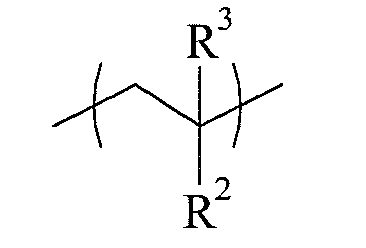
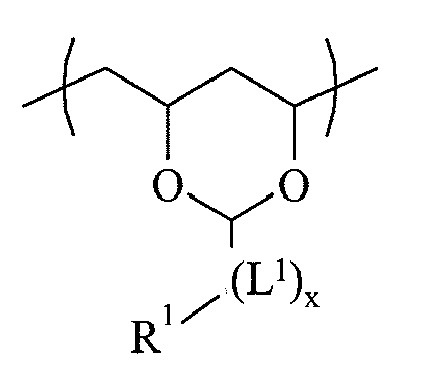
Description
- The present invention relates to (ethylene, vinyl acetal) copolymers and to lithographic printing plate precursors including such copolymers.
- Lithographic printing typically involves the use of a so-called printing master such as a printing plate which is mounted on a cylinder of a rotary printing press. The master carries a lithographic image on its surface and a print is obtained by applying ink to said image and then transferring the ink from the master onto a receiver material, which is typically paper. In conventional lithographic printing, ink as well as an aqueous fountain solution (also called dampening liquid) are supplied to the lithographic image which consists of oleophilic (or hydrophobic, i.e. ink-accepting, water-repelling) areas as well as hydrophilic (or oleophobic, i.e. water-accepting, ink-repelling) areas. In so-called driographic printing, the lithographic image consists of ink-accepting and ink-abhesive (ink-repelling) areas and during driographic printing, only ink is supplied to the master.
- Lithographic printing masters are generally obtained by the image-wise exposure and processing of an imaging material called plate precursor. The coating of the precursor is exposed image-wise to heat or light, typically by means of a digitally modulated exposure device such as a laser, which triggers a (physico-)chemical process, such as ablation, polymerization, insolubilization by cross-linking of a polymer or by particle coagulation of a thermoplastic polymer latex, solubilization by the destruction of intermolecular interactions or by increasing the penetrability of a development barrier layer. Although some plate precursors are capable of producing a lithographic image immediately after exposure, the most popular plate precursors require wet processing since the exposure produces a difference of solubility or of rate of dissolution in a developer between the exposed and the non-exposed areas of the coating. In positive working plates, the exposed areas of the coating dissolve in the developer while the non-exposed areas remain resistant to the developer. In negative working plates, the non-exposed areas of the coating dissolve in the developer while the exposed areas remain resistant to the developer. Most plates contain a hydrophobic coating on a hydrophilic support, so that the areas which remain resistant to the developer define the ink-accepting, printing areas of the plate while the hydrophilic support is revealed by the dissolution of the coating in the developer at the non-printing areas.
- Many lithographic printing plates contain polymeric binders such as phenolic resins which can be baked in order to increase the run length on the press. Over the last few years, printing plate materials which provide a high run length without baking have become more popular because the post-bake oven can be eliminated leading to reduced energy consumption and less floor space. The trend towards higher printing speeds on web presses and the use of recycled paper require plate coatings that are characterised by a high abrasion resistance. Unbaked phenolic resins such as novolac, resol or poly(vinyl phenol) have a poor abrasion resistance and cannot provide a high run length in such conditions.
- In the prior art, the run length of lithographic printing plates based on phenolic resins has been improved by chemical modification of such binders. Examples thereof are described in for example
WO 99/01795 EP 934 822 EP 1 072 432 ,US 3,929,488 ,EP 2 102 443 ,EP 2 102 444 ,EP 2 102 445 andEP 2 102 446 . Phenolic resins have also been mixed with or replaced by other polymers such as poly(vinyl acetal) resins in order to improve the abrasion resistance of the coating. Suitable poly(vinyl acetal) resins are described inUS 5,262,270 ;US 5,169,897 ;US 5,534,381 ;US 6,458,511 ;US 6,541,181 ;US 6,087,066 ;US 6,270,938 ;WO 2001/9682 EP 1 162 209 ;US 6,596,460 ;US 6,458,503 ;US 6,783,913 ;US 6,818,378 ;US 6,596,456 ;WO 2002/73315 WO 2002/96961 WO 2003/79113 WO 2004/20484 WO 2004/81662 EP 1 627 732 ;WO 2007/17162 WO 2008/103258 ;US 6,255,033 ;WO 2009/5582 WO 2009/85093 WO 2001/09682 US 2009/4599 WO 2009/99518 US 2006/130689 ;US 2003/166750 ;US 5,330,877 ;US 2005/3296 WO 2007/3030 US 2009/0291387 ;US 2010/47723 andUS 2011/0059399 . - Poly(vinyl acetal) resins are prepared in the art by acetalisation of poly(vinyl alcohol) with aldehydes. Poly(vinyl acetals) used for lithographic printing plate coatings typically comprise both a hydrophobic acetal moiety, which provides the ink-acceptance, and an hydroxyl substituted aromatic acetal moiety, which produces the solubility differentiation in an alkaline developer upon exposure.
- Such poly(vinyl acetal) resins are typically prepared by the acetalisation of poly(vinyl alcohol) with a mixture of aldehydes, e.g. an aliphatic aldehyde such as butyraldehyde mixed with a phenolic aldehyde such as hydroxybenzaldehyde. The physical and chemical properties of such poly(vinyl acetal) resins are highly dependent on the degree of acetalysation, the ratio of the aliphatic and the aromatic acetal moieties, the stereochemistry and the random or block nature of the acetal resin. Small shifts in process conditions during the preparation of the known acetal resins may produce significant differences in the structure of the obtained resin and thus in significant differences of their properties. For example, incomplete dissolution of the poly(vinyl alcohol) reagent may lead to an irreproducible degree of conversion, i.e. a lack of control of the composition of the final product. Also the competition and the transacetylisation which often occurs between the mixed aldehyde reagents is difficult to control so that the right balance between the hydrophobicity of the resin and its solubility in an alkaline developer cannot always be obtained.
- In the unpublished patent application
PCT/EP2013/075366 filed on January 1 2013 - With the so-called thermal digital plates, an infrared laser is used to image infrared radiation sensitive precursors. These infrared radiation sensitive precursors have as a common ingredient a compound that triggers the imaging mechanism by absorbing and converting the infrared radiation, which is used to image the precursors, into heat. Such compounds are often dyes, commonly referred to as IR-dyes. It has been observed that such IR-dyes, present as major ingredients in the coating of the precursors, can also have a negative impact on these precursors. For example, it has been observed that IR-dyes may be inhomogeneously distributed or even form aggregates in the coating of a printing plate due to their poor solubility in common coating solvents. Such aggregates may tend to form so-called hot spots in the coating leading to unwanted partial ablation. The generation of ablation debris may contaminate the electronics and optics of exposure devices. In addition, IR-dyes may form crystals in the coating which may locally influence the solubilisation behaviour of the coating. As a result, a poor differentiation between image and non-image areas may be obtained leading to a poor printing quality. The occurrence of these crystallization defects may become more pronounced when the printing plate precursor is stored before exposure and development, i.e. the storage stability of the precursor is poor.
-
EP 1 297 950 discloses a heat-sensitive lithographic printing plate precursor comprising a polymer which is soluble in an aqueous alkaline solution and which comprises at least one chromophoric moiety having a light absorption maximum in the wavelength range between 400 and 780 nm. -
US 6,124,425 discloses a reactive infrared absorbing polymer having a molecular weight of more than 5000 which comprises a near infrared absorbing segment, a processing segment and a thermally reactive segment. -
WO 2001/94123 - It is therefore an object of the present invention to provide poly(vinyl acetal) resins which are suitable for lithographic platemaking and which have the known advantages of this class of polymers such as a high abrasion resistance but which are intrinsically less susceptible to process conditions during their preparation. This object is realised by the (ethylene, vinyl acetal) copolymer defined in claim 1, of which the hydrophobicity is defined by ethylenic moieties in the backbone of the polymer which can be controlled independently from the acetal moieties. In the coating of lithographic printing plates these polymers provide an improved sensitivity and abrasion resistance compared to poly(vinyl acetal) resins of the prior art while the balance between the ink acceptance, arising from the ethylenic moieties, and the solubility in an alkaline developer, arising form the acetal moieties, can be controlled efficiently.
- The (ethylene, vinyl acetal) copolymer of claim 1 comprises (i) a plurality of ethylenic moieties A having a structure according to the following formula:


- L1 represents a divalent linking group;
- x = 0 or 1; and
- R1 represents an optionally substituted aromatic or heteroaromatic group including at least one hydroxyl group; and
- Other features, elements, steps, characteristics and advantages of the present invention will become more apparent from the following detailed description of preferred embodiments of the present invention. Specific embodiments of the invention are also defined in the dependent claims.
- The poly(vinyl acetal) resin of the present invention is a copolymer comprising a plurality of ethylenic moieties A, a plurality of acetal moieties B and a plurality of acetal moieties C and/or moieties D. The term "ethylenic moiety" is generally understood as the monomeric unit - i.e. the building block making up the polymer - obtained after polymerisation of optionally substituted ethylene. The ethylenic moieties comprise -CH2-CH2- as well as mono- and/or di-substituted derivatives thereof. The poly(vinyl acetal) resin of the present invention is further also referred to herein as the "(ethylene, vinyl acetal) copolymer".
- The (ethylene, vinyl acetal) copolymer may be a random or a block-copolymer. In the latter embodiment, the copolymer may include alternating sequences of blocks consisting of the ethylenic moieties A and blocks consisting of the acetal moieties B and blocks consisting of the acetal moieties C and/or moieties D. Such blocks may range from small blocks, e.g. comprising less than 5 moieties - i.e. 1, 2, 3, 4 or 5 moieties - up to blocks comprising 100 moieties or more. Preferably, the blocks including the ethylenic moieties A, the blocks including the acetal moieties B and the blocks including the acetal moieties C and/or moieties D independently include about 10 to 90, 15 to 80 or 20 to 60 ethylenic moieties. The moieties A may be all the same or different. Likewise, the moieties B, C and/or D may be all the same or different.
- The acetal moieties B have a structure according to the following formula:

- L1 represents a divalent linking group;
- X = 0 or 1; and
- R1 represents an aromatic or heteroaromatic group including at least one hydroxyl group and optionally one or more additional substituent(s). The hydroxyl group(s) may be in ortho, meta and/or para-position on the ring.
- Suitable examples of the aromatic group include a phenyl, benzyl, tolyl, ortho- meta- or para-xylyl group, naphtyl, anthracenyl, phenanthrenyl group and/or combinations thereof, which may contain, besides the at least one hydroxyl group, further optional substituents. The heteroaromatic group is preferably selected from an optionally substituted furyl, pyridyl, pyrimidyl, pyrazoyl, thiofenyl group and/or combinations thereof, all including at least one hydroxyl group.
- In the definition of R1, the optional substituents on the aromatic or heteroaromatic group may be selected from additional hydroxy substituents, an alkyl group such as a methyl or ethyl group, an alkoxy group such as a methoxy or an ethoxy group, an aryloxy group, a thioalkyl group, a thioaryl group, -SH, an azo group such as an azoalkyl or azoaryl group, a thioalkyl, amino, ethenyl, phenyl, alkyl, alkenyl, alkynyl, cycloalkyl, aryl, heteroaryl or heteroalicyclic group and/or combinations thereof.
- Preferably, R1 is an optionally substituted phenol or naphthol group such as an optionally substituted 2-,3- or 4-hydroxyphenyl group, a 2,3-, 2,4-, 2,5-dihydroxyphenyl, a 1,2,3-trihydroxyphenyl or a hydroxynaphthyl group. More preferably, R1 is an optionally substituted phenol group. The optional substitutents are preferably an alkoxy group such as a methoxy or an ethoxy group.
- The divalent linking group L1 is preferably selected from an optionally substituted alkylene, arylene or heteroarylene, - O-, -CO-, -CO-O-, -O-CO-, -CO-NH-, -NH-CO-, -NH-CO-O-, -O-CO-NH-, -NH-CO-NH-, -NH-CS-NH-, -SO-, -SO2-, -CH=N-, -NH-NH- and/or combinations thereof. The substituents optionally present on the alkylene, the arylene or the heteroarylene group may be represented by an alkyl group, a hydroxyl group, an amino group, a (di)alkylamino group, an alkoxy group, a phosponic acid group or a salt thereof. More preferably, the divalent linking group L1 represents an optionally substituted alkylene, arylene or heteroarylene. Most preferably, L1 represents -CH2-, -CH2-CH2-, -CH2-CH2-CH2- or a phenylene group.
- In a highly preferred embodiment, the acetal moieties B have a structure according to the following formula :

- The ethylenic moieties A have a structure according to the following formula :

- The optional substituents on the linear, branched or cyclic alk(en)yl group and on the aromatic or heteroaromatic group may be selected from an alkoxy group such as a methoxy or an ethoxy group, a thioalkyl group, -SH, and/or a combinations thereof. The optional substituents on the aromatic or heteroaromatic group may further be selected from an aryloxy group, a thioaryl group, an azo group such as an azoalkyl or azoaryl group, an amino group and/or a combinations thereof.
- In a highly preferred embodiment, the ethylenic moieties A have a structure according to the following formula :

- The (ethylene, vinyl acetal) copolymer of the present invention comprises besides the moieties A and B as defined above, the acetal moieties C and/or moieties D which include a structural moiety comprising a chromophoric group that has its main absorption in the infrared region.
- Preferably the acetal moieties C and the moieties D have a structure according to the following formulae:

- L2 and L3 represent a divalent linking group;
- y and z independently represent 0 or 1;
- R4 and R5 include a structural moiety comprising a chromophoric group that has its main absorption in the infrared region.
- The linking groups L2 and L3 independently represent a linking group as defined above for the linking group L1.
- In a preferred embodiment of the present invention, the acetal moieties C have a structure according to the following formula:

- R6 represents a structural moiety comprising a chromophoric group that has its main absorption in the infrared region and the bond to the center of the aromatic ring means that any of the hydrogen atoms of the aromatic ring can be substituted by - O-R6: -OR6 may be in ortho, meta or para position on the ring structure.
- The chromophoric group has its main absorption in the infrared region, i.e. radiation having a wavelength in the range from 750 to 1500 nm, preferably in the range from 750 nm to 1250 nm, more preferably in the range from 750 nm to 1100 nm, and most preferably in the range from 780 nm to 900 nm. Preferably the chromophoric group has its absorption maximum in the infrared region. Preferably, the term "chromophoric moiety" corresponds to a group including a conjugated system.
- Useful chromophoric groups correspond to the dyes given in The Chemistry and Application of Dyes, edited by D.R. Waring and G. Hallas (Plenum Press New York and London, 1990). Suitable dye classes can be selected from the group consisting of indoaniline dyes, azomethine dyes, azo dyes, di- and triaryl carbonium dyes and their heteroatomic counterparts, anthraquinone dyes, benzodifuranone dyes, polycyclic aromatic carbonyl dyes, indigoid dyes, cyanines, oxonoles, hemicyanines, azacarbocyanines, merocyanines, hemicyanines, carbostyryl dyes, phthalocyanines, quinophtalones, nitro and nitroso dyes, formazan dyes and stylbene dyes. The dyes can also be complexes of transition metals, typically e.g. copper or iron complexes. Most preferably, the chromophoric moiety is derived from cyanine dyes, indoaniline dyes, azomethine dyes, azo dyes or anthraquinone dyes.
- The chromophoric group preferably has a structure according to General Formula I:

- T and T' independently represent one or more substituents or an annulated ring;
- Z and Z' independently represent -O-, -S-, -CReRf- or -CH=CH- and wherein Re and Rf independently represent an optionally substituted alkyl or aryl group;
- Rz and Rz' independently represent an optionally substituted alkyl group;
- Rb and Rc independently represent a hydrogen atom or an optionally substituted alkyl group or represent the necessary atoms to form an optionally substituted ring structure;
- Ra and Rd independently represent a hydrogen atom or an optionally substituted alkyl group;
- Rz and Ra or Rd and Rz' may represent the necessary atoms to form an optionally substituted 5- or 6-membered ring;
- X renders the chromophoric group neutral; and
- * denotes the linking position.
- In a preferred embodiment, Z and Z' represent -CReRf-wherein Re and Rf represent an alkyl group, preferably a methyl group; Ra and Rd represent a hydrogen atom; and Rb and Rc represent the necessary atoms to form an optionally substituted ring structure; preferably a five or six membered carbocyclic or aromatic ring, most preferably a six membered carbocyclic ring.
- Preferably X represents a halide anion, i.e. Cl-, Br- or I-; a sulfonate group anion, e.g. CH3SO3 -, CF3SO3 -, p-toluene sulfonate; a tetrafluoroborate or a hexafluorophosphate anion. Most preferably, X represents p-toluene sulfonate.
- The one or more substituents T and T may be independently selected from halogen such as a chloro, bromo or iodo atom, an optionally substituted alkyl group, an optionally substituted (hetero)alkyl group, an alkoxy group, a cyano group, -CO2Rt, -CF3 and -SO2Rt' and wherein Rt represents a hydrogen atom or an optionally substituted alkyl group and Rt' respresents an optionally substituted alkyl or an optionally substituted (hetero)aryl group.
- The chromophoric group according to general formula I is preferably cationic meaning that none of the substituents contain an anionic group.
- In a preferred embodiment, the weight ratio of the weight of the chromophoric group in the polymer to the total weight of the polymer is less than 25 wt%, preferably less than 15 %wt, more preferably less then 10 wt% and most preferably between 2 and 7.5 wt%.
- The acetal moiety C is preferably prepared by post-modification of an acetal moiety bearing at least one hydroxy substituted group. Preferably, the acetal moiety C is prepared by acylation, acetalysation or alkylation of such an acetal precursor moiety - i.e. an acetal moiety bearing at least one hydroxy substituted group. An alkylation reaction of such an acetale precursor moiety is particularly preferred. For example, the acetal moiety C can be prepared by reacting a chromophoric group according to General Formula II including a leaving group in the meso-position, preferably a chloride leaving group, with a hydroxy group on the acetal precursor moiety.

- The leaving group Y preferably represents a halogen such as a fluorine, chlorine, bromine or iodine, more preferably chlorine or iodine and most preferably a chlorine.
- Typical examples of resins including acetal moieties bearing hydroxy substituted groups suitably used for the preparation of acetal moieties C, are given below without being limited thereto. The polymers are represented by their main structural elements, independent from the monomer ratios.


- Typical examples of chromophoric groups according to
- General Formula II including a leaving group in the meso-position, suitably used as precursors in the preparation of the resins according to the present invention are given in the Table below without being limited thereto.


- Preferably the (ethylene, vinyl acetal) copolymer comprises ethylenic moieties A as defined above in an amount of at least 10 mol%, preferably in a range from 10 to 55 mol%, more preferably in a range from 15 to 45 mol%, and most preferably in a range from 20 to 35 mol%. The acetal moieties B as defined above are preferably present in an amount of at least 15 mol%, preferably in a range from 15 to 60 mol%, more preferably in a range from 20 to 50 mol%, and most preferably in a range from 25 to 45 mol%. The acetal moieties C as defined above, if present, are preferably present in an amount of at least 0.25 mol%, preferably in a range from 0.25 to 25 mol%, more preferably in a range from 0.5 to 20 mol%, and most preferably in a range from 1 to 15 mol%. The acetal moieties D as defined above are, if present, preferably present in an amount of at least 0.25 mol%, preferably in a range from 0.25 to 25 mol%, more preferably in a range from 0.5 to 20 mol%, and most preferably in a range from 1 to 15 mol%. All amounts of the moieties, expressed herein as mol%, refer to the sum of all monomeric units of the copolymer.
- In a preferred embodiment, the sum of the amounts of all the moieties A, and of all the moieties B and of all the moieties C and/or moieties D in the copolymer ranges from 50 to 90 mol%, more preferably from 60 to 80 mol%, and most preferably from 65 to 75 mol%. Preferably, the (ethylene, vinyl acetal) copolymer of the present invention comprises the moieties A, B and C.
- The (ethylene, vinyl acetal) copolymer of the present invention may comprise other monomeric units besides moieties A, B, C and D as defined above. The copolymer may for example further comprise optionally substituted vinyl alcohol, referred to herein as moieties E, and/or moieties F represented by the following formula :

- wherein R7 represents hydrogen, or an optionally substituted linear, branched or cyclic alkyl group such as a methyl, ethyl, n-propyl, n-butyl, n-pentyl, n-hexyl, chloromethyl, trichloromethyl, iso-propyl, iso-butyl, iso-pentyl, neo-pentyl, 1-methylbutyl and iso-hexyl cyclopropyl, cyclobutyl, cyclopentyl, methyl cyclohexyl, cyclohexyl group, an optionally substituted aromatic group or an optionally substituted heteroaromatic group. In a preferred embodiment, R7 is an optionally substituted alkyl group, most preferably methyl.
- In the above definition of R7, the optional substituents on the linear, branched or cyclic alkyl group and the aromatic or heteroaromatic group may be selected from an alkoxy group such as a methoxy or an ethoxy group, a thioalkyl group, -SH, and/or a combinations thereof. The optional substituents on the aromatic or heteroaromatic group may further be selected from an aryloxy group, a thioaryl group, an azo group such as an azoalkyl or azoaryl group, an amino group, and/or a combinations thereof.
- The amount of vinyl alcohol moieties E is preferably from 10 to 60 mol%, more preferably from 15 to 50 mol%, and most preferably from 20 to 30 mol%. The amount of moieties F is preferably between 0 and 10 mol%. Preferably the amount of moieties F is less than 8 mol%, more preferably less than 3 mol% and most preferably less than 1 mol%.
- In a preferred embodiment of the present invention, the (ethylene, vinyl acetal) copolymer is represented by the general formula:

- wherein R1, R4, Y and L2 are as defined above and R is an optionally substituted alkyl group, preferably methyl;
- m = 10 to 55 mol%, more preferably 15 to 45 mol%, and most preferably 20 to 35 mol%;
- n = 15 to 60 mol%, more preferably 20 to 50 mol%, and most preferably 25 to 45 mol%;
- o = 10 to 60 mol%, more preferably 15 to 50 mol%, and most preferably 20 to 30 mol%; and
- p = 0 to 10 mol%, more preferably less than 3 mol% and most preferably less than 1 mol%;
- q = 0.25 to 25 mol%, more preferably 0.5 to 20 mol%, and most preferably 1 to 15 mol%.
- The numeric average molecular weight (Mn) of the copolymers according to the present invention ranges preferably from 15000 to 250000, more preferably from 25000 to 200000 and most preferably from 35000 to 150000. The weight average molecular weight (Mw) of the copolymers according to the present invention ranges preferably from 50000 to 350000, more preferably from 70000 to 325000 and most preferably from 100000 to 300000. The numeric average molecular weight (Mn) and the weight average molecular weight (Mw) are each determined by size exclusion chromatography.
- The copolymer of the present invention can, besides moieties A, B, C, D, E and F discussed above, contain further monomeric units as disclosed in
US 5,169,897 ,WO 1993/3068 US 5,534,381 ,US 5,698,360 ,JP 11-212252 JP 11-231535 JP 2000-039707 JP 2000-275821 JP 2000-275823 US 6,087,066 ,WO 2001/9682 US 6,270,938 ,US 6,596,460 ,WO 2002/73315 WO 2002/96961 US 6,818,378 ,WO 2004/20484 WO 2007/3030 WO 2009/5582 WO 2009/99518 - The copolymers described herein can be prepared using known reagentia and reaction conditions including those described in
US 6,541,181 ,US 4,665,124 ,US 4,940,646 ,US 5,169,898 ,US 5,700,619 ,US 5,792,823 ,US 5,849,842 ,WO 93/03068 DE 10011096 ;DE 3404366 ,US 09/751,660 WO 01/09682 WO 03/079113 WO 2004/081662 ,WO 2004/020484 ,WO 2008/103258 , and inJP 09-328,519 - Suitable polymers which can be used as starting material are copolymers of optionally substituted ethylene and vinyl alcohol. Acetalisation of two neighbouring vinyl alcohol units thereof with an aldehyde produces acetal moieties B.
- Examples of such aldehydes are e.g. phenolic aldehydes such as o-hydroxybenzaldehyde, 4,6-dibromo-2-formylphenol, 3,5-dichlorosalicylaldehyde, 2,4-dihydroxybenzaldehyde, 3-methoxysalicyladehyde, 6-hydroxysalicylaldehyde, phloroglucinaldehyde, m-hydroxybenzaldehyde, 3,4-dihydroxy-benzaldehyde, 4-ethoxy-3-hydroxy-benzaldehyde, p-hydroxybenzaldehyde, syringaldehyde, 4-hydroxy-3,5-di-tert-butylbenzaldehyde, 6-hydroxy-isophthalaldehydic acid and 1-hydroxy-2-anthraquinonecarboxaldehyde; naphthol aldehydes such as 2-hydroxy-1-naphthalenealdehyde, 4-hydroxy-1-naphthalenecarbaldehyde, 1-hydroxy-2-naphthaldehyde, 6-hydroxy-2-naphthaldehyde and 1,6,7-trihydroxy- 2-naphthalenecarbox-aldehyde; or antracenol aldehydes such as 1,3-dihydroxy-2-anthracenecarboxaldehyde and 2-hydroxy-1-anthracene-carboxaldehyde.
- This acetalization reaction generally requires addition of a strong inorganic or organic catalyst acid. Examples of catalyst acids are hydrochloric acid, sulfuric acid, phosphoric acid, p-toluenesulfonic acid, alkylsulfonic acid, perfluoroalkylsulfonic acid and other perfluoro-activated acids. The amount of acid added to the reaction mixture should allow effective protonation of the reagens but should not significantly alter the final product by causing unwanted hydrolysis of the acetal groups. The applied reaction temperature is preferably between 0°C and the boiling point of the solvent and depends on the kind of reagens and on the desired level of substitution. The reaction product obtained often remains in solution even if the initial poly(ethylene, vinyl alcohol) reagent is not completely dissolved. Organic solvents as well as mixtures of water with organic solvents are used for the reaction. Incomplete dissolution of the poly(ethylene, vinyl alcohol) reagent is a disadvantage that may lead to an irreproducible degree of conversion. Therefore, in order to obtain reproducible products, solvents which allow complete dissolution of the initial poly(ethylene, vinyl alcohol) reagent in the reaction mixture are preferred. Suitable organic solvents are alcohols (such as methanol, ethanol, propanol, butanol, and glycol ether), cyclic ethers (such as 1,4-dioxane), and dipolar aprotic solvents (such as N,N-dimethylformamid, N-methyl pyrrolidone or dimethyl sulfoxide). The finished products may be isolated as a solid, by introducing the reaction mixture into a non-solvent under vigorous stirring, followed by filtering and drying. Water is especially suitable as a non-solvent for the polymers. Unwanted hydrolysis of the acetal group containing a hydroxyl-substituted aromatic group takes place much easier than for the acetal groups containing an aliphatic or non-substituted aromatic group. The presence of small amounts of water in the reaction mixture may lead to a decreased degree of acetalization and incomplete conversion of the aromatic hydroxy aldehyde used. In the absence of water, the hydroxy-substituted aromatic aldehydes react with hydroxyl groups of alcohols immediately and with almost 100% conversion. Therefore, it is desirable to remove the water from the reaction mixture during the reaction by for example distillation under reduced pressure. In addition, the remaining water may be removed by adding organic compounds to the reaction mixture which form volatile materials and/or inert compounds upon reaction with water. These organic compounds may be choosen from e.g. carbonates, orthoesters of carbonic or carboxylic acids such as diethylcarbonate, trimethyl orthoformate, tetraethyl carbonate, and tetraethyl silicate such as silica-containing compounds. The addition of these materials to the reaction mixture typically leads to 100% conversion of the used aldehydes.
- Specific examples of copolymers according to the present invention are given in the following Table:


- The (ethylene, vinyl acetal) copolymer can be used as a binder in the coating of an image recording material such as a lithographic printing plate precursor or a printed circuit board precursor. The lithographic printing plate precursor preferably includes a heat and/or light sensitive coating and is preferably positive-working, i.e. after exposure and development the exposed areas of the coating are removed from the support and define hydrophilic (non-printing) areas, whereas the unexposed coating is not removed from the support and defines oleophilic (printing) areas.
- The light and/or heat-sensitive coating which includes the (ethylene, vinyl acetal) copolymer, may comprise one layer or more than one layer. Preferably, the coating comprises at least two layers; a first layer, and a second layer located above said first layer. First layer means that the layer is, compared to the second layer, located closer to the lithographic support. The poly(vinyl acetale) binder of the present invention may be present in the first layer, in the second layer or in the first and the second layer. The poly(vinyl acetal) binder of the present invention is preferably only present in the second layer.
- The light and/or heat sensitive coating preferably contains, besides the (ethylene, vinyl acetal) copolymer, an alkaline soluble oleophilic resin. The oleophilic resin present in the coating is preferably a polymer that is soluble in an aqueous developer, more preferably an aqueous alkaline developing solution with a pH between 7.5 and 14. The oleophilic resin is preferably a phenolic resin selected from a novolac, a resol or a polyvinylphenolic resin. Other preferred polymers are phenolic resins wherein the phenyl group or the hydroxy group of the phenolic monomeric unit are chemically modified with an organic substituent as described in
EP 894 622 EP 901 902 EP 933 682 WO99/63407 EP 934 822 EP 1 072 432 ,US 5,641,608 ,EP 982 123 WO99/01795 WO04/035310 WO04/035686 WO04/035645 WO04/035687 EP 1 506 858 . One or more alkaline soluble oleophilic resins may be present in the first layer, in the second layer or in both the first and the second layer. Preferably, one or more alkaline soluble oleophilic resin(s) - preferably a resole resin - is present in the layer including the poly(vinyl acetal) binder of the present invention. In the embodiment where the poly(vinyl acetal) binder is only present in the first layer, one or more alkaline soluble oleophilic resin(s) - preferably a novolac resin - is present in the second layer. - In the embodiment where the poly(vinyl acetal) binder is at least present in the second layer, the amount of phenolic resin optionally present in the coating is preferably at least 10% by weight relative to the total weight of all the components present in the coating. Preferably, the amount of phenolic resin optionally present in the coating is between 10 and 40% by weight, more preferably between 12 and 35 % by weight, most preferably between 15 and 30% by weight.
- In the embodiment where the poly(vinyl acetal) binder is only present in the first layer, the amount of phenolic resin present in the coating is preferably at least 20% by weight, more preferably at least 30% by weight and most preferably at least 45% by weight. Alternatively, the amount of phenolic resin in the latter embodiment is preferably between 25 and 65% by weight, more preferably between 35 and 60 %wt weight and most preferably between 45 and 55 %wt.
- The novolac resin or resol resin may be prepared by polycondensation of aromatic hydrocarbons such as phenol, o-cresol, p-cresol, m-cresol, 2,5-xylenol, 3,5-xylenol, resorcinol, pyrogallol, bisphenol, bisphenol A, trisphenol, o-ethylphenol, p-etylphenol, propylphenol, n-butylphenol, t-butylphenol, 1-naphtol and 2-naphtol, with at least one aldehyde or ketone selected from aldehydes such as formaldehyde, glyoxal, acetoaldehyde, propionaldehyde, benzaldehyde and furfural and ketones such as acetone, methyl ethyl ketone and methyl isobutyl ketone, in the presence of an acid catalyst. Instead of formaldehyde and acetaldehyde, paraformaldehyde and paraldehyde may, respectively, be used. The weight average molecular weight, measured by gel permeation chromatography using universal calibration and polystyrene standards, of the novolac resin is preferably from 500 to 150,000 g/mol, more preferably from 1,500 to 50,000 g/mol.
- The poly(vinylphenol) resin may be a polymer of one or more hydroxy-phenyl containing monomers such as hydroxystyrenes or hydroxy-phenyl (meth)acrylates. Examples of such hydroxystyrenes are o-hydroxystyrene, m-hydroxystyrene, p-hydroxystyrene, 2-(o-hydroxyphenyl)propylene, 2-(m-hydroxyphenyl)propylene and 2-(p-hydroxyphenyl)propylene. Such a hydroxystyrene may have a substituent such as chloro, bromo, iodo or fluoro group or a C1-4 alkyl group, on its aromatic ring. An example of such hydroxy-phenyl (meth)acrylate is 2-hydroxy-phenyl methacrylate. The poly(vinylphenol) resin may be prepared by polymerizing one or more hydroxy-phenyl containing monomer in the presence of a radical initiator or a cationic polymerization initiator, or by copolymerizing of one or more of these hydroxy-phenyl containing monomers with other monomeric compounds such as acrylate monomers, methacrylate monomers, acrylamide monomers, methacrylamide monomers, vinyl monomers, aromatic vinyl monomers or diene monomers. The weight average molecular weight, measured by gel permeation chromatography using universal calibration and polystyrene standards, of the poly(vinylphenol) resin is preferably from 1.000 to 200,000 g/mol, more preferably from 1,500 to 50,000 g/mol.
- The heat-sensitive coating may further contain one or more other binder(s) which is insoluble in water and soluble in an alkaline solution such as an organic polymer which has acidic groups with a pKa of less than 13 to ensure that the layer is soluble or at least swellable in aqueous alkaline developers. This additional binder may be present in the first layer, in the second layer or in both the first and the second layer. Preferably, the binder is present in the first layer located between the second layer including the poly(vinyl acetal) binder of the present invention and the hydrophilic support. The binder may be selected from a polyester resin, a polyamide resin, an epoxy resin, an acrylic resin, a methacrylic resin, a styrene based resin, a polyurethane resin or a polyurea resin. The binder may have one or more functional groups. The functional group(s) can be selected from the list of
- (i) a sulfonamide group such as -NR-SO2-, -SO2-NR- or -SO2-NR'R" wherein R and R' independently represent hydrogen or an optionally substituted hydrocarbon group such as an optionally substituted alkyl, aryl or heteroaryl group; more details concerning these polymers can be found in
EP 2 159 049 ; - (ii) a sulfonamide group including an acid hydrogen atom such as -SO2-NH-CO- or -SO2-NH-SO2- as for example disclosed in
US 6,573,022 ; suitable examples of these compounds include for example N-(p-toluenesulfonyl) methacrylamide and N-(p-toluenesulfonyl) acrylamide; - (iii) an urea group such as -NH-CO-NH-, more details concerning these polymers can be found in
WO 01/96119 - (iv) a star polymer in which at least three polymer chains are bonded to a core as described in
EP 2 497 639 ; - (v) a carboxylic acid group;
- (vi) a nitrile group;
- (vii) a sulfonic acid group; and/or
- (viii) a phosphoric acid group.
- (Co)polymers including a sulfonamide group are preferred. Sulfonamide (co)polymers are preferably high molecular weight compounds prepared by homopolymerization of monomers containing at least one sulfonamide group or by copolymerization of such monomers and other polymerizable monomers. Preferably, in the embodiment where the poly(vinyl acetal) binder of the present invention is present in the second layer, the copolymer comprising at least one sulfonamide group is present in the first layer located between the layer including the poly(vinyl acetal) binder of the present invention and the hydrophilic support.
- Examples of monomers copolymerized with the monomers containing at least one sulfonamide group include monomers as disclosed in
EP 1 262 318 ,EP 1 275 498 ,EP 909 657 EP 1 120 246 ,EP 894 622 US 5,141,838 ,EP 1 545 878 andEP 1 400 351 . Monomers such as alkyl or aryl (meth)acrylate such as methyl (meth)acrylate, ethyl (meth)acrylate, butyl (meth)acrylate, benzyl (meth)acrylate, 2-phenylethyl (meth)acrylate, hydroxylethyl (meth)acrylate, phenyl (meth)acrylate; (meth)acrylic acid; (meth)acrylamide; a N- alkyl or N-aryl (meth)acrylamide such as N-methyl (meth)acrylamide, N-ethyl (meth)acrylamide, N-phenyl (meth)acrylamide, N-benzyl (meth)acrylamide, N-methylol (meth)acrylamide, N-(4-hydroxyphenyl)(meth)acrylamide, N-(4-methylpyridyl)(meth)acrylate; (meth)acrylonitrile; styrene; a substituted styrene such as 2-, 3-or 4-hydroxy-styrene, 4-benzoic acid-styrene; a vinylpyridine such as 2-vinylpyridine, 3-vinylpyridine, 4-vinylpyridine; a substituted vinylpyridine such as 4-methyl-2-vinylpyridine; vinyl acetate, optionally the copolymerised vinyl acetate monomeric units are at least partially hydrolysed, forming an alcohol group, and/or at least partially reacted by an aldehyde compound such as formaldehyde or butyraldehyde, forming an acetal or butyral group; vinyl alcohol; vinyl acetal; vinyl butyral; a vinyl ether such as methyl vinyl ether; vinyl amide; a N-alkyl vinyl amide such as N-methyl vinyl amide, caprolactame, vinyl pyrrolydone; maleimide; a N-alkyl or N-aryl maleimide such as N-benzyl maleimide, are preferred. - Suitable examples of sulfonamide (co)polymers and/or their method of preparation are disclosed in
EP 933 682 EP 982 123 EP 1 072 432 ,WO 99/63407 EP 1 400 351 andEP 2 159 049 . A highly preferred example of a sulfonamide (co)polymer is described inEP 2 047 988 A in [0044] to [0046]. - Specific preferred examples of sulphonamide (co)polymers are polymers comprising N-(p-aminosulfonylphenyl) (meth)acrylamide, N-(m-aminosulfonylphenyl) (meth)acrylamide N-(o-aminosulfonylphenyl) (meth)acrylamide and or m-aminosulfonylphenyl (meth)acrylate.
- (Co)polymers including an imide group are also preferred as a binder in the heat-sensitive coating. Specific examples include derivatives of methyl vinyl ether/maleic anhydride copolymers and derivatives of styrene/maleic anhydride copolymers, that contain an N-substituted cyclic imide monomeric units and/or N-substituted maleimides such as a N-phenylmaleimide monomeric unit and a N-benzyl-maleimide monomeric unit. Preferably, this copolymer is present in the first layer located between the layer including the poly(vinyl acetal) binder of the present invention and the hydrophilic support. This copolymer is preferably alkali soluble. Suitable examples are described in
EP 933 682 EP 894 622 A EP 901 902 EP 0 982 123 A [007] to [0114],EP 1 072 432 A [0024] to [0043] andWO 99/63407 - Polycondensates and polymers having free phenolic hydroxyl groups, as obtained, for example, by reacting phenol, resorcinol, a cresol, a xylenol or a trimethylphenol with aldehydes, especially formaldehyde, or ketones, may also be added to the heat-sensitive coating. Condensates of sulfamoyl- or carbamoyl-substituted aromatics and aldehydes or ketones are also suitable. Polymers of bismethylol-substituted ureas, vinyl ethers, vinyl alcohols, vinyl acetals or vinylamides and polymers of phenylacrylates and copolymers of hydroxy-phenylmaleimides are likewise suitable. Furthermore, polymers having units of vinylaromatics or aryl (meth)acrylates may be mentioned, it being possible for each of these units also to have one or more carboxyl groups, phenolic hydroxyl groups, sulfamoyl groups or carbamoyl groups. Specific examples include polymers having units of 2-hydroxyphenyl (meth)acrylate, of 4-hydroxystyrene or of hydroxyphenylmaleimide. The polymers may additionally contain units of other monomers which have no acidic units. Such units include vinylaromatics, methyl (meth)acrylate, phenyl(meth)acrylate, benzyl (meth)acrylate, methacrylamide or acrylonitrile.
- The dissolution behavior of the coating can be fine-tuned by optional solubility regulating components. More particularly, developability enhancing compounds, development accelerators and development inhibitors can be used. In the embodiment where the coating comprises more than one layer, these ingredients can be added to the first layer and/or to the second layer and/or to an optional other layer of the coating.
- Suitable developability enhancing compounds are (i) compounds which upon heating release gas as disclosed in
WO 2003/79113 WO 2004/81662 WO 2008/103258 and (iv) the organic compounds having at least one amino group and at least one carboxylic acid group as disclosed inWO 2009/85093 - Examples of basic nitrogen-containing organic compounds useful in the developability-enhancing compositions are N-(2-hydroxyethyl)-2- pyrrolidone, 1 -(2-hydroxyethyl)piperazine, N-phenyldiethanolamine, triethanolamine, 2-[bis(2-hydroxyethyl)amino]-2-hydroxymethyl-1.3-propanediol, N,N,N',N'-tetrakis(2-hydroxyethyl)-ethylenediamine, N,N,N',N'-tetrakis(2-hydroxypropyl)-ethylenediamine, 3-[(2-hydroxyethyl)phenylamino]propionitrile, and hexahydro-1,3,5-tris(2-hydroxyethyl)-s-triazine. Preferably N,N,N',N'-tetrakis(2-hydroxypropyl)-ethylenediamine is used. Mixtures of two or more of these compounds are also useful. The basic nitrogen-containing organic compounds can be obtained from a number of commercial sources including BASF (Germany) and Aldrich Chemical Company (Milwaukee, WI).
- The basic nitrogen-containing organic compound(s) is preferably present in the coating in an amount of from 1 to 30 %wt, and typically from 3 to 15 %wt, based on the total solids of the coating composition.
- Preferably, one or more of the basic nitrogen-containing organic compounds are used in combination with one or more acidic developability-enhancing compounds, such as carboxylic acids or cyclic acid anhydrides, sulfonic acids, sulfinic acids, alkylsulfuric acids, phosphonic acids, phosphinic acids, phosphonic acid esters, phenols, sulfonamides, or sulfonimides, since such a combination may permit further improved developing latitude and printing durability. Representative examples of the acidic developability-enhancing compounds are provided in [0030] to [0036] of
US 2005/0214677 . They may be present in an amount of from 0.1 to 30 %wt based on the total dry weight of the coating composition. The molar ratio of one or more basic nitrogen-containing organic compounds to one or more acidic developability-enhancing compounds is generally from 0.1: 1 to 10:1 and more typically from 0.5: 1 to 2: 1. - Polymeric developability enhancing compounds combined with a low molecular weight developability enhancing compound as described above are also of interest. The polymeric compound preferably has a molecular weight above 1500 g/mol and is present in an amount preferably less than 40 %wt of the total coating composition, more preferably less than 10 %wt and most preferably less than 5 %wt. The low molecular weight component preferably has a molecular weight below 1500 g/mol and is present in an amount preferably less than 10 %wt of the total weight composition, more preferably less than 5 %wt and most preferably less than 2.5 %wt. This type of contrast-enhancing system is preferably used in low pH developers, pH<12, which are substantially free of silicates.
- The polymeric compound may be a derivative of a glycol such as for example polyethylenoxide, polypropyleneoxide and/or copolymers thereof, or a phenolic resin having a molecular weight lower than 100000 g/mol.
- Specific examples of such high and low molecular weight developability enhancing compounds which are suitably used together are for example hyperbranched polyesters such as the Boltorn™ products commercially available from Perstorp, and the following compounds:


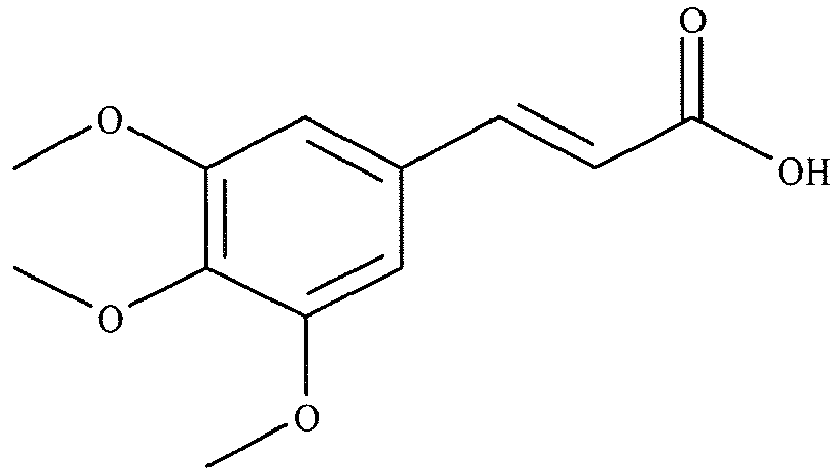
- Development accelerators are compounds which act as dissolution promoters because they are capable of increasing the dissolution rate of the coating. For example, cyclic acid anhydrides, phenols or organic acids can be used in order to improve the aqueous developability. Examples of the cyclic acid anhydride include phthalic anhydride, tetrahydrophthalic anhydride, hexahydrophthalic anhydride, 3,6-endoxy-4-tetrahydro-phthalic anhydride, tetrachlorophthalic anhydride, maleic anhydride, chloromaleic anhydride, alpha -phenylmaleic anhydride, succinic anhydride, and pyromellitic anhydride, as described in
U.S. Patent No. 4,115,128 . Examples of the phenols include bisphenol A, p-nitrophenol, p-ethoxyphenol, 2,4,4'-trihydroxybenzophenone, 2,3,4-trihydroxy-benzophenone, 4-hydroxybenzophenone, 4,4',4"-trihydroxy-triphenylmethane, and 4,4',3",4"-tetrahydroxy-3,5,3',5'-tetramethyltriphenyl-methane, and the like. Examples of the organic acids include sulphonic acids, sulfinic acids, alkylsulfuric acids, phosphonic acids, phosphates, and carboxylic acids, as described in, for example,JP-A Nos. 60-88,942 2-96,755 - In a preferred embodiment, the coating also contains developer resistance means, also called development inhibitors, i.e. one or more ingredients which are capable of delaying the dissolution of the unexposed areas during processing. The dissolution inhibiting effect is preferably reversed by heating, so that the dissolution of the exposed areas is not substantially delayed and a large dissolution differential between exposed and unexposed areas can thereby be obtained. The compounds described in e.g.
EP 823 327 WO 97/39894 EP 825 927 EP 823 327 - Other suitable inhibitors improve the developer resistance because they delay the penetration of the aqueous alkaline developer into the coating. Such compounds can be present in the first layer and/or in the optional second layer and/or in a development barrier layer on top of said layer, as described in e.g.
EP 864 420 EP 950 517 WO 99/21725 WO 01/45958 - Water-repellent polymers represent another type of suitable dissolution inhibitors. Such polymers seem to increase the developer resistance of the coating by repelling the aqueous developer from the coating. The water-repellent polymers can be added to the first and/or second layer of the coating and/or can be present in a separate layer provided on top of these layers. In the latter embodiment, the water-repellent polymer forms a barrier layer which shields the coating from the developer and the solubility of the barrier layer in the developer or the penetrability of the barrier layer by the developer can be increased by exposure to heat or infrared light, as described in e.g.
EP 864 420 EP 950 517 WO99/21725 - Preferred examples of inhibitors which delay the penetration of the aqueous alkaline developer into the coating include water-repellent polymers including siloxane and/or perfluoroalkyl units. The polysiloxane may be a linear, cyclic or complex cross-linked polymer or copolymer. The term polysiloxane compound shall include any compound which contains more than one siloxane group -Si(R,R')-O-, wherein R and R' are optionally substituted alkyl or aryl groups. Preferred siloxanes are phenylalkylsiloxanes and dialkylsiloxanes. The number of siloxane groups in the polymer is at least 2, preferably at least 10, more preferably at least 20. It may be less than 100, preferably less than 60.
- The water-repellent polymer may be a block-copolymer or a graft-copolymer including a polar block such as a poly- or oligo(alkylene oxide) and a hydrophobic block such as a long chain hydrocarbon group, a polysiloxane and/or a perfluorinated hydrocarbon group. A typical example of a perfluorinated surfactant is Megafac F-177 available from Dainippon Ink & Chemicals, Inc.. Other suitable copolymers comprise about 15 to 25 siloxane units and 50 to 70 alkyleneoxide groups. Preferred examples include copolymers comprising phenylmethylsiloxane and/or dimethylsiloxane as well as ethylene oxide and/or propylene oxide, such as Tego Glide 410, Tego Wet 265, Tego Protect 5001 or Silikophen P50/X, all commercially available from Tego Chemie, Essen, Germany.
- A suitable amount of such a water-repellent polymer in the coating is between 0.5 and 25 mg/m2, preferably between 0.5 and 15 mg/m2 and most preferably between 0.5 and 10 mg/m2. When the water-repellent polymer is also ink-repelling, e.g. in the case of polysiloxanes, higher amounts than 25 mg/m2 can result in poor ink-acceptance of the non-exposed areas. An amount lower than 0.5 mg/m2 on the other hand may lead to an unsatisfactory development resistance.
- It is believed that during coating and drying, the water-repellent polymer or copolymer acts as a surfactant and tends to position itself, due to its bifunctional structure, at the interface between the coating and air and thereby forms a separate top layer, even when applied as an ingredient of the coating solution. Simultaneously, such surfactants also act as spreading agents which improve the coating quality. Alternatively, the water-repellent polymer or copolymer can be applied in a separate solution, coated on top of the coating including one or optional more layers. In that embodiment, it may be advantageous to use a solvent in the separate solution that is not capable of dissolving the ingredients present in the other layers so that a highly concentrated water-repellent phase is obtained at the top of the coating.
- Optionally, the coating of the heat-sensitive printing plate precursor may contain an infrared light absorbing dye or pigment which, in the embodiment where the coating comprises more than one layer, may be present in the first layer, and/or in the second layer, and/or in an optional other layer. Preferred IR absorbing dyes are cyanine dyes, merocyanine dyes, indoaniline dyes, oxonol dyes, pyrilium dyes and squarilium dyes. Examples of suitable IR dyes are described in e.g.
EP-As 823327 978376 1029667 ,1053868 ,1093934 ;WO 97/39894 00/29214 
- The concentration of the optional IR-dye in the coating is preferably between 0.25 and 15.0 %wt, more preferably between 0.5 and 10.0 %wt, most preferably between 1.0 and 7.5 %wt relative to the coating as a whole.
- The coating may further comprise one or more colorant(s) such as dyes or pigments which provide a visible color to the coating and which remain in the coating at the image areas which are not substantially removed during the processing step. As a result, a visible image is formed which enables inspection of the lithographic image on the developed printing plate. Such dyes are often called contrast dyes or indicator dyes. Preferably, the dye has a blue color and an absorption maximum in the wavelength range between 600 nm and 750 nm. Typical examples of such contrast dyes are the amino-substituted tri- or diarylmethane dyes, e.g. crystal violet, methyl violet, victoria pure blue, flexoblau 630, basonylblau 640, auramine and malachite green. Also the dyes which are discussed in depth in
EP-A 400,706 WO2006/005688 may also be used as colorants. - To protect the surface of the coating of the heat and/or light sensitive printing plate precursors, in particular from mechanical damage, a protective layer may also optionally be applied. The protective layer generally comprises at least one water-soluble binder, such as polyvinyl alcohol, polyvinylpyrrolidone, partially hydrolyzed polyvinyl acetates, gelatin, carbohydrates or hydroxyethylcellulose, and can be produced in any known manner such as from an aqueous solution or dispersion which may, if required, contain small amounts - i.e. less than 5% by weight based on the total weight of the coating solvents for the protective layer - of organic solvents. The thickness of the protective layer can suitably be any amount, advantageously up to 5.0 µm, preferably from 0.1 to 3.0 µm, particularly preferably from 0.15 to 1.0 µm.
- Optionally, the coating may further contain additional ingredients such as surfactants, especially perfluoro surfactants, inoragnic fillers or polymers particles such as matting agents and spacers. Examples of inorganic fillers include silicon or titanium dioxide particles, zirconium oxide, kaolin clays and derivatives, silicium oxide based particles optionally coated and/or modified, alumina oxide, fumed silica and cerium oxide. The particles can be in the micrometer range, typically between 1 µm and 10 µm. More preferable, the particles are in the nanometer-range i.e. between 10 nm and 900 nm.
- Any coating method can be used for applying one or more coating solutions to the hydrophilic surface of the support. The multi-layer coating can be applied by coating/drying each layer consecutively or by the simultaneous coating of several coating solutions at once. In the drying step, the volatile solvents are removed from the coating until the coating is self-supporting and dry to the touch. However it is not necessary (and may not even be possible) to remove all the solvent in the drying step. Indeed the residual solvent content may be regarded as an additional composition variable by means of which the composition may be optimized. Drying is typically carried out by blowing hot air onto the coating, typically at a temperature of at least 70°C, suitably 80-150°C and especially 90-140°C. Also infrared lamps can be used. The drying time may typically be 15-600 seconds.
- Between coating and drying, or after the drying step, a heat treatment and subsequent cooling may provide additional benefits, as described in
WO99/21715 EP-A 1074386 ,EP-A 1074889 ,WO00/29214 WO/04030923 WO/04030924 WO/04030925 - The lithographic printing plate precursor used in the present invention comprises a support which has a hydrophilic surface or which is provided with a hydrophilic layer. The support may be a sheet-like material such as a plate or it may be a cylindrical element such as a sleeve which can be slid around a print cylinder of a printing press. Preferably, the support is a metal support such as aluminum or stainless steel. The support can also be a laminate comprising an aluminum foil and a plastic layer, e.g. polyester film.
- A particularly preferred lithographic support is a grained and anodized aluminum support. The aluminum support has usually a thickness of about 0.1-0.6 mm. However, this thickness can be changed appropriately depending on the size of the printing plate used and/or the size of the plate-setters on which the printing plate precursors are exposed. The aluminum is preferably grained by electrochemical graining, and anodized by means of anodizing techniques employing phosphoric acid or a sulphuric acid/phosphoric acid mixture. Methods of both graining and anodization of aluminum are well known in the art.
- By graining (or roughening) the aluminum support, both the adhesion of the printing image and the wetting characteristics of the non-image areas are improved. By varying the type and/or concentration of the electrolyte and the applied voltage in the graining step, different type of grains can be obtained. The surface roughness is often expressed as arithmetical mean centerline roughness Ra (ISO 4287/1 or DIN 4762) and may vary between 0.05 and 1.5 µm. The aluminum substrate of the current invention has preferably an Ra value between 0.30 µm and 0.60 µm, more preferably between 0.35 µm and 0.55 µm and most preferably between 0.40 µm and 0.50 µm. The lower limit of the Ra value is preferably about 0.1 µm. More details concerning the preferred Ra values of the surface of the grained and anodized aluminum support are described in
EP 1 356 926 . - By anodising the aluminum support, its abrasion resistance and hydrophilic nature are improved. The microstructure as well as the thickness of the Al2O3 layer are determined by the anodising step, the anodic weight (g/m2 Al2O3 formed on the aluminum surface) varies between 1 and 8 g/m2. The anodic weight is preferably between 1.5 g/m2 and 5.0 g/m2, more preferably 2.5 g/m2 and 4.0 g/m2 and most preferably 2.5 g/m2 and 3.5 g/m2.
- The grained and anodized aluminum support may be subject to a so-called post-anodic treatment to improve the hydrophilic character of its surface. For example, the aluminum support may be silicated by treating its surface with a solution including one or more alkali metal silicate compound(s) - such as for example a solution including an alkali metal phosphosilicate, orthosilicate, metasilicate, hydrosilicate, polysilicate or pyrosilicate - at elevated temperature, e.g. 95°C. Silicated supports are preferred in the embodiment were the printing plate precursors of the present invention are developed with a silicate-free developer solution. Post anodic treatment Alternatively, a phosphate treatment may be applied which involves treating the aluminum oxide surface with a phosphate solution that may further contain an inorganic fluoride. Further, the aluminum oxide surface may be rinsed with a citric acid or citrate solution, gluconic acid, or tartaric acid. This treatment may be carried out at room temperature or may be carried out at a slightly elevated temperature of about 30 to 50°C. A further interesting treatment involves rinsing the aluminum oxide surface with a bicarbonate solution. Still further, the aluminum oxide surface may be treated with polyvinylphosphonic acid, polyvinylmethylphosphonic acid, phosphoric acid esters of polyvinyl alcohol, polyvinylsulphonic acid, polyvinylbenzenesulphonic acid, sulphuric acid esters of polyvinyl alcohol, acetals of polyvinyl alcohols formed by reaction with a sulphonated aliphatic aldehyde, polyacrylic acid or derivates such as GLASCOL E15™ commercially available from Ciba Speciality Chemicals. One or more of these post treatments may be carried out alone or in combination. More detailed descriptions of these treatments are given in
GB-A 1 084 070 DE-A 4 423 140 ,DE-A 4 417 907 ,EP-A 659 909 EP-A 537 633 DE-A 4 001 466 ,EP-A 292 801 EP-A 291 760 US 4,458,005 . - In a preferred embodiment, the support is first treated with an aqueous solution including one or more silicate compound(s) as descibed above followed by the treatment of the support with an aqueous solution including a compound having a carboxylic acid group and/or a phosphonic acid group, or their salts. Particularly preferred silicate compounds are sodium or potassium orthosilicate and sodium or potassium metasilicate. Suitable examples of a compound with a carboxylic acid group and/or a phosphonic acid group and/or an ester or a salt thereof are polymers such as polyvinylphosphonic acid, polyvinylmethylphosphonic acid, phosphoric acid esters of polyvinyl alcohol, polyacrylic acid, polymethacrylic acid and a copolymer of acrylic acid and vinylphosphonic acid. A solution comprising polyvinylphosphonic acid or poly(meth)acrylic acid is highly preferred.
- The support can also be a flexible support, which may be provided with a hydrophilic layer, hereinafter called 'base layer'. The flexible support is e.g. paper, plastic film or aluminum. Preferred examples of plastic film are polyethylene terephthalate film, polyethylene naphthalate film, cellulose acetate film, polystyrene film, polycarbonate film, etc. The plastic film support may be opaque or transparent.
- The base layer is preferably a cross-linked hydrophilic layer obtained from a hydrophilic binder cross-linked with a hardening agent such as formaldehyde, glyoxal, polyisocyanate or a hydrolyzed tetra-alkylorthosilicate. The latter is particularly preferred. The thickness of the hydrophilic base layer may vary in the range of 0.2 to 25 µm and is preferably 1 to 10 µm. More details of preferred embodiments of the base layer can be found in e.g.
EP 1 025 992 . - The heat-sensitive plate precursor can be image-wise exposed directly with heat, e.g. by means of a thermal head, or indirectly by infrared light, preferably near infrared light. The infrared light is preferably converted into heat by an IR light absorbing compound as discussed above. The heat-sensitive lithographic printing plate precursor is preferably not sensitive to visible light, i.e. no substantial effect on the dissolution rate of the coating in the developer is induced by exposure to visible light. Most preferably, the coating is not sensitive to ambient daylight, i.e. the wavelength range including near UV light (300-400 nm) and visible light (400-750 nm).
- The printing plate precursor can be exposed to infrared light by means of e.g. LEDs or a laser. Most preferably, the light used for the exposure is a laser emitting near infrared light having a wavelength in the range from about 750 to about 1500 nm, more preferably 750 to 1100 nm, such as a semiconductor laser diode, a Nd:YAG or a Nd:YLF laser. The required laser power depends on the sensitivity of the plate precursor, the pixel dwell time of the laser beam, which is determined by the spot diameter (typical value of modern plate-setters at 1/e2 of maximum intensity: 5-25 µm), the scan speed and the resolution of the exposure apparatus (i.e. the number of addressable pixels per unit of linear distance, often expressed in dots per inch or dpi; typical value : 1000-4000 dpi).
- Two types of laser-exposure apparatuses are commonly used: internal (ITD) and external drum (XTD) platesetters. ITD plate-setters for thermal plates are typically characterized by a very high scan speed up to 500 m/sec and may require a laser power of several Watts. XTD platesetters for thermal plates having a typical laser power from about 200 mW to about 1 W operate at a lower scan speed, e.g. from 0.1 to 10 m/sec. An XTD platesetter equipped with one or more laserdiodes emitting in the wavelength range between 750 and 850 nm is an especially preferred embodiment for the method of the present invention.
- The known platesetters can be used as an off-press exposure apparatus, which offers the benefit of reduced press downtime. XTD platesetter configurations can also be used for on-press exposure, offering the benefit of immediate registration in a multi-color press. More technical details of on-press exposure apparatuses are described in e.g.
US 5,174,205 andUS 5,163,368 . - After exposure, the precursor is developed whereby the non-image areas of the coating are removed by immersion in a developer, preferably an aqueous alkaline developer, which may be combined with mechanical rubbing, e.g. by a rotating brush. The developer preferably comprises an alkaline agent which may be an inorganic alkaline agent such as an alkali metal hydroxide, an organic alkaline agent such as an amine, and/or an alkaline silicate such as an alkali metal silicate or an alkali metal metasilicate. Silicate-based developers which have a ratio of silicon dioxide to alkali metal oxide of at least 1 are advantageous because they ensure that the alumina layer (if present) of the substrate is not damaged. Preferred alkali metal oxides include Na2O and K2O, and mixtures thereof. A particularly preferred silicate-based developer solution is a developer solution comprising sodium or potassium metasilicate, i.e. a silicate where the ratio of silicon dioxide to alkali metal oxide is 1. The developer preferably has a pH above 8, more preferably above 10 and most preferably above 12. The developer may further contain components such as a buffer substance, a complexing agent, an antifoaming agent, an organic solvent, a corrosion inhibitor, a dye, an antisludge agent, a dissolution preventing agent such as a non-ionic surfactant, an anionic, cationic or amphoteric surfactant and/or a hydrotropic agent as known in the art. The developer may further contain a poly- hydroxyl compound such as e.g. sorbitol, preferably in a concentration of at least 40 g/l, and also a polyethylene oxide containing compound such as e.g. Supronic B25, commercially available from RHODIA, preferably in a concentration of at most 0.15 g/l.; this may be combined with mechanical rubbing, e.g. by using a rotating brush. During development, any water-soluble protective layer present is also removed. In a preferred embodiment, the developer is substantially free of silicates e.g. alkali metal silicates or alkali metal metasilicates.
- More details concerning the development step can be found in for example
EP 2 263 874 ,US 2010/0047723 andWO/2004071767 . - The development step may be followed by a rinsing step and/or a gumming step. The gumming step involves post-treatment of the lithographic printing plate with a gum solution. A gum solution is typically an aqueous liquid which comprises one or more surface protective compounds that are capable of protecting the lithographic image of a printing plate against contamination or damaging. Suitable examples of such compounds are film-forming hydrophilic polymers or surfactants. A suitable gum solution which can be used after the development step is described in for example
EP 1 342 568 andWO 2005/111727 . The plate precursor can, if required, be further post-treated with a suitable correcting agent or preservative as known in the art. - To increase the resistance of the finished printing plate and hence to extend its press life capability the layer can be briefly heated to elevated temperatures ("baking"). The plate can be dried before baking or is dried during the baking process itself. During the baking step, the plate can be heated at a temperature which is higher than the glass transition temperature of the heat-sensitive coating, e.g. between 100°C and 230°C for a period of 40 seconds to 5 minutes. Baking can be done in conventional hot air ovens or by irradiation with lamps emitting in the infrared or ultraviolet spectrum. As a result of this baking step, the resistance of the printing plate to plate cleaners, correction agents and UV-curable printing inks increases. Such a thermal post-treatment is described, inter alia, in
DE 1,447,963 andGB 1,154,749 - The heat and/or light sensitive printing plates can be used for conventional, so-called wet offset printing, in which ink and an aqueous dampening liquid are supplied to the plate. Another suitable printing method uses so-called single-fluid ink without a dampening liquid. Suitable single-fluid inks have been described in
US 4,045,232 ;US 4,981,517 andUS 6,140,392 . In a most preferred embodiment, the single-fluid ink comprises an ink phase, also called the hydrophobic or oleophilic phase, and a polyol phase as described inWO 00/32705 - The structural formulae shown below indicate the monomer composition of the prepared resins but the sequence of the moieties is for illustration only.
- Unless otherwise specified, all compounds and solvents used in the Examples are readily available from fine chemical suppliers such as Acros or Aldrich.
- The LC-MS analysis according to method 1 was done on a HP 1100 Esquire LC, using an Altima HP C18 AQ column (150x3, 5µm), operating at a flow rate of 0.5 ml/min and at 40°C. A gradient elution was used, with water + 0.1 % formic acid as eluent A and acetonitrile + 0.1% formic acid as eluent B. The gradient according to the following Table was used.
Time % B 0 20 7 100 17 100 17.1 20 20 20 - ESI ionisation was used in combination with a combibron detector. 5 µl of a solution of 2 mg of each compound in 10 ml acetonitrile was injected.
- The LC-MS analysis according to method 2 was done on a HP 1100 Esquire LC, using an Altima HP C18 AQ column (150x3, 5µm), operating at a flow rate of 0.5 ml/min and at 40°C. A gradient elution was used, H2O/MeOH 9/1 containing 10 mmol NH4OAc as eluent A and MeOH containing 10 mmol NH4OAc as eluent B. The gradient according to the following Table was used.
Time % B 0 0 12 100 17 100 18 0 20 0 - ESI ionisation was used in combination with a combibron detector. 5 µl of a solution of 2 mg of each compound in 10 ml acetonitrile was injected.
- A Varian Unity Inova spectrometer was used, using DMSO d6 as solvent at 25°C with DMSO d5 (2.50 ppm) as internal reference at a spectrometer frequency of 400 MHz.
-


- 13.6 g of an ethylene vinyl alcohol copolymer (27 mol % ethylene, EVAL SP521 B, supplied by Kuraray) was dissolved in 50 g dimethyl acetamide at 85°C. 0.3 g (3.13 mmol) methane sulfonic acid in 5.6 g dimethyl acetamide was added and the mixture was stirred for 10 minutes at 85°C. 12.2 g (0.1 mol) salicylic aldehyde in 11.3 g dimethyl acetamide was added slowly while keeping the reaction temperature at 80°C. The reaction was allowed to continue for 1 hour at 80°C. 11.1 g (0.105 mol) trimethyl orthoformate in 5.6 g dimethyl acetamide was added and the reaction was allowed to continue for 90 minutes at 80°C. 0.92 g (3.13 mmol) quadrol (CASRN102-60-3) in 7 g dimethyl acetamide was added and the reaction mixture was stirred for 10 minutes. The reaction mixture was diluted with 90 ml 1-methoxy-2-propanol and cooled down to room temperature. The reaction mixture was further diluted with 100 ml 1-methoxy-2-propanol. The mixture was slowly added to 1 1 water to precipitate comparative resin 1. Comparative resin 1 was isolated by filtration and treated with a mixture of 400 ml water en 100 ml 1-methoxy-2-propanol for 16 hours. Comparative resin 1 was isolated by filtration and dried. 21 g of comparative resin 1 was isolated.
- Comparative resin 1 was analyzed using 1H-NMR spectroscopy. (20 mg of the polymer was dissolved in DMSO-d6 : the aromatic protons of the polymer bound phenolic fragments:
- 6.75 ppm (2H), 7.11 ppm (1H), 7.32 ppm (1H), the acetal protons : 5.70 ppm and 5.99 ppm (together 1H), the phenolic proton : 9.30 ppm (1H)).
-

-


- 279.8 g of an ethylene vinyl alcohol copolymer (29 mol% ethylene supplied by Aldrich) was dissolved in 1000 g dimethyl acetamide at 100°C. The reaction mixture was cooled to 90°C. A solution of 6 g (62.5 mmol) methane sulfonic acid in 75 g dimethyl acetamide was added and the mixture was stirred for 10 minutes. A solution of 244.2 g (2 mol) 3-hydroxy-benzaldehyde in 200 g dimethyl acetamide was added over 30 minutes, while keeping the temperature at 90°C. The reaction was allowed to continue for 2 hours at 90°C. A solution of 222.8g (2.1 mol) trimethyl orthoformate in 112.5 g dimethyl acetamide was added and the reaction was allowed to continue at 80°C for 16 hours. A solution of 18.3 g quadrol (CASRN102-60-3) in 112.5 dimethyl acetamide was added and the reaction mixture was stirred for 10 minutes. The reaction mixture was diluted with 1800 1-methoxy-2-propanol and cooled down to room temperature. The mixture was further diluted with 6000 g 1-methoxy-2-propanol and the polymer was precipitated in 30 1 water. The polymer was isolated by filtration and washed with a mixture of 4 1 water and 1 1 1-methoxy-2-propanol. The polymer was treated with a mixture of 5 1 water and 1 1 1-methoxy-2-propanol, isolated by filtration and dried. 450 g of the polymer was isolated.
-


- 5.7 g of the 3-hydroxy-benzaldehyde derivatised resin was dissolved in 28.5 g dimethyl formamide at 65°C. 20 mg (0.5 mmol) NaH (60% in mineral oil) was added and the reaction was allowed to continue for 30 minutes at 65°C. A solution of 0.39 g (0.5 mmol) of IR-dye 1 (supplied by FEW Chemicals) in 10 g dimethyl formamide was added and the reaction was allowed to continue for 2 hours at 65°C. The reaction mixture was allowed to cool down to room temperature and the reaction mixture was diluted with 105 g 1-methoxy-2-propanol. The mixture was added to 420 g water. The mixture was stirred for 1 hour. IR-resin 1 was isolated by filtration, washed with water and dried. 4.8 g of Inventive IR-resin 1 was isolated. Inventive IR-resin 1 was characterized using TLC-analysis (on Silicagel 60 F254, supplied by Merck, eluent methylene chloride/methanol 90/10, no residual IR dye detectable at Rf = 0.5) and UV-VIS-spectroscopy (0.013 w% in dimethyl acetamide : λmax : 825 nm).
-
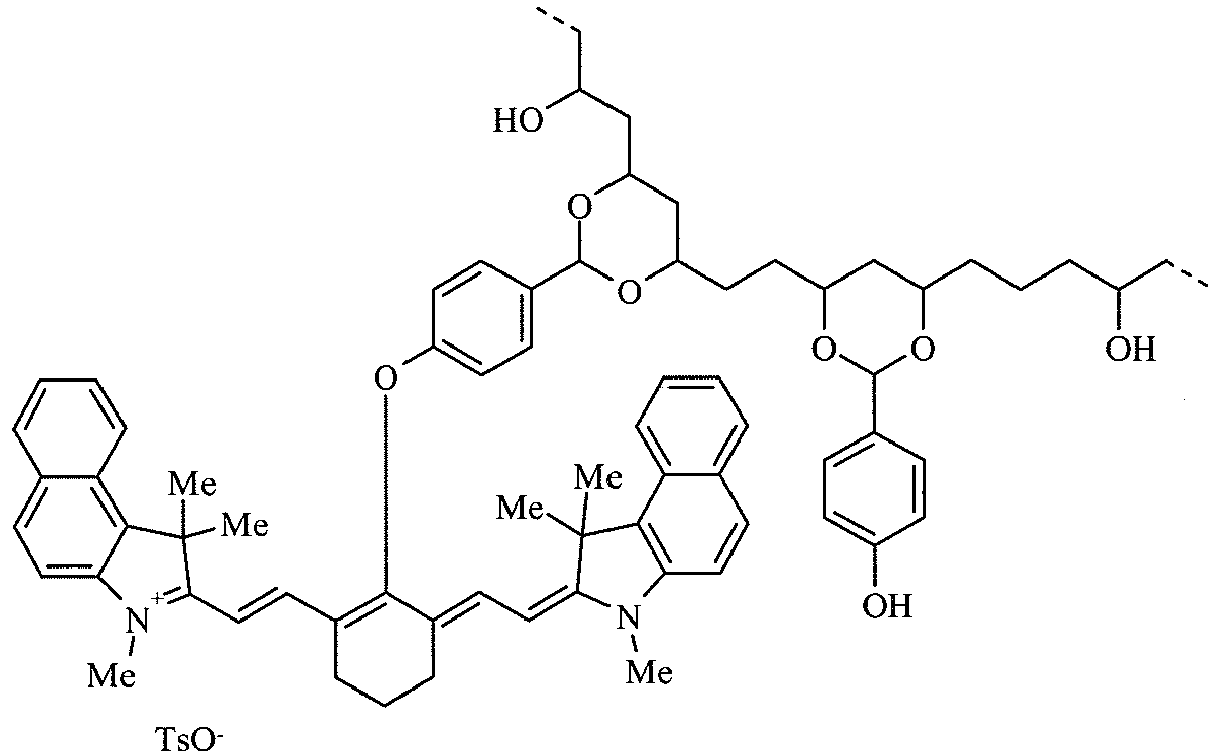
-

- 43.5 g EVAL SP521B (supplied by Kuraray) was dissolved in 200 g dimethyl formamide at 120°C. The mixture was allowed to cool down to 80°C. 0.96 g (10 mmol) methane sulfonic acid, dissolved in 12 g dimethyl formamide was added, followed by the addition of 39.1 g (0.32 mol) 4-hydroxybenzaldehyde, dissolved in 24 g dimethyl formamide. The reaction was allowed to continue for 45 minutes at 82°C. A solution of 37.5 g (0.36 mol) 2,2-dimethoxypropane in 22 g dimethyl formamide was added while keeping the temperature at 82°C. The reaction was allowed to continue for one hour at 82°C. A solution of 2.9 g (10 mmol) Quadrol (CASRN102-60-3) in 8 g dimethyl formamide was added and the mixture was allowed to cool down to room temperature. The mixture was diluted with 1300 g 1-methoxy-2-propanol and the polymer was precipitated in 13 1 water. The polymer was isolated by filtration, treated with a mixture of 4.3 1 water and 860 ml 1-methoxy-2-propanol, isolated by filtration, washed twice with a mixture of 2 1 water and 200 1-methoxy-2-propanol and dried. 51 g of the 4-hydroxybenzaldehyde functionalized resin was isolated.
-
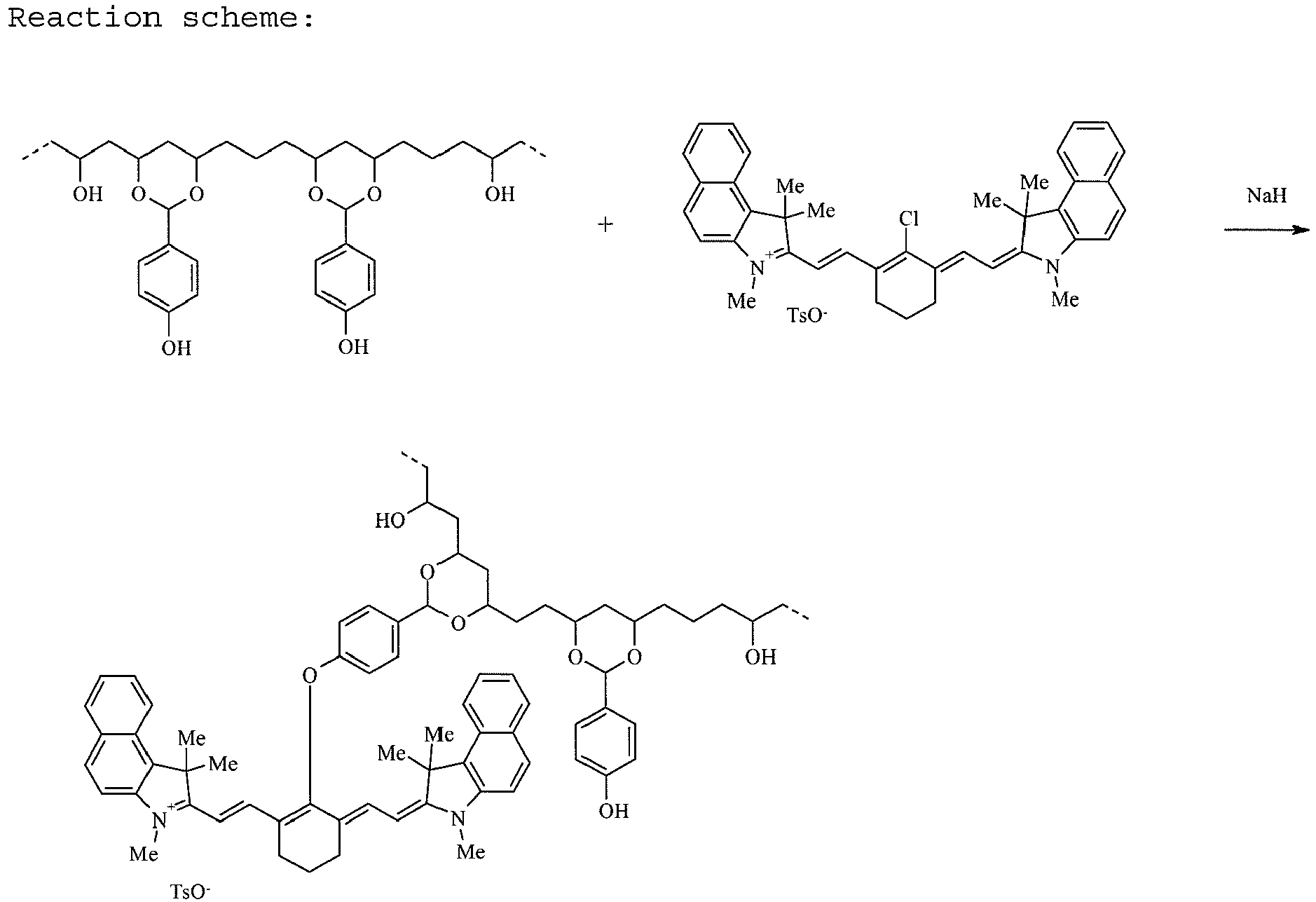
- 5.7 g of the 4-hydroxy-benzaldehyde derivatised resin was dissolved in 28.5 g dimethyl formamide at 65°C. 20 mg (0.5 mmol) NaH (60% in mineral oil) was added and the reaction was allowed to continue for 30 minutes at 65°C. A solution of 0.39 g (0.5 mmol) of IR-dye 1 (supplied by FEW Chemicals) in 10 g dimethyl formamide was added and the reaction was allowed to continue for 2 hours at 65°C. The reaction mixture was allowed to cool down to room temperature and Inventive IR-resin 2 was precipitated in 500 ml water. The mixture was stirred for one hour followed by the addition of 75 ml ethanol and stirring over night. Inventive IR-resin 2 was isolated by filtration, washed with water and dried. 2.7 g of Inventive IR-resin 2 was isolated. Inventive IR-resin 2 was characterized using TLC-analysis (on Silicagel 60 F254, supplied by Merck, eluent methylene chloride/methanol 90/10, no residual IR dye detectable at Rf =0.5) and UV-VIS-spectroscopy (0.013 w% in dimethyl acetamide : λmax : 813 nm).
-

-


- 13.6 g of EVAL SP521 B (supplied by Kuraray) was dissolved in 50 g dimethyl acetamide at 85°C. 0.3 g (3.13 mmol) methane sulfonic acid in 5.6 g dimethyl acetamide was added and the mixture was stirred for 10 minutes at 85°C. 12.2 g (0.1 mol) salicylic aldehyde in 11.3 g dimethyl acetamide was added slowly while keeping the reaction temperature at 80°C. The reaction was allowed to continue for 1 hour at 80°C. 11.1 g (0.105 mol) trimethyl orthoformate in 5.6 g dimethyl acetamide was added and the reaction was allowed to continue for 90 minutes at 80°C. 0.92 g (3.13 mmol) quadrol (CASRN102-60-3) in 7 g dimethyl acetamide was added and the reaction mixture was stirred for 10 minutes. The reaction mixture was diluted with 90 ml 1-methoxy-2-propanol and cooled down to room temperature. The reaction mixture was further diluted with 100 ml 1-methoxy-2-propanol. The mixture was slowly added to 1 1 water to precipitate the polymer. The polymer was isolated by filtration and treated with a mixture of 400 ml water en 100 ml 1-methoxy-2-propanol for 16 hours. The polymer was isolated by filtration and dried. 21 g of intermediate polymer was isolated.
-


- 5.2 g of the 2-hydroxy-benzaldehyde derivatised resin was dissolved in 28.5 g dimethyl formamide at 65°C. 16 mg (0.4 mmol) NaH (60% in mineral oil) was added and the reaction was allowed to continue for 30 minutes at 65°C. A solution of 0.31 g (0.4 mmol) of IR-dye 1 (supplied by FEW Chemicals) in 10 g dimethyl formamide was added and the reaction was allowed to continue for 2 hours at 65°C. The reaction mixture was allowed to cool down to room temperature. The reaction mixture was diluted with 50 g ethanol and Inventive IR-resin 3 was precipitated in 600 g water. Inventive IR-resin 3 was isolated by filtration and dried. 4.2 g of Inventive IR-resin 3 was isolated. Inventive IR-resin 3 was characterized using TLC-analysis (on Silicagel 60 F254, supplied by Merck, eluent methylene chloride/methanol 90/10, no residual IR dye detectable at Rf =0.5) and UV-VIS-spectroscopy (0.013 w% in dimethyl acetamide : λmax : 812 nm).
- A 0.3 mm thick aluminum foil was degreased by spraying with an aqueous solution containing 34 g/l NaOH at 70°C for 6 seconds and rinsed with demineralised water for 3.6 seconds. The foil was then electrochemically grained during 8 seconds using an alternating current in an aqueous solution containing 15 g/l HCl, 15 g/l SO4 2ions and 5 g/l Al3+ ions at a temperature of 37°C and a current density of about 100 A/dm2 (charge density of about 800 C/dm2). Afterwards, the aluminum foil was desmutted by etching with an aqueous solution containing 6.5 g/l of sodium hydroxide at 35°C for 5 seconds and rinsed with demineralised water for 4 seconds. The foil was subsequently subjected to anodic oxidation during 10 seconds in an aqueous solution containing 145 g/l of sulfuric acid at a temperature of 57°C and an anodic charge of 250 C/dm2, then washed with demineralised water for 7 seconds and dried at 120°C for 7 seconds.
- The lithographic support was post treated by spraying, onto the above described support a post treatment solution containing 2.2 g/l polyvinylphosphonic acid (PVPA) for 4 seconds at 70°C, rinsed with demineralised water for 3.5 seconds and dried at 120°C for 7 seconds.
- The support thus obtained was characterised by a surface roughness Ra of 0.45-0.50 µm (measured with interferometer WYKO NT1100™ Optical profiling system) and had an anodic weight of about 3.0 g/m2 (gravimetric analysis).
- A first coating solution (Table 1) was applied on the aluminum substrate S-01 at a wet coating thickness of 26 µm. After coating, this first layer was dried at 100°C for 1 minute.
Table 1: first coating solution. Composition coating solution %wt Dowanol PM(1) 21.23 THF 58.38 Binder (2) 13.69 Crystal Violet(3) 5.02 Contrast dye FEW S0944 (4) 1.26 Tegoglide 410(5) 0.42 - (1) Propyleneglycol-monomethylether(1-methoxy-2-propanol) commercially available from Dow Chemical Company;
- (2) Polysulfonacrylamide (65 mol% sulfonamide/35 mol% N-phenyl-acrylamide)

- (3) 1 wt % solution of Crystal Violet in Dowanol PM; Crystal Violet is commercially available from Ciba-Geigy GmbH.;
- (4) Cyanine dye commercially available from FEW Chemicals GmbH.;
- (5) 1 wt % solution of Tegoglide 410 in Dowanol PM; Tegoglide 410 is a copolymer of polysiloxane and poly(alkylene oxide), commercially available from Tego Chemie Service GmbH.
- A second coating solution (Table 2) was subsequently coated on the previous layer (wet coating thickness = 26 µm) resulting in printing plate precursors PPP-01 to PPP-07. The solution was prepared by the ingredients given in Table 2 in a 50/50 mixture of methyl-ethylketon (MEK) and dowanol PM®. After coating, this second layer was dried at 100°C for 1 minute.
Table 2: Second coating solution. Composition coating solution* mg/m2 Resin (1) 436.4 Tetrahydrophtalic acid anhydride 35.0 Alnovol SPN402 (44.3 wt%) Resole binder (2) 100.0 Megaface F-253 (3) 3.0 IR-dye 1 (4) Variable, see Table 3 Crystal Violet (1 wt%) (5) 7.5 Total dry coating weight 581.8 *active ingredients in the coating
(1) Comparative resin 1, Inventive IR-resin 1, Inventive IR-resin 2 or Inventive IR-resin 3 as described above;
(2) Alnovol SPN402 is a 44.3 % wt. solution of novolac resin in Dowanol PM commercially available from Clariant GmbH;
(3) Fluorinated acrylic copolymer commercially available from Dainipon Ink and Chemicals;
(4) IR absorbing cyanine dye, commercially available from FEW CHEMICALS GmbH., with the chemical structure IR-dye 1 (see above);
(5) 1 %wt solution of Crystal Violet in Dowanol PM commercially available from Ciba-Geigy GmbH.Table 3: printing plates PP-01 to PP-07 Printing Plate Comparative Resin 1 Inventive IR-Resin 1 Inventive IR-Resin 2 Inventive IR-Resin 3 Conc. of non bonded IR dye Conc. of bonded IR dye* mg/m2 mg/m2 PP-01 X - - - 20 - PP-02 - X - - - 31.8 PP-03 - - X - - 15.8 PP-04 - - - X - 27.9 PP-05 X - - 31.8 - PP-06 X - - - 15.8 - PP-07 X - - - 27.9 - * 100% bonded IR dye - The printing plate precursor was image-wise exposed at a range of energy densities with a Creo Trendsetter, a platesetter having a 20 W infrared laser head (830 nm), operating at 140 rpm and 2400dpi, commercially available from Eastman Kodak Corp. The image had a 50% dot coverage and consisted of a 10µm x 10µm checkerboard pattern.
- The "right exposure" (RE) sensitivity was determined and is defined as the energy density value (mJ/cm2) at which the 1x1 checkerboard pattern on the plate after processing has the same density as the 8x8 checkerboard pattern. The density was measured with a Gretag-MacBeth D19C densitometer, commercially available from GretagMacbeth AG. The automatic colour filter setting was used.
- The exposed precursors were treated with a developing solution DEV-01 by dipping (see below). The developing solution is water-based (demineralized water) and the formulation is given in Table 4 below.
- 200 ml of the developer in a cylindrical container is placed in an incubator at 25°C. Subsequently, the exposed printing plate precursor is brought into the container including the developer (developer temperature = 25°C) for a pre-defined time (developer dwell time = 25 seconds) and then thoroughly rinsed with water. Printing plates 01 to PP-07 were obtained.
- Dev-01: the formulation of DEV-01 is presented in Table 4 below. The pH is 12.9 and the conductivity is 82 mS/cm.
Table 4: Composition of DEV-01 Ingredient DEV-01 (1) Active ingredients in DEV-01 g/l Sodium hydroxide (2) 2.3 Sodium metasilicate pentahydrate (3) 66 LiCl 4 Akypo RLM 45CA (4) 3.68 Sodiumsilicate Na2O+SiO2 9.9 Briquest 543-25S (5) 1.8 Ralufon DCH (6) 3.7 Preventol R50 (7) 1.0 Crodateric CYAP (8) 5 SAG220 (9) 0.1 (1) The pH of DEV-01 is 12.9 and the conductivity 82 mS/cm +/- 0.1 mS/cm (measured at 20°C). The ingredients are added to demineralized water (total 1 1) ;
(2) 50 wt.% solution of NaOH in water;
(3) metasilicate commercially available from Silmaco NV;
(4) 90 wt.% alcohol ether carboxylate surfactant solution in water, commercially available from Kao Chemicals GmbH;
(5) 25 wt.% solution of the following compound, commercially available from Rhodia Ltd.:

(8) sodium caprylamphopropionate, commercially available from Croda Chemicals Europe Ltd.;
(9) SAG220 Anti-Foam Emulsion, polydimethylsiloxane emulsion in water (20 wt% active material), commercially available from Momentive Performance Materials Inc.. - The RE sensitivity, determined as described above, obtained for the printing plate precursors according to the present invention, i.e. the printing plate precursors including the Inventive IR-resins 1 to 3, are similar to the sensitivity of the comparative printing plate precursor including Comparative resin 1.
- The ablation behaviour of the printing plate precursors PPP-01 to PPP-07 was tested according to the ablation test method as described below. The results of the ablation test are given in Table 5 below.
- In a first step, ablation dust is collected via the Fast Filter Collection (FFC) method. Subsequently, the Total Organic Carbon (TOC) measurement provides an accurate value of weight of the released solid dust per plate surface (e.g. mg carbon/m2).
- The Fast Filter Collection (FFC) method is performed on the Creo Trendsetter, a platesetter having a 20 W infrared laser head (830 nm), operating at 140 rpm and 2400dpi, commercially available from Eastman Kodak Corp.
- A filter (Pallflex™ Membrame Filter Tissu; Quartz 47 mm; rec. no. 7202) is placed between the laser head and the vacuum cleaner, directly after the laser head. The filter is blocked between a grid and a support. A surface area of the plate of about 4000 cm2 is exposed and the dust is collected on 11 cm2 of filter.
- One measurement lasts about 5 to 10 minutes. Subsequently, the level of ablation is quantified by means of the Total Organic Carbon (TOC) measurement.
- TOC analysis is a quantitative method providing a total weight of all organic carbon atoms present in the sample obtained by the FFC method. The amount of carbon atoms which were released during the exposure step due to the ablation phenomenon - i.e. mg carbon/m2 - is obtained and gives an idea about the degree of ablation.
- More details concerning this measurement can be found in the following standards:
- ISO NBN EN 15936/2012: Sludge, treated bio-waste, soil and waste - Determination of total organic carbon (TOC) by dry combustion. NBN EN 13137/2001: Characterization of waste - Determination of total organic carbon (TOC) in waste, sludges and sediments.
- The results of the ablation test are given in Table 5 below.
Table 5: Ablation results Printing Plate Conc. of non-bonded IR dye Conc. of bonded IR dye Level of ablation mg/m2 mg/m2 mg C/m2 at 150 mJ/cm2 PP-01 comparative 20 - 0.23 PP-02 inventive - 31.8 <0.1 PP-03 inventive - 15.8 <0.1 PP-04 inventive - 27.9 <0.1 PP-05 comparative 31.8 - 0.23 PP-06 comparative 15.8 - 0.18 PP-07 comparative 27.9 - 0.27 - The ablation results show that there is a clear difference between the printing plates with bonded IR-dye compared to the printing plates with a similar amount of free IR-dye. The amount of dust collected on the filter is reduced with more than 50%.
Claims (15)
- A copolymer comprising (i) a plurality of ethylenic moieties A having a structure according to the following formula:

(ii) a plurality of acetal moieties B having a structure according to the following formula: L1 is a divalent linking group;x= 0 or 1;R1 represents an optionally substituted aromatic or heteroaromatic group including at least one hydroxyl group; and(iii) a plurality of acetal moieties C and/or moieties D which include a structural moiety comprising a chromophoric group that has its main absorption in the infrared region.
 - A copolymer according to claim 1 wherein the acetal moieties C and/or moieties D have a structure according to the following formulae:
 L2 and L3 independently represent a divalent linking group; Y and z independently represent 0 or 1; andR4 and R independently represent a structural moiety comprising a chromophoric group that has its main absorption in the infrared region.
 - A copolymer according to claims 1 or 2 wherein the acetal moieties C have a structure according to the following formula:

R6 represents a structural moiety comprising a chromophoric group that has its main absorption in the infrared region and the bond to the center of the aromatic ring means that any of the hydrogen atoms of the aromatic ring can be substituted by -O-R6. - A copolymer according according to any of the preceding claims wherein the chromophoric group has a structure according to General Formula I:
 T and T' independently represent one or more substituents or an annulated ring;Z and Z' independently represent -O-, -S-, -CReRf- or -CH=CH- and wherein Re and Rf independently represent an optionally substituted alkyl or aryl group;Rz and Rz' independently represent an optionally substituted alkyl group;Rb and Rc independently represent a hydrogen atom or an optionally substituted alkyl group or represent the necessary atoms to form an optionally substituted ring structure;Ra and Rd independently represent a hydrogen atom or an optionally substituted alkyl group;Rz and Ra or Rd and Rz' may represent the necessary atoms to form an optionally substituted 5- or 6-membered ring;X renders the chromophoric group neutral; and* denotes the linking position.
 - A copolymer according according to claim 4 wherein Z and Z' represent -CReRf- wherein Re and Rf represent an alkyl group, Ra and Rd represent a hydrogen atom; and Rb and Rc represent the necessary atoms to form an optionally substituted ring structure.
- A copolymer according according to claims 4 or 5 wherein Rb and Rc represent the necessary atoms to form an optionally substituted six membered carbocyclic ring.
- A copolymer according to any of the proceeding claims including a plurality of moieties A, a plurality of moieties B and a plurality of moieties C.
- A copolymer according to any of the preceding claims wherein R2 and R3 represent hydrogen.
- A copolymer according to any of the preceding claims further comprising one or more optionally substituted vinyl alcohol moieties E and/or one or more moieties F represented by the following formula :

- A copolymer according to any of the preceding claims which is represented by the following formula :
 wherein R7 is an optionally substituted alkyl group and whereinm is in the range of 10 to 55 mol%,n is in the range of 15 to 60 mol%,o is in the range of 10 to 60 mol%,p is in the range of 0 to 10 mol%, andq is in the range of 0.25 to 25 mol%.
 - A positive-working lithographic printing plate precursor which comprises a support having a hydrophilic surface or which is provided with a hydrophilic layer, and a heat- and/or light-sensitive coating provided thereon, wherein said coating includes a copolymer as defined in any of the preceding claims.
- A precursor according to claim 11 wherein the coating comprises two layers- a first layer comprising a binder including a sulfonamide group, an imide group, a nitrile group, a urea group, a carboxyl group, a sulfonic acid group and/or a phosphoric acid group,- and a second layer, located above the first layer, comprising the copolymer as defined in any of the preceding claims 1 to 10.
- A precursor according to claim 11 wherein the coating comprises two layers- a first layer comprising a binder including a sulfonamide group, an imide group, a nitrile group, a urea group, a carboxyl group, a sulfonic acid group and/or a phosphoric acid group, and the copolymer as defined in any of the preceding claims 1 to 10;- and a second layer, located above the first layer, comprising a phenolic resin selected from a novolac, a resol or a polyvinylphenolic resin.
- A method of making a lithographic printing plate precursor including the steps of- providing a support having a hydrophilic surface or which is provided with a hydrophilic layer;- applying a coating including a copolymer as defined in claims 1 to 10; and- drying the precursor.
- A method of making a lithographic printing plate including the steps of- providing a lithographic printing plate precursor according to any of the preceding claims 11 to 13;- image-wise exposing the precursor with heat and/or light;- developing the precursor by treating the precursor with a developing solution thereby removing the exposed areas of the coating from the support.
Priority Applications (5)
| Application Number | Priority Date | Filing Date | Title |
|---|---|---|---|
| ES14172254.6T ES2660063T3 (en) | 2014-06-13 | 2014-06-13 | Copolymers (ethylene, vinyl acetal) and their use in lithographic printing plate precursors |
| EP14172254.6A EP2955198B8 (en) | 2014-06-13 | 2014-06-13 | Ethylene/vinyl acetal-copolymers and their use in lithographic printing plate precursors |
| CN201580031684.4A CN106715494B (en) | 2014-06-13 | 2015-06-04 | (Ethylene, vinyl acetal) copolymers and their use in lithographic printing plate precursors |
| US15/317,190 US10227423B2 (en) | 2014-06-13 | 2015-06-04 | (Ethylene, vinyl acetal) copolymers and their use in lithographic printing plate precursors |
| PCT/EP2015/062514 WO2015189092A1 (en) | 2014-06-13 | 2015-06-04 | (ethylene, vinyl acetal) copolymers and their use in lithographic printing plate precursors |
Applications Claiming Priority (1)
| Application Number | Priority Date | Filing Date | Title |
|---|---|---|---|
| EP14172254.6A EP2955198B8 (en) | 2014-06-13 | 2014-06-13 | Ethylene/vinyl acetal-copolymers and their use in lithographic printing plate precursors |
Publications (3)
| Publication Number | Publication Date |
|---|---|
| EP2955198A1 true EP2955198A1 (en) | 2015-12-16 |
| EP2955198B1 EP2955198B1 (en) | 2017-11-22 |
| EP2955198B8 EP2955198B8 (en) | 2018-01-03 |
Family
ID=51059263
Family Applications (1)
| Application Number | Title | Priority Date | Filing Date |
|---|---|---|---|
| EP14172254.6A Not-in-force EP2955198B8 (en) | 2014-06-13 | 2014-06-13 | Ethylene/vinyl acetal-copolymers and their use in lithographic printing plate precursors |
Country Status (5)
| Country | Link |
|---|---|
| US (1) | US10227423B2 (en) |
| EP (1) | EP2955198B8 (en) |
| CN (1) | CN106715494B (en) |
| ES (1) | ES2660063T3 (en) |
| WO (1) | WO2015189092A1 (en) |
Families Citing this family (7)
| Publication number | Priority date | Publication date | Assignee | Title |
|---|---|---|---|---|
| AU2017235148A1 (en) | 2016-03-16 | 2018-07-12 | Agfa Nv | Method and apparatus for processing a lithographic printing plate |
| EP3879346A1 (en) * | 2017-02-28 | 2021-09-15 | FUJIFILM Corporation | Method for producing lithographic printing plate |
| EP3677434B1 (en) | 2017-08-31 | 2022-10-19 | FUJIFILM Corporation | Lithographic printing original plate and method for producing lithographic printing plate |
| WO2019064974A1 (en) * | 2017-09-29 | 2019-04-04 | 富士フイルム株式会社 | Lithographic printing plate precursor and lithographic printing plate fabrication method |
| EP3637188A1 (en) | 2018-10-08 | 2020-04-15 | Agfa Nv | An effervescent developer precursor for processing a lithographic printing plate precursor |
| EP3778253A1 (en) | 2019-08-13 | 2021-02-17 | Agfa Nv | Method for processing a lithographic printing plate |
| EP4382306A1 (en) | 2022-12-08 | 2024-06-12 | Eco3 Bv | Lithographic printing press make-ready method |
Citations (120)
| Publication number | Priority date | Publication date | Assignee | Title |
|---|---|---|---|---|
| GB1084070A (en) | 1960-08-05 | 1967-09-20 | Kalle Ag | Process and material for the preparation of planographic printing plates |
| DE1447963A1 (en) | 1965-11-24 | 1968-11-14 | Kalle Ag | Method for producing a printing plate from presensilized printing plate material |
| US3929488A (en) | 1971-06-17 | 1975-12-30 | Howson Algraphy Ltd | Light sensitive diazo composition with azo dye formed from a diazonium salt and a novolak resin |
| US4045232A (en) | 1973-11-12 | 1977-08-30 | Topar Products Corporation | Printing ink composition |
| US4115128A (en) | 1975-12-26 | 1978-09-19 | Fuji Photo Film Co., Ltd. | Positive image forming radiation sensitive compositions containing diazide compound and organic cyclic anhydride |
| US4458005A (en) | 1981-07-06 | 1984-07-03 | Hoechst Aktiengesellschaft | Polyvinylmethylphosphinic acid, process for its manufacture and use |
| JPS6088942A (en) | 1983-10-21 | 1985-05-18 | Fuji Photo Film Co Ltd | Photosensitive composition |
| DE3404366A1 (en) | 1984-02-08 | 1985-08-14 | Hoechst Ag, 6230 Frankfurt | LIGHT SENSITIVE MIXTURE BASED ON A DIAZONIUM SALT POLYCONDENSATION PRODUCT AND LIGHT SENSITIVE RECORDING MATERIAL MADE THEREOF |
| US4665124A (en) | 1985-08-02 | 1987-05-12 | American Hoechst Corporation | Resin |
| EP0291760A2 (en) | 1987-05-12 | 1988-11-23 | Hoechst Aktiengesellschaft | Printing plate supports and process and apparatus for their manufacture |
| EP0292801A2 (en) | 1987-05-26 | 1988-11-30 | Hoechst Aktiengesellschaft | Process for the electrochemical graining of aluminium for supports for printing plates |
| JPH0296755A (en) | 1988-10-03 | 1990-04-09 | Konica Corp | photosensitive composition |
| US4940646A (en) | 1986-12-23 | 1990-07-10 | Hoechst Aktiengesellschaft | Polyvinyl acetal with hydroxy aliphatic acetal groups useful in photosensitive negative working compositions |
| EP0400706A1 (en) | 1989-05-31 | 1990-12-05 | Agfa-Gevaert N.V. | Dyes and dye-donor elements for use in thermal dye sublimation transfer |
| US4981517A (en) | 1989-06-12 | 1991-01-01 | Desanto Jr Ronald F | Printing ink emulsion |
| DE4001466A1 (en) | 1990-01-19 | 1991-07-25 | Hoechst Ag | Electrochemical roughening of aluminium for printing plate mfr. - using combination of mechanical and electrochemical roughening before and/or after main electrochemical roughening stage |
| US5141838A (en) | 1988-02-25 | 1992-08-25 | Fuji Photo Film Co., Ltd. | Photosensitive composition |
| US5163368A (en) | 1988-08-19 | 1992-11-17 | Presst, Inc. | Printing apparatus with image error correction and ink regulation control |
| US5169897A (en) | 1991-07-30 | 1992-12-08 | Eastman Kodak Company | Binary acetal polymers useful in photosensitive compositions and lithographic printing plates |
| US5169898A (en) | 1991-07-30 | 1992-12-08 | Eastman Kodak Company | Acid-substituted ternary acetal polymers useful in photosensitive compositions and lithographic printing plates |
| US5174205A (en) | 1991-01-09 | 1992-12-29 | Kline John F | Controller for spark discharge imaging |
| WO1993003068A1 (en) | 1991-07-30 | 1993-02-18 | Eastman Kodak Company | Acid-substituted ternary acetal polymers and use thereof in photosensitive compositions and lithographic printing plates |
| EP0537633A1 (en) | 1991-10-16 | 1993-04-21 | Hoechst Aktiengesellschaft | Method for treatment of grained and anodised lithographic printing plates and lithographic printing plates produced according to this method |
| US5262270A (en) | 1991-07-30 | 1993-11-16 | Eastman Kodak Company | Photosensitive compositions and lithographic printing plates containing binary acetal polymers |
| US5330877A (en) | 1992-05-29 | 1994-07-19 | Ulano Corporation | Photosensitive compositions containing stilbazolium groups |
| EP0659909A1 (en) | 1993-12-22 | 1995-06-28 | Hoechst Aktiengesellschaft | Electrochemical graining method |
| DE4417907A1 (en) | 1994-05-21 | 1995-11-23 | Hoechst Ag | Process for the aftertreatment of plate, foil or strip material, supports of such material and its use for offset printing plates |
| DE4423140A1 (en) | 1994-07-01 | 1996-01-04 | Hoechst Ag | Hydrophilized carrier material and recording material produced therewith |
| US5534381A (en) | 1995-07-06 | 1996-07-09 | Minnesota Mining And Manufacturing Company | Acetal polymers useful in photosensitive compositions |
| US5641608A (en) | 1995-10-23 | 1997-06-24 | Macdermid, Incorporated | Direct imaging process for forming resist pattern on a surface and use thereof in fabricating printing plates |
| WO1997039894A1 (en) | 1996-04-23 | 1997-10-30 | Horsell Graphic Industries Limited | Heat-sensitive composition and method of making a lithographic printing form with it |
| US5698360A (en) | 1995-07-10 | 1997-12-16 | Sun Chemical Corporation | Sulfonamido substituted acetal polymers and use thereof in photo-sensitive compositions and lithographic printing plates |
| JPH09328519A (en) | 1996-06-07 | 1997-12-22 | Toppan Printing Co Ltd | Oxygen-reducing polyvinyl alcohol derivative and method for producing the same |
| US5700619A (en) | 1995-07-07 | 1997-12-23 | Sun Chemical Corporation | Acetal polymers and use thereof in photosensitive compositions and lithographic printing plates |
| EP0823327A2 (en) | 1996-08-06 | 1998-02-11 | Mitsubishi Chemical Corporation | Positive photosensitive composition, positive photosensitive lithographic printing plate and method for making positive photosensitive lithographic printing plate |
| US5792823A (en) | 1996-12-20 | 1998-08-11 | Hyundai Electronics Industries Co., Ltd. | Vinyl 4-tetrahydropyranyloxybenzal-vinyl 4-hydroxybenzal-vinyl tetrahydropyranyl ether-vinyl acetate copolymer, vinyl 4-tetrahydropyranyloxybenzal-vinyl tetrahydropyranyl ether-vinyl acetate copolymer and preparation methods thereof |
| EP0864420A1 (en) | 1997-03-11 | 1998-09-16 | Agfa-Gevaert N.V. | Heat-sensitive imaging element for making positive working printing plates |
| WO1999001795A2 (en) | 1997-07-05 | 1999-01-14 | Kodak Polychrome Graphics Company Ltd. | Pattern-forming methods and radiation sensitive materials |
| EP0894622A2 (en) | 1997-07-28 | 1999-02-03 | Fuji Photo Film Co., Ltd. | Positive-working photosensitive composition for use with infrared laser |
| EP0901902A2 (en) | 1997-09-12 | 1999-03-17 | Fuji Photo Film Co., Ltd. | Positive photosensitive composition for use with an infrared laser |
| EP0909657A2 (en) | 1997-10-17 | 1999-04-21 | Fuji Photo Film Co., Ltd | A positive type photosensitive image-forming material for an infrared laser and a positive type photosensitive composition for an infrared laser |
| WO1999021725A1 (en) | 1997-10-29 | 1999-05-06 | Kodak Polychrome Graphics Company Ltd | Pattern formation |
| WO1999021715A1 (en) | 1997-10-29 | 1999-05-06 | Kodak Polychrome Graphics Company Ltd. | Manufacture of lithographic printing forms |
| EP0933682A2 (en) | 1998-01-30 | 1999-08-04 | Agfa-Gevaert AG | Polymers comprising N-substituted maleimide units and their use in radiation-sensitive compositions |
| JPH11212252A (en) | 1997-11-19 | 1999-08-06 | Mitsubishi Paper Mills Ltd | Lithographic printing plate |
| EP0934822A1 (en) | 1998-02-04 | 1999-08-11 | Mitsubishi Chemical Corporation | Positive photosensitive composition, positive photosensitive lithographic printing plate and method for forming a positive image |
| JPH11231535A (en) | 1998-02-13 | 1999-08-27 | Mitsubishi Paper Mills Ltd | Lithographic printing plate |
| EP0950517A1 (en) | 1998-04-15 | 1999-10-20 | Agfa-Gevaert N.V. | A heat mode sensitive imaging element for making positive working printing plates |
| WO1999063407A1 (en) | 1998-06-03 | 1999-12-09 | Kodak Polychrome Graphics Company Ltd. | Lithographic printing plate precursors |
| JP2000039707A (en) | 1998-07-24 | 2000-02-08 | Mitsubishi Paper Mills Ltd | Photosensitive composition and photosensitive lithographic printing plate material |
| EP0978376A2 (en) | 1998-08-01 | 2000-02-09 | Agfa-Gevaert AG | Radiation-sensitive mixture comprising IR-absorbing cyanine dyes having a betaine structure or having a betaine structure and containing an anion, and recording material prepared therewith |
| EP0982123A2 (en) | 1998-08-24 | 2000-03-01 | Fuji Photo Film Co., Ltd. | Photosensitive resin composition, image recording material, and planographic printing plate using the same |
| WO2000029214A1 (en) | 1998-11-16 | 2000-05-25 | Mitsubishi Chemical Corporation | Positive-working photosensitive lithographic printing plate and method for producing the same |
| WO2000032705A1 (en) | 1998-11-30 | 2000-06-08 | Flint Ink Corporation | Lithographic printing inks comprising acid-functional vinyl polymer and polyol phase |
| US6087066A (en) | 1998-10-15 | 2000-07-11 | Kodak Polychrome Graphics Llc | Polyvinyl acetals having imido groups and use thereof in photosensitive compositions |
| EP1025992A1 (en) | 1999-02-02 | 2000-08-09 | Agfa-Gevaert N.V. | A method for making positive printing plates |
| EP1029667A1 (en) | 1999-02-15 | 2000-08-23 | Fuji Photo Film Co., Ltd. | Positive planographic printing material |
| US6124425A (en) | 1999-03-18 | 2000-09-26 | American Dye Source, Inc. | Thermally reactive near infrared absorption polymer coatings, method of preparing and methods of use |
| JP2000275823A (en) | 1999-03-25 | 2000-10-06 | Mitsubishi Paper Mills Ltd | Photosensitive composition and photosensitive lithographic printing plate material |
| JP2000275821A (en) | 1999-03-25 | 2000-10-06 | Mitsubishi Paper Mills Ltd | Photosensitive lithographic printing plate material |
| EP1053868A2 (en) | 1999-05-21 | 2000-11-22 | Fuji Photo Film Co., Ltd. | Photosensitive composition and planographic printing plate base using same |
| EP1072432A2 (en) | 1999-07-27 | 2001-01-31 | Fuji Photo Film Co., Ltd. | Image forming material and method for forming thereof |
| EP1074386A2 (en) | 1999-08-03 | 2001-02-07 | Kodak Polychrome Graphics Company Ltd. | Heat treatment method for obtaining imagable coatings |
| EP1074889A2 (en) | 1999-08-03 | 2001-02-07 | Kodak Polychrome Graphics Company Ltd. | Thermal treatment of imagable coatings |
| WO2001009682A2 (en) | 1999-07-30 | 2001-02-08 | Creo, Ltd. | Positive acting photoresist composition and imageable element |
| EP1093934A1 (en) | 1999-10-19 | 2001-04-25 | Fuji Photo Film Co., Ltd. | Photosensitive composition and planographic printing plate using the same |
| WO2001045958A2 (en) | 1999-12-22 | 2001-06-28 | Kodak Polychrome Graphics Company Ltd | Thermally imageable element and lithographic printing plate |
| EP1120246A2 (en) | 2000-01-27 | 2001-08-01 | Fuji Photo Film Co., Ltd. | Planographic printing original plate and method of plate-making a planographic printing plate |
| US6270938B1 (en) | 2000-06-09 | 2001-08-07 | Kodak Polychrome Graphics Llc | Acetal copolymers and use thereof in photosensitive compositions |
| DE10011096A1 (en) | 2000-03-09 | 2001-10-11 | Clariant Gmbh | Use of carboxyl group-containing acetal polymers in photosensitive compositions and lithographic printing plates |
| WO2001094123A1 (en) | 2000-06-07 | 2001-12-13 | Kodak Polychrome Graphics Co. Ltd. | Polymers and their use in imagable products and image-forming methods |
| WO2001096119A1 (en) | 2000-06-13 | 2001-12-20 | Kodak Polychrome Graphics Company Ltd. | Thermal digital lithographic printing plate |
| WO2002073315A1 (en) | 2001-03-08 | 2002-09-19 | Kodak Polychrome Graphics Company, Ltd. | Fluorinated aromatic acetal polymers and photosensitive compositions containing such polymers |
| US6458511B1 (en) | 2000-06-07 | 2002-10-01 | Kodak Polychrome Graphics Llc | Thermally imageable positive-working lithographic printing plate precursor and method for imaging |
| EP1262318A2 (en) | 2001-06-01 | 2002-12-04 | Fuji Photo Film Co., Ltd. | Lithographic printing plate precursor |
| WO2002096961A1 (en) | 2001-05-29 | 2002-12-05 | Kodak Polychrome Graphics Company Ltd. | Use of cinnamic acid groups containing acetal polymers for radiation-sensitive compositions and lithographic printing plates |
| EP1275498A2 (en) | 2001-07-09 | 2003-01-15 | Fuji Photo Film Co., Ltd. | Lithographic printing plate precursor and production method of lithographic printing plate |
| EP1297950A2 (en) | 2001-09-27 | 2003-04-02 | Agfa-Gevaert | Heat-sensitive lithographic printing plate precursor |
| US6596460B2 (en) | 2000-12-29 | 2003-07-22 | Kodak Polychrome Graphics Llc | Polyvinyl acetals having azido groups and use thereof in radiation-sensitive compositions |
| US20030166750A1 (en) | 1995-12-04 | 2003-09-04 | Koletar Gabor I. | Method for the production of anhydride modified polyvinyl acetals useful for photosensitive compositions |
| EP1342568A1 (en) | 2002-03-06 | 2003-09-10 | Agfa-Gevaert N.V. | Method of developing a heat-sensitive lithographic printing plate precursor with a gum solution |
| WO2003079113A1 (en) | 2002-03-15 | 2003-09-25 | Creo Inc. | Sensitivity enhancement of radiation-sensitive elements |
| EP1356926A1 (en) | 2002-04-26 | 2003-10-29 | Agfa-Gevaert | Negative-working thermal lithographic printing plate precursor comprising a smooth aluminum support. |
| WO2004020484A1 (en) | 2002-08-28 | 2004-03-11 | Kodak Polychrome Graphics Gmbh | Heat-sensitive positive working lithographic printing plate precursor with a high resistance to chemicals |
| EP1400351A2 (en) | 2002-09-19 | 2004-03-24 | Fuji Photo Film Co., Ltd. | Lithographic printing plate precursor |
| WO2004030924A1 (en) | 2002-10-04 | 2004-04-15 | Agfa-Gevaert | Method of making a lithographic printing plate precursor |
| WO2004030925A1 (en) | 2002-10-04 | 2004-04-15 | Agfa-Gevaert | Method of making a lithographic printing plate precursor |
| WO2004030923A2 (en) | 2002-10-04 | 2004-04-15 | Agfa-Gevaert | Method of marking a lithographic printing plate precursor |
| WO2004035687A1 (en) | 2002-10-15 | 2004-04-29 | Agfa-Gevaert | Polymer for heat-sensitive lithographic printing plate precursor |
| WO2004035310A1 (en) | 2002-10-15 | 2004-04-29 | Agfa-Gevaert | Heat-sensitive lithographic printing plate precursor |
| WO2004035645A1 (en) | 2002-10-15 | 2004-04-29 | Agfa-Gevaert | Polymer for heat-sensitive lithographic printing plate precursor |
| WO2004035686A2 (en) | 2002-10-15 | 2004-04-29 | Agfa-Gevaert | Polymer for heat-sensitive lithographic printing plate precursor |
| WO2004071767A1 (en) | 2003-02-11 | 2004-08-26 | Agfa-Gevaert | Heat-sensitive lithographic printing plate precursor. |
| US6783913B2 (en) | 2002-04-05 | 2004-08-31 | Kodak Polychrome Graphics Llc | Polymeric acetal resins containing free radical inhibitors and their use in lithographic printing |
| WO2004081662A2 (en) | 2003-03-14 | 2004-09-23 | Creo Inc. | Development enhancement of radiation-sensitive elements |
| US6818378B2 (en) | 2001-11-26 | 2004-11-16 | Fuji Photo Film Co., Ltd. | Lithographic printing plate precursor |
| US20050003296A1 (en) | 2002-03-15 | 2005-01-06 | Memetea Livia T. | Development enhancement of radiation-sensitive elements |
| EP1506858A2 (en) | 2003-08-13 | 2005-02-16 | Agfa-Gevaert | Heat-sensitive lithographic printing plate precursor |
| EP1545878A1 (en) | 2002-10-04 | 2005-06-29 | Kodak Polychrome Graphics, LLC | Thermally sensitive multilayer imageable element |
| US20050214677A1 (en) | 2004-03-26 | 2005-09-29 | Fuji Photo Film Co., Ltd. | Light-sensitive lithographic printing plate |
| WO2005111727A1 (en) | 2004-05-19 | 2005-11-24 | Agfa-Gevaert | Method of making a photopolymer printing plate |
| WO2006005688A1 (en) | 2004-07-08 | 2006-01-19 | Agfa-Gevaert | Method for making negative-working heat-sensitive lithographic printing plate precursor. |
| EP1627732A1 (en) | 2004-08-18 | 2006-02-22 | Fuji Photo Film Co., Ltd. | Planographic printing plate precursor |
| WO2007003030A1 (en) | 2005-06-03 | 2007-01-11 | American Dye Source Inc. | Thermally reactive near-infrared absorbing acetal copolymers, methods of preparation and methods of use |
| WO2007017162A2 (en) | 2005-08-05 | 2007-02-15 | Kodak Graphic Communications Gmbh | Dual-layer heat- sensitive imageable elements with a polyvinyl acetal top layer |
| WO2008103258A1 (en) | 2007-02-22 | 2008-08-28 | Eastman Kodak Company | Radiation-sensitive compositions and elements with basic development enhancers |
| US20090004599A1 (en) | 2007-06-28 | 2009-01-01 | Moshe Levanon | Radiation-sensitive compositions and elements with solvent resistant poly(vinyl acetal)s |
| EP2047988A1 (en) | 2007-10-09 | 2009-04-15 | Agfa Graphics N.V. | A lithographic printing plate precursor |
| WO2009085093A1 (en) | 2007-12-19 | 2009-07-09 | Eastman Kodak Company | Radiation-sensitive elements with developability-enhancing compounds |
| WO2009099518A1 (en) | 2008-02-04 | 2009-08-13 | Eastman Kodak Company | Method of imaging and developing positive-working imageable elements |
| EP2102445A1 (en) | 2006-12-12 | 2009-09-23 | Baker Hughes Incorporated | Methods of attaching a shank to a body of an earth boring drilling tool, and tools formed by such methods |
| EP2102444A2 (en) | 2006-12-11 | 2009-09-23 | Baker Hughes Incorporated | Impregnated bit with changeable hydraulic nozzles |
| EP2102446A1 (en) | 2007-01-12 | 2009-09-23 | BJ Services Company | Wellhead assembly and method for an injection tubing string |
| EP2102443A1 (en) | 2007-01-11 | 2009-09-23 | Halliburton Energy Services N.V. | Device or actuating a bottom tool |
| US20090291387A1 (en) | 2008-05-22 | 2009-11-26 | Moshe Levanon | Method of imaging and developing positive-working imageable elements |
| US20100047723A1 (en) | 2008-08-21 | 2010-02-25 | Moshe Levanon | Processing of positive-working lithographic printing plate precursor |
| EP2159049A1 (en) | 2008-09-02 | 2010-03-03 | Agfa Graphics N.V. | A heat-sensitive positive-working lithographic printing plate precursor |
| EP2263874A1 (en) | 2009-06-18 | 2010-12-22 | Agfa Graphics N.V. | A lithographic printing plate precursor |
| US20110059399A1 (en) | 2009-09-08 | 2011-03-10 | Moshe Levanon | Positive-working radiation-sensitive imageable elements |
| EP2497639A2 (en) | 2011-03-11 | 2012-09-12 | Fujifilm Corporation | Thermal positive-type planographic original printing plate and method of making planographic printing plate |
Family Cites Families (3)
| Publication number | Priority date | Publication date | Assignee | Title |
|---|---|---|---|---|
| JPH0625005B2 (en) * | 1986-09-22 | 1994-04-06 | 株式会社クラレ | Intermediate film composition for safety laminated glass |
| ATE555905T1 (en) * | 2009-10-27 | 2012-05-15 | Agfa Graphics Nv | NOVEL CYANINE DYES AND LITHOGRAPHIC PRINTING PLATE PRECURSORS WITH THE DYES |
| CN104870193B (en) | 2013-01-01 | 2017-12-22 | 爱克发印艺公司 | (ethene, vinyl acetal) copolymer and their purposes in Lighographic printing plate precursor |
-
2014
- 2014-06-13 EP EP14172254.6A patent/EP2955198B8/en not_active Not-in-force
- 2014-06-13 ES ES14172254.6T patent/ES2660063T3/en active Active
-
2015
- 2015-06-04 US US15/317,190 patent/US10227423B2/en not_active Expired - Fee Related
- 2015-06-04 WO PCT/EP2015/062514 patent/WO2015189092A1/en not_active Ceased
- 2015-06-04 CN CN201580031684.4A patent/CN106715494B/en not_active Expired - Fee Related
Patent Citations (135)
| Publication number | Priority date | Publication date | Assignee | Title |
|---|---|---|---|---|
| GB1084070A (en) | 1960-08-05 | 1967-09-20 | Kalle Ag | Process and material for the preparation of planographic printing plates |
| DE1447963A1 (en) | 1965-11-24 | 1968-11-14 | Kalle Ag | Method for producing a printing plate from presensilized printing plate material |
| GB1154749A (en) | 1965-11-24 | 1969-06-11 | Kalle Ag | Process for the Preparation of a Printing Plate |
| US3929488A (en) | 1971-06-17 | 1975-12-30 | Howson Algraphy Ltd | Light sensitive diazo composition with azo dye formed from a diazonium salt and a novolak resin |
| US4045232A (en) | 1973-11-12 | 1977-08-30 | Topar Products Corporation | Printing ink composition |
| US4115128A (en) | 1975-12-26 | 1978-09-19 | Fuji Photo Film Co., Ltd. | Positive image forming radiation sensitive compositions containing diazide compound and organic cyclic anhydride |
| US4458005A (en) | 1981-07-06 | 1984-07-03 | Hoechst Aktiengesellschaft | Polyvinylmethylphosphinic acid, process for its manufacture and use |
| JPS6088942A (en) | 1983-10-21 | 1985-05-18 | Fuji Photo Film Co Ltd | Photosensitive composition |
| DE3404366A1 (en) | 1984-02-08 | 1985-08-14 | Hoechst Ag, 6230 Frankfurt | LIGHT SENSITIVE MIXTURE BASED ON A DIAZONIUM SALT POLYCONDENSATION PRODUCT AND LIGHT SENSITIVE RECORDING MATERIAL MADE THEREOF |
| US4665124A (en) | 1985-08-02 | 1987-05-12 | American Hoechst Corporation | Resin |
| US4940646A (en) | 1986-12-23 | 1990-07-10 | Hoechst Aktiengesellschaft | Polyvinyl acetal with hydroxy aliphatic acetal groups useful in photosensitive negative working compositions |
| EP0291760A2 (en) | 1987-05-12 | 1988-11-23 | Hoechst Aktiengesellschaft | Printing plate supports and process and apparatus for their manufacture |
| EP0292801A2 (en) | 1987-05-26 | 1988-11-30 | Hoechst Aktiengesellschaft | Process for the electrochemical graining of aluminium for supports for printing plates |
| US5141838A (en) | 1988-02-25 | 1992-08-25 | Fuji Photo Film Co., Ltd. | Photosensitive composition |
| US5163368A (en) | 1988-08-19 | 1992-11-17 | Presst, Inc. | Printing apparatus with image error correction and ink regulation control |
| US5163368B1 (en) | 1988-08-19 | 1999-08-24 | Presstek Inc | Printing apparatus with image error correction and ink regulation control |
| JPH0296755A (en) | 1988-10-03 | 1990-04-09 | Konica Corp | photosensitive composition |
| EP0400706A1 (en) | 1989-05-31 | 1990-12-05 | Agfa-Gevaert N.V. | Dyes and dye-donor elements for use in thermal dye sublimation transfer |
| US4981517A (en) | 1989-06-12 | 1991-01-01 | Desanto Jr Ronald F | Printing ink emulsion |
| DE4001466A1 (en) | 1990-01-19 | 1991-07-25 | Hoechst Ag | Electrochemical roughening of aluminium for printing plate mfr. - using combination of mechanical and electrochemical roughening before and/or after main electrochemical roughening stage |
| US5174205A (en) | 1991-01-09 | 1992-12-29 | Kline John F | Controller for spark discharge imaging |
| US5174205B1 (en) | 1991-01-09 | 1999-10-05 | Presstek Inc | Controller for spark discharge imaging |
| US5169898A (en) | 1991-07-30 | 1992-12-08 | Eastman Kodak Company | Acid-substituted ternary acetal polymers useful in photosensitive compositions and lithographic printing plates |
| WO1993003068A1 (en) | 1991-07-30 | 1993-02-18 | Eastman Kodak Company | Acid-substituted ternary acetal polymers and use thereof in photosensitive compositions and lithographic printing plates |
| US5262270A (en) | 1991-07-30 | 1993-11-16 | Eastman Kodak Company | Photosensitive compositions and lithographic printing plates containing binary acetal polymers |
| US5169897A (en) | 1991-07-30 | 1992-12-08 | Eastman Kodak Company | Binary acetal polymers useful in photosensitive compositions and lithographic printing plates |
| EP0537633A1 (en) | 1991-10-16 | 1993-04-21 | Hoechst Aktiengesellschaft | Method for treatment of grained and anodised lithographic printing plates and lithographic printing plates produced according to this method |
| US5330877A (en) | 1992-05-29 | 1994-07-19 | Ulano Corporation | Photosensitive compositions containing stilbazolium groups |
| EP0659909A1 (en) | 1993-12-22 | 1995-06-28 | Hoechst Aktiengesellschaft | Electrochemical graining method |
| DE4417907A1 (en) | 1994-05-21 | 1995-11-23 | Hoechst Ag | Process for the aftertreatment of plate, foil or strip material, supports of such material and its use for offset printing plates |
| DE4423140A1 (en) | 1994-07-01 | 1996-01-04 | Hoechst Ag | Hydrophilized carrier material and recording material produced therewith |
| US5534381A (en) | 1995-07-06 | 1996-07-09 | Minnesota Mining And Manufacturing Company | Acetal polymers useful in photosensitive compositions |
| US5700619A (en) | 1995-07-07 | 1997-12-23 | Sun Chemical Corporation | Acetal polymers and use thereof in photosensitive compositions and lithographic printing plates |
| US5698360A (en) | 1995-07-10 | 1997-12-16 | Sun Chemical Corporation | Sulfonamido substituted acetal polymers and use thereof in photo-sensitive compositions and lithographic printing plates |
| US5849842A (en) | 1995-07-10 | 1998-12-15 | Kodak Polychrome Graphics, Llc | Sulfonamido substituted acetal polymers |
| US5641608A (en) | 1995-10-23 | 1997-06-24 | Macdermid, Incorporated | Direct imaging process for forming resist pattern on a surface and use thereof in fabricating printing plates |
| US20030166750A1 (en) | 1995-12-04 | 2003-09-04 | Koletar Gabor I. | Method for the production of anhydride modified polyvinyl acetals useful for photosensitive compositions |
| WO1997039894A1 (en) | 1996-04-23 | 1997-10-30 | Horsell Graphic Industries Limited | Heat-sensitive composition and method of making a lithographic printing form with it |
| EP0825927A1 (en) | 1996-04-23 | 1998-03-04 | Horsell Graphic Industries Limited | Heat-sensitive composition and method of making a lithographic printing form with it |
| JPH09328519A (en) | 1996-06-07 | 1997-12-22 | Toppan Printing Co Ltd | Oxygen-reducing polyvinyl alcohol derivative and method for producing the same |
| EP0823327A2 (en) | 1996-08-06 | 1998-02-11 | Mitsubishi Chemical Corporation | Positive photosensitive composition, positive photosensitive lithographic printing plate and method for making positive photosensitive lithographic printing plate |
| US5792823A (en) | 1996-12-20 | 1998-08-11 | Hyundai Electronics Industries Co., Ltd. | Vinyl 4-tetrahydropyranyloxybenzal-vinyl 4-hydroxybenzal-vinyl tetrahydropyranyl ether-vinyl acetate copolymer, vinyl 4-tetrahydropyranyloxybenzal-vinyl tetrahydropyranyl ether-vinyl acetate copolymer and preparation methods thereof |
| EP0864420A1 (en) | 1997-03-11 | 1998-09-16 | Agfa-Gevaert N.V. | Heat-sensitive imaging element for making positive working printing plates |
| WO1999001795A2 (en) | 1997-07-05 | 1999-01-14 | Kodak Polychrome Graphics Company Ltd. | Pattern-forming methods and radiation sensitive materials |
| EP0894622A2 (en) | 1997-07-28 | 1999-02-03 | Fuji Photo Film Co., Ltd. | Positive-working photosensitive composition for use with infrared laser |
| EP0901902A2 (en) | 1997-09-12 | 1999-03-17 | Fuji Photo Film Co., Ltd. | Positive photosensitive composition for use with an infrared laser |
| EP0909657A2 (en) | 1997-10-17 | 1999-04-21 | Fuji Photo Film Co., Ltd | A positive type photosensitive image-forming material for an infrared laser and a positive type photosensitive composition for an infrared laser |
| US6573022B1 (en) | 1997-10-17 | 2003-06-03 | Fuji Photo Film Co., Ltd. | Positive type photosensitive image-forming material for an infrared laser and a positive type photosensitive composition for an infrared laser |
| WO1999021725A1 (en) | 1997-10-29 | 1999-05-06 | Kodak Polychrome Graphics Company Ltd | Pattern formation |
| WO1999021715A1 (en) | 1997-10-29 | 1999-05-06 | Kodak Polychrome Graphics Company Ltd. | Manufacture of lithographic printing forms |
| JPH11212252A (en) | 1997-11-19 | 1999-08-06 | Mitsubishi Paper Mills Ltd | Lithographic printing plate |
| EP0933682A2 (en) | 1998-01-30 | 1999-08-04 | Agfa-Gevaert AG | Polymers comprising N-substituted maleimide units and their use in radiation-sensitive compositions |
| EP0934822A1 (en) | 1998-02-04 | 1999-08-11 | Mitsubishi Chemical Corporation | Positive photosensitive composition, positive photosensitive lithographic printing plate and method for forming a positive image |
| JPH11231535A (en) | 1998-02-13 | 1999-08-27 | Mitsubishi Paper Mills Ltd | Lithographic printing plate |
| EP0950517A1 (en) | 1998-04-15 | 1999-10-20 | Agfa-Gevaert N.V. | A heat mode sensitive imaging element for making positive working printing plates |
| WO1999063407A1 (en) | 1998-06-03 | 1999-12-09 | Kodak Polychrome Graphics Company Ltd. | Lithographic printing plate precursors |
| JP2000039707A (en) | 1998-07-24 | 2000-02-08 | Mitsubishi Paper Mills Ltd | Photosensitive composition and photosensitive lithographic printing plate material |
| EP0978376A2 (en) | 1998-08-01 | 2000-02-09 | Agfa-Gevaert AG | Radiation-sensitive mixture comprising IR-absorbing cyanine dyes having a betaine structure or having a betaine structure and containing an anion, and recording material prepared therewith |
| EP0982123A2 (en) | 1998-08-24 | 2000-03-01 | Fuji Photo Film Co., Ltd. | Photosensitive resin composition, image recording material, and planographic printing plate using the same |
| US6087066A (en) | 1998-10-15 | 2000-07-11 | Kodak Polychrome Graphics Llc | Polyvinyl acetals having imido groups and use thereof in photosensitive compositions |
| WO2000029214A1 (en) | 1998-11-16 | 2000-05-25 | Mitsubishi Chemical Corporation | Positive-working photosensitive lithographic printing plate and method for producing the same |
| WO2000032705A1 (en) | 1998-11-30 | 2000-06-08 | Flint Ink Corporation | Lithographic printing inks comprising acid-functional vinyl polymer and polyol phase |
| US6140392A (en) | 1998-11-30 | 2000-10-31 | Flint Ink Corporation | Printing inks |
| EP1025992A1 (en) | 1999-02-02 | 2000-08-09 | Agfa-Gevaert N.V. | A method for making positive printing plates |
| EP1029667A1 (en) | 1999-02-15 | 2000-08-23 | Fuji Photo Film Co., Ltd. | Positive planographic printing material |
| US6124425A (en) | 1999-03-18 | 2000-09-26 | American Dye Source, Inc. | Thermally reactive near infrared absorption polymer coatings, method of preparing and methods of use |
| JP2000275823A (en) | 1999-03-25 | 2000-10-06 | Mitsubishi Paper Mills Ltd | Photosensitive composition and photosensitive lithographic printing plate material |
| JP2000275821A (en) | 1999-03-25 | 2000-10-06 | Mitsubishi Paper Mills Ltd | Photosensitive lithographic printing plate material |
| EP1053868A2 (en) | 1999-05-21 | 2000-11-22 | Fuji Photo Film Co., Ltd. | Photosensitive composition and planographic printing plate base using same |
| EP1072432A2 (en) | 1999-07-27 | 2001-01-31 | Fuji Photo Film Co., Ltd. | Image forming material and method for forming thereof |
| WO2001009682A2 (en) | 1999-07-30 | 2001-02-08 | Creo, Ltd. | Positive acting photoresist composition and imageable element |
| US6255033B1 (en) | 1999-07-30 | 2001-07-03 | Creo, Ltd. | Positive acting photoresist compositions and imageable element |
| US6541181B1 (en) | 1999-07-30 | 2003-04-01 | Creo Il. Ltd. | Positive acting photoresist composition and imageable element |
| EP1074889A2 (en) | 1999-08-03 | 2001-02-07 | Kodak Polychrome Graphics Company Ltd. | Thermal treatment of imagable coatings |
| EP1074386A2 (en) | 1999-08-03 | 2001-02-07 | Kodak Polychrome Graphics Company Ltd. | Heat treatment method for obtaining imagable coatings |
| EP1093934A1 (en) | 1999-10-19 | 2001-04-25 | Fuji Photo Film Co., Ltd. | Photosensitive composition and planographic printing plate using the same |
| WO2001045958A2 (en) | 1999-12-22 | 2001-06-28 | Kodak Polychrome Graphics Company Ltd | Thermally imageable element and lithographic printing plate |
| EP1120246A2 (en) | 2000-01-27 | 2001-08-01 | Fuji Photo Film Co., Ltd. | Planographic printing original plate and method of plate-making a planographic printing plate |
| DE10011096A1 (en) | 2000-03-09 | 2001-10-11 | Clariant Gmbh | Use of carboxyl group-containing acetal polymers in photosensitive compositions and lithographic printing plates |
| WO2001094123A1 (en) | 2000-06-07 | 2001-12-13 | Kodak Polychrome Graphics Co. Ltd. | Polymers and their use in imagable products and image-forming methods |
| US6458511B1 (en) | 2000-06-07 | 2002-10-01 | Kodak Polychrome Graphics Llc | Thermally imageable positive-working lithographic printing plate precursor and method for imaging |
| EP1162209A1 (en) | 2000-06-09 | 2001-12-12 | Kodak Polychrome Graphics Company Ltd. | Acetal copolymers and use thereof in photosensitive compositions |
| US6270938B1 (en) | 2000-06-09 | 2001-08-07 | Kodak Polychrome Graphics Llc | Acetal copolymers and use thereof in photosensitive compositions |
| WO2001096119A1 (en) | 2000-06-13 | 2001-12-20 | Kodak Polychrome Graphics Company Ltd. | Thermal digital lithographic printing plate |
| US6596460B2 (en) | 2000-12-29 | 2003-07-22 | Kodak Polychrome Graphics Llc | Polyvinyl acetals having azido groups and use thereof in radiation-sensitive compositions |
| US6458503B1 (en) | 2001-03-08 | 2002-10-01 | Kodak Polychrome Graphics Llc | Fluorinated aromatic acetal polymers and photosensitive compositions containing such polymers |
| WO2002073315A1 (en) | 2001-03-08 | 2002-09-19 | Kodak Polychrome Graphics Company, Ltd. | Fluorinated aromatic acetal polymers and photosensitive compositions containing such polymers |
| WO2002096961A1 (en) | 2001-05-29 | 2002-12-05 | Kodak Polychrome Graphics Company Ltd. | Use of cinnamic acid groups containing acetal polymers for radiation-sensitive compositions and lithographic printing plates |
| US6596456B2 (en) | 2001-05-29 | 2003-07-22 | Kodak Polychrome Graphics Llc | Use of cinnamic acid groups containing acetal polymers for radiation-sensitive compositions and lithographic printing plates |
| EP1262318A2 (en) | 2001-06-01 | 2002-12-04 | Fuji Photo Film Co., Ltd. | Lithographic printing plate precursor |
| EP1275498A2 (en) | 2001-07-09 | 2003-01-15 | Fuji Photo Film Co., Ltd. | Lithographic printing plate precursor and production method of lithographic printing plate |
| EP1297950A2 (en) | 2001-09-27 | 2003-04-02 | Agfa-Gevaert | Heat-sensitive lithographic printing plate precursor |
| US6818378B2 (en) | 2001-11-26 | 2004-11-16 | Fuji Photo Film Co., Ltd. | Lithographic printing plate precursor |
| EP1342568A1 (en) | 2002-03-06 | 2003-09-10 | Agfa-Gevaert N.V. | Method of developing a heat-sensitive lithographic printing plate precursor with a gum solution |
| WO2003079113A1 (en) | 2002-03-15 | 2003-09-25 | Creo Inc. | Sensitivity enhancement of radiation-sensitive elements |
| US20050003296A1 (en) | 2002-03-15 | 2005-01-06 | Memetea Livia T. | Development enhancement of radiation-sensitive elements |
| US6783913B2 (en) | 2002-04-05 | 2004-08-31 | Kodak Polychrome Graphics Llc | Polymeric acetal resins containing free radical inhibitors and their use in lithographic printing |
| EP1356926A1 (en) | 2002-04-26 | 2003-10-29 | Agfa-Gevaert | Negative-working thermal lithographic printing plate precursor comprising a smooth aluminum support. |
| WO2004020484A1 (en) | 2002-08-28 | 2004-03-11 | Kodak Polychrome Graphics Gmbh | Heat-sensitive positive working lithographic printing plate precursor with a high resistance to chemicals |
| US20060130689A1 (en) | 2002-08-28 | 2006-06-22 | Kodak Polychrome Graphics Llc | Heat-sensitive positive working lithographic printing plate precursor with a high resistance to chemicals |
| EP1400351A2 (en) | 2002-09-19 | 2004-03-24 | Fuji Photo Film Co., Ltd. | Lithographic printing plate precursor |
| WO2004030923A2 (en) | 2002-10-04 | 2004-04-15 | Agfa-Gevaert | Method of marking a lithographic printing plate precursor |
| WO2004030925A1 (en) | 2002-10-04 | 2004-04-15 | Agfa-Gevaert | Method of making a lithographic printing plate precursor |
| EP1545878A1 (en) | 2002-10-04 | 2005-06-29 | Kodak Polychrome Graphics, LLC | Thermally sensitive multilayer imageable element |
| WO2004030924A1 (en) | 2002-10-04 | 2004-04-15 | Agfa-Gevaert | Method of making a lithographic printing plate precursor |
| WO2004035310A1 (en) | 2002-10-15 | 2004-04-29 | Agfa-Gevaert | Heat-sensitive lithographic printing plate precursor |
| WO2004035687A1 (en) | 2002-10-15 | 2004-04-29 | Agfa-Gevaert | Polymer for heat-sensitive lithographic printing plate precursor |
| WO2004035686A2 (en) | 2002-10-15 | 2004-04-29 | Agfa-Gevaert | Polymer for heat-sensitive lithographic printing plate precursor |
| WO2004035645A1 (en) | 2002-10-15 | 2004-04-29 | Agfa-Gevaert | Polymer for heat-sensitive lithographic printing plate precursor |
| WO2004071767A1 (en) | 2003-02-11 | 2004-08-26 | Agfa-Gevaert | Heat-sensitive lithographic printing plate precursor. |
| WO2004081662A2 (en) | 2003-03-14 | 2004-09-23 | Creo Inc. | Development enhancement of radiation-sensitive elements |
| EP1506858A2 (en) | 2003-08-13 | 2005-02-16 | Agfa-Gevaert | Heat-sensitive lithographic printing plate precursor |
| US20050214677A1 (en) | 2004-03-26 | 2005-09-29 | Fuji Photo Film Co., Ltd. | Light-sensitive lithographic printing plate |
| WO2005111727A1 (en) | 2004-05-19 | 2005-11-24 | Agfa-Gevaert | Method of making a photopolymer printing plate |
| WO2006005688A1 (en) | 2004-07-08 | 2006-01-19 | Agfa-Gevaert | Method for making negative-working heat-sensitive lithographic printing plate precursor. |
| EP1627732A1 (en) | 2004-08-18 | 2006-02-22 | Fuji Photo Film Co., Ltd. | Planographic printing plate precursor |
| WO2007003030A1 (en) | 2005-06-03 | 2007-01-11 | American Dye Source Inc. | Thermally reactive near-infrared absorbing acetal copolymers, methods of preparation and methods of use |
| WO2007017162A2 (en) | 2005-08-05 | 2007-02-15 | Kodak Graphic Communications Gmbh | Dual-layer heat- sensitive imageable elements with a polyvinyl acetal top layer |
| EP2102444A2 (en) | 2006-12-11 | 2009-09-23 | Baker Hughes Incorporated | Impregnated bit with changeable hydraulic nozzles |
| EP2102445A1 (en) | 2006-12-12 | 2009-09-23 | Baker Hughes Incorporated | Methods of attaching a shank to a body of an earth boring drilling tool, and tools formed by such methods |
| EP2102443A1 (en) | 2007-01-11 | 2009-09-23 | Halliburton Energy Services N.V. | Device or actuating a bottom tool |
| EP2102446A1 (en) | 2007-01-12 | 2009-09-23 | BJ Services Company | Wellhead assembly and method for an injection tubing string |
| WO2008103258A1 (en) | 2007-02-22 | 2008-08-28 | Eastman Kodak Company | Radiation-sensitive compositions and elements with basic development enhancers |
| WO2009005582A1 (en) | 2007-06-28 | 2009-01-08 | Eastman Kodak Company | Radiation-sensitive compositions and elements with solvent resistant poly(vinyl acetal)s |
| US20090004599A1 (en) | 2007-06-28 | 2009-01-01 | Moshe Levanon | Radiation-sensitive compositions and elements with solvent resistant poly(vinyl acetal)s |
| EP2047988A1 (en) | 2007-10-09 | 2009-04-15 | Agfa Graphics N.V. | A lithographic printing plate precursor |
| WO2009085093A1 (en) | 2007-12-19 | 2009-07-09 | Eastman Kodak Company | Radiation-sensitive elements with developability-enhancing compounds |
| WO2009099518A1 (en) | 2008-02-04 | 2009-08-13 | Eastman Kodak Company | Method of imaging and developing positive-working imageable elements |
| US20090291387A1 (en) | 2008-05-22 | 2009-11-26 | Moshe Levanon | Method of imaging and developing positive-working imageable elements |
| US8084189B2 (en) * | 2008-05-22 | 2011-12-27 | Eastman Kodak Company | Method of imaging and developing positive-working imageable elements |
| US20100047723A1 (en) | 2008-08-21 | 2010-02-25 | Moshe Levanon | Processing of positive-working lithographic printing plate precursor |
| EP2159049A1 (en) | 2008-09-02 | 2010-03-03 | Agfa Graphics N.V. | A heat-sensitive positive-working lithographic printing plate precursor |
| EP2263874A1 (en) | 2009-06-18 | 2010-12-22 | Agfa Graphics N.V. | A lithographic printing plate precursor |
| US20110059399A1 (en) | 2009-09-08 | 2011-03-10 | Moshe Levanon | Positive-working radiation-sensitive imageable elements |
| EP2497639A2 (en) | 2011-03-11 | 2012-09-12 | Fujifilm Corporation | Thermal positive-type planographic original printing plate and method of making planographic printing plate |
Non-Patent Citations (1)
| Title |
|---|
| D.R. WARING AND G. HALLAS: "The Chemistry and Application of Dyes", 1990, PLENUM PRESS |
Also Published As
| Publication number | Publication date |
|---|---|
| CN106715494A (en) | 2017-05-24 |
| EP2955198B8 (en) | 2018-01-03 |
| ES2660063T3 (en) | 2018-03-20 |
| US10227423B2 (en) | 2019-03-12 |
| EP2955198B1 (en) | 2017-11-22 |
| WO2015189092A1 (en) | 2015-12-17 |
| CN106715494B (en) | 2019-10-18 |
| US20170114158A1 (en) | 2017-04-27 |
Similar Documents
| Publication | Publication Date | Title |
|---|---|---|
| EP2159049B1 (en) | A heat-sensitive positive-working lithographic printing plate precursor | |
| EP2941349B1 (en) | (ethylene, vinyl acetal) copolymers and their use in lithographic printing plate precursors | |
| EP2963496B1 (en) | A lithographic printing plate precursor including ( ethylene, vinyl acetal ) copolymers | |
| EP2955198B1 (en) | Ethylene/vinyl acetal-copolymers and their use in lithographic printing plate precursors | |
| EP2933278B1 (en) | (Ethylene, vinyl acetal) copolymers and their use in lithographic printing plate precursors | |
| EP2944657B1 (en) | (Ethylene, Vinyl Acetal) Copolymers and Their Use In Lithographic Printing Plate Precursors | |
| WO2010145947A2 (en) | A lithographic printing plate precursor | |
| EP1506858A2 (en) | Heat-sensitive lithographic printing plate precursor | |
| WO2008132091A1 (en) | A lithographic printing plate precursor | |
| US20050037280A1 (en) | Heat-sensitive lithographic printing plate precursor | |
| EP3130465B1 (en) | Heat-sensitive lithographic printing plate precursor | |
| EP2366545B1 (en) | A lithographic printing plate precursor | |
| EP1738902A1 (en) | Method for preparing a lithographic printing plate precursor | |
| EP1396338B1 (en) | Heat-sensitive lithographic printing plate precursor |
Legal Events
| Date | Code | Title | Description |
|---|---|---|---|
| PUAI | Public reference made under article 153(3) epc to a published international application that has entered the european phase |
Free format text: ORIGINAL CODE: 0009012 |
|
| AK | Designated contracting states |
Kind code of ref document: A1 Designated state(s): AL AT BE BG CH CY CZ DE DK EE ES FI FR GB GR HR HU IE IS IT LI LT LU LV MC MK MT NL NO PL PT RO RS SE SI SK SM TR |
|
| AX | Request for extension of the european patent |
Extension state: BA ME |
|
| 17P | Request for examination filed |
Effective date: 20160616 |
|
| RBV | Designated contracting states (corrected) |
Designated state(s): AL AT BE BG CH CY CZ DE DK EE ES FI FR GB GR HR HU IE IS IT LI LT LU LV MC MK MT NL NO PL PT RO RS SE SI SK SM TR |
|
| REG | Reference to a national code |
Ref country code: DE Ref legal event code: R079 Ref document number: 602014017466 Country of ref document: DE Free format text: PREVIOUS MAIN CLASS: C08F0216360000 Ipc: C09D0129140000 |
|
| GRAP | Despatch of communication of intention to grant a patent |
Free format text: ORIGINAL CODE: EPIDOSNIGR1 |
|
| RIC1 | Information provided on ipc code assigned before grant |
Ipc: B41C 1/10 20060101ALI20170602BHEP Ipc: C08F 216/38 20060101ALI20170602BHEP Ipc: C08F 218/10 20060101ALN20170602BHEP Ipc: C09D 129/14 20060101AFI20170602BHEP |
|
| INTG | Intention to grant announced |
Effective date: 20170623 |
|
| GRAS | Grant fee paid |
Free format text: ORIGINAL CODE: EPIDOSNIGR3 |
|
| GRAA | (expected) grant |
Free format text: ORIGINAL CODE: 0009210 |
|
| AK | Designated contracting states |
Kind code of ref document: B1 Designated state(s): AL AT BE BG CH CY CZ DE DK EE ES FI FR GB GR HR HU IE IS IT LI LT LU LV MC MK MT NL NO PL PT RO RS SE SI SK SM TR |
|
| REG | Reference to a national code |
Ref country code: GB Ref legal event code: FG4D |
|
| REG | Reference to a national code |
Ref country code: CH Ref legal event code: EP |
|
| REG | Reference to a national code |
Ref country code: IE Ref legal event code: FG4D |
|
| REG | Reference to a national code |
Ref country code: AT Ref legal event code: REF Ref document number: 948349 Country of ref document: AT Kind code of ref document: T Effective date: 20171215 |
|
| RAP2 | Party data changed (patent owner data changed or rights of a patent transferred) |
Owner name: AGFA NV |
|
| REG | Reference to a national code |
Ref country code: DE Ref legal event code: R096 Ref document number: 602014017466 Country of ref document: DE |
|
| REG | Reference to a national code |
Ref country code: NL Ref legal event code: FP |
|
| REG | Reference to a national code |
Ref country code: ES Ref legal event code: FG2A Ref document number: 2660063 Country of ref document: ES Kind code of ref document: T3 Effective date: 20180320 |
|
| REG | Reference to a national code |
Ref country code: LT Ref legal event code: MG4D |
|
| REG | Reference to a national code |
Ref country code: AT Ref legal event code: MK05 Ref document number: 948349 Country of ref document: AT Kind code of ref document: T Effective date: 20171122 |
|
| REG | Reference to a national code |
Ref country code: FR Ref legal event code: PLFP Year of fee payment: 5 |
|
| PG25 | Lapsed in a contracting state [announced via postgrant information from national office to epo] |
Ref country code: NO Free format text: LAPSE BECAUSE OF FAILURE TO SUBMIT A TRANSLATION OF THE DESCRIPTION OR TO PAY THE FEE WITHIN THE PRESCRIBED TIME-LIMIT Effective date: 20180222 Ref country code: LT Free format text: LAPSE BECAUSE OF FAILURE TO SUBMIT A TRANSLATION OF THE DESCRIPTION OR TO PAY THE FEE WITHIN THE PRESCRIBED TIME-LIMIT Effective date: 20171122 Ref country code: FI Free format text: LAPSE BECAUSE OF FAILURE TO SUBMIT A TRANSLATION OF THE DESCRIPTION OR TO PAY THE FEE WITHIN THE PRESCRIBED TIME-LIMIT Effective date: 20171122 Ref country code: SE Free format text: LAPSE BECAUSE OF FAILURE TO SUBMIT A TRANSLATION OF THE DESCRIPTION OR TO PAY THE FEE WITHIN THE PRESCRIBED TIME-LIMIT Effective date: 20171122 |
|
| PG25 | Lapsed in a contracting state [announced via postgrant information from national office to epo] |
Ref country code: HR Free format text: LAPSE BECAUSE OF FAILURE TO SUBMIT A TRANSLATION OF THE DESCRIPTION OR TO PAY THE FEE WITHIN THE PRESCRIBED TIME-LIMIT Effective date: 20171122 Ref country code: GR Free format text: LAPSE BECAUSE OF FAILURE TO SUBMIT A TRANSLATION OF THE DESCRIPTION OR TO PAY THE FEE WITHIN THE PRESCRIBED TIME-LIMIT Effective date: 20180223 Ref country code: RS Free format text: LAPSE BECAUSE OF FAILURE TO SUBMIT A TRANSLATION OF THE DESCRIPTION OR TO PAY THE FEE WITHIN THE PRESCRIBED TIME-LIMIT Effective date: 20171122 Ref country code: AT Free format text: LAPSE BECAUSE OF FAILURE TO SUBMIT A TRANSLATION OF THE DESCRIPTION OR TO PAY THE FEE WITHIN THE PRESCRIBED TIME-LIMIT Effective date: 20171122 Ref country code: LV Free format text: LAPSE BECAUSE OF FAILURE TO SUBMIT A TRANSLATION OF THE DESCRIPTION OR TO PAY THE FEE WITHIN THE PRESCRIBED TIME-LIMIT Effective date: 20171122 Ref country code: BG Free format text: LAPSE BECAUSE OF FAILURE TO SUBMIT A TRANSLATION OF THE DESCRIPTION OR TO PAY THE FEE WITHIN THE PRESCRIBED TIME-LIMIT Effective date: 20180222 |
|
| PG25 | Lapsed in a contracting state [announced via postgrant information from national office to epo] |
Ref country code: SK Free format text: LAPSE BECAUSE OF FAILURE TO SUBMIT A TRANSLATION OF THE DESCRIPTION OR TO PAY THE FEE WITHIN THE PRESCRIBED TIME-LIMIT Effective date: 20171122 Ref country code: CY Free format text: LAPSE BECAUSE OF FAILURE TO SUBMIT A TRANSLATION OF THE DESCRIPTION OR TO PAY THE FEE WITHIN THE PRESCRIBED TIME-LIMIT Effective date: 20171122 Ref country code: EE Free format text: LAPSE BECAUSE OF FAILURE TO SUBMIT A TRANSLATION OF THE DESCRIPTION OR TO PAY THE FEE WITHIN THE PRESCRIBED TIME-LIMIT Effective date: 20171122 Ref country code: DK Free format text: LAPSE BECAUSE OF FAILURE TO SUBMIT A TRANSLATION OF THE DESCRIPTION OR TO PAY THE FEE WITHIN THE PRESCRIBED TIME-LIMIT Effective date: 20171122 Ref country code: CZ Free format text: LAPSE BECAUSE OF FAILURE TO SUBMIT A TRANSLATION OF THE DESCRIPTION OR TO PAY THE FEE WITHIN THE PRESCRIBED TIME-LIMIT Effective date: 20171122 |
|
| REG | Reference to a national code |
Ref country code: DE Ref legal event code: R097 Ref document number: 602014017466 Country of ref document: DE |
|
| PG25 | Lapsed in a contracting state [announced via postgrant information from national office to epo] |
Ref country code: PL Free format text: LAPSE BECAUSE OF FAILURE TO SUBMIT A TRANSLATION OF THE DESCRIPTION OR TO PAY THE FEE WITHIN THE PRESCRIBED TIME-LIMIT Effective date: 20171122 Ref country code: SM Free format text: LAPSE BECAUSE OF FAILURE TO SUBMIT A TRANSLATION OF THE DESCRIPTION OR TO PAY THE FEE WITHIN THE PRESCRIBED TIME-LIMIT Effective date: 20171122 Ref country code: RO Free format text: LAPSE BECAUSE OF FAILURE TO SUBMIT A TRANSLATION OF THE DESCRIPTION OR TO PAY THE FEE WITHIN THE PRESCRIBED TIME-LIMIT Effective date: 20171122 |
|
| PLBE | No opposition filed within time limit |
Free format text: ORIGINAL CODE: 0009261 |
|
| STAA | Information on the status of an ep patent application or granted ep patent |
Free format text: STATUS: NO OPPOSITION FILED WITHIN TIME LIMIT |
|
| 26N | No opposition filed |
Effective date: 20180823 |
|
| REG | Reference to a national code |
Ref country code: NL Ref legal event code: HC Owner name: AGFA NV; BE Free format text: DETAILS ASSIGNMENT: CHANGE OF OWNER(S), CHANGE OF OWNER(S) NAME; FORMER OWNER NAME: AGFA GRAPHICS NV Effective date: 20180919 |
|
| PG25 | Lapsed in a contracting state [announced via postgrant information from national office to epo] |
Ref country code: SI Free format text: LAPSE BECAUSE OF FAILURE TO SUBMIT A TRANSLATION OF THE DESCRIPTION OR TO PAY THE FEE WITHIN THE PRESCRIBED TIME-LIMIT Effective date: 20171122 |
|
| REG | Reference to a national code |
Ref country code: CH Ref legal event code: PL |
|
| REG | Reference to a national code |
Ref country code: BE Ref legal event code: MM Effective date: 20180630 |
|
| REG | Reference to a national code |
Ref country code: IE Ref legal event code: MM4A |
|
| PG25 | Lapsed in a contracting state [announced via postgrant information from national office to epo] |
Ref country code: MC Free format text: LAPSE BECAUSE OF FAILURE TO SUBMIT A TRANSLATION OF THE DESCRIPTION OR TO PAY THE FEE WITHIN THE PRESCRIBED TIME-LIMIT Effective date: 20171122 Ref country code: LU Free format text: LAPSE BECAUSE OF NON-PAYMENT OF DUE FEES Effective date: 20180613 |
|
| PG25 | Lapsed in a contracting state [announced via postgrant information from national office to epo] |
Ref country code: IE Free format text: LAPSE BECAUSE OF NON-PAYMENT OF DUE FEES Effective date: 20180613 Ref country code: LI Free format text: LAPSE BECAUSE OF NON-PAYMENT OF DUE FEES Effective date: 20180630 Ref country code: CH Free format text: LAPSE BECAUSE OF NON-PAYMENT OF DUE FEES Effective date: 20180630 |
|
| PG25 | Lapsed in a contracting state [announced via postgrant information from national office to epo] |
Ref country code: BE Free format text: LAPSE BECAUSE OF NON-PAYMENT OF DUE FEES Effective date: 20180630 |
|
| PG25 | Lapsed in a contracting state [announced via postgrant information from national office to epo] |
Ref country code: MT Free format text: LAPSE BECAUSE OF NON-PAYMENT OF DUE FEES Effective date: 20180613 |
|
| PG25 | Lapsed in a contracting state [announced via postgrant information from national office to epo] |
Ref country code: TR Free format text: LAPSE BECAUSE OF FAILURE TO SUBMIT A TRANSLATION OF THE DESCRIPTION OR TO PAY THE FEE WITHIN THE PRESCRIBED TIME-LIMIT Effective date: 20171122 |
|
| PGFP | Annual fee paid to national office [announced via postgrant information from national office to epo] |
Ref country code: NL Payment date: 20200330 Year of fee payment: 7 |
|
| PG25 | Lapsed in a contracting state [announced via postgrant information from national office to epo] |
Ref country code: PT Free format text: LAPSE BECAUSE OF FAILURE TO SUBMIT A TRANSLATION OF THE DESCRIPTION OR TO PAY THE FEE WITHIN THE PRESCRIBED TIME-LIMIT Effective date: 20171122 |
|
| PG25 | Lapsed in a contracting state [announced via postgrant information from national office to epo] |
Ref country code: MK Free format text: LAPSE BECAUSE OF NON-PAYMENT OF DUE FEES Effective date: 20171122 Ref country code: HU Free format text: LAPSE BECAUSE OF FAILURE TO SUBMIT A TRANSLATION OF THE DESCRIPTION OR TO PAY THE FEE WITHIN THE PRESCRIBED TIME-LIMIT; INVALID AB INITIO Effective date: 20140613 |
|
| PG25 | Lapsed in a contracting state [announced via postgrant information from national office to epo] |
Ref country code: AL Free format text: LAPSE BECAUSE OF FAILURE TO SUBMIT A TRANSLATION OF THE DESCRIPTION OR TO PAY THE FEE WITHIN THE PRESCRIBED TIME-LIMIT Effective date: 20171122 Ref country code: IS Free format text: LAPSE BECAUSE OF FAILURE TO SUBMIT A TRANSLATION OF THE DESCRIPTION OR TO PAY THE FEE WITHIN THE PRESCRIBED TIME-LIMIT Effective date: 20180322 |
|
| PGFP | Annual fee paid to national office [announced via postgrant information from national office to epo] |
Ref country code: DE Payment date: 20200505 Year of fee payment: 7 Ref country code: FR Payment date: 20200428 Year of fee payment: 7 |
|
| PGFP | Annual fee paid to national office [announced via postgrant information from national office to epo] |
Ref country code: GB Payment date: 20200428 Year of fee payment: 7 |
|
| PGFP | Annual fee paid to national office [announced via postgrant information from national office to epo] |
Ref country code: ES Payment date: 20200717 Year of fee payment: 7 |
|
| PGFP | Annual fee paid to national office [announced via postgrant information from national office to epo] |
Ref country code: IT Payment date: 20200630 Year of fee payment: 7 |
|
| REG | Reference to a national code |
Ref country code: DE Ref legal event code: R119 Ref document number: 602014017466 Country of ref document: DE |
|
| REG | Reference to a national code |
Ref country code: NL Ref legal event code: MM Effective date: 20210701 |
|
| GBPC | Gb: european patent ceased through non-payment of renewal fee |
Effective date: 20210613 |
|
| PG25 | Lapsed in a contracting state [announced via postgrant information from national office to epo] |
Ref country code: GB Free format text: LAPSE BECAUSE OF NON-PAYMENT OF DUE FEES Effective date: 20210613 Ref country code: DE Free format text: LAPSE BECAUSE OF NON-PAYMENT OF DUE FEES Effective date: 20220101 |
|
| PG25 | Lapsed in a contracting state [announced via postgrant information from national office to epo] |
Ref country code: NL Free format text: LAPSE BECAUSE OF NON-PAYMENT OF DUE FEES Effective date: 20210701 Ref country code: FR Free format text: LAPSE BECAUSE OF NON-PAYMENT OF DUE FEES Effective date: 20210630 |
|
| PG25 | Lapsed in a contracting state [announced via postgrant information from national office to epo] |
Ref country code: IT Free format text: LAPSE BECAUSE OF NON-PAYMENT OF DUE FEES Effective date: 20210613 |
|
| REG | Reference to a national code |
Ref country code: ES Ref legal event code: FD2A Effective date: 20220829 |
|
| PG25 | Lapsed in a contracting state [announced via postgrant information from national office to epo] |
Ref country code: ES Free format text: LAPSE BECAUSE OF NON-PAYMENT OF DUE FEES Effective date: 20210614 |