EP1162209A1 - Acetal copolymers and use thereof in photosensitive compositions - Google Patents
Acetal copolymers and use thereof in photosensitive compositions Download PDFInfo
- Publication number
- EP1162209A1 EP1162209A1 EP01112097A EP01112097A EP1162209A1 EP 1162209 A1 EP1162209 A1 EP 1162209A1 EP 01112097 A EP01112097 A EP 01112097A EP 01112097 A EP01112097 A EP 01112097A EP 1162209 A1 EP1162209 A1 EP 1162209A1
- Authority
- EP
- European Patent Office
- Prior art keywords
- group
- sub
- alkyl
- unit
- radiation
- Prior art date
- Legal status (The legal status is an assumption and is not a legal conclusion. Google has not performed a legal analysis and makes no representation as to the accuracy of the status listed.)
- Withdrawn
Links
- 239000000203 mixture Substances 0.000 title claims abstract description 53
- 229920001577 copolymer Polymers 0.000 title claims abstract description 43
- DHKHKXVYLBGOIT-UHFFFAOYSA-N acetaldehyde Diethyl Acetal Natural products CCOC(C)OCC DHKHKXVYLBGOIT-UHFFFAOYSA-N 0.000 title claims abstract description 23
- 238000007639 printing Methods 0.000 claims abstract description 41
- 230000005855 radiation Effects 0.000 claims abstract description 32
- 125000001997 phenyl group Chemical group [H]C1=C([H])C([H])=C(*)C([H])=C1[H] 0.000 claims abstract description 26
- 229910052739 hydrogen Inorganic materials 0.000 claims abstract description 14
- 239000001257 hydrogen Substances 0.000 claims abstract description 14
- 125000004435 hydrogen atom Chemical class [H]* 0.000 claims abstract description 13
- 125000001424 substituent group Chemical group 0.000 claims abstract description 11
- 125000000217 alkyl group Chemical group 0.000 claims abstract description 8
- 229910052736 halogen Inorganic materials 0.000 claims abstract description 8
- 150000002367 halogens Chemical group 0.000 claims abstract description 8
- 229910052760 oxygen Inorganic materials 0.000 claims abstract description 5
- 229910052717 sulfur Inorganic materials 0.000 claims abstract description 5
- 229920002554 vinyl polymer Polymers 0.000 claims description 27
- -1 amino, methoxy, ethoxy, methyl Chemical group 0.000 claims description 23
- 239000000758 substrate Substances 0.000 claims description 22
- 125000004178 (C1-C4) alkyl group Chemical group 0.000 claims description 17
- 238000006068 polycondensation reaction Methods 0.000 claims description 17
- 239000002243 precursor Substances 0.000 claims description 17
- 239000002253 acid Substances 0.000 claims description 15
- 239000012954 diazonium Substances 0.000 claims description 14
- 238000000034 method Methods 0.000 claims description 14
- 239000000049 pigment Substances 0.000 claims description 14
- 229920002451 polyvinyl alcohol Polymers 0.000 claims description 14
- 229910052782 aluminium Inorganic materials 0.000 claims description 10
- XAGFODPZIPBFFR-UHFFFAOYSA-N aluminium Chemical compound [Al] XAGFODPZIPBFFR-UHFFFAOYSA-N 0.000 claims description 10
- 238000000576 coating method Methods 0.000 claims description 10
- IJGRMHOSHXDMSA-UHFFFAOYSA-O diazynium Chemical compound [NH+]#N IJGRMHOSHXDMSA-UHFFFAOYSA-O 0.000 claims description 10
- 239000004372 Polyvinyl alcohol Substances 0.000 claims description 8
- 239000011248 coating agent Substances 0.000 claims description 8
- 125000003178 carboxy group Chemical group [H]OC(*)=O 0.000 claims description 7
- 239000000975 dye Substances 0.000 claims description 7
- 239000004094 surface-active agent Substances 0.000 claims description 7
- 125000000229 (C1-C4)alkoxy group Chemical group 0.000 claims description 6
- 125000001931 aliphatic group Chemical group 0.000 claims description 6
- 125000003118 aryl group Chemical group 0.000 claims description 6
- 125000001495 ethyl group Chemical group [H]C([H])([H])C([H])([H])* 0.000 claims description 6
- 125000006850 spacer group Chemical group 0.000 claims description 6
- NBIIXXVUZAFLBC-UHFFFAOYSA-N Phosphoric acid Chemical compound OP(O)(O)=O NBIIXXVUZAFLBC-UHFFFAOYSA-N 0.000 claims description 5
- QAOWNCQODCNURD-UHFFFAOYSA-N Sulfuric acid Chemical compound OS(O)(=O)=O QAOWNCQODCNURD-UHFFFAOYSA-N 0.000 claims description 5
- 125000002496 methyl group Chemical group [H]C([H])([H])* 0.000 claims description 5
- 239000004014 plasticizer Substances 0.000 claims description 5
- 238000002360 preparation method Methods 0.000 claims description 5
- 125000004169 (C1-C6) alkyl group Chemical group 0.000 claims description 3
- ABLZXFCXXLZCGV-UHFFFAOYSA-N Phosphorous acid Chemical compound OP(O)=O ABLZXFCXXLZCGV-UHFFFAOYSA-N 0.000 claims description 3
- 125000005843 halogen group Chemical group 0.000 claims description 3
- 229920006395 saturated elastomer Polymers 0.000 claims description 3
- 239000007858 starting material Substances 0.000 claims description 3
- 125000006273 (C1-C3) alkyl group Chemical group 0.000 claims description 2
- 239000011888 foil Substances 0.000 claims description 2
- 125000002485 formyl group Chemical class [H]C(*)=O 0.000 claims 4
- 238000007743 anodising Methods 0.000 claims 2
- 229910052799 carbon Inorganic materials 0.000 claims 1
- 238000007789 sealing Methods 0.000 claims 1
- 238000004519 manufacturing process Methods 0.000 abstract description 4
- 125000003545 alkoxy group Chemical group 0.000 abstract 2
- OKKJLVBELUTLKV-UHFFFAOYSA-N Methanol Chemical compound OC OKKJLVBELUTLKV-UHFFFAOYSA-N 0.000 description 33
- 229920000642 polymer Polymers 0.000 description 30
- 239000000243 solution Substances 0.000 description 28
- NBBJYMSMWIIQGU-UHFFFAOYSA-N Propionic aldehyde Chemical compound CCC=O NBBJYMSMWIIQGU-UHFFFAOYSA-N 0.000 description 25
- IAZDPXIOMUYVGZ-UHFFFAOYSA-N Dimethylsulphoxide Chemical compound CS(C)=O IAZDPXIOMUYVGZ-UHFFFAOYSA-N 0.000 description 20
- ZWEHNKRNPOVVGH-UHFFFAOYSA-N 2-Butanone Chemical compound CCC(C)=O ZWEHNKRNPOVVGH-UHFFFAOYSA-N 0.000 description 18
- 239000011230 binding agent Substances 0.000 description 16
- 239000000047 product Substances 0.000 description 16
- XLYOFNOQVPJJNP-UHFFFAOYSA-N water Substances O XLYOFNOQVPJJNP-UHFFFAOYSA-N 0.000 description 16
- ZMANZCXQSJIPKH-UHFFFAOYSA-N Triethylamine Chemical compound CCN(CC)CC ZMANZCXQSJIPKH-UHFFFAOYSA-N 0.000 description 15
- ZTQSAGDEMFDKMZ-UHFFFAOYSA-N butyric aldehyde Natural products CCCC=O ZTQSAGDEMFDKMZ-UHFFFAOYSA-N 0.000 description 15
- 150000001241 acetals Chemical class 0.000 description 14
- 239000000976 ink Substances 0.000 description 11
- JOXIMZWYDAKGHI-UHFFFAOYSA-N toluene-4-sulfonic acid Chemical compound CC1=CC=C(S(O)(=O)=O)C=C1 JOXIMZWYDAKGHI-UHFFFAOYSA-N 0.000 description 11
- GOUHYARYYWKXHS-UHFFFAOYSA-N 4-formylbenzoic acid Chemical compound OC(=O)C1=CC=C(C=O)C=C1 GOUHYARYYWKXHS-UHFFFAOYSA-N 0.000 description 10
- 239000007787 solid Substances 0.000 description 9
- 125000000664 diazo group Chemical group [N-]=[N+]=[*] 0.000 description 8
- HYBBIBNJHNGZAN-UHFFFAOYSA-N Furaldehyde Natural products O=CC1=CC=CO1 HYBBIBNJHNGZAN-UHFFFAOYSA-N 0.000 description 7
- 238000003760 magnetic stirring Methods 0.000 description 7
- XNWFRZJHXBZDAG-UHFFFAOYSA-N 2-METHOXYETHANOL Chemical compound COCCO XNWFRZJHXBZDAG-UHFFFAOYSA-N 0.000 description 6
- QTBSBXVTEAMEQO-UHFFFAOYSA-N Acetic acid Chemical compound CC(O)=O QTBSBXVTEAMEQO-UHFFFAOYSA-N 0.000 description 6
- YMWUJEATGCHHMB-UHFFFAOYSA-N Dichloromethane Chemical compound ClCCl YMWUJEATGCHHMB-UHFFFAOYSA-N 0.000 description 6
- IAZDPXIOMUYVGZ-WFGJKAKNSA-N Dimethyl sulfoxide Chemical compound [2H]C([2H])([2H])S(=O)C([2H])([2H])[2H] IAZDPXIOMUYVGZ-WFGJKAKNSA-N 0.000 description 6
- XEKOWRVHYACXOJ-UHFFFAOYSA-N Ethyl acetate Chemical compound CCOC(C)=O XEKOWRVHYACXOJ-UHFFFAOYSA-N 0.000 description 6
- HEMHJVSKTPXQMS-UHFFFAOYSA-M Sodium hydroxide Chemical compound [OH-].[Na+] HEMHJVSKTPXQMS-UHFFFAOYSA-M 0.000 description 6
- 230000015572 biosynthetic process Effects 0.000 description 6
- VLKZOEOYAKHREP-UHFFFAOYSA-N n-Hexane Chemical compound CCCCCC VLKZOEOYAKHREP-UHFFFAOYSA-N 0.000 description 6
- 238000011282 treatment Methods 0.000 description 6
- IMROMDMJAWUWLK-UHFFFAOYSA-N Ethenol Chemical compound OC=C IMROMDMJAWUWLK-UHFFFAOYSA-N 0.000 description 5
- UHOVQNZJYSORNB-UHFFFAOYSA-N benzene Substances C1=CC=CC=C1 UHOVQNZJYSORNB-UHFFFAOYSA-N 0.000 description 5
- 238000006243 chemical reaction Methods 0.000 description 5
- 239000007795 chemical reaction product Substances 0.000 description 5
- RBTKNAXYKSUFRK-UHFFFAOYSA-N heliogen blue Chemical compound [Cu].[N-]1C2=C(C=CC=C3)C3=C1N=C([N-]1)C3=CC=CC=C3C1=NC([N-]1)=C(C=CC=C3)C3=C1N=C([N-]1)C3=CC=CC=C3C1=N2 RBTKNAXYKSUFRK-UHFFFAOYSA-N 0.000 description 5
- 238000007645 offset printing Methods 0.000 description 5
- 229920002037 poly(vinyl butyral) polymer Polymers 0.000 description 5
- 230000035945 sensitivity Effects 0.000 description 5
- 239000002904 solvent Substances 0.000 description 5
- 238000003756 stirring Methods 0.000 description 5
- 238000003786 synthesis reaction Methods 0.000 description 5
- IJGRMHOSHXDMSA-UHFFFAOYSA-N Atomic nitrogen Chemical compound N#N IJGRMHOSHXDMSA-UHFFFAOYSA-N 0.000 description 4
- 229910019142 PO4 Inorganic materials 0.000 description 4
- PMZURENOXWZQFD-UHFFFAOYSA-L Sodium Sulfate Chemical compound [Na+].[Na+].[O-]S([O-])(=O)=O PMZURENOXWZQFD-UHFFFAOYSA-L 0.000 description 4
- 239000004411 aluminium Substances 0.000 description 4
- 239000003054 catalyst Substances 0.000 description 4
- 238000004821 distillation Methods 0.000 description 4
- 235000021317 phosphate Nutrition 0.000 description 4
- 235000019422 polyvinyl alcohol Nutrition 0.000 description 4
- 238000001556 precipitation Methods 0.000 description 4
- 239000011541 reaction mixture Substances 0.000 description 4
- 238000005160 1H NMR spectroscopy Methods 0.000 description 3
- CSCPPACGZOOCGX-UHFFFAOYSA-N Acetone Chemical compound CC(C)=O CSCPPACGZOOCGX-UHFFFAOYSA-N 0.000 description 3
- WSFSSNUMVMOOMR-UHFFFAOYSA-N Formaldehyde Chemical compound O=C WSFSSNUMVMOOMR-UHFFFAOYSA-N 0.000 description 3
- 206010034972 Photosensitivity reaction Diseases 0.000 description 3
- QAOWNCQODCNURD-UHFFFAOYSA-L Sulfate Chemical compound [O-]S([O-])(=O)=O QAOWNCQODCNURD-UHFFFAOYSA-L 0.000 description 3
- 150000001299 aldehydes Chemical class 0.000 description 3
- 150000001450 anions Chemical class 0.000 description 3
- 150000001875 compounds Chemical class 0.000 description 3
- 238000009472 formulation Methods 0.000 description 3
- 238000010438 heat treatment Methods 0.000 description 3
- 239000000463 material Substances 0.000 description 3
- 229910052751 metal Inorganic materials 0.000 description 3
- 239000002184 metal Substances 0.000 description 3
- WSFSSNUMVMOOMR-NJFSPNSNSA-N methanone Chemical compound O=[14CH2] WSFSSNUMVMOOMR-NJFSPNSNSA-N 0.000 description 3
- 239000000178 monomer Substances 0.000 description 3
- 239000003960 organic solvent Substances 0.000 description 3
- NBIIXXVUZAFLBC-UHFFFAOYSA-K phosphate Chemical compound [O-]P([O-])([O-])=O NBIIXXVUZAFLBC-UHFFFAOYSA-K 0.000 description 3
- 239000010452 phosphate Substances 0.000 description 3
- 230000036211 photosensitivity Effects 0.000 description 3
- 229920003023 plastic Polymers 0.000 description 3
- 239000004033 plastic Substances 0.000 description 3
- 239000000126 substance Substances 0.000 description 3
- LXFQSRIDYRFTJW-UHFFFAOYSA-M 2,4,6-trimethylbenzenesulfonate Chemical compound CC1=CC(C)=C(S([O-])(=O)=O)C(C)=C1 LXFQSRIDYRFTJW-UHFFFAOYSA-M 0.000 description 2
- NIXOWILDQLNWCW-UHFFFAOYSA-N 2-Propenoic acid Natural products OC(=O)C=C NIXOWILDQLNWCW-UHFFFAOYSA-N 0.000 description 2
- XLLIQLLCWZCATF-UHFFFAOYSA-N 2-methoxyethyl acetate Chemical compound COCCOC(C)=O XLLIQLLCWZCATF-UHFFFAOYSA-N 0.000 description 2
- YEJRWHAVMIAJKC-UHFFFAOYSA-N 4-Butyrolactone Chemical compound O=C1CCCO1 YEJRWHAVMIAJKC-UHFFFAOYSA-N 0.000 description 2
- CZRVTBRNFOROAU-UHFFFAOYSA-N 4-[(4z)-4-diazo-3,6-diethoxycyclohexa-1,5-dien-1-yl]morpholine Chemical compound CCOC1=CC(=[N+]=[N-])C(OCC)C=C1N1CCOCC1 CZRVTBRNFOROAU-UHFFFAOYSA-N 0.000 description 2
- MQIUGAXCHLFZKX-UHFFFAOYSA-N Di-n-octyl phthalate Natural products CCCCCCCCOC(=O)C1=CC=CC=C1C(=O)OCCCCCCCC MQIUGAXCHLFZKX-UHFFFAOYSA-N 0.000 description 2
- 229920000084 Gum arabic Polymers 0.000 description 2
- AMIMRNSIRUDHCM-UHFFFAOYSA-N Isopropylaldehyde Chemical compound CC(C)C=O AMIMRNSIRUDHCM-UHFFFAOYSA-N 0.000 description 2
- CERQOIWHTDAKMF-UHFFFAOYSA-N Methacrylic acid Chemical compound CC(=C)C(O)=O CERQOIWHTDAKMF-UHFFFAOYSA-N 0.000 description 2
- 239000004793 Polystyrene Substances 0.000 description 2
- 241000978776 Senegalia senegal Species 0.000 description 2
- VYPSYNLAJGMNEJ-UHFFFAOYSA-N Silicium dioxide Chemical compound O=[Si]=O VYPSYNLAJGMNEJ-UHFFFAOYSA-N 0.000 description 2
- PPBRXRYQALVLMV-UHFFFAOYSA-N Styrene Chemical compound C=CC1=CC=CC=C1 PPBRXRYQALVLMV-UHFFFAOYSA-N 0.000 description 2
- WYURNTSHIVDZCO-UHFFFAOYSA-N Tetrahydrofuran Chemical compound C1CCOC1 WYURNTSHIVDZCO-UHFFFAOYSA-N 0.000 description 2
- 238000010521 absorption reaction Methods 0.000 description 2
- 239000000205 acacia gum Substances 0.000 description 2
- 235000010489 acacia gum Nutrition 0.000 description 2
- IKHGUXGNUITLKF-XPULMUKRSA-N acetaldehyde Chemical compound [14CH]([14CH3])=O IKHGUXGNUITLKF-XPULMUKRSA-N 0.000 description 2
- 230000002378 acidificating effect Effects 0.000 description 2
- 239000005030 aluminium foil Substances 0.000 description 2
- 238000004458 analytical method Methods 0.000 description 2
- 239000007864 aqueous solution Substances 0.000 description 2
- HUMNYLRZRPPJDN-UHFFFAOYSA-N benzaldehyde Chemical compound O=CC1=CC=CC=C1 HUMNYLRZRPPJDN-UHFFFAOYSA-N 0.000 description 2
- BJQHLKABXJIVAM-UHFFFAOYSA-N bis(2-ethylhexyl) phthalate Chemical compound CCCCC(CC)COC(=O)C1=CC=CC=C1C(=O)OCC(CC)CCCC BJQHLKABXJIVAM-UHFFFAOYSA-N 0.000 description 2
- 238000009835 boiling Methods 0.000 description 2
- 239000003795 chemical substances by application Substances 0.000 description 2
- 238000004587 chromatography analysis Methods 0.000 description 2
- 239000007859 condensation product Substances 0.000 description 2
- 238000002425 crystallisation Methods 0.000 description 2
- JHIVVAPYMSGYDF-UHFFFAOYSA-N cyclohexanone Chemical compound O=C1CCCCC1 JHIVVAPYMSGYDF-UHFFFAOYSA-N 0.000 description 2
- BGTOWKSIORTVQH-UHFFFAOYSA-N cyclopentanone Chemical compound O=C1CCCC1 BGTOWKSIORTVQH-UHFFFAOYSA-N 0.000 description 2
- DOIRQSBPFJWKBE-UHFFFAOYSA-N dibutyl phthalate Chemical compound CCCCOC(=O)C1=CC=CC=C1C(=O)OCCCC DOIRQSBPFJWKBE-UHFFFAOYSA-N 0.000 description 2
- 239000003480 eluent Substances 0.000 description 2
- LZCLXQDLBQLTDK-UHFFFAOYSA-N ethyl 2-hydroxypropanoate Chemical compound CCOC(=O)C(C)O LZCLXQDLBQLTDK-UHFFFAOYSA-N 0.000 description 2
- AOCYHPQXGJBAQQ-UHFFFAOYSA-N ethyl n-sulfonylcarbamate Chemical group CCOC(=O)N=S(=O)=O AOCYHPQXGJBAQQ-UHFFFAOYSA-N 0.000 description 2
- CNUDBTRUORMMPA-UHFFFAOYSA-N formylthiophene Chemical compound O=CC1=CC=CS1 CNUDBTRUORMMPA-UHFFFAOYSA-N 0.000 description 2
- CATSNJVOTSVZJV-UHFFFAOYSA-N heptan-2-one Chemical compound CCCCCC(C)=O CATSNJVOTSVZJV-UHFFFAOYSA-N 0.000 description 2
- 230000002209 hydrophobic effect Effects 0.000 description 2
- 125000002887 hydroxy group Chemical group [H]O* 0.000 description 2
- 229910052757 nitrogen Inorganic materials 0.000 description 2
- 150000007524 organic acids Chemical class 0.000 description 2
- 239000012074 organic phase Substances 0.000 description 2
- 150000003009 phosphonic acids Chemical class 0.000 description 2
- 230000000704 physical effect Effects 0.000 description 2
- 229920002223 polystyrene Polymers 0.000 description 2
- 229920002689 polyvinyl acetate Polymers 0.000 description 2
- 239000011118 polyvinyl acetate Substances 0.000 description 2
- 239000001267 polyvinylpyrrolidone Substances 0.000 description 2
- 229920000036 polyvinylpyrrolidone Polymers 0.000 description 2
- 235000013855 polyvinylpyrrolidone Nutrition 0.000 description 2
- 239000000843 powder Substances 0.000 description 2
- 239000003755 preservative agent Substances 0.000 description 2
- 238000010992 reflux Methods 0.000 description 2
- 229920005989 resin Polymers 0.000 description 2
- 239000011347 resin Substances 0.000 description 2
- 239000000741 silica gel Substances 0.000 description 2
- 229910002027 silica gel Inorganic materials 0.000 description 2
- 229910052938 sodium sulfate Inorganic materials 0.000 description 2
- 235000011152 sodium sulphate Nutrition 0.000 description 2
- 239000011877 solvent mixture Substances 0.000 description 2
- CXVGEDCSTKKODG-UHFFFAOYSA-N sulisobenzone Chemical compound C1=C(S(O)(=O)=O)C(OC)=CC(O)=C1C(=O)C1=CC=CC=C1 CXVGEDCSTKKODG-UHFFFAOYSA-N 0.000 description 2
- 238000004448 titration Methods 0.000 description 2
- 238000007738 vacuum evaporation Methods 0.000 description 2
- 239000000080 wetting agent Substances 0.000 description 2
- QHIGBUQIFLDZPZ-UHFFFAOYSA-N 1-[(4e)-4-diazo-2-methoxycyclohexa-1,5-dien-1-yl]pyrrolidine Chemical compound C1=CC(=[N+]=[N-])CC(OC)=C1N1CCCC1 QHIGBUQIFLDZPZ-UHFFFAOYSA-N 0.000 description 1
- FHDQFPCQZMLBFE-UHFFFAOYSA-N 1-[(4e)-4-diazo-2-methylcyclohexa-1,5-dien-1-yl]pyrrolidine Chemical compound C1=CC(=[N+]=[N-])CC(C)=C1N1CCCC1 FHDQFPCQZMLBFE-UHFFFAOYSA-N 0.000 description 1
- ARXJGSRGQADJSQ-UHFFFAOYSA-N 1-methoxypropan-2-ol Chemical compound COCC(C)O ARXJGSRGQADJSQ-UHFFFAOYSA-N 0.000 description 1
- YIKSHDNOAYSSPX-UHFFFAOYSA-N 1-propan-2-ylthioxanthen-9-one Chemical compound S1C2=CC=CC=C2C(=O)C2=C1C=CC=C2C(C)C YIKSHDNOAYSSPX-UHFFFAOYSA-N 0.000 description 1
- KAESVJOAVNADME-UHFFFAOYSA-N 1H-pyrrole Natural products C=1C=CNC=1 KAESVJOAVNADME-UHFFFAOYSA-N 0.000 description 1
- RSZXXBTXZJGELH-UHFFFAOYSA-N 2,3,4-tri(propan-2-yl)naphthalene-1-sulfonic acid Chemical compound C1=CC=CC2=C(C(C)C)C(C(C)C)=C(C(C)C)C(S(O)(=O)=O)=C21 RSZXXBTXZJGELH-UHFFFAOYSA-N 0.000 description 1
- LXFQSRIDYRFTJW-UHFFFAOYSA-N 2,4,6-trimethylbenzenesulfonic acid Chemical compound CC1=CC(C)=C(S(O)(=O)=O)C(C)=C1 LXFQSRIDYRFTJW-UHFFFAOYSA-N 0.000 description 1
- IRLYGRLEBKCYPY-UHFFFAOYSA-N 2,5-dimethylbenzenesulfonic acid Chemical compound CC1=CC=C(C)C(S(O)(=O)=O)=C1 IRLYGRLEBKCYPY-UHFFFAOYSA-N 0.000 description 1
- SMZOUWXMTYCWNB-UHFFFAOYSA-N 2-(2-methoxy-5-methylphenyl)ethanamine Chemical compound COC1=CC=C(C)C=C1CCN SMZOUWXMTYCWNB-UHFFFAOYSA-N 0.000 description 1
- JAHNSTQSQJOJLO-UHFFFAOYSA-N 2-(3-fluorophenyl)-1h-imidazole Chemical compound FC1=CC=CC(C=2NC=CN=2)=C1 JAHNSTQSQJOJLO-UHFFFAOYSA-N 0.000 description 1
- BIAWAXVRXKIUQB-MDZDMXLPSA-N 2-[(e)-2-phenylethenyl]pyridine Chemical group C=1C=CC=CC=1/C=C/C1=CC=CC=N1 BIAWAXVRXKIUQB-MDZDMXLPSA-N 0.000 description 1
- GNTARUIZNIWBCN-UHFFFAOYSA-N 2-chloro-5-nitrobenzenesulfonic acid Chemical compound OS(=O)(=O)C1=CC([N+]([O-])=O)=CC=C1Cl GNTARUIZNIWBCN-UHFFFAOYSA-N 0.000 description 1
- ZNQVEEAIQZEUHB-UHFFFAOYSA-N 2-ethoxyethanol Chemical compound CCOCCO ZNQVEEAIQZEUHB-UHFFFAOYSA-N 0.000 description 1
- KTALPKYXQZGAEG-UHFFFAOYSA-N 2-propan-2-ylthioxanthen-9-one Chemical compound C1=CC=C2C(=O)C3=CC(C(C)C)=CC=C3SC2=C1 KTALPKYXQZGAEG-UHFFFAOYSA-N 0.000 description 1
- ACNUVXZPCIABEX-UHFFFAOYSA-N 3',6'-diaminospiro[2-benzofuran-3,9'-xanthene]-1-one Chemical compound O1C(=O)C2=CC=CC=C2C21C1=CC=C(N)C=C1OC1=CC(N)=CC=C21 ACNUVXZPCIABEX-UHFFFAOYSA-N 0.000 description 1
- QDWTXRWOKORYQH-UHFFFAOYSA-N 3-bromobenzenesulfonic acid Chemical compound OS(=O)(=O)C1=CC=CC(Br)=C1 QDWTXRWOKORYQH-UHFFFAOYSA-N 0.000 description 1
- IQOJIHIRSVQTJJ-UHFFFAOYSA-N 3-chlorobenzenesulfonic acid Chemical compound OS(=O)(=O)C1=CC=CC(Cl)=C1 IQOJIHIRSVQTJJ-UHFFFAOYSA-N 0.000 description 1
- ABSXMLODUTXQDJ-UHFFFAOYSA-N 4-(4-sulfophenyl)benzenesulfonic acid Chemical compound C1=CC(S(=O)(=O)O)=CC=C1C1=CC=C(S(O)(=O)=O)C=C1 ABSXMLODUTXQDJ-UHFFFAOYSA-N 0.000 description 1
- SCETWWDGKCBPMK-UHFFFAOYSA-N 4-[(4e)-4-diazocyclohexa-1,5-dien-1-yl]morpholine Chemical compound C1=CC(=[N+]=[N-])CC=C1N1CCOCC1 SCETWWDGKCBPMK-UHFFFAOYSA-N 0.000 description 1
- WKXBVXXBNGSEPS-UHFFFAOYSA-N 4-[(4z)-3,6-dibutoxy-4-diazocyclohexa-1,5-dien-1-yl]morpholine Chemical compound CCCCOC1=CC(=[N+]=[N-])C(OCCCC)C=C1N1CCOCC1 WKXBVXXBNGSEPS-UHFFFAOYSA-N 0.000 description 1
- MURZLGAHXMSTCA-UHFFFAOYSA-N 4-[(4z)-4-diazo-3,6-dimethoxycyclohexa-1,5-dien-1-yl]morpholine Chemical compound COC1=CC(=[N+]=[N-])C(OC)C=C1N1CCOCC1 MURZLGAHXMSTCA-UHFFFAOYSA-N 0.000 description 1
- LAXPFHMCFLHGKK-UHFFFAOYSA-N 4-diazo-n,n-dimethylcyclohexa-1,5-dien-1-amine Chemical compound CN(C)C1=CCC(=[N+]=[N-])C=C1 LAXPFHMCFLHGKK-UHFFFAOYSA-N 0.000 description 1
- ZDTXQHVBLWYPHS-UHFFFAOYSA-N 4-nitrotoluene-2-sulfonic acid Chemical compound CC1=CC=C([N+]([O-])=O)C=C1S(O)(=O)=O ZDTXQHVBLWYPHS-UHFFFAOYSA-N 0.000 description 1
- VAUMDUIUEPIGHM-UHFFFAOYSA-N 5-Methyl-2-thiophenecarboxaldehyde Chemical compound CC1=CC=C(C=O)S1 VAUMDUIUEPIGHM-UHFFFAOYSA-N 0.000 description 1
- YLKCHWCYYNKADS-UHFFFAOYSA-N 5-hydroxynaphthalene-1-sulfonic acid Chemical compound C1=CC=C2C(O)=CC=CC2=C1S(O)(=O)=O YLKCHWCYYNKADS-UHFFFAOYSA-N 0.000 description 1
- OUDFNZMQXZILJD-UHFFFAOYSA-N 5-methyl-2-furaldehyde Chemical compound CC1=CC=C(C=O)O1 OUDFNZMQXZILJD-UHFFFAOYSA-N 0.000 description 1
- YCPXWRQRBFJBPZ-UHFFFAOYSA-N 5-sulfosalicylic acid Chemical compound OC(=O)C1=CC(S(O)(=O)=O)=CC=C1O YCPXWRQRBFJBPZ-UHFFFAOYSA-N 0.000 description 1
- GEGJJEQPYVHPRG-UHFFFAOYSA-N 6-diazo-2,5-dimethoxy-3-(4-methylphenyl)sulfanylcyclohexa-1,3-diene Chemical compound COC1=CC(=[N+]=[N-])C(OC)C=C1SC1=CC=C(C)C=C1 GEGJJEQPYVHPRG-UHFFFAOYSA-N 0.000 description 1
- HWTDMFJYBAURQR-UHFFFAOYSA-N 80-82-0 Chemical compound OS(=O)(=O)C1=CC=CC=C1[N+]([O-])=O HWTDMFJYBAURQR-UHFFFAOYSA-N 0.000 description 1
- LPEKGGXMPWTOCB-UHFFFAOYSA-N 8beta-(2,3-epoxy-2-methylbutyryloxy)-14-acetoxytithifolin Natural products COC(=O)C(C)O LPEKGGXMPWTOCB-UHFFFAOYSA-N 0.000 description 1
- QTBSBXVTEAMEQO-UHFFFAOYSA-M Acetate Chemical group CC([O-])=O QTBSBXVTEAMEQO-UHFFFAOYSA-M 0.000 description 1
- PLXMOAALOJOTIY-FPTXNFDTSA-N Aesculin Natural products OC[C@@H]1[C@@H](O)[C@H](O)[C@@H](O)[C@H](O)[C@H]1Oc2cc3C=CC(=O)Oc3cc2O PLXMOAALOJOTIY-FPTXNFDTSA-N 0.000 description 1
- 229910000838 Al alloy Inorganic materials 0.000 description 1
- 0 C*C1(C)C=C(*=*C2=CC(C)(C)C=C(C3OC(C)CC(C)O3)N2)NC=C1 Chemical compound C*C1(C)C=C(*=*C2=CC(C)(C)C=C(C3OC(C)CC(C)O3)N2)NC=C1 0.000 description 1
- 229920002134 Carboxymethyl cellulose Polymers 0.000 description 1
- 229920001747 Cellulose diacetate Polymers 0.000 description 1
- DQEFEBPAPFSJLV-UHFFFAOYSA-N Cellulose propionate Chemical compound CCC(=O)OCC1OC(OC(=O)CC)C(OC(=O)CC)C(OC(=O)CC)C1OC1C(OC(=O)CC)C(OC(=O)CC)C(OC(=O)CC)C(COC(=O)CC)O1 DQEFEBPAPFSJLV-UHFFFAOYSA-N 0.000 description 1
- 229920002284 Cellulose triacetate Polymers 0.000 description 1
- RYGMFSIKBFXOCR-UHFFFAOYSA-N Copper Chemical compound [Cu] RYGMFSIKBFXOCR-UHFFFAOYSA-N 0.000 description 1
- 239000004375 Dextrin Substances 0.000 description 1
- 229920001353 Dextrin Polymers 0.000 description 1
- KRHYYFGTRYWZRS-UHFFFAOYSA-M Fluoride anion Chemical compound [F-] KRHYYFGTRYWZRS-UHFFFAOYSA-M 0.000 description 1
- YCKRFDGAMUMZLT-UHFFFAOYSA-N Fluorine atom Chemical compound [F] YCKRFDGAMUMZLT-UHFFFAOYSA-N 0.000 description 1
- 239000001828 Gelatine Substances 0.000 description 1
- UFHFLCQGNIYNRP-UHFFFAOYSA-N Hydrogen Chemical compound [H][H] UFHFLCQGNIYNRP-UHFFFAOYSA-N 0.000 description 1
- DGAQECJNVWCQMB-PUAWFVPOSA-M Ilexoside XXIX Chemical compound C[C@@H]1CC[C@@]2(CC[C@@]3(C(=CC[C@H]4[C@]3(CC[C@@H]5[C@@]4(CC[C@@H](C5(C)C)OS(=O)(=O)[O-])C)C)[C@@H]2[C@]1(C)O)C)C(=O)O[C@H]6[C@@H]([C@H]([C@@H]([C@H](O6)CO)O)O)O.[Na+] DGAQECJNVWCQMB-PUAWFVPOSA-M 0.000 description 1
- VVQNEPGJFQJSBK-UHFFFAOYSA-N Methyl methacrylate Chemical compound COC(=O)C(C)=C VVQNEPGJFQJSBK-UHFFFAOYSA-N 0.000 description 1
- 239000000020 Nitrocellulose Substances 0.000 description 1
- BPQQTUXANYXVAA-UHFFFAOYSA-N Orthosilicate Chemical compound [O-][Si]([O-])([O-])[O-] BPQQTUXANYXVAA-UHFFFAOYSA-N 0.000 description 1
- 229920003171 Poly (ethylene oxide) Polymers 0.000 description 1
- 239000004698 Polyethylene Substances 0.000 description 1
- 239000004743 Polypropylene Substances 0.000 description 1
- 239000004111 Potassium silicate Substances 0.000 description 1
- OFOBLEOULBTSOW-UHFFFAOYSA-N Propanedioic acid Natural products OC(=O)CC(O)=O OFOBLEOULBTSOW-UHFFFAOYSA-N 0.000 description 1
- BQCADISMDOOEFD-UHFFFAOYSA-N Silver Chemical compound [Ag] BQCADISMDOOEFD-UHFFFAOYSA-N 0.000 description 1
- 239000004115 Sodium Silicate Substances 0.000 description 1
- XTXRWKRVRITETP-UHFFFAOYSA-N Vinyl acetate Chemical compound CC(=O)OC=C XTXRWKRVRITETP-UHFFFAOYSA-N 0.000 description 1
- HCHKCACWOHOZIP-UHFFFAOYSA-N Zinc Chemical compound [Zn] HCHKCACWOHOZIP-UHFFFAOYSA-N 0.000 description 1
- NNLVGZFZQQXQNW-ADJNRHBOSA-N [(2r,3r,4s,5r,6s)-4,5-diacetyloxy-3-[(2s,3r,4s,5r,6r)-3,4,5-triacetyloxy-6-(acetyloxymethyl)oxan-2-yl]oxy-6-[(2r,3r,4s,5r,6s)-4,5,6-triacetyloxy-2-(acetyloxymethyl)oxan-3-yl]oxyoxan-2-yl]methyl acetate Chemical compound O([C@@H]1O[C@@H]([C@H]([C@H](OC(C)=O)[C@H]1OC(C)=O)O[C@H]1[C@@H]([C@@H](OC(C)=O)[C@H](OC(C)=O)[C@@H](COC(C)=O)O1)OC(C)=O)COC(=O)C)[C@@H]1[C@@H](COC(C)=O)O[C@@H](OC(C)=O)[C@H](OC(C)=O)[C@H]1OC(C)=O NNLVGZFZQQXQNW-ADJNRHBOSA-N 0.000 description 1
- FJWGYAHXMCUOOM-QHOUIDNNSA-N [(2s,3r,4s,5r,6r)-2-[(2r,3r,4s,5r,6s)-4,5-dinitrooxy-2-(nitrooxymethyl)-6-[(2r,3r,4s,5r,6s)-4,5,6-trinitrooxy-2-(nitrooxymethyl)oxan-3-yl]oxyoxan-3-yl]oxy-3,5-dinitrooxy-6-(nitrooxymethyl)oxan-4-yl] nitrate Chemical compound O([C@@H]1O[C@@H]([C@H]([C@H](O[N+]([O-])=O)[C@H]1O[N+]([O-])=O)O[C@H]1[C@@H]([C@@H](O[N+]([O-])=O)[C@H](O[N+]([O-])=O)[C@@H](CO[N+]([O-])=O)O1)O[N+]([O-])=O)CO[N+](=O)[O-])[C@@H]1[C@@H](CO[N+]([O-])=O)O[C@@H](O[N+]([O-])=O)[C@H](O[N+]([O-])=O)[C@H]1O[N+]([O-])=O FJWGYAHXMCUOOM-QHOUIDNNSA-N 0.000 description 1
- 238000006359 acetalization reaction Methods 0.000 description 1
- TWVGAEQMWFGWDX-UHFFFAOYSA-N acetylene;thiophene Chemical compound C#C.C=1C=CSC=1 TWVGAEQMWFGWDX-UHFFFAOYSA-N 0.000 description 1
- 150000008065 acid anhydrides Chemical class 0.000 description 1
- 125000005396 acrylic acid ester group Chemical group 0.000 description 1
- 239000000654 additive Substances 0.000 description 1
- 230000032683 aging Effects 0.000 description 1
- 238000007754 air knife coating Methods 0.000 description 1
- 239000003513 alkali Substances 0.000 description 1
- 150000005215 alkyl ethers Chemical class 0.000 description 1
- 229910000147 aluminium phosphate Inorganic materials 0.000 description 1
- 150000001413 amino acids Chemical class 0.000 description 1
- 125000003277 amino group Chemical group 0.000 description 1
- PYKYMHQGRFAEBM-UHFFFAOYSA-N anthraquinone Natural products CCC(=O)c1c(O)c2C(=O)C3C(C=CC=C3O)C(=O)c2cc1CC(=O)OC PYKYMHQGRFAEBM-UHFFFAOYSA-N 0.000 description 1
- 150000004056 anthraquinones Chemical class 0.000 description 1
- 150000003934 aromatic aldehydes Chemical class 0.000 description 1
- 150000004982 aromatic amines Chemical class 0.000 description 1
- 150000004945 aromatic hydrocarbons Chemical class 0.000 description 1
- 229920001400 block copolymer Polymers 0.000 description 1
- 239000001768 carboxy methyl cellulose Substances 0.000 description 1
- 235000010948 carboxy methyl cellulose Nutrition 0.000 description 1
- 239000008112 carboxymethyl-cellulose Substances 0.000 description 1
- 239000000969 carrier Substances 0.000 description 1
- 229920002678 cellulose Polymers 0.000 description 1
- 229920002301 cellulose acetate Polymers 0.000 description 1
- 229920006217 cellulose acetate butyrate Polymers 0.000 description 1
- 229920006218 cellulose propionate Polymers 0.000 description 1
- 238000010073 coating (rubber) Methods 0.000 description 1
- 230000000052 comparative effect Effects 0.000 description 1
- 239000002131 composite material Substances 0.000 description 1
- 238000006482 condensation reaction Methods 0.000 description 1
- 229910052802 copper Inorganic materials 0.000 description 1
- 239000010949 copper Substances 0.000 description 1
- 238000004132 cross linking Methods 0.000 description 1
- 125000004122 cyclic group Chemical group 0.000 description 1
- 235000019425 dextrin Nutrition 0.000 description 1
- 150000001989 diazonium salts Chemical group 0.000 description 1
- 150000001991 dicarboxylic acids Chemical class 0.000 description 1
- 238000003618 dip coating Methods 0.000 description 1
- BJZIJOLEWHWTJO-UHFFFAOYSA-H dipotassium;hexafluorozirconium(2-) Chemical compound [F-].[F-].[F-].[F-].[F-].[F-].[K+].[K+].[Zr+4] BJZIJOLEWHWTJO-UHFFFAOYSA-H 0.000 description 1
- ODQWQRRAPPTVAG-GZTJUZNOSA-N doxepin Chemical compound C1OC2=CC=CC=C2C(=C/CCN(C)C)/C2=CC=CC=C21 ODQWQRRAPPTVAG-GZTJUZNOSA-N 0.000 description 1
- 230000000694 effects Effects 0.000 description 1
- 229940116333 ethyl lactate Drugs 0.000 description 1
- 229910052731 fluorine Inorganic materials 0.000 description 1
- 239000011737 fluorine Substances 0.000 description 1
- 125000000524 functional group Chemical group 0.000 description 1
- 238000007306 functionalization reaction Methods 0.000 description 1
- 229920000159 gelatin Polymers 0.000 description 1
- 235000019322 gelatine Nutrition 0.000 description 1
- 238000007756 gravure coating Methods 0.000 description 1
- MBAKFIZHTUAVJN-UHFFFAOYSA-I hexafluoroantimony(1-);hydron Chemical compound F.F[Sb](F)(F)(F)F MBAKFIZHTUAVJN-UHFFFAOYSA-I 0.000 description 1
- 230000007062 hydrolysis Effects 0.000 description 1
- 238000006460 hydrolysis reaction Methods 0.000 description 1
- 229920001477 hydrophilic polymer Polymers 0.000 description 1
- 229920001600 hydrophobic polymer Polymers 0.000 description 1
- 238000010348 incorporation Methods 0.000 description 1
- 239000010954 inorganic particle Substances 0.000 description 1
- 238000010030 laminating Methods 0.000 description 1
- VZCYOOQTPOCHFL-UPHRSURJSA-N maleic acid Chemical compound OC(=O)\C=C/C(O)=O VZCYOOQTPOCHFL-UPHRSURJSA-N 0.000 description 1
- 239000011976 maleic acid Substances 0.000 description 1
- 238000002844 melting Methods 0.000 description 1
- 230000008018 melting Effects 0.000 description 1
- QSHDDOUJBYECFT-UHFFFAOYSA-N mercury Chemical compound [Hg] QSHDDOUJBYECFT-UHFFFAOYSA-N 0.000 description 1
- 229910052753 mercury Inorganic materials 0.000 description 1
- 229910001507 metal halide Inorganic materials 0.000 description 1
- 150000005309 metal halides Chemical class 0.000 description 1
- 125000005397 methacrylic acid ester group Chemical group 0.000 description 1
- 125000000956 methoxy group Chemical group [H]C([H])([H])O* 0.000 description 1
- UZKWTJUDCOPSNM-UHFFFAOYSA-N methoxybenzene Substances CCCCOC=C UZKWTJUDCOPSNM-UHFFFAOYSA-N 0.000 description 1
- 229940057867 methyl lactate Drugs 0.000 description 1
- JFTBTTPUYRGXDG-UHFFFAOYSA-N methyl violet Chemical compound Cl.C1=CC(=NC)C=CC1=C(C=1C=CC(=CC=1)N(C)C)C1=CC=C(N(C)C)C=C1 JFTBTTPUYRGXDG-UHFFFAOYSA-N 0.000 description 1
- LVHBHZANLOWSRM-UHFFFAOYSA-N methylenebutanedioic acid Natural products OC(=O)CC(=C)C(O)=O LVHBHZANLOWSRM-UHFFFAOYSA-N 0.000 description 1
- ZBOFNBUHQGGQPT-UHFFFAOYSA-N n-[(4z)-4-diazo-3,6-diethoxycyclohexa-1,5-dien-1-yl]benzamide Chemical compound CCOC1=CC(=[N+]=[N-])C(OCC)C=C1NC(=O)C1=CC=CC=C1 ZBOFNBUHQGGQPT-UHFFFAOYSA-N 0.000 description 1
- 229920001220 nitrocellulos Polymers 0.000 description 1
- 239000002736 nonionic surfactant Substances 0.000 description 1
- 238000005457 optimization Methods 0.000 description 1
- 150000002894 organic compounds Chemical class 0.000 description 1
- 239000011146 organic particle Substances 0.000 description 1
- 125000005375 organosiloxane group Chemical group 0.000 description 1
- 230000003647 oxidation Effects 0.000 description 1
- 238000007254 oxidation reaction Methods 0.000 description 1
- QNGNSVIICDLXHT-UHFFFAOYSA-N para-ethylbenzaldehyde Natural products CCC1=CC=C(C=O)C=C1 QNGNSVIICDLXHT-UHFFFAOYSA-N 0.000 description 1
- 150000008379 phenol ethers Chemical class 0.000 description 1
- 150000002989 phenols Chemical class 0.000 description 1
- 150000003013 phosphoric acid derivatives Chemical class 0.000 description 1
- 239000001007 phthalocyanine dye Substances 0.000 description 1
- 229920000515 polycarbonate Polymers 0.000 description 1
- 239000004417 polycarbonate Substances 0.000 description 1
- 229920000573 polyethylene Polymers 0.000 description 1
- 229920000139 polyethylene terephthalate Polymers 0.000 description 1
- 239000005020 polyethylene terephthalate Substances 0.000 description 1
- 229920002503 polyoxyethylene-polyoxypropylene Polymers 0.000 description 1
- 229920001155 polypropylene Polymers 0.000 description 1
- 229920005749 polyurethane resin Polymers 0.000 description 1
- NNHHDJVEYQHLHG-UHFFFAOYSA-N potassium silicate Chemical compound [K+].[K+].[O-][Si]([O-])=O NNHHDJVEYQHLHG-UHFFFAOYSA-N 0.000 description 1
- 229910052913 potassium silicate Inorganic materials 0.000 description 1
- 235000019353 potassium silicate Nutrition 0.000 description 1
- 239000002244 precipitate Substances 0.000 description 1
- 230000002335 preservative effect Effects 0.000 description 1
- LLHKCFNBLRBOGN-UHFFFAOYSA-N propylene glycol methyl ether acetate Chemical compound COCC(C)OC(C)=O LLHKCFNBLRBOGN-UHFFFAOYSA-N 0.000 description 1
- 238000000926 separation method Methods 0.000 description 1
- 229910052709 silver Inorganic materials 0.000 description 1
- 239000004332 silver Substances 0.000 description 1
- 229910052911 sodium silicate Inorganic materials 0.000 description 1
- PNGLEYLFMHGIQO-UHFFFAOYSA-M sodium;3-(n-ethyl-3-methoxyanilino)-2-hydroxypropane-1-sulfonate;dihydrate Chemical compound O.O.[Na+].[O-]S(=O)(=O)CC(O)CN(CC)C1=CC=CC(OC)=C1 PNGLEYLFMHGIQO-UHFFFAOYSA-M 0.000 description 1
- 238000005507 spraying Methods 0.000 description 1
- 238000003860 storage Methods 0.000 description 1
- 238000004381 surface treatment Methods 0.000 description 1
- YLQBMQCUIZJEEH-UHFFFAOYSA-N tetrahydrofuran Natural products C=1C=COC=1 YLQBMQCUIZJEEH-UHFFFAOYSA-N 0.000 description 1
- VZCYOOQTPOCHFL-UHFFFAOYSA-N trans-butenedioic acid Natural products OC(=O)C=CC(O)=O VZCYOOQTPOCHFL-UHFFFAOYSA-N 0.000 description 1
- JOYRKODLDBILNP-UHFFFAOYSA-N urethane group Chemical group NC(=O)OCC JOYRKODLDBILNP-UHFFFAOYSA-N 0.000 description 1
- HGBOYTHUEUWSSQ-UHFFFAOYSA-N valeric aldehyde Natural products CCCCC=O HGBOYTHUEUWSSQ-UHFFFAOYSA-N 0.000 description 1
- 239000002966 varnish Substances 0.000 description 1
- 229910052725 zinc Inorganic materials 0.000 description 1
- 239000011701 zinc Substances 0.000 description 1
Classifications
-
- G—PHYSICS
- G03—PHOTOGRAPHY; CINEMATOGRAPHY; ANALOGOUS TECHNIQUES USING WAVES OTHER THAN OPTICAL WAVES; ELECTROGRAPHY; HOLOGRAPHY
- G03F—PHOTOMECHANICAL PRODUCTION OF TEXTURED OR PATTERNED SURFACES, e.g. FOR PRINTING, FOR PROCESSING OF SEMICONDUCTOR DEVICES; MATERIALS THEREFOR; ORIGINALS THEREFOR; APPARATUS SPECIALLY ADAPTED THEREFOR
- G03F7/00—Photomechanical, e.g. photolithographic, production of textured or patterned surfaces, e.g. printing surfaces; Materials therefor, e.g. comprising photoresists; Apparatus specially adapted therefor
- G03F7/004—Photosensitive materials
- G03F7/038—Macromolecular compounds which are rendered insoluble or differentially wettable
- G03F7/0388—Macromolecular compounds which are rendered insoluble or differentially wettable with ethylenic or acetylenic bands in the side chains of the photopolymer
-
- C—CHEMISTRY; METALLURGY
- C08—ORGANIC MACROMOLECULAR COMPOUNDS; THEIR PREPARATION OR CHEMICAL WORKING-UP; COMPOSITIONS BASED THEREON
- C08F—MACROMOLECULAR COMPOUNDS OBTAINED BY REACTIONS ONLY INVOLVING CARBON-TO-CARBON UNSATURATED BONDS
- C08F8/00—Chemical modification by after-treatment
-
- C—CHEMISTRY; METALLURGY
- C08—ORGANIC MACROMOLECULAR COMPOUNDS; THEIR PREPARATION OR CHEMICAL WORKING-UP; COMPOSITIONS BASED THEREON
- C08F—MACROMOLECULAR COMPOUNDS OBTAINED BY REACTIONS ONLY INVOLVING CARBON-TO-CARBON UNSATURATED BONDS
- C08F8/00—Chemical modification by after-treatment
- C08F8/48—Isomerisation; Cyclisation
-
- G—PHYSICS
- G03—PHOTOGRAPHY; CINEMATOGRAPHY; ANALOGOUS TECHNIQUES USING WAVES OTHER THAN OPTICAL WAVES; ELECTROGRAPHY; HOLOGRAPHY
- G03F—PHOTOMECHANICAL PRODUCTION OF TEXTURED OR PATTERNED SURFACES, e.g. FOR PRINTING, FOR PROCESSING OF SEMICONDUCTOR DEVICES; MATERIALS THEREFOR; ORIGINALS THEREFOR; APPARATUS SPECIALLY ADAPTED THEREFOR
- G03F7/00—Photomechanical, e.g. photolithographic, production of textured or patterned surfaces, e.g. printing surfaces; Materials therefor, e.g. comprising photoresists; Apparatus specially adapted therefor
- G03F7/004—Photosensitive materials
- G03F7/016—Diazonium salts or compounds
- G03F7/021—Macromolecular diazonium compounds; Macromolecular additives, e.g. binders
- G03F7/0212—Macromolecular diazonium compounds; Macromolecular additives, e.g. binders characterised by the polymeric binder or the macromolecular additives other than the diazo resins or the polymeric diazonium compounds
- G03F7/0215—Natural gums; Proteins, e.g. gelatins; Macromolecular carbohydrates, e.g. cellulose; Polyvinyl alcohol and derivatives thereof, e.g. polyvinylacetals
-
- C—CHEMISTRY; METALLURGY
- C08—ORGANIC MACROMOLECULAR COMPOUNDS; THEIR PREPARATION OR CHEMICAL WORKING-UP; COMPOSITIONS BASED THEREON
- C08F—MACROMOLECULAR COMPOUNDS OBTAINED BY REACTIONS ONLY INVOLVING CARBON-TO-CARBON UNSATURATED BONDS
- C08F2810/00—Chemical modification of a polymer
- C08F2810/30—Chemical modification of a polymer leading to the formation or introduction of aliphatic or alicyclic unsaturated groups
Definitions
- the present invention relates to particular acetal copolymers and photosensitive compositions comprising said copolymers and, inter alia, are excellently suitable for the production of lithographic printing plates.
- the invention relates to acetal copolymers containing furylvinylidene, thienylvinylidene or pyrrolylvinylidene units.
- photosensitive compositions usable particularly for high-performance lithographic plates must fulfill high requirements.
- the polymeric binders therefore, exhibit various structural elements for satisfying the extensive requirements, which may have different effects on individual properties.
- hydrophilic structural elements such as carboxyl groups, hydroxyl groups and the like generally promote the developability of the photosensitive compositions in aqueous alkaline developers and partly ensure sufficient adhesion to polar substrates.
- Hydrophobic structural elements reduce the capability of being developed in the above-mentioned developers, but ensure the good ink receptivity used in the printing process, which is indispensable in lithographic plates.
- EP-A-135026, EP-A-186 156 and US-A-4 731 316 describe binder systems consisting of compositions of polymers having different hydrophilic/hydrophobic properties.
- such compositions have the disadvantage that very frequently incompatibilities between the different substances lead to separation during the formation of layers.
- the hydrophobic polymers precipitate during the developing process of the processing of the lithographic plates, which may lead to silting in the developing machines and the redeposition of dispersed layer portions on the surface of the photosensitive material.
- DE-A-27 51 060 describes photosensitive compositions, wherein the binder is a reaction product of cellulose esters with cyclic, intermolecular acid anhydrides of dicarboxylic acids. These binders, however, are not oleophilic enough for the use in lithographic plate formulations.
- Polymers that contain urethane groups were also described as binders for photosensitive compositions (EP-A-415 302, EP-A-406 599, EP-A-406 600, EP-A-414 099, US-A-4 983 491, US-A-4 950 582, US-A-4 877 711).
- These polyurethane resins contain functional groups (-COOH, -SO 2 NHCOO-, -CONHSO 2 NH-) with an acidic hydrogen, whose pK a values in water are no higher than 7.
- the necessary functionalization with such hydrophilic groups requires very high efforts regarding synthesis and involves high costs.
- binders described are acetals of aliphatic aldehydes having a lower alkyl group and vinyl alcohol/vinyl acetate copolymers (US-A-2 179 051, EP-B1-216 083). Such binders, however, cause problems in the developing of lithographic plates due to the portion of hydrophilic groups in the polymer being too low.
- carboxyl and sulfonyl urethane groups were introduced into the polymers in order to achieve the desired developability parameters.
- the introduction of the acidic carboxyl group into the side chain of the polyvinyl acetals may, however, lead to ink receptivity problems, particularly when alkaline wetting agents are used in the printing process.
- this disadvantage is almost excluded; however, the production of such binders involves difficulties and high costs.
- polyvinyl acetals which have stilbazole units within the molecule (US-A-5 330 877), a good ink receptivity is practically not achieved.
- EP-A-996 603 describes polyvinyl acetal binders having imido groups. Although photosensitive compositions comprising these binders show high photosensitivity, the print run stability of lithographic printing plates obtained therefrom is not sufficient. Furthermore, the photosensitive compositions still need a sensitizer in addition to the polyvinyl acetal which is a certain economical disadvantage.
- the object of the present invention to provide polymers which, in addition to their high photosensitivity, ensure a good adhesion to Al substrates and thus lead to a high print run stability. It is furthermore the object of the present invention to provide polymers enabling compositions to suffice with as few components as possible vis-à-vis the compositions described in the state of the art when used in photosensitive compositions (which makes them economically desirable) and still having the same or - in individual areas - improved physical properties.
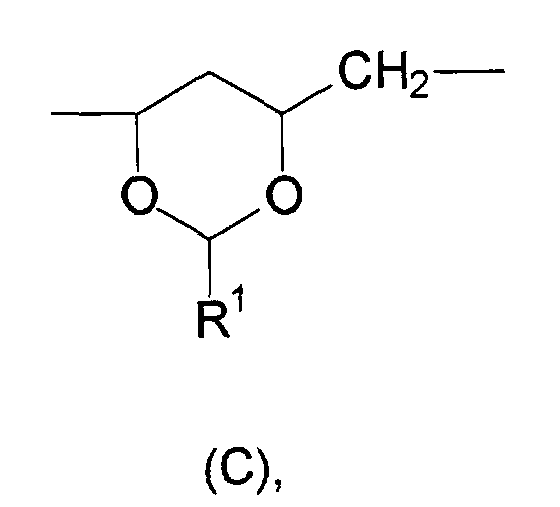
- a polyvinyl acetal copolymer comprising units A, B, C, D, wherein A is present in an amount of about 0.5 to about 20 wt.-% and is of the formula wherein R is hydrogen or C 1 -C 6 alkyl, this unit A can be contained several times in the copolymer with various moieties R independent of one another, B is present in an amount of about 10 to about 35 wt.-% and is of the formula C is present in an amount of about 10 to about 55 wt.-% and is of the formula wherein R 1 is an alkyl group with up to 4 carbons, which is optionally substituted by an acid group, or a phenyl group to which an acid group is attached, wherein the phenyl group optionally comprises 1 to 2 further substituents selected from halogen atoms, amino, methoxy, ethoxy, methyl and ethyl groups, or is a group X-NR 2 -CO-Y-COOH, wherein
- the polyvinyl acetal copolymer of the present invention comprises about 0.5 to about 20 wt.-% based on the total copolymer unit (A) wherein R is hydrogen or C 1 -C 6 alkyl.
- Unit (A) is preferably present in the copolymer in an amount of about 5 to about 20 wt.-%, especially preferred about 10 to about 15 wt.-%.
- R is preferably methyl.
- Unit A may be present several times in a polymer molecule with different groups R.
- the copolymer further comprises about 10 to about 35 wt.-% of unit (B)
- the amount of (B) is about 10 to about 20 wt.-%, more preferred about 10 to about 15 wt.-%.
- a further essential unit of the polyvinyl acetal copolymer of the present invention is unit (C) wherein R 1 is an alkyl group with up to 4 carbons, which is optionally substituted by an acid group, or a phenyl group to which an acid group is attached, wherein the phenyl group optionally comprises 1 to 2 further substituents selected from halogen atoms, amino, methoxy, ethoxy, methyl and ethyl groups, or is a group X-NR 2 -CO-Y-COOH, wherein X is an aliphatic, aromatic or araliphatic spacer group, R 2 is hydrogen or an aliphatic, aromatic or araliphatic moiety and Y is a saturated or unsaturated chain- or ring-shaped spacer group, and this unit C may be contained several times in the copolymer with various moieties R 1 independent of one another.
- Unit (C) is present in the copolymer in an amount of about 10 to about 55 wt.-%, preferably about 25 to about 45 wt.-%, more preferred about 30 to about 40 wt.-%.
- X is preferably selected from -CH 2 -, -CH(CH 3 )- or - CH 2 CH 2 CH 2 -.
- R 2 is preferably hydrogen, C 1 -C 4 alkyl or phenyl.
- R 1 is C 1 -C 3 alkyl or carboxyphenyl.
- Unit C may be present several times in a polymer molecule with different groups R 1 .
- a further essential unit of the polyvinyl acetal copolymer of the present invention is unit (D) wherein each Z is independently selected from the group consisting of O, S and NR 5 with R 5 being selected from the group consisting of hydrogen, C 1 -C 4 alkyl and phenyl, the phenyl being optionally substituted with one or two substituents selected from the group consisting of halogen, C 1 -C 4 alkoxy and C 1 -C 4 alkyl; R 3 and R 4 are independently selected from C 1 -C 4 alkyl and a phenyl group, the phenyl being optionally substituted with one or two substituents selected from the group consisting of halogen, C 1 -C 4 alkoxy and C 1 -C 4 alkyl; m is 0, 1 or 2 and n is 0, 1, 2 or 3, and this unit (D) may be contained several times in the copolymer with various moieties Z, R 3 and R 4 independent of one another.
- Unit (D) is present in the copolymer in an amount of about 5 to about 45 wt.-%, preferably about 10 to about 40 wt.-%, more preferred about 20 to about 30 wt.-%.
- R 4 is preferably methyl or ethyl.
- R 3 is preferably C 1-4 alkyl or phenyl, more preferred methyl, ethyl or phenyl.
- Z is preferably O or S; especially preferred Z are either both O or both S.
- unit D is represented by the following formula (D') wherein R 3' is C 1 -C 4 alkyl, preferably methyl and Z' are either both O or both S.
- Unit D may be present several times in a polymer molecule with different moieties Z, R 3 and R 4 independent of one another.
- the vinyl alcohol/vinyl acetate copolymers that serve as starting material for the preparation of the polymers of the present invention are about 70 to 98 mole% hydrolyzed and have a weight-average molecular mass M w of about 20,000 to 150,000 g/mole. Suitable copolymers of this type are commercially available. Which copolymer is used as starting material for the synthesis depends on the intended use of the photosensitive composition. If lithographic plates are to be produced, polymers with a weight-average molecular mass M w of about 35,000 to 130,000 g/mole and an hydrolysis degree of the vinyl acetate structural unit of about 80 to 98 mole% are preferably used.
- the polyvinyl acetal copolymers of the present invention can be prepared by simultaneously reacting one or more aldehydes corresponding to the desired unit(s) C and one or more vinylene furfural and/or vinylene thiophen aldehyde and/or vinylene pyrrol aldehyde corresponding to the desired unit(s) D with a polyvinylalcohol which is partially esterified in order to contain units A and B. It is also possible to first contact the polyvinyl alcohol with the furfural(s), thiophen aldehyde(s), pyrrol aldehyde(s) and then allow the product obtained to react with the aldehyd(s) corresponding to unit(s) C in a subsequent process step.
- the preferred aliphatic aldehydes for the acetalization of the vinyl alcohol/vinyl acetate copolymers are acetaldehyde, propionaldehyde or butyraldehyde. Particularly preferred is propionaldehyde.
- developability and photochemical sensitivity of a photosensitive composition having the polymeric binders of the present invention will decrease as the amount of aliphatic aldehydes increases.
- 4-Formyl benzoic acid is the preferred aromatic aldehyde. The portion of incorporation of this compound should be balanced in such way that an acid number of the polymeric binder between 40 and 60 mg KOH/g results.
- the reaction may take place in an organic solvent for vinyl alcohol/vinyl acetate copolymers (cf. Brochure Mowiol R-Polyvinyl alcohol, Hoechst AG, 1991 page C13), particularly preferred is dimethyl sulfoxide.
- the polyvinyl acetal copolymers of the present invention are, however, preferably prepared under mild conditions, i.e. room temperature or slightly elevated temperature, in the presence of an acid, preferably an organic acid like 4-toluene sulfonic acid.
- the end products are precipitated by stirring them into water. Then, the precipitated reaction product is separated, washed with water and dried by using hot air of 45 to 50°C until the water content is reduced to no more than 4wt.-%.
- the lithographic plate precursors obtained by using the polyvinyl acetals of the present invention require neither an overcoating nor is a pre-heat step necessary.
- the lithographic plate precursors and plates, respectively, are marked by a good thermal stability, good developability and good resolution as well as good ink receptivity.
- the photosensitive compositions of this invention have the advantage that they are composed of very few components and are thus more economical.
- the polyvinyl acetals of the present invention can be used as such as a radiation-sensitive coating on an optionally pretreated substrate of a printing plate precursor or they can be used in admixture with further components such as dyes/pigments for improving the contrast, surfactants, plasticizers and diazonium polycondensation products. Since the polyvinyl acetals of the present invention are capable of absorbing radiation in the range of 340 to 420 nm (i.e. radiation of a UV radiation source commonly used for imagewise exposing lithographic printing plates) no sensitizer is necessary in the coating. This is a great advantage at least from an economical point of view, since the sensitizers usually used are expensive. With the polyvinyl acetals of the present invention, printing plates can be obtained which are not only less expensive than those known in the art, but they also have a high print run stability, as well as high sensitivity and storage stability.
- Suitable dyes and/or pigments which can be present in the radiation-sensitive compositions according to the present invention as optional components are those that do not show substantial absorption in the long-wavelength absorption range of the copolymers of the present invention; furthermore, they should dissolve well in the solvent or solvent mixture used for coating or are easily introduced as a pigment in the disperse form.
- Suitable dyes and/or pigments for increasing the contrast of the image include inter alia rhodamin dyes, methyl violet, anthraquinone pigments and phthalocyanine dyes and/or pigments.
- the dyes and/or pigments are preferably present in the radiation-sensitive composition in an amount of about 1 to 15 wt.-%, preferably about 2 to 7 wt.-%.
- Suitable plasticizers include dibutyl phthalate, triaryl phosphate and dioctyl phthalate. Dioctyl phthalate is especially preferred.
- the amount of the plasticizer used is not limited but preferably about 0.25 to about 2 wt.-%.
- the diazo polycondensation products which may be present in the radiation-sensitive compositions of the present invention are commonly known in the art and are the diazonium polycondensation products selected from those, which are soluble in organic solvents; these diazonium polycondensation products are well-known to those skilled in the art, and are described for instance in US-A-4,687,727. It has been found by the inventors that depending on the pretreatment of the substrate, the properties of the printing plate precursor comprising a radiation-sensitive layer containing the polyvinyl acetals of the present invention can sometimes be further improved if diazo polycondensation products are present in the radiation-sensitive layer.
- the additional use of diazo polycondensation products is especially preferred if the substrate used is aluminum anodized with sulfuric acid.
- the diazonium polycondensation products useful in the present invention have been used hitherto for negative-working radiation sensitive lithographic printing plates. They are obtained by a condensation reaction of diazo monomers with aldehydes and precipitation of the reaction product with a certain anion.
- the condensation product is prepared by condensing a diazo monomer such as 4-diazodiphenylamine, 1-diazo-4-N,N-dimethylaminobenzene, 1-diazo-4-N,N-diethylaminobenzene, 1-diazo-4-N-ethyl-N-hydroxyethylaminobenzene, 1-diazo-4-N-methyl-N-hydroxyethylamino-benzene, 1-diazo-2,5-diethoxy-4-benzoylaminobenzene, 1-diazo-4-N-benzylamino-benzene, 1-diazo-4-N,N-dimethylaminobenzene, 1-diazo-4-morpholinobenzene, 1-diazo-2,5-dimethoxy-4-p-tolylmercaptobenzene, 1-diazo-2-ethoxy-4-N,N-dimethyl-aminobenzene, 4-diazodimethylaniline,
- Diazonium polycondensation products soluble in organic solvents are for instance obtained by selecting tetrafluoroboric acid, hexafluorophosphoric acid, hexafluoroantimonic acid, hexafluoroarsenic acid, triisopropylnaphthalenesulfonic acid, 4,4'-biphenyldisulfonic acid, 5-nitro-o-toluenesulfonic acid, 5-sulfosalicylic acid, 2,5-dimethylbenzenesulfonic acid, 2,4,6-trimethylbenzenesulfonic acid, 2-nitrobenzenesulfonic acid, 3-chlorobenzenesulfonic acid, 3-bromobenzenesulfonic acid, 2-chloro-5-nitrobenzenesulfonic acid, 2-fluorocaprylnaphthalenesulfonic acid, 1-naphthol-5-sulfonic acid, 2-methoxy-4-hydroxy-5-benzoyl
- mixed condensation products can be used which, apart from the diazonium salt units, comprise other non-photosensitive units, which are derived from condensable compounds, in particular from aromatic amines, phenols, phenol ethers, aromatic thioethers, aromatic hydrocarbons, aromatic heterocycles or organic acid amides.
- diazonium polycondensation products are reaction products of diphenylamine-4-diazonium salts, optionally having a methoxy group in the phenyl group bearing the diazo group, with formaldehyde or 4,4'-bis-methoxymethyl-diphenyl-ether, the latter being preferred.
- the most preferred diazonium polycondensation product is a polycondensation product of 3-methoxydiphenylamine-4-diazoniumsulfate and 4,4'-bis-methoxymethyl-diphenyl-ether, preferably precipitated as mesitylenesulfonate.
- the diazonium polycondensation product is preferably present in the radiation-sensitive compositions of the present invention in an amount of from 0 to about 60 wt.-% based on the total weight of the composition, more preferably from 0 to about 30 wt.-% and most preferably from about 0 to about 20 wt.-%.
- the photosensitive compositions of the present invention are preferably usable for producing lithographic printing plate precursors.
- they may be used in recording materials for creating images on suitable carriers and receiving sheets, for creating reliefs that may serve as printing molds, screens and the like, as light-hardening varnishes for surface protection and for the formulation of UV-hardening printing inks.
- the radiation-sensitive composition according to the present invention is applied to the substrate in the form of a solution prepared by dissolving the components in a solvent capable of dissolving them.
- a solvent capable of dissolving them include cyclohexanone, cyclopentanone, 2-heptanone, ⁇ -butyrolactone, methyl ethyl ketone, ethylene glycol monomethyl ether, ethylene glycol monoethyl ether, 2-methoxyethyl acetate, propylene glycol monomethyl ether, propylene glycol monomethyl ether acetate, methanol, acetone, tetrahydrofuran, methyl lactate and ethyl lactate.
- solvents may be used singly or in admixture.
- One or more surfactants may be added to the solvent.
- the surfactant include nonionic surfactants such as polyoxyethylene alkyl ethers, polyoxyethylene-polyoxypropylene block copolymers, fluorine surfactants, organosiloxane polymers and acrylic or methacrylic (co)polymers, which are known for those skilled in the art.
- the amount of the surfactant(s) to be incorporated is usually in the range of about 2 parts by weight or less, preferably about 1 part by weight or less, based on 100 parts by weight of solid content of the composition according to the present invention.
- the radiation-sensitive composition is coated on a dimensionally stable substrate.
- a support include paper, paper on which plastic (e.g. polyethylene, propylene, polystyrene) is laminated, a thin plate of metal such as aluminium (including aluminium alloys), zinc, copper, etc., a film of plastic (cellulose diacetate, cellulose triacetate, cellulose propionate, cellulose acetate, cellulose acetate butyrate, cellulose nitrate, polyethylene terephthalate, polyethylene, polystyrene, polypropylene, polycarbonate, polyvinyl acetal), and a paper or plastic on which the metal as cited above is laminated.
- plastic e.g. polyethylene, propylene, polystyrene
- a thin plate of metal such as aluminium (including aluminium alloys), zinc, copper, etc.
- a film of plastic cellulose diacetate, cellulose triacetate, cellulose propionate, cellulose acetate, cellulose a
- an aluminium plate is preferred over the others since it has markedly high dimensional stability and especially high adhesiveness to the radiation-sensitive layers using the present radiation-sensitive compositions, and is inexpensive.
- a composite sheet formed by laminating an aluminium sheet on a polymeric film can be used.
- the substrate undergoes a surface treatment such as a graining treatment like brush graining and electrolytic graining, an anodic oxidation treatment, etc; the details of such a treatment are commonly known in the art.
- a surface treatment such as a graining treatment like brush graining and electrolytic graining, an anodic oxidation treatment, etc; the details of such a treatment are commonly known in the art.
- the support is then treated with a silicate (sodium or potassium silicate) as disclosed in US-A-2,714,066, potassium fluorozirconate as disclosed in US-A-2,946,638, a phosphate, a phosphate/fluoride composition or an organic compound selected from the group consisting of carboxymethyl cellulose, dextrin, gum arabic, amino group-containing phosphonic acids, organic phosphonic acids including polyvinyl phosphonic acid, organic phosphates, amino acids, and hydroxyl group-containing amine hydrochlorides, etc. These compounds may be used singly or as a mixture of two or more thereof. The details of such a hydrophilizing treatment are well-known to the person skilled in the art.
- compositions of the present invention may be applied to the support as formulations containing up to about 20% total solids by coating methods well known in the art. For example, slot coating, gravure coating, air knife coating, dip coating spray coating, and other methods may be used with satisfactory results.
- the coatings are preferably dried at temperatures up to about 120°C to give dry coating weights preferably in the range of about 0.5 to about 4 g/m 2 , particularly preferred from about 0.8 to about 2 g/m 2 .
- the polymers suitable for the top layer include polyvinyl alcohol, polyvinyl alcohol/polyvinyl acetate copolymers, polyvinyl pyrrolidone, polyvinyl pyrrolidone/ polyvinyl acetate copolymers and gelatine.
- the layer weight of the oxygen-impermeable top layer is preferably about 0.1 to 4 g/m 2 , and more preferably about 0.3 to 2 g/m 2 .
- the overcoat may contain also organic or inorganic particles.
- the lithographic plate precursors produced using the photosensitive compositions of the present invention do have excellent properties even without top layer.
- lithographic plate precursors are exposed to UV radiation with a commonly used radiation source such as metal halide doped mercury lamps and developed with an alkaline developer commonly used for negative working printing plates as known to the person skilled in the art.
- the developed plates are usually treated with a preservative ("rubber coating").
- the preservatives are aqueous solutions of hydrophilic polymers, wetting agents and other additives.
- the plate is first treated with a solution that protects the non-image areas such that the heat treatment will cause no ink receptivity in these areas.
- a suitable solution is described e.g. in US-A-4 355 096.
- the lithographic plates produced using the photosensitive compositions of the present invention do have excellent properties even with no heat treatment.
- the TVT was isolated by distillation under high vacuum (10-5 mm Hg) or by chromatography on silica gel (hexane/ethyl acetate 90:10 as eluent). It could be purified by a second distillation or by crystallisation in methyl alcohol. It was obtained as a yellow crystalline powder. The yield was approximately 45% and the melting point was determined to be 114°C.
- This polymer could also be obtained by the following procedure: in the first reaction step, only the FVF was grafted, the polymer was isolated by precipitation in water and then dissolved again in DMSO for the reaction with the propionaldehyde.
- the polymer contained between 8 and 10 mol% of FVF acetal units and 30 mol% of propionic acetal units.
- the plate ink receptivity was good and exposed micro lines are well reproduced.
- the gray wedge is completely covered (in the following referred as solids) up to step 3 and partially covered (in the following referred as tail) up to step 7.
- Micro lines are produced up to step 4, while gaps are reproduced up to step 15.
- a printing layer was applied to the aluminum foil, as explained above, exposed, developed and after rinsing with water, the developed plate was wiped and rubbed with an aqueous solution of 0.5% phosphoric acid and 6% gum arabic. The thus prepared plate was loaded in a sheet-fed offset printing machine and under normal printing conditions provided 90.000 copies of good quality.
- a solution for a radiation-sensitive layer was prepared from the following components:
- a solution for a photosensitive layer was prepared from the following components:
- a solution for a photosensitive layer was prepared from the following components:
- Example 9 was repeated, but instead of polvyvinylacetal 3 polyvinylacetal 4 obtained in Example 4 was used and the exposure energy was 300 mJ/cm 2 . Copy results: solid up to 3, tail up to 7, lines up to 6/8, gaps up to 10. No ink acceptance problems occurred.
- Example 4 was repeated, but instead of polyvinylacetal 1 polyvinylacetal 5 obtained in Example 5 was used and processed. Copy results: solids up to 3, tail up to 8, lines up to 4, gaps up to 12. No ink acceptance problems occurred.
- a coating solution is prepared from the following components:
- the mentioned components are dissolved in the solvent mixture according to Example 1 and further processed as described there.
- the weight of the printing layer amounts to approx. 1 g/m 2 .
- the printing layer is exposed , developed and blackened as described in Example 1. Upon blackening, the printing layer exhibits a solid step of 2 and the steps up to 7 are partially covered. In the sheet-fed offset printing machine, one lithographic plate provided only 5.000 copies of good quality.
Landscapes
- Chemical & Material Sciences (AREA)
- Physics & Mathematics (AREA)
- Spectroscopy & Molecular Physics (AREA)
- Health & Medical Sciences (AREA)
- Medicinal Chemistry (AREA)
- Polymers & Plastics (AREA)
- Organic Chemistry (AREA)
- Chemical Kinetics & Catalysis (AREA)
- General Chemical & Material Sciences (AREA)
- General Physics & Mathematics (AREA)
- General Health & Medical Sciences (AREA)
- Life Sciences & Earth Sciences (AREA)
- Molecular Biology (AREA)
- Addition Polymer Or Copolymer, Post-Treatments, Or Chemical Modifications (AREA)
- Printing Plates And Materials Therefor (AREA)
- Photosensitive Polymer And Photoresist Processing (AREA)
- Materials For Photolithography (AREA)
- Compositions Of Macromolecular Compounds (AREA)
Abstract
Description
- The present invention relates to particular acetal copolymers and photosensitive compositions comprising said copolymers and, inter alia, are excellently suitable for the production of lithographic printing plates. In particular, the invention relates to acetal copolymers containing furylvinylidene, thienylvinylidene or pyrrolylvinylidene units.
- Nowadays, photosensitive compositions usable particularly for high-performance lithographic plates must fulfill high requirements.
- In order to improve the properties of photosensitive compositions and thus also of the corresponding lithographic plates, essentially two different ways are taken. One of them deals with the improvement of the properties of the photosensitive components in the compositions (frequently negative diazo resins, photo polymers etc.), the other one with the search for novel polymeric compounds ("binders"), which are to control the physical properties of the photosensitive layers. In particular the latter way is decisive for lithographic plates because the behavior in the developing and printing processes (such as developability, ink receptivity, scratch resistance, consistency in the number of prints produced) is decisively influenced by the polymeric binders. Also shelf life and photosensitivity of the materials are strongly influenced by such polymeric compounds.
- The polymeric binders, therefore, exhibit various structural elements for satisfying the extensive requirements, which may have different effects on individual properties. For instance, hydrophilic structural elements such as carboxyl groups, hydroxyl groups and the like generally promote the developability of the photosensitive compositions in aqueous alkaline developers and partly ensure sufficient adhesion to polar substrates. Hydrophobic structural elements, on the other hand, reduce the capability of being developed in the above-mentioned developers, but ensure the good ink receptivity used in the printing process, which is indispensable in lithographic plates.
- Due to the broad range of requirements regarding the polymeric binders, there have been extensive studies for many years on the synthesis and optimization of the use of these substances for photosensitive compositions, cf. e.g. H. Baumann and H.-J. Timpe: "Chemical Aspects of Offset Printing" in J. prakt. Chem./Chemiker-Zeitung [Journal for chemists] 336 (1994) pages 377-389.
- EP-A-135026, EP-A-186 156 and US-A-4 731 316 describe binder systems consisting of compositions of polymers having different hydrophilic/hydrophobic properties. However, such compositions have the disadvantage that very frequently incompatibilities between the different substances lead to separation during the formation of layers. Furthermore, it was found that the hydrophobic polymers precipitate during the developing process of the processing of the lithographic plates, which may lead to silting in the developing machines and the redeposition of dispersed layer portions on the surface of the photosensitive material.
- Furthermore, various copolymers consisting of only slightly hydrophilic monomers such as styrene, acrylic acid ester, methacrylic acid ester and the like with hydrophilic comonomers were described. Examples of such comonomers are semi-esters of maleic acid (DE-A-31 30 987, EP-B-71 881, EP-A-104 863), itaconic acid (EP-A-397 375, US-A-5 260 161) and acrylic acid and/or methacrylic acid (EP-A-487 343, US-A-4 304 832, US-A-4 123 276). The very tight play of the properties important for their use, which are layer adhesion, developability and printing ink receptivity, proved to be disadvantageous in such polymers. Variations in the polymers' composition can hardly be avoided during the production process, which leads to unacceptable fluctuations in the plates' properties.
- DE-A-27 51 060 describes photosensitive compositions, wherein the binder is a reaction product of cellulose esters with cyclic, intermolecular acid anhydrides of dicarboxylic acids. These binders, however, are not oleophilic enough for the use in lithographic plate formulations.
- Polymers that contain urethane groups were also described as binders for photosensitive compositions (EP-A-415 302, EP-A-406 599, EP-A-406 600, EP-A-414 099, US-A-4 983 491, US-A-4 950 582, US-A-4 877 711). These polyurethane resins contain functional groups (-COOH, -SO2NHCOO-, -CONHSO2NH-) with an acidic hydrogen, whose pKa values in water are no higher than 7. The necessary functionalization with such hydrophilic groups, however, requires very high efforts regarding synthesis and involves high costs.
- Another group of binders described are acetals of aliphatic aldehydes having a lower alkyl group and vinyl alcohol/vinyl acetate copolymers (US-A-2 179 051, EP-B1-216 083). Such binders, however, cause problems in the developing of lithographic plates due to the portion of hydrophilic groups in the polymer being too low. Semi-acetalized vinyl alcohol/vinyl acetate copolymers were provided with alkali soluble groups by means of special reactions for improvement (EP-A-48 876, US-A-4 387 151, US-A-3 732 106, DE-A-20 53 363, EP-A-152 819, DE-A-36 44 163, US-A-4 741 985, EP-A-208 145, DE-A-37 01 626, US-A-5 169 897, DE-A-36 44 162, US-A-4 940 646, DE-A-39 03 001, US-A-5 925 491 and US-A-5 219 699). Particularly preferred, carboxyl and sulfonyl urethane groups were introduced into the polymers in order to achieve the desired developability parameters. The introduction of the acidic carboxyl group into the side chain of the polyvinyl acetals may, however, lead to ink receptivity problems, particularly when alkaline wetting agents are used in the printing process. In the case of sulfonyl urethane containing binders, this disadvantage is almost excluded; however, the production of such binders involves difficulties and high costs. Also in the case of polyvinyl acetals, which have stilbazole units within the molecule (US-A-5 330 877), a good ink receptivity is practically not achieved.
- In addition, all these known systems have the disadvantage of a relatively low photochemical sensitivity, which is why they are rather unsuitable for applications requiring highly sensitive compositions.
- It is known that the light-induced cross-linking of imido-group containing polymers in the presence of certain sensitizers may lead to photosensitive compositions having a higher photochemical sensitivity. However, their use for producing lithographic plates is strongly limited due to an insufficient adhesion on the commonly used aluminum substrates. This particularly leads to a reduced number of prints produced, so that their practical use is complicated greatly. Therefore, especially prepared substrates are necessary (EP-A-377 589), or diazo resins (US-A-5 112 743, DE-C-3 633 456, EP-A-368 327) and/or certain polymers (EP-A-679 950) must be added. The latter measures, however, lead to a lower sensitivity of such compositions, which in turn leads to longer exposure times.
- EP-A-996 603 describes polyvinyl acetal binders having imido groups. Although photosensitive compositions comprising these binders show high photosensitivity, the print run stability of lithographic printing plates obtained therefrom is not sufficient. Furthermore, the photosensitive compositions still need a sensitizer in addition to the polyvinyl acetal which is a certain economical disadvantage.
- It is thus the object of the present invention to provide polymers which, in addition to their high photosensitivity, ensure a good adhesion to Al substrates and thus lead to a high print run stability. It is furthermore the object of the present invention to provide polymers enabling compositions to suffice with as few components as possible vis-à-vis the compositions described in the state of the art when used in photosensitive compositions (which makes them economically desirable) and still having the same or - in individual areas - improved physical properties.
- These objects are achieved by a polyvinyl acetal copolymer comprising units A, B, C, D, wherein A is present in an amount of about 0.5 to about 20 wt.-% and is of the formulawherein R is hydrogen or C1-C6 alkyl, this unit A can be contained several times in the copolymer with various moieties R independent of one another,
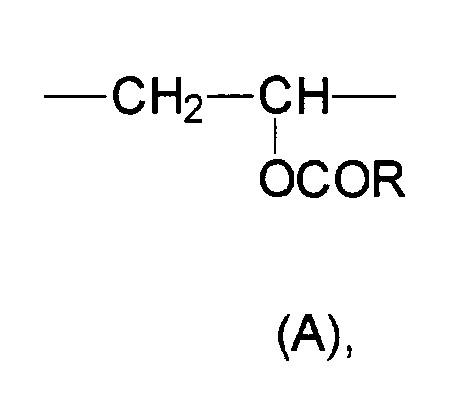
B is present in an amount of about 10 to about 35 wt.-% and is of the formulaC is present in an amount of about 10 to about 55 wt.-% and is of the formula wherein R1 is an alkyl group with up to 4 carbons, which is optionally substituted by an acid group, or a phenyl group to which an acid group is attached, wherein the phenyl group optionally comprises 1 to 2 further substituents selected from halogen atoms, amino, methoxy, ethoxy, methyl and ethyl groups, or is a group X-NR2-CO-Y-COOH, wherein X is an aliphatic, aromatic or araliphatic spacer group, R2 is hydrogen or an aliphatic, aromatic or araliphatic moiety and Y is a saturated or unsaturated chain- or ring-shaped spacer group, and this unit C may be contained several times in the copolymer with various moieties R1 independent of one another, and D is present in an amount of about 5 to about 45 wt.-% and is of the formula
 wherein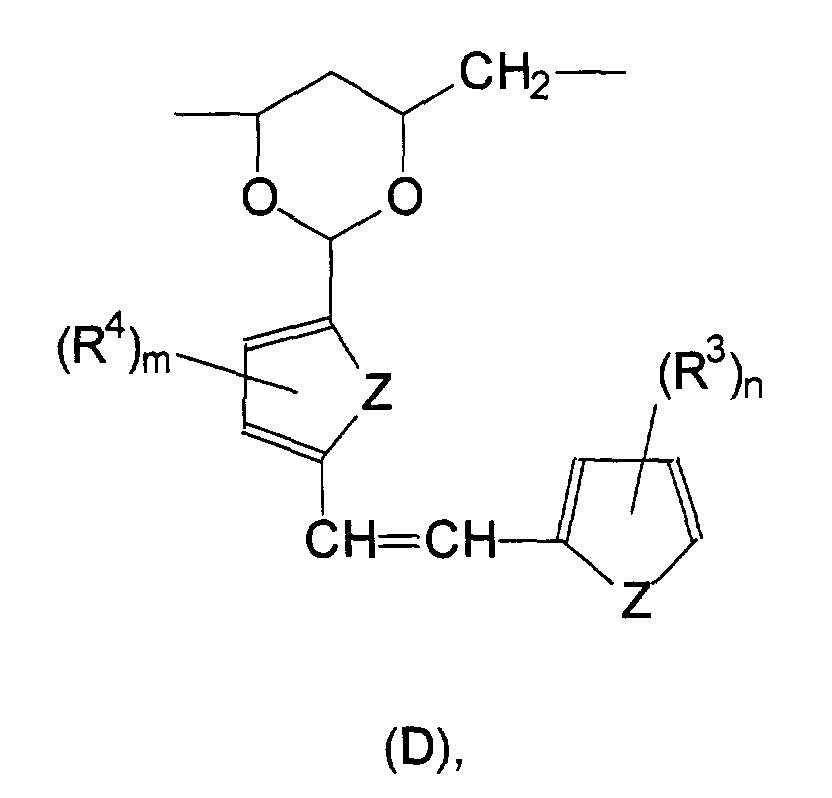
each Z is independently selected from the group consisting of O, S and NR5 with R5 being selected from the group consisting of hydrogen, C1-C4 alkyl and phenyl, the phenyl being optionally substituted with one or two substituents selected from the group consisting of halogen, C1-C4 alkoxy and C1-C4 alkyl;
R3 and R4 are independently selected from C1-C4 alkyl and a phenyl group, the phenyl being optionally substituted with one or two substituents selected from the group consisting of halogen, C1-C4 alkoxy and C1-C4 alkyl; m is 0, 1 or 2 and n is 0, 1, 2 or 3,
and this unit (D) may be contained several times in the copolymer with various moieties Z, R3 and R4 independent of one another. - The polyvinyl acetal copolymer of the present invention comprises about 0.5 to about 20 wt.-% based on the total copolymer unit (A)wherein R is hydrogen or C1-C6 alkyl.

- Unit (A) is preferably present in the copolymer in an amount of about 5 to about 20 wt.-%, especially preferred about 10 to about 15 wt.-%.
- R is preferably methyl. Unit A may be present several times in a polymer molecule with different groups R.
- The copolymer further comprises about 10 to about 35 wt.-% of unit (B)
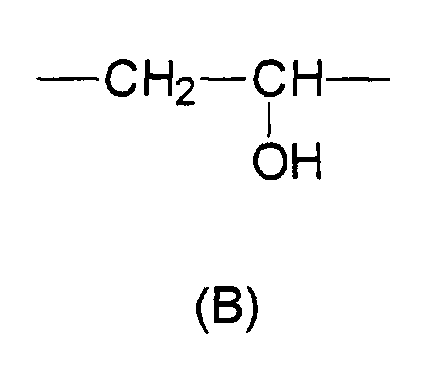
- Preferably the amount of (B) is about 10 to about 20 wt.-%, more preferred about 10 to about 15 wt.-%.
- Still a further essential unit of the polyvinyl acetal copolymer of the present invention is unit (C)wherein R1 is an alkyl group with up to 4 carbons, which is optionally substituted by an acid group, or a phenyl group to which an acid group is attached, wherein the phenyl group optionally comprises 1 to 2 further substituents selected from halogen atoms, amino, methoxy, ethoxy, methyl and ethyl groups, or is a group X-NR2-CO-Y-COOH, wherein X is an aliphatic, aromatic or araliphatic spacer group, R2 is hydrogen or an aliphatic, aromatic or araliphatic moiety and Y is a saturated or unsaturated chain- or ring-shaped spacer group, and this unit C may be contained several times in the copolymer with various moieties R1 independent of one another.
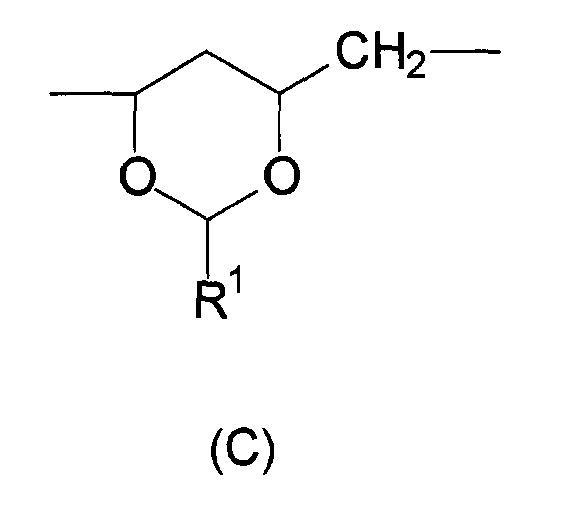
- Unit (C) is present in the copolymer in an amount of about 10 to about 55 wt.-%, preferably about 25 to about 45 wt.-%, more preferred about 30 to about 40 wt.-%.
- X is preferably selected from -CH2-, -CH(CH3)- or - CH2CH2CH2-.
- Y is preferably selected from -CR6R7-CR8R9-, -CR6=CR7-

 wherein R6, R7, R8 and R9 each are independently selected from hydrogen and C1-C4 alkyl.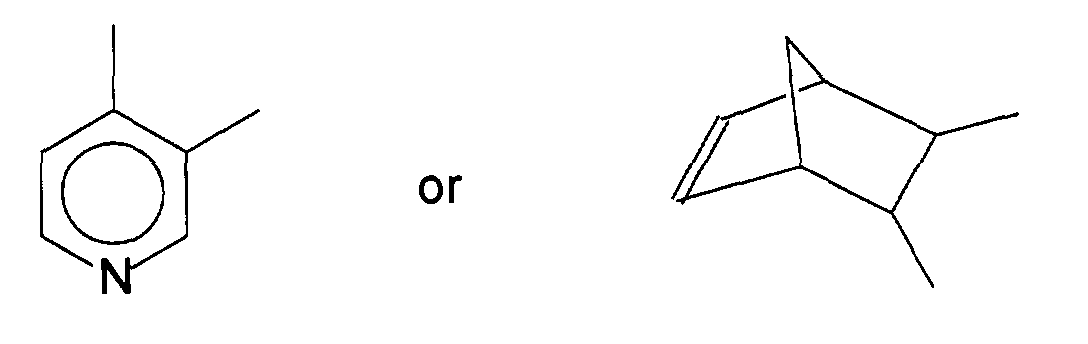
- R2 is preferably hydrogen, C1-C4 alkyl or phenyl.
In a particular preferred embodiment of the present invention R1 is C1-C3 alkyl or carboxyphenyl.
Unit C may be present several times in a polymer molecule with different groups R1. Still a further essential unit of the polyvinyl acetal copolymer of the present invention is unit (D)wherein
each Z is independently selected from the group consisting of O, S and NR5 with R5 being selected from the group consisting of hydrogen, C1-C4 alkyl and phenyl, the phenyl being optionally substituted with one or two substituents selected from the group consisting of halogen, C1-C4 alkoxy and C1-C4 alkyl;
R3 and R4 are independently selected from C1-C4 alkyl and a phenyl group, the phenyl being optionally substituted with one or two substituents selected from the group consisting of halogen, C1-C4 alkoxy and C1-C4 alkyl; m is 0, 1 or 2 and n is 0, 1, 2 or 3,
and this unit (D) may be contained several times in the copolymer with various moieties Z, R3 and R4 independent of one another. - Unit (D) is present in the copolymer in an amount of about 5 to about 45 wt.-%, preferably about 10 to about 40 wt.-%, more preferred about 20 to about 30 wt.-%.
R4 is preferably methyl or ethyl.
R3 is preferably C1-4 alkyl or phenyl, more preferred methyl, ethyl or phenyl.
Z is preferably O or S; especially preferred Z are either both O or both S. - An especially preferred unit D (hereinafter referred to as unit D') is represented by the following formula (D')wherein R3' is C1-C4 alkyl, preferably methyl and Z' are either both O or both S.
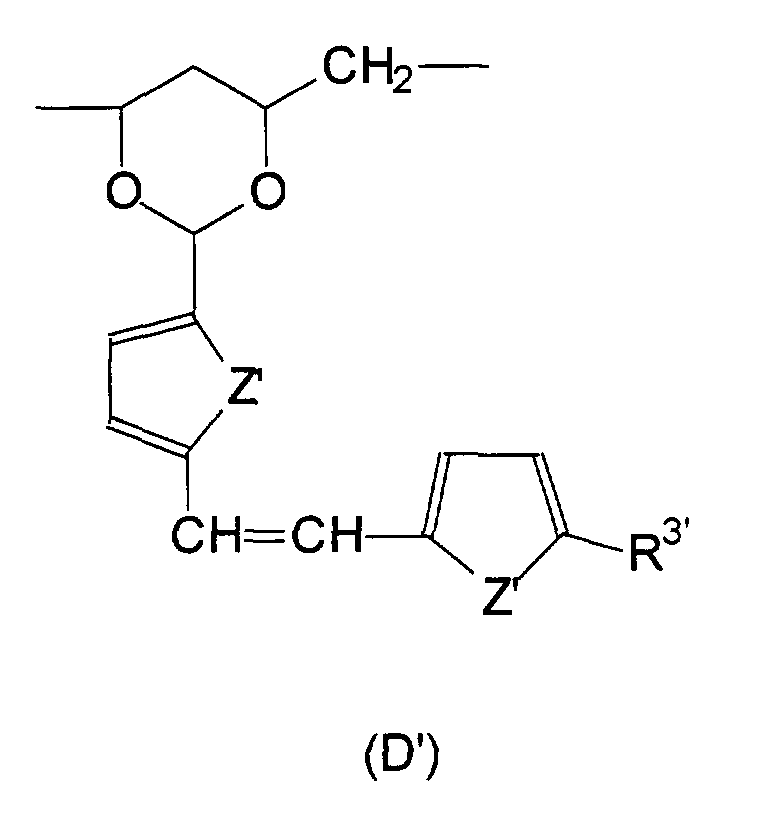
- Unit D may be present several times in a polymer molecule with different moieties Z, R3 and R4 independent of one another.
- The vinyl alcohol/vinyl acetate copolymers that serve as starting material for the preparation of the polymers of the present invention are about 70 to 98 mole% hydrolyzed and have a weight-average molecular mass Mw of about 20,000 to 150,000 g/mole. Suitable copolymers of this type are commercially available. Which copolymer is used as starting material for the synthesis depends on the intended use of the photosensitive composition. If lithographic plates are to be produced, polymers with a weight-average molecular mass Mw of about 35,000 to 130,000 g/mole and an hydrolysis degree of the vinyl acetate structural unit of about 80 to 98 mole% are preferably used.
- The polyvinyl acetal copolymers of the present invention can be prepared by simultaneously reacting one or more aldehydes corresponding to the desired unit(s) C and one or more vinylene furfural and/or vinylene thiophen aldehyde and/or vinylene pyrrol aldehyde corresponding to the desired unit(s) D with a polyvinylalcohol which is partially esterified in order to contain units A and B. It is also possible to first contact the polyvinyl alcohol with the furfural(s), thiophen aldehyde(s), pyrrol aldehyde(s) and then allow the product obtained to react with the aldehyd(s) corresponding to unit(s) C in a subsequent process step. The preferred aliphatic aldehydes for the acetalization of the vinyl alcohol/vinyl acetate copolymers are acetaldehyde, propionaldehyde or butyraldehyde. Particularly preferred is propionaldehyde. In general, developability and photochemical sensitivity of a photosensitive composition having the polymeric binders of the present invention will decrease as the amount of aliphatic aldehydes increases. 4-Formyl benzoic acid is the preferred aromatic aldehyde. The portion of incorporation of this compound should be balanced in such way that an acid number of the polymeric binder between 40 and 60 mg KOH/g results.
- The reaction may take place in an organic solvent for vinyl alcohol/vinyl acetate copolymers (cf. Brochure Mowiol R-Polyvinyl alcohol, Hoechst AG, 1991 page C13), particularly preferred is dimethyl sulfoxide. The polyvinyl acetal copolymers of the present invention are, however, preferably prepared under mild conditions, i.e. room temperature or slightly elevated temperature, in the presence of an acid, preferably an organic acid like 4-toluene sulfonic acid. The end products are precipitated by stirring them into water. Then, the precipitated reaction product is separated, washed with water and dried by using hot air of 45 to 50°C until the water content is reduced to no more than 4wt.-%.
- The lithographic plate precursors obtained by using the polyvinyl acetals of the present invention require neither an overcoating nor is a pre-heat step necessary. The lithographic plate precursors and plates, respectively, are marked by a good thermal stability, good developability and good resolution as well as good ink receptivity. Furthermore, the photosensitive compositions of this invention have the advantage that they are composed of very few components and are thus more economical.
- The polyvinyl acetals of the present invention can be used as such as a radiation-sensitive coating on an optionally pretreated substrate of a printing plate precursor or they can be used in admixture with further components such as dyes/pigments for improving the contrast, surfactants, plasticizers and diazonium polycondensation products. Since the polyvinyl acetals of the present invention are capable of absorbing radiation in the range of 340 to 420 nm (i.e. radiation of a UV radiation source commonly used for imagewise exposing lithographic printing plates) no sensitizer is necessary in the coating. This is a great advantage at least from an economical point of view, since the sensitizers usually used are expensive. With the polyvinyl acetals of the present invention, printing plates can be obtained which are not only less expensive than those known in the art, but they also have a high print run stability, as well as high sensitivity and storage stability.
- Suitable dyes and/or pigments which can be present in the radiation-sensitive compositions according to the present invention as optional components are those that do not show substantial absorption in the long-wavelength absorption range of the copolymers of the present invention; furthermore, they should dissolve well in the solvent or solvent mixture used for coating or are easily introduced as a pigment in the disperse form. Suitable dyes and/or pigments for increasing the contrast of the image include inter alia rhodamin dyes, methyl violet, anthraquinone pigments and phthalocyanine dyes and/or pigments. The dyes and/or pigments are preferably present in the radiation-sensitive composition in an amount of about 1 to 15 wt.-%, preferably about 2 to 7 wt.-%.
- Suitable plasticizers include dibutyl phthalate, triaryl phosphate and dioctyl phthalate. Dioctyl phthalate is especially preferred. The amount of the plasticizer used is not limited but preferably about 0.25 to about 2 wt.-%.
- The diazo polycondensation products which may be present in the radiation-sensitive compositions of the present invention are commonly known in the art and are the diazonium polycondensation products selected from those, which are soluble in organic solvents; these diazonium polycondensation products are well-known to those skilled in the art, and are described for instance in US-A-4,687,727. It has been found by the inventors that depending on the pretreatment of the substrate, the properties of the printing plate precursor comprising a radiation-sensitive layer containing the polyvinyl acetals of the present invention can sometimes be further improved if diazo polycondensation products are present in the radiation-sensitive layer. The additional use of diazo polycondensation products is especially preferred if the substrate used is aluminum anodized with sulfuric acid.
- The diazonium polycondensation products useful in the present invention have been used hitherto for negative-working radiation sensitive lithographic printing plates. They are obtained by a condensation reaction of diazo monomers with aldehydes and precipitation of the reaction product with a certain anion. The condensation product is prepared by condensing a diazo monomer such as 4-diazodiphenylamine, 1-diazo-4-N,N-dimethylaminobenzene, 1-diazo-4-N,N-diethylaminobenzene, 1-diazo-4-N-ethyl-N-hydroxyethylaminobenzene, 1-diazo-4-N-methyl-N-hydroxyethylamino-benzene, 1-diazo-2,5-diethoxy-4-benzoylaminobenzene, 1-diazo-4-N-benzylamino-benzene, 1-diazo-4-N,N-dimethylaminobenzene, 1-diazo-4-morpholinobenzene, 1-diazo-2,5-dimethoxy-4-p-tolylmercaptobenzene, 1-diazo-2-ethoxy-4-N,N-dimethyl-aminobenzene, 4-diazodimethylaniline, 1-diazo-2,5-dibutoxy-4-morpholinobenzene, 1-diazo-2,5-diethoxy-4-morpholinobenzene, 1-diazo-2,5-dimethoxy-4-morpholino-benzene, 1-diazo-2,5-diethoxy-4-morpholinobenzene, 1-diazo-2,5-diethoxy-4-(4'-tolylmercapto)benzene, 1-diazo-3-ethoxy-4-N-methyl-N-benzylaminobenzene, 1-diazo-3-chloro-4-N,N-diethylaminobenzene, 1-diazo-3-methyl-4-pyrrolidinobenzene, 1-diazo-2-chloro-4-N,N-dimethylamino-5-methoxybenzene, 1-diazo-3-methoxy-4-pyrrolidinobenzene, 3-methoxy-4-diazodiphenylamine, 3-ethoxy-4-diazodiphenyl-amine, 3-(n-propoxy)-4-diazodiphenylamine or 3-(isopropoxy)-4-diazodiphenylamine with a condensing agent such as formaldehyde, acetaldehyde, propionaldehyde, butyric aldehyde, isobutyric aldehyde, benzaldehyde or aldehydes containing one or more carboxylic groups as described in US-A-5,112,743, preferably in a molar ratio of 1:1 to 1:0.5, more preferably 1:1 to 1:0.8, by a conventional process, followed by precipitation with a suitable anion.
- Diazonium polycondensation products soluble in organic solvents are for instance obtained by selecting tetrafluoroboric acid, hexafluorophosphoric acid, hexafluoroantimonic acid, hexafluoroarsenic acid, triisopropylnaphthalenesulfonic acid, 4,4'-biphenyldisulfonic acid, 5-nitro-o-toluenesulfonic acid, 5-sulfosalicylic acid, 2,5-dimethylbenzenesulfonic acid, 2,4,6-trimethylbenzenesulfonic acid, 2-nitrobenzenesulfonic acid, 3-chlorobenzenesulfonic acid, 3-bromobenzenesulfonic acid, 2-chloro-5-nitrobenzenesulfonic acid, 2-fluorocaprylnaphthalenesulfonic acid, 1-naphthol-5-sulfonic acid, 2-methoxy-4-hydroxy-5-benzoyl-benzene-sulfonic acid or 4-toluenesulfonic acid, etc. as anion source. Among these, 4-toluenesulfonic acid and 2-methoxy-4-hydroxy-5-benzoylbenzene-sulfonic acid are particularly preferred.
- Furthermore, mixed condensation products can be used which, apart from the diazonium salt units, comprise other non-photosensitive units, which are derived from condensable compounds, in particular from aromatic amines, phenols, phenol ethers, aromatic thioethers, aromatic hydrocarbons, aromatic heterocycles or organic acid amides.
- Especially preferred examples of diazonium polycondensation products are reaction products of diphenylamine-4-diazonium salts, optionally having a methoxy group in the phenyl group bearing the diazo group, with formaldehyde or 4,4'-bis-methoxymethyl-diphenyl-ether, the latter being preferred. The most preferred diazonium polycondensation product is a polycondensation product of 3-methoxydiphenylamine-4-diazoniumsulfate and 4,4'-bis-methoxymethyl-diphenyl-ether, preferably precipitated as mesitylenesulfonate.
- The diazonium polycondensation product is preferably present in the radiation-sensitive compositions of the present invention in an amount of from 0 to about 60 wt.-% based on the total weight of the composition, more preferably from 0 to about 30 wt.-% and most preferably from about 0 to about 20 wt.-%.
- The photosensitive compositions of the present invention are preferably usable for producing lithographic printing plate precursors. In addition, however, they may be used in recording materials for creating images on suitable carriers and receiving sheets, for creating reliefs that may serve as printing molds, screens and the like, as light-hardening varnishes for surface protection and for the formulation of UV-hardening printing inks.
- The radiation-sensitive composition according to the present invention is applied to the substrate in the form of a solution prepared by dissolving the components in a solvent capable of dissolving them. Preferred examples of the solvent include cyclohexanone, cyclopentanone, 2-heptanone, γ-butyrolactone, methyl ethyl ketone, ethylene glycol monomethyl ether, ethylene glycol monoethyl ether, 2-methoxyethyl acetate, propylene glycol monomethyl ether, propylene glycol monomethyl ether acetate, methanol, acetone, tetrahydrofuran, methyl lactate and ethyl lactate. These solvents may be used singly or in admixture.
- One or more surfactants may be added to the solvent. Specific examples of the surfactant include nonionic surfactants such as polyoxyethylene alkyl ethers, polyoxyethylene-polyoxypropylene block copolymers, fluorine surfactants, organosiloxane polymers and acrylic or methacrylic (co)polymers, which are known for those skilled in the art. The amount of the surfactant(s) to be incorporated is usually in the range of about 2 parts by weight or less, preferably about 1 part by weight or less, based on 100 parts by weight of solid content of the composition according to the present invention.
- For the preparation of lithographic printing plate precursors the radiation-sensitive composition is coated on a dimensionally stable substrate. Examples of such a support include paper, paper on which plastic (e.g. polyethylene, propylene, polystyrene) is laminated, a thin plate of metal such as aluminium (including aluminium alloys), zinc, copper, etc., a film of plastic (cellulose diacetate, cellulose triacetate, cellulose propionate, cellulose acetate, cellulose acetate butyrate, cellulose nitrate, polyethylene terephthalate, polyethylene, polystyrene, polypropylene, polycarbonate, polyvinyl acetal), and a paper or plastic on which the metal as cited above is laminated. Of these supports, an aluminium plate is preferred over the others since it has markedly high dimensional stability and especially high adhesiveness to the radiation-sensitive layers using the present radiation-sensitive compositions, and is inexpensive. Also, a composite sheet formed by laminating an aluminium sheet on a polymeric film can be used.
- When a metal substrate, especially an aluminium plate is used, it is preferred that the substrate undergoes a surface treatment such as a graining treatment like brush graining and electrolytic graining, an anodic oxidation treatment, etc; the details of such a treatment are commonly known in the art. In a further preferred embodiment, the support is then treated with a silicate (sodium or potassium silicate) as disclosed in US-A-2,714,066, potassium fluorozirconate as disclosed in US-A-2,946,638, a phosphate, a phosphate/fluoride composition or an organic compound selected from the group consisting of carboxymethyl cellulose, dextrin, gum arabic, amino group-containing phosphonic acids, organic phosphonic acids including polyvinyl phosphonic acid, organic phosphates, amino acids, and hydroxyl group-containing amine hydrochlorides, etc. These compounds may be used singly or as a mixture of two or more thereof. The details of such a hydrophilizing treatment are well-known to the person skilled in the art.
- The compositions of the present invention may be applied to the support as formulations containing up to about 20% total solids by coating methods well known in the art. For example, slot coating, gravure coating, air knife coating, dip coating spray coating, and other methods may be used with satisfactory results. The coatings are preferably dried at temperatures up to about 120°C to give dry coating weights preferably in the range of about 0.5 to about 4 g/m2, particularly preferred from about 0.8 to about 2 g/m2.
- Although not an essential requirement, in few cases, the additional application of an oxygen-impermeable, water-soluble overcoating on a photosensitive layer may be advantageous. The polymers suitable for the top layer include polyvinyl alcohol, polyvinyl alcohol/polyvinyl acetate copolymers, polyvinyl pyrrolidone, polyvinyl pyrrolidone/ polyvinyl acetate copolymers and gelatine. The layer weight of the oxygen-impermeable top layer is preferably about 0.1 to 4 g/m2, and more preferably about 0.3 to 2 g/m2. The overcoat may contain also organic or inorganic particles. However, the lithographic plate precursors produced using the photosensitive compositions of the present invention do have excellent properties even without top layer.
- The thus obtained lithographic plate precursors are exposed to UV radiation with a commonly used radiation source such as metal halide doped mercury lamps and developed with an alkaline developer commonly used for negative working printing plates as known to the person skilled in the art. The developed plates are usually treated with a preservative ("rubber coating"). The preservatives are aqueous solutions of hydrophilic polymers, wetting agents and other additives.
- For certain uses it is furthermore advantageous to increase the mechanical strength of the printing layers by means of a heat treatment or a combined use of heat and UV radiation. For this purpose, the plate is first treated with a solution that protects the non-image areas such that the heat treatment will cause no ink receptivity in these areas. A suitable solution is described e.g. in US-A-4 355 096. However, the lithographic plates produced using the photosensitive compositions of the present invention do have excellent properties even with no heat treatment.
- The following examples serve to provide a more detailed explanation of the invention, but they should not be construed as to limit this invention.
- In a three neck flask provided with magnetic stirring, 20 ml of 5-methyl furfural and 1.2 g of NaOH were added to 50 ml of a solution made up with 2 parts of water and 1 part of methyl alcohol (in volume). The solution was brought to boiling point, flashed with nitrogen and maintained 1.5 hours under reflux. Then the mixture was neutralised with acetic acid, shaken with water and methylene chloride to extract the organic part. This organic phase was dried over anhydrous sodium sulphate, filtered and concentrated by vacuum evaporation.
The FVF was isolated by distillation under high vacuum (10-5 mm Hg) or by chromatography on silica gel (hexane/ethyl acetate 90:10 as eluent). It could be purified by a second distillation or by crystallisation in methyl alcohol. It was obtained as a yellow crystalline powder. The yield was approximately 40%. - In a three neck flask provided with magnetic stirring, 20 ml of 5-methyl thiophene 2-aldehyde and 1.2 g of NaOH were added to 50 ml of a solution made up with 2 parts of water and 1 part of methyl alcohol (in volume). The solution was brought to boiling point, flashed with nitrogen and maintained 4 hours under reflux. Then the mixture was neutralised with acetic acid, shaken with water and methylene chloride to extract the organic part. This organic phase was dried over anhydrous sodium sulphate, filtered and concentrated by vacuum evaporation.
The TVT was isolated by distillation under high vacuum (10-5 mm Hg) or by chromatography on silica gel (hexane/ethyl acetate 90:10 as eluent). It could be purified by a second distillation or by crystallisation in methyl alcohol. It was obtained as a yellow crystalline powder. The yield was approximately 45% and the melting point was determined to be 114°C. - 20 g Mowiol 8-88 (available from Clariant, Mw. 67000, 12% residual acetate groups) were dissolved in 200 ml of dimethylsulfoxide (DMSO) with magnetic stirring. 3.12 g of propionaldehyde and 3.6 g of 5-[2-(5-methylfuryl vinylene)]furfural (FVF) were added. The reaction was acid catalysed by 2 g of para-toluene sulfonic acid (pTS). The mixture was stirred in the dark, at room temperature, for 24 hours. Then the solution was neutralised with 1.44 ml of triethylamine. The polymer was isolated by precipitation in an excess of water, filtered and dried in a vacuum oven at 50°C for two days.
- This polymer could also be obtained by the following procedure: in the first reaction step, only the FVF was grafted, the polymer was isolated by precipitation in water and then dissolved again in DMSO for the reaction with the propionaldehyde.
- In both cases, according to the analysis by 1H-NMR in DMSO-d6, the polymer contained between 8 and 10 mol% of FVF acetal units and 30 mol% of propionic acetal units.
- 20 g of Mowiol 8-88 were dissolved in 200 ml of DMSO with magnetic stirring. 2g of pTS were used as catalyst. 7.3 g of FVF and 3.12 g of propionaldehyde were added. The reaction mixture was stirred for 24 hours in the dark, at room temperature. The solution was neutralised by 1.44 ml of triethylamine. The polymer was precipitated in an excess of water, filtered and dried in a vacuum oven at 50°C for two days.
According to 1H-NMR analysis in DMSO-d6 the polymer contained 16 and 20 mol% of FVF acetal units and 30 mol% of propionic acetal units. - 20 g of Mowiol 8-88 were dissolved in 200 ml of DMSO with magnetic stirring. 2 g of pTS were used as catalyst. 3.12 g of propionaldehyde, 7.3 g of FVF and 5.5 g of 4-formyl benzoic acid were added. The reaction mixture was stirred for 24 hours in the dark, at room temperature. The solution was neutralized with 1.44 ml of triethylamine. The polymer was precipitated two times in an excess of water to remove the DMSO. It was then filtered and dried at 50°C for two days.
Titration with a 0.1 N of KOH solution gave an acid number of 44 mg of KOH/g. - 21 g of Mowiol 8-88 were dissolved in 200 ml of DMSO with magnetic stirring. 2 g of pTS were used as catalyst. 3.29 g of propionaldehyde, 8.8 g of TVT and 5.78 g of 4-formylbenzoic acid were added. The reaction mixture was stirred for 24 hours in the dark, at room temperature. The solution was neutralized with 1.44 ml of triethylamine. The isolated polymer was treated two times in an excess of water to remove the DMSO. It was then filtered and dried at 50°C for two days. After all these treatments 28.3 g polyvinylacetal 4 was received.
Titration with a 0.1 N KOH solution gave an acid number of 51 mg of KOH/g. - 21 g of Mowiol 8-88 were dissolved in 200 ml of DMSO with magnetic stirring. 2 g of pTS were used as catalyst. 6.63 g of TVT and 3.29 g of propionaldehyd were added. The reaction mixture was stirred for 24 hours in the dark, at room temperature. The solution was neutralised by 1.44 ml of triethylamine. The polymer was precipitated in an excess of water, filtered and dried in an vacuum oven at 50°C for two days. 29.4 g of polyvinylacetal 5 were isolated.
According to 1H-NMR in DMSO-d6 the obtained polymer contains about 15 mol% of TVT acetal units and about 30 mol% of propionic acetal units. - 1.66 g of polyvinylacetal 1 obtained in Example 1 and
0.2 g of Renol blue B2G-HW® (Clariant; copper phthalocyanine pigment dispersed in polyvinyl butyral)
were dissolved under stirring in 40 ml of a solution consisting of: - 45 parts by volume of methyl alcohol (MeOH)
- 30 parts by volume of methyl glycol (MC)
- 25 parts by volume of methyl ethyl ketone (MEK)
- The plate ink receptivity was good and exposed micro lines are well reproduced. The gray wedge is completely covered (in the following referred as solids) up to step 3 and partially covered (in the following referred as tail) up to step 7. Micro lines are produced up to step 4, while gaps are reproduced up to step 15.
For the preparation of a lithographic plate, a printing layer was applied to the aluminum foil, as explained above, exposed, developed and after rinsing with water, the developed plate was wiped and rubbed with an aqueous solution of 0.5% phosphoric acid and 6% gum arabic. The thus prepared plate was loaded in a sheet-fed offset printing machine and under normal printing conditions provided 90.000 copies of good quality. - To simulate aging of the plate, it was stored for 10 days at a temperature of 40°C and 80% relative humidity. The thus treated plates were used for printing in a sheet-fed offset printing machine and exhibited no change in their printing behaviour (especially the print run stability) in comparison to the plate that was not artifically aged.
- A solution for a radiation-sensitive layer was prepared from the following components:
- 1.66 g of polyvinylacetal 1 obtained in Example 1
- 0.08 g of a polycondensation product of 1 mole 3-methoxydiphenylamin-4-diazonium sulfate and 1 mole 4,4'-bis-methoxy-methyldiphenylether, precipitated as mesitylenesulfonate
- 0.2 g of Renol blue B2G-HW® (Clariant; copper phthalocyanine pigment dispersed in polyvinyl butyral)
- 45 parts in volume of methyl alcohol (MeOH)
- 30 parts in volume of methyl glycol (MC)
- 25 parts in volume of methyl ethyl ketone (MEK)
- A solution for a photosensitive layer was prepared from the following components:
- 1.66 g of polyvinylacetal 2 obtained in Example 2
- 0.08 g of a polycondensation product of 1 mole diphenylamin-4-diazonium sulfate and 1 mole formaldehyde, precipitated as tosylate
- 0.2 g of Renol blue B2G-HW® (Clariant; copper phthalocyanine pigment dispersed in polyvinyl butyral)
- 45 parts in volume of methyl alcohol (MeOH)
- 30 parts in volume of methyl glycol (MC)
- 25 parts in volume of methyl ethyl ketone (MEK)
- A solution for a photosensitive layer was prepared from the following components:
- 1.66 g of the polyvinylacetal 3 obtained in Example 3
- 0.08 g of a polycondensation product of 1 mole diphenylamin-4-diazonium sulfate and 1 mole formaldehyde, precipitated as tosylate
- 0.2 g of Renol blue B2G-HW® (Clariant; copper phthalocyanine pigment dispersed in polyvinyl butyral)
- 45 parts in volume of methyl glycol
- 30 parts in volume of methyl glycol
- 25 parts in volume of methyl ethyl ketone.
- Example 9 was repeated, but instead of polvyvinylacetal 3 polyvinylacetal 4 obtained in Example 4 was used and the exposure energy was 300 mJ/cm2.
Copy results: solid up to 3, tail up to 7, lines up to 6/8, gaps up to 10.
No ink acceptance problems occurred. - Example 4 was repeated, but instead of polyvinylacetal 1 polyvinylacetal 5 obtained in Example 5 was used and processed.
Copy results: solids up to 3, tail up to 8, lines up to 4, gaps up to 12.
No ink acceptance problems occurred. - A coating solution is prepared from the following components:
- 5.25 g of
- copolymer of methyl methacrylate/N-[2-(methacryloyloxy)ethyl]-2,3-dimethyl maleinimide/methacrylic acid (weight ratio: 15/65/20)
- 0.3 g of
- Renol Blue B2G-HW® (Clariant; copper phthalocyanine pigment dispersed in polyvinyl butyral)
- 0.3 g of
- Quantacure ITX® (Rahn: isopropyl thioxanthone)
- The mentioned components are dissolved in the solvent mixture according to Example 1 and further processed as described there. The weight of the printing layer amounts to approx. 1 g/m2.
- The printing layer is exposed , developed and blackened as described in Example 1. Upon blackening, the printing layer exhibits a solid step of 2 and the steps up to 7 are partially covered. In the sheet-fed offset printing machine, one lithographic plate provided only 5.000 copies of good quality.
The plate was exposed under a silver halftone film (Ugra grey scale) with an exposure energy of 100 mJ/cm2. The exposed plate was treated with an alkaline developer for negative working plates 952 (Kodak Polychrome Graphics) for 30 s then rubbed with a tamp for 30 s. After this treatment, the exposed portions remain on the plate.
Copy results: solids up to 3, tail up to 6, lines up to 6/8, gaps up to 12.
In the sheet-fed offset printing machine and under normal printing conditions, one lithographic plate provided 110.000 copies of good quality.
Copy results: solids up to 3, tail up to 7, lines up to 4, gaps up to 12.
Copy results: solid up to 3, tail up to 7, lines up to 6/8, gaps up to 10.
Claims (15)
- A polyvinyl acetal copolymer containing the units A, B, C and D, wherein A is present in an amount of about 0.5 to about 20 wt.-% and is of the formulawherein R is hydrogen or C1-C6 alkyl,
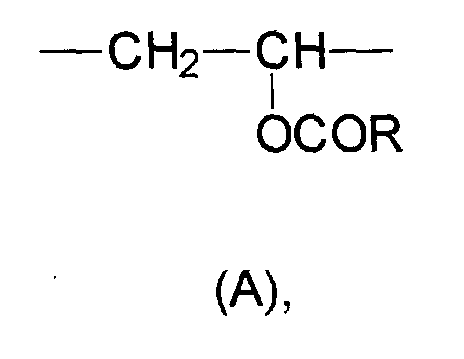
B is present in an amount of about 10 to about 35 wt.-% and is of the formulaC is present in an amount of about 10 to about 55 wt.-% and is of the formula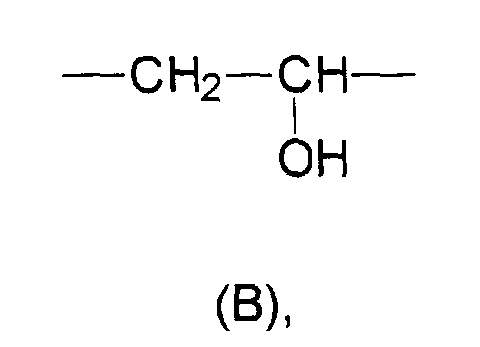 wherein R1 is an alkyl group with up to 4 carbons, which is optionally substituted by an acid group, or a phenyl group to which an acid group is attached, wherein the phenyl group optionally comprises 1 or 2 further substituents selected from halogen atoms, amino, methoxy, ethoxy, methyl and ethyl groups, or is a group X-NR2-CO-Y-COOH, wherein X is an aliphatic, aromatic or araliphatic spacer group, R2 is hydrogen or an aliphatic, aromatic or araliphatic moiety and Y is a saturated or unsaturated chain- or ring-shaped spacer group,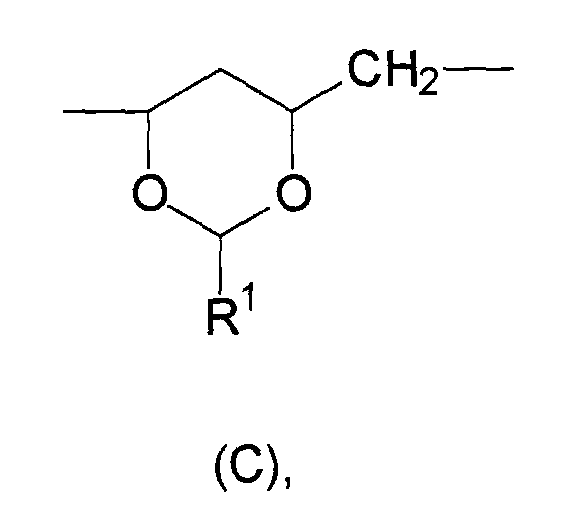
and D is present in an amount of about 5 to about 45 wt.-% and is of the formulawherein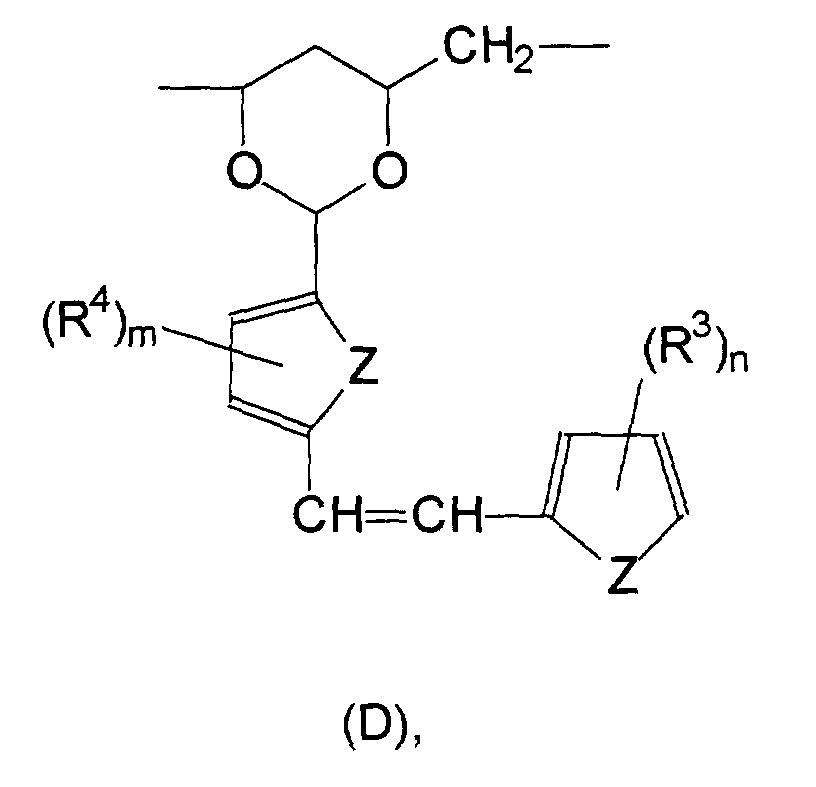
each Z is independently selected from the group consisting of O, S and NR5 with R5 being selected from the group consisting of hydrogen, C1-C4 alkyl and phenyl, the phenyl being optionally substituted with one or two substituents selected from the group consisting of halogen, C1-C4 alkoxy and C1-C4 alkyl;
R3 and R4 are independently selected from C1-C4 alkyl and a phenyl group, the phenyl being optionally substituted with one or two substituents selected from the group consisting of halogen, C1-C4 alkoxy and C1-C4 alkyl; m is 0, 1 or 2 and n is 0, 1, 2 or 3;
each A being the same or different, each C being the same or different and each D being the same or different. - The polyvinyl acetal copolymer according to claim 1, wherein R is hydrogen or methyl.
- The polyvinyl acetal copolymer according to claim 1 or 2, wherein R1 is C1-C3 alkyl or carboxyphenyl.
- The polyvinyl acetal copolymer according to any one of claims 1 to 3, wherein unit D is represented by the following formula (D')wherein Z' are either both O or both S and R3' is C1-C4 alkyl.

- The polyvinyl acetal copolymer according to any one of claims 1 to 4, wherein the weight-average molecular weight Mw of the polyvinyl alcohol used as starting material is within the range of from about 20.000 to about 150.000 g/mole.
- Radiation-sensitive composition comprising a polyvinyl acetal copolymer as defined in any one of claims 1 to 5 and at least one other member selected from the group consisting of dyes/pigments for increasing the contrast, surfactants, plasticizers and diazonium polycondensation products.
- Lithographic printing plate precursor comprising an optionally pretreated substrate and a radiation-sensitive layer comprising a polyvinyl acetal copolymer as defined in any one of claims 1 to 5.
- Lithographic printing plate precursor according to claim 9, wherein the radiation-sensitive layer further comprises at least one member selected from dyes/pigments for increasing the contrast, surfactants, plasticizers and diazonium polycondensation products.
- Lithographic printing plate precursor according to claim 7 or 8, wherein the substrate is an aluminum foil.
- Lithographic printing plate precursor according to claim 9, wherein the substrate was grained and subsequently anodized with H3PO4 or H2SO4 before it was coated with the radiation sensitive layer.
- Lithographic printing plate precursor according to claim 10, wherein the substrate was sealed with polyvinylphosphonic acid after the anodizing step but before the coating step.
- Method for preparing a lithographic printing plate precursor, comprising(a) providing an aluminum substrate(b) mechanically or electrochemically graining the substrate(c) anodizing the substrate obtained in step (b) with H3PO4 or H2SO4(d) optionally sealing the substrate obtained in step (c) with polyvinyl phosphonic acid(e) coating the substrate obtained in step (d) with a radiation-sensitive composition as defined in claim 6.
- Method for providing an image comprising:(a) providing a printing plate precursor as defined in any one of claims 7 to 11(b) imagewise exposing the precursor to UV radiation(c) treating the exposed precursor with an alkaline developer for negative working printing plates.
- Process for the preparation of a polyvinyl acetal copolymer as defined in any one of claims 1 to 5, comprising: simultaneously reacting at least one aldehyde which reacts to form unit C and at least one aldehyde including a unit selected from furylvinylidene unit, thienylvinylidene unit and pyrrolylvinylidene unit which reacts to form unit D, with a polyvinyl alcohol which is partially esterified to contain units A and B.
- Process for the preparation of a polyvinyl acetal copolymer as defined in any one of claims 1 to 5, comprising: first contacting a polyvinyl alcohol which is partially esterified to contain units A and B with at least one aldehyde including a unit selected from furylvinylidene unit, thienylvinylidene unit and pyrrolylvinylidene unit which reacts to form unit D and then reacting the obtained product with at least one aldehyde which reacts to form unit C.
Applications Claiming Priority (2)
| Application Number | Priority Date | Filing Date | Title |
|---|---|---|---|
| US09/590,930 US6270938B1 (en) | 2000-06-09 | 2000-06-09 | Acetal copolymers and use thereof in photosensitive compositions |
| US590930 | 2000-06-09 |
Publications (1)
| Publication Number | Publication Date |
|---|---|
| EP1162209A1 true EP1162209A1 (en) | 2001-12-12 |
Family
ID=24364319
Family Applications (1)
| Application Number | Title | Priority Date | Filing Date |
|---|---|---|---|
| EP01112097A Withdrawn EP1162209A1 (en) | 2000-06-09 | 2001-05-29 | Acetal copolymers and use thereof in photosensitive compositions |
Country Status (3)
| Country | Link |
|---|---|
| US (1) | US6270938B1 (en) |
| EP (1) | EP1162209A1 (en) |
| JP (1) | JP2002080528A (en) |
Cited By (11)
| Publication number | Priority date | Publication date | Assignee | Title |
|---|---|---|---|---|
| EP2366545A1 (en) | 2010-03-19 | 2011-09-21 | Agfa Graphics N.V. | A lithographic printing plate precursor |
| WO2014106554A1 (en) | 2013-01-01 | 2014-07-10 | Agfa Graphics Nv | (ethylene, vinyl acetal) copolymers and their use in lithographic printing plate precursors |
| CN104826616A (en) * | 2015-06-05 | 2015-08-12 | 青岛大学 | HPLC (high-performance liquid chromatography) chromatographic column packing modification method |
| EP2933278A1 (en) | 2014-04-17 | 2015-10-21 | Agfa Graphics Nv | (Ethylene, vinyl acetal) copolymers and their use in lithographic printing plate precursors |
| EP2944657A1 (en) | 2014-05-15 | 2015-11-18 | Agfa Graphics Nv | (Ethylene, Vinyl Acetal) Copolymers and Their Use In Lithographic Printing Plate Precursors |
| EP2955198A1 (en) | 2014-06-13 | 2015-12-16 | Agfa Graphics Nv | (Ethylene, vinyl acetal) copolymers and their use in lithographic printing plate precursors |
| EP2963496A1 (en) | 2014-06-30 | 2016-01-06 | Agfa Graphics Nv | A lithographic printing plate precursor including ( ethylene, vinyl acetal ) copolymers |
| EP3130465A1 (en) | 2015-08-12 | 2017-02-15 | Agfa Graphics Nv | Heat-sensitive lithographic printing plate precursor |
| WO2017157571A1 (en) | 2016-03-16 | 2017-09-21 | Agfa Graphics Nv | Method and apparatus for processing a lithographic printing plate |
| EP3778253A1 (en) | 2019-08-13 | 2021-02-17 | Agfa Nv | Method for processing a lithographic printing plate |
| KR102789050B1 (en) * | 2023-12-13 | 2025-04-01 | 충남대학교산학협력단 | Photoreversible photoresist composition containing polyvinyl alcohol-based photoreversible polymer and method for producing the same |
Families Citing this family (11)
| Publication number | Priority date | Publication date | Assignee | Title |
|---|---|---|---|---|
| US6555617B1 (en) * | 1999-07-29 | 2003-04-29 | Mitsubishi Chemical Corporation | Composition of cyclic anhydride modified polyvinyl acetal and curable resin and laminated products |
| JP4233199B2 (en) * | 2000-06-30 | 2009-03-04 | 富士フイルム株式会社 | Planographic printing plate manufacturing method |
| US6777155B2 (en) * | 2000-10-03 | 2004-08-17 | Fuji Photo Film Co., Ltd. | Photosensitive lithographic printing plate |
| KR100685944B1 (en) * | 2000-12-05 | 2007-02-23 | 엘지.필립스 엘시디 주식회사 | Optical alignment material and liquid crystal display device using same |
| US6458503B1 (en) * | 2001-03-08 | 2002-10-01 | Kodak Polychrome Graphics Llc | Fluorinated aromatic acetal polymers and photosensitive compositions containing such polymers |
| DE10129422A1 (en) * | 2001-06-19 | 2003-01-02 | Huels Troisdorf | Plasticized PVB film |
| US20040264139A1 (en) * | 2003-06-24 | 2004-12-30 | Nokia Corporation | Process for manufacturing a cover |
| BRPI0611018B1 (en) | 2005-06-03 | 2017-03-07 | American Dye Source Inc | thermally reactive near-infrared absorption acetal copolymers, preparation methods and methods of use |
| US8017303B2 (en) * | 2009-02-23 | 2011-09-13 | International Business Machines Corporation | Ultra low post exposure bake photoresist materials |
| JP2020064082A (en) | 2017-02-17 | 2020-04-23 | 富士フイルム株式会社 | Positive type lithographic printing plate precursor and method for producing lithographic printing plate |
| KR20250078922A (en) * | 2022-10-04 | 2025-06-04 | 이스트만 케미칼 컴파니 | High refractive index polyvinyl acetal resin modified with cyclic aldehyde |
Citations (5)
| Publication number | Priority date | Publication date | Assignee | Title |
|---|---|---|---|---|
| EP0313220A2 (en) * | 1987-10-17 | 1989-04-26 | Autotype International Limited | Photopolymers |
| JPH01172831A (en) * | 1987-12-28 | 1989-07-07 | Agency Of Ind Science & Technol | Photosensitive resin composition |
| WO1993003068A1 (en) * | 1991-07-30 | 1993-02-18 | Eastman Kodak Company | Acid-substituted ternary acetal polymers and use thereof in photosensitive compositions and lithographic printing plates |
| EP0752430A2 (en) * | 1995-07-07 | 1997-01-08 | Sun Chemical Corporation | Acetal polymers and use thereof in photosensitive compositions and lithographic printing plates |
| EP0996037A2 (en) * | 1998-10-15 | 2000-04-26 | Kodak Polychrome Graphics GmbH | Polyvinyl acetals having imido groups and use thereof in photosensitive compositions |
Family Cites Families (41)
| Publication number | Priority date | Publication date | Assignee | Title |
|---|---|---|---|---|
| US2179051A (en) | 1935-09-26 | 1939-11-07 | Shawinigan Chem Ltd | Process of making polyvinyl acetal resins |
| BE540601A (en) | 1950-12-06 | |||
| US2946638A (en) | 1959-03-31 | 1960-07-26 | Acme Visible Records Inc | Slidable shelf arrangement |
| DE2053364A1 (en) | 1970-10-30 | 1972-05-04 | Kalle Ag, 6202 Wiesbaden-Biebrich | Photosensitive copying paste |
| DE2053363C3 (en) | 1970-10-30 | 1980-09-18 | Hoechst Ag, 6000 Frankfurt | Photosensitive mixture |
| US4123276A (en) | 1974-02-28 | 1978-10-31 | Fuji Photo Film Co., Ltd. | Photosensitive composition |
| JPS564144A (en) | 1979-06-23 | 1981-01-17 | Tokyo Ohka Kogyo Co Ltd | Photosensitive composition |
| US4355096A (en) | 1980-07-11 | 1982-10-19 | American Hoechst Corporation | Process for heating exposed and developed light-sensitive lithographic printing plates with carboxylic acid and amine moiety containing compounds on surface thereof |
| DE3036077A1 (en) | 1980-09-25 | 1982-05-06 | Hoechst Ag, 6000 Frankfurt | LIGHT-CURABLE MIXTURE AND LIGHT-SENSITIVE COPY MATERIAL MADE THEREOF |
| DE3130987A1 (en) | 1981-08-05 | 1983-02-24 | Hoechst Ag, 6000 Frankfurt | METHOD FOR THE PRODUCTION OF FLAT PRINTING FORMS FROM A LIGHT-SENSITIVE MATERIAL BASED ON DIAZONIUM SALTS-POLYCONDENSATION PRODUCTS |
| JPS5953836A (en) | 1982-09-21 | 1984-03-28 | Fuji Photo Film Co Ltd | Photosensitive lithographic plate |
| US4511640A (en) | 1983-08-25 | 1985-04-16 | American Hoechst Corporation | Aqueous developable diazo lithographic printing plates with admixture of polyvinyl acetate and styrene maleic acid ester copolymer |
| DE3404366A1 (en) | 1984-02-08 | 1985-08-14 | Hoechst Ag, 6230 Frankfurt | LIGHT SENSITIVE MIXTURE BASED ON A DIAZONIUM SALT POLYCONDENSATION PRODUCT AND LIGHT SENSITIVE RECORDING MATERIAL MADE THEREOF |
| JPH0782236B2 (en) | 1984-10-12 | 1995-09-06 | 三菱化学株式会社 | Photosensitive composition |
| US4618562A (en) | 1984-12-27 | 1986-10-21 | American Hoechst Corporation | Aqueous developable lithographic printing plates containing an admixture of diazonium salts and polymers and composition therefor |
| DE3678050D1 (en) | 1985-06-07 | 1991-04-18 | Fuji Photo Film Co Ltd | HEARING DEVICE WITH A PIVOTING FLAP. |
| US4665124A (en) | 1985-08-02 | 1987-05-12 | American Hoechst Corporation | Resin |
| JPS6278544A (en) | 1985-10-01 | 1987-04-10 | Fuji Photo Film Co Ltd | Photosensitive composition |
| CA1308595C (en) | 1985-11-22 | 1992-10-13 | Toshiaki Aoai | Photosensitive composition |
| JPH0693116B2 (en) | 1986-01-21 | 1994-11-16 | 富士写真フイルム株式会社 | Photosensitive composition |
| US4877711A (en) | 1986-05-19 | 1989-10-31 | Fuji Photo Film Co., Ltd. | Light-sensitive diazo photopolymerizable composition with polyurethane having carbon-carbon unsaturated and a carboxyl group |
| DE3644162A1 (en) | 1986-12-23 | 1988-07-07 | Hoechst Ag | POLYVINYL ACETAL, THIS CONTAINING LIGHT SENSITIVE MIXTURE AND RECORDING MATERIAL MADE THEREOF |
| DE3644163A1 (en) | 1986-12-23 | 1988-07-07 | Hoechst Ag | LIGHT SENSITIVE MIXTURE BASED ON A DIAZONIUM SALT POLYCONDENSATION PRODUCT AND LIGHT SENSITIVE RECORDING MATERIAL MADE THEREOF |
| JPH0727208B2 (en) | 1987-04-20 | 1995-03-29 | 富士写真フイルム株式会社 | Photosensitive composition |
| GB8720424D0 (en) | 1987-08-28 | 1987-10-07 | Horsell Graphic Ind Ltd | Pre-sensitized lithographic printing plate production |
| DE68921146T2 (en) | 1988-11-11 | 1995-06-14 | Fuji Photo Film Co Ltd | Photosensitive composition. |
| DE3903001A1 (en) | 1989-02-02 | 1990-08-16 | Hoechst Ag | LIGHT-SENSITIVE MIXTURE AND LIGHT-SENSITIVE RECORDING MATERIAL MADE THEREOF |
| US5260161A (en) | 1989-05-06 | 1993-11-09 | Konica Corporation | Photosensitive composition and photosensitive lithographic printing plate comprising in admixture a tetrapolymer and a diazo resin |
| EP0397375B1 (en) | 1989-05-06 | 1994-04-06 | Konica Corporation | Photosensitive composition and photosensitive lithographic printing plate |
| US5112743A (en) | 1989-05-24 | 1992-05-12 | Fuji Photo Film Co., Ltd. | Light-sensitive composition and presensitized plate for use in making lithographic printing plates |
| US5238772A (en) | 1989-06-21 | 1993-08-24 | Hoechst Aktiengesellschaft | Photopolymerizable mixture and recording material containing free-radically polymerizable compound, photosensitive polymerization initiator and polyurethane binder grafted with vinyl alcohol and vinyl acetal units |
| DE3920230A1 (en) | 1989-06-21 | 1991-01-24 | Hoechst Ag | LIGHT-SENSITIVE MIXTURE AND LIGHT-SENSITIVE RECORDING MATERIAL MANUFACTURED THEREFROM |
| DE3927632A1 (en) | 1989-08-22 | 1991-02-28 | Basf Ag | IMPLEMENTATION PRODUCT, METHOD FOR THE PRODUCTION THEREOF AND THE RADIATION-SENSITIVE MATERIAL THEREFORE RECEIVED |
| DE3928825A1 (en) | 1989-08-31 | 1991-03-07 | Hoechst Ag | Graft polymer with unsaturated side chains, this containing light-sensitive mixture and recording material made from it |
| JP2739390B2 (en) | 1990-11-21 | 1998-04-15 | 富士写真フイルム株式会社 | Lithographic printing plate manufacturing method |
| US5219699A (en) | 1991-07-30 | 1993-06-15 | Eastman Kodak Company | Photosensitive compositions and lithographic printing plates containing acid-substituted ternary acetal polymers |
| US5169897A (en) | 1991-07-30 | 1992-12-08 | Eastman Kodak Company | Binary acetal polymers useful in photosensitive compositions and lithographic printing plates |
| JP3278286B2 (en) | 1994-04-25 | 2002-04-30 | 富士写真フイルム株式会社 | Photosensitive lithographic printing plate |
| US5534381A (en) * | 1995-07-06 | 1996-07-09 | Minnesota Mining And Manufacturing Company | Acetal polymers useful in photosensitive compositions |
| DE19644515A1 (en) | 1996-10-25 | 1998-06-25 | Sun Chemical Corp | Amido-substituted acetal polymers and use thereof in photosensitive compositions and lithographic printing plates |
| DE19726778A1 (en) | 1997-06-24 | 1999-01-14 | Cerdec Ag | Process for the production of ceramic and glassy coatings, electrostatically applicable coating powder therefor and its use |
-
2000
- 2000-06-09 US US09/590,930 patent/US6270938B1/en not_active Expired - Fee Related
-
2001
- 2001-05-29 EP EP01112097A patent/EP1162209A1/en not_active Withdrawn
- 2001-06-08 JP JP2001174608A patent/JP2002080528A/en active Pending
Patent Citations (6)
| Publication number | Priority date | Publication date | Assignee | Title |
|---|---|---|---|---|
| EP0313220A2 (en) * | 1987-10-17 | 1989-04-26 | Autotype International Limited | Photopolymers |
| JPH01172831A (en) * | 1987-12-28 | 1989-07-07 | Agency Of Ind Science & Technol | Photosensitive resin composition |
| WO1993003068A1 (en) * | 1991-07-30 | 1993-02-18 | Eastman Kodak Company | Acid-substituted ternary acetal polymers and use thereof in photosensitive compositions and lithographic printing plates |
| EP0752430A2 (en) * | 1995-07-07 | 1997-01-08 | Sun Chemical Corporation | Acetal polymers and use thereof in photosensitive compositions and lithographic printing plates |
| US5985996A (en) * | 1995-07-07 | 1999-11-16 | Kodak Polychrome Graphics Llc | Acetal polymers and use thereof in photosensitive compositions and lithographic printing plates |
| EP0996037A2 (en) * | 1998-10-15 | 2000-04-26 | Kodak Polychrome Graphics GmbH | Polyvinyl acetals having imido groups and use thereof in photosensitive compositions |
Non-Patent Citations (1)
| Title |
|---|
| PATENT ABSTRACTS OF JAPAN vol. 013, no. 443 (P - 941) 5 October 1989 (1989-10-05) * |
Cited By (23)
| Publication number | Priority date | Publication date | Assignee | Title |
|---|---|---|---|---|
| EP2366545A1 (en) | 2010-03-19 | 2011-09-21 | Agfa Graphics N.V. | A lithographic printing plate precursor |
| WO2011113693A1 (en) | 2010-03-19 | 2011-09-22 | Agfa Graphics Nv | A lithographic printing plate precursor |
| WO2014106554A1 (en) | 2013-01-01 | 2014-07-10 | Agfa Graphics Nv | (ethylene, vinyl acetal) copolymers and their use in lithographic printing plate precursors |
| US9562129B2 (en) | 2013-01-01 | 2017-02-07 | Agfa Graphics Nv | (Ethylene, vinyl acetal) copolymers and their use in lithographic printing plate precursors |
| EP2933278A1 (en) | 2014-04-17 | 2015-10-21 | Agfa Graphics Nv | (Ethylene, vinyl acetal) copolymers and their use in lithographic printing plate precursors |
| EP2944657A1 (en) | 2014-05-15 | 2015-11-18 | Agfa Graphics Nv | (Ethylene, Vinyl Acetal) Copolymers and Their Use In Lithographic Printing Plate Precursors |
| US10227423B2 (en) | 2014-06-13 | 2019-03-12 | Agfa Nv | (Ethylene, vinyl acetal) copolymers and their use in lithographic printing plate precursors |
| WO2015189092A1 (en) | 2014-06-13 | 2015-12-17 | Agfa Graphics Nv | (ethylene, vinyl acetal) copolymers and their use in lithographic printing plate precursors |
| EP2955198A1 (en) | 2014-06-13 | 2015-12-16 | Agfa Graphics Nv | (Ethylene, vinyl acetal) copolymers and their use in lithographic printing plate precursors |
| EP2963496A1 (en) | 2014-06-30 | 2016-01-06 | Agfa Graphics Nv | A lithographic printing plate precursor including ( ethylene, vinyl acetal ) copolymers |
| WO2016001023A1 (en) | 2014-06-30 | 2016-01-07 | Agfa Graphics Nv | A lithographic printing plate precursor including (ethylene, vinyl acetal) copolymers |
| US10232658B2 (en) | 2014-06-30 | 2019-03-19 | Agfa Nv | Lithographic printing plate precursor including (ethylene, vinyl acetal) copolymers |
| CN104826616A (en) * | 2015-06-05 | 2015-08-12 | 青岛大学 | HPLC (high-performance liquid chromatography) chromatographic column packing modification method |
| EP3130465A1 (en) | 2015-08-12 | 2017-02-15 | Agfa Graphics Nv | Heat-sensitive lithographic printing plate precursor |
| WO2017157572A1 (en) | 2016-03-16 | 2017-09-21 | Agfa Graphics Nv | Apparatus for processing a lithographic printing plate and corresponding method |
| WO2017157576A1 (en) | 2016-03-16 | 2017-09-21 | Agfa Graphics Nv | Method for processing a lithographic printing plate |
| WO2017157575A1 (en) | 2016-03-16 | 2017-09-21 | Agfa Graphics Nv | Method and apparatus for processing a lithographic printing plate |
| WO2017157579A1 (en) | 2016-03-16 | 2017-09-21 | Agfa Graphics Nv | Method for processing a lithographic printing plate |
| WO2017157578A1 (en) | 2016-03-16 | 2017-09-21 | Agfa Graphics Nv | Method for processing a lithographic printing plate |
| WO2017157571A1 (en) | 2016-03-16 | 2017-09-21 | Agfa Graphics Nv | Method and apparatus for processing a lithographic printing plate |
| EP3778253A1 (en) | 2019-08-13 | 2021-02-17 | Agfa Nv | Method for processing a lithographic printing plate |
| WO2021028385A1 (en) | 2019-08-13 | 2021-02-18 | Agfa Nv | Method for processing a lithographic printing plate |
| KR102789050B1 (en) * | 2023-12-13 | 2025-04-01 | 충남대학교산학협력단 | Photoreversible photoresist composition containing polyvinyl alcohol-based photoreversible polymer and method for producing the same |
Also Published As
| Publication number | Publication date |
|---|---|
| JP2002080528A (en) | 2002-03-19 |
| US6270938B1 (en) | 2001-08-07 |
Similar Documents
| Publication | Publication Date | Title |
|---|---|---|
| US6270938B1 (en) | Acetal copolymers and use thereof in photosensitive compositions | |
| US5700619A (en) | Acetal polymers and use thereof in photosensitive compositions and lithographic printing plates | |
| US4631245A (en) | Photosensitive composition admixture of a diazonium salt polycondensation product and polymeric binder with carboxyl side chain groups | |
| US5169897A (en) | Binary acetal polymers useful in photosensitive compositions and lithographic printing plates | |
| EP0757061B1 (en) | Sulfonamido substituted acetal polymers and use thereof in photosensitive compositions and lithographic printing plates | |
| US4413091A (en) | Photosensitive polymer and photosensitive material for photomechanical process | |
| EP0996037B1 (en) | Polyvinyl acetals having imido groups and use thereof in photosensitive compositions | |
| EP0752622A1 (en) | Acetal polymers useful in photosensitive compositions | |
| US5262270A (en) | Photosensitive compositions and lithographic printing plates containing binary acetal polymers | |
| JPS5827141A (en) | Manufacture of lithographic plate | |
| US20030166750A1 (en) | Method for the production of anhydride modified polyvinyl acetals useful for photosensitive compositions | |
| US6808858B2 (en) | Use of carboxyl group-containing acetal polymers in light-sensitive compositions and lithographic printing plates | |
| US5695905A (en) | Photosensitive compositions and lithographic printing plates utilizing oxazoline modified acid polymers | |
| EP0596941B1 (en) | Acid-substituted ternary acetal polymers and use thereof in photosensitive compositions and lithographic printing plates | |
| US5219699A (en) | Photosensitive compositions and lithographic printing plates containing acid-substituted ternary acetal polymers | |
| US6596456B2 (en) | Use of cinnamic acid groups containing acetal polymers for radiation-sensitive compositions and lithographic printing plates | |
| US6596460B2 (en) | Polyvinyl acetals having azido groups and use thereof in radiation-sensitive compositions | |
| EP0778497B1 (en) | Aqueous developable negative acting photosensitive composition having improved image contrast | |
| US20030198887A1 (en) | Polymeric acetal resins containing free radical inhibitors and their use in lithographic printing | |
| US4902602A (en) | Light-sensitive composition and presensitized plate with light-sensitive diazo resin, acidic binder and compound with pivaloyl group | |
| EP1276010A2 (en) | Radiation-sensitive, positive working coating composition based on carboxylic copolymers | |
| US20060024609A1 (en) | Process for the production of negative working lithographic printing plate precursors with a coating comprising diazo resin | |
| JPH0290163A (en) | Photosensitive composition |
Legal Events
| Date | Code | Title | Description |
|---|---|---|---|
| PUAI | Public reference made under article 153(3) epc to a published international application that has entered the european phase |
Free format text: ORIGINAL CODE: 0009012 |
|
| AK | Designated contracting states |
Kind code of ref document: A1 Designated state(s): AT BE CH CY DE DK ES FI FR GB GR IE IT LI LU MC NL PT SE TR Kind code of ref document: A1 Designated state(s): DE GB IT |
|
| AX | Request for extension of the european patent |
Free format text: AL;LT;LV;MK;RO;SI |
|
| 17P | Request for examination filed |
Effective date: 20020111 |
|
| AKX | Designation fees paid |
Free format text: DE GB IT |
|
| STAA | Information on the status of an ep patent application or granted ep patent |
Free format text: STATUS: THE APPLICATION HAS BEEN WITHDRAWN |
|
| 18W | Application withdrawn |
Effective date: 20031230 |