EP2047988A1 - A lithographic printing plate precursor - Google Patents
A lithographic printing plate precursor Download PDFInfo
- Publication number
- EP2047988A1 EP2047988A1 EP07118085A EP07118085A EP2047988A1 EP 2047988 A1 EP2047988 A1 EP 2047988A1 EP 07118085 A EP07118085 A EP 07118085A EP 07118085 A EP07118085 A EP 07118085A EP 2047988 A1 EP2047988 A1 EP 2047988A1
- Authority
- EP
- European Patent Office
- Prior art keywords
- group
- printing plate
- coating
- plate precursor
- layer
- Prior art date
- Legal status (The legal status is an assumption and is not a legal conclusion. Google has not performed a legal analysis and makes no representation as to the accuracy of the status listed.)
- Granted
Links
- 238000007639 printing Methods 0.000 title claims abstract description 67
- 239000002243 precursor Substances 0.000 title claims abstract description 64
- 238000000576 coating method Methods 0.000 claims abstract description 116
- 239000011248 coating agent Substances 0.000 claims abstract description 114
- 239000004094 surface-active agent Substances 0.000 claims abstract description 37
- 125000003709 fluoroalkyl group Chemical group 0.000 claims abstract description 34
- 229920000570 polyether Polymers 0.000 claims abstract description 18
- 239000004721 Polyphenylene oxide Substances 0.000 claims abstract description 13
- 230000005660 hydrophilic surface Effects 0.000 claims abstract description 4
- 229910052739 hydrogen Inorganic materials 0.000 claims description 25
- 239000001257 hydrogen Substances 0.000 claims description 23
- 125000004432 carbon atom Chemical group C* 0.000 claims description 20
- 238000001035 drying Methods 0.000 claims description 19
- 150000001875 compounds Chemical class 0.000 claims description 17
- 229920005989 resin Polymers 0.000 claims description 17
- 239000011347 resin Substances 0.000 claims description 17
- 125000000547 substituted alkyl group Chemical group 0.000 claims description 17
- 238000000034 method Methods 0.000 claims description 12
- 229940124530 sulfonamide Drugs 0.000 claims description 10
- 125000000565 sulfonamide group Chemical group 0.000 claims description 10
- UFHFLCQGNIYNRP-UHFFFAOYSA-N Hydrogen Chemical compound [H][H] UFHFLCQGNIYNRP-UHFFFAOYSA-N 0.000 claims description 9
- 125000003107 substituted aryl group Chemical group 0.000 claims description 8
- 125000003710 aryl alkyl group Chemical group 0.000 claims description 7
- 125000005647 linker group Chemical group 0.000 claims description 7
- 239000011230 binding agent Substances 0.000 claims description 6
- 125000001183 hydrocarbyl group Chemical group 0.000 claims description 6
- 150000002431 hydrogen Chemical class 0.000 claims description 6
- 125000004435 hydrogen atom Chemical group [H]* 0.000 claims description 6
- KRHYYFGTRYWZRS-UHFFFAOYSA-N Fluorane Chemical compound F KRHYYFGTRYWZRS-UHFFFAOYSA-N 0.000 claims description 3
- 125000004404 heteroalkyl group Chemical group 0.000 claims description 2
- 150000003456 sulfonamides Chemical class 0.000 claims 2
- 239000012670 alkaline solution Substances 0.000 claims 1
- 239000010410 layer Substances 0.000 description 54
- 239000000243 solution Substances 0.000 description 39
- -1 (heptafluoropropyl)- Chemical class 0.000 description 27
- 229920000642 polymer Polymers 0.000 description 21
- 229910052782 aluminium Inorganic materials 0.000 description 19
- XAGFODPZIPBFFR-UHFFFAOYSA-N aluminium Chemical compound [Al] XAGFODPZIPBFFR-UHFFFAOYSA-N 0.000 description 19
- 229920001577 copolymer Polymers 0.000 description 19
- 239000000975 dye Substances 0.000 description 19
- 229920003986 novolac Polymers 0.000 description 15
- 125000003118 aryl group Chemical group 0.000 description 14
- 238000011161 development Methods 0.000 description 14
- 239000000976 ink Substances 0.000 description 14
- 125000000217 alkyl group Chemical group 0.000 description 13
- 125000000484 butyl group Chemical group [H]C([*])([H])C([H])([H])C([H])([H])C([H])([H])[H] 0.000 description 12
- 230000000052 comparative effect Effects 0.000 description 12
- 238000004090 dissolution Methods 0.000 description 12
- 239000004615 ingredient Substances 0.000 description 12
- 230000003068 static effect Effects 0.000 description 12
- 125000001424 substituent group Chemical group 0.000 description 12
- 239000002537 cosmetic Substances 0.000 description 10
- 239000000203 mixture Substances 0.000 description 10
- 239000000178 monomer Substances 0.000 description 10
- 239000003112 inhibitor Substances 0.000 description 9
- 125000002496 methyl group Chemical group [H]C([H])([H])* 0.000 description 9
- 229920001568 phenolic resin Polymers 0.000 description 9
- 239000005011 phenolic resin Substances 0.000 description 9
- 229920002451 polyvinyl alcohol Polymers 0.000 description 9
- 235000019422 polyvinyl alcohol Nutrition 0.000 description 9
- 238000012545 processing Methods 0.000 description 9
- 239000004372 Polyvinyl alcohol Substances 0.000 description 8
- 239000003795 chemical substances by application Substances 0.000 description 8
- 125000001495 ethyl group Chemical group [H]C([H])([H])C([H])([H])* 0.000 description 8
- 125000001072 heteroaryl group Chemical group 0.000 description 8
- 230000002209 hydrophobic effect Effects 0.000 description 8
- 125000001449 isopropyl group Chemical group [H]C([H])([H])C([H])(*)C([H])([H])[H] 0.000 description 8
- 125000001436 propyl group Chemical group [H]C([*])([H])C([H])([H])C([H])([H])[H] 0.000 description 8
- 239000000126 substance Substances 0.000 description 8
- 239000002253 acid Substances 0.000 description 7
- 229910052736 halogen Inorganic materials 0.000 description 7
- 150000002367 halogens Chemical group 0.000 description 7
- 125000000623 heterocyclic group Chemical group 0.000 description 7
- 239000012948 isocyanate Substances 0.000 description 7
- 239000000463 material Substances 0.000 description 7
- 125000001147 pentyl group Chemical group C(CCCC)* 0.000 description 7
- ISWSIDIOOBJBQZ-UHFFFAOYSA-N phenol group Chemical group C1(=CC=CC=C1)O ISWSIDIOOBJBQZ-UHFFFAOYSA-N 0.000 description 7
- 238000002360 preparation method Methods 0.000 description 7
- 230000035945 sensitivity Effects 0.000 description 7
- VYPSYNLAJGMNEJ-UHFFFAOYSA-N silicon dioxide Inorganic materials O=[Si]=O VYPSYNLAJGMNEJ-UHFFFAOYSA-N 0.000 description 7
- KXGFMDJXCMQABM-UHFFFAOYSA-N 2-methoxy-6-methylphenol Chemical compound [CH]OC1=CC=CC([CH])=C1O KXGFMDJXCMQABM-UHFFFAOYSA-N 0.000 description 6
- QAOWNCQODCNURD-UHFFFAOYSA-N Sulfuric acid Chemical compound OS(O)(=O)=O QAOWNCQODCNURD-UHFFFAOYSA-N 0.000 description 6
- WYURNTSHIVDZCO-UHFFFAOYSA-N Tetrahydrofuran Chemical compound C1CCOC1 WYURNTSHIVDZCO-UHFFFAOYSA-N 0.000 description 6
- 125000003342 alkenyl group Chemical group 0.000 description 6
- 125000000304 alkynyl group Chemical group 0.000 description 6
- 239000013078 crystal Substances 0.000 description 6
- 125000000753 cycloalkyl group Chemical group 0.000 description 6
- 238000011156 evaluation Methods 0.000 description 6
- 239000011888 foil Substances 0.000 description 6
- 239000002245 particle Substances 0.000 description 6
- 229920000728 polyester Polymers 0.000 description 6
- 229920002635 polyurethane Polymers 0.000 description 6
- 239000004814 polyurethane Substances 0.000 description 6
- 239000004793 Polystyrene Substances 0.000 description 5
- 125000003545 alkoxy group Chemical group 0.000 description 5
- 239000007864 aqueous solution Substances 0.000 description 5
- 230000004888 barrier function Effects 0.000 description 5
- 230000008901 benefit Effects 0.000 description 5
- IISBACLAFKSPIT-UHFFFAOYSA-N bisphenol A Chemical compound C=1C=C(O)C=CC=1C(C)(C)C1=CC=C(O)C=C1 IISBACLAFKSPIT-UHFFFAOYSA-N 0.000 description 5
- 229910052794 bromium Inorganic materials 0.000 description 5
- 229910052801 chlorine Inorganic materials 0.000 description 5
- 239000000460 chlorine Substances 0.000 description 5
- 229910052731 fluorine Inorganic materials 0.000 description 5
- 125000004475 heteroaralkyl group Chemical group 0.000 description 5
- 125000002887 hydroxy group Chemical group [H]O* 0.000 description 5
- 125000004464 hydroxyphenyl group Chemical group 0.000 description 5
- 229920002223 polystyrene Polymers 0.000 description 5
- LHENQXAPVKABON-UHFFFAOYSA-N 1-methoxypropan-1-ol Chemical compound CCC(O)OC LHENQXAPVKABON-UHFFFAOYSA-N 0.000 description 4
- YEJRWHAVMIAJKC-UHFFFAOYSA-N 4-Butyrolactone Chemical compound O=C1CCCO1 YEJRWHAVMIAJKC-UHFFFAOYSA-N 0.000 description 4
- HRPVXLWXLXDGHG-UHFFFAOYSA-N Acrylamide Chemical compound NC(=O)C=C HRPVXLWXLXDGHG-UHFFFAOYSA-N 0.000 description 4
- 241001479434 Agfa Species 0.000 description 4
- LFQSCWFLJHTTHZ-UHFFFAOYSA-N Ethanol Chemical compound CCO LFQSCWFLJHTTHZ-UHFFFAOYSA-N 0.000 description 4
- WSFSSNUMVMOOMR-UHFFFAOYSA-N Formaldehyde Chemical compound O=C WSFSSNUMVMOOMR-UHFFFAOYSA-N 0.000 description 4
- BPQQTUXANYXVAA-UHFFFAOYSA-N Orthosilicate Chemical compound [O-][Si]([O-])([O-])[O-] BPQQTUXANYXVAA-UHFFFAOYSA-N 0.000 description 4
- NBIIXXVUZAFLBC-UHFFFAOYSA-N Phosphoric acid Chemical compound OP(O)(O)=O NBIIXXVUZAFLBC-UHFFFAOYSA-N 0.000 description 4
- 229910000272 alkali metal oxide Inorganic materials 0.000 description 4
- 125000002947 alkylene group Chemical group 0.000 description 4
- 125000004429 atom Chemical group 0.000 description 4
- 239000004637 bakelite Substances 0.000 description 4
- 239000002585 base Substances 0.000 description 4
- 239000000872 buffer Substances 0.000 description 4
- 238000006243 chemical reaction Methods 0.000 description 4
- 239000000994 contrast dye Substances 0.000 description 4
- 125000004122 cyclic group Chemical group 0.000 description 4
- LEQAOMBKQFMDFZ-UHFFFAOYSA-N glyoxal Chemical compound O=CC=O LEQAOMBKQFMDFZ-UHFFFAOYSA-N 0.000 description 4
- 238000003384 imaging method Methods 0.000 description 4
- 229910052740 iodine Inorganic materials 0.000 description 4
- 239000007788 liquid Substances 0.000 description 4
- 150000007524 organic acids Chemical class 0.000 description 4
- TWNQGVIAIRXVLR-UHFFFAOYSA-N oxo(oxoalumanyloxy)alumane Chemical compound O=[Al]O[Al]=O TWNQGVIAIRXVLR-UHFFFAOYSA-N 0.000 description 4
- 125000000843 phenylene group Chemical group C1(=C(C=CC=C1)*)* 0.000 description 4
- 239000011241 protective layer Substances 0.000 description 4
- 239000000377 silicon dioxide Substances 0.000 description 4
- 239000002904 solvent Substances 0.000 description 4
- 229910001220 stainless steel Inorganic materials 0.000 description 4
- 239000010935 stainless steel Substances 0.000 description 4
- XLYOFNOQVPJJNP-UHFFFAOYSA-N water Substances O XLYOFNOQVPJJNP-UHFFFAOYSA-N 0.000 description 4
- ZWEHNKRNPOVVGH-UHFFFAOYSA-N 2-Butanone Chemical compound CCC(C)=O ZWEHNKRNPOVVGH-UHFFFAOYSA-N 0.000 description 3
- JESXATFQYMPTNL-UHFFFAOYSA-N 2-ethenylphenol Chemical compound OC1=CC=CC=C1C=C JESXATFQYMPTNL-UHFFFAOYSA-N 0.000 description 3
- XLLXMBCBJGATSP-UHFFFAOYSA-N 2-phenylethenol Chemical class OC=CC1=CC=CC=C1 XLLXMBCBJGATSP-UHFFFAOYSA-N 0.000 description 3
- QZYAQRJJGPOBHO-UHFFFAOYSA-N 3-(2,2,3,3,4,4,4-heptafluorobutoxymethyl)-3-methyloxetane Chemical compound FC(F)(F)C(F)(F)C(F)(F)COCC1(C)COC1 QZYAQRJJGPOBHO-UHFFFAOYSA-N 0.000 description 3
- FUGYGGDSWSUORM-UHFFFAOYSA-N 4-hydroxystyrene Chemical compound OC1=CC=C(C=C)C=C1 FUGYGGDSWSUORM-UHFFFAOYSA-N 0.000 description 3
- CSCPPACGZOOCGX-UHFFFAOYSA-N Acetone Chemical compound CC(C)=O CSCPPACGZOOCGX-UHFFFAOYSA-N 0.000 description 3
- 101100172118 Caenorhabditis elegans eif-2Bgamma gene Proteins 0.000 description 3
- 101100030361 Neurospora crassa (strain ATCC 24698 / 74-OR23-1A / CBS 708.71 / DSM 1257 / FGSC 987) pph-3 gene Proteins 0.000 description 3
- YTFVRYKNXDADBI-UHFFFAOYSA-N O-Methylsinapic acid Natural products COC1=CC(C=CC(O)=O)=CC(OC)=C1OC YTFVRYKNXDADBI-UHFFFAOYSA-N 0.000 description 3
- 229910019142 PO4 Inorganic materials 0.000 description 3
- HEMHJVSKTPXQMS-UHFFFAOYSA-M Sodium hydroxide Chemical compound [OH-].[Na+] HEMHJVSKTPXQMS-UHFFFAOYSA-M 0.000 description 3
- PNEYBMLMFCGWSK-UHFFFAOYSA-N aluminium oxide Inorganic materials [O-2].[O-2].[O-2].[Al+3].[Al+3] PNEYBMLMFCGWSK-UHFFFAOYSA-N 0.000 description 3
- 238000007743 anodising Methods 0.000 description 3
- 230000001588 bifunctional effect Effects 0.000 description 3
- 229910052799 carbon Inorganic materials 0.000 description 3
- KRKNYBCHXYNGOX-UHFFFAOYSA-N citric acid Chemical compound OC(=O)CC(O)(C(O)=O)CC(O)=O KRKNYBCHXYNGOX-UHFFFAOYSA-N 0.000 description 3
- 125000001511 cyclopentyl group Chemical group [H]C1([H])C([H])([H])C([H])([H])C([H])(*)C1([H])[H] 0.000 description 3
- 229920000359 diblock copolymer Polymers 0.000 description 3
- 239000012530 fluid Substances 0.000 description 3
- 229940093915 gynecological organic acid Drugs 0.000 description 3
- 239000003999 initiator Substances 0.000 description 3
- 150000002513 isocyanates Chemical class 0.000 description 3
- RLSSMJSEOOYNOY-UHFFFAOYSA-N m-cresol Chemical compound CC1=CC=CC(O)=C1 RLSSMJSEOOYNOY-UHFFFAOYSA-N 0.000 description 3
- 229920006030 multiblock copolymer Polymers 0.000 description 3
- 229910052757 nitrogen Inorganic materials 0.000 description 3
- 235000005985 organic acids Nutrition 0.000 description 3
- 230000035515 penetration Effects 0.000 description 3
- 125000001997 phenyl group Chemical group [H]C1=C([H])C([H])=C(*)C([H])=C1[H] 0.000 description 3
- 235000021317 phosphate Nutrition 0.000 description 3
- 239000002985 plastic film Substances 0.000 description 3
- 229920006255 plastic film Polymers 0.000 description 3
- 238000006116 polymerization reaction Methods 0.000 description 3
- 229920001296 polysiloxane Polymers 0.000 description 3
- 230000008569 process Effects 0.000 description 3
- 239000011541 reaction mixture Substances 0.000 description 3
- 229920003987 resole Polymers 0.000 description 3
- 235000012239 silicon dioxide Nutrition 0.000 description 3
- 239000000758 substrate Substances 0.000 description 3
- 229920001169 thermoplastic Polymers 0.000 description 3
- ARXJGSRGQADJSQ-UHFFFAOYSA-N 1-methoxypropan-2-ol Chemical compound COCC(C)O ARXJGSRGQADJSQ-UHFFFAOYSA-N 0.000 description 2
- NKTOLZVEWDHZMU-UHFFFAOYSA-N 2,5-xylenol Chemical compound CC1=CC=C(C)C(O)=C1 NKTOLZVEWDHZMU-UHFFFAOYSA-N 0.000 description 2
- SMZOUWXMTYCWNB-UHFFFAOYSA-N 2-(2-methoxy-5-methylphenyl)ethanamine Chemical compound COC1=CC=C(C)C=C1CCN SMZOUWXMTYCWNB-UHFFFAOYSA-N 0.000 description 2
- NIXOWILDQLNWCW-UHFFFAOYSA-N 2-Propenoic acid Natural products OC(=O)C=C NIXOWILDQLNWCW-UHFFFAOYSA-N 0.000 description 2
- 125000003903 2-propenyl group Chemical group [H]C([*])([H])C([H])=C([H])[H] 0.000 description 2
- SJSOFNCYXJUNBT-UHFFFAOYSA-N 3,4,5-trimethoxybenzoic acid Chemical compound COC1=CC(C(O)=O)=CC(OC)=C1OC SJSOFNCYXJUNBT-UHFFFAOYSA-N 0.000 description 2
- TUAMRELNJMMDMT-UHFFFAOYSA-N 3,5-xylenol Chemical compound CC1=CC(C)=CC(O)=C1 TUAMRELNJMMDMT-UHFFFAOYSA-N 0.000 description 2
- NPFYZDNDJHZQKY-UHFFFAOYSA-N 4-Hydroxybenzophenone Chemical compound C1=CC(O)=CC=C1C(=O)C1=CC=CC=C1 NPFYZDNDJHZQKY-UHFFFAOYSA-N 0.000 description 2
- IKHGUXGNUITLKF-UHFFFAOYSA-N Acetaldehyde Chemical compound CC=O IKHGUXGNUITLKF-UHFFFAOYSA-N 0.000 description 2
- NIXOWILDQLNWCW-UHFFFAOYSA-M Acrylate Chemical compound [O-]C(=O)C=C NIXOWILDQLNWCW-UHFFFAOYSA-M 0.000 description 2
- CIWBSHSKHKDKBQ-JLAZNSOCSA-N Ascorbic acid Chemical compound OC[C@H](O)[C@H]1OC(=O)C(O)=C1O CIWBSHSKHKDKBQ-JLAZNSOCSA-N 0.000 description 2
- IJGRMHOSHXDMSA-UHFFFAOYSA-N Atomic nitrogen Chemical compound N#N IJGRMHOSHXDMSA-UHFFFAOYSA-N 0.000 description 2
- 229920001342 Bakelite® Polymers 0.000 description 2
- IAYPIBMASNFSPL-UHFFFAOYSA-N Ethylene oxide Chemical compound C1CO1 IAYPIBMASNFSPL-UHFFFAOYSA-N 0.000 description 2
- 101000835998 Homo sapiens SRA stem-loop-interacting RNA-binding protein, mitochondrial Proteins 0.000 description 2
- UFWIBTONFRDIAS-UHFFFAOYSA-N Naphthalene Chemical group C1=CC=CC2=CC=CC=C21 UFWIBTONFRDIAS-UHFFFAOYSA-N 0.000 description 2
- 229920001665 Poly-4-vinylphenol Polymers 0.000 description 2
- NBBJYMSMWIIQGU-UHFFFAOYSA-N Propionic aldehyde Chemical compound CCC=O NBBJYMSMWIIQGU-UHFFFAOYSA-N 0.000 description 2
- 102100025491 SRA stem-loop-interacting RNA-binding protein, mitochondrial Human genes 0.000 description 2
- 229920002125 Sokalan® Polymers 0.000 description 2
- KKEYFWRCBNTPAC-UHFFFAOYSA-N Terephthalic acid Chemical compound OC(=O)C1=CC=C(C(O)=O)C=C1 KKEYFWRCBNTPAC-UHFFFAOYSA-N 0.000 description 2
- GWEVSGVZZGPLCZ-UHFFFAOYSA-N Titan oxide Chemical compound O=[Ti]=O GWEVSGVZZGPLCZ-UHFFFAOYSA-N 0.000 description 2
- 238000002679 ablation Methods 0.000 description 2
- 150000007513 acids Chemical class 0.000 description 2
- 239000000654 additive Substances 0.000 description 2
- WNLRTRBMVRJNCN-UHFFFAOYSA-N adipic acid Chemical compound OC(=O)CCCCC(O)=O WNLRTRBMVRJNCN-UHFFFAOYSA-N 0.000 description 2
- 150000001299 aldehydes Chemical class 0.000 description 2
- 125000004419 alkynylene group Chemical group 0.000 description 2
- 229910000147 aluminium phosphate Inorganic materials 0.000 description 2
- 125000005577 anthracene group Chemical group 0.000 description 2
- 125000000732 arylene group Chemical group 0.000 description 2
- HUMNYLRZRPPJDN-UHFFFAOYSA-N benzaldehyde Chemical compound O=CC1=CC=CC=C1 HUMNYLRZRPPJDN-UHFFFAOYSA-N 0.000 description 2
- WPYMKLBDIGXBTP-UHFFFAOYSA-N benzoic acid Chemical compound OC(=O)C1=CC=CC=C1 WPYMKLBDIGXBTP-UHFFFAOYSA-N 0.000 description 2
- 230000015572 biosynthetic process Effects 0.000 description 2
- 238000007664 blowing Methods 0.000 description 2
- 125000001589 carboacyl group Chemical group 0.000 description 2
- 125000003178 carboxy group Chemical group [H]OC(*)=O 0.000 description 2
- 239000003086 colorant Substances 0.000 description 2
- 229910052593 corundum Inorganic materials 0.000 description 2
- 125000000113 cyclohexyl group Chemical group [H]C1([H])C([H])([H])C([H])([H])C([H])(*)C([H])([H])C1([H])[H] 0.000 description 2
- 125000004956 cyclohexylene group Chemical group 0.000 description 2
- POULHZVOKOAJMA-UHFFFAOYSA-N dodecanoic acid Chemical compound CCCCCCCCCCCC(O)=O POULHZVOKOAJMA-UHFFFAOYSA-N 0.000 description 2
- HYBBIBNJHNGZAN-UHFFFAOYSA-N furfural Chemical compound O=CC1=CC=CO1 HYBBIBNJHNGZAN-UHFFFAOYSA-N 0.000 description 2
- 238000005227 gel permeation chromatography Methods 0.000 description 2
- 229940015043 glyoxal Drugs 0.000 description 2
- 238000010438 heat treatment Methods 0.000 description 2
- 125000004051 hexyl group Chemical group [H]C([H])([H])C([H])([H])C([H])([H])C([H])([H])C([H])([H])C([H])([H])* 0.000 description 2
- 125000000959 isobutyl group Chemical group [H]C([H])([H])C([H])(C([H])([H])[H])C([H])([H])* 0.000 description 2
- QQVIHTHCMHWDBS-UHFFFAOYSA-N isophthalic acid Chemical compound OC(=O)C1=CC=CC(C(O)=O)=C1 QQVIHTHCMHWDBS-UHFFFAOYSA-N 0.000 description 2
- 150000002576 ketones Chemical class 0.000 description 2
- 239000004816 latex Substances 0.000 description 2
- 229920000126 latex Polymers 0.000 description 2
- KWGKDLIKAYFUFQ-UHFFFAOYSA-M lithium chloride Chemical compound [Li+].[Cl-] KWGKDLIKAYFUFQ-UHFFFAOYSA-M 0.000 description 2
- 230000007246 mechanism Effects 0.000 description 2
- WSFSSNUMVMOOMR-NJFSPNSNSA-N methanone Chemical compound O=[14CH2] WSFSSNUMVMOOMR-NJFSPNSNSA-N 0.000 description 2
- QWVGKYWNOKOFNN-UHFFFAOYSA-N o-cresol Chemical compound CC1=CC=CC=C1O QWVGKYWNOKOFNN-UHFFFAOYSA-N 0.000 description 2
- 125000002347 octyl group Chemical group [H]C([*])([H])C([H])([H])C([H])([H])C([H])([H])C([H])([H])C([H])([H])C([H])([H])C([H])([H])[H] 0.000 description 2
- 239000003960 organic solvent Substances 0.000 description 2
- GJYCVCVHRSWLNY-UHFFFAOYSA-N ortho-butylphenol Natural products CCCCC1=CC=CC=C1O GJYCVCVHRSWLNY-UHFFFAOYSA-N 0.000 description 2
- 229910052760 oxygen Inorganic materials 0.000 description 2
- IWDCLRJOBJJRNH-UHFFFAOYSA-N p-cresol Chemical compound CC1=CC=C(O)C=C1 IWDCLRJOBJJRNH-UHFFFAOYSA-N 0.000 description 2
- LPNBBFKOUUSUDB-UHFFFAOYSA-N p-toluic acid Chemical compound CC1=CC=C(C(O)=O)C=C1 LPNBBFKOUUSUDB-UHFFFAOYSA-N 0.000 description 2
- 150000002989 phenols Chemical class 0.000 description 2
- NBIIXXVUZAFLBC-UHFFFAOYSA-K phosphate Chemical compound [O-]P([O-])([O-])=O NBIIXXVUZAFLBC-UHFFFAOYSA-K 0.000 description 2
- 239000010452 phosphate Substances 0.000 description 2
- XNGIFLGASWRNHJ-UHFFFAOYSA-N phthalic acid Chemical compound OC(=O)C1=CC=CC=C1C(O)=O XNGIFLGASWRNHJ-UHFFFAOYSA-N 0.000 description 2
- 239000000049 pigment Substances 0.000 description 2
- 239000004584 polyacrylic acid Substances 0.000 description 2
- 125000004805 propylene group Chemical group [H]C([H])([H])C([H])([*:1])C([H])([H])[*:2] 0.000 description 2
- WQGWDDDVZFFDIG-UHFFFAOYSA-N pyrogallol Chemical compound OC1=CC=CC(O)=C1O WQGWDDDVZFFDIG-UHFFFAOYSA-N 0.000 description 2
- 230000002829 reductive effect Effects 0.000 description 2
- 239000005871 repellent Substances 0.000 description 2
- GHMLBKRAJCXXBS-UHFFFAOYSA-N resorcinol Chemical compound OC1=CC=CC(O)=C1 GHMLBKRAJCXXBS-UHFFFAOYSA-N 0.000 description 2
- 125000002914 sec-butyl group Chemical group [H]C([H])([H])C([H])([H])C([H])(*)C([H])([H])[H] 0.000 description 2
- 125000005373 siloxane group Chemical group [SiH2](O*)* 0.000 description 2
- 229910052911 sodium silicate Inorganic materials 0.000 description 2
- 238000005063 solubilization Methods 0.000 description 2
- 230000007928 solubilization Effects 0.000 description 2
- 230000007480 spreading Effects 0.000 description 2
- 238000003892 spreading Methods 0.000 description 2
- 229910052717 sulfur Inorganic materials 0.000 description 2
- 230000003746 surface roughness Effects 0.000 description 2
- 125000000999 tert-butyl group Chemical group [H]C([H])([H])C(*)(C([H])([H])[H])C([H])([H])[H] 0.000 description 2
- 238000007651 thermal printing Methods 0.000 description 2
- ANRHNWWPFJCPAZ-UHFFFAOYSA-M thionine Chemical compound [Cl-].C1=CC(N)=CC2=[S+]C3=CC(N)=CC=C3N=C21 ANRHNWWPFJCPAZ-UHFFFAOYSA-M 0.000 description 2
- 125000005628 tolylene group Chemical group 0.000 description 2
- 239000001003 triarylmethane dye Substances 0.000 description 2
- ZDPHROOEEOARMN-UHFFFAOYSA-N undecanoic acid Chemical compound CCCCCCCCCCC(O)=O ZDPHROOEEOARMN-UHFFFAOYSA-N 0.000 description 2
- 125000000391 vinyl group Chemical group [H]C([*])=C([H])[H] 0.000 description 2
- 229920002554 vinyl polymer Polymers 0.000 description 2
- 229910001845 yogo sapphire Inorganic materials 0.000 description 2
- OKJFKPFBSPZTAH-UHFFFAOYSA-N (2,4-dihydroxyphenyl)-(4-hydroxyphenyl)methanone Chemical compound C1=CC(O)=CC=C1C(=O)C1=CC=C(O)C=C1O OKJFKPFBSPZTAH-UHFFFAOYSA-N 0.000 description 1
- HZBSQYSUONRRMW-UHFFFAOYSA-N (2-hydroxyphenyl) 2-methylprop-2-enoate Chemical group CC(=C)C(=O)OC1=CC=CC=C1O HZBSQYSUONRRMW-UHFFFAOYSA-N 0.000 description 1
- MUTGBJKUEZFXGO-OLQVQODUSA-N (3as,7ar)-3a,4,5,6,7,7a-hexahydro-2-benzofuran-1,3-dione Chemical compound C1CCC[C@@H]2C(=O)OC(=O)[C@@H]21 MUTGBJKUEZFXGO-OLQVQODUSA-N 0.000 description 1
- KMOUUZVZFBCRAM-OLQVQODUSA-N (3as,7ar)-3a,4,7,7a-tetrahydro-2-benzofuran-1,3-dione Chemical compound C1C=CC[C@@H]2C(=O)OC(=O)[C@@H]21 KMOUUZVZFBCRAM-OLQVQODUSA-N 0.000 description 1
- 125000004178 (C1-C4) alkyl group Chemical group 0.000 description 1
- GFNDFCFPJQPVQL-UHFFFAOYSA-N 1,12-diisocyanatododecane Chemical compound O=C=NCCCCCCCCCCCCN=C=O GFNDFCFPJQPVQL-UHFFFAOYSA-N 0.000 description 1
- KCZQSKKNAGZQSZ-UHFFFAOYSA-N 1,3,5-tris(6-isocyanatohexyl)-1,3,5-triazin-2,4,6-trione Chemical compound O=C=NCCCCCCN1C(=O)N(CCCCCCN=C=O)C(=O)N(CCCCCCN=C=O)C1=O KCZQSKKNAGZQSZ-UHFFFAOYSA-N 0.000 description 1
- RTTZISZSHSCFRH-UHFFFAOYSA-N 1,3-bis(isocyanatomethyl)benzene Chemical compound O=C=NCC1=CC=CC(CN=C=O)=C1 RTTZISZSHSCFRH-UHFFFAOYSA-N 0.000 description 1
- ALQLPWJFHRMHIU-UHFFFAOYSA-N 1,4-diisocyanatobenzene Chemical compound O=C=NC1=CC=C(N=C=O)C=C1 ALQLPWJFHRMHIU-UHFFFAOYSA-N 0.000 description 1
- OVBFMUAFNIIQAL-UHFFFAOYSA-N 1,4-diisocyanatobutane Chemical compound O=C=NCCCCN=C=O OVBFMUAFNIIQAL-UHFFFAOYSA-N 0.000 description 1
- SBJCUZQNHOLYMD-UHFFFAOYSA-N 1,5-Naphthalene diisocyanate Chemical compound C1=CC=C2C(N=C=O)=CC=CC2=C1N=C=O SBJCUZQNHOLYMD-UHFFFAOYSA-N 0.000 description 1
- QWGAJMDRYUIPIT-UHFFFAOYSA-N 1-(isocyanatomethyl)-3-methoxybenzene Chemical compound COC1=CC=CC(CN=C=O)=C1 QWGAJMDRYUIPIT-UHFFFAOYSA-N 0.000 description 1
- FMDGXCSMDZMDHZ-UHFFFAOYSA-N 1-isocyanato-4-methoxybenzene Chemical compound COC1=CC=C(N=C=O)C=C1 FMDGXCSMDZMDHZ-UHFFFAOYSA-N 0.000 description 1
- QWDQYHPOSSHSAW-UHFFFAOYSA-N 1-isocyanatooctadecane Chemical compound CCCCCCCCCCCCCCCCCCN=C=O QWDQYHPOSSHSAW-UHFFFAOYSA-N 0.000 description 1
- UYVDGHOUPDJWAZ-UHFFFAOYSA-N 1-methoxypropan-2-ol Chemical compound COCC(C)O.COCC(C)O UYVDGHOUPDJWAZ-UHFFFAOYSA-N 0.000 description 1
- KJCVRFUGPWSIIH-UHFFFAOYSA-N 1-naphthol Chemical compound C1=CC=C2C(O)=CC=CC2=C1 KJCVRFUGPWSIIH-UHFFFAOYSA-N 0.000 description 1
- 238000005160 1H NMR spectroscopy Methods 0.000 description 1
- RIMCYDHEGYQJPG-UHFFFAOYSA-N 2,2,3,4-tetrafluoro-4-[1,2,2,2-tetrafluoro-1-[1,1,2,3,3,3-hexafluoro-2-(1,1,2,2,3,3,3-heptafluoropropoxy)propoxy]ethyl]-3-(trifluoromethyl)oxetane Chemical compound FC(F)(F)C(F)(F)C(F)(F)OC(F)(C(F)(F)F)C(F)(F)OC(F)(C(F)(F)F)C1(F)OC(F)(F)C1(F)C(F)(F)F RIMCYDHEGYQJPG-UHFFFAOYSA-N 0.000 description 1
- HBBPUTOQGBFWPQ-UHFFFAOYSA-N 2,2,3-trifluoro-3-(1,1,2,2,3,3,4,4,4-nonafluorobutyl)oxirane Chemical compound FC(F)(F)C(F)(F)C(F)(F)C(F)(F)C1(F)OC1(F)F HBBPUTOQGBFWPQ-UHFFFAOYSA-N 0.000 description 1
- UZMDMNZLGPBNGW-UHFFFAOYSA-N 2,2,3-trifluoro-3-(1,1,2,2-tetrafluoroethyl)oxirane Chemical compound FC(F)C(F)(F)C1(F)OC1(F)F UZMDMNZLGPBNGW-UHFFFAOYSA-N 0.000 description 1
- NYZSKEULTVZUAW-UHFFFAOYSA-N 2,2-bis(trifluoromethyl)oxirane Chemical compound FC(F)(F)C1(C(F)(F)F)CO1 NYZSKEULTVZUAW-UHFFFAOYSA-N 0.000 description 1
- PLDYTCVFPKKAJR-UHFFFAOYSA-N 2,2-difluoro-3,3-bis(trifluoromethyl)oxirane Chemical compound FC(F)(F)C1(C(F)(F)F)OC1(F)F PLDYTCVFPKKAJR-UHFFFAOYSA-N 0.000 description 1
- MENKJNZMJJOPCS-UHFFFAOYSA-N 2,2-difluoro-3-phenyl-3-(trifluoromethyl)oxirane Chemical compound C=1C=CC=CC=1C1(C(F)(F)F)OC1(F)F MENKJNZMJJOPCS-UHFFFAOYSA-N 0.000 description 1
- RIIWUTZSSYCFDQ-UHFFFAOYSA-N 2,3,3-trifluoro-2-[1,1,2,3,3,3-hexafluoro-2-(1,1,2,2,3,3,3-heptafluoropropoxy)propoxy]oxetane Chemical compound FC(F)(F)C(F)(F)C(F)(F)OC(F)(C(F)(F)F)C(F)(F)OC1(F)OCC1(F)F RIIWUTZSSYCFDQ-UHFFFAOYSA-N 0.000 description 1
- HTQNYBBTZSBWKL-UHFFFAOYSA-N 2,3,4-trihydroxbenzophenone Chemical compound OC1=C(O)C(O)=CC=C1C(=O)C1=CC=CC=C1 HTQNYBBTZSBWKL-UHFFFAOYSA-N 0.000 description 1
- JECYNCQXXKQDJN-UHFFFAOYSA-N 2-(2-methylhexan-2-yloxymethyl)oxirane Chemical compound CCCCC(C)(C)OCC1CO1 JECYNCQXXKQDJN-UHFFFAOYSA-N 0.000 description 1
- XDGHGMZQMZLVPD-UHFFFAOYSA-N 2-(3,3,4,4,5,5,6,6,7,7,8,8,9,9,10,10,10-heptadecafluorodecoxymethyl)-3-methyloxetane Chemical compound CC1COC1COCCC(F)(F)C(F)(F)C(F)(F)C(F)(F)C(F)(F)C(F)(F)C(F)(F)C(F)(F)F XDGHGMZQMZLVPD-UHFFFAOYSA-N 0.000 description 1
- CBXSIBSENUJPJF-UHFFFAOYSA-N 2-(3,3,4,4,5,5,6,6,7,7,8,8,9,9,10,10,11,11,12,12,12-henicosafluorododecoxymethyl)-3-methyloxetane Chemical compound CC1COC1COCCC(F)(F)C(F)(F)C(F)(F)C(F)(F)C(F)(F)C(F)(F)C(F)(F)C(F)(F)C(F)(F)C(F)(F)F CBXSIBSENUJPJF-UHFFFAOYSA-N 0.000 description 1
- FALRKNHUBBKYCC-UHFFFAOYSA-N 2-(chloromethyl)pyridine-3-carbonitrile Chemical compound ClCC1=NC=CC=C1C#N FALRKNHUBBKYCC-UHFFFAOYSA-N 0.000 description 1
- AQZRARFZZMGLHL-UHFFFAOYSA-N 2-(trifluoromethyl)oxirane Chemical compound FC(F)(F)C1CO1 AQZRARFZZMGLHL-UHFFFAOYSA-N 0.000 description 1
- IXQGCWUGDFDQMF-UHFFFAOYSA-N 2-Ethylphenol Chemical compound CCC1=CC=CC=C1O IXQGCWUGDFDQMF-UHFFFAOYSA-N 0.000 description 1
- PELRGOXLIQKUIE-UHFFFAOYSA-N 2-[[2,3,3,3-tetrafluoro-2-(1,1,2,2,3,3,3-heptafluoropropoxy)propoxy]methyl]oxirane Chemical compound FC(F)(F)C(F)(F)C(F)(F)OC(F)(C(F)(F)F)COCC1CO1 PELRGOXLIQKUIE-UHFFFAOYSA-N 0.000 description 1
- KLOYSEPXLXBZQA-UHFFFAOYSA-N 2-[[2,3,3,3-tetrafluoro-2-[1,1,2,3,3,3-hexafluoro-2-(1,1,2,2,3,3,3-heptafluoropropoxy)propoxy]propoxy]methyl]oxirane Chemical compound FC(F)(F)C(F)(F)C(F)(F)OC(F)(C(F)(F)F)C(F)(F)OC(F)(C(F)(F)F)COCC1CO1 KLOYSEPXLXBZQA-UHFFFAOYSA-N 0.000 description 1
- ZVLJYKFTNKVQAO-UHFFFAOYSA-N 2-[difluoro-[1,1,1,2,3,3-hexafluoro-3-[1,1,1,2,3,3-hexafluoro-3-[1,1,1,2,3,3-hexafluoro-3-(trifluoromethoxy)propan-2-yl]oxypropan-2-yl]oxypropan-2-yl]oxymethyl]-2,3,4,4-tetrafluoro-3-(trifluoromethyl)oxetane Chemical compound FC(F)(F)OC(F)(F)C(F)(C(F)(F)F)OC(F)(F)C(F)(C(F)(F)F)OC(F)(F)C(F)(C(F)(F)F)OC(F)(F)C1(F)OC(F)(F)C1(F)C(F)(F)F ZVLJYKFTNKVQAO-UHFFFAOYSA-N 0.000 description 1
- ICGLGDINCXDWJB-UHFFFAOYSA-N 2-benzylprop-2-enamide Chemical compound NC(=O)C(=C)CC1=CC=CC=C1 ICGLGDINCXDWJB-UHFFFAOYSA-N 0.000 description 1
- WBIQQQGBSDOWNP-UHFFFAOYSA-N 2-dodecylbenzenesulfonic acid Chemical compound CCCCCCCCCCCCC1=CC=CC=C1S(O)(=O)=O WBIQQQGBSDOWNP-UHFFFAOYSA-N 0.000 description 1
- DILXLMRYFWFBGR-UHFFFAOYSA-N 2-formylbenzene-1,4-disulfonic acid Chemical compound OS(=O)(=O)C1=CC=C(S(O)(=O)=O)C(C=O)=C1 DILXLMRYFWFBGR-UHFFFAOYSA-N 0.000 description 1
- GSLTVFIVJMCNBH-UHFFFAOYSA-N 2-isocyanatopropane Chemical compound CC(C)N=C=O GSLTVFIVJMCNBH-UHFFFAOYSA-N 0.000 description 1
- NQRAOOGLFRBSHM-UHFFFAOYSA-N 2-methyl-n-(4-sulfamoylphenyl)prop-2-enamide Chemical compound CC(=C)C(=O)NC1=CC=C(S(N)(=O)=O)C=C1 NQRAOOGLFRBSHM-UHFFFAOYSA-N 0.000 description 1
- JWAZRIHNYRIHIV-UHFFFAOYSA-N 2-naphthol Chemical compound C1=CC=CC2=CC(O)=CC=C21 JWAZRIHNYRIHIV-UHFFFAOYSA-N 0.000 description 1
- LCHYEKKJCUJAKN-UHFFFAOYSA-N 2-propylphenol Chemical compound CCCC1=CC=CC=C1O LCHYEKKJCUJAKN-UHFFFAOYSA-N 0.000 description 1
- WJQOZHYUIDYNHM-UHFFFAOYSA-N 2-tert-Butylphenol Chemical compound CC(C)(C)C1=CC=CC=C1O WJQOZHYUIDYNHM-UHFFFAOYSA-N 0.000 description 1
- VAYMIYBJLRRIFR-UHFFFAOYSA-N 2-tolyl isocyanate Chemical compound CC1=CC=CC=C1N=C=O VAYMIYBJLRRIFR-UHFFFAOYSA-N 0.000 description 1
- VMJRXKQPAMYKLG-UHFFFAOYSA-N 3,3-bis(2,2,2-trifluoroethoxymethyl)oxetane Chemical compound FC(F)(F)COCC1(COCC(F)(F)F)COC1 VMJRXKQPAMYKLG-UHFFFAOYSA-N 0.000 description 1
- AFSCWLFBQMYEGZ-UHFFFAOYSA-N 3,3-bis(2,2,3,3,4,4,5,5,6,6,7,7,8,8,8-pentadecafluorooctoxymethyl)oxetane Chemical compound FC(F)(F)C(F)(F)C(F)(F)C(F)(F)C(F)(F)C(F)(F)C(F)(F)COCC1(COCC(F)(F)C(F)(F)C(F)(F)C(F)(F)C(F)(F)C(F)(F)C(F)(F)F)COC1 AFSCWLFBQMYEGZ-UHFFFAOYSA-N 0.000 description 1
- IWPZKOJSYQZABD-UHFFFAOYSA-N 3,4,5-trimethoxybenzoic acid Natural products COC1=CC(OC)=CC(C(O)=O)=C1 IWPZKOJSYQZABD-UHFFFAOYSA-N 0.000 description 1
- YTFVRYKNXDADBI-SNAWJCMRSA-N 3,4,5-trimethoxycinnamic acid Chemical compound COC1=CC(\C=C\C(O)=O)=CC(OC)=C1OC YTFVRYKNXDADBI-SNAWJCMRSA-N 0.000 description 1
- DAUAQNGYDSHRET-UHFFFAOYSA-N 3,4-dimethoxybenzoic acid Chemical compound COC1=CC=C(C(O)=O)C=C1OC DAUAQNGYDSHRET-UHFFFAOYSA-N 0.000 description 1
- CXJAFLQWMOMYOW-UHFFFAOYSA-N 3-chlorofuran-2,5-dione Chemical compound ClC1=CC(=O)OC1=O CXJAFLQWMOMYOW-UHFFFAOYSA-N 0.000 description 1
- YNGIFMKMDRDNBQ-UHFFFAOYSA-N 3-ethenylphenol Chemical compound OC1=CC=CC(C=C)=C1 YNGIFMKMDRDNBQ-UHFFFAOYSA-N 0.000 description 1
- HRCSGRQEDJDRIB-UHFFFAOYSA-N 3-methyl-2-(3,3,4,4,5,5,6,6,7,7,8,8,8-tridecafluorooctoxymethyl)oxetane Chemical compound CC1COC1COCCC(F)(F)C(F)(F)C(F)(F)C(F)(F)C(F)(F)C(F)(F)F HRCSGRQEDJDRIB-UHFFFAOYSA-N 0.000 description 1
- KNLXBOKBOCQJTG-UHFFFAOYSA-N 3-methyl-3-(2,2,2-trifluoroethoxymethyl)oxetane Chemical compound FC(F)(F)COCC1(C)COC1 KNLXBOKBOCQJTG-UHFFFAOYSA-N 0.000 description 1
- WTXTVOBDAYMETL-UHFFFAOYSA-N 3-methyl-3-(2,2,3,3,3-pentafluoropropoxymethyl)oxetane Chemical compound FC(F)(F)C(F)(F)COCC1(C)COC1 WTXTVOBDAYMETL-UHFFFAOYSA-N 0.000 description 1
- XCBUJZSDVFFWHE-UHFFFAOYSA-N 3-methyl-3-(2,2,3,3,4,4,5,5,6,6,7,7,8,8,8-pentadecafluorooctoxymethyl)oxetane Chemical compound FC(F)(F)C(F)(F)C(F)(F)C(F)(F)C(F)(F)C(F)(F)C(F)(F)COCC1(C)COC1 XCBUJZSDVFFWHE-UHFFFAOYSA-N 0.000 description 1
- FUKBVIWXOZPQGY-UHFFFAOYSA-N 3-methyl-3-(3,3,4,4,5,5,6,6,7,7,8,8,8-tridecafluorooctoxymethyl)oxetane Chemical compound FC(F)(F)C(F)(F)C(F)(F)C(F)(F)C(F)(F)C(F)(F)CCOCC1(C)COC1 FUKBVIWXOZPQGY-UHFFFAOYSA-N 0.000 description 1
- QZYCWJVSPFQUQC-UHFFFAOYSA-N 3-phenylfuran-2,5-dione Chemical compound O=C1OC(=O)C(C=2C=CC=CC=2)=C1 QZYCWJVSPFQUQC-UHFFFAOYSA-N 0.000 description 1
- UPMLOUAZCHDJJD-UHFFFAOYSA-N 4,4'-Diphenylmethane Diisocyanate Chemical compound C1=CC(N=C=O)=CC=C1CC1=CC=C(N=C=O)C=C1 UPMLOUAZCHDJJD-UHFFFAOYSA-N 0.000 description 1
- LKVFCSWBKOVHAH-UHFFFAOYSA-N 4-Ethoxyphenol Chemical compound CCOC1=CC=C(O)C=C1 LKVFCSWBKOVHAH-UHFFFAOYSA-N 0.000 description 1
- WFCQTAXSWSWIHS-UHFFFAOYSA-N 4-[bis(4-hydroxyphenyl)methyl]phenol Chemical compound C1=CC(O)=CC=C1C(C=1C=CC(O)=CC=1)C1=CC=C(O)C=C1 WFCQTAXSWSWIHS-UHFFFAOYSA-N 0.000 description 1
- BTJIUGUIPKRLHP-UHFFFAOYSA-N 4-nitrophenol Chemical compound OC1=CC=C([N+]([O-])=O)C=C1 BTJIUGUIPKRLHP-UHFFFAOYSA-N 0.000 description 1
- JAGRUUPXPPLSRX-UHFFFAOYSA-N 4-prop-1-en-2-ylphenol Chemical group CC(=C)C1=CC=C(O)C=C1 JAGRUUPXPPLSRX-UHFFFAOYSA-N 0.000 description 1
- 239000005711 Benzoic acid Substances 0.000 description 1
- BVKZGUZCCUSVTD-UHFFFAOYSA-M Bicarbonate Chemical compound OC([O-])=O BVKZGUZCCUSVTD-UHFFFAOYSA-M 0.000 description 1
- 229930185605 Bisphenol Natural products 0.000 description 1
- DPUOLQHDNGRHBS-UHFFFAOYSA-N Brassidinsaeure Natural products CCCCCCCCC=CCCCCCCCCCCCC(O)=O DPUOLQHDNGRHBS-UHFFFAOYSA-N 0.000 description 1
- WKBOTKDWSSQWDR-UHFFFAOYSA-N Bromine atom Chemical group [Br] WKBOTKDWSSQWDR-UHFFFAOYSA-N 0.000 description 1
- KRKNYBCHXYNGOX-UHFFFAOYSA-K Citrate Chemical compound [O-]C(=O)CC(O)(CC([O-])=O)C([O-])=O KRKNYBCHXYNGOX-UHFFFAOYSA-K 0.000 description 1
- URXZXNYJPAJJOQ-UHFFFAOYSA-N Erucic acid Natural products CCCCCCC=CCCCCCCCCCCCC(O)=O URXZXNYJPAJJOQ-UHFFFAOYSA-N 0.000 description 1
- KIWBPDUYBMNFTB-UHFFFAOYSA-N Ethyl hydrogen sulfate Chemical compound CCOS(O)(=O)=O KIWBPDUYBMNFTB-UHFFFAOYSA-N 0.000 description 1
- PXGOKWXKJXAPGV-UHFFFAOYSA-N Fluorine Chemical compound FF PXGOKWXKJXAPGV-UHFFFAOYSA-N 0.000 description 1
- 108010010803 Gelatin Proteins 0.000 description 1
- 229920000663 Hydroxyethyl cellulose Polymers 0.000 description 1
- 239000004354 Hydroxyethyl cellulose Substances 0.000 description 1
- DGAQECJNVWCQMB-PUAWFVPOSA-M Ilexoside XXIX Chemical compound C[C@@H]1CC[C@@]2(CC[C@@]3(C(=CC[C@H]4[C@]3(CC[C@@H]5[C@@]4(CC[C@@H](C5(C)C)OS(=O)(=O)[O-])C)C)[C@@H]2[C@]1(C)O)C)C(=O)O[C@H]6[C@@H]([C@H]([C@@H]([C@H](O6)CO)O)O)O.[Na+] DGAQECJNVWCQMB-PUAWFVPOSA-M 0.000 description 1
- 239000005058 Isophorone diisocyanate Substances 0.000 description 1
- 239000005639 Lauric acid Substances 0.000 description 1
- CERQOIWHTDAKMF-UHFFFAOYSA-M Methacrylate Chemical compound CC(=C)C([O-])=O CERQOIWHTDAKMF-UHFFFAOYSA-M 0.000 description 1
- NTIZESTWPVYFNL-UHFFFAOYSA-N Methyl isobutyl ketone Chemical compound CC(C)CC(C)=O NTIZESTWPVYFNL-UHFFFAOYSA-N 0.000 description 1
- UIHCLUNTQKBZGK-UHFFFAOYSA-N Methyl isobutyl ketone Natural products CCC(C)C(C)=O UIHCLUNTQKBZGK-UHFFFAOYSA-N 0.000 description 1
- VVQNEPGJFQJSBK-UHFFFAOYSA-N Methyl methacrylate Chemical compound COC(=O)C(C)=C VVQNEPGJFQJSBK-UHFFFAOYSA-N 0.000 description 1
- FXHOOIRPVKKKFG-UHFFFAOYSA-N N,N-Dimethylacetamide Chemical compound CN(C)C(C)=O FXHOOIRPVKKKFG-UHFFFAOYSA-N 0.000 description 1
- 239000004677 Nylon Substances 0.000 description 1
- 229930040373 Paraformaldehyde Natural products 0.000 description 1
- QLZHNIAADXEJJP-UHFFFAOYSA-N Phenylphosphonic acid Chemical compound OP(O)(=O)C1=CC=CC=C1 QLZHNIAADXEJJP-UHFFFAOYSA-N 0.000 description 1
- LGRFSURHDFAFJT-UHFFFAOYSA-N Phthalic anhydride Natural products C1=CC=C2C(=O)OC(=O)C2=C1 LGRFSURHDFAFJT-UHFFFAOYSA-N 0.000 description 1
- 101100520284 Pithecopus azureus psn12 gene Proteins 0.000 description 1
- 101100464308 Pithecopus azureus psn15 gene Proteins 0.000 description 1
- 239000004952 Polyamide Substances 0.000 description 1
- 229920002396 Polyurea Polymers 0.000 description 1
- GOOHAUXETOMSMM-UHFFFAOYSA-N Propylene oxide Chemical compound CC1CO1 GOOHAUXETOMSMM-UHFFFAOYSA-N 0.000 description 1
- XUIMIQQOPSSXEZ-UHFFFAOYSA-N Silicon Chemical compound [Si] XUIMIQQOPSSXEZ-UHFFFAOYSA-N 0.000 description 1
- 239000004115 Sodium Silicate Substances 0.000 description 1
- XSTXAVWGXDQKEL-UHFFFAOYSA-N Trichloroethylene Chemical compound ClC=C(Cl)Cl XSTXAVWGXDQKEL-UHFFFAOYSA-N 0.000 description 1
- GPVDHNVGGIAOQT-UHFFFAOYSA-N Veratric acid Natural products COC1=CC=C(C(O)=O)C(OC)=C1 GPVDHNVGGIAOQT-UHFFFAOYSA-N 0.000 description 1
- 238000005299 abrasion Methods 0.000 description 1
- 238000010521 absorption reaction Methods 0.000 description 1
- IKHGUXGNUITLKF-XPULMUKRSA-N acetaldehyde Chemical compound [14CH]([14CH3])=O IKHGUXGNUITLKF-XPULMUKRSA-N 0.000 description 1
- 150000001241 acetals Chemical class 0.000 description 1
- 239000003377 acid catalyst Substances 0.000 description 1
- 150000001252 acrylic acid derivatives Chemical class 0.000 description 1
- 125000003647 acryloyl group Chemical group O=C([*])C([H])=C([H])[H] 0.000 description 1
- 239000001361 adipic acid Substances 0.000 description 1
- 235000011037 adipic acid Nutrition 0.000 description 1
- 150000001298 alcohols Chemical class 0.000 description 1
- 239000003513 alkali Substances 0.000 description 1
- 229910052783 alkali metal Inorganic materials 0.000 description 1
- 229910052910 alkali metal silicate Inorganic materials 0.000 description 1
- 150000001340 alkali metals Chemical class 0.000 description 1
- 125000003277 amino group Chemical group 0.000 description 1
- 238000002048 anodisation reaction Methods 0.000 description 1
- 125000002178 anthracenyl group Chemical group C1(=CC=CC2=CC3=CC=CC=C3C=C12)* 0.000 description 1
- 239000002518 antifoaming agent Substances 0.000 description 1
- 150000004945 aromatic hydrocarbons Chemical class 0.000 description 1
- 229960005070 ascorbic acid Drugs 0.000 description 1
- 235000010323 ascorbic acid Nutrition 0.000 description 1
- 239000011668 ascorbic acid Substances 0.000 description 1
- JPIYZTWMUGTEHX-UHFFFAOYSA-N auramine O free base Chemical compound C1=CC(N(C)C)=CC=C1C(=N)C1=CC=C(N(C)C)C=C1 JPIYZTWMUGTEHX-UHFFFAOYSA-N 0.000 description 1
- ZOMSMJKLGFBRBS-UHFFFAOYSA-N bentazone Chemical compound C1=CC=C2NS(=O)(=O)N(C(C)C)C(=O)C2=C1 ZOMSMJKLGFBRBS-UHFFFAOYSA-N 0.000 description 1
- 235000010233 benzoic acid Nutrition 0.000 description 1
- 125000001797 benzyl group Chemical group [H]C1=C([H])C([H])=C(C([H])=C1[H])C([H])([H])* 0.000 description 1
- 125000002529 biphenylenyl group Chemical group C1(=CC=CC=2C3=CC=CC=C3C12)* 0.000 description 1
- 229920001400 block copolymer Polymers 0.000 description 1
- GDTBXPJZTBHREO-UHFFFAOYSA-N bromine Chemical group BrBr GDTBXPJZTBHREO-UHFFFAOYSA-N 0.000 description 1
- JHIWVOJDXOSYLW-UHFFFAOYSA-N butyl 2,2-difluorocyclopropane-1-carboxylate Chemical compound CCCCOC(=O)C1CC1(F)F JHIWVOJDXOSYLW-UHFFFAOYSA-N 0.000 description 1
- ZTQSAGDEMFDKMZ-UHFFFAOYSA-N butyric aldehyde Natural products CCCC=O ZTQSAGDEMFDKMZ-UHFFFAOYSA-N 0.000 description 1
- 229930188620 butyrolactone Natural products 0.000 description 1
- 235000014633 carbohydrates Nutrition 0.000 description 1
- 150000001720 carbohydrates Chemical class 0.000 description 1
- 125000002915 carbonyl group Chemical group [*:2]C([*:1])=O 0.000 description 1
- 150000001735 carboxylic acids Chemical class 0.000 description 1
- 125000002091 cationic group Chemical group 0.000 description 1
- 238000010538 cationic polymerization reaction Methods 0.000 description 1
- 229920002301 cellulose acetate Polymers 0.000 description 1
- 239000002738 chelating agent Substances 0.000 description 1
- 238000001311 chemical methods and process Methods 0.000 description 1
- 125000001309 chloro group Chemical group Cl* 0.000 description 1
- 230000015271 coagulation Effects 0.000 description 1
- 238000005345 coagulation Methods 0.000 description 1
- 238000004581 coalescence Methods 0.000 description 1
- 238000009833 condensation Methods 0.000 description 1
- 230000005494 condensation Effects 0.000 description 1
- 238000001816 cooling Methods 0.000 description 1
- 238000007334 copolymerization reaction Methods 0.000 description 1
- 229920006037 cross link polymer Polymers 0.000 description 1
- 238000004132 cross linking Methods 0.000 description 1
- ZXJXZNDDNMQXFV-UHFFFAOYSA-M crystal violet Chemical compound [Cl-].C1=CC(N(C)C)=CC=C1[C+](C=1C=CC(=CC=1)N(C)C)C1=CC=C(N(C)C)C=C1 ZXJXZNDDNMQXFV-UHFFFAOYSA-M 0.000 description 1
- ILUAAIDVFMVTAU-UHFFFAOYSA-N cyclohex-4-ene-1,2-dicarboxylic acid Chemical compound OC(=O)C1CC=CCC1C(O)=O ILUAAIDVFMVTAU-UHFFFAOYSA-N 0.000 description 1
- KQWGXHWJMSMDJJ-UHFFFAOYSA-N cyclohexyl isocyanate Chemical compound O=C=NC1CCCCC1 KQWGXHWJMSMDJJ-UHFFFAOYSA-N 0.000 description 1
- 230000007547 defect Effects 0.000 description 1
- 230000001934 delay Effects 0.000 description 1
- 230000003111 delayed effect Effects 0.000 description 1
- 239000001002 diarylmethane dye Substances 0.000 description 1
- KORSJDCBLAPZEQ-UHFFFAOYSA-N dicyclohexylmethane-4,4'-diisocyanate Chemical compound C1CC(N=C=O)CCC1CC1CCC(N=C=O)CC1 KORSJDCBLAPZEQ-UHFFFAOYSA-N 0.000 description 1
- 150000001993 dienes Chemical class 0.000 description 1
- 125000005442 diisocyanate group Chemical group 0.000 description 1
- 229940113088 dimethylacetamide Drugs 0.000 description 1
- 150000002009 diols Chemical class 0.000 description 1
- ASMQGLCHMVWBQR-UHFFFAOYSA-M diphenyl phosphate Chemical compound C=1C=CC=CC=1OP(=O)([O-])OC1=CC=CC=C1 ASMQGLCHMVWBQR-UHFFFAOYSA-M 0.000 description 1
- KPUWHANPEXNPJT-UHFFFAOYSA-N disiloxane Chemical class [SiH3]O[SiH3] KPUWHANPEXNPJT-UHFFFAOYSA-N 0.000 description 1
- 239000006185 dispersion Substances 0.000 description 1
- 230000000694 effects Effects 0.000 description 1
- 239000003792 electrolyte Substances 0.000 description 1
- 239000003480 eluent Substances 0.000 description 1
- 239000003822 epoxy resin Substances 0.000 description 1
- DPUOLQHDNGRHBS-KTKRTIGZSA-N erucic acid Chemical compound CCCCCCCC\C=C/CCCCCCCCCCCC(O)=O DPUOLQHDNGRHBS-KTKRTIGZSA-N 0.000 description 1
- 238000005530 etching Methods 0.000 description 1
- HVCNNTAUBZIYCG-UHFFFAOYSA-N ethyl 2-[4-[(6-chloro-1,3-benzothiazol-2-yl)oxy]phenoxy]propanoate Chemical compound C1=CC(OC(C)C(=O)OCC)=CC=C1OC1=NC2=CC=C(Cl)C=C2S1 HVCNNTAUBZIYCG-UHFFFAOYSA-N 0.000 description 1
- WUDNUHPRLBTKOJ-UHFFFAOYSA-N ethyl isocyanate Chemical compound CCN=C=O WUDNUHPRLBTKOJ-UHFFFAOYSA-N 0.000 description 1
- 125000000816 ethylene group Chemical group [H]C([H])([*:1])C([H])([H])[*:2] 0.000 description 1
- 239000011737 fluorine Substances 0.000 description 1
- ANSXAPJVJOKRDJ-UHFFFAOYSA-N furo[3,4-f][2]benzofuran-1,3,5,7-tetrone Chemical compound C1=C2C(=O)OC(=O)C2=CC2=C1C(=O)OC2=O ANSXAPJVJOKRDJ-UHFFFAOYSA-N 0.000 description 1
- 239000008273 gelatin Substances 0.000 description 1
- 229920000159 gelatin Polymers 0.000 description 1
- 235000019322 gelatine Nutrition 0.000 description 1
- 235000011852 gelatine desserts Nutrition 0.000 description 1
- ZSDBFLMJVAGKOU-UHFFFAOYSA-N glycerol phenylbutyrate Chemical compound C=1C=CC=CC=1CCCC(=O)OCC(OC(=O)CCCC=1C=CC=CC=1)COC(=O)CCCC1=CC=CC=C1 ZSDBFLMJVAGKOU-UHFFFAOYSA-N 0.000 description 1
- 229960002815 glycerol phenylbutyrate Drugs 0.000 description 1
- 229930182470 glycoside Natural products 0.000 description 1
- 150000002338 glycosides Chemical class 0.000 description 1
- 125000005843 halogen group Chemical group 0.000 description 1
- LNEPOXFFQSENCJ-UHFFFAOYSA-N haloperidol Chemical compound C1CC(O)(C=2C=CC(Cl)=CC=2)CCN1CCCC(=O)C1=CC=C(F)C=C1 LNEPOXFFQSENCJ-UHFFFAOYSA-N 0.000 description 1
- 125000005549 heteroarylene group Chemical group 0.000 description 1
- 125000005343 heterocyclic alkyl group Chemical group 0.000 description 1
- PGFXOWRDDHCDTE-UHFFFAOYSA-N hexafluoropropylene oxide Chemical compound FC(F)(F)C1(F)OC1(F)F PGFXOWRDDHCDTE-UHFFFAOYSA-N 0.000 description 1
- RRAMGCGOFNQTLD-UHFFFAOYSA-N hexamethylene diisocyanate Chemical compound O=C=NCCCCCCN=C=O RRAMGCGOFNQTLD-UHFFFAOYSA-N 0.000 description 1
- 229920001519 homopolymer Polymers 0.000 description 1
- 125000001165 hydrophobic group Chemical group 0.000 description 1
- 230000003165 hydrotropic effect Effects 0.000 description 1
- 125000004356 hydroxy functional group Chemical group O* 0.000 description 1
- PQPVPZTVJLXQAS-UHFFFAOYSA-N hydroxy-methyl-phenylsilicon Chemical class C[Si](O)C1=CC=CC=C1 PQPVPZTVJLXQAS-UHFFFAOYSA-N 0.000 description 1
- 235000019447 hydroxyethyl cellulose Nutrition 0.000 description 1
- 230000002401 inhibitory effect Effects 0.000 description 1
- 229910001506 inorganic fluoride Inorganic materials 0.000 description 1
- 230000003993 interaction Effects 0.000 description 1
- PNDPGZBMCMUPRI-UHFFFAOYSA-N iodine Chemical group II PNDPGZBMCMUPRI-UHFFFAOYSA-N 0.000 description 1
- IQPQWNKOIGAROB-UHFFFAOYSA-N isocyanate group Chemical group [N-]=C=O IQPQWNKOIGAROB-UHFFFAOYSA-N 0.000 description 1
- YDNLNVZZTACNJX-UHFFFAOYSA-N isocyanatomethylbenzene Chemical compound O=C=NCC1=CC=CC=C1 YDNLNVZZTACNJX-UHFFFAOYSA-N 0.000 description 1
- HLJDOURGTRAFHE-UHFFFAOYSA-N isocyanic acid;3,5,5-trimethylcyclohex-2-en-1-one Chemical compound N=C=O.N=C=O.CC1=CC(=O)CC(C)(C)C1 HLJDOURGTRAFHE-UHFFFAOYSA-N 0.000 description 1
- NIMLQBUJDJZYEJ-UHFFFAOYSA-N isophorone diisocyanate Chemical compound CC1(C)CC(N=C=O)CC(C)(CN=C=O)C1 NIMLQBUJDJZYEJ-UHFFFAOYSA-N 0.000 description 1
- 150000002605 large molecules Chemical class 0.000 description 1
- 230000031700 light absorption Effects 0.000 description 1
- 229940107698 malachite green Drugs 0.000 description 1
- FDZZZRQASAIRJF-UHFFFAOYSA-M malachite green Chemical compound [Cl-].C1=CC(N(C)C)=CC=C1C(C=1C=CC=CC=1)=C1C=CC(=[N+](C)C)C=C1 FDZZZRQASAIRJF-UHFFFAOYSA-M 0.000 description 1
- FPYJFEHAWHCUMM-UHFFFAOYSA-N maleic anhydride Chemical compound O=C1OC(=O)C=C1 FPYJFEHAWHCUMM-UHFFFAOYSA-N 0.000 description 1
- 125000005439 maleimidyl group Chemical group C1(C=CC(N1*)=O)=O 0.000 description 1
- 239000006224 matting agent Substances 0.000 description 1
- DZVCFNFOPIZQKX-LTHRDKTGSA-M merocyanine Chemical compound [Na+].O=C1N(CCCC)C(=O)N(CCCC)C(=O)C1=C\C=C\C=C/1N(CCCS([O-])(=O)=O)C2=CC=CC=C2O\1 DZVCFNFOPIZQKX-LTHRDKTGSA-M 0.000 description 1
- 229940100630 metacresol Drugs 0.000 description 1
- 229910052751 metal Inorganic materials 0.000 description 1
- 239000002184 metal Substances 0.000 description 1
- FQPSGWSUVKBHSU-UHFFFAOYSA-N methacrylamide Chemical compound CC(=C)C(N)=O FQPSGWSUVKBHSU-UHFFFAOYSA-N 0.000 description 1
- RBQRWNWVPQDTJJ-UHFFFAOYSA-N methacryloyloxyethyl isocyanate Chemical compound CC(=C)C(=O)OCCN=C=O RBQRWNWVPQDTJJ-UHFFFAOYSA-N 0.000 description 1
- HAMGRBXTJNITHG-UHFFFAOYSA-N methyl isocyanate Chemical compound CN=C=O HAMGRBXTJNITHG-UHFFFAOYSA-N 0.000 description 1
- 125000001570 methylene group Chemical group [H]C([H])([*:1])[*:2] 0.000 description 1
- 125000001624 naphthyl group Chemical group 0.000 description 1
- 125000002560 nitrile group Chemical group 0.000 description 1
- 125000004433 nitrogen atom Chemical group N* 0.000 description 1
- 229920001778 nylon Polymers 0.000 description 1
- 238000007645 offset printing Methods 0.000 description 1
- 230000003647 oxidation Effects 0.000 description 1
- 238000007254 oxidation reaction Methods 0.000 description 1
- 239000005022 packaging material Substances 0.000 description 1
- 238000004806 packaging method and process Methods 0.000 description 1
- QNGNSVIICDLXHT-UHFFFAOYSA-N para-ethylbenzaldehyde Natural products CCC1=CC=C(C=O)C=C1 QNGNSVIICDLXHT-UHFFFAOYSA-N 0.000 description 1
- 229920002866 paraformaldehyde Polymers 0.000 description 1
- SQYNKIJPMDEDEG-UHFFFAOYSA-N paraldehyde Chemical compound CC1OC(C)OC(C)O1 SQYNKIJPMDEDEG-UHFFFAOYSA-N 0.000 description 1
- 229960003868 paraldehyde Drugs 0.000 description 1
- 125000005010 perfluoroalkyl group Chemical group 0.000 description 1
- DGTNSSLYPYDJGL-UHFFFAOYSA-N phenyl isocyanate Chemical compound O=C=NC1=CC=CC=C1 DGTNSSLYPYDJGL-UHFFFAOYSA-N 0.000 description 1
- CMPQUABWPXYYSH-UHFFFAOYSA-N phenyl phosphate Chemical compound OP(O)(=O)OC1=CC=CC=C1 CMPQUABWPXYYSH-UHFFFAOYSA-N 0.000 description 1
- MLCHBQKMVKNBOV-UHFFFAOYSA-N phenylphosphinic acid Chemical compound OP(=O)C1=CC=CC=C1 MLCHBQKMVKNBOV-UHFFFAOYSA-N 0.000 description 1
- 239000008363 phosphate buffer Substances 0.000 description 1
- 150000003009 phosphonic acids Chemical class 0.000 description 1
- 150000003013 phosphoric acid derivatives Chemical class 0.000 description 1
- 150000003014 phosphoric acid esters Chemical class 0.000 description 1
- 229920003023 plastic Polymers 0.000 description 1
- 239000004033 plastic Substances 0.000 description 1
- 229920000233 poly(alkylene oxides) Polymers 0.000 description 1
- 229920000058 polyacrylate Polymers 0.000 description 1
- 229920002647 polyamide Polymers 0.000 description 1
- 229920006289 polycarbonate film Polymers 0.000 description 1
- 238000006068 polycondensation reaction Methods 0.000 description 1
- 229920000647 polyepoxide Polymers 0.000 description 1
- 229920006267 polyester film Polymers 0.000 description 1
- 229920006290 polyethylene naphthalate film Polymers 0.000 description 1
- 229920000139 polyethylene terephthalate Polymers 0.000 description 1
- 239000005020 polyethylene terephthalate Substances 0.000 description 1
- 239000005056 polyisocyanate Substances 0.000 description 1
- 229920001228 polyisocyanate Polymers 0.000 description 1
- 239000003505 polymerization initiator Substances 0.000 description 1
- 230000000379 polymerizing effect Effects 0.000 description 1
- 229920005862 polyol Polymers 0.000 description 1
- 150000003077 polyols Chemical class 0.000 description 1
- 229920002689 polyvinyl acetate Polymers 0.000 description 1
- 229920000036 polyvinylpyrrolidone Polymers 0.000 description 1
- 239000001267 polyvinylpyrrolidone Substances 0.000 description 1
- 235000013855 polyvinylpyrrolidone Nutrition 0.000 description 1
- 229910052913 potassium silicate Inorganic materials 0.000 description 1
- 235000019353 potassium silicate Nutrition 0.000 description 1
- 230000002035 prolonged effect Effects 0.000 description 1
- 125000004076 pyridyl group Chemical group 0.000 description 1
- 229940079877 pyrogallol Drugs 0.000 description 1
- 150000003254 radicals Chemical class 0.000 description 1
- 230000001105 regulatory effect Effects 0.000 description 1
- 239000013557 residual solvent Substances 0.000 description 1
- 238000007151 ring opening polymerisation reaction Methods 0.000 description 1
- 238000007788 roughening Methods 0.000 description 1
- 150000003839 salts Chemical class 0.000 description 1
- 239000004065 semiconductor Substances 0.000 description 1
- 238000001542 size-exclusion chromatography Methods 0.000 description 1
- 239000011734 sodium Substances 0.000 description 1
- 235000019795 sodium metasilicate Nutrition 0.000 description 1
- NTHWMYGWWRZVTN-UHFFFAOYSA-N sodium silicate Chemical compound [Na+].[Na+].[O-][Si]([O-])=O NTHWMYGWWRZVTN-UHFFFAOYSA-N 0.000 description 1
- 125000006850 spacer group Chemical group 0.000 description 1
- 238000003756 stirring Methods 0.000 description 1
- 229920001909 styrene-acrylic polymer Polymers 0.000 description 1
- 125000005649 substituted arylene group Chemical group 0.000 description 1
- 229940014800 succinic anhydride Drugs 0.000 description 1
- 235000000346 sugar Nutrition 0.000 description 1
- 150000008163 sugars Chemical class 0.000 description 1
- 150000003455 sulfinic acids Chemical class 0.000 description 1
- 125000000475 sulfinyl group Chemical group [*:2]S([*:1])=O 0.000 description 1
- 125000000472 sulfonyl group Chemical group *S(*)(=O)=O 0.000 description 1
- 239000001117 sulphuric acid Substances 0.000 description 1
- 235000011149 sulphuric acid Nutrition 0.000 description 1
- 239000008399 tap water Substances 0.000 description 1
- 235000020679 tap water Nutrition 0.000 description 1
- 238000012360 testing method Methods 0.000 description 1
- AUHHYELHRWCWEZ-UHFFFAOYSA-N tetrachlorophthalic anhydride Chemical compound ClC1=C(Cl)C(Cl)=C2C(=O)OC(=O)C2=C1Cl AUHHYELHRWCWEZ-UHFFFAOYSA-N 0.000 description 1
- YLQBMQCUIZJEEH-UHFFFAOYSA-N tetrahydrofuran Natural products C=1C=COC=1 YLQBMQCUIZJEEH-UHFFFAOYSA-N 0.000 description 1
- 125000000383 tetramethylene group Chemical group [H]C([H])([*:1])C([H])([H])C([H])([H])C([H])([H])[*:2] 0.000 description 1
- 239000004408 titanium dioxide Substances 0.000 description 1
- DVKJHBMWWAPEIU-UHFFFAOYSA-N toluene 2,4-diisocyanate Chemical compound CC1=CC=C(N=C=O)C=C1N=C=O DVKJHBMWWAPEIU-UHFFFAOYSA-N 0.000 description 1
- JOXIMZWYDAKGHI-UHFFFAOYSA-N toluene-4-sulfonic acid Chemical compound CC1=CC=C(S(O)(=O)=O)C=C1 JOXIMZWYDAKGHI-UHFFFAOYSA-N 0.000 description 1
- 229920000428 triblock copolymer Polymers 0.000 description 1
- 230000001960 triggered effect Effects 0.000 description 1
- ROVRRJSRRSGUOL-UHFFFAOYSA-N victoria blue bo Chemical compound [Cl-].C12=CC=CC=C2C(NCC)=CC=C1C(C=1C=CC(=CC=1)N(CC)CC)=C1C=CC(=[N+](CC)CC)C=C1 ROVRRJSRRSGUOL-UHFFFAOYSA-N 0.000 description 1
- 239000003232 water-soluble binding agent Substances 0.000 description 1
- 238000009736 wetting Methods 0.000 description 1
Classifications
-
- B—PERFORMING OPERATIONS; TRANSPORTING
- B41—PRINTING; LINING MACHINES; TYPEWRITERS; STAMPS
- B41C—PROCESSES FOR THE MANUFACTURE OR REPRODUCTION OF PRINTING SURFACES
- B41C1/00—Forme preparation
- B41C1/10—Forme preparation for lithographic printing; Master sheets for transferring a lithographic image to the forme
- B41C1/1008—Forme preparation for lithographic printing; Master sheets for transferring a lithographic image to the forme by removal or destruction of lithographic material on the lithographic support, e.g. by laser or spark ablation; by the use of materials rendered soluble or insoluble by heat exposure, e.g. by heat produced from a light to heat transforming system; by on-the-press exposure or on-the-press development, e.g. by the fountain of photolithographic materials
-
- B—PERFORMING OPERATIONS; TRANSPORTING
- B41—PRINTING; LINING MACHINES; TYPEWRITERS; STAMPS
- B41C—PROCESSES FOR THE MANUFACTURE OR REPRODUCTION OF PRINTING SURFACES
- B41C1/00—Forme preparation
- B41C1/10—Forme preparation for lithographic printing; Master sheets for transferring a lithographic image to the forme
- B41C1/1008—Forme preparation for lithographic printing; Master sheets for transferring a lithographic image to the forme by removal or destruction of lithographic material on the lithographic support, e.g. by laser or spark ablation; by the use of materials rendered soluble or insoluble by heat exposure, e.g. by heat produced from a light to heat transforming system; by on-the-press exposure or on-the-press development, e.g. by the fountain of photolithographic materials
- B41C1/1016—Forme preparation for lithographic printing; Master sheets for transferring a lithographic image to the forme by removal or destruction of lithographic material on the lithographic support, e.g. by laser or spark ablation; by the use of materials rendered soluble or insoluble by heat exposure, e.g. by heat produced from a light to heat transforming system; by on-the-press exposure or on-the-press development, e.g. by the fountain of photolithographic materials characterised by structural details, e.g. protective layers, backcoat layers or several imaging layers
-
- B—PERFORMING OPERATIONS; TRANSPORTING
- B41—PRINTING; LINING MACHINES; TYPEWRITERS; STAMPS
- B41C—PROCESSES FOR THE MANUFACTURE OR REPRODUCTION OF PRINTING SURFACES
- B41C2201/00—Location, type or constituents of the non-imaging layers in lithographic printing formes
- B41C2201/02—Cover layers; Protective layers
-
- B—PERFORMING OPERATIONS; TRANSPORTING
- B41—PRINTING; LINING MACHINES; TYPEWRITERS; STAMPS
- B41C—PROCESSES FOR THE MANUFACTURE OR REPRODUCTION OF PRINTING SURFACES
- B41C2201/00—Location, type or constituents of the non-imaging layers in lithographic printing formes
- B41C2201/04—Intermediate layers
-
- B—PERFORMING OPERATIONS; TRANSPORTING
- B41—PRINTING; LINING MACHINES; TYPEWRITERS; STAMPS
- B41C—PROCESSES FOR THE MANUFACTURE OR REPRODUCTION OF PRINTING SURFACES
- B41C2201/00—Location, type or constituents of the non-imaging layers in lithographic printing formes
- B41C2201/14—Location, type or constituents of the non-imaging layers in lithographic printing formes characterised by macromolecular organic compounds, e.g. binder, adhesives
-
- B—PERFORMING OPERATIONS; TRANSPORTING
- B41—PRINTING; LINING MACHINES; TYPEWRITERS; STAMPS
- B41C—PROCESSES FOR THE MANUFACTURE OR REPRODUCTION OF PRINTING SURFACES
- B41C2210/00—Preparation or type or constituents of the imaging layers, in relation to lithographic printing forme preparation
- B41C2210/02—Positive working, i.e. the exposed (imaged) areas are removed
-
- B—PERFORMING OPERATIONS; TRANSPORTING
- B41—PRINTING; LINING MACHINES; TYPEWRITERS; STAMPS
- B41C—PROCESSES FOR THE MANUFACTURE OR REPRODUCTION OF PRINTING SURFACES
- B41C2210/00—Preparation or type or constituents of the imaging layers, in relation to lithographic printing forme preparation
- B41C2210/06—Developable by an alkaline solution
-
- B—PERFORMING OPERATIONS; TRANSPORTING
- B41—PRINTING; LINING MACHINES; TYPEWRITERS; STAMPS
- B41C—PROCESSES FOR THE MANUFACTURE OR REPRODUCTION OF PRINTING SURFACES
- B41C2210/00—Preparation or type or constituents of the imaging layers, in relation to lithographic printing forme preparation
- B41C2210/22—Preparation or type or constituents of the imaging layers, in relation to lithographic printing forme preparation characterised by organic non-macromolecular additives, e.g. dyes, UV-absorbers, plasticisers
-
- B—PERFORMING OPERATIONS; TRANSPORTING
- B41—PRINTING; LINING MACHINES; TYPEWRITERS; STAMPS
- B41C—PROCESSES FOR THE MANUFACTURE OR REPRODUCTION OF PRINTING SURFACES
- B41C2210/00—Preparation or type or constituents of the imaging layers, in relation to lithographic printing forme preparation
- B41C2210/24—Preparation or type or constituents of the imaging layers, in relation to lithographic printing forme preparation characterised by a macromolecular compound or binder obtained by reactions involving carbon-to-carbon unsaturated bonds, e.g. acrylics, vinyl polymers
-
- B—PERFORMING OPERATIONS; TRANSPORTING
- B41—PRINTING; LINING MACHINES; TYPEWRITERS; STAMPS
- B41C—PROCESSES FOR THE MANUFACTURE OR REPRODUCTION OF PRINTING SURFACES
- B41C2210/00—Preparation or type or constituents of the imaging layers, in relation to lithographic printing forme preparation
- B41C2210/26—Preparation or type or constituents of the imaging layers, in relation to lithographic printing forme preparation characterised by a macromolecular compound or binder obtained by reactions not involving carbon-to-carbon unsaturated bonds
-
- B—PERFORMING OPERATIONS; TRANSPORTING
- B41—PRINTING; LINING MACHINES; TYPEWRITERS; STAMPS
- B41C—PROCESSES FOR THE MANUFACTURE OR REPRODUCTION OF PRINTING SURFACES
- B41C2210/00—Preparation or type or constituents of the imaging layers, in relation to lithographic printing forme preparation
- B41C2210/26—Preparation or type or constituents of the imaging layers, in relation to lithographic printing forme preparation characterised by a macromolecular compound or binder obtained by reactions not involving carbon-to-carbon unsaturated bonds
- B41C2210/262—Phenolic condensation polymers, e.g. novolacs, resols
Definitions
- the present invention relates to a lithographic printing plate precursor.
- Lithographic printing presses use a so-called printing master such as a printing plate which is mounted on a cylinder of the printing press.
- the master carries a lithographic image on its surface and a print is obtained by applying ink to said image and then transferring the ink from the master onto a receiver material, which is typically paper.
- ink as well as an aqueous fountain solution (also called dampening liquid) are supplied to the lithographic image which consists of oleophilic (or hydrophobic, i.e. ink-accepting, water-repelling) areas as well as hydrophilic (or oleophobic, i.e. water-accepting, ink-repelling) areas.
- driographic printing the lithographic image consists of ink-accepting and ink-abhesive (ink-repelling) areas and during driographic printing, only ink is supplied to the master.
- Printing masters are generally obtained by the image-wise exposure and processing of an imaging material called plate precursor.
- plate precursor an imaging material
- heat-sensitive printing plate precursors have become very popular in the late 1990s.
- thermal materials offer the advantage of daylight stability and are especially used in the so-called computer-to-plate method wherein the plate precursor is directly exposed, i.e. without the use of a film mask.
- the material is exposed to heat or to infrared light and the generated heat triggers a (physico-) chemical process, such as ablation, polymerization, insolubilization by cross linking of a polymer, heat-induced solubilization or particle coagulation of a thermoplastic polymer latex.
- a chemical process such as ablation, polymerization, insolubilization by cross linking of a polymer, heat-induced solubilization or particle coagulation of a thermoplastic polymer latex.
- the most popular thermal plates form an image by a heat-induced solubility difference in an alkaline developer between exposed and non-exposed areas of the coating.
- the coating typically comprises an oleophilic binder, e.g. a phenolic resin, of which the rate of dissolution in the developer is either reduced (negative working) or increased (positive working) by the image-wise exposure.
- the solubility differential leads to the removal of the non-image (non-printing) areas of the coating, thereby revealing the hydrophilic support, while the image (printing) areas of the coating remain on the support.
- Typical examples of such plates are described in e.g.
- Negative working plate precursors which do not require a pre-heat step may contain an image-recording layer that works by heat-induced particle coalescence of a thermoplastic polymer particle (latex), as described in e.g. EP-As 770 494 , 770 495 , 770 496 and 770 497 .
- EP-As 770 494 , 770 495 , 770 496 and 770 497 disclose a method for making a lithographic printing plate comprising the steps of (1) image-wise exposing an imaging element comprising hydrophobic thermoplastic polymer particles dispersed in a hydrophilic binder and a compound capable of converting light into heat, (2) and developing the image-wise exposed element by applying fountain and/or ink.
- Some of these thermal processes enable plate making without wet processing and are for example based on ablation of one or more layers of the coating. At the exposed areas the surface of an underlying layer is revealed which has a different affinity towards ink or fountain than the surface of the unexposed coating.
- thermal processes which enable platemaking without wet processing are for example processes based on a heat-induced hydrophilic/oleophilic conversion of one or more layers of the coating so that at exposed areas a different affinity towards ink or fountain is created than at the surface of the unexposed coating.
- JP 2006/330670 discloses a printing plate precursor containing a coating including a spreading agent comprising a fluoroalkyl group.
- Printing plate precursors are susceptible to damage caused by mechanical forces applied to the surface of the coating during transport, mechanical handling and/or manual handling. After coating and drying, the thermal printing plate precursors are cut, stacked and packed in boxes by means of specified packaging equipment. During transport of the packed printing plate precursors, the plates can move relatively to each other. The degree of this slipperiness can be determined by the static coefficient of friction as measured between two stacked precursors: a low static coefficient of friction between the surface of a printing plate precursor and the interleaf sheet on top of it, or between the surface of a printing plate precursor and the aluminum back side of the plate on top of it in case no interleaf sheets are used, results in slippery plates.
- Slippery plates do not only cause unsafe situations during transport, but also lead to damage on the surface of the plate precursor, such as for example formation of the well-known "scuff marks". Scuff marks are unacceptable from an aesthetic point of view but moreover, these areas of the coating often do not sufficiently take up ink during printing and result in a poor, sometimes unacceptable, printing quality.
- Printing plate precursors characterized by a surface having a high static coefficient of friction on the other hand will be much less slippery, but in general, the preparation - i.e. coatability - of such printing plate precursors is difficult under industrial coating- and drying conditions. As a result, a precursor with an uneven and non-uniform surface - also referred to in the art as a surface with bad coating cosmetics - is obtained. Thus, under industrial coating- and drying conditions it is very difficult to obtain a printing plate precursor with a surface characterized by excellent coating cosmetics and at the same time a high static coefficient of friction.
- a heat-sensitive positive-working lithographic printing plate precursor which comprises on a support having a hydrophilic surface or which is provided with a hydrophilic layer, a heat- and/or light sensitive coating comprising a surfactant, characterized in that said surfactant comprises a polyether block including a pendant fluoroalkylgroup and a urethane linking group.
- the surfactants used in the present invention in contrast to surfactants of the prior art, not only provide a good coatability to the coating - i.e. good coating cosmetics or a coating with an even and smooth surface - but at the same time provide a coating with a sufficiently high coefficient of friction.
- the lithographic printing plate precursor of the present invention comprises a heat and/or light sensitive coating on a support.
- the imaging mechanism of such printing plate precursors can be triggered by direct exposure to heat, e.g. by means of a thermal head, or by the light absorption of one or more compounds in the coating that are capable of converting light, more preferably infrared light, into heat.
- the coating comprises a surfactant which comprises a polyether block including a pendant fluoroalkyl group and a urethane linking group.
- the fluoroalkyl group may be straight or branched and includes a -(CF 2 )- and/or a -(CHF)- unit. The number of such units may be 1, i.e. -(CF 3 ), -(CHF 2 ) or -(CH 2 F); or more than 1, preferably less than 20; more preferably less than 15 and most preferably between 2 and 10.
- the polyether block includes a pendant alkoxyfluoroalkyl group.
- the alkoxyfluoroalkyl group includes a -[(CR a R b ) g -O-(CR c R d ) h -fluOroalkyl]-unit wherein R a , R b , R c and R d independently represent hydrogen, an alkyl or a fluoroalkyl group and g and h independently represent an integer ⁇ 0.
- the urethane linking group present in the surfactant may be linked to the polyether block including a pendant fluoroalkyl group and/or alkoxyfluoroalkyl group; or may be linked to another polymeric block such as a polyether, polyester, polyurethane or polyvinyl alcohol block optionally present in the surfactant.
- the surfactant used in the present invention preferably comprises the structural unit represented by the following formula (I): wherein
- the surfactant comprises the structural unit represented by the formula (I) wherein:
- the surfactant includes a polyether block including a pendant alkoxyfluoroalkyl group and a urethane linking group represented by the formula (II): wherein d and e represent an integer ⁇ 0;
- the surfactant used in the present invention may further comprise one or more polyether blocks as represented by formula (III): wherein R 5 represents hydrogen; an optionally substituted
- the structural units represented by the formula's (I) and/or (II) may be linked together and/or they may be linked, optionally via a linking group, to a polyether block represented by formula (III), a polyester, polyurethane or polyvinyl alcohol block forming diblock copolymers.
- a polyether block represented by formula (III) a polyester, polyurethane or polyvinyl alcohol block forming diblock copolymers.
- diblock copolymers By further linking diblock copolymers, multiblock copolymers may be formed.
- Such diblock copolymers may for example be prepared by reacting a mono-hydroxyterminated polyether comprising a pendant fluoroalkyl or alkoxyfluoroalkyl group with one, two or more isocyanate functional groups of a mono-, di or multi-isocyanate compound, optionally followed by a reaction of the remaining isocyanate functional group(s) with a polyether optionally comprising a pendant fluoroalkyl or alkoxyfluoroalkyl group, a polyester, polyurethane or polyvinyl alcohol.
- triblock or multiblock copolymers are obtained by reaction with mono-, di- and/or multi-isocyanate compounds.
- These tri- or multiblock copolymers may comprise for example the following structural units: wherein independently in each of the structures above m, n, o, p and w independely represent an integer ranging between 1 and 40, preferably an integer ranging between 2 and 20.
- Hydroxyterminated polyethers comprising a pendant fluoroalkyl or alkoxyfluoroalkyl group can be obtained by for example cationic ringopening polymerisation of a fluoroalkyl or an alkoxyfluoroalkyl substituted oxethane with an alcohol as initiator.
- the alcohol initiator may be a monofunctional alcohol or a multifunctional alcohol such as a diol, a triol or a tetra-alcohol. They may have a low molecular weight (i.e. non polymeric) or may be polymeric alcohols such as condensation polymers e.g. mono- or dihydroxy terminated polyurethanes, polyesters or polyethers or addition polymers e.g. polyvinyl alcohol.
- alohols are mono-functional, mono-hydroxyterminated fluoroalkyl and/or alkoxyfluoroalkyl polyethers are obtained; when the alohols are multifunctional, multi-hydroxyterminated fluoroalkyl and/or alkoxyfluoroalkyl polyethers are obtained such as for example bis-, tris- or tetra-hydroxyterminated (star branched) fluoroalkyl and/or alkoxyfluoroalkyl polyethers.
- Suitable fluoroalkyl and alkoxyfluoroalkyl substituted oxethanes for the preparation of the surfactants include: hexafluoropropylene oxide: perfluoroisobutene oxide: trifluoro(1,1,2,2-tetrafluoroethyl)- oxirane: 6-Hydroperfluoro-1,2-epoxyhexane: trifluoro(nonafluorobutyl)oxirane: 2,2-difluoro-3-phenyl-3-(trifluoromethyl)- Oxirane: (heptafluoropropyl)-) oxirane, (heptafluoropropyl)- ) oxirane: 2,2-Bis(trifluoromethyl)oxirane: trifluoromethyloxirane: [[2,3,3,3-tetrafluoro-2-(heptafluoropropoxy)propoxy]methyl]-oxirane: [[2,3,3,3-t
- Suitable isocyanates for the preparation of the surfactants include monofunctional isocyanates such as phenyl isocyanate, stearyl isocyanate, 2-(methacryloxy)ethyl isocyanate, methyl isocyanate, isocyanatocyclohexane, ethyl isocyanate, 1-(isocyanatomethyl)benzene, 4-methoxyphenyl isocyanate, isopropyl isocyanate, m-anisyl isocyanate and 2-tolyl isocyanate; diisocyanates such as 1,6-hexylene diisocyanate, 4,4'-diphenylmethane diisocyanate, isophorone diisocyanate, tolylene diisocyanate, 4,4'-diisocyanatodicyclohexylmethane, 1,4-phenylene diisocyanate, tetramethylene isocyanate, 1 dodecamethylene diisocyanate,
- a specific di-isocyanate of interest is the following isophorone di-isocyanate:
- the linking group which may link the structural units represented by the formula's (I), (II) and/or (III) and/or other polymeric blocks such as for example polyester, polyurethane or polyvinyl alcohol blocks, may have up to 20 carbon atoms and may contain at least one atom selected from C, H, N, O and S.
- Preferred linking groups are a linear alkylene group having 1 to 18 carbon atoms, a linear, branched, or cyclic group having 3 to 18 carbon atoms, an alkynylene group having 2 to 18 carbon atoms and an arylene group having 6 to 20 atoms, -O-, -S-, -CO-, -CO-O-, -O-CO-, - CS-, -NR n R o -, -CO-NR n -, -NR n -CO-, -NR n -CO-O-, -O-CO-NR n , - NR n -CO-NR o -, -NR n -CS-NR o -, a phenylene group, a naphtalene group, an anthracene group, a heterocyclic group, or combinations thereof, wherein R n and R o each independently represent hydrogen or an optionally substituted alkyl, alkeny
- Suitable examples of diblock and multiblock surfactants include the following surfactants: wherein independently in each of the structures above m, n, o, p, r, s, t, x, y, u, q and v independely represent an integer ranging between 1 and 40, preferably an integer ranging between 2 and 20.
- the amount of surfactant in the coating is preferably ranging between 0.05 %wt and 5 %wt, more preferably between 0.1 %wt and 3 %wt and most preferably between 0.15 %wt and 1.5 %wt.
- the thermal printing plate precursor comprises a heat and/or light sensitive coating and is positive working. Its working mechanism is based on a heat-induced solubilization of an oleophilic resin.
- the oleophilic resin is preferably a polymer that is soluble in an aqueous developer, more preferably an aqueous alkaline developing solution with a pH between 7.5 and 14.
- Preferred polymers are phenolic resins e.g. novolac, resoles, polyvinyl phenols and carboxy substituted polymers. Typical examples of these polymers are described in DE 4007428 , DE 4027301 and DE 4445820 .
- the amount of phenolic resin present in the coating is preferably at least 50% by weight, preferably at least 80% by weight relative to the total weight of all the components present in the coating.
- the oleophilic resin is preferably a phenolic resin wherein the phenyl group or the hydroxy group is chemically modified with an organic substituent.
- the phenolic resins which are chemically modified with an organic substituent may exhibit an increased chemical resistance against printing chemicals such as fountain solutions or plate treating liquids such as plate cleaners.
- EP 934 822 examples include EP 1 072 432 ; US 5,641,608 ; EP 982 123 ; WO 99/01795 ; EP 2 102 446 , EP 2 102 444 ; EP 2 102 445 ; EP 2 102 443 ; EP 3 102 522 ; WO04/035310 ; WO04/035686 ; WO04/035645 ; WO04/035687 or EP 1 506 858 .
- the novolac resin or resol resin may be prepared by polycondensation of at least one member selected from aromatic hydrocarbons such as phenol, o-cresol, p-cresol, m-cresol, 2,5-xylenol, 3,5-xylenol, resorcinol, pyrogallol, bisphenol, bisphenol A, trisphenol, o-ethylphenol, p-etylphenol, propylphenol, n-butylphenol, t-butylphenol, 1-naphtol and 2-naphtol, with at least one aldehyde or ketone selected from aldehydes such as formaldehyde, glyoxal, acetoaldehyde, propionaldehyde, benzaldehyde and furfural and ketones such as acetone, methyl ethyl ketone and methyl isobutyl ketone, in the presence of an acid catalyst.
- the weight average molecular weight, measured by gel permeation chromatography using universal calibration and polystyrene standards, of the novolac resin is preferably from 500 to 150,000 g/mol, more preferably from 1,500 to 50,000 g/mol.
- the poly(vinylphenol) resin may also be a polymer of one or more hydroxy-phenyl containing monomers such as hydroxystyrenes or hydroxy-phenyl (meth)acrylates.
- hydroxystyrenes are o-hydroxystyrene, m-hydroxystyrene, p-hydroxystyrene, 2-(o-hydroxyphenyl)propylene, 2-(m-hydroxyphenyl)propylene and 2-(p-hydroxyphenyl)propylene.
- Such a hydroxystyrene may have a substituent such as chlorine, bromine, iodine, fluorine or a C 1-4 alkyl group, on its aromatic ring.
- An example of such hydroxy-phenyl (meth)acrylate is 2-hydroxy-phenyl methacrylate.
- the poly(vinylphenol) resin may usually be prepared by polymerizing one or more hydroxy-phenyl containing monomer in the presence of a radical initiator or a cationic polymerization initiator.
- the poly(vinylphenol) resin may also be prepared by copolymerizing one or more of these hydroxy-phenyl containing monomers with other monomeric compounds such as acrylate monomers, methacrylate monomers, acrylamide monomers, methacrylamide monomers, vinyl monomers, aromatic vinyl monomers or diene monomers.
- the weight average molecular weight, measured by gel permeation chromatography using universal calibration and polystyrene standards, of the poly(vinylphenol) resin is preferably from 1,000 to 200,000 g/mol, more preferably from 1,500 to 50,000 g/mol.
- phenolic resins examples are:
- the coating may comprise a second layer that comprises a polymer or copolymer (i.e.(co)polymer) comprising at least one monomeric unit that comprises at least one sulfonamide group.
- This layer is located between the layer described above comprising the oleophilic resin and the hydrophilic support.
- a (co)polymer comprising at least one monomeric unit that comprises at least one sulfonamide group' is also referred to as "a sulphonamide (co)polymer”.
- the sulphonamide (co)polymer is preferably alkali soluble.
- the sulphonamide group is preferably represented by -NR-SO 2 -, -SO 2 -NR- or -SO 2 -NRR' wherein R and R' each independently represent hydrogen or an organic substituent.
- the surfactant used in the present invention may be present in the first layer, the second layer or an optional other layer. Most preferably, the surfactant is present in the layer comprising the oleophilic resin.
- Sulfonamide (co)polymers are preferably high molecular weight compounds prepared by homopolymerization of monomeric units containing at least one sulfonamide group or by copolymerization of such monomeric units and other polymerizable monomeric units.
- Examples of monomeric units containing at least one sulfonamide group include monomeric units further containing at least one polymerizable unsaturated bond such as an acryloyl, allyl or vinyloxy group. Suitable examples are disclosed in U.S. 5,141,838 , EP 1 545 878 ; EP 909,657 , EP 0 894 622 and EP 1,120,246 .
- Examples of monomeric units copolymerized with the monomeric units containing at least one sulfonamide group include monomeric units as disclosed in EP 1,262,318 , EP 1,275,498 , EP 909,657 , EP 1,120,246 , EP 0 894 622 and EP 1,400,351 .
- EP-A 933 682 Suitable examples of sulfonamide (co)polymers and/or their method of preparation are disclosed in EP-A 933 682 , EP-A 982 123 , EP-A 1 072 432 , WO 99/63407 and EP 1,400,351 .
- a highly preferred example of a sulfonamide (co)polymer is a homopolymer or copolymer comprising a structural unit represented by the following general formula (IV): wherein:
- the structural unit represented by the general formula (IV) has preferably the following groups:
- sulphonamide (co)polymers are polymers comprising N-(p-aminosulfonylphenyl) (meth)acrylamide, N-(m-aminosulfonylphenyl) (meth)acrylamide and/or N-(o-aminosulfonylphenyl) (meth)acrylamide.
- a particularly preferred sulphonamide (co)polymer is a polymer comprising N-(p-aminosulphonylphenyl) methacrylamide wherein the sulphonamide group comprises an optionally substituted straight, branched, cyclic or heterocyclic alkyl group, an optionally substituted aryl group or an optionally substituted heteroaryl group.
- the layer comprising the sulphonamide (co)polymer may further comprise additional hydrophobic binders such as a phenolic resin (e.g. novolac, resoles or polyvinyl phenols), a chemically modified phenolic resin or a polymer containing a carboxyl group, a nitrile group or a maleimide group.
- additional hydrophobic binders such as a phenolic resin (e.g. novolac, resoles or polyvinyl phenols), a chemically modified phenolic resin or a polymer containing a carboxyl group, a nitrile group or a maleimide group.
- the dissolution behavior of the coating can be fine-tuned by optional solubility regulating components. More particularly, development accelerators and development inhibitors can be used. In the embodiment where the coating comprises more than one layer, these ingredients can be added to the first layer, to the second layer and/or to an optional other layer of the coating.
- Development accelerators are compounds which act as dissolution promoters because they are capable of increasing the dissolution rate of the coating.
- cyclic acid anhydrides, phenols or organic acids can be used in order to improve the aqueous developability.
- the cyclic acid anhydride include phthalic anhydride, tetrahydrophthalic anhydride, hexahydrophthalic anhydride, 3,6-endoxy-4-tetrahydro-phthalic anhydride, tetrachlorophthalic anhydride, maleic anhydride, chloromaleic anhydride, alpha -phenylmaleic anhydride, succinic anhydride, and pyromellitic anhydride, as described in U.S. Patent No.
- Examples of the phenols include bisphenol A, p-nitrophenol, p-ethoxyphenol, 2,4,4'-trihydroxybenzophenone, 2,3,4-trihydroxy-benzophenone, 4-hydroxybenzophenone, 4,4',4"-trihydroxy-triphenylmethane, and 4,4',3",4"-tetrahydroxy-3,5,3',5'-tetramethyltriphenylmethane, and the like.
- the organic acids include sulphonic acids, sulfinic acids, alkylsulfuric acids, phosphonic acids, phosphates, and carboxylic acids, as described in, for example, JP-A Nos. 60-88, 942 and 2-96,755 .
- organic acids include p-toluenesulphonic acid, dodecylbenzenesulphonic acid, p-toluenesulfinic acid, ethylsulfuric acid, phenylphosphonic acid, phenylphosphinic acid, phenyl phosphate, diphenyl phosphate, benzoic acid, isophthalic acid, adipic acid, p-toluic acid, 3,4-dimethoxybenzoic acid, 3,4,5-trimethoxybenzoic acid, 3,4,5-trimethoxycinnamic acid, phthalic acid, terephthalic acid, 4-cyclohexene-1,2-dicarboxylic acid, erucic acid, lauric acid, n-undecanoic acid, and ascorbic acid.
- the amount of the cyclic acid anhydride, phenol, or organic acid contained in the coating is preferably in the range of 0.05 to 20% by weight, relative to the coating as a whole.
- Polymeric development accelerators such as phenolic-formaldehyde resins comprising at least 70 mol% meta-cresol as recurring monomeric units are also suitable development accelerators.
- the coating also contains developer resistance means, also called development inhibitors, i.e. one or more ingredients which are capable of delaying the dissolution of the unexposed areas during processing.
- developer resistance means also called development inhibitors
- the dissolution inhibiting effect is preferably reversed by heating, so that the dissolution of the exposed areas is not substantially delayed and a large dissolution differential between exposed and unexposed areas can thereby be obtained.
- the compounds described in e.g. EP-A 823 327 and WO97/39894 are believed to act as dissolution inhibitors due to interaction, e.g. by hydrogen bridge formation, with the alkali-soluble resin(s) in the coating.
- Inhibitors of this type typically comprise at least one hydrogen bridge forming group such as nitrogen atoms, onium groups, carbonyl (-CO-), sulfinyl (-SO-) or sulfonyl (-SO 2 -) groups and a large hydrophobic moiety such as one or more aromatic rings.
- hydrogen bridge forming group such as nitrogen atoms, onium groups, carbonyl (-CO-), sulfinyl (-SO-) or sulfonyl (-SO 2 -) groups and a large hydrophobic moiety such as one or more aromatic rings.
- Suitable inhibitors improve the developer resistance because they delay the penetration of the aqueous alkaline developer into the coating.
- Such compounds can be present in the first layer and/or, if present, in the second layer as described in e.g. EP-A 950 518 , and/or in a development barrier layer on top of said layer, as described in e.g. EP-A 864 420 , EP-A 950 517 , WO 99/21725 and WO 01/45958 .
- the solubility of the barrier layer in the developer or the penetrability of the barrier layer by the developer can be increased by exposure to heat or infrared light.
- inhibitors which delay the penetration of the aqueous alkaline developer into the coating include the following:
- the above mentioned inhibitor of type (b) and (c) tends to position itself, due to its bifunctional structure, at the interface between the coating and air and thereby forms a separate top layer even when applied as an ingredient of the coating solution of the first and/or of the optional second layer.
- the surfactants also act as a spreading agent which improves the coating quality.
- the separate top layer thus formed seems to be capable of acting as the above mentioned barrier layer which delays the penetration of the developer into the coating.
- the inhibitor of type (a) to (c) can be applied in a separate solution, coated on top of the first, optional second and/or other layers of the coating.
- a solvent in the separate solution that is not capable of dissolving the ingredients present in the other layers so that a highly concentrated water-repellent or hydrophobic phase is obtained at the top of the coating which is capable of acting as the above mentioned development barrier layer.
- first or optional second layer and/or other layer may comprise polymers that further improve the run length and/or the chemical resistance of the plate.
- examples thereof are polymers comprising imido (-CO-NR-CO-) pendant groups, wherein R is hydrogen, optionally substituted alkyl or optionally substituted aryl, such as the polymers described in EP-A 894 622 , EP-A 901 902 , EP-A 933 682 and WO 99/63407 .
- the coating of the heat-sensitive printing plate precursor preferably also contains an infrared light absorbing dye or pigment which, in the embodiment where the coating comprises more than one layer, may be present in the first layer, and/or in the second layer, and/or in an optional other layer.
- Preferred IR absorbing dyes are cyanine dyes, merocyanine dyes, indoaniline dyes, oxonol dyes, pyrilium dyes and squarilium dyes. Examples of suitable IR dyes are described in e.g. EP-As 823327 , 978376 , 1029667 , 1053868 , 1093934 ; WO 97/39894 and 00/29214 .
- a preferred compound is the following cyanine dye:
- the concentration of the IR-dye in the coating is preferably between 0.25 and 15.0 %wt, more preferably between 0.5 and 10.0 %wt, most preferably between 1.0 and 7.5 %wt relative to the coating as a whole.
- the coating may further comprise one or more colorant(s) such as dyes or pigments which provide a visible color to the coating and which remain in the coating at the image areas which are not removed during the processing step. Thereby a visible image is formed and examination of the lithographic image on the developed printing plate becomes feasible.
- dyes are often called contrast dyes or indicator dyes.
- the dye has a blue color and an absorption maximum in the wavelength range between 600 nm and 750 nm.
- Typical examples of such contrast dyes are the amino-substituted tri- or diarylmethane dyes, e.g. crystal violet, methyl violet, victoria pure blue, flexoblau 630, basonylblau 640, auramine and malachite green.
- dyes which are discussed in depth in EP 400 706 are suitable contrast dyes. Dyes which, combined with specific additives, only slightly color the coating but which become intensively colored after exposure, as described in for example WO2006/005688 may also be used as colorants.
- the protective layer generally comprises at least one water-soluble binder, such as polyvinyl alcohol, polyvinylpyrrolidone, partially hydrolyzed polyvinyl acetates, gelatin, carbohydrates or hydroxyethylcellulose, and can be produced in any known manner such as from an aqueous solution or dispersion which may, if required, contain small amounts - i.e. less than 5% by weight based on the total weight of the coating solvents for the protective layer - of organic solvents.
- the thickness of the protective layer can suitably be any amount, advantageously up to 5.0 ⁇ m, preferably from 0.1 to 3.0 ⁇ m, particularly preferably from 0.15 to 1.0 ⁇ m.
- the coating may further contain additional ingredients such as further surfactants, silicon or titanium dioxide particles or polymers particles such as matting agents and spacers.
- any coating method can be used for applying two or more coating solutions to the hydrophilic surface of the support.
- the multi-layer coating can be applied by coating/drying each layer consecutively or by the simultaneous coating of several coating solutions at once.
- the volatile solvents are removed from the coating until the coating is self-supporting and dry to the touch.
- the residual solvent content may be regarded as an additional composition variable by means of which the composition may be optimized. Drying is typically carried out by blowing hot air onto the coating, typically at a temperature of at least 70°C, suitably 80-150°C and especially 90-140°C. Also infrared lamps can be used.
- the drying time may typically be 15-600 seconds.
- a heat treatment and subsequent cooling may provide additional benefits, as described in WO99/21715 , EP-A 1074386 , EP-A 1074889 , WO00/29214 , and WO/04030923 , WO/04030924 , WO/04030925 .
- the support of the lithographic printing plate precursor may be a sheet-like material such as a plate or it may be a cylindrical element such as a sleeve which can be slid around a print cylinder of a printing press.
- the support is a metal support such as aluminum or stainless steel.
- the support can also be a laminate comprising an aluminum foil and a plastic layer, e.g. polyester film.
- a particularly preferred lithographic support is an electrochemically grained and anodized aluminum support.
- the aluminum support has usually a thickness of about 0.1-0.6 mm. However, this thickness can be changed appropriately depending on the size of the printing plate used and/or the size of the plate-setters on which the printing plate precursors are exposed.
- the aluminum is preferably grained by electrochemical graining, and anodized by means of anodizing techniques employing phosphoric acid or a sulphuric acid/phosphoric acid mixture. Methods of both graining and anodization of aluminum are very well known in the art.
- the surface roughness is often expressed as arithmetical mean center-line roughness Ra (ISO 4287/1 or DIN 4762) and may vary between 0.05 and 1.5 ⁇ m.
- the aluminum substrate of the current invention has preferably an Ra value below 0.45 ⁇ m, more preferably below 0.40 ⁇ m and most preferably below 0.30 ⁇ m.
- the lower limit of the Ra value is preferably about 0.1 ⁇ m. More details concerning the preferred Ra values of the surface of the grained and anodized aluminum support are described in EP 1 356 926 .
- the anodic weight (g/m 2 Al 2 O 3 formed on the aluminum surface) varies between 1 and 8 g/m 2 .
- the anodic weight is preferably ⁇ 3 g/m 2 , more preferably ⁇ 3.5 g/m 2 and most preferably ⁇ 4.0 g/m 2 .
- the grained and anodized aluminum support may be subject to a so-called post-anodic treatment to improve the hydrophilic properties of its surface.
- the aluminum support may be silicated by treating its surface with a sodium silicate solution at elevated temperature, e.g. 95°C.
- a phosphate treatment may be applied which involves treating the aluminum oxide surface with a phosphate solution that may further contain an inorganic fluoride.
- the aluminum oxide surface may be rinsed with a citric acid or citrate solution. This treatment may be carried out at room temperature or may be carried out at a slightly elevated temperature of about 30 to 50°C.
- a further interesting treatment involves rinsing the aluminum oxide surface with a bicarbonate solution.
- the aluminum oxide surface may be treated with polyvinylphosphonic acid, polyvinylmethylphosphonic acid, phosphoric acid esters of polyvinyl alcohol, polyvinylsulphonic acid, polyvinylbenzenesulphonic acid, sulphuric acid esters of polyvinyl alcohol, and acetals of polyvinyl alcohols formed by reaction with a sulphonated aliphatic aldehyde.
- Another useful post-anodic treatment may be carried out with a solution of polyacrylic acid or a polymer comprising at least 30 mol% of acrylic acid monomeric units, e.g. GLASCOL E15, a polyacrylic acid, commercially available from Ciba Speciality Chemicals.
- the support can also be a flexible support, which may be provided with a hydrophilic layer, hereinafter called 'base layer'.
- the flexible support is e.g. paper, plastic film or aluminum.
- Preferred examples of plastic film are polyethylene terephthalate film, polyethylene naphthalate film, cellulose acetate film, polystyrene film, polycarbonate film, etc.
- the plastic film support may be opaque or transparent.
- the base layer is preferably a cross-linked hydrophilic layer obtained from a hydrophilic binder cross-linked with a hardening agent such as formaldehyde, glyoxal, polyisocyanate or a hydrolyzed tetra-alkylorthosilicate.
- a hardening agent such as formaldehyde, glyoxal, polyisocyanate or a hydrolyzed tetra-alkylorthosilicate.
- the thickness of the hydrophilic base layer may vary in the range of 0.2 to 25 ⁇ m and is preferably 1 to 10 ⁇ m. More details of preferred embodiments of the base layer can be found in e.g. EP-A 1 025 992 .
- the heat-sensitive plate precursor can be image-wise exposed directly with heat, e.g. by means of a thermal head, or indirectly by infrared light, preferably near infrared light.
- the infrared light is preferably converted into heat by an IR light absorbing compound as discussed above.
- the heat-sensitive lithographic printing plate precursor is preferably not sensitive to visible light i.e. no substantial effect on the dissolution rate of the coating in the developer is induced by exposure to visible light. Most preferably, the coating is not sensitive to ambient daylight.
- the printing plate precursor can be exposed to infrared light by means of e.g. LEDs or a laser.
- the light used for the exposure is a laser emitting near infrared light having a wavelength in the range from about 750 to about 1500 nm, more preferably 750 to 1100 nm, such as a semiconductor laser diode, a Nd:YAG or a Nd:YLF laser.
- the required laser power depends on the sensitivity of the plate precursor, the pixel dwell time of the laser beam, which is determined by the spot diameter (typical value of modern plate-setters at 1/e 2 of maximum intensity: 5-25 ⁇ m), the scan speed and the resolution of the exposure apparatus (i.e. the number of addressable pixels per unit of linear distance, often expressed in dots per inch or dpi; typical value: 1000-4000 dpi).
- ITD plate-setters for thermal plates are typically characterized by a very high scan speed up to 500 m/sec and may require a laser power of several Watts.
- An XTD platesetter equipped with one or more laserdiodes emitting in the wavelength range between 750 and 850 nm is an especially preferred embodiment for the method of the present invention.
- the known plate-setters can be used as an off-press exposure apparatus, which offers the benefit of reduced press down-time.
- XTD plate-setter configurations can also be used for on-press exposure, offering the benefit of immediate registration in a multi-color press. More technical details of on-press exposure apparatuses are described in e.g. US 5,174,205 and US 5,163,368 .
- the precursor is preferably developed by means of immersing the precursor in a developing solution; this may be combined with mechanical rubbing, e.g. by using a rotating brush.
- a developing solution e.g. a developer solution
- the developer solution preferably has a pH above 10, more preferably above 12.
- any water-soluble layer present is preferably also removed.
- the development step is preferably carried out at temperatures ranging between 20 and 40°C in automated processing units as customary in the art.
- EP 1614538 More details concerning the development step can be found in for example EP 1614538 , EP 1614539 , EP 1614540 and WO/2004071767 .
- the developing solution preferably contains a buffer such as for example a silicate-based buffer or a phosphate buffer.
- concentration of the buffer in the developer preferably ranges bewteen 3 to 14%wt.
- Silicate-based developers which have a ratio of silicon dioxide to alkali metal oxide of at least 1 are advantageous because they ensure that the alumina layer (if present) of the substrate is not damaged.
- Preferred alkali metal oxides include Na 2 0 and K 2 0, and mixtures thereof.
- a particularly preferred silicate-based developer solution is a developer solution comprising sodium or potassium metasilicate, i.e. a silicate where the ratio of silicon dioxide to alkali metal oxide is 1.
- the developing solution may optionally contain further components as known in the art: other buffer substances, chelating agents, surfactants, complexes, inorganic salts, inorganic alkaline agents, organic alkaline agents, antifoaming agents, organic solvents in small amounts i.e. preferably less than 10%wt and more preferably less than 5%wt, nonreducing sugars, glycosides, dyes and/or hydrotropic agents. These components may be used alone or in combination.
- replenishing solution hereinafter also referred to as replenisher
- More than one replenishing solution containing different ingredients and/or different amounts of the ingredients may be added to the developing solution.
- Alkali metal silicate solutions having alkali metal contents of from 0.6 to 2.0 mol/l can suitably be used. These solutions may have the same silica/alkali metal oxide ratio as the developer (generally, however, it is lower) and likewise optionally contain further additives.
- the (co)polymer of the present invention is present in the replenisher(s); preferably at a concentration of at least 0.5 g/l, more preferably in a concentration ranging between 1 and 50 g/l most preferably between 2 and 30 g/l.
- the replenishing solution has preferably a pH value of at least 10, more preferably of at least 11, most preferably of at least 12.
- the development step may be followed by a rinsing step, a gumming step, a drying step and/or a post-baking step.
- the heat-sensitive printing plates can be used for conventional, so-called wet offset printing, in which ink and an aqueous dampening liquid are supplied to the plate.
- Another suitable printing method uses so-called single-fluid ink without a dampening liquid.
- Suitable single-fluid inks have been described in US 4,045,232 ; US 4,981,517 and US 6,140,392 .
- the single-fluid ink comprises an ink phase, also called the hydrophobic or oleophilic phase, and a polyol phase as described in WO 00/32705 .
- the printing plate precursor of the present invention can also be used for treating thermo-resists, for example on a PCB (printed circuit board) application as described in US 2003/0003406 A1 .
- a 0.30 mm thick aluminum foil was degreased by immersing the foil in an aqueous solution containing 34 g/l of sodium hydroxide at 70°C for 6 seconds and rinsed with demineralized water for 3.6 seconds.
- the foil was then electrochemically grained during 8 seconds using an alternating current in an aqueous solution containing 15 g/l HCl, 15 g/l SO 4 2- ions and 5 g/l Al 3+ at a temperature of 37°C and a current density of 100 A/dm 2 .
- the aluminum foil was then desmutted by etching with an aqueous solution containing 145 g/l of sulfuric acid at 80°C for 5 seconds and rinsed with demineralized water for 4 seconds.
- the foil was subsequently subjected to anodic oxidation during 10 seconds in an aqueous solution containing 145 g/l of sulfuric acid at a temperature of 57°C and a current density of 25 A/dm 2 , then washed with demineralized water for 7 seconds and post-treated for 4 seconds with a solution containing 2.2 g/l of polyvinylphosphonic acid at 70°C, rinsed with demineralized water for 3.5 seconds and dried at 120°C for 7 seconds.
- the support thus obtained was characterized by a surface roughness Ra of 0.35-0.40 ⁇ m (measured with interferometer NT1100) and an anodic weight of 3.0 g/m 2 .
- a first layer was coated on an aluminum substrate (described above) with the first coating solution with the composition as defined in Table 1 at a wet coating thickness of 20 ⁇ m.
- Table 1 composition of the first coating solution.
- Composition first coating solution g Dowanol PM (1) 270.98 THF (2) 576.55 Binder-01(25 wt%) (3) 53.75 Crystal Violet (1 wt%) (4) 58.24 Tegoglide 410 (1 wt%) (5) 5.82 (1) Propyleneglycol-monomethylether (1-methoxy-2-propanol) commercially available from Dow Chemical Company; (2) THF is tetrahydrofuran; (3) Binder-01: preparation see 2.2; (4) 1 wt% solution of Crystal Violet in Dowanol PM, Crystal Violet is commercially available from Ciba-Geigy GmbH; (5) 1 wt% solution of Tegoglide 410 in Dowanol PM; Tegoglide 410 is a copolymer of polysiloxane and poly(
- Table 2 Dry coating weight of first coating. Dry Weight first Coating* mg/m 2 Binder-01 660 Crystal Violet 10 Tegoglide 410 1 * ingredients as defined in Table 1.
- Binder-01 was analyzed with 1 H-NMR-spectroscopy and size exclusion chromatography, using dimethyl acetamide/0.21 % LiCl as eluent on a 3x mixed-B column and relative to polystyrene standards.
- M n M w PD Binder-01 23500 67000 2.84
- the reaction mixture was cooled to 40°C and the resulting 25 %wt polymer solution was collected in a drum.
- a second coating solution with the composition as defined in Table 3 (coating solutions 1 to 16) was coated at a wet coating thickness of 16 ⁇ m resulting in the printing plate precursors PPP-01 to PPP-16.
- the total dry coating weight of the second coatings and their respective ingredients are given in Table 4.
- Table 4 dry coating weight of the second coating. Dry Weight second Coating * mg/m 2 Alnovol SPN402 653.0 TMCA 56.0 Adagio 25.0 Crystal Violet 10.0 Perfluoro surfactant 5.0 or 10.0 Total: 749 or 754 *:the dry coating weight of the second coating of PPP-01 amounted to only 744 mg/m 2 ; the ingredients of the coating are defined in Table 3.
- the printing plate precursors PPP-01 to PPP-16 were imaged on a Creo TrendSetter with a 40 W imaging head (commercially available from Kodak) at 140 rpm and 2400 dpi and then developed in an Agfa Autolith TP105 processor (commercially available form Agfa Graphics NV) with Agfa Energy Elite developer (commercially available from Agfa Graphics NV) in the developer section (temperature 23°C, dwell time 25 sec.) and tap water (room temperature) in the finisher section.
- an Agfa Autolith TP105 processor commercially available form Agfa Graphics NV
- Agfa Energy Elite developer commercially available from Agfa Graphics NV
- the static coefficient of friction of the surface of the precursors was measured. A value of at least 0.45 is required in order to prevent the occurrence of plates shifting over each other during transport, giving rise to "scuff mark" defects.
- the static coefficient of friction is defined as the maximum power (N) in order to move the stainless steel block e, divided by the weight of the stainless steel block.
- a value of at least 4 of the cosmetics or coatability of the surface is required in order to be able to coat the layer with sufficient latitude under industrial conditions.
- the right exposure (RE) sensitivity is the energy density value (in mJ/cm 2 ) where the 1x1 checkerboard pattern on the plate after processing reads 52% (Gretag-MacBeth D19C densitometer, automatic colour filter setting).
- inventive printing plate precursors comprising the surfactants PolyFox PF-652 and PolyFox PF-651, PPP-13 to PPP-16, allow for a good coatability - i.e. a coating cosmetics level of at least 4 - AND at the same time a sufficiently high static coefficient of friction - i.e. a static coefficient of friction of at least 0.45.
- PolyFox PF-652 has the additional feature that it shows a very consistent behaviour over the concentration range used.
Landscapes
- Physics & Mathematics (AREA)
- Optics & Photonics (AREA)
- Thermal Sciences (AREA)
- Engineering & Computer Science (AREA)
- Manufacturing & Machinery (AREA)
- Materials For Photolithography (AREA)
Abstract
characterized in that said surfactant comprises a polyether block including a pendant fluoroalkylgroup and a urethane linking group.
Description
- The present invention relates to a lithographic printing plate precursor.
- Lithographic printing presses use a so-called printing master such as a printing plate which is mounted on a cylinder of the printing press. The master carries a lithographic image on its surface and a print is obtained by applying ink to said image and then transferring the ink from the master onto a receiver material, which is typically paper. In conventional, so-called "wet" lithographic printing, ink as well as an aqueous fountain solution (also called dampening liquid) are supplied to the lithographic image which consists of oleophilic (or hydrophobic, i.e. ink-accepting, water-repelling) areas as well as hydrophilic (or oleophobic, i.e. water-accepting, ink-repelling) areas. In so-called driographic printing, the lithographic image consists of ink-accepting and ink-abhesive (ink-repelling) areas and during driographic printing, only ink is supplied to the master.
- Printing masters are generally obtained by the image-wise exposure and processing of an imaging material called plate precursor. In addition to the well-known photosensitive, so-called pre-sensitized plates, which are suitable for UV contact exposure through a film mask, also heat-sensitive printing plate precursors have become very popular in the late 1990s. Such thermal materials offer the advantage of daylight stability and are especially used in the so-called computer-to-plate method wherein the plate precursor is directly exposed, i.e. without the use of a film mask. The material is exposed to heat or to infrared light and the generated heat triggers a (physico-) chemical process, such as ablation, polymerization, insolubilization by cross linking of a polymer, heat-induced solubilization or particle coagulation of a thermoplastic polymer latex.
- The most popular thermal plates form an image by a heat-induced solubility difference in an alkaline developer between exposed and non-exposed areas of the coating. The coating typically comprises an oleophilic binder, e.g. a phenolic resin, of which the rate of dissolution in the developer is either reduced (negative working) or increased (positive working) by the image-wise exposure. During processing, the solubility differential leads to the removal of the non-image (non-printing) areas of the coating, thereby revealing the hydrophilic support, while the image (printing) areas of the coating remain on the support. Typical examples of such plates are described in e.g.
EP-A 625728 823327 825927 864420 894622 901902 EP-625,728 - Negative working plate precursors which do not require a pre-heat step may contain an image-recording layer that works by heat-induced particle coalescence of a thermoplastic polymer particle (latex), as described in e.g.
EP-As 770 494 770 495 770 496 770 497 - Some of these thermal processes enable plate making without wet processing and are for example based on ablation of one or more layers of the coating. At the exposed areas the surface of an underlying layer is revealed which has a different affinity towards ink or fountain than the surface of the unexposed coating.
- Other thermal processes which enable platemaking without wet processing are for example processes based on a heat-induced hydrophilic/oleophilic conversion of one or more layers of the coating so that at exposed areas a different affinity towards ink or fountain is created than at the surface of the unexposed coating.
-
JP 2006/330670 - Printing plate precursors are susceptible to damage caused by mechanical forces applied to the surface of the coating during transport, mechanical handling and/or manual handling. After coating and drying, the thermal printing plate precursors are cut, stacked and packed in boxes by means of specified packaging equipment. During transport of the packed printing plate precursors, the plates can move relatively to each other. The degree of this slipperiness can be determined by the static coefficient of friction as measured between two stacked precursors: a low static coefficient of friction between the surface of a printing plate precursor and the interleaf sheet on top of it, or between the surface of a printing plate precursor and the aluminum back side of the plate on top of it in case no interleaf sheets are used, results in slippery plates. Slippery plates do not only cause unsafe situations during transport, but also lead to damage on the surface of the plate precursor, such as for example formation of the well-known "scuff marks". Scuff marks are unacceptable from an aesthetic point of view but moreover, these areas of the coating often do not sufficiently take up ink during printing and result in a poor, sometimes unacceptable, printing quality. Printing plate precursors characterized by a surface having a high static coefficient of friction on the other hand, will be much less slippery, but in general, the preparation - i.e. coatability - of such printing plate precursors is difficult under industrial coating- and drying conditions. As a result, a precursor with an uneven and non-uniform surface - also referred to in the art as a surface with bad coating cosmetics - is obtained. Thus, under industrial coating- and drying conditions it is very difficult to obtain a printing plate precursor with a surface characterized by excellent coating cosmetics and at the same time a high static coefficient of friction.
- It is an object of the present invention to provide a printing plate precursor with a heat and/or light-sensitive coating which has a smooth, even and uniform surface, and which at the same time has a sufficiently high coefficient of friction; i.e. a coefficient of friction whereby stacked plate precursors do not easily move relative to each other during handling and/or transport.
- This object is realized by claim 1, i.e. a heat-sensitive positive-working lithographic printing plate precursor which comprises on a support having a hydrophilic surface or which is provided with a hydrophilic layer, a heat- and/or light sensitive coating comprising a surfactant, characterized in that said surfactant comprises a polyether block including a pendant fluoroalkylgroup and a urethane linking group.
- It was surprisingly found that the surfactants used in the present invention, in contrast to surfactants of the prior art, not only provide a good coatability to the coating - i.e. good coating cosmetics or a coating with an even and smooth surface - but at the same time provide a coating with a sufficiently high coefficient of friction.
- Other features, elements, steps, characteristics and advantages of the present invention will become more apparent from the following detailed description of preferred embodiments of the present invention.
- The lithographic printing plate precursor of the present invention comprises a heat and/or light sensitive coating on a support. The imaging mechanism of such printing plate precursors can be triggered by direct exposure to heat, e.g. by means of a thermal head, or by the light absorption of one or more compounds in the coating that are capable of converting light, more preferably infrared light, into heat.
- The coating comprises a surfactant which comprises a polyether block including a pendant fluoroalkyl group and a urethane linking group. The fluoroalkyl group may be straight or branched and includes a -(CF2)- and/or a -(CHF)- unit. The number of such units may be 1, i.e. -(CF3), -(CHF2) or -(CH2F); or more than 1, preferably less than 20; more preferably less than 15 and most preferably between 2 and 10.
- In a preferred embodiment, the polyether block includes a pendant alkoxyfluoroalkyl group. The alkoxyfluoroalkyl group includes a -[(CRaRb)g-O-(CRcRd)h-fluOroalkyl]-unit wherein Ra, Rb, Rc and Rd independently represent hydrogen, an alkyl or a fluoroalkyl group and g and h independently represent an integer ≥ 0.
- The urethane linking group present in the surfactant may be linked to the polyether block including a pendant fluoroalkyl group and/or alkoxyfluoroalkyl group; or may be linked to another polymeric block such as a polyether, polyester, polyurethane or polyvinyl alcohol block optionally present in the surfactant.
- The surfactant used in the present invention preferably comprises the structural unit represented by the following formula (I):

- a and b independently represent an integer ≥ 0;
- c represents an integer ranging between 1 and 40, preferably an integer ranging between 2 and 20;
- Y1 represents a fluoroalkyl group or an alkoxyfluoroalkyl group;
- Y2 represents hydrogen; an optionally substituted alkyl group such as methyl, ethyl, propyl, isopropyl, butyl, tertiary butyl or pentyl group, a fluoroalkyl group or an alkoxyfluoroalkyl group;
- R1 to R4 independently represent hydrogen, fluoride, an optionally substituted alkyl group such as for example a methyl, ethyl, propyl, isopropyl, butyl, tertiary butyl or pentyl group; a fluoroalkyl group or an optionally substituted aryl group.
- The optional substituents on the alkyl or aryl group may be a halogen such as F, Cl, Br or I; an alkyl group or a fluoroalkyl group. The fluoroalkyl group and the alkoxyfluoroalkyl group are defined above.
- In a more preferred embodiment, the surfactant comprises the structural unit represented by the formula (I) wherein:
- a and b independently represent an integer ≥ 0;
- c represents an integer ranging between 1 and 40, preferably an integer ranging between 2 and 20;
- Y1 represents a fluoroalkyl group or an alkoxyfluoroalkyl group;
- Y2 represents hydrogen; an optionally substituted alkyl group such as methyl, ethyl, propyl, isopropyl, butyl, tertiary butyl or pentyl group;
- R1 to R4 independently represent hydrogen, fluoride, an optionally substituted alkyl group such as for example a methyl, ethyl, propyl, isopropyl, butyl, tertiary butyl or pentyl group; a fluoroalkyl group or an optionally substituted aryl group. The optional substituents on the alkyl or aryl group may be a halogen such as F, Cl, Br or I; an alkyl group or a fluoroalkyl group.
- The fluoroalkyl group and the alkoxyfluoroalkyl group are defined above.
- In a most preferred embodiment, the surfactant includes a polyether block including a pendant alkoxyfluoroalkyl group and a urethane linking group represented by the formula (II):

- X represents a fluoroalkyl group;
- Y3 represents hydrogen or an optionally substituted alkyl group such as a methyl, ethyl, propyl, isopropyl, butyl, tertiary butyl or pentyl group;
- and f represents on integer ranging between 1 and 40, preferably an integer ranging between 2 and 20.
- The optional substituents on the alkyl group may be a halogen such as F, Cl, Br or I; an alkyl group or a fluoroalkyl group.
- The surfactant used in the present invention may further comprise one or more polyether blocks as represented by formula (III):

- alkyl or cycloalkyl group such as methyl, ethyl, propyl, isopropyl, cyclopentyl; an optionally substituted aryl, aralkyl or heteroalkyl group;
- and k represents on integer ranging between 1 and 40, preferably an integer ranging between 2 and 20. The optional substituents on the alkyl or aryl group may be a halogen such as F, Cl, Br or I; an alkyl group or a fluoroalkyl group.
- The structural units represented by the formula's (I) and/or (II) may be linked together and/or they may be linked, optionally via a linking group, to a polyether block represented by formula (III), a polyester, polyurethane or polyvinyl alcohol block forming diblock copolymers. By further linking diblock copolymers, multiblock copolymers may be formed.
- Such diblock copolymers may for example be prepared by reacting a mono-hydroxyterminated polyether comprising a pendant fluoroalkyl or alkoxyfluoroalkyl group with one, two or more isocyanate functional groups of a mono-, di or multi-isocyanate compound, optionally followed by a reaction of the remaining isocyanate functional group(s) with a polyether optionally comprising a pendant fluoroalkyl or alkoxyfluoroalkyl group, a polyester, polyurethane or polyvinyl alcohol. If the hydroxyterminated polyether comprising a pendant fluoroalkyl or alkoxyfluoroalkyl group contains two or more hydroxy endgroups, triblock or multiblock copolymers are obtained by reaction with mono-, di- and/or multi-isocyanate compounds. These tri- or multiblock copolymers may comprise for example the following structural units:


- Hydroxyterminated polyethers comprising a pendant fluoroalkyl or alkoxyfluoroalkyl group can be obtained by for example cationic ringopening polymerisation of a fluoroalkyl or an alkoxyfluoroalkyl substituted oxethane with an alcohol as initiator. The alcohol initiator may be a monofunctional alcohol or a multifunctional alcohol such as a diol, a triol or a tetra-alcohol. They may have a low molecular weight (i.e. non polymeric) or may be polymeric alcohols such as condensation polymers e.g. mono- or dihydroxy terminated polyurethanes, polyesters or polyethers or addition polymers e.g. polyvinyl alcohol. When the alohols are mono-functional, mono-hydroxyterminated fluoroalkyl and/or alkoxyfluoroalkyl polyethers are obtained; when the alohols are multifunctional, multi-hydroxyterminated fluoroalkyl and/or alkoxyfluoroalkyl polyethers are obtained such as for example bis-, tris- or tetra-hydroxyterminated (star branched) fluoroalkyl and/or alkoxyfluoroalkyl polyethers.
- Suitable fluoroalkyl and alkoxyfluoroalkyl substituted oxethanes for the preparation of the surfactants include:
hexafluoropropylene oxide:


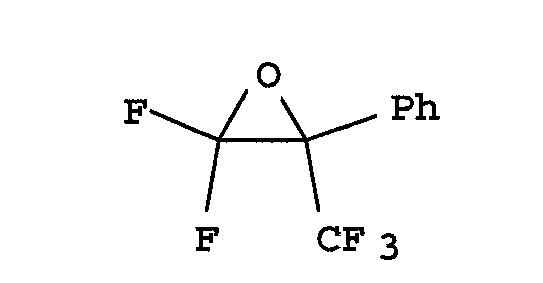


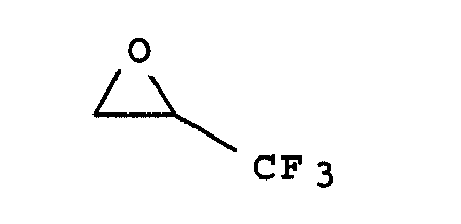


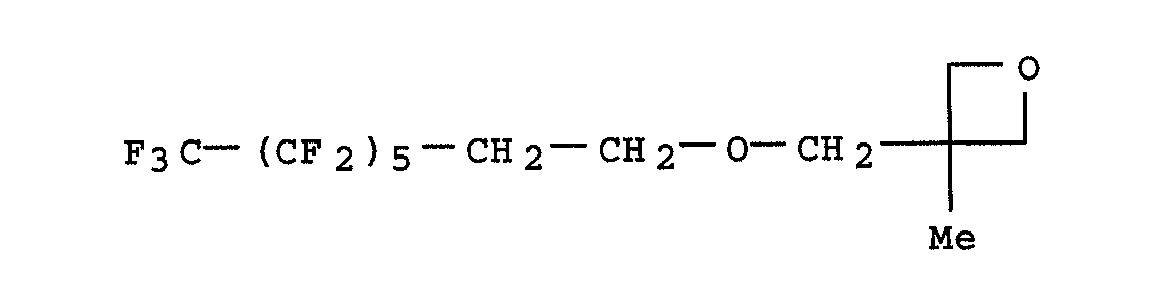


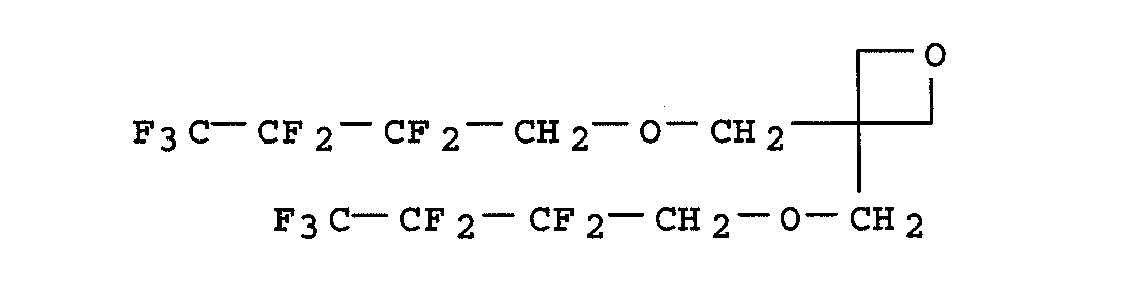

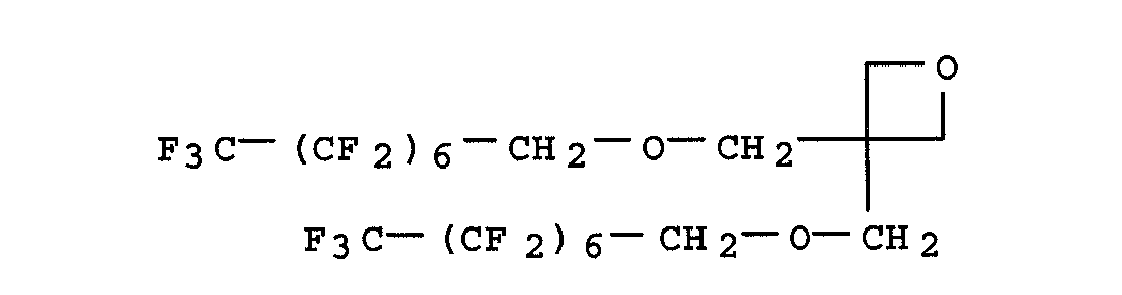


- Suitable isocyanates for the preparation of the surfactants include monofunctional isocyanates such as phenyl isocyanate, stearyl isocyanate, 2-(methacryloxy)ethyl isocyanate, methyl isocyanate, isocyanatocyclohexane, ethyl isocyanate, 1-(isocyanatomethyl)benzene, 4-methoxyphenyl isocyanate, isopropyl isocyanate, m-anisyl isocyanate and 2-tolyl isocyanate; diisocyanates such as 1,6-hexylene diisocyanate, 4,4'-diphenylmethane diisocyanate, isophorone diisocyanate, tolylene diisocyanate, 4,4'-diisocyanatodicyclohexylmethane, 1,4-phenylene diisocyanate, tetramethylene isocyanate, 1 dodecamethylene diisocyanate, 1,5-naphthylene diisocyanate and m-xylylene diisocyanate; or multifunctional isocyanates such as the isocyanurate trimer of hexamethylenediisocyanate.
- A specific di-isocyanate of interest is the following isophorone di-isocyanate:

- The linking group which may link the structural units represented by the formula's (I), (II) and/or (III) and/or other polymeric blocks such as for example polyester, polyurethane or polyvinyl alcohol blocks, may have up to 20 carbon atoms and may contain at least one atom selected from C, H, N, O and S. Preferred linking groups are a linear alkylene group having 1 to 18 carbon atoms, a linear, branched, or cyclic group having 3 to 18 carbon atoms, an alkynylene group having 2 to 18 carbon atoms and an arylene group having 6 to 20 atoms, -O-, -S-, -CO-, -CO-O-, -O-CO-, - CS-, -NRnRo-, -CO-NRn-, -NRn-CO-, -NRn-CO-O-, -O-CO-NRn, - NRn-CO-NRo -, -NRn-CS-NRo -, a phenylene group, a naphtalene group, an anthracene group, a heterocyclic group, or combinations thereof, wherein Rn and Ro each independently represent hydrogen or an optionally substituted alkyl, alkenyl, alkynyl, cycloalkyl, heterocyclic, aryl, heteroaryl, aralkyl or heteroaralkyl group. Preferred substituents on the latter groups are an alkoxy group having up to 12 carbon atoms, a halogen or a hydroxyl group.
- Suitable examples of diblock and multiblock surfactants include the following surfactants:

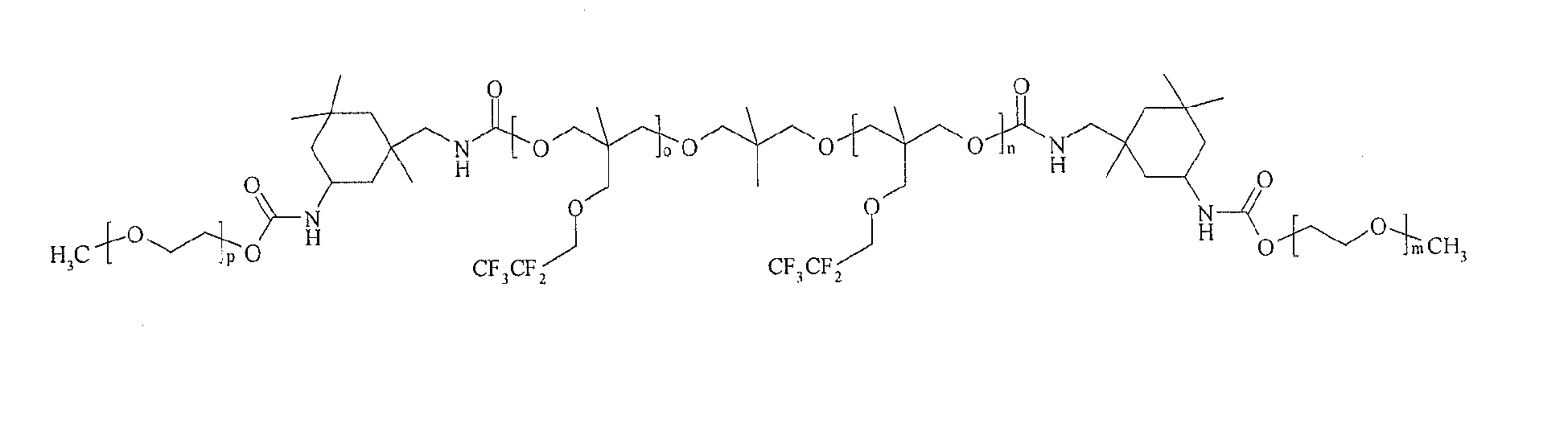


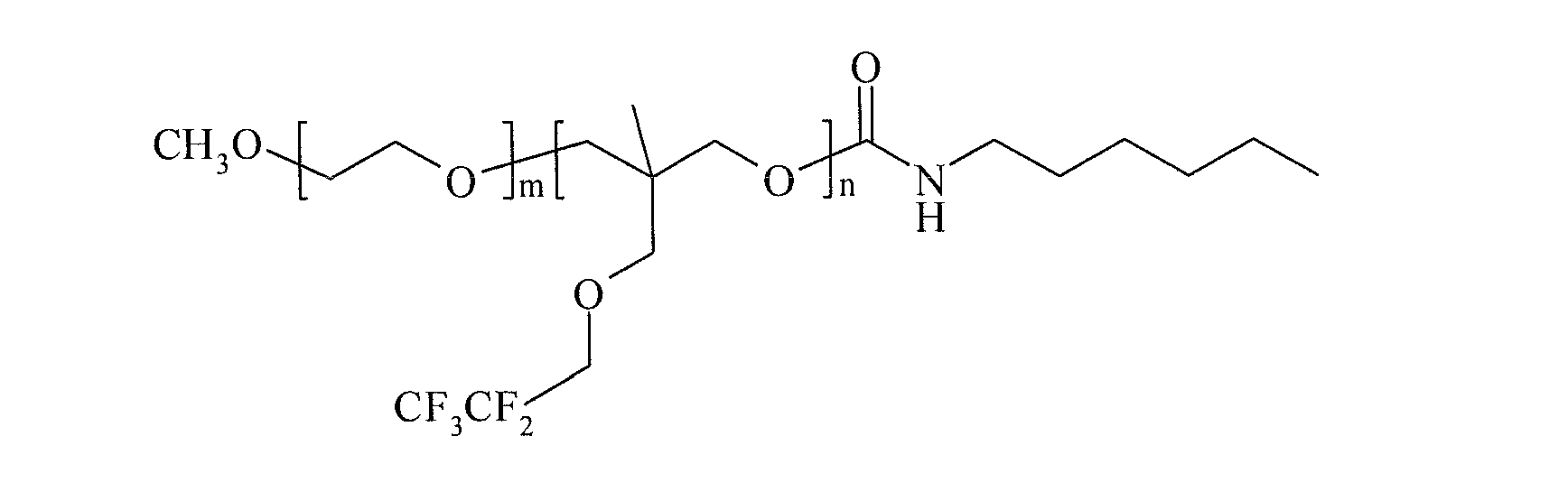


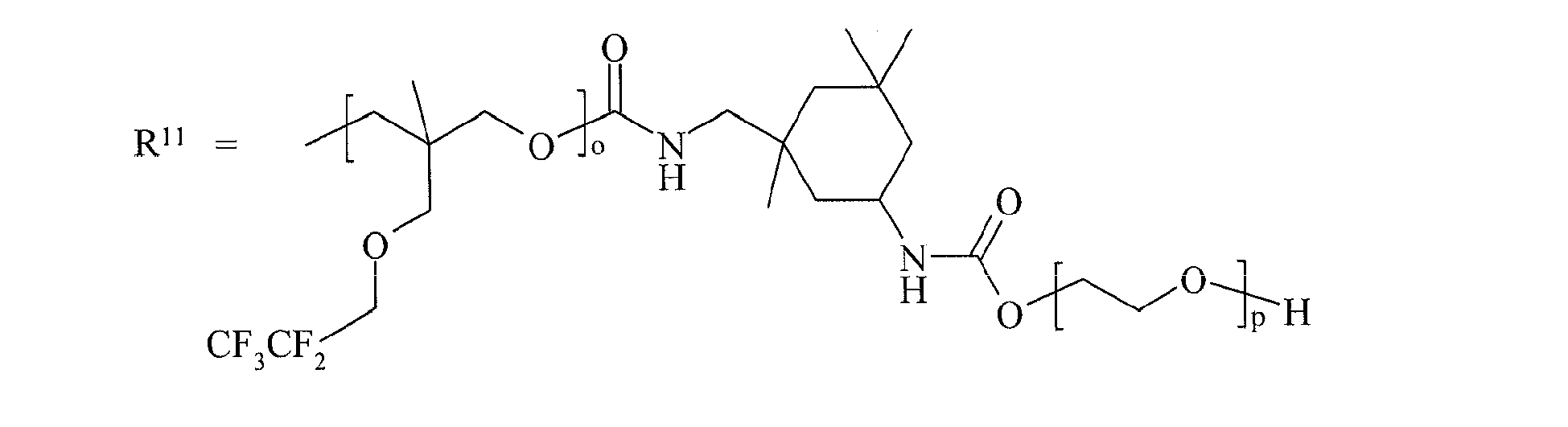


- The amount of surfactant in the coating is preferably ranging between 0.05 %wt and 5 %wt, more preferably between 0.1 %wt and 3 %wt and most preferably between 0.15 %wt and 1.5 %wt.
- The thermal printing plate precursor comprises a heat and/or light sensitive coating and is positive working. Its working mechanism is based on a heat-induced solubilization of an oleophilic resin. The oleophilic resin is preferably a polymer that is soluble in an aqueous developer, more preferably an aqueous alkaline developing solution with a pH between 7.5 and 14. Preferred polymers are phenolic resins e.g. novolac, resoles, polyvinyl phenols and carboxy substituted polymers. Typical examples of these polymers are described in
DE 4007428 ,DE 4027301 andDE 4445820 . The amount of phenolic resin present in the coating is preferably at least 50% by weight, preferably at least 80% by weight relative to the total weight of all the components present in the coating. The oleophilic resin is preferably a phenolic resin wherein the phenyl group or the hydroxy group is chemically modified with an organic substituent. The phenolic resins which are chemically modified with an organic substituent may exhibit an increased chemical resistance against printing chemicals such as fountain solutions or plate treating liquids such as plate cleaners. Examples of such chemically modified phenolic resins are described inEP 934 822 EP 1 072 432 ;US 5,641,608 ;EP 982 123 WO 99/01795 EP 2 102 446 ,EP 2 102 444 ;EP 2 102 445 ;EP 2 102 443 ;EP 3 102 522 ;WO04/035310 WO04/035686 WO04/035645 WO04/035687 EP 1 506 858 . The modified resins described inEP 2 102 446 , are preferred, especially those resins wherein the phenyl-group of said phenolic resin is substituted with a group having the structure -N=N-Q, wherein the -N=N- group is covalently bound to a carbon atom of the phenyl group and wherein Q is an aromatic group. - The novolac resin or resol resin may be prepared by polycondensation of at least one member selected from aromatic hydrocarbons such as phenol, o-cresol, p-cresol, m-cresol, 2,5-xylenol, 3,5-xylenol, resorcinol, pyrogallol, bisphenol, bisphenol A, trisphenol, o-ethylphenol, p-etylphenol, propylphenol, n-butylphenol, t-butylphenol, 1-naphtol and 2-naphtol, with at least one aldehyde or ketone selected from aldehydes such as formaldehyde, glyoxal, acetoaldehyde, propionaldehyde, benzaldehyde and furfural and ketones such as acetone, methyl ethyl ketone and methyl isobutyl ketone, in the presence of an acid catalyst. Instead of formaldehyde and acetaldehyde, paraformaldehyde and paraldehyde may, respectively, be used.
- The weight average molecular weight, measured by gel permeation chromatography using universal calibration and polystyrene standards, of the novolac resin is preferably from 500 to 150,000 g/mol, more preferably from 1,500 to 50,000 g/mol.
- The poly(vinylphenol) resin may also be a polymer of one or more hydroxy-phenyl containing monomers such as hydroxystyrenes or hydroxy-phenyl (meth)acrylates. Examples of such hydroxystyrenes are o-hydroxystyrene, m-hydroxystyrene, p-hydroxystyrene, 2-(o-hydroxyphenyl)propylene, 2-(m-hydroxyphenyl)propylene and 2-(p-hydroxyphenyl)propylene. Such a hydroxystyrene may have a substituent such as chlorine, bromine, iodine, fluorine or a C1-4 alkyl group, on its aromatic ring. An example of such hydroxy-phenyl (meth)acrylate is 2-hydroxy-phenyl methacrylate.
- The poly(vinylphenol) resin may usually be prepared by polymerizing one or more hydroxy-phenyl containing monomer in the presence of a radical initiator or a cationic polymerization initiator. The poly(vinylphenol) resin may also be prepared by copolymerizing one or more of these hydroxy-phenyl containing monomers with other monomeric compounds such as acrylate monomers, methacrylate monomers, acrylamide monomers, methacrylamide monomers, vinyl monomers, aromatic vinyl monomers or diene monomers.
- The weight average molecular weight, measured by gel permeation chromatography using universal calibration and polystyrene standards, of the poly(vinylphenol) resin is preferably from 1,000 to 200,000 g/mol, more preferably from 1,500 to 50,000 g/mol.
- Examples of phenolic resins are:
- ALNOVOL™ SPN452, 40%wt of a novolac resin in Dowanol™ PM, commercially available from CLARIANT GmbH.
- ALNOVOL™ SPN400, 44%wt of a novolac resin in Dowanol™ PMA, commercially available from CLARIANT GmbH.
- ALNOVOL™ HPN100, novolac resin commercially available from CLARIANT GmbH.
- DURITE™ PD443, novolac resin commercially available from BORDEN CHEM. INC.
- DURITE™ SD423A, novolac resin commercially available from BORDEN CHEM. INC.
- DURITE™ SD126A, novolac resin commercially available from BORDEN CHEM. INC.
- BAKELITE™ 6866LB02, novolac resin commercially available from BAKELITE AG.
- BAKELITE™ 6866LB03, novolac resin commercially available from BAKELITE AG.
- KR 400/8, novolac resin commercially available from KOYO CHEMICALS INC.
- HRJ 1085, novolac resin commercially available from SCHNECTADY INTERNATIONAL INC.
- HRJ 2606, phenol novolac resin commercially available from SCHNECTADY INTERNATIONAL INC.
- LYNCUR™ CMM, copolymer of 4-hydroxy-styrene and methyl methacrylate commercially available from SIBER HEGNER.
- The coating may comprise a second layer that comprises a polymer or copolymer (i.e.(co)polymer) comprising at least one monomeric unit that comprises at least one sulfonamide group. This layer is located between the layer described above comprising the oleophilic resin and the hydrophilic support. Hereinafter, 'a (co)polymer comprising at least one monomeric unit that comprises at least one sulfonamide group' is also referred to as "a sulphonamide (co)polymer". The sulphonamide (co)polymer is preferably alkali soluble. The sulphonamide group is preferably represented by -NR-SO2-, -SO2-NR- or -SO2-NRR' wherein R and R' each independently represent hydrogen or an organic substituent.
- The surfactant used in the present invention may be present in the first layer, the second layer or an optional other layer. Most preferably, the surfactant is present in the layer comprising the oleophilic resin.
- Sulfonamide (co)polymers are preferably high molecular weight compounds prepared by homopolymerization of monomeric units containing at least one sulfonamide group or by copolymerization of such monomeric units and other polymerizable monomeric units.
- Examples of monomeric units containing at least one sulfonamide group include monomeric units further containing at least one polymerizable unsaturated bond such as an acryloyl, allyl or vinyloxy group. Suitable examples are disclosed in
U.S. 5,141,838 ,EP 1 545 878 ;EP 909,657 EP 0 894 622 andEP 1,120,246 . - Examples of monomeric units copolymerized with the monomeric units containing at least one sulfonamide group include monomeric units as disclosed in
EP 1,262,318 ,EP 1,275,498 ,EP 909,657 EP 1,120,246 ,EP 0 894 622 andEP 1,400,351 . - Suitable examples of sulfonamide (co)polymers and/or their method of preparation are disclosed in
EP-A 933 682 EP-A 982 123 EP-A 1 072 432 ,WO 99/63407 EP 1,400,351 . - A highly preferred example of a sulfonamide (co)polymer is a homopolymer or copolymer comprising a structural unit represented by the following general formula (IV):

- R9 represents hydrogen or a hydrocarbon group having up to 12 carbon atoms; preferably R9 represents hydrogen or a methyl group;
- X1 represents a single bond or a divalent linking group. The divalent linking group may have up to 20 carbon atoms and may contain at least one atom selected from C, H, N, O and S. Preferred divalent linking groups are a linear alkylene group having 1 to 18 carbon atoms, a linear, branched, or cyclic group having 3 to 18 carbon atoms, an alkynylene group having 2 to 18 carbon atoms and an arylene group having 6 to 20 atoms, -O-, -S-, -CO-, -CO-O-, -O-CO-, -CS-, -NRnRo-, -CO-NRn-, -NRn-CO-, -NRn-CO-O-, -O-CO-NRn-, -NRn-CO-NRo-, -NRn-CS-NRo-, a phenylene group, a naphtalene group, an anthracene group, a heterocyclic group, or combinations thereof, wherein Rn and Ro each independently represent hydrogen or an optionally substituted alkyl, alkenyl, alkynyl, cycloalkyl, heterocyclic, aryl, heteroaryl, aralkyl or heteroaralkyl group. Preferred substituents on the latter groups are an alkoxy group having up to 12 carbon atoms, a halogen or a hydroxyl group. Preferably X1 is a methylene group, an ethylene group, a propylene group, a butylene group, an isopropylene group, cyclohexylene group, a phenylene group, a tolylene group or a biphenylene group;
- Y4 is a bivalent sulphonamide group represented by -NRp-SO2- or -SO2-NRq- wherein Rp and Rq each independently represent hydrogen, an optionally substituted alkyl, alkanoyl, alkenyl, alkynyl, cycloalkyl, heterocyclic, aryl, heteroaryl, aralkyl or heteroaralkyl group or a group of the formula -C(=N)-NH-R10, wherein R10 represents hydrogen or an optionally substituted alkyl or aryl group;
- Z1 represents a terminal group preferably represented by hydrogen or an optionally substituted linear, branched, or cyclic alkylene or alkyl group having 1 to 18 carbon atoms such as a methyl group, an ethyl group, a propyl group, an isopropyl group, a butyl group, an isobutyl group, a t-butyl group, a s-butyl group, a pentyl group, a hexyl group, a cyclopentyl group, a cyclohexyl group, an octyl group , an optionally substituted arylene or aryl group having 6 to 20 carbon atoms; an optionally substituted hetero-arylene or heteroaryl group; a linear, branched, or cyclic alkenylene or alkenyl group having 2 to 18 carbon atoms, a linear, branched, or cyclic alkynylene or alkynyl group having 2 to 18 carbon atoms or an alkoxy group.
- The structural unit represented by the general formula (IV) has preferably the following groups:
- X1 represents an alkylene, cyclohexylene, phenylene or tolylene group, -O-, -S-, -CO-, -CO-O-, -O-CO-, -CS-, -NRnRo-, -CO-NRn-, -NRn-CO-, -NRn-CO-O-, -O-CO-NRn-, -NRn-CO-NRo-, -NRn-CS-NRo-, or combinations thereof, and wherein Rn and Ro each independently represent hydrogen or an optionally substituted alkyl, alkenyl, alkynyl, cycloalkyl, heterocyclic, aryl, heteroaryl, aralkyl or heteroaralkyl group. Preferred substituents on the latter groups are an alkoxy group having up to 12 carbon atoms, a halogen or a hydroxyl group;
- Y4 is a bivalent sulphonamide group represented by -NRp-SO2-, -SO2-NRq- wherein Rp and Rq each independently represent hydrogen, an optionally substituted alkyl, alkanoyl, alkenyl, alkynyl, cycloalkyl, heterocyclic, aryl, heteroaryl, aralkyl or heteroaralkyl group;
- Z1 is a terminal group represented by hydrogen, an alkyl group such as a methyl group, an ethyl group, a propyl group, an isopropyl group, a butyl group, an isobutyl group, a t-butyl group, a s-butyl group, a pentyl group, a hexyl group, a cyclopentyl group, a cyclohexyl group or an octyl group, a benzyl group, an optionally substituted aryl or heteroaryl group, a naphtyl group, an anthracenyl group, a pyridyl group, an allyl group or a vinyl group.
- Specific preferred examples of sulphonamide (co)polymers are polymers comprising N-(p-aminosulfonylphenyl) (meth)acrylamide, N-(m-aminosulfonylphenyl) (meth)acrylamide and/or N-(o-aminosulfonylphenyl) (meth)acrylamide. A particularly preferred sulphonamide (co)polymer is a polymer comprising N-(p-aminosulphonylphenyl) methacrylamide wherein the sulphonamide group comprises an optionally substituted straight, branched, cyclic or heterocyclic alkyl group, an optionally substituted aryl group or an optionally substituted heteroaryl group.
- The layer comprising the sulphonamide (co)polymer may further comprise additional hydrophobic binders such as a phenolic resin (e.g. novolac, resoles or polyvinyl phenols), a chemically modified phenolic resin or a polymer containing a carboxyl group, a nitrile group or a maleimide group.
- The dissolution behavior of the coating can be fine-tuned by optional solubility regulating components. More particularly, development accelerators and development inhibitors can be used. In the embodiment where the coating comprises more than one layer, these ingredients can be added to the first layer, to the second layer and/or to an optional other layer of the coating.
- Development accelerators are compounds which act as dissolution promoters because they are capable of increasing the dissolution rate of the coating. For example, cyclic acid anhydrides, phenols or organic acids can be used in order to improve the aqueous developability. Examples of the cyclic acid anhydride include phthalic anhydride, tetrahydrophthalic anhydride, hexahydrophthalic anhydride, 3,6-endoxy-4-tetrahydro-phthalic anhydride, tetrachlorophthalic anhydride, maleic anhydride, chloromaleic anhydride, alpha -phenylmaleic anhydride, succinic anhydride, and pyromellitic anhydride, as described in
U.S. Patent No. 4,115,128 . Examples of the phenols include bisphenol A, p-nitrophenol, p-ethoxyphenol, 2,4,4'-trihydroxybenzophenone, 2,3,4-trihydroxy-benzophenone, 4-hydroxybenzophenone, 4,4',4"-trihydroxy-triphenylmethane, and 4,4',3",4"-tetrahydroxy-3,5,3',5'-tetramethyltriphenylmethane, and the like. Examples of the organic acids include sulphonic acids, sulfinic acids, alkylsulfuric acids, phosphonic acids, phosphates, and carboxylic acids, as described in, for example,JP-A Nos. 60-88, 942 2-96,755 - In a preferred embodiment, the coating also contains developer resistance means, also called development inhibitors, i.e. one or more ingredients which are capable of delaying the dissolution of the unexposed areas during processing. The dissolution inhibiting effect is preferably reversed by heating, so that the dissolution of the exposed areas is not substantially delayed and a large dissolution differential between exposed and unexposed areas can thereby be obtained. The compounds described in e.g.
EP-A 823 327 WO97/39894 - Other suitable inhibitors improve the developer resistance because they delay the penetration of the aqueous alkaline developer into the coating. Such compounds can be present in the first layer and/or, if present, in the second layer as described in e.g.
EP-A 950 518 EP-A 864 420 EP-A 950 517 WO 99/21725 WO 01/45958 - Preferred examples of inhibitors which delay the penetration of the aqueous alkaline developer into the coating include the following:
- (a) A polymeric material which is insoluble in or impenetrable by the developer, e.g. a hydrophobic or water-repellent polymer or copolymer such as acrylic polymers, polystyrene, styrene-acrylic copolymers, polyesters, polyamides, polyureas, polyurethanes, nitrocellulosics and epoxy resins; or polymers comprising siloxane (silicones) and/or perfluoroalkyl units.
- (b) Bifunctional compounds such as surfactants comprising a polar group and a hydrophobic group such as a long chain hydrocarbon group, a poly- or oligosiloxane and/or a perfluorinated hydrocarbon group. A typical example is Megafac F-177, a perfluorinated surfactant available from Dainippon Ink & Chemicals, Inc. A suitable amount of such compounds is between 10 and 100 mg/m2, more preferably between 50 and 90 mg/m2.
- (c) Bifunctional block-copolymers comprising a polar block such as a poly- or oligo(alkylene oxide) and a hydrophobic block such as a long chain hydrocarbon group, a poly- or oligosiloxane and/or a perfluorinated hydrocarbon group. A suitable amount of such compounds is between 0.5 and 25 mg/m2, preferably between 0.5 and 15 mg/m2 and most preferably between 0.5 and 10 mg/m2. A suitable copolymer comprises about 15 to 25 siloxane units and 50 to 70 alkyleneoxide groups. Preferred examples include copolymers comprising phenylmethylsiloxane and/or dimethylsiloxane as well as ethylene oxide and/or propylene oxide, such as Tego Glide 410, Tego Wet 265, Tego Protect 5001 or Silikophen P50/X, all commercially available from Tego Chemie, Essen, Germany. Said poly- or oligosiloxane may be a linear, cyclic or complex cross-linked polymer or copolymer. The term polysiloxane compound shall include any compound which contains more than one siloxane group -Si(R,R')-O-, wherein R and R' are optionally substituted alkyl or aryl groups. Preferred siloxanes are phenylalkylsiloxanes and dialkylsiloxanes. The number of siloxane groups in the polymer or oligomer is at least 2, preferably at least 10, more preferably at least 20. It may be less than 100, preferably less than 60.
- It is believed that during coating and drying, the above mentioned inhibitor of type (b) and (c) tends to position itself, due to its bifunctional structure, at the interface between the coating and air and thereby forms a separate top layer even when applied as an ingredient of the coating solution of the first and/or of the optional second layer. Simultaneously, the surfactants also act as a spreading agent which improves the coating quality. The separate top layer thus formed seems to be capable of acting as the above mentioned barrier layer which delays the penetration of the developer into the coating.
- Alternatively, the inhibitor of type (a) to (c) can be applied in a separate solution, coated on top of the first, optional second and/or other layers of the coating. In that embodiment, it may be advantageous to use a solvent in the separate solution that is not capable of dissolving the ingredients present in the other layers so that a highly concentrated water-repellent or hydrophobic phase is obtained at the top of the coating which is capable of acting as the above mentioned development barrier layer.
- In addition, the first or optional second layer and/or other layer may comprise polymers that further improve the run length and/or the chemical resistance of the plate. Examples thereof are polymers comprising imido (-CO-NR-CO-) pendant groups, wherein R is hydrogen, optionally substituted alkyl or optionally substituted aryl, such as the polymers described in
EP-A 894 622 EP-A 901 902 EP-A 933 682 WO 99/63407 - The coating of the heat-sensitive printing plate precursor preferably also contains an infrared light absorbing dye or pigment which, in the embodiment where the coating comprises more than one layer, may be present in the first layer, and/or in the second layer, and/or in an optional other layer. Preferred IR absorbing dyes are cyanine dyes, merocyanine dyes, indoaniline dyes, oxonol dyes, pyrilium dyes and squarilium dyes. Examples of suitable IR dyes are described in e.g.
EP-As 823327 978376 1029667 ,1053868 ,1093934 ;WO 97/39894 00/29214 
- The concentration of the IR-dye in the coating is preferably between 0.25 and 15.0 %wt, more preferably between 0.5 and 10.0 %wt, most preferably between 1.0 and 7.5 %wt relative to the coating as a whole.
- The coating may further comprise one or more colorant(s) such as dyes or pigments which provide a visible color to the coating and which remain in the coating at the image areas which are not removed during the processing step. Thereby a visible image is formed and examination of the lithographic image on the developed printing plate becomes feasible. Such dyes are often called contrast dyes or indicator dyes. Preferably, the dye has a blue color and an absorption maximum in the wavelength range between 600 nm and 750 nm. Typical examples of such contrast dyes are the amino-substituted tri- or diarylmethane dyes, e.g. crystal violet, methyl violet, victoria pure blue, flexoblau 630, basonylblau 640, auramine and malachite green. Also the dyes which are discussed in depth in
EP 400 706 WO2006/005688 may also be used as colorants. - To protect the surface of the coating of the heat and/or light-sensitive printing plate precursors, in particular from mechanical damage, a protective layer may also optionally be applied. The protective layer generally comprises at least one water-soluble binder, such as polyvinyl alcohol, polyvinylpyrrolidone, partially hydrolyzed polyvinyl acetates, gelatin, carbohydrates or hydroxyethylcellulose, and can be produced in any known manner such as from an aqueous solution or dispersion which may, if required, contain small amounts - i.e. less than 5% by weight based on the total weight of the coating solvents for the protective layer - of organic solvents. The thickness of the protective layer can suitably be any amount, advantageously up to 5.0 µm, preferably from 0.1 to 3.0 µm, particularly preferably from 0.15 to 1.0 µm.
- Optionally, the coating may further contain additional ingredients such as further surfactants, silicon or titanium dioxide particles or polymers particles such as matting agents and spacers.
- Any coating method can be used for applying two or more coating solutions to the hydrophilic surface of the support. The multi-layer coating can be applied by coating/drying each layer consecutively or by the simultaneous coating of several coating solutions at once. In the drying step, the volatile solvents are removed from the coating until the coating is self-supporting and dry to the touch. However it is not necessary (and may not even be possible) to remove all the solvent in the drying step. Indeed the residual solvent content may be regarded as an additional composition variable by means of which the composition may be optimized. Drying is typically carried out by blowing hot air onto the coating, typically at a temperature of at least 70°C, suitably 80-150°C and especially 90-140°C. Also infrared lamps can be used. The drying time may typically be 15-600 seconds.
- Between coating and drying, or after the drying step, a heat treatment and subsequent cooling may provide additional benefits, as described in
WO99/21715 EP-A 1074386 ,EP-A 1074889 ,WO00/29214 WO/04030923 WO/04030924 WO/04030925 - The support of the lithographic printing plate precursor may be a sheet-like material such as a plate or it may be a cylindrical element such as a sleeve which can be slid around a print cylinder of a printing press. Preferably, the support is a metal support such as aluminum or stainless steel. The support can also be a laminate comprising an aluminum foil and a plastic layer, e.g. polyester film.
- A particularly preferred lithographic support is an electrochemically grained and anodized aluminum support. The aluminum support has usually a thickness of about 0.1-0.6 mm. However, this thickness can be changed appropriately depending on the size of the printing plate used and/or the size of the plate-setters on which the printing plate precursors are exposed. The aluminum is preferably grained by electrochemical graining, and anodized by means of anodizing techniques employing phosphoric acid or a sulphuric acid/phosphoric acid mixture. Methods of both graining and anodization of aluminum are very well known in the art.
- By graining (or roughening) the aluminum support, both the adhesion of the printing image and the wetting characteristics of the non-image areas are improved. By varying the type and/or concentration of the electrolyte and the applied voltage in the graining step, different type of grains can be obtained. The surface roughness is often expressed as arithmetical mean center-line roughness Ra (ISO 4287/1 or DIN 4762) and may vary between 0.05 and 1.5 µm. The aluminum substrate of the current invention has preferably an Ra value below 0.45 µm, more preferably below 0.40 µm and most preferably below 0.30 µm. The lower limit of the Ra value is preferably about 0.1 µm. More details concerning the preferred Ra values of the surface of the grained and anodized aluminum support are described in
EP 1 356 926 . - By anodising the aluminum support, its abrasion resistance and hydrophilic nature are improved. The microstructure as well as the thickness of the Al2O3 layer are determined by the anodising step, the anodic weight (g/m2 Al2O3 formed on the aluminum surface) varies between 1 and 8 g/m2. The anodic weight is preferably ≥ 3 g/m2, more preferably ≥ 3.5 g/m2 and most preferably ≥ 4.0 g/m2.
- The grained and anodized aluminum support may be subject to a so-called post-anodic treatment to improve the hydrophilic properties of its surface. For example, the aluminum support may be silicated by treating its surface with a sodium silicate solution at elevated temperature, e.g. 95°C. Alternatively, a phosphate treatment may be applied which involves treating the aluminum oxide surface with a phosphate solution that may further contain an inorganic fluoride. Further, the aluminum oxide surface may be rinsed with a citric acid or citrate solution. This treatment may be carried out at room temperature or may be carried out at a slightly elevated temperature of about 30 to 50°C. A further interesting treatment involves rinsing the aluminum oxide surface with a bicarbonate solution. Still further, the aluminum oxide surface may be treated with polyvinylphosphonic acid, polyvinylmethylphosphonic acid, phosphoric acid esters of polyvinyl alcohol, polyvinylsulphonic acid, polyvinylbenzenesulphonic acid, sulphuric acid esters of polyvinyl alcohol, and acetals of polyvinyl alcohols formed by reaction with a sulphonated aliphatic aldehyde.
- Another useful post-anodic treatment may be carried out with a solution of polyacrylic acid or a polymer comprising at least 30 mol% of acrylic acid monomeric units, e.g. GLASCOL E15, a polyacrylic acid, commercially available from Ciba Speciality Chemicals.
- The support can also be a flexible support, which may be provided with a hydrophilic layer, hereinafter called 'base layer'. The flexible support is e.g. paper, plastic film or aluminum. Preferred examples of plastic film are polyethylene terephthalate film, polyethylene naphthalate film, cellulose acetate film, polystyrene film, polycarbonate film, etc. The plastic film support may be opaque or transparent.
- The base layer is preferably a cross-linked hydrophilic layer obtained from a hydrophilic binder cross-linked with a hardening agent such as formaldehyde, glyoxal, polyisocyanate or a hydrolyzed tetra-alkylorthosilicate. The latter is particularly preferred. The thickness of the hydrophilic base layer may vary in the range of 0.2 to 25 µm and is preferably 1 to 10 µm. More details of preferred embodiments of the base layer can be found in e.g.
EP-A 1 025 992 . - The heat-sensitive plate precursor can be image-wise exposed directly with heat, e.g. by means of a thermal head, or indirectly by infrared light, preferably near infrared light. The infrared light is preferably converted into heat by an IR light absorbing compound as discussed above. The heat-sensitive lithographic printing plate precursor is preferably not sensitive to visible light i.e. no substantial effect on the dissolution rate of the coating in the developer is induced by exposure to visible light. Most preferably, the coating is not sensitive to ambient daylight.
- The printing plate precursor can be exposed to infrared light by means of e.g. LEDs or a laser. Most preferably, the light used for the exposure is a laser emitting near infrared light having a wavelength in the range from about 750 to about 1500 nm, more preferably 750 to 1100 nm, such as a semiconductor laser diode, a Nd:YAG or a Nd:YLF laser. The required laser power depends on the sensitivity of the plate precursor, the pixel dwell time of the laser beam, which is determined by the spot diameter (typical value of modern plate-setters at 1/e2 of maximum intensity: 5-25 µm), the scan speed and the resolution of the exposure apparatus (i.e. the number of addressable pixels per unit of linear distance, often expressed in dots per inch or dpi; typical value: 1000-4000 dpi).
- Two types of laser-exposure apparatuses are commonly used: internal (ITD) and external drum (XTD) platesetters. ITD plate-setters for thermal plates are typically characterized by a very high scan speed up to 500 m/sec and may require a laser power of several Watts. XTD plate-setters for thermal plates having a typical laser power from about 200 mW to about 1 W operate at a lower scan speed, e.g. from 0.1 to 10 m/sec. An XTD platesetter equipped with one or more laserdiodes emitting in the wavelength range between 750 and 850 nm is an especially preferred embodiment for the method of the present invention.
- The known plate-setters can be used as an off-press exposure apparatus, which offers the benefit of reduced press down-time. XTD plate-setter configurations can also be used for on-press exposure, offering the benefit of immediate registration in a multi-color press. More technical details of on-press exposure apparatuses are described in e.g.
US 5,174,205 andUS 5,163,368 . - After exposure, the precursor is preferably developed by means of immersing the precursor in a developing solution; this may be combined with mechanical rubbing, e.g. by using a rotating brush. During the development the non-image areas of the coating are preferably removed with an aqueous alkaline developer solution. The developer solution preferably has a pH above 10, more preferably above 12. During the development step, any water-soluble layer present is preferably also removed. The development step is preferably carried out at temperatures ranging between 20 and 40°C in automated processing units as customary in the art.
- More details concerning the development step can be found in for example
EP 1614538 ,EP 1614539 ,EP 1614540 andWO/2004071767 . - The developing solution preferably contains a buffer such as for example a silicate-based buffer or a phosphate buffer. The concentration of the buffer in the developer preferably ranges bewteen 3 to 14%wt. Silicate-based developers which have a ratio of silicon dioxide to alkali metal oxide of at least 1 are advantageous because they ensure that the alumina layer (if present) of the substrate is not damaged. Preferred alkali metal oxides include Na20 and K20, and mixtures thereof. A particularly preferred silicate-based developer solution is a developer solution comprising sodium or potassium metasilicate, i.e. a silicate where the ratio of silicon dioxide to alkali metal oxide is 1.
- The developing solution may optionally contain further components as known in the art: other buffer substances, chelating agents, surfactants, complexes, inorganic salts, inorganic alkaline agents, organic alkaline agents, antifoaming agents, organic solvents in small amounts i.e. preferably less than 10%wt and more preferably less than 5%wt, nonreducing sugars, glycosides, dyes and/or hydrotropic agents. These components may be used alone or in combination.
- To ensure a stable processing with the developer solution for a prolonged time, it is particularly important to control the concentration of the ingredients in the developer. Therefore a replenishing solution, hereinafter also referred to as replenisher, is often added to the developing solution. More than one replenishing solution containing different ingredients and/or different amounts of the ingredients may be added to the developing solution. Alkali metal silicate solutions having alkali metal contents of from 0.6 to 2.0 mol/l can suitably be used. These solutions may have the same silica/alkali metal oxide ratio as the developer (generally, however, it is lower) and likewise optionally contain further additives. It is advantageous that the (co)polymer of the present invention is present in the replenisher(s); preferably at a concentration of at least 0.5 g/l, more preferably in a concentration ranging between 1 and 50 g/l most preferably between 2 and 30 g/l.
- The replenishing solution has preferably a pH value of at least 10, more preferably of at least 11, most preferably of at least 12.
- The development step may be followed by a rinsing step, a gumming step, a drying step and/or a post-baking step.
- The heat-sensitive printing plates can be used for conventional, so-called wet offset printing, in which ink and an aqueous dampening liquid are supplied to the plate. Another suitable printing method uses so-called single-fluid ink without a dampening liquid. Suitable single-fluid inks have been described in
US 4,045,232 ;US 4,981,517 andUS 6,140,392 . In a most preferred embodiment, the single-fluid ink comprises an ink phase, also called the hydrophobic or oleophilic phase, and a polyol phase as described inWO 00/32705 - The printing plate precursor of the present invention can also be used for treating thermo-resists, for example on a PCB (printed circuit board) application as described in
US 2003/0003406 A1 . - A 0.30 mm thick aluminum foil was degreased by immersing the foil in an aqueous solution containing 34 g/l of sodium hydroxide at 70°C for 6 seconds and rinsed with demineralized water for 3.6 seconds. The foil was then electrochemically grained during 8 seconds using an alternating current in an aqueous solution containing 15 g/l HCl, 15 g/l SO4 2- ions and 5 g/l Al3+ at a temperature of 37°C and a current density of 100 A/dm2. The aluminum foil was then desmutted by etching with an aqueous solution containing 145 g/l of sulfuric acid at 80°C for 5 seconds and rinsed with demineralized water for 4 seconds. The foil was subsequently subjected to anodic oxidation during 10 seconds in an aqueous solution containing 145 g/l of sulfuric acid at a temperature of 57°C and a current density of 25 A/dm2, then washed with demineralized water for 7 seconds and post-treated for 4 seconds with a solution containing 2.2 g/l of polyvinylphosphonic acid at 70°C, rinsed with demineralized water for 3.5 seconds and dried at 120°C for 7 seconds.
- The support thus obtained was characterized by a surface roughness Ra of 0.35-0.40 µm (measured with interferometer NT1100) and an anodic weight of 3.0 g/m2.
- A first layer was coated on an aluminum substrate (described above) with the first coating solution with the composition as defined in Table 1 at a wet coating thickness of 20 µm.
Table 1: composition of the first coating solution. Composition first coating solution g Dowanol PM (1) 270.98 THF (2) 576.55 Binder-01(25 wt%) (3) 53.75 Crystal Violet (1 wt%) (4) 58.24 Tegoglide 410 (1 wt%) (5) 5.82 (1) Propyleneglycol-monomethylether (1-methoxy-2-propanol) commercially available from Dow Chemical Company;
(2) THF is tetrahydrofuran;
(3) Binder-01: preparation see 2.2;
(4) 1 wt% solution of Crystal Violet in Dowanol PM, Crystal Violet is commercially available from Ciba-Geigy GmbH;
(5) 1 wt% solution of Tegoglide 410 in Dowanol PM; Tegoglide 410 is a copolymer of polysiloxane and poly(alkylene oxide), commercially available from Tego Chemie Service GmbH. - he total dry coating weight amounts to 0.671 g/m2. The dry weight of the ingredients in the first coating is shown in Table 2.
Table 2: Dry coating weight of first coating. Dry Weight first Coating* mg/m2 Binder-01 660 Crystal Violet 10 Tegoglide 410 1 * ingredients as defined in Table 1. - In a 250 ml reactor, 162 mmol of Monomer-01 (structure see below), 21.3g (132 mmol) benzyl acrylamide, 0.43 g (6 mmol) acrylic acid and 103g gamma-butyrolactone were added and the mixture was heated to 140°C, while stirring at 200 rpm. A constant flow of nitrogen was put over the reactor. After dissolution of all the components, the reactor was cooled to 100°C. 0.35 ml Trigonox™ DC50, commercially available from AKZO NOBEL, was added followed by the addition of 1.39 ml Trigonox™ 141, commercially available from AKZO NOBEL, in 3.43 ml butyrolactone. The polymerization was started and the reactor was heated to 140°C over 2 hours while dosing 1.75 ml Trigonox™ DC50. The mixture was stirred at 400 rpm and the polymerization was allowed to continue for 2 hours at 140°C. The reaction mixture was cooled to 120°C and the stirrer speed was enhanced to 500 rpm. 85.7 ml 1-methoxy-2-propanol was added and the reaction mixture was allowed to cool down to room temperature.
Binder-01 was analyzed with 1H-NMR-spectroscopy and size exclusion chromatography, using dimethyl acetamide/0.21 % LiCl as eluent on a 3x mixed-B column and relative to polystyrene standards.Mn Mw PD Binder-01 23500 67000 2.84 - The reaction mixture was cooled to 40°C and the resulting 25 %wt polymer solution was collected in a drum.
- Monomer-01:

- Above the first layer, a second coating solution with the composition as defined in Table 3 (coating solutions 1 to 16) was coated at a wet coating thickness of 16 µm resulting in the printing plate precursors PPP-01 to PPP-16.

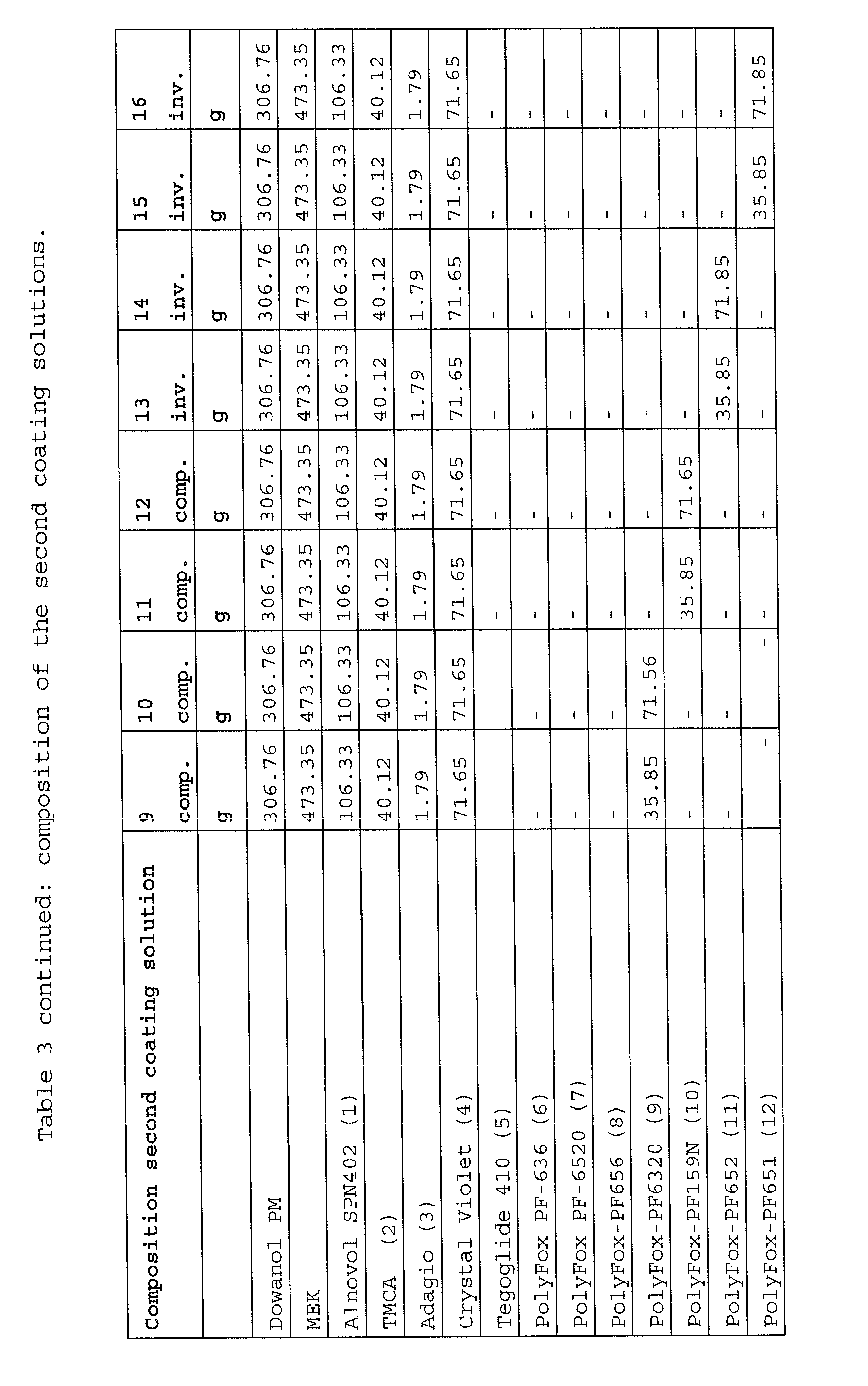


- The total dry coating weight of the second coatings and their respective ingredients are given in Table 4.
Table 4:dry coating weight of the second coating. Dry Weight second Coating * mg/m2 Alnovol SPN402 653.0 TMCA 56.0 Adagio 25.0 Crystal Violet 10.0 Perfluoro surfactant 5.0 or 10.0 Total: 749 or 754 *:the dry coating weight of the second coating of PPP-01 amounted to only 744 mg/m2; the ingredients of the coating are defined in Table 3. - The printing plate precursors PPP-01 to PPP-16 were imaged on a Creo TrendSetter with a 40 W imaging head (commercially available from Kodak) at 140 rpm and 2400 dpi and then developed in an Agfa Autolith TP105 processor (commercially available form Agfa Graphics NV) with Agfa Energy Elite developer (commercially available from Agfa Graphics NV) in the developer section (temperature 23°C, dwell time 25 sec.) and tap water (room temperature) in the finisher section.
- The static coefficient of friction of the surface of the precursors was measured. A value of at least 0.45 is required in order to prevent the occurrence of plates shifting over each other during transport, giving rise to "scuff mark" defects.
- The static coefficient of friction was measured in line with standard ASTM D 1894. The following experimental set-up was used:wherein

- a: gauge which measures the frictional force between d and g; b: pulley;
- c: nylon thread;
- d: part of a typical interleaf paper (Pleiderer Pergo-Tec 37 g/m2) ;
- e: stainless steel block;
- f: support;
- g: the printing plate precursor with the photosensitive layer facing upwards
- The static coefficient of friction is defined as the maximum power (N) in order to move the stainless steel block e, divided by the weight of the stainless steel block.
- This assessment was performed 5 times for each of the printing plate precursors 1 to 16. The results of this evaluation (average value and standard deviation) are given in Table 5.
- In order to evaluate the robustness of each of the second coating solutions with regards to coating and drying conditions, i.e. coatability, an additional coating test on an aluminum support as described under 1 was performed with each of the coating solutions 1 - 16 as described in 2.3 but using very critical drying conditions:
- step 1: drying for 30 seconds under the conditions described below;
- step 2: drying in a warm air (convection) oven for 3 minutes at 135°C.
- Drying conditions used in step 1:wherein

- a is a hair dryer (WIGO Taifun 110ch, power 1000W, commercially available from WIGO) used at the maximum available air blowing capacity setting 2.
- b is the printing plate precursor.
- After coating and drying under the conditions described above, the obtained precursors were visually evaluated with regards to the coating uniformity using the following qualitative scale:
- 1= strongly cloudy coating
- 2= cloudy coating
- 3= slightly cloudy coating
- 4= nearly homogeneous coating
- 5= perfectly homogeneous coating
- A value of at least 4 of the cosmetics or coatability of the surface is required in order to be able to coat the layer with sufficient latitude under industrial conditions.
- The right exposure (RE) sensitivity is the energy density value (in mJ/cm2) where the 1x1 checkerboard pattern on the plate after processing reads 52% (Gretag-MacBeth D19C densitometer, automatic colour filter setting).
- he results of the right exposure sensitivity (RE), cosmetics level/coatability and coefficient of friction evaluations are given in Table 5.
Table 5:Static coeff. of friction and sensitivity results. Printing plate precursor "RE" sensitivity (mJ/cm2) static coefficient of friction * coating cosmetics ** Dry coating weight of the surfactant (mg/m2) PPP 1; reference 111 0.60 ± 0.008 2 - PPP 2; comparative 109 0.16 ± 0.009 5 5.0 PPP 3; comparative na na 1 5.0 0 PPP 4 ; comparative na na 1 10.0 PPP 5; comparative 98 0.36 ± 0.019 4 5.0 PPP 6; comparative 84 0.31 ± 0.010 4.5 10.0 PPP 7; comparative na na 3 5.0 PPP 8 ; comparative na na 3 10.0 PPP 9; comparative 83 0.46 ± 0.023 1 5.0 PPP 10; comparative 101 0.33 ± 0.016 1 10.0 PPP 11; comparative na na 1 5.0 0 PPP 12; comparative na na 1 10.0 PPP 13; inventive 97 0.58 ± 0.002 5 5.0 PPP 14; inventive 88 0.57 ± 0.004 4 10.0 PPP 15; inventive 108 0.56 ± 0.008 4.5 5.0 PPP 16; inventive 99 0.48 ± 0.008 4 10.0 na= data not available;
* determined as described above;
** coating uniformity visually evaluated using the following qualitative scale:
1= strongly cloudy coating
2= cloudy coating
3= slightly cloudy coating
4= nearly homogeneous coating
5= perfectly homogeneous coating. - The results in Table 5 show that the comparative printing plates either have a bad result for coatability (i.e. coating cosmetics level of 1 to 3), or, when the coatability is acceptable i.e. a coating cosmetics level of at least 4, the static coefficient of friction is not sufficiently high (below 0.45).
- The inventive printing plate precursors comprising the surfactants PolyFox PF-652 and PolyFox PF-651, PPP-13 to PPP-16, allow for a good coatability - i.e. a coating cosmetics level of at least 4 - AND at the same time a sufficiently high static coefficient of friction - i.e. a static coefficient of friction of at least 0.45. PolyFox PF-652 has the additional feature that it shows a very consistent behaviour over the concentration range used.
- The sensitivity results are comparable for all the printing plate precursors PPP-1 to PPP-16.
Claims (12)
- A heat-sensitive positive-working lithographic printing plate precursor which comprises on a support having a hydrophilic surface or which is provided with a hydrophilic layer, a heat and/or light-sensitive coating comprising a surfactant,
characterized in that the surfactant comprises a polyether block including a pendant fluoroalkyl group and a urethane linking group. - A printing plate precursor according to claim 1 wherein the fluoroalkylgroup is an alkoxyfluoroalkyl group.
- A printing plate precursor according to claims 1 or 2 wherein the surfactant comprises the following structural unit:
 a and b independently represent an integer ≥ 0;c represents an integer ranging between 1 and 40;Y1 represents a fluoroalkyl group or an alkoxyfluoroalkyl group;Y2 represents hydrogen, an optionally substituted alkyl group, a fluoroalkyl group or an alkoxyfluoroalkyl group;R1 to R4 independently represent hydrogen, fluoride, a fluoroalkyl group, an optionally substituted alkyl groupor an optionally substituted aryl group.
 - A precursor according to any of claims 1 to 3 wherein the surfactant comprises the following structural unit:
 X represents a fluoroalkyl group;Y3 represents hydrogen or an optionally substituted alkyl group;and f represents on integer ranging between 1 and 40.
 - A printing plate precursor according to any of the preceding claims wherein the surfactant comprises the following structural unit:
 alkyl or an optionally substituted aryl, aralkyl or heteroalkyl group;and k represents an integer ranging between 1 and 40.
 - A printing plate precursor according to any of the preceding claims wherein the surfactant comprises the following structural unit:


- A printing plate precursor according to any of the preceding claims wherein the surfactant is one of the following compounds:


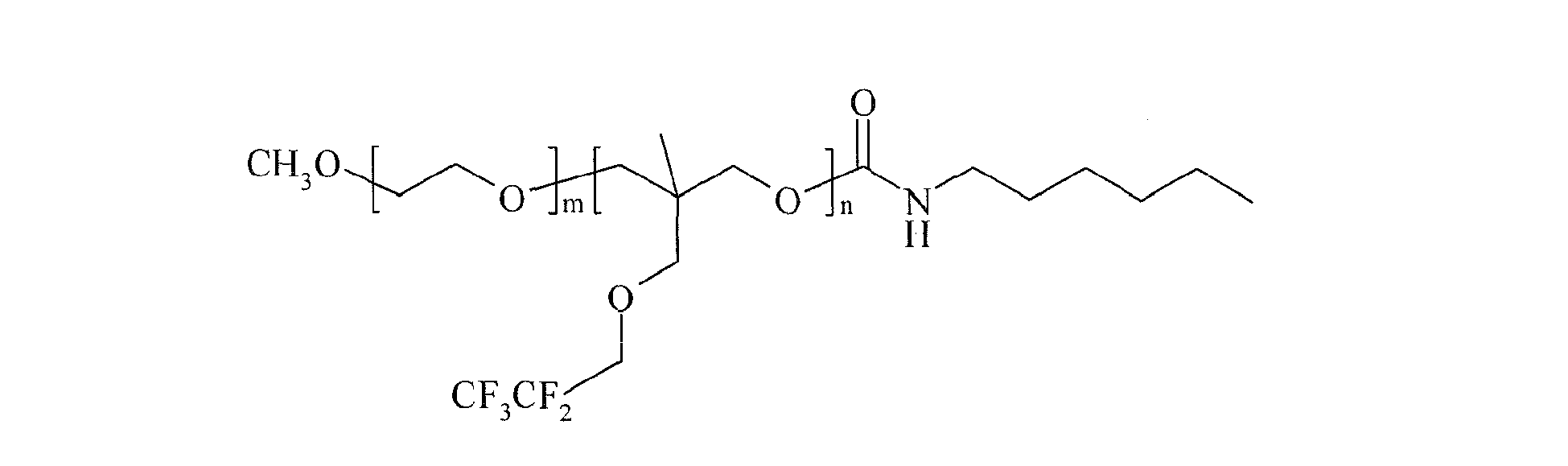
- A printing plate precursor according to any of the preceding claims wherein the surfactant is present in the coating in an amount ranging between 0.1 %wt and 3%wt.
- A printing plate precursor according to any of the preceding claims wherein the coating comprises at least two layers- a layer comprising an oleophilic resin;- another layer comprising a sulfonamide binder, which is located between the support and said layer comprising the oleophilic resin;
and wherein the surfactant is present in the layer comprising the oleophilic resin. - A printing plate precursor according to claim 8 wherein the sulfonamide binder is represented by
 R9 represents hydrogen or a hydrocarbon group having up to 12 carbon atoms;X1 represents a single bond or a divalent linking group;Y4 is a bivalent sulphonamide group;and Z1 represents a terminal group.
 - A method for making a lithographic printing plate precursor comprising the steps of- applying a coating as defined in any of the preceding claims;- drying the precursor.
- A method for making a lithographic printing plate comprising the steps of- providing a printing plate precursor according to any of the preceding claims;- exposing said precursor to heat and/or infrared light;- developing the exposed precursor with an aqueous alkaline solution.
Priority Applications (5)
| Application Number | Priority Date | Filing Date | Title |
|---|---|---|---|
| EP20070118085 EP2047988B1 (en) | 2007-10-09 | 2007-10-09 | A lithographic printing plate precursor |
| CN200880110738.6A CN101821097B (en) | 2007-10-09 | 2008-09-23 | Lithographic printing plate precursors |
| ES08832772T ES2436000T3 (en) | 2007-10-09 | 2008-09-23 | Precursor of lithographic printing plate |
| PCT/EP2008/062663 WO2009047112A1 (en) | 2007-10-09 | 2008-09-23 | A lithographic printing plate precursor |
| EP08832772.1A EP2197678B1 (en) | 2007-10-09 | 2008-09-23 | Lithographic printing plate precursor |
Applications Claiming Priority (1)
| Application Number | Priority Date | Filing Date | Title |
|---|---|---|---|
| EP20070118085 EP2047988B1 (en) | 2007-10-09 | 2007-10-09 | A lithographic printing plate precursor |
Publications (2)
| Publication Number | Publication Date |
|---|---|
| EP2047988A1 true EP2047988A1 (en) | 2009-04-15 |
| EP2047988B1 EP2047988B1 (en) | 2014-03-12 |
Family
ID=39146935
Family Applications (2)
| Application Number | Title | Priority Date | Filing Date |
|---|---|---|---|
| EP20070118085 Not-in-force EP2047988B1 (en) | 2007-10-09 | 2007-10-09 | A lithographic printing plate precursor |
| EP08832772.1A Not-in-force EP2197678B1 (en) | 2007-10-09 | 2008-09-23 | Lithographic printing plate precursor |
Family Applications After (1)
| Application Number | Title | Priority Date | Filing Date |
|---|---|---|---|
| EP08832772.1A Not-in-force EP2197678B1 (en) | 2007-10-09 | 2008-09-23 | Lithographic printing plate precursor |
Country Status (4)
| Country | Link |
|---|---|
| EP (2) | EP2047988B1 (en) |
| CN (1) | CN101821097B (en) |
| ES (1) | ES2436000T3 (en) |
| WO (1) | WO2009047112A1 (en) |
Cited By (12)
| Publication number | Priority date | Publication date | Assignee | Title |
|---|---|---|---|---|
| WO2014106554A1 (en) | 2013-01-01 | 2014-07-10 | Agfa Graphics Nv | (ethylene, vinyl acetal) copolymers and their use in lithographic printing plate precursors |
| EP2933278A1 (en) | 2014-04-17 | 2015-10-21 | Agfa Graphics Nv | (Ethylene, vinyl acetal) copolymers and their use in lithographic printing plate precursors |
| EP2944657A1 (en) | 2014-05-15 | 2015-11-18 | Agfa Graphics Nv | (Ethylene, Vinyl Acetal) Copolymers and Their Use In Lithographic Printing Plate Precursors |
| EP2955198A1 (en) | 2014-06-13 | 2015-12-16 | Agfa Graphics Nv | (Ethylene, vinyl acetal) copolymers and their use in lithographic printing plate precursors |
| EP2963496A1 (en) | 2014-06-30 | 2016-01-06 | Agfa Graphics Nv | A lithographic printing plate precursor including ( ethylene, vinyl acetal ) copolymers |
| EP3032334A1 (en) | 2014-12-08 | 2016-06-15 | Agfa Graphics Nv | A system for reducing ablation debris |
| EP3130465A1 (en) | 2015-08-12 | 2017-02-15 | Agfa Graphics Nv | Heat-sensitive lithographic printing plate precursor |
| EP3170662A1 (en) | 2015-11-20 | 2017-05-24 | Agfa Graphics Nv | A lithographic printing plate precursor |
| WO2017157571A1 (en) | 2016-03-16 | 2017-09-21 | Agfa Graphics Nv | Method and apparatus for processing a lithographic printing plate |
| EP3637188A1 (en) | 2018-10-08 | 2020-04-15 | Agfa Nv | An effervescent developer precursor for processing a lithographic printing plate precursor |
| EP3778253A1 (en) | 2019-08-13 | 2021-02-17 | Agfa Nv | Method for processing a lithographic printing plate |
| EP4382306A1 (en) | 2022-12-08 | 2024-06-12 | Eco3 Bv | Lithographic printing press make-ready method |
Families Citing this family (1)
| Publication number | Priority date | Publication date | Assignee | Title |
|---|---|---|---|---|
| CN113632003B (en) * | 2019-03-28 | 2024-06-11 | 东洋纺Mc株式会社 | Developer composition for flexographic printing plate, developer and method for producing printing plate |
Citations (13)
| Publication number | Priority date | Publication date | Assignee | Title |
|---|---|---|---|---|
| US5163368A (en) | 1988-08-19 | 1992-11-17 | Presst, Inc. | Printing apparatus with image error correction and ink regulation control |
| US5174205A (en) | 1991-01-09 | 1992-12-29 | Kline John F | Controller for spark discharge imaging |
| EP0894622A2 (en) | 1997-07-28 | 1999-02-03 | Fuji Photo Film Co., Ltd. | Positive-working photosensitive composition for use with infrared laser |
| EP0901902A2 (en) | 1997-09-12 | 1999-03-17 | Fuji Photo Film Co., Ltd. | Positive photosensitive composition for use with an infrared laser |
| EP0933682A2 (en) | 1998-01-30 | 1999-08-04 | Agfa-Gevaert AG | Polymers comprising N-substituted maleimide units and their use in radiation-sensitive compositions |
| WO1999063407A1 (en) | 1998-06-03 | 1999-12-09 | Kodak Polychrome Graphics Company Ltd. | Lithographic printing plate precursors |
| EP1241003A2 (en) | 2001-03-13 | 2002-09-18 | Kodak Polychrome Graphics Company Ltd. | Imageable element having a protective overlayer |
| EP1614538A2 (en) | 2004-07-08 | 2006-01-11 | Agfa-Gevaert | Method for making a negative working, heat-sensitive lithographic printing plate precursor. |
| EP1614540A1 (en) | 2004-07-08 | 2006-01-11 | Agfa-Gevaert | Method for making a lithographic printing plate |
| EP1614539A1 (en) | 2004-07-08 | 2006-01-11 | Agfa-Gevaert | Method for making a lithographic printing plate |
| JP2006330670A (en) | 2005-04-28 | 2006-12-07 | Konica Minolta Medical & Graphic Inc | Photosensitive lithographic printing plate and image forming method for the same |
| EP1738901A1 (en) | 2005-06-30 | 2007-01-03 | Agfa-Gevaert | Heat-sensitive lithographic printing plate precursor |
| US7399576B1 (en) | 2007-02-28 | 2008-07-15 | Eastman Kodak Company | Positive-working radiation-sensitive composition and elements |
Family Cites Families (3)
| Publication number | Priority date | Publication date | Assignee | Title |
|---|---|---|---|---|
| US4678551A (en) * | 1984-10-11 | 1987-07-07 | Fuji Photo Film Co., Ltd. | Process for producing an aluminum support for a lithographic printing plate |
| DE69517815T2 (en) * | 1995-12-14 | 2001-02-01 | Agfa-Gevaert N.V., Mortsel | Heat-sensitive recording element and method for the production of planographic printing plates therewith |
| DE602004008224T2 (en) * | 2003-02-11 | 2008-05-15 | Agfa Graphics N.V. | THERMAL SENSITIVE LITHOGRAPHIC PRESSURE PLATE ROLLER |
-
2007
- 2007-10-09 EP EP20070118085 patent/EP2047988B1/en not_active Not-in-force
-
2008
- 2008-09-23 ES ES08832772T patent/ES2436000T3/en active Active
- 2008-09-23 CN CN200880110738.6A patent/CN101821097B/en not_active Expired - Fee Related
- 2008-09-23 EP EP08832772.1A patent/EP2197678B1/en not_active Not-in-force
- 2008-09-23 WO PCT/EP2008/062663 patent/WO2009047112A1/en not_active Ceased
Patent Citations (15)
| Publication number | Priority date | Publication date | Assignee | Title |
|---|---|---|---|---|
| US5163368B1 (en) | 1988-08-19 | 1999-08-24 | Presstek Inc | Printing apparatus with image error correction and ink regulation control |
| US5163368A (en) | 1988-08-19 | 1992-11-17 | Presst, Inc. | Printing apparatus with image error correction and ink regulation control |
| US5174205A (en) | 1991-01-09 | 1992-12-29 | Kline John F | Controller for spark discharge imaging |
| US5174205B1 (en) | 1991-01-09 | 1999-10-05 | Presstek Inc | Controller for spark discharge imaging |
| EP0894622A2 (en) | 1997-07-28 | 1999-02-03 | Fuji Photo Film Co., Ltd. | Positive-working photosensitive composition for use with infrared laser |
| EP0901902A2 (en) | 1997-09-12 | 1999-03-17 | Fuji Photo Film Co., Ltd. | Positive photosensitive composition for use with an infrared laser |
| EP0933682A2 (en) | 1998-01-30 | 1999-08-04 | Agfa-Gevaert AG | Polymers comprising N-substituted maleimide units and their use in radiation-sensitive compositions |
| WO1999063407A1 (en) | 1998-06-03 | 1999-12-09 | Kodak Polychrome Graphics Company Ltd. | Lithographic printing plate precursors |
| EP1241003A2 (en) | 2001-03-13 | 2002-09-18 | Kodak Polychrome Graphics Company Ltd. | Imageable element having a protective overlayer |
| EP1614538A2 (en) | 2004-07-08 | 2006-01-11 | Agfa-Gevaert | Method for making a negative working, heat-sensitive lithographic printing plate precursor. |
| EP1614540A1 (en) | 2004-07-08 | 2006-01-11 | Agfa-Gevaert | Method for making a lithographic printing plate |
| EP1614539A1 (en) | 2004-07-08 | 2006-01-11 | Agfa-Gevaert | Method for making a lithographic printing plate |
| JP2006330670A (en) | 2005-04-28 | 2006-12-07 | Konica Minolta Medical & Graphic Inc | Photosensitive lithographic printing plate and image forming method for the same |
| EP1738901A1 (en) | 2005-06-30 | 2007-01-03 | Agfa-Gevaert | Heat-sensitive lithographic printing plate precursor |
| US7399576B1 (en) | 2007-02-28 | 2008-07-15 | Eastman Kodak Company | Positive-working radiation-sensitive composition and elements |
Cited By (22)
| Publication number | Priority date | Publication date | Assignee | Title |
|---|---|---|---|---|
| WO2014106554A1 (en) | 2013-01-01 | 2014-07-10 | Agfa Graphics Nv | (ethylene, vinyl acetal) copolymers and their use in lithographic printing plate precursors |
| EP2933278A1 (en) | 2014-04-17 | 2015-10-21 | Agfa Graphics Nv | (Ethylene, vinyl acetal) copolymers and their use in lithographic printing plate precursors |
| EP2944657A1 (en) | 2014-05-15 | 2015-11-18 | Agfa Graphics Nv | (Ethylene, Vinyl Acetal) Copolymers and Their Use In Lithographic Printing Plate Precursors |
| EP2955198A1 (en) | 2014-06-13 | 2015-12-16 | Agfa Graphics Nv | (Ethylene, vinyl acetal) copolymers and their use in lithographic printing plate precursors |
| WO2015189092A1 (en) | 2014-06-13 | 2015-12-17 | Agfa Graphics Nv | (ethylene, vinyl acetal) copolymers and their use in lithographic printing plate precursors |
| EP2963496A1 (en) | 2014-06-30 | 2016-01-06 | Agfa Graphics Nv | A lithographic printing plate precursor including ( ethylene, vinyl acetal ) copolymers |
| WO2016001023A1 (en) | 2014-06-30 | 2016-01-07 | Agfa Graphics Nv | A lithographic printing plate precursor including (ethylene, vinyl acetal) copolymers |
| EP3032334A1 (en) | 2014-12-08 | 2016-06-15 | Agfa Graphics Nv | A system for reducing ablation debris |
| EP3130465A1 (en) | 2015-08-12 | 2017-02-15 | Agfa Graphics Nv | Heat-sensitive lithographic printing plate precursor |
| EP3170662A1 (en) | 2015-11-20 | 2017-05-24 | Agfa Graphics Nv | A lithographic printing plate precursor |
| WO2017085002A1 (en) | 2015-11-20 | 2017-05-26 | Agfa Graphics Nv | A lithographic printing plate precursor |
| WO2017157571A1 (en) | 2016-03-16 | 2017-09-21 | Agfa Graphics Nv | Method and apparatus for processing a lithographic printing plate |
| WO2017157572A1 (en) | 2016-03-16 | 2017-09-21 | Agfa Graphics Nv | Apparatus for processing a lithographic printing plate and corresponding method |
| WO2017157576A1 (en) | 2016-03-16 | 2017-09-21 | Agfa Graphics Nv | Method for processing a lithographic printing plate |
| WO2017157579A1 (en) | 2016-03-16 | 2017-09-21 | Agfa Graphics Nv | Method for processing a lithographic printing plate |
| WO2017157578A1 (en) | 2016-03-16 | 2017-09-21 | Agfa Graphics Nv | Method for processing a lithographic printing plate |
| EP3637188A1 (en) | 2018-10-08 | 2020-04-15 | Agfa Nv | An effervescent developer precursor for processing a lithographic printing plate precursor |
| WO2020074258A1 (en) | 2018-10-08 | 2020-04-16 | Agfa Nv | An effervescent developer precursor for processing a lithographic printing plate precursor |
| EP3778253A1 (en) | 2019-08-13 | 2021-02-17 | Agfa Nv | Method for processing a lithographic printing plate |
| WO2021028385A1 (en) | 2019-08-13 | 2021-02-18 | Agfa Nv | Method for processing a lithographic printing plate |
| EP4382306A1 (en) | 2022-12-08 | 2024-06-12 | Eco3 Bv | Lithographic printing press make-ready method |
| WO2024120763A1 (en) | 2022-12-08 | 2024-06-13 | Eco3 Bv | Lithographic printing press make-ready method |
Also Published As
| Publication number | Publication date |
|---|---|
| CN101821097A (en) | 2010-09-01 |
| EP2197678B1 (en) | 2013-11-06 |
| CN101821097B (en) | 2012-04-18 |
| EP2047988B1 (en) | 2014-03-12 |
| EP2197678A1 (en) | 2010-06-23 |
| WO2009047112A1 (en) | 2009-04-16 |
| ES2436000T3 (en) | 2013-12-26 |
Similar Documents
| Publication | Publication Date | Title |
|---|---|---|
| EP2197678B1 (en) | Lithographic printing plate precursor | |
| EP2941349B1 (en) | (ethylene, vinyl acetal) copolymers and their use in lithographic printing plate precursors | |
| EP2263874B1 (en) | A lithographic printing plate precursor | |
| EP2159049A1 (en) | A heat-sensitive positive-working lithographic printing plate precursor | |
| EP1594696B1 (en) | Heat-sensitive lithographic printing plate precursor. | |
| WO2007099025A1 (en) | Positive working lithographic printing plates | |
| WO2007099047A1 (en) | A heat-sensitive positive-working lithographic printing plate precursor | |
| EP2933278B1 (en) | (Ethylene, vinyl acetal) copolymers and their use in lithographic printing plate precursors | |
| EP1554346B1 (en) | Polymer for heat-sensitive lithographic printing plate precursor | |
| US10221269B2 (en) | (Ethylene, vinyl acetal) copolymers and their use in lithographic printing plate precursors | |
| US10227423B2 (en) | (Ethylene, vinyl acetal) copolymers and their use in lithographic printing plate precursors | |
| WO2004035310A1 (en) | Heat-sensitive lithographic printing plate precursor | |
| EP2963496A1 (en) | A lithographic printing plate precursor including ( ethylene, vinyl acetal ) copolymers | |
| US7425402B2 (en) | Heat-sensitive lithographic printing plate precursor | |
| US8455177B2 (en) | Method for making a lithographic printing plate | |
| EP1738901B1 (en) | Heat-sensitive lithographic printing plate precursor | |
| US7678533B2 (en) | Heat-sensitive lithographic printing plate precursor | |
| US20070003869A1 (en) | Heat-sensitive lithographic printing plate-precursor |
Legal Events
| Date | Code | Title | Description |
|---|---|---|---|
| PUAI | Public reference made under article 153(3) epc to a published international application that has entered the european phase |
Free format text: ORIGINAL CODE: 0009012 |
|
| AK | Designated contracting states |
Kind code of ref document: A1 Designated state(s): AT BE BG CH CY CZ DE DK EE ES FI FR GB GR HU IE IS IT LI LT LU LV MC MT NL PL PT RO SE SI SK TR |
|
| AX | Request for extension of the european patent |
Extension state: AL BA HR MK RS |
|
| 17P | Request for examination filed |
Effective date: 20091015 |
|
| AKX | Designation fees paid |
Designated state(s): AT BE BG CH CY CZ DE DK EE ES FI FR GB GR HU IE IS IT LI LT LU LV MC MT NL PL PT RO SE SI SK TR |
|
| 17Q | First examination report despatched |
Effective date: 20130319 |
|
| GRAP | Despatch of communication of intention to grant a patent |
Free format text: ORIGINAL CODE: EPIDOSNIGR1 |
|
| INTG | Intention to grant announced |
Effective date: 20131024 |
|
| GRAS | Grant fee paid |
Free format text: ORIGINAL CODE: EPIDOSNIGR3 |
|
| GRAA | (expected) grant |
Free format text: ORIGINAL CODE: 0009210 |
|
| AK | Designated contracting states |
Kind code of ref document: B1 Designated state(s): AT BE BG CH CY CZ DE DK EE ES FI FR GB GR HU IE IS IT LI LT LU LV MC MT NL PL PT RO SE SI SK TR |
|
| REG | Reference to a national code |
Ref country code: GB Ref legal event code: FG4D |
|
| REG | Reference to a national code |
Ref country code: CH Ref legal event code: EP |
|
| REG | Reference to a national code |
Ref country code: AT Ref legal event code: REF Ref document number: 655981 Country of ref document: AT Kind code of ref document: T Effective date: 20140315 |
|
| REG | Reference to a national code |
Ref country code: IE Ref legal event code: FG4D |
|
| REG | Reference to a national code |
Ref country code: NL Ref legal event code: T3 |
|
| REG | Reference to a national code |
Ref country code: DE Ref legal event code: R096 Ref document number: 602007035485 Country of ref document: DE Effective date: 20140424 |
|
| PG25 | Lapsed in a contracting state [announced via postgrant information from national office to epo] |
Ref country code: LT Free format text: LAPSE BECAUSE OF FAILURE TO SUBMIT A TRANSLATION OF THE DESCRIPTION OR TO PAY THE FEE WITHIN THE PRESCRIBED TIME-LIMIT Effective date: 20140312 |
|
| REG | Reference to a national code |
Ref country code: AT Ref legal event code: MK05 Ref document number: 655981 Country of ref document: AT Kind code of ref document: T Effective date: 20140312 |
|
| REG | Reference to a national code |
Ref country code: LT Ref legal event code: MG4D |
|
| PG25 | Lapsed in a contracting state [announced via postgrant information from national office to epo] |
Ref country code: FI Free format text: LAPSE BECAUSE OF FAILURE TO SUBMIT A TRANSLATION OF THE DESCRIPTION OR TO PAY THE FEE WITHIN THE PRESCRIBED TIME-LIMIT Effective date: 20140312 Ref country code: CY Free format text: LAPSE BECAUSE OF FAILURE TO SUBMIT A TRANSLATION OF THE DESCRIPTION OR TO PAY THE FEE WITHIN THE PRESCRIBED TIME-LIMIT Effective date: 20140312 Ref country code: SE Free format text: LAPSE BECAUSE OF FAILURE TO SUBMIT A TRANSLATION OF THE DESCRIPTION OR TO PAY THE FEE WITHIN THE PRESCRIBED TIME-LIMIT Effective date: 20140312 |
|
| PG25 | Lapsed in a contracting state [announced via postgrant information from national office to epo] |
Ref country code: LV Free format text: LAPSE BECAUSE OF FAILURE TO SUBMIT A TRANSLATION OF THE DESCRIPTION OR TO PAY THE FEE WITHIN THE PRESCRIBED TIME-LIMIT Effective date: 20140312 |
|
| PG25 | Lapsed in a contracting state [announced via postgrant information from national office to epo] |
Ref country code: BG Free format text: LAPSE BECAUSE OF FAILURE TO SUBMIT A TRANSLATION OF THE DESCRIPTION OR TO PAY THE FEE WITHIN THE PRESCRIBED TIME-LIMIT Effective date: 20140612 Ref country code: CZ Free format text: LAPSE BECAUSE OF FAILURE TO SUBMIT A TRANSLATION OF THE DESCRIPTION OR TO PAY THE FEE WITHIN THE PRESCRIBED TIME-LIMIT Effective date: 20140312 Ref country code: IS Free format text: LAPSE BECAUSE OF FAILURE TO SUBMIT A TRANSLATION OF THE DESCRIPTION OR TO PAY THE FEE WITHIN THE PRESCRIBED TIME-LIMIT Effective date: 20140712 Ref country code: BE Free format text: LAPSE BECAUSE OF FAILURE TO SUBMIT A TRANSLATION OF THE DESCRIPTION OR TO PAY THE FEE WITHIN THE PRESCRIBED TIME-LIMIT Effective date: 20140312 Ref country code: RO Free format text: LAPSE BECAUSE OF FAILURE TO SUBMIT A TRANSLATION OF THE DESCRIPTION OR TO PAY THE FEE WITHIN THE PRESCRIBED TIME-LIMIT Effective date: 20140312 Ref country code: EE Free format text: LAPSE BECAUSE OF FAILURE TO SUBMIT A TRANSLATION OF THE DESCRIPTION OR TO PAY THE FEE WITHIN THE PRESCRIBED TIME-LIMIT Effective date: 20140312 |
|
| PG25 | Lapsed in a contracting state [announced via postgrant information from national office to epo] |
Ref country code: SK Free format text: LAPSE BECAUSE OF FAILURE TO SUBMIT A TRANSLATION OF THE DESCRIPTION OR TO PAY THE FEE WITHIN THE PRESCRIBED TIME-LIMIT Effective date: 20140312 Ref country code: AT Free format text: LAPSE BECAUSE OF FAILURE TO SUBMIT A TRANSLATION OF THE DESCRIPTION OR TO PAY THE FEE WITHIN THE PRESCRIBED TIME-LIMIT Effective date: 20140312 Ref country code: ES Free format text: LAPSE BECAUSE OF FAILURE TO SUBMIT A TRANSLATION OF THE DESCRIPTION OR TO PAY THE FEE WITHIN THE PRESCRIBED TIME-LIMIT Effective date: 20140312 Ref country code: PL Free format text: LAPSE BECAUSE OF FAILURE TO SUBMIT A TRANSLATION OF THE DESCRIPTION OR TO PAY THE FEE WITHIN THE PRESCRIBED TIME-LIMIT Effective date: 20140312 |
|
| REG | Reference to a national code |
Ref country code: DE Ref legal event code: R097 Ref document number: 602007035485 Country of ref document: DE |
|
| PG25 | Lapsed in a contracting state [announced via postgrant information from national office to epo] |
Ref country code: PT Free format text: LAPSE BECAUSE OF FAILURE TO SUBMIT A TRANSLATION OF THE DESCRIPTION OR TO PAY THE FEE WITHIN THE PRESCRIBED TIME-LIMIT Effective date: 20140714 |
|
| PLBE | No opposition filed within time limit |
Free format text: ORIGINAL CODE: 0009261 |
|
| STAA | Information on the status of an ep patent application or granted ep patent |
Free format text: STATUS: NO OPPOSITION FILED WITHIN TIME LIMIT |
|
| PG25 | Lapsed in a contracting state [announced via postgrant information from national office to epo] |
Ref country code: DK Free format text: LAPSE BECAUSE OF FAILURE TO SUBMIT A TRANSLATION OF THE DESCRIPTION OR TO PAY THE FEE WITHIN THE PRESCRIBED TIME-LIMIT Effective date: 20140312 |
|
| 26N | No opposition filed |
Effective date: 20141215 |
|
| REG | Reference to a national code |
Ref country code: DE Ref legal event code: R097 Ref document number: 602007035485 Country of ref document: DE Effective date: 20141215 |
|
| PG25 | Lapsed in a contracting state [announced via postgrant information from national office to epo] |
Ref country code: IT Free format text: LAPSE BECAUSE OF FAILURE TO SUBMIT A TRANSLATION OF THE DESCRIPTION OR TO PAY THE FEE WITHIN THE PRESCRIBED TIME-LIMIT Effective date: 20140312 |
|
| PG25 | Lapsed in a contracting state [announced via postgrant information from national office to epo] |
Ref country code: LU Free format text: LAPSE BECAUSE OF FAILURE TO SUBMIT A TRANSLATION OF THE DESCRIPTION OR TO PAY THE FEE WITHIN THE PRESCRIBED TIME-LIMIT Effective date: 20141009 Ref country code: MC Free format text: LAPSE BECAUSE OF FAILURE TO SUBMIT A TRANSLATION OF THE DESCRIPTION OR TO PAY THE FEE WITHIN THE PRESCRIBED TIME-LIMIT Effective date: 20140312 |
|
| REG | Reference to a national code |
Ref country code: CH Ref legal event code: PL |
|
| REG | Reference to a national code |
Ref country code: IE Ref legal event code: MM4A |
|
| PG25 | Lapsed in a contracting state [announced via postgrant information from national office to epo] |
Ref country code: SI Free format text: LAPSE BECAUSE OF FAILURE TO SUBMIT A TRANSLATION OF THE DESCRIPTION OR TO PAY THE FEE WITHIN THE PRESCRIBED TIME-LIMIT Effective date: 20140312 Ref country code: LI Free format text: LAPSE BECAUSE OF NON-PAYMENT OF DUE FEES Effective date: 20141031 Ref country code: CH Free format text: LAPSE BECAUSE OF NON-PAYMENT OF DUE FEES Effective date: 20141031 |
|
| PG25 | Lapsed in a contracting state [announced via postgrant information from national office to epo] |
Ref country code: IE Free format text: LAPSE BECAUSE OF NON-PAYMENT OF DUE FEES Effective date: 20141009 |
|
| PG25 | Lapsed in a contracting state [announced via postgrant information from national office to epo] |
Ref country code: GR Free format text: LAPSE BECAUSE OF FAILURE TO SUBMIT A TRANSLATION OF THE DESCRIPTION OR TO PAY THE FEE WITHIN THE PRESCRIBED TIME-LIMIT Effective date: 20140613 |
|
| PG25 | Lapsed in a contracting state [announced via postgrant information from national office to epo] |
Ref country code: MT Free format text: LAPSE BECAUSE OF FAILURE TO SUBMIT A TRANSLATION OF THE DESCRIPTION OR TO PAY THE FEE WITHIN THE PRESCRIBED TIME-LIMIT Effective date: 20140312 Ref country code: HU Free format text: LAPSE BECAUSE OF FAILURE TO SUBMIT A TRANSLATION OF THE DESCRIPTION OR TO PAY THE FEE WITHIN THE PRESCRIBED TIME-LIMIT; INVALID AB INITIO Effective date: 20071009 Ref country code: TR Free format text: LAPSE BECAUSE OF FAILURE TO SUBMIT A TRANSLATION OF THE DESCRIPTION OR TO PAY THE FEE WITHIN THE PRESCRIBED TIME-LIMIT Effective date: 20140312 |
|
| REG | Reference to a national code |
Ref country code: FR Ref legal event code: PLFP Year of fee payment: 10 |
|
| REG | Reference to a national code |
Ref country code: FR Ref legal event code: PLFP Year of fee payment: 11 |
|
| REG | Reference to a national code |
Ref country code: DE Ref legal event code: R081 Ref document number: 602007035485 Country of ref document: DE Owner name: AGFA NV, BE Free format text: FORMER OWNER: AGFA GRAPHICS N.V., MORTSEL, BE |
|
| REG | Reference to a national code |
Ref country code: NL Ref legal event code: HC Owner name: AGFA NV; BE Free format text: DETAILS ASSIGNMENT: CHANGE OF OWNER(S), CHANGE OF OWNER(S) NAME; FORMER OWNER NAME: AGFA GRAPHICS N.V. Effective date: 20180126 |
|
| REG | Reference to a national code |
Ref country code: FR Ref legal event code: CD Owner name: AGFA NV, BE Effective date: 20180628 |
|
| REG | Reference to a national code |
Ref country code: FR Ref legal event code: PLFP Year of fee payment: 12 |
|
| PGFP | Annual fee paid to national office [announced via postgrant information from national office to epo] |
Ref country code: NL Payment date: 20190830 Year of fee payment: 13 |
|
| PGFP | Annual fee paid to national office [announced via postgrant information from national office to epo] |
Ref country code: FR Payment date: 20190830 Year of fee payment: 13 |
|
| PGFP | Annual fee paid to national office [announced via postgrant information from national office to epo] |
Ref country code: GB Payment date: 20190830 Year of fee payment: 13 |
|
| PGFP | Annual fee paid to national office [announced via postgrant information from national office to epo] |
Ref country code: DE Payment date: 20190903 Year of fee payment: 13 |
|
| REG | Reference to a national code |
Ref country code: DE Ref legal event code: R119 Ref document number: 602007035485 Country of ref document: DE |
|
| REG | Reference to a national code |
Ref country code: NL Ref legal event code: MM Effective date: 20201101 |
|
| GBPC | Gb: european patent ceased through non-payment of renewal fee |
Effective date: 20201009 |
|
| PG25 | Lapsed in a contracting state [announced via postgrant information from national office to epo] |
Ref country code: FR Free format text: LAPSE BECAUSE OF NON-PAYMENT OF DUE FEES Effective date: 20201031 Ref country code: DE Free format text: LAPSE BECAUSE OF NON-PAYMENT OF DUE FEES Effective date: 20210501 Ref country code: NL Free format text: LAPSE BECAUSE OF NON-PAYMENT OF DUE FEES Effective date: 20201101 |
|
| PG25 | Lapsed in a contracting state [announced via postgrant information from national office to epo] |
Ref country code: GB Free format text: LAPSE BECAUSE OF NON-PAYMENT OF DUE FEES Effective date: 20201009 |