EP2953928B1 - Verfahren zur abtrennung eines durch phosgenierung eines primären amins in der gasphase hergestellten isocyanats aus dem gasförmigen rohprodukt der phosgenierung - Google Patents
Verfahren zur abtrennung eines durch phosgenierung eines primären amins in der gasphase hergestellten isocyanats aus dem gasförmigen rohprodukt der phosgenierung Download PDFInfo
- Publication number
- EP2953928B1 EP2953928B1 EP14705308.6A EP14705308A EP2953928B1 EP 2953928 B1 EP2953928 B1 EP 2953928B1 EP 14705308 A EP14705308 A EP 14705308A EP 2953928 B1 EP2953928 B1 EP 2953928B1
- Authority
- EP
- European Patent Office
- Prior art keywords
- liquid
- stream
- isocyanate
- process according
- quench
- Prior art date
- Legal status (The legal status is an assumption and is not a legal conclusion. Google has not performed a legal analysis and makes no representation as to the accuracy of the status listed.)
- Active
Links
Images
Classifications
-
- C—CHEMISTRY; METALLURGY
- C07—ORGANIC CHEMISTRY
- C07C—ACYCLIC OR CARBOCYCLIC COMPOUNDS
- C07C263/00—Preparation of derivatives of isocyanic acid
- C07C263/18—Separation; Purification; Stabilisation; Use of additives
- C07C263/20—Separation; Purification
-
- B—PERFORMING OPERATIONS; TRANSPORTING
- B01—PHYSICAL OR CHEMICAL PROCESSES OR APPARATUS IN GENERAL
- B01D—SEPARATION
- B01D3/00—Distillation or related exchange processes in which liquids are contacted with gaseous media, e.g. stripping
- B01D3/009—Distillation or related exchange processes in which liquids are contacted with gaseous media, e.g. stripping in combination with chemical reactions
-
- C—CHEMISTRY; METALLURGY
- C07—ORGANIC CHEMISTRY
- C07C—ACYCLIC OR CARBOCYCLIC COMPOUNDS
- C07C263/00—Preparation of derivatives of isocyanic acid
- C07C263/18—Separation; Purification; Stabilisation; Use of additives
-
- C—CHEMISTRY; METALLURGY
- C07—ORGANIC CHEMISTRY
- C07C—ACYCLIC OR CARBOCYCLIC COMPOUNDS
- C07C253/00—Preparation of carboxylic acid nitriles
Definitions
- isocyanates in particular diisocyanates
- gas phase has long been described in the prior art and is used industrially, in particular for the production of tolylene diisocyanate, 1,6-hexamethylene diisocyanate, isophorone diisocyanate and diisocyanatodicyclohexylmethane.
- a gaseous crude product is obtained which comprises at least isocyanate, hydrogen chloride and unreacted phosgene (phosgene is always used in excess) and which must be further worked up in order to recover the desired isocyanate in pure form.
- a disadvantage of this method is that the flow rate at which the gas mixture is passed through the solvent bath, must be chosen to be relatively low, as at high speeds solvent and the compounds dissolved in it would be carried along. In a subsequent step, the liquid compounds would have to be separated from the gas.
- Another disadvantage is that due to the low flow rate and low heat transfer, large solvent containers must be used to achieve cooling.
- the registration WO2007 / 014936 A2 Process for the preparation of isocyanates (in the gas phase), describes a quench zone, in which by injecting a quench liquid, the gaseous crude product is rapidly cooled.
- the reaction mixture which consists essentially of the isocyanates, phosgene and hydrogen chloride, intensively mixed with the injected liquid.
- the mixing is carried out such that the temperature of the reaction mixture is lowered from 200 to 570 ° C to 100 to 200 ° C and the isocyanate contained in the reaction mixture completely or partially passes through condensation in the sprayed liquid droplets, while the phosgene and hydrogen chloride substantially remain completely in the gas phase.
- Possible quenching liquids are solvents, isocyanate mixtures and solvent-isocyanate mixtures. Mention is made of the injection of a quench liquid for cooling the reaction mixture and selective dissolution of the diisocyanate formed in the solvent, wherein a first separation into a liquid phase and a gas phase with predominantly phosgene and hydrogen chloride takes place as constituents. The two phases are then fed to a corresponding workup. On optimization possibilities of this process step will not be discussed.
- WO 2011/003532 A1 discloses a method for rapidly cooling the gaseous reaction mixture by injecting a quench liquid into the gas mixture continuously flowing from the reaction zone into the downstream quench zone.
- the injection of quench liquid by means of at least two spray nozzles, which are arranged at the entrance of the quench zone is in EP 1 403 248 B1 disclosed.
- quenching liquids organic solvents or a mixture of various organic solvents which do not react with the diisocyanate formed.
- a solution of the formed diisocyanate in a suitable organic solvent can also be used, which reduces the amount of solvent used.
- the diameter of the quench zone may be larger or smaller than the diameter of the reaction zone.
- the quenching of the reaction gases can be carried out in one stage and also in several stages.
- This system is optimized according to the teaching of EP 1 935 875 B1 in that, to terminate the reaction, the reaction mixture is passed out of the reaction space through a cooling section, into which liquids are injected into two zones, so that the direct cooling in the cooling section is single-stage (ie, maintaining only one condensation mixture) in two or more series-connected Cooling zones takes place.
- a cooling liquid is used at least in the second zone, which contains the isocyanate prepared in considerable proportions (see claim 1, last paragraph).
- the diisocyanate produced is obtained in a common condensation mixture.
- This mixture is preferably collected in a fluid collection container, located below the cooling section.
- This condensation mixture can be discharged to separate off the isocyanate prepared or, preferably after cooling, partially recycled to one or more cooling zones of the cooling section.
- a disadvantage of this use of the liquid crude product mixture from the gas phase phosgenation can be an incoming contamination of the cooler described before entering the quench. This can be caused by undesirable by-products or polymer compounds from the phosgenation reaction.
- a gas stream containing at least hydrogen chloride, phosgene, if appropriate solvent, and the isocyanate prepared are obtained. This gas stream is removed from the sump and fed to a wash column where it largely freed from its isocyanate. Preferably, this wash is carried out in countercurrent with solvent.
- the washing phase thus obtained consisting of diisocyanate and predominantly solvent, is used in a preferred embodiment as the quench liquid of the first cooling zone of the cooling section.
- the residual gas from the wash column consists essentially of phosgene, hydrogen chloride and solvent. These vapors leave the column overhead, wherein the solvent fraction is largely retained by means of partial condensation in a preferred embodiment via two capacitors with different coolant temperatures and is returned to the column as a partial condensate.
- the residual gas obtained thereafter which consists essentially of phosgene, hydrogen chloride and solvent residues, is then in a conventional manner, such as. In EP 1 849 767 B1 described, further treated.
- WO 2010/063665 A1 refers to a possible problem of the previously mentioned quench variants. If at least part of the quench liquid is removed from the collecting container after the quench, that is, the liquid crude product mixture, there is the possibility that solids may be present which may clog the quench nozzles. There are various techniques, such as. B. centrifuging, distilling off the intended quencher liquid content or filtration described. In order to set the temperature of the selected Quenche current for the task, the current can be cooled by means of a heat exchanger or autogenous.
- WO 2010/115908 A2 a specific embodiment of the quench is disclosed.
- the quench nozzles and their arrangement are designed such that a substantially complete wetting of the wall takes place in the quench area. This captures the entire reaction mixture.
- EP 2 463 273 A1 discloses a process variant for isocyanate concentrations greater than 70 mass% in the liquid bottoms leaving the quench zone.
- the gas leaving the quench zone is passed directly through a jacket-cooled condenser without passing through a wash column.
- the remaining gas stream is fed directly to the phosgene recovery.
- the condensate flow is combined with the condensate of the Steam stream, which is formed by relaxation of the liquid bottom product from the quench zone, combined and returned as quench liquid.
- the amount of solvent required to cool the reaction gas is reduced by replacing quench liquid supplied from the outside with diisocyanate produced in the gas phase phosgenation and solvent already contained in the condensate.
- the total amount of quench liquid can be reduced by the partial use of scrubbing liquid from the gas scrubbing of the vapor leaving the condensate collector after quenching. Both methods lead to a reduction of the solvent cycle in the overall process and thus contribute to the reduction of energy consumption when used successfully and can possibly contribute to the reduction of costs in the apparatus sector.
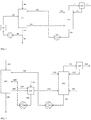
- the quench gaseous leaving stream (106) containing mainly evaporated quench liquid, hydrogen chloride and phosgene, the wash column (A12) is fed to Remain residual amounts of isocyanate as much as possible from the vapor stream.
- the washing liquid stream consists of the condensate (113) of the condenser (W12) and additional - possibly low-boiling components such as phosgene-containing, but virtually isocyanate-free - solvent (110) together.
- the virtually isocyanate-free vapor stream (114) mainly contains phosgene and hydrogen chloride.
- the liquid bottom effluent (115) mainly contains solvent and is expediently fed as quenching liquid to the quencher.
- the adjustment of the temperature of the streams at the exit of the quenching step must be done balancing opposing goals, including low thermal product load and low solvent and isocyanate content in the vapor stream to be cleaned and recycled on the one hand (low temperature is positive) and low carbamic acid chloride formation and low energy requirement in the product purification on the other hand (high temperature is positive).
- the temperature of the streams at the exit of the quench zones is determined for a given gas stream from the reaction zone by the amount, temperature and composition of the quench liquid streams.
- the process sections should (a) transfer the liquid crude product mixture from the quencher to the further workup stages, (b) treat the quenched gas phase (vapors) including gas scrubbing, and (c) supply the quench stage against the background of low operation and apparatus costs with high availability and simple, reliable controllability are further optimized.
- the word “a” in connection with countable quantities is to be understood as a number word only if expressly stated (eg by the expression “exactly one” ) .
- the word “a” is to be understood as an indefinite article and not as a number word, so it is also an embodiment in which two or more capacitors are connected in series.
- step (vi) of the process according to the invention means that in step (i) liquefied isocyanate is not part of the quench liquid (s) used in step (i), ie in contrast to the prior art Technology no partial recycling of the liquefied isocyanate into the "quench” of the gaseous crude product (201) instead.
- the reaction of a primary amine with an excess of phosgene in the gas phase to obtain the corresponding isocyanate-containing gaseous crude product (201) can be carried out in principle by any known from the prior art method for gas phase phosgenation.
- suitable gas phase phosgenation processes are in EP 0 570 799 A1 .
- EP 1 526 129 A1 and DE 101 61 384 A1 and in particular for aliphatic isocyanates in EP 0 289 840 B1 and EP 1 754 698 B1 , described.
- Suitable primary zines are in particular the isomers of toluenediamine (hereinafter TDA), the isomers of diphenylmethanediamine (hereinafter MDA), 1,6-hexamethylenediamine (hereinafter HDA), the isomers of isophorendiamine (hereinafter IDPA) and the isomers of diaminodicyclohexylmethane (hereinafter H12 -MDA).
- TDA isomers of toluenediamine
- MDA diphenylmethanediamine
- HDA 1,6-hexamethylenediamine
- IDPA isomers of isophorendiamine
- H12 -MDA diaminodicyclohexylmethane
- TDA which is preferably used, comprises 78% by mass to 82% by mass of 2,4-TDA and 18% by mass to 22% by mass of 2,6-TDA, based on the total mass of 2,4- and 2 , 6-TDA isomers.
- the 2,4- and 2,6-TDA isomers preferably make up a total of 95.0% by mass to 100% by mass, particularly preferably from 98.0% by mass to 100% by mass. %, out.
- the primary amine is reacted with phosgene.
- phosgene In this case, a continuous as well as discontinuous operation is possible. Preference is given to phosgenation in continuous operation.
- the reaction is preferably carried out at a temperature of 200 ° C to 600 ° C, preferably from 300 ° C to 500 ° C, and an absolute pressure of 150mbar to 10 bar, preferably from 1.0 bar to 3.0 bar.
- the molar excess of phosgene is preferably 20% to 400% of theory.
- Step (i) of the process according to the invention the rapid quenching and partial quenching of the gaseous crude product (201) of the phosgenation by contacting with, preferably by injection, a quench liquid, can be carried out in any apparatus known from the prior art (US Pat. A21).
- Suitable embodiments are, for example, in EP 1 403 248 A1 See in particular the drawings with the accompanying explanations in paragraphs [0017] to [0019], and EP 1 935 875 A1 , see in particular the paragraphs [0015] to [0022] and [0033] to [0045], it being noted in the present invention, however, that in step (i) liquefied isocyanate from stream 202 is not part of the quench liquid (See step (vi) of the present invention).
- a fresh stream of an organic solvent may also be used as the quench liquid (in Fig. 2 Not shown).
- Preferred solvents are chlorinated aromatic Hydrocarbons, such as chlorobenzene, o-dichlorobenzene, p-dichlorobenzene, trichlorobenzenes, the corresponding chlorotoluenes or chloroxylenes, chloroethylbenzene, monochlorodiphenyl, ⁇ - or ⁇ -naphthyl chloride, ethyl benzoate, dialkyl phthalate, diisodiethyl phthalate, toluene and xylenes.
- Particularly preferred solvents are chlorobenzene and the isomers of dichlorobenzene, exceptionally particularly preferred is o-dichlorobenzene.
- This additional stream of fresh organic solvent preferably has a temperature of 40 ° C to 150 ° C.
- the quench liquid (s) used contain at most insignificant amounts of isocyanate (from small proportions in step (i) of non-liquefied isocyanate which leave the quenches A21 with the gas stream 206).
- step (i) a liquid phase (202) comprising at least quench liquid and isocyanate and in a gas phase (206) comprising at least hydrogen chloride and phosgene are thus obtained.
- Step (ii) of the process according to the invention the partial condensation of the gas phase (206) obtained in step (i), can be carried out in any condenser (W23) known from the prior art.
- the capacitor (W23) can be carried out in several stages, for. B. in order to use different cooling media and / or to obtain more process condensate qualities, which may be attributed to different points in the process if necessary.
- the condenser (W23) is preferably designed as an indirect condenser with liquid sprinkling.
- a possible embodiment is, for example, a trickle-film capacitor, in which part of the condensate is returned to the same capacitor as the irrigation liquid.
- the gas phase (206) In addition to hydrogen chloride and phosgene, the gas phase (206) generally also contains residual amounts of isocyanate and quench liquid, since the separation of these from phosgene and hydrogen chloride in step (i) is generally not completely successful.
- the condenser used in step (ii) the majority of the quench liquid remaining in the gas phase (206) and of the isocyanate are now condensed. This is done by cooling the gas phase (206), which is preferably conducted at a temperature of 120 ° C to 250 ° C in the condenser, to a temperature of preferably 40 ° C to 170 ° C.
- Step (ii) is preferably used to recover steam, preferably low pressure steam of 6 bar.
- the resulting condensate (208) mainly contains solvent (from the quench liquid) and is therefore particularly suitable for recycling as quenching liquid (209). Since it is the condensate from a vaporous stream, the proportion of high boilers and the risk of solid fractions is much lower than in the liquid crude product mixture (202). The tendency to fouling in heat exchanger (W23), pump (P23), the quench nozzles for flow (209) and associated piping is therefore much lower than a possible Pollution tendency in the comparable, liquid raw product mixture leading plant components in the prior art (pump P11, heat exchanger W11, quench nozzles for stream 105, associated piping).
- the condenser (W23) is preferably operated on the DC side of steam and liquid phase in order to allow high vapor velocities and small device dimensions. However, it can also be carried out in countercurrent, in particular in order to achieve more than one theoretical separation stage in order to minimize the proportion of isocyanate in the exiting vapor stream (207).
- the condensate (208) obtained in step (iv) is withdrawn from the condenser, if necessary conveyed by means of a pump (P23), and used as quench liquid (209) in step (iii) in the quenching step (step (i)).
- the pump can be omitted.
- the stream (208) can be further cooled with the aid of an additional cooling medium before it is used as the quench liquid (209).
- the quench liquid (209) is preferably contacted with a temperature of 30 ° C to 170 ° C with the gaseous crude product stream (201), preferably injected into this.
- Step (iv) of the process according to the invention the at least partial liquefaction of the non-condensed in step (ii) portions (207) of the gas phase (206) is preferably carried out in a wash column (A22) with at least one separation stage, wherein the wash column (A22) at least one solvent stream is supplied as washing liquid.
- the gaseous overhead stream (212) of the scrubbing column (A22) is condensed in a condenser (W22) and the resulting condensate (213) is returned as additional scrubbing liquid into the scrubbing column (A22).
- Suitable wash columns (A22) for step (iv) are described, for example, in US Pat Perry's Chemical Engineers' Handbook, 7th Edition, McGraw-Hill, Chapter 14 "Gas Absorption and Gas-Liquid System Design
- Preferred solvents for step (iv) are chlorinated aromatic hydrocarbons, such as chlorobenzene, o-dichlorobenzene, p-dichlorobenzene, trichlorobenzenes, the corresponding chlorotoluenes or chloroxylenes, chloroethylbenzene, monochlorodiphenyl, ⁇ - or ⁇ -naphthyl chloride, ethyl benzoate, dialkyl phthalate, Diisodiethyl phthalate, toluene and xylenes
- Particularly preferred solvents are chlorobenzene and the isomers of dichlorobenzene, most preferably o-dichlorobenzene
- the wash column (A22) is supplied with exactly one (different from (213)) solvent stream.
- a solvent stream (210) is fed above the separation stage to the wash column (A22), in the presence of a plurality of separation stages above the top separation stage. If the solvent stream (210) is not a fresh solvent but a recycled solvent-containing stream, care should be taken that it contains the isocyanate to be separated in a mass fraction of not more than 100 ppm, based on the total mass of the solvent stream (210) to avoid the formation of decomposition products.
- a solvent stream (211) below the separation stage may be fed to the scrubber column (A22), in the presence of multiple separation stages below the bottom separation stage. If the solvent stream (211) is not fresh solvent, but a recycled solvent-containing stream is to be used, then the requirements for the maximum isocyanate content are less stringent than in the case of electricity (210). Due to the direct contribution of stream (210) to the vapor-liquid equilibrium with the vaporous top product stream of the wash column, which must be largely isocyanate-free, only much lower isocyanate fractions can be allowed in stream (210) than in stream (211 ). Therefore, the solvent stream (211) may contain up to 20% by mass of isocyanate, based on the total mass of the solvent stream (211).
- the volume flow supplied to the scrubbing column (A22) is comparatively low (namely only 30% to 80% of the corresponding gas stream without step (ii)). ), substantially less isocyanate (namely preferably 0% by mass to 5% by mass, more preferably 10 ppm to 0.5% by mass, based in each case on the total mass of the stream 206), and a lower temperature (namely preferably 40 ° C up to 170 ° C).
- the condensation temperature in the condenser W23 is suitably selected (eg 60 ° C.), then, with the aid of W23, with respect to the in Fig. 1
- the vapor stream to the scrubbing column (207 compared to 106) reduced in volume by about 55% and reduced by about a factor of 1000 with respect to the amount of isocyanate contained.
- step (iv) it is possible to work with a small-diameter scrubbing column and with a small number of separation stages.
- the lowered temperature and the associated lower quench liquid content of the gas phase conducted to the scrubbing column moreover makes a lower performance of the condenser of the scrubbing column necessary.
- the lower device dimensions mentioned above increase the economy of the process.
- the cooling capacity shifted from the condenser (W22) of the scrubbing column into the condenser (W23) of step (ii) can be used to obtain steam, preferably low pressure steam of 6 bar, due to the higher condensation temperature level.
- a gaseous stream (214) also accumulates in step (iv).
- This gaseous stream consists essentially of hydrogen chloride gas, stoichiometric excess phosgene, other gases, such as nitrogen and carbon monoxide, and minor amounts of solvent.
- This gaseous product stream is preferably fed to a further work-up, where as a rule solvent, excess phosgene and hydrogen chloride gas formed are separated from one another. Solvent and excess phosgene are (separately from each other) for economic reasons preferably fed back to the reaction.
- the hydrogen chloride can be supplied to various uses, such as an oxychlorination of ethylene to ethylene dichloride or a recycling process, which recycles chlorine back into the isocyanate process.
- recycling methods include the catalytic oxidation of hydrogen chloride, e.g. B. by the Deacon process, the electrolysis of gaseous hydrogen chloride and the electrolysis of an aqueous solution of hydrogen chloride (hydrochloric acid).
- the liquid phase (215) obtained in step (iv) is conveyed by means of a pump (P22) and also used as quench liquid (216) in step (i) in step (v) .
- the pump can be omitted.
- the stream (215) can be further cooled by means of an additional cooling medium before it is used as the quench liquid (216).
- the quench liquid (216) is preferably contacted with a temperature of 30 ° C to 150 ° C with the gaseous crude product stream (201), preferably injected.
- the quench liquid of step (iii) and the quench liquid of step (v) in step (i) separately (209, 216) introduced into the gaseous crude product of the phosgenation (201), preferably injected.
- the quench liquid (216) is preferably introduced into the gaseous crude product stream (201) above the quench liquid from step (iii) (209), preferably injected. Because in the process according to the invention, the isocyanate contained in the vapors (206) is already largely separated off in the condenser (W23), the isocyanate content of the liquid phase (215) obtained in step (iv) decreases, as described above, which is used as quench liquid (216).
- step (i) the pump (P23) can be omitted.
- Step (vi) of the process according to the invention the work-up of the liquid phase (202) obtained in step (i) can be carried out by any method known from the prior art.
- a partial recycling of the stream (202) to the quench zone (A21) is omitted in the process according to the invention;
- the circulation pump (P11) and the potentially use-friendly quench cooler (W11) can thus be dispensed with. Due to the quench run only once, the product is subjected to a shorter thermal load, which reduces by-product formation. Since the Quenchesumpf in Fig. 1 at the same time acting as a pumping template for the large circulation pump (P11), the hold-up of Quenchesumpfes in the method according to Fig.
- the liquid crude product mixture stream (202) contains essentially isocyanate, solvent (from the quench liquid) and a small proportion of unreacted phosgene.
- This liquid crude product mixture stream is then fed to a distillative, generally multi-stage, workup, wherein dissolved phosgene and the solvent are separated.
- This work-up by distillation of the crude isocyanate can be carried out by generally known methods. Examples are in EP-A-1 413 571 . US 2003/0230476 A1 (TDI), and EP 0289 840 B1 (HDI, IDPI and H12-MDI).
- Fig. 1 determines the amount of washing liquid (110), the solvent content of the liquid crude product mixture in Quenchesumpf (102).
- a lower solvent concentration reduces the cost of product purification and is therefore advantageous in terms of energy and apparatus.
- the amount of solvent necessary to achieve sufficient isocyanate wash in the wash column (A12) limits the desirable lowering of the solvent content in the liquid product mixture (103) to the bottom. This limitation becomes effective especially at low solvent contents in the liquid product mixture (103).
- far lower solvent contents in the liquid crude product mixture are possible, since the isocyanate content in the inlet to the wash column is already substantially lower and therefore less washing liquid is required to retain the isocyanate, than according to the prior art ( Fig. 1 ).
- the inlet temperature of the liquid crude product mixture returned from the quench bottom to the quench is usually actively controlled.
- the process control according to the invention Fig. 2 increases with increasing quench bottom temperature corresponding to the vapor-liquid equilibrium of the vapor-drawn from the quench vapor stream. If the condensation temperature in (W23) remains unchanged, the amount of condensate drawn off in liquid form, which is returned as the quenching liquid and counteracts the quenching-sump-temperature increase without active control, thus increases automatically.
- the invention Method thus has an advantageous, (due to the thermodynamics) itself damping dynamic operating behavior.
- the volume of the vapor stream to wash column (207) was 55% less in Example 2 than in Example 1 (106), and the wash column in Example 2 (A22) could be made 30% smaller in diameter than Example 1 (A12).
- the vapor stream (207) to the scrubbing column (A22) contained an approximately 1000 times lower isocyanate quantity than the vapor stream (106) to the scrubbing column (A12). Accordingly, the amount of wash liquid required for the operation of the wash column (A22) and thus the solvent concentration in the raw mixture (202) could be substantially reduced compared to Example 1 without increasing the isocyanate content in the phosgene-chlorinated water mixture (214) to be worked up (114) ,
Landscapes
- Chemical & Material Sciences (AREA)
- Organic Chemistry (AREA)
- Chemical Kinetics & Catalysis (AREA)
- Organic Low-Molecular-Weight Compounds And Preparation Thereof (AREA)
Priority Applications (1)
| Application Number | Priority Date | Filing Date | Title |
|---|---|---|---|
| EP14705308.6A EP2953928B1 (de) | 2013-02-08 | 2014-02-05 | Verfahren zur abtrennung eines durch phosgenierung eines primären amins in der gasphase hergestellten isocyanats aus dem gasförmigen rohprodukt der phosgenierung |
Applications Claiming Priority (3)
| Application Number | Priority Date | Filing Date | Title |
|---|---|---|---|
| EP13154596 | 2013-02-08 | ||
| EP14705308.6A EP2953928B1 (de) | 2013-02-08 | 2014-02-05 | Verfahren zur abtrennung eines durch phosgenierung eines primären amins in der gasphase hergestellten isocyanats aus dem gasförmigen rohprodukt der phosgenierung |
| PCT/EP2014/052260 WO2014122180A1 (de) | 2013-02-08 | 2014-02-05 | Verfahren zur abtrennung eines durch phosgenierung eines primären amins in der gasphase hergestellten isocyanats aus dem gasförmigen rohprodukt der phosgenierung |
Publications (2)
| Publication Number | Publication Date |
|---|---|
| EP2953928A1 EP2953928A1 (de) | 2015-12-16 |
| EP2953928B1 true EP2953928B1 (de) | 2017-08-09 |
Family
ID=47750442
Family Applications (1)
| Application Number | Title | Priority Date | Filing Date |
|---|---|---|---|
| EP14705308.6A Active EP2953928B1 (de) | 2013-02-08 | 2014-02-05 | Verfahren zur abtrennung eines durch phosgenierung eines primären amins in der gasphase hergestellten isocyanats aus dem gasförmigen rohprodukt der phosgenierung |
Country Status (8)
| Country | Link |
|---|---|
| US (1) | US9932299B2 (enExample) |
| EP (1) | EP2953928B1 (enExample) |
| JP (1) | JP6297602B2 (enExample) |
| KR (1) | KR20150114523A (enExample) |
| CN (1) | CN105121403B (enExample) |
| HU (1) | HUE034207T2 (enExample) |
| SA (1) | SA515360864B1 (enExample) |
| WO (1) | WO2014122180A1 (enExample) |
Families Citing this family (7)
| Publication number | Priority date | Publication date | Assignee | Title |
|---|---|---|---|---|
| WO2015144681A1 (de) | 2014-03-27 | 2015-10-01 | Bayer Material Science Ag | Verfahren zum betreiben einer gasphasenphosgenierungsanlage |
| CN106458864B (zh) | 2014-03-27 | 2020-08-11 | 科思创德国股份有限公司 | 运行气相光气化装置的方法 |
| WO2018184980A1 (de) | 2017-04-03 | 2018-10-11 | Covestro Deutschland Ag | Reinigungsvorrichtung für gasströme aus der isocyanatherstellung |
| WO2018224530A1 (de) | 2017-06-08 | 2018-12-13 | Covestro Deutschland Ag | Verfahren zur herstellung von isocyanaten |
| EP3634947B1 (de) | 2017-06-08 | 2022-09-07 | Covestro Intellectual Property GmbH & Co. KG | Verfahren zur herstellung von isocyanaten in der gasphase |
| US20250051268A1 (en) * | 2021-12-17 | 2025-02-13 | Mojia (Shanghai) Biotech Co., Ltd. | Method for preparing isocyanate by means of gas-phase solvent-free method |
| CN115155467B (zh) * | 2022-08-09 | 2023-10-10 | 宁夏瑞泰科技股份有限公司 | 采用液相光气化合成六亚甲基二异氰酸酯的系统及方法 |
Family Cites Families (30)
| Publication number | Priority date | Publication date | Assignee | Title |
|---|---|---|---|---|
| US4101590A (en) * | 1976-08-23 | 1978-07-18 | Maruzen Oil Co., Ltd. | Process for separation and purification of vinylphenol |
| DE2756928A1 (de) * | 1977-12-21 | 1979-07-05 | Bayer Ag | Verfahren zur kontinuierlichen herstellung von monoisocyanaten |
| DE3714439A1 (de) | 1987-04-30 | 1988-11-10 | Bayer Ag | Verfahren zur herstellung von (cyclo)aliphatischen diisocyanaten |
| DE4217019A1 (de) | 1992-05-22 | 1993-11-25 | Bayer Ag | Verfahren zur Herstellung von aromatischen Diisocyanaten |
| DE19523385A1 (de) | 1995-06-23 | 1997-01-09 | Bayer Ag | Verfahren zur Herstellung von Triisocyanaten |
| US6120640A (en) | 1996-12-19 | 2000-09-19 | Applied Materials, Inc. | Boron carbide parts and coatings in a plasma reactor |
| DE10158160A1 (de) | 2001-11-28 | 2003-06-12 | Basf Ag | Herstellung von Isocyanaten in der Gasphase |
| DE10161384A1 (de) | 2001-12-14 | 2003-06-18 | Bayer Ag | Verbessertes Verfahren für die Herstellung von (/Poly)-isocyanaten in der Gasphase |
| EP1371633A1 (en) | 2002-06-14 | 2003-12-17 | Bayer Ag | Process for the purification of mixtures of toluenediisocyanate incorporating a dividing-wall distillation column |
| EP1371634A1 (en) * | 2002-06-14 | 2003-12-17 | Bayer Ag | Process for the purification of mixtures of toluenediisocyanate |
| DE10245704A1 (de) | 2002-09-30 | 2004-04-01 | Bayer Ag | Verfahren zum Quenchen eines gasförmigen Reaktionsgemisches bei der Gasphasenphosgenierung von Diaminen |
| ES2271171T3 (es) | 2002-10-22 | 2007-04-16 | Bayer Materialscience Ag | Procedimiento para la purificacion de toluendiisocianato que incorpora una columna de destilacion de pared divisoria para la purificacion final. |
| DE10349504A1 (de) | 2003-10-23 | 2005-05-25 | Bayer Technology Services Gmbh | Verfahren zur Herstellung von Isocyanaten in der Gasphase |
| DE10359627A1 (de) | 2003-12-18 | 2005-07-21 | Bayer Materialscience Ag | Verfahren zur Herstellung von Diisocyanaten |
| DE102004030164A1 (de) | 2004-06-22 | 2006-01-19 | Basf Ag | Verfahren zur Herstellung von Isocyanaten |
| DE102005036870A1 (de) | 2005-08-02 | 2007-02-08 | Bayer Materialscience Ag | Verfahren zur Gasphasenphosgenierung |
| DE102005037328A1 (de) | 2005-08-04 | 2007-02-08 | Basf Ag | Verfahren zur Herstellung von Isocyanaten |
| DE102005042392A1 (de) * | 2005-09-06 | 2007-03-08 | Basf Ag | Verfahren zur Herstellung von Isocyanaten |
| US7504533B2 (en) | 2006-04-24 | 2009-03-17 | Bayer Materialscience Llc | Process for the production of isocyanates |
| DE102006058634A1 (de) | 2006-12-13 | 2008-06-19 | Bayer Materialscience Ag | Verfahren zur Herstellung von Isocyanaten in der Gasphase |
| DE102006058633A1 (de) | 2006-12-13 | 2008-06-19 | Bayer Materialscience Ag | Verfahren zur Herstellung von Isocyanaten in der Gasphase |
| EP2028178A1 (de) * | 2007-08-22 | 2009-02-25 | Bayer MaterialScience AG | Herstellung von Isocyanaten mit niedrigen Chlorgehalten |
| EP2364294B1 (de) * | 2008-11-07 | 2013-07-03 | Basf Se | Verfahren zur herstellung von isocyanaten |
| FR2939131B1 (fr) | 2008-12-01 | 2010-12-17 | Rhodia Operations | Procede de fabrication d'acide adipique |
| JP5576390B2 (ja) * | 2008-12-03 | 2014-08-20 | ビーエーエスエフ ソシエタス・ヨーロピア | イソシアネートの製造方法 |
| DE102008061686A1 (de) | 2008-12-11 | 2010-06-17 | Bayer Materialscience Ag | Verfahren zur Herstellung von Isocyanaten in der Gasphase |
| CN102369182B (zh) | 2009-04-08 | 2015-04-08 | 巴斯夫欧洲公司 | 异氰酸酯的制备方法 |
| DE102009032413A1 (de) * | 2009-07-09 | 2011-01-13 | Bayer Materialscience Ag | Verfahren zur Herstellung von Isocyanaten |
| HUE057757T2 (hu) * | 2010-10-14 | 2022-06-28 | Basf Se | Eljárás izocianátok elõállítására |
| PL214499B1 (pl) | 2010-12-10 | 2013-08-30 | Inst Chemii Przemyslowej Im Prof Ignacego Moscickiego | Sposób wydzielania toluilenodiizocyjanianu z mieszaniny poreakcyjnej w procesie fosgenowania toluilenodiaminy w fazie gazowej |
-
2014
- 2014-02-05 US US14/765,870 patent/US9932299B2/en active Active
- 2014-02-05 CN CN201480008147.3A patent/CN105121403B/zh active Active
- 2014-02-05 EP EP14705308.6A patent/EP2953928B1/de active Active
- 2014-02-05 WO PCT/EP2014/052260 patent/WO2014122180A1/de not_active Ceased
- 2014-02-05 HU HUE14705308A patent/HUE034207T2/hu unknown
- 2014-02-05 KR KR1020157023401A patent/KR20150114523A/ko not_active Abandoned
- 2014-02-05 JP JP2015556484A patent/JP6297602B2/ja not_active Expired - Fee Related
-
2015
- 2015-08-06 SA SA515360864A patent/SA515360864B1/ar unknown
Non-Patent Citations (1)
| Title |
|---|
| None * |
Also Published As
| Publication number | Publication date |
|---|---|
| CN105121403B (zh) | 2017-12-08 |
| WO2014122180A1 (de) | 2014-08-14 |
| KR20150114523A (ko) | 2015-10-12 |
| EP2953928A1 (de) | 2015-12-16 |
| US20150368190A1 (en) | 2015-12-24 |
| US9932299B2 (en) | 2018-04-03 |
| SA515360864B1 (ar) | 2017-10-29 |
| CN105121403A (zh) | 2015-12-02 |
| JP6297602B2 (ja) | 2018-03-20 |
| HUE034207T2 (hu) | 2018-01-29 |
| JP2016506970A (ja) | 2016-03-07 |
Similar Documents
| Publication | Publication Date | Title |
|---|---|---|
| EP1935876B1 (de) | Verfahren zur Herstellung von Isocyanaten in der Gasphase | |
| EP3634947B1 (de) | Verfahren zur herstellung von isocyanaten in der gasphase | |
| EP2093215B1 (de) | Verfahren zur Herstellung von Isocyanaten | |
| EP2451775B1 (de) | Verfahren zur herstellung von isocyanaten | |
| EP0568782B1 (de) | Kontinuierliches mehrstufiges Verfahren zur Herstellung von (cyclo)-aliphatischen Diisocyanaten | |
| EP2828235B1 (de) | Verfahren zur herstellung von isocyanaten | |
| EP2024279B1 (de) | Verfahren zur abtrennung von chlor aus dem produktgas eines hci-oxidationsprozesses | |
| EP3122719B1 (de) | Verfahren zum betreiben einer gasphasenphosgenierungsanlage | |
| EP3634946B1 (de) | Verfahren zur herstellung von isocyanaten | |
| EP2953928A1 (de) | Verfahren zur abtrennung eines durch phosgenierung eines primären amins in der gasphase hergestellten isocyanats aus dem gasförmigen rohprodukt der phosgenierung | |
| EP3122718B1 (de) | Verfahren zur herstellung von isocyanaten | |
| EP3500553B1 (de) | Verfahren zur herstellung eines isocyanats und mindestens eines weiteren chemischen produkts in einem produktionsverbund | |
| EP3356324B1 (de) | Verfahren zur herstellung von isocyanaten | |
| EP3322692B1 (de) | Verfahren zur herstellung von isocyanaten | |
| EP3024817B1 (de) | Verfahren zur herstellung von isocyanaten | |
| EP3122720A1 (de) | Verfahren zum betreiben einer gasphasenphosgenierungsanlage | |
| EP2566844B1 (de) | Verfahren zur herstellung von isocyanaten in der gasphase | |
| EP4227291A1 (de) | Verfahren zur herstellung von isocyanaten | |
| EP4031526B1 (de) | Verfahren zur herstellung von isocyanaten | |
| WO2004056760A1 (de) | Verfahren zur herstellung von (cyclo)aliphatischen isocyanaten | |
| EP4476197B1 (de) | Verfahren zur herstellung von isocyanaten | |
| EP4476198A1 (de) | Verfahren zur herstellung von isocyanaten |
Legal Events
| Date | Code | Title | Description |
|---|---|---|---|
| PUAI | Public reference made under article 153(3) epc to a published international application that has entered the european phase |
Free format text: ORIGINAL CODE: 0009012 |
|
| 17P | Request for examination filed |
Effective date: 20150908 |
|
| AK | Designated contracting states |
Kind code of ref document: A1 Designated state(s): AL AT BE BG CH CY CZ DE DK EE ES FI FR GB GR HR HU IE IS IT LI LT LU LV MC MK MT NL NO PL PT RO RS SE SI SK SM TR |
|
| AX | Request for extension of the european patent |
Extension state: BA ME |
|
| DAX | Request for extension of the european patent (deleted) | ||
| GRAP | Despatch of communication of intention to grant a patent |
Free format text: ORIGINAL CODE: EPIDOSNIGR1 |
|
| INTG | Intention to grant announced |
Effective date: 20170511 |
|
| GRAS | Grant fee paid |
Free format text: ORIGINAL CODE: EPIDOSNIGR3 |
|
| GRAA | (expected) grant |
Free format text: ORIGINAL CODE: 0009210 |
|
| AK | Designated contracting states |
Kind code of ref document: B1 Designated state(s): AL AT BE BG CH CY CZ DE DK EE ES FI FR GB GR HR HU IE IS IT LI LT LU LV MC MK MT NL NO PL PT RO RS SE SI SK SM TR |
|
| REG | Reference to a national code |
Ref country code: GB Ref legal event code: FG4D Free format text: NOT ENGLISH |
|
| REG | Reference to a national code |
Ref country code: CH Ref legal event code: EP Ref country code: AT Ref legal event code: REF Ref document number: 916636 Country of ref document: AT Kind code of ref document: T Effective date: 20170815 |
|
| REG | Reference to a national code |
Ref country code: IE Ref legal event code: FG4D Free format text: LANGUAGE OF EP DOCUMENT: GERMAN |
|
| REG | Reference to a national code |
Ref country code: DE Ref legal event code: R096 Ref document number: 502014004919 Country of ref document: DE |
|
| REG | Reference to a national code |
Ref country code: NL Ref legal event code: MP Effective date: 20170809 |
|
| REG | Reference to a national code |
Ref country code: LT Ref legal event code: MG4D |
|
| REG | Reference to a national code |
Ref country code: FR Ref legal event code: PLFP Year of fee payment: 5 |
|
| REG | Reference to a national code |
Ref country code: HU Ref legal event code: AG4A Ref document number: E034207 Country of ref document: HU |
|
| PG25 | Lapsed in a contracting state [announced via postgrant information from national office to epo] |
Ref country code: LT Free format text: LAPSE BECAUSE OF FAILURE TO SUBMIT A TRANSLATION OF THE DESCRIPTION OR TO PAY THE FEE WITHIN THE PRESCRIBED TIME-LIMIT Effective date: 20170809 Ref country code: FI Free format text: LAPSE BECAUSE OF FAILURE TO SUBMIT A TRANSLATION OF THE DESCRIPTION OR TO PAY THE FEE WITHIN THE PRESCRIBED TIME-LIMIT Effective date: 20170809 Ref country code: HR Free format text: LAPSE BECAUSE OF FAILURE TO SUBMIT A TRANSLATION OF THE DESCRIPTION OR TO PAY THE FEE WITHIN THE PRESCRIBED TIME-LIMIT Effective date: 20170809 Ref country code: NL Free format text: LAPSE BECAUSE OF FAILURE TO SUBMIT A TRANSLATION OF THE DESCRIPTION OR TO PAY THE FEE WITHIN THE PRESCRIBED TIME-LIMIT Effective date: 20170809 Ref country code: SE Free format text: LAPSE BECAUSE OF FAILURE TO SUBMIT A TRANSLATION OF THE DESCRIPTION OR TO PAY THE FEE WITHIN THE PRESCRIBED TIME-LIMIT Effective date: 20170809 Ref country code: NO Free format text: LAPSE BECAUSE OF FAILURE TO SUBMIT A TRANSLATION OF THE DESCRIPTION OR TO PAY THE FEE WITHIN THE PRESCRIBED TIME-LIMIT Effective date: 20171109 |
|
| PG25 | Lapsed in a contracting state [announced via postgrant information from national office to epo] |
Ref country code: IS Free format text: LAPSE BECAUSE OF FAILURE TO SUBMIT A TRANSLATION OF THE DESCRIPTION OR TO PAY THE FEE WITHIN THE PRESCRIBED TIME-LIMIT Effective date: 20171209 Ref country code: PL Free format text: LAPSE BECAUSE OF FAILURE TO SUBMIT A TRANSLATION OF THE DESCRIPTION OR TO PAY THE FEE WITHIN THE PRESCRIBED TIME-LIMIT Effective date: 20170809 Ref country code: RS Free format text: LAPSE BECAUSE OF FAILURE TO SUBMIT A TRANSLATION OF THE DESCRIPTION OR TO PAY THE FEE WITHIN THE PRESCRIBED TIME-LIMIT Effective date: 20170809 Ref country code: BG Free format text: LAPSE BECAUSE OF FAILURE TO SUBMIT A TRANSLATION OF THE DESCRIPTION OR TO PAY THE FEE WITHIN THE PRESCRIBED TIME-LIMIT Effective date: 20171109 Ref country code: LV Free format text: LAPSE BECAUSE OF FAILURE TO SUBMIT A TRANSLATION OF THE DESCRIPTION OR TO PAY THE FEE WITHIN THE PRESCRIBED TIME-LIMIT Effective date: 20170809 Ref country code: ES Free format text: LAPSE BECAUSE OF FAILURE TO SUBMIT A TRANSLATION OF THE DESCRIPTION OR TO PAY THE FEE WITHIN THE PRESCRIBED TIME-LIMIT Effective date: 20170809 Ref country code: GR Free format text: LAPSE BECAUSE OF FAILURE TO SUBMIT A TRANSLATION OF THE DESCRIPTION OR TO PAY THE FEE WITHIN THE PRESCRIBED TIME-LIMIT Effective date: 20171110 |
|
| PG25 | Lapsed in a contracting state [announced via postgrant information from national office to epo] |
Ref country code: CZ Free format text: LAPSE BECAUSE OF FAILURE TO SUBMIT A TRANSLATION OF THE DESCRIPTION OR TO PAY THE FEE WITHIN THE PRESCRIBED TIME-LIMIT Effective date: 20170809 Ref country code: DK Free format text: LAPSE BECAUSE OF FAILURE TO SUBMIT A TRANSLATION OF THE DESCRIPTION OR TO PAY THE FEE WITHIN THE PRESCRIBED TIME-LIMIT Effective date: 20170809 Ref country code: RO Free format text: LAPSE BECAUSE OF FAILURE TO SUBMIT A TRANSLATION OF THE DESCRIPTION OR TO PAY THE FEE WITHIN THE PRESCRIBED TIME-LIMIT Effective date: 20170809 |
|
| REG | Reference to a national code |
Ref country code: DE Ref legal event code: R097 Ref document number: 502014004919 Country of ref document: DE |
|
| PG25 | Lapsed in a contracting state [announced via postgrant information from national office to epo] |
Ref country code: SM Free format text: LAPSE BECAUSE OF FAILURE TO SUBMIT A TRANSLATION OF THE DESCRIPTION OR TO PAY THE FEE WITHIN THE PRESCRIBED TIME-LIMIT Effective date: 20170809 Ref country code: SK Free format text: LAPSE BECAUSE OF FAILURE TO SUBMIT A TRANSLATION OF THE DESCRIPTION OR TO PAY THE FEE WITHIN THE PRESCRIBED TIME-LIMIT Effective date: 20170809 Ref country code: EE Free format text: LAPSE BECAUSE OF FAILURE TO SUBMIT A TRANSLATION OF THE DESCRIPTION OR TO PAY THE FEE WITHIN THE PRESCRIBED TIME-LIMIT Effective date: 20170809 Ref country code: IT Free format text: LAPSE BECAUSE OF FAILURE TO SUBMIT A TRANSLATION OF THE DESCRIPTION OR TO PAY THE FEE WITHIN THE PRESCRIBED TIME-LIMIT Effective date: 20170809 |
|
| PLBE | No opposition filed within time limit |
Free format text: ORIGINAL CODE: 0009261 |
|
| STAA | Information on the status of an ep patent application or granted ep patent |
Free format text: STATUS: NO OPPOSITION FILED WITHIN TIME LIMIT |
|
| 26N | No opposition filed |
Effective date: 20180511 |
|
| PG25 | Lapsed in a contracting state [announced via postgrant information from national office to epo] |
Ref country code: SI Free format text: LAPSE BECAUSE OF FAILURE TO SUBMIT A TRANSLATION OF THE DESCRIPTION OR TO PAY THE FEE WITHIN THE PRESCRIBED TIME-LIMIT Effective date: 20170809 |
|
| REG | Reference to a national code |
Ref country code: CH Ref legal event code: PL |
|
| PG25 | Lapsed in a contracting state [announced via postgrant information from national office to epo] |
Ref country code: MT Free format text: LAPSE BECAUSE OF FAILURE TO SUBMIT A TRANSLATION OF THE DESCRIPTION OR TO PAY THE FEE WITHIN THE PRESCRIBED TIME-LIMIT Effective date: 20170809 Ref country code: MC Free format text: LAPSE BECAUSE OF FAILURE TO SUBMIT A TRANSLATION OF THE DESCRIPTION OR TO PAY THE FEE WITHIN THE PRESCRIBED TIME-LIMIT Effective date: 20170809 |
|
| GBPC | Gb: european patent ceased through non-payment of renewal fee |
Effective date: 20180205 |
|
| REG | Reference to a national code |
Ref country code: IE Ref legal event code: MM4A |
|
| REG | Reference to a national code |
Ref country code: BE Ref legal event code: MM Effective date: 20180228 |
|
| PG25 | Lapsed in a contracting state [announced via postgrant information from national office to epo] |
Ref country code: LI Free format text: LAPSE BECAUSE OF NON-PAYMENT OF DUE FEES Effective date: 20180228 Ref country code: CH Free format text: LAPSE BECAUSE OF NON-PAYMENT OF DUE FEES Effective date: 20180228 Ref country code: LU Free format text: LAPSE BECAUSE OF NON-PAYMENT OF DUE FEES Effective date: 20180205 |
|
| PG25 | Lapsed in a contracting state [announced via postgrant information from national office to epo] |
Ref country code: IE Free format text: LAPSE BECAUSE OF NON-PAYMENT OF DUE FEES Effective date: 20180205 |
|
| PG25 | Lapsed in a contracting state [announced via postgrant information from national office to epo] |
Ref country code: GB Free format text: LAPSE BECAUSE OF NON-PAYMENT OF DUE FEES Effective date: 20180205 Ref country code: BE Free format text: LAPSE BECAUSE OF NON-PAYMENT OF DUE FEES Effective date: 20180228 |
|
| PG25 | Lapsed in a contracting state [announced via postgrant information from national office to epo] |
Ref country code: TR Free format text: LAPSE BECAUSE OF FAILURE TO SUBMIT A TRANSLATION OF THE DESCRIPTION OR TO PAY THE FEE WITHIN THE PRESCRIBED TIME-LIMIT Effective date: 20170809 |
|
| REG | Reference to a national code |
Ref country code: AT Ref legal event code: MM01 Ref document number: 916636 Country of ref document: AT Kind code of ref document: T Effective date: 20190205 |
|
| PG25 | Lapsed in a contracting state [announced via postgrant information from national office to epo] |
Ref country code: AT Free format text: LAPSE BECAUSE OF NON-PAYMENT OF DUE FEES Effective date: 20190205 |
|
| PG25 | Lapsed in a contracting state [announced via postgrant information from national office to epo] |
Ref country code: PT Free format text: LAPSE BECAUSE OF FAILURE TO SUBMIT A TRANSLATION OF THE DESCRIPTION OR TO PAY THE FEE WITHIN THE PRESCRIBED TIME-LIMIT Effective date: 20170809 |
|
| PG25 | Lapsed in a contracting state [announced via postgrant information from national office to epo] |
Ref country code: CY Free format text: LAPSE BECAUSE OF FAILURE TO SUBMIT A TRANSLATION OF THE DESCRIPTION OR TO PAY THE FEE WITHIN THE PRESCRIBED TIME-LIMIT Effective date: 20170809 Ref country code: MK Free format text: LAPSE BECAUSE OF NON-PAYMENT OF DUE FEES Effective date: 20170809 |
|
| PG25 | Lapsed in a contracting state [announced via postgrant information from national office to epo] |
Ref country code: AL Free format text: LAPSE BECAUSE OF FAILURE TO SUBMIT A TRANSLATION OF THE DESCRIPTION OR TO PAY THE FEE WITHIN THE PRESCRIBED TIME-LIMIT Effective date: 20170809 |
|
| PGFP | Annual fee paid to national office [announced via postgrant information from national office to epo] |
Ref country code: FR Payment date: 20210126 Year of fee payment: 8 |
|
| PG25 | Lapsed in a contracting state [announced via postgrant information from national office to epo] |
Ref country code: FR Free format text: LAPSE BECAUSE OF NON-PAYMENT OF DUE FEES Effective date: 20220228 |
|
| PGFP | Annual fee paid to national office [announced via postgrant information from national office to epo] |
Ref country code: HU Payment date: 20260213 Year of fee payment: 13 |
|
| PGFP | Annual fee paid to national office [announced via postgrant information from national office to epo] |
Ref country code: DE Payment date: 20260121 Year of fee payment: 13 |