EP2950293B1 - Verfahren und vorrichtung zur schätzung einer ankunftszeit eines transportfahrzeugs - Google Patents
Verfahren und vorrichtung zur schätzung einer ankunftszeit eines transportfahrzeugs Download PDFInfo
- Publication number
- EP2950293B1 EP2950293B1 EP15168702.7A EP15168702A EP2950293B1 EP 2950293 B1 EP2950293 B1 EP 2950293B1 EP 15168702 A EP15168702 A EP 15168702A EP 2950293 B1 EP2950293 B1 EP 2950293B1
- Authority
- EP
- European Patent Office
- Prior art keywords
- section
- transportation
- travel
- time
- vehicle
- Prior art date
- Legal status (The legal status is an assumption and is not a legal conclusion. Google has not performed a legal analysis and makes no representation as to the accuracy of the status listed.)
- Active
Links
Images


Classifications
-
- G—PHYSICS
- G08—SIGNALLING
- G08G—TRAFFIC CONTROL SYSTEMS
- G08G1/00—Traffic control systems for road vehicles
- G08G1/123—Traffic control systems for road vehicles indicating the position of vehicles, e.g. scheduled vehicles; Managing passenger vehicles circulating according to a fixed timetable, e.g. buses, trains, trams
-
- G—PHYSICS
- G08—SIGNALLING
- G08G—TRAFFIC CONTROL SYSTEMS
- G08G1/00—Traffic control systems for road vehicles
- G08G1/01—Detecting movement of traffic to be counted or controlled
- G08G1/0104—Measuring and analyzing of parameters relative to traffic conditions
- G08G1/0125—Traffic data processing
-
- G—PHYSICS
- G08—SIGNALLING
- G08G—TRAFFIC CONTROL SYSTEMS
- G08G1/00—Traffic control systems for road vehicles
- G08G1/123—Traffic control systems for road vehicles indicating the position of vehicles, e.g. scheduled vehicles; Managing passenger vehicles circulating according to a fixed timetable, e.g. buses, trains, trams
- G08G1/127—Traffic control systems for road vehicles indicating the position of vehicles, e.g. scheduled vehicles; Managing passenger vehicles circulating according to a fixed timetable, e.g. buses, trains, trams to a central station ; Indicators in a central station
-
- G—PHYSICS
- G08—SIGNALLING
- G08G—TRAFFIC CONTROL SYSTEMS
- G08G1/00—Traffic control systems for road vehicles
- G08G1/01—Detecting movement of traffic to be counted or controlled
- G08G1/0104—Measuring and analyzing of parameters relative to traffic conditions
- G08G1/0108—Measuring and analyzing of parameters relative to traffic conditions based on the source of data
- G08G1/0112—Measuring and analyzing of parameters relative to traffic conditions based on the source of data from the vehicle, e.g. floating car data [FCD]
-
- G—PHYSICS
- G08—SIGNALLING
- G08G—TRAFFIC CONTROL SYSTEMS
- G08G1/00—Traffic control systems for road vehicles
- G08G1/01—Detecting movement of traffic to be counted or controlled
- G08G1/0104—Measuring and analyzing of parameters relative to traffic conditions
- G08G1/0125—Traffic data processing
- G08G1/0129—Traffic data processing for creating historical data or processing based on historical data
-
- G—PHYSICS
- G08—SIGNALLING
- G08G—TRAFFIC CONTROL SYSTEMS
- G08G1/00—Traffic control systems for road vehicles
- G08G1/01—Detecting movement of traffic to be counted or controlled
- G08G1/0104—Measuring and analyzing of parameters relative to traffic conditions
- G08G1/0125—Traffic data processing
- G08G1/0133—Traffic data processing for classifying traffic situation
Definitions
- Korean Patent Application Laid-Open No. 10-2004-0086675 discloses an apparatus and a method for calculating an estimated arrival time.
- a target station for which the estimated arrival time is to be calculated, is selected from a route map on which station identification information and location information for each line of transportation are recorded. Line numbers of the lines of transportation passing through the selected target station and current locations of vehicles traveling through routes corresponding to the line numbers are obtained. The remaining distance to the selected target station is calculated based on current locations of vehicles nearest to the selected target station among the vehicles which travel through the routes corresponding to the respective line numbers passing through the selected target station. Estimated arrival times of the vehicles nearest to the selected target station are calculated using a disclosed mathematical expression.
- the related art estimates the arrival time of a transportation vehicle based on a single algorithm, leading to degradation in accuracy.
- Hybrid dynamic prediction model of bus arrival time based on weighted of historical and real-time GPS data by Jun Gong et al. CONTROL AND DECISION CONFERENCE (CCDC), 2013 25TH CHINESE, IEEE, 25 May 2013 (2013-05-25), pages 972 - 976 discloses a hybrid dynamic prediction model of bus arrival time based on a moving average model and a moving average dynamic adjustment model.
- Embodiments described herein provide methods capable of increasing the accuracy of arrival time estimation of a transportation vehicle.
- embodiments described herein provide sections divided according to service characteristics of transportation.
- embodiments described herein provide various algorithms capable of being applied to arrival time estimation of a transportation vehicle.
- embodiments described herein provide methods capable of accurately estimating an arrival time of a transportation vehicle by using various algorithms.
- the present invention provides a method for estimating an arrival time of a transportation vehicle as defined in claim 1.
- the present invention also provides an apparatus for estimating an arrival time of a transportation vehicle as defined in claim 9.
- a section includes at least one of a first section between a first intersection and a first station adjacent to the first intersection, a second section between the first intersection and a second intersection adjacent to the first intersection, and a third section between the first station and a second station adjacent to the first station, and calculating the travel times comprises calculating travel times of the plurality of vehicles through the first section and calculating travel times of the plurality of vehicles through the second section and the third section, based on the travel time of the plurality of vehicles through the first section.
- the travel time through the section includes a stoppage time of a vehicle at a station located in the section.
- the moving average is calculated based on a cumulative operation frequency of the plurality of vehicles and a cumulative operation time of the plurality of vehicles.
- service patterns may include patterns of transportation service provided based on seasons, weather, day of the week, time, and characteristics of the section.
- a method in accordance with an embodiment may further include filtering a value, which is outside of a predefined range, among the measured travel times of the plurality of vehicles.
- a method in accordance with an embodiment may further include determining a traffic condition of the section, based on the travel times calculated using the moving average, the exponential smoothing, and the service pattern.
- transportation service providers can provide high-quality services to transportation passengers.
- the reliability of transportation services can be improved.
- an operator of a transportation vehicle can stably operate the transportation vehicle.
- transportation passengers can use services while accurately estimating the time it will take to use a transportation vehicle.
- Passenger transportation vehicles such as buses, trains, electric cars, railways, subways, trams, automobiles, two-wheeled vehicles, and the like, travel through predefined travel pathways or routes.
- FIG. 1 is a diagram illustrating a system for estimating an arrival time of a transportation vehicle according to an embodiment.
- a system for estimating an arrival time of a transportation vehicle includes a plurality of vehicles 10, an information output apparatus 20, which provides transportation information, and an arrival time estimation apparatus 700, which estimates an arrival time of a vehicle.
- the plurality of vehicles 10, the transportation information output apparatus 20, and the arrival time estimation apparatus 700 may be connected through a wired or wireless network.
- the plurality of vehicles 10 may transmit vehicle location information (i.e., information on the location of the plurality of vehicles 10) to the arrival time estimation apparatus 700.
- vehicle location information may include Global Positioning System (GPS) information or information obtained from Radio-Frequency Identification (RFID) tags installed on traveling paths.
- GPS Global Positioning System
- RFID Radio-Frequency Identification
- the arrival time estimation apparatus 700 may estimate the arrival time of each of the plurality of vehicles 10 by using the vehicle location information. In addition, the arrival time estimation apparatus 700 may transmit the estimated arrival times of the plurality of vehicles 10 to the transportation information output apparatus 20.
- the arrival time estimation apparatus 700 may be located at a control facility that is separate from the plurality of vehicles 10 and the transportation information output apparatus 20. In other embodiments, the arrival time estimation apparatus 700 may be provided in the plurality of vehicles 10, or may be provided in the transportation information output apparatus 20.
- the arrival time estimation apparatus 700 may estimate the arrival time of the plurality of vehicles 10 with respect to sections of a route or travel pathway of a line of transportation.
- a route or travel pathway may be divided into sections based on intersections and stations, by using various algorithms.
- a method for estimating an arrival time of a transportation vehicle in accordance with an embodiment will be described below with reference to FIGS. 2 to 6 .
- the transportation information output apparatus 20 may provide a variety of information to transportation passengers.
- the information provided by the transportation information output apparatus 20 may include the estimated arrival time of the plurality of vehicles 10, the number of stations remaining in a transportation route, information on the nearest vehicle, information on the last vehicle to arrive at a station, route information, advertisements, weather information, news information, and the like.
- the transportation information output apparatus 20 may be installed at a transportation station.
- the transportation information output apparatus 20 may be a display or reader board.
- the transportation information output apparatus 20 may be a passenger's mobile terminal. That is, the arrival time estimation apparatus 700 may transmit a variety of information to a passenger's mobile terminal.
- the transportation information output apparatus 20 includes a display screen and outputs information visually. However, embodiments are not limited thereto.
- the transportation information output apparatus 20 may output information in a visual format, an audio format, as haptic feedback, or any combination thereof.
- the vehicle information may be classified and provided based on a predefined number of remaining stations or a predefined estimated arrival time. For example, detailed vehicle information may be provided when the number of the remaining stations is five or less, or when the estimated arrival time is ten minutes or less.
- FIG. 2 is a diagram illustrating sections of a transportation route that is divided according to transportation service characteristics according to an embodiment.
- sections of the transportation route may be divided into first sections 211, 212, 213 and 214, a second section 221, and third sections 231 and 232.
- the first sections 211, 212, 213 and 214 are sections between intersections and stations adjacent to the intersections.
- the first sections 211, 212, 213 and 214 include a section between a station 201 and an intersection 202, a section between the intersection 202 and a station 203, a section between the station 203 and an intersection 204, and a section between the intersection 204 and a station 205, respectively.
- the second section 221 is a section between adjacent intersections.
- the second section 221 is a section between the intersection 202 and the intersection 204.
- the third sections 231 and 232 are sections between adjacent stations.
- the third sections 231 and 232 are a section between the station 201 and the station 203 and a section between the station 203 and the station 205, respectively.
- the arrival time estimation apparatus 700 may estimate the travel time of each of the plurality of vehicles 10 with respect to each section, thereby increasing the accuracy of the arrival time estimation.
- FIG. 3 is a flowchart illustrating a method for estimating the arrival time of a transportation vehicle according to an embodiment.
- the arrival time estimation apparatus 700 measures the travel time of each of the plurality of vehicles 10 with respect to the predefined sections by using the location information on the plurality of vehicles 10. That is, the arrival time estimation apparatus 700 determines the time it takes for a vehicle to travel through the predefined sections.
- the predefined sections may include the first sections 211, 212, 213 and 214, the second section 221, and the third sections 231 and 232.
- the arrival time estimation apparatus 700 may measure the travel times of the plurality of vehicles 10 with respect to the first sections 211, 212, 213 and 214, the second section 221, and the third sections 231 and 232 by using a passage time, i.e., the time when a vehicle has passed through any of the stations 201, 203 and 205 and the intersections 202 and 204.
- a passage time i.e., the time when a vehicle has passed through any of the stations 201, 203 and 205 and the intersections 202 and 204.
- the travel time of one of the plurality of vehicles 10 with respect to the first section 211 may be calculated using the difference between the time when the vehicle passed through the intersection 202 and the time when the vehicle passed through the station 201.
- the arrival time estimation apparatus 700 may calculate the travel times of the plurality of vehicles 10 through the second section 221 and the third sections 231 and 232, based on the travel times of the plurality of vehicles 10 through the first sections 211, 212, 213 and 214.
- the arrival time estimation apparatus 700 may calculate the travel times of the plurality of vehicles 10 through the second section 221, based on the travel times of the plurality of vehicles 10 through the first sections 212 and 213. In addition, the arrival time estimation apparatus 700 may calculate the travel times of the plurality of vehicles 10 through the third section 231, based on the travel times of the plurality of vehicles 10 through the first sections 211 and 212.
- the arrival time estimation apparatus 700 can reduce redundant calculations by calculating the travel times of the plurality of vehicles 10 through the second section 221 and the third sections 231 and 232, based on the travel times of the plurality of vehicles 10 through the first sections 211, 212, 213 and 214.
- a method in accordance with an embodiment can reduce the load on a processor that determines the travel times, and reduce the amount of time it takes to make such calculations.
- the arrival time estimation apparatus 700 filters a value that is outside of a predefined range.
- the predefined range may refer to a range of velocity.
- a predefined range may correspond to a range of velocities that are considered within a range of normal operation of a vehicle providing a transportation service, and a value outside of the predefined range may correspond to a velocity that is not considered normal in the operation of the transportation vehicle.
- the arrival time estimation apparatus 700 may filter a value of 3 km or less or a value of 110 km or more.
- the arrival time estimation apparatus 700 calculates travel times according to a moving average, exponential smoothing, and a service pattern by using the measured travel times of the plurality of vehicles 10.
- the calculated travel times, which are calculated according to the moving average, the exponential smoothing, and the service pattern of the plurality of vehicles 10, may be calculated for each predefined section.
- the moving average Mt may be calculated using Formula 1 below.
- the moving average Mt is calculated based on a cumulative operation frequency of the plurality of vehicles 10 and a cumulative operation time of the plurality of vehicles 10.
- the cumulative operation frequency may correspond to the number of times the plurality of vehicles 10 travels through a section in a predetermined time period, and the cumulative operation time may represent a sum of the total time taken for the plurality of vehicles 10 to travel through the section.
- A is the cumulative operation frequency of the plurality of vehicles 10
- B is the cumulative operation time of the plurality of vehicles 10.
- the cumulative operation frequency may be reset when the calculated moving average Mt changes beyond a predefined range. For example, when the change in the moving average Mt is one minute or more, the cumulative operation frequency may be reset so that service frequency is recounted from 0.
- the moving average Mt may be calculated based on data aggregated for a predefined time period. For example, the moving average Mt may be calculated based on data aggregated for the last fifteen minutes.
- the exponential smoothing Et may be calculated using Formulas 2 and 3 below.
- E T 1 ⁇ e + T 2 ⁇ 1 ⁇ e
- T1 and T2 are recently collected operation times
- e is an exponential value
- R is a time interval for which the exponential smoothing is to be calculated.
- a default value of e is 0.7.
- the service pattern Pt may be a pattern of transportation service provided based on various factors that affect travel conditions, such as seasons, weather, day of the week, time, and characteristics of the predefined sections.
- travel time according to the service pattern may be the travel time of the plurality of vehicles 10 in the first section 211 when it rains.
- service patterns are preset and applied to a section of a route.
- the arrival time estimation apparatus 700 may calculate an error rate for the plurality of service patterns. In addition, the arrival time estimation apparatus 700 may use the error rate to estimate the arrival time of a second vehicle.
- Traffic conditions in the predefined sections may be determined based on the travel times that are calculated using the moving average, the exponential smoothing, and the service pattern.
- the traffic condition may include "free flow”, “hold-up”, and “congestion”. Different criteria may be applied to determine the traffic conditions for each predefined section.
- the arrival time estimation apparatus 700 may transmit the traffic conditions to the transportation information output apparatus 20.
- the travel times calculated using the moving average, the exponential smoothing, and the service pattern may be calculated using a representative value.
- a representative value in accordance with an embodiment will be described with reference to FIG. 5 .
- the arrival time estimation apparatus 700 calculates an error value between a measured actual travel time of a first vehicle and each calculated travel time. That is, the arrival time estimation apparatus 700 calculates an error value between the travel times of the plurality of vehicles 10, which are calculated based on the moving average, the exponential smoothing, and the service pattern, and which is calculated at step 330, and the actual travel time of the first vehicle.
- the first vehicle refers to vehicle that arrives at a target station after sample data is generated using the travel times of the plurality of vehicles 10.
- the above error calculation may be performed on more than one vehicle. That is, a plurality of vehicles may be used as the first vehicle.
- the target station refers to a station at which the arrival time of the vehicle is calculated. An error calculation process in accordance with an embodiment will be described with reference to FIG. 4 .
- the arrival time estimation apparatus 700 estimates a travel time of a second vehicle based on the calculated error value.
- the arrival time estimation apparatus 700 may determine, as the travel time of the second vehicle, a value having the smallest error value with respect to the actual travel time of the first vehicle, among the travel times that were calculated according to the moving average, the exponential smoothing, and the service pattern.
- the arrival time estimation apparatus 700 may estimate the arrival time of the second vehicle by applying different algorithms to the respective predefined sections.
- the algorithms may include the moving average, the exponential smoothing, and the service pattern.
- the second vehicle refers to vehicle that arrives at the target station after the first vehicle has arrived at the target station. That is, the second vehicle is the vehicle targeted to estimate its arrival time.
- the arrival time estimation apparatus 700 may estimate the arrival time of the second vehicle, considering the estimated travel time of the second vehicle.
- the arrival time estimation apparatus 700 may transmit arrival information including the estimated arrival time of the second vehicle to the transportation information output apparatus 20.
- the transportation information output apparatus 20 may provide the arrival information on the second vehicle to transportation passengers.
- FIG. 4 is a diagram illustrating a structure of a database according to an embodiment.
- the database includes an arrival time, an error value, a selected algorithm, and an estimated arrival time of a second vehicle. That is, the database stores calculations based on the travel times determined using the moving average, the exponential smoothing, and the service pattern.
- the arrival time estimation apparatus 700 may generate and manage a database including a table illustrated in FIG. 4 with respect to each predefined section.
- a predefined section may include at least one of a first section between a first intersection and a first station adjacent to the first intersection, a second section between the first intersection and a second intersection adjacent to the first intersection, and a third section between the first station and a second station adjacent to the first station.
- the travel times according to the moving average and the exponential smoothing may be calculated using Formulas 1 to 3 described above with reference to FIG. 3 .
- the service pattern may include patterns of transportation services provided based on seasons, weather, day of the week, time, and characteristics of the predefined sections.
- a travel time according to a service pattern may be calculated based on the listed service patterns.
- the arrival time in the database may be calculated based on the travel time from the current location of the vehicle to the target station.
- the error value may be calculated from a difference between the actual arrival time when the first vehicle arrives at the target station and the calculated arrival times of the plurality of vehicles.
- the arrival time estimation apparatus 700 may select, as the arrival time of the second vehicle, a value having the smallest error value among the arrival times calculated based on the travel times according to the moving average, the exponential smoothing, and the service pattern. For example, when the arrival time of the first vehicle is 2:54, the arrival time estimation apparatus 700 may determine the arrival time of the second vehicle using the travel time according to the service pattern, i.e., 2:53, which has the smallest error value, in FIG. 4 .
- the arrival time estimation apparatus 700 may select the algorithm to be applied to determine the arrival time of the second vehicle with respect to each of the plurality of predefined sections, based on the algorithm used to obtain the smallest calculated error value.
- FIG. 5 is a diagram illustrating a method for calculating a representative value according to an embodiment.
- the section 501 located on a travel path and travel times according to the frequency of operation on the travel path are illustrated.
- the section 501 is one of the predefined sections.
- the arrival time estimation apparatus 700 may calculate the travel times according to a moving average, an exponential smoothing, and a service pattern, based on the representative value. For example, the arrival time estimation apparatus 700 may calculate a cumulative operation frequency and a cumulative operation time based on travel times within a confidence interval among measured travel times of a plurality of vehicles. The arrival time estimation apparatus 700 may calculate the moving average using the calculated cumulative operation frequency and the calculated cumulative operation time.
- the arrival time estimation apparatus 700 may calculate the exponential smoothing using travel times within the confidence interval among recently collected travel times.
- the arrival time estimation apparatus 700 may calculate a moving time according to a service pattern by considering service patterns provided based on seasons, weather, day of the week, time, and characteristics of the predefined sections, which only correspond to the travel times within the confidence interval.
- the representative value S(t) may be calculated using Formula 4 below.
- the representative value S(t) may be calculated by dividing the sum of the service time values included in the confidence interval by the number of the service time values included in the confidence interval.
- the confidence interval may be adjusted.
- the representative value may have a 95% confidence interval or an 85% confidence interval.
- FIG. 6 is a diagram illustrating a method for estimating the arrival time of a transportation vehicle according to an embodiment.
- travel sections of transportation vehicle may be divided into station sections 611, 612 and 613, intersection sections 621 and 622, first sections 631, 632, 633 and 634, a second section 641, and third sections 651 and 652.
- the sections illustrated in FIG. 6 include the station sections 611, 612 and 613 and the intersection sections 621 and 622, in which traffic congestion may occur.
- the arrival time estimation apparatus 700 may consider a vehicle's stoppage time in the station sections 611, 612 and 613 and stoppage time in the intersection sections 621 and 622 for the arrival time estimation. That is, the apparatus 700 may consider how long a vehicle stops in each station or at each intersection.
- the above-described algorithms may also be applied to determine the stoppage time in the station sections 611, 612 and 613 and the stoppage time in the intersection sections 621 and 622. That is, the arrival time estimation apparatus 700 may apply the moving average or a service pattern to determine the stoppage time in the station sections 611, 612 and 613 and the stoppage time in the intersection sections 621 and 622. In addition, different algorithms may be applied according to the respective predefined sections.
- the arrival time estimation apparatus 700 may estimate the stoppage time in the intersection sections 621 and 622, by using a stoppage time calculated based on a service pattern associated with rush hours when the station sections 611, 612 and 613 are congested.
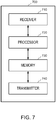
- FIG. 7 is a block diagram illustrating an apparatus for estimating the arrival time of a vehicle according to an embodiment.
- an arrival time estimation apparatus 700 includes a receiver 710, a processor 720, a memory 730, and a transmitter 740.
- the arrival time estimation apparatus 700 may be located at a control facility that is separate from the plurality of vehicles 10 and the transportation information output apparatus 20. In other embodiments, the arrival time estimation apparatus 700 may be provided in the plurality of vehicles 10, or may be provided in the transportation information output apparatus 20.
- the receiver 710 receives location information on the plurality of vehicles 10.
- the location information may include GPS information or information obtained from RFID tags installed on traveling paths.
- the arrival time estimation apparatus 700 includes one or more non-transitory computer-readable media.
- a non-transitory computer-readable medium may be memory, such as random access memory (RAM), read-only memory (ROM), or a higher capacity storage.
- RAM random access memory
- ROM read-only memory
- FIG. 7 Such memory is indicated in FIG. 7 as memory 730.
- Memory 730 may have stored thereon computer-executable instructions, which, when executed, causes one or more processors 720 to perform various operations for estimating an arrival time of a transportation vehicle 10.
- the executable instructions are to perform operations in accordance with embodiments described with reference to FIGS. 2 to 6 above.
- the processor 720 calculates the travel times according to the moving average, the exponential smoothing, and the service pattern of the plurality of vehicles 10 with respect to a predefined section by using the travel times of the plurality of vehicles 10, which are measured with respect to the predefined section.
- the predefined section may include at least one of a first section between a first intersection and a first station adjacent to the first intersection, a second section between the first intersection and a second intersection adjacent to the first intersection, and a third section between the first station and a second station adjacent to the first station.
- the predefined section may include a station section and an intersection section.
- the predefined section may include the sections described above with reference to FIGS. 2 and 6 .
- the travel time in the predefined section may include stoppage time of the vehicle at the station located at the predefined section.
- the moving average may be calculated based on the cumulative operation frequency of the plurality of vehicles and the cumulative operation time of the plurality of vehicles.
- the travel times calculated according to the moving average and the exponential smoothing may be calculated using Formulas 1 to 3.
- the service pattern may include patterns of transportation provided based on seasons, weather, day of the week, time, and characteristics of the predefined sections.
- the processor 720 calculates error values between the actual travel time of the first vehicle with respect to a predefined section and the travel times calculated according to the moving average, the exponential smoothing, and the service pattern.
- the processor 720 estimates the travel time of a second vehicle with respect to the predefined section, based on the calculated error values.
- the processor 720 may estimate, as the travel time of the second vehicle, a value having the smallest error value with respect to the actual travel time of the first vehicle with respect to the predefined section among the travel times calculated according to the moving average, the exponential smoothing, and the service pattern.
- the processor 720 may estimate the travel time of the second vehicle with respect to the respective predefined sections using different algorithms.
- the memory 730 may store the travel times of the plurality of vehicles 10, and the travel times according to the moving average, the exponential smoothing, and the service pattern of the plurality of vehicles 10.
- the transmitter 740 may transmit the estimated arrival times of the plurality of vehicles 10 to the transportation information output apparatus 20.
- Embodiments of the present disclosure may be implemented in the form of program commands which can be executed through various computer units, and then written to computer readable media.
- the computer readable media may include a program command, a data file, a data structure, or a combination thereof.
- Examples of a computer readable media may include magnetic media such as a hard disk, a floppy disk and a magnetic tape, optical media such as CD-ROM and DVD, magneto-optical media such as a floptical disk, and hardware devices, such as ROM, RAM and flash memory, configured to store and execute a program command.
- Examples of the program command may include a machine language code created by a compiler and a high-level language code executed by a computer through an interpreter or the like.
- the hardware device may be configured to operate as one or more software modules to perform an operation in accordance with an embodiment of the present disclosure, and vice versa.
Landscapes
- Physics & Mathematics (AREA)
- General Physics & Mathematics (AREA)
- Engineering & Computer Science (AREA)
- Radar, Positioning & Navigation (AREA)
- Remote Sensing (AREA)
- Chemical & Material Sciences (AREA)
- Analytical Chemistry (AREA)
- Traffic Control Systems (AREA)
- Navigation (AREA)
Claims (13)
- Verfahren zum Schätzen einer Ankunftszeit eines Transportfahrzeugs, das Verfahren umfassend:Messen von Fahrzeiten einer Vielzahl von Transportfahrzeugen (10) durch einen Abschnitt einer Transportroute unter der Verwendung von Standortinformationen über die Vielzahl von Transportfahrzeugen;Berechnen von Fahrzeiten unter der Verwendung eines gleitenden Durchschnitts, einer exponentiellen Glättung und eines Dienstleistungsangebots der Vielzahl von Transportfahrzeugen bezüglich des Abschnitts unter der Verwendung der gemessenen Fahrzeiten der Vielzahl von Transportfahrzeugen (10);Berechnen eines Fehlerwerts zwischen einer gemessenen Fahrzeit eines ersten Transportfahrzeugs bezüglich des Abschnitts und jeder Fahrzeit, die unter der Verwendung des gleitenden Durchschnitts, der exponentiellen Glättung und des Dienstleistungsangebots berechnet wurde; undSchätzen einer Fahrzeit eines zweiten Transportfahrzeugs bezüglich des Abschnitts auf Basis des berechneten Fehlerwerts,wobei das Schätzen der Fahrzeit des zweiten Transportfahrzeugs umfasst:
Schätzen, als die Fahrzeit des zweiten Transportfahrzeugs, eines Werts, der den kleinsten Fehlerwert bezüglich der gemessenen Fahrzeit des ersten Transportfahrzeugs bezüglich des Abschnitts unter den Fahrzeiten hat, die unter der Verwendung des gleitenden Durchschnitts, der exponentiellen Glättung und des Dienstleistungsangebots berechnet wurden. - Verfahren gemäß Anspruch 1, wobei der Abschnitt mindestens eines einschließt aus einem ersten Abschnitt (211) zwischen einer ersten Kreuzung (202) und einer ersten Station (201), die der ersten Kreuzung benachbart ist, einem zweiten Abschnitt (221) zwischen der ersten Kreuzung (202) und einer zweiten Kreuzung (204), die der ersten Kreuzung benachbart ist, und einem dritten Abschnitt (231) zwischen der ersten Station (201) und einer zweiten Station (203), die der ersten Station benachbart ist.
- Verfahren gemäß Anspruch 2, wobei das Berechnen der Fahrzeiten umfasst:Berechnen von Fahrzeiten der Vielzahl von Transportfahrzeugen durch den ersten Abschnitt (211); undBerechnen von Fahrzeiten der Vielzahl von Transportfahrzeugen durch den zweiten Abschnitt (221) und den dritten Abschnitt (231) auf Basis der Fahrzeit der Vielzahl von Transportfahrzeugen (10) durch den ersten Abschnitt.
- Verfahren gemäß Anspruch 1, wobei die Fahrzeit bezüglich des Abschnitts eine Haltezeit eines Transportfahrzeugs an einer in dem Abschnitt gelegenen Station einschließt.
- Verfahren gemäß Anspruch 1, wobei der gleitende Durchschnitt auf Basis einer kumulativen Betriebsfrequenz der Vielzahl von Transportfahrzeugen (10) und einer kumulativen Betriebszeit der Vielzahl von Transportfahrzeugen (10) berechnet wird.
- Verfahren gemäß Anspruch 1, wobei das Dienstleistungsangebot Transportdienstleistungsangebote einschließt, die auf Basis von Jahreszeiten, Wetter, Wochentag, Zeit und Eigenschaften des Abschnitts vorgesehen werden.
- Verfahren gemäß Anspruch 1, ferner umfassend:
Filtern eines Werts, der außerhalb eines vorbestimmten Bereichs liegt, unter den gemessenen Fahrzeiten der Vielzahl von Transportfahrzeugen. - Verfahren gemäß Anspruch 1, ferner umfassend:
Bestimmen einer Verkehrslage des Abschnitts auf Basis der Fahrzeiten, die unter der Verwendung des gleitenden Durchschnitts, der exponentiellen Glättung und des Dienstleistungsangebots berechnet wurden. - Vorrichtung (700) zum Schätzen einer Ankunftszeit eines Transportfahrzeugs, die Vorrichtung umfassend:
einen Prozessor (720), der dazu konfiguriert ist:Fahrzeiten unter der Verwendung eines gleitenden Durchschnitts, einer exponentiellen Glättung und eines Dienstleistungsangebots einer Vielzahl von Transportfahrzeugen (10) bezüglich eines Abschnitts einer Transportroute unter der Verwendung von Fahrzeiten der Vielzahl von Transportfahrzeugen (10), die bezüglich des Abschnitts gemessen werden, zu berechnen;Fehlerwerte zwischen einer gemessenen Fahrzeit eines ersten Transportfahrzeugs bezüglich des Abschnitts und der Fahrzeiten, die unter der Verwendung des gleitenden Durchschnitts, der exponentiellen Glättung und des Dienstleistungsangebots berechnet wurden, zu berechnen; undeine Fahrzeit eines zweiten Transportfahrzeugs bezüglich des Abschnitts auf Basis der berechneten Fehlerwerte zu schätzen,wobei der Prozessor (720) dazu konfiguriert ist, als die Fahrzeit des zweiten Transportfahrzeugs, einen Wert zu schätzen, der den kleinsten Fehlerwert bezüglich der gemessenen Fahrzeit des ersten Transportfahrzeugs bezüglich des Abschnitts unter den Fahrzeiten hat, die unter der Verwendung des gleitenden Durchschnitts, der exponentiellen Glättung und des Dienstleistungsangebots berechnet wurden. - Vorrichtung (700) gemäß Anspruch 9, wobei der Abschnitt mindestens einen aus einem ersten Abschnitt (211) einschließt zwischen einer ersten Kreuzung (202) und einer ersten Station (201), die der ersten Kreuzung benachbart ist, einem zweiten Abschnitt (221) zwischen der ersten Kreuzung (202) und einer zweiten Kreuzung (204), die der ersten Kreuzung benachbart ist, und einem dritten Abschnitt (231) zwischen der ersten Station (201) und einer zweiten Station (203), die der ersten Station benachbart ist.
- Vorrichtung (700) gemäß Anspruch 9, wobei die Fahrzeit bezüglich des Abschnitts eine Haltezeit eines Transportfahrzeugs an einer in dem Abschnitt gelegenen Station einschließt.
- Vorrichtung (700) gemäß Anspruch 9, wobei der gleitende Durchschnitt auf Basis einer kumulativen Betriebsfrequenz der Vielzahl von Transportfahrzeugen (10) und einer kumulativen Betriebszeit der Vielzahl von Transportfahrzeugen (10) berechnet wird.
- Vorrichtung (700) gemäß Anspruch 9, wobei das Dienstleistungsangebot Transportdienstleistungsangebote einschließt, die auf Basis von Jahreszeiten, Wetter, Wochentag, Zeit und Eigenschaften des Abschnitts vorgesehen werden.
Applications Claiming Priority (1)
| Application Number | Priority Date | Filing Date | Title |
|---|---|---|---|
| US14/292,773 US20150348410A1 (en) | 2014-05-30 | 2014-05-30 | Method and apparatus for estimating time to arrival of transportation |
Publications (3)
| Publication Number | Publication Date |
|---|---|
| EP2950293A2 EP2950293A2 (de) | 2015-12-02 |
| EP2950293A3 EP2950293A3 (de) | 2016-02-17 |
| EP2950293B1 true EP2950293B1 (de) | 2018-12-05 |
Family
ID=53275993
Family Applications (1)
| Application Number | Title | Priority Date | Filing Date |
|---|---|---|---|
| EP15168702.7A Active EP2950293B1 (de) | 2014-05-30 | 2015-05-21 | Verfahren und vorrichtung zur schätzung einer ankunftszeit eines transportfahrzeugs |
Country Status (3)
| Country | Link |
|---|---|
| US (1) | US20150348410A1 (de) |
| EP (1) | EP2950293B1 (de) |
| KR (2) | KR20150137933A (de) |
Families Citing this family (10)
| Publication number | Priority date | Publication date | Assignee | Title |
|---|---|---|---|---|
| JP6700784B2 (ja) * | 2015-12-28 | 2020-05-27 | 綜合警備保障株式会社 | 移動時間推定システム及び移動時間推定方法 |
| CN105427650A (zh) * | 2016-01-19 | 2016-03-23 | 曾周玉 | 一种物联网智能交通系统 |
| CN107967802B (zh) * | 2016-10-19 | 2020-06-16 | 阿里巴巴(中国)有限公司 | 一种公交车车速确定方法及装置 |
| CN106571034B (zh) * | 2016-11-02 | 2019-02-05 | 浙江大学 | 基于融合数据的城市快速路交通状态滚动预测方法 |
| CN110520913B (zh) * | 2017-06-12 | 2022-04-05 | 北京嘀嘀无限科技发展有限公司 | 确定预估到达时间的系统和方法 |
| KR102545188B1 (ko) | 2018-06-12 | 2023-06-20 | 한국전자통신연구원 | 통행 시간 예측 모델을 이용한 통행 시간 예측 방법 및 통행 시간 예측 장치 |
| US11300414B2 (en) * | 2019-09-17 | 2022-04-12 | Baidu Usa Llc | Estimated time of arrival based on history |
| DE102020102883B4 (de) * | 2020-02-05 | 2021-09-16 | Bayerische Motoren Werke Aktiengesellschaft | Computerimplementiertes verfahren zur bestimmung einer abweichung eines geschätzten wertes einer durchschnittsfahrzeit für ein durchfahren eines streckenabschnitts von einem messwert einer gefahrenen fahrzeit für das durchfahren des streckenabschnitts, softwareprogramm und system zur bestimmung der abweichung des geschätzten wertes der durchschnittsfahrzeit von dem messwert der gefahrenen fahrzeit |
| US11927456B2 (en) * | 2021-05-27 | 2024-03-12 | Rovi Guides, Inc. | Methods and systems for providing dynamic in-vehicle content based on driving and navigation data |
| KR102397198B1 (ko) * | 2021-09-03 | 2022-05-13 | 한국과학기술정보연구원(Kisti) | 버스 운행시간 예측 장치 및 그 동작방법 |
Family Cites Families (5)
| Publication number | Priority date | Publication date | Assignee | Title |
|---|---|---|---|---|
| KR100701763B1 (ko) * | 2002-09-24 | 2007-03-29 | 주식회사 케이티 | 단거리무선통신망을 이용한 버스 내 승객을 위한 정류소도착소요시간 안내 방법 |
| JP3526422B2 (ja) | 1999-10-28 | 2004-05-17 | 株式会社東芝 | 走行所要時間情報演算システム |
| JP3792172B2 (ja) | 2002-04-09 | 2006-07-05 | 住友電気工業株式会社 | 旅行時間予測方法、装置及びプログラム |
| KR20040086675A (ko) | 2003-04-03 | 2004-10-12 | 삼성에스디에스 주식회사 | 도착예상시간 산출장치 및 방법 |
| KR20120034277A (ko) * | 2010-10-01 | 2012-04-12 | 주식회사 엘지유플러스 | 통신망을 이용한 버스 교통 정보 제공 서버, 방법, 및 기록 매체 |
-
2014
- 2014-05-30 US US14/292,773 patent/US20150348410A1/en not_active Abandoned
- 2014-07-22 KR KR1020140092429A patent/KR20150137933A/ko not_active Ceased
-
2015
- 2015-05-21 EP EP15168702.7A patent/EP2950293B1/de active Active
-
2016
- 2016-07-05 KR KR1020160084873A patent/KR101661883B1/ko active Active
Non-Patent Citations (1)
| Title |
|---|
| None * |
Also Published As
| Publication number | Publication date |
|---|---|
| KR20150137933A (ko) | 2015-12-09 |
| EP2950293A3 (de) | 2016-02-17 |
| KR101661883B1 (ko) | 2016-09-30 |
| US20150348410A1 (en) | 2015-12-03 |
| EP2950293A2 (de) | 2015-12-02 |
| KR20160086784A (ko) | 2016-07-20 |
Similar Documents
| Publication | Publication Date | Title |
|---|---|---|
| EP2950293A2 (de) | Verfahren und vorrichtung zur schätzung einer ankunftszeit eines transportfahrzeugs | |
| EP2727098B1 (de) | Verfahren und system zum sammeln von verkehrsdaten | |
| CN105096643B (zh) | 基于多线路前车运行数据的实时公交到站时间预测方法 | |
| US11127289B2 (en) | Traffic congestion estimating device, traffic congestion estimating method, and recording medium storing program thereof | |
| JP5424754B2 (ja) | リンク旅行時間算出装置及びプログラム | |
| US20140058652A1 (en) | Traffic information processing | |
| US9778045B2 (en) | Method for managing service schedule of vehicle | |
| CN104318759B (zh) | 基于自学习算法的公交车停靠站时间实时估计方法及系统 | |
| EP3009324A1 (de) | Steuerungsvorrichtung für verkehrsanfragen | |
| CN109377758B (zh) | 一种行驶时间预估方法及系统 | |
| US9937939B2 (en) | Railway vehicle operation | |
| KR101943198B1 (ko) | 구간통행시간 및 신호지체 추정방법 | |
| CN104240529A (zh) | 一种预测公交到站时间的方法及系统 | |
| CN103606272B (zh) | 一种基于客流量的快速公交到站时刻预测方法 | |
| Byon et al. | Bunching and headway adherence approach to public transport with GPS | |
| CN103730005A (zh) | 一种路程行驶时间的预测方法和系统 | |
| JP2006134158A (ja) | 区間旅行時間情報収集システム及び車載装置 | |
| JP6393766B2 (ja) | 列車運行予測システム、列車運行予測方法、運転時分算出装置、および運転時分算出方法 | |
| JP7032085B2 (ja) | 交通量判定システム、交通量判定方法、及び交通量判定プログラム | |
| CN112101677B (zh) | 一种公共交通出行路径规划方法、装置、设备及存储介质 | |
| CN109146333A (zh) | 导航算法评估方法和装置 | |
| CN106205176B (zh) | 一种车辆实时到站预测方法和系统 | |
| CN105206037B (zh) | 公交线路分析方法和系统 | |
| CN116523232A (zh) | 一种基于复杂路况的派单方法、装置、电子设备及存储介质 | |
| KR20040086675A (ko) | 도착예상시간 산출장치 및 방법 |
Legal Events
| Date | Code | Title | Description |
|---|---|---|---|
| 17P | Request for examination filed |
Effective date: 20150521 |
|
| AK | Designated contracting states |
Kind code of ref document: A2 Designated state(s): AL AT BE BG CH CY CZ DE DK EE ES FI FR GB GR HR HU IE IS IT LI LT LU LV MC MK MT NL NO PL PT RO RS SE SI SK SM TR |
|
| AX | Request for extension of the european patent |
Extension state: BA ME |
|
| PUAI | Public reference made under article 153(3) epc to a published international application that has entered the european phase |
Free format text: ORIGINAL CODE: 0009012 |
|
| PUAL | Search report despatched |
Free format text: ORIGINAL CODE: 0009013 |
|
| RIC1 | Information provided on ipc code assigned before grant |
Ipc: G08G 1/01 20060101ALI20151218BHEP Ipc: G08G 1/127 20060101AFI20151218BHEP |
|
| AK | Designated contracting states |
Kind code of ref document: A3 Designated state(s): AL AT BE BG CH CY CZ DE DK EE ES FI FR GB GR HR HU IE IS IT LI LT LU LV MC MK MT NL NO PL PT RO RS SE SI SK SM TR |
|
| AX | Request for extension of the european patent |
Extension state: BA ME |
|
| RIC1 | Information provided on ipc code assigned before grant |
Ipc: G08G 1/127 20060101AFI20160111BHEP Ipc: G08G 1/01 20060101ALI20160111BHEP |
|
| GRAP | Despatch of communication of intention to grant a patent |
Free format text: ORIGINAL CODE: EPIDOSNIGR1 |
|
| STAA | Information on the status of an ep patent application or granted ep patent |
Free format text: STATUS: GRANT OF PATENT IS INTENDED |
|
| INTG | Intention to grant announced |
Effective date: 20180720 |
|
| GRAS | Grant fee paid |
Free format text: ORIGINAL CODE: EPIDOSNIGR3 |
|
| GRAA | (expected) grant |
Free format text: ORIGINAL CODE: 0009210 |
|
| GRAA | (expected) grant |
Free format text: ORIGINAL CODE: 0009210 |
|
| STAA | Information on the status of an ep patent application or granted ep patent |
Free format text: STATUS: THE PATENT HAS BEEN GRANTED |
|
| AK | Designated contracting states |
Kind code of ref document: B1 Designated state(s): AL AT BE BG CH CY CZ DE DK EE ES FI FR GB GR HR HU IE IS IT LI LT LU LV MC MK MT NL NO PL PT RO RS SE SI SK SM TR |
|
| REG | Reference to a national code |
Ref country code: GB Ref legal event code: FG4D |
|
| REG | Reference to a national code |
Ref country code: CH Ref legal event code: EP |
|
| REG | Reference to a national code |
Ref country code: AT Ref legal event code: REF Ref document number: 1074040 Country of ref document: AT Kind code of ref document: T Effective date: 20181215 |
|
| REG | Reference to a national code |
Ref country code: IE Ref legal event code: FG4D |
|
| REG | Reference to a national code |
Ref country code: DE Ref legal event code: R096 Ref document number: 602015020718 Country of ref document: DE |
|
| REG | Reference to a national code |
Ref country code: NL Ref legal event code: FP |
|
| REG | Reference to a national code |
Ref country code: AT Ref legal event code: MK05 Ref document number: 1074040 Country of ref document: AT Kind code of ref document: T Effective date: 20181205 |
|
| REG | Reference to a national code |
Ref country code: GR Ref legal event code: EP Ref document number: 20190400007 Country of ref document: GR Effective date: 20190422 |
|
| REG | Reference to a national code |
Ref country code: LT Ref legal event code: MG4D |
|
| PG25 | Lapsed in a contracting state [announced via postgrant information from national office to epo] |
Ref country code: NO Free format text: LAPSE BECAUSE OF FAILURE TO SUBMIT A TRANSLATION OF THE DESCRIPTION OR TO PAY THE FEE WITHIN THE PRESCRIBED TIME-LIMIT Effective date: 20190305 Ref country code: LT Free format text: LAPSE BECAUSE OF FAILURE TO SUBMIT A TRANSLATION OF THE DESCRIPTION OR TO PAY THE FEE WITHIN THE PRESCRIBED TIME-LIMIT Effective date: 20181205 Ref country code: AT Free format text: LAPSE BECAUSE OF FAILURE TO SUBMIT A TRANSLATION OF THE DESCRIPTION OR TO PAY THE FEE WITHIN THE PRESCRIBED TIME-LIMIT Effective date: 20181205 Ref country code: HR Free format text: LAPSE BECAUSE OF FAILURE TO SUBMIT A TRANSLATION OF THE DESCRIPTION OR TO PAY THE FEE WITHIN THE PRESCRIBED TIME-LIMIT Effective date: 20181205 Ref country code: BG Free format text: LAPSE BECAUSE OF FAILURE TO SUBMIT A TRANSLATION OF THE DESCRIPTION OR TO PAY THE FEE WITHIN THE PRESCRIBED TIME-LIMIT Effective date: 20190305 Ref country code: LV Free format text: LAPSE BECAUSE OF FAILURE TO SUBMIT A TRANSLATION OF THE DESCRIPTION OR TO PAY THE FEE WITHIN THE PRESCRIBED TIME-LIMIT Effective date: 20181205 Ref country code: FI Free format text: LAPSE BECAUSE OF FAILURE TO SUBMIT A TRANSLATION OF THE DESCRIPTION OR TO PAY THE FEE WITHIN THE PRESCRIBED TIME-LIMIT Effective date: 20181205 Ref country code: ES Free format text: LAPSE BECAUSE OF FAILURE TO SUBMIT A TRANSLATION OF THE DESCRIPTION OR TO PAY THE FEE WITHIN THE PRESCRIBED TIME-LIMIT Effective date: 20181205 |
|
| PG25 | Lapsed in a contracting state [announced via postgrant information from national office to epo] |
Ref country code: RS Free format text: LAPSE BECAUSE OF FAILURE TO SUBMIT A TRANSLATION OF THE DESCRIPTION OR TO PAY THE FEE WITHIN THE PRESCRIBED TIME-LIMIT Effective date: 20181205 Ref country code: SE Free format text: LAPSE BECAUSE OF FAILURE TO SUBMIT A TRANSLATION OF THE DESCRIPTION OR TO PAY THE FEE WITHIN THE PRESCRIBED TIME-LIMIT Effective date: 20181205 Ref country code: AL Free format text: LAPSE BECAUSE OF FAILURE TO SUBMIT A TRANSLATION OF THE DESCRIPTION OR TO PAY THE FEE WITHIN THE PRESCRIBED TIME-LIMIT Effective date: 20181205 |
|
| PG25 | Lapsed in a contracting state [announced via postgrant information from national office to epo] |
Ref country code: PL Free format text: LAPSE BECAUSE OF FAILURE TO SUBMIT A TRANSLATION OF THE DESCRIPTION OR TO PAY THE FEE WITHIN THE PRESCRIBED TIME-LIMIT Effective date: 20181205 Ref country code: CZ Free format text: LAPSE BECAUSE OF FAILURE TO SUBMIT A TRANSLATION OF THE DESCRIPTION OR TO PAY THE FEE WITHIN THE PRESCRIBED TIME-LIMIT Effective date: 20181205 Ref country code: PT Free format text: LAPSE BECAUSE OF FAILURE TO SUBMIT A TRANSLATION OF THE DESCRIPTION OR TO PAY THE FEE WITHIN THE PRESCRIBED TIME-LIMIT Effective date: 20190405 |
|
| PG25 | Lapsed in a contracting state [announced via postgrant information from national office to epo] |
Ref country code: SK Free format text: LAPSE BECAUSE OF FAILURE TO SUBMIT A TRANSLATION OF THE DESCRIPTION OR TO PAY THE FEE WITHIN THE PRESCRIBED TIME-LIMIT Effective date: 20181205 Ref country code: SM Free format text: LAPSE BECAUSE OF FAILURE TO SUBMIT A TRANSLATION OF THE DESCRIPTION OR TO PAY THE FEE WITHIN THE PRESCRIBED TIME-LIMIT Effective date: 20181205 Ref country code: EE Free format text: LAPSE BECAUSE OF FAILURE TO SUBMIT A TRANSLATION OF THE DESCRIPTION OR TO PAY THE FEE WITHIN THE PRESCRIBED TIME-LIMIT Effective date: 20181205 Ref country code: IS Free format text: LAPSE BECAUSE OF FAILURE TO SUBMIT A TRANSLATION OF THE DESCRIPTION OR TO PAY THE FEE WITHIN THE PRESCRIBED TIME-LIMIT Effective date: 20190405 Ref country code: RO Free format text: LAPSE BECAUSE OF FAILURE TO SUBMIT A TRANSLATION OF THE DESCRIPTION OR TO PAY THE FEE WITHIN THE PRESCRIBED TIME-LIMIT Effective date: 20181205 |
|
| REG | Reference to a national code |
Ref country code: DE Ref legal event code: R097 Ref document number: 602015020718 Country of ref document: DE |
|
| PLBE | No opposition filed within time limit |
Free format text: ORIGINAL CODE: 0009261 |
|
| STAA | Information on the status of an ep patent application or granted ep patent |
Free format text: STATUS: NO OPPOSITION FILED WITHIN TIME LIMIT |
|
| PG25 | Lapsed in a contracting state [announced via postgrant information from national office to epo] |
Ref country code: SI Free format text: LAPSE BECAUSE OF FAILURE TO SUBMIT A TRANSLATION OF THE DESCRIPTION OR TO PAY THE FEE WITHIN THE PRESCRIBED TIME-LIMIT Effective date: 20181205 Ref country code: DK Free format text: LAPSE BECAUSE OF FAILURE TO SUBMIT A TRANSLATION OF THE DESCRIPTION OR TO PAY THE FEE WITHIN THE PRESCRIBED TIME-LIMIT Effective date: 20181205 |
|
| 26N | No opposition filed |
Effective date: 20190906 |
|
| REG | Reference to a national code |
Ref country code: CH Ref legal event code: PL |
|
| PG25 | Lapsed in a contracting state [announced via postgrant information from national office to epo] |
Ref country code: CH Free format text: LAPSE BECAUSE OF NON-PAYMENT OF DUE FEES Effective date: 20190531 Ref country code: MC Free format text: LAPSE BECAUSE OF FAILURE TO SUBMIT A TRANSLATION OF THE DESCRIPTION OR TO PAY THE FEE WITHIN THE PRESCRIBED TIME-LIMIT Effective date: 20181205 Ref country code: LI Free format text: LAPSE BECAUSE OF NON-PAYMENT OF DUE FEES Effective date: 20190531 |
|
| REG | Reference to a national code |
Ref country code: BE Ref legal event code: MM Effective date: 20190531 |
|
| PG25 | Lapsed in a contracting state [announced via postgrant information from national office to epo] |
Ref country code: LU Free format text: LAPSE BECAUSE OF NON-PAYMENT OF DUE FEES Effective date: 20190521 |
|
| PG25 | Lapsed in a contracting state [announced via postgrant information from national office to epo] |
Ref country code: TR Free format text: LAPSE BECAUSE OF FAILURE TO SUBMIT A TRANSLATION OF THE DESCRIPTION OR TO PAY THE FEE WITHIN THE PRESCRIBED TIME-LIMIT Effective date: 20181205 |
|
| PG25 | Lapsed in a contracting state [announced via postgrant information from national office to epo] |
Ref country code: IE Free format text: LAPSE BECAUSE OF NON-PAYMENT OF DUE FEES Effective date: 20190521 |
|
| PG25 | Lapsed in a contracting state [announced via postgrant information from national office to epo] |
Ref country code: BE Free format text: LAPSE BECAUSE OF NON-PAYMENT OF DUE FEES Effective date: 20190531 |
|
| PG25 | Lapsed in a contracting state [announced via postgrant information from national office to epo] |
Ref country code: CY Free format text: LAPSE BECAUSE OF FAILURE TO SUBMIT A TRANSLATION OF THE DESCRIPTION OR TO PAY THE FEE WITHIN THE PRESCRIBED TIME-LIMIT Effective date: 20181205 |
|
| PG25 | Lapsed in a contracting state [announced via postgrant information from national office to epo] |
Ref country code: MT Free format text: LAPSE BECAUSE OF FAILURE TO SUBMIT A TRANSLATION OF THE DESCRIPTION OR TO PAY THE FEE WITHIN THE PRESCRIBED TIME-LIMIT Effective date: 20181205 Ref country code: HU Free format text: LAPSE BECAUSE OF FAILURE TO SUBMIT A TRANSLATION OF THE DESCRIPTION OR TO PAY THE FEE WITHIN THE PRESCRIBED TIME-LIMIT; INVALID AB INITIO Effective date: 20150521 |
|
| PG25 | Lapsed in a contracting state [announced via postgrant information from national office to epo] |
Ref country code: MK Free format text: LAPSE BECAUSE OF FAILURE TO SUBMIT A TRANSLATION OF THE DESCRIPTION OR TO PAY THE FEE WITHIN THE PRESCRIBED TIME-LIMIT Effective date: 20181205 |
|
| PGFP | Annual fee paid to national office [announced via postgrant information from national office to epo] |
Ref country code: IT Payment date: 20250321 Year of fee payment: 11 |
|
| PGFP | Annual fee paid to national office [announced via postgrant information from national office to epo] |
Ref country code: DE Payment date: 20250320 Year of fee payment: 11 |
|
| PGFP | Annual fee paid to national office [announced via postgrant information from national office to epo] |
Ref country code: GB Payment date: 20260324 Year of fee payment: 12 |
|
| PGFP | Annual fee paid to national office [announced via postgrant information from national office to epo] |
Ref country code: NL Payment date: 20260324 Year of fee payment: 12 |
|
| PGFP | Annual fee paid to national office [announced via postgrant information from national office to epo] |
Ref country code: FR Payment date: 20260323 Year of fee payment: 12 |
|
| PGFP | Annual fee paid to national office [announced via postgrant information from national office to epo] |
Ref country code: GR Payment date: 20260323 Year of fee payment: 12 |