EP2939720A1 - Szenenpuzzle - Google Patents
Szenenpuzzle Download PDFInfo
- Publication number
- EP2939720A1 EP2939720A1 EP14194665.7A EP14194665A EP2939720A1 EP 2939720 A1 EP2939720 A1 EP 2939720A1 EP 14194665 A EP14194665 A EP 14194665A EP 2939720 A1 EP2939720 A1 EP 2939720A1
- Authority
- EP
- European Patent Office
- Prior art keywords
- puzzle
- component
- scene
- base plate
- mounting seat
- Prior art date
- Legal status (The legal status is an assumption and is not a legal conclusion. Google has not performed a legal analysis and makes no representation as to the accuracy of the status listed.)
- Withdrawn
Links
Images



Classifications
-
- A—HUMAN NECESSITIES
- A63—SPORTS; GAMES; AMUSEMENTS
- A63F—CARD, BOARD, OR ROULETTE GAMES; INDOOR GAMES USING SMALL MOVING PLAYING BODIES; VIDEO GAMES; GAMES NOT OTHERWISE PROVIDED FOR
- A63F9/00—Games not otherwise provided for
- A63F9/06—Patience; Other games for self-amusement
- A63F9/12—Three-dimensional [3D] jig-saw puzzles
- A63F9/1208—Connections between puzzle elements
-
- A—HUMAN NECESSITIES
- A63—SPORTS; GAMES; AMUSEMENTS
- A63H—TOYS, e.g. TOPS, DOLLS, HOOPS OR BUILDING BLOCKS
- A63H33/00—Other toys
- A63H33/04—Building blocks, strips, or similar building parts
- A63H33/046—Building blocks, strips, or similar building parts comprising magnetic interaction means, e.g. holding together by magnetic attraction
-
- A—HUMAN NECESSITIES
- A63—SPORTS; GAMES; AMUSEMENTS
- A63F—CARD, BOARD, OR ROULETTE GAMES; INDOOR GAMES USING SMALL MOVING PLAYING BODIES; VIDEO GAMES; GAMES NOT OTHERWISE PROVIDED FOR
- A63F9/00—Games not otherwise provided for
- A63F9/06—Patience; Other games for self-amusement
- A63F9/10—Two-dimensional [2D] jig-saw puzzles
- A63F2009/1016—Two-dimensional [2D] jig-saw puzzles the pieces having additional connections, i.e. in addition to the connection by the jig-saw shapes
- A63F2009/1022—Two-dimensional [2D] jig-saw puzzles the pieces having additional connections, i.e. in addition to the connection by the jig-saw shapes to the display board
- A63F2009/1033—Two-dimensional [2D] jig-saw puzzles the pieces having additional connections, i.e. in addition to the connection by the jig-saw shapes to the display board magnetic
-
- A—HUMAN NECESSITIES
- A63—SPORTS; GAMES; AMUSEMENTS
- A63F—CARD, BOARD, OR ROULETTE GAMES; INDOOR GAMES USING SMALL MOVING PLAYING BODIES; VIDEO GAMES; GAMES NOT OTHERWISE PROVIDED FOR
- A63F9/00—Games not otherwise provided for
- A63F9/06—Patience; Other games for self-amusement
- A63F9/12—Three-dimensional [3D] jig-saw puzzles
- A63F9/1208—Connections between puzzle elements
- A63F2009/1212—Connections between puzzle elements magnetic connections
Definitions
- the present application relates to the field design technique of puzzles, and particularly to a scene puzzle.
- a puzzle is a tool for an educational game, and multiple picture parts are spliced together by a player to form a complete picture or layout setting having a particular scene.
- toy puzzles available in the market are generally classified as three categories according to the space construction, including a planar type, a three-dimensional type and a plane stacking three-dimensional type which is between the planar type and the three-dimensional type; and are generally classified as several categories according to the materials, including wooden type, paper type, plastic type and etc.; and are generally classified as several categories according to the assembling method, including wedge embedding type, glue bonding type, track jointing type, and etc..
- the assembling method of the wedge embedding type is commonly used in a puzzle made of wooden or plastic materials. Wooden or plastic puzzle parts are wedged together by a hole pluggable manner or a snap-fit manner, thereby forming a layout structural picture having a certain scene.
- the puzzle parts are assembled by wedging, and repeated plugging and unplugging or snap fitting are prone to cause abrasion of the puzzle parts, which further results in a low reutilization rate of the puzzle.
- a scene puzzle is provided according to the present application, to address the technical issue of a low reutilization rate of the puzzle in the conventional technology.
- Technical solutions according to the present application are as follows.
- a scene puzzle includes a base plate and at least one puzzle component having a scene pattern; wherein,
- a magnet is provided inside the puzzle component, and a metal substance capable of attracting the magnet is provided inside the base plate.
- a magnet mounting seat is provided inside the puzzle component, the magnet mounting seat is rotatably connected to the puzzle component, and a rotating axis of the magnet mounting seat is parallel to a connecting surface of the puzzle component.
- a sliding groove is provided inside the puzzle component, a protrusion is provided on the magnet mounting seat, and a maximum length of the protrusion is smaller than a width of the sliding groove.
- the connecting surface of the puzzle component is vertically connected to the sliding groove arranged in the puzzle component, and the connecting surface is provided with a retaining portion configured to cooperate with the protrusion on the magnet mounting seat.
- an outer end surface of the magnet mounting seat is provided with a positioning groove.
- a magnetic force between each puzzle component and the base place is larger than a gravity of the respective puzzle component.
- the base plate is provided with at least one connecting component, wherein the connecting component is configured for hanging the base plate.
- the connecting component has an annular structure.
- the connecting component is provided inside the base plate.
- Another scene puzzle includes a base plate and at least one puzzle component having a scene pattern; wherein,
- a metal substance is provided inside the puzzle component, and a magnet capable of attracting the metal substance is provided inside the base plate.
- a scene puzzle according to the present application includes a puzzle component and a base plate.
- a magnet is provided inside the puzzle component, and a metal substance capable of attracting the magnet is provided inside the base plate.
- the puzzle component and the base plate are connected by a magnetic force between the magnetic substance and the metal substance.
- a scene puzzle is a tool for an educational game, and parts of the puzzle are spliced together by a player to form a complete picture or setting having a particular scene, for example, a hospital, a police office, or a supermarket.
- the method for assembling parts of the scene puzzle includes a wedge embedding method, which is specifically realized by hole plugging or snap fitting.
- Figure 1 which is a schematic view showing the hole plugging manner, and in the Figure, a puzzle part 11 and a puzzle part 12 are connected via a hole 13.
- Figure 2 which is a schematic view showing the snap fitting manner, and in the Figure, a puzzle part 21 is connected to a puzzle part 22 by snap-fitting.
- Figure 3 is a schematic view showing the structure of a scene puzzle according to a first embodiment of the present application.
- This embodiment may include a puzzle component 31 and a base plate 32.
- a magnet is provided inside the puzzle component 31, and a metal substance capable of attracting the magnet is provided inside the base plate 32.
- a player may place the puzzle component 31 on the base plate 32, and the puzzle component 31 and the base plate 32 are connected by a magnetic force.
- the present application may have another implementation, wherein, a magnet is provided inside the base plate 32 of the scene puzzle, and a metal substance capable of attracting the magnet is provided inside the puzzle component 31.
- the magnet may be a magnetic iron, or an electromagnet.
- the electromagnet is a device which may generate electromagnetism when being energized, and consists of a built-in coil and an iron core.
- the intensity of the magnetism of the electromagnet may be controlled by the intensity of a current or a number of turns of the coil.
- the magnetism of the electromagnet may be removed.
- the iron core may be made of a soft iron and a silicon steel.
- a device for supplying power, such as a battery may be provided inside the base plate, to provide electricity support for the electromagnet, thus the electromagnet may be magnetized for connecting the components.
- the magnetic substance may be a magnetic iron having a natural magnetism.
- the metal substance includes but not limit to iron, nickel, cobalt, or alloy, and the existing metal substances capable of being attracted by a magnet all fall into the scope of the present application.
- the puzzle parts in the conventional technology are assembled by hole plugging or snap fitting, and since most puzzle parts are made of materials such as paper, wood or plastic, and repeated plugging and unplugging or snap fitting are prone to cause abrasion or damage of the parts to be spliced (including wedge heads or engaging teeth), which shortens the service life of the puzzle and reduces the reutilization rate of the puzzle.
- the puzzle component and the base plate are connected by a magnetic force between the magnet and the metal substance. In such connecting method, the player does not need to plug/unplug or snap fit the puzzle components, thereby effectively reducing the abrasion of the puzzle components and improving the reutilization rate of the puzzle.
- the scene puzzle according to the above embodiment using the magnetic force for connection may enable the connection between the components to be more stable.
- a junction is provided in each of the puzzle parts, which limits the position of the puzzle part to be connected, for example, an automobile part can only be inserted in a fixed position.
- no junction is provided on the base plate and the puzzle component, thus the position to be connected is not limited, and the player may arrange and connect the puzzle components as desired according to his own imagination, to create any various settings of different layouts and structures, thereby facilitating developing the spatial imagination of the player.
- the number of the puzzle components in the scene puzzle may be one or multiple. Preferably, the number of the puzzle components is multiple.
- Figure 4 is a schematic view showing a setting of the scene puzzle according to the present application.
- the puzzle components may be connected to the base plate, but also the puzzle components may be connected to each other by a magnetic force, thereby constructing a setting having a certain layout structure.
- a surface of the puzzle component to be connected to another puzzle component is defined as a connecting surface of the puzzle component.
- the magnet Since the magnet has a characteristic that unlike poles attract and like poles repel, and if the magnet inside the puzzle component is fixed, an end of the puzzle component close to the connecting surface has a fixed magnetic polarity, i.e., can only be a negative pole or a positive pole, thus the connection between various puzzle components is limited, that is, if ends, close to the connecting surfaces, of two puzzle components has the same magnetic polarity, the two puzzle components cannot be connected.
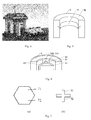
- reference numeral 5 in this figure refers to a puzzle component, and a magnet mounting seat is provided inside the puzzle component 5, the magnet mounting seat is indicated by reference numeral 51, and the connecting surface of the puzzle component is indicated by reference numeral 52.
- the magnet mounting seat 51 is rotatably connected to the puzzle component 5, and a rotating axis of the magnet mounting seat 51 is parallel to the connecting surface 52 of the puzzle component, thus after the magnet inside the magnet mounting seat 51 is rotated, the polarity of the magnet close to the connecting surface 52 may be adjusted according to practical connection requirements.
- the puzzle component 1 when the puzzle component 1 is to be connected to the puzzle component 2, if sides of the magnets in the puzzle component 1 and the puzzle component 2 close to the connecting surfaces both have a negative polarity, then due to the attraction between magnetic polarities, the magnet mounting seat in the puzzle component 1 is rotated, which then rotates the positive polarity of the magnet on the magnet mounting seat to be close to the connecting surface, and finally, the puzzle component 1 and the puzzle component 2 are connected via the connecting surfaces.
- the magnet mounting seat is provided with a rotating shaft and the puzzle component is provided with a rotating hole
- the puzzle component is provided with a rotating shaft and the magnet mounting seat is provided with a rotating hole, and then the rotating shaft is rotatably inserted into the rotating hole.
- the rotatable connection may also be realized in a way as shown in Figure 6 , in the figure, a sliding groove 53 is provided inside the puzzle component, a protrusion 510 is provided on the magnet mounting seat 51, and a maximum linear length of the protrusion in the sliding groove is slightly smaller than a width of the sliding groove, thus the magnet mounting seat is rotatable inside the sliding groove.
- puzzle components can be connected by configuring the magnet mounting seat to be rotatably connected to the puzzle component, thereby improving the flexibility of the connection between the puzzle components.
- Connecting two puzzle components via connecting surfaces refers to that the two puzzle components are connected by magnetism of the magnets inside the puzzle components.
- the tightness of the connection between the puzzle components is related to the magnitude of the magnetic force between the magnets, which in turn is related to a distance between the two magnets, i.e., when the distance between two magnets has the smallest value, the magnetic force has the greatest value, and the connection between the puzzle components is firmest.
- the position of the magnet mounting seat with respect to the connecting surface may not be fixed, and as shown in Figure 6 , the sliding groove 53 in the puzzle component 5 is perpendicular to the connecting surface 52, and a magnet 511 is placed inside the magnet mounting seat 51.
- the magnet mounting seat 51 is rotatable inside the puzzle component, and when the magnet mounting seat 51 is rotated to an appropriate position and the puzzle component is to be connected to another puzzle component, due to the attraction of the magnetic force, the magnet mounting seat 51 is driven to slide along the sliding groove 53 to a position in the same plane with the connecting surface 52, and thus the magnet 511 is at a position closest to the magnet inside the another puzzle component, thus the magnetic force between the two magnets has the maximum value, thereby improving the firmness of the connection between the puzzle components.
- the magnet mounting seat 51 is provided with a protrusion 510
- the connecting surface 52 of the puzzle component is provided with a retaining portion 520
- the protrusion is configured to cooperate with the retaining portion.
- the retaining portion may be considered as a retaining groove, and the cooperation therebetween refers to that the protrusion may be stuck inside the retaining groove.
- a sectional view of the protrusion 510 (the section cutting plane is perpendicular to the connecting surface) is shown in Figure 7 , and the protrusion may have a sectional shape shown in Figure 7(a) or 7(b) .
- the portion 71 or the portion 72 of the protrusion 510 may be stuck in the retaining portion, thereby enabling the magnet mounting seat to be in a fixed state, and facilitating the connection with another puzzle component.
- an outer end surface of the magnet mounting seat is provided with a positioning groove, to further improve the firmness of the connection between two puzzle components.
- the outer end surface refers to a surface of the magnet mounting seat close to the connecting surface.
- the positioning groove may be a sawtooth-shaped protrusion, or a spherical protrusion and a spherical groove.
- the positions of the spherical protrusion and the spherical groove are not limited, for example, a spherical protrusion is provided on an outer end surface of a magnet mounting seat of a puzzle component, and a spherical groove is provided on an outer end surface of a magnet mounting seat of another puzzle component; or, both a spherical protrusion and a spherical groove are provided on an outer end surface of a magnet mounting seat of the same puzzle component.
- an outer end surface of a magnet mounting seat is provided with a positioning groove 512, and the positioning groove is of a sawtooth shape, and a positioning retaining groove of another puzzle component may be staggeredly snapped in the positioning retaining groove in the previous puzzle component.
- reference numeral 91 in Figure 9(a) refers to a magnet mounting seat, and an outer end surface of the magnet mounting seat is provided with a spherical groove 910.
- Reference numeral 92 in Figure 9(b) refers to a magnet mounting seat, and an outer end surface of the magnet mounting seat is provided with a spherical protrusion 920.
- the spherical protrusion and the spherical groove can be connected by snap fitting, thereby increasing the firmness of the connection between the puzzle components.
- the base plate and the puzzle component are connected by a magnetic force, and the magnetic force between any one of the puzzle components and the base place is larger than the gravity of the respective puzzle component.
- the magnitude of the magnetic force is determined by several factors, including the category and size of each of the magnetic substance and the attractable metal substance, thus, a magnetic substance and a metal substance which may generate a larger magnetic force may be adopted.
- the gravity of the puzzle component is determined by the weight of the puzzle component, thus, the weight of the puzzle component may be limited, to allow the gravity of the puzzle component to be smaller than the magnetic force between the puzzle component and the base plate, thus the base plate of the scene puzzle may be placed vertically or upside down.
- Figure 10 is a schematic view showing a scene puzzle being placed vertically.
- a base plate 101 is vertically placed, a puzzle component 102 and the base plate 101 are connected by a magnetic force, and the magnetic force is larger than the gravity of the puzzle component 102.
- Figure 11 is a schematic view showing a scene puzzle being placed upside down.
- a base plate 111 is placed upside down, a puzzle component 112 and the base plate 111 are connected by a magnetic force, and the magnetic force is larger than the gravity of the puzzle component 112.
- a base plate of a scene puzzle may be provided with a connecting component for hanging the base plate, so as to place the scene puzzle vertically or upside down.
- the connecting component has an annular structure.
- Figure 12 is a schematic view showing the structure of the connecting component, and this figure is a side view of the connecting component, and in this figure, the base plate 12 is provided with a connecting component 120, and the connecting component 120 is annular.
- a player can arrange a hook-shaped hanger on a wall, and then the base palate 12 can be hanged onto the hook-shaped hanger via the connecting component 120.
- the connecting component 120 is connected to the base plate 12 by screw threads.
- the connecting component 120 is arranged inside the base plate.
Landscapes
- Engineering & Computer Science (AREA)
- Multimedia (AREA)
- Toys (AREA)
Applications Claiming Priority (1)
| Application Number | Priority Date | Filing Date | Title |
|---|---|---|---|
| CN201410182473.8A CN103920290B (zh) | 2014-04-30 | 2014-04-30 | 一种情景拼图 |
Publications (1)
| Publication Number | Publication Date |
|---|---|
| EP2939720A1 true EP2939720A1 (de) | 2015-11-04 |
Family
ID=51138824
Family Applications (1)
| Application Number | Title | Priority Date | Filing Date |
|---|---|---|---|
| EP14194665.7A Withdrawn EP2939720A1 (de) | 2014-04-30 | 2014-11-25 | Szenenpuzzle |
Country Status (2)
| Country | Link |
|---|---|
| EP (1) | EP2939720A1 (de) |
| CN (1) | CN103920290B (de) |
Families Citing this family (1)
| Publication number | Priority date | Publication date | Assignee | Title |
|---|---|---|---|---|
| CN110251933A (zh) * | 2019-06-01 | 2019-09-20 | 林志苹 | 一种磁性音乐拼图 |
Citations (3)
| Publication number | Priority date | Publication date | Assignee | Title |
|---|---|---|---|---|
| US4741534A (en) * | 1987-01-09 | 1988-05-03 | Rogahn Dino J | Multi-picture puzzle apparatus |
| EP2239026A1 (de) * | 2009-03-30 | 2010-10-13 | EDTOY, Co., Ltd. | Block zum Bauen eines Spielzeugs |
| WO2013100491A1 (ko) * | 2011-12-28 | 2013-07-04 | Kim Sang Hoon | 자석장착용 부품 및 이를 포함하는 자석완구 |
-
2014
- 2014-04-30 CN CN201410182473.8A patent/CN103920290B/zh active Active
- 2014-11-25 EP EP14194665.7A patent/EP2939720A1/de not_active Withdrawn
Patent Citations (3)
| Publication number | Priority date | Publication date | Assignee | Title |
|---|---|---|---|---|
| US4741534A (en) * | 1987-01-09 | 1988-05-03 | Rogahn Dino J | Multi-picture puzzle apparatus |
| EP2239026A1 (de) * | 2009-03-30 | 2010-10-13 | EDTOY, Co., Ltd. | Block zum Bauen eines Spielzeugs |
| WO2013100491A1 (ko) * | 2011-12-28 | 2013-07-04 | Kim Sang Hoon | 자석장착용 부품 및 이를 포함하는 자석완구 |
Also Published As
| Publication number | Publication date |
|---|---|
| CN103920290B (zh) | 2017-06-16 |
| CN103920290A (zh) | 2014-07-16 |
Similar Documents
| Publication | Publication Date | Title |
|---|---|---|
| US7828556B2 (en) | Audio magnetic connection and indexing device | |
| CN205490709U (zh) | 滑动结构及用户设备 | |
| US8773226B2 (en) | Driving device and relay | |
| KR101746469B1 (ko) | 점자 액츄에이터 및 이를 이용한 점자 출력 장치 | |
| JP2002325421A5 (de) | ||
| US20180126294A1 (en) | Connector for magnetic modules and toy construction kits employing same | |
| JP3161698U (ja) | 磁石式プレート玩具 | |
| KR20170071458A (ko) | 점자 액츄에이터 및 이를 이용한 점자 출력 장치 | |
| CN204979556U (zh) | 箱体之磁吸结构 | |
| JPH09311629A (ja) | 紙片保定具 | |
| EP2939720A1 (de) | Szenenpuzzle | |
| CN206411307U (zh) | 驱动装置及双滤光片切换器 | |
| CN216976317U (zh) | 一种万向摄像头 | |
| JP7149406B2 (ja) | 磁石モジュールの製造方法及び磁石モジュール | |
| CN204992838U (zh) | 单相永磁电机 | |
| US20160357350A1 (en) | Three-Dimensional Building Blocks | |
| CN205407550U (zh) | 振动马达 | |
| CN216487532U (zh) | 磁吸件以及磁环组件 | |
| CN223297507U (zh) | 拼接型磁悬浮装置 | |
| CN217548999U (zh) | 一种磁吸积木 | |
| JP2010098461A (ja) | 平面スピーカ | |
| CN208525833U (zh) | 无规则摆动永动摆件 | |
| US10058790B2 (en) | Motor assembly kit | |
| CN204745674U (zh) | 一种磁性拼接玩具 | |
| CN215136878U (zh) | 一种纸板制作的套圈圈装置 |
Legal Events
| Date | Code | Title | Description |
|---|---|---|---|
| PUAI | Public reference made under article 153(3) epc to a published international application that has entered the european phase |
Free format text: ORIGINAL CODE: 0009012 |
|
| AK | Designated contracting states |
Kind code of ref document: A1 Designated state(s): AL AT BE BG CH CY CZ DE DK EE ES FI FR GB GR HR HU IE IS IT LI LT LU LV MC MK MT NL NO PL PT RO RS SE SI SK SM TR |
|
| AX | Request for extension of the european patent |
Extension state: BA ME |
|
| STAA | Information on the status of an ep patent application or granted ep patent |
Free format text: STATUS: THE APPLICATION IS DEEMED TO BE WITHDRAWN |
|
| 18D | Application deemed to be withdrawn |
Effective date: 20160505 |