EP2932672B1 - Carrier phase and amplitude estimation for phase shift keying using pilots and data - Google Patents
Carrier phase and amplitude estimation for phase shift keying using pilots and data Download PDFInfo
- Publication number
- EP2932672B1 EP2932672B1 EP13862539.7A EP13862539A EP2932672B1 EP 2932672 B1 EP2932672 B1 EP 2932672B1 EP 13862539 A EP13862539 A EP 13862539A EP 2932672 B1 EP2932672 B1 EP 2932672B1
- Authority
- EP
- European Patent Office
- Prior art keywords
- candidate
- value
- squares
- sum
- symbols
- Prior art date
- Legal status (The legal status is an assumption and is not a legal conclusion. Google has not performed a legal analysis and makes no representation as to the accuracy of the status listed.)
- Active
Links
Images

Classifications
-
- H—ELECTRICITY
- H04—ELECTRIC COMMUNICATION TECHNIQUE
- H04L—TRANSMISSION OF DIGITAL INFORMATION, e.g. TELEGRAPHIC COMMUNICATION
- H04L27/00—Modulated-carrier systems
- H04L27/18—Phase-modulated carrier systems, i.e. using phase-shift keying
- H04L27/22—Demodulator circuits; Receiver circuits
- H04L27/227—Demodulator circuits; Receiver circuits using coherent demodulation
- H04L27/2271—Demodulator circuits; Receiver circuits using coherent demodulation wherein the carrier recovery circuit uses only the demodulated signals
-
- H—ELECTRICITY
- H04—ELECTRIC COMMUNICATION TECHNIQUE
- H04L—TRANSMISSION OF DIGITAL INFORMATION, e.g. TELEGRAPHIC COMMUNICATION
- H04L27/00—Modulated-carrier systems
- H04L27/18—Phase-modulated carrier systems, i.e. using phase-shift keying
- H04L27/22—Demodulator circuits; Receiver circuits
- H04L27/227—Demodulator circuits; Receiver circuits using coherent demodulation
- H04L27/2275—Demodulator circuits; Receiver circuits using coherent demodulation wherein the carrier recovery circuit uses the received modulated signals
-
- H—ELECTRICITY
- H04—ELECTRIC COMMUNICATION TECHNIQUE
- H04L—TRANSMISSION OF DIGITAL INFORMATION, e.g. TELEGRAPHIC COMMUNICATION
- H04L27/00—Modulated-carrier systems
- H04L27/18—Phase-modulated carrier systems, i.e. using phase-shift keying
- H04L27/22—Demodulator circuits; Receiver circuits
- H04L27/233—Demodulator circuits; Receiver circuits using non-coherent demodulation
- H04L27/2332—Demodulator circuits; Receiver circuits using non-coherent demodulation using a non-coherent carrier
-
- H—ELECTRICITY
- H04—ELECTRIC COMMUNICATION TECHNIQUE
- H04L—TRANSMISSION OF DIGITAL INFORMATION, e.g. TELEGRAPHIC COMMUNICATION
- H04L27/00—Modulated-carrier systems
- H04L27/32—Carrier systems characterised by combinations of two or more of the types covered by groups H04L27/02, H04L27/10, H04L27/18 or H04L27/26
- H04L27/34—Amplitude- and phase-modulated carrier systems, e.g. quadrature-amplitude modulated carrier systems
- H04L27/38—Demodulator circuits; Receiver circuits
-
- H—ELECTRICITY
- H04—ELECTRIC COMMUNICATION TECHNIQUE
- H04L—TRANSMISSION OF DIGITAL INFORMATION, e.g. TELEGRAPHIC COMMUNICATION
- H04L5/00—Arrangements affording multiple use of the transmission path
- H04L5/003—Arrangements for allocating sub-channels of the transmission path
- H04L5/0058—Allocation criteria
- H04L5/006—Quality of the received signal, e.g. BER, SNR, water filling
-
- H—ELECTRICITY
- H04—ELECTRIC COMMUNICATION TECHNIQUE
- H04L—TRANSMISSION OF DIGITAL INFORMATION, e.g. TELEGRAPHIC COMMUNICATION
- H04L25/00—Baseband systems
- H04L25/02—Details ; arrangements for supplying electrical power along data transmission lines
- H04L25/03—Shaping networks in transmitter or receiver, e.g. adaptive shaping networks
- H04L25/03006—Arrangements for removing intersymbol interference
- H04L2025/0335—Arrangements for removing intersymbol interference characterised by the type of transmission
- H04L2025/03375—Passband transmission
- H04L2025/03401—PSK
-
- H—ELECTRICITY
- H04—ELECTRIC COMMUNICATION TECHNIQUE
- H04L—TRANSMISSION OF DIGITAL INFORMATION, e.g. TELEGRAPHIC COMMUNICATION
- H04L25/00—Baseband systems
- H04L25/02—Details ; arrangements for supplying electrical power along data transmission lines
- H04L25/03—Shaping networks in transmitter or receiver, e.g. adaptive shaping networks
- H04L25/03006—Arrangements for removing intersymbol interference
- H04L2025/03592—Adaptation methods
- H04L2025/03598—Algorithms
- H04L2025/03611—Iterative algorithms
- H04L2025/03649—Algorithms using recursive least square [RLS]
-
- H—ELECTRICITY
- H04—ELECTRIC COMMUNICATION TECHNIQUE
- H04L—TRANSMISSION OF DIGITAL INFORMATION, e.g. TELEGRAPHIC COMMUNICATION
- H04L27/00—Modulated-carrier systems
- H04L27/18—Phase-modulated carrier systems, i.e. using phase-shift keying
Definitions
- the present invention relates to communication systems.
- the present invention relates to estimation of carrier phase and amplitude in a receiver in a communication system using a phase shift keying modulation scheme.
- the transmitted signal typically undergoes time offset (delay), phase shift and attenuation (amplitude change). These effects must be compensated for at the receiver, and the performance of the receiver can depend greatly on the accuracy of the estimates of these parameters.
- time offset has been previously handled and we focus on the problem of estimating the phase shift and attenuation of the signal at the receiver.
- signalling constellations that have symbols evenly distributed on the complex unit circle, such as, binary phase shift keying (BPSK), quaternary phase shift keying (QPSK) and M -ary phase shift keying ( M -PSK).
- the block may be an arbitrary number of symbols selected by the receiver or the size of the block may be determined based upon a communication system parameter such as a predetermined frame size.
- a communication system parameter such as a predetermined frame size.
- the least squares estimator is also the maximum likelihood estimator under the assumption that the noise sequence w i , i ⁇ Z is additive white and Gaussian. However, the estimator also works well under less stringent assumptions.
- differential encoding is often used and for this reason the estimation problem has been called multiple symbol differential detection.
- Differential detection comprises determining the difference between the received phases of two consecutive symbols to determine the encoded phase. That is, the symbol is encoded based upon the change in phase in successive symbols, and thus, unlike the coherent case, the receiver does not need to estimate the carrier phase.
- a popular approach to multiple symbol differential detection is the so called non-data aided, sometimes also called non-decision directed, estimator based on the paper of Viterbi and Viterbi ( A. Viterbi and A.
- Viterbi "Nonlinear estimation of PSK-modulated carrier phase with application to burst digital transmission," IEEE Trans. Inform. Theory, vol. 29, no. 4, pp. 543 - 551, Jul. 1983 ).
- the idea is to 'strip' the modulation from the received signal by taking y i /
- WO 98/49767 A1 describes a fast algorithm for performing maximum likelihood detection of data symbols transmitted as phases of a carrier.
- M-PSK M-ary phase-shift-keying
- Embodiments of a method for estimating the carrier phase and amplitude in a received signal comprising a plurality of symbols modulated (or encoded) using one or more M -ary phase shift keying digital modulation schemes will now be described.
- the method considers the case where the plurality of transmitted symbols comprises both a plurality of pilot symbols known to the receiver and a plurality of data symbols unknown to the receiver.
- the method may be stored on a processor readable medium and implemented by a receiver in a communication system.
- Embodiments of the method use an efficient algorithm for optimised estimation (such as least-squares estimation) of the carrier phase and amplitude which exploits knowledge of pilot symbols (indexed by P ) in addition to the unknown data portion of the received signal (indexed by D ).
- Optimising techniques define an objective function which is then optimised (eg typically maximised or minimised) to obtain (or select) an estimate or value that represents an optimal solution.
- optimised eg typically maximised or minimised
- sub-optimal solutions may be selected whether there is some advantage such as reduced execution time (eg if the sub-optimal solution is typically within a threshold of the optimal solution at some confidence level).
- One optimisation technique is least squares estimation.
- Y is a function of the unknown data symbols ⁇ d i , i ⁇ D ⁇ and we could write Y ( ⁇ d i , i ⁇ D ⁇ ), but have chosen to suppress the argument ( ⁇ d i , i ⁇ D ⁇ ) for notational clarity.
- the objective function is a sum of squares function and thus optimisation is in the form of minimisation of SS which from (9) amounts to finding the largest or maximum value of
- maximisation could be performed by a simple change of sign in the objective function.
- optimisation to cover both minimisation and maximisation of an appropriate optimisation function.
- the corresponding SS ( ⁇ d i , i ⁇ D ⁇ ) can be computed in O ( L ) arithmetic operations.
- Y candidate sum value
- Q
- 2 the candidate sum of squares value and observe that obtaining Q allows determining the full sum of squares term SS in (9) as L and A are constants. That is, the candidate sum value and candidate sum of squares value will refer to calculated values of ⁇ in (8) and SS in (9) respectively, or suitable variations of those quantities which allow determination of those quantities (such as Q ) .
- the candidate sum of squares value may be obtained from calculating the full term or some other term from which the full term can be calculated such as Q , or even some term that is correlated with the full term eg the term is proportional or functionally related to the full term to serve as a suitable proxy calculation for SS.
- the largest candidate square sum value Q will be the sum of squares value that minimises the sum of squares SS .
- the least squares estimator of the i th data symbol d i is given by minimising
- d ⁇ i ( ⁇ ) does not depend on the amplitude ⁇ .
- û i ( ⁇ ) is not strictly inside the set 0 , 2 ⁇ ⁇ M , ... , 2 ⁇ ⁇ M ⁇ 1 M , but this is not of consequence, as we intend its value to be considered equivalent modulo 2 ⁇ .
- û i ⁇ ⁇ y i ⁇ ⁇ 2 ⁇ ⁇ M which is equivalent to the definition from (11) modulo 2 ⁇ .
- S f ⁇
- S contains the sequence ⁇ d ⁇ i ( ⁇ ) , i ⁇ D ⁇ corresponding to the least squares estimator of the data symbols, ie, S contains the minimiser of (9). Observe from (15) that there are at most M
- the next sequence f 1 is given by replacing the element b ⁇ (1) in f 0 with b ⁇ (1) e -j 2 ⁇ / M .
- xe i x with the i th element replaced by x i e - j 2 ⁇ / M .
- f 1 f 0 e ⁇ 0 .
- Y k + 1 Y k + ⁇ g k ⁇ k .
- each candidate sum value Y k can be computed from its predecessor Y k -1 in a constant number of operations, and given Y k , the value of SS ( f k ) can be computed in a constant number of operations using (23).
- k ⁇ arg min SS ( f k ) .
- the sort function requires sorting
- the sort function is the primary bottleneck in this algorithm when L is large.
- the loops on lines 1 and 11 and the operations on lines 6 to 9 all require O ( L ) or less operations.
- the sort function in step 10 may be performed using standard (efficient) sorting algorithms such as found in numerical libraries. Note that the sort function returns the sorted indices of the phase offsets (ie the positions of the symbols in D, or equivalently L ), or otherwise allows the sorted indices to be determined. For example, the sort could sort the values, from which the indices could be obtained. In some embodiments, the sorting performed in step 10 could be performed as part of (ie integrated into) the loop of the data symbols in steps 1-5 so that the sorted order of M -ary rounded phase offsets is obtained upon completion of the loop.
- the order of this value within the set of i - 1 previously calculated values could be determined and stored.
- a data structure such as an array, linked list, hierarchical tree, etc could be used to store the sorted indexes and once the i th value is obtained, the index i of the data symbol could be inserted into the appropriate location in this data structure.
- a possible stopping criterion is if the candidate sum of squares value exceeds a predetermined threshold value. Whilst this may be a suboptimal value it may be sufficiently close for the estimation purposes and may further reduce the number of operations required. Such a threshold value could be obtained from simulations or other data, such as data from experimental trials or operational data. Further, in some embodiments, the exact terms calculated could be varied.
- the value Q that is calculated is not actually the full sum of squares term (ie SS in (9)) but rather a value (or term) from which the full term may be calculated.
- Q represents the varying or non-constant component of the full sum of squares term ( SS in (9)) from which the full term can be calculated (for a given set of pilot symbols and total number of symbols L ).
- the candidate sum of squares value calculated in steps 8 and 14 could be the full term SS rather Q.
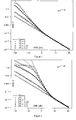
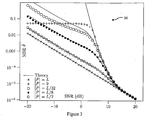
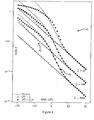
- the dots, squares, circles and crosses are the results of Monte-Carlo simulations with the least square estimator.
- the solid lines are the MSEs predicted based on a theoretical result not described here.
- Figures 1 to 3 each show that the estimator described herein, which exploits pilot symbols in addition to the unknown data symbols, significantly outperforms the non-coherent case (plus +) over a wide range of relevant signal to noise ratios.
- 256.
- where the sets P and D are disjoint, ie P ⁇ D ⁇ .
- the data symbols D are further separated into subsets according to the size of the constellation used to modulate each symbol.
- D 2 , D 3 ,... denote a partition of the indices in D such that D 2 is the set of indices corresponding to data symbols modulated with 2 -PSK (ie BSPK), and D 3 is the set of symbols modulated with 3 -PSK, and D 4 is the set of symbols modulated with 4 -PSK (ie QPSK) and so on.
- G be the set of integers for which D m is not empty, ie
- G ⁇ 2, 4 ⁇ and
- 2.
- Equation (6) Equivalent equations are derived by replacing M (single modulation scheme case) with m, where m corresponds to the respective modulation scheme used for a symbol (or equivalently adding a subscript M m to designate the appropriate modulation scheme for a symbol).
- the rounding in equations (11)(13)(12) is performed by rounding to the nearest multiple of 2 ⁇ / m where m is the modulation scheme for the symbol being rounded (ie the M -ary rounded phase offsets are each rounded with respect to corresponding modulation scheme for the symbol the phase offset is being calculated for).
- H ⁇ m ⁇ G m
- D m O L sequences in S , because there are m distinct values of d ⁇ i ( ⁇ ) .
- O ( L ).
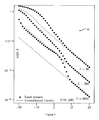
- Figure 5 shows plots 50 of the mean square error (MSE) of the phase estimator versus SNR for a system using multiple modulation schemes.
- the dots show the sample MSE of the least squares estimator.
- the dashed line is the sample MSE of the unmodulated carrier estimator, that is, the estimator that results when all symbols are known a-priory at the receiver, ie, all symbols are pilot symbol.
- Embodiments of a method for estimating the carrier phase and amplitude in a received signal, comprising a plurality of symbols modulated (or encoded), using one or more M -ary phase shift keying digital modulation schemes have been discussed.
- the method considers the case where the plurality of transmitted symbols comprises both a plurality of pilot symbols known to the receiver and a plurality of data symbols unknown to the receiver.
- Figure 6 illustrates a flow chart 600 of a method for estimating the carrier phase and amplitude in a received signal comprising a plurality of symbols modulated (or encoded) using one or more M -ary phase shift keying digital modulation schemes according to an embodiment.
- the method comprises the steps of:
- Embodiments of the above method provide an improved algorithm for optimal estimation (using a least squares estimator) of the carrier phase and amplitude which exploits knowledge of pilot symbols (indexed by P ) in addition to the unknown data portion of the received signal (indexed by D ) .
- the method may be implemented using the algorithms shown in Table 1 or 2.
- the M -ary rounded phase offset calculated in step 602 are calculated according to the appropriate modulation scheme for the symbol.
- Embodiments of the method utilise recursion to calculate (or computer) candidate estimates and only require O ( L log L ) arithmetic operations, where L is the number of received symbols and is thus an efficient estimation method.
- the plurality of candidate values of an objective function calculated in step 606 above correspond with a plurality of candidate estimates of the carrier phase and amplitude.
- calculating the candidate value of the objective function, and selecting an optimum value allows a corresponding optimum estimates of the carrier phase and amplitude to be obtained (ie calculated or determined).
- the determining step 608 is performed as the plurality of candidate values are calculated in step 606.
- corresponding candidate estimates (or values) of the carrier phase and amplitude (the complex amplitude) are calculated (or determined) and stored.
- the determining step 608 is performed after the calculation step 606.
- the plurality of candidate values are stored in a matrix, vector, tree, hash, or other data structure.
- the optimum value could then be obtained from the full set of candidate values, and he corresponding carrier phase and amplitude for this optimum value could then be determined.
- the corresponding carrier phase and amplitude for each of the plurality of candidate estimates could also be calculated and stored when they are calculated, and once the optimum candidate value is selected, the corresponding carrier phase and amplitude could be determined by looking up the corresponding stored values.
- the objective function may be a sum of squares function, eg (9), and the candidate sum of squares value may be obtained from calculating the full term or some other term from which the full term can be calculated such as Q (the non-constant or varying component in the full term), or even some term that is correlated with the full term, eg the term is proportional or functionally related to the full term to serve as a suitable proxy calculation.
- the optimum may be the minimum sum of squares value.
- a carrier phase and amplitude can be calculated for each candidate value and these can be associated in a memory with the candidate value. For example, in Table 1, as each improved optimum value of Q is obtained, the associated carrier phase and amplitude is also calculated (or estimated).
- or H
- the optimum value need not be a global optimum.
- the optimum value may simply be a good or acceptable value based on some threshold or criteria, such as an indication of convergence such as decreasing change between current and previous optimum values (ie further calculations are only likely to increase the precision and not the accuracy of the estimate of the optimum value).
- a receiver and an associated communication system which implement embodiments of the method described herein can also be provided.
- the communication system may be a wired or wireless communication system.
- Figure 7 is a block diagram 700 of a receiver which implements the above described algorithm.
- the receiver comprises a receiver module 710 and a processing module 720.
- the receiver module comprises a signal receiving module 702 such as input port in a wired implementation or an antenna in a wireless implementation.
- the receiver module 710 receives a transmitted signal and prepares the signal for signal processing tasks performed by the (baseband) processing module.
- the receiver module 710 (the RF front end in the case of RF wireless communications) comprises modules for performing tasks such as filtering and low noise amplification 712, down-conversion to baseband frequencies 714, automatic gain control (AGC) 716 and quantisation (eg using an Analog to Digital Converter or ADC) of the received signal 718 to produce a base band signal.
- the (baseband) processing module 720 receives the base band signal and performs a range of signal processing tasks to generate estimates of the transmitted bit stream.
- the baseband processing can be implemented in application specific integrated circuits (ASICs), digital signal processors (DSPs), digital signal processing devices (DSPDs), programmable logic devices (PLDs), field programmable gate arrays (FPGAs), processors, controllers, etc and comprises modules for performing time offset (delay) estimation 722, carrier phase and amplitude estimation 724, demodulation 726, and symbol decoding 728.
- ASICs application specific integrated circuits
- DSPs digital signal processors
- DSPDs digital signal processing devices
- PLDs programmable logic devices
- FPGAs field programmable gate arrays
- the carrier phase and amplitude estimation module is configured to implement embodiments of the method described herein, such as the algorithms shown in Table 1 and Table 2.
- the method is stored as instructions in a non-transitory processor readable medium (eg hard disk, Flash memory, optical disk (CDROM, DVD), etc) for causing a processor to implement the method.
- a processor readable medium eg hard disk, Flash memory, optical disk (CDROM, DVD), etc.
- the methods and receivers may be utilised in communication systems and components.
- processing may be implemented within one or more application specific integrated circuits (ASICs), digital signal processors (DSPs), digital signal processing devices (DSPDs), programmable logic devices (PLDs), field programmable gate arrays (FPGAs), processors, controllers, micro-controllers, microprocessors, other electronic units designed to perform the functions described herein, or a combination thereof.
- ASICs application specific integrated circuits
- DSPs digital signal processors
- DSPDs digital signal processing devices
- PLDs programmable logic devices
- FPGAs field programmable gate arrays
- processors controllers, micro-controllers, microprocessors, other electronic units designed to perform the functions described herein, or a combination thereof.
- a central processing unit may be used, containing an Input/Output Interface, an Arithmetic and Logic Unit (ALU) and a Control Unit and Program Counter element which is in communication with input and output devices or modules through the Input/Output Interface, and a memory.
- Software modules also known as computer programs, computer codes, or instructions, may contain a number a number of source code or object code segments or instructions, and may reside in any computer or processor readable medium such as a RAM memory, flash memory, ROM memory, EPROM memory, registers, hard disk, a removable disk, a CD-ROM, a DVD-ROM or any other form of computer readable medium.
- the computer readable medium may be integral to the processor.
- the processor and the computer readable medium may reside in an ASIC or related device.
- the software codes may be stored in a memory unit and executed by a processor.
- the memory unit may be implemented within the processor or external to the processor, in which case it can be communicatively coupled to the processor via various means as is known in the art.
Landscapes
- Engineering & Computer Science (AREA)
- Signal Processing (AREA)
- Computer Networks & Wireless Communication (AREA)
- Quality & Reliability (AREA)
- Digital Transmission Methods That Use Modulated Carrier Waves (AREA)
Applications Claiming Priority (2)
| Application Number | Priority Date | Filing Date | Title |
|---|---|---|---|
| AU2012905489A AU2012905489A0 (en) | 2012-12-14 | Carrier phase and amplitude estimation for phase shift keying using pilots and data | |
| PCT/AU2013/001464 WO2014089634A1 (en) | 2012-12-14 | 2013-12-13 | Carrier phase and amplitude estimation for phase shift keying using pilots and data |
Publications (3)
| Publication Number | Publication Date |
|---|---|
| EP2932672A1 EP2932672A1 (en) | 2015-10-21 |
| EP2932672A4 EP2932672A4 (en) | 2016-08-17 |
| EP2932672B1 true EP2932672B1 (en) | 2019-11-13 |
Family
ID=50933596
Family Applications (1)
| Application Number | Title | Priority Date | Filing Date |
|---|---|---|---|
| EP13862539.7A Active EP2932672B1 (en) | 2012-12-14 | 2013-12-13 | Carrier phase and amplitude estimation for phase shift keying using pilots and data |
Country Status (6)
| Country | Link |
|---|---|
| US (1) | US9491018B2 (cg-RX-API-DMAC7.html) |
| EP (1) | EP2932672B1 (cg-RX-API-DMAC7.html) |
| JP (1) | JP6159413B2 (cg-RX-API-DMAC7.html) |
| AU (1) | AU2013359957B2 (cg-RX-API-DMAC7.html) |
| CA (1) | CA2893307C (cg-RX-API-DMAC7.html) |
| WO (1) | WO2014089634A1 (cg-RX-API-DMAC7.html) |
Families Citing this family (1)
| Publication number | Priority date | Publication date | Assignee | Title |
|---|---|---|---|---|
| CN119316014B (zh) * | 2024-09-29 | 2025-10-28 | 北京慧清科技有限公司 | 一种高速跳频系统的盲相位估计方法及系统 |
Family Cites Families (6)
| Publication number | Priority date | Publication date | Assignee | Title |
|---|---|---|---|---|
| JPH0630066A (ja) * | 1992-07-10 | 1994-02-04 | Matsushita Electric Ind Co Ltd | データ復号装置 |
| JP3281527B2 (ja) * | 1996-01-17 | 2002-05-13 | 松下電器産業株式会社 | 周波数オフセット補償装置 |
| US5940446A (en) | 1997-04-28 | 1999-08-17 | Stanford Telecommunications, Inc. | Maximum likelihood detection of MPSK bursts with inserted reference symbols |
| JP2006211211A (ja) * | 2005-01-27 | 2006-08-10 | Matsushita Electric Ind Co Ltd | データ受信装置 |
| US7688918B2 (en) * | 2006-07-07 | 2010-03-30 | Alcatel-Lucent Usa Inc. | Recursive phase estimation for a phase-shift-keying receiver |
| JP5578601B2 (ja) * | 2009-11-05 | 2014-08-27 | 日本電気株式会社 | 搬送波再生回路、復調回路および搬送波再生方法 |
-
2013
- 2013-12-13 EP EP13862539.7A patent/EP2932672B1/en active Active
- 2013-12-13 AU AU2013359957A patent/AU2013359957B2/en active Active
- 2013-12-13 WO PCT/AU2013/001464 patent/WO2014089634A1/en not_active Ceased
- 2013-12-13 US US14/651,941 patent/US9491018B2/en active Active
- 2013-12-13 CA CA2893307A patent/CA2893307C/en active Active
- 2013-12-13 JP JP2015546776A patent/JP6159413B2/ja active Active
Non-Patent Citations (1)
| Title |
|---|
| None * |
Also Published As
| Publication number | Publication date |
|---|---|
| EP2932672A1 (en) | 2015-10-21 |
| AU2013359957A1 (en) | 2015-06-11 |
| WO2014089634A1 (en) | 2014-06-19 |
| CA2893307A1 (en) | 2014-06-19 |
| US20150312073A1 (en) | 2015-10-29 |
| JP2016506142A (ja) | 2016-02-25 |
| JP6159413B2 (ja) | 2017-07-05 |
| CA2893307C (en) | 2019-08-06 |
| AU2013359957B2 (en) | 2017-05-18 |
| EP2932672A4 (en) | 2016-08-17 |
| US9491018B2 (en) | 2016-11-08 |
Similar Documents
| Publication | Publication Date | Title |
|---|---|---|
| CN100588193C (zh) | 计算用于移动通信系统的接收机中的解码的对数似然比的方法和装置 | |
| US9137066B2 (en) | Method and apparatus for generating a metric for use in one or more of lock detection, SNR estimation, and modulation classification | |
| US7957474B2 (en) | Robust detection of packet types | |
| US7826521B1 (en) | Rate adaptation using error vector magnitude | |
| US8750089B2 (en) | Method and system for iterative discrete fourier transform (DFT) based channel estimation using minimum mean square error (MMSE) techniques | |
| US9031170B2 (en) | Channel frequency response estimator for a wireless RF channel | |
| KR20090115232A (ko) | 다중캐리어 변조 시스템들의 간섭을 완화하기 위한 방법 및 장치 | |
| US20090285276A1 (en) | Apparatus, method, and computer program product for demodulation | |
| KR102010562B1 (ko) | 무선 통신 시스템에서 주파수-직각 진폭 변조된 신호의 복호 매트릭 생성 방법 및 장치 | |
| US8644433B1 (en) | MIMO soft demodulation using hard-decision candidate selection | |
| EP2932672B1 (en) | Carrier phase and amplitude estimation for phase shift keying using pilots and data | |
| EP2362597A1 (en) | Process for performing log-likelihood-ratio clipping in a soft-decision near-ML detector, and detector for doing the same | |
| CN104067584A (zh) | 使用具有不明确性的串行局部化的解调器的度量校正 | |
| EP2680520B1 (en) | Method and apparatus for efficient MIMO reception with reduced complexity | |
| WO2011065878A1 (en) | Bit soft value normalization | |
| EP2555479A1 (en) | Apparatus and method for estimating a channel coefficient of a data subchannel of a radio channel | |
| EP3432496A1 (en) | Log-likelihood ratio calculation circuit, reception apparatus, and log-likelihood ratio calculation method | |
| EP2597835B1 (en) | MIMO decoding system | |
| CN103368895A (zh) | 信号检测方法以及信号接收装置 | |
| Ghodeswar et al. | Tenth Order Envelope Moment Based SNR Estimation Technique Using Newton-Raphson Method for AWGN and Rician Channels | |
| JP5478327B2 (ja) | モジュロ演算で生成された信号を送受信する無線通信システム、受信機、及び、復調方法 | |
| KR101371315B1 (ko) | 다중 입력 다중 출력 통신 시스템의 심볼 검파 방법 | |
| US20070030915A1 (en) | Receiver Block Providing Signal Quality Information in a Communication System with Signal Constellation not Having multiple Symbols in Same Angle | |
| US7844011B2 (en) | Apparatus and method for improving symbol error rate performance of M-ary phase shift keying system having quadrature error | |
| Teng et al. | Non-coherent detectors for quadrature-multiplexed continuous phase modulation signals |
Legal Events
| Date | Code | Title | Description |
|---|---|---|---|
| PUAI | Public reference made under article 153(3) epc to a published international application that has entered the european phase |
Free format text: ORIGINAL CODE: 0009012 |
|
| 17P | Request for examination filed |
Effective date: 20150605 |
|
| AK | Designated contracting states |
Kind code of ref document: A1 Designated state(s): AL AT BE BG CH CY CZ DE DK EE ES FI FR GB GR HR HU IE IS IT LI LT LU LV MC MK MT NL NO PL PT RO RS SE SI SK SM TR |
|
| AX | Request for extension of the european patent |
Extension state: BA ME |
|
| DAX | Request for extension of the european patent (deleted) | ||
| A4 | Supplementary search report drawn up and despatched |
Effective date: 20160715 |
|
| RIC1 | Information provided on ipc code assigned before grant |
Ipc: H04L 27/22 20060101ALI20160712BHEP Ipc: H04B 10/556 20130101ALI20160712BHEP Ipc: H04L 27/233 20060101ALI20160712BHEP Ipc: H04L 27/227 20060101ALI20160712BHEP Ipc: H04L 27/18 20060101AFI20160712BHEP |
|
| RAP1 | Party data changed (applicant data changed or rights of an application transferred) |
Owner name: MYRIOTA PTY LTD |
|
| STAA | Information on the status of an ep patent application or granted ep patent |
Free format text: STATUS: EXAMINATION IS IN PROGRESS |
|
| 17Q | First examination report despatched |
Effective date: 20190211 |
|
| RAP1 | Party data changed (applicant data changed or rights of an application transferred) |
Owner name: MYRIOTA PTY LTD |
|
| REG | Reference to a national code |
Ref country code: DE Ref legal event code: R079 Ref document number: 602013062977 Country of ref document: DE Free format text: PREVIOUS MAIN CLASS: H04L0027180000 Ipc: H04L0025030000 |
|
| GRAP | Despatch of communication of intention to grant a patent |
Free format text: ORIGINAL CODE: EPIDOSNIGR1 |
|
| STAA | Information on the status of an ep patent application or granted ep patent |
Free format text: STATUS: GRANT OF PATENT IS INTENDED |
|
| RIC1 | Information provided on ipc code assigned before grant |
Ipc: H04L 25/03 20060101AFI20190517BHEP Ipc: H04L 27/227 20060101ALI20190517BHEP Ipc: H04L 27/233 20060101ALI20190517BHEP |
|
| INTG | Intention to grant announced |
Effective date: 20190611 |
|
| GRAS | Grant fee paid |
Free format text: ORIGINAL CODE: EPIDOSNIGR3 |
|
| GRAA | (expected) grant |
Free format text: ORIGINAL CODE: 0009210 |
|
| STAA | Information on the status of an ep patent application or granted ep patent |
Free format text: STATUS: THE PATENT HAS BEEN GRANTED |
|
| AK | Designated contracting states |
Kind code of ref document: B1 Designated state(s): AL AT BE BG CH CY CZ DE DK EE ES FI FR GB GR HR HU IE IS IT LI LT LU LV MC MK MT NL NO PL PT RO RS SE SI SK SM TR |
|
| REG | Reference to a national code |
Ref country code: CH Ref legal event code: EP Ref country code: AT Ref legal event code: REF Ref document number: 1202852 Country of ref document: AT Kind code of ref document: T Effective date: 20191115 |
|
| RIN2 | Information on inventor provided after grant (corrected) |
Inventor name: COWLEY, WILLIAM GEORGE Inventor name: MCKILLIAM, ROBERT GEORGE Inventor name: POLLOK, ANDRE |
|
| REG | Reference to a national code |
Ref country code: DE Ref legal event code: R096 Ref document number: 602013062977 Country of ref document: DE |
|
| REG | Reference to a national code |
Ref country code: IE Ref legal event code: FG4D |
|
| REG | Reference to a national code |
Ref country code: NL Ref legal event code: FP |
|
| REG | Reference to a national code |
Ref country code: LT Ref legal event code: MG4D |
|
| PG25 | Lapsed in a contracting state [announced via postgrant information from national office to epo] |
Ref country code: LV Free format text: LAPSE BECAUSE OF FAILURE TO SUBMIT A TRANSLATION OF THE DESCRIPTION OR TO PAY THE FEE WITHIN THE PRESCRIBED TIME-LIMIT Effective date: 20191113 Ref country code: PT Free format text: LAPSE BECAUSE OF FAILURE TO SUBMIT A TRANSLATION OF THE DESCRIPTION OR TO PAY THE FEE WITHIN THE PRESCRIBED TIME-LIMIT Effective date: 20200313 Ref country code: BG Free format text: LAPSE BECAUSE OF FAILURE TO SUBMIT A TRANSLATION OF THE DESCRIPTION OR TO PAY THE FEE WITHIN THE PRESCRIBED TIME-LIMIT Effective date: 20200213 Ref country code: SE Free format text: LAPSE BECAUSE OF FAILURE TO SUBMIT A TRANSLATION OF THE DESCRIPTION OR TO PAY THE FEE WITHIN THE PRESCRIBED TIME-LIMIT Effective date: 20191113 Ref country code: FI Free format text: LAPSE BECAUSE OF FAILURE TO SUBMIT A TRANSLATION OF THE DESCRIPTION OR TO PAY THE FEE WITHIN THE PRESCRIBED TIME-LIMIT Effective date: 20191113 Ref country code: NO Free format text: LAPSE BECAUSE OF FAILURE TO SUBMIT A TRANSLATION OF THE DESCRIPTION OR TO PAY THE FEE WITHIN THE PRESCRIBED TIME-LIMIT Effective date: 20200213 Ref country code: GR Free format text: LAPSE BECAUSE OF FAILURE TO SUBMIT A TRANSLATION OF THE DESCRIPTION OR TO PAY THE FEE WITHIN THE PRESCRIBED TIME-LIMIT Effective date: 20200214 Ref country code: LT Free format text: LAPSE BECAUSE OF FAILURE TO SUBMIT A TRANSLATION OF THE DESCRIPTION OR TO PAY THE FEE WITHIN THE PRESCRIBED TIME-LIMIT Effective date: 20191113 Ref country code: PL Free format text: LAPSE BECAUSE OF FAILURE TO SUBMIT A TRANSLATION OF THE DESCRIPTION OR TO PAY THE FEE WITHIN THE PRESCRIBED TIME-LIMIT Effective date: 20191113 |
|
| PG25 | Lapsed in a contracting state [announced via postgrant information from national office to epo] |
Ref country code: HR Free format text: LAPSE BECAUSE OF FAILURE TO SUBMIT A TRANSLATION OF THE DESCRIPTION OR TO PAY THE FEE WITHIN THE PRESCRIBED TIME-LIMIT Effective date: 20191113 Ref country code: IS Free format text: LAPSE BECAUSE OF FAILURE TO SUBMIT A TRANSLATION OF THE DESCRIPTION OR TO PAY THE FEE WITHIN THE PRESCRIBED TIME-LIMIT Effective date: 20200313 Ref country code: RS Free format text: LAPSE BECAUSE OF FAILURE TO SUBMIT A TRANSLATION OF THE DESCRIPTION OR TO PAY THE FEE WITHIN THE PRESCRIBED TIME-LIMIT Effective date: 20191113 |
|
| PG25 | Lapsed in a contracting state [announced via postgrant information from national office to epo] |
Ref country code: AL Free format text: LAPSE BECAUSE OF FAILURE TO SUBMIT A TRANSLATION OF THE DESCRIPTION OR TO PAY THE FEE WITHIN THE PRESCRIBED TIME-LIMIT Effective date: 20191113 |
|
| PG25 | Lapsed in a contracting state [announced via postgrant information from national office to epo] |
Ref country code: RO Free format text: LAPSE BECAUSE OF FAILURE TO SUBMIT A TRANSLATION OF THE DESCRIPTION OR TO PAY THE FEE WITHIN THE PRESCRIBED TIME-LIMIT Effective date: 20191113 Ref country code: CZ Free format text: LAPSE BECAUSE OF FAILURE TO SUBMIT A TRANSLATION OF THE DESCRIPTION OR TO PAY THE FEE WITHIN THE PRESCRIBED TIME-LIMIT Effective date: 20191113 Ref country code: EE Free format text: LAPSE BECAUSE OF FAILURE TO SUBMIT A TRANSLATION OF THE DESCRIPTION OR TO PAY THE FEE WITHIN THE PRESCRIBED TIME-LIMIT Effective date: 20191113 Ref country code: ES Free format text: LAPSE BECAUSE OF FAILURE TO SUBMIT A TRANSLATION OF THE DESCRIPTION OR TO PAY THE FEE WITHIN THE PRESCRIBED TIME-LIMIT Effective date: 20191113 Ref country code: DK Free format text: LAPSE BECAUSE OF FAILURE TO SUBMIT A TRANSLATION OF THE DESCRIPTION OR TO PAY THE FEE WITHIN THE PRESCRIBED TIME-LIMIT Effective date: 20191113 |
|
| REG | Reference to a national code |
Ref country code: DE Ref legal event code: R097 Ref document number: 602013062977 Country of ref document: DE |
|
| REG | Reference to a national code |
Ref country code: AT Ref legal event code: MK05 Ref document number: 1202852 Country of ref document: AT Kind code of ref document: T Effective date: 20191113 |
|
| REG | Reference to a national code |
Ref country code: BE Ref legal event code: MM Effective date: 20191231 |
|
| PG25 | Lapsed in a contracting state [announced via postgrant information from national office to epo] |
Ref country code: SM Free format text: LAPSE BECAUSE OF FAILURE TO SUBMIT A TRANSLATION OF THE DESCRIPTION OR TO PAY THE FEE WITHIN THE PRESCRIBED TIME-LIMIT Effective date: 20191113 Ref country code: SK Free format text: LAPSE BECAUSE OF FAILURE TO SUBMIT A TRANSLATION OF THE DESCRIPTION OR TO PAY THE FEE WITHIN THE PRESCRIBED TIME-LIMIT Effective date: 20191113 Ref country code: MC Free format text: LAPSE BECAUSE OF FAILURE TO SUBMIT A TRANSLATION OF THE DESCRIPTION OR TO PAY THE FEE WITHIN THE PRESCRIBED TIME-LIMIT Effective date: 20191113 |
|
| PLBE | No opposition filed within time limit |
Free format text: ORIGINAL CODE: 0009261 |
|
| STAA | Information on the status of an ep patent application or granted ep patent |
Free format text: STATUS: NO OPPOSITION FILED WITHIN TIME LIMIT |
|
| 26N | No opposition filed |
Effective date: 20200814 |
|
| PG25 | Lapsed in a contracting state [announced via postgrant information from national office to epo] |
Ref country code: IE Free format text: LAPSE BECAUSE OF NON-PAYMENT OF DUE FEES Effective date: 20191213 |
|
| PG25 | Lapsed in a contracting state [announced via postgrant information from national office to epo] |
Ref country code: AT Free format text: LAPSE BECAUSE OF FAILURE TO SUBMIT A TRANSLATION OF THE DESCRIPTION OR TO PAY THE FEE WITHIN THE PRESCRIBED TIME-LIMIT Effective date: 20191113 Ref country code: BE Free format text: LAPSE BECAUSE OF NON-PAYMENT OF DUE FEES Effective date: 20191231 Ref country code: SI Free format text: LAPSE BECAUSE OF FAILURE TO SUBMIT A TRANSLATION OF THE DESCRIPTION OR TO PAY THE FEE WITHIN THE PRESCRIBED TIME-LIMIT Effective date: 20191113 |
|
| REG | Reference to a national code |
Ref country code: CH Ref legal event code: NV Representative=s name: VALIPAT S.A. C/O BOVARD SA NEUCHATEL, CH |
|
| PG25 | Lapsed in a contracting state [announced via postgrant information from national office to epo] |
Ref country code: IT Free format text: LAPSE BECAUSE OF FAILURE TO SUBMIT A TRANSLATION OF THE DESCRIPTION OR TO PAY THE FEE WITHIN THE PRESCRIBED TIME-LIMIT Effective date: 20191113 |
|
| PG25 | Lapsed in a contracting state [announced via postgrant information from national office to epo] |
Ref country code: CY Free format text: LAPSE BECAUSE OF FAILURE TO SUBMIT A TRANSLATION OF THE DESCRIPTION OR TO PAY THE FEE WITHIN THE PRESCRIBED TIME-LIMIT Effective date: 20191113 |
|
| PG25 | Lapsed in a contracting state [announced via postgrant information from national office to epo] |
Ref country code: MT Free format text: LAPSE BECAUSE OF FAILURE TO SUBMIT A TRANSLATION OF THE DESCRIPTION OR TO PAY THE FEE WITHIN THE PRESCRIBED TIME-LIMIT Effective date: 20191113 Ref country code: HU Free format text: LAPSE BECAUSE OF FAILURE TO SUBMIT A TRANSLATION OF THE DESCRIPTION OR TO PAY THE FEE WITHIN THE PRESCRIBED TIME-LIMIT; INVALID AB INITIO Effective date: 20131213 |
|
| PG25 | Lapsed in a contracting state [announced via postgrant information from national office to epo] |
Ref country code: TR Free format text: LAPSE BECAUSE OF FAILURE TO SUBMIT A TRANSLATION OF THE DESCRIPTION OR TO PAY THE FEE WITHIN THE PRESCRIBED TIME-LIMIT Effective date: 20191113 |
|
| PG25 | Lapsed in a contracting state [announced via postgrant information from national office to epo] |
Ref country code: MK Free format text: LAPSE BECAUSE OF FAILURE TO SUBMIT A TRANSLATION OF THE DESCRIPTION OR TO PAY THE FEE WITHIN THE PRESCRIBED TIME-LIMIT Effective date: 20191113 |
|
| PGFP | Annual fee paid to national office [announced via postgrant information from national office to epo] |
Ref country code: NL Payment date: 20241219 Year of fee payment: 12 Ref country code: LU Payment date: 20241219 Year of fee payment: 12 |
|
| PGFP | Annual fee paid to national office [announced via postgrant information from national office to epo] |
Ref country code: GB Payment date: 20241113 Year of fee payment: 12 |
|
| PGFP | Annual fee paid to national office [announced via postgrant information from national office to epo] |
Ref country code: FR Payment date: 20241223 Year of fee payment: 12 |
|
| PGFP | Annual fee paid to national office [announced via postgrant information from national office to epo] |
Ref country code: DE Payment date: 20241227 Year of fee payment: 12 |
|
| PGFP | Annual fee paid to national office [announced via postgrant information from national office to epo] |
Ref country code: CH Payment date: 20250122 Year of fee payment: 12 |
|
| REG | Reference to a national code |
Ref country code: CH Ref legal event code: U11 Free format text: ST27 STATUS EVENT CODE: U-0-0-U10-U11 (AS PROVIDED BY THE NATIONAL OFFICE) Effective date: 20260101 |