EP2931740B1 - Dérivés de testostérone avec une substitution carboxyalkyle en position 3 et leur utilitisation pour la production des stéroïdes marqués pour la détermination de la concentration de testostérone dans un échantillon biologique - Google Patents
Dérivés de testostérone avec une substitution carboxyalkyle en position 3 et leur utilitisation pour la production des stéroïdes marqués pour la détermination de la concentration de testostérone dans un échantillon biologique Download PDFInfo
- Publication number
- EP2931740B1 EP2931740B1 EP13820805.3A EP13820805A EP2931740B1 EP 2931740 B1 EP2931740 B1 EP 2931740B1 EP 13820805 A EP13820805 A EP 13820805A EP 2931740 B1 EP2931740 B1 EP 2931740B1
- Authority
- EP
- European Patent Office
- Prior art keywords
- formula
- compound
- reacting
- testosterone
- solvent
- Prior art date
- Legal status (The legal status is an assumption and is not a legal conclusion. Google has not performed a legal analysis and makes no representation as to the accuracy of the status listed.)
- Active
Links
- 0 ON(C(CC1*=I)=O)C1=O Chemical compound ON(C(CC1*=I)=O)C1=O 0.000 description 11
- UPBHDNBADOAHCA-ZUNBRJIESA-N CC(CC1)(C(CC2)C(CC3)C1C(C)(CC1)C3=C[C@H]1O)C2OC(C)=O Chemical compound CC(CC1)(C(CC2)C(CC3)C1C(C)(CC1)C3=C[C@H]1O)C2OC(C)=O UPBHDNBADOAHCA-ZUNBRJIESA-N 0.000 description 3
- GYGSVUKADCSBAO-HFMUPVQQSA-N CC(CC1)(C(CC2)C(CC3)C1C(C)(CC1)C3=C[C@H]1OCC(O)=O)C2O Chemical compound CC(CC1)(C(CC2)C(CC3)C1C(C)(CC1)C3=C[C@H]1OCC(O)=O)C2O GYGSVUKADCSBAO-HFMUPVQQSA-N 0.000 description 2
- BNUHAJGCKIQFGE-UHFFFAOYSA-N COc(cc1)ccc1[N+]([O-])=O Chemical compound COc(cc1)ccc1[N+]([O-])=O BNUHAJGCKIQFGE-UHFFFAOYSA-N 0.000 description 2
- NQTADLQHYWFPDB-UHFFFAOYSA-N ON(C(CC1)=O)C1=O Chemical compound ON(C(CC1)=O)C1=O NQTADLQHYWFPDB-UHFFFAOYSA-N 0.000 description 2
- MXQAOGZQWVPBIE-UHFFFAOYSA-N CC(CC1)(C(CC2)C(CC3)C1C(C)(CC1)C3=CC1/C=[O]\CC(O)=O)C2O Chemical compound CC(CC1)(C(CC2)C(CC3)C1C(C)(CC1)C3=CC1/C=[O]\CC(O)=O)C2O MXQAOGZQWVPBIE-UHFFFAOYSA-N 0.000 description 1
- JDFXJJLFADUZIY-UHFFFAOYSA-N CON(C(CC1)=O)C1=O Chemical compound CON(C(CC1)=O)C1=O JDFXJJLFADUZIY-UHFFFAOYSA-N 0.000 description 1
- SLPGHCLHCTXMKA-UHFFFAOYSA-N CON(C(CC1[S]([Na])(=O)(=O)=O)=O)C1=O Chemical compound CON(C(CC1[S]([Na])(=O)(=O)=O)=O)C1=O SLPGHCLHCTXMKA-UHFFFAOYSA-N 0.000 description 1
- ZRQUIRABLIQJRI-UHFFFAOYSA-N COc(c(F)c(c(F)c1F)F)c1F Chemical compound COc(c(F)c(c(F)c1F)F)c1F ZRQUIRABLIQJRI-UHFFFAOYSA-N 0.000 description 1
- CFBYEGUGFPZCNF-UHFFFAOYSA-N COc(cccc1)c1[N+]([O-])=O Chemical compound COc(cccc1)c1[N+]([O-])=O CFBYEGUGFPZCNF-UHFFFAOYSA-N 0.000 description 1
- IZARLLKMNDBURC-UHFFFAOYSA-N C[N+](C(CC1CON(C(CC2[S]([Na])(=O)(=O)=O)=O)C2=O)=O)(C1=O)[O-] Chemical compound C[N+](C(CC1CON(C(CC2[S]([Na])(=O)(=O)=O)=O)C2=O)=O)(C1=O)[O-] IZARLLKMNDBURC-UHFFFAOYSA-N 0.000 description 1
- GEXVFZLVSITTRO-UHFFFAOYSA-N [O-][N+](C(C=C1)=CCC1O)=O Chemical compound [O-][N+](C(C=C1)=CCC1O)=O GEXVFZLVSITTRO-UHFFFAOYSA-N 0.000 description 1
Images
Classifications
-
- C—CHEMISTRY; METALLURGY
- C07—ORGANIC CHEMISTRY
- C07J—STEROIDS
- C07J1/00—Normal steroids containing carbon, hydrogen, halogen or oxygen, not substituted in position 17 beta by a carbon atom, e.g. estrane, androstane
- C07J1/0003—Androstane derivatives
- C07J1/0018—Androstane derivatives substituted in position 17 beta, not substituted in position 17 alfa
- C07J1/0022—Androstane derivatives substituted in position 17 beta, not substituted in position 17 alfa the substituent being an OH group free esterified or etherified
-
- C—CHEMISTRY; METALLURGY
- C07—ORGANIC CHEMISTRY
- C07J—STEROIDS
- C07J41/00—Normal steroids containing one or more nitrogen atoms not belonging to a hetero ring
- C07J41/0033—Normal steroids containing one or more nitrogen atoms not belonging to a hetero ring not covered by C07J41/0005
- C07J41/0038—Normal steroids containing one or more nitrogen atoms not belonging to a hetero ring not covered by C07J41/0005 with an androstane skeleton, including 18- or 19-substituted derivatives, 18-nor derivatives and also derivatives where position 17-beta is substituted by a carbon atom not directly bonded to a further carbon atom and not being part of an amide group
-
- C—CHEMISTRY; METALLURGY
- C07—ORGANIC CHEMISTRY
- C07J—STEROIDS
- C07J43/00—Normal steroids having a nitrogen-containing hetero ring spiro-condensed or not condensed with the cyclopenta(a)hydrophenanthrene skeleton
- C07J43/003—Normal steroids having a nitrogen-containing hetero ring spiro-condensed or not condensed with the cyclopenta(a)hydrophenanthrene skeleton not condensed
-
- C—CHEMISTRY; METALLURGY
- C07—ORGANIC CHEMISTRY
- C07J—STEROIDS
- C07J51/00—Normal steroids with unmodified cyclopenta(a)hydrophenanthrene skeleton not provided for in groups C07J1/00 - C07J43/00
-
- G—PHYSICS
- G01—MEASURING; TESTING
- G01N—INVESTIGATING OR ANALYSING MATERIALS BY DETERMINING THEIR CHEMICAL OR PHYSICAL PROPERTIES
- G01N33/00—Investigating or analysing materials by specific methods not covered by groups G01N1/00 - G01N31/00
- G01N33/48—Biological material, e.g. blood, urine; Haemocytometers
- G01N33/50—Chemical analysis of biological material, e.g. blood, urine; Testing involving biospecific ligand binding methods; Immunological testing
- G01N33/74—Chemical analysis of biological material, e.g. blood, urine; Testing involving biospecific ligand binding methods; Immunological testing involving hormones or other non-cytokine intercellular protein regulatory factors such as growth factors, including receptors to hormones and growth factors
Definitions
- the present invention relates to the field of detection of testosterone in a biological sample.
- it relates to novel testosterone-derived compounds particularly useful in immunoassays, to a process for their preparation, and to their use for the determination of testosterone.
- Androgen 17 ⁇ -hydroxyandrost-4-en-3-one commonly known as testosterone, is the main androgen hormone in humans. It is secreted by Leydig cells in the testes, under the influence of a pituitary hormone: LH (Luteinizing hormone).
- Testosterone circulates largely linked to transport proteins, mainly SHBG (Sex Hormone-Binding Globulin) and albumin. Free testosterone accounts for 1 to 2% of total testosterone (Litwack G., 1992).
- testosterone acts on spermatogenesis, on the maturation of the external genitalia, on secondary sexual characteristics (beard, pubic and axillary hair) and on protein anabolism.
- the assay of testosterone in humans makes it possible to evaluate the testicular steroidogenic function.
- a serum testosterone level above 3.2 ng / mL is considered normal, a rate below 2 ng / mL can be used to diagnose hypogonadism or feminization of the body.
- the upper limit of normal values in humans is 8-9 ng / mL.
- testosterone is secreted in small amounts by the ovaries and the adrenal glands. It comes mainly from the peripheral conversion of precursors (especially androstenedione). Thus, the testosterone dosage in women can explore the androgen secretion. High levels of testosterone may be related to polycystic ovarian syndrome, ovarian or adrenal tumor, adrenal hyperplasia or idiopathic hirsutism.
- Immunoassay methods also known as immunoassays or immunochemical tests, involve immunological reactions between the analyte to be detected, testosterone, and at least one first compound that is a binding partner to that analyte. Since the assay of testosterone is by competition, the process also involves another compound that competes with the testosterone to be assayed, which is a testosterone derivative. One of the two compounds will be then marked for viewing. This labeled compound will be referred to as the labeled conjugate.
- the term "immuno" in "immunoassay” for example is not to be considered in the present application as strictly indicating that the binding partner is an immunological partner, such as an antibody. Indeed, those skilled in the art also use this term widely when the binding partner, also called a ligand, is not an immunological partner but is for example a receptor for the analyte that is to be assayed.
- the Applicant has found, unexpectedly, new testosterone derivatives which make it possible to overcome the drawbacks of the immunoassays of the prior art in the sense that their use in a competitive immunoassay, especially as a tracer, made it possible to have a highly sensitive assay and particularly in the lower ranges of testosterone, and whose preparation is easy.
- an object of the invention relates to compounds derived from testosterone of general formula (I) below: wherein n is an integer from 1 to 10 and Y represents an activated or ready-to-activate coupling moiety which allows the formation of an amide linkage with a primary amine of a molecule.
- Another subject of the invention comprises a conjugate comprising or consisting of a testosterone derivative of formula (I) as described above and a marker, as well as a kit comprising such compounds.
- Another subject of the invention comprises the use of said conjugate in an immunoassay method for testosterone, in particular as a tracer.
- a last object relates to a process for preparing said testosterone derivatives.
- the present invention therefore relates to the compounds of formula (I) as described above, which are particularly useful for a competition immunoassay, and in particular for the preparation of tracer.
- the Applicant has unexpectedly found that the modification of testosterone in position 3, by reducing the carbonyl hydroxyl and introduction of an arm, allowed to give a derivative of testosterone not being in the form of isomeric mixture and being particularly advantageous when used in a testosterone assay, and especially as a tracer, in that the testosterone assay is particularly sensitive and can detect low testosterone concentrations.
- testosterone, estradiol, estrone and androstenedione differ from each other only by the presence of a hydroxyl or ketone function in positions 3 and 17, as well as by the presence or absence of a methyl group in position 10, as shown below:
- the compounds of formula (I) of the invention despite the modification of the basic chemical structure of testosterone, because of the reduction of the carbonyl hydroxyl position 3 and therefore its structural similarity in the functional group in this position with estradiol, analyte that one does not want to assay, are particularly well suited for their use for the assay of testosterone.
- n is an integer between 1 and 10 and Y represents a coupling group activated or ready to be activated which allows the formation of an amide bond with a primary amine of a molecule.
- n is between 1 and 5 and preferably between 1 and 3. According to a particular embodiment, n is 1.
- the molecules which can be coupled with the testosterone derivatives of the invention are any molecules which naturally have a primary amine, such as a protein, or any molecules which have been chemically modified to include such a primary amine, for example a modified biotin having a primary amine.
- coupling group activated or ready to be activated means a suitable functional group, if appropriate after activation, to allow the coupling of the testosterone derivative of the invention with the primary amine functional group of the coupling molecule.
- This group may also be called a leaving group because it will no longer exist in the conjugate formed between the testosterone derivative and the primary amine molecule.
- This leaving group will thus be dissociated from the rest of the molecule during the nucleophilic substitution reaction with the nucleophilic primary amine group of the coupling molecule of interest.
- the leaving group will be directly dissociated when it is said already activated, or it will be dissociated only after activation when it is said ready to be activated.
- Activated coupling group therefore means a group that can form an amide bond directly, without this group needs to be modified.
- m is an integer, preferably between 1 and 10, which constitutes an embodiment of the invention.
- m is between 1 and 5, or between 1 and 3.
- Y is chosen from -OH, -NH- (CH 2 ) m -COOH, and m being between 1 and 10 and preferably being 1.
- the compounds which are particularly suitable for the determination of testosterone, and in particular for the preparation of tracer, are the stereochemically pure compounds ( ⁇ or ⁇ isomers) and that at the level of the carbon in position 3, since there is no longer any double bond in position 3, as in testosterone.
- the stereochemically pure compounds ( ⁇ isomers or ⁇ ) at carbon 3 are advantageous in that they are more reproducible, of better quality, and that the dosage in which they are used is more robust.
- the testosterone derivatives of the invention of formula (I) in the form of ⁇ isomer in the 3-position are represented by the following formula (I ⁇ ): Y and n being as previously described.
- the testosterone derivatives of the invention of formula (I) in the form of the ⁇ isomer in position 3 are represented by the following formula (I ⁇ ): Y and n being as previously described
- the bond between the carbon at the 3-position and the oxygen atom of the arm represented as a straight segment as follows: , includes both a ⁇ -type bond and an ⁇ -type bond.
- the compounds of the invention can be used in two ways in testosterone assay methods by competitive immunoassay, such as diagnostic tests. Either they are used as is, or they are used coupled to another molecule to form a conjugate. Said other molecule is either a marker, a chemical arm or "linker", or a chemical compound whose coupling with a testosterone derivative is of interest for the implementation of a testosterone assay by competitive immunoassay.
- the present invention also relates to conjugates comprising or consisting of a testosterone derivative as described above and another molecule, in particular a marker or a chemical arm.
- Indirect detection systems can also be used, such as, for example, ligands capable of reacting with an anti-ligand.
- the ligand then corresponds to the marker to constitute, with the testosterone derivative, the conjugate of the invention.
- ligand / anti-ligand pairs are well known to those skilled in the art, which is the case, for example, of the following pairs: biotin / streptavidin, hapten / antibody, antigen / antibody, peptide / antibody, sugar / lectin, polynucleotide / complementary polynucleotide.
- the anti-ligand can then be detectable directly by the direct detection markers described above or be itself detectable by another ligand / anti-ligand pair, and so on.
- reagents allowing the visualization of the marking or the emission of a detectable signal by any type of suitable measuring device such as a spectrophotometer, a spectrofluorometer or a high definition camera.
- linker any molecule containing a primary amine group, directly without chemical modification, or after chemical modification to include such a group, which molecule is capable of binding to a solid phase, covalently or non-covalently. covalently, selectively or non-selectively.
- the testosterone derivatives or conjugates of the invention are particularly useful for the in vitro determination of the testosterone concentration in a biological sample, which constitutes a further object of the invention.
- the biological sample in which the process of the invention may be carried out is any animal biological sample, preferably a human sample, which may contain testosterone, in which an immunoassay may be carried out.
- animal biological sample preferably a human sample, which may contain testosterone, in which an immunoassay may be carried out.
- the samples used in the assay process may be modified beforehand or not before their use.
- biological fluids such as whole blood, urine, cerebrospinal fluid, seminal fluid, semen, leucorrhea (vaginal secretions), cervical mucus, cervicovaginal lavage, rectal lavage. , saliva, bronchoalveolar lavage and amniotic fluid.
- a previously modified sample also called a sample derivative
- serum, plasma, cells that are recovered from a biopsy or following surgery and which are in vitro culture The assay of the testosterone concentration can then be carried out in the culture supernatant or in the cell lysate.
- the competitive immunoassay is a dosage widely known to those skilled in the art. It consists in measuring the analyte, here testosterone, in the sample, by creating a competition between the analyte of the sample and a derivative of this analyte, here the testosterone derivative. The immunological reaction is then evidenced by the presence of a tracer.
- the analyte derivative can be used in the competition reaction, as previously indicated, without prior coupling or after coupling to a label to form a conjugate or tracer.
- the immunoassay also requires the use of a testosterone binding partner to which the analyte derivative and the analyte compete.
- the binding partner is then labeled to constitute the tracer of the reaction.
- the binding partner is coupled to a marker (it is then the tracer), the binding partner then becomes the capture partner.
- the measured signal emitted by the tracer is then inversely proportional to the amount of testosterone in the sample.
- a testosterone binding partner is meant any molecule capable of binding to testosterone.
- a testosterone binding partner mention may be made of antibodies, antibody fractions, nanofitins, testosterone receptors or any other protein which is known to have an interaction with testosterone, as for example by example the SHBG.
- the binding partner antibodies are, for example, either polyclonal antibodies or monoclonal antibodies.
- the polyclonal antibodies can be obtained by immunization of an animal with target testosterone as immunogen, followed by the recovery of the desired antibodies in purified form, by removal of the serum of said animal, and separation of said antibodies from other constituents of the serum, in particular by affinity chromatography on a column on which is fixed an antigen specifically recognized by the antibodies, in particular the immunogen.
- the monoclonal antibodies can be obtained by the hybridoma technique widely known to those skilled in the art.
- the monoclonal antibodies can also be recombinant antibodies obtained by genetic engineering, by techniques well known to those skilled in the art.
- antibody fragments By way of example of antibody fragments, mention may be made of the Fab, Fab ', F (ab') 2 fragments as well as the scFv (single chain variable fragment) and dsFv (double-stranded variable fragment) chains. These functional fragments can in particular be obtained by genetic engineering.
- Nanofitins are small proteins that, like antibodies, are able to bind to a biological target that can detect, capture or simply target within an organism.
- the binding partners used may or may not be specific to testosterone. They are said to be specific when they are able to bind exclusively or almost exclusively to testosterone. They are said to be nonspecific when the testosterone binding selectivity is low and they are then able to bind to other ligands, such as other proteins or antibodies. According to a preferred embodiment, the specific binding partners are preferred.
- Binding partners or testosterone derivatives when used in capture, may or may not be bound to a support by any technique widely known to those skilled in the art.
- the second step b) of the process of the invention is a conventional step of a competition assay method.
- the last step c) of the process of the invention consists in determining the testosterone concentration.
- the measured signal is inversely proportional to the amount of testosterone in the sample.
- the signal is compared with a calibration curve obtained beforehand by techniques widely known to those skilled in the art.
- the calibration curve is obtained by performing an immunoassay using the same binding partner as well as increasing amounts of testosterone. A curve is thus obtained by placing the testosterone concentration on the abscissa and on the ordinate the corresponding signal obtained after immunoassay.
- the signal is obtained through labeling by the marker as described above.
- the signal consists of the direct reading of the partner bond testosterone derivative / derivative, which can be done for example by surface plasmon resonance or cyclic voltammetry.
- the testosterone derivatives or conjugates of the invention as described above are incorporated into a diagnostic kit, which constitutes a further object of the invention.
- the kit may comprise other constituents necessary for carrying out the immunoassay, such as, for example, at least one binding partner, a calibration means, washing buffers and reagents allowing the visualization of the immunoassay. marking or the emission of a detectable signal.
- the testosterone derivatives have been prepared by particular methods for synthesizing compounds which are either pure isomers ⁇ or pure isomers ⁇ . These methods are new and constitute another object of the invention.
- the compound of formula (Ia) is in fact a testosterone derivative of formula (I) in which Y is the -OH group.
- This testosterone derivative may be in the form of the ⁇ isomer at the 3-position; he then has the following formula (Ia ⁇ ): n being as defined above.
- the testosterone derivative of formula (I) in which Y is -OH may also be in the form of the ⁇ isomer at the 3-position; he then has the following formula (Ia ⁇ ): wherein n is as previously described.
- reducing agents that can be used herein are any reducing agent known to those skilled in the art for stereoselectively reducing a carbonyl to hydroxyl.
- the solvents that can be used here are all solvents that make it possible to have a reaction that reverses the stereochemistry of the hydroxyl.
- the bases that can be used here are all mineral bases that allow saponification for the return to an -OH group.
- the latter may be, for example, dicyclohexylcarbodiimide or 1-ethyl-3- (3-dimethylaminopropyl) carbodiimide.
- Alkyls and aryls are groups known to those skilled in the art. Non-limiting examples of alkyl groups that may be mentioned include methyl, ethyl, propyl, isopropyl, butyl, t-butyl and pentyl. As a non-limiting example of an aryl group, mention may be made of phenyl, benzyl, tolyl, xylyl, benzylidene, benzoyl and naphthyl.
- the carbodiimide derivative used in this process is as defined above.
- the preparation of the conjugates of the invention is carried out by any technique known to those skilled in the art for forming an amide bond between the compounds of formula (I) and a primary amine in another molecule, as described especially in Wong SS, 1991.
- TLC Thin-layer chromatography
- control is carried out on the Merck silica gel plate (type 60, F254, thickness 0.2 mm) visualized by means of a UV lamp. 254 nm and heat-exposed after sputtering 5% phosphomolybdic acid in ethanol (95%).
- Purification of the products is carried out by Merck silica gel flash chromatography, 40-63 ⁇ m, pH 6.5 to 7.5.
- the NMR spectra are recorded on the Bruker Avance 250 apparatus.
- TMS tetramethylsilane
- the IR spectra are recorded on the Thermo-Nicolet FT-IR Avatar 360 and the Golden Gate option is used.
- LC-MS analyzes are performed with LC-MS PE-Sciex API 100, column C 4 .
- the dry reaction solvent dichloromethane (CH 2 Cl 2 ) is prepared by distillation of 250 ml of CH 2 Cl 2 over 5 g of phosphorus pentoxide (P 2 O 5 ).
- a solution of 0.5 ml (4.8 mmol) of N 2 CHCOO and in 2 ml of dry dichloromethane is introduced into the tricol by the dropping funnel for 10 min at room temperature.
- 20 ml of distilled water and 20 ml of dichloromethane are poured and the mixture is stirred for 10 min.
- the phases are separated and the aqueous phase is extracted with 2x20 ml of dichloromethane.
- the organic phases are combined, dried over anhydrous MgSO 4 and evaporated to dryness using a rotary evaporator at 25 ° C. to give the crude product as a yellow oil.
- N-hydroxysuccinimide HOSu, 247.7 mg, 2.15 mmol
- DCC 1,3-dicyclohexylcarbodiimide
- a solution of sodium bicarbonate (1.0N NaHCO 3 , 10 ml) and 1.0 ml of tert-butyl glycine ester product (H 2 NCH 2 COOBu t ) are added to the filtrate.
- the mixture formed is stirred at room temperature for 12 hours.
- 70 ml of distilled water and 50 ml of ethyl acetate are mixed with the reaction medium.
- the phases are decanted and the phase is extracted with ethyl acetate (3 ⁇ 50 ml).
- the combined organic solution is dried over anhydrous MgSO 4 and then evaporated using a rotary evaporator at 30 ° C.
- the aqueous phase is extracted with ethyl ether (3x100 ml).
- the combined organic solution is dried over anhydrous MgSO 4 and evaporated.
- the residue obtained is purified with a chromatographic column of silica gel (eluent: ethyl acetate / petroleum ether, 1/6, v / v) for give 3.2 g of product which is directly used for the continuation of the synthesis.
- the reaction medium is neutralized with hydrochloric acid (HCl, 1.0 N) at pH 6 and evaporated to dryness at room temperature under reduced pressure.
- the crude product thus formed is purified on a chromatographic column of silica gel (eluent: chloroform / methanol, 4/1, v / v). 950 mg of the product (Ia ⁇ ) are obtained.
- the filtrate is evaporated at 25 ° C using a rotary evaporator.
- the residue is vacuum pump dried, washed with 5 ml of anhydrous hexane and dried under reduced pressure. 86 mg (66.5%, purity: 90% by HPLC) of the testosterone derivative (I ⁇ ) are obtained.
- 0.3 mL of a 20 mg / mL recombinant alkaline phosphatase (ALP) solution (Roche, Ref 03-535-452) are dialyzed in Spectra / Por® gut (cut-off point 6000-8000 Da, Spectrum Laboratories, USA) against 300 ml of 50 mM borate buffer pH 7.6, with magnetic stirring, overnight at 2-8 ° C.
- concentration of the protein is determined by reading the optical density at 280 nm and this concentration is adjusted to 8 mg / ml.
- the 17- ⁇ -hydroxy-3- ⁇ -carboxymethoxyandrost-4-ene-N-hydroxysuccinimide (or NHS) ester obtained in Example 2 is taken up in dimethylformamide (DMF) at a concentration of 1 mg / ml.
- DMF dimethylformamide
- the reaction is blocked by the addition of 1 mM lysine diluted in water.
- the amount of lysine added is equimolar to the amount of ester used for coupling.
- 68 ⁇ L of the lysine solution for the type (1-3) coupling and 112 ⁇ L for the type (1-5) coupling are therefore added.
- the mixtures are incubated for 20 minutes on a wheel at 18/25 ° C.
- the conjugates are dialyzed Spectra / Por® gut (cutoff threshold about 7000 Da) for 1 hour at 18/25 ° C against 250 ml of Tris buffer 50 mM pH 7.4, NaCl 9 g / L , 5 mM MgCl 2 , 0.1 mM ZnCl 2 , azide 0.9 g / L, with magnetic stirring. After 1 hour, the casings are transferred to new baths still containing 250 ml of the same buffer. Dialysis is continued overnight at 2/8 ° C with magnetic stirring.
- the volume of the conjugates is supplemented to 1 ml with dialysis buffer.
- the conjugates are then purified by hydrophobic interaction chromatography using a RESOURCE Phenyl column (Cat No. 17-1186-01, GE Healthcare Lifesciences) mounted on a chromatography chain. ⁇ KTA.
- the flow rate of the pump is set at 0.5 ml / min.
- Buffer TA is 50 mM Tris pH 7.4, NaCl 9 g / L, 5 mM MgCl 2 , 0.1 mM ZnCl 2 , 0.9 g / L azide, (NH 4 ) 2 SO 4 0.8M.
- the TB buffer is 50 mM Tris pH 7.4, NaCl 9 g / L, 5 mM MgCl 2 , 0.1 mM ZnCl 2 , azide 0.9 g / L, this is the dialysis buffer.
- the RESOURCE Phenyl column is balanced in TA buffer.
- the conjugate to be purified is mixed volume for volume (475 ⁇ L conjugate and 475 ⁇ L buffer) with 50 mM Tris buffer pH 7.4, NaCl 9 g / L, 5 mM MgCl 2 , 0.1 mM ZnCl 2 , azide O, 9 g / L, (NH 4 ) 2 SO 4 1.6 M.
- This step makes it possible to have the conjugate in the buffer TA. Injection of the conjugate is followed by a wash of 30 mL in TA buffer. Then a 0 to 100% gradient of TB is applied for 30 mL followed by a TB buffer wash for 10 mL and a water wash for 10 mL.
- VIDAS® kit bioMérieux testosterone assay (Cat No. 30418) was used as a reference immunoassay, it is a commercial kit with a CE mark. This dosage is described in the package leaflet ref. 09345 F-en-2010/08 and it is carried out using the VIDAS® immunoassay automaton.
- the disposable cone serves both as a solid phase for the reaction and as a pipetting system.
- the cartridge is composed of 10 wells covered with a sealed and labeled aluminum foil.
- the first well has a pre-cut portion to facilitate the introduction of the sample.
- the last well is an optical bowl in which fluorescence of the substrate is measured.
- the different reagents necessary for the analysis are contained in the intermediate wells.
- the cone contained in the VIDAS® kit of the testosterone assay was sensitized by a sheep polyclonal anti-rabbit IgG antibody and then by a polyclonal anti-testosterone rabbit antibody.
- the surface is passivated and is ready for use.
- the sample to be assayed is introduced into the first well of the cartridge. Then all the steps of the dosing reaction are performed automatically by the VIDAS® analyzer.
- the sample to be assayed is mixed with the conjugate, which is a testosterone derivative labeled with alkaline phosphatase, but whose position 3 is not modified as in the present invention.
- This conjugate "Conjugate VIDAS®” or Conjugate of the prior art will be referred to.
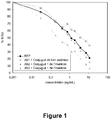
- the B / B0 ratio is the signal obtained for the tested range point divided by the signal obtained for the 0.001 ng / mL range of testosterone, multiplied by 100.
- the B / B0% ratio values are represented on the Figure 1 by a graph which gives these values as a function of the logarithm of the concentration of the points of the standard range for each format, namely two formats using a conjugate of the prior art ((i) REF which is the reference dosage of the prior art which corresponds to the commercial kit VIDAS® assay of testosterone (bioMérieux, Cat No. 30418), and (ii) Ab1 + Conjugate VIDAS®), and two formats using conjugate 1 of the invention (Ab2 + Conjugate 1 of the invention, and Ab3 + Conjugate 1 of the invention).
- the graph on the Figure 1 shows that the two most sensitive assay formats are those using the conjugate of the invention.
- the most sensitive test format is the format associating the antibody Ab3 and Conjugate 1 of the invention.
- a decrease of the signal of 50% is observed as of approximately 0.2 ng / ml of testosterone.
- the format associating the antibody Ab2 and the Conjugate 1 of the invention, as well as the reference dosage on VIDAS® it takes about 1 ng / mL of testosterone to reach a ratio B / B0 of 50%.
- the Ab2 + Conjugate 1 format of the invention is slightly more sensitive than the reference format.
- the format Ab1 + Conjugate VIDAS® it takes 3.82 ng / mL of testosterone to reach 50%. This is the least sensitive format.
- the molecule here will be abbreviated testosterone-3 ⁇ -EMC-DAP-biotin, DAP being diaminopropyl and has the following formula.
- the reaction medium is dried at room temperature under reduced pressure.
- the residue obtained is purified by chromatography on silica gel 60 (0.040-0.063 mm, Merck Cat No. 109385) with the eluent: dichloromethane / methanol, 8/1, v / v to begin with and dichloromethane methanol, 5/1. , v / v to finish the purification. 125 mg of product are obtained, which corresponds to a yield of 82%.
- Testosterone-3 ⁇ -EMC-DAP-biotin is a white powder ..
- the product is analyzed by high pressure liquid chromatography (HPLC).
- HPLC high pressure liquid chromatography
- the column used is a Thermokromasil C18, 150x4.6 mm and the eluent is a mixture of acetonitrile, water (0.1% trifluoroacetic acid) gradient. Chromatography is followed by measuring the absorbance at 214 nm. The purity of the product thus estimated is 90.1%.
- a 96-well microplate (Nunc Maxisorp F96) are dispensed 100 .mu.l / well of the goat anti-Fc IgG mouse monoclonal antibody (clone 9A4A5, bioMérieux) diluted to 10 .mu.g / ml in 1x PBS buffer. The microplate is incubated overnight at room temperature to obtain adsorption of the antibody. The microplate is emptied, then 300 ⁇ l / well of passivation buffer (0.2 M Tris buffer, pH 6.2) containing a protein or peptide saturation agent, and the monoclonal sheep anti-testosterone antibody cloned 3.6A3.
- passivation buffer 0.2 M Tris buffer, pH 6.2
- the reaction with the conjugate is carried out for 15 minutes at 37 ° C, followed by 3 washes.
- 100 uL / well of streptavidin-peroxidase solution (Jackson Imunoresearch Cat. No. 016-30-084) diluted 1 / 20,000 in TBS-Tween ® -20 0.05%., 2% BSA are added and the Microplate is incubated for 30 min at 37 ° C.
- 100 ⁇ L / well of the TMB 1-step Ultra substrate (Thermo Scientific, Cat No. 34028) is added and the microplate is incubated for 5 min at room temperature, protected from light.
- the reaction is then stopped by adding 100 ⁇ l of 2M sulfuric acid.
- the optical density (OD) at 450 nm and at 630 nm is measured in a microplate reader. For each well, the optical density at 630 nm is subtracted from the optical density at 450 nm.
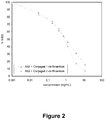
- Table 3 [c] Testosterone (ng / mL) DO 450 -DO 630 B / B0% 0,001 2.52 100 0.03 2.10 83 0.18 1.88 74 0.41 1.61 64 0.76 1.36 54 1.29 1.00 40 3.82 0.42 17 11.55 0.17 7
- the ratio values B / B0% of Table 3 are represented on the Figure 2 by a graph which gives these values according to the logarithm of the concentration of the points of the standard range.
- the Figure 2 takes the values obtained in Example 10 for the format using Ab2 + Conjugate 1 of the invention.
- This graph shows that the appearance of the testosterone assay range obtained with the antibody Ab3 + the conjugate 2 of the invention testosterone-3 ⁇ -EMC-DAP-biotin on a microplate is comparable to that obtained by the Ab2 + Conjugate format. 1 of the invention on VIDAS® in Example 10. This microplate assay with a conjugate of the invention is therefore more sensitive than VIDAS® assays using VIDAS® Conjugate.
Landscapes
- Chemical & Material Sciences (AREA)
- Organic Chemistry (AREA)
- Health & Medical Sciences (AREA)
- General Health & Medical Sciences (AREA)
- Life Sciences & Earth Sciences (AREA)
- Molecular Biology (AREA)
- Engineering & Computer Science (AREA)
- Hematology (AREA)
- Urology & Nephrology (AREA)
- Biomedical Technology (AREA)
- Immunology (AREA)
- Cell Biology (AREA)
- Biotechnology (AREA)
- Microbiology (AREA)
- Endocrinology (AREA)
- Food Science & Technology (AREA)
- Medicinal Chemistry (AREA)
- Physics & Mathematics (AREA)
- Analytical Chemistry (AREA)
- Biochemistry (AREA)
- General Physics & Mathematics (AREA)
- Pathology (AREA)
- Steroid Compounds (AREA)
Priority Applications (1)
| Application Number | Priority Date | Filing Date | Title |
|---|---|---|---|
| PL13820805T PL2931740T3 (pl) | 2012-12-13 | 2013-12-12 | Pochodne testosteronu z podstawieniem karboksyalkilowym w pozycji 3 i ich zastosowanie do produkcji znakowanych steroidów do oznaczania stężenia testosteronu w próbce biologicznej |
Applications Claiming Priority (2)
| Application Number | Priority Date | Filing Date | Title |
|---|---|---|---|
| FR1261982A FR2999576B1 (fr) | 2012-12-13 | 2012-12-13 | Derives de testosterone |
| PCT/FR2013/053040 WO2014091158A1 (fr) | 2012-12-13 | 2013-12-12 | Derives de testosterone avec une substitution carboxyalkyle en position 3 et leur utilitisation pour la production des steroïdes marqués pour la détermination de la concentration de testosterone dans un échantillon biologique |
Publications (2)
| Publication Number | Publication Date |
|---|---|
| EP2931740A1 EP2931740A1 (fr) | 2015-10-21 |
| EP2931740B1 true EP2931740B1 (fr) | 2017-08-23 |
Family
ID=47741142
Family Applications (1)
| Application Number | Title | Priority Date | Filing Date |
|---|---|---|---|
| EP13820805.3A Active EP2931740B1 (fr) | 2012-12-13 | 2013-12-12 | Dérivés de testostérone avec une substitution carboxyalkyle en position 3 et leur utilitisation pour la production des stéroïdes marqués pour la détermination de la concentration de testostérone dans un échantillon biologique |
Country Status (10)
| Country | Link |
|---|---|
| US (1) | US9676811B2 (pl) |
| EP (1) | EP2931740B1 (pl) |
| CN (1) | CN104955832B (pl) |
| BR (1) | BR112015013652B1 (pl) |
| ES (1) | ES2649469T3 (pl) |
| FR (1) | FR2999576B1 (pl) |
| PL (1) | PL2931740T3 (pl) |
| PT (1) | PT2931740T (pl) |
| WO (1) | WO2014091158A1 (pl) |
| ZA (1) | ZA201504111B (pl) |
Families Citing this family (3)
| Publication number | Priority date | Publication date | Assignee | Title |
|---|---|---|---|---|
| CN107015010A (zh) * | 2017-06-09 | 2017-08-04 | 深圳大学 | 一种用于睾酮残留检测的试剂盒及其制备方法和检测方法 |
| CN114957367B (zh) * | 2022-05-27 | 2023-12-29 | 黄冈人福药业有限责任公司 | 一种生物法制备睾酮的精制方法 |
| CN115305489B (zh) * | 2022-06-24 | 2025-04-29 | 中国农业科学院油料作物研究所 | 一种电化学促进的氢氘交换合成黄体酮(2,2,4,6,6,17α,21,21,21-D9)的方法 |
Family Cites Families (1)
| Publication number | Priority date | Publication date | Assignee | Title |
|---|---|---|---|---|
| FR2710075B1 (fr) | 1993-09-15 | 1995-10-27 | Bio Merieux | Réactif et procédé pour la détection d'une séquence nucléotidique avec amplification de signal. |
-
2012
- 2012-12-13 FR FR1261982A patent/FR2999576B1/fr not_active Expired - Fee Related
-
2013
- 2013-12-12 ES ES13820805.3T patent/ES2649469T3/es active Active
- 2013-12-12 US US14/649,355 patent/US9676811B2/en active Active
- 2013-12-12 WO PCT/FR2013/053040 patent/WO2014091158A1/fr not_active Ceased
- 2013-12-12 CN CN201380071213.7A patent/CN104955832B/zh active Active
- 2013-12-12 PT PT138208053T patent/PT2931740T/pt unknown
- 2013-12-12 EP EP13820805.3A patent/EP2931740B1/fr active Active
- 2013-12-12 PL PL13820805T patent/PL2931740T3/pl unknown
- 2013-12-12 BR BR112015013652-4A patent/BR112015013652B1/pt active IP Right Grant
-
2015
- 2015-06-08 ZA ZA2015/04111A patent/ZA201504111B/en unknown
Non-Patent Citations (1)
| Title |
|---|
| None * |
Also Published As
| Publication number | Publication date |
|---|---|
| EP2931740A1 (fr) | 2015-10-21 |
| FR2999576A1 (fr) | 2014-06-20 |
| WO2014091158A1 (fr) | 2014-06-19 |
| CN104955832B (zh) | 2017-09-19 |
| US20150299244A1 (en) | 2015-10-22 |
| CN104955832A (zh) | 2015-09-30 |
| BR112015013652B1 (pt) | 2022-02-01 |
| PT2931740T (pt) | 2017-11-28 |
| ZA201504111B (en) | 2016-04-28 |
| ES2649469T3 (es) | 2018-01-12 |
| US9676811B2 (en) | 2017-06-13 |
| BR112015013652A2 (pt) | 2017-07-11 |
| PL2931740T3 (pl) | 2018-01-31 |
| FR2999576B1 (fr) | 2014-12-05 |
Similar Documents
| Publication | Publication Date | Title |
|---|---|---|
| CA1334026C (fr) | Cryptates de terres rares, procedes d'obtention, intermediaires de synthese et application a titre de marqueurs fluorescents | |
| EP3358356B1 (fr) | Solution de dissociation de la vitamine d de sa protéine de liaison, procédé de détection associé et trousse | |
| EP2931740B1 (fr) | Dérivés de testostérone avec une substitution carboxyalkyle en position 3 et leur utilitisation pour la production des stéroïdes marqués pour la détermination de la concentration de testostérone dans un échantillon biologique | |
| US5559210A (en) | Reagents and methods for the detection and quantification of testosterone in fluid samples | |
| EP2939029B1 (fr) | Dérivés de folate, particulièrement utiles dans le cadre du dosage de folate(s) | |
| EP3585438B1 (en) | Chemiluminescent androstenedione conjugates | |
| JP6041125B2 (ja) | エストロゲンの超高感度測定法 | |
| EP0733903A1 (fr) | Procédé de dosage immunologique du cortisol, notamment urinaire, et réactifs utilisés | |
| Higashi et al. | Studies on neurosteroids XIV. Levels of dehydroepiandrosterone sulfate in rat brain and serum determined with newly developed enzyme-linked immunosorbent assay | |
| KR930000057B1 (ko) | 6-치환-에스트리올-3-설페이트 단백질 접합체의 제조방법 | |
| DK167022B1 (da) | 4- eller 6-substitueret aldosteron, fremgangsmaade til fremstilling deraf samt fremgangsmaader og kit til bestemmelse af aldosteron under anvendelse deraf | |
| EP0232348B1 (fr) | Procede homogene de detection et/ou de determination par luminescence d'un analyte dans un milieu susceptible de le contenir | |
| JP3686657B2 (ja) | ステロイド性生体内微量物質の測定方法 | |
| JP5515113B2 (ja) | エストロン類の高感度測定法 | |
| WO1995019976A1 (fr) | Derives chemoluminescents heterocycliques | |
| AU627424B2 (en) | Phospholipid conjugates, protein conjugates, and their preparation | |
| Gower | Analysis of androgens and their derivatives | |
| JPS6224742B2 (pl) | ||
| FR2479234A1 (fr) | Monohydrazides n-steroide-substitues de l'acide 3-(4-hydroxyphenyl) pentanedoique et analogues, et leur procede de preparation | |
| CN110790803A (zh) | 一种雌二醇衍生物及其制备方法和应用 | |
| CA1235064A (fr) | Antigenes a base de composes estradienique et d'albumine humaine ou bovine, et methode d'obtention d'anticorps | |
| JPH07167862A (ja) | 化学発光性化合物およびこれを用いるアッセイ法 | |
| EP0114011A1 (fr) | Dérivés estratriéniques radioactifs marqués à l'iode, procédé et intermédiaires de préparation, application aux dosages radio-immunologiques et à la préparation d'antigènes, antigènes obtenus | |
| JPS6061597A (ja) | 新規ステロイド化合物,その製造方法,及びその化合物からなる免疫化学的測定方法によるエストリオ−ル−3−サルフエ−ト−16α−グルクロナイド測定用抗原 | |
| JPH07167861A (ja) | 抗体を用いたカーバメート系除草剤の簡易測定法 |
Legal Events
| Date | Code | Title | Description |
|---|---|---|---|
| PUAI | Public reference made under article 153(3) epc to a published international application that has entered the european phase |
Free format text: ORIGINAL CODE: 0009012 |
|
| 17P | Request for examination filed |
Effective date: 20150602 |
|
| AK | Designated contracting states |
Kind code of ref document: A1 Designated state(s): AL AT BE BG CH CY CZ DE DK EE ES FI FR GB GR HR HU IE IS IT LI LT LU LV MC MK MT NL NO PL PT RO RS SE SI SK SM TR |
|
| AX | Request for extension of the european patent |
Extension state: BA ME |
|
| RIN1 | Information on inventor provided before grant (corrected) |
Inventor name: GUO, YUPING Inventor name: COSIN, PERRINE |
|
| DAX | Request for extension of the european patent (deleted) | ||
| GRAP | Despatch of communication of intention to grant a patent |
Free format text: ORIGINAL CODE: EPIDOSNIGR1 |
|
| RIC1 | Information provided on ipc code assigned before grant |
Ipc: C07J 1/00 20060101AFI20170303BHEP Ipc: G01N 33/74 20060101ALI20170303BHEP Ipc: C07J 51/00 20060101ALI20170303BHEP Ipc: C07J 43/00 20060101ALI20170303BHEP Ipc: G01N 33/50 20060101ALI20170303BHEP Ipc: C07J 41/00 20060101ALI20170303BHEP |
|
| STAA | Information on the status of an ep patent application or granted ep patent |
Free format text: STATUS: GRANT OF PATENT IS INTENDED |
|
| INTG | Intention to grant announced |
Effective date: 20170413 |
|
| RIN1 | Information on inventor provided before grant (corrected) |
Inventor name: GUO, YUPING Inventor name: COSIN, PERRINE |
|
| GRAS | Grant fee paid |
Free format text: ORIGINAL CODE: EPIDOSNIGR3 |
|
| GRAA | (expected) grant |
Free format text: ORIGINAL CODE: 0009210 |
|
| STAA | Information on the status of an ep patent application or granted ep patent |
Free format text: STATUS: THE PATENT HAS BEEN GRANTED |
|
| AK | Designated contracting states |
Kind code of ref document: B1 Designated state(s): AL AT BE BG CH CY CZ DE DK EE ES FI FR GB GR HR HU IE IS IT LI LT LU LV MC MK MT NL NO PL PT RO RS SE SI SK SM TR |
|
| REG | Reference to a national code |
Ref country code: GB Ref legal event code: FG4D Free format text: NOT ENGLISH |
|
| REG | Reference to a national code |
Ref country code: CH Ref legal event code: EP |
|
| REG | Reference to a national code |
Ref country code: AT Ref legal event code: REF Ref document number: 921226 Country of ref document: AT Kind code of ref document: T Effective date: 20170915 |
|
| REG | Reference to a national code |
Ref country code: IE Ref legal event code: FG4D Free format text: LANGUAGE OF EP DOCUMENT: FRENCH |
|
| REG | Reference to a national code |
Ref country code: DE Ref legal event code: R096 Ref document number: 602013025587 Country of ref document: DE |
|
| REG | Reference to a national code |
Ref country code: PT Ref legal event code: SC4A Ref document number: 2931740 Country of ref document: PT Date of ref document: 20171128 Kind code of ref document: T Free format text: AVAILABILITY OF NATIONAL TRANSLATION Effective date: 20171121 |
|
| REG | Reference to a national code |
Ref country code: FR Ref legal event code: PLFP Year of fee payment: 5 |
|
| REG | Reference to a national code |
Ref country code: NL Ref legal event code: MP Effective date: 20170823 |
|
| REG | Reference to a national code |
Ref country code: LT Ref legal event code: MG4D |
|
| REG | Reference to a national code |
Ref country code: ES Ref legal event code: FG2A Ref document number: 2649469 Country of ref document: ES Kind code of ref document: T3 Effective date: 20180112 |
|
| REG | Reference to a national code |
Ref country code: AT Ref legal event code: MK05 Ref document number: 921226 Country of ref document: AT Kind code of ref document: T Effective date: 20170823 |
|
| PG25 | Lapsed in a contracting state [announced via postgrant information from national office to epo] |
Ref country code: LT Free format text: LAPSE BECAUSE OF FAILURE TO SUBMIT A TRANSLATION OF THE DESCRIPTION OR TO PAY THE FEE WITHIN THE PRESCRIBED TIME-LIMIT Effective date: 20170823 Ref country code: SE Free format text: LAPSE BECAUSE OF FAILURE TO SUBMIT A TRANSLATION OF THE DESCRIPTION OR TO PAY THE FEE WITHIN THE PRESCRIBED TIME-LIMIT Effective date: 20170823 Ref country code: NO Free format text: LAPSE BECAUSE OF FAILURE TO SUBMIT A TRANSLATION OF THE DESCRIPTION OR TO PAY THE FEE WITHIN THE PRESCRIBED TIME-LIMIT Effective date: 20171123 Ref country code: NL Free format text: LAPSE BECAUSE OF FAILURE TO SUBMIT A TRANSLATION OF THE DESCRIPTION OR TO PAY THE FEE WITHIN THE PRESCRIBED TIME-LIMIT Effective date: 20170823 Ref country code: FI Free format text: LAPSE BECAUSE OF FAILURE TO SUBMIT A TRANSLATION OF THE DESCRIPTION OR TO PAY THE FEE WITHIN THE PRESCRIBED TIME-LIMIT Effective date: 20170823 Ref country code: AT Free format text: LAPSE BECAUSE OF FAILURE TO SUBMIT A TRANSLATION OF THE DESCRIPTION OR TO PAY THE FEE WITHIN THE PRESCRIBED TIME-LIMIT Effective date: 20170823 Ref country code: HR Free format text: LAPSE BECAUSE OF FAILURE TO SUBMIT A TRANSLATION OF THE DESCRIPTION OR TO PAY THE FEE WITHIN THE PRESCRIBED TIME-LIMIT Effective date: 20170823 |
|
| PG25 | Lapsed in a contracting state [announced via postgrant information from national office to epo] |
Ref country code: IS Free format text: LAPSE BECAUSE OF FAILURE TO SUBMIT A TRANSLATION OF THE DESCRIPTION OR TO PAY THE FEE WITHIN THE PRESCRIBED TIME-LIMIT Effective date: 20171223 Ref country code: RS Free format text: LAPSE BECAUSE OF FAILURE TO SUBMIT A TRANSLATION OF THE DESCRIPTION OR TO PAY THE FEE WITHIN THE PRESCRIBED TIME-LIMIT Effective date: 20170823 Ref country code: BG Free format text: LAPSE BECAUSE OF FAILURE TO SUBMIT A TRANSLATION OF THE DESCRIPTION OR TO PAY THE FEE WITHIN THE PRESCRIBED TIME-LIMIT Effective date: 20171123 Ref country code: LV Free format text: LAPSE BECAUSE OF FAILURE TO SUBMIT A TRANSLATION OF THE DESCRIPTION OR TO PAY THE FEE WITHIN THE PRESCRIBED TIME-LIMIT Effective date: 20170823 Ref country code: GR Free format text: LAPSE BECAUSE OF FAILURE TO SUBMIT A TRANSLATION OF THE DESCRIPTION OR TO PAY THE FEE WITHIN THE PRESCRIBED TIME-LIMIT Effective date: 20171124 |
|
| PG25 | Lapsed in a contracting state [announced via postgrant information from national office to epo] |
Ref country code: CZ Free format text: LAPSE BECAUSE OF FAILURE TO SUBMIT A TRANSLATION OF THE DESCRIPTION OR TO PAY THE FEE WITHIN THE PRESCRIBED TIME-LIMIT Effective date: 20170823 Ref country code: DK Free format text: LAPSE BECAUSE OF FAILURE TO SUBMIT A TRANSLATION OF THE DESCRIPTION OR TO PAY THE FEE WITHIN THE PRESCRIBED TIME-LIMIT Effective date: 20170823 Ref country code: RO Free format text: LAPSE BECAUSE OF FAILURE TO SUBMIT A TRANSLATION OF THE DESCRIPTION OR TO PAY THE FEE WITHIN THE PRESCRIBED TIME-LIMIT Effective date: 20170823 |
|
| REG | Reference to a national code |
Ref country code: DE Ref legal event code: R097 Ref document number: 602013025587 Country of ref document: DE |
|
| PG25 | Lapsed in a contracting state [announced via postgrant information from national office to epo] |
Ref country code: SM Free format text: LAPSE BECAUSE OF FAILURE TO SUBMIT A TRANSLATION OF THE DESCRIPTION OR TO PAY THE FEE WITHIN THE PRESCRIBED TIME-LIMIT Effective date: 20170823 Ref country code: EE Free format text: LAPSE BECAUSE OF FAILURE TO SUBMIT A TRANSLATION OF THE DESCRIPTION OR TO PAY THE FEE WITHIN THE PRESCRIBED TIME-LIMIT Effective date: 20170823 Ref country code: SK Free format text: LAPSE BECAUSE OF FAILURE TO SUBMIT A TRANSLATION OF THE DESCRIPTION OR TO PAY THE FEE WITHIN THE PRESCRIBED TIME-LIMIT Effective date: 20170823 |
|
| PLBE | No opposition filed within time limit |
Free format text: ORIGINAL CODE: 0009261 |
|
| STAA | Information on the status of an ep patent application or granted ep patent |
Free format text: STATUS: NO OPPOSITION FILED WITHIN TIME LIMIT |
|
| 26N | No opposition filed |
Effective date: 20180524 |
|
| PG25 | Lapsed in a contracting state [announced via postgrant information from national office to epo] |
Ref country code: SI Free format text: LAPSE BECAUSE OF FAILURE TO SUBMIT A TRANSLATION OF THE DESCRIPTION OR TO PAY THE FEE WITHIN THE PRESCRIBED TIME-LIMIT Effective date: 20170823 |
|
| REG | Reference to a national code |
Ref country code: IE Ref legal event code: MM4A |
|
| PG25 | Lapsed in a contracting state [announced via postgrant information from national office to epo] |
Ref country code: LU Free format text: LAPSE BECAUSE OF NON-PAYMENT OF DUE FEES Effective date: 20171212 Ref country code: MT Free format text: LAPSE BECAUSE OF FAILURE TO SUBMIT A TRANSLATION OF THE DESCRIPTION OR TO PAY THE FEE WITHIN THE PRESCRIBED TIME-LIMIT Effective date: 20170823 |
|
| REG | Reference to a national code |
Ref country code: BE Ref legal event code: MM Effective date: 20171231 |
|
| PG25 | Lapsed in a contracting state [announced via postgrant information from national office to epo] |
Ref country code: IE Free format text: LAPSE BECAUSE OF NON-PAYMENT OF DUE FEES Effective date: 20171212 |
|
| PG25 | Lapsed in a contracting state [announced via postgrant information from national office to epo] |
Ref country code: BE Free format text: LAPSE BECAUSE OF NON-PAYMENT OF DUE FEES Effective date: 20171231 |
|
| PG25 | Lapsed in a contracting state [announced via postgrant information from national office to epo] |
Ref country code: HU Free format text: LAPSE BECAUSE OF FAILURE TO SUBMIT A TRANSLATION OF THE DESCRIPTION OR TO PAY THE FEE WITHIN THE PRESCRIBED TIME-LIMIT; INVALID AB INITIO Effective date: 20131212 Ref country code: MC Free format text: LAPSE BECAUSE OF FAILURE TO SUBMIT A TRANSLATION OF THE DESCRIPTION OR TO PAY THE FEE WITHIN THE PRESCRIBED TIME-LIMIT Effective date: 20170823 |
|
| PG25 | Lapsed in a contracting state [announced via postgrant information from national office to epo] |
Ref country code: CY Free format text: LAPSE BECAUSE OF FAILURE TO SUBMIT A TRANSLATION OF THE DESCRIPTION OR TO PAY THE FEE WITHIN THE PRESCRIBED TIME-LIMIT Effective date: 20170823 |
|
| PG25 | Lapsed in a contracting state [announced via postgrant information from national office to epo] |
Ref country code: MK Free format text: LAPSE BECAUSE OF FAILURE TO SUBMIT A TRANSLATION OF THE DESCRIPTION OR TO PAY THE FEE WITHIN THE PRESCRIBED TIME-LIMIT Effective date: 20170823 |
|
| PG25 | Lapsed in a contracting state [announced via postgrant information from national office to epo] |
Ref country code: TR Free format text: LAPSE BECAUSE OF FAILURE TO SUBMIT A TRANSLATION OF THE DESCRIPTION OR TO PAY THE FEE WITHIN THE PRESCRIBED TIME-LIMIT Effective date: 20170823 |
|
| PG25 | Lapsed in a contracting state [announced via postgrant information from national office to epo] |
Ref country code: AL Free format text: LAPSE BECAUSE OF FAILURE TO SUBMIT A TRANSLATION OF THE DESCRIPTION OR TO PAY THE FEE WITHIN THE PRESCRIBED TIME-LIMIT Effective date: 20170823 |
|
| P01 | Opt-out of the competence of the unified patent court (upc) registered |
Effective date: 20230525 |
|
| PGFP | Annual fee paid to national office [announced via postgrant information from national office to epo] |
Ref country code: PT Payment date: 20251119 Year of fee payment: 13 |
|
| REG | Reference to a national code |
Ref country code: CH Ref legal event code: U11 Free format text: ST27 STATUS EVENT CODE: U-0-0-U10-U11 (AS PROVIDED BY THE NATIONAL OFFICE) Effective date: 20260101 |
|
| PGFP | Annual fee paid to national office [announced via postgrant information from national office to epo] |
Ref country code: GB Payment date: 20251229 Year of fee payment: 13 |
|
| PGFP | Annual fee paid to national office [announced via postgrant information from national office to epo] |
Ref country code: IT Payment date: 20251219 Year of fee payment: 13 |
|
| PGFP | Annual fee paid to national office [announced via postgrant information from national office to epo] |
Ref country code: FR Payment date: 20251226 Year of fee payment: 13 |
|
| PGFP | Annual fee paid to national office [announced via postgrant information from national office to epo] |
Ref country code: PL Payment date: 20251121 Year of fee payment: 13 |
|
| PGFP | Annual fee paid to national office [announced via postgrant information from national office to epo] |
Ref country code: ES Payment date: 20260102 Year of fee payment: 13 |
|
| PGFP | Annual fee paid to national office [announced via postgrant information from national office to epo] |
Ref country code: DE Payment date: 20251229 Year of fee payment: 13 |
|
| PGFP | Annual fee paid to national office [announced via postgrant information from national office to epo] |
Ref country code: CH Payment date: 20260101 Year of fee payment: 13 |