EP2929339B1 - Systeme und verfahren zum identifizieren von verbindungen aus ms/ms-daten ohne vorläuferioneninformationen - Google Patents
Systeme und verfahren zum identifizieren von verbindungen aus ms/ms-daten ohne vorläuferioneninformationen Download PDFInfo
- Publication number
- EP2929339B1 EP2929339B1 EP13854471.3A EP13854471A EP2929339B1 EP 2929339 B1 EP2929339 B1 EP 2929339B1 EP 13854471 A EP13854471 A EP 13854471A EP 2929339 B1 EP2929339 B1 EP 2929339B1
- Authority
- EP
- European Patent Office
- Prior art keywords
- product ion
- measured product
- compounds
- measured
- compound
- Prior art date
- Legal status (The legal status is an assumption and is not a legal conclusion. Google has not performed a legal analysis and makes no representation as to the accuracy of the status listed.)
- Active
Links
Images




Classifications
-
- H—ELECTRICITY
- H01—ELECTRIC ELEMENTS
- H01J—ELECTRIC DISCHARGE TUBES OR DISCHARGE LAMPS
- H01J49/00—Particle spectrometers or separator tubes
- H01J49/0027—Methods for using particle spectrometers
- H01J49/0036—Step by step routines describing the handling of the data generated during a measurement
-
- G—PHYSICS
- G16—INFORMATION AND COMMUNICATION TECHNOLOGY [ICT] SPECIALLY ADAPTED FOR SPECIFIC APPLICATION FIELDS
- G16C—COMPUTATIONAL CHEMISTRY; CHEMOINFORMATICS; COMPUTATIONAL MATERIALS SCIENCE
- G16C20/00—Chemoinformatics, i.e. ICT specially adapted for the handling of physicochemical or structural data of chemical particles, elements, compounds or mixtures
- G16C20/20—Identification of molecular entities, parts thereof or of chemical compositions
-
- G—PHYSICS
- G16—INFORMATION AND COMMUNICATION TECHNOLOGY [ICT] SPECIALLY ADAPTED FOR SPECIFIC APPLICATION FIELDS
- G16C—COMPUTATIONAL CHEMISTRY; CHEMOINFORMATICS; COMPUTATIONAL MATERIALS SCIENCE
- G16C99/00—Subject matter not provided for in other groups of this subclass
-
- H—ELECTRICITY
- H01—ELECTRIC ELEMENTS
- H01J—ELECTRIC DISCHARGE TUBES OR DISCHARGE LAMPS
- H01J49/00—Particle spectrometers or separator tubes
- H01J49/004—Combinations of spectrometers, tandem spectrometers, e.g. MS/MS, MSn
Definitions
- SRM Selected reaction monitoring
- a precursor ion is selected, fragmented, and passed to a second analyzer which is set to transmit a single ion.
- a response is generated when a precursor of the selected mass fragments to give an ion of the selected fragment mass, and this output signal can be used for quantitation.
- the instrument may also be set to measure several fragment ions for identification purposes or several precursor- fragment combinations to quantitate different compounds.
- the mass of the precursor ion may not be known.
- SWATH sequential windowed acquisition
- the mass of the precursor ion may not be known.
- SWATH allows a mass range to be scanned within a time interval using multiple scans with adjacent or overlapping precursor mass windows.
- a first mass analyzer selects each precursor mass window for fragmentation.
- a high resolution second mass analyzer is then used to detect the product ions produced from the fragmentation of each precursor mass window. Identification of the correct precursor ion for a set of product ions can, therefore, be confounded by the presence of many other precursor ions within a precursor mass window.
- the mass of a known or experimentally derived precursor ion may not identify the compound of interest.
- the compound of interest is a peptide and the compound analyzed is a modified peptide
- the precursor ion selected for fragmentation may not indicate the molecular weight of the unmodified (naked) peptide.
- WO 2006/040622 A1 discloses a method of determining molecular structures of compounds by identifying the structure of ions generated from these compounds using tandem mass spectrometry and subsequently conducting a library search of structurally characterized tandem product spectra from known ions for specific matches.
- a system for identifying a compound from tandem mass spectrometry product ions without using any a priori precursor ion information.
- the system includes a tandem mass spectrometer that analyzes a sample producing at least one measured product ion spectrum from a precursor mass-to-charge ratio range.
- the system also includes a processor that receives the at least one measured product ion spectrum from the tandem mass spectrometer.
- the processor selects a subset of measured product ions from the at least one measured product ion spectrum.
- the processor creates a list of candidate compounds that includes a score for each of the candidate compounds.
- the processor creates the list by searching a dictionary of potential compounds using the subset of measured product ions.
- the processor selects a candidate compound from the list as the identified compound.
- a method for identifying a compound from tandem mass spectrometry product ions without using any a priori precursor ion information is disclosed.
- a sample is analyzed using a tandem mass spectrometer, producing at least one measured product ion spectrum from a precursor mass-to-charge ratio range.
- the at least one measured product ion spectrum are received from the tandem mass spectrometer using a processor.
- a subset of measured product ions is selected from the at least one measured product ion spectrum using the processor.
- a list of candidate compounds is created that includes a score for each of the candidate compounds by searching a dictionary of potential compounds that includes one or more predicted product ions for each of the potential compounds using the subset of measured product ions using the processor.
- a candidate compound on the list is selected as the identified compound using the processor.
- a computer program product includes a non-transitory and tangible computer-readable storage medium whose contents include a program with instructions being executed on a processor so as to perform a method for identifying a compound from tandem mass spectrometry product ions without using any a priori precursor ion information.
- the method includes providing a system, wherein the system comprises one or more distinct software modules, and wherein the distinct software modules comprise a measurement module and an identification module.
- the measurement module receives from a tandem mass spectrometer at least one measured product ion spectrum from a precursor mass-to-charge ratio range produced by analyzing a sample.
- the identification module selects a subset of measured product ions from the at least one measured product ion spectrum.
- the identification module creates a list of candidate compounds that includes a score for each of the candidate compounds.
- the identification module creates the list by searching a dictionary of potential compounds that includes one or more predicted product ions for each of the potential compounds using the subset of measured product ions.
- the identification module selects a candidate compound from the list as the identified compound.
- a system for identifying a peptide from tandem mass spectrometry product ions assumed to correspond to shortened forms of the peptide without using any a priori precursor ion information.
- the system includes a tandem mass spectrometer that analyzes a sample producing at least one measured product ion spectrum from a precursor mass-to-charge ratio range.
- the system also includes a processor that receives the at least one measured product ion spectrum from the tandem mass spectrometer.
- the processor further selects the subset of measured product ions from the at least one measured product ion spectrum by selecting a number of measured mono-isotopic product ions from the at least one measured product ion spectrum with the highest intensity and with an m/z greater than the precursor m/z range.
- the processor searches a protein database in a non-tryptic or semi-tryptic mode specifying the subset of measured product ions as the precursor ions for the search. Finally, the processor selects a full length tryptic peptide from the search results that has a mass to charge ratio in the precursor mass-to-charge ratio range and a non-tryptic or semi-tryptic form with a mass-to-charge ratio matching one of the subset of measured product ions as the identified peptide.
- a method is also disclosed for identifying a peptide from tandem mass spectrometry product ions assumed to correspond to shortened forms of the peptide without using any a priori precursor ion information.
- a sample is analyzed using a tandem mass spectrometer, producing at least one measured product ion spectrum from a precursor mass-to-charge ratio range.
- the at least one measured product ion spectrum are received from the tandem mass spectrometer using a processor.
- a subset of measured product ions is selected from the at least one measured product ion spectrum by selecting a number of measured mono-isotopic product ions from the at least one measured product ion spectrum with the highest intensity and with a mass-to-charge ratio greater than the precursor mass-to-charge ratio range using the processor.
- a protein database is searched in a non-tryptic or semi-tryptic mode specifying the subset of measured product ions as the precursor ions for the search using the processor.
- a full length tryptic peptide is selected from the search results that has a mass to charge ratio in the precursor mass-to-charge ratio range and a non-tryptic or semi-tryptic form with a mass-to-charge ratio matching one of the subset of measured product ions as the identified peptide using the processor.
- a computer program product includes a non-transitory and tangible computer-readable storage medium whose contents include a program with instructions being executed on a processor so as to perform a method for identifying a peptide from tandem mass spectrometry product ions assumed to correspond to shortened forms of the peptide without using any a priori precursor ion information.
- the method includes providing a system, wherein the system comprises one or more distinct software modules, and wherein the distinct software modules comprise a measurement module and an identification module.
- the measurement module receives from a tandem mass spectrometer at least one measured product ion spectrum from a precursor mass-to-charge ratio range produced by analyzing a sample.
- the identification module selects a subset of measured product ions from the at least one measured product ion spectrum by selecting a number of measured mono-isotopic product ions from the at least one measured product ion spectrum with the highest intensity and with a mass-to-charge ratio greater than the precursor mass-to-charge ratio range.
- the identification module searches a protein database in a non-tryptic or semi-tryptic mode specifying the subset of measured product ions as the precursor ions for the search.
- the identification module selects a full length tryptic peptide from the search results that has a mass to charge ratio in the precursor mass-to-charge ratio range and a non-tryptic or semi-tryptic form with a mass-to-charge ratio matching one of the subset of measured product ions as the identified peptide.
- FIG. 1 is a block diagram that illustrates a computer system 100, upon which embodiments of the present teachings may be implemented.
- Computer system 100 includes a bus 102 or other communication mechanism for communicating information, and a processor 104 coupled with bus 102 for processing information.
- Computer system 100 also includes a memory 106, which can be a random access memory (RAM) or other dynamic storage device, coupled to bus 102 for storing instructions to be executed by processor 104.
- Memory 106 also may be used for storing temporary variables or other intermediate information during execution of instructions to be executed by processor 104.
- Computer system 100 further includes a read only memory (ROM) 108 or other static storage device coupled to bus 102 for storing static information and instructions for processor 104.
- a storage device 110 such as a magnetic disk or optical disk, is provided and coupled to bus 102 for storing information and instructions.
- Computer system 100 may be coupled via bus 102 to a display 112, such as a cathode ray tube (CRT) or liquid crystal display (LCD), for displaying information to a computer user.
- a display 112 such as a cathode ray tube (CRT) or liquid crystal display (LCD)
- An input device 114 is coupled to bus 102 for communicating information and command selections to processor 104.
- cursor control 116 is Another type of user input device, such as a mouse, a trackball or cursor direction keys for communicating direction information and command selections to processor 104 and for controlling cursor movement on display 112.
- This input device typically has two degrees of freedom in two axes, a first axis (i.e., x) and a second axis (i.e., y), that allows the device to specify positions in a plane.
- a computer system 100 can perform the present teachings. Consistent with certain implementations of the present teachings, results are provided by computer system 100 in response to processor 104 executing one or more sequences of one or more instructions contained in memory 106. Such instructions may be read into memory 106 from another computer-readable medium, such as storage device 110. Execution of the sequences of instructions contained in memory 106 causes processor 104 to perform the process described herein. Alternatively hard-wired circuitry may be used in place of or in combination with software instructions to implement the present teachings. Thus implementations of the present teachings are not limited to any specific combination of hardware circuitry and software.
- Non-volatile media includes, for example, optical or magnetic disks, such as storage device 110.
- Volatile media includes dynamic memory, such as memory 106.
- Transmission media includes coaxial cables, copper wire, and fiber optics, including the wires that comprise bus 102.
- Computer-readable media include, for example, a floppy disk, a flexible disk, hard disk, magnetic tape, or any other magnetic medium, a CD-ROM, digital video disc (DVD), a Blu-ray Disc, any other optical medium, a thumb drive, a memory card, a RAM, PROM, and EPROM, a FLASH-EPROM, any other memory chip or cartridge, or any other tangible medium from which a computer can read.
- Various forms of computer readable media may be involved in carrying one or more sequences of one or more instructions to processor 104 for execution.
- the instructions may initially be carried on the magnetic disk of a remote computer.
- the remote computer can load the instructions into its dynamic memory and send the instructions over a telephone line using a modem.
- a modem local to computer system 100 can receive the data on the telephone line and use an infra-red transmitter to convert the data to an infra-red signal.
- An infra-red detector coupled to bus 102 can receive the data carried in the infra-red signal and place the data on bus 102.
- Bus 102 carries the data to memory 106, from which processor 104 retrieves and executes the instructions.
- the instructions received by memory 106 may optionally be stored on storage device 110 either before or after execution by processor 104.
- instructions configured to be executed by a processor to perform a method are stored on a computer-readable medium.
- the computer-readable medium can be a device that stores digital information.
- a computer-readable medium includes a compact disc read-only memory (CD-ROM) as is known in the art for storing software.
- CD-ROM compact disc read-only memory
- the computer-readable medium is accessed by a processor suitable for executing instructions configured to be executed.
- tandem mass spectrometry or mass spectrometry/mass spectrometry (MS/MS)
- MS/MS mass spectrometry/mass spectrometry
- SWATH sequential windowed acquisition
- the mass of the precursor ion may not be known.
- the mass of a known or experimentally derived precursor ion may not identify the compound of interest due to a modification of the compound of interest in the sample analyzed.
- the identity of a compound is determined without knowing the mass of a known or experimentally derived precursor ion. In one embodiment, identification can be determined based on the uniqueness of one or more product ions. In another embodiment, a database search can be conducted by assuming that a product ion is a shortened form of a precursor ion.
- the identity of product ions is assumed to help identify the peptide.
- the ions are actual product ions from a precursor ion of unknown (but restricted) m/z.
- the ions are precursor ions (of a shortened fragment).
- proteins and peptides the systems and methods described herein can be used for other compounds, if the fragments of these compounds can be predicted. Given a list of likely proteins in a sample, for example, the peptides of the proteins and then the fragment ions of the peptides can be predicted.
- a dictionary is created for all possible fragment or product ion masses of likely peptides in a proteome.
- a dictionary is a computer data structure that uses keys to store data in an organized way. Values are stored with specific keys so that the key can be used to retrieve only those values.
- the key is the calculated mass of the product ion and the value is a list of all peptides (sequences or other identifiers) that could produce the mass of the product ion.
- a list of the corresponding peptides and/or proteins is stored in the dictionary.
- the dictionary can be stored in a database, for example. The sample is then analyzed using a tandem mass spectrometer, producing a product ion spectrum.
- a peptide is identified by:
- a peptide is identified by:
- the ions corresponding to the identified peptide can be removed from the product ion spectrum and the identification procedure repeated to identify additional peptides that may have been selected and fragmented.
- the performance of both of these methods can be improved by selecting the most specific product ions first.
- the most specific product ions are, for example, those that appear in the smallest number of peptides. Starting with the smallest number of peptides makes subsequent processing faster.
- step A in both of the methods described above can be replaced with:
- Database search engines that are typically used to identify peptides normally assume that a peptide is "fully tryptic.” In other words, these search engines assume that the peptide is generated by cleavage on the C-terminal side of the amino acids K and R: (protein N-Terminus) - xxxK.ACDEFGHR.xxxxx - (protein C-terminus) where the dots represent the enzyme cleavage sites and the final, fully tryptic peptide is ACDEFGHR.
- the peptide can be identified using a conventional search engine if the mass of a y ion is used as if it were the precursor ion and the semi-tryptic mode of operation is identified.
- fragmenting a multiply charged precursor ion can generate ions with a higher mass-charge value (m/z, as measured by a mass spectrometer) if z is reduced, and these ions often correspond to y ions.
- a method for identifying a peptide proceeds as follows:
- This method is performed for 2 or 3 m/z values, since it is possible that the ions are not y ions. If the ions are all y ions, then different length shortened forms of the fully tryptic peptide will be received.
- Another conventional method of identifying a protein in a sample using tandem mass spectrometry involves comparing an entire measured product ion spectrum to a database of predicted product ion spectra.
- Sub-sequences (or peptides) for known or target proteins are determined from a sequence library and predicted product ion spectra are created from the peptides using a computer.
- An unknown peptide is then identified using tandem mass spectrometry by comparing an entire measured product ion spectrum to the predicted product ion spectra.
- An entire measured product ion spectrum is compared to a predicted product ion using a closeness-of-fit algorithm, for example.
- one product ion is predicted and compared to the measured product ion spectrum at a time.
- An unknown peptide or precursor ion is then identified based the number of predicted product ions that matched the measured product ion spectrum.
- FIG. 2 is a schematic diagram showing a system 200 for identifying a compound from tandem mass spectrometry product ions without using any a priori precursor ion information, in accordance with various embodiments.
- System 200 includes tandem mass spectrometer 210 and processor 220.
- Tandem mass spectrometer 210 can include one or more physical mass analyzers that perform two or more mass analyses.
- a mass analyzer of a tandem mass spectrometer can include , but is not limited to, a time-of-flight (TOF), quadrupole, an ion trap, a linear ion trap, an orbitrap, or a Fourier transform mass analyzer.
- Tandem mass spectrometer 210 can also include a separation device (not shown). The separation device can perform a separation technique that includes, but is not limited to, liquid chromatography, gas chromatography, capillary electrophoresis, or ion mobility.
- Tandem mass spectrometer 210 can include separating mass spectrometry stages or steps in space or time, respectively.
- Processor 220 can be, but is not limited to, a computer, microprocessor, or any device capable of sending and receiving control signals and data from tandem mass spectrometer 210 and processing data. Processor 220 is in communication with tandem mass spectrometer 210.
- tandem mass spectrometer 210 analyzes a sample producing at least one measured product ion spectrum from a precursor mass-to-charge ratio range.
- a precursor mass-to-charge ratio range is, for example, a precursor mass window.
- tandem mass spectrometer 210 analyzes the sample using SWATH. Tandem mass spectrometer 210 divides a mass range into two or more precursor mass windows, for example. Tandem mass spectrometer 210 then fragments each precursor mass window of the two or more mass windows, producing a measured product ion spectrum for each precursor mass window.
- Processor 220 receives the at least one measured product ion spectrum from tandem mass spectrometer 210. Processor 220 selects a subset of measured product ions from the at least one measured product ion spectrum. The subset includes a number of product ions large enough to identify an unknown precursor ion from other ions, for example. An exemplary number of product ions selected for the subset is 30.
- Processor 220 creates a list of candidate compounds that includes a score for each of the candidate compounds. For example, a score can be a count of the number of times a candidate compound matches a measured product ion of the subset of measured product ions. Processor 220 creates the list by searching a dictionary of potential compounds using the subset of measured product ions. The dictionary includes one or more predicted product ions for each of the potential compounds. Processor 220 selects a candidate compound from the list as the identified compound. For example, the candidate compound with the highest score is selected as the identified compound.
- the sample includes proteins or peptides and the identified compound is a peptide.
- the measured product ion spectrum includes peptide fragments
- the dictionary of potential compounds includes predicted peptides for proteins
- the one or more predicted product ions for each of the potential compounds include one or more fragments of peptides
- the list of candidate compounds includes candidate peptides.
- the sample includes compounds other than proteins.
- the sample includes sugars, lipids, deoxyribonucleic acid (DNA), ribonucleic acid (RNA), or any compound for which product ions can be predicted.
- filtering is performed on the measured product ion spectrum in order to select the subset of measured product ions.
- processor 220 can select the subset of measured product ions by selecting a number of measured mono-isotopic product ions with the highest intensity from the at least one measured product ion spectrum.
- processor 220 can select the subset of measured product ions by selecting measured product ions predicted to occur in the smallest number of potential compounds.
- processor 220 can select the subset of measured product ions by selecting a number of measured product ions from the at least one measured product ion spectrum with a mass-to-charge ratio (m/z) greater than a threshold value.
- m/z mass-to-charge ratio
- processor 220 creates the list of candidate compounds by searching the dictionary for potential compounds matching one measured product ion from the subset of measured product ions. The remainder of the measured product ions in the subset are then compared to the candidate compounds on the list to determine a candidate compound that has the most product ions in common with the subset of measured product ions.
- processor 220 selects a first product ion from a subset of measured product ions.
- Processor 220 searches the dictionary of potential compounds for potential compounds that include a predicted product ion that matches the first product ion, producing a plurality of matching potential compounds.
- Processor 220 adds the matching potential compounds to the list of candidate compounds and provides each candidate compound on the list with an initial score.
- processor 220 iteratively compares each remaining product ion to the predicted product ions of each candidate compound on the list and increases the score of each candidate compound if an included predicted product ion matches a remaining measured product ion.
- processor 220 creates the list of candidate compounds by iteratively searching the dictionary with each measured product ion from the selected subset. If a candidate compound that matches the measured product ion is found, it is added to the candidate list if it is not already on the list. If a candidate compound that matches the measured product ion is already on the list, its score is increased.
- processor 220 searches the dictionary of potential compounds for potential compounds that include a predicted product ion that matches the measured product ion. If a potential compound includes a predicted product ion that matches the measured product ion, processor 220 adds the matching potential compound to the list of candidate compounds with an initial score, if the matching potential compound is not already on the list. Processor 220 increments the score of the matching potential compound, if the matching potential compound is already on the list.
- processor 220 further determines if the identified compound is a modified form. For example, processor 220 compares the identified compound to the precursor mass-to-charge ratio (m/z) range. If the identified compound m/z is not found in the precursor m/z range, processor 220 determines that the identified compound is a modified form.
- processor 220 compares the identified compound to the precursor mass-to-charge ratio (m/z) range. If the identified compound m/z is not found in the precursor m/z range, processor 220 determines that the identified compound is a modified form.
- the unmodified form of the identified is found from the modified form.
- processor 220 analyzes a list of modifications to determine a modification that puts the m/z of the modified identified compound in the precursor m/z range.
- the list of modifications is found from a database of modifications for compounds, for example.
- processor 220 further identifies one or more additional compound from the sample after a first compound is identified. For example, processor 220 further subtracts predicted product ions of the identified compound from the measured product ion spectrum. Processor 220 removes all candidate compounds currently on the list of candidate compounds. Processor 220 then selects a new subset of measured product ions from the measured product ion spectrum. Processor 220 creates a new list of candidate compounds that includes a score for each of the candidate compounds of measured product ions. Processor 220 creates the list by searching a dictionary of potential compounds using the subset of measured product ions. Processor 220 identifies a candidate compound on the list as the second identified compound.
- the compound to be identified is a peptide and a measured product ion is a modification of the peptide.
- the modification may be a truncation of the N-terminus to produce a shortened peptide with the same C-terminus, for example.
- tandem mass spectrometer 210 also analyzes a sample producing at least one measured product ion spectrum from a precursor mass-to-charge ratio range.
- processor 220 also receives the at least one measured product ion spectrum from tandem mass spectrometer 210 and selects a subset of measured product ions from the at least one measured product ion spectrum.
- processor 220 further selects the subset of measured product ions from the at least one measured product ion spectrum by selecting a number of measured mono-isotopic product ions from the at least one measured product ion spectrum with the highest intensity and with an m/z greater than the precursor m/z range. Processor 220 then searches a protein database in a non-tryptic or semi-tryptic mode specifying the subset of measured product ions as the precursor ions for the search.
- processor 220 selects a full length tryptic peptide from the search results that has a mass to charge ratio in the precursor mass-to-charge ratio range and a non-tryptic or semi-tryptic form with a mass-to-charge ratio matching one of the subset of measured product ions as the identified peptide.
- processor 220 further identifies one or more additional compounds from the sample after a first compound is identified. For example, processor 220 subtracts predicted product ions of the identified peptide from the measured product ion spectrum. Processor 220 then selects a new subset of measured product ions from the at least one measured product ion spectrum by selecting a number of measured mono-isotopic product ions from the at least one measured product ion spectrum with the highest intensity and with an m/z greater than the precursor m/z range. Processor 220 then searches a protein database in a non-tryptic or semi-tryptic mode specifying the new subset of measured product ions as the precursor ions for the search.
- processor 220 selects a full length tryptic peptide from the search results that has a mass to charge ratio in the precursor mass-to-charge ratio range and a non-tryptic or semi-tryptic form with a mass-to-charge ratio matching one of the subset of measured product ions as the second identified peptide.
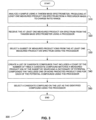
- Figure 3 is an exemplary flowchart showing a method 300 for identifying a compound from tandem mass spectrometry product ions without using any a priori precursor ion information, in accordance with various embodiments.
- a sample is analyzed using a tandem mass spectrometer, producing at least one measured product ion spectrum from a precursor mass-to-charge ratio range.
- step 320 the at least one measured product ion spectrum are received from the tandem mass spectrometer using a processor.
- step 330 a subset of measured product ions is selected from the at least one measured product ion spectrum using the processor.
- a list of candidate compounds is created that includes a score for each of the candidate compounds by searching a dictionary of potential compounds that includes one or more predicted product ions for each of the potential compounds using the subset of measured product ions using the processor.
- step 350 a candidate compound on the list is selected as the identified compound using the processor.
- Figure 4 is an exemplary flowchart showing a method 400 for identifying a peptide from tandem mass spectrometry product ions assumed to correspond to shortened forms of the peptide without using any a priori precursor ion information, in accordance with various embodiments.
- a sample is analyzed using a tandem mass spectrometer, producing at least one measured product ion spectrum from a precursor mass-to-charge ratio range.
- step 420 the at least one measured product ion spectrum are received from the tandem mass spectrometer using a processor.
- a subset of measured product ions is selected from the at least one measured product ion spectrum by selecting a number of measured mono-isotopic product ions from the at least one measured product ion spectrum with the highest intensity and with a mass-to-charge ratio greater than the precursor mass-to-charge ratio range using the processor.
- a protein database is searched in a non-tryptic or semi-tryptic mode specifying the subset of measured product ions as the precursor ions for the search using the processor.
- a full length tryptic peptide is selected from the search results that has a mass to charge ratio in the precursor mass-to-charge ratio range and a non-tryptic or semi-tryptic form with a mass-to-charge ratio matching one of the subset of measured product ions as the identified peptide using the processor.
- computer program products include a tangible computer-readable storage medium whose contents include a program with instructions being executed on a processor so as to perform a method for identifying a compound from tandem mass spectrometry product ions without using any a priori precursor ion information. This method is performed by a system that includes one or more distinct software modules.
- FIG. 5 is a schematic diagram of a system 500 that includes one or more distinct software modules that performs a method for identifying a compound from tandem mass spectrometry product ions without using any a priori precursor ion information, in accordance with various embodiments.
- System 500 includes measurement module 510 and identification module 520.
- measurement module 510 receives from a tandem mass spectrometer at least one measured product ion spectrum from a precursor mass-to-charge ratio range produced by analyzing a sample.
- Identification module 520 selects a subset of measured product ions from the at least one measured product ion spectrum.
- Identification module 520 creates a list of candidate compounds that includes a score for each of the candidate compounds.
- Identification module 520 creates the list by searching a dictionary of potential compounds that includes one or more predicted product ions for each of the potential compounds using the subset of measured product ions.
- Identification module 520 selects a candidate compound from the list as the identified compound.
- measurement module 510 receives from a tandem mass spectrometer at least one measured product ion spectrum from a precursor mass-to-charge ratio range produced by analyzing a sample.
- Identification module 520 selects a subset of measured product ions from the at least one measured product ion spectrum by selecting a number of measured mono-isotopic product ions from the at least one measured product ion spectrum with the highest intensity and with a mass-to-charge ratio greater than the precursor mass-to-charge ratio range.
- Identification module 520 searches a protein database in a non-tryptic or semi-tryptic mode specifying the subset of measured product ions as the precursor ions for the search.
- Identification module 520 selects a full length tryptic peptide from the search results that has a mass to charge ratio in the precursor mass-to-charge ratio range and a non-tryptic or semi-tryptic form with a mass-to-charge ratio matching one of the subset of measured product ions as the identified peptide.
Landscapes
- Chemical & Material Sciences (AREA)
- Life Sciences & Earth Sciences (AREA)
- Engineering & Computer Science (AREA)
- Bioinformatics & Cheminformatics (AREA)
- Bioinformatics & Computational Biology (AREA)
- Computing Systems (AREA)
- Theoretical Computer Science (AREA)
- Analytical Chemistry (AREA)
- Physics & Mathematics (AREA)
- Spectroscopy & Molecular Physics (AREA)
- Crystallography & Structural Chemistry (AREA)
- Other Investigation Or Analysis Of Materials By Electrical Means (AREA)
Claims (13)
- System (200) zum Identifizieren einer Verbindung von Tandem-Massenspektrometrie-Produktionen ohne Verwendung a priori von Vorläuferionen-Informationen, umfassend:ein Tandem-Massenspektrometer (210), das konfiguriert ist, um eine Probe zu analysieren, die mindestens ein gemessenes Produktionenspektrum aus einem Vorläufer-Masse-Ladungs-Verhältnisbereich erzeugt; undeinen Prozessor (220) in Verbindung mit dem Tandem-Massenspektrometer, der zu Folgendem konfiguriert ist:(a) Empfangen des mindestens einen gemessenen Produktionenspektrums von dem Tandem-Massenspektrometer (210),(b) Auswählen eines gemessenen Produktions aus dem mindestens einen gemessenen Produktionenspektrum und Abrufen einer Liste möglicher Verbindungen, die das gemessene Produktion erzeugen könnten, aus einem Wörterbuch bekannter Verbindungen, wobei das Wörterbuch konfiguriert ist, um für jedes bekannte Produktion der bekannten Verbindungen eine Liste aller Verbindungen zu speichern, die die Masse des bekannten Produktions erzeugen könnten,(c) Auswählen eines anderen gemessenen Produktions aus dem mindestens einen gemessenen Produktionenspektrum und Abrufen einer anderen Liste bekannter Verbindungen, die das andere gemessene Produktion erzeugen könnten, aus dem Wörterbuch,(d) Untersuchen aller abgerufenen Listen möglicher Verbindungen und Identifizieren von Verbindungen, die allen abgerufenen Listen möglicher Verbindungen gemeinsam sind,(e) Wiederholen von Schritt (c) und (d), bis eine Verbindung identifiziert ist, die allen abgerufenen Listen möglicher Verbindungen gemeinsam ist, und Identifizieren dieser einen Verbindung als eine Verbindung der Probe.
- System (200) nach Anspruch 1, wobei das gemessene Produktionenspektrum Peptidfragmente umfasst und das Wörterbuch bekannter Verbindungen bekannte Peptide bekannter Proteine umfasst.
- System (200) nach einem der vorherigen Ansprüche, wobei die bekannten Verbindungen Zucker, Lipide, DNA, RNA oder eine beliebige Verbindung umfassen, für die Produktionen vorhergesagt werden können.
- System (200) nach einem der vorherigen Ansprüche, wobei der Prozessor (220) konfiguriert ist, um das gemessene Produktion auszuwählen, indem er ein gemessenes monoisotopisches Produktion mit der höchsten Intensität aus dem mindestens einen gemessenen Produktionenspektrum auswählt.
- System (200) nach einem der vorherigen Ansprüche, wobei der Prozessor (220) konfiguriert ist, um das gemessene Produktion auszuwählen, indem er ein gemessenes Produktion auswählt, von dem vorhergesagt wird, dass es in der kleinsten Anzahl potenzieller Verbindungen vorkommt.
- System (200) nach einem der vorherigen Ansprüche, wobei der Prozessor (220) konfiguriert ist, um das gemessene Produktion auszuwählen, indem er ein gemessenes Produktion aus dem mindestens einen gemessenen Produktionenspektrum mit einem Masse-Ladungs-Verhältnis (m/z) auswählt, das größer ist als ein Schwellenwert.
- System (200) nach einem der vorherigen Ansprüche, wobei das Tandem-Massenspektrometer (210) konfiguriert ist, um eine Probe analysiert, durch:
Aufteilen eines Massenbereichs in zwei oder mehrere Vorläufermassenfenster und Fragmentieren von jedem Vorläufermassenfenster der zwei oder mehreren Massenfenster, was ein gemessenes Produktionenspektrum für jedes Vorläufermassenfenster erzeugt. - System (200) nach Anspruch 7, wobei der Prozessor (220) ferner zu Folgendem konfiguriert istVergleichen der identifizierten Verbindung mit dem Massenbereich, undes, wenn das Masse-Ladungs-Verhältnis (m/z) der identifizierten Verbindung nicht in dem Massenbereich gefunden wird, konfiguriert ist, um zu bestimmen, dass die identifizierte Verbindung eine modifizierte Form ist.
- System (200) nach Anspruch 7 oder Anspruch 8, wobei der Prozessor (220) ferner konfiguriert ist, um eine Liste von Modifikationen zu analysieren, um eine Modifikation zu bestimmen, die ein Masse-Ladungs-Verhältnis einer modifizierten Form einer Verbindung in den Massenbereich bringt.
- System (200) nach Anspruch 1, wobei der Prozessor ferner zu Folgendem konfiguriert ist: Subtrahieren vorhergesagter Produktionen der identifizierten Verbindung von dem mindestens einen gemessenen Produktionenspektrum,Entfernen aller Listen möglicher Verbindungen, underneutes Ausführen von Schritt (b)-(e), um eine weitere Verbindung in der Probe zu identifizieren.
- Verfahren zum Identifizieren einer Verbindung von Tandem-Massenspektrometrie-Produktionen ohne Verwendung a priori von Vorläuferionen-Informationen, umfassend:(a) Analysieren einer Probe unter Verwendung eines Tandem-Massenspektrometers, was mindestens ein gemessenes Produktionenspektrum aus einem Vorläufer-Masse-Ladungs-Verhältnisbereich erzeugt;(b) Empfangen des mindestens einen gemessenen Produktionenspektrums von dem Tandem-Massenspektrometer unter Verwendung eines Prozessors;(c) Auswählen eines gemessenen Produktions aus dem mindestens einen gemessenen Produktionenspektrum und Abrufen einer Liste möglicher Verbindungen, die das gemessene Produktion erzeugen könnten, aus einem Wörterbuch bekannter Verbindungen unter Verwendung des Prozessors, wobei das Wörterbuch für jedes bekannte Produktion der bekannten Verbindungen eine Liste aller Verbindungen speichert, die die Masse des bekannten Produktions erzeugen könnten;(d) Auswählen eines anderen gemessenen Produktions aus dem mindestens einen gemessenen Produktionenspektrum und Abrufen einer anderen Liste bekannter Verbindungen, die das andere gemessene Produktion erzeugen könnten, aus dem Wörterbuch unter Verwendung des Prozessors;(e) Untersuchen aller abgerufenen Listen möglicher Verbindungen und Identifizieren von Verbindungen, die allen abgerufenen Listen möglicher Verbindungen gemeinsam sind, unter Verwendung des Prozessors; und(f) Wiederholen von Schritt (c) und (d), bis eine Verbindung identifiziert ist, die allen abgerufenen Listen möglicher Verbindungen gemeinsam ist, und Identifizieren dieser einen Verbindung als eine Verbindung der Probe, unter Verwendung des Prozessors.
- Verfahren nach Anspruch 11, wobei ein Auswählen eines gemessenen Produktions Folgendes umfasst: Auswählen eines gemessenen monoisotopischen Produktions mit der höchsten Intensität aus dem mindestens einen gemessenen Produktionenspektrum; oderAuswählen eines gemessenen Produktions, von dem vorhergesagt wird, dass es in der kleinsten Anzahl bekannter Verbindungen vorkommt; oderAuswählen eines gemessenen Produktions aus dem mindestens einen gemessenen Produktionenspektrum mit einem Masse-Ladungs-Verhältnis (m/z) größer als ein Schwellenwert.
- Computerprogrammprodukt, umfassend ein nicht-transitorisches und tangibles computerlesbares Speichermedium, dessen Inhalt ein Programm mit Anweisungen beinhaltet, die auf einem Prozessor ausgeführt werden, um ein Verfahren zum Identifizieren eines Vorläuferions aus Tandem-Massenspektrometrie-Produktionen ohne Verwendung a priori von Vorläuferionen-Informationen durchzuführen, das Verfahren umfassend:
Bereitstellen eines Systems (500), wobei das System ein oder mehrere verschiedene Softwaremodule umfasst, und wobei die verschiedenen Softwaremodule ein Messmodul (510) und ein Identifizierungsmodul (520) umfassen; und(a) Empfangen, von einem Tandem-Massenspektrometer, mindestens eines gemessenen Produktionenspektrums aus einem Vorläufer-Masse-Ladungs-Verhältnisbereich, der durch Analysieren einer Probe unter Verwendung des Messmoduls erzeugt wird;(b) Auswählen eines gemessenen Produktions aus dem mindestens einen gemessenen Produktionenspektrum und Abrufen einer Liste möglicher Verbindungen, die das gemessene Produktion erzeugen könnten, aus einem Wörterbuch bekannter Verbindungen unter Verwendung des Identifizierungsmoduls, wobei das Wörterbuch für jedes bekannte Produktion der bekannten Verbindungen eine Liste aller Verbindungen speichert, die die Masse des bekannten Produktions erzeugen könnten;(c) Auswählen eines anderen gemessenen Produktions aus dem mindestens einen gemessenen Produktionenspektrum und Abrufen einer anderen Liste bekannter Verbindungen, die das andere gemessene Produktion erzeugen könnten, aus dem Wörterbuch unter Verwendung des Identifizierungsmoduls;(d) Untersuchen aller abgerufenen Listen möglicher Verbindungen und Identifizieren von Verbindungen, die allen abgerufenen Listen möglicher Verbindungen gemeinsam sind, unter Verwendung des Identifizierungsmoduls; und(e) Wiederholen von Schritt (c) und (d), bis eine Verbindung identifiziert ist, die allen abgerufenen Listen möglicher Verbindungen gemeinsam ist, und Identifizieren dieser einen Verbindung als eine Verbindung der Probe, unter Verwendung des Identifizierungsmoduls.
Applications Claiming Priority (2)
| Application Number | Priority Date | Filing Date | Title |
|---|---|---|---|
| US201261726617P | 2012-11-15 | 2012-11-15 | |
| PCT/IB2013/002304 WO2014076529A1 (en) | 2012-11-15 | 2013-10-16 | Systems and methods for identifying compounds from ms/ms data without precursor ion information |
Publications (3)
| Publication Number | Publication Date |
|---|---|
| EP2929339A1 EP2929339A1 (de) | 2015-10-14 |
| EP2929339A4 EP2929339A4 (de) | 2016-06-01 |
| EP2929339B1 true EP2929339B1 (de) | 2025-01-15 |
Family
ID=50730651
Family Applications (1)
| Application Number | Title | Priority Date | Filing Date |
|---|---|---|---|
| EP13854471.3A Active EP2929339B1 (de) | 2012-11-15 | 2013-10-16 | Systeme und verfahren zum identifizieren von verbindungen aus ms/ms-daten ohne vorläuferioneninformationen |
Country Status (6)
| Country | Link |
|---|---|
| US (1) | US11456164B2 (de) |
| EP (1) | EP2929339B1 (de) |
| JP (1) | JP6362611B2 (de) |
| CN (1) | CN104718449B (de) |
| CA (1) | CA2884929A1 (de) |
| WO (1) | WO2014076529A1 (de) |
Families Citing this family (12)
| Publication number | Priority date | Publication date | Assignee | Title |
|---|---|---|---|---|
| WO2015033397A1 (ja) * | 2013-09-04 | 2015-03-12 | 株式会社島津製作所 | クロマトグラフ質量分析用データ処理装置 |
| CN107743649B (zh) * | 2015-06-18 | 2020-12-11 | Dh科技发展私人贸易有限公司 | 基于概率的库搜索算法(prols) |
| WO2017025892A1 (en) * | 2015-08-13 | 2017-02-16 | Dh Technologies Development Pte. Ltd. | Deconvolution of mixed spectra |
| EP3345208A4 (de) | 2015-08-31 | 2019-05-01 | DH Technologies Development PTE. Ltd. | Verfahren zur verbesserung der ms/ms-spektralqualität von mrm-getriggerten ida |
| US10170290B2 (en) * | 2016-05-24 | 2019-01-01 | Thermo Finnigan Llc | Systems and methods for grouping MS/MS transitions |
| US11373735B2 (en) * | 2016-07-06 | 2022-06-28 | Dh Technologies Development Pte. Ltd. | Results dependent analysis—iterative analysis of SWATH data |
| US10845344B2 (en) * | 2016-07-08 | 2020-11-24 | Shimadzu Corporation | Data processing device for chromatograph mass spectrometer |
| EP3488460B1 (de) * | 2016-07-25 | 2024-02-28 | DH Technologies Development PTE. Ltd. | Systeme und verfahren zur identifizierung von vorläufer- und produktionenpaaren bei der abtastung von schwadendaten |
| CN109643633B (zh) * | 2016-08-10 | 2021-09-14 | Dh科技发展私人贸易有限公司 | 自动化质谱库保留时间校正 |
| US10665440B1 (en) * | 2018-11-19 | 2020-05-26 | Thermo Finnigan Llc | Methods for multiplexed MS-3 analyses of peptides |
| EP3977628A4 (de) | 2019-05-31 | 2023-06-28 | DH Technologies Development Pte. Ltd. | Verfahren zur echtzeitcodierung von abtastbanddaten und probabilistischer rahmen für vorläuferinferenz |
| ES2767375B2 (es) * | 2020-01-24 | 2020-12-17 | Consorcio Centro De Investig Biomedica En Red M P | Metodo , sistema y producto de programa para la identificacion de compuestos en muestras biologicas o ambientales complejas |
Family Cites Families (20)
| Publication number | Priority date | Publication date | Assignee | Title |
|---|---|---|---|---|
| JPS59137854A (ja) * | 1983-01-28 | 1984-08-08 | Jeol Ltd | マススペクトルライブラリ−のインバ−スサ−チ |
| US6017693A (en) * | 1994-03-14 | 2000-01-25 | University Of Washington | Identification of nucleotides, amino acids, or carbohydrates by mass spectrometry |
| GB9710582D0 (en) * | 1997-05-22 | 1997-07-16 | Oxford Glycosciences Uk Ltd | A method for de novo peptide sequence determination |
| AU2002323683A1 (en) * | 2002-03-01 | 2003-09-16 | Applera Corporation | Method for protein identification using mass spectrometry data |
| US7197402B2 (en) * | 2004-10-14 | 2007-03-27 | Highchem, Ltd. | Determination of molecular structures using tandem mass spectrometry |
| US8108153B2 (en) * | 2005-12-13 | 2012-01-31 | Palo Alto Research Center Incorporated | Method, apparatus, and program product for creating an index into a database of complex molecules |
| JP2007287531A (ja) * | 2006-04-18 | 2007-11-01 | Shimadzu Corp | 質量分析データ解析方法 |
| US8143572B2 (en) * | 2006-07-03 | 2012-03-27 | Physikron | Method and system of tandem mass spectrometry without primary mass selection for multicharged ions |
| US20090203068A1 (en) * | 2008-02-07 | 2009-08-13 | Battelle Memorial Institute | High Pressure Enzymatic Digestion System For Protein Characterization |
| GB2463633B (en) * | 2008-05-15 | 2013-02-27 | Thermo Fisher Scient Bremen | MS/MS data processing |
| US20110093205A1 (en) * | 2009-10-19 | 2011-04-21 | Palo Alto Research Center Incorporated | Proteomics previewer |
| US20110224101A1 (en) * | 2009-11-10 | 2011-09-15 | Xuefeng Ling | Tumor associated proteome and peptidome analyses for multiclass cancer discrimination |
| WO2011064068A1 (en) * | 2009-11-30 | 2011-06-03 | Physikron | Multiplexed tandem mass spectrometry method |
| JP5764860B2 (ja) * | 2010-04-01 | 2015-08-19 | 三井情報株式会社 | タンパク質の同定装置、同定方法並びに同定プログラム及びこれを記録したコンピュータ読み取り可能な記録媒体 |
| US8935101B2 (en) * | 2010-12-16 | 2015-01-13 | Thermo Finnigan Llc | Method and apparatus for correlating precursor and product ions in all-ions fragmentation experiments |
| US9273339B2 (en) * | 2011-01-03 | 2016-03-01 | University Of Maryland, Baltimore | Methods for identifying bacteria |
| DE102011014805A1 (de) * | 2011-03-18 | 2012-09-20 | Friedrich-Schiller-Universität Jena | Verfahren zur Identifizierung insbesondere unbekannter Substanzen durch Massenspektrometrie |
| WO2012164375A1 (en) * | 2011-06-03 | 2012-12-06 | Dh Technologies Development Pte. Ltd. | Use of variable xic widths of tof-msms data for the determination of background interference in srm assays |
| US9343276B2 (en) * | 2011-12-29 | 2016-05-17 | Dh Technologies Development Pte. Ltd. | Use of windowed mass spectrometry data for retention time determination or confirmation |
| US10141169B2 (en) * | 2012-11-15 | 2018-11-27 | Dh Technologies Development Pte. Ltd. | Systems and methods for identifying compounds from MS/MS data without precursor ion information |
-
2013
- 2013-10-16 WO PCT/IB2013/002304 patent/WO2014076529A1/en not_active Ceased
- 2013-10-16 CA CA2884929A patent/CA2884929A1/en not_active Abandoned
- 2013-10-16 EP EP13854471.3A patent/EP2929339B1/de active Active
- 2013-10-16 JP JP2015542366A patent/JP6362611B2/ja active Active
- 2013-10-16 CN CN201380052630.7A patent/CN104718449B/zh active Active
-
2018
- 2018-11-26 US US16/199,966 patent/US11456164B2/en active Active
Also Published As
| Publication number | Publication date |
|---|---|
| US20190096647A1 (en) | 2019-03-28 |
| CA2884929A1 (en) | 2014-05-22 |
| EP2929339A1 (de) | 2015-10-14 |
| WO2014076529A1 (en) | 2014-05-22 |
| EP2929339A4 (de) | 2016-06-01 |
| JP2016501367A (ja) | 2016-01-18 |
| CN104718449B (zh) | 2017-06-06 |
| US11456164B2 (en) | 2022-09-27 |
| JP6362611B2 (ja) | 2018-07-25 |
| CN104718449A (zh) | 2015-06-17 |
Similar Documents
| Publication | Publication Date | Title |
|---|---|---|
| US11456164B2 (en) | Systems and methods for identifying compounds from MS/MS data without precursor ion information | |
| US9791424B2 (en) | Use of windowed mass spectrometry data for retention time determination or confirmation | |
| EP3497709B1 (de) | Automatische korrektur der retentionszeit von spektrenbibliotheken | |
| US9768000B2 (en) | Systems and methods for acquiring data for mass spectrometry images | |
| EP3218703B1 (de) | Bestimmung der identität von modifizierten verbindungen | |
| US10141169B2 (en) | Systems and methods for identifying compounds from MS/MS data without precursor ion information | |
| EP3745407A1 (de) | Betrieb eines massenspektrometers unter verwendung einer beförderungsliste | |
| EP3204740B1 (de) | Verbesserung der ausgangsspektren der informationsabhängigen datenanalyse (ida) für datenbanksuchen | |
| JP6003842B2 (ja) | タンパク質の同定方法及び同定装置 | |
| EP2936544B1 (de) | Identifizierung einer verbindung mit mehreren spektren bei verschiedenen kollisionsenergien | |
| US20150303045A1 (en) | Compound Identification Using Multiple Spectra at Different Collision Energies | |
| WO2021240441A1 (en) | Operating a mass spectrometer for sample quantification |
Legal Events
| Date | Code | Title | Description |
|---|---|---|---|
| PUAI | Public reference made under article 153(3) epc to a published international application that has entered the european phase |
Free format text: ORIGINAL CODE: 0009012 |
|
| 17P | Request for examination filed |
Effective date: 20150506 |
|
| AK | Designated contracting states |
Kind code of ref document: A1 Designated state(s): AL AT BE BG CH CY CZ DE DK EE ES FI FR GB GR HR HU IE IS IT LI LT LU LV MC MK MT NL NO PL PT RO RS SE SI SK SM TR |
|
| AX | Request for extension of the european patent |
Extension state: BA ME |
|
| DAX | Request for extension of the european patent (deleted) | ||
| RA4 | Supplementary search report drawn up and despatched (corrected) |
Effective date: 20160429 |
|
| RIC1 | Information provided on ipc code assigned before grant |
Ipc: G06F 19/00 20110101AFI20160422BHEP Ipc: H01J 49/00 20060101ALN20160422BHEP |
|
| RAP1 | Party data changed (applicant data changed or rights of an application transferred) |
Owner name: DH TECHNOLOGIES DEVELOPMENT PTE. LTD. |
|
| STAA | Information on the status of an ep patent application or granted ep patent |
Free format text: STATUS: EXAMINATION IS IN PROGRESS |
|
| 17Q | First examination report despatched |
Effective date: 20210126 |
|
| P01 | Opt-out of the competence of the unified patent court (upc) registered |
Effective date: 20230601 |
|
| REG | Reference to a national code |
Ref country code: DE Ref legal event code: R079 Free format text: PREVIOUS MAIN CLASS: G06F0019000000 Ipc: G16C0020200000 Ref country code: DE Ref legal event code: R079 Ref document number: 602013086451 Country of ref document: DE Free format text: PREVIOUS MAIN CLASS: G06F0019000000 Ipc: G16C0020200000 |
|
| GRAP | Despatch of communication of intention to grant a patent |
Free format text: ORIGINAL CODE: EPIDOSNIGR1 |
|
| STAA | Information on the status of an ep patent application or granted ep patent |
Free format text: STATUS: GRANT OF PATENT IS INTENDED |
|
| RIC1 | Information provided on ipc code assigned before grant |
Ipc: G16C 20/20 20190101AFI20240711BHEP |
|
| INTG | Intention to grant announced |
Effective date: 20240806 |
|
| GRAS | Grant fee paid |
Free format text: ORIGINAL CODE: EPIDOSNIGR3 |
|
| GRAA | (expected) grant |
Free format text: ORIGINAL CODE: 0009210 |
|
| STAA | Information on the status of an ep patent application or granted ep patent |
Free format text: STATUS: THE PATENT HAS BEEN GRANTED |
|
| AK | Designated contracting states |
Kind code of ref document: B1 Designated state(s): AL AT BE BG CH CY CZ DE DK EE ES FI FR GB GR HR HU IE IS IT LI LT LU LV MC MK MT NL NO PL PT RO RS SE SI SK SM TR |
|
| REG | Reference to a national code |
Ref country code: CH Ref legal event code: EP Ref country code: GB Ref legal event code: FG4D |
|
| REG | Reference to a national code |
Ref country code: DE Ref legal event code: R096 Ref document number: 602013086451 Country of ref document: DE |
|
| REG | Reference to a national code |
Ref country code: IE Ref legal event code: FG4D |
|
| REG | Reference to a national code |
Ref country code: NL Ref legal event code: MP Effective date: 20250115 |
|
| PG25 | Lapsed in a contracting state [announced via postgrant information from national office to epo] |
Ref country code: NL Free format text: LAPSE BECAUSE OF FAILURE TO SUBMIT A TRANSLATION OF THE DESCRIPTION OR TO PAY THE FEE WITHIN THE PRESCRIBED TIME-LIMIT Effective date: 20250115 |
|
| PG25 | Lapsed in a contracting state [announced via postgrant information from national office to epo] |
Ref country code: RS Free format text: LAPSE BECAUSE OF FAILURE TO SUBMIT A TRANSLATION OF THE DESCRIPTION OR TO PAY THE FEE WITHIN THE PRESCRIBED TIME-LIMIT Effective date: 20250415 |
|
| PG25 | Lapsed in a contracting state [announced via postgrant information from national office to epo] |
Ref country code: FI Free format text: LAPSE BECAUSE OF FAILURE TO SUBMIT A TRANSLATION OF THE DESCRIPTION OR TO PAY THE FEE WITHIN THE PRESCRIBED TIME-LIMIT Effective date: 20250115 |
|
| PG25 | Lapsed in a contracting state [announced via postgrant information from national office to epo] |
Ref country code: PL Free format text: LAPSE BECAUSE OF FAILURE TO SUBMIT A TRANSLATION OF THE DESCRIPTION OR TO PAY THE FEE WITHIN THE PRESCRIBED TIME-LIMIT Effective date: 20250115 |
|
| PG25 | Lapsed in a contracting state [announced via postgrant information from national office to epo] |
Ref country code: ES Free format text: LAPSE BECAUSE OF FAILURE TO SUBMIT A TRANSLATION OF THE DESCRIPTION OR TO PAY THE FEE WITHIN THE PRESCRIBED TIME-LIMIT Effective date: 20250115 |
|
| REG | Reference to a national code |
Ref country code: LT Ref legal event code: MG9D |
|
| PG25 | Lapsed in a contracting state [announced via postgrant information from national office to epo] |
Ref country code: NO Free format text: LAPSE BECAUSE OF FAILURE TO SUBMIT A TRANSLATION OF THE DESCRIPTION OR TO PAY THE FEE WITHIN THE PRESCRIBED TIME-LIMIT Effective date: 20250415 Ref country code: IS Free format text: LAPSE BECAUSE OF FAILURE TO SUBMIT A TRANSLATION OF THE DESCRIPTION OR TO PAY THE FEE WITHIN THE PRESCRIBED TIME-LIMIT Effective date: 20250515 |
|
| REG | Reference to a national code |
Ref country code: AT Ref legal event code: MK05 Ref document number: 1760390 Country of ref document: AT Kind code of ref document: T Effective date: 20250115 |
|
| PG25 | Lapsed in a contracting state [announced via postgrant information from national office to epo] |
Ref country code: HR Free format text: LAPSE BECAUSE OF FAILURE TO SUBMIT A TRANSLATION OF THE DESCRIPTION OR TO PAY THE FEE WITHIN THE PRESCRIBED TIME-LIMIT Effective date: 20250115 |
|
| PG25 | Lapsed in a contracting state [announced via postgrant information from national office to epo] |
Ref country code: PT Free format text: LAPSE BECAUSE OF FAILURE TO SUBMIT A TRANSLATION OF THE DESCRIPTION OR TO PAY THE FEE WITHIN THE PRESCRIBED TIME-LIMIT Effective date: 20250515 Ref country code: LV Free format text: LAPSE BECAUSE OF FAILURE TO SUBMIT A TRANSLATION OF THE DESCRIPTION OR TO PAY THE FEE WITHIN THE PRESCRIBED TIME-LIMIT Effective date: 20250115 |
|
| PG25 | Lapsed in a contracting state [announced via postgrant information from national office to epo] |
Ref country code: BG Free format text: LAPSE BECAUSE OF FAILURE TO SUBMIT A TRANSLATION OF THE DESCRIPTION OR TO PAY THE FEE WITHIN THE PRESCRIBED TIME-LIMIT Effective date: 20250115 Ref country code: GR Free format text: LAPSE BECAUSE OF FAILURE TO SUBMIT A TRANSLATION OF THE DESCRIPTION OR TO PAY THE FEE WITHIN THE PRESCRIBED TIME-LIMIT Effective date: 20250416 |
|
| PG25 | Lapsed in a contracting state [announced via postgrant information from national office to epo] |
Ref country code: AT Free format text: LAPSE BECAUSE OF FAILURE TO SUBMIT A TRANSLATION OF THE DESCRIPTION OR TO PAY THE FEE WITHIN THE PRESCRIBED TIME-LIMIT Effective date: 20250115 |
|
| PG25 | Lapsed in a contracting state [announced via postgrant information from national office to epo] |
Ref country code: SE Free format text: LAPSE BECAUSE OF FAILURE TO SUBMIT A TRANSLATION OF THE DESCRIPTION OR TO PAY THE FEE WITHIN THE PRESCRIBED TIME-LIMIT Effective date: 20250115 |
|
| PG25 | Lapsed in a contracting state [announced via postgrant information from national office to epo] |
Ref country code: SM Free format text: LAPSE BECAUSE OF FAILURE TO SUBMIT A TRANSLATION OF THE DESCRIPTION OR TO PAY THE FEE WITHIN THE PRESCRIBED TIME-LIMIT Effective date: 20250115 |
|
| PG25 | Lapsed in a contracting state [announced via postgrant information from national office to epo] |
Ref country code: DK Free format text: LAPSE BECAUSE OF FAILURE TO SUBMIT A TRANSLATION OF THE DESCRIPTION OR TO PAY THE FEE WITHIN THE PRESCRIBED TIME-LIMIT Effective date: 20250115 |
|
| PG25 | Lapsed in a contracting state [announced via postgrant information from national office to epo] |
Ref country code: IT Free format text: LAPSE BECAUSE OF FAILURE TO SUBMIT A TRANSLATION OF THE DESCRIPTION OR TO PAY THE FEE WITHIN THE PRESCRIBED TIME-LIMIT Effective date: 20250115 |
|
| REG | Reference to a national code |
Ref country code: DE Ref legal event code: R097 Ref document number: 602013086451 Country of ref document: DE |
|
| PG25 | Lapsed in a contracting state [announced via postgrant information from national office to epo] |
Ref country code: EE Free format text: LAPSE BECAUSE OF FAILURE TO SUBMIT A TRANSLATION OF THE DESCRIPTION OR TO PAY THE FEE WITHIN THE PRESCRIBED TIME-LIMIT Effective date: 20250115 Ref country code: CZ Free format text: LAPSE BECAUSE OF FAILURE TO SUBMIT A TRANSLATION OF THE DESCRIPTION OR TO PAY THE FEE WITHIN THE PRESCRIBED TIME-LIMIT Effective date: 20250115 |
|
| PG25 | Lapsed in a contracting state [announced via postgrant information from national office to epo] |
Ref country code: RO Free format text: LAPSE BECAUSE OF FAILURE TO SUBMIT A TRANSLATION OF THE DESCRIPTION OR TO PAY THE FEE WITHIN THE PRESCRIBED TIME-LIMIT Effective date: 20250115 |
|
| PG25 | Lapsed in a contracting state [announced via postgrant information from national office to epo] |
Ref country code: SK Free format text: LAPSE BECAUSE OF FAILURE TO SUBMIT A TRANSLATION OF THE DESCRIPTION OR TO PAY THE FEE WITHIN THE PRESCRIBED TIME-LIMIT Effective date: 20250115 |
|
| PLBE | No opposition filed within time limit |
Free format text: ORIGINAL CODE: 0009261 |
|
| STAA | Information on the status of an ep patent application or granted ep patent |
Free format text: STATUS: NO OPPOSITION FILED WITHIN TIME LIMIT |
|
| 26N | No opposition filed |
Effective date: 20251016 |
|
| PGFP | Annual fee paid to national office [announced via postgrant information from national office to epo] |
Ref country code: DE Payment date: 20251028 Year of fee payment: 13 |
|
| PGFP | Annual fee paid to national office [announced via postgrant information from national office to epo] |
Ref country code: GB Payment date: 20251023 Year of fee payment: 13 |
|
| PGFP | Annual fee paid to national office [announced via postgrant information from national office to epo] |
Ref country code: FR Payment date: 20251027 Year of fee payment: 13 |