EP2928978B1 - Silicone gel adhesive with hydrophilic and antimicrobial properties - Google Patents
Silicone gel adhesive with hydrophilic and antimicrobial properties Download PDFInfo
- Publication number
- EP2928978B1 EP2928978B1 EP13712069.7A EP13712069A EP2928978B1 EP 2928978 B1 EP2928978 B1 EP 2928978B1 EP 13712069 A EP13712069 A EP 13712069A EP 2928978 B1 EP2928978 B1 EP 2928978B1
- Authority
- EP
- European Patent Office
- Prior art keywords
- adhesive composition
- weight percent
- silicone gel
- grams
- hydrophilic component
- Prior art date
- Legal status (The legal status is an assumption and is not a legal conclusion. Google has not performed a legal analysis and makes no representation as to the accuracy of the status listed.)
- Active
Links
Images
Classifications
-
- C—CHEMISTRY; METALLURGY
- C09—DYES; PAINTS; POLISHES; NATURAL RESINS; ADHESIVES; COMPOSITIONS NOT OTHERWISE PROVIDED FOR; APPLICATIONS OF MATERIALS NOT OTHERWISE PROVIDED FOR
- C09J—ADHESIVES; NON-MECHANICAL ASPECTS OF ADHESIVE PROCESSES IN GENERAL; ADHESIVE PROCESSES NOT PROVIDED FOR ELSEWHERE; USE OF MATERIALS AS ADHESIVES
- C09J183/00—Adhesives based on macromolecular compounds obtained by reactions forming in the main chain of the macromolecule a linkage containing silicon, with or without sulfur, nitrogen, oxygen, or carbon only; Adhesives based on derivatives of such polymers
- C09J183/02—Polysilicates
-
- A—HUMAN NECESSITIES
- A61—MEDICAL OR VETERINARY SCIENCE; HYGIENE
- A61L—METHODS OR APPARATUS FOR STERILISING MATERIALS OR OBJECTS IN GENERAL; DISINFECTION, STERILISATION OR DEODORISATION OF AIR; CHEMICAL ASPECTS OF BANDAGES, DRESSINGS, ABSORBENT PADS OR SURGICAL ARTICLES; MATERIALS FOR BANDAGES, DRESSINGS, ABSORBENT PADS OR SURGICAL ARTICLES
- A61L15/00—Chemical aspects of, or use of materials for, bandages, dressings or absorbent pads
- A61L15/16—Bandages, dressings or absorbent pads for physiological fluids such as urine or blood, e.g. sanitary towels, tampons
- A61L15/42—Use of materials characterised by their function or physical properties
- A61L15/46—Deodorants or malodour counteractants, e.g. to inhibit the formation of ammonia or bacteria
-
- A—HUMAN NECESSITIES
- A61—MEDICAL OR VETERINARY SCIENCE; HYGIENE
- A61L—METHODS OR APPARATUS FOR STERILISING MATERIALS OR OBJECTS IN GENERAL; DISINFECTION, STERILISATION OR DEODORISATION OF AIR; CHEMICAL ASPECTS OF BANDAGES, DRESSINGS, ABSORBENT PADS OR SURGICAL ARTICLES; MATERIALS FOR BANDAGES, DRESSINGS, ABSORBENT PADS OR SURGICAL ARTICLES
- A61L15/00—Chemical aspects of, or use of materials for, bandages, dressings or absorbent pads
- A61L15/16—Bandages, dressings or absorbent pads for physiological fluids such as urine or blood, e.g. sanitary towels, tampons
- A61L15/42—Use of materials characterised by their function or physical properties
- A61L15/58—Adhesives
-
- A—HUMAN NECESSITIES
- A61—MEDICAL OR VETERINARY SCIENCE; HYGIENE
- A61L—METHODS OR APPARATUS FOR STERILISING MATERIALS OR OBJECTS IN GENERAL; DISINFECTION, STERILISATION OR DEODORISATION OF AIR; CHEMICAL ASPECTS OF BANDAGES, DRESSINGS, ABSORBENT PADS OR SURGICAL ARTICLES; MATERIALS FOR BANDAGES, DRESSINGS, ABSORBENT PADS OR SURGICAL ARTICLES
- A61L24/00—Surgical adhesives or cements; Adhesives for colostomy devices
- A61L24/001—Use of materials characterised by their function or physical properties
- A61L24/0015—Medicaments; Biocides
-
- A—HUMAN NECESSITIES
- A61—MEDICAL OR VETERINARY SCIENCE; HYGIENE
- A61L—METHODS OR APPARATUS FOR STERILISING MATERIALS OR OBJECTS IN GENERAL; DISINFECTION, STERILISATION OR DEODORISATION OF AIR; CHEMICAL ASPECTS OF BANDAGES, DRESSINGS, ABSORBENT PADS OR SURGICAL ARTICLES; MATERIALS FOR BANDAGES, DRESSINGS, ABSORBENT PADS OR SURGICAL ARTICLES
- A61L24/00—Surgical adhesives or cements; Adhesives for colostomy devices
- A61L24/04—Surgical adhesives or cements; Adhesives for colostomy devices containing macromolecular materials
- A61L24/046—Surgical adhesives or cements; Adhesives for colostomy devices containing macromolecular materials obtained otherwise than by reactions only involving carbon-to-carbon unsaturated bonds
-
- A—HUMAN NECESSITIES
- A61—MEDICAL OR VETERINARY SCIENCE; HYGIENE
- A61L—METHODS OR APPARATUS FOR STERILISING MATERIALS OR OBJECTS IN GENERAL; DISINFECTION, STERILISATION OR DEODORISATION OF AIR; CHEMICAL ASPECTS OF BANDAGES, DRESSINGS, ABSORBENT PADS OR SURGICAL ARTICLES; MATERIALS FOR BANDAGES, DRESSINGS, ABSORBENT PADS OR SURGICAL ARTICLES
- A61L31/00—Materials for other surgical articles, e.g. stents, stent-grafts, shunts, surgical drapes, guide wires, materials for adhesion prevention, occluding devices, surgical gloves, tissue fixation devices
- A61L31/04—Macromolecular materials
- A61L31/06—Macromolecular materials obtained otherwise than by reactions only involving carbon-to-carbon unsaturated bonds
-
- A—HUMAN NECESSITIES
- A61—MEDICAL OR VETERINARY SCIENCE; HYGIENE
- A61L—METHODS OR APPARATUS FOR STERILISING MATERIALS OR OBJECTS IN GENERAL; DISINFECTION, STERILISATION OR DEODORISATION OF AIR; CHEMICAL ASPECTS OF BANDAGES, DRESSINGS, ABSORBENT PADS OR SURGICAL ARTICLES; MATERIALS FOR BANDAGES, DRESSINGS, ABSORBENT PADS OR SURGICAL ARTICLES
- A61L31/00—Materials for other surgical articles, e.g. stents, stent-grafts, shunts, surgical drapes, guide wires, materials for adhesion prevention, occluding devices, surgical gloves, tissue fixation devices
- A61L31/14—Materials characterised by their function or physical properties, e.g. injectable or lubricating compositions, shape-memory materials, surface modified materials
- A61L31/16—Biologically active materials, e.g. therapeutic substances
-
- C—CHEMISTRY; METALLURGY
- C08—ORGANIC MACROMOLECULAR COMPOUNDS; THEIR PREPARATION OR CHEMICAL WORKING-UP; COMPOSITIONS BASED THEREON
- C08K—Use of inorganic or non-macromolecular organic substances as compounding ingredients
- C08K5/00—Use of organic ingredients
- C08K5/04—Oxygen-containing compounds
- C08K5/10—Esters; Ether-esters
- C08K5/101—Esters; Ether-esters of monocarboxylic acids
-
- C—CHEMISTRY; METALLURGY
- C08—ORGANIC MACROMOLECULAR COMPOUNDS; THEIR PREPARATION OR CHEMICAL WORKING-UP; COMPOSITIONS BASED THEREON
- C08L—COMPOSITIONS OF MACROMOLECULAR COMPOUNDS
- C08L9/00—Compositions of homopolymers or copolymers of conjugated diene hydrocarbons
- C08L9/02—Copolymers with acrylonitrile
-
- C—CHEMISTRY; METALLURGY
- C09—DYES; PAINTS; POLISHES; NATURAL RESINS; ADHESIVES; COMPOSITIONS NOT OTHERWISE PROVIDED FOR; APPLICATIONS OF MATERIALS NOT OTHERWISE PROVIDED FOR
- C09J—ADHESIVES; NON-MECHANICAL ASPECTS OF ADHESIVE PROCESSES IN GENERAL; ADHESIVE PROCESSES NOT PROVIDED FOR ELSEWHERE; USE OF MATERIALS AS ADHESIVES
- C09J183/00—Adhesives based on macromolecular compounds obtained by reactions forming in the main chain of the macromolecule a linkage containing silicon, with or without sulfur, nitrogen, oxygen, or carbon only; Adhesives based on derivatives of such polymers
- C09J183/04—Polysiloxanes
-
- A—HUMAN NECESSITIES
- A61—MEDICAL OR VETERINARY SCIENCE; HYGIENE
- A61L—METHODS OR APPARATUS FOR STERILISING MATERIALS OR OBJECTS IN GENERAL; DISINFECTION, STERILISATION OR DEODORISATION OF AIR; CHEMICAL ASPECTS OF BANDAGES, DRESSINGS, ABSORBENT PADS OR SURGICAL ARTICLES; MATERIALS FOR BANDAGES, DRESSINGS, ABSORBENT PADS OR SURGICAL ARTICLES
- A61L2300/00—Biologically active materials used in bandages, wound dressings, absorbent pads or medical devices
- A61L2300/10—Biologically active materials used in bandages, wound dressings, absorbent pads or medical devices containing or releasing inorganic materials
- A61L2300/102—Metals or metal compounds, e.g. salts such as bicarbonates, carbonates, oxides, zeolites, silicates
-
- A—HUMAN NECESSITIES
- A61—MEDICAL OR VETERINARY SCIENCE; HYGIENE
- A61L—METHODS OR APPARATUS FOR STERILISING MATERIALS OR OBJECTS IN GENERAL; DISINFECTION, STERILISATION OR DEODORISATION OF AIR; CHEMICAL ASPECTS OF BANDAGES, DRESSINGS, ABSORBENT PADS OR SURGICAL ARTICLES; MATERIALS FOR BANDAGES, DRESSINGS, ABSORBENT PADS OR SURGICAL ARTICLES
- A61L2300/00—Biologically active materials used in bandages, wound dressings, absorbent pads or medical devices
- A61L2300/10—Biologically active materials used in bandages, wound dressings, absorbent pads or medical devices containing or releasing inorganic materials
- A61L2300/102—Metals or metal compounds, e.g. salts such as bicarbonates, carbonates, oxides, zeolites, silicates
- A61L2300/104—Silver, e.g. silver sulfadiazine
-
- A—HUMAN NECESSITIES
- A61—MEDICAL OR VETERINARY SCIENCE; HYGIENE
- A61L—METHODS OR APPARATUS FOR STERILISING MATERIALS OR OBJECTS IN GENERAL; DISINFECTION, STERILISATION OR DEODORISATION OF AIR; CHEMICAL ASPECTS OF BANDAGES, DRESSINGS, ABSORBENT PADS OR SURGICAL ARTICLES; MATERIALS FOR BANDAGES, DRESSINGS, ABSORBENT PADS OR SURGICAL ARTICLES
- A61L2300/00—Biologically active materials used in bandages, wound dressings, absorbent pads or medical devices
- A61L2300/40—Biologically active materials used in bandages, wound dressings, absorbent pads or medical devices characterised by a specific therapeutic activity or mode of action
- A61L2300/404—Biocides, antimicrobial agents, antiseptic agents
Definitions
- the present disclosure relates to hydrophilic silicone gel adhesives and more specifically to crosslinked hydrophilic silicone gel adhesives that are made by methods including electron beam or gamma ray curing.
- PSAs pressure sensitive adhesives
- silicone pressure sensitive adhesives for adhering to skin
- some properties of PSAs limit their application for adhesion to skin. For instance, skin damage may result during the removal of a PSA that exhibits too high a level of adhesive strength. Alternatively, if the adhesive strength is reduced, the PSA may lack sufficient holding power to be useful or will lose sufficient tackiness at room temperature to be useful.
- PSAs that are relatively rigid or non-conformable compared to skin typically result in considerable patient discomfort during use. Also, even adhesives that have a measured low peel adhesion to skin may cause discomfort during removal, e.g., if the adhesive becomes entangled with hair.
- Patent WO 2010/056544 discloses an adhesive composition comprising a silicone gel and possibly a silicate tackifying resin.
- the gel is crosslinked via E-beam or gamma radiation.
- Adhesive compositions of the present disclosure include a crosslinked silicone gel, a hydrophilic component dispersed in the silicone gel, and an antimicrobial agent dispersed in the silicone gel.
- the adhesive composition is readily applied to (and removed from) skin, and has desirable hydrophilic and antimicrobial properties.
- the hydrophilic component in the crosslinked silicone gel is not readily extractable (e.g., into a pH 7 buffer).
- the combination of hydrophilic component with antimicrobial agent in the crosslinked silicone gel can provide a synergistic level of antimicrobial activity.
- the present disclosure provides an adhesive composition that includes a silicone gel having a crosslinked poly(diorganosiloxane).
- the crosslinked poly(diorganosiloxane) has terminal groups of formula -O-Si(R 1 )(R 2 ) 2 wherein R 1 is hydroxyl, alkyl, or aryl and each R 2 is independently alkyl or aryl.
- a hydrophilic component is dispersed in the silicone gel.
- the hydrophilic component has at least one carbohydrate having at least 3 hydroxyl groups, carbohydrate derivative having at least 3 hydroxyl groups, or a combination thereof.
- An antimicrobial agent is also dispersed in the silicone gel.
- the antimicrobial agent can include elemental copper, elemental silver, a copper-containing compound, a silver-containing compound, or a combination thereof. Less than 10 weight percent of the hydrophilic component is extractable from the adhesive composition into a phosphate buffer saline solution at pH 7 within 24 hours at room temperature.
- the present disclosure provides an article having a substrate and a layer of the adhesive composition of the first aspect adhered to the substrate.
- Useful articles can include, for example, medical articles such as tapes, wound dressings, surgical drapes, IV site dressings, a prosthesis, an ostomy or stoma pouch, a buccal patch, or a transdermal patch.
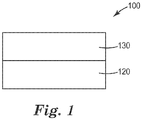
- FIG. 1 illustrates an article according to some embodiments of the present disclosure.
- a hydrophilic component in an adhesive composition can enhance the ability of the adhesive composition to adhere when moisture is present.
- the hydrophilic component has a low level of extractability from the adhesive composition, and this is particularly advantageous in medical uses of the adhesive composition. It is also often desirable that the hydrophilic component not be readily extracted from the adhesive composition by the moisture (e.g., at a wound site).
- an antimicrobial agent in the adhesive composition and preferably the combination of hydrophilic component and antimicrobial agent in the adhesive composition can result in a synergistic enhancement of antimicrobial properties at the adhesion site.
- hydrophilic is used to describe materials that can be wet by water, or by aqueous solutions or suspensions (e.g., wound exudates).
- articles including adhesive compositions of the present disclosure can be sufficiently hydrophilic to absorb at least 1 gram of water per 1 gram of the article.
- Hydrophilic component and “hydrophilic additive” are used synonymously throughout the present disclosure.
- Silicone gels are part of a class of materials typically known as filler-free silicone elastomers. Typical fillers that are absent in these materials are pyrogenic and precipitated silicas, silica aero-gels and carbon blacks. It is well known that covalent crosslinking of pure polysiloxanes yields elastomers whose mechanical strength is very low compared with that of organic elastomers. Silicone gels are typically understood to be under-crosslinked PDMS networks that exhibit greater extensibility, tack and a gelatinous consistency relative to fully crosslinked filler-free silicone elastomers.
- silicone gels exhibit pronounced viscoelastic behavior. Silicone gels are highly dissipative under deformation, resulting in pronounced damping, self-healing and resiliency properties. Another key characteristic of silicone gels is a naturally tacky surface. This natural adhesion allows gels to gain a degree of physical adhesion to most common surfaces without the need for primers. Silicone gels retain much of the stress relief and self-healing qualities of a liquid while providing the dimensional stability of an elastomer.
- Silicone gels have been used to isolate circuits from the harmful effects of moisture and other contaminants and provide electrical insulation for high voltages. Additionally, silicone gels are used in healthcare applications, such as adhesive tapes and dressings, where very gentle removal from skin is desired. Silicone gels are softer than silicone pressure sensitive adhesives (PSAs), resulting in less discomfort when adhered to, and subsequently removed from, skin. The combination of moderate adhesive strength and tack make silicone gels suitable for many skin adhesive applications.
- PSAs silicone pressure sensitive adhesives
- adhesive compositions of the present disclosure include a silicone gel that has a crosslinked poly(diorganosiloxane).
- the crosslinked poly(diorganosiloxane) has terminal end groups of Formula 1: where R 1 is hydroxyl, alkyl, or aryl, and each R 2 is independently alkyl or aryl.
- the poly(diorganosiloxanes) have a poly(siloxane) backbone.
- the poly(diorganosiloxane) can be a linear material described by Formula 2, illustrating a siloxane backbone with aliphatic and/or aromatic substituents: wherein each R 1 is independently hydroxyl, alkyl, or aryl, and wherein each R 2 , R 3 , R 4 , R 5 , and R 6 is independently alkyl or aryl, and m and n are integers, and at least one of m or n is not zero.
- An alkyl group can include 1 to about 20 carbon atoms, and an aryl group typically includes 6 to 10 carbon atoms.
- one or more of the alkyl or aryl groups may contain a halogen substituent, e.g., fluorine.
- one or more of the alkyl groups may be -CH 2 CH 2 C 4 F 9 .
- R 1 and R 2 are methyl groups, i.e., the poly(diorganosiloxane) material is terminated by trimethylsiloxy groups.
- R 3 and R 4 are alkyl groups and n is zero, and the material is referred to as a poly(dialkylsiloxane).
- the alkyl groups in a poly(dialkylsiloxane) are methyl groups, the material is a poly(dimethylsiloxane) ("PDMS").
- the poly(diorganosiloxane) can be, for example, a PDMS having -Si(OH)(CH 3 ) 2 or -Si(CH 3 ) 3 terminal groups.
- R 3 is an alkyl group
- R 4 is an aryl group
- n is zero, i.e., the material is a poly(alkylarylsiloxane).
- R 3 is methyl group and R 4 is a phenyl group, i.e., the material is poly(methylphenylsiloxane).
- R 3 and R 4 are alkyl groups and R 5 and R 6 are aryl groups, i.e., the material is a poly(dialkyldiarylsiloxane).
- R 3 and R 4 are methyl groups, and R 5 and R 6 are phenyl groups, i.e., the material is poly(dimethyldiphenylsiloxane).
- the poly(diorganosiloxane) materials can be a branched material described by Formula 3, illustrating a siloxane backbone that includes at least one linear or branched siloxane substituent among substituents R 7 , R 8 , R 9 , and R 10 : wherein each R 1 is independently hydroxyl, alkyl, or aryl, each R 2 is independently alkyl or aryl, and at least one of R 7 , R 8 , R 9 , and R 10 is a linear or branched siloxane with alkyl or aryl (optionally including halogenated alkyl or aryl) substituents, the linear or branched siloxane having the terminal end group of Formula 1, and m and n are integers, and at least one of m or n is not zero.
- Formula 3 illustrating a siloxane backbone that includes at least one linear or branched siloxane substituent among substituents R 7 , R 8 , R 9 ,
- R-groups among R 7 , R 8 , R 9 , and R 10 in Formula 3 are independently alkyl or aryl (optionally including halogenated alkyl or aryl).
- Alkyl and aryl for Formula 3 are as defined for Formula 2.
- nonfunctional groups are either alkyl or aryl groups consisting of carbon, hydrogen, and in some embodiments, halogen (e.g., fluorine) atoms.
- a “nonfunctionalized poly(diorganosiloxane) material” is one in which the R 1 , R 2 , R 3 , R 4 , R 5 , R 6 , R 7 , R 8 , R 9 , and R 10 groups are nonfunctional groups.
- the crosslinked poly(diorganosiloxane) materials of the present disclosure can be formed from either silanol-terminated or non-functional poly(diorganosiloxane) materials.
- These silicone gel adhesives have excellent wetting characteristics, due to the very low glass transition temperature (Tg) and modulus of the crosslinked poly(diorganosiloxane) network. Rheologically, these gels exhibit similar storage moduli at bond making and bond breaking time scales, resulting in relatively low to moderate forces being required to debond the adhesive by peeling. This results in minimal to no skin trauma upon removal. Additionally, the elastic nature of the crosslinked gel prevents flow of the adhesive around hair during skin wear, further reducing the instances of pain during removal.
- the silicone materials may be oils, fluids, gums, elastomers, or resins (e.g., friable solid resins).
- resins e.g., friable solid resins.
- lower molecular weight, lower viscosity materials are referred to as fluids or oils, while higher molecular weight, higher viscosity materials are referred to as gums; however, there is no sharp distinction between these terms.
- Elastomers and resins have even higher molecular weights that gums, and typically do not flow.
- fluid and oil refer to materials having a dynamic viscosity at 25 °C of no greater than 1,000,000 mPa•sec (e.g., less than 600,000 mPa•sec), while materials having a dynamic viscosity at 25 °C of greater than 1,000,000 mPa•sec (e.g., at least 10,000,000 mPa•sec) are referred to as "gums”.
- Suitable examples of poly(diorganosiloxane) materials useful for preparation of adhesive compositions of the present disclosure are commercially available, including a trimethylsilyl-terminated poly(dimethylsiloxane) silicone fluid available under the trade designation "AK 60000” from Wacker Chemical Corp. (Adrian, MI), a two-part soft skin adhesive available under the trade designation “DOW CORNING MG 7-9900” from Dow Corning (Midland, MI), and a poly(diorganosiloxane) fluid with silanol end groups available under the trade designation "OHX-4070" from Xiameter (Midland, MI).
- Adhesive compositions of the present disclosure include a hydrophilic component dispersed in the silicone gel.
- the hydrophilic component aides in managing moisture that may be present at an adhesion site, by absorbing moisture.
- the hydrophilic component can be a carbohydrate having at least 3 hydroxyl groups, a carbohydrate derivative having at least 3 hydroxyl groups, or a combination thereof.
- carbohydrates having at least 3 hydroxyl groups can include saccharides, including monosaccharides, disaccharides, trisaccharides, polysaccharides, or combinations thereof. Some other examples of carbohydrates having at least 3 hydroxyl groups can include cellulosic materials.
- Examples of carbohydrate derivatives having at least 3 hydroxyl groups can include reduced saccharides (e.g., reduced monosaccharides, reduced disaccharides, reduced trisaccharides, reduced polysaccharides, and including sugar alcohols such as mannitol, sorbitol, glycerol), partially alkoxylated carbohydrates, partially alkoxylated reduced saccharides, carboxyalkylated carbohydrates (e.g., carboxymethylated carbohydrates), or combinations thereof.
- Some other examples of alkoxylated carbohydrate derivatives having at least 3 hydroxyl groups can include alkoxylated or carboxyalkylated cellulosic materials.
- alkoxylated carbohydrate derivatives can include methoxylated or ethoxylated derivatives, ether-type alkoxylated derivatives of carbohydrates (including, e.g., ethyl 2-hydroxyethyl or methyl 2-hydroxyethyl derivatives), or combinations of any of the foregoing alkoxylated derivatives.
- carbohydrate derivatives having at least 3 hydroxyl groups can include ionic carbohydrate polymers that are based on naturally occurring polysaccharides (e.g., sodium Carboxymethylcellulose) and other modified cellulose derivatives (e.g., cellulose ethyl ether; cellulose ethyl hydroxyethyl ether; cellulose hydroxyethyl ether; cellulose methyl hydroxyethyl ether), aliginic acid, sodium alginate, guar gum; pullulan, pectin, arabic gum, and similar materials derived from carrageenans (from seaweed), pectins (from plant extracts) and xanthan (from microbial fermentation process).
- ionic carbohydrate polymers sodium alginate and carboxymethyl cellulose are most preferred.
- adhesive compositions of the present disclosure include the hydrophilic component in an amount of at least 5 weight percent, at least 10 weight percent, or even at least 20 weight percent, relative to a total weight of the adhesive composition. In some embodiments, adhesive compositions of the present disclosure include the hydrophilic component in an amount of up to 50 weight percent, up to 40 weight percent, or even up to 35 weight percent, relative to a total weight of the adhesive composition. In some embodiments, adhesive compositions of the present disclosure include the hydrophilic component in a range from 5 weight percent to 50 weight percent, from 10 weight percent to 40 weight percent, or even from 20 weight percent to 35 weight percent, relative to a total weight of the adhesive composition.
- the hydrophilic component of the present disclosure can absorb moisture (e.g., water).
- an adhesive composition of the present disclosure can absorb water in amount (by weight) that is at least 100% of an initial weight of the adhesive composition (see Examples section).
- Adhesive compositions of the present disclosure include an antimicrobial agent dispersed in the silicone gel.
- Suitable antimicrobial agents can include elemental copper, elemental silver, a copper-containing compound, a silver-containing compound, or a combination thereof.
- the antimicrobial agent be a salt, for example, a copper salt, a silver salt, or a combination thereof.
- adhesive compositions of the present disclosure can include the antimicrobial agent in an amount of at least 0.1 weight percent, at least 0.5 weight percent, or even at least 1.0 weight percent, relative to a total weight of the adhesive composition.
- the antimicrobial agent is present in an amount of up to 20 weight percent, up to 10 weight percent, or even up to 5.0 weight percent, relative to a total weight of the adhesive composition.
- the amount of antimicrobial agent is in a range from 0.1 weight percent to 20 weight percent, from 0.5 to 10 weight percent, or even from 1.0 to 5.0 weight percent, relative to a total weight of the adhesive composition.
- adhesive compositions of the present disclosure can include 35 to 95 weight percent silicone gel, 5 to 50 weight percent hydrophilic component, and 0.1 to 20 weight percent antimicrobial agent, wherein each amount is based on a total weight of the adhesive composition. More preferably, the adhesive composition can include 40 to 80 weight percent silicone gel, 10 to 40 weight percent hydrophilic component, and 0.5 to 10 weight percent antimicrobial agent, wherein each amount is based on a total weight of the adhesive composition. Even more preferably, the adhesive composition can include 45 to 60 weight percent silicone gel, 20 to 35 weight percent hydrophilic component, and 1 to 5 weight percent antimicrobial agent, wherein each amount is based on a total weight of the adhesive composition.
- the amounts of silicone gel, hydrophilic component, and antimicrobial agent can be selected to have any value within these ranges, with allowance for any of the optional additives described below, to obtain a total weight of the adhesive composition.
- the adhesive compositions of the present disclosure may be prepared by combining one or more poly(diorganosiloxane) materials (e.g., silicone oils or fluids) with the hydrophilic component and antimicrobial agent, coating the resulting combination, and curing using electron beam (E-beam) or gamma radiation.
- a tackifying resin can optionally be included, to modify adhesive properties of the adhesive compositions.
- any known tackifying resin may be used, for example, silicate tackifying resins may be used.
- the tackifying resin is usually selected to be miscible with the silicone gel.
- a plurality of silicate tackifying resins can be used to achieve desired performance.
- Suitable silicate tackifying resins include those resins composed of the following structural units M (i.e., monovalent R' 3 SiO 1/2 units), D (i.e., divalent R' 2 SiO 2/2 units), T (i.e., trivalent R'SO 3/2 units), and Q (i.e., quaternary SiO 4/2 units), and combinations thereof.
- Typical exemplary silicate resins include MQ silicate tackifying resins, MQD silicate tackifying resins, and MQT silicate tackifying resins. These silicate tackifying resins usually have a number average molecular weight in the range of 100 to 50,000- gm/mole, e.g., 500 to 15,000 gm/mole and generally R' groups are methyl groups.
- MQ silicate tackifying resins are copolymeric resins where each M unit is bonded to a Q unit, and each Q unit is bonded to at least one other Q unit. Some of the Q units are bonded to only other Q units. However, some Q units are bonded to hydroxyl radicals resulting in HOSiO 3/2 units (i.e., "T OH " units), thereby accounting for some silicon-bonded hydroxyl content of the silicate tackifying resin.
- the level of silicon bonded hydroxyl groups (i.e., silanol) on the MQ resin may be selected from to no greater than 5 weight percent, no greater than 3 weight percent, or even no greater than 1.5 weight percent based on the weight of the silicate tackifying resin.
- MQD silicone tackifying resins are terpolymers having M, Q and D units.
- MQT silicate tackifying resins are terpolymers having M, Q and T units.
- Suitable silicate tackifying resins are commercially available from sources such as Dow Corning (e.g., DC 2-7066), Momentive Performance Materials (e.g., SR545 and SR1000), and Wacker Chemie AG (e.g., BELSIL TMS-803).
- adhesive compositions of the present disclosure include 35 to 95 weight percent silicone gel, 5 to 50 weight percent hydrophilic component, 0.1 to 20 weight percent antimicrobial agent, and 0.1 to 59.9 weight percent tackifier, wherein each amount is based on a total weight of the adhesive composition. More preferably, the adhesive composition can include 40 to 80 weight percent silicone gel, 10 to 40 weight percent hydrophilic component, 0.5 to 10 weight percent antimicrobial agent, and 5 to 49.5 weight percent tackifier, wherein each amount is based on a total weight of the adhesive composition.
- the adhesive composition can include 45 to 60 weight percent silicone gel, 20 to 35 weight percent hydrophilic component, 1 to 5 weight percent antimicrobial agent, and 10 to 34 weight percent tackifier, wherein each amount is based on a total weight of the adhesive composition.
- the adhesives optionally include any of a variety of known fillers and additives including, but not limited to, fumed silica, pigments, dyes or fragrances.
- the poly(diorganosiloxane) material, the hydrophilic component, the antimicrobial agent, the tackifying resin (if present), and any optional additives may be combined by any of a wide variety of known means prior to being coated and cured.
- the various components may be pre-blended using common equipment such as mixers, blenders, mills, extruders, and the like.
- the materials may be dissolved in a solvent, coated, and dried prior to curing.
- solventless compounding and coating processes may be used.
- solventless coating may occur at about room temperature.
- the materials may have kinematic viscosity of no greater than 100,000 centistokes (cSt), e.g., no greater than 50,000 cSt.
- hot melt coating processes such as extrusion may be used, e.g., to reduce the viscosity of higher molecular weight materials to values more suitable for coating.
- the various components may be added together, in various combinations or individually, through one or more separate ports of an extruder, blended (e.g., melt mixed) within the extruder, and extruded to form the hot melt coated composition.
- the coated compositions are radiation cured.
- coating may be cured through exposure to E-beam radiation.
- the coating may be cured through exposure to gamma radiation.
- a combination of electron beam curing and gamma ray curing may be used.
- the coating may be partially cured by exposure to electron beam radiation. Subsequently, the coating may be further cured by gamma radiation.
- a support film e.g., polyester terephthalate support film
- a sample of uncured material with a liner e.g., a fluorosilicone release liner
- a sample of the uncured material may be applied to one liner, with no liner on the opposite surface ("open face”).
- the chamber is inerted (e.g., the oxygen-containing room air is replaced with an inert gas, e.g., nitrogen) while the samples are e-beam cured, particularly when open-face curing.
- the uncured material may be exposed to E-beam radiation from one side through the release liner.
- a single pass through the electron beam may be sufficient.
- Thicker samples may exhibit a cure gradient through the cross section of the adhesive so that it may be desirable to expose the uncured material to electron beam radiation from both sides.
- gamma radiation equipment includes equipment often used for gamma radiation sterilization of products for medical applications.
- such equipment may be used to cure, or partially cure adhesive compositions of the present disclosure.
- curing may occur simultaneously with a sterilization process for a semifinished or finished product, for example a tape or wound dressing.
- crosslinking the silicone gel by radiation with E-beam or gamma radiation avoids any need for additional catalyst materials. In this way, fewer extractable materials remain in the crosslinked poly(diorganosiloxane), including for example any catalytic materials that may have associated toxicity or skin irritation properties.
- the silicone gel is crosslinked in the absence of a peroxide, condensation catalyst, or hydrosilation catalyst.
- the silicone gel can be substantially free of "-SiH" groups ("substantially free” here refers to less than 0.5 mol % of -SiH groups being present in the silicone gel).
- the hydrophilic component can have a low level of extractability. For example, in some embodiments less than 10 weight percent of the hydrophilic component is extractable into a phosphate buffer saline solution at pH 7 within 24 hours at room temperature. Without being bound by theory, it is thought that at least some portion of the hydrophilic component may be covalently crosslinked to the poly(diorganosiloxane) during E-beam or gamma radiation, making at least that portion of the hydrophilic component less extractable (or even non-extractable).
- less than 9 weight percent, less than 8 weight percent, less than 7 weight percent, less than 6 weight percent, less than 5 weight percent, less than 4 weight percent, less than 3 weight percent, less than 2 weight percent, or even less than 1 weight percent of the hydrophilic component is extractable into a phosphate buffer saline solution at pH 7 within 24 hours at room temperature.
- the antimicrobial properties of the adhesive compositions of the present disclosure surprisingly can include a synergistic effect.
- Adhesive compositions including both the hydrophilic component and the antimicrobial component in a crosslinked poly(diorganosiloxane), where the crosslinking was done by radiation (e.g., E-beam radiation) showed unexpected improvement in antimicrobial properties over comparative compositions lacking the hydrophilic additive.
- adhesive compositions of the present disclosure are suitable for forming articles having medical utility, such as tapes, wound dressings, surgical drapes, IV site dressings, a prosthesis, an ostomy or stoma pouch, a buccal patch, or a transdermal patch.
- the adhesives may also be useful for other articles including dentures and hairpieces.
- the adhesive compositions of the present disclosure are suitable for adhering an article to a biological substrate (e.g., a human or an animal).
- a biological substrate e.g., a human or an animal
- adhesive compositions of the present disclosure may be used to adhere an article (e.g., a wound dressing) to the skin of humans or animals.
- Exemplary substrates include polymeric materials, plastics, natural macromolecular materials (e.g., collagen, wood, cork, and leather), paper, cloth, metals, glass, ceramics, and composites.
- the substrate is suitable for making an article suitable for use as a wound dressing.
- the substrate comprises at least one of paper, polymeric film, and woven cloth and non-woven cloth.
- the substrate can be in the form of a fiber (e.g., a sodium carboxymethylcellulose fiber) or a rope.
- the thickness of the adhesive layer is not particularly limited. In some embodiments, the thickness will be at least 10 micrometers, and in some embodiments, at least 20 micrometers. In some embodiments, the thickness will be no greater than 400 micrometers, and in some embodiments, no greater than 200 micrometers.
- the peel adhesion to surfaces such as human skin is known to be highly variable. Skin type, location on the body, and other factors can affect results. Generally, average values of peel adhesion from skin are subject to large standard deviations. In some embodiments, the average peel adhesion for human skin may be less than 200 grams/2.54 cm, and in some embodiments, less than 100 grams/2.54 cm.
- Exemplary article 100 is illustrated in FIG. 1 .
- Article 100 comprises silicone adhesive 130 associated with a first major surface of substrate 120.
- the opposite surface of silicone adhesive 130 may be protected by a release liner.
- article 100 may be self-wound, and the opposite (exposed) surface of the adhesive will come into contact with the uncoated major surface of substrate 120.
- the surface of silicone adhesive 130 can applied to a surface of interest (e.g., human skin), adhering substrate 120 to that surface.
- Film samples coated with silicone adhesive were exposed to ionizing radiation for crosslinking on an electron beam generating apparatus (obtained from Energy Sciences, Inc., Wilmington, MA, under the trade designation "MODEL CB-300").
- the samples were attached to a polyethylene terephthalate support film to convey them through the nitrogen inerted irradiation chamber of the electron beam generating apparatus.
- the absorption capacity of silicone adhesive samples was determined by the following test method. Triplicate 2.5 centimeter by 2.5 centimeter samples ("initial samples”) of polyurethane film coated with silicone adhesive (“initial samples”) were weighed, and their masses ("initial weights") were recorded. The samples were placed in a wire mesh basket and loosely covered with a wire mesh to prevent the samples from folding on themselves or sticking to each other. The samples in the wire mesh basket were placed in a jar with 1 liter of phosphate buffer solution (10 mM Na 2 HPO 4 ) that had been adjusted to pH of 7.4. The samples were kept in the solution after 24 hours, then were removed from the jar and gently blotted to remove surface moisture, and the weighed. Absorption was calculated as the percent increase in mass from the initial mass. These final, weighed samples were then typically evaluated for "Sample Integrity" by measuring extraction of hydrophilic component according to the Sample Integrity Test Method.
- sample Integrity i.e., measurement of extraction of hydrophilic component
- percent weight loss of hydrophilic additive relative to the initial samples i.e., prior to absorption of phosphate buffer
- the 180° peel adhesion of a silicone adhesive was measured according to ASTM D 3330-90 (Method A).
- Stainless steel panels were obtained from ChemInstruments, Indian Springs, OH. The stainless steel panels were washed sequentially with methylethyl ketone and n-heptane and allowed to dry for 10 minutes prior to use. Silicone adhesive coatings on a polyurethane film having a thickness of 25 micrometers were cut into 2.54 centimeter by 15 centimeter strips. Each strip was then adhered to a 5 centimeter by 20 centimeter clean, solvent-washed stainless steel panel using a 2 kilogram roller passed twice over the strip at 30 centimeters per minute.
- the bonded assembly dwelled at room temperature for about one minute and was tested for 180° peel adhesion using an IMASS slip/peel tester (obtained from Instrumentors Inc., Strongsville, OH under the trade designation "MODEL SP-2000") at a rate of 30 centimeters per minute over a ten second data collection period. Duplicate samples were tested, and the reported peel adhesion value was an average of the peel adhesion values from the individual samples.
- IMASS slip/peel tester obtained from Instrumentors Inc., Strongsville, OH under the trade designation "MODEL SP-2000
- Antibacterial activity of the silicone adhesives was evaluated according to JIS Z 2801 (Japan Industrial Standards, Japanese Standards Association, Tokyo, JP).
- a bacterial inoculum was prepared to a concentration of approximately 1 x 10 6 colony forming units per mL in a solution of 1 part Trypticase Soy Broth (BBL Prepared Plated Media, Becton, Dickinson and Company, Sparks, MD) and 499 parts phosphate buffer (0.3 mM KH 2 PO 4 ). Samples were cut as 1 inch by 1 inch (2.54 cm by 2.54 cm) squares.
- a 150 microliters aliquot of the bacterial suspension was placed onto the surface of the sample and the inoculated sample was incubated for the specified contact time at 27 °C ⁇ 1 °C. After the incubation, the sample was placed into 20 mL of Dey/Engley (D/E) Neutralizing Broth (DIFCO, Becton, Dickinson and Company, Sparks, MD). The number of surviving bacteria in the Neutralizing Broth was determined by serially diluting and plating on AEROBIC COUNT (AC) PETRIFILM (3M Company, St. Paul, MN). The plates were incubated for 48 hours at 35 °C ⁇ 1 °C. Bacterial colonies from appropriate dilution were counted according to the manufacturer's instructions and a Viable Cell Count was recorded as colony-forming units (CFU) per cm 2 .
- CFU colony-forming units
- AK 60000 A trimethylsilyl-terminated poly(dimethylsiloxane) silicone fluid, obtained from Wacker Chemical Corp., Adrian, MI, under the trade designation "AK 60000” BELSIL TMS-803 An MQ silicate resin, obtained from Wacker Chemical Corp., Adrian, MI, under the trade designation “BELSIL TMS-803” CMC Carboxymethylcellulose (“CMC”) obtained from from AMTEX, Lombard, IL, under the trade designation "GELYCEL” CMS Croscarmellose sodium (“CMS”), an internally crosslinked version of CMC, obtained from FMC Biopolymer Newark, DE, under the trade designation "SD711" D-Mannitol D-Mannitol obtained from Alfa Aesar, Ward Hill, MA MG 7-9900 A two-part soft skin adhesive, the two components obtained from Dow Corning, Midland, MI, under the trade designations "DOW CORNING MG 7-9900A” and "DOW CORNING MG 7-9900B” OHX
- Comparative Example 1 This comparative example illustrated the preparation of a silicone adhesive without hydrophilic or antimicrobial additives for comparison purposes.
- OHX-4070 (69 grams) and BELSIL TMS-803 (31 grams) were added to a cup and blended for 90 seconds at 2500 rpm in a mixer (obtained from FlackTek Inc, Landrum, SC, under the trade designation "SPEEDMIXER MODEL DAC 150.1 FV") to form a homogenous solution.
- the solution was coated at a thickness of 125 micrometers onto a 25 micrometer polyurethane film.
- the coating was irradiated with an E-beam dose of 7.5 Mrads at 280 keV.
- Comparative Example 2 This comparative example illustrated the preparation of a silicone adhesive without hydrophilic or antimicrobial additives for comparison purposes.
- OHX-4070 90 grams
- BELSIL TMS-803 10 grams
- the solution was coated at a thickness of 125 micrometers onto a 25 micrometer polyurethane film.
- the coating was irradiated with an E-beam dose of 7.5 Mrads at 280 keV.
- Example 1 (Ex. 1) A silicone composition of 50.4 grams of OHX-4070 and 22.6 grams of BELSIL TMS-803 were added to a cup and blended for 90 seconds at 2500 rpm in a mixer (SPEEDMIXER MODEL DAC 150.1 FV) to form a homogenous solution. To this solution 12 grams of CMC, 15 grams of CMS, and 2 grams of silver acetate were then added and the cup was mixed again for 90 seconds at 2500 rpm. The solution was coated at a thickness of 125 micrometers onto a 25 micrometer polyurethane film. The coating was irradiated with an E-beam dose of 7.5 Mrads at 280 keV.
- Example 2 A silicone composition of 48.3 grams of OHX-4070 and 21.7 grams of BELSIL TMS-803 were added to a cup and blended for 90 seconds at 2500 rpm in a mixer (SPEEDMIXER MODEL DAC 150.1 FV) to form a homogenous solution. To this solution 30 grams of CMC and 2 grams of silver acetate were then added and the cup was mixed again for 90 seconds at 2500 rpm. The solution was coated 125 micrometers on a 25 micrometer polyurethane film. The coating was irradiated with an E-beam dose of 7.5 Mrads at 280 keV. Adhesion, Absorption and Integrity measurements were performed and results reported in Table 2.
- Example 3 (Ex. 3): A silicone composition of 79.6 grams of OHX-4070 and 8.8 grams of BELSIL TMS-803 were added to a cup and blended for 90 seconds at 2500 rpm in a mixer (SPEEDMIXER MODEL DAC 150.1 FV) to form a homogenous solution. To this solution 8.8 grams of CMC and 2.7 grams of silver acetate were then added and the cup was mixed again for 90 seconds at 2500 rpm. The solution was coated 125 micrometers on a 25 micrometer polyurethane film. The coating was irradiated with an E-beam dose of 7.5 Mrads at 280 keV.
- Example 4 (Ex. 4): A silicone composition of 67.4 grams of OHX-4070 and 7.5 grams of BELSIL TMS-803 were added to a cup and blended for 90 seconds at 2500 rpm in a mixer (SPEEDMIXER MODEL DAC 150.1 FV) to form a homogenous solution. To this solution 22.5 grams of CMC and 2.7 grams of silver acetate were then added and the cup was mixed again for 90 seconds at 2500 rpm. The solution was coated 125 micrometers on a 25 micrometer polyurethane film. The coating was irradiated with an E-beam dose of 7.5 Mrads at 280 keV.
- Example 5 (Ex. 5): A silicone composition of 48.3 grams of OHX-4070 and 21.7 grams of BELSIL TMS-803 were added to a cup and blended for 90 seconds at 2500 rpm in a mixer (SPEEDMIXER MODEL DAC 150.1 FV) to form a homogenous solution. To this solution 30 grams of D-Mannitol and 2 grams of silver acetate were then added and the cup was mixed again for 90 seconds at 2500 rpm. The solution was coated 125 micrometers on a 25 micrometer polyurethane film. The coating was irradiated with an E-beam dose of 7.5 Mrads at 280 keV.
- Example 6 (Ex. 6): A silicone composition of 48.3 grams of AK60000 and 21.7 grams of BELSIL TMS-803 were added to a cup and blended for 90 seconds at 2500 rpm in a mixer (SPEEDMIXER MODEL DAC 150.1 FV) to form a homogenous solution. To this solution 30 grams of CMC and 2 grams of silver acetate were then added and the cup was mixed again for 90 seconds at 2500 rpm. The solution was coated 125 micrometers on a 25 micrometer polyurethane film. The coating was irradiated with an E-beam dose of 7.5 Mrads at 280 keV.
- Comparative Example 3 This comparative example illustrated the preparation of a silicone adhesive composition with non-saccharide based hydrophilic additive and an antimicrobial additive for comparison purposes.
- OHX-4070 48.3 grams
- BELSIL TMS-803 (21.7 grams) were added to a cup and blended for 90 seconds at 2500 rpm in a mixer (SPEEDMIXER MODEL DAC 150.1 FV) to form a homogenous solution.
- SPEEDMIXER MODEL DAC 150.1 FV SPEEDMIXER MODEL DAC 150.1 FV
- To this solution 30 grams Polyethylene glycol (PEG 3400) and 2 grams of silver acetate were then added and the cup was mixed again for 90 seconds at 2500 rpm.
- the solution was coated 125 micrometers on a 25 micrometer polyurethane film.
- the coating was irradiated with an E-beam dose of 7.5 Mrads at 280 keV.
- Comparative Example 4 This comparative example illustrated the preparation of a non-radiation crosslinked silicone adhesive composition.
- SPEEDMIXER cup 50 grams of MG 7-9900 part A and 50 grams of MG 7-9900 part B were added to a cup and blended for 90 seconds at 2500 rpm in a mixer (SPEEDMIXER MODEL DAC 150.1 FV) to form a homogenous solution.
- the solution was coated 125 micrometers on a 25 micrometer polyurethane film. The coating was heated to 70 °C for 15 minutes to facilitate the crosslinking of the silicone adhesive.
- Comparative Example 5 This comparative example illustrated the preparation of a non-radiation crosslinked silicone adhesive composition.
- SPEEDMIXER cup 34 grams of MG 7-9900 part A and 34 grams of MG 7-9900 part B were added to a cup and blended for 90 seconds at 2500 rpm in a mixer (SPEEDMIXER MODEL DAC 150.1 FV) to form a homogenous solution.
- SPEEDMIXER MODEL DAC 150.1 FV a mixer
- To this solution 15 grams of CMC and 15 grams of CMS and 2 grams silver acetate were then added and the cup was mixed again for 90 seconds at 2500 rpm.
- the solution was coated 125 micrometers on a 25 micrometer polyurethane film. The coating was heated to 70 °C for 15 minutes to facilitate the crosslinking of the silicone adhesive.
- Comparative Example 6 This comparative example illustrated the preparation of a (non-radiation) crosslinked silicone adhesive and non-saccharide hydrophilic additive.
- SPEEDMIXER cup 34 grams of MG 7-9900 part A and 34 grams of MG 7-9900 part B were added to a cup and blended for 90 seconds at 2500 rpm in a mixer (SPEEDMIXER MODEL DAC 150.1 FV) to form a homogenous solution.
- SPEEDMIXER MODEL DAC 150.1 FV a mixer
- To this solution 30 grams of PEG 3400 and 2 grams silver acetate were then added and the cup was mixed again for 90 seconds at 2500 rpm.
- the solution was coated 125 micrometers on a 25 micrometer polyurethane film. The coating was heated to 70 °C for 15 minutes to facilitate the crosslinking of the silicone adhesive.
- Comparative Example 7 This comparative example illustrated the preparation of a (non-radiation) crosslinked silicone adhesive composition.
- SPEEDMIXER cup 34 grams of MG 7-9900 part A and 34 grams of MG 7-9900 part B were added to a cup and blended for 90 seconds at 2500 rpm in a mixer (SPEEDMIXER MODEL DAC 150.1 FV) to form a homogenous solution.
- SPEEDMIXER MODEL DAC 150.1 FV a mixer
- D-Mannitol and 2 grams silver acetate were then added and the cup was mixed again for 90 seconds at 2500 rpm.
- the solution was coated 125 micrometers on a 25 micrometer polyurethane film. The coating was heated to 70 °C for 15 minutes to facilitate the crosslinking of the silicone adhesive.
- Example 7 This example illustrated the preparation of a silicone adhesive with an antimicrobial and hydrophilic additive according to the present disclosure.
- OHX-4070 47 grams
- BELSIL TMS-803 21 grams
- SPEEDMIXER MODEL DAC 150.1 FV a mixer
- To this solution 12 grams of CMC, 15 grams of CMS, and 5 grams silver acetate were then added and the cup was mixed again for 90 seconds at 2500 rpm.
- the resulting solution was coated at a thickness of 200 micrometers onto a 25 micrometer polyurethane film. The coating was irradiated with an E-beam dose of 7.5 Mrads at 280 keV.
- Comparative Example 8 This comparative example illustrated the preparation of a silicone adhesive with hydrophilic additive but no antimicrobial additive.
- OHX-4070 50 grams
- BELSIL TMS-803 23 grams
- SPEEDMIXER MODEL DAC 150.1 FV a mixer
- Comparative Example 9 This comparative example illustrated the preparation of a silicone adhesive with an antimicrobial additive but no hydrophilic additive.
- OHX-4070 66 grams
- BELSIL TMS-803 29 grams
- SPEEDMIXER MODEL DAC 150.1 FV a mixer
- silver acetate were then added and the cup was mixed again for 90 seconds at 2500 rpm.
- the resulting solution was coated at a thickness of 200 micrometers onto a 25 micrometer polyurethane film. The coating was irradiated with an E-beam dose of 7.5 Mrads at 280 keV.
- Comparative Example 10 This comparative example illustrated the preparation of a silicone adhesive with an antimicrobial additive but no hydrophilic additive.
- OHX-4070 81.8 grams
- BELSIL TMS-803 9.1 grams
- OHX-4070 81.8 grams
- BELSIL TMS-803 9.1 grams
- CMC CMC
- the resulting solution was coated at a thickness of 200 micrometers onto a 25 micrometer polyurethane film.
- the coating was irradiated with an E-beam dose of 7.5 Mrads at 280 keV.
- Comparative Example 11 This comparative example illustrated the preparation of a silicone adhesive with an antimicrobial additive but no hydrophilic additive.
- OHX-4070 (69.2 grams) and BELSIL TMS-803 (7.7 grams) were added to a cup and blended for 90 seconds at 2500 rpm in a mixer (SPEEDMIXER MODEL DAC 150.1 FV) to form a homogenous solution.
- SPEEDMIXER MODEL DAC 150.1 FV SPEEDMIXER MODEL DAC 150.1 FV
Landscapes
- Health & Medical Sciences (AREA)
- Chemical & Material Sciences (AREA)
- Life Sciences & Earth Sciences (AREA)
- Epidemiology (AREA)
- Veterinary Medicine (AREA)
- Public Health (AREA)
- General Health & Medical Sciences (AREA)
- Animal Behavior & Ethology (AREA)
- Chemical Kinetics & Catalysis (AREA)
- Engineering & Computer Science (AREA)
- Surgery (AREA)
- Organic Chemistry (AREA)
- Medicinal Chemistry (AREA)
- Materials Engineering (AREA)
- Hematology (AREA)
- Heart & Thoracic Surgery (AREA)
- Vascular Medicine (AREA)
- Polymers & Plastics (AREA)
- Biomedical Technology (AREA)
- Molecular Biology (AREA)
- Adhesives Or Adhesive Processes (AREA)
- Materials For Medical Uses (AREA)
- Laminated Bodies (AREA)
- Adhesive Tapes (AREA)
- Medicinal Preparation (AREA)
Applications Claiming Priority (2)
| Application Number | Priority Date | Filing Date | Title |
|---|---|---|---|
| US201261734653P | 2012-12-07 | 2012-12-07 | |
| PCT/US2013/030670 WO2014088622A1 (en) | 2012-12-07 | 2013-03-13 | Silicone gel adhesive with hydrophilic and antimicrobial properties |
Publications (2)
| Publication Number | Publication Date |
|---|---|
| EP2928978A1 EP2928978A1 (en) | 2015-10-14 |
| EP2928978B1 true EP2928978B1 (en) | 2018-08-08 |
Family
ID=47997914
Family Applications (1)
| Application Number | Title | Priority Date | Filing Date |
|---|---|---|---|
| EP13712069.7A Active EP2928978B1 (en) | 2012-12-07 | 2013-03-13 | Silicone gel adhesive with hydrophilic and antimicrobial properties |
Country Status (6)
| Country | Link |
|---|---|
| US (1) | US10370571B2 (enExample) |
| EP (1) | EP2928978B1 (enExample) |
| JP (1) | JP6053951B2 (enExample) |
| KR (1) | KR102085683B1 (enExample) |
| CN (1) | CN105121586B (enExample) |
| WO (1) | WO2014088622A1 (enExample) |
Families Citing this family (15)
| Publication number | Priority date | Publication date | Assignee | Title |
|---|---|---|---|---|
| US20190314187A1 (en) | 2016-12-02 | 2019-10-17 | 3M Innovative Properties Company | Muscle or joint support article with bump |
| US11510804B2 (en) | 2016-12-02 | 2022-11-29 | 3M Innovative Properties Company | Muscle or joint support article with a strap |
| US11446185B2 (en) | 2016-12-02 | 2022-09-20 | 3M Innovative Properties Company | Muscle or joint support article |
| CN107233616A (zh) * | 2017-05-23 | 2017-10-10 | 苏州聚容纳米科技有限公司 | 一种载纳米氧化高银的硅凝胶抗菌敷料的制备方法 |
| US11466187B2 (en) | 2017-10-26 | 2022-10-11 | 3M Innovative Properties Company | Composition containing a silicone-based adhesive and cellulose nanocrystals, and methods and articles |
| US11965120B2 (en) | 2018-04-05 | 2024-04-23 | 3M Innovative Properties Company | Gel adhesive comprising crosslinked blend of polydiorganosiloxane and acrylic polymer |
| CN108742750B (zh) * | 2018-06-21 | 2020-09-22 | 广州迈普再生医学科技股份有限公司 | 组织封堵材料及其制备方法和封堵制品 |
| IT201900004127A1 (it) * | 2019-03-21 | 2020-09-21 | Prysmian Spa | Cavo elettrico ritardante di fiamma |
| US11945973B2 (en) * | 2019-05-15 | 2024-04-02 | The Hong Kong University Of Science And Technology | Ionic liquid-based coating and method of making articles coated with the same |
| BR112021024461A2 (pt) * | 2019-07-09 | 2022-01-18 | Lts Lohmann Therapie Systeme Ag | Sistema terapêutico transdérmico compreendendo uma camada contendo agente ativo compreendendo um polímero contendo silicone e uma camada de contato com a pele compreendendo um adesivo de gel de silicone |
| JP6856163B1 (ja) * | 2020-09-18 | 2021-04-07 | 凸版印刷株式会社 | 粘着シート及びその製造方法 |
| CN118102877A (zh) * | 2021-10-13 | 2024-05-28 | 瓦克化学股份公司 | 抗微生物组合物及其制备方法 |
| WO2025094158A1 (en) * | 2023-11-03 | 2025-05-08 | Solventum Intellectual Properties Company | Polydiorganosiloxane composition comprising an antimicrobial, articles, and methods |
| WO2025099507A1 (en) * | 2023-11-10 | 2025-05-15 | Solventum Intellectual Properties Company | Method of using a negative pressure wound therapy dressing |
| CN117752552B (zh) * | 2023-12-26 | 2024-07-12 | 上海世领制药有限公司 | 亲水性美白剂和硅凝胶组合物、美白淡斑贴及其制备方法 |
Citations (4)
| Publication number | Priority date | Publication date | Assignee | Title |
|---|---|---|---|---|
| WO2005102403A1 (en) | 2004-04-08 | 2005-11-03 | Dow Corning Corporation | Silicone skin adhesive gels |
| WO2008057155A1 (en) | 2006-11-07 | 2008-05-15 | Dow Corning Corporation | Silicone skin adhesive gels |
| WO2010056544A1 (en) | 2008-10-29 | 2010-05-20 | 3M Innovative Properties Company | Gentle to skin adhesive |
| WO2011129759A1 (en) | 2010-04-14 | 2011-10-20 | Mölnlycke Health Care Ab | Antimicrobial gels |
Family Cites Families (14)
| Publication number | Priority date | Publication date | Assignee | Title |
|---|---|---|---|---|
| US56045A (en) * | 1866-07-03 | Improvement in steam-engines, valves | ||
| GB1088992A (en) | 1963-09-19 | 1967-10-25 | Squibb & Sons Inc | Protective dressings |
| US6746765B1 (en) | 2003-01-23 | 2004-06-08 | Bristol-Myers Squibb Company | Hydrocolloid adhesive tape |
| US9278155B2 (en) | 2003-06-05 | 2016-03-08 | 3M Innovative Properties Company | Adhesive compositions, articles incorporating same and methods of manufacture |
| WO2005021058A2 (en) | 2003-09-02 | 2005-03-10 | Coloplast A/S | Adhesive composition comprising hydrophilic and hydrophobic silicone elastomers |
| JP4718146B2 (ja) | 2004-09-01 | 2011-07-06 | 株式会社Shindo | 多孔質シート用エマルション型シリコーン粘着剤組成物および再剥離性粘着シート |
| KR20070049653A (ko) * | 2004-09-07 | 2007-05-11 | 다우 코닝 코포레이션 | 발한 억제제를 함유하는 실리콘 접착제 제형 |
| US20120037038A1 (en) * | 2005-11-09 | 2012-02-16 | Jayanth Rajaiah | Denture adhesive compositions and methods |
| EP1815876A3 (en) | 2006-02-02 | 2007-10-17 | Bristol-Myers Squibb Company | Hot-melt silicone based ostomy and wound care skin attachment adhesives |
| US9359529B2 (en) | 2008-10-29 | 2016-06-07 | 3M Innovative Properties Company | Electron beam cured silicone materials |
| EP2636705B1 (en) | 2008-10-29 | 2018-12-19 | 3M Innovative Properties Company | Electron beam cured, nonfunctionalized silicone pressure sensitive adhesives |
| US9907702B2 (en) | 2011-08-17 | 2018-03-06 | 3M Innovative Properties Company | Monomer-grafted fibers and uses thereof |
| WO2013056045A1 (en) * | 2011-10-12 | 2013-04-18 | Dow Corning Coporation | High-viscosity silicone adhesive |
| KR20140101416A (ko) | 2011-12-13 | 2014-08-19 | 쓰리엠 이노베이티브 프로퍼티즈 컴파니 | 활성제를 포함하는 감압 접착 물품을 제조하는 방법 |
-
2013
- 2013-03-13 CN CN201380062877.7A patent/CN105121586B/zh active Active
- 2013-03-13 EP EP13712069.7A patent/EP2928978B1/en active Active
- 2013-03-13 WO PCT/US2013/030670 patent/WO2014088622A1/en not_active Ceased
- 2013-03-13 KR KR1020157017597A patent/KR102085683B1/ko active Active
- 2013-03-13 US US14/648,633 patent/US10370571B2/en active Active
- 2013-03-13 JP JP2015546446A patent/JP6053951B2/ja active Active
Patent Citations (4)
| Publication number | Priority date | Publication date | Assignee | Title |
|---|---|---|---|---|
| WO2005102403A1 (en) | 2004-04-08 | 2005-11-03 | Dow Corning Corporation | Silicone skin adhesive gels |
| WO2008057155A1 (en) | 2006-11-07 | 2008-05-15 | Dow Corning Corporation | Silicone skin adhesive gels |
| WO2010056544A1 (en) | 2008-10-29 | 2010-05-20 | 3M Innovative Properties Company | Gentle to skin adhesive |
| WO2011129759A1 (en) | 2010-04-14 | 2011-10-20 | Mölnlycke Health Care Ab | Antimicrobial gels |
Non-Patent Citations (1)
| Title |
|---|
| "Product Information Dow Corning Soft Skin Adhesives Parts A and B", DOW CORNING, 28 August 2015 (2015-08-28), pages 1 - 3, XP055589933 |
Also Published As
| Publication number | Publication date |
|---|---|
| WO2014088622A1 (en) | 2014-06-12 |
| CN105121586B (zh) | 2017-10-13 |
| CN105121586A (zh) | 2015-12-02 |
| JP6053951B2 (ja) | 2016-12-27 |
| US10370571B2 (en) | 2019-08-06 |
| KR20150093193A (ko) | 2015-08-17 |
| KR102085683B1 (ko) | 2020-03-06 |
| US20150299542A1 (en) | 2015-10-22 |
| EP2928978A1 (en) | 2015-10-14 |
| JP2016507598A (ja) | 2016-03-10 |
Similar Documents
| Publication | Publication Date | Title |
|---|---|---|
| US10370571B2 (en) | Silicone gel adhesive with hydrophillic and antimicrobial properties | |
| EP2350221B1 (en) | Gentle to skin adhesive | |
| EP3700994B1 (en) | Composition containing a silicone-based adhesive and cellulose nanocrystals, and methods and articles | |
| JP5690398B2 (ja) | 抗菌性ゲル | |
| CA3003653A1 (en) | Skin adhesives, antimicrobial compositions, articles, and methods for the use thereof | |
| KR102242908B1 (ko) | 개선된 특성을 지니는 항미생물 접착제 | |
| EP3145463A1 (en) | A discontinuous silicone adhesive article | |
| WO2012003028A1 (en) | Silicone gel adhesives with organic polyhydroxy compounds | |
| JP2008518699A (ja) | 抗微生物活性成分を含有するシリコーンエラストマー | |
| TW202103737A (zh) | 疤痕膠片用水膠及其製法 | |
| CN111440582A (zh) | 高导热型聚氨酯热熔胶及其制备方法、应用和防护服 | |
| CN116036352A (zh) | 促进创面愈合的抗菌水凝胶粘合剂及其制备方法和应用 | |
| WO2025094158A1 (en) | Polydiorganosiloxane composition comprising an antimicrobial, articles, and methods | |
| KR102806052B1 (ko) | 의료용 실리콘 겔 조성물 및 그 제조방법 | |
| CN112812729A (zh) | 疤痕胶片用水胶的制备方法 |
Legal Events
| Date | Code | Title | Description |
|---|---|---|---|
| PUAI | Public reference made under article 153(3) epc to a published international application that has entered the european phase |
Free format text: ORIGINAL CODE: 0009012 |
|
| 17P | Request for examination filed |
Effective date: 20150602 |
|
| AK | Designated contracting states |
Kind code of ref document: A1 Designated state(s): AL AT BE BG CH CY CZ DE DK EE ES FI FR GB GR HR HU IE IS IT LI LT LU LV MC MK MT NL NO PL PT RO RS SE SI SK SM TR |
|
| AX | Request for extension of the european patent |
Extension state: BA ME |
|
| DAX | Request for extension of the european patent (deleted) | ||
| GRAP | Despatch of communication of intention to grant a patent |
Free format text: ORIGINAL CODE: EPIDOSNIGR1 |
|
| STAA | Information on the status of an ep patent application or granted ep patent |
Free format text: STATUS: GRANT OF PATENT IS INTENDED |
|
| INTG | Intention to grant announced |
Effective date: 20180213 |
|
| GRAS | Grant fee paid |
Free format text: ORIGINAL CODE: EPIDOSNIGR3 |
|
| GRAA | (expected) grant |
Free format text: ORIGINAL CODE: 0009210 |
|
| STAA | Information on the status of an ep patent application or granted ep patent |
Free format text: STATUS: THE PATENT HAS BEEN GRANTED |
|
| AK | Designated contracting states |
Kind code of ref document: B1 Designated state(s): AL AT BE BG CH CY CZ DE DK EE ES FI FR GB GR HR HU IE IS IT LI LT LU LV MC MK MT NL NO PL PT RO RS SE SI SK SM TR |
|
| REG | Reference to a national code |
Ref country code: GB Ref legal event code: FG4D |
|
| REG | Reference to a national code |
Ref country code: CH Ref legal event code: EP Ref country code: AT Ref legal event code: REF Ref document number: 1026974 Country of ref document: AT Kind code of ref document: T Effective date: 20180815 |
|
| REG | Reference to a national code |
Ref country code: IE Ref legal event code: FG4D |
|
| REG | Reference to a national code |
Ref country code: DE Ref legal event code: R096 Ref document number: 602013041563 Country of ref document: DE |
|
| REG | Reference to a national code |
Ref country code: NL Ref legal event code: MP Effective date: 20180808 |
|
| REG | Reference to a national code |
Ref country code: LT Ref legal event code: MG4D |
|
| REG | Reference to a national code |
Ref country code: AT Ref legal event code: MK05 Ref document number: 1026974 Country of ref document: AT Kind code of ref document: T Effective date: 20180808 |
|
| PG25 | Lapsed in a contracting state [announced via postgrant information from national office to epo] |
Ref country code: FI Free format text: LAPSE BECAUSE OF FAILURE TO SUBMIT A TRANSLATION OF THE DESCRIPTION OR TO PAY THE FEE WITHIN THE PRESCRIBED TIME-LIMIT Effective date: 20180808 Ref country code: GR Free format text: LAPSE BECAUSE OF FAILURE TO SUBMIT A TRANSLATION OF THE DESCRIPTION OR TO PAY THE FEE WITHIN THE PRESCRIBED TIME-LIMIT Effective date: 20181109 Ref country code: AT Free format text: LAPSE BECAUSE OF FAILURE TO SUBMIT A TRANSLATION OF THE DESCRIPTION OR TO PAY THE FEE WITHIN THE PRESCRIBED TIME-LIMIT Effective date: 20180808 Ref country code: NO Free format text: LAPSE BECAUSE OF FAILURE TO SUBMIT A TRANSLATION OF THE DESCRIPTION OR TO PAY THE FEE WITHIN THE PRESCRIBED TIME-LIMIT Effective date: 20181108 Ref country code: RS Free format text: LAPSE BECAUSE OF FAILURE TO SUBMIT A TRANSLATION OF THE DESCRIPTION OR TO PAY THE FEE WITHIN THE PRESCRIBED TIME-LIMIT Effective date: 20180808 Ref country code: IS Free format text: LAPSE BECAUSE OF FAILURE TO SUBMIT A TRANSLATION OF THE DESCRIPTION OR TO PAY THE FEE WITHIN THE PRESCRIBED TIME-LIMIT Effective date: 20181208 Ref country code: LT Free format text: LAPSE BECAUSE OF FAILURE TO SUBMIT A TRANSLATION OF THE DESCRIPTION OR TO PAY THE FEE WITHIN THE PRESCRIBED TIME-LIMIT Effective date: 20180808 Ref country code: BG Free format text: LAPSE BECAUSE OF FAILURE TO SUBMIT A TRANSLATION OF THE DESCRIPTION OR TO PAY THE FEE WITHIN THE PRESCRIBED TIME-LIMIT Effective date: 20181108 Ref country code: SE Free format text: LAPSE BECAUSE OF FAILURE TO SUBMIT A TRANSLATION OF THE DESCRIPTION OR TO PAY THE FEE WITHIN THE PRESCRIBED TIME-LIMIT Effective date: 20180808 Ref country code: NL Free format text: LAPSE BECAUSE OF FAILURE TO SUBMIT A TRANSLATION OF THE DESCRIPTION OR TO PAY THE FEE WITHIN THE PRESCRIBED TIME-LIMIT Effective date: 20180808 Ref country code: PL Free format text: LAPSE BECAUSE OF FAILURE TO SUBMIT A TRANSLATION OF THE DESCRIPTION OR TO PAY THE FEE WITHIN THE PRESCRIBED TIME-LIMIT Effective date: 20180808 |
|
| PG25 | Lapsed in a contracting state [announced via postgrant information from national office to epo] |
Ref country code: AL Free format text: LAPSE BECAUSE OF FAILURE TO SUBMIT A TRANSLATION OF THE DESCRIPTION OR TO PAY THE FEE WITHIN THE PRESCRIBED TIME-LIMIT Effective date: 20180808 Ref country code: LV Free format text: LAPSE BECAUSE OF FAILURE TO SUBMIT A TRANSLATION OF THE DESCRIPTION OR TO PAY THE FEE WITHIN THE PRESCRIBED TIME-LIMIT Effective date: 20180808 Ref country code: HR Free format text: LAPSE BECAUSE OF FAILURE TO SUBMIT A TRANSLATION OF THE DESCRIPTION OR TO PAY THE FEE WITHIN THE PRESCRIBED TIME-LIMIT Effective date: 20180808 |
|
| PG25 | Lapsed in a contracting state [announced via postgrant information from national office to epo] |
Ref country code: ES Free format text: LAPSE BECAUSE OF FAILURE TO SUBMIT A TRANSLATION OF THE DESCRIPTION OR TO PAY THE FEE WITHIN THE PRESCRIBED TIME-LIMIT Effective date: 20180808 Ref country code: RO Free format text: LAPSE BECAUSE OF FAILURE TO SUBMIT A TRANSLATION OF THE DESCRIPTION OR TO PAY THE FEE WITHIN THE PRESCRIBED TIME-LIMIT Effective date: 20180808 Ref country code: IT Free format text: LAPSE BECAUSE OF FAILURE TO SUBMIT A TRANSLATION OF THE DESCRIPTION OR TO PAY THE FEE WITHIN THE PRESCRIBED TIME-LIMIT Effective date: 20180808 Ref country code: CZ Free format text: LAPSE BECAUSE OF FAILURE TO SUBMIT A TRANSLATION OF THE DESCRIPTION OR TO PAY THE FEE WITHIN THE PRESCRIBED TIME-LIMIT Effective date: 20180808 Ref country code: EE Free format text: LAPSE BECAUSE OF FAILURE TO SUBMIT A TRANSLATION OF THE DESCRIPTION OR TO PAY THE FEE WITHIN THE PRESCRIBED TIME-LIMIT Effective date: 20180808 |
|
| REG | Reference to a national code |
Ref country code: DE Ref legal event code: R026 Ref document number: 602013041563 Country of ref document: DE |
|
| PLBI | Opposition filed |
Free format text: ORIGINAL CODE: 0009260 |
|
| PLAX | Notice of opposition and request to file observation + time limit sent |
Free format text: ORIGINAL CODE: EPIDOSNOBS2 |
|
| PG25 | Lapsed in a contracting state [announced via postgrant information from national office to epo] |
Ref country code: SM Free format text: LAPSE BECAUSE OF FAILURE TO SUBMIT A TRANSLATION OF THE DESCRIPTION OR TO PAY THE FEE WITHIN THE PRESCRIBED TIME-LIMIT Effective date: 20180808 Ref country code: DK Free format text: LAPSE BECAUSE OF FAILURE TO SUBMIT A TRANSLATION OF THE DESCRIPTION OR TO PAY THE FEE WITHIN THE PRESCRIBED TIME-LIMIT Effective date: 20180808 Ref country code: SK Free format text: LAPSE BECAUSE OF FAILURE TO SUBMIT A TRANSLATION OF THE DESCRIPTION OR TO PAY THE FEE WITHIN THE PRESCRIBED TIME-LIMIT Effective date: 20180808 |
|
| 26 | Opposition filed |
Opponent name: MOELNLYCKE HEALTH CARE AB Effective date: 20190506 |
|
| PG25 | Lapsed in a contracting state [announced via postgrant information from national office to epo] |
Ref country code: SI Free format text: LAPSE BECAUSE OF FAILURE TO SUBMIT A TRANSLATION OF THE DESCRIPTION OR TO PAY THE FEE WITHIN THE PRESCRIBED TIME-LIMIT Effective date: 20180808 |
|
| PLBB | Reply of patent proprietor to notice(s) of opposition received |
Free format text: ORIGINAL CODE: EPIDOSNOBS3 |
|
| PG25 | Lapsed in a contracting state [announced via postgrant information from national office to epo] |
Ref country code: MC Free format text: LAPSE BECAUSE OF FAILURE TO SUBMIT A TRANSLATION OF THE DESCRIPTION OR TO PAY THE FEE WITHIN THE PRESCRIBED TIME-LIMIT Effective date: 20180808 |
|
| REG | Reference to a national code |
Ref country code: CH Ref legal event code: PL |
|
| GBPC | Gb: european patent ceased through non-payment of renewal fee |
Effective date: 20190313 |
|
| PG25 | Lapsed in a contracting state [announced via postgrant information from national office to epo] |
Ref country code: LU Free format text: LAPSE BECAUSE OF NON-PAYMENT OF DUE FEES Effective date: 20190313 |
|
| REG | Reference to a national code |
Ref country code: BE Ref legal event code: MM Effective date: 20190331 |
|
| PG25 | Lapsed in a contracting state [announced via postgrant information from national office to epo] |
Ref country code: GB Free format text: LAPSE BECAUSE OF NON-PAYMENT OF DUE FEES Effective date: 20190313 Ref country code: LI Free format text: LAPSE BECAUSE OF NON-PAYMENT OF DUE FEES Effective date: 20190331 Ref country code: CH Free format text: LAPSE BECAUSE OF NON-PAYMENT OF DUE FEES Effective date: 20190331 Ref country code: IE Free format text: LAPSE BECAUSE OF NON-PAYMENT OF DUE FEES Effective date: 20190313 |
|
| PG25 | Lapsed in a contracting state [announced via postgrant information from national office to epo] |
Ref country code: FR Free format text: LAPSE BECAUSE OF NON-PAYMENT OF DUE FEES Effective date: 20190331 Ref country code: BE Free format text: LAPSE BECAUSE OF NON-PAYMENT OF DUE FEES Effective date: 20190331 |
|
| PG25 | Lapsed in a contracting state [announced via postgrant information from national office to epo] |
Ref country code: TR Free format text: LAPSE BECAUSE OF FAILURE TO SUBMIT A TRANSLATION OF THE DESCRIPTION OR TO PAY THE FEE WITHIN THE PRESCRIBED TIME-LIMIT Effective date: 20180808 |
|
| PG25 | Lapsed in a contracting state [announced via postgrant information from national office to epo] |
Ref country code: MT Free format text: LAPSE BECAUSE OF NON-PAYMENT OF DUE FEES Effective date: 20190313 Ref country code: PT Free format text: LAPSE BECAUSE OF FAILURE TO SUBMIT A TRANSLATION OF THE DESCRIPTION OR TO PAY THE FEE WITHIN THE PRESCRIBED TIME-LIMIT Effective date: 20181208 |
|
| PG25 | Lapsed in a contracting state [announced via postgrant information from national office to epo] |
Ref country code: CY Free format text: LAPSE BECAUSE OF FAILURE TO SUBMIT A TRANSLATION OF THE DESCRIPTION OR TO PAY THE FEE WITHIN THE PRESCRIBED TIME-LIMIT Effective date: 20180808 |
|
| PG25 | Lapsed in a contracting state [announced via postgrant information from national office to epo] |
Ref country code: HU Free format text: LAPSE BECAUSE OF FAILURE TO SUBMIT A TRANSLATION OF THE DESCRIPTION OR TO PAY THE FEE WITHIN THE PRESCRIBED TIME-LIMIT; INVALID AB INITIO Effective date: 20130313 |
|
| PG25 | Lapsed in a contracting state [announced via postgrant information from national office to epo] |
Ref country code: MK Free format text: LAPSE BECAUSE OF FAILURE TO SUBMIT A TRANSLATION OF THE DESCRIPTION OR TO PAY THE FEE WITHIN THE PRESCRIBED TIME-LIMIT Effective date: 20180808 |
|
| PLCK | Communication despatched that opposition was rejected |
Free format text: ORIGINAL CODE: EPIDOSNREJ1 |
|
| APAH | Appeal reference modified |
Free format text: ORIGINAL CODE: EPIDOSCREFNO |
|
| APAW | Appeal reference deleted |
Free format text: ORIGINAL CODE: EPIDOSDREFNO |
|
| APAY | Date of receipt of notice of appeal deleted |
Free format text: ORIGINAL CODE: EPIDOSDNOA2O |
|
| APBM | Appeal reference recorded |
Free format text: ORIGINAL CODE: EPIDOSNREFNO |
|
| APBP | Date of receipt of notice of appeal recorded |
Free format text: ORIGINAL CODE: EPIDOSNNOA2O |
|
| APBQ | Date of receipt of statement of grounds of appeal recorded |
Free format text: ORIGINAL CODE: EPIDOSNNOA3O |
|
| APAH | Appeal reference modified |
Free format text: ORIGINAL CODE: EPIDOSCREFNO |
|
| REG | Reference to a national code |
Ref country code: DE Ref legal event code: R081 Ref document number: 602013041563 Country of ref document: DE Owner name: SOLVENTUM INTELLECTUAL PROPERTIES CO. (N.D.GES, US Free format text: FORMER OWNER: 3M INNOVATIVE PROPERTIES COMPANY, SAINT PAUL, MINN., US |
|
| RAP2 | Party data changed (patent owner data changed or rights of a patent transferred) |
Owner name: SOLVENTUM INTELLECTUAL PROPERTIES COMPANY |
|
| REG | Reference to a national code |
Ref country code: DE Ref legal event code: R100 Ref document number: 602013041563 Country of ref document: DE |
|
| APBU | Appeal procedure closed |
Free format text: ORIGINAL CODE: EPIDOSNNOA9O |
|
| PLBN | Opposition rejected |
Free format text: ORIGINAL CODE: 0009273 |
|
| STAA | Information on the status of an ep patent application or granted ep patent |
Free format text: STATUS: OPPOSITION REJECTED |
|
| 27O | Opposition rejected |
Effective date: 20241129 |
|
| PGFP | Annual fee paid to national office [announced via postgrant information from national office to epo] |
Ref country code: DE Payment date: 20260219 Year of fee payment: 14 |