EP2919826B1 - Vascular embolic system - Google Patents
Vascular embolic system Download PDFInfo
- Publication number
- EP2919826B1 EP2919826B1 EP13802115.9A EP13802115A EP2919826B1 EP 2919826 B1 EP2919826 B1 EP 2919826B1 EP 13802115 A EP13802115 A EP 13802115A EP 2919826 B1 EP2919826 B1 EP 2919826B1
- Authority
- EP
- European Patent Office
- Prior art keywords
- peptide
- solution
- composition
- biological vessel
- subject
- Prior art date
- Legal status (The legal status is an assumption and is not a legal conclusion. Google has not performed a legal analysis and makes no representation as to the accuracy of the status listed.)
- Active
Links
Images


Classifications
-
- A—HUMAN NECESSITIES
- A61—MEDICAL OR VETERINARY SCIENCE; HYGIENE
- A61P—SPECIFIC THERAPEUTIC ACTIVITY OF CHEMICAL COMPOUNDS OR MEDICINAL PREPARATIONS
- A61P9/00—Drugs for disorders of the cardiovascular system
-
- A—HUMAN NECESSITIES
- A61—MEDICAL OR VETERINARY SCIENCE; HYGIENE
- A61B—DIAGNOSIS; SURGERY; IDENTIFICATION
- A61B17/00—Surgical instruments, devices or methods
- A61B17/12—Surgical instruments, devices or methods for ligaturing or otherwise compressing tubular parts of the body, e.g. blood vessels or umbilical cord
- A61B17/12022—Occluding by internal devices, e.g. balloons or releasable wires
- A61B17/12131—Occluding by internal devices, e.g. balloons or releasable wires characterised by the type of occluding device
- A61B17/12181—Occluding by internal devices, e.g. balloons or releasable wires characterised by the type of occluding device formed by fluidized, gelatinous or cellular remodelable materials, e.g. embolic liquids, foams or extracellular matrices
- A61B17/12186—Occluding by internal devices, e.g. balloons or releasable wires characterised by the type of occluding device formed by fluidized, gelatinous or cellular remodelable materials, e.g. embolic liquids, foams or extracellular matrices liquid materials adapted to be injected
-
- A—HUMAN NECESSITIES
- A61—MEDICAL OR VETERINARY SCIENCE; HYGIENE
- A61B—DIAGNOSIS; SURGERY; IDENTIFICATION
- A61B6/00—Apparatus or devices for radiation diagnosis; Apparatus or devices for radiation diagnosis combined with radiation therapy equipment
- A61B6/48—Diagnostic techniques
- A61B6/481—Diagnostic techniques involving the use of contrast agents
-
- A—HUMAN NECESSITIES
- A61—MEDICAL OR VETERINARY SCIENCE; HYGIENE
- A61B—DIAGNOSIS; SURGERY; IDENTIFICATION
- A61B6/00—Apparatus or devices for radiation diagnosis; Apparatus or devices for radiation diagnosis combined with radiation therapy equipment
- A61B6/50—Apparatus or devices for radiation diagnosis; Apparatus or devices for radiation diagnosis combined with radiation therapy equipment specially adapted for specific body parts; specially adapted for specific clinical applications
- A61B6/504—Apparatus or devices for radiation diagnosis; Apparatus or devices for radiation diagnosis combined with radiation therapy equipment specially adapted for specific body parts; specially adapted for specific clinical applications for diagnosis of blood vessels, e.g. by angiography
-
- A—HUMAN NECESSITIES
- A61—MEDICAL OR VETERINARY SCIENCE; HYGIENE
- A61K—PREPARATIONS FOR MEDICAL, DENTAL OR TOILETRY PURPOSES
- A61K49/00—Preparations for testing in vivo
- A61K49/04—X-ray contrast preparations
- A61K49/0433—X-ray contrast preparations containing an organic halogenated X-ray contrast-enhancing agent
- A61K49/0438—Organic X-ray contrast-enhancing agent comprising an iodinated group or an iodine atom, e.g. iopamidol
-
- A—HUMAN NECESSITIES
- A61—MEDICAL OR VETERINARY SCIENCE; HYGIENE
- A61L—METHODS OR APPARATUS FOR STERILISING MATERIALS OR OBJECTS IN GENERAL; DISINFECTION, STERILISATION OR DEODORISATION OF AIR; CHEMICAL ASPECTS OF BANDAGES, DRESSINGS, ABSORBENT PADS OR SURGICAL ARTICLES; MATERIALS FOR BANDAGES, DRESSINGS, ABSORBENT PADS OR SURGICAL ARTICLES
- A61L24/00—Surgical adhesives or cements; Adhesives for colostomy devices
- A61L24/001—Use of materials characterised by their function or physical properties
- A61L24/0031—Hydrogels or hydrocolloids
-
- A—HUMAN NECESSITIES
- A61—MEDICAL OR VETERINARY SCIENCE; HYGIENE
- A61L—METHODS OR APPARATUS FOR STERILISING MATERIALS OR OBJECTS IN GENERAL; DISINFECTION, STERILISATION OR DEODORISATION OF AIR; CHEMICAL ASPECTS OF BANDAGES, DRESSINGS, ABSORBENT PADS OR SURGICAL ARTICLES; MATERIALS FOR BANDAGES, DRESSINGS, ABSORBENT PADS OR SURGICAL ARTICLES
- A61L24/00—Surgical adhesives or cements; Adhesives for colostomy devices
- A61L24/04—Surgical adhesives or cements; Adhesives for colostomy devices containing macromolecular materials
- A61L24/10—Polypeptides; Proteins
- A61L24/108—Specific proteins or polypeptides not covered by groups A61L24/102 - A61L24/106
-
- A—HUMAN NECESSITIES
- A61—MEDICAL OR VETERINARY SCIENCE; HYGIENE
- A61L—METHODS OR APPARATUS FOR STERILISING MATERIALS OR OBJECTS IN GENERAL; DISINFECTION, STERILISATION OR DEODORISATION OF AIR; CHEMICAL ASPECTS OF BANDAGES, DRESSINGS, ABSORBENT PADS OR SURGICAL ARTICLES; MATERIALS FOR BANDAGES, DRESSINGS, ABSORBENT PADS OR SURGICAL ARTICLES
- A61L31/00—Materials for other surgical articles, e.g. stents, stent-grafts, shunts, surgical drapes, guide wires, materials for adhesion prevention, occluding devices, surgical gloves, tissue fixation devices
- A61L31/04—Macromolecular materials
- A61L31/043—Proteins; Polypeptides; Degradation products thereof
- A61L31/047—Other specific proteins or polypeptides not covered by A61L31/044 - A61L31/046
-
- A—HUMAN NECESSITIES
- A61—MEDICAL OR VETERINARY SCIENCE; HYGIENE
- A61P—SPECIFIC THERAPEUTIC ACTIVITY OF CHEMICAL COMPOUNDS OR MEDICINAL PREPARATIONS
- A61P35/00—Antineoplastic agents
-
- A—HUMAN NECESSITIES
- A61—MEDICAL OR VETERINARY SCIENCE; HYGIENE
- A61P—SPECIFIC THERAPEUTIC ACTIVITY OF CHEMICAL COMPOUNDS OR MEDICINAL PREPARATIONS
- A61P41/00—Drugs used in surgical methods, e.g. surgery adjuvants for preventing adhesion or for vitreum substitution
-
- C—CHEMISTRY; METALLURGY
- C07—ORGANIC CHEMISTRY
- C07K—PEPTIDES
- C07K7/00—Peptides having 5 to 20 amino acids in a fully defined sequence; Derivatives thereof
- C07K7/04—Linear peptides containing only normal peptide links
- C07K7/08—Linear peptides containing only normal peptide links having 12 to 20 amino acids
-
- H—ELECTRICITY
- H10—SEMICONDUCTOR DEVICES; ELECTRIC SOLID-STATE DEVICES NOT OTHERWISE PROVIDED FOR
- H10K—ORGANIC ELECTRIC SOLID-STATE DEVICES
- H10K59/00—Integrated devices, or assemblies of multiple devices, comprising at least one organic light-emitting element covered by group H10K50/00
- H10K59/60—OLEDs integrated with inorganic light-sensitive elements, e.g. with inorganic solar cells or inorganic photodiodes
-
- A—HUMAN NECESSITIES
- A61—MEDICAL OR VETERINARY SCIENCE; HYGIENE
- A61B—DIAGNOSIS; SURGERY; IDENTIFICATION
- A61B17/00—Surgical instruments, devices or methods
- A61B17/12—Surgical instruments, devices or methods for ligaturing or otherwise compressing tubular parts of the body, e.g. blood vessels or umbilical cord
- A61B17/12022—Occluding by internal devices, e.g. balloons or releasable wires
- A61B17/12099—Occluding by internal devices, e.g. balloons or releasable wires characterised by the location of the occluder
- A61B17/12109—Occluding by internal devices, e.g. balloons or releasable wires characterised by the location of the occluder in a blood vessel
-
- A—HUMAN NECESSITIES
- A61—MEDICAL OR VETERINARY SCIENCE; HYGIENE
- A61B—DIAGNOSIS; SURGERY; IDENTIFICATION
- A61B17/00—Surgical instruments, devices or methods
- A61B17/12—Surgical instruments, devices or methods for ligaturing or otherwise compressing tubular parts of the body, e.g. blood vessels or umbilical cord
- A61B17/12022—Occluding by internal devices, e.g. balloons or releasable wires
- A61B17/12099—Occluding by internal devices, e.g. balloons or releasable wires characterised by the location of the occluder
- A61B17/12109—Occluding by internal devices, e.g. balloons or releasable wires characterised by the location of the occluder in a blood vessel
- A61B17/12113—Occluding by internal devices, e.g. balloons or releasable wires characterised by the location of the occluder in a blood vessel within an aneurysm
-
- A—HUMAN NECESSITIES
- A61—MEDICAL OR VETERINARY SCIENCE; HYGIENE
- A61L—METHODS OR APPARATUS FOR STERILISING MATERIALS OR OBJECTS IN GENERAL; DISINFECTION, STERILISATION OR DEODORISATION OF AIR; CHEMICAL ASPECTS OF BANDAGES, DRESSINGS, ABSORBENT PADS OR SURGICAL ARTICLES; MATERIALS FOR BANDAGES, DRESSINGS, ABSORBENT PADS OR SURGICAL ARTICLES
- A61L2400/00—Materials characterised by their function or physical properties
- A61L2400/04—Materials for stopping bleeding
-
- A—HUMAN NECESSITIES
- A61—MEDICAL OR VETERINARY SCIENCE; HYGIENE
- A61L—METHODS OR APPARATUS FOR STERILISING MATERIALS OR OBJECTS IN GENERAL; DISINFECTION, STERILISATION OR DEODORISATION OF AIR; CHEMICAL ASPECTS OF BANDAGES, DRESSINGS, ABSORBENT PADS OR SURGICAL ARTICLES; MATERIALS FOR BANDAGES, DRESSINGS, ABSORBENT PADS OR SURGICAL ARTICLES
- A61L2400/00—Materials characterised by their function or physical properties
- A61L2400/06—Flowable or injectable implant compositions
-
- A—HUMAN NECESSITIES
- A61—MEDICAL OR VETERINARY SCIENCE; HYGIENE
- A61L—METHODS OR APPARATUS FOR STERILISING MATERIALS OR OBJECTS IN GENERAL; DISINFECTION, STERILISATION OR DEODORISATION OF AIR; CHEMICAL ASPECTS OF BANDAGES, DRESSINGS, ABSORBENT PADS OR SURGICAL ARTICLES; MATERIALS FOR BANDAGES, DRESSINGS, ABSORBENT PADS OR SURGICAL ARTICLES
- A61L2430/00—Materials or treatment for tissue regeneration
- A61L2430/36—Materials or treatment for tissue regeneration for embolization or occlusion, e.g. vaso-occlusive compositions or devices
-
- A—HUMAN NECESSITIES
- A61—MEDICAL OR VETERINARY SCIENCE; HYGIENE
- A61M—DEVICES FOR INTRODUCING MEDIA INTO, OR ONTO, THE BODY; DEVICES FOR TRANSDUCING BODY MEDIA OR FOR TAKING MEDIA FROM THE BODY; DEVICES FOR PRODUCING OR ENDING SLEEP OR STUPOR
- A61M5/00—Devices for bringing media into the body in a subcutaneous, intra-vascular or intramuscular way; Accessories therefor, e.g. filling or cleaning devices, arm rests
- A61M5/007—Devices for bringing media into the body in a subcutaneous, intra-vascular or intramuscular way; Accessories therefor, e.g. filling or cleaning devices, arm rests for contrast media
Definitions
- compositions as defined in the claims relate to compositions as defined in the claims.
- Document WO 2006/014570 A2 discloses aqueous solutions of an amphiphilic peptide having alternating hydrophilic and hydrophobic amino acids and containing at least 8 amino acids.
- a peptide comprising 16 aminoacids such as peptide RADA16.
- Solutions of the peptides are used in amounts and concentrations which allow formation of hydrogels.
- the gels may be injected into blood vessels and can be used for embolization or stopping bleeding in conjunction with tumor excision.
- the gels may also be used for drug delivery in the treatment of cancerous cells.
- Document EP 2 345 433 A1 discloses arteriovenous occluding agents, in particular, peptides of sequence Ac-(RADA) 4 -NH 2 .
- the peptides are used in amounts and concentrations which allow them to form hydrogels.
- the polymers can be used also in tumor excisions to stop bleeding.
- Embolization is a procedure that creates a blockage, lodging, occlusion, or embolism in one or more biological pathways or channels.
- the biological pathways or channels may include vessels, veins, portal veins, arteries, and ducts that may transport blood and other fluids, such as lymph fluids.
- Embolization is used to treat a wide variety of conditions affecting different organs of a subject's body, including the human body.
- the one or more vessels may be targeted to purposely prevent or reduce the circulation of blood to a desired target.
- the embolization procedure may be used to purposely create such a blockage, lodging or occlusion in order to deprive tumors or other pathological processes of their blood supply (perfusion).
- Embolization may be used to treat disorders, malformations, or congenital ailments in biological vessels.
- embolization may be used to treat patent ductus arteriosus (PDA).
- the embolization treatment may be used to treat major aortopulmonary collateral artery (MAPCA), recurrent hemotysis, arteriovenous malformations, cerebral aneurysms, gastrointestinal bleeding, epistaxis, post-partum hemorrhage, surgical hemorrhage, and uterine fibroids.
- MAPCA major aortopulmonary collateral artery
- Embolization may be accomplished by several different techniques. It may be accomplished by administering a material, such as a liquid to a desired or predetermined location, such as a target area. Administering may include applying or injecting a material, such as a liquid to a desired or predetermined location, such as a target area.
- Embolization may be used to shut down or block all or a portion of a vessel which forms an aneurysm in order to prevent the aneurysm from rupturing. Embolization may also be used to shut down or block all or a portion of certain blood vessels that surround a region of a subject that is being operated on, for example, during surgery of cerebral arteriovenous malformation (AVM).
- AVM cerebral arteriovenous malformation
- Obstructing materials may be used to create a blockage or occlusion in a biological vessel to accomplish embolization.
- Obstructing materials may include metal coils, collagens, cyanoacrylates, and other materials. The materials may be inserted or placed at the desired surgical sites with the use of a catheter. Balloons may also be implanted in a target vessel and filled with saline.
- Metal coils may remain in vivo permanently, but the safety of these coils in long-term applications is unknown.
- the metal coils may also result in incompatibility with magnetic devices.
- Collagens may have biological incompatabilities and cyanoacrylates may become toxic in vivo.
- Specific liquid embolization agents may include onyx, n-butyl-2-cyanoacrylate (nbca) and ethiodol, made from iodine, poppyseed oil. Schlerosing agents, which harden the endothelial lining of vessels may also be used. Examples of such agents include ethanol, ethanolamine oleate and sotradecol. Particulate embolization agents include polyvinyl alcohol and acrylic gelatin microspheres.
- Blood vessels may include arteries, veins, portal veins and capillaries.
- vascular may refer to biological vessels, including arteries, veins, portal veins, capillaries, and ducts.
- subject is intended to include human and non-human animals, for example, vertebrates, large animals, and primates.
- the subject is a mammalian subject, and in particular embodiments, the subject is a human subject.
- non-human animals of the invention includes all vertebrates, for example, non-mammals (such as birds, for example, chickens; amphibians; reptiles) and mammals, such as non-human primates, domesticated, and agriculturally useful animals, for example, sheep, dog, cat, cow, pig, rat, among others.
- non-mammals such as birds, for example, chickens; amphibians; reptiles
- mammals such as non-human primates, domesticated, and agriculturally useful animals, for example, sheep, dog, cat, cow, pig, rat, among others.
- the embolism, blockage or obstruction may be partial or complete. By complete it is meant that the embolism, blockage or obstruction prevents substantially all blood flow past the embolism, blockage, or obstruction.
- the self-assembling peptide solution may be an aqueous self-assembling peptide solution.
- the self-assembling peptide also referred to herein as "peptide” or “amphiphilic peptide” may be administered, applied, or injected in a solution that is substantially cell-free. In certain embodiments, the self-assembling peptide may be administered, applied, or injected in a solution that is cell-free.
- the self-assembling peptide may also be administered, applied or injected in a solution that is substantially drug-free.
- the self-assembling peptide may be administered, applied, or injected in a solution that is drug-free.
- the self-assembling peptide may be administered, applied, or injected in a solution that is substantially cell-free and substantially drug-free.
- the self-assembling peptide may be administered, applied, or injected in a solution that is cell-free and drug-free.
- a hydrogel is a term that may refer to a colloidal gel that is dispersed in water.
- the composition is for applying a self-assembling peptide to a predetermined or desired target as a solution, such as an aqueous peptide solution.
- administering it is intended to include, but is not limited to, applying, introducing or injecting the self-assembling peptide, in one or more of various forms including, but not limited to, by itself, by way of a solution, such as an aqueous solution, or by way of a hydrogel, with or without additional components.
- the method of blocking the biological vessel in a subject may comprise introducing a syringe, pipette, catheter, or other needle-based device into the biological vessel.
- the self-assembling peptide may be administered by way of a syringe, pipette, catheter, or other needle-based device into the biological vessel.
- the gauge of the syringe needle may be selected to provide an adequate flow of liquid from the syringe to the target area. This may be based in some embodiments on at least one of the amount of self-assembling peptide or peptide solution being administered, the concentration of the peptide in solution, and the viscosity of the peptide solution.
- the method of blocking the biological vessel in the subject may comprise introducing a catheter into the biological vessel and positioning an end of the catheter in a target area of the biological vessel in which at least a partial obstruction is desired.
- the self-assembling peptide may be administered by way of a catheter to the target area of a biological vessel in which at least a partial obstruction is desired.
- the use of a catheter may provide a more selective administration of the peptide to provide for a more accurate delivery to the target area.
- Selective administration of the peptide may allow for enhanced and more targeted delivery of the peptide solution such that blockage of the biological vessel is successful and positioned in the desired location in an accurate manner.
- the selective administration may provide enhanced, targeted delivery that markedly improves the positioning and effectiveness of the blockage in the biological vessel over use of a syringe or other means.
- Use of the catheter may include use of accompanying devices, such as a guidewire used to guide the catheter into position.
- the guidewire may be introduced into the biological vessel prior to introducing the catheter. Once the administration of the peptide solution is complete, or once the at least partial obstruction or blockage is in place, the catheter may be removed from the biological vessel.
- a syringe, needle, pipette, other needle-based device, or catheter may require determining the diameter of the biological vessel which is targeted, such that at least a portion of the syringe, needle, pipette, other needle-type device, or catheter may enter the biological vessel to administer the peptide, peptide solution, or hydrogel to the target area.
- a solution comprising the self-assembling peptide such as an aqueous solution, may be inserted to an in vivo location or area of a subject to allow an embolism to be created at that location.
- the hydrogel may be formed in vivo at one location, and allowed to move the hydrogel unassisted to the area in which it is desired to form an embolism.
- another procedure may place the hydrogel in the area in which it is desired to form an embolism. Since the self-assembling peptide gels in response to changes in solution pH and salt concentration, it can be distributed as a liquid that gels upon contact with a subject during application or administration.
- the particular self-assembling peptides of the present disclosure may provide for improved adhesion to tissue over other agents that may be used in biological vessel embolization.
- the improved adhesion may be due to the composition of the peptide (for example, the particular amino acids of the peptide), the structure of the peptide once self-assembled, or due to the self-assembly process itself.
- it may benefit the procedure to remove excess body fluid, such as blood or bile, from the target site or area in which it is desired to provide a hydrogel for occlusion.
- the peptide or hydrogel may not adhere to the tissue or biological vessel.
- the peptide or peptide solution As the peptide or peptide solution is administered, it comes in contact with the blood or other fluid in the biological vessel, which causes gelation inside the vessel.
- the peptide solution can move within the vessel, but as it begins to gel it loses its fluidity and will remain in position at a position or target area in the biological vessel.
- the peptides in the form of a hydrogel may remain in place without adhesion to the tissue or biological vessel.
- the self-assembling peptides may exhibit a beta-structure in aqueous solution in the presence of physiological pH and/or a cation, such as a monovalent cation.
- the order of effectiveness of the monovalent cations appears to be Li + >Na + >K + >Cs + .
- Cs + may produce the least amount of membranes and in addition, yields nonmembranous precipitates.
- the effectiveness of the monovalent cations may correlate inversely with the crystal radii of the ions: Li + (0.6 Angstroms), Na + (0.95 Angstroms), K + (1.33 Angstroms), and Cs + (1.69 Angstroms) (Pauling, 1960).
- the presence of the the monovalent metal cations may act as a catalyst or may be incorporated into the membrane.
- the size of the filaments (10-20 nm) and interfilament distance (50-80 nm) in some membranes formed may suggest that hydrated ions may stabilize the intermolecular interaction.
- Some anions, including divalent anions, acetate, Cl - , SO 4 -2 , and PO 4 -2 , and organic ions, NH 4 + and Tris-Cl, may not induce membrane formation.
- the peptides may be generally stable in aqueous solutions and self-assemble into large, extremely stable macroscopic structures or matrices when exposed to physiological conditions or levels of salt.
- a monovalent alkali metal ion such as sodium ions and potassium ions present at physiological levels promote formation of a hydrogel from the peptide solution. Once the hydrogel is formed it may not decompose even under common protein denaturing conditions such as high temperature or with denaturing agents such as acids, alkalis, proteases, urea, guanidine hydrochloride or the like.
- the self-assembled peptides may be visible to the naked eye when stained with a dye, Congo Red, and can form sheet-like or fibril structures which have high tensile strength. These materials are substantially resistant to change in pH, heat, and enzymatic proteolysis.
- the self-assembled peptides have a fibrous microstructure with small pores as revealed by electron microscopy.
- Physiological conditions may occur in nature for a particular organism or cell system, which may be in contrast to artificial laboratory conditions.
- the conditions may comprise one or more properties such as one or more particular properties or one or more ranges of properties.
- the physiological conditions may include a temperature or range of temperatures, a pH or range of pH's, a pressure or range of pressures, and one or more concentrations of particular compounds, salts, and other components.
- the physiological conditions may include a temperature in a range of about 20 to about 40 degrees Celsius.
- the atmospheric pressure may be about 1 atm.
- the pH may be in a range of about 6 to about 8.
- the physiological conditions may include cations such as monovalent metal cations that may induce membrane formation. These may include sodium chloride (NaCl).
- the physiological conditions may also include a glucose concentration, sucrose concentration, or other sugar concentration, of between about 1 mM and about 20 mM.
- Macroscopic membranes, filaments, and hydrogels formed of the self-assembling peptides may be stable in aqueous solution, in serum, and in ethanol, and may be highly resistant to degradation by heat, alkaline and acidic pH (stable at pH 1.5-11), chemical denaturants (for example, guanidine-HCl, urea and sodium dodecyl sulfate), and proteases in vitro (for example, trypsin, alpha-chymotrypsin, papain, protease K, and pronase). They may be non-cytotoxic.
- the methods and methods of facilitating may comprise adding a contrast agent to the peptide solution or providing instructions to add a contrast agent to the solution.
- the peptide solution may be manufactured with a contrast agent.
- the contrast agent may provide a visual image during use of X-ray techniques, such as fluoroscopy or angiography.
- a nonionic radiopaque contrast media may be included, such as, for example, a water-soluble iodine based solution.
- the water-soluble iodine based solution may be iopamidol.
- the methods and methods of facilitating of the present disclosure may comprise visualizing a region comprising at least a portion of the biological vessel or providing instructions to visualize a region comprising at least a portion of the biological vessel.
- the visualization may occur during at least one of identifying the target area, introducing the catheter, positioning the end of the catheter in the target area, administering of the solution, and observing the biological vessel after removing the catheter.
- the visualizing may be accomplished through imaging using X-ray radiography.
- Methods and methods of facilitating may comprise visualizing or providing instructions to visualize the region using X-ray radiography.
- Visualizing may occur for a period of time after administering the peptide or removing the catheter. For example, it may occur for up to 5 minutes or an hour after administering the peptide or removing the catheter.
- Visualization may also occur after one or more pre-determined intervals. For example, visualization may occur about 24 hours after administering the peptide or removing the catheter, after about one week, after about two weeks, or after about four weeks. Visualization may occur after about 3 months. Visualization may also occur after about 6 months.
- Instructions may be provided to visualize the region at any one or more of the times disclosed herein and for any period of time. For example, at one week, the visualization may occur for 1 minute or 5 minutes. At four weeks, the visualization may occur for 10 minutes or 3 minutes.
- Visualizing or monitoring the area surrounding the formed blockage may also occur for a period of time or at one or more pre-determined intervals after administering the peptide or removing the catheter. This may occur to determine any one or more of the effectiveness of the blockage, any degradation of the blockage, and any cell or tissue necrosis.
- the method of facilitating may comprise providing instructions to add a contrast agent to the solution.
- the method of facilitating may comprising providing instructions to combine a sufficient quantity or volume of the contrast agent in order to adequately do at least one of: identify the target area, introduce a catheter or other administration device, position an end of the catheter in the target area, administer the peptide solution, remove the catheter or other administration device, and observe the biological vessel after removing the catheter.
- the use of the contrast agent may allow visualization of the area to which the peptide, peptide solution or hydrogel is administered.
- the self-assembly of the peptides may be attributable to hydrogen bonding and hydrophobic bonding between the peptide molecules by the amino acids composing the peptides.
- the self-assembling peptides of the present disclosure may have a nanofiber diameter in a range of about 10 nm to about 20 nm and an average pore size is in a range of about 5 nm to about 200 nm.
- the nanofiber diameter, the pore size, and the nanofiber density may be controlled by at least one of the concentration of peptide solution used and the amount of peptide solution used, such as the volume of peptide solution.
- at least one of a specific concentration of peptide in solution and a specific amount of peptide solution to provide at least one of a desired nanofiber diameter, pore size, and density to adequately deliver and form an embolism upon administration to a biological vessel may be selected.
- an amount of a peptide effective to provide at least a partial obstruction, blockage, or occlusion or treat a disorder refers to an amount of the peptide which is effective, upon single or multiple administration (application or injection) to a subject, in treating, or in curing, alleviating, relieving or improving a subject with a disorder beyond that expected in the absence of such treatment.
- the dosage, for example, volume or concentration, administered may vary depending upon the form of the peptide (for example, in a peptide solution, hydrogel, or in a dried form, such as a lyophilized form) and the route of administration utilized.
- the exact formulation, route of administration, volume, and concentration can be chosen in view of the subject's condition and in view of the particular target area or location that the peptide solution, hydrogel, or other form of peptide will be administered. Lower or higher doses than those recited herein may be used or required.
- Specific dosage and treatment regimens for any particular subject may depend upon a variety of factors, which may include the specific peptide or peptides employed, the dimension of the biological vessel that is being treated or occluded, the desired thickness of the resulting hydrogel that may be positioned in the desired target area, and the length of time of treatment. Other factors that may affect the specific dosage and treatment regimens include age, body weight, general health status, sex, time of administration, rate of degradation, the severity and course of the disease, condition or symptoms, and the judgment of the treating physician.
- the peptide solution may be administered in a single dose. In other embodiments, the peptide solution may be administered in more than one dose, or multiple doses.
- An effective amount and an effective concentration of the peptide solution may be selected to at least partially obstruct or block a biological vessel.
- at least one of the effective amount and the effective concentration may be based in part on a diameter of the target area of the biological vessel.
- at least one of the effective amount and the effective concentration is based in part on the flow rate of the blood in the biological vessel.
- at least one of the effective amount and the effective concentration may be based in part on a blood pressure of the blood in the biological vessel.
- at least one of the effective amount and the effective concentration may be based in part on an average diameter of a red blood cell of the subject.
- At least one of the effective amount and the effective concentration may be based in part on at least one of the diameter of the target area of the biological vessel, the flow rate of blood in the biological vessel, the blood pressure of the blood in the biological vessel, and the average diameter of a red blood cell of the subject.
- the at least one of the effective amount and the effective concentration may be based in part on providing nanofibers of a hydrogel having an average pore size that is less than an average diameter of a red blood cell of the subject. This may comprise collecting a sample of blood from the subject to determine the average red blood cell diameter to provide for the at least one of the effective amount and the effective concentration.
- the effective amount may be, as described herein, an amount that may provide for a desired blockage in a biological vessel.
- Various properties of the biological vessel may contribute to the selection or determination of the effective amount including at least one of the diameter of the target area of the biological vessel, the flow rate of blood in the biological vessel, the blood pressure of the blood in the biological vessel, and the average diameter of a red blood cell of the subject.
- the effective amount may include volumes of from about 0.1 milliliters (mL) to about 100 mL of a peptide solution.
- the effective amount may include volumes of from about 0.1 mL to about 10 mL of a peptide solution.
- the effective amount may be about 0.5 mL.
- the effective amount may be about 1.0 mL.
- the effective amount may be about 1.5 mL.
- the effective amount may be about 2.0 mL.
- the effective amount may be about 3.0 mL.
- a more effective blockage may be achieved with a greater volume of peptide solution administered. This may allow a longer or thicker hydrogel to form within the biological vessel, allowing a more secure postion of the hydrogel in the target area. It is possible that if a high enough volume is not selected, the hydrogel may not be effective in maintaining a blockage in the target area for the desired period of time. This may also be influenced based on the blood flow rate or blood pressure in the vessel.
- the effective concentration may be, as described herein, an amount that may provide for a desired blockage in a biological vessel.
- Various properties of the biological vessel may contribute to the selection or determination of the effective concentration including at least one of the diameter of the target area of the biological vessel, the flow rate of blood in the biological vessel, the blood pressure of the blood in the biological vessel, and the average diameter of a red blood cell of the subject.
- the effective concentration according to the claims are peptide concentrations in the solution in a range of 0.1 weight per volume (w/v) percent to 3 w/v percent. In certain embodiments, the effective concentration may be about 1 w/v percent. In other embodiments, the effective concentration may be about 2.5 w/v percent. In yet other embodiments, the effective concentration may be 3.0 w/v percent.
- a peptide solution having a higher concentration of peptide may provide for a more effective hydrogel that has the ability to stay in place and provide effective blockage of the biological vessel.
- higher concentrations of peptide solutions may become too viscous to allow for effective and selective administration of the solution. It is possible that if a high enough concentration is not selected, the hydrogel may not be effective in maintaining a blockage in the target area for the desired period of time. This may also be influenced based on the blood flow rate or blood pressure in the vessel.
- the effective concentration may be selected to provide for a solution that may be administered by injection or other means using a particular diameter or gauge catheter or needle.
- Methods of the disclosure contemplate single as well as multiple administrations of a therapeutically effective amount of the peptides as described herein.
- Peptides as described herein may be administered at regular intervals, depending on the nature, severity and extent of the subject's condition.
- a peptide may be administered in a single administration.
- a peptide, peptide solution, or hydrogel described herein is administered in multiple administrations.
- a therapeutically effective amount of a peptide may be administered periodically at regular intervals.
- the regular intervals selected may be based on any one or more of the initial peptide concentration of the solution administered, the amount administered, and the degradation rate of the hydrogel formed.
- a follow-on administration may occur after, for example, two weeks, four weeks, six weeks, or eight weeks.
- the follow-on administration may comprise administration of a solution having the same concentration of peptide and volume as the initial administration, or may comprise administration of a solution of lesser or great concentration of peptide and volume.
- the selection of the appropriate follow-on administration of peptide solution may be based on imaging the target area and the area surrounding the target area and ascertaining the needs based on the condition of the subject.
- the pre-determined intervals may be the same for each follow-on administration, or they may be different.
- the peptide may be administered chronically at pre-determined intervals to maintain at least a partial blockage of a biological vessel in a subject over the life of the subject.
- the pre-determined intervals may be the same for each follow-on administration, or they may be different. This may be dependent on whether the hydrogel formed from the previous administration is partially or totally disrupted or degraded.
- the follow-on administration may comprise administration of a solution having the same concentration of peptide and volume as the initial administration, or may comprise administration of a solution of lesser or great concentration of peptide and volume.
- the selection of the appropriate follow-on administration of peptide solution may be based on imaging the target area and the area surrounding the target area and ascertaining the needs based on the condition of the subject.
- the self-assembling peptides of the present disclosure may be peptide sequences that lack a distinct physiologically or biologically active motif or sequence, and therefore may not impair intrinsic cell function.
- Physiologically active motifs may control numerous intracellular phenomena such as transcription, and the presence of physiologically active motifs may lead to phosphorylation of intracytoplasmic or cell surface proteins by enzymes that recognize the motifs.
- a physiologically active motif is present in a peptide tissue occluding agent, transcription of proteins with various functions may be activated or suppressed.
- the self-assembling peptides, of the present disclosure may lack such physiologically active motifs and therefore do not carry this risk.
- a sugar may be added to the self-assembling peptide solution to improve the osmotic pressure of the solution from hypotonicity to isotonicity without reducing the tissue occluding effect, thereby allowing the biological safety to be increased.
- the sugar may be sucrose or glucose.
- the peptides can be chemically synthesized or they can be purified from natural and recombinant sources. Using chemically synthesized peptides may allow the peptide solutions to be deficient in unidentified components such as unidentified components derived from the extracellular matrix of another animal. This property therefore may eliminate concerns of infection, including risk of viral infection compared to conventional tissue-derived biomaterials. This may eliminate concerns of infection including infections such as bovine spongiform encephalopathy (BSE), making the peptide highly safe for medical use.
- BSE bovine spongiform encephalopathy
- the initial concentration of the peptide may be a factor in the size and thickness of the membrane or hydrogel formed. In general, it may be the case that the higher the peptide concentration, the higher the extent of membrane formation. Membranes or hydrogels may form from initial peptide concentrations as low as about 0.5 mM or about 1 mg/ml (about 0.1 w/v percent). However, membranes or hydrogels formed at higher initial peptide concentrations (about 10 mg/ml (about 1 w/v percent)) may be thicker and thus, likely to be stronger. It may be preferable when producing the membranes or hydrogels to add peptide to a salt solution or a physiological condition, rather than to add salt to a peptide solution.
- Formation of the membranes or hydrogels may be very fast, on the order of a few minutes.
- the formation of the membranes or hydrogels may form instantaneously upon application or injection to a desired area.
- the formation of the membranes or hydrogels may occur within one to two minutes of application or injection. In other examples, the formation of the membranes or hydrogels may occur within four minutes of application or injection.
- the time it takes to form the membranes or hydrogels may be based at least in part on one or more of the concentration of the peptide solution, the volume of peptide solution applied, and the conditions at the area of application or injection (for example, the concentration of monovalent metal cations at the area of application, the blood flow rate, the blood pressure, and the diameter of the biological vessel).
- the formation of the membranes or hydrogels may be irreversible.
- the process may be unaffected by pH of less than or equal to 12 (the peptides tend to precipitate out at pH above 12), and by temperature.
- the membranes or hydrogels may form at temperatures in the range of 4 to 90 degrees Celsius.
- the membranes or hydrogels may remain in position at the target area for a period of time sufficient to provide a desired effect using the methods and kits of the present disclosure.
- the desired effect may be to reduce or prevent flow of a fluid through a biological pathway or channel.
- the desired effect may be a blockage, lodging, occlusion, or embolism in one or more biological pathways or channels.
- the desired effect may be to purposely create such a blockage, lodging or occlusion in order to deprive tumors or other pathological processes of their blood supply (perfusion).
- the desired effect may include providing at least a partial blockage to produce cell necrosis or to reduce or eliminate cancerous cells.
- the period of time that the membranes or hydrogels may remain at the desired area may be for about 10 minutes. In certain examples, it may remain at the desired area for about 35 minutes. In certain further examples, it may remain at the desired area for several days, up to two weeks. In other examples, it may remain at the desired area indefinitely. In other examples, it may remain at the desired area for a longer period of time, until it is naturally degraded or intentionally removed. If the hydrogel naturally degrades over a period of time, subsequent application or injection of the hydrogel to the same or different location in the biological vessel, or another biological vessel may be performed.
- the self-assembling peptide may be prepared with one or more components that may provide for enhanced effectiveness of the self-assembling peptide or may provide another action, treatment, therapy, or otherwise interact with one or more components of the subject.
- additional peptides comprising one or more biologically or physiologically active amino acid sequences or motifs may be included as one of the components along with the self-assembling peptide.
- Other components may include biologically active compounds such as a drug or other treatment that may provide some benefit to the subject.
- a cancer treating drug or anticancer drug may be administered with the self-assembling peptide, or may be administered separately.
- composition according to the claims may comprise small molecular drugs to treat the subject or to prevent hemolysis, inflammation, and infection.
- the small molecular drugs may be selected from the group consisting of glucose, saccharose, purified saccharose, lactose, maltose, trehalose, destran, iodine, lysozyme chloride, dimethylisoprpylazulene, tretinoin tocoferil, povidone iodine, alprostadil alfadex, anise alcohol, isoamyl salicylate, ⁇ , ⁇ -dimethylphenylethyl alcohol, bacdanol, helional, sulfazin silver, bucladesine sodium, alprostadil alfadex, gentamycin sulfate, tetracycline hydrochloride, sodium fusidate, mupirocin calcium hydrate and isoamyl benzoate.
- Other small molecular drugs may be contemplate
- a component may be included to protect the peptide solution against rapid or immediate formation into a hydrogel.
- This may include an encapsulated delivery systems that may degrade over time to allow a controlled time release of the peptide solution into the target area to form the hydrogel over time a desired, predetermined period of time.
- Biodegradable, biocompatible polymers may be used, such as ethylene vinyl acetate, polyanhydrides, polyglycolic acid, collagen, polyorthoesters, and polylactic acid.
- any of the components described herein may be included in the peptide solution or may be administered separate from the peptide solution. Additionally, any of the methods and methods of facilitating provided herein may be performed by one or more parties.
- composition according to the claims may be provided in a kit.
- Instructions for administering the solution to a biological vessel in a subject may also be provided in the kit.
- the instructions for administering the solution may comprise methods for administering the peptide, peptide solution, or hydrogel provided herein, for example, by a route of administration described herein, at a dose, volume or concentration, or administration schedule.
- the kit may also comprise informational material.
- the informational material may be descriptive, instructional, marketing or other material that relates to the methods described herein.
- the informational material may include information about production of the peptide, peptide solution, or hydrogel disclosed herein, physical properties of the peptide, peptide solution or hydrogel, concentration, volume, size, dimensions, date of expiration, and batch or production site.
- the kit may also optionally include a device or materials to allow for administration of the peptide or peptide solution to the desired area.
- a device or materials to allow for administration of the peptide or peptide solution to the desired area.
- a syringe, pipette, catheter, or other needle-based device may be included in the kit.
- the kit may include a guidewire or other accompanying equipment to provide selective administration of the peptide solution to the target area.
- the kit may comprise in addition to or in the alternative, other components or ingredients, such as components that may aid in contrast imaging.
- the kit may comprise a contrast agent.
- the contrast agent may provide a visual image during use of X-ray techniques, such as fluoroscopy or angiography.
- a nonionic radiopaque contrast media may be included, such as, for example, a water-soluble iodine based solution.
- the water-soluble iodine based solution may be iopamidol.
- Instructions may be provided in the kit to combine a sufficient quantity or volume of the contrast agent in order to adequately do at least one of: identify the target area, introduce a catheter or other administration device, position an end of the catheter in the target area, administer the peptide solution, remove the catheter or other administration device, and observe the biological vessel after removing the catheter.
- the use of the contrast agent may allow visualization of the area to which the peptide, peptide solution or hydrogel is administered.
- Instructions may be provided for diluting the peptide solution to administer an effective concentration of the solution to the biological vessel.
- Instructions may further be provided for determining at least one of the effective concentration of the solution and the effective amount of the solution to the biological vessel. This may be based on various parameters discussed herein, and may include the diameter of the biological vessel at the target area.
- kits may be included in the same or different compositions or containers than the peptide, peptide solutions, or hydrogel.
- the one or more components that may include components that may provide for enhanced effectiveness of the self-assembling peptide or may provide another action, treatment, therapy, or otherwise interact with one or more components of the subject.
- additional peptides comprising one or more biologically or physiologically active sequences or motifs may be included as one of the components along with the self-assembling peptide.
- Other components may include biologically active compounds such as a drug or other treatment that may provide some benefit to the subject.
- a cancer treating drug or anticancer drug may be administered with the self-assembling peptide, or may be administered separately.
- the peptide, peptide solution, or hydrogel may comprise small molecular drugs to treat the subject or to prevent hemolysis, inflammation, and infection, as disclosed herein.
- a sugar solution such as a sucrose solution may be provided with the kit.
- the sucrose solution may be a 20% sucrose solution.
- a component of the kit is stored in a sealed vial, for example, with a rubber or silicone closure (for example, a polybutadiene or polyisoprene closure).
- a component of the kit is stored under inert conditions (for example, under nitrogen or another inert gas such as argon).
- a component of the kit is stored under anhydrous conditions (for example, with a desiccant).
- a component of the kit is stored in a light blocking container such as an amber vial.
- syringes or pipettes may be pre-filled with a peptide, peptide solution, or hydrogel as disclosed herein.
- Methods to instruct a user to supply a self-assembling peptide solution to a syringe or pipette, with or without the use of other devices, and administering it to the target area through the syringe or pipette, with or without the use of other devices, is provided.
- Other devices may include, for example, a catheter with or without a guidewire.
- Tests were performed in two beagles using a 2.5% PuraMatrix TM solution, a peptide solution comprising Ac-RADARADARADARADA-NH 2 (Ac-Arg-Ala-Asp-Ala-Arg-Ala-Asp-Ala-Arg-Ala-Asp-Ala-Arg-Ala-Asp-Ala-NH 2 ) (SEQ ID NO: 58) in water. These tests were performed to confirm the effectiveness of beagle hepatic artery embolism and hepatic cell necrosis using the 2.5% peptide solution.
- the peptide solution included iopamidol at a concentration of 612.4 mg/mL. Iopamidol is a nonionic radiopaque contrast agent.
- a microcatheter (Terumo, minimum inner diameter of 0.50 mm) was inserted by way of the carotid artery into the hepatic artery. Hepatic artery contrast imaging was used to confirm that the hepatic artery was operational. A 2 mL volume of the 2.5% peptide solution (with Iopamidol) was injected.
- Hepatic artery contrast imaging was used to confirm the hepatic artery peptide solution embolism effect during surgery.
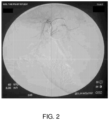
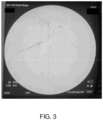
- Figure 2 displays a contrast image of a normal hepatic artery of the beagle, while Figure 3 shows the peptide solution injection.
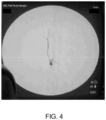
- Figure 4 shows a hepatic artery contrast image after a peptide solution injection in which back flow of the contrast image was confirmed. The presence of the peptide solution is evidenced by the darker regions of the image.
- FIG. 5 shows a hepatic artery contrast image two weeks after a peptide solution injection.
- Hematoxylin-Eosin (HE) dye was used to histopathologically confirm the peptide solution embolism and hepatic impairment.
- HE Hematoxylin-Eosin
- Figures 6A-6C the peptide solution can be seen in each of these images of the hepatic artery as the darkened areas of the images.
- Figure 7 shows a hepatic cell necrosis image at an embolism location, where all cells appear to have at least some level of necrosis.
- the results show that injection of the peptide solution using a microcatheter may be accomplished.
- the peptide gel may be visible using X-ray imaging.
- the hepatic artery embolism effect can be seen during surgery and two weeks after surgery. Additionally, the hepatic artery embolism effect and hepatic cell necrosis effect using the peptide solution occurred and was confirmed histopathologically.
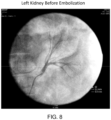
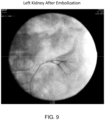
- PuraMatrix TM a peptide solution comprising Ac-RADARADARADARADA-NH 2 (Ac-Arg-Ala-Asp-Ala-Arg-Ala-Asp-Ala-Arg-Ala-Asp-Ala-Arg-Ala-Asp-Ala-NH 2 ) (SEQ ID NO: 58) in water was used as an embolic agent in a porcine model through angiography, gross necropsy assessment, and histopathology assessment.
- One female Yorkshire cross swine was tested. The weight of the swine at the time of testing was 46.5 kg. Feed and water were provided per standard operating procedures.
- a 2.5% test solution of the peptide solution was used. Approximately 800 microliters of the peptide solution was placed in an eppendorf tube. Approximately 200 microliters of Isovue-370 (Iopamidol) contrast agent was added. The liquids were mixed slowly so as to not create air bubbles.
- Table 2 Test Number Site Embolization Time Approximate Volume Placed Comments 1 Left Kidney Start 13:55 1.5 mL Successful embolization immediately following injection of peptide solution/Isovue Renal Artery 2 Right Kidney Start 14:12 1.5 mL Successful Renal Artery embolization immediately following injection. Slight flow reestablished at 14:18. Additional PuraMatrix TM / Iopamidol placed at 14:27. Angiogram showed full occlusion. 3 Hepatic Artery Start 14:58 2.0 mL Successful embolization immediately following injection. At 15:08, the artery remained occluded. At 15:32, the artery remained occluded. 4 Splenic Artery Start 15:17 3.0 mL Vessel was completed occluded at 15:21.
Landscapes
- Health & Medical Sciences (AREA)
- Life Sciences & Earth Sciences (AREA)
- General Health & Medical Sciences (AREA)
- Veterinary Medicine (AREA)
- Public Health (AREA)
- Animal Behavior & Ethology (AREA)
- Chemical & Material Sciences (AREA)
- Surgery (AREA)
- Engineering & Computer Science (AREA)
- Epidemiology (AREA)
- Nuclear Medicine, Radiotherapy & Molecular Imaging (AREA)
- Medical Informatics (AREA)
- Heart & Thoracic Surgery (AREA)
- Organic Chemistry (AREA)
- Molecular Biology (AREA)
- Medicinal Chemistry (AREA)
- Biomedical Technology (AREA)
- Biophysics (AREA)
- Vascular Medicine (AREA)
- Chemical Kinetics & Catalysis (AREA)
- General Chemical & Material Sciences (AREA)
- Pharmacology & Pharmacy (AREA)
- Radiology & Medical Imaging (AREA)
- High Energy & Nuclear Physics (AREA)
- Pathology (AREA)
- Optics & Photonics (AREA)
- Physics & Mathematics (AREA)
- Materials Engineering (AREA)
- Dispersion Chemistry (AREA)
- Bioinformatics & Cheminformatics (AREA)
- Genetics & Genomics (AREA)
- Oral & Maxillofacial Surgery (AREA)
- Dentistry (AREA)
- Reproductive Health (AREA)
- Proteomics, Peptides & Aminoacids (AREA)
- Biochemistry (AREA)
- Inorganic Chemistry (AREA)
- Sustainable Development (AREA)
- Cardiology (AREA)
- Medicines That Contain Protein Lipid Enzymes And Other Medicines (AREA)
Applications Claiming Priority (2)
| Application Number | Priority Date | Filing Date | Title |
|---|---|---|---|
| US201261726250P | 2012-11-14 | 2012-11-14 | |
| PCT/IB2013/060145 WO2014076660A1 (en) | 2012-11-14 | 2013-11-14 | Vascular embolic system |
Publications (2)
| Publication Number | Publication Date |
|---|---|
| EP2919826A1 EP2919826A1 (en) | 2015-09-23 |
| EP2919826B1 true EP2919826B1 (en) | 2025-06-11 |
Family
ID=49725176
Family Applications (1)
| Application Number | Title | Priority Date | Filing Date |
|---|---|---|---|
| EP13802115.9A Active EP2919826B1 (en) | 2012-11-14 | 2013-11-14 | Vascular embolic system |
Country Status (5)
| Country | Link |
|---|---|
| US (4) | US20160287744A1 (enExample) |
| EP (1) | EP2919826B1 (enExample) |
| JP (6) | JP2016501066A (enExample) |
| HK (1) | HK1215200A1 (enExample) |
| WO (1) | WO2014076660A1 (enExample) |
Families Citing this family (15)
| Publication number | Priority date | Publication date | Assignee | Title |
|---|---|---|---|---|
| CN105435211A (zh) | 2008-10-06 | 2016-03-30 | 三维肽胶株式会社 | 组织闭塞剂 |
| EP2869903B1 (en) | 2012-07-06 | 2018-11-28 | 3-D Matrix Ltd. | Fill-finish process for peptide solutions |
| US20160287744A1 (en) * | 2012-11-14 | 2016-10-06 | 3-D Matrix Ltd. | Vascular embolic system |
| ES3037364T3 (en) | 2014-03-10 | 2025-10-01 | 3 D Matrix Ltd | Sterilization and filtration of peptide compositions |
| ES2712608T3 (es) | 2014-03-10 | 2019-05-14 | 3 D Matrix Ltd | Péptidos autoensamblantes para el tratamiento de las bullas pulmonares |
| DK3116896T3 (en) | 2014-03-10 | 2019-03-18 | 3 D Matrix Ltd | SELF-PREPARING PEPTIME COMPOSITIONS |
| US10235906B2 (en) | 2014-11-18 | 2019-03-19 | Maximum Fidelity Surgical Simulations, LLC | Post mortem reconstitution of circulation |
| WO2017120092A1 (en) | 2016-01-06 | 2017-07-13 | 3-D Matrix, Ltd. | Combination compositions |
| CN109195640A (zh) * | 2016-03-18 | 2019-01-11 | 立美基股份有限公司 | 脑脊液漏堵塞 |
| US20190091376A1 (en) * | 2016-03-18 | 2019-03-28 | 3-D Matrix, Ltd. | Preventing Biological Tissue Adhesion |
| US11174288B2 (en) | 2016-12-06 | 2021-11-16 | Northeastern University | Heparin-binding cationic peptide self-assembling peptide amphiphiles useful against drug-resistant bacteria |
| PE20200719A1 (es) | 2017-11-13 | 2020-07-21 | Maximum Fidelity Surgical Simulations Llc | Reconstitucion de la circulacion posmortem, metodos y procedimientos especializados |
| US11716989B2 (en) | 2019-04-16 | 2023-08-08 | Maximum Fidelity Surgical Simulations, LLC | Cadaver preservation systems and methods |
| US11915610B2 (en) | 2019-05-15 | 2024-02-27 | Maximum Fidelity Surgical Simulations, LLC | Cadaverous heart model |
| CN115397454A (zh) | 2020-03-31 | 2022-11-25 | 立美基股份有限公司 | 通过辐照对自组装肽进行灭菌 |
Family Cites Families (49)
| Publication number | Priority date | Publication date | Assignee | Title |
|---|---|---|---|---|
| JPH10127754A (ja) * | 1996-11-06 | 1998-05-19 | Koken Co Ltd | コラーゲンからなる塞栓材 |
| DK1355566T3 (da) * | 2000-12-18 | 2013-03-04 | Univ Texas | Lokal regional kemoterapi og radioterapi ved anvendelse af hydrogel in situ |
| US7449180B2 (en) | 2001-02-06 | 2008-11-11 | John Kisiday | Macroscopic scaffold containing amphiphilic peptides encapsulating cells |
| US7179784B2 (en) | 2001-07-10 | 2007-02-20 | Massachusetts Institute Of Technology | Surfactant peptide nanostructures, and uses thereof |
| US7713923B2 (en) | 2003-06-25 | 2010-05-11 | Massachusetts Institute Of Technology | Self-assembling peptides incorporating modifications and methods of use thereof |
| CA2572964C (en) | 2004-07-06 | 2018-03-06 | 3D Matrix, Inc. | Purified amphiphilic peptide compositions and uses thereof |
| US7790699B2 (en) * | 2004-10-12 | 2010-09-07 | Fmc Biopolymer As | Self-gelling alginate systems and uses thereof |
| GB0500643D0 (en) | 2005-01-13 | 2005-02-23 | Renovo Ltd | Medicaments |
| US9162005B2 (en) | 2005-04-25 | 2015-10-20 | Arch Biosurgery, Inc. | Compositions for prevention of adhesions and other barrier applications |
| KR20100102750A (ko) | 2005-04-25 | 2010-09-24 | 메사추세츠 인스티튜트 오브 테크놀로지 | 지혈 및 다른 생리학적 활성을 촉진하기 위한 조성물 및 방법 |
| US8299032B2 (en) | 2005-06-27 | 2012-10-30 | Menicon Co., Ltd. | Self-assembling peptide and gel produced from the same |
| JP5121172B2 (ja) | 2005-07-01 | 2013-01-16 | 日本合成化学工業株式会社 | 血管一時塞栓材料、その製造方法、および血管一時塞栓剤 |
| US8361454B2 (en) | 2005-07-01 | 2013-01-29 | The Nippon Synthetic Chemical Industry Co., Ltd. | PVA particle for temporary embolic material and production process thereof, and temporary embolic material |
| JP5263756B2 (ja) | 2005-09-30 | 2013-08-14 | 国立大学法人 岡山大学 | 細胞の培養方法および細胞培養物 |
| HUE037994T2 (hu) | 2006-04-25 | 2018-09-28 | Massachusetts Inst Technology | Készítmények és eljárások szennyezõ anyagok, testfolyadékok vagy más anyagok mozgásának befolyásolására és/vagy más fiziológiai állapotok befolyásolására |
| EP2066697A2 (en) | 2006-09-26 | 2009-06-10 | Massachusetts Institute of Technology | Modified self-assembling peptides |
| JP5558104B2 (ja) | 2006-12-11 | 2014-07-23 | スリー−ディー マトリックス, インコーポレイテッド | 心組織の保護および再生のための組成物および方法 |
| US9415084B2 (en) | 2007-03-14 | 2016-08-16 | Arch Biosurgery, Inc. | Treatment of leaky or damaged tight junctions and enhancing extracellular matrix |
| US9987221B2 (en) * | 2007-08-23 | 2018-06-05 | Boston Scientific Scimed, Inc. | Injectable hydrogel compositions |
| ES2534770T3 (es) | 2007-12-05 | 2015-04-28 | 3-D Matrix, Ltd. | Material para la curación de heridas y la reconstrucción de la piel |
| JP4422191B1 (ja) | 2008-09-30 | 2010-02-24 | ゼライス株式会社 | 架橋ゼラチン、塞栓剤および架橋ゼラチンの製造方法 |
| CN105435211A (zh) * | 2008-10-06 | 2016-03-30 | 三维肽胶株式会社 | 组织闭塞剂 |
| US8962784B2 (en) | 2008-12-19 | 2015-02-24 | Ethicon, Inc. | Isocyanate terminated macromer and formulation thereof for use as an internal adhesive or sealant |
| JP2012100680A (ja) * | 2009-03-04 | 2012-05-31 | Terumo Corp | 血管内用処置材 |
| WO2010103887A1 (ja) | 2009-03-09 | 2010-09-16 | 株式会社メニコン | 自己組織化ペプチドおよび高強度ペプチドゲル |
| KR101764439B1 (ko) | 2009-04-22 | 2017-08-02 | 머케이터 메드시스템즈, 인크. | 국소 혈관 운반으로 고혈압을 치료하는 구아네티딘의 용도 |
| US20120123355A1 (en) * | 2009-07-30 | 2012-05-17 | Cook Medical Technologied | Erodible embolization material |
| US20110117195A1 (en) * | 2009-11-18 | 2011-05-19 | National Cheng Kung University | Method for improving myocardial infarction by intramyocardial or transendocardial injection of peptide nanofibers |
| WO2011072482A1 (en) | 2009-12-14 | 2011-06-23 | The University Of Hong Kong | Nano cancer barrier device(ncbd) to immobilize and inhibit the division of metastic cancer stem cells |
| EP2351779B1 (en) | 2010-01-27 | 2019-04-24 | Biosphere Medical, Inc. | Microspheres and method of making the microspheres |
| US8741833B2 (en) | 2010-07-16 | 2014-06-03 | Massachusetts Institute Of Technology | Self-assembling peptides incorporating modifications and methods of use thereof |
| WO2012133608A1 (ja) * | 2011-03-30 | 2012-10-04 | 東レ株式会社 | 生分解性粒子、血管塞栓材料及び生分解性粒子の製造方法 |
| JP6034868B2 (ja) | 2011-09-02 | 2016-11-30 | 株式会社スリー・ディー・マトリックス | 胸部の空気漏れ閉塞のための両親媒性ペプチド |
| US20150105336A1 (en) | 2012-03-09 | 2015-04-16 | 3-D Matrix, Ltd. | Mucosa-elevating agent |
| EP2869903B1 (en) | 2012-07-06 | 2018-11-28 | 3-D Matrix Ltd. | Fill-finish process for peptide solutions |
| US20160287744A1 (en) * | 2012-11-14 | 2016-10-06 | 3-D Matrix Ltd. | Vascular embolic system |
| HK1220116A1 (zh) | 2013-03-06 | 2017-04-28 | 3-D Matrix Ltd. | 使用纯化的两亲性多肽组合物的外科手术方法 |
| WO2014141160A1 (en) | 2013-03-14 | 2014-09-18 | 3-D Matrix, Ltd | Treatment for bile leakage |
| CA2905182A1 (en) | 2013-03-14 | 2014-09-18 | 3-D Matrix, Ltd. | Materials for gastrointestinal obstruction prevention |
| WO2015027203A1 (en) | 2013-08-22 | 2015-02-26 | Arch Biosurgery, Inc. | Implantable meshes for controlling the movement of fluids |
| ES3037364T3 (en) | 2014-03-10 | 2025-10-01 | 3 D Matrix Ltd | Sterilization and filtration of peptide compositions |
| WO2015138475A1 (en) | 2014-03-10 | 2015-09-17 | 3-D Matrix, Ltd. | Self-assembling peptides as bronchial obstruction agents |
| ES2712608T3 (es) | 2014-03-10 | 2019-05-14 | 3 D Matrix Ltd | Péptidos autoensamblantes para el tratamiento de las bullas pulmonares |
| JP2017513927A (ja) | 2014-03-10 | 2017-06-01 | 株式会社スリー・ディー・マトリックス | 肺の漏出を治療するための自発組織化ペプチド |
| DK3116896T3 (en) | 2014-03-10 | 2019-03-18 | 3 D Matrix Ltd | SELF-PREPARING PEPTIME COMPOSITIONS |
| JP2017519568A (ja) | 2014-06-20 | 2017-07-20 | 株式会社スリー・ディー・マトリックス | 骨間隙を充填するための材料および方法 |
| BR112016029517A2 (pt) | 2014-06-20 | 2018-06-19 | 3 D Matrix Ltd | materiais e métodos para enchimento de vácuo do osso dentário |
| WO2016075977A1 (ja) | 2014-11-14 | 2016-05-19 | 株式会社スリー・ディー・マトリックス | 自己組織化ペプチド修飾キトサンナノ会合体の合成とプロテインデリバリーへの応用 |
| EP3262155A1 (en) | 2015-02-25 | 2018-01-03 | 3-D Matrix, Ltd | Synthetic peptide hydrogel formulations for use as extracellular matrix |
-
2013
- 2013-11-14 US US14/442,677 patent/US20160287744A1/en not_active Abandoned
- 2013-11-14 HK HK16103152.0A patent/HK1215200A1/zh unknown
- 2013-11-14 JP JP2015542401A patent/JP2016501066A/ja active Pending
- 2013-11-14 WO PCT/IB2013/060145 patent/WO2014076660A1/en not_active Ceased
- 2013-11-14 EP EP13802115.9A patent/EP2919826B1/en active Active
-
2018
- 2018-02-26 JP JP2018032093A patent/JP2018086425A/ja active Pending
-
2019
- 2019-05-14 JP JP2019091205A patent/JP2019122875A/ja active Pending
-
2021
- 2021-07-09 JP JP2021114234A patent/JP2021164739A/ja not_active Withdrawn
- 2021-11-24 US US17/535,470 patent/US20220168462A1/en not_active Abandoned
-
2023
- 2023-06-23 JP JP2023103314A patent/JP2023115128A/ja active Pending
-
2024
- 2024-12-26 JP JP2024231414A patent/JP2025031996A/ja active Pending
-
2025
- 2025-06-12 US US19/235,902 patent/US12629446B2/en active Active
-
2026
- 2026-03-26 US US19/629,304 patent/US20260199545A1/en active Pending
Non-Patent Citations (2)
| Title |
|---|
| ANONYMOUS: "European Neurological Devices Market", 31 December 2012 (2012-12-31), XP055254147, Retrieved from the Internet <URL:http://idataresearch.com/european-neurological-devices-market-research-report-2012/> [retrieved on 20160301] * |
| K. STUART: "Chemoembolization in the Management of Liver Tumors", THE ONCOLOGIST, vol. 8, no. 5, 1 October 2003 (2003-10-01), US, pages 425 - 437, XP055494791, ISSN: 1083-7159, DOI: 10.1634/theoncologist.8-5-425 * |
Also Published As
| Publication number | Publication date |
|---|---|
| HK1215200A1 (zh) | 2016-08-19 |
| JP2025031996A (ja) | 2025-03-07 |
| US20260199545A1 (en) | 2026-07-16 |
| JP2016501066A (ja) | 2016-01-18 |
| JP2018086425A (ja) | 2018-06-07 |
| WO2014076660A1 (en) | 2014-05-22 |
| JP2019122875A (ja) | 2019-07-25 |
| EP2919826A1 (en) | 2015-09-23 |
| US12629446B2 (en) | 2026-05-19 |
| US20160287744A1 (en) | 2016-10-06 |
| US20220168462A1 (en) | 2022-06-02 |
| US20250311587A1 (en) | 2025-10-02 |
| JP2021164739A (ja) | 2021-10-14 |
| JP2023115128A (ja) | 2023-08-18 |
Similar Documents
| Publication | Publication Date | Title |
|---|---|---|
| US12629446B2 (en) | Vascular embolic system | |
| EP3116523B1 (en) | Self-assembling peptides as bronchial obstruction agents | |
| EP3116524B1 (en) | Autoassembling peptides for the treatment of pulmonary bulla | |
| EP3116522B1 (en) | Autoassembling peptides for the treatment of pulmonary leakage | |
| US20160030628A1 (en) | Treatment for bile leakage | |
| US12377196B2 (en) | Preventing biological tissue adhesion | |
| JPWO2010041636A1 (ja) | 組織閉塞剤 | |
| US20200078489A1 (en) | Pancreatic fistula occlusion | |
| US20210023257A1 (en) | Cerebrospinal fluid leakage occlusion |
Legal Events
| Date | Code | Title | Description |
|---|---|---|---|
| PUAI | Public reference made under article 153(3) epc to a published international application that has entered the european phase |
Free format text: ORIGINAL CODE: 0009012 |
|
| 17P | Request for examination filed |
Effective date: 20150514 |
|
| AK | Designated contracting states |
Kind code of ref document: A1 Designated state(s): AL AT BE BG CH CY CZ DE DK EE ES FI FR GB GR HR HU IE IS IT LI LT LU LV MC MK MT NL NO PL PT RO RS SE SI SK SM TR |
|
| AX | Request for extension of the european patent |
Extension state: BA ME |
|
| DAX | Request for extension of the european patent (deleted) | ||
| REG | Reference to a national code |
Ref country code: HK Ref legal event code: DE Ref document number: 1215200 Country of ref document: HK |
|
| STAA | Information on the status of an ep patent application or granted ep patent |
Free format text: STATUS: EXAMINATION IS IN PROGRESS |
|
| 17Q | First examination report despatched |
Effective date: 20180611 |
|
| APBK | Appeal reference recorded |
Free format text: ORIGINAL CODE: EPIDOSNREFNE |
|
| APBN | Date of receipt of notice of appeal recorded |
Free format text: ORIGINAL CODE: EPIDOSNNOA2E |
|
| APBR | Date of receipt of statement of grounds of appeal recorded |
Free format text: ORIGINAL CODE: EPIDOSNNOA3E |
|
| APAF | Appeal reference modified |
Free format text: ORIGINAL CODE: EPIDOSCREFNE |
|
| RAP1 | Party data changed (applicant data changed or rights of an application transferred) |
Owner name: 3-D MATRIX, LTD. |
|
| REG | Reference to a national code |
Ref country code: HK Ref legal event code: WD Ref document number: 1215200 Country of ref document: HK |
|
| APBX | Invitation to file observations in appeal sent |
Free format text: ORIGINAL CODE: EPIDOSNOBA2E |
|
| APBZ | Receipt of observations in appeal recorded |
Free format text: ORIGINAL CODE: EPIDOSNOBA4E |
|
| APBT | Appeal procedure closed |
Free format text: ORIGINAL CODE: EPIDOSNNOA9E |
|
| REG | Reference to a national code |
Ref country code: DE Ref legal event code: R079 Free format text: PREVIOUS MAIN CLASS: A61L0031040000 Ipc: A61L0024000000 Ref country code: DE Ref legal event code: R079 Ref document number: 602013086820 Country of ref document: DE Free format text: PREVIOUS MAIN CLASS: A61L0031040000 Ipc: A61L0024000000 |
|
| GRAP | Despatch of communication of intention to grant a patent |
Free format text: ORIGINAL CODE: EPIDOSNIGR1 |
|
| STAA | Information on the status of an ep patent application or granted ep patent |
Free format text: STATUS: GRANT OF PATENT IS INTENDED |
|
| RIC1 | Information provided on ipc code assigned before grant |
Ipc: A61L 24/10 20060101ALI20241128BHEP Ipc: A61P 41/00 20060101ALI20241128BHEP Ipc: A61P 35/00 20060101ALI20241128BHEP Ipc: A61P 9/00 20060101ALI20241128BHEP Ipc: A61L 24/00 20060101AFI20241128BHEP |
|
| INTG | Intention to grant announced |
Effective date: 20241216 |
|
| RAP3 | Party data changed (applicant data changed or rights of an application transferred) |
Owner name: 3-D MATRIX LTD. |
|
| GRAS | Grant fee paid |
Free format text: ORIGINAL CODE: EPIDOSNIGR3 |
|
| P01 | Opt-out of the competence of the unified patent court (upc) registered |
Free format text: CASE NUMBER: APP_13563/2025 Effective date: 20250319 |
|
| GRAA | (expected) grant |
Free format text: ORIGINAL CODE: 0009210 |
|
| STAA | Information on the status of an ep patent application or granted ep patent |
Free format text: STATUS: THE PATENT HAS BEEN GRANTED |
|
| AK | Designated contracting states |
Kind code of ref document: B1 Designated state(s): AL AT BE BG CH CY CZ DE DK EE ES FI FR GB GR HR HU IE IS IT LI LT LU LV MC MK MT NL NO PL PT RO RS SE SI SK SM TR |
|
| REG | Reference to a national code |
Ref country code: GB Ref legal event code: FG4D |
|
| REG | Reference to a national code |
Ref country code: CH Ref legal event code: EP |
|
| REG | Reference to a national code |
Ref country code: DE Ref legal event code: R096 Ref document number: 602013086820 Country of ref document: DE |
|
| REG | Reference to a national code |
Ref country code: IE Ref legal event code: FG4D |
|
| PG25 | Lapsed in a contracting state [announced via postgrant information from national office to epo] |
Ref country code: FI Free format text: LAPSE BECAUSE OF FAILURE TO SUBMIT A TRANSLATION OF THE DESCRIPTION OR TO PAY THE FEE WITHIN THE PRESCRIBED TIME-LIMIT Effective date: 20250611 Ref country code: ES Free format text: LAPSE BECAUSE OF FAILURE TO SUBMIT A TRANSLATION OF THE DESCRIPTION OR TO PAY THE FEE WITHIN THE PRESCRIBED TIME-LIMIT Effective date: 20250611 |
|
| REG | Reference to a national code |
Ref country code: LT Ref legal event code: MG9D |
|
| PG25 | Lapsed in a contracting state [announced via postgrant information from national office to epo] |
Ref country code: GR Free format text: LAPSE BECAUSE OF FAILURE TO SUBMIT A TRANSLATION OF THE DESCRIPTION OR TO PAY THE FEE WITHIN THE PRESCRIBED TIME-LIMIT Effective date: 20250912 Ref country code: NO Free format text: LAPSE BECAUSE OF FAILURE TO SUBMIT A TRANSLATION OF THE DESCRIPTION OR TO PAY THE FEE WITHIN THE PRESCRIBED TIME-LIMIT Effective date: 20250911 |
|
| REG | Reference to a national code |
Ref country code: NL Ref legal event code: MP Effective date: 20250611 |
|
| PG25 | Lapsed in a contracting state [announced via postgrant information from national office to epo] |
Ref country code: BG Free format text: LAPSE BECAUSE OF FAILURE TO SUBMIT A TRANSLATION OF THE DESCRIPTION OR TO PAY THE FEE WITHIN THE PRESCRIBED TIME-LIMIT Effective date: 20250611 |
|
| PG25 | Lapsed in a contracting state [announced via postgrant information from national office to epo] |
Ref country code: HR Free format text: LAPSE BECAUSE OF FAILURE TO SUBMIT A TRANSLATION OF THE DESCRIPTION OR TO PAY THE FEE WITHIN THE PRESCRIBED TIME-LIMIT Effective date: 20250611 |
|
| PG25 | Lapsed in a contracting state [announced via postgrant information from national office to epo] |
Ref country code: RS Free format text: LAPSE BECAUSE OF FAILURE TO SUBMIT A TRANSLATION OF THE DESCRIPTION OR TO PAY THE FEE WITHIN THE PRESCRIBED TIME-LIMIT Effective date: 20250911 |
|
| PG25 | Lapsed in a contracting state [announced via postgrant information from national office to epo] |
Ref country code: LV Free format text: LAPSE BECAUSE OF FAILURE TO SUBMIT A TRANSLATION OF THE DESCRIPTION OR TO PAY THE FEE WITHIN THE PRESCRIBED TIME-LIMIT Effective date: 20250611 |
|
| PG25 | Lapsed in a contracting state [announced via postgrant information from national office to epo] |
Ref country code: NL Free format text: LAPSE BECAUSE OF FAILURE TO SUBMIT A TRANSLATION OF THE DESCRIPTION OR TO PAY THE FEE WITHIN THE PRESCRIBED TIME-LIMIT Effective date: 20250611 |
|
| PG25 | Lapsed in a contracting state [announced via postgrant information from national office to epo] |
Ref country code: PT Free format text: LAPSE BECAUSE OF FAILURE TO SUBMIT A TRANSLATION OF THE DESCRIPTION OR TO PAY THE FEE WITHIN THE PRESCRIBED TIME-LIMIT Effective date: 20251013 |
|
| REG | Reference to a national code |
Ref country code: AT Ref legal event code: MK05 Ref document number: 1801865 Country of ref document: AT Kind code of ref document: T Effective date: 20250611 |
|
| PG25 | Lapsed in a contracting state [announced via postgrant information from national office to epo] |
Ref country code: IS Free format text: LAPSE BECAUSE OF FAILURE TO SUBMIT A TRANSLATION OF THE DESCRIPTION OR TO PAY THE FEE WITHIN THE PRESCRIBED TIME-LIMIT Effective date: 20251011 |
|
| PGFP | Annual fee paid to national office [announced via postgrant information from national office to epo] |
Ref country code: DE Payment date: 20251128 Year of fee payment: 13 |
|
| PGFP | Annual fee paid to national office [announced via postgrant information from national office to epo] |
Ref country code: GB Payment date: 20251127 Year of fee payment: 13 |
|
| PG25 | Lapsed in a contracting state [announced via postgrant information from national office to epo] |
Ref country code: SM Free format text: LAPSE BECAUSE OF FAILURE TO SUBMIT A TRANSLATION OF THE DESCRIPTION OR TO PAY THE FEE WITHIN THE PRESCRIBED TIME-LIMIT Effective date: 20250611 Ref country code: AT Free format text: LAPSE BECAUSE OF FAILURE TO SUBMIT A TRANSLATION OF THE DESCRIPTION OR TO PAY THE FEE WITHIN THE PRESCRIBED TIME-LIMIT Effective date: 20250611 |
|
| PGFP | Annual fee paid to national office [announced via postgrant information from national office to epo] |
Ref country code: FR Payment date: 20251125 Year of fee payment: 13 |
|
| PG25 | Lapsed in a contracting state [announced via postgrant information from national office to epo] |
Ref country code: CZ Free format text: LAPSE BECAUSE OF FAILURE TO SUBMIT A TRANSLATION OF THE DESCRIPTION OR TO PAY THE FEE WITHIN THE PRESCRIBED TIME-LIMIT Effective date: 20250611 |
|
| PG25 | Lapsed in a contracting state [announced via postgrant information from national office to epo] |
Ref country code: PL Free format text: LAPSE BECAUSE OF FAILURE TO SUBMIT A TRANSLATION OF THE DESCRIPTION OR TO PAY THE FEE WITHIN THE PRESCRIBED TIME-LIMIT Effective date: 20250611 |
|
| PG25 | Lapsed in a contracting state [announced via postgrant information from national office to epo] |
Ref country code: EE Free format text: LAPSE BECAUSE OF FAILURE TO SUBMIT A TRANSLATION OF THE DESCRIPTION OR TO PAY THE FEE WITHIN THE PRESCRIBED TIME-LIMIT Effective date: 20250611 |
|
| PG25 | Lapsed in a contracting state [announced via postgrant information from national office to epo] |
Ref country code: RO Free format text: LAPSE BECAUSE OF FAILURE TO SUBMIT A TRANSLATION OF THE DESCRIPTION OR TO PAY THE FEE WITHIN THE PRESCRIBED TIME-LIMIT Effective date: 20250611 Ref country code: SK Free format text: LAPSE BECAUSE OF FAILURE TO SUBMIT A TRANSLATION OF THE DESCRIPTION OR TO PAY THE FEE WITHIN THE PRESCRIBED TIME-LIMIT Effective date: 20250611 |
|
| REG | Reference to a national code |
Ref country code: DE Ref legal event code: R097 Ref document number: 602013086820 Country of ref document: DE |
|
| PG25 | Lapsed in a contracting state [announced via postgrant information from national office to epo] |
Ref country code: DK Free format text: LAPSE BECAUSE OF FAILURE TO SUBMIT A TRANSLATION OF THE DESCRIPTION OR TO PAY THE FEE WITHIN THE PRESCRIBED TIME-LIMIT Effective date: 20250611 |
|
| PG25 | Lapsed in a contracting state [announced via postgrant information from national office to epo] |
Ref country code: IT Free format text: LAPSE BECAUSE OF FAILURE TO SUBMIT A TRANSLATION OF THE DESCRIPTION OR TO PAY THE FEE WITHIN THE PRESCRIBED TIME-LIMIT Effective date: 20250611 |
|
| PLBE | No opposition filed within time limit |
Free format text: ORIGINAL CODE: 0009261 |
|
| STAA | Information on the status of an ep patent application or granted ep patent |
Free format text: STATUS: NO OPPOSITION FILED WITHIN TIME LIMIT |
|
| REG | Reference to a national code |
Ref country code: CH Ref legal event code: L10 Free format text: ST27 STATUS EVENT CODE: U-0-0-L10-L00 (AS PROVIDED BY THE NATIONAL OFFICE) Effective date: 20260423 |
|
| 26N | No opposition filed |
Effective date: 20260312 |
|
| REG | Reference to a national code |
Ref country code: CH Ref legal event code: H13 Free format text: ST27 STATUS EVENT CODE: U-0-0-H10-H13 (AS PROVIDED BY THE NATIONAL OFFICE) Effective date: 20260623 |
|
| PG25 | Lapsed in a contracting state [announced via postgrant information from national office to epo] |
Ref country code: LT Free format text: LAPSE BECAUSE OF FAILURE TO SUBMIT A TRANSLATION OF THE DESCRIPTION OR TO PAY THE FEE WITHIN THE PRESCRIBED TIME-LIMIT Effective date: 20250611 |
|
| PG25 | Lapsed in a contracting state [announced via postgrant information from national office to epo] |
Ref country code: MC Free format text: LAPSE BECAUSE OF FAILURE TO SUBMIT A TRANSLATION OF THE DESCRIPTION OR TO PAY THE FEE WITHIN THE PRESCRIBED TIME-LIMIT Effective date: 20250611 |
|
| PG25 | Lapsed in a contracting state [announced via postgrant information from national office to epo] |
Ref country code: LU Free format text: LAPSE BECAUSE OF NON-PAYMENT OF DUE FEES Effective date: 20251114 Ref country code: CH Free format text: LAPSE BECAUSE OF NON-PAYMENT OF DUE FEES Effective date: 20251130 |
|
| PG25 | Lapsed in a contracting state [announced via postgrant information from national office to epo] |
Ref country code: SE Free format text: LAPSE BECAUSE OF FAILURE TO SUBMIT A TRANSLATION OF THE DESCRIPTION OR TO PAY THE FEE WITHIN THE PRESCRIBED TIME-LIMIT Effective date: 20250611 |