EP2919584B1 - Formkörper zur bekämpfung von varroa-milben - Google Patents
Formkörper zur bekämpfung von varroa-milben Download PDFInfo
- Publication number
- EP2919584B1 EP2919584B1 EP13789778.1A EP13789778A EP2919584B1 EP 2919584 B1 EP2919584 B1 EP 2919584B1 EP 13789778 A EP13789778 A EP 13789778A EP 2919584 B1 EP2919584 B1 EP 2919584B1
- Authority
- EP
- European Patent Office
- Prior art keywords
- weight
- propylene glycol
- bees
- shaped articles
- bee
- Prior art date
- Legal status (The legal status is an assumption and is not a legal conclusion. Google has not performed a legal analysis and makes no representation as to the accuracy of the status listed.)
- Active
Links
Images
Classifications
-
- A—HUMAN NECESSITIES
- A01—AGRICULTURE; FORESTRY; ANIMAL HUSBANDRY; HUNTING; TRAPPING; FISHING
- A01N—PRESERVATION OF BODIES OF HUMANS OR ANIMALS OR PLANTS OR PARTS THEREOF; BIOCIDES, e.g. AS DISINFECTANTS, AS PESTICIDES OR AS HERBICIDES; PEST REPELLANTS OR ATTRACTANTS; PLANT GROWTH REGULATORS
- A01N25/00—Biocides, pest repellants or attractants, or plant growth regulators, characterised by their forms, or by their non-active ingredients or by their methods of application, e.g. seed treatment or sequential application; Substances for reducing the noxious effect of the active ingredients to organisms other than pests
- A01N25/08—Biocides, pest repellants or attractants, or plant growth regulators, characterised by their forms, or by their non-active ingredients or by their methods of application, e.g. seed treatment or sequential application; Substances for reducing the noxious effect of the active ingredients to organisms other than pests containing solids as carriers or diluents
- A01N25/10—Macromolecular compounds
-
- A—HUMAN NECESSITIES
- A01—AGRICULTURE; FORESTRY; ANIMAL HUSBANDRY; HUNTING; TRAPPING; FISHING
- A01N—PRESERVATION OF BODIES OF HUMANS OR ANIMALS OR PLANTS OR PARTS THEREOF; BIOCIDES, e.g. AS DISINFECTANTS, AS PESTICIDES OR AS HERBICIDES; PEST REPELLANTS OR ATTRACTANTS; PLANT GROWTH REGULATORS
- A01N25/00—Biocides, pest repellants or attractants, or plant growth regulators, characterised by their forms, or by their non-active ingredients or by their methods of application, e.g. seed treatment or sequential application; Substances for reducing the noxious effect of the active ingredients to organisms other than pests
- A01N25/08—Biocides, pest repellants or attractants, or plant growth regulators, characterised by their forms, or by their non-active ingredients or by their methods of application, e.g. seed treatment or sequential application; Substances for reducing the noxious effect of the active ingredients to organisms other than pests containing solids as carriers or diluents
-
- A—HUMAN NECESSITIES
- A01—AGRICULTURE; FORESTRY; ANIMAL HUSBANDRY; HUNTING; TRAPPING; FISHING
- A01K—ANIMAL HUSBANDRY; AVICULTURE; APICULTURE; PISCICULTURE; FISHING; REARING OR BREEDING ANIMALS, NOT OTHERWISE PROVIDED FOR; NEW BREEDS OF ANIMALS
- A01K51/00—Appliances for treating beehives or parts thereof, e.g. for cleaning or disinfecting
-
- A—HUMAN NECESSITIES
- A01—AGRICULTURE; FORESTRY; ANIMAL HUSBANDRY; HUNTING; TRAPPING; FISHING
- A01N—PRESERVATION OF BODIES OF HUMANS OR ANIMALS OR PLANTS OR PARTS THEREOF; BIOCIDES, e.g. AS DISINFECTANTS, AS PESTICIDES OR AS HERBICIDES; PEST REPELLANTS OR ATTRACTANTS; PLANT GROWTH REGULATORS
- A01N25/00—Biocides, pest repellants or attractants, or plant growth regulators, characterised by their forms, or by their non-active ingredients or by their methods of application, e.g. seed treatment or sequential application; Substances for reducing the noxious effect of the active ingredients to organisms other than pests
- A01N25/34—Shaped forms, e.g. sheets, not provided for in any other sub-group of this main group
-
- A—HUMAN NECESSITIES
- A01—AGRICULTURE; FORESTRY; ANIMAL HUSBANDRY; HUNTING; TRAPPING; FISHING
- A01N—PRESERVATION OF BODIES OF HUMANS OR ANIMALS OR PLANTS OR PARTS THEREOF; BIOCIDES, e.g. AS DISINFECTANTS, AS PESTICIDES OR AS HERBICIDES; PEST REPELLANTS OR ATTRACTANTS; PLANT GROWTH REGULATORS
- A01N35/00—Biocides, pest repellants or attractants, or plant growth regulators containing organic compounds containing a carbon atom having two bonds to hetero atoms with at the most one bond to halogen, e.g. aldehyde radical
- A01N35/08—Biocides, pest repellants or attractants, or plant growth regulators containing organic compounds containing a carbon atom having two bonds to hetero atoms with at the most one bond to halogen, e.g. aldehyde radical at least one of the bonds to hetero atoms is to nitrogen
- A01N35/10—Biocides, pest repellants or attractants, or plant growth regulators containing organic compounds containing a carbon atom having two bonds to hetero atoms with at the most one bond to halogen, e.g. aldehyde radical at least one of the bonds to hetero atoms is to nitrogen containing a carbon-to-nitrogen double bond
-
- A—HUMAN NECESSITIES
- A01—AGRICULTURE; FORESTRY; ANIMAL HUSBANDRY; HUNTING; TRAPPING; FISHING
- A01N—PRESERVATION OF BODIES OF HUMANS OR ANIMALS OR PLANTS OR PARTS THEREOF; BIOCIDES, e.g. AS DISINFECTANTS, AS PESTICIDES OR AS HERBICIDES; PEST REPELLANTS OR ATTRACTANTS; PLANT GROWTH REGULATORS
- A01N53/00—Biocides, pest repellants or attractants, or plant growth regulators containing cyclopropane carboxylic acids or derivatives thereof
-
- A—HUMAN NECESSITIES
- A01—AGRICULTURE; FORESTRY; ANIMAL HUSBANDRY; HUNTING; TRAPPING; FISHING
- A01N—PRESERVATION OF BODIES OF HUMANS OR ANIMALS OR PLANTS OR PARTS THEREOF; BIOCIDES, e.g. AS DISINFECTANTS, AS PESTICIDES OR AS HERBICIDES; PEST REPELLANTS OR ATTRACTANTS; PLANT GROWTH REGULATORS
- A01N57/00—Biocides, pest repellants or attractants, or plant growth regulators containing organic phosphorus compounds
- A01N57/10—Biocides, pest repellants or attractants, or plant growth regulators containing organic phosphorus compounds having phosphorus-to-oxygen bonds or phosphorus-to-sulfur bonds
- A01N57/16—Biocides, pest repellants or attractants, or plant growth regulators containing organic phosphorus compounds having phosphorus-to-oxygen bonds or phosphorus-to-sulfur bonds containing heterocyclic radicals
Definitions
- the present invention relates to shaped bodies which are suitable for combating Varroa mites in bees.
- the parasitic honey bee mite Varroa destructor is a natural parasite of the Asian honey bee species Apis cerana.
- the Asian honey bee there is only the western honey bee Apis mellifera that is suitable for human beekeeping.
- the natural distribution areas of both honey bee species are separated from each other by the deserts and mountains of the Middle East and the Near East. Only when colonies of western honey bees were brought into the natural range of the Asian honey bee in the last century were the mites able to parasitize this new host and spread with it to all continents with the exception of Australia and Antarctica.
- the mites can breed on male brood, drone larvae and pupae, which the mites prefer, as well as female worker larvae and pupae. Unlike the Asian bee, there are no natural limits to reproduction. On the one hand, there is direct damage to the bee brood by the hematophagous mites, but the mites are also vectors of bacterial and viral infectious agents, so there is also indirect damage. Without effective mite control, bee colonies will sooner or later perish.
- Biotechnical measures such as removing and destroying the drone brood preferred by the mites, and chemotherapeutic measures, i.e. the use of substances and preparations of substances that selectively kill the mites but protect the bees, are recommended as control measures.
- chemotherapeutic measures i.e. the use of substances and preparations of substances that selectively kill the mites but protect the bees.
- the majority of the mites are in the brood cells, which are sealed with a thin wax cover and evade the effects of pesticides there. Only during the period when the queen bee is not laying eggs and the bees are not brooding are all the mites on adult bees where they are amenable to treatment. Preparations with a short duration of action must therefore be used in the brood-free period of the bee colony.
- the majority of bee colonies die in late summer and autumn, when the reduction in bee brood activity means that more and more mites are concentrated in a
- WO02/23981 already affects an antiparasitic bee sluice for beehives, which could be improved again.
- WO2006/00335 describes active substance-containing solid shaped bodies for external use against parasites on animals.
- EP0441750 A1 relates to a device for applying an active ingredient to insects such as bees.
- the shaped bodies contain an acaricidal active ingredient which has the lowest possible toxicity to bees.
- the shaped bodies contain the acaricidal active substance flumethrin in concentrations of 0.1 to 5% by weight, particularly preferably 0.5 to 2% by weight or, according to a further particularly preferred embodiment, 0.5 to 2.5% by weight. based on the total mass of the solid formulation.
- the moldings described herein contain a glycerol ester or propylene glycol ester with C 8 -C 12 fatty acids; these are preferably aliphatic, unbranched saturated fatty acids such as caprylic, capric or lauric acid.
- all the hydroxyl groups of the underlying alcohol are preferably esterified, ie they are propylene glycol diesters or triglycerides.
- Preferred examples of such esters are caprylic-capric acid triglyceride (Miglyol 812) and propylene glycol dicaprylate/dicaprate.
- the shaped bodies according to the invention contain the glycerol ester or propylene glycol ester with C 8 -C 12 fatty acids in proportions of 5 to 25% by weight, particularly preferably 7 to 25% by weight, very particularly preferably 15 to 25% by weight (based on the respective total mixture mass).
- Caprylic-capric acid triglyceride (Miglyol 812, from Sasol Germany GmbH/Witten, CAS No. 73398-61-5) is also known under the name MKT (medium-chain triglycerides).
- Propylene glycol dicaprylate/dicaprate (Miglyol 840 from Sasol/Witten, CAS No.
- the moldings according to the invention with propylene glycol dicaprylate/dicaprate are preferred.
- flexible thermoplastic polyolefins e.g. polyethylene
- polyvinyl resins can be used as a carrier substance or basis for the shaped bodies.
- polyvinyl chloride homopolymer PVC is used.
- the moldings described herein can, if appropriate, additionally contain customary plasticizers which are customarily used for plasticizing solid polyvinyl chloride resins.
- Di-n-butyl adipate is used as an additional plasticizer according to the invention.
- suitable additional plasticizers that are not according to the invention are, for example, phosphoric acid esters or alternative adipic acid esters, such as e.g. B. diisobutyl adipate.
- esters such as the esters of azelaic, maleic, ricinoleic, myristic, palmitic, oleic, sebacic, stearic, and trimellitic acids, as well as complex linear polyesters, polymeric plasticizers, and epoxidized soybean oils may also be used not in accordance with the invention.
- di-n-butyl adipate is used as an additional plasticizer in concentrations of 1 to 30% by weight, preferably 7 to 22% by weight.
- the total amount of plasticizer i.e. the amount of caprylic acid triglyceride or propylene glycol dicaprylate/dicaprate plus the amount of additional plasticizer should not exceed 50% by weight, preferably 45% by weight, more preferably 35% by weight.
- the total amount of emollients will therefore range from about 5% to 50%, preferably from about 15% to 45%, more preferably from 15% to 35% by weight of the total composition.
- the total amount of plasticizer does not exceed 40% by weight of the total composition, in which case the total amount of plasticizer is from 15 to 40% by weight.
- customary components such as stabilizers, lubricants, mold release agents, fillers and coloring materials, can also be contained in the shaped bodies; as a rule, this does not significantly change the basic properties of the composition.
- Suitable stabilizers are antioxidants and agents that protect the ribbons from ultraviolet radiation and unwanted degradation during processing such as extrusion.
- Some plasticizers such as epoxidized soybean oil, also act as stabilizers.
- stearic acid or its salts (stearates) or low molecular weight polyethylenes can be used as lubricants.
- Stearic acid is preferably used.
- These ingredients are typically used at a level of up to about 5%, preferably up to 3%, by weight of the total composition.
- Total masterbatch mass is the finished mass which is then formed by suitable methods.
- the shaped bodies are preferably produced by melt extrusion, extrusion or injection molding.
- the choice of processing method for producing the shaped bodies depends on technical aspects basically according to the rheological properties of the polymeric carrier material and the shape of the desired shaped body.
- the processing methods can be adjusted according to the processing technology or according to the type of shaping. In process technology, the processes can be subdivided according to the rheological states they go through. According to this, casting, pressing, injection molding and application are suitable for viscous polymeric carrier materials and injection molding, extrusion, calendering, rolling and optionally kneading for elasto-viscous polymers.
- the moldings according to the invention can be produced by casting, dipping, pressing, injection molding, extrusion, calendering, embossing, bending, deep-drawing, etc. Coating solid base supports is also an option.
- the moldings can be adapted to their functional requirements by reworking.
- the solid moldings according to the invention have a material thickness of 1 to 5 mm, very particularly preferably 1 to 3 mm.
- Beehives can have different shapes and consist of different materials.
- a beehive (a bee hive) is to be understood here as the dwelling for a bee colony.
- the shaped bodies according to the invention preferably have a shape that fits the entrance hole of conventional beehives (also referred to as bee hive) and forms a kind of sluice.
- the shaped bodies have holes and are shaped in such a way that the bees are forced to pass through these holes when leaving the hive and when returning to the hive.
- the holes have a diameter of 6 to 9 mm, preferably 6 to 8 mm, particularly preferably 6.5 to 7.5 mm.
- the holes should have a total area of 5 to 26 cm 2 preferably 10 to 15 cm 2 per hive. It follows that there should be about 10 to 100 holes per beehive (with an entry hole), preferably 15 to 80 holes, particularly preferably 15 to 60, very particularly preferably 25 to 40, in particular 20 to 30 holes. The number and size of the holes must be chosen in such a way as to ensure adequate ventilation of the hive even in extreme temperatures and that they do not constitute a mechanical obstacle, e.g. B. when carrying out dead drones (male bees).
- the shape and size of the moldings according to the invention should be chosen so that they fit the entrance holes of conventional beehives.
- they can have a rectangular shape with a height of 1 to 10 cm, preferably 1.5 to 4 cm, in particular 2 to 4 cm or in particular 1.5 to 2.5 cm and widths of 10 to 50 cm, preferably 15 to 40 have cm.
- the shaped bodies according to the invention can be attached to the beehive in a manner known per se, so that the bees have to pass through the openings in the shaped body as a kind of sluice when entering or leaving the beehive.
- fasteners such as nails, thumbtacks, screws or glue can be used.
- Other devices are also conceivable, for example those in which the moldings according to the invention are pushed into guides.
- the shaped bodies according to the invention show an excellent effect against Varroa mites in bees when the shaped bodies are attached in the manner described at the entrance to the beehive.
- the moldings according to the invention are notable for their good compatibility with bees.
- the Varroa mites When passing through the shaped bodies, the Varroa mites are killed either directly or after a certain time. If the mites are not killed directly, however, the further reproduction of the mites can usually be prevented.
- the use of propylene glycol dicaprylate/dicaprate improves the bee tolerance of the shaped bodies. Because of the chemical similarity, it can be assumed that caprylic-capric acid triglyceride also improves bee tolerance.
- shaped bodies according to the invention which contain flumethrin are particularly effective. It seems that the flumethrin protects the bees in a certain way against infestation by Varroa mites, i.e. there are indications that bees that have passed a flumethrin-containing shaped body according to the invention have a certain protection against the lasting for a while Infestation obtained by Varroa mites.
- propylene glycol dicaprylate/dicaprate per se also protects bees against infestation by Varroa mites. It can be assumed that this also applies to caprylic-capric acid triglyceride.
- Bees are the eastern honey bee (Apis cerana) and in particular the western honey bee (Apis mellifera.
- Varroa mites are in particular Varroa destructor.
- the function of the moldings according to the invention is primarily based on the bees passing through the holes, their use makes sense above all when the bees are active in flight. However, it is not absolutely necessary to remove the shaped bodies outside of the active flight period.
- Composition flumethrin 2.5% by weight di-n-butyl adipate 8.9% by weight Propylene Glycol Octanoate Decanoate (Miglyol 840) 20% by weight Epoxidized soybean oil 1.1% by weight stearic acid 2% by weight PVC 64.5% by weight titanium dioxide 1% by weight
- the mixture of titanium dioxide and PVC is blended in a blender with the mixture of di-n-butyl adipate, propylene glycol octanoate decanoate, epoxidized soybean oil and flumethrin. Mix under heat until the mixture is homogeneous. The heating promotes the penetration of the drug-plasticizer mixture into the PVC. After the subsequent homogeneous distribution of the stearic acid, the mixture can be processed using methods known per se to give shaped bodies of the desired thickness.
- Composition Coumaphos 7.5% by weight di-n-butyl adipate 8.9% by weight Propylene Glycol Octanoate Decanoate (Miglyol 840) 20% by weight Epoxidized soybean oil 1.1% by weight stearic acid 2% by weight PVC 59.5% by weight titanium dioxide 1% by weight
- the mixture of titanium dioxide, PVC and coumaphos is blended in a blender with the mixture of din-butyl adipate, propylene glycol octanoate decanoate and epoxidized soybean oil. Mix under heat until the mixture is homogeneous. The heating promotes the penetration of the drug-plasticizer mixture into the PVC. After the subsequent homogeneous distribution of the stearic acid, the mixture can be processed using methods known per se to give shaped bodies of the desired thickness.
- Example 13 is a placebo formulation.
- Example 4 is not according to the invention. (In the tables, the amounts of the ingredients are given in % by weight)
- compositions of Examples 3 to 16 can be prepared analogously to the composition of Example 1.
- PVC, titanium dioxide and iron oxide pigments can be blended under heat (60°C), then a solution of the remaining ingredients except stearic acid is prepared and blended into the PVC pigment blend while warm. Finally, stearic acid is added with further stirring and heating, and a homogeneous composition is produced, which can be further processed after cooling.
- Solid moldings according to the invention can be made from the finished compositions, e.g. B. be prepared as indicated in Example 1.
- the total mite deaths recorded for the various treatment groups and colonies are summarized in Table 1 below.
- the rows labeled A, B and C contain the efficiencies in percent for each bee colony (n Varroa).
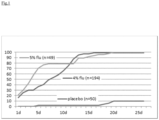
- the course of mite deaths over time during the observation period for selected colonies is shown in the graph ( 1 ), shown. (Because of the low total number of deaths in the 3% group, no graphic representation was made.)
- the data demonstrate the varroacid effect of treatment of the bee colonies with the active substance carrier containing flumethrin.
Landscapes
- Life Sciences & Earth Sciences (AREA)
- General Health & Medical Sciences (AREA)
- Health & Medical Sciences (AREA)
- Environmental Sciences (AREA)
- Zoology (AREA)
- Agronomy & Crop Science (AREA)
- Plant Pathology (AREA)
- Engineering & Computer Science (AREA)
- Dentistry (AREA)
- Wood Science & Technology (AREA)
- Pest Control & Pesticides (AREA)
- Toxicology (AREA)
- Animal Husbandry (AREA)
- Biodiversity & Conservation Biology (AREA)
- Agricultural Chemicals And Associated Chemicals (AREA)
- Catching Or Destruction (AREA)
- Compositions Of Macromolecular Compounds (AREA)
Description
- Die vorliegende Erfindung betrifft Formkörper die sich zur Bekämpfung von Varroa-Milben bei Bienen eignen.
- Die parasitische Honigbienenmilbe Varroa destructor ist ein natürlicher Parasit der asiatischen Honigbienenart Apis cerana. Neben der asiatischen Honigbiene gibt es nur noch die westliche Honigbiene Apis mellifera, die für die Bienenhaltung durch den Menschen geeignet ist. Die natürlichen Verbreitungsgebiete beider Honigbienenarten sind durch die Wüsten und Gebirge des Mittleren Ostens und Vorderasiens voneinander getrennt. Erst durch das Verbringen von Völkern der westlichen Honigbienen in das natürliche Verbreitungsgebiet der asiatischen Honigbiene konnten die Milben im letzten Jahrhundert auch diesen neuen Wirt parasitieren und sich mit diesem auf allen Kontinenten mit Ausnahme von Australien und der Antarktis verbreiten. Anders als auf ihrem natürlichen Wirt können sich die Milben sowohl auf der männlichen Brut, den Drohnenlarven und Puppen, die von den Milben bevorzugt werden, als auch auf den weiblichen Arbeiterlarven und Puppen fortpflanzen. Der Vermehrung sind - anders als bei der asiatischen Biene - keine natürlichen Grenzen gesetzt. Zum einen kommt es zu einer direkten Schädigung der Bienenbrut durch die hämatophagen Milben, aber die Milben sind auch Vektoren von bakteriellen und viralen Infektionserregern, so dass es auch zu einer indirekten Schädigung kommt. Ohne eine wirksame Bekämpfung der Milben gehen die Bienenvölker früher oder später ein.
- Als Bekämpfungsmaßnahmen empfehlen sich biotechnische Maßnahmen, wie das Entfernen und Vernichten der von den Milben bevorzugten Drohnenbrut, und chemotherapeutische Maßnahmen, d.h. die Anwendung von Substanzen und Zubereitungen von Substanzen, die selektiv die Milben töten aber die Bienen schonen. Während der Fortpflanzung befindet sich allerdings die Mehrzahl der Milben in den mit einem dünnen Wachsdeckel verschlossenen Brutzellen und entzieht sich dort der Einwirkung von Bekämpfungsmitteln. Nur während der Zeit, in der die Bienenkönigin keine Eier legt und die Bienen keine Brut anlegen, befinden sich alle Milben auf adulten Bienen, wo sie einer Behandlung zugänglich sind. Präparate mit einer kurzen Wirkdauer müssen deshalb in der brutfreien Zeit der Bienenvölker angewendet werden. Die Mehrzahl der Bienenvölker geht jedoch im Spätsommer und Herbst ein, wenn sich durch das Nachlassen der Brutaktivität der Bienen immer mehr Milben in einer geringer werden Anzahl von Brutzellen konzentrieren und die Bienenbrut so nachhaltig schädigen.
- Vor diesem Hintergrund war die Entwicklung von Verdampfersystemen von organischen Säuren und ätherischen Ölen sowie von Polymermatrix- Wirkstoffträgern, die den in die Matrix eingearbeiteten Wirkstoff über einen mehrwöchigen Zeitraum an der Oberfläche freisetzen, ein großer Fortschritt. Diese Wirkstoffträger werden zwischen die Brutwaben der Bienenvölker platziert, so dass sie beidseitig von den Bienen belaufen werden können, wobei der Wirkstoff von der Oberfläche der Wirkstoffträger mechanisch abgenommen und von den Bienen durch den sozialen Körperkontakt im Bienenstock verteilt wird. So gelangt er auch auf die Varroamilben. Die während ihrer Reprqduktionsphase in den Brutzellen vor der varroaziden Wirkung der Behandlung geschützten Milben werden nach ihrem Schlüpfen nachhaltig erfasst.
- Jüngere Untersuchungen (Grünewald B; Fuchs S (2011): AREA-WIDE VARROA TREATMENTS WITH ALTERNATING COUMAPHOS AND FLUMETHRIN ON HONEYBEE COLONIES: A FIELD STUDY IN GERMANY. Poster Apimondia Congress Buenos Aires.) zeigen, dass es im Spätsommer, nach der Honigentnahme, zu einem hohen Varroamilbentransfer von stark infizierten zu wenig infizierten (erfolgreich behandelten) Bienenvölkern kommen kann. D.h. eine erfolgreiche Sommerbehandlung der Bienenvölker (z.B. mit Ameisensäure) bietet keinen hinreichenden Schutz bis zur Winterbehandlung in der brutfreien Zeit. Die hier beschriebenen Formkörper sollen Bienenvölker vor einem Milbeneintrag aus stark infizierten Völkern anderer Bienenstände schützen und so eine gesunde Überwinterung der Bienenvölker ermöglichen.
- Aus
WO00/72683 -
WO02/23981 -
WO2006/00335 -
EP0441750 A1 betrifft eine Vorrichtung zur Applikation eines Wirkstoffs bei Insekten, wie z.B. Bienen. - Die Erfindung betrifft:
- 1. Feste Formkörper auf Basis einer Polyvinlychlorid-Matrix enthaltend
- 0,1 bis 5 Gew.-% Flumethrin
- 5 bis 25 Gew.-% eines Glycerinesters oder Propylenglykolesters mit aliphatischen unverzweigten C8-C12-Fettsäuren
- 1 bis 30 Gew.-% eines zusätzlichen Weichmachers
- sowie ggf. weitere Hilfs- und Zusatzstoffe
- Die Formkörper enthalten einen akariziden Wirkstoff der eine möglichst geringe Toxizität gegenüber Bienen aufweist.
- Die Formkörper enthalten erfindungsgemäß den akariziden Wirkstoff Flumethrin in Konzentrationen von 0,1 bis 5 Gew.-%, besonders bevorzugt 0,5 bis 2 Gew.-% oder gemäß einer weiteren besonders bevorzugten Ausführungsform 0,5 bis 2,5 Gew.-% bezogen auf die Gesamtmasse der festen Formulierung.
- Die hierin beschriebenen Formkörper enthalten einen Glycerinester oder Propylenglykolester mit C8-C12-Fettsäuren; dies sind vorzugsweise aliphatische, unverzweigte gesättigte Fettsäuren, wie z.B. Capryl-, Caprin- oder Laurinsäure. Vorzugsweise sind in diesen Estern alle Hydroxylgruppen des zugrundeliegenden Alkohols verestert, d.h. es handelt sich um Propylenglykoldiester oder um Triglyceride. Als bevorzugte Beispiele für solche Ester seien Capryl-Caprinsäure-Triglycerid (Miglyol 812) und Propylenglykoldicaprylat/-dicaprat genannt. Die erfindungsgemäßen Formkörper enthalten den Glycerinester oder Propylenglykolester mit C8-C12-Fettsäuren in Anteilen von 5 bis 25 Gew.-%, besonders bevorzugt 7 bis 25 Gew.-%, ganz besonders bevorzugt 15 bis 25 Gew.-% (bezogen auf die jeweilige Gesamtabmischungsmasse). Capryl-Caprinsäure-Triglycerid (Miglyol 812, der Fa. Sasol Germany GmbH/Witten, CAS-Nr. 73398-61-5) ist auch unter der Bezeichnung MKT (mittelkettige Triglyceride) bekannt. Propylenglykoldicaprylat/-dicaprat (Miglyol 840 der Fa. Sasol/Witten, CAS-Nr. 68583-51-7) ist der Propylenglykoldiester der Capryl- und Caprinsäure, im Deutschen Arzneibuch 9 (DAB 9) ist es als Propylenglykoloctanoatdecanoat beschrieben. In üblichen Qualitäten der beiden Ester sind auch kleine Anteile von C6- und C12-Fettsäuren mit verestert. Siehe auch die Einträge "Miglyol 812-Neutralöl" und "Miglyol 840" in H.P. Fiedler, Lexikon der Hilfsstoffe, Editio Cantor Verlag Aulendorf, 4. überarbeitete und ergänzte Auflage, 1996, Bd. 2, S. 1008/1009.
- Die erfindungsgemäßen Formkörper mit Propylenglykoldicaprylat/-dicaprat sind bevorzugt.
- Als Trägersubstanz oder Basis für die Formkörper kommen grundsätzlich flexible thermoplastische Polyolefine (z. B. Polyethylen) oder Polyvinylharze in Frage. Erfindungsgemäß wird Polyvinylchlorid-Homopolymer (PVC) eingesetzt.
- Die hierin beschriebenen Formkörper können gegebenenfalls zusätzlich übliche Weichmacher enthalten, die üblicherweise zum Weichmachen von festen Polyvinylchlorid-Harzen verwendet werden.
- Als erfindungsgemäßer zusätzlicher Weichmacher wird Di-n-butyladipat eingesetzt. Andere geeignete zusätzliche jedoch nicht erfindungsgemäße Weichmacher sind beispielsweise Phosphorsäureester oder alternative Adipinsäureester, wie z. B. Diisobutyladipat.
- Nicht erfindungsgemäß können auch andere Ester, wie die Ester von Azelainsäure, Maleinsäure, Ricinolsäure, Myristinsäure, Palmitinsäure, Ölsäure, Sebacinsäure, Stearinsäure und Trimellithsäure, sowie komplexe lineare Polyester, polymere Weichmacher und epoxydierte Sojabohnenöle verwendet werden.
- In den erfindungsgemäßen Formkörpern wird als zusätzlicher Weichmacher Di-n-butyladipat in Konzentrationen von 1 bis 30 Gew.-%, bevorzugt 7 bis 22 Gew.-%, eingesetzt.
- Die Gesamtmenge an Weichmacher, d.h. die Menge an Capryl-Caprinsäure-Triglycerid oder Propylenglykoldicaprylat/-dicaprat zuzüglich der Menge an zusätzlichem Weichmacher sollte 50 Gew.-%, bevorzugt 45 Gew.-%, besonders bevorzugt 35 Gew.-% nicht übersteigen. Die Gesamtmenge an Weichmachern liegt daher in den Bereichen von etwa 5 bis 50 Gew.-%, vorzugsweise etwa 15 bis 45 Gew.-%, besonders bevorzugt 15 bis 35 Gew-% der gesamten Zusammensetzung. Gemäß einer weiteren besonders bevorzugten Ausführungsform übersteigt die Gesamtmenge an Weichmacher nicht 40 Gew.-% der gesamten Zusammensetzung, in diesem Fall liegt die Gesamtmenge an Weichmacher bei 15 bis 40 Gew.-%.
- In den Formkörpern können noch weitere übliche Bestandteile, wie Stabilisierungsmittel, Schmiermittel, Formtrennmittel, Füllstoffe und Färbematerialien, enthalten sein; in der Regel werden dadurch die grundlegenden Eigenschaften der Zusammensetzung nicht wesentlich verändert.
- Geeignete Stabilisierungsmittel sind Antioxidationsmittel und Mittel, welche die Bänder vor ultravioletter Strahlung und unerwünschtem Abbau während der Bearbeitung, wie Strangpressen schützen. Einige Weichmacher wie epoxidiertes Sojabohnenöl, wirken gleichzeitig als Stabilisierungsmittel. Als Schmiermittel können beispielsweise Stearinsäure oder ihre Salze (Stearate) oder Polyethylene mit niedrigem Molekulargewicht verwendet werden. Bevorzugt wird Stearinsäure verwendet. Diese Bestandteile werden üblicherweise in einer Konzentration bis zu etwa 5 Gew.-%, bevorzugt bis zu 3 Gew.-% der gesamten Zusammensetzung verwendet.
- Soweit nicht anders angegeben, sind unter %-Angaben Gewichtsprozent bezogen auf die Gesamtabmischungsmasse zu verstehen. "Gesamtabmischungsmasse" ist die fertige Masse, die dann durch geeignete Verfahren geformt wird.
- Die Formkörper werden vorzugsweise durch Schmelzextrusion, Strangpressen oder Spritzguss hergestellt.
- Die Wahl des Verarbeitungsverfahrens zur Herstellung der Formkörper richtet sich technisch grundsätzlich nach den rheologischen Eigenschaften des polymeren Trägermaterials und der Form des gewünschten Formkörpers. Die Verarbeitungsverfahren können nach der Verarbeitungstechnologie oder nach der Art der Formgebung eingestellt werden. Bei der Verfahrenstechnologie kann man die Verfahren nach den bei ihnen durchlaufenen rheologischen Zuständen unterteilen. Danach kommen für viskose polymere Trägermaterialien Gießen, Pressen, Spritzgießen und Auftragen und für elastoviskose Polymere Spritzgießen, Strangpressen (Extrudieren), Kalandrieren, Walzen und gegebenenfalls Kneten in Frage. Nach Art der Formgebung eingeteilt, lassen sich die erfindungsgemäßen Formkörper durch Gießen, Tauchen, Pressen, Spritzgießen, Extrudieren, Kalandrieren, Prägen, Biegen, Tiefziehen etc. herstellen. Ein Beschichten von festen Grundträgern kommt ebenfalls in Frage. Durch Nacharbeiten können die Formkörper ihrem funktionellen Anspruch angepaßt werden.
- Diese Verarbeitungsverfahren sind an sich bekannt und bedürfen keiner näheren Erklärung.
- Die erfindungsgemäßen festen Formkörper haben eine Materialdicke von 1 bis 5 mm, ganz besonders bevorzugt 1 bis 3 mm.
- Bienenstöcke (Bienenbeuten) können unterschiedliche Formen haben und aus unterschiedlichen Materialien bestehen. Unter einem Bienenstock (einer Bienenbeute) soll hier die Behausung für jeweils ein Bienenvolk verstanden werden. Die erfindungsgemäßen Formkörper haben vorzugsweise eine Form die zum Einflugloch üblicher Bienenstöcke (auch als Bienenbeute bezeichnet) passt und eine Art Schleuse bildet. Die Formkörper haben Löcher und sind so geformt, dass die Bienen gezwungen sind, beim Verlassen des Bienenstocks und bei der Rückkehr in den Bienenstock diese Löcher zu passieren. Die Löcher haben erfindungsgemäß einen Durchmesser von 6 bis 9 mm, bevorzugt 6 bis 8 mm, besonders bevorzugt 6,5 bis 7,5 mm. Um eine ausreichende Belüftung des Bienenstocks sicherzustellen, sollten die Löcher insgesamt pro Bienenstock eine Fläche von 5 bis 26 cm2 bevorzugt 10 bis 15 cm2 haben. Daraus ergibt sich, dass pro Bienenstock (mit einem Einflugloch) etwa 10 bis 100 Löcher vorhanden sein sollten, vorzugsweise 15 bis 80 Löcher, besonders bevorzugt 15 bis 60, ganz besonders bevorzugt, 25 bis 40, insbesondere 20 bis 30 Löcher. Die Anzahl und Größe der Löcher muss so gewählt werden, dass eine ausreichende Belüftung des Bienenstocks auch bei extremen Temperaturen gewährleistet ist und dass sie kein mechanisches Hindernis darstellen, z. B. beim Hinaustragen toter Drohnen (männliche Bienen).
- Die Form und Größe der erfindungsgemäßen Formkörper sollte so gewählt werden, dass sie zu den Einfluglöchern üblicher Bienenstöcke passen. Beispielsweise können sie eine rechteckige Form mit einer Höhe von 1 bis 10 cm, vorzugsweise 1,5 bis 4 cm, insbesondere 2 bis 4 cm oder insbesondere 1,5 bis 2,5 ein und Breiten von 10 bis 50 cm, bevorzugt 15 bis 40 cm haben.
- In der praktischen Anwendung können die erfindungsgemäßen Formkörper in an sich bekannter Weise am Bienenstock angebracht werden, sodass die Bienen beim Kommen oder Verlassen des Bienenstocks die Öffnungen in dem Formkörper als ein Art Schleuse passieren müssen. Zur Befestigung am Bienenstock oder an eine Halterung können z. B. Befestigungsmittel wie Nägel, Reißzwecken, Schrauben oder Klebstoff verwendet werden. Auch andere Vorrichtungen sind denkbar, z.B. solche bei denen die erfindungsgemäßen Formkörper in Führungen eingeschoben werden. Ebenfalls denkbar ist ein geeigneter Halter, an dem in einfacher Weise der erfindungsgemäße Formkörper angebracht werden kann; der Halter ist wiederum so konstruiert, dass er samt Formkörper problemlos am Bienenstock angebracht werden kann.
- Überraschenderweise zeigen die erfindungsgemäßen Formkörper eine ausgezeichnete Wirkung gegen Varroa-Milben bei Bienen, wenn die Formkörper in der beschriebenen Weise am Eingang des Bienenstocks angebracht werden.
- Die erfindungsgemäßen Formkörper zeichnen sich durch gute Bienenverträglichkeit aus. Beim Passieren der Formkörper werden die Varroa-Milben entweder direkt oder nach einer gewissen Zeit abgetötet. Sofern die Milben nicht direkt abgetötet werden, kann aber in der Regel zumindest die weitere Reproduktion der Milben verhindert werden. Es gibt Hinweise darauf, dass die Verwendung von Propylenglykoldicaprylat/-dicaprat die Bienenverträglichkeit der Formkörper verbessert. Wegen der chemischen Ähnlichkeit ist zu vermuten, dass auch Capryl-Caprinsäure-Triglycerid die Bienenverträglichkeit verbessert.
- Es gibt Hinweise darauf, dass erfindungsgemäße Formkörper, die Flumethrin enthalten, besonders effektiv sind. Es scheint, dass die Bienen durch das Flumethrin in gewisser Weise gegen eine Infestation durch Varroa-Milben geschützt werden, d.h. es gibt Hinweise darauf, dass Bienen, die einen erfindungsgemäßen Flumethrin-haltigen Formkörper passiert haben, einen gewissen für eine Weile andauernden Schutz gegen die Infestation durch Varroa-Milben erhalten.
- Weiterhin gibt es Anzeichen dafür, dass auch Propylenglykoldicaprylat/-dicaprat per se die Bienen gegen Infestation durch Varroa-Milben schützt. Es ist anzunehmen, dass dies auch auf Capryl-Caprinsäure-Triglycerid zutrifft.
- Bienen sind die Östliche Honigbiene (Apis cerana) und insbesondere die Westliche Honigbiene (Apis mellifera.
- Varroa-Milben sind insbesondere Varroa destructor.
- Da die Funktion der erfindungsgemäßen Formkörper vor allem darauf basiert, dass die Bienen die Löcher passieren, ist ihr Einsatz vor allem in der flugaktiven Zeit der Bienen sinnvoll. Es ist aber nicht zwingend erforderlich, die Formkörper außerhalb der flugaktiven Periode zu entfernen.
- Bei der Anwendung der erfindungsgemäßen Formkörper kann es zur Vermeidung von Resistenzbildung empfehlenswert sein, Formkörper, die Wirkstoffe mit unterschiedlichen Wirkmechanismen enthalten, alternierend einzusetzen.
- Zusammensetzung:
Flumethrin 2,5 Gew.-% Di-n-butyladipat 8,9 Gew.-% Propylenglycoloctanoatdecanoat (Miglyol 840) 20 Gew.-% Epoxidiertes Sojabohnenöl 1,1 Gew.-% Stearinsäure 2 Gew.-% PVC 64,5 Gew.-% Titandioxid 1 Gew.-% - Die Mischung aus Titandioxid und PVC wird in einem Mischer mit dem Gemisch aus Di-n-butyladipat, Propylenglycoloctanoatdecanoat, epoxidiertem Sojabohnenöl und Flumethrin gemischt. Man mischt unter Wärme solange, bis die Mischung homogen ist. Das Erwärmen fördert das Einziehen der Wirkstoff-Weichmachermischung in das PVC. Nach der anschließenden homogenen Verteilung der Stearinsäure kann die Mischung mit an sich bekannten Verfahren zu Formkörpern in der gewünschten Dicke verarbeitet werden.
- Es wurden Formkörper hergestellt, die sich für die Anwendung an Bienenstöcken eignen. Diese haben folgende Abmessungen:
- Länge: 15 cm, Breite 3 cm, Dicke: 2 mm.
- Die Formkörper weisen 15 Löcher mit je 7 mm Durchmesser auf.
- Zusammensetzung:
Coumaphos 7,5 Gew.-% Di-n-butyladipat 8,9 Gew.-% Propylenglycoloctanoatdecanoat (Miglyol 840) 20 Gew.-% Epoxidiertes Sojabohnenöl 1,1 Gew.-% Stearinsäure 2 Gew.-% PVC 59,5 Gew.-% Titandioxid 1 Gew.-% - Die Mischung aus Titandioxid, PVC und Coumaphos wird in einem Mischer mit dem Gemisch aus Din-butyladipat, Propylenglycoloctanoatdecanoat und epoxidiertem Sojabohnenöl gemischt. Man mischt unter Wärme solange, bis die Mischung homogen ist. Das Erwärmen fördert das Einziehen der Wirkstoff-Weichmachermischung in das PVC. Nach der anschließenden homogenen Verteilung der Stearinsäure kann die Mischung mit an sich bekannten Verfahren zu Formkörpern in der gewünschten Dicke verarbeitet werden.
- Es wurden Formkörper hergestellt, die sich für die Anwendung an Bienenstöcken eignen. Diese haben folgende Abmessungen:
- Länge: 15 cm, Breite 3 cm, Dicke: 2 mm.
- Die Formkörper weisen 15 Löcher mit je 7 mm Durchmesser auf.
- In der folgenden Tabelle sind als Beispiele 3 bis 12 und 14 bis 16 weitere Zusammensetzungen angegeben, die zur Herstellung erfindungsgemäßer fester Formkörper geeignet sind. Beispiel 13 ist eine Placeboformulierung. Das Beispiel 4 ist nicht erfindungsgemäß.


- Die Zusammensetzungen der Beispiele 3 bis 16 können analog der Zusammensetzung des Beispiels 1 hergestellt werden. Alternativ können PVC, Titandioxid und Eisenoxidpigmente unter Erwärmen (60°C) gemischt werden, dann wird eine Lösung der restlichen Bestandteile, ausgenommen Stearinsäure, hergestellt und dem PVC-Pigmentgemisch in der Wärme zugemischt. Schließlich wird noch Stearinsäure unter weiterem Rühren und Erwärmen zugegeben und eine homogene Zusammensetzung hergestellt, die nach Abkühlen weiterverarbeitet werden kann.
- Aus den fertigen Zusammensetzungen können erfindungsgemäße feste Formkörper z. B. wie in Beispiel 1 angegeben hergestellt werden.
- Zur Beurteilung der Wirksamkeit von erfindungsgemäßen Flumethrin-haltigen PVC-Wirkstoffträgern (Formkörper) am Flugloch von Bienenstöcken wurden am 6. April 2012 12 brütende Bienenvölker in Zander-Magazinbeuten mit je 2 ca. 15 cm langen, ca. 2.5 cm breiten und ca. 2 mm dicken Wirkstoffträgern, die mit 30 Löchern von 7 mm Durchmesser versehen und so am Flugloch positioniert waren, dass die Bienen den Bienenstock ausschließlich durch die Löcher der Wirkstoffträger verlassen oder in diesen zurückkehren konnten. Je drei Völker erhielten Wirkstoffträger mit 3%, 4% und 5% Flumethrin-Gehalt (Bsp. 16, 15 bzw.14). Drei Bienenvölker wurden als Kontrollvölker mit wirkstofffreien Trägern bestückt. Zwischen dem 6. April und dem 2. Mai erfolgte eine tägliche Erfassung des Milbentotenfalls mit Hilfe von Einschubkästen, die den kompletten Beutenboden unterhalb des Wabensitzes der Beuten bedeckten und durch ein nur für die herabfallenden Milben nicht aber für Bienen durchlässiges Metallgitter abgedeckt war.
- Der erfasste gesamte Milbentotenfall für die verschiedenen Behandlungsgruppen und Völker ist in nachfolgender Tabelle 1 zusammengefasst. Die mit A, B und C bezeichneten Zeilen enthalten die Wirksamkeiten in Prozent für jeweils ein Bienenvolk (n Varroa). Der zeitliche Verlauf des Milbentotenfalls während des Beobachtungszeitraums ist für ausgewählte Völker in der Grafik (
Fig. 1 ), dargestellt. (Wegen des geringen Gesamttotenfalls in der 3%-Gruppe wurde auf eine grafische Darstellung verzichtet.) Die Daten belegen den varroaciden Effekt der Behandlung der Bienenvölker mit dem flumethrinhaltigen Wirkstoffträger.Tabelle 1: Placebo 5% Flu 4% Flu 3% Flu A 0 (11) 100 (3) 66,67 (3) 90 (10) B 50 (4) 100 (49) 98,97 (194) 100 (2) C 10,41 (50) 100 (7) 90 (10) 100 (3)
Claims (6)
- Feste Formkörper auf Basis einer Polyvinylchlorid-Matrix enthaltend- 0,1 bis 5 Gew.-% Flumethrin- 5 bis 25 Gew.-% eines Glycerinesters oder Propylenglykolesters mit aliphatischen unverzweigten C8-C12-Fettsäuren- 1 bis 30 Gew.-% eines zusätzlichen Weichmachers- sowie ggf. weitere Hilfs- und Zusatzstoffewobei die Formkörper eine Dicke von 1 bis 5 mm haben und Löcher mit einem Durchmesser von 6-9 mm aufweisen und wobei es sich bei dem zusätzlichen Weichmacher um Di-n-butyladipat handelt.
- Feste Formkörper gemäß Anspruch 1 enthaltend 7 bis 25 Gew.-% eines Glycerinesters oder Propylenglykolesters mit aliphatischen unverzweigten C8-C12-Fettsäuren.
- Feste Formkörper gemäß einem der vorstehenden Ansprüche enthaltend Propylenglykoldicaprylat/-dicaprat als Propylenglykolester mit aliphatischen unverzweigten C8-C12-Fettsäuren.
- Feste Formkörper gemäß einem der vorstehenden Ansprüche mit 10 bis 100 Löchern.
- Feste Formkörper gemäß einem der vorstehenden Ansprüche zur Verwendung zur Bekämpfung von Varroa-Milben bei Bienen, wobei die Bienen beim Verlassen des Bienenstocks und bei der Rückkehr in den Bienenstock diese Löcher der festen Formkörper passieren.
- Bienenstock umfassend einen festen Formkörper gemäß einem der Ansprüche 1 bis 5.
Priority Applications (3)
| Application Number | Priority Date | Filing Date | Title |
|---|---|---|---|
| SI201332042T SI2919584T1 (sl) | 2012-11-13 | 2013-11-11 | Ulita telesa za zatiranje pršice varroa |
| EP13789778.1A EP2919584B1 (de) | 2012-11-13 | 2013-11-11 | Formkörper zur bekämpfung von varroa-milben |
| HRP20230413TT HRP20230413T1 (hr) | 2012-11-13 | 2013-11-11 | Oblikovano tijelo namijenjeno borbi protiv grinje varroa |
Applications Claiming Priority (4)
| Application Number | Priority Date | Filing Date | Title |
|---|---|---|---|
| EP12192358 | 2012-11-13 | ||
| EP13176238 | 2013-07-12 | ||
| EP13789778.1A EP2919584B1 (de) | 2012-11-13 | 2013-11-11 | Formkörper zur bekämpfung von varroa-milben |
| PCT/EP2013/073518 WO2014076036A1 (de) | 2012-11-13 | 2013-11-11 | Formkörper zur bekämpfung von varroa-milben |
Publications (2)
| Publication Number | Publication Date |
|---|---|
| EP2919584A1 EP2919584A1 (de) | 2015-09-23 |
| EP2919584B1 true EP2919584B1 (de) | 2023-02-15 |
Family
ID=49582739
Family Applications (1)
| Application Number | Title | Priority Date | Filing Date |
|---|---|---|---|
| EP13789778.1A Active EP2919584B1 (de) | 2012-11-13 | 2013-11-11 | Formkörper zur bekämpfung von varroa-milben |
Country Status (16)
| Country | Link |
|---|---|
| US (2) | US20160278369A1 (de) |
| EP (1) | EP2919584B1 (de) |
| JP (1) | JP6383361B2 (de) |
| AR (1) | AR093453A1 (de) |
| AU (1) | AU2013346978B2 (de) |
| CA (1) | CA2899361C (de) |
| ES (1) | ES2943610T3 (de) |
| HR (1) | HRP20230413T1 (de) |
| HU (1) | HUE061707T2 (de) |
| IL (1) | IL238617B (de) |
| MX (1) | MX386751B (de) |
| NZ (1) | NZ707330A (de) |
| PL (1) | PL2919584T3 (de) |
| SI (1) | SI2919584T1 (de) |
| UY (1) | UY35135A (de) |
| WO (1) | WO2014076036A1 (de) |
Families Citing this family (5)
| Publication number | Priority date | Publication date | Assignee | Title |
|---|---|---|---|---|
| WO2017214272A1 (en) * | 2016-06-09 | 2017-12-14 | Emery Oleochemicals Llc | Control of pests in honey bee hives |
| EP3610729A1 (de) * | 2018-08-16 | 2020-02-19 | Bayer Cropscience LP | Zusammensetzungen und verfahren zur varroamilbenbekämpfung |
| AT16678U1 (de) | 2019-02-07 | 2020-04-15 | Bayer Animal Health Gmbh | Halterung für Wirkstoffstreifen |
| US11297805B2 (en) | 2019-05-02 | 2022-04-12 | Andrew Bramante | Miticidal beehive entranceway |
| DE102020130875A1 (de) | 2020-10-02 | 2022-04-07 | Interbran Nature Gmbh | Freisetzungssystem zur Bekämpfung von Parasiten |
Family Cites Families (5)
| Publication number | Priority date | Publication date | Assignee | Title |
|---|---|---|---|---|
| GB9002505D0 (en) * | 1990-02-05 | 1990-04-04 | Sandoz Ltd | Improvements in or relating to mechanical devices |
| RU2045176C1 (ru) * | 1992-04-17 | 1995-10-10 | Научно-исследовательский институт пластических масс им.Г.С.Петрова с Опытным московским заводом пластмасс | Способ получения полимерной пластины |
| EP1331846A1 (de) * | 2000-09-19 | 2003-08-06 | Bayer Healthcare, LLC | Parasitenabtötende eingangsschleuse für bienenkasten |
| DE102004031325A1 (de) * | 2004-06-29 | 2006-01-19 | Bayer Healthcare Ag | Wirkstoffhaltige feste Formkörper zur äußerlichen Anwendung gegen Parasiten an Tieren |
| EP2434871B1 (de) * | 2009-05-29 | 2014-03-12 | Biobest Belgium NV | An einem bienenkorb montierter verteiler |
-
2013
- 2013-11-11 SI SI201332042T patent/SI2919584T1/sl unknown
- 2013-11-11 PL PL13789778.1T patent/PL2919584T3/pl unknown
- 2013-11-11 US US14/442,662 patent/US20160278369A1/en not_active Abandoned
- 2013-11-11 JP JP2015541174A patent/JP6383361B2/ja active Active
- 2013-11-11 AU AU2013346978A patent/AU2013346978B2/en active Active
- 2013-11-11 NZ NZ707330A patent/NZ707330A/en unknown
- 2013-11-11 HU HUE13789778A patent/HUE061707T2/hu unknown
- 2013-11-11 HR HRP20230413TT patent/HRP20230413T1/hr unknown
- 2013-11-11 WO PCT/EP2013/073518 patent/WO2014076036A1/de not_active Ceased
- 2013-11-11 MX MX2015005823A patent/MX386751B/es unknown
- 2013-11-11 ES ES13789778T patent/ES2943610T3/es active Active
- 2013-11-11 EP EP13789778.1A patent/EP2919584B1/de active Active
- 2013-11-11 CA CA2899361A patent/CA2899361C/en active Active
- 2013-11-12 AR ARP130104155A patent/AR093453A1/es active IP Right Grant
- 2013-11-12 UY UY0001035135A patent/UY35135A/es not_active Application Discontinuation
-
2015
- 2015-05-04 IL IL238617A patent/IL238617B/en active IP Right Grant
-
2022
- 2022-10-21 US US18/048,707 patent/US20230084168A1/en not_active Abandoned
Also Published As
| Publication number | Publication date |
|---|---|
| MX2015005823A (es) | 2015-09-24 |
| US20230084168A1 (en) | 2023-03-16 |
| CA2899361A1 (en) | 2014-05-22 |
| IL238617A0 (en) | 2015-06-30 |
| ES2943610T3 (es) | 2023-06-15 |
| IL238617B (en) | 2018-08-30 |
| AR093453A1 (es) | 2015-06-10 |
| CA2899361C (en) | 2022-08-23 |
| SI2919584T1 (sl) | 2023-06-30 |
| WO2014076036A1 (de) | 2014-05-22 |
| JP2016501847A (ja) | 2016-01-21 |
| UY35135A (es) | 2014-06-30 |
| AU2013346978A1 (en) | 2015-05-21 |
| US20160278369A1 (en) | 2016-09-29 |
| AU2013346978B2 (en) | 2017-07-27 |
| JP6383361B2 (ja) | 2018-08-29 |
| EP2919584A1 (de) | 2015-09-23 |
| MX386751B (es) | 2025-03-19 |
| PL2919584T3 (pl) | 2023-07-10 |
| NZ707330A (en) | 2019-03-29 |
| HUE061707T2 (hu) | 2023-08-28 |
| HRP20230413T1 (hr) | 2023-07-07 |
Similar Documents
| Publication | Publication Date | Title |
|---|---|---|
| DE69201550T2 (de) | Pesticides System. | |
| US20230084168A1 (en) | Moulded article for combating varroa mites | |
| EP0224697B1 (de) | Verwendung von synthetischen Pyrethroiden zur Herstellung von Mitteln zur Bekämpfung von Parasitosen bei Bienen | |
| DE69923583T2 (de) | Antiparasitäre formulierungen | |
| DE2654014A1 (de) | Biozide masse, deren verwendung und die dabei erhaltenen produkte | |
| DE69210438T2 (de) | Akarizides Mittel verwendbar gegen Varroatose der Bienen, und eine dieses enthaltende Vorrichtung | |
| DE2618129A1 (de) | Feste, subkutan implantierbare pille, enthaltend eine biologisch wirksame menge an 2 alpha-methylandrostan-17beta- 0l-3-on-17-propionat, verfahren zu deren herstellung und anwendung | |
| DE2629192C2 (de) | Pestizide Polyvinylchlorid-Masse | |
| DE69600126T2 (de) | An einem Tier anbringbare Vorrichtung zur kontrollierten Wirkstoffabgabe und Verfahren zur deren Herstellung | |
| EP0377904B1 (de) | Mittel gegen Protozoen bei Insekten | |
| DE19780441B3 (de) | Anti-Floh- und -Zecken-Halsband auf der Grundlage von N-Phenylpyrazol für Katzen und Hunde | |
| EP2725899B1 (de) | Mittel zur bekämpfung von parasiten an tieren | |
| EP2653034B1 (de) | Spot-on präparat mit parasiten-repellierender wirkung zur topischen anwendung auf tieren | |
| DE2647976A1 (de) | Anthelmintisches mittel | |
| EP0441750A1 (de) | Verbesserungen an oder in bezug auf mechanische Vorrichtungen | |
| CH627617A5 (de) | Akarizide trocken gemischte polyvinylchloridharzmasse. | |
| DE102012022345A1 (de) | Bienwaben-Mittelwand | |
| DE2318824C2 (de) | ||
| WO2019170267A1 (de) | Lithium-verbindungen zur bekämpfung von milben, die von teilen der menschlichen oder warmblüterischen haut leben | |
| WO2011103694A1 (de) | Spot-on präparat mit parasiten- repellierender wirkung | |
| DE102010033048A1 (de) | Verwendung eines mikroverkapselten Nahrungssubstrats | |
| EP0475253A2 (de) | Mittel und Verfahren zur Bekämpfung von Haus- und Staubmilben | |
| DE69521996T2 (de) | Verwendung mindestens einer fettsäure gegen die eiablage von lepidoptera tortricidae | |
| DE102024200780A1 (de) | Partikel zur Reduzierung der Brutschäden während Varroa-Bekämpfung bei Honigbienen | |
| WO1991007998A1 (de) | VERBESSERTES TRANSDERMALES SYSTEM ZUR APPLIKATION VON PHARMAKOLOGISCH AKTIVEN VERBINDUNGEN UNTER pH-KONTROLLIERTEN BEDINGUNGEN |
Legal Events
| Date | Code | Title | Description |
|---|---|---|---|
| REG | Reference to a national code |
Ref country code: HR Ref legal event code: TUEP Ref document number: P20230413T Country of ref document: HR |
|
| PUAI | Public reference made under article 153(3) epc to a published international application that has entered the european phase |
Free format text: ORIGINAL CODE: 0009012 |
|
| 17P | Request for examination filed |
Effective date: 20150615 |
|
| AK | Designated contracting states |
Kind code of ref document: A1 Designated state(s): AL AT BE BG CH CY CZ DE DK EE ES FI FR GB GR HR HU IE IS IT LI LT LU LV MC MK MT NL NO PL PT RO RS SE SI SK SM TR |
|
| AX | Request for extension of the european patent |
Extension state: BA ME |
|
| DAX | Request for extension of the european patent (deleted) | ||
| 17Q | First examination report despatched |
Effective date: 20160301 |
|
| STAA | Information on the status of an ep patent application or granted ep patent |
Free format text: STATUS: EXAMINATION IS IN PROGRESS |
|
| REG | Reference to a national code |
Ref country code: DE Ref legal event code: R079 Ref document number: 502013016346 Country of ref document: DE Free format text: PREVIOUS MAIN CLASS: A01N0025100000 Ipc: A01N0053000000 |
|
| GRAP | Despatch of communication of intention to grant a patent |
Free format text: ORIGINAL CODE: EPIDOSNIGR1 |
|
| STAA | Information on the status of an ep patent application or granted ep patent |
Free format text: STATUS: GRANT OF PATENT IS INTENDED |
|
| RIC1 | Information provided on ipc code assigned before grant |
Ipc: A01N 25/34 20060101ALI20220128BHEP Ipc: A01K 51/00 20060101ALI20220128BHEP Ipc: A01P 7/02 20060101ALI20220128BHEP Ipc: A01N 25/10 20060101ALI20220128BHEP Ipc: A01N 53/00 20060101AFI20220128BHEP |
|
| INTG | Intention to grant announced |
Effective date: 20220303 |
|
| GRAJ | Information related to disapproval of communication of intention to grant by the applicant or resumption of examination proceedings by the epo deleted |
Free format text: ORIGINAL CODE: EPIDOSDIGR1 |
|
| STAA | Information on the status of an ep patent application or granted ep patent |
Free format text: STATUS: EXAMINATION IS IN PROGRESS |
|
| GRAS | Grant fee paid |
Free format text: ORIGINAL CODE: EPIDOSNIGR3 |
|
| STAA | Information on the status of an ep patent application or granted ep patent |
Free format text: STATUS: GRANT OF PATENT IS INTENDED |
|
| INTC | Intention to grant announced (deleted) | ||
| GRAP | Despatch of communication of intention to grant a patent |
Free format text: ORIGINAL CODE: EPIDOSNIGR1 |
|
| INTG | Intention to grant announced |
Effective date: 20220824 |
|
| GRAA | (expected) grant |
Free format text: ORIGINAL CODE: 0009210 |
|
| STAA | Information on the status of an ep patent application or granted ep patent |
Free format text: STATUS: THE PATENT HAS BEEN GRANTED |
|
| AK | Designated contracting states |
Kind code of ref document: B1 Designated state(s): AL AT BE BG CH CY CZ DE DK EE ES FI FR GB GR HR HU IE IS IT LI LT LU LV MC MK MT NL NO PL PT RO RS SE SI SK SM TR |
|
| REG | Reference to a national code |
Ref country code: CH Ref legal event code: EP Ref country code: GB Ref legal event code: FG4D Free format text: NOT ENGLISH |
|
| REG | Reference to a national code |
Ref country code: DE Ref legal event code: R096 Ref document number: 502013016346 Country of ref document: DE |
|
| REG | Reference to a national code |
Ref country code: AT Ref legal event code: REF Ref document number: 1547750 Country of ref document: AT Kind code of ref document: T Effective date: 20230315 Ref country code: IE Ref legal event code: FG4D Free format text: LANGUAGE OF EP DOCUMENT: GERMAN |
|
| REG | Reference to a national code |
Ref country code: LT Ref legal event code: MG9D |
|
| REG | Reference to a national code |
Ref country code: ES Ref legal event code: FG2A Ref document number: 2943610 Country of ref document: ES Kind code of ref document: T3 Effective date: 20230615 |
|
| REG | Reference to a national code |
Ref country code: NL Ref legal event code: MP Effective date: 20230215 |
|
| REG | Reference to a national code |
Ref country code: HR Ref legal event code: T1PR Ref document number: P20230413 Country of ref document: HR |
|
| P01 | Opt-out of the competence of the unified patent court (upc) registered |
Effective date: 20230527 |
|
| PG25 | Lapsed in a contracting state [announced via postgrant information from national office to epo] |
Ref country code: RS Free format text: LAPSE BECAUSE OF FAILURE TO SUBMIT A TRANSLATION OF THE DESCRIPTION OR TO PAY THE FEE WITHIN THE PRESCRIBED TIME-LIMIT Effective date: 20230215 Ref country code: PT Free format text: LAPSE BECAUSE OF FAILURE TO SUBMIT A TRANSLATION OF THE DESCRIPTION OR TO PAY THE FEE WITHIN THE PRESCRIBED TIME-LIMIT Effective date: 20230615 Ref country code: NO Free format text: LAPSE BECAUSE OF FAILURE TO SUBMIT A TRANSLATION OF THE DESCRIPTION OR TO PAY THE FEE WITHIN THE PRESCRIBED TIME-LIMIT Effective date: 20230515 Ref country code: NL Free format text: LAPSE BECAUSE OF FAILURE TO SUBMIT A TRANSLATION OF THE DESCRIPTION OR TO PAY THE FEE WITHIN THE PRESCRIBED TIME-LIMIT Effective date: 20230215 Ref country code: LV Free format text: LAPSE BECAUSE OF FAILURE TO SUBMIT A TRANSLATION OF THE DESCRIPTION OR TO PAY THE FEE WITHIN THE PRESCRIBED TIME-LIMIT Effective date: 20230215 Ref country code: LT Free format text: LAPSE BECAUSE OF FAILURE TO SUBMIT A TRANSLATION OF THE DESCRIPTION OR TO PAY THE FEE WITHIN THE PRESCRIBED TIME-LIMIT Effective date: 20230215 |
|
| REG | Reference to a national code |
Ref country code: HU Ref legal event code: AG4A Ref document number: E061707 Country of ref document: HU |
|
| PG25 | Lapsed in a contracting state [announced via postgrant information from national office to epo] |
Ref country code: SE Free format text: LAPSE BECAUSE OF FAILURE TO SUBMIT A TRANSLATION OF THE DESCRIPTION OR TO PAY THE FEE WITHIN THE PRESCRIBED TIME-LIMIT Effective date: 20230215 Ref country code: IS Free format text: LAPSE BECAUSE OF FAILURE TO SUBMIT A TRANSLATION OF THE DESCRIPTION OR TO PAY THE FEE WITHIN THE PRESCRIBED TIME-LIMIT Effective date: 20230615 Ref country code: GR Free format text: LAPSE BECAUSE OF FAILURE TO SUBMIT A TRANSLATION OF THE DESCRIPTION OR TO PAY THE FEE WITHIN THE PRESCRIBED TIME-LIMIT Effective date: 20230516 Ref country code: FI Free format text: LAPSE BECAUSE OF FAILURE TO SUBMIT A TRANSLATION OF THE DESCRIPTION OR TO PAY THE FEE WITHIN THE PRESCRIBED TIME-LIMIT Effective date: 20230215 |
|
| PG25 | Lapsed in a contracting state [announced via postgrant information from national office to epo] |
Ref country code: SM Free format text: LAPSE BECAUSE OF FAILURE TO SUBMIT A TRANSLATION OF THE DESCRIPTION OR TO PAY THE FEE WITHIN THE PRESCRIBED TIME-LIMIT Effective date: 20230215 Ref country code: RO Free format text: LAPSE BECAUSE OF FAILURE TO SUBMIT A TRANSLATION OF THE DESCRIPTION OR TO PAY THE FEE WITHIN THE PRESCRIBED TIME-LIMIT Effective date: 20230215 Ref country code: EE Free format text: LAPSE BECAUSE OF FAILURE TO SUBMIT A TRANSLATION OF THE DESCRIPTION OR TO PAY THE FEE WITHIN THE PRESCRIBED TIME-LIMIT Effective date: 20230215 Ref country code: DK Free format text: LAPSE BECAUSE OF FAILURE TO SUBMIT A TRANSLATION OF THE DESCRIPTION OR TO PAY THE FEE WITHIN THE PRESCRIBED TIME-LIMIT Effective date: 20230215 Ref country code: CZ Free format text: LAPSE BECAUSE OF FAILURE TO SUBMIT A TRANSLATION OF THE DESCRIPTION OR TO PAY THE FEE WITHIN THE PRESCRIBED TIME-LIMIT Effective date: 20230215 |
|
| REG | Reference to a national code |
Ref country code: DE Ref legal event code: R097 Ref document number: 502013016346 Country of ref document: DE |
|
| REG | Reference to a national code |
Ref country code: HR Ref legal event code: ODRP Ref document number: P20230413 Country of ref document: HR Payment date: 20231017 Year of fee payment: 11 |
|
| PG25 | Lapsed in a contracting state [announced via postgrant information from national office to epo] |
Ref country code: SK Free format text: LAPSE BECAUSE OF FAILURE TO SUBMIT A TRANSLATION OF THE DESCRIPTION OR TO PAY THE FEE WITHIN THE PRESCRIBED TIME-LIMIT Effective date: 20230215 |
|
| PLBE | No opposition filed within time limit |
Free format text: ORIGINAL CODE: 0009261 |
|
| STAA | Information on the status of an ep patent application or granted ep patent |
Free format text: STATUS: NO OPPOSITION FILED WITHIN TIME LIMIT |
|
| 26N | No opposition filed |
Effective date: 20231116 |
|
| REG | Reference to a national code |
Ref country code: HR Ref legal event code: PNAN Ref document number: P20230413 Country of ref document: HR Owner name: ELANCO ANIMAL HEALTH GMBH, DE |
|
| REG | Reference to a national code |
Ref country code: DE Ref legal event code: R081 Ref document number: 502013016346 Country of ref document: DE Owner name: ELANCO ANIMAL HEALTH GMBH, DE Free format text: FORMER OWNER: BAYER ANIMAL HEALTH GMBH, 51373 LEVERKUSEN, DE |
|
| REG | Reference to a national code |
Ref country code: BE Ref legal event code: HC Owner name: ELANCO ANIMAL HEALTH GMBH; DE Free format text: DETAILS ASSIGNMENT: CHANGE OF OWNER(S), CHANGE OF OWNER(S) NAME; FORMER OWNER NAME: BAYER ANIMAL HEALTH GMBH Effective date: 20240503 |
|
| REG | Reference to a national code |
Ref country code: HU Ref legal event code: HC9C Owner name: ELANCO ANIMAL HEALTH GMBH, DE Free format text: FORMER OWNER(S): BAYER ANIMAL HEALTH GMBH, DE Ref country code: CH Ref legal event code: PL |
|
| PG25 | Lapsed in a contracting state [announced via postgrant information from national office to epo] |
Ref country code: MC Free format text: LAPSE BECAUSE OF FAILURE TO SUBMIT A TRANSLATION OF THE DESCRIPTION OR TO PAY THE FEE WITHIN THE PRESCRIBED TIME-LIMIT Effective date: 20230215 |
|
| PG25 | Lapsed in a contracting state [announced via postgrant information from national office to epo] |
Ref country code: LU Free format text: LAPSE BECAUSE OF NON-PAYMENT OF DUE FEES Effective date: 20231111 |
|
| PG25 | Lapsed in a contracting state [announced via postgrant information from national office to epo] |
Ref country code: CH Free format text: LAPSE BECAUSE OF NON-PAYMENT OF DUE FEES Effective date: 20231130 |
|
| PG25 | Lapsed in a contracting state [announced via postgrant information from national office to epo] |
Ref country code: MC Free format text: LAPSE BECAUSE OF FAILURE TO SUBMIT A TRANSLATION OF THE DESCRIPTION OR TO PAY THE FEE WITHIN THE PRESCRIBED TIME-LIMIT Effective date: 20230215 Ref country code: LU Free format text: LAPSE BECAUSE OF NON-PAYMENT OF DUE FEES Effective date: 20231111 Ref country code: CH Free format text: LAPSE BECAUSE OF NON-PAYMENT OF DUE FEES Effective date: 20231130 |
|
| REG | Reference to a national code |
Ref country code: IE Ref legal event code: MM4A |
|
| REG | Reference to a national code |
Ref country code: AT Ref legal event code: HC Ref document number: 1547750 Country of ref document: AT Kind code of ref document: T Owner name: ELANCO ANIMAL HEALTH GMBH, DE Effective date: 20240717 |
|
| REG | Reference to a national code |
Ref country code: SI Ref legal event code: SP73 Owner name: ELANCO ANIMAL HEALTH GMBH; DE Effective date: 20240822 |
|
| PG25 | Lapsed in a contracting state [announced via postgrant information from national office to epo] |
Ref country code: IE Free format text: LAPSE BECAUSE OF NON-PAYMENT OF DUE FEES Effective date: 20231111 |
|
| REG | Reference to a national code |
Ref country code: ES Ref legal event code: PC2A Owner name: ELANCO ANIMAL HEALTH GMBH Effective date: 20241015 |
|
| PG25 | Lapsed in a contracting state [announced via postgrant information from national office to epo] |
Ref country code: IE Free format text: LAPSE BECAUSE OF NON-PAYMENT OF DUE FEES Effective date: 20231111 |
|
| PG25 | Lapsed in a contracting state [announced via postgrant information from national office to epo] |
Ref country code: BG Free format text: LAPSE BECAUSE OF FAILURE TO SUBMIT A TRANSLATION OF THE DESCRIPTION OR TO PAY THE FEE WITHIN THE PRESCRIBED TIME-LIMIT Effective date: 20230215 |
|
| REG | Reference to a national code |
Ref country code: HR Ref legal event code: ODRP Ref document number: P20230413 Country of ref document: HR Payment date: 20241030 Year of fee payment: 12 |
|
| PG25 | Lapsed in a contracting state [announced via postgrant information from national office to epo] |
Ref country code: BG Free format text: LAPSE BECAUSE OF FAILURE TO SUBMIT A TRANSLATION OF THE DESCRIPTION OR TO PAY THE FEE WITHIN THE PRESCRIBED TIME-LIMIT Effective date: 20230215 |
|
| PG25 | Lapsed in a contracting state [announced via postgrant information from national office to epo] |
Ref country code: CY Free format text: LAPSE BECAUSE OF FAILURE TO SUBMIT A TRANSLATION OF THE DESCRIPTION OR TO PAY THE FEE WITHIN THE PRESCRIBED TIME-LIMIT; INVALID AB INITIO Effective date: 20131111 |
|
| REG | Reference to a national code |
Ref country code: HR Ref legal event code: ODRP Ref document number: P20230413 Country of ref document: HR Payment date: 20251027 Year of fee payment: 13 |
|
| PG25 | Lapsed in a contracting state [announced via postgrant information from national office to epo] |
Ref country code: TR Free format text: LAPSE BECAUSE OF FAILURE TO SUBMIT A TRANSLATION OF THE DESCRIPTION OR TO PAY THE FEE WITHIN THE PRESCRIBED TIME-LIMIT Effective date: 20230215 |
|
| PGFP | Annual fee paid to national office [announced via postgrant information from national office to epo] |
Ref country code: HU Payment date: 20251117 Year of fee payment: 13 |
|
| PGFP | Annual fee paid to national office [announced via postgrant information from national office to epo] |
Ref country code: DE Payment date: 20251022 Year of fee payment: 13 |
|
| PGFP | Annual fee paid to national office [announced via postgrant information from national office to epo] |
Ref country code: GB Payment date: 20251023 Year of fee payment: 13 |
|
| PGFP | Annual fee paid to national office [announced via postgrant information from national office to epo] |
Ref country code: AT Payment date: 20251024 Year of fee payment: 13 |
|
| PGFP | Annual fee paid to national office [announced via postgrant information from national office to epo] |
Ref country code: IT Payment date: 20251022 Year of fee payment: 13 |
|
| PGFP | Annual fee paid to national office [announced via postgrant information from national office to epo] |
Ref country code: HR Payment date: 20251027 Year of fee payment: 13 Ref country code: FR Payment date: 20251022 Year of fee payment: 13 |
|
| PGFP | Annual fee paid to national office [announced via postgrant information from national office to epo] |
Ref country code: BE Payment date: 20251022 Year of fee payment: 13 |
|
| PGFP | Annual fee paid to national office [announced via postgrant information from national office to epo] |
Ref country code: PL Payment date: 20251105 Year of fee payment: 13 |
|
| PGFP | Annual fee paid to national office [announced via postgrant information from national office to epo] |
Ref country code: SI Payment date: 20251029 Year of fee payment: 13 Ref country code: ES Payment date: 20251201 Year of fee payment: 13 |