EP2918552B1 - Procédé de séparation de solides et récupération de phosphates à partir de suspensions aqueuses - Google Patents
Procédé de séparation de solides et récupération de phosphates à partir de suspensions aqueuses Download PDFInfo
- Publication number
- EP2918552B1 EP2918552B1 EP14158671.9A EP14158671A EP2918552B1 EP 2918552 B1 EP2918552 B1 EP 2918552B1 EP 14158671 A EP14158671 A EP 14158671A EP 2918552 B1 EP2918552 B1 EP 2918552B1
- Authority
- EP
- European Patent Office
- Prior art keywords
- aqueous solution
- phosphates
- basin
- organic layer
- humification
- Prior art date
- Legal status (The legal status is an assumption and is not a legal conclusion. Google has not performed a legal analysis and makes no representation as to the accuracy of the status listed.)
- Active
Links
Images


Classifications
-
- C—CHEMISTRY; METALLURGY
- C02—TREATMENT OF WATER, WASTE WATER, SEWAGE, OR SLUDGE
- C02F—TREATMENT OF WATER, WASTE WATER, SEWAGE, OR SLUDGE
- C02F3/00—Biological treatment of water, waste water, or sewage
- C02F3/32—Biological treatment of water, waste water, or sewage characterised by the animals or plants used, e.g. algae
- C02F3/327—Biological treatment of water, waste water, or sewage characterised by the animals or plants used, e.g. algae characterised by animals and plants
-
- C—CHEMISTRY; METALLURGY
- C02—TREATMENT OF WATER, WASTE WATER, SEWAGE, OR SLUDGE
- C02F—TREATMENT OF WATER, WASTE WATER, SEWAGE, OR SLUDGE
- C02F3/00—Biological treatment of water, waste water, or sewage
- C02F3/02—Aerobic processes
- C02F3/12—Activated sludge processes
- C02F3/1205—Particular type of activated sludge processes
- C02F3/1215—Combinations of activated sludge treatment with precipitation, flocculation, coagulation and separation of phosphates
-
- B—PERFORMING OPERATIONS; TRANSPORTING
- B09—DISPOSAL OF SOLID WASTE; RECLAMATION OF CONTAMINATED SOIL
- B09C—RECLAMATION OF CONTAMINATED SOIL
- B09C1/00—Reclamation of contaminated soil
- B09C1/10—Reclamation of contaminated soil microbiologically, biologically or by using enzymes
- B09C1/105—Reclamation of contaminated soil microbiologically, biologically or by using enzymes using fungi or plants
-
- C—CHEMISTRY; METALLURGY
- C02—TREATMENT OF WATER, WASTE WATER, SEWAGE, OR SLUDGE
- C02F—TREATMENT OF WATER, WASTE WATER, SEWAGE, OR SLUDGE
- C02F2101/00—Nature of the contaminant
- C02F2101/10—Inorganic compounds
- C02F2101/105—Phosphorus compounds
-
- C—CHEMISTRY; METALLURGY
- C02—TREATMENT OF WATER, WASTE WATER, SEWAGE, OR SLUDGE
- C02F—TREATMENT OF WATER, WASTE WATER, SEWAGE, OR SLUDGE
- C02F2209/00—Controlling or monitoring parameters in water treatment
- C02F2209/04—Oxidation reduction potential [ORP]
-
- C—CHEMISTRY; METALLURGY
- C02—TREATMENT OF WATER, WASTE WATER, SEWAGE, OR SLUDGE
- C02F—TREATMENT OF WATER, WASTE WATER, SEWAGE, OR SLUDGE
- C02F2209/00—Controlling or monitoring parameters in water treatment
- C02F2209/18—PO4-P
-
- Y—GENERAL TAGGING OF NEW TECHNOLOGICAL DEVELOPMENTS; GENERAL TAGGING OF CROSS-SECTIONAL TECHNOLOGIES SPANNING OVER SEVERAL SECTIONS OF THE IPC; TECHNICAL SUBJECTS COVERED BY FORMER USPC CROSS-REFERENCE ART COLLECTIONS [XRACs] AND DIGESTS
- Y02—TECHNOLOGIES OR APPLICATIONS FOR MITIGATION OR ADAPTATION AGAINST CLIMATE CHANGE
- Y02W—CLIMATE CHANGE MITIGATION TECHNOLOGIES RELATED TO WASTEWATER TREATMENT OR WASTE MANAGEMENT
- Y02W10/00—Technologies for wastewater treatment
- Y02W10/10—Biological treatment of water, waste water, or sewage
-
- Y—GENERAL TAGGING OF NEW TECHNOLOGICAL DEVELOPMENTS; GENERAL TAGGING OF CROSS-SECTIONAL TECHNOLOGIES SPANNING OVER SEVERAL SECTIONS OF THE IPC; TECHNICAL SUBJECTS COVERED BY FORMER USPC CROSS-REFERENCE ART COLLECTIONS [XRACs] AND DIGESTS
- Y02—TECHNOLOGIES OR APPLICATIONS FOR MITIGATION OR ADAPTATION AGAINST CLIMATE CHANGE
- Y02W—CLIMATE CHANGE MITIGATION TECHNOLOGIES RELATED TO WASTEWATER TREATMENT OR WASTE MANAGEMENT
- Y02W10/00—Technologies for wastewater treatment
- Y02W10/30—Wastewater or sewage treatment systems using renewable energies
- Y02W10/37—Wastewater or sewage treatment systems using renewable energies using solar energy
Definitions
- the invention relates to a process for the recovery of phosphates from a suspension of solids in an aqueous solution comprising the steps of concentrating phosphates in the aqueous solution, separating the solids from the aqueous solution and precipitating the phosphates from the aqueous solution.
- Biopolder From the DE 43 23 610 C1 is a Biopolder known that forms an intermediate storage for to be cleaned soils or sludge and run in the biological processes.
- the Biopolder is used for the biological purification and / or mineralization of soils, sludges and effluents, which are contaminated with organic or inorganic pollutants.
- the Biopolder has a seal in the form of a waterproof film against the soil. Its bottom is covered with a drainage bed which is either filled with iron compounds or consists entirely of iron compounds.
- On the drainage a water-permeable nonwoven fabric is arranged, above which the substances to be cleaned are introduced into the Biopolder and there form a contaminated with the organic and inorganic pollutants soil or sludge layer.
- This layer is planted with suitable plants or corresponding rhizomes, through whose fine roots oxygen enters the soil or mud layer.
- a water level controller installed in a side wall, a suitable water level is set in the biopolter.
- the activity of aerobic microorganisms is promoted or stabilized by targeted addition of nutrients and / or additives.
- By rainfall occurs a migration of unreacted pollutants and conversion products aerobic processes, eg. Sulphates, phosphates or heavy metals, from an upper aerobic area to a lower anaerobic area of the Biopolder.
- the phosphates react there with the iron compounds of the drainage bed, for example to FePO 4, and are thus fixed in the drainage bed.
- the purified water is removed via a trench system or a pump.
- the DE 197 00 434 C1 describes a process for sewage sludge digestion avoiding chemicals.
- liquid sewage sludge is introduced into a first polder up to a first filling level, the liquid sewage sludge is dried, fine-root, fast-growing plants are sown, and a growth phase of the plants over a predetermined period is initiated. This is repeated until the polder is completely filled, and after renewed rest, the polder is emptied.
- the individual method steps are performed offset in time in several polders.
- each polder is of walls and a bottom plate, z. B. of concrete, or surrounded by a subsurface and soböschept water blocking or difficult water-permeable layer.
- a pipe or surface drainage On the bottom plate or the underground barrier layer is a pipe or surface drainage, which is covered by a layer of gravel.
- the gravel layer is covered, for example, with a mineral mixture or concrete blocks.
- Overflow water is discharged by means of a shaft construction on the wall. Drainage water and overflow water are fed via pipelines to a wastewater treatment plant.
- PRISA method For phosphorus recovery in wastewater treatment, the so-called PRISA method is known (Monday, 2008: Phospholiens backung in wastewater treatment - Development of a method for integration in municipal sewage treatment plants, thesis, RWTH Aachen), having the features of the preamble of independent claim 1.
- This method involves thickening the sludge in a pre-thickener and a post-thickener before and after anaerobic sludge treatment. Subsequently, a machine sludge dewatering is performed.
- a phosphate-rich supernatant water of the pre-thickener, an ammonium- and phosphate-rich supernatant water of the post-thickener and the sludge water from the machine sludge dewatering are filtered together, for example using a cloth filter.
- the filtrate magnesium oxide as Precipitant and sodium hydroxide added to adjust the pH.
- magnesium ammonium phosphate crystals are formed.
- the dewatered sewage sludge from the machine sludge dewatering must be disposed of separately. Since the realization of this process requires investments in a pre-thickener, a post-thickener and sludge dewatering machines, it can only be used economically in large sewage treatment plants.
- the phosphate rich sludge is kept under anaerobic conditions for several hours to reduce the phosphate content in its solid phase.
- the transition of the phosphate is accelerated in a settling phosphate-rich liquid by the addition of an auxiliary medium. Subsequently, a part of the sludge is returned to the mixture with waste water.
- the WO 2012/150296 A2 discloses a process and apparatus for dephosphatizing wastewaters.
- the wastewater is pretreated in a biological pre-treatment.
- the pretreated effluents are inoculated in a storage tank with coagulants for the precipitation of phosphates and stirred as needed for better distribution of the coagulants.
- the wastewater is then passed through a filter planted with rhizomes. From the surface of this filter the precipitated phosphates are recovered.
- the seeding with coagulants in the reservoir and the discharge of waste water through the vegetable filter can be carried out in succession in several stages, disclosed in particular two successive stages, each with a reservoir and each with a vegetable filter.
- the invention has for its object to provide a method with the features of the preamble of claim 1, can be retrieved cost-effectively with the phosphates from domestic and industrial wastewater even in smaller sized sewage treatment plants for example, less than 100,000 inhabitants.
- the invention relates to a process by which phosphates can be recovered from a suspension of solids in an aqueous solution.
- suspensions may be, for example, domestic or industrial wastewaters, but also waste, for example from the food processing industry or agriculture.
- a drainage layer is covered with a reactive organic layer, for example, or based on compost.
- the aqueous suspension is applied to this reactive organic layer.
- a separation of the aqueous solution which can drain into the drainage layer, of the solids that become part of the reactive organic layer, without the use of filter materials or energy would be necessary.
- the reactive organic layer is a biological degradation of phosphate-containing solids by bacteria, fungi and other, even more sophisticated, destructors such as compost worms.
- a large volume reduction so that in each case within a few days days further layers of aqueous suspension can be applied.
- the Vererdungsbecken can therefore be operated without emptying for several years, which is particularly efficient.
- Biodegradation increases the proportion of phosphate present in soluble form. This soluble phosphate can be washed out with the aqueous solution from the reactive organic layer into the drainage layer. From there, the aqueous solution is withdrawn whenever this appears favorable due to its enriched phosphate content.
- the phosphate concentration in the drainage layer is constantly monitored; This can be done for example by regular sampling or insertion of a probe.
- the aqueous solution is preferably withdrawn when a particularly advantageous for the precipitation phosphate concentration is reached.
- the aqueous solution if its phosphate concentration is below a predetermined limit, may be recycled to the digester tank. From the withdrawn aqueous solution, the dissolved phosphates are precipitated and then exist in a pure form, which is suitable for use in fertilizers, for example.
- Residual quantities of Phosphates that do not dissolve in the aqueous solution and remain permanently in the separated and greatly reduced volume solids are permanently accessible through the aboveground deposition of solids in the digestion basin and can also be further used by peeling if necessary (eg. Combustion with subsequent recovery of phosphates from the combustion ash).
- the precipitation of the phosphates can be done, for example, by adding magnesium, so that MAP precipitates. This is particularly advantageous since the phosphate and ammonium concentrations present in the aqueous solution lead to the precipitation of MAP even at very low additions of magnesium.
- the underground basin is sealed to the ground in a liquid-tight manner, for example by means of a foil or a concrete trough provided with a liquid-tight coating.
- the Vererdungsbecken at its top is usually open.
- the degradation processes are supported by air, sunlight and other weather conditions.
- the digester basin can be completely or partially covered as needed, so that, for example, a dilution or washing out by rain, wherein the rainwater is part of the aqueous solution is promoted or prevented.
- This can be done for example by a movable roof or a foil. In this way, the drying of the solids or the reactive organic layer can be controlled by controlling the sunlight.
- the drying of the solids or the reactive organic layer can also be accelerated by heating the drainage layer.
- ideal temperature conditions for microbial degradation processes can be set.
- waste heat for example, from a digestion plant, a wastewater stream or other incurred at the same treatment plant process heat can be used, so that no additional energy needs.
- the redox potential of the aqueous solution from the drainage layer is preferably monitored with a probe.
- a probe For an ideal sequence of the microbial degradation processes in the reactive organic layer predominantly aerobic processes are desired, therefore predominantly oxidized compounds in the stripped aqueous solution and thus positive redox potentials in the range of more than 100 mV are sought. If the redox potential falls below this value, the relevant subregion of the earth basin is temporarily allowed to dry, so that increased amounts of atmospheric oxygen enter the reactive organic layer.
- the aqueous solution can also be dammed up so that it reaches into the dissolved solids. This allows it to wash out dissolved phosphates and carry them into the drainage layer.
- the reactive organic layer can be planted to promote microbial degradation processes by creating a microbially colonized root space. Through the root system, the layer is also aerated and it form fine channels, so that the filter effect of the layer does not deteriorate. In addition, an increased oxygen input into the layer can promote aerobic degradation processes.
- the plants serve as a buffer for various substances that bind them during their growth, such as carbon dioxide and phosphates. Concentration of the phosphates from the aqueous suspension is favored by the plants. The plants are fertilized by the phosphates and absorb them as they grow. The plants thus form a temporary phosphate reservoir. When the plants die, they become part of the organic layer. The stored phosphates are then degraded and return in concentrated form back into the aqueous solution with which they are flushed out.
- C2 plants such as reeds (Phragmites australis) are preferred. But it is also a planting with crops such as poplars or willows for logging or rapeseed for energy production possible, so that an additional benefit of the reactive organic layer is created as a growing area, which further increases the efficiency of the process.
- crops such as poplars or willows for logging or rapeseed for energy production possible, so that an additional benefit of the reactive organic layer is created as a growing area, which further increases the efficiency of the process.
- the aqueous suspension is introduced via a plurality of feed points distributed over the surface of the digester tank. If each inflow point can be controlled individually, this makes it possible to use several subfaces of the geothermal basin together or separately. For example, if a geothermal basin has six inflow points, then three adjacent inflow points together can form a portion of the geothermal basin that is managed uniformly. Two further adjacent inflow points can go into operation at a later date and operate a smaller subarea, while the sixth inflow point can continue to be idle due to low utilization. If, for example, the redox potential falls below a desired value in one subarea, then this subarea can be allowed to dry, while wastewater arising in other subareas can continue to be processed.
- individual subregions can also serve for the intermediate storage of bound substances, in particular of phosphates bound in plants. It is also possible to aim at different concentrations or thickening of the dissolved solids in the different subregions, depending on their later use. It is also possible to shut down individual sections and to remove after a dry phase with maximum separation of the phosphate-rich aqueous solution, the dissolved solids from the ground basin and feed it to another use. It can be recovered in the dissolved solids remaining phosphates and other valuable materials by z. B. the solids burned and the recyclables are recovered from the resulting ash.
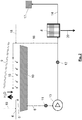
- Fig. 1 shows a Vererdungsbecken 10, which is sealed with a waterproof layer 7, for example, a plastic film, below and laterally, for example against the ground and earth ramparts.
- a drainage layer 7 for example of drainage gravel, to which a reactive organic layer 2, for example the basis of compost, was applied.
- plants 3 are planted, which root through the reactive organic layer 2.
- the plants 3 cause the entry of oxygen O 2 in the reactive organic layer 2, as well as the exchange of carbon dioxide CO 2 .
- the suspension 4 of solids in an aqueous solution 6 is applied to the reactive organic layer 2.
- the aqueous solution 6 filtered off from the aqueous suspension 4 flows as a result of gravity into the drainage layer 1 and is pumped to precipitate phosphates in a separate container 8.
- the solids from the suspension 4 become part of the reactive organic layer 2.
- the ground basin 10 can be completely or partially covered with a roof 9.
- Fig. 2 schematically shows the course of the suspension 4 and the aqueous solution through the Vererdungsbecken 10 and the container 8.
- the suspension 4 is introduced in its raw state in the Vererdungsbecken 10.
- polymers 19 may be added to promote their drainage.
- the filtered-off aqueous solution 6 is pumped by means of a pump 13 into the container 8, where magnesium ammonium phosphate 20 is precipitated by the addition of magnesium.
- the phosphate-free aqueous solution 14 can be spent in a wastewater treatment plant 17.
- the aqueous solution 6 is monitored with a redox measuring probe 11.
- a phosphate measuring probe 12 measures the phosphate concentration in the withdrawn aqueous solution 6.
- the aqueous solution 6 can be recycled to the digester tank 10 as recyclate 16 instead of the tank 8, optionally via agitation 15 above the digester basin 10
- Alkaline or alkaline earth metals 18 can be added to the recycled material 16 in order to increase the pH and to achieve a composition of the aqueous solution 6 favorable for the precipitation of magnesium ammonium phosphate 20.
- the accumulation of phosphate in the aqueous solution 6 can be further controlled by the use of the roof 9. With the roof, rainwater H 2 O can thickening the shut off in the Vererdungsbecken 10 suspension 4 shut off, or conversely, evaporation of H 2 O can be prevented by solar heat.
- Fig. 3 shows a Vererdungsbecken 10, which is divided by several, here six, separately controllable feed points 5 in separately managed sections 21 to 23.
- Three adjacent feed points 5 define a first portion 21 of the Vererdungsbeckens, while two other adjacent feed points 5 supply a smaller second portion 22 of the Vererdungsbeckens.
- a smallest, third portion 23 of the Vererdungsbeckens is defined by the sixth feed point 5.
- aqueous solution 6 can be selectively supplied to the container 8 for precipitating phosphates, if it comes from the feed of a portion 21 to 23, in which the plants 3 are just dying and thus bound during their growth phosphates in concentrated form in the aqueous solution 6 release.
Landscapes
- Life Sciences & Earth Sciences (AREA)
- Engineering & Computer Science (AREA)
- Chemical & Material Sciences (AREA)
- Hydrology & Water Resources (AREA)
- Biodiversity & Conservation Biology (AREA)
- Microbiology (AREA)
- Environmental & Geological Engineering (AREA)
- Water Supply & Treatment (AREA)
- Organic Chemistry (AREA)
- Botany (AREA)
- Biotechnology (AREA)
- Analytical Chemistry (AREA)
- Fertilizers (AREA)
- Water Treatment By Sorption (AREA)
Claims (13)
- Procédé de récupération de phosphates à partir d'une suspension (4) de solides dans une solution aqueuse (6), avec- concentration de phosphates dans la solution aqueuse (6),- séparation des solides à partir de la solution aqueuse (6) et- précipitation des phosphates à partir de la solution aqueuse (6),caractérisé en ce que- la concentration et la séparation comprennent- l'agencement d'une couche de drainage (1) et d'une couche (2) organique réactive dans un bassin d'humification (10),- introduction de la suspension (4) au-dessus de la couche (2) organique réactive dans le bassin d'humification (10),- augmentation de la proportion de phosphates qui sont présents dans la couche (2) organique réactive sous forme soluble par biodégradation de solides contenant des phosphates,- élimination par lavage des phosphates solubles à partir de la couche (2) organique réactive dans la couche de drainage (1) avec la solution aqueuse (6),- surveillance de la concentration de phosphates dans la solution aqueuse (6) à partir de la zone de la couche de drainage (1) et- enlèvement par intermittence de la solution aqueuse (6) à partir de la zone de la couche de drainage (1), et- en ce que la précipitation des phosphates à partir des volumes enlevés de la solution aqueuse (6) s'effectue avec une teneur en phosphates accrue à partir d'une valeur limite prédéfinie de la concentration de phosphates.
- Procédé selon la revendication 1, caractérisé par l'étanchéisation, étanche aux liquides, du bassin d'humification (10) par rapport au sous-sol et par l'exposition aux conditions météorologiques des suspensions (4) introduites dans le bassin d'humification (10).
- Procédé selon l'une des revendications précédentes,
caractérisé par la surveillance du potentiel redox de la solution aqueuse (6) à partir de la zone de la couche de drainage (1). - Procédé selon l'une des revendications précédentes,
caractérisé par le renvoi dans le bassin d'humification (10) de la solution aqueuse (6) enlevée dont la teneur en phosphates est inférieure à une valeur limite prédéfinie. - Procédé selon l'une des revendications précédentes,
caractérisé par le réglage consécutif de degrés de séchage différents de solides qui se sont déposés dans le bassin d'humification (10). - Procédé selon la revendication 5, caractérisé par l'accumulation de la solution aqueuse (6) jusque dans la zone des solides déposés avant l'enlèvement de la solution aqueuse (6) à partir de la zone de la couche de drainage (1).
- Procédé selon l'une des revendications précédentes,
caractérisé par l'addition de magnésium aux volumes de la solution aqueuse (6) avec une teneur accrue en phosphates pour la précipitation d'ammoniophosphate de magnésium. - Procédé selon l'une des revendications précédentes,
caractérisé par la plantation de la couche (2) organique réactive. - Procédé selon la revendication 8, caractérisé par la plantation de la couche (2) organique réactive avec des plantes C2.
- Procédé selon la revendication 8 ou 9, caractérisé par la plantation de la couche (2) organique réactive avec des plantes cultivées pour la production de matières premières renouvelables.
- Procédé selon l'une des revendications précédentes,
caractérisé par l'utilisation d'un compost pour la couche (2) organique réactive. - Procédé selon l'une des revendications précédentes,
caractérisé par l'introduction sélective de la suspension (4) aqueuse dans plusieurs zones partielles (21 à 23) du bassin d'humification (10) réparties sur l'étendue du bassin d'humification (10). - Procédé selon l'une des revendications précédentes,
caractérisé par le chauffage du bassin d'humification (10).
Priority Applications (4)
| Application Number | Priority Date | Filing Date | Title |
|---|---|---|---|
| ES14158671.9T ES2623897T3 (es) | 2014-03-10 | 2014-03-10 | Procedimiento para la separación de materias sólidas y recuperación de fosfatos a partir de suspensiones acuosas |
| EP14158671.9A EP2918552B1 (fr) | 2014-03-10 | 2014-03-10 | Procédé de séparation de solides et récupération de phosphates à partir de suspensions aqueuses |
| HUE14158671A HUE032530T2 (en) | 2014-03-10 | 2014-03-10 | A method for separating solids and recovering phosphates from aqueous suspensions |
| PL14158671T PL2918552T3 (pl) | 2014-03-10 | 2014-03-10 | Sposób oddzielania substancji stałych i odzyskiwania fosforanów z zawiesin wodnych |
Applications Claiming Priority (1)
| Application Number | Priority Date | Filing Date | Title |
|---|---|---|---|
| EP14158671.9A EP2918552B1 (fr) | 2014-03-10 | 2014-03-10 | Procédé de séparation de solides et récupération de phosphates à partir de suspensions aqueuses |
Publications (2)
| Publication Number | Publication Date |
|---|---|
| EP2918552A1 EP2918552A1 (fr) | 2015-09-16 |
| EP2918552B1 true EP2918552B1 (fr) | 2017-03-15 |
Family
ID=50239478
Family Applications (1)
| Application Number | Title | Priority Date | Filing Date |
|---|---|---|---|
| EP14158671.9A Active EP2918552B1 (fr) | 2014-03-10 | 2014-03-10 | Procédé de séparation de solides et récupération de phosphates à partir de suspensions aqueuses |
Country Status (4)
| Country | Link |
|---|---|
| EP (1) | EP2918552B1 (fr) |
| ES (1) | ES2623897T3 (fr) |
| HU (1) | HUE032530T2 (fr) |
| PL (1) | PL2918552T3 (fr) |
Families Citing this family (3)
| Publication number | Priority date | Publication date | Assignee | Title |
|---|---|---|---|---|
| EP3527549B1 (fr) | 2018-02-16 | 2022-03-09 | Udo Pauly | Engrais de phosphore organominéral et sa production |
| CN109454091B (zh) * | 2018-11-16 | 2020-09-22 | 长沙工研院环保有限公司 | 一种好氧堆肥与浸提技术联用处理陈腐垃圾填埋场腐殖土的方法 |
| CN116216352B (zh) * | 2023-03-06 | 2023-11-24 | 江苏德邦多菱健康科技有限公司 | 一种磷酸盐生产用填料密封装置及其使用方法 |
Family Cites Families (6)
| Publication number | Priority date | Publication date | Assignee | Title |
|---|---|---|---|---|
| US3236766A (en) | 1964-03-31 | 1966-02-22 | Hazleton Lab Inc | Sewage treatment process |
| SU784754A3 (ru) | 1975-06-04 | 1980-11-30 | Юнион Карбид Корпорейшн (Фирма) | Способ биохимической очистки сточных вод, содержащих фосфор |
| DE4323610C1 (de) | 1993-07-12 | 1995-02-09 | Ingbuero Dr Fechter Gmbh | Biopolder zur biologischen Reinigung von Böden und Schlämmen |
| DE19700434C1 (de) | 1997-01-10 | 1998-07-16 | Joachim Dipl Ing Pabsch | Klärschlammvererdung |
| DE102008038886A1 (de) | 2008-08-15 | 2010-03-04 | Georg Fritzmeier Gmbh & Co. Kg | Beschrieben wird ein Verfahren zur selektiven Gewinnung von Phosphor aus schwermetall- undphosphathaltigen Feststoffen, bei dem die schwermetall- und phosphorhaltigen Feststoffe unter sauren aeroben Bedingungen mit Mikroorganismen behandelt werden, die laugungsaktive und polyphosphatspeichernde Mikroorganismen umfassen. Dabeiwerden Schwermetalle und Phosphat aus dem Feststoff freigesetzt und das freigesetzte Phosphat wird durch die polyphosphatspeichernden Mikroorganismen aufgenommen. Die mit Phosphor angereicherte Biomasse wird abgetrennt. |
| FR2974798B1 (fr) * | 2011-05-03 | 2014-06-13 | Philippe Michel | Procede et installation de traitement d'effluents |
-
2014
- 2014-03-10 EP EP14158671.9A patent/EP2918552B1/fr active Active
- 2014-03-10 PL PL14158671T patent/PL2918552T3/pl unknown
- 2014-03-10 ES ES14158671.9T patent/ES2623897T3/es active Active
- 2014-03-10 HU HUE14158671A patent/HUE032530T2/en unknown
Non-Patent Citations (1)
| Title |
|---|
| None * |
Also Published As
| Publication number | Publication date |
|---|---|
| EP2918552A1 (fr) | 2015-09-16 |
| ES2623897T3 (es) | 2017-07-12 |
| PL2918552T3 (pl) | 2017-09-29 |
| HUE032530T2 (en) | 2017-09-28 |
Similar Documents
| Publication | Publication Date | Title |
|---|---|---|
| EP0573478B1 (fr) | Procede pour le traitement separe et l'elimination de melanges composes de dechets organiques solides et liquides | |
| EP2102115B1 (fr) | Installation de filtration verticale-horizontale pour l'épuration biologique d'eaux usées | |
| WO2009118304A2 (fr) | Procédé de traitement des eaux usées domestiques produites par des particuliers | |
| EP0892764B1 (fr) | Transformation de boues de curage en humus | |
| EP2918552A1 (fr) | Procédé de séparation de solides et récupération de phosphates à partir de suspensions aqueuses | |
| DE2455929C2 (fr) | ||
| DE3406004C2 (de) | Verfahren und Anlage zur Abwasserreinigung mit Hilfe der Wurzelraumentsorgung | |
| DE4027581C2 (de) | Verfahren und Anlage zur kontinuierlichen Aufbereitung von Gülle | |
| DE102015118988B4 (de) | Verfahren zum Betreiben einer Biogasanlage | |
| DE19726128C1 (de) | Verfahren zur Vererdung einer wässrigen Suspension organischer Stoffe, insbesondere von Klärschlamm | |
| DE19717669B4 (de) | Verfahren zur Schwermetallentfrachtung von biogen-organischen Substraten | |
| WO2019068289A1 (fr) | Procédé d'épuration des eaux souterraines et des eaux de surface dans une zone de réception d'une mine à ciel ouvert épuisée en ayant recours à un matériau filtrant tels que du charbon de biomasse obtenu selon les procédés connus de pyrolyse ou htc. | |
| EP3527549B1 (fr) | Engrais de phosphore organominéral et sa production | |
| DE3312145A1 (de) | Verfahren zur wiederverwertbarkeit von schlaemmen | |
| DE102018120117A1 (de) | Verfahren, Anlage und System zur Gärrestaufbereitung | |
| DE102004003071B4 (de) | Verfahren zur Abwasserreinigung | |
| EP3297960B1 (fr) | Procédé pour enrichir le phosphore dans des boues d'épuration | |
| EP1519901B1 (fr) | Procédé d'acheminement de boues provenant d'une installation de traitement des eaux usees dans un reservoir de deshydratation et de compostage et installation correspondante | |
| DE102006037197A1 (de) | Verfahren und Anordnung zur Herstellung von Pellets aus Eisenhydroxidschlämmen sowie deren Verwendung | |
| DE2335538B1 (de) | Verfahren zur Beschleunigung und Intensivierung biologischer Abbauvorgaenge | |
| EP2046689B8 (fr) | Dispositif de purification préliminaire des eaux usées avec traitement ultérieur intégré des solides | |
| EP3636599B1 (fr) | Procédé de fonctionnement d'un filtre à eau sous pression et installation pourvue de filtre à eau sous pression | |
| DE102019131391A1 (de) | Verfahren zur Klärschlammaufbereitung sowie Klärschlammanlage | |
| DE19602023C1 (de) | Verfahren zur Aufbereitung von biogenen Abfallstoffen | |
| DE102017109733B4 (de) | Verfahren zum Betreiben einer Bioreaktoranlage |
Legal Events
| Date | Code | Title | Description |
|---|---|---|---|
| PUAI | Public reference made under article 153(3) epc to a published international application that has entered the european phase |
Free format text: ORIGINAL CODE: 0009012 |
|
| AK | Designated contracting states |
Kind code of ref document: A1 Designated state(s): AL AT BE BG CH CY CZ DE DK EE ES FI FR GB GR HR HU IE IS IT LI LT LU LV MC MK MT NL NO PL PT RO RS SE SI SK SM TR |
|
| AX | Request for extension of the european patent |
Extension state: BA ME |
|
| 17P | Request for examination filed |
Effective date: 20160225 |
|
| RBV | Designated contracting states (corrected) |
Designated state(s): AL AT BE BG CH CY CZ DE DK EE ES FI FR GB GR HR HU IE IS IT LI LT LU LV MC MK MT NL NO PL PT RO RS SE SI SK SM TR |
|
| 17Q | First examination report despatched |
Effective date: 20160322 |
|
| GRAP | Despatch of communication of intention to grant a patent |
Free format text: ORIGINAL CODE: EPIDOSNIGR1 |
|
| INTG | Intention to grant announced |
Effective date: 20160930 |
|
| RIC1 | Information provided on ipc code assigned before grant |
Ipc: C02F 101/10 20060101ALN20160919BHEP Ipc: C02F 3/32 20060101ALI20160919BHEP Ipc: B09C 1/10 20060101ALI20160919BHEP Ipc: C02F 3/12 20060101AFI20160919BHEP |
|
| GRAS | Grant fee paid |
Free format text: ORIGINAL CODE: EPIDOSNIGR3 |
|
| GRAA | (expected) grant |
Free format text: ORIGINAL CODE: 0009210 |
|
| AK | Designated contracting states |
Kind code of ref document: B1 Designated state(s): AL AT BE BG CH CY CZ DE DK EE ES FI FR GB GR HR HU IE IS IT LI LT LU LV MC MK MT NL NO PL PT RO RS SE SI SK SM TR |
|
| REG | Reference to a national code |
Ref country code: CH Ref legal event code: EP Ref country code: GB Ref legal event code: FG4D Free format text: NOT ENGLISH |
|
| REG | Reference to a national code |
Ref country code: DE Ref legal event code: R082 Ref document number: 502014002978 Country of ref document: DE Representative=s name: REHBERG HUEPPE + PARTNER PATENTANWAELTE PARTG , DE |
|
| REG | Reference to a national code |
Ref country code: IE Ref legal event code: FG4D Free format text: LANGUAGE OF EP DOCUMENT: GERMAN |
|
| REG | Reference to a national code |
Ref country code: AT Ref legal event code: REF Ref document number: 875346 Country of ref document: AT Kind code of ref document: T Effective date: 20170415 |
|
| REG | Reference to a national code |
Ref country code: DE Ref legal event code: R096 Ref document number: 502014002978 Country of ref document: DE |
|
| REG | Reference to a national code |
Ref country code: SE Ref legal event code: TRGR |
|
| REG | Reference to a national code |
Ref country code: ES Ref legal event code: FG2A Ref document number: 2623897 Country of ref document: ES Kind code of ref document: T3 Effective date: 20170712 |
|
| REG | Reference to a national code |
Ref country code: NL Ref legal event code: MP Effective date: 20170315 |
|
| REG | Reference to a national code |
Ref country code: LT Ref legal event code: MG4D |
|
| PG25 | Lapsed in a contracting state [announced via postgrant information from national office to epo] |
Ref country code: LT Free format text: LAPSE BECAUSE OF FAILURE TO SUBMIT A TRANSLATION OF THE DESCRIPTION OR TO PAY THE FEE WITHIN THE PRESCRIBED TIME-LIMIT Effective date: 20170315 Ref country code: NO Free format text: LAPSE BECAUSE OF FAILURE TO SUBMIT A TRANSLATION OF THE DESCRIPTION OR TO PAY THE FEE WITHIN THE PRESCRIBED TIME-LIMIT Effective date: 20170615 Ref country code: GR Free format text: LAPSE BECAUSE OF FAILURE TO SUBMIT A TRANSLATION OF THE DESCRIPTION OR TO PAY THE FEE WITHIN THE PRESCRIBED TIME-LIMIT Effective date: 20170616 Ref country code: FI Free format text: LAPSE BECAUSE OF FAILURE TO SUBMIT A TRANSLATION OF THE DESCRIPTION OR TO PAY THE FEE WITHIN THE PRESCRIBED TIME-LIMIT Effective date: 20170315 Ref country code: HR Free format text: LAPSE BECAUSE OF FAILURE TO SUBMIT A TRANSLATION OF THE DESCRIPTION OR TO PAY THE FEE WITHIN THE PRESCRIBED TIME-LIMIT Effective date: 20170315 |
|
| PG25 | Lapsed in a contracting state [announced via postgrant information from national office to epo] |
Ref country code: LV Free format text: LAPSE BECAUSE OF FAILURE TO SUBMIT A TRANSLATION OF THE DESCRIPTION OR TO PAY THE FEE WITHIN THE PRESCRIBED TIME-LIMIT Effective date: 20170315 Ref country code: BG Free format text: LAPSE BECAUSE OF FAILURE TO SUBMIT A TRANSLATION OF THE DESCRIPTION OR TO PAY THE FEE WITHIN THE PRESCRIBED TIME-LIMIT Effective date: 20170615 Ref country code: RS Free format text: LAPSE BECAUSE OF FAILURE TO SUBMIT A TRANSLATION OF THE DESCRIPTION OR TO PAY THE FEE WITHIN THE PRESCRIBED TIME-LIMIT Effective date: 20170315 |
|
| REG | Reference to a national code |
Ref country code: HU Ref legal event code: AG4A Ref document number: E032530 Country of ref document: HU |
|
| PG25 | Lapsed in a contracting state [announced via postgrant information from national office to epo] |
Ref country code: NL Free format text: LAPSE BECAUSE OF FAILURE TO SUBMIT A TRANSLATION OF THE DESCRIPTION OR TO PAY THE FEE WITHIN THE PRESCRIBED TIME-LIMIT Effective date: 20170315 |
|
| PG25 | Lapsed in a contracting state [announced via postgrant information from national office to epo] |
Ref country code: EE Free format text: LAPSE BECAUSE OF FAILURE TO SUBMIT A TRANSLATION OF THE DESCRIPTION OR TO PAY THE FEE WITHIN THE PRESCRIBED TIME-LIMIT Effective date: 20170315 Ref country code: RO Free format text: LAPSE BECAUSE OF FAILURE TO SUBMIT A TRANSLATION OF THE DESCRIPTION OR TO PAY THE FEE WITHIN THE PRESCRIBED TIME-LIMIT Effective date: 20170315 Ref country code: SK Free format text: LAPSE BECAUSE OF FAILURE TO SUBMIT A TRANSLATION OF THE DESCRIPTION OR TO PAY THE FEE WITHIN THE PRESCRIBED TIME-LIMIT Effective date: 20170315 |
|
| PG25 | Lapsed in a contracting state [announced via postgrant information from national office to epo] |
Ref country code: PT Free format text: LAPSE BECAUSE OF FAILURE TO SUBMIT A TRANSLATION OF THE DESCRIPTION OR TO PAY THE FEE WITHIN THE PRESCRIBED TIME-LIMIT Effective date: 20170717 Ref country code: IS Free format text: LAPSE BECAUSE OF FAILURE TO SUBMIT A TRANSLATION OF THE DESCRIPTION OR TO PAY THE FEE WITHIN THE PRESCRIBED TIME-LIMIT Effective date: 20170715 Ref country code: SM Free format text: LAPSE BECAUSE OF FAILURE TO SUBMIT A TRANSLATION OF THE DESCRIPTION OR TO PAY THE FEE WITHIN THE PRESCRIBED TIME-LIMIT Effective date: 20170315 |
|
| REG | Reference to a national code |
Ref country code: DE Ref legal event code: R097 Ref document number: 502014002978 Country of ref document: DE |
|
| PLBE | No opposition filed within time limit |
Free format text: ORIGINAL CODE: 0009261 |
|
| STAA | Information on the status of an ep patent application or granted ep patent |
Free format text: STATUS: NO OPPOSITION FILED WITHIN TIME LIMIT |
|
| PG25 | Lapsed in a contracting state [announced via postgrant information from national office to epo] |
Ref country code: DK Free format text: LAPSE BECAUSE OF FAILURE TO SUBMIT A TRANSLATION OF THE DESCRIPTION OR TO PAY THE FEE WITHIN THE PRESCRIBED TIME-LIMIT Effective date: 20170315 |
|
| 26N | No opposition filed |
Effective date: 20171218 |
|
| PG25 | Lapsed in a contracting state [announced via postgrant information from national office to epo] |
Ref country code: SI Free format text: LAPSE BECAUSE OF FAILURE TO SUBMIT A TRANSLATION OF THE DESCRIPTION OR TO PAY THE FEE WITHIN THE PRESCRIBED TIME-LIMIT Effective date: 20170315 |
|
| REG | Reference to a national code |
Ref country code: FR Ref legal event code: PLFP Year of fee payment: 5 |
|
| PG25 | Lapsed in a contracting state [announced via postgrant information from national office to epo] |
Ref country code: MT Free format text: LAPSE BECAUSE OF FAILURE TO SUBMIT A TRANSLATION OF THE DESCRIPTION OR TO PAY THE FEE WITHIN THE PRESCRIBED TIME-LIMIT Effective date: 20170315 |
|
| REG | Reference to a national code |
Ref country code: CH Ref legal event code: PL |
|
| GBPC | Gb: european patent ceased through non-payment of renewal fee |
Effective date: 20180310 |
|
| PG25 | Lapsed in a contracting state [announced via postgrant information from national office to epo] |
Ref country code: MC Free format text: LAPSE BECAUSE OF FAILURE TO SUBMIT A TRANSLATION OF THE DESCRIPTION OR TO PAY THE FEE WITHIN THE PRESCRIBED TIME-LIMIT Effective date: 20170315 |
|
| REG | Reference to a national code |
Ref country code: BE Ref legal event code: MM Effective date: 20180331 |
|
| REG | Reference to a national code |
Ref country code: IE Ref legal event code: MM4A |
|
| PG25 | Lapsed in a contracting state [announced via postgrant information from national office to epo] |
Ref country code: LU Free format text: LAPSE BECAUSE OF NON-PAYMENT OF DUE FEES Effective date: 20180310 |
|
| PG25 | Lapsed in a contracting state [announced via postgrant information from national office to epo] |
Ref country code: IE Free format text: LAPSE BECAUSE OF NON-PAYMENT OF DUE FEES Effective date: 20180310 |
|
| PG25 | Lapsed in a contracting state [announced via postgrant information from national office to epo] |
Ref country code: LI Free format text: LAPSE BECAUSE OF NON-PAYMENT OF DUE FEES Effective date: 20180331 Ref country code: CH Free format text: LAPSE BECAUSE OF NON-PAYMENT OF DUE FEES Effective date: 20180331 Ref country code: GB Free format text: LAPSE BECAUSE OF NON-PAYMENT OF DUE FEES Effective date: 20180310 Ref country code: BE Free format text: LAPSE BECAUSE OF NON-PAYMENT OF DUE FEES Effective date: 20180331 |
|
| PG25 | Lapsed in a contracting state [announced via postgrant information from national office to epo] |
Ref country code: TR Free format text: LAPSE BECAUSE OF FAILURE TO SUBMIT A TRANSLATION OF THE DESCRIPTION OR TO PAY THE FEE WITHIN THE PRESCRIBED TIME-LIMIT Effective date: 20170315 |
|
| PG25 | Lapsed in a contracting state [announced via postgrant information from national office to epo] |
Ref country code: MK Free format text: LAPSE BECAUSE OF NON-PAYMENT OF DUE FEES Effective date: 20170315 Ref country code: CY Free format text: LAPSE BECAUSE OF FAILURE TO SUBMIT A TRANSLATION OF THE DESCRIPTION OR TO PAY THE FEE WITHIN THE PRESCRIBED TIME-LIMIT Effective date: 20170315 |
|
| PG25 | Lapsed in a contracting state [announced via postgrant information from national office to epo] |
Ref country code: AL Free format text: LAPSE BECAUSE OF FAILURE TO SUBMIT A TRANSLATION OF THE DESCRIPTION OR TO PAY THE FEE WITHIN THE PRESCRIBED TIME-LIMIT Effective date: 20170315 |
|
| PGFP | Annual fee paid to national office [announced via postgrant information from national office to epo] |
Ref country code: CZ Payment date: 20210225 Year of fee payment: 8 |
|
| PGFP | Annual fee paid to national office [announced via postgrant information from national office to epo] |
Ref country code: SE Payment date: 20210323 Year of fee payment: 8 Ref country code: HU Payment date: 20210227 Year of fee payment: 8 Ref country code: PL Payment date: 20210301 Year of fee payment: 8 |
|
| PGFP | Annual fee paid to national office [announced via postgrant information from national office to epo] |
Ref country code: IT Payment date: 20210331 Year of fee payment: 8 |
|
| PGFP | Annual fee paid to national office [announced via postgrant information from national office to epo] |
Ref country code: ES Payment date: 20210421 Year of fee payment: 8 |
|
| PG25 | Lapsed in a contracting state [announced via postgrant information from national office to epo] |
Ref country code: CZ Free format text: LAPSE BECAUSE OF NON-PAYMENT OF DUE FEES Effective date: 20220310 |
|
| PG25 | Lapsed in a contracting state [announced via postgrant information from national office to epo] |
Ref country code: SE Free format text: LAPSE BECAUSE OF NON-PAYMENT OF DUE FEES Effective date: 20220311 Ref country code: HU Free format text: LAPSE BECAUSE OF NON-PAYMENT OF DUE FEES Effective date: 20220311 |
|
| REG | Reference to a national code |
Ref country code: ES Ref legal event code: FD2A Effective date: 20230526 |
|
| PG25 | Lapsed in a contracting state [announced via postgrant information from national office to epo] |
Ref country code: IT Free format text: LAPSE BECAUSE OF NON-PAYMENT OF DUE FEES Effective date: 20220310 |
|
| P01 | Opt-out of the competence of the unified patent court (upc) registered |
Effective date: 20230528 |
|
| PG25 | Lapsed in a contracting state [announced via postgrant information from national office to epo] |
Ref country code: ES Free format text: LAPSE BECAUSE OF NON-PAYMENT OF DUE FEES Effective date: 20220311 |
|
| PG25 | Lapsed in a contracting state [announced via postgrant information from national office to epo] |
Ref country code: PL Free format text: LAPSE BECAUSE OF NON-PAYMENT OF DUE FEES Effective date: 20220310 |
|
| PGFP | Annual fee paid to national office [announced via postgrant information from national office to epo] |
Ref country code: DE Payment date: 20260311 Year of fee payment: 13 |
|
| PGFP | Annual fee paid to national office [announced via postgrant information from national office to epo] |
Ref country code: AT Payment date: 20260319 Year of fee payment: 13 |
|
| PGFP | Annual fee paid to national office [announced via postgrant information from national office to epo] |
Ref country code: FR Payment date: 20260324 Year of fee payment: 13 |