EP2918552B1 - Method for the separation of solids and recovery of phosphates from aqueous suspensions - Google Patents
Method for the separation of solids and recovery of phosphates from aqueous suspensions Download PDFInfo
- Publication number
- EP2918552B1 EP2918552B1 EP14158671.9A EP14158671A EP2918552B1 EP 2918552 B1 EP2918552 B1 EP 2918552B1 EP 14158671 A EP14158671 A EP 14158671A EP 2918552 B1 EP2918552 B1 EP 2918552B1
- Authority
- EP
- European Patent Office
- Prior art keywords
- aqueous solution
- phosphates
- basin
- organic layer
- humification
- Prior art date
- Legal status (The legal status is an assumption and is not a legal conclusion. Google has not performed a legal analysis and makes no representation as to the accuracy of the status listed.)
- Active
Links
Images


Classifications
-
- C—CHEMISTRY; METALLURGY
- C02—TREATMENT OF WATER, WASTE WATER, SEWAGE, OR SLUDGE
- C02F—TREATMENT OF WATER, WASTE WATER, SEWAGE, OR SLUDGE
- C02F3/00—Biological treatment of water, waste water, or sewage
- C02F3/32—Biological treatment of water, waste water, or sewage characterised by the animals or plants used, e.g. algae
- C02F3/327—Biological treatment of water, waste water, or sewage characterised by the animals or plants used, e.g. algae characterised by animals and plants
-
- C—CHEMISTRY; METALLURGY
- C02—TREATMENT OF WATER, WASTE WATER, SEWAGE, OR SLUDGE
- C02F—TREATMENT OF WATER, WASTE WATER, SEWAGE, OR SLUDGE
- C02F3/00—Biological treatment of water, waste water, or sewage
- C02F3/02—Aerobic processes
- C02F3/12—Activated sludge processes
- C02F3/1205—Particular type of activated sludge processes
- C02F3/1215—Combinations of activated sludge treatment with precipitation, flocculation, coagulation and separation of phosphates
-
- B—PERFORMING OPERATIONS; TRANSPORTING
- B09—DISPOSAL OF SOLID WASTE; RECLAMATION OF CONTAMINATED SOIL
- B09C—RECLAMATION OF CONTAMINATED SOIL
- B09C1/00—Reclamation of contaminated soil
- B09C1/10—Reclamation of contaminated soil microbiologically, biologically or by using enzymes
- B09C1/105—Reclamation of contaminated soil microbiologically, biologically or by using enzymes using fungi or plants
-
- C—CHEMISTRY; METALLURGY
- C02—TREATMENT OF WATER, WASTE WATER, SEWAGE, OR SLUDGE
- C02F—TREATMENT OF WATER, WASTE WATER, SEWAGE, OR SLUDGE
- C02F2101/00—Nature of the contaminant
- C02F2101/10—Inorganic compounds
- C02F2101/105—Phosphorus compounds
-
- C—CHEMISTRY; METALLURGY
- C02—TREATMENT OF WATER, WASTE WATER, SEWAGE, OR SLUDGE
- C02F—TREATMENT OF WATER, WASTE WATER, SEWAGE, OR SLUDGE
- C02F2209/00—Controlling or monitoring parameters in water treatment
- C02F2209/04—Oxidation reduction potential [ORP]
-
- C—CHEMISTRY; METALLURGY
- C02—TREATMENT OF WATER, WASTE WATER, SEWAGE, OR SLUDGE
- C02F—TREATMENT OF WATER, WASTE WATER, SEWAGE, OR SLUDGE
- C02F2209/00—Controlling or monitoring parameters in water treatment
- C02F2209/18—PO4-P
-
- Y—GENERAL TAGGING OF NEW TECHNOLOGICAL DEVELOPMENTS; GENERAL TAGGING OF CROSS-SECTIONAL TECHNOLOGIES SPANNING OVER SEVERAL SECTIONS OF THE IPC; TECHNICAL SUBJECTS COVERED BY FORMER USPC CROSS-REFERENCE ART COLLECTIONS [XRACs] AND DIGESTS
- Y02—TECHNOLOGIES OR APPLICATIONS FOR MITIGATION OR ADAPTATION AGAINST CLIMATE CHANGE
- Y02W—CLIMATE CHANGE MITIGATION TECHNOLOGIES RELATED TO WASTEWATER TREATMENT OR WASTE MANAGEMENT
- Y02W10/00—Technologies for wastewater treatment
- Y02W10/10—Biological treatment of water, waste water, or sewage
-
- Y—GENERAL TAGGING OF NEW TECHNOLOGICAL DEVELOPMENTS; GENERAL TAGGING OF CROSS-SECTIONAL TECHNOLOGIES SPANNING OVER SEVERAL SECTIONS OF THE IPC; TECHNICAL SUBJECTS COVERED BY FORMER USPC CROSS-REFERENCE ART COLLECTIONS [XRACs] AND DIGESTS
- Y02—TECHNOLOGIES OR APPLICATIONS FOR MITIGATION OR ADAPTATION AGAINST CLIMATE CHANGE
- Y02W—CLIMATE CHANGE MITIGATION TECHNOLOGIES RELATED TO WASTEWATER TREATMENT OR WASTE MANAGEMENT
- Y02W10/00—Technologies for wastewater treatment
- Y02W10/30—Wastewater or sewage treatment systems using renewable energies
- Y02W10/37—Wastewater or sewage treatment systems using renewable energies using solar energy
Definitions
- the invention relates to a process for the recovery of phosphates from a suspension of solids in an aqueous solution comprising the steps of concentrating phosphates in the aqueous solution, separating the solids from the aqueous solution and precipitating the phosphates from the aqueous solution.
- Biopolder From the DE 43 23 610 C1 is a Biopolder known that forms an intermediate storage for to be cleaned soils or sludge and run in the biological processes.
- the Biopolder is used for the biological purification and / or mineralization of soils, sludges and effluents, which are contaminated with organic or inorganic pollutants.
- the Biopolder has a seal in the form of a waterproof film against the soil. Its bottom is covered with a drainage bed which is either filled with iron compounds or consists entirely of iron compounds.
- On the drainage a water-permeable nonwoven fabric is arranged, above which the substances to be cleaned are introduced into the Biopolder and there form a contaminated with the organic and inorganic pollutants soil or sludge layer.
- This layer is planted with suitable plants or corresponding rhizomes, through whose fine roots oxygen enters the soil or mud layer.
- a water level controller installed in a side wall, a suitable water level is set in the biopolter.
- the activity of aerobic microorganisms is promoted or stabilized by targeted addition of nutrients and / or additives.
- By rainfall occurs a migration of unreacted pollutants and conversion products aerobic processes, eg. Sulphates, phosphates or heavy metals, from an upper aerobic area to a lower anaerobic area of the Biopolder.
- the phosphates react there with the iron compounds of the drainage bed, for example to FePO 4, and are thus fixed in the drainage bed.
- the purified water is removed via a trench system or a pump.
- the DE 197 00 434 C1 describes a process for sewage sludge digestion avoiding chemicals.
- liquid sewage sludge is introduced into a first polder up to a first filling level, the liquid sewage sludge is dried, fine-root, fast-growing plants are sown, and a growth phase of the plants over a predetermined period is initiated. This is repeated until the polder is completely filled, and after renewed rest, the polder is emptied.
- the individual method steps are performed offset in time in several polders.
- each polder is of walls and a bottom plate, z. B. of concrete, or surrounded by a subsurface and soböschept water blocking or difficult water-permeable layer.
- a pipe or surface drainage On the bottom plate or the underground barrier layer is a pipe or surface drainage, which is covered by a layer of gravel.
- the gravel layer is covered, for example, with a mineral mixture or concrete blocks.
- Overflow water is discharged by means of a shaft construction on the wall. Drainage water and overflow water are fed via pipelines to a wastewater treatment plant.
- PRISA method For phosphorus recovery in wastewater treatment, the so-called PRISA method is known (Monday, 2008: Phospholiens backung in wastewater treatment - Development of a method for integration in municipal sewage treatment plants, thesis, RWTH Aachen), having the features of the preamble of independent claim 1.
- This method involves thickening the sludge in a pre-thickener and a post-thickener before and after anaerobic sludge treatment. Subsequently, a machine sludge dewatering is performed.
- a phosphate-rich supernatant water of the pre-thickener, an ammonium- and phosphate-rich supernatant water of the post-thickener and the sludge water from the machine sludge dewatering are filtered together, for example using a cloth filter.
- the filtrate magnesium oxide as Precipitant and sodium hydroxide added to adjust the pH.
- magnesium ammonium phosphate crystals are formed.
- the dewatered sewage sludge from the machine sludge dewatering must be disposed of separately. Since the realization of this process requires investments in a pre-thickener, a post-thickener and sludge dewatering machines, it can only be used economically in large sewage treatment plants.
- the phosphate rich sludge is kept under anaerobic conditions for several hours to reduce the phosphate content in its solid phase.
- the transition of the phosphate is accelerated in a settling phosphate-rich liquid by the addition of an auxiliary medium. Subsequently, a part of the sludge is returned to the mixture with waste water.
- the WO 2012/150296 A2 discloses a process and apparatus for dephosphatizing wastewaters.
- the wastewater is pretreated in a biological pre-treatment.
- the pretreated effluents are inoculated in a storage tank with coagulants for the precipitation of phosphates and stirred as needed for better distribution of the coagulants.
- the wastewater is then passed through a filter planted with rhizomes. From the surface of this filter the precipitated phosphates are recovered.
- the seeding with coagulants in the reservoir and the discharge of waste water through the vegetable filter can be carried out in succession in several stages, disclosed in particular two successive stages, each with a reservoir and each with a vegetable filter.
- the invention has for its object to provide a method with the features of the preamble of claim 1, can be retrieved cost-effectively with the phosphates from domestic and industrial wastewater even in smaller sized sewage treatment plants for example, less than 100,000 inhabitants.
- the invention relates to a process by which phosphates can be recovered from a suspension of solids in an aqueous solution.
- suspensions may be, for example, domestic or industrial wastewaters, but also waste, for example from the food processing industry or agriculture.
- a drainage layer is covered with a reactive organic layer, for example, or based on compost.
- the aqueous suspension is applied to this reactive organic layer.
- a separation of the aqueous solution which can drain into the drainage layer, of the solids that become part of the reactive organic layer, without the use of filter materials or energy would be necessary.
- the reactive organic layer is a biological degradation of phosphate-containing solids by bacteria, fungi and other, even more sophisticated, destructors such as compost worms.
- a large volume reduction so that in each case within a few days days further layers of aqueous suspension can be applied.
- the Vererdungsbecken can therefore be operated without emptying for several years, which is particularly efficient.
- Biodegradation increases the proportion of phosphate present in soluble form. This soluble phosphate can be washed out with the aqueous solution from the reactive organic layer into the drainage layer. From there, the aqueous solution is withdrawn whenever this appears favorable due to its enriched phosphate content.
- the phosphate concentration in the drainage layer is constantly monitored; This can be done for example by regular sampling or insertion of a probe.
- the aqueous solution is preferably withdrawn when a particularly advantageous for the precipitation phosphate concentration is reached.
- the aqueous solution if its phosphate concentration is below a predetermined limit, may be recycled to the digester tank. From the withdrawn aqueous solution, the dissolved phosphates are precipitated and then exist in a pure form, which is suitable for use in fertilizers, for example.
- Residual quantities of Phosphates that do not dissolve in the aqueous solution and remain permanently in the separated and greatly reduced volume solids are permanently accessible through the aboveground deposition of solids in the digestion basin and can also be further used by peeling if necessary (eg. Combustion with subsequent recovery of phosphates from the combustion ash).
- the precipitation of the phosphates can be done, for example, by adding magnesium, so that MAP precipitates. This is particularly advantageous since the phosphate and ammonium concentrations present in the aqueous solution lead to the precipitation of MAP even at very low additions of magnesium.
- the underground basin is sealed to the ground in a liquid-tight manner, for example by means of a foil or a concrete trough provided with a liquid-tight coating.
- the Vererdungsbecken at its top is usually open.
- the degradation processes are supported by air, sunlight and other weather conditions.
- the digester basin can be completely or partially covered as needed, so that, for example, a dilution or washing out by rain, wherein the rainwater is part of the aqueous solution is promoted or prevented.
- This can be done for example by a movable roof or a foil. In this way, the drying of the solids or the reactive organic layer can be controlled by controlling the sunlight.
- the drying of the solids or the reactive organic layer can also be accelerated by heating the drainage layer.
- ideal temperature conditions for microbial degradation processes can be set.
- waste heat for example, from a digestion plant, a wastewater stream or other incurred at the same treatment plant process heat can be used, so that no additional energy needs.
- the redox potential of the aqueous solution from the drainage layer is preferably monitored with a probe.
- a probe For an ideal sequence of the microbial degradation processes in the reactive organic layer predominantly aerobic processes are desired, therefore predominantly oxidized compounds in the stripped aqueous solution and thus positive redox potentials in the range of more than 100 mV are sought. If the redox potential falls below this value, the relevant subregion of the earth basin is temporarily allowed to dry, so that increased amounts of atmospheric oxygen enter the reactive organic layer.
- the aqueous solution can also be dammed up so that it reaches into the dissolved solids. This allows it to wash out dissolved phosphates and carry them into the drainage layer.
- the reactive organic layer can be planted to promote microbial degradation processes by creating a microbially colonized root space. Through the root system, the layer is also aerated and it form fine channels, so that the filter effect of the layer does not deteriorate. In addition, an increased oxygen input into the layer can promote aerobic degradation processes.
- the plants serve as a buffer for various substances that bind them during their growth, such as carbon dioxide and phosphates. Concentration of the phosphates from the aqueous suspension is favored by the plants. The plants are fertilized by the phosphates and absorb them as they grow. The plants thus form a temporary phosphate reservoir. When the plants die, they become part of the organic layer. The stored phosphates are then degraded and return in concentrated form back into the aqueous solution with which they are flushed out.
- C2 plants such as reeds (Phragmites australis) are preferred. But it is also a planting with crops such as poplars or willows for logging or rapeseed for energy production possible, so that an additional benefit of the reactive organic layer is created as a growing area, which further increases the efficiency of the process.
- crops such as poplars or willows for logging or rapeseed for energy production possible, so that an additional benefit of the reactive organic layer is created as a growing area, which further increases the efficiency of the process.
- the aqueous suspension is introduced via a plurality of feed points distributed over the surface of the digester tank. If each inflow point can be controlled individually, this makes it possible to use several subfaces of the geothermal basin together or separately. For example, if a geothermal basin has six inflow points, then three adjacent inflow points together can form a portion of the geothermal basin that is managed uniformly. Two further adjacent inflow points can go into operation at a later date and operate a smaller subarea, while the sixth inflow point can continue to be idle due to low utilization. If, for example, the redox potential falls below a desired value in one subarea, then this subarea can be allowed to dry, while wastewater arising in other subareas can continue to be processed.
- individual subregions can also serve for the intermediate storage of bound substances, in particular of phosphates bound in plants. It is also possible to aim at different concentrations or thickening of the dissolved solids in the different subregions, depending on their later use. It is also possible to shut down individual sections and to remove after a dry phase with maximum separation of the phosphate-rich aqueous solution, the dissolved solids from the ground basin and feed it to another use. It can be recovered in the dissolved solids remaining phosphates and other valuable materials by z. B. the solids burned and the recyclables are recovered from the resulting ash.
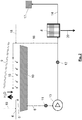
- Fig. 1 shows a Vererdungsbecken 10, which is sealed with a waterproof layer 7, for example, a plastic film, below and laterally, for example against the ground and earth ramparts.
- a drainage layer 7 for example of drainage gravel, to which a reactive organic layer 2, for example the basis of compost, was applied.
- plants 3 are planted, which root through the reactive organic layer 2.
- the plants 3 cause the entry of oxygen O 2 in the reactive organic layer 2, as well as the exchange of carbon dioxide CO 2 .
- the suspension 4 of solids in an aqueous solution 6 is applied to the reactive organic layer 2.
- the aqueous solution 6 filtered off from the aqueous suspension 4 flows as a result of gravity into the drainage layer 1 and is pumped to precipitate phosphates in a separate container 8.
- the solids from the suspension 4 become part of the reactive organic layer 2.
- the ground basin 10 can be completely or partially covered with a roof 9.
- Fig. 2 schematically shows the course of the suspension 4 and the aqueous solution through the Vererdungsbecken 10 and the container 8.
- the suspension 4 is introduced in its raw state in the Vererdungsbecken 10.
- polymers 19 may be added to promote their drainage.
- the filtered-off aqueous solution 6 is pumped by means of a pump 13 into the container 8, where magnesium ammonium phosphate 20 is precipitated by the addition of magnesium.
- the phosphate-free aqueous solution 14 can be spent in a wastewater treatment plant 17.
- the aqueous solution 6 is monitored with a redox measuring probe 11.
- a phosphate measuring probe 12 measures the phosphate concentration in the withdrawn aqueous solution 6.
- the aqueous solution 6 can be recycled to the digester tank 10 as recyclate 16 instead of the tank 8, optionally via agitation 15 above the digester basin 10
- Alkaline or alkaline earth metals 18 can be added to the recycled material 16 in order to increase the pH and to achieve a composition of the aqueous solution 6 favorable for the precipitation of magnesium ammonium phosphate 20.
- the accumulation of phosphate in the aqueous solution 6 can be further controlled by the use of the roof 9. With the roof, rainwater H 2 O can thickening the shut off in the Vererdungsbecken 10 suspension 4 shut off, or conversely, evaporation of H 2 O can be prevented by solar heat.
- Fig. 3 shows a Vererdungsbecken 10, which is divided by several, here six, separately controllable feed points 5 in separately managed sections 21 to 23.
- Three adjacent feed points 5 define a first portion 21 of the Vererdungsbeckens, while two other adjacent feed points 5 supply a smaller second portion 22 of the Vererdungsbeckens.
- a smallest, third portion 23 of the Vererdungsbeckens is defined by the sixth feed point 5.
- aqueous solution 6 can be selectively supplied to the container 8 for precipitating phosphates, if it comes from the feed of a portion 21 to 23, in which the plants 3 are just dying and thus bound during their growth phosphates in concentrated form in the aqueous solution 6 release.
Landscapes
- Life Sciences & Earth Sciences (AREA)
- Engineering & Computer Science (AREA)
- Chemical & Material Sciences (AREA)
- Hydrology & Water Resources (AREA)
- Biodiversity & Conservation Biology (AREA)
- Microbiology (AREA)
- Environmental & Geological Engineering (AREA)
- Water Supply & Treatment (AREA)
- Organic Chemistry (AREA)
- Botany (AREA)
- Biotechnology (AREA)
- Analytical Chemistry (AREA)
- Fertilizers (AREA)
- Water Treatment By Sorption (AREA)
Description
Die Erfindung betrifft ein Verfahren zur Rückgewinnung von Phosphaten aus einer Suspension von Feststoffen in einer wässrigen Lösung mit den Schritten Konzentrieren von Phosphaten in der wässrigen Lösung, Trennen der Feststoffe von der wässrigen Lösung und Fällen der Phosphate aus der wässrigen Lösung.The invention relates to a process for the recovery of phosphates from a suspension of solids in an aqueous solution comprising the steps of concentrating phosphates in the aqueous solution, separating the solids from the aqueous solution and precipitating the phosphates from the aqueous solution.
Aus der
Die
Zur Phosphorrückgewinnung bei der Abwasserreinigung ist das sogenannte PRISA-Verfahren bekannt (Montag, 2008: Phosphorrückgewinnung bei der Abwasserreinigung - Entwicklung eines Verfahrens zur Integration in kommunale Kläranlagen, Dissertation, RWTH Aachen), das die Merkmale des Oberbegriffs des unabhängigen Patentanspruchs 1 aufweist. Dieses Verfahren umfasst vor und nach einer anaeroben Schlammbehandlung ein Eindicken des Schlamms in einem Voreindicker und einem Nacheindicker. Anschließend wird eine maschinelle Schlammentwässerung durchgeführt. Ein phosphatreiches Überstandswasser des Voreindickers, ein ammonium- und phosphatreiches Überstandswasser des Nacheindickers und das Schlammwasser aus der maschinellen Schlammentwässerung werden gemeinsam, beispielsweise mithilfe eines Tuchfilters, gefiltert. In einem Mischbehälter werden dem Filtrat Magnesiumoxid als Fällmittel und Natronlauge zur Einstellung des pH-Wertes zugesetzt. In einem Kristallisationsbehälter bilden sich Magnesiumammoniumphosphatkristalle. Der entwässerte Klärschlamm aus der maschinellen Schlammentwässerung muss getrennt entsorgt werden. Da die Realisation dieses Verfahrens Investitionen in einen Voreindicker, einen Nacheindicker und Maschinen zur Schlammentwässerung erfordert, ist es erst bei großen Kläranlagen wirtschaftlich einsetzbar.For phosphorus recovery in wastewater treatment, the so-called PRISA method is known (Monday, 2008: Phosphorückgewinnung in wastewater treatment - Development of a method for integration in municipal sewage treatment plants, dissertation, RWTH Aachen), having the features of the preamble of independent claim 1. This method involves thickening the sludge in a pre-thickener and a post-thickener before and after anaerobic sludge treatment. Subsequently, a machine sludge dewatering is performed. A phosphate-rich supernatant water of the pre-thickener, an ammonium- and phosphate-rich supernatant water of the post-thickener and the sludge water from the machine sludge dewatering are filtered together, for example using a cloth filter. In a mixing vessel, the filtrate magnesium oxide as Precipitant and sodium hydroxide added to adjust the pH. In a crystallization vessel, magnesium ammonium phosphate crystals are formed. The dewatered sewage sludge from the machine sludge dewatering must be disposed of separately. Since the realization of this process requires investments in a pre-thickener, a post-thickener and sludge dewatering machines, it can only be used economically in large sewage treatment plants.
Aus der
Bei einem in der
In der
Horn, Sartorius, Tettenborn 2010: Technologievorausschau für Phosphorrecyclingtechnologien (Arbeitspaket 6) gibt eine Übersicht über weitere Verfahren zur Phosphatrückgewinnung.Horn, Sartorius, Tettenborn 2010: Technology preview for phosphorus recycling technologies (work package 6) gives an overview of other methods for phosphate recovery.
Die
Der Erfindung liegt die Aufgabe zugrunde, ein Verfahren mit den Merkmalen des Oberbegriffs des Patentanspruchs 1 aufzuzeigen, mit dem Phosphate aus häuslichen und industriellen Abwässern auch in kleiner dimensionierten Kläranlagen für beispielsweise weniger als 100.000 Einwohner kosteneffizient zurückgewonnen werden können.The invention has for its object to provide a method with the features of the preamble of claim 1, can be retrieved cost-effectively with the phosphates from domestic and industrial wastewater even in smaller sized sewage treatment plants for example, less than 100,000 inhabitants.
Die Aufgabe der Erfindung wird erfindungsgemäß durch ein Verfahren mit den Merkmalen des unabhängigen Patentanspruchs gelöst. Bevorzugte erfindungsgemäße Ausgestaltungen des Verfahrens sind den abhängigen Patentansprüchen zu entnehmen.The object of the invention is achieved by a method having the features of the independent claim. Preferred embodiments of the method according to the invention can be found in the dependent claims.
Die Erfindung betrifft ein Verfahren, mit dem Phosphate aus einer Suspension von Feststoffen in einer wässrigen Lösung rückgewonnen werden können. Solche Suspensionen können beispielsweise häusliche oder industrielle Abwässer sein, aber auch Abfälle, beispielsweise aus der lebensmittelverarbeitenden Industrie oder der Landwirtschaft. In einem Vererdungsbecken wird eine Drainageschicht mit einer reaktiven organischen Schicht, beispielsweise aus oder auf der Basis von Kompost, bedeckt. Die wässrige Suspension wird auf diese reaktive organische Schicht aufgebracht. In Folge der Schwerkraft erfolgt eine Separation der wässrigen Lösung, die bis in die Drainageschicht abfließen kann, von den Feststoffen, die Teil der reaktiven organischen Schicht werden, ohne dass der Einsatz von Filtermaterialien oder Energie nötig wäre. In der reaktiven organischen Schicht erfolgt ein biologischer Abbau von phosphathaltigen Feststoffen durch Bakterien, Pilze und sonstige, auch höher entwickelte, Destruenten wie Kompostwürmer. In der reaktiven organischen Schicht erfolgt eine starke Volumenreduktion, so dass jeweils im Abstand weniger Tage weitere Schichten wässriger Suspension aufgebracht werden können. Das Vererdungsbecken kann daher ohne Leerung über mehrere Jahre betrieben werden, was besonders effizient ist. Durch den biologischen Abbau erhöht sich der Anteil des Phosphats, das in löslicher Form vorliegt. Dieses lösliche Phosphat kann mit der wässrigen Lösung aus der reaktiven organischen Schicht in die Drainageschicht ausgewaschen werden. Von dort wird die wässrige Lösung abgezogen, wann immer dies aufgrund ihres angereicherten Phosphatgehalts günstig erscheint. Die Phosphatkonzentration in der Drainageschicht wird laufend überwacht; dies kann etwa durch regelmäßige Probenentnahme oder Einbringen einer Sonde geschehen. Die wässrige Lösung wird vorzugsweise dann abgezogen, wenn eine für das Ausfällen besonders vorteilhafte Phosphatkonzentration erreicht ist. Die wässrige Lösung kann, wenn ihre Phosphatkonzentration unterhalb eines vorgegebenen Grenzwerts liegt, in das Vererdungsbecken zurückgeführt werden. Aus der abgezogenen wässrigen Lösung werden die gelösten Phosphate ausgefällt und liegen anschließend in einer reinen Form vor, die sich zum Beispiel zur Verwendung in Düngemitteln eignet. Restmengen von Phosphaten, die sich in der wässrigen Lösung nicht lösen und dauerhaft in den abgetrennten und stark volumenreduzierten Feststoffen verbleiben, sind durch die oberirdische Ablagerung der Feststoffe in dem Vererdungsbecken dauerhaft zugänglich und können bei Bedarf durch Abschälung ebenfalls einer weiteren Nutzung zugeführt werden (z. B. Verbrennung mit nachfolgender Rückgewinnung von Phosphaten aus den Verbrennungsaschen).The invention relates to a process by which phosphates can be recovered from a suspension of solids in an aqueous solution. Such suspensions may be, for example, domestic or industrial wastewaters, but also waste, for example from the food processing industry or agriculture. In a make-up basin, a drainage layer is covered with a reactive organic layer, for example, or based on compost. The aqueous suspension is applied to this reactive organic layer. As a result of gravity, a separation of the aqueous solution, which can drain into the drainage layer, of the solids that become part of the reactive organic layer, without the use of filter materials or energy would be necessary. In the reactive organic layer is a biological degradation of phosphate-containing solids by bacteria, fungi and other, even more sophisticated, destructors such as compost worms. In the reactive organic layer, a large volume reduction, so that in each case within a few days days further layers of aqueous suspension can be applied. The Vererdungsbecken can therefore be operated without emptying for several years, which is particularly efficient. Biodegradation increases the proportion of phosphate present in soluble form. This soluble phosphate can be washed out with the aqueous solution from the reactive organic layer into the drainage layer. From there, the aqueous solution is withdrawn whenever this appears favorable due to its enriched phosphate content. The phosphate concentration in the drainage layer is constantly monitored; This can be done for example by regular sampling or insertion of a probe. The aqueous solution is preferably withdrawn when a particularly advantageous for the precipitation phosphate concentration is reached. The aqueous solution, if its phosphate concentration is below a predetermined limit, may be recycled to the digester tank. From the withdrawn aqueous solution, the dissolved phosphates are precipitated and then exist in a pure form, which is suitable for use in fertilizers, for example. Residual quantities of Phosphates that do not dissolve in the aqueous solution and remain permanently in the separated and greatly reduced volume solids are permanently accessible through the aboveground deposition of solids in the digestion basin and can also be further used by peeling if necessary (eg. Combustion with subsequent recovery of phosphates from the combustion ash).
Zusätzlich zu einem vorhandenen Vererdungsbecken und einem Behälter zum Ausfällen werden für das erfindungsgemäße Verfahren keine weiteren Vorrichtungen benötigt. Es ist auch kein besonderer verfahrenstechnischer Aufwand zu bewältigen, da das Separieren der wässrigen Suspension und das Konzentrieren der Phosphate in der wässrigen Lösung in einem Arbeitsgang und demselben Vererdungsbecken erfolgen. Vererdungsbecken sind bei einigen Kläranlagen, gerade kleineren Kläranlagen ab etwa 1000 Einwohner, sowieso vorhanden oder für solche kleineren Kläranlagen jedenfalls von Vorteil. An den Behälter zum Ausfällen bestehen keine besonderen Anforderungen; er beansprucht auch nicht viel Platz.In addition to an existing digestion basin and a container for precipitation, no further devices are required for the process according to the invention. It is also no special procedural effort to deal with, since the separation of the aqueous suspension and the concentration of the phosphates in the aqueous solution in a single operation and the same Vererdungsbecken done. Vererdungsbecken are in some sewage treatment plants, just smaller wastewater treatment plants from about 1000 inhabitants, anyway available or at least for such smaller wastewater treatment plants of advantage. There are no special requirements for the precipitation container; he does not take much space either.
Das Fällen der Phosphate kann beispielsweise durch Zugabe von Magnesium erfolgen, so dass MAP ausfällt. Dies ist besonders vorteilhaft, da die in der wässrigen Lösung vorliegenden Phosphat- und Ammoniumkonzentrationen bereits bei sehr geringen Zugaben von Magnesium zum Ausfallen von MAP führen.The precipitation of the phosphates can be done, for example, by adding magnesium, so that MAP precipitates. This is particularly advantageous since the phosphate and ammonium concentrations present in the aqueous solution lead to the precipitation of MAP even at very low additions of magnesium.
Um zu gewährleisten, dass keine Umweltgefährdung durch austretende Stoffe auftritt, wird das Vererdungsbecken zum Untergrund hin flüssigkeitsdicht abgeschlossen, zum Beispiel durch eine Folie oder eine mit einem flüssigkeitsdichten Anstrich versehene Betonwanne. Hingegen ist das Vererdungsbecken an seiner Oberseite in aller Regel offen. So werden die Abbauprozesse durch Luftzufuhr, Sonneneinstrahlung und andere Witterungseinflüsse unterstützt.To ensure that there are no environmental hazards due to escaping substances, the underground basin is sealed to the ground in a liquid-tight manner, for example by means of a foil or a concrete trough provided with a liquid-tight coating. By contrast, the Vererdungsbecken at its top is usually open. Thus, the degradation processes are supported by air, sunlight and other weather conditions.
Um das Eindicken der Suspensionen zu steuern, kann das Vererdungsbecken nach Bedarf ganz oder teilweise abgedeckt werden, so dass beispielsweise eine Verdünnung oder das Auswaschen durch Regen, wobei das Regenwasser Teil der wässrigen Lösung wird, gefördert oder verhindert wird. Dies kann beispielsweise durch ein bewegliches Dach oder eine Folie geschehen. Auf diese Weise kann auch das Abtrocknen der Feststoffe oder der reaktiven organischen Schicht durch Kontrolle der Sonneneinstrahlung gesteuert werden.In order to control the thickening of the suspensions, the digester basin can be completely or partially covered as needed, so that, for example, a dilution or washing out by rain, wherein the rainwater is part of the aqueous solution is promoted or prevented. This can be done for example by a movable roof or a foil. In this way, the drying of the solids or the reactive organic layer can be controlled by controlling the sunlight.
In einer Ausführungsform der Erfindung kann das Abtrocknen der Feststoffe oder der reaktiven organischen Schicht außerdem dadurch beschleunigt werden, dass die Drainageschicht beheizt wird. Auf diese Weise können auch ideale Temperaturbedingungen für mikrobielle Abbauprozesse eingestellt werden. Zur Heizung kann Abwärme, beispielsweise aus einer Faulungsanlage, einem Abwasserstrom oder andere auf derselben Kläranlage anfallende Prozesswärme, verwendet werden, so dass kein zusätzlicher Energiebedarf anfällt.In one embodiment of the invention, the drying of the solids or the reactive organic layer can also be accelerated by heating the drainage layer. In this way, ideal temperature conditions for microbial degradation processes can be set. For heating waste heat, for example, from a digestion plant, a wastewater stream or other incurred at the same treatment plant process heat can be used, so that no additional energy needs.
Vorzugsweise wird mit einer Sonde das Redoxpotential der wässrigen Lösung aus der Drainageschicht überwacht. Für einen idealen Ablauf der mikrobiellen Abbauprozesse in der reaktiven organischen Schicht sind überwiegend aerobe Prozesse erwünscht, daher werden überwiegend oxidierte Verbindungen in der abgezogenen wässrigen Lösung und damit positive Redoxpotentiale im Bereich von mehr als 100 mV angestrebt. Fällt das Redoxpotential unter diesen Wert, lässt man den betreffenden Teilbereich des Vererdungsbeckens vorübergehend trockenfallen, so dass vermehrt Luftsauerstoff in die reaktive organische Schicht gelangt.The redox potential of the aqueous solution from the drainage layer is preferably monitored with a probe. For an ideal sequence of the microbial degradation processes in the reactive organic layer predominantly aerobic processes are desired, therefore predominantly oxidized compounds in the stripped aqueous solution and thus positive redox potentials in the range of more than 100 mV are sought. If the redox potential falls below this value, the relevant subregion of the earth basin is temporarily allowed to dry, so that increased amounts of atmospheric oxygen enter the reactive organic layer.
Die wässrige Lösung kann außerdem angestaut werden, so dass sie bis in die aufgelandeten Feststoffe hineinreicht. So kann sie dort gelöste Phosphate auswaschen und in die Drainageschicht tragen.The aqueous solution can also be dammed up so that it reaches into the dissolved solids. This allows it to wash out dissolved phosphates and carry them into the drainage layer.
Die reaktive organische Schicht kann bepflanzt werden, um durch Schaffung eines mikrobiell besiedelten Wurzelraums die mikrobiellen Abbauprozesse zu fördern. Durch das Wurzelwerk wird die Schicht außerdem durchlüftet und es bilden sich feine Kanäle aus, so dass die Filterwirkung der Schicht nicht nachlässt. Zudem kann ein verstärkter Sauerstoffeintrag in die Schicht aerobe Abbauprozesse fördern. Ebenso dienen die Pflanzen als Zwischenspeicher für verschiedene Substanzen, die sie während ihres Wachstums binden, so etwa Kohlendioxid und Phosphate. Das Aufkonzentrieren der Phosphate aus der wässrigen Suspension wird durch die Pflanzen begünstigt. Die Pflanzen werden durch die Phosphate gedüngt und nehmen sie bei ihrem Wachstum auf. Die Pflanzen bilden so einen temporären Phosphatspeicher. Wenn die Pflanzen absterben, werden sie selbst Teil der organischen Schicht. Die gespeicherten Phosphate werden dann abgebaut und gelangen so in aufkonzentrierter Form zurück in die wässrige Lösung, mit der sie ausgeschwemmt werden.The reactive organic layer can be planted to promote microbial degradation processes by creating a microbially colonized root space. Through the root system, the layer is also aerated and it form fine channels, so that the filter effect of the layer does not deteriorate. In addition, an increased oxygen input into the layer can promote aerobic degradation processes. Likewise, the plants serve as a buffer for various substances that bind them during their growth, such as carbon dioxide and phosphates. Concentration of the phosphates from the aqueous suspension is favored by the plants. The plants are fertilized by the phosphates and absorb them as they grow. The plants thus form a temporary phosphate reservoir. When the plants die, they become part of the organic layer. The stored phosphates are then degraded and return in concentrated form back into the aqueous solution with which they are flushed out.
Als Bepflanzung sind C2-Pflanzen wie etwa Schilf (Phragmites australis) bevorzugt. Es ist aber auch eine Bepflanzung mit Nutzpflanzen wie etwa Pappeln oder Weiden zur Holzgewinnung oder Raps zur Energiegewinnung möglich, so dass ein zusätzlicher Nutzen der reaktiven organischen Schicht als Anbaufläche geschaffen wird, was die Wirtschaftlichkeit des Verfahrens weiter erhöht.For planting C2 plants such as reeds (Phragmites australis) are preferred. But it is also a planting with crops such as poplars or willows for logging or rapeseed for energy production possible, so that an additional benefit of the reactive organic layer is created as a growing area, which further increases the efficiency of the process.
In einer Ausführungsform der Erfindung wird die wässrige Suspension über mehrere über die Fläche des Vererdungsbeckens verteilte Zulaufpunkte eingeleitet. Wenn jeder Zulaufpunkt individuell angesteuert werden kann, ermöglicht dies, mehrere Teilflächen des Vererdungsbeckens gemeinsam oder getrennt zu nutzen. Wenn ein Vererdungsbecken beispielsweise sechs Zulaufpunkte aufweist, dann können drei benachbarte Zulaufpunkte gemeinsam einen Teilbereich des Vererdungsbeckens bilden, der einheitlich bewirtschaftet wird. Zwei weitere benachbarte Zulaufpunkte können zu einem späteren Zeitpunkt in Betrieb gehen und einen kleineren Teilbereich bedienen, während der sechste Zulaufpunkt wegen geringer Auslastung weiter brach liegen kann. Fällt dann beispielsweise in einem Teilbereich das Redoxpotential unter einen angestrebten Wert, so kann man diesen Teilbereich trockenfallen lassen, während anfallende Abwässer in anderen Teilbereichen weiterhin verarbeitet werden können. Insbesondere können einzelne Teilbereiche auch zur Zwischenlagerung von gebundenen Stoffen, insbesondere von in Pflanzen gebundenen Phosphaten, dienen. Es ist außerdem möglich, in den verschiedenen Teilbereichen unterschiedliche Stoffkonzentrationen oder Eindickungen der aufgelandeten Feststoffe - je nach deren späterer Verwendung - anzustreben. Es ist auch möglich, einzelne Teilbereiche stillzulegen und nach einer Trockenphase mit maximaler Abtrennung der phosphatreichen wässrigen Lösung die aufgelandeten Feststoffe aus dem Vererdungsbecken zu entnehmen und einer weiteren Nutzung zuzuführen. Dabei können auch in den aufgelandeten Feststoffen verbliebene Phosphate und sonstige Wertstoffe zurückgewonnen werden, indem z. B. die Feststoffe verbrannt und die Wertstoffe aus den entstehenden Aschen geborgen werden.In one embodiment of the invention, the aqueous suspension is introduced via a plurality of feed points distributed over the surface of the digester tank. If each inflow point can be controlled individually, this makes it possible to use several subfaces of the geothermal basin together or separately. For example, if a geothermal basin has six inflow points, then three adjacent inflow points together can form a portion of the geothermal basin that is managed uniformly. Two further adjacent inflow points can go into operation at a later date and operate a smaller subarea, while the sixth inflow point can continue to be idle due to low utilization. If, for example, the redox potential falls below a desired value in one subarea, then this subarea can be allowed to dry, while wastewater arising in other subareas can continue to be processed. In particular, individual subregions can also serve for the intermediate storage of bound substances, in particular of phosphates bound in plants. It is also possible to aim at different concentrations or thickening of the dissolved solids in the different subregions, depending on their later use. It is also possible to shut down individual sections and to remove after a dry phase with maximum separation of the phosphate-rich aqueous solution, the dissolved solids from the ground basin and feed it to another use. It can be recovered in the dissolved solids remaining phosphates and other valuable materials by z. B. the solids burned and the recyclables are recovered from the resulting ash.
Vorteilhafte Weiterbildungen der Erfindung ergeben sich aus den Patentansprüchen, der Beschreibung und den Zeichnungen. Die in der Beschreibung genannten Vorteile von Merkmalen und von Kombinationen mehrerer Merkmale sind lediglich beispielhaft und können alternativ oder kumulativ zur Wirkung kommen, ohne dass die Vorteile zwingend von erfindungsgemäßen Ausführungsformen erzielt werden müssen. Ohne dass hierdurch der Gegenstand der beigefügten Patentansprüche verändert wird, gilt hinsichtlich des Offenbarungsgehalts der ursprünglichen Anmeldungsunterlagen und des Patents Folgendes: weitere Merkmale sind den Zeichnungen - insbesondere den dargestellten Geometrien und den relativen Abmessungen mehrerer Bauteile zueinander sowie deren relativer Anordnung und Wirkverbindung - zu entnehmen. Die Kombination von Merkmalen unterschiedlicher Ausführungsformen der Erfindung oder von Merkmalen unterschiedlicher Patentansprüche ist ebenfalls abweichend von den gewählten Rückbeziehungen der Patentansprüche möglich und wird hiermit angeregt. Dies betrifft auch solche Merkmale, die in separaten Zeichnungen dargestellt sind oder bei deren Beschreibung genannt werden. Diese Merkmale können auch mit Merkmalen unterschiedlicher Patentansprüche kombiniert werden. Ebenso können in den Patentansprüchen aufgeführte Merkmale für weitere Ausführungsformen der Erfindung entfallen.Advantageous developments of the invention will become apparent from the claims, the description and the drawings. The advantages of features and of combinations of several features mentioned in the description are merely exemplary and can take effect alternatively or cumulatively, without the advantages having to be achieved by embodiments according to the invention. Without altering the subject matter of the appended claims, as regards the disclosure of the original application documents and the patent, the following applies: Further features are the drawings - in particular the illustrated geometries and the relative dimensions of several Components to each other and their relative arrangement and operative connection - refer. The combination of features of different embodiments of the invention or of features of different claims is also possible deviating from the chosen relationships of the claims and is hereby stimulated. This also applies to those features which are shown in separate drawings or are mentioned in their description. These features can also be combined with features of different claims. Likewise, in the claims listed features for further embodiments of the invention can be omitted.
Die in den Patentansprüchen enthaltenen Bezugszeichen stellen keine Beschränkung des Umfangs der durch die Patentansprüche geschützten Gegenstände dar. Sie dienen lediglich dem Zweck, die Patentansprüche leichter verständlich zu machen.The reference numerals contained in the claims do not limit the scope of the objects protected by the claims. They are for the sole purpose of making the claims easier to understand.
Im Folgenden wird die Erfindung anhand von in den Figuren dargestellten bevorzugten Ausführungsbeispielen weiter erläutert und beschrieben.
- Fig. 1
- zeigt ein Vererdungsbecken mit einem separaten Behälter zum Ausfällen von Phosphaten aus einer aus dem Vererdungsbecken abgezogenen wässrigen Lösung.
- Fig. 2
- zeigt schematisch den Lauf der wässrigen Suspension durch das Vererdungsbecken und den Behälter gemäß
Fig. 1 . - Fig. 3
- ist eine Draufsicht auf ein Vererdungsbecken, das in mehrere Teilbereiche mit jeweils einem Zulaufpunkt aufgeteilt ist.
- Fig. 1
- shows a digester tank with a separate container for precipitating phosphates from an aqueous solution withdrawn from the digester tank.
- Fig. 2
- schematically shows the course of the aqueous suspension through the Vererdungsbecken and the container according to
Fig. 1 , - Fig. 3
- is a plan view of a Vererdungsbecken, which is divided into several sections, each with a feed point.
- 11
- Drainageschichtdrainage layer
- 22
- Reaktive organische SchichtReactive organic layer
- 33
- Pflanzenplants
- 44
- Wässrige SuspensionAqueous suspension
- 55
- Zulaufpunktinlet point
- 66
- Wässrige LösungAqueous solution
- 77
- Wasserdichte SchichtWaterproof layer
- 88th
- Behältercontainer
- 99
- Dachtop, roof
- 1010
- Vererdungsbeckentransformation basin
- 1111
- Redox-MesssondeRedox probe
- 1212
- Phosphat-MesssondePhosphate-measuring probe
- 1313
- Pumpepump
- 1414
- Phosphatfreie wässrige LösungPhosphate-free aqueous solution
- 1515
- Verregnungspray irrigation
- 1616
- Rezyklatrecycled
- 1717
- Abwasserreinigungsanlagewastewater treatment plant
- 1818
- Alkali- oder ErdalkalimetalleAlkali or alkaline earth metals
- 1919
- Polymerepolymers
- 2020
- Magnesiumammoniumphosphat (MAP)Magnesium ammonium phosphate (MAP)
- 2121
- Teilbereichsubregion
- 2222
- Teilbereichsubregion
- 2323
- Teilbereichsubregion
- 2424
- Rohrleitungpipeline
Claims (13)
- Method for recovery of phosphates in a suspension (4) of solids in an aqueous solution (6) comprising- concentrating phosphates in the aqueous solution (6),- separating the solids from the aqueous solution (6) and- precipitating of the phosphates from the aqueous solution (6),characterised in- that the concentrating and separating comprises- placing a drainage layer (1) and a reactive organic layer (2) in a humification basin (10),- feeding the suspension (4) into the humification basin (10) above the reactive organic layer (2),- increasing the proportion of phosphates present in soluble form in the reactive organic layer (2) by biological degradation of solids containing phosphates,- sluicing the soluble phosphates from the reactive organic layer (2) into the drainage layer (1) with the aqueous solution (6),- monitoring the concentration of phosphates in the aqueous solution (6) from the region of the drainage layer (1) and- intermittent draining of the aqueous solution (6) from the region of the drainage layer (1) and- that the precipitating of the phosphates from the drained volumes of the aqueous solution with the increased phosphate content is started when a predetermined threshold value of the phosphate concentration is reached.
- Method according to claim 1, characterised in fluid-tight sealing of the humification basin (10) towards the ground and subjecting the suspensions (4) fed into the humification basin (10) to the weather.
- Method according to one of the preceding claims, characterised in monitoring of the redox potential of the aqueous solution (6) from the region of the drainage layer (1).
- Method according to one of the preceding claims, characterised in feeding back drained aqueous solution (6) with a phosphate content below a predetermined threshold value into the humification basin (10).
- Method according to one of the preceding claims, characterised in subsequent setting of different degrees of drying of solids accumulated in the humification basin (10).
- Method according to claim 5, characterised by impounding the aqueous solution (6) up into the region of the accumulated solids before draining the aqueous solution (6) from the region of the drainage layer (1).
- Method according to one of the preceding claims, characterised by adding magnesium to the volumes of aqueous solution (6) with increased phosphate content for a precipitation of magnesium ammonium phosphate.
- Method according to one of the preceding claims, characterised by planting the reactive organic layer (2).
- Method according to claim 8, characterised by planting the reactive organic layer (2) with C2 plants.
- Method according to claim 8 or 9, characterised by planting the reactive organic layer (2) with agricultural crop plants for gaining renewable resources.
- Method according to one of the preceding claims, characterised by using a compost for the reactive organic layer (2).
- Method according to one of the preceding claims, characterised by selectively feeding the aqueous suspension (4) into several partial regions (21 to 23) of the humification basin (10) spread over the extension of the humification basin (10).
- Method according to one of the preceding claims, characterised by heating the humification basin (10).
Priority Applications (4)
| Application Number | Priority Date | Filing Date | Title |
|---|---|---|---|
| ES14158671.9T ES2623897T3 (en) | 2014-03-10 | 2014-03-10 | Procedure for solid matter separation and phosphate recovery from aqueous suspensions |
| EP14158671.9A EP2918552B1 (en) | 2014-03-10 | 2014-03-10 | Method for the separation of solids and recovery of phosphates from aqueous suspensions |
| HUE14158671A HUE032530T2 (en) | 2014-03-10 | 2014-03-10 | Method for the separation of solids and recovery of phosphates from aqueous suspensions |
| PL14158671T PL2918552T3 (en) | 2014-03-10 | 2014-03-10 | Method for the separation of solids and recovery of phosphates from aqueous suspensions |
Applications Claiming Priority (1)
| Application Number | Priority Date | Filing Date | Title |
|---|---|---|---|
| EP14158671.9A EP2918552B1 (en) | 2014-03-10 | 2014-03-10 | Method for the separation of solids and recovery of phosphates from aqueous suspensions |
Publications (2)
| Publication Number | Publication Date |
|---|---|
| EP2918552A1 EP2918552A1 (en) | 2015-09-16 |
| EP2918552B1 true EP2918552B1 (en) | 2017-03-15 |
Family
ID=50239478
Family Applications (1)
| Application Number | Title | Priority Date | Filing Date |
|---|---|---|---|
| EP14158671.9A Active EP2918552B1 (en) | 2014-03-10 | 2014-03-10 | Method for the separation of solids and recovery of phosphates from aqueous suspensions |
Country Status (4)
| Country | Link |
|---|---|
| EP (1) | EP2918552B1 (en) |
| ES (1) | ES2623897T3 (en) |
| HU (1) | HUE032530T2 (en) |
| PL (1) | PL2918552T3 (en) |
Families Citing this family (3)
| Publication number | Priority date | Publication date | Assignee | Title |
|---|---|---|---|---|
| EP3527549B1 (en) | 2018-02-16 | 2022-03-09 | Udo Pauly | Organomineral phosphorus fertilizer and production of same |
| CN109454091B (en) * | 2018-11-16 | 2020-09-22 | 长沙工研院环保有限公司 | Method for treating humus soil of aged refuse landfill by combining aerobic composting and leaching technologies |
| CN116216352B (en) * | 2023-03-06 | 2023-11-24 | 江苏德邦多菱健康科技有限公司 | Packing sealing device for phosphate production and application method thereof |
Family Cites Families (6)
| Publication number | Priority date | Publication date | Assignee | Title |
|---|---|---|---|---|
| US3236766A (en) | 1964-03-31 | 1966-02-22 | Hazleton Lab Inc | Sewage treatment process |
| SU784754A3 (en) | 1975-06-04 | 1980-11-30 | Юнион Карбид Корпорейшн (Фирма) | Method of biochemical purification of phosphorus-containing waste water |
| DE4323610C1 (en) | 1993-07-12 | 1995-02-09 | Ingbuero Dr Fechter Gmbh | Biopolder for the biological clean-up of soils and sludges |
| DE19700434C1 (en) | 1997-01-10 | 1998-07-16 | Joachim Dipl Ing Pabsch | Sewage sludge soil |
| DE102008038886A1 (en) | 2008-08-15 | 2010-03-04 | Georg Fritzmeier Gmbh & Co. Kg | Disclosed is a process for selectively recovering phosphorous from heavy metal and phosphate-containing solids by treating the heavy metal and phosphorus-containing solids under acidic aerobic conditions with microorganisms comprising leaching-active and polyphosphate-storing microorganisms. In the process, heavy metals and phosphate are released from the solid and the liberated phosphate is taken up by the polyphosphate-storing microorganisms. The phosphorus-enriched biomass is separated. |
| FR2974798B1 (en) * | 2011-05-03 | 2014-06-13 | Philippe Michel | METHOD AND SYSTEM FOR TREATING EFFLUENTS |
-
2014
- 2014-03-10 EP EP14158671.9A patent/EP2918552B1/en active Active
- 2014-03-10 PL PL14158671T patent/PL2918552T3/en unknown
- 2014-03-10 ES ES14158671.9T patent/ES2623897T3/en active Active
- 2014-03-10 HU HUE14158671A patent/HUE032530T2/en unknown
Non-Patent Citations (1)
| Title |
|---|
| None * |
Also Published As
| Publication number | Publication date |
|---|---|
| EP2918552A1 (en) | 2015-09-16 |
| ES2623897T3 (en) | 2017-07-12 |
| PL2918552T3 (en) | 2017-09-29 |
| HUE032530T2 (en) | 2017-09-28 |
Similar Documents
| Publication | Publication Date | Title |
|---|---|---|
| EP0573478B1 (en) | Process for separate treatment and disposal of mixtures of solid and liquid organic waste materials | |
| EP2102115B1 (en) | Vertical-horizontal filter unit for the biological purification of polluted water | |
| WO2009118304A2 (en) | Method for processing domestic sewage from households | |
| EP0892764B1 (en) | Processing of sewage sludge into humus | |
| EP2918552A1 (en) | Method for the separation of solids and recovery of phosphates from aqueous suspensions | |
| DE2455929C2 (en) | ||
| DE3406004C2 (en) | Process and system for wastewater treatment with the help of root space disposal | |
| DE4027581C2 (en) | Process and plant for the continuous treatment of manure | |
| DE102015118988B4 (en) | Method for operating a biogas plant | |
| DE19726128C1 (en) | Converting clarifier sludge etc. into arable soil | |
| DE19717669B4 (en) | Process for heavy metal removal of biogenic organic substrates | |
| WO2019068289A1 (en) | METHOD FOR THE CLEANING OF BASE AND SURFACE WATER IN THE FIELD OF COLLECTED DAILY CONSTRUCTION USING FILTER MATERIAL SUCH AS BIO COAL, WHICH IS USED ACCORDING TO THE KNOWN METHOD OF PYROLYSIS OR HTC MADE | |
| EP3527549B1 (en) | Organomineral phosphorus fertilizer and production of same | |
| DE3312145A1 (en) | Process for the reusability of sludges | |
| DE102018120117A1 (en) | Process, plant and system for digestate treatment | |
| DE102004003071B4 (en) | Process for wastewater treatment | |
| EP3297960B1 (en) | Process for phosphorus enrichment of clarified sludge | |
| EP1519901B1 (en) | Method for the transport of sludge from a sewage water treatment installation to a drainage and composting container and corresponding water treatment installation | |
| DE102006037197A1 (en) | Production of iron hydroxide pellets for water purification, e.g. after open-cast coal mining, involves flocculation of iron hydroxide slurry, concentration, filtration, milling, addition of hygroscopic fibres and pelletisation | |
| DE2335538B1 (en) | Process to accelerate and intensify biological degradation processes | |
| EP2046689B8 (en) | Plant for the prepurification of contaminated water with integrated further treatment of the solids | |
| EP3636599B1 (en) | Method for operating a pressurised water filter and installation comprising a pressurised water filter | |
| DE102019131391A1 (en) | Process for sewage sludge treatment and sewage sludge plant | |
| DE19602023C1 (en) | Process for the treatment of biogenic waste | |
| DE102017109733B4 (en) | Method for operating a bioreactor system |
Legal Events
| Date | Code | Title | Description |
|---|---|---|---|
| PUAI | Public reference made under article 153(3) epc to a published international application that has entered the european phase |
Free format text: ORIGINAL CODE: 0009012 |
|
| AK | Designated contracting states |
Kind code of ref document: A1 Designated state(s): AL AT BE BG CH CY CZ DE DK EE ES FI FR GB GR HR HU IE IS IT LI LT LU LV MC MK MT NL NO PL PT RO RS SE SI SK SM TR |
|
| AX | Request for extension of the european patent |
Extension state: BA ME |
|
| 17P | Request for examination filed |
Effective date: 20160225 |
|
| RBV | Designated contracting states (corrected) |
Designated state(s): AL AT BE BG CH CY CZ DE DK EE ES FI FR GB GR HR HU IE IS IT LI LT LU LV MC MK MT NL NO PL PT RO RS SE SI SK SM TR |
|
| 17Q | First examination report despatched |
Effective date: 20160322 |
|
| GRAP | Despatch of communication of intention to grant a patent |
Free format text: ORIGINAL CODE: EPIDOSNIGR1 |
|
| INTG | Intention to grant announced |
Effective date: 20160930 |
|
| RIC1 | Information provided on ipc code assigned before grant |
Ipc: C02F 101/10 20060101ALN20160919BHEP Ipc: C02F 3/32 20060101ALI20160919BHEP Ipc: B09C 1/10 20060101ALI20160919BHEP Ipc: C02F 3/12 20060101AFI20160919BHEP |
|
| GRAS | Grant fee paid |
Free format text: ORIGINAL CODE: EPIDOSNIGR3 |
|
| GRAA | (expected) grant |
Free format text: ORIGINAL CODE: 0009210 |
|
| AK | Designated contracting states |
Kind code of ref document: B1 Designated state(s): AL AT BE BG CH CY CZ DE DK EE ES FI FR GB GR HR HU IE IS IT LI LT LU LV MC MK MT NL NO PL PT RO RS SE SI SK SM TR |
|
| REG | Reference to a national code |
Ref country code: CH Ref legal event code: EP Ref country code: GB Ref legal event code: FG4D Free format text: NOT ENGLISH |
|
| REG | Reference to a national code |
Ref country code: DE Ref legal event code: R082 Ref document number: 502014002978 Country of ref document: DE Representative=s name: REHBERG HUEPPE + PARTNER PATENTANWAELTE PARTG , DE |
|
| REG | Reference to a national code |
Ref country code: IE Ref legal event code: FG4D Free format text: LANGUAGE OF EP DOCUMENT: GERMAN |
|
| REG | Reference to a national code |
Ref country code: AT Ref legal event code: REF Ref document number: 875346 Country of ref document: AT Kind code of ref document: T Effective date: 20170415 |
|
| REG | Reference to a national code |
Ref country code: DE Ref legal event code: R096 Ref document number: 502014002978 Country of ref document: DE |
|
| REG | Reference to a national code |
Ref country code: SE Ref legal event code: TRGR |
|
| REG | Reference to a national code |
Ref country code: ES Ref legal event code: FG2A Ref document number: 2623897 Country of ref document: ES Kind code of ref document: T3 Effective date: 20170712 |
|
| REG | Reference to a national code |
Ref country code: NL Ref legal event code: MP Effective date: 20170315 |
|
| REG | Reference to a national code |
Ref country code: LT Ref legal event code: MG4D |
|
| PG25 | Lapsed in a contracting state [announced via postgrant information from national office to epo] |
Ref country code: LT Free format text: LAPSE BECAUSE OF FAILURE TO SUBMIT A TRANSLATION OF THE DESCRIPTION OR TO PAY THE FEE WITHIN THE PRESCRIBED TIME-LIMIT Effective date: 20170315 Ref country code: NO Free format text: LAPSE BECAUSE OF FAILURE TO SUBMIT A TRANSLATION OF THE DESCRIPTION OR TO PAY THE FEE WITHIN THE PRESCRIBED TIME-LIMIT Effective date: 20170615 Ref country code: GR Free format text: LAPSE BECAUSE OF FAILURE TO SUBMIT A TRANSLATION OF THE DESCRIPTION OR TO PAY THE FEE WITHIN THE PRESCRIBED TIME-LIMIT Effective date: 20170616 Ref country code: FI Free format text: LAPSE BECAUSE OF FAILURE TO SUBMIT A TRANSLATION OF THE DESCRIPTION OR TO PAY THE FEE WITHIN THE PRESCRIBED TIME-LIMIT Effective date: 20170315 Ref country code: HR Free format text: LAPSE BECAUSE OF FAILURE TO SUBMIT A TRANSLATION OF THE DESCRIPTION OR TO PAY THE FEE WITHIN THE PRESCRIBED TIME-LIMIT Effective date: 20170315 |
|
| PG25 | Lapsed in a contracting state [announced via postgrant information from national office to epo] |
Ref country code: LV Free format text: LAPSE BECAUSE OF FAILURE TO SUBMIT A TRANSLATION OF THE DESCRIPTION OR TO PAY THE FEE WITHIN THE PRESCRIBED TIME-LIMIT Effective date: 20170315 Ref country code: BG Free format text: LAPSE BECAUSE OF FAILURE TO SUBMIT A TRANSLATION OF THE DESCRIPTION OR TO PAY THE FEE WITHIN THE PRESCRIBED TIME-LIMIT Effective date: 20170615 Ref country code: RS Free format text: LAPSE BECAUSE OF FAILURE TO SUBMIT A TRANSLATION OF THE DESCRIPTION OR TO PAY THE FEE WITHIN THE PRESCRIBED TIME-LIMIT Effective date: 20170315 |
|
| REG | Reference to a national code |
Ref country code: HU Ref legal event code: AG4A Ref document number: E032530 Country of ref document: HU |
|
| PG25 | Lapsed in a contracting state [announced via postgrant information from national office to epo] |
Ref country code: NL Free format text: LAPSE BECAUSE OF FAILURE TO SUBMIT A TRANSLATION OF THE DESCRIPTION OR TO PAY THE FEE WITHIN THE PRESCRIBED TIME-LIMIT Effective date: 20170315 |
|
| PG25 | Lapsed in a contracting state [announced via postgrant information from national office to epo] |
Ref country code: EE Free format text: LAPSE BECAUSE OF FAILURE TO SUBMIT A TRANSLATION OF THE DESCRIPTION OR TO PAY THE FEE WITHIN THE PRESCRIBED TIME-LIMIT Effective date: 20170315 Ref country code: RO Free format text: LAPSE BECAUSE OF FAILURE TO SUBMIT A TRANSLATION OF THE DESCRIPTION OR TO PAY THE FEE WITHIN THE PRESCRIBED TIME-LIMIT Effective date: 20170315 Ref country code: SK Free format text: LAPSE BECAUSE OF FAILURE TO SUBMIT A TRANSLATION OF THE DESCRIPTION OR TO PAY THE FEE WITHIN THE PRESCRIBED TIME-LIMIT Effective date: 20170315 |
|
| PG25 | Lapsed in a contracting state [announced via postgrant information from national office to epo] |
Ref country code: PT Free format text: LAPSE BECAUSE OF FAILURE TO SUBMIT A TRANSLATION OF THE DESCRIPTION OR TO PAY THE FEE WITHIN THE PRESCRIBED TIME-LIMIT Effective date: 20170717 Ref country code: IS Free format text: LAPSE BECAUSE OF FAILURE TO SUBMIT A TRANSLATION OF THE DESCRIPTION OR TO PAY THE FEE WITHIN THE PRESCRIBED TIME-LIMIT Effective date: 20170715 Ref country code: SM Free format text: LAPSE BECAUSE OF FAILURE TO SUBMIT A TRANSLATION OF THE DESCRIPTION OR TO PAY THE FEE WITHIN THE PRESCRIBED TIME-LIMIT Effective date: 20170315 |
|
| REG | Reference to a national code |
Ref country code: DE Ref legal event code: R097 Ref document number: 502014002978 Country of ref document: DE |
|
| PLBE | No opposition filed within time limit |
Free format text: ORIGINAL CODE: 0009261 |
|
| STAA | Information on the status of an ep patent application or granted ep patent |
Free format text: STATUS: NO OPPOSITION FILED WITHIN TIME LIMIT |
|
| PG25 | Lapsed in a contracting state [announced via postgrant information from national office to epo] |
Ref country code: DK Free format text: LAPSE BECAUSE OF FAILURE TO SUBMIT A TRANSLATION OF THE DESCRIPTION OR TO PAY THE FEE WITHIN THE PRESCRIBED TIME-LIMIT Effective date: 20170315 |
|
| 26N | No opposition filed |
Effective date: 20171218 |
|
| PG25 | Lapsed in a contracting state [announced via postgrant information from national office to epo] |
Ref country code: SI Free format text: LAPSE BECAUSE OF FAILURE TO SUBMIT A TRANSLATION OF THE DESCRIPTION OR TO PAY THE FEE WITHIN THE PRESCRIBED TIME-LIMIT Effective date: 20170315 |
|
| REG | Reference to a national code |
Ref country code: FR Ref legal event code: PLFP Year of fee payment: 5 |
|
| PG25 | Lapsed in a contracting state [announced via postgrant information from national office to epo] |
Ref country code: MT Free format text: LAPSE BECAUSE OF FAILURE TO SUBMIT A TRANSLATION OF THE DESCRIPTION OR TO PAY THE FEE WITHIN THE PRESCRIBED TIME-LIMIT Effective date: 20170315 |
|
| REG | Reference to a national code |
Ref country code: CH Ref legal event code: PL |
|
| GBPC | Gb: european patent ceased through non-payment of renewal fee |
Effective date: 20180310 |
|
| PG25 | Lapsed in a contracting state [announced via postgrant information from national office to epo] |
Ref country code: MC Free format text: LAPSE BECAUSE OF FAILURE TO SUBMIT A TRANSLATION OF THE DESCRIPTION OR TO PAY THE FEE WITHIN THE PRESCRIBED TIME-LIMIT Effective date: 20170315 |
|
| REG | Reference to a national code |
Ref country code: BE Ref legal event code: MM Effective date: 20180331 |
|
| REG | Reference to a national code |
Ref country code: IE Ref legal event code: MM4A |
|
| PG25 | Lapsed in a contracting state [announced via postgrant information from national office to epo] |
Ref country code: LU Free format text: LAPSE BECAUSE OF NON-PAYMENT OF DUE FEES Effective date: 20180310 |
|
| PG25 | Lapsed in a contracting state [announced via postgrant information from national office to epo] |
Ref country code: IE Free format text: LAPSE BECAUSE OF NON-PAYMENT OF DUE FEES Effective date: 20180310 |
|
| PG25 | Lapsed in a contracting state [announced via postgrant information from national office to epo] |
Ref country code: LI Free format text: LAPSE BECAUSE OF NON-PAYMENT OF DUE FEES Effective date: 20180331 Ref country code: CH Free format text: LAPSE BECAUSE OF NON-PAYMENT OF DUE FEES Effective date: 20180331 Ref country code: GB Free format text: LAPSE BECAUSE OF NON-PAYMENT OF DUE FEES Effective date: 20180310 Ref country code: BE Free format text: LAPSE BECAUSE OF NON-PAYMENT OF DUE FEES Effective date: 20180331 |
|
| PG25 | Lapsed in a contracting state [announced via postgrant information from national office to epo] |
Ref country code: TR Free format text: LAPSE BECAUSE OF FAILURE TO SUBMIT A TRANSLATION OF THE DESCRIPTION OR TO PAY THE FEE WITHIN THE PRESCRIBED TIME-LIMIT Effective date: 20170315 |
|
| PG25 | Lapsed in a contracting state [announced via postgrant information from national office to epo] |
Ref country code: MK Free format text: LAPSE BECAUSE OF NON-PAYMENT OF DUE FEES Effective date: 20170315 Ref country code: CY Free format text: LAPSE BECAUSE OF FAILURE TO SUBMIT A TRANSLATION OF THE DESCRIPTION OR TO PAY THE FEE WITHIN THE PRESCRIBED TIME-LIMIT Effective date: 20170315 |
|
| PG25 | Lapsed in a contracting state [announced via postgrant information from national office to epo] |
Ref country code: AL Free format text: LAPSE BECAUSE OF FAILURE TO SUBMIT A TRANSLATION OF THE DESCRIPTION OR TO PAY THE FEE WITHIN THE PRESCRIBED TIME-LIMIT Effective date: 20170315 |
|
| PGFP | Annual fee paid to national office [announced via postgrant information from national office to epo] |
Ref country code: CZ Payment date: 20210225 Year of fee payment: 8 |
|
| PGFP | Annual fee paid to national office [announced via postgrant information from national office to epo] |
Ref country code: SE Payment date: 20210323 Year of fee payment: 8 Ref country code: HU Payment date: 20210227 Year of fee payment: 8 Ref country code: PL Payment date: 20210301 Year of fee payment: 8 |
|
| PGFP | Annual fee paid to national office [announced via postgrant information from national office to epo] |
Ref country code: IT Payment date: 20210331 Year of fee payment: 8 |
|
| PGFP | Annual fee paid to national office [announced via postgrant information from national office to epo] |
Ref country code: ES Payment date: 20210421 Year of fee payment: 8 |
|
| PG25 | Lapsed in a contracting state [announced via postgrant information from national office to epo] |
Ref country code: CZ Free format text: LAPSE BECAUSE OF NON-PAYMENT OF DUE FEES Effective date: 20220310 |
|
| PG25 | Lapsed in a contracting state [announced via postgrant information from national office to epo] |
Ref country code: SE Free format text: LAPSE BECAUSE OF NON-PAYMENT OF DUE FEES Effective date: 20220311 Ref country code: HU Free format text: LAPSE BECAUSE OF NON-PAYMENT OF DUE FEES Effective date: 20220311 |
|
| REG | Reference to a national code |
Ref country code: ES Ref legal event code: FD2A Effective date: 20230526 |
|
| PG25 | Lapsed in a contracting state [announced via postgrant information from national office to epo] |
Ref country code: IT Free format text: LAPSE BECAUSE OF NON-PAYMENT OF DUE FEES Effective date: 20220310 |
|
| P01 | Opt-out of the competence of the unified patent court (upc) registered |
Effective date: 20230528 |
|
| PG25 | Lapsed in a contracting state [announced via postgrant information from national office to epo] |
Ref country code: ES Free format text: LAPSE BECAUSE OF NON-PAYMENT OF DUE FEES Effective date: 20220311 |
|
| PG25 | Lapsed in a contracting state [announced via postgrant information from national office to epo] |
Ref country code: PL Free format text: LAPSE BECAUSE OF NON-PAYMENT OF DUE FEES Effective date: 20220310 |
|
| PGFP | Annual fee paid to national office [announced via postgrant information from national office to epo] |
Ref country code: DE Payment date: 20260311 Year of fee payment: 13 |
|
| PGFP | Annual fee paid to national office [announced via postgrant information from national office to epo] |
Ref country code: AT Payment date: 20260319 Year of fee payment: 13 |
|
| PGFP | Annual fee paid to national office [announced via postgrant information from national office to epo] |
Ref country code: FR Payment date: 20260324 Year of fee payment: 13 |