EP2916319A1 - Concept for encoding of information - Google Patents
Concept for encoding of information Download PDFInfo
- Publication number
- EP2916319A1 EP2916319A1 EP14178789.5A EP14178789A EP2916319A1 EP 2916319 A1 EP2916319 A1 EP 2916319A1 EP 14178789 A EP14178789 A EP 14178789A EP 2916319 A1 EP2916319 A1 EP 2916319A1
- Authority
- EP
- European Patent Office
- Prior art keywords
- polynomials
- spectrum
- derived
- polynomial
- converter
- Prior art date
- Legal status (The legal status is an assumption and is not a legal conclusion. Google has not performed a legal analysis and makes no representation as to the accuracy of the status listed.)
- Withdrawn
Links
Images




Classifications
-
- G—PHYSICS
- G10—MUSICAL INSTRUMENTS; ACOUSTICS
- G10L—SPEECH ANALYSIS TECHNIQUES OR SPEECH SYNTHESIS; SPEECH RECOGNITION; SPEECH OR VOICE PROCESSING TECHNIQUES; SPEECH OR AUDIO CODING OR DECODING
- G10L19/00—Speech or audio signals analysis-synthesis techniques for redundancy reduction, e.g. in vocoders; Coding or decoding of speech or audio signals, using source filter models or psychoacoustic analysis
- G10L19/04—Speech or audio signals analysis-synthesis techniques for redundancy reduction, e.g. in vocoders; Coding or decoding of speech or audio signals, using source filter models or psychoacoustic analysis using predictive techniques
- G10L19/06—Determination or coding of the spectral characteristics, e.g. of the short-term prediction coefficients
- G10L19/07—Line spectrum pair [LSP] vocoders
-
- G—PHYSICS
- G10—MUSICAL INSTRUMENTS; ACOUSTICS
- G10L—SPEECH ANALYSIS TECHNIQUES OR SPEECH SYNTHESIS; SPEECH RECOGNITION; SPEECH OR VOICE PROCESSING TECHNIQUES; SPEECH OR AUDIO CODING OR DECODING
- G10L19/00—Speech or audio signals analysis-synthesis techniques for redundancy reduction, e.g. in vocoders; Coding or decoding of speech or audio signals, using source filter models or psychoacoustic analysis
- G10L19/02—Speech or audio signals analysis-synthesis techniques for redundancy reduction, e.g. in vocoders; Coding or decoding of speech or audio signals, using source filter models or psychoacoustic analysis using spectral analysis, e.g. transform vocoders or subband vocoders
- G10L19/0212—Speech or audio signals analysis-synthesis techniques for redundancy reduction, e.g. in vocoders; Coding or decoding of speech or audio signals, using source filter models or psychoacoustic analysis using spectral analysis, e.g. transform vocoders or subband vocoders using orthogonal transformation
-
- G—PHYSICS
- G10—MUSICAL INSTRUMENTS; ACOUSTICS
- G10L—SPEECH ANALYSIS TECHNIQUES OR SPEECH SYNTHESIS; SPEECH RECOGNITION; SPEECH OR VOICE PROCESSING TECHNIQUES; SPEECH OR AUDIO CODING OR DECODING
- G10L19/00—Speech or audio signals analysis-synthesis techniques for redundancy reduction, e.g. in vocoders; Coding or decoding of speech or audio signals, using source filter models or psychoacoustic analysis
- G10L19/02—Speech or audio signals analysis-synthesis techniques for redundancy reduction, e.g. in vocoders; Coding or decoding of speech or audio signals, using source filter models or psychoacoustic analysis using spectral analysis, e.g. transform vocoders or subband vocoders
- G10L19/032—Quantisation or dequantisation of spectral components
- G10L19/038—Vector quantisation, e.g. TwinVQ audio
-
- G—PHYSICS
- G10—MUSICAL INSTRUMENTS; ACOUSTICS
- G10L—SPEECH ANALYSIS TECHNIQUES OR SPEECH SYNTHESIS; SPEECH RECOGNITION; SPEECH OR VOICE PROCESSING TECHNIQUES; SPEECH OR AUDIO CODING OR DECODING
- G10L19/00—Speech or audio signals analysis-synthesis techniques for redundancy reduction, e.g. in vocoders; Coding or decoding of speech or audio signals, using source filter models or psychoacoustic analysis
- G10L19/04—Speech or audio signals analysis-synthesis techniques for redundancy reduction, e.g. in vocoders; Coding or decoding of speech or audio signals, using source filter models or psychoacoustic analysis using predictive techniques
- G10L19/06—Determination or coding of the spectral characteristics, e.g. of the short-term prediction coefficients
-
- G—PHYSICS
- G10—MUSICAL INSTRUMENTS; ACOUSTICS
- G10L—SPEECH ANALYSIS TECHNIQUES OR SPEECH SYNTHESIS; SPEECH RECOGNITION; SPEECH OR VOICE PROCESSING TECHNIQUES; SPEECH OR AUDIO CODING OR DECODING
- G10L19/00—Speech or audio signals analysis-synthesis techniques for redundancy reduction, e.g. in vocoders; Coding or decoding of speech or audio signals, using source filter models or psychoacoustic analysis
- G10L19/04—Speech or audio signals analysis-synthesis techniques for redundancy reduction, e.g. in vocoders; Coding or decoding of speech or audio signals, using source filter models or psychoacoustic analysis using predictive techniques
- G10L19/08—Determination or coding of the excitation function; Determination or coding of the long-term prediction parameters
- G10L19/12—Determination or coding of the excitation function; Determination or coding of the long-term prediction parameters the excitation function being a code excitation, e.g. in code excited linear prediction [CELP] vocoders
-
- G—PHYSICS
- G10—MUSICAL INSTRUMENTS; ACOUSTICS
- G10L—SPEECH ANALYSIS TECHNIQUES OR SPEECH SYNTHESIS; SPEECH RECOGNITION; SPEECH OR VOICE PROCESSING TECHNIQUES; SPEECH OR AUDIO CODING OR DECODING
- G10L19/00—Speech or audio signals analysis-synthesis techniques for redundancy reduction, e.g. in vocoders; Coding or decoding of speech or audio signals, using source filter models or psychoacoustic analysis
- G10L19/04—Speech or audio signals analysis-synthesis techniques for redundancy reduction, e.g. in vocoders; Coding or decoding of speech or audio signals, using source filter models or psychoacoustic analysis using predictive techniques
- G10L19/26—Pre-filtering or post-filtering
-
- G—PHYSICS
- G10—MUSICAL INSTRUMENTS; ACOUSTICS
- G10L—SPEECH ANALYSIS TECHNIQUES OR SPEECH SYNTHESIS; SPEECH RECOGNITION; SPEECH OR VOICE PROCESSING TECHNIQUES; SPEECH OR AUDIO CODING OR DECODING
- G10L19/00—Speech or audio signals analysis-synthesis techniques for redundancy reduction, e.g. in vocoders; Coding or decoding of speech or audio signals, using source filter models or psychoacoustic analysis
- G10L2019/0001—Codebooks
- G10L2019/0011—Long term prediction filters, i.e. pitch estimation
-
- G—PHYSICS
- G10—MUSICAL INSTRUMENTS; ACOUSTICS
- G10L—SPEECH ANALYSIS TECHNIQUES OR SPEECH SYNTHESIS; SPEECH RECOGNITION; SPEECH OR VOICE PROCESSING TECHNIQUES; SPEECH OR AUDIO CODING OR DECODING
- G10L19/00—Speech or audio signals analysis-synthesis techniques for redundancy reduction, e.g. in vocoders; Coding or decoding of speech or audio signals, using source filter models or psychoacoustic analysis
- G10L2019/0001—Codebooks
- G10L2019/0016—Codebook for LPC parameters
Definitions
- ACELP Algebraic Code Excited Linear Prediction
- the coefficients of the linear predictive model are very sensitive to quantization, whereby usually, they are first transformed to Line Spectral Frequencies (LSFs) or Imittance Spectral Frequencies (ISFs) before quantization.
- LSFs Line Spectral Frequencies
- ISFs Imittance Spectral Frequencies
- the LSF/ISF domains are robust to quantization errors and in these domains; the stability of the predictor can be readily preserved, whereby it offers a suitable domain for quantization [4].
- the LSFs/ISFs in the following referred to as frequency values, can be obtained from a linear predictive polynomial A(z) of order m as follows.
- Q z A z - z - m - l ⁇ A ⁇ z - 1
- LSP/ISP polynomials The central property of LSP/ISP polynomials is that if and only if A(z) has all its roots inside the unit circle, then the roots of P(z) and Q(z) are interlaced on the unit circle. Since the roots of P(z) and Q(z) are on the unit circle, they can be represented by their angles only. These angles correspond to frequencies and since the spectra of P(z) and Q(z) have vertical lines in their logarithmic magnitude spectra at frequencies corresponding to the roots, the roots are referred to as frequency values.
- frequency values encode all information of the predictor A(z). Moreover, it has been found that frequency values are robust to quantization errors such that a small error in one of the frequency values produces a small error in spectrum of the reconstructed predictor which is localized, in the spectrum, near the corresponding frequency. Due to these favorable properties, quantization in the LSF or ISF domains is used in all main-stream speech codecs [1-3].
- the problem to be solved is to provide an improved concept for encoding of information.
- the information encoder comprises:
- the information encoder according to the invention uses a zero crossing search, whereas the spectral approach for finding the roots according to prior art relies on finding valleys in the magnitude spectrum. However, when searching for valleys, the accuracy is poorer than when searching for zero-crossings.
- the sequence [4, 2, 1, 2, 3] Clearly, the smallest value is the third element, whereby the zero would lie somewhere between the second and the fourth element. In other words, one cannot determine whether the zero is on the right or left side of the third element. However, if one considers the sequence [4, 2, 1, -2, -3], one can immediately see that the zero crossing is between the third and fourth elements, whereby our margin of error is reduced in half. It follows that with the magnitude-spectrum approach, one need double the number of analysis points to obtain the same accuracy as with the zero-crossing search.
- the zero-crossing approach In comparison to evaluating the magnitudes
- the sequence 3, 2, -1, -2 With the zero-crossing approach it is obvious that the zero lies between 2 and -1.
- the zero-crossing approach it is obvious that the zero lies somewhere between the second and the last elements. In other words, with the zero-crossing approach the accuracy is double in comparison to the magnitude-based approach.
- the Chebyshev transform performs sufficiently only when the length of A(z) is relatively small, for example m ⁇ 20.
- the Chebyshev transform is numerically unstable, whereby practical implementation of the algorithm is impossible.
- the main properties of the proposed information encoder are thus that one may obtain as high or better accuracy as the Chebyshev-based method since zero crossings are searched and because a time domain to frequency domain conversion is done, so that the zeros may be found with very low computational complexity.
- the information encoder determines the zeros (roots) both more accurately, but also with low computational complexity.
- the information encoder according to the invention can be used in any signal processing application which needs to determine the line spectrum of a sequence.
- the information encoder is exemplary discussed in the context speech coding.
- the invention is applicable in a speech, audio and/or video encoding device or application, which employs a linear predictor for modelling the spectral magnitude envelope, perceptual frequency masking threshold, temporal magnitude envelope, perceptual temporal masking threshold, or other envelope shapes, or other representations equivalent to an envelope shape such as an autocorrelation signal, which uses a line spectrum to represent the information of the envelope, for encoding, analysis or processing, which needs a method for determining the line spectrum from an input signal, such as a speech or general audio signal, and where the input signal is represented as a digital filter or other sequence of numbers.
- the information signal may be for instance an audio signal or a video signal.
- the frequency values may be line spectral frequencies or Imittance spectral frequencies.
- the quantized frequency values transmitted within the bitstream will enable a decoder to decode the bitstream in order to re-create the audio signal or the video signal.
- the converter comprises a determining device to determine the polynomials P(z) and Q(z) from the predictive polynomial A(z).
- the converter comprises a zero identifier for identifying the zeros of the strictly real spectrum derived from P(z) and the strictly imaginary spectrum derived from Q(z).
- the zero identifier is configured for identifying the zeros by interpolation.
- the converter comprises a zero-padding device for adding one or more coefficients having a value "0" to the polynomials P(z) and Q(z) so as to produce a pair of elongated polynomials P e (z) and Q e (z).
- Accuracy can be further improved by extending the length of the evaluated spectrum. Based on information about the system, it is actually possible in some cases to determine a minimum distance between the frequency values, and thus determine the minimum length of the spectrum with which all frequency values can be found [8].
- the converter is configured in such way that during converting the linear prediction coefficients to frequency values of a spectral frequency representation of the predictive polynomial A(z) at least a part of operations with coefficients known to be have the value "0" of the elongated polynomials P e (z) and Q e (z) are omitted.
- the converter comprises a composite polynomial former configured to establish a composite polynomial C e (P e (z), Q e (z)) from the elongated polynomials P e (z) and Q e (z).
- the converter is configured in such way that the strictly real spectrum derived from P(z) and the strictly imaginary spectrum from Q(z) are established by a single Fourier transform by transforming the composite polynomial C e (P e (z), Q e (z)).
- the converter comprises a Fourier transform device for Fourier transforming the pair of polynomials P(z) and Q(z) or one or more polynomials derived from the pair of polynomials P(z) and Q(z) into a frequency domain and an adjustment device for adjusting a phase of the spectrum derived from P(z) so that it is strictly real and for adjusting a phase of the spectrum derived from Q(z) so that it is strictly imaginary.
- the Fourier transform device may be based on the fast Fourier transform or on the discrete Fourier transform.
- the adjustment device is configured as a coefficient shifter for circular shifting of coefficients of the pair of polynomials P(z) and Q(z) or one or more polynomials derived from the pair of polynomials P(z) and Q(z).
- the coefficient shifter is configured for circular shifting of coefficients in such way that an original midpoint of a sequence of coefficients is shifted to the first position of the sequence.
- FFT algorithms are usually applied requires that the point of symmetry is the first element, whereby when applied for example in MATLAB one can write fft p 2 p 1 p 0 p 0 p 1 to obtain a real-valued output.
- a circular shift may be applied, such that the point of symmetry corresponding to the mid-point element, that is, coefficient p 2 is shifted left such that it is at the first position.
- the coefficients which were on the left side of p 2 are then appended to the end of the sequence.
- the adjustment device is configured as a phase shifter for shifting a phase of the output of the Fourier transform device.
- the converter comprises a Fourier transform device for Fourier transforming the pair of polynomials P(z) and Q(z) or one or more polynomials derived from the pair of polynomials P(z) and Q(z) into a frequency domain with half samples so that the spectrum derived from P(z) is strictly real and so that the spectrum derived from Q(z) is strictly imaginary.
- the coefficients of A(z) are a 0 a 1 a 2 a 3 a 4 which one can zero-pad to an arbitrary length N by a 0 , a 1 , a 2 , a 3 , a 4 , 0 , 0 ... 0 .
- the converter comprises a composite polynomial former configured to establish a composite polynomial C(P(z), Q(z)) from the polynomials P(z) and Q(z).
- the converter is configured in such way that the strictly real spectrum derived from P(z) and the strictly imaginary spectrum from Q(z) are established by a single Fourier transform, for example a fast Fourier transform (FFT), by transforming a composite polynomial C(P(z), Q(z)).
- FFT fast Fourier transform
- the converter comprises a limiting device for limiting the numerical range of the spectra of the polynomials P(z) and Q(z) by multiplying the polynomials P(z) and Q(z) or one or more polynomials derived from the polynomials P(z) and Q(z) with a filter polynomial B(z), wherein the filter polynomial B(z) is symmetric and does not have any roots on a unit circle.
- Speech codecs are often implemented on mobile device with limited resources, whereby numerical operations must be implemented with fixed-point representations. It is therefore essential that algorithms implemented operate with numerical representations whose range is limited. For common speech spectral envelopes, the numerical range of the Fourier spectrum is, however, so large that one needs a 32-bit implementation of the FFT to ensure that the location of zero-crossings are retained.
- a 16-bit FFT can, on the other hand, often be implemented with lower complexity, whereby it would be beneficial to limit the range of spectral values to fit within that 16-bit range. From the equations
- B(z) has to be symmetric such that z -(m+l+n)/2 P (z)B(z) and z -(m+l+n)/2 Q(z)B(z) remain symmetric and antisymmetric and their spectra are purely real and imaginary, respectively.
- z (n+l)/2 A(z) one can thus evaluate z (n+l+n)/2 A(z)B(z), where B(z) is an order n symmetric polynomial without roots on the unit circle.
- one can apply the same approach as described above, but first multiplying A(z) with filter B(z) and applying a modified phase-shift z- (m+l+n)/2 .
- the remaining task is to design a filter B(z) such that the numerical range of A(z)B(z) is limited, with the restriction that B(z) must be symmetric and without roots on the unit circle.
- a computationally very efficient approach is to choose ⁇ such that the magnitude at 0-frequency and Nyquist is equal,
- B 1 (z) is low-pass, whereby the product A(z)B 1 (z) has, as expected, equal magnitude at 0- and Nyquist-frequency and it is more or less flat. Since B 1 (z) has only one degree of freedom, one obviously cannot expect that the product would be completely flat. Still, observe that the ratio between the highest peak and lowest valley of B 1 (z)A(z) maybe much smaller than that of A(z). This means that one have obtained the desired effect; the numerical range of B 1 (z)A(z) is much smaller than that of A(z).
- a second, slightly more complex method is to calculate the autocorrelation r k of the impulse response of A(0.5z).
- multiplication by 0.5 moves the zeros of A(z) in the direction of origo, whereby the spectral magnitude is reduced approximately by half.
- H(z) Z -n H(z)H(z -1 )
- Z -n H(z)H(z -1 ) to obtain a
- is smaller than that of
- Further approaches for the design of B(z) can be readily found in classical literature of FIR design [18].
- the converter comprises a limiting device for limiting the numerical range of the spectra of the elongated polynomials P e (z) and Q e (z) or one or more polynomials derived from the elongated polynomials P e (z) and Q e (z) by multiplying the elongated polynomials P e (z) and Q e (z) with a filter polynomial B(z), wherein the filter polynomial B(z) is symmetric and does not have any roots on a unit circle.
- B(z) can be found as explained above.
- the problem is solved by a method for operating an information encoder for encoding an information signal.
- the method comprises the steps of:
- the program is noticed by a computer program for, when running on a processor, executing the method according to the invention.
- Fig. 1 illustrates an embodiment of an information encoder 1 according to the invention in a schematic view.
- the information encoder 1 for encoding an information signal IS comprises:
- the information encoder 1 uses a zero crossing search, whereas the spectral approach for finding the roots according to prior art relies on finding valleys in the magnitude spectrum. However, when searching for valleys, the accuracy is poorer than when searching for zero-crossings.
- the sequence [4, 2, 1, 2, 3] Clearly, the smallest value is the third element, whereby the zero would lie somewhere between the second and the fourth element. In other words, one cannot determine whether the zero is on the right or left side of the third element. However, if one considers the sequence [4, 2, 1, -2, -3], one can immediately see that the zero crossing is between the third and fourth elements, whereby our margin of error is reduced in half. It follows that with the magnitude-spectrum approach, one need double the number of analysis points to obtain the same accuracy as with the zero-crossing search.
- the zero-crossing approach In comparison to evaluating the magnitudes
- the sequence 3, 2, -1, -2 With the zero-crossing approach it is obvious that the zero lies between 2 and -1.
- the zero-crossing approach it is obvious that the zero lies somewhere between the second and the last elements. In other words, with the zero-crossing approach the accuracy is double in comparison to the magnitude-based approach.
- the Chebyshev transform performs sufficiently only when the length of A(z) is relatively small, for example m ⁇ 20.
- the Chebyshev transform is numerically unstable, whereby practical implementation of the algorithm is impossible.
- the main properties of the proposed information encoder 1 are thus that one may obtain as high or better accuracy as the Chebyshev-based method since zero crossings are searched and because a time domain to frequency domain conversion is done, so that the zeros may be found with very low computational complexity.
- the information encoder 1 determines the zeros (roots) both more accurately, but also with low computational complexity.
- the information encoder 1 can be used in any signal processing application which needs to determine the line spectrum of a sequence.
- the information encoder 1 is exemplary discussed in the context speech coding.
- the invention is applicable in a speech, audio and/or video encoding device or application, which employs a linear predictor for modelling the spectral magnitude envelope, perceptual frequency masking threshold, temporal magnitude envelope, perceptual temporal masking threshold, or other envelope shapes, or other representations equivalent to an envelope shape such as an autocorrelation signal, which uses a line spectrum to represent the information of the envelope, for encoding, analysis or processing, which needs a method for determining the line spectrum from an input signal, such as a speech or general audio signal, and where the input signal is represented as a digital filter or other sequence of numbers.
- the information signal IS may be for instance an audio signal or a video signal.
- Fig. 2 illustrates an exemplary relation of A(z), P (z) and Q(z).
- the vertical dashed lines depict the frequency values f 1 ...f 6 .
- the magnitude is expressed on a linear axis instead of the decibel scale in order to keep zero-crossings visible.
- the line spectral frequencies occur at the zeros crossings of P (z) and Q(z).
- the magnitudes of P (z) and Q(z) are smaller or equal than 2
- Fig. 3 illustrates a first embodiment of the converter of the information encoder according to the invention in a schematic view.
- the converter 3 comprises a determining device 6 to determine the polynomials P(z) and Q(z) from the predictive polynomial A(z).
- the converter comprises a Fourier transform device 8 for Fourier transforming the pair of polynomials P(z) and Q(z) or one or more polynomials derived from the pair of polynomials P(z) and Q(z) into a frequency domain and an adjustment device 7 for adjusting a phase of the spectrum RES derived from P(z) so that it is strictly real and for adjusting a phase of the spectrum IES derived from Q(z) so that it is strictly imaginary.
- the Fourier transform device may 8 be based on the fast Fourier transform or on the discrete Fourier transform.
- the adjustment device 7 is configured as a coefficient shifter 7 for circular shifting of coefficients of the pair of polynomials P(z) and Q(z) or one or more polynomials derived from the pair of polynomials P(z) and Q(z).
- the coefficient shifter 7 is configured for circular shifting of coefficients in such way that an original midpoint of a sequence of coefficients is shifted to the first position of the sequence.
- the way fast Fourier transform algorithms are usually applied requires that the point of symmetry is the first element, whereby when applied for example in MATLAB one can write fft p 2 p 1 p 0 p 0 p 1 to obtain a real-valued output.
- a circular shift may be applied, such that the point of symmetry corresponding to the mid-point element, that is, coefficient p 2 is shifted left such that it is at the first position.
- the coefficients which were on the left side of p 2 are then appended to the end of the sequence.
- the converter 3 comprises a zero identifier 9 for identifying the zeros of the strictly real spectrum RES derived from P(z) and the strictly imaginary spectrum IES derived from Q(z).
- the zero identifier 9 is configured for identifying the zeros by
- the zero identifier 9 is configured for identifying the zeros by interpolation.
- Fig. 4 illustrates a second embodiment of the converter 3 of the information encoder 1 according to the invention in a schematic view.
- the converter 3 comprises a zero-padding device 10 for adding one or more coefficients having a value "0" to the polynomials P(z) and Q(z) so as to produce a pair of elongated polynomials P e (z) and Q e (z).
- Accuracy can be further improved by extending the length of the evaluated spectrum RES, IES. Based on information about the system, it is actually possible in some cases to determine a minimum distance between the frequency values f 1 ...f n , and thus determine the minimum length of the spectrum RES, IES with which all frequency values f 1 ...f n , can be found [8].
- the converter 3 is configured in such way that during converting the linear prediction coefficients to frequency values f 1 ...f n , of a spectral frequency representation RES, IES of the predictive polynomial A(z) at least a part of operations with coefficients known to be have the value "0" of the elongated polynomials P e (z) and Q e (z) are omitted.
- the converter comprises a limiting device 11 for limiting the numerical range of the spectra of the elongated polynomials P e (z) and Q e (z) or one or more polynomials derived from the elongated polynomials P e (z) and Q e (z) by multiplying the elongated polynomials P e (z) and Q e (z) with a filter polynomial B(z), wherein the filter polynomial B(z) is symmetric and does not have any roots on a unit circle.
- B(z) can be found as explained above.
- Fig. 5 illustrates an exemplary magnitude spectrum of a predictor A(z), the corresponding flattening filters B 1 (z) and B 2 (z) and the products A(z)B 1 (z) and A(z)B 2 (z).
- the horizontal dotted line shows the level of A(z)B 1 (z) at the 0-and Nyquist-frequencies.
- the converter 3 comprises a limiting device 11 for limiting the numerical range of the spectra RES, IES of the polynomials P(z) and Q(z) by multiplying the poly-nomials P(z) and Q(z) or one or more polynomials derived from the polynomials P(z) and Q(z) with a filter polynomial B(z), wherein the filter polynomial B(z) is symmetric and does not have any roots on a unit circle.
- Speech codecs are often implemented on mobile device with limited resources, whereby numerical operations must be implemented with fixed-point representations. It is therefore essential that algorithms implemented operate with numerical representations whose range is limited. For common speech spectral envelopes, the numerical range of the Fourier spectrum is, however, so large that one needs a 32-bit implementation of the FFT to ensure that the location of zero-crossings are retained.
- a 16-bit FFT can, on the other hand, often be implemented with lower complexity, whereby it would be beneficial to limit the range of spectral values to fit within that 16-bit range. From the equations
- B(z) has to be symmetric such that z -(m+l+n)/2 P (z)B(z) and z -(m+l+n)/2 Q(z)B(z) remain symmetric and antisymmetric and their spectra are purely real and imaginary, respectively.
- z (n+l)/2 A(z) one can thus evaluate z (n+l+n)/2 A(z)B(z), where B(z) is an order n symmetric polynomial without roots on the unit circle.
- one can apply the same approach as described above, but first multiplying A(z) with filter B(z) and applying a modified phase-shift Z- (m+l+n)/2 .
- the remaining task is to design a filter B(z) such that the numerical range of A(z)B(z) is limited, with the restriction that B(z) must be symmetric and without roots on the unit circle.
- a computationally very efficient approach is to choose ⁇ such that the magnitude at 0-frequency and Nyquist is equal,
- B 1 (z) is low-pass, whereby the product A(z)B 1 (z) has, as expected, equal magnitude at 0- and Nyquist-frequency and it is more or less flat. Since B 1 (z) has only one degree of freedom, one obviously cannot expect that the product would be completely flat. Still, observe that the ratio between the highest peak and lowest valley of B 1 (z)A(z) maybe much smaller than that of A(z). This means that one have obtained the desired effect; the numerical range of B 1 (z)A(z) is much smaller than that of A(z).
- a second, slightly more complex method is to calculate the autocorrelation r k of the impulse response of A(0.5z).
- multiplication by 0.5 moves the zeros of A(z) in the direction of origo, whereby the spectral magnitude is reduced approximately by half.
- H(z) of order n which is minimum-phase.
- B 2 (z) z -n H(z)H(z -1 ) to obtain a
- is smaller than that of
- Further approaches for the design of B(z) can be readily found in classical literature of FIR design [18].
- Fig. 6 illustrates a third embodiment of the converter 3 of the information encoder 1 according to the invention in a schematic view.
- the adjustment device 12 is configured as a phase shifter 12 for shifting a phase of the output of the Fourier transform device 8.
- Fig. 7 illustrates a fourth embodiment of the converter 3 of the information encoder 1 according to the invention in a schematic view.
- the converter 3 comprises a composite polynomial former 13 configured to establish a composite polynomial C(P(z), Q(z)) from the polynomials P(z) and Q(z).
- the converter 3 is configured in such way that the strictly real spectrum derived from P(z) and the strictly imaginary spectrum from Q(z) are established by a single Fourier transform, for example a fast Fourier transform (FFT), by transforming a composite polynomial C(P(z), Q(z)).
- FFT fast Fourier transform
- the converter 3 comprises a composite polynomial former configured to establish a composite polynomial C e (P e (z), Q e (z)) from the elongated polynomials P e (z) and Q e (z).
- the converter is configured in such way that the strictly real spectrum derived from P(z) and the strictly imaginary spectrum from Q(z) are established by a single Fourier transform by transforming the composite polynomial C e (P e (z), Q e (z)).
- Fig. 8 illustrates a fifth embodiment of the converter 3 of the information encoder 1 according to the invention in a schematic view.
- the converter 3 comprises a Fourier transform device 14 for Fourier transforming the pair of polynomials P(z) and Q(z) or one or more polynomials derived from the pair of polynomials P(z) and Q(z) into a frequency domain with half samples so that the spectrum derived from P(z) is strictly real and so that the spectrum derived from Q(z) is strictly imaginary.
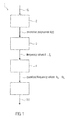
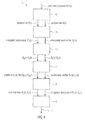
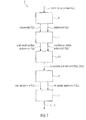
- the presented method consists of the following steps:
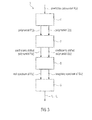
- the presented method consists of the following steps
- embodiments of the invention can be implemented in hardware or in software.
- the implementation can be performed using a digital storage medium, for example a floppy disk, a DVD, a CD, a ROM, a PROM, an EPROM, an EEPROM or a FLASH memory, having electronically readable control signals stored thereon, which cooperate (or are capable of cooperating) with a programmable computer system such that the respective method is performed.
- a digital storage medium for example a floppy disk, a DVD, a CD, a ROM, a PROM, an EPROM, an EEPROM or a FLASH memory, having electronically readable control signals stored thereon, which cooperate (or are capable of cooperating) with a programmable computer system such that the respective method is performed.
- Some embodiments according to the invention comprise a data carrier having electronically readable control signals, which are capable of cooperating with a programmable computer system, such that one of the methods described herein is performed.
- embodiments of the present invention can be implemented as a computer program product with a program code, the program code being operative for performing one of the methods when the computer program product runs on a computer.
- the program code may for example be stored on a machine readable carrier.
- inventions comprise the computer program for performing one of the methods described herein, stored on a machine readable carrier or a non-transitory storage medium.
- an embodiment of the inventive method is, therefore, a computer program having a program code for performing one of the methods described herein, when the computer program runs on a computer.
- a further embodiment of the inventive methods is, therefore, a data carrier (or a digital storage medium, or a computer-readable medium) comprising, recorded thereon, the computer program for performing one of the methods described herein.
- a further embodiment of the inventive method is, therefore, a data stream or a sequence of signals representing the computer program for performing one of the methods described herein.
- the data stream or the sequence of signals may for example be configured to be transferred via a data communication connection, for example via the Internet.
- a further embodiment comprises a processing means, for example a computer, or a programmable logic device, configured to or adapted to perform one of the methods described herein.
- a processing means for example a computer, or a programmable logic device, configured to or adapted to perform one of the methods described herein.
- a further embodiment comprises a computer having installed thereon the computer program for performing one of the methods described herein.
- a programmable logic device for example a field programmable gate array
- a field programmable gate array may cooperate with a microprocessor in order to perform one of the methods described herein.
- the methods are advantageously performed by any hardware apparatus.
Landscapes
- Engineering & Computer Science (AREA)
- Physics & Mathematics (AREA)
- Spectroscopy & Molecular Physics (AREA)
- Computational Linguistics (AREA)
- Signal Processing (AREA)
- Health & Medical Sciences (AREA)
- Audiology, Speech & Language Pathology (AREA)
- Human Computer Interaction (AREA)
- Acoustics & Sound (AREA)
- Multimedia (AREA)
- Compression, Expansion, Code Conversion, And Decoders (AREA)
- Measurement And Recording Of Electrical Phenomena And Electrical Characteristics Of The Living Body (AREA)
Priority Applications (29)
| Application Number | Priority Date | Filing Date | Title |
|---|---|---|---|
| EP14178789.5A EP2916319A1 (en) | 2014-03-07 | 2014-07-28 | Concept for encoding of information |
| RU2016137805A RU2670384C2 (ru) | 2014-03-07 | 2015-02-09 | Принцип кодирования информации |
| PL15703085T PL3097559T3 (pl) | 2014-03-07 | 2015-02-09 | Koncepcja kodowania informacji |
| PCT/EP2015/052634 WO2015132048A1 (en) | 2014-03-07 | 2015-02-09 | Concept for encoding of information |
| ES15703085T ES2721029T3 (es) | 2014-03-07 | 2015-02-09 | Concepto para la codificación de información |
| CN201580012260.3A CN106068534B (zh) | 2014-03-07 | 2015-02-09 | 用于信息编码的概念 |
| CA2939738A CA2939738C (en) | 2014-03-07 | 2015-02-09 | Concept for encoding of information |
| EP19154890.8A EP3503099B1 (en) | 2014-03-07 | 2015-02-09 | Concept for encoding of information |
| SG11201607433YA SG11201607433YA (en) | 2014-03-07 | 2015-02-09 | Concept for encoding of information |
| PT15703085T PT3097559T (pt) | 2014-03-07 | 2015-02-09 | Conceito para codificação de informação |
| MX2016011516A MX358363B (es) | 2014-03-07 | 2015-02-09 | Concepto para la codificación de información. |
| EP23217777.4A EP4318471B8 (en) | 2014-03-07 | 2015-02-09 | Concept for encoding of information |
| MYPI2016001586A MY192163A (en) | 2014-03-07 | 2015-02-09 | Concept for encoding of information |
| CN201911362154.4A CN111179952B (zh) | 2014-03-07 | 2015-02-09 | 用于信息编码的概念 |
| PL23217777.4T PL4318471T3 (pl) | 2014-03-07 | 2015-02-09 | Koncepcja enkodowania informacji |
| JP2016555956A JP6420356B2 (ja) | 2014-03-07 | 2015-02-09 | 情報符号化のコンセプト |
| PL19154890.8T PL3503099T3 (pl) | 2014-03-07 | 2015-02-09 | Koncepcja enkodowania informacji |
| BR112016018694-0A BR112016018694B1 (pt) | 2014-03-07 | 2015-02-09 | Conceito para codificação de informação |
| ES19154890T ES2987003T3 (es) | 2014-03-07 | 2015-02-09 | Concepto para la codificación de información |
| AU2015226480A AU2015226480B2 (en) | 2014-03-07 | 2015-02-09 | Concept for encoding of information |
| EP15703085.9A EP3097559B1 (en) | 2014-03-07 | 2015-02-09 | Concept for encoding of information |
| KR1020167027515A KR101875477B1 (ko) | 2014-03-07 | 2015-02-09 | 정보의 인코딩에 대한 개념 |
| ES23217777T ES3038334T3 (en) | 2014-03-07 | 2015-02-09 | Concept for encoding of information |
| TW104106071A TWI575514B (zh) | 2014-03-07 | 2015-02-25 | 資訊編碼器、其操作方法及相關電腦可讀媒體 |
| US15/258,702 US10403298B2 (en) | 2014-03-07 | 2016-09-07 | Concept for encoding of information |
| JP2018192262A JP6772233B2 (ja) | 2014-03-07 | 2018-10-11 | 情報符号化のコンセプト |
| US16/512,156 US11062720B2 (en) | 2014-03-07 | 2019-07-15 | Concept for encoding of information |
| JP2020164496A JP7077378B2 (ja) | 2014-03-07 | 2020-09-30 | 情報符号化のコンセプト |
| US17/367,009 US11640827B2 (en) | 2014-03-07 | 2021-07-02 | Concept for encoding of information |
Applications Claiming Priority (2)
| Application Number | Priority Date | Filing Date | Title |
|---|---|---|---|
| EP14158396 | 2014-03-07 | ||
| EP14178789.5A EP2916319A1 (en) | 2014-03-07 | 2014-07-28 | Concept for encoding of information |
Publications (1)
| Publication Number | Publication Date |
|---|---|
| EP2916319A1 true EP2916319A1 (en) | 2015-09-09 |
Family
ID=51260570
Family Applications (4)
| Application Number | Title | Priority Date | Filing Date |
|---|---|---|---|
| EP14178789.5A Withdrawn EP2916319A1 (en) | 2014-03-07 | 2014-07-28 | Concept for encoding of information |
| EP19154890.8A Active EP3503099B1 (en) | 2014-03-07 | 2015-02-09 | Concept for encoding of information |
| EP23217777.4A Active EP4318471B8 (en) | 2014-03-07 | 2015-02-09 | Concept for encoding of information |
| EP15703085.9A Active EP3097559B1 (en) | 2014-03-07 | 2015-02-09 | Concept for encoding of information |
Family Applications After (3)
| Application Number | Title | Priority Date | Filing Date |
|---|---|---|---|
| EP19154890.8A Active EP3503099B1 (en) | 2014-03-07 | 2015-02-09 | Concept for encoding of information |
| EP23217777.4A Active EP4318471B8 (en) | 2014-03-07 | 2015-02-09 | Concept for encoding of information |
| EP15703085.9A Active EP3097559B1 (en) | 2014-03-07 | 2015-02-09 | Concept for encoding of information |
Country Status (18)
| Country | Link |
|---|---|
| US (3) | US10403298B2 (enExample) |
| EP (4) | EP2916319A1 (enExample) |
| JP (3) | JP6420356B2 (enExample) |
| KR (1) | KR101875477B1 (enExample) |
| CN (2) | CN106068534B (enExample) |
| AR (1) | AR099616A1 (enExample) |
| AU (1) | AU2015226480B2 (enExample) |
| BR (1) | BR112016018694B1 (enExample) |
| CA (1) | CA2939738C (enExample) |
| ES (3) | ES2721029T3 (enExample) |
| MX (1) | MX358363B (enExample) |
| MY (1) | MY192163A (enExample) |
| PL (3) | PL4318471T3 (enExample) |
| PT (1) | PT3097559T (enExample) |
| RU (1) | RU2670384C2 (enExample) |
| SG (1) | SG11201607433YA (enExample) |
| TW (1) | TWI575514B (enExample) |
| WO (1) | WO2015132048A1 (enExample) |
Cited By (1)
| Publication number | Priority date | Publication date | Assignee | Title |
|---|---|---|---|---|
| EP3580856A1 (en) * | 2017-02-07 | 2019-12-18 | QUALCOMM Incorporated | Antenna diversity schemes |
Families Citing this family (10)
| Publication number | Priority date | Publication date | Assignee | Title |
|---|---|---|---|---|
| HUE050142T2 (hu) | 2011-04-29 | 2020-11-30 | Selecta Biosciences Inc | Ellenanyagválasz csökkentésére szolgáló tolerogén, szintetikus nanohordozók |
| PL3444818T3 (pl) | 2012-10-05 | 2023-08-21 | Fraunhofer-Gesellschaft zur Förderung der angewandten Forschung e.V. | Urządzenie do kodowania sygnału mowy wykorzystujące ACELP w dziedzinie autokorelacji |
| KR20220025911A (ko) | 2013-05-03 | 2022-03-03 | 셀렉타 바이오사이언시즈, 인크. | Cd4+ 조절 t 세포를 증진시키기 위한 방법 및 조성물 |
| EP2916319A1 (en) * | 2014-03-07 | 2015-09-09 | Fraunhofer-Gesellschaft zur Förderung der angewandten Forschung e.V. | Concept for encoding of information |
| ES3041986T3 (en) * | 2014-04-25 | 2025-11-17 | Ntt Docomo Inc | Linear prediction coefficient conversion device and linear prediction coefficient conversion method for speech and audio coding |
| KR20170045344A (ko) * | 2014-09-07 | 2017-04-26 | 셀렉타 바이오사이언시즈, 인크. | 항-바이러스 전달 벡터 면역 반응을 약화시키기 위한 방법 및 조성물 |
| US10349127B2 (en) * | 2015-06-01 | 2019-07-09 | Disney Enterprises, Inc. | Methods for creating and distributing art-directable continuous dynamic range video |
| KR20250011715A (ko) | 2017-03-11 | 2025-01-21 | 셀렉타 바이오사이언시즈, 인크. | 항염증제, 및 면역억제제를 포함하는 합성 나노담체를 사용한 조합 치료와 관련된 방법 및 조성물 |
| WO2020247625A1 (en) | 2019-06-04 | 2020-12-10 | Selecta Biosciences, Inc. | Formulations and doses of pegylated uricase |
| EP4154398B1 (en) * | 2020-12-23 | 2024-08-07 | Mitsubishi Electric Corporation | Interactive online adaptation for digital pre-distortion and power amplifier system auto-tuning |
Family Cites Families (39)
| Publication number | Priority date | Publication date | Assignee | Title |
|---|---|---|---|---|
| JP3246029B2 (ja) * | 1993-01-29 | 2002-01-15 | ソニー株式会社 | 音声信号処理装置及び電話装置 |
| US5701390A (en) | 1995-02-22 | 1997-12-23 | Digital Voice Systems, Inc. | Synthesis of MBE-based coded speech using regenerated phase information |
| DE69626088T2 (de) * | 1995-11-15 | 2003-10-09 | Nokia Corp., Espoo | Bestimmung der Linienspektrumfrequenzen zur Verwendung in einem Funkfernsprecher |
| JPH09212198A (ja) * | 1995-11-15 | 1997-08-15 | Nokia Mobile Phones Ltd | 移動電話装置における線スペクトル周波数決定方法及び移動電話装置 |
| US6480822B2 (en) * | 1998-08-24 | 2002-11-12 | Conexant Systems, Inc. | Low complexity random codebook structure |
| US7272556B1 (en) * | 1998-09-23 | 2007-09-18 | Lucent Technologies Inc. | Scalable and embedded codec for speech and audio signals |
| FI116992B (fi) | 1999-07-05 | 2006-04-28 | Nokia Corp | Menetelmät, järjestelmä ja laitteet audiosignaalin koodauksen ja siirron tehostamiseksi |
| US6611560B1 (en) * | 2000-01-20 | 2003-08-26 | Hewlett-Packard Development Company, L.P. | Method and apparatus for performing motion estimation in the DCT domain |
| US6665638B1 (en) * | 2000-04-17 | 2003-12-16 | At&T Corp. | Adaptive short-term post-filters for speech coders |
| KR20020028224A (ko) * | 2000-07-05 | 2002-04-16 | 요트.게.아. 롤페즈 | 선 스펙트럼 주파수를 선형 예측 계수로 다시 변환하는 방법 |
| US7089178B2 (en) * | 2002-04-30 | 2006-08-08 | Qualcomm Inc. | Multistream network feature processing for a distributed speech recognition system |
| JP4649208B2 (ja) * | 2002-07-16 | 2011-03-09 | コーニンクレッカ フィリップス エレクトロニクス エヌ ヴィ | オーディオコーディング |
| CA2415105A1 (en) | 2002-12-24 | 2004-06-24 | Voiceage Corporation | A method and device for robust predictive vector quantization of linear prediction parameters in variable bit rate speech coding |
| CN1458646A (zh) * | 2003-04-21 | 2003-11-26 | 北京阜国数字技术有限公司 | 一种滤波参数矢量量化和结合量化模型预测的音频编码方法 |
| US20080249765A1 (en) * | 2004-01-28 | 2008-10-09 | Koninklijke Philips Electronic, N.V. | Audio Signal Decoding Using Complex-Valued Data |
| CA2457988A1 (en) * | 2004-02-18 | 2005-08-18 | Voiceage Corporation | Methods and devices for audio compression based on acelp/tcx coding and multi-rate lattice vector quantization |
| CN1677493A (zh) * | 2004-04-01 | 2005-10-05 | 北京宫羽数字技术有限责任公司 | 一种增强音频编解码装置及方法 |
| KR100723409B1 (ko) * | 2005-07-27 | 2007-05-30 | 삼성전자주식회사 | 프레임 소거 은닉장치 및 방법, 및 이를 이용한 음성복호화 방법 및 장치 |
| US7831420B2 (en) * | 2006-04-04 | 2010-11-09 | Qualcomm Incorporated | Voice modifier for speech processing systems |
| DE102006022346B4 (de) * | 2006-05-12 | 2008-02-28 | Fraunhofer-Gesellschaft zur Förderung der angewandten Forschung e.V. | Informationssignalcodierung |
| CN101149927B (zh) * | 2006-09-18 | 2011-05-04 | 展讯通信(上海)有限公司 | 在线性预测分析中确定isf参数的方法 |
| CN103383846B (zh) * | 2006-12-26 | 2016-08-10 | 华为技术有限公司 | 改进语音丢包修补质量的语音编码方法 |
| KR101531910B1 (ko) * | 2007-07-02 | 2015-06-29 | 엘지전자 주식회사 | 방송 수신기 및 방송신호 처리방법 |
| US20090198500A1 (en) * | 2007-08-24 | 2009-08-06 | Qualcomm Incorporated | Temporal masking in audio coding based on spectral dynamics in frequency sub-bands |
| EP2077551B1 (en) * | 2008-01-04 | 2011-03-02 | Dolby Sweden AB | Audio encoder and decoder |
| US8290782B2 (en) * | 2008-07-24 | 2012-10-16 | Dts, Inc. | Compression of audio scale-factors by two-dimensional transformation |
| CN101662288B (zh) * | 2008-08-28 | 2012-07-04 | 华为技术有限公司 | 音频编码、解码方法及装置、系统 |
| JP2010060989A (ja) | 2008-09-05 | 2010-03-18 | Sony Corp | 演算装置および方法、量子化装置および方法、オーディオ符号化装置および方法、並びにプログラム |
| RU2591661C2 (ru) | 2009-10-08 | 2016-07-20 | Фраунхофер-Гезелльшафт цур Фёрдерунг дер ангевандтен Форшунг Е.Ф. | Многорежимный декодировщик аудио сигнала, многорежимный кодировщик аудио сигналов, способы и компьютерные программы с использованием кодирования с линейным предсказанием на основе ограничения шума |
| ES3031957T3 (en) | 2009-10-20 | 2025-07-14 | Navigate Llc | Audio signal decoder, corresponding method and computer program |
| CN103119647B (zh) * | 2010-04-09 | 2015-08-19 | 杜比国际公司 | 基于改进型离散余弦变换的复数预测立体声编码 |
| ES2950751T3 (es) | 2010-04-13 | 2023-10-13 | Fraunhofer Ges Forschung | Codificador de audio o vídeo, decodificador de audio o vídeo y métodos relacionados para procesar señales de audio o vídeo multicanal usando una dirección de predicción variable |
| CN101908949A (zh) * | 2010-08-20 | 2010-12-08 | 西安交通大学 | 无线通信系统及其基站、中继站、用户终端和数据的发送接收方法 |
| KR101747917B1 (ko) * | 2010-10-18 | 2017-06-15 | 삼성전자주식회사 | 선형 예측 계수를 양자화하기 위한 저복잡도를 가지는 가중치 함수 결정 장치 및 방법 |
| US20130211846A1 (en) * | 2012-02-14 | 2013-08-15 | Motorola Mobility, Inc. | All-pass filter phase linearization of elliptic filters in signal decimation and interpolation for an audio codec |
| US9516446B2 (en) * | 2012-07-20 | 2016-12-06 | Qualcomm Incorporated | Scalable downmix design for object-based surround codec with cluster analysis by synthesis |
| CN102867516B (zh) * | 2012-09-10 | 2014-08-27 | 大连理工大学 | 一种采用高阶线性预测系数分组矢量量化的语音编解方法 |
| US9396734B2 (en) * | 2013-03-08 | 2016-07-19 | Google Technology Holdings LLC | Conversion of linear predictive coefficients using auto-regressive extension of correlation coefficients in sub-band audio codecs |
| EP2916319A1 (en) | 2014-03-07 | 2015-09-09 | Fraunhofer-Gesellschaft zur Förderung der angewandten Forschung e.V. | Concept for encoding of information |
-
2014
- 2014-07-28 EP EP14178789.5A patent/EP2916319A1/en not_active Withdrawn
-
2015
- 2015-02-09 MY MYPI2016001586A patent/MY192163A/en unknown
- 2015-02-09 ES ES15703085T patent/ES2721029T3/es active Active
- 2015-02-09 PL PL23217777.4T patent/PL4318471T3/pl unknown
- 2015-02-09 CN CN201580012260.3A patent/CN106068534B/zh active Active
- 2015-02-09 MX MX2016011516A patent/MX358363B/es active IP Right Grant
- 2015-02-09 EP EP19154890.8A patent/EP3503099B1/en active Active
- 2015-02-09 BR BR112016018694-0A patent/BR112016018694B1/pt active IP Right Grant
- 2015-02-09 WO PCT/EP2015/052634 patent/WO2015132048A1/en not_active Ceased
- 2015-02-09 PL PL19154890.8T patent/PL3503099T3/pl unknown
- 2015-02-09 RU RU2016137805A patent/RU2670384C2/ru active
- 2015-02-09 EP EP23217777.4A patent/EP4318471B8/en active Active
- 2015-02-09 CN CN201911362154.4A patent/CN111179952B/zh active Active
- 2015-02-09 AU AU2015226480A patent/AU2015226480B2/en active Active
- 2015-02-09 ES ES19154890T patent/ES2987003T3/es active Active
- 2015-02-09 EP EP15703085.9A patent/EP3097559B1/en active Active
- 2015-02-09 PL PL15703085T patent/PL3097559T3/pl unknown
- 2015-02-09 SG SG11201607433YA patent/SG11201607433YA/en unknown
- 2015-02-09 KR KR1020167027515A patent/KR101875477B1/ko active Active
- 2015-02-09 PT PT15703085T patent/PT3097559T/pt unknown
- 2015-02-09 CA CA2939738A patent/CA2939738C/en active Active
- 2015-02-09 JP JP2016555956A patent/JP6420356B2/ja active Active
- 2015-02-09 ES ES23217777T patent/ES3038334T3/es active Active
- 2015-02-25 TW TW104106071A patent/TWI575514B/zh active
- 2015-03-03 AR ARP150100631A patent/AR099616A1/es active IP Right Grant
-
2016
- 2016-09-07 US US15/258,702 patent/US10403298B2/en active Active
-
2018
- 2018-10-11 JP JP2018192262A patent/JP6772233B2/ja active Active
-
2019
- 2019-07-15 US US16/512,156 patent/US11062720B2/en active Active
-
2020
- 2020-09-30 JP JP2020164496A patent/JP7077378B2/ja active Active
-
2021
- 2021-07-02 US US17/367,009 patent/US11640827B2/en active Active
Non-Patent Citations (19)
| Title |
|---|
| "Adaptive multi-rate (AMR-WB) speech codec", 3GPP TS 26.190 V7.0.0, 2007 |
| "Adaptive polynomial factorization by coefficient matching", IEEE TRANSACTIONS ON SIGNAL PROCESSING, vol. 39, no. 2, February 1991 (1991-02-01), pages 527 - 530 |
| "Frame error robust narrow-band and wideband embedded variable bit-rate coding of speech and audio from 8-32 kbit/s", ITU-T G.718, 2008 |
| B. BESSETTE; R. SALAMI; R. LEFEBVRE; M. JELINEK; J. ROTOLA-PUKKILA; J. VAINIO; H. MIKKOLA; K. JARVINEN: "The adaptive multirate wideband speech codec (AMR-WB", SPEECH AND AUDIO PROCESSING, IEEE TRANSAC- TIONS ON, vol. 10, no. 8, 2002, pages 620 - 636 |
| D. STARER; A. NEHORAI: "Polynomial factorization algorithms for adaptive root estimation", INT. CONF. ON ACOUSTICS, SPEECH, AND SIGNAL PROCESSING, vol. 2, May 1989 (1989-05-01), pages 1158 - 1161 |
| E. DURAND: "Solutions Numeriques des Equations Algébriques", 1960, MASSON |
| G. H. GOLUB; C. F. VAN LOAN: "Matrix Computations", 1996, JOHN HOPKINS UNIVERSITY PRESS |
| G. KANG; L. FRANSEN: "Application of line-spectrum pairs to low-bit-rate speech encoders", ACOUSTICS, SPEECH, AND SIGNAL PROCESSING, IEEE INTERNATIONAL CONFERENCE ON ICASSP'85, vol. 10, 1985, pages 244 - 247 |
| I. KERNER: "Ein Gesamtschrittverfahren zur Berechnung der Nullstellen von Polynomen", NUMERISCHE MATHEMATIK, vol. 8, no. 3, May 1966 (1966-05-01), pages 290 - 294 |
| L. EHRLICH: "A modified newton method for polynomials", COMMUNICATIONS OF THE ACM, vol. 10, no. 2, February 1967 (1967-02-01), pages 107 - 108 |
| M. NEUENDORF; P. GOURNAY; M. MULTRUS; J. LECOMTE; B. BESSETTE; R. GEIGER; S. BAYER; G. FUCHS; J. HILPERT; N. RETTELBACH: "Unified speech and audio coding scheme for high quality at low bitrates", ACOUSTICS, SPEECH AND SIGNAL PROCESSING. ICASSP 2009. IEEE INT CONF, 2009, pages 1 - 4 |
| O. ABERTH: "Iteration methods for finding all zeros of a polynomial simultaneously", MATHEMATICS OF COMPUTATION, vol. 27, no. 122, April 1973 (1973-04-01), pages 339 - 344 |
| P. KABAL; R. P. RAMACHANDRAN: "The computation of line spectral frequencies using Chebyshev polynomials", ACOUSTICS, SPEECH AND SIGNAL PROCESSING, IEEE TRANSACTIONS, vol. 34, no. 6, 1986, pages 1419 - 1426 |
| SOONG F K ET AL: "LINE SPECTRUM PAIR (LSP) AND SPEECH DATA COMPRESSION", INTERNATIONAL CONFERENCE ON ACOUSTICS, SPEECH & SIGNAL PROCESSING. ICASSP. SAN DIEGO, MARCH 19 - 21, 1984; [INTERNATIONAL CONFERENCE ON ACOUSTICS, SPEECH & SIGNAL PROCESSING. ICASSP], NEW YORK, IEEE, US, vol. 1, 19 March 1984 (1984-03-19), pages 1.10.1 - 1.10.4, XP000560468 * |
| T. BACKSTR®M; C. MAGI; P. ALKU: "Minimum separation of line spectral frequencies", IEEE SIGNAL PROCESS. LETT., vol. 14, no. 2, February 2007 (2007-02-01), pages 145 - 147 |
| T. BÄCKSTRÖM: "Vandermonde factorization of Toeplitz matrices and applications in filtering and warping", IEEE TRANS. SIGNAL PROCESS., vol. 61, no. 24, 2013, pages 6257 - 6263 |
| T. BACKSTROM; C. MAGI: "Properties of line spectrum pair polynomials - a review", SIGNAL PROCESSING, vol. 86, no. 11, November 2006 (2006-11-01), pages 3286 - 3298 |
| T. SARAMÄKI: "Handbook for Digital Signal Processing", 1993, article "Finite impulse response filter design", pages: 155 - 277 |
| V. F. PISARENKO: "The retrieval of harmonics from a covariance function", GEOPHYSICAL JOURNAL OF THE ROYAL ASTRONOMICAL SOCIETY, vol. 33, no. 3, 1973, pages 347 - 366 |
Cited By (1)
| Publication number | Priority date | Publication date | Assignee | Title |
|---|---|---|---|---|
| EP3580856A1 (en) * | 2017-02-07 | 2019-12-18 | QUALCOMM Incorporated | Antenna diversity schemes |
Also Published As
Similar Documents
| Publication | Publication Date | Title |
|---|---|---|
| US11640827B2 (en) | Concept for encoding of information | |
| JP6423065B2 (ja) | 線形予測分析装置、方法、プログラム及び記録媒体 | |
| KR20150032723A (ko) | 개선된 확률 분포 추정을 이용한 선형 예측 기반 오디오 코딩 | |
| EP2267699A1 (en) | Encoding device and encoding method | |
| JP6416363B2 (ja) | 線形予測分析装置、方法、プログラム及び記録媒体 | |
| HK40009028B (en) | Concept for encoding of information | |
| HK40009028A (en) | Concept for encoding of information | |
| HK1230344B (en) | Concept for encoding of information | |
| HK1230344A1 (en) | Concept for encoding of information | |
| Bäckström et al. | Finding line spectral frequencies using the fast Fourier transform | |
| Bäckström | Spectral Envelope and Perceptual Masking Models | |
| Kovačević et al. | Overview of Standard Methods | |
| HK1223725A1 (en) | Apparatus and method for audio signal envelope encoding, processing and decoding by modelling a cumulative sum representation employing distribution quantization and coding |
Legal Events
| Date | Code | Title | Description |
|---|---|---|---|
| PUAI | Public reference made under article 153(3) epc to a published international application that has entered the european phase |
Free format text: ORIGINAL CODE: 0009012 |
|
| AK | Designated contracting states |
Kind code of ref document: A1 Designated state(s): AL AT BE BG CH CY CZ DE DK EE ES FI FR GB GR HR HU IE IS IT LI LT LU LV MC MK MT NL NO PL PT RO RS SE SI SK SM TR |
|
| AX | Request for extension of the european patent |
Extension state: BA ME |
|
| STAA | Information on the status of an ep patent application or granted ep patent |
Free format text: STATUS: THE APPLICATION IS DEEMED TO BE WITHDRAWN |
|
| 18D | Application deemed to be withdrawn |
Effective date: 20160310 |