EP2913299B1 - Negativ-Aktivmaterial für eine wiederaufladbare Lithiumbatterie, Herstellungsverfahren dafür und wiederaufladbare Lithiumbatterie damit - Google Patents
Negativ-Aktivmaterial für eine wiederaufladbare Lithiumbatterie, Herstellungsverfahren dafür und wiederaufladbare Lithiumbatterie damit Download PDFInfo
- Publication number
- EP2913299B1 EP2913299B1 EP14157034.1A EP14157034A EP2913299B1 EP 2913299 B1 EP2913299 B1 EP 2913299B1 EP 14157034 A EP14157034 A EP 14157034A EP 2913299 B1 EP2913299 B1 EP 2913299B1
- Authority
- EP
- European Patent Office
- Prior art keywords
- natural graphite
- spherically
- shaped natural
- particle
- amorphous
- Prior art date
- Legal status (The legal status is an assumption and is not a legal conclusion. Google has not performed a legal analysis and makes no representation as to the accuracy of the status listed.)
- Active
Links
Images







Classifications
-
- H—ELECTRICITY
- H01—ELECTRIC ELEMENTS
- H01M—PROCESSES OR MEANS, e.g. BATTERIES, FOR THE DIRECT CONVERSION OF CHEMICAL ENERGY INTO ELECTRICAL ENERGY
- H01M4/00—Electrodes
- H01M4/02—Electrodes composed of, or comprising, active material
- H01M4/36—Selection of substances as active materials, active masses, active liquids
- H01M4/58—Selection of substances as active materials, active masses, active liquids of inorganic compounds other than oxides or hydroxides, e.g. sulfides, selenides, tellurides, halogenides or LiCoFy; of polyanionic structures, e.g. phosphates, silicates or borates
- H01M4/583—Carbonaceous material, e.g. graphite-intercalation compounds or CFx
- H01M4/587—Carbonaceous material, e.g. graphite-intercalation compounds or CFx for inserting or intercalating light metals
-
- C—CHEMISTRY; METALLURGY
- C01—INORGANIC CHEMISTRY
- C01B—NON-METALLIC ELEMENTS; COMPOUNDS THEREOF; METALLOIDS OR COMPOUNDS THEREOF NOT COVERED BY SUBCLASS C01C
- C01B32/00—Carbon; Compounds thereof
- C01B32/05—Preparation or purification of carbon not covered by groups C01B32/15, C01B32/20, C01B32/25, C01B32/30
-
- H—ELECTRICITY
- H01—ELECTRIC ELEMENTS
- H01M—PROCESSES OR MEANS, e.g. BATTERIES, FOR THE DIRECT CONVERSION OF CHEMICAL ENERGY INTO ELECTRICAL ENERGY
- H01M4/00—Electrodes
- H01M4/02—Electrodes composed of, or comprising, active material
- H01M4/04—Processes of manufacture in general
- H01M4/0471—Processes of manufacture in general involving thermal treatment, e.g. firing, sintering, backing particulate active material, thermal decomposition, pyrolysis
-
- H—ELECTRICITY
- H01—ELECTRIC ELEMENTS
- H01M—PROCESSES OR MEANS, e.g. BATTERIES, FOR THE DIRECT CONVERSION OF CHEMICAL ENERGY INTO ELECTRICAL ENERGY
- H01M4/00—Electrodes
- H01M4/02—Electrodes composed of, or comprising, active material
- H01M4/13—Electrodes for accumulators with non-aqueous electrolyte, e.g. for lithium-accumulators; Processes of manufacture thereof
- H01M4/133—Electrodes based on carbonaceous material, e.g. graphite-intercalation compounds or CFx
-
- H—ELECTRICITY
- H01—ELECTRIC ELEMENTS
- H01M—PROCESSES OR MEANS, e.g. BATTERIES, FOR THE DIRECT CONVERSION OF CHEMICAL ENERGY INTO ELECTRICAL ENERGY
- H01M4/00—Electrodes
- H01M4/02—Electrodes composed of, or comprising, active material
- H01M4/13—Electrodes for accumulators with non-aqueous electrolyte, e.g. for lithium-accumulators; Processes of manufacture thereof
- H01M4/139—Processes of manufacture
- H01M4/1393—Processes of manufacture of electrodes based on carbonaceous material, e.g. graphite-intercalation compounds or CFx
-
- H—ELECTRICITY
- H01—ELECTRIC ELEMENTS
- H01M—PROCESSES OR MEANS, e.g. BATTERIES, FOR THE DIRECT CONVERSION OF CHEMICAL ENERGY INTO ELECTRICAL ENERGY
- H01M4/00—Electrodes
- H01M4/02—Electrodes composed of, or comprising, active material
- H01M4/36—Selection of substances as active materials, active masses, active liquids
- H01M4/362—Composites
- H01M4/364—Composites as mixtures
-
- H—ELECTRICITY
- H01—ELECTRIC ELEMENTS
- H01M—PROCESSES OR MEANS, e.g. BATTERIES, FOR THE DIRECT CONVERSION OF CHEMICAL ENERGY INTO ELECTRICAL ENERGY
- H01M4/00—Electrodes
- H01M4/02—Electrodes composed of, or comprising, active material
- H01M4/36—Selection of substances as active materials, active masses, active liquids
- H01M4/362—Composites
- H01M4/366—Composites as layered products
-
- C—CHEMISTRY; METALLURGY
- C01—INORGANIC CHEMISTRY
- C01P—INDEXING SCHEME RELATING TO STRUCTURAL AND PHYSICAL ASPECTS OF SOLID INORGANIC COMPOUNDS
- C01P2004/00—Particle morphology
- C01P2004/30—Particle morphology extending in three dimensions
- C01P2004/32—Spheres
-
- C—CHEMISTRY; METALLURGY
- C01—INORGANIC CHEMISTRY
- C01P—INDEXING SCHEME RELATING TO STRUCTURAL AND PHYSICAL ASPECTS OF SOLID INORGANIC COMPOUNDS
- C01P2004/00—Particle morphology
- C01P2004/60—Particles characterised by their size
- C01P2004/61—Micrometer sized, i.e. from 1-100 micrometer
-
- H—ELECTRICITY
- H01—ELECTRIC ELEMENTS
- H01M—PROCESSES OR MEANS, e.g. BATTERIES, FOR THE DIRECT CONVERSION OF CHEMICAL ENERGY INTO ELECTRICAL ENERGY
- H01M10/00—Secondary cells; Manufacture thereof
- H01M10/05—Accumulators with non-aqueous electrolyte
- H01M10/052—Li-accumulators
-
- H—ELECTRICITY
- H01—ELECTRIC ELEMENTS
- H01M—PROCESSES OR MEANS, e.g. BATTERIES, FOR THE DIRECT CONVERSION OF CHEMICAL ENERGY INTO ELECTRICAL ENERGY
- H01M4/00—Electrodes
- H01M4/02—Electrodes composed of, or comprising, active material
- H01M2004/021—Physical characteristics, e.g. porosity, surface area
-
- Y—GENERAL TAGGING OF NEW TECHNOLOGICAL DEVELOPMENTS; GENERAL TAGGING OF CROSS-SECTIONAL TECHNOLOGIES SPANNING OVER SEVERAL SECTIONS OF THE IPC; TECHNICAL SUBJECTS COVERED BY FORMER USPC CROSS-REFERENCE ART COLLECTIONS [XRACs] AND DIGESTS
- Y02—TECHNOLOGIES OR APPLICATIONS FOR MITIGATION OR ADAPTATION AGAINST CLIMATE CHANGE
- Y02E—REDUCTION OF GREENHOUSE GAS [GHG] EMISSIONS, RELATED TO ENERGY GENERATION, TRANSMISSION OR DISTRIBUTION
- Y02E60/00—Enabling technologies; Technologies with a potential or indirect contribution to GHG emissions mitigation
- Y02E60/10—Energy storage using batteries
Definitions
- a negative active material for a rechargeable lithium battery, a method of preparing the same, and a rechargeable lithium battery including the same are disclosed.
- a crystalline graphite material is being used as a negative active material for a rechargeable lithium battery.
- the crystalline graphite is classified into artificial graphite and natural graphite. Since the artificial graphite is obtained by heat-carbonizing a carbon precursor at a high temperature of greater than or equal to about 2800 °C under an inert atmosphere, impurity removal and graphitization, costs for preparation of the artificial graphite are high. Thus, the natural graphite has been increasingly used in recent times.
- a flake-shaped natural graphite particle as a negative active material has a problem of deteriorating uniformity due to anisotropic characteristics of its shape when a slurry is coated to manufacture an electrode, and also sharply deteriorates battery characteristics since the particle is arranged along with a current collector by compression and pressure. Accordingly, spherically-shaped natural graphite obtained by assembling flake-shaped graphite into a spherical shape is commercially available. However, the spherically-shaped natural graphite requires improved high-rate charge and discharge and cycle-life characteristics.
- WO 2007/136164 A1 discloses graphite particles used as active material for a rechargeable lithium battery which are made of graphite flakes in a cabbage-like structure. Amorphous or low crystalline carbon is present between the flakes and on top of the spherical particles.
- One embodiment provides a negative active material for a rechargeable lithium battery having excellent high-rate charge and discharge characteristics and cycle-life characteristics.
- Another embodiment provides a method of preparing the negative active material for a rechargeable lithium battery.
- Yet another embodiment provides a rechargeable lithium battery including the negative active material for a rechargeable lithium battery.
- One embodiment provides a negative active material for a rechargeable lithium battery that includes a spherically-shaped natural graphite-modified composite particle including a spherically-shaped natural graphite particle where flake-shaped natural graphite fragments build up and assemble into a cabbage or random shape, and amorphous or semi-crystalline carbon, wherein an open gap between the flake-shaped natural graphite fragments is positioned on a surface part and inside the spherically-shaped natural graphite particle, the open gap is formed by ultrasonication, the amorphous or semi-crystalline carbon is coated on the surface of the spherically-shaped natural graphite particle, and the amorphous or semi-crystalline carbon is present in the open gap, and thereby the open gap positioned on the surface part and inside the spherically-shaped natural graphite particle is maintained.
- the spherically-shaped natural graphite particle may have an average particle diameter (D50) of 5 to 40 ⁇ m.
- the amorphous or semi-crystalline carbon may be included in an amount of 1 to 20 parts by weight based on 100 parts by weight of the spherically-shaped natural graphite particle.
- the spherically-shaped natural graphite-modified composite particle may further include a lithium compound selected from Li 2 O, Li 2 CO 3 , and a combination thereof, the lithium compound may be coated on the surface of the spherically-shaped natural graphite particle, and the lithium compound may be present in the open gap positioned on the surface part and inside the spherically-shaped natural graphite particle.
- the lithium compound may be included in an amount of 0.01 to 10 parts by weight based on 100 parts by weight of the spherically-shaped natural graphite particle.
- Another embodiment provides a method of preparing a negative active material for a rechargeable lithium battery that includes: preparing a solution including a spherically-shaped natural graphite particle where flake-shaped natural graphite fragments build up and assemble into a cabbage or random shape, an amorphous or semi-crystalline carbon precursor, and a solvent; performing ultrasonication on the solution, opening between the flake-shaped natural graphite fragments of a surface part and inside the spherically-shaped natural graphite particle to form an open gap while maintaining crystallinity of the spherically-shaped natural graphite particle, and simultaneously coating the surface of the spherically-shaped natural graphite particle with the amorphous or semi-crystalline carbon precursor and impregnating the amorphous or semi-crystalline carbon precursor in the open gap present on the surface part and inside the spherically-shaped natural graphite particle; drying the solution subjected to the ultrasonication to obtain a spherically-shaped natural graphite-mod
- Yet another embodiment provides a method of preparing a negative active material for a rechargeable lithium battery that includes: preparing a solution including a spherically-shaped natural graphite particle where flake-shaped natural graphite fragments build up and assemble into a cabbage or random shape, an amorphous or semi-crystalline carbon precursor, lithium acetate, and a solvent; performing ultrasonication on the solution, opening between the flake-shaped natural graphite fragments of a surface part and inside the spherically-shaped natural graphite particle to form an open gap while maintaining crystallinity of the spherically-shaped natural graphite particle, and simultaneously coating the surface of the spherically-shaped natural graphite particle with the amorphous or semi-crystalline carbon precursor and the lithium acetate, and impregnating the amorphous or semi-crystalline carbon precursor and the lithium acetate in the open gap present on the surface part and inside the spherically-shaped natural graphite particle; drying the solution subjected to the ultras
- Still another embodiment provides a method of preparing a negative active material for a rechargeable lithium battery that includes: preparing a solution including a spherically-shaped natural graphite particle where flake-shaped natural graphite fragments build up and assemble into a cabbage or random shape, an amorphous or semi-crystalline carbon precursor, and a solvent; performing ultrasonication on the solution, opening between the flake-shaped natural graphite fragments of the surface part and inside the spherically-shaped natural graphite particle to form an open gap while maintaining crystallinity of the spherically-shaped natural graphite particle, and simultaneously coating the surface of the spherically-shaped natural graphite particle with the amorphous or semi-crystalline carbon precursor and impregnating the amorphous or semi-crystalline carbon precursor in the open gap present on the surface part and inside the spherically-shaped natural graphite particle; drying the solution subjected to the ultrasonication after adding lithium acetate thereto to obtain a spherically
- the amorphous or semi-crystalline carbon precursor may include citric acid, stearic acid, sucrose, polyvinylidene fluoride, carboxymethyl cellulose (CMC), hydroxypropyl cellulose, regenerated cellulose, polyvinylpyrrolidone, tetrafluoroethylene, polyethylene, polypropylene, an ethylene-propylene-diene monomer (EPDM), sulfonated EPDM, starch, a phenolic resin, a furan resin, furfuryl alcohol, polyacrylic acid, sodium polyacrylate, polyacrylonitrile, polyimide, an epoxy resin, cellulose, styrene, polyvinyl alcohol, polyvinylchloride, coal-based pitch, petroleum-based pitch, mesophase pitch, low molecular weight heavy oil, glucose, gelatin, saccharides, or a combination thereof.
- CMC carboxymethyl cellulose
- EPDM ethylene-propylene-diene monomer
- EPDM ethylene-propylene
- the ultrasonication may be performed by radiating ultrasonic waves at an oscillating frequency of 10 to 35 kHz with power of 10 to 100 W for 1 minute to 24 hours
- the drying may be performed using at least one spray dry method selected from rotary spray, nozzle spray, and ultrasonic wave spray methods; a drying method using a rotary evaporator; a vacuum-dry method;a natural drying method; or a combination thereof.
- the heat treating may be performed at a temperature of 500 to 2500 °C.
- the amorphous or semi-crystalline carbon precursor may be included in an amount of 2 to 80 parts by weight based on 100 parts by weight of the spherically-shaped natural graphite particle.
- the lithium acetate may be included in an amount of 0.1 to 20 parts by weight based on 100 parts by weight of the spherically-shaped natural graphite particle.
- Yet another embodiment provides a rechargeable lithium battery including the negative electrode including the negative active material, a positive electrode, and an electrolyte solution.
- a rechargeable lithium battery having improved high-rate charge and discharge characteristics and cycle-life characteristics may be realized.
- a negative active material according to one embodiment is described referred to FIG. 1 .
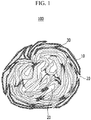
- FIG. 1 is a schematic cross-sectional view of a negative active material according to one embodiment.
- a negative active material includes a spherically-shaped natural graphite modify composite particle.
- the spherically-shaped natural graphite modify composite particle 100 may include a spherically-shaped natural graphite particle where flake-shaped natural graphite fragments 10 build up and assemble into a cabbage or random shape, and amorphous or semi-crystalline carbon 30.
- an open gap 20 is present on a surface part and inside the spherically-shaped natural graphite particle, and the open gap 20 may be formed by the post-described method of preparing the negative active material, specifically, opening spaces between the flake-shaped natural graphite fragments 10 through ultrasonication of a solution.
- the spherically-shaped natural graphite particle may maintain crystallinity when the open gap is formed by performing ultrasonication on the solution.
- the amorphous or semi-crystalline carbon 30 may be coated on the surface of the spherically-shaped natural graphite particle, or may be present in the open gap 20 on the surface part and inside the spherically-shaped natural graphite particle.
- the amorphous or semi-crystalline carbon is coated on the surface of the spherically-shaped natural graphite particle and is present in the open gap formed on the surface part and inside the spherically-shaped natural graphite particle, and thus may maintain the structure of the open gap and bond the flake-shaped natural graphite fragments with each other, which consist of the spherically-shaped natural graphite particle.
- the "gap" in the spherically-shaped natural graphite particle is different from a "void".
- the "gap” indicates an empty space formed when flake-shaped natural graphite fragments build up and spaces between flake-shaped natural graphite fragments become open during assembly of the spherically-shaped natural graphite particle without changing its crystallinity.
- the "void (or cavity)” indicates an empty space formed as a structural defect of crystalline graphite inside of the crystalline graphite particle including natural graphite by a strong external force, and specifically, a milling process and the like applying a stronger external force than ultrasonication, and thus changes the crystallinity of the graphite particle.
- the spherically-shaped natural graphite-modified composite particle when a spherically-shaped natural graphite-modified composite particle has the above-described structure, the spherically-shaped natural graphite-modified composite particle may have improved reactivity with an electrolyte solution and thus realize a rechargeable lithium battery having excellent high-rate charge and discharge characteristics and cycle-life characteristics.
- the spherically-shaped natural graphite particle since the amorphous or semi-crystalline carbon is coated on the surface of the spherically-shaped natural graphite particle and is simultaneously present in an open gap formed on the surface part and inside the spherically-shaped natural graphite particle, the spherically-shaped natural graphite particle may be suppressed from compression during a compression process for preparing a negative electrode and maintain the open gap formed through ultrasonication. Accordingly, the spherically-shaped natural graphite-modified composite particle may have excellent reactivity with an electrolyte solution and thus improve high-rate charge and discharge characteristics of a rechargeable lithium battery.
- the amorphous or semi-crystalline carbon is coated on the surface of the spherically-shaped natural graphite particle and is present in the open gap formed on the surface part and inside the spherically-shaped natural graphite particle, and thus bonds flake-shaped natural graphite fragments with each other and resultantly may suppress deterioration of structural stability of the spherically-shaped natural graphite particle during repeated charges and discharges and improve cycle characteristics of the rechargeable lithium battery.
- the amorphous or semi-crystalline carbon may be present in the open gap present inside as well as the open gap present on the surface part of the spherically-shaped natural graphite particle.
- the amorphous or semi-crystalline carbon may be present deep inside the open gap, that is, in or around the center of the spherically-shaped natural graphite particle, and this structure may further contribute to improvement of structural stability of the spherically-shaped natural graphite particle during the charge and discharge.
- the spherically-shaped natural graphite particle may be formed according to the methods suggested in Korean Patent Laid-Open Publication Nos. 2003-0087986 and 2005-0009245 , without limitation.
- a flake-shaped natural graphite having an average particle diameter of greater than or equal to about 30 ⁇ m is assembled and ultimately manufactured into a spherically-shaped natural graphite particle by pulverization through contact between the inside of the rotary processor and the flake-shaped natural graphite powders, a friction process between powders, a shear process of the powder by a shear stress, and the like by a repeated process with a rotary processor.
- the spherically-shaped natural graphite particle may be formed by building up the flake-shaped natural graphite fragments into a cabbage or random shape and assembling them.
- the spherically-shaped natural graphite particle may have a circular or oval shape, and specifically, a spherical shape having an index obtained by projecting a three-dimensional natural graphite particle on a two dimensional plane of greater than or equal to about 0.8.
- the spherically-shaped natural graphite particle may have an average particle diameter (D50) ranging from about 5 to about 40 ⁇ m, and specifically about 7 to about 30 ⁇ m.
- the D50 denotes an average particle diameter corresponding to 50 volume% of a cumulative volume in a particle distribution.
- the flake-shaped natural graphite fragments may build up and be easily assembled into a cabbage or random shape, and thus improve electrochemical characteristics.
- the amorphous or semi-crystalline carbon may be included in an amount of about 1 to about 20 parts by weight, and specifically about 2 to about 15 parts by weight, based on 100 parts by weight of the spherically-shaped natural graphite particle.
- the amorphous or semi-crystalline carbon is coated on the surface of the spherically-shaped natural graphite particle or is present in an open gap on the surface part and inside of the spherically-shaped natural graphite particle within the amount range, the open gap between the flake-shaped natural graphite fragments formed on the surface part and inside of the spherically-shaped natural graphite particle may be appropriately maintained.
- the spherically-shaped natural graphite-modified composite particle may further include a lithium compound in addition to the spherically-shaped natural graphite particle and the amorphous or semi-crystalline carbon.
- the lithium compound along with the amorphous or semi-crystalline carbon may be coated on the surface of the spherically-shaped natural graphite particle, and is also present in the open gap on the surface part and inside of the spherically-shaped natural graphite particle.
- the lithium compound may include Li 2 O, Li 2 CO 3 , or a combination thereof.
- the lithium compound may be formed by using lithium acetate. Specifically, the lithium acetate may be decomposed into Li 2 CO 3 and further decomposed into Li 2 O by a heat treatment.
- the spherically-shaped natural graphite particle basically indicates a hexagonal graphite structure in which graphitic layer planes are laminated in a c-axis direction in a way of ABAB... but may include a rhombohedral graphite structure in which the graphitic layer planes are laminated in a way of ABCABC... which is partially changed from the way of ABAB....
- the rhombohedral graphite structure as a structural defect may increase disordering of the graphite structure and thus suppress intercalation and deintercalation of lithium during charge and discharge and lead an irreversible reaction.
- This rhombohedral graphite structure is less thermally stable than the hexagonal graphite structure and thus may be removed when heat-treated at higher than or equal to about 2000 °C.
- the heat treatment at the above temperature may be expensive.
- the spherically-shaped natural graphite-modified composite particle further includes the lithium compound, lithium acetate reacts with a spherically-shaped natural graphite particle during a heat treatment while manufacturing the spherically-shaped natural graphite-modified composite particle, and thus the rhombohedral graphite structure may be easily removed at a relatively low temperature of about 1200 °C, improving initial charge and discharge efficiency and cycle-life characteristics.
- the lithium compound may be included in an amount of about 0.01 to about 10 parts by weight, and specifically about 0.1 to about 5 parts by weight, based on 100 parts by weight of the spherically-shaped natural graphite particle.
- the lithium acetate sufficiently reacts with flake-shaped natural graphite particles consisting of the spherically-shaped natural graphite particle and effectively removes a rhombohedral graphite structural defect in the flake-shaped natural graphite particles, and thus may improve initial charge and discharge characteristics and charge and discharge cycle characteristics.
- the above negative active material may be manufactured in the following method.
- the above spherically-shaped natural graphite-modified composite particle may be prepared by a method including preparing a solution including a spherically-shaped natural graphite particle, an amorphous or semi-crystalline carbon precursor, and a solvent, performing ultrasonication on the solution, drying the solution subjected to the ultrasonication to obtain a spherically-shaped natural graphite-modified particle, and heat-treating the spherically-shaped natural graphite-modified particle.
- the spherically-shaped natural graphite particle may include a particle assembled by building up the above-described flake-shaped natural graphite fragments into a cabbage or random shape.
- the amorphous or semi-crystalline carbon precursor may include citric acid, stearic acid, sucrose, polyvinylidene fluoride, carboxylmethyl cellulose (CMC), hydroxypropyl cellulose, regenerated cellulose, polyvinylpyrrolidone, tetrafluoroethylene, polyethylene, polypropylene, ethylene-propylene-diene monomer (EPDM), sulfonated EPDM, starch, a phenolic resin, a furan resin, furfuryl alcohol, polyacrylic acid, sodium polyacrylate, polyacrylonitrile, polyimide, an epoxy resin, cellulose, styrene, polyvinyl alcohol, polyvinylchloride, coal-based pitch, petroleum-based pitch, mesophase pitch, a low molecular weight heavy oil, glucose, gelatin, saccharides, or a combination thereof.
- CMC carboxylmethyl cellulose
- EPDM ethylene-propylene-diene monomer
- EPDM sul
- the amorphous or semi-crystalline carbon precursor may be included in an amount of about 2 to about 80 parts by weight, and specifically about 5 to about 50 parts by weight, based on 100 parts by weight of the spherically-shaped natural graphite particle.
- an open gap between the flake-shaped natural graphite fragments on the surface part and inside of the spherically-shaped natural graphite particle may be appropriately maintained.
- the solvent may include water, N-methylpyrrolidone, dimethylformamide, toluene, ethylene, dimethylacetamide, acetone, methylethylketone, hexane, tetrahydrofuran, decane, ethanol, methanol, isopropanol, ethyl acetate, or a combination thereof.
- the ultrasonication of the solution opens areas between flake-shaped natural graphite fragments that are to build up during manufacture of the spherically-shaped natural graphite particle as well as maintain crystallinity of the spherically-shaped natural graphite particle.
- the open gap is formed and simultaneously the surface of the spherically-shaped natural graphite particle is coated with the amorphous or semi-crystalline carbon precursor and the amorphous or semi-crystalline carbon precursor is impregnated in the open gap present on the surface part and inside the spherically-shaped natural graphite particle.
- the ultrasonication may be performed under the following conditions.
- the ultrasonication may be performed by radiating ultrasonic waves at an oscillating frequency of about 10 to about 35 kHz with power of about 10 to about 100 W for about 1 minute to about 24 hours.
- the oscillating frequency may specifically be in a range of about 20 to about 35 kHz, and more specifically about 20 to about 30 kHz
- the power may specifically be in a range of about 15 to about 70 W, and more specifically about 20 to about 60 W
- the radiation time may specifically be in a range of about 5 minutes to 10 hours, and more specifically about 10 minutes to about 2 hours.
- the spherically-shaped natural graphite particle may not only maintain crystallinity of the graphite, but an open gap may also be formed between flake-shaped natural graphite fragments on the surface part and inside of the spherically-shaped natural graphite particle.
- the solution subjected to the ultrasonication may be dried using at least one spray dry method selected from rotary spray, nozzle spray, and ultrasonic wave spray methods; a drying method using a rotary evaporator; a vacuum-dry method; a natural drying method; or a combination thereof.
- the spherically-shaped natural graphite-modified particle may be heat-treated at a temperature of about 500 to about 2500 °C, specifically about 500 to about 2000 °C, and more specifically about 900 to about 1500 °C.
- a temperature of about 500 to about 2500 °C specifically about 500 to about 2000 °C, and more specifically about 900 to about 1500 °C.
- heterogeneous elements as impurities may be sufficiently removed during carbonization of the amorphous or semi-crystalline carbon precursor, decreasing irreversible capacity and improving charge and discharge characteristics.
- the heat treatment may be performed under an atmosphere including nitrogen, argon, hydrogen, or a mixed gas thereof, or under vacuum.
- the heat treatment may carbonize the amorphous or semi-crystalline carbon precursor in the open gap between the flake-shaped natural graphite fragments and on the surface of the spherically-shaped natural graphite, so that the amorphous or semi-crystalline carbon may be coated on the surface of the spherically-shaped natural graphite particle and be present in the open gap on the surface part and inside of the spherically-shaped natural graphite particle.
- the negative active material shows improved reactivity with an electrolyte solution, and may realize a rechargeable lithium battery having excellent high-rate charge and discharge characteristics and cycle-life characteristics.
- the spherically-shaped natural graphite particle when a spherically-shaped natural graphite particle as a negative active material is used to manufacture a negative electrode, the spherically-shaped natural graphite particle may be compressed during a compression process.
- the ultrasonication forms an open gap between flake-shaped natural graphite fragments of the spherically-shaped natural graphite particle, the compression may be largely aggravated.
- the amorphous or semi-crystalline carbon precursor is impregnated in the open gap between the flake-shaped natural graphite fragments and coated on the surface of the spherically-shaped natural graphite during ultrasonication and then the amorphous or semi-crystalline carbon is present in the open gap formed on the surface part and inside of the spherically-shaped natural graphite particle as well as coated on the surface of the spherically-shaped natural graphite particle through heat treatment, the spherically-shaped natural graphite particle is suppressed from compression and may maintain the open gap formed through the ultrasonication. Accordingly, the spherically-shaped natural graphite particle has excellent reactivity with an electrolyte solution and may improve high-rate charge and discharge characteristics of a rechargeable lithium battery.
- flake-shaped natural graphite fragments consisting of the spherically-shaped natural graphite particle may build up loosely and deteriorate structural stability of the spherically-shaped natural graphite particle.
- the amorphous or semi-crystalline carbon is coated on the surface of the spherically-shaped natural graphite particle and present in the open gap on the surface part and inside of the spherically-shaped natural graphite particle, and thus may bond the flake-shaped natural graphite fragments of the spherically-shaped natural graphite particle.
- the spherically-shaped natural graphite-modified composite particle further including the lithium compound in addition to the spherically-shaped natural graphite particle and the amorphous or semi-crystalline carbon may be manufactured as follows.
- the spherically-shaped natural graphite-modified composite particle may be prepared by a method including preparing a solution including a spherically-shaped natural graphite particle, an amorphous or semi-crystalline carbon precursor, lithium acetate, and a solvent, performing ultrasonication on the solution, drying the solution subjected to the ultrasonication to obtain a spherically-shaped natural graphite-modified particle, and heat-treating the spherically-shaped natural graphite-modified particle.
- the flake-shaped natural graphite fragments on the surface part and inside the spherically-shaped natural graphite particle are opened to form an open gap while maintaining crystallinity of the spherically-shaped natural graphite particle, and simultaneously the surface of the spherically-shaped natural graphite particle is coated with the amorphous or semi-crystalline carbon precursor and the lithium acetate, and the amorphous or semi-crystalline carbon precursor and the lithium acetate are impregnated in the open gap present on the surface part and inside the spherically-shaped natural graphite particle.
- the amorphous or semi-crystalline carbon precursor in the open gaps between the flake-shaped natural graphite fragments and on the surface of the spherically-shaped natural graphite particle is carbonized and the lithium acetate is decomposed, and thereby the amorphous or semi-crystalline carbon and lithium compound are coated on the surface of the spherically-shaped natural graphite particle together and the amorphous or semi-crystalline carbon and lithium compound are present in the open gap present on the surface part and inside the spherically-shaped natural graphite particle together.
- the spherically-shaped natural graphite modify composite particle further including a lithium compound
- the kind and amount of the spherically-shaped natural graphite particle and the amorphous or semi-crystalline carbon precursor, the conditions of the ultrasonic waves, and the conditions of the drying and the heat treatment are all the same as above.
- the spherically-shaped natural graphite-modified composite particle may be prepared by a method including preparing a solution including a spherically-shaped natural graphite particle, an amorphous or semi-crystalline carbon precursor, and a solvent, performing ultrasonication on the solution, drying the solution subjected to the ultrasonication after adding lithium acetate thereto to obtain a spherically-shaped natural graphite-modified particle, and heat-treating the spherically-shaped natural graphite-modified particle.
- the flake-shaped natural graphite fragments on the surface part and inside the spherically-shaped natural graphite particle are opened to form an open gap while maintaining crystallinity of the spherically-shaped natural graphite particle, and simultaneously the surface of the spherically-shaped natural graphite particle is coated with the amorphous or semi-crystalline carbon precursor and the amorphous or semi-crystalline carbon precursor may be impregnated in the open gap present on the surface part and inside the spherically-shaped natural graphite particle.
- the surface of the spherically-shaped natural graphite particle is coated with the amorphous or semi-crystalline carbon precursor and the lithium acetate, and the amorphous or semi-crystalline carbon precursor and the lithium acetate are impregnated in the open gap present on the surface part and inside the spherically-shaped natural graphite particle.
- the amorphous or semi-crystalline carbon precursor in the open gaps between the flake-shaped natural graphite fragments and on the surface of the spherically-shaped natural graphite particle is carbonized and the lithium acetate is decomposed, and thereby the amorphous or semi-crystalline carbon and lithium compound are coated on the surface of the spherically-shaped natural graphite particle together and the amorphous or semi-crystalline carbon and lithium compound are present in the open gap present on the surface part and inside the spherically-shaped natural graphite particle together.
- the lithium acetate may be included in an amount of about 0.1 to about 20 parts by weight, and specifically about 0.1 to about 15 parts by weight, based on 100 parts by weight of the spherically-shaped natural graphite particle.
- the lithium acetate sufficiently reacts with a flake-shaped natural graphite particle consisting of the spherically-shaped natural graphite particle, and thus may remove a rhombohedral graphite structural defect in the flake-shaped natural graphite particle and improve initial charge and discharge characteristics and charge and discharge cycle characteristics.
- the kind and amount of the spherically-shaped natural graphite particle and the amorphous or semi-crystalline carbon precursor, the conditions of the ultrasonic waves, and the heat treatment are all the same as above.
- a rechargeable lithium battery including a negative electrode including the above negative active material, a positive electrode, and an electrolyte solution is provided.
- a rechargeable lithium battery may be classified as a lithium ion battery, a lithium ion polymer battery, or a lithium polymer battery according to the presence of a separator and the kind of electrolyte used in the battery.
- the rechargeable lithium battery may also be classified as cylindrical, prismatic, coin-type, or pouch-type batteries according to shapes, and may be classified as a thin film or bulk battery. Structures and preparation methods for lithium ion batteries pertaining to this disclosure are well known in the art.
- the negative electrode may be manufactured by mixing the above-described negative active material, a binder, and optionally a conductive material to prepare a composition for a negative active material layer, and applying the composition on a negative current collector.
- the structure of the negative electrode is well known in this art, and thus detailed descriptions thereof are omitted.
- a spherically-shaped natural graphite-modified particle is manufactured by adding 2.5 parts by weight of a spherically-shaped natural graphite particle having an average particle diameter (D50) of 12.5 ⁇ m (SNG12, Posco Chemtech) and 0.23 parts by weight of petroleum-based pitch (yield after carbonization of 5 parts by weight of amorphous or semi-crystalline carbon based on 100 parts by weight of the spherically-shaped natural graphite particle) to 100 parts by weight of tetrahydrofuran to prepare a mixed solution, agitating the mixed solution with a magnet agitator and simultaneously radiating ultrasonic waves thereto at a frequency of 20 kHz and with 25 W of power for 60 minutes, adding 100 parts by weight of distilled water thereto, and rotary spray-drying the mixture at 160 °C after evaporating the tetrahydrofuran with a rotary evaporator.
- D50 average particle diameter
- SNG12 Posco Chemtech
- the spherically-shaped natural graphite-modified particle is heat-treated at 1200 °C for 1 hour under an argon atmosphere and then furnace-cooled, manufacturing a spherically-shaped natural graphite-modified composite particle having an average particle diameter (D50) of 16.3 ⁇ m.
- a spherically-shaped natural graphite-modified particle is manufactured by adding 2.5 parts by weight of a spherically-shaped natural graphite particle having an average particle diameter (D50) of 12.5 ⁇ m (SNG12, Posco Chemtech) and 0.23 parts by weight of petroleum-based pitch (yield after carbonization of 5 parts by weight of amorphous or semi-crystalline carbon based on 100 parts by weight of the spherically-shaped natural graphite particle) to 100 parts by weight of tetrahydrofuran to prepare a mixed solution, agitating the mixed solution with a magnet agitator and simultaneously radiating ultrasonic waves thereto at a frequency of 20 kHz and with 55W of power for 10 minutes, adding 100 parts by weight of distilled water thereto, and rotary spray-drying the mixture at 160 °C after evaporating the tetrahydrofuran with a rotary evaporator.
- D50 average particle diameter
- SNG12 Posco Chemtech
- the spherically-shaped natural graphite-modified particle is heat-treated at 1200 °C for 1 hour under an argon atmosphere and furnace-cooled, manufacturing a spherically-shaped natural graphite-modified composite particle having an average particle diameter (D50) of 16 ⁇ m.
- a spherically-shaped natural graphite-modified particle is manufactured by adding 2.5 parts by weight of a spherically-shaped natural graphite particle having an average particle diameter (D50) of 12.5 ⁇ m (SNG12, Posco Chemtech) and 0.3 parts by weight of petroleum-based pitch (yield after carbonization of 7 parts by weight of amorphous or semi-crystalline carbon based on 100 parts by weight of the spherically-shaped natural graphite particle) to 100 parts by weight of tetrahydrofuran to prepare a mixed solution, agitating the mixed solution with a magnet agitator and simultaneously radiating ultrasonic waves at a frequency of 20 kHz and with 55 W of power for 60 minutes, adding 100 parts by weight of distilled water thereto, and rotary spray-drying the mixture at 160 °C after evaporating the tetrahydrofuran with a rotary evaporator.
- D50 average particle diameter
- SNG12 Posco Chemtech
- the spherically-shaped natural graphite-modified particle is heat-treated at 1200 °C for 1 hour under an argon atmosphere and furnace-cooled, manufacturing a spherically-shaped natural graphite-modified composite particle having an average particle diameter (D50) of 17.2 ⁇ m.
- a spherically-shaped natural graphite-modified particle is manufactured by adding 2.5 parts by weight of a spherically-shaped natural graphite particle having an average particle diameter (D50) of 12.5 ⁇ m (SNG12, Posco Chemtech) and 0.3 parts by weight of petroleum-based pitch (yield after carbonization of 7 parts by weight of amorphous or semi-crystalline carbon based on 100 parts by weight of the spherically-shaped natural graphite particle) to 100 parts by weight of tetrahydrofuran to prepare a mixed solution, agitating the mixed solution with a magnet agitator and simultaneously radiating ultrasonic waves at a frequency of 20 kHz and with under 55 W of power for 60 minutes, adding 100 parts by weight of distilled water thereto, evaporating the tetrahydrofuran with a rotary evaporator, dissolving 0.125 parts of weight of lithium acetate therein, and rotary spray-drying the mixture at 160 °C.
- D50 average particle
- the spherically-shaped natural graphite-modified particle is heat-treated at 1200 °C for 1 hour under an argon atmosphere and furnace-cooled, manufacturing a spherically-shaped natural graphite-modified composite particle having an average particle diameter (D50) of 17.1 ⁇ m.
- a spherically-shaped natural graphite-modified particle is manufactured by adding 2.5 parts by weight of a spherically-shaped natural graphite particle having an average particle diameter (D50) of 16 ⁇ m (SNG12, Posco Chemtech) and 0.3 parts by weight of petroleum-based pitch (yield after carbonization of 7 parts by weight of amorphous or semi-crystalline carbon based on 100 parts by weight of the spherically-shaped natural graphite particle) to 100 parts by weight of tetrahydrofuran to prepare a mixed solution, agitating the mixed solution with a magnet agitator and simultaneously radiating ultrasonic waves at a frequency of 20 kHz and with 55 W of power for 60 minutes, adding 100 parts by weight of distilled water thereto, and rotary spray-drying the mixture at 160 °C after evaporating the tetrahydrofuran with a rotary evaporator.
- the spherically-shaped natural graphite-modified particle is heat-treated at 1200 °C for 1 hour under an argon atmosphere and furnace-cooled, manufacturing a spherically-shaped natural graphite-modified composite particle having an average particle diameter (D50) of 19.5 ⁇ m.
- a spherically-shaped natural graphite particle having an average particle diameter (D50) of 12.5 ⁇ m (SNG12, Posco Chemtech) is used as a negative active material.
- a spherically-shaped natural graphite-modified particle is manufactured by adding 2.5 parts by weight of a spherically-shaped natural graphite particle having an average particle diameter (D50) of 12.5 ⁇ m (SNG12, Posco Chemtech) and 0.3 parts by weight of petroleum-based pitch (yield after carbonization of 7 parts by weight of amorphous or semi-crystalline carbon based on 100 parts by weight of the spherically-shaped natural graphite particle) to 100 parts by weight of tetrahydrofuran to prepare a mixed solution, agitating the mixed solution with a magnet agitator for one hour, adding 100 parts by weight of distilled water thereto, and rotary spray-drying the mixture at 160 °C after evaporating the tetrahydrofuran from the mixture with a rotary evaporator.
- D50 average particle diameter
- SNG12 12.5 ⁇ m
- Posco Chemtech Posco Chemtech
- the spherically-shaped natural graphite-modified particle is heat-treated at 1200 °C for 1 hour under an argon atmosphere and furnace-cooled, manufacturing a spherically-shaped natural graphite-modified composite particle having an average particle diameter (D50) of 16 ⁇ m.
- a spherically-shaped natural graphite-modified particle is manufactured by adding 2.5 parts by weight of a spherically-shaped natural graphite particle having an average particle diameter (D50) of 16 ⁇ m (SNG12, Posco Chemtech) and 0.3 parts by weight of petroleum-based pitch (yield after carbonization of 7 parts by weight of amorphous or semi-crystalline carbon based on 100 parts by weight of the spherically-shaped natural graphite particle) to 100 parts by weight of tetrahydrofuran to prepare a mixed solution, agitating the mixed solution with a magnet agitator for one hour, adding 100 parts by weight of distilled water thereto, and rotary spry-drying the mixture at 160 °C after evaporating the tetrahydrofuran from the mixture with a rotary evaporator.
- D50 average particle diameter
- SNG12 16 ⁇ m
- Posco Chemtech Posco Chemtech
- the spherically-shaped natural graphite-modified particle is heat-treated at 1200 °C for 1 hour under an argon atmosphere and furnace-cooled, manufacturing a spherically-shaped natural graphite-modified composite particle having an average particle diameter (D50) of 17 ⁇ m.
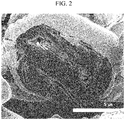
- FIGS. 2 and 3 are respectively scanning electron microscope (SEM) photographs showing the cross-section of the negative active materials according to Example 1 and Comparative Example 1
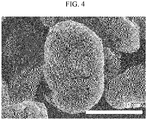
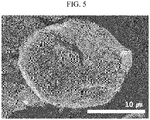
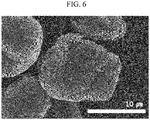
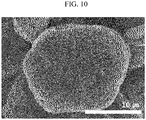
- FIGS. 4 to 11 are respectively scanning electron microscope (SEM) photographs showing the negative active materials according to Examples 1 to 5 and Comparative Examples 1 to 3.
- the negative active materials according to Examples 1 to 5 are found to have open gaps between flake-shaped natural graphite fragments on the surface part of the spherically-shaped natural graphite particle.
- the negative active material of Example 1 has open gaps between flake-shaped natural graphite fragments inside as well as on the surface part of the spherically-shaped natural graphite particle.
- the spherically-shaped natural graphite particle of Comparative Example 1 has a gap partly formed inside during the manufacturing process but almost no gap on the surface part, and herein, the gap partly formed inside does not have as much of an open gap as the gap in the ultrasonicated spherically-shaped natural graphite particle of Example 1.
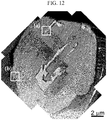
- FIG. 12 is a transmission electron microscope (TEM) photograph showing cross-sectional view of negative active materials according to Example 5, and FIGS. 13 and 14 are transmission electron microscope (TEM) photographs respectively showing enlargements of (a) and (b) parts in FIG. 12 .
- TEM transmission electron microscope
- the amorphous or semi-crystalline carbon is present in the open gaps between flake-shaped natural graphite fragments on both the surface part and inside of the spherically-shaped natural graphite particle, which are formed through the ultrasonication.
- the ultrasonicated negative active materials according to Examples 1 to 4 show an increased average particle diameter (D50) compared with the non-ultrasonicated negative active material according to Comparative Example 2.
- the ultrasonicated negative active material according to Example 5 shows an increased average particle diameter (D50) compared with the non-ultrasonicated negative active material according to Comparative Example 3. The reason is that the ultrasonication opens flake-shaped natural graphite fragments and forms an open gap between them inside and on the surface part of the spherically-shaped natural graphite particle.
- BET surface area Specific surface area of the negative active materials according to Examples 1 to 5 and Comparative Examples 1 to 3 is measured in a gas adsorption/desorption method, and the results are provided in the following Table 2.
- Table 2 Examples Comparative Examples 1 2 3 4 5 1 2 3 Specific surface area of negative active material (m 2 /g) 9.5 7 7.5 7.2 6.2 6.7 2.8 2.7
- the ultrasonicated negative active materials according to Examples 1 to 4 show an increased specific surface area compared with the non-ultrasonicated but carbon-coated negative active material according to Comparative Example 2.
- the ultrasonicated negative active material of Example 5 shows an increased specific surface area compared to the non-ultrasonicated but carbon-coated negative active material of Comparative Example 3. The reason is that the ultrasonication opens and forms an open gap between flake-shaped natural graphite fragments inside and on the surface of the spherically-shaped natural graphite particle.
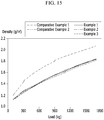
- Compression strength of the negative active materials according to Examples 1 to 3 and Comparative Examples 1 and 2 is evaluated by measuring density of each manufactured pellet by increasing a load thereon, and the results are provided in FIG. 15 .
- FIG. 15 is a graph showing density of the negative active materials of Examples 1 to 3 and Comparative Examples 1 and 2 relative to a load applied thereon.
- Examples 1 to 3 have an open gap formed by opening flake-shaped natural graphite fragments of the spherically-shaped natural graphite particle through ultrasonication, but show no increased density even though compressed with a high load compared with Comparative Example 1. In addition, Examples 1 to 3 show similar compression strength to that of Comparative Example 2.
- an amorphous or semi-crystalline carbon precursor is impregnated in an open gap between the flake-shaped natural graphite fragments and coated on the surface of the spherically-shaped natural graphite during the ultrasonication, and then the amorphous or semi-crystalline carbon is present in an open gap formed on the surface part and inside of the spherically-shaped natural graphite particle and coated on the surface of the spherically-shaped natural graphite particle through the heat-treating, compression of the spherically-shaped natural graphite particle is suppressed and the open gap formed during the ultrasonication is maintained.
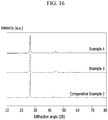
- Crystalline of the negative active materials according to Examples 3 and 4 and Comparative Example 2 are measured using an X-ray diffraction pattern analyzer, and the results are provided in FIGS. 16 and 17 .
- FIG. 16 is a graph showing X-ray diffraction (XRD) patterns of the negative active materials according to Examples 3 and 4 and Comparative Example 2, and FIG. 17 is a graph enlarging a part of the 2 ⁇ section in the X-ray diffraction pattern (XRD) of FIG. 16 .
- XRD X-ray diffraction
- Example 4 including lithium acetate shows no peak having a rhombohedral graphite structure, and the reason is that the lithium acetate react with flake-shaped natural graphite particles of the spherically-shaped natural graphite particle and effectively remove a rhombohedral graphite structural defect in the flake-shaped natural graphite particles.
- La and Lc values are calculated from the X-ray diffraction pattern analysis results of the negative active materials of Examples 3 and 4 and Comparative Example 2, that is, the results in FIG. 16 , and are provided in the following Table 3.
- La indicates a crystallite size in a direction parallel to a basal plane (an a-axis direction)
- Lc indicates a crystallite size in a direction perpendicular to the basal plane (an c-axis direction)
- the La and Lc are main characteristic factors showing a crystal structure in a carbon material.
- the negative active materials formed through ultrasonication according to Example 5 show almost the same La and Lc values as the negative active material manufactured through carbon coating and not through the ultrasonication according to Comparative Example 3. Accordingly, the ultrasonication can be seen to have no influence on crystallinity of the spherically-shaped natural graphite particle.
- each negative active material according to Examples 1 to 5 and Comparative Examples 1 to 3 and 4 wt% of binder obtained by mixing CMC/SBR (carboxylmethyl cellulose/styrene-butadiene rubber) in a weight ratio of 1:1 are mixed in distilled water, preparing each negative electrode slurry.
- the negative electrode slurry is coated on a copper foil and then dried and compressed, preparing each negative electrode.
- DEC diethyl carbonate
- EC ethylene carbonate
- the cells according to Examples 1 to 5 and Comparative Examples 1 to 3 are charged with a current density of 70 mA/g in a CC/CV mode and maintained at a cut-off voltage of 0.01 V, and the charge was ended at a current of 7 mA/g (10 % of current density).
- the cells are discharged with a current density of 70 mA/g in a CC mode and maintained at a cut-off voltage of 1.5 V.
- the initial charge and discharge efficiency (%) in the following Table 4 is calculated as a percentage of initial discharge capacity relative to initial charge capacity.
- the lithium rechargeable batteries using the ultrasonicated negative active materials according to Examples 1 to 5 show similar or a little better initial efficiency than the lithium rechargeable battery using the non-ultrasonicated but amorphous carbon-coated negative active material according to Comparative Example 2, since the ultrasonication opens flake-shaped natural graphite fragments on the surface part and inside the spherically-shaped natural graphite particle and forms an open gap between the flake-shaped natural graphite fragments and thus increases specific surface area of the negative active materials.
- Example 4 of the spherically-shaped natural graphite-modified composite particle including lithium acetate shows improved initial charge and discharge efficiency compared with Examples 1 to 3 including no lithium acetate and Comparative Example 2 of the carbon-coated flake-shaped natural graphite without ultrasonication. The reason is that the lithium acetate reacts with the flake-shaped natural graphite and effectively removes a rhombohedral graphite structural defect in the flake-shaped natural graphite and thus decreases irreversible capacity in the initial charge and discharge reaction.
- test cells according to Examples 1 to 5 and Comparative Examples 1 to 3 were evaluated regarding high-rate charge characteristics, and the results are provided in the following Table 4.
- the cells according to Examples 1 to 5 and Comparative Examples 1 to 3 are charged with a current density of 0.2 to 2 C-rate in a CC mode and maintained at a cut-off voltage of 0.01 V, and then discharged with a current density of 0.2 C-rate in a CC mode and maintained at a cut-off voltage of 1.5 V.
- the negative active materials manufactured through ultrasonication according to Examples 1 to 5 show excellent high-rate charge characteristics compared with the negative active material coated with amorphous carbon without the ultrasonication according to Comparative Examples 2 and 3.
- the reason is that the ultrasonication forms an open gap between flake-shaped natural graphite fragments inside and on the surface part of the spherically-shaped natural graphite particle, and the spherically-shaped natural graphite particle is also suppressed from compression due to amorphous or semi-crystalline carbon in the open gap and thus has improved reactivity with an electrolyte solution.
- test cells according to Examples 1 to 5 and Comparative Examples 1 to 3 are evaluated regarding high rate discharge characteristics in the following method, and the results are provided in the following Table 4.
- the cells according to Examples 1 to 5 and Comparative Examples 1 to 3 are charged with a current density of 0.2 C-rate in a CC/CV mode and maintained at a cut-off voltage of 0.01 V, and then the charge is cut-off at a current of 0.02 C-rate (10 % of current density).
- the cells are discharged in a range of 0.2 to 10 C-rate in a CC mode and maintained at a cut-off voltage of 1.5 V.
- the negative active materials manufactured through ultrasonication according to Examples 1 to 5 show excellent high-rate discharge characteristics compared with the negative active materials coated with amorphous carbon without the ultrasonication according to Comparative Examples 2 and 3.
- the reason is that the ultrasonication form an open gap between flake-shaped natural graphite fragments inside and on the surface part of the spherically-shaped natural graphite particle, and the spherically-shaped natural graphite particle is suppressed from compression due to amorphous or semi-crystalline carbon in the open gap and has improved reactivity with an electrolyte solution.
- test cells according to Examples 1 to 5 and Comparative Examples 1 to 3 are evaluated regarding cycle-life, and the results are provided in Table 4.
- test cells are charged with a current density of 0.5 C-rate in a CC mode and maintained at a cut-off voltage of 0.01 V.
- the cells are discharged with a current density of 0.5 C-rate in a CC mode and maintained at a cut-off voltage of 1.5 V, and the charge and discharge are repeated 100 cycles in total.
- capacity retention (%) is obtained as a percentage of discharge capacity after 100 cycles relative to discharge capacity at an initial cycle.
- the negative active materials manufactured through ultrasonication according to Examples 1 to 5 show excellent cycle-life characteristics compared with the negative active materials coated with amorphous carbon without the ultrasonication according to Comparative Examples 2 and 3.
- the reason is that the ultrasonication forms an open gap between flake-shaped natural graphite fragments inside and on the surface part of the spherically-shaped natural graphite particle, and the spherically-shaped natural graphite particle is suppressed from compression due to amorphous or semi-crystalline carbon in the open gap and has improved reactivity with an electrolyte solution.
Landscapes
- Chemical & Material Sciences (AREA)
- Chemical Kinetics & Catalysis (AREA)
- Electrochemistry (AREA)
- General Chemical & Material Sciences (AREA)
- Composite Materials (AREA)
- Engineering & Computer Science (AREA)
- Manufacturing & Machinery (AREA)
- Inorganic Chemistry (AREA)
- Organic Chemistry (AREA)
- Materials Engineering (AREA)
- Battery Electrode And Active Subsutance (AREA)
Claims (15)
- Negatives aktives Material für eine wiederaufladbare Lithiumbatterie, die ein kugelförmiges, mit natürlichem Graphit modifiziertes Verbundteilchen (100) aufweist, das aufweist:ein kugelförmiges natürliches Graphitteilchen, bei dem sich flockenförmige natürliche Graphitfragmente (10) zu einer Kohlform oder einer zufälligen Form aufbauen und zusammenfügen, undeinen amorphen oder teilkristallinen Kohlenstoff (30),wobei ein offener Spalt (20) zwischen den flockenförmigen natürlichen Graphitfragmenten (10) auf dem Oberflächenteil und innerhalb des kugelförmigen natürlichen Graphitteilchens angeordnet ist,wobei der offene Spalt durch ein Durchführen einer Ultraschallbehandlung gebildet worden ist, undwobei der amorphe oder teilkristalline Kohlenstoff (30) auf die Oberfläche des kugelförmigen natürlichen Graphitteilchens aufgetragen worden ist und der amorphe oder teilkristalline Kohlenstoff (30) in dem offenen Spalt (20) vorhanden ist, und dadurch der offene Spalt (20), der auf dem Oberflächenteil und innerhalb des kugelförmigen natürlichen Graphitteilchens angeordnet ist, aufrechterhalten wird.
- Negatives aktives Material für eine wiederaufladbare Lithiumbatterie nach Anspruch 1, wobei das kugelförmige natürliche Graphitteilchen einen durchschnittlichen Teilchendurchmesser (D50) von 5 bis 40 µm aufweist.
- Negatives aktives Material für eine wiederaufladbare Lithiumbatterie nach Anspruch 1 oder 2, wobei der amorphe oder teilkristalline Kohlenstoff (30) in einer Menge von 1 bis 20 Gewichtsteilen, bezogen auf 100 Gewichtsteile des kugelförmigen natürlichen Graphitteilchen, enthalten ist.
- Negatives aktives Material für eine wiederaufladbare Lithiumbatterie nach einem der Ansprüche 1 bis 3, wobei das kugelförmige, mit natürlichem Graphit modifizierte Verbundteilchen ferner eine Lithiumverbindung aufweist, wobeidie Lithiumverbindung ein Li2O, ein Li2CO3 oder eine Kombination davon aufweist, unddie Lithiumverbindung auf die Oberfläche des kugelförmigen natürlichen Graphitteilchens aufgetragen worden ist, und die Lithiumverbindung in dem offenen Spalt vorhanden ist, der an dem Oberflächenteil und innerhalb des kugelförmigen natürlichen Graphitteilchens angeordnet ist.
- Negatives aktives Material für eine wiederaufladbare Lithiumbatterie nach Anspruch 4, wobei die Lithiumverbindung in einer Menge von 0,01 bis 10 Gewichtsteilen, bezogen auf 100 Gewichtsteile des kugelförmigen natürlichen Graphitteilchens, enthalten ist.
- Verfahren zur Herstellung eines negativen aktiven Materials für eine wiederaufladbare Lithiumbatterie, wobei das Verfahren umfasst:ein Herstellen einer Lösung, die ein kugelförmiges natürliches Graphitteilchen, in dem sich plättchenförmige natürliche Graphitfragmente zu einer Kohlform oder einer zufälligen Form aufbauen und zusammensetzen, eine amorphe oder teilkristalline Kohlenstoffvorstufe und ein Lösungsmittel aufweist,ein Durchführen einer Ultraschallbehandlung an der Lösung, ein Öffnen zwischen den plättchenförmigen natürlichen Graphitfragmenten eines Oberflächenteils und innerhalb des kugelförmigen natürlichen Graphitteilchens, um einen offenen Spalt zu bilden, während die Kristallinität des kugelförmigen natürlichen Graphitteilchens aufrechterhalten wird, und ein gleichzeitiges Beschichten der Oberfläche des kugelförmigen natürlichen Graphitteilchens mit der amorphen oder teilkristallinen Kohlenstoffvorstufe und ein Imprägnieren der amorphen oder teilkristallinen Kohlenstoffvorstufe, die in dem offenen Spalt auf dem Oberflächenteil und innerhalb des kugelförmigen natürlichen Graphitteilchens vorhanden ist,ein Trocknen der Lösung, die der Ultraschallbehandlung unterworfen worden ist, um ein kugelförmiges, mit natürlichem Graphit modifiziertes Teilchen zu erhalten, undein Wärmebehandeln des kugelförmigen, mit natürlichem Graphit modifizierten Teilchens zur Herstellung eines kugelförmigen, mit natürlichem Graphit modifizierten Verbundteilchens, das einen amorphen oder teilkristallinen Kohlenstoff enthält, der auf die Oberfläche des kugelförmigen, natürlichen Graphitteilchens aufgetragen worden ist und der in dem offenen Spalt vorhanden ist, der auf dem Oberflächenteil und innerhalb des kugelförmigen natürlichen Graphitteilchens vorhanden ist,wobei der offene Spalt durch ein Durchführen einer Ultraschallbehandlung gebildet worden ist, undwobei der amorphe oder teilkristalline Kohlenstoff (30) auf die Oberfläche des kugelförmigen natürlichen Graphitteilchens aufgetragen wird und der amorphe oder teilkristalline Kohlenstoff (30) in dem ersten offenen Spalt vorhanden ist, und dadurch der offene Spalt, der auf dem Oberflächenteil und innerhalb des kugelförmigen natürlichen Graphitteilchens angeordnet ist, aufrechterhalten wird.
- Verfahren zur Herstellung eines negativen aktiven Materials für eine wiederaufladbare Lithiumbatterie, wobei das Verfahren umfasst:ein Herstellen einer Lösung, die ein kugelförmiges natürliches Graphitteilchen, in dem sich plättchenförmige natürliche Graphitfragmente (10) zu einer Kohlform oder einer zufälligen Form aufbauen und zusammenfügen, eine amorphe oder teilkristalline Kohlenstoffvorstufe, ein Lithiumacetat und ein Lösungsmittel aufweist,ein Durchführen einer Ultraschallbehandlung an der Lösung, ein Öffnen zwischen den plättchenförmigen natürlichen Graphitfragmenten (10) eines Oberflächenteils und innerhalb des kugelförmigen natürlichen Graphitteilchens, um einen offenen Spalt (20) zu bilden, während die Kristallinität des kugelförmigen natürlichen Graphitteilchens erhalten bleibt, und ein gleichzeitiges Beschichten der Oberfläche des kugelförmigen natürlichen Graphitteilchens mit der amorphen oder teilkristallinen Kohlenstoffvorstufe und dem Lithiumacetat und ein Imprägnieren der amorphen oder teilkristallinen Kohlenstoffvorstufe und des Lithiumacetats in dem offenen Spalt (20), der auf dem Oberflächenteil und innerhalb des kugelförmigen natürlichen Graphitteilchens vorhanden ist,ein Trocknen der Lösung, die der Ultraschallbehandlung unterworfen wurde, um ein kugelförmiges, mit natürlichem Graphit modifiziertes Teilchen zu erhalten, undein Wärmebehandeln des kugelförmigen, mit natürlichem Graphit modifizierten Teilchens, um ein kugelförmiges, mit natürlichem Graphit modifiziertes Verbundteilchen (100) herzustellen, das einen amorphen oder teilkristallinen Kohlenstoff (30) und eine Lithiumverbindung enthält, die auf die Oberfläche des kugelförmigen natürlichen Graphitteilchens aufgetragen sind und die in dem offenen Spalt (20) vorhanden sind, der sich auf dem Oberflächenteil und innerhalb des kugelförmigen natürlichen Graphitteilchens befindet,wobei die Lithiumverbindung ein Li2O, ein Li2CO3 oder eine Kombination davon umfasst, undwobei der offene Spalt durch ein Durchführen einer Ultraschallbehandlung gebildet worden ist, undwobei der amorphe oder teilkristalline Kohlenstoff (30) auf die Oberfläche des kugelförmigen natürlichen Graphitteilchens aufgetragen wird und der amorphe oder teilkristalline Kohlenstoff (30) in dem ersten offenen Spalt vorhanden ist, und dadurch der offene Spalt, der auf dem Oberflächenteil und innerhalb des kugelförmigen natürlichen Graphitteilchens angeordnet ist, aufrechterhalten wird.
- Verfahren zur Herstellung eines negativen aktiven Materials für eine wiederaufladbare Lithiumbatterie, wobei das Verfahren umfasst:ein Herstellen einer Lösung, die ein kugelförmiges natürliches Graphitteilchen, in dem sich plättchenförmige natürliche Graphitfragmente (10) zu einer Kohlform oder einer zufälligen Form aufbauen und zusammenfügen, eine amorphe oder teilkristalline Kohlenstoffvorstufe und ein Lösungsmittel aufweist,ein Durchführen einer Ultraschallbehandlung an der Lösung, ein Öffnen zwischen den plättchenförmigen natürlichen Graphitfragmenten (10) eines Oberflächenteils und innerhalb des kugelförmigen natürlichen Graphitteilchens, um einen offenen Spalt (20) zu bilden, während die Kristallinität des kugelförmigen natürlichen Graphitteilchens erhalten bleibt, und ein gleichzeitiges Beschichten der Oberfläche des kugelförmigen natürlichen Graphitteilchens mit der amorphen oder teilkristallinen Kohlenstoffvorstufe und ein Imprägnieren der amorphen oder teilkristallinen Kohlenstoffvorstufe in dem offenen Spalt (20), der auf dem Oberflächenteil und innerhalb des kugelförmigen natürlichen Graphitteilchens vorhanden ist,ein Trocknen der Lösung, die der Ultraschallbehandlung unterworfen wurde, nach einer Zugabe von einem Lithiumacetat, um ein kugelförmiges, mit natürlichem Graphit modifiziertes Teilchen zu erhalten, das die amorphe oder teilkristalline Kohlenstoffvorstufe und das ein Lithiumacetat enthält, die auf die Oberfläche des kugelförmigen natürlichen Graphitteilchens aufgetragen sind und die in dem offenen Spalt (20) imprägniert sind, der auf dem Oberflächenteil und innerhalb des kugelförmigen natürlichen Graphitteilchens vorhanden ist, undein Wärmebehandeln des kugelförmigen, mit natürlichem Graphit modifizierten Teilchens, um ein kugelförmiges, mit natürlichem Graphit modifiziertes Verbundteilchen (100) herzustellen, das einen amorphen oder teilkristallinen Kohlenstoff (30) und eine Lithiumverbindung enthält, die auf die Oberfläche des kugelförmigen natürlichen Graphitteilchens aufgetragen sind und die in dem offenen Spalt (20) vorhanden sind, der sich auf dem Oberflächenteil und innerhalb des kugelförmigen natürlichen Graphitteilchens befindet,wobei die Lithiumverbindung ein Li2O, ein Li2CO3 oder eine Kombination davon umfasst, undwobei der offene Spalt durch ein Durchführen einer Ultraschallbehandlung gebildet worden ist, undwobei der amorphe oder teilkristalline Kohlenstoff (30) auf die Oberfläche des kugelförmigen natürlichen Graphitteilchens aufgetragen wird und der amorphe oder teilkristalline Kohlenstoff (30) in dem ersten offenen Spalt vorhanden ist, und dadurch der offene Spalt, der auf dem Oberflächenteil und innerhalb des kugelförmigen natürlichen Graphitteilchens angeordnet ist, aufrechterhalten wird.
- Verfahren nach einem der Ansprüche 6 bis 8, wobei die amorphe oder teilkristalline Kohlenstoffvorstufe eine Citronensäure, eine Stearinsäure, eine Saccharose, ein Polyvinylidenfluorid, eine Carboxymethylcellulose (CMC), eine Hydroxypropylcellulose, eine regenerierte Cellulose, ein Polyvinylpyrrolidon, ein Tetrafluorethylen, ein Polyethylen, ein Polypropylen, ein Ethylen-Propylen-Dien-Monomer (EPDM), ein sulfoniertes EPDM, eine Stärke, ein Phenolharz, ein Furanharz, einen Furfurylalkohol, eine Polyacrylsäure, ein Natriumpolyacrylat, ein Polyacrylnitril, ein Polyimid, ein Epoxyharz, eine Cellulose, ein Styrol, ein Polyvinyl-Alkohol, ein Polyvinylchlorid, ein Pech auf Kohlenbasis, ein Pech auf Erdölbasis, ein Mesophasenpech, ein Schweröl mit niedrigem Molekulargewicht, eine Glucose, eine Gelatine, Saccharide oder eine Kombination davon umfasst.
- Verfahren nach einem der Ansprüche 6 bis 9, wobei die Ultraschallbehandlung durch ein Abstrahlen von Ultraschallwellen bei einer Oszillationsfrequenz von 10 bis 35 kHz mit einer Leistung von 10 bis 100 W für 1 Minute bis 24 Stunden durchgeführt wird.
- Verfahren nach einem der Ansprüche 6 bis 10, wobei das Trocknen unter Verwendung von mindestens einem von einem Sprühtrocknungsverfahren, das aus einem Rotationssprüh-, einem Düsensprüh- und einem Ultraschallwellensprühverfahren ausgewählt worden ist, einem Trocknungsverfahren mittels eines Rotationsverdampfers, einem Vakuumtrocknungsverfahren, einer natürliche Trocknungsmethode, oder einer Kombination davon durchgeführt wird.
- Verfahren nach einem der Ansprüche 6 bis 11, wobei die Wärmebehandlung bei einer Temperatur von 500 bis 2500 °C durchgeführt wird.
- Verfahren nach einem der Ansprüche 6 bis 12, wobei die amorphe oder teilkristalline Kohlenstoffvorstufe in einer Menge von 2 bis 80 Gewichtsteilen, bezogen auf 100 Gewichtsteile des kugelförmigen natürlichen Graphitteilchens, enthalten ist.
- Verfahren nach einem der Ansprüche 7 bis 13, wobei das Lithiumacetat in einer Menge von 0,1 bis 20 Gewichtsteilen, bezogen auf 100 Gewichtsteile des kugelförmigen natürlichen Graphitteilchens, enthalten ist.
- Wiederaufladbare Lithiumbatterie, die aufweist:eine negative Elektrode, die das negative aktive Material nach einem der Ansprüche 1 bis 5,eine positive Elektrode, undeine Elektrolytlösung enthält.
Priority Applications (1)
| Application Number | Priority Date | Filing Date | Title |
|---|---|---|---|
| EP14157034.1A EP2913299B1 (de) | 2014-02-27 | 2014-02-27 | Negativ-Aktivmaterial für eine wiederaufladbare Lithiumbatterie, Herstellungsverfahren dafür und wiederaufladbare Lithiumbatterie damit |
Applications Claiming Priority (1)
| Application Number | Priority Date | Filing Date | Title |
|---|---|---|---|
| EP14157034.1A EP2913299B1 (de) | 2014-02-27 | 2014-02-27 | Negativ-Aktivmaterial für eine wiederaufladbare Lithiumbatterie, Herstellungsverfahren dafür und wiederaufladbare Lithiumbatterie damit |
Publications (2)
| Publication Number | Publication Date |
|---|---|
| EP2913299A1 EP2913299A1 (de) | 2015-09-02 |
| EP2913299B1 true EP2913299B1 (de) | 2020-02-26 |
Family
ID=50184788
Family Applications (1)
| Application Number | Title | Priority Date | Filing Date |
|---|---|---|---|
| EP14157034.1A Active EP2913299B1 (de) | 2014-02-27 | 2014-02-27 | Negativ-Aktivmaterial für eine wiederaufladbare Lithiumbatterie, Herstellungsverfahren dafür und wiederaufladbare Lithiumbatterie damit |
Country Status (1)
| Country | Link |
|---|---|
| EP (1) | EP2913299B1 (de) |
Families Citing this family (9)
| Publication number | Priority date | Publication date | Assignee | Title |
|---|---|---|---|---|
| JP6906891B2 (ja) * | 2015-09-02 | 2021-07-21 | 三菱ケミカル株式会社 | 非水系二次電池用炭素材、及び、リチウムイオン二次電池 |
| JP6801171B2 (ja) * | 2015-09-24 | 2020-12-16 | 三菱ケミカル株式会社 | 炭素材、及び、非水系二次電池 |
| CN108134088A (zh) * | 2016-12-01 | 2018-06-08 | 内蒙古欣源石墨烯科技有限公司 | 一种倍率型锂离子电池负极复合材料及其制备方法 |
| KR101965773B1 (ko) * | 2018-12-11 | 2019-04-04 | 강원대학교산학협력단 | 리튬 이차전지용 음극 활물질, 그 제조방법 및 리튬 이차전지용 음극 활물질을 포함하는 리튬 이차전지 |
| WO2020149683A1 (ko) * | 2019-01-18 | 2020-07-23 | 주식회사 엘지화학 | 이차전지용 음극 활물질, 이의 제조방법, 이를 포함하는 이차전지용 음극 및 리튬 이차전지 |
| KR102857546B1 (ko) * | 2020-02-25 | 2025-09-08 | 삼성에스디아이 주식회사 | 전고체 이차전지 |
| WO2024036485A1 (zh) * | 2022-08-16 | 2024-02-22 | 宁德时代新能源科技股份有限公司 | 负极活性材料、制法、二次电池和用电装置 |
| CN115275166B (zh) * | 2022-08-31 | 2025-07-15 | 四川坤天新能源科技有限公司 | 一种长寿命石墨复合材料及其制备方法 |
| CN116514094B (zh) * | 2022-11-28 | 2023-10-03 | 昆明理工大学 | 一种电池负极碳材料的制备方法及其应用 |
Family Cites Families (6)
| Publication number | Priority date | Publication date | Assignee | Title |
|---|---|---|---|---|
| JP4074757B2 (ja) * | 2001-10-16 | 2008-04-09 | 関西熱化学株式会社 | 改質黒鉛粒子、その製造法、および二次電池用電極材料 |
| KR20020042586A (ko) | 2002-05-10 | 2002-06-05 | 이영균 | 인편상 흑연으로부터 구형화된 흑연 재료를 제조하는 방법및 이를 사용한 리튬 2차 전지용 음극 활물질의 제조방법 |
| KR100793691B1 (ko) | 2003-07-16 | 2008-01-10 | 간사이네쯔카가꾸가부시끼가이샤 | 리튬이온 2차전지용 부극재료, 그 제조방법, 그부극재료를 사용한 리튬이온 2차전지용 부극 및 리튬이온2차전지 |
| KR100830612B1 (ko) * | 2006-05-23 | 2008-05-21 | 강원대학교산학협력단 | 리튬 이차 전지용 음극 활물질, 그의 제조 방법 및 그를포함하는 리튬 이차 전지 |
| JP5986347B2 (ja) * | 2009-09-07 | 2016-09-06 | 三菱化学株式会社 | リチウムイオン二次電池用黒鉛材料の製造方法 |
| CN103250285B (zh) * | 2010-12-08 | 2016-01-20 | 日本焦化工业株式会社 | 锂离子二次电池用负极材料及其制造方法 |
-
2014
- 2014-02-27 EP EP14157034.1A patent/EP2913299B1/de active Active
Non-Patent Citations (1)
| Title |
|---|
| None * |
Also Published As
| Publication number | Publication date |
|---|---|
| EP2913299A1 (de) | 2015-09-02 |
Similar Documents
| Publication | Publication Date | Title |
|---|---|---|
| US9368792B2 (en) | Negative active material for rechargeable lithium battery, method of preparing the same, and rechargeable lithium battery including the same | |
| US12148919B2 (en) | Composite carbon particles and use thereof | |
| KR101430733B1 (ko) | 리튬 이차 전지용 음극 활물질, 이의 제조 방법 및 이를 포함하는 리튬 이차 전지 | |
| KR102691451B1 (ko) | 음극 활물질 및 이를 채용한 리튬 이차 전지, 및 상기 음극 활물질의 제조방법 | |
| US10714742B2 (en) | Cathode active material including lithium transition metal phosphate particles, preparation method thereof, and lithium secondary battery including the same | |
| KR102819273B1 (ko) | 리튬 이차 전지용 음극 활물질, 이의 제조방법 및 이를 포함하는 리튬 이차 전지 | |
| EP2913299A1 (de) | Negativ-Aktivmaterial für eine wiederaufladbare Lithiumbatterie, Herstellungsverfahren dafür und wiederaufladbare Lithiumbatterie damit | |
| KR102114044B1 (ko) | 리튬 이차 전지용 음극 활물질, 이의 제조 방법 및 이를 포함하는 리튬 이차 전지 | |
| KR101786714B1 (ko) | 카본으로 이루어진 코어를 포함하는 리튬 이차 전지용 음극 활물질, 이의 제조방법 및 이를 포함하는 리튬 이차 전지 | |
| KR101561274B1 (ko) | 리튬 이차 전지용 음극 활물질, 이의 제조 방법, 그리고 이를 포함하는 음극 및 리튬 이차 전지 | |
| KR101368474B1 (ko) | 리튬 이차 전지용 음극 활물질, 이의 제조방법 및 이를 포함하는 리튬 이차 전지 | |
| US9580322B2 (en) | Method of preparing negative active material for rechargeable lithium battery, and negative active material and rechargeable lithium battery prepared from the same | |
| KR101419792B1 (ko) | 리튬 이차 전지용 음극 활물질, 이의 제조방법 및 이를 포함하는 리튬 이차 전지 | |
| JP7480284B2 (ja) | 球状化カーボン系負極活物質、その製造方法、それを含む負極、及びリチウム二次電池 | |
| KR20140140323A (ko) | 리튬 이차 전지용 음극 활물질, 이의 제조 방법 및 이를 포함하는 리튬 이차전지 | |
| KR20130016727A (ko) | 리튬 이차 전지용 음극 활물질, 이의 제조 방법, 그리고 이를 포함하는 음극 및 리튬 이차 전지 | |
| KR102912638B1 (ko) | 리튬 이차전지용 음극 활물질, 이의 제조방법 및 이를 포함하는 리튬 이차전지 | |
| KR102757389B1 (ko) | 리튬이온 이차 전지용 음극 | |
| KR20070113066A (ko) | 리튬 이차 전지용 음극 활물질, 그의 제조 방법 및 그를포함하는 리튬 이차 전지 | |
| KR102819298B1 (ko) | 리튬이온 이차 전지용 음극 | |
| KR102955399B1 (ko) | 구형화된 카본계 음극활물질, 이의 제조방법, 이를 포함하는 음극 및 리튬 이차전지 | |
| JP7498267B2 (ja) | 球状化カーボン系負極活物質、その製造方法、それを含む負極、及びリチウム二次電池 | |
| KR20150025048A (ko) | 리튬 전이금속 산화물 입자를 포함하는 양극 활물질, 이의 제조방법, 및 이를 포함하는 리튬 이차전지 | |
| KR20240076555A (ko) | 리튬 이차전지용 양극 활물질 및 이를 포함하는 리튬 이차전지 | |
| KR102695392B1 (ko) | 리튬 이차전지용 음극 활물질, 이의 제조방법 및 이를 포함하는 리튬 이차전지 |
Legal Events
| Date | Code | Title | Description |
|---|---|---|---|
| PUAI | Public reference made under article 153(3) epc to a published international application that has entered the european phase |
Free format text: ORIGINAL CODE: 0009012 |
|
| AK | Designated contracting states |
Kind code of ref document: A1 Designated state(s): AL AT BE BG CH CY CZ DE DK EE ES FI FR GB GR HR HU IE IS IT LI LT LU LV MC MK MT NL NO PL PT RO RS SE SI SK SM TR |
|
| AX | Request for extension of the european patent |
Extension state: BA ME |
|
| 17P | Request for examination filed |
Effective date: 20160225 |
|
| RBV | Designated contracting states (corrected) |
Designated state(s): AL AT BE BG CH CY CZ DE DK EE ES FI FR GB GR HR HU IE IS IT LI LT LU LV MC MK MT NL NO PL PT RO RS SE SI SK SM TR |
|
| STAA | Information on the status of an ep patent application or granted ep patent |
Free format text: STATUS: EXAMINATION IS IN PROGRESS |
|
| 17Q | First examination report despatched |
Effective date: 20180215 |
|
| REG | Reference to a national code |
Ref country code: DE Ref legal event code: R079 Ref document number: 602014061414 Country of ref document: DE Free format text: PREVIOUS MAIN CLASS: C01B0031020000 Ipc: H01M0004583000 |
|
| GRAJ | Information related to disapproval of communication of intention to grant by the applicant or resumption of examination proceedings by the epo deleted |
Free format text: ORIGINAL CODE: EPIDOSDIGR1 |
|
| GRAP | Despatch of communication of intention to grant a patent |
Free format text: ORIGINAL CODE: EPIDOSNIGR1 |
|
| RIC1 | Information provided on ipc code assigned before grant |
Ipc: H01M 4/02 20060101ALI20190808BHEP Ipc: H01M 4/36 20060101ALI20190808BHEP Ipc: H01M 4/133 20100101ALI20190808BHEP Ipc: H01M 4/583 20100101AFI20190808BHEP Ipc: H01M 4/1393 20100101ALI20190808BHEP Ipc: C01B 32/05 20170101ALI20190808BHEP Ipc: H01M 4/04 20060101ALI20190808BHEP Ipc: H01M 4/587 20100101ALI20190808BHEP Ipc: H01M 10/052 20100101ALI20190808BHEP |
|
| GRAP | Despatch of communication of intention to grant a patent |
Free format text: ORIGINAL CODE: EPIDOSNIGR1 |
|
| STAA | Information on the status of an ep patent application or granted ep patent |
Free format text: STATUS: GRANT OF PATENT IS INTENDED |
|
| INTG | Intention to grant announced |
Effective date: 20190913 |
|
| GRAS | Grant fee paid |
Free format text: ORIGINAL CODE: EPIDOSNIGR3 |
|
| GRAA | (expected) grant |
Free format text: ORIGINAL CODE: 0009210 |
|
| STAA | Information on the status of an ep patent application or granted ep patent |
Free format text: STATUS: THE PATENT HAS BEEN GRANTED |
|
| AK | Designated contracting states |
Kind code of ref document: B1 Designated state(s): AL AT BE BG CH CY CZ DE DK EE ES FI FR GB GR HR HU IE IS IT LI LT LU LV MC MK MT NL NO PL PT RO RS SE SI SK SM TR |
|
| REG | Reference to a national code |
Ref country code: GB Ref legal event code: FG4D |
|
| REG | Reference to a national code |
Ref country code: CH Ref legal event code: EP |
|
| REG | Reference to a national code |
Ref country code: DE Ref legal event code: R096 Ref document number: 602014061414 Country of ref document: DE |
|
| REG | Reference to a national code |
Ref country code: AT Ref legal event code: REF Ref document number: 1238750 Country of ref document: AT Kind code of ref document: T Effective date: 20200315 |
|
| REG | Reference to a national code |
Ref country code: IE Ref legal event code: FG4D |
|
| REG | Reference to a national code |
Ref country code: SE Ref legal event code: TRGR |
|
| PG25 | Lapsed in a contracting state [announced via postgrant information from national office to epo] |
Ref country code: NO Free format text: LAPSE BECAUSE OF FAILURE TO SUBMIT A TRANSLATION OF THE DESCRIPTION OR TO PAY THE FEE WITHIN THE PRESCRIBED TIME-LIMIT Effective date: 20200526 Ref country code: RS Free format text: LAPSE BECAUSE OF FAILURE TO SUBMIT A TRANSLATION OF THE DESCRIPTION OR TO PAY THE FEE WITHIN THE PRESCRIBED TIME-LIMIT Effective date: 20200226 Ref country code: FI Free format text: LAPSE BECAUSE OF FAILURE TO SUBMIT A TRANSLATION OF THE DESCRIPTION OR TO PAY THE FEE WITHIN THE PRESCRIBED TIME-LIMIT Effective date: 20200226 |
|
| REG | Reference to a national code |
Ref country code: NL Ref legal event code: MP Effective date: 20200226 |
|
| REG | Reference to a national code |
Ref country code: LT Ref legal event code: MG4D |
|
| PG25 | Lapsed in a contracting state [announced via postgrant information from national office to epo] |
Ref country code: IS Free format text: LAPSE BECAUSE OF FAILURE TO SUBMIT A TRANSLATION OF THE DESCRIPTION OR TO PAY THE FEE WITHIN THE PRESCRIBED TIME-LIMIT Effective date: 20200626 Ref country code: GR Free format text: LAPSE BECAUSE OF FAILURE TO SUBMIT A TRANSLATION OF THE DESCRIPTION OR TO PAY THE FEE WITHIN THE PRESCRIBED TIME-LIMIT Effective date: 20200527 Ref country code: HR Free format text: LAPSE BECAUSE OF FAILURE TO SUBMIT A TRANSLATION OF THE DESCRIPTION OR TO PAY THE FEE WITHIN THE PRESCRIBED TIME-LIMIT Effective date: 20200226 Ref country code: LV Free format text: LAPSE BECAUSE OF FAILURE TO SUBMIT A TRANSLATION OF THE DESCRIPTION OR TO PAY THE FEE WITHIN THE PRESCRIBED TIME-LIMIT Effective date: 20200226 Ref country code: BG Free format text: LAPSE BECAUSE OF FAILURE TO SUBMIT A TRANSLATION OF THE DESCRIPTION OR TO PAY THE FEE WITHIN THE PRESCRIBED TIME-LIMIT Effective date: 20200526 |
|
| PG25 | Lapsed in a contracting state [announced via postgrant information from national office to epo] |
Ref country code: NL Free format text: LAPSE BECAUSE OF FAILURE TO SUBMIT A TRANSLATION OF THE DESCRIPTION OR TO PAY THE FEE WITHIN THE PRESCRIBED TIME-LIMIT Effective date: 20200226 |
|
| REG | Reference to a national code |
Ref country code: CH Ref legal event code: PL |
|
| REG | Reference to a national code |
Ref country code: BE Ref legal event code: MM Effective date: 20200229 |
|
| PG25 | Lapsed in a contracting state [announced via postgrant information from national office to epo] |
Ref country code: ES Free format text: LAPSE BECAUSE OF FAILURE TO SUBMIT A TRANSLATION OF THE DESCRIPTION OR TO PAY THE FEE WITHIN THE PRESCRIBED TIME-LIMIT Effective date: 20200226 Ref country code: PT Free format text: LAPSE BECAUSE OF FAILURE TO SUBMIT A TRANSLATION OF THE DESCRIPTION OR TO PAY THE FEE WITHIN THE PRESCRIBED TIME-LIMIT Effective date: 20200719 Ref country code: DK Free format text: LAPSE BECAUSE OF FAILURE TO SUBMIT A TRANSLATION OF THE DESCRIPTION OR TO PAY THE FEE WITHIN THE PRESCRIBED TIME-LIMIT Effective date: 20200226 Ref country code: EE Free format text: LAPSE BECAUSE OF FAILURE TO SUBMIT A TRANSLATION OF THE DESCRIPTION OR TO PAY THE FEE WITHIN THE PRESCRIBED TIME-LIMIT Effective date: 20200226 Ref country code: LT Free format text: LAPSE BECAUSE OF FAILURE TO SUBMIT A TRANSLATION OF THE DESCRIPTION OR TO PAY THE FEE WITHIN THE PRESCRIBED TIME-LIMIT Effective date: 20200226 Ref country code: CZ Free format text: LAPSE BECAUSE OF FAILURE TO SUBMIT A TRANSLATION OF THE DESCRIPTION OR TO PAY THE FEE WITHIN THE PRESCRIBED TIME-LIMIT Effective date: 20200226 Ref country code: RO Free format text: LAPSE BECAUSE OF FAILURE TO SUBMIT A TRANSLATION OF THE DESCRIPTION OR TO PAY THE FEE WITHIN THE PRESCRIBED TIME-LIMIT Effective date: 20200226 Ref country code: SK Free format text: LAPSE BECAUSE OF FAILURE TO SUBMIT A TRANSLATION OF THE DESCRIPTION OR TO PAY THE FEE WITHIN THE PRESCRIBED TIME-LIMIT Effective date: 20200226 Ref country code: LU Free format text: LAPSE BECAUSE OF NON-PAYMENT OF DUE FEES Effective date: 20200227 Ref country code: SM Free format text: LAPSE BECAUSE OF FAILURE TO SUBMIT A TRANSLATION OF THE DESCRIPTION OR TO PAY THE FEE WITHIN THE PRESCRIBED TIME-LIMIT Effective date: 20200226 |
|
| REG | Reference to a national code |
Ref country code: AT Ref legal event code: MK05 Ref document number: 1238750 Country of ref document: AT Kind code of ref document: T Effective date: 20200226 |
|
| REG | Reference to a national code |
Ref country code: DE Ref legal event code: R097 Ref document number: 602014061414 Country of ref document: DE |
|
| PG25 | Lapsed in a contracting state [announced via postgrant information from national office to epo] |
Ref country code: MC Free format text: LAPSE BECAUSE OF FAILURE TO SUBMIT A TRANSLATION OF THE DESCRIPTION OR TO PAY THE FEE WITHIN THE PRESCRIBED TIME-LIMIT Effective date: 20200226 Ref country code: LI Free format text: LAPSE BECAUSE OF NON-PAYMENT OF DUE FEES Effective date: 20200229 Ref country code: CH Free format text: LAPSE BECAUSE OF NON-PAYMENT OF DUE FEES Effective date: 20200229 |
|
| PLBE | No opposition filed within time limit |
Free format text: ORIGINAL CODE: 0009261 |
|
| STAA | Information on the status of an ep patent application or granted ep patent |
Free format text: STATUS: NO OPPOSITION FILED WITHIN TIME LIMIT |
|
| PG25 | Lapsed in a contracting state [announced via postgrant information from national office to epo] |
Ref country code: IT Free format text: LAPSE BECAUSE OF FAILURE TO SUBMIT A TRANSLATION OF THE DESCRIPTION OR TO PAY THE FEE WITHIN THE PRESCRIBED TIME-LIMIT Effective date: 20200226 Ref country code: FR Free format text: LAPSE BECAUSE OF NON-PAYMENT OF DUE FEES Effective date: 20200426 Ref country code: IE Free format text: LAPSE BECAUSE OF NON-PAYMENT OF DUE FEES Effective date: 20200227 Ref country code: AT Free format text: LAPSE BECAUSE OF FAILURE TO SUBMIT A TRANSLATION OF THE DESCRIPTION OR TO PAY THE FEE WITHIN THE PRESCRIBED TIME-LIMIT Effective date: 20200226 |
|
| 26N | No opposition filed |
Effective date: 20201127 |
|
| PG25 | Lapsed in a contracting state [announced via postgrant information from national office to epo] |
Ref country code: BE Free format text: LAPSE BECAUSE OF NON-PAYMENT OF DUE FEES Effective date: 20200229 Ref country code: SI Free format text: LAPSE BECAUSE OF FAILURE TO SUBMIT A TRANSLATION OF THE DESCRIPTION OR TO PAY THE FEE WITHIN THE PRESCRIBED TIME-LIMIT Effective date: 20200226 Ref country code: PL Free format text: LAPSE BECAUSE OF FAILURE TO SUBMIT A TRANSLATION OF THE DESCRIPTION OR TO PAY THE FEE WITHIN THE PRESCRIBED TIME-LIMIT Effective date: 20200226 |
|
| PG25 | Lapsed in a contracting state [announced via postgrant information from national office to epo] |
Ref country code: TR Free format text: LAPSE BECAUSE OF FAILURE TO SUBMIT A TRANSLATION OF THE DESCRIPTION OR TO PAY THE FEE WITHIN THE PRESCRIBED TIME-LIMIT Effective date: 20200226 Ref country code: MT Free format text: LAPSE BECAUSE OF FAILURE TO SUBMIT A TRANSLATION OF THE DESCRIPTION OR TO PAY THE FEE WITHIN THE PRESCRIBED TIME-LIMIT Effective date: 20200226 Ref country code: CY Free format text: LAPSE BECAUSE OF FAILURE TO SUBMIT A TRANSLATION OF THE DESCRIPTION OR TO PAY THE FEE WITHIN THE PRESCRIBED TIME-LIMIT Effective date: 20200226 |
|
| PG25 | Lapsed in a contracting state [announced via postgrant information from national office to epo] |
Ref country code: MK Free format text: LAPSE BECAUSE OF FAILURE TO SUBMIT A TRANSLATION OF THE DESCRIPTION OR TO PAY THE FEE WITHIN THE PRESCRIBED TIME-LIMIT Effective date: 20200226 Ref country code: AL Free format text: LAPSE BECAUSE OF FAILURE TO SUBMIT A TRANSLATION OF THE DESCRIPTION OR TO PAY THE FEE WITHIN THE PRESCRIBED TIME-LIMIT Effective date: 20200226 |
|
| REG | Reference to a national code |
Ref country code: GB Ref legal event code: 732E Free format text: REGISTERED BETWEEN 20231130 AND 20231206 |
|
| REG | Reference to a national code |
Ref country code: DE Ref legal event code: R081 Ref document number: 602014061414 Country of ref document: DE Owner name: SK ON CO., LTD., KR Free format text: FORMER OWNER: KANGWON NATIONAL UNIVERSITY UNIVERSITY-INDUSTRY COOPERATION FOUNDATION, CHUNCHEON-SI, GANGWON-DO, KR |
|
| REG | Reference to a national code |
Ref country code: DE Ref legal event code: R082 Ref document number: 602014061414 Country of ref document: DE Representative=s name: STOLMAR & PARTNER PATENTANWAELTE PARTG MBB, DE |
|
| PGFP | Annual fee paid to national office [announced via postgrant information from national office to epo] |
Ref country code: GB Payment date: 20251222 Year of fee payment: 13 |
|
| PGFP | Annual fee paid to national office [announced via postgrant information from national office to epo] |
Ref country code: SE Payment date: 20251223 Year of fee payment: 13 |
|
| PGFP | Annual fee paid to national office [announced via postgrant information from national office to epo] |
Ref country code: DE Payment date: 20251222 Year of fee payment: 13 |