EP2907486A1 - Fernsteuerbares magenbandsystem - Google Patents
Fernsteuerbares magenbandsystem Download PDFInfo
- Publication number
- EP2907486A1 EP2907486A1 EP15160040.0A EP15160040A EP2907486A1 EP 2907486 A1 EP2907486 A1 EP 2907486A1 EP 15160040 A EP15160040 A EP 15160040A EP 2907486 A1 EP2907486 A1 EP 2907486A1
- Authority
- EP
- European Patent Office
- Prior art keywords
- piston
- implantable
- fluid
- reservoir
- housing
- Prior art date
- Legal status (The legal status is an assumption and is not a legal conclusion. Google has not performed a legal analysis and makes no representation as to the accuracy of the status listed.)
- Withdrawn
Links
Images



Classifications
-
- A—HUMAN NECESSITIES
- A61—MEDICAL OR VETERINARY SCIENCE; HYGIENE
- A61F—FILTERS IMPLANTABLE INTO BLOOD VESSELS; PROSTHESES; DEVICES PROVIDING PATENCY TO, OR PREVENTING COLLAPSING OF, TUBULAR STRUCTURES OF THE BODY, e.g. STENTS; ORTHOPAEDIC, NURSING OR CONTRACEPTIVE DEVICES; FOMENTATION; TREATMENT OR PROTECTION OF EYES OR EARS; BANDAGES, DRESSINGS OR ABSORBENT PADS; FIRST-AID KITS
- A61F5/00—Orthopaedic methods or devices for non-surgical treatment of bones or joints; Nursing devices ; Anti-rape devices
- A61F5/0003—Apparatus for the treatment of obesity; Anti-eating devices
- A61F5/0013—Implantable devices or invasive measures
- A61F5/005—Gastric bands
- A61F5/0053—Gastric bands remotely adjustable
- A61F5/0056—Gastric bands remotely adjustable using injection ports
-
- A—HUMAN NECESSITIES
- A61—MEDICAL OR VETERINARY SCIENCE; HYGIENE
- A61F—FILTERS IMPLANTABLE INTO BLOOD VESSELS; PROSTHESES; DEVICES PROVIDING PATENCY TO, OR PREVENTING COLLAPSING OF, TUBULAR STRUCTURES OF THE BODY, e.g. STENTS; ORTHOPAEDIC, NURSING OR CONTRACEPTIVE DEVICES; FOMENTATION; TREATMENT OR PROTECTION OF EYES OR EARS; BANDAGES, DRESSINGS OR ABSORBENT PADS; FIRST-AID KITS
- A61F5/00—Orthopaedic methods or devices for non-surgical treatment of bones or joints; Nursing devices ; Anti-rape devices
- A61F5/0003—Apparatus for the treatment of obesity; Anti-eating devices
- A61F5/0013—Implantable devices or invasive measures
- A61F5/003—Implantable devices or invasive measures inflatable
-
- A—HUMAN NECESSITIES
- A61—MEDICAL OR VETERINARY SCIENCE; HYGIENE
- A61F—FILTERS IMPLANTABLE INTO BLOOD VESSELS; PROSTHESES; DEVICES PROVIDING PATENCY TO, OR PREVENTING COLLAPSING OF, TUBULAR STRUCTURES OF THE BODY, e.g. STENTS; ORTHOPAEDIC, NURSING OR CONTRACEPTIVE DEVICES; FOMENTATION; TREATMENT OR PROTECTION OF EYES OR EARS; BANDAGES, DRESSINGS OR ABSORBENT PADS; FIRST-AID KITS
- A61F5/00—Orthopaedic methods or devices for non-surgical treatment of bones or joints; Nursing devices ; Anti-rape devices
- A61F5/0003—Apparatus for the treatment of obesity; Anti-eating devices
- A61F5/0013—Implantable devices or invasive measures
- A61F5/005—Gastric bands
- A61F5/0053—Gastric bands remotely adjustable
- A61F5/0059—Gastric bands remotely adjustable with wireless means
Definitions
- the present invention generally relates to medical systems and apparatus and uses thereof for treating obesity and/or obesity-related diseases, and more specifically, relates to gastric banding systems that are remotely adjustable.
- Adjustable gastric banding apparatus have provided an effective and substantially less invasive alternative to gastric bypass surgery and other conventional surgical weight loss procedures.
- sustained weight loss can be achieved through a laparoscopically-placed gastric band, for example, the LAP-BAND® (Allergan, Inc., Irvine, CA) gastric band or the LAP-BAND AP® (Allergan, Inc., Irvine, CA) gastric band.
- gastric bands are placed about the cardia, or upper portion, of a patient's stomach forming a stoma that restricts food's passage into a lower portion of the stomach.
- gastric band apparatus When the stoma is of an appropriate size that is restricted by a gastric band, food held in the upper portion of the stomach provides a feeling of satiety or fullness that discourages overeating. Unlike gastric bypass procedures, gastric band apparatus are reversible and require no permanent modification to the gastrointestinal tract.
- gastric band systems provide a subcutaneous fluid access port connected to an expandable or inflatable portion of the gastric band. By adding fluid to or removing fluid from the inflatable portion by means of a hypodermic needle inserted into the access port, the effective size of the gastric band can be adjusted to provide a tighter or looser constriction. Naturally, it would be desirable to allow for non-invasive adjustment of gastric band constriction, for example, without the use of a hypodermic needle.
- Birk et al., U.S. Patent Pub. No. 2010-0010291 , which is commonly-assigned and co-pending with the present application, is incorporated herein in its entirety by this specific reference. Birk discloses certain approaches to implantable pumping systems that may be relevant.
- Brown U.S. Patent No. 5,259,339 discloses a bladder that may be inflated and deflated within the stomach to control appetite. Brown utilizes a pump that is external to the patient's body. The external pump is connected to the bladder via a percutaneous endoscopic gastronomy tube which creates a permanent channel to the stomach. Brown does not disclose use of the tube in connection with a gastric band.
- Franetzki et al., U.S. Patent No. 4,883,467 , discloses a reciprocating pump for use in an implantable medication dosage device capable of delivering small boluses of drugs that have a volume less than ten micro-liters.
- Franetzki discloses a device that utilizes an electromagnetic system comprising strong permanent magnets and a high current electromagnet. Also, Franetzki discloses one-way movement of the medication into the patient.
- U.S. Patent No. 5,360,445 discloses an implantable blood pump actuator for an artificial heart.
- the actuator utilizes a voice coil linear electromagnetic motor to power a hydraulic piston.
- Hassler, Jr., et al. U.S. Patent No. 7,374,565 discloses an implantable artificial sphincter system that utilizes a transcutaneous energy transfer for adjustment of the sphincter.
- a propellant causes a metal bellows to expand or collapse, and the opposite movement is effected by a thermal element that heats or cools the propellant. The repeated expanding and collapsing of the bellows may subject it to fatigue and failure.
- remotely adjustable and powered gastric banding systems and methods of use thereof.
- the apparatus, systems and methods described herein aid in facilitating obesity control and/or treating obesity-related diseases while being non-invasive once implanted.
- an implantable device is configured for filling and draining an inflatable portion of a gastric band.
- the implantable device comprises a reservoir for holding a fluid and a sensor positioned between the gastric band and the reservoir.
- the sensor has a first inlet and a second inlet, and the fluid flows from the first inlet to the second inlet when filling the inflatable portion of the gastric band.
- the fluid flows from the second inlet to the first inlet when draining the inflatable portion of the gastric band.
- the sensor monitors a parameter of the fluid when filling and draining the inflatable portion of the gastric band.
- the implantable device further comprises a first flow control device that is coupled to the first inlet of the sensor.
- the first flow control device controls a flow of the fluid when filling and draining the inflatable portion of the gastric band.
- the implantable device comprises a pumping device coupled between the reservoir and the first flow control device. The pumping device moves the fluid into and out of the inflatable portion of the gastric band, and the pumping device is a non-magnetic electrical drive capable of being activated and deactivated using a telemetric signal received from a remote device.
- an implantable, motorized piston pump comprises a housing with a fluid port and an integrated reservoir capable of holding a fluid.
- the reservoir is positioned within the housing and adjacent to the fluid port.
- the implantable pump further comprises a first piston positioned within the housing and adjacent to the integrated reservoir. The first piston is capable of moving a portion of the fluid from the integrated reservoir to the inflatable portion of the gastric band.
- the implantable pump comprises a first leadscrew coupled to the first piston, and the first leadscrew is capable of causing the first piston to move between a first position and a second position within the housing.
- a motor is attached to the housing and coupled to the first leadscrew, and the motor moves the first piston between the first position and the second position.
- the motor is capable of being controlled by a telemetric signal received from a remote device.
- the implantable pump may comprise a slidable seal connected to the first piston.
- the slidable seal maintains a seal with the housing as the first piston moves from the first position to the second position.
- an implantable, motorized device comprises a housing with a first fluid port, a second fluid port, and a first reservoir positioned within the housing and adjacent to the first fluid port.
- a second reservoir is also positioned within the housing and is positioned adjacent to the second fluid port. The first reservoir and the second reservoir are both capable of holding a portion of the fluid.
- a first piston is positioned within the housing and adjacent to the first reservoir, and the first piston is capable of moving a portion of the fluid out of the first reservoir into the inflatable portion of the gastric band.
- a second piston is positioned within the housing and is positioned adjacent to the second reservoir. The second piston is capable of moving a portion of the fluid into the second reservoir.
- the implantable device further comprises a bellows disposed between the first piston and the second piston.
- a motor is located within the bellows and is coupled to the first piston and the second piston. The motor facilitates moving the first piston and the second piston within the housing, and the bellows is hermetically sealed and expands and contracts as the first piston and the second piston move within the housing.
- the present invention generally provides remotely adjustable gastric banding systems, for example, for treatment of obesity and obesity related conditions, as well as systems for controlling inflation of gastric banding systems.
- a remotely adjustable gastric band is a medical device which allows a healthcare worker to adjust a gastric band without utilizing hypodermic needles to connect to an implanted access port.
- An external, handheld controller can be used to send radio frequency signals for powering and communicating with the implanted device.
- the implanted device can fill or drain the gastric band as requested by the healthcare worker via the handheld controller.
- the handheld controller may be a remote device configured to produce a telemetric signal that controls the various components of the gastric banding system.
- the filling and draining of the band is accomplished by a set of fluidic elements including pumps, valves, and sensors which monitor and/or move fluid between the gastric band and a reservoir.
- fluidic elements including pumps, valves, and sensors which monitor and/or move fluid between the gastric band and a reservoir.
- different numbers, types, and orientations of the fluidic elements may be utilized to obtain the desired results. Any and/or all of these various components may be configured to be controlled by a remote transmitter.
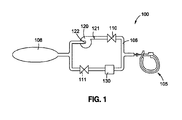
- a gastric banding system 100 includes a gastric band 105, a reservoir 108, a pump 120, a sensor module 130 and flow control devices such as valves 110 and 111.
- Each of the components of the system 100 is implantable in a patient using conventional surgical techniques.
- the reservoir 108, the pump 120, the valves 110 and 111 and the sensor module 130 may be used to replace or complement a conventional access port for adjusting inflation of the gastric band 105.
- the system 100 includes a conventional access port which can be used, for example, with a hypodermic needle, to fill and drain the gastric band 105.
- the pump 120 and the valves 110 and 111 may move precisely metered volumes of a fluid (e.g., saline, a drug, and/or combinations thereof) from the reservoir 108 through the sensor module 130 into the gastric band 105.
- the reservoir 108 may comprise an elastic polymer, a balloon, a rubber container, a silicone container, a collapsible container, a non-elastomeric container, a bellows, and combinations thereof that are configured to contain the fluid.
- Moving the fluid into the gastric band 105 causes inflation of at least one bladder, or inflatable member of the gastric band 105 and constricts around the cardia, or upper portion of the stomach, forming a stoma that restricts the passage of food into a lower portion of the stomach.
- This stoma can provide a patient with a sensation of satiety or fullness that discourages overeating.
- moving the fluid out of at least one inflatable member of the gastric band 105 contracts the pressure around the cardia and allows a stoma to be at least partially released and regains the patient's hunger sensation.
- the valves 110 and 111 can be any flow control device to allow precise delivery of fluid and precise flow rates through the valves in response to inductive powering signals received from a remote transmitter.
- flow control devices as disclosed herein may comprise piezoelectric valves, solenoid valves, membranes, tubes, pressure regulators, ultrasonic flow meters, thermal mechanisms, mass flow sensors, turbines, paddle wheels and combinations thereof.
- the pump 120 may comprise any device for moving fluid through a system.
- the pump 120 may comprise a piezoelectric motor, an electromagnetic motor, an AC motor, a DC motor, a stepper motor and combinations thereof.
- the remote transmitter may also be a wireless receiver and/or transceiver operable to take readings from the flow sensing module 130 to determine the amount of fluid entering and/or exiting the gastric band 105, and/or to send or receive other types of information associated with the gastric banding system 100.
- the remote transmitter provides access to system data and functions and is an external, handheld, reusable battery-powered device.
- the remote transmitter can be made of any rugged plastic material including, polypropylene, cyclicolephin co-polymer, nylon, and other compatible polymers and the like.
- the remote transmitter has a user interface including at least one display and at least one user input. The remote transmitter permits a clinician or a patient to navigate through menu driven screens used for data entry, data collection, and control of gastric banding system 100.
- the remote transmitter is capable of communicating with the gastric banding system 100.
- “Capable of communicating” as used herein refers to the remote transmitter's ability to establish communications with the gastric banding system 100, yet still have the ability to break communication and the systems described herein still function.
- a display shows a searching query for a nearby gastric banding system 100.
- the display shows the strength of the communication link.
- the display shows the serial number (or other unique patient data) of the system so a clinician can verify they have the appropriate patient records in hand.
- the remote transmitter can also display the current volume within the gastric band 105 and indicate the new volume as the gastric band 105 fills.
- the remote transmitter can also indicate desired and actual volumes during the gastric band 105 draining.
- the gastric banding system 100 allows for a remotely controlled adjustment without needles, non-invasively, by using the remote transmitter.
- the presently described systems and apparatus offer several benefits. First, for conventional access ports located under a thick layer of fatty tissue, which is generally the case as the devices are generally used to treat obesity, the access port can be difficult to locate. The present systems reduce or eliminate the need for port location as the use of the remote transmitter removes the necessity of adjustment using a syringe.
- MRI magnetic resonance imaging
- the fluids used within the systems include any fluid that is biocompatible and incompressible.
- the fluid has no adverse effect on the patient in the unlikely event that a leak emanates from the system.
- the fluid can simply be water or any biocompatible polymer oil such as caster oil.
- the fluid is saline, a drug, and/or combinations thereof.
- the tubing 106 connects the various components of the system 100 and comprises any biocompatible flexible tubing that does not degrade in vivo.
- the tubing 106 is configured to withstand hydraulic forces up to hundreds of psi without leakage. This hydraulic pressure tolerance is true of the entire fluid path of the systems described herein. Although the systems described herein do not generally leak, if they do, fluid is generally lost at a rate less than about 0.2cc/yr, for example, between about 0.01 to 0.07 cc/yr.
- components of the gastric banding system 100 may be placed in their respective positions within a patient using common surgical techniques.
- the surgical techniques may be similar to those used in the placement of conventional gastric banding systems.
- the gastric band 105 may be placed around the stomach using laparoscopic techniques, as known to those of skill in the art.
- various components of the gastric banding system 100 may be sutured onto the rectus muscle sheath or any other conveniently accessible muscle.
- the tubing 106 to the gastric band 105 passes through the rectus muscle into the peritoneal cavity in the same manner as the tubing of a conventional access port.
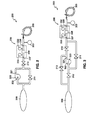
- FIG. 2 illustrates an embodiment of the gastric banding system 200 which comprises a valve 211 and a pump 220 connected in parallel to each other.
- the parallel combination of the valve 211 and the pump 220 is connected in serial with a reservoir 208 on one end and with a valve 210 on the other end.
- the sensor module 230 is connected in serial with the valve 210 and is disposed between the valve 210 and the gastric band 205.
- the sensor module 230 comprises two pressure sensors, flow meters 232 and 233, and/or other devices for measuring a desired property or parameter of the fluid in the gastric banding system 200.
- the sensor module 230 may be configured to measure flow speed/rate, pressure, fill volume, stress, strain, linear position and combinations thereof.
- a calibrated orifice 236 is disposed between the flow meters 232 and 233.
- the sensor module 230 comprises a first inlet/outlet 237 and a second inlet/outlet 238. Because fluid may flow in both directions within the gastric banding system 200, the inlets/outlets 237 and 238 may alternately function as inlets and outlets.
- the valve 210 is coupled to the inlet/outlet 237 for controlling the fluid flow into or out of the gastric band 205.
- a remote transmitter may be utilized to control various components of the gastric banding system 200, should the remote transmitter be unavailable, damaged, out of power, or in the event of an emergency, an adjustment of the gastric band 205 may be performed invasively using a needle.
- an access port 203 (commonly used in other gastric banding systems) may be included in the gastric banding system 205, in addition to the other components illustrated in FIG. 2 .
- the access port may be located between the valve 210 and the gastric band 205.
- a clinician may choose to use a standard needle for adjustments, for example, if any of the electronics associated with the gastric banding system 200 become inoperable. Even if the electronics are unavailable, the access port would be available to adjust the gastric band 205. In the unlikely event that the access port is used, it may be located away from the tubing connection to the gastric band 205 to reduce the potential for tubing needle sticks.
- Information regarding hydraulically adjustable gastric banding systems including subcutaneous fluid access ports/injection ports may be found in Vincent, U.S. Patent No. 5,601,604 ; Kusmack, U.S. Patent No. 5,226,429 ; Birk, U.S. Patent Application Publication No. 2005/0192531 , the disclosure of each of these patents and publications is being incorporated herein in its entirety by this specific reference.
- the pulsatile flow of pumps may produce a quickly varying pressure wave which can affect the accuracy of pressure and flow measurements.
- This high pressure gradient can be reduced and the measurement accuracy can be increased by rearranging existing elements and placing additional elements within the flow path such as a valve membrane, soft tubing, or a specially designed fluidic pressure regulator.
- embodiments of the present invention are configured to speed up the medical procedure of increasing the volume or pressure within a gastric band.
- the various configurations also facilitate decreasing the time required to perform a partial or complete draining of the gastric band.
- embodiments of the present invention provide an implantable device that has an increased efficiency of filling and draining the inflatable portion of the gastric band, with respect to existing implantable pumps.
- the flow sensing module 230 functions both in pumping and draining the gastric band 205 to facilitate measuring the fluid flow rate in both directions.
- the flow sensing module 230 may comprise the pressure sensors 232 and 233 positioned on opposite sides of the calibrated orifice 236.
- the calibrated orifice 236 selected may be designed to accurately control bidirectional fluid flow.
- the flow sensing module 230 and/or the gastric banding system 200 may include ultrasonic flow meters, thermal mechanisms such as mass flow sensors, or mechanical systems such as turbines and paddle wheels.
- FIG. 2 An embodiment as illustrated in FIG. 2 allows the pump 220 to "warm up” or stabilize before proceeding with the transfer of fluid between the reservoir 208 and the gastric band 205.
- the valve 211 connects a pump outlet 221 to a pump inlet 222, and the valve 211 may be opened while the valve 210, to the flow sensing module 230 and the gastric band 205, remains closed. Opening the valve 211 in this manner allows the pump 220 to stabilize. After stabilization, the valve 210 may be opened. Allowing the pump 220 to stabilize before transferring fluid through the flow sensing module 230 facilitates more accurate measurements of the flow conditions of the fluid.
- FIG. 2 in an embodiment as illustrated in FIG.
- valves 312 and 313 may be opened before the valves 310 and 311 are opened so that the pump 320 may stabilize before the fluid is directed through the flow sensing module 330 and into the gastric band 305.
- the valves 312 and 313 may be configured to withstand approximately 30 psi.
- an embodiment of the gastric banding system 300 may be configured to modify the drain rate of the gastric band 305 using the passive and active properties of the pump 320. For example, opening valves 310 and 312 while keeping valves 311 and 313 closed, causes fluid to flow from the gastric band 305 through the deenergized pump 320 to the reservoir 308. This fluid path through the deenergized pump 320 significantly reduces the drain rate from the gastric band 305. Additionally, by opening valves 311 and 313 while keeping valves 310 and 312 closed, and directing the drainage through the deenergized pump 320 in a different direction, the drain rate can be slightly reduced since the one-way valves favor this direction of flow.
- the drain rate can be slightly increased. As the voltage applied to the pump 320 is increased, the drain flow rate from the gastric band 305 to the reservoir 308 is also increased. This property may be advantageous, for example, when the gastric band 305 contains too little pressure to drain at a desired rate.
- the gastric banding systems 200 and 300 are configured to obtain an overall lower leak rate because of their arrangement.
- the arrangement may be adjusted by placing a valve between the flow sensing modules 230 and 330 and the gastric bands 205 and 305.
- Such embodiments facilitate reducing the flow rate from the various pumps because the fluid is pumped through the flow resistance caused by the flow sensing modules 230 and 330.
- one embodiment comprises an implantable pump 440 that includes an integrated chamber or reservoir 452 configured to contain a fluid.
- the reservoir 452 may comprise an elastic polymer, a balloon, a rubber container, a silicone container, a collapsible container, a non-elastomeric container, a bellows, and combinations thereof that are configured to contain the fluid.
- the pump 440 further comprises a motor 444 that drives a piston 442 via a leadscrew 446 to cause fluid to exit and/or enter a chamber 452 via a fluid port 454.
- the pump 440 may be referred to herein as an implantable, motorized piston pump.
- the leadscrew 446 may comprise a screw, a rod, combinations thereof and/or other structure capable of driving the piston 442 using the motor 444.
- the leadscrew 446 may comprise a smooth portion and a textured portion to facilitate moving the piston 442 by translational movement.
- the pump 440 may be utilized in connection with filling and draining a gastric band, it should be understood that the pump 440 has other uses contemplated within the scope of this disclosure. For example, there are many medical situations where the pump 440 may be employed, where it is useful to move the fluid from one place within the body to another place within the body, such as in drug delivery and the modulation of artificial sphincters.
- the motor 444 uses electrical energy to turn a gear which moves the leadscrew 446 back and forth to move the piston 442.
- the piston 442 and a seal 448 are tightly coupled to and housed within a block 450.
- the space bounded by the piston 442 and the interior of the block 450 forms a chamber 452, the volume of which contracts and expands as the piston 442 moves within the block 450.
- the motor 444 may comprises any system or device capable of developing linear and/or rotary motion.
- Linear motors such as piezoelectric linear motors or electromagnetic linear motors may be used to directly drive the piston.
- an armature may be used to move the piston 442, which does not have the helical shape of the leadscrew 446.
- a non-electromagnetic and/or non-magnetic linear drive motor may be used.
- a rotary drive motor may be geared to provide the desired linear motion.
- Rotary motors such as AC, DC, stepper, or piezoelectric motors can be used to drive a gear system which, in turn, moves the piston 442.
- the gear system may be any style which is capable of converting rotational motion into linear motion, and examples include a leadscrew, a ball screw, a jack screw, a rod, and combinations thereof.
- the leadscrew 446 may rotate and/or translate with respect to the outer casing of the motor 444 since the gear system may be located between the motor 444 and the leadscrew 446 or between the leadscrew 446 and the piston 442.
- the piston 442 is configured to use the motion of the leadscrew 446 to apply force on the fluid in the reservoir 452.
- the piston 442 may be of any cross-sectional shape, including circular, annular, triangular and/or other shapes.
- the piston 442 may act directly on the fluid by utilizing a seal 448 and/or a wiper.
- a piston 542 may act indirectly on the fluid if it pushes on a container 558 such as an elastic balloon, an inelastic bladder, a bellows, and combinations thereof. If the piston acts on the container 558, a seal may not be required and/or the piston may act on the container to move the fluid without a seal. However, a seal may be utilized in connection with the container 558.
- a container 558 such as an elastic balloon, an inelastic bladder, a bellows, and combinations thereof.
- the piston 442 (542) and/or the seal 448 may have a flat face or a tapered face depending on the desired flow properties and the available space for pump 440 (540).
- Flow properties and/or device size may also determine if the fluid port 454 (554) is placed within the block 450 (550) in-line with the center of piston 442 (542) or off-axis from the center of piston 442 (542). Additionally, as will be discussed further below, fluid port 454 (554) may be placed within piston 442 (542) to obtain a different set of operating parameters and/or properties.
- the various components of the pumps disclosed herein are configured to pump a fluid into a gastric band.
- the pistons and/or seals are configured to move within the pump in a manner that causes the fluid to be expelled from the reservoir.
- Tolerances may be tighter or looser than those illustrated in the figures without departing from the scope of the present invention.
- other tolerances, materials, seals, lubricants, components and/or combinations thereof may be utilized to obtain the desired pumping characteristics.
- the pump may not include a seal between the piston and the filling reservoir.
- the orientation or configuration of the motor 444 and the piston 442 may affect function and/or size of the pump 440.
- the load of the piston 442 which is inline with the motor 444, produces a symmetrical distribution of forces.
- An alternate embodiment includes a configuration where the motor 444 is placed off axis to the piston 442. This configuration results in an asymmetric loading of the piston 442.
- the motor 444, the gearing, and the leadscrew 446 can be connected to the piston 442 in a way to match certain characteristics to the mechanical system by pulling and/or pushing the piston 442 or to obtain substantially equal pushing and pulling forces.
- a return spring may be utilized to assist the movement of the piston 442 into or out of the block 450.
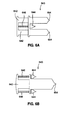
- FIG. 4 illustrates the pump 440 having one motor and one piston
- FIG. 6A illustrates an embodiment with two pistons 642 and one motor 644 and one leadscrew 646.
- FIG. 6B illustrates an embodiment with one piston 642 and two motors 644 and two leadscrews 646.
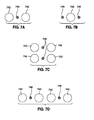
- FIGS. 7A-7H illustrate various other combinations of the pistons 742 and the leadscrews 746 according to embodiments of the present invention.
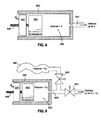
- the total volume (V) which is moved by the piston 842 may reside within the reservoir 852.
- the volume pumped by the system may be any part of the total volume V, but not more than V.
- one embodiment facilitates delivering more than the volume (V 1 ) of fluid contained in the reservoir 952.
- flow control devices such as valves 960 and 961 and the external reservoir 964 having a volume (V 2 ) may be added to the system, and the total amount which can be delivered (e.g., V 1 + V 2 ) can be greater than the volume of the reservoir 952.
- the reservoir 952 and/or the external reservoir 964 may comprise an elastic polymer, a balloon, a rubber container, a silicone container, a collapsible container, a non-elastomeric container, a bellows and combinations thereof that are configured to contain the fluid.
- the reservoir 952 has a volume of between approximately 0.1-5 cc (preferably approximately 1 cc)
- the external reservoir 964 has a volume of between approximately 1-10 cc (preferably approximately 5 cc).
- the piston 942 can reciprocate within the block 950 in order to drain or fill the external reservoir 964.
- the piston 942 can reciprocate within the block 950 in order to drain or fill the gastric band.
- the motorized piston pump system is reversible.
- fluid may be driven out of the reservoir 852 by driving the piston 842 through the block 850 toward the inlet/outlet 854, and the fluid can be returned into the reservoir 852 by pulling the piston 842 out of the block 850 away from the inlet/outlet 854.
- valves 960 and 961 and the piston 942 may be sequenced, as discussed above, so that the fluid flows into or out of the reservoir 952.
- various embodiments disclosed herein comprise a motor that is located outside of the fluid path which it is used to pump (see, e.g., FIG. 4 where piston 442 pumps the fluid in the reservoir 452).
- the motor may be configured to function within a fluid environment, and may be positioned in contact with or surrounded by the fluid.
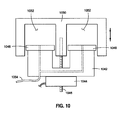
- the inlet/outlet port 1054 may be placed within the piston 1042, as compared to within the block 950 as illustrated in FIG. 9 .
- the location of the port within the piston or the block may be determined by certain performance requirements. For example, if the fluid connection(s) is/are routed out of the same assembly that holds the motor, both the fluid connection(s) and the electrical connection(s) to the motor can remain stationary and be less susceptible to bending fatigue, as illustrated in FIG. 10 .
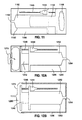
- FIG. 11 when an internal element (such as a piston 1142) moves within a casing 1186, the friction or resistive forces may be reduced by interposing low friction or lubricious materials between the moving surfaces. Additionally, the friction may be reduced by including fluid- or air-filled spaces between the moving surfaces of the pump and casing components.
- an internal element such as a piston 1142
- the friction or resistive forces may be reduced by interposing low friction or lubricious materials between the moving surfaces. Additionally, the friction may be reduced by including fluid- or air-filled spaces between the moving surfaces of the pump and casing components.
- various embodiments comprise one or more of a flexible housing, an internal equalizer, or a reduced volume change in the piston block 1150 and/or in casing 1186.
- a rigid housing may be converted to a flexible housing and then any changes in the internal volume will cause corresponding volume changes within the housing.
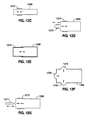
- FIGS. 12A-12G illustrate various embodiments for adapting an external housing 1250 to include flexible structures.
- the flexible structures can be constructed either from metal or polymeric material.
- FIG. 12A illustrates a volume transfer bladder 1270 that is partially located within and without the casing 1286. As the piston 1242 moves in the block 1250, the volume transfer bladder 1270 enters or exits the casing 1286 to compensate for the change in volume.
- part of the casing 1286 may comprise a flexible portion 1275 that expands and contracts as the piston 1242 moves within the block 1250.
- the overall length of the casing 1286 may be configured to change to compensate for the change in volume.
- a first set of bellows 1272 may be utilized to facilitate the change in length of the casing 1286.
- the first set of bellows 1272 may be used in conjunction with a second set of bellows 1273 that moves in opposition to the first set of bellows 1272.
- the first set of bellows 1272 may be utilized in connection with an elongating balloon 1277 that extends from or retracts into the casing 1286 depending on the motion of the piston.
- one embodiment includes a sliding segment 1274 that slides with respect to the casing 1286 in response to motion of the piston. Such motion allows the volume of the casing 1286 to change as fluid exits or enters the reservoir of the pump. Utilizing sliding components may improve the system's resistance to fatigue and failure.
- the casing 1286 may comprise at least one flexible segment 1276 that expands or contracts in response to motion of the piston.
- an internal equalizer mechanism may be used to compensate for a change in volume.
- the casing 1386 may comprise a bladder 1380 with a volume that increases or decreases as the piston 1342 moves within the block 1350.
- the bladder 1380 may be utilized with or without an external reservoir 1364.
- the valves 1360 and 1361 may be alternately opened or closed to control the volume of fluid within the reservoir 1352 and/or the external reservoir 1364, as discussed above with respect to FIG. 9 , to compensate for volume changes due to movement of the piston 1342.
- valve 1361 When the valve 1361 is opened, fluid may be expelled from the reservoir 1352, and the volume change caused by movement of the piston 1342 causes fluid from the external reservoir 1364 to be drawn into the bladder 1380 (see FIG. 13B ). Then, if more fluid is desired within the reservoir 1352, the valve 1361 may be closed and the valve 1360 may be opened to allow fluid to be drawn from the bladder 1380 and/or the external reservoir 1364.
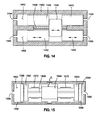
- FIG. 14 Another embodiment configured to compensate for the vacuum/pressure mismatch is illustrated in FIG. 14 , for example, to minimize the parasitic effects of a vacuum.
- Such an embodiment comprises multiple, opposing pistons 1442 and 1443 that are configured to reduce the volume/pressure mismatch by minimizing and/or eliminating the amount of volume change in the motor piston pump.
- the piston 1443 moves away from the inlet/outlet 1455 to compensates for the volume change induced by the movement of the piston 1442.
- two or more pistons 1442 and 1443 to act oppositely for a given motor 144 stroke (e.g., one pumping and one filling), a nearly continuous pumping action may be achieved.
- the inlet/outlet 1455 may be connected to an external reservoir as illustrated in FIGS. 13A-13B , and may operate in conjunction with various valves (also as illustrated in FIGS. 13A-13B ) to facilitate movement of the fluid within the system.
- the opposing pistons 1442 and 1443 facilitate reducing the overall size of the implantable device.
- one embodiment comprises sealed bellows 1572 and 1573 that expand and contract in response to movement of the pistons 1542 and 1543.
- the bellows 1572 and 1573 may be constructed of metal or any other material that facilitates operation of the pump as disclosed herein.
- the rotating parts and electronics may be hermetically sealed.
- two opposing bellows 1572 and 1573 are moved opposite of one another (i.e., one compresses as the other expands), the pressure of the gas or fluid within the sealed system can be kept substantially constant.
- the seals 1548 (and/or bladders as discussed with respect to FIG. 5- flexible bladder 558) may be used to further seal the motor 1544 and/or other electronics or components of the piston pump.
Landscapes
- Health & Medical Sciences (AREA)
- Engineering & Computer Science (AREA)
- Vascular Medicine (AREA)
- Life Sciences & Earth Sciences (AREA)
- Orthopedic Medicine & Surgery (AREA)
- Obesity (AREA)
- Biomedical Technology (AREA)
- Heart & Thoracic Surgery (AREA)
- Child & Adolescent Psychology (AREA)
- Nursing (AREA)
- Animal Behavior & Ethology (AREA)
- General Health & Medical Sciences (AREA)
- Public Health (AREA)
- Veterinary Medicine (AREA)
- Computer Networks & Wireless Communication (AREA)
- Surgical Instruments (AREA)
- Prostheses (AREA)
Applications Claiming Priority (2)
| Application Number | Priority Date | Filing Date | Title |
|---|---|---|---|
| US12/705,245 US20110201874A1 (en) | 2010-02-12 | 2010-02-12 | Remotely adjustable gastric banding system |
| EP11704161.6A EP2533732B1 (de) | 2010-02-12 | 2011-02-10 | Fernsteuerbares magenbandsystem |
Related Parent Applications (2)
| Application Number | Title | Priority Date | Filing Date |
|---|---|---|---|
| EP11704161.6A Division-Into EP2533732B1 (de) | 2010-02-12 | 2011-02-10 | Fernsteuerbares magenbandsystem |
| EP11704161.6A Division EP2533732B1 (de) | 2010-02-12 | 2011-02-10 | Fernsteuerbares magenbandsystem |
Publications (1)
| Publication Number | Publication Date |
|---|---|
| EP2907486A1 true EP2907486A1 (de) | 2015-08-19 |
Family
ID=43838294
Family Applications (3)
| Application Number | Title | Priority Date | Filing Date |
|---|---|---|---|
| EP15160040.0A Withdrawn EP2907486A1 (de) | 2010-02-12 | 2011-02-10 | Fernsteuerbares magenbandsystem |
| EP11704161.6A Not-in-force EP2533732B1 (de) | 2010-02-12 | 2011-02-10 | Fernsteuerbares magenbandsystem |
| EP15160045.9A Withdrawn EP2907487A1 (de) | 2010-02-12 | 2011-02-10 | Fernsteuerbares magenbandsystem |
Family Applications After (2)
| Application Number | Title | Priority Date | Filing Date |
|---|---|---|---|
| EP11704161.6A Not-in-force EP2533732B1 (de) | 2010-02-12 | 2011-02-10 | Fernsteuerbares magenbandsystem |
| EP15160045.9A Withdrawn EP2907487A1 (de) | 2010-02-12 | 2011-02-10 | Fernsteuerbares magenbandsystem |
Country Status (3)
| Country | Link |
|---|---|
| US (2) | US20110201874A1 (de) |
| EP (3) | EP2907486A1 (de) |
| WO (1) | WO2011100450A1 (de) |
Families Citing this family (45)
| Publication number | Priority date | Publication date | Assignee | Title |
|---|---|---|---|---|
| US7338433B2 (en) | 2002-08-13 | 2008-03-04 | Allergan, Inc. | Remotely adjustable gastric banding method |
| WO2004019671A2 (en) | 2002-08-28 | 2004-03-11 | Inamed Medical Products Corporation | Fatigue-resistant gastric banding device |
| ATE526887T1 (de) | 2004-01-23 | 2011-10-15 | Allergan Inc | Lösbar befestigbares, einteiliges, verstellbares magenband |
| MXPA06010204A (es) | 2004-03-08 | 2007-03-07 | Endoart Sa | Sistema de cierre para organos tubulares. |
| CA2569043C (en) | 2004-03-18 | 2010-08-17 | Allergan, Inc. | Apparatus and method for volume adjustment of intragastric balloons |
| US8251888B2 (en) | 2005-04-13 | 2012-08-28 | Mitchell Steven Roslin | Artificial gastric valve |
| US8043206B2 (en) | 2006-01-04 | 2011-10-25 | Allergan, Inc. | Self-regulating gastric band with pressure data processing |
| US7798954B2 (en) | 2006-01-04 | 2010-09-21 | Allergan, Inc. | Hydraulic gastric band with collapsible reservoir |
| WO2010042493A1 (en) | 2008-10-06 | 2010-04-15 | Allergan, Inc. | Mechanical gastric band with cushions |
| US20100185049A1 (en) | 2008-10-22 | 2010-07-22 | Allergan, Inc. | Dome and screw valves for remotely adjustable gastric banding systems |
| US8758221B2 (en) | 2010-02-24 | 2014-06-24 | Apollo Endosurgery, Inc. | Source reservoir with potential energy for remotely adjustable gastric banding system |
| US8840541B2 (en) | 2010-02-25 | 2014-09-23 | Apollo Endosurgery, Inc. | Pressure sensing gastric banding system |
| US20110237871A1 (en) | 2010-03-25 | 2011-09-29 | Allergan, Inc. | Controller support apparatus |
| US9044298B2 (en) | 2010-04-29 | 2015-06-02 | Apollo Endosurgery, Inc. | Self-adjusting gastric band |
| US9028394B2 (en) | 2010-04-29 | 2015-05-12 | Apollo Endosurgery, Inc. | Self-adjusting mechanical gastric band |
| US20110270024A1 (en) | 2010-04-29 | 2011-11-03 | Allergan, Inc. | Self-adjusting gastric band having various compliant components |
| US20110270025A1 (en) | 2010-04-30 | 2011-11-03 | Allergan, Inc. | Remotely powered remotely adjustable gastric band system |
| US8517915B2 (en) | 2010-06-10 | 2013-08-27 | Allergan, Inc. | Remotely adjustable gastric banding system |
| US20120059216A1 (en) | 2010-09-07 | 2012-03-08 | Allergan, Inc. | Remotely adjustable gastric banding system |
| US8961393B2 (en) | 2010-11-15 | 2015-02-24 | Apollo Endosurgery, Inc. | Gastric band devices and drive systems |
| US8876694B2 (en) | 2011-12-07 | 2014-11-04 | Apollo Endosurgery, Inc. | Tube connector with a guiding tip |
| US8961394B2 (en) | 2011-12-20 | 2015-02-24 | Apollo Endosurgery, Inc. | Self-sealing fluid joint for use with a gastric band |
| US9579198B2 (en) | 2012-03-01 | 2017-02-28 | Twelve, Inc. | Hydraulic delivery systems for prosthetic heart valve devices and associated methods |
| US9456916B2 (en) | 2013-03-12 | 2016-10-04 | Medibotics Llc | Device for selectively reducing absorption of unhealthy food |
| US9022968B2 (en) * | 2013-01-08 | 2015-05-05 | University Of South Florida | Auto-regulation system for intraocular pressure |
| US9011365B2 (en) | 2013-03-12 | 2015-04-21 | Medibotics Llc | Adjustable gastrointestinal bifurcation (AGB) for reduced absorption of unhealthy food |
| US9067070B2 (en) | 2013-03-12 | 2015-06-30 | Medibotics Llc | Dysgeusia-inducing neurostimulation for modifying consumption of a selected nutrient type |
| EP2967871A4 (de) * | 2013-03-14 | 2016-12-21 | Univ Texas | Implantierbare medizinische vorrichtung und systeme |
| US9814554B2 (en) * | 2013-06-06 | 2017-11-14 | Coloplast A/S | Artificial urinary sphincter system |
| US10765520B2 (en) | 2017-04-05 | 2020-09-08 | Coloplast A/S | Penile implant with a length-adjustable tube |
| US10575950B2 (en) * | 2017-04-18 | 2020-03-03 | Twelve, Inc. | Hydraulic systems for delivering prosthetic heart valve devices and associated methods |
| US10646338B2 (en) | 2017-06-02 | 2020-05-12 | Twelve, Inc. | Delivery systems with telescoping capsules for deploying prosthetic heart valve devices and associated methods |
| AU2018280236B2 (en) | 2017-06-07 | 2024-06-06 | Supira Medical, Inc. | Intravascular fluid movement devices, systems, and methods of use |
| CN107941307B (zh) * | 2017-11-10 | 2021-02-26 | 西安航天动力试验技术研究所 | 一种常规大型液体发动机推进剂流量现场校准系统及方法 |
| EP3710076B1 (de) | 2017-11-13 | 2023-12-27 | Shifamed Holdings, LLC | Intravaskuläre fluidbewegungsvorrichtungen, systeme und verwendungsverfahren |
| EP4085965A1 (de) | 2018-02-01 | 2022-11-09 | Shifamed Holdings, LLC | Intravaskuläre blutpumpen und verfahren zur verwendung und herstellung |
| US12161857B2 (en) | 2018-07-31 | 2024-12-10 | Shifamed Holdings, Llc | Intravascular blood pumps and methods of use |
| US12220570B2 (en) | 2018-10-05 | 2025-02-11 | Shifamed Holdings, Llc | Intravascular blood pumps and methods of use |
| WO2021011473A1 (en) | 2019-07-12 | 2021-01-21 | Shifamed Holdings, Llc | Intravascular blood pumps and methods of manufacture and use |
| US11654275B2 (en) | 2019-07-22 | 2023-05-23 | Shifamed Holdings, Llc | Intravascular blood pumps with struts and methods of use and manufacture |
| EP4010046A4 (de) | 2019-08-07 | 2023-08-30 | Calomeni, Michael | Katheterblutpumpen und zusammenklappbare pumpengehäuse |
| US11724089B2 (en) | 2019-09-25 | 2023-08-15 | Shifamed Holdings, Llc | Intravascular blood pump systems and methods of use and control thereof |
| EP4501393A3 (de) | 2019-09-25 | 2025-04-09 | Shifamed Holdings, LLC | Katheterblutpumpen und zusammenklappbare pumpengehäuse |
| EP4034184B1 (de) | 2019-09-25 | 2026-03-18 | Supira Medical, Inc. | Katheterblutpumpen und kollabierbare blutleitungen |
| EP4072650A4 (de) | 2019-12-11 | 2024-01-10 | Shifamed Holdings, LLC | Absteigende aorten- und hohlvenenblutpumpen |
Citations (12)
| Publication number | Priority date | Publication date | Assignee | Title |
|---|---|---|---|---|
| DE3420865C1 (de) * | 1984-06-05 | 1985-08-29 | B. Braun Melsungen Ag, 3508 Melsungen | Infusionsspritzenpumpe |
| US4883467A (en) | 1987-04-22 | 1989-11-28 | Siemens Aktiengesellschaft | Reciprocating pump for an implantable medication dosage device |
| US5226429A (en) | 1991-06-20 | 1993-07-13 | Inamed Development Co. | Laparoscopic gastric band and method |
| US5259339A (en) | 1992-07-16 | 1993-11-09 | Mclaughlin Brian D | Container for treating animals |
| US5360445A (en) | 1991-11-06 | 1994-11-01 | International Business Machines Corporation | Blood pump actuator |
| US5601604A (en) | 1993-05-27 | 1997-02-11 | Inamed Development Co. | Universal gastric band |
| US5676162A (en) | 1992-08-06 | 1997-10-14 | Electric Boat Corporation | Reciprocating pump and linear motor arrangement |
| WO2004014245A1 (en) * | 2002-08-13 | 2004-02-19 | Inamed Medical Products Corporation | Remotely adjustable gastric banding device and method |
| US20050192531A1 (en) | 2002-08-28 | 2005-09-01 | Janel Birk | Fatigue-resistant gastric banding device |
| US7374565B2 (en) | 2004-05-28 | 2008-05-20 | Ethicon Endo-Surgery, Inc. | Bi-directional infuser pump with volume braking for hydraulically controlling an adjustable gastric band |
| EP2095796A1 (de) * | 2008-02-26 | 2009-09-02 | Ethicon Endo-Surgery, Inc. | Kontrollieren des Drucks in justierbarer Drosselungsvorrichtung |
| US20100010291A1 (en) | 2008-07-14 | 2010-01-14 | Allergan, Inc. | Implantable pump system with calibration |
Family Cites Families (96)
| Publication number | Priority date | Publication date | Assignee | Title |
|---|---|---|---|---|
| US2163048A (en) * | 1937-02-13 | 1939-06-20 | Mckee Brothers Corp | Band clamp |
| BE758322A (fr) * | 1969-11-03 | 1971-04-01 | Bosch Gmbh Robert | Dispositif pour l'essuyage des glaces telles que glaces de phares et defeux arriere de vehicules automobiles |
| US4157713A (en) * | 1977-05-11 | 1979-06-12 | Clarey Michael T | Air-pressure splint |
| US4450375A (en) * | 1982-11-12 | 1984-05-22 | Kiwi Coders Corporation | Piezoelectric fluid control device |
| IL67773A (en) * | 1983-01-28 | 1985-02-28 | Antebi E | Tie for tying live tissue and an instrument for performing said tying operation |
| US4592339A (en) * | 1985-06-12 | 1986-06-03 | Mentor Corporation | Gastric banding device |
| US4671351A (en) * | 1985-07-17 | 1987-06-09 | Vertech Treatment Systems, Inc. | Fluid treatment apparatus and heat exchanger |
| US5120313A (en) * | 1986-03-28 | 1992-06-09 | Nancy W. Elftman | Method for measuring blood pressure in an animal or human using a percutaneous access port |
| US5089019A (en) * | 1989-12-06 | 1992-02-18 | Medtronic, Inc. | Muscle work output monitor by intramuscular temperature variation measurement |
| US5449368A (en) * | 1993-02-18 | 1995-09-12 | Kuzmak; Lubomyr I. | Laparoscopic adjustable gastric banding device and method for implantation and removal thereof |
| US5496312A (en) * | 1993-10-07 | 1996-03-05 | Valleylab Inc. | Impedance and temperature generator control |
| SE9303319D0 (sv) * | 1993-10-11 | 1993-10-11 | Gambro Ab | Sätt att beräkna och/eller styra flöder under en viss tidsperiod genom en peristaltisk pump samt en monitor anpassad för utövning av detta sätt |
| SG44800A1 (en) * | 1993-12-28 | 1997-12-19 | Westonbridge Int Ltd | A micropump |
| JP3707822B2 (ja) * | 1995-03-23 | 2005-10-19 | 富士写真フイルム株式会社 | 画像表示装置 |
| WO1997030565A1 (en) * | 1996-02-15 | 1997-08-21 | Neukermans Armand P | Improved biocompatible transducers |
| US5766232A (en) * | 1996-05-10 | 1998-06-16 | Medtronic, Inc. | Method and apparatus for altering the Q of an implantable medical device telemetry antenna |
| US6024340A (en) * | 1996-12-04 | 2000-02-15 | Active Control Experts, Inc. | Valve assembly |
| US6042345A (en) * | 1997-04-15 | 2000-03-28 | Face International Corporation | Piezoelectrically actuated fluid pumps |
| US5938669A (en) * | 1997-05-07 | 1999-08-17 | Klasamed S.A. | Adjustable gastric banding device for contracting a patient's stomach |
| US5861017A (en) * | 1997-06-06 | 1999-01-19 | Shriners Hospitals For Children | Portable functional electrical stimulation (FES) system for upper or lower extremity applications |
| US5910149A (en) * | 1998-04-29 | 1999-06-08 | Kuzmak; Lubomyr I. | Non-slipping gastric band |
| US6024704A (en) * | 1998-04-30 | 2000-02-15 | Medtronic, Inc | Implantable medical device for sensing absolute blood pressure and barometric pressure |
| US6074341A (en) * | 1998-06-09 | 2000-06-13 | Timm Medical Technologies, Inc. | Vessel occlusive apparatus and method |
| US6221024B1 (en) * | 1998-07-20 | 2001-04-24 | Medtronic, Inc. | Implantable pressure sensor and method of fabrication |
| US6210347B1 (en) * | 1998-08-13 | 2001-04-03 | Peter Forsell | Remote control food intake restriction device |
| US6067991A (en) * | 1998-08-13 | 2000-05-30 | Forsell; Peter | Mechanical food intake restriction device |
| FR2783153B1 (fr) * | 1998-09-14 | 2000-12-01 | Jerome Dargent | Dispositif de constriction gastrique |
| IL129032A (en) * | 1999-03-17 | 2006-12-31 | Moshe Dudai | Stomach strap |
| DE19931990C1 (de) * | 1999-07-09 | 2001-01-11 | Festo Ag & Co | Elektroventil |
| US6454699B1 (en) * | 2000-02-11 | 2002-09-24 | Obtech Medical Ag | Food intake restriction with controlled wireless energy supply |
| US6482145B1 (en) * | 2000-02-14 | 2002-11-19 | Obtech Medical Ag | Hydraulic anal incontinence treatment |
| US6450173B1 (en) * | 1999-08-12 | 2002-09-17 | Obtech Medical Ag | Heartburn and reflux disease treatment with controlled wireless energy supply |
| US7204821B1 (en) * | 2000-01-31 | 2007-04-17 | Ethicon, Inc. | Surgical fluid management system with suction control |
| US6691047B1 (en) * | 2000-03-16 | 2004-02-10 | Aksys, Ltd. | Calibration of pumps, such as blood pumps of dialysis machine |
| US6685668B1 (en) * | 2000-07-31 | 2004-02-03 | Abbott Laboratories | Closed-loop IV fluid flow control |
| US7198250B2 (en) * | 2000-09-18 | 2007-04-03 | Par Technologies, Llc | Piezoelectric actuator and pump using same |
| WO2002026317A1 (en) * | 2000-09-26 | 2002-04-04 | Transneuronix, Inc. | Method and apparatus for treating obesity by electrical stimulation of the gastrointestinal tract using sensed activity |
| US6527701B1 (en) * | 2000-09-29 | 2003-03-04 | Precision Medical Devices, Inc. | Body fluid flow control device |
| US6871090B1 (en) * | 2000-10-13 | 2005-03-22 | Advanced Bionics Corporation | Switching regulator for implantable spinal cord stimulation |
| US6681135B1 (en) * | 2000-10-30 | 2004-01-20 | Medtronic, Inc. | System and method for employing temperature measurements to control the operation of an implantable medical device |
| ATE386560T1 (de) * | 2000-11-03 | 2008-03-15 | Allergan Medical S A | Implantierbare medizinische vorrichtung zum abgeben einer flüssigkeit |
| US6579301B1 (en) * | 2000-11-17 | 2003-06-17 | Syntheon, Llc | Intragastric balloon device adapted to be repeatedly varied in volume without external assistance |
| JP4246492B2 (ja) * | 2001-01-05 | 2009-04-02 | メタキュアー ナームロゼ フェンノートシャップ | 摂食習慣の規制 |
| US6889086B2 (en) * | 2001-04-06 | 2005-05-03 | Cardiac Pacemakers, Inc. | Passive telemetry system for implantable medical device |
| US6511490B2 (en) * | 2001-06-22 | 2003-01-28 | Antoine Jean Henri Robert | Gastric banding device and method |
| DE10139857B4 (de) * | 2001-08-14 | 2009-09-10 | Robert Bosch Gmbh | Ventil zum Steuern von Flüssigkeiten |
| DE10161888A1 (de) * | 2001-08-14 | 2003-02-27 | Continental Teves Ag & Co Ohg | Piezoelektrisch betätigtes Fluidventil |
| US6659937B2 (en) * | 2001-10-11 | 2003-12-09 | M. Sheldon Polsky | Continent bladder access device |
| US6892095B2 (en) * | 2001-12-31 | 2005-05-10 | Cardiac Pacemakers, Inc. | Method and apparatus for monitoring left ventricular work or power |
| EP1343112A1 (de) * | 2002-03-08 | 2003-09-10 | EndoArt S.A. | Implantierbare Vorrichtung |
| US7040349B2 (en) * | 2002-03-27 | 2006-05-09 | Viking Technologies, L.C. | Piezo-electric actuated multi-valve manifold |
| ES2291405T3 (es) * | 2002-09-04 | 2008-03-01 | Endoart S.A. | Anillo quirurgico provisto de un sistema de mando a distancia y reversible en la variacion de su diametro. |
| US7216648B2 (en) * | 2002-09-06 | 2007-05-15 | Apneon, Inc. | Systems and methods for moving and/or restraining tissue in the upper respiratory system |
| US7037344B2 (en) * | 2002-11-01 | 2006-05-02 | Valentx, Inc. | Apparatus and methods for treatment of morbid obesity |
| US7844338B2 (en) * | 2003-02-03 | 2010-11-30 | Enteromedics Inc. | High frequency obesity treatment |
| US7048519B2 (en) * | 2003-04-14 | 2006-05-23 | Agilent Technologies, Inc. | Closed-loop piezoelectric pump |
| US20050002984A1 (en) * | 2003-06-27 | 2005-01-06 | Byrum Randal T. | Implantable band with attachment mechanism having dissimilar material properties |
| US7500944B2 (en) * | 2003-06-27 | 2009-03-10 | Ethicon Endo-Surgery, Inc. | Implantable band with attachment mechanism |
| US7530943B2 (en) * | 2003-07-25 | 2009-05-12 | Wolfgang Lechner | Adjustable stomach band |
| US9498366B2 (en) * | 2003-07-28 | 2016-11-22 | Baronova, Inc. | Devices and methods for pyloric anchoring |
| US7608086B2 (en) * | 2003-09-30 | 2009-10-27 | Ethicon Endo-Surgery, Inc. | Anastomosis wire ring device |
| US20050070937A1 (en) * | 2003-09-30 | 2005-03-31 | Jambor Kristin L. | Segmented gastric band |
| ATE526887T1 (de) * | 2004-01-23 | 2011-10-15 | Allergan Inc | Lösbar befestigbares, einteiliges, verstellbares magenband |
| WO2006049725A2 (en) * | 2004-03-23 | 2006-05-11 | Minimus Surgical Systems | Surgical systems and devices to enhance gastric restriction therapies |
| US7255675B2 (en) * | 2004-03-23 | 2007-08-14 | Michael Gertner | Devices and methods to treat a patient |
| US7481763B2 (en) * | 2004-05-28 | 2009-01-27 | Ethicon Endo-Surgery, Inc. | Metal bellows position feedback for hydraulic control of an adjustable gastric band |
| US7351240B2 (en) * | 2004-05-28 | 2008-04-01 | Ethicon Endo—Srugery, Inc. | Thermodynamically driven reversible infuser pump for use as a remotely controlled gastric band |
| US7351198B2 (en) * | 2004-06-02 | 2008-04-01 | Ethicon Endo-Surgery, Inc. | Implantable adjustable sphincter system |
| US7191007B2 (en) * | 2004-06-24 | 2007-03-13 | Ethicon Endo-Surgery, Inc | Spatially decoupled twin secondary coils for optimizing transcutaneous energy transfer (TET) power transfer characteristics |
| US20060041183A1 (en) * | 2004-08-20 | 2006-02-23 | Massen Richard J | Electromechanical machine-based artificial muscles, bio-valves and related devices |
| US7776061B2 (en) * | 2004-09-28 | 2010-08-17 | Garner Dean L | Fluid adjustable band |
| US20070078476A1 (en) * | 2004-10-12 | 2007-04-05 | Hull Wendell C Sr | Overweight control apparatuses for insertion into the stomach |
| US7366571B2 (en) * | 2004-12-10 | 2008-04-29 | Cyberonics, Inc. | Neurostimulator with activation based on changes in body temperature |
| US7658196B2 (en) * | 2005-02-24 | 2010-02-09 | Ethicon Endo-Surgery, Inc. | System and method for determining implanted device orientation |
| US20080009680A1 (en) * | 2005-06-24 | 2008-01-10 | Hassler William L Jr | Remote monitoring and adjustment of a food intake restriction device |
| US7927270B2 (en) * | 2005-02-24 | 2011-04-19 | Ethicon Endo-Surgery, Inc. | External mechanical pressure sensor for gastric band pressure measurements |
| US7699770B2 (en) * | 2005-02-24 | 2010-04-20 | Ethicon Endo-Surgery, Inc. | Device for non-invasive measurement of fluid pressure in an adjustable restriction device |
| AT501281B8 (de) * | 2005-04-11 | 2007-02-15 | Wolfgang Dr Lechner | Steuerbares magenband |
| US7319316B2 (en) * | 2005-06-29 | 2008-01-15 | Lam Research Corporation | Apparatus for measuring a set of electrical characteristics in a plasma |
| US7021147B1 (en) * | 2005-07-11 | 2006-04-04 | General Electric Company | Sensor package and method |
| US20070016262A1 (en) * | 2005-07-13 | 2007-01-18 | Betastim, Ltd. | Gi and pancreatic device for treating obesity and diabetes |
| US8182411B2 (en) * | 2005-07-15 | 2012-05-22 | Ethicon Endo-Surgery, Inc. | Gastric band with mating end profiles |
| US7367937B2 (en) * | 2005-07-15 | 2008-05-06 | Ethicon Endo-Surgey, Inc. | Gastric band |
| US7364542B2 (en) * | 2005-07-15 | 2008-04-29 | Ethicon Endo-Surgery, Inc. | Gastric band suture tab extender |
| US20070015955A1 (en) * | 2005-07-15 | 2007-01-18 | Mark Tsonton | Accordion-like gastric band |
| US7766815B2 (en) * | 2005-07-28 | 2010-08-03 | Ethicon Endo-Surgery, Inc. | Electroactive polymer actuated gastric band |
| US7353747B2 (en) * | 2005-07-28 | 2008-04-08 | Ethicon Endo-Surgery, Inc. | Electroactive polymer-based pump |
| US8043206B2 (en) * | 2006-01-04 | 2011-10-25 | Allergan, Inc. | Self-regulating gastric band with pressure data processing |
| WO2007104356A1 (de) * | 2006-03-13 | 2007-09-20 | Rudolf Steffen | Adaptive einrichtung und adaptives verfahren zur anpassung der magenöffnung eines patienten |
| US8246533B2 (en) * | 2006-10-20 | 2012-08-21 | Ellipse Technologies, Inc. | Implant system with resonant-driven actuator |
| US7862502B2 (en) * | 2006-10-20 | 2011-01-04 | Ellipse Technologies, Inc. | Method and apparatus for adjusting a gastrointestinal restriction device |
| US7530278B2 (en) * | 2006-11-02 | 2009-05-12 | Rivatek, Inc. | Fluid flow blender and methods |
| ES2398974T3 (es) * | 2008-04-23 | 2013-03-25 | Allergan, Inc. | Sistema de aplicación de banda gástrica aujstable a distancia |
| WO2010042493A1 (en) * | 2008-10-06 | 2010-04-15 | Allergan, Inc. | Mechanical gastric band with cushions |
| US9364362B2 (en) * | 2008-10-21 | 2016-06-14 | General Electric Company | Implantable device system |
| US8366602B2 (en) * | 2008-10-22 | 2013-02-05 | Allergan, Inc. | Electrically activated valve for implantable fluid handling system |
-
2010
- 2010-02-12 US US12/705,245 patent/US20110201874A1/en not_active Abandoned
-
2011
- 2011-02-10 EP EP15160040.0A patent/EP2907486A1/de not_active Withdrawn
- 2011-02-10 EP EP11704161.6A patent/EP2533732B1/de not_active Not-in-force
- 2011-02-10 EP EP15160045.9A patent/EP2907487A1/de not_active Withdrawn
- 2011-02-10 WO PCT/US2011/024375 patent/WO2011100450A1/en not_active Ceased
-
2013
- 2013-08-27 US US14/011,377 patent/US20130345500A1/en not_active Abandoned
Patent Citations (12)
| Publication number | Priority date | Publication date | Assignee | Title |
|---|---|---|---|---|
| DE3420865C1 (de) * | 1984-06-05 | 1985-08-29 | B. Braun Melsungen Ag, 3508 Melsungen | Infusionsspritzenpumpe |
| US4883467A (en) | 1987-04-22 | 1989-11-28 | Siemens Aktiengesellschaft | Reciprocating pump for an implantable medication dosage device |
| US5226429A (en) | 1991-06-20 | 1993-07-13 | Inamed Development Co. | Laparoscopic gastric band and method |
| US5360445A (en) | 1991-11-06 | 1994-11-01 | International Business Machines Corporation | Blood pump actuator |
| US5259339A (en) | 1992-07-16 | 1993-11-09 | Mclaughlin Brian D | Container for treating animals |
| US5676162A (en) | 1992-08-06 | 1997-10-14 | Electric Boat Corporation | Reciprocating pump and linear motor arrangement |
| US5601604A (en) | 1993-05-27 | 1997-02-11 | Inamed Development Co. | Universal gastric band |
| WO2004014245A1 (en) * | 2002-08-13 | 2004-02-19 | Inamed Medical Products Corporation | Remotely adjustable gastric banding device and method |
| US20050192531A1 (en) | 2002-08-28 | 2005-09-01 | Janel Birk | Fatigue-resistant gastric banding device |
| US7374565B2 (en) | 2004-05-28 | 2008-05-20 | Ethicon Endo-Surgery, Inc. | Bi-directional infuser pump with volume braking for hydraulically controlling an adjustable gastric band |
| EP2095796A1 (de) * | 2008-02-26 | 2009-09-02 | Ethicon Endo-Surgery, Inc. | Kontrollieren des Drucks in justierbarer Drosselungsvorrichtung |
| US20100010291A1 (en) | 2008-07-14 | 2010-01-14 | Allergan, Inc. | Implantable pump system with calibration |
Also Published As
| Publication number | Publication date |
|---|---|
| EP2533732B1 (de) | 2015-11-04 |
| EP2533732A1 (de) | 2012-12-19 |
| EP2907487A1 (de) | 2015-08-19 |
| US20110201874A1 (en) | 2011-08-18 |
| WO2011100450A1 (en) | 2011-08-18 |
| US20130345500A1 (en) | 2013-12-26 |
Similar Documents
| Publication | Publication Date | Title |
|---|---|---|
| EP2533732B1 (de) | Fernsteuerbares magenbandsystem | |
| US8517915B2 (en) | Remotely adjustable gastric banding system | |
| US8678993B2 (en) | Remotely adjustable gastric banding system | |
| US8142452B2 (en) | Controlling pressure in adjustable restriction devices | |
| EP2095796B1 (de) | Kontrollieren des Drucks in justierbarer Drosselungsvorrichtung | |
| JP5318859B2 (ja) | 萎み可能な容器を備えた液圧式の胃バンド | |
| US8845513B2 (en) | Remotely adjustable gastric banding device | |
| US20100185049A1 (en) | Dome and screw valves for remotely adjustable gastric banding systems | |
| US9050165B2 (en) | Remotely adjustable gastric banding system | |
| US9226840B2 (en) | Magnetically coupled implantable pump system and method | |
| HK1137325B (en) | Controlling pressure in adjustable restriction device |
Legal Events
| Date | Code | Title | Description |
|---|---|---|---|
| PUAI | Public reference made under article 153(3) epc to a published international application that has entered the european phase |
Free format text: ORIGINAL CODE: 0009012 |
|
| AC | Divisional application: reference to earlier application |
Ref document number: 2533732 Country of ref document: EP Kind code of ref document: P |
|
| AK | Designated contracting states |
Kind code of ref document: A1 Designated state(s): AL AT BE BG CH CY CZ DE DK EE ES FI FR GB GR HR HU IE IS IT LI LT LU LV MC MK MT NL NO PL PT RO RS SE SI SK SM TR |
|
| RIN1 | Information on inventor provided before grant (corrected) |
Inventor name: TEZEL, AHMET Inventor name: LESLIE, DUSTIN B. Inventor name: BIRK, JANEL Inventor name: SNOW, SEAN |
|
| 17P | Request for examination filed |
Effective date: 20160119 |
|
| RBV | Designated contracting states (corrected) |
Designated state(s): AL AT BE BG CH CY CZ DE DK EE ES FI FR GB GR HR HU IE IS IT LI LT LU LV MC MK MT NL NO PL PT RO RS SE SI SK SM TR |
|
| STAA | Information on the status of an ep patent application or granted ep patent |
Free format text: STATUS: THE APPLICATION HAS BEEN WITHDRAWN |
|
| 18W | Application withdrawn |
Effective date: 20160314 |