EP2906577B1 - Anthracyclin-derivate zur behandlung von tumorerkrankungen - Google Patents
Anthracyclin-derivate zur behandlung von tumorerkrankungen Download PDFInfo
- Publication number
- EP2906577B1 EP2906577B1 EP13779194.3A EP13779194A EP2906577B1 EP 2906577 B1 EP2906577 B1 EP 2906577B1 EP 13779194 A EP13779194 A EP 13779194A EP 2906577 B1 EP2906577 B1 EP 2906577B1
- Authority
- EP
- European Patent Office
- Prior art keywords
- general formula
- group
- formula
- compounds
- hydrogen atom
- Prior art date
- Legal status (The legal status is an assumption and is not a legal conclusion. Google has not performed a legal analysis and makes no representation as to the accuracy of the status listed.)
- Not-in-force
Links
- 206010028980 Neoplasm Diseases 0.000 title claims description 7
- STQGQHZAVUOBTE-VGBVRHCVSA-N daunorubicin Chemical class O([C@H]1C[C@@](O)(CC=2C(O)=C3C(=O)C=4C=CC=C(C=4C(=O)C3=C(O)C=21)OC)C(C)=O)[C@H]1C[C@H](N)[C@H](O)[C@H](C)O1 STQGQHZAVUOBTE-VGBVRHCVSA-N 0.000 title description 2
- 150000001875 compounds Chemical class 0.000 claims description 74
- 125000004435 hydrogen atom Chemical group [H]* 0.000 claims description 54
- 125000002887 hydroxy group Chemical group [H]O* 0.000 claims description 40
- 125000000956 methoxy group Chemical group [H]C([H])([H])O* 0.000 claims description 38
- 229940045799 anthracyclines and related substance Drugs 0.000 claims description 32
- 125000000217 alkyl group Chemical group 0.000 claims description 29
- 239000000460 chlorine Substances 0.000 claims description 23
- 239000001257 hydrogen Substances 0.000 claims description 23
- 229910052739 hydrogen Inorganic materials 0.000 claims description 23
- 238000006243 chemical reaction Methods 0.000 claims description 21
- 125000002496 methyl group Chemical group [H]C([H])([H])* 0.000 claims description 21
- 235000000346 sugar Nutrition 0.000 claims description 21
- WKBOTKDWSSQWDR-UHFFFAOYSA-N Bromine atom Chemical compound [Br] WKBOTKDWSSQWDR-UHFFFAOYSA-N 0.000 claims description 17
- PXGOKWXKJXAPGV-UHFFFAOYSA-N Fluorine Chemical compound FF PXGOKWXKJXAPGV-UHFFFAOYSA-N 0.000 claims description 17
- 229910052801 chlorine Inorganic materials 0.000 claims description 17
- 238000000034 method Methods 0.000 claims description 17
- 125000004044 trifluoroacetyl group Chemical group FC(C(=O)*)(F)F 0.000 claims description 17
- 125000005843 halogen group Chemical group 0.000 claims description 15
- 125000004432 carbon atom Chemical group C* 0.000 claims description 14
- 229910052760 oxygen Inorganic materials 0.000 claims description 10
- 239000008194 pharmaceutical composition Substances 0.000 claims description 10
- 239000002904 solvent Substances 0.000 claims description 10
- 229910052757 nitrogen Inorganic materials 0.000 claims description 9
- 125000003232 p-nitrobenzoyl group Chemical group [N+](=O)([O-])C1=CC=C(C(=O)*)C=C1 0.000 claims description 9
- 229910052717 sulfur Inorganic materials 0.000 claims description 9
- 125000004404 heteroalkyl group Chemical group 0.000 claims description 8
- TWCMVXMQHSVIOJ-UHFFFAOYSA-N Aglycone of yadanzioside D Natural products COC(=O)C12OCC34C(CC5C(=CC(O)C(O)C5(C)C3C(O)C1O)C)OC(=O)C(OC(=O)C)C24 TWCMVXMQHSVIOJ-UHFFFAOYSA-N 0.000 claims description 7
- PLMKQQMDOMTZGG-UHFFFAOYSA-N Astrantiagenin E-methylester Natural products CC12CCC(O)C(C)(CO)C1CCC1(C)C2CC=C2C3CC(C)(C)CCC3(C(=O)OC)CCC21C PLMKQQMDOMTZGG-UHFFFAOYSA-N 0.000 claims description 7
- IJGRMHOSHXDMSA-UHFFFAOYSA-N Atomic nitrogen Chemical compound N#N IJGRMHOSHXDMSA-UHFFFAOYSA-N 0.000 claims description 7
- 230000004913 activation Effects 0.000 claims description 7
- PFOARMALXZGCHY-UHFFFAOYSA-N homoegonol Natural products C1=C(OC)C(OC)=CC=C1C1=CC2=CC(CCCO)=CC(OC)=C2O1 PFOARMALXZGCHY-UHFFFAOYSA-N 0.000 claims description 7
- 150000002923 oximes Chemical class 0.000 claims description 7
- 125000002252 acyl group Chemical group 0.000 claims description 6
- 125000002947 alkylene group Chemical group 0.000 claims description 6
- 125000000449 nitro group Chemical group [O-][N+](*)=O 0.000 claims description 6
- 230000003647 oxidation Effects 0.000 claims description 6
- 238000007254 oxidation reaction Methods 0.000 claims description 6
- 125000004430 oxygen atom Chemical group O* 0.000 claims description 6
- 239000000126 substance Substances 0.000 claims description 6
- 239000013543 active substance Substances 0.000 claims description 5
- 125000003277 amino group Chemical group 0.000 claims description 5
- 230000002829 reductive effect Effects 0.000 claims description 5
- ZAMOUSCENKQFHK-UHFFFAOYSA-N Chlorine atom Chemical compound [Cl] ZAMOUSCENKQFHK-UHFFFAOYSA-N 0.000 claims description 4
- 150000001412 amines Chemical class 0.000 claims description 4
- GDTBXPJZTBHREO-UHFFFAOYSA-N bromine Substances BrBr GDTBXPJZTBHREO-UHFFFAOYSA-N 0.000 claims description 4
- 229910052794 bromium Inorganic materials 0.000 claims description 4
- 231100000433 cytotoxic Toxicity 0.000 claims description 4
- 230000001472 cytotoxic effect Effects 0.000 claims description 4
- 239000003085 diluting agent Substances 0.000 claims description 4
- 125000005842 heteroatom Chemical group 0.000 claims description 4
- 150000002576 ketones Chemical class 0.000 claims description 4
- 150000001299 aldehydes Chemical group 0.000 claims description 3
- 125000003435 aroyl group Chemical group 0.000 claims description 3
- 201000011510 cancer Diseases 0.000 claims description 3
- 239000003814 drug Substances 0.000 claims description 3
- 238000005858 glycosidation reaction Methods 0.000 claims description 3
- RZVHIXYEVGDQDX-UHFFFAOYSA-N 9,10-anthraquinone Chemical compound C1=CC=C2C(=O)C3=CC=CC=C3C(=O)C2=C1 RZVHIXYEVGDQDX-UHFFFAOYSA-N 0.000 claims description 2
- YTBSYETUWUMLBZ-IMJSIDKUSA-N L-threose Chemical compound OC[C@H](O)[C@@H](O)C=O YTBSYETUWUMLBZ-IMJSIDKUSA-N 0.000 claims description 2
- 230000001028 anti-proliverative effect Effects 0.000 claims description 2
- 150000002009 diols Chemical class 0.000 claims description 2
- 229940079593 drug Drugs 0.000 claims description 2
- 229910052987 metal hydride Inorganic materials 0.000 claims description 2
- 150000004681 metal hydrides Chemical class 0.000 claims description 2
- 230000002062 proliferating effect Effects 0.000 claims description 2
- 150000003214 pyranose derivatives Chemical class 0.000 claims description 2
- 150000003215 pyranoses Chemical class 0.000 claims description 2
- 238000011160 research Methods 0.000 claims description 2
- 238000006467 substitution reaction Methods 0.000 claims description 2
- 238000002560 therapeutic procedure Methods 0.000 claims description 2
- 238000011282 treatment Methods 0.000 claims description 2
- LQNUZADURLCDLV-UHFFFAOYSA-N nitrobenzene Chemical compound [O-][N+](=O)C1=CC=CC=C1 LQNUZADURLCDLV-UHFFFAOYSA-N 0.000 claims 3
- 239000000654 additive Substances 0.000 claims 1
- 239000000758 substrate Substances 0.000 claims 1
- YMWUJEATGCHHMB-UHFFFAOYSA-N Dichloromethane Chemical compound ClCCl YMWUJEATGCHHMB-UHFFFAOYSA-N 0.000 description 87
- XEKOWRVHYACXOJ-UHFFFAOYSA-N Ethyl acetate Chemical compound CCOC(C)=O XEKOWRVHYACXOJ-UHFFFAOYSA-N 0.000 description 81
- WYURNTSHIVDZCO-UHFFFAOYSA-N Tetrahydrofuran Chemical compound C1CCOC1 WYURNTSHIVDZCO-UHFFFAOYSA-N 0.000 description 68
- YXFVVABEGXRONW-UHFFFAOYSA-N Toluene Chemical compound CC1=CC=CC=C1 YXFVVABEGXRONW-UHFFFAOYSA-N 0.000 description 41
- 239000011541 reaction mixture Substances 0.000 description 38
- 235000019439 ethyl acetate Nutrition 0.000 description 37
- HEMHJVSKTPXQMS-UHFFFAOYSA-M Sodium hydroxide Chemical compound [OH-].[Na+] HEMHJVSKTPXQMS-UHFFFAOYSA-M 0.000 description 36
- 239000000203 mixture Substances 0.000 description 29
- 239000012074 organic phase Substances 0.000 description 28
- OKKJLVBELUTLKV-UHFFFAOYSA-N Methanol Chemical compound OC OKKJLVBELUTLKV-UHFFFAOYSA-N 0.000 description 24
- 239000012071 phase Substances 0.000 description 23
- 239000008346 aqueous phase Substances 0.000 description 19
- 125000006239 protecting group Chemical group 0.000 description 19
- -1 aroyl radical Chemical class 0.000 description 18
- UFHFLCQGNIYNRP-UHFFFAOYSA-N Hydrogen Chemical compound [H][H] UFHFLCQGNIYNRP-UHFFFAOYSA-N 0.000 description 16
- JUJWROOIHBZHMG-UHFFFAOYSA-N Pyridine Chemical compound C1=CC=NC=C1 JUJWROOIHBZHMG-UHFFFAOYSA-N 0.000 description 16
- CSCPPACGZOOCGX-UHFFFAOYSA-N Acetone Chemical compound CC(C)=O CSCPPACGZOOCGX-UHFFFAOYSA-N 0.000 description 15
- 239000011737 fluorine Substances 0.000 description 15
- 229910052731 fluorine Inorganic materials 0.000 description 15
- 238000003786 synthesis reaction Methods 0.000 description 15
- FAPWRFPIFSIZLT-UHFFFAOYSA-M Sodium chloride Chemical class [Na+].[Cl-] FAPWRFPIFSIZLT-UHFFFAOYSA-M 0.000 description 14
- 229920006395 saturated elastomer Polymers 0.000 description 14
- 239000011734 sodium Substances 0.000 description 14
- KZBUYRJDOAKODT-UHFFFAOYSA-N Chlorine Chemical group ClCl KZBUYRJDOAKODT-UHFFFAOYSA-N 0.000 description 13
- RTZKZFJDLAIYFH-UHFFFAOYSA-N Diethyl ether Chemical compound CCOCC RTZKZFJDLAIYFH-UHFFFAOYSA-N 0.000 description 13
- 239000007787 solid Substances 0.000 description 12
- LFQSCWFLJHTTHZ-UHFFFAOYSA-N Ethanol Chemical compound CCO LFQSCWFLJHTTHZ-UHFFFAOYSA-N 0.000 description 11
- 239000012300 argon atmosphere Substances 0.000 description 11
- 238000004587 chromatography analysis Methods 0.000 description 11
- 239000003921 oil Substances 0.000 description 10
- 238000003756 stirring Methods 0.000 description 10
- PMZURENOXWZQFD-UHFFFAOYSA-L Sodium Sulfate Chemical compound [Na+].[Na+].[O-]S([O-])(=O)=O PMZURENOXWZQFD-UHFFFAOYSA-L 0.000 description 9
- 229910052938 sodium sulfate Inorganic materials 0.000 description 9
- 235000011152 sodium sulphate Nutrition 0.000 description 9
- YLQBMQCUIZJEEH-UHFFFAOYSA-N tetrahydrofuran Natural products C=1C=COC=1 YLQBMQCUIZJEEH-UHFFFAOYSA-N 0.000 description 9
- XLYOFNOQVPJJNP-UHFFFAOYSA-N water Substances O XLYOFNOQVPJJNP-UHFFFAOYSA-N 0.000 description 9
- 125000001495 ethyl group Chemical group [H]C([H])([H])C([H])([H])* 0.000 description 8
- UMJSCPRVCHMLSP-UHFFFAOYSA-N pyridine Natural products COC1=CC=CN=C1 UMJSCPRVCHMLSP-UHFFFAOYSA-N 0.000 description 8
- DKVBOUDTNWVDEP-NJCHZNEYSA-N teicoplanin aglycone Chemical compound N([C@H](C(N[C@@H](C1=CC(O)=CC(O)=C1C=1C(O)=CC=C2C=1)C(O)=O)=O)[C@H](O)C1=CC=C(C(=C1)Cl)OC=1C=C3C=C(C=1O)OC1=CC=C(C=C1Cl)C[C@H](C(=O)N1)NC([C@H](N)C=4C=C(O5)C(O)=CC=4)=O)C(=O)[C@@H]2NC(=O)[C@@H]3NC(=O)[C@@H]1C1=CC5=CC(O)=C1 DKVBOUDTNWVDEP-NJCHZNEYSA-N 0.000 description 8
- 230000015572 biosynthetic process Effects 0.000 description 7
- 239000012043 crude product Substances 0.000 description 7
- 238000006206 glycosylation reaction Methods 0.000 description 7
- 230000008569 process Effects 0.000 description 7
- IAZDPXIOMUYVGZ-UHFFFAOYSA-N Dimethylsulphoxide Chemical compound CS(C)=O IAZDPXIOMUYVGZ-UHFFFAOYSA-N 0.000 description 6
- AOJJSUZBOXZQNB-TZSSRYMLSA-N Doxorubicin Chemical compound O([C@H]1C[C@@](O)(CC=2C(O)=C3C(=O)C=4C=CC=C(C=4C(=O)C3=C(O)C=21)OC)C(=O)CO)[C@H]1C[C@H](N)[C@H](O)[C@H](C)O1 AOJJSUZBOXZQNB-TZSSRYMLSA-N 0.000 description 6
- PCLIMKBDDGJMGD-UHFFFAOYSA-N N-bromosuccinimide Chemical compound BrN1C(=O)CCC1=O PCLIMKBDDGJMGD-UHFFFAOYSA-N 0.000 description 6
- VYPSYNLAJGMNEJ-UHFFFAOYSA-N Silicium dioxide Chemical compound O=[Si]=O VYPSYNLAJGMNEJ-UHFFFAOYSA-N 0.000 description 6
- 239000002585 base Substances 0.000 description 6
- 125000003236 benzoyl group Chemical group [H]C1=C([H])C([H])=C(C([H])=C1[H])C(*)=O 0.000 description 6
- 125000001301 ethoxy group Chemical group [H]C([H])([H])C([H])([H])O* 0.000 description 6
- 125000005745 ethoxymethyl group Chemical group [H]C([H])([H])C([H])([H])OC([H])([H])* 0.000 description 6
- 239000006260 foam Substances 0.000 description 6
- 230000013595 glycosylation Effects 0.000 description 6
- 230000004048 modification Effects 0.000 description 6
- 238000012986 modification Methods 0.000 description 6
- 125000002924 primary amino group Chemical group [H]N([H])* 0.000 description 6
- 239000000741 silica gel Substances 0.000 description 6
- 229910002027 silica gel Inorganic materials 0.000 description 6
- FPGGTKZVZWFYPV-UHFFFAOYSA-M tetrabutylammonium fluoride Chemical compound [F-].CCCC[N+](CCCC)(CCCC)CCCC FPGGTKZVZWFYPV-UHFFFAOYSA-M 0.000 description 6
- QAEDZJGFFMLHHQ-UHFFFAOYSA-N trifluoroacetic anhydride Chemical compound FC(F)(F)C(=O)OC(=O)C(F)(F)F QAEDZJGFFMLHHQ-UHFFFAOYSA-N 0.000 description 6
- 0 *C(*)C*[C@@]1OC(*)(*)O[C@]1C*C(C1=CC=C*(*)C=C1)=O Chemical compound *C(*)C*[C@@]1OC(*)(*)O[C@]1C*C(C1=CC=C*(*)C=C1)=O 0.000 description 5
- QPJVMBTYPHYUOC-UHFFFAOYSA-N Methyl benzoate Natural products COC(=O)C1=CC=CC=C1 QPJVMBTYPHYUOC-UHFFFAOYSA-N 0.000 description 5
- BZLVMXJERCGZMT-UHFFFAOYSA-N Methyl tert-butyl ether Chemical compound COC(C)(C)C BZLVMXJERCGZMT-UHFFFAOYSA-N 0.000 description 5
- ZMXDDKWLCZADIW-UHFFFAOYSA-N N,N-Dimethylformamide Chemical compound CN(C)C=O ZMXDDKWLCZADIW-UHFFFAOYSA-N 0.000 description 5
- 239000004480 active ingredient Substances 0.000 description 5
- 230000000694 effects Effects 0.000 description 5
- 239000003480 eluent Substances 0.000 description 5
- 150000002431 hydrogen Chemical class 0.000 description 5
- 239000011261 inert gas Substances 0.000 description 5
- 229940095102 methyl benzoate Drugs 0.000 description 5
- 238000002360 preparation method Methods 0.000 description 5
- 125000001981 tert-butyldimethylsilyl group Chemical group [H]C([H])([H])[Si]([H])(C([H])([H])[H])[*]C(C([H])([H])[H])(C([H])([H])[H])C([H])([H])[H] 0.000 description 5
- JOXIMZWYDAKGHI-UHFFFAOYSA-N toluene-4-sulfonic acid Chemical compound CC1=CC=C(S(O)(=O)=O)C=C1 JOXIMZWYDAKGHI-UHFFFAOYSA-N 0.000 description 5
- ZUFQFGSMHXKORU-ODXCJYRJSA-N (7r,9s)-9-acetyl-6,7,9,11-tetrahydroxy-8,10-dihydro-7h-tetracene-5,12-dione Chemical compound O=C1C2=CC=CC=C2C(=O)C2=C1C(O)=C1[C@H](O)C[C@@](C(=O)C)(O)CC1=C2O ZUFQFGSMHXKORU-ODXCJYRJSA-N 0.000 description 4
- OFXFVDCISQOAQH-LBRZWICESA-N 2-[[(2s,3s)-3,5-dihydroxy-2-methyloxolan-3-yl]methyl]-1,4-dihydroxyanthracene-9,10-dione Chemical compound C[C@@H]1OC(O)C[C@@]1(O)CC1=CC(O)=C(C(=O)C=2C(=CC=CC=2)C2=O)C2=C1O OFXFVDCISQOAQH-LBRZWICESA-N 0.000 description 4
- BBMKQGIZNKEDOX-UHFFFAOYSA-N 4-amino-6-methyloxane-2,5-diol Chemical group CC1OC(O)CC(N)C1O BBMKQGIZNKEDOX-UHFFFAOYSA-N 0.000 description 4
- WTDHULULXKLSOZ-UHFFFAOYSA-N Hydroxylamine hydrochloride Chemical compound Cl.ON WTDHULULXKLSOZ-UHFFFAOYSA-N 0.000 description 4
- 238000006859 Swern oxidation reaction Methods 0.000 description 4
- DTQVDTLACAAQTR-UHFFFAOYSA-N Trifluoroacetic acid Chemical compound OC(=O)C(F)(F)F DTQVDTLACAAQTR-UHFFFAOYSA-N 0.000 description 4
- 125000002777 acetyl group Chemical group [H]C([H])([H])C(*)=O 0.000 description 4
- PYKYMHQGRFAEBM-UHFFFAOYSA-N anthraquinone Natural products CCC(=O)c1c(O)c2C(=O)C3C(C=CC=C3O)C(=O)c2cc1CC(=O)OC PYKYMHQGRFAEBM-UHFFFAOYSA-N 0.000 description 4
- 150000004056 anthraquinones Chemical class 0.000 description 4
- 239000000010 aprotic solvent Substances 0.000 description 4
- 125000000484 butyl group Chemical group [H]C([*])([H])C([H])([H])C([H])([H])C([H])([H])[H] 0.000 description 4
- 239000003153 chemical reaction reagent Substances 0.000 description 4
- 201000010099 disease Diseases 0.000 description 4
- 208000037265 diseases, disorders, signs and symptoms Diseases 0.000 description 4
- ZCSHNCUQKCANBX-UHFFFAOYSA-N lithium diisopropylamide Chemical compound [Li+].CC(C)[N-]C(C)C ZCSHNCUQKCANBX-UHFFFAOYSA-N 0.000 description 4
- 125000004108 n-butyl group Chemical group [H]C([H])([H])C([H])([H])C([H])([H])C([H])([H])* 0.000 description 4
- CTSLXHKWHWQRSH-UHFFFAOYSA-N oxalyl chloride Chemical compound ClC(=O)C(Cl)=O CTSLXHKWHWQRSH-UHFFFAOYSA-N 0.000 description 4
- 239000000047 product Substances 0.000 description 4
- 125000001436 propyl group Chemical group [H]C([*])([H])C([H])([H])C([H])([H])[H] 0.000 description 4
- FTVLMFQEYACZNP-UHFFFAOYSA-N trimethylsilyl trifluoromethanesulfonate Chemical compound C[Si](C)(C)OS(=O)(=O)C(F)(F)F FTVLMFQEYACZNP-UHFFFAOYSA-N 0.000 description 4
- YMAXEPFSFVNUCR-QIKUIUABSA-N (2S,5S)-2-tert-butyl-5-[2-[tert-butyl(dimethyl)silyl]oxyethyl]-5-[(1,4,9,10-tetramethoxyanthracen-2-yl)methyl]-1,3-dioxolan-4-one Chemical compound C(C)(C)(C)[C@H]1O[C@@](C(O1)=O)(CC1=C(C2=C(C3=CC=CC=C3C(=C2C(=C1)OC)OC)OC)OC)CCO[Si](C)(C)C(C)(C)C YMAXEPFSFVNUCR-QIKUIUABSA-N 0.000 description 3
- ZUFQFGSMHXKORU-YUNKPMOVSA-N (7s,9s)-9-acetyl-6,7,9,11-tetrahydroxy-8,10-dihydro-7h-tetracene-5,12-dione Chemical compound O=C1C2=CC=CC=C2C(=O)C2=C1C(O)=C1[C@@H](O)C[C@@](C(=O)C)(O)CC1=C2O ZUFQFGSMHXKORU-YUNKPMOVSA-N 0.000 description 3
- MHDQQUDEAYEFHB-HXUWFJFHSA-N (9r)-9-acetyl-6,9,11-trihydroxy-8,10-dihydro-7h-tetracene-5,12-dione Chemical compound O=C1C2=CC=CC=C2C(=O)C2=C1C(O)=C1CC[C@@](C(=O)C)(O)CC1=C2O MHDQQUDEAYEFHB-HXUWFJFHSA-N 0.000 description 3
- KXSZWIFMKTXJCG-RKOGDMNLSA-N 2-[(4s,5s)-2,2,5-trimethyl-4-[(1,4,9,10-tetramethoxyanthracen-2-yl)methyl]-1,3-dioxolan-4-yl]acetaldehyde Chemical compound COC=1C2=C(OC)C3=CC=CC=C3C(OC)=C2C(OC)=CC=1C[C@@]1(CC=O)OC(C)(C)O[C@H]1C KXSZWIFMKTXJCG-RKOGDMNLSA-N 0.000 description 3
- OTLNPYWUJOZPPA-UHFFFAOYSA-M 4-nitrobenzoate Chemical compound [O-]C(=O)C1=CC=C([N+]([O-])=O)C=C1 OTLNPYWUJOZPPA-UHFFFAOYSA-M 0.000 description 3
- WEVYAHXRMPXWCK-UHFFFAOYSA-N Acetonitrile Chemical compound CC#N WEVYAHXRMPXWCK-UHFFFAOYSA-N 0.000 description 3
- QKZNJXZFRSZEDO-HWRSSNJWSA-N COc1cc(C[C@@]2(CC=O)OC(C)(C)O[C@H]2C)c(OC)c2C(=O)c3ccccc3C(=O)c12 Chemical compound COc1cc(C[C@@]2(CC=O)OC(C)(C)O[C@H]2C)c(OC)c2C(=O)c3ccccc3C(=O)c12 QKZNJXZFRSZEDO-HWRSSNJWSA-N 0.000 description 3
- 229910010082 LiAlH Inorganic materials 0.000 description 3
- ZMANZCXQSJIPKH-UHFFFAOYSA-N Triethylamine Chemical compound CCN(CC)CC ZMANZCXQSJIPKH-UHFFFAOYSA-N 0.000 description 3
- 230000002378 acidificating effect Effects 0.000 description 3
- 230000000259 anti-tumor effect Effects 0.000 description 3
- 239000000969 carrier Substances 0.000 description 3
- 230000004663 cell proliferation Effects 0.000 description 3
- 239000012230 colorless oil Substances 0.000 description 3
- NKLCNNUWBJBICK-UHFFFAOYSA-N dess–martin periodinane Chemical compound C1=CC=C2I(OC(=O)C)(OC(C)=O)(OC(C)=O)OC(=O)C2=C1 NKLCNNUWBJBICK-UHFFFAOYSA-N 0.000 description 3
- 238000003818 flash chromatography Methods 0.000 description 3
- 239000000543 intermediate Substances 0.000 description 3
- 125000000468 ketone group Chemical group 0.000 description 3
- IUBQJLUDMLPAGT-UHFFFAOYSA-N potassium bis(trimethylsilyl)amide Chemical compound C[Si](C)(C)N([K])[Si](C)(C)C IUBQJLUDMLPAGT-UHFFFAOYSA-N 0.000 description 3
- 238000006722 reduction reaction Methods 0.000 description 3
- 238000010992 reflux Methods 0.000 description 3
- BZRNKGBXAVGIKX-AUSOSSAASA-N tert-butyl-dimethyl-[2-[(4S,5S)-2,2,5-trimethyl-4-[(1,4,9,10-tetramethoxyanthracen-2-yl)methyl]-1,3-dioxolan-4-yl]ethoxy]silane Chemical compound C(C)(C)(C)[Si](OCC[C@@]1(OC(O[C@H]1C)(C)C)CC1=C(C2=C(C3=CC=CC=C3C(=C2C(=C1)OC)OC)OC)OC)(C)C BZRNKGBXAVGIKX-AUSOSSAASA-N 0.000 description 3
- 125000004187 tetrahydropyran-2-yl group Chemical group [H]C1([H])OC([H])(*)C([H])([H])C([H])([H])C1([H])[H] 0.000 description 3
- LOGMZQUTCQXWJV-AAEUAGOBSA-N (2S,5S)-2-tert-butyl-5-[2-[tert-butyl(dimethyl)silyl]oxyethyl]-1,3-dioxolan-4-one Chemical compound C(C)(C)(C)[C@H]1O[C@H](C(O1)=O)CCO[Si](C)(C)C(C)(C)C LOGMZQUTCQXWJV-AAEUAGOBSA-N 0.000 description 2
- YQMLDIYFHFSWJW-SSEXGKCCSA-N (3S)-5-[tert-butyl(dimethyl)silyl]oxy-3-hydroxy-3-[(1,4,9,10-tetramethoxyanthracen-2-yl)methyl]pentan-2-one Chemical compound C(C)(C)(C)[Si](OCC[C@](C(C)=O)(CC1=C(C2=C(C3=CC=CC=C3C(=C2C(=C1)OC)OC)OC)OC)O)(C)C YQMLDIYFHFSWJW-SSEXGKCCSA-N 0.000 description 2
- CGHXFWHXTKUVNX-BBKKEGEKSA-N (7S,9S)-6,7,9,11-tetrahydroxy-9-[(1S)-1-hydroxyethyl]-8,10-dihydro-7H-tetracene-5,12-dione Chemical compound OC1=C2C(C=3C=CC=CC3C(C2=C(C=2C[C@](C[C@@H](C12)O)([C@H](C)O)O)O)=O)=O CGHXFWHXTKUVNX-BBKKEGEKSA-N 0.000 description 2
- VQHRZZISQVWPLK-UIRGBLDSSA-N (7s,9s)-7-[(2r,4s,5s,6s)-5-[(2s,4s,5s,6s)-4-amino-5-hydroxy-6-methyloxan-2-yl]oxy-4-hydroxy-6-methyloxan-2-yl]oxy-6,9,11-trihydroxy-9-(2-hydroxyacetyl)-8,10-dihydro-7h-tetracene-5,12-dione Chemical compound C1[C@H](N)[C@H](O)[C@H](C)O[C@H]1O[C@H]1[C@@H](O)C[C@H](O[C@@H]2C3=C(O)C=4C(=O)C5=CC=CC=C5C(=O)C=4C(O)=C3C[C@](O)(C2)C(=O)CO)O[C@H]1C VQHRZZISQVWPLK-UIRGBLDSSA-N 0.000 description 2
- YOFDHOWPGULAQF-MQJDWESPSA-N (7s,9s)-9-acetyl-6,7,9,11-tetrahydroxy-4-methoxy-8,10-dihydro-7h-tetracene-5,12-dione Chemical compound C1[C@@](O)(C(C)=O)C[C@H](O)C2=C1C(O)=C1C(=O)C(C=CC=C3OC)=C3C(=O)C1=C2O YOFDHOWPGULAQF-MQJDWESPSA-N 0.000 description 2
- HEWZVZIVELJPQZ-UHFFFAOYSA-N 2,2-dimethoxypropane Chemical compound COC(C)(C)OC HEWZVZIVELJPQZ-UHFFFAOYSA-N 0.000 description 2
- OZAIFHULBGXAKX-UHFFFAOYSA-N 2-(2-cyanopropan-2-yldiazenyl)-2-methylpropanenitrile Chemical compound N#CC(C)(C)N=NC(C)(C)C#N OZAIFHULBGXAKX-UHFFFAOYSA-N 0.000 description 2
- CKIIJIDEWWXQEA-UHFFFAOYSA-N 2-(bromomethyl)-1,3-dioxolane Chemical class BrCC1OCCO1 CKIIJIDEWWXQEA-UHFFFAOYSA-N 0.000 description 2
- NXFFJDQHYLNEJK-UHFFFAOYSA-N 2-[4-[(4-chlorophenyl)methyl]-7-fluoro-5-methylsulfonyl-2,3-dihydro-1h-cyclopenta[b]indol-3-yl]acetic acid Chemical compound C1=2C(S(=O)(=O)C)=CC(F)=CC=2C=2CCC(CC(O)=O)C=2N1CC1=CC=C(Cl)C=C1 NXFFJDQHYLNEJK-UHFFFAOYSA-N 0.000 description 2
- SKDHHIUENRGTHK-UHFFFAOYSA-N 4-nitrobenzoyl chloride Chemical compound [O-][N+](=O)C1=CC=C(C(Cl)=O)C=C1 SKDHHIUENRGTHK-UHFFFAOYSA-N 0.000 description 2
- QTBSBXVTEAMEQO-UHFFFAOYSA-N Acetic acid Chemical compound CC(O)=O QTBSBXVTEAMEQO-UHFFFAOYSA-N 0.000 description 2
- XKRFYHLGVUSROY-UHFFFAOYSA-N Argon Chemical compound [Ar] XKRFYHLGVUSROY-UHFFFAOYSA-N 0.000 description 2
- YOFDHOWPGULAQF-UHFFFAOYSA-N Daunomycin-Aglycone Natural products C1C(O)(C(C)=O)CC(O)C2=C1C(O)=C1C(=O)C(C=CC=C3OC)=C3C(=O)C1=C2O YOFDHOWPGULAQF-UHFFFAOYSA-N 0.000 description 2
- LYCAIKOWRPUZTN-UHFFFAOYSA-N Ethylene glycol Chemical group OCCO LYCAIKOWRPUZTN-UHFFFAOYSA-N 0.000 description 2
- 238000003747 Grignard reaction Methods 0.000 description 2
- XDXDZDZNSLXDNA-TZNDIEGXSA-N Idarubicin Chemical compound C1[C@H](N)[C@H](O)[C@H](C)O[C@H]1O[C@@H]1C2=C(O)C(C(=O)C3=CC=CC=C3C3=O)=C3C(O)=C2C[C@@](O)(C(C)=O)C1 XDXDZDZNSLXDNA-TZNDIEGXSA-N 0.000 description 2
- XDXDZDZNSLXDNA-UHFFFAOYSA-N Idarubicin Natural products C1C(N)C(O)C(C)OC1OC1C2=C(O)C(C(=O)C3=CC=CC=C3C3=O)=C3C(O)=C2CC(O)(C(C)=O)C1 XDXDZDZNSLXDNA-UHFFFAOYSA-N 0.000 description 2
- KFZMGEQAYNKOFK-UHFFFAOYSA-N Isopropanol Chemical compound CC(C)O KFZMGEQAYNKOFK-UHFFFAOYSA-N 0.000 description 2
- 150000001150 L-threoses Chemical class 0.000 description 2
- AFVFQIVMOAPDHO-UHFFFAOYSA-N Methanesulfonic acid Chemical compound CS(O)(=O)=O AFVFQIVMOAPDHO-UHFFFAOYSA-N 0.000 description 2
- OHXPWFTWAXPUCG-WPRPVWTQSA-N O1C(OCC1)CC(=NO)[C@@H]1OC(O[C@H]1CO)(C)C Chemical compound O1C(OCC1)CC(=NO)[C@@H]1OC(O[C@H]1CO)(C)C OHXPWFTWAXPUCG-WPRPVWTQSA-N 0.000 description 2
- WFVPKPOVGBOFAI-FPOVZHCZSA-N O1C(OCC1)CC(=NO)[C@@H]1OC(O[C@H]1COCCOCCOCCOCCOCCOC)(C)C Chemical compound O1C(OCC1)CC(=NO)[C@@H]1OC(O[C@H]1COCCOCCOCCOCCOCCOC)(C)C WFVPKPOVGBOFAI-FPOVZHCZSA-N 0.000 description 2
- ORBYHQVEKAZXCZ-ZJOUEHCJSA-N O1C(OCC1)C[C@H](N)[C@@H]1OC(O[C@H]1COCCOCCOCCOCCOCCOC)(C)C Chemical compound O1C(OCC1)C[C@H](N)[C@@H]1OC(O[C@H]1COCCOCCOCCOCCOCCOC)(C)C ORBYHQVEKAZXCZ-ZJOUEHCJSA-N 0.000 description 2
- WKXWCIKODYNILE-GWNMQOMSSA-N OC1=C2C(C=3C=CC=CC3C(C2=C(C=2C[C@](CCC12)([C@H](C)O)O)O)=O)=O Chemical compound OC1=C2C(C=3C=CC=CC3C(C2=C(C=2C[C@](CCC12)([C@H](C)O)O)O)=O)=O WKXWCIKODYNILE-GWNMQOMSSA-N 0.000 description 2
- CGHXFWHXTKUVNX-LGDNQSIBSA-N OC1=C2C(C=3C=CC=CC3C(C2=C(C=2C[C@](C[C@H](C12)O)([C@H](C)O)O)O)=O)=O Chemical compound OC1=C2C(C=3C=CC=CC3C(C2=C(C=2C[C@](C[C@H](C12)O)([C@H](C)O)O)O)=O)=O CGHXFWHXTKUVNX-LGDNQSIBSA-N 0.000 description 2
- KEAYESYHFKHZAL-UHFFFAOYSA-N Sodium Chemical compound [Na] KEAYESYHFKHZAL-UHFFFAOYSA-N 0.000 description 2
- QAOWNCQODCNURD-UHFFFAOYSA-N Sulfuric acid Chemical compound OS(O)(=O)=O QAOWNCQODCNURD-UHFFFAOYSA-N 0.000 description 2
- JEDZLBFUGJTJGQ-UHFFFAOYSA-N [Na].COCCO[AlH]OCCOC Chemical compound [Na].COCCO[AlH]OCCOC JEDZLBFUGJTJGQ-UHFFFAOYSA-N 0.000 description 2
- 125000003545 alkoxy group Chemical group 0.000 description 2
- 238000005804 alkylation reaction Methods 0.000 description 2
- VSCWAEJMTAWNJL-UHFFFAOYSA-K aluminium trichloride Chemical compound Cl[Al](Cl)Cl VSCWAEJMTAWNJL-UHFFFAOYSA-K 0.000 description 2
- 238000007664 blowing Methods 0.000 description 2
- ILAHWRKJUDSMFH-UHFFFAOYSA-N boron tribromide Chemical compound BrB(Br)Br ILAHWRKJUDSMFH-UHFFFAOYSA-N 0.000 description 2
- WTEOIRVLGSZEPR-UHFFFAOYSA-N boron trifluoride Chemical compound FB(F)F WTEOIRVLGSZEPR-UHFFFAOYSA-N 0.000 description 2
- 230000008859 change Effects 0.000 description 2
- DQLATGHUWYMOKM-UHFFFAOYSA-L cisplatin Chemical compound N[Pt](N)(Cl)Cl DQLATGHUWYMOKM-UHFFFAOYSA-L 0.000 description 2
- 229960004316 cisplatin Drugs 0.000 description 2
- 238000003776 cleavage reaction Methods 0.000 description 2
- 238000004440 column chromatography Methods 0.000 description 2
- 229960004679 doxorubicin Drugs 0.000 description 2
- 125000000524 functional group Chemical group 0.000 description 2
- 150000004678 hydrides Chemical class 0.000 description 2
- 230000033444 hydroxylation Effects 0.000 description 2
- 238000005805 hydroxylation reaction Methods 0.000 description 2
- 229960000908 idarubicin Drugs 0.000 description 2
- 230000003993 interaction Effects 0.000 description 2
- 238000009830 intercalation Methods 0.000 description 2
- 238000003402 intramolecular cyclocondensation reaction Methods 0.000 description 2
- 238000005907 ketalization reaction Methods 0.000 description 2
- YNESATAKKCNGOF-UHFFFAOYSA-N lithium bis(trimethylsilyl)amide Chemical compound [Li+].C[Si](C)(C)[N-][Si](C)(C)C YNESATAKKCNGOF-UHFFFAOYSA-N 0.000 description 2
- 229940126601 medicinal product Drugs 0.000 description 2
- DLYXAYRFEQGABF-ZDZADGERSA-N n-[2-(1,3-dioxolan-2-yl)-1-[(4s,5s)-5-[2-[2-[2-[2-(2-methoxyethoxy)ethoxy]ethoxy]ethoxy]ethoxymethyl]-2,2-dimethyl-1,3-dioxolan-4-yl]ethyl]-2,2,2-trifluoroacetamide Chemical compound COCCOCCOCCOCCOCCOC[C@@H]1OC(C)(C)O[C@H]1C(NC(=O)C(F)(F)F)CC1OCCO1 DLYXAYRFEQGABF-ZDZADGERSA-N 0.000 description 2
- JCSREICEMHWFAY-HUUCEWRRSA-N naxagolide Chemical compound C1=C(O)C=C2[C@H]3OCCN(CCC)[C@@H]3CCC2=C1 JCSREICEMHWFAY-HUUCEWRRSA-N 0.000 description 2
- 230000000269 nucleophilic effect Effects 0.000 description 2
- 238000010534 nucleophilic substitution reaction Methods 0.000 description 2
- 125000001181 organosilyl group Chemical group [SiH3]* 0.000 description 2
- 239000003208 petroleum Substances 0.000 description 2
- 230000009467 reduction Effects 0.000 description 2
- 229950000615 sabarubicin Drugs 0.000 description 2
- 230000007017 scission Effects 0.000 description 2
- 239000012312 sodium hydride Substances 0.000 description 2
- 229910000104 sodium hydride Inorganic materials 0.000 description 2
- 150000008163 sugars Chemical class 0.000 description 2
- 238000006257 total synthesis reaction Methods 0.000 description 2
- 210000004881 tumor cell Anatomy 0.000 description 2
- XVXGYZFARCOVHS-BINOZUKVSA-N (7s,9s)-7-[(2r,4s,5s,6s)-4-amino-5-hydroxy-6-methyloxan-2-yl]oxy-6,9,11-trihydroxy-9-(2-hydroxyacetyl)-8,10-dihydro-7h-tetracene-5,12-dione Chemical compound C1[C@H](N)[C@H](O)[C@H](C)O[C@H]1O[C@@H]1C2=C(O)C(C(=O)C3=CC=CC=C3C3=O)=C3C(O)=C2C[C@@](O)(C(=O)CO)C1 XVXGYZFARCOVHS-BINOZUKVSA-N 0.000 description 1
- BSRQHWFOFMAZRL-BODGVHBXSA-N (7s,9s)-7-[(2r,4s,5s,6s)-5-[(2s,4s,5s,6s)-4-amino-5-hydroxy-6-methyloxan-2-yl]oxy-4-hydroxy-6-methyloxan-2-yl]oxy-6,9,11-trihydroxy-9-(2-hydroxyacetyl)-8,10-dihydro-7h-tetracene-5,12-dione;hydron;chloride Chemical compound Cl.C1[C@H](N)[C@H](O)[C@H](C)O[C@H]1O[C@H]1[C@@H](O)C[C@H](O[C@@H]2C3=C(O)C=4C(=O)C5=CC=CC=C5C(=O)C=4C(O)=C3C[C@](O)(C2)C(=O)CO)O[C@H]1C BSRQHWFOFMAZRL-BODGVHBXSA-N 0.000 description 1
- FDKXTQMXEQVLRF-ZHACJKMWSA-N (E)-dacarbazine Chemical compound CN(C)\N=N\c1[nH]cnc1C(N)=O FDKXTQMXEQVLRF-ZHACJKMWSA-N 0.000 description 1
- ZKBABTQXVYBHBS-UHFFFAOYSA-N 2-(bromomethyl)-1,4,9,10-tetramethoxyanthracene Chemical compound BrCC1=C(C2=C(C3=CC=CC=C3C(=C2C(=C1)OC)OC)OC)OC ZKBABTQXVYBHBS-UHFFFAOYSA-N 0.000 description 1
- IWECKVLILSXTOH-XNCJUZBTSA-N 2-[(2s,4s)-2-tert-butyl-5-oxo-1,3-dioxolan-4-yl]acetic acid Chemical compound CC(C)(C)[C@H]1O[C@@H](CC(O)=O)C(=O)O1 IWECKVLILSXTOH-XNCJUZBTSA-N 0.000 description 1
- OHFONPDHKGLHBX-RKOGDMNLSA-N 2-[(4s,5s)-2,2,5-trimethyl-4-[(1,4,9,10-tetramethoxyanthracen-2-yl)methyl]-1,3-dioxolan-4-yl]ethanol Chemical compound COC=1C2=C(OC)C3=CC=CC=C3C(OC)=C2C(OC)=CC=1C[C@@]1(CCO)OC(C)(C)O[C@H]1C OHFONPDHKGLHBX-RKOGDMNLSA-N 0.000 description 1
- ARGVXLRPEZMWEQ-UHFFFAOYSA-N 2-[2-[2-[2-(2-methoxyethoxy)ethoxy]ethoxy]ethoxy]ethyl 4-methylbenzenesulfonate Chemical compound COCCOCCOCCOCCOCCOS(=O)(=O)C1=CC=C(C)C=C1 ARGVXLRPEZMWEQ-UHFFFAOYSA-N 0.000 description 1
- CZMRCDWAGMRECN-UHFFFAOYSA-N 2-{[3,4-dihydroxy-2,5-bis(hydroxymethyl)oxolan-2-yl]oxy}-6-(hydroxymethyl)oxane-3,4,5-triol Chemical compound OCC1OC(CO)(OC2OC(CO)C(O)C(O)C2O)C(O)C1O CZMRCDWAGMRECN-UHFFFAOYSA-N 0.000 description 1
- VHYFNPMBLIVWCW-UHFFFAOYSA-N 4-Dimethylaminopyridine Chemical compound CN(C)C1=CC=NC=C1 VHYFNPMBLIVWCW-UHFFFAOYSA-N 0.000 description 1
- OTLNPYWUJOZPPA-UHFFFAOYSA-N 4-nitrobenzoic acid Chemical class OC(=O)C1=CC=C([N+]([O-])=O)C=C1 OTLNPYWUJOZPPA-UHFFFAOYSA-N 0.000 description 1
- STQGQHZAVUOBTE-UHFFFAOYSA-N 7-Cyan-hept-2t-en-4,6-diinsaeure Natural products C1=2C(O)=C3C(=O)C=4C(OC)=CC=CC=4C(=O)C3=C(O)C=2CC(O)(C(C)=O)CC1OC1CC(N)C(O)C(C)O1 STQGQHZAVUOBTE-UHFFFAOYSA-N 0.000 description 1
- ZCYVEMRRCGMTRW-UHFFFAOYSA-N 7553-56-2 Chemical compound [I] ZCYVEMRRCGMTRW-UHFFFAOYSA-N 0.000 description 1
- OZAIFHULBGXAKX-VAWYXSNFSA-N AIBN Substances N#CC(C)(C)\N=N\C(C)(C)C#N OZAIFHULBGXAKX-VAWYXSNFSA-N 0.000 description 1
- 241000349731 Afzelia bipindensis Species 0.000 description 1
- 229910015900 BF3 Inorganic materials 0.000 description 1
- 108010006654 Bleomycin Proteins 0.000 description 1
- CPELXLSAUQHCOX-UHFFFAOYSA-M Bromide Chemical compound [Br-] CPELXLSAUQHCOX-UHFFFAOYSA-M 0.000 description 1
- KCCRWYMJQYQQJI-HOCLYGCPSA-N C(C1=CC=CC=C1)(=O)OC[C@@H]1OC(O[C@H]1C(CC1OCCO1)=O)(C)C Chemical compound C(C1=CC=CC=C1)(=O)OC[C@@H]1OC(O[C@H]1C(CC1OCCO1)=O)(C)C KCCRWYMJQYQQJI-HOCLYGCPSA-N 0.000 description 1
- QWOJMRHUQHTCJG-UHFFFAOYSA-N CC([CH2-])=O Chemical compound CC([CH2-])=O QWOJMRHUQHTCJG-UHFFFAOYSA-N 0.000 description 1
- HUFYCQFCIBUCME-VCAIXKDPSA-N COCCOCCOCCOCCOCCOCC1O[C@H](O)C[C@H](NC(=O)C(F)(F)F)[C@@H]1O Chemical compound COCCOCCOCCOCCOCCOCC1O[C@H](O)C[C@H](NC(=O)C(F)(F)F)[C@@H]1O HUFYCQFCIBUCME-VCAIXKDPSA-N 0.000 description 1
- OKTJSMMVPCPJKN-UHFFFAOYSA-N Carbon Chemical compound [C] OKTJSMMVPCPJKN-UHFFFAOYSA-N 0.000 description 1
- 150000000703 Cerium Chemical class 0.000 description 1
- 238000003716 Corey-Seebach umpolung reaction Methods 0.000 description 1
- CMSMOCZEIVJLDB-UHFFFAOYSA-N Cyclophosphamide Chemical compound ClCCN(CCCl)P1(=O)NCCCO1 CMSMOCZEIVJLDB-UHFFFAOYSA-N 0.000 description 1
- WEAHRLBPCANXCN-UHFFFAOYSA-N Daunomycin Natural products CCC1(O)CC(OC2CC(N)C(O)C(C)O2)c3cc4C(=O)c5c(OC)cccc5C(=O)c4c(O)c3C1 WEAHRLBPCANXCN-UHFFFAOYSA-N 0.000 description 1
- 238000006646 Dess-Martin oxidation reaction Methods 0.000 description 1
- 238000005967 Finkelstein reaction Methods 0.000 description 1
- KRHYYFGTRYWZRS-UHFFFAOYSA-M Fluoride anion Chemical compound [F-] KRHYYFGTRYWZRS-UHFFFAOYSA-M 0.000 description 1
- GHASVSINZRGABV-UHFFFAOYSA-N Fluorouracil Chemical compound FC1=CNC(=O)NC1=O GHASVSINZRGABV-UHFFFAOYSA-N 0.000 description 1
- DGAQECJNVWCQMB-PUAWFVPOSA-M Ilexoside XXIX Chemical compound C[C@@H]1CC[C@@]2(CC[C@@]3(C(=CC[C@H]4[C@]3(CC[C@@H]5[C@@]4(CC[C@@H](C5(C)C)OS(=O)(=O)[O-])C)C)[C@@H]2[C@]1(C)O)C)C(=O)O[C@H]6[C@@H]([C@H]([C@@H]([C@H](O6)CO)O)O)O.[Na+] DGAQECJNVWCQMB-PUAWFVPOSA-M 0.000 description 1
- 239000002841 Lewis acid Substances 0.000 description 1
- WHXSMMKQMYFTQS-UHFFFAOYSA-N Lithium Chemical compound [Li] WHXSMMKQMYFTQS-UHFFFAOYSA-N 0.000 description 1
- FYYHWMGAXLPEAU-UHFFFAOYSA-N Magnesium Chemical compound [Mg] FYYHWMGAXLPEAU-UHFFFAOYSA-N 0.000 description 1
- ZDZOTLJHXYCWBA-VCVYQWHSSA-N N-debenzoyl-N-(tert-butoxycarbonyl)-10-deacetyltaxol Chemical compound O([C@H]1[C@H]2[C@@](C([C@H](O)C3=C(C)[C@@H](OC(=O)[C@H](O)[C@@H](NC(=O)OC(C)(C)C)C=4C=CC=CC=4)C[C@]1(O)C3(C)C)=O)(C)[C@@H](O)C[C@H]1OC[C@]12OC(=O)C)C(=O)C1=CC=CC=C1 ZDZOTLJHXYCWBA-VCVYQWHSSA-N 0.000 description 1
- 229910019142 PO4 Inorganic materials 0.000 description 1
- JXLYSJRDGCGARV-WWYNWVTFSA-N Vinblastine Natural products O=C(O[C@H]1[C@](O)(C(=O)OC)[C@@H]2N(C)c3c(cc(c(OC)c3)[C@]3(C(=O)OC)c4[nH]c5c(c4CCN4C[C@](O)(CC)C[C@H](C3)C4)cccc5)[C@@]32[C@H]2[C@@]1(CC)C=CCN2CC3)C JXLYSJRDGCGARV-WWYNWVTFSA-N 0.000 description 1
- IWFWCPBTGWIHGD-RYUDHWBXSA-N [(4S,5R)-5-formyl-2,2-dimethyl-1,3-dioxolan-4-yl]methyl benzoate Chemical compound C(C1=CC=CC=C1)(=O)OC[C@@H]1OC(O[C@H]1C=O)(C)C IWFWCPBTGWIHGD-RYUDHWBXSA-N 0.000 description 1
- OLBVUFHMDRJKTK-UHFFFAOYSA-N [N].[O] Chemical compound [N].[O] OLBVUFHMDRJKTK-UHFFFAOYSA-N 0.000 description 1
- 229960000583 acetic acid Drugs 0.000 description 1
- WPJRFCZKZXBUNI-KVQBGUIXSA-N acosamine Chemical compound C[C@H](O)[C@@H](O)[C@H](N)CC=O WPJRFCZKZXBUNI-KVQBGUIXSA-N 0.000 description 1
- 230000009471 action Effects 0.000 description 1
- 229940009456 adriamycin Drugs 0.000 description 1
- 230000001476 alcoholic effect Effects 0.000 description 1
- 150000001323 aldoses Chemical class 0.000 description 1
- 230000029936 alkylation Effects 0.000 description 1
- 230000001093 anti-cancer Effects 0.000 description 1
- 229910052786 argon Inorganic materials 0.000 description 1
- VSRXQHXAPYXROS-UHFFFAOYSA-N azanide;cyclobutane-1,1-dicarboxylic acid;platinum(2+) Chemical compound [NH2-].[NH2-].[Pt+2].OC(=O)C1(C(O)=O)CCC1 VSRXQHXAPYXROS-UHFFFAOYSA-N 0.000 description 1
- FUKOGSUFTZDYOI-BMANNDLBSA-O beacopp protocol Chemical compound ClCCN(CCCl)P1(=O)NCCCO1.CNNCC1=CC=C(C(=O)NC(C)C)C=C1.O=C1C=C[C@]2(C)[C@H]3C(=O)C[C@](C)([C@@](CC4)(O)C(=O)CO)[C@@H]4[C@@H]3CCC2=C1.O([C@H]1C[C@@](O)(CC=2C(O)=C3C(=O)C=4C=CC=C(C=4C(=O)C3=C(O)C=21)OC)C(=O)CO)[C@H]1C[C@H](N)[C@H](O)[C@H](C)O1.COC1=C(O)C(OC)=CC([C@@H]2C3=CC=4OCOC=4C=C3C(O[C@H]3[C@@H]([C@@H](O)[C@@H]4O[C@H](C)OC[C@H]4O3)O)[C@@H]3[C@@H]2C(OC3)=O)=C1.C([C@H](C[C@]1(C(=O)OC)C=2C(=C3C([C@]45[C@H]([C@@]([C@H](OC(C)=O)[C@]6(CC)C=CCN([C@H]56)CC4)(O)C(=O)OC)N3C=O)=CC=2)OC)C[C@@](C2)(O)CC)N2CCC2=C1NC1=CC=CC=C21.N([C@H](C(=O)N[C@H](C)[C@@H](O)[C@H](C)C(=O)N[C@@H]([C@H](O)C)C(=O)NCCC=1SC=C(N=1)C=1SC=C(N=1)C(=O)NCCC[S+](C)C)C(O[C@H]1[C@H]([C@@H](O)[C@H](O)[C@H](CO)O1)O[C@@H]1[C@@H]([C@@H](OC(N)=O)[C@H](O)[C@@H](CO)O1)O)C=1NC=NC=1)C(=O)C1=NC([C@H](CC(N)=O)NC[C@H](N)C(N)=O)=NC(N)=C1C FUKOGSUFTZDYOI-BMANNDLBSA-O 0.000 description 1
- 229960000074 biopharmaceutical Drugs 0.000 description 1
- 229960001561 bleomycin Drugs 0.000 description 1
- OYVAGSVQBOHSSS-UAPAGMARSA-O bleomycin A2 Chemical compound N([C@H](C(=O)N[C@H](C)[C@@H](O)[C@H](C)C(=O)N[C@@H]([C@H](O)C)C(=O)NCCC=1SC=C(N=1)C=1SC=C(N=1)C(=O)NCCC[S+](C)C)[C@@H](O[C@H]1[C@H]([C@@H](O)[C@H](O)[C@H](CO)O1)O[C@@H]1[C@H]([C@@H](OC(N)=O)[C@H](O)[C@@H](CO)O1)O)C=1N=CNC=1)C(=O)C1=NC([C@H](CC(N)=O)NC[C@H](N)C(N)=O)=NC(N)=C1C OYVAGSVQBOHSSS-UAPAGMARSA-O 0.000 description 1
- 238000009835 boiling Methods 0.000 description 1
- YMEKEHSRPZAOGO-UHFFFAOYSA-N boron triiodide Chemical compound IB(I)I YMEKEHSRPZAOGO-UHFFFAOYSA-N 0.000 description 1
- 150000001720 carbohydrates Chemical class 0.000 description 1
- 235000014633 carbohydrates Nutrition 0.000 description 1
- 229910052799 carbon Inorganic materials 0.000 description 1
- 229960004562 carboplatin Drugs 0.000 description 1
- XMPZTFVPEKAKFH-UHFFFAOYSA-P ceric ammonium nitrate Chemical compound [NH4+].[NH4+].[Ce+4].[O-][N+]([O-])=O.[O-][N+]([O-])=O.[O-][N+]([O-])=O.[O-][N+]([O-])=O.[O-][N+]([O-])=O.[O-][N+]([O-])=O XMPZTFVPEKAKFH-UHFFFAOYSA-P 0.000 description 1
- 238000007385 chemical modification Methods 0.000 description 1
- 239000003795 chemical substances by application Substances 0.000 description 1
- 238000002512 chemotherapy Methods 0.000 description 1
- 150000001845 chromium compounds Chemical class 0.000 description 1
- 238000011284 combination treatment Methods 0.000 description 1
- 238000001816 cooling Methods 0.000 description 1
- 125000004122 cyclic group Chemical group 0.000 description 1
- 229960004397 cyclophosphamide Drugs 0.000 description 1
- 231100000263 cytotoxicity test Toxicity 0.000 description 1
- 229960003901 dacarbazine Drugs 0.000 description 1
- WPJRFCZKZXBUNI-HCWXCVPCSA-N daunosamine Chemical compound C[C@H](O)[C@@H](O)[C@@H](N)CC=O WPJRFCZKZXBUNI-HCWXCVPCSA-N 0.000 description 1
- 230000020335 dealkylation Effects 0.000 description 1
- 238000006900 dealkylation reaction Methods 0.000 description 1
- 238000013461 design Methods 0.000 description 1
- 125000000118 dimethyl group Chemical group [H]C([H])([H])* 0.000 description 1
- 229960003668 docetaxel Drugs 0.000 description 1
- 231100000673 dose–response relationship Toxicity 0.000 description 1
- 230000002526 effect on cardiovascular system Effects 0.000 description 1
- 238000006345 epimerization reaction Methods 0.000 description 1
- NLFBCYMMUAKCPC-KQQUZDAGSA-N ethyl (e)-3-[3-amino-2-cyano-1-[(e)-3-ethoxy-3-oxoprop-1-enyl]sulfanyl-3-oxoprop-1-enyl]sulfanylprop-2-enoate Chemical compound CCOC(=O)\C=C\SC(=C(C#N)C(N)=O)S\C=C\C(=O)OCC NLFBCYMMUAKCPC-KQQUZDAGSA-N 0.000 description 1
- VJJPUSNTGOMMGY-MRVIYFEKSA-N etoposide Chemical compound COC1=C(O)C(OC)=CC([C@@H]2C3=CC=4OCOC=4C=C3[C@@H](O[C@H]3[C@@H]([C@@H](O)[C@@H]4O[C@H](C)OC[C@H]4O3)O)[C@@H]3[C@@H]2C(OC3)=O)=C1 VJJPUSNTGOMMGY-MRVIYFEKSA-N 0.000 description 1
- 229960005420 etoposide Drugs 0.000 description 1
- 239000000284 extract Substances 0.000 description 1
- 238000000855 fermentation Methods 0.000 description 1
- 230000004151 fermentation Effects 0.000 description 1
- 239000000706 filtrate Substances 0.000 description 1
- 229960002949 fluorouracil Drugs 0.000 description 1
- 238000009472 formulation Methods 0.000 description 1
- 239000012362 glacial acetic acid Substances 0.000 description 1
- 125000003147 glycosyl group Chemical class 0.000 description 1
- 150000002373 hemiacetals Chemical class 0.000 description 1
- 239000005457 ice water Substances 0.000 description 1
- 230000002687 intercalation Effects 0.000 description 1
- 239000013067 intermediate product Substances 0.000 description 1
- 229910052740 iodine Inorganic materials 0.000 description 1
- 239000011630 iodine Substances 0.000 description 1
- 150000002617 leukotrienes Chemical class 0.000 description 1
- 150000007517 lewis acids Chemical class 0.000 description 1
- 229910052744 lithium Inorganic materials 0.000 description 1
- 239000012280 lithium aluminium hydride Substances 0.000 description 1
- IHLVCKWPAMTVTG-UHFFFAOYSA-N lithium;carbanide Chemical compound [Li+].[CH3-] IHLVCKWPAMTVTG-UHFFFAOYSA-N 0.000 description 1
- 208000020816 lung neoplasm Diseases 0.000 description 1
- 208000037841 lung tumor Diseases 0.000 description 1
- 239000011777 magnesium Substances 0.000 description 1
- 229910052749 magnesium Inorganic materials 0.000 description 1
- 238000004519 manufacturing process Methods 0.000 description 1
- DVSDBMFJEQPWNO-UHFFFAOYSA-N methyllithium Chemical compound C[Li] DVSDBMFJEQPWNO-UHFFFAOYSA-N 0.000 description 1
- 239000002808 molecular sieve Substances 0.000 description 1
- 125000004573 morpholin-4-yl group Chemical group N1(CCOCC1)* 0.000 description 1
- HUFYCQFCIBUCME-KWEKYREISA-N n-[(2s,3s,4s)-3,6-dihydroxy-2-[2-[2-[2-[2-(2-methoxyethoxy)ethoxy]ethoxy]ethoxy]ethoxymethyl]oxan-4-yl]-2,2,2-trifluoroacetamide Chemical compound COCCOCCOCCOCCOCCOC[C@@H]1OC(O)C[C@H](NC(=O)C(F)(F)F)[C@@H]1O HUFYCQFCIBUCME-KWEKYREISA-N 0.000 description 1
- CTMCWCONSULRHO-UHQPFXKFSA-N nemorubicin Chemical group C1CO[C@H](OC)CN1[C@@H]1[C@H](O)[C@H](C)O[C@@H](O[C@@H]2C3=C(O)C=4C(=O)C5=C(OC)C=CC=C5C(=O)C=4C(O)=C3C[C@](O)(C2)C(=O)CO)C1 CTMCWCONSULRHO-UHQPFXKFSA-N 0.000 description 1
- 229950010159 nemorubicin Drugs 0.000 description 1
- QJGQUHMNIGDVPM-UHFFFAOYSA-N nitrogen group Chemical group [N] QJGQUHMNIGDVPM-UHFFFAOYSA-N 0.000 description 1
- 125000002734 organomagnesium group Chemical group 0.000 description 1
- 125000002524 organometallic group Chemical group 0.000 description 1
- 230000017693 oxidative demethylation Effects 0.000 description 1
- 238000007067 oxidative demethylation reaction Methods 0.000 description 1
- 230000001590 oxidative effect Effects 0.000 description 1
- 101150032584 oxy-4 gene Proteins 0.000 description 1
- KHIWWQKSHDUIBK-UHFFFAOYSA-N periodic acid Chemical compound OI(=O)(=O)=O KHIWWQKSHDUIBK-UHFFFAOYSA-N 0.000 description 1
- 230000003285 pharmacodynamic effect Effects 0.000 description 1
- NBIIXXVUZAFLBC-UHFFFAOYSA-K phosphate Chemical compound [O-]P([O-])([O-])=O NBIIXXVUZAFLBC-UHFFFAOYSA-K 0.000 description 1
- 239000010452 phosphate Substances 0.000 description 1
- 125000002467 phosphate group Chemical group [H]OP(=O)(O[H])O[*] 0.000 description 1
- 239000003880 polar aprotic solvent Substances 0.000 description 1
- 229920001223 polyethylene glycol Chemical class 0.000 description 1
- XOFYZVNMUHMLCC-ZPOLXVRWSA-N prednisone Chemical compound O=C1C=C[C@]2(C)[C@H]3C(=O)C[C@](C)([C@@](CC4)(O)C(=O)CO)[C@@H]4[C@@H]3CCC2=C1 XOFYZVNMUHMLCC-ZPOLXVRWSA-N 0.000 description 1
- 229960004618 prednisone Drugs 0.000 description 1
- 150000003138 primary alcohols Chemical class 0.000 description 1
- CPTBDICYNRMXFX-UHFFFAOYSA-N procarbazine Chemical compound CNNCC1=CC=C(C(=O)NC(C)C)C=C1 CPTBDICYNRMXFX-UHFFFAOYSA-N 0.000 description 1
- 229960000624 procarbazine Drugs 0.000 description 1
- 108090000765 processed proteins & peptides Proteins 0.000 description 1
- 102000004196 processed proteins & peptides Human genes 0.000 description 1
- 229940002612 prodrug Drugs 0.000 description 1
- 239000000651 prodrug Substances 0.000 description 1
- 238000000746 purification Methods 0.000 description 1
- 150000003254 radicals Chemical class 0.000 description 1
- 230000002285 radioactive effect Effects 0.000 description 1
- 238000006268 reductive amination reaction Methods 0.000 description 1
- 239000011347 resin Substances 0.000 description 1
- 229920005989 resin Polymers 0.000 description 1
- 238000006798 ring closing metathesis reaction Methods 0.000 description 1
- 229910052708 sodium Inorganic materials 0.000 description 1
- URGAHOPLAPQHLN-UHFFFAOYSA-N sodium aluminosilicate Chemical compound [Na+].[Al+3].[O-][Si]([O-])=O.[O-][Si]([O-])=O URGAHOPLAPQHLN-UHFFFAOYSA-N 0.000 description 1
- 239000012279 sodium borohydride Substances 0.000 description 1
- 229910000033 sodium borohydride Inorganic materials 0.000 description 1
- 238000011915 stereoselective alkylation Methods 0.000 description 1
- 150000005846 sugar alcohols Chemical class 0.000 description 1
- 125000004434 sulfur atom Chemical group 0.000 description 1
- 239000000725 suspension Substances 0.000 description 1
- 238000010189 synthetic method Methods 0.000 description 1
- 229920001059 synthetic polymer Polymers 0.000 description 1
- 230000008685 targeting Effects 0.000 description 1
- 125000000999 tert-butyl group Chemical group [H]C([H])([H])C(*)(C([H])([H])[H])C([H])([H])[H] 0.000 description 1
- BCNZYOJHNLTNEZ-UHFFFAOYSA-N tert-butyldimethylsilyl chloride Chemical compound CC(C)(C)[Si](C)(C)Cl BCNZYOJHNLTNEZ-UHFFFAOYSA-N 0.000 description 1
- 125000005490 tosylate group Chemical group 0.000 description 1
- 231100000027 toxicology Toxicity 0.000 description 1
- FAQYAMRNWDIXMY-UHFFFAOYSA-N trichloroborane Chemical compound ClB(Cl)Cl FAQYAMRNWDIXMY-UHFFFAOYSA-N 0.000 description 1
- 229960003048 vinblastine Drugs 0.000 description 1
- JXLYSJRDGCGARV-XQKSVPLYSA-N vincaleukoblastine Chemical compound C([C@@H](C[C@]1(C(=O)OC)C=2C(=CC3=C([C@]45[C@H]([C@@]([C@H](OC(C)=O)[C@]6(CC)C=CCN([C@H]56)CC4)(O)C(=O)OC)N3C)C=2)OC)C[C@@](C2)(O)CC)N2CCC2=C1NC1=CC=CC=C21 JXLYSJRDGCGARV-XQKSVPLYSA-N 0.000 description 1
- OGWKCGZFUXNPDA-XQKSVPLYSA-N vincristine Chemical compound C([N@]1C[C@@H](C[C@]2(C(=O)OC)C=3C(=CC4=C([C@]56[C@H]([C@@]([C@H](OC(C)=O)[C@]7(CC)C=CCN([C@H]67)CC5)(O)C(=O)OC)N4C=O)C=3)OC)C[C@@](C1)(O)CC)CC1=C2NC2=CC=CC=C12 OGWKCGZFUXNPDA-XQKSVPLYSA-N 0.000 description 1
- 229960004528 vincristine Drugs 0.000 description 1
- OGWKCGZFUXNPDA-UHFFFAOYSA-N vincristine Natural products C1C(CC)(O)CC(CC2(C(=O)OC)C=3C(=CC4=C(C56C(C(C(OC(C)=O)C7(CC)C=CCN(C67)CC5)(O)C(=O)OC)N4C=O)C=3)OC)CN1CCC1=C2NC2=CC=CC=C12 OGWKCGZFUXNPDA-UHFFFAOYSA-N 0.000 description 1
- 238000010792 warming Methods 0.000 description 1
- 238000002424 x-ray crystallography Methods 0.000 description 1
Classifications
-
- C—CHEMISTRY; METALLURGY
- C07—ORGANIC CHEMISTRY
- C07H—SUGARS; DERIVATIVES THEREOF; NUCLEOSIDES; NUCLEOTIDES; NUCLEIC ACIDS
- C07H15/00—Compounds containing hydrocarbon or substituted hydrocarbon radicals directly attached to hetero atoms of saccharide radicals
- C07H15/20—Carbocyclic rings
- C07H15/24—Condensed ring systems having three or more rings
- C07H15/244—Anthraquinone radicals, e.g. sennosides
-
- A—HUMAN NECESSITIES
- A61—MEDICAL OR VETERINARY SCIENCE; HYGIENE
- A61P—SPECIFIC THERAPEUTIC ACTIVITY OF CHEMICAL COMPOUNDS OR MEDICINAL PREPARATIONS
- A61P35/00—Antineoplastic agents
-
- C—CHEMISTRY; METALLURGY
- C07—ORGANIC CHEMISTRY
- C07C—ACYCLIC OR CARBOCYCLIC COMPOUNDS
- C07C15/00—Cyclic hydrocarbons containing only six-membered aromatic rings as cyclic parts
- C07C15/20—Polycyclic condensed hydrocarbons
- C07C15/27—Polycyclic condensed hydrocarbons containing three rings
- C07C15/28—Anthracenes
-
- C—CHEMISTRY; METALLURGY
- C07—ORGANIC CHEMISTRY
- C07C—ACYCLIC OR CARBOCYCLIC COMPOUNDS
- C07C45/00—Preparation of compounds having >C = O groups bound only to carbon or hydrogen atoms; Preparation of chelates of such compounds
- C07C45/56—Preparation of compounds having >C = O groups bound only to carbon or hydrogen atoms; Preparation of chelates of such compounds from heterocyclic compounds
- C07C45/57—Preparation of compounds having >C = O groups bound only to carbon or hydrogen atoms; Preparation of chelates of such compounds from heterocyclic compounds with oxygen as the only heteroatom
- C07C45/59—Preparation of compounds having >C = O groups bound only to carbon or hydrogen atoms; Preparation of chelates of such compounds from heterocyclic compounds with oxygen as the only heteroatom in five-membered rings
-
- C—CHEMISTRY; METALLURGY
- C07—ORGANIC CHEMISTRY
- C07D—HETEROCYCLIC COMPOUNDS
- C07D307/00—Heterocyclic compounds containing five-membered rings having one oxygen atom as the only ring hetero atom
- C07D307/02—Heterocyclic compounds containing five-membered rings having one oxygen atom as the only ring hetero atom not condensed with other rings
- C07D307/04—Heterocyclic compounds containing five-membered rings having one oxygen atom as the only ring hetero atom not condensed with other rings having no double bonds between ring members or between ring members and non-ring members
- C07D307/18—Heterocyclic compounds containing five-membered rings having one oxygen atom as the only ring hetero atom not condensed with other rings having no double bonds between ring members or between ring members and non-ring members with hetero atoms or with carbon atoms having three bonds to hetero atoms with at the most one bond to halogen, e.g. ester or nitrile radicals, directly attached to ring carbon atoms
- C07D307/20—Oxygen atoms
-
- C—CHEMISTRY; METALLURGY
- C07—ORGANIC CHEMISTRY
- C07D—HETEROCYCLIC COMPOUNDS
- C07D317/00—Heterocyclic compounds containing five-membered rings having two oxygen atoms as the only ring hetero atoms
- C07D317/08—Heterocyclic compounds containing five-membered rings having two oxygen atoms as the only ring hetero atoms having the hetero atoms in positions 1 and 3
- C07D317/10—Heterocyclic compounds containing five-membered rings having two oxygen atoms as the only ring hetero atoms having the hetero atoms in positions 1 and 3 not condensed with other rings
- C07D317/14—Heterocyclic compounds containing five-membered rings having two oxygen atoms as the only ring hetero atoms having the hetero atoms in positions 1 and 3 not condensed with other rings with substituted hydrocarbon radicals attached to ring carbon atoms
- C07D317/26—Radicals substituted by doubly bound oxygen or sulfur atoms or by two such atoms singly bound to the same carbon atom
-
- C—CHEMISTRY; METALLURGY
- C07—ORGANIC CHEMISTRY
- C07D—HETEROCYCLIC COMPOUNDS
- C07D317/00—Heterocyclic compounds containing five-membered rings having two oxygen atoms as the only ring hetero atoms
- C07D317/08—Heterocyclic compounds containing five-membered rings having two oxygen atoms as the only ring hetero atoms having the hetero atoms in positions 1 and 3
- C07D317/10—Heterocyclic compounds containing five-membered rings having two oxygen atoms as the only ring hetero atoms having the hetero atoms in positions 1 and 3 not condensed with other rings
- C07D317/32—Heterocyclic compounds containing five-membered rings having two oxygen atoms as the only ring hetero atoms having the hetero atoms in positions 1 and 3 not condensed with other rings with hetero atoms or with carbon atoms having three bonds to hetero atoms with at the most one bond to halogen, e.g. ester or nitrile radicals, directly attached to ring carbon atoms
-
- C—CHEMISTRY; METALLURGY
- C07—ORGANIC CHEMISTRY
- C07D—HETEROCYCLIC COMPOUNDS
- C07D317/00—Heterocyclic compounds containing five-membered rings having two oxygen atoms as the only ring hetero atoms
- C07D317/08—Heterocyclic compounds containing five-membered rings having two oxygen atoms as the only ring hetero atoms having the hetero atoms in positions 1 and 3
- C07D317/10—Heterocyclic compounds containing five-membered rings having two oxygen atoms as the only ring hetero atoms having the hetero atoms in positions 1 and 3 not condensed with other rings
- C07D317/32—Heterocyclic compounds containing five-membered rings having two oxygen atoms as the only ring hetero atoms having the hetero atoms in positions 1 and 3 not condensed with other rings with hetero atoms or with carbon atoms having three bonds to hetero atoms with at the most one bond to halogen, e.g. ester or nitrile radicals, directly attached to ring carbon atoms
- C07D317/34—Oxygen atoms
-
- C—CHEMISTRY; METALLURGY
- C07—ORGANIC CHEMISTRY
- C07F—ACYCLIC, CARBOCYCLIC OR HETEROCYCLIC COMPOUNDS CONTAINING ELEMENTS OTHER THAN CARBON, HYDROGEN, HALOGEN, OXYGEN, NITROGEN, SULFUR, SELENIUM OR TELLURIUM
- C07F7/00—Compounds containing elements of Groups 4 or 14 of the Periodic Table
- C07F7/02—Silicon compounds
- C07F7/08—Compounds having one or more C—Si linkages
- C07F7/18—Compounds having one or more C—Si linkages as well as one or more C—O—Si linkages
- C07F7/1804—Compounds having Si-O-C linkages
-
- C—CHEMISTRY; METALLURGY
- C07—ORGANIC CHEMISTRY
- C07H—SUGARS; DERIVATIVES THEREOF; NUCLEOSIDES; NUCLEOTIDES; NUCLEIC ACIDS
- C07H15/00—Compounds containing hydrocarbon or substituted hydrocarbon radicals directly attached to hetero atoms of saccharide radicals
- C07H15/02—Acyclic radicals, not substituted by cyclic structures
- C07H15/04—Acyclic radicals, not substituted by cyclic structures attached to an oxygen atom of the saccharide radical
- C07H15/08—Polyoxyalkylene derivatives
-
- C—CHEMISTRY; METALLURGY
- C07—ORGANIC CHEMISTRY
- C07H—SUGARS; DERIVATIVES THEREOF; NUCLEOSIDES; NUCLEOTIDES; NUCLEIC ACIDS
- C07H15/00—Compounds containing hydrocarbon or substituted hydrocarbon radicals directly attached to hetero atoms of saccharide radicals
- C07H15/20—Carbocyclic rings
- C07H15/24—Condensed ring systems having three or more rings
- C07H15/252—Naphthacene radicals, e.g. daunomycins, adriamycins
-
- C—CHEMISTRY; METALLURGY
- C07—ORGANIC CHEMISTRY
- C07C—ACYCLIC OR CARBOCYCLIC COMPOUNDS
- C07C2603/00—Systems containing at least three condensed rings
- C07C2603/02—Ortho- or ortho- and peri-condensed systems
- C07C2603/04—Ortho- or ortho- and peri-condensed systems containing three rings
- C07C2603/22—Ortho- or ortho- and peri-condensed systems containing three rings containing only six-membered rings
- C07C2603/24—Anthracenes; Hydrogenated anthracenes
-
- C—CHEMISTRY; METALLURGY
- C07—ORGANIC CHEMISTRY
- C07C—ACYCLIC OR CARBOCYCLIC COMPOUNDS
- C07C2603/00—Systems containing at least three condensed rings
- C07C2603/02—Ortho- or ortho- and peri-condensed systems
- C07C2603/40—Ortho- or ortho- and peri-condensed systems containing four condensed rings
- C07C2603/42—Ortho- or ortho- and peri-condensed systems containing four condensed rings containing only six-membered rings
- C07C2603/44—Naphthacenes; Hydrogenated naphthacenes
Definitions
- the second strategy is to design new anthracycline agents. Since conventional anthracyclines are generally obtained purely by fermentation, the possibilities for chemical modification remain limited and are limited to a few functional groups. Modifications only make sense at certain positions, since the planar structure of the molecule must be preserved in order to achieve the DNA intercalating effect.
- the functional groups most frequently used for modifications are the hydroxy group at position 14 on the aglycone, the keto group at position 13 and the 3'-amino group and the 4'-hydroxy group on the sugar part.
- anthracycline disacharides including sabarubicin, which has already been clinically tested ( M. Bigioni et al., Antitumour effect of combination treatment with Sabarubicin (MEN 10755) and cisplatin (DDP) in human lung tumor xenograft, Cancer chemotherapy and pharmacology, 62 (2008) 621-629 .).
- Other known examples of sugar-modified anthracyclines are derivatives which contain a morpholino structure. The best known representative is nemorubicin, which has also been clinically tested ( C. Sessa et al., Ongoing phase I and II studies of novel anthracyclines, Cardiovascular toxicology, 7 (2007) 75-79 .).
- EP 0 523 289 A1 discloses a process for the synthesis of doxorubicin and its derivatives by a new synthesis of daunomycinone and its derivatives (see page 2, lines 1 to 3). Both doxorubicin and daunomycinone have an unsubstituted methyl group in position 6 of the sugar residue.
- Butyl or n-butyl means most preferably methyl or ethyl; wherein R 4 is an unbranched or branched alkyl or heteroalkyl chain with a chain length of 1 to 19 elements, the maximum of 6 heteroatoms (O, N, S) being combinable as desired and separated from one another by at least two carbon atoms.
- Suitable protective groups in particular for the amino group, are known to the person skilled in the art from the prior art, for example from “ Protective Groups in Organic Synthesis “(Greene, Wuts) 4th edition, John Wiley & Sons, Inc., pages 781 to 783 ,
- the present invention further provides a process for the preparation of the anthracycline derivatives of the general formula (I), an open-chain sugar compound of the general formula (II) in which R 7 and R 8 are the same and represent alkyl or alkylene having 2 to 3 carbon atoms; R 9 and R 10 represent an alkyl group with 1 to 3 C atoms; X, Y and R 4 have the meaning given in formula (I), is cyclized.
- R 1 is a hydrogen atom, a hydroxyl or methoxy group, a halogen atom, in particular a fluorine, chlorine or bromine atom, or a NO 2 group
- R 2 is a hydrogen atom, a hydroxyl or methoxy group, an acyl or aroyl radical, preferably acetyl or benzoyl
- Butyl or n-butyl means most preferably a methyl group or ethyl group is attached.
- the CC linkage between compounds of the general formula (V) and compounds of the general formula (VI) is preferably carried out by a Grignard reaction, preferably in an aprotic solvent such as tetrahydrofuran, methyl tert-butyl ether or diethyl ether at a temperature of approximately 0 ° C.
- the aroyl protective group is cleaved off at X, preferably in a basic medium, preferably using NaOH in THF / H 2 O.
- a radical R4 is introduced in accordance with the meaning given in formula I, the introduction of an unbranched or branched alkyl or heteroalkyl chain on X, preferably by nucleophilic substitution, particularly preferred using a non-nucleophilic base such as sodium hydride in THF or DMF and the residue R4 to be introduced is activated beforehand.
- the present invention does not provide a process for the preparation of anthraquinone-derived aglycones of the general formula (IV) which are prepared by total synthesis, the stereoselective alkylation based on the Seebach reaction ( Seebach, D .; Sting, AR; Hoffmann, M. Angewandte Chemie International Edition in English 1997, 35, 2708 ) is carried out while the Marschalk reaction ( Marschalk, C .; Koenig, F .; Ouroussoff, N. Bulletin de la Societe Chimique de France, Memoires 1936, 3, 1545 ) is used.
- the ring system is formed by the reaction of a tricyclic bromide of the general formula (VIII) in which R 1 has the meaning given in formula (I), with a synthon of the general formula (IX), prepared, the compound of general formula (IX) first with a non-nucleophilic base, such as LDA (lithium diisopropylamide), LiHMDS (lithium bis (trimethylsilyl) amide) but preferably with KHMDS (potassium bis (trimethylsilyl) amide) in a polar aprotic solvent (eg dimethylformamide or tetrahydrofuran) is deprotonated.
- the reaction is preferably carried out at -40 ° C to -90 ° C, most preferably at -60 ° C to -80 ° C, most preferably at -76 ° C.
- Formula (XV) is then cyclized, preferably with the aid of a Marschalk reaction in tetrahydrofuran / methanol as solvent, preferably at a temperature range from -10 ° C. to room temperature, for the compound of the general formula (XVI) in which R 1 is a hydrogen atom, a hydroxyl or methoxy group, a halogen atom, in particular a fluorine, chlorine or bromine atom, or a NO 2 group; R 12 and R 13 each represent a hydrogen atom, or a hydrogen atom and a hydroxyl group in any combination.
- the side chain hydroxyl group is then oxidized, Dess-Martin periodinan in dichloromethane being particularly suitable for this purpose, preferably at room temperature, in order to obtain a compound of the general formula (XVII), in which R 1 is a hydrogen atom, a hydroxyl or methoxy group, a halogen atom, in particular a fluorine, chlorine or bromine atom, or a NO 2 group; R 12 and R 13 each represent a hydrogen atom, or a hydrogen atom and a hydroxyl group in any combination; to obtain.
- R 1 is a hydrogen atom, a hydroxyl or methoxy group, a halogen atom, in particular a fluorine, chlorine or bromine atom, or a NO 2 group
- R 12 and R 13 each represent a hydrogen atom, or a hydrogen atom and a hydroxyl group in any combination; to obtain.
- the compound of the formula (XVII) is then hydroxylated, provided that R 12 and R 13 represent a hydrogen atom, N-bromosuccinimide and azo-bis- (isobutyronitrile) in CCl 4 being particularly suitable for this purpose;
- the hydroxylation is preferably carried out under reflux, a compound of the general formula (IV) in which R 1 is a hydrogen atom, a hydroxyl or methoxy group, a halogen atom, in particular a fluorine, chlorine or bromine atom, or an NO Is 2 group; and R 2 means hydrogen.
- Compounds according to the general formulas (I), (Ia) and (IIIc) of the present invention show statistically significant effects with regard to their cytotoxic effect in non-radioactive cell proliferation and cytotoxicity tests on tumor cell lines, for example the two tumor cell lines MCF-7 and KB-3-1 and their ability to inhibit cell proliferation.
- auxiliaries Suitable auxiliaries, carriers, diluents and solvents are known to the person skilled in the art.
- the compounds of formula (I), (Ia) or (IIIc), a pharmaceutical composition or a pharmaceutical kit according to the present invention can be used as a medicament or as a tool in biomedical research.
- Compounds of formula (I), (Ia) or (IIIc), a pharmaceutical composition or a pharmaceutical kit according to the present invention can also be used in the
Landscapes
- Chemical & Material Sciences (AREA)
- Organic Chemistry (AREA)
- Health & Medical Sciences (AREA)
- General Health & Medical Sciences (AREA)
- Life Sciences & Earth Sciences (AREA)
- Biotechnology (AREA)
- Engineering & Computer Science (AREA)
- Molecular Biology (AREA)
- Genetics & Genomics (AREA)
- Biochemistry (AREA)
- Crystallography & Structural Chemistry (AREA)
- Veterinary Medicine (AREA)
- Nuclear Medicine, Radiotherapy & Molecular Imaging (AREA)
- Public Health (AREA)
- General Chemical & Material Sciences (AREA)
- Chemical Kinetics & Catalysis (AREA)
- Animal Behavior & Ethology (AREA)
- Medicinal Chemistry (AREA)
- Pharmacology & Pharmacy (AREA)
- Pharmaceuticals Containing Other Organic And Inorganic Compounds (AREA)
Description
- Anthracycline kommen in großem Umfang bei einem breiten Spektrum von Tumorerkrankungen zum Einsatz. Ihre klinische Anwendung ist jedoch durch dosisabhängige Nebenwirkungen und auftretende Tumorresistenzen stark limitiert. Um diese Problematik zu umgehen werden bisher zwei grundsätzliche Strategien verfolgt.
- Einerseits wird durch Techniken des "Drug Targeting" versucht, die Anreicherung bzw. Freisetzung der Wirkstoffe im Tumorgewebe zu erhöhen. Zum Einsatz kommen dabei Prodrugs, wobei die Anthracycline mit Peptiden, Kohlenhydraten, Antikörpern oder synthetischen Polymeren verknüpft werden, und spezielle vor allem liposomale Formulierungen der Arzneistoffe. Beispiele dafür sind in der Literatur ausführlich beschrieben (Krohn K. "Anthracycline Chemistry and Biology II" Topics in current chemistry, 283 (2008), 73-140).
- Die zweite Strategie ist das Design neuer Anthracyclinwirkstoffe. Da herkömmliche Anthracycline im Regelfall rein fermentativ gewonnen werden, bleiben die Möglichkeiten chemischer Modifikation begrenzt und beschränken sich auf wenige funktionelle Gruppen. Modifikationen sind außerdem nur an bestimmten Positionen sinnvoll, da die planare Struktur des Moleküls erhalten bleiben muss, um die DNA interkalierende Wirkung zu erzielen. Die am häufigsten für Modifikationen genutzten funktionellen Gruppen sind am Aglycon die Hydroxygruppe an Position 14, die Ketogruppe an Position 13 und am Zuckerteil die 3'- Aminogruppe bzw. die 4'-Hydroxygruppe.

- Beispiele für derartige Modifikationen sind Anthracyclin-Disacharide darunter Sabarubicin welches bereits klinisch getestet wurde (M. Bigioni et al., Antitumour effect of combination treatment with Sabarubicin (MEN 10755) and cisplatin (DDP) in human lung tumour xenograft, Cancer chemotherapy and pharmacology, 62 (2008) 621-629.). Weitere bekannte Beispiele für zuckermodifizierte Anthracycline sind Derivate die eine Morpholino-Struktur enthalten. Der bekannteste Vertreter ist Nemorubicin, welches ebenfalls klinisch getestet wurde (C. Sessa et al., Ongoing phase I and II studies of novel anthracyclines, Cardiovascular toxicology, 7 (2007) 75-79.).
-
EP 0 523 289 A1 offenbart ein Verfahren zur Synthese von Doxorubicin und dessen Derivate, durch eine neue Synthese von Daunomycinon und seiner Derivate (siehe Seite 2, Zeilen 1 bis 3). Sowohl Doxorubicin als auch Daunomycinon weisen eine unsubstituierte Methylgruppe in Position 6 des Zuckerrestes auf. -
DE 197 08 496 A1 betrifft die Synthese von Aglyconen, die in Position 7 durch eine OH-Gruppe oder eine Alkoxygruppe substituiert sind (siehe Anspruch 1). -
CA 1,131,622 A offenbart 4-demethoxydaunorubicin, welches als Zucker eine L-Daunosamin-Gruppe in Position 7 aufweist (siehe Seite 6) und seine Synthese. Die Position 6 der L-Daunosamin-Gruppe weist lediglich eine Methylgruppe auf. A. B. Argade et all offenbaren in Tetrahedron Letters Vol. 27, Nr.30 Seiten 3529 to 3532 (1986) eine neues Synthese eines Aglycons. Auch hier ist als Zuckerrest L-Daunosamin vorgesehen. - Gegenstand der vorliegenden Erfindung sind neue Anthracycline, deren physikochemische Eigenschaften, vor allem Basizität und hydrophiles-lipophiles Gleichgewicht durch gezielte Strukturmodifikationen so verändert werden, dass sich ihre pharmakodynamischen bzw. pharmakokinetischen Eigenschaften gezielt ändern. Da strukturelle Veränderungen eines Wirkstoffes die Wirkstoff-Rezeptor-Interaktion massiv stören können, ist die Auswahl jener Stelle, an welcher die strukturelle Veränderung erfolgt, von besonderer Bedeutung. Bei den Verbindungen der vorliegenden Erfindung werden die strukturellen Veränderungen unter anderem an der Position 6 des Zuckerteils vorgenommen. Diese Position ist in den therapeutisch angewandten Anthracyclinen durch eine Methylgruppe besetzt. Durch Röntgenkristallographische Aufnahmen wurde gezeigt, dass bei den als Interkalierern wirkenden Anthracyclinen, dieser Zuckerteil in der "minor groove" der DNA positioniert ist (C.A. Frederick et al., Structural comparison of anticancer drug-DNA complexes: adriamycin and daunomycin, Biochemistry, 29 (1990) 2538-2549.). Durch die Positionierung des Struktur-modifizierenden Teiles an die Position 6 des Zuckerringes, kann eine Störung der Struktur-Wirkungsinteraktion vermieden werden. Selbst sterisch anspruchsvolle Reste können sich in den Raum um das Molekül herum erstrecken, ohne die Interkalierung zu behindern. Durch die räumliche Nähe zu den sauren Phosphatgruppen der DNA in der "minor groove" können darüber hinaus basische Reste leicht mit diesen interagieren.
- Ein Charakteristikum der Strukturmodifikationen gemäß der vorliegenden Erfindung besteht darin, dass die Reste, welche die Eigenschaften des Wirkstoffes modulieren, über ein Sauerstoff-Stickstoff- oder Schwefelatom an die Position 6 des Zuckers gebunden sind. Bisher sind in der Literatur lediglich halogenierte Derivate an dieser Position beschrieben, sowie Verbindungen mit einer freien Hydroxy- bzw. Aminogruppe.
- F. Arcamone, et al., Stereocontrolled glycosidation of daunomycinone. Synthesis and biological evaluation of 6-hydroxyL-arabino analogues of antitumor anthracyclines, Journal of Medicinal Chemistry, 19 (1976) 733-734.
- K. Nakai, et al., Synthesis and antitumor activity of 5'-demethyl-5'-trifluoromethyl-daunorubicin and -doxorubicin, Carbohydr. Res., 320 (1999) 8-18.
- E.F. Fuchs, et al., New daunorubicin analogs. 3-Amino-2,3,6-trideoxy-α- and β-D-arabino- and 3,6-diamino-2,3,6-trideoxy-α-D-ribo-hexopyranosides of daunomycinone, Journal of Antibiotics, 32 (1979) 223-238.
- Patent
US 6355784 " Methods and compositions for the manufacture of halogenated anthracyclines with increased antitumor activity, other anthracyclines, halogenated sugars, and glycosyl donors", filed June 1999, issued March 2002. - Da eine Methylgruppe, wie bei den Zuckerteilen der therapeutisch eingesetzten Anthracycline, nämlich Acosamin und Daunosamin, nicht mit bekannten synthetischen Methoden funktionalisiert werden kann, sind auch die neuen bisher unbekannten Zucker und ihre Derivate, sowie deren Herstellung, die derartige 6'-Modifikation zugänglich macht und deren Verwendung Gegenstand der Erfindung.
- Gegenstand der vorliegenden Erfindung sind neue Anthracyclinderivate der allgemeinen Formel (I),

- Geeignete Schutzgruppen, insbesondere für die Aminogruppe sind dem Fachmann aus dem Stand der Technik bekannt beispielsweise aus "Protective Groups in Organic Synthesis" (Greene, Wuts) 4. Auflage, John Wiley&Sons, Inc., Seiten 781 bis 783.
- In einer bevorzugten Ausführungsform, gemäß Formel (Ia),

- Ein weiterer Gegenstand der vorliegenden Erfindung ist ein Verfahren zur Herstellung der Anthracyclinderivate der allgemeinen Formel(I), wobei eine offenkettige Zuckerverbindung der allgemeinen Formel (II),


- In weiterer Folge werden Verbindungen der allgemeinen Formel (III) mit einem tetracyklischen Aglycon vom Strukturtyp der Anthracycline (AA) glykosyliert. Bevorzugt ist AA ein interkalierungsfähiges tetracyklisches Aglykon vom Strukturtyp der Anthracycline.
- Als Glykosylierungsreaktion können eine Reihe von Reaktionen verwendet werden. Die Verbindung III kann direkt in der Reaktion eingesetzt werden oder kann vorzugsweise vorher für die Glykosylierung aktiviert werden. Diese Aktivierung wird vorzugsweise mit p-Nitrobenzoylchlorid in Pyridin bei einer Temperatur von -10°C bis 50°C, vorzugsweise bei ungefähr 0°C durchgeführt. Diese Reaktion führt zu Verbindungen der allgemeinen Formel (IIIa) führt. Gut geeignet zur Aktivierung ist ebenso Trifluoressigsäureanhydrid in Diethylether, wobei die Reaktion bei von -10°C bis 50°C vorzugsweise bei ungefähr 0°C durchgeführt wird und zu Verbindungen der allgemeinen Formel (IIIb),

- In IIIa und IIIb haben X, Y und R4 die in Formel (I) gegebene Bedeutung.
- Die Glycosylierung mit einem tetracyklischen Aglycon vom Strukturtyp der Anthracycline (AA) führt zu einer Verbindung der allgemeinen Formel IIIc,

- Die anschließende Abspaltung der Schutzgruppen, kann nach in der Literatur ausführlich beschriebenen Methoden durchgeführt werden (T. Matsumoto, M. Osaki, K. Yamada, F. Matsuda, S. Terashima, 14-Fluoroanthracyclines. Novel syntheses and antitumor activity, Chemical & Pharmaceutical Bulletin, 36 (1988) 3793-3804);(Y. Kimura, M. Suzuki, T. Matsumoto, R. Abe, S. Terashima, Novel glycosidation of 4-demethoxyanthracyclinones by the use of trimethylsilyl triflate. Syntheses of optically active 4-demethoxydaunorubicin and 4-demethoxyadriamycin, Bulletin of the Chemical Society of Japan, 59 (1986) 423-431).
- In der bevorzugten Ausführungsform werden die aktivierten Pyranosen der allgemeinen Formel (IIIa) oder (IIIb) mit einem vom Anthrachinon abgeleiteten Aglycon der allgemeinen Formel (IV),


- Die offenkettigen Zuckerverbindungen der allgemeinen Formel (II), stellen gemeinsam mit den Verfahren zu ihrer Herstellung einen weiteren Gegenstand der vorliegenden Erfindung dar.
-


- Verbindungen der allgemeinen Formel (VI) in welcher X= O und R9 bzw. R10 eine Methylgruppe ist, sind in der Literatur ausführlich beschrieben (S. Morgenlie, Identification of the products of periodate oxidation of some mono-O-isopropylidene derivatives of aldoses and alditols by g.l.c.-m.s, Carbohydr. Res., 138 (1985) 329-334); (N. Cohen, B.L. Banner, R.J. Lopresti, Synthesis of optically active leukotriene (SRS-A) intermediates, Tetrahedron Letters, 21 (1980) 4163-4166).
- Die C-C Knüpfung zwischen Verbindungen der allgemeinen Formel (V) und Verbindungen der allgemeinen Formel (VI) erfolgt bevorzugt durch eine Grignard-Reaktion, vorzugsweise in einem aprotischen Lösungsmittel wie Tetrahydrofuran, Methyl tert-butyl ether oder Diethylether bei einer Temperatur von ungefähr 0°C bis 100°C, vorzugsweise bei Raumtemperatur, wobei Verbindungen der allgemeinen Formel (VII),

- Dieses Additionsprodukt wird anschließend zum Keton [Y= C(=O)] der allgemeinen Formel (VII) oxidiert, vorzugsweise durch eine Swern-Oxidation in Dichlormethan bei tiefen Temperaturen, vorzugsweise bei -50°C bis -90°C, am meisten bevorzugt bei -60°C durchgeführt.
- Zur Einführung des Stickstoffs in das Molekül stehen verschiedene Methoden zur Verfügung. Am besten kann diese Reaktion durch Umsetzung des Ketons [Y= C(=O)] der allgemeinen Formel (VII) zu einem Oxim [Y= C(=N)-OH] der allgemeinen Formel (VII) erfolgen, vorzugsweise wird diese Reaktion mit Hydroxylaminhydrochlorid durchgeführt, vorzugsweise in Pyridin bei 20°C bis 80°C, am meisten bevorzugt bei ungefähr 55°C.
- In weiterer Folge wird die Aroylschutzgruppe an X abgespalten, vorzugsweise in basischem Medium, vorzugsweise mittels NaOH in THF/H2O. Nach der Abspaltung wird ein Rest R4 gemäß der in Formel I gegebenen Bedeutung eingeführt, wobei die Einführung einer unverzweigten oder verzweigten Alkyl- oder Heteroalkylkette an X vorzugsweise durch nukleophile Substitution, besonders bevorzugt mithilfe einer nicht nukleophilen Base, wie Natriumhydrid in THF oder DMF erfolgt und der einzuführende Rest R4 zuvor aktiviert wird. Zur Aktivierung wird bevorzugt ein Tosylatrest als Abgangsgruppe verwendet, beispielsweise para-Toluolsulfonsäurechlorid, NaOH und Tetrahydrofuran/Wasser bei Temperaturen von 0°C bis 60°.
- Das daraus resultierende Oxim [Y= C(=N)-OH] der allgemeinen Formel (II) wird zum Amin [Y= CH-NH2] der allgemeinen Formel (II)reduziert. Für diese Reaktion stehen eine Vielzahl von Reagentien zur Verfügung, wobei komplexe chirale und nicht chirale Matallhydride, wie Natrium-bis-(2-methoxy-ethoxy)-aluminium-dihydrid oder LiAlH4 besonders gut geeignet sind. Vorzugsweise wird diese Reaktion mit Natrium-bis-(2-methoxy-ethoxy)-aluminium-dihydrid oder LiAlH4 in Toluol oder THF bei 0°C bis 100°C, vorzugsweise bei Raumtemperatur durchgeführt.
- Die erhaltene Aminogruppe wird ihrerseits mit einer Schutzgruppe versehen, welche zur selektiven Abspaltung nach Ringschluß und Glykosylierung geeignet ist, wobei für diesen Zweck die Trifluoracetyl-Gruppe besonders gut geeignet ist und die Reaktion mit Trifluoressigsäureanhydrid in Pyridin als Lösungsmittel durchgeführt werden kann, vorzugsweise bei 0°C bis 60°C, vorzugsweise bei Raumtemperatur und so eine Zuckerverbindung der allgemeinen Formel (II) [Y= CH-NR5R6] entsteht, in welcher R5/R6 verschieden sind und die in Formel (I) angegebene Bedeutung haben.
- Kein Gegenstand der vorliegenden Erfindung ist ein Verfahren zur Herstellung von vom Anthrachinon abgeleiteter Aglycone der allgemeinen Formel (IV)

- Das Ringsystem wird durch die Umsetzung eines trizyklischen Bromids der allgemeinen Formel (VIII),


- Die darauffolgende Alkylierung führt zur Bildung einer enantiomerenreinen Verbindung der allgemeinen Formel (X),
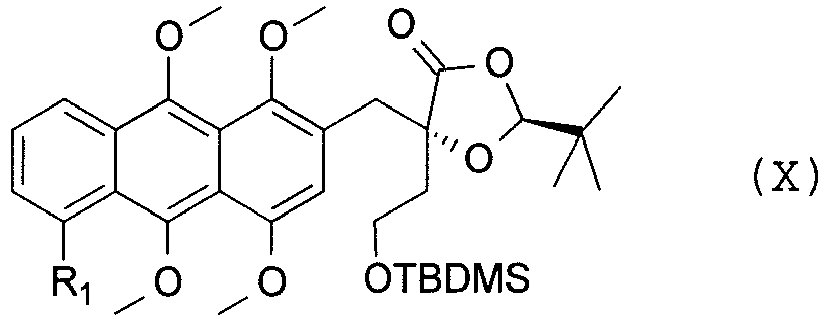
- Die Umsetzung einer Verbindung der allgemeinen Formel (X) mit einem organometallischen Reagens wie Organo-Magnesium, -Lithium oder -Natrium bevorzugt mit Methyl Lithium in einen aprotischen Lösungsmittel wie z.B. Tetrahydrofuran bei -40°C bis -90°C, bevorzugt bei -50°C bis -80°C, am meisten bevorzugt bei -78°C, ergibt eine Verbindung der Formel (XI),

- Die Ketogruppe der Verbindung der allgemeinen Formel (XI) wird in einer Reduktionsreaktion, vorzugsweise einer Hydridreduktion z.B. mit Natriumborhydrid in Ethanol als Lösungsmittel vorzugsweise bei 10°C bis 70°C, vorzugsweise bei Raumtemperatur, zu einer Hydroxylgruppe reduziert und anschließend zu einer Verbindung der allgemeinen Formel (XII),

- Die Ketalisierung kann vorzugsweise mit Dimethoxypropan und p-Toluolsulfonsäure in Aceton durchgeführt werden. Nach der Spaltung der Silyl-Schutzgruppe, welche am besten mit einem Fluoridreagens, wie beispielsweise Tetrabutylammoniumfluorid (TBAF) in THF erfolgt, vorzugsweise bei Raumtemperatur, wird die freiwerdende Hydroxylgruppe zum Aldehyd der allgemeinen Formel (XIII),

- Die so erhaltene Verbindung der allgemeinen Formel (XIII) durch oxidative Dealkylierung bevorzugt unter Anwendung eines Cersalzes (Cer(IV)-ammoniumnitrat, vorzugsweise in Acetonitril bei 0°C bis 10°C, am meisten bevorzugt bei ungefähr 2°C) zum Anthrachinon-Derivat der allgemeinen Formel (XIV),

- Die restlichen Schutzgruppen (z.B. Methoxy und Acetonid) werden unter sauren Bedingungen abgespalten, wobei zu diesem Zweck vorzugsweise Lewis-Säuren wie BBr3 (Bortribromid), BI3 (Bortriiodid), BF3 (Bortrifluorid) oder AlCl3 (Aluminiumchlorid), vorzugsweise BCl3 (Bortrichlorid) in DCM, vorzugsweise bei 0°C-10°C, am meisten bevorzugt bei ungefähr 2°C zum Einsatz kommen, wobei das Halbacetal der allgemeinen Formel (XV),
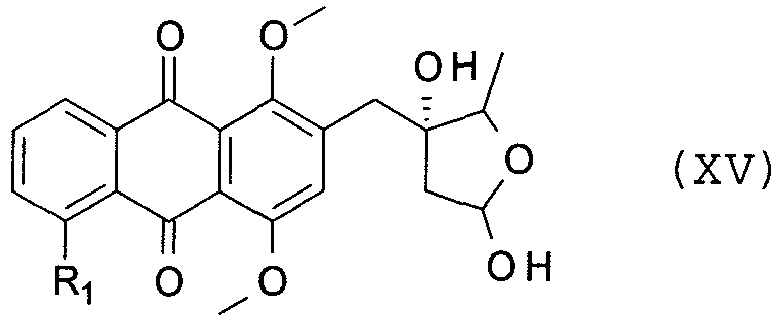
- Formel (XV) wird anschließend zyklisiert, vorzugsweise mit Hilfe einer Marschalk Reaktion in Tetrahydrofuran/Methanol als Lösungsmittelin, vorzugsweise bei einem Temperaturbereich von - 10°C bis Raumtemperatur, zur Verbindung der allgemeinen Formel (XVI)

- Die Seitenketten-Hydroxylgruppe wird anschießend oxidiert, wobei sich für diesen Zweck besonders Dess-Martin Periodinan in Dichlormethan eignet, vorzugsweise bei Raumtemperatur, um so eine Verbindung der allgemeinen Formel (XVII),

- Die Verbindung der Formel (XVII) wird anschließend, vorausgesetzt R12 und R13 stehen für ein Wasserstoffatom, hydroxyliert, wobei sich dafür besonders N-Bromsuccinimid und Azo-bis-(isobutyronitril) in CCl4 eignen; vorzugsweise erfolgt die Hydroxylierung unter Rückfluß, wobei eine Verbindung der allgemeinen Formel (IV), in welcher in welcher R1 ein Wasserstoffatom, eine Hydroxy- oder Methoxy-Gruppe, ein Halogenatom, insbesondere ein Fluor-, Chlor- oder Bromatom, oder eine NO2-Gruppe ist; und R2 Wasserstoff bedeutet, entsteht.

- Demzufolge betrifft die vorliegende Erfindung des Weiteren pharmazeutische Zusammensetzung umfassend eine oder mehrere Verbindungen der Formel (I), (Ia) oder (IIIc) und optional einen oder mehrere pharmazeutisch annehmbare Stoffe, ausgewählt aus Hilfsstoffen, Träger, Verdünnungsmittel und Lösungsmitteln.
- Geeignete Hilfsstoffen, Träger, Verdünnungsmittel und Lösungsmitteln sind dem Fachmann bekannt.
- Die vorliegende Erfindung betrifft weiterhin einen pharmazeutischen Kit umfassend (i) eine oder mehrere Verbindungen der Formel (I), (Ia) oder (IIIc), oder eine pharmazeutische Zusammensetzung umfassend eine oder mehrere Verbindungen der Formel (I), (Ia) oder (IIIc) und optional einen oder mehrere pharmazeutisch annehmbare Stoffe, ausgewählt aus Hilfsstoffen, Träger, Verdünnungsmittel und Lösungsmitteln und (ii) mindestens einem antiproliferativen oder cytotoxischen Wirkstoff.
- Die Verbindungen der Formel (I), (Ia) oder (IIIc), eine pharmazeutische Zusammensetzung oder ein pharmazeutischer Kit gemäß der vorliegenden Erfindung können als Medikament oder als Werkzeug in der biomedizinischen Forschung verwendet werden. Verbindungen der Formel (I), (Ia) oder (IIIc), eine pharmazeutische Zusammensetzung oder ein pharmazeutischer Kit gemäß der vorliegenden Erfindung können darüber hinaus zur Anwendung bei der
- Behandlung von Krankheiten oder Krankheitszuständen, die zumindest teilweise durch Therapie gelindert werden können, verwendet werden. Die Krankheiten oder Krankheitszustände sind ausgewählt aus proliferierenden Krankheiten, vorzugsweise Krebs.
- Die Verbindungen der Formel (I), (Ia) und (IIIc), eine pharmazeutische Zusammensetzung oder ein pharmazeutischer Kit gemäß der vorliegenden Erfindung können als Monopräparate oder in Kombination mit anderen Wirkstoffen, vorzugsweise Wirkstoffen, welche ebenfalls die Zellproliferation hemmen, bzw. eine zytotoxische Wirkung entfalten können, eingesetzt werden. Beispielhaft seien die bekannten Wirkstoffe Bleomycin, Vinblastin, Dacarbazin, Cyclophosphamid, Etoposid(phosphat), Procarbazin, Vincristin, Prednison, Cisplatin, Carboplatin, 5-Fluoruracil, Docetaxel, erwähnt, welche schon jetzt mit Anthracyclinen in Kombination eingesetzt werden (z.B. ABVD, BEACOPP, ECF, TAC, TEC).
- Ebenfalls können die Verbindungen der Formel (I), (Ia) und (IIIc) der vorliegenden Erfindung zusammen mit rekombinanten Wirkstoffen (Biologika) verwendet werden, welche die Wirkung der erfindungsgemäßen Verbindungen spezifisch, z.B. als Antikörper, verstärken können.
- Die vorliegende Erfindung wird nun anhand nachfolgender Beispiele näher erläutert.
- Zu einer Lösung von 8,9 g (17.2 mmol) N-[2-(1,3-dioxolan-2-yl)-1-[(4S,5S)-5-[2-[2-[2-[2-(2-methoxyethoxy)ethoxy]ethoxy] ethoxy]ethoxymethyl]-2,2-dimethyl-1,3-dioxolan-4-yl]ethyl]-2,2,2-trifluoro-acetamide (II) in THF/H20 (4:1) werden 43 ml (0.56 mol) Trifluoressigsäure zugetropft. Anschließend wird bei 60°C für 30 min gerührt. Dann wird das Reaktionsgemisch auf 100 ml Eiswasser geleert und 87 g (1.03 mol) festes NaHCO3 zugesetzt, bis pH 6-7 erreicht ist. Das Reaktionsgemisch wird anschließend filtriert und mit 3x mit je 200 ml Dichlormethan extrahiert. Die vereinigten organischen Phasen werden über Natriumsulfat getrocknet, filtriert und eingedampft. Das erhaltene Öl wird chromatographisch gereinigt (Laufmittel DCM/MeOH 100:3-> 100:5-> 10:1, v/v) Es werden 2,1 g (27%) farbloses Öl isoliert. Das Anomerenverhältnis beträgt α:β= 76:24.
1H NMR (α), (500 MHz; CDCl3): δ(ppm)= 7,09 (m, 1H, NH); 5,41 (m, 1H, H-1); 4,47 (m, 1H, H-3); 4,18 (m, 1H, H-5); 3,92 (m, 1H, H-4); 3,79-3,69 (m, 2H, H-6/1, H-6/2) 3,62 (m, 18H, CH2O); 3,55 (m, 2H, MeOCH2); 3,35 (s, 3H, OMe); 2,00-1,91 (m, 1H, H-2/1); 1,87-1,84 (m, 1H, H-2/2)
1H NMR (β), (500 MHz; CDCl3) : δ(ppm)= 7,29 (m, 1H, NH); 5,18 (m, 1H, H-1); 4,16-4,06 (m, 1H, H-3); 3,82 (m, 1H, H-4); 3,79-3,69 (m, 2H, H-6/1, H-6/2); 3,62 (m, 19H, CH2O, H-5); 3,55 (m, 2H, CH2O); 3,35 (s, 3H, OMe); 2,04-2,00 (m, 1H, H-2/1); 1,80-1,74 (m, 1H, H-2/2) - Zu einer Lösung von 1,67g (3.38 mmol) N-[(3S,4S,6S)-3,6-dihydroxy-2-[2-[2-[2-[2-(2-methoxyethoxy)ethoxy]ethoxy]ethoxy] ethoxymethyl]tetrahydropyran-4-yl] -2,2,2-trifluoro-acetamide (II) in Pyridin wird unter Inertgas auf 0°C abgekühlt. Anschließend werden 1,75 g (9.43 mmol) p-Nitrobenzoylchlorid zugegeben und das Reaktionsgemisch innerhalb 12 h auf Raumtemperatur erwärmt. Die Reaktion wird mit H2O gequencht und anschließend werden alle Lösungsmittel abgedampft. Der Rückstand wird in Dichlormethan aufgenommen und einmal H2O, dreimal mit halbgesättigter NaHCO3-Lösung und einmal mit gesättigter NaCl-Lösung gewaschen, über Natriumsulfat getrocknet, filtriert und eingedampft. Das erhaltene Öl wird chromatographisch gereinigt (Laufmittel Ethylacetat/Petrolether 1:1-> 3:2-> 2:1, v/v) Es werden 1,94 g (72%) als weißes Schaumharz erhalten. Das Anomerenverhältnis beträgt α:β= 76:24.
1H NMR (α), (200 MHz; CDCl3) : δ (ppm) = 8,30 (m, 8H, Ar); 6,88 (d, 1H, J= 6.56 Hz, NH); 6,67 (m, 1H, H-1); 5,76 (m, 1H, H-4); 4,80 (m, 1H, H-5); 4,46 (m, 1H, H-3); 3,63-3,46 (m, 22H, H-6/1, H-6/2, CH2O) 3,34 (s, 3H, OMe); 2,39-2,33 (m, 2H, H-2/1, H-2/2)
1H NMR (β), (200 MHz; CDCl3) : δ(ppm)= 8, 28 (m, 8H, Ar) ; 6,90 (m, 1H, NH); 6,15 (m, 1H, H-1); 5,64 (m, 1H, H-4); 4,51 (m, 1H, H-5); 4,18(m, 1H, H-3); 3,69-3,52 (m, 22H, H-6/1, H-6/2, CH2O) 3,34 (s, 3H, OMe); 2,44-2,17 (m, 2H, H-2/1, H-2/2) - Zu einer Lösung von 225 mg (0.28 mmol) [(4S,5S,6S)-6-[2-[2-[2-[2-(2-methoxyethoxy)ethoxy]ethoxy]ethoxy]ethoxymethyl]-5-(4-nitrobenzoyl)oxy-4-[(2,2,2-trifluoroacetyl)amino]tetrahydropyran -2-yl] 4-nitrobenzoate, (III), in 15 ml Dichlormethan und 12 ml Et2O werden 1,1g Molsieb-4A zugesetzt. Unter Inertgas werden 129 mg (0.58 mmol) Trimethylsilyltrifluoromethanesulfonate bei -40°C zugetropft und 1h bei 0°C gerührt, auf -20°C abgekühlt und 56 mg (0.14 mmol) (7S,9S)-9-acetyl-6,7,9,11-tetrahydroxy-4-methoxy-8,10-dihydro-7H-tetracene-5,12-dione, (IV), gelöst in 9 ml Tetrahydrofuran zugetropft. Anschließend wird 6h bei -10°C bis -15°C gerührt. Dem Reaktionsgemisch werden gesättigte NaHCO3-Lösung und Dichlormethan zugesetzt und die Phasen getrennt. Die wässrige Phase wir mehrmals mit Dichlormethan extrahiert. Die vereinigten organischen Phasen werden mit H2O und gesättigter NaCl-Lösung gewaschen, über Natriumsulfat getrocknet, filtriert und eingedampft. Der erhaltene Rückstand wird chromatographisch gereinigt (Laufmittel DCM/MeOH 100:1-> 100:2-> 100:4, v/v). Es werden 118 mg (82%) orange-roter Feststoff erhalten.
1H NMR (500MHz, CDCl3): δ(ppm)= 13,93 (s, 1H, OH-6); 13,15 (s, 1H, OH-11); 8,30-8,23 (m, 4H, Ar); 7,90 (d, 1H, J= 7.55 Hz, H-1); 7,76-7,72 (m, 1H, H-2); 7,35 (d, 1H, J= 8.5 Hz, H-3); 6,72 (m, 1H, NH); 5,69 (m, 1H, H-1'); 5,62 (m, 1H, H-4'); 5,20 (m, 1H, H-7); 4,56-4,53 (m, 1H, H-5'); 4,48-4,40 (m, 1H, H-3'); 4,04 (s, 3H, ArOMe); 3,68-3,45 (m, 22H, CH2O, H-6); 3,33 (s, 3H, OMe); 3,12 (m, 1H, H-10/1); 2,88 (m, 1H, H-10/2); 2,57 (m, 1H, H-8/1); 2,43 (s, 3H, H-14); 2,18-2,02 (m, 3H, H-8/2, H-2') - Eine Lösung von 99mg (0.1 mmol) [(2S,3S,4S,6R)-6-[[(1S,3S)-3-acetyl-3,5,12-trihydroxy-10-methoxy-6,11-dioxo-2,4-dihydro-1H-tetracen-1-yl]oxy]-2-[2-[2-[2-[2-(2-methoxyethoxy)ethoxy]ethoxy]ethoxy]ethoxymethyl]-4-[(2,2,2-trifluoroacetyl)amino]tetrahydropyran-3-yl] 4-nitrobenzoate, (I), in 52,1 ml Methanol und 0,1 ml Dichlormethan wird auf 0°C abgekühlt. Anschließend werden 1,3 ml 0.1 N NaOH zugetropft und für 30 min bei 0°C gerührt. Das Reaktionsgemisch wir anschließend mit Eisessig neutralisiert und Ethylacetat und gesättigte NaCl-Lösung zugegeben. Die Phasen werden getrennt und die wässrige Phase wird einmal mit Ehtylacetat extrahiert. Die vereinigten organischen Phasen werden mit gesättigter NaCl-Lösung gewaschen, über Natriumsulfat getrocknet, filtriert und eingedampft. Der erhaltene Rückstand wird chromatographisch gereinigt (Laufmittel DCM/MeOH 100:4, v/v). Es werden 75,9 mg (89%) orange-roter Feststoff erhalten.
1H NMR (500MHz, CDCl3) : δ(ppm) = 13,94 (s, 1H, OH-6); 13,23 (s, 1H, OH-11); 7,99 (d, 1H, J= 7.55 Hz, H-1); 7,75 (t, 1H, J= 8.02 Hz H-2); 7,36 (d, 1H, J= 8.5 Hz, H-3); 7,10 (m, 1H, NH); 5,56 (m, 1H, H-1'); 5,25 (m, 1H, H-7); 4,22-4,14 (m, 1H, H-3'); 4,14-4,11 (m, 1H, H-5'); 4,05 (s, 3H, ArOMe); 3,98 (m, 1H, H-4'); 3,87-3,71 (m, 2H, H-6/1, H-6/2); 3,69-3,53 (m, 20H, CH2O); 3,35 (s, 3H, OMe); 3,27-3,17 (m, 1H, H-10/1); 2,87-2,84 (m, 1H, H-10/2); 2,39 (s, 3H, H-14); 2,37-2,34 (m, 1H, H-8/1); 2,12-2,01 (m, 2H, H-8/2, H-2'/1); 1,86-1,83 (m, 1H, H-2'/2) - Eine Lösung von 60mg (0.07 mmol) N-[(2S,3S,4S,6R)-6-[[(1S,3S)-3-acetyl-3,5,12-trihydroxy-10-methoxy-6,11-dioxo-2,4-dihydro-1H-tetracen-1-yl]oxy]-3-hydroxy-2-[2-[2-[2-[2-(2-methoxyethoxy)ethoxy]ethoxy]ethoxy]ethoxymethyl]tetrahydropyran-4-yl]-2,2,2-trifluoro-acetamide, (I), in 12,5 ml 1 N NaOH wird bei Raumtemperatur 20 min gerührt. Das Reaktionsgemisch wird anschließend mit 12,5 ml 1N HCL neutralisiert und so lange mit Dichlormethan extrahiert bis die Extrakte keine orange Farbe mehr aufweisen. Die vereinigten organischen Phasen werden mit gesättigter NaCl-Lösung gewaschen, über Natriumsulfat getrocknet, filtriert und eingedampft. Der erhaltene Rückstand wird chromatographisch gereinigt (Laufmittel DCM/MeOH 10:1-> 10:2, v/v). Es werden 13 mg (24%) orange-roter Feststoff erhalten.
1H NMR (500MHz, CDCl3): δ(ppm)= 13,81 (s, 1H, OH-6); 13,12 (s, 1H, OH-11); 7,85 (d, 1H, J= 6,9 Hz, H-1); 7,67 (t, 1H, J= 7,57 Hz, H-2); 7,36 (m, 1H, H-3); 5,52 (m, 1H, H-1'); 5,00 (m, 1H, H-7); 4,27 (m, 1H, H-4'); 4,19 (m, 1H, H-5'); 3,95 (s, 3H, ArOMe); 3,91-3,50 (m, 23H, H-3', H-6', CH2O); 3,33 (s, 3H, OMe); 3,13-3,10 (m, 1H, H-10/1); 2,81-2,77 (m, 1H, H-10/2); 2,38 (s, 3H, H-14); 2,35 (m, 1H, H-8/1); 2,18-2,00 (m, 3H, H-2', H-8/2) - Eine Lösung von 4,20 g (0,17 mol) Magnesiumspäne und 2 mg (0.015 mmol) elementarem Iod in 200 ml THF wird unter Argon für 10 min zum sieden erhitzt. Anschließend werden 26 g (0.15 mol) 2-Bromomethyl-1,3-Dioxolane (V) zugetropft, bis das Anspringen der Reaktion erkennbar wird. Das restliche 2-Bromomethyl-1,3-Dioxolane (V) wird im Anschluss so zu dosiert, dass das Reaktionsgemisch gelinde siedet. Nach beendeter Zugabe wird das Reaktionsgemisch bei 80 °C für 2h gerührt. Im Anschluss werden 20 g (0,08 mol) [(4S,5R)-5-formyl-2,2-dimethyl-1,3-dioxolan-4-yl]methyl benzoate (VI), gelöst in 30ml THF, zum Reaktionsgemisch zugetropft und für 6 h bei Raumtemperatur gerührt. Dem Reaktionsgemisch werden 200 ml gesättigte NH4Cl-Lösung und 200 ml Eis zugesetzt und für 5 min. gerührt. Anschließend werden 300 ml Ethylacetat zugesetzt, Phasen getrennt und die wässrige Phase mit 100 ml Ethylacetat extrahiert. Die vereinigten organischen Phasen werden mit 100 ml gesättigte NH4Cl-Lösung gewaschen, über Na2SO4 getrocknet, filtriert und eingedampft. Es werden 25 g (92%) gelbes Öl (Mischung der Diastereomere 51:49 an 3') erhalten.
1H NMR (Diastereomer 1), (500MHz, CDCl3): δ(ppm)= 8,06(m, 2H, Ar); 7,56 (m, 1H, Ar); 7,44 (m, 2H, Ar); 5,09 (m, 1H, H-1); 4,66 (dd, J1= 11.6 Hz, J2= 2.5 Hz, 1H, H-6/1); 4,39 (dd, J1= 11.6 Hz, J2= 5.6 Hz, 1H, H-6/2); 4,31 (m, 1H, H-5); 4,08-3,80 (m, 6H, H-4, H-3, 2x OCH2); 2,18-2,14 (m, 1H, H-2/1); 1,90-1,81 (m, 1H, H-2/2); 1,42 (s, 3H, MeC); 1,41 (s, 3H, MeC)
1H NMR (Diastereomer 2), (500MHz, CDCl3) : δ(ppm) = 8,06(m, 2H, Ar) ; 7,56 (m, 1H, Ar); 7,44 (m, 2H, Ar); 5,09 (m, 1H, H-1); 4,55 (m, 1H, H-6/1); 4,48-4,31 (m, 2H, H-6/2, H-5); 4,08-3,80 (m, 6H, H-4, H-3, 2x OCH2) ; 2,03-1,92 (m, 2H, H-2/1, H-2/2); 1,45 (s, 3H, MeC); 1,44 (s, 3H, MeC) - Eine Lösung von 22,7 ml (0.31 mol) DMSO und 10 ml Dichlormethan wird auf -70°C abgekühlt und unter Inertgas langsam 18,53 g (0,14 mol) Oxalyldichlorid zugetropft, so dass die Temperatur -60°C nicht übersteigt. Das Reaktionsgemisch wird bei -70°C für 50 Minuten gerührt. Anschließend werden 34,22 g (0.1 mol) [(4S,5S)-5-[2-(1,3-dioxolan-2-yl)-1-hydroxy-ethyl]-2,2-dimethyl-1,3-dioxolan-4-yl]methyl benzoate (II) gelöst in 20 ml Dichlormethan zugetropft, wobei zu berücksichtigen ist, dass die Temperatur -60°C nicht übersteigt. Anschließend wird das Reaktionsgemisch 50 min bei -70°C gerührt. Danach werden 79,84 g (0.73 mol) Triethylamin zugetropft und weitere 30 min bei -70°C gerührt. Das Reaktionsgemisch wird dann langsam auf Raumtemperatur erwärmt und 250 ml H2O und 200 ml Dichlormethan zugesetzt. Die Phasen werden getrennt und die wässrige Phase einmal mit 100 ml Dichlormethan extrahiert. Die vereinigten organischen Phasen werden einmal mit 100 ml Schwefelsäure (0,1 % in H2O), einmal mit 100 ml gesättigter NaHCO3-Lösung (und einmal mit 100 ml gesättigter NaCl-Lösung gewaschen über Na2SO4 getrocknet, filtriert und eingedampft. Es werden 33,73 g (99%) farbloses Öl erhalten.
1H NMR (500 MHz; CDCl3): δ(ppm)= 8,02 (d, J= 7.2 Hz, 2H, Ar); 7,53 (t, J= 7.2 Hz, 1H, Ar); 7,41 (t, J= 7.6 Hz, 2H, Ar); 5,30 (t, J= 5.2 Hz, 1H, H-1); 4,62 (dd, J1= 11.6 Hz, J2= 3.1 Hz, 1H, H-6/1); 4,37 (m, 3H, H-4, H-5, H-6/2); 3,94 (m, 2H, OCH2); 3,83 (m, 2H, OCH2) ; 3,04 (d, J= 5.3, 2H, H-2/1, H-2/2); 1,44 (s, 3H, MeC); 1,41 (s, 3H, MeC) - Zu einer Lösung von 24,52 g (0.07 mol) [(4S,5R)-5-[2-(1,3-dioxolan-2-yl)acetyl]-2,2-dimethyl-1,3-dioxolan-4-yl]methyl benzoate (II) in 80 ml a Pyridin, werden 31,58 g (0.45 mol) Hydroxylaminhydrochlorid (NH2OH·HCl) zugesetzt. Anschließend wird für 13h bei 55°C unter Inertgas gerührt. Das Pyridin wird mittels Rotationsverdampfer entfernt und der Rückstand anschließend im Hochvakuum getrocknet. Danach werden 250 ml H2O und 250 ml Ethylacetat zugesetzt und die Phasen getrennt. Die wässrige Phase wird viermal mit Ethylacetat (4x50 ml) extrahiert. Die vereinigten organischen Phasen werden mit gesättigter NaCl-Lösung gewaschen und über Natriumsulfat getrocknet, filtriert und eingedampft. Es werden 24,24 g (94%) gelbes Öl erhalten.
1H NMR (500 MHz; CDCl3): δ(ppm)= 8,05 (d, J= 7.2 Hz, 2H, Ar); 7,56 (t, J= 7.2 Hz, 1H, Ar); 7,43 (t, J= 7.7 Hz, 2H, Ar); 5,31 (t, J= 4.7 Hz, 1H, H-1); 4,58 (m, 3H, H-4,H-5,H-6/1); 4,40 (m, 1H, H-6/2); 3,98 (m, 2H, OCH2); 3,84 (m, 2H, OCH2) ; 2,78 (m, 2H, H-2/1, H-2/2); 1,46 (s, 6H, Me2C) - Zu einer Lösung von 16,0 g (43.79 mmol) [(4S,5S)-5-[(E)-C-(1,3-dioxolan-2-ylmethyl)-N-hydroxy-carbonimidoyl]-2,2-dimethyl-1,3-dioxolan-4-yl]methyl benzoate (II) in 340 ml THF/H2O (1:1) werden 32ml 2N NaOH (63.96 mmol) zugetropft und für 18 h bei 60°C gerührt. Nach dem abkühlen auf Raumtemperatur werden 200 ml MTBE zugesetzt, die Phasen getrennt und die wässrige Phase viermal mit MTBE extrahiert. Die vereinigten organischen Phasen werden mit gesättigter NaCl-Lösung gewaschen und über Natriumsulfat getrocknet, filtriert und eingedampft. Es werden 9,31 g (81%) gelbes Öl erhalten.
1H NMR (500 MHz; CDCl3): δ(ppm)= 9,07 (s, 1H, OH); 5,35 (t, J= 5.3 Hz, 1H, H-1); 4,45 (d, J= 8.5 Hz, 1H, H-4,); 4,27 (m, 1H, H-5); 3,97 (m, 2H, OCH2) ; 3,78 (m, 3H, OCH2, H-6); 3,09 (s, 1H, OH); 2,74 (m, 2H, H-2/1, H-2/2); 1,43 (s, 6H, Me2C) - Zu einer Lösung von 7.8 g (29.9 mmol) 2-(1,3-dioxolan-2-yl)-1-[(4S,5S)-5-(hydroxymethyl)-2,2-dimethyl-1,3-dioxolan-4-yl]ethanone oxime (II) in 150 ml THF werden 2,26 g Natriumhydrid (95%) (89.8 mmol) portionsweise zugesetzt und 1,5h unter Inertgas bei Raumtemperatur gerührt. Anschließend werden 24.3 g (60 mmol) 2-[2-[2-[2-(2-methoxyethoxy)ethoxy]ethoxy]ethoxy] ethyl4-methylbenzenesulfonate gelöst in 50 ml THF zugetropft und für weitere 5h bei 60°C gerührt. Die Reaktion wird im Anschluss mit gesättigter NH4Cl-Lösung gequencht. Danach werden 300 ml DCM zugegeben, die Phasen getrennt und die wässrige Phase viermal mit DCM extrahiert. Die vereinigten organischen Phasen werden über Na2SO4 getrocknet, filtriert und eingedampft. Das erhaltene Öl wird chromatographisch gereinigt (Laufmittel Toluol/Aceton 2:1-> 1:1, v/v). Es werden 12,4 g (84%) gelbes Öl erhalten.
1H NMR (500 MHz; CDCl3) : δ(ppm)= 5,32 (t, J= 5.3 Hz, 1H, H-1); 4,38 (m, 1H, H-5); 4,28 (d, J= 8.2 Hz, 1H, H-4,); 3,95 (m, 2H, OCH2) ; 3,82 (m, 2H, OCH2) ; 3,64 (m, 18H, CH2O) ; 3,52 (m, 4H, H-6, MeOCH2) ; 3,35 (s, 3H, OMe); 2,73 (d, J= 5.7 Hz, 2H, H-2/1, H-2/2); 1,42 (s, 3H, MeC); 1,40 (s, 3H, MeC) - Eine Lösung von 12,4 g (25 mmol) 2-(1,3-dioxolan-2-yl)-1-[(4S,5S)-5-[2-[2-[2-[2-(2-methoxyethoxy)ethoxy]ethoxy]ethoxy]ethoxymethyl]-2,2-dimethyl-1,3-dioxolan-4-yl]ethanone oxime (II) in 125 ml THF wird unter Intergas auf 0°C abgekühlt. Anschließen werden 3,1 g (82.2 mmol) Lithiumaluminiumhydrid (LiAlH4) unter Rühren langsam zugesetzt. Anschließend wird 4h bei RT gerührt. Die Reaktion wird mit NaOH-Lösung (5M) gequencht, 100 ml EtOAc zugesetzt und für 10 min gerührt. Das Reaktionsgemisch wird im Anschluss filtriert und die Phasen getrennt. Die vereinigten organischen Phasen werden mit gesättigter NaCl-Lösung gewaschen und über Natriumsulfat getrocknet, filtriert und eingedampft. Es werden 9,8 g (81%) gelbes Öl (Mischung der Diastereomere 57:43 an 3') erhalten.
1H NMR, (200 MHz; CDCl3) : δ(ppm)= 5,01 (t, J= 4.73 Hz, 1H, H-1); 4,20-3,77 (m, 7H, , H-4, H-5, H-6, 2x OCH2); 3,64 (m, 18H, CH2O); 3,53 (m, 2H, MeOCH2); 3,35 (s, 3H, OMe); 3,19-3,00 (m, 1H, H-3); 2,24-1,56 (m, 2H, H-2); 1,38 (s, 3H, MeC); 1,37 (s, 3H, MeC) - Zu einer Lösung von 9,8 g (20,3 mmol) (1S)-2-(1,3-dioxolan-2-yl)-1-[(4S,5S)-5-[2-[2-[2-[2-(2-methoxyethoxy)ethoxy]ethoxy]ethoxy]ethoxymethyl]-2,2-dimethyl-1,3-dioxolan-4-yl]ethanamine (II) in 196 ml DCM und 9,6 ml Pyridin werden 0,05 g (0.4 mmol) 4-(Dimethylamino)-pyridin zugesetzt. Das Reaktionsgemisch wird auf -17°C abgekühlt und 6,41 g (30.5 mmol) Trifluoressigsäureanhydrid zugetropft. Im Anschluss wird innerhalb von 4h unter rühren auf Raumtemperatur erwärmt, alle Lösungsmittel eingedampft und der Rückstand in Dichlormethan aufgenommen. Die organische Phase wird mit halbgesättigter NaHCO3-Lösung und gesättigter NaCl-Lösung gewaschen, über Natriumsulfat getrocknet, filtriert und eingedampft. Das erhaltene Öl wird chromatographisch gereinigt (Laufmittel Petrolether/Aceton 2:1, v/v). Es werden 9,5 g (80%) gelbes Öl (Mischung der Diastereomere 57:43 an 3') erhalten.
1H NMR (Diastereomer 1), (500 MHz; CDCl3): δ(ppm)= 7,65 (d, J= 8.85 Hz, 1H, NH); 4,99 (t, J= 4.6 Hz, 1H, H-1); 4,30 (m, 1H, H-3); 3,92 (m, 7H, , H-4, H-5, H-6, 2x OCH2); 3,62 (m, 18H, CH2O); 3,52 (m, 2H, MeOCH2); 3,35 (s, 3H, OMe); 2,04 (m, 2H, H-2); 1,38 (s, 3H, MeC); 1,37 (s, 3H, MeC)
1H NMR (Diastereomer 2), (500 MHz; CDCl3): δ(ppm)= 6,95 (d, J= 9.15 Hz, 1H, NH); 4,96 (t, J= 4.4 Hz, 1H, H-1); 4,40 (m, 1H, H-3); 3,92 (m, 7H, , H-4, H-5, H-6, 2x OCH2); 3,62 (m, 18H, CH2O) ; 3,52 (m, 2H, MeOCH2); 3,35 (s, 3H, OMe); 2,04 (m, 2H, H-2); 1,38 (s, 3H, MeC); 1,1,37 (s, 3H, MeC) - 40 g 2-[(2S,4S)-2-tert-Butyl-5-oxo-1,3-dioxolan-4-yl]essigsäure werden unter Argon-atmosphäre in 300 mL THF gelöst und auf 0°C gekühlt. 238 mL BH3.THF-Komplex (1M in THF) werden innerhalb einer Stunde langsam so zugegeben, dass die Temperatur nicht über 5 °C steigt. Nach der vollständigen Zugabe des Reagens wird das Reaktionsgemisch 20 min bei 0 °C gerührt, auf Raumtemperatur erwärmt und 3,5 Stunden gerührt. Das Reaktionsgemisch wird zwischen gesättigter NH4Cl-Lösung und EtOAc verteilt. Die Phasen werden getrennt und die wässrige Phase mit EtOAc extrahiert. Die vereinigten organischen Phasen werden mit 5% wässriger NaHCO3-Lösung und gesättigter Kochsalzlösung gewaschen, über Na2SO4 getrocknet, filtriert und im Vakuum eingedampft. Es werden 32 g Zwischenprodukt erhalten, welches ohne weitere Aufreinigung direkt in die nächste Stufe eingesetzt werden kann.
- 43 g TBDMSCl in 500 mL DCM werden mit 45,1 g Pyridin versetzt. Die Lösung wird 10 min gerührt, dann wird das Zwischenprodukt, gelöst in 100 mL DCM, zugegeben. Das Reaktionsgemisch wird 16 Stunden bei Raumtemperatur gerührt und anschließend auf Wasser gegossen. Die Phasen werden getrennt, die organische Phase wird mit 5% wässriger NaHCO3-Lösung gewaschen, über Na2SO4 getrocknet, filtriert und im Vakuum eingedampft. Das Rohpodukt wird mittels Flash-Chromatographie über Kieselgel mit Toluol als Laufmittel gereinigt. Es werden 52.3 g (2S, 5S)-2-tert-butyl-5-[2-(tert-butyl(dimethyl)silyl)oxyethyl]-1,3-dioxolan-4-on als farbloses Öl erhalten.
1H NMR (500 MHz; CDCl3) : δ (ppm) = 5.15 (s, 1H, H-5); 4.43 (dd, 1H, 3.8 Hz, 8.5 Hz, H-3); 3.80 (m, 2H, H-1); 2.12 (m, 1H, H-2/1); 1.86 (m, 1H, H-2/2); 0.97 (s, 9H, H-tBuCH3); 0.89 (s, 9H, H-SitBuCH3); 0.06 (s, 6H, H-SiCH3). - Zu einer Lösung von 18 g KHMDS in 680 mL wasserfreiem THF wird unter Argonatmosphäre bei -76°C eine Lösung von 25,6 g (2S,5S)-2-tert-Butyl-5-[2-(tert-butyl(dimethyl)silyl)oxyethyl]-1,3-dioxolan-4-on in 30 mL THF so zugetropft, dass die Temperatur nicht über -72°C steigt. Das Reaktionsgemisch wird 50 Minuten bei -76°C gerührt. Eine Lösung von 22 g 2-(Brommethyl)-1,4,9,10-tetramethoxy-anthracen in 40 mL THF wird bei -75°C zugetropft. Anschließend wird 20 min bei dieser Temperatur gerührt. Das Reaktionsgemisch wird zwischen 1N HCl und EtOAc verteilt. Die wässrige Phase wird mit EtOAc extrahiert und die vereinigten organischen Phasen werden über Na2SO4 getrocknet, filtriert und im Vakuum eingedampft. Das Rohprodukt wird in einer Mischung von 50 mL MTBE und 200 mL PE digeriert, filtriert und mit PE gewaschen. Es werden 23.4 g (2S,5S)-2-tert-Butyl-5-[2-(tert-butyl(dimethyl)silyl)oxyethyl]-5-[(1,4,9,10-tetramethoxy-2-anthryl)-methyl-1,3-dioxolan-4-on als gelber Feststoff erhalten, Das Filtrat wird im Vakuum eingedampft und mittels Säulenchromatographie (Kieselgel, Toluol/ EtOAc 30/1) aufgetrennt. Es werden so weitere 7.4 g (2S,5S)-2-tert-Butyl-5-[2-(tert-butyl(dimethyl)silyl)oxyethyl]-5-[(1,4,9,10-tetra-methoxy -2-anthryl)methyl]-1,3-dioxolan-4-on erhalten.
1H NMR (500 MHz; CDCl3) : δ (ppm) = 8.35 (m, 2H, H-5 and H-8); 7.52 (m, 2H, H-6 and H-7); 6.64 (s, 1H, H-3); 4.84 (s, 1H, H-acetal); 4.02 (s, 3H, OCH3-4); 4.00 (s, 3H, OCH3-10); 3.95 (s, 3H, OCH3-9); 3.83 (m, 2H, H-4'); 3.75 (s, 3H, OCH3-1); 3.44 (d, 1H, J = 13.9 Hz, H-1'/1); 3.18 (d, 1H, J = 13.9 Hz, H-1'/2); 2.17 (m, 2H, H-3'); 0.89 (s, 9H, H-tBuCH3); 0.88 (s, 9H, H-SitBuCH3); 0.05 (s, 3H, H-SiCH3); 0.04 (s, 3H, H-SiCH3). - Zu einer Lösumg von 62 g (2S,5S)-2-tert-Butyl-5-[2-(tert-butyl(dimethyl)silyl)oxyethyl]-5-[(1,4,9,10-tetramethoxy-2-anthryl)methyl]-1,3-dioxolan-4-one in 700 mL wasserfreiem THF werden unter Argonatmosphäre bei -78°C 164 mL MeLi (1.6 M in Et2O) so zugetropft, dass die Temperatur nicht über -71 °C steigt. Das Reaktionsgemisch wird 1,5 Stunden bei -75°C gerührt und anschließemd zwischen gesättigter NH4Cl-Lösung und EtOAc verteilt. Die wässrige Phase wird mit EtOAc extrahiert. Die vereinigten organischen Phasen werden über Na2SO4 getrocknet, filtriert und im Vakuum eingedampft. Das Rohprodukt wird mittels Säulenchromatographie (Kieselgel, Toluol/EtOAc, 10/1) gereinigt. Es werden 54.2 g (3S)-5-(tert-Butyl(dimethyl)silyl)oxy-3-hydroxy-3-[(1,4,9,10-tetramethoxy-2-anthryl)methyl]pentan-2-on als gelber Schaum erhalten.
1H NMR (500 MHz; CDCl3): δ(ppm) = 16.67 (m, 2H, H-5 and H-8); 7.51 (m, 2H, H-6 and H-7); 6.70 (s, 1H, H-3); 4.01 (s, 3H, OCH3-4); 3.98 (s, 3H, OCH3-10); 3.92 (s, 3H, OCH3-9); 3.82 (td, 1H, J = 4.1 Hz, 9.2 Hz, H-4'/1); 3.77 (s, 3H, OCH3-1); 3.70 (dt, 1H, J = 5.1 Hz, 10.4 Hz, H-4'/2); 3.27 (d, 1H, J = 12.9 Hz, H-1'/1); 3.12 (d, 1H, J = 12.9 Hz, H-1'/2); 2.39 (m, 1H, H-3'/1); 2.33 (s, 3H, CH3); 1.96 (dt, 1H, J = 4.4 Hz, 14.2 Hz, H-3'/2); 0.86 (s, 9H, H-SitBuCH3); 0.02 (s, 3H, H-SiCH3); 0.01 (s, 3H, H-SiCH3). - Zu einer Lösung von 33.8 g (3S)-5-(tert-Butyl(dimethyl)silyl)oxy-3-hydroxy-3-[(1,4,9,10-tetramethoxy-2-anthryl)methyl]pentan-2-on in 340 mL EtOH werden unter Argonatmosphäre 2,36 g NaBH4 zugegeben. Das Reaktionsgemisch wird eine Stunde bei RT gerührt und anschließend mit gesättigter Kochsalzlösung und EtOAc gequencht. Die wässrige Phase wird mit EtOAc extrahiert. Die vereinigten organischen Phasen werden über Na2SO4 getrocknet, filtriert und im Vakuum eingedampft. Das Rohprodukt wird mittels Flash- Chromatographie (Kieselgel, Toluol/EtOAc = 5:1) gereinigt. Es werden 30.70 g (2S,3S)-5-(tert-butyl(dimethyl)silyl)oxy-3-[(1,4,9,10-tetramethoxy-2-anthryl)methyl]pentan-2,3-diol als gelber Schaum erhalten.
- Zu einer Lösung von 5,26 g des alkoholischen Zwischenproduktes in 100 mL trockenem Aceton werden unter Argonatmosphäre 2,6 mL Dimethoxypropan gefolgt von 0,09 g pTsOH zugegeben. Das Reaktionsgemisch wird 1,5 Stunden bei RT gerührt und anschließend zwischen gesättigter NaHCO3 - Lösung und EtOAc verteilt. Die Phasen werden getrennt: Die wässrige Phase wird mit EtOAc extrahiert. Die vereinigten organischen Phasen werden über Na2SO4 getrocknet, filtriert und im Vakuum eingedampft. Das Rohprodukt wird mittels Flash-Chromatographie (Kieselgel, Toluol / EtOAc, 40/1) gereinigt. Es werden 4.66 g tert-Butyl-dimethyl-[2-[(4S,5S)-2,2,5-trimethyl-4-[(1,4,9,10-tetramethoxy-2-anthryl)methyl]-1,3-dioxolan-4-yl]ethoxy]silan als gelber Schaum erhalten.
1H NMR (500 MHz; CDCl3): δ(ppm) = 8.35 (m, 2H, H-5 and H-8); 7.50 (m, 2H, H-6 and H-7); 6.97 (s, 1H, H-3); 4.54 (q, 1H, J = 6.3 Hz, H-5'); 4.02 (s, 3H, OCH3-4); 3.98 (s, 3H, OCH3-10); 3.92 (s, 3H, OCH3-9); 3.73 (s, 3H, OCH3-1); 3.69 (m, 2H, H-4'); 3.19 (d, 1H, J = 13.6 Hz, H-1'/1); 2.75 (d, 1H, J = 13.6 Hz, H-1'/2); 1.91 (m, 1H, H-3'/1); 1.77 (m, 1H, H-3'/2); 1.74 (s, 3H, H-Acetonid); 1.45 (d, 3H, J = 6.3 Hz, CH3); 1.44 (s, 3H, H-Acetonid); 0.86 (s, 9H, H-SitBuCH3); 0.01 (s, 6H, H-SiCH3). - Zu eine Lösung von 4.57 g tert-Butyl-dimethyl-[2-[(4S,5S)-2,2,5-trimethyl-4-[(1,4,9,10-tetramethoxy-2-anthryl)methyl]-1,3-dioxolan-4-yl]ethoxy]silan in 90 mL wasserfreiem THF werden unter Argonatmosphäre 19,5 mL TBAF (1M in THF) bei RT zugegeben. Die Reaktionsmischung wird 1 Stunde bei RT gerührt. Das Reaktionsgemisch wird zwischen gesättigter NaHCO3 - Lösung und EtOAc verteilt. Die wässrige Phase wird mit EtOAc extrahiert. Die vereinigten organischen Phasen werden über Na2SO4 getrocknet, filtriert und im Vakuum eingedampft. Es werden 603g 2-[(4S,5S)-2,2,5-trimethyl-4-[(1,4,9,10-tetramethoxy-2-anthryl)methyl]-1,3-dioxolan-4-yl]ethanol als gelber Schaum erhalten.
1H NMR (500 MHz; CDCl3): δ(ppm) = 8.35 (m, 2H, H-5 and H-8); 7.51 (m, 2H, H-6 and H-7); 6.93 (s, 1H, H-3); 4.37 (q, 1H, J = 6.3Hz, H-5'); 4.02 (s, 3H, OCH3-4); 4.00 (s, 3H, OCH3-10); 3.93 (s, 3H, OCH3-9); 3.81 (m, 1H, H-4'/1); 3.78 (s, 3H, OCH3-1); 3.66 (m, 1H, H-4'/2); 3.22 (d, 1H, J = 13.6 Hz, H-1'/1); 2.81 (brs, 1H, OH-4'); 2.75 (d, 1H, J = 13.6 Hz, H-1'/2); 1.88 (m, 2H, H-3'); 1.75 (s, 3H, H-Acetonid); 1.48 (d, 3H, J = 6.3 Hz, CH3); 1.47 (s, 3H, H-Acetonid) . - In eine Lösung von 0,99 mL DMSO in 55 mL DCM werden bei -70 °C 0,61 mL Oxalylchlorid unter Argonatmosphäre zugetropft. Das Gemisch wird 1 Stunde bei -70°C gerührt. Anschließend werden 2,19 g 2-[(4S,5S)-2,2,5-trimethyl-4-[(1,4,9,10-tetramethoxy-2-anthryl-)methyl]-1,3-dioxolan-4-yl]ethanol in 4 mL DCM bei -70°C langsam zugegeben. Das Reaktionsgemisch wird 1 Stunde gerührt. Es werden 4,27 mL Et3N bei derselben Temperatur zugegeben. Es wird unter langsamer Erwärmung auf 0°C noch 1 Stunde weiter gerührt. Das Reaktionsgemisch wird zwischen gesättigter Kochsalzlösung und EtOAc verteilt. Die organische Phase wird nacheinander mit gesättigter NH4Cl-Lösung, gesättigter NaHCO3- Lösung und gesättigter Kochsalzlösung gewaschen, über Na2SO4 getrocknet, filtriert und im Vakuum eingedampft. Es werden 2.1 g 2-[(4S,5S)-2,2,5-trimethyl-4-[(1,4,9,10-tetramethoxy-2-anthryl)methyl]-1,3-dioxolan-4-yl]acetaldehyd als gelber Schaum erhalten.
1H NMR (500 MHz; CDCl3) : δ (ppm) = 9.65 (dd, 1H, J = 1.3 Hz, 2.2 Hz, H-4'); 8.34 (m, 2H, H-5 und H-8); 7.51 (m, 2H, H-6 und H-7); 6.81 (s, 1H, H-3); 4.28 (q, 1H, J = 6.3 Hz, H-5'); 4.03 (s, 3H, OCH3-4); 3.99 (s, 3H, OCH3-10); 3.91 (s, 3H, OCH3-9); 3.70 (s, 3H, OCH3-1); 3.23 (d, 1H, J = 13.6 Hz, H-1'/1); 2.77 (dd, 1H, J = 2.2 Hz, 16.4 Hz, H-3'/1); 2.73 (d, 1H, J = 13.6 Hz, H-1'/2); 2.62 (dd, 1H, J = 1.3 Hz, 16.34 Hz, H-3'/2); 1.74 (s, 3H, H-Acetonid); 1.55 (d, 3H, J = 6.3 Hz, CH3); 1.40 (s, 3H, H-Acetonid). - Zu einer Lösung von 2,08 g 2-[(4S,5S)-2,2,5-trimethyl-4-[(1,4,9,10-tetramethoxy-2-anthryl)-methyl]-1,3-dioxolan-4-yl]acetaldehyd in 60 mL CH3CN wird bei 2°C einer Lösung von 7,3 g CAN in 130 mL Wasser zugesetzt. Nach 30 min Rühren wird das Reaktionsgemisch mit 80 mL Wasser verdünnt. Die wässrige Phase wird mit EtOAc extrahiert. Die kombinierten organischen Phasen werden getrocknet und eingedampft. Die erhaltene Mischung wird chromatographisch getrennt (Laufmittel Toluol/EtOAc 6:1). Es werden 1.91 g 2-[(4S,5S)-4-[(1,4-dimethoxy-9,10-dioxo-2-anthryl)methyl]-2,2,5-trimethyl-1,3-dioxolan-4-yl]acetaldehyd als gelber Feststoff erhalten.
1H NMR (500 MHz; CDCl3): δ(ppm)= 9.62 (dd, 1H, J = 1.6 Hz, 2.5 Hz, H-4'); 8.16 (m, 2H, H-5 and H-8); 7.71 (m, 2H, H-6 and H-7); 7.45 (s, 1H, H-3); 4.25 (q, 1H, J = 6.3 Hz, H-5'); 4.00 (s, 3H, OCH3-4); 3.81 (s, 3H, OCH3-1); 3.18 (d, 1H, J = 12.9 Hz, H-1'/1); 2.66 (d, 1H, J = 12.9 Hz, H-1'/2); 2.65 (dd, 1H, J = 2.5 Hz and 16.4 Hz, H-3'/1); 2.48 (dd, 1H, J = 1.6 Hz, 16.4 Hz, H-3'/2); 1.64 (s, 3H, H-Acetonid); 1.50 (d, 3H, J = 6.3 Hz, CH3); 1.34 (s, 3H, H-Acetonid). - Zu einer Lösung von 1 g 2-[(4S,5S)-4-[(1,4-dimethoxy-9,10-dioxo-2-anthryl)methyl]-2,2,5-trimethyl-1,3-dioxolan-4-yl]acetaldehyd in 55 mL DCM werden unter Argonatmosphäre tropfenweise 13,7 mL BCl3 (1M in DCM) bei 2 °C zugesetzt. Das Reaktionsgemisch wird 40 min gerührt und mit 0.5 N NaOH und DCM versetzt. Die Phasen werden getrennt, die organische Phase wird mit 0.5 N NaOH gewaschen. Die kombinierten wässrigen Phasen werden bei 0°C mit 1 N HCl auf pH = 6 angesäuert und mit DCM extrahiert. Die kombinierten organischen Phasen werden getrocknet und eingedampft. Es werden 0.79 g 2-[[(2S,3S)-3,5-dihydroxy-2-methyl-tetrahydrofuran-3-yl]methyl]-1,4-dihydroxy-anthracen-9,10-dion als roter Feststoff erhalten.
1H NMR (500 MHz; CDCl3): δ(ppm) = 13.66 (s, 1H, OH-1); 12.87 (s, 1H, OH-4); 8.36 (m, 2H, H-5 and H-8); 7.85 (m, 2H, H-6 and H-7); 7.29 (s, 1H, H-3); 5.38 (m, 1H, H-4'); 4.01 (q, 1H, J = 6.3 Hz, H-6'); 3.52 (d, 1H, J= 7.3 Hz, OH-4'); 3.39 (s, 1H, OH-2'); 3.07 (d, 1H, J = 13.6 Hz, H-1'/1); 2.90 (d, 1H, J = 13.6 Hz, H-1'/2);; 2.21 (dd, 1H, J = 5.1, 13.3 Hz, H-3'/1); 1.99 (d, 1H, J = 13.3 Hz, H-3'/2); 1.34 (d, 3H, J = 6.3 Hz, CH3). - Zu einer Lösung von 70 mg 2-[[(2S,3S)-3,5-dihydroxy-2-methyl-tetrahydrofuran-3-yl]methyl]-1,4-dihydroxy-anthracen-9,10-dion in 5 mL THF und 5 mL MeOH wird tropfenweise unter Argonatmosphäre bei -10 °C eine Lösung von 38 mg NaOH und 49 mg Na2S2O4 in 1,2 mL Wasser zugesetzt. Nach zweistündigem Rühren wird das Reaktionsgemisch durch Einblasen von Luft für 30 min gequencht. Das Reaktionsgemisch wird mit 0.05 N HCl und EtOAc versetzt. Die Phasen werden getrennt, die wässrige Phase wird mit EtOAc extrahiert. Die kombinierten organischen Phasen werden getrocknet und eingedampft. Die erhaltene Mischung wird chromatographisch getrennt (Laufmittel Toluol/Isopropanol 30:1). Es werden 37 mg einer Mischung von (7R,9S)-6,7,9,11-Tetrahydroxy-9-[(1S)-1-hydroxyethyl]-8,10-dihydro-7H-tetracene-5,12-dion und (7S,9S)-6,7,9,11-Tetrahydroxy-9-[(1S)-1-hydroxyethyl]-8,10-dihydro-7H-tetracene-5,12-dion als roter Feststoff erhalten.
- 1H NMR (500 MHz, CDCl3) : δ = 13.60 (s, 1H, OH-6); 13.33 (s, 1H, OH-11); 8.23 (m, 2H, H-1 and H-4); 7.95 (m, 2H, H-2 and H-3); 5.17 (d, 1H, J = 5.7 Hz, OH-7); 5.05 (m, 1H, H-7); 4.85 (d, 1H, J = 5.7 Hz, OH-13); 4.45 (s, 1H, OH-9); 3.54 (q, 1H, J = 6.3 Hz, H-13); 2.85 (d, 1H, J = 18.3 Hz, H-10/1); 2.68 (d, 1H, J = 18.3 Hz, H-10/2); 2.14 (m, 1H, H-8/1); 1.75 (m, 1H, H-8/2); 1.14 (d, 3H, J = 6.3 Hz, CH3).
- 1H NMR (500 MHz, CDCl3) : δ = 13.42 (s, 1H, OH-6); 13.30 (s, 1H, OH-11); 8.23 (m, 2H, H-1 and H-4); 7.95 (m, 2H, H-2 and H-3); 5.30 (d, 1H, J = 7.9 Hz, OH-7); 5.14 (s, 1H, OH-9); 5.00 (m, 1H, H-7); 4.81 (d, 1H, J = 5.7 Hz, OH-13); 3.54 (q, 1H, 6.3 Hz, H-13); 2.88 (d, 1H, J = 18.3 Hz, H-10/1); 2.75 (d, 1H, J = 18.3 Hz, H-10/2); 2.14 (m, 1H, H-8/1); 1.75 (m, 1H, H-8/2); 1.16 (d, 3H, J = 6.3 Hz, CH3).
- Zu einer Lösung von 0,79 g 2-[[(2S,3S)-3,5-Dihydroxy-2-methyl-tetrahydrofuran-3-yl]methyl]-1,4-dihydroxy-anthracen-9,10-dion in 31 mL THF und 31 mL MeOH wird bei RT unter Argonatmosphäre eine Lösung von 0,43 g NaOH und 0,56 g Na2S2O4 in 5,3 mL Wasser tropfenweise zugesetzt. Nach 1.5-stündigem Rühren wird das Reaktionsgemisch durch Einblasen von Luft für 30 min gequencht. Das Reaktionsgemisch wird mit 0.05 N HCl und EtOAc versetzt. Die Phasen werden getrennt, die wässrige Phase wird mit EtOAc extrahiert. Die kombinierten organischen Phasen werden getrocknet und eingedampft. Die erhaltene Mischung wird durch Digerieren mit Toluol/EtOAc (1:1) aufgereinigt. Es werden 0.51 g (9R)-6,9,11-trihydroxy-9-[(1S)-1-hydroxyethyl]-8,10-dihydro-7H-tetracene-5,12-dion als roter Feststoff erhalten.
1H NMR (500 MHz; CDCl3): δ(ppm) = 13.36 (s, 1H, OH-11); 13.35 (s, 1H, OH-6); 8.21 (m, 2H, H-1 and H-4); 7.94 (m, 2H, H-2 and H-3); 4.69 (d, 1H, J = 6.3 Hz, OH-13); 4.28 (s, 1H, OH-9); 3.56 (m, 1H, H-13); 2.82 (d, 1H, J = 18.3 Hz, H-7/1); 2.66 (m, 3H, H-7/2 and H-10); 1.88 (m, 1H, H-8/1); 1.51 (m, 1H, H-8/2);1.14 (d, 3H, J = 6.3 Hz, CH3). - Zu einer Lösung von 0,8 g (9R)-6,9,11-Trihydroxy-9-[(1S)-1-hydroxyethyl]-8,10-dihydro-7H-tetracen-5,12-dion (0.80 g, 2.258 mmol) in 45 mL DCM werden bei RT unter Argonatmosphäre 1,58 g Dess-Martin Periodinan (97%) zugesetzt. Nach 5 stündigem Rühren wird das Reaktiongemisch mit gesättigter NaHCO3-Lösung und EtOAc versetzt. Die Phasen werden getrennt, die wässrige Phase wird mit EtOAc extrahiert. Die kombinierten organischen Phasen werden getrocknet und eingedampft. Die erhaltene Mischung wird chromatographisch getrennt (Laufmittel DCM/EtOAc 7:1). Es werden 0.60 g (9R)-9-Acetyl-6,9,11-trihydroxy-8,10-dihydro-7H-tetracene-5,12-dion (1.694 mmol, 75%) als roter Feststoff erhalten.
1H NMR (500 MHz; CDCl3) : δ (ppm) = 13.48 (s, 1H, OH-11); 13.47 (s, 1H, OH-6); 8.35 (m, 2H, H-1 and H-4); 7.83 (m, 2H, H-2 and H-3); 3.16 (m, 1H, H-7/1); 3.07 (d, 1H, J = 18 Hz, H-10/1); 2.95 (m, 2H, H-10/2 and H-7/2); 2.39 (s, 3H, CH3); 2.00 (m, 2H, H-8). - Zu einer Suspension von 130 mg (9R)-9-acetyl-6,9,11-trihydroxy-8,10-dihydro-7H-tetracen-5,12-dion in 35 mL CCl4 werden nacheinander 1 mL Wasser, 74 mg NBS und 18 mg AIBN zugegeben. Die Reaktionsmischung wird anschließend 90 Minuten unter Rückfluss erhitzt. Weitere 33 mg NBS werden zugegeben und die Reaktionsmischung weitere 2 Stunden unter Rückfluss erhitzt. Das Reaktionsgemisch wird auf 20 °C abgekühlt und mit 15 mL 10% K2CO3-Lösung und 20 mL THF verdünnt. Nach 10 minütigem Rühren wird die wässrige Phase mit 1 N HCl auf pH = 1 gebracht und mit DCM extrahiert. Die vereinigten organischen Phasen werden getrocknet, filtriert und im Vakuum eingedampft. Das Rohprodukt wird chromatographisch auf Silicagel mit Toluol/EtOAc (10/1) gereinigt, wobei 35 mg (9R)-9-acetyl-6,9,11-trihydroxy-8,10-dihydro-7H-tetracen-5,12-dion, 16 mg (7R,9S)-9-acetyl-6,7,9,11-tetrahydroxy-8,10-dihydro-7H-tetracen-5,12-dion and 48 mg (7S,9S)-9-acetyl-6,7,9,11-tetrahydroxy-8,10-dihydro-7H-tetracen-5,12-dion als roter Feststoff erhalten werden.
- 1H NMR (500 MHz; CDCl3): δ(ppm) = 13.53 (s, 1H, OH-6); 13.25 (s, 1H, OH-11); 8.31 (m, 2H, H-1 and H-4); 7.84 (m, 2H, H-2 and H-3); 5.29 (brs, 1H, H-7); 4.58 (s, 1H, OH-9); 3.86 (d, 1H, J = 5.0 Hz, OH-7); 3.17 (dd, 1H, J = 2.2 Hz, 18.6 Hz, H-10/1); 2.94 (d, 1H, J = 18.6 Hz, H-10/2); 2.44 (s, 3H, CH3); 2.35 (m, 1H, H-8/1); 2.17 (dd, 1H, J = 5.1 Hz, 14.5 Hz, H-8/2).
- 1H NMR (500 MHz; CDCl3): δ(ppm) = 13.93 (s, 1H, OH-6); 13.30 (s, 1H, OH-11); 8.35 (m, 2H, H-1 and H-4); 7.85 (m, 1H, H-2 and H-3); 5.40 (dd, 1H, J = 7.9 Hz, 8.6 Hz, H-7); 4.28 (d, 1H, J = 1.6 Hz, OH-7); 3.90 (s, 1H, OH-9); 3.10 (d, 1H, J = 18.0 Hz, H-10/1); 2.94 (d, 1H, J = 18.0 Hz, H-10/2); 2.41 (s, 3H, CH3); 2.35 (m , 1H, H-8/1); 2.18 (dd, 1H, J = 9.8 Hz, 13.0 Hz, H-8/2).
- 26 mg (7R,9S)-9-Acetyl-6,7,9,11-tetrahydroxy-8,10-dihydro-7H-tetracen-5,12-dion, welches mit (7S,9S)-9-Acetyl-6,7,9,11-tetrahydroxy-8,10-dihydro-7H-tetracene-5,12-dion verunreinigt sein kann, werden in 1,3 mL TFA aufgelöst. Nach zweistündigem Rühren bei RT wird das Reaktionsgemisch mit Wasser versetzt und mit DCM extrahiert. Die kombinierten organischen Phasen werden getrocknet und eingedampft. Das Rohprodukt wird in 1 mL Aceton aufgelöst. Danach wird gesättigte NaHCO3-Lösung zugesetzt. Nach 10 min Rühren wird mit DCM extrahiert. Die kombinierten organischen Phasen werden getrocknet und eingedampft. Das erhaltene Produkt wird chromatographisch gereinigt (Laufmittel Toluol/EtOAc 10:1). Es werden 15 mg (7S,9S)-9-Acetyl-6,7,9,11-tetrahydroxy-8,10-dihydro-7H-tetracene-5,12-dion als roter Feststoff erhalten.
1H NMR (500 MHz; CDCl3): δ(ppm) = 13.53 (s, 1H, OH-6); 13.25 (s, 1H, OH-11); 8.31 (m, 2H, H-1 and H-4); 7.84 (m, 2H, H-2 and H-3); 5.29 (brs, 1H, H-7); 4.58 (s, 1H, OH-9); 3.86 (d, 1H, J = 5.0 Hz, OH-7); 3.17 (dd, 1H, J = 2.2 Hz, 18.6 Hz, H-10/1); 2.94 (d, 1H, J = 18.6 Hz, H-10/2); 2.44 (s, 3H, CH3); 2.35 (m, 1H, H-8/1); 2.17 (dd, 1H, J = 5.1 Hz, 14.5 Hz, H-8/2). - Des Weiteren betrifft die Erfindung folgende Gegenstände/ Verbindungen und Verwendungen:
- 1'. Verbindungen der allgemeinen Formel (I),

- 2'. Verbindungen der allgemeinen Formel (I), in welcher X = O bedeutet und R1, R2, R3, R4 und Y die in Gegenstand 1' gegebene Bedeutung haben.
- 3'. Verbindungen der allgemeinen Formel (I) in welcher X = NR bedeutet und R1, R2, R3, R4 und Y die in Gegenstand 1' gegebene Bedeutung haben.
- 4'. Verbindungen der allgemeinen Formel (I) in welcher X = S bedeutet und R1, R2, R3, R4 und Y die in Gegenstand 1' gegebene Bedeutung haben.
- 5'. Verbindungen gemäß den Gegenständen 1' bis 4' in welcher R4 mindestens eine Ethylenglykoleinheit (-O-CH2-CH2-O-) enthält.
- 6'. Verfahren zur Herstellung von Verbindungen der allgemeinen Formel (I) gemäß den Gegenständen 1' bis 5', dadurch gekennzeichnet, dass eine offenkettige Zuckerverbindung der allgemeinen Formel (II),


- 7'. Verfahren gemäß Gegenstand 6', dadurch gekennzeichnet, dass die zu zyklisiernde Verbindung der allgemeinen Formel (II) dadurch hergestellt wird, dass ein C2-Baustein der allgemeinen Formel (V),


wobei die C-C Knüpfung mittels Grignard-Reaktion in einem aprotischen Lösungsmittel wie Tetrahydrofuran bevorzugt wird und das daraus resultierende Additionspordukt der allgemeinen Formel (II)in welcher [Y= CH-OH] bedeutet, kann anschließend durch bekannte Verfahren wie Oxidation mit Chromverbindungen, vorzugsweise jedoch mittels Swern-Oxidation zum Keton [Y= C(=O)] der allgemeinen Formel (II), oxidiert werden,
um anschließend nach bekannten Methoden z.B. durch reduktive Aminierung den Stickstoff an Position 3 einzuführen, vorzugsweise jedoch durch Herstellung eines Oxims [Y= C(=N)-OH] der allgemeinen Formel (II), welches in Folge reduziert wird, jedoch zuvor für den Fall dass R4 Wasserstoff oder eine HydroxySchutzgruppe bedeutet, wenn nötig entschützt und gemäß der Beschreibung für R4 in Formel (I), derivatisiert werden kann, wobei die Einführung einer unverzweigten oder verzweigten Alkyl-oder Heteroalkylkette an X nach bekannten Methoden z.B. Finkelstein-Reaktion, vorzugsweise jedoch über eine nukleophile Substitution, wo die einzuführende Kette zuvor mit einer guten Abgangsgruppen wie Tosylat oder Mesylat aktiviert wird, erfolgt,
und anschließend Oxime der allgemeinen Formel (II)[Y= C(=N)-OH] reduziert werden, wobei bekannte Methoden zum Einsatz kommen können, bevorzugt ein komplexes Hydrid in einem aprotischen Lösungsmittel wie Toluol oder THF, wobei Amine der allgemeinen Formel (II) [Y= CH-NH2] entstehen, die an dieser Stelle gegebenenfalls weiter derivatisiert oder geschützt [Y= CH-NR5R6] werden, wobei R5 und R6 die in der allgemeinen Formel (I) angegebene Bedeutung haben. - 8'. Verbindungen der allgemeinen Formel (III)

- 9'. Verbindungen nach Gegenstand 8', dadurch gekennzeichnet, dass R3 und R11 jeweils Wasserstoff bedeutet, Y= [CH-NR5R6] bedeutet, wobei R5 Wasserstoff und R6 TFA bedeutet, X= O bedeutet und R4 mindestens eine Ethylenglykoleinheit (-O-CH2-CH2-O-) enthält.
- 10'. Verbindungen nach Gegenstand 9', dadurch gekennzeichnet, dass R3 und R11 jeweils p-Nitrobenzoyl bedeutet.
- 11'. Verbindungen der allgemeinen Formel (II),

- 12'. Verwendung von Verbindungen der allgemeinen Formel I alleine oder in Kombination mit andere Wirkstoffen in Arzneimitteln.
- 13'. Die Verwendung von Verbindungen der allgemeinen Formel III als Strukturelement in Arzneistoffen.
Claims (15)
- Verbindungen der allgemeinen Formel (IIIa/b)

- Verbindungen nach Anspruch 1, der allgemeinen Formel (IIIc)

- Verbindungen nach Anspruch 1, der allgemeinen Formel (I),

- Verbindungen gemäß Anspruch 3, wobei diese die folgende Formel (Ia) aufweisen

- Verbindungen nach Anspruch 3, in welcher X = O bedeutet und R1, R2, R3, R4 und Y die in Anspruch 3 gegebene Bedeutung haben oder in welcher X= NR bedeutet und R, R1, R2, R3, R4 und Y die in Anspruch 3 gegebene Bedeutung haben oder in welcher X= S bedeutet und R1, R2, R3, R4 und Y die in Anspruch 3 gegebene Bedeutung haben.
- Verbindungen nach Anspruch 1, dadurch gekennzeichnet, dass R3 und R11 jeweils Wasserstoff bedeutet, Y= [CH-NR5R6] bedeutet, wobei R5 Wasserstoff und R6 TFA bedeutet, X= O bedeutet und R4 die Gruppe (CH2-CH2-O)n- mit n = 1 bis 6 bedeutet, wobei am terminalen Sauerstoffatom der (CH2-CH2-O)n-Gruppe ein Wasserstoffatom oder eine C1 bis C4 Alkylgruppe gebunden ist.
- Verbindungen nach Anspruch 6, dadurch gekennzeichnet, dass R3 und R11 jeweils p-Nitrobenzoyl bedeutet.
- Verbindungen der allgemeinen Formel (II),
 in welcher R7 und R8 gleich sind und für Alkyl oder Alkylen mit 2 bis 3 C-Atomen stehen;R9 und R10 eine Alkylgruppe mit 1 bis 3 C-Atomen; X, Y und R4 die in Anspruch 3 gegebene Bedeutung haben.
 - Verfahren zur Herstellung von Verbindungen der allgemeinen Formel (IIIc) gemäß Anspruch 2 vorzugsweise von Verbindungen der Formel (I) gemäß Anspruch 3 insbesondere Verbindungen der Formel (Ia) gemäß Anspruch 4, dadurch gekennzeichnet, dass eine offenkettige Zuckerverbindung der allgemeinen Formel (II),


- Verfahren gemäß Anspruch 9, dadurch gekennzeichnet, dass Verbindungen der allgemeinen Formel (II) dadurch hergestellt werden, dass ein C2-Baustein der allgemeinen Formel (V),
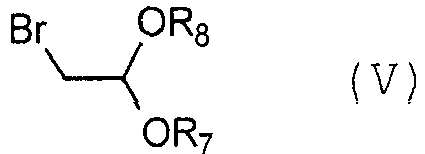


- Pharmazeutische Zusammensetzung umfassend eine oder mehrere Verbindungen der Formel (I), (Ia) und (IIIc) gemäß Ansprüche 2-4 und optional einen oder mehrere pharmazeutisch annehmbare Stoffe, ausgewählt aus Hilfsstoffen, Träger, Verdünnungsmittel und Lösungsmitteln.
- Pharmazeutischer Kit umfassend (i) eine oder mehrere Verbindungen der Formel (I), (Ia) oder (IIIc) gemäß Ansprüche 2-4, oder eine pharmazeutische Zusammensetzung gemäß Anspruch 11 und (ii) mindestens einen antiproliferativen oder cytotoxischen Wirkstoff.
- Verbindungen der Formel (I), (Ia) oder (IIIc) gemäß Ansprüche 2-4, pharmazeutische Zusammensetzung gemäß Anspruch 11 oder pharmazeutischer Kit gemäß Anspruch 12 zur Anwendung als Medikament oder als Werkzeug in der biomedizinischen Forschung.
- Verbindungen der Formel (I), (Ia) oder (IIIc) gemäß Ansprüche 2-4, pharmazeutische Zusammensetzung gemäß Anspruch 11 oder pharmazeutischer Kit gemäß Anspruch 12 zur Anwendung bei der Behandlung von Krankheiten oder Krankheitszuständen, die zumindest teilweise durch Therapie gelindert werden können.
- Verbindungen der Formel (I), (Ia) oder (IIIc) gemäß Ansprüche 2-4, pharmazeutische Zusammensetzung oder pharmazeutischer Kit zur Anwendung gemäß Anspruch 14, wobei die Krankheiten oder Krankheitszustände ausgewählt sind aus proliferierenden Krankheiten, vorzugsweise Krebs.
Applications Claiming Priority (2)
| Application Number | Priority Date | Filing Date | Title |
|---|---|---|---|
| ATA1114/2012A AT513522A1 (de) | 2012-10-15 | 2012-10-15 | Neue Anthracyclinderivate |
| PCT/EP2013/071520 WO2014060408A1 (de) | 2012-10-15 | 2013-10-15 | Anthracyclin-derivate zur behandlung von tumorerkrankungen |
Publications (2)
| Publication Number | Publication Date |
|---|---|
| EP2906577A1 EP2906577A1 (de) | 2015-08-19 |
| EP2906577B1 true EP2906577B1 (de) | 2020-01-22 |
Family
ID=50487596
Family Applications (1)
| Application Number | Title | Priority Date | Filing Date |
|---|---|---|---|
| EP13779194.3A Not-in-force EP2906577B1 (de) | 2012-10-15 | 2013-10-15 | Anthracyclin-derivate zur behandlung von tumorerkrankungen |
Country Status (8)
| Country | Link |
|---|---|
| US (2) | US10144753B2 (de) |
| EP (1) | EP2906577B1 (de) |
| AT (1) | AT513522A1 (de) |
| AU (1) | AU2013333998B2 (de) |
| CA (1) | CA2888415A1 (de) |
| HU (1) | HUE048942T2 (de) |
| IL (1) | IL238267B (de) |
| WO (1) | WO2014060408A1 (de) |
Family Cites Families (5)
| Publication number | Priority date | Publication date | Assignee | Title |
|---|---|---|---|---|
| CA1131622A (en) | 1978-06-05 | 1982-09-14 | Raphael Pappo | Intermediates for the synthesis of (.sup. )-4- demethoxydaunorubicin |
| EP0523289A1 (de) | 1991-07-16 | 1993-01-20 | Board of Regents of the University of Nebraska | Verfahren zur Herstellung von Doxorubicin, Daunomycinon und Doxorubicinderivaten |
| DE19708496A1 (de) | 1997-03-03 | 1998-09-10 | Hoechst Ag | Verfahren zur enantionmerenreinen Anthracylin-Synthese |
| US6355784B1 (en) | 1998-06-12 | 2002-03-12 | Waldemar Priebe | Methods and compositions for the manufacture of halogenated anthracyclines with increased antitumor activity, other anthracyclines, halogenated sugars, and glycosyl donors |
| CA2653770A1 (en) * | 2006-06-01 | 2007-12-06 | Reata Pharmaceuticals, Inc. | Combination of chemotherapeutic compounds for treating cancer |
-
2012
- 2012-10-15 AT ATA1114/2012A patent/AT513522A1/de not_active Application Discontinuation
-
2013
- 2013-10-15 US US14/435,907 patent/US10144753B2/en not_active Expired - Fee Related
- 2013-10-15 AU AU2013333998A patent/AU2013333998B2/en not_active Ceased
- 2013-10-15 HU HUE13779194A patent/HUE048942T2/hu unknown
- 2013-10-15 WO PCT/EP2013/071520 patent/WO2014060408A1/de not_active Ceased
- 2013-10-15 EP EP13779194.3A patent/EP2906577B1/de not_active Not-in-force
- 2013-10-15 CA CA2888415A patent/CA2888415A1/en not_active Abandoned
-
2015
- 2015-04-13 IL IL23826715A patent/IL238267B/en active IP Right Grant
-
2018
- 2018-12-03 US US16/207,285 patent/US20190100548A1/en not_active Abandoned
Non-Patent Citations (1)
| Title |
|---|
| None * |
Also Published As
| Publication number | Publication date |
|---|---|
| US20150252069A1 (en) | 2015-09-10 |
| US20190100548A1 (en) | 2019-04-04 |
| IL238267B (en) | 2019-11-28 |
| CA2888415A1 (en) | 2014-04-24 |
| WO2014060408A1 (de) | 2014-04-24 |
| EP2906577A1 (de) | 2015-08-19 |
| IL238267A0 (en) | 2015-06-30 |
| AU2013333998B2 (en) | 2018-02-22 |
| HUE048942T2 (hu) | 2020-09-28 |
| AT513522A1 (de) | 2014-05-15 |
| US10144753B2 (en) | 2018-12-04 |
| AU2013333998A1 (en) | 2015-05-28 |
Similar Documents
| Publication | Publication Date | Title |
|---|---|---|
| EP1005465B1 (de) | Neue epothilon-derivate, verfahren zu deren herstellung und ihre pharmazeutische verwendung | |
| DE69729128T2 (de) | Taxoid-derivate und verfahren zu ihrer herstellung | |
| DE3587938T2 (de) | Bryostatine. | |
| DE69103428T2 (de) | Latente alkylierungsubstituenten enthaltende anthracycline-analoge. | |
| DE69728544T2 (de) | Totalsynthese von acylfulvenen mit antitumorwirkung | |
| DE2510866A1 (de) | Adriamycine und verfahren zu deren herstellung | |
| DE3219380C2 (de) | Desmethoxy-anthracyclinglycoside, Verfahren zu deren Herstellung sowie pharmazeutische Mittel, die diese enthalten | |
| DE69617425T2 (de) | Paclitaxelsynthese aus vorläuferverbindungen und verfahren zu deren herstellung | |
| Steunenberg et al. | C (1→ 4)-linked disaccharides through carbonylative Stille cross-coupling | |
| DE3719377C2 (de) | Anthracyclinglykoside, Verfahren zu deren Herstellung und Arzneimittel, welche diese enthalten | |
| DE69509377T2 (de) | Anthracyclin-derivate, die ein trifluormethylierte zuckereinheiten enthalten | |
| DE60112769T2 (de) | Tetraphenylbacteriochlorinderivate und diese enthaltdenden Zusammensetzungen | |
| EP0286926B1 (de) | Semisynthetische Rhodomycine, Verfahren zu ihrer Herstellung und ihre Verwendung als Zytostatika | |
| NL8702436A (nl) | Anthracycline glycosiden met antitumorwerking, bereiding daarvan, tussenprodukten daarvoor, en preparaten alsmede gebruik daarvan. | |
| JPS6328079B2 (de) | ||
| DE69312512T2 (de) | Etoposid-derivate, ihre herstellung, ihre verwendung als medikament und ihre verwendung zur herstellung eines antikrebsmittels | |
| DE2942818C2 (de) | 4'-C-Methyl-4'-O-methyl-daunorubicin und -doxorubicin und deren 4'-Epimere sowie diese Verbindungen enthaltende pharmazeutische Zusammensetzungen | |
| EP2906577A1 (de) | Anthracyclin-derivate zur behandlung von tumorerkrankungen | |
| DE69505828T2 (de) | Fluoroanthracycline, verfahren zu deren herstellung und diese enthaltende pharmazeutischen zusammensetzungen | |
| EP0659190A1 (de) | Antineoplastic heteronaphtochinone | |
| JP2013237659A (ja) | 抗腫瘍剤 | |
| EP0345598A2 (de) | Zytostatisch wirksame Anthracyclinderivate | |
| EP0777673A2 (de) | Alpha-d-pentofuranosid-derivate, verfahren zu deren herstellung und deren verwendung | |
| DE69727916T2 (de) | Taxoid-Derivate und Verfahren zu deren Herstellung | |
| DE69200900T2 (de) | 1,5-Diyn-3-cycloalkenderivate, ihr Herstellungsverfahren und diese enthaltende pharmazeutische Compositionen. |
Legal Events
| Date | Code | Title | Description |
|---|---|---|---|
| PUAI | Public reference made under article 153(3) epc to a published international application that has entered the european phase |
Free format text: ORIGINAL CODE: 0009012 |
|
| 17P | Request for examination filed |
Effective date: 20150420 |
|
| AK | Designated contracting states |
Kind code of ref document: A1 Designated state(s): AL AT BE BG CH CY CZ DE DK EE ES FI FR GB GR HR HU IE IS IT LI LT LU LV MC MK MT NL NO PL PT RO RS SE SI SK SM TR |
|
| AX | Request for extension of the european patent |
Extension state: BA ME |
|
| DAX | Request for extension of the european patent (deleted) | ||
| STAA | Information on the status of an ep patent application or granted ep patent |
Free format text: STATUS: EXAMINATION IS IN PROGRESS |
|
| 17Q | First examination report despatched |
Effective date: 20170721 |
|
| GRAP | Despatch of communication of intention to grant a patent |
Free format text: ORIGINAL CODE: EPIDOSNIGR1 |
|
| STAA | Information on the status of an ep patent application or granted ep patent |
Free format text: STATUS: GRANT OF PATENT IS INTENDED |
|
| INTG | Intention to grant announced |
Effective date: 20181210 |
|
| GRAJ | Information related to disapproval of communication of intention to grant by the applicant or resumption of examination proceedings by the epo deleted |
Free format text: ORIGINAL CODE: EPIDOSDIGR1 |
|
| STAA | Information on the status of an ep patent application or granted ep patent |
Free format text: STATUS: EXAMINATION IS IN PROGRESS |
|
| GRAS | Grant fee paid |
Free format text: ORIGINAL CODE: EPIDOSNIGR3 |
|
| STAA | Information on the status of an ep patent application or granted ep patent |
Free format text: STATUS: GRANT OF PATENT IS INTENDED |
|
| GRAP | Despatch of communication of intention to grant a patent |
Free format text: ORIGINAL CODE: EPIDOSNIGR1 |
|
| INTG | Intention to grant announced |
Effective date: 20190412 |
|
| GRAA | (expected) grant |
Free format text: ORIGINAL CODE: 0009210 |
|
| STAA | Information on the status of an ep patent application or granted ep patent |
Free format text: STATUS: THE PATENT HAS BEEN GRANTED |
|
| AK | Designated contracting states |
Kind code of ref document: B1 Designated state(s): AL AT BE BG CH CY CZ DE DK EE ES FI FR GB GR HR HU IE IS IT LI LT LU LV MC MK MT NL NO PL PT RO RS SE SI SK SM TR |
|
| REG | Reference to a national code |
Ref country code: GB Ref legal event code: FG4D Free format text: NOT ENGLISH |
|
| REG | Reference to a national code |
Ref country code: CH Ref legal event code: EP |
|
| REG | Reference to a national code |
Ref country code: AT Ref legal event code: REF Ref document number: 1226841 Country of ref document: AT Kind code of ref document: T Effective date: 20200215 |
|
| REG | Reference to a national code |
Ref country code: IE Ref legal event code: FG4D Free format text: LANGUAGE OF EP DOCUMENT: GERMAN |
|
| REG | Reference to a national code |
Ref country code: DE Ref legal event code: R096 Ref document number: 502013014247 Country of ref document: DE |
|
| REG | Reference to a national code |
Ref country code: CH Ref legal event code: NV Representative=s name: NIIZUMA WASNER GMBH PATENTANWALTSBUERO, CH |
|
| REG | Reference to a national code |
Ref country code: NL Ref legal event code: MP Effective date: 20200122 |
|
| REG | Reference to a national code |
Ref country code: LT Ref legal event code: MG4D |
|
| PG25 | Lapsed in a contracting state [announced via postgrant information from national office to epo] |
Ref country code: RS Free format text: LAPSE BECAUSE OF FAILURE TO SUBMIT A TRANSLATION OF THE DESCRIPTION OR TO PAY THE FEE WITHIN THE PRESCRIBED TIME-LIMIT Effective date: 20200122 Ref country code: PT Free format text: LAPSE BECAUSE OF FAILURE TO SUBMIT A TRANSLATION OF THE DESCRIPTION OR TO PAY THE FEE WITHIN THE PRESCRIBED TIME-LIMIT Effective date: 20200614 Ref country code: NL Free format text: LAPSE BECAUSE OF FAILURE TO SUBMIT A TRANSLATION OF THE DESCRIPTION OR TO PAY THE FEE WITHIN THE PRESCRIBED TIME-LIMIT Effective date: 20200122 Ref country code: NO Free format text: LAPSE BECAUSE OF FAILURE TO SUBMIT A TRANSLATION OF THE DESCRIPTION OR TO PAY THE FEE WITHIN THE PRESCRIBED TIME-LIMIT Effective date: 20200422 Ref country code: FI Free format text: LAPSE BECAUSE OF FAILURE TO SUBMIT A TRANSLATION OF THE DESCRIPTION OR TO PAY THE FEE WITHIN THE PRESCRIBED TIME-LIMIT Effective date: 20200122 |
|
| PG25 | Lapsed in a contracting state [announced via postgrant information from national office to epo] |
Ref country code: LV Free format text: LAPSE BECAUSE OF FAILURE TO SUBMIT A TRANSLATION OF THE DESCRIPTION OR TO PAY THE FEE WITHIN THE PRESCRIBED TIME-LIMIT Effective date: 20200122 Ref country code: SE Free format text: LAPSE BECAUSE OF FAILURE TO SUBMIT A TRANSLATION OF THE DESCRIPTION OR TO PAY THE FEE WITHIN THE PRESCRIBED TIME-LIMIT Effective date: 20200122 Ref country code: HR Free format text: LAPSE BECAUSE OF FAILURE TO SUBMIT A TRANSLATION OF THE DESCRIPTION OR TO PAY THE FEE WITHIN THE PRESCRIBED TIME-LIMIT Effective date: 20200122 Ref country code: BG Free format text: LAPSE BECAUSE OF FAILURE TO SUBMIT A TRANSLATION OF THE DESCRIPTION OR TO PAY THE FEE WITHIN THE PRESCRIBED TIME-LIMIT Effective date: 20200422 Ref country code: GR Free format text: LAPSE BECAUSE OF FAILURE TO SUBMIT A TRANSLATION OF THE DESCRIPTION OR TO PAY THE FEE WITHIN THE PRESCRIBED TIME-LIMIT Effective date: 20200423 Ref country code: IS Free format text: LAPSE BECAUSE OF FAILURE TO SUBMIT A TRANSLATION OF THE DESCRIPTION OR TO PAY THE FEE WITHIN THE PRESCRIBED TIME-LIMIT Effective date: 20200522 |
|
| REG | Reference to a national code |
Ref country code: HU Ref legal event code: AG4A Ref document number: E048942 Country of ref document: HU |
|
| REG | Reference to a national code |
Ref country code: DE Ref legal event code: R097 Ref document number: 502013014247 Country of ref document: DE |
|
| PG25 | Lapsed in a contracting state [announced via postgrant information from national office to epo] |
Ref country code: SK Free format text: LAPSE BECAUSE OF FAILURE TO SUBMIT A TRANSLATION OF THE DESCRIPTION OR TO PAY THE FEE WITHIN THE PRESCRIBED TIME-LIMIT Effective date: 20200122 Ref country code: RO Free format text: LAPSE BECAUSE OF FAILURE TO SUBMIT A TRANSLATION OF THE DESCRIPTION OR TO PAY THE FEE WITHIN THE PRESCRIBED TIME-LIMIT Effective date: 20200122 Ref country code: LT Free format text: LAPSE BECAUSE OF FAILURE TO SUBMIT A TRANSLATION OF THE DESCRIPTION OR TO PAY THE FEE WITHIN THE PRESCRIBED TIME-LIMIT Effective date: 20200122 Ref country code: CZ Free format text: LAPSE BECAUSE OF FAILURE TO SUBMIT A TRANSLATION OF THE DESCRIPTION OR TO PAY THE FEE WITHIN THE PRESCRIBED TIME-LIMIT Effective date: 20200122 Ref country code: DK Free format text: LAPSE BECAUSE OF FAILURE TO SUBMIT A TRANSLATION OF THE DESCRIPTION OR TO PAY THE FEE WITHIN THE PRESCRIBED TIME-LIMIT Effective date: 20200122 Ref country code: SM Free format text: LAPSE BECAUSE OF FAILURE TO SUBMIT A TRANSLATION OF THE DESCRIPTION OR TO PAY THE FEE WITHIN THE PRESCRIBED TIME-LIMIT Effective date: 20200122 Ref country code: EE Free format text: LAPSE BECAUSE OF FAILURE TO SUBMIT A TRANSLATION OF THE DESCRIPTION OR TO PAY THE FEE WITHIN THE PRESCRIBED TIME-LIMIT Effective date: 20200122 Ref country code: ES Free format text: LAPSE BECAUSE OF FAILURE TO SUBMIT A TRANSLATION OF THE DESCRIPTION OR TO PAY THE FEE WITHIN THE PRESCRIBED TIME-LIMIT Effective date: 20200122 |
|
| PLBE | No opposition filed within time limit |
Free format text: ORIGINAL CODE: 0009261 |
|
| STAA | Information on the status of an ep patent application or granted ep patent |
Free format text: STATUS: NO OPPOSITION FILED WITHIN TIME LIMIT |
|
| 26N | No opposition filed |
Effective date: 20201023 |
|
| PG25 | Lapsed in a contracting state [announced via postgrant information from national office to epo] |
Ref country code: IT Free format text: LAPSE BECAUSE OF FAILURE TO SUBMIT A TRANSLATION OF THE DESCRIPTION OR TO PAY THE FEE WITHIN THE PRESCRIBED TIME-LIMIT Effective date: 20200122 |
|
| PGFP | Annual fee paid to national office [announced via postgrant information from national office to epo] |
Ref country code: AT Payment date: 20201016 Year of fee payment: 8 Ref country code: FR Payment date: 20201020 Year of fee payment: 8 Ref country code: CH Payment date: 20201022 Year of fee payment: 8 Ref country code: GB Payment date: 20201022 Year of fee payment: 8 Ref country code: HU Payment date: 20201003 Year of fee payment: 8 Ref country code: DE Payment date: 20201022 Year of fee payment: 8 |
|
| PG25 | Lapsed in a contracting state [announced via postgrant information from national office to epo] |
Ref country code: PL Free format text: LAPSE BECAUSE OF FAILURE TO SUBMIT A TRANSLATION OF THE DESCRIPTION OR TO PAY THE FEE WITHIN THE PRESCRIBED TIME-LIMIT Effective date: 20200122 Ref country code: SI Free format text: LAPSE BECAUSE OF FAILURE TO SUBMIT A TRANSLATION OF THE DESCRIPTION OR TO PAY THE FEE WITHIN THE PRESCRIBED TIME-LIMIT Effective date: 20200122 |
|
| PG25 | Lapsed in a contracting state [announced via postgrant information from national office to epo] |
Ref country code: MC Free format text: LAPSE BECAUSE OF FAILURE TO SUBMIT A TRANSLATION OF THE DESCRIPTION OR TO PAY THE FEE WITHIN THE PRESCRIBED TIME-LIMIT Effective date: 20200122 Ref country code: LU Free format text: LAPSE BECAUSE OF NON-PAYMENT OF DUE FEES Effective date: 20201015 |
|
| REG | Reference to a national code |
Ref country code: BE Ref legal event code: MM Effective date: 20201031 |
|
| PG25 | Lapsed in a contracting state [announced via postgrant information from national office to epo] |
Ref country code: BE Free format text: LAPSE BECAUSE OF NON-PAYMENT OF DUE FEES Effective date: 20201031 |
|
| PG25 | Lapsed in a contracting state [announced via postgrant information from national office to epo] |
Ref country code: IE Free format text: LAPSE BECAUSE OF NON-PAYMENT OF DUE FEES Effective date: 20201015 |
|
| REG | Reference to a national code |
Ref country code: DE Ref legal event code: R082 Ref document number: 502013014247 Country of ref document: DE |
|
| REG | Reference to a national code |
Ref country code: DE Ref legal event code: R119 Ref document number: 502013014247 Country of ref document: DE |
|
| REG | Reference to a national code |
Ref country code: CH Ref legal event code: PL |
|
| PG25 | Lapsed in a contracting state [announced via postgrant information from national office to epo] |
Ref country code: TR Free format text: LAPSE BECAUSE OF FAILURE TO SUBMIT A TRANSLATION OF THE DESCRIPTION OR TO PAY THE FEE WITHIN THE PRESCRIBED TIME-LIMIT Effective date: 20200122 Ref country code: MT Free format text: LAPSE BECAUSE OF FAILURE TO SUBMIT A TRANSLATION OF THE DESCRIPTION OR TO PAY THE FEE WITHIN THE PRESCRIBED TIME-LIMIT Effective date: 20200122 Ref country code: CY Free format text: LAPSE BECAUSE OF FAILURE TO SUBMIT A TRANSLATION OF THE DESCRIPTION OR TO PAY THE FEE WITHIN THE PRESCRIBED TIME-LIMIT Effective date: 20200122 |
|
| REG | Reference to a national code |
Ref country code: AT Ref legal event code: MM01 Ref document number: 1226841 Country of ref document: AT Kind code of ref document: T Effective date: 20211015 |
|
| GBPC | Gb: european patent ceased through non-payment of renewal fee |
Effective date: 20211015 |
|
| PG25 | Lapsed in a contracting state [announced via postgrant information from national office to epo] |
Ref country code: MK Free format text: LAPSE BECAUSE OF FAILURE TO SUBMIT A TRANSLATION OF THE DESCRIPTION OR TO PAY THE FEE WITHIN THE PRESCRIBED TIME-LIMIT Effective date: 20200122 Ref country code: AL Free format text: LAPSE BECAUSE OF FAILURE TO SUBMIT A TRANSLATION OF THE DESCRIPTION OR TO PAY THE FEE WITHIN THE PRESCRIBED TIME-LIMIT Effective date: 20200122 |
|
| PG25 | Lapsed in a contracting state [announced via postgrant information from national office to epo] |
Ref country code: HU Free format text: LAPSE BECAUSE OF NON-PAYMENT OF DUE FEES Effective date: 20211016 Ref country code: GB Free format text: LAPSE BECAUSE OF NON-PAYMENT OF DUE FEES Effective date: 20211015 Ref country code: DE Free format text: LAPSE BECAUSE OF NON-PAYMENT OF DUE FEES Effective date: 20220503 |
|
| PG25 | Lapsed in a contracting state [announced via postgrant information from national office to epo] |
Ref country code: LI Free format text: LAPSE BECAUSE OF NON-PAYMENT OF DUE FEES Effective date: 20211031 Ref country code: CH Free format text: LAPSE BECAUSE OF NON-PAYMENT OF DUE FEES Effective date: 20211031 Ref country code: AT Free format text: LAPSE BECAUSE OF NON-PAYMENT OF DUE FEES Effective date: 20211015 |
|
| PG25 | Lapsed in a contracting state [announced via postgrant information from national office to epo] |
Ref country code: FR Free format text: LAPSE BECAUSE OF NON-PAYMENT OF DUE FEES Effective date: 20211031 |