EP2902950A1 - Procédé, système et produit de programme informatique permettant de déterminer une stratégie de paiement - Google Patents
Procédé, système et produit de programme informatique permettant de déterminer une stratégie de paiement Download PDFInfo
- Publication number
- EP2902950A1 EP2902950A1 EP14153720.9A EP14153720A EP2902950A1 EP 2902950 A1 EP2902950 A1 EP 2902950A1 EP 14153720 A EP14153720 A EP 14153720A EP 2902950 A1 EP2902950 A1 EP 2902950A1
- Authority
- EP
- European Patent Office
- Prior art keywords
- payment
- transactions
- financial
- parameters
- impact
- Prior art date
- Legal status (The legal status is an assumption and is not a legal conclusion. Google has not performed a legal analysis and makes no representation as to the accuracy of the status listed.)
- Withdrawn
Links
Images


Classifications
-
- G—PHYSICS
- G06—COMPUTING OR CALCULATING; COUNTING
- G06Q—INFORMATION AND COMMUNICATION TECHNOLOGY [ICT] SPECIALLY ADAPTED FOR ADMINISTRATIVE, COMMERCIAL, FINANCIAL, MANAGERIAL OR SUPERVISORY PURPOSES; SYSTEMS OR METHODS SPECIALLY ADAPTED FOR ADMINISTRATIVE, COMMERCIAL, FINANCIAL, MANAGERIAL OR SUPERVISORY PURPOSES, NOT OTHERWISE PROVIDED FOR
- G06Q10/00—Administration; Management
- G06Q10/06—Resources, workflows, human or project management; Enterprise or organisation planning; Enterprise or organisation modelling
- G06Q10/063—Operations research, analysis or management
- G06Q10/0637—Strategic management or analysis, e.g. setting a goal or target of an organisation; Planning actions based on goals; Analysis or evaluation of effectiveness of goals
- G06Q10/06375—Prediction of business process outcome or impact based on a proposed change
-
- G—PHYSICS
- G06—COMPUTING OR CALCULATING; COUNTING
- G06Q—INFORMATION AND COMMUNICATION TECHNOLOGY [ICT] SPECIALLY ADAPTED FOR ADMINISTRATIVE, COMMERCIAL, FINANCIAL, MANAGERIAL OR SUPERVISORY PURPOSES; SYSTEMS OR METHODS SPECIALLY ADAPTED FOR ADMINISTRATIVE, COMMERCIAL, FINANCIAL, MANAGERIAL OR SUPERVISORY PURPOSES, NOT OTHERWISE PROVIDED FOR
- G06Q50/00—Information and communication technology [ICT] specially adapted for implementation of business processes of specific business sectors, e.g. utilities or tourism
- G06Q50/10—Services
- G06Q50/14—Travel agencies
Definitions
- the present invention is in the field of airline payment, and relates more particularly to a method, system and computer program product of determining a payment strategy.
- Payment platforms offer a full suite of solutions for airline payment processing, helping merchants improve conversion rate, ensure revenue protection, and reduce costs.
- Payment platform servers provide travel agencies and travel industry companies the computing environment for processing all the airline payment services.
- the payment services generally cover payment fraud screening to detect risks of fraud associated to a payment request, payment authorization to check if customer has enough funds to purchase a trip and block funds when necessary, payment capture to send orders to transfer money from customer account to travel company account, and further additional services like IVR (Interactive Voice Response), payment statistics, and so.
- the airline merchants are not necessarily experts in the field of payment and determining which payment platform to meet the overall requirements of payment services is a complex operation.
- the airline merchants have to make decisions for selecting payment parameters among which at least the means of payment (MOP) to accept, the third party partners payment system processors (PSP), the payment acquirers (Bank) and fraud management strategy to adopt (Acceptance).
- MOP means of payment
- PSP third party partners payment system processors
- Bank payment acquirers
- fraud management strategy to adopt
- the method includes receiving a plurality of financial parameters and payment parameters, the payment parameters comprising one or more payment alternatives and one or more payment rules; simulating payment transactions for a plurality of combinations of the payment parameters, payment alternatives and payment rules; using the financial parameters for computing a plurality of financial impacts for each simulated payment transaction; and providing payment strategy recommendations based on the computed results.
- a system comprising means adapted for carrying out each step of the method according to the first aspect of the invention.
- a computer program comprising instructions for carrying out the steps of the method when said computer program is executed on a suitable computer device.
- a computer readable medium having encoded thereon a computer program comprising instructions for carrying out each step of the method when the computer program is executed on a computer.
- FIG.1 a computing airline environment 100 taking advantage of the method of the present invention is depicted in accordance with a preferred embodiment.
- the proposed example in an airline environment is illustrative only and the person skilled in the art would devise an application of the invention in any other environment that would need to determine a payment strategy.
- APS Amadeus Payment Server
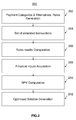
- FIG 2 a general process flow 200 of a computer-implemented method for determining a payment strategy is shown in accordance with an embodiment of the present invention.
- Each step of the general process is further detailed with reference to figures 3 to 8 on an illustrative but non limitative example.
- the process begins at step 202 by prompting a user to specify payment parameters to be used for the determination process.
- the payment parameters may be indifferently named 'payment categories'.
- the user is prompted to provide payment category alternatives if any, herein named indifferently 'alternative' or 'payment alternative'.
- each alternative of a category may also include specific payment alternative rules, herein named indifferently 'rules' or 'payment rules'.
- step 202 allows issuing a set of payment combinations grouping payment categories, alternatives for each payment category with associated payment rules.
- the payment strategy determination process allows simulating a set of transactions for a specific payment category.
- step 206 For each payment combination generated on step 202, the process allows computing for each transaction simulated the impact on each payment category of the payment combination.
- the process allows acquiring a plurality of financial parameters to be next used by the process to compute (step 210) the Net Profit Value (NPV) for each payment combination.
- NSV Net Profit Value
- a final step (212) the process allows comparing the plurality of NPVs previously computed to provide a total financial impact of each payment strategy alternative, thereby allowing providing payment strategy recommendations.
- each payment category may comprise a plurality of payment items.
- the MOP payment category may comprise a list of credit cards such as the Visa®, the Mastercard® or the American Express®, plus various on-line money payments such as the PayPal® one to name a few.
- the transaction acceptance category allows defining several acceptance items such as accept or reject decisions or obtaining further information before making a final acceptance decision (e.g. manual review, 3-D Secure® authentication).
- the payment strategy determination process of the invention may be operated and accessed through a user interface either directly on a general purpose computer or from a remote server over the World Wide Web via a Universal Resource Locator (URL).
- the user interface may be configured to offer a user the means to enter the payment categories or to select different payment categories from a proposed list or from a mix of selections and voluntary inputs.
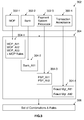
- an alternative registration component allows the creation and registration of a plurality of alternatives for each payment category.
- a first block 304-1 illustrates a MOP alternatives sub-component to create the MOP alternatives.
- the user enters or selects from a proposed list, the items to be included in each alternative.
- the payment items already used by the payment platform are labeled as 'current context' or 'historical'.
- MOP_Alt1 For example, for creating a first MOP alternative (MOP_Alt1) for the MOP category, two items may be selected to define the alternative as follow:
- MOP_Alt2 a second alternative
- a third alternative may be defined as:
- MOP Rules specific rules for each MOP item.
- one MOP rule may be to restrict the use of the on-line payments with PayPal® to one country or geographic territories, e.g. PayPal® is used only for the US.
- the specific rules may also be retrieved from a MOP rules database storing predefined and/or historical rules.
- MOP Rules a set of rules for the MOP category.
- Block 304-2 illustrates the Bank alternatives sub-component created for the Bank payment category. As shown in the example only one bank alternative is created (Bank_Alt1) selecting one bank handling all the transactions. For purposes of the example, the bank is the historical one.
- block 304-3 illustrates the PSP alternatives created for the PSP payment category.
- a first PSP alternative is created (PSP_Alt1) to select a first PSP being operatively in communication with the bank selected in the bank alternative.
- the first PSP is the historical one.
- a second PSP alternative is created (PSP_Alt2) with a second PSP2 which is not necessarily operatively in communication with the bank selected but that the user wants to be studied by the strategy determination process.
- the alternative registration component may comprise conventional means for validating the PSPs entered by a user are valid ones to handle all the MOPs previously selected or for informing the user of any incompatibility.
- Block 304-4 illustrates the Transaction Acceptance alternatives created for the Transaction Acceptance category.
- a first Transaction Acceptance alternative (Fraud Mgt_Alt1) is created for an acceptance based on a fraud screening provider having rules based on transaction data leading to accept, manual review or reject decisions.
- the first Acceptance alternative is the historical one.
- a second Transaction Acceptance alternative (Fraud Mgt_Alt2) is created for an acceptance based on the use of a 3-D Secure® authentication.
- the determination process allows generating a set of overall payment alternatives combining alternatives from each of the payment alternative sub-components.
- a flow chart 400 of the steps performed for the simulation of a set of transactions (step 204 of figure 2 ) is now described.
- the previous use case is also taken as example to detail the process.
- the process allows retrieving a volume of past transactions to be used as a set of transactions for the simulations. Let's have a volume of past transactions be equal to 100%.
- the volume of transactions to be taken into consideration may be based on transactions executed over several months and stored in a transaction database.
- MOP_Alt2 Visa + Mastercard + Amex.
- step 408 The user is further prompted on step 408 to define the increase on the volume of transactions obtained by the alternative.
- the user selects to have +5% of transactions providing a total volume of 105%.
- the user is prompt to reallocate the volume of transactions among the MOP payment items.
- the user selects to have +10% of transactions for the new MOP item 'Amex', and to reduce the volume for the historical MOP items from 60% to 57% for the Visa and from 40% to 38% for the Mastercard.
- step 412 the process allows comparing for each transaction of the past volume of transactions, the historical allocation of transactions (Volume1) to the reallocation (Volume2) defined by the user for the alternative.
- step 414 the process runs a two-steps simulation routine on all transactions of the set of past transactions.
- a first step allows setting a probability for the MOP items depending on the reallocation provided by the user.
- the process allows retaining the historical transaction and putting it in the set of simulated transaction with a probability equal to Volume2/Volume1.
- the process allows retaining the historical transaction and putting it in the set of simulated transaction with a probability equal to Volume2/Volume1-1.
- the process allows retaining the historical transaction and putting it in the set of simulated transaction with probability of 57%/60% if the transaction is a Visa transaction, and a probability of 38%/40% if the transaction is a Mastercard transaction.
- a second step allows selecting the new MOP items that are not historical MOP items, with their associated percentage 'p i s'. Then, for each transaction in the past volume of transactions, the process allows using the percentage 'p i s' in the simulated set of transactions with a probability equal to the sum 'p' of all percentage. Then, the process allows assigning the new MOP item with a probability equal to 'p i /p'.
- the process allows going through all transactions in the historical set again, copying them in the new simulated set of transactions with probability 10%, and change the MOP with probability 10%/10% to Amex.
- step 416 the process allows providing a set of simulated transactions for the alternative selected.
- the user defines by how much the new alternative will increase the total sales volume.
- the user is then prompt to modify the historical transaction split to reflect a new transaction split with the new MOP for the different countries or regions.
- Table below shows a splitting for the US: MOPs Volume of historical MOP Volume with new MOP Visa 58% 58% Mastercard 42% 42% Amex 0% 5% PayPal 0% 5% Total 100% 110% As previously described, the user is then prompted (410) to reallocate the volume of transactions among the MOP payment items, as shown in each table below for US and non-US countries.
- the process allows running simulations for all transactions of the set of past transactions with the inputs defined by the user, and by using first in each transaction probabilities depending of the user's inputs for the existing MOP items, and by using secondly other probabilities for the new MOP items.
- the process allows simulating all transactions of the past set of transactions with probabilities of:
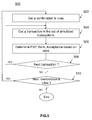
- step 500 executed for determining payment items of each payment category for each transaction of the set of simulated transactions.
- the process is operated for transaction per transaction within the set of simulated transactions for each combination of the overall payment alternatives previously obtained from step 306.
- step 502 the process allows selecting a first combination of payment alternatives and associated rules, and on step 504, the process allows selecting a first transaction in the set of simulated transactions obtained previously from step 416.
- step 506 the process allows running the first transaction for the first selected combination and determining a Payment System Processor, a Bank and an Acceptance strategy.
- next step 508 the process allows selecting a next transaction (branch Yes) or going to next step 510 to determine if all combinations have been simulated. When all combinations have been simulated for the all set of simulated transactions, the process ends.
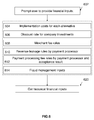
- FIG 6 illustrates the set of financial parameters to be provided by the user to continue the determination process.
- the process allows on step 620 retrieving a plurality of historical financial inputs.
- the historical financial inputs may be retrieved either through a total cost of merchant fees, revenue leakage and payment processing fees, and total cost of fraud or with merchant fees, revenue leakage, payment processing fees and total cost of fraud inputs.
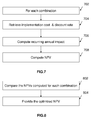
- Figure 7 details the steps for computing the Net Profit Value (NPV) for each payment combination on the basis of the financial inputs previously collected.
- the process begins at step 702 by selecting a first payment combination and next on step 704 by retrieving the implementation cost 'imp_cost' and the discount rate 'd' previously defined at steps 604 and 606.
- the process allows computing a recurring annual impact.
- a recurring annual incremental impact 'an_imp' is computed by summing the annual impact for each new alternative and subtracting the historical alternative annual impact.
- the computation of the recurring annual impact consists mainly in computing the cost differences for the various financial parameters previously defined: merchant fee, payment processing fee, revenue leakage, fraud cost.
- NPV computation is exemplified below for the two payment combinations used in the example.
- the impact on the annual gross margin is computed by summing the amount of the whole set of simulated transactions, comparing it to the amount of the historical transactions, and getting the gross margin.
- the historical alternative of the merchant be equal to 200MEUR, with a 20/80 split between the US and the rest of the world.
- 5% is gained in terms of annual volume worldwide, so there is an incremental of 10MEUR of sales, so an incremental of 2MEUR gross margin.
- the impact is also computed for the merchant fee for each transaction.
- the cumulated historical and the cumulated new merchant fee amounts are calculated over all transactions in the historical and the new sets of transactions, and then subtracted.
- a historical merchant fee 0.6% (fee for Visa or Mastercard transaction without 3DS) to be applied over the 200MEUR sales.
- the impact is also computed for the payment processing fee.
- the cumulated historical and cumulated new payment processing fees may be calculated over all transactions in the historical and the new sets of transactions, and then subtracted.
- the impact is also computed for the revenue leakage.
- the cumulated historical and cumulated new revenue leakage may be calculated over all transactions in the historical and the new sets of transactions, and then subtracted.
- the impact is also computed for the total cost of fraud.
- the cumulated historical and cumulated new total cost may be calculated over all transactions in the historical and the new sets of transactions, and then subtracted.
- NPV 5 years an_imp / d * 1 - 1 / 1 + d ⁇ ⁇ 5 - imp_cost
- Figure 8 shows the last steps processed for determining a payment strategy, once all NPVs have been computed in previous step 708 of figure 7 .
- the process allows on step 802 comparing the value of each NPV computed for each payment combination and providing on next step 804, the payment combination corresponding to the optimized NPV. More precisely, if all payment combinations have a negative NPV, then the process allows proposing the historical payment combination as being the optimized one. If some payment combinations have a positive NPV, the process allows providing the combination having the highest NPV has being the optimized one.
- the process would generate as the result that the payment combination based on Alternative 2 is the optimized one with a NPV of 5.46MEUR compared to the NPV of 2.6MEUR of the other alternative (ALT3), even if the sales increase is not as much as for Alternative 3, but Alternative 3 is deserved as it creates more merchant fees and total cost of fraud.
- the invention can take the form of an entirely hardware embodiment, an entirely software embodiment or an embodiment containing both hardware and software elements.
- the invention is implemented in software, which includes but is not limited to firmware, resident software, microcode, etc.
- the invention can take the form of a computer program product accessible from a computer-usable or computer-readable medium providing program code for use by or in connection with a computer or any instruction execution system.
- a computer-usable or computer readable medium can be any apparatus that can contain, store, communicate, propagate, or transport the program for use by or in connection with the instruction execution system, apparatus, or device.
- the medium can be an electronic, magnetic, optical, electromagnetic, infrared, or semiconductor system (or apparatus or device) or a propagation medium.
- Examples of a computer-readable medium include a semiconductor or solid state memory, magnetic tape, a removable computer diskette, a random access memory (RAM), a read-only memory (ROM), a rigid magnetic disk and an optical disk.
- Current examples of optical disks include compact disk - read only memory (CD-ROM), compact disk - read/write (CD-R/W) and DVD.
Landscapes
- Business, Economics & Management (AREA)
- Human Resources & Organizations (AREA)
- Engineering & Computer Science (AREA)
- Tourism & Hospitality (AREA)
- Strategic Management (AREA)
- Economics (AREA)
- General Physics & Mathematics (AREA)
- Theoretical Computer Science (AREA)
- Entrepreneurship & Innovation (AREA)
- Marketing (AREA)
- Educational Administration (AREA)
- General Business, Economics & Management (AREA)
- Physics & Mathematics (AREA)
- Development Economics (AREA)
- Quality & Reliability (AREA)
- Operations Research (AREA)
- Game Theory and Decision Science (AREA)
- Health & Medical Sciences (AREA)
- General Health & Medical Sciences (AREA)
- Primary Health Care (AREA)
- Financial Or Insurance-Related Operations Such As Payment And Settlement (AREA)
Priority Applications (4)
| Application Number | Priority Date | Filing Date | Title |
|---|---|---|---|
| EP14153720.9A EP2902950A1 (fr) | 2014-02-03 | 2014-02-03 | Procédé, système et produit de programme informatique permettant de déterminer une stratégie de paiement |
| CA2879029A CA2879029A1 (fr) | 2014-02-03 | 2015-01-22 | Methode, systeme et produit de programme informatique servant a determiner une strategie de paiement |
| AU2015200485A AU2015200485A1 (en) | 2014-02-03 | 2015-02-02 | Method, system, and computer program product for determining a payment strategy |
| KR1020150016570A KR20150099415A (ko) | 2014-02-03 | 2015-02-03 | 지불 전략을 결정하기 위한 방법, 시스템 및 컴퓨터 프로그램 제품 |
Applications Claiming Priority (1)
| Application Number | Priority Date | Filing Date | Title |
|---|---|---|---|
| EP14153720.9A EP2902950A1 (fr) | 2014-02-03 | 2014-02-03 | Procédé, système et produit de programme informatique permettant de déterminer une stratégie de paiement |
Publications (1)
| Publication Number | Publication Date |
|---|---|
| EP2902950A1 true EP2902950A1 (fr) | 2015-08-05 |
Family
ID=50031217
Family Applications (1)
| Application Number | Title | Priority Date | Filing Date |
|---|---|---|---|
| EP14153720.9A Withdrawn EP2902950A1 (fr) | 2014-02-03 | 2014-02-03 | Procédé, système et produit de programme informatique permettant de déterminer une stratégie de paiement |
Country Status (1)
| Country | Link |
|---|---|
| EP (1) | EP2902950A1 (fr) |
Cited By (5)
| Publication number | Priority date | Publication date | Assignee | Title |
|---|---|---|---|---|
| FR3048537A1 (fr) * | 2016-03-07 | 2017-09-08 | Amadeus Sas | Systeme de traitement de transaction en ligne avec selection adaptative d'acquereur |
| CN114298707A (zh) * | 2021-12-30 | 2022-04-08 | 深圳市神州路路通网络科技有限公司 | 智能支付推荐方法、装置、设备及存储介质 |
| WO2022267816A1 (fr) * | 2021-06-21 | 2022-12-29 | 腾讯科技(深圳)有限公司 | Procédé et appareil de reconnaissance faciale, dispositif électronique et support d'enregistrement |
| US20230134392A1 (en) * | 2021-11-02 | 2023-05-04 | Liveperson, Inc. | Automated decisioning based on predicted user intent |
| EP4181036A1 (fr) * | 2021-11-16 | 2023-05-17 | Amadeus S.A.S. | Orchestration de simulation de rétroaction |
-
2014
- 2014-02-03 EP EP14153720.9A patent/EP2902950A1/fr not_active Withdrawn
Non-Patent Citations (1)
| Title |
|---|
| No relevant documents disclosed * |
Cited By (8)
| Publication number | Priority date | Publication date | Assignee | Title |
|---|---|---|---|---|
| FR3048537A1 (fr) * | 2016-03-07 | 2017-09-08 | Amadeus Sas | Systeme de traitement de transaction en ligne avec selection adaptative d'acquereur |
| WO2022267816A1 (fr) * | 2021-06-21 | 2022-12-29 | 腾讯科技(深圳)有限公司 | Procédé et appareil de reconnaissance faciale, dispositif électronique et support d'enregistrement |
| US12412178B2 (en) | 2021-06-21 | 2025-09-09 | Tencent Technology (Shenzhen) Company Limited | Face recognition method, apparatus, electronic device, and storage medium |
| US20230134392A1 (en) * | 2021-11-02 | 2023-05-04 | Liveperson, Inc. | Automated decisioning based on predicted user intent |
| US12260387B2 (en) * | 2021-11-02 | 2025-03-25 | Liveperson, Inc. | Automated decisioning based on predicted user intent |
| EP4181036A1 (fr) * | 2021-11-16 | 2023-05-17 | Amadeus S.A.S. | Orchestration de simulation de rétroaction |
| US11869009B2 (en) | 2021-11-16 | 2024-01-09 | Amadeus S.A.S. | Orchestration of feedback simulation |
| CN114298707A (zh) * | 2021-12-30 | 2022-04-08 | 深圳市神州路路通网络科技有限公司 | 智能支付推荐方法、装置、设备及存储介质 |
Similar Documents
| Publication | Publication Date | Title |
|---|---|---|
| US8719166B2 (en) | Iterative processing of transaction information to detect fraud | |
| US20120158586A1 (en) | Aggregating transaction information to detect fraud | |
| US20120158540A1 (en) | Flagging suspect transactions based on selective application and analysis of rules | |
| US20130339186A1 (en) | Identifying Fraudulent Users Based on Relational Information | |
| US20130282563A1 (en) | Systems and Methods for Routing Debit Transactions | |
| JP6527282B1 (ja) | 情報処理方法、情報処理装置、および情報処理プログラム | |
| US20140316960A1 (en) | Merchant bank tool | |
| MX2014011684A (es) | Metodos y sistemas para procesar pagos a nivel mundial a traves de una pluralidad de vias de procesamiento. | |
| US9412107B2 (en) | Predictive fraud screening | |
| US20160042354A1 (en) | Predictive fraud screening | |
| US20160232532A1 (en) | Using revenue management to improve payment fraud screening | |
| US9558490B2 (en) | Systems and methods for predicting a merchant's change of acquirer | |
| US20150221025A1 (en) | Method, system, and computer program product for determining a payment strategy | |
| US20230401108A1 (en) | Automated preparation and transmission of electronic registrations, data sheets and resources | |
| US10430793B2 (en) | Fraud management system and method | |
| AU2014203818B2 (en) | Fraud management system and method | |
| KR101753474B1 (ko) | 예측적 사기 스크리닝 | |
| KR20150007940A (ko) | 사기 관리 시스템 및 방법 | |
| KR102380556B1 (ko) | B2b 정산 서비스 시스템 및 방법과 이를 위한 컴퓨터 프로그램 | |
| KR101686742B1 (ko) | 표준 임대차 가격에 기반한 공증 서비스 및 표준 임대차 가격 결정 방법 | |
| JP5982082B2 (ja) | 証拠金勘定引出余力計算システムおよびプログラム | |
| Hashemi Taba et al. | A novel algorithm developed with integrated metrics for dynamic and smart credit rating of bank customers | |
| EP2983119A1 (fr) | Criblage de fraude prédictive | |
| US20250148546A1 (en) | Computed inequaliies solution | |
| US20230076010A1 (en) | Hardline Threshold Softening |
Legal Events
| Date | Code | Title | Description |
|---|---|---|---|
| PUAI | Public reference made under article 153(3) epc to a published international application that has entered the european phase |
Free format text: ORIGINAL CODE: 0009012 |
|
| 17P | Request for examination filed |
Effective date: 20140203 |
|
| AK | Designated contracting states |
Kind code of ref document: A1 Designated state(s): AL AT BE BG CH CY CZ DE DK EE ES FI FR GB GR HR HU IE IS IT LI LT LU LV MC MK MT NL NO PL PT RO RS SE SI SK SM TR |
|
| AX | Request for extension of the european patent |
Extension state: BA ME |
|
| STAA | Information on the status of an ep patent application or granted ep patent |
Free format text: STATUS: THE APPLICATION IS DEEMED TO BE WITHDRAWN |
|
| 18D | Application deemed to be withdrawn |
Effective date: 20160206 |