EP2901511B1 - Positivplatte für eine bleisäurebatterie und legierung dafür - Google Patents
Positivplatte für eine bleisäurebatterie und legierung dafür Download PDFInfo
- Publication number
- EP2901511B1 EP2901511B1 EP13841239.0A EP13841239A EP2901511B1 EP 2901511 B1 EP2901511 B1 EP 2901511B1 EP 13841239 A EP13841239 A EP 13841239A EP 2901511 B1 EP2901511 B1 EP 2901511B1
- Authority
- EP
- European Patent Office
- Prior art keywords
- alloy
- lead
- grid
- cell
- battery
- Prior art date
- Legal status (The legal status is an assumption and is not a legal conclusion. Google has not performed a legal analysis and makes no representation as to the accuracy of the status listed.)
- Active
Links
Images



Classifications
-
- H—ELECTRICITY
- H01—ELECTRIC ELEMENTS
- H01M—PROCESSES OR MEANS, e.g. BATTERIES, FOR THE DIRECT CONVERSION OF CHEMICAL ENERGY INTO ELECTRICAL ENERGY
- H01M4/00—Electrodes
- H01M4/02—Electrodes composed of, or comprising, active material
- H01M4/64—Carriers or collectors
- H01M4/66—Selection of materials
- H01M4/68—Selection of materials for use in lead-acid accumulators
- H01M4/685—Lead alloys
-
- C—CHEMISTRY; METALLURGY
- C22—METALLURGY; FERROUS OR NON-FERROUS ALLOYS; TREATMENT OF ALLOYS OR NON-FERROUS METALS
- C22C—ALLOYS
- C22C11/00—Alloys based on lead
- C22C11/06—Alloys based on lead with tin as the next major constituent
-
- H—ELECTRICITY
- H01—ELECTRIC ELEMENTS
- H01M—PROCESSES OR MEANS, e.g. BATTERIES, FOR THE DIRECT CONVERSION OF CHEMICAL ENERGY INTO ELECTRICAL ENERGY
- H01M10/00—Secondary cells; Manufacture thereof
- H01M10/06—Lead-acid accumulators
-
- H—ELECTRICITY
- H01—ELECTRIC ELEMENTS
- H01M—PROCESSES OR MEANS, e.g. BATTERIES, FOR THE DIRECT CONVERSION OF CHEMICAL ENERGY INTO ELECTRICAL ENERGY
- H01M4/00—Electrodes
- H01M4/02—Electrodes composed of, or comprising, active material
- H01M4/14—Electrodes for lead-acid accumulators
-
- H—ELECTRICITY
- H01—ELECTRIC ELEMENTS
- H01M—PROCESSES OR MEANS, e.g. BATTERIES, FOR THE DIRECT CONVERSION OF CHEMICAL ENERGY INTO ELECTRICAL ENERGY
- H01M4/00—Electrodes
- H01M4/02—Electrodes composed of, or comprising, active material
- H01M4/64—Carriers or collectors
- H01M4/70—Carriers or collectors characterised by shape or form
- H01M4/72—Grids
- H01M4/73—Grids for lead-acid accumulators, e.g. frame plates
-
- Y—GENERAL TAGGING OF NEW TECHNOLOGICAL DEVELOPMENTS; GENERAL TAGGING OF CROSS-SECTIONAL TECHNOLOGIES SPANNING OVER SEVERAL SECTIONS OF THE IPC; TECHNICAL SUBJECTS COVERED BY FORMER USPC CROSS-REFERENCE ART COLLECTIONS [XRACs] AND DIGESTS
- Y02—TECHNOLOGIES OR APPLICATIONS FOR MITIGATION OR ADAPTATION AGAINST CLIMATE CHANGE
- Y02E—REDUCTION OF GREENHOUSE GAS [GHG] EMISSIONS, RELATED TO ENERGY GENERATION, TRANSMISSION OR DISTRIBUTION
- Y02E60/00—Enabling technologies; Technologies with a potential or indirect contribution to GHG emissions mitigation
- Y02E60/10—Energy storage using batteries
Definitions
- the present disclosure relates to lead-acid batteries, and more particularly, to alloys for battery grids.
- Lead-acid batteries are standard on most types of transportation vehicles including microhybrid vehicles. For example, lead-acid batteries are used to start the internal combustion engines of automobiles, trucks, and other equipment and to supply electricity for vehicle accessories. These battery requirements are known in the industry as SLI (Starting, Lighting and Ignition). Lead-acid batteries are also used in industrial stationary applications including emergency lighting and power supply systems with battery backup such as data networks, high-speed data transmission networks, wireless communication and cable TV systems.
- VRLA batteries are sometimes referred to as an absorbed glass mat (AGM) battery.
- AGM absorbed glass mat
- Stationary applications are generally float applications, i.e., the cells are generally on float (i.e., an external voltage supply connected to the cells is held slightly above the cell potential to maintain charge), with an occasional need for a deep discharge when the main power source fails or is otherwise interrupted.
- Suitable cells must thus be capable of enduring repetitive charge-deep discharge-charge cycling regimes for up to 500 cycles or even more. Indeed, it would be desirable to provide cells capable of enduring from 1,000 to 2,000 cycles or so.
- Suitable alloys must be capable of being cast into satisfactory grids and must impart adequate mechanical properties to the grid. Also, the alloys must impart satisfactory electrical performance to the cell in the intended application. Satisfactory alloys thus must impart the desired corrosion resistance, not result in thermal runaway (i.e., must not raise the tendency for the cell to lose water via gassing) and avoid premature capacity loss (sometimes referred to as "PCL").
- suitable alloys must be capable of being cast into grids by the desired technique, i.e., the cast grids must be low in defects as is known (e.g., relative freedom from voids, tears, microcracks and the like).
- Such casting techniques range from conventional gravity casting ("book molds" or the like) to continuous processes using expanded metal techniques. Alternatively, grids may be punched.
- the resulting grids need to be strong enough to endure processing into plates and assembly into cells in conventionally used equipment. Even further, suitable grids must maintain satisfactory mechanical properties throughout the expected service life. Any substantial loss in the desired mechanical properties during service life can adversely impact upon the cell performance as will be more fully discussed hereinafter.
- the grid alloy for positive plates must yield a cell having adequate corrosion resistance.
- Positive grid corrosion thus is a primary mode of failure of VRLA lead-acid cells. When positive grid corrosion occurs, this lowers the electrical conductivity of the cell itself. Cell failure occurs when the corrosion-induced decrease in the conductivity of the grid causes the discharge voltage to drop below a value acceptable for a particular application.
- the positive grid corrodes; and the corrosion products form on the surface of the grid.
- the corrosion products form at the grain boundaries and grid surface of the lead-acid where the corrosion process has penetrated the interior of the "wires" of the grid.
- These corrosion products are generally much harder than the lead alloy forming the grid and are less dense. Due to the stresses created by these conditions, the grid alloy moves or grows to accommodate the bulky corrosion products. This physical displacement of the grid causes an increase in the length and/or width of the grid. The increase in size of the grid may be nonuniform.
- a corrosion-induced change in the dimension of the grid may also sometimes be called "creep".
- VRLA cells must avoid conditions in service in which the temperature within the cell increases uncontrollably and irreversibly. It has been hypothesized that excessive water loss resulting in cell dry-out is the driving mechanism for thermal runaway in VRLA cells. This water loss can be caused by hydrogen gassing at the negative electrode or oxygen gassing at the positive electrode through the electrolysis of water, or both.
- the oxygen recombination efficiency is increased. Since this recombination reaction is highly exothermic, this tends to heat the cell. As the temperature rises, the cell tends to generate gas; and the recombination processes become even more efficient, thereby further increasing the cell temperature. In similar fashion, water loss increases the cell electrical resistance; and such increased cell resistance increases the cell temperature, thereby further increasing water loss. The cell is in thermal runaway.
- antimonial alloys have been considered necessary for positive grids where the cells are required in service to endure deep discharge-charge cycling regimes. Yet, in general, although not exclusively, antimonial alloys cause thermal runaway in VRLA cells due to excessive gassing at both electrodes. Antimony thus leaches out from the positive grid as corrosion takes place, dissolving into the electrolyte, ultimately migrating to and "electroplating" onto the negative electrode. These antimony sites on the negative electrode thus become preferential to hydrogen gassing. Additionally, the presence of antimony on the negative electrode increases the self-discharge and thereby heats the cell since the self-discharge current is also reflected in the float current.
- PCL premature capacity loss
- PbSO 4 Lead sulfate crystals on the plates are formed as batteries discharge. These crystals become relatively difficult to charge if the plates are left in the discharged state or at open circuit for a significant period of time. Moreover, the fluid in a battery tends to evaporate over time to such an extent that upper edges of battery plates become exposed that they become susceptible to corrosion. This corrosion of the plates, especially positive plates, further deteriorates the ability of a battery to be recharged and hold a charge.
- MFX PbSbCd
- MFX PbSbCd
- MFX is the main alloy for the positive grids.
- MFX is robust and has good mechanical properties and excellent corrosion resistance.
- this alloy contains Cd, which causes environmental and recycling issues. Therefore, the use of Cd-containing alloys is restricted globally because of environmental concerns.
- Alloy A (PbSnCaAg) is a replacement for MFX and is used extensively in current production. It performs well in the BCI cycle life test, but overall it does not fully match the performance of MFX.
- the addition of Ag increases the general corrosion resistance but also increases cost and creates adhesion issues between the grids and PAM (Positive Active Materials). In particular, it shows PCL at the high rate discharge test.
- the problems and disadvantages of the prior art are overcome or alleviated by the present lead-acid battery that applies battery design features that protects the battery from permanent deep discharge damage and promotes charge acceptance during float applications.
- a unique combination of battery materials that are applied in unique proportions have been found by experimentation to enable the battery to better hold a charge during float operations.
- the proportions and ratio at which these exemplary materials are applied are unique.
- Exemplary embodiments of the invention also use certain materials and/or material characteristics that are unique either in their use or in their amount.
- a battery of the present invention exhibits superior performance for long periods of time.
- the optimal materials and their proportions and ratios of use are disclosed in detail in the body of this specification.
- These unique exemplary materials used in unique proportions and percentages, in combination with conventional materials, have by experimentation been found to provide cumulatively an advantageous lead-acid battery that overcomes problems that have plagued lead-acid batteries in the past.
- Exemplary embodiments of the positive grid metal alloy of this invention overcome such problems with excellent mechanical properties, enhanced corrosion resistance, less gassing and therefore lower rate of sulfation and water loss, and no post-casting treatments required to age-harden battery grids.
- presently described new, exemplary lead based alloys containing tin, calcium, bismuth and copper may be characterized by enhanced mechanical properties, corrosion resistance, less battery gassing, lower sulfation and water loss, and no post-casting treatment requirements for age hardening so that the grids can be processed much sooner after being cast or punched.
- One embodiment of the present invention includes a lead-acid cell having a positive plate and a negative plate disposed with a container, a separator disposed within said container and separating said positive and negative plates, and an electrolyte within said container, said positive plate comprising a grid supporting structure having a layer of active material thereon, said grid supporting structure comprising a lead-based alloy consisting essentially of lead, from about 1.5% to about 3.0% tin, from about 0% to about 0.02% copper, from about 0.015% to about 0.04% bismuth, and from about 0% to about 0.08% calcium, the percentages being based upon the total weight of said lead-based alloy.
- FIG. 1 illustrates an exemplary lead-acid battery having a positive plate, indicated generally at 10, with a separator 12 enveloping the positive plate 10.
- the positive plate 10 generally comprises a grid 14 having a plate lug 16 and positive active material 18 pasted onto grid 14.
- the separator is typically an absorbent glass fiber mat.
- Other commercially available glass fiber separators incorporate polyolefin or other polymeric fibers to replace part of the glass fibers.
- FIG. 2 illustrates a VRLA cell, indicated generally at 20.
- the cell 20 thus includes a container or jar 22 retaining snugly therein an element stack, shown generally at 24.
- the element stack 24 thus comprises a series of positive plates 10 and negative plates 26 alternately disposed and having separators 12 separating adjacent positive and negative plates.
- Band 28 is used to hold adjacent plates in the desired compression and to facilitate assembly (the band encircling the element stack 24, but being partially broken away in FIG. 2 for illustrative purposes).
- the VRLA cell 20 likewise includes a positive terminal 30, a negative terminal 32, and a cover 34 affixed to container or jar 22 by any appropriate means, as is known.
- a low pressure, self-resealing valve 36 is used to maintain the desired internal pressure within the cell. Many suitable relief valves are known and used.
- the grid 14 includes a Pb-Sn-Ca type alloy with some other elements and characteristics as described hereinafter below.
- Ca is fixed at about 0.065%, just below the peritectic composition, and no Ag is added.
- Dog bone samples were gravity cast. Hardness and tensile tests were performed to evaluate the mechanical properties of the alloys as-cast and aged at the room temperature and heat treated at 100°C for three hours.
- the corrosion tests were performed at 60°C, in H 2 SO 4 with 1.30 s.g., and with potential of about 1.30V vs. Hg/Hg 2 SO 4 reference electrode. Four samples of each alloy were used for each test cell. The test time is from 1.5 to 11 months. After the corrosion test, the weight loss and sample dimension changes were measured and the corrosion layer was analyzed with a scanning electron microscope (SEM) and optical microscope.
- SEM scanning electron microscope
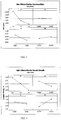
- FIGS. 3 and 4 illustrate the main effect plots for the corrosion rate and sample length growth from the 8-month test cell. Both Sn and Bi reduce the corrosion rate and sample growth. Cu almost has no effect on the corrosion rate but reduces the sample growth. Ba had a negative effect on the corrosion rate and sample growth.
- the preferred alloy is with 2.0%Sn, 0.032%Bi and 0.0125%Cu (Alloy 15 in the matrix) and was selected for battery build tests.
- FIGS. 5-8 compare mechanical properties for Alloy A and Alloy 15. With higher Ca content, Alloy 15 has higher hardness ( FIG. 5 ), yield ( FIG. 6 ) and tensile ( FIG. 7 ) strength with the similar elongation ( FIG. 8 ). The conditions for all the tests are shown in fig. 8 .
- Oxygen overvoltage measurements were carried out in 1.30 SG sulfuric acid at 25°C, 35°C, and 45°C, respectively, at electrodes fabricated from Alloys 15, A, and B (pure lead).
- the Tafel slope, b is the same for all the 3 test alloys.
- the Tafel slope is related to the reaction mechanism for oxygen evolution at the test electrode.
- the exchange current density io, describes the rate of reaction (for O 2 evolution) under open circuit conditions. The higher the value, the greater is the rate of O 2 evolution at that electrode. A higher exchange current density would signify a catalytic effect of the alloy on oxygen evolution.
- the exchange current density for alloy 15 is appreciably lower than that for Alloy A. In fact, it is comparable to that of Alloy B (pure Pb). Furthermore, the activation energy for oxygen evolution on alloy 15 (similar to that of Alloy B) is significantly higher than that of Alloy A.
- a plot of the polarization voltage at a specific current density of 10 mA/cm2 in FIG. 9 confirms a much higher polarization resistance for Oxygen evolution on Alloy 15 than on Alloy A. Consequently, the rate of oxygen evolution on Alloy 15 would be expected to be relatively lower than that on Alloy A but comparable to that of Alloy B (pure Pb). The lower gassing rate could lead to lower self-discharge rates in the battery and to a more efficient recombination process in VRLA systems.
- Alloy 15 is comparable to Alloy B (pure lead) in terms of resistance to gassing at the positive plate.
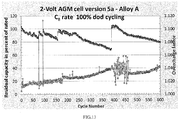
- Alloy 15 (Pb2.0Sn0.065Ca0.032Bi0.0125Cu) is selected for the battery test. Test results are illustrated in FIGS. 10-13 .
- FIG. 10 illustrates stand loss, or average voltage drop (mV) after 112 days for Alloy 15, 13 and A.
- FIG. 11 illustrates BCI cycle life capacity discharge for Alloy 15 cells.
- alloy 15 performs equally or better than Alloy A.
- Alloy 13 may adequately satisfy the diverse requirements needed for making battery grids for positive plates.
- these alloys are characterized by enhanced mechanical properties, corrosion resistance, less battery gassing and water loss, enhanced electrical performance, and no post-casting treatment requirements for age hardening so that the grids can be processed much sooner after being cast. These criteria should be satisfied regardless of the type of application.
Landscapes
- Chemical & Material Sciences (AREA)
- Chemical Kinetics & Catalysis (AREA)
- Electrochemistry (AREA)
- General Chemical & Material Sciences (AREA)
- Engineering & Computer Science (AREA)
- Materials Engineering (AREA)
- Manufacturing & Machinery (AREA)
- Mechanical Engineering (AREA)
- Metallurgy (AREA)
- Organic Chemistry (AREA)
- Cell Electrode Carriers And Collectors (AREA)
Claims (13)
- Bleisäurezelle, die eine positive Platte und eine negative Platte, die in einem Behälter angeordnet sind, einen Separator, der in dem Behälter angeordnet ist und die positive und negative Platte voneinander trennt, und einen Elektrolyt in dem Behälter aufweist, wobei die positive Platte ein Tragstruktur-Gitter aufweist, welches eine bleibasierte Legierung umfasst, die aus Blei, von 1,5 % bis 3,0 % Zinn, von 0,01 % bis 0,02 % Kupfer, von 0,015 % bis 0,04 % Bismut und von 0,05 % bis 0,08 % Calcium umfasst, wobei sich die prozentualen Angaben auf das Gesamtgewicht der bleibasierten Legierung beziehen.
- Bleisäurezelle gemäß Anspruch 1, wobei der Zinngehalt der Legierung von 1,75 % bis 2,25 % beträgt.
- Bleisäurezelle gemäß Anspruch 1, wobei der Zinngehalt der Legierung von 1,95 % bis 2,05 % beträgt.
- Bleisäurezelle gemäß Anspruch 1, wobei der Zinngehalt der Legierung 2,0 % beträgt.
- Bleisäurezelle gemäß Anspruch 1, wobei der Kupfergehalt der Legierung 0,0125 % beträgt.
- Bleisäurezelle gemäß Anspruch 1, wobei der Bismutgehalt der Legierung von 0,015 % bis 0,035 % beträgt.
- Bleisäurezelle gemäß Anspruch 1, wobei der Bismutgehalt der Legierung 0,032 % beträgt.
- Bleisäurezelle gemäß Anspruch 1, wobei der Calciumgehalt der Legierung von 0,05 % bis 0,07 % beträgt.
- Bleisäurezelle gemäß Anspruch 1, wobei der Calciumgehalt der Legierung 0,065 % beträgt.
- Bleisäurezelle gemäß Anspruch 1, wobei das Gitter ein gegossenes Gitter ist.
- Bleisäurezelle gemäß Anspruch 1, wobei die Batterie abgedichtet ist.
- Platte für eine Bleisäurebatterie mit einem Gitter, das eine bleibasierte Legierung umfasst, die aus Blei, 2,0 % Zinn, 0,0125 % Kupfer, 0,032 % Bismut und 0,065 % Calcium besteht, wobei die prozentualen Angaben auf dem Gewicht basieren.
- Platte für eine Bleisäurebatterie mit einem Gitter, das eine bleibasierte Legierung umfasst, die aus Blei, 2,0 % Zinn, 0,0125 % Kupfer, 0,015 % Bismut und 0,065 % Calcium besteht, wobei die prozentualen Angaben auf dem Gewicht basieren.
Priority Applications (1)
| Application Number | Priority Date | Filing Date | Title |
|---|---|---|---|
| PL13841239T PL2901511T3 (pl) | 2012-09-28 | 2013-09-26 | Płytka dodatnia i stop akumulatora kwasowo-ołowiowego |
Applications Claiming Priority (2)
| Application Number | Priority Date | Filing Date | Title |
|---|---|---|---|
| US201261706846P | 2012-09-28 | 2012-09-28 | |
| PCT/US2013/061826 WO2014052528A1 (en) | 2012-09-28 | 2013-09-26 | Lead-acid battery positive plate and alloy therefore |
Publications (3)
| Publication Number | Publication Date |
|---|---|
| EP2901511A1 EP2901511A1 (de) | 2015-08-05 |
| EP2901511A4 EP2901511A4 (de) | 2016-01-27 |
| EP2901511B1 true EP2901511B1 (de) | 2019-09-11 |
Family
ID=50388948
Family Applications (1)
| Application Number | Title | Priority Date | Filing Date |
|---|---|---|---|
| EP13841239.0A Active EP2901511B1 (de) | 2012-09-28 | 2013-09-26 | Positivplatte für eine bleisäurebatterie und legierung dafür |
Country Status (11)
| Country | Link |
|---|---|
| US (1) | US10147953B2 (de) |
| EP (1) | EP2901511B1 (de) |
| JP (1) | JP6530312B2 (de) |
| AU (2) | AU2013323563A1 (de) |
| BR (1) | BR112015006528B1 (de) |
| CA (1) | CA2884453C (de) |
| ES (1) | ES2753241T3 (de) |
| MX (1) | MX373758B (de) |
| PL (1) | PL2901511T3 (de) |
| PT (1) | PT2901511T (de) |
| WO (1) | WO2014052528A1 (de) |
Families Citing this family (4)
| Publication number | Priority date | Publication date | Assignee | Title |
|---|---|---|---|---|
| CN104075960B (zh) * | 2014-06-27 | 2016-05-25 | 天能集团江苏科技有限公司 | 一种快速测定蓄电池板栅合金耐腐蚀性能的方法 |
| EP3432394A4 (de) * | 2016-08-26 | 2019-06-12 | Hitachi Chemical Company, Ltd. | Bleisäureakkumulator und verfahren zur herstellung davon |
| JP6406457B2 (ja) * | 2016-08-26 | 2018-10-17 | 日立化成株式会社 | 鉛蓄電池、並びに、鋳造格子体及びその製造方法 |
| CN110205516B (zh) * | 2019-06-13 | 2021-06-04 | 骆驼集团华中蓄电池有限公司 | 铅酸蓄电池超低水损耗板正极板栅及铅酸蓄电池制备方法 |
Family Cites Families (10)
| Publication number | Priority date | Publication date | Assignee | Title |
|---|---|---|---|---|
| JPH0770321B2 (ja) | 1986-12-16 | 1995-07-31 | 松下電器産業株式会社 | 密閉式鉛蓄電池 |
| JPH01117272A (ja) | 1987-10-29 | 1989-05-10 | Shin Kobe Electric Mach Co Ltd | 鉛蓄電池 |
| JP3367157B2 (ja) * | 1993-08-23 | 2003-01-14 | 松下電器産業株式会社 | 鉛蓄電池 |
| AU2003227501B8 (en) * | 2002-04-18 | 2006-03-30 | The Furukawa Battery Co., Ltd. | Lead-based alloy for lead-acid battery, substrate for lead-acid battery and lead-acid battery |
| US20040033157A1 (en) * | 2002-08-13 | 2004-02-19 | Johnson Controls Technology Company | Alloy for battery grids |
| JP4274873B2 (ja) * | 2002-10-18 | 2009-06-10 | 古河電池株式会社 | 鉛蓄電池用基板およびそれを用いた鉛蓄電池 |
| EP2122725B1 (de) | 2007-03-02 | 2014-04-09 | Johnson Controls Technology Company | Negatives batteriegitter |
| US8974965B2 (en) | 2008-03-24 | 2015-03-10 | Zeon Corporation | Electrodes for a lead acid battery and the use thereof |
| US20120121975A1 (en) * | 2010-05-21 | 2012-05-17 | Hollingsworth & Vose Company | Surface modified glass fibers |
| US9831043B2 (en) * | 2010-09-09 | 2017-11-28 | California Institute Of Technology | Electrochemical energy storage systems and methods |
-
2013
- 2013-09-26 EP EP13841239.0A patent/EP2901511B1/de active Active
- 2013-09-26 CA CA2884453A patent/CA2884453C/en active Active
- 2013-09-26 MX MX2015003678A patent/MX373758B/es active IP Right Grant
- 2013-09-26 PL PL13841239T patent/PL2901511T3/pl unknown
- 2013-09-26 US US14/431,500 patent/US10147953B2/en active Active
- 2013-09-26 PT PT138412390T patent/PT2901511T/pt unknown
- 2013-09-26 AU AU2013323563A patent/AU2013323563A1/en not_active Abandoned
- 2013-09-26 BR BR112015006528-7A patent/BR112015006528B1/pt active IP Right Grant
- 2013-09-26 WO PCT/US2013/061826 patent/WO2014052528A1/en not_active Ceased
- 2013-09-26 JP JP2015534638A patent/JP6530312B2/ja active Active
- 2013-09-26 ES ES13841239T patent/ES2753241T3/es active Active
-
2018
- 2018-04-27 AU AU2018202919A patent/AU2018202919B2/en not_active Expired - Fee Related
Non-Patent Citations (1)
| Title |
|---|
| None * |
Also Published As
| Publication number | Publication date |
|---|---|
| EP2901511A1 (de) | 2015-08-05 |
| ES2753241T3 (es) | 2020-04-07 |
| AU2018202919A1 (en) | 2018-05-17 |
| BR112015006528B1 (pt) | 2021-09-08 |
| JP2015536027A (ja) | 2015-12-17 |
| JP6530312B2 (ja) | 2019-06-12 |
| EP2901511A4 (de) | 2016-01-27 |
| CA2884453A1 (en) | 2014-04-03 |
| AU2018202919B2 (en) | 2020-09-17 |
| AU2013323563A1 (en) | 2015-03-05 |
| CA2884453C (en) | 2020-07-21 |
| US10147953B2 (en) | 2018-12-04 |
| PL2901511T3 (pl) | 2020-03-31 |
| MX2015003678A (es) | 2015-09-23 |
| US20150243998A1 (en) | 2015-08-27 |
| BR112015006528A2 (pt) | 2017-07-04 |
| WO2014052528A1 (en) | 2014-04-03 |
| MX373758B (es) | 2020-04-23 |
| PT2901511T (pt) | 2019-11-11 |
Similar Documents
| Publication | Publication Date | Title |
|---|---|---|
| KR101050012B1 (ko) | 하이브리드 에너지 저장 장치 및 그 제조 방법 | |
| EP0697746A1 (de) | Gasdichte Zink-Sekundärbatterie und Zink-Elektrode | |
| AU2018202919B2 (en) | Lead-acid battery positive plate and alloy therefore | |
| US5120620A (en) | Binary lead-tin alloy substrate for lead-acid electrochemical cells | |
| CA2419248C (en) | Lead-acid batteries and positive plate and alloys therefor | |
| AU732741C (en) | Lead-acid cell and positive plate and alloy therefor | |
| JP4325153B2 (ja) | 制御弁式鉛蓄電池 | |
| JP5656068B2 (ja) | 液式鉛蓄電池 | |
| JPH11121028A (ja) | 密閉式鉛蓄電池 | |
| Cattelan et al. | Corrosion in Pb-Acid Batteries—Recent Developments | |
| JP5061451B2 (ja) | 鉛蓄電池用負極集電体 | |
| Perkins | Materials and mechanisms determining the performance of lead-acid storage batteries an invited review | |
| CA1179013A (en) | Sealed, maintenance-free, lead-acid batteries for float applications | |
| JPH08329975A (ja) | 密閉型鉛蓄電池 | |
| CN117957676B (zh) | 铅蓄电池 | |
| Durante et al. | Corrosion in Pb-Acid Batteries—Recent Developments | |
| GB2197342A (en) | Lead base arsenic-tin alloy | |
| JP2021086732A (ja) | 鉛蓄電池用正極板、鉛蓄電池 |
Legal Events
| Date | Code | Title | Description |
|---|---|---|---|
| PUAI | Public reference made under article 153(3) epc to a published international application that has entered the european phase |
Free format text: ORIGINAL CODE: 0009012 |
|
| 17P | Request for examination filed |
Effective date: 20150217 |
|
| AK | Designated contracting states |
Kind code of ref document: A1 Designated state(s): AL AT BE BG CH CY CZ DE DK EE ES FI FR GB GR HR HU IE IS IT LI LT LU LV MC MK MT NL NO PL PT RO RS SE SI SK SM TR |
|
| AX | Request for extension of the european patent |
Extension state: BA ME |
|
| DAX | Request for extension of the european patent (deleted) | ||
| RA4 | Supplementary search report drawn up and despatched (corrected) |
Effective date: 20160107 |
|
| RIC1 | Information provided on ipc code assigned before grant |
Ipc: H01M 2/10 20060101AFI20151222BHEP |
|
| STAA | Information on the status of an ep patent application or granted ep patent |
Free format text: STATUS: EXAMINATION IS IN PROGRESS |
|
| 17Q | First examination report despatched |
Effective date: 20170705 |
|
| GRAP | Despatch of communication of intention to grant a patent |
Free format text: ORIGINAL CODE: EPIDOSNIGR1 |
|
| STAA | Information on the status of an ep patent application or granted ep patent |
Free format text: STATUS: GRANT OF PATENT IS INTENDED |
|
| INTG | Intention to grant announced |
Effective date: 20190401 |
|
| GRAS | Grant fee paid |
Free format text: ORIGINAL CODE: EPIDOSNIGR3 |
|
| GRAA | (expected) grant |
Free format text: ORIGINAL CODE: 0009210 |
|
| STAA | Information on the status of an ep patent application or granted ep patent |
Free format text: STATUS: THE PATENT HAS BEEN GRANTED |
|
| AK | Designated contracting states |
Kind code of ref document: B1 Designated state(s): AL AT BE BG CH CY CZ DE DK EE ES FI FR GB GR HR HU IE IS IT LI LT LU LV MC MK MT NL NO PL PT RO RS SE SI SK SM TR |
|
| REG | Reference to a national code |
Ref country code: GB Ref legal event code: FG4D |
|
| REG | Reference to a national code |
Ref country code: CH Ref legal event code: EP |
|
| REG | Reference to a national code |
Ref country code: AT Ref legal event code: REF Ref document number: 1179631 Country of ref document: AT Kind code of ref document: T Effective date: 20190915 |
|
| REG | Reference to a national code |
Ref country code: DE Ref legal event code: R096 Ref document number: 602013060491 Country of ref document: DE Ref country code: IE Ref legal event code: FG4D |
|
| REG | Reference to a national code |
Ref country code: PT Ref legal event code: SC4A Ref document number: 2901511 Country of ref document: PT Date of ref document: 20191111 Kind code of ref document: T Free format text: AVAILABILITY OF NATIONAL TRANSLATION Effective date: 20191030 |
|
| REG | Reference to a national code |
Ref country code: NL Ref legal event code: MP Effective date: 20190911 |
|
| REG | Reference to a national code |
Ref country code: LT Ref legal event code: MG4D |
|
| PG25 | Lapsed in a contracting state [announced via postgrant information from national office to epo] |
Ref country code: SE Free format text: LAPSE BECAUSE OF FAILURE TO SUBMIT A TRANSLATION OF THE DESCRIPTION OR TO PAY THE FEE WITHIN THE PRESCRIBED TIME-LIMIT Effective date: 20190911 Ref country code: NO Free format text: LAPSE BECAUSE OF FAILURE TO SUBMIT A TRANSLATION OF THE DESCRIPTION OR TO PAY THE FEE WITHIN THE PRESCRIBED TIME-LIMIT Effective date: 20191211 Ref country code: FI Free format text: LAPSE BECAUSE OF FAILURE TO SUBMIT A TRANSLATION OF THE DESCRIPTION OR TO PAY THE FEE WITHIN THE PRESCRIBED TIME-LIMIT Effective date: 20190911 Ref country code: HR Free format text: LAPSE BECAUSE OF FAILURE TO SUBMIT A TRANSLATION OF THE DESCRIPTION OR TO PAY THE FEE WITHIN THE PRESCRIBED TIME-LIMIT Effective date: 20190911 Ref country code: BG Free format text: LAPSE BECAUSE OF FAILURE TO SUBMIT A TRANSLATION OF THE DESCRIPTION OR TO PAY THE FEE WITHIN THE PRESCRIBED TIME-LIMIT Effective date: 20191211 Ref country code: LT Free format text: LAPSE BECAUSE OF FAILURE TO SUBMIT A TRANSLATION OF THE DESCRIPTION OR TO PAY THE FEE WITHIN THE PRESCRIBED TIME-LIMIT Effective date: 20190911 |
|
| PG25 | Lapsed in a contracting state [announced via postgrant information from national office to epo] |
Ref country code: AL Free format text: LAPSE BECAUSE OF FAILURE TO SUBMIT A TRANSLATION OF THE DESCRIPTION OR TO PAY THE FEE WITHIN THE PRESCRIBED TIME-LIMIT Effective date: 20190911 Ref country code: GR Free format text: LAPSE BECAUSE OF FAILURE TO SUBMIT A TRANSLATION OF THE DESCRIPTION OR TO PAY THE FEE WITHIN THE PRESCRIBED TIME-LIMIT Effective date: 20191212 Ref country code: LV Free format text: LAPSE BECAUSE OF FAILURE TO SUBMIT A TRANSLATION OF THE DESCRIPTION OR TO PAY THE FEE WITHIN THE PRESCRIBED TIME-LIMIT Effective date: 20190911 Ref country code: RS Free format text: LAPSE BECAUSE OF FAILURE TO SUBMIT A TRANSLATION OF THE DESCRIPTION OR TO PAY THE FEE WITHIN THE PRESCRIBED TIME-LIMIT Effective date: 20190911 |
|
| REG | Reference to a national code |
Ref country code: GB Ref legal event code: 732E Free format text: REGISTERED BETWEEN 20200206 AND 20200212 |
|
| REG | Reference to a national code |
Ref country code: ES Ref legal event code: FG2A Ref document number: 2753241 Country of ref document: ES Kind code of ref document: T3 Effective date: 20200407 |
|
| REG | Reference to a national code |
Ref country code: AT Ref legal event code: MK05 Ref document number: 1179631 Country of ref document: AT Kind code of ref document: T Effective date: 20190911 |
|
| PG25 | Lapsed in a contracting state [announced via postgrant information from national office to epo] |
Ref country code: RO Free format text: LAPSE BECAUSE OF FAILURE TO SUBMIT A TRANSLATION OF THE DESCRIPTION OR TO PAY THE FEE WITHIN THE PRESCRIBED TIME-LIMIT Effective date: 20190911 Ref country code: NL Free format text: LAPSE BECAUSE OF FAILURE TO SUBMIT A TRANSLATION OF THE DESCRIPTION OR TO PAY THE FEE WITHIN THE PRESCRIBED TIME-LIMIT Effective date: 20190911 Ref country code: EE Free format text: LAPSE BECAUSE OF FAILURE TO SUBMIT A TRANSLATION OF THE DESCRIPTION OR TO PAY THE FEE WITHIN THE PRESCRIBED TIME-LIMIT Effective date: 20190911 Ref country code: AT Free format text: LAPSE BECAUSE OF FAILURE TO SUBMIT A TRANSLATION OF THE DESCRIPTION OR TO PAY THE FEE WITHIN THE PRESCRIBED TIME-LIMIT Effective date: 20190911 |
|
| PG25 | Lapsed in a contracting state [announced via postgrant information from national office to epo] |
Ref country code: CZ Free format text: LAPSE BECAUSE OF FAILURE TO SUBMIT A TRANSLATION OF THE DESCRIPTION OR TO PAY THE FEE WITHIN THE PRESCRIBED TIME-LIMIT Effective date: 20190911 Ref country code: SM Free format text: LAPSE BECAUSE OF FAILURE TO SUBMIT A TRANSLATION OF THE DESCRIPTION OR TO PAY THE FEE WITHIN THE PRESCRIBED TIME-LIMIT Effective date: 20190911 Ref country code: IS Free format text: LAPSE BECAUSE OF FAILURE TO SUBMIT A TRANSLATION OF THE DESCRIPTION OR TO PAY THE FEE WITHIN THE PRESCRIBED TIME-LIMIT Effective date: 20200224 Ref country code: SK Free format text: LAPSE BECAUSE OF FAILURE TO SUBMIT A TRANSLATION OF THE DESCRIPTION OR TO PAY THE FEE WITHIN THE PRESCRIBED TIME-LIMIT Effective date: 20190911 |
|
| REG | Reference to a national code |
Ref country code: CH Ref legal event code: PL |
|
| REG | Reference to a national code |
Ref country code: DE Ref legal event code: R097 Ref document number: 602013060491 Country of ref document: DE |
|
| PLBE | No opposition filed within time limit |
Free format text: ORIGINAL CODE: 0009261 |
|
| STAA | Information on the status of an ep patent application or granted ep patent |
Free format text: STATUS: NO OPPOSITION FILED WITHIN TIME LIMIT |
|
| PG2D | Information on lapse in contracting state deleted |
Ref country code: IS |
|
| PG25 | Lapsed in a contracting state [announced via postgrant information from national office to epo] |
Ref country code: IE Free format text: LAPSE BECAUSE OF NON-PAYMENT OF DUE FEES Effective date: 20190926 Ref country code: LU Free format text: LAPSE BECAUSE OF NON-PAYMENT OF DUE FEES Effective date: 20190926 Ref country code: DK Free format text: LAPSE BECAUSE OF FAILURE TO SUBMIT A TRANSLATION OF THE DESCRIPTION OR TO PAY THE FEE WITHIN THE PRESCRIBED TIME-LIMIT Effective date: 20190911 Ref country code: LI Free format text: LAPSE BECAUSE OF NON-PAYMENT OF DUE FEES Effective date: 20190930 Ref country code: CH Free format text: LAPSE BECAUSE OF NON-PAYMENT OF DUE FEES Effective date: 20190930 Ref country code: IS Free format text: LAPSE BECAUSE OF FAILURE TO SUBMIT A TRANSLATION OF THE DESCRIPTION OR TO PAY THE FEE WITHIN THE PRESCRIBED TIME-LIMIT Effective date: 20200112 |
|
| REG | Reference to a national code |
Ref country code: BE Ref legal event code: MM Effective date: 20190930 |
|
| 26N | No opposition filed |
Effective date: 20200615 |
|
| PG25 | Lapsed in a contracting state [announced via postgrant information from national office to epo] |
Ref country code: BE Free format text: LAPSE BECAUSE OF NON-PAYMENT OF DUE FEES Effective date: 20190930 Ref country code: SI Free format text: LAPSE BECAUSE OF FAILURE TO SUBMIT A TRANSLATION OF THE DESCRIPTION OR TO PAY THE FEE WITHIN THE PRESCRIBED TIME-LIMIT Effective date: 20190911 Ref country code: MC Free format text: LAPSE BECAUSE OF FAILURE TO SUBMIT A TRANSLATION OF THE DESCRIPTION OR TO PAY THE FEE WITHIN THE PRESCRIBED TIME-LIMIT Effective date: 20190911 |
|
| REG | Reference to a national code |
Ref country code: DE Ref legal event code: R079 Ref document number: 602013060491 Country of ref document: DE Free format text: PREVIOUS MAIN CLASS: H01M0002100000 Ipc: H01M0050200000 |
|
| PG25 | Lapsed in a contracting state [announced via postgrant information from national office to epo] |
Ref country code: CY Free format text: LAPSE BECAUSE OF FAILURE TO SUBMIT A TRANSLATION OF THE DESCRIPTION OR TO PAY THE FEE WITHIN THE PRESCRIBED TIME-LIMIT Effective date: 20190911 |
|
| PG25 | Lapsed in a contracting state [announced via postgrant information from national office to epo] |
Ref country code: MT Free format text: LAPSE BECAUSE OF FAILURE TO SUBMIT A TRANSLATION OF THE DESCRIPTION OR TO PAY THE FEE WITHIN THE PRESCRIBED TIME-LIMIT Effective date: 20190911 Ref country code: HU Free format text: LAPSE BECAUSE OF FAILURE TO SUBMIT A TRANSLATION OF THE DESCRIPTION OR TO PAY THE FEE WITHIN THE PRESCRIBED TIME-LIMIT; INVALID AB INITIO Effective date: 20130926 |
|
| PG25 | Lapsed in a contracting state [announced via postgrant information from national office to epo] |
Ref country code: TR Free format text: LAPSE BECAUSE OF FAILURE TO SUBMIT A TRANSLATION OF THE DESCRIPTION OR TO PAY THE FEE WITHIN THE PRESCRIBED TIME-LIMIT Effective date: 20190911 |
|
| PG25 | Lapsed in a contracting state [announced via postgrant information from national office to epo] |
Ref country code: MK Free format text: LAPSE BECAUSE OF FAILURE TO SUBMIT A TRANSLATION OF THE DESCRIPTION OR TO PAY THE FEE WITHIN THE PRESCRIBED TIME-LIMIT Effective date: 20190911 |
|
| PGFP | Annual fee paid to national office [announced via postgrant information from national office to epo] |
Ref country code: PT Payment date: 20250919 Year of fee payment: 13 |
|
| PGFP | Annual fee paid to national office [announced via postgrant information from national office to epo] |
Ref country code: DE Payment date: 20250702 Year of fee payment: 13 |
|
| PGFP | Annual fee paid to national office [announced via postgrant information from national office to epo] |
Ref country code: PL Payment date: 20250707 Year of fee payment: 13 Ref country code: IT Payment date: 20250825 Year of fee payment: 13 |
|
| PGFP | Annual fee paid to national office [announced via postgrant information from national office to epo] |
Ref country code: GB Payment date: 20250703 Year of fee payment: 13 |
|
| PGFP | Annual fee paid to national office [announced via postgrant information from national office to epo] |
Ref country code: FR Payment date: 20250808 Year of fee payment: 13 |
|
| PGFP | Annual fee paid to national office [announced via postgrant information from national office to epo] |
Ref country code: ES Payment date: 20251015 Year of fee payment: 13 |