EP2892587B1 - Interface detector for blood processing system - Google Patents
Interface detector for blood processing system Download PDFInfo
- Publication number
- EP2892587B1 EP2892587B1 EP13716093.3A EP13716093A EP2892587B1 EP 2892587 B1 EP2892587 B1 EP 2892587B1 EP 13716093 A EP13716093 A EP 13716093A EP 2892587 B1 EP2892587 B1 EP 2892587B1
- Authority
- EP
- European Patent Office
- Prior art keywords
- light
- light beam
- blood
- scanning
- optical sensor
- Prior art date
- Legal status (The legal status is an assumption and is not a legal conclusion. Google has not performed a legal analysis and makes no representation as to the accuracy of the status listed.)
- Active
Links
Images







Classifications
-
- A—HUMAN NECESSITIES
- A61—MEDICAL OR VETERINARY SCIENCE; HYGIENE
- A61M—DEVICES FOR INTRODUCING MEDIA INTO, OR ONTO, THE BODY; DEVICES FOR TRANSDUCING BODY MEDIA OR FOR TAKING MEDIA FROM THE BODY; DEVICES FOR PRODUCING OR ENDING SLEEP OR STUPOR
- A61M1/00—Suction or pumping devices for medical purposes; Devices for carrying-off, for treatment of, or for carrying-over, body-liquids; Drainage systems
- A61M1/36—Other treatment of blood in a by-pass of the natural circulatory system, e.g. temperature adaptation, irradiation ; Extra-corporeal blood circuits
- A61M1/3693—Other treatment of blood in a by-pass of the natural circulatory system, e.g. temperature adaptation, irradiation ; Extra-corporeal blood circuits using separation based on different densities of components, e.g. centrifuging
-
- B—PERFORMING OPERATIONS; TRANSPORTING
- B04—CENTRIFUGAL APPARATUS OR MACHINES FOR CARRYING-OUT PHYSICAL OR CHEMICAL PROCESSES
- B04B—CENTRIFUGES
- B04B13/00—Control arrangements specially designed for centrifuges; Program control of centrifuges
-
- G—PHYSICS
- G01—MEASURING; TESTING
- G01N—INVESTIGATING OR ANALYSING MATERIALS BY DETERMINING THEIR CHEMICAL OR PHYSICAL PROPERTIES
- G01N21/00—Investigating or analysing materials by the use of optical means, i.e. using sub-millimetre waves, infrared, visible or ultraviolet light
- G01N21/17—Systems in which incident light is modified in accordance with the properties of the material investigated
- G01N21/55—Specular reflectivity
-
- G—PHYSICS
- G01—MEASURING; TESTING
- G01N—INVESTIGATING OR ANALYSING MATERIALS BY DETERMINING THEIR CHEMICAL OR PHYSICAL PROPERTIES
- G01N21/00—Investigating or analysing materials by the use of optical means, i.e. using sub-millimetre waves, infrared, visible or ultraviolet light
- G01N21/17—Systems in which incident light is modified in accordance with the properties of the material investigated
- G01N21/59—Transmissivity
-
- G—PHYSICS
- G01—MEASURING; TESTING
- G01N—INVESTIGATING OR ANALYSING MATERIALS BY DETERMINING THEIR CHEMICAL OR PHYSICAL PROPERTIES
- G01N21/00—Investigating or analysing materials by the use of optical means, i.e. using sub-millimetre waves, infrared, visible or ultraviolet light
- G01N21/17—Systems in which incident light is modified in accordance with the properties of the material investigated
- G01N21/59—Transmissivity
- G01N21/5907—Densitometers
-
- G—PHYSICS
- G01—MEASURING; TESTING
- G01N—INVESTIGATING OR ANALYSING MATERIALS BY DETERMINING THEIR CHEMICAL OR PHYSICAL PROPERTIES
- G01N33/00—Investigating or analysing materials by specific methods not covered by groups G01N1/00 - G01N31/00
- G01N33/48—Biological material, e.g. blood, urine; Haemocytometers
- G01N33/483—Physical analysis of biological material
- G01N33/487—Physical analysis of biological material of liquid biological material
- G01N33/49—Blood
- G01N33/491—Blood by separating the blood components
-
- A—HUMAN NECESSITIES
- A61—MEDICAL OR VETERINARY SCIENCE; HYGIENE
- A61M—DEVICES FOR INTRODUCING MEDIA INTO, OR ONTO, THE BODY; DEVICES FOR TRANSDUCING BODY MEDIA OR FOR TAKING MEDIA FROM THE BODY; DEVICES FOR PRODUCING OR ENDING SLEEP OR STUPOR
- A61M2202/00—Special media to be introduced, removed or treated
- A61M2202/04—Liquids
- A61M2202/0413—Blood
- A61M2202/0415—Plasma
-
- A—HUMAN NECESSITIES
- A61—MEDICAL OR VETERINARY SCIENCE; HYGIENE
- A61M—DEVICES FOR INTRODUCING MEDIA INTO, OR ONTO, THE BODY; DEVICES FOR TRANSDUCING BODY MEDIA OR FOR TAKING MEDIA FROM THE BODY; DEVICES FOR PRODUCING OR ENDING SLEEP OR STUPOR
- A61M2202/00—Special media to be introduced, removed or treated
- A61M2202/04—Liquids
- A61M2202/0413—Blood
- A61M2202/0427—Platelets; Thrombocytes
-
- A—HUMAN NECESSITIES
- A61—MEDICAL OR VETERINARY SCIENCE; HYGIENE
- A61M—DEVICES FOR INTRODUCING MEDIA INTO, OR ONTO, THE BODY; DEVICES FOR TRANSDUCING BODY MEDIA OR FOR TAKING MEDIA FROM THE BODY; DEVICES FOR PRODUCING OR ENDING SLEEP OR STUPOR
- A61M2202/00—Special media to be introduced, removed or treated
- A61M2202/04—Liquids
- A61M2202/0413—Blood
- A61M2202/0429—Red blood cells; Erythrocytes
-
- A—HUMAN NECESSITIES
- A61—MEDICAL OR VETERINARY SCIENCE; HYGIENE
- A61M—DEVICES FOR INTRODUCING MEDIA INTO, OR ONTO, THE BODY; DEVICES FOR TRANSDUCING BODY MEDIA OR FOR TAKING MEDIA FROM THE BODY; DEVICES FOR PRODUCING OR ENDING SLEEP OR STUPOR
- A61M2205/00—General characteristics of the apparatus
- A61M2205/33—Controlling, regulating or measuring
- A61M2205/3306—Optical measuring means
-
- B—PERFORMING OPERATIONS; TRANSPORTING
- B04—CENTRIFUGAL APPARATUS OR MACHINES FOR CARRYING-OUT PHYSICAL OR CHEMICAL PROCESSES
- B04B—CENTRIFUGES
- B04B13/00—Control arrangements specially designed for centrifuges; Program control of centrifuges
- B04B2013/006—Interface detection or monitoring of separated components
-
- G—PHYSICS
- G01—MEASURING; TESTING
- G01N—INVESTIGATING OR ANALYSING MATERIALS BY DETERMINING THEIR CHEMICAL OR PHYSICAL PROPERTIES
- G01N2201/00—Features of devices classified in G01N21/00
- G01N2201/06—Illumination; Optics
- G01N2201/061—Sources
- G01N2201/06113—Coherent sources; lasers
- G01N2201/0612—Laser diodes
-
- G—PHYSICS
- G01—MEASURING; TESTING
- G01N—INVESTIGATING OR ANALYSING MATERIALS BY DETERMINING THEIR CHEMICAL OR PHYSICAL PROPERTIES
- G01N2201/00—Features of devices classified in G01N21/00
- G01N2201/06—Illumination; Optics
- G01N2201/062—LED's
-
- G—PHYSICS
- G01—MEASURING; TESTING
- G01N—INVESTIGATING OR ANALYSING MATERIALS BY DETERMINING THEIR CHEMICAL OR PHYSICAL PROPERTIES
- G01N2201/00—Features of devices classified in G01N21/00
- G01N2201/06—Illumination; Optics
- G01N2201/063—Illuminating optical parts
- G01N2201/0636—Reflectors
-
- G—PHYSICS
- G01—MEASURING; TESTING
- G01N—INVESTIGATING OR ANALYSING MATERIALS BY DETERMINING THEIR CHEMICAL OR PHYSICAL PROPERTIES
- G01N2201/00—Features of devices classified in G01N21/00
- G01N2201/08—Optical fibres; light guides
Definitions
- the disclosure relates to blood treatment systems and methods. More particularly, the disclosure relates to systems and methods for optically detecting or monitoring characteristics of fluid (e.g., the location of an interface between separated blood components) within a centrifugal blood processing device.
- fluid e.g., the location of an interface between separated blood components
- Whole blood is typically separated into its constituents through centrifugation. This requires that the whole blood be passed through a centrifuge after it is withdrawn from, and before it is returned to, the blood source.
- the blood is preferably processed within a sealed, sterile fluid flow system during the centrifugation process.
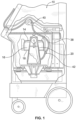
- Typical blood processing systems include a disposable, sealed, and sterile flow circuit, including a centrifuge chamber portion, that is mounted in cooperation on a durable, reusable assembly containing the hardware (centrifuge, drive system, pumps, valve actuators, programmable controller, and the like) that rotates a centrifuge chamber and controls the flow through the fluid circuit.
- the centrifuge rotates the centrifuge chamber of the disposable flow circuit during processing.
- the heavier (greater specific gravity) components of the whole blood in the centrifuge chamber such as red blood cells
- the lighter (lower specific gravity) components migrate toward the inner or "low-G” wall of the centrifuge chamber.
- the boundary that forms between the denser red blood cells and the lighter plasma in the centrifuge chamber is commonly referred to as the interface.
- Various ones of these components can be selectively removed from the whole blood by providing appropriately located channeling structures and outlet ports in the flow circuit.
- plasma is separated from cellular blood components and collected, with the cellular blood components and a replacement fluid being returned to the blood source.
- red blood cells may be harvested from the centrifuge chamber and the rest of the blood constituents returned to the donor.
- Other processes are also possible including, without limitation, platelet collection, red blood cell exchanges, plasma exchanges, etc. In these procedures, the efficiency of the process is often dependent upon accurate identification and control of the position of the interface during centrifugation.
- a method for monitoring fluid within a blood processing system having a centrifuge assembly, in accordance with any of claims 11-15.
- the optical sensor system may include a white light source.
- An optical fiber bundle can extend between first and second ends being associated with the support arm of the yoke.
- the optical sensor system can be configured to direct a light toward the first end of the optical fiber bundle.
- the second end of the optical fiber bundle directs the light toward the light-transmissive portion.
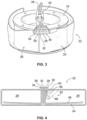
- the blood separation chamber 22 can be variously constructed.
- Fig. 4 shows a representative embodiment.
- the chamber 22 shown in Fig. 4 allows for either single- or multi-stage processing.
- a first stage 24 separates whole blood into first and second components.
- one of the components may be transferred into a second stage 26 for further processing.
- one of the separated components is returned to the donor, while the other is removed from the first stage 24 and stored.
- whole blood in the first stage 24 is separated into cellular components (i.e., a high density red blood cell component) and substantially cell-free plasma (i.e., a low density component).
- the plasma is removed from the first stage 24 via the first outlet port 30 for collection and storage, while the cellular components are removed from the first stage 24 via the second outlet port 28 and returned to the donor or patient.
- it may instead be discarded after separation or treated by a secondary device and returned to the donor or patient.
- one of the components will be transferred from the first stage 24 to the second stage 26 via a port 34 associated with the second stage 26.
- the component transferred to the second stage 26 is further fractionated into sub-components such as plasma and platelet concentrate, with one of the sub-components (plasma in one embodiment) being removed from the second stage 26 via an outlet port 36 and the other sub-component (platelet concentrate in one embodiment) remaining in the second stage 26.
- the ports 28, 30, 32, 34, and 36 are arranged side-by-side along the top transverse edge of the chamber 22.
- the location of the interface 60 within the chamber 22 can dynamically shift during blood processing, as Figs. 6 and 7 show. If the location of the interface 60 is too high (that is, if it is too close to the low-G wall 64 and the removal port 30, as Fig. 6 shows), cellular components can spill over and into the low density collection region 52, potentially adversely affecting the quality of the low density components (typically plasma). On the other hand, if the location of the interface 60 is too low (that is, if it resides too far away from the low-G wall 64, as Fig. 7 shows), the collection efficiency of the system 10 may be impaired.
- the ramp 66 forms a tapered wedge that restricts the flow of fluid toward the first outlet port 30.
- the top edge of the ramp 66 extends to form a constricted passage 68 along the low-G wall 64.
- the plasma layer 58 must flow through the constricted passage 68 to reach the first outlet port 30.
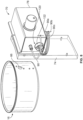
- the ramp 66 makes the interface 60 between the RBC layer 56 and the plasma layer 58 more discernible for detection, displaying the RBC layer 56, plasma layer 58, and interface 60 for viewing through a light-transmissive portion of the high-G wall 62 of the chamber 22, as will be described in greater detail below.
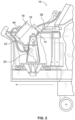
- the optical sensor system 70 is secured to a fixture or wall 74 of the system 10.
- the wall 74 includes an opening 76 ( Fig. 9 ) through which light from the optical sensor system 70 may be directed toward and into the centrifuge assembly 14 via a light-transmissive portion thereof.
- the ramp 66 is translucent and comprises the light-transmissive portion of the centrifuge bowl 16, such that light from the optical sensor system 70 passes through the ramp 66 ( Figs. 13 and 14 ) to intersect the separated blood components thereon to determine the location of the interface 60, as will be described in greater detail herein.
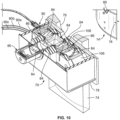
- the optical sensor system 70 includes a variety of components, some of which are contained within a housing or case 78. Among the components mounted within the housing 78 is at least one light source 80 ( Figs. 10-12 ), which emits a source beam 82 of light.
- the optical sensor system 70 may include one or more components (e.g., the achromatic prism pairs 84 and aperture stop 86 of Figs. 10-12 ) configured to condition and/or focus the source beam 82 that exits the light source 80.
- the light source comprises one or more non-white, narrow spectrum light sources.
- the nature of the narrow spectrum light sources e.g., whether they are provided as light-emitting diode or in some other form
- the source light beam emitted by the narrow spectrum light sources e.g., the color of the light, if it is within the visible spectrum
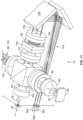
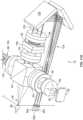
- the optical sensor system 70 includes a beam splitter 94 that is configured to split the source beam 82 from the light source 80 into two beams 96 (reference beam or first split beam) and 98 (scanning beam or second split beam) ( Figs. 11 and 12 ).
- the beam splitter 94 comprises a beam splitter cube which splits the source beam 82, with a first split beam 96 being a reference beam that is reflected at an angle (e.g., 90° in the illustrated embodiment) toward the optical fiber 90 and a second split beam 98 being a scanning beam that is transmitted through the beam splitter cube 94 and toward the centrifuge assembly 14.
- the optical sensor system 70 may include one or more components (e.g., an achromatic prism pair 84 for color correction, as shown in Figs. 10-12 ) configured to condition and/or focus the reference beam 96 before it reaches the associated optical fiber 90, but the light received by the optical fiber 90 is essentially a direct view of the source beam 82 (albeit at a fraction of its original intensity) and gives an indication of the power level of the light source 80.
- the optical fiber 90 that receives the reference beam 96 may be referred to as the reference fiber.
- the reference fiber 90 may be associated with a light detector 88 that forms a feedback loop with a driver 100 of the light source 80 ( Fig. 15 ).
- a beam directing member 106 (e.g., a pair of mirrors) is employed between the beam splitter 94 and the scanning fibers 90a-90c to direct the reflected scanning beam 104 to the scanning fibers 90a-90c.
- the optical sensor system 70 may include one or more components (e.g., the achromatic prism pairs 84, direct vision prism 108, and aperture stop 86 of Figs. 10-12 ) configured to condition and/or focus the reflected scanning beam 104 prior to encountering the beam directing member 106.
- a direct vision prism 108 may be particularly advantageous for undoing any dispersion of a reflected beam having passed through the ramp 66 (which may be prismatic, as described below), thereby color-correcting the reflected beam.
- the scanning fibers 90a-90c may be oriented at an angle, such as at an approximately 25° to coincide with the angle at which the ramp 66 is oriented with respect to the rotational axis 110 of the centrifuge assembly 14.
- the interface 60 appears on the ramp 66 as a line oriented at approximately the same angle as that of the ramp 66 with respect to the rotational axis 110 of the centrifuge assembly 14.
- the scanning fibers 90a-90c along a line at the same approximate angle as the ramp 66, they will be also be oriented at approximately the same angle as the interface 60 on the ramp 66.
- the "interface" signals transmitted to the light detectors 88a associated with the scanning fibers 90a-90c will occur substantially simultaneously.
- the scanning fibers may be arranged for individual, rather than simultaneous adjustment, such as by providing an adjustable module or a surface of the housing with a plurality of sockets into which the various scanning fibers may be selectively inserted or removed to create different (e.g., non-linear) one- or two-dimensional scanning profiles.
- the optical sensor system 70 may be configured to have a horizontal resolution (i.e., a resolution in the plane of the centrifuge assembly 14) of approximately 100 ⁇ m or better, resulting in an accurate determination of the location of the interface 60.
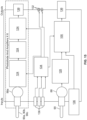
- Fig. 15 shows a plurality of representative light detectors 88, 88a.
- the lower detector 88 is associated with the reference fiber 90, as described above to form a feedback loop with the light source driver 100 to control the brightness of the light source 80.
- the upper light detector 88a of Fig. 15 is associated with one of the scanning fibers 90a-90c.
- Fig. 15 only shows one such detector 88a, but there may be one or more such detectors 88a for each scanning fiber 90a-90c provided in the optical sensor system 70.
- Each of these light detectors 88a receives the portion of the reflected beam 104 transmitted thereto by the associated scanning fiber 90a-90c. Each light detector 88a converts the light into a signal that may pass through one or more amplifiers 124 (e.g., a transimpedance amplifier, a gain amplifier, and/or a buffer amplifier), if provided.
- the individual signals represent a characteristic of the fluid (e.g., the location of its interface) or the nature of the fluid on the ramp 66 at the location monitored by the associated scanning fiber 90a-90c. For example, in one embodiment, as the ramp 66 comes into alignment with the optical sensor system 70, the detector(s) 88a will first sense light reflected through the plasma layer 58 on the ramp 66.
- a positive error signal indicates that the RBC layer 56 on the ramp 66 is too large (as Fig. 6 shows).
- the interface command module 128 generates a signal to adjust an operational parameter accordingly, such as by reducing the rate at which plasma is removed through a tube 130 associated with the first outlet port 30 under action of a pump 132 ( Fig. 16 ).
- the interface 60 moves away from the constricted passage 68 toward the desired control position (as Fig. 5 shows), where the error signal is zero.
- a negative error signal indicates that the RBC layer 56 on the ramp 66 is too small (as Fig. 7 shows).
- the interface command module 128 generates a signal to adjust an operational parameter accordingly, such as by increasing the rate at which plasma is removed through the first outlet port 30 and associated tube 130.
- the interface 60 moves toward the constricted passage 68 to the desired control position ( Fig. 5 ), where the error signal is again zero.
- the optical sensor system 70 may determine other information about the fluid in the blood separation chamber 22.
- the optical sensor system 70 may be configured to detect and read notations (e.g., bar codes) present on the centrifuge assembly 14 and/or the blood separation chamber 22.
- the optical sensor system 70 may be configured to gather spectrally-based information, thereby acting as a spectrometer. For example, when employing a white light source, different wavelengths of the light passing through the ramp 66 and fluid thereon will be absorbed by the different types of fluid that may appear on the ramp 66.
- the light that is reflected to a scanning fiber 90a-90c may be passed through a spectral beam splitter and then to a pair of light detectors 88a, with each detector receiving the unique wavelengths passed thereto and generating signals based on that data.
- the signals may be passed to a controller or processing module that considers the individual signals (e.g., considering red vs. blue light absorption) and/or compares them to historical signals (e.g., considering the difference in blue light absorption over time) to generate information about the fluid in the blood separation chamber 22 (e.g., lipid concentration, the presence of cellular blood components in separated plasma, platelet concentration, and hemolysis) and/or to cause adjustments in the operation of the system 10.
- the optical sensor system 70 may include additional or alternative components without departing from the scope of the present disclosure.
- Fig. 15 shows one or more power or status indicators 132 (which can be a visual indicator that the optical sensor system 70 is functional) and one or more voltage regulators 134 associated with the indicators 132, the driver 100, and various amplifiers 124.
- the system may also include various connectors 136 between the various components (e.g., BNC connectors, 3-pin connectors to a power source, etc.), as well as to other components that are not illustrated.
- centrifuge assemblies according to the present disclosure may be provided as umbilicus-driven (as illustrated in Figs. 1 and 2 ) or as direct-driven. If the centrifuge assembly is umbilicus-driven, additional steps may be taken to reduce the risk of the view of the ramp 66 by the optical sensor system 70 being blocked or obscured by the yoke 20 or umbilicus 38 during use.
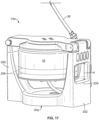
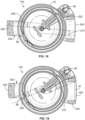
- a centrifuge assembly 14a having a modified yoke 20a is provided, as shown in Figs. 17-19 .
- the yoke 20a includes first and second support arms 200 and 202, which are shown as being generally diametrically opposed, with the centrifuge bowl 16 positioned therebetween.
- the yoke 20a is configured and operates generally according to the above description of the yoke 20 of Figs. 1 and 2 , with the exception that one of the support arms (illustrated as second support arm 202) defines an opening or aperture or window 204 therethrough.
- the yoke window 204 is configured to provide a sight line through the support arm 202 to allow the optical sensor system 70 to view and monitor the ramp 66.
- the yoke window 204 is preferably significantly larger than the ramp 66 to maximize the visibility of the ramp 66 through the support arm 202, with a height H (the vertical dimension in the orientation of Fig. 17 ) that is greater than the height of the ramp 66 (shown in Fig. 17 as a pair of broken lines 206 to represent the multiple possible positions of the ramp 66 as the centrifuge bowl 16 is rotated) and a width or angular extent W ( Fig. 19 ) that is greater than the width or angular extent of the ramp 66.
- H the vertical dimension in the orientation of Fig. 17
- W Fig. 19
- the yoke window 204 is positioned with the ramp 66 centered along the height H of the yoke window 204 (i.e., with the vertical center of the ramp 66 being at the same elevation as the vertical center of the yoke window 204 in the orientation of Fig. 17 ), but it is also within the scope of the present disclosure for the ramp 66 to be closer to the top or bottom of the yoke window 204.
- the yoke window 204 preferably has a width or angular extent W equal to or greater than that of the opposing support arm 200 at the same elevation, with the other support arm 200 being diametrically opposed to the yoke window 204.
- the illustrated configuration may be preferred because of the fact that the yoke 20a rotates at one half the speed of the centrifuge bowl 16, as described above in greater detail. In such a rotational relationship, a 180° rotation of the yoke 20a will result in a 360° rotation of the centrifuge bowl 16.
- the ramp 66 will be at the same position (e.g., in position to be viewed by the optical sensor system 70) upon each 180° rotation of the yoke 20a. Accordingly, if the yoke is provided with visual obstructions or obstacles positioned 180° apart, then it may be that the view of the ramp 66 will be obstructed during consecutive 360° rotations of the centrifuge bowl 16.
- bracketing method is only one way of distinguishing between obstructed and unobstructed views of the ramp 66, and other methods of distinguishing between obstructed and unobstructed views of the ramp 66 may be employed without departing from the scope of the present disclosure.
- FIGs. 17-19 illustrate a two-armed yoke 20a, with one of the support arms 202 having a window 204 therethrough for improved visibility into the centrifuge bowl 16 from an externally located optical sensor system
- Fig. 20 shows only one support arm 302 of a yoke 20b. If the yoke 20b includes only one support arm 302, then the above-described concern of a visual obstruction located 180° away from the support arm 302 is effectively eliminated.
- a yoke 20b having an optical fiber bundle 300 associated therewith is provided.
- an optical fiber bundle 300 is secured to an exterior and/or an interior portion one of the yoke support arms 302, but it is also within the scope of the present disclosure for a single optical fiber bundle to be associated with two yoke support arms or for separate optical fiber bundles to be associated with each yoke support arm (if more than one support arm is provided).
- the optical fiber bundle 300 extends between a first or lower end 304 and a second or upper end 306.
- the lower end 304 is illustrated in greater detail in Figs. 21 and 22
- the upper end 306 is illustrated in greater detail in Fig. 23 .
- the optical fiber bundle 300 includes one or more of signal fibers 310 and one or more illumination fibers 312, all of which are configured to transmit light between the ends 304 and 306 of the optical fiber bundle 300.
- the signal fibers 310 are positioned at and directly adjacent to the central axis of the optical fiber bundle 300, while the illumination fibers 312 are positioned around the signal fibers 310, such as in a ring or annular arrangement.
- This configuration is advantageous when used in combination with the particular illumination and detection assembly 308 of Fig. 20 , but other fiber configurations (such as the mixed arrangement of signal fibers 310 and illumination fibers 312 shown in Fig. 23A or a configuration that positions the illumination fibers 312 at and directly adjacent to the central axis of the optical fiber bundle 300, with the signal fibers 310 positioned around the illumination fibers 312) may be employed with differently configured illumination and light detection assemblies.
- the illustrated illumination and detection assembly 308 comprises a central photodiode 314 or other suitable light detector aligned with the central axis of the optical fiber bundle 300 at its lower end 304 (to correspond to the location of the signal fibers 310 at and directly adjacent to the central axis of the optical fiber bundle 300) and a plurality of light-emitting diodes or laser diodes 316 or other suitable light sources arranged in a ring around the light detector 314 (to correspond to the location of the illumination fibers 312 at the lower end 304 of the optical fiber bundle 300).
- the light source(s) 316 may be spaced away from the light detector(s) 314 to prevent the light detector(s) 314 from receiving light from the light source(s) 316, in which case the lower end 304 of the optical fiber bundle 304 may be outwardly flared ( Figs. 21 and 22 ) to similarly separate the signal fibers 310 from the illumination fibers 310 and to maintain the fibers in proper registration with the associated components of the illumination and detection assembly 308.
- light is emitted by the light source(s) 316 in a direction substantially parallel to the rotational axis and received by the illumination fibers 310 at the lower end 304 of the optical fiber bundle 300.
- the illumination fibers 310 transmit the light to the upper end 306 of the optical fiber bundle 300, where it is directed onto the outer surface of the centrifuge bowl 16 in a generally radial direction, including the ramp 66 when it has rotated into light-receiving relationship with the upper end 306 of the optical fiber bundle 300.
- the light source(s) 316 may be configured to be always on or to only be on when the ramp 66 is in light-receiving relationship with the upper end 306 of the optical fiber bundle 300.
- Light from the illumination fibers 312 passes through the ramp 66 and the fluid thereon (as described above with respect to the embodiment of Figs. 1-16 ).
- the light is reflected back through the ramp 66 and out of the centrifuge bowl 16 (by a retroreflector or mirror or the like, as described above with respect to the embodiment of Figs. 1-16 ), where it is received by the signal fibers 310 at the upper end 306 of the optical fiber bundle 300.
- the signal fibers 310 transmit the reflected light from the upper end 306 of the optical fiber bundle 300 to the lower end 304 of the optical fiber bundle 300, where it is directed toward the light detector(s) 314.
- the light detector(s) 314 receives the light from the signal fibers 310 and transmits the data to a processor, such as the interface command module 126, for detecting and controlling the location of the interface on the ramp 66 and/or determining other information about the fluid on the ramp 66.
- a processor such as the interface command module 126
- a wide variety of information may be determined about the fluid processing region by providing two or more light sources 316 configured to emit light having differing wavelengths.
- the light sources 316 may operate simultaneously or be controlled to function separately (e.g, by switching selected light sources 316 on during one sampling session or rotation of the centrifuge bowl 16 and the switching those light sources 316 off and other light sources 316 on during another sampling session or rotation of the centrifuge bowl 16) to direct light of differing wavelengths into the fluid processing region, which different wavelengths may be used to determine different information about the fluid processing region (e.g., lipemia or hemolysis or the location of the interface, etc.).
- the light detector(s) 314 and the light source(s) 316 are all positioned at the same general location, which may be at a non-rotating surface of the centrifuge assembly 14b along the axis of rotation, but it is also within the scope of the present disclosure for the components to be located at different locations. It is also within the scope of the present disclosure for the illumination and signal fibers to be positioned at different locations.
- the illumination fibers 312 may be positioned as shown in Fig.
- the signal fibers 310 are at least partially positioned within the centrifuge bowl 16 to directly receive light from the illumination fibers 312 after it has passed through the ramp 66 (e.g., with the upper ends of the signal fibers 301 being located on the centrifuge spool behind the ramp 66, where the retroreflector or mirror would otherwise be to receive light transmitted through the ramp 66).
- the signal fibers 310 would then transmit the light from the illumination fibers 312 to the light detector 314, wherever it may be located.
- Optical sensor systems of the type illustrated in Fig. 20 have several advantages. For example, such a design takes advantage of the proximity of the optical fiber to the fluid processing region to implement a non-imaging light collection system. This allows for more generous alignment and focusing tolerances and illumination requirements in comparison to other known optical sensor systems. Additionally, on account of the light being directed into the fluid processing region from a position that rotates in the same direction as the fluid processing region, the signal received from the fluid processing region may be longer than a signal resulting from light directed into the fluid processing region from a stationary position (e.g., on the order of twice the duration).
- Systems of the type illustrated in Fig. 20 may be used alone or in combination with the other aspects described herein.
- the system of Fig. 20 may be used in combination with the optical sensor system 70 to act as an auxiliary optical sensor system in the event that the view of the optical sensor system 70 becomes obscured or obstructed or to monitor a different aspect of the fluid on the ramp 66.
Landscapes
- Health & Medical Sciences (AREA)
- Life Sciences & Earth Sciences (AREA)
- Engineering & Computer Science (AREA)
- General Health & Medical Sciences (AREA)
- Physics & Mathematics (AREA)
- Chemical & Material Sciences (AREA)
- Biomedical Technology (AREA)
- Pathology (AREA)
- Immunology (AREA)
- General Physics & Mathematics (AREA)
- Biochemistry (AREA)
- Analytical Chemistry (AREA)
- Hematology (AREA)
- Heart & Thoracic Surgery (AREA)
- Vascular Medicine (AREA)
- Veterinary Medicine (AREA)
- Public Health (AREA)
- Animal Behavior & Ethology (AREA)
- Anesthesiology (AREA)
- Cardiology (AREA)
- Biophysics (AREA)
- Ecology (AREA)
- Molecular Biology (AREA)
- Urology & Nephrology (AREA)
- Food Science & Technology (AREA)
- Medicinal Chemistry (AREA)
- External Artificial Organs (AREA)
- Investigating Or Analysing Materials By Optical Means (AREA)
- Centrifugal Separators (AREA)
Applications Claiming Priority (2)
| Application Number | Priority Date | Filing Date | Title |
|---|---|---|---|
| US201261696343P | 2012-09-04 | 2012-09-04 | |
| PCT/US2013/031494 WO2014039091A1 (en) | 2012-09-04 | 2013-03-14 | Interface detector for blood processing system |
Publications (3)
| Publication Number | Publication Date |
|---|---|
| EP2892587A1 EP2892587A1 (en) | 2015-07-15 |
| EP2892587C0 EP2892587C0 (en) | 2024-07-03 |
| EP2892587B1 true EP2892587B1 (en) | 2024-07-03 |
Family
ID=48093080
Family Applications (1)
| Application Number | Title | Priority Date | Filing Date |
|---|---|---|---|
| EP13716093.3A Active EP2892587B1 (en) | 2012-09-04 | 2013-03-14 | Interface detector for blood processing system |
Country Status (7)
| Country | Link |
|---|---|
| US (3) | US9594020B2 (enExample) |
| EP (1) | EP2892587B1 (enExample) |
| JP (4) | JP6250053B2 (enExample) |
| CN (3) | CN106377813B (enExample) |
| AU (2) | AU2013313352B2 (enExample) |
| IN (1) | IN2015DN01424A (enExample) |
| WO (1) | WO2014039091A1 (enExample) |
Families Citing this family (27)
| Publication number | Priority date | Publication date | Assignee | Title |
|---|---|---|---|---|
| US9594020B2 (en) | 2012-09-04 | 2017-03-14 | Fenwal, Inc. | Interface detector for blood processing system |
| WO2016204533A1 (ko) | 2015-06-16 | 2016-12-22 | (주)타스컴 | 생체 측정기 |
| ES2844073T3 (es) | 2015-06-16 | 2021-07-21 | Tascom Co Ltd | Instrumento de medición de material biológico |
| CN106111356B (zh) * | 2016-06-29 | 2019-03-19 | 四川南格尔生物科技有限公司 | 一种探测装置及探测方法 |
| CN109085143B (zh) * | 2016-08-25 | 2021-01-12 | 邵明秀 | 一种血液浓度检测装置 |
| CN118767234A (zh) * | 2016-09-16 | 2024-10-15 | 汾沃有限公司 | 采用离心和旋转膜分离技术的血液分离系统和方法 |
| EP3299049B1 (en) * | 2016-09-21 | 2022-11-02 | Fenwal, Inc. | System for maintaining patient fluid balance during an extracorporeal therapeutic cell treatment |
| US11285250B2 (en) | 2017-03-07 | 2022-03-29 | Fenwal, Inc. | Systems and methods for separating blood under conditions of reduced plasma clarity |
| US10561784B2 (en) * | 2017-05-31 | 2020-02-18 | Fenwal, Inc. | Stationary optical monitoring system for blood processing system |
| GB201718859D0 (en) * | 2017-11-15 | 2017-12-27 | Smith & Nephew | Sensor positioning for sensor enabled wound therapy dressings and systems |
| PL3501562T3 (pl) | 2017-12-22 | 2025-05-26 | Fenwal, Inc. | Konwertowalne zespoły przetwarzania płynów |
| EP3553498B1 (en) | 2018-04-13 | 2021-06-02 | Fenwal, Inc. | Optical detection and measurement of hematocrit and free hemoglobin concentration |
| EP3578971B1 (en) | 2018-06-05 | 2021-12-15 | Fenwal, Inc. | Determination of cause of redness in biological fluid |
| US11137344B2 (en) | 2018-11-28 | 2021-10-05 | Fenwal, Inc. | Optical mixing of fluids |
| US12168087B2 (en) | 2019-03-05 | 2024-12-17 | Fenwal, Inc. | Collection, genome editing, and washing of T-cell lymphocytes |
| EP4483917B1 (en) | 2019-03-05 | 2026-05-13 | Fenwal, Inc. | Collection of mononuclear cells and peripheral blood stem cells |
| EP4238595B1 (en) | 2019-05-23 | 2026-08-05 | Fenwal, Inc. | Adjustment of target interface location between separated fluid components in a centrifuge |
| EP4238596B1 (en) | 2019-05-23 | 2025-04-02 | Fenwal, Inc. | Centrifugal separation and collection of red blood cells or both red blood cells and plasma |
| CN115254456B (zh) | 2019-09-16 | 2023-08-29 | 汾沃有限公司 | 血液分离装置和数据处理系统 |
| US11969536B2 (en) | 2019-12-12 | 2024-04-30 | Fenwal, Inc. | Systems enabling alternative approaches to therapeutic red blood cell exchange and/or therapeutic plasma exchange |
| IT202000006712A1 (it) * | 2020-03-31 | 2021-10-01 | Medica S P A | Sistema per misurare parametri intrinseci di un fluido organico circolante in un condotto |
| CN114306788B (zh) * | 2020-09-30 | 2026-04-24 | 汾沃有限公司 | 检测组件的光源的位置的调节 |
| US12313441B2 (en) | 2021-01-29 | 2025-05-27 | Fenwal, Inc. | Automated splitting of a fluid into uneven volumes |
| US11898967B2 (en) | 2021-02-02 | 2024-02-13 | Fenwal, Inc. | Predicting malfunction and failure of centrifuge umbilicus |
| EP4075119B1 (en) | 2021-04-15 | 2025-11-12 | Fenwal, Inc. | Adjustment of the thickness of a biological fluid being monitored by an optical detection assembly |
| CN117259035B (zh) * | 2023-09-08 | 2024-09-06 | 江苏赛德力制药机械制造有限公司 | 一种基于机器视觉的离心机自动控制系统及方法 |
| EP4628121A1 (en) | 2024-03-28 | 2025-10-08 | Fenwal, Inc. | Dynamic adjustment of light intensity and/or signal amplification in a centrifuge optical sensor assembly |
Citations (4)
| Publication number | Priority date | Publication date | Assignee | Title |
|---|---|---|---|---|
| EP0342730A2 (en) * | 1988-05-02 | 1989-11-23 | Theodorus Schouten | Device for determining the erythrocyte sedimentation rate of blood samples |
| US5260598A (en) * | 1991-10-04 | 1993-11-09 | Fresenius Ag | Device for separation of media into their components having means for detection and adjustment of the phase boundary |
| EP0885619A1 (en) * | 1997-06-16 | 1998-12-23 | Terumo Kabushiki Kaisha | Blood component collecting apparatus |
| US20090129976A1 (en) * | 2005-07-08 | 2009-05-21 | Yoshiteru Hoshino | Circuit For Collecting Blood Component And Apparatus For Collecting Blood Component |
Family Cites Families (68)
| Publication number | Priority date | Publication date | Assignee | Title |
|---|---|---|---|---|
| US3727066A (en) | 1968-02-16 | 1973-04-10 | Baxter Laboratories Inc | Probe photometer with fluid sensing device |
| US3752995A (en) | 1972-04-07 | 1973-08-14 | Coulter Electronics | Blank value storing photometer |
| US3778171A (en) | 1972-11-09 | 1973-12-11 | Beckman Instruments Inc | Sample cell for ultracentrifuge utilizing-multiple-beam interference optics |
| US4409820A (en) | 1981-06-17 | 1983-10-18 | Irwin Nash | Apparatus and method for use in quantitative analysis of a fluid suspension |
| DE3301113C2 (de) | 1983-01-14 | 1985-01-10 | Fresenius AG, 6380 Bad Homburg | Verfahren und Vorrichtung für das Separieren von Medien |
| US4468219A (en) | 1983-12-20 | 1984-08-28 | International Business Machines Corporation | Pump flow rate compensation system |
| HU192531B (en) | 1984-01-26 | 1987-06-29 | Mueszeripari Muevek Lab | Multifunctional centrifuge |
| US5104526A (en) | 1987-01-30 | 1992-04-14 | Baxter International Inc. | Centrifugation system having an interface detection system |
| US5656163A (en) * | 1987-01-30 | 1997-08-12 | Baxter International Inc. | Chamber for use in a rotating field to separate blood components |
| US4834890A (en) | 1987-01-30 | 1989-05-30 | Baxter International Inc. | Centrifugation pheresis system |
| US5573678A (en) | 1987-01-30 | 1996-11-12 | Baxter International Inc. | Blood processing systems and methods for collecting mono nuclear cells |
| US5628915A (en) | 1987-01-30 | 1997-05-13 | Baxter International Inc. | Enhanced yield blood processing systems and methods establishing controlled vortex flow conditions |
| US5632893A (en) | 1987-01-30 | 1997-05-27 | Baxter Internatinoal Inc. | Enhanced yield blood processing systems with angled interface control surface |
| US4810090A (en) | 1987-08-24 | 1989-03-07 | Cobe Laboratories, Inc. | Method and apparatus for monitoring blood components |
| US4937637A (en) * | 1989-02-10 | 1990-06-26 | Kollmorgen Corporation | Dual reading head transmission/reflection densitometer |
| US5316667A (en) | 1989-05-26 | 1994-05-31 | Baxter International Inc. | Time based interface detection systems for blood processing apparatus |
| CA2009226A1 (en) * | 1990-02-02 | 1991-08-02 | Marek T. Wlodarczyk | Fiber optic sensors |
| WO1991019989A1 (en) | 1990-06-21 | 1991-12-26 | Reynolds Software, Inc. | Method and apparatus for wave analysis and event recognition |
| US5639382A (en) | 1991-12-23 | 1997-06-17 | Baxter International Inc. | Systems and methods for deriving recommended storage parameters for collected blood components |
| US6319471B1 (en) | 1992-07-10 | 2001-11-20 | Gambro, Inc. | Apparatus for producing blood component products |
| EP0636261A4 (en) | 1992-04-16 | 1998-03-25 | Dow Chemical Co | IMPROVED METHOD FOR INTERPRETATION OF COMPLEX DATA AND FOR DETECTION OF DEFECTS IN AN INSTRUMENT OR PROCESS. |
| CA2124812C (en) * | 1992-10-22 | 2004-06-01 | Baxter International, Inc. | Time based interface detection systems for blood processing apparatus |
| US5746708A (en) | 1993-12-22 | 1998-05-05 | Baxter International Inc. | Peristaltic pump tube holder with pump tube shield and cover |
| US5437598A (en) | 1994-01-21 | 1995-08-01 | Cobe Laboratories, Inc. | Automation of plasma sequestration |
| US5570697A (en) | 1994-07-15 | 1996-11-05 | Vixel Corporation | Sensor for analyzing molecular species |
| DE19515870C1 (de) * | 1995-04-29 | 1996-08-14 | Fresenius Ag | Vorrichtung zur Trennung von Medien in deren Bestandteile |
| US6312607B1 (en) * | 1995-06-07 | 2001-11-06 | Baxter International Inc. | Blood processing systems and methods which optically monitor incremental platelet volumes in a plasma constituent |
| US5958250A (en) | 1995-06-07 | 1999-09-28 | Baxter International Inc. | Blood processing systems and methods which optically derive the volume of platelets contained in a plasma constituent |
| US5961842A (en) | 1995-06-07 | 1999-10-05 | Baxter International Inc. | Systems and methods for collecting mononuclear cells employing control of packed red blood cell hematocrit |
| EP0868215B1 (en) | 1995-12-01 | 2002-01-30 | Baker Hughes Incorporated | Method and apparatus for controlling and monitoring continuous feed centrifuge |
| WO1998043720A1 (en) | 1997-04-03 | 1998-10-08 | Baxter International Inc. | Interface detection and control systems and methods |
| US5980760A (en) | 1997-07-01 | 1999-11-09 | Baxter International Inc. | System and methods for harvesting mononuclear cells by recirculation of packed red blood cells |
| US6063292A (en) | 1997-07-18 | 2000-05-16 | Baker Hughes Incorporated | Method and apparatus for controlling vertical and horizontal basket centrifuges |
| US6254784B1 (en) * | 1997-10-30 | 2001-07-03 | Baxter International Inc. | Optical interface detection system for centrifugal blood processing |
| US8885913B2 (en) * | 1999-01-25 | 2014-11-11 | Amnis Corporation | Detection of circulating tumor cells using imaging flow cytometry |
| JP4260962B2 (ja) * | 1999-02-10 | 2009-04-30 | 住友電気工業株式会社 | 多重逆反射体とその製造方法 |
| US6589153B2 (en) * | 2001-09-24 | 2003-07-08 | Medtronic, Inc. | Blood centrifuge with exterior mounted, self-balancing collection chambers |
| JP2003287532A (ja) * | 2002-03-28 | 2003-10-10 | Fuji Photo Film Co Ltd | 血液検査ユニット |
| JP2003329896A (ja) * | 2002-05-14 | 2003-11-19 | Precise Gauges Co Ltd | 光学部品の調芯方法及びその装置 |
| JP2005537891A (ja) * | 2002-09-10 | 2005-12-15 | ユーロ−セルティーク エス.エイ. | 血液成分の非侵襲的測定のための装置及び方法 |
| US7524316B2 (en) * | 2002-10-31 | 2009-04-28 | Cooltouch, Inc. | Endovenous closure of varicose veins with mid infrared laser |
| CN103454191B (zh) * | 2003-07-02 | 2016-01-06 | 泰尔茂比司特公司 | 用于利用预测数据分析算法控制血液处理离心机的方法 |
| US7327443B2 (en) * | 2004-07-01 | 2008-02-05 | Gambro Bct, Inc | Stroboscopic LED light source for blood processing apparatus |
| CN100432727C (zh) * | 2004-01-28 | 2008-11-12 | 株式会社东芝 | 激光入射光学装置 |
| US7087177B2 (en) * | 2004-04-16 | 2006-08-08 | Baxter International Inc. | Methods for determining flow rates of biological fluids |
| WO2006012352A2 (en) * | 2004-06-28 | 2006-02-02 | Haemonetics Corporation | Blood component separation system with stationary separation chamber |
| KR100601964B1 (ko) * | 2004-09-07 | 2006-07-19 | 삼성전자주식회사 | 다채널 다중 컬러 측정을 위한 광검출장치 및 이를 채용한다채널 시료 분석기 |
| JP4388907B2 (ja) * | 2005-03-17 | 2009-12-24 | 横浜ゴム株式会社 | 移動物体の検知装置及び速度計測装置 |
| US20060197038A1 (en) * | 2005-06-13 | 2006-09-07 | Xerox Corporation | Incoming sheet skew, lateral and process position detection with an angled transverse sensor array bar |
| WO2007109540A2 (en) * | 2006-03-17 | 2007-09-27 | The General Hospital Corporation | Arrangement, method and computer-accessible medium for identifying characteristics of at least a portion of a blood vessel contained within a tissue using spectral domain low coherence interferometry |
| WO2008021626A2 (en) * | 2006-08-17 | 2008-02-21 | Caridianbct, Inc. | Blood processing apparatus with robust automated process control |
| JP5017079B2 (ja) * | 2007-01-26 | 2012-09-05 | 株式会社トプコン | 光画像計測装置 |
| WO2009036418A1 (en) * | 2007-09-13 | 2009-03-19 | Duke University | Apparatuses, systems, and methods for low-coherence interferometry (lci) |
| US7812951B2 (en) * | 2007-09-27 | 2010-10-12 | Rockwell Automation Technologies, Inc. | Color sensors using polarimetric techniques |
| JP4477677B2 (ja) * | 2008-01-16 | 2010-06-09 | 古河電気工業株式会社 | 光モジュールおよびその作製方法 |
| US9325425B2 (en) * | 2008-02-24 | 2016-04-26 | Finisar Corporation | Method and apparatus for demodulating and regenerating phase modulated optical signals |
| US20160028210A1 (en) * | 2008-04-04 | 2016-01-28 | CVI Laser, LLC. | Compact, thermally stable multi-laser engine |
| CN104237539A (zh) * | 2009-04-07 | 2014-12-24 | 连接Dx股份有限公司 | 用于读取救护点测试结果的手持扫描仪系统和方法 |
| CN102472785B (zh) * | 2009-06-29 | 2014-10-08 | 日本电气株式会社 | 电/磁场探头 |
| DE102009036044A1 (de) | 2009-08-04 | 2011-02-10 | Fresenius Medical Care Deutschland Gmbh | Vorrichtung und Verfahren zur Erkennung von Blut oder Blutbestandteilen im Flüssigkeitssystem einer Vorrichtung zur extrakorporalen Blutbehandlung |
| JP5394501B2 (ja) * | 2009-10-02 | 2014-01-22 | シャープ株式会社 | 血管状態モニタリング方法 |
| US8494431B2 (en) * | 2009-10-23 | 2013-07-23 | Xerox Corporation | Duplex sheet registration |
| US8556793B2 (en) * | 2011-02-04 | 2013-10-15 | Fenwal, Inc. | Control of interface between separated blood components under lipemic and hemolytic conditions |
| JP2012245285A (ja) * | 2011-05-31 | 2012-12-13 | Fujifilm Corp | 光源装置 |
| US9794016B2 (en) * | 2011-10-05 | 2017-10-17 | University Of Central Florida Research Foundation, Inc. | Systems and methods for processing space-multiplexed optical signals |
| US8781547B2 (en) * | 2011-10-28 | 2014-07-15 | Medtronic, Inc. | Method and apparatus for calibrating an absolute oxygen saturation sensor |
| EP2893320B1 (en) * | 2012-08-20 | 2020-12-23 | Siemens Healthcare Diagnostics Inc. | Clam-shell luminometer |
| US9594020B2 (en) | 2012-09-04 | 2017-03-14 | Fenwal, Inc. | Interface detector for blood processing system |
-
2013
- 2013-03-14 US US14/422,188 patent/US9594020B2/en active Active
- 2013-03-14 EP EP13716093.3A patent/EP2892587B1/en active Active
- 2013-03-14 IN IN1424DEN2015 patent/IN2015DN01424A/en unknown
- 2013-03-14 WO PCT/US2013/031494 patent/WO2014039091A1/en not_active Ceased
- 2013-03-14 CN CN201610737388.2A patent/CN106377813B/zh active Active
- 2013-03-14 JP JP2015531063A patent/JP6250053B2/ja active Active
- 2013-03-14 AU AU2013313352A patent/AU2013313352B2/en active Active
- 2013-03-14 CN CN202010151648.4A patent/CN111494743B/zh active Active
- 2013-03-14 CN CN201380046188.7A patent/CN104602725B/zh active Active
-
2017
- 2017-01-25 US US15/414,717 patent/US10209185B2/en active Active
- 2017-03-14 AU AU2017201732A patent/AU2017201732B2/en active Active
- 2017-11-21 JP JP2017223636A patent/JP2018086264A/ja active Pending
-
2018
- 2018-12-11 US US16/215,711 patent/US10768107B2/en active Active
-
2019
- 2019-11-08 JP JP2019202896A patent/JP6989579B2/ja active Active
-
2021
- 2021-12-02 JP JP2021196319A patent/JP7337137B2/ja active Active
Patent Citations (4)
| Publication number | Priority date | Publication date | Assignee | Title |
|---|---|---|---|---|
| EP0342730A2 (en) * | 1988-05-02 | 1989-11-23 | Theodorus Schouten | Device for determining the erythrocyte sedimentation rate of blood samples |
| US5260598A (en) * | 1991-10-04 | 1993-11-09 | Fresenius Ag | Device for separation of media into their components having means for detection and adjustment of the phase boundary |
| EP0885619A1 (en) * | 1997-06-16 | 1998-12-23 | Terumo Kabushiki Kaisha | Blood component collecting apparatus |
| US20090129976A1 (en) * | 2005-07-08 | 2009-05-21 | Yoshiteru Hoshino | Circuit For Collecting Blood Component And Apparatus For Collecting Blood Component |
Also Published As
| Publication number | Publication date |
|---|---|
| US10209185B2 (en) | 2019-02-19 |
| CN111494743A (zh) | 2020-08-07 |
| US10768107B2 (en) | 2020-09-08 |
| AU2013313352B2 (en) | 2017-03-02 |
| AU2017201732B2 (en) | 2018-11-01 |
| US9594020B2 (en) | 2017-03-14 |
| US20170131203A1 (en) | 2017-05-11 |
| JP6250053B2 (ja) | 2017-12-20 |
| US20190120761A1 (en) | 2019-04-25 |
| EP2892587A1 (en) | 2015-07-15 |
| CN104602725B (zh) | 2017-04-26 |
| CN106377813A (zh) | 2017-02-08 |
| CN106377813B (zh) | 2020-03-24 |
| JP2018086264A (ja) | 2018-06-07 |
| WO2014039091A1 (en) | 2014-03-13 |
| JP2020036930A (ja) | 2020-03-12 |
| CN111494743B (zh) | 2023-08-22 |
| JP2015530156A (ja) | 2015-10-15 |
| JP7337137B2 (ja) | 2023-09-01 |
| JP6989579B2 (ja) | 2022-01-05 |
| AU2017201732A1 (en) | 2017-03-30 |
| CN104602725A (zh) | 2015-05-06 |
| IN2015DN01424A (enExample) | 2015-07-03 |
| JP2022028921A (ja) | 2022-02-16 |
| AU2013313352A1 (en) | 2015-04-09 |
| US20150219558A1 (en) | 2015-08-06 |
| EP2892587C0 (en) | 2024-07-03 |
Similar Documents
| Publication | Publication Date | Title |
|---|---|---|
| US10768107B2 (en) | Interface detector for blood processing system | |
| US10258998B2 (en) | Optical monitoring system for blood processing system | |
| EP3578971B1 (en) | Determination of cause of redness in biological fluid | |
| WO1998043720A1 (en) | Interface detection and control systems and methods | |
| US10893829B2 (en) | Optical detection and measurement of hematocrit and free hemoglobin concentration | |
| US20190193091A1 (en) | Convertible Fluid Processing Assemblies |
Legal Events
| Date | Code | Title | Description |
|---|---|---|---|
| PUAI | Public reference made under article 153(3) epc to a published international application that has entered the european phase |
Free format text: ORIGINAL CODE: 0009012 |
|
| 17P | Request for examination filed |
Effective date: 20150303 |
|
| AK | Designated contracting states |
Kind code of ref document: A1 Designated state(s): AL AT BE BG CH CY CZ DE DK EE ES FI FR GB GR HR HU IE IS IT LI LT LU LV MC MK MT NL NO PL PT RO RS SE SI SK SM TR |
|
| AX | Request for extension of the european patent |
Extension state: BA ME |
|
| DAX | Request for extension of the european patent (deleted) | ||
| STAA | Information on the status of an ep patent application or granted ep patent |
Free format text: STATUS: EXAMINATION IS IN PROGRESS |
|
| 17Q | First examination report despatched |
Effective date: 20200415 |
|
| STAA | Information on the status of an ep patent application or granted ep patent |
Free format text: STATUS: REQUEST FOR EXAMINATION WAS MADE |
|
| PUAG | Search results despatched under rule 164(2) epc together with communication from examining division |
Free format text: ORIGINAL CODE: 0009017 |
|
| STAA | Information on the status of an ep patent application or granted ep patent |
Free format text: STATUS: EXAMINATION IS IN PROGRESS |
|
| 17Q | First examination report despatched |
Effective date: 20220706 |
|
| B565 | Issuance of search results under rule 164(2) epc |
Effective date: 20220706 |
|
| RIC1 | Information provided on ipc code assigned before grant |
Ipc: G01N 33/49 20060101ALI20220701BHEP Ipc: G01N 21/59 20060101ALI20220701BHEP Ipc: A61M 1/36 20060101AFI20220701BHEP |
|
| GRAP | Despatch of communication of intention to grant a patent |
Free format text: ORIGINAL CODE: EPIDOSNIGR1 |
|
| STAA | Information on the status of an ep patent application or granted ep patent |
Free format text: STATUS: GRANT OF PATENT IS INTENDED |
|
| INTG | Intention to grant announced |
Effective date: 20231120 |
|
| GRAJ | Information related to disapproval of communication of intention to grant by the applicant or resumption of examination proceedings by the epo deleted |
Free format text: ORIGINAL CODE: EPIDOSDIGR1 |
|
| STAA | Information on the status of an ep patent application or granted ep patent |
Free format text: STATUS: EXAMINATION IS IN PROGRESS |
|
| GRAP | Despatch of communication of intention to grant a patent |
Free format text: ORIGINAL CODE: EPIDOSNIGR1 |
|
| STAA | Information on the status of an ep patent application or granted ep patent |
Free format text: STATUS: GRANT OF PATENT IS INTENDED |
|
| INTC | Intention to grant announced (deleted) | ||
| INTG | Intention to grant announced |
Effective date: 20240326 |
|
| GRAS | Grant fee paid |
Free format text: ORIGINAL CODE: EPIDOSNIGR3 |
|
| GRAA | (expected) grant |
Free format text: ORIGINAL CODE: 0009210 |
|
| STAA | Information on the status of an ep patent application or granted ep patent |
Free format text: STATUS: THE PATENT HAS BEEN GRANTED |
|
| AK | Designated contracting states |
Kind code of ref document: B1 Designated state(s): AL AT BE BG CH CY CZ DE DK EE ES FI FR GB GR HR HU IE IS IT LI LT LU LV MC MK MT NL NO PL PT RO RS SE SI SK SM TR |
|
| REG | Reference to a national code |
Ref country code: CH Ref legal event code: EP |
|
| REG | Reference to a national code |
Ref country code: DE Ref legal event code: R096 Ref document number: 602013085850 Country of ref document: DE |
|
| U01 | Request for unitary effect filed |
Effective date: 20240710 |
|
| U07 | Unitary effect registered |
Designated state(s): AT BE BG DE DK EE FI FR IT LT LU LV MT NL PT SE SI Effective date: 20240724 |
|
| PG25 | Lapsed in a contracting state [announced via postgrant information from national office to epo] |
Ref country code: NO Free format text: LAPSE BECAUSE OF FAILURE TO SUBMIT A TRANSLATION OF THE DESCRIPTION OR TO PAY THE FEE WITHIN THE PRESCRIBED TIME-LIMIT Effective date: 20241003 |
|
| PG25 | Lapsed in a contracting state [announced via postgrant information from national office to epo] |
Ref country code: PL Free format text: LAPSE BECAUSE OF FAILURE TO SUBMIT A TRANSLATION OF THE DESCRIPTION OR TO PAY THE FEE WITHIN THE PRESCRIBED TIME-LIMIT Effective date: 20240703 Ref country code: GR Free format text: LAPSE BECAUSE OF FAILURE TO SUBMIT A TRANSLATION OF THE DESCRIPTION OR TO PAY THE FEE WITHIN THE PRESCRIBED TIME-LIMIT Effective date: 20241004 |
|
| PG25 | Lapsed in a contracting state [announced via postgrant information from national office to epo] |
Ref country code: IS Free format text: LAPSE BECAUSE OF FAILURE TO SUBMIT A TRANSLATION OF THE DESCRIPTION OR TO PAY THE FEE WITHIN THE PRESCRIBED TIME-LIMIT Effective date: 20241103 |
|
| PG25 | Lapsed in a contracting state [announced via postgrant information from national office to epo] |
Ref country code: CZ Free format text: LAPSE BECAUSE OF FAILURE TO SUBMIT A TRANSLATION OF THE DESCRIPTION OR TO PAY THE FEE WITHIN THE PRESCRIBED TIME-LIMIT Effective date: 20240703 Ref country code: HR Free format text: LAPSE BECAUSE OF FAILURE TO SUBMIT A TRANSLATION OF THE DESCRIPTION OR TO PAY THE FEE WITHIN THE PRESCRIBED TIME-LIMIT Effective date: 20240703 |
|
| PG25 | Lapsed in a contracting state [announced via postgrant information from national office to epo] |
Ref country code: RS Free format text: LAPSE BECAUSE OF FAILURE TO SUBMIT A TRANSLATION OF THE DESCRIPTION OR TO PAY THE FEE WITHIN THE PRESCRIBED TIME-LIMIT Effective date: 20241003 Ref country code: ES Free format text: LAPSE BECAUSE OF FAILURE TO SUBMIT A TRANSLATION OF THE DESCRIPTION OR TO PAY THE FEE WITHIN THE PRESCRIBED TIME-LIMIT Effective date: 20240703 |
|
| PG25 | Lapsed in a contracting state [announced via postgrant information from national office to epo] |
Ref country code: RS Free format text: LAPSE BECAUSE OF FAILURE TO SUBMIT A TRANSLATION OF THE DESCRIPTION OR TO PAY THE FEE WITHIN THE PRESCRIBED TIME-LIMIT Effective date: 20241003 Ref country code: PL Free format text: LAPSE BECAUSE OF FAILURE TO SUBMIT A TRANSLATION OF THE DESCRIPTION OR TO PAY THE FEE WITHIN THE PRESCRIBED TIME-LIMIT Effective date: 20240703 Ref country code: NO Free format text: LAPSE BECAUSE OF FAILURE TO SUBMIT A TRANSLATION OF THE DESCRIPTION OR TO PAY THE FEE WITHIN THE PRESCRIBED TIME-LIMIT Effective date: 20241003 Ref country code: IS Free format text: LAPSE BECAUSE OF FAILURE TO SUBMIT A TRANSLATION OF THE DESCRIPTION OR TO PAY THE FEE WITHIN THE PRESCRIBED TIME-LIMIT Effective date: 20241103 Ref country code: HR Free format text: LAPSE BECAUSE OF FAILURE TO SUBMIT A TRANSLATION OF THE DESCRIPTION OR TO PAY THE FEE WITHIN THE PRESCRIBED TIME-LIMIT Effective date: 20240703 Ref country code: GR Free format text: LAPSE BECAUSE OF FAILURE TO SUBMIT A TRANSLATION OF THE DESCRIPTION OR TO PAY THE FEE WITHIN THE PRESCRIBED TIME-LIMIT Effective date: 20241004 Ref country code: ES Free format text: LAPSE BECAUSE OF FAILURE TO SUBMIT A TRANSLATION OF THE DESCRIPTION OR TO PAY THE FEE WITHIN THE PRESCRIBED TIME-LIMIT Effective date: 20240703 Ref country code: CZ Free format text: LAPSE BECAUSE OF FAILURE TO SUBMIT A TRANSLATION OF THE DESCRIPTION OR TO PAY THE FEE WITHIN THE PRESCRIBED TIME-LIMIT Effective date: 20240703 |
|
| PG25 | Lapsed in a contracting state [announced via postgrant information from national office to epo] |
Ref country code: SM Free format text: LAPSE BECAUSE OF FAILURE TO SUBMIT A TRANSLATION OF THE DESCRIPTION OR TO PAY THE FEE WITHIN THE PRESCRIBED TIME-LIMIT Effective date: 20240703 |
|
| PG25 | Lapsed in a contracting state [announced via postgrant information from national office to epo] |
Ref country code: SK Free format text: LAPSE BECAUSE OF FAILURE TO SUBMIT A TRANSLATION OF THE DESCRIPTION OR TO PAY THE FEE WITHIN THE PRESCRIBED TIME-LIMIT Effective date: 20240703 |
|
| U20 | Renewal fee for the european patent with unitary effect paid |
Year of fee payment: 13 Effective date: 20250327 |
|
| PLBE | No opposition filed within time limit |
Free format text: ORIGINAL CODE: 0009261 |
|
| STAA | Information on the status of an ep patent application or granted ep patent |
Free format text: STATUS: NO OPPOSITION FILED WITHIN TIME LIMIT |
|
| 26N | No opposition filed |
Effective date: 20250404 |
|
| PG25 | Lapsed in a contracting state [announced via postgrant information from national office to epo] |
Ref country code: MC Free format text: LAPSE BECAUSE OF FAILURE TO SUBMIT A TRANSLATION OF THE DESCRIPTION OR TO PAY THE FEE WITHIN THE PRESCRIBED TIME-LIMIT Effective date: 20240703 |
|
| REG | Reference to a national code |
Ref country code: CH Ref legal event code: H13 Free format text: ST27 STATUS EVENT CODE: U-0-0-H10-H13 (AS PROVIDED BY THE NATIONAL OFFICE) Effective date: 20251024 |
|
| PG25 | Lapsed in a contracting state [announced via postgrant information from national office to epo] |
Ref country code: CH Free format text: LAPSE BECAUSE OF NON-PAYMENT OF DUE FEES Effective date: 20250331 |
|
| PG25 | Lapsed in a contracting state [announced via postgrant information from national office to epo] |
Ref country code: IE Free format text: LAPSE BECAUSE OF NON-PAYMENT OF DUE FEES Effective date: 20250314 |
|
| PGFP | Annual fee paid to national office [announced via postgrant information from national office to epo] |
Ref country code: GB Payment date: 20260327 Year of fee payment: 14 |
|
| PG25 | Lapsed in a contracting state [announced via postgrant information from national office to epo] |
Ref country code: RO Free format text: LAPSE BECAUSE OF FAILURE TO SUBMIT A TRANSLATION OF THE DESCRIPTION OR TO PAY THE FEE WITHIN THE PRESCRIBED TIME-LIMIT Effective date: 20240703 |
|
| U20 | Renewal fee for the european patent with unitary effect paid |
Year of fee payment: 14 Effective date: 20260327 |
|
| PG25 | Lapsed in a contracting state [announced via postgrant information from national office to epo] |
Ref country code: CY Free format text: LAPSE BECAUSE OF FAILURE TO SUBMIT A TRANSLATION OF THE DESCRIPTION OR TO PAY THE FEE WITHIN THE PRESCRIBED TIME-LIMIT Effective date: 20240703 |
|
| PG25 | Lapsed in a contracting state [announced via postgrant information from national office to epo] |
Ref country code: TR Free format text: LAPSE BECAUSE OF FAILURE TO SUBMIT A TRANSLATION OF THE DESCRIPTION OR TO PAY THE FEE WITHIN THE PRESCRIBED TIME-LIMIT Effective date: 20240703 |