EP2886244A1 - Verfahren zur Befestigung eines Bauteils auf einem Substrat - Google Patents
Verfahren zur Befestigung eines Bauteils auf einem Substrat Download PDFInfo
- Publication number
- EP2886244A1 EP2886244A1 EP13197640.9A EP13197640A EP2886244A1 EP 2886244 A1 EP2886244 A1 EP 2886244A1 EP 13197640 A EP13197640 A EP 13197640A EP 2886244 A1 EP2886244 A1 EP 2886244A1
- Authority
- EP
- European Patent Office
- Prior art keywords
- solder
- component
- flux
- substrate
- dicarboxylic acid
- Prior art date
- Legal status (The legal status is an assumption and is not a legal conclusion. Google has not performed a legal analysis and makes no representation as to the accuracy of the status listed.)
- Withdrawn
Links
Images

Classifications
-
- H—ELECTRICITY
- H05—ELECTRIC TECHNIQUES NOT OTHERWISE PROVIDED FOR
- H05K—PRINTED CIRCUITS; CASINGS OR CONSTRUCTIONAL DETAILS OF ELECTRIC APPARATUS; MANUFACTURE OF ASSEMBLAGES OF ELECTRICAL COMPONENTS
- H05K3/00—Apparatus or processes for manufacturing printed circuits
- H05K3/30—Assembling printed circuits with electric components, e.g. with resistors
- H05K3/32—Assembling printed circuits with electric components, e.g. with resistors electrically connecting electric components or wires to printed circuits
- H05K3/34—Assembling printed circuits with electric components, e.g. with resistors electrically connecting electric components or wires to printed circuits by soldering
- H05K3/341—Surface mounted components
- H05K3/3431—Leadless components
- H05K3/3436—Leadless components having an array of bottom contacts, e.g. pad grid array or ball grid array components
-
- B—PERFORMING OPERATIONS; TRANSPORTING
- B23—MACHINE TOOLS; METAL-WORKING NOT OTHERWISE PROVIDED FOR
- B23K—SOLDERING OR UNSOLDERING; WELDING; CLADDING OR PLATING BY SOLDERING OR WELDING; CUTTING BY APPLYING HEAT LOCALLY, e.g. FLAME CUTTING; WORKING BY LASER BEAM
- B23K1/00—Soldering, e.g. brazing, or unsoldering
- B23K1/0008—Soldering, e.g. brazing, or unsoldering specially adapted for particular articles or work
- B23K1/0016—Soldering of electronic components
-
- B—PERFORMING OPERATIONS; TRANSPORTING
- B23—MACHINE TOOLS; METAL-WORKING NOT OTHERWISE PROVIDED FOR
- B23K—SOLDERING OR UNSOLDERING; WELDING; CLADDING OR PLATING BY SOLDERING OR WELDING; CUTTING BY APPLYING HEAT LOCALLY, e.g. FLAME CUTTING; WORKING BY LASER BEAM
- B23K35/00—Rods, electrodes, materials, or media, for use in soldering, welding, or cutting
- B23K35/02—Rods, electrodes, materials, or media, for use in soldering, welding, or cutting characterised by mechanical features, e.g. shape
- B23K35/0222—Rods, electrodes, materials, or media, for use in soldering, welding, or cutting characterised by mechanical features, e.g. shape for use in soldering or brazing
- B23K35/0244—Powders, particles or spheres; Preforms made therefrom
- B23K35/025—Pastes, creams or slurries
-
- B—PERFORMING OPERATIONS; TRANSPORTING
- B23—MACHINE TOOLS; METAL-WORKING NOT OTHERWISE PROVIDED FOR
- B23K—SOLDERING OR UNSOLDERING; WELDING; CLADDING OR PLATING BY SOLDERING OR WELDING; CUTTING BY APPLYING HEAT LOCALLY, e.g. FLAME CUTTING; WORKING BY LASER BEAM
- B23K35/00—Rods, electrodes, materials, or media, for use in soldering, welding, or cutting
- B23K35/22—Rods, electrodes, materials, or media, for use in soldering, welding, or cutting characterised by the composition or nature of the material
- B23K35/24—Selection of soldering or welding materials proper
- B23K35/26—Selection of soldering or welding materials proper with the principal constituent melting at less than 400°C
- B23K35/262—Sn as the principal constituent
-
- B—PERFORMING OPERATIONS; TRANSPORTING
- B23—MACHINE TOOLS; METAL-WORKING NOT OTHERWISE PROVIDED FOR
- B23K—SOLDERING OR UNSOLDERING; WELDING; CLADDING OR PLATING BY SOLDERING OR WELDING; CUTTING BY APPLYING HEAT LOCALLY, e.g. FLAME CUTTING; WORKING BY LASER BEAM
- B23K35/00—Rods, electrodes, materials, or media, for use in soldering, welding, or cutting
- B23K35/22—Rods, electrodes, materials, or media, for use in soldering, welding, or cutting characterised by the composition or nature of the material
- B23K35/36—Selection of non-metallic compositions, e.g. coatings or fluxes; Selection of soldering or welding materials, conjoint with selection of non-metallic compositions, both selections being of interest
- B23K35/3612—Selection of non-metallic compositions, e.g. coatings or fluxes; Selection of soldering or welding materials, conjoint with selection of non-metallic compositions, both selections being of interest with organic compounds as principal constituents
- B23K35/3615—N-compounds
-
- B—PERFORMING OPERATIONS; TRANSPORTING
- B23—MACHINE TOOLS; METAL-WORKING NOT OTHERWISE PROVIDED FOR
- B23K—SOLDERING OR UNSOLDERING; WELDING; CLADDING OR PLATING BY SOLDERING OR WELDING; CUTTING BY APPLYING HEAT LOCALLY, e.g. FLAME CUTTING; WORKING BY LASER BEAM
- B23K35/00—Rods, electrodes, materials, or media, for use in soldering, welding, or cutting
- B23K35/22—Rods, electrodes, materials, or media, for use in soldering, welding, or cutting characterised by the composition or nature of the material
- B23K35/36—Selection of non-metallic compositions, e.g. coatings or fluxes; Selection of soldering or welding materials, conjoint with selection of non-metallic compositions, both selections being of interest
- B23K35/3612—Selection of non-metallic compositions, e.g. coatings or fluxes; Selection of soldering or welding materials, conjoint with selection of non-metallic compositions, both selections being of interest with organic compounds as principal constituents
- B23K35/3618—Carboxylic acids or salts
-
- B—PERFORMING OPERATIONS; TRANSPORTING
- B23—MACHINE TOOLS; METAL-WORKING NOT OTHERWISE PROVIDED FOR
- B23K—SOLDERING OR UNSOLDERING; WELDING; CLADDING OR PLATING BY SOLDERING OR WELDING; CUTTING BY APPLYING HEAT LOCALLY, e.g. FLAME CUTTING; WORKING BY LASER BEAM
- B23K35/00—Rods, electrodes, materials, or media, for use in soldering, welding, or cutting
- B23K35/22—Rods, electrodes, materials, or media, for use in soldering, welding, or cutting characterised by the composition or nature of the material
- B23K35/36—Selection of non-metallic compositions, e.g. coatings or fluxes; Selection of soldering or welding materials, conjoint with selection of non-metallic compositions, both selections being of interest
- B23K35/362—Selection of compositions of fluxes
-
- H—ELECTRICITY
- H05—ELECTRIC TECHNIQUES NOT OTHERWISE PROVIDED FOR
- H05K—PRINTED CIRCUITS; CASINGS OR CONSTRUCTIONAL DETAILS OF ELECTRIC APPARATUS; MANUFACTURE OF ASSEMBLAGES OF ELECTRICAL COMPONENTS
- H05K3/00—Apparatus or processes for manufacturing printed circuits
- H05K3/30—Assembling printed circuits with electric components, e.g. with resistors
- H05K3/32—Assembling printed circuits with electric components, e.g. with resistors electrically connecting electric components or wires to printed circuits
- H05K3/34—Assembling printed circuits with electric components, e.g. with resistors electrically connecting electric components or wires to printed circuits by soldering
- H05K3/346—Solder materials or compositions specially adapted therefor
-
- H—ELECTRICITY
- H05—ELECTRIC TECHNIQUES NOT OTHERWISE PROVIDED FOR
- H05K—PRINTED CIRCUITS; CASINGS OR CONSTRUCTIONAL DETAILS OF ELECTRIC APPARATUS; MANUFACTURE OF ASSEMBLAGES OF ELECTRICAL COMPONENTS
- H05K3/00—Apparatus or processes for manufacturing printed circuits
- H05K3/30—Assembling printed circuits with electric components, e.g. with resistors
- H05K3/32—Assembling printed circuits with electric components, e.g. with resistors electrically connecting electric components or wires to printed circuits
- H05K3/34—Assembling printed circuits with electric components, e.g. with resistors electrically connecting electric components or wires to printed circuits by soldering
- H05K3/3489—Composition of fluxes; Application thereof; Other processes of activating the contact surfaces
-
- H—ELECTRICITY
- H05—ELECTRIC TECHNIQUES NOT OTHERWISE PROVIDED FOR
- H05K—PRINTED CIRCUITS; CASINGS OR CONSTRUCTIONAL DETAILS OF ELECTRIC APPARATUS; MANUFACTURE OF ASSEMBLAGES OF ELECTRICAL COMPONENTS
- H05K3/00—Apparatus or processes for manufacturing printed circuits
- H05K3/30—Assembling printed circuits with electric components, e.g. with resistors
- H05K3/32—Assembling printed circuits with electric components, e.g. with resistors electrically connecting electric components or wires to printed circuits
- H05K3/34—Assembling printed circuits with electric components, e.g. with resistors electrically connecting electric components or wires to printed circuits by soldering
- H05K3/341—Surface mounted components
Definitions
- the present invention relates to a method for mounting an electronic component on a substrate using a solder paste comprising a mixture of organic dicarboxylic acids and in which the thickness of the solder deposit is 25 to 200 ⁇ m.
- solder pastes are mainly used in the manufacture of integral circuits, such as in the semiconductor industry.
- electronic components are applied to substrates, such as circuit boards, and mechanically, electronically and thermally connected to them by means of a solder paste. Consequently, the demands placed on such a process and the solder pastes employed therein are manifold, especially considering an automated process.
- the surface of the substrate is provided with a solder paste, via which the contact with the component is produced. By heating the solder paste, the mechanical contact is strengthened.
- the solder paste can also serve to establish electrical contact between the component and the substrate and / or to dissipate the heat generated during operation of the component.
- WO 02/20211 A1 describes a solder for use in diffusion soldering processes, which comprises a mixture of at least partially metallized grains of a refractory metal and a solder metal, which differ by their melting temperature.
- US 5,672,542 relates to a method and a process for the application of electrically conductive substances to a substrate by means of solder balls, wherein the solder balls have a maximum distance of 400 microns to each other.
- a particular challenge in these methods are electronic components which, in addition to electrical connection points, also have thermal connection points On the bottom have, such as QFP components (Quad Flat Package), which have electrical connection points in the form of so-called legs, which are attached to the sides of the component and through which the electrical contact between the component and the substrate is made have, and a thermal interface on the bottom, which serves to dissipate the heat generated during operation of the component.
- QFP components Quad Flat Package
- the contacting of the connection points with the substrate takes place in each case with the aid of different solder pastes, one for the thermal and one for the electrical connection. It may happen that the introduced solder depot of the thermal connection points runs during heating.
- solder powder particles usually in the form of so-called solder balls, expelled in the direction of the electrical connection points and can lead to short circuits there. This is especially problematic if due to the predetermined distance between the component and substrate, for example via the electrical connection points, a corresponding amount of solder paste must be used so that it comes to a mutual contact.
- Flowing out in the context of the present invention is the leakage of the solder paste for the thermal connection between the component and the substrate beyond the delimitations of the thermal connection point of the component and / or substrate as well as the formation of unwanted solder balls when the solder paste is heated under process conditions, so that it to a contact between the solder paste and the electrical connection points of the component and thus leads to short circuits, to understand.
- solder paste comprising a solder and a flux, in particular a flux having a mixture of two different dicarboxylic acids
- the outflow of the solder paste and the formation of unwanted solder balls, and thus of short circuits to the electrical connection points of the component can be prevented.
- the thickness of the solder deposit between the component and the substrate decisively controls the outflow.
- solder deposit An essential component of the method is the solder deposit, which is described in more detail below.
- the solder deposit is formed from a solder paste, which is composed of a flux and a solder.
- the individual components of the solder paste are detailed below.
- the flux is an important component of the solder paste and determines, above all, its rheological properties. It has surprisingly been found that the occurrence of short circuits in the attachment of a component to a substrate can be reduced if a flux is used which comprises a mixture of two different dicarboxylic acids. It has been found that by using a solder paste which has said flux, a stable mechanical and thermal connection between the component and the substrate is formed without electrical short circuits occurring, and that the solder paste simultaneously has good processability and good wetting properties. In particular, in the interaction of the solder paste with a defined depot thickness in the range of 25 to 200 microns, show excellent properties.
- dicarboxylic acid A has 5 or more carbon atoms, preferably 6 to 8 carbon atoms and in particular 6 carbon atoms.
- dicarboxylic acid A is adipic acid.
- a dicarboxylic acid B is used as a further component, which has fewer carbon atoms than dicarboxylic acid A.
- dicarboxylic acid B has 4 or fewer carbon atoms, in particular 2 carbon atoms. Particularly preferred is an embodiment in the dicarboxylic acid B is oxalic acid. It has furthermore been found, surprisingly, that the advantageous effects occur in particular when dicarboxylic acid A and dicarboxylic acid B are present in a specific weight ratio to one another.
- the weight ratio of dicarboxylic acid A to dicarboxylic acid B is therefore 30: 1 to 5: 1, preferably 25: 1 to 7: 1, in particular 20: 1 to 10: 1.
- the flux dicarboxylic acid A in an amount of 7 to 13 wt .-%, preferably 8 to 12 wt .-%, each based on the total weight of the flux having.
- the flux is dicarboxylic acid B in an amount of 0.3 to 2.0 wt%, preferably 0.4 to 1.5 wt%, more preferably 0.45 to 1 , 0 wt .-%, each based on the total weight of the flux having.
- Amine component X is a diamine which has at least one tertiary amino group, preferably two tertiary amino groups.
- amine component X is selected from the group consisting of 1,2-tetramethylethylenediamine, 1,2-tetraethylethylenediamine and 1,2-tetrapropylethylenediamine, for example 1,2-tetra-n-propylethylenediamine and 1,2- Tetra-iso-propylethylenediamine.
- Particularly preferred are those diamines in which each tertiary amino group has two identical substituents.
- Tertiary amine in the context of the present invention is an amine whose nitrogen atom carries three carbon-containing substituents.
- Amine Component Y is a diamine or polyamine in which at least 2 of the amino groups are separated by at least 3 carbon atoms and which have at least 4 carbon atoms.
- Amine Component Y is a diamine in which the two amino groups are separated by at least 3 carbon atoms and which has at least 4 carbon atoms.
- amine component Y is a polyamine in which at least 2 of the amino groups are separated by at least 3 carbon atoms and which has at least 4 carbon atoms.
- amine component Y therefore has at least one primary amino group.
- amine component Y is selected from the group consisting of N-coco-1,3-diaminopropane, 1,6-diaminohexane, 1,7-diaminoheptane, 1,8-diaminooctane, 1,9-diaminononane and 1 , 10-diaminodecane.
- the amine to be used that is, amine component X or amine component Y, has no tertiary and / or quaternary carbon atoms.
- the amine has at least 6 carbon atoms.
- the carbon atoms may be present as a linking chain between two amino groups or may be bonded thereto as substituents of the nitrogen atoms.
- the total amount of amine, ie amine component A and / or amine component B in the flux is 2% by weight or less, preferably 1% by weight or less, for example 0.1% by weight to 2.0% by weight .-%, in each case based on the total weight of the flux.
- the amount of amine in the flux is preferably chosen so that a good processability of the solder paste and a good wetting of the surfaces of the component to be fastened and the substrate are ensured.
- the flux is amine component X and / or amine component Y in an amount of 0.1 to 2.0 wt .-%, preferably from 0.4 to 1.0 wt .-%, each based on the total weight of the flux.
- the flux additionally comprises monoamine.
- the monoamine is present in addition to the amine component X and / or the amine component Y.
- the monoamine is a secondary and / or tertiary monoamine. Therefore, an embodiment is preferred in which the monoamine is selected from the group consisting of secondary monoamine and tertiary monoamine and mixtures thereof. Most preferably, the monoamine is a tertiary monoamine.
- the flux comprises monoamine in an amount of from 0.5 to 5.5% by weight, preferably from 1.0 to 5.0% by weight, based in each case on the total weight of the flux.
- the flux has, in addition to the dicarboxylic acids A and B, further dicarboxylic acids which are different from the dicarboxylic acids A and B.
- the flux additionally contains dicarboxylic acids other than dicarboxylic acid A and dicarboxylic acid B in an amount of 0 to 2% by weight, preferably in an amount of 0.01 to 1.0% by weight. %, in each case based on the total weight of the flux.
- the total amount of all dicarboxylic acids in the flux is at most 15% by weight, preferably 7 to 13% by weight, in particular 8 to 12% by weight, in each case based on the total weight of the flux.
- the flux of the solder paste for use in the process according to the invention comprises further additives, preferably in an amount of 0.05 to 3.0 wt .-%, each based on the total weight of the flux.
- additives are preferably compounds which improve the wetting properties of the solder paste, such as, for example, ethoxylated amine resin, amine resin, methyl esters of resins, n-oleyl sarcosine, oleyl imidazoline and mixtures thereof.
- the flux additionally comprises a solvent, in particular a solvent selected from the group consisting of diols which are liquid at 25 ° C., alcohols, ether alcohols and ketones, in particular trimethylpropanol, 1,2-octanediol, 1.8 Octanediol, 2,5-dimethyl-2,5-hexanediol, iso-bornylcyclohexanone, glycol ether, 2-ethyl-1,3-hexanediol, n-decyl alcohol, 2-methyl-2,4-pentanediol, terpineol and isopropanol and mixtures from that.
- a solvent in particular a solvent selected from the group consisting of diols which are liquid at 25 ° C., alcohols, ether alcohols and ketones, in particular trimethylpropanol, 1,2-octanediol, 1.8 Octanediol, 2,5-dimethyl-2
- the glycol ether is selected from the group consisting of mono-, di-, tri-propylene glycol methyl ether, mono-, di-, tri-propylene glycol n-butyl ether, mono-, di-, tri-ethylene glycol n- butyl ether, ethylene glycol methyl ether, triethylene glycol methyl ether, diethylene glycol dibutyl ether, tetraethylene glycol dimethyl ether and diethylene glycol monohexyl ether, and mixtures thereof.
- the flux may include a resin to give the solder paste the consistency needed for the particular use.
- the flux additionally comprises a resin, preferably a resin selected from the group consisting of rosin, tall oil, hydrogenated rosin, dimerized rosin, partially dimerized rosin, and mixtures thereof.
- the resin is present in an amount of from 35 to 50% by weight, preferably from 40 to 48% by weight, based in each case on the total weight of the flux.
- the results of the process according to the invention can be further improved if the flux has an activator, for example a halogen-containing compound, which activates the surfaces of the solder powder, the component to be joined and the substrate and thus ensures a better connection of the components.
- an activator for example a halogen-containing compound
- the flux additionally contains halogen-containing compounds selected from the group consisting of aniline hydrochloride, glutamic acid hydrochloride, diethanolamine hydrochloride, diethanolamine hydrobromide, triethanolamine hydrochloride, triethanolamine hydrobromide and trans-2,3-dibromo-2-butene-1,4-diol is preferred and mixtures thereof.
- halogen-containing compounds selected from the group consisting of aniline hydrochloride, glutamic acid hydrochloride, diethanolamine hydrochloride, diethanolamine hydrobromide, triethanolamine hydrochloride, triethanolamine hydrobromide and trans-2,3-dibromo-2-butene-1,4-diol is preferred and mixtures thereof.
- the amount of halogen-containing compounds in the flux does not exceed 5% by weight, based on the total weight of the flux. Therefore, an embodiment of the solder paste according to the invention is preferred in which the flux halogen-containing compounds in an amount of 0.1 to 3.0 wt .-%, preferably 0.5 to 2.0 wt .-%, each based on the total weight of Fluxing comprises.
- the solder paste used in the method according to the invention is substantially free of halogen-containing compounds.
- essentially free of halogen-containing compounds are pastes which contain halogen-containing compounds in an amount of less than 0.1% by weight, preferably between 0 and 0.09% by weight, especially less than 0, 01 wt .-% or less than 0.005 wt .-%, each based on the total weight of the flux having.
- the flux may contain thickening agents.
- the flux additionally comprises one or more thickening agents, preferably selected from the group consisting of ethyl cellulose, hydrogenated castor oil, glycerol tris-12-hydroxystearin and modified glycerol tris-12-hydroxystearin.
- the flux comprises thickening agent in an amount of 1.0 to 4.0 wt .-%, preferably from 1.7 to 3.0 wt .-%, each based on the total weight of the flux on.
- solder paste Another important constituent of the solder paste used in the method according to the invention is the solder, which is described in more detail below.
- solder together with the flux, forms the solder deposit via which the thermal connection of the component to the substrate takes place. Since the heat which is generated during the operation of the component is to be dissipated via this connection, it is desirable for the solder to have a good thermal conductivity, if possible in conjunction with a limited electrical conductivity. These properties are found especially in solders, which have tin as the main component.
- solder is a tin-based solder.
- a tin-based solder in the context of the present invention describes a solder which has at least 80% by weight, preferably at least 83% by weight, in particular between 85 and 90% by weight, of tin, the weight data in each case being based on the total amount of the Lot.
- the solder in addition to tin include other metals, for example, to adjust the liquidus temperature of the solder to an advantageous range for each application.
- the solder comprises silver in an amount of 0.1 to 8 wt .-%, preferably 0.2 to 6 wt .-%, each based on the total weight of the solder.
- the solder comprises copper in an amount of 0.1 to 1.5 wt .-%, preferably 0.2 to 1.0 wt .-%, each based on the total weight of the solder.
- solder is lead-free.
- the solder paste is particularly suitable for use in the method according to the invention, in which the solder is heated above its liquidus temperature and thus ensures an optimum connection between the component and the substrate. From an energy-technical point of view and taking into account the sensitive components and substrates, therefore, the liquidus temperature of the solder should not be too high.
- solder has a liquidus temperature in a range of 200 to 250 ° C, preferably in a range of 200 to 230 ° C.
- the solder is in powder form, preferably with a weight-average particle size of 15 to 50 microns, preferably from 20 to 45 microns, determined according to IPC-TM-650 2.2.14-2.2.14.2. In a preferred embodiment, 80 to 90% of the particles in the powder have a size in the range of 15 to 50 ⁇ m, preferably 20 to 45 ⁇ m. Particle size in the context of the present invention denotes the maximum linear extent of a particle.
- the solder paste comprises the solder in an amount of 80 to 97 wt .-%, preferably 83 to 95 wt .-%, in particular 85 to 93 wt .-%, each based on the total weight of the solder paste.
- a component is provided.
- the method according to the invention is particularly suitable for the attachment of components which have thermal and electrical connection points on substrates, wherein the contacting takes place via a first surface of the component and a second surface of the substrate by means of a solder deposit.
- the first surface of the component comprises at least one metal selected from the group consisting of copper, silver, gold, nickel, aluminum, tin, palladium and alloys of two or more of said metals.
- the component has a square base. This is particularly preferably in the range from 3 ⁇ 3 to 100 ⁇ 100 mm, preferably from 5 ⁇ 5 to 80 ⁇ 80 mm.
- the component is selected from the group of Quad Flat Packages (QFP), for example, Bumpered Quad Flat Package with heat distributor (BQFPH) and Heat Sinked Quad Flat Package (HQFP).
- QFP Quad Flat Packages
- BQFPH Bumpered Quad Flat Package with heat distributor
- HQFP Heat Sinked Quad Flat Package
- a substrate is provided, which is provided with a solder deposit.
- the substrate on which the component is fastened with the aid of the method according to the invention has a second surface, via which the contacting with the component takes place.
- the second surface of the substrate comprises at least one material selected from the group consisting of nickel, copper, gold, silver, aluminum, tin and palladium and alloys of two or more of said metals.
- the substrate is preferably a metallized substrate, that is to say a substrate which has at least one metal surface.
- the base body of the substrate may consist for example of ceramic, paper, epoxy or pure copper.
- the method according to the invention is particularly suitable for processes in which the application of the solder deposit and the mechanical contacting of the component with the solder deposit are automated.
- the application of the solder deposit takes place quickly and without additional work steps. Therefore, an embodiment of the method is preferred in which the application of the solder deposit by means of screen printing, doctoring, stencil printing, dispensing or jetting takes place. In this way, a precise application, which also allows the production of small integrated circuits, allows.
- the thickness of the solder deposit amounts to 25 to 200 .mu.m, preferably 30 to 150 .mu.m, for example 50 to 150 microns or 80 to 150 microns.
- the thickness of the solder deposit may also be 25 to 130 ⁇ m, in particular 30 to 120 ⁇ m or 30 to 100 ⁇ m. In this way, an optimal thermal connection of the component to the substrate and thus an optimal cooling of the component is ensured. Likewise, the leakage in this thickness range can be reduced or avoided with the selected solder paste.
- the first surface of the component is mechanically brought into contact with the second surface of the substrate via the solder deposit.
- the solder paste is heated above the liquidus temperature of the solder, so that there is a connection between the component and the substrate via the solder paste.
- the solder paste is preferably heated so that the solder passes into its liquidus phase, but without causing damage to the solder paste, the component and / or the substrate.
- the solder is preferably heated to a temperature which is 5 to 60 ° C, preferably 10 to 50 ° C, above the liquidus temperature of the solder.
- the heating is preferably carried out by means of a heating plate, on which the substrate is placed, so that the surface of the substrate, which is opposite to the second surface, is in contact with the heating plate.
- the solder may also be heated by means of heated moldings, stirrups, stamps, infrared radiators, laser beams or with the aid of steam.
- the components fastened to the substrate in accordance with the method according to the invention have a significantly reduced occurrence of short-circuits.
- Another object of the present invention is therefore a component which is mounted on a substrate and which is obtainable or obtained according to the inventive method.
- the components produced with the aid of the method according to the invention were evaluated by means of the anti-capillary test (AC test) at different thicknesses of the solder deposit.
- AC test anti-capillary test
- the solder paste was applied to the thermal interface of a QFP component (for example, from Infineon Technologies AG, Germany) and covered with a glass plate.
- the QFP component was placed with the opposite surface on a heating plate with a temperature of 200 ° C, so that the behavior of the paste could be assessed.
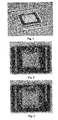
- the experimental setup is in FIG. 1 shown.
- solder paste 1 describes a solder paste to be used according to the invention
- solder paste 2 describes a solder paste, which has only one dicarboxylic acid.
- Table 1 solder paste Solder Paste 1 Solder paste 2 flux Amount in% by weight Amount in% by weight adipic acid 10.0 10.0 oxalic acid 0.7 - Bis-C 8 -dialkylamine 2.1 2.1 N, N-Dialkylfettamin 2.1 2.1 Hydrogenated rosin 45.3 45.3 Triethanolamine HBr 1.5 1.5 castor oil 2.7 2.7 Tri-propylene glycol n-butyl ether 35.6 36.3 Flux (total) 100.0 100.0 paste Amount in% by weight Amount in% by weight Lot (SnAgCu) 89.25 89.25 flux ad 100.0 ad 100 Thick solder deposit Solder paste 1 (result of the AC test) Solder paste 2 (
- the solder paste according to the invention shows very good to good results in the AC test, whereas when the conventional comparison solder paste 2 was used, excessive flow of the solder paste and thus poor results in the AC test occurred.
- FIGS. 2 to 5 show the results of the AC tests using the solder paste 1 to be used according to the invention, in which different thicknesses of the solder deposit were applied, as shown in Table 2.
- the results of the experiments in which the thickness of the solder deposit lies in a range between 100 and 160 ⁇ m, show very good to good test results
- Fig. 2 Measurement of solder paste 1 at 100 ⁇ m
- Fig. 3 Measurement of solder paste 1 at 120 ⁇ m
- Fig. 4 Measurement of solder paste 1 at 160 ⁇ m.
- the solder paste at a Lotdepotdicke of 160 microns FIG.
Landscapes
- Engineering & Computer Science (AREA)
- Mechanical Engineering (AREA)
- Manufacturing & Machinery (AREA)
- Microelectronics & Electronic Packaging (AREA)
- Electric Connection Of Electric Components To Printed Circuits (AREA)
Abstract
Die vorliegende Erfindung betrifft ein Verfahren zur Befestigung eines elektronischen Bauteils auf einem Substrat, unter Verwendung einer Lotpaste, die eine Mischung aus organischen Dicarbonsäuren umfasst und bei welchem die Dicke des Lotdepots 25 bis 200 µm beträgt.
Description
- Die vorliegende Erfindung betrifft ein Verfahren zur Befestigung eines elektronischen Bauteils auf einem Substrat, unter Verwendung einer Lotpaste, die eine Mischung aus organischen Dicarbonsäuren umfasst und bei welchem die Dicke des Lotdepots 25 bis 200 µm beträgt.
- Lotpasten, vor allem Weichlotpasten, finden vor allem in der Fertigung integraler Schaltkreise, wie beispielsweise in der Halbleiterindustrie, Verwendung. Dabei werden elektronische Bauteile auf Substrate, wie beispielsweise Leiterplatten, aufgebracht und mit Hilfe einer Lotpaste mechanisch, elektronisch und thermisch mit diesen verbunden. Folglich sind die Anforderungen, die an ein solches Verfahren und die darin eingesetzten Lotpasten gestellt werden, mannigfaltig, vor allem unter Berücksichtigung eines automatisierten Prozesses. In der Regel wird die Oberfläche des Substrats mit einer Lotpaste versehen, über die der Kontakt mit dem Bauteil hergestellt wird. Durch Erwärmen der Lotpaste kommt es zur Festigung des mechanischen Kontaktes. Neben der mechanischen Haftung kann die Lotpaste auch dazu dienen einen elektrischen Kontakt zwischen Bauteil und Substrat herzustellen und/oder die während des Betriebs des Bauteils entstehende Wärme abzuleiten.
WO 02/20211 A1 -
DE 195 11 392 A1 beschreibt ein Verfahren und eine Vorrichtung zum Aufbringen von Löthöckern mittels energiereicher Strahlung, insbesondere Laserstrahlung. -
US 5,672,542 betrifft ein Verfahren und einen Prozess für das Aufbringen von elektrisch leitenden Substanzen auf ein Substrat mit Hilfe von Lötkugeln, wobei die Lötkugeln einen Abstand von maximal 400 µm zueinander haben. - Eine besondere Herausforderung stellen bei diesen Verfahren elektronische Bauteile dar, die neben elektrischen Anschlussstellen auch über thermische Anschlussstellen auf der Unterseite verfügen, wie beispielsweise QFP-Bauteile (Quad Flat Package), die über elektrische Anschlussstellen in Form sogenannter Beinchen, die an den Seiten des Bauteils angebracht sind und über die der elektrische Kontakt zwischen Bauteil und Substrat hergestellt wird, verfügen, sowie eine thermische Anschlussstelle auf der Unterseite aufweisen, die dazu dient, die während des Betriebs generierte Wärme des Bauteils abzuleiten. Die Kontaktierung der Anschlussstellen mit dem Substrat erfolgt jeweils mit Hilfe von unterschiedlichen Lotpasten, eine für die thermische und eine für die elektrische Verbindung. Dabei kann es vorkommen, dass das eingebrachte Lotdepot der thermischen Anschlussstellen beim Erwärmen verläuft. Dabei werden Lotpulverpartikel, meist in Form sogenannter Lotkugeln, in Richtung der elektrischen Anschlussstellen ausgetrieben und können dort zu Kurzschlüssen führen. Dies wird vor allem dann problematisch, wenn aufgrund des vorgegebenen Abstandes zwischen Bauteil und Substrat, beispielsweise über die elektrischen Anschlussstellen, entsprechend viel der Lotpaste verwendet werden muss, damit es zu einer beiderseitigen Kontaktierung kommt.
- Es ist somit Aufgabe der vorliegenden Erfindung ein Verfahren zur Befestigung von Bauteilen, insbesondere Bauteilen mit elektrischen und thermischen Anschlussstellen, auf Substraten bereitzustellen, bei dem ein Ausfließen der Lotpaste und die Entstehung unerwünschter Lotkugeln verhindert wird, so dass das Auftreten von elektrischen Kurzschlüssen verhindert, wenigstens aber minimiert wird, ohne die thermische und mechanische Verbindung des Bauteils an das Substrat zu beeinträchtigen.
- Unter Ausfließen im Rahmen der vorliegenden Erfindung ist das Zerlaufen der Lotpaste für die thermische Verbindung zwischen Bauteil und Substrat über die Abgrenzungen der thermischen Anschlussstelle des Bauteils und/oder Substrates hinaus sowie die Entstehung unerwünschter Lotkugeln, wenn die Lotpaste unter Prozessbedingungen erwärmt wird, so dass es zu einem Kontakt zwischen der Lotpaste und den elektrischen Anschlussstellen des Bauteils und damit zu Kurzschlüssen kommt, zu verstehen.
- Die Aufgabe wird durch die Gegenstände der unabhängigen Ansprüche der vorliegenden Erfindung gelöst.
- Es wurde überraschend gefunden, dass durch die Verwendung einer Lotpaste, die ein Lot und ein Flussmittel, insbesondere ein Flussmittel, das eine Mischung aus zwei verschiedenen Dicarbonsäuren aufweist, umfasst, das Ausfließen der Lotpaste und die Entstehung unerwünschter Lotkugeln, und damit von Kurzschlüssen an den elektrischen Anschlussstellen des Bauteils, verhindert werden können. Zudem wurde auch gefunden, dass die Dicke des Lotdepots zwischen Bauteil und Substrat entscheidend das Ausfließen steuert.
- Daher ist ein Gegenstand der vorliegenden Erfindung ein Verfahren zur Befestigung eines Bauteils auf einem Substrat, das die folgenden Schritte umfasst:
- i) Bereitstellen eines Bauteils mit einer ersten Oberfläche, wobei das Bauteil mit elektrischen und thermischen Anschlussstellen versehen ist;
- ii) Bereitstellen eines Substrates mit einer zweiten Oberfläche, die mit einem Lotdepot versehen ist;
- iii) Mechanisches Kontaktieren der ersten Oberfläche des Bauteils mit der zweiten Oberfläche des Substrates über das Lotdepot, wobei die Dicke des Lotdepots 25 bis 200 µm beträgt; und
- iv) Erhitzen des Lotdepots über die Liquidustemperatur des Lots,
wobei das Lotdepot durch eine Lotpaste, umfassend ein Lot und ein Flussmittel, wobei das Flussmittel eine Dicarbonsäure A und eine Dicarbonsäure B, die voneinander verschieden sind, aufweist, gebildet wird. - Ein wesentlicher Bestandteil des Verfahrens ist das Lotdepot, das im Folgenden näher beschrieben wird.
- Das Lotdepot wird aus einer Lotpaste gebildet, die sich aus einem Flussmittel und einem Lot zusammensetzt. Die einzelnen Komponenten der Lotpaste sind im Folgenden näher ausgeführt.
- Das Flussmittel ist ein wichtiger Bestandteil der Lotpaste und bestimmt vor allem deren rheologische Eigenschaften. Es wurde überraschend gefunden, dass das Auftreten von Kurzschlüssen bei der Befestigung eines Bauteils auf einem Substrat verringert werden kann, wenn ein Flussmittel verwendet wird, das eine Mischung aus zwei verschiedenen Dicarbonsäuren aufweist. Es hat sich gezeigt, dass durch die Verwendung einer Lotpaste, welche besagtes Flussmittel aufweist, eine stabile mechanische und thermische Verbindung zwischen Bauteil und Substrat ausgebildet wird, ohne dass elektrische Kurzschlüsse auftreten, und dass die Lotpaste gleichzeitig eine gute Verarbeitbarkeit und gute Benetzungseigenschaften aufweist. Insbesondere im Zusammenspiel der Lotpaste mit einer definierten Depotdicke im Bereich von 25 bis 200 µm, zeigen sich hervorragende Eigenschaften.
- Besonders gute Ergebnisse wurden mit Dicarbonsäuren erzielt, die eine bestimmte Anzahl von Kohlenstoffatomen aufwiesen.
- Daher ist eine Ausführungsform des erfindungsgemäßen Verfahrens bevorzugt, bei der Dicarbonsäure A 5 oder mehr Kohlenstoffatome, vorzugsweise 6 bis 8 Kohlenstoffatome und insbesondere 6 Kohlenstoffatome aufweist. In einer besonders bevorzugten Ausführungsform ist Dicarbonsäure A Adipinsäure.
- Weiterhin hat es sich als vorteilhaft erwiesen, wenn als weitere Komponente eine Dicarbonsäure B verwendet wird, die weniger Kohlenstoffatome als Dicarbonsäure A aufweist.
- Folglich ist weiterhin eine Ausführungsform bevorzugt, in der Dicarbonsäure B 4 oder weniger Kohlenstoffatome, insbesondere 2 Kohlenstoffatome, aufweist. Besonders bevorzugt ist eine Ausführungsform in der Dicarbonsäure B Oxalsäure ist. Es wurde weiterhin überraschend gefunden, dass die vorteilhaften Effekte insbesondere dann auftreten, wenn Dicarbonsäure A und Dicarbonsäure B in einem bestimmten Gewichtsverhältnis zueinander vorliegen.
- In einer bevorzugten Ausführungsform beträgt das Gewichtsverhältnis von Dicarbonsäure A zu Dicarbonsäure B daher 30:1 bis 5:1, vorzugsweise 25:1 bis 7:1, insbesondere 20:1 bis 10:1.
- In einer besonders bevorzugten Ausführungsform des erfindungsgemäßen Verfahrens umfasst die Lotpaste die folgenden Komponenten:
- a) 5 bis 15 Gew.-% eines Flussmittels und
- b) 85 bis 95 Gew.-% eines Lots,
- i) 7 bis 13 Gew.-% Dicarbonsäure A, vorzugsweise Adipinsäure;
- ii) 0,3 bis 2,0 Gew.-% Dicarbonsäure B, vorzugsweise Oxalsäure; und
- iii) Amin, vorzugsweise ausgewählt aus Aminkomponente X und Aminkomponente Y, wobei Aminkomponente X ein Diamin mit tertiären Aminogruppen ist; und Aminkomponente Y ein Diamin oder Polyamin ist, bei denen wenigstens 2 der Aminogruppen durch mindestens 3 Kohlenstoffatome voneinander getrennt sind und die wenigstens 4 Kohlenstoffatome aufweisen, umfasst,
wobei sich die Gewichtsangaben der Dicarbonsäuren jeweils auf das Gesamtgewicht des Flussmittels beziehen. - Besonders bevorzugt ist eine Ausführungsform in der das Flussmittel Dicarbonsäure A in einer Menge von 7 bis 13 Gew.-%, vorzugsweise 8 bis 12 Gew.-%, jeweils bezogen auf das Gesamtgewicht des Flussmittels, aufweist.
- Weiterhin bevorzugt ist eine Ausführungsform, in der das Flussmittel Dicarbonsäure B in einer Menge von 0,3 bis 2,0 Gew.-%, vorzugsweise von 0,4 bis 1,5 Gew.-%, weiter bevorzugt von 0,45 bis 1,0 Gew.-%, jeweils bezogen auf das Gesamtgewicht des Flussmittels, aufweist.
- Im Folgenden werden die Aminkomponenten X und Y näher erläutert.
- Aminkomponente X ist ein Diamin, welches wenigstens eine tertiäre Aminogruppe, bevorzugt zwei tertiäre Aminogruppen aufweist.
- Es ist eine Ausführungsform bevorzugt, in der Aminkomponente X ausgewählt ist aus der Gruppe bestehend aus 1,2-Tetramethylethylendiamin, 1,2-Tetraethylethylendiamin und 1,2-Tetrapropylethylendiamin, beispielsweise 1,2-Tetra-n-propylethylendiamin und 1,2-Tetra-iso-propylethylendiamin. Insbesondere bevorzugt sind solche Diamine, bei denen jede tertiäre Aminogruppe zwei identische Substituenten aufweist.
- Tertiäres Amin im Sinne der vorliegenden Erfindung ist ein Amin, dessen Stickstoffatom drei kohlenstoffhaltige Substituenten trägt.
- Aminkomponente Y ist ein Diamin oder Polyamin, bei denen wenigstens 2 der Aminogruppen durch mindestens 3 Kohlenstoffatome voneinander getrennt sind und die wenigstens 4 Kohlenstoffatome aufweisen.
- Aminkomponente Y ist ein Diamin, bei dem die beiden Aminogruppen durch mindestens 3 Kohlenstoffatome voneinander getrennt sind und das wenigstens 4 Kohlenstoffatome aufweist. Alternativ ist Aminkomponente Y ein Polyamin, bei dem wenigstens 2 der Aminogruppen durch mindestens 3 Kohlenstoffatome voneinander getrennt sind und das wenigstens 4 Kohlenstoffatome aufweist.
- Es hat sich weiterhin überraschend gezeigt, dass sich die vorteilhaften rheologischen Eigenschaften der Lotpaste weiter verbessern lassen, wenn Aminkomponente Y eine primäre Aminogruppe aufweist.
- In einer bevorzugten Ausführungsform der vorliegenden Erfindung weist Aminkomponente Y daher mindestens eine primäre Aminogruppe auf.
- Bevorzugt ist eine Ausführungsform in der Aminkomponente Y ausgewählt ist aus der Gruppe bestehend aus N-Coco-1,3-diaminopropan, 1,6-Diaminohexan, 1,7-Diaminoheptan, 1,8-Diaminooktan, 1,9-Diaminononan und 1,10-Diaminodecan.
- In einer weiter bevorzugten Ausführungsform weist das einzusetzende Amin, das heißt Aminkomponente X oder Aminkomponente Y, keine tertiären und/oder quaternären Kohlenstoffatome auf.
- Weiterhin bevorzugt ist eine Ausführungsform, in der das Amin mindestens 6 Kohlenstoffatome aufweist. Dabei können die Kohlenstoffatome als Verbindungskette zwischen zwei Aminogruppen vorliegen oder als Substituenten der Stickstoffatome an diese gebunden sein.
- In einer bevorzugten Ausführungsform beträgt die Gesamtmenge an Amin, also Aminkomponente A und/oder Aminkomponente B im Flussmittel 2 Gew.-% oder weniger, vorzugsweise 1 Gew.-% oder weniger, beispielsweise 0,1 Gew.-% bis 2,0 Gew.-%, jeweils bezogen auf das Gesamtgewicht des Flussmittels.
- Die Menge an Amin im Flussmittel ist vorzugsweise so gewählt, dass eine gute Verarbeitbarkeit der Lotpaste sowie eine gute Benetzung der Oberflächen des zu befestigenden Bauteils und des Substrates gewährleistet sind.
- Daher ist eine Ausführungsform bevorzugt, in der das Flussmittel Aminkomponente X und/oder Aminkomponente Y in einer Menge von 0,1 bis 2,0 Gew.-%, vorzugsweise von 0,4 bis 1,0 Gew.-%, jeweils bezogen auf das Gesamtgewicht des Flussmittels, aufweist.
- In einer weiter bevorzugten Ausführungsform weist das Flussmittel zusätzlich Monoamin auf. Das Monoamin liegt zusätzlich zu der Aminkomponente X und/oder der Aminkomponente Y vor.
- Besonders gute Ergebnisse, vor allem hinsichtlich der Verarbeitbarkeit und des Ausfließverhaltens der Lotpaste, können erzielt werden, wenn es sich bei dem Monoamin um ein sekundäres und/oder tertiäres Monoamin handelt. Daher ist eine Ausführungsform bevorzugt, in der das Monoamin ausgewählt ist aus der Gruppe bestehend aus sekundärem Monoamin und tertiärem Monoamin sowie Mischungen davon. Besonders bevorzugt ist das Monoamin ein tertiäres Monoamin. Vorzugsweise umfasst das Flussmittel Monoamin in einer Menge von 0,5 bis 5,5 Gew.-%, vorzugsweise von 1,0 bis 5,0 Gew.-%, jeweils bezogen auf das Gesamtgewicht des Flussmittels.
- Als besonders vorteilhaft hat es sich erwiesen, wenn das Flussmittel neben den Dicarbonsäuren A und B weitere Dicarbonsäuren aufweist, die von den Dicarbonsäuren A und B verschieden sind.
- Daher ist eine Ausführungsform bevorzugt, in der das Flussmittel zusätzlich Dicarbonsäuren, die von Dicarbonsäure A und Dicarbonsäure B verschieden sind, in einer Menge von 0 bis 2 Gew.-%, vorzugsweise in einer Menge von 0,01 bis 1,0 Gew.-%, jeweils bezogen auf das Gesamtgewicht des Flussmittels, aufweist. Weiterhin bevorzugt ist eine Ausführungsform, in der die Gesamtmenge aller Dicarbonsäuren im Flussmittel maximal 15 Gew.-%, vorzugsweise 7 bis 13 Gew.-%, insbesondere 8 bis 12 Gew.-%, jeweils bezogen auf das Gesamtgewicht des Flussmittels, beträgt.
- Es hat sich gezeigt, dass die Benetzungseigenschaften und die Verarbeitbarkeit sowie weitere Eigenschaften der Lotpaste mit Hilfe weiterer Additive verbessert werden können.
- Daher umfasst das Flussmittel der Lotpaste zur Verwendung im erfindungsgemäßen Verfahren weitere Additive, vorzugsweise in einer Menge von 0,05 bis 3,0 Gew.-%, jeweils bezogen auf das Gesamtgewicht des Flussmittels. Bei diesen Additiven handelt es sich vorzugsweise um Verbindungen, die die Benetzungseigenschaften der Lotpaste verbessern, wie zum Beispiel ethoxyliertes Aminharz, Aminharz, Methylester von Harzen, n-Oleylsarcosin, Oleylimidazolin sowie Mischungen davon. Bevorzugt ist eine Ausführungsform, in der das Flussmittel weiterhin zusätzlich ein Lösungsmittel umfasst, insbesondere ein Lösungsmittel, ausgewählt aus der Gruppe bestehend aus bei 25 °C flüssige Diole, Alkohole, Etheralkohole und Ketone, insbesondere Trimethylpropanol, 1,2-Oktandiol, 1,8-Oktandiol, 2,5-Dimethyl-2,5-hexandiol, iso-Bornylcyclohexanon, Glykolether, 2-Ethyl-1,3-hexandiol, n-Decylalkohol, 2-Methyl-2,4-pentandiol, Terpineol und Isopropanol sowie Mischungen davon. In einer weiteren bevorzugten Ausführungsform ist der Glykolether ausgewählt aus der Gruppe bestehend aus Mono-, Di-, Tri-Propylenglykolmethylether, Mono-, Di-, Tri-Propylenglykol-n-butylether, Mono-, Di-, Tri-Ethylenglykol-n-butylether, Ethylenglykolmethylether, Triethylenglykolmethylether, Diethylenglykoldibutylether, Tetraethylenglykoldimethylether und Diethylenglykol-monohexylether sowie Mischungen davon.
- Weiterhin kann das Flussmittel ein Harz aufweisen, um der Lotpaste die für die jeweilige Verwendung benötigte Konsistenz zu verleihen. In einer bevorzugten Ausführungsform weist das Flussmittel zusätzlich ein Harz auf, bevorzugt ein Harz ausgewählt aus der Gruppe bestehend aus Kolophonium, Tallöl, hydriertes Kolophonium, dimerisiertes Kolophonium, teilweise dimerisiertes Kolophonium und Mischungen davon.
- In einer bevorzugten Ausführungsform liegt das Harz in einer Menge von 35 bis 50 Gew.-%, bevorzugt 40 bis 48 Gew.-%, jeweils bezogen auf das Gesamtgewicht des Flussmittels, vor.
- Die Ergebnisse des erfindungsgemäßen Verfahrens lassen sich weiter verbessern, wenn das Flussmittel einen Aktivator, beispielsweise eine halogenhaltige Verbindung, aufweist, der die Oberflächen des Lotpulvers, des zu verbindenden Bauteils und des Substrates aktiviert und so für eine bessere Verbindung der Komponenten sorgt.
- Daher ist eine Ausführungsform bevorzugt, in der das Flussmittel zusätzlich halogenhaltige Verbindungen ausgewählt aus der Gruppe bestehend aus Anilinhydrochlorid, Glutaminsäurehydrochlorid, Diethanolaminhydrochlorid, Diethanolaminhydrobromid, Triethanolaminhydrochlorid, Triethanolamin-hydrobromid und trans-2,3-Dibrom-2-buten-1,4-diol sowie Mischungen davon umfasst.
- Als besonders vorteilhaft hat es sich erwiesen, wenn die Menge an halogenhaltigen Verbindungen im Flussmittel 5 Gew.-%, bezogen auf das Gesamtgewicht des Flussmittels, nicht überschreitet. Daher ist eine Ausführungsform der erfindungsgemäßen Lotpaste bevorzugt, in der das Flussmittel halogenhaltige Verbindungen in einer Menge von 0,1 bis 3,0 Gew.-%, vorzugsweise 0,5 bis 2,0 Gew.-%, jeweils bezogen auf das Gesamtgewicht des Flussmittels, umfasst.
- In einer alternativ bevorzugten Ausführungsform ist die Lotpaste, die in dem erfindungsgemäßen Verfahren eingesetzt wird, im Wesentlichen frei von halogenhaltigen Verbindungen. Als im Wesentlichen frei von halogenhaltigen Verbindungen im Rahmen der vorliegenden Erfindung sind Pasten anzusehen, die halogenhaltige Verbindungen in einer Menge von weniger als 0,1 Gew.-%, vorzugsweise zwischen 0 und 0,09 Gew.-%, speziell weniger als 0,01 Gew.-% oder weniger als 0,005 Gew.-%, jeweils bezogen auf das Gesamtgewicht des Flussmittels, aufweisen.
- Zur Verbesserung der rheologischen Eigenschaften und der Benetzbarkeit der Lotpaste kann das Flussmittel beispielsweise Verdickungsmittel enthalten. In einer bevorzugten Ausführungsform umfasst das Flussmittel zusätzlich ein oder mehrere Verdickungsmittel, bevorzugt ausgewählt aus der Gruppe bestehend aus Ethylcellulose, hydriertes Rizinusöl, Glycerin-tris-12-hydroxystearin und modifiziertes Glycerin-tris-12-hydroxystearin. Vorzugsweise weist das Flussmittel Verdickungsmittel in einer Menge von 1,0 bis 4,0 Gew.-%, bevorzugt von 1,7 bis 3,0 Gew.-%, jeweils bezogen auf das Gesamtgewicht des Flussmittels, auf.
- Ein weiterer wichtiger Bestandteil der Lotpaste, die in dem erfindungsgemäßen Verfahren eingesetzt wird, ist das Lot, das im Folgenden näher beschrieben wird.
- Das Lot bildet zusammen mit dem Flussmittel das Lotdepot, über das die thermische Anbindung des Bauteils an das Substrat erfolgt. Da über diese Verbindung die Wärme, die während des Betriebs des Bauteils generiert wird, abgeleitet werden soll, ist es wünschenswert, dass das Lot eine gute Wärmeleitfähigkeit besitzt, möglichst in Verbindung mit einer begrenzten elektrischen Leitfähigkeit. Diese Eigenschaften finden sich vor allem in Loten, die Zinn als Hauptbestandteil aufweisen.
- Daher ist eine Ausführungsform bevorzugt, in der das Lot ein Lot auf Zinnbasis ist.
- Ein Lot auf Zinnbasis im Rahmen der vorliegenden Erfindung beschreibt ein Lot, das mindestens 80 Gew.-%, vorzugsweise mindestens 83 Gew.-%, insbesondere zwischen 85 und 90 Gew.-%, Zinn aufweist, wobei sich die Gewichtsangaben jeweils auf die Gesamtmenge des Lot beziehen.
- In einer bevorzugten Ausführungsform kann das Lot neben Zinn weitere Metalle umfassen, um beispielsweise die Liquidustemperatur des Lots auf einen für die jeweilige Anwendung vorteilhaften Bereich einzustellen.
- Daher ist eine Ausführungsform bevorzugt, in der das Lot Silber in einer Menge von 0,1 bis 8 Gew.-%, vorzugsweise 0,2 bis 6 Gew.-%, jeweils bezogen auf das Gesamtgewicht des Lots, umfasst.
- In einer weiter bevorzugten Ausführungsform umfasst das Lot Kupfer in einer Menge von 0,1 bis 1,5 Gew.-%, vorzugsweise 0,2 bis 1,0 Gew.-%, jeweils bezogen auf das Gesamtgewicht des Lots.
- Weiterhin bevorzugt ist eine Ausführungsform, in der das Lot bleifrei ist.
- Die Lotpaste eignet sich vor allem für den Einsatz in dem erfindungsgemäßen Verfahren, bei denen das Lot über seine Liquidustemperatur erwärmt wird und so für eine optimale Verbindung zwischen Bauteil und Substrat sorgt. Aus energietechnischen Gesichtspunkten und unter Berücksichtigung der empfindlichen Bauteile und Substrate, sollte daher die Liquidustemperatur des Lots nicht zu hoch sein.
- Daher ist eine Ausführungsform bevorzugt, in der das Lot eine Liquidustemperatur in einem Bereich von 200 bis 250 °C, vorzugsweise in einem Bereich von 200 bis 230 °C, aufweist.
- In einer bevorzugten Ausführungsform liegt das Lot in Pulverform vor, vorzugsweise mit einer gewichtmittleren Teilchengröße von 15 bis 50 µm, vorzugsweise von 20 bis 45 µm, bestimmt gemäß IPC-TM-650 2.2.14-2.2.14.2. In einer bevorzugten Ausführungsform weisen 80 bis 90% der Teilchen im Pulver eine Größe in dem Bereich von 15 bis 50 µm, vorzugsweise von 20 bis 45 µm auf. Teilchengröße im Rahmen der vorliegenden Erfindung bezeichnet die maximale lineare Ausdehnung eines Teilchens.
- In einer weiterhin bevorzugten Ausführungsform umfasst die Lotpaste das Lot in einer Menge von 80 bis 97 Gew.-%, vorzugsweise 83 bis 95 Gew.-%, insbesondere 85 bis 93 Gew.-%, jeweils bezogen auf das Gesamtgewicht der Lotpaste.
- Im Folgenden werden die einzelnen Schritte des erfindungsgemäßen Verfahrens näher erläutert.
- In einem ersten Schritt des erfindungsgemäßen Verfahrens zur Befestigung eines Bauteils auf einem Substrat wird ein Bauteil bereitgestellt. Das erfindungsgemäße Verfahren ist vor allem für das Befestigen von Bauteilen, die über thermische und elektrische Anschlussstellen verfügen, auf Substraten geeignet, wobei die Kontaktierung über eine erste Oberfläche des Bauteils und eine zweite Oberfläche des Substrates mit Hilfe eines Lotdepots erfolgt. Vorzugsweise umfasst die erste Oberfläche des Bauteils mindestens ein Metall, das ausgewählt ist aus der Gruppe bestehend aus Kupfer, Silber, Gold, Nickel, Aluminium, Zinn, Palladium sowie Legierungen von zwei oder mehreren der genannten Metalle.
- Vorzugsweise weist das Bauteil eine quadratische Grundfläche auf. Besonders bevorzugt liegt diese in einem Bereich von 3 x 3 bis 100 x 100 mm, vorzugsweise von 5 x 5 bis 80 x 80 mm.
- In einer weiterhin bevorzugten Ausführungsform ist das Bauteil ausgewählt aus der Gruppe der Quad Flat Packages (QFP), beispielsweise Bumpered Quad Flat Package mit Hitzeverteiler (BQFPH) und Heat sinked Quad Flat Package (HQFP).
- In einem zweiten Schritt wird ein Substrat bereitgestellt, das mit einem Lotdepot versehen ist. Das Substrat, auf dem das Bauteil mit Hilfe des erfindungsgemäßen Verfahrens befestigt wird, weist eine zweite Oberfläche auf, über die die Kontaktierung mit dem Bauteil erfolgt. Vorzugsweise umfasst die zweite Oberfläche des Substrates mindestens ein Material, das ausgewählt ist aus der Gruppe bestehend aus Nickel, Kupfer, Gold, Silber, Aluminium, Zinn und Palladium sowie Legierungen von zwei oder mehrerer der genannten Metalle.
- Vorzugsweise handelt es sich bei dem Substrat um ein metallisiertes Substrat, also um ein Substrat, das mindestens eine Metalloberfläche aufweist. Der Basiskörper des Substrates kann dabei beispielsweise aus Keramik, Papier, Epoxydharz oder reinem Kupfer bestehen.
- Das erfindungsgemäße Verfahren eignet sich besonders für Prozesse, bei denen das Aufbringen des Lotdepots und das mechanische Kontaktieren des Bauteils mit dem Lotdepot automatisiert erfolgen. Um ein schnelles und präzises Arbeiten zu ermöglichen, ist es wünschenswert, dass das Aufbringen des Lotdepots schnell und ohne zusätzliche Arbeitsschritte erfolgt. Daher ist eine Ausführungsform des Verfahrens bevorzugt, in der das Aufbringen des Lotdepots mittels Siebdruck, Rakeln, Schablonendruck, Dispensen oder Jetten erfolgt. Auf diese Weise wird ein präzises Aufbringen, das auch die Herstellung kleiner integrierter Schaltkreise erlaubt, ermöglicht. Die Dicke des Lotdepots beträgt dabei 25 bis 200 µm, vorzugsweise 30 bis 150 µm, beispielsweise 50 bis 150 µm oder 80 bis 150 µm. Alternativ kann die Dicke des Lotdepots auch 25 bis 130 µm, insbesondere 30 bis 120 µm oder 30 bis 100 µm betragen. Auf diese Weise ist eine optimale thermische Anbindung des Bauteils an das Substrat und damit eine optimale Kühlung des Bauteils gewährleistet. Gleichfalls kann das Ausfließen in diesem Dickenbereich mit der gewählten Lotpaste verringert bzw. vermieden werden.
- In einem nächsten Schritt des erfindungsgemäßen Verfahrens wird die erste Oberfläche des Bauteils mit der zweiten Oberfläche des Substrates über das Lotdepot mechanisch in Kontakt gebracht.
- Anschließend wird die Lotpaste über die Liquidustemperatur des Lots erwärmt, so dass es zu einer Verbindung zwischen Bauteil und Substrat über die Lotpaste kommt. Dabei wird die Lotpaste vorzugsweise so erwärmt, dass das Lot in seine Liquidusphase übergeht, jedoch ohne dass es zu einer Beschädigung der Lotpaste, des Bauteils und/oder des Substrates kommt. Das Lot wird vorzugsweise auf eine Temperatur erwärmt, die 5 bis 60 °C, vorzugsweise 10 bis 50 °C, über der Liquidustemperatur des Lots liegt. Das Erwärmen erfolgt vorzugsweise mit Hilfe einer Heizplatte, auf die das Substrat gelegt wird, so dass sich die Oberfläche des Substrates, die sich der zweiten Oberfläche gegenüber befindet, mit der Heizplatte in Kontakt steht. Alternativ kann das Erhitzen des Lots auch mit Hilfe beheizter Formteile, Bügel, Stempel, Infrarotstrahler, Laserstrahlen oder mit Hilfe von Dampf erfolgen.
- Die gemäß dem erfindungsgemäßen Verfahren mit dem Substrat befestigten Bauteile weisen ein wesentlich verringertes Auftreten von Kurzschlüssen auf.
- Ein weiterer Gegenstand der vorliegenden Erfindung ist daher ein Bauteil, welches auf einem Substrat befestigt ist und welches gemäß dem erfindungsgemäßen Verfahren erhältlich ist oder erhalten wird.
- Die Erfindung soll anhand der folgenden Beispiele näher beschrieben werden, wobei diese jedoch nicht als Einschränkung des Erfindungsgedanken zu verstehen sind.
- Die mit Hilfe des erfindungsgemäßen Verfahrens hergestellten Bauteile wurden anhand des Anti-Capillary-Tests (AC-Test) bei verschiedenen Dicken des Lotdepots beurteilt. Dazu wurde die Lotpaste auf die thermische Anschlussstelle eines QFP-Bauteils (beispielsweise von Infineon Technologies AG, Deutschland) aufgebracht und mit einer Glasplatte abgedeckt. Das QFP-Bauteil wurde mit der gegenüber liegenden Oberfläche auf eine Heizplatte mit einer Temperatur von 200 °C gelegt, so dass das Verhalten der Paste beurteilt werden konnte. Der Versuchsaufbau ist in
Figur 1 dargestellt. - Die erhaltenen Ergebnisse wurden mittels Noten bewertet, wobei die Note 1 für sehr gute und die Note 2 für gute Ergebnisse steht, bei denen es zu keinen Kurzschlüssen aufgrund des unerwünschten Kontaktes der Lotpaste mit den elektrischen Anschlussstellen des Bauteils kam. Die Note 3 wurde für Tests vergeben, bei denen die Lotpaste so weit verlaufen ist, dass es zu einem Kontakt mit den elektrischen Anschlussstellen des Bauteils kam. Die Ergebnisse sind in Tabelle 2 zusammengefasst, wobei die Tests jeweils mit einer erfindungsgemäß einzusetzenden Lotpaste 1 und einer herkömmlichen Vergleichs-Lotpaste 2 durchgeführt wurden.
- Tabelle 1 gibt die Rezeptur der verwendeten Lotpaste wieder, die in den AC-Tests eingesetzt wurden, wobei Lotpaste 1 eine erfindungsgemäß einzusetzende Lotpaste beschreibt, während Lotpaste 2 eine Lotpaste beschreibt, die nur eine Dicarbonsäure aufweist.
Tabelle 1 Lotpaste Lotpaste 1 Lotpaste 2 Flussmittel Menge in Gew.-% Menge in Gew.-% Adipinsäure 10,0 10,0 Oxalsäure 0,7 - Bis-C8-dialkylamin 2,1 2,1 N,N-Dialkylfettamin 2,1 2,1 Hydriertes Kolophonium 45,3 45,3 Triethanolamin·HBr 1,5 1,5 Rizinusöl 2,7 2,7 Tri-Propylenglykol-n-butylether 35,6 36,3 Flussmittel (gesamt) 100,0 100,0 Paste Menge in Gew.-% Menge in Gew.-% Lot (SnAgCu) 89,25 89,25 Flussmittel ad 100,0 ad 100 Tabelle 2 Dicke Lotdepot Lotpaste 1 (Ergebnis des AC-Tests) Lotpaste 2 (Ergebnis des AC-Tests) 100 µm 1 3 120 µm 1 3 160 µm 2 3 240 µm 3 3 - Wie Tabelle 2 zu entnehmen, zeigt die erfindungsgemäße Lotpaste sehr gute bis gute Ergebnisse im AC-Test, während es bei Verwendung der herkömmlichen Vergleichs-Lotpaste 2 zu einem übermäßigen Verlaufen der Lotpaste und damit zu schlechten Ergebnissen im AC-Test kam.
- Die
Figuren 2 bis 5 zeigen die Ergebnisse der AC-Tests unter Verwendung der erfindungsgemäß einzusetzenden Lotpaste 1, bei denen unterschiedliche Dicken des Lotdepots aufgetragen wurden, wie in Tabelle 2 dargestellt. Wie den Figuren zu entnehmen ist, zeigen die Ergebnisse der Versuche, bei denen die Dicke des Lotdepots in einem Bereich zwischen 100 und 160 µm liegen, sehr gute bis gute Testergebnisse (Fig. 2 : Messung der Lotpaste 1 bei 100 µm;Fig. 3 : Messung der Lotpaste 1 bei 120 µm;Fig. 4 : Messung der Lotpaste 1 bei 160 µm). Obwohl die Lotpaste bei einer Lotdepotdicke von 160 µm (Figur 4 ) schon recht weit verlaufen ist, kommt es auch hier nicht zu einem unerwünschten Kontakt mit den elektrischen Anschlussstellen des Bauteils, so dass Kurzschlüsse vermieden werden konnten. Eine Schichtdicke, die außerhalb des erfindungsgemäßen Bereichs von 25 bis 200 µm lag, führte dagegen zu Kontakten der Lotpaste mit den elektrischen Anschlussstellen des Bauteils und den dadurch bedingten Kurzschlüssen (Figur 5 ).
Claims (15)
- Verfahren zur Befestigung eines Bauteils auf einem Substrat umfassend die folgenden Schritte:i) Bereitstellen eines Bauteils mit einer ersten Oberfläche, wobei das Bauteil mit elektrischen und thermischen Anschlussstellen versehen ist;ii) Bereitstellen eines Substrates mit einer zweiten Oberfläche, die mit einem Lotdepot versehen ist;iii) Mechanisches Kontaktieren der ersten Oberfläche des Bauteils mit der zweiten Oberfläche des Substrates über das Lotdepot, wobei die Dicke des Lotdepots 25 bis 200 µm beträgt; undiv) Erhitzen des Lotdepots über die Liquidustemperatur des Lots,
wobei das Lotdepot durch eine Lotpaste umfassend ein Lot und ein Flussmittel, wobei das Flussmittel eine Dicarbonsäure A und eine Dicarbonsäure B, die voneinander verschieden sind, aufweist, gebildet wird. - Verfahren gemäß Anspruch 1, dadurch gekennzeichnet, dass die Dicarbonsäure A 5 oder mehr Kohlenstoffatome, vorzugsweise 6 bis 8 Kohlenstoffatome und insbesondere 6 Kohlenstoffatome aufweist.
- Verfahren gemäß einem oder beiden der Ansprüche 1 und 2, dadurch gekennzeichnet, dass Dicarbonsäure B 4 oder weniger Kohlenstoffatome, insbesondere 2 Kohlenstoffatome, aufweist.
- Verfahren gemäß einem oder mehrerer der Ansprüche 1 bis 3, dadurch gekennzeichnet, dass das Gewichtsverhältnis von Dicarbonsäure A zu Dicarbonsäure B 30:1 bis 5:1, vorzugsweise 25:1 bis 7:1, insbesondere 20:1 bis 10:1 beträgt.
- Verfahren gemäß einem oder mehrerer der Ansprüche 1 bis 4, dadurch gekennzeichnet, dass das die Lotpaste folgendes umfasst:a) 5 bis 15 Gew.-% eines Flussmittel undb) 85 bis 95 Gew.-% eines Lots,
wobei sich die Gewichtsangaben jeweils auf das Gesamtgewicht der Lotpaste beziehen und wobei das Flussmitteli) 7 bis 13 Gew.-% Dicarbonsäure A, vorzugsweise Adipinsäure;ii) 0,3 bis 2,0 Gew.-% Dicarbonsäure B, vorzugsweise Oxalsäure; undiii) Amin, vorzugsweise ausgewählt aus Aminkomponente X und Aminkomponente Y, wobei Aminkomponente X ein Diamin mit tertiären Aminogruppen ist;
und Aminkomponente Y ein Diamin oder Polyamin ist, bei denen wenigstens 2 der Aminogruppen durch mindestens 3 Kohlenstoffatome voneinander getrennt sind und die wenigstens 4 Kohlenstoffatome aufweisen;
wobei sich die Gewichtsangaben der Dicarbonsäuren jeweils auf das Gesamtgewicht des Flussmittels beziehen. - Verfahren gemäß Anspruch 5, dadurch gekennzeichnet, dass Aminkomponente X ausgewählt ist aus der Gruppe bestehend aus 1,2-Tetramethylethylendiamin, 1,2-Tetraethylethylendiamin, 1,2-Tetrapropylethylendiamin und 1,2-Tetra-isopropylethylendiamin.
- Verfahren gemäß Anspruch 5, dadurch gekennzeichnet, dass die Aminkomponente Y ausgewählt ist aus der Gruppe bestehend aus N-Coco-1,3-Diaminopropan, 1,6-Diaminohexan, 1,7-Diaminoheptan, 1,8-Diaminooktan, 1,9-Diaminononan und 1,10-Diaminodecan.
- Verfahren gemäß einem oder mehrerer der Ansprüche 1 bis 7, dadurch gekennzeichnet, dass die Gesamtmenge aller Dicarbonsäuren im Flussmittel maximal 15 Gew.-%, vorzugsweise 7 bis 13 Gew.-%, jeweils bezogen auf das Gesamtgewicht des Flussmittels, beträgt.
- Verfahren gemäß einem oder mehrerer der Ansprüche 1 bis 8, dadurch gekennzeichnet, dass das Lot ein Lot auf Zinnbasis ist.
- Verfahren gemäß einem oder mehrerer der Ansprüche 1 bis 9, dadurch gekennzeichnet, dass das Lot Silber in einer Menge von 0,1 bis 8,0 Gew.-%, vorzugsweise 0,2 bis 6 Gew.-% umfasst, bezogen auf das Gesamtgewicht des Lotes.
- Verfahren gemäß einem oder mehrerer der Ansprüche 1 bis 10, dadurch gekennzeichnet, dass das Lot Kupfer in einer Menge von 0,1 bis 1,5 Gew.-%, vorzugsweise 0,2 bis 1,0 Gew.-%, jeweils bezogen auf das Gesamtgewicht des Lots, umfasst.
- Verfahren gemäß einem oder mehrerer der Ansprüche 1 bis 11, dadurch gekennzeichnet, dass das Lot eine Liquidustemperatur im Bereich von 200 bis 250 °C, vorzugsweise im Bereich von 200 bis 230 °C aufweist.
- Verfahren gemäß einem oder mehrerer der Ansprüche 1 bis 12, dadurch gekennzeichnet, dass die Oberfläche des Bauteils mindestens ein Metall umfasst, das ausgewählt ist aus der Gruppe bestehend aus Kupfer, Silber, Gold, Nickel, Aluminium, Zinn und Palladium sowie Legierungen von zwei oder mehrerer der genannten Metalle davon
- Verfahren gemäß einem oder mehrerer der Ansprüche 1 bis 13, dadurch gekennzeichnet, dass die Oberfläche des Substrates mindestens ein Material umfasst, das ausgewählt ist aus der Gruppe bestehend aus Nickel, Gold, Kupfer, Zinn, Silber, Aluminium und Palladium sowie Legierungen von zwei oder mehrerer der genannten Metalle.
- Bauteil, welches auf einem Substrat befestigt ist, erhältlich gemäß einem Verfahren gemäß einem oder mehreren der Ansprüche 1 bis 14.
Priority Applications (8)
| Application Number | Priority Date | Filing Date | Title |
|---|---|---|---|
| EP13197640.9A EP2886244A1 (de) | 2013-12-17 | 2013-12-17 | Verfahren zur Befestigung eines Bauteils auf einem Substrat |
| SG11201604950QA SG11201604950QA (en) | 2013-12-17 | 2014-12-12 | Method for securing a component to a substrate |
| CN201480069205.3A CN105813798A (zh) | 2013-12-17 | 2014-12-12 | 在基底上固定部件的方法 |
| PCT/EP2014/077559 WO2015091260A1 (de) | 2013-12-17 | 2014-12-12 | Verfahren zur befestigung eines bauteils auf einem substrat |
| KR1020167019334A KR20160102230A (ko) | 2013-12-17 | 2014-12-12 | 기판 위에 부품을 실장하기 위한 방법 |
| US15/105,378 US20160316572A1 (en) | 2013-12-17 | 2014-12-12 | Method for mounting a component on a substrate |
| MX2016007749A MX2016007749A (es) | 2013-12-17 | 2014-12-12 | Metodo para asegurar un componente a un sustrato. |
| JP2016539139A JP2017507025A (ja) | 2013-12-17 | 2014-12-12 | 部品を基板に実装する方法 |
Applications Claiming Priority (1)
| Application Number | Priority Date | Filing Date | Title |
|---|---|---|---|
| EP13197640.9A EP2886244A1 (de) | 2013-12-17 | 2013-12-17 | Verfahren zur Befestigung eines Bauteils auf einem Substrat |
Publications (1)
| Publication Number | Publication Date |
|---|---|
| EP2886244A1 true EP2886244A1 (de) | 2015-06-24 |
Family
ID=49816849
Family Applications (1)
| Application Number | Title | Priority Date | Filing Date |
|---|---|---|---|
| EP13197640.9A Withdrawn EP2886244A1 (de) | 2013-12-17 | 2013-12-17 | Verfahren zur Befestigung eines Bauteils auf einem Substrat |
Country Status (8)
| Country | Link |
|---|---|
| US (1) | US20160316572A1 (de) |
| EP (1) | EP2886244A1 (de) |
| JP (1) | JP2017507025A (de) |
| KR (1) | KR20160102230A (de) |
| CN (1) | CN105813798A (de) |
| MX (1) | MX2016007749A (de) |
| SG (1) | SG11201604950QA (de) |
| WO (1) | WO2015091260A1 (de) |
Families Citing this family (2)
| Publication number | Priority date | Publication date | Assignee | Title |
|---|---|---|---|---|
| US10913132B2 (en) | 2017-08-30 | 2021-02-09 | Tamura Corporation | Solder composition, electronic board, and bonding method |
| JP6674982B2 (ja) * | 2017-08-30 | 2020-04-01 | 株式会社タムラ製作所 | はんだ組成物および電子基板 |
Citations (7)
| Publication number | Priority date | Publication date | Assignee | Title |
|---|---|---|---|---|
| GB2198676A (en) * | 1986-12-03 | 1988-06-22 | Multicore Solders Ltd | Solder cream composition |
| DE19511392A1 (de) | 1994-03-31 | 1995-10-05 | Fraunhofer Ges Forschung | Verfahren und Vorrichtung zur Herstellung von Lothöckern |
| US5672542A (en) | 1994-08-08 | 1997-09-30 | Hewlett Packard Company | Method of making solder balls by contained paste deposition |
| WO2002020211A1 (de) | 2000-09-07 | 2002-03-14 | Infineon Techonologies Ag | Lötmittel zur verwendung bei diffusionslötprozessen sowie verfahren zur herstellung von lötverbindungen unter verwendung des lötmittels |
| US20030168123A1 (en) * | 2002-03-07 | 2003-09-11 | Kenichi Wada | Flux for solder paste and solder paste |
| DE102009034483A1 (de) * | 2009-07-22 | 2011-01-27 | W.C. Heraeus Gmbh | Bleifreie Hochtemperaturverbindung für die AVT in der Elektronik |
| US20130082094A1 (en) * | 2011-09-30 | 2013-04-04 | Rohm And Haas Electronic Materials Llc | Polyamine, carboxylic acid flux composition and method of soldering |
Family Cites Families (12)
| Publication number | Priority date | Publication date | Assignee | Title |
|---|---|---|---|---|
| AU5919890A (en) * | 1989-08-14 | 1991-02-14 | Multicore Solders Limited | Manufacture of printed circuit board assemblies |
| JP3273961B2 (ja) * | 1991-12-18 | 2002-04-15 | トヨタ自動車株式会社 | クリームはんだ |
| US5272007A (en) * | 1992-02-21 | 1993-12-21 | Union Carbide Chemicals & Plastics Technology Corporation | Solder powder coated with parylene |
| JP3311282B2 (ja) * | 1997-10-13 | 2002-08-05 | 株式会社東芝 | 金属部材の接合方法及び接合体 |
| US6217671B1 (en) * | 1999-12-14 | 2001-04-17 | International Business Machines Corporation | Composition for increasing activity of a no-clean flux |
| US6524398B2 (en) * | 2000-04-13 | 2003-02-25 | Fry's Metals, Inc. | Low-residue, low-solder-ball flux |
| DE102005053553A1 (de) * | 2005-11-08 | 2007-05-16 | Heraeus Gmbh W C | Lotpasten mit harzfreien Flussmittel |
| US7767032B2 (en) * | 2006-06-30 | 2010-08-03 | W.C. Heraeus Holding GmbH | No-clean low-residue solder paste for semiconductor device applications |
| JP2008062253A (ja) * | 2006-09-05 | 2008-03-21 | Denso Corp | はんだ付け用フラックスおよびはんだペースト組成物 |
| WO2012081688A1 (ja) * | 2010-12-17 | 2012-06-21 | 荒川化学工業株式会社 | 鉛フリーハンダ用フラックス及び鉛フリーハンダペースト |
| US8430294B2 (en) * | 2011-09-30 | 2013-04-30 | Rohm And Haas Electronic Materials Llc | Amine, carboxylic acid flux composition and method of soldering |
| WO2013095670A1 (en) * | 2011-12-23 | 2013-06-27 | Intel Corporation | Hybrid low metal loading flux |
-
2013
- 2013-12-17 EP EP13197640.9A patent/EP2886244A1/de not_active Withdrawn
-
2014
- 2014-12-12 US US15/105,378 patent/US20160316572A1/en not_active Abandoned
- 2014-12-12 JP JP2016539139A patent/JP2017507025A/ja active Pending
- 2014-12-12 KR KR1020167019334A patent/KR20160102230A/ko not_active Ceased
- 2014-12-12 MX MX2016007749A patent/MX2016007749A/es unknown
- 2014-12-12 WO PCT/EP2014/077559 patent/WO2015091260A1/de not_active Ceased
- 2014-12-12 SG SG11201604950QA patent/SG11201604950QA/en unknown
- 2014-12-12 CN CN201480069205.3A patent/CN105813798A/zh active Pending
Patent Citations (7)
| Publication number | Priority date | Publication date | Assignee | Title |
|---|---|---|---|---|
| GB2198676A (en) * | 1986-12-03 | 1988-06-22 | Multicore Solders Ltd | Solder cream composition |
| DE19511392A1 (de) | 1994-03-31 | 1995-10-05 | Fraunhofer Ges Forschung | Verfahren und Vorrichtung zur Herstellung von Lothöckern |
| US5672542A (en) | 1994-08-08 | 1997-09-30 | Hewlett Packard Company | Method of making solder balls by contained paste deposition |
| WO2002020211A1 (de) | 2000-09-07 | 2002-03-14 | Infineon Techonologies Ag | Lötmittel zur verwendung bei diffusionslötprozessen sowie verfahren zur herstellung von lötverbindungen unter verwendung des lötmittels |
| US20030168123A1 (en) * | 2002-03-07 | 2003-09-11 | Kenichi Wada | Flux for solder paste and solder paste |
| DE102009034483A1 (de) * | 2009-07-22 | 2011-01-27 | W.C. Heraeus Gmbh | Bleifreie Hochtemperaturverbindung für die AVT in der Elektronik |
| US20130082094A1 (en) * | 2011-09-30 | 2013-04-04 | Rohm And Haas Electronic Materials Llc | Polyamine, carboxylic acid flux composition and method of soldering |
Also Published As
| Publication number | Publication date |
|---|---|
| US20160316572A1 (en) | 2016-10-27 |
| JP2017507025A (ja) | 2017-03-16 |
| SG11201604950QA (en) | 2016-08-30 |
| WO2015091260A1 (de) | 2015-06-25 |
| KR20160102230A (ko) | 2016-08-29 |
| CN105813798A (zh) | 2016-07-27 |
| MX2016007749A (es) | 2016-12-12 |
Similar Documents
| Publication | Publication Date | Title |
|---|---|---|
| EP3186032B1 (de) | Verfahren zur herstellung einer lötverbindung | |
| EP2456589B1 (de) | Bleifreie hochtemperaturverbindung | |
| DE102012222791A1 (de) | Verfahren zur Kontaktierung eines Halbleiters und Halbleiterbauelement mit erhöhter Stabilität gegenüber thermomechanischen Einflüssen | |
| DE102015107724B4 (de) | Verfahren zum Herstellen einer Substratanordnung, Substratanordnung, Verfahren zum Verbinden eines Elektronikbauteils mit einer Substratanordnung und Elektronikbauteil | |
| DE102013107065A1 (de) | Bolzenkontakthügelstruktur und Verfahren zum Herstellen derselben | |
| EP2959990A1 (de) | Metallzubereitung und deren verwendung zum verbinden von bauelementen | |
| EP2572814A1 (de) | Paste und Verfahren zum Verbinden von elektronischem Bauelement mit Substrat | |
| DE102021124877A1 (de) | Lotmaterial, schichtstruktur, chipgehäuse, verfahren zum herstellen einer schichtstruktur und verfahren zum herstellen eines chipgehäuses | |
| EP2886245B1 (de) | Lotpaste mit adipinsäure, oxalsäure und aminkomponente | |
| EP2942129B1 (de) | Metallpaste und deren Verwendung zum Verbinden von Bauelementen | |
| DE102014105957B3 (de) | Verfahren zur Herstellung einer Lötverbindung | |
| EP3186033B1 (de) | Lotpaste und verfahren zum stoffschlüssigen verbinden | |
| WO2015091260A1 (de) | Verfahren zur befestigung eines bauteils auf einem substrat | |
| EP2998048A1 (de) | Metallsinterzubereitung und deren Verwendung zum Verbinden von Bauelementen | |
| EP2957366B1 (de) | Metallpaste und deren Verwendung zum Verbinden von Bauelementen | |
| EP3834980B1 (de) | Lotpaste | |
| DE102019126505B4 (de) | Verfahren zum herstellen einer mehrchipvorrichtung | |
| DE102019009176A1 (de) | Verfahren zum bilden einer metallzwischenverbindung | |
| DE102017122059A1 (de) | Verfahren zur Herstellung einer Endoberfläche und Leiterplatte | |
| DE102010041917B4 (de) | Schaltungsanordnung und Verfahren zu deren Herstellung | |
| DE102023201060A1 (de) | Verfahren sowie Fertigungsvorrichtung zur Herstellung einer stoffschlüssigen, elektrisch leitfähigen Schnittstelle für eine Verbindung von elektronischen Bauteilen | |
| EP3782764A1 (de) | Cu-pasten/lotkombination zur erzeugung bleifreier hochtemepraturstabiler lötverbindungen | |
| DE2042370B2 (de) | Lottrager und denselben enthal tende Lotpaste | |
| EP4494803A1 (de) | Flussmittel und dieses umfassende lotpaste | |
| DE102021207267A1 (de) | Als temporäres Fixiermittel verwendbare Zusammensetzung |
Legal Events
| Date | Code | Title | Description |
|---|---|---|---|
| PUAI | Public reference made under article 153(3) epc to a published international application that has entered the european phase |
Free format text: ORIGINAL CODE: 0009012 |
|
| 17P | Request for examination filed |
Effective date: 20131217 |
|
| AK | Designated contracting states |
Kind code of ref document: A1 Designated state(s): AL AT BE BG CH CY CZ DE DK EE ES FI FR GB GR HR HU IE IS IT LI LT LU LV MC MK MT NL NO PL PT RO RS SE SI SK SM TR |
|
| AX | Request for extension of the european patent |
Extension state: BA ME |
|
| STAA | Information on the status of an ep patent application or granted ep patent |
Free format text: STATUS: REQUEST FOR EXAMINATION WAS MADE |
|
| STAA | Information on the status of an ep patent application or granted ep patent |
Free format text: STATUS: THE APPLICATION IS DEEMED TO BE WITHDRAWN |
|
| 18D | Application deemed to be withdrawn |
Effective date: 20180703 |