EP2880322B1 - Steuerverfahren, programm und system zur steuerung einer lagervorspannung einer windturbine und windturbine mit solch einem steuerungssystem - Google Patents
Steuerverfahren, programm und system zur steuerung einer lagervorspannung einer windturbine und windturbine mit solch einem steuerungssystem Download PDFInfo
- Publication number
- EP2880322B1 EP2880322B1 EP13777137.4A EP13777137A EP2880322B1 EP 2880322 B1 EP2880322 B1 EP 2880322B1 EP 13777137 A EP13777137 A EP 13777137A EP 2880322 B1 EP2880322 B1 EP 2880322B1
- Authority
- EP
- European Patent Office
- Prior art keywords
- preload
- bearing
- inner ring
- outer ring
- temperature
- Prior art date
- Legal status (The legal status is an assumption and is not a legal conclusion. Google has not performed a legal analysis and makes no representation as to the accuracy of the status listed.)
- Active
Links
Images



Classifications
-
- F—MECHANICAL ENGINEERING; LIGHTING; HEATING; WEAPONS; BLASTING
- F03—MACHINES OR ENGINES FOR LIQUIDS; WIND, SPRING, OR WEIGHT MOTORS; PRODUCING MECHANICAL POWER OR A REACTIVE PROPULSIVE THRUST, NOT OTHERWISE PROVIDED FOR
- F03D—WIND MOTORS
- F03D7/00—Controlling wind motors
-
- F—MECHANICAL ENGINEERING; LIGHTING; HEATING; WEAPONS; BLASTING
- F16—ENGINEERING ELEMENTS AND UNITS; GENERAL MEASURES FOR PRODUCING AND MAINTAINING EFFECTIVE FUNCTIONING OF MACHINES OR INSTALLATIONS; THERMAL INSULATION IN GENERAL
- F16C—SHAFTS; FLEXIBLE SHAFTS; ELEMENTS OR CRANKSHAFT MECHANISMS; ROTARY BODIES OTHER THAN GEARING ELEMENTS; BEARINGS
- F16C19/00—Bearings with rolling contact, for exclusively rotary movement
- F16C19/52—Bearings with rolling contact, for exclusively rotary movement with devices affected by abnormal or undesired conditions
- F16C19/525—Bearings with rolling contact, for exclusively rotary movement with devices affected by abnormal or undesired conditions related to temperature and heat, e.g. insulation
-
- F—MECHANICAL ENGINEERING; LIGHTING; HEATING; WEAPONS; BLASTING
- F03—MACHINES OR ENGINES FOR LIQUIDS; WIND, SPRING, OR WEIGHT MOTORS; PRODUCING MECHANICAL POWER OR A REACTIVE PROPULSIVE THRUST, NOT OTHERWISE PROVIDED FOR
- F03D—WIND MOTORS
- F03D7/00—Controlling wind motors
- F03D7/02—Controlling wind motors the wind motors having rotation axis substantially parallel to the air flow entering the rotor
- F03D7/04—Automatic control; Regulation
- F03D7/042—Automatic control; Regulation by means of an electrical or electronic controller
-
- F—MECHANICAL ENGINEERING; LIGHTING; HEATING; WEAPONS; BLASTING
- F03—MACHINES OR ENGINES FOR LIQUIDS; WIND, SPRING, OR WEIGHT MOTORS; PRODUCING MECHANICAL POWER OR A REACTIVE PROPULSIVE THRUST, NOT OTHERWISE PROVIDED FOR
- F03D—WIND MOTORS
- F03D80/00—Details, components or accessories not provided for in groups F03D1/00 - F03D17/00
- F03D80/60—Cooling or heating of wind motors
-
- F—MECHANICAL ENGINEERING; LIGHTING; HEATING; WEAPONS; BLASTING
- F03—MACHINES OR ENGINES FOR LIQUIDS; WIND, SPRING, OR WEIGHT MOTORS; PRODUCING MECHANICAL POWER OR A REACTIVE PROPULSIVE THRUST, NOT OTHERWISE PROVIDED FOR
- F03D—WIND MOTORS
- F03D80/00—Details, components or accessories not provided for in groups F03D1/00 - F03D17/00
- F03D80/70—Bearing or lubricating arrangements
-
- F—MECHANICAL ENGINEERING; LIGHTING; HEATING; WEAPONS; BLASTING
- F03—MACHINES OR ENGINES FOR LIQUIDS; WIND, SPRING, OR WEIGHT MOTORS; PRODUCING MECHANICAL POWER OR A REACTIVE PROPULSIVE THRUST, NOT OTHERWISE PROVIDED FOR
- F03D—WIND MOTORS
- F03D9/00—Adaptations of wind motors for special use; Combinations of wind motors with apparatus driven thereby; Wind motors specially adapted for installation in particular locations
- F03D9/20—Wind motors characterised by the driven apparatus
- F03D9/25—Wind motors characterised by the driven apparatus the apparatus being an electrical generator
-
- F—MECHANICAL ENGINEERING; LIGHTING; HEATING; WEAPONS; BLASTING
- F16—ENGINEERING ELEMENTS AND UNITS; GENERAL MEASURES FOR PRODUCING AND MAINTAINING EFFECTIVE FUNCTIONING OF MACHINES OR INSTALLATIONS; THERMAL INSULATION IN GENERAL
- F16C—SHAFTS; FLEXIBLE SHAFTS; ELEMENTS OR CRANKSHAFT MECHANISMS; ROTARY BODIES OTHER THAN GEARING ELEMENTS; BEARINGS
- F16C19/00—Bearings with rolling contact, for exclusively rotary movement
- F16C19/02—Bearings with rolling contact, for exclusively rotary movement with bearing balls essentially of the same size in one or more circular rows
- F16C19/14—Bearings with rolling contact, for exclusively rotary movement with bearing balls essentially of the same size in one or more circular rows for both radial and axial load
- F16C19/18—Bearings with rolling contact, for exclusively rotary movement with bearing balls essentially of the same size in one or more circular rows for both radial and axial load with two or more rows of balls
- F16C19/181—Bearings with rolling contact, for exclusively rotary movement with bearing balls essentially of the same size in one or more circular rows for both radial and axial load with two or more rows of balls with angular contact
- F16C19/183—Bearings with rolling contact, for exclusively rotary movement with bearing balls essentially of the same size in one or more circular rows for both radial and axial load with two or more rows of balls with angular contact with two rows at opposite angles
- F16C19/184—Bearings with rolling contact, for exclusively rotary movement with bearing balls essentially of the same size in one or more circular rows for both radial and axial load with two or more rows of balls with angular contact with two rows at opposite angles in O-arrangement
-
- F—MECHANICAL ENGINEERING; LIGHTING; HEATING; WEAPONS; BLASTING
- F16—ENGINEERING ELEMENTS AND UNITS; GENERAL MEASURES FOR PRODUCING AND MAINTAINING EFFECTIVE FUNCTIONING OF MACHINES OR INSTALLATIONS; THERMAL INSULATION IN GENERAL
- F16C—SHAFTS; FLEXIBLE SHAFTS; ELEMENTS OR CRANKSHAFT MECHANISMS; ROTARY BODIES OTHER THAN GEARING ELEMENTS; BEARINGS
- F16C19/00—Bearings with rolling contact, for exclusively rotary movement
- F16C19/22—Bearings with rolling contact, for exclusively rotary movement with bearing rollers essentially of the same size in one or more circular rows, e.g. needle bearings
- F16C19/34—Bearings with rolling contact, for exclusively rotary movement with bearing rollers essentially of the same size in one or more circular rows, e.g. needle bearings for both radial and axial load
- F16C19/38—Bearings with rolling contact, for exclusively rotary movement with bearing rollers essentially of the same size in one or more circular rows, e.g. needle bearings for both radial and axial load with two or more rows of rollers
- F16C19/383—Bearings with rolling contact, for exclusively rotary movement with bearing rollers essentially of the same size in one or more circular rows, e.g. needle bearings for both radial and axial load with two or more rows of rollers with tapered rollers, i.e. rollers having essentially the shape of a truncated cone
- F16C19/385—Bearings with rolling contact, for exclusively rotary movement with bearing rollers essentially of the same size in one or more circular rows, e.g. needle bearings for both radial and axial load with two or more rows of rollers with tapered rollers, i.e. rollers having essentially the shape of a truncated cone with two rows, i.e. double-row tapered roller bearings
- F16C19/386—Bearings with rolling contact, for exclusively rotary movement with bearing rollers essentially of the same size in one or more circular rows, e.g. needle bearings for both radial and axial load with two or more rows of rollers with tapered rollers, i.e. rollers having essentially the shape of a truncated cone with two rows, i.e. double-row tapered roller bearings in O-arrangement
-
- F—MECHANICAL ENGINEERING; LIGHTING; HEATING; WEAPONS; BLASTING
- F16—ENGINEERING ELEMENTS AND UNITS; GENERAL MEASURES FOR PRODUCING AND MAINTAINING EFFECTIVE FUNCTIONING OF MACHINES OR INSTALLATIONS; THERMAL INSULATION IN GENERAL
- F16C—SHAFTS; FLEXIBLE SHAFTS; ELEMENTS OR CRANKSHAFT MECHANISMS; ROTARY BODIES OTHER THAN GEARING ELEMENTS; BEARINGS
- F16C19/00—Bearings with rolling contact, for exclusively rotary movement
- F16C19/54—Systems consisting of a plurality of bearings with rolling friction
- F16C19/546—Systems with spaced apart rolling bearings including at least one angular contact bearing
- F16C19/547—Systems with spaced apart rolling bearings including at least one angular contact bearing with two angular contact rolling bearings
-
- F—MECHANICAL ENGINEERING; LIGHTING; HEATING; WEAPONS; BLASTING
- F16—ENGINEERING ELEMENTS AND UNITS; GENERAL MEASURES FOR PRODUCING AND MAINTAINING EFFECTIVE FUNCTIONING OF MACHINES OR INSTALLATIONS; THERMAL INSULATION IN GENERAL
- F16C—SHAFTS; FLEXIBLE SHAFTS; ELEMENTS OR CRANKSHAFT MECHANISMS; ROTARY BODIES OTHER THAN GEARING ELEMENTS; BEARINGS
- F16C25/00—Bearings for exclusively rotary movement adjustable for wear or play
- F16C25/06—Ball or roller bearings
- F16C25/08—Ball or roller bearings self-adjusting
-
- F—MECHANICAL ENGINEERING; LIGHTING; HEATING; WEAPONS; BLASTING
- F16—ENGINEERING ELEMENTS AND UNITS; GENERAL MEASURES FOR PRODUCING AND MAINTAINING EFFECTIVE FUNCTIONING OF MACHINES OR INSTALLATIONS; THERMAL INSULATION IN GENERAL
- F16C—SHAFTS; FLEXIBLE SHAFTS; ELEMENTS OR CRANKSHAFT MECHANISMS; ROTARY BODIES OTHER THAN GEARING ELEMENTS; BEARINGS
- F16C37/00—Cooling of bearings
- F16C37/007—Cooling of bearings of rolling bearings
-
- F—MECHANICAL ENGINEERING; LIGHTING; HEATING; WEAPONS; BLASTING
- F16—ENGINEERING ELEMENTS AND UNITS; GENERAL MEASURES FOR PRODUCING AND MAINTAINING EFFECTIVE FUNCTIONING OF MACHINES OR INSTALLATIONS; THERMAL INSULATION IN GENERAL
- F16C—SHAFTS; FLEXIBLE SHAFTS; ELEMENTS OR CRANKSHAFT MECHANISMS; ROTARY BODIES OTHER THAN GEARING ELEMENTS; BEARINGS
- F16C19/00—Bearings with rolling contact, for exclusively rotary movement
- F16C19/02—Bearings with rolling contact, for exclusively rotary movement with bearing balls essentially of the same size in one or more circular rows
- F16C19/14—Bearings with rolling contact, for exclusively rotary movement with bearing balls essentially of the same size in one or more circular rows for both radial and axial load
- F16C19/16—Bearings with rolling contact, for exclusively rotary movement with bearing balls essentially of the same size in one or more circular rows for both radial and axial load with a single row of balls
- F16C19/163—Bearings with rolling contact, for exclusively rotary movement with bearing balls essentially of the same size in one or more circular rows for both radial and axial load with a single row of balls with angular contact
-
- F—MECHANICAL ENGINEERING; LIGHTING; HEATING; WEAPONS; BLASTING
- F16—ENGINEERING ELEMENTS AND UNITS; GENERAL MEASURES FOR PRODUCING AND MAINTAINING EFFECTIVE FUNCTIONING OF MACHINES OR INSTALLATIONS; THERMAL INSULATION IN GENERAL
- F16C—SHAFTS; FLEXIBLE SHAFTS; ELEMENTS OR CRANKSHAFT MECHANISMS; ROTARY BODIES OTHER THAN GEARING ELEMENTS; BEARINGS
- F16C2226/00—Joining parts; Fastening; Assembling or mounting parts
- F16C2226/50—Positive connections
- F16C2226/60—Positive connections with threaded parts, e.g. bolt and nut connections
-
- F—MECHANICAL ENGINEERING; LIGHTING; HEATING; WEAPONS; BLASTING
- F16—ENGINEERING ELEMENTS AND UNITS; GENERAL MEASURES FOR PRODUCING AND MAINTAINING EFFECTIVE FUNCTIONING OF MACHINES OR INSTALLATIONS; THERMAL INSULATION IN GENERAL
- F16C—SHAFTS; FLEXIBLE SHAFTS; ELEMENTS OR CRANKSHAFT MECHANISMS; ROTARY BODIES OTHER THAN GEARING ELEMENTS; BEARINGS
- F16C2229/00—Setting preload
-
- F—MECHANICAL ENGINEERING; LIGHTING; HEATING; WEAPONS; BLASTING
- F16—ENGINEERING ELEMENTS AND UNITS; GENERAL MEASURES FOR PRODUCING AND MAINTAINING EFFECTIVE FUNCTIONING OF MACHINES OR INSTALLATIONS; THERMAL INSULATION IN GENERAL
- F16C—SHAFTS; FLEXIBLE SHAFTS; ELEMENTS OR CRANKSHAFT MECHANISMS; ROTARY BODIES OTHER THAN GEARING ELEMENTS; BEARINGS
- F16C2233/00—Monitoring condition, e.g. temperature, load, vibration
-
- F—MECHANICAL ENGINEERING; LIGHTING; HEATING; WEAPONS; BLASTING
- F16—ENGINEERING ELEMENTS AND UNITS; GENERAL MEASURES FOR PRODUCING AND MAINTAINING EFFECTIVE FUNCTIONING OF MACHINES OR INSTALLATIONS; THERMAL INSULATION IN GENERAL
- F16C—SHAFTS; FLEXIBLE SHAFTS; ELEMENTS OR CRANKSHAFT MECHANISMS; ROTARY BODIES OTHER THAN GEARING ELEMENTS; BEARINGS
- F16C2300/00—Application independent of particular apparatuses
- F16C2300/10—Application independent of particular apparatuses related to size
- F16C2300/14—Large applications, e.g. bearings having an inner diameter exceeding 500 mm
-
- F—MECHANICAL ENGINEERING; LIGHTING; HEATING; WEAPONS; BLASTING
- F16—ENGINEERING ELEMENTS AND UNITS; GENERAL MEASURES FOR PRODUCING AND MAINTAINING EFFECTIVE FUNCTIONING OF MACHINES OR INSTALLATIONS; THERMAL INSULATION IN GENERAL
- F16C—SHAFTS; FLEXIBLE SHAFTS; ELEMENTS OR CRANKSHAFT MECHANISMS; ROTARY BODIES OTHER THAN GEARING ELEMENTS; BEARINGS
- F16C2300/00—Application independent of particular apparatuses
- F16C2300/40—Application independent of particular apparatuses related to environment, i.e. operating conditions
-
- F—MECHANICAL ENGINEERING; LIGHTING; HEATING; WEAPONS; BLASTING
- F16—ENGINEERING ELEMENTS AND UNITS; GENERAL MEASURES FOR PRODUCING AND MAINTAINING EFFECTIVE FUNCTIONING OF MACHINES OR INSTALLATIONS; THERMAL INSULATION IN GENERAL
- F16C—SHAFTS; FLEXIBLE SHAFTS; ELEMENTS OR CRANKSHAFT MECHANISMS; ROTARY BODIES OTHER THAN GEARING ELEMENTS; BEARINGS
- F16C2360/00—Engines or pumps
- F16C2360/31—Wind motors
-
- F—MECHANICAL ENGINEERING; LIGHTING; HEATING; WEAPONS; BLASTING
- F16—ENGINEERING ELEMENTS AND UNITS; GENERAL MEASURES FOR PRODUCING AND MAINTAINING EFFECTIVE FUNCTIONING OF MACHINES OR INSTALLATIONS; THERMAL INSULATION IN GENERAL
- F16C—SHAFTS; FLEXIBLE SHAFTS; ELEMENTS OR CRANKSHAFT MECHANISMS; ROTARY BODIES OTHER THAN GEARING ELEMENTS; BEARINGS
- F16C33/00—Parts of bearings; Special methods for making bearings or parts thereof
- F16C33/30—Parts of ball or roller bearings
- F16C33/58—Raceways; Race rings
- F16C33/583—Details of specific parts of races
- F16C33/586—Details of specific parts of races outside the space between the races, e.g. end faces or bore of inner ring
-
- Y—GENERAL TAGGING OF NEW TECHNOLOGICAL DEVELOPMENTS; GENERAL TAGGING OF CROSS-SECTIONAL TECHNOLOGIES SPANNING OVER SEVERAL SECTIONS OF THE IPC; TECHNICAL SUBJECTS COVERED BY FORMER USPC CROSS-REFERENCE ART COLLECTIONS [XRACs] AND DIGESTS
- Y02—TECHNOLOGIES OR APPLICATIONS FOR MITIGATION OR ADAPTATION AGAINST CLIMATE CHANGE
- Y02E—REDUCTION OF GREENHOUSE GAS [GHG] EMISSIONS, RELATED TO ENERGY GENERATION, TRANSMISSION OR DISTRIBUTION
- Y02E10/00—Energy generation through renewable energy sources
- Y02E10/70—Wind energy
- Y02E10/72—Wind turbines with rotation axis in wind direction
Definitions
- the present invention relates to a method of controlling the preload of a wind turbine bearing.
- a wind turbine for producing electric energy normally comprises a main frame that rotates about a vertical axis; a blade assembly, which comprises a hub fitted with at least two blades, and is connected to the main frame by at least one bearing to permit rotation of the blade assembly about an axis of rotation; and a rotary electric machine, which is rotated by the blade assembly, and comprises a stator connected to the main frame., and a rotor connected to the blade assembly.
- the stator comprises a tubular first active part
- the rotor comprises a tubular second active part facing, and separated by an air gap from, the tubular first active part.
- the efficiency of a rotary electric machine is known to be affected significantly by the size of the air gap : the smaller the air gap, the greater the efficiency of the electric machine.
- the blade assembly On direct-drive wind turbines, the blade assembly is connected rigidly to the rotor, and the bearding serves to support both the rotor and the blade assembly for rotation about the axis of rotation; and a fairly common practice is to employ one bearing designed to absorb radial and axial forces and tipping moments. Other wind turbine configurations employ two coaxial bearings.
- the bearings used between the blade assembly and main frame of wind turbines are normally rolling bearings.
- a rolling bearing comprises an outer ring and an inner ring; and at least one ring of rolling bodies equally spaced about the axis of rotation; between the outer and inner rings.
- the bearing can be assembled to achieve a small amount of both radial and axial interference.
- Rolling bearings may normally be assembled with interference or clearance; and in the following description, the term 'preload' is used to describe both interference and clearance configurations.
- the set preload on the bearing at the installation stage may vary widely over time, depending on the temperature range at the wind turbine installation site, and on operating conditions, such as the heat generated by the rotary electric machine, friction in the bearing, and the efficiency of the cooling system. Changes in the preload of the bearing may produce severe stress on the bearing, wear affecting the working life of the bearing, or slack which equally impairs the working life of the bearing and also alters the size of the air gap. Changes in the preload of the bearing therefore have a particularly harmful effect on the working life of the bearing and, in some situations, also on the efficiency of the electric machine.
- Document EP 2,290,250 discloses a method for controlling the temperature of a sleeve supporting two bearing at its opposite ends for a cartridge of drive-train of a geared wind turbine.
- a control method for controlling the preload of a wind turbine bearing comprising the steps of estimating the preload on the bearing at least as a function of the temperature of the outer ring and the inner ring; comparing the estimated preload with a predetermined acceptance range; and correcting the preload on the bearing when the preload is outside the acceptance range; detecting the temperature of the outer ring; detecting the temperature of the inner ring; calculating the temperature difference between the outer ring and the inner ring; controlling the temperature of the outer ring and the inner ring as a function of the temperature difference between the outer ring and the inner ring so as to keep the preload within the predetermined acceptance range.
- the step of estimating the preload comprises calculating the preload on the basis of the structural, dimensional, and assembly characteristics, and the temperature of the bearing.
- the step of correcting the preload on the bearing comprises directly or indirectly heating or cooling the outer ring and/or inner ring.
- control method comprises determining the temperature of the outer ring and the inner ring, or of the supporting structures close to them. In this way, it is possible to implement a closed-cycle control algorithm.
- the temperature of the outer ring and the inner ring is preferably closed-cycle controlled by determining the temperature of the outer ring and the inner ring, or the temperature close to them, but open-cycle controls are not excluded.
- the present invention also relates to a program for controlling the preload of a bearing.
- a computer program loadable directly into a memory of a control unit to perform the steps in the method according to the present invention when the program is implemented by the control unit.
- the program may also be stored in a mobile memory on a readable medium on which the program is stored.
- the present invention also relates to a control system for controlling the preload of a wind turbine bearing.
- a control system for controlling the preload of a wind turbine bearing, the control system comprising a control unit configured to estimate the preload on the bearing at least as a function of the temperature of the outer ring and the inner ring; compare the estimated preload with a predetermined acceptance range; and correct the preload on the bearing when the preload is outside the acceptance range; at least one first sensor for detecting the temperature of the outer ring; at least one second sensor for detecting the temperature of the inner ring, wherein the control unit is configured to calculate the temperature difference between the outer ring and the inner ring and to control a first and a second control device to adjust the temperature of the outer ring and the inner ring respectively as a function of the temperature difference between the outer ring and the inner ring so as to keep the preload within the predetermined acceptance range.
- control system provides for optimizing the working life of the bearing and the efficiency of the wind turbine electric machine cheaply and easily.
- control unit is configured to calculate the preload on the basis of the structural, dimensional, and assembly characteristics, and the temperature of the bearing.
- the control unit is preferably programmable, has a memory in which to store bearing data, is designed to receive outside information, such as the detected temperatures of the outer ring and inner ring, and is designed to emit control signals to control a first and second control device.
- the control unit is also designed to emit alarm signals in the event of anomalous operating situations with respect to recorded history data.
- the present invention also relates to a wind turbine.
- a wind turbine for producing electric energy, the wind turbine comprising a blade assembly rotatable about an axis of rotation; a rotary electric machine comprising a stator, and a rotor connected to the blade assembly; a bearing for supporting the blade assembly about the axis of rotation; and a control system configured to control the preload of the bearing and in accordance with the present invention.
- the above configuration provides for achieving a small air gap, and improving the efficiency, of the rotary electric machine.
- Wind turbine 1 indicates as a whole a wind turbine for producing electric energy.
- Wind turbine 1 is a direct-drive type.
- wind turbine 1 comprises a main frame 2; a rotary electric machine 3; and a blade assembly 4 which rotates about an axis of rotation A.
- Rotary electric machine 3 is located between main frame 2 and blade assembly 4 and, in addition to producing electric energy, serves, to support blade assembly 4 and to transmit forces and moments induced by blade assembly 4 and rotary electric machine 3 itself to main frame 2.
- main frame 2 is defiried by a curved, tubular nacelle 5 comprising a circular end flange 6 for connection to rotary electric machine 3; an end flange 7 for housing a pivot (not shown) for connection to a vertical support (not shown); and an opening 8 in the wall of nacelle 5, through which to insert and remove large component parts.
- opening 8 is substantially aligned with end flange 6.
- Blade assembly 4 comprises a hub 9 connected to rotary electric machine 3; and a plurality of blades (not shown in the drawings).
- Hub 9 comprises a hollow member 10 for supporting the blades (not shown); and a flange 11 for connection to rotary electric machine 3.
- Rotary electric machine 3 extends about axis of rotation A, and is substantially tubular, so as to form a passage between the hollow main frame 2 and hollow hub 9.
- Rotary electric machine 3 comprises a stator 12; a rotor 13 located inside stator 12 and which rotates with respect to stator 12 about axis of rotation A.
- Rotary electric machine 3 comprises a frame 14 for connecting rotary electric machine 3 to main frame 2, and for supporting blade assembly 4, stator 12, and rotor 13.
- Frame 14 extends about axis of rotation A, and comprises a tubular structure 15, which has a cylindrical face 16 and is designed to support a tubular active part 17 along cylindrical face 16; an annular flange 18 for connecting rotary electric machine 3 to main frame 2 of wind turbine 1; and a ring 19 having an annular seat 20 for at least partly housing a bearing 21.
- one bearing 21 supports blade assembly 4 and rotor 13 integral with blade assembly 4.
- frame 14 forms part of tubular stator 12, since tubular structure 15 forms part of tubular stator 12.
- tubular stator 12 comprises tubular structure 15 and active part 17.
- Tubular active part 17 is divided into a plurality of axial active segments 22, each of which, in the example shown, has electric windings fitted to a ferromagnetic, substantially prismatic core extending predominantly parallel to axis of rotation A.
- Tubular structure 15 is cylindrical and extends about axis of rotation A.
- Annular flange 18 is coaxial with tubular structure 15 and smaller in diameter than cylindrical face 16.
- ring 19 is coaxial with tubular structure 15 and smaller in diameter than annular flange 18.
- Annular flange 18 is located inside the end of tubular structure 15, along axis of rotation A.
- Ring 19 is located inside the central area of tubular structure 15, along axis of rotation A.
- Tubular structure 15, annular flange 18 and ring 19 are connected rigidly to one another by arms 23 and 24. More specifically, tubular structure 15 is connected to annular flange 18 by arms 23, which extend predominantly radially with a small axial component; and annular flange 18 is connected to ring 19 by arms 24, which extend predominantly axially with a small radial component.
- Each arm 23 comprises two plates 25 parallel to each other and to axis of rotation A.
- each arm 24 comprises two plates 26 also parallel to each other and to axis of rotation A.
- Annular flange 18 has a seat 27 for connection to main frame 2 of wind turbine 1.
- Frame 14 and main frame 2 are preferably connected by a bolted joint (not shown in the drawings) between annular flange 18 and end flange 6, and by which the forces and moments induced by rotary electric machine 3 and blade assembly 4 are transmitted to main frame 2.
- Rotary electric machine 3 i.e. wind turbine 1 preferably has only bearing 21 to withstand the radial and axial loads transmitted from tubular rotor 13 and blade assembly 4 to main frame 2.
- bearing 21 is a rolling bearing, comprises an outer ring 28 and an inner ring 29, and is housed in annular seat 20 of ring 19. More specifically, outer ring 28 is housed in annular seat 20, and inner ring 29 is connected to tubular rotor 13. Annular seat 20 has a step profile, with cylindrical faces alternating with annular supporting faces. More specifically, outer ring 28 of bearing 21 is housed inside annular seat 20 and locked in place by a lock ring 30 bolted to ring 19 and outer ring 28.
- Tubular rotor 13 comprises a tubular structure 31 with a cylindrical face 32; a tubular active part 33; and a radial structure 34 located inside tubular structure 31 and connected to bearing 21, more specifically to inner ring 29 of bearing 21.
- radial structure 34 is fixed, on one side, to bearing 21 and, on the opposite side, to hub 9, more specifically to flange 11 of hub 9.
- Radial structure 34 is fixed to bearing 21 and hub 9 by two independently releasable bolted joints. Radial structure 34 is fixed using a lock ring 35 designed to partly house inner ring 29 of bearing 21, and the end of radial structure 34 with flange 11 of hub 9.
- Tubular active parts 17 and 33 are separated radially by an air gap T.
- One, bolted joint comprises bolts, one of which, indicated 36 (in Figures 1 and 2 ), engages lock ring 35, radial structure 34 of rotor 13, and flange 11 of hub 9.
- the other bolted joint Comprises bolts 37, which only engage radial structure 34 of rotor 13, and flange 11 of hub 9 ( Figure 1 ).
- Radial structure 34 is also connectable by a joint, in particular a bolted joint, directly to ring 19. Radial structure 34 is located close to a face 38 of ring 19, and both radial structure 34 and ring 19 are designed to be connected integrally to each other. Radial structure 34 and ring 19 are connected to connect tubular rotor 13 directly to frame 14 when changing bearing 21.
- Frame 14 has an emergency bearing 39 located along arms 24 and which is positioned contacting tubular rotor 13 - in the example shown, tubular structure 31.
- active part 33 comprises axial active segments 40, each of which, in the example shown, has permanent magnets fitted to respective magnetic guides, is prismatic in shape, and extends predominantly parallel to axis of rotation A.
- Tubular rotary electric machine 3 communicates directly with hollow hub 9, and is traversed by cooling air, which is indicated by arrows F, is appropriately blown inside rotary electric machine 3, and serves mainly to cool active parts 17 and 33. Cooling air F sweeps over the area where bearing 21 is assembled, and in particular the inner ring 29 area. To mitigate the effect of cooling air.
- wind turbine 1 comprises an insulating cover 41 for insulating the area swept by cooling air F.
- insulating cover 41 is tubular and applied to lock ring 35. More specifically, insulating cover 41 is also shaped to guide the flow of cooling air F.
- bearing 21 also comprises rolling bodies 42 arranged in two rings. More specifically, inner ring 29 comprises two adjacent half-rings 29A and 29B.
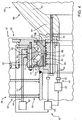
- Wind turbine 1 comprises a control system 43 for controlling the preload of bearing 21.
- the term 'preload' is a general term intended to mean interference or clearance between outer ring 28, inner ring 29 and rolling bodies 42 of bearing 21.
- the preload is divided into a radial preload and an axial preload with reference to axis of rotation A.
- the bearing is normally assembled with interference.
- the preload is set at the assembly stage, by hot-fitting, with a small amount of interference, outer ring 28 inside seat 20 on ring 19, and inner ring 29 inside a seat on lock ring 35.
- Lock ring 35 is also tightened to radial structure 34 by bolts 36. Tightening bolts 36 brings half-rings 29A and 29B closer together to produce the axial preload.
- Control system 43 comprises a control device 44 for controlling outer ring 28; a control device 45 for controlling inner ring 29; a temperature sensor 46 for detecting the temperature of outer ring 28; a temperature sensor 47 for detecting the temperature of inner ring 29; and a control unit, 48 for controlling control devices 44 and 45 on the basis of the detected temperatures of outer ring 28 and inner ring 29.
- Outer ring 28 is the stationary part of bearing 21, while inner ring 29 is integral with rotor 13 and, in use, rotates about axis of rotation A with respect to outer ring 28.
- Control device 44 comprises a thermostat 49; a heat exchanger 50 close to outer ring 28; and connecting lines 51 between thermostat 49 and heat exchanger 50.
- control device 45 comprises a thermostat 52; a heat exchanger 53 close to inner ring 29; connecting lines 54 between thermostat 52 and heat exchanger 53; and a rotary distributor 55 located along connecting lines 54 to connect the stationary part to the rotary part of control device 45.
- heat exchanger 53 is located along the inner face of lock ring 35.
- Control devices 44 and 45 are preferably electric, and heat exchangers 50 and 53 are electric resistors located close to, and preferably coiled about, outer ring 28 and inner ring 29 respectively.
- control devices 44 and 45 are liquid types, so heat exchangers 50 and 53 can cool as well as heat outer ring 28 and inner ring 29.
- Bearing 21 is selected on the basis of its capacity and other parameters, including operating temperature.
- control system 43 provides for maintaining the temperature of outer ring 28 and inner ring 29 so as to keep the preload within a predetermined acceptance range I.
- control system 43 is substantially based on the characteristics and the assembly conditions of bearing 21, on the thermal deformation of bearing 21 as a function of the temperature of outer ring 28 and inner ring 29, and on the variations in preload as a function of said thermal deformation. Given this data, it is possible to calculate the preload as a function of the temperature of outer ring 28 and inner ring 29. And the calculated preload is compared with the predetermined preload acceptance range I shown in Figure 6 . As shown in Figure 6 , the preload acceptance range I (x axis) is chosen to ensure a long predicted working life (y axis) of bearing 21.
- Control unit 48 is programmable, and comprises a memory in which to store the characteristics of bearing 21. Control unit 48 is configured to calculate the deformation of bearing 21 on the basis of the detected temperatures of outer ring 28 and inner ring 29, and/or the difference between the detected temperatures of outer ring 28 and inner ring 29. Control unit 48 is configured to calculate the preload on the basis of the thermal deformation of outer ring 28 and inner ring 29; and to compare the calculated preload with preload acceptance range I. If the calculated preload does not fall within acceptance range I, the control unit commands thermostats 49 and 52 to heat and/or cool outer ring 28 8 and/or inner ring 29 to bring the preload back within acceptance range I.
- Control unit 48 is configured to memorize the temperature data of outer ring 28 and inner 29 together with data detected and memorized by the control unit controlling wind turbine 1 as a whole, so as to determine any anomalous behaviour of bearing 21. For example, for a given external temperature, cooling system efficiency, wind speed, and blade angle, overheating of bearing 21 may be detected, and which may be considered anomalous in the light of other operating conditions. In which case, control unit 48 is configured to emit an alarm signal.
- heat exchanger 53 is located between lock ring 35 and inner ring 29 of bearing 21.
- Wind turbine 56 indicates a wind turbine for producing electric energy.
- Wind turbine 56 is a direct-drive type and, in the example shown, comprises a rotary electric machine 57; and a blade assembly 58 which rotates about an axis of rotation A.
- rotary electric machine 57 also serves to support blade assembly 58 and to transmit forces and moments induced by blade assembly 58 and rotary electric machine 57 itself to the main frame (not shown) of wind turbine 56.
- Blade assembly 58 comprises a hub 59 connected to rotary electric machine 57; and a plurality of blades (not shown in the drawings).
- Hub 59 comprises a hollow member 60 for supporting the blades (not shown); and a flange 61 for connection to rotary electric machine 57.
- Rotary electric machine 57 is substantially tubular, so as to form a space for access to hollow hub 59.
- Rotary electric machine 57 comprises a stator 62; and a rotor 63 located inside stator 62.
- Stator 62 comprises a ring 64 having an annular seat 65 for at least partly housing a bearing 66; and a radial structure 67 for connecting ring 64 to a tubular structure not shown in the drawings.
- one bearing 66 supports blade assembly 58 and rotor 63 integral with blade assembly 58.
- Rotor 63 comprises a ring 68 with an annular seat 69 for housing bearing 66; and a radial structure 70 for connecting ring 68 to a further tubular structure not shown in the drawings.
- Rotary electric machine 57 i.e. wind turbine 56, preferably has only bearing 66 to withstand radial and axial forces and tipping moments.
- Bearing 66 is a rolling bearing and comprises an outer ring 71 and an inner ring 72.
- bearing 66 is a rolling bearing with two rings of rolling bodies 73 - in the example shown, rollers. More specifically, outer ring 71 is housed in annular seat 65, and inner ring 72 is housed in annular seat 69 on ring 68 of rotor 63. Outer ring 71 of bearing 66 is locked inside annular seat 65 by a lock ring 74 bolted to ring 64 and outer ring 71.
- Inner ring 72 comprises two half-rings 72A and 72B, which are arranged axially adjacent inside seat 69, and are locked axially by a lock ring 75 and by a bolted joint by which to set the axial preload.
- Wind turbine 56 comprises a control system 43 as described with reference to Figure 2 .
- Heat exchanger 50 is housed inside grooves formed in ring 64 of stator 62, at annular seat 65, so as to directly contact outer ring 71.
- heat exchanger 53 is housed inside grooves formed in ring 68 of rotor 63, at annular seat 69, so as to directly contact inner ring 72.
- Temperature sensor 46 is located inside a space in ring 64, between ring 64 and outer ring 71, and preferably along a front face of outer ring 71, at a given distance from heat exchanger 50. And likewise, temperature sensor 47 is located inside a space in ring 68, preferably between ring 68 and inner ring 72, preferably facing a front face of inner ring 72, and at a given distance from heat exchanger 53.
- Wind turbine 76 indicates a wind turbine for producing electric energy.
- Wind turbine 76 is a direct-drive type and, in the example shown, comprises a rotary electric machine 77; and a blade assembly 78 which rotates about an axis of rotation A.
- rotary electric machine 77 also serves to support blade assembly 78 and to transmit forces and moments induced by blade assembly 78 and rotary electric machine 77 itself to the main frame 79 of wind turbine 76.
- Blade assembly 78 comprises a hollow hub 80 connected to rotary electric machine 77; and a plurality of blades (not shown in the drawings).
- Hub 80 comprises a flange 81 for connection to rotary electric machine 77.
- Rotary electric machine 77 extends about axis of rotation A, and is substantially tubular to form a space for access to hollow hub 80.
- Rotary electric machine 77 comprises a stator 82; and a rotor 83 located inside stator 62, and which rotates about axis of rotation A with respect to stator 82.
- Stator 82 comprises a tubular structure 84 having a cylindrical face 85 and designed to support a tubular active part 86 along cylindrical face 85.
- Rotor 83 comprises a tubular structure 87 with a cylindrical face 88; and a tubular active part 89 fitted to cylindrical face 88 of tubular structure 87.
- Tubular structures 84 and 87 are connected in rotary manner by two bearings 90 and 91 located at opposite ends of tubular structures 84 and 87, which have reinforcing rings at the ends, and assembly rings.
- Each bearing 90, 91 comprises an outer ring 92, an sinner ring 93, and a ring of rolling bodies 94.
- Bearing 90 is stressed more than bearing 91, is preloaded with interference, and is actively controlled by control system 43.
- the grooves housing heat exchangers 50 and 53 are formed in tubular structures 84 and 87, at end seats of bearings 90 and 91.
- control method and system and the wind turbine according to the present invention without, however, departing from the protective scope of the accompanying Claims.
- control method and system described and claimed also apply to wind turbines, with overgears and with structures other than those described with reference to the attached drawings, and may also be used to advantage for controlling bearings other than those described.
Landscapes
- Engineering & Computer Science (AREA)
- General Engineering & Computer Science (AREA)
- Mechanical Engineering (AREA)
- Life Sciences & Earth Sciences (AREA)
- Sustainable Development (AREA)
- Sustainable Energy (AREA)
- Chemical & Material Sciences (AREA)
- Combustion & Propulsion (AREA)
- Power Engineering (AREA)
- Physics & Mathematics (AREA)
- Thermal Sciences (AREA)
- Wind Motors (AREA)
- Rolling Contact Bearings (AREA)
Claims (25)
- Steuerverfahren zur Steuerung der Vorspannung eines Windturbinenlagers, wobei das Verfahren die Schritte Abschätzen der Vorspannung auf dem Lager (21; 66; 90) als eine Funktion der Temperatur des äußeren Rings (28; 71; 92) und des inneren Rings (29, 72; 93); Vergleichen der abgeschätzten Vorspannung mit einem vorbestimmten Akzeptanzbereich (I); Korrigieren der Vorspannung auf dem Lager (21; 66; 90), wenn die Vorspannung außerhalb des Akzeptanzbereiches (I) liegt; Nachweisen der Temperatur des äußeren Rings (28, 71, 92); Nachweisen der Temperatur des inneren Rings (29; 72; 93); Berechnen der Temperaturdifferenz zwischen dem äußeren Ring (28; 71; 92) und dem inneren Ring (29; 72; 93); Kontrollieren der Temperatur des äußeren Rings (28; 71; 92) und des inneren Rings (29; 72; 93) als eine Funktion der Temperaturdifferenz zwischen dem äußeren Ring (28; 71; 92) und dem inneren Ring (29; 72; 93), so dass die Vorspannung innerhalb des vorbestimmten Akzeptanzbereiches (I) gehalten wird, umfasst.
- Steuerverfahren nach Anspruch 1, wobei der Schritt des Abschätzens der Vorspannung das Berechnen der Vorspannung auf der Grundlage der Strukturdimension, der Baumerkmale und der Temperatur des Lagers (21; 66; 90) umfasst.
- Steuerverfahren nach Anspruch 1 oder 2, wobei der Schritt des Korrigierens der Vorspannung das Erwärmen des äußeren Rings (28; 71; 92) umfasst.
- Steuerverfahren nach einem der vorangehenden Ansprüche, wobei der Schritt des Korrigierens der Vorspannung das Kühlen des äußeren Rings (28; 81; 92) umfasst.
- Steuerverfahren nach einem der vorangehenden Ansprüche, wobei der Schritt des Korrigierens der Vorspannung das Erwärmen des inneren Rings (29; 72; 93) umfasst.
- Steuerverfahren nach einem der vorangehenden Ansprüche, wobei der Schritt des Korrigierens der Vorspannung das Kühlen des inneren Rings (29; 72; 93) umfasst.
- Steuerverfahren nach einem der vorangehenden Ansprüche und umfassend die Schritte des Steuerns der Temperatur des äußeren Rings (28; 71; 92) als eine Funktion der nachgewiesenen Temperatur des äußeren Rings (28; 71, 92).
- Steuerverfahren nach einem der vorangehenden Ansprüche und umfassend den Schritt des Steuerns der Temperatur des inneren Rings (29; 72; 93) als eine Funktion der nachgewiesenen Temperatur des inneren Rings (29; 72; 93).
- Computerprogramm, das direkt in einen Speicher einer Steuereinheit (48) zur Durchführung der Schritte in dem Verfahren nach einem der Ansprüche 1 bis 8 ladbar ist, wenn das Programm in der Steuereinheit (48) implementiert wird.
- Softwareprodukt, umfassend ein lesbares Medium, auf welches das Programm in Anspruch 9 gespeichert ist.
- Steuersystem zur Steuerung der Vorspannung eines Windturbinenlagers, wobei das Steuersystem (43) folgendes aufweist: eine Steuereinheit (48), die zum Abschätzen der Vorspannung auf dem Lager (21; 66; 90) als eine Funktion der Temperatur des äußeren Rings (28; 71; 92) und des inneren Rings (29; 72; 93); Vergleichen der abgeschätzten Vorlast mit einem vorbestimmten Akzeptanzbereich (I), und Korrigieren der Vorlast auf dem Lager (21; 66; 90), wenn die Vorspannung außerhalb des Akzeptanzbereiches (I) liegt, konfiguriert ist; mindestens einen ersten Sensor (46) zum Nachweisen der Temperatur des äußeren Rings (28; 71; 92); mindestens einen zweiten Sensor (47) zum Nachweisen der Temperatur des inneren Rings (29; 72; 93), wobei die Steuereinheit (48) zur Berechnung der Temperaturdifferenz zwischen dem äußeren Ring (28; 71, 92) und dem inneren Ring (29; 72; 93) und zur Kontrolle einer ersten und einer zweiten Steuervorrichtung (44, 45) konfiguriert ist, um die Temperatur des äußeren Rings (28; 81; 92) bzw. des inneren Rings (29; 72; 93) als eine Funktion der Temperaturdifferenz zwischen dem äußeren Ring (28; 71; 92) und dem inneren Ring (29; 72; 93) einzustellen, so dass die Vorspannung innerhalb des vorbestimmten Akzeptanzbereiches (I) gehalten wird.
- Steuersystem nach Anspruch 11, wobei die Steuereinheit (48) zur Berechnung der Vorspannung auf der Grundlage der strukturellen, dimensionalen und baulichen Merkmale und der Temperatur des Lagers (21; 66; 90) konfiguriert ist.
- Steuersystem nach Anspruch 11 oder 12, wobei die erste Steuervorrichtung (44) zum Erwärmen des äußeren Rings (28; 71; 92) zur Korrektur der Vorspannung auf dem Lager (21; 66; 90) konfiguriert ist.
- Steuersystem nach einem der Ansprüche 11 bis 13, wobei die erste Steuervorrichtung (44) zum Kühlen des äußeren Rings (28; 81; 92) zur Korrektur der Vorspannung auf dem Lager (21; 66; 90) konfiguriert ist.
- Steuersystem nach einem der Ansprüche 11 bis 14, wobei die zweite Steuervorrichtung (45) zum Erwärmen des inneren Rings (29; 72; 93) zur Korrektur der Vorspannung auf dem Lager (21; 66; 90) konfiguriert ist.
- Steuersystem nach einem der Ansprüche 11 bis 15, wobei die zweite Steuervorrichtung (45) zum Kühlen des inneren Rings (29; 72; 93) zur Korrektur der Vorspannung auf dem Lager (21; 66; 90) konfiguriert ist.
- Steuersystem nach einem der Ansprüche 11 bis 16, wobei die Steuereinheit (48) zur Steuerung der ersten Steuervorrichtung (44) zur Einstellung der Temperatur des äußeren Rings (28; 71; 92) als eine Funktion der nachgewiesenen Temperatur des äußeren Rings (28; 71; 92) konfiguriert ist.
- Steuersystem nach einem der Ansprüche 11 bis 17, wobei die Steuereinheit (48) zur Steuerung der zweiten Steuervorrichtung (45) zur Einstellung der Temperatur des inneren Rings (29; 72; 93) als eine Funktion der nachgewiesenen Temperatur des inneren Rings (29; 72; 93) konfiguriert ist.
- Direktantriebswindturbine zur Erzeugung von elektrischer Energie, wobei die Windturbine (1; 56; 76) eine Propelleranordnung (4; 58; 78), die um eine Rotationsachse (A) drehbar ist, eine elektrische Rotationsmaschine (3; 57; 77), aufweisend einen Stator (12; 62; 82) und einen Rotor (13; 63; 83), der mit dem Propelleraufbau (4; 58; 78) verbunden ist, ein Lager (21; 66; 90) zum Tragen des Propelleraufbaus (4; 58; 78) um die Rotationsachse (A); und ein Steuersystem (43), das zur Steuerung der Vorspannung auf dem Lager (21; 66; 90) konfiguriert ist, nach einem der Ansprüche 11 bis 18 aufweist.
- Windturbine nach Anspruch 19 und aufweisend eine Wärmeisolierung des Lagers (21).
- Windturbine nach Anspruch 19 oder 20, wobei die elektrische Rotationsmaschine (3) eine rohrförmige elektrische Rotationsmaschine ist, durch die Kühlungsluft (F) entlang der Rotationsachse (A) strömt, und die eine Isolierabdeckung (41) auf dem inneren Ring (29) aufweist.
- Windturbine nach einem der Ansprüche 19 bis 21, wobei der äußere Ring (28; 71; 92) mit dem Stator (12; 62; 82) verbunden ist, und der innere Ring (29; 72; 93) mit dem Rotor (13; 63; 83) verbunden ist.
- Windturbine nach einem der Ansprüche 19 bis 22, wobei der Stator (12; 82) eine erste rohrförmige Struktur (15; 84) und einen rohrförmigen ersten wirksamen Teil (17; 86), der mit der ersten rohrförmigen Struktur (15; 84) verbunden ist, aufweist; und der Rotor (13; 83) eine zweite rohrförmige Struktur (31; 87) aufweist, und ein rohrförmiger zweiter wirksamer Teil (33; 89), der mit der zweiten rohrförmigen Struktur (31; 87) verbunden ist, in Richtung des ersten wirksamen Teils (17; 86) zeigt und von dem ersten wirksamen Teil (17; 86) durch einen Luftspalt (T) getrennt ist.
- Windturbine nach einem der Ansprüche 17 bis 19, wobei das Lager (21; 66; 90) ein Rolllager zum Tragen von radialen und axialen Lasten ist.
- Windturbine nach einem der Ansprüche 19 bis 23, wobei das Lager (21; 66) zwei Ringe von Rollkörpern (42; 73) aufweist, wobei die Rollkörper (73) vorzugsweise durch Walzen definiert sind.
Applications Claiming Priority (2)
| Application Number | Priority Date | Filing Date | Title |
|---|---|---|---|
| IT001395A ITMI20121395A1 (it) | 2012-08-06 | 2012-08-06 | Metodo, programma, e sistema di controllo per controllare il precarico di un cuscinetto di un aerogeneratore e aerogeneratore comprendente tale sistema di controllo |
| PCT/IB2013/056443 WO2014024139A1 (en) | 2012-08-06 | 2013-08-06 | Control method, program and system for controlling the bearing preload of a wind turbine and wind turbine comprising such control system |
Publications (2)
| Publication Number | Publication Date |
|---|---|
| EP2880322A1 EP2880322A1 (de) | 2015-06-10 |
| EP2880322B1 true EP2880322B1 (de) | 2016-10-05 |
Family
ID=46939811
Family Applications (1)
| Application Number | Title | Priority Date | Filing Date |
|---|---|---|---|
| EP13777137.4A Active EP2880322B1 (de) | 2012-08-06 | 2013-08-06 | Steuerverfahren, programm und system zur steuerung einer lagervorspannung einer windturbine und windturbine mit solch einem steuerungssystem |
Country Status (10)
| Country | Link |
|---|---|
| US (1) | US10215227B2 (de) |
| EP (1) | EP2880322B1 (de) |
| AU (1) | AU2013301218A1 (de) |
| BR (1) | BR112015002669A2 (de) |
| DK (1) | DK2880322T3 (de) |
| IT (1) | ITMI20121395A1 (de) |
| MX (1) | MX2015001609A (de) |
| NZ (1) | NZ704484A (de) |
| PL (1) | PL2880322T3 (de) |
| WO (1) | WO2014024139A1 (de) |
Cited By (1)
| Publication number | Priority date | Publication date | Assignee | Title |
|---|---|---|---|---|
| US10215227B2 (en) | 2012-08-06 | 2019-02-26 | Windfin B.V. | Control method, program and system for controlling the bearing preload of a wind turbine and wind turbine comprising such control system |
Families Citing this family (11)
| Publication number | Priority date | Publication date | Assignee | Title |
|---|---|---|---|---|
| US9593670B2 (en) * | 2014-04-30 | 2017-03-14 | General Electric Company | System and methods for reducing wind turbine noise |
| EP2947312B1 (de) | 2014-05-23 | 2019-09-25 | Siemens Gamesa Renewable Energy A/S | Verfahren zum Betreiben einer Windturbine |
| CN104832774B (zh) * | 2015-04-22 | 2017-03-22 | 北京金风科创风电设备有限公司 | 风力发电机的轴承保护用加热装置及轴承系统 |
| US9891136B2 (en) * | 2015-09-30 | 2018-02-13 | Deere & Company | Methods to determine a bearing setting |
| DE102016224761A1 (de) * | 2015-12-11 | 2017-06-14 | Sms Group Gmbh | Lagerbock zur Aufnahme eines Lagers für eine Rolle |
| JP2017180687A (ja) * | 2016-03-30 | 2017-10-05 | 株式会社 神崎高級工機製作所 | 転がり軸受型伝動機構 |
| EP3273077B1 (de) | 2016-07-21 | 2020-06-03 | Aktiebolaget SKF | Wälzlager mit montageflansch |
| CN107044390B (zh) * | 2017-05-12 | 2023-10-13 | 北京金风科创风电设备有限公司 | 风力发电机组及其冷却控制方法 |
| CN108019324B (zh) * | 2017-12-06 | 2019-07-09 | 北京金风科创风电设备有限公司 | 轴系的冷却系统及其控制方法以及风力发电机组 |
| EP3904712B1 (de) * | 2020-04-28 | 2024-06-26 | Siemens Gamesa Renewable Energy A/S | Hauptlager für eine windenergieanlage |
| EP3919768A1 (de) * | 2020-06-03 | 2021-12-08 | Flender GmbH | Anordnung, verfahren zur montage und simulation eines wälzlagers |
Family Cites Families (15)
| Publication number | Priority date | Publication date | Assignee | Title |
|---|---|---|---|---|
| US6135641A (en) * | 1997-10-30 | 2000-10-24 | Honeywell International Inc. | Hybrid duplex bearing assembly having thermal compensation |
| JP3949801B2 (ja) * | 1997-12-16 | 2007-07-25 | 東芝機械株式会社 | 工作機械主軸の軸受装置 |
| DE19944652B4 (de) * | 1999-09-17 | 2005-08-25 | Skf Gmbh | Verfahren zum Betreiben einer Walzenanordnung und Lageranordnung für eine Walzenanordnung |
| JP2002054629A (ja) * | 2000-08-11 | 2002-02-20 | Koyo Seiko Co Ltd | 転がり軸受の予圧調整装置 |
| US7082772B2 (en) * | 2003-08-20 | 2006-08-01 | Directed Electronics, Inc. | Peltier temperature control system for electronic components |
| SE530523C2 (sv) * | 2006-10-02 | 2008-07-01 | Metso Panelboard Ab | Roterande maskin, raffinör och förfarande för vibrationsstyrning av en roterande maskin |
| JP2008157340A (ja) * | 2006-12-22 | 2008-07-10 | Ntn Corp | 転がり軸受 |
| EP1992829B2 (de) * | 2007-05-18 | 2017-01-18 | Fibro GmbH | Verfahren zum Einstellen der Vorspannung eines Wälzlagers, Wälzlagereinheit mit einstellbarer Vorspannung sowie Rundtisch und Spindel mit entsprechender Wälzlagereinheit |
| US8469597B2 (en) * | 2008-04-16 | 2013-06-25 | Honeywell International Inc. | Active preload control for rolling element bearings |
| EP2341327B1 (de) * | 2008-10-15 | 2013-09-18 | NTN Corporation | Mit sensor ausgestattetes radlager |
| GB2472619B (en) * | 2009-08-12 | 2015-07-29 | Romax Technology Ltd | Bearing cartridge |
| JP2012021574A (ja) * | 2010-07-14 | 2012-02-02 | Ntn Corp | 軸受装置 |
| DE102011076099B4 (de) * | 2011-05-19 | 2012-12-06 | Aktiebolaget Skf | Verfahren zum Betrieb einer Lageranordnung |
| DE202013012054U1 (de) * | 2012-04-13 | 2015-02-23 | Eolotec Gmbh | Lageranordnung einer Windkraftanlage |
| ITMI20121395A1 (it) | 2012-08-06 | 2014-02-07 | Wilic Sarl | Metodo, programma, e sistema di controllo per controllare il precarico di un cuscinetto di un aerogeneratore e aerogeneratore comprendente tale sistema di controllo |
-
2012
- 2012-08-06 IT IT001395A patent/ITMI20121395A1/it unknown
-
2013
- 2013-08-06 MX MX2015001609A patent/MX2015001609A/es unknown
- 2013-08-06 PL PL13777137T patent/PL2880322T3/pl unknown
- 2013-08-06 BR BR112015002669A patent/BR112015002669A2/pt not_active Application Discontinuation
- 2013-08-06 AU AU2013301218A patent/AU2013301218A1/en not_active Abandoned
- 2013-08-06 WO PCT/IB2013/056443 patent/WO2014024139A1/en not_active Ceased
- 2013-08-06 US US14/419,860 patent/US10215227B2/en active Active
- 2013-08-06 DK DK13777137.4T patent/DK2880322T3/da active
- 2013-08-06 NZ NZ704484A patent/NZ704484A/en not_active IP Right Cessation
- 2013-08-06 EP EP13777137.4A patent/EP2880322B1/de active Active
Cited By (1)
| Publication number | Priority date | Publication date | Assignee | Title |
|---|---|---|---|---|
| US10215227B2 (en) | 2012-08-06 | 2019-02-26 | Windfin B.V. | Control method, program and system for controlling the bearing preload of a wind turbine and wind turbine comprising such control system |
Also Published As
| Publication number | Publication date |
|---|---|
| EP2880322A1 (de) | 2015-06-10 |
| DK2880322T3 (da) | 2017-01-02 |
| PL2880322T3 (pl) | 2017-02-28 |
| US10215227B2 (en) | 2019-02-26 |
| BR112015002669A2 (pt) | 2019-07-30 |
| ITMI20121395A1 (it) | 2014-02-07 |
| AU2013301218A1 (en) | 2015-02-26 |
| US20150211572A1 (en) | 2015-07-30 |
| NZ704484A (en) | 2017-12-22 |
| WO2014024139A1 (en) | 2014-02-13 |
| MX2015001609A (es) | 2015-11-16 |
Similar Documents
| Publication | Publication Date | Title |
|---|---|---|
| EP2880322B1 (de) | Steuerverfahren, programm und system zur steuerung einer lagervorspannung einer windturbine und windturbine mit solch einem steuerungssystem | |
| US8177483B2 (en) | Active casing alignment control system and method | |
| US20100296912A1 (en) | Active Rotor Alignment Control System And Method | |
| EP3754218B1 (de) | Lagervorrichtung und spindelvorrichtung | |
| KR101928791B1 (ko) | 열 조절 시스템을 갖는 직접 구동 풍력 터빈 | |
| CN104121287B (zh) | 控制滑动轴承的间隙的装置 | |
| US9473002B2 (en) | System and method for cooling dynamoelectric machine | |
| EP3568602B1 (de) | Aktive radiale magnetlageranordnung mit internen sensoren | |
| EP3012415B1 (de) | Turbomaschine mit kontrolle der thermischen ausdehnung und verfahren zum betrieb einer turbomaschine | |
| EP3514375B1 (de) | Kühlsystem für welle und steuerungsverfahren dafür sowie windturbine | |
| EP2947352B1 (de) | Getriebeeinheit und Verfahren zum Erwärmen von Schmieröl einer Getriebeeinheit | |
| US20170158298A1 (en) | Pod propulsion device and a method for cooling such | |
| CN102287609A (zh) | 低温旋转设备及其运行方法 | |
| CN101765719A (zh) | 在利用电磁轴承的涡轮机中定位密封件的方法 | |
| EP2947312B1 (de) | Verfahren zum Betreiben einer Windturbine | |
| CN103769796B (zh) | 一种兆瓦级风电机组主轴承内、外圈同时加热方法 | |
| CN103390942A (zh) | 发电机,具体是用于风力涡轮机的发电机 | |
| KR20190133772A (ko) | 무-기어 풍력 터빈을 냉각하기 위한 방법 | |
| EP2878067B1 (de) | Rotor für eine windturbine einer elektrischen rotationsmaschine sowie windturbine mit solch einem rotor | |
| EP3790174A1 (de) | Stator einer elektrischen machine mit entnehmbarem temperatursensor | |
| US20170234164A1 (en) | Rotary machine unit | |
| EP2899858B1 (de) | Elektrische Generatoranordnung mit verbessertem Kühlsystem und Betriebsverfahren dafür | |
| KR101331279B1 (ko) | 바이메탈을 이용한 가변형 임펠러 | |
| CN108397404B (zh) | 轴流风机及通风散热设备 | |
| JP2013150374A (ja) | 回転電機の軸受装置 |
Legal Events
| Date | Code | Title | Description |
|---|---|---|---|
| PUAI | Public reference made under article 153(3) epc to a published international application that has entered the european phase |
Free format text: ORIGINAL CODE: 0009012 |
|
| 17P | Request for examination filed |
Effective date: 20150204 |
|
| AK | Designated contracting states |
Kind code of ref document: A1 Designated state(s): AL AT BE BG CH CY CZ DE DK EE ES FI FR GB GR HR HU IE IS IT LI LT LU LV MC MK MT NL NO PL PT RO RS SE SI SK SM TR |
|
| AX | Request for extension of the european patent |
Extension state: BA ME |
|
| DAX | Request for extension of the european patent (deleted) | ||
| REG | Reference to a national code |
Ref country code: DE Ref legal event code: R079 Ref document number: 602013012510 Country of ref document: DE Free format text: PREVIOUS MAIN CLASS: F16C0029060000 Ipc: F16C0019520000 |
|
| GRAP | Despatch of communication of intention to grant a patent |
Free format text: ORIGINAL CODE: EPIDOSNIGR1 |
|
| RIC1 | Information provided on ipc code assigned before grant |
Ipc: F03D 7/00 20060101ALI20160303BHEP Ipc: F16C 19/52 20060101AFI20160303BHEP Ipc: F03D 9/00 20160101ALI20160303BHEP Ipc: F03D 7/04 20060101ALI20160303BHEP Ipc: F16C 25/08 20060101ALI20160303BHEP Ipc: F16C 37/00 20060101ALI20160303BHEP |
|
| INTG | Intention to grant announced |
Effective date: 20160324 |
|
| GRAS | Grant fee paid |
Free format text: ORIGINAL CODE: EPIDOSNIGR3 |
|
| GRAA | (expected) grant |
Free format text: ORIGINAL CODE: 0009210 |
|
| AK | Designated contracting states |
Kind code of ref document: B1 Designated state(s): AL AT BE BG CH CY CZ DE DK EE ES FI FR GB GR HR HU IE IS IT LI LT LU LV MC MK MT NL NO PL PT RO RS SE SI SK SM TR |
|
| REG | Reference to a national code |
Ref country code: GB Ref legal event code: FG4D |
|
| REG | Reference to a national code |
Ref country code: CH Ref legal event code: EP |
|
| REG | Reference to a national code |
Ref country code: AT Ref legal event code: REF Ref document number: 834938 Country of ref document: AT Kind code of ref document: T Effective date: 20161015 |
|
| REG | Reference to a national code |
Ref country code: IE Ref legal event code: FG4D |
|
| REG | Reference to a national code |
Ref country code: DE Ref legal event code: R096 Ref document number: 602013012510 Country of ref document: DE |
|
| REG | Reference to a national code |
Ref country code: NL Ref legal event code: FP |
|
| REG | Reference to a national code |
Ref country code: DK Ref legal event code: T3 Effective date: 20161227 |
|
| REG | Reference to a national code |
Ref country code: LT Ref legal event code: MG4D |
|
| PG25 | Lapsed in a contracting state [announced via postgrant information from national office to epo] |
Ref country code: LV Free format text: LAPSE BECAUSE OF FAILURE TO SUBMIT A TRANSLATION OF THE DESCRIPTION OR TO PAY THE FEE WITHIN THE PRESCRIBED TIME-LIMIT Effective date: 20161005 |
|
| PG25 | Lapsed in a contracting state [announced via postgrant information from national office to epo] |
Ref country code: GR Free format text: LAPSE BECAUSE OF FAILURE TO SUBMIT A TRANSLATION OF THE DESCRIPTION OR TO PAY THE FEE WITHIN THE PRESCRIBED TIME-LIMIT Effective date: 20170106 Ref country code: LT Free format text: LAPSE BECAUSE OF FAILURE TO SUBMIT A TRANSLATION OF THE DESCRIPTION OR TO PAY THE FEE WITHIN THE PRESCRIBED TIME-LIMIT Effective date: 20161005 Ref country code: NO Free format text: LAPSE BECAUSE OF FAILURE TO SUBMIT A TRANSLATION OF THE DESCRIPTION OR TO PAY THE FEE WITHIN THE PRESCRIBED TIME-LIMIT Effective date: 20170105 Ref country code: SE Free format text: LAPSE BECAUSE OF FAILURE TO SUBMIT A TRANSLATION OF THE DESCRIPTION OR TO PAY THE FEE WITHIN THE PRESCRIBED TIME-LIMIT Effective date: 20161005 |
|
| PG25 | Lapsed in a contracting state [announced via postgrant information from national office to epo] |
Ref country code: PT Free format text: LAPSE BECAUSE OF FAILURE TO SUBMIT A TRANSLATION OF THE DESCRIPTION OR TO PAY THE FEE WITHIN THE PRESCRIBED TIME-LIMIT Effective date: 20170206 Ref country code: ES Free format text: LAPSE BECAUSE OF FAILURE TO SUBMIT A TRANSLATION OF THE DESCRIPTION OR TO PAY THE FEE WITHIN THE PRESCRIBED TIME-LIMIT Effective date: 20161005 Ref country code: IS Free format text: LAPSE BECAUSE OF FAILURE TO SUBMIT A TRANSLATION OF THE DESCRIPTION OR TO PAY THE FEE WITHIN THE PRESCRIBED TIME-LIMIT Effective date: 20170205 Ref country code: HR Free format text: LAPSE BECAUSE OF FAILURE TO SUBMIT A TRANSLATION OF THE DESCRIPTION OR TO PAY THE FEE WITHIN THE PRESCRIBED TIME-LIMIT Effective date: 20161005 Ref country code: BE Free format text: LAPSE BECAUSE OF FAILURE TO SUBMIT A TRANSLATION OF THE DESCRIPTION OR TO PAY THE FEE WITHIN THE PRESCRIBED TIME-LIMIT Effective date: 20161005 Ref country code: RS Free format text: LAPSE BECAUSE OF FAILURE TO SUBMIT A TRANSLATION OF THE DESCRIPTION OR TO PAY THE FEE WITHIN THE PRESCRIBED TIME-LIMIT Effective date: 20161005 Ref country code: FI Free format text: LAPSE BECAUSE OF FAILURE TO SUBMIT A TRANSLATION OF THE DESCRIPTION OR TO PAY THE FEE WITHIN THE PRESCRIBED TIME-LIMIT Effective date: 20161005 |
|
| REG | Reference to a national code |
Ref country code: DE Ref legal event code: R097 Ref document number: 602013012510 Country of ref document: DE |
|
| PG25 | Lapsed in a contracting state [announced via postgrant information from national office to epo] |
Ref country code: SK Free format text: LAPSE BECAUSE OF FAILURE TO SUBMIT A TRANSLATION OF THE DESCRIPTION OR TO PAY THE FEE WITHIN THE PRESCRIBED TIME-LIMIT Effective date: 20161005 Ref country code: RO Free format text: LAPSE BECAUSE OF FAILURE TO SUBMIT A TRANSLATION OF THE DESCRIPTION OR TO PAY THE FEE WITHIN THE PRESCRIBED TIME-LIMIT Effective date: 20161005 Ref country code: CZ Free format text: LAPSE BECAUSE OF FAILURE TO SUBMIT A TRANSLATION OF THE DESCRIPTION OR TO PAY THE FEE WITHIN THE PRESCRIBED TIME-LIMIT Effective date: 20161005 Ref country code: EE Free format text: LAPSE BECAUSE OF FAILURE TO SUBMIT A TRANSLATION OF THE DESCRIPTION OR TO PAY THE FEE WITHIN THE PRESCRIBED TIME-LIMIT Effective date: 20161005 |
|
| PLBE | No opposition filed within time limit |
Free format text: ORIGINAL CODE: 0009261 |
|
| STAA | Information on the status of an ep patent application or granted ep patent |
Free format text: STATUS: NO OPPOSITION FILED WITHIN TIME LIMIT |
|
| REG | Reference to a national code |
Ref country code: FR Ref legal event code: PLFP Year of fee payment: 5 |
|
| PG25 | Lapsed in a contracting state [announced via postgrant information from national office to epo] |
Ref country code: BG Free format text: LAPSE BECAUSE OF FAILURE TO SUBMIT A TRANSLATION OF THE DESCRIPTION OR TO PAY THE FEE WITHIN THE PRESCRIBED TIME-LIMIT Effective date: 20170105 Ref country code: SM Free format text: LAPSE BECAUSE OF FAILURE TO SUBMIT A TRANSLATION OF THE DESCRIPTION OR TO PAY THE FEE WITHIN THE PRESCRIBED TIME-LIMIT Effective date: 20161005 |
|
| 26N | No opposition filed |
Effective date: 20170706 |
|
| PGFP | Annual fee paid to national office [announced via postgrant information from national office to epo] |
Ref country code: GB Payment date: 20170830 Year of fee payment: 5 |
|
| PG25 | Lapsed in a contracting state [announced via postgrant information from national office to epo] |
Ref country code: SI Free format text: LAPSE BECAUSE OF FAILURE TO SUBMIT A TRANSLATION OF THE DESCRIPTION OR TO PAY THE FEE WITHIN THE PRESCRIBED TIME-LIMIT Effective date: 20161005 |
|
| PGFP | Annual fee paid to national office [announced via postgrant information from national office to epo] |
Ref country code: NL Payment date: 20170828 Year of fee payment: 5 Ref country code: DK Payment date: 20170828 Year of fee payment: 5 |
|
| REG | Reference to a national code |
Ref country code: CH Ref legal event code: PL |
|
| PG25 | Lapsed in a contracting state [announced via postgrant information from national office to epo] |
Ref country code: MC Free format text: LAPSE BECAUSE OF FAILURE TO SUBMIT A TRANSLATION OF THE DESCRIPTION OR TO PAY THE FEE WITHIN THE PRESCRIBED TIME-LIMIT Effective date: 20161005 |
|
| PG25 | Lapsed in a contracting state [announced via postgrant information from national office to epo] |
Ref country code: LI Free format text: LAPSE BECAUSE OF NON-PAYMENT OF DUE FEES Effective date: 20170831 Ref country code: CH Free format text: LAPSE BECAUSE OF NON-PAYMENT OF DUE FEES Effective date: 20170831 |
|
| REG | Reference to a national code |
Ref country code: IE Ref legal event code: MM4A |
|
| PG25 | Lapsed in a contracting state [announced via postgrant information from national office to epo] |
Ref country code: LU Free format text: LAPSE BECAUSE OF NON-PAYMENT OF DUE FEES Effective date: 20170806 |
|
| PG25 | Lapsed in a contracting state [announced via postgrant information from national office to epo] |
Ref country code: IE Free format text: LAPSE BECAUSE OF NON-PAYMENT OF DUE FEES Effective date: 20170806 |
|
| REG | Reference to a national code |
Ref country code: FR Ref legal event code: PLFP Year of fee payment: 6 |
|
| PG25 | Lapsed in a contracting state [announced via postgrant information from national office to epo] |
Ref country code: MT Free format text: LAPSE BECAUSE OF NON-PAYMENT OF DUE FEES Effective date: 20170806 |
|
| REG | Reference to a national code |
Ref country code: AT Ref legal event code: UEP Ref document number: 834938 Country of ref document: AT Kind code of ref document: T Effective date: 20161005 |
|
| REG | Reference to a national code |
Ref country code: DK Ref legal event code: EBP Effective date: 20180831 |
|
| REG | Reference to a national code |
Ref country code: NL Ref legal event code: MM Effective date: 20180901 |
|
| GBPC | Gb: european patent ceased through non-payment of renewal fee |
Effective date: 20180806 |
|
| PG25 | Lapsed in a contracting state [announced via postgrant information from national office to epo] |
Ref country code: NL Free format text: LAPSE BECAUSE OF NON-PAYMENT OF DUE FEES Effective date: 20180901 Ref country code: HU Free format text: LAPSE BECAUSE OF FAILURE TO SUBMIT A TRANSLATION OF THE DESCRIPTION OR TO PAY THE FEE WITHIN THE PRESCRIBED TIME-LIMIT; INVALID AB INITIO Effective date: 20130806 |
|
| PG25 | Lapsed in a contracting state [announced via postgrant information from national office to epo] |
Ref country code: DK Free format text: LAPSE BECAUSE OF NON-PAYMENT OF DUE FEES Effective date: 20180831 |
|
| PG25 | Lapsed in a contracting state [announced via postgrant information from national office to epo] |
Ref country code: CY Free format text: LAPSE BECAUSE OF FAILURE TO SUBMIT A TRANSLATION OF THE DESCRIPTION OR TO PAY THE FEE WITHIN THE PRESCRIBED TIME-LIMIT Effective date: 20161005 Ref country code: GB Free format text: LAPSE BECAUSE OF NON-PAYMENT OF DUE FEES Effective date: 20180806 |
|
| PG25 | Lapsed in a contracting state [announced via postgrant information from national office to epo] |
Ref country code: MK Free format text: LAPSE BECAUSE OF FAILURE TO SUBMIT A TRANSLATION OF THE DESCRIPTION OR TO PAY THE FEE WITHIN THE PRESCRIBED TIME-LIMIT Effective date: 20161005 |
|
| PG25 | Lapsed in a contracting state [announced via postgrant information from national office to epo] |
Ref country code: AL Free format text: LAPSE BECAUSE OF FAILURE TO SUBMIT A TRANSLATION OF THE DESCRIPTION OR TO PAY THE FEE WITHIN THE PRESCRIBED TIME-LIMIT Effective date: 20161005 |
|
| P01 | Opt-out of the competence of the unified patent court (upc) registered |
Effective date: 20230518 |
|
| PGFP | Annual fee paid to national office [announced via postgrant information from national office to epo] |
Ref country code: DE Payment date: 20250827 Year of fee payment: 13 |
|
| PGFP | Annual fee paid to national office [announced via postgrant information from national office to epo] |
Ref country code: TR Payment date: 20250718 Year of fee payment: 13 Ref country code: IT Payment date: 20250709 Year of fee payment: 13 Ref country code: PL Payment date: 20250711 Year of fee payment: 13 |
|
| PGFP | Annual fee paid to national office [announced via postgrant information from national office to epo] |
Ref country code: FR Payment date: 20250825 Year of fee payment: 13 Ref country code: AT Payment date: 20250819 Year of fee payment: 13 |