EP2880013B1 - Verfahren zum herstellen von substituierten biphenylen durch c-h-aktivierung - Google Patents
Verfahren zum herstellen von substituierten biphenylen durch c-h-aktivierung Download PDFInfo
- Publication number
- EP2880013B1 EP2880013B1 EP13742231.7A EP13742231A EP2880013B1 EP 2880013 B1 EP2880013 B1 EP 2880013B1 EP 13742231 A EP13742231 A EP 13742231A EP 2880013 B1 EP2880013 B1 EP 2880013B1
- Authority
- EP
- European Patent Office
- Prior art keywords
- formula
- process according
- und
- iva
- ist
- Prior art date
- Legal status (The legal status is an assumption and is not a legal conclusion. Google has not performed a legal analysis and makes no representation as to the accuracy of the status listed.)
- Not-in-force
Links
- 235000010290 biphenyl Nutrition 0.000 title claims description 16
- 150000004074 biphenyls Chemical class 0.000 title claims description 16
- 238000004519 manufacturing process Methods 0.000 title claims description 4
- 238000010499 C–H functionalization reaction Methods 0.000 title description 2
- -1 2-methyl-THF Natural products 0.000 claims description 51
- 150000004945 aromatic hydrocarbons Chemical class 0.000 claims description 48
- 238000000034 method Methods 0.000 claims description 36
- 241001120493 Arene Species 0.000 claims description 34
- 125000002496 methyl group Chemical group [H]C([H])([H])* 0.000 claims description 34
- 230000008569 process Effects 0.000 claims description 31
- 229910052723 transition metal Inorganic materials 0.000 claims description 31
- 229910052739 hydrogen Inorganic materials 0.000 claims description 30
- 239000001257 hydrogen Substances 0.000 claims description 30
- 239000000460 chlorine Substances 0.000 claims description 28
- RFFLAFLAYFXFSW-UHFFFAOYSA-N 1,2-dichlorobenzene Chemical compound ClC1=CC=CC=C1Cl RFFLAFLAYFXFSW-UHFFFAOYSA-N 0.000 claims description 24
- 150000003624 transition metals Chemical class 0.000 claims description 24
- 239000003054 catalyst Substances 0.000 claims description 22
- 229910052736 halogen Inorganic materials 0.000 claims description 22
- 150000002367 halogens Chemical class 0.000 claims description 22
- PXGOKWXKJXAPGV-UHFFFAOYSA-N Fluorine Chemical compound FF PXGOKWXKJXAPGV-UHFFFAOYSA-N 0.000 claims description 21
- 229910052731 fluorine Inorganic materials 0.000 claims description 21
- ZAMOUSCENKQFHK-UHFFFAOYSA-N Chlorine atom Chemical compound [Cl] ZAMOUSCENKQFHK-UHFFFAOYSA-N 0.000 claims description 20
- 125000002915 carbonyl group Chemical group [*:2]C([*:1])=O 0.000 claims description 18
- 229910052801 chlorine Inorganic materials 0.000 claims description 18
- 150000002431 hydrogen Chemical class 0.000 claims description 18
- 229910052763 palladium Inorganic materials 0.000 claims description 18
- 125000003226 pyrazolyl group Chemical group 0.000 claims description 18
- 238000006243 chemical reaction Methods 0.000 claims description 17
- 229910052760 oxygen Inorganic materials 0.000 claims description 17
- 229910052707 ruthenium Inorganic materials 0.000 claims description 17
- 239000000654 additive Substances 0.000 claims description 15
- 239000007800 oxidant agent Substances 0.000 claims description 15
- 125000004169 (C1-C6) alkyl group Chemical group 0.000 claims description 14
- 239000011737 fluorine Substances 0.000 claims description 13
- 125000004076 pyridyl group Chemical group 0.000 claims description 13
- MVPPADPHJFYWMZ-UHFFFAOYSA-N chlorobenzene Chemical compound ClC1=CC=CC=C1 MVPPADPHJFYWMZ-UHFFFAOYSA-N 0.000 claims description 12
- 125000005843 halogen group Chemical group 0.000 claims description 12
- 239000003446 ligand Substances 0.000 claims description 12
- 229910052703 rhodium Inorganic materials 0.000 claims description 12
- 239000002904 solvent Substances 0.000 claims description 12
- 125000001028 difluoromethyl group Chemical group [H]C(F)(F)* 0.000 claims description 11
- FZERHIULMFGESH-UHFFFAOYSA-N N-phenylacetamide Chemical compound CC(=O)NC1=CC=CC=C1 FZERHIULMFGESH-UHFFFAOYSA-N 0.000 claims description 10
- 125000000171 (C1-C6) haloalkyl group Chemical group 0.000 claims description 9
- 229910052804 chromium Inorganic materials 0.000 claims description 9
- 229910052802 copper Inorganic materials 0.000 claims description 9
- 229910052737 gold Inorganic materials 0.000 claims description 9
- 229910052741 iridium Inorganic materials 0.000 claims description 9
- 229910052742 iron Inorganic materials 0.000 claims description 9
- 229910052748 manganese Inorganic materials 0.000 claims description 9
- 229910052759 nickel Inorganic materials 0.000 claims description 9
- 229910052697 platinum Inorganic materials 0.000 claims description 9
- 229910052709 silver Inorganic materials 0.000 claims description 9
- QTBSBXVTEAMEQO-UHFFFAOYSA-N Acetic acid Chemical compound CC(O)=O QTBSBXVTEAMEQO-UHFFFAOYSA-N 0.000 claims description 8
- PAYRUJLWNCNPSJ-UHFFFAOYSA-N Aniline Chemical compound NC1=CC=CC=C1 PAYRUJLWNCNPSJ-UHFFFAOYSA-N 0.000 claims description 8
- LCGLNKUTAGEVQW-UHFFFAOYSA-N Dimethyl ether Chemical compound COC LCGLNKUTAGEVQW-UHFFFAOYSA-N 0.000 claims description 8
- XEKOWRVHYACXOJ-UHFFFAOYSA-N Ethyl acetate Chemical compound CCOC(C)=O XEKOWRVHYACXOJ-UHFFFAOYSA-N 0.000 claims description 8
- BZLVMXJERCGZMT-UHFFFAOYSA-N Methyl tert-butyl ether Chemical compound COC(C)(C)C BZLVMXJERCGZMT-UHFFFAOYSA-N 0.000 claims description 8
- 229910052794 bromium Inorganic materials 0.000 claims description 8
- LGVUAXNPXVXCCW-UHFFFAOYSA-M cesium;2,2-dimethylpropanoate Chemical compound [Cs+].CC(C)(C)C([O-])=O LGVUAXNPXVXCCW-UHFFFAOYSA-M 0.000 claims description 7
- 125000000956 methoxy group Chemical group [H]C([H])([H])O* 0.000 claims description 7
- IUGYQRQAERSCNH-UHFFFAOYSA-N pivalic acid Chemical compound CC(C)(C)C(O)=O IUGYQRQAERSCNH-UHFFFAOYSA-N 0.000 claims description 7
- AJKNNUJQFALRIK-UHFFFAOYSA-N 1,2,3-trifluorobenzene Chemical compound FC1=CC=CC(F)=C1F AJKNNUJQFALRIK-UHFFFAOYSA-N 0.000 claims description 6
- WEVYAHXRMPXWCK-UHFFFAOYSA-N Acetonitrile Chemical compound CC#N WEVYAHXRMPXWCK-UHFFFAOYSA-N 0.000 claims description 6
- RTZKZFJDLAIYFH-UHFFFAOYSA-N Diethyl ether Chemical compound CCOCC RTZKZFJDLAIYFH-UHFFFAOYSA-N 0.000 claims description 6
- LFQSCWFLJHTTHZ-UHFFFAOYSA-N Ethanol Chemical compound CCO LFQSCWFLJHTTHZ-UHFFFAOYSA-N 0.000 claims description 6
- LYCAIKOWRPUZTN-UHFFFAOYSA-N Ethylene glycol Chemical compound OCCO LYCAIKOWRPUZTN-UHFFFAOYSA-N 0.000 claims description 6
- OKKJLVBELUTLKV-UHFFFAOYSA-N Methanol Chemical compound OC OKKJLVBELUTLKV-UHFFFAOYSA-N 0.000 claims description 6
- ZMXDDKWLCZADIW-UHFFFAOYSA-N N,N-Dimethylformamide Chemical compound CN(C)C=O ZMXDDKWLCZADIW-UHFFFAOYSA-N 0.000 claims description 6
- YXFVVABEGXRONW-UHFFFAOYSA-N Toluene Chemical compound CC1=CC=CC=C1 YXFVVABEGXRONW-UHFFFAOYSA-N 0.000 claims description 6
- 229910052740 iodine Inorganic materials 0.000 claims description 6
- JHEFOJNPLXSWNZ-UHFFFAOYSA-N n-(4-fluorophenyl)acetamide Chemical compound CC(=O)NC1=CC=C(F)C=C1 JHEFOJNPLXSWNZ-UHFFFAOYSA-N 0.000 claims description 6
- HFPZCAJZSCWRBC-UHFFFAOYSA-N p-cymene Chemical compound CC(C)C1=CC=C(C)C=C1 HFPZCAJZSCWRBC-UHFFFAOYSA-N 0.000 claims description 6
- 229910052719 titanium Inorganic materials 0.000 claims description 6
- MPNXSZJPSVBLHP-UHFFFAOYSA-N 2-chloro-n-phenylpyridine-3-carboxamide Chemical compound ClC1=NC=CC=C1C(=O)NC1=CC=CC=C1 MPNXSZJPSVBLHP-UHFFFAOYSA-N 0.000 claims description 5
- WUTUYTDBDVXQTQ-UHFFFAOYSA-N 3-(difluoromethyl)-1-methyl-n-phenylpyrazole-4-carboxamide Chemical compound FC(F)C1=NN(C)C=C1C(=O)NC1=CC=CC=C1 WUTUYTDBDVXQTQ-UHFFFAOYSA-N 0.000 claims description 5
- 229960001413 acetanilide Drugs 0.000 claims description 5
- QVGXLLKOCUKJST-UHFFFAOYSA-N atomic oxygen Chemical compound [O] QVGXLLKOCUKJST-UHFFFAOYSA-N 0.000 claims description 5
- 125000004435 hydrogen atom Chemical group [H]* 0.000 claims description 5
- 239000001301 oxygen Substances 0.000 claims description 5
- LJCOVZYPESTRJJ-UHFFFAOYSA-N 3-(difluoromethyl)-n-(4-fluorophenyl)-1-methylpyrazole-4-carboxamide Chemical compound FC(F)C1=NN(C)C=C1C(=O)NC1=CC=C(F)C=C1 LJCOVZYPESTRJJ-UHFFFAOYSA-N 0.000 claims description 4
- KRZCOLNOCZKSDF-UHFFFAOYSA-N 4-fluoroaniline Chemical compound NC1=CC=C(F)C=C1 KRZCOLNOCZKSDF-UHFFFAOYSA-N 0.000 claims description 4
- ZHGNHOOVYPHPNJ-UHFFFAOYSA-N Amigdalin Chemical compound FC(F)(F)C(=O)OCC1OC(OCC2OC(OC(C#N)C3=CC=CC=C3)C(OC(=O)C(F)(F)F)C(OC(=O)C(F)(F)F)C2OC(=O)C(F)(F)F)C(OC(=O)C(F)(F)F)C(OC(=O)C(F)(F)F)C1OC(=O)C(F)(F)F ZHGNHOOVYPHPNJ-UHFFFAOYSA-N 0.000 claims description 4
- LRHPLDYGYMQRHN-UHFFFAOYSA-N N-Butanol Chemical compound CCCCO LRHPLDYGYMQRHN-UHFFFAOYSA-N 0.000 claims description 4
- WYURNTSHIVDZCO-UHFFFAOYSA-N Tetrahydrofuran Chemical compound C1CCOC1 WYURNTSHIVDZCO-UHFFFAOYSA-N 0.000 claims description 4
- RDOXTESZEPMUJZ-UHFFFAOYSA-N anisole Chemical compound COC1=CC=CC=C1 RDOXTESZEPMUJZ-UHFFFAOYSA-N 0.000 claims description 4
- 239000000203 mixture Substances 0.000 claims description 4
- HVZJRWJGKQPSFL-UHFFFAOYSA-N tert-Amyl methyl ether Chemical compound CCC(C)(C)OC HVZJRWJGKQPSFL-UHFFFAOYSA-N 0.000 claims description 4
- JOXIMZWYDAKGHI-UHFFFAOYSA-N toluene-4-sulfonic acid Chemical compound CC1=CC=C(S(O)(=O)=O)C=C1 JOXIMZWYDAKGHI-UHFFFAOYSA-N 0.000 claims description 4
- 125000006555 (C3-C5) cycloalkyl group Chemical group 0.000 claims description 3
- POILWHVDKZOXJZ-ARJAWSKDSA-M (z)-4-oxopent-2-en-2-olate Chemical compound C\C([O-])=C\C(C)=O POILWHVDKZOXJZ-ARJAWSKDSA-M 0.000 claims description 3
- GPVVSRKZVHQKIX-UHFFFAOYSA-N 1,2,3,4,5-pentamethylcyclopenta-1,3-diene Chemical compound CC=1C(C)=C(C)[C-](C)C=1C GPVVSRKZVHQKIX-UHFFFAOYSA-N 0.000 claims description 3
- DYRDKSSFIWVSNM-UHFFFAOYSA-N acetoacetanilide Chemical compound CC(=O)CC(=O)NC1=CC=CC=C1 DYRDKSSFIWVSNM-UHFFFAOYSA-N 0.000 claims description 3
- YLQBEKUKMJWXMC-UHFFFAOYSA-N cyclopenta-1,3-diene cyclopenta-2,4-dien-1-ylphosphane iron(2+) Chemical compound [Fe++].c1cc[cH-]c1.P[c-]1cccc1 YLQBEKUKMJWXMC-UHFFFAOYSA-N 0.000 claims description 3
- SINKOGOPEQSHQD-UHFFFAOYSA-N cyclopentadienide Chemical compound C=1C=C[CH-]C=1 SINKOGOPEQSHQD-UHFFFAOYSA-N 0.000 claims description 3
- PCGMZJHAOYYUHF-UHFFFAOYSA-N n-(4-fluorophenyl)-3-oxobutanamide Chemical compound CC(=O)CC(=O)NC1=CC=C(F)C=C1 PCGMZJHAOYYUHF-UHFFFAOYSA-N 0.000 claims description 3
- LBMUQXVGROIZCJ-UHFFFAOYSA-N n-(4-fluorophenyl)propan-2-imine Chemical compound CC(C)=NC1=CC=C(F)C=C1 LBMUQXVGROIZCJ-UHFFFAOYSA-N 0.000 claims description 3
- YEYCASGOSICVMZ-UHFFFAOYSA-N n-phenylpropan-2-imine Chemical compound CC(C)=NC1=CC=CC=C1 YEYCASGOSICVMZ-UHFFFAOYSA-N 0.000 claims description 3
- BDERNNFJNOPAEC-UHFFFAOYSA-N propan-1-ol Chemical compound CCCO BDERNNFJNOPAEC-UHFFFAOYSA-N 0.000 claims description 3
- XLYOFNOQVPJJNP-UHFFFAOYSA-N water Substances O XLYOFNOQVPJJNP-UHFFFAOYSA-N 0.000 claims description 3
- RYHBNJHYFVUHQT-UHFFFAOYSA-N 1,4-Dioxane Chemical compound C1COCCO1 RYHBNJHYFVUHQT-UHFFFAOYSA-N 0.000 claims description 2
- AZQWKYJCGOJGHM-UHFFFAOYSA-N 1,4-benzoquinone Chemical group O=C1C=CC(=O)C=C1 AZQWKYJCGOJGHM-UHFFFAOYSA-N 0.000 claims description 2
- KMTRUDSVKNLOMY-UHFFFAOYSA-N Ethylene carbonate Chemical compound O=C1OCCO1 KMTRUDSVKNLOMY-UHFFFAOYSA-N 0.000 claims description 2
- FXHOOIRPVKKKFG-UHFFFAOYSA-N N,N-Dimethylacetamide Chemical compound CN(C)C(C)=O FXHOOIRPVKKKFG-UHFFFAOYSA-N 0.000 claims description 2
- SECXISVLQFMRJM-UHFFFAOYSA-N N-Methylpyrrolidone Chemical compound CN1CCCC1=O SECXISVLQFMRJM-UHFFFAOYSA-N 0.000 claims description 2
- KVNRLNFWIYMESJ-UHFFFAOYSA-N butyronitrile Chemical compound CCCC#N KVNRLNFWIYMESJ-UHFFFAOYSA-N 0.000 claims description 2
- SBZXBUIDTXKZTM-UHFFFAOYSA-N diglyme Chemical compound COCCOCCOC SBZXBUIDTXKZTM-UHFFFAOYSA-N 0.000 claims description 2
- JMMWKPVZQRWMSS-UHFFFAOYSA-N isopropanol acetate Natural products CC(C)OC(C)=O JMMWKPVZQRWMSS-UHFFFAOYSA-N 0.000 claims description 2
- 229940011051 isopropyl acetate Drugs 0.000 claims description 2
- GWYFCOCPABKNJV-UHFFFAOYSA-N isovaleric acid Chemical compound CC(C)CC(O)=O GWYFCOCPABKNJV-UHFFFAOYSA-N 0.000 claims description 2
- AUHZEENZYGFFBQ-UHFFFAOYSA-N mesitylene Substances CC1=CC(C)=CC(C)=C1 AUHZEENZYGFFBQ-UHFFFAOYSA-N 0.000 claims description 2
- 125000001827 mesitylenyl group Chemical group [H]C1=C(C(*)=C(C([H])=C1C([H])([H])[H])C([H])([H])[H])C([H])([H])[H] 0.000 claims description 2
- UZKWTJUDCOPSNM-UHFFFAOYSA-N methoxybenzene Substances CCCCOC=C UZKWTJUDCOPSNM-UHFFFAOYSA-N 0.000 claims description 2
- PTMHPRAIXMAOOB-UHFFFAOYSA-L phosphoramidate Chemical compound NP([O-])([O-])=O PTMHPRAIXMAOOB-UHFFFAOYSA-L 0.000 claims description 2
- RUOJZAUFBMNUDX-UHFFFAOYSA-N propylene carbonate Chemical compound CC1COC(=O)O1 RUOJZAUFBMNUDX-UHFFFAOYSA-N 0.000 claims description 2
- CQLFBEKRDQMJLZ-UHFFFAOYSA-M silver acetate Chemical compound [Ag+].CC([O-])=O CQLFBEKRDQMJLZ-UHFFFAOYSA-M 0.000 claims description 2
- 239000008096 xylene Substances 0.000 claims description 2
- 150000003738 xylenes Chemical class 0.000 claims description 2
- SQGYOTSLMSWVJD-UHFFFAOYSA-N silver(1+) nitrate Chemical compound [Ag+].[O-]N(=O)=O SQGYOTSLMSWVJD-UHFFFAOYSA-N 0.000 claims 3
- RIOQSEWOXXDEQQ-UHFFFAOYSA-N triphenylphosphine Chemical compound C1=CC=CC=C1P(C=1C=CC=CC=1)C1=CC=CC=C1 RIOQSEWOXXDEQQ-UHFFFAOYSA-N 0.000 claims 2
- 229910002567 K2S2O8 Inorganic materials 0.000 claims 1
- 229910021135 KPF6 Inorganic materials 0.000 claims 1
- 229910017673 NH4PF6 Inorganic materials 0.000 claims 1
- 229910004882 Na2S2O8 Inorganic materials 0.000 claims 1
- 125000005595 acetylacetonate group Chemical group 0.000 claims 1
- WIKQEUJFZPCFNJ-UHFFFAOYSA-N carbonic acid;silver Chemical compound [Ag].[Ag].OC(O)=O WIKQEUJFZPCFNJ-UHFFFAOYSA-N 0.000 claims 1
- OPQARKPSCNTWTJ-UHFFFAOYSA-L copper(ii) acetate Chemical compound [Cu+2].CC([O-])=O.CC([O-])=O OPQARKPSCNTWTJ-UHFFFAOYSA-L 0.000 claims 1
- SBTSVTLGWRLWOD-UHFFFAOYSA-L copper(ii) triflate Chemical compound [Cu+2].[O-]S(=O)(=O)C(F)(F)F.[O-]S(=O)(=O)C(F)(F)F SBTSVTLGWRLWOD-UHFFFAOYSA-L 0.000 claims 1
- LKZMBDSASOBTPN-UHFFFAOYSA-L silver carbonate Substances [Ag].[O-]C([O-])=O LKZMBDSASOBTPN-UHFFFAOYSA-L 0.000 claims 1
- 229910001544 silver hexafluoroantimonate(V) Inorganic materials 0.000 claims 1
- KQTXIZHBFFWWFW-UHFFFAOYSA-L silver(I) carbonate Inorganic materials [Ag]OC(=O)O[Ag] KQTXIZHBFFWWFW-UHFFFAOYSA-L 0.000 claims 1
- CHQMHPLRPQMAMX-UHFFFAOYSA-L sodium persulfate Chemical compound [Na+].[Na+].[O-]S(=O)(=O)OOS([O-])(=O)=O CHQMHPLRPQMAMX-UHFFFAOYSA-L 0.000 claims 1
- 229910001495 sodium tetrafluoroborate Inorganic materials 0.000 claims 1
- UFHFLCQGNIYNRP-UHFFFAOYSA-N Hydrogen Chemical compound [H][H] UFHFLCQGNIYNRP-UHFFFAOYSA-N 0.000 description 27
- KDLHZDBZIXYQEI-UHFFFAOYSA-N Palladium Chemical compound [Pd] KDLHZDBZIXYQEI-UHFFFAOYSA-N 0.000 description 18
- 125000000217 alkyl group Chemical group 0.000 description 17
- 125000005842 heteroatom Chemical group 0.000 description 14
- 125000001424 substituent group Chemical group 0.000 description 14
- 229910052698 phosphorus Inorganic materials 0.000 description 11
- 229910052717 sulfur Inorganic materials 0.000 description 11
- 125000004400 (C1-C12) alkyl group Chemical group 0.000 description 10
- 125000003118 aryl group Chemical group 0.000 description 10
- 230000004913 activation Effects 0.000 description 6
- 125000002947 alkylene group Chemical group 0.000 description 6
- 238000005801 aryl-aryl coupling reaction Methods 0.000 description 6
- 229910052757 nitrogen Inorganic materials 0.000 description 6
- XFXPMWWXUTWYJX-UHFFFAOYSA-N Cyanide Chemical compound N#[C-] XFXPMWWXUTWYJX-UHFFFAOYSA-N 0.000 description 5
- 125000002252 acyl group Chemical group 0.000 description 5
- 125000002877 alkyl aryl group Chemical group 0.000 description 5
- 125000003368 amide group Chemical group 0.000 description 5
- 229940051881 anilide analgesics and antipyretics Drugs 0.000 description 5
- 125000003710 aryl alkyl group Chemical group 0.000 description 5
- 229940054066 benzamide antipsychotics Drugs 0.000 description 5
- 150000003936 benzamides Chemical class 0.000 description 5
- 125000003178 carboxy group Chemical group [H]OC(*)=O 0.000 description 5
- 125000004093 cyano group Chemical group *C#N 0.000 description 5
- 125000001181 organosilyl group Chemical group [SiH3]* 0.000 description 5
- 238000002360 preparation method Methods 0.000 description 5
- PXQLVRUNWNTZOS-UHFFFAOYSA-N sulfanyl Chemical class [SH] PXQLVRUNWNTZOS-UHFFFAOYSA-N 0.000 description 5
- 150000003931 anilides Chemical class 0.000 description 4
- 230000008878 coupling Effects 0.000 description 4
- 238000010168 coupling process Methods 0.000 description 4
- 238000005859 coupling reaction Methods 0.000 description 4
- 230000002950 deficient Effects 0.000 description 4
- 125000002924 primary amino group Chemical group [H]N([H])* 0.000 description 4
- 150000003568 thioethers Chemical class 0.000 description 4
- 0 C*c([n](C)nc1*)c1N Chemical compound C*c([n](C)nc1*)c1N 0.000 description 3
- IAZDPXIOMUYVGZ-UHFFFAOYSA-N Dimethylsulphoxide Chemical compound CS(C)=O IAZDPXIOMUYVGZ-UHFFFAOYSA-N 0.000 description 3
- 229910020808 NaBF Inorganic materials 0.000 description 3
- 238000006069 Suzuki reaction reaction Methods 0.000 description 3
- 125000003545 alkoxy group Chemical group 0.000 description 3
- 125000004429 atom Chemical group 0.000 description 3
- 238000006880 cross-coupling reaction Methods 0.000 description 3
- 125000000753 cycloalkyl group Chemical group 0.000 description 3
- 229910052751 metal Inorganic materials 0.000 description 3
- 239000002184 metal Substances 0.000 description 3
- 230000003287 optical effect Effects 0.000 description 3
- 239000007858 starting material Substances 0.000 description 3
- WKBOTKDWSSQWDR-UHFFFAOYSA-N Bromine atom Chemical compound [Br] WKBOTKDWSSQWDR-UHFFFAOYSA-N 0.000 description 2
- ULGZDMOVFRHVEP-RWJQBGPGSA-N Erythromycin Chemical compound O([C@@H]1[C@@H](C)C(=O)O[C@@H]([C@@]([C@H](O)[C@@H](C)C(=O)[C@H](C)C[C@@](C)(O)[C@H](O[C@H]2[C@@H]([C@H](C[C@@H](C)O2)N(C)C)O)[C@H]1C)(C)O)CC)[C@H]1C[C@@](C)(OC)[C@@H](O)[C@H](C)O1 ULGZDMOVFRHVEP-RWJQBGPGSA-N 0.000 description 2
- CTQNGGLPUBDAKN-UHFFFAOYSA-N O-Xylene Chemical group CC1=CC=CC=C1C CTQNGGLPUBDAKN-UHFFFAOYSA-N 0.000 description 2
- VYPSYNLAJGMNEJ-UHFFFAOYSA-N Silicium dioxide Chemical compound O=[Si]=O VYPSYNLAJGMNEJ-UHFFFAOYSA-N 0.000 description 2
- 230000003213 activating effect Effects 0.000 description 2
- 125000001797 benzyl group Chemical group [H]C1=C([H])C([H])=C(C([H])=C1[H])C([H])([H])* 0.000 description 2
- 150000005347 biaryls Chemical group 0.000 description 2
- 230000015572 biosynthetic process Effects 0.000 description 2
- GDTBXPJZTBHREO-UHFFFAOYSA-N bromine Substances BrBr GDTBXPJZTBHREO-UHFFFAOYSA-N 0.000 description 2
- 125000004432 carbon atom Chemical group C* 0.000 description 2
- 230000003197 catalytic effect Effects 0.000 description 2
- 239000003153 chemical reaction reagent Substances 0.000 description 2
- 239000007819 coupling partner Substances 0.000 description 2
- 230000000694 effects Effects 0.000 description 2
- 235000019439 ethyl acetate Nutrition 0.000 description 2
- 230000007717 exclusion Effects 0.000 description 2
- KTWOOEGAPBSYNW-UHFFFAOYSA-N ferrocene Chemical compound [Fe+2].C=1C=C[CH-]C=1.C=1C=C[CH-]C=1 KTWOOEGAPBSYNW-UHFFFAOYSA-N 0.000 description 2
- 150000002430 hydrocarbons Chemical group 0.000 description 2
- 238000011065 in-situ storage Methods 0.000 description 2
- 150000002739 metals Chemical class 0.000 description 2
- 230000001590 oxidative effect Effects 0.000 description 2
- 239000011541 reaction mixture Substances 0.000 description 2
- 238000003786 synthesis reaction Methods 0.000 description 2
- 125000006552 (C3-C8) cycloalkyl group Chemical group 0.000 description 1
- 125000001607 1,2,3-triazol-1-yl group Chemical group [*]N1N=NC([H])=C1[H] 0.000 description 1
- 125000004505 1,2,4-oxadiazol-5-yl group Chemical group O1N=CN=C1* 0.000 description 1
- 125000004515 1,2,4-thiadiazol-3-yl group Chemical group S1N=C(N=C1)* 0.000 description 1
- 125000004516 1,2,4-thiadiazol-5-yl group Chemical group S1N=CN=C1* 0.000 description 1
- 125000003626 1,2,4-triazol-1-yl group Chemical group [*]N1N=C([H])N=C1[H] 0.000 description 1
- 125000004509 1,3,4-oxadiazol-2-yl group Chemical group O1C(=NN=C1)* 0.000 description 1
- 125000004521 1,3,4-thiadiazol-2-yl group Chemical group S1C(=NN=C1)* 0.000 description 1
- 125000004317 1,3,5-triazin-2-yl group Chemical group [H]C1=NC(*)=NC([H])=N1 0.000 description 1
- GJYHLESHXPAPRA-UHFFFAOYSA-N 1-(3,4,4a,5-tetrahydro-2h-quinolin-1-yl)ethanone Chemical compound C1C=CC=C2N(C(=O)C)CCCC21 GJYHLESHXPAPRA-UHFFFAOYSA-N 0.000 description 1
- 125000001462 1-pyrrolyl group Chemical group [*]N1C([H])=C([H])C([H])=C1[H] 0.000 description 1
- 125000002941 2-furyl group Chemical group O1C([*])=C([H])C([H])=C1[H] 0.000 description 1
- 125000000389 2-pyrrolyl group Chemical group [H]N1C([*])=C([H])C([H])=C1[H] 0.000 description 1
- 125000000175 2-thienyl group Chemical group S1C([*])=C([H])C([H])=C1[H] 0.000 description 1
- 125000003682 3-furyl group Chemical group O1C([H])=C([*])C([H])=C1[H] 0.000 description 1
- 125000001397 3-pyrrolyl group Chemical group [H]N1C([H])=C([*])C([H])=C1[H] 0.000 description 1
- 125000001541 3-thienyl group Chemical group S1C([H])=C([*])C([H])=C1[H] 0.000 description 1
- 125000001255 4-fluorophenyl group Chemical group [H]C1=C([H])C(*)=C([H])C([H])=C1F 0.000 description 1
- KDDQRKBRJSGMQE-UHFFFAOYSA-N 4-thiazolyl Chemical group [C]1=CSC=N1 KDDQRKBRJSGMQE-UHFFFAOYSA-N 0.000 description 1
- CWDWFSXUQODZGW-UHFFFAOYSA-N 5-thiazolyl Chemical group [C]1=CN=CS1 CWDWFSXUQODZGW-UHFFFAOYSA-N 0.000 description 1
- 101710134784 Agnoprotein Proteins 0.000 description 1
- XKRFYHLGVUSROY-UHFFFAOYSA-N Argon Chemical compound [Ar] XKRFYHLGVUSROY-UHFFFAOYSA-N 0.000 description 1
- MYMOFIZGZYHOMD-UHFFFAOYSA-N Dioxygen Chemical compound O=O MYMOFIZGZYHOMD-UHFFFAOYSA-N 0.000 description 1
- 241001077868 Joanna Species 0.000 description 1
- 230000000996 additive effect Effects 0.000 description 1
- 239000003905 agrochemical Substances 0.000 description 1
- 150000001298 alcohols Chemical class 0.000 description 1
- 150000007933 aliphatic carboxylic acids Chemical class 0.000 description 1
- 150000001338 aliphatic hydrocarbons Chemical class 0.000 description 1
- 125000003342 alkenyl group Chemical group 0.000 description 1
- 125000000304 alkynyl group Chemical group 0.000 description 1
- 125000002178 anthracenyl group Chemical group C1(=CC=CC2=CC3=CC=CC=C3C=C12)* 0.000 description 1
- 239000000010 aprotic solvent Substances 0.000 description 1
- 229910052786 argon Inorganic materials 0.000 description 1
- 239000012300 argon atmosphere Substances 0.000 description 1
- 125000002029 aromatic hydrocarbon group Chemical group 0.000 description 1
- 150000001502 aryl halides Chemical class 0.000 description 1
- 238000006254 arylation reaction Methods 0.000 description 1
- 239000012298 atmosphere Substances 0.000 description 1
- 230000008901 benefit Effects 0.000 description 1
- 125000003236 benzoyl group Chemical group [H]C1=C([H])C([H])=C(C([H])=C1[H])C(*)=O 0.000 description 1
- 125000005620 boronic acid group Chemical class 0.000 description 1
- 229910052799 carbon Inorganic materials 0.000 description 1
- 239000013522 chelant Substances 0.000 description 1
- 239000002738 chelating agent Substances 0.000 description 1
- 150000001875 compounds Chemical class 0.000 description 1
- 239000012043 crude product Substances 0.000 description 1
- 125000004122 cyclic group Chemical group 0.000 description 1
- 125000001995 cyclobutyl group Chemical group [H]C1([H])C([H])([H])C([H])(*)C1([H])[H] 0.000 description 1
- 125000002188 cycloheptatrienyl group Chemical group C1(=CC=CC=CC1)* 0.000 description 1
- 125000000582 cycloheptyl group Chemical group [H]C1([H])C([H])([H])C([H])([H])C([H])([H])C([H])(*)C([H])([H])C1([H])[H] 0.000 description 1
- 125000000113 cyclohexyl group Chemical group [H]C1([H])C([H])([H])C([H])([H])C([H])(*)C([H])([H])C1([H])[H] 0.000 description 1
- 125000000640 cyclooctyl group Chemical group [H]C1([H])C([H])([H])C([H])([H])C([H])([H])C([H])(*)C([H])([H])C([H])([H])C1([H])[H] 0.000 description 1
- 125000000058 cyclopentadienyl group Chemical group C1(=CC=CC1)* 0.000 description 1
- 125000001559 cyclopropyl group Chemical group [H]C1([H])C([H])([H])C1([H])* 0.000 description 1
- ZUOUZKKEUPVFJK-UHFFFAOYSA-N diphenyl Chemical class C1=CC=CC=C1C1=CC=CC=C1 ZUOUZKKEUPVFJK-UHFFFAOYSA-N 0.000 description 1
- 238000004821 distillation Methods 0.000 description 1
- 239000003814 drug Substances 0.000 description 1
- 238000006056 electrooxidation reaction Methods 0.000 description 1
- ZSWFCLXCOIISFI-UHFFFAOYSA-N endo-cyclopentadiene Natural products C1C=CC=C1 ZSWFCLXCOIISFI-UHFFFAOYSA-N 0.000 description 1
- 150000002148 esters Chemical class 0.000 description 1
- 125000001495 ethyl group Chemical group [H]C([H])([H])C([H])([H])* 0.000 description 1
- 238000001914 filtration Methods 0.000 description 1
- 239000012467 final product Substances 0.000 description 1
- 239000012847 fine chemical Substances 0.000 description 1
- 238000007306 functionalization reaction Methods 0.000 description 1
- 239000007789 gas Substances 0.000 description 1
- 238000004128 high performance liquid chromatography Methods 0.000 description 1
- 238000009815 homocoupling reaction Methods 0.000 description 1
- 239000000543 intermediate Substances 0.000 description 1
- PNDPGZBMCMUPRI-UHFFFAOYSA-N iodine Chemical compound II PNDPGZBMCMUPRI-UHFFFAOYSA-N 0.000 description 1
- 125000000959 isobutyl group Chemical group [H]C([H])([H])C([H])(C([H])([H])[H])C([H])([H])* 0.000 description 1
- 125000001449 isopropyl group Chemical group [H]C([H])([H])C([H])(*)C([H])([H])[H] 0.000 description 1
- 150000003951 lactams Chemical class 0.000 description 1
- PYLWMHQQBFSUBP-UHFFFAOYSA-N monofluorobenzene Chemical compound FC1=CC=CC=C1 PYLWMHQQBFSUBP-UHFFFAOYSA-N 0.000 description 1
- AXJVTIXMCNXNFH-UHFFFAOYSA-N n-[2-(3,4-dichlorophenyl)-4-fluorophenyl]acetamide Chemical compound CC(=O)NC1=CC=C(F)C=C1C1=CC=C(Cl)C(Cl)=C1 AXJVTIXMCNXNFH-UHFFFAOYSA-N 0.000 description 1
- 125000004108 n-butyl group Chemical group [H]C([H])([H])C([H])([H])C([H])([H])C([H])([H])* 0.000 description 1
- 125000003136 n-heptyl group Chemical group [H]C([H])([H])C([H])([H])C([H])([H])C([H])([H])C([H])([H])C([H])([H])C([H])([H])* 0.000 description 1
- 125000001280 n-hexyl group Chemical group C(CCCCC)* 0.000 description 1
- 125000000740 n-pentyl group Chemical group [H]C([H])([H])C([H])([H])C([H])([H])C([H])([H])C([H])([H])* 0.000 description 1
- 125000001624 naphthyl group Chemical group 0.000 description 1
- 239000012299 nitrogen atmosphere Substances 0.000 description 1
- 125000004433 nitrogen atom Chemical group N* 0.000 description 1
- 238000007339 nucleophilic aromatic substitution reaction Methods 0.000 description 1
- 150000002896 organic halogen compounds Chemical class 0.000 description 1
- 150000002902 organometallic compounds Chemical class 0.000 description 1
- 230000003647 oxidation Effects 0.000 description 1
- 238000007254 oxidation reaction Methods 0.000 description 1
- 125000004430 oxygen atom Chemical group O* 0.000 description 1
- 125000001997 phenyl group Chemical group [H]C1=C([H])C([H])=C(*)C([H])=C1[H] 0.000 description 1
- 125000000286 phenylethyl group Chemical group [H]C1=C([H])C([H])=C(C([H])=C1[H])C([H])([H])C([H])([H])* 0.000 description 1
- PTMHPRAIXMAOOB-UHFFFAOYSA-N phosphoramidic acid Chemical compound NP(O)(O)=O PTMHPRAIXMAOOB-UHFFFAOYSA-N 0.000 description 1
- 238000002953 preparative HPLC Methods 0.000 description 1
- 230000001681 protective effect Effects 0.000 description 1
- 238000000746 purification Methods 0.000 description 1
- 125000004307 pyrazin-2-yl group Chemical group [H]C1=C([H])N=C(*)C([H])=N1 0.000 description 1
- 125000002206 pyridazin-3-yl group Chemical group [H]C1=C([H])C([H])=C(*)N=N1 0.000 description 1
- 125000004940 pyridazin-4-yl group Chemical group N1=NC=C(C=C1)* 0.000 description 1
- 125000000246 pyrimidin-2-yl group Chemical group [H]C1=NC(*)=NC([H])=C1[H] 0.000 description 1
- 125000004527 pyrimidin-4-yl group Chemical group N1=CN=C(C=C1)* 0.000 description 1
- 125000004528 pyrimidin-5-yl group Chemical group N1=CN=CC(=C1)* 0.000 description 1
- 230000009257 reactivity Effects 0.000 description 1
- 150000003839 salts Chemical class 0.000 description 1
- 125000002914 sec-butyl group Chemical group [H]C([H])([H])C([H])([H])C([H])(*)C([H])([H])[H] 0.000 description 1
- 239000000741 silica gel Substances 0.000 description 1
- 229910002027 silica gel Inorganic materials 0.000 description 1
- 230000000707 stereoselective effect Effects 0.000 description 1
- 150000003462 sulfoxides Chemical class 0.000 description 1
- 238000001308 synthesis method Methods 0.000 description 1
- 238000010189 synthetic method Methods 0.000 description 1
- 125000000999 tert-butyl group Chemical group [H]C([H])([H])C(*)(C([H])([H])[H])C([H])([H])[H] 0.000 description 1
- 125000003944 tolyl group Chemical group 0.000 description 1
- 125000002023 trifluoromethyl group Chemical group FC(F)(F)* 0.000 description 1
- 239000002699 waste material Substances 0.000 description 1
Classifications
-
- C—CHEMISTRY; METALLURGY
- C07—ORGANIC CHEMISTRY
- C07C—ACYCLIC OR CARBOCYCLIC COMPOUNDS
- C07C231/00—Preparation of carboxylic acid amides
- C07C231/12—Preparation of carboxylic acid amides by reactions not involving the formation of carboxamide groups
-
- B—PERFORMING OPERATIONS; TRANSPORTING
- B01—PHYSICAL OR CHEMICAL PROCESSES OR APPARATUS IN GENERAL
- B01J—CHEMICAL OR PHYSICAL PROCESSES, e.g. CATALYSIS OR COLLOID CHEMISTRY; THEIR RELEVANT APPARATUS
- B01J31/00—Catalysts comprising hydrides, coordination complexes or organic compounds
- B01J31/02—Catalysts comprising hydrides, coordination complexes or organic compounds containing organic compounds or metal hydrides
- B01J31/0201—Oxygen-containing compounds
- B01J31/0202—Alcohols or phenols
-
- B—PERFORMING OPERATIONS; TRANSPORTING
- B01—PHYSICAL OR CHEMICAL PROCESSES OR APPARATUS IN GENERAL
- B01J—CHEMICAL OR PHYSICAL PROCESSES, e.g. CATALYSIS OR COLLOID CHEMISTRY; THEIR RELEVANT APPARATUS
- B01J31/00—Catalysts comprising hydrides, coordination complexes or organic compounds
- B01J31/16—Catalysts comprising hydrides, coordination complexes or organic compounds containing coordination complexes
- B01J31/22—Organic complexes
- B01J31/2204—Organic complexes the ligands containing oxygen or sulfur as complexing atoms
- B01J31/2208—Oxygen, e.g. acetylacetonates
- B01J31/2226—Anionic ligands, i.e. the overall ligand carries at least one formal negative charge
- B01J31/223—At least two oxygen atoms present in one at least bidentate or bridging ligand
- B01J31/2239—Bridging ligands, e.g. OAc in Cr2(OAc)4, Pt4(OAc)8 or dicarboxylate ligands
-
- B—PERFORMING OPERATIONS; TRANSPORTING
- B01—PHYSICAL OR CHEMICAL PROCESSES OR APPARATUS IN GENERAL
- B01J—CHEMICAL OR PHYSICAL PROCESSES, e.g. CATALYSIS OR COLLOID CHEMISTRY; THEIR RELEVANT APPARATUS
- B01J31/00—Catalysts comprising hydrides, coordination complexes or organic compounds
- B01J31/16—Catalysts comprising hydrides, coordination complexes or organic compounds containing coordination complexes
- B01J31/22—Organic complexes
- B01J31/2282—Unsaturated compounds used as ligands
- B01J31/2295—Cyclic compounds, e.g. cyclopentadienyls
-
- C—CHEMISTRY; METALLURGY
- C07—ORGANIC CHEMISTRY
- C07C—ACYCLIC OR CARBOCYCLIC COMPOUNDS
- C07C211/00—Compounds containing amino groups bound to a carbon skeleton
- C07C211/43—Compounds containing amino groups bound to a carbon skeleton having amino groups bound to carbon atoms of six-membered aromatic rings of the carbon skeleton
- C07C211/44—Compounds containing amino groups bound to a carbon skeleton having amino groups bound to carbon atoms of six-membered aromatic rings of the carbon skeleton having amino groups bound to only one six-membered aromatic ring
- C07C211/45—Monoamines
- C07C211/48—N-alkylated amines
-
- C—CHEMISTRY; METALLURGY
- C07—ORGANIC CHEMISTRY
- C07C—ACYCLIC OR CARBOCYCLIC COMPOUNDS
- C07C233/00—Carboxylic acid amides
- C07C233/01—Carboxylic acid amides having carbon atoms of carboxamide groups bound to hydrogen atoms or to acyclic carbon atoms
- C07C233/12—Carboxylic acid amides having carbon atoms of carboxamide groups bound to hydrogen atoms or to acyclic carbon atoms having the nitrogen atom of at least one of the carboxamide groups bound to a carbon atom of a hydrocarbon radical substituted by halogen atoms or by nitro or nitroso groups
- C07C233/15—Carboxylic acid amides having carbon atoms of carboxamide groups bound to hydrogen atoms or to acyclic carbon atoms having the nitrogen atom of at least one of the carboxamide groups bound to a carbon atom of a hydrocarbon radical substituted by halogen atoms or by nitro or nitroso groups with the substituted hydrocarbon radical bound to the nitrogen atom of the carboxamide group by a carbon atom of a six-membered aromatic ring
-
- B—PERFORMING OPERATIONS; TRANSPORTING
- B01—PHYSICAL OR CHEMICAL PROCESSES OR APPARATUS IN GENERAL
- B01J—CHEMICAL OR PHYSICAL PROCESSES, e.g. CATALYSIS OR COLLOID CHEMISTRY; THEIR RELEVANT APPARATUS
- B01J2231/00—Catalytic reactions performed with catalysts classified in B01J31/00
- B01J2231/40—Substitution reactions at carbon centres, e.g. C-C or C-X, i.e. carbon-hetero atom, cross-coupling, C-H activation or ring-opening reactions
- B01J2231/42—Catalytic cross-coupling, i.e. connection of previously not connected C-atoms or C- and X-atoms without rearrangement
- B01J2231/4205—C-C cross-coupling, e.g. metal catalyzed or Friedel-Crafts type
-
- B—PERFORMING OPERATIONS; TRANSPORTING
- B01—PHYSICAL OR CHEMICAL PROCESSES OR APPARATUS IN GENERAL
- B01J—CHEMICAL OR PHYSICAL PROCESSES, e.g. CATALYSIS OR COLLOID CHEMISTRY; THEIR RELEVANT APPARATUS
- B01J2531/00—Additional information regarding catalytic systems classified in B01J31/00
- B01J2531/10—Complexes comprising metals of Group I (IA or IB) as the central metal
- B01J2531/16—Copper
-
- B—PERFORMING OPERATIONS; TRANSPORTING
- B01—PHYSICAL OR CHEMICAL PROCESSES OR APPARATUS IN GENERAL
- B01J—CHEMICAL OR PHYSICAL PROCESSES, e.g. CATALYSIS OR COLLOID CHEMISTRY; THEIR RELEVANT APPARATUS
- B01J2531/00—Additional information regarding catalytic systems classified in B01J31/00
- B01J2531/80—Complexes comprising metals of Group VIII as the central metal
- B01J2531/82—Metals of the platinum group
- B01J2531/822—Rhodium
Definitions
- the present invention relates to a novel process for preparing substituted biphenyls of the formula (III) by reacting arenes of the formula (I) with arenes of the formula (II) in the presence of a transition metal catalyst and at least one oxidizing agent.
- Biaryl compounds in particular biphenyl compounds, have industrial significance as fine chemicals, intermediates for pharmaceuticals, optical brighteners and agrochemicals.
- DMSO in combination with pure oxygen and TFA in combination with Na 2 S 2 O 8 are used as additional activating reagents or oxidizing agents.
- Low-electron aromatics containing electron-withdrawing substituents such as F, CF 3 , CHF 2 , Cl, etc. are considered to be underreactive and can therefore under these reaction conditions very poorly or not bring with anilides to react.
- Bi-Jie Li Shi-Liang Tian, Zhao Fang, and Zhang-lie Shi in Angew. Chem., 2008, 47, 1115-1118 , disclose multiple CH activation methods for producing biologically active molecules, which method is free of organohalogen and organometallic compounds.
- a process for the palladium-catalyzed ortho-arylation of acetanilide with ortho-xylene using O 2 as the oxidant and PrOH as the solvent is disclosed (Table 1, entry 6).
- the coupling of an electron-deficient arene (fluorobenzene) with N-acetyltetrahydroquinoline is also described (Table 2, entry 8).
- this required a much higher amount of catalyst the reaction was not stereoselective and the yield was only 48%.
- the object of the present invention is therefore to provide a novel process for the preparation of electron-poor biphenyls, in particular of those which are substituted by a plurality of (2, 3 or 4) halogen atoms, which disadvantages the known methods, especially the need uneconomical building blocks such as Not mentioned above.
- ortho-directing groups are included Eric J.-G. Anctil and Victor Snieckus in Metal-Catalyzed Cross-Coupling Reactions, 2nd Edition 2004, 761-813 , Ed. A. de Meijere and F. Diederich, WILEY-VCH Verlag GmbH & KGaA, Weinheim (Scheme 14-2, page 762).
- benzamides are explicitly named as ortho-directing groups, but not the corresponding anilides.
- halogens includes those elements selected from the group consisting of fluorine, chlorine, bromine and iodine, fluorine, chlorine and bromine being preferred and fluorine and chlorine being particularly preferably used ,
- Optionally substituted groups may be monosubstituted or polysubstituted, with multiple substituents the substituents may be the same or different.
- the alkyl groups substituted by one or more halogen atoms are, for example, selected from trifluoromethyl (-CF 3 ), difluoromethyl (-CHF 2 ), CH 2 CF 3 , CH 2 Cl, and CCl 2 CF 3 .
- Alkyl groups are in the context of the present invention, unless otherwise defined, linear or branched hydrocarbon groups which may optionally have one, two or more heteroatoms selected from O, N, P and S.
- C 1 -C 12 alkyl includes the largest range defined herein for an alkyl group.
- this definition includes, for example, the meanings methyl, ethyl, n-, iso-propyl, n-, iso-, sec- and t-butyl, n-pentyl, n-hexyl, 1,3-dimethylbutyl, 3,3- Dimethylbutyl, n-heptyl, n-nonyl, n-decyl, n-undecyl, n-dodecyl.
- Cycloalkyl groups are in the context of the present invention, unless otherwise defined, annular hydrocarbon groups which may optionally have one, two or more heteroatoms selected from O, N, P and S.
- C 3 -C 8 cycloalkyl includes the largest range defined herein for a cycloalkyl group. Specifically, this definition includes, for example, the meanings cyclopropyl, cyclobutyl, cyclohexyl, cycloheptyl and cyclooctyl.
- C 5-18 aryl includes the largest range defined herein for an aryl group having 5 to 18 skeleton atoms, where the C atoms may be substituted for heteroatoms.
- this definition includes, for example, the meanings cyclopentadienyl, phenyl, cycloheptatrienyl, cyclooctatetraenyl, naphthyl and anthracenyl; 2-furyl, 3-furyl, 2-thienyl, 3-thienyl, 2-pyrrolyl, 3-pyrrolyl, 3-isoxazolyl, 4-isoxazolyl, 5-isoxazolyl, 3-isothiazolyl, 4-isothiazolyl, 5-isothiazolyl, 3 Pyrazolyl, 4-pyrazolyl, 5-pyrazolyl, 2-oxazolyl, 4-oxazolyl, 5-oxazolyl, 2-thiazolyl, 4-thiazolyl, 5-thiazolyl, 2-imidazolyl
- C 7-19 aralkyl group includes the largest range defined herein for an arylalkyl group having a total of 7 to 19 atoms in the backbone and alkylene chain. Specifically, this definition includes, for example, the meanings benzyl and phenylethyl.
- C 7-19 alkaryl group includes the largest range defined herein for an alkylaryl group having a total of 7 to 19 atoms in the backbone and alkylene chain. Specifically, this definition includes, for example, the meanings tolyl, 2,3-, 2,4-, 2,5-, 2,6-, 3,4- or 3,5-dimethylphenyl.
- the alkyl, alkenyl, alkynyl, aryl, alkaryl and aralkyl groups may have one or more heteroatoms which, unless otherwise defined, are selected from N, O, P and S.
- the heteroatoms replace the numbered carbon atoms
- the compounds according to the invention can be present as mixtures of various possible isomeric forms, in particular of stereoisomers, such as, for example, E and Z, threo and erythro, as well as optical isomers, but optionally also of tautomers. Both the E and the Z isomers, as well as the threo and erythro, as well as the optical isomers, any mixtures of these isomers, as well as the possible tautomeric forms disclosed and claimed.
- N-phenyl-3- (difluoromethyl) -1-methyl-1H-pyrazole-4-carboxamide N- (4-fluorophenyl) -3- (difluoromethyl) -1-methyl-1H-pyrazole-4-carboxamide and N-phenyl-2-chloronicotinamide.
- the arenes of the formula (I) are selected from aniline, 4-fluoroaniline, acetanilide, 4-fluoroacetanilide, N-phenyl-3-oxobutanamide, N- (4-fluorophenyl) -3-oxobutanamide, N- (propan-2-ylidene) aniline, 4-fluoro-N- (propan-2-ylidene) aniline, N-phenyl-3- (difluoromethyl) -1-methyl-1H-pyrazole-4-carboxamide, N- (4-Fluorophenyl) -3- (difluoromethyl) -1-methyl-1H-pyrazole-4-carboxamide and N-phenyl-2-chloronicotinamide.
- the arenes of the formula (I) are selected from aniline, 4-fluoroaniline, N- (propan-2-ylidene) aniline and 4-fluoro-N- (propan-2-ylidene) aniline, most preferably from aniline, 4-fluoroaniline.
- the arenes of the formula (I) are selected from acetanilide, 4-fluoroacetanilide, N-phenyl-3-oxobutanamide, N- (4-fluorophenyl) -3-oxobutanamide, N-phenyl-3 - (difluoromethyl) -1-methyl-1H-pyrazole-4-carboxamide, N- (4-fluorophenyl) -3- (difluoromethyl) -1-methyl-1H-pyrazole-4-carboxamide and N-phenyl-2-chloronicotinamide , most preferably acetanilide, 4-fluoroacetanilide, N-phenyl-3- (difluoromethyl) -1-methyl-1H-pyrazole-4-carboxamide, N- (4-fluorophenyl) -3- (difluoromethyl) -1-methyl 1H-pyrazole-4-carboxamide and N-
- the arenes of the formula (II) are selected from 1,2-dichlorobenzene, chlorobenzene and 1,2,3-trifluorobenzene.
- the arenes of the formula (II) are selected from 1,2-dichlorobenzene, chlorobenzene and 1,2,3-trifluorobenzene.
- the coupling of the arenes of the formula (I) with the arenes of the formula (II) preferably takes place in the presence of at least one solvent which, for example, is selected from the group consisting of water, aliphatic ethers, if appropriate halogenated aromatic or aliphatic hydrocarbons, alcohols, Esters, aromatic or aliphatic nitriles and dipolar aprotic solvents, such as dialkyl sulfoxides, N, N-dialkylamides of aliphatic carboxylic acids or alkylated lactams.
- solvent which, for example, is selected from the group consisting of water, aliphatic ethers, if appropriate halogenated aromatic or aliphatic hydrocarbons, alcohols, Esters, aromatic or aliphatic nitriles and dipolar aprotic solvents, such as dialkyl sulfoxides, N, N-dialkylamides of aliphatic carboxylic acids or alkylated lactams.
- solvents which are selected from the group consisting of 1,2-dichlorobenzene, chlorobenzene, 1,2,3-trifluorobenzene, THF, dioxane, diethyl ether, diglyme, methyl tert-butyl ether (MTBE), tert-amyl methyl ether (TAME), dimethyl ether (DME), 2-methyl-THF, acetonitrile, butyronitrile, toluene, xylenes, mesitylene, anisole, ethyl acetate, isopropyl acetate, methanol, ethanol, propanol, butanol, ethylene glycol, ethylene carbonate, propylene carbonate, N, N- Dimethylacetamide, N, N-dimethylformamide, N-methylpyrrolidone, water and mixtures of these.
- the arene of the formula (II) is used as a solvent.
- the solvent selected from 1,2-dichlorobenzene, 1,2,3-trifluorobenzene and chlorobenzene.
- the aryl-aryl coupling proceeds in the presence of transition metal catalysts.
- transition metal catalysts described in the art in connection with aryl-aryl couplings can be used.
- M is selected from Ru, Pd and Rh. According to a particularly preferred embodiment, M is selected from Ru and Pd. In a most preferred embodiment, M is Ru.
- the transition metals M can be present in the oxidation states from -II to + VI.
- the phosphinoferrocene ligands are selected from 1,1-bis (di-tert-butylphosphino) ferrocene and pentaphenyl (di-tert-butylphosphino) ferrocene.
- the transition metal complex of the formula MY p L r [RhCp * Cl 2 ] 2 is the transition metal complex of the formula MY p L r [RhCp * Cl 2 ] 2 .
- the catalyst system (transition metal or transition metal salt and ligand) may be added together or separately.
- the addition takes place at room temperature or at a temperature of 30 ° C to 100 ° C.
- the addition preferably takes place at room temperature.
- the transition metal catalysts used in the reaction are preferably generated in situ from at least one transition metal salt MY p and the corresponding ligand L.
- the transition metal salts can also be used directly, ie without combination with the ligands L, without thereby reducing the initial catalytic activity.
- the transition metal complex MY p L r is generated in situ from the transition metal salt MY p and the ligand L.
- the molar ratio of transition metal M to ligand L is between 4: 1 and 1:50. According to a particularly preferred embodiment, the molar ratio of transition metal M to ligand L is between 1: 1 and 1: 5. In a most preferred embodiment, the molar ratio of transition metal M to ligand L is between 1: 1 and 1: 2.
- At least one independently combinable oxidizing agent is used to couple the arenes (I) and (II).
- the oxidizing agents are selected from benzoquinone, atmospheric oxygen, O 2 , AgNO 3 , AgOAc, Cu (OAc) 2 , Ag 2 CO 3 , AgSbF 6 , K 2 S 2 O 8 , H 4 PMo 11 VO 40 , Cu (OTf) 2 , Na 2 S 2 O 8 .
- atmospheric oxygen is used as the oxidizing agent.
- AgSbF 6 and Cu (OAc) 2 are used as the oxidizing agent.
- AgSbF 6 and Cu (OAc) 2 as the oxidizing agent, 0.05-0.5, preferably 0.05-0.2, equivalents of AgSbF 6 and 0.5-5 equivalents, preferably 1.0-2.5 equivalents Cu (OAc) 2 based on the arene of the formula (I) - used.
- additives can be chelators that chelate through 1-3 coordination sites. Coordination sites can here be heteroatoms and multiple bonds, preferably O and N atoms and double bonds. Non-limiting examples are pTsOH, AcOH, TFA, CsOPiv, PivOH. In addition, additives may also be auxiliaries which serve to liberate the catalytic activity. Non-limiting examples of these are KPF 6 , PPh 3 , NH 4 PF 6 , NaBF 4 .
- the additives are selected from pTsOH, AcOH, TFA, CsOPiv, PivOH, KPF 6 , PPh 3 , NH 4 PF 6 , and NaBF 4 .
- the additives are selected from pTsOH, AcOH, TFA, CsOPiv and PivOH. According to a particularly preferred embodiment, the additives are selected from CsOPiv and PivOH.
- the additives are selected from KPF 6 , PPh 3 , NH 4 PF 6 , NaBF 4 .
- up to five independently combinable additives are used.
- up to three independently combinable additives are used.
- the arenes of the formula (I) and the arenes of the formula (II) are used in the ratio between 5: 1 and 1: 5, preferably in the ratio between 2: 1 and 1: 2 (I: II).
- the arene of the formula (I) or the arene of the formula (II), preferably the arene of the formula (II), is used in large excess as the solvent.
- the reaction is generally carried out at a temperature of 20 to 200 ° C, preferably from 50 to 150 ° C, more preferably from 120 to 140 ° C, and at a pressure between atmospheric pressure and 100 bar, preferably at a pressure between atmospheric pressure and 40 bar, performed.
- the reaction takes place with the exclusion of atmospheric oxygen under a protective gas atmosphere, such. under argon or nitrogen atmosphere.
- a protective gas atmosphere such. under argon or nitrogen atmosphere.
- the catalyst can remain in the final product in most cases.
- purification of the resulting biaryls by filtration, e.g. via Celite.
Landscapes
- Chemical & Material Sciences (AREA)
- Organic Chemistry (AREA)
- Chemical Kinetics & Catalysis (AREA)
- Engineering & Computer Science (AREA)
- Materials Engineering (AREA)
- Inorganic Chemistry (AREA)
- Organic Low-Molecular-Weight Compounds And Preparation Thereof (AREA)
- Low-Molecular Organic Synthesis Reactions Using Catalysts (AREA)
- Catalysts (AREA)
- Pyridine Compounds (AREA)
Description
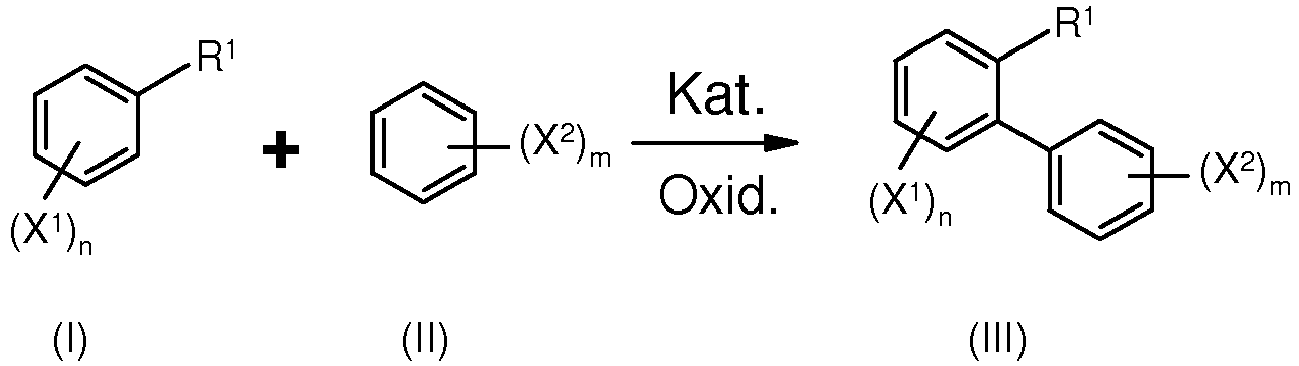
- Die vorliegende Erfindung betrifft ein neues Verfahren zum Herstellen von substituierten Biphenylen der Formel (III) durch Umsetzen von Arenen der Formel (I) mit Arenen der Formel (II) in Gegenwart eines Übergangsmetallkatalysators und mindestens eines Oxidationsmittels.
- Biarylverbindungen, insbesondere Biphenylverbindungen, haben technische Bedeutung als Feinchemikalien, Zwischenprodukte für Pharmazeutika, optische Aufheller und Agrochemikalien.
- Es ist bekannt, dass substituierte Biphenyle durch Suzuki-Kupplungen zugänglich sind. Hierfür werden allerdings teure Borin-/Boronsäuren mit Halogenarenen als Ausgangsverbindungen benötigt, die in Gegenwart eines Übergangsmetallkatalysators miteinander verknüpft werden, vgl.
WO 2011/023324 A1 . In letzter Zeit hat sich die Synthese von Biphenylen durch direkte zweifache C-H-Aktivierung als attraktive Alternative zu den bestehenden Syntheseverfahren (z.B. Suzuki-Reaktion) entwickelt. Hierbei werden Arene, die eine dirigierende Gruppe tragen, mit Arenen in Gegenwart von Übergangsmetallkatalysatoren und/oder geeigneten Aktivierungsreagenzien umgesetzt. Übersichtsartikel zu dieser Thematik findet man beispielsweise in Charles S. Yeung, Vy M. Dong, Chem. Rev. 2011, 111, 1215-1292. Eine Übersicht zur Pd-katalysierten Aryl-Aryl-Kupplung durch doppelte C-H-Aktivierung liefert Shu-Li You and Ji-Bao Xia, Top. Curr. Chem. 2010, 292, 165-194. Eine Übersicht über oxidative Kreuzkupplungen von Arenen findet man in James A. Ashenhurst, Chem. Soc. Rev. 2010, 39, 540-548. Der Vorteil der direkten zweifachen C-H-Aktivierung ist vor allem die gegenüber den bestehenden Syntheseverfahren (z.B. Suzuki-Reaktion) gesteigerte Nachhaltigkeit. Es werden keine präfunktionalisierten Kupplungspartner benötigt, wodurch die Zahl der Reaktionsschritte und der Abfall verringert werden. - Allerdings gibt es bei diesem Reaktionstyp auch eine Vielzahl von Schwierigkeiten, z.B. ungünstige Thermodynamik, die allgemein geringe Reaktivität von C-H Bindungen und Selektivitätsprobleme (Funktionalisierung einer C-H Bindung in Gegenwart von anderen C-H Bindungen, und die Konkurrenz zwischen Hetero- und Homokupplung). Bei den im Stand der Technik beschriebenen Pd-katalysierten Aryl-Aryl-Kupplungen durch zweifache C-H-Aktivierung beschränken sich die Beschreibungen von beispielsweise Gordon Brasche, Jorge García-Fortanet, Stephen L. Buchwald in Org. Lett. 2008, 10(11), 2207-2210 auf die Umsetzung von Aniliden mit elektronenreichen Arenen (enthaltend elektronenschiebende Substituenten wie z.B. Me, OMe, etc). Neben dem Palladium-haltigen Katalysator kommen hierbei DMSO in Kombination mit reinem Sauerstoff sowie TFA in Kombination mit Na2S2O8 als zusätzliche Aktivierungsreagenzien bzw. Oxidationsmittel zum Einsatz. Elektronenarme Aromaten (enthaltend elektronenziehende Substituenten wie z.B. F, CF3, CHF2, Cl, etc) gelten als zu wenig reaktiv und lassen sich daher unter diesen Reaktionsbedingungen nur sehr schlecht oder gar nicht mit Aniliden zur Reaktion bringen.
- Bi-Jie Li, Shi-Liang Tian, Zhao Fang, und Zhang-lie Shi in Angew. Chem., 2008, 47, 1115-1118, offenbaren Verfahren mit mehrfacher C-H Aktivierung zur Herstellung biologisch aktiver Moleküle, wobei das Verfahren frei von Organohalogen und Organometall-Verbindungen ist. Es wird beispielsweise ein Verfahren zur Palladium-katalysierten ortho-Arylierung von Acetanilid mit ortho-Xylol unter Verwendung von O2 als Oxidationsmittel und PrOH als Lösungsmittel offenbart (Tab. 1, Nr. 6). Auch die Kupplung eines elektronenarmen Arenes (Fluorbenzol) mit N-Acetyltetrahydroquinolin wird beschrieben (Tab. 2, Nr. 8). Allerdings wurde hierfür eine wesentlich höhere Katalysatormenge benötigt, die Reaktion war nicht stereoselektiv und die Ausbeute betrug nur 48%.
- Joanna Wencel-Delord, Corinna Nimphius, Frederic W. Patureau und Frank Glorius beschreiben in Angew. Chem. Int. Ed. 2012, 51, 2247-2251 eine Rh-katalysierte dehydrogenierende Aryl-Aryl-Kupplung, die den Einsatz elektronenarmer Aromaten erlaubt. Bisher wurden diese Umsetzungen durch C-H-Aktivierung allerdings nur mit Benzamiden als dirigierendem Kupplungspartner durchgeführt. Als Additive bzw. Oxidationsmittel wurden hier PivOH und CsOPiv sowie AgSbF6 und Cu(OAc)2 verwendet. Der Einsatz von Aniliden in der Umsetzung mit elektronenarmen Arenen (enthaltend elektronenziehende Substituenten wie z.B. F, CF3, CHF2, Cl, etc) konnte unter den im Stand der Technik vorbeschriebenen Verfahren bisher nicht realisiert werden.
- Aufgabe der vorliegenden Erfindung ist daher die Bereitstellung eines neuen Verfahrens zur Herstellung von elektronenarmen Biphenylen, insbesondere von solchen, die mit mehreren (2,_3 oder 4) Halogenatomen substituiert sind, das die Nachteile der bekannten Verfahren, vor allem die Notwendigkeit unwirtschaftlicher Synthesebausteine wie die oben erwähnten Edukte, nicht aufweist.
- Diese Aufgabe wird gelöst durch ein Verfahren zum Herstellen von substituierten Biphenylen der Formel (III)

- X1 und X2
- unabhängig voneinander ausgewählt sind aus Fluor und Chlor
- n
- ausgewählt ist aus 0 und 1;
- m
- ausgewählt ist aus 1, 2 und 3;
- R1
- ausgewählt ist aus der Gruppe bestehend aus -NHR2, -NR3-CO-R2 und -N=CR4R5;
- R2 - R5
- ausgewählt sind aus der Gruppe bestehend aus Wasserstoff, linearen oder verzweigten C1-6-Alkyl-Gruppen, -CH2-CO-CH3, Pyrazolyl-Gruppen der Formel (IVa) und Pyridyl-Gruppen der Formel (IVb)
- X2 und m
- den obigen Definitionen entsprechen,
- Diese Lösung der erfinderischen Aufgabe ist überraschend gegenüber dem Stand der Technik. So wird zwar in Joanna Wencel-Delord et al., Angew. Chem. Int. Ed. 2012, 51, 2247-2251 eine Rh-katalysierte dehydrogenierende Aryl-Aryl-Kupplung beschrieben, die den Einsatz elektronenarmer Aromaten erlaubt. Diese Umsetzungen durch C-H-Aktivierung wurden bisher allerdings nur mit Benzamiden als dirigierendem Kupplungspartner durchgeführt. Die in der vorliegenden Erfindung als Edukte verwendeten Arene der Formel (I) weisen gegenüber Benzamiden eine stark unterschiedliche elektronische Situation auf. Von einem vergleichbar guten ortho-dirigierenden Effekt wie er bei der Reaktion von Benzamiden auftritt und nicht mit dem +/- I bzw. +/- M-Effekt bei der nucleophilen aromatischen Substitution zu verwechseln ist, kann bei den im erfindungsgemäßen Verfahren als Edukte verwendeten Arenen der Formel (I) nicht notwendigerweise ausgegangen werden. Typische Beispiele von ortho-dirigierenden Gruppen sind bei Eric J.-G. Anctil und Victor Snieckus in Metal-Catalyzed Cross-Coupling Reactions, 2nd Edition 2004, 761-813. Hrsg. A. de Meijere und F. Diederich, WILEY-VCH Verlag GmbH & KGaA, Weinheim (Schema 14-2, Seite 762) zu finden. Hier werden Benzamide explizit als ortho-dirigierende Gruppen genannt, nicht aber die entsprechenden Anilide.
- Im Zusammenhang mit der vorliegenden Erfindung umfasst der Begriff Halogene, soweit nicht anders definiert, solche Elemente, die ausgewählt sind aus der Gruppe bestehend aus Fluor, Chlor, Brom und Iod, wobei Fluor, Chlor und Brom bevorzugt und Fluor und Chlor besonders bevorzugt verwendet werden.
- Gegebenenfalls substituierte Gruppen können einfach oder mehrfach substituiert sein, wobei bei Mehrfachsubstitutionen die Substituenten gleich oder verschieden sein können.
- Die mit einem oder mehreren Halogenatomen substituierten Alkyl-Gruppen sind beispielsweise ausgewählt aus Trifluormethyl (-CF3), Difluormethyl (-CHF2), CH2CF3, CH2Cl, und CCl2CF3.
- Alkyl-Gruppen sind im Zusammenhang mit der vorliegenden Erfindung, soweit nicht abweichend definiert, lineare, oder verzweigte Kohlenwasserstoff-Gruppen, die optional ein, zwei oder mehrere Heteroatome, die ausgewählt sind aus O, N, P und S aufweisen können. Außerdem können die erfindungsgemäßen Alkyl-Gruppen optional durch weitere Gruppen substituiert sein, die ausgewählt sind aus-R', Halogen-, Alkoxy- (-OR'), Thioether- oder Mercapto- (-SR'), Amino- (-NR'2), Silyl- (-SiR'3), Carboxyl- (-COOR'), Cyan- (-CN), Acyl- (-(C=O)R') und Amid-Gruppen (-CONR2'), wobei R' Wasserstoff oder eine C1-12-Alkyl-Gruppe, vorzugsweise C2-10-Alkyl-Gruppe, besonders bevorzugt C3-8-Alkyl-Gruppe ist, die ein oder mehrere Heteroatome, ausgewählt aus N, O, P und S, aufweisen kann.
- Die Definition C1-C12-Alkyl umfasst den größten hierin definierten Bereich für eine Alkyl-Gruppe. Im Einzelnen umfasst diese Definition beispielsweise die Bedeutungen Methyl, Ethyl, n-, iso-Propyl, n-, iso-, sec- und t-Butyl, n-Pentyl, n-Hexyl, 1,3-Dimethylbutyl, 3,3-Dimethylbutyl, n-Heptyl, n-Nonyl, n-Decyl, n-Undecyl, n-Dodecyl.
- Cycloalkyl-Gruppen sind im Zusammenhang mit der vorliegenden Erfindung, soweit nicht abweichend definiert, ringförmige Kohlenwasserstoff-Gruppen, die optional ein, zwei oder mehrere Heteroatome, die ausgewählt sind aus O, N, P und S aufweisen können. Außerdem können die erfindungsgemäßen Cycloalkyl-Gruppen optional durch weitere Gruppen substituiert sein, die ausgewählt sind aus -R', Halogen- (-X), Alkoxy- (-OR'), Thioether- oder Mercapto- (-SR'), Amino- (-NR'2), Silyl- (-SiR'3), Carboxyl- (-COOR'), Cyan- (-CN), Acyl- (-(C=O)R') und Amid-Gruppen (-CONR2'), wobei R' Wasserstoff oder eine C1-12-Alkyl-Gruppe, vorzugsweise C2-10-Alkyl-Gruppe, besonders bevorzugt C3-8-Alkyl-Gruppe ist, die ein oder mehrere Heteroatome, ausgewählt aus N, O, P und S, aufweisen kann.
- Die Definition C3-C8-Cycloalkyl umfasst den größten hierin definierten Bereich für eine CycloalkylGruppe. Im Einzelnen umfasst diese Definition beispielsweise die Bedeutungen Cyclopropyl, Cyclobutyl, Cyclohexyl, Cycloheptyl und Cyclooctyl.
- Aryl-Gruppen sind im Zusammenhang mit der vorliegenden Erfindung, soweit nicht abweichend definiert, aromatische Kohlenwasserstoff-Gruppen, die ein, zwei oder mehrere Heteroatome, die ausgewählt sind aus O, N, P und S aufweisen können und optional durch weitere Gruppen substituiert sein können, die ausgewählt sind aus -R', Halogen-, Alkoxy- (-OR'), Thioether- oder Mercapto- (-SR'), Amino- (-NR'2), Silyl- (-SiR'3), Carboxyl- (-COOR'), Cyan- (-CN), Acyl- (-(C=O)R') und Amid-Gruppen (-CONR2'), wobei R' Wasserstoff oder eine C1-12-Alkyl-Gruppe, vorzugsweise C2-10-Alkyl-Gruppe, besonders bevorzugt C3-8-Alkyl-Gruppe ist, die ein oder mehrere Heteroatome, ausgewählt aus N, O, P und S, aufweisen kann.
- Die Definition C5-18-Aryl umfasst den größten hierin definierten Bereich für eine Aryl-Gruppe mit 5 bis 18 Gerüst-Atomen, wobei die C-Atome gegen Heteroatome ausgetauscht sein können. Im Einzelnen umfasst diese Definition beispielsweise die Bedeutungen Cyclopentadienyl, Phenyl, Cycloheptatrienyl, Cyclooctatetraenyl, Naphthyl und Anthracenyl; 2-Furyl, 3-Furyl, 2-Thienyl, 3-Thienyl, 2-Pyrrolyl, 3-Pyrrolyl, 3-Isoxazolyl, 4-Isoxazolyl, 5-Isoxazolyl, 3-Isothiazolyl, 4-Isothiazolyl, 5-Isothiazolyl, 3-Pyrazolyl, 4-Pyrazolyl, 5-Pyrazolyl, 2-Oxazolyl, 4-Oxazolyl, 5- Oxazolyl, 2-Thiazolyl, 4-Thiazolyl, 5-Thiazolyl, 2-Imidazolyl, 4-Imidazolyl, 1,2,4-Oxadiazol-3-yl, 1,2,4-Oxadiazol-5-yl, 1,2,4-Thiadiazol-3-yl, 1,2,4-Thiadiazol-5-yl, 1,2,4-Triazol-3-yl, 1,3,4-Oxadiazol-2-yl, 1,3,4-Thiadiazol-2-yl und 1,3,4-Triazol-2-yl; 1-Pyrrolyl, 1-Pyrazolyl, 1,2,4-Triazol-1-yl, 1-Imidazolyl, 1,2,3-Triazol-1-yl, 1,3,4-Triazol-1-yl; 3-Pyridazinyl, 4-Pyridazinyl, 2-Pyrimidinyl, 4-Pyrimidinyl, 5-Pyrimidinyl, 2-Pyrazinyl, 1,3,5-Triazin-2-yl und 1,2,4-Triazin-3-yl.
- Arylalkyl-Gruppen (Aralkyl-Gruppen) sind im Zusammenhang mit der vorliegenden Erfindung, soweit nicht abweichend definiert, durch Aryl-Gruppen substituierte Alkyl-Gruppen, die eine C1-8-Alkylenkette aufweisen können und im Arylgerüst oder der Alkylenkette durch eines oder mehrere Heteroatome, die ausgewählt sind aus O, N, P und S und optional durch weitere Gruppen substituiert sein können, die ausgewählt sind aus -R', Halogen-, Alkoxy- (-OR'), Thioether- oder Mercapto-(-SR'), Amino- (-NR'2), Silyl- (-SiR'3), Carboxyl- (-COOR'), Cyan- (-CN), Acyl- (-(C=O)R') und Amid-Gruppen (-CONR2'), wobei R' Wasserstoff oder eine C1-12-Alkyl-Gruppe, vorzugsweise C2-10-Alkyl-Gruppe, besonders bevorzugt C3-8-Alkyl-Gruppe ist, die ein oder mehrere Heteroatome, ausgewählt aus N, O, P und S, aufweisen kann.
- Die Definition C7-19-Aralkyl-Gruppe umfasst den größten hierin definierten Bereich für eine Arylalkyl-Gruppe mit insgesamt 7 bis 19 Atomen in Gerüst und Alkylenkette. Im Einzelnen umfasst diese Definition beispielsweise die Bedeutungen Benzyl- und Phenylethyl-.
- Alkylaryl-Gruppen (Alkaryl-Gruppen) sind im Zusammenhang mit der vorliegenden Erfindung, soweit nicht abweichend definiert, durch Alkyl-Gruppen substituierte Aryl-Gruppen, die eine C1-8-Alkylenkette aufweisen können und im Arylgerüst oder der Alkylenkette durch eines oder mehrere Heteroatome, die ausgewählt sind aus O, N, P und S und optional durch weitere Gruppen substituiert sein können, die ausgewählt sind aus -R', Halogen-, Alkoxy- (-OR'), Thioether- oder Mercapto-(-SR'), Amino- (-NR'2), Silyl- (-SiR'3), Carboxyl- (-COOR'), Cyan- (-CN), Acyl- (-(C=O)R') und Amid-Gruppen (-CONR2'), wobei R' Wasserstoff oder eine C1-2-Alkyl-Gruppe, vorzugsweise C2-10-Alkyl-Gruppe, besonders bevorzugt C3-8-Alkyl-Gruppe ist, die ein oder mehrere Heteroatome, ausgewählt aus N, O, P und S, aufweisen kann.
- Die Definition C7-19-Alkaryl-Gruppe umfasst den größten hierin definierten Bereich für eine AlkylarylGruppe mit insgesamt 7 bis 19 Atomen in Gerüst und Alkylenkette. Im Einzelnen umfasst diese Definition beispielsweise die Bedeutungen Tolyl-, 2,3-, 2,4-, 2,5-, 2,6-, 3,4- oder 3,5-Dimethylphenyl.
- Die Alkyl-, Alkenyl-, Alkinyl-, Aryl,- Alkaryl- und Aralkylgruppen können zudem ein oder mehrere Heteroatome aufweisen, die - soweit nicht abweichend definiert - ausgewählt sind aus N, O, P und S. Die Heteroatome ersetzen dabei die bezifferten Kohlenstoffatome. Die erfindungsgemäßen Verbindungen können gegebenenfalls als Mischungen verschiedener möglicher isomerer Formen, insbesondere von Stereoisomeren, wie z.B. E- und Z-, threo- und erythro-, sowie optischen Isomeren, gegebenenfalls aber auch von Tautomeren vorliegen. Es werden sowohl die E- als auch die Z-Isomeren, wie auch die threo- und erythro-, sowie die optischen Isomeren, beliebige Mischungen dieser Isomeren, sowie die möglichen tautomeren Formen offenbart und beansprucht.
- Gemäß einer bevorzugten Ausführungsform des erfindungsgemäßen Verfahrens zum Herstellen von substituierten Biphenylen der Formel (III) sind die Substituenten wie folgt definiert:
- X1 und X2
- sind unabhängig voneinander ausgewählt aus Fluor und Chlor;
- n
- ist ausgewählt aus 0 und 1;
- m
- ist ausgewählt aus 1, 2 und 3;
- R1
- ist ausgewählt aus -NHR2, -NR3-CO-R2 und -N=CR4R5;
- R2-R5
- sind ausgewählt aus Wasserstoff, linearen oder verzweigten C1-6-Alkyl-Gruppen, - CH2-CO-CH3, Pyrazolyl-Gruppen der Formel (IVa) und Pyridyl-Gruppen der Formel (IVb)
- Gemäß einer weiteren bevorzugten Ausführungsform des erfindungsgemäßen Verfahrens zum Herstellen von substituierten Biphenylen der Formel (III) sind die Substituenten wie folgt definiert:
- X1 und X2
- sind unabhängig voneinander ausgewählt aus Fluor und Chlor;
- n
- ist ausgewählt aus 0 und 1;
- m
- ist ausgewählt aus 1, 2 und 3;
- R1
- ist ausgewählt aus -NHR2 und -NR3-CO-R2;
- R2-R5
- sind ausgewählt aus Wasserstoff, linearen oder verzweigten C1-6-Alkyl-Gruppen, -CH3-CO-CH3, Pyrazolyl-Gruppen der Formel (IVa) und Pyridyl-Gruppen der Formel (IVb)
- Gemäß einer weiteren bevorzugten Ausführungsform des erfindungsgemäßen Verfahrens zum Herstellen von substituierten Biphenylen der Formel (III) sind die Substituenten wie folgt definiert:
- X1 und X2
- sind unabhängig voneinander ausgewählt aus Fluor und Chlor;
- n
- ist ausgewählt aus 0 und 1;
- m
- ist ausgewählt aus 1, 2 und 3;
- R1
- ist -NR3-CO-R2;
- R2 - R5
- sind ausgewählt aus Wasserstoff, linearen oder verzweigten C1-6-Alkyl-Gruppen, -CH3-CO-CH3, Pyrazolyl-Gruppen der Formel (IVa) und Pyridyl-Gruppen der Formel (IVb)
- Gemäß einer besonders bevorzugten Ausführungsform des erfindungsgemäßen Verfahrens zum Herstellen von substituierten Biphenylen der Formel (III) sind die Substituenten in Formel (III) wie folgt definiert:
- X1
- ist 5-Fluor;
- n
- ist 1;
- X2
- ist 3,4-Chlor;
- m
- ist 2;
- R1
- ist ausgewählt aus -NH2 und -NH-CO-R2;
- R2
- ist ausgewählt aus Methyl, - CH2-CO-CH3 und Pyrazolyl-Gruppen der Formel (IVa)
- R6
- ist Difluormethyl und
- R7
- ist Wasserstoff.
- Gemäß einer ganz besonders bevorzugten Ausführungsform des erfindungsgemäßen Verfahrens zum Herstellen von substituierten Biphenylen der Formel (III) sind die Substituenten in Formel (III) wie folgt definiert:
- X1
- ist 5-Fluor;
- n
- ist 1;
- X2
- ist 3,4-Chlor;
- m
- ist 2;
- R1
- ist -NH-CO-R2;
- R2
- ist ausgewählt aus Methyl, - CH2-CO-CH3 und Pyrazolyl-Gruppen der Formel (IVa)
- R6
- ist Difluormethyl und
- R7
- ist Wasserstoff.
- Gemäß einer weiteren besonders bevorzugten Ausführungsform des erfindungsgemäßen Verfahrens zum Herstellen von substituierten Biphenylen der Formel (III) sind die Substituenten in Formel (III) wie folgt definiert:
- n
- ist 0;
- X2
- ist 3,4,5-Fluor;
- m
- ist 3;
- R1
- ist ausgewählt aus -NH2 und -NH-CO-R2;
- R2
- ist ausgewählt aus Methyl, - CH2-CO-CH3 und Pyrazolyl-Gruppen der Formel (IVa)
- R6
- ist Difluormethyl und
- R7
- ist Wasserstoff.
- Gemäß einer weiteren besonders bevorzugten Ausführungsform des erfindungsgemäßen Verfahrens zum Herstellen von substituierten Biphenylen der Formel (III) sind die Substituenten in Formel (III) wie folgt definiert:
- n
- ist 0;
- X2
- ist 3,4,5-Fluor;
- m
- ist 3;
- R1
- ist -NH-CO-R2;
- R2
- ist ausgewählt aus Methyl, - CH2-CO-CH3 und Pyrazolyl-Gruppen der Formel (IVa)
- R6
- ist Difluormethyl und
- R7
- ist Wasserstoff.
- Gemäß einer weiteren besonders bevorzugten Ausführungsform des erfindungsgemäßen Verfahrens zum Herstellen von substituierten Biphenylen der Formel (III) sind die Substituenten in Formel (III) wie folgt definiert:
- n
- ist 0;
- X2
- ist 4-Chlor;
- m
- ist 1;
- R1
- ist ausgewählt aus -NH2 und -NH-CO-R2;
- R2
- ist ausgewählt aus Methyl, - CH2-CO-CH3 und Pyridyl-Gruppen der Formel (IVb)
- Gemäß einer weiteren besonders bevorzugten Ausführungsform des erfindungsgemäßen Verfahrens zum Herstellen von substituierten Biphenylen der Formel (III) sind die Substituenten in Formel (III) wie folgt definiert:
- n
- ist 0;
- X2
- ist 4-Chlor;
- m
- ist 1;
- R1
- ist -NH-CO-R2;
- R2
- ist ausgewählt aus Methyl, - CH2-CO-CH3 und Pyridyl-Gruppen der Formel (IVb)
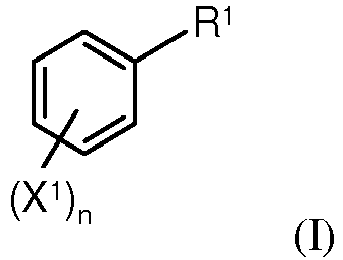
- Die Arene der Formel (I) sind im Zusammenhang mit der vorliegenden Erfindung wie folgt substituiert.

- X1
- ist unabhängig voneinander ausgewählt aus Fluor und Chlor;
- n
- ist ausgewählt aus 0 und 1;
- R1
- ist ausgewählt aus -NHR2, -NR3-CO-R2 und -N=CR4R5;
- R2 - R5
- sind ausgewählt aus Wasserstoff, linearen oder verzweigten C1-12-Alkyl-Gruppen, cyclischen C3-8-Alkyl-Gruppen, - CH2-CO-CH3, Benzyl-Gruppen, Benzoyl-Gruppen, Pyrazolyl-Gruppen der Formel (IVa) und Pyridyl-Gruppen der Formel (IVb)
- Gemäß einer bevorzugten Ausführungsform der vorliegenden Erfindung sind die Arene der Formel (I) wie folgt substituiert.

- X1
- ist unabhängig voneinander ausgewählt aus Halogenatomen;
- n
- ist ausgewählt aus 0 und 1;
- R1
- ist ausgewählt aus -NHR2, -NO2, -NR3-CO-R2 und -N=CR4R5;
- R2 - R5
- sind ausgewählt aus Wasserstoff, linearen oder verzweigten C1-6-Alkyl-Gruppen, -CH2-CO-CH3, Pyrazolyl-Gruppen der Formel (IVa) und Pyridyl-Gruppen der Formel (IVb)
- Gemäß einer bevorzugten Ausführungsform der vorliegenden Erfindung sind die Arene der Formel (I) wie folgt substituiert.

- X1
- ist 4-Fluor;
- n
- ist ausgewählt aus 0 und 1;
- R1
- ist ausgewählt aus -NHR2 und -NR3-CO-R2;
- Gemäß einer bevorzugten Ausführungsform der vorliegenden Erfindung sind die Arene der Formel (I) wie folgt substituiert.
- X1
- ist 4-Fluor;
- n
- ist ausgewählt aus 0 und 1;
- R1
- ist -NR3-CO-R2;
- In einer weiteren bevorzugten Ausführungsform der Erfindung sind die Arene der Formel (I) ausgewählt aus Pyrazolyl- oder Pyridyl-Aniliden (R1 = -NH-CO-R2-), die Pyrazolyl-Gruppen der Formel (IVa) mit R6 = CHF2 und R7 = Wasserstoff oder Fluor oder Pyridyl-Gruppen der Formel (IVb) enthalten.

- Besonders bevorzugt sind N-Phenyl-3-(difluormethyl)-1-methyl-1H-pyrazol-4-carboxamid, N-(4-Fluorphenyl)-3-(difluormethyl)-1-methyl-1H-pyrazol-4-carboxamid und N-Phenyl-2-chlornicotinamid.
- Gemäß einer weiteren bevorzugten Ausführungsform des erfindungsgemäßen Verfahrens sind die Arene der Formel (I) ausgewählt aus Anilin, 4-Fluoranilin, Acetanilid, 4-Fluoracetanilid, N-Phenyl-3-oxobutanamid, N-(4-Fluorphenyl)-3-oxobutanamid, N-(Propan-2-yliden)anilin, 4-Fluor-N-(propan-2-yliden)anilin, N-Phenyl-3-(difluormethyl)-1-methyl-1H-pyrazol-4-carboxamid, N-(4-Fluorphenyl)-3-(difluormethyl)-1-methyl-1H-pyrazol-4-carboxamid und N-Phenyl-2-chlornicotinamid.
- Gemäß einer besonders bevorzugten Ausführungsform des erfindungsgemäßen Verfahrens sind die Arene der Formel (I) ausgewählt aus Anilin, 4-Fluoranilin, N-(Propan-2-yliden)anilin und 4-Fluor-N-(propan-2-yliden)anilin, ganz besonders bevorzugt aus Anilin, 4-Fluoranilin.
- Gemäß einer weiteren besonders bevorzugten Ausführungsform des erfindungsgemäßen Verfahrens sind die Arene der Formel (I) ausgewählt aus Acetanilid, 4-Fluoracetanilid, N-Phenyl-3-oxobutanamid, N-(4-Fluorphenyl)-3-oxobutanamid, N-Phenyl-3-(difluormethyl)-1-methyl-1H-pyrazo1-4-carboxamid, N-(4-Fluorphenyl)-3-(difluormethyl)-1-methyl-1H-pyrazol-4-carboxamid und N-Phenyl-2-chlornicotinamid, ganz besonders bevorzugt aus Acetanilid, 4-Fluoracetanilid, N-Phenyl-3-(difluormethyl)-1-methyl-1H-pyrazol-4-carboxamid, N-(4-Fluorphenyl)-3-(difluormethyl)-1-methyl-1H-pyrazol-4-carboxamid und N-Phenyl-2-chlornicotinamid.
- Gemäß einer weiteren bevorzugten Ausführungsform des erfindungsgemäßen Verfahrens sind die Arene der Formel (II) ausgewählt aus 1,2-Dichlorbenzol, Chlorbenzol und 1,2,3-Trifluorbenzol.
- Die Arene der Formel (II) sind im Zusammenhang mit der vorliegenden Erfindung wie folgt substituiert.

- X2
- ist ausgewählt aus Fluor und Chlor;
- m
- ist ausgewählt aus 1, 2 und 3.
- Gemäß einer bevorzugten Ausführungsform der vorliegenden Erfindung sind die Arene der Formel (II) wie folgt substituiert.

- X2
- ist ausgewählt aus Fluor und Chlor;
- m
- ist ausgewählt aus 1, 2 und 3.
- Gemäß einer bevorzugten Ausführungsform der vorliegenden Erfindung sind die Arene der Formel (II) wie folgt substituiert.

- X2
- ist ausgewählt aus Chlor und Fluor;
- m
- ist ausgewählt aus 1, 2 und 3, besonders bevorzugt aus 2 und 3.
- Gemäß einer besonders bevorzugten Ausführungsform der vorliegenden Erfindung sind die Arene der Formel (II) ausgewählt aus 1,2-Dichlorbenzol, Chlorbenzol und 1,2,3-Trifluorbenzol.
- Die Kupplung der Arene der Formel (I) mit den Arenen der Formel (II) findet vorzugsweise in Gegewart mindestens eines Lösungsmittels statt, welches beispielsweise ausgewählt ist aus der Gruppe bestehend aus Wasser, aliphatischen Ethern, ggfs. halogenierten aromatischen oder aliphatischen Kohlenwasserstoffen, Alkoholen, Estern, aromatischen oder aliphatischen Nitrilen und dipolar aprotischen Lösungsmitteln, wie Dialkylsulfoxiden, N,N-Dialkylamiden aliphatischer Carbonsäuren oder alkylierten Lactamen.
- Besonders bevorzugt sind Lösungsmittel, die ausgewählt sind aus der Gruppe bestehend aus 1,2-Dichlorbenzol, Chlorbenzol, 1,2,3-Trifluorbenzol, THF, Dioxan, Diethylether, Diglyme, Methyl-tert-butylether (MTBE), tert-Amyl-methylether (TAME), Dimethylether (DME), 2-Methyl-THF, Acetonitril, Butyronitril, Toluol, Xylole, Mesitylen, Anisol, Ethylacetat, Isopropylacetat, Methanol, Ethanol, Propanol, Butanol, Ethylenglycol, Ethylencarbonat, Propylencarbonat, N,N-Dimethylacetamid, N,N-Dimethylformamid , N-Methylpyrrolidon, Wasser und Gemischen dieser.
- Gemäß einer besonders bevorzugten Ausführungsform der vorliegenden Erfindung wird das Aren der Formel (II) als Lösungsmittel verwendet. Gemäß einer besonders bevorzugten Ausführungsform der vorliegenden Erfindung ist das Lösungsmittel ausgewählt aus 1,2-Dichlorbenzol, 1,2,3-Trifluorbenzol und Chlorbenzol.
- Die Aryl-Aryl-Kupplung verläuft in Gegenwart von Übergangsmetallkatalysatoren. Grundsätzlich können alle im Stand der Technik im Zusammenhang mit Aryl-Aryl-Kupplungen beschriebenen Übergangsmetallkatalysatoren verwendet werden.
- Vorzugsweise werden Katalysatoren auf Basis der Übergangsmetalle M eingesetzt, wobei
- M
- ausgewählt ist aus den Metallen Ni, Pd, Pt, Cu, Ag, Au, Co, Rh, Ir, Fe, Ru, Mn, Cr und Ti.
- Gemäß einer bevorzugten Ausführungsform ist M ausgewählt aus Ru, Pd und Rh. Gemäß einer besonders bevorzugten Ausführungsform ist M ausgewählt aus Ru und Pd. Gemäß einer ganz besonders bevorzugten Ausführungsform ist M Ru.
- Die Übergangsmetalle M können in den Oxidationsstufen von -II bis +VI vorliegen.
- Als Katalysatoren können auch Metallsalze bestehend aus den oben genannten Metallen M in Form von MYp eingesetzt werden, wobei
- M
- ausgewählt ist aus Ni, Pd, Pt, Cu, Ag, Au, Co, Rh, Ir, Fe, Ru, Mn, Cr und Ti, bevorzugt aus Ru, Pd und Rh, besonders bevorzugt aus Ru und Pd, ganz besonders bevorzugt ist M Ru;
- Y
- unabhängig voneinander ausgewählt ist aus F, Cl, Br, I, OTf, OAc, OMes, OTos, CF3CO2, SO4 und Acetylacetonat, bevorzugt aus Cl und OAc.
- p
- ausgewählt ist aus 1, 2, 3, 4, 5 und 6, bevorzugt aus 2, 3 und 4.
- Als Katalysatoren können auch Übergangsmetallkomplexe der Formel MYpLr verwendet werden, die durch Kombination der oben genannten Übergangsmetallsalze MYp mit Liganden L erzeugt werden können, wobei
- M
- ausgewählt ist aus Ni, Pd, Pt, Cu, Ag, Au, Co, Rh, Ir, Fe, Ru, Mn, Cr und Ti, bevorzugt aus Ru, Pd und Rh, besonders bevorzugt aus Ru und Pd, ganz besonders bevorzugt ist M Ru;
- Y
- unabhängig voneinander ausgewählt ist aus F, Cl, Br, I, OTf, OAc, OMes, OTos, CF3CO2, SO4 und Acetylacetonat, bevorzugt aus Cl und OAc;
- p
- ausgewählt ist aus 1, 2, 3, 4, 5 und 6, bevorzugt aus 2, 3 und 4;
- L
- unabhängig voneinander ausgewählt ist aus Cp (Cyclopentadienid), Cp*(Pentamethylcyclopentadienid), p-Cymol, PR'3 und Phosphoramidat;
- R'
- unabhängig voneinander ausgewählt ist aus C1-6-Alkyl-, C3-5-Cycloalkyl, C6-12-Aryl, C12-24-Biaryl und Phosphinoferrocenliganden; und
- r
- ausgewählt ist aus 0, 1, 2, 3, 4, 5 und 6, bevorzugt aus 2, 3 und 4.
- Gemäß einer bevorzugten Ausführungsform der vorliegenden Erfindung sind die Phosphinoferrocenliganden ausgewählt aus 1,1-Bis-(di-tert-butylphosphino)ferrocen und Pentaphenyl(di-tert-butylphosphino)ferrocen.
- Gemäß einer besonders bevorzugten Ausführungsform ist der Übergangsmetallkomplex der Formel MYpLr [RhCp*Cl2]2.
- Bei der Durchführung der Reaktion kann das Katalysatorsystem (Übergangsmetall oder Übergangsmetallsalz und Ligand) zusammen oder getrennt zugegeben werden. Die Zugabe erfolgt bei Raumtemperatur oder bei einer Temperatur von 30°C bis 100°C. Bevorzugt erfolgt die Zugabe bei Raumtemperatur. Man kann den Übergangsmetallkomplexkatalysator kurz vor der Durchführung separat durch Zusammengeben eines Übergangsmetallsalzes und des Liganden herstellen oder in kristalliner Form käuflich erwerben. Bevorzugt werden die in der Reaktion verwendeten Übergangsmetallkatalysatoren in situ aus mindestens einem Übergangsmetallsalz MYp und den entsprechenden Liganden L erzeugt. Die Übergangsmetallsalze können aber auch direkt, d.h. ohne Kombination mit den Liganden L, eingesetzt werden, ohne dass dadurch die anfängliche katalytische Aktivität gemindert wird.
- Gemäß einer bevorzugten Ausführungsform der vorliegenden Erfindung wird der Übergangsmetallkomplex MYpLr in situ aus dem Übergangsmetallsalz MYp und dem Liganden L erzeugt.
- Gemäß einer bevorzugten Ausführungsform der vorliegenden Erfindung liegt das molare Verhältnis von Übergangsmetall M zu Ligand L zwischen 4:1 und 1:50. Gemäß einer besonders bevorzugten Ausführungsform liegt das molare Verhältnis von Übergangsmetall M zu Ligand L zwischen 1:1 und 1:5. Gemäß einer ganz besonders bevorzugten Ausführungsform liegt das molare Verhältnis von Übergangsmetall M zu Ligand L zwischen 1:1 und 1:2.
- Bei dem erfindungsgemäßen Verfahren werden 0,001 bis 10,0 mol%, vorzugsweise 0,01 bis 5,0 mol%, besonders bevorzugt 0,1 bis 2,5 mol% des Übergangsmetall-Katalysators - bezogen auf das Aren der Formel (I) - eingesetzt.
- Gemäß der vorliegenden Erfindung wird zur Kupplung der Arene (I) und (II) mindestens ein unabhängig voneinander kombinierbares Oxidationsmittel eingesetzt. Grundsätzlich können alle geeigneten Oxidationsmittel sowie elektrochemische Oxidation verwendet werden. Gemäß einer bevorzugten Ausführungsform sind die Oxidationsmittel ausgewählt aus Benzoquinon, Luftsauerstoff, O2, AgNO3, AgOAc, Cu(OAc)2, Ag2CO3, AgSbF6, K2S2O8, H4PMo11VO40, Cu(OTf)2, Na2S2O8. Gemäß einer besonders bevorzugten Ausführungsform wird Luftsauerstoff als Oxidationsmittel eingesetzt. Gemäß einer weiteren besonders bevorzugten Ausführungsform werden AgSbF6 und Cu(OAc)2 als Oxidationsmittel eingesetzt.
- In Kombination mit dem Katalysator werden bei dem erfindungsgemäßen Verfahren 0,1 bis 10,0 Äquivalente, vorzugsweise 0,5 bis 5 Äquivalente, besonders bevorzugt 1,0 bis 2,5 Äquivalente des Oxidationsmittels oder der unabhängig voneinander kombinierbaren Oxidationsmittel - bezogen auf das Aren der Formel (I) - eingesetzt. Bei Einsatz von AgSbF6 und Cu(OAc)2 als Oxidationsmittel werden 0,05-0,5, vorzugsweise 0,05-0,2 Äquivalente AgSbF6 und 0,5 bis 5 Äquivalente, bevorzugt 1,0 bis 2,5 Äquivalente Cu(OAc)2 bezogen auf das Aren der Formel (I) - eingesetzt.
- Gemäß der vorliegenden Erfindung können zur Kupplung der Arene der Formeln (I) und (II) bis zu zehn, bevorzugt bis zu fünf, besonders bevorzugt bis zu drei unabhängig voneinander kombinierbare Additive eingesetzt werden. Additive können zum einen Chelatoren sein, die über 1-3 Koordinationsstellen chelatisieren. Koordinationsstellen können hierbei Heteroatome und Mehrfachbindungen sein, bevorzugt O- und N-Atome sowie Doppelbindungen. Nicht-beschränkende Beispiele dafür sind sind pTsOH, AcOH, TFA, CsOPiv, PivOH. Daneben können Additive auch Hilfsmittel sein, die zur Freisetzung der katalytischen Aktivität dienen. Nicht-beschränkende Beispiele hierfür sind KPF6, PPh3, NH4PF6, NaBF4.
- Gemäß einer bevorzugten Ausführungsform der vorliegenden Erfindung sind die Additive ausgewählt aus pTsOH, AcOH, TFA, CsOPiv, PivOH, KPF6, PPh3, NH4PF6, und NaBF4.
- Gemäß einer weiteren bevorzugten Ausführungsform der vorliegenden Erfindung sind die Additive ausgewählt aus pTsOH, AcOH, TFA, CsOPiv und PivOH. Gemäß einer besonders bevorzugten Ausführungsform sind die Additive ausgewählt aus CsOPiv und PivOH.
- Gemäß einer weiteren bevorzugten Ausführungsform der vorliegenden Erfindung sind die Additive ausgewählt aus KPF6, PPh3, NH4PF6, NaBF4.
- Gemäß einer bevorzugten Ausführungsform werden bis zu fünf unabhängig voneinander kombinierbare Additive eingesetzt. Gemäß einer besonders bevorzugten Ausführungsform werden bis zu drei unabhängig voneinander kombinierbare Additive eingesetzt.
- Gemäß einer bevorzugten Ausführungsform der vorliegenden Erfindung werden 0,01 bis 10 Äquivalente, vorzugsweise 0,05 bis 5 Äquivalente, besonders bevorzugt 0,1 bis 1,5 Äquivalente des Additivs oder der unabhängig voneinander kombinierbaren Additive - bezogen auf das Aren der Formel (I) - eingesetzt.
- Gemäß der vorliegenden Erfindung werden die Arene der Formel (I) und die Arene der Formel (II) im Verhältnis zwischen 5:1 und 1:5, vorzugsweise im Verhältnis zwischen 2:1 und 1:2 (I:II) eingesetzt. Alternativ kann jedoch auch eine der beiden Komponenten (I oder II), vorzugsweise das Aren der Formel (II), in großem Überschuss als Lösungsmittel eingesetzt werden.
- Gemäß einer bevorzugten Ausführungsform der vorliegenden Erfindung wird das Aren der Formel (I) oder das Aren der Formel (II), vorzugsweise das Aren der Formel (II), in großem Überschuss als Lösungsmittel eingesetzt.
- Die Umsetzung wird im allgemeinen bei einer Temperatur von 20 bis 200°C, vorzugsweise von 50 bis 150°C, besonders bevorzugt von 120 bis 140°C, sowie bei einem Druck zwischen Normaldruck und 100 bar, vorzugsweise bei einem Druck zwischen Normaldruck und 40 bar, durchgeführt.
- Gemäß einer bevorzugten Ausführungsform erfolgt die Reaktion unter Ausschluss von Luftsauerstoff unter Schutzgasatmosphäre, wie z.B. unter Argon- oder Stickstoffatmosphäre.
- Aufgrund der geringen Katalysatormengen kann der Katalysator in den meisten Fällen im Endprodukt verbleiben. Alternativ kann jedoch auch eine Aufreinigung der erhaltenen Biaryle durch Filtration z.B. über Celite erfolgen.
- Das nachstehende Beispiel dient der Erläuterung des erfindungsmäßen Verfahrens, ohne es darauf zu beschränken:
- 153,2 mg (1,00 mmol) N-(4-Fluorphenyl)acetamid, 15,5 mg (0,02 mmol) [RhCp*Cl2]2, 34,4 mg (0,10 mmol) AgSbF6, 399,6 mg (2,20 mmol) Cu(OAc)2, 112,3 mg (1,10 mmol) PivOH und 46,8 mg (0,2 mmol) CsOPiv wurden unter Ausschluss von Sauerstoff in einem ausgeheizten Radley Reaktionsrohr vorgelegt und mit 5,0 mL (44,4 mmol) 1,2-Dichlorbenzol versetzt. Die Reaktionsmischung wurde 19 Stunden bei 130 °C gerührt. Nach Beendigung der Umsetzung (HPLC-Kontrolle) wurde die Reaktionsmischung auf RT abgekühlt, über eine kurze Kieselgelsäule filtriert und mit EtOAc eluiert. Das Lösungsmittel wurde destillativ entfernt und das Rohprodukt mittels präparativer HPLC aufgereinigt. Man erhielt 134,0 mg N-(3',4'-Dichlor-5-fluorbiphenyl-2-yl)acetamid mit einer LC-Reinheit von 99.9 % (Ausbeute 45 %).

R6 und R7 ausgewählt sind aus Wasserstoff, Halogen, einer linearen oder verzweigten C1-12-Alkyl-Gruppe und einer C1-6-Haloalkyl-Gruppe mit 1 bis 6 Halogenatomen;
durch Umsetzen von Arenen der Formel (I)

R1, X1 und n den obigen Definitionen entsprechen,
mit Arenen der Formel (II)


R6 und R7 sind ausgewählt aus Wasserstoff, Halogen, einer linearen oder verzweigten C1-6-Alkyl-Gruppe und einer C1-6-Haloalkyl-Gruppe mit 1 bis 6 Halogenatomen.

R6 und R7 sind ausgewählt aus Wasserstoff, Halogen, einer linearen oder verzweigten C1-6-Alkyl-Gruppe und einer C1-6-Haloalkyl-Gruppe mit 1 bis 6 Halogenatomen.


R6 und R7 sind ausgewählt aus Wasserstoff, Halogen, einer linearen oder verzweigten C1-6-Alkyl-Gruppe und einer C1-6-Haloalkyl-Gruppe mit 1 bis 6 Halogenatomen.


R6 und R7 sind ausgewählt aus Wasserstoff, Halogen, einer linearen oder verzweigten C1-12-Alkyl-Gruppe und einer C1-6-Haloalkyl-Gruppe mit 1 bis 6 Halogenatomen;

R6 und R7 sind ausgewählt aus Wasserstoff, Halogen, einer linearen oder verzweigten C1-12-Alkyl-Gruppe und einer C1-6-Haloalkyl-Gruppe mit 1 bis 6 Halogenatomen;

R6 und R7 sind ausgewählt aus Wasserstoff, Halogen, einer linearen oder verzweigten C1-12-Alkyl-Gruppe und einer C1-6-Haloalkyl-Gruppe mit 1 bis 6 Halogenatomen.

R6 und R7 sind ausgewählt aus Wasserstoff, Halogen, einer linearen oder verzweigten C1-12-Alkyl-Gruppe und einer C1-6-Haloalkyl-Gruppe mit 1 bis 6 Halogenatomen.
Claims (14)
- Verfahren zum Herstellen von substituierten Biphenylen der Formel (III)
 X1 und X2 unabhängig voneinander ausgewählt sind aus Fluor und Chlor;n ausgewählt ist aus 0 und 1;m ausgewählt ist aus 1, 2 und 3;R1 ausgewählt ist aus -NHR2, -NR3-CO-R2 und -N=CR4R5;R2 - R5 ausgewählt sind aus Wasserstoff, linearen oder verzweigten C1-6-Alkyl-Gruppen, -CH2-CO-CH3, Pyrazolyl-Gruppen der Formel (IVa) und Pyridyl-Gruppen der Formel (IVb)
 R6 und R7 ausgewählt sind aus Wasserstoff, Halogen, einer linearen oder verzweigten C1-6-Alkyl-Gruppe und einer C1-6-Haloalkyl-Gruppe mit 1 bis 6 Halogenatomen;durch Umsetzen von Arenen der Formel (I)
 R1, X1 und n den obigen Definitionen entsprechen,mit Arenen der Formel (II)
X2 und m den obigen Definitionen entsprechen,
wobei die Reaktion in Gegenwart eines Übergangsmetallkatalysators, mindestens eines Oxidationsmittels, bis zu fünf Additiven und in einem Lösungsmittel durchgeführt wird. - Verfahren nach Anspruch 1, wobeiR1 -NR3-CO-R2 ist.
- Verfahren nach einem der Ansprüche 1 oder 2, wobeiX1 in Formel (III) 5-Fluor ist;n 1 ist;X2 in Formel (III) 3,4-Chlor ist;m 2 ist;R1 -NH-CO-R2 ist;R2 ausgewählt ist aus Methyl, - CH2-CO-CH3 und Pyrazolyl-Gruppen der Formel (IVa)
 R6 Difluormethyl ist undR7 Wasserstoff ist.
 - Verfahren nach einem der Ansprüche 1 oder 2, wobein 0 ist;X2 in Formel (III) 3,4,5-Fluor ist;m 3 ist;R1 -NH-CO-R2 ist;R2 ausgewählt ist aus Methyl, - CH2-CO-CH3 und Pyrazolyl-Gruppen der Formel (IVa)
 R6 Difluormethyl ist undR7 Wasserstoff ist.
 - Verfahren nach einem der Ansprüche 1 oder 2, wobein 0 ist;X2 in Formel (III) 4-Chlor ist;m 1 ist;R1 -NH-CO-R2 ist;R2 ausgewählt ist aus der Gruppe bestehend aus Methyl, - CH2-CO-CH3 und Pyridyl-Gruppen der Formel (IVb)

- Verfahren nach einem der Ansprüche 1 bis 5, wobei die Arene der Formel (I) ausgewählt sind aus Anilin, 4-Fluoranilin, Acetanilid, 4-Fluoracetanilid, N-Phenyl-3-oxobutanamid, N-(4-Fluorphenyl)-3-oxobutanamid, N-(Propan-2-yliden)anilin, 4-Fluor-N-(propan-2-yliden)anilin, N-Phenyl-3-(difluormethyl)-1-methyl-1H-pyrazol-4-carboxamid, N-(4-Fluorphenyl)-3-(difluormethyl)-1-methyl-1H-pyrazol-4-carboxamid und N-Phenyl-2-chlornicotinamid.
- Verfahren nach einem der Ansprüche 1 bis 6, wobei die Arene der Formel (II) ausgewählt sind aus 1,2-Dichlorbenzol, Chlorbenzol und 1,2,3-Trifluorbenzol.
- Verfahren nach einem der Ansprüche 1 bis 7, wobei das Lösungsmittel ausgewählt ist aus 1,2-Dichlorbenzol, Chlorbenzol, 1,2,3-Trifluorbenzol, THF, Dioxan, Diethylether, Diglyme, Methyl-tert-butylether (MTBE), tert-Amyl-methylether (TAME), Dimethylether (DME), 2-Methyl-THF, Acetonitril, Butyronitril, Toluol, Xylole, Mesitylen, Anisol, Ethylacetat, Isopropylacetat, Methanol, Ethanol, Propanol, Butanol, Ethylenglycol, Ethylencarbonat, Propylencarbonat, N,N-Dimethylacetamid, N,N-Dimethylformamid, N-Methylpyrrolidon, Wasser und Gemischen dieser.
- Verfahren nach einem der Ansprüche 1 bis 8, wobei der Übergangsmetallkatalysator ausgewählt ist aus den Übergangsmetallen M, wobei M ausgewählt ist aus Ni, Pd, Pt, Cu, Ag, Au, Co, Rh, Ir, Fe, Ru, Mn, Cr und Ti.
- Verfahren nach einem der Ansprüche 1 bis 8, wobei der Übergangsmetallkatalysator ausgewählt ist aus den Übergangsmetallsalzen MYp, wobeiM ausgewählt ist aus Ni, Pd, Pt, Cu, Ag, Au, Co, Rh, Ir, Fe, Ru, Mn, Cr und Ti;Y unabhängig voneinander ausgewählt ist aus F, Cl, Br, I, OTf, OAc, OMes, OTos, CF3CO2, SO4 und Acetylacetonat;p ausgewählt ist aus 1, 2, 3, 4, 5 und 6.
- Verfahren nach einem der Ansprüche 1 bis 8, wobei der Übergangsmetallkatalysator ausgewählt ist aus den Übergangsmetallkomplexen MYpLr, wobeiM ausgewählt ist aus Ni, Pd, Pt, Cu, Ag, Au, Co, Rh, Ir, Fe, Ru, Mn, Cr und Ti;Y unabhängig voneinander ausgewählt ist aus F, Cl, Br, I, OTf, OAc, OMes, OTos, CF3CO2, SO4 und Acetylacetonate;p ausgewählt ist aus 1, 2, 3, 4, 5 und 6;L unabhängig voneinander ausgewählt ist aus Cp (Cyclopentadienid), Cp*(Pentamethylcyclopentadienid), p-Cymol, PR'3 und Phosphoramidat;R' unabhängig voneinander ausgewählt ist aus C1-6-Alkyl-, C3-5-Cycloalkyl, C6-12-Aryl, C12-24-Biaryl und Phosphinoferrocenliganden; undr ausgewählt ist aus 0, 1, 2, 3, 4, 5 und 6.
- Verfahren nach einem der Ansprüche 1 bis 11, wobei das mindestens eine Oxidationsmittel ausgewählt ist aus Benzoquinon, Luftsauerstoff, O2, AgNO3, AgOAc, Cu(OAc)2, Ag2CO3, AgSbF6, K2S2O8, H4PMo11VO40, Cu(OTf)2 und Na2S2O8.
- Verfahren nach einem der Ansprüche 1 bis 12, wobei die bis zu fünf Additive ausgewählt sind aus pTsOH, AcOH, TFA, CsOPiv, PivOH, KPF6, PPh3, NH4PF6 und NaBF4.
- Verfahren nach einem der Ansprüche 1 bis 13, wobei das Aren der Formel (I) oder das Aren der Formel (II), vorzugsweise das Aren der Formel (II), in großem Überschuss als Lösungsmittel eingesetzt wird.
Priority Applications (1)
| Application Number | Priority Date | Filing Date | Title |
|---|---|---|---|
| EP13742231.7A EP2880013B1 (de) | 2012-08-02 | 2013-07-29 | Verfahren zum herstellen von substituierten biphenylen durch c-h-aktivierung |
Applications Claiming Priority (3)
| Application Number | Priority Date | Filing Date | Title |
|---|---|---|---|
| EP12179058 | 2012-08-02 | ||
| EP13742231.7A EP2880013B1 (de) | 2012-08-02 | 2013-07-29 | Verfahren zum herstellen von substituierten biphenylen durch c-h-aktivierung |
| PCT/EP2013/065925 WO2014019995A1 (de) | 2012-08-02 | 2013-07-29 | Verfahren zum herstellen von substituierten biphenylen durch c-h-aktivierung |
Publications (2)
| Publication Number | Publication Date |
|---|---|
| EP2880013A1 EP2880013A1 (de) | 2015-06-10 |
| EP2880013B1 true EP2880013B1 (de) | 2018-05-09 |
Family
ID=48877252
Family Applications (1)
| Application Number | Title | Priority Date | Filing Date |
|---|---|---|---|
| EP13742231.7A Not-in-force EP2880013B1 (de) | 2012-08-02 | 2013-07-29 | Verfahren zum herstellen von substituierten biphenylen durch c-h-aktivierung |
Country Status (12)
| Country | Link |
|---|---|
| US (1) | US9199915B2 (de) |
| EP (1) | EP2880013B1 (de) |
| JP (1) | JP6109938B2 (de) |
| KR (1) | KR102125294B1 (de) |
| CN (1) | CN104520267B (de) |
| BR (1) | BR112015002355B1 (de) |
| DK (1) | DK2880013T3 (de) |
| ES (1) | ES2681026T3 (de) |
| IN (1) | IN2015DN00665A (de) |
| MX (1) | MX365072B (de) |
| TW (1) | TWI589551B (de) |
| WO (1) | WO2014019995A1 (de) |
Families Citing this family (6)
| Publication number | Priority date | Publication date | Assignee | Title |
|---|---|---|---|---|
| DK3134383T3 (da) | 2014-04-25 | 2020-06-29 | Bayer Cropscience Ag | Fremgangsmåde til fremstilling af biphenylaminer af anilider ved hjælp af rutheniumkatalyse |
| EP3009420A1 (de) | 2014-10-16 | 2016-04-20 | Bayer CropScience AG | Verfahren zum Herstellen von Biphenylaminen aus Aniliden durch Rutheniumkatalyse |
| CN104557589A (zh) * | 2014-12-24 | 2015-04-29 | 天津大学 | N-(1,1’-二芳基)取代的酰胺类衍生物的制备方法 |
| CN109678911B (zh) * | 2019-02-01 | 2021-11-02 | 中国科学院上海有机化学研究所 | 二茂铁化合物及其制备方法 |
| CN113563147B (zh) * | 2021-07-29 | 2023-05-09 | 西湖大学 | 一种芳环苄位碳氢键选择性氘代的方法 |
| CN113999130B (zh) * | 2021-11-26 | 2023-09-29 | 湖北工业大学 | 一种邻硝基酰基苯胺类化合物的制备方法 |
Family Cites Families (3)
| Publication number | Priority date | Publication date | Assignee | Title |
|---|---|---|---|---|
| EP2119697A1 (de) * | 2008-05-09 | 2009-11-18 | Bayer CropScience AG | Verfahren zur Herstellung substituierter Biphenylanilin |
| WO2011023324A1 (de) | 2009-08-31 | 2011-03-03 | Bayer Cropscience Ag | Tetraarylborat verfahren zur herstellung von substituierten biphenylen |
| CN102005625A (zh) * | 2010-09-28 | 2011-04-06 | 苏州群瑞环保科技有限公司 | 一种废旧锂电池处理的工艺方法 |
-
2013
- 2013-07-29 KR KR1020157002343A patent/KR102125294B1/ko not_active Expired - Fee Related
- 2013-07-29 DK DK13742231.7T patent/DK2880013T3/en active
- 2013-07-29 IN IN665DEN2015 patent/IN2015DN00665A/en unknown
- 2013-07-29 BR BR112015002355A patent/BR112015002355B1/pt not_active IP Right Cessation
- 2013-07-29 JP JP2015524756A patent/JP6109938B2/ja not_active Expired - Fee Related
- 2013-07-29 MX MX2015001459A patent/MX365072B/es active IP Right Grant
- 2013-07-29 ES ES13742231.7T patent/ES2681026T3/es active Active
- 2013-07-29 EP EP13742231.7A patent/EP2880013B1/de not_active Not-in-force
- 2013-07-29 WO PCT/EP2013/065925 patent/WO2014019995A1/de not_active Ceased
- 2013-07-29 US US14/418,968 patent/US9199915B2/en not_active Expired - Fee Related
- 2013-07-29 CN CN201380041158.7A patent/CN104520267B/zh not_active Expired - Fee Related
- 2013-08-01 TW TW102127561A patent/TWI589551B/zh not_active IP Right Cessation
Non-Patent Citations (1)
| Title |
|---|
| SHABASHOV DMITRY ET AL: "Palladium-Catalyzed Anilide ortho-Arylation and Subsequent One-Pot Cyclization to Phenanthridines", THE JOURNAL OF ORGANIC CHEMISTRY, AMERICAN CHEMICAL SOCIETY ETC.|, vol. 72, no. 20, 1 January 2007 (2007-01-01), pages 7720 - 7725, XP002527991, ISSN: 0022-3263, [retrieved on 20070907], DOI: 10.1021/JO701387M * |
Also Published As
| Publication number | Publication date |
|---|---|
| TWI589551B (zh) | 2017-07-01 |
| KR20150036246A (ko) | 2015-04-07 |
| CN104520267B (zh) | 2017-07-14 |
| WO2014019995A1 (de) | 2014-02-06 |
| MX2015001459A (es) | 2015-05-08 |
| EP2880013A1 (de) | 2015-06-10 |
| IN2015DN00665A (de) | 2015-06-26 |
| BR112015002355B1 (pt) | 2020-04-14 |
| DK2880013T3 (en) | 2018-08-06 |
| JP2015524814A (ja) | 2015-08-27 |
| BR112015002355A2 (pt) | 2017-07-04 |
| KR102125294B1 (ko) | 2020-06-23 |
| CN104520267A (zh) | 2015-04-15 |
| TW201434801A (zh) | 2014-09-16 |
| US20150203440A1 (en) | 2015-07-23 |
| JP6109938B2 (ja) | 2017-04-05 |
| US9199915B2 (en) | 2015-12-01 |
| ES2681026T3 (es) | 2018-09-11 |
| MX365072B (es) | 2019-05-22 |
Similar Documents
| Publication | Publication Date | Title |
|---|---|---|
| EP2880013A1 (de) | Verfahren zum herstellen von substituierten biphenylen durch c-h-aktivierung | |
| EP2303828B1 (de) | Verfahren zur herstellung von substituierten biphenylen | |
| EP1856024B1 (de) | Verfahren zur herstellung substituierter biphenyle | |
| EP0089011B1 (de) | Verfahren zur Herstellung von 3-Oxonitrilen | |
| WO1997003969A1 (de) | Verfahren zur herstellung von n-substituierten 3-hydroxypyrazolen | |
| EP2046754B1 (de) | Verfahren zum herstellen von alkylaniliden aus halogenbenzolderivaten | |
| EP2473476B1 (de) | Tetraarylborat verfahren zur herstellung von substituierten biphenylen | |
| EP0931068A1 (de) | Verfahren zur herstellung substituierter phenylpyridine | |
| EP0178260B1 (de) | Verfahren zur Herstellung von fluorierten Pyridin-Derivaten | |
| EP2321241B1 (de) | Verfahren zur herstellung von phenylalkan-1-olen | |
| EP2366680A2 (de) | Verfahren zur Herstellung von 4'-Halogenalkyl-biphenyl-2-carbonsäuren | |
| EP2729444B1 (de) | Verfahren zur herstellung von 2-amino-5-cyano-n,3-dimethylbenzamid | |
| DE69420275T2 (de) | Verfahren zur herstellung von p-nitroaromatischen-amiden | |
| EP1268400B1 (de) | Verfahren zur herstellung von n-butyryl-4-amino-3-methyl-benzoesäuremethylester und die neue verbindung n-(4-brom-2-methylphenyl)-butanamid | |
| DE69934034T2 (de) | Verfahren zur Herstellung von Derivaten der Cyanobenzoesäure | |
| EP2868652A1 (de) | Katalytische Hydrierung zur Herstellung von Aminen aus Amidacetalen, Keten-N,O-acetalen oder Esterimiden | |
| DE60107248T2 (de) | Neues verfahren zur herstellung von pyrazolopyrimidonen | |
| EP0811607A1 (de) | Verfahren zur Nitrosierung von C-H-aciden Verbindungen | |
| EP0587533B1 (de) | Verfahren zur Herstellung von alpha-Aminoketonsalzen | |
| EP2554539B1 (de) | Verfahren zur Herstellung von gamma-Spirolactamen aus zyklischen ungesättigten Carbonsäuren | |
| DE69431706T2 (de) | Verfahren zur Herstellung von 5-Amino-dihydropyrrol, Zwischenprodukt davon und Verfahren zur Herstellung des Zwischenprodukts | |
| EP1322587A1 (de) | Verfahren zur herstellung von ketocarbonsäurederivaten | |
| DE2050684A1 (en) | Neuroleptic 1-aralkyl-4-phenyl-piperazines prodn - by reacting ethylenediamines with oxalic acid derivs,and reducing resulting dioxo | |
| DE4437930A1 (de) | 2-Chlor-N-[1-(2,6-dichlor-4-difluormethyl- phenyl)-1H-pyrazol-5-yl]-propanamid | |
| DE3828059A1 (de) | Verfahren zur herstellung von seitenkettenhalogenierten alkylbenzolderivaten |
Legal Events
| Date | Code | Title | Description |
|---|---|---|---|
| PUAI | Public reference made under article 153(3) epc to a published international application that has entered the european phase |
Free format text: ORIGINAL CODE: 0009012 |
|
| 17P | Request for examination filed |
Effective date: 20150302 |
|
| AK | Designated contracting states |
Kind code of ref document: A1 Designated state(s): AL AT BE BG CH CY CZ DE DK EE ES FI FR GB GR HR HU IE IS IT LI LT LU LV MC MK MT NL NO PL PT RO RS SE SI SK SM TR |
|
| AX | Request for extension of the european patent |
Extension state: BA ME |
|
| DAX | Request for extension of the european patent (deleted) | ||
| STAA | Information on the status of an ep patent application or granted ep patent |
Free format text: STATUS: EXAMINATION IS IN PROGRESS |
|
| 17Q | First examination report despatched |
Effective date: 20161214 |
|
| GRAP | Despatch of communication of intention to grant a patent |
Free format text: ORIGINAL CODE: EPIDOSNIGR1 |
|
| STAA | Information on the status of an ep patent application or granted ep patent |
Free format text: STATUS: GRANT OF PATENT IS INTENDED |
|
| INTG | Intention to grant announced |
Effective date: 20171127 |
|
| GRAS | Grant fee paid |
Free format text: ORIGINAL CODE: EPIDOSNIGR3 |
|
| GRAA | (expected) grant |
Free format text: ORIGINAL CODE: 0009210 |
|
| STAA | Information on the status of an ep patent application or granted ep patent |
Free format text: STATUS: THE PATENT HAS BEEN GRANTED |
|
| AK | Designated contracting states |
Kind code of ref document: B1 Designated state(s): AL AT BE BG CH CY CZ DE DK EE ES FI FR GB GR HR HU IE IS IT LI LT LU LV MC MK MT NL NO PL PT RO RS SE SI SK SM TR |
|
| REG | Reference to a national code |
Ref country code: GB Ref legal event code: FG4D Free format text: NOT ENGLISH |
|
| REG | Reference to a national code |
Ref country code: CH Ref legal event code: EP Ref country code: AT Ref legal event code: REF Ref document number: 997469 Country of ref document: AT Kind code of ref document: T Effective date: 20180515 |
|
| REG | Reference to a national code |
Ref country code: IE Ref legal event code: FG4D Free format text: LANGUAGE OF EP DOCUMENT: GERMAN |
|
| REG | Reference to a national code |
Ref country code: DE Ref legal event code: R096 Ref document number: 502013010122 Country of ref document: DE |
|
| REG | Reference to a national code |
Ref country code: FR Ref legal event code: PLFP Year of fee payment: 6 |
|
| REG | Reference to a national code |
Ref country code: DK Ref legal event code: T3 Effective date: 20180731 |
|
| REG | Reference to a national code |
Ref country code: NL Ref legal event code: FP |
|
| REG | Reference to a national code |
Ref country code: ES Ref legal event code: FG2A Ref document number: 2681026 Country of ref document: ES Kind code of ref document: T3 Effective date: 20180911 |
|
| REG | Reference to a national code |
Ref country code: LT Ref legal event code: MG4D |
|
| PG25 | Lapsed in a contracting state [announced via postgrant information from national office to epo] |
Ref country code: SE Free format text: LAPSE BECAUSE OF FAILURE TO SUBMIT A TRANSLATION OF THE DESCRIPTION OR TO PAY THE FEE WITHIN THE PRESCRIBED TIME-LIMIT Effective date: 20180509 Ref country code: BG Free format text: LAPSE BECAUSE OF FAILURE TO SUBMIT A TRANSLATION OF THE DESCRIPTION OR TO PAY THE FEE WITHIN THE PRESCRIBED TIME-LIMIT Effective date: 20180809 Ref country code: NO Free format text: LAPSE BECAUSE OF FAILURE TO SUBMIT A TRANSLATION OF THE DESCRIPTION OR TO PAY THE FEE WITHIN THE PRESCRIBED TIME-LIMIT Effective date: 20180809 Ref country code: LT Free format text: LAPSE BECAUSE OF FAILURE TO SUBMIT A TRANSLATION OF THE DESCRIPTION OR TO PAY THE FEE WITHIN THE PRESCRIBED TIME-LIMIT Effective date: 20180509 |
|
| PG25 | Lapsed in a contracting state [announced via postgrant information from national office to epo] |
Ref country code: HR Free format text: LAPSE BECAUSE OF FAILURE TO SUBMIT A TRANSLATION OF THE DESCRIPTION OR TO PAY THE FEE WITHIN THE PRESCRIBED TIME-LIMIT Effective date: 20180509 Ref country code: RS Free format text: LAPSE BECAUSE OF FAILURE TO SUBMIT A TRANSLATION OF THE DESCRIPTION OR TO PAY THE FEE WITHIN THE PRESCRIBED TIME-LIMIT Effective date: 20180509 Ref country code: LV Free format text: LAPSE BECAUSE OF FAILURE TO SUBMIT A TRANSLATION OF THE DESCRIPTION OR TO PAY THE FEE WITHIN THE PRESCRIBED TIME-LIMIT Effective date: 20180509 Ref country code: GR Free format text: LAPSE BECAUSE OF FAILURE TO SUBMIT A TRANSLATION OF THE DESCRIPTION OR TO PAY THE FEE WITHIN THE PRESCRIBED TIME-LIMIT Effective date: 20180810 |
|
| PG25 | Lapsed in a contracting state [announced via postgrant information from national office to epo] |
Ref country code: RO Free format text: LAPSE BECAUSE OF FAILURE TO SUBMIT A TRANSLATION OF THE DESCRIPTION OR TO PAY THE FEE WITHIN THE PRESCRIBED TIME-LIMIT Effective date: 20180509 Ref country code: CZ Free format text: LAPSE BECAUSE OF FAILURE TO SUBMIT A TRANSLATION OF THE DESCRIPTION OR TO PAY THE FEE WITHIN THE PRESCRIBED TIME-LIMIT Effective date: 20180509 Ref country code: PL Free format text: LAPSE BECAUSE OF FAILURE TO SUBMIT A TRANSLATION OF THE DESCRIPTION OR TO PAY THE FEE WITHIN THE PRESCRIBED TIME-LIMIT Effective date: 20180509 Ref country code: EE Free format text: LAPSE BECAUSE OF FAILURE TO SUBMIT A TRANSLATION OF THE DESCRIPTION OR TO PAY THE FEE WITHIN THE PRESCRIBED TIME-LIMIT Effective date: 20180509 Ref country code: SK Free format text: LAPSE BECAUSE OF FAILURE TO SUBMIT A TRANSLATION OF THE DESCRIPTION OR TO PAY THE FEE WITHIN THE PRESCRIBED TIME-LIMIT Effective date: 20180509 |
|
| REG | Reference to a national code |
Ref country code: DE Ref legal event code: R097 Ref document number: 502013010122 Country of ref document: DE |
|
| PG25 | Lapsed in a contracting state [announced via postgrant information from national office to epo] |
Ref country code: SM Free format text: LAPSE BECAUSE OF FAILURE TO SUBMIT A TRANSLATION OF THE DESCRIPTION OR TO PAY THE FEE WITHIN THE PRESCRIBED TIME-LIMIT Effective date: 20180509 |
|
| PLBE | No opposition filed within time limit |
Free format text: ORIGINAL CODE: 0009261 |
|
| STAA | Information on the status of an ep patent application or granted ep patent |
Free format text: STATUS: NO OPPOSITION FILED WITHIN TIME LIMIT |
|
| PG25 | Lapsed in a contracting state [announced via postgrant information from national office to epo] |
Ref country code: LU Free format text: LAPSE BECAUSE OF NON-PAYMENT OF DUE FEES Effective date: 20180729 Ref country code: MC Free format text: LAPSE BECAUSE OF FAILURE TO SUBMIT A TRANSLATION OF THE DESCRIPTION OR TO PAY THE FEE WITHIN THE PRESCRIBED TIME-LIMIT Effective date: 20180509 |
|
| 26N | No opposition filed |
Effective date: 20190212 |
|
| REG | Reference to a national code |
Ref country code: IE Ref legal event code: MM4A |
|
| PG25 | Lapsed in a contracting state [announced via postgrant information from national office to epo] |
Ref country code: SI Free format text: LAPSE BECAUSE OF FAILURE TO SUBMIT A TRANSLATION OF THE DESCRIPTION OR TO PAY THE FEE WITHIN THE PRESCRIBED TIME-LIMIT Effective date: 20180509 |
|
| PG25 | Lapsed in a contracting state [announced via postgrant information from national office to epo] |
Ref country code: IE Free format text: LAPSE BECAUSE OF NON-PAYMENT OF DUE FEES Effective date: 20180729 |
|
| PG25 | Lapsed in a contracting state [announced via postgrant information from national office to epo] |
Ref country code: AL Free format text: LAPSE BECAUSE OF FAILURE TO SUBMIT A TRANSLATION OF THE DESCRIPTION OR TO PAY THE FEE WITHIN THE PRESCRIBED TIME-LIMIT Effective date: 20180509 |
|
| PG25 | Lapsed in a contracting state [announced via postgrant information from national office to epo] |
Ref country code: MT Free format text: LAPSE BECAUSE OF FAILURE TO SUBMIT A TRANSLATION OF THE DESCRIPTION OR TO PAY THE FEE WITHIN THE PRESCRIBED TIME-LIMIT Effective date: 20180509 |
|
| PG25 | Lapsed in a contracting state [announced via postgrant information from national office to epo] |
Ref country code: TR Free format text: LAPSE BECAUSE OF FAILURE TO SUBMIT A TRANSLATION OF THE DESCRIPTION OR TO PAY THE FEE WITHIN THE PRESCRIBED TIME-LIMIT Effective date: 20180509 |
|
| PG25 | Lapsed in a contracting state [announced via postgrant information from national office to epo] |
Ref country code: PT Free format text: LAPSE BECAUSE OF FAILURE TO SUBMIT A TRANSLATION OF THE DESCRIPTION OR TO PAY THE FEE WITHIN THE PRESCRIBED TIME-LIMIT Effective date: 20180509 Ref country code: HU Free format text: LAPSE BECAUSE OF FAILURE TO SUBMIT A TRANSLATION OF THE DESCRIPTION OR TO PAY THE FEE WITHIN THE PRESCRIBED TIME-LIMIT; INVALID AB INITIO Effective date: 20130729 |
|
| PG25 | Lapsed in a contracting state [announced via postgrant information from national office to epo] |
Ref country code: MK Free format text: LAPSE BECAUSE OF NON-PAYMENT OF DUE FEES Effective date: 20180509 Ref country code: CY Free format text: LAPSE BECAUSE OF FAILURE TO SUBMIT A TRANSLATION OF THE DESCRIPTION OR TO PAY THE FEE WITHIN THE PRESCRIBED TIME-LIMIT Effective date: 20180509 |
|
| PG25 | Lapsed in a contracting state [announced via postgrant information from national office to epo] |
Ref country code: IS Free format text: LAPSE BECAUSE OF FAILURE TO SUBMIT A TRANSLATION OF THE DESCRIPTION OR TO PAY THE FEE WITHIN THE PRESCRIBED TIME-LIMIT Effective date: 20180909 |
|
| PGFP | Annual fee paid to national office [announced via postgrant information from national office to epo] |
Ref country code: IT Payment date: 20210628 Year of fee payment: 9 Ref country code: FR Payment date: 20210624 Year of fee payment: 9 |
|
| PGFP | Annual fee paid to national office [announced via postgrant information from national office to epo] |
Ref country code: BE Payment date: 20210623 Year of fee payment: 9 Ref country code: NL Payment date: 20210716 Year of fee payment: 9 |
|
| PGFP | Annual fee paid to national office [announced via postgrant information from national office to epo] |
Ref country code: FI Payment date: 20210709 Year of fee payment: 9 Ref country code: AT Payment date: 20210625 Year of fee payment: 9 |
|
| PGFP | Annual fee paid to national office [announced via postgrant information from national office to epo] |
Ref country code: CH Payment date: 20210715 Year of fee payment: 9 Ref country code: DE Payment date: 20210629 Year of fee payment: 9 Ref country code: GB Payment date: 20210701 Year of fee payment: 9 Ref country code: DK Payment date: 20210712 Year of fee payment: 9 Ref country code: ES Payment date: 20210802 Year of fee payment: 9 |
|
| REG | Reference to a national code |
Ref country code: DE Ref legal event code: R119 Ref document number: 502013010122 Country of ref document: DE |
|
| REG | Reference to a national code |
Ref country code: DK Ref legal event code: EBP Effective date: 20220731 |
|
| REG | Reference to a national code |
Ref country code: CH Ref legal event code: PL |
|
| REG | Reference to a national code |
Ref country code: NL Ref legal event code: MM Effective date: 20220801 |
|
| REG | Reference to a national code |
Ref country code: AT Ref legal event code: MM01 Ref document number: 997469 Country of ref document: AT Kind code of ref document: T Effective date: 20220729 |
|
| GBPC | Gb: european patent ceased through non-payment of renewal fee |
Effective date: 20220729 |
|
| REG | Reference to a national code |
Ref country code: BE Ref legal event code: MM Effective date: 20220731 |
|
| PG25 | Lapsed in a contracting state [announced via postgrant information from national office to epo] |
Ref country code: LI Free format text: LAPSE BECAUSE OF NON-PAYMENT OF DUE FEES Effective date: 20220731 Ref country code: FR Free format text: LAPSE BECAUSE OF NON-PAYMENT OF DUE FEES Effective date: 20220731 Ref country code: FI Free format text: LAPSE BECAUSE OF NON-PAYMENT OF DUE FEES Effective date: 20220729 Ref country code: CH Free format text: LAPSE BECAUSE OF NON-PAYMENT OF DUE FEES Effective date: 20220731 Ref country code: AT Free format text: LAPSE BECAUSE OF NON-PAYMENT OF DUE FEES Effective date: 20220729 |
|
| PG25 | Lapsed in a contracting state [announced via postgrant information from national office to epo] |
Ref country code: GB Free format text: LAPSE BECAUSE OF NON-PAYMENT OF DUE FEES Effective date: 20220729 Ref country code: DE Free format text: LAPSE BECAUSE OF NON-PAYMENT OF DUE FEES Effective date: 20230201 Ref country code: BE Free format text: LAPSE BECAUSE OF NON-PAYMENT OF DUE FEES Effective date: 20220731 |
|
| PG25 | Lapsed in a contracting state [announced via postgrant information from national office to epo] |
Ref country code: NL Free format text: LAPSE BECAUSE OF NON-PAYMENT OF DUE FEES Effective date: 20220801 |
|
| PG25 | Lapsed in a contracting state [announced via postgrant information from national office to epo] |
Ref country code: IT Free format text: LAPSE BECAUSE OF NON-PAYMENT OF DUE FEES Effective date: 20220729 Ref country code: DK Free format text: LAPSE BECAUSE OF NON-PAYMENT OF DUE FEES Effective date: 20220731 |
|
| REG | Reference to a national code |
Ref country code: ES Ref legal event code: FD2A Effective date: 20230901 |
|
| PG25 | Lapsed in a contracting state [announced via postgrant information from national office to epo] |
Ref country code: ES Free format text: LAPSE BECAUSE OF NON-PAYMENT OF DUE FEES Effective date: 20220730 |